V i 1 Tu in legione, ego in culina You in camp, I in the kitchen
In Truculento Plautina militi atrociter minitanti cocus respondet: Sis tu in legione bellator si vis, at ego in culina Ares. Auxit cocus bellatoris verbum. Mars enim Deus belli est. Quod autem dixit Ares pro Mavors, non est Plauto novum Graecas voces admiscere Latinis. Quanquam in nonnullis exemplaribus habebat aves, in nonnullis aries, sed mendose.
In Plautus' Truculentus the soldier is making horrible threats and the cook replies:
You may be a great fighter in camp if you please,
But here in my kitchen I'm Ares himself.
The cook takes the word 'fighter' up a notch, for Ares is the god of war. As for the use of Greek 'Ares' for Latin 'Mavors' it's nothing unusual for Plautus to mix Greek words in with Latin. Though some texts read here, instead of Ares, either aves 'birds' or aries 'ram,' which are obviously wrong.
Facsimile: 
Iconclass: 41C21 kitchen 41C221 cook 45B the soldier; the soldier's life 53C11 Authority, Power; 'Dominio', 'Giurisdittione' (Ripa)
Loci Communes: Dissimilitudinis et incongruentiae (Dissimilarity and incongruity, Dissemblance et incongruité)
V i 2 Citius quam formicae papaver Quicker than ants move poppy-seed
Non caret adagii specie, quod est apud Plautum in Trinummo: Confit citius, quàm situ obicias formicis papaverem. Verba sunt Stasini serui narrantis quadraginta minas intra quindecim dies fuisse consumptas, utpote in comessationes, compotationes, balnea, in piscatores, pistores, lanios, coquos, olitores, myropolas, et aucupes dissipatas, non aliter quam si papaver obicias agmini formicarum. Mox enim distrahitur acervus, dum unaquaeque suum arripit granulum.
This line from Plautus' Three-shilling Day seems to incorporate a proverb: 'It disappears quicker than poppy-seed put before ants.' The words are spoken by the slave Stasimus, who is describing how forty minae disappeared in a fortnight, spent on dinners, drinking-parties, visits to the baths, fish-merchants, pastry-cooks, butchers, cooks, greengrocers, perfumers, and poulterers, just like putting poppy-seed in the way of a column of ants. The heap melts away as each ant takes its own little grain.
Facsimile:
Iconclass: 25F711(ANT)(+5246) insects: ant (+ animal(s) carrying something) 25G2111(POPPY) seed (POPPY) 25G4(POPPY) plants and herbs (POPPY) 51M11 Swiftness, Speed; 'Agilità', 'Celerità', 'Velocità' (Ripa)
Loci Communes: Festinatio praepropera (Overhasty haste, Précipitation excessive)
V i 3 Itidem ut Acheronti As in the grave
Apud eundem in eadem fabula amanti reposcenti quae dederat, respondet scortum. Nam itidem ut Acheronti hic ratio accepti scribitur. Intro receptum, quando acceptum est, non potest ferri foras. Sentit nihilo magis ad amantem redire, quod in meretricis domum est datum, quam redeunt ab inferis mortui, unde iuxta Catullum negant redire quenquam.
In the same play, when the lover demands his gifts back, the tart replies, 'Our accounts are kept like the grave's - what once is brought in / And written in the ledger, never goes out again.' She means that what once enters the tart's establishment never returns to the lover, anymore than the dead return from the grave. As Catullus says, 'Thence they say no one returns.'
V i 4 Mus non uni fidit antro A mouse keeps more than one hole
Nihil hodie est decantatius apud vulgus, quam eum murem esse miserum, cui non est nisi unus cavus. Idem Plautus expressit in Truculeto: Sed tamen cogitato mus pusillus quam sit sapiens bestia, Aetatem qui uni cubili numquam commitit suam. Quta si obsideatur unum, aliunde praesidium gerit. Locus erit adagio si quem admonebimus, ut sibi plures amicos paret, aut una cum opibus studeat philosophiae, ut si fortuna quod suum est eripiat, in literis sit praesidium.
One of the most common popular sayings today is 'It's an unhappy mouse that only has one hole.' Plautus has the same idea in Truculentus:
Just consider how wise a creature is the little mouse,
Who never to one hidey-hole alone entrusts his life.
If siege is laid to one, he finds at another his defence.
This adage will find a place if we advise someone to provide himself with abundance of friends or to give thought to philosophy as well as to material well-being, so that if Fortune removes what is hers, learning may provide some defence.
Facsimile:
Mus non uni fidit antro: Meisner, Politica Politica (Nürnberg, 1700), emblem 92
Iconclass: 25F26(MOUSE)(+421) rodents: mouse (+ nest, den, burrow) 25F26(MOUSE)(+471) rodents: mouse (+ instinct of animal) 52A24 Precaution
V i 5 Post rem devoratam ratio To start reckoning up when the money's been squandered
Quemadmodum de sera ope dicitur, post bellum auxilia, ita de sera parsimonia dicitur, post absumptam rem supputatio. Stasinus in Trinummo Plautina: Sero atque stulte, prius quod cautum oportuit, postquam comedit rem, post rationem putat. Loquitur servus herili silio supputanti rationem accepti, cum tota summa iam esset nequiter absumpta. Nimirum hoc est, numerare praeteritas undas, cum venientes oporteat censere.
Help that comes too late is called 'Help when the war is over.' Likewise, economy applied too late is 'Counting up when the money's all gone.' Stasimus in Plautus' Three-shilling Day:
Too late and stupid - what should have been thought of before -
To start doing his accounts now, when he's used up all the capital!
The slave is talking to the young master, who is now counting up his assets when he has liquidated his entire resources through folly. This really is numbering the waves that have passed, when one should be counting those that are coming.
Facsimile:
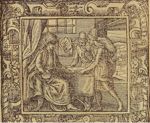
Sera parsimonia: Sambucus, Emblemata (Antwerp, 1564), emblem 70 quotes the comment
Iconclass: 51FF52:55CC1 Lateness❧Saving, Frugality, Parsimony; 'Parsimonia' (Ripa) 51FF52:54A6 Lateness❧Helpfulness 54BB3 Inutility, Noxiousness; 'Nocumento', 'Nocumento d'ogni cosa' (Ripa)
Loci Communes: Absurda, indecora, seu praepostera (Absurd, unbecoming, or preposterous things, Choses absurdes, inconvenantes ou déplacées)
V i 6 Coena popularis A dinner for the people
Quemadmodum Phormio Terentianus coenam dubiam appellat, variis epulis instru ctam, ubi tu dubites quid sumas potissimum, ita Philto Plautinus coenam popularem appellat magnificam, egregieque lautam, atque adeo gratuitam quoque, quales solent exhiberi populo. Verba Plautina sic habent: Quid tu si in aedem ad cenam veneris, atque ibi opulentus tibi par forte ut venerit, apposita sit cena, popularem quam vocant. Si illi congestae sint epulae a clientibus, &c.
Phormio, in Terence's play of that name, speaks of 'A doubtful dinner,' that is, one offering so many dishes that you are 'doubtful which one to try first.' Similarly, Plautus' character Philto applies the phrase 'A dinner for the people' to a splendid, sumptuous, and, what's more, free dinner, like those provided for the whole community. Plautus says:
Suppose you went to a temple for a dinner
And found yourself beside a wealthy man;
The banquet's served, standard of a people's dinner,
Before him lots of tasty dishes by his clients piled.
Facsimile: 
Iconclass: 51H421:41C5 Excess❧celebration meal, feast, banquet
Loci Communes: Lautitiae (Sumptuousness, luxuries, Somptuosités); Sumptuosa (Costly, sumptuous things, Choses somptueuses)
V i 7 Apud mensam verecundari neminem decet No one ought to hold back at table
Sequitur ibidem aliud proverbium quod ex tanta antiquitate per manus traditum hodieque versatur in ore omnium, Verecundari neminem apud mensam decet, Nam ibi de divinis atque humanis cernitur. Nisi quod vulgus addit, nec in lecto. Sententia est non philosophi, sed Stasini servi Comici: cum nusquam magis habenda sit verecundiae ratio, quam in lecto et in convivio. Sunt tamen, qui rustico pudore molesti sunt convivae, semper exspectantes ut ipsis praeministretur, et quod datum est reponentes. Iam hoc ipsum de divinis atque humanis cernitur, proverbiale est, quo tropo fignificabant de summa rerum agi. Dictum servo dignum, qui felicitatis puppim ac proram in ventris expletione collocarat.
Another saying occurs soon after the passage quoted above, one that has been 'Passed down from hand to hand' right from those early days and still is in common use today: 'No one ought to hold back at table, / For things human and divine are there in question.' Except that the vulgar add 'or in bed!' These are no words of a philosopher, but the words of Stasimus, a slave in comedy, for in reality bed and table are the two places where restraint needs to be exercised more than anywhere else. Though there are people who are embarrassing guests to have at a dinner because of their gauche fear of putting themselves forward, always waiting for others to offer them food and putting back what they are given. The words 'things human and divine are there in question' are also proverbial, being a figurative expression for 'matters of supreme import are involved.' This saying befits a slave who placed felicity 'Stem and stern' in filling his belly.
Facsimile:
Iconclass: 57A5 Decency, Shyness, Bashfulness 41C4 (family) meal
Loci Communes: Pudor (Shame, modesty, Pudeur)
V i 8 Salillum animae A little salt-cellarful of soul
In eadem scena Philto hominem vocat Salillum animae, sentiens hominis brevissimam esse vitam, videlicet quantulum salis cuique in convivio apponitur. Locus Plautinus sic habet: Dei divites sunt, Deos decet opulentia. Et factiones, nos homunculi sumus Salillum animae, quam cum extemplo amisimus, Aeque mendicus atque ille opulentissimus censetur ad Acherontem mortuus. Quamquam extremo senario desunt duae syllabae. Pelops censetur, aut censetur Croesus, aut aliquid simile.
In the same scene Philto speaks of man as 'A little salt-cellarful of soul,' meaning that the life of man is very brief, comparable to the small amount of salt served to each guest at a dinner. Plautus here says:
The gods are rich - wealth and social connections are for them.
But we poor mannikins are just a salt-cellarful of soul,
And the moment that has gone from us, the beggar and the millionaire
Count the same in Hell, once dead.
The last line is two syllables short - maybe read 'the millionaire Pelops' or 'the millionaire Croesus' or some such thing.
Facsimile:
Iconclass: 31D920 'Velocità della vita humana', 'Vita breve' (Ripa) 31G the soul 41C314 salt-cellar, salt-shaker 51B3:51FF5 Parity, Equality❧End; 'Fine' (Ripa)
Loci Communes: Vita hominis misera et brevis (The life of man, wretched and short, La vie de l'homme, misérable et brève)
V i 9 Nummus plumbeus A lead penny
Quemadmodum assis, obolus, ac teruncius, ita & nummus plumbeus abiit olim in vilitatis proverbium. Plautus in Trinummo: Cui si capitis res siet, nummum numquam credam plumbeum. Idem in Cassina, cui homini hodie peculi nummus non est plumbeus. Aereos nummos et hodie novit Flandria, plumbeos Anglia. At Mar. Tullius libro ad Atticum v. Vatinium semissem hominem vocat vilissimum et contemptissimum. Simul verò semissis homo contra me arma tulit. Et tressis agaso pro contemptissimo dictus est alibi. Plaut. in Mustellaria: Tace sis faber, qui cudere soles plumbeos nummos.
Like the as, the obol, and the teruncius, 'A lead penny' became proverbial for something of little value. Plautus in Three-shilling Day: 'If it were a matter of life and death, I wouldn't ever trust him with a lead penny.' Again in Casina: 'A fellow that hasn't saved a single lead penny to this day.' Coins of bronze are known even today in Flanders, and England has lead ones. Cicero, in the fifth book of his Letters to Atticus, calls Vatinius a despicable villain, 'a half-penny fellow': 'At the same time that half-penny fellow took up arms against me.' And somewhere or other we have the phrase 'a threepenny donkey man,' meaning 'contemptible.' In the Haunted House Plautus writes, 'Shut up, you coiner of leaden pennies.'
Facsimile:
Iconclass: 54BB6 Worthlessness 25D13(LEAD):46B311 minerals and metals: lead❧coin
Loci Communes: Contemptus et vilitatis (Contempt and worthlessness, Mépris et bassesse)
V i 10 Basilica facinora Right royal doings
Ante admonuimus quicquid magnificum esset appellari solere βασιλικὸν, ut valere βασιλικῶς. & magnificas aedes basilicas appellabant. Plautus in Trinummo de servo nullius rei, sed philosophica quaedam loquente: Dii inquit mortales, basilica hic quidem facinora inceptat loqui. Notum est illud Pori responsum, qui roganti Alexandro à quo fuerat bello superatus, quomodo te tracto? βασιλικῶς, inquit. Roganti, nunquid aliud? respondit, ἐν τῷ βασιλικῶς omnia comprehendi. Nihil enim humile decet reges. Duriusculum est, quod Plautus dixit in Epidico: Dii immortales ut ego perii basilice.
As I have already recorded, the adjective βασιλικὸν 'royal' was applied to anything splendid, for example, enjoying health βασιλικῶς 'fit for a king.' Also splendid buildings were called basilicae. In the Three-shilling Day, Plautus says of a slave, a worthless fellow who is nonetheless spouting some fine sentiments, 'Good heavens! Now he's got onto right royal doings!' There is a well-known story about Porus and Alexander. After he had defeated Porus in battle, Alexander asked him, 'How am I to treat you?' and Porus replied, 'Like a king.' Alexander then asked him, 'And what besides?' Porus answered that the words like a king' were all-inclusive. Kings should indeed do nothing ignoble. Plautus has a rather less natural use of the last phrase in Epidicus: 'Ye gods! I'm done for basilice "right royally!"'
Facsimile:
Iconclass: 44B113 king 59B41 Regality, Majesty; 'Maestà regia', 'Regalità' (Ripa)
Loci Communes: Arrogantia jactantiaque (Arrogance and boastfulness, Arrogance et vantardise)
V i 11 Nec caput, nec pedes Neither head nor feet
Negotium ita perturbatum, ut nescias quo pacto vel expedias, vel amittas, veteres dicebant, nec caput habere, nec pedes. Sic enim Marcus Tullius iocatur respondens suo Curioni: Sulpitii tibi operam intelligo ex tuis literis non multum opus fuisse, propter res tuas ita contractas, ut quemadmodum scribis: Nec caput, nec pedes. Equidem vellem pedes haberent, ut aliquando redires. Antea nobis dictum esst ex Platone ἀκέφαλος μῦθος. Sine capite fabula.
The ancients said that any business so involved that you don't know how to straighten it out or get rid of it had 'Neither head nor feet.' So Cicero jokingly replies to his friend Curio, 'I gather from your letter that you didn't greatly need Sulpicius' assistance, as your affairs were in such a heap that, as you yourself say, they had "Neither head nor feet." For my part, I wish they did have feet, so that you would come back one of these days.' I spoke earlier of Plato's phrase, 'A story without a head.'
V i 12 Somnum non vidit He never saw sleep
Quum somnus non videatur, sed ille potius occludat oculos, dubium non est quin proverbiali schemate dictum sit: Somnium oculis non vidit. Namhis verbis significant summam vigilantiam. M. Tullius Curio lib. viii. Epist. Ita Caninio consule, scito neminem prandisse. Nihil tamen eo consule mali factum est. Fuit enim mirifica vigilantia, qui toto suo consulatu somnum non viderit. Dicti argutia in hoc est, quòd is unum modò diem consul fuit. Proverbii ratio est in tropo.
Since sleep is not seen but in fact closes the eyes, it is quite obvious that we have one of those proverbial figures of speech in the words 'He never set eyes on sleep,' which express the idea of supreme vigilance. Cicero, writing to Curius in the eighth book of Letters to Friends, says, 'You can take it from me that during Caninius' consulship not a single person ever had lunch. Nor were any crimes committed while he was consul. He was in fact wonderfully vigilant, as he never saw sleep during his whole period of office.' The point of the joke is that he was consul only for one day. Sayings depend on the use of figures.
V i 13 Manum ad os apponere Put one's fingers to one's lips
Hoc gestu significamus nos scire quippiam, quod tamen nolimus effari. Caelius Cicero ni lib. viii. At Domitius quum manus ad os apposuit, te ad ix. Calend. Iunii subrostrarii quod illorum capiti sit dissiparant perisse.
This gesture is a sign that we know something that we don't want to noise abroad. Caelius, writing to Cicero in book 8 of the Letters to Friends: 'But when Domitius put his fingers to his lips, the loafers in the forum, on their own heads be it, had spread it abroad that you had perished on May 24th.'
Facsimile: 
In silentium: Whitney, A choice of emblemes (Leiden, 1586), emblem 66 uses the adage's imagery
In silentium: Alciatus, Emblemata (Leiden, 1591), emblem 11 uses the adage's imagery
Man muss eher hören und sehen als reden: Mitelli, Proverbii verificati (Augsburg, 1718), emblem 4 uses the adage's imagery
Wo das Gold redet, schweigen die Zungen: Mitelli, Proverbii verificati (Augsburg, 1718), emblem 13 uses the adage's imagery
Nihil silentio utilius ad servandas amicitias: Moralia Horatiana (Amsterdam, 1656), emblem 28 uses the adage's imagery
Noce esse locutum: Vaenius, Amorum emblemata (Antwerp, 1608), emblem 36 uses the adage's imagery
Iconclass: 31B623591 putting a finger to the lips, 'Silentium'; 'Silentio' (Ripa) 52DD3 Taciturnity; 'Secretezza', 'Secretezza overo Taciturnità' (Ripa)
Loci Communes: Potentes (The powerful, Les puissants)
V i 14 Emendus cui imperes If you want to give orders, you must buy a slave
Cuique in suos servos imperiosum esse licet, in alienos aut in liberos non item. Ita Plautinus Stasinus in Trinnummo hero imperiosius revocanti, quem herum esse nesciebat, aut scire dissimulabat: Emere, inquit; melius est cui imperes. Item in Persa: Emere oportet quem tibi obedire velis. Huc pertinet illud Theocritum quod alibi recensuimus, non sum sollicita ne mihi vacuam abstergeas. Mulier indigne fert obiurgari ab illo, cui non erat ancilla nec uxor. Addit et illud surakousi/ais2 e)pita/sseis2, id est, Syracusanis mulieribus imperas, hoc est, non tuis, sed liberis.
Anyone may lord it over his own slaves, but not over anyone else's, nor over free men. So Stasimus in Plautus' play, the Three-shilling Day, says to his master who is imperiously telling him to come back (either because he doesn't know it is his master or is pretending not to know), 'You'd better buy someone to give orders to.' Again, in the Persian: 'You need to buy someone if you want him to obey you.' A line in Theocritus which I discussed earlier is relevant here: 'I'm not bothered. Don't you level off what is empty!' The woman is taking exception to being reprimanded by a man to whom she is neither maidservant nor wife. She also says, 'You're telling Syracusan women what to do,' that is, not women you have any rights over, but free women.
Facsimile:
Iconclass: 46A181 slave-trade 53C2 Command
Loci Communes: Libertas, veritas (Freedom, truth, Liberté, vérité)
V i 15 Omnium quos sol videt Of all whom the sun beholds
Sunt & illae figurae proverbiales, omnium quos terra sustinet, aut quos sol vidit pessimus optimúsve. Plaut. in Sticho: Facile invenies & peiorem et peius moratam pater quàm illa fuit, meliorem neque tu reperies, neque vidit sol. Idem in Bacchid. Quia aedepol certo scio Vulcanus, luna, sol, dies, dii quatuor Scelestiorem nullum illuxere alterum. Vergilius, Sol qui terrarum flammis opera omnia lustras. Unde & oculus mundi dictus est. Simile est illus. Quodcunque in solum venit. M. Tullius Epistola, fam, lib. ix. epist. ultima. Convivio delector, ibi loquor, quicquid in solum ut dicitur, & gemitum et risus. Sentit se in convivio de quibuislibet rebus loqui, seu laetis seu tristibus. Citatum est nobis hoc adagium in superioribus ex primo libro De natura deorum, sed hic locus tum non occurrebat, qui tamen ad proverbii fidem pertinere visus est. Plaut. in Poenulo, Quantum hominum terra sustinet sacerrimo.
Here are some other proverbial figures of speech: 'Of all the earth supports' or 'Of all the sun beholds, the worst or the best.' Plautus in Stichus:
You'll soon find a woman worse than she was, father,
And with not so nice a nature. A better one
You'll never find; the sun doesn't look upon her like.
Again, in the Bacchis Sisters:
I know this for sure,
Vulcan, Moon, Sun, Day, the Four Gods,
Never shone down on a greater villain.
Virgil: 'O sun, that lightest with thy flames all the works of earth.' Hence the sun is called 'the eye of the world.' Another similar expression is 'whatever meets the foot,' for example in the last letter of book 9 of Cicero's Letters to Friends, 'I enjoy going out to dinner. There I can talk about "whatever meets the foot," as they say, tears and smiles.' Cicero is saying that over dinner he can talk about anything at all, happy or sad. I have already cited this phrase, quoting it from the first book of On the Nature of the Gods. I didn't at the time recall this second example, but it does serve to establish the words as proverbial. Plautus in the Carthaginian: 'The nastiest villain of all that walk upon the earth.'
Facsimile:
Iconclass: 51H3 Multitude 24A81 sunbeams
Loci Communes: Omnia (All things, Toutes choses)
V i 16 Sale et aceto With salt and vinegar
Parcum tenueque prandium significans Grippus piscator in Rudentibus ait, Sed hic rex cum aceto pransurus est, sine bono pulmento. Miseris, obsoniorum loco sal est cum aceto. M. Tullius ad Papirium Paetum libro nono. Tyrotarichi meminit, ceu plebei condimenti. Id erat ius e caseo confectum, quod et hodie Itali vocant menestram. Meminit & Pompili piscis vilissimi, qualis erat et gobio. Quem inquit, tu mihi Pompilum, quem denarium narras, quam Tyrotarichi patinam? De Pompilo pisce crebra est apud Plinium mentio. Denarium suspicamur esse vocem depravatam. Certe nobis nondum liquet quid sibi velit. Acetum tamen nonnunquevam usurpatur in significationem acuminis, ut Platus: Acetum habet in pectore et Persius: Mordaci lotus aceto. Varro in Sesquiulyxe citante Nonio, Alteram viam deformasse Carneadem virtutis, a cupis acris aceti, hoc est, magna subtilitate.
A thrifty, meagre lunch is being described by the fisherman Gripus in the Rope, when he says, 'My lord will have his lunch flavoured with vinegar and with salt, not a piece of something tasty.' Poor people have salt and vinegar in place of something more substantial. Cicero, writing to Papirius Paetus in book 9 of his Letters to Friends, makes mention of something called tyrotarichus, apparently a cheap and popular savoury dish. It was a broth made with cheese, a dish still found in Italy today under the name 'menestra.' Cicero also mentions there the pilot-fish, a coarse species like the gudgeon. What he says is 'What's all this about a pilot-fish, about a shilling, about a dish of tyrotarichus?' Pliny often mentions the pilot-fish. I suspect that denarius, the word for 'shilling' in the Cicero passage, is corrupt. Certainly I don't as yet see what it means. 'Vinegar' is quite often used in the sense of 'sharpness' or 'shrewdness,' as for example in the phrase from Plautus, 'vinegar in his bosom,' or in Persius, 'well-washed with biting vinegar.' Nonius cites lines from Varro's Better than Ulysses: 'Carneades mapped out another road to virtue, drawing on "tubs of sharp vinegar."' He means 'with great subtlety.'
Facsimile:
Iconclass: 41C672 vinegar 41C661 salt
Loci Communes: Bonae fortunae, copiae, felicitatis aut ominis (Of good fortune, abundance, happiness, or omen, Bonne fortune, abondance, bonheur ou présage)
V i 17 Cassa glande An empty acorn
Inter vilitatis adagia retulimus & illud, Cassa nuce non emam. Similimo tropo Plaut. in Rudentibus dixit cassam glandem: Promittens indicium quaerit pretium, Alter licitatur, nummos trecentos. Grippus respondet, tricas. Lab. Quadringentos. Gr. Tramas putidas. Lab. Quingentos. Gr. Cassam glandem. Lab. Sexcentos. Gr. Curculiunculos minutos fabulare. Cassam glandem dixit, pro vitiosa glande, & inani putamine.
Along with various other examples of phrases meaning 'of little worth' I have already quoted 'I wouldn't buy it for a rotten nut.' Plautus used a similar figurative expression, 'An empty acorn,' in the Rope. Here the character Gripus is offering information for money. Labrax offers thirty pounds. Gripus: 'Rubbish!' Labrax: 'Forty.' Gripus: 'Stuff and nonsense!' Labrax: 'Fifty.' Gripus: 'Empty acorns!' Labrax: 'Sixty.' Gripus: 'Squiggly wrigglies!' An empty acorn is rotten, just an empty shell with nothing inside.
Facsimile:
Iconclass: 51II2:25G21(ACORN) Emptiness, Void❧fruits: acorn
Loci Communes: Contemptus et vilitatis (Contempt and worthlessness, Mépris et bassesse)
V i 18 Vervecea statua A sheep-brained piece of statuary
Plautinus Egio in Captivi duo, servum stupidum appellat statuam verneceam, quasi dicas, brutum ac mutum hominem: Vos, inquit, ite intro, interim ego ex hac statua veruecea volo rogitare, meo minore quid sit factum filio. Quidam pro veruecea legunt verberea, quasi verberonem plagis assuetum pro statua marmorea dixerit verbeream. Certe dictionem verueceam non patitur carminis trochaici ratio: superesset enim una syllaba, nisi incea, facias synaeresim.
A sheep-brained piece of statuary Hegio, in Plautus' play the Two Captives, calls a stupid slave 'A sheepbrained piece of statuary,' that is, a brutish tongue-tied fellow. He says, 'You two go inside. Meantime I'll question this sheep-brained piece of statuary / And find out what happened to my younger son.' Some people read here not vervecea 'sheep-brained,' but verberea, so that Plautus wrote 'whippingblock' instead of 'marble-block,' that is, a rascal constantly getting flogged. Certainly the form vervecea disturbs the trochaic rhythm, as there is an extra syllable, unless one reads -cea with the two vowels contracted into one syllable by synaeresis.
Facsimile:
Iconclass: 47I213(+9331) sheep (+ skull of an animal) 52AA1 Stupidity, Poverty of Intellect; 'Stupidità overo Stolidità' (Ripa)
Loci Communes: Multi - in stupidos (Many people - against the stupid, Beaucoup de gens - contre les sots)
V i 19 Hoc age Attend to the business in hand
Quum aliquem iubemus esse attentum, dicimus, hic esto, aut, hoc age. Audivit Caligula Imperator ab iis qui venarant illum interfecturi, hoc age. Et Plautus in eadem fabula, Hoc agamus.
When we bid someone pay attention, we say, 'Be right here' or 'Attend to the business in hand.' The Emperor Caligula heard those who had come to assassinate him say 'Attend to the business.' Plautus in the same play uses a plural version, 'Let's attend to business.'
Facsimile:
Iconclass: 52A11 Attention, Concentration
Loci Communes: Attentio et contra (Attention and its opposite, Attention et son contraire)
V i 20 Quam in tragoedia Comici Comic characters in a tragedy
Ubi quis in aliena versatur harena, inducti dicentur in tragoediam Comici. Diversi generis sunt Tragoedia et Comoedia, nec fas est tragicas persovas in comoediam induce re, nec contra. Plautus in Poenulo: Quin aedepol indoctior sum quam in tragoedia Comici. Nos legendum arbitramut in ductior sum. Allusit enim Colabiscus ad id, quod dixerat Milphie: Fac modo ut conducta tibi sint dicta ad hanc fallaciam. Respondit iocans: Inductior sum, idest, instructior sum.
'Comic characters brought on in a tragedy.' We can use this phrase when someone is operating in a field not his own. Tragedy and comedy are very different genres, and it is not allowed to bring on tragic characters in comedy, or vice versa. In Plautus' play the Carthaginian we have a line 'Why, to be sure, I'm less well trained than comic characters in a tragedy.' The word in the text here is indoctior 'more untrained,' but in my opinion we should read inductior 'brought on more.' Colabiscus' words picked up what Milphio had just said: 'Now you just make sure that you've got some words conducta "brought in" to suit this bit of trickery.' Colabiscus jokingly retorts, 'Actually I'm inductior "more brought on,"' in other words 'I'm better rehearsed.'
Facsimile: 
Iconclass: 48C8546(+1) comedy (+ artist at work) 48C8545 tragedy
Loci Communes: Aliena a re (Irrelevant to the matter, Étranger au sujet)
V i 21 Non magis quam canem No more than a dog
Odium & contemptum vulgo declarant canis vocabulo. Hor. Odit cane peius. Et Plautus in Amphytrione: Valuistin' usque? Exspectatus advenio? Sos. Haud vidi magis. Expectatum eum salutat haud quisquam magis quam canem. Sic enim legendum opinamur, ut constet ratio carminis trochaici, tetrametri, catalectici.
The word 'dog' is used in common speech to indicate hatred and contempt. Horace says, 'He hates worse than a dog.' Plautus in Amphitryo:
amphitryo: Have you kept well? Are you pleased to see me back?
sosia: Never saw anyone more welcome!
No one's any more pleased to see him back than to see a dog!
I think we need this reading to fit the metre, which is trochaic tetrameter catalectic.
Facsimile:
Iconclass: 34B11 dog 57BB21 Contempt
Loci Communes: Contemptus et vilitatis (Contempt and worthlessness, Mépris et bassesse); Odium (Hatred, Haine)
V i 22 Gralatorius aut testudineus gradus Stilt-walk or tortoise walk
Plautus in Amphytrione: Blep. Non potuimus nostros grandius grandire gradus. Amphi. Sive gralatorius, sive testudineus fuerit, certum est mihi hunc scelestum perdere. Item in Poenulo: Vinceretis cervum cursu, gralatorem gradu. Gralae dicuntur fustes quibus innixi quidam ingrediuntur, quos gralatores appellavit antiquitas. Graecis καλοβάται dicuntur, quemadmodum schoenobatae vocantur funambuli. Ii fustes quo sunt longiores a gradu, cui pes innititur, hoc gradus sunt maiores. Tantum elicere licuit, e corruptissimo loco apud Nonium, praesertim in editione Aldina. Idem Plautus in Menaechmis: Atque eccum incedit, move formicinum gradum. Formicae videntur currere, cum minimum promoveant. Rursus in Poenulo: Vicistis cochleam tarditudine. In eadem tardos appellat spissigradissimos, et tardiores quam sint cotbitae in tranquillo mari. Rursus talium gradum dicit esse succretum cribro pollinario, quòd simila perangustia foramina, paulatim defluat.
Plautus in Amphitryo:
blepharo: We couldn't stride our steps out with a bigger stretch.
amphitryo: Whether it was 'Stilt-walk or tortoise walk,' I'm sure we've
lost the villain.
Plautus again, in the Carthaginian: 'You'd have outrun a stag, outstepped a stilt-walker.' Gralae 'stilts' are poles on which it is possible to prop oneself up and walk. The Latin name for stilt-walkers was gralatores. The Greeks called them καλοβάται, just as tight-rope walkers are called 'schoenobatae'. The higher the foot-rest on the stilt is from the ground, the bigger the step that can be taken. So much can be deduced from a Nonius passage which is very corrupt, especially in the Aldine edition. Plautus again, writing in the Two Menaechmuses: 'Just look at him tripping along! Get that ant's pace of yours moving!' Ants appear to be scuttling along without making much progress. Plautus, in the Carthaginian again: 'You beat a snail in a slow-race.' In the same play, he calls people who come slowly 'sticky-footed, slower than cargo-boats in a dead calm.' Then he says their steps must have been passed through a flour-sieve - because the flour trickles slowly through the tiny holes.
Facsimile:
Iconclass: 43C725 (walking on) stilts 46C1261 stilts 25F44(+5211) tortoises, turtles (+ walking animal)
Loci Communes: Tarditatis et cunctationis (Slowness and delay, Lenteur et retard)
V i 23 Daedaleum remigium Oarage of Daedalus
Ad celeritatem significandum Plautus in Amphytrione dixit, remigiis Daedaleis, pro volatu. Non ocius quivi si Daedaleis me tulissem remigiis.
To indicate speed, Plautus in Amphitryo uses the phrase 'By oarage of Daedalus/ meaning 'flying': 'I couldn't have done it quicker if I'd brought myself by oarage of Daedalus.'
Facsimile:
Iconclass: 51M11 Swiftness, Speed; 'Agilità', 'Celerità', 'Velocità' (Ripa) 46C2323(+0) oaring, sculling (+ variant) 95A(ICARUS)51 the flight of Daedalus and Icarus
Loci Communes: Festinatio praepropera (Overhasty haste, Précipitation excessive); Servitus (Slavery, Servitude)
V i 24 Argentum accepi, dote imperium vendidi I took the money, sold my authority
NIhil hac sententia decantatius: qui accipit beneficium perdit libertatem. Demaenetus eleganter expressit in Asinaria: Argentum accepi, dote imperium vendidi. Nam pauper uxorem duxerat pulchre dotatam, sed in quam nihil haberet imperii. Talis inducitur et Nausistrata in Phormione Terentiana.
There is nothing more frequently trotted out than this saying: 'Accept a favour and lose your liberty.' Demaenetus puts it neatly in the Comedy of Asses: 'I took the money and for a dowry sold my authority.' He was poor and had married a wife with a large dowry, but found he had no authority over her. Nausistrata in Terence's play Phormio is just such another wife.
Facsimile:
Iconclass: 46B911 bribery 55AA1:51E11 Loss❧Freedom, Liberty; 'Libertà' (Ripa)
Loci Communes: Munerum corruptela (Corruption by gifts, Corruption par les présents); Servitus (Slavery, Servitude)
V i 25 Despuere malum Spit away the evil
Manet & hodie in vulgi moribus, ut si quid audiant exsecrandum, quod sibi nolint evenire, despuant velut abominantes. Id autem haesit ex veterum superstitione, qui sibi persuaserant desputationem esse remedium adversus imminentia mala, praecipue adversus morbum comitialem: cui non hinc tantum est nomen inditum, quod in hominum frequentia saepius oboriatur, verum etiam quod prohibeat comitia fieri, et in admovendis remediis ter expuere habebatur salutare. Velut etia adversus incantationes, ut refert Plinius. Simili superstitione contra improbae spei fascinum, ter in sinum expuebant. Plautus: Et illic isti qui sputatur morbus venit, cui respondetur, Ain' verbero mihi eum morbum esse, qui me opus sit insputarier? Hic rursus alter. Ne verere, multos illic morbus homines macerat, quibus insputari saluti fuit, atque illis profuit. Idem in Amphytrione: Teque obsecro hercle ut quae locutus despuas.
Even today it is a popular custom for people to spit to avert the evil omen if they hear of something dreadful that they don't want to happen to themselves. This is a survival of an ancient superstition whereby people believed that spitting was a protection against looming evils, especially against the 'assembly disease,' so called not only because attacks are more likely to occur in crowded places, but because it caused the assembly to be abandoned. Also in the application of remedies, it was thought that spitting three times increased their effectiveness, and it could also counteract spells, according to Pliny, and the same superstitious belief led people to spit three times in their own bosom to avert the mischief attracted by overweening hopes. We have a section in a play of Plautus that goes as follows:
And he suffers attacks of that disease, the one that gets spat on.
You wretch! So I've got that disease that means I need to be spat on?
Never mind! Many a man's tormented by that disease, and spitting
Has helped him back to health.
Plautus again in Amphitryo: 'Please, for heaven's sake, spit away the words you spoke!'
Facsimile:
Iconclass: 31A65 spitting 54E42 Protection; 'Custodia', 'Difesa contra nimici, malefici & venefici', 'Difesa contra pericoli', 'Riparo da i tradimenti' (Ripa) 51B61:49D11(3) Repetition❧numerals: 3
Loci Communes: Deprecantis, abominantis (Pleading, abhorring, Qui implore, qui abhorre)
V i 26 Χρήσει καὶ κτήσει By use and possession
Qui se totum alicuius haberi volebat, dicebat Χρήσει καὶ κτήσει., tuus sum. hoc est, & usu fructu & proprietate. Siquidem in possessionibus saepe numero fit, ut penes sit dominium, penes alium usus fructus. M. Tullio Curius libro octavo: Si vales bene est, sum enim χρήσει μὲν tuus κτήσει δὲ Attici nostri. Ergo fructus est tuus, mancipium illius. Sentit Curius se sic esse addictum Attico, ut tamen bene velit Ciceroni. Id M. Tullius velut exponens ita respondet. Et nisi haberem studiorum meorum socium Atticum nostrum, cuius quando te proprium esse scribis mancipio & nexu, meum autem usu & fructu, contentus isto sum. id enim cuiusque est proprium quo quisque fruitur atque utitur. M. Tullius ludens cum Iureconsulto, ostendit proprietatem bifariam constare, mancipio & nexu. Nec hoc ius desiderat, modo liceat uti frui. propterea quòd quandiu manet ius utendi fruendi, perinde est ac si res sit propria.
Anyone who wanted to express the idea of belonging wholly to someone, could say, 'I am yours Χρήσει καὶ κτήσει,' that is, 'By both usufruct and ownership.' With regard to possessions, it is often the case that ownership rests with one person, the usufruct with another. Curius, writing to Cicero in book 8 of his Letters to Friends, says, 'I hope you are in good health, for I am yours by usufruct, by ownership I belong to our friend Atticus. So the enjoyment is yours, the ownership his.' Curius means that he is bound to Atticus without being any the less well-disposed to Cicero. Cicero's reply expands on this: '... if I didn't have our dear Atticus as a companion in my studies. When you write that you belong to him by bondage and debtslavery, to me by use and enjoyment, I am content with that, for what someone uses and enjoys is his.' Cicero's joke with the lawyer shows that ownership could be established in two ways, by bondage and by debtslavery, but he does not want that kind of right so long as he has use and enjoyment, because as long as the right of use and enjoyment exists, it is as if the thing were one's own.
V i 27 Ferire frontem Beat one's brow
Qui supra modum & impotenter indignantur, frontem ferire dicuntur. M. Tullius ad Atticum epist. 1. Puto te in hoc aut risisse aut ingemuisse. ut frontem ferias, sunt qui etiam Caesonium putant, &c. Quae prius dixerat, iudicabat esse digna, vel risu vel gemitu, caeterum de Caesonio tam esse indignum, ut Atticus frontem ferire debeat. Qui hoc negant esse proverbium, eadem opera negent esse proverbium, Perfricare frontem, & Premere pollicem, & alia complura quae à gestu corporum ducta sunt.
Anyone who is thoroughly exasperated and angry is said 'To beat his brow.' Cicero, in his first letter to Atticus, writes, 'I imagine all that will make you laugh or groan. To make you beat your brow, some people think Caesonius too will stand .. . He considered what he had just written fit to raise a laugh or groan, but his news about Caesonius was so unacceptable that Atticus ought 'To beat his brow.' Anyone who thinks this isn't a proverb will have to reject 'To wipe off your blushes' and 'Thumbs down' and many other sayings referring to physical gestures.
Facsimile: 
Iconclass: 31A2533:31A22111(BROW) hand towards the forehead❧parts of the face (BROW) 56E2 Rage, Anger
Loci Communes: Molesti intolerabiles (Unbearable, troublesome people, Gens insupportables)
V i 28 Virtutem omnem explica Lay out all your powers
Eodem libro usurpat Homericum carmen, ut vulgo celebre, παντοίης ἄρετῆς μιμνήσκεο, Curáque & effice, ut ab omnibus & laudemur & amemur. Carmen ita reddi potest: Omnijugae tibi virtutis succurrat imago. id est, In hoc negotio expedi omnes vires, omnesque ingenii nervos.
In a letter from the same book he quotes a very well-known line from Homer: παντοίης ἄρετῆς μιμνήσκεο, and do all you can to ensure that I am generally popular and approved of.' The Greek may be translated as 'Bring now to mind every power of which you are possessed,' in other words, Tn this matter exert all your strength, strain every mental nerve.'
Facsimile:
Iconclass: 54A11 Industriousness, Assiduity; 'Assiduità', 'Industria', 'Zelo' (Ripa) 51A7 Perfection, Completeness; 'Perfettione', 'Operatione perfetta' (Ripa)
Loci Communes: Conatus (Effort, endeavor, Effort)
V i 29 Clemens lanista A soft-hearted manager of gladiators
Antea commemoravimus Graecum proverbium, εὔνους σφάκτης. id est, benevolus mactator. huic simillimum quod habet M. Tullius epistola ad Atticum lib. primo, (epistolae initium est, Quaeris ex me) lanista clemens. Nam ut reiectio facta est clamoribus maximis, quum accusator unquam censor bonus homines nequissimos reiiceret, reus tanquam clemens lanista frugalissimum quenque secernit, ut primum iudices consederunt, valde dissidere boni coeperunt.
I have already recorded the Greek proverb εὔνους σφάκτης. 'A well-wishing murderer.' Very similar to this is the phrase 'A soft-hearted manager of gladiators,' used by Cicero when writing to Atticus in the letter in book 1 that begins 'You ask ...':
After the challenging of the jury had taken place amidst a great deal of up-
roar, with the prosecuting counsel, like a good censor, rejecting those of bad
character, and the defendant, like a soft-hearted manager of gladiators, set-
ting aside the respectable, when the jury took their places, decent men began
to feel very apprehensive.
Facsimile:
Iconclass: 43C3961(+0) fight of gladiators (+ variant) 56EE2 Meekness; 'Mansuetudine' (Ripa) 57A77 Friendliness, Gentleness, Affability; 'Affabilità, piacevolezza, amabilità', 'Animo piacevole, trattabile & amorevole', 'Benignità' (Ripa) 48C821(+0) director, producer ~ the stage (+ variant)
V i 30 Praepostere Back to front
Quum sentiemus rem praepostere geri, veluti quum populus imperat principibus, aut discipulus docet praeceptorem, conveniet illud M. Tul. ex eadem epist. Ego, inquit, respondebo tibi ὕστερον πρότερον ὁμηρικῶς. Est autem figura grammaticorum, quam illi & πρωθύστερον, sive ὑστερόπρωτον appellant, quum quod prius est natura, posterius refertur. veluti si quis dicat: Cornelia Gracchos educavit ac genuit. In Homero talis tropus frequenter est obvius
When we think something is 'Back to front,' like the people telling the rulers what to do, or students instructing their teachers, it will be appropriate to use Cicero's words in this same letter: 'I will answer your questions Homeric fashion, ὕστερον πρότερον ὁμηρικῶς.' This is a figure of style that the grammarians call πρωθύστερον 'hindmost foremost' or ὑστερόπρωτον 'latter first,' in which what naturally comes first is put second, for example 'Cornelia brought up the Gracchi and brought them into the world.' This figure occurs frequently in Homer.
Facsimile:
Iconclass: 51D1 Order, Arrangement, Organization 51DD1 Disorder, Confusion, Derangement, Disorganization, Chaos 51LL2 Irregular Motion 29A1 'mundus inversus', the reversed world, the topsy-turvy world, 'le monde bestourné'
Loci Communes: Absurda, indecora, seu praepostera (Absurd, unbecoming, or preposterous things, Choses absurdes, inconvenantes ou déplacées)
V i 31 Concessis in Talario ludo A music-hall assembly
Nec proverbii specie caret quod habetur in eadem epistola, Confessus talarius, pro conventu hominum parum honoratorum. Nam confessus Graecè συνέδριον, proprie dicitur Senatus, aut iudicium, qui solent ex honestissimis deligi. In confessu talario qui nequissimus est, primas tenet. verba Ciceronis sunt haec: Non enim unquam turpior in ludo talario consessus fuit, maculosi senatores, nudi equites, Tribuni non tam aerarii quàm ut appellantur aerati: pauci tamen boni inerant, &c. Quanquàm & is iocus est proverbialis, quod ait illos vulgo appellari solere pro tribunis aerariis, tribunos aeratos, hoc est obaeratos, aut certe bene nummatos peculatu.
The same letter contains another phrase that looks proverbial, 'A musichall assembly,' referring to a gathering of persons of not very reputable character. Consessus 'assembly,' συνέδριον in Greek, is properly used for a session of senators or jurymen, who are usually selected from men of good standing. In a music-hall assembly the most disreputable takes the leading role. Cicero says:
There was never a more disgraceful 'Assembly in a music-hall' - senators under a cloud, knights who had lost their status, treasury tribunes who are not so much paying-out officers as paying-in officers, as people are calling them. There were however a few honest men ...
This last joke can also be called proverbial as Cicero says these men were popularly called not 'paying-out' officers, but 'paying-in' officers. In other words, they were in debt; or else they had paid themselves well out of the public purse.
V i 32 Contrahere vela Take in one's sails
In eadem epistola dixit contrahere vela, pro eo, quod est reprimere sese, & cautius agere. Contraxi, inquit, vela perspiciens inopiam iudicum, neque dixi quicquam pro testimonio, nisi quod erat ita notum atque testatum, ut non possem praeterire. Itidem Horatius, Et idem Contrahes vento nimium secundo Turgida vela. Sumptum est a nautis, qui vehementius spirante vento vela contrahunt, quo tutius navigent, vento languidiore pandunt, captantes auram.
In the same letter, Cicero uses the phrase 'Take in one's sails,' meaning 'check oneself, go carefully.' 'I took in my sails,' he says, 'when I realized the financial straits of the jurymen, and I didn't say anything in my testimony that was not already so well known and sworn to that I couldn't leave it out.' Horace says something similar:
But also
Draw in, when favouring winds too strongly blow,
Your billowing canvas.
The metaphor is derived from sailors, who take in the sails when the wind blows too strongly, so as to avoid danger; and when it drops, they spread the sails to catch the breeze.
Facsimile:
Iconclass: 51AA4:46C24111 Nothingness, Absence❧sail 26C3 storm
Loci Communes: Modestia modusque (Modesty and moderation, Modestie et mesure)
V i 33 Εσπετε νῦν μοι Tell out now
In eadem carmen Homericum festivissime usurpat ad continuationem narrationis: Εσπετε νῦν μοι μοῦσαι ὅπως δὴ πρῶτον ἔπεσθε id est, Dicite nunc Musae, dixistis quippe priora. In commemoratione rerum ridicularum habebit gratiam. in Aldina editione, hemistichium modo refertur, ἕσπετε νῦν μοι μοῦσαι. Neque enim semel habetur apud Homerum, licet finis non sit idem, velut illud ἕσπετε νῦν μοι μοῦσαι ὀλύμπια δώματ᾽ ἔχοντες. Iliad. ii.
In the same letter, Cicero continues his narrative of events with an amusing quotation from Homer: 'Tell out now, ye Muses, as you told what went before.' This will be nice to use when relating some laughable incident. In the Aldine edition, only the first half of the line is quoted: 'Tell out now, ye Muses.' This half-line occurs more than once in Homer, with variants in the second half, for example, 'Tell out now, ye Muses, that dwell on Olympus' heights,' from book 2.
Facsimile:
Iconclass: 54D31 Continuance 33A341 story teller; listening to story teller
Loci Communes: Magnifica promissa (Magnificent promises, Promesses magnifiques)
V i 34 In dierectum Get crucified
Quibus precamur exitium, eos iubemus ire in malam crucem, ad coruos, ad cynosarges: pro eodem prisci dixerunt in dierectum, quod illi dierectos appellarent in crucem suffixos. Nonius citat ex Varrone, Apage in dierectum a domo nostra istam insanitatem. Dierectos dici putat quasi in diem erectos. Fortasse scriptum erat in dium erectos, quod qui crucifiguntur, sub dium exponuntur. Praesertim cum addat, a domo nostra Sub dium rapiun tur, quae domo efferuntur. Insanitatem aute pro insania dixit M. Tullius, ne quis mendum suspicetur.
We tell someone to whom we wish ill to 'go and be hanged' or to 'be off to the crows' or 'to Cynosarges.' The early Romans said, 'Go and get crucified,' using a word dierectus, which means 'crucified.' Nonius cites a line from Varro: 'Get that madness out of our house in dierectum "and onto a cross."' Nonius thinks the word dierectus means 'erected into the day,' (that is, in diem erectus). Perhaps Nonius really wrote in dium erectos 'erected under the open sky,' as those who are crucified are displayed in the open, especially as Varro adds, 'out of our house.' Anything carried out of the house is taken into the open. Varro's word for madness here, insanitas, not insania, is supported by Cicero's use of it, so there is no need to suspect a corruption.
V i 35 Mittere sanguinem Letting blood
Olim militibus, si quid gravius deliquissent, ignominiae causa incidebatur vena. id appellabant sanguinem mittere. M. Tul. in eadem Epist. Missus est sanguis invidiae sine dolore. Sentit se liberatum aliqua parte invidiae, quod in eo iudicio non valuisset ipsius testimonium, idque citra dolorem suum, quod omnes scirent iudices fuisse corruptos. Idem lib. vi. epistola 1. Sic Appius quum ex ἀφαιρέσεως provinciam curarit, sanguinem miserit, quicquid potuit detraxerit, mihi tradiderit enectam, &c. Quin hoc ipsum ex ἀφαιρέσεως curare, παροιμιῶδες est in hominem furacem ac rapacem. Metaphora sumpta est à medicis qui in certis morbis corpus inaniunt, ineddia aut venarum incisione superflua detrahentes.
At one time, soldiers who were guilty of a grave misdemeanour had a vein opened to humiliate them. This was called 'Letting blood.' Cicero, in the same letter as above: 'The vein of ill-will was opened without any pain.' He means that his unpopularity was diminished to some extent, because the evidence he produced at the trial had carried no weight, and that this happened without any grief on his part, because everybody knew the jury had been bribed. Again, in the first letter in book 6: 'Appius had treated the province by means of reduction, let blood, removed whatever he could, handed it over to me at the point of death .. .' The phrase 'treated by means of reduction' is a kind of saying, as it is here used of a greedy rapacious man. It is a metaphor derived from doctors, who in certain conditions empty the body, removing superfluous matter, either by a regime of fasting or by blood-letting.
Facsimile: 
Iconclass: 31EE2364(+0) violent death by opening of arteries - EE - death not certain; wounded person (+ variant) 49G341(+0) bleeding, blood-letting with the aid of blood-suckers (+ variant) 57BB24 Humiliation
Loci Communes: Multi - in stupidos (Many people - against the stupid, Beaucoup de gens - contre les sots)
V i 36 Faba nummus Bean-currency
Dictum est aliàs olim fabis ferri solita suffragia, quod innuisse Pythagoram existimant, quum vetaret edere fabas. Corrupta itaque suffragia lepidissimo tropo significavit M. Tullius in eadem Epistola. Sed heus tu, vidésne consulatum illum nostrum, quem Curio ante ἀποθέωσιν vocabat, si hic factus erit, fabam nummum futurum? Haec ille. Ubi faba nummus est, ibi redemptum est suffragium.
I have said elsewhere that at one time votes were cast using beans, and Pythagoras is thought to have had this in mind when he forbade the eating of beans. So in the following passage, Cicero is referring to electoral corruption in a witty metaphorical way: 'But mark you! If he's elected, our consulship, which Curio used to call a positive apotheosis, will become beancurrency.' Where beans become money, there votes have been bought.
Facsimile:
Iconclass: 25G21(BEANS) fruits: beans 44C23 voting, election 46B310 'Pecunia' (Ripa) 46B911 bribery 59CC221 Corruptibility, Venality, Corruption
Loci Communes: Munerum corruptela (Corruption by gifts, Corruption par les présents)
V i 37 Nihil est, aut nihil cura est He is nothing, or cares for nothing
Idem eodem libro, Epistola cuius initium, Quum è Pompeiano, versiculum Rhintonis ut vulgo iactatum refert: Illud tamen, inquit, velim existimes, me hanc viam optimatum post Catuli mortem, nec praesidio ullo, nec comitatu tenere. Nam ita ait Rhinton ut opinor, Οἱ μὲν παρ᾽ οὐδὲν εἰσίν, οἷς δ᾽ οὐδὲν μέλει. id est, Nihili quidem hi sunt, caeteris curae est nihil. Sentit se non uti praesidiis magnatum, quod partim nihil possint, partim negligant res.
In the same book of letters, in the one beginning 'After I got back from my place near Pompeii,' Cicero quotes an obviously well-known line of Rhinthon: 'I would have you know/ he writes, 'that since the death of Catulus I maintain this optimate road with no protection and no support. As Rhinthon, I think, says, "These are nothing, the others care for nothing."' He means he is without the support of the big names, because they were either powerless or indifferent.
Facsimile:
Iconclass: 51AA4:54A6 Nothingness, Absence❧Helpfulness
Loci Communes: Contemptus et vilitatis (Contempt and worthlessness, Mépris et bassesse)
V i 38 E terra spectare naufragium View the shipwreck from the shore
Aliàs nobis dictum est, de muris iudicare Achivos, pro eo quod est in tuto spectare aliorum pericula. Idem alia metaphora festivius extulit M. Tullius lib. ad Atticum ii. Epist. De geographia. Nunc vero quum cogar exire de navi, non abiectis sed ereptis gubernaculis, cupio istorum naufragia ex terra intueri, cupio ut ait tuus amicus Sophocles, Κᾂν ἀπὸ στεγῆς ἀκούειν εὐκηλος εὑδούσῃ φρενὶ. Quanquam hic versiculus in aliis codicibus habebatur varius, sed aeque depravatus in aliis erat omissus Videtur esse versus trochaicus catalecticus. Κᾂν ἀπὸ στεγῆς ἀκούειν εὐκηλος εὑδούσῃ φρενὶ. pro εὔκηλος, quidam codices habebant ψάκαλος, quod quid sit non intelligimus, εὔκηλος, non patitur carminis ratio. Sensus autem hic videtur esse: optat de tecto audire tumultus aliorum, ipse vacuus & quietus animo.
I wrote earlier about 'Judging the Achaeans from the tower,' that is, observing other people's danger from a safe place. Cicero with a touch of humour finds another metaphor to express this same idea. In the second book of his Letters to Atticus, the one beginning 'About the Geography,' he writes, 'Now that I am compelled to abandon ship, not taking my hand off the tiller but having it torn from my grasp, it is my intention to observe from the shore the shipwreck those people are going to make. I desire, as your friend Sophocles says, "beneath my own roof-tree to harken, free from care with mind at peace."' In some texts this fragment of Greek verse appeared in a different version, but one equally corrupt. Other texts omitted it. The line seems to be trochaic catalectic. Instead of the word εὔκηλος, 'free from care', some texts had ψάκαλος, but I do not know what this could be, εὔκηλος doesn't fit the metre. However, the sense seems to be that Cicero desires to listen from home to the commotion affecting others, himself being uninvolved and unconcerned.
Facsimile:
Iconclass: 31A31:46C291 sight, looking (one of the five senses)❧shipwreck 54D5 Safety 25H133 beach
Loci Communes: Securitatis et tutae rei (Security and safety, Sécurité et sûreté)
V i 39 Qui prior laesit The first to wound
In eodem lib. epist. Subito cum mihi dixisset, &c. usurpat versum Homericum, minitans vindictam ei qui prior lacesseret. Nam nos quidem, inquit, si per istum tuum sodalem Publium licebit, σοφιστεύειν cogitamus. Si ille cogitat tantum duntaxat nos offendere, & quod proprium est artis huius, ἐπαγγέλομαι Ανδρ᾽ ἀπαμύνεσθαι ὅς τις πρότερος χαλεπήνῃ. id est, Denuncio Ulturum me hominem quisquis prior irritarit.
In the same book of letters, in the one beginning 'When Caecilius suddenly informed me,' Cicero quotes a line from Homer, threatening vengeance on someone who was the first to pick a quarrel: 'As for myself, it is my intention, if your crony Publius will allow it, to play the sophist. If he is even thinking of upsetting me at all, I will do what goes with the sophist's stance, and I proclaim that I will "ward off any man that is the first to injure."'
Facsimile:
Iconclass: 33B14 threatening behaviour, challenging 51F3 Priority, Pre-eminence
Loci Communes: Ultio malefacti (Vengeance for a wrongdoing, Vengeance d'un méfait)
V i 40 Quod datur What you're given
Nonius Marcellus citat hunc versiculum è Caecilii Plotio, Patiere quod dant, quando optata non danunt. Danunt antique dictum est prodant. Convenit cum eo quod alibi retulimus ex Cicerone, τὰ μὲν διδόμενα, & huic similibus.
Nonius Marcellus cites this verse from Caecilius' Plocium: 'Put up with what they give, as they don't give what you want.' The line in Latin contains the form danunt, an old form for dant 'they give.' This sentiment agrees with something I cited from Cicero earlier: 'Make the best of what you've got,' and other similar phrases.
Facsimile:
Iconclass: 56B3 Satisfaction, Contentment; 'Contento' (Ripa)
Loci Communes: Proximis utendum (One must make use of one's neighbors, Il faut se servir de son prochain)
V i 41 Chimaera A chimaera
Hominem inconstantem ac variis moribus, aut opus sibi non cohaerens, M. Tullius designat festiviter illo versu Homerico, Quod de Qu. inquit, fratris Epistola scribis, ad me quoque fuit, Πρόσθε λέων, ὅπιθεν δὲ δράκων, μέσση δὲ χιμαίρα Quid dicam nescio, nam ita deplorat primis versibus mansionem suam, ut quemvis movere possit: ita rursus remittit, ut me roget, ut annales suos emendem atque edam. Epistolam sibi inaequalem appellat Chimaeram.
Cicero humorously denotes an inconstant man of unpredictable behaviour or a work that does not hold together with a line from Homer: 'As to what you write about brother Quintus' letter, I too found it "forepart lion, behind a dragon, in between a chimaera." I don't know what to make of it. The first few lines he spends complaining so forcefully about having to stay out there that anyone would feel sorry for him. Then he slackens off and asks me to edit his Annals and get them published.' Cicero calls this inconsistent letter 'A chimaera.'
Facsimile:
Iconclass: 25FF232 chimera (lion/goat/snake); 'Chimera' (Ripa) 92I74912 Chimera 51EE4 Incoherence 52DD2 Unclarity, Imprecision 51BB4 Multiformity, Variety
Loci Communes: Inconstantiae, perfidiae, versutiae (Inconstancy, treachery, cunning, Inconstance, perfidie, ruse)
V i 42 Nihil dulcius quam omnia scire Nothing nicer than being in the know
M. Tul. ad Att. lib. iiii. epist. Delectarunt me, refert hunc Senarium ceu vulgo celebrem. Οὐδὲν γλυκύτερον ἢ πᾶν εἰδέναι. id est, Nil dulcius, quam scire prorsus omnia. Versus corruptus constabit, si addas ἐστὶν, sic, οὐδὲν γλυκύτεῥον ἐστὶν ἢ πάντ᾽ εἰδέναι. aut ἢ πᾶν εἰδέναι. Ac mox subicit: quare ut homini curioso, ita perscribas ad me, quid primus dies, quid secundus, quid censores, quid Appius, quid illa populi Apuleia. Est & illud aliquoties obvium in Epistolis M. Tullii πάντα περὶ πάντων.
In book four of his Letters to Atticus, in the one beginning 'I was delighted to receive,' Cicero quotes an apparently well-known line of Greek verse: Οὐδὲν γλυκύτερον ἢ πᾶν εἰδέναι. 'Nothing nicer than knowing all.' As it stands, the verse is faulty, but this can be healed by the insertion of ἐστὶν 'is': 'Nothing is nicer than οὐδὲν γλυκύτεῥον ἐστὶν ἢ πάντ᾽ εἰδέναι "knowing all things."' Or one can read at the end ἢ πᾶν εἰδέναι 'knowing all.' Cicero goes on: 'So treat me as a fellow consumed with curiosity and write and tell me about what happened on the first day, on the second, tell me about the censors, about Appius, about that pet of the people, the unsexed Appuleius.' One also finds in Cicero's letters another Greek phrase, πάντα περὶ πάντων 'everything about everything.'
Facsimile: 
Iconclass: 52A5 Knowledge; 'Cognitione', 'Cognitione delle cose' (Ripa) 52A12 Curiosity, Inquisitiveness, Desire of Knowledge; 'Curiosità' (Ripa)
Loci Communes: Curiositas (Curiosity, Curiosité)
V i 43 De statu demigrare Abandon one's position
Quemadmodum de gradu deiici dicuntur, qui depelluntur à proposito, quod nobis antea dictum est, ita M. Tullius ad Atticum lib. iiii epistola, Occupationum mearum, dixit de statu demigro, pro eo quod erat recedo à vitae instituto, Disrumpantur, inquit, ii qui me posse aliquid doluerunt: multa mihi dant solatia, nec tmaen ego de meo statu demigro: quaeque vita maxime est ad naturam, ad eam me refero. Translatum videtur vel ab athletis, vel à praeliis, ubi laudi erat non cessisse loco.
I have already discussed 'To be pushed off the step,' meaning 'to be made to abandon one's stance.' Similarly, in the fourth book of his letters to Atticus, in the one beginning 'You will gather how busy I am/ Cicero wrote, 'Abandon my position,' meaning 'give up my principles of action.' He says, 'Those who were not happy that I had any powers at all may burst with fury. I find comfort in many things, nor am I really abandoning my position - I am returning to the life that is most natural to me.' The metaphor seems to be derived either from athletes, or from battles, where it is considered praiseworthy not to have retreated from one's position.
Facsimile:
Iconclass: 53AA21 Inconstancy; 'Incostanza', 'Instabilità', 'Instabilità overo Incostanza' (Ripa) 45L13(+0) retreat of the defeated (+ variant)
Loci Communes: Inconstantiae, perfidiae, versutiae (Inconstancy, treachery, cunning, Inconstance, perfidie, ruse)
V i 44 Strumam dibapho tegere Cover a swelling with a purple robe
Strumam dibapho tegere, dixit M. Tullius ad Atticum pro eo, quod est infamiam aliqua dignitate obliterare. Vatinii, inquit, strumam sacerdotii dibapho tegere. Dibaphon appellat purpuram bis tinctam. Struma est tumor corporis, veluti gibbus. Ea deformitas interdum purpura dissimulatur. Idem ad M. Caelium libro 2. Nam Curtius noster Dibaphum cogitat, sed eum infector moratur. Dibaphi nomine designat magistratum, cui fas erat dibapho uti. Sed iocatur illi rem parum ex sententia cedere, quod tinctor esset in mora. Est autem haec una ratio obliterandae infamiae, splendore dignitatis hominum calumnias deterrere: medio cris enim fortuna patet invidiae. Nec desunt fortasse qui hoc consilio enituntur ad mitras
In a letter to Atticus, Cicero used the phrase Strumam dibapho tegere 'Cover a swelling with a purple robe' to mean 'disguise infamy with office.' He says, 'Conceal Vatinius' tumour with the purple robe of priesthood.' The word for the purple robe, dibaphon, means 'double-dyed.' The word struma means some swelling of the body, such as a hump. That deformity is sometimes camouflaged with the purple. Again, writing to Marcus Caelius in book 2 of the Letters to Friends: 'Our friend Curtius has thoughts of the purple robe, but the dyer is keeping him waiting.' By 'purple robe' here he means a magistracy, as holders of such offices were entitled to wear the double-dyed dibaphon, but he jokes that things were not turning out as Curtius hoped, because the dyer was behind schedule. Indeed, one way of obliterating ill repute is to inhibit accusation by the eminence of the position one holds. Modest rank is open to the attacks of enmity. This maybe has motivated some who have striven to attain the cardinal's mitre and hat.
Facsimile:
Iconclass: 52DD1 Secrecy, Latency, Concealment; 'Secretezza' (Ripa) 31A417 hunchback 22C4(PURPLE):41D211 colours, pigments, and paints: purple❧dress, gown 59B2(+0):57AA68 Advancement, Promotion (+ variant)❧Unworthiness
Loci Communes: Honos indigno habitus (Honor given to the unworthy, Honneur accordé à qui ne le mérite pas)
V i 45 Multa in medio Much in between
Antea commemoravimus, multa cadunt inter calicem supremaque labra. Idem alia metaphora extulit M. Tull. ad Attic. lib. 6. epist. Et si nil sani. Non quo me aliquid iuvare posses, quippe res in manibus, tu autem abes longe gentium. Πολλὰ δ᾽ ἐν μεταιχμΐω, Νότος κυλίνδει κύματ᾽ εὐρείης ἁλὸς. Ita Cicero sentit multas rerum novationes exorituras, antequam Atticus, qui procul aberat possit opitulari. Senarii sunt, quos ita vertas licet, Sed interim in medio notus Mulias patientis voluit undas aequoris
I have already written about 'There's many a slip 'twixt the cup and the lip.' Cicero has another metaphorical expression for this idea in book 6 of his Letters to Atticus, in the letter beginning 'Although I had nothing new.' There he writes, 'Not that you could help me. The matter is in train, and you are far away across the world. Πολλὰ δ᾽ ἐν μεταιχμΐω, Νότος κυλίνδει κύματ᾽ εὐρείης ἁλὸς .' Cicero feels that many upheavals would take place before Atticus, who was far away, could come to his aid. The Greek is in iambic verse and could be translated, 'And many the waves in the space between / Rolling before the wind, over the outspread sea.'
Facsimile:
Iconclass: 54F122 Vicissitudes of Life
Loci Communes: Fortunae commutatio (Change of fortune, Changement de fortune)
V i 46 Preces armatae Requests backed by force
Idem lib. ix. Epist. cuius initium: Tuas xi. cal. πειθανάγκην appellat, suasionem cum necessitate vique coniunctam. Quales sunt principum preces; id quod eleganter Ovidius expressit in iove: Precibusque minas regaliter addit. Ciceronis verba sunt. Ego autem non tam γοητείαν huius timeo, quam πειθανάγκην. αἱ γὰρ τῶν τυράννων δεήσεις, inquit, Plato, οἶσθ᾽ ὅτι μεμιγμέναι ἀνάγκαις εἰσὶν. id est, non tam fucos huius timeo quam parendi necessitatem. nam tyrannorum preces, ut ait Plato, scis necessitati admixtas esse. Extat & ille minus celebris, Cogit rogando qui rogat potentior.
Cicero again, in the letter in book 9 that begins 'I received your letter on the twenty-third,' uses a Greek word πειθανάγκην, meaning 'suggestion linked with compulsion and power.' The requests of rulers have this character, and Ovid puts this neatly, when speaking of Jove: 'And being a king, he joins with his entreaties threats.' Here is what Cicero writes: 'I am not so much afraid of his manipulative ability as of his πειθανάγκη, the compulsion that accompanies his requests. As Plato says, "The requests of tyrants come, as you know, with power to compel."' See also the famous line from the mime writer: 'When the more powerful make requests, their request compels.'
Facsimile:
Iconclass: 57AA7:52EE1 Malevolence, Maliciousness; 'Malevolenza', 'Malignità', 'Malvagità' (Ripa)❧Asking, Question, Interrogation
Loci Communes: Potentes (The powerful, Les puissants)
V i 47 Libero lecto nihil jucundius Nothing nicer than a bed to oneself
M. Tullius ad Att. lib. xiiii. epist. cuius initium, O mi Attice: de Quinto loquens. à ducenda autem uxore sic abhorrens, ut libero lectulo neget quicquam esse iucundius, &c. Expertus fuerat Quintus uxorem, ea mortua torquebatur etiam magna cura de debitione dotis. Coelibem itaque vitam iudicabat esse suavissimam. Eam appellat lectulum liberum. Siquidem ut, ait Iuvenalis, Minimum dormitur in illo lecto, in quo nupta iacet.
Cicero, writing to Atticus about Quintus in the fourteenth book of Letters to Atticus, in the one beginning, 'My dear Atticus': 'He is so opposed to taking a wife that he says nothing is nicer than a bed to oneself.' Quintus had had experience of a wife, and now that she had died, he was greatly worried about paying back the dowry. So he was thinking that a bachelor life was best, and he calls this 'a bed to oneself,' since, as Juvenal says, 'Little sleeping is done in a bed that holds a wife.'
V i 48 Benefactis pensare delicta Make up for failings with noble deeds
Eodem libro, Epistola cuius initium, Certior Pylio factus, citat hunc Senarium citra nomenclaturam, ut vulgo celebrem, Αλλοις ἐν ἐσθλοῖς τὸν δ᾽ ἄπωθοῦνται ψόγον id est, Altis benefactis hocce depellunt, probrum. Loquitur ni fallor, de Bruto & Cassio qui occiderant Caesarem, locus sic habet: Itaque idus Martiae me non tam consolantur quàm antea. magnum enim mendum continent, & si illi iuvenes, ἄλλοις μὲν ἐσθλοῖς, &c. Convenit cum illo σὺ κακῶς εὖ δρῶν λέγεις.
In the same book of letters, in the one beginning 'When Pilia told me,' Cicero quotes the following Greek senarius. He does not give the author, but clearly considers it well known: Αλλοις ἐν ἐσθλοῖς τὸν δ᾽ ἄπωθοῦνται ψόγον 'By other noble deeds they fend off this blame.' He is presumably speaking of Brutus and Cassius, who had assassinated Caesar. The passage runs as follows: 'So the Ides of March do not comfort me as much as they did, for they contain a great mistake, even if those young men "by other noble deeds" .. .' This saying agrees with 'You speak ill while doing well.'
Facsimile: 
Iconclass: 57A1 Good Behaviour 57A42 Compunction, Remorse; 'Compuntione' (Ripa)
Loci Communes: Libertas, veritas (Freedom, truth, Liberté, vérité); Pensatio beneficii vel officii (Repayment of a favor or duty, Rétribution d'un bienfait ou d'un devoir)
V i 49 Tempestas rerum A stormy situation
Quum significabimus magnam rerum confusionem, uti licebit illis versibus Homericis quos usurpat M. Tullius lib. Epist. ad Q. frat. iii. Ηματ᾽ ὀπωρινῷ, ὅτε λαβρότατον χέει ὕδωρ Ζεῦς, ὅτε δηγ᾽ ἄνερέσσι κοτεσσάμενος χαλεπῄνῃ. id est, Mensibus autumni vehementem Iuppiter hymbrem Effundit, quum succensens mortalibus instat. Subiicit idem protinus alios duos versus, quibus significat ob iniustitiam hominum à superis immitti mala: Η βίῃ ἐν ἀγορῃ σκολιὰς κρίνωσι θέμιστας Εκ δὲ δίκην ἐλάσωσι θεῶν ὄπιν οὐκ ἀλέγοντες. id est, Inve foro violenta ferunt suffragia pravi, at Vindictam accersunt, spernentes iussa deorum.
To indicate a troubled situation, we may make use of the lines from Homer which Cicero cites in book 3 of the Letters to his Brother Quintus:
When on an autumn day, Zeus a lashing rainstorm sends,
Impatient grown with mortal men and grievously displeased.
He goes on with the next lines, to indicate that evil is sent from the gods to punish men's injustice: 'For in the meeting-place they set law at naught / And crooked judgments give, but for themselves / They lay up vengeance, scorning Heaven's command.'
Facsimile:
Iconclass: 26C3 storm 57BB131 Punishing Badness
Loci Communes: Infortunii sive exitii (Misfortune or ruin, Malheur ou ruine)
V i 50 Altius Oromedonte Higher than Oromedon
Theocritus in Thalysia, Ως μοι καὶ τέκτῶν μέγ᾽ ἀπέχθεται, ὅστις ἐρευνῆ Ισον ἔρευς κορυφᾷ τελέσαι δόμον Ωρομέδοντος. id est, Sic mihi magnopere faber est invisus, in altum Qui struit, adnitens superare iugum Oromedontis. Allegoria proverbialis est, deterrens ab insolentia, ne quis se praeponat iis, quibuscum nullo pacto est conferendus. Scholiastes indicat Oromedontem esse montem in insula Co. Suspicor allusum ad poetam Coum. Nam paulo post, Homerum appellat poetam Chium.
Theocritus writes in his Idyll entitled Thalysia:
Just so I hate a builder who strives a house so high to raise
That it challenges Oromedon's high peak.
We have here a proverbial expression containing a metaphor, its purpose being to deter from the arrogance of setting oneself above those with whom one has no point of comparison. The ancient commentator tells us that Oromedon was a mountain in the island of Cos. I think there is here an allusion to the 'Poet of Cos,' for in the next line he calls Homer the Coan poet.
Facsimile:
Iconclass: 57AA644 Arrogance; 'Arroganza' (Ripa) 41A15(+0) skyscraper (+ variant) 61D(OROMEDON) geographical names of countries, regions, mountains, rivers, etc. (OROMEDON) (OROMEDON)
Loci Communes: Arrogantia jactantiaque (Arrogance and boastfulness, Arrogance et vantardise)
V i 51 Primas tenere Hold first place
M. Tullius ad Qu. frat. epist. li. iii. carmen adfert veluti παροιμιῶδες. Illud vero, inquit, quod à puero adamaram. Αἰὲν ἀριστεύειν καὶ ὑπείροχον ἔμμενα ἄλλων, totum occidisse. Queritur enim illic oppressa repub. nullum esse locum vel exercendae virtuti, vel tuendae dignitati. Carmen suspicor esse Homeri, quod ita verti potest, Primas usque tenere, aliosque excellere laude. Idem usurpat lib. xiii. ad Caesarem
Writing to his brother Quintus in a letter in book 3, Cicero quotes a line of verse as something well known and proverbial. 'That ideal, he writes, 'that always inspired me as a boy, Αἰὲν ἀριστεύειν καὶ ὑπείροχον ἔμμενα ἄλλων, has totally perished.' He is complaining that, with constitutional government suppressed, there is no opportunity for exercising one's talents or even for maintaining one's status. I think the line comes from Homer, and may be translated, 'Always to hold first place and excel all others in praise.' He uses it again in book 13 of the Letters to Friends, writing to Caesar.
V i 52 Auriculam mordicus Bite off an ear
Et hodie vulgus illiteratum quum impotentem inimicitiam significant, impatientemque vindictae cupiditatem aiunt, vel auriculam illi lubens mordicus amputassem. M. Tullius ad Qu. frat. Epist. lib. iii. Ad inimicitias res venisset, si cum Esernino Samnite Pacideianus comparatus videretur, auriculam fortasse mordicus abstulisset, cum Clodio quidem certe rediisset in gratiam. Haec M. Tullius. Aptius dicetur in hominem qui quantumvis indignetur, magis cupiat quam possit laedere. Mulierum enim ac puerorum est auriculam mordicus arripere. De Esernio sive Esernino & Pacidiano nobis alibi dictum est ex autoritate Flacci.
Even today the ignorant crowd say, 'I could have gladly bitten off his ear,' giving vent to passionate hatred and a burning desire for vengeance. Cicero, writing to his brother Quintus in one of the letters in book 3, says, 'There would have been an open breach of relations; there might have been a fight like the one between Pacideianus and Eserninus the Samnite; possibly he would have bitten off my ear; certainly he would have been reconciled to Clodius.' That is how Cicero uses it, but it will be more fittingly used of a man who, however angry he is, has more desire to hurt than ability to do so, for it is women and boys who bite off an ear. I discussed 'Esernius (or Eserninus) versus Pacideianus' earlier, using Horace as my authority.
Facsimile:
Iconclass: 31B62341:31A2213 biting❧ears 54AA33:57AA741 Inability, Maladroitness, Awkwardness❧Revenge, Requital, Retaliation; 'Vendetta' (Ripa)
Loci Communes: Pertinacia (Stubbornness, Obstination); Ultio malefacti (Vengeance for a wrongdoing, Vengeance d'un méfait)
V i 53 Φαινοπροσωπεῖν Put on an appearance
Hac voce M. Tullius videtur delectatus. Ita subinde usurpat in Epistolis: Est autem vultu fronteque praeferre hilaritatem ac benevolentiam, quum aliud geras in animo. Unde illud Maronis: Spem vultu simulat, premit altum corde dolorem.
Cicero seems to have liked this word, as he uses it several times in his letters. It means to wear an expression of cheerfulness and good will when one's real feelings are very different. Hence the line in Virgil: 'She wears false hope upon her face and crushes down her trouble / Deep within her heart.'
V i 54 Faciles partus Children that come easily
Theocritus in Encomio Ptolemaei: Ρηΐδιαι δὲ γοναὶ, τέκνα δ᾽ οὔ ποθ᾽ ἑοικόττα πατρί. Sunt faciles partus, sed proles natu parentem Ore refert numquam. Pater est iuxta iureconsultos quem nuptiae designant, sed proles non semper facie maritum parientis exprimit. Eoque iuxta Flaccum, Laudantur simili prole puerperae. Quanquam & hic natura ludit varietate, quemadmodum fermè in omnibus. Proles non semper refert matrem aut patrem, sed interdum avum paternum aut maternum, interdum aviam, interdum patruum aut propatruum.
In his Encomium of Ptolemy, Theocritus writes, 'To them 'Ρηΐδιαι δὲ γοναὶ, τέκνα δ᾽ οὔ ποθ᾽ ἑοικόττα πατρί. "Children come easily," but the offspring never / Bear the father's features.' According to the Jurists, there is a legal presumption that the husband is the father of any child, but the offspring does not always look like the mother's husband. So, as Horace writes, 'The father's face in the babe honour to the mother brings.' Though here too nature makes sport with variety, as in almost all things. The child does not always look like its mother or its father, but sometimes like its paternal or maternal grandfather, or its grandmother, or its father's brother or indeed its great-grandfather's brother!
Facsimile:
Iconclass: 42G family, relationship, descent 42A2 confinement, birth 51B2 Similarity, Likeness 51BB2 Dissimilarity, Unlikeness
Loci Communes: Dissimilitudinis et incongruentiae (Dissimilarity and incongruity, Dissemblance et incongruité)
V i 55 Praeficarum more Like hired mourners
Praeficae dicebantur mulieres in hoc conductae, ut in funere lamentarentur, ac defuncti laudes praedicarent, aliis plorandi modum praeirent, unde & praeficae dictae sunt, quasi praefectae. Ab his iocus sumitur in eos qui simulant amorem aut dolorem, quum lucri causa faciant quicquid faciunt. Lucilius citante Nonio: Mercede quae conductae flent alteno in funere praefica, Multo & capillos scindunt & clamant magis. Id imitatus est Horatius, Ut quae conductae plorant in funere, dicunt Et faciunt propè plura dolentibus ex animo. Plautus apud Nonium in Frivolaria, Superavere omnes argutando praeficas. Convenit & in illos, qui prae invidia non sustinent laudare, nisi vita defunctos. Naevius apud Festum, Haec quidem me Hercle opinor praefica est, quae sic mortuum collaudat. Id familiare est uxoribus, ut maritum defunctum in alterius invidiam sine fine praedicent. Quadrabit & in illos, qui quum ipsi nihil habeant quod laudem promereatur, laudandis aliis affectant videri aliquid. Plaut. in Truculento, Sine virtute argutum civem mihi habeam pro praefica, alios quae collaudat, eapse sese vero non potest.
Praeficae was the word used for women hired to wail at a funeral, to sing the praises of the deceased and lead the rest in their lamentations. They were called praeficae because they were, so to speak, praefectae 'put in charge.' The word can be used jokingly of those who feign love or grief when they are really motivated by greed. Nonius cites Lucilius: 'Those women hired to mourn at a stranger's obsequies / Tear their hair and cry far more than all the rest.' Horace imitated this in the following: 'Those weeping at a funeral for hire, say and do / Almost more than those who grieve from the heart.' Nonius also cites Plautus' Frivolaria: 'They surpass hired mourners with their never-ending noise.' The words will fit those who, out of jealousy, cannot bear to praise anyone except the dead. Naevius, quoted by Festus: 'Upon my word, I think she's been hired for the job, / She praises him so, now he's dead.' It's common practice for wives to praise a dead husband without end, in order to spite their second. The words will also fit those who themselves have nothing worthy of praise, but try to make themselves seem something by praising others. Plautus, in Truculentus: 'A citizen of ready tongue but without worth, to me / Is but a women hired to praise others, who cannot praise herself.'
Facsimile: 
Iconclass: 42E27 mortuary specialists 42E41 mourning customs 51H421 Excess
Loci Communes: Simulatio, dissimulatio (Pretense, dissimulation, Simulation, dissimulation)
V i 56 Socratis gallus: aut callus Socrates' cockerel or hide
Nonius Marcellus è Varrone citat Socratis gallum in significationem calviciei: invenisse se, quum dormire coepisset tam glaber quam Socratis gallus, esse factum ericium cum pilis et proboscide. Sentit quisquis illic loquitur, se cum iret cubitum, fuisse levi corpore, nec ullos habuisse pilos toto corpore. In somno transformatum in ericium, qui totus hirsutus est, & suum in ore proboscidem habet. Scio locum esse mendosum, nec me fugit quid habeat Aldina aeditio, quae pro gallo legit calvum. lectio tolerabilis esset, si pro calvum legamus callum, hoc pacto: invenisse se, quum dormire coepisset tam glaber quàm Socratis callus sive callum, esse factum Ericium, &c. Socrates corporis erat patientissimi, quod ad omnem laborem occalluerat, ambulabat nudis pedibus, dormiebat humi. Hinc iocus in Socratis callum. Non ignoramus quid narrent de gallo deplumato, quem Diogenes, ni fallor, immiserat in scholam Platonis, sed magis placet, ut legamus callum, facilis enim transitus est, à c in g. cognatam literam. In corporis partibus quae callum habent, non proveniunt pili, velut in pedum cavo, & vola manuum. vulgus illiteratum significans nihil esse quod det, ostensa vola manus dicere solet, Hinc mihi pilum evelle. Adagium conveniet in nudos et inopes.
Nonius Marcellus cites an example from Varro where 'Socrates' cockerel,' is used to indicate 'hairlessness': 'Though he went to sleep as smooth as Socrates' cockerel, he found himself turned into a hedgehog with bristles and snout.' Whoever is speaking here means to say that when he went to bed, his skin was smooth and he had no hairs anywhere, but in his sleep he was turned into a hedgehog, which is bristly all over and has a snout such as pigs have. I know that the text is corrupt here, and I am well aware of the reading of the Aldine edition, which has not gallus 'cockerel,' but calvus 'bald.' A possible reading would be to replace calvus with callus or callum 'hide,' that is, 'When he went to sleep as hairless as Socrates' hide, he found himself turned into a hedgehog.' Socrates had a tough body, hardened to every kind of toil; he walked bare-foot, slept on the ground. Hence the joke about 'Socrates' hide.' I know the story about the plucked cockerel that Diogenes, if I remember aright, released into Plato's school, but it is more satisfactory to read callus 'hide' than gallus 'cockerel.' The letters 'c' and 'g' are related and it is easy for one to change to the other. The parts of the body covered with thick skin, such as the sole of the foot and the palm of the hand, do not grow hair. The common people, to indicate that they have nothing to give, show the palm of the hand and say, 'Pluck a hair from there.' The saying will fit the poor and destitute.
Facsimile:
Iconclass: 31A5339 baldness 98B(SOCRATES)3 (story of) Socrates - representations to which the NAME of a person from classical history may be attached 34B232(+51) fowl (cock, hen, chicken, etc.) (+ male animal) 31A2262 skin (human)
Loci Communes: Tolerantia (Tolerance, endurance, Tolérance)
V i 57 Ut ex bulga matris As from our mother's bag
Nonius Marcellus refert hunc Trochaicum tetrametrum catalecticum è Lucilio, Ita uti quisque nostrum è bulga est matris in lucem aeditus. Id ad nuditatem inopiamque referri potest. Potest & ad aequam omnibus vitae conditionem. Nativitas enim non distinguit Croesum ab Iro, non regem à plebeio: Eaedem sunt voces reginae parturientis & mendicae. Idem vagitus Caesaris emergentis et tenuissimi cuiuslibet. Neque mundius est cavum unde se profert monarchae filius, quàm unde prodit ancillae proles. Festus indicat vocem esse gallorum qui folliculos aut crumenas aut sacculos scorteos, hoc est è pellibus factos, olim appellabant bulgas. Lucilius Satyrica libertate matricem sive vulvam bulgae nomen designavit. Quod Graeci dicunt: Nudus tanquam ex matre, alibi nobis commemoratum est.
Nonius Marcellus cites the following trochaic tetrameter catalectic from Lucilius: 'Just as each one of us was from our mother's bag thrust into the light.' This can be introduced when speaking of a total lack of possessions, utter destitution, or of the basic equality of the process that gives us life. The manner of birth does not distinguish a Croesus from an Irus, a king from a commoner. A queen and a beggar-woman both cry out in labour. The babe as it enters the world wails equally, whether it is an emperor or an insignificant nonentity. The cavity from which a queen's child emerges is no cleaner than that which produces a servant's brat. Festus tells us that the word for 'bag,' bulga, comes from the Gauls, who used this word for leather sacks or purses or pouches, that is, those made of animal skin. Lucilius, with a satirist's lack of inhibition, calls the female reproductive organ or womb 'a bag.' The Greek notion 'Naked as he came from his mother' has already been discussed.
Facsimile:
Nous serons veus tous esgaulx en la fin: La Perrière, Le theatre des bons engins (Lyon, 1545), emblem 27 turns the adage's imagery - all humans are born from the same 'bag' - upside down: all humans, like chess pieces, eventually end up in the same 'bag'
Iconclass: 42A211 woman giving birth (lying-in) 31A223621 womb, uterus 41A776(+0) container of leather: leather bag (+ variant)
Loci Communes: Aequalitas (Equality, Égalité); Paupertas (Poverty, Pauvreté)
V i 58 Esurienti leoni praedam exsculpere To prise the prey from a hungry lion
Nonius Marcellus ex Lucilio citat hunc versum: Ut esurienti leoni ex ore exculpere praedam. Versus constat, si amoveas ut, aut quod vero propius est, pro ut legas, vi: & si in esurienti corripiatur ti, aut si legas esuriente. Metrum durius est, quod nullam habeat caesuram, sed non abhorrens à compositione Lucilii: Adagium similimum est illi quod aliàs retulimus, Clavam extorquere de manu Herculis, & Lupo agnam eripere.
Nonius Marcellus cites the following line from Lucilius: Ut esurienti leoni ex ore exsculpere praedam 'As from a hungry lion's mouth its prey to prise away.' This line can be made to scan if you remove ut 'as' at the beginning, or, a more likely solution, replace it by vi 'by force,' and if the -ti in esurienti is shortened, or the word emended to esuriente. The line is harsh, as it has no caesura, but it is not uncharacteristic of Lucilius' style. The adage is similar to ones I discussed earlier: 'Wrest the club from Hercules' hand' and 'Snatch the lamb from the wolf.'
Facsimile:
Iconclass: 25F23(LION)(+45) beasts of prey, predatory animals: lion (+ animals eating and drinking) 25F23(LION)(+452) beasts of prey, predatory animals: lion (+ animal with prey) 31A2512(+934) arm stretched forward (+ reaching for somebody or something, seizing something, touching)
Loci Communes: Impossibilia (Impossible things, Choses impossibles); Difficultatis (Difficulty, Difficulté)
V i 59 Halopanta Romancer
Halopantam veteres appellabant omnia mentientem. Plautus in Curculione, Aedepol nugatorem lepide nactus est hunc Phedromus Halopantam an sycophantam magis hunc dicam nescio. Verba sunt militis conquerentis de Curchlione, qui anulo militis imposuerat lenoni. Nonius Marcellus citans hunc Plauti locum haec refert: Halopantam aut sycophan tam, hominum genus nequam, quod ob suenda mendacia, miserrima mercede conducitur. Festus hunc in modum: halopanta significat omnia mentientem: πάντα enim Graeci omnia, ἁλιτόμενον fallentem appellant: Quantum aurem tribuendum sit eiusmodi fragmentis non minus depravatis quam decurtatis. Aldina editio habuit aliam etymologiam, sed magis etiam mendosam: nam si halopanta venit ab ἀλέω, sive ἀλιτεύομαι neutra dictio habet primam aspiratam: & utraque corripit primam, quum apud Plautum sit producta, ut exigit Trochaici carminis ratio. Rursus si venit ab ἁλὸς convenit quidem aspiratio, sed haec quoque vox habet primam brevem. Adde quod est nova compositionis forma à nomine, non à verbo, mollius erat πανθαλήτης. Quoniam autem est in his vocibus duabus schema προσονομασίας, propius alludit ad sycophantam, halophanta, quam halopanta, ἁλοφάντης autem dici videtur, quid defert eos, qui telonas conantur fraudare vectigalibus, quemadmodum sycophantae dicti sunt qui deferebant exportantes ficus Athenis. si legamus ἀλλοφάντην, quasi aliena loquentem varieque mentientem, convenit quidem metri ratio, sed abiicienda est aspiratio primae vocalis. Metrum tamen constabit, si Graece pronuncies halophanten, aut sycophantem. Tunc enim in primo loco erit anapaestus pro spondaeo. Plaut. autem non raro graecissat in comoedia. Verum hoc doctis relinquo discutiendum.
This was a word the ancients used for someone who tells lies all the time. Plautus in Curculio: Well! Phaedromus has got himself a fine spinner of yarns in this fellow. I don't know whether to say he's halopanta 'romancer' or sycophanta 'trickster.' At this point in the play, the soldier is complaining about Curculio, who had used the soldier's signet ring to trick the pimp. Nonius Marcellus quotes the extract, saying 'halopanta or sycophanta, a despicable class of men, hired for a small fee, because of their ability to string lies together.' Festus explains as follows: 'A halopanta means one who tells lies all the time.' In Greek, πάντα means 'all,' ἁλιτόμενος means 'deceiving.' Though how much credulity should be accorded to fragments of this sort, which are as corrupt as they are truncated, I do not know. The Aldine edition offered another etymology, but one equally blemished. For if halopanta is derived from ἀλέω or ἀλιτεύομαι 'to err, transgress,' neither of these words has an initial aspirate and in both the first vowel is short, whereas the word in Plautus has the first vowel long, as required by the trochaic metre. If it is derived from ἁλὸς 'salt,' we have an initial aspirate, but this word too has a short vowel in its first syllable. There is also the further problem in halopanta, that it is unusual to form a compound with a nominal stem in second place. It would be easier if the form were [greek] 'all-wandering.' The two words in the line in Plautus demonstrate the figure of [greek], and there would be a better play on words if we had sycophanta and halophanta, rather than halopanta. A 'halophant' would appear to be someone who informed against those trying to cheat the customs-officers of their dues, just as a sycophant was someone who reported those exporting figs from Athens. If we read [greek] [from [greek] 'other'], meaning someone who says something alien and tells all kinds of lies, the word fits the metre but we have to reject the initial aspirate. The line will scan, however, if you treat halophanten aut sycophanten as Greek words, as then there will be an anapaest instead of a spondee in first position. Plautus often does as the Greeks do in his plays. But I leave all this for the consideration of scholars.
Facsimile: 
Iconclass: 57AA6221 Lie; 'Bugia' (Ripa) 57AA6225 Falsification 33A341(+0) story teller; listening to story teller (+ variant)
Loci Communes: Imposturae (Impostures, Impostures)
V i 60 Quadra propria Your own slice of pie
Et hodie vulgo dicitur, Nihil aeque sapere ut cibum proprium domi sumptum. Nonius citat hoc hemistichium ex Priapeis. Catulli. De meo ligurire libido est. Ligurire dixit, pro gustare cum voluptate. At dii Homerici malunt invitari ad nidores hostiarum quàm vivere οἰκόσιτοι. Citat & ex Plauti Persa. Turbucinari de suo, si quid domi est.
Even today we commonly say, 'Nothing tastes as good as your own home fare.' Nonius cites half a line from Catullus' Priapea: 'A longing to lick up something I myself provide.' 'Lick up' here means 'to eat with enjoyment.' Though Homer's gods prefer to be invited out to the aroma arising from burnt offerings, rather than live at their own expense at home! Nonius also cites Plautus' play the Persian: 'To guzzle at his own expense, if he has the wherewithal at home.'
Facsimile:
Iconclass: 41C625 pie 57AA6122 Sponging, Parasitizing
Loci Communes: Parasiti (Parasites, hangers-on, Parasites)
V i 61 Mansum ex ore dare Give pap from your own mouth
Quos tenere amamus, his mansum ex ore dare dicimur, quod à matribus ac nutricibus mutuo sumptum est. Lucilius citante Nonio: Sperans si aetatem eandem proferre potesset, Mansum ex ore daturum. Quanquàm M. Tullius & A. Gellius paulo diversius usurparunt praemandere, quemadmodum antea monuimus.
If we love someone dearly, we are said to 'Give them pap from our own mouths,' a phrase borrowed from mothers and nurses. Nonius cites Lucilius: 'Hoping, if he could show the same years, / He'd give pap from his own mouth.' Cicero and Gellius, however, use praemandere in a rather different sense, 'predigest,' as I indicated earlier.
V i 62 Medullitus, oculitus From one's very bones, as dear as one's eyes
Intimum affectum veteres variis modis exprimebant, ex corde, ex animo, toto pectore, de quo diximus, penitus, ex intimis praecordiis, medullitus, animatus, oculitus. Plaut. apud Nonium in Cornicibus: Qui ancillam meam sedulium oculitus. Amantium enim est oculum appellare, quod unice charum est. In Mustellaria,. Euge oculus meus. Rursus: Volo placere meo Philolacheti, meo oculo, meo patrono.
The ancients had various ways of expressing deep affection: from the heart, from the soul, heart and soul (which I have already discussed), deeply, from the depths of one's being, from one's very bones, as one's very soul, as one's very eyes. Nonius cites a line from Plautus' Crows: 'Hold my maid Sedulium as dear as their very eyes.' Lovers call the object of their affection their 'eye.' In the Haunted House: 'Oh good, my dearest eye!' or 'I wish to please my dear Philolaches, the apple of my eye, my dear protector.'
V i 63 Sapientia gubernator navis The ship is steered by judgment
DIctum est à sapientissimis viris, etiam in bellis plus habere momenti consilia, quàm vires. Idem eleganter expressit Titinnius, citante Nonio: Sed in sapientia gubernator navim torquet non valentia.
The wisest of men have said that even in war counsel carries more weight than force. Titinius, as cited by Nonius, puts this neatly: The steersman turns the ship by judgment, not by strength.'
Facsimile:
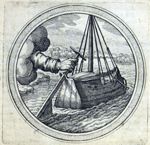
Consilio non robore: Zincgreff, Emblematum Ethico-politicorum (Heidelberg, 1619), emblem 64 uses the adage's imagery
Iconclass: 46C285 manoeuvering a ship 52A52 Judgement, Discrimination; 'Giuditio' (Ripa)
Loci Communes: Prudentia (Prudence, Prudence); Consilium (Counsel, advice, Conseil)
V i 64 Novum cribrum, novo paxillo A new sieve on a new peg
Nequaquàm obscurum est proverbio fuisse iactatum quod Nonius citat ex Varronis Eumenidibus, ubi dicitur primus Zeno novam haeresim, novo paxillo suspendisse. Zenonem notat, qui primus Athenis invexit sectam Stoicorum, idque novis rationibus ac paradoxis. Idem in Bimargo: Novum ut cribrum, novo paxillo pendeat. Sic enim habet Aldina aeditio. Quadrabit in eos, qui novi quippiam comminiscuntur.
This quotation from Varro's Eumenides, cited in Nonius, quite unmistakably contains a popular saying. It says, 'Zeno was the first to hang a new school on a new peg.' He is censuring Zeno, who introduced to Athens the Stoic sect with its novel theories and its paradoxes. Varro again, in Bimargus: 'A new sieve must hang from a new peg.' I follow the reading of the Aldine edition. The saying will fit those thinking up something new.
Facsimile:
Iconclass: 51F51:41C27(SIEVE) Newness❧kitchen-utensils: sieve 51F51:41D427(+0) Newness❧accessories and implements ~ laundering, e.g. clothes-peg, drying frame, (empty) washing line (+ variant)
Loci Communes: Similitudinis et congruentiae (Similarity and congruence, Similitude et convenance)
V i 65 Sarcinator summum centonem The patcher with his last patch
Apud eundem citatur hic versus ex Lucilio: Sarcinatoris esse summum fuere centonem optime. Videtur esse rersus trochaicus, tetrameter, catalecticus: & constat elisos. in sarcinatoriis. Sarcinator à sarcina dicitur, non à sarciendo. Convenit cum illo quod alibi retulimus, Boni poetae est in extremo actu esse optimum. Lucilianum tamen dictum germaniorem ac venustiorem habet adagii speciem.
Nonius Marcellus also cites this verse from Lucilius: Sarcinatoris esse summum suere centonem optime 'It is for a stitcher of patches to sew his last bit of patchwork best.' The metre appears to be trochaic tetrameter catalectic, and the line scans correctly with the elision of final -s in sarcinatoris 'the stitcher of patches.' The word sarcinator is derived from sarcina 'a bundle,' not from sarcire 'to repair.' This saying comes in the same category as one I mentioned earlier: 'A good poet is at his best in the last act.' But Lucilius' version has a more convincing and nicer proverbial ring.
Facsimile:
Iconclass: 47H71 tailor, dressmaker 41D4421 darning, patching
Loci Communes: Perficiendi sive absolvendi (Finishing, completing, Achever, accomplir)
V i 66 Praelio victus non bello Lose the battle but not the war
Non statim victor est, qui in uno alterove negotii actu discessit superior, sed qui totam causam evicit. Proelium enim est conflictus bellicus, bellum totum hoc tempus dicitur, etiamsi cessetur a proeliis, aut si intercedant induciae. Sola pax finit bellum, induciae dirimunt congressus. Nonius hos trochaicos citat ex Lucilio: Ut Romanus populus victus vi, & superatus proeliis saepe multis, bello vero numquam, in quo sunt omnia. Congruunt illi, Vir fugiens et denuo pugnabit.
It is not the one who gets the upper hand in one or two phases of the action who is necessarily the victor, but the one who triumphs overall. A battle is a particular military engagement, a war is the whole period of conflict, even if there is no actual fighting for a time, or if a truce intervenes. Only peace brings a war to an end, a truce suspends hostilities. Nonius cites these lines in trochaic rhythm from Lucilius:
As the Roman people, oft subdued by might
And in many a battle worsted by the foe,
Never yet a war did lose, wherein lies the whole.
This belongs with 'He that fights and runs away may live to fight another day.'
Facsimile: 
Iconclass: 54FF2:45H3 Defeat❧battle 54F2:45A1 Victory❧war
Loci Communes: Vincere et vinci (To conquer and to be conquered, Vaincre et être vaincu)
V i 67 Curre denuo Take another run
Τρέχ᾽ αὖθις. i. Curre denuo. Hoc ita refertur a Luciano in tragoedia cui titulus ὠκύπους, quasi sit in tonstrina natum. Quanquam totum hoc poemation mendis scatet, nec ullam habet micam salis Lucianici. Inducitur illic podagrosus iuvenis, qui tamen affectabat videri ὠκύπους, Is rogatus à sene, unde accidisset pedis dolor, respondit se cum magna celeritate curreret, distrinxisse talum, atque hinc esse cruciatum. Huic respondet senex, Τρέχ᾽ αὖθις ὥστις εἶπον ἢ καθήμενος Γώγονα τίλλει κουρέων ὑπ᾽ ὠλέναις Si legas, εἶπεν ὅς, sensus erit, Curre denuo sicuti dixit quidam, qui sedens vellit barbam sub cubitis tonsorum, hoc est qui curatur à tonsore. Podagrosi remedium petunt à tonsoribus, & tamen nolunt videri podagram, sed pedem alioqui laesum, ut ex immodico cursu. Interim aliquis eorum qui tondentur, sentiens fictam esse causam, respondet τρέχ᾽ αὖθις. Nam id solet esse remedium in simili malo. Posteaquam enim nervus incaluit violento motu, cessat dolor. Quod quottidie videre est in equis, qui post cursum aut non claudicant, aut levius claudicant. Probabilius tamen est pro κουρέων legendum κουριῶν participium à verbo κουρϊᾶν, quod est hirsutum esse & tonsoris egere: quemadmodum aliquis dixit, qui sedens in tonstrina vellit barbam quam habet hirsutam sub alis. Illic enim desident ociosi & garruli. Horatius: Cultello proprios purgantem leniter ungues. Haec nostra divinatio si cui non placet, sequatur quod magis arridet, res non est magni momenti.
[greek], Take another run. Lucian introduces this phrase into his tragedy Okypus as a saying supposedly originating in a barber-shop. And yet this little work in verse is full of faults and hasn't a grain of Lucian's wit. We meet here a young man suffering from gout, who nevertheless wanted to be thought [greek] 'fast-foot.' When an old man asked him why his foot hurt, he replied that he had sprained his ankle when running very fast, and was in agony as a result. The old man replied, ' "Take another run," as one of the customers said, / Sitting and plucking his beard under the barbers' arms,' that is, submitting to the barber's ministrations. (If that is, one reads [greek] 'one said, who ...') People with gout seek relief from barbers, but they do not want the condition to be recognized as gout, preferring it to be thought the result of some kind of injury, caused for example by too much running. Meantime, one of those getting barbered, realizing that this is just a tale, says, 'Take another run.' For that's the way of treating sprains etc., because the pain subsides as the tendons heat up with vigorous movement. One can see this any day in horses, which after a gallop either do not limp or do not limp so noticeably. It's more likely however that instead of [greek] 'of the barbers,' we should read [greek] the present participle of the verb [greek] meaning 'to be hairy' and in need of a barber, the sense being 'as someone said, sitting in the barber's shop, and plucking the shaggy mass of hair luxuriating in his armpits.' The barber's shop is the place where idlers meet and chatter. As Horace says, 'Leisurely trimming his own nails with a knife.' If anyone does not fancy this suggestion of mine, he can pursue something that appeals to him more, but it is of no great matter.
V i 68 Nutricis pallium A nurse's dress
Nutrices quoniam tractant infantes, saepe vestes habent, bua, saliva, mictu, foriaque contaminatas. Unde Plautus in Bacchid. Si unam peccavisses syllabam, fieret corium tam maculosum quam est nutricis pallium. In arcanis literis crebra mentio panni menstruatae.
As nurses handle babies, their clothes are often stained with food, dribble, urine and faeces. So Plautus writes in the Bacchis Sisters: 'If you'd got one syllable wrong, your skin would have / As many blotches as a nurse's dress.' The Scriptures often mention 'the cloths of a menstruous woman.'
Facsimile:
Iconclass: 42A25 dry-nurse 42A311 wet-nurse 41D2321(+0) apron (+ variant)
Loci Communes: Contemptus et vilitatis (Contempt and worthlessness, Mépris et bassesse)
V i 69 Cum ramento Filings and all
Tropo proverbiali cum ramento reddidisse dicitur, qui totum reddidit nulla ex parte decurtatum. Sumptum apparet a fabris aerariis, qui sibi servant quod lima deraserint. Plautus in Bacchidibus: Quia patri omne cum ramento reddidi, cum ramento additum ἐπιτάσεως gratia, idem velut interpretatur, subiiciens omne oppido, hoc est omne prorsus. cum pulvisculo, & cum aerugine, aliàs nobis dicta sunt. Plaut. in Rudentibus: Converret iam hic me totum cum pulvisculo.
This proverbial expression can be used of someone who has handed over all with no deductions of any kind. The phrase apparently originates with metal-workers, who take for themselves what they file off. Plautus, in the Bacchis Sisters: 'For I have handed it over totally to my father, filings and all.' 'Filings and all' is added for the sake of emphasis. He then gives a kind of explanation, saying: 'Every bit. Absolutely.' I have already discussed 'Dust and all,' 'Rust and all.' Plautus, in the Rope: 'He'll sweep me up entirely, dust and all.'
Facsimile:
Iconclass: 51A7 Perfection, Completeness; 'Perfettione', 'Operatione perfetta' (Ripa) 47C35(+0) planing, filing, abrading (industrial processes) (+ variant) 47D8(FILE) tools, aids, implements ~ crafts and industries: file
Loci Communes: Totum ut nihil reliqui (The whole, so that nothing remains, Le tout, sans rien laisser)
V i 70 Mortuo vilior Of less account than a corpse
NIhil abiectius cadavere. Plautus in eadem fabula. Eia bonum habe animum. Unde habeam? Mortuus pluris precii est quam ego sum. Et in Persa, quidam alterum per contemptum appellat morticinum. Non Hercle si os praeciderem tibi, metuam morticine.
Nothing is more worthless than a dead body. In the same play, Plautus writes, 'Come on, cheer up! - How can I? A dead man is worth more than I am.' In the Persian, one character insults another by calling him 'a slab of dead flesh': 'Heavens! I wouldn't feel afraid, even if I punched / Your face in, you slab of dead flesh!'
Facsimile:
Iconclass: 54BB6:31E3 Worthlessness❧the corpse
Loci Communes: Contemptus et vilitatis (Contempt and worthlessness, Mépris et bassesse)
V i 71 Quam Clinia ex Demetrio More than Clinia heard from Demetrius
Plautus in eadem fabula, Plura ex me audis hodie mala quam audivit unquam Clinia ex Demetrio. Quidam eruditi hoc loco pro Clinia legunt Lamia. Et verum est Lamiam fuisse supra modum adamatam à Demetrio rege Macaedonum, quo nomine ipse quidem male audiebat vulgo, sed eam à rege fuisse conviciis affectam, nusquam legimus: praeterea vocem Lamiam carminis ratio non admittit. Vero propius est sumptum e comoedia Turpilii, cui titulus Demetrius, vel alia quapiam, ubi pater prolixius & acerbius obiurgat filium. Talis enim inducitur Clinia in Sene se ipsum excruciante, qui à patre nimium saepe nimiumque acerbe obiurgatus, tandem profugit in militiam. Et haud scimus an ad hanc fabulam alludat Plautus. Nam fieri potest, ut Terentius pro Demetrio senem appellarit Menedemum. Nec obstat quod Terentius Plauto fuit posterior, quum Graecus autor fabulae fuerit utroque prior.
In the same play, Plautus writes:
You'll hear more hard words from me this day
Than ever Clinia heard from Demetrius.
Some scholars think that one should read Lamia instead of Clinia. It's quite true that Lamia was passionately loved by Demetrius, king of Macedonia, and on account of this he was much criticized by the people, but we never read that the king abused her verbally. In any case, Lamia does not fit the metre. It's more likely that it's taken from the comedy by Turpilius, called Demetrius, or from some other play where a father bitterly and at great length reproaches his son. In the Self-Tormentor we have just such a Clinia, whose father censures him so often and so bitterly that he eventually runs away to join the army. Maybe Plautus is alluding to this story. It's possible that Terence changed the name of the father from Demetrius to Menedemus. The fact that Terence is later than Plautus does not raise a problem, because the Greek author of the original play was earlier than both of them.
Facsimile:
Iconclass: 82A(DEMETRIUS) male literary characters (DEMETRIUS) 82AA(CLINIA) female literary characters (CLINIA) 42B20(+0) 'Oblivione d'amore verso i figliuoli' (Ripa) (+ variant)
Loci Communes: Maledicentia (Slander, abusive speech, Médisance)
V i 72 Pleno gradu At a quick march
Qui leviter rem quampiam attigerunt, summo pede dicuntur ingressi: contra qui magno studio instituerunt aliquid, pleno gradu dicuntur ingressi. Trebonius Ciceroni lib. xii. Nam illum paratum, ut video et ingressum pleno gradu, cohortari non intermittemus, quo in dies longius discendo exercendoque se procedat.
Those who have just sampled anything are said to have dipped their toes in, whereas those who have tackled something with great enthusiasm are said to have approached it 'At a quick march.' Trebonius, writing to Cicero in book 12 of his Letters to Friends: 'He is mentally prepared and marching quick step, as I can see, but I will keep on encouraging him, and then he will continue to make daily progress in his studies and exercises.'
Facsimile:
Iconclass: 31A27112 running 49B441(+0) studying ~ university (+ symbol, coat of arms, seal, etc. ~ school, education)
Loci Communes: Diligentiae (Diligence, Diligence)
V i 73 Ad pila ubi ventum When it comes to the pikes
M. Tullius in libello De re militari, si tamen non fallit titulus: Prima autem, inquit, & secunda acies, quum ad pila, ut dicitur, ventum fuerit, totum sustinet bellum. Pilum autem est genus hastae Romanae brevius. Itaque quum de propinquo res geritur, ad pila ventum dicitur. Videor mihi alicubi hoc adagium retulisse, sed in praesentia locus non occurrit.
Cicero, in his little treatise On Military Terms (if this work is correctly attributed to him), says, 'The first and second lines, when, as the saying goes, "It comes to the pikes," bear the full brunt of the fighting.' The pike is a kind of short Roman spear, so when the fighting has got to close quarters, they say 'It has come to the pikes.' I have a feeling I have already used this adage, but I can't at the moment recall where.
Facsimile: 
Iconclass: 45C14(PIKE) helved weapons, polearms (for striking, hacking, thrusting): pike 45H2 being attacked; defence
Loci Communes: Discriminis (Danger, crisis, Danger)
V i 74 Velatis manibus orare Pray with veiled hands
Qui suppliciter orant, Velatis manibus orare dicuntur. suptum ab antiquo more oratorum, quo qui pacem petituri venirent, ramum olivae praetendebant. Velatis autem dictum arbitror pro vittatis. Plautus in Amphitryone: Postridie in castra ex urbe ad nos veniunt flentes principes, vittatis manibus orant, ignoscamus peccatum suum.
Those who make suppliant entreaty are said to 'Pray with veiled hands,' a phrase derived from the ancient custom whereby spokesmen who came to treat for peace carried an olive branch before them. I think that velati 'veiled' is here equivalent to vittati 'swathed with vittae.' Plautus writes in Amphitryo: Next day come the chief men from the town to our camp,
Weeping, begging us with veiled hands to pardon their wrongdoing.
Facsimile:
Iconclass: 41D2251 'manus velatae' (hands covered with a cloth) 11Q21 one person praying 44B421 peace negotiations
Loci Communes: Deprecantis, abominantis (Pleading, abhorring, Qui implore, qui abhorre)
V i 75 Cicadae sibi canent The cicadas will sing to themselves
Οἱ τέττιγες ἑαυτοῖς χαμόθεν ἄσονται. i. Cicadae sibi ipsis ex humo canent. Hoc exemplum Aristoteles lib. iii. adducit ex Stesichoro schematis, quo quis dicit, quid non dicit. Nec aliud addit, unde possis dicti sensum deprehendere: nisi quod suspicor poetam his verbis comminatum iis à quibus erat laesus, quos si ulcisci alioqui non posset, certe carminibus suis esset illos infamiae traditurus. Adducit idem eiusdem lib. ii. inter sententias obscure dictas: ὅπερ Στησίχορος ἐν λοκροῖς εἶπεν, ὅτι οὐδεῖ ὑβριστὰς εἶναι ὅπως μὴ οἱ τέττιγες χαμόωεν ἄδῳσιν, Quid quidem stesichorus apud Locrenses dixit, Non oportere cuiquam iniuriam facere, ne Cicadae ex humo canant. Cicadae poetarum habent symbolum, χαμόθεν dixit, ob inopiam et conditionis humilitatem. Unumquodque animal minatur his armis quibus a natura instructum est. Poetae praeter versus nihil habent, quibus tamen hominem vel album, vel nigrum ad posteros transmittunt. Unde & Plato dicitur amicos admonere solitus, ne quem hominem poeticum sibi redderent inimicum. Est enim, ut ait Flaccus, genus irritabile vatum, & in his sunt qui foenum habeant in cornu. Doctis tamen nonnullis placet, aliò spectare Stesichori dictum. Quoniam cicadae solent, Marone attestante, in arboribus canere, apparet Stesichorum civiliter hoc aenigmate Locrenses admonere, ne per petulantiam à finitimorum iniuriis parum temperantes, tandem arma illorum in se concitent, qui cum exercitu fines illorum ingressi, quicquid arbustorum sit in agris hostiliter excidant, itaque fiat ut cicadae illis iam humi canere incipiant, sublatis arboribus quibus insideant. Fortasse tale quiddam refert Gregorius Nazianzenus, cuius in hoc opus commentarios vidimus Venetiae.
[greek], The cicadas will sing to themselves on the ground. Aristotle in book 3 cites this from Stesichorus as an example of a figure in which the real meaning is not the literal meaning of the words. Aristotle doesn't add anything that would help to elucidate the true meaning, though I suspect that the poet in these words threatens those who had injured him, giving them to understand that, if he could not avenge himself in any other way, certainly he would use his poetry to destroy their reputation. Aristotle quotes it again in book 2 among enigmatic sayings: 'As Stesichorus said when among the Locrians, "One shouldn't act with insolent effrontery, or the cicadas will sing on the ground."' Cicadas represent poets; 'on the ground' refers to their poverty and humble status. Every creature uses what means nature has given it to present a threatening aspect. Poets have nothing but their verse, but by this they can hand a man down to posterity as a 'dark or fair man.' This is why Plato is said to have advised his friends never to make an enemy of a man of poetic bent. For, as Horace said, 'Bards are an irascible tribe,' and some of them 'have hay on their horn.' A number of scholars prefer quite a different explanation of Stesichorus' saying. As Virgil tells us, cicadas usually sing in trees, so it appears that, by this riddling saying, Stesichorus was politely warning the Locrians not to keep on harrying their neighbours out of arrogance and aggressiveness, or they would drive them to take up arms against them; their neighbours would invade their territory and cut down everything growing out of sheer hostility, and then the cicadas would start singing on the ground, as there would be no trees for them to perch in. Possibly Gregory of Nazianzus reports something of the sort. I saw his commentaries on this work when I was in Venice.
Facsimile:
Iconclass: 25F711(CICADA)(+49) insects: cicada (+ audible means of communication of animal(s): roaring, crying, singing, barking, mewing, neighing, chirping, etc.) 55BB1:48C91 Poverty; 'Povertà', 'Povertà del doni', 'Povertà in uno ch'habbia bell'ingegno' (Ripa)❧writer, poet, author 51CC1:33B14 Effect, Result❧threatening behaviour, challenging
Loci Communes: Garrulitas (Talkativeness, Bavardage)
V i 76 Fama prodit omnia Rumour makes all things known
Aeschines in oratione contra Timarchum refert sententiam Euripidis: Φήμῃ τὸν ἐσθλὸν κᾂν μυχῷ δείκνυσι γῆς. id est, Virum bonum fama aperit vel in terrae cavis. Interpretatur autem hoc sensisse poetam, non viventium tantum virtutem illustrari fama, verum etiam sepultorum. Terra corpus tegit, sed fama non sinit occultari quod quis bene gessit in vita. Eodem in loco citat Hesiodi versum quem antea commemoravimus. Φήμη δ᾽ οὔτις πάμπαν ἀπόλλυται, ἥν τινα λαοί Πολλοὶ φημΐζουσι, θεὸς νύτις ἐστὶ καὶ αὐτή Quem locum citat et in oratione περὶ τῆς παραπρεσβείας.
In his speech against Timarchus, Aeschines quotes a line from Euripides: 'Rumour makes known the righteous man, even in the hollows of the earth.' He explains this as meaning that it is not only the living whose virtues are celebrated by common report, but the dead and buried also. Earth may cover the body, but the talk of men does not allow a man's good deeds in life to be covered over. In the same passage, he cites lines from Hesiod, which I have used before: 'Rumour dies hard that many folk have uttered; / Rumour herself's a kind of deity.' He quotes these lines again in the speech On the False Legation.
Facsimile:
Iconclass: 54D31:52D5 Continuance❧Rumour; 'Rumore' (Ripa)
Loci Communes: Notus (Known, famous, Connu); Probrum, gloria (Disgrace, glory, Honte, gloire)
V i 77 Boetissare Act Boeotian
Inter convicia quibus Aeschines lapidat Demosthenem, etiam illud obiecit, quod Boeotorum more vociferarentur immodice & indecore: ταῦτα δέ μου μεταξὺ λέγοντος ἀναβοᾶ παμμέγεθες Δημοσθένης, ὡς ισασι πάντες οἱ συμπρέσβεις ἡμῶν, καὶ γὰρ πρὸς τοῖς ἄλλοις κακοῖς βοιωτιάζει. id est, haec me loquente vehementer exclamat Demosthenes, quemadmodum sciunt omnes qui nobis in ea legatione fuere collegae. Nam praeter alia mala etiam Boeotissat. In clamore fit allusio ad boum mugitum: Quanquam βοιωτιάζειν accipi potest, pro favere Boeotorum partibus.
Among all the other accusations which Aeschines hurls at Demosthenes, he taxes him with shouting out in an uncontrolled and unseemly manner, like Boeotians: 'As I was saying this, Demosthenes shouted out extremely loudly, as all those who were on the embassy with us know. For indeed, in addition to all his other crimes, [greek] "He acts Boeotian."' The 'shouting out' contains an allusion to the mooing of bovines. Though 'Act Boeotian' could be taken as meaning 'to follow a pro-Boeotian policy.'
Facsimile:
Iconclass: 32B311(BOEOTIAN) indigenous European peoples (BOEOTIAN) 31B62351(+92) crying, shouting (+ relations with aggressive, hostile character (expressive connotations))
Loci Communes: Clamosus (Noisy, clamorous, Bruyant)
V i 78 Surculus surculum ferens Twig supporting twig
Qui singuli sunt infirmi, tamen concordia iuncti multum habent roboris. Ita Ennius apud Festum. Unus surus surum ferret, tamen defendere possent. Veteres enim, ut Festus admonet, surum dicebant, unde nos dicimus surculum diminutive. Nos non fugit carmen esse vitiatum etiam in Aldina editione, fortasse legendum. Si unus surum surus ferret, eum aut se defendere posset, aut possent. Stirps habet robur, succuli nihil habent virium nisi iuncti.
Individuals are weak, but joined together in concord they acquire great strength. See Ennius, as cited by Festus: Unus surus surum ferret, tamen defendere possent 'One twig would carry but another twig, and yet they could defend.' As Festus tells us, surus was the form of the word used in ancient times; we now use the diminutive surculus. I am well aware that the text of this line of verse is corrupt, even in the Aldine edition. Perhaps it should read Si unus surum surus ferret 'If one twig should carry but another twig,' eum (or se) defendere -posset 'it could defend it (or, itself), or possent 'they could defend it,' or, 'they could defend each other.' A branch is strong; twigs have no strength except when bundled together.
V i 79 Salacones Salacons
Quemadmodum Irus & Codrus ob inopiam in vulgi fabulam abierunt, ita & Salacon quidam extremae paupertatis homo effecit, ut omnes fortuna tenui Salacones dicerentur, & ipsa paupertas, Salaconia. Meminit Hesychius, sed idem indicat eodem nomine fuisse notatos fastuosos & arrogantes: unde ductum sit verbum σαλακωνίζειν καὶ σαλακωνεύειν, pro eo quod est, fracto delicatoque gradu incedere. Addunt testem Theophrastum, qui σαλάκωνα, dixerit eum qui sua profundit temere. Ex his colligere licet, adagii convicium non haesisse in quosvis pauperes, sed in eos duntaxat qui fastu luxuque redacti sunt ad inopiam. Vox autem dicta videtur, à verbo σαλαξαι, quod est labefactari & ad ruinam tendere.
Because of their poverty, Irus and Codrus became stock examples of indigence. Likewise, a certain Salacon was so impoverished that all persons in extreme penury came to be called 'Salacons' and poverty itself was called salaconia. This information comes from Hesychius, but he also tells us that the same word was used for a conceited person who put on airs, and this gave rise to the verb [greek] 'walk in a mincing or foppish manner.' There is also the evidence of Theophrastus, who said a 'Salacon' was a person who squandered his possessions. From all this we may conclude that the censure carried in the adage is not directed at any and every poor person, but only at those reduced to indigence by self-conceit and extravagance. The word seems to come from the verb [greek], which means 'to totter,' 'to be on the point of collapse.'
Facsimile: 
Iconclass: 46A15 the poor 55BB1 Poverty; 'Povertà', 'Povertà del doni', 'Povertà in uno ch'habbia bell'ingegno' (Ripa) 98B(SALACON)3 male persons from classical history (SALACON) - representations to which the NAME of a person from classical history may be attached 58AA12 Self-destruction
Loci Communes: Paupertas (Poverty, Pauvreté); Arrogantia jactantiaque (Arrogance and boastfulness, Arrogance et vantardise)
V i 80 Archilochi melos Archilochus' song
Αρχιλόχου μέλος. i. Archilochi cantio, dicebatur hymnus qui ad multos poterat accommodari, qualem ferunt Archilocho fuisse repertum, qui fuerit ante Pindarum & alios hoc genus lyricos, qui singulos propriis laudibus exornabant. Archilochi carmen erat idem in omnes, quod cithara canebatur. Citharoedus tantum ad singula cantionis intervalla, victorum nomina voce sua repetebat: veluti si Herculem laudabat accinebat Tenella Callivice χαῖρ᾽ ἄναξ ἡράκλεις. Aut aliud, si cum alium canebat. Huic non dissimile est quod refert Horatius de pictore, qui depicta cupresso nautam rogabat, ecquid vellet addi. Quadrabit in rem priscam ac rudem. Meminit Aristophanis & Pindari interpres. Sumptum est è Pindari Olympiorum Encomio semptimo: τὸ μὲν ἀρχιλόχον μέλος φωνᾶεν ὀλυμπία καλλίνικος. Quo quidem loco varia commenta refert enarrator, quae repetere, non videtur ad hoc, quod agimus, necessarium.
[greek], Archilochus' song. This was the name for a song that could be adapted to many subjects, such as Archilochus is supposed to have invented. He was earlier than Pindar and other such lyric poets who composed celebratory odes specific to individual victors. Archilochus' song was the same for everybody and was played on the lyre. The lyre-player simply sang in the name of the victor at intervals throughout the music. If he were praising Hercules, for example, he would bring into his song 'Tenella Kallinike, hail Lord Hercules,' or some other name, if he was praising somebody else. Rather similar is Horace's story of the painter who painted a cypress tree and asked the sailor if he wanted anything added. This phrase will fit anything crude and primitive. 'Archilochus' song' is mentioned by the commentators on Pindar and on Aristophanes. It comes from the seventh of Pindar's Olympian triumphal odes: 'The song of Archilochus, sung out at Olympia, "Kallinikos."' The commentaries on this passage report various suggestions that have been thought up, but it doesn't seem necessary to my present purpose to reproduce them here.
Facsimile:

Maledicentia: Alciatus, Emblemata (Leiden, 1591), emblem 51 uses the imagery of Archilochus' tomb
Iconclass: 57BB25 Calumny, Detraction; 'Biasimo vitioso', 'Calunnia', 'Detrattione', 'Maledicenza' (Ripa) 98B(ARCHILOCHUS)3 male persons from classical history (ARCHILOCHUS) - representations to which the NAME of a person from classical history may be attached
Loci Communes: Absurda, indecora, seu praepostera (Absurd, unbecoming, or preposterous things, Choses absurdes, inconvenantes ou déplacées)
V i 81 ὁλοέχινος All-spiny
Antea retulimus ex oratione Aeschinis, περὶ ὁλοσχοίνου ἀβρόχου, quum lexicographi pro ὁλοσχοίνου habeant ὁλοεχίνου. qui adiecit scholia in Demosthenem, citat orationem Aeschinis adversus Demosthenem περὶ παραπρεσβείας, & Theophrastum in quarto libro. Apud Aeschinem repperi ὁλοσχοίνου. Similiter Theophrastus lib. De plantis quarto, inter ea quae proveniunt in aquis facit (quod admonet scholiastes) tria σχοίνου, hoc est, sparti sive iunci genera: quorum unum sit acutum, quod appellant masculum, id est, infrugiferum: alterum frugiferum, quod à nigro fructu vocant μελαγκρανὶν. tertium quod dicitur ὁλοσχοίνος, pinguitudine, magnitudine & callositate caeteris praestans. Hoc ultimum putat accommodatius ad plectendos funes, quod mollius sit & carnosius. Dioscorides lib. iiii. paulo secus distinguit genera; sed admonet tertium quod ὁλόσχοινος dicitur esse caeteris & asperius & callosius. Ut autem quidam pro σχοῖνος scriberent ἐχῖνος suspicor in causa fuisse, quod Theophrastus meminit carnositatis, quasi novum sit audire carnem mali, aut cerasii. Echinus tamen terrestris, quem appellant Erinacium, in hoc convenit cum holoschoeno, quod habet asperitatem: unde & cutis detracta cum spinis, utilis est ad defricanda vasa. Proinde dictum videtur de duro et procaci sermone, quo velut os alicui percellimus. Hoc quicquid est appendicis, lectorem caelare nolui.
I have already discussed the word ὁλοσχοίνος (in the phrase ὁλοσχοίνος ἀβρόχοs) from a speech by Aeschines. The lexicographers however have here not ὁλοσχοίνος but ὁλοεχίνος. The ancient annotator on Demosthenes cites this speech of Aeschines, that is, the one On the False Legation, attacking Demosthenes, and also Theophrastus, book four. I found the form ὁλοσχοίνος in the Aeschines passage. Likewise, Theophrastus, in book four of On Plants, where he is discussing water-loving plants, distinguishes (as the ancient commentator tells us) three species of σχοίνος 'esparto' or 'rush.' One is the iuncus acutus, the sharp rush, also called 'male,' here meaning 'infertile'; the second is fertile, and from its dark fruits is called μελαγκρανὶς 'black' bog-rush; the third is the ὁλοσχοίνος, the club-rush, which surpasses the others in stoutness, height, and toughness. Theophrastus thinks this last is better for weaving ropes because it is more pliable and fleshier. Dioscorides, in book four, classifies them somewhat differently, but he does tell us that the third species, the one called ὁλοσχοίνος, is rougher and tougher than the others. I think the reason why some persons preferred to write ἐχῖνος 'hedgehog' instead of σχοῖνος 'rush' was that Theophrastus spoke of its 'fleshiness,' as if it were anything unusual to speak of the 'flesh' of an apple or cherry. The land echinos, or 'hedgehog,' does share with the holoschoinos the characteristic of being bristly. The skin of a hedgehog, if removed complete with spines, can be used to clean pots. So the word 'allspiny' can be used of harsh domineering words, which we dash in someone's face, so to speak. Even if some of this is somewhat of an appendix, I wanted to pass it on to my readers.
Facsimile:
Iconclass: 57AA6 Viciousness, Naughtiness 51G3 Toughness 25G4(CLUB-RUSH) plants and herbs (CLUB-RUSH) 25G4(ὉΛΟΈΧΙΝΟΣ) plants and herbs (ὉΛΟΈΧΙΝΟΣ)
Loci Communes: Asperitas, morositas (Harshness, moroseness, Rudesse, morosité); Molesti intolerabiles (Unbearable, troublesome people, Gens insupportables)
V i 82 Apologus Alcinoi A story for Alcinous
Απόλογος Αλκινόου, Commemoratur in Graecorum collect. ut ante nobis commemoratum est. Originem autem tum divinavimus ex Homeri Odyssea, apud quem in convivio multa de se mentitur Ulysses: nec absurdum esset commentum, si Alcinoi apologus dici posset ficta narratio apud Alcinoum habita. Aristoteles tamen Rhet. iii. quum obiter meminit huius apologi, sic loquitur, ut videri possit notasse scriptorem aliquem, qui finxerit orationem ad Penelopen, contexens omnia quae multis annis geri potuerint, ficta narrans pro veris. Fortassis scriptor cui nomen Alcinous, induxit personam Ulyssis apud Penelopen plurima commemorantem, quasi vel in bello, vel in itinere vere passus esset ea. Locus apud Aristotelem sic habet: ἔτι πεπραγμένα δεῖ λέγειν ὅσα μὴ πραττόμενα ἢ οἶκτον ἢ δείνωσιν φέρει. παράδειγμα ὁ Αλκινόου ἀπόλογος, ὅτε πρὸς τὴν Πενελόπην ἐν ἑξηκοντα ἔτεσι πεποίηται. Trapezontius interpres legisse videtur: ἔτι μὴ πεπραγμένα δεῖ λέγειν ὅσα πραττόμενα &c. At ne sic quidem locus videtur vacare mendis. Quare suspendemus hic sententiam: donec vel e Gregorii Nazianzeni commentar is in hoc libros, vel aliunde compertius aliquid fuerimus nacti.
[greek], A story for Alcinous, is recorded in the Greek proverb collections, as I noted earlier. On that occasion, I surmised that it was derived from Homer's Odyssey, where Ulysses is represented as telling a whole lot of tall stories about himself at the feast. This is not a silly suggestion, if 'A story for Alcinous' can mean a fictitious tale told in the presence of Alcinous. However, Aristotle, in book three of the Rhetoric, happens to mention this tale and writes in such a way that he appears to be censuring some writer who wrote an imaginary speech to Penelope, bringing in all the things that could have happened in the course of many years, and treating fiction as truth. Perhaps the writer, called Alcinous, introduced the figure of Ulysses telling Penelope a lot of things which he was supposed to have experienced either in the war or on his journey home. Aristotle writes, 'Besides, one must speak of events as past and done, [greek] "except for" those that arouse either pity or indignation if represented as happening now. An example is the story of Alcinous, when it is presented to Penelope as if covering sixty years.' George of Trebizond's translation of the passage gives one to understand that he read, 'One must speak of [greek] "events that have not actually happened," such that, if represented as happening now .. .' But even so, the text is not free from fault. So I shall suspend judgment until I can find something more definite either in the commentaries of Gregory of Nazianzus on the Rhetoric, or elsewhere.
Facsimile:
Iconclass: 94I23421(+0) Ulysses tells of his wanderings (+ variant) 82A names of literary characters
V i 83 Virtus aeterna Virtue lives forever
Pindarus in Olympiis Encomio θ. refert huiusmodi sententiam: ἀΐδατοι λάθεται ἅρμενα πράξας ἀνὴρ. i. Orci obliviscitur vir qui se digna gessit. Vita brevis est, sed immortalis est benefactorum memoria: eoque qui res praeclaras & aeterna memoria dignas gesserunt, aequiore animo decedunt è vita, nec perinde mortem horrent, quod intelligant se gloria nominis semper apud posteritatem victuros.
Pindar records a similar sentiment in Olympian eight: [greek] 'A man that performs fitting deeds / Gives no thought to Hades.' Life is short, but the memory of good deeds never dies, and for that reason those who have done splendid things that deserve to be remembered for ever depart this life more contentedly and are not so appalled by death, because they know they will live on in the minds of future generations through the glory of their name.
Facsimile: 
Iconclass: 57A6 Virtuousness; 'Amor di Virtù', 'Attione virtuosa', 'Guida sicura de' veri honori', 'Virtù', 'Virtù insuperabile' (Ripa) 23A2 Eternity, 'Aeternitas'; 'Eternità','Eternità o Perpetuità' (Ripa)
Loci Communes: Probrum, gloria (Disgrace, glory, Honte, gloire)
V i 84 Doceat, qui didicit Let one who has learned teach others
Idem in eodem Encomio, τὸ διδάξασθαι δέ τοι εἰδότι ῥαΐτερον, i. Docere porrò facilius ei qui didicit: Iuxta illud: Disce, sed a doctis. Nemo facilius artem tradit alteri, quàm qui eam exacte callet. Novit enim multa in compendium contrahere, novit obscuris dare lucem. Proinde quod quidam tot ambagibus circumagunt ac detinent adolescentes in disciplinis, in causa est aut quaestus, aut livor, aut imperitia.
Pindar again, in the same victory ode: To [greek] 'Easier it is for one who knows to teach.' This is like 'Learn, but only from those who have been well taught.' No one can more easily pass on a skill to another than the person who is thoroughly versed in it. He knows how to compress a great deal of information into a few words, he knows how to cast light on obscurities. The reason why some teachers take their pupils round in circles and keep them from making progress is either the desire to make more money, or else spite, or, finally, lack of skill.
Facsimile:
Iconclass: 49B441 studying ~ university 49B43 professor
Loci Communes: Docilitas (Docility, teachableness, Docilité)
V i 85 Celeritas in malis optima When evils strike, speed is best
Sophocles in Antigona: Βράχιστα γὰρ κράτιστα τ᾽ ἀν ποσὶν κακὰ. id est, Urgentibus malis celeritas optima est. Verba sunt Chori ad Creontem in vario luctu domus cupientem e medio tolli. Nam cito perire quem vitae taedet, non nohil est lucri. Nihil molestius quam diu animo discruciari, si quid mali imminet, quod vitari non queat. optimum est dare operam, ut sit quam brevissimum.
In Antigone, Sophocles writes, [greek] 'When evils are upon us, 'tis best when they are short.' These words are addressed by the chorus to Creon, who longs to be removed from this life when faced by all the griefs that have befallen his house. There is much to be said for dying quickly if one is weary of life. Nothing is worse than enduring the mental torture of seeing some evil approaching which cannot be avoided. The best thing is to make sure that it doesn't last long.
V i 86 Nullus sum I am nothing
In eadem fabula. Αγετε μ᾽ ἐκποδὼν Τὸν οὐκ ὄντα μᾶλλον ἢ μηδένα. id est, E medio me abducite. Qui non magis sum quàm ille qui iam nullus est. Hac figura significabant exitium sine spe recuperandae salutis. Scio me prius commemorasse, Fuimus Troes, & Nullus sum, sed ob novatam sermonis formam hoc adiicere libuit.
Sophocles again, in the same play: 'Take me away, / [greek] "One who no more exists than one who is already nothing."' This idea signifies destruction without hope of recovery. I know I have already discussed 'We Trojans have ceased to be' and 'I am nothing,' but I decided to add this example because it puts the idea in a new way.
Facsimile:
Iconclass: 54A:51AA4 State of Being while Doing❧Nothingness, Absence
Loci Communes: Desperatio (Despair, Désespoir)
V i 87 Prima felicitatis pars sapere Wisdom the chief part of happiness
In eiusdem fabulae clausula: Πολλῷ τὸ φρονεῖν εὐδαιμονίας πρῶτον ὑπάρχει. id est, Ut sis felix longe primum Sapere est. De Creonte dictum est, qui dum mavult animo suo quàm rectis consiliis obtemperare, et suos et se funditus perdidit. Magna fortuna facile vertitur in magnam calamitatem, si absit sapientia. Idem paulo ante contrariis expressit verbis de Haemone loquens, qui sibi mortem consciverat: Δείξας ἐν ἀνθρώποισι τὴν ἀβουλίαν Οσῳ μεγιστον ἀνδρι πρόσκειται κακόν. id est, Monstrans quod inconsulta temeritas viro Adiuncta, sit longe malerum maximum.
In the closing section of the same play: [greek] 'Wisdom is by far the foremost part of happiness.' This was said in reference to Creon who chose to follow the dictates of passion rather than clear thinking, and brought destruction on himself and those nearest him. Without wisdom, great good fortune easily turns to great misfortune. A little earlier in the play, Sophocles expresses the same idea from the opposite point of view. Speaking of Haemon, who had taken his own life, the poet says, 'Proclaiming to the world how rashness divorced from thought / Becomes the greatest evil that can befall a man.'
V i 88 Sero vidit justitiam He has too late recognized the right
Rursum in eadem: Οἴ μ᾽ ἔοικας ὀψὲ τὴν δίκην ἰδεῖν. id est, Proh ut videre iusta sero cernere. De Creonte dictum est, qui prius nec Tiresiae, nec cuiquam suorum obtemperat, magnis doctus cladibus incusat suam stultitiam. Eadem sententia reperitur in clausula tragoediae, sed diverso schemate. Μεγάλας δὲ πληγὰς τῶν ὑπεραυχῶν ἀποτίσαντες, γήρᾳ τὸ φρονεῖν ἐδίδαξαν. id est, Divi poenas postquam atroces De verbis sumpsere superbis, Aetate docent sapere extrema. Convenit cum illo: Sero sapiunt Phryges.
Sophocles again, in the same play: [greek] 'Alas! Too late you seem to realize what is right.' This is said with reference to Creon, who earlier on would not give way to Tiresias or any of his people, but, having learnt his lesson through dreadful happenings, now blames his folly. We find the same sentiment again in the closing lines of the play, expressed differently: 'Exacting dreadful vengeance for overweening words / The gods teach men in old age to be wise.' This agrees with 'The Phrygians learn wisdom too late.'
Facsimile:
Iconclass: 51FF52:52C4 Lateness❧Understanding, Comprehension; 'Apprehensiva' (Ripa)
Loci Communes: Sera paenitentia (Late repentance, Repentir tardif)
V i 89 Vindicta velox Swift recompense
De sera vindicta numinum aliquot proverbiis testatum est, quae supra retulimus. Sed quod ait Sophocles expeditam Deorum vindictam, magis huc conducit, ut in aliquod pro lapsi malum, mature resipiscamus. Verba sunt Chori ad Creontem: ὅσον γ᾽ ἄναξ τάχιστα. συντέμνουσι γὰρ Θεῶν ποδώκεις τοῦς κακόφρονας βλάβαι. id est, Rex ista facito quam potes celerrime. Noxae citipedes numinum improbos viros Subito occupant iunctae simul compendio. Id evenit Creonti, cui vindicta poenae prius adfuit quam absolveretur Tiresiae vaticinium.
There is quite a number of proverbs about the slow vengeance of the gods, which I have recorded above. Sophocles' lines about the swift vengeance of heaven suggest that we should come to our senses promptly if we have fallen into some wickedness. The chorus is addressing Creon: Do it with all speed, O King. For swift-footed mischief from the gods
Seizes evil-minded men and cuts them off.
That is what happened to Creon, for vengeance fell on him almost before Tiresias had finished his prophesying.
Facsimile: 
Iconclass: 51M11:57AA741 Swiftness, Speed; 'Agilità', 'Celerità', 'Velocità' (Ripa)❧Revenge, Requital, Retaliation; 'Vendetta' (Ripa) 92 gods ~ classical mythology
Loci Communes: Ultio malefacti (Vengeance for a wrongdoing, Vengeance d'un méfait)
V i 90 Fato non repugnandum Fight not against fate
In eadem Creon ita loquitur: ἀνάγκῃ δ᾽ οὐχὶ δυσμαχητέον. id est, Sed fata contra, quando, id est, perquam arduum, Non est reluctandum. Eandem sententiam alias ex variis citavimus autoribus. Nemo potest vitare quod deus nobis immittit. Quod autem vitari non potest, ferendum est, non culpandum. Ducunt enim volentem fata, nolentem trahunt, ut ait Tragicus.
In the same play, Creon says, [greek] 'Fight not against the fates, for that fight is hard.' We have cited this same sentiment elsewhere, culled from various authors. No one can escape what God sends us, and what can't be avoided must be endured, not railed against. 'For the fates lead the willing man, the unwilling man they drag,' as the writer of the tragedies says.
V i 91 Vati non conviciandum Do not revile a prophet
In eadem fabula Creon Tiresiae more natum incandescenti ac liberioribus dictis impetenti regem, loquitur: Ω βούλομαι τὸν μάντιν ἀντειπεῖν κακῶς. id est, Vati vicissim nolo proloqui male. Quod Horatius ait: Genus irritabile vatum: non tantum ad poetas, sed multo magis ad divinos pertinet. Eblandiendum est, si quid ab eis velis exculpere, quos si provoces, divinant omnia mala. Conveniet uti, ubi quis nos impetierit impotenti convicio, velut afflatus furore quodam, cui honoris gratia nolimus vicissim maledicere, quum non desit quod retorqueatur: aut quum libertatem eam tribuimus irae, veluti furori cuidam. Cum irato enim nihilo sanius decertes conviciis quam cum furioso. finitimum est illi quod ante retulimus. Omitte vatem. Praeterea illi: Ni pater esses, quod est in hac eadem fabula sub persona Haemonis.
In the same play, when Tiresias becomes impassioned in the manner of prophets and attacks the king rather too boldly, Creon replies, [greek] 'I will not return evil words for evil to a prophet.' Horace's words, 'Bards are an irascible tribe,' do not apply to poets only but even more so to people with prophetic powers. You have to wheedle to get anything out of them, and if you offend them, their prophecy is entirely bad. We can use this phrase when somebody assails us with uncontrolled abuse, being in the grip of a sort of madness, and when we are unwilling, out of respect for his position, to return insult for insult, though there is much that we might say by way of reply; or when we permit anger, as a kind of derangement, to say what it will. It is as much use to enter into a contest of insults with a man in the grip of anger as with a madman. This is very like a saying I recorded earlier, 'Hands off the holy man.' Also, 'Were you not my father,' which occurs in this same play, addressed to Creon by Haemon.
Facsimile:
Iconclass: 56E21:12F52(AUGUR) Irascibility❧'augur' ~ Roman religion 13E7 diviner, soothsayer 56E21:48C75412 Irascibility❧bard, lyric poet
Loci Communes: Lacessentis (Provoking, Provoquer)
V i 92 Vatum genus avarum Prophets are a greedy tribe
In eadem scena Creon ita loquitur Tiresiae: Τὸ μαντικὸν γὰρ πᾶν φυλάργυρον γένος. id est, Genus omne vatum est appetent pecuniae. Hoc nomine olim male audiebant augures & haruspices. Nunc utinam praeter meritum idem audiant, qui divina tractant. Vera non potest semper loqui, qui corruptus muneribus ad hominum gratiam loquitur.
In the same scene, Creon says to Tiresias, [greek] 'Prophets as a tribe are money-lovers, each and every one.' In the past, augurs and soothsayers had this bad reputation, and I wish that when the same accusation is levelled against those who handle the things of God today, the charge were not deserved. No one who takes gifts and is thereby induced to say what people want to hear can be relied on to speak the truth at all times.
Facsimile:
Iconclass: 12F52(AUGUR) 'augur' ~ Roman religion 46A161 acquiring riches 55CC11:13E7 Greed, Covetousness, Cupidity; 'Cupidità' (Ripa)❧diviner, soothsayer
Loci Communes: Rapacitas et avaritia (Rapacity and greed, Rapacité et avarice); Munerum corruptela (Corruption by gifts, Corruption par les présents)
V i 93 Non movenda loqui To speak what should be left undisturbed
Eodem in loco iam irritatlor Tiresia sic minatur Creonti: Ορσεις μὲτ᾽ ἀκίνητα δια φρενῶν φράσαι. id est, Tu me excitas, ut quae latent in pectore Immota, cogar proloqui. Usus erit, quoties adversariorum improbitas eo nos compellit, ut quae decreveramus silentio tegere, efferamus. Creon enim illum convicio tetigerat, dicens: σοφός συ μάντις, ἀλλὰ τ᾽ ἀδικεῖν φιλῶν. id est, Tu doctus augur, at suetus laedere. Quod ipsum convenit in hominem prudentem aut eruditum, sed improbum. Confine est illi, non movenda moves.
In the same passage of the play, Tiresias is provoked into threatening Creon with the following words: [greek] 'You will make me utter what lies quiescent in my thoughts.' We can use this phrase when the outrageous behaviour of an opponent drives us to say something about which we had decided to keep silent. Creon had angered Tiresias with the insult 'A skilful prophet you may be, but you love unjust accusation.' This in its turn can be used of a man who is shrewd or learned, but unprincipled. Related is the saying 'You move what should not be moved.'
Facsimile:
Iconclass: 51M11:52E1 Swiftness, Speed; 'Agilità', 'Celerità', 'Velocità' (Ripa)❧Response, Answer, Solution
Loci Communes: Lacessentis (Provoking, Provoquer); Occulta (Hidden things, Choses cachées)
V i 94 Mortuos rursus occidere To slay the dead again
Ibidem verba Tiresiae sunt ad Creontem, suadentis ut Polynicis corpus sinat condi sepulcro: Αλλ᾽ εῖκε τῷ θανόντι, μήδ᾽ ὀλωλότα Κέντει, τὶς ἀλκὴ τὸν θανόντ᾽ ἐπικτανεῖν. id est, Age, mortuo concede, nec qui extinctus est, Stimulato, quae nam est fortitudo, mortuum Necare rursum? Confine est illi, quod alibi retulimus, Iugulare mortuos. Iugulare mortuos.
Again in Antigone, the following words are given to Tiresias as he tries to persuade Creon to let Polynices' body be buried:
Make concession to the dead. Do not stab
A man who is no more. What prowess is it
[greek] 'To slay the dead again?'
This is like a saying I discussed earlier, 'To cut a dead man's throat.'
Facsimile:
Iconclass: 51B61:33B6 Repetition❧killing ~ aggressive relationships 31E234632:31E3 violent death by dagger, knife❧the corpse
Loci Communes: Crudelitas (Cruelty, Cruauté); Inanis opera (Vain effort, Effort vain)
V i 95 Deo nemo potest nocere No one can injure God
Sententia pia est, sed a Creonte impio animo dicta: Θεοὺς μιαίνειν οὔτις ἀνθρώπων σθένει. id est, Violare, sive polluere divos, nemo quit mortalium. Veteribus persuasum erat offendi divos inferos, si mortuo negaretur sepultura: offendi Iovem supplicium, si quis supplicem reiceret. At Creon putabat nihil huiusmodi rerum curae esse diis, quod illi non queant à quoquam laedi. Hoc carmen occini potest iis qui indignum deo putant, in matrice virginis latitasse, & per uterum virginis exisse, unde prodeunt homines caeteri, aut qui putant corpus domini pollui, quod in stomachum hominis immundum descendat: Θεοὺς μιαίνειν, οὔτις ἀνθρώπων σθένει. Neque sol polluitur, tot cloacas ac paludes lustrans.
It is a pious sentiment to say, [greek] 'No mortal man has power to violate (or pollute) the gods,' but when Creon utters these words he is being impious.1 The ancients believed that offence was given to the gods of the underworld if a dead person were denied burial, and to Jove, the protector of suppliants, if a suppliant's plea were rejected. Creon thought that nothing of this sort was of any concern to the gods, because no mortal could injure them. Some people think it improper for God to lie concealed in the Virgin's womb and to come into the world from a woman's belly, just like the rest of mankind. Others think the Body of the Lord is polluted because it goes down into the foul human stomach. To all these one can intone in reply, 'No mortal man can the gods pollute.' The sun is not polluted, though its beams fall on sewers and swamps.
Facsimile: 
Iconclass: 52BB42:33B3:92 Impossibility❧fighting❧gods ~ classical mythology 52BB42:33B3:11A Impossibility❧fighting❧Deity, God (in general) ~ Christian religion
Loci Communes: Impossibilia (Impossible things, Choses impossibles)
V i 96 Auscultandum bene loquenti Listen to a man who says what is sound
Tiresia in eodem sermone: Εὖ σοι φρονήσας, εὖ λέγω. τὸ μανθάνειν δ᾽ ἥδιστον εὖ λέγοντος, εἰ κέρδος λέγει, id est, Tibi benevolus, bene loquor, suavissimum est A bene loquente, lucra si fert, discere. Eandem sententiam, antea dixerat Haemon: Καὶ τῶν λεγόντων εὖ, καλὸν τὸ μανθάνειν. id est, Recte loquentem audire par est, ac decet. Conveniet cum illo: Audi quae ex animo dicuntur. Item cum Hesiodo, quo probatur & is, qui paret recta monenti.
Tiresias, in the same speech addressed to Creon, says:
I mean you well, and speak to bring you good.
Pleasant it is to learn, when he who speaks
Wishes well and says what will bring advantage.
Haemon had said the same thing earlier in the play: 'Right and proper it is to listen to good advice.' This agrees with 'Listen to a man who speaks from the heart,' and also with that line from Hesiod, which expresses approval of the man who follows good advice.
Facsimile:
Iconclass: 53B1:52E3 Acceptance❧Counsel; 'Consiglio' (Ripa) 53B5 Obedience; 'Obedienza' (Ripa)
Loci Communes: Docilitas (Docility, teachableness, Docilité); Consilium (Counsel, advice, Conseil)
V i 97 Fortunae novacula On the razor's edge of fate
Eiusdem Tiresie verba sunt ad Creontem admonentis, ut in summo discrimine positus sapiat. Φρόνει βεβὼς ἆυ νῦν ἐπὶ ξυροῦ τύχης, id est, Sape, denuo nunc positus in novacula Fortunae, Calamitati quam excitarat Eteoclis & Polynicis contentio, successit haec quam offensis diis excitavit Creon. Quanquam hic versus obiter nobis alibi citatus est, in proverbio, In acie novaculae.
The same Tiresias addresses Creon, warning him to take thought in the crucial situation in which he finds himself: 'Think, now that once again / You tread [greek] "Upon the razor's edge of fate."' On the heels of the calamity brought upon the community by the quarrel of Eteocles and Polynices has come this one, engendered by Cleon's offence against heaven. I have already quoted this line in the course of discussing the proverb 'On the razor's edge.'
Facsimile:
Iconclass: 31A5351 razor 54FF12 Fate, Doom 54DD51 Danger; 'Pericolo' (Ripa)
Loci Communes: Discriminis (Danger, crisis, Danger)
V i 98 Exemplum utile A useful example
Creon Haemoni filio liberius agenti minitans malum,ita loquitur: Κλαίων φρενώσεις, ὢν φρενῶν αὐτὸς κενὸς. id est, Plorando facies mentem ut habeant caeteri, Mente ipse vacuus. Quum improbiluunt stultitiae suae poenas, quanquam ipsi nihilo fiunt meliores, tamen aliis exemplo sunt, ne per incogitantiam in similes incurrant calamitates.
Creon threatens his son Haemon, when he remonstrates with him too freely: 'Senseless yourself, you shall as you repent / Teach others to have sense.' When wrongdoers pay the penalty for their folly, though they themselves are not bettered by it, they are nonetheless a warning to others not to fall into similar disaster through thoughtless action.
Facsimile:
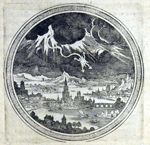
Nous nous debuons chastier par aultruy: La Perrière, Le theatre des bons engins (Lyon, 1545), emblem 75 uses the imagery of a lion who is scared as he sees another lion hanged to convey the idea that the example of punishment will prevent others from committing a crime
Iconclass: 54B3:54C31 Utility, Usefulness; 'Utilità' (Ripa)❧Example 52CC41 Error; 'Errore' (Ripa)
Loci Communes: Malum vertens bono (Evil turning to good, Mal qui tourne en bien); Metus poena (Fear as punishment, La peur comme châtiment)
V i 99 Pervicacia stultitiae dat poenas Stubbornness pays the penalty that its folly deserves
In eadem tragoedia Tiresia, Creontem admonens ne praefractus ac rigidus persistat in sententia, ita loquitur: Αὐθαδία τοι, σκαιότητ᾽ ὄφλισκάνει. id est, Praefracta mens, amentiae poenas luit. Intractabilis illa ferocia fere solet magnae cuiusdam calamitatis esse praeludium, quemadmodum indicant & Hebraeorum proverbia: Contritionem praecedit superbia, & ante ruinam exaltatur spiritus. Hoc Tiresiae dictum eleganter expressit Haemon in eadem fabula, duplici metaphora, arborum & nautarum. Carmen sic habet: Ορᾷς παραῤῥαίθοισι χειμάῤῥοις ὅσα Δένδρων ὑπείκει, κλῶνας ὡς ἐκσώζεται, Τὰ δ᾽ ἀντιτείνοντ᾽ αὐτόπρεμν᾽ ἀπόλλυται. Αὔτως δὲ, ναὸς ὅστις ἐγκρατὴς, πόδα Τείνας ὑπείκει μηδὲν, ὑπτίοις κάτω Τρέψας τὸ λοιπὸν σέλμασιν ναυτίλλεται. id est, Vides, ut in torrentium decursibus, Quae cedit arbor surculos servat suos. At quae resistit, stirpe cum ipsa deperit, Nauclerus itidem, qui tenens clavum, nihil Concedit aurae et fluctibus, devoluitur Ac iam supinis navigat nixus foris.
In the same tragedy, Tiresias warns Creon not to hold to his own view of things with rigid obstinacy, and says, [greek] 'The stubborn mind pays the penalty of its mindlessness.' That kind of intractable ferocity is usually the prelude to some great disaster, as it says in the Hebrew Book of Proverbs: 'Pride goes before destruction, and a haughty spirit before a fall.' Haemon put forward the same view as Tiresias earlier in the play, tellingly expressing it through metaphors taken from trees and sailors:
You see how trees that grow beside the streams
Which winter rains have to torrents turned,
If they yield, their branches keep intact.
Those that resist are torn out root and branch.
Likewise, the master of the ship, holding
The sheets too tight, his boat capsizes,
And on his journey goes, clinging to upturned benches.
Facsimile: 
Iconclass: 57BB13:53BB4 Punishment; 'Castigo', 'Pena', 'Punitione' (Ripa)❧Unwillingness
Loci Communes: Pertinacia (Stubbornness, Obstination)
V i 100 Navigationis socius A fellow-sailor
Ante retulimus, In eadem esse navi, qui communi tenentur periculo. Ad hoc allusit Ismene, in eadem fabula, dicens se non recusare, quo minus subiret eidem periculum, quod subiret Antigone soror. Αλλ᾽ ἐν κακοῖς τοῖς σοὶσιν οὐκ αἰσχύνομαι Ξυμπλοῦν ἐμαυτὴν τοὺ πάθους ποιουμένη., id est, Sed in tuis non erubesco me malis Rate vecta eadem calamitati adiungere.
I have already recorded 'To be in the same boat,' said of those who share a common danger. Ismene has the same idea in mind when she says she is quite prepared to share the same danger as her sister Antigone: 'In this your misfortune, I am not ashamed / [greek] "Toboard your boat and share your suffering."'
Facsimile:
Iconclass: 55C5:46C23 Sharing❧boat propelled by man or animal 55C5:54DD51 Sharing❧Danger; 'Pericolo' (Ripa)
Loci Communes: Discriminis (Danger, crisis, Danger); Amicitia (Friendship, Amitié)