III iii 1 Sileni Alcibiadis The Sileni of Alcibiades
Σιληνοὶ ἀλικιβιάδου.i. Sileni Alcibiadis, apud eruditos in proverbium abiisse videntur: certe in Collectaneis Graecorum proverbii vice referuntur. quo licebit uti, vel de re quae cum in speciem, & prima, quod aiunt, fronte vilis ac ridicula videatur, tamen interius ac propius contemplanti sit admirabilis: vel de homine, qui habitu vultuque longe minus prae se ferat, quam in animo claudat. Aiunt enim Silenos imagunculas quaspiam fuisse sectiles, & ita factas, ut diduci & explicari possent, & quae clausae ridiculam ac monstrosam tibicinis speciem habebant, apertae subito numen ostendebant, ut artem scalptoris gratiorem iocosus faceret error. Porrò statuarum argumentum sumptum est à ridiculo illo Sileno Bacchi paedagogo numinunque poeticorum morione. Quandoquidem habent & illi principum nostratium exemplo suos γελωτοποιούς. Proinde apud Athenaeum libro quinto adolescens Critobulus irridens Socratem senem ac deformem dicebat illum πολὺ τῶν σειληνῶν αἰσχίω, id est multo Silenis deformiorem: Locus autem est apud Xenophontem in Convivio. Socrates: ὡς γὰρ καλλίων ἂν τοῦτο κομπάζεις. Ut istud iactas quasi sis formosior. Critobulus, νὴ δία, ἢ πάντων σειληνῶν τῶν ἐν σατυρικοῖς, αἴσχιστος ἒν εἴην. i. Ita per Iovem, aut omnium Silenorum qui sunt inter Satyros turpissimus fuero. Et Alcibiades apud Platonem in Convivio, Socratis encomium dicturus, eum Silenis huiusmodi similem facit, quod is multo alius esset propius intuenti, quàm summo habitu specieque videretur. Quem si de summa, quod dici solet, cute quis aestimasset, non emisset asse. Facies erat rusticana, taurinus aspectus, nares simae, muccoque plenae. Sannionem quempiam bardum ac stupidum dixisses. Cultus neglectus, sermo simplex ac plebeius, & et humilis, ut qui semper aurigas, cerdones, fullones & fabros haberet in ore. Nam hinc ferè sumebat illas suas εἰσαγωγὰς, quibus urgebat in disputando. Fortuna tenuis, uxor qualem ne vilissimus quidem carbonarius ferre posset. Videbatur mirari formas adulescentulorum, videbatur amare, & zelotypia tangi, cum eum ab his affectibus δὶς δὶα πασῶν abesse compererit etiam Alcibiades. Denique iocus ille perpetuus nonnullam habebat morionis speciem. Cum ea tempestate, ad insaniam usque ferveret inter stultos, profitendi sapientiam ambitio, nec unus esset Gorgias, qui se nihil nescire iactitaret: & ardelionibus huiusmodi nusquam non referta essent omnia, solus hic hoc unum scire se dictitabat quod nihil sciret. Videbatur ineptus ad omnia reipublicae munia, adeo ut quodam die nescio quid apud populum adorsus agere, cum risu sit explosus. Atqui si Silenum hunc tam ridiculum explicuisses, videlicet numen invenisses potius quàm hominem, animum ingentem, sublimem ac vere philosophicum: omnium rerum pro quibus caeteri mortales currunt, navigant, sudant litigant belligerantur, contemptorem, iniuriis omnibus superiorem, & in quem nullum omnino ius haberet fortuna, & usque adeo nihil timentem, ut mortem quoque nulli non formidatam contempserit, in tantum, ut cicutam eodem ebiberit vultu quo vinum solet, utque iam moriens etiam in Phaedonem suum iocaretur, admonens, ut voto se liberans Aesculapio gallum persolueret, perinde quasi sumpto pharmaco, iam sanitatis beneficium sentiret, cum exiret è corpore, unde omnes animi morbi scatent, ac pullulant. Proinde non iniuria cum id tempestatis plena sophis essent omnia, solus hic morio, sapiens oraculo pronunciatus est, & plus iudicatus est scire, qui nihil sciebat, quàm hi qui nihil nescire se praedicabant, imò ob idipsum iudicatus est plus caeteris scire, quod unus omnium nihil sciret. Huiusmodi Silenus fuit Antisthenes, baculo suo, pera, pallioque, maximorum regum fortunas antecellens. Huiusmodi Silenus fuit Diogenes, vulgo canis habitus. Verum in hoc cane divinum quiddam animaduerterat Alexander magnus, principum, ut videbatur, omnium κορυφαῖνος & alpha, cum animi magnitudinem admiratus, optaturum se diceret, ut ni Alexander esset, Diogenes esset, cum hoc magis optare debuerit Diogenis animum, quod Alexander esset. Huiusmodi Silenus fuit Epictetus, servus, pauper, claudus, ut indicat illius epitaphium, sed idem, quod est felicissimum charus superis, id quod sola vitae praestat integritas cum sapientia coniuncta. Haec nimirum est natura rerum vere honestarum, quod habent eximium, id in intimis recondunt abduntque, quod contemptissimum, id prima specie prae se gerunt, ac thesaurum ceu vili cortice dissi mulant nec prophanis ostendunt oculis. At vulgarium & umbraticarum longe diversa ratio, summa specie blandiuntur, quodque pulcherrimum habent, statim obviis ostentant: sin penitus introspicias, nihil minus sunt, quàm quod titulo specieque prae se ferebant. An non mirificus quidam Silenus fuit Christus? si fas est de hoc ad eum loqui modum, quem equidem haud video cur non omnes pro virili debeant exprimere, qui Christiani nomine gloriantur. Si summam Sileni faciem intuearis, quid iuxta popularem aestimationem abiectius, aut contemptius? Tenues & obscuri parentes, domus humilis: ipse pauper & pauculos, & pauperculos habuit discipulos: non è magnatum palatiis, non è pharisaeorum cathedris, non è philosophorum scholis, sed à telonio & retibus ascitos. Tum vita, quàm à voluptatibus omnibus aliena, per famem, per lassitudinem, per convicia, per ludibria, ad crucem denique pervenit. Hac illum parte contemplabatur mysticus ille vates, cum eum depingens: Non erat, inquit, ei species, neque decor. Vidimus eum, & non erat aspectus: & desideravimus eum despectum, ac novissimum virorum, caeteraque permulta, quae in hanc sequuntur sententiam. Iam si contingat apertum hunc Silenum propius intueri, hoc est, si cui dignetur ipse se purgatis animi luminibus ostendere, deum immortalem, quàm ineffabilem reperies thesaurum: in quanta vilitate, quale margaritum: in quanta humilitate, quantam sublimitatem, in quanta paupertate, quantas divitias: in quanta infirmitate, quam incogitabilem virtutem, in quanta ignominia quantam gloriam: in quantis laboribus, quàm absolutam requiem. denique in morte tam acerba, perennem immortalitatis fontem. Cur sic abhorrent ab hac imagine, qui titulo tamen illius se iactitant? Nimirum erat in proclivi Christo totius orbis occupare monarchiam, atque id possidere, quod olim Romani principes frustra affectarunt, satellitio superare Xerxes, opibus anteire Croesos, philosophis universis silentium imponere, & inane sophos detrahere. Verum haec una forma placuit, quam suis discipulis & amicis, hoc est, Christianis, proponeret. Hanc potissimum delegit philosophiam, à philosophorum decretis, à mundi ratione longe lateque diversam, sed eam quae sola omnium praestaret, quod alii aliis viis conantur assequi, nempe felicitatem. Huiusmodi quondam Sileni fuere prophetae exules, errantes, in solitudinibus cum feris exigentes vitam, vili holusculo victitantes, ovium et caprarum amicti pellibus. Sed introspexerat hos Silenos ille qui dixit, quibus dignus non erat mundus. Huiusmodi Silenus fuit Ioannes Baptista, qui camelorum tectus pilis, zona cinctus pellicea, longe regum purpuras ac gemmas vicit, locustis vescens, principum omnium delitias superavit. Nimirum cernebat quid thesauri lateret sub agresti pallio, qui miro illo elogio laudum eius summam complexus, Inter natos, inquit, mulierum, non surrexit maior Ioanne baptista. Huiusmodi Sileni fuerunt apostoli, pauperes, inculti, illiterati, ignobiles, imbecilles, abiecti, omnibus omnium contumeliis expositi, irrisi, invisi, execrabiles, ac pene publicum orbis simul & odium & ludibrium. Verum aperi mihi Silenum, quis tyrannorum cum horum potentia possit aequari, qui dicto imperant daemonibus, nutu sedant saevientia maria, verbo vita defunctos in vitam revocant? Quis non Croesus ad hos pauper esse videatur, qui vel umbra sui conferunt sanitatem aegrotis, qui solo manus contactu spiritum illum coelestem impertiunt? Quis non Aristoteles stultus & indoctus ac nugator, cum his collatus, habeatur, qui ex ipso fonte coelestem hauserant sapientiam, ad quam omnis humana sapientia, mera stultitia est? Quod quidem eorum pace dictum esto, qui nefas arbitrantur & impium, usquam Aristotelis autoritatem convellere. Fateor illum esse virum eximia doctrina, sed quod lumen tam excellens, quod Christo collatum non obscuretur? Tum vere regnum coelorum, grani sinapis imaginem habebat, specie pusillum & contemptum, virtute maximum: à quo prorsus ut dixi, & ἐκ διαμέτρου, quod aiunt, dissidet huius mundi ratio. Huiusmodi Silenus fuit contemptus & irrisus ille Martinus episcopus. Tales fuerunt veteres illi episcopi, humilitate sublimes, paupertate locupletes, gloria neglecta gloriosi. Latitant & hodie boni quidam Sileni, sed heu nimium pauci. Bona pars hominum praeposterum Silenum exprimunt. Si quis rerum vim ac naturam penitus introspiciat, reperiet nullos à vera sapientia longius abesse, quàm istos qui magnificis titulis, qui sapientibus pileis, qui splendidis cingulis, qui gemmatis anulis absolutam profitentur sapientiam. Adeo ut non raro plus uerae germanaeque sapientiae deprehendas in uno quopiam homuncione, iuxta vulgi opinionem idiota simplici ac semifatuo, cuius mentem non subtilis ut uocant Scotus, sed coele stis ille Christi docuit spiritus, quàm in multis theologorum tragicis personis ac ter quaterque magistris nostris, Aristotele suo turgidis, magistralium definitionum, conclusionum & propositionum turba differtis. Non in omneis hoc dixerim, sed in heu nimium multos. Item videas in nullis minus esse verae nobilitatis quam in Thrasonibus istis, qui vetustis stemmatibus, qui torquibus aureis, qui splendidis cognominibus summam iactitant nobilitatem, nec alios à vera fortitudine longius abesse, quam eos qui ob temeritatem ac praeferoces animos, vulgo fortissimi iudicantur & invicti. Nullos abiectius ac servilius servos, quam hos, qui se diis, ut aiunt, proximos, & omnium dominos putant. Nullos aeque calamitosos, atque eos qui videntur felicissimi. Nullos pauperius esse pauperes, his quos hominum vulgus ut divites adorat. Nullos esse minus episcopos, quam qui inter episcopos primas tenent. Etiam atque etiam te rogo lector, ne putes haec in cuiusquam dici contumeliam. Rem notamus, non homines. Optamus esse nullos in quos haec congruant. Et si nunc tales nulli sunt, quod faxit Christus, tales olim fuerunt, & in posterum fortasse futuri sunt. Atque utinam illud quoque falsum esset, saepenumero longissime semotos esse à vera religione, qui titulo, qui cultu, qui caeremoniis religionem absolutam profitentur. Adeo quicquid in omni rerum genere praeclarum est, id minus in conspicuo est. In arboribus flores & folia blandiuntur oculis: ipsa se late moles ostentat. At semen, in quo vis est omnium, quàm est res minutula, quam abdita, quàm non lenocinans aspectui, quàm non ostentatrix sui? Aurum & gemmas in altissimas terrae latebras abdidit natura. In elementis quae vocant, quo quicque praestantius est, hoc longius a sensibus est remotum, velut aer et ignis. In animantium genere quod est optimum & efficacissimum, id in intimis abditum habent. In homine quod est maximè divinum & immortale, id solum cerni non potest. In quovis rerum genere, materia pars vilior maxime patet sensibus, formae vis & beneficium utilitate sentitur, & tamen ipsa procul abest à sensibus. Rursum in corporis physici temperatura, cum phlegma et sanguis sensibus sit familiaris et pateat, et quod plurimum confert ad vitam, minime patet, nempe spiritus. Demum in universo quae maxime sunt, ea non videntur, veluti substantiae quas separatas vocant. Et quod in his summum est, id à sensibus quam maximè sepositum est, nempe deus, adeo ut nec intelligi, nec cogitari possit, cum hic fons sit unicus omnium. Quin & in ecclesiae sacramentis reperire liceat nonnullam Silenorum imaginem. Absit invidia verbis. Aquam vides, salem & oleum vides, vocem audis, ceu summum Sileni faciem: vim coelestem nec audis, nec vides: quae si non adsit, mera ludibria sint caetera. Iam habent & suos Silenos arcanae literae. Si consistas in superficie, ridicula nonnunquam res sit: si penetres usque ad anagogen, divinam adores sapientiam. Etenim ut de veteri loquamur instrumento, si praeter historiam nihil spectes, & audias Adam è limo conditum, uxorculam è dormientis latere furtim subtractam, serpentem illecebra pomi solicitantem mulierculam, deum ad auram inambulantem, romphaeam foribus praesidentem ne postliminio redirent exules, nonne putes ex Homeri officina profectam fabulam? Si legas Loth incestum, totam Sampsonis historiam, quam divus Hieronymus è cortice aestimans, fabulam appellat, David adulterium, & in senis frigidi gremio cubitantem puellam, Osee meretricium matrimonium, nónne qui verecundioribus sit auribus, ut obscoenam fabulam aversetur? At sub his involucris, deum immortalem, quàm splendida latet sapientia? Evangelicas parabolas, si primum aestimes corticem, quis non iudicet hominis esse idiotae? Si nucem frangas, nimirum reperies arcanam illam ac vere divinam sapientiam planeque quiddam ipsi Christo simillimum. Et ne singula persequens fiam prolixior, in naturae simul ac mysticis rebus, ut quicque praestantissimum est, ita quam maximè videbis abstrusum, & à prophanis oculis longissime semotum. Itidem in cognitione germana rerum veritas semper altissime latet, quae nec facile nec à multis deprehenditur. Crassum vulgus, quoniam praepostere iudicat, nimirum ex his quae maximè sensibus corporis obvia sunt aestimans omnia, passim & labitur & errat, ac falsis bonorum & malorum simulachris deluditur inversosque Silenos miratur ac suspicit. De malis loquar, bonos non laedam, imò ne malos quidem, quandoquidem generalis de vitiis disputatio ad nullius personae pertinet iniuriam. Atque utinam pauciores essent, in quos haec competere possint. Cum sceptrum vides, cum insignia, cum satellitium, cum titulos audis serenissimum, clementissimum, inclytum, nónne principem adoras, terrenum quoddam numen, & quiddam homine maius intueri te putas? Sed aperi Silenum praeposterum, tyrannum invenies, interdum civium hostem, publicae concordiae osorem, discordiarum serendarum artificem, bonorum oppressorem, legum pestem, urbium eversorem, ecclesiae compilatorem, latronem, sacrilegum, incestum, aleatorem, breviter, ut est in Graecorum proverbiis, ἰλιάδα κακῶν. Sunt qui titulo specieque prae se ferant magistratum, & reipublicae custodem, cum re lupi sint & praedones civitatis. Sunt quorum si consideres rasum verticem, venereris ut sacerdotes, si Silenum introspicias, plus quam laicos reperies. Fortassis & episcopos aliquot reperias, quorum solennem illam consecrationem si spectes, si novum ornatum inspicias, mitram gemmis & auro nitentem, pedem item gemmeum: in summa, totam illam ἐκ ποδὸς εἰς κεφαλὴν mysticam πανοπλίαν, videlicet coelestem quempiam et homine maiorem virum expectes. Inverte Silenum, nihil interdum invenies nisi bellatorem, negotiatorem, denique tyrannum, iamque magnifica illa insignia, comoediam fuisse iudicabis. Sunt, atque utinam non tam passim obvii sint, quos si quis è barbae sylva, pallore, cucullo, inflexis cervicibus, cingulo, supercilio vultusque truculentia velit aestimare, Serapiones ac Paulos esse dicat: sin explices, meros invenies balatrones, helluones, planos, ganeones, imò praedones ac tyrannos, sed alia via, & haud scio an hoc pestilentiore quo tectiore, planeque quod aiunt ἄνθρακας τὸ θησαυρόν. Rursum admoneo, neminem his offendi oportere, cum nullius designetur nomen. Si quis huiusmodi non est, nihil ad se pertinere cogitet: sin agnoscit suum malum, admonitum se putet. Ille sibi gratuletur, hic mihi gratias agat. Denique passim in omni mortalium genere sunt, quorum si formam contemplere corporis, homines & praeclaros homines dicas: si Silenum explicueris, intus suem aut leonem aut ursum aut asinum fortassis invenies. Ac diversum quiddam eveniet ei, quod de Circes veneficiis poetarum fabulis est proditum. Apud hanc enim ferarum figuram habebant, mentem hominis: isti sub humana specie plus quam beluam tegunt. Contrà sunt quos de specie, sicut dictum est, vix homines iudices, cum in animi penetralibus angelum occultent. In hoc igitur discrimen est mundani & Christiani, quod ille crassissima quaeque, ac statim oculis obvia, maxime suspicit & sectatur: quae secus habent, aut omnino negligit aut certe postremo loco ponit. Hic ediverso, quae minime cernuntur oculis, quaeque longissime recesserunt à natura corporum, ea sola sectatur, caeteris aut praeteritis aut contemptius adhibitis, ab intimis illis omne rerum iudicium ducens. In bonis, sic enim vocat Aristoteles, quae non pertinent proprie ad hominem, extremae sunt opes. At apud vulgus, imò pene apud omnes, is plurimi fit, qui has quacunque via possidet, has per saxa, per ignes expetunt universi. Proximum habet locum, generis claritas, si nihil accedat aliud, ridiculum prorsus et inane nomen. Semideus habetur, qui sanguinis seriem ad Codrum Atheniensem aut ad Brutum Troianum, qui haud scio an unquam natus fuerit, aut ad fabulosum Herculem referre possit: & obscurus est, qui sibi literis & virtute famam paravit? Illustris est, cuius tritavus in bello strennuum praestitit homicidam: & plebeius est atque imaginibus caret, qui bonis animi profuit orbi? In tertia classe sunt corporis commoda: id cui contigerit ingens, robustum, formosum, praevalidum: eum non semovent quidem è numero felicium, sed ita ut nihilo secius primas teneant divitiae, proximas nobilitas, animi postrema cura est. Iam hunc ipsum, si iuxta Paulum in treis partes dividas, carnem, animam & spiritum, utar enim illius verbis, infimam, quae maxime in conspicuo est, quamque prorsus damnat Apostolus, vulgus potissimum amplectitur. Mediam quam ita demum probat, si ad spiritum accesserit, plures approbant. Porrò spiritum optimam nostri partem, à quo ceu fonte felicitas omnis nostra proficiscitur, quoque deo copulamur, adeo non habent in pretio, ut nec illud inquirant, sitne aut quid sit spiritus, de quo tamen Paulus toties inculcat. Atque hinc praeposterum de rebus multitudinis iudicium, ut quibus primus debebatur honos, horum ὥσπερ τῶν μεγαρέων οὐδεὶς λόγος sit, & quae summo studio fuerant expetenda, haec in contemptissimis ducant. Hinc aurum anteponitur literis, generis antiquitas honesto, corporis dotes animi bonis, caeremoniis posthabetur vera pietas, Christi praecepta decretis hominum, persona veritati, umbra rebus, fucata nativis, fluxa solidis, momentanea aeternis. Deinde ex praeposteris opinionibus praepostera rerum vocabula. Quod excelsum est, humile vocant: quod amarum, dulce: quod preciosum, vile: quod vita mortem. Vtque nominatim obiter pauca delibem, amare dicuntur, qui vel indulgentia corrumpunt vel pudicitiae simul ac famae insidiantur, cum hac re quid esse possit hostilius? Iustitiam appellant, cum malum malo, scelus scelere vincitur, cum iniuria accepta, multo cum foenore reponitur. Parum aequus matri monio dicitur, qui illud incontaminatum, & quam potest uirginitati simillimum, ganeis dissimillimum esse postulet. Proditorem appellant & principis hostem, qui nihil illi supra leges, ac praeter aequum licere velit, hoc est, qui illum optet vere principem agere, & à tyranni, qua belua non est alia tetrior, imagine quam maxime velit abesse. Ille contrà consultor, amicus, fautor principum dicitur, qui illos perversa educatione corrumpat, qui stultis inficiat opinionibus, qui assentatione ludat, qui malis consiliis in odium populi pertrahat, qui bellis & insanis rerum tumultibus involuat. Aiunt auctam principis maiestatem, ubi tyrannidis aliquid accessit, hoc est summi mali magna portio. Peculator est qui de extortis vectigalibus velit nonnihil circumcidi. At cum principis praecipua bona sint tria, quibus deum qui vere solus est rex, quodammodo repraesentat, bonitas, sapientia, potentia, num is principi videtur amicus esse, qui duobus praecipuis bonis illum spoliet, bonitate & sapientia, solamque potentiam illi relinquat, & hanc non modo falsam, verum ne propriam quidem? Siquidem potentia nisi sit cum sapientia bonitateque coniuncta, tyrannis est, non potentia, quam ipsam tamen populi consensus quemadmodum dedit, ita potest eripere: cum interim depulsum ab imperio, bonitas & sapientia, ceu propria bona comitentur. Capitale est, violare principis insignia, & praemium est his, qui animum illius vitiantes pro bono crudelem, pro sapiente versutum, pro potente tyrannum reddunt? Parum est una mors, ei qui principis calicem toxico tentarit inficere: & praemium fert, qui mentem illius pestilentissimis opinionibus corrumpit ac venenat, & veluti publicum reipublicae fontem inficit, summo totius orbis malo? Principis munus dominium vocant, cum re vera nihil aliud sit agere principem, quam rem communem administrare. Regum inter ipsos affinitates ac subinde novanda foedera, Christianae pacis glutinum appellant, cum his fontibus omnia pene bella, plurimos rerum humanarum tumultus nasci videamus. Iustum bellum appellant, cum ad exhauriendam opprimendamque rempublicam principes inter se colludunt; pacem vocant, cum in hoc ipsum inter sese conspirant. Auctum ducunt imperium, cum unius aut alterius oppiduli titulus accesserit principi, tanta civium expilatione, tanto sanguine, tot viduitatibus, tot orbitatibus emptus. Ad eundem modum ecclesiam vocant sacrificos, episcopos ac summos pontifices, cum hi revera nihil aliud sint quàm ecclesiae ministri. Caeterum ecclesia populus est Christianus, quem Christus ipse maiorem vocat, ut cui recumbenti ministrent episcopi, obsequio minores sed alia ratione maiores, si modo Christum ut successione muneris ita morum ac vitae referant imitatione, qui cum modis omnibus princeps ac dominus esset omnium, ministri partes suscepit, non domini. Omne fulmen torquetur in illos, hostes ecclesiae vocantur ac propemodum haeretici, qui sacerdotum crumenam nummulis aliquot fraudarint. Equidem non adsum fraudatori, ne quis hoc interpretetur, verum cedò, siquidem hostem ecclesiae iuvat odisse, num esse possit hostis ecclesiae perniciosior aut capitalior quam impius pontifex? Ubi nonnihil de sacerdotum praediis aut censu diminutum fuerit, clamatur undique opprimi Christianam ecclesiam. Vbi concitatur orbis ad bellum, ubi palàm improba sacerdotum vita, tot animarum milia pertrahuntur in exitium, nemo deplorat ecclesiae vicem, cum vere iam affligatur ecclesia. Ornatam & cohonestatam vocant ecclesiam, non cum in populo gliscit pietas, cum uitia decrescunt, boni mores augescunt, cum sacra doctrina viget, verum cum auro gemmisque lucent altaria, imo cum his neglectis praediis, famulitio, luxu, mulis, equis, sumptuosis aedium vel magis palatiorum substructionibus, ac reliquo vitae strepitu satrapas aequant sacerdotes. Atque haec adeo videntur recta, ut in ipsis pontificum diplomatibus inseratur huiusmodi elogium: Quoniam ille cardinalis tot equos, tot purpuratos alens domi, vehementer ornat ecclesiam dei, concedimus illi quartam episcopi dignitatem. Et in ornamentum ecclesiae iubentur episcopi, sacerdotes & clerici purpura sericisque vestiri. O miram ecclesiae dignitatem. Quid superest, postea quam etiam vocabula honesti perdidimus? Neque enim libet interim eorum meminisse, qui censum ecclesiasticum in impios usus magno plebis offendiculo profundunt. His si quid accreverit, gratamur, et auctam Christi ecclesiam dicimus: cum verum & unicum ecclesiae lucrum sit, Christianae vitae profectus. Blasphemiam vocant, si quis parum reverenter de Christophoro loquatur aut Georgio nec omnes omnium fabulas aequet Evangelio, Verum Paulus blasphemiam appellat, quoties impiis Christianorum moribus fit, ut Christi nomen infametur inter ethnicos. Quid enim consentaneum est Chri stianae religionis hostes dicere, cum in Evangelicis literis viiderint Christum ad opum contemptum, ad voluptatum abdicationem, ad gloriae neglectum hortantem, et è regione conspexerint, primores etiam ac duces Christianae professionis ita vivere, ut opum accumulandarum studio, ut voluptatum amore, ut vitae splendore, ut belli ferocia caeterisque ferè vitiis omnibus ipsos superent ethnicos? Intelligit prudens lector, quid hic taceam, ob honorem Christiani nominis, & quid apud me suspirem. Quos cachinnos putas illos tollere, qui cum videant in Evangelio Christum non cultu, non caeremoniis, non cibis insignisse suos, sed hac nota dignosci voluisse Christianos, si mutua charitate conglutinentur, postea conspiciant, adeo nihil inter nos convenire, ut neque turpius, neque perniciosius ulla gentilitas sit tumultuata? Princeps cum principe belligeratur, civitas cum civitate pugnat: nec scholae cum schola, nec religioni, ut nunc vocant, cum religione convenit: rixarum, factionum, litium apud nos plena sunt omnia. Haec vera demum est blasphemia, cuius autores sunt, qui iustam ministrant occasionem. Haeresim appellant, si quis dixerit aut scripserit aliquid, quod aliquo pacto cum magistralibus theologorum propositiunculis, vel in re grammatica dissentiat: & haeresis non est, ubi quis ceu praecipuam felicitatis humanae portionem effert, id quod ipse Christus ubique docet esse negligendum: qui vitae rationem inducit, ab evangelicis praeceptis & apostolicis institutis longe diversam? qui contra sensum Christi apostolos ad evangelii praedicationem profecturos, pro gladio spiritus (qui terrenis affectibus omnibus amputatis, solus facit, ut gladio non sit opus) ferro armat, quo se adversus persecutionem defendant? (Neque dubium, quin sub gladii nomine balistas, bombardas, machinas, ac reliquum belli apparatum velit comprehendi.) Tum pera onerat, in qua gestent pecuniam, videlicet ne quid usquam desit: ac sub perae nomine quicquid ad huius vitae provisionem pertinet, vult intelligi. Atque haec qui docet, inter magnos theologos citatur. Sacrilegium est inexpiabile, si quis quidlibet è phano sustulerit: & leve crimen habetur pauperculos et viduas, vivum dei templum expilare, fraudare, opprimere? id quod passim à principibus fit et optimatibus, interdum & ab episcopis & abbatibus. Prophanus est, qui pugna aut seminis profluvio sacram aedem contaminarit: & non execramur eum qui puram et castam virginem, templum spiritussancti, blanditiis, muneribus, pollicitis, lenociniis violat, corrumpit, prophanat? Atque haec qui facit, vulgo festivus & elegans dicitur. Non patrocinor malefactis, sicut ante testatus sum: illud ostendo, vulgus hominum multo pluris ea facere, quae cernuntur oculis, quàm quae hoc verius sunt, quo minus conspiciuntur. Saxei templi consecrationem vides, animi dedicationem quia non vides negligis. Pro tuendis illius ornamentis digladiaris, pro servanda morum integritate, nemo capessit gladium illum evangelicum, quem Christus iubet etiam tunicae divenditae precio parari. Summa pietas vocatur, si quis pro defendenda aut augenda ditione & pecunia sacerdotum sumat arma, ac bellicis tumultibus sacra prophanaque misceat. Atque interea, dum sacrificorum pecunia, nimirum res vilissima vindicatur, quam ingens totius pietatis diluvium admittitur admisso bello? Quid enim est omnino mali, quod non secum trahat bellum? Sed forsitan obstrepet interim mihi tacita lectoris cogitatio: Quorsum haec tam putida tendunt, inquiens? Num tu principem eiusmodi uis esse, cuiusmodi Plato facit in sua republica custodes? Num sacerdotes imperio, dignitate, gloria, divitiis spoliatos ad apostolorum peram & baculum revocas? Bona verba. Non spolio, sed his potioribus locupleto: non deiicio de possessione, sed ad meliora provoco. Quaeso te, uter nostrum de regis excellentia magnificentius sentit: tu, qui vis illi licere quicquid libet, qui tyrannum vis esse non principem, qui voluptatibus exples, qui luxui prodis, qui cupiditatibus omnibus servum ac dedititium facis, qui nihilo plus sapere vis quam quemvis è media plebe, qui his oneras rebus, quas apud ethnicos quoque semper magnificum fuit contemnere: an ego qui principem, deo cuius imaginem quandam gerit, quam fieri potest, simillimum esse cupio, sapientia quae propria regum laus, caeteris antecellere, ab omnibus sordidis affectibus animique morbis, quibus crassum & humile vulgus ἄγεται καὶ φέρεται, procul abesse? Nihil mirari plebeium, opibus esse superiorem, denique id esse in republica quod animus est in corpore, quod deus in universo? Uter nostrum verius perpendit episcopi dignitatem? Tu, qui illum terrenis opibus oneras, sordidis ac plebeiis implicas curis, bellorum procellis involuis: an ego, qui Christi vicarium, & coelestis sponsae custodem ab omni terrae contagio purissimum esse cupio, & quoad li cet, ei cuius loco munereque fungitur, quam simillimum? Stoici negant bonum virum esse posse, nisi qui vacet animi morbis. Morbos autem animi cupiditates sive affectus vocant. Multo igitur magis Christianorum est ab his esse liberos, sed omnium maxime principem. Ac rursum plus quam maxime principem ac patrem ecclesiae, hoc est coelestis illius populi coelestem principem. Volo regnare sacerdotum, sed mundanam istam ditionem indignam iudico, ut hac vir coelestis oneretur. Volo quam maxime triumphare pontificem, non his sanguinariïs triumphis, quos sceleratus Marius, quos impius egit Iulius, adeo vanis ut Satyrarum iocis incessantur: quos si Democritus ille spectasset, risu crediderim emoriturum: sed vere magnificis & apostolicis, cuiusmodi Paulus bellator ac dux longe splendidior Alexandro Magno describit, ac veluti sui canens encomium iactat, In laboribus, inquit, plurimis, in carceribus abundantius, in plagis supra modum, in mortibus frequenter: a Iudaeis quinquies quadragenas, una minus accepi, ter virgis caesus sum, semel lapidatus sum, ter naufragium feci, nocte et die in profundo maris fui. In itineribus saepe, periculis fluminum, periculis latronum, periculis ex genere, periculis ex gentibus, periculis in civitate, periculis in solitudine, periculis in mari, periculis in falsis fratribus, in labore & aerumna, in vigiliis multis, in fame & in siti, in ieiuniis multis, in frigore et nuditate. Praeter illa, quae extrinsecus sunt instantia, mea quotidiana solicitudo omnium ecclesiarum. Quis infirmatur, & ego non infirmor? Quis scandalizatur, & ego non uror? Rursum paulo superius, In omnibus, inquit, exhibeamus nosmetipsos sicut dei ministros: in multa patientia, in tribulationibus, in necessitatibus, in angustiis, in plagis, in carceribus, in seditionibus, in laboribus, in vigiliis, in ieiuniis, in castitate, in scientia, in longanimitate, in suavitate, in spiritu sancto, in charitate non ficta, in verbo veritatis, in virtute dei: per arma iustitiae à dextris & à sinistris, per gloriam & ignobilitatem, per infamiam & bonam famam, ut seductores & veraces, sicut ignoti & cogniti, quasi morientes et ecce vivimus, ut castigati & non mortificati: quasi tristes semper autem gaudentes: sicut egentes, multos autem locupletantes: tanquam nihil habentes, & omnia possidentes. Vides quae belli decora, quae victoria, qui triumphus apostolicus. Haec est illa gloria, per quam ceu sacram rem Paulus aliquoties deierat. Haec sunt egregia facinora, pro quibus sibi coronam immortalem esse repositam confidit. Non gravabuntur apostolorum ingredi vestigiis, qui locum et autoritatem sibi vindicant apostolorum. Cupio quam maxime divites esse pontifices, sed Evangelico margarito, sed coelestibus opibus, quas quo largius in omnes effuderint, hoc ipsi magis abundabunt: nec periculum erit, ne benignitas pereat benignitate. Volo quam munitissimos esse, sed armis apostolicis, nempe scuto fidei, lorica iustitiae, gladio salutis quod est verbum dei. Volo bellacissimos esse, sed adversus veros illos ecclesiae hostes, simoniam, superbiam, libidinem, ambitionem, iracundiam, impietatem. Hi Turcae sunt semper observandi, semper oppugnandi Christianis. Ad huiusmodi bella dux sit & hortator episcopus. Volo cum primis suspiciendos esse sacerdotes, at non tyrannico strepitu, sed excellentia doctrinae sanctae, sed eximiis virtutibus. Volo reverendos esse, sed ob integritatem ac severitatem vitae, non tantum ob titulos, aut ornatum tragicum. Volo timeri, sed ut patres, non ut tyrannos. Volo timeri, sed à malis duntaxat, imo tales esse volo, ut improbi revereantur potius quam formident oderintue. Denique volo deliciis affluere, sed raris ac longe quam quas vulgus novit suavioribus. Vis audire vere summi pontificis divitias? Audi à pontificum principe proximum: Aurum & argentum non est mecum, quod autem habeo, hoc tibi do: In nomine Iesu surge & ambula. Vis audire apostolici nominis decus, quod omnes titulos, quod omneis superet fornices ac statuas? Audi Paulum illum vere inclytum, Christi bonus odor sumus deo in omni loco. Vis plus quam regiam audire potentiam? Omnia possum, inquit, in eo qui me confortat. Vis audire gloriam? Gaudium meum & corona mea vos estis in domino. Vis audire titulos episcopo dignos, & ornamenta veri pontificis? Paulus idem tibi depingit, sobrium, ornatum, prudentem, pudicum, hospitalem, doctorem: non vinolentum, non percussorem, sed modestum, non litigiosum, non lucri cupidum, non neophytum: qui bonum habeat testimonium, & ab his qui foris sunt, ut non in opprobrium incidat, & in laqueum diaboli. Contemplare quibus ornamentis honestet Aaron pontificem Moyses, quibus ornet opibus, quibus picturet coloribus, quam variis gemmarum stellis illustret, quanto auri fulgore decoret. Quae quid sibi velint, si ex Origenis Hieronymique cognoveris interpretatione, nimirum intelliges, quae supellex paranda sit vere magnis episcopis. Quos potius exprimant vita pontifices, quam quos exprimunt plumbo, quos titulis referunt, quorum vices occupant? An magis convenit, lulios, Alexandros, Croesos & Xerxes, nihil aliud quam magnos latrones imitari Christi vicarium, quam ipsum Christum unicum ecclesiae ducem & imperatorem? Quos iustius aemulentur apostolorum successores, quàm apostolorum principem? Christus palam negavit regnum suum huius esse mundi, & tu convenire putas, ut Christi successor mundanam ditionem non solum admittat, verum etiam ambiat, proque hac omnem, quod aiunt, moveat lapidem? In hoc mundo veluti duo sunt mundi, modis omnibus inter se pugnantes: alter crassus & corporeus, alter coelestis, iam nunc pro virili meditans id esse, quod aliquando futurus est. In illo primus est, qui à veris bonis quam maximè semotus est, ac falsis oneratus. Veluti rex ethnicus libidine, luxu, violentia, superbia, fastu, divitiis, rapacitate superat universos et ita primus uidetur, si maxima huius sentinae portio in hunc influxerit: sapientiae, temperantiae, sobrietatis, iustitiae caeterorumque, quae vere sunt bona, quàm minimum. Contrà, in hoc qui summus est, is ut plebeiis illis et crassis bonis minimum est inquinatus, ita veris illis ac coelestibus opibus est cumulatissimus. Proinde cur Christianum principem id esse vis, quod ethnici quoque philosophi semper damnarunt & contempserunt? Cur illius maiestatem in his collocas rebus, quas contempsisse pulcherrimum est? Cur angelum dei (sic enim in arcanis literis appellatur episcopus) his rebus oneras, quae vel homine bono sint indignae? Cur eum his metiris opibus, quibus latrones sunt divites, quibus tyranni sunt formidabiles? Coeleste quiddam est sacerdos, & homine maius. Nihil huius sublimitate dignum, nisi coeleste. Quid huius dignitatem vulgaribus rebus dehonestas? Quid huius puritatem mundanis sordibus contaminas? Cur non sinis eum sua ditione potentem esse? Cur non pateris sua nobilem esse gloria? sua maiestate reverendum? suis divitem opibus? Hunc è coelesti corpore, quod est ecclesia, coelestis ille spiritus ad res summas delegit. Cur eum ad satraparum furiosos tumultus pertrahis? Paulus segregatum sese gloriatur: cur tu meum praesulem in mediam infimae plebis sentinam immergis? cur ad foeneratorum solicitudines deiicis ? cur hominem divinum ad negotia detrahis, vix homine digna? cur hisce rebus felicitatem Christianorum sacerdotum metiris, quas ut stultissimas risit Democritus, ut miserrimas flevit Heraclitus, ut frivolas sprevit Diogenes, ut onerosas abiecit Crates, ut pestiferas semper fugere sancti? Cur Petri successorem his opibus aestimas, quas ipse Petrus se non habere gloriatur? Cur apostolicos principes eis ornamentis magnos videri vis, quibus calcandis magni fuerunt apostoli? Cur illud Petri patrimonium vocas, quod ipse Petrus se non habere gloriatus est? Cur Christi vicarios opibus irretiendos putas, quas ipse Christus appellavit spinas? Cur eum, cuius ut proprium, ita praecipuum officium est divini verbi semen iacere, divitiis obruis, quibus uel maxime iactum praefocatur? Cur aequitatis doctorem ac iudicem iniquo vis servire mammonae? Quid coelestium sacramentorum dispensatorem vilissimarum rerum facis procuratorem? Expectat ab hoc Christianus orbis sacrae doctrinae pabulum: expectat salutare consilium, expectat paternam consolationem, expectat vivendi formam. Quid tu rebus tam praeclaris destinatum ac dicatum in vulgarium curarum ergastulum detrudis, pariter & sua dignitate spolians episcopum, et populum orbans episcopo? Habet suum Christus regnum excellentius quàm ut gentili regno vel ut uerius dicam tyrannide, pollui debeat: suum habet splendorem, suas habet opes, suas voluptates. Quid tam inter se pugnantia miscemus? Quid terrena coelestibus, quid infima summis, quid ethnica Christianis, quid profana sacris confundimus? Tam multa, tam magna sunt dona ditissimi simul & benignissimi spiritus: dona linguarum, dona prophetiae, dona sanitatum, dona scientiae, dona sapientiae, dona doctrinae, discretio spirituum, exhortatio, consolatio. Cum his sacris donariis quid tu prophana mundi dona coniungis? ne dicam, extinguis. Quid cum mammona Christum, cum Christi spiritu Belial conaris iungere? Quid mitrae cum galea, quid sacrae pallae cum Mavortia lorica, quid benedictionibus cum bombardis, quid clementissimo pastori cum armatis latronibus, quid sacerdotio cum bello? Quid machinis oppida subruit, qui claves habet regni coelorum? Qui convenit, autorem esse belli eum, qui pacis omine salutat populum? Quonam ore docebit plebem Christianam opes esse contemnendas, qui puppim & proram rerum suarum constituit in pecunia? Qua fronte docebit, quod & docuit et exhibuit Christus, quod toties in culcant apostoli, non esse resistendum malo, sed malorum improbitatem bonitate superandam, iniuriam beneficio pensandam, inimicum benefactis obruendum, qui propter oppiduli ditionem sut salinarum vectigal orbem bellorum tempestatibus commovet? Quo pacto dux erit ad regnum coelorum, sic enim Christus suam vocat ecclesiam, qui totus sit in regno mundi? Sed impendio pius es, ornare vis ecclesiam harum etiam opum accessione. Probarem, nisi cum paululo commodi tantum secum ea res traheret malorum. Cum imperium dedisti, simul dedisti congerendae pecuniae curam, dedisti tyrannicum satellitium, ferratas copias, exploratores, equos, mulos, tubas, bellum, strages, triumphos, tumultus, foedera, pugnas, breviter omnia sine quibus imperium administrari non potest. Ut animus adsit, quando futurum est ocium apostolico fungendi munere, quem tot curarum milia diversum trahunt? dum scribitur delectus militum, dum panguntur et rescinduntur foedera, dum coercentur qui detrectant imperium, dum in fide retinentur qui ad res novas spectant, dum expugnantur hostes, dum muniuntur arces, dum audiuntur rationes, dum tractantur prophanae legationes, dum conviviis excipiuntur satrapae, dum ad honores provehuntur amici, dum depelluntur qui locum dare iubentur felicioribus, dum alia fiunt, quae nec meminisse libet, & tamen fieri necesse est? An is tibi videtur intelligere Pontificis & Cardinalium excellentiam, qui eos ab oratione qua cum deo confabulantur, à sacra contemplatione qua versantur inter angelos: à vernantissimis divinae scripturae pratis, in quibus felicissime spatiantur, ab apostolico evangelizandi munere, quo Christum maxime referunt, ad has rerum sordes detrahendos esse censet? An eis bene velle videtur, qui à tanta felicitate vitaeque tranquillitate, qua fruebantur, ad has aerumnas, ad hos rerum tumultus pertrahi cupit? Etenim cum per se regnum infinitis laboribus obnoxium est, tum verò longe minus feliciter cedit sacerdotibus quam laicis. Idque duabus ferè de causis, partim quod vulgus hominum libentius paret in hoc genere prophanis quam ecclesiasticis: partim quod illi ceu liberis suis relicturi ditionem student eam quam florentissimam reddere. Hi contrà, quemadmodum serius ac plerunque iam senes ad imperium asciscuntur, ita quoniam sibi gerunt non haeredi, magis expilant quàm ornant, perinde quasi praeda sit obiecta non provincia. Ad haec ubi profanus rerum potitur, ibi semel fortasse de regno digladiandum, semel evehendi locupletandique quibus favet princeps. Ubi serus, ibi subinde nova digladiatio, deiiciendi de possessione, quos prior evexerat: rursus alii atque alii novi homines populi malo locupletandi. Iam est & illud nonnihil, quod populus multo facilius fert imperium eius cui iam assueuit, etiam si durius imperet: qui si decesserit, tamen in haerede filio superstes esse uidetur, ac plebes imaginatur, principem non in alium esse mutatum, sed eundem sibi renovatum. Et solent liberi parentes utcunque referre moribus, praesertim ab his instituti. E diverso quum deo dicatis viris commissum est imperium, subita plerunque rerum omnium commutatio. Adde his, quod prophanus ille accedit ad rem gerendam, meditatus & ab incunabulis institutus. Illic saepenumero praeter omnem spem obvenit rerum summa, ut quem remis genuerat natura, fortunae ludus evehat ad regnum.. Postremò vix fieri potest, ut quemadmodum Hercules duobus monstris, ita unus duabus difficillimis rebus administrandis par sit. Omnium difficillimum est, bonum praestare principem. At longe pulchrius, sed idem longe difficilius, bonum agere sacerdotem. Quid tandem utrunque? An non est necesse fieri, ut dum utrunque munus in se recipiunt, neutri satisfaciant? His nimirum rebus fit nisi fallor, ut cum laicorum regum urbes opibus, aedificiis, ac viris, magis ac magis florere uideamus, sacerdotum oppida ferè frigeant ac collabantur. Quorsum igitur opus fuit harum accessione rerum, quas tot incommoditates comitantur? An vereris, ne parum potens futurus sit Christus propriis opibus, nisi laicus tyrannus aliquid impertiat suae potestatis? Parum ornatum putas, nisi prophanus bellator aurum, Phrygionem, candidos mannos, & satellitium, illi indulserit, hoc est aliquid de suo fastu asperserit? Parum splendidus videtur, nisi his liceat insignibus uti, quae propter invidiam ambitiosissimus recusavit Iulius? Humilem iudicas, nisi sit mundano onustus imperio, quod si sibi gerit, tyrannus sit: si reipublicae, negociosissimus? Habeant prophana prophani, in episcopo quod infimum est totius imperii superat fastigium. Quo plus addideris de mundi bonis, hoc minus de suis impertiet Christus. Quo ab illis erit purgatior, hoc effusius hisce locupletabitur. Vides, opinor, ut tota res in diversum exeat, si Silenum inverteris. Qui principi Christiano maxime favere videbantur, hos prodito res & hostes principis maximos deprehendis. Quos pontificum dignitatem tueri dixisses, ab his conspurcari comperis. Neque vero haec dixerim, quod sacerdotibus eripiendum putem, si quid quocunque modo contigit vel ditionis vel opum: tumultus enim nulli pio debet placere, verum illos suae magnitudinis conscios ac memores esse uolo, ut ista plebeia, ne dicam ethnica, vel reiiciant ultro, & infimis cedant, vel certe contemptim possideant, & iuxta Paulum sic habeant quasi non habeant. Denique sic eos Christi opibus ornatos esse volo, ut quicquid accesserit ex huius mundi splendore, aut meliorum obscuretur luce aut sordidum etiam ex collatione videatur. Ita fiet ut et quod possident hoc felicius possideant quo securius: nec enim angentur metu, ne quis eripiat, nec pro rebus caducis & humilibus tanto tumultu dimicabunt, si quid alicunde decesserit. Postremo non orbabuntur suis bonis, dum alienis gaudent ditescere. Nec evangelicum amittent margaritum, dum vitreas mundi gemmas consectantur: ut illud interim omittam, haec ipsa quae contemni volumus ita copiosius accessura, si fuerint contempta, et honestius sequentur fugientes, quam ab insequentibus arripiuntur. Siquidem unde tandem natae sunt opes ecclesiae nisi ab opum contemptu? unde gloria nisi a gloriae neglectu? Libentius ista donabunt laici, si viderint reiici ab his, quos plus sapere credunt. Fortasse nonnunquam tolerandi sunt & mali principes, deferendum aliquid eorum memoriae, quorum occupare videntur locum, dandum nonnihil titulo. Non erit tentandum remedium, quod haud scio an infeliciter tentatum, vertat in graviorem perniciem. Verum quàm male interim cum rebus humanis agitur, si quorum omnis vita debebat esse miraculo, tales sunt ut applaudant pessimi, boni suspirent & ingemiscant: & quorum omnis dignitas, vel ab improborum favore, vel à mediocrium modestia, vel à simplicium imperitia, vel à bonorum tolerantia pendet: imò quos incolumes reddit populi discordia, quos non alia res magnos facit, quam dissidia civium, quorum felicitas publica infelicitate alitur. Quod si sacerdotes rem recta aestimarent via, tantum incommodum secum trahit accessio ditionis prophanae, ut recusanda sit, etiam si ultro deferatur. Fiunt mancipia principum & aulae, impetuntur seditionibus, involuuntur bellis, in quibus interdum exhalant animam: breviter fit ut monarchae habeant honestum famulitium, sed ubi interim patres populi Christiani? ubi pastores? Quale verò iam est, abbates et episcopos eiusmodi titulos magnis summis à monarchis emere? Abbas honestus non videtur, nisi idem sit comes. Ornasse sacerdotium videtur, qui Ducis titulum admercatus est. O pulchre coniuncta vocabula: abbas & satrapa, episcopus & bellator. Atqui multo absurdius, quod hic quidem fortes viros agunt, in eo, quod erat proprium ipsorum munus, umbrae sunt. Habent manus et gladios, quibus occidant corpora, sit haec sanè iustitia; at iidem non habent linguam qua sanent animos. Abbas novit instruere aciem, at idem nescit esse dux ad religionem. Episcopus ad confligendum armis ac bombardis affatim instructus est, sed idem ad docendum, ad exhortandum, ad consolandum mutus est. Armatus est iaculis ac balistis, divinis scripturis prorsus inermis est. Et tamen interim quicquid emolumenti, quicquid honoris debetur piis abbatibus, quicquid bonis episcopis, ad assem exigunt a suis, imo interdum non quantum debetur, sed quantum libet. Coronabit dominus populi tolerantiam, qui tales amore quietis perpetitur: at vereor ne hoc duriorem experturi sint iudicem deum. Hi rerum tumultus quid aliud nobis clamant, quam omnibus iratum deum? Quid autem superest, nisi ut omnes, maximi pariter ac minimi, sacri simul ac prophani, submissis animis ad domini misericordiam confugiamus? Quanto id consultius, quam si dum suam quisque culpam non agnoscit in alium reiiciens, & numinis iram magis etiam exasperemus et mutuis nos morsibus non sanemus, sed gravius vulneremus. Populus obmurmurat principibus. principes nec prophanis parcunt nec sacris, vulgus oppedit sacerdotibus. Atqui non raro fit, ut deus offensus sceleribus populi, tales immittat rectores; quales illi merentur accipere. Hactenus querimoniis, saevitia, rixis, tumultibus nihil profectum est. Quod unum superest, sit omnium communis confessio, ut sit omnibus parata dei misericordia. Sed quò me sermonis cursus abripuit, ut paroemiographum professus, Ecclesiastes esse coeperim? Nimirum in hanc tam sobriam disputationem ebrius Alcibiades suis Silenis nos induxit. Verum huius erroris non admodum me poenituerit, si quod ad proverbiorum enarrationem non pertinet, ad vitae pertineat emendationem: & quod ad eruditionem non confert, conducat ad pietatem: quodque ad operis instituti rationem πάρεργον καὶ ἀπροσδίονυσον videtur, ad vivendi rationem fuerit accommodatum.
Σιληνοὶ ἀλικιβιάδου, The Sileni of Alcibiades, seems to have passed into a proverb among educated people; it is, at any rate, on record as a proverb in the Greek collections. It will have two possible uses, either of some thing which, though on the surface and (as the saying goes) at first sight looks worthless and absurd, is yet admirable on a nearer and less superficial view, or of some man whose face and bearing promise far less than what he hides in his heart. The Sileni are said to have been a kind of small figure of carved wood, so made that they could be divided and opened. Thus, though when closed they looked like a caricature of a hideous flute-player, when opened they suddenly displayed a deity, so that this humorous surprise made the carver's skill all the more admirable. Furthermore, the subject of these images was drawn from the well-known comic figure of Silenus, Bacchus' tutor and the court buffoon of the gods of poetry (for they too have their jesters like the princes of our own day). Thus in the fifth book of Athenaeus a young man called Critobulus, 'who is making fun of Socrates as old and ugly, calls him "far more hideous than the Sileni.'" There is a passage in Xenophon, in the Symposium, where Socrates says 'You give yourself these airs as though you were more handsome than I,' and Critobulus replies 'Good heavens yes, or I should be the ugliest of all the Sileni in the satyr-plays.' And Alcibiades in Plato's Symposium, who is preparing to deliver a panegyric of Socrates, draws a parallel between him and Sileni of this kind, because like them he was very different on close inspection from what he seemed in his outward bearing and appearance. Anyone who had valued him skin-deep (as they say) would not have given twopence for him. With his peasant face, glaring like a bull, and his snub nose always sniffling, he might have been taken for some blockheaded country bumpkin.
The care of his person was neglected, his language simple and homely and smacking of common folk; for his talk was all of carters and cobblers, of fullers and smiths, and it was from them, as a rule, that he derived the analogies which he used in any discussion to press home his point. His means were modest, and his wife such as the low charcoal-burner would have found insufferable. He was thought to admire good looks in young men, he was thought to know the meaning of love and jealousy, though Alcibiades of all people found him a whole gamut removed from such emotions. Last but not least, that unbroken flow of humour gave him the air of a buffoon. While that was a period when the ambition to advertise one's own cleverness reached manic heights among the foolish, nor was Gorgias the only man who boasted that there was nothing he did not know, but all the world was filled with know-alls of this kind, Socrates was alone in declaring that there was only one thing he knew, which was that he knew nothing. For all the duties of public life he was clearly unfitted, so much so that one day, when he attempted to make a speech on some subject before the public assembly, he was laughed out of court. Yet, had you opened this absurd Silenus, you would have found, you may be sure, a divine being rather than a man, a great and lofty spirit worthy of a true philosopher, one who despised all the things for which other mortals run their races, sail the seas, toil, go to law, and fight in wars; a man above resenting any injury and over whom fortune had no power at all; so far from any fear that he despised even death, of which all men are afraid - so much so that he drank the hemlock with the same air with which he would drink wine, and even in the moment of death joked with his friend Phaedo, telling him to pay a vow on his behalf by sacrificing a cock to Aesculapius, for all the world as if after drinking the fatal dose he already felt the benefits of returning health because he was leaving the body, the breeding-ground of all the countless ailments of the spirit.
Small wonder then, though the world of those days was full of professional wits, if this buffoon was the only man declared wise by the oracle, and he who knew nothing was judged to know more than those who boasted there was nothing they did not know - was in fact judged to know more than the rest for that very reason, that he alone of them all said he knew nothing. A Silenus of this sort was Antisthenes, who with his staff, his satchel and his cloak surpassed the wealth of the greatest kings. A Silenus of this sort was Diogenes, commonly regarded as a dog; but in this dog something of the divine must have been detected by Alexander the Great, of all princes (as it seemed) the chief, the alpha, when in admiration of his nobility of mind he declared that he would wish himself, were he not Alexander, to be Diogenes, whereas he ought to have wished for the spirit of Diogenes all the more because he was Alexander. A Silenus of this sort was Epictetus a slave and penniless and lame, as his epitaph declares, but at the same time (and this is the greatest of blessings) dear to the heavenly powers in a way that only integrity of life combined with wisdom can secure. Such, to be sure, is the nature of things really worth having. Their excellence they bury in their inmost parts, and hide; they wear what is most contemptible at first glance on the surface, concealing their treasure with a kind of worthless outward shell and not showing it to uninitiated eyes. Vulgar, unsubstantial things have a far different design: their attractions are all on the surface and their beauties are at once displayed to all and sundry, but look inside and you will find that nothing could be less like what was promised by the label and the outward view. And what of Christ? Was not He too a marvellous Silenus, (if one may be allowed to use such language of Him)? And I for my part do not see how any who proudly call themselves Christians can escape the duty of reproducing this to the utmost of their power. Observe the outside surface of this Silenus: to judge by ordinary standards, what could be humbler or more worthy of disdain? Parents of modest means and lowly station, and a humble home; poor Himself and with few and poor disciples, recruited not from noblemen's palaces or the chief sects of the Pharisees or the lecture-rooms of philosophers, but from the publican's office and the nets of fishermen.
And then His way of life: what a stranger He was to all physical comforts as He pursued through hunger and weariness, through insults and mockery the way that led to the cross! It was this aspect of Him that the mystic and poet contemplated when he described Him in the words 'He had no form nor comeliness; we beheld Him and there was nothing to look upon, and we desired Him, despised as He was and the least of men,' and a great deal that follows to the same effect. And now, if one has the good fortune to have a nearer view of this Silenus, open - if, in other words, He shows Himself in His mercy to anyone, the eyes of whose soul have been washed clean - in heaven's name what a treasure you will find, in that cheap setting what a pearl, in that lowliness what grandeur, in that poverty what riches, in that weakness what unimaginable valour, in that disgrace what glory, in all those labours what perfect refreshment, and in that bitter death, in short, a never-failing spring of immortality! Why are those men so much revolted by this picture of Him who boast none the less that they bear His name? It would of course have been easy for Christ to have taken over the monarchy of the whole world: to possess what the Roman emperors of old aspired to in vain, to outdo any Xerxes in the number of His followers, to surpass any Croesus1 in wealth, to silence all the philosophers and strip them of their pointless plaudits. But this was the only system which He chose to set before His disciples and His friends - before us Christians. This above all was the philosophy of His choice, worlds away from the principles laid down by philosophers and from the reasoning of the world, but the one and only way to achieve the end which others pursue by differing means, that is, true felicity. Sileni of this sort were in old days the Prophets, wandering in exile in the wilderness, contriving to live among wild beasts, their food the poorest greenstuff and their garments the skins of sheep and goats. But he had seen the inside of these Sileni who said 'of whom the world was not worthy.' A Silenus of this sort was John the Baptist, who was clothed in camelhair with a leather girdle round his loins, yet far surpassed kings with their purple and their precious stones, and who lived on locusts and yet outdid the luxury of all the princes. What treasure lay hidden beneath that rustic cloak was discerned, of course, by Him who summed up all his merits in that memorable phrase 'Among them that are born of women there hath not risen a greater than John the Baptist.'
Sileni of this sort were the Apostles, poor, unkempt, illiterate, of humble birth, weak and rejected, exposed to insults of every kind from every quarter, mocked, hated, cursed, almost the whole world's public target at once for loathing and for laughter. But pray open the Silenus, and what tyrant could enjoy such power as theirs? - as they control evil spirits with a command, calm raging seas with a gesture, and call the dead back to life with a word. Compared with them any Croesus would seem a pauper, as they bestow health on the sick merely by their shadow, and by a simple touch of the hand convey that spirit that comes from heaven. Aristotle himself would seem a foolish and ignorant dilettante, when compared with these men who have drawn from the true fountain-head that heavenly wisdom, against which all human wisdom is mere folly. In so saying I must ask pardon of those who think it impious and wicked to weaken the authority of Aristotle in any way. He was, I grant you, an exceptionally learned man; but all the same what light can shine so bright that when compared with Christ it is not darkened? In those days the kingdom of heaven really was 'like a grain of mustard-seed,' in appearance tiny and negligible, in power immense; and, as I have said, it differs utterly and what they call diametrically from the system of this world. A Silenus of this sort was that object of contempt and mockery, Bishop Martin. Such were those early bishops, exalted in their lowliness, rich in their poverty, and famous because they took no thought for fame. Even today there are some good men who are hidden Sileni; but, alas, too few!
A goodly number of men reproduce Silenus inside-out. Anyone who looked thoroughly into the driving force of things and their true nature would find none so far removed from real wisdom as those whose honorific titles, learned bonnets, resplendent belts, and bejewelled rings advertize wisdom in perfection. So true is this that you may not seldom find more real and native wisdom in one single ordinary man, who in the world's judgment is an ignoramus and a simple-minded fool, more or less, whose mind has been educated not by the subtle Scotus (as they call him) but by the heavenly spirit of Christ, than in many of our pompous theologians, Professors three and four times over, stuffed with their favourite Aristotle and swollen with a plethora of doctoral definitions, conclusions and propositions. I would not say this of them all, but of, alas, far too many. In the same way, in no one would you find less true nobility than in those braggart Thrasos, who boast a noble lineage of the highest class with their ancient pedigrees, golden collars, and resplendent titles; nowhere men further remote from true courage than among those whose rashness and brutality have earned them a reputation as courageous and invincible; no slaves more abject and more servile than the men who think themselves next the gods (as the saying is) and lords of all; none in such trouble as those who seem most successful; none so poor in the full sense of the word as those whom public opinion adores as rich; none less truly bishops than those who among the bishops are in the first rank. (With all possible emphasis I beg you, dear reader, not to think that this is said in order to bring discredit on any individual; it is the practice, not the persons, that I criticize. I wish there were no one living whom this cap fits. And if there are no such people now - and I pray Christ it may be so - there have been such before now, and in the future perhaps there may be more. I only wish that this too may be untrue, that those men are very often furthest removed from true religion who make a show of religious perfection in title, in costume, and in ceremonial.) So true is it in things of every sort that what is excellent is least conspicuous.
Look at the trees: their flowers and leaves appeal to every eye, and their great bulk is inescapable, whereas the seed which contains the vital force of the whole - what a tiny thing it is, how well concealed, how far from appealing to the eye, how little given to self-advertizement. Gold and jewels are hidden by nature in the deepest bowels of the earth. Of the elements, as we call them, the greater the excellence of each, the further it is removed from the senses, air for example and fire. In the animal kingdom the best and most active parts are hidden deep inside. In man, the part which more than the rest is divine and immortal is the one part that cannot be perceived. In things of every kind the matter, which is less valuable, is most fully open to perception, while the principle, the moving force active for good, is perceived through the value of that activity, and yet is itself far removed from perception. Again, in the make-up of our physical body, while phlegm and blood are familiar to the senses and visible, that which make the largest contribution to life is by no means visible, I mean breath. In the universe, finally, the things that are greatest are not seen, for instance what they call the separate substances, and among them that which is highest of all is farthest of all remote from perception, I mean God Himself, so much so that He is beyond the imagination and the understanding, for all that He is the sole source of everything. And no less in the sacraments of the Church you may find some sort of reflection of the Sileni. (Let no man misinterpret what I say.)
You see the water, you see the salt and the oil, you hear the words of consecration, and this is like seeing a Silenus from the outside; the power from heaven you neither hear nor see, in the absence of which all the rest would be mere mockery. After all, Scripture too has its own Sileni. Pause at the surface, and what you see is sometimes ridiculous; were you to pierce to the heart of the allegory, you would venerate the divine wisdom. Let us take the Old Testament. If you looked at nothing beyond the story; if you heard how Adam was made out of clay and his poor wife taken secretly out of his side while he slept, how the serpent tempted the woman with an apple as his bait, how God walked out to take the air, and how a great sword guarded the gate to prevent the exiles from returning later, would you not think this was a fable that issued from Homer's workshop? If you read of Lof s incest, the whole story of Samson which St Jerome, judging it by the outside, calls a fable, of David's adultery and the girl who slept in his embrace when he was old and cold, or of Hosea's marriage to a prostitute, would not anyone with a reasonably sensitive ear reject the whole thing as an improper story? Yet under these wrappings, in heaven's name, how splendid is the wisdom that lies hidden! The parables in the Gospels, if you judge them by their outward shell, would be thought, surely, by everyone to be the work of an ignoramus. Crack the nutshell and of course you will find that hidden wisdom which is truly divine, something in truth very like Christ Himself.
But I must not go on too long in the pursuit of details. It is in fact the same in nature and in the mysteries of religion: the more excellent a thing is, the more deeply it is hidden, and far removed from uninitiated eyes. It is the same with knowledge: the real truth of things is always most profoundly concealed, and cannot be detected easily or by many people. The stupid multitude, judging things as they do upside down, and using of course as their criteria for every purpose what is most clearly obvious to the bodily senses, constantly make mistakes and go astray, are misled by phantom images of good and bad, and keep their admiration and respect for any Silenus that is inside out. I am speaking of bad men; the good I will not hurt, nor the bad either, for that matter for, after all, the discussion of faults in general has no connection with attacks on any individual. How I wish there were fewer people to whom these strictures could apply! When you behold the sceptre, the insignia, the bodyguard; when you hear the titles, 'Most Serene,' 'Most Merciful,' 'Right Glorious,' can you fail to revere a prince, and suppose yourself to see some earthly deity, something greater than a human being? Open this inside-out Silenus, and you will find a despot, sometimes an enemy of his citizens, one who hates the public peace and is skilled in sowing the seeds of discord, who oppresses men of good will, perverts the laws, overthrows cities, despoils the Church, lives by robbery and sacrilege, a lecher and a gambler - in a word, what the Greek proverbs call 'an Iliad of evils.' Some men by their titles and their outward show advertize themselves as governors and guardians of the commonwealth, while in truth they are wolves and pirates preying on the community. There are some whom, if you saw only their shaved heads, you would respect as priests; but look inside the Silenus, and you will find them worse than laymen. It may be that you will find even some bishops in whom, if you observe their solemn consecration and run your eye over their new attributes of honour, the mitre glittering with jewels and gold and the crozier equally studded with gems - in a word, from head to foot all that mystic panoply - you would no doubt expect to find some heavenly character, some man more than human.
Turn your Silenus inside out, and you will sometimes find nothing but a man of war, a merchant, even a despot, and you will now decide that all those splendid trappings were just play-acting. There are some men (and how I wish one did not meet them everywhere!), whom anyone prepared to judge them by a forest of beard, a pale face, a cowl, a stiff neck, a belt, a proud brow, and a savage expression, would think were as good as any Serapion or Paul; but if you open them, you will find mere buffoons, squanderers, impostors, gluttons - robbers in a word and despots (but of another sort and one I rather think more pestilential inasmuch as it is more concealed), and your treasure, as the saying goes, will be simply coals. Once again I give notice that no one should take offence at what I say, for no person is identified by name. Anyone who is not of the kind I describe should reflect that none of this concerns him; if he recognizes his own faults, let him consider that the warning is meant for him.
One of the two can congratulate himself, and the other owes me thanks. Finally, in every class of mortal men everywhere there are those of whom you would say, were you to inspect their outward bodily form, that they are human beings, and distinguished beings too; open the Silenus, and inside you will find maybe a pig or a lion, a bear or a donkey. Your experience will be the converse of what we are told in the fables of the poets about Circe's magic spells. Her victims had the shape of animals but the mind of a human being. Those I speak of conceal something worse than a beast beneath a human shape. There are, on the other hand, some whom from their outward shape, as I have said, you would judge to be hardly human, while in their inmost hearts they hide an angel. In this therefore we find a difference between the worldly man and the Christian. The one chiefly respects and follows all that is most coarse in texture and immediately presented to the eye; things of other kinds he either overlooks altogether, or at least rates them in the lowest place. The other, from the opposite point of view, picks out what is least visible to the eye and what is furthest removed from the nature of corporeal things, and these alone he pursues, either passing over all the rest or using them with a measure of contempt, because he draws his principles of judgment entirely from what is within. Among the good things, as Aristotle calls them, which do not as a property belong to man, the lowest is wealth; but among common people, and indeed almost universally, that man is most highly thought of who possesses wealth by some means of other, and wealth is pursued by everyone 'through rocks, through fire.'
The next place is held by noble lineage, which without other qualities is nothing but a mockery, an empty name. A man is thought to be a demigod who can trace his ancestry to Codrus the Athenian or to Brutus the Trojan, who I rather think never existed, or to the mythical figure of Hercules; and is he of low degree who has won himself a reputation by literary gifts and force of character? A man is noble if his great-great-greatgreat-grandfather proved himself on the field of battle a doughty murderer; and is he a plebeian without pride of ancestry who by his intellectual gifts has been a blessing to the world? In a third class are physical advantages, and anyone who happens to be blessed with a body that is big, healthy, handsome, and of great strength is not eliminated from the list of the fortunate, but on the principle that, all the same, riches must take first place and noble birth second, while the mind is the last thing they consider. And if, with St Paul, you divide this one man into three parts, body and soul and spirit (for I will use his own words), it is the lowest of the three, the most clearly visible and the one which the apostle entirely condemns, which is a favourite with the multitude. The middle one, of which he approves only when it is joined with the spirit, finds favour with a good many. But the spirit, the best part of ourselves, which is as it were the spring from which flows all our felicity, and through which we are joined with God - on this they set so small a value that they do not ask even whether it exists or what that spirit is on which, in spite of all this, Paul insists so often. And thus the judgment of the multitude is topsy-turvy: What ought to be put first is, like the Megarians, of no account, and the objects they should have pursued with might and main they think quite contemptible.
Thus gold is more valued than sound learning, ancient lineage more than integrity, bodily endowments more than intellectual gifts; true religion takes second place to ceremonies, Christ's commandments to the decrees of men, the mask to the true face; shadow is preferred to substance, artificial to natural, transient to solid, momentary to eternal. And then these topsy-turvy opinions give rise to topsy-turvy names for things. What is lofty they call lowly, what is bitter they call sweet, what is precious they call worthless, and life they call death. Let me select a few particular examples in passing. To 'love' a person, in common parlance, is either to corrupt by over-indulgence or to lay schemes against both chastity and reputation, hostile actions which it would be hard to surpass. 'Justice' is their name for outdoing evil with evil and one crime with another, and when you are wronged, to repay the wrong with interest. A man is said to be 'prejudiced againsf matrimony, who demands that it should be unsullied, as close as possible to celibacy and as far from the life of the brothels. They call a man a traitor and an enemy to his prince who wishes a prince to have no power above the laws and outside what is right, who wants him, that is, to play the part of a true prince and be as unlike as possible to the picture of a tyrant, the most savage beast there is. He on the other hand is called a counsellor, friend, and supporter of princes, who corrupts them with misguided education, infects them with foolish ideas, deludes them with adulation, eggs them on by bad advice to incur the hatred of their subjects, and involves them in wars and in the frenzy of civil discord. They say that a prince actually gains in majesty when he acquires a tincture of the tyrant - the greater part, that is to say, of the worst thing of all. He who would like to see some reduction in the taxes extorted from the public has an eye, they think, to his own profit. The fact is that a prince has three special good qualities, in which he reflects God, who is the only true king: goodness, wisdom, power. How can that man pass for a prince's friend, who strips him of two of these special attributes, goodness and wisdom, and leaves him only power - sham power at that and, what is more, not even really his? For power that is not united with wisdom and goodness is tyranny and not power, and the public will, which gave it to him, can equally take it away, while all the time, if he is driven from his throne, goodness and wisdom, as his personal possessions, keep him company.
To insult a prince's escutcheon is an offence punishable with death; is there to be a reward for those who corrupt his heart, who turn a good man into a cruel brute, a wise man into a fox, and a powerful man into a tyrant? A single death is not enough for the criminal who has tried to put poison in a prince's cup; and shall he win a prize who corrupts and poisons his mind with most pestilent opinions, who taints, as it were, the public water-supply of the community and inflicts the greatest harm on the whole world? A prince's duty, they say, is to rule; whereas in truth to be a prince is nothing but to organize the common good. The dynastic marriages and their constantly changing alliances, they call the cement of Christian peace, although we can see them as the causes from which spring nearly all wars and most of the convulsions in human affairs. They speak of a just war when princes play a match of which the outcome is to exhaust and oppress the commonwealth; they speak of peace when that is the very object against which they conspire among themselves; they reckon that dominions are enlarged when a prince has acquired the title to one or two wretched towns, bought at the price of all those citizens despoiled, of all that bloodshed, of wives left husbandless and children without fathers. In the same way they give the name of 'the Church' to priests, bishops and supreme pontiffs, though they are in truth nothing but the Church's servants. No, it is Christian people who are the Church, whom Christ himself calls 'greater,' in the sense that bishops ought to serve them as they sit at the table, taking a lesser place in the service they render, but by another reckoning greater, if only they will follow the example of Christ, not only by taking on his duty of service but by the imitation of his character and life who, though he was in every way the lord and master of all things, took upon himself the part of a servant and not a master. Every thunderbolt is brandished over thoseand they are called enemies of the Church and little short of heretics - who defraud priests' purses of a few small coins.
For my part, I offer no support to the fraudulent - let no one think that is what I mean - but tell me this: if it is a good thing to hate an enemy of the Church, could the Church have an enemy more pernicious or more deadly than a godless Pontiff? When there has been some reduction in the estates or revenues of the priesthood, there is a universal outcry that this is an oppression of the Church of Christ; when the world is seething on the brink of war, when the open immorality of the clergy is putting so many thousand souls in jeopardy, no one laments the fate that has befallen the Church, although the Church is now really suffering. They say the Church is adorned and honoured, not when religion is on the increase among ordinary folk, when vices are shrinking and virtue flourishes, when sacred scholarship is in full vigour, but when altars gleam with gold and jewels - or rather, when the altars are neglected and it is land, servants, luxury, mules, horses, the costly construction of houses (more like palaces) and all the other noise and bustle of life that puts priests on the level of Eastern potentates. To such an extent does this seem right and proper that even the official documents of the papacy contain words of praise like these: 'Whereas suchand-such a cardinal by maintaining in his household so many horses and so many men in purple adds such outstanding glory to the Church of God, we grant him the dignity of a fourth episcopal see.' And for the Church's greater glory bishops, priests, and clergy are bidden to array themselves in purple and silk. What a marvellous distinction for the Church! What next, now that we have corrupted even our words of moral approval? For I do not choose to mention at this moment those who lavish their clerical income on sinful purposes, causing great offence to ordinary people. If anything further comes their way, we wish them joy of it, we say that the Church of Christ has made a step forward, although the one true profit that the Church can make lies in progress in the Christian life.
They call it blasphemy if a man speaks with less than perfect reverence of Christopher or George, and fails to set all the stories of all the saints on the same level as the Gospel. Yet Paul calls it blasphemy whenever as a result of Christians' irreligious behaviour the name of Christ is discredited among the Gentiles. What can we expect the enemies of Christianity to say, when in the Gospel text they have seen Christ urging us to despise riches, to reject pleasure, to take no thought for reputation, and on the other hand have observed even the chief and leading men among those who profess Christianity living in such a way that in the race to acquire wealth, in love of pleasure, in splendour of life, in cruelty of battle and in almost all other forms of wrongdoing they actually outdo the gentiles? The intelligent reader will understand how much I do not say on this point, to spare the honour of the name of Christian, and how I sigh within my heart. What peals of laughter do you suppose they raise when they see that Christ in the Gospel did not distinguish His followers by cult and ceremonies and rules of diet, but wished Christians to be identified by the mark of mutual charity binding them together, and then observe us enjoying so little agreement among ourselves that never did gentiles of any kind indulge in disputes more disgraceful or more destructive? Prince makes war on prince, one city fights another; two universities, two religious bodies (as they now call them) cannot agree; wrangling and faction and strife fill the whole world. This and this alone is the true blasphemy, and the people responsible are those who provide it with a just excuse. They call it heresy if someone has said or written something which disagrees in some way, be it only on a point of grammar, with the petty pronouncements dear to our master-doctors in theology; and is he no heretic who extols as a principal part of human felicity what Christ Himself on all occasions taught us to despise; who introduces a way of life so very different from the precepts of the Gospel and the principles of the apostles; who, contrary to Christ's teaching, arms the apostles, as they set out to preach the gospel, not with the sword of the Spirit which alone, by cutting away all earthly passions, can make the sword unnecessary, but with steel to defend themselves against persecution (nor is there any doubt that under the word sword he means us to understand crossbows and cannon, siege-engines and all other munitions of war); then burdens them with a wallet in which to carry their money, no doubt that they may never run short of anything, and under the word wallet wants us to understand all that pertains to equipment for this life?
And he who teaches this is cited among our great theologians! It is sacrilege beyond expiation, if someone has stolen anything from a sacred building; and is it regarded as a trifling crime to fleece poor people and widows, the living temple of God, and cheat them and oppress them? - a normal practice with princes and great nobles, and sometimes too with bishops and abbots. It is profanity to pollute a sacred edifice by fighting or by an emission of semen; and should we not load with curses a man who with soft speech and gifts and promises and flattery debauches a pure and virtuous young woman, a temple of the Holy Spirit, and corrupts and pollutes her? And he who does this is commonly spoken of as an elegant man of fashion. I am no supporter of wrongdoing, as I have said before; my point is that public opinion sets much more store by what they see for themselves than by things that are all the more real, the less they are exposed to view. The consecration of a stone-built place of worship is before your eyes: the dedication of a soul you cannot see, and so you ignore it. The ornaments of a church you fight to protect; to protect integrity of character no man draws the sword of the spirit, which Christ in the gospel tells us to acquire even at the cost of selling our last shirt. It is called the height of piety, if in order to defend or increase the power and cash-resources of the priesthood one were to take up arms and confound things sacred and profane in the tumult of war. And all the time in defence of the coin in a mass-priest' s pocket, surely a thing of a very small importance, what a vast cataclysm is let loose upon every sort of religion, when we let loose a war! For is there any form of evil which war does not bring in its train?
But all this time, maybe, the reader's unspoken thoughts will be protesting: To what purpose all this rancid stuff?' he says; do you want a prince to be like what Plato makes his guardians in the Republic? You strip priests of their absolute power, their dignity, their splendour and their riches: would you recall them to the wallet and staff of the apostles? Steady, steady! I strip them of nothing; I merely enrich them with things far more precious. I do not turn them out of their possessions; I challenge them to do better. Answer me this: which of us has the more exalted idea of kingly excellence? - you, who wish him to be allowed to do just as he pleases, who want him to be a despot rather than a prince, who surfeit him with pleasures, who abandon him to luxurious living, who make him the servant and bond-slave of his appetites and wish him no more sense than any random member of the crowd, who burden him with the very things which even gentiles always thought it noble to despise? Or I, who desire to see a prince as like as can be to God, whose image in some sort he bears, surpassing all other men in wisdom, which is the merit peculiar to kings, and far removed from all base desires and all distempers of the mind that carry away the common herd; I, who want him to admire nothing common, to rise above riches, to be in short in the commonwealth what the soul is in the body and God is in the universe? Which of us sets a truer valuation on the dignity of a bishop? - you, who weigh him down with worldly wealth, entangle him in mean and sordid cares, and involve him in the storms of war? - or I, who long to see a vicar of Christ and guardian of His heavenly spouse perfectly free from all earthly contagion and, as far as may be, closely similar to Him whose place and service he fulfils? The Stoics say that no man can be good except him who is free from all infections of the spirit, and they give the name of infections of the spirit to desires or feelings. Much more is it the duty of Christians to be free of them, and most of all, the duty of princes; and again, more than all others, of a prince and father of the Church, that is, the heavenly ruler of that heavenly commonwealth.
I like to see a priest who reigns, but your earthly power I judge unworthy to burden a man whose business is with heaven. I like above all things to see a pope in triumph, not in these bloodstained triumphs which cursed Marius and impious Julius held, so worthless that they are greeted with scurrility and satireand had the famous Democritus watched one, I think he would have died with laughter - but in triumphs genuinely magnificent and worthy of an apostle, such as Paul describes, a warrior and commander far more glorious than Alexander the Great, when he says, as though singing his own praises 'In labours very many, in prisons more abundant, in blows above measure, in deaths often. From the Jews five times I received forty stripes save one, thrice was I beaten with rods, once I was stoned, thrice I suffered shipwreck, a night and a day I have been in the deep; in journeys often, in perils of rivers, in perils of robbers, in perils of my countrymen, in perils of gentiles, in perils in the city, in perils in the wilderness, in perils in the sea, in perils among false brethren, in labour and in pain, in many a sleepless night, in hunger and thirst, in fasting often, in cold and nakedness; besides those things which press upon me from without, my daily care of all the churches. Who is weak, and I am not weak? Who is offended, and I burn not?' Again a little earlier he says 'In all things showing ourselves as the ministers of God, in much patience, in afflictions, in necessities, in distresses, in scourgings, in imprisonments, in tumults, in labours, in vigils, in fastings, in purity, in knowledge, in long-suffering, in kindness, in the Holy Spirit, in love unfeigned, in the word of truth, in the power of God, by the armour of righteousness on the right hand and on the left, by honour and dishonour, by evil report and good report, as deceivers and yet true, as unknown and yet well known, as dying and behold we live, as chastened and not killed, as sorrowful and yet always rejoicing, as poor yet making many rich, as having nothing and yet possessing all things.'
Such are the feats of battle, the victory and the triumph proper to an apostle! This is that glory by which, as if it were something holy, Paul sometimes swears; these are the noble deeds for which he is confident there is laid up for him a crown of immortality. Those who claim for themselves the place and the authority of the apostles will find it no hardship to follow in the footsteps of the apostles. I desire that pontiffs should be very rich - but rich with the pearl of which the gospel speaks, rich with that heavenly treasure of which they themselves will enjoy more abundance the more freely they lavish it on all men; nor will there be any risk that generosity may prove its own undoing. I would like to see them as well defended as can be - but with the armour spoken of by the Apostle: the shield of faith, the breastplate of justice, the sword of salvation which is the word of God. I would like them to be warlike - but against those true enemies of the Church: simony, pride, lust, ambition, anger, impiety. These are the Turks against whom Christians must be always watchful, always on the offensive; this is the sort of warfare in which a bishop should lead and inspire. I would like to see priests most highly respected, not for the noise and bustle of a tyrant's court but for their high standard of sacred learning and their outstanding virtues. I would like them to be revered - but for their integrity and strict way of life, not merely for their titles or their grandiose costume. I would like them to be feared - but as gathers, not as tyrants; I would like them to be feared - but only by the wicked, or rather I would like them to be the sort for whom bad men feel awe rather than fear or hate. In a word, I wish them a life full of pleasures, but rare pleasures, far more enjoyable than those known to common folk. Would you hear what are the riches of one who is truly a Supreme Pontiff? Listen to one who is very close to the Prince of pontiffs: 'Gold and silver have I none, but such as I have give I thee: in the name of Jesus rise up and walk.' Would you hear what is the glory of the name 'apostle,' which outshines all honorific titles, all statues and triumphal arches? Listen to St Paul, that truly famous man: We are unto God a sweet savour of Christ in every place.' Would you hear of his more than royal power? T can do all things' he says 'through Him who strengthens me.' Would you hear of his glory?
'My joy and my crown you are in the Lord.' Would you hear titles worthy of a bishop, ornaments of a true pontiff? That same Paul paints him for you: 'sober, accomplished, prudent, modest, given to hospitality, apt to teach, not given to wine, not violent, but humble, not quarrelsome, not greedy of filthy lucre, not a novice, having a good report of them also which are without, lest he fall into reproach and into the snare of the devil.' Consider the ornaments with which Moses decorates Aaron the high priest, the wealth with which he equips him, the colours in which he paints him, the various jewels gleaming like stars with which he adorns him, the glittering gold with which he glorifies him. If you have learned the meaning of these from the interpretation of Origen and Jerome, you will of course understand with what vestments bishops will be equipped who are truly great. Whom should popes reproduce in their lives rather than those whom they reproduce on their leaden seals, whom they recall in their titles, whose office they fulfil? Is it more appropriate for the vicar of Christ to model himself on the life of Julius and Alexander, of Croesus and Xerxes, great robbers all of them, than on Christ, the Church's sole general and commander-in-chief?
Whom could the successors of the apostles more justly imitate than the prince of the apostles? Christ openly denied that His kingdom was of this world, and can you think it proper for Christ's successor not merely to accept an earthly rule but even to seek it as desirable, and in order to secure it to leave, as they say, no stone unturned? In this world there are, as it were, two worlds, which fight against each other in every way, one gross and corporeal, the other heavenly and already practising with all its might to become what it one day will be. In one of these, first place is taken by him who is as far as possible removed from what is truly good and burdened with what is falsely so called. A pagan king, for instance, who outdoes all men in lust and luxury, in violence, in pride and pomp, in riches and rapacity, and is accounted first only if the greatest share of this filth has flooded down to him, and as little as can be in the way of wisdom, temperance, self-control, justice, and the other qualities that are truly good. With him who is the greatest it is the opposite: he is the least contaminated by those gross plebeian blessings, and at the same time most richly blessed with those true and heavenly sources of wealth. Why therefore do you wish a Christian prince to be what pagan philosophers too have always condemned and despised? Why locate his majesty in those very attributes which it is most honourable to despise? Why load an angel of God - for so a bishop is called in Holy Scripture - with these burdens, which are unworthy even of a good man? Why estimate him by the wealth which makes robbers rich and tyrants formidable? There is something heavenly about a priest, something more than human; nothing is worthy of his exalted position except what is heavenly. Why do you degrade his dignity with common things? Why stain his purity with this world's dirt? Why not let him be strong with the power that is really his? Why not allow him to be powerful with his own authority, exalted in his own glory, venerable in his own majesty, rich in his own wealth? This is the man chosen out of the heavenly body, which is the Church, by that heavenly Spirit for appointment to the highest place. Why do you drag him down into the raging rivalries of rajahs? Paul boasts that he has been 'separated': Why do you plunge my prelate deep in the filth of the lowest rabble? Why degrade him to the anxieties of usurers? Why drag down a man touched with divinity to business barely worthy of a man? Why measure the felicity of Christian priests by these of all things, at which Democritus laughed for their foolishness and Heraclitus wept because they were so pitiable, which Diogenes scorned as frivolous and Crates threw away as burdensome, while saints have always fled from them as pestilential? Why gauge the value of Peter's successors by the wealth which Peter himself boasts that he does not possess? Why wish that princes who follow the apostles should show their greatness by those trappings which the apostles trod under foot, and thus showed how great they were? Why call something 'the patrimony of St Peter' which Peter himself boasted that he did not possess? Why do you think the vicars of Christ should be ensnared in riches which Christ Himself called thorns? Why do you overwhelm him whose proper and principal duty is to scatter the seed of the divine word, with wealth, which is the best thing there is with which to stifle the seed he sows? Why do you wish the teacher of equity and the judge to be enslaved to the mammon of injustice? Why do you make the dispenser of heavenly mysteries into a steward of all that is most worthless? The Christian world looks to him for its food of sacred learning, it looks for the counsel that leads to salvation, for fatherly consolation, for a pattern by which to live.
Why thrust one destined and dedicated to such noble purposes into a prison-cell of vulgar cares, at one stroke robbing a bishop of his proper dignity and leaving the people fatherless without a bishop? Christ has His own kingdom, and it is too fine a thing to deserve pollution by a gentile kingdom or, to speak more accurately, tyranny; He has His majesty, His wealth, His pleasures. Why do we mingle things that are so much at war with one another? Why do we confound earthly with heavenly, lowest with highest, pagan with Christian, profane with sacred? So many and so great are the gifts of that at once most rich and most generous spirit, gifts of tongues, of prophecy, of healing, of knowledge, of wisdom, of learning, 'the discerning of spirits,' exhortation, consolation: these sacred endowments why do you associate (I will not say annihilate) with the profane world's gifts? Why try to join Christ and Mammon, and the spirit of Christ with Belial? What has a mitre in common with a helmet, a sacred vestment with a soldier's breastplate, consecrations with a cannon, a merciful shepherd with armed robbers, priesf s orders and order of battle? How does he come to overthrow towns with siege-engines, who holds the keys of the kingdom of heaven? How can it be proper for him to start a war who greets the people with words fraught with peace? How can he have the face to teach ordinary Christians that wealth is a thing to be despised who grounds his position, stem to stern, in money? How can he have the effrontery to teach what Christ taught by precept and example, and what is so often stressed by the apostles, that we must not resist evil but must overcome the wickedness of evil men with goodness, repay an injury with kindness, and overwhelm an enemy with good deeds - how can he teach this who, to secure the lordship of some poor town or the revenue from salt, upheaves a world with the hurricane of war? How can he be a leader towards the kingdom of heaven (for so Christ describes His Church) who is wholly absorbed in the kingdom of this world? But suppose you are highly pious, and wish to make the Church more glorious by adding all this to her other riches: I would approve, did not this programme bring with it, together with small advantages, such a mass of evils. When you gave him absolute rule, you gave him at the same time all the troubles of accumulating wealth, a tyrant's bodyguard, troops in full armour, scouts, horses, mules, trumpets, warfare and carnage, triumph and tumult, treaties and battles - in a word, all the things without which absolute rule cannot be exercized. Granted that he has the spirit to act, when will a man have the leisure to perform his apostolic office who is pulled in different directions by all those thousand cares? There are troops to be mustered, treaties to be drawn up and torn up, pressure to be applied to those reluctant to obey while those on the lookout for changes are retained in their allegiance, enemies to be driven out, fortresses to be strengthened, plans to be given a hearing, secular envoys to be treated with, foreign potentates to be entertained at dinner, friends to be promoted to high office while those ordered to give place to the more fortunate are put out of the way - all this, and other things happen which I do not choose to mention, and yet happen they must. Does that man seem to you to understand the dignity of pope and cardinals who thinks they should be degraded to this mass of filth from prayer, in which they converse with God; from holy contemplation, in which they enjoy the society of angels; from the flowery meadows of Holy Scripture, in which they wander blissfully; from the apostolic office of preaching the gospel, in which above all they resemble Christ?
Does he seem to you to wish them well who would like to divert them from such great felicity and the peace of life they once enjoyed to this hard labour and this state of turmoil? For a kingdom by its own nature demands infinite exertions, and at the same time is far less successful in the hands of priests than of laymen; and for this there are perhaps two reasons. For one thing, the common mass of people are more ready in this field to obey secular rulers than ecclesiastics, partly because laymen, expecting as they do to bequeath the kingdom to their children, do their best to make it flourish, while clerics on the other hand are called to rule late in life and usually when old men already, and so, ruling as they do for their own benefit and not for an heir, plunder their charge rather than enrich it, just as if it were a windfall that had come their way rather than a responsibility. Besides which, a secular ruler, when he comes to power, has perhaps only one struggle for his kingdom, one stage of promoting and enriching his princely favourites; but in the other case, there is a fresh struggle from time to time, as those whom he had previously promoted are turned out of their places, and then a succession of new men have to be enriched at the public expense. And another point is not without importance: the people bear much more readily the rule of a man to whom they have become accustomed, even though he is more severe and, though he dies, he seems to survive in the son who succeeds him, and the common folk imagine that they have not changed their prince for another, but acquired a new version of the old. It is normal too for children to reproduce in some way the character of their parents, especially if trained by them. On the contrary, when absolute rule is entrusted to clerics dedicated to God's service, there is usually a sudden change in all respects. Add to this that your lay ruler comes to the seat of power after some thought, and an education that started in his cradle. Supreme power often falls to the other man contrary to all expectation, so that it is a man born by nature to tug at the oar who is exalted by a freak of fortune to the throne. Last but not least, it can hardly happen, as with Hercules and his two monsters, that one man should be capable of administration in two very difficult fields. To play the part of a good prince is of all things most difficult; but it is far finer, and at the same time far more difficult, to be a good priest. And what, pray, of both at once? Is it not inevitable that those who accept both tasks do justice to neither? And in this way, of course, it comes about, if I am not mistaken, that while we see the cities of secular kings go from strength to strength in riches, buildings and manpower, the towns of priests are chill and crumbling. What then was the need of these additions, which bring such great drawbacks in their train?
Are you afraid that Christ with His own resources will have too little power, unless some secular tyrant gives him a share of his own force? Do you think he will look dowdy unless some worldly warrior allows him to share the gold brocade, the white carriage-horses and the bodyguard - infects him, in other words, with a touch of his own pomp? Is his glory inadequate unless he is allowed to flaunt the insignia which Julius, that most ambitious of men, rejected for fear of their unpopularity? Do you reckon him of no account unless he is burdened with secular powers which, if used for his own benefit, will make him a tyrant, and if for the public good, will load him with overwork? Leave worldly things to men of this world; in a bishop what is lowest surpasses the summit of a whole empire. The more you add of the good things of this world, the less will Christ give him of His own good things. The more completely he is purged of the one, the more lavishly will he be enriched with the other. You can see, I imagine, how wholly different the outcome is if you turn your Silenus inside out. Those who seemed the greatest supporters of a Christian prince you find to be the prince's greatest betrayers and enemies. You understand that those whom you would have called pillars of the papal dignity in fact defile it. Not that I would say this because I think priests should be stripped of anything that has come to them by any channel in the way of power or wealth, for no devout man ought to approve of revolution; but I want them to be aware and mindful of their greatness within limits: these plebeian, not to say pagan, distinctions they should either reject of their own accord and abandon to their inferiors, or, while retaining, should at least despise them and in Paul's words 'so have them as though they had them not.' In a word, I wish them to be so adorned with the riches of Christ that whatever else they have acquired out of the glory of this world will be put in the shade by the light of better things, or even seen to be sordid in comparison with them. The result will be to make them happier, because less anxious, in the possession of it; for they will not be tormented by fear that someone will snatch it from them, nor will they suffer the great tumult of fighting for transitory and worthless things, if they lose any part of it. Last but not least, they will not be deprived of blessings that are theirs, in exchange for the joy of growing rich on those that belong to others, nor will they lose the gospel pearl while they pursue the glassy jewels of the world, to say nothing for the moment of the fact that the very things which I wish them to despise will come to them in greater measure if they have been despised, and will bring greater honour if they follow those who avoid them than if seized by those who pursue them. How indeed did the Church's wealth begin if not from contempt of wealth?
Whence came its glory if not from giving glory no thought? The laity will be more ready to give these things, if they see them rejected by those whom they think wiser than themselves. Sometimes perhaps we should endure even wicked princes; some respect should be paid to the memory of those whose places they are seen to occupy and some concession made to the title they bear. We should not attempt a remedy which, if unskilfully attempted, may well prove, I suspect, a greater disaster. But in what poor state all this time are human affairs, if those whose whole life ought to be a public marvel are such that the worst of men applaud and the good sigh and groan, men whose high position is entirely owed to the support of the wicked, the cowardice of men in middle station, or the inexperience of simple folk, or rather, who are made impregnable by public failure to agree, who are made great solely by civic disputes, and whose felicity is fed by the infelicity of the people at large. If priests in setting a value on things would only follow a right course, the acquisition of a secular jurisdiction brings with it such great drawbacks that it should be refused even when freely offered. They become slaves of princes and of the Court, they are the targets of sedition, they are involved in wars in which from time to time they breathe their last; the result, in short, is that monarchs have honourable men in their service, but where all this time are the fathers of a Christian people? Where are the shepherds? And what are we to make of the way abbots and bishops buy titles of this kind from monarchs for large sums? An abbot does not seem respectable unless he is also a count; a man is thought to have added to the dignity of the priesthood if he has added the title of duke by purchase. Fine pairing of words, these - abbot and satrap, bishop and warrior! And yet it is much more absurd that in this department they should play heroic parts, and in the field which was their proper sphere of action they are mere shadows. They have hands and swords with which to kill men's bodies (only let this be in the cause of justice), and at the same time have no tongue with which to heal the spirit. An abbot knows how to draw up a line of battle, and is ignorant of the way to lead men to religion; a bishop is well enough informed how to conduct an engagement with arms and cannon, but when it comes to teaching, exhortation, consolation he is speechless. Well-armed with javelins and catapults, he finds no sort of weapon in the Holy Scriptures; and yet all the time whatever in the way of recompense or reward is owed to pious abbots or to saintly bishops is exacted by them to the nearest penny from their underlings - indeed, not so much what is owed to them as what they choose to ask. The Lord will reward the patience of His people, who endure such masters from a love of peace, but I fear that for this very reason those masters will find God a harsher judge. All this turmoil in the world, what other message has it for us, loud and clear, except that God is angry with us all? And what remains except for all of us, alike the greatest and the least, both sacred and secular, with humble hearts to take refuge in the Lord's mercy? How much wiser this would be than for each of us, not recognizing his own fault, to put the blame on others, thus provoking still more the anger of the Deity, and not healing but making still more severe the wounds we have ourselves inflicted on one another! The people are resentful against their princes, the princes have no mercy on things secular or sacred, the mob fart in the face of priests. And yet it happens not seldom that God, losing patience with His people's crimes, sends them rulers of the kind that they deserve. Up to now, with our complaints, our cruelty, our quarrelling, our turmoil, we have got nowhere; all that remains is a communal act of confession by us all, that God may have His mercy in readiness. But whither has the flood of my language carried me away, so that I, who profess myself a mere compiler of proverbs, begin to be a preacher? Of course it was Alcibiades in his cups, and his Sileni, that drew me into this very sober disputation. But I shall not be over-penitent for this error if what does not belong to an exposition of proverbs does belong to the amendment of life, if what does not contribute to learning contributes to religion, and if what in the light of the task I have undertaken may seem a sideline and 'nothing to do with Dionysus' may prove not ill-adapted in the light of the life we have to live.
Facsimile: 




Iconclass: 52AA522:54BB6 Delusion, Fallacy; 'Prima Impressione' (Ripa)❧Worthlessness 92L4 satyrs, fauns, Sileni 92L421 (story of) Silenus
Loci Communes: Simulatio, dissimulatio (Pretense, dissimulation, Simulation, dissimulation)
III iii 2 Sarone magis nauticus More of an old sailor than Saron
Σάρωνος ναυτικώερος, id est, Sarone magis nauticus. Aiunt hunc fuisse deum quempiam nauticum. Unde et Saronico mari cognomen inditum. Congruet in horrido cultu hominem, et moribus feris, quod genus nautas plerosque videmus esse. Aut in negociatorem per omnia maria volitantem. Meminit & Saronis, et ab hac cognominati maris Aristides in Themistocle: οὐδ᾽ ἵνα τὸν πάντα χρόνον τὴν θάλατταν οἰκῶσιν, ὥσπερ τὸν γλαυκόν φασι τὸν ἀνθήδόνιον, ἢ τὸν σάρωνα τὸν ἐπώνυνομ τοῦ πελάτους, id est, Nec uti per omne tempus in mari habitent, quemadmodum aiunt facere Glaucum Anthedonium & Saronem mari cognominem. Pausanias in Corinthiacis Saronis facit mentionem qui Althepiae regioni maritimae imperarit. Huic diversum, quod ait in Ranis Aristophanes: Πῶς δυνήσομαι ἄπερος, ἀθαλαττώτατος, ἀσαλεμίνιος ὤν εἰτ᾽ ἐλαύνειν; id est, Quo nam modo Potero imperitus, & à mari alienissimus. Salaminis expers, atque navim agere rudis?
Σάρωνος ναυτικώερος, More of an old sailor than Saron. He was, they say, some sort of sea-deity, who gave his name to the Saronic sea. This will be suitable for a man with the boorish address and savage character that we find as a rule in sailors, or for a merchant who spends his life in perpetual motion over the sea. Saron, and the sea which takes its name from him, are also mentioned by Aristides in his Themistocles: 'Nor is it that they may dwell all their time in the sea like Glaucus of Anthedon (so they say) or Saron after whom the sea of that name was called.' Pausanias in his book on Corinth speaks of Saron, as having ruled over the region called Althepia, which lies on the sea. This is quite different from what Aristophanes says in the Frogs: 'Me row? How can I row? / A greenhorn with no sea-salt in my veins, / Who never breathed the air of Salamis.'
Facsimile: 
Iconclass: 46C2711(SAILOR) seaman: sailor 54AA42 Wildness, Untamedness 92H gods of the waters: Neptune and his environment 95A(GLAUCUS) (story of) Glaucus, the fisherman, who was made a sea-god
Loci Communes: Tristitia, laetitia (Sadness, joy, Tristesse, joie)
III iii 3 Assidua stilla saxum excavat Constant dropping wears away a stone
ῥανὶς ἐνδελεχουσα κοιλαίνει πέτραν, est, Stillicidium perpetuum saxum excavat. Admonet, nihil esse tam durum, quod non emolliat: nihil tam arduum, quod non efficiat assiduitas. Quandoquidem stilla aquae, nimirum res tam tenuis ac levis saxum etiam durissimum exhauriat, quia vix ferre possis evincere. Plinius tradit, inveniri silices, formicarum pedibus attritas, idque gravissimum exemplum esse putat, quantam vim habeat assiduitas. Menander apud Stobaeum, Πάντα γὰρ Ταῖς ἐνδελεχίαις καταπονεῖται πράγματα. id est, Nam Vinci solent Assiduitate qualibet negotia. Ovidius, Quid magis est durum saxo, quid mollius unda? Dura tamen molli saxa cavantur aqua. Galenus περὶ κράσεων libro tertio, eandem sententiam refert, carmine heroico: οὔτω δήπου κᾳκεῖνο καλῶς εἰρῆσθαι δοκεῖ, Πέτραν κοιλαίνει ῥανὶς ὕδατος ἐνδελεχείῃ. id est, Ita nimirum & illud recte dictum videtur. Stillula mollis aquae lapidem assiduo cavat ictu. Huc adferunt Homeridae, quod cum poculum plenum ceteri vix tollerent a mensa, solus Nestor facile nulloque negocio sustulerit, quum esset admodum senex, & viribus multis inferior, verum hoc illi dabat usus, et exercitatio. Nam Homerus facit Nestorem φιλοποτην. Homeri carmen sic habet, ἄλλος μὲν μογέων ἀποκινήσασκε τραπέζης Πλεῖον ἐὸν, νέστωρ δ᾽ ὁ γέρων ἀμογκτὶ ἄειρεν. id est, Vix alii polcum poterant sustollere mensa Plenum, at grandaevus Nestor facile abstulit illud. Quae sententia non solum accommodari potest ad assiduitatem, sed huc quoque, quod ea facile facimus, quae libenter facimus.
ῥανὶς ἐνδελεχουσα κοιλαίνει πέτραν, Perpetual dripping wears away a stone. The moral of this is that nothing is so hard that it cannot be softened and nothing so difficult that it cannot be achieved by constant effort; for a drop of water, unsubstantial and light, as of course it is, can wear out even the hardest rock, which you would hardly be able to overcome with an iron tool. Pliny tells us that flints can be found which have been worn away by the feet of ants; and this he regards as a signal instance of the power of constant effort. Menander, as preserved by Stobaeus: 'All things by constant toil can be worn down.' Ovid: 'Nothing so soft as water, hard as rock; / Yet hard rock by soft water's worn away.' Galen in book three of his On Temperaments records the same opinion in a hexameter line: 'So true, it would seem, is that saying, A drip of water by its constancy / Hollows a stone.' To this principle the Homeric scholiasts refer the fact that, when the others could hardly lift a full wine-cup from the table, Nestor alone raised it easily and without effort, though he was far gone in years and much more feeble physically than they, because constant practice enabled him to do this; for Homer represents Nestor as fond of wine. Homer's lines run thus: 'Scarce could the others lift the cup from the table, for it was full; but Nestor old as he was raised it without effort.' This saying can be adapted not merely to constant effort, but to the fact that we find things easy to do when we enjoy doing them.
Facsimile:

Met arbeydt krijgtmen vyer uyt den steen: Cats, Spiegel (The Hague, 1632), emblem 15 uses the imagery of a fire started with a flint and now warming lovers, to convey the idea that practice gets you what you want; the comment quote a French version of the adage
De boom en valt ten eersten slagh niet: Cats, Spiegel (The Hague, 1632), emblem 24 uses the adage's imagery - constant drop hollows the stone - and applies it to the felling of an oak
Iconclass: 21D water (one of the four elements) 25D1 rock types 31E23112(+0) continuous dripping (violent death ~ water) (+ variant) 53A21 Constancy, Tenacity; 'Costanza', 'Tenacità' (Ripa) 54A11:54A44 Industriousness, Assiduity; 'Assiduità', 'Industria', 'Zelo' (Ripa)❧Patience; 'Patienza' (Ripa) 54D21 Practice; 'Prattica' (Ripa)
Loci Communes: Assiduitas (Diligence, persistence, Assiduité)
III iii 4 Salaminia navis A ship of Salamis
Σαλαμινία ναῦς, id est, Salaminia navis, de praevelocibus dictitatum est. Celebratur enim vel in primis navale bellum adversus Xerxem gestum apud Salaminem, sive quod ex triremibus, altera Salaminia vocari consuevit, altera πάραλος. Aristophanes in Avibus, ἶρις ταχεῖα, πάραλος ἢ σαλαμινία. Unde & Bacchus eo, quem modo citavimus loco ἀσαλαμίνιον appellat sese, quod bellicarum rerum ac remi ducendi esset ignarus. Allusit autem poeta, sicut opinamur, ad proverbium quod alibi retulimus, δεῖ κώπην ἐλαύνειν τὸν εἰδότα, id est, Oportet ducere rom cum qui norit. Plutarchus in vita Periclis navim robustam & in qua velut in triariis, ultimum sit praesidium, Salaminiam appellat, οὐδ᾽ αἰεὶ παριὼν εἰς τὸ πλῆθος, ἀλλ᾽ ἑαυτὸν ὥσπερ σαλαμινίαν πριήρη, φησι κριτόλαος, πρὸς τὰς μεγάλας χρείας ἐπιδιδοὺς id est, Nec semper obambulans in turba, sed veluti Salaminiam triremem, ut inquit Critolaus, sese ad maiorem rerum usum praebens. Scholia quae feruntur in Aristophanem, tradunt Athenis duas fuisse naves usui publico destinatas, e quibus Salaminia subveheret ad iudi cium evocans, Paralus aucheret. Nam Theoris eos vehebat, qui voti aut religionis ergò Delphos, aut alio quopiam proficiscerentur.
Σαλαμινία ναῦς, A ship of Salamis, was used of those with a high turn of speed. For among the most famous of all battles is the sea-fight fought against Xerxes at Salamis; or else because, of the two triremes, one was normally called the Salaminia and the other the Paralos. Aristophanes in the Birds: 'Swift Iris, Paralos or Salaminia.' This explains also why Bacchus, in the passage I have just quoted, says that he 'never breathed the air of Salamis,' meaning that he knew nothing of battles and had never learnt to row. The poet alludes, I presume, to a proverb which I have recorded elsewhere: The man who has learned to row should take the oar. Plutarch in his life of Pericles gives the name Salaminia to a stout ship of the sort on which (as on the third battle line) the defence ultimately depends: 'Not appearing constantly in public, but making himself available, as Critolaus puts it, like the trireme Salaminia for use in great affairs of state.' The current scholia on Aristophanes tell us that in Athens there were two vessels kept for the public service, of which the Salaminia used to summon people who were to appear before the courts and brought them back, and the Paralus took them away. For the Theoris was used to carry those who set out for Delphi or some other destination to pay a vow or for some religious purpose.
Facsimile: 
Iconclass: 25H14:61D(SALAMIS) island❧geographical names of countries, regions, mountains, rivers, etc. (SALAMIS) (SALAMIS) 45H(+31) battle, fighting in general (+ oared ships, e.g.: galley) 46C23221 trireme, galley 51M11 Swiftness, Speed; 'Agilità', 'Celerità', 'Velocità' (Ripa)
Loci Communes: Festinationis (Haste, Hâte)
III iii 5 Pyrrhandri commentum One of Pyrrhander's tricks
Πυῤῥάνδρου μηχάνημα, i. Pyrrhandri commentum, de callido invento. Hic Pyrrhander sycophanta quispiam fuit, insignite versutus, notaeque malitiae: Aristophanes in Equitibus, Καὶ νὴ δί᾽ ἦν καὶ τοὺτο πυῤῥάνδρου τὸ μηχάνημα. id est, Ac per Iovem fuit quidem Pyrrhandrica ista techna.
Πυῤῥάνδρου μηχάνημα, A trick of Pyrrhander. Of a cunning ruse. This Pyrrhander was some sort of common informer, a cunning rascal, with an infamous reputation. Aristophanes in the Knights: 'This too, to be sure, was one of Pyrrhander's tricks.'
Facsimile:
Iconclass: 57AA613 Cunning, Slyness; 'Astutia ingannevole' (Ripa) 98B(PYRRHANDER) male persons from classical history (PYRRHANDER)
Loci Communes: Inconstantiae, perfidiae, versutiae (Inconstancy, treachery, cunning, Inconstance, perfidie, ruse)
III iii 6 ἄζελος πλοῦτος Unenvied wealth
ἄζηλος πλοῦτος, vocabatur, cum quis suas dotes ignoraret. Veluti si qua formosa cum sit, putida esset tamen, sibique displiceret. Aut si quis facundus, infacun dus sibi videretur. Porro felicitatis non minima pars est, ut quisque sua norit bona. Proinde Maro,: O fortunatos nimium, bona si sua norint Agricolas. Est finitim um illi: ὁ τυφλὸς πλοῦτος id est, Caecae divitiae. Nam ζηλοῦν aliquoties idem est, quod admirari ac felicem ducere. Unde ἀρίζηλον vocant conspicuum & illustre: Cui diversum est ἄζηλον, quia nemo miratur. Quis autem miratur quod est abditum ac retrusum? Plutarchus in vita Lycutgi facit Theophrastum huius dicti auctorem: laudat enim Lycurgum, qui suis institutis effecisset, ut apud Spartanos divitiae nec essent obnoxiae furibus, ac praedonibus, quod ille vocat ἄσυλον, nec admirabiles, quod appellat ἄζηλον, nec omnino pro divitiis haberentur, quod illi vocant ἄπλουτον πλοῦτον, quasi dicas opes inopes: Verum ipsa Plutarchi verba subscribamus, vel in hoc, quo perspicuum fiat, quanta gratiae parte fraudetur, qui malit auctores in aliam linguam versos legere, quam sua lingua loquentes audite: μέγα μὲν οὖν καὶ τοῦτο ἦν, μεῖζον δὲ τὸ τὸν πλοῦτον ἄσυλον, μᾶλλον δὲ ἄζὴλον ὥς φησι θεόφραστος. καὶ ἄπλουτον ἀπεργάσασθαι, τῇ κοινότητι τῶν δείπνων. Addit inibi Plutarchus his ex rebus exutisse dictum illud celebre: Plutum ex omuib. civitatibus, quae sub sole sunt, in una Sparta sernari tuflo\n, id est, caecum ac repositum, non aliter quam tabulam anima carentem et immobilem. Ex hisce verbis simul et illud colligitur, idem pollere τυφλὸς ὁ πλοῦτος καὶ ἄζηλος ὁ πλοῦτος. Caecum enim dicitur, non solum quod non videt, verumetiam quicquid luce caret. Quam quam autem festiviter proverbium detortum est ad Spartanorum frugalitatem, tamen quadrat potius in eos qui suas. opes sibi possident, easque recondunt aut defodiunt etiam. Aristophanes in Contionatricibus ἀφανῆ πλοῦτον appellat nummos in arca reconditos. Nam domus & agri, celari non possunt. Nullus usus est picturae repositae, nihilo maior divitiarum abstrusarum. Nam in usum paratae sunt opes. Sic Flaccus in Odis: Nullus argento color es avaris Abdito terris. Et Pindarus in Nemeis hymmo primo: οὐκ ἐραμαι πολὺν ἐν μεγάρῳ πλοῦτον κατακρύψας ἄχειν, ἂλλ᾽ ἐόντων εὖ τε παθεῖν, καὶ ἀκοῦσαι φίλοις ἐξαρκέων, id est, Non desidero multas in adibus opes habere abstrusas, sed his, quae adsunt bene frui, ac bene audire, amicis suppeditans.
ἄζελος πλοῦτος, was used when someone was unaware of his own advantages; if, for instance, a beautiful woman was none the less self-critical and dissatisfied, or an eloquent man supposed himself a bad speaker. It is in fact not the least ingredient of happiness that each man should be conscious of his blessings. Does not Virgil say 'Happy, too happy are the countryfolk, / If they but knew their blessings'? It is, I think, close to that other phrase, Blind riches; for zêlos, the Greek for 'envy,' is sometimes the same as admiring a man and counting him fortunate. Hence the derivative arizêlos for one who is famous and much admired, and its opposite azelos, 'unenvied,' 'admired by no one.' And how can one admire something which is hidden and kept out of sight? Plutarch in his life of Lycurgus makes Theophrastus the origin of this remark; for he praises Lycurgus as having secured by his constitutional measures that in Sparta wealth should be neither exposed to thieves and bandits (his word for which is asylos, inviolate), nor an object of admiration (for which he uses azelos, unenvied), nor be regarded as wealth in any way, which he calls aploutos ploutos, wealth that is no wealth. But I will subjoin Plutarch's actual words, for this purpose among others, to make it clear how much of the charm of an author is lost by those who would rather read the classical authors translated into an alien language than speaking freely in their own: 'This too was a great achievement, and an even greater one was his making wealth inviolate, or rather unenvied, as Theophrastus says, and "not wealth," by his institution of common dinners.' Plutarch adds in the same passage that this was the origin of the celebrated saying that 'of all states under the sun it was only in Sparta that Plutus, the god of wealth, was kept blind and laid up like a picture, lifeless and motionless.' From these words we can infer at the same time that 'blind wealth' and 'unenvied wealth' mean the same thing. For 'blind' is used to mean not only that which cannot see but that which has no light. The proverb has been humorously extended to apply to the traditional Spartan frugality; it is an even better fit for those who keep their riches to themselves, and hide them or bury them in the ground. Aristophanes also uses 'invisible assets' in the Ecclesiazusae of coin kept hidden in a chest; for houses and land cannot be hid. A painting kept in store serves no useful purpose, and no more do riches hidden away; wealth is acquired for use. So Horace in the Odes: 'There is no shine in silver hidden in the miserly earth.' And Pindar in the first hymn of his Nemeans: 'I love not to keep great wealth hidden in my hall, but rather to lead a pleasant life with what I have, and earn a good name by being generous to my friends.'
Facsimile:
Iconclass: 51AA4:57AA76 Nothingness, Absence❧Jealousy; 'Gelosia', 'Rammarico del ben'altrui' (Ripa) 55B1 Wealth, Opulence; 'Opulenza', 'Richezza' (Ripa) 56BB3 Dissatisfaction 92M191:31AA4111 Plutus (god of wealth), son of Ceres and Iasion❧blind, blindness - AA - metaphorically blind
Loci Communes: Contrarium philautiae (The opposite of self-love, Le contraire de l'amour-propre); Festinationis (Haste, Hâte)
III iii 7 Dicas tria ex curia May you say your three words from the court
Εἴποις τὰ τρία παρὰ τῆς αὐλῆς, id est dicas tria de curia. Antiquitus qui iudicum sententiis fuissent ad capitale supplicium condemnati, prius quam ad mortem ducerentur, ea facultas concedebatur, ut vino, ciboque expleti, tria quaedam quaecum que libitum esset dicerent. Quae simul atque dixissent promulgata damnatione producebantur ad supplicium. au)lhn\ enim olim vocabant eum locum, quo damnati ducebantur, quem neoterici ἀρχεῖον appellant. Apud Suidam legitur παρὰ αὐλῇ, dandi casu, id est, iuxta curiam, sive iuxta septum. Usus adagii apud neminem adhuc reperitur. Coniicio dici solitum, ubi quis perulantius loqueretur, sed magno suo malo, aut exitium imprecaretur alicui. Adagium refertur à Zenodoto.
Εἴποις τὰ τρία παρὰ τῆς αὐλῆς, May you say your three words from the court. In ancient times those who had been condemned to death by the verdict of the jury were given the privilege, before being led away to their death, of filling themselves with wine and food, and then saying three things entirely of their own choice. When they had uttered their remarks, the sentence was published, and they were hauled off to execution; for aulê, court, was in old days the name for the place to which condemned criminals were taken, which nowadays is called archeion, town-hall. In Suidas we find παρὰ αὐλῇ in the dative case, which means 'near the courf or 'near the boundary-wall.' How this adage is to be used I have not yet found in any authority. My guess is that it was commonly employed when a man made rash statements but brought great disaster on himself, or wished another man might go to perdition. The adage is recorded by Zenodotus.
Facsimile:
Iconclass: 31B6235 speaking 44G34111(+0) last talk with relatives (during last hours before execution) (+ variant) 52AA21 Rashness, Imprudence, Recklessness
Loci Communes: Infortunii sive exitii (Misfortune or ruin, Malheur ou ruine)
III iii 8 Pyraustae gaudes gaudium Your joy is that of the fire-worm
Χαρὰν πυράυστου χαίρεις, id est, Gaudium pyraustae gaudes. De momentaria fluxaque voluptate. Ostendimus alicubi pyraustam ad lucernas advolantem, ambustis alis perire: unde & proverbium, πυράυστου μόρος, id est, Pyraustae fatum. Cuius alibi meminimus.
Χαρὰν πυράυστου χαίρεις, Your joy is that of the fire-worm, of fleeting happiness that lasts but for a moment. I have shown somewhere that the fire-worm flies into lighted lamps, burns its wings, and dies. Hence the proverb: The death of a fire-worm, which I have mentioned elsewhere.
Facsimile:
Iconclass: 25F711(GLOW-WORM) insects: glow-worm 25F711(FIRE-WORM) insects (FIRE-WORM) 56B22 Short Felicity; 'Felicità breve' (Ripa)
Loci Communes: Illecebra mali (The allurement of evil, L'attrait du mal); Tristitia, laetitia (Sadness, joy, Tristesse, joie)
III iii 9 Πτερυγίζειν To try one's wings
Πτερυγίζειν, qui conatur & gestit quippiam efficere. Sumptum a pullis avium, cum adhuc involucres sunt alas moventibus. Lucianus usurpat pro indecore et scurrili ter gesticulari, libello De mercede servientibus. Aristophanes in Pluto, Καὶ σύ γε λέξαι μ᾽ οὔπω δύνασαι περὶ τούτου, ἀλλὰ φλυαρεῖς, καὶ πτερυγίζεις. id est: Tu mihi nondum fari potis es super hac re, Sed nugaris gesticulando. Et Diphilus apud Athenaeum libro sexto, inducit parasitum hunc in modum loquentem, Γέγηθα καὶ χαίρω τὶ καὶ πτερύσσομαι. id est: Laetorque gaudeoque & alas verbero.
A man is said Πτερυγίζειν, To try his wings, who attempts something and longs to achieve it. Taken from young birds, which test their wings while they still have no feathers. Lucian uses it for unseemly and vulgar gesticulation in his essay On Salaried Posts. Aristophanes in the Plutus: 'And you still cannot talk sense to me on this, / But chatter and flap your wings.' And Diphilus, cited by Athenaeus book 6, introduces a parasite talking like this: 'I rejoice and gloat and flap my wings.'
Facsimile: 
Iconclass: 25F3(+21) birds (+ young animal) 54D11:25F3(+342) Attempt, Trial❧birds (+ wings of an animal)
Loci Communes: Intemperantia, libido (Intemperance, lust, Intempérance, désir)
III iii 10 Ante barbam doces senes Before you've grown your beard you teach old men
Πρὸ τῆς γενειάδος διδάσκεις τοὺς γέροντας, id est, Ante barbam doces senes. Cum imberbis maiorem natu docet. Est autem figura proverbialis, quod ait Persius, Ante pilos. Et rerum prudentia velox Ante pilos venit, dicenda, tacendaque calles. Hanc prudentiam, quam praecoquam, seu praecocem appellant, vulgo non admodum fausti omnis habitam, ostendit Apuleius in secunda Apologia, scribens hunc senarium nobilem & celebrem fuisse, poetae cuiusdam, neque enim nominat: Odi puerulos praecoci sapientia. Nec Fabio plac praecox ingeniorum genus, quod negat ad frugem so lere pervenire. Pindarus in Pythiis hymno quinto, sic laudat quempiam: κρέσσον μὲν ἁλικίας νόον φέρβεται, γλώττάν τε, θάρσος δε τανύπτερος ἐν ὄρνιξιν αἰετός, id est, Praestantiorem quam pro aetate mentem alit, linguamque: audacia verò pernix inter aves aquila.
Πρὸ τῆς γενειάδος διδάσκεις τοὺς γέροντας, Before you've grown your beard you teach old men. When a beardless youth teaches a man older than himself. There is a proverbial look about that phrase in Persius 'sooner than your beard': 'And experience of business has been quick in coming, and arrived sooner than your beard: you know well what should be said and what not.' This worldly wisdom which they call precocious or premature is not universally regarded as a very good sign of things to come, as Apuleius shows in his second Apology when he writes that this iambic line by a poet unknown to me (for Apuleius does not give his name) was well-known and much used: 'Striplings I hate with wisdom early ripe.' Nor does this precocious class of intelligence commend itself to Quintilian, who denies that it comes, as a rule, to fruition. Pindar in the fifth hymn of his Pythians praises someone in these terms: 'He treasures a mind and a tongue beyond his years, and in courage is a long-winged eagle among birds.'
Facsimile:
Iconclass: 49B241 child teaching teacher, parents, or other adults 51F521 Precocity 51AA4:31A534 Nothingness, Absence❧beard
Loci Communes: Absurda, indecora, seu praepostera (Absurd, unbecoming, or preposterous things, Choses absurdes, inconvenantes ou déplacées); Festinatio praepropera (Overhasty haste, Précipitation excessive)
III iii 11 Bellum Cononi cura fuerit War shall be Conon's business
Πόλεμος κώνωνι μελήσει. id est: Curabit proelia Conon. Hemistichium est heroici carminis, nec satis liquet unde sumptum. Porrò Conon dux Atheniensium fuit multum in belli negotiis exercitatus. Primum navali praelio superatus à Lysandro Lacedaemoniorum duce, redintegratis copiis, eundem terrestri praelio vicit, & Athenarum libertatem restituit. Proinde conveniet ad hunc modum respondere, curanti negotium, quod ad se nihil attineat. Item Hector Andromachae suae Iliados secundo, Πόλεμος δ᾽ ἄνδρεσσι μελήσει. id est, Viris curae sunt bella futura. Et Turnus apud Virgilium: Arma viri, bellumque gerant, quis bella gerenda.
Πόλεμος κώνωνι μελήσει, Conon will take charge of the fighting. Half a line from an epic poem, nor is its origin really clear. Conon was an Athenian commander of long experience in war. To begin with he was defeated in a naval battle by the Spartan commander Lysander, but after reinforcements he beat him in his turn on land and liberated Athens. This will therefore be a suitable retort to anyone who concerns himself with what is not his business. Hector too in the sixth Iliad says to his wife Andromache 'The war will be man's work,' and Turnus in Virgil 'Leave war and weapons to those whose trade is war.'
Facsimile:
Iconclass: 45D311 commander-in-chief, general, marshal 45D321 commander-in-chief, admiral 98B(CONON)3 male persons from classical history (CONON) - representations to which the NAME of a person from classical history may be attached
Loci Communes: Aliena curantis (Meddling in others' affairs, Qui se mêle des affaires d'autrui)
III iii 12 Antehac putabam te habere cornua Before this, I thought you had horns
Πρὸ τούτου σέ ὤμην κέρατα ἔχειν, id est, Antehac credebam tibi esse cornua. De his qui prius habiti fortes ac strenui, postea cum res virum postulat, apparent ignavi: unde et Comicus Cornutam bestiam vocat hominem paratum se defendere: Cornutam bestiam petis. Et Horatius, Parata tollo cornua. Apud eundem scurra iocatur in scurram accepto convitio minitantem capite moto, quum in fronte foedam haberet cicatricem. Quid faceres, inquit, si cornu tibi non esset exectum, quum sic mutilus miniteris?. Deinde Dialectici Cornutum appellant syllogismum, dilemma velut inexpugnabile.
Πρὸ τούτου σέ ὤμην κέρατα ἔχειν, Before this I believed you had horns. Of those who were once thought brave and vigorous, and later, when manly action is required, prove cowards. Hence the comic poet uses 'horned beast' of a man ready to defend himself: 'You attack a horned beast.' And Horace: 'I raise my ready horns.' In Horace again one low jester has insulted another, and the victim wags his head threateningly, which has an ugly scar on the forehead; whereas the first one jokingly says What would you do if your horn had not been cut off, when, mutilated as you are, you threaten so?' Last but not least, logicians use 'a horn-syllogism' of a dilemma from which there seems to be no escape.
Facsimile:
Iconclass: 25F(+332) animals (+ antlers; horn) 54A8 Courage, Bravery, Valiance, Manliness; 'Ardire magnanimo et generoso', 'Gagliardezza', 'Valore', 'Virtù heroica', 'Virtù dell'animo e del corpo' (Ripa) 54AA8 Cowardice
Loci Communes: Contemptus et vilitatis (Contempt and worthlessness, Mépris et bassesse)
III iii 13 Priusquam mactaris, excorias You flay the beast before you've killed it
Πρὶν ἐσφάχθαι, δέρεις. id est, Prius quàm mactaris, excorias. Dicendum, ubi quid praepostere fieri videtur. Videri potest ex Homero sumptum, apud quem saepe excoriatur taurus, prius quàm occiditur: figura quam grammatici προθύστερον appellant. Finitimum illi quod alibi retulimus, Actum agere. Nam id etiam adagium M. Tullius putat ad consilii praeposteri significationem pertinere. Sic enim scribit in dialogo De amicitia, Praeposteris enim utimur consiliis, & acta agimus, quod vetamur veteri proverbio.
Πρὶν ἐσφάχθαι, δέρεις, You flay the beast before you've killed it, can be used when some action seems to be begun at the wrong end. It might well be thought to be derived from Homer, in whose work an ox is often flayed before it is killed; the figure is called hysteron proteron by grammarians. It is related to one I have recorded elsewhere, Actum agere; for that adage too is thought by Cicero to be a way of conveying that it is proposed to do things in the wrong order. We put things back to front' he writes 'and go over things already settled, in defiance of the old proverb.'
Facsimile:
Iconclass: 25F2(+351) mammals (+ skin, fleece, hide, fur, leather) 34F12 man killing animal 51F521 Precocity
Loci Communes: Absurda, indecora, seu praepostera (Absurd, unbecoming, or preposterous things, Choses absurdes, inconvenantes ou déplacées)
III iii 14 Priusquam assa sit farina Before the meal is roasted
Πρὶν ὀπτῆσαι ἄλευρα, id est, Prius quàm coxeris farinam, subaudiendum inspergis, aut simile quippiam. Eustathius in Odysseae π. refert utrunque, tum hoc, tum illud proximum. Solitum autem est, assis carnibus apud quosdam inspergere farinam.
Πρὶν ὀπτῆσαι ἄλευρα, Before you've finished cooking (we must supply, you sprinkle) the meal (or something like that). Eustathius in the sixteenth book of the Odyssey records both this and the preceding. It was the custom among certain peoples to sprinkle meal on meat when roasted.
Facsimile:
Iconclass: 41C25 cooking food 41C61 flour 51F521 Precocity
Loci Communes: Absurda, indecora, seu praepostera (Absurd, unbecoming, or preposterous things, Choses absurdes, inconvenantes ou déplacées)
III iii 15 Plures adorant solem orientem quam occidentem More men adore the rising than the setting sun
Πλείους προσκυνοῦσο τὸν ἥλιον ἀνατέλλοντα ἢ δυννοντα. id est, Plures adorant solem orientem, quam occidentem. Iuveni magis adhaeretur, quam seni. Plutarchus scribit, Pompeium hoc adagio minatum Cinnae. Sensit autem Pompeius, se solem esse orientem, nimirum iuvenem indies magis fama crescentem: illum occidentem, utpote affecta iam aetate, & cuius dignitas gloriaque iam consenesceret. Caeterum quod Pompeius erat Cinnae, hoc Caius Caesar post fuit Pompeio. Simile quiddam Athenaeus libro tertio, ex poeta quopiam, οὐκ ἀείδω τὰ παλαιὰ, καινὰ γὰρ ἅμα κρείσσω, νὲος ὁ ζεὺς βασιλεύει. id est, Non cano vetera: nova si quae sunt, eadem & meliora sunt: Iupiter qui invenis est, regnat. Mos erat antiquis adorare solem, quem Deum existimant, & à Persis praecipue colebatur, nomine Mithrae. Item apud Aegyptios Osiridis, apud Graecos Apollinis, apud alios aliis atque aliis nominibus. Hunc orientem salutabant religionis causa. Quem morem tradit Socrati fuisse Plato. Ferunt & ab elephantis odorari solem in exortu. Salutabatur & occidens, sed à paucioribus. Habet & cuiusque hominis aetas suam vesperam, quae simul atque advenit. iuventae gratia vertitur in taedium. Ita senex quidam apud Alexidem, Ηδη γὰρ ὁ βίος οὑμὸς ἑσπέραν ἄγει. id est, Mea quippe seram vita ducit vesperam. Sub occasum autem solis incumbunt umbrae: unde Euripides, Τί δ᾽ ἄλλο; φωνὴ καὶ σκιὰ γέρων ἀνήρ. id est, Quid aliud, atque vox, & umbra vir senex.
Πλείους προσκυνοῦσο τὸν ἥλιον ἀνατέλλοντα ἢ δυννοντα, More men adore the rising than the setting sun; a young man wins more support than an old one. Plutarch tells us that Pompey used this adage as a threat to Cinna, his point being that he, as a young man growing daily in reputation, was a rising sun, and his rival a setting sun, because he was already advanced in years and his authority and fame were now growing old. For that matter, what Pompey then was to Cinna, Gaius Caesar later was to Pompey. Athenaeus has something like this in his third book from one of the poets: 'I do not sing the old things, for the new are far better; new is the Jupiter who now reigns.' It was a custom in antiquity to worship the sun, who is supposed to be a god, and he was worshipped especially in Persia under the name of Mithras; similarly in Egypt he was called Osiris, in Greece Apollo, and in other countries he had many other names. They greeted the rising sun on religious grounds; and this practice, so Plato tells us, was observed by Socrates. They also say that he was worshipped by elephants at his rising. He was also saluted at his setting, but by fewer people. And every man's life has its evening, at whose onset the graces of youth change into weariness. There is an old man in Alexis, who says Tor now the evening of my life draws on,' and at the setting of the sun the shadows gather. Hence, as Euripides has it, 'Old age: a voice, a shadow, and no more.'
III iii 16 Auro loquente nihil pollet quaevis oratio When gold speaks, no words have any force
Χρυσοὺ λαλοῦντος πᾶς ἀπρακτείτω λόγος Πείθειν γὰρ εἶδε καὶ πέφυκε μὴ λέγων. id est, Auro loquente, ratio quaevis irrita est, Suadere siquidem novit, & loquens nihil. Proverbium indicat, munera ubique longe plurimum valere. Vulgaris iocus ait, tinnulas rationes praecipuam habere vim ad persuadendum, pecuniam indicans.
Χρυσοὺ λαλοῦντος πᾶς ἀπρακτείτω λόγος Πείθειν γὰρ εἶδε καὶ πέφυκε μὴ λέγων , Let gold but speak, all argument is vain; / By nature speechless, it can still persuade. The lesson of this proverb is that gifts everywhere have far more power than anything. There is a humorous saying in common currency, that clinking arguments are the best persuaders, meaning coin.
Facsimile: 
Iconclass: 25D13(GOLD) minerals and metals: gold 31B6235 speaking 53C11:33A4 Authority, Power; 'Dominio', 'Giurisdittione' (Ripa)❧bringing gifts; exchanging gifts
Loci Communes: Arrogantia jactantiaque (Arrogance and boastfulness, Arrogance et vantardise)
III iii 17 Pellenaea tunica A tunic Pellene-style
Πελληναῖος χιτών. id est, Pellenaea vestis. De prisco cultu. Pellene pervetusta Achaiae civitas, Protei patria, in quo diversae vestimentorum formae fieri consueverunt, attestante Suida. Iulius libro De rerum vocabulis septimo, prodidit laenas Pellenicas olim nobiles fuisse, adeo ut Iunoniis ludis ac certaminibus victori lacerna Pellenica praemii vice daretur. Astipulatur Strabo libro Geographiae octavo. Diversum igitur videtur illi, quod alibi diximus, Munus levidensae: lepidius erit, si per ironiam adhibeatur. Veluti si cui pro laboriosis ac diutinis officiis vile munusculum missum sit, dicamus, πελληναῖον χιτῶνα contigisse. Romae quoque vestes xeniorum loco missitari solitas indicat Iuvenalis.
Πελληναῖος χιτών, The dress of Pellene. Of old-fashioned clothes. Pellene was a very ancient city in Achaea, the home of Proteus, in which it was the practice to make clothing of different fashions, as we learn from Suidas. Julius in book seven of his Vocabulary tells us that cloaks from Pellene had at one time a great reputation, so much so that in the athletic contests in honour of Juno a Pellene cloak was given to the victor as a prize. This is confirmed by Strabo in book eight of his Geography. It seems therefore to have been the opposite of a thing I have spoken of elsewhere, a Levidensian gift. It will be more elegant if used ironically: for instance, if a man has worked long and hard, and has then been sent a very trifling present, we might say he had got a tunic Pellene-style. In Rome too it was the practice to send clothing as presents, as Juvenal makes clear.
Facsimile:
Iconclass: 41D223(TUNIC)(+0) clothing for the upper part of the body (TUNIC) (+ variant) 61D(PELLENE) geographical names of countries, regions, mountains, rivers, etc. (PELLENE) (PELLENE) 51FF51:41D1 Oldness❧fashion
Loci Communes: Ingrata ob vetustatem (Unpleasant because of age, Déplaisant à cause de l'ancienneté)
III iii 18 Aquilam cornix provocat The crow irritates the eagle
Αετὸν κορώνη ἐρεσκελεῖ, id est, Aquilam cornix provocat. Tradunt peculiare cornicibus esse irritare aquilam. Verum illa negligit provocantem, intelligens nimirum sibi ab illa noceri non posse. Locus igitur fuerit adagio, si quando leviusculus quispiam homuncio, qui neque prodesse queat, neque laedere, maximis viris oblatrat. Quemadmodum Menelaus apud Euripidem in Iphigenia Aulidensi de vatibus: Κοὐδὲ γ᾽ ἄχρηστον οὐδε χρήσιμον παρόν. id est, At nihil habet nec utile, nec inutile.
'Αετὸν κορώνη ἐρεσκελεῖ, The crow irritates the eagle. They say that crows have an odd habit of annoying the eagle; but the eagle ignores the provocation, being no doubt well aware that the crow can do him no harm. There will thus be a place for this adage whenever some lightweight little man, who can do neither good nor harm, barks at the heels of the great. As Menelaus says of seers in Euripides' Iphigeneia in Aulis, "There's nothing to him, either bad or good.'
Facsimile:
Dum sedet invadunt: Zincgreff, Emblematum Ethico-politicorum (Heidelberg, 1619), emblem 3 uses the imagery of crows annoying an eagle
Iconclass: 25F32(CROW) song-birds: crow 25F33(EAGLE) predatory birds: eagle 46A23(+0) contrast between important and unimportant people; the inferior before the superior, the weak before the mighty (+ variant) 56E1 Irritation
Loci Communes: Contemptus et vilitatis (Contempt and worthlessness, Mépris et bassesse)
III iii 19 Lupus pilum mutat, non mentem A wolf may change his hair, but not his heart
Ο λύκος τὴν τρίχα, οὐ τὴν γνώμην ἀλλάττει. id est, Lupus pilum, non ingenium mutat. Senecta caniciem adfert im probis, non item aufert malitiam. Canescunt enim lupi, velut & equi more hominum per aetatem.
'Ο λύκος τὴν τρίχα, οὐ τὴν γνώμην ἀλλάττει, A wolf changes his hair but not his nature. Old age brings white hair to the wicked, but does not take away their iniquity. For wolves turn white, and horses too, as men do when they grow old.
Facsimile:
Iconclass: 25F23(WOLF)(+24) beasts of prey, predatory animals: wolf (+ very old animal) 51KK2 Immutability
Loci Communes: Ingenii malitia et institutio (Malice of character and its formation, Malice d'esprit et son origine)
III iii 20 Laqueus laqueum cepit One snare has caught another
Αταρ ἡ πάγη ἔοικε λήψεσθαι πάγην. id est, Laqueum laqueus, ita ut videtur, ceperit. Ubi malus malum observat: veluti adulter adulterum, fur furem, perfidus perfidum: quod interdum usu venit, ut dum duo sibi vicissim insidias tendunt, uterque deprehendat alterum.
' Αταρ ἡ πάγη ἔοικε λήψεσθαι πάγην, But one snare seems likely to catch another. When one bad man keeps watch on another; adulterer watches adulterer, for example, thief watches thief, traitor watches traitor; for it sometimes happens that, while two are laying traps, each for the other, each is detected by the other.
Facsimile:
Iconclass: 44G5(+512) criminals (+ being caught in the act) 51B3 Parity, Equality 54EE2 Hindrance, Obstruction
Loci Communes: Decretum - in deprehensos (Decree - against those caught in the act, Décret - contre les pris sur le fait)
III iii 21 Ipsum ostii limen tetigisti You have touched the very treshold of the door
Αὐτὸν κέκρουκας τὸν βατῆρα τῆς θύρας. id est, Ipsum attigtsti limen ostii pede. Dici solitu, quoties ad rem ipsam pervenitur. Aristophanes in Ranis, Αλλ᾽ ἴσθ᾽ ἐπ᾽ αὐτὴν τὴν θύραν ἀφιγμένος. id est, Sed noveris venisse te ipsas ad fores.
Αὐτὸν κέκρουκας τὸν βατῆρα τῆς θύρας, You have set your foot on the actual threshold of the door. This was commonly used when they got to the heart of the matter. Aristophanes in the Frogs: 'Know now that you have reached the very door.'
Facsimile: 
Iconclass: 31A2755(+934):41A325 moving the legs (+ reaching for somebody or something, seizing something, touching)❧threshold 51A5 Intrinsic Nature, Essence, Idea (according to Plato)
Loci Communes: Aliena curantis - ad rem pertinentia (Meddling in others' affairs - relevant matters, Qui se mêle des affaires d'autrui - choses pertinentes)
III iii 22 Gallus insilit The cock jumps in
Αλεκτρυὼν ἐπιπηδᾷ. id est, gallus insilit. Ubi quis semel victus, redintegrat certamen. A gallorum certaminibus sumptum. Nam is huic animanti mos est, ut ad pugnam assiliat, quo magis laedat calcaribus suis, in hunc usum à natura affixis.
'Αλεκτρυὼν ἐπιπηδᾷ, The cock jumps in. When someone who has suffered one defeat reopens the contest. Taken from the behaviour of fighting-cocks. For this is the creature's habit, to jump into the fray, in order to do the maximum damage with the spurs with which nature has equipped it for this purpose.
III iii 23 Nunc ipsa vivit sapientia Now wisdom itself is alive
Αὐτὴ νῦν σοφία. id est, Nunc ipsa vivit sapientia. Applaudentis & adgratulantis est sermo, si quid aliquando videtur scite & arte dictum, factúmve. Festivius erit, si per ironiam efferatur in eos, qui res egregias stultissime tractant.
Αὐτὴ νῦν σοφία, Now wisdom itself is alive. The language of a man full of approval and delight at something which he thinks skilfully and neatly said or done. It will be more elegant if used by way of irony against those who handle a distinguished case very foolishly.
III iii 24 Nunc ipsa floret Musa Now is the Muse herself in flower
Αὐτὴ νῦν ἀνθεῖ ἡ μοῦσα. id est, Nunc ipsa floret musa. Superiori similimum. Ubi quid erudite, facunde, venuste dictum, aut scriptum videbitur, quasi musi bene fortunantibus. Et hoc venustius fiet per ironiam, ubi quis sibi videtur mirifice dicere, quum dicat insulsissime.
Αὐτὴ νῦν ἀνθεῖ ἡ μοῦσα, Now is the Muse herself in flower. Very close to the preceding. For use when something is said or written that we think scholarly or eloquent or charming, as though the Muses gave it their blessing. This too will gain in elegance if used by way of irony, when someone thinks he makes a brilliant speech, though he speaks abominably.
III iii 25 Onus navis A burden on the ship
Αχθος νεώς id est, Onus navis. In inertes et inutiles iacere conveniet, Αὐτὸ τοῦτο ἄχθος νεώς. Confine illi: Ετώσιον ἄχθος ἀρούρης. id est, Telluris inutile pondus. Quadrabit & in magnum, eundemque molestum. Naves enim longe plus oneris ferunt quàm currus. De Hamaxiaeis alibi dictum est.
Αχθος νεώς, A burden on the ship. Against lazy and useless people we may well use the taunt 'This is just what makes a burden on the ship.' Very close to 'A vain burden on the Earth.' It will also suit a great man who also causes trouble. For ships carry far more burdens than wagons. Of 'Wagon-loading' things I have spoken elsewhere.
Facsimile:
Iconclass: 46C256:46C121:51G2 freight vessel❧carrying something❧Heaviness 54AA11 Sluggishness, Inertia; 'Dapocaggine', 'Pigritia' (Ripa) 54BB3 Inutility, Noxiousness; 'Nocumento', 'Nocumento d'ogni cosa' (Ripa)
Loci Communes: Molesti intolerabiles (Unbearable, troublesome people, Gens insupportables)
III iii 26 Marinam auditionem fluviali abluit sermone He washed the sea-salt from his ears with words like river-water
Αλμυρὰν ἀκοὴν ἀπεκλύσατο ποτίμῳ λόγῳ. id est, Salsuginosum sermonem potabili diluit oratione: ubi quod erat audire molestum, id diversa oratione velut edulcatur. Quod erat gustus, id traductum est ad aures. Etenim quod palato aqua marina, id auribus oratio tristis aut contumeliosa. Item, quod palato liquor fentanus, id auditui sermo placidus ac benignus. Usurpat adagium Plato in Phaedro, ἐπὶθυμῶ ποτίμῳ λόγῳ οἷον ἁλμυρὰν ἀκοὴν ἀποκλύσασθαι. id est, Cupio sermonem velut amarum potabili sermone diluere. Item Atheneaeus Dipnosophistarum libro tertio, ἐπὶ τούτοις λεχθεῖσιν ὁ κύνουλκος πιεῖν ᾔτησε δίκοκταν, δεῖν λέγων ἁλμηροὺς λόγους γλυκέσιν ἀποκλύσεσθαι νάμασιν. id est, His dictis Cynulcus poscit decoctam, dicens amaros sermones dulcibus lymphis oportere diluere. Cynulcus usus est voce Romana, quum Graece loqueretur: siquidem Ulpiano indignanti, quod vode insolenti ac barbara uteretur, respondit, se in urbe Roma usum esse vocabulo urbis Romae vernaculo. Nam illic sic loquebantur, Poposcit frigidam, poposcit calidam aut decoctam, subaudicentes aquam.
'Αλμυρὰν ἀκοὴν ἀπεκλύσατο ποτίμῳ λόγῳ, He washed away the sea-salt language with words clear as drinking-water. When a man sweetens, so to say, by a change of style what his hearers found harsh and unpleasant. Words proper to the sense of taste are adapted to the ears, for harsh or abusive language makes the same effect on the ear as salt water on the palate, and spring water to the palate is like calm and kindly words to the hearing. Plato uses the adage in the Phaedrus: 'I long to dilute this sea-water language with words clear as drinking-water.' Athenaeus too in book three of the Doctors at Dinner. 'At these words Cynulcus called for some decocta, saying that such salt and bitter language ought to be washed away with sweet fresh water.' Cynulcus, though speaking Greek, used a Latin word, and, when Ulpian expressed indignation that he should use an unfamiliar and barbarous expression, retorted that he was speaking in Rome itself and used a word which was a native of that city. For there they used expressions such as 'he asked for cold,' 'he asked for hot' or 'for decocta,' leaving the word 'water' to be supplied.
Facsimile:
Iconclass: 21D water (one of the four elements) 41C661 salt 47C61 mixing (industrial process) 56BB11 Bitterness; 'Amaritudine' (Ripa)
Loci Communes: Alibi diminutum alibi redditum (Diminished in one place, restored in another, Diminué ici, rendu là)
III iii 27 Arcadicum germen A scion of Arcadia
Αρκάδιον βλάστημα. id est, Arcadicum germen, de grandibus & ignavis dici solitum. Iuvenalis, Quod laeva in parte mamillae Nil salit Arcadico iuveni. Arcades olim male audierunt ob stuporem ingenii. De quorum immanitate multa Athenaeus libro decimoquarto, qui primi musicam omnem in civitatem recipere noluerunt, nec ullas liberales disciplinas, quarum cultu mansuescunt hominum ingenia. Unde & coeli vitio, & neglectu disciplinarum, in summam morum immanitatem efferati sunt. Lucianus in libello De astrologia, tradit Arcades ob eam causam stupidos habitos, quod caeteris omnibus amplectentibus astrologiam soli contempserint, seseque fecerint antiquiores ipsa luna. Unde & προσεληναῖοι dicti. Iidem epigrammatum iocis notati sunt, ut βαλανοφάγοι, id est, glandibus victitantes. Nam is priscorum hominum cibus erat nondum repertis frugibus. Epigramma sic habet, Πολλοὶ ἐν ἀρκαδίᾳ βαλανοφάγοι ἄνδρες ἔασιν. id est: Multi in Arcadia sunt, quis alimonia glandes. Aristophanes in Avibus, variis titulis irridet eos qui iactant antiquitatem suam, Καὶ τοῦ διὸς αὐτοῦ Αρχαίοτεροι, πόρτεροί τε κρόνου, καὶ τιτάνων ἐγένεσθαι. id est, Antiquiores & Crono & Titanibus fuistis.
'Greek, A scion of Arcadia, was commonly used of those who were overgrown and idle. Juvenal: 'That Arcadian youth, / 'Neath whose left pap no beating organ stirs.' The Arcadians had a bad name in old days for inborn stupidity. Athenaeus in book 14 has much to say of their barbarism. They were the first people to refuse entry into their whole city to music and all those liberal disciplines, the pursuit of which does so much to civilize human nature. Thus it was that a hostile climate and the neglect of a liberal education combined to make them brutish and their customs barbarous in the extreme. Lucian in his essay On Astrology records as the reason why the Arcadians were thought stupid that, while all other peoples welcomed astrology, they alone despised it, and made themselves out to be actually more ancient than the Moon, whence they got the name Pre-moon men. They also got a humorous reputation in Greek epigrams as balanophagoi, acorn-eaters; for acorns were the food of early man before grain was discovered. The epigram runs as follows: 'Many the men in Arcadia whose daily bread is acorns.' Aristophanes in the Birds mocks at them on many grounds for boasting of their own antiquity: 'More ancient you than Jove himself, you were there before Cronos and the Titans.'
Facsimile:
Iconclass: 25G21(ACORN) fruits: acorn 32B311(ARCADIANS) indigenous European peoples (ARCADIANS) 52AA1 Stupidity, Poverty of Intellect; 'Stupidità overo Stolidità' (Ripa) 56B42 Coarseness, Rusticity
Loci Communes: Multi - in stupidos (Many people - against the stupid, Beaucoup de gens - contre les sots)
III iii 28 Hic Rhodus, hic saltus Here's Rhodes: let's see you jump
Αὐτοῦ ῥόδος, αὐτοῦ πήδημα id est, Hic Rhodus, hic saltus. Vulgò iactatum de his, qui sese de negocio quopiam iactarent insolentius, cuius fides non extaret. Sumptum ex apologo, qui fertur inter Aesopicos. Adolescenti cuidam iactanti sese, quod dum Rhodi esset admirabiles fecisset saltus, quidam ex auditoribus interpellato sermone, ἴδου ῥόδος, inquit, ἴδου πήδημα. i. Ecce Rhodus, ecce saltus. Conveniet igitur, ubi quis iubetur re praestare, quod alibi se fecisse iactat. Ovidius, Sua narret Ulysses Quae sine teste gerit. Arbitror huic adfine, quod dictum est apud Theocritum in Hodoeporis, Αὐτόθι μοι ποτέρις δε, καὶ αὐτόθι βωκολιάσδευ Mecum isthic certa, simul istic pascito tauros. Quidam quum tutum est, gloriosa loquuntur: ubi praesto periculum, tergiversantur: his occini poterit hoc carmen. Simili figura Graeci quum iubent protinus numerari praesentem pecuniam, αὐτοῦ καταβάλου. i. hoc ipso loco depone. Apud Athenaeum libro sexto, ἔπειτα γ᾽ ἂν τἀργύριον αὐτοῦ καταβάλῃς. i. Deinde si pecuniam praesentem numeraris. Quanquam in excusis codicibus habetur, αὐτῷ, sed mendose, ni fallimur.
Greek, Rhodes is here: here's your jump, was a phrase in common use for those who boasted extravagantly of something they had done, for which there was no evidence at all. Taken from a fable current among those ascribed to Aesop. A young man was boasting that he had made some remarkable jumps while in Rhodes, and one of the people who heard him interrupted with 'Suppose this is Rhodes: 'let's see you jump.' So it will be suitable when someone is called upon to give a demonstration of some feat which he boasts that he has performed somewhere else. Ovid: 'Let Ulysses spin his yarns of what he does when there's no one there to see.' I take this to be related to that remark in Theocritus, in the Wayfarers: 'Compete on the spot then, and pasture your oxen on the spot.' Some people talk very big when it is quite safe, but when danger is at hand, they run away; and this line can be used against them. There is a similar metaphor in Greek, when they tell people to pay cash on the spot: 'Put it down here and now.' Athenaeus in book six: 'Then if you put down the actual cash.' Though the printed texts have not Greek but Greek, wrongly, if I am not mistaken.
Facsimile: 
Iconclass: 25H14:61D(RHODES) island❧geographical names of countries, regions, mountains, rivers, etc. (RHODES) (RHODES) 43C32 long-jumping, broad-jumping 57AA645 Boast; 'Iattanza' (Ripa)
Loci Communes: Arrogantia jactantiaque (Arrogance and boastfulness, Arrogance et vantardise)
III iii 29 Archidamicum bellum An Archidamian war
Αρχιδάμιος πόλεμος. i. Archidamicum bellum. De bello saevo crudelique dicebatur, epitheto sumpto ab Archidamo duce Lacedaemoniorum, qui maximis copiis impressionem fecerit in Atticam, eamque decem annis divexarit. Gravissimam autem noxam inflixit Acharnensibus, succisis omnibus arboribus, ut testatur & Synesius in Encomio Calvicii. Pronide cum funditus tolluntur omnia, bellum Archidamicum dicebatur. Meminit adagionis & Demosthenicarum dictionum interpres, indicans extitisse apud Lysiam. Archidami saevitiam memorat & Pausanias in Laconicis.
'Greek, An Archidamian war, was applied to any savage and cruel war, the epithet being taken from the Spartan general Archidamus, who invaded Attica with very large forces and laid it waste for ten years. The most severe damage of all he inflicted on the Acharnians, by cutting down all their trees, as Synesius also records in his Praise of Baldness. Any widespread devastation thus came to be described as an Archidamian war. The adage is also mentioned by the author of a study on the language of Demosthenes, who points out that it occurs in Lysias. The cruelty of Archidamus is also recorded by Pausanias in his book on Laconia.
Facsimile:
Iconclass: 45D311:98B(ARCHIDAMUS) commander-in-chief, general, marshal❧male persons from classical history (ARCHIDAMUS) 45L43 devastated, ruined place or city (~ warfare) 57AA91 Cruelty, Ferocity; 'Crudeltà', 'Ferocità' (Ripa) 61E(SPARTA) names of cities and villages (SPARTA)
Loci Communes: Infortunii sive exitii (Misfortune or ruin, Malheur ou ruine); Odium (Hatred, Haine)
III iii 30 Mortuum unguento perungis You smear ointment all over a corpse
Νεκρὸν μυρίζεις. i. Mortuum unguento perungis. De sumptu supervacaneo, sive cum sero quid adhibetur. Moris erat apud priscos, maximè Aegyptios, defunctorum cadavera ne putrescerent, unguentis perungere. Qui mos & his temporibus apud principes, sicut alia pleraque gentilium, magno stultitiae argumento, durat.
Greek, You smear ointment all over a corpse. Of expenditure that serves no useful purpose, or when some treatment is applied too late. It was a custom in antiquity, and especially in Egypt, to smear ointment all over the bodies of the dead, to prevent putrefaction. This custom still survives among princes in our own day, like many other pagan practices, and is a clear proof of their folly.
Facsimile:
Iconclass: 31A5143 ointments 31E3 the corpse 42E11 washing and dressing of the corpse 42E15 embalming, mummification of the corpse 52AA511 Ridiculousness
Loci Communes: Absurda, indecora, seu praepostera (Absurd, unbecoming, or preposterous things, Choses absurdes, inconvenantes ou déplacées); Simulatio, dissimulatio (Pretense, dissimulation, Simulation, dissimulation)
III iii 31 Mortuus jacet pedens The dead man lies there farting
Νεκρὸς κεῖται βλέων. i. Mortuus iacet pedens. Dici solitum, si quando pauper simularet opulentiam. Apud unum Apostolium Byzantium reperi. & haud scio, an ipsi vulgoque relinquendum.
Greek, The dead man lies farting. Used in practice when a poor man gave himself the airs of opulence. I have found it in one source only, in Apostolius of Byzantium, and I rather think that we might leave it to him and the common herd.
Facsimile:
Iconclass: 31A621 flatulence 31E3 the corpse 46A15 the poor 55B1 Wealth, Opulence; 'Opulenza', 'Richezza' (Ripa)
Loci Communes: Simulatio, dissimulatio (Pretense, dissimulation, Simulation, dissimulation); Paupertas (Poverty, Pauvreté)
III iii 32 Rudentes et remos cum armis commutavit He has changed rigging and oars for arms
Νήια καὶ κωπέας ἀνθ᾽ ὅπλων ἠλλάξαντο. id est, Mutarunt armis remos & nautica vincla, Conveniet ubi quis artem aut quaestum solitum relinquit, gloriae cupiditate commotus, velut si quis è nauta fieret miles, è negociatore sacerdos. νήια funes nautici sunt, κωπέαι, ligna unde remi parantur.
Greek, They changed for arms their oars and sailors' tackle. Will be appropriate when someone abandons the skill and the livelihood to which he is accustomed, moved by a thirst for reputation; for instance, if a sailor turned soldier or a merchant were to take holy orders. Neia are the ropes used on shipboard and kôpeai the spars from which oars are made.
Facsimile:
Iconclass: 45C1 weapons 46C241 sailing-ship's rigging 51K1 Change 56F11 Ambition; 'Ambitione', 'Amor di Fama' (Ripa)
Loci Communes: Mutati instituti (A changed custom, Une coutume changée)
III iii 33 Niobes mala The woes of Niobe
Νιόβης πάθη. i. Niobes dolores. De maximis & acerbissimis malis dicebatur. Erat Niobe filia Tantali, uxor Amphionis, quae filios habebat sex, totidem puellas. Eo successu insolens contempsit Latonam, quae nonnisi duorum mater esset, Apollinis ac Dianae. Hanc enim fabulae narrant, post occisos liberos, quos permultos habebat, prae dolore in saxum conversam fuisse, illud innuentes, immodico dolore diriguisse. Id saxum quod fabulae dedit occasionem, in Sipylo Phrygiae conspici tradit Homeri Scholiastes, lachrymarum fontes emittens. Ovidius Metamorpho. li. 6. fabulam elegantissime narrans, de saxo sic loquitur, Flet tamen, & validi circumdata turbine venti In patriam rapta est, ubi fixa cacumine montis Liquitur, & lacrimis etiam nunc marmora manant. Qui funditus pereunt, Graecis πανοικὶ ἀναιρεῖσθαι dicuntur, veluti cum pestilentia nullum in familia reliquum facit.
Greek, The woes of Niobe, was applied to very great and very bitter misfortunes. Niobe was a daughter of Tantalus and the wife of Amphion, and she had six sons and six daughters. This good fortune made her insolent, and she despised Latona, as being the mother of only two children, Apollo and Diana. Niobe, according to the story, after the deaths of her children, of whom she had a great many, was overcome with grief and was turned to stone, (which indicates that she became stiff and immobile from excess of sorrow). The rock which gave rise to the story, according to the scholiast on Homer, can still be seen on Mount Sipylus in Phrygia, and runs constantly with tears. Ovid, who gives a most elegant account of the story in book six of the Metamorphoses, writes as follows of the rock: Only her tears yet flow;
Swept by some whirlwind to her native land,
She there stands fettered to a rocky peak,
Dissolves in tears, and still the marble weeps.
Those who perish utterly are said in Greek to be done away panoiki, with all their house, as when, for instance, a pestilence leaves a family with no survivor.
Facsimile:
Iconclass: 56BB21 Calamity, Distress; 'Calamità', 'Calamità o miseria' (Ripa) 95B(NIOBE)6 suffering, misfortune of Niobe 97FF5 Niobe changed into stone: in her grief for the loss of her children, Niobe is changed into a stone (Ovid, Metamorphoses VI 305)
Loci Communes: Infortunii sive exitii (Misfortune or ruin, Malheur ou ruine)
III iii 34 Radit usque ad cutem He shaves close to the skin
Ξυρεῖ ἐν χρῷ. i. Ad cutem usque radit. Grammatici citant ex Sophocle. De eo dicebatur, qui nimium exacte videretur agere cum aliquo. Sumptum a tonsoribus, qui quosdam per pectinem radunt, relictis pilorum quasi stirpibus, quosdam citra pectinem ad vivam usque cutem. Plautus in Captivi duo, Sed utrum strictim ne dicam attonsurum esse, an per pecti nem nescio: verum si frugi est, usque admutilabit probe. Loquitur de hero diligentius omnia percunctaturo, & tanquam ad cutem rasuro. Cognatum illi, Ad vivum resecare.
Greek He shaves close to the skin. Quoted by the grammarians from Sophocles; it was said of a man who was thought to deal with someone too strictly. Taken from barbers who shave some customers through a comb, leaving as it were the stumps of the hairs, and some without a comb right down to the skin. Plautus in the Captivi: 'But shall I say he'll give him a close crop, or through a comb? That I don't know; but if he knows his job, he'll trim him to some tune.' He speaks of his master, who will cross-examine the man with every care, and 'shave him close to the skin.' Related to that other proverb, To cut to the quick.
III iii 35 Signum bonum aut certe malum An omen good or else bad
Σύμβολος ἀγαθὸς ἢ καὶ φαῦλος. i. Signum bonum, aut certe malum. Ubi quis de re incognita divinat incertus. Symbolum aiunt augurium appellari, quod sumitur è sternutamentis, id autem ad Cererem pertinebat. Et hominis primum occursum, ex quo signum aliquod eventus captabant, symbolum appellabant. Ceterum hic loquendi color divinis olim familiaris erat, testibus Homero & Platone. Item apud Horatium Tiresia, Quicquid dicam, aut erit, aut non.
Greek, A sign good or else bad. When a man in a state of uncertainty seeks an omen on something unknown. They say that [the Greek word used], symbolos, was applied to the augury drawn from sneezing; and this was ascribed to Ceres. And the first man they met, another source for some augury of the result, was also called a symbolos. In any case this style of speaking was habitual in the old days among soothsayers, as we learn from Homer and Plato. Compare Teiresias in Horace: 'Whatever I shall say, either will be or will not be.'
Facsimile: 
Iconclass: 52E21 Good Omen; 'Augurio buono' (Ripa) 52E22 Bad Omen; 'Augurio cattivo' (Ripa)
Loci Communes: Conjecturae (Conjectures, Conjectures)
III iii 36 Duos insequens lepores neutrum capit He that hunts two hares catches neither
Ο δύο πτῶκας διώκων, οὐδέτερον καταλαμβάνει. i. Qui duos insectatur lepores, neutrum capit. Huius proverbii sensus est. Qui simul duplex captat commodum, utroque frustratur. Effertur in Graecorum collectaneis, & citra figuram, Δυοῖν ἐπιθυμήσας οὐδετέρου ἔτυχες. i. Ambo concupiscens, neutrum assecutus es.
Ο δύο πτῶκας διώκων, οὐδέτερον καταλαμβάνει, He that pursues two hares catches neither. The force of this proverb is that the man who seeks to gain a double advantage at the same time falls short of both. It is expressed in the Greek collections, and without a metaphor, by the words 'Desiring both you secured neither.'
Facsimile:
Qui duos sequitur lepores neutrum capit: Cats, Spiegel (The Hague, 1632), emblem 74
Nemo potest Thetidem simul et Galateam amare: Cats, Spiegel (The Hague, 1632), emblem 17
Qui duos insectatur lepores neutrum capit: Printer's device 2095
Qui binos insectatur lepores, neutrum capit: Vaenius, Amorum emblemata (Antwerp, 1608), emblem 13
Et tutto abbraccio et nulla stringo: Whitney, A choice of emblemes (Leiden, 1586), emblem 61
Et tutto abbraccio et nulla stringo: Junius, Emblemata (Antwerp, 1565), emblem 16
Iconclass: 25F26(HARE):49D11(2) rodents: hare❧numerals: 2 43C111261 hare-hunting, rabbit-hunting 43C1151:54FF1 catching animals❧Failure 55CC11 Greed, Covetousness, Cupidity; 'Cupidità' (Ripa)
Loci Communes: Frustrata spes (Frustrated hope, Espoir déçu)
III iii 37 Cui multum est piperis etiam oleribus immiscet The man who has plenty of pepper sprinkles it even on the salad
Ο πολὺ ἔχων πέπερι, τίθησι κἂν λαχάνοις. i. Qui multum habet piperis, etiam oleribus admiscet. Cui rei cuiuspiam largior adest copia, ea profusius utatur licebit. De pusillo parcius insumendum. Ut, cui multum suppetit facultatum, huic licet opipare vivere. Nam piper oleribus ad misceri solere, testatur & Martialis, Ut sapiant fatuae fabrorum prandia betae, O quàm saepe petet vina, piperque coquus. Nonnihil suspicor & hoc Apostolium à vulgi fece hausisse. Tametsi utitur Hermolaus Barbarus in epistola quadam ad Picum. Huic simile quod alibi retulimus, Putre salsamentum amat origanum.
'Greek, The man who has plenty of pepper puts it even on the salad. The man who has plenty of something will be able to use it more freely; on a small supply you must draw more sparingly. He who has large resources can live in luxury. That pepper used to be put on salads is shown by, among others, Martial: 'That beet, the workman's lunch, may taste at all, / How will the cook on wine and pepper call!' I have my suspicions that this too was found by Apostolius among the dregs of the population. Though Ermolao Barbara uses it in one of his letters, addressed to Pico. This resembles one I have recorded elsewhere: Rotting salt fish is fond of marjoram.
Facsimile:
Iconclass: 25G4(LETTUCE) plants and herbs: lettuce 41C662 pepper 51H42 Abundance; 'Abondanza', 'Abondanza maritima' (Ripa) 55B1 Wealth, Opulence; 'Opulenza', 'Richezza' (Ripa)
Loci Communes: Profusio (Extravagance, Prodigalité)
III iii 38 Domus amica, domus optima A loved home is the best home
Οἶκος φίλος, οἶκος ἄριστος. id est, Est grata domus, domus optima semper. Nusquam commodius, nusquam liberius, nusquam lautius homini vivere contingit, quam domi. Quidam per iocum detorquent ad testudinem, de qua fertur apologus huiusmodi: Iupiter cum animantium omne genus ad nuptias rogasset, venissentque reliqua, praeter unam testudinem (nam haec peracto convivio, tum demum advenit) Iupiter admirans percontatus est, quidnam illi fuisset in mora. Atque illa respondit, οἶκος φίλος, οἶκος ἄριστος. Iratus ille, iussit ut quocumque iret, domum suam secum circumferret. Unde per iocum affectata obscuritate sic describitur apud Ciceronem, libro De divinatione secundo, Terrae tardigradam, domiportam, sanguine cassam. Nam terrae pro terrigenam, legendum opinamur. Quin & iura publica favent privato domus. Sic enim Caius Pande. li. 4. tit. de in ius vocando. Plerique putaverunt nullum de domo sua in ius vocari licere, quia domus tutissimum cuique refugium ac receptaculum sit: eumque qui inde in ius vocaret, vim inferre videri. Similia Paulus lib. l. Tit. de regulis iuris. Ad apologum allusit M. Tullius in Epist. quadam ad Dolabellam: Haec loca venusta sunt, abdita certe, & si quid scribere velis, ab arbitris libera, sed nescio quomodo οἶκος φίλος. Itaque me referunt pedes in Tusoulanum. Cui respondet illud, alibi à nobis positum, Οἶκοι μένειν δεῖ τὸν καλῶς εὐδαίμονα. id est, Domi manendum est, fata cui sunt prospera. Nam huic demum, Οἶκος φίλος, οἶκος ἄριστος Alioqui cui sit uxor rixosa domi, & nihil quod edatur, huic domus carcer est. Caeterum Plutarchus hoc genus hominum ignavum, quod tecto gaudet, & umbra, quodque semper amat desidere domi, οἰκουροὺς appellat quasi dicas, custodes domus. Et in libello περὶ τῆς εὐθυμίας, non probat hanc οἰκουρίαν καὶ ἀπραξίαν. Idem in praeceptis coniugialibus refert, Phidiam, Heleorum Venerem ita finxisse, ut testudinem calcaret, tacite significans, uxoribus domi manendum esse, silendumque. Idem narrat, Aegyptiis hunc fuisse morem, ut nuptae sandaliis non uterentur, ne videlicet domo unquam prodirent. Atqui haec imago haudquaquam placitura sit nostratibus foeminis, per omnia emporia, per omnia oenopolia, denique nusquam non terrarum terra marique volitantibus. Huc adscribendum quod refert Plutarchus in vita T. Fla minii. Is dehortans Achaicos ne sibi vindicarent insulam Zacynthiorum, dicebat, κινδυνεύειν ἂν ὥσπερ αἱ χελωναι ποῤῥωτέρω τὴν κεφαλὴν τῆς πελοπονήσου προτείνωσιν, id est, Periculum ipsis fore, quemadmodum testudinibus, si longius à Peloponeso proferrent caput. His non dissimilia T. Livius de bello Macedonico lib. sexto, ubi sic loquitur Quintius: Si utilem possessionem eius insulae censerem Achaeis esse, autor essem S.P.Q.R. ut eam vos habere sineret: caeterum sicut testudinem, ubi collecta in suum tegumen est, tutam ad omnes ictus video esse, ubi exerit partes aliquas, quodcunque nudavit, obnoxium atque infirmum habere: haud dissimiliter vobis Achaei clausis undique maris quod intra Peloponesum est, termino, ea & iungere vobis, & iuncta tueri facile: si semel aviditate plura amplecedi hinc excedatis, nuda vobis omnia, quae extra sint & exposita ad omnes ictus esse.
Οἶκος φίλος, οἶκος ἄριστος, A loved home is always the best home. Nowhere can a lucky man live in more convenience, more freedom, and more comfort than at home. Some people with humorous distortion apply this to the tortoise, of which the following tale is told. Jupiter once invited animals of all kinds to attend his wedding, and all the others came, but not the tortoise. He was much surprised, and when she turned up (which was not until the feast was over), he asked her what the reason was of this delay. And she replied A loved home is the best home.' Jupiter was angry, and gave orders that wherever she went in future, she should carry her home about with her. Hence the tortoise is described by Cicero in the second book of his On Divination, with deliberate and humorous obscurity, as 'Earth's tardigrade, home-carrying, bloodless creature.' (For we must, I take it, read terrae, earth's, for terrigenam, earth-born.) Besides which, the privacy of home has the support of the civil law. Thus Gaius in the Pandects, book 4, title De in jus vocando: 'It has been commonly held that no man may be summoned to court from his own home, because each man's home is his safest refuge and place of resort, and he therefore who should summon him to court from his home was thought to commit a violent assault.' Similarly Paulus in book 1, title De regulis juris. Cicero alludes to the fable in one of his letters, writing to Dolabella: "This place is pretty, or at any rate remote, and if you have something to write, free from interruption. But somehow "a loved home," you know; and so my feet are all set to carry me to my house at Tusculum.' This corresponds with one I have placed elsewhere: 'He for whom all goes well should stay at home,' for to him alone a loved home is the best home. Otherwise, to the man whose home contains a quarrelsome wife and nothing to eat, home is a prison. On the other hand, Plutarch has a word for this idle sort of man who is happy indoors and in the shade, and loves to be always sitting motionless at home. He calls them oikouroi, home-keepers. And in his essay 'On Tranquility of Mind' he disapproves of this stay-at-home lack of activity. Again in his 'Advice to Bride and Groom' he records that Phidias made a statue of Venus for the people of Elis with her foot on a tortoise, as a tacit suggestion that wives should stay at home and hold their peace. Plutarch also tells of a custom in Egypt that newly-wedded wives should not wear sandals, to prevent them of course from ever leaving the house. All the same, this ideal would have little chance of acceptance by our own countrywomen, as they flit busily round all the markets and all the wine-shops and everywhere on earth by land or sea. This seems the place to add a remark recorded by Plutarch in his life of Titus Flaminius. When seeking to persuade the Achaeans that they should not lay claim to the island of Zacynthos, They would' he said 'run risks like tortoises, if they struck their heads out beyond the Peloponnese.' Livy has something very like this in book six of his Macedonian War, where Quinctius speaks as follows: 'If I thought that the possession of that island was of any value to the Achaeans, I would recommend the Roman government to let you have it. But I have my eye on the tortoise: gathered into its shell, it is safe from all attacks, but when it puts out any part of itself, whatever it exposes is at risk and defenceless. It is much the same with you Achaeans: you are enclosed on all sides by the bounds of the sea, and what lies within the Peloponnese, you can add to your own, and easily defend what you have added; but if once you exceed these limits in your greed for further acquisitions, all your overseas possessions are naked and exposed to all attacks.'
Facsimile: 
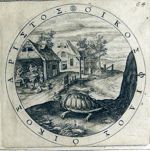
Ὄικος φιλος ὄικος αριστος: Wither, A collection of emblems (London, 1635), emblem 164
Domus amica domus optima: Meisner, Politica Politica (Nürnberg, 1700), emblem 178
Domus amica, domus optima: Holtzwart, Emblematum Tyrocinia (Strasbourg, 1581), emblem 27
Domus optima: De la Feuille, Devises et emblemes anciennes et modernes (Augsburg, 1697), emblem 564
La statue de Caia Cecilia: Corrozet, Hecatomgraphie (Paris, 1540), emblem 97 uses the imagery of the statue of Venus made by Phidias
Uxoriae virtutes: Whitney, A choice of emblemes (Leiden, 1586), emblem 102 uses the imagery of the statue of Venus made by Phidias
Domus optima: Camerarius, Symbolorum et Emblematum Centuria(e) (Nürnberg, 1590, 1595, 1596, 1604), emblem 191 uses the adage
Domus optima: Borja, Empresas morales (Bruxelles, 1680), emblem 41 uses the adage
Ce qu'est requis en la femme prudente: La Perrière, Le theatre des bons engins (Lyon, 1545), emblem 18 uses the imagery of Venus with one foot on a tortoise, a finger to her lips and a key in her right hand to express the qualities of a prudent housewife
Iconclass: 42D25 wedding feast, wedding meal 42B71 family life at home 51MM11 Slowness, Tardiness; 'Tardità' (Ripa) 56D31 Self-confidence 85(JUPITER AND ANIMALS) fables (JUPITER AND ANIMALS) 85(ZEUS AND THE TORTOISE) fables (ZEUS AND THE TORTOISE) 92B1 (story of) Jupiter (Zeus)
Loci Communes: Domi vivere (To live at home, Vivre chez soi)
III iii 39 Asini caput ne laves nitro Do not wash a donkey's head with soap
Ονου κεφαλὴν μὴ πλύνειν νίτρῳ. i. Asini caput ne laves nitro. Ne mulrum sumptus operae've impendas in rem vilem, ac sordidam. Finitimum illi: τὴν χοίτραν ποικίλλειν, id est, Ollam variegare.
Greek, Do not wash a donkey's head with soap. Do not expend much coin or effort on a mean and worthless task. Related to You are painting up the cooking-pot.
Facsimile:
Iconclass: 31A54 washing and bathing 31A5461 soap 46C13142(+733) ass, donkey (+ head of an animal) 54BB3 Inutility, Noxiousness; 'Nocumento', 'Nocumento d'ogni cosa' (Ripa)
Loci Communes: Inanis opera (Vain effort, Effort vain)
III iii 40 Asini mandibula The jawbone of an ass
Ονουγνάθος, id est, Asini mandibula. Convenit in edaces, alioqui stolidos & ignavos. Cuiusmodi pingit Horatius, Nos numerus sumus & fruges consumere nati. Hesychius citat ex Eupolide, dictumque in homines edaces. Addit & loci nomen esse. Et haud scio an sentiat de loco in quo Samson reperit asini mandibulam, cuius fit mentio Iudicum 15.
Greek, The jawbone of an ass, is appropriate for hearty eaters who in other respects are dull and lazy, like the people whom Horace describes in the line 'Mere cyphers we, and born to consume the fruits of the earth.' According to Hesychius, it comes in Eupolis, and was used of heavy eaters. He adds that it was also the name of a place. I suspect that he was thinking of the place where Samson found the jawbone of the ass, which is mentioned in Judges 15.
Facsimile:
Iconclass: 41C19 insatiable hunger or thirst 46C13142(+7335) ass, donkey (+ snout, jaw, beak, nib) 54AA11 Sluggishness, Inertia; 'Dapocaggine', 'Pigritia' (Ripa) 71F35 Samson and the jaw-bone of an ass (Judges 15:9-20)
Loci Communes: Luxus et mollicies (Luxury and softness, Luxe et mollesse)
III iii 41 In occipitio oculos gerit He has eyes in the back of his head
Οπισθεν κεφαλῆς, ὂμματα ἔχει. i. In occipitio oculos habet. De versutis & circumspectis, quosque neutiquam proclive sit fallere. Quod genus hominum Persius Ianos appellat, O Iane à tergo cui nula ciconia pinsit Et Homerus à principe requirit, ut oculatus sit πρόσσω καὶ ὀπίσσω A fronte & à tergo. Plautus in Aulularia, Quae in occipitio quoque habet oculos.
Greek, He has eyes in the back of his head. Used of cunning and wary people, and those whom it is by no means easy to deceive. Men of this sort are called by Persius Januses: 'What a Janus you are! No stork can peck you from behind.' And Homer demands of a prince that he should have eyes 'both before and behind.' Plautus in the Aulularia: 'She has eyes in the back of her head as well.'
Facsimile:
Iconclass: 31A221(+2):31A2212 head (human) (+ back view)❧eyes 31A443:31A2212 anthropomorphic beings with limbs, organs, etc. in unusual places❧eyes 52A23 Alertness, Vigilance; 'Guardia', 'Vigilanza', 'Vigilanza per difendersi & oppugnare altri' (Ripa) 57AA6131 Guile, Artfulness, Craftiness, Deceitfulness
Loci Communes: Diligentiae (Diligence, Diligence)
III iii 42 Lutum nisi tundatur, non fit urceus Unless you pound the clay, you get no jar
Ο πηλος ἢν μ δαρῇ, κέραμος οὐ γίνεται. Lutum ni tundatur, non fit testa. Citra laborem nullus evadit in virum absolutum. Et hoc, ni fallor, Apostolius hausit à vulgi fece, homo non perinde ingenio elegans atque palato: quemadmodum accepimus ab his qui eum domestica consuetudine noverant.
'Greek, Unless you pound the clay, you get no pot. Without hard work no one becomes a really educated man. This too, if I am not mistaken, was collected by Apostolius from the dregs of society; he was a man of no great nicety of mind or taste, as I have heard from those who knew him in ordinary conversation.
Facsimile:
Iconclass: 31A2743 hitting at something 47B14(+43) handicrafts ~ clay, sand, chalk (+ clay, sand, etc. ~ crafts, industries, agriculture) 54A11 Industriousness, Assiduity; 'Assiduità', 'Industria', 'Zelo' (Ripa)
Loci Communes: Industria (Industriousness, Application, diligence)
III iii 43 Viri jurejurando, pueri talis fallendi Cheat men with oaths and children with markers
Ορκοις ἂνδρας, ἀστραγάλοις δὲ παῖδας ἐξαπατέον. i. Iureiurando viros, talis pueros oportet fallere. Docet viris nulla re citius imponi posse, quam iureiurando, quod nemo tam improbus esse credatur, qui id velit violare. Lysandri Lacedaemoniorum ducis apophthegma, autore Plutarcho.
Greek, Cheat men with oaths; keep markers for children. This tells us that there is no quicker way of imposing on grown men than to use an oath; for no one is thought to be such a villain that he would take an oath and break it. This is a saying, according to Plutarch, of the Spartan general Lysander.
Facsimile:
Iconclass: 31D112 child 31D14 adult man 57AA621:57A6142 Cheat, Deceit; 'Fraude', 'Inganno' (Ripa)❧Oath
Collectanea (1500): 495a
Loci Communes: Fides et gravitas (Trust and seriousness, Confiance et gravité)
III iii 44 Aves quaeris You look for birds
Ορνις ζητεῖς. i. Aves quaeris. Rem vagam, & captu difficilem sequeris. Persius, An passim sequeris corvos, testaque lutoque, Item Aristoteles, τὰ πετώμενα διώκειν, id est, Sectari volantia. Et ante hunc Plato in Euthyphrone, τί δὲ πετώμενόν τινα διώκεις; id est, Quid autem volantem quempiam insectaris?
Greek, You look for birds. You pursue a flying quarry which is hard to overtake. Persius: 'Do you with brickbats and with clods pursue the random crow?' So too Aristotle: To pursue a flying quarry.' And before him Plato in the Euthyphro: 'But why pursue someone who flies away?'
Facsimile:
Iconclass: 43C115:25F3 searching for game❧birds 54BB2 Unnecessity, Superfluity 54BB3 Inutility, Noxiousness; 'Nocumento', 'Nocumento d'ogni cosa' (Ripa)
Loci Communes: Inanis opera (Vain effort, Effort vain)
III iii 45 Mons cum monte non miscetur Mountains never meet
Ορος ὄρει οὐ μίγνυται, id est, Mons cum monte non miscetur. Non convenit inter pariter elatos aut pariter potentes. Etiam si Plinius tradit, duos montes concurrisse, crepitu maximo assultantes recedentesque magna hominum turba spectante, idque luce.
Greek, Mountains never meet. Men of equally exalted station or of equal power do not agree. Though Pliny tells us that two hills collided, running together and separating with a loud crashing sound, under the eyes of a great crowd of people, and that too in broad daylight.
Facsimile:
Iconclass: 25H1121 mountain-top, peak 51AA4:33A13 Nothingness, Absence❧meeting 51B2 Similarity, Likeness 54EE31 Disagreement, Discord; 'Discordia' (Ripa)
Loci Communes: Similitudinis et congruentiae (Similarity and congruence, Similitude et convenance)
III iii 46 Qui canem alit externum He who feeds a stranger's dog
Ος κύνα τρέφει ξένον, τούτῳ μόνον λῖνος μένει. i. Qui canem alit peregrinam, huic praeter funiculum nihil fit reliqui. Qui beneficium collocat in ingratum, perdit operam. Nam canis alienus relicta fune quo alligatur, pristinum dominum repetit. Sapit & hoc vulgare quiddam, mea quidem sententia.
Greek, He who feeds another man's dog is left with nothing but the leash. He who bestows a benefit on someone ungrateful, loses his labour. For a strange dog leaves the leash behind with which it was tied, and returns to its old master. This too, at least in my opinion, has a somewhat plebeian smell.
Facsimile:
Iconclass: 34B11(+1) dog (+ feeding animal) 57AA8 Ingratitude; 'Ingratitudine' (Ripa)
Loci Communes: Ingratitudo (Ingratitude, Ingratitude)
III iii 47 Cum Nibas coccyssaverit When the cock crows at Nibas
Οτ᾽ ἄν νίβας κοκκύσῃ. i. Cum Nibas coccyssaverit. Similimum illi, Ad Graecas calendas. Tradunt in Thessalonica Macedoniae civitate vicum esse, cui nomen Nibas, ubi galli nunquam vocem aedant. Quemadmodum & cicadae mutae sunt alicubi. Porro quod illic locus addit gallinaceo, id ars efficit, addito collo circulo è sarmentis, si qua fides Plinio, qui hoc retulit lib. 29. cap. 4. Hesychius addit, Nibades dici capras cristatas, ut ab iis exspectetur τὸ κοκκύζειν, quod est, gallinaceorum.
Greek, When the cock crows at Nibas. Very like that other adage: At the Greek calends. The story goes that in the territory of Thessalonica, a city in Macedonia, there is a village called Nibas where the cocks never utter a sound, in the same way that in other places cicadas are dumb. In fact the quality possessed in that place by the domestic fowl can be produced artificially by putting a collar of twigs round the creature's neck, if we are to believe Pliny, who records this in book 29 chapter 4. Hesychius adds that nibades is the word for goats which have a crest, such that one might expect them to crow, which is the property of cocks.
Facsimile: 
Iconclass: 22D9 silence 34B232(+949) fowl (cock, hen, chicken, etc.) (+ audible means of communication of animal(s): roaring, crying, singing, barking, mewing, neighing, chirping, etc.) 51FF6 Infrequency 52DD3 Taciturnity; 'Secretezza', 'Secretezza overo Taciturnità' (Ripa)
III iii 48 Ignis non extinguitur igni Fire is not quenched by fire
Πυρὶ οὐ σβέννυται πῦρ. i. Igni non extinguitur ignis. Malum malo non tollitur: ira non sedatur iracundia, sed ferocitas sedatur lenitate, malum patientia tollitur: iniuria beneficio vincitur. μὴ πῦρ ἐπὶ τῦρ alibi retulimus ex Platone & Plutarcho.
Greek, Fire is not quenched by fire. One evil thing is not removed by another; wrath is not calmed by angry words, but ferocity is tamed by gentleness, ill-treatment is ended by patience, wrongdoing is conquered by kindness. Do not add fire to fire, as I have recorded elsewhere from Plato and Plutarch.
Facsimile:
Aut terra, aut mari: Borja, Empresas morales (Bruxelles, 1680), emblem 93 uses the imagery of a ram and elephant to show that gentleness is the better answer to ferocity
Iconclass: 51AA4:21C Nothingness, Absence❧fire (one of the four elements) 57A77 Friendliness, Gentleness, Affability; 'Affabilità, piacevolezza, amabilità', 'Animo piacevole, trattabile & amorevole', 'Benignità' (Ripa)
Loci Communes: Mali retaliatio (Retaliation of evil, Rendre le mal pour le mal); Mansuetudo (Gentleness, Douceur)
III iii 49 Ne terra quidem juvit He did not help even with earth
Οὐδ᾽ ἀπὸ γῆς ὤνησεν. i. Ne terra quidem profuit, id est, ne minimo quidem, perinde quasi dicat, ne glebam quidem impertivit: aut ne terrae quidem hospitio dignatus est, ut apud Maronem, Hospitio prohibemur arenae? Bella cient, primaque vetant consistere terra.
Greek, He was no use even with earth, not even (that is) to the smallest extent, as though this meant 'he gave me not so much as a clod of earth,' or 'he was not ready to give us even permission to use his land,' as in Virgil: 'We are denied the hospitality of the sandy shore; they call to arms, and forbid us so much as to set foot on the verge of their land.'
Facsimile:
Iconclass: 25D21 earth (soil type) 54AA6 Obstructiveness 54BB3 Inutility, Noxiousness; 'Nocumento', 'Nocumento d'ogni cosa' (Ripa)
Loci Communes: Contemptus et vilitatis (Contempt and worthlessness, Mépris et bassesse)
III iii 50 Nullus emptor difficilis bonum edit obsonium No hard bargainer eats good meat
Οὐδεὶς δυσώνης χρηστὸν ὀψονεῖ κρέας. id est, Difficilis emptor haud bona emit obsonia. Qui nimium vili studet emere, semper merces vitiosas emit. Nam haud conveniunt, parvo emere, & rem egregie bonam emere. Conveniet in hos qui paululo labore conantur egregias assequi literas, quae non contingunt, nisi maximis ac diuturnis vigiliis. Ni fallor, subnotavit hoc proverbium Iulius Pollux lib. De rerum vocabulis sexto, quum negat vocem δυσώνης usurpatam ab autoribus: sed tantum reperiri in proverbio.
Οὐδεὶς δυσώνης χρηστὸν ὀψονεῖ κρέας, He who drives a hard bargain does not buy good meat. The man who strives to buy things too cheaply always buys defective goods; for there is no connection between buying cheap and buying something really good. Will be appropriate for those who try with very little labour to master the humanities, which cannot be acquired except by industry and long studious nights. If I am not mistaken, Julius Pollux was referring to this proverb in book six of his Vocabulary, when he says that the word dysônês, the man who drives a hard bargain, is not used by good authors, but found only in proverbs.
Facsimile:
Haud conveniunt: Peacham, Minerva Britanna (London, 1612), emblem 169 quotes the comment
Iconclass: 46B43 bargaining 51EE2:41C69 Inferiority❧meat; still life of meat
Loci Communes: Sordes et parcimonia (Meanness and stinginess, Bassesse et avarice)
III iii 51 Non potes Tethydem simul et Galateam amare You cannot love Tethys and Galatea at one time
Οὐ δύνασαι θὲτιδός τε καὶ γαλατείας ἐρᾶν. i. Non potes simul & Thetidem & Galateam amare. id est, non potes idem diversa sequi, velut literas & pecuniam, voluptatem & gloriam, mundum & Christum. Nam Galateae fluvio male convenit cum marinis fluctibus. Declarat hoc Luciani dialogus inter Galateam ac Doridem. Suspicor & hoc è vulgi fece haustum.
Greek, You cannot love both Tethys and Galatea at the same time, You cannot, that is, pursue simultaneously quite different things, scholarship and money, pleasure and glory, the world and Christ. For the river Galatea has nothing in common with the waves of the sea. This is made clear by Lucian's dialogue between Galatea and Doris. I suspect that this too was collected from the dregs of the common people.
Facsimile:
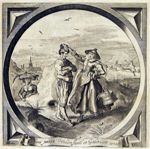
Nemo potest Thetidem simul et Galateam amare: Cats, Spiegel (The Hague, 1632), emblem 17
Iconclass: 52BB42:51F4:56F2 Impossibility❧Simultaneity❧(personifications and symbolic representations of) Love; 'Amore (secondo Seneca)' (Ripa) 53A11 Choice; 'Elettione' (Ripa) 91B122 Tethys 92I22 (story of) Galatea; 'Galatea' (Ripa) 49A1 study and diversion
Loci Communes: Amicitia (Friendship, Amitié)
III iii 52 Lucrum malum aequale dispendio Gain ill-gotten is as bad as loss
Celebratum Hesiodium dictum, Μὴ κακὰ κερδαίνειν, κακὰ κέρδεα ἶσα ἄτησιν, id est, Ne mala lucreris, mala lucra aequalia damnis. Utinam hanc sententiam cum mortales omnes, tum praecipue negociatores, non scriniis, sed pectori inscriberent suo, ducerentque non esse lucrum, quod iactura bonae mentis comparetur: neque quicquam utile esse, quod non idem sit honestum. Verum his magis arridet illud Ennianum, Unde habeas quaerit nemo, sed oportet habere. Sophocles Hesiodiam sententiam latius extulit, Οὐκ ἐξ ἅπαντος δεῖ τὸ κορδαίνειν φιλεῖν. Εκ τῶν γὰρ αἰσχρῶν λημμάτων πλείονας Ατωμένους ἰδοις ἂν ἢ σεσθμένους. id est, Non undecunque lucra gaude quaerere, Plerosque siquidem turpibus de quaestibus Auferre damnum, non salutem videris. Feruntur in eandem sententiam aliquot senarii proverbiales, Κέρδος πονηρὸν ζημίαν ἀεὶ φέρει. id est, Dispendio usque est fraude quaesitum lucrum. Et, Τὰ δ᾽ αἰσχρὰ κέρδη συμφορὰς ἐργάζεται. id est, At turpe lucrum adducit infortunium. Huc pertinet quod alibi retulimus ex Isthmiis Pindari, τὸ δὲ πὰρ δίκαν γλυκὺ πικροτάτα μένει τελευτὰ. i. Quod praeter iustum est dulce, exitum habet amarissimum.
There is a famous aphorism in Hesiod: 'Seek not ill-gotten gain, for gain ill-gotten is as bad as loss.' Would that this saying might be written up by all mortals and especially by merchants, not on their shelves but in their hearts! Would that they might remember that what is purchased by the loss of a good conscience can never be a source of gain, nor can anything be profitable that is not at the same time honest. No; such people are more attracted by that line of Ennius: 'Whence comes your money, no man asks; but money you must have.' Hesiod's opinion was expanded by Sophocles:
One must not love to gain from every source;
By gains ill-gotten you may often see
More men distressed than in prosperity.
Several proverbial iambic lines are current to the same effect: 'Dishonest gain's always a source of loss' and 'Ill-gotten gain, disaster's architect.' Here belongs a passage I have recorded elsewhere from Pindar's Isthmians: That which is sweet beyond the bounds of justice has a very bitter end in store.'
Facsimile:
Unde habeas quaerit nemo: Visscher, Sinnepoppen (Amsterdam, 1614), emblem 99 quotes the comment
Iconclass: 57AA61:55A1 Dishonesty, Falsety❧Acquisition, Gain, Profit 55AA1 Loss
Loci Communes: Injustitia (Injustice, Injustice)
III iii 53 Thericlei amicus A friend of the Thericleian
Θηρϊκλείου φίλος, id est, Thericlei amicus. Dictum in bibosos. Thericles primus excogitavit poculum, ut citatur autor Eubulus. Dictum est autem inventum inventoris vocabulo. Siquidem Graeci vitreum poculum θηρίκλειον vocant, autore Suida. Fertur apud eundem & illud θηρικλέους τέκνον κύλιξ. i. Thericlis filius calix. Huius dicti autorem citat Athenaeus Theopompum in Nemea. Antiphanes θηρίκλειον ὄργανον appellat. Sed plura super hac re prodidit Athenaeus li. 11. ostendens Thericlem Corinthium quempiam aetate Ari stophanis Comici fuisse figulum, qui nova arte primus è terebintho tornatile poculum finxerit, quod à fictilibus non potuerit dignosci. Cuius rei meminit Theophrastus in libris De plantis, Poculum erat satis profundum, auriculis brevibus, ut ad ilia gestari posset, ad uteri effigiem imitatum, quemadmodum refert idem Athenaeus, & incertum utrum poculo nomen sit inditum ab homine, an homini à poculo. Alii malunt Thericleum dictum, δὶα τὸ δορὰς θηρίων αὐτῳ ἐντετυπῶσθαι. i. Quod ferarum pelles illi fuerint insculptae. Pamphilus Alexandrinus mavult hinc dictum, quod Bacchus hoc poculo libans feras exturbare soleat. Sed nominis controversiam relinquamus. Illud constat, eiusmodi poculi genus postea dictum Thericleum, insuper & crateres dictos Thericleos. Similiter & intus lignea, foris inaurata pocula, nihilominus Thericlea vocata, quae Callimachus χρυσόκλειστα dixit. Imò quicquid novo artificio reperisset aliquis, Thericleum appellabatur. De patinis Thericleis meminit Plutarchus in apophthegmatis Scipionis minoris, tanquam de re singulari ac pretiosa.
Greek, A friend of the Thericleian, was a phrase used of heavy drinkers. Thericles was the first inventor of the cup, as we know from Eubulus who is cited as the authority, and the invention was known by the inventor's name. For in Greek a drinking-vessel made of glass was called a Thericleian, as Suidas says; and he also cites the words The cup, Thericles' child.' As the author of this Athenaeus gives Theopompus in his Nemea. Antiphanes calls it 'instrument of Thericles.' But more information on this topic is provided by Athenaeus book 11, who shows that there was a Corinthian called Thericles, a potter contemporary of Aristophanes, who first invented the art of making a cup of terebinth wood, turned on the lathe, which was indistinguishable from cups made of clay. This fact is mentioned by Theophrastus in his work on plants. The cup was fairly deep, with short ears so that it could be carried on the flanks, reproducing the shape of a wine-skin, as Athenaeus also tells us; and it is uncertain whether the cup got its name from the man or the man from the cup. Others prefer to suppose that the Thericleian was so called because it had the skins of wild animals (theria) represented on it. Pamphilus of Alexandria would rather derive it from the way that Bacchus often drives wild animals in confusion when he pours libations from this cup. But let us abandon the controversy about its name. One thing is certain, that cups of this sort were later called Thericleian, and further that there were mixing-bowls of the same name. Also that cups of which the inside was wooden and the outside gilt were none the less called Thericleians; Callimachus calls them 'gold-washed.' In fact, any object produced by some new technical discovery was called a Thericleian. Plutarch in his 'Apophthegms of Scipio' mentions Thericleian dishes as something rare and valuable.
Facsimile: 
Iconclass: 31B521 drunkard 33A5:41C321 friends❧cup 52A42 Invention, Inventiveness; 'Inventione' (Ripa) 98B(THERICLES) male persons from classical history (THERICLES)
Loci Communes: Luxus et mollicies (Luxury and softness, Luxe et mollesse)
III iii 54 Theagenis Hecataeum Theagenes and his shrine of Hecate
Θεαγένους ἐκάτειον, id est, Theagenis hecateum. In superstitiosos ac ridicule meticulosos dictum est. Hic Theagenes legitur usque adeo fuisse superstitiosus, ut domi haberet Hecates simulacrum, nec usquam pedem moveret, nisi illo consulto. Unde & καπνὸς. i. fumus est cognominatus, quod magnifice polliceretur, cum esset pauper. Qua de re meminimus alibi.
Greek, Theagenes and his shrine of Hecate, was used of superstitious people, full of childish anxieties. This Theagenes, we read, was so superstitious that he kept in his house an image of Hecate, and never set foot outside it until he had consulted the image. Hence he was also nicknamed Kapnos, which means Smoke, because he used to make magnificent promises, though he was poor. I have mentioned this elsewhere.
Facsimile:
Iconclass: 13G superstition, popular belief 12E62:92N27 altar ~ Greek religion❧specific aspects, allegorical aspects of Hecate; Hecate as patroness 98B(THEAGENES) male persons from classical history (THEAGENES)
Loci Communes: Inanis metus (Groundless fear, Peur vaine); Magnifica promissa (Magnificent promises, Promesses magnifiques)
III iii 55 Fiducia pecunias amisi Credulity has cost me money
Iactatur & hodie, vereque dicitur, fiducia plerosque mortalium falli. Videtur autem ex antiquorum relictum proverbiis: quando quidem apud Theognidem legitur hic versiculus, Πίστει χρήματ᾽ ὄλεσσα, ἀπιστείη δ᾽ ἐσαωσα. id est, Fiso res periit, diffiso salva remansit. Proinde non pessime monet Epicharmus, νῆφε καὶ μέμνησο ἀπιστεῖν. i. sobrius esto, & memineris diffidere. Quanquam nulli fidere, inhumanum est, omnibus fidere, stultum. Hoc honestius, illud tutius. Propter quod, ut idem ait Theognis, Παῦροι τοι πολλῶν πιστὸν ἔχουσι νόον. id est, Paucis è multis fidus adest animus.
Even today there is a common saying, and a true one too, that most men are taken in by trusting others. And this seems to be a survivor from the stock of proverbs in antiquity, for in Theognis we find the line 'By trust I lost my money, by mistrust I saved it.' So there is much to be said for Epicharmus' advice: 'Keep your head and trust no man.' Though to trust nobody is as inhuman as it is foolish to trust everybody; one is more admirable, the other safer; for, as Theognis says in another passage, 'Few among many have a loyal heart.'
Facsimile:
Fiducia pecunias amisi: Meisner, Politica Politica (Nürnberg, 1700), emblem 75
Iconclass: 55AA1:46B31 Loss❧money 56D29 Misplaced Trust, False Confidence, 'Pax Falsa'; 'Speranza fallace' (Ripa)
Loci Communes: Diffidentia (Distrust, Méfiance)
III iii 56 Aliud stans, aliud sedens One thing on his feet and another sitting down
Nullus inficias iverit, proverbiali figura dictum illud Salustianum in Ciceronem: Aliud stans, aliud sedens loquitur. Quo licebit uti, cum summam inconstantiam animi significamus, quasi tantillum momentum atque intervallum commutet hominis sententiam. Homerus Iliados Ν huiusmodi versiculo notat hominis inconstantis ingenium, Αλλὰ μετοκλάζει, καὶ ἐπ᾽ ἀμφοτέρσυς πόδσς ἵζει. id est, Verum claudicat, inque pedes utrosque vacillat. Eandem sententiam sic effert Pindarus in Nemeis hymno tertio, ὅ δὲ δίδακτ᾽ ἔχει ψεφηνὸς ἀνὴρ ἄλλοτ᾽ πνέων, οὔποτ᾽ ἀτρεκεῖ κατέβα ποδὶ, μυριᾶν δ᾽ ἀρετᾶν ἀτελεῖ νόῳ γεύεται. i. Qui vero tenet ea quae didicit, obscurus homo, alias aliter atque aliter affectus, nunquam certo ingressus est pede, sed innumerabilium virtutum imperfecto intellectu gustum capit. Praefert autem Pindarus naturam institutioni, quod qui natura bonus semper sui similis est, qui vero nititur eruditione, cum multa tentet, nec firmus nec absolutus est ulla in re.
No one would deny that there is a proverbial shape about that remark of Sallustius about Cicero: 'He says one thing on his feet, and another sitting down.' This will be useful when we wish to convey a high degree of unreliability, as though a man's opinions might be changed by the least possible pressure or lapse of time. Homer in the thirteenth Iliad uses the following line to pillory a man who is constantly changing his mind: 'But shifts his weight and stands on either foot.' The same idea is thus expressed by Pindar in the third hymn of the Nemeans: 'But the man who has learned all he knows lives in obscurity, constantly changing his purpose from one thing to another and never setting his best foot foremost, but has a smattering of a myriad forms of excellence in a spirit that accomplishes nothing.' Pindar prefers natural gifts to instruction, because the man who is good by nature is always himself, while he who depends on what he has learned, though he tries many things, never achieves strength or mastery in any one thing.
Facsimile:
Iconclass: 31A231 standing figure 31A235 sitting figure 57AA6141:98B(CICERO)3 Untrustworthiness, Unreliability❧(story of) Cicero - representations to which the NAME of a person from classical history may be attached
Loci Communes: Inconstantiae, perfidiae, versutiae (Inconstancy, treachery, cunning, Inconstance, perfidie, ruse)
III iii 57 Lingua amicus A friend in word
Απὸ γλώττης φίλος, id est, Lingua amicus, qui verbis ostendit, non re praestat beneficium. Aut qui non amat ex animo, sed benevolentiam oratione prae se sert. Quod genus inducitur Candidus apud Martialem. Et apud Homerum Odysseae. Σ. Οἵτ᾽ εὖ μὲν βάζουσι, κακῶς δ᾽ ὄπισθεν φρονέουσι. id est, Qui recte dicunt, à tergo prava valutant. Theognis in Sententiis, Αλλὰ δόκει μὲν πᾶσιν ἀπὸ γλώσσης φίλος εἶναι, Χρῆμα δὲ συμμίξῃς μηδενὶ μηδοτιοῦν. id est, Sic facito, ut lingua cunctis videaris amicus, At factis cuiquam te cave miscueris. Contra Sophocles in Antigone, Λόγοις δ᾽ ἐγὼ φιλοῦσαν οὐ στέργω φίλην. id est, Non diligo hanc verbotenus quae diligat. At idem Theognis paulo post, damnat huiusmodi genus amicorum: Μή μ᾽ ἔπεσιν μὲν στέργε, νόον δ᾽ ἔχε καὶ φρένας ἄλλη. id est, Nec me diligito verbis, cum mens alibi sit. Rursum alibi, Μή μοι ἀνὴρ εἴη γλώσσῃ φίλος, ἄλλα καὶ ἔργῳ. id est, Ne lingua mihi quis sit amicus, sed mage facto. Similimum est huic quod alibi refert idem, μέχρι προσηγορίας. id est, usque ad salutationem. Πράγμα μὲν ἐσθ᾽ ὁ φιλος πάνη δύσκολον, εἰσὶ δὲ πολλοὶ Καὶ σχεδὸν οἱ πάντες μέχρι προσηγορίας. id est, Res perdifficilis quidem amicus, sunt quia multi Atque adeo cuncti penè, salute tenus.
Greek, A friend in word, one who displays kindness in words, but does not back them up with deeds, or who has no love in his heart but makes a show of good will in what he says. Such a man is represented by Candidus in Martial, and in Homer, in book 18 of the Odyssey: 'Whose words are kindly, but their heart within is evil.' Theognis among his aphorisms: 'But mind you seem to all a friend in word, / Yet with no man in deed make common cause.' For the opposite view Sophocles in the Antigone: 'I like no friend whose friendship is but words.' But that same Theognis not much further on condemns friends of this kind: 'No loving words, with heart and mind elsewhere!' And again in another passage: 'No friends in word be mine, but friends in deed.'There is a phrase very like this, recorded elsewhere by the same author, Greek, Not beyond greetings:
How rare a thing is friendship! Many a friend
Who starts with greetings will with greetings end.
III iii 58 Saturni podex Saturn's anus
Κρόνου πυγή. i. Saturni culus: de carnibus vetulis, iamque mancis et sensu vacantibus. Quicquid enim putre iam & effetum intelligi volebant olim, id Saturnium vocabant. Meminit Diogenianus, nec tamen explicat. Suidas & Hesychius admonent, ita dictam carnem ob vetustatem stupidam, ac sensus expertem, a Saturno deo, qui multa proverbia nobis dedit. Ad animum translatum nonnihil habebit gratiae.
Greek, Saturn's backside, of old flesh, which is now defective and devoid of feeling; for in old days, whenever they wished to convey that something was decaying by now and worn out, they used to call it Saturnian. Mentioned by Diogenianus, but he does not explain it. Suidas and Hesychius tell us that flesh which is numb from old age and has lost all feeling was so called from the god Saturn, who has provided us with many proverbs. Transferred to apply to the mind, it will have its attractions.
Facsimile: 
Iconclass: 91B111:31A22371 (story of) Saturn (Cronus)❧anus 56AA1 Insensibility, Insensitivity
Loci Communes: Multi - in stupidos (Many people - against the stupid, Beaucoup de gens - contre les sots)
III iii 59 Qui vitat molam, vitat farinam He who runs from the mill runs away from the meal
Ο φεύγων μύλον, ἄλφιτα φεύγει. id est, Qui fugit molam, fugit farinam. aut, Devitat quicunque molam, fugit ille farinam. Nam omisso articulo videtur hemistichium carminis heroici. Qui refugit in dustriam, non fruetur emolumentis. Sunt qui molarum stridoribus offenduntur, cum sine molis non liceat vivere. Sic quidam uxorum mores ferre non possunt, cum optent liberos. Dicunt & hodie vulgo, Qui quaerit ova, gallinarum cacalismus (ut vulgo vocant, Latini glocire dicunt) ferat oportet. Finitimum illi, οὐτε μέλι οὔτε μέλιτται. id est, Neque mel, neque apes.
'Greek, He who runs away from the mill runs away from the meal, or Who seeks to miss the mill will miss the meal; for by omitting the definite article we seem to get half of a dactylic hexameter. He who fights shy of hard work will not enjoy the miller's fees. Some people object to the noise of a mill, though without mills we could not live. In the same way there are men who cannot endure their wives' personality, though they wish for children. In our own day there is still a popular saying; He who wants eggs must put up with the cackling of the hens' ('cackling' [cacalismus] is the colloquial word; glocire is the proper Latin word). Close to No bees, no honey.
Facsimile:
Iconclass: 33B9:47D21 flight, running away; pursuing❧handmill 54A11 Industriousness, Assiduity; 'Assiduità', 'Industria', 'Zelo' (Ripa) 54AA11 Sluggishness, Inertia; 'Dapocaggine', 'Pigritia' (Ripa) 55AA1:41C4 Loss❧(family) meal
Loci Communes: Industria (Industriousness, Application, diligence)
III iii 60 Αγεωμέτρητος οὐδείς εἰσίτω No admission without a knowledge of geometry
Αγεωμέτρητος οὐδεὶς εἰσίτω. Admonet iniquum non admittendum. Geometriam enim aequabilitatem accipiunt, ut apud Aristidem in Themistocle: ὅπου γὲ δεῖ καὶ τῆς ἰσότητος, καὶ γεωμετρίας. i. Ubi opus est, & aequabilitate, & geometria. Idem in Pericle, εἰ δεὶ ἡ γεωμετρία καλὸν, καὶ ἡ κατ᾽ αὐτὴν ἰσότης. i. Si honesta est geometria, & quae cum illa coniuncta est aequalitas. Unde Lycurgus arithmeticen, ceu popularem, ac turbulentam eiecit è Lacedaemone: geometriam induxit, tanquam modestae oligarchiae, & legitimo regno convenientem, teste Plutarcho. Sed mea quidem sententia, magis valebit perinde proverbium, quasi dicas, ἀνίπτοις ποσὶν. i., Illotis pedibus, hoc est, temere & imparatis. Nam haec erant apud veteres prima philosophiae rudimenta, Musica, & Geometria. Quibus disciplinis si qui essent initiati, non admittebantur in scholam Platonis, cuius hanc ferunt fuisse inscriptionem, ἀγεωμέτρητος οὐδεὶς εἰσίτω. Loquitur ad hunc modum & Taurus philosophus apud Gellium: Nunc autem istis, qui repente pedibus illotis ad philosophos divertunt, non est hoc satis, quod sunt omnino ἀθεώρητοι, ἂμουσοι, ἀγεωμέτρητοι. i. Speculativae, musicae, geometriae ignari. Praecipuus autem admirator geometriaee fuit Pythagoras, quem tradunt ob inventum unum problema, sacrificasse diis. Id erat huiusmodi, Datis duabus figuris adicere tertiam ab his diversam, quae alteri sit aequalis, alteri similis. Tum Philo, qui geometriam ἀρχὴν καὶ μητρόπολιν appellarit omnium disciplinarum, quod haec rerum intelligibilium imagines, verique vestigia, tanquam in politissimo speculo demonstret, mentemque purgatam paulatim abducat à sensu. Plato quoque dixisse creditur, deum ipsum γεωμετρεῖν, sive quod geometrica speculatio animum à rebus corporeis abducat ad ea, quae semper eodem sunt modo. (Deus autem ab omni materia purissimus est.) Sive quod in Timaeo principia mundi divisit in tria, deum, materiam, & ideam. Materia quiddam est omnium quae substernuntur, maxime confusum & incompositum: Idea exemplarium pulcherrimum: Deus causarum optima. Cum igitur ita condiderit mundum, ac semper ita servet, ut materiae sit aequalis, ideae similis, videtur explicare Pythagoricum illud problema, cuius modo meminimus. Haec itaque, & alia id genus multa, Plutarchus Symposiacae decadis octavae problemate secundo. Plato videtur aemulatus sollemnem morem tale quippiam inscribendi foribus. Spado quidam effoeminatus, quum ostio domus inscripsisset, οὐδὲν κακόν εἰσίτω, Diogenes, At herus, inquit, domus, qua tandem ingredietur? Socrates apud Platonem in Theaeteto disputaturus de rebus subtilioribus, ἄθρει δὴ, inquit, περισκοπῶ, μήτις τῶν ἀμυήτων ἐπακούῃ, id est, obser va iam circumspiciens, ne quis profanus exaudiat. Imitatus est Pythagoram, qui sic praefatur: Αείσω συνετοῖς, θύρας δ᾽ επίθεσθε βέβηλοι. id est, Cordatis cantabo, fores tamen obde profane. Cuius alibi meminimus,
'Greek, No admission without a knowledge of geometry. The lesson of this is that a man who is not fair-minded should not be admitted, for by common consent geometry connotes fairness of mind, as it does in Aristides in Themistocles: 'Where there is need of fairness of mind and of geometry,' and again in Pericles: 'But if geometry be a good thing, and the fairness of mind that goes with it.' That was why Lycurgus banished arithmetic from Sparta on the ground that it is democratic and unruly, and brought in geometry as being appropriate to a moderate oligarchy and a lawful kingship, as Plutarch tells us. But in my opinion the proverb will carry more weight if taken as equivalent to 'With unwashed feet,' in the sense of rashly and without preparation. For these two, music and geometry, were in ancient times the first rudiments of philosophy, and those who had no grounding in these fields of study were not admitted into the school of Plato, over which they say stood this inscription: 'No admission without a knowledge of geometry.' The same language is used by the philosopher Taurus in Gellius: 'But nowadays these fellows who suddenly go off with unwashed feet to listen to the philosophers are not satisfied with being completely untouched by theory, by music, by geometry.' But the leading enthusiast for geometry was Pythagoras, who is traditionally said to have sacrificed to the gods when he had invented a particular problem. It was something like this: given two figures, to add a third different from them, which will be equal to one and similar to the other. After him Philo, who is said to have called geometry the beginning and the mother-city of all subjects, because it shows us images of intelligible things and traces of the truth as though in a highly polished mirror, and thus purges the mind and weans it gradually away from the senses. Plato too is supposed to have said that god himself is always doing geometry, either because the speculations of geometry wean the mind from corporeal things in favour of those which are always in the same mode, and god is perfectly pure from every trace of matter; or because in the Timaeus he makes a triple division of the first principles of the universe into god, matter and form, of which matter is the most confused and least well-ordered of all substances, form the most beautiful of patterns, and god the best of causes. Since therefore he created the universe and ever preserves it, in such a way that it is equal to matter and similar to form, he seems to expound that famous problem of Pythagoras which I mentioned just now. For all this and much else of the same kind, see Plutarch in the eighth decade of his Table-talk,' problem 2. In setting an inscription of this sort over his door Plato seems to have had his eye on a practice that was traditional. When an effeminate eunuch had written up over his house-door 'Let no evil thing pass through,' Diogenes' comment was 'And how is the master of the house to enter?' Socrates in Plato's Theaetetus, when preparing to discuss some difficult questions, say 'Keep a careful lookout to make sure no uninitiated person overhears us.' He has in mind Pythagoras, who began with the prefatory words 'I will sing to men of understanding; close the doors, ye who are profane,' as I have mentioned elsewhere.
Facsimile: 
Iconclass: 41AA3211 open door - AA - feigned door, sham-door 52A5:49D3 Knowledge; 'Cognitione', 'Cognitione delle cose' (Ripa)❧planimetry, geometry
Loci Communes: Vis injustia (Unjust force, Force injuste)
III iii 61 Serpens ni edat serpentem, draco non fiet A serpent, unless it devours a serpent, will not become a dragon
Οφις ἢ μὴ φάγῃ ὄφιν, δράκων οὐ γενήσεται. id est, Serpens nisi serpentem edat, non futurus est draco. Potentes aliorum damnis crescunt, & optimatum fortunae non in tantum augerentur, nisi essent quos exugerent. Quemadmodum inter pisces & beluas, maiores vivunt laniatu minorum. Quanquam mihi quidem & hoc dictum fecem vulgi videtur olere.
Greek, A serpent, unless it devours a serpent, will not become a dragon. The powerful grow at the expense of others, and the fortunes of the nobility would not increase as they do, had they no victims whom they can suck dry. Just so, among fish and beasts, the larger live by butchering the smaller. Though in my opinion this is another saying that smells of the dregs of the population.
Facsimile:
Iconclass: 25F42(+45):25F42 snakes (+ animals eating and drinking)❧snakes 25FF422 dragon (large fabulous serpent, sometimes with wings and legs) 57AA91 Cruelty, Ferocity; 'Crudeltà', 'Ferocità' (Ripa)
Loci Communes: Rapacitas et avaritia (Rapacity and greed, Rapacité et avarice)
III iii 62 Certamen non recipit excusationes A fight once started leaves no room for excuses
Αγὼν οὐ δέχεται σκήψεις. i. Certamen non admittit excusationes. Plato lib. De legibus sexto, ἀλλὰ γὰρ ἀγῶντα προφάσεις οὐ πάνυ δέχεσθαί φασιν. i. Verum aiunt certamen non admittere causationes. Et, ἀγὼν πρόφασιν οὐκ ἀναμένει, id est, Certamen non expectat occasionem. Cum agitur periculo, non convenit tergiversari. Aut si mavis, In praesentaneo periculo non oportet occasionem expectare quemadmodum aliis in rebus. Veluti si quis in morbo capitali medicum operiatur insignem, aut procul accersendum. Quae res hominem illum vere divinum extinxit Rodolphum Agricolam. Etenim dum contatur medicus, mors antevertit. Huc pertinet quod legimus apud Quintum Curtium lib. septimo. Sed necessitas ante rationem est, maximè in bello, quod raro permittit tempora legere.
'Greek, A fight once started admits no excuses. Plato in book six of the Laws: 'A fight, they say, once it has started leaves no room for excuses.' And Greek, A fight does not wait for pretexts: when you act at your peril, it is no moment for hesitation, or, if you prefer, In the face of danger, one cannot wait for a pretext, as one does in other things, like a man in mortal illness who waits for some grand physician or one who must be fetched from afar. It was this that killed that really godlike man Rodolphus Agricola; death overtook him while the doctor was still on his way. Here belongs that saying we read in Quinrus Curtius, book 7: 'But counsel is forestalled by necessity, and most of all in war, which rarely lets one choose one's timing.'
Facsimile:
Iconclass: 54DD3:33B3 Start❧fighting 51AA4:53BB2 Nothingness, Absence❧Hesitation
Loci Communes: Discriminis (Danger, crisis, Danger)
III iii 63 Phallus deo A phallus for the god
Φαλλὸς τῳ θεῷ. i. Phallus Deo. Dici solitum, ubi parum quidem honesta, sed tamen apta tribuuntur, quasi dicas, ἐνουρεῖν εἰς ἀμίδα, id est, In matellam immeiere. Plutarchus in commentario περὶ τῆς φιλοπλουτίας, ostendit hanc fuisse priscorum in ludis sollemnibus pompam, ut primo loco duceretur amphora vini, & clematis, id est fabae genus: post aliquis hircum trahebat: deinde nucum sportulam gestabat alius, postremo loco Phallus ferebatur. Ea erat effigies obscoeni membri virilis. Cur autem in mysteriis fuerit receptum, causam reddit Plutarchus in li. De Iside & Osiride. Columella in carmine ipsum Priapum Ithyphallum vocat, Sed truncum forte dolatum Arboris antiquae nomen venerare Ithyphalli. Et Pompeius ostendit, Ithyphallum dici membrum viri pudendum. Unde & hodie Itali si quem contemnunt, hoc nomine notant. Nonnulla de Phallis Herodotus libro secundo. dictum est alibi de Phallis Bacchi, nempe in proverbio, Erebinthius Bacchus.
'Greek, A phallus for the god. Used by custom when something is paid by way of tribute which is not very respectable but highly apt, like saying 'to make water in a chamber-pot.' Plutarch in his essay 'On Love of Wealth' makes it clear that in ancient times a procession at the solemn games went as follows. In the first place was carried an amphora of wine and a clematis (which is a kind of bean); next, a goat was led by somebody, and then another man carried a basket of nuts; in the last place was borne the phallus. This was a representation of the male sexual organ, and the reason why it was incorporated in the mysteries is given by Plutarch in his 'On Isis and Osiris.' Columella in the book he wrote in verse calls Priapus himself Ithyphallus: 'But in the rough-hewn trunk of some old tree / Venerate Ithyphallus' deity.' And Pompeius makes it clear that Ithyphallus is a name for the male sexual organ. Hence it is that even in our own day the Italians use that word to show disapproval of someone they despise. Something on the phallus will also be found in the second book of Herodotus, I have spoken elsewhere of the phallus as belonging to Bacchus - on the proverb A chickpea Bacchus.
Facsimile:
Iconclass: 12B211 prayer ~ non-Christian religions 31A2236121 image of phallus, 'phallos' 59BB33 Ignobility, 'Vulgus'; 'Vulgo overo ignobilità' (Ripa)
Loci Communes: Tempestiva (Timely things, Choses opportunes)
III iii 64 Obturbas frustra velut unda You trouble me in vain as might a wave
Οχλεῖς μάτην μὲ, κῦμ᾽ ὅπως. id est, Turbas me ut unda inaniter. id est, Incassum mihi molestus es. Fragmentum carminis est ex poeta quopiam. Traductum ab unda cautem assidue verberante. Quò pertinet illud Maronis: Quàm si dura silex aut stet Marpesia cautes.
'Greek, You trouble me in vain as might a wave, your attentions are tedious and useless. This is a fragment of verse from some poet or other. Taken from a wave constantly pounding a rock. Here belongs that line in Virgil: 'Hard as Marpesian marble, stern as flint.'
Facsimile:
Iconclass: 25H2311 wave 51B61:56BB31 Repetition❧Boredom 54BB2 Unnecessity, Superfluity
Loci Communes: Inanis opera (Vain effort, Effort vain)
III iii 65 Optimum obsonium labor senectuti Hard work best earns a dinner for old age
Οψον ἄριστον πόνος τῷ γήρᾳ. i. Optimum obsonium senectuti labor. Laborandum in iuventa, quo seni suppetat commodius vivendi facultas. Diogenes rogatus, quid esse miserrimum censeret, respondit senectutem inopem. Adagium autem videtur mutilum. Equidem opinor πόνει. i. labora legendum, ut intelligas, senectutis imbecillitatem exquisitioribus cibis esse fulciendam, qui quo suppetant seni, paranda res est in iuventa.
Greek, Hard work best earns a dinner for old age. Work when you are young, that it may be easier to find something to live on when old. Diogenes, when asked what he thought the most pitiful thing there is, replied A penniless old age. But the adage seems incomplete. I think myself that for ponos we should read ponei (work hard, that is, in the imperative), to make you understand that the weakness of old age requires support from better food, and that to secure this when you are old, you should put money by as a young man.
Facsimile:
Iconclass: 23A43 Time rewarding Industry and punishing Sloth 41C:31D160 nutrition, nourishment❧Old Age, 'Senectus'; 'Vecchiezza' (Ripa) 54A11 Industriousness, Assiduity; 'Assiduità', 'Industria', 'Zelo' (Ripa)
Loci Communes: Industria (Industriousness, Application, diligence)
III iii 66 Omne aes alienum cepe et mulcta allium All my debts onions and my taxes garlic
Πᾶν μοι χρέος κρόμμυα, καὶ τὸ τίμημα σκόροδα. i. Universum aes alienum cepe, & mulcta allium. Subaudiendum εἴη. Cum quis obstrictus multo aere alieno, optat ut parvo dependere possit quicquid debet. Nonnihil vereor ne & hoc Apostolius hauserit, non ex autoribus priscis, sed è suis combibonibus.
Greek, All my debts onions and my taxes garlic; one must supply 'I wish.' When someone who is heavily burdened with debt wishes that he could pay off what he owes at small expense. I very much fear that this too was taken by Apostolius not from ancient authors but from his own pot-companions.
Facsimile:
Iconclass: 46B451:25G22(ONION) debit, debt❧(non-fruit) products of plants or trees: onion 44D211:25G4(GARLIC) tax payment❧plants and herbs: garlic 46B44 paying (~ commerce) (here also repayment of debt, etc.)
Loci Communes: Votum (A vow, a wish, Vœu)
III iii 67 Oportet omnibus corydalis Every lark must have one
Πάσῃσι κορυδάλοισι χρὴ λόφον ἐγγενέσθαι, id est, Omnibus galeritis oportet cristam inesse. Citatur ex Simonide, & usurpatur aliquoties à Plutarcho, nominatim in vita Timoleontis, in hunc sensum: nullum est mortalis ingenium, cui non sit aliquod vitium admixtum, ceu perinde secundum hominis naturam sit non carere vitio, ut galeritae naturale est habere cristam. Plutarchi verba subscribamus, ἐπεὶ δὲ χρῆν ὡς ἔοικεν, οὐ μόνον πᾶσι κορυδαλοῖς λόφον ἐγγίνεσθαι κατα σιμωνίδην, ἀλλὰ καὶ πάσῃ δημοκρατείᾳ συκοφάντην. i. Quoniam autem oportet, ut videtur, non solum omnibus galeritis cristam inesse, quemadmodum dixit Simonides, verum etiam omni democratiae sycophantam. Meminit Corydi Aristophanes in Avibus, affingens ex Aesopo lepidam fabulam. Ait enim hanc avem fuisse omnium antiquissimam, videlicet ante natam quam esset terra, quumque pater illius morbo periisset, nec esset sepulchro locus, in capite sepelisse patrem, unde & crista tumuli loco est. Inibi Corydo regnum decernitur. In eadem indicat Philocteti cuidam turbinato capite deformeato, fuisse nomen Corydo. Congruit huic dictum Cratetis, quod refertur apud Laertium, vix esse quenquam qui prorsus omni vitio careat. sed omnibus malis Punicis aliquod inesse granum putre.
Greek, Every lark must have a crest. Cited from Simonides, and several times used by Plutarch, especially in his life of Timoleon, in the following sense: no mortal man's nature is such that it has no admixture of vice, just as though not to be found without vice were as much a part of man's nature as it is of a lark's to have a crest. I will give Plutarch's words: 'Since it was essential, apparently, not only for every lark to have a crest, as Simonides says, but for every democracy to have a common informer.' Aristophanes mentions larks in the Birds, making use of a delightful fable from Aesop. This bird, he says, was the oldest of all birds; in fact, it started life before the earth was made; and when its father had died of a fatal illness, and there was no place to bury him, it buried him in its head. Hence the crest, to take the place of a tomb; and in that passage it is decided that the lark should be king. In the same play he gives us to understand that there was a certain Philoctetes with a misshapen and pointed head, who was called Corydus, the Lark. There is a parallel to this in Crates' saying, recorded in Laertius, that hardly anyone exists who is quite free from every fault, but there is a rotten seed in every pomegranate.
Facsimile: 
Iconclass: 11N1 Vice, Evil, Sin; 'Peccato' (Ripa) 25F32(LARK)(+35) song-birds: lark (+ external appearance of animals) 57AA6 Viciousness, Naughtiness
Loci Communes: Insidiae (Ambush, treachery, Embûches)
III iii 68 Toto devorato bove in cauda defecit He ate the whole ox and stopped short when he got to the tail
Πάντα ἐκτραγὼν τὸν βοῦν, εἰς τὴν οὐρὰν απέκαμεν. i. Toto devorato bove, in cauda defecit. Hoc est, reliquo negocio peracto, in extremo fine delassatus est. Videtur esse senarius, sed depravatus. Sapit tamen vulgi fecem & hoc.
Greek, He ate the whole ox and stopped short when he got to the tail; that is, he finished the rest of the business, and stopped from exhaustion just before the end. It looks like an iambic line, corrupted. All the same, this too smells of the dregs of the people.
Facsimile:
Iconclass: 41C11:41C692(OX) eating❧kinds of meat (OX) 51AA4:47I21111(+9343) Nothingness, Absence❧ox (+ tail of an animal) 51AA7 Imperfection, Incompleteness; 'Imperfettione' (Ripa)
Loci Communes: Perficiendi sive absolvendi (Finishing, completing, Achever, accomplir)
III iii 69 Juxta fluvium puteum fodit He digs a well alongside the river
Παρὰ ποταμὸν φρέαρ ὀρύττει. i. Ad flumen puteum fodit. De stultam & inanem sumente operam. Finitimum illi, In sylvam importat ligna. Putei fodiuntur ob aquarum inopiam.
Greek, Beside the river he digs a well, of a man toiling at some foolish and pointless task. Close to that other: He carts wood to the forest. Wells are dug when water is short.
Facsimile:
Iconclass: 25H213 river 47C21:21D digging (industrial process)❧water (one of the four elements) 54BB3 Inutility, Noxiousness; 'Nocumento', 'Nocumento d'ogni cosa' (Ripa)
Loci Communes: Absurda, indecora, seu praepostera (Absurd, unbecoming, or preposterous things, Choses absurdes, inconvenantes ou déplacées)
III iii 70 Mutabilior Metra Erisichthonis As changeable as Metra, Erisichthon's daughter
Μεταβλητότερος μήτρας τῆς ἐρισίχθονος. i. Mutabilior Metra Erisichthonis. In eum congruit, qui secum non constat, sed subinde aliam atque aliam personam sumit. Extat in priscorum fabulis Metram puellam in varias rerum figuras transfiguari solere. Res autem sic habet: Erisichthon quidam Thessalus absumptis facultatibus, ad extremam devenit inopiam. Huic erat filia puella praestanti forma, nomine Metra. Quam ubi prostituisset, adolescentes qui commeabant ad illam, varia munera deferebant, alius equos, alius boves, alius verueces. Nam dum temporis nondum auri, argenti, gemmarumve erat usus. Porrò Thessali per iocum dicebant, Metram Erisichthonis verti in ea omnia, quae illia ab amatoribus filiae donabantur, Atque hinc proverbium. Fabulam Erisichthonis tractat Ovidius li. Metamorphoseon 8.
Greek, As changeable as Metra, Erisichthon's daughter. Suitable for the man who shows no consistency, but adopts a different personality at different times. Among tales told in Antiquity is one of a girl, Metra by name, who used to change into various forms. The story runs as follows. There was a Thessalian called Erisichthon who squandered his property and was reduced to penury. He had a very beautiful daughter called Metra, and made a prostitute of her; and the men who were her customers used to bring various offerings, some of them horses, some oxen, some sheep, for at that date gold silver and jewels were not yet in use. So the people of Thessaly used to say in jest that his daughter Metra turned into all the things that were given to Erisichthon by his daughter's lovers; hence the proverb. Erisichthon's story is in Ovid's Metamorphoses book 8.
Facsimile:
Iconclass: 51K2 Mutability; 'Immutatione' (Ripa) 95A(ERYSICHTHON)612 Erysichthon, having squandered all his possessions, is supported by his daughter Metra, who lets herself be sold in various forms
Loci Communes: Inconstantiae, perfidiae, versutiae (Inconstancy, treachery, cunning, Inconstance, perfidie, ruse)
III iii 71 Catella Melitaea A Maltese lapdog
Μελιταῖον κυνίδιον. i. Melitaea catella. Quadrat in eum, qui habetur in deliciis, ac lautius in ocio alitur ad voluptatem, non ad usum. Triplex enim canum genus. Quidam habentur ad usum venandi, quos appellant, ἰχνευτὰς, quasi dicas vestigatores. Quidam aedium custodiae praeficiuntur, qui dicuntur οἰκουροὶ, id est, custodes domus. Quidam animi causa nutriuntur, & ad lusum duntaxat muliercularum, hos μελιτηροὺς, sive μελιταίους appellant. De quibus est illud Platonis, τὰ κυνίδια μιμούμενα τὰς δεσποίνας, id est, Catellae dominas imitantes. Et Gorgo apud Theocritum in Syracusiis, profectura duo mandat famulae, ut infantem vagientem placaret, & catellum revocaret intrò. Lucianus salsissime ludit in Stoicum barbatum, cui in eodem sedenti vehiculo domina catellam committit, obtestans illum per ea quae sunt in vita dulcissima, ut diligenter curet. Est in familiis divitum huiusmodi ministrorum genus, quos illi non ad ministerium, sed animi causa domi habent.
Greek, A Maltese lapdog. Suitable for someone treated as a favourite, and kept in the lap of luxury and ease to give pleasure and serve no useful purpose. For dogs are of three kinds. Some are kept for use in hunting, and are called ichneutai, which means something like 'trackers.' Some have the duty of keeping watch over the house, and their name is oikouroi, guard-dogs. Others again are fed and housed purely for pleasure, as playthings at any rate for foolish women, and these they call meliterians or Melitaeans, Maltese. It is of them that Plato was thinking when he wrote that 'a lapdog takes after its mistress.' And Gorgo in Theocritus, in his Women of Syracuse, when she is leaving the house, tells her servant to pacify the baby when he cries, and to call the dog in. Lucian tells a very amusing anecdote of a bearded Stoic philosopher, to whom his mistress entrusts her lapdog when they are travelling in the same carriage, adjuring him by all in life that he holds most dear to take good care of it. In the households of the rich one can find servants of the same sort, whom they keep in their houses not to do anything useful but to entertain them.
Facsimile:
Iconclass: 34B11(MALTESE) dog (MALTESE) 54BB3 Inutility, Noxiousness; 'Nocumento', 'Nocumento d'ogni cosa' (Ripa) 55B2 Luxury, Luxuriousness
Loci Communes: Luxus et mollicies (Luxury and softness, Luxe et mollesse); Adulatio - in deliciis (Flattery - among favourites, Flatterie - parmi les favoris)
III iii 72 Ne cinerem vitans in prunas incidas Avoiding the ashes, do not fall into the red-hot coals
Μὴ τέφραν φεύγων εἰς ἀνθρακίαν πέσῃς. id est, Ne cinerem fugiens in carbonariam incidas. Ne sic defugias malum hoc aut illud, ut in aliud longe maius incurras. Videtur heroicus depravatus. constabit, si pro πέσῃς legas καταπίπτῃς.
Greek, Shunning the ashes, do not fall into the furnace. Do not avoid this evil or that in such a way that you run into one that is far worse. This looks like a hexameter that has gone wrong; it will stand up if you write katapiptes in place of peses.
Facsimile:
Iconclass: 31A2731 falling 33B9:52B5112 flight, running away; pursuing❧Bad, Evil, Wrong 33A13:52B5112 meeting❧Bad, Evil, Wrong 41B152 ash 47I831 charcoal furnace 52A23 Alertness, Vigilance; 'Guardia', 'Vigilanza', 'Vigilanza per difendersi & oppugnare altri' (Ripa)
Loci Communes: Malum male vitatum (Evil badly avoided, Mal mal évité)
III iii 73 Syrus cum non sis, ne syrissa Not being a Syrian, do not behave like one
Μὴ ὢν σύρος μὴ σύριζε. i. Cum non sis Syrus, ne syrissa. Ne sumas personam parum decoram, ne velis alius videri quàm sis. Aut cum sis natus ingenuus, ne moribus agas servum & barbarum. Nam Syri male audiebant ob morum molliciem. Est autem facetus iocus, ex amphibologia huius verbi συρίζω, quod significat, & syrissare, & fistula canere.
Greek, Not being a Syrian, do not behave like one. Do not adopt behaviour that is unbecoming, do not wish to seem different from what you are; or, since you are of gentle birth, do not act as though you had the character of a slave or a barbarian. For the Syrians had a bad name for lack of moral fibre. There is some wit and humour in this remark, owing to the ambiguity of the verb syrizô, which means both to behave like a Syrian, and to play on the pan-pipes.
Facsimile:
Iconclass: 32B33(SYRIANS) Asian peoples, Asians (SYRIANS) 51B2 Similarity, Likeness 57A1:54A5 Good Behaviour❧Goodness; 'Bontà' (Ripa) 57AA1:54AA5 Bad Behaviour❧Badness 59A3 Propriety, Decorum; 'Decoro' (Ripa)
Loci Communes: Dissimilitudinis et incongruentiae (Dissimilarity and incongruity, Dissemblance et incongruité)
III iii 74 Ne move festucam Stir not a twig
Μὴ κάρφος κίνει. i. Ne move festucam. Iocus proverbialis, ubi quis omnis strepitus impatiens est. Quosdam videas usque adeo morosos, ut quicquid agas offendantur, etiam si stipulam dumtaxat moveas.
Greek, Stir not a twig. A humorous expression, proverbial for a person who cannot endure any noise. You may see some people so hard to please that, whatever you do, they take offence, even though you only move a bit of straw.
Facsimile:
Iconclass: 31A274:47I17(STRAW) movement ~ objects❧agricultural products and by-products: straw 51M11:56E1 Swiftness, Speed; 'Agilità', 'Celerità', 'Velocità' (Ripa)❧Irritation
Loci Communes: Asperitas, morositas (Harshness, moroseness, Rudesse, morosité)
III iii 75 Cum parvula est, bona videtur spina While it is small a thorn seems good
Μικρόθεν ἡ ἄκανθα ἀγαθὴ φαίνεται. i. Cum parvula est spina, bona videtur. Pueritia sem per amabilis. Quemadmodum spina quoque innoxia est, atque adeo vesca etiam, donec aetate durescat. Senit de asparagis. Iactatur & inter theologos illud: Qui maior est aetate, maior est iniquitate. Sic est rerum humanarum conditio, ut omnia suapte sponte degenerent in peius. Citatur ex Diphilo, Πολιὸς τεχνίτης ἐστὶν ὁ χρόνος ὦ ξένε, Χαίρει μεταπλάττων πάντας ἐπὶ τὰ χείρονα. id est: Est canus artifex ô Iupiter, dies: Nam gaudet omnes detertores reddere.
Greek, While the thorn is small, it seems good. Childhood is always likeable. Just like the thorn, which is harmless, and indeed edible, until it grows hard with age. He is thinking, I suppose, of asparagus. And there is a saying current among theologians: 'Older in years, older in iniquity.' Such is the state of human affairs: all things of their own accord go to the bad. There is a couplet quoted from Diphilus: 'A skilled old greybeard - such is Time, my friend, / And loves to change us all from bad to worse.'
Facsimile: 
Iconclass: 25G1(+223):51GG1 plants (in general) (+ thorn, prickle)❧Littleness, Smallness 54B3 Utility, Usefulness; 'Utilità' (Ripa) 54BB31 Damage, Disservice; 'Danno' (Ripa)
Loci Communes: Initium laudatum (A praised beginning, Un commencement loué)
III iii 76 Moschus canens Boeoticum Moschus singing a Boeotian strain
Μόσχος ᾄδων βοιώτειον. i. Moschus canens Boeoticum. Moschus hic citharoedus fuit imperitus, qui citra respirationem vocem in longum producebat. Boeoticum autem vocat cantionis genus, veluti Phrygium aut Dorium. Quadrabit in multiloquos, sed tamen inepte loquaces.
Greek, Moschus singing a Boeotian strain, This Moschus was an unskilful lyre-player, who used to stretch out a note to great lengths without drawing breath. The name Boeotian is given to one of the modes of music, like Phrygian or Dorian. This will be suitable for those who talk a great deal, but have nothing to say.
Facsimile:
Iconclass: 32B311(BOEOTIANS) indigenous European peoples (BOEOTIANS) 48C752:48C7321 one person playing an instrument❧lyre, cithara, psaltery 52D4 Prolixity, Verbosity, Loquacity; 'Loquacità' (Ripa) 98B(MOSCHUS) male persons from classical history (MOSCHUS)
Loci Communes: Garrulitas (Talkativeness, Bavardage)
III iii 77 Filum contentionis tunc erat This, then, was the thread of the dispute
Μίτος ἔριδος τότ᾽ ἦν, id est, Filum contentionis tum erat. Dici solitum in pertinaces, cum uterque pervicax, neuterque concedit alteri. Est aliquoties in epistolis Hieronymianis, Funiculum contentiosum ducere, nec apud alium legisse meminimus, praeterquam apud Tertullianum in principio libri Adversus Iudaeos. Apparet natum a luto, quo duobus hinc atque hinc funem tenentibus, uterque conatur alterum ad se trahere. Hinc et illud ductum arbitramur, quod alibi retulimus: Ne rumpamus, dum nimum tendimus funiculum.
Greek, This, then, was the thread of dispute. Used by custom of two obstinate disputants, when each is so stubborn that neither will yield. In several places in his Letters Jerome has the phrase 'to tug the rope of contention,' nor do I remember to have read it in any other author; except in Tertullian at the beginning of his book Against the Jews. Evidently derived from the game in which two men stand, one at either end of a rope, and each tries to pull the other over to him. This I take to be also the source of a saying I have recorded elsewhere: Let us not break the rope by stretching it too hard.
Facsimile:
Iconclass: 31A2747:47D8(ROPE) drawing, pulling something❧tools, aids, implements ~ crafts and industries: rope 46A633 debate, discussion (~ meeting) 49C4 discussion, dialogue, dispute ~ scholar, philosopher 53A211 Obstinacy; 'Ostinatione', 'Pertinacia' (Ripa)
Loci Communes: Discriminis (Danger, crisis, Danger)
III iii 78 Neque caecum ducem neque amentem consultorem Neither a blind guide nor a witless counsellor
Μήτε τυφλὸν ὁδηγὸν, μήτε ἀνόητον σύμβουλον. i. Neque caecum ducem, neque amentem consultorem. Subaudiendum adhibeas. Disce, sed a doctis. Consilium pete, sed a consultis. Contra Horatius: Caecus uti si monstret iter, tamen aspice.
Greek, Neither a blind guide nor a witless counsellor (we have to supply 'Choose for yourself). 'Learn from those who themselves have been well taught.' Seek advice, but from a wise man. Horace is on the other side: Though he were blind who shows you where to go, / Yet listen none the less.'
Facsimile:
Iconclass: 31A41111(+0) the blind leading the blind (Matthew 15:14) (+ variant) 44G162:52AA552 counsellor❧Intellectual Blindness; 'Cecità della Mente' (Ripa) 54E2:31A4111 Guidance❧blind, blindness
Loci Communes: Caecutientia (Poor eyesight, near-blindness, Mauvaise vue)
III iii 79 Mus non ingrediens antrum cucurbitam ferebat The mouse that did not run into its hole was carrying a gourd
Μῦς εἰς τρώγην οὐ χωρῶν, κολοκύντην ἔφερε, id est, Mus non potens subire antrum, gestabat cucurbitam. In eum congruit, qui cum ipse sibi consulere non possit, aliis covatur opitulari. Aut qui conatur maiora viribus suis. Videtur ab apologo natum, sed anili, ni fallor.
Greek, The mouse unable to enter its hole carried a gourd. Suitable for a man who, though he does not know how to look after himself, tries to assist others. Or who attempts tasks beyond his strength. This took its rise, by the look of it, from a fable, but it was a foolish old-wives-tale, or I am much mistaken.
Facsimile:
Iconclass: 25F26(MOUSE)(+5246):25G21(GOURD) rodents: mouse (+ animal(s) carrying something)❧fruits: gourd 54A6:52AA51 Helpfulness❧Folly, Foolishness; 'Pazzia', 'Sciocchezza', 'Stoltitia' (Ripa) 54AA7 Weakness, Powerlessness, Helplessness; 'Infermità' (Ripa)
Loci Communes: Absurda, indecora, seu praepostera (Absurd, unbecoming, or preposterous things, Choses absurdes, inconvenantes ou déplacées)
III iii 80 Novos parans amicos ne obliviscere veterum When you make new friends, do not forget the old ones
Νέους φίλους ποιῶν, λῷστε, τῶν παλαιῶν μὴ ἐπιλανθάνου. i. Novos parans amicos, optime, veterum ne obliviscere. Torqueri potest, et ad mutua studia, ad quae convenit nonnumquam respicere, etiam posteaquam diversae te addixeris disciplinae. Veluti si moneas, qui se ad iuris studium contulerit, ut obiter recurrat ad bonas literas. Usurpatur ab Hermolao Barbaro in epistola quadam ad Picum Mirandulanum.
Greek, When you make new friends, my good sir, do not forget the old ones. This can also be adapted to a change in your subjects of study, for it is a good plan sometimes to look back at the old ones, even after you have devoted yourself to a different field. For example, if you were to advise a man who has turned over to study law, that he should return to the humanities from time to time. It is used by Ermolao Barbara in one of his letters to Pico della Mirandola.
III iii 81 Etiam dormiens somniat He dreams even when he's asleep
Ονειροπολεῖ καὶ καθεύδων, id est, Somniat etiam dormiens, hodie quoque vulgo dicitur, quoties significat aliquem toto pectore rei cuipiam addictum, deditum que. Siquidem iis evenire solet, ut quae interdiu voluerint animo, noctu somnient. Aristophanes in Nebulis: Ονειροπολεῖ γὰρ καθεύδων ἱππικὴν. id est: Et dormiens equestre studium somniat. De iuvene dictum est, qui studio alendorum equorum rem patriam omnem absumpserat. Item paulo superius, ὀνειροπολεῖθ᾽ ἵππους, id est, Equosque somniat. Dicet aliquis, quid miri si quis dormiens somniet? Sed ὀνειροπολεῖν non tam est somniare, quam somnia interpretari, & hinc spem concipere aut facere. Porrò curam illam iuvenis somnium vult videri poeta. Ita bis somniat eadem & vigilans et dormiens. Plautus contra: Vigilans somniat, dixit. Terentius: Num ille somniatea, quae vigilans voluit? Et apud Horatuium Europa sic loquitur: Vigilaens ne ploro Turpe commissum, an vitiis carentem Ludit imago Vana?
' Greek, He dreams even when he's asleep. Still a popular saying in our own day, when they wish to convey that someone is wholeheartedly addicted and given over to one thing in particular; for such people have a habit of dreaming at night about what they have been devoted to during the day. Aristophanes in the Clouds: 'Even when he's asleep, he dreams of nothing but horseflesh.' This is said of a young man who has such a passion for keeping horses that he has dissipated all his patrimony. And a few lines previously: 'He dreams of horses.' Someone may say 'Is it surprising if someone dreams when he's asleep? But the verb used, oneiropolein, means not so much dreaming as the interpretation of dreams, and hence the formation or fulfilment of hopes. And so the poet wishes the young man's passion to be regarded as a dream; and in this way he has the same dream twice over, both waking and asleep. Plautus on the other hand speaks of dreaming while awake. Terence: 'Is he dreaming what he wanted while he was awake?' And in Horace Europa says: 'Am I awake, lamenting for a sinful act, or does some empty vision deceive my innocence?'
III iii 82 Chordae vice In place of a string
Ως ἀντὶ χορδῆς, id est, Tamquam chordae loco. Conveniet, ubi quod alicubi diminutum videbatur, suppletum alium de signficabimus. Plutarchus in Symposiacis proverbii vice videtur usurpasse: καὶ ταῦτα μὲν, inquiens, ὡς ἀντὶ χορδῆς κείσθω, τοῖς ὑπὸ σοῦ πεφιλεσοφημένοις, id est, Atque haec quidem chordae vice addita sint iis, quae abs te sunt erudite disserta. Sumptum est à Locrensi fabula, quam exposuimus in proverbio: ἀκάνθιος τέττιξ, id est, Acanthia cicada.
Greek, As though instead of a string, will be suitable when we wish to convey that what seemed imperfect in some way has now been made good from some other source. Plutarch can be seen to have used it as a proverb in his Table-talk': 'So let this be added in place of a string to the learned account you have given us.' It derives from the tradition at Locri which I have set forth in The grasshopper of Acanthus.
Facsimile:
Musicam Diis curae esse: Alciatus, Emblemata (Padua, 1621), col. 777 b, emblem 185
Iconclass: 48C731 string instruments (bowed) 51AA7 Imperfection, Incompleteness; 'Imperfettione' (Ripa) 51K3 Substitution
Loci Communes: Cum auxilio ; citra auxilium (With help; without help, Avec aide ; sans aide)
III iii 83 In caput praecipitari To be pitched head foremost
Επὶ κεφαλὴν ὠθεῖσθαι, id est, In caput impelli, hoc est, praecipitem dari, dicebant eum, qui per summam contumeliam expelleretur, vel potius qui funditus perderetur. Est in Luciani libello de mercede servientibus. Usurpavit non ab simili figura Terentius, Autores erant, ut illam praecipitem darem. id est, ut exturbarem aedibus. Plutarchus in Stoicorum contrarietatibus, ὁ δὲ χρύσιππος ἕνεκα τοῦ χρηματισμοῦ τὸν σοφὸν ἐπὶ κεγαλὴν εἰς παντικάπαιον ὠθεῖ, καὶ σκυθῶν ἐρημίαν. i. Chrysippus sapientem foenoris gratia praecipitem dat in Panticapaeum, & Scytharum solitudinem. Panticapaeum, urbs Scythiae ad Bosphorum, autore Stephano. Equidem arbitror idem esse quod ait Seneca libro de beneficiis sexto, Alia detinebo diutius, alia expellam & capite agam. Notavit nonnihil adagii formam Phoenix Colophonius apud Athenaeum libro duodecimo, de Nino rege Assytiorum agens, qui prae corporis voluptatibus omnia contemnebat. Scazontes illius sic habent: Αλλ᾽ ἦν ἄριστος ἐσθίειν τε, καὶ πίνειν Κερᾶν. τὰ δ᾽ ἂλλα πάντα κατὰ πετρῶν ὤθει. id est, Sed erat edendo, poculumque miscendo Praestans, reliqua autem cuncta abegit in saxa. id est, prorsus contempsit.
Greek, To be thrown on one's head, that is, to be sent headlong, was used of a man who was expelled in deep disgrace or, better, was consigned to perdition. It comes in Lucian's essay On Salaried Posts. Terence uses a similar figure of speech: 'They advised me to send her headlong,' to turn her, that is, out of the house. Plutarch in his 'Contradictions of the Stoics': 'Chrysippus for the sake of gain sends a wise man headlong to Panticapaeum and the Scythian wilderness.' Panticapaeum, according to Stephanus, is a city in Scythia on the Bosphorus. I myself think Seneca's phrase is identical when he says in book six of the De beneficiis 'Some I will keep longer by me, others I will reject and send them headlong.' Phoenix of Colophon, cited by Athenaeus in book 12, gave the adage something of a new look, when treating of Ninus, king of Assyria, who despised everything in comparison with bodily pleasures. His scazon iambics run as follows: 'He shone in eating and in mixing drinks; / All else, however, he drove over the precipice,' that is, he utterly despised.
Facsimile: 
Iconclass: 31A2735(+61) being thrown (+ forward) 43A45 public disgrace 57A4 Shame 59BB31 Disgrace; 'Infamia', 'Scorno' (Ripa)
Loci Communes: Vis injustia (Unjust force, Force injuste)
III iii 84 Ασπονδος πόλεμος A truceless war
M. Tullius Epistolarum ad Atticum li. 9. Huius igitur belli ego particeps & socius, & adiutor esse cogor, quod & ἄσπονδον est cum civibus. ἄσπονδον vocat perpetuum, & atrox & irreconciliabile. Suidas ostendit, ἀσπόνδους ἐχθροῦς dici eos, qui in concordiam redigi non possunt. Sonat fermè, quasi dicas inconfoederabiles, ut docendi causa sic loquamur. Conveniet in simultatem ac dissidium amarulentum. Usus est eo proverbio divus Chrysostomus homilia in Matthaeum quadragesimaseptima. Item divus Basilius in epistola quadam ad Athanasium, κἂν τὴν αἰτίαν ἐρωτῶσι τοῦ ἀκηρύκτου τούτου καὶ ἀσπόνδο πολέμου, ψαλμοὺς λέγουσι καὶ τρόπον μελωδίας τῆς παῤ ἡμῖν κεκρατηκυίας Quod si rogentur quae causa sit huius nec indicti, & sine sacris suscepti belli, narrant cantica quaedam esse & speciem melodiae, quae apud nos obtinuit. Aeschines in oratione περὶ παραπρεσβείας, ἐξ ὧν οὐκ εἰρήνη, γένοιτ᾽ ἂν ἐκ πολέμου, ἀλλ᾽ ἐξ εἰρήνης πόλεμος ἀκήρυκτους. i. Ex quibus non pax fieret è bello, sed ex pace bellum non in dictum, hoc est vehemens & atrox. Idem in eadem, εἰ δὲ ἔσονται τῶν πολέμων αἱ μὲν εὐθύναι τῶν πρέσβεων, αἱ δὲ δωρεαὶ τῶν στρατηγῶν, ἀσπόνδους καὶ ἀκηρύκτους τοὺς πολέμους ποιησετε. i. Quod si bellorum causae quidem erunt oratorum, dona vero ducum, efficietis ut bella & sacris careant & denunciationibus. Etenim qui indicit, qui mittit foeciales, qui sacrificat, ipsa mora fit lenior: & hoc consilio probabile est huiusmodi moras repertas, velut in iure citationem triplicem, litis contestationem, in matrimonio libellum repudii, & solennia verba, Tua tibi habe: quo dum haec aguntur, residat impetus ille impotens.
Cicero in book 9 of his Letters to Atticus: This then is the war in which I am compelled to play my part, to be an ally and a supporter - a truceless war fought against my fellow-citizens.' By 'truceless' he means endless, ruthless and irreconcilable. Suidas makes it clear that the same word aspondos was used of enemies with whom any agreement was impossible. It carries a sense of 'inconfederable,' if I may use such a word to make my meaning clear. It will be suitable for implacable opposition and discord. St Chrysostom uses the proverb in his forty-seventh homily on Matthew. St Basil too in one of his letters to Athanasius: 'And if they are asked the reason for this undeclared and truceless war, they say it is the psalm-singing and the type of music that is established among us.' Aeschines in the speech called Misconduct on an Embassy: 'Which could never lead to peace in place of war, but only to undeclared war in place of peace,' meaning savage and implacable. Again in the same speech: 'But if the causes of wars are to be laid at the door of politicians, and the rewards are to fall to the generals, your wars will know no truce and no declaration.' For the man who declares war in form, who sends the proper envoys and offers the proper sacrifices, cools off to some extent simply as a result of the delay; and this is probably the reason why such delays were introduced, just as in litigation the triple summons and joinder of issue, and in divorce law the bill of divorcement and the solemn formula 'Take back what is yours,' give an opportunity, while these formalities are in progress, for the uncontrolled hostility shown at the outset to cool down.
III iii 85 Ab Eteobutadis ducit genus He traces his line from the Eteobutadae
Εξ ἐτεοβουταδῶν ἕλκει τὸ γένος. i. Ab Eteobutadis ducit genus. Dici solitum de iis qui maioribus illustribus & antiqua nobilitate sunt oriundi, videlicet à Buto quopiam, qui sacerdotes Athenis instituit. Et ab huius posteris postea summi magistratus creabantur. Venustius erit, si per ironiam sumatur in hominem obscurum, aut nobilitatis & imaginum ostentatorem.
'Greek, He traces his line from the Eteobutadae, used to be said of men who were descended from illustrious forebears and from ancient lineage, in fact from a character called Butes, who instituted the priesthood in Athens, and from his descendants the chief magistrates were later chosen. This will be more elegant if used ironically of a man of low degree, or of someone who boasts of his ancestors and his blue blood.
III iii 86 Ergini cani Erginus' white hairs
Εργίνου πολιαὶ, id est, Ergini canicies. De canicie praepropera, id est, quae ante diem legitimum accidit. Erginus filius fuit Clymenis, unus ex Argonautis. Cum autem Hypsipyle Thoantis Lemniorum regis filia funerales ludos manibus parentis proposuisset, Erginus adulescens praeter aetatis rationem iam canus, accessit inter reliquos decertaturus. Irrisus est autem à mulieribus Lemniacis, ob intempestivam capitis caniciem, & proverbio locum fecit, hoc insignior, quod superatis omnibus athletis pulcherrimam victoriam reportarit. Festivius autem fiet, si per ironiam dicetur in senes iam canos, qui tamen iuvenes etiandum haberi velint, causantes eam caniciem non ex annis, sed è curis, aut aliunde praematuram accidisse. Poterit torqueri & in illos qui aetate iuvenes, iam tum ingenio moribusque senem agunt. Et quibus rerum prudentia velox Ante pilos venit, ut inquit Persius. Nulla vero res citius accelerat senium quam animi curae, amor, odium, invidentia, metus ac moeror. Huc pertinet illud Theocriticum in Aita, Οἱ δὲ ποθεύντες ἐν ἄματι γηράσκουσι. id est, Verum quos amor angit, in una luce senescunt. Scholiastes adducit consimilem versum ex Odysseae Τ. Αἰψα γὰρ ἐν κακότητι βροτοὶ καταγηράσκουσι. id est, Rebus in adversis venit accelerata senectus. Pindarus item in Olympiis, Φύονται δὲ καὶ νέοις ἐν ἀνδράσι πολιαὶ θαμὰ καὶ παρὰ τὸν ἁλικίας ἐοικότα χρόνον. id est, Nascuntur & in iuvenibus viris cani, frequenter & praeter aetaris conveniens tempus. Desiderantibus omne tempus longum est, Sic piger annus Pupillis quos dura premit custodiae matrum. Et hodie praedicant nautae in praesenti naufragii periculo derepente oboriri caniciem.
'Greek, Erginus' white hair, of hair which goes white in a hurry, which comes before the proper time of life. Erginus was the son of Clymenes, and he was one of the Argonauts. When Hypsipyle, daughter of Thoas, king of Lemnos, had announced funeral games in honour of her dead father, Erginus, a mere stripling but already white-headed in spite of his years, arrived to compete with the others, and the women of Lemnos made fun of him because of his untimely white hair. Thus he gave rise to a proverb, being all the more notable because he defeated all the other athletes and won a famous victory. It will be more entertaining if used ironically of old men already white, who wish all the same to be thought still young, and excuse their white hair as the result not of age but of responsibility or some other cause that brought it on early. It can also be diverted to apply to those who are young in years but in mind and manners have given themselves already the airs of age, and men to whom 'experience of business has been quick in coming, and arrived sooner than their beards,' as Persius puts it. But nothing brings on old age so quickly as care, love, hate, envy, fear and grief. Here belongs that phrase of Theocritus in the Aites: 'The yearning lover grows old in one day,' where the scholiast adduces a very similar line from Odyssey 19: 'Men in adversity forthwith grow old.' Pindar likewise in the Olympians: 'Young men's hair too grows white even before the proper time of life.' To those who yearn for something every space of time is long: 'Slow runs the year for children not yet of age, oppressed by their mothers' severe and watchful eye.' Even today, sailors tell us that in imminent peril of shipwreck a man's hair can suddenly go white.
Facsimile: 
Iconclass: 31D7(+0) unnatural aging (+ variant) 51F521:22C4(GREY):31A22621 Precocity❧colours, pigments, and paints (GREY)❧hair 51F521:51FF51 Precocity❧Oldness 95B(HYPSIPYLE)5 non-aggressive, friendly or neutral activities and relationships of Hypsipyle 95A(ERGINUS)3 the Greek heroic legends (ERGINUS): heroes (ERGINUS) - most important deeds
Loci Communes: Absurda, indecora, seu praepostera (Absurd, unbecoming, or preposterous things, Choses absurdes, inconvenantes ou déplacées); Festinatio praepropera (Overhasty haste, Précipitation excessive); Senium praematurum aut mors (Premature old age or death, Vieillesse prématurée ou mort)
III iii 87 Εσκιμαλίχθαι To be a target for the finger
Εσκιμαλίχθαι σὲ χρὴ. Hoc gestu contumeliam, despectumque supremum significabant. Est enim Graecis, ἐσκιμαλίσαι, medium digitum ostendere, contractis ceteris, ignominiae causa, aut strepitu digitorum significare contem ptum. Unde & apud Iuvenalem, quod alibi retulimus, Mandaret laqueum, mediumque ostenderet unguem. Suidas citat ex Aristophane senatium hunc. Extat autem ἐν εἰρήνῃ Ο δὲ δρεπανοουργὸς οὐχ ὁρᾶς ὡς ἥδεται, Καὶ τὸν δορυξόον οἱον εσκιμοάλισεν; id est, At non vides, ut gestiat falcis faber, Medioque monstret ungue lancearium? Quid autem proprie significet ἐσκιμαλίζειν, qui scire cupiet, malo è Suida, quam ex me. Elegantius magisque proverbialiter, ad fortunam, ad eruditionem, aut aliud quippiam, quod plane contemnitur, detorquebitur.
'Greek, You should be a target for the finger. This insulting gesture was used to convey supreme contempt. Eskimalisai in Greek is to display the middle finger while keeping the others closed, to show disrespect, or to indicate contempt by snapping one's fingers. Hence too that line in Juvenal which I have recorded elsewhere: 'Bade her go hang, showed her his middle finger-nail.' Suidas cites this line from Aristophanes; it is to be found in the Peace: 'Just see the joy in the face of the man who makes sickles, / How to the smith who makes weapons he's showing the middle nail.' But if anyone wants to know the true meaning of eskimalizein, I would rather he learned it from Suidas than from me. It will be used more elegantly, and more like a true proverb, if applied to a man's position in the world, or his stock of learning, or anything else which is the object of supreme contempt.
Facsimile:
Iconclass: 31A22463(+63) middle finger, second finger (+ upward) 31A22463(+9212) middle finger, second finger (+ challenging) 31A22463(+929):57BB21 middle finger, second finger (+ other connotations)❧Contempt
III iii 88 Extrema extremorum mala Of ultimate disasters the ultimate
Εσχάτων ἔσχατα κακὰ διαπέπρακται. i. Extrema extremorum mala acciderunt. In ipso schemate sita est proverbii ratio, quemadmodum in initio operis admonuimus. Ad hanc formam pertinere videtur, quod apud Athenaeum lib. 15. scripsit Hipponax, κακῶν κακὰ, id est, malorum mala, pro summis malis. Item quod quidam Atticam, ἑλλάδος ἑλλάδα, id est, Graeciae Graeciam dixit, quasi dicas Graeciae florem. Quod genus sunt & illa, ἀγαθῶν ἀγαθίδες. Et δεινότερα δεινίου. Et κύντερα κύντωνος. Hunc sermonis typum Graeci videntur ab Hebraeis mutuo sumpsisse, qui vehementiam & ἐπίτασιν eiusdem dictionis congeminatione significant. Quod genus est illud apud Hieremiam, Ficus bonas bonas, & ficus malas malas. Cum valde bonas, & valde malas velit intelligi.
Greek, Of ultimate disasters the ultimate has struck us. Taken by itself, the form of the expression contains the essence of a proverb, as I have pointed out at the outset of this work. To the same formula is clearly attributable a phrase from Hipponax quoted by Athenaeus in book 15, 'Evil of evils,' for a supreme misfortune. Also the words used by someone of Attica, 'Hellas of Hellas,' as a way of saying 'the fine flower of Greece.' In the same class are also agathôn agathides, reels of good things; deinoteros Deiniou, as clever as Deinias; kyntera kyntônos, as shameless as Kynton. It looks as though this type of phrase had been borrowed by the Greeks from Hebrew, which redoubles words to convey emphasis and force. To this class belongs that expression in Jeremiah 'Good figs good' and 'Bad figs bad/ when he wants to convey 'very good' and 'very bad.'
Facsimile:
Iconclass: 54FF11 Adversity, Misfortune, Bad Luck; 'Fortuna infelice', 'Infortunio' (Ripa) 56BB21 Calamity, Distress; 'Calamità', 'Calamità o miseria' (Ripa)
Loci Communes: Infortunii sive exitii (Misfortune or ruin, Malheur ou ruine)
III iii 89 Cucurrit quispiam ne pluvia madesceret, et in foveam praefocatus est To avoid getting wet a man ran through the rain,/Fell into a pit, and was ne'er seen again
Ετρεχέτις μῆ βρεχθείη, καὶ εἰς βόθρον ἀπεπνίγη. i. Cucurrit quispiam, ne conspergeretur aqua, & in foveam praefocatus est. Ubi quis levius malum incautius fugiens, in maximum incurrit. Videtur è vulgo sumptum ab Apostolio, cuiusmodi multa scientes praetermisimus.
Greek, A man ran through the rain in order not to get wet, fell into a pit, and was drowned. When someone trying to escape a lesser evil without sufficient care runs into a very serious one. This looks as though it had been taken by Apostolius from common everyday speech; many things of the kind I have deliberately passed over.
Facsimile:
Iconclass: 31A2731(+61):25H115 falling (+ forward)❧pit, hole 31E2211 death by drowning (non-violent) 33B9:26B flight, running away; pursuing❧rain 54DD52 Risk; 'Ardire ultimo & necessario' (Ripa)
Loci Communes: Malum male vitatum (Evil badly avoided, Mal mal évité)
III iii 90 Heterognathus es You use both jaws
Ετερόγναθος εἶ, id est, Heterognathus es. In edacem dici consuevit, quai ob voracitatem alternatim, utraque mandibula cibum commanderet. Nam hinc dictum ἑτερόγναθος, quod nunc in hanc, nunc in illam mandibulam cibum transferat. Hesychius tamen interpretatur de duris ac male morigeris, translatum putans ab equis.
'Greek, You use both jaws, was customarily said to a heavy eater, because to satisfy his greed he chewed his food alternately with either jaw; for a 'double-jawed' man is so-called from the way he transfers his food back and forth from one jaw to the other. Hesychius however explains it of stubborn and disobedient people, thinking the metaphor taken from horses.
Facsimile:
Iconclass: 31A2111 jaw (human) 32A43 glutton 53A211 Obstinacy; 'Ostinatione', 'Pertinacia' (Ripa) 54AA43 Intemperance, Immoderation
Loci Communes: Luxus et mollicies (Luxury and softness, Luxe et mollesse)
III iii 91 Urbanus nihil aequi cogitat A city-dweller has no righteous thoughts
Οὐδὲν φρονεῖ δίκαιον ἀνὴρ ἀστυκός. id est, Urbanus aequi nil, bonive cogitat. Admonet rusticam vitam innocentiorem esse, ut quae sola cum solis habeat commercia terris. Contra qui degunt in urbibus, propter contagia negotiorum & hominum astutiores evadere, unde & astuti, παρὰ τὸ ἄστυ, dicti putantur. Potest & huc accommodari paroemia: quod eximiae morum civilitati & urbanae blandiloquentiae ferè comes esse solet astutia. Contra qui moribus sunt subagrestibus iis plerunque est fides certior, animusque syncerior. Versus est Senarius, sed depravatus. Et Terentianus Demea ait, In astu aliud ex alio venire malum.
Greek, A city-dweller has no righteous thoughts. The lesson of this is that those who live in the country are more innocent than others, because they alone do all their business with the land; those on the other hand who dwell in cities are contaminated by their contacts with commerce and with men and turn out more cunning. They are astute, a word thought to come from the Greek astu, a city. The proverb can also be adapted to the idea that the highly cultivated manners and polished civilities of the city have cunning or astuteness as their almost inseparable companion. Those on the other hand whose manners are more or less countrified are as a rule more trustworthy and of more straightforward character. This is a six-foot iambic line, but the text is corrupt. And Demea in Terence says that in the city one trouble gives rise to another.
III iii 92 Patroclo sordidior As sordid as Patroclus
Πατροκλέους φειδωλότερος, id est, Patroclo parcior. In divitem quidem, sed oppido quàm sordidum ac parcum. Hic enim Patroclus posteaquam ad summas opes evectus est, aut, ut alii dicunt, ex quo natus est nunquam est usus balneo, parsimoniae causa. Taxatur ab Aristophane in Pluto, Εκ παρτοκλέους ἔρχομαι. id est, Ex patrocli venio domo. Plutum enim squalidum dixerat, & situs plenum. Proverbii meminit etiam Eudemus.
Greek, As mean as Patroclus, for a man who is rich, but excessively sordid and mean. The Patroclus in question, once he had risen to great wealth or, as some say, from birth, never had a bath, to save money. He is criticized by Aristophanes in the Plutus: 'From Patroclus' home I come.' For he had represented Plutus as squalid and filthy from head to foot. The proverb is also mentioned by Eudemus.
Facsimile: 
Iconclass: 32A44 miser 51AA4:31A5 Nothingness, Absence❧care of the body, hygiene 55CC1 Saving, Frugality, Parsimony; 'Parsimonia' (Ripa) 98B(PATROCLUS):32A44 male persons from classical history (PATROCLUS)❧miser
Loci Communes: Sordes et parcimonia (Meanness and stinginess, Bassesse et avarice)
III iii 93 Omnis herus servo monosyllabus Every master speaks to his slave in words of one syllable
Πᾶς δεσπότης δούλῳ μονοσύλλαβον. i. Omnis herus servo monosyllabum. Heris & potentibus brevissimo tantum verbulo est opus, ut vel annuant, vel renuant, ναί, ἢ οὐ. Sic volo, sic iubeo, sit pro ratione voluntas. Servis autem & impotentioribus, multis opus est verbis, ut exorent, aut persuadeant. Effertur integre ad hunc modum, πᾶς δεσπότης δούλῳ μονοσύλλαβον. τὸ δὲ ἱκετεύειν, μακρόν. i. Omnis dominus servo monosyllabum: At supplicare, longum. Annotatum est à doctis, monosyllaba & dissyllaba nomina convenitre servis, cuiusmodi sunt μῦς, quo nomine fuit servus Epicuro. Caeterum Athenaeus li. 5. citat Herodicum, qui contemptus gratia grammaticos appellat μονοσυλλάβους Γωνιοβόμβυκες, μονοσύλλαβοι. Quod in angulis latitent bombicum more, quodque de minutiis vocularum tractent. De Lysimacho dixit Demosthenes, ni fallor, regnum ipsius nihil differre à scena comica, quod impendio delectaretur ridicule dictis, eoque ab hoc omnes discedere dissyllabos, hoc est, histriones. Notavit enim Bichen & Parin, qui nihil apud illum non poterant. Athenaeus li. 14. Rursus nomina magnatum faciunt polysyllaba, qualia sunt, Ariobarzanes, & Nabuchodonosor, & apud Plautum Polypyrgopolinieces, & Megalodorus.
Greek, Every master speaks to his slave in words of one syllable. Masters, and men in authority, need only the shortest of words to express their approval or dissent, yes or no: 'Such is my will and pleasure; if I please, / That's good enough for you.' Slaves, and those whose authority is less, must use many words to obtain forgiveness or to make their point. The complete expression runs as follows: 'Every master speaks to his slave in words of one syllable; beggars are long-winded.' Scholars have observed that names of one and two syllables are suitable for slaves; in this class are Mys, the name of a slave belonging to Epicurus. Athenaeus however in book five cites Herodicus as applying the epithet 'monosyllabic' to grammarians to show his contempt: 'buzzing in corners and monosyllabical,' because he thought they lurked in obscurity like some buzzing insect, discussing tiny questions about negligible words. It was said of Lysimachus, by Demosthenes if I am not mistaken, that his royal court was just like the stage in a comedy, such was his passionate delight in comic remarks, and so, he said, every man it produced had a two-syllable name; his scorn was directed against Bithes and Paris, who could do what they liked with the king. So Athenaeus book 14. Again, they give great men names of many syllables, Ariobarzanes, for example, and Nabuchodonosor, and Polypyrgopolinices and Megalodorus in Plautus.
III iii 94 Penicissare To wear a wig
Πηνικίζειν μοὶ δοκεῖς, Perinde valet quasi dicas, fucum facere, quod idem dicitur φενακίζειν, Nam πηνίκη, Graecis comam non genuinam, sed apposititiam significat, quam quidam galericulum vocant. Hinc πηνικίσματα, τέχναι, doli.
Greek, You seem to me to wear a wig, is used in the sense of trying to deceive, for which another word is phenakizein. For pênikê is a word in Greek for hair which is not your own but artificial, for which another name is galericulum. Hence pênikismata is cunning or fraud.
Facsimile:
Iconclass: 31A5331 wig 57AA621 Cheat, Deceit; 'Fraude', 'Inganno' (Ripa)
Loci Communes: Fucus (Sham, deceptive appearance, Feinte, apparence trompeuse); Simulatio, dissimulatio (Pretense, dissimulation, Simulation, dissimulation)
III iii 95 Cicadis pleni Full of grasshopers
Τεττίγων ἀνάμεστοι. i. Cicadis operti. In gloriosos ac stultos olima dicebatur, aut obsoletis, ac iam desitis utentes. Antiquitus enim Atticis mos erat, capillorum cicinnis aureas cicadas addere. Unde & τεττιγοφόροι dicti sunt, hoc indicio significantes, αὐτόχθονας esse sese, id est, in digenas, quemadmodum & cicadae non aliunde commigrant, sicut pleraque alia, sed inibi nascuntur ubi vivunt. Aristophanes in Nebulis, Αρχαῖά γε καὶ δὴ πολιάδη, καὶ τεττιγων ἀνάμεστα, Καὶ κηκείδου, καὶ βουφονίων. id est: Prisca haec sanè atque obsita cania, necnon repleta cicadis, Ac Cecide cum buphoniis. Cecides pervetustus quispiam fuit dithyramborum scriptor. Buphonia item, festum priscum & iam olim ob vetustatem desitum. Quae sanè omnia proverbiali schemate sunt dicta.
Greek, Covered with grasshoppers, was used in old days of boastful and foolish people, or those who followed archaic customs which are now out of date. For there was an ancient tradition in Attica of adding little grasshoppers made of gold to the locks of their hair (which earned them the epithet of 'grasshopper-wearers'), which was a token to show that they were autochthonous, natives that is of the country, like grasshoppers, which do not arrive on migration as so many other creatures do, but are born in the place where they live. Aristophanes in the Clouds: Ancient things these and gray with age, full of grasshoppers, smacking of Cecides and of the Ox-roastings.' Cecides was a very ancient writer of dithyrambs, and the Ox-roastings an early festival which had long ago been given up from lapse of time. All these things, of course, are used as proverbial formulae.
Facsimile:
Iconclass: 25F711(GRASS-HOPPER)(+15):25D13(GOLD) insects: grass-hopper (+ ornamental variants of animals)❧minerals and metals: gold
Loci Communes: Arrogantia jactantiaque (Arrogance and boastfulness, Arrogance et vantardise); Sordes et parcimonia (Meanness and stinginess, Bassesse et avarice)
III iii 96 Quid de pusillis magna prooemia? Why such great prefaces on little themes?
Τί μικρῶν πέρϊ μεγάλα φροιμιάζῃ; i. Quid de minutis rebus magna texis prooemia? Ubi quis in re non magni momenti, verbosa utitur praelocutione. Nam Athenis interdicebat praeco dicturis in concione, ne vel praefatione, vel affectibus uterentur, rem modo exponerent, ἄνευ προιμίων καὶ παθῶν. i. Absque prooemiis & affectibus. Ut aliquot locis indicat Lucianus. Ad quod allusit etiam Terentius. Etiam proeoemium inceptat. Et Horatius. Quorsum haec tam putida tendunt? Leviter huc alludens Aelius Spartianus in Aelio Vero, Et quoniam, inquit, nimis pauca dicenda sunt, nec debet prologus enormior esse quàm fabula, de ipso iam loquar. Plutarchus in apothegmatis Laconicis ad Cleomenem Cleombroti filium refert, qui quum alter quispiam uteretur oratione plus satis prolix: Τί, inquit, μοὶ μικρῶν περι μεγάλα φροι μιάζῃ, ὅσον γὰρ εἴη πρᾶγμα, τοσοῦτον καιὶ ὁ λόγος, ᾧ χρῆσαι, id est, Quid mihi de parvis magna facis prooemia? Nam quanta res fuerit, tanta sit & oratio, qua uteris.
Greek; Why weave such great prefaces on tiny themes? When someone devotes a verbose introduction to a subject of no great importance. For in Athens a herald forbade those who were minded to speak in the assembly to use solemn openings or arouse emotions; they were to expound the facts simply with no flourishes and no pathetic appeals, as Lucian in several passages makes clear. Terence too alludes to this: 'And now he starts his prologue.' And Horace: 'Why all this tedious stuff?' Aelius Spartianus refers to it in passing in his life of Aelius Verus when he says: 'And since I have very little to say, and a prologue must not be very much bigger than the story, I will now speak of the man himself.' Plutarch in his 'Sayings of Spartans' refers to Cleomenes son of Cleombrotus who, when someone was speaking at great length, said: 'Why such a big introduction to a small subject? The size of your topic should dictate the style you use.'
Facsimile:
Iconclass: 52D4 Prolixity, Verbosity, Loquacity; 'Loquacità' (Ripa)
Loci Communes: Intempestiva et inepta (Untimely and inept things, Choses inopportunes et ineptes)
III iii 97 Tunc canent cygni, cum tacebunt graculi The swans will sing when the jackdaws are silent
Τότ᾽ ᾄσονται κύκνοι, ὅταν κολοιοὶ σιωπήσωσι. i.Tum canent cycni, cum tacuerint graculi, Hoc est, tum loquentur eruditi, cum garrulis non erit loquendi locus. Aut, inter garrulos & obstreperos non est eruditis dicendi locus. Usurpavit adagium Gregorius Theologus, opinor in epistolis, παῦσαι καραφλψαρῶν ἡμῶν τῆς σιωπῆς, ἢ σοι παροιμίαν ἐρῶ μάλιστα μὲν ἀληθῆ, μάλιστα δὲ σύντομον, ὅτι τότε ᾄσονται κύκνοι ὅταν κολοιοὶ σιωπήσωσιν. i. Aut desine tuis nugis obstrepere nostro silentio, aut tibi referam proverbium, ut verissimum, ita brevissimum, Tunc ca nent cycni, cum tacebunt graculi. Ita nunc loquuntur, Cicero, Virgilius, Horatius, & tacent Pero, Philiscus, Mevius, qui vivis illis obstrepebant, et tanto loquaciores quanto indoctiores.
Greek, The swans will sing when the jackdaws are silent; that is, Educated men will speak when chatterers have no more to say, or Among chatterers and interruptors educated men have no room to say a word. The adage was used by Gregory the Theologian, I think in one of his letters: 'Either cease to fill up my silence with your chattering, or I shall turn against you a proverb as true as it is concise: The swans will sing when the jackdaws are silent.' Thus it is that Cicero and Virgil and Horace speak to us still, while Pero, Philiscus, Maevius are silent whose chatter beset them while they were alive, and outmatched them in fluency as it did in ignorance.
Facsimile: 
Iconclass: 22D9 silence 25F32(JACKDAW)(+49) song-birds: jackdaw (+ audible means of communication of animal(s): roaring, crying, singing, barking, mewing, neighing, chirping, etc.) 25F36(SWAN)(+49) water-birds: swan (+ audible means of communication of animal(s): roaring, crying, singing, barking, mewing, neighing, chirping, etc.) 52D4 Prolixity, Verbosity, Loquacity; 'Loquacità' (Ripa)
III iii 98 Malis ter mala Evil thrice over to the evil
Τοῖς κακοῖς τρὶς κακά. id est, Malis ter mala. hoc est, digna dignis eveniunt. Hanc paroemiam aiunt ab huiusmodi quadam fabula profectam. Narrant attagines aves cum primum è Lydia in Aegyptum essent deportatae, atque in silvas dimissae, coturnicis vocem edidisse: deinde evenit, ut desiccato Nili fluminis alveo, pestilentia regionem Aegyptiorum infestaret, magnamque hominum vim absumeret. Inter haec, attagines vocem aedere coeperunt humanam & articulatam, aliquanto maiorem puerili, dicentes haec verba, τοῖς κακοῖς τρὶς κακά, id est, Malis ter mala. Atque huius quidem fabulae autorem citat Athenaeus lib. nono, Socratem in opere De finibus, sic efferens adagium, τρὶς τοῖς κακούργοις κακὰ. Circumfertur inter Graecas sententias & hic versus, Εσθλῷ γὰρ ἀνδροὶ ἐσθλὰ καὶ διδοὶ θεός. id est, Viro bono bona largiuntur coelites. Referuntur & hi senarii ex poeta quopiam, in commentariis De audiendis poetis, Εἰμαρμένον γὰρ τῶν κακῶν βουλευμάτων Κακὰς ἐμοιβάς ἐστι καρποῦσθαι βροτοῖς. id est, Consilia si quis destinarit improba, Huic necesse est, praemium ferre improbum.
Greek, Evil thrice over to the evil; men get what they deserve. This proverb took its rise, they say, from a fable that runs something like this. The story goes that when francolins, a kind of bird, were first introduced into Egypt from Lydia and turned loose in the woods, they had a voice like the quail. It then came about that the bed of the river Nile dried up, and a plague attacked the whole country of Egypt and destroyed a great part of the population. Meanwhile the francolins took to uttering the articulate sounds of a human voice, rather more loudly than a child would, and the words were 'Evil thrice over to the evil.' As the authority for this fable Athenaeus, book 9, cites Socrates in his work on boundaries, and gives the adage in the form 'Evil thrice over to the evil-doers.' There is also a line in circulation among the Greek maxims to this effect: 'To the good man god gives a good reward.' Then there are the iambic lines recorded from some poet or other in the essay 'On How to Study Poetry': 'For fated is it that from evil plans / An evil recompense shall mortals reap.'
Facsimile:
Iconclass: 54AA5 Badness 55A12 Reward, 'Praemium'; 'Premio', 'Remuneratione' (Ripa)
Loci Communes: Ultio malefacti (Vengeance for a wrongdoing, Vengeance d'un méfait)
III iii 99 Canis peccatum sus dependit The dog offended, the sow paid the penalty
Τὸ κυνὸς κακὸν, ὗς ἀπέτισεν, id est, Canis malum, sus dependit. Quoties pro iis, quae peccavit alius, alius dat poenas. Ex quonam eventu natum sit, non liquet, nec admodum refert. Sapit enim vulgus.
Greek, The dog's offence was paid for by the sow, used when one person has done wrong, and someone quite different pays the penalty. The occurrence which gave rise to it is not clear; nor does it matter very much, for it smacks of the common herd.
Facsimile:
Iconclass: 34B11 dog 47I2122 sow 44G37 public punishment (death not intended or involved)
Loci Communes: Puniri pro alio (To be punished for another, Être puni à la place d'un autre); Ultio malefacti (Vengeance for a wrongdoing, Vengeance d'un méfait)
III iii 100 Intersecta musica The music is cut off
Εκκέκοφθ᾽ ἡ μουσική, id est, Interrupta est musica. Veteres in conviviis eruditis confabulationibus uti consueverunt. Post cantores, histriones, saltationes induci coeptae. Unde quidam moleste ferentes interrumpi sermones suos, dicebant: ἐκκέκοπται ἡ μουσική. Quae vox in proverbium traducta est, quoties aliquis interveniens sermonem institutum interpellaret. Simile quiddam memini legitur apud Platonem, licet in praesentia locus non occurrat.
'Greek, The music's broken off. The Ancients at their dinnerparties used to devote themselves to learned conversation; but later they began to introduce singers, actors, and dancing. Hence some people who did not like to have their talking interrupted said 'The music is cut off.' And this phrase was turned into a proverb, whenever someone's arrival interrupted a discussion which had already started. I remember reading something like thisin Plato, though at the moment I cannot recall the passage.
Facsimile:
Iconclass: 49C41 disturbance, interruption of philosophical discussion 54DD31:48C7 Interruption, Cessation❧music
Loci Communes: Garrulitas (Talkativeness, Bavardage)