III viii 1 Non probantis For a dissenter
Αλλ᾽ οὐκ ἀτρείδῃ ἀγαμέμνονι ἤνδανε θυμῷ. id est, At non Atridae sic est Agamemnoni visum. Usurpatur à Luciano ceu proverbialiter in Lapithis. Recte utemur, ubi rem quidem fatebimur honestam factu, verum diversa placere ils, quorum libido plus valet, quàm aequitatis ratio. Sive cum quis tyrannico more sequitur, non quod dictet aequitas, sed quod animo collubitum sit. Sive cum unus aliquis à caetris omnibus dissentit. Sumptum est autem ex Iliados Homericae libro primo, ubi & iteratur hic versiculus: Ενθ᾽ ἄλλοι μὲν πάντες ἐπευφήμησαν ἀχαιοί, Αἰδεῖσθαι θ᾽ ἱερῆα, καὶ ἄγλαα δέχθαι ἄποινα. Αλλ᾽ οὐκ ἀτρείδῃ ἀγαμέμνονι ἤνδανε θυμῷ ἀλλὰ κακῶς ἀφίει, κρατερὸν δ᾽ ἐπὶ μῦθον ἔτελλε.. id est, At reliquae Danaum placet haec sententia turbae, Sacrifico ut habeatur honos, ac splendida dona Accipiant, at idem hoc Agamemnoni non ita visum est, Quin male dimittit, ac dicta fera insuper addit.
'[greek], But this was not at all to the liking of Agamemnon, son of Atreus. This is used in a proverbial fashion by Lucian in The Lapiths. We shall be using it correctly when we admit that something is the right thing to do but that the opposite is favoured by those whose wishes prevail over justice. Or when someone pursues in tyrannical fashion not what fairness demands but what his whim dictates. Or when one person disagrees with everyone else. Its source is book 1 of Homer's Iliad, where this verse is also repeated:
But the rest of the Greek troops favour the idea
That the priest should be treated with honour and the magnificent gifts accepted;
But this was not at all to the liking of Agamemnon
Who dismisses the man rudely and sends him away with harsh words.
III viii 2 Refutantis laudem immodicam For one who rejects excessive praise
Οὐτοι ἐγὼ θέος εἰμι, τίμ᾽ ἀθανατοισιν ἐΐσκεις. id est, Nullum ego sum numen, quid me immortalibus aequas? Plutarchus in commentario, cui titulus, Quo pacto quis intelligat se profecisse, monet ut hoc Homericum carmen semper habeamus in promptu, tanquam pharmacum adversus venenum adulationis, aut ubi quis nos magnificentius quam pro merito laudat. Usurpatur à Luciano in Icaromenippo. Carmen extat Odysseae π. sub persona Ulyssis loquentis ad Telemachum filium.
[greek]; I am no god; why do you liken me to the immortals? In his essay on 'Progress in Virtue' Plutarch advises us to keep this line of Homer always in mind as a remedy for the poison of flattery, or for the occasions when someone praises us more generously than we deserve. It is used by Lucian in the Icaromenippus. The verse comes from book 16 of the Odyssey and is part of a speech of Ulysses to his son Telemachus.
III viii 3 Caventis clancularias insidias Of someone wary of hidden treachery
Μή τις σοι φεύγοντι μεταφρένῳ ἐν δόρυ πήξη. id est, Ne quis te à tergo fugtentem cuspide figat. Cum significamus circumspectius agendum, ne quis noceat imprudenti. Diogenes usurpavit mutata vocula in adolescentem formosum, qui incustodite dormiebat, Μήτις σοι εὕδοντι μεταφρένῳ ἐν δόρυ πήξῃ Sunt autem apud Homerum Iliados θ. verba Diomedis Ulyssem fugientem revocantis ad pugnam. Item Iliados χ. Οὐ μέν μοι φεύγοντι μεταφρένῳ ἐν δόρυ πήξεις, Αλλ᾽ ἰθὺς μεμαῶτι διὰ στήθεσφιν ἔλεσσον. id est, Nunquam mi à tergo fugienti infixeris hastam, Sed prompto potius adversa in pectore torque. Hoc licebit usurpare, cum quis non detractat apertum certamen.
[greek], Take care that no one spears you in the back as you flee. To be used when we want to recommend action with some caution, so that the rash do not come to harm. Diogenes used it, changing one word, to address a handsome youth who slept without a guard: 'Take care that no one spears you in the back as you sleep.' However, these are the words of Diomedes calling the fleeing Ulysses back to the battle in Homer's Iliad book 8. We find the same in the Iliad book 22:
You will never plant your spear in my back as I flee
But twist it rather in my chest as I face you.
This can be used when someone is not refusing to dispute openly.
III viii 4 Iubentis aperte loqui Of one who commends frank speech
Si quem admonebimus, ut proferat doloris, aut odii causas, neque caelet in animo, non illepide dixerimus illud ex primo Iliados libro, Εξαύδα, μὴ κεῦθε νόῳ, ἵνα εἴδομεν ἄμφω. id est, Eloquitor, ne caelato, quo norimus ambo.
If we wish to advise someone to speak out about the reasons for their grief or hatred and not hide it in their heart, we could quite neatly quote this from book 1 of the Iliad: 'Speak out, do not hide it, so that we may both know.'
Facsimile: 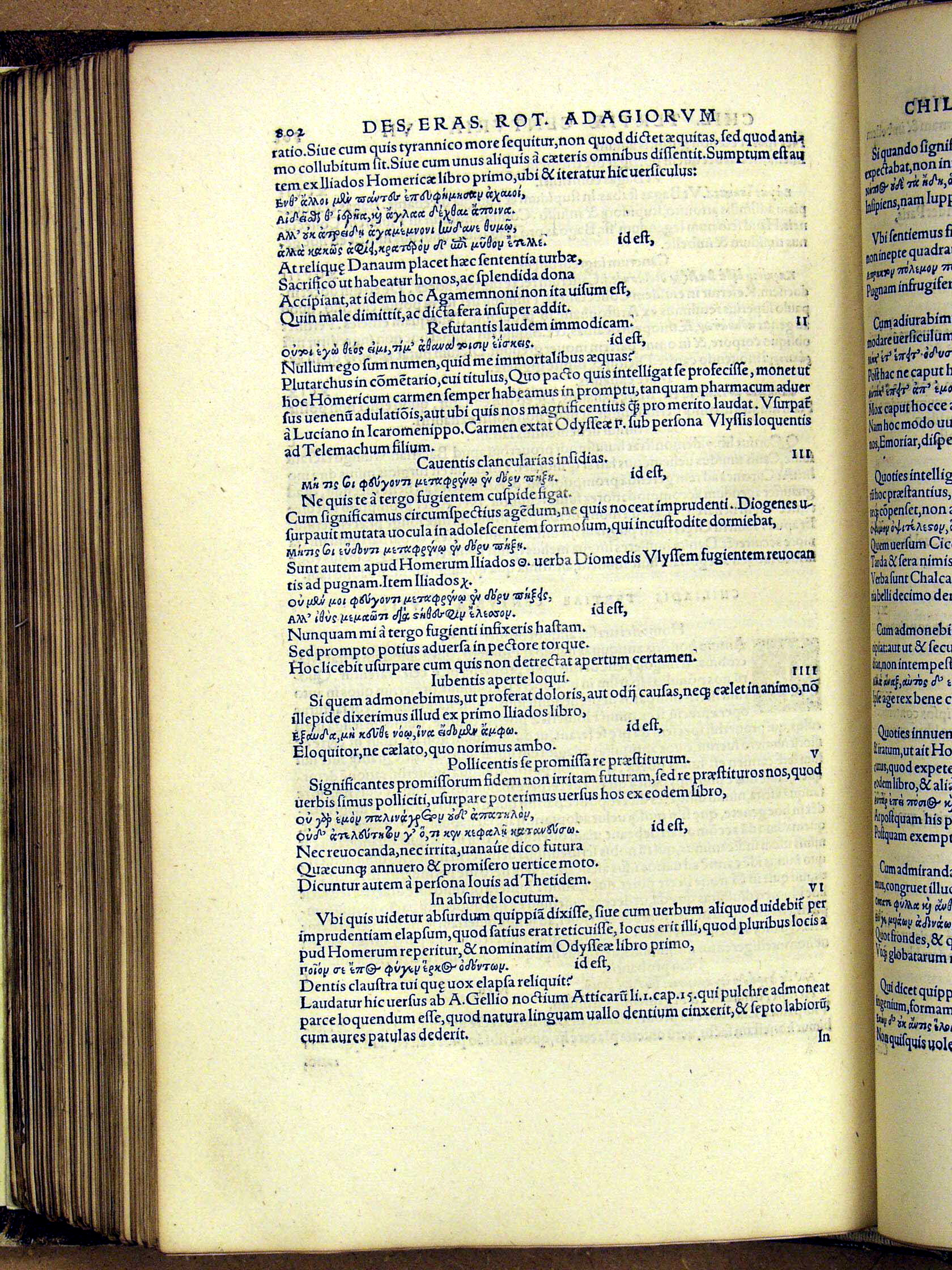
Iconclass: 51E11:31B6235 Freedom, Liberty; 'Libertà' (Ripa)❧speaking 52A6 Truth; 'Verità' (Ripa) 57A611 Frankness, Loyalty; 'Lealtà', 'Realtà' (Ripa)
Loci Communes: Libertas, veritas (Freedom, truth, Liberté, vérité)
III viii 5 Pollicentis se promissa re praestiturum Of one who promises to stand by what has been promised
Significantes promissorum fidem non irtitam futuram, sed re praestituros nos, quod verbis simus polliciti, usurpare poterimus versus hos ex eodem libro, Οὐ γὰρ ἐμὸν παλινάγρετον ουδ᾽ ἀπατηλὸν, Οὐδ᾽ ἀτελεύτητον γ᾽ ὅ, τι κεν κεφαλῇ κατανεύσω. id est, Nec revocanda, nec irrita, vanaúe dico futura Quaecunque annuero & promisero vertice moto. Dicuntur autem à persona Iovis ad Thetidem.
When we want to say that confidence in things promised will not be vain, but that we will guarantee by our actions what we have promised in words, we could use these lines from the same book:
Nothing that I say can be revoked or will be invalidated or unfulfilled,
Whatever I have bowed my head to and promised.
This is Jove speaking to Thetis.
Facsimile:
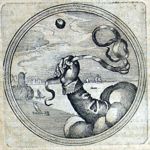
Iconclass: 52A6 Truth; 'Verità' (Ripa) 53D2 Promise; 'Promissione' (Ripa) 54D2 Action; 'Operatione manifesta' (Ripa)
Loci Communes: Fides et gravitas (Trust and seriousness, Confiance et gravité)
III viii 6 In absurde locutum Against one who has spoken out of place
Ubi quis videtur absurdum quippiam dixisse, sive cum verbum aliquod videbitur per imprudentiam elapsum, quod satius erat reticuisse, locus erit illi, quod pluribus locis apud Homerum reperitur, & nominatim Odysseae libro primo, Ποῖόν σε ἔπος φύγεν ἕρκος ὀδόντων. id est, Dentis claustra tui quae vox elapsa reliquit? Laudatur hic versus ab Aulo Gellio noctium Atticarum li. 1, cap. 15. qui pulchre admoneat parce loquendum esse, quod natura linguam vallo dentium cinxerit, & septo labiorum, cum aures patulas dederit.
When someone seems to have said something absurd or when through inattention some word seems to have slipped out that it would have been better to restrain, then it will be a moment for the phrase that is to be found in several places in Homer and, to be precise, in the first book of the Odyssey: 'What word has slipped past the barrier of your teeth?' This verse is praised by Aulus Gellius in book l chapter 15 of his Attic Nights because it gives noble advice on the need to speak sparingly, 'for Nature surrounded the tongue with the fence of the teeth and the enclosure of the lips' but gave us wide open ears
III viii 7 In spem frustratam On disappointed hope
Si quando significabimus aliquem sua spe frustratum, ac rem evenisse secus atque ille expectabat, non infestiviter applicabimus illud ex Iliados libro secundo, Νήπιος οὐδὲ τὰ ἤδη, ἃ ῥὰ ζεὺς μήδετο ἔργα. id est, Insipiens, nam Iuppiter his diversa parabat Ignaro.
If we want to indicate that someone has been disappointed in his hope and that something has turned out otherwise than he expected, it would be quite amusing to apply this from book 2 of the Iliad: 'Fool that he was, for Jupiter was devising things quite different from these / For the unwitting man.'
Facsimile: 
Iconclass: 56BB34 Disappointment 56BB35:56D1 Frustration❧Hope; 'Speranza', 'Speranza delle fatiche' (Ripa)
Loci Communes: Frustrata spes (Frustrated hope, Espoir déçu)
III viii 8 Inanis conatus Vain effort
Ubi sentiemus frustra sumi operam, neque quicquam promoveri diutinis laboribus, non inepte quadraverit illud ex eodem libro, Απρηκτον πόλεμον πολεμΐζειν ἠδὲ μάχωσθαι. id est, Pugnam infrugiferamque & inutile ducere bellum.
When we feel that work has been undertaken in vain and that nothing is gained by prolonged labours, it would be rather apt to bring in this from the same book: 'Waging a fruitless battle and a useless war.'
Facsimile:
Iconclass: 54BB3:54D11 Inutility, Noxiousness; 'Nocumento', 'Nocumento d'ogni cosa' (Ripa)❧Attempt, Trial
Loci Communes: Inanis opera (Vain effort, Effort vain)
III viii 9 Adiurantis se facturum aliquid Of one who swears to perform some act
Cum adiurabimus nos facturos quippiam, si modo vita non destituat, licet accommodare versivulum ex eodem libro, Μήκ᾽ ἔτ᾽ ἔπειτ᾽ ὀδυσῆϊ κάρη ὤμοισι ἐπείη.. id est Post hac ne caput hoc humeris insistat Ulyssis. Item Iliados quinto, Αὐτίκ᾽ ἔπειτ᾽ ἀπ᾽ ἐμοῖο κάρη τάμοι ἀλλότριος φώς. id est, Mox caput hocce aliquis mihi barbarus ense recidat. Nam hoc modo vulgus, nostris etiam temporibus deierat. Et nota sunt illa apud Latinnos, Emoriar, dispeream.
When we want to swear on our life that we will perform some act, we may adapt this line from the same book: 'May this head rest no more on Ulysses' shoulders.' Again in book 5 of the Iliad: 'Then may some barbarian sword cut off this head of mine.' For this is how ordinary people swear even nowadays. And among Latin speakers emoriar 'may I die' and dispeream 'may I perish utterly' are well known.
III viii 10 Quae sero contingunt, sed magnifica Rewards coming late, but generously
Quoties intelligi volemus famam, aut praemium aliquod serius quidem contingere, verum hoc praestantius, ac durabilius quo diutius dilatum, ut tarditatem stabilitate, perpetuitateque compenset, non alienum fuerit Homericum illud ex Iliados secundo libro usurpare: Οψιμον ὀψιτέλεστον, ὅν κλέος οὐκ ἀπολεῖται. Quem versum Cicero ita vertit, Tarda & sera nimis, sed fama & laude perenni. Verba sunt Chalchantis animum addentis Graecis ut perdurent: quanquam enim victoria belli decimo demum anno contigerit, eius famam tamen immortalem fore.
Whenever we wish to imply that fame or some reward comes late but is the more brilliant or lasting precisely because it has been rather long delayed, so that delay is compensated by security and permanence, it will not be inappropriate to employ this verse from book 2 of the Iliad, which Cicero translates thus: 'Slow and very late, but of everlasting fame and praise.' They are the words of Chalcas as he encouraged the Greeks to endure, for although victory would not come until the tenth year of the war, the glory of it would be undying.
Facsimile:
Iconclass: 51FF52:55A12 Lateness❧Reward, 'Praemium'; 'Premio', 'Remuneratione' (Ripa) 51H42:55A12 Abundance; 'Abondanza', 'Abondanza maritima' (Ripa)❧Reward, 'Praemium'; 'Premio', 'Remuneratione' (Ripa)
Loci Communes: Tarditatis et cunctationis (Slowness and delay, Lenteur et retard)
III viii 11 Consulendum et consiliis parendum Consider well and take advice
Cum admonebimus quempiam, ut vicissim & rectum consilium aliis det, & ab aliis accipiat: aut ut & secum rem diligenter perpendat, & alienam sententiam auribus attentis audiat, non intempestivum erit illud ex eodem libro, Αλλὰ ἄναξ, αὐτὸς δ᾽ εὖ μήδεο, πείθεό τ᾽ ἄλλῳ. id est, Ipse age rex bene consulito, & pareto vicissim.
When we warn someone that he should both give just advice to others and accept it from them in return, or that he should consider a matter thoroughly in his own mind and listen carefully to the opinion of others, it will be a good moment for this, from the same book: 'Come, O king, give good advice yourself and accept good counsel too.'
Facsimile:
Iconclass: 52B1 Thinking, Thought, Reflection; 'Pensiero' (Ripa) 53B1:52E3 Acceptance❧Counsel; 'Consiglio' (Ripa) 55C2:52E3 Giving❧Counsel; 'Consiglio' (Ripa)
Loci Communes: Attentio et contra (Attention and its opposite, Attention et son contraire)
III viii 12 Non interpellandus famelicus Don't hinder a hungry man
Quoties innuemus non esse confabulandi ocium, nisi prius placaverimus latrantem & iratum, ut ait Horatius, ventrem. Aut ubi significabimus aliquem, simulatque sit adsecutus, quod expetebat, iam ad alia converti, non inepte proferemus versiculum hunc ex eodem libro, & alias apud Homerum solennem, Αὐτὰρ ἐπεὶ πόσιος καὶ ἐδητύος ἐξ ἔρον ἕντο. id est: At postquam his potus exempta cupido, cibique. Id Virgilius ita reddit, Postquam exempta fames & amor compressus edendi.
Whenever we want to imply that there is no leisure for chatter if the ravenous, barking stomach, as Horace calls it, has not first been satisfied, or when we want to indicate that someone, as soon as he has obtained what he sought, turns immediately to other things, we might quite aptly utter this formulaic line found in the same book and elsewhere in Homer: 'But after the desire for food and drink was taken away .. .,' which Virgil renders thus: 'After hunger was taken away and the urgent desire to eat .. .'
III viii 13 Ingens rerum multitudo An enormous number of things
Cum admirandam hominum, aut rerum seu malorum multitudinem indicare volemus, congruet illud ex eodem libro, crebroque aliàs, Οσσατε φύλλα καὶ ἄνθεα γίγνετα ὥρῃ, Ηΰ γε μυάων ἀδινάων ἔθνεα πολλὰ. id est, Quot frondes, & quot sunt verno tempore flores, Utque globatarum muscarum examina multa.
When we want to signify an astonishing multitude of men, of things, of evils for example, a suitable expression will be the following found in the same book and frequently elsewhere:
As many as are the leaves and flowers in spring,
As the many swarms of flies in their masses.
Facsimile:
Iconclass: 23D42 spring, 'Ver'; 'Primavera' (Ripa) 25F711(FLY) insects: fly 25G41 flowers 51H3 Multitude
Loci Communes: Bonae fortunae, copiae, felicitatis aut ominis (Of good fortune, abundance, happiness, or omen, Bonne fortune, abondance, bonheur ou présage)
III viii 14 Quae divinitus contingunt Things which come by divine providence
Qui dicet quippiam non cuivis contingere, quisquis optas, sed divinitus dari, velut ingenium, formam, vires, usurpare poterit Homericum illud Iliad. lib. 3. Εκὼν δ᾽ οὐκ ἄντις ἕλοιτο. id est, Non quisquis volet illa ferat. Dicuntur ab Alexandri persona ad Hectorem, qui illi comam, formam & imbellem citharam opprobrarat. Οὐκ ἄν τοπ χραίσμῃ κιθαρϊς, τάτε δῶρ᾽ ἀφροδίτης. Ητε κόμη, τότε εἶδος ὅτ᾽ ἐν κονίῃσι μιγείης. id est, Nihil tibi profuerint, cantusque & dona Diones, Vel coma, vel species, in pulvere congredienti. Ad ita respondet Paris, Μή μοι δῶρ᾽ ἐρατὰ πρόφερε χρυσῆς ἀφροδίτης. Οὔτοι ἀπόβλητ᾽ ἐστὶ θεῶν ἐρικυδὲα δῶρα, Οσσάκεν αὐτοὶ δῶσιν, ἑκὼν δ᾽ οὐκ ἄν τις ἔλοιτο. id est, Ne mi opprobaris Cithereae optabile donum. Haud quaquam apsernanda deûm pulcherrima dona, Quae ultro dant: neque mox si quis velit, auferet illa. Refert Laertius Cynicum Diogenem reprehensum, quod accepisset munera ab Antipatro, respondisse versu Homerico quem modo retuli, οὔτοι ἀπόβλητ᾽. &c.
If someone wants to say that not everything comes to everybody, no matter who makes the wish, but is given by divine providence, whether it be intelligence, beauty or strength, he could use this expression of Homer from book 3 of the Iliad: 'Not every man will gain what he wants.' The words are spoken by Alexander to Hector who had reproached him for his hair, his figure, and his unwarlike lyre:
They will be worth nothing to you, your music and the gifts of Venus,
Your locks and your beauty, when you join battle in the dust.
To which Paris responds:
Do not reproach me for the desirable gifts of the Cytherean;
Not to be despised are the glorious gifts of the gods,
Which they give of their own accord; nor does every man immediately
gain what he wants.
Laertius relates that when Diogenes the Cynic was blamed for accepting gifts from Antipater, he replied with the Homeric verse that I have just quoted: 'Not to be despised, etc.'
Facsimile: 
Iconclass: 11A2 Divine Nature 12E1 conceptions and ideas visualized ~ Greek religion 55C2 Giving 56BB3 Dissatisfaction
Loci Communes: Bonae fortunae, copiae, felicitatis aut ominis (Of good fortune, abundance, happiness, or omen, Bonne fortune, abondance, bonheur ou présage)
III viii 15 In senem libidinosum For a salacious old man
In eos qui ad rem gerendam iam inutiles sunt ob aetatem, verum oratione valent, veluti si quis taxare velit vervecem, ut ait Plautus, vetulum, turpiloquum quidem, caeterum ad Veneris usum languidum, apposite dicerit illud ex eodem libro, Γήραϊ δὴ πλέμοιο πεπαυμένοι, ἀλλ᾽ ἀγορηταὶ Εσθλοί. id est, Iam ob senium bello emeriti, sed dicere tantum Egregii.
Against those who are no longer capable of action because of age, but still talk at great length - for example if you want to reproach some 'old wether,' as Plautus says, who talks obscenities but is incapable of making love, then you might aptly quote this from the same book: 'Now because of age they are veterans of war, but they are admirable / If it is only a matter of talking.' This is how he describes the son of Tydeus in the fourth book: 'Inferior in battle, but first in talking.'
Facsimile:
Iconclass: 31D160 Old Age, 'Senectus'; 'Vecchiezza' (Ripa) 52D4 Prolixity, Verbosity, Loquacity; 'Loquacità' (Ripa)
Loci Communes: Intempestiva et inepta (Untimely and inept things, Choses inopportunes et ineptes)
III viii 16 Fatis imputandum Put it down to fate
Dum hominem quempiam culpa liberabimus, eamque vel in fatum, vel in fortunam reiiciemus, usurpare licebit quod inibi dicit Priamus ad Helenam, Οὔτοι μοι ἀιτίη ἐσσί, θεοίνυ μοι αἴτιοί εἰσιν. id est: Nil tibi ego imputo, verum ipsis magis imputo divis.
When we want to declare a man free of a fault and attribute it to destiny or chance, we could use what Priam says to Helen there: 'There is nothing I blame you for, rather it is the gods themselves I blame.'
III viii 17 Diu dissimulatum aperientis For someone revealing what he has long concealed
In eum, qui quod diu dissimulavit, tandem irritatus eloquitur, non inconcinne detorquebitur illud, quod in eodem loco dictum est de Ulysse: Αλλ᾽ ὅτε δὴ ῥ᾽ ὄπατε μεγάλην ἐκ στήθεος ἵει. id est, Ast ubi iam promit praegrandem è pectore vocem.
For someone who finally speaks out angrily about what he has long concealed, there is an apt expression which is applied in the same passage to Ulysses: 'But when he does speak with his great voice from deep in his chest .. .'
Facsimile:
Iconclass: 23A41(+0) Time revealing Truth; Time carrying Truth aloft (+ variant) 31B6235 speaking 57A611 Frankness, Loyalty; 'Lealtà', 'Realtà' (Ripa)
Loci Communes: Simulatio, dissimulatio (Pretense, dissimulation, Simulation, dissimulation)
III viii 18 Pertinax contentio Stubborn quarrelling
Quoties ostendemus obstinatam ac muliebrem aequalium inter ipsos contentionem, cum neuter altero vult inferior videri, conveniet illud, quod Iliados libro quarto, Iuno dicit ad Iovem, Καὶ γὰρ ἐγὼ θεὸς εἰμι, γένος δὲ μοι ἔνθεν, ὅθεν σοι. id est, Ipsa etiam dea sum, genus ine mihi, unde tibi ortus.
When we want to indicate that it is perverse and unmanly for people of equal standing to carry on quarrelling because neither one wants to appear inferior to the other, it will be appropriate to quote from the fourth book of the Iliad what Juno says to Jupiter: I too am a god, my birth was from the same parentage as yours.'
III viii 19 Cum uterque concedit alteri When each yields to the other
Rursum cum omissa contentione, uterque alteri concedit, locus erit ei, quod eodem statim loco consequitur, Αλλ᾽ ἤ τοι γὰρ ταῦθ᾽ ὑποείξομεν ἀλλήλοισιν, Σοὶ μὲν ἐγὼ, σὺ δὲ μοι. id est, QUin magis alteri in his rebus cedamus uterque. Tu mihi, contra ego deinde tibi.
On the other hand when quarrelling is laid aside and each yields to the other, it will be a suitable moment for what follows immediately in the same passage: 'Nay rather let us both yield in this to the other, / You to me, and I thereon to you.'
Facsimile:
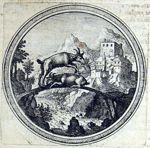
Sic pergimus ambae: Zincgreff, Emblematum Ethico-politicorum (Heidelberg, 1619), emblem 34 uses the imagery of two goats passing each other on a bridge to express the adage's moral
Iconclass: 33B1:51FF5 quarrel, argument❧End; 'Fine' (Ripa) 57A74 Forgivingness
Loci Communes: Obsecundantis (Complying, being obliging, Se conformer, obéir)
III viii 20 Adamantis tenere Of one who loves tenderly
In eum qui tenere diligit quempiam, vel adamat magis, ita ut non patiatur, vel levissimis incommodis à quoquam affici, non inscite torseris illud ex eodem libro, Ως ὅτε μήτηρ Παιδὸς, ἐέργει μῦαν ὅθ᾽ ἡδέϊ λέξεται ὕπνῳ. id est, Non secus atque genitrix Muscas arcet puero somno officiosa cubanti. Dictum de Pallade curante vulnus Menelai.
To someone who loves another tenderly or loves so much that he will not suffer his loved one to be affected by the least trouble from anyone, you might quite appropriately apply this from the same book: 'Just as a mother / Carefully brushes away a fly from her child as he lies asleep,' a description of Athena treating Menelaus' wound.
III viii 21 Contemnentis dicterium For one who is not troubled by mockery
Si quando significabimus nos scommate, seu contumelia leviter commoveri, nec altius in animum demittere, congruet illud ex Iliados eodem lib. iiii. Οὐκ ἐν καιρίῳ ὀξὺ πάγη βέλος, ἀλλὰ πάροιθεν Εἰρύσατο ζωστήρτε παναίολος, ἡ δ᾽ ὑπένερθεν, Ζῶμά τε καὶ μΐτρη, τὴν χαλκῆες κάμον ἄνδρες. id est, At missum non transiit ad vitalia telum, Sed summa in cute baltheus arcuit, impositoque Laminea squamae, quas huic faber addidit aere.
When we want to indicate that we are only slightly affected by a joke or an insult and do not take it too deeply to heart, the following passage also from book 4 of the Iliad will be appropriate: The flying arrow did not penetrate to my vitals,
But my belt stopped it in my skin, and the plated armour
With applied bronze which the smith attached to it.
Facsimile: 
Iconclass: 56AA1:57BB21 Insensibility, Insensitivity❧Contempt 56AA1:56B131 Insensibility, Insensitivity❧Joke; 'Giuoco (dall'antico)' (Ripa)
Loci Communes: Contemptus et vilitatis (Contempt and worthlessness, Mépris et bassesse)
III viii 22 Malorum oblivio Forgetting wrongs
Qui deprecabitur omen aliquod parum faustum, aut qui iubebit obliterari memoriam malorum, non intempestiviter usurpabit illud ex eodem libro, Τά δε πάντα θεοὶ μεταμώλια θεῖεν. id est, Irrita dii superi ventis haec omniae tradant.
Someone who wants to turn aside an unfavourable omen or wants the memory of wrongs to be obliterated could aptly use this from the same book:
And may the gods blow all these things away and bring them to naught.
III viii 23 Ex minimis initiis maxima Greatest things from small beginnings
Ad indicandum maximas simultates nonnunquam ex levissimis iniuriolis nasci, non secus atque ex minutissima scintillula gravissimum incendium, mire congruet illud ex eodem lib. de Eride. id est, dea contentione, Ητ᾽ ὀλίγη μὲν πρῶτα κορύσσεται, αὐτὰρ ἔπειτα Οὐρανῷ ἐστήριξε κάρη καὶ ἐπὶ χθονὶ βαίνει. id est, Quae primum exigua surgit, verum ilico coelum Attingit capite, in terris vestigia ponens. Hunc locum Virgilius Aeneidos quarto, detorsit ad famam, Parva metu primo, mox sese attollit in auras, Ingrediturque solo, & caput inter nubila condit.
To signify that the greatest animosities are sometimes born of the slightest wrongs, just as the worst fire is born from the smallest spark, the lines from the same book about Eris, goddess of discord, will be wonderfully apt: 'At first she rises only a little, but then her head / Reaches to heaven while her feet still mark the earth.' In the Aeneid book 4 Virgil turned this expression to apply to Rumour: 'Small at first through fear, soon she rises to the heavens; / She walks on the ground and her head reaches to the clouds.'
III viii 24 Diversarum partium Conflicting loyalties
Qui volet innuere Metium quempiam, & cum utraque parte colludentem, aut advocatum praevaricatorem, aut proditorem ducem, non ineleganter usurpaverit illud ex Iliad. lib. v. Τυτείδην δ᾽ οὐκ ἂν γνοίῆς, ποτέροισι μετείη, Ηέ μετὰ τρώεσσινι ὁμιλέοι, ἢ μετ᾽ ἀχαιοῖς. id est, Porrò Tytiden minime dignoscere possis Troianos ne inter versetur, an inter Achivos.
If you want to imply that someone is a Metius or conspires with both sides or is a lying witness or a treacherous leader, you could quite neatly use this from book 5 of the Iliad:
But of Tydeus' son you could scarcely tell
Whether he belonged to the Trojan or to the Achaean army.
Facsimile:
Iconclass: 53AA21 Inconstancy; 'Incostanza', 'Instabilità', 'Instabilità overo Incostanza' (Ripa) 57A611 Frankness, Loyalty; 'Lealtà', 'Realtà' (Ripa) 57AA612 Insincerity
Loci Communes: Inconstantiae, perfidiae, versutiae (Inconstancy, treachery, cunning, Inconstance, perfidie, ruse)
III viii 25 Alieno ferox praesidio Fierce with someone else's help
Si quaeras innuere, quod ferox sit quispiam, & improba moliatur, id eum non facere domesticis viribus fretum, verum alicuius potentioris fultum praesidio, qui clanculum illi suppeditat & animum et opem, quemadmodum vulgus nostratium suspicatur ducem Geltiae tot iam annos negotium facessere nobis, dissimulatis Gallorum suppetiis, illud accommodes licebit eodem ex libro, Οὐκ ὅγ᾽ ἄνευθε θεοῦ τάδε μαίνεται, ἀλλάτις ἄγχι Εστηκ᾽ ἀθανάτων νεφέλῃ εἰλυμένος ὤμους. id est, Ista quidem hic nequaquam audet sine numine, verum Adstat divûm aliquis, humeros caligine tectus.
If someone is being aggressive and acting wickedly and you want to imply that he is doing this relying not on his own strength but with the support and protection of someone more powerful who is secretly supplying him with confidence and resources (as our people suspect the Duke of Geldern has troubled us these many years with the hidden support of the French), you could adapt this from the same book: 'Such things this man could never dare without inspiration, / But some god stands beside him, his shoulders hidden in the dark.'
Facsimile:
Iconclass: 52DD11:54A6 Secret❧Helpfulness 54A82 Audacity, Temerity; 'Audacia' (Ripa)
Loci Communes: Cum auxilio ; citra auxilium (With help; without help, Avec aide ; sans aide)
III viii 26 Fortuna prorsus adversa Absolutely hostile fortune
Cum res bonis instituta consiliis, tamen male cedit, illud apposite dixeris ex eodem libro, Θεὸς νύτις ἐστὶ κοτήεις. id est, Infensus deus est aliquis. Item in Ζ. Αλλ᾽ ὅτε δὴ κᾀκεῖνος ἀπήχθετο πᾶσι θεοῖσι. id est, Ille ubi iam invisus divis etiam omnibus esset.
When something is undertaken with thorough deliberation but still turns out badly you might aptly quote this from the same book: 'Some god is angry.' And this in book 6: 'When he too came to be hated by every one of the gods.'
Facsimile:
Iconclass: 54FF1:52A2 Failure❧Forethought, Deliberation; 'Previdenza', 'Providenza' (Ripa) 54FF11 Adversity, Misfortune, Bad Luck; 'Fortuna infelice', 'Infortunio' (Ripa)
Loci Communes: Infortunii sive exitii (Misfortune or ruin, Malheur ou ruine)
III viii 27 Arripe negocii curam Seize control of the affair
Admonentes aliquem, ut diligenter negocium capessat, & gnaviter rem aggrediatur, utemur hoc ex eodem loco carmine, quo Aeneas hortatur aurigam suum, Αλλ᾽ ἄγε νῦν κάστιγα καὶ ἡνία σιγαλόεντα δέξαι. id est, Quin age nunc scuticamque manu, depictaque lora. Corripe.
When we advise someone to take some business firmly in hand and to approach the affair with zeal, we shall use this verse from the same passage, where Aeneas exhorts his charioteer: 'Nay, come now, grasp the whip in your hand / And the glittering reins.'
Facsimile: 
Iconclass: 53B2 Decisiveness, Decision 54A2 Carefulness, Diligence; 'Diligenza' (Ripa)
Loci Communes: Diligentiae (Diligence, Diligence)
III viii 28 Reiicientis autorem formidinis Rejecting talk of fear
Territanti metumque inanem iniicienti, versum hunc occinere licebit, quo Sthenelum ibidem alloquitur Diomedes, Μήτε φόβον δ᾽ ἀγόρευε. id est, Ne trepidandi autor mihi sis.
To someone who causes terror and inspires groundless fear one could recite this line from the same book where Diomedes addresses Sthenelus: 'Talk not to me of fear.'
III viii 29 Omni conatu invadere Attack with every effort
Si quem significabimus totis viribus tendere in quempiam oppugnandum, conveniet illud ex eodem libro, Αἰνείας δ᾽ ἐπόρουσε σὺν ἀσπίδι δουρίτε μακρῷ. id est, Obvius Aeneas, clypeoque insurgit & hasta.
If we want to affirm that someone is putting all his efforts into attacking someone else, this line from the same book will be appropriate: 'Forward leapt Aeneas with shield and spear.'
Facsimile:
Iconclass: 51H42:54EE4 Abundance; 'Abondanza', 'Abondanza maritima' (Ripa)❧Attack
Loci Communes: Lacessentis (Provoking, Provoquer)
III viii 30 Summa vi defendere Strongest defence
Rursum si quis alterum summa vi tuebitur, quadrabit quod proxime eo consequitur loco, Προσθε δέ οἰ δόρυτ᾽ ἔσχε καὶ ἀσπίδα πάντοσε ἴσην. id est, Undique texit cum lancea clypeoque rotundo.
On the other hand if someone wants to protect another with all his strength, then what follows in the same passage will be fitting: 'On all sides he covered him with his spear and round shield.'
Facsimile:
Iconclass: 51H42:54E4 Abundance; 'Abondanza', 'Abondanza maritima' (Ripa)❧Defence
Loci Communes: Cum auxilio ; citra auxilium (With help; without help, Avec aide ; sans aide)
III viii 31 Aequa concertatio Contest between equals
Cum significabimus duos ex aequo paratos ad disceptandum, rixámve, licebit accommodare carmen illud ex eodem libro, Τὼ μὲν δὴ χεῖράς τε καὶ ἔγχεα ὀξυόεντα, Αντίον ἀλληλων ἐχέτην μεμαῶτε μάχεσθαι. id est, Illi inter sese, iamiam pugnare parantes Obtendunt, pariterque manus, praeacutaque pila.
When we want to say that two parties are equally matched to debate or to fight we may apply these verses from the same book: 'Ready to do immediate battle with each other, / They raise their hands and sharp-pointed spears.'
III viii 32 Incitare currentem Cheering on a willing runner
Qui significabit instigari quempiam ad id, ad quod suapte sponte propendet, usurpabit illud ex eodem libro, quanquam & alias apud eundem poetam occurrit: Μάστιξεν ἵππου, τώδ οὐκ ἄκοντε πετέσθην. id est, Caedit equos scutica, ast illi vel sponte volabant. Sumptum ab aurigis.
If one wants to talk of encouraging someone to do what he is inclined to do of his own accord, one could use this from the same book, though it is found elsewhere too in the same author: "The whip strikes the horses, but they were willingly flying.' This originates with charioteers.
Facsimile:
Iconclass: 43A(+91) festivities (+ cheers, applause ~ festive activities) 43C211(+1) running, race (+ sportsman, player, etc.) 54BB2 Unnecessity, Superfluity
Loci Communes: Proclivitas (contra) (Propensity (against), Penchant (contre))
III viii 33 Ad utrumvis paratus Ready for good or bad
Hominem ad utramque fortunam instructum, ludicris pariter ac seriis accommodatum, aut qui norit cum bonis pariter ac malis convenire, notabimus hoc carmine, quod est in Iliados Η. Οἶδ᾽ ἐπὶ δεξιὰ οἶδ᾽ ἐπ᾽ ἀριστερὰ, νωμῆσαι βῶν. id est, Novi equidem clypeum dextra, laevaque movere.
A man who is prepared for good or bad fortune, who is able to play as well as to be serious, or who knows how to deal with both good men and bad, might be symbolized by this verse, which is in book 7 of the Iliad: 'I have learned to wield my buckler on both right and left.'
Facsimile:
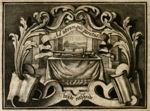
Ad utrumque paratus - beijde enscheide: Mayer, Vortrefflich-hoch-adeliches Controfeé (Vienna, 1709), emblem 29
Ad utrumque parata: Pfeffel, Güldene Aepfel (Augsburg, 1746), emblem 114
Preces ad utrumque paratae: Cramer, Octoginta emblemata nova (Frankfurt, 1630), emblem 35
Iconclass: 54A32 Preparedness 54F11 Welfare, Prosperity; 'Felicità publica', 'Prosperità della vita', 'Salute' (Ripa) 54FF11 Adversity, Misfortune, Bad Luck; 'Fortuna infelice', 'Infortunio' (Ripa)
Loci Communes: Anceps et dubius (Doubtful and uncertain, Incertain et douteux)
III viii 34 Nullus delectus No discrimination
Aristoteles lib. Politicorum ii. refert hunc versiculum ceu vulgo celebrem, Ενδ᾽ ἰῇ τιμῇ ἠ μὲν κακός ἠδὲ καὶ ἐσθλός. id est, Par honor, ignavoque viro, & virtute valenti. Quo licebit uti, si quando significabimus nihil esse discriminis inter eruditum & impostorem, inter benemerentem & malemerentem, inter probum & improbum. Verba sunt Achillis stomachantis, quod sui ratio non esset habita ab Agamemnone, cum esset omnium multo fortissimus. Hoc loco lapsus est interpres Leonardus Aretinus, vir ille quidem tum doctus, tum eloquens, sed homo tamen. Sic enim vertit carmen Homericum, Honori incumbit tam ignavus quam bonus, nimirum deceptus ab eo qui libros eos illi praelegerat. Nec animadvertit ἰῇ positum pro μιᾷ.
In book 2 of his Politics Aristotle quotes this line as well known: 'Equal honour to the coward and the brave.' This could be used when we want to say no distinction is made between the scholar and the imposter, between the deserving and the culpable, between the honourable and the dishonourable. They are the words of Achilles, angry that he is not given his due by Agamemnon though he was by far the bravest of all. A mistake was made here by the translator Leonardo Aretino, a man both learned and eloquent but still a man, for he translates Homer's line thus: 'The coward strives for honour as much as the brave man'; he must have been misled by the man who lectured to him on these books. Nor did he notice that [greek] appears in place of [greek].
III viii 35 Muneribus res agitur Gifts get the business done
Qui dicet non esse locum recte factis, & aequis rationibus, sed largitione & assentatione rem omnem peragi, poterit illud accommodare ex Iliad. Ι. Δώροισίν τ᾽ ἀγανοισιν, ἔπεσσί τε μειλιχίοισι. id est, Et donis permagnificis, & lenibus dictis. Quo quidem in carmine muneribus non temere prior datus est locus.
If someone wants to say that there is no place for things done properly and for fair arguments, but that everything is achieved by bribery and flattery, he might adapt this line from book 9 of the Iliad: 'With lavish gifts and smooth words.' A verse in which gifts are given first place quite deliberately.
Facsimile:
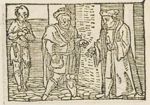
L'argent content faict playder Aduocatz: La Perrière, Le theatre des bons engins (Lyon, 1545), emblem 66 uses the imagery of accepting a bribe to convey its message about lawyers
Iconclass: 46B911 bribery 57AA6121 Flattery; 'Adulatione' (Ripa) 59CC221 Corruptibility, Venality, Corruption
Loci Communes: Munerum corruptela (Corruption by gifts, Corruption par les présents)
III viii 36 Frustratus conatus A vain attempt
Qui spe frustratus sua, non assequitur id quod ambiebat, in hunc non incongrue torquebitur illud ex Iliados Θ. Βαλέειν ὁ δὲ ισετο θυμὸς, Καὶ τοῦ μὲν ρ᾽ ἀφάμαρτο. id est, Animus cupiit configere telo, Verum illum, fallente manu non attigit. Rursus aliàs, Αλλ᾽ ἅγε καὶ τόθ᾽ ἅμαρτε. id est, Verum & tunc ille fefellit.
Someone who is disappointed in his hope and fails to obtain what he was soliciting could be quite suitably described by this from book 8 of the Iliad: 'The heart willed the arrow to transfix him, / But the hand failed and he missed.' Or this: 'But once again he deceived.'
Facsimile: 
Iconclass: 54FF1:54D11 Failure❧Attempt, Trial 56D1 Hope; 'Speranza', 'Speranza delle fatiche' (Ripa)
Loci Communes: Conatus (Effort, endeavor, Effort); Frustrata spes (Frustrated hope, Espoir déçu)
III viii 37 Alieno auxilio potentes Strong with someone else's help
Qui alienis praesidiis freti facinus aliquod egregium, aut qui alieni praetextu nominis aliquid faciunt, in eos apposite torquebitur ex eodem libro, quod ibi dictum est de Teucto fratre Aiacis Telamonii. Nam is sub fraterno latitans clypeo, sagittas aliquot mittit in Troianos, Στῆ δ᾽ ἀρ᾽ ὑπ᾽ αἴαντος σάκεϊ τελαμωνιάδαο. id est, Constitit Aiacis clypeo septemplice tectus.
People who rely on others' resources to commit some unusual crime, or do something under the cloak of someone else's name, might be aptly labelled with what is said in the same book about Teucer the brother of Telamonian Ajax; for he hides behind his brother's shield and fires some arrows at the Trojans: 'He stood covered by the seven-layered shield of Ajax.'
Facsimile:
Iconclass: 33B91 hiding, hiding oneself 52AA6:54A7 Falsehood❧Strength, Power; 'Fortezza', 'Fortezza d'Animo e di corpo', 'Fortezza del corpo congiunta con la generosità dell'animo', 'Fortezza & valore del corpo congiunto con la prudenza & virtù del animo', 'Forza' (Ripa)
Loci Communes: Cum auxilio ; citra auxilium (With help; without help, Avec aide ; sans aide)
III viii 38 Cavendum a potentiore Beware of a more powerful man
Qui se negabit rem habere velle cum homine longe potentiori, quique magnopere possit laedere, recte accommodaverit illud eodem è libro, Οὐ γὰρ ἐγὼ γ᾽ ἐθέλοιμι διὶ κρονίωνι μάχεσθαι. id est, Cum Iove ego sane nolim certamen inire.
Someone who wants to say he has no wish to deal with a much more powerful person who could do him great harm could justly adapt this from the same book: 'With Jove I have no desire at all to start a fight.'
Facsimile:
Iconclass: 52A2 Forethought, Deliberation; 'Previdenza', 'Providenza' (Ripa) 57B2:53C11 Respect, Reverence, Esteem❧Authority, Power; 'Dominio', 'Giurisdittione' (Ripa)
Loci Communes: Potentes (The powerful, Les puissants)
III viii 39 Subitum remedium periculi Swift relief from danger
Cum indicabimus rem in extremum discrimen adductam, actumque fuisse ni subita salus, ceu deo quopiam immissa protinus affulsisset, illud ex eodem libro, tum alias saepe conveniet, Εἰ μὴ ἂρ ὀξὺ νόησε πατὴρ ἀνδρῶν τε θεῶν τε. id est, Ni ilico sensisset, genitor divumque hominumque.
When we want to say that an affair had reached the point of crisis and it was all over if salvation had not suddenly appeared, as if sent directly by some god, then this from the same book, which occurs frequently elsewhere too, will be appropriate: 'If the father of both gods and men had not been quick to see.'
Facsimile:
Iconclass: 33A610 'Ajuto', 'Soccorso' (Ripa) 54A6 Helpfulness 54DD51 Danger; 'Pericolo' (Ripa)
Loci Communes: Praeter spem bonum aut malum (Good or bad beyond expectation, Bien ou mal inattendu)
III viii 40 Perplexus animique consternati Entangled and fearful at heart
In eum, qui periculoso negocio consternatur animo, nec rationem invenit, qua explicet sese, quadrabit illud ex eodem libro, Νέστορα δ᾽ ἐκ χειρῶν φύγον ἡνία σιγαλόεντα. id est, Fugére è manibus miranda Nestori habenae.
For someone who is frightened by a dangerous business and cannot find a way to extricate himself, this from the same book will be appropriate:
From Nestor's hands the shining reins slipped.'
Facsimile:
Iconclass: 56DD1 Fear, Dread; 'Paura', 'Timidità o Timore', 'Timore' (Ripa) 56DD33 Confusion, Bewilderment, Panic; 'Perturbatione' (Ripa)
Loci Communes: Perplexus (Perplexed, entangled, Perplexe)
III viii 41 Litem incipere To start a dispute
In eum qui iam provocatus aggreditur convitiis agere, congruet illud ex Iliad. κ Εἲλετο δ᾽ ἄλκιμον ἔγχος ἀκαμένον ὀξέϊ χαλκῷ. id est, Hastam corripuit robustam cuspide acuta. Cui diversum illud, Hastam abiecit. quod alibi retulimus ex Cicerone.
For one who when challenged proceeds to shout insults, the following from book 10 of the Iliad will fit: 'A spear he seized, stout and sharp-tipped.' This is the opposite of 'He threw away his spear,' which I have included elsewhere from Cicero.
Facsimile:
Iconclass: 54DD3:33B1 Start❧quarrel, argument 54DD3:49C4 Start❧discussion, dialogue, dispute ~ scholar, philosopher
Loci Communes: Rixosus (Quarrelsome, Querelleur)
III viii 42 In formidolosum For a man dismayed
In hominem vehementer pavidum, animoque consternatum, quadrabunt hi versus ex eodem libro, οὐδὲ μοι ἦτορ Εμπεδον, ἀλλ᾽ ἀλαλύκτημαι, ηραδίη δέ μοι ἔξω, Στηθέων ἐκθρώσκει, τρομέει δ᾽ ὑποφαίδιμα γῦα. id est, Nec mihi mens constat, sed mota vacillat, & extra Pectus cor salit, & terpidant quoque corporis artus. Dicuntur autem haec ab Agamemnone, populo metuente.
For a man who is extremely afraid and dismayed at heart these lines from the same book will suit:
Nor is my mind firm, but is tossed to and fro; my heart
Leaps out of my breast and the limbs of my body tremble.
They are spoken by Agamemnon fearful for his people.
III viii 43 Blanduis alloqui Speaking with gentler words
In eum qui blandius & honorificentius compellat aliquem, gentilitiis etiam praenominibus additis, Quint puta, aut Publi, videlicet quo gratiam aliquam ineat apud illum, recte torquebitur illud quod eodem in libro dictum ab Agamennone, iubente Menelaum blandiri copiis Graecorum, Πατρόθεν ἐκ γενεῆς ὀνομάζων ἄνδρα ἕκαστον. id est, Compellans patris ac gentis cognomine quenque
A person who persuades someone with gentle and respectful words, using his family names, such as 'Quintus' or 'Publius,' so that he can gain some favour with him, will rightly be described with the words used by Agamemnon in the same book when he orders Menelaus to coax the Greek troops: 'Calling each man by his father's and his family's name.'
III viii 44 Inexorabilis Unbending
Inexoratu difficilem ac praefractum, suoque relinquendum ingenio: sive in eum cuius operam nihil moramur, apposite torquebitur, quod Iliados Ι. Diomedes dixit in Achillem, qui legatos & Agamemnonis done reiecerat, Αλλ᾽ ἔτοι κεῖνον μὲν ἐάσομεν, ἤκεν ἴησιν, Ηκε μένη. id est, Quin magis ipsius hunc animo, ingenioque sinamus, Sive venire velit, sive hic remanere.
For one who will not listen to prayers, who is stern and must be left to his own way of thinking, or one whose service we have no regard for, we may suitably borrow what Diomedes said of Achilles in book 9 of the Iliad, when the latter rejected the envoys and the gifts of Agamemnon: 'Let us rather leave him to his own devices, / Whether he wishes to come or remain here.'
Facsimile:
Iconclass: 52AA4 Lack of Imagination, Inflexibility 53C13 Sternness; 'Rigore' (Ripa) 53DD1:31A32 Refusal❧hearing, listening (one of the five senses)
Loci Communes: Pertinacia (Stubbornness, Obstination)
III viii 45 Ausculta et perpende Pay heed and consider
Quoties significabimus nos aliquid dicturos quod ad rem pertineat, quodque ratum ac certum futurum sit, conveniet illud ex eodem libro, quanquam & aliàs apud eum poetam saepius obvium: Αλλο δέ τοι ἐρέω, σύ δ᾽ ἐνὶ φρεσὶ βάλλεο σῆσι. id est, Immo aliud quiddam, tu mente recondito, dicam.
Whenever we want to indicate that we are about to say something that is relevant and will be proved true, it will be suitable to quote this, which occurs in the same book, though quite often elsewhere in this poet: 'Nay, one other thing I shall say; and you must take it to heart.'
Facsimile: 
Iconclass: 53C2:31A32 Command❧hearing, listening (one of the five senses) 53C2:52A11 Command❧Attention, Concentration
Loci Communes: Attentio et contra (Attention and its opposite, Attention et son contraire)
III viii 46 Non statim decernendum Not to be resolved at once
Qui significabit interponendam moram prius quam decernatur, & rem in posterum diem reiiciendam, accommodabit illud ex eodem lib. quod Phoenici cum legatis ad reconciliandam gratiam misso ab Agamemnone respondit Achilles, Αμ᾽ ἠοὶ φαιναμένηφι Φρασσόμεθα. id est, Aurora ubi crastina surget, Consultabimus. Hinc apparet sumptum celebre Graecis proverbium, ἐν νυκτὶ βουλὴ. id est, In nocte consilium, quod alio diximus loco.
If you are going to indicate that there should be a pause before a decision is made, and that a matter should be postponed to a later day, a suitable phrase from the same book would be Achilles' reply to Phoenix, who was sent by Agamemnon with a delegation to regain his good will: 'When the dawn comes up tomorrow, / We shall take counsel.' This seems to be the source of the well-known Greek proverb 'Night is the mother of counsel,' which I have quoted in another place.
Facsimile:
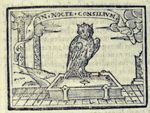
In nocte consilium: Covarrubias, Emblemas Morales (Madrid, 1610), emblem 247 quotes the comment
In nocte consilium: Wither, A collection of emblems (London, 1635), emblem 9 quotes the comment
In nocte consilium: Rollenhagen, Nucleus emblematum (Arnhem, 1618), Cent. I, emblem 9 quotes the comment
Iconclass: 51FF521 Delay 52E3 Counsel; 'Consiglio' (Ripa) 54A2 Carefulness, Diligence; 'Diligenza' (Ripa)
Loci Communes: Tarditatis et cunctationis (Slowness and delay, Lenteur et retard)
III viii 47 Nemo cogendus amicus No one may be forced to be a friend
Cum innues aliquem non esse ad negocium accersendum, praeter animi sententiam, aut non esse collocadum officium in eum, qui nec agnoscat, nec accipiat libeter, accommodum fuerit quod eodem in libro de Phoenice dixit Achilles, Ην ἐθέλωσιν. ἀμάγκῃδ᾽ οὔτιμιν ἄξω. id est, Si volet. invitum hunc haudquaquam abduxero quóquam.
When you want to signify that a person should not be ordered to agree to treat against his will, or that a duty should not be imposed on one who will neither recognize it nor accept it of his own free will, this remark of Achilles about Phoenix in the same book would be suitable: 'If he wishes. I will not force this man to go anywhere against his will.'
III viii 48 Omnibus antevertenda vitae cura Life comes before all else
Qui dicet omnia posthabenda, quo vitae consulamus, accomodabit illud ex eodem lib. Οὐ γὰρ ἐμοι ψυχῆς ἀντάξιον, οὐδ᾽ ὅσα φασίν Ιλιον ἐκτῆσθαι ἐναίομενον πτολιέθρον, Τὸ πρὶν ἐπ᾽ εἰρήνης. id est, Nullum equidem praecium cum vita confero, nec cum Iliacis opibus, pridem quas tempore pacis Urbs opulenta tenebat, uti fama est Moxque causa redditur, quod una vita, neque revocari, neque sarciri possit, simulatque semel dentes reliquerit. Ανδρὸς δὲ ψυχὴ, πάλιν ἐλθεῖν οὔτε ληϊστὴ, Οὔθ᾽ ἑλετή.
If one wants to say everything must be counted of lesser importance when we are considering life itself, one can adapt this from the same book:
For me, no wealth is worth the same as life, not even the same
As the wealth of Ilium, which men say this rich city
Possessed of old in time of peace.
And the reason is given immediately, for a life can neither be recalled nor restored once breath has left the lips: 'But that a man's spirit should come back ... neither pillage avails nor winning.'
Facsimile:
Iconclass: 51F3:58B2 Priority, Pre-eminence❧Life
Loci Communes: Dignitatis (Dignity, Dignité)
III viii 49 Evenit malo male Wrong to the wrong-doer
Cum scelerato cuipiam evenit, quod omnes imprecabantur et optabant, locus erit illi ex eodem libro, Θεοὶ δ᾽ ἐτέλειον ἐπαράς. id est, Explerunt inimica precamina divi. Verba sunt Phoenicis narrantis omnia mala accidisse sibi, qui pater olim fuerat imprecatus.
When things turn out for some villain as everyone prayed and wished, it will be the moment to quote this from the same book: "The curses were fulfilled by the gods.' These are the words of Phoenix recounting how all the ills befell him that his father had earlier prayed for.
Facsimile:
Iconclass: 44G3 criminal law; punishment 59C2:57AA741 Justice; 'Forza alla giustitia sottoposta', 'Giustitia', 'Giustitia retta', 'Giustitia rigorosa', 'Impietà e violenza soggetta alla giustitia' (Ripa)❧Revenge, Requital, Retaliation; 'Vendetta' (Ripa)
Loci Communes: Ultio malefacti (Vengeance for a wrongdoing, Vengeance d'un méfait)
III viii 50 Nec dignus, qui me intueatur Not worthy to look me in the eye
Qui contemnet omnino quempiam, ut ignavum, multoque sese inferiorem, non ineleganter illud ex eodem libro detorserit, quod in Agamemnonem dixit Achilles, Οὐ δ᾽ ἂν ἔμοι γε Τετλαίη κύνεος περ ἐὼν, εἰς ὥπα ἰδέσθαι. id est, Haud ille quidem ausit Quamvis perfricta sit fronte, mihi ora tueri. Quod idem etiam hodie vulgo dictitant. Est autem indicium animi conscii, non audere recta faciem intueri eius quem laeseris. Hinc est, quod Menelaus in Iphigenia Aulidensi iubet in primis, ut Agamemnon obtueatur sese, videlicet inde facti collecturus primum argumentum.
If you want to express contempt for someone who you think is cowardly and altogether inferior to yourself, then it would be quite humorous to adapt this remark of Achilles about Agamemnon from the same book: 'He would not dare, / Despite his shameless mien to look me in the face.' The same expression is still common nowadays. It is a sign of consciousness of guilt if you do not dare to look directly in the face of the one you have offended. This is why Menelaus, in the Iphigenia in Aulis, especially orders Agamemnon to look at him, so that he can gather the best proof of what he had done.
Facsimile:
Iconclass: 31A31 sight, looking (one of the five senses) 51EE2 Inferiority 54AA8 Cowardice 57BB21 Contempt
Loci Communes: Contemptus et vilitatis (Contempt and worthlessness, Mépris et bassesse); Excellentia, inaequalitas (Excellence, inequality, Excellence, inégalité)
III viii 51 Cavendum ab eo, qui semel imposuit Beware of the man who has cheated once
Qui se negabit habere velle commercium cum eo à quo semel sit deceptus, usurpabit illud ex eodem libro, Οὐ δέ τι οἱ βουλὰς συμφράσομαι, οὐδὲ μὲν ἔργον. Εκ γὰρ δή μ᾽ ἀπάτησε καὶ ἥλιτεν. οὐ δ᾽ ἂν ἔτ᾽ αὖτις Εξαπάφοι ἐπέεσσιν, ἅλις δέ οἱ, ἀλλὰ ἕκηλος Εῤῥέτω.. id est, Hoc ego cum nihil aggrediar, neque enim expedit unquam. Quippe ubi frustratus semel est, ac fraude fefellit, Non iterum mihi verba dabit stulto, semel illi hoc Sit fecisse satis, quin posthac illo qutescat. Ac valeat.
If you want to say you have no wish to deal with someone who has once cheated you, you might use this from the same book:
I will undertake nothing with this man, nor is it in any way right that I should;
For now he has cheated once and deceived me with lies,
He will not make a fool of me again with words.
Let it suffice that he has done this once, and let him henceforth be silent,
And go to hell.
Facsimile: 
Iconclass: 51B61:57AA621 Repetition❧Cheat, Deceit; 'Fraude', 'Inganno' (Ripa) 52A24 Precaution
Loci Communes: Diffidentia (Distrust, Méfiance); Imposturae (Impostures, Impostures)
III viii 52 Amicorum est admonere mutuum It is the duty of friends to admonish each other
Sententia proverbialis videtur, quam legimus Iliad. Α. Αγαθὴ δὲ παραίφασίς ἐστιν ἑταίρου. id est, Bonus est affatus amici Admonitoris. Hanc licebit usurpare, si quando dicemus amici munus esse, ut amicum si quid erret, liberius admoneat.
There seems to be a proverbial phrase in this line of book 11 of the Iliad: 'Effective are the words of a friend who advises.' This phrase might be used when we want to say that it is the duty of one friend to admonish another quite freely if he has somehow gone astray.
III viii 53 Unus multorum instar One who is equal to many
Quod eodem in lib. dictum est in laudem medici, idem torqueri poterit ad quemcunque virtute praestantem. Carmen est huiusmodi, Ιητρὸς γὰρ ἀνὴρ πολλῶν ἀντάξιος ἄλλων. id est, Vir medicus multis aliis aequandus honore est. Festiviter hoc in Eryximachum torquet Alcibiades, cui iubenti negat se posse obsistere, quod vir medicus multorum instar sit. Festivius erit si transferatur ad res animi. Veluti Plato libro de Repub. iiii. ἐὰν τὸ λεγόμενον ἓν μέγα φυλάττωσι. id est, Si illud unum magnum quod dicitur servaverint. Indicat illud ἓν μέγα fuisse proverbiale. Vide proverbiu, Multa novit vulpes, &c. Idem admonet elegantissima parabola evangelica, de precioso margarito, & de thesauro in agro. Bona mens igitur πάντων ἀντάξιος ἄλλων, & eruditio & bona fama, πολλῶν ἀντάξιος ἄλλων.
The praise of physicians in the same book could be adapted to any outstanding virtue. The verse goes like this: 'One physician is worth many other men.' This is wittily turned against Eryximachus by Alcibiades who says he cannot resist his orders because a physician is the equal of many men. It will be funnier if it is used figuratively of ideas, as Plato does in book 4 of the Republic: 'Providing they have preserved the one big thing,' as they say. He indicates that this [greek] 'one big thing' is a proverbial expression. See the adage 'The fox knows many things, etc.' The same lesson is taught by the very remarkable parables in the gospels of the precious pearl and the treasure in the field. A good mind therefore is 'worth all other things,' and learning and reputation are 'worth many other things.'
Facsimile:
Iconclass: 51BB2 Dissimilarity, Unlikeness 51BB3 Imparity, Inequality, Difference 51H3 Multitude 73C872 'the Kingdom of Heaven is like treasure hidden in a field' ~ proverbial saying of Christ (Matthew 13:44)
Loci Communes: Excellentia, inaequalitas (Excellence, inequality, Excellence, inégalité)
III viii 54 Contemnentis inimicum Of a man who despises his enemy
Qui negabit se commoveri conviciis alicuius hominis contempti, non inscite deflexerit id quod eodem libro dicit Diomedes, Οὐκ ἀλέγω, ὡς εἴ με γυνὴ βάλοι, ἢ πάϊς ἄφρων, Κωφὸν γὰρ βέλος ἀνδρὸς ἀνάλκιδος οὐτιδανοῖο. id est, Haud curo magis, ac si foemina sive quis infans Me iaculo peteret, siquidem viri inertis & ipsa Irrita tela volant.
Anyone who wants to say he is not alarmed by the insults of some despised person might neatly turn to his use what Diomedes says in the same book: 'I care no more than if a woman or some child / Had aimed a dart at me, for your arrows are those of a coward and fly to no effect.'
Facsimile:
Iconclass: 54AA21:57BB22 Indifference❧Insult; 'Ingiuria', 'Offesa' (Ripa)
Loci Communes: Contemptus et vilitatis (Contempt and worthlessness, Mépris et bassesse)
III viii 55 In voti compotem On one whose wish is fulfilled
Ubi quis assecutus est quod affectabat captabatque, veluti si quis sacerdotii spe munus principi mitteret, eoque sacetdotio favore principis potiretur, quadrabit illud ex eodem lib. Καὶ βάλεν ουδ᾽ ἄρα μιν ἄλιον βέλος ἔκφυγε χειρὸς. id est, Attigit, eque manu non irrita missae sagitta est.
When someone has achieved what he hoped for and desired, for example if someone sends a gift to a prince in the hope of a church benefice and obtains that benefice by favour of the prince, then this from the same book will be appropriate: 'He hit him, not for nothing was the sharp arrow fired by his hand.'
Facsimile:
Iconclass: 53B7 Observance, Fulfilment 54F1 Success; 'Evento buono' (Ripa)
Loci Communes: Bonae fortunae, copiae, felicitatis aut ominis (Of good fortune, abundance, happiness, or omen, Bonne fortune, abondance, bonheur ou présage); Votum (A vow, a wish, Vœu)
III viii 56 Lupus in fabula The wolf in the fable
Cum forte fortuna in medio sermone intervenit is, cuius mentio siebat, conveniet illud ex Iliados Κ. Οὔπω πᾶν εἴρητο ἔπος, ὅτ᾽ ἂρ ἤλυθον αὐτοί. id est, Iamque aderant ipsi nondum sermone peracto.
When by chance in the middle of a conversation someone appears who was the subject of discussion, this from book 10 of the Iliad will be appropriate: 'Suddenly there they were themselves before the word was out of his mouth.'
Facsimile:
Iconclass: 52BB3:46C514 Surprise, Wonder; 'Maraviglia' (Ripa)❧arrival and return ~ travelling 25F23(WOLF) beasts of prey, predatory animals: wolf 85 fables
Loci Communes: Subiti interventus (A sudden intervention, Intervention soudaine)
III viii 57 Corrigentis quod dictum est ab alio For one who corrects what someone else has said
Ubi civiliter notabimus aliquem tanquam haud ex animi sententia locutum, aut ubi quid dictum erit parum honestum, intorquebimus versiculum hunc ex Iliados Μ. quem Plutarchus ad eum usum adduxit alicubi, Οἶσθα καὶ ἄλλον μῦθον ἐμείνονα τοῦ δὲ νοῆσαι. id est, Sermonem hoc alium potiorem adducere nosti.
When we want to indicate politely that someone has not expressed his real opinion or when what is proposed would be improper, we can adapt this line from book 12 of the Iliad, which Plutarch also used in this way somewhere: 'You know how to devise better words than these.'
Facsimile:
Iconclass: 52E3 Counsel; 'Consiglio' (Ripa) 57BB12:52C11 Correction; 'Correttione' (Ripa)❧Opinion
Loci Communes: Correctio dicti aut facti (Correction of a word or deed, Correction d'une parole ou d'un acte)
III viii 58 Aliter cum aliis agendum Different people should be treated differently
Qui significabit cum aliis blandius agendum, cum aliis asperius, ut cuiusque fuerit ingenium, aut fortuna, dignitasque allegabit illud ex eodem libro: Αλλον μειλιχίοις, ἄλλον στερεοῖς ἐπέεσσι Νείκεον. id est, Verbis hunc placidis, contra asperioribus illum Increpuere.
If someone wants to say that some people should be treated more gently, others more harshly, each according to his intelligence or fortune and rank, he may bring in this from the same book: 'One man with gentle words, another with harsher words / They chided.
Facsimile:
Iconclass: 51BB2 Dissimilarity, Unlikeness 57A77 Friendliness, Gentleness, Affability; 'Affabilità, piacevolezza, amabilità', 'Animo piacevole, trattabile & amorevole', 'Benignità' (Ripa) 57AA77 Unfriendliness
Loci Communes: Alia aliis placent (Different things please different people, Chacun ses goûts)
III viii 59 Ut nunc sunt homines That's how men are now
Si notabis temporum tuorum mores, ut semper in peius degenerantes à virtute maiorum, Veluti si dicas hunc aut illum principem laudandum, ut hac tempestate sunt principes, applicabis illud ex eodem libro, οἶοι νῦν βροτοί εἰσιν. Quod quidem hemistichium aliquot est locis apud Homerum: hic de Aiace & Hectore, saxum ingens humo facile tollentibus, Iliados ε. de Tydeo saxum item tollente
If you want to say that the morals of your time are continually declining from the standards of your elders, for example if you say this or that monarch should be praised, considering how monarchs are nowadays, you can apply this from the same book: 'Such as mortals are now.' This hemistich is found in several places in Homer; in this book it is used of Ajax and Hector who easily pick up huge stones from the ground; in book 5 of the Iliad it is used to describe Tydeus likewise picking up a stone.
Facsimile: 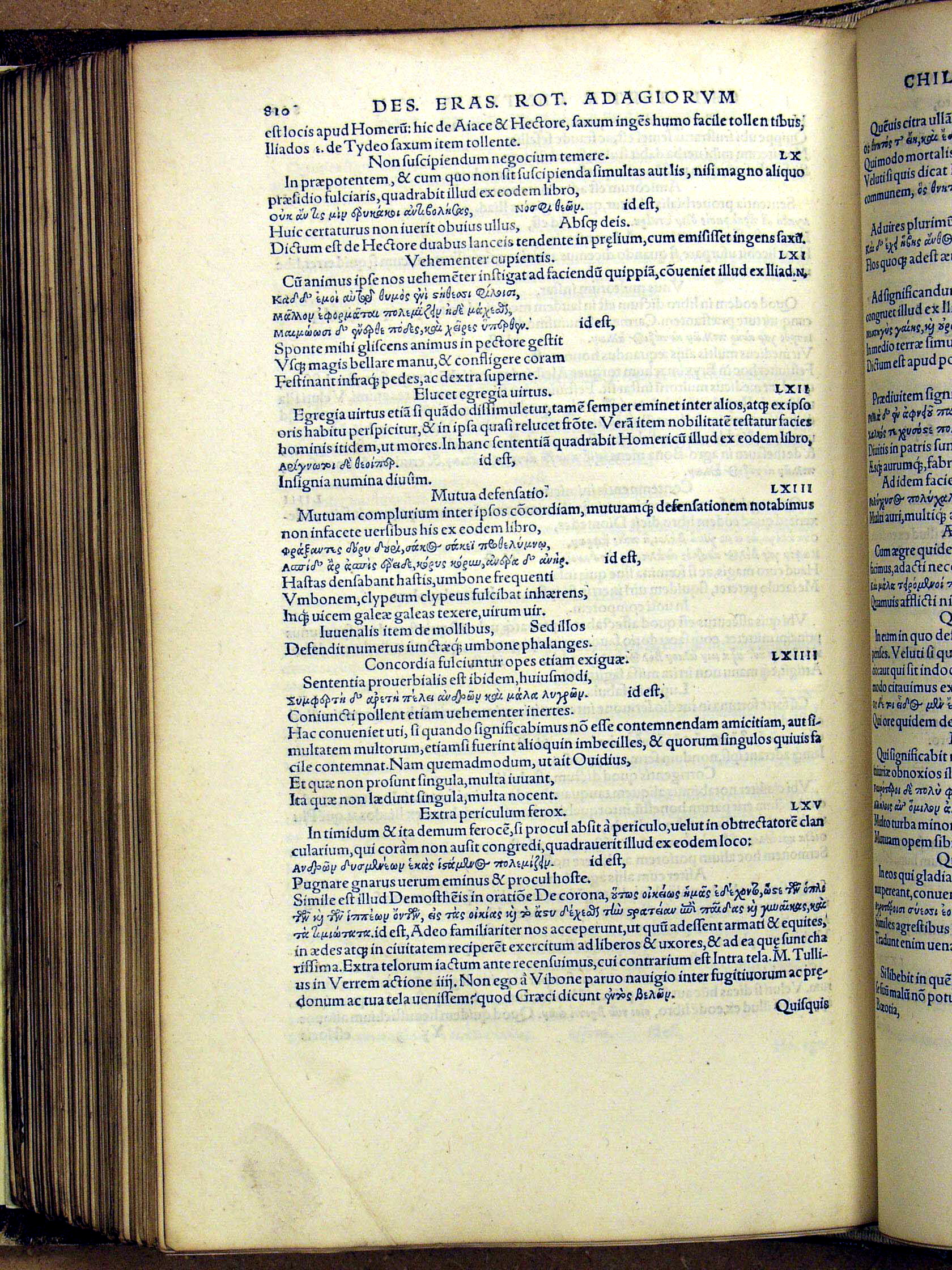
Iconclass: 23A32 present 53BB61 Laxity 54FF13:59A3 Regression, Deterioration, Relapse❧Propriety, Decorum; 'Decoro' (Ripa)
Loci Communes: Degenerantium in pejus (Degenerating for the worse, Dégénérer en pire)
III viii 60 Non suscipiendum negocium temere A deal not to be undertaken rashly
In praepotentem, & cum quo non sit suscipienda simultas aut lis, nisi magno aliquo praesidio fulciaris, quadrabit illud ex eodem libro, Οὐκ ἄντις μὶν ἐρυκάκοι ἀντιβολήσας Νόσφι θεῶν. id est, Huic certaturus non iuerit obvius ullus, Absque deis. Dictum est de Hectore duabus lanceis tendente in proelium, cum emisisset ingens saxum.
Against some exceptionally powerful person with whom you should not compete or fight unless you have some strong protection, this from the same book will be suitable:
None facing him could have stood against him,
Except the gods.
This describes Hector, armed with two spears, leaping into battle after he had thrown the great stone.
III viii 61 Vehementer cupientis For someone with a powerful longing
Cum animus ipse nos vehementer instigat ad faciendum quippiam, conveniet illud ex Iliad. Ν. Καδδ᾽ ἐμοι αὐτῳ θυμός ἐνὶ στήθεσσι φίλοισι, Μᾶλλον ἐφορμᾶται πολεμΐζειν ἠδὲ μάχεσθαι, Μαιμώωσι δ᾽ ἔνερθε πόδες, καὶ χεῖρες ὕπερθεν. id est, Sponte mihi gliscens animus in pectore gestit Usque magis bellare manu, & confligere coram Festinant infraque pedes, ac dextra superne.
When the heart itself prompts us strongly to do something, this from book 13 of the Iliad will be suitable: My heart, welling up of itself in my breast, Is ever more eager to fight and come to close grips; My feet below and my hands above both hasten me forward.
Facsimile:
Iconclass: 53B41 Inclination; 'Inclinatione' (Ripa) 54AA4 Vehemence, Violence, Fierceness; 'Sforza con Inganno', 'Violenza' (Ripa)
Loci Communes: Vehementia, languor (Vehemence, listlessness, Véhémence, langueur)
III viii 62 Elucet egregia virtus Exceptional virtue shines out
Egregia virtus etiam si quando dissimuletur, tamen semper eminet inter alios, atque ex ipso oris habitu perspiciture, & in ipsa quasi relucet fronte. Veram item nobilitatem testatur facies hominis itidem, ut mores. In hanc sententiam quadrabit Homericum illud ex eodem libro, Αρίγνωτοι δὲ θεοίπερ. id est, Insignia numina divûm.
Exceptional virtue, even when it is concealed, always stands out among other people; it is visible in the cast of the face and shines, so to speak, on the brow. True nobility too shows in the human face just as virtue does. This notion is expressed by the following verse of Homer from the same book: 'The might of the gods is unmistakable.'
Facsimile:
Iconclass: 31A2211 face 51G5:57A6 Visibility❧Virtuousness; 'Amor di Virtù', 'Attione virtuosa', 'Guida sicura de' veri honori', 'Virtù', 'Virtù insuperabile' (Ripa)
Loci Communes: Concordia (Harmony, Concorde); Excellentia, inaequalitas (Excellence, inequality, Excellence, inégalité)
III viii 62A Mutua defensatio Mutual defence
Mutuam complurimum inter ipsos concordiam, mutuamque defensationem notabimus non infacete versibus his ex eodem libro, Φράξαντες δόρυ δουρὶ, σάκος σάκεϊ προθελύμνῳ, Ασπίδ᾽ ἂρ ἀστπὶς ἔρειδε, κόρυς κόρυν, ἀνέρα δ᾽ ἀνὴρ. id est, Hastas densabant hastis, umbone frequenti Umbonem, clypeum clypeus fulcibat inhaerens, Inque vicem galeae galeas texere, virum vir. Iuvenalis item de mollibus, Sed illos Defendit numerus iunctaeque umbone phalanges.
Agreement by many people among themselves and mutual defence can be indicated quite humorously with these lines from the same book:
Spears were packed against spears,
Shield against serried shield, buckler supported buckler,
Helmets interlocked with helmets, man with man.
Likewise Juvenal talking about effeminate people:
But they are defended
By their number and phalanxes of joined shields.
III viii 63 Concordia fulciuntur opes etiam exiguare With unanimity even slender resources are strenghtened
Sententia proverbialis est ibidem huiusmodi: Συμφερτή δ᾽ ἀρετὴ πέλει ἀνδρῶν καὶ μάλα λυγρῶν. id est, Coniuncti pollent etiam vehementer inertes Hac conveniet uti, si quando significabimus non esse contemnendam amicitiam aut simultatem multorum, etiamsi fuerint alioquin imbecilles, & quorum singulos quivis facile contemnat. Nam quemadmodum, ut ait Ovidius, Et quae non prosunt singula, multa iuvant, Sic quae non laedunt singula, multa nocent.
In the same passage there is a proverbial phrase which goes like this: 'When they join together even the most unskilled are a force.' This can be used appropriately when we want to say that we should not disregard the alliance or the rivalry of the multitude, even if they are otherwise weak and, as individuals, easily despised. For, in Ovid's words, just as 'Things that taken singly are of no benefit, in large numbers do help,' - so things that do not hurt singly, in large numbers do harm.
Facsimile:

Amicitiae bonum: Borja, Empresas morales (Bruxelles, 1680), emblem 35 uses the imagery of an arch to illustrate the benefits of friendship and collaboration
Reddit coniunctio tutos: Zincgreff, Emblematum Ethico-politicorum (Heidelberg, 1619), the comment of emblem 33 quotes the adage's comment
Iconclass: 54A7 Strength, Power; 'Fortezza', 'Fortezza d'Animo e di corpo', 'Fortezza del corpo congiunta con la generosità dell'animo', 'Fortezza & valore del corpo congiunto con la prudenza & virtù del animo', 'Forza' (Ripa) 54E31 Agreement, Unity; 'Concordia', 'Concordia insuperabile', 'Concordia militare', 'Concordia di Pace', 'Unione civile' (Ripa) 54E4 Defence
III viii 64 Extra periculum ferox Brave when there is no danger
In timidum & ita demum ferocem si procul absit à periculo, velut in obtrectatorem clancularium, qui coràm non ausit congredi, quadraverit illud ex eodem loco: Ανδρῶν δυσμενέων ἑκὰς ἱστάμενος πολεμιζειν. id est, Pugnare gnarus verum eminus & procul hoste. Simile est illud Demosthenis in oratione De corona, οὕτως οἰκείως ἡμᾶς ἐδέχοντο, ὥστε τῶν ὁπλιτῶν καὶ τῶν ἱππέων ὄντῶν, εἰς τὰς οἰκίας καὶ τὸ ἄστυ δέχεσθαι τὴν στρατείαν ἐπὶ παῖδας καὶ γυναῖκας, καὶ τὰ τιμιώτατα. id est, Adeo familiariter nos acceperunt, ut quum adessent armati & equites, in aedes atque in civitatem reciperent exercitum ad liberos & uxores, & ad ea quae sunt charissima. Extra telorum iactum ante recensuimus, cui contrarium est Intra tela. M. Tullius in Verrem actione iiii. Non ego à Vibone parvo navigio inter fugitivorum ac praedonum ac tua tela venissem? quod Graeci dicunt ἐντὸς βελῶν.
Against a cowardly person and one who is brave only when danger is far away, like a secret critic who has not dared to take issue face to face, this line from the same passage will be suitable: 'Knowing how to fight, but at a distance and when the enemy is far away.' This recalls what Demosthenes says in his speech On the Crown: "They welcomed us in such a friendly manner that, although their infantry and cavalry were there, they gave the army access to their homes, to their city, to their children and their wives and to everything that was most precious to them.' 'Out of range,' we have recorded before; the opposite is 'Within range.' Marcus Tullius, in the fourth speech against Verres: 'I should not have come myself the short voyage from Vibo within range of your arrows and those of the revolted slaves and pirates.' 'Within range,' as the Greeks say.
Facsimile:
Iconclass: 32A42 coward 54A8:54D5 Courage, Bravery, Valiance, Manliness; 'Ardire magnanimo et generoso', 'Gagliardezza', 'Valore', 'Virtù heroica', 'Virtù dell'animo e del corpo' (Ripa)❧Safety 54AA8:54DD51 Cowardice❧Danger; 'Pericolo' (Ripa)
Loci Communes: Securitatis et tutae rei (Security and safety, Sécurité et sûreté)
III viii 65 Quisquis is fuerit No matter who it might be
Quemvis citra ullam exceptionem hominem indicabimus hoc versiculo, qui est in eodem lib. Ος θνητός τ᾽ εἴη, καὶ ἔδοι δημήτερος ἀκτὴν. id est, Qui modo mortalis sit edens cerealia dona. Veluti si quis dicat humanas leges alibi alias esse, caeterum legem naturae omnium esse communem, ὁς θνητός τ᾽ εἴη.
We can show that we mean any man at all without any exception with this line, which is in the same book: 'Providing he is mortal and eats the gifts of Ceres.' For example, if someone says that human laws are different from place to place but that the law of nature is the same for everyone 'providing he is mortal ...'
Facsimile: 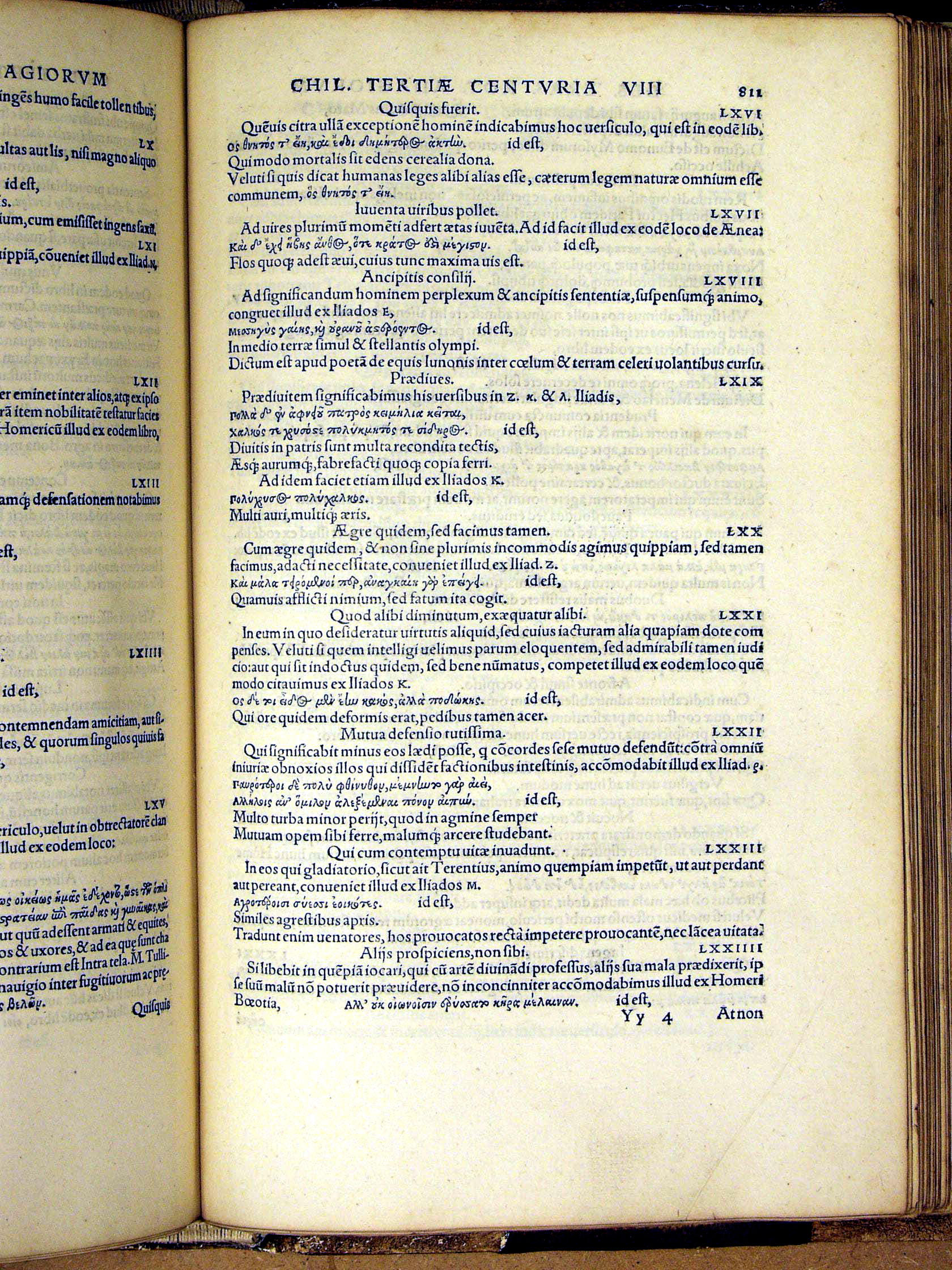
Iconclass: 59B1 Everyman, 'Elckerlyc'
Loci Communes: Differentiae (Differences, Différences)
III viii 66 Iuventa viribus pollet Youth abounds in physical strength.
Ad vires plurimum momenti adfert aetas iuventa. Ad id facit illud ex eodem loco de Aenea: Καὶ δ᾽ ἔχει ἥβης ἄνθος, ὅτε κράτος ἐστὶ μέγιστον. id est, Flos quoque adest aevi, cuius tunc maxima vis est.
Youth is a time that brings the greatest development of physical strength. This is suitably expressed by this line about Aeneas from the same book: 'And he is in the flower of youth, in which strength is at its greatest.'
Facsimile:
Iconclass: 31D120 Youth, Adolescence, 'Iuventus'; 'Adolescenza', 'Gioventù' (Ripa) 54A7 Strength, Power; 'Fortezza', 'Fortezza d'Animo e di corpo', 'Fortezza del corpo congiunta con la generosità dell'animo', 'Fortezza & valore del corpo congiunto con la prudenza & virtù del animo', 'Forza' (Ripa)
III viii 67 Ancipitis consilii In two minds
Ad significandum hominem perplexum & ancipitis sententiae, suspendumque animo, congruet illud ex Iliados Ε, Μεσσηγὺς γαίης, καὶ οὐρανοῦ αστερόεντος. id est, In medio terrae simul & stellantis olympi. Dictum est apud poetam de equis Iunonis inter coelum & terram celeri volantibus cursu.
A person who is perplexed, in two minds, and hesitating, could be suitably described with this from book 5 of the Iliad: 'Halfway between earth and starry Olympus.' These are the words of the poet describing the horses of Juno flying swiftly between heaven and earth.
Facsimile:
Iconclass: 52BB2 Doubt; 'Dubbio' (Ripa) 53BB2 Hesitation
Loci Communes: Anceps et dubius (Doubtful and uncertain, Incertain et douteux)
III viii 68 Praedives Very wealthy
Praedivitem significabimus his versibus in Ζ. κ. & λ. Iliadis. Πολλὰ δ᾽ ἐν ἀφνειοῦ πατρὸς κειμήλια κεῖται, Χαλκός τε χρυσόστε πολύκμητος τε σίδηρος. id est, Divitis in patris sunt multa recondita tectis, Aesque aurumque fabrefacti quoque copia ferri. Ad idem faciet etiam illud ex Iliados Κ. Πολύχρυσος πολύχαλκος. id est Multi auri, multi aeris.
We can signify a very wealthy person with these lines, which are in books 6, 10, and 11 of the Iliad:
Many treasures are hidden in my wealthy father's house,
Bronze and gold and much wrought iron.
The same idea is suitably expressed in these words from book 10 of the Iliad: 'Rich in gold and rich in bronze.'
III viii 69 Aegre quidem, sed facimus tamen With difficulty, but still we do it
Cum aegre quidem, & non sine plurimis incommodis agimus quippiam, sed tamen facimus adacti necessitate, conveniet illud ex Iliad. Ζ. Καὶ μάλα τειρόμενοι περ, ἀναγκαίη γὰρ ἐπείγει. id est, Quamvis afflicti nimium, sed fatum ita cogit.
When we do something with difficulty and with much inconvenience, but do it nevertheless because we are forced to by necessity, then this line from book 6 of the Iliad will be apt: 'Though we are much distressed, yet so fate forces us.'
Facsimile:
Iconclass: 53A2 Perseverance, Resolution, Determination; 'Perseveranza' (Ripa) 54DD4 Difficulty
Loci Communes: Difficultatis (Difficulty, Difficulté)
III viii 70 Quod alibi diminutum exaequatur alibi What is lacking in one way is made up for in another
In eum in quo desideratur virtutis aliquid, sed cuius iacturam alia quapiam dote compenset. Veluti si quem intelligi velimus parum eloquentem, sed admirabili tamen iudicio: aut qui sit indoctus quidem, sed bene nummatus, competet illud ex eodem loco quemmodo citavimus ex Iliados. Κ. Ος δὲ τοι εἶδος μὲν ἔην κακὸς, ἀλλὰ ποδώκης. id est, Qui ore quidem deformis erat, pedibus tamen acer.
For someone who is thought to be lacking in some virtue but whose deficiency is compensated by some other gift - for example if we want to give the idea that someone is not very eloquent but has admirable judgment, or if someone is uneducated but well endowed, then this line from the same passage in book 10 of the Iliad that we have just quoted will be appropriate: 'A man who was ugly in appearance, but swift of foot.'
Facsimile:
Iconclass: 51H42 Abundance; 'Abondanza', 'Abondanza maritima' (Ripa) 51HH41 Insufficiency
Loci Communes: Alibi diminutum alibi redditum (Diminished in one place, restored in another, Diminué ici, rendu là)
III viii 71 Mutua defensio tutissima Mutual protection is the surest
Qui significabit minus eos laedi posse, qui concordes sese mutuo defendunt: contra omnium iniuriae obnoxios illos, qui dissident factionibus intestinis, accommodabit illud ex Iliad. ρ. Παυρότεροι δὲ πολὺ φθίνυθον, μέμνηντο γὰρ αἰεὶ, Αλλὴλοις ἀν᾽ ὅμιλον ἀλεχέμεναι πόνον αἰπύν. id est, Multo turbae minor periit, quod in agmine semper Mutuam opem sibi ferre, malumque arcere studebant.
If someone wants to say that the least vulnerable people are those who agree to protect each other and, on the other hand, those who are divided by internal factions are exposed to all sorts of harm, then these lines from book 17 of the Iliad will be appropriate: 'Far fewer died, for in battle they always strove / To support each other and to ward off harm.'
Facsimile:
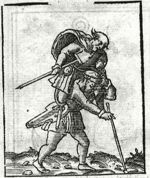
Mutuum auxilium: Alciatus, Emblemata (Paris, 1534), emblem 22 uses the adage's imagery
Mutuum auxilium: Whitney, A choice of emblemes (Leiden, 1586), emblem 71 uses the adage's imagery
O charitas, o raritas: Cramer, Octoginta emblemata nova (Frankfurt, 1630), emblem 52 adapts the imagery of the halt and the blind
Iconclass: 54E:54A6 Reciprocal Action❧Helpfulness 54E4 Defence
III viii 72 Qui cum contemptu vitae invadunt Those who attack with no regard for their life
In eos qui gladiatorio, sicut ait Terentius, animo quempiam impetunt, ut aut perdant aut pereant, conveniet illud ex Iliados Μ Αργοτέροισι σύεσσι ἐοικότες. id est, Similes agrestibus apris. Tradunt enim venatores, hos provocatos rectà impetere provocantem, nec lancea vitata.
For those who, as Terence says, attack someone 'in the spirit of a gladiator' so that they either kill or are killed, this phrase from book 12 of the [greek] will be suitable: 'Like wild boars.' Hunters say that these animals when challenged charge straight at the challenger without avoiding the spear.
Facsimile:
Iconclass: 25F24(BOAR)(+512) hoofed animals: boar (+ animal(s) attacking) 43C3961 fight of gladiators 54A82 Audacity, Temerity; 'Audacia' (Ripa) 54EE4:31AA4111 Attack❧blind, blindness - AA - metaphorically blind 56E3 Fury; 'Furore', 'Furore implacabile', 'Furore & Rabbia', 'Furore superbo & Indomito' (Ripa)
III viii 73 Aliis prospiciens, non sibi Foresight for others, not for oneself
Si libebit in quempiam iocari, qui cum artem divinandi professus, aliis sua mala praedixerit, ipse suum malum non potuerit praevidere, non inconcinniter accommodabimus illud ex Homeri Boeotia, Αλλ᾽ οὐκ οἰωνοῖσιν ἐρύσσατο κῆρα μέλαιναν. id est, At non auguriis fatum sibi detulit atrum. Quod imitatus Maro, At non auguriis valuit depellere pestem. Dictum est de Eunomo Mysorum duce, perito quidem auguriorum, at nihilominus ab Achille occiso.
If we want to amuse ourselves with a joke at the expense of someone who claimed to know the art of divination and predicted the misfortunes of others but failed to foresee his own, we can quite aptly use this from the 'Boeotia' of Homer: 'But for all his auguries he did not ward off his black fate.' The line was imitated by Maro: 'But auguries were not enough to ward off his doom.' This is said of Eunomus, leader of the Mysians, a skilled augur, who was nevertheless killed by Achilles.
Facsimile: 
Iconclass: 12E52 seer, prophet ~ Greek religion 12F52(AUGUR) 'augur' ~ Roman religion 51AA4:52E2 Nothingness, Absence❧Prediction, Prophecy; 'Augurio', 'Divinatione', 'Profetia' (Ripa)
Loci Communes: Aliis sapere (To be wise for others, Être sage pour autrui)
III viii 74 Dedecus publicum Public shame
Rem modis omnibus infamen, ac perniciosam, non ineleganter indicaveris his versibus quibus Hector Paridem obiurgat libro Iliad. iii. Πατρί τε σῷ μέγα πῆμα πολῆί τε παντίτε δήμῷ, Δυσμενέσιν μὲν χάρμα, κατηφειην δέ σοι αὐτῳ. id est, Noxa ingens urbique tuae, populoque patrique, Hosti gaudia, sed probumque dolorque tibiipsi.
You could signify something altogether dishonourable and destructive quite wittily with these lines, in which Hector upbraids Paris in book 3 of the Iliad: Enormous harm to your city, your people, and your father, A joy to your enemy, but to yourself shame and grief.
Facsimile:
Iconclass: 52C111 Public Opinion; 'Opinione' (Ripa) 57A4 Shame
Loci Communes: Probrum, gloria (Disgrace, glory, Honte, gloire)
III viii 75 Ne depugnes in alieno negocio Don't contend in other peoples business
Ubi significabimus nos nolle nosmet admiscere liti alienae, quae nihil ad nos pertineat, sed permissuros ut ipsi inter sese suo decertent periculo, quorum agitur negocium, versiculo fuerit locus ex eodem libro Οἴους ἀμφ᾽ ἑλένῃ, καὶ κτήμασι πᾶσι μάχεσθαι. id est, Proque Helena, proque omni re decernere solos. Dictum de Menelao & Paride singulari certamine congressuris.
When we wish to indicate that we do not want to be embroiled in someone else's dispute which has nothing to do with us, but that we will allow those whose business it is to fight it out between themselves at their own risk, then there will be a place for this line from the same book: 'They alone should do battle for Helen and all her wealth.' Said of Menelaus and Paris when they were about to meet in single combat.
Facsimile:
Iconclass: 33B2 duelling 44G174 judicial duel 45A9 non-belligerents, neutrals
Loci Communes: Aliena curantis (Meddling in others' affairs, Qui se mêle des affaires d'autrui)
III viii 76 Prudentia coniuncta cum viribus Wisdom joined with strength
In eum qui norit idem & aliis imperare quid sit agendum, & ipse persequi cum est opus, quod aliis imperat, apte quadrabit illud ex eodem libro, Αμφότερον βασιλεύς τ᾽ ἀγαθὸς κρατερός τ᾽ αἰχμητής. id est, Et iuxta ductor bonus, & certamine pollens. Sunt enim qui imperatorem agere norunt, at militem praestare non norunt.
For someone who knows both how to tell others what has to be done, and to carry out himself, when necessary, the orders he gives to others, the following from the same book will be apt: 'Equally a good leader and powerful in battle.' For there are some who know how to play the commander but not how to be a soldier.
Facsimile:
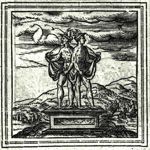
Prudentia cum robore coniuncta: Junius, Emblemata (Antwerp, 1565), emblem 13
In insignia academiae palatinae: Zincgreff, Emblematum Ethico-politicorum (Heidelberg, 1619), emblem 67 uses the imagery of a lion holding a book to express wisdom and strength
Exercet utrumque: Zincgreff, Emblematum Ethico-politicorum (Heidelberg, 1619), emblem 68 uses the imagery of a centaur holding a book and a club to express wisdom and strength
Iconclass: 52A22 Tact 53C2 Command 54A7 Strength, Power; 'Fortezza', 'Fortezza d'Animo e di corpo', 'Fortezza del corpo congiunta con la generosità dell'animo', 'Fortezza & valore del corpo congiunto con la prudenza & virtù del animo', 'Forza' (Ripa) 54D21 Practice; 'Prattica' (Ripa) 54E2 Guidance
Loci Communes: Prudentia conjuncta viribus (Prudence joined with strength, Prudence alliée à la force)
III viii 77 Pauciloquus, sed eruditus Sparing of words, but knowledgeable
In eum, qui pauca quidem, sed tamen auditu digna loquit, conveniet illud ex eodem libro, quod illic dicitur de Menelao, breviloquo Laconum more, verum suaviloquo & arguto: Παῦρα μὲν, ἀλλὰ μὰλα λιγέως, ἐπεὶ οὐ πολύμυθος. id est, Non is multa quidem, verum argutissima, quippe Pauciloquus.
For someone whose words are few but worth hearing, there is a suitable line from the same book that describes Menelaus, who is laconic, but who speaks pleasantly and clearly: 'Not at length, but very clearly, seeing he was a man of few words.'
Facsimile:
Iconclass: 51AA4:52D4 Nothingness, Absence❧Prolixity, Verbosity, Loquacity; 'Loquacità' (Ripa) 52D21 Conciseness
Loci Communes: Breviloquentia (Brevity of speech, Brièveté du discours)
III viii 78 Duobus malis resistere difficillimum Against two evils it is very difficult to stand firm
Εἰ δὴ ὁμοῦ πολεμός τε δαμᾷ, καὶ λοιμὸς ἀχαιούς. id est, Iam pariter subigit, bellumque & morbus Achivos. Si quando dicemus eundem hominem duobus, aut plurimis premi malis. Est apud Homerum Iliados a.
'Now war and sickness alike subdue the Greeks' - for a time when we want to say that the same individual is oppressed by two or several ills. The line is in book 1 of Homer's Iliad.
Facsimile:
Iconclass: 54DD4:54E4 Difficulty❧Defence 54EE4:49D11(2) Attack❧numerals: 2
Loci Communes: Malum conduplicatum aut renovatum (Evil doubled or renewed, Mal redoublé ou renouvelé)
III viii 79 A fronte simul et occipitio With both the front and the back of the head
Cum indicabimus admirabilem rerum omnium cognitionem, aut singularem prudetium, quae constat non praesentium modo scietia, sed & memoria praeteritorum, & futurorum prospicientia, recte versum hunc ex eodem usurpabimus libro: Ος ῃδη τάτ᾽ ἐόντα τάτ᾽ ἐσσόμενα, πρότ᾽ ἐόντα. id est, Qui scit praeterita, ac praesentia, postque futura. Virgilius vertit ad hunc modum: Quae sint, quae fuerint, quae mox ventura trahantur.
When we want to describe a wonderful understanding of everything or exceptional wisdom, which consists not only of knowledge of things present but remembrance of things past and foresight for things to come, we can aptly use this from the same book: 'He knows the past and present, and what will be later.' Virgil translated the line like this: 'What is, what was, what the future may soon bring .. .'
Facsimile:
Quae sint, quae fuerint, quae mox ventura trahantur: Saavedra, Idea de un principe (München, 1640), emblem 27 quotes the comment
Pour vivre en paix et tranquilité: La Perrière, Le theatre des bons engins (Lyon, 1545), emblem 1 uses the imagery of Janus
Iconclass: 31A221(+2) head (human) (+ back view) 31A2211 face 52A5:23A3 Knowledge; 'Cognitione', 'Cognitione delle cose' (Ripa)❧past, present and future
III viii 80 Nocuit et nocebit It has done harm and will do so again
Si quando demonstrata praeteritorum malorum causa comminabimur, futurum ut accedant maiora, nisi quis resipiscat, non intempestiviter usurpabimus versum hunc Homericum ex eodem libro, Τούνεκ᾽ ἂρ ἄλγε᾽ ἔδωκε ἑκηβόλος, ἤδ᾽ ἔστι δώσει. id est, Phoebus ob haec mala multa dedit, atque insuper addet. Veluti si medicus, ostenso morbi periculo moneat aegtotum revalescentem, ut temperet ab immodica Venere, alioqui rediturum cum foenore malum.
Whenever the cause of past ills has been proven and we want to warn that there may be worse to come unless someone comes to his senses, we can make timely use of this line of Homer from the same book:
For these acts Apollo has sent many ills and will send more.
For example, if a physician, given the proven danger of the sickness, advises his recovering patient to abstain from too much love-making, otherwise the illness will recur in worse measure.
Facsimile:
Iconclass: 51B61:52B5112 Repetition❧Bad, Evil, Wrong
Loci Communes: Discriminis (Danger, crisis, Danger)
III viii 81 Ingens discrimen An enormous difference
Quoties ingens discrimen innuemus inter homines, aut res plurimum inter se diversas, aut immensum intervallum inter seiunctos, eleganter accommodabimus illud ex eodem libro: Επειὴ μάλα πολλὰ μεταξὺ Οὔρεά τε σκιόεντα θάλασσά τε ἠχεήεσσα. id est, Sunt in medio sita plurima, montesque, Umbrosi, fretaque horrisono clamosa fragore.
Whenever we want to say there is a very big difference between men, or that things differ in great measure from one another, or there is a large gap between widely divided people, we can neatly adapt the following from the same book:
Much stands between, both shadowy mountains
And straits full of the frightful crash of breaking seas.
Facsimile: 
Iconclass: 51H4:51BB2 Plenitude❧Dissimilarity, Unlikeness
Loci Communes: Differentiae (Differences, Différences)
III viii 82 Adhortantis ad gloriam For someone giving encouragement to seek fame
Cum adhortabimur ad immortalem gloriam egregiis parandam factis, non inconcinniter adhibebimus illud carmen, quo M. Tullius aliquot usus est locis, Αλκιμός ἐσσ᾽ ἵνα τίς σε καὶ ὀψιγόνων εὖ εἴπῃ. id est, Strennuus esto, quo te posteritas quoque laudet. Extat autem apud Homerum cum aliàs, tum Odysseae lib. I. Sic enim Pallas in specie Mentoris adhortatur Telemachum ad virtutem, aliorum illustrium heroum exemplo, Καὶ συ φίλος, μάλα γὰρ σ᾽ ὁρόω καλόν τε μέγαντε, Αλκιμός ἐσσ᾽ ἵνα τῖς σε καὶ ὀψιγόνων εὖ εἴπῃ. id est, Tuque age, quando te video magnumque bonumque, Strenuus esto, ut tete & postera praedicet aetas.
When we want to encourage people to procure everlasting fame with extraordinary deeds, it will be appropriate to adduce this verse, which Marcus Tullius used in several places: 'Strive so that posterity too may praise you.' The verse exists in other places in Homer including the Odyssey book 1. For this is how Athena, in the shape of Mentor, exhorts Telemachus to valour with the example of other famous men: 'Come, you too, for I see you are tall and handsome, / Strive so that posterity too may praise you.'
Facsimile:
Iconclass: 54C2 Recommendation, Inducement, Incitement 59B32 Fame; 'Fama', 'Fama buona', 'Fama chiara' (Ripa)
Loci Communes: Probrum, gloria (Disgrace, glory, Honte, gloire)
III viii 83 Qui paratus ad resistendum Someone ready to resist
Qui significare volet se nequaquam detractare certamen, sed abunde suppetere, quo partes tueatur suas, usurpabit illud ex Iliad. ν. Τῷ μοι δούρα τά ἐστι καὶ ἀσπίδες ὀμφαλόεσσαι, Καὶ κόρυθες καὶ θώρηκες λαμπρὸν γανόωντες. id est, Et mihi sunt hastae teretes, clypeique rotundi, Tum galeae, tum thoraces procul igne micantes.
Someone who wants to indicate that he will certainly not decline to fight, but has abundant resources to protect his possessions, can use this from book 13 of the Iliad: T have slender spears and round shields, / Helmets and far-flashing breast-plates.'
III viii 84 In discrimine apparet, qui vir A crisis reveals who is a man
De re periculosa difficilique, et huiusmodi, quae virum cordatum ac strenuum requirat, conveniet illud quod eodem libro dicitur ab Idomeneo Cretensium duce: Ενθ᾽ ὅ τε δειλὸς ἀνὴρ ὅς τ᾽ ἄλκιμος ἐξεφάνθη. id est, Illic qui vir iners, qui strenuus ipsa docet res. Ad idem facit quod proximo carmine consequitur. Τοῦ μὲν γὰρ τε κακοῦ τρέπεται χρὼς ἄλλυδις ἄλλη. Cuius aliàs nobis facta mentio.
For a dangerous and difficult situation, and such as calls for a man both prudent and decisive, this verse will be suitable, spoken by Idomeneus, leader of the Cretans: 'There the situation itself tells us who is the coward and who the man of valour.' What follows in the next verse is suitable for the same purpose: 'A coward changes colour back and forth.' This has been mentioned by me elsewhere.
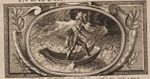
III viii 85 Non cedendum malis Never yield to misfortunes
Si quando admonebis, non oportere cedere vel adversariis, vel insultibus adversae fortunae, aut non esse certandum cum fugitivis, non inscite detorseris illud ex eodem libro, Οὐκ ἂν ἐν αὐχέν ὄπισθε πέσοι βέλος οὐδ᾽ ἐνὶ νότῳ, Αλλά κεν ἢ στέρνων ἢ νηδύος ἀντιάσειε. id est, Ne feriat iaculum cervicem aut terga, sed ipsum Aut ventrem, aut pectus feriat adversa sagitta.
Whenever you want to warn someone that he should not give in to enemies or the assaults of hostile fortune, or be like those who run away, you could quite neatly turn this to the purpose from the same book:
May the javelin not strike behind on your neck or back,
May the enemy's arrow strike your stomach or your breast.
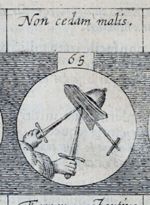
III viii 86 Ipse sibi perniciem accersivit He brought calamities on himself
In eum, qui sibi pertinaciter accersit malum, cui veluti fato destinatus sit, congruet illud ex eodem libro, Τόν δ᾽ ἂγε μοῖρα κακὴ θανάτοιο τέλος δε. id est, Istum mortis in exitium mala parca trahebat.
For a man who obstinately brings disaster on himself as if he is condemned to it by fate, this line from the same book will be suitable: 'An evil Fate was drawing him on to this fatal end.'
Facsimile:
Iconclass: 58AA12 Self-destruction
Loci Communes: Malum accersitum aut retortum (Evil brought upon oneself or turned back, Mal attiré ou retourné)
III viii 87 Ultra vires nihil aggrediendum Do not engage in what is beyond your powers
Qui dicet non esse suscipiendum negocium, ad quod peragendum non suppetant vires, non inconcinniter illud accommodaverit ex eodem libro, Πὰρ δύναμιν δ᾽ οὐκ ἔστι καὶ εσσύμενον πολεμΐζειν. id est, Vires ultra nemo queat bellare, licet sit Quantumvis animo promptus. Verba sunt Paridis ad Hectorem.
If you want to say that you should not begin an undertaking that you do not have the power to complete, then this from the same book could be adapted quite appropriately: 'No one should seek a battle beyond his strength, / However eager he may be.' These are the words of Paris speaking to Hector.
Facsimile:
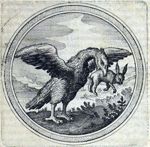
Iconclass: 54A43 Temperance, Moderation; 'Misura' (Ripa) 57AA647 Hybris
Loci Communes: Modestia modusque (Modesty and moderation, Modestie et mesure)
III viii 88 Ocyor accipitre As swift as a hawk
Admirandam celeritatem hyperbola proverbiali licebit indicare, quae est in eodem lib. Θάσσονες ἱρήκων. id est, Pernices magis accipitre. Venustius fiet, si ad famam, aut ingenium, aut nuncium, aut eiusmodi quidpiam detorqueatur.
It is possible to signify wonderful speed with a proverbial hyperbole which is to be found in the same book: 'As swift as a hawk.' The phrase will be more stylish if it is used to refer to fame, or intelligence, or a message, or anything like that.
Facsimile:
Iconclass: 25F33(HAWK) predatory birds: hawk 51M11 Swiftness, Speed; 'Agilità', 'Celerità', 'Velocità' (Ripa)
Loci Communes: Festinationis (Haste, Hâte)
III viii 89 Ancipitis animi In two minds
Animum accipitem et incerti consilii, licet indicare versiculo, qui est Iliados c. Ως ὁ γέρων ὥρμαινε δαϊζομενος κατα θυμὸν Διχθάδια. id est, Sic senior versans animo disquirit, utroque Nutans. Id Maro sic est imitatus, Atque animum nunc huc celerem, nunc dividit illuc. Rursum Iliados Π Διχθὰ δέ μοι κραδίη μέμονε φρεσὶν ὁρμαίνοντι. id est, Huc animus mihi versanti inclinabat & illuc.
A mind divided in two and undecided could be described with the lines in book 14 of the Iliad:
So the old man turned it over in his mind and pondered,
Inclining one way and the other.
This was imitated by Maro: 'And his mind is divided, going rapidly now this way now that.' In the Iliad again, book 16: 'My mind inclined this way and that as I pondered.'
Facsimile: 
Iconclass: 52BB2 Doubt; 'Dubbio' (Ripa) 54AA47 Disquietude of Mind; 'Inquietudine d'animo' (Ripa)
Loci Communes: Anceps et dubius (Doubtful and uncertain, Incertain et douteux)
III viii 90 Correctio dicti Mending what we say
Dictum obscoenius & bonis viris reticendum, aut absurdum dictu, notabimus hoc versiculo ex Iliados ξ. Μῦθον, ὅν οὔ κεν ἀνήρ γε δία στόμα πάμπαν ἄγοιτο, Ος τις ἐπίσταιτο ᾖσι φρεσὶν ἄρτια βάζειν. id est, Sermonem, quem nemo unquam promat ab ore, Qui modo cognorit cordata & sana profari.
A remark that is improper and such as should be withheld by respectable people, or any absurd remark, we can denote with this couplet from the Iliad book 14:
Speech such as may never be uttered by any man
Who has the least idea of how to speak prudent and sensible words.
Facsimile:
Iconclass: 31B6235:59AA3 speaking❧Vulgarity 31B6235:57AA68 speaking❧Unworthiness 57BB12 Correction; 'Correttione' (Ripa)
Loci Communes: Correctio dicti aut facti (Correction of a word or deed, Correction d'une parole ou d'un acte)
III viii 91 In clamosos Against people who shout
Ingentem inter litigandum aut disputandum vociferationem, indicabimus eo versiculo, quem ibidem de Neptuno scripsit Homerus, Οσσοντ᾽ ἐννεάχιλοι ἐπίαχον ἢ δεκάχιλοι Ανέρες ἐν πολέμῳ, έῤιδα ξυνάγοντες ἄρηος. id est, Tantum vociferans, quantum novies, deciésve Mille viri clamare solent qui praelia miscent. Idem carmen habetur Iliad. ε. de Marte
We can describe loud shouting during lawsuits or disputes with this couplet of Homer's about Neptune in the same passage:
Shouting loud as the war cry of nine
Or ten thousand men as they join battle.
The same couplet is found also in book 5 of the Iliad where it refers to Mars.
III viii 92 Pro mea virili To the utmost of my ability
Cum pollicebimus nos operam nostram praestituros pro nostra virili, conveniet illud ex eodem libro Veneris ad Iunonem. Εἰ δύναμαι τέλεσαί γε καὶ εἰ τετελεσμένον ἔσται. id est, Si praestare queam, & fieri res ipsa potessit. Idem versus habetur Odysseae ε. & Iliad. σ. Usurpat veluti proverbii vice Plutarchus, in libello De dignoscendo adulatore ab amico, εὖ γὰρ εἴρηται τοῖς πρὸ ἡμῶν, φίλου μὲν ἐκείνην εἶναι τὴν ἐπαγγελίαν, εἰ δύναμαι τέλεσαί γε καὶ εἰ τετελεσμένον ἔστα. κόλακος δὲ ταύτην, αὔδα ὅτι φρονέεις. id est, Nam recte dictu est illud à maioribus nostris, amicum sic promittere, Si praestare queam, & fieri res ipsa potessit. Adulatorem vero ad hunc modum, Dicito quicquid habes in pectore.
When we want to promise that we shall give something our attention to the utmost of our ability, this remark of Venus to Juno from the same book will be appropriate: 'If I can fulfil it and if it is something that can be fulfilled.' The same verse is to be found in book 5 of the Odyssey and book 18 of the Iliad. Plutarch uses it as if it were a proverb in his essay 'On Distinguishing a Flatterer from a Friend': 'For it was rightly said by our ancestors that a friend makes a promise like this: "If I can fulfil it and if it is something that can be fulfilled," but a flatterer does it like this: "Tell me whatever you have in your heart."'
Facsimile:
Iconclass: 51H4:54A33 Plenitude❧Skill, Ability; 'Artificio', 'Prontezza' (Ripa)
Loci Communes: Conatus (Effort, endeavor, Effort)
III viii 93 Pro dignitate cuiusque To each according to his status
Cum unicuique partes tribuuntur pro decoro personae, proque dignitate. Veluti negocium arduum committatur prudenti & exercitato: leviusculum iuveni cuipiam & imperito, quadrabit illud ex eodem Iliados ξ. Εσθλὰ μὲν ἒσθλὸς ἔδυνε χέρεια δὲ χείρονι δόσκεν. id est, Egregia egregius subit arma, ac deteriori Deteriora dedit.
When roles are assigned to each person according to his suitability and status, for example if difficult business is entrusted to someone wise and experienced and less important things to someone young and inexperienced, then this also from book 14 of the Iliad will be suitable: 'The best warrior was now the best equipped, and passed on / His inferior gear to the inferior man.'
Facsimile:
Iconclass: 51E3 Conformity; 'Temperamento delle cose terrene con le celesti' (Ripa) 59A3 Propriety, Decorum; 'Decoro' (Ripa)
Loci Communes: Dignitatis (Dignity, Dignité)
III viii 94 Omnia ex sententia cedunt Everything is happening as planned
In magnopere fortunatos, quibus & recte & secus instituta feliciter cedunt, congruet illud ex Iliados ρ. Τῶν μὲν γὰρ πάντῶν βέλε᾽ ἅπτεται, ὅστις ἀφείη, Η κακός, ἢ ἀγαθὸς, ζεὺς δ᾽ ἔμπης πάντ᾽ ἰθύνει. id est, Spicula cuncta horum feriunt, seu torserit illa Ignavus, seu vir fortis, quia Iuppiter ipse Dirigit.
For the extremely fortunate, for whom everything undertaken whether rightly or wrongly turns out happily, this couplet from the Iliad book 17 will be suitable:
All their darts strike home, whether they are fired
By coward or brave man, for Jupiter himself
Guides them.
Facsimile:
Iconclass: 45F11(+0) plan of battle (+ variant) 54F1 Success; 'Evento buono' (Ripa)
Loci Communes: Bonae fortunae, copiae, felicitatis aut ominis (Of good fortune, abundance, happiness, or omen, Bonne fortune, abondance, bonheur ou présage)
III viii 95 Improbitas muscae The depravity of the fly
In improbum, & subinde redeuntem, etiamsi turpiter repellatur, quadrabit illud ex eodem, Καὶ οἱ μυίης θάρσος ἐνὶ σταήθεσσιν ἐνῆκεν, Η τε καὶ ἐργεομένη μάλα περ χροὸς ἀνδρεομένοιο. ἰσχανάα δακέειν. id est, Atque illi muscae vim intra praecordia misit. Quae quamvis de pelle viri sic saepe repulsa, Assultat morsura tamen.
For the reprobate who immediately returns to crime even if he is driven off in disgrace, this from the same book will be appropriate:
And in his heart she set the daring of the fly
That however often it is driven off a man's skin,
Still returns to attack and bite.
Facsimile:
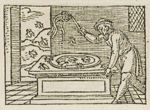
Fol, en plaisir s'esgare trop auant: La Perrière, Le theatre des bons engins (Lyon, 1545), emblem 4 uses the imagery of a fly who eventually drowns in the milk to which it keeps returning
Iconclass: 51B61:44G51 Repetition❧crime 54A82:25F711(FLY)(+512) Audacity, Temerity; 'Audacia' (Ripa)❧insects: fly (+ animal(s) attacking)
Loci Communes: Audacia (Boldness, Audace); Molesti intolerabiles (Unbearable, troublesome people, Gens insupportables)
III viii 96 Deo fortunaeque committo I trust to God and fortune
Qui fortunam experiri statuerit, eventum negotii fortunae committens, in hunc convenerit illud ex eodem libro, Ησω γὰρ καὶ ἐγὼ, τὰ δέ κεν διὶ πάντα μελήσει. id est, Torsero & ipse, Iovi fuerint haec omnia curae.
For someone who has decided to put an affair to the test and commit the outcome of it to fortune, the following from the same book will suit: I too will cast; all these things shall be Jupiter's concern.'
Facsimile: 
Iconclass: 56D2:92B1 Trust❧(story of) Jupiter (Zeus)
Loci Communes: Experientae seu pericliationis (Experience or risk-taking, Expérience ou mise à l'épreuve)
III viii 97 Consilium in melius commutandum Change your plan for a better one
Si quando iubebimus mutare consilium, utpote foedum ac stultum, aut reprehendemus quippiam ut inconsulte factum, usui fuerit ex eodem libro, Τις τοί νυ θεῶν νηκερδέα βουλὴν Εν στήθεσιν ἔθῃκε καὶ ἐξέλτο φρένας ἐσθλάς;. id est, Quis tibi consilium submisit inutile tandem Divorum, sanamque exemit pectore mentem?
Whenever we want to enjoin someone to change their intention because it is repugnant or stupid, or when we want to condemn something as done ill— advisedly, then this from the same book will be useful: 'What god has given you such unprofitable counsel/And driven good sense out of your heart?'
Facsimile:
Iconclass: 51K1:52A41 Change❧Idea, Concept; 'Idea' (Ripa) 52AA1:52E3 Stupidity, Poverty of Intellect; 'Stupidità overo Stolidità' (Ripa)❧Counsel; 'Consiglio' (Ripa)
Loci Communes: Mutandae sententiae (Changing one's opinion, Changer d'avis)
III viii 98 Modis omnibus incitat By every means he urges
Ubi quis modis omnibus animum alterius sollicitat, nunc precibus, nunc blanditiis, nunc iurgiis, nunc minis, usurpare licebit illud ex eodem libro de Automedonte dictum & equis Achillis, Πολλὰ μὲν ἂρ μάστιγι θοῇ ἐπεμαίσετο θείνων. Πολλὰ δὲ μειλιχίοισι προσηύδα, πολλὰ δ᾽ ἀρειῇ. id est, Multum ille, scuticaque cita celerare iubebat, Multum idem blande affatus, multumque minatus.
When someone uses every means to persuade someone else, prayers, flattery, censure, threats, you can make use of this from the same book, spoken of Automedon and the horses of Achilles: 'Again and again he commanded them with lashes of his whip, / Again and again he coaxed them with soft words, again and again he threatened.'
III viii 99 Eidem inhiantes testamento Mouths agape for the same will
Duriusculum quidem, sed tamen non inscitum, si quod est in eodem libro dictum de Graecis ac Troianis, pro Patrocli cadavere dimicantibus, torqueatur ad haeredipetas eundem senem, velut idem cadaver certatim captantes, Ως οἵγ᾽ ἔνθα καὶ ἔνθα νέκυν ὀλίγῃ ἐνὶ χώρῃ Ἕλκεον ἀμφότεροι. id est, Sic illi exiguo discrimine utrique cadaver Hinc atque inde trahunt.
It will be harsh perhaps, but quite clever nevertheless, if the verse in the same book about the Greeks and Trojans fighting over the body of Patroclus is adapted to describe inheritance hunters vying over the same old man as if he were a corpse: 'Even so in the scant space they haul the corpse / This way and that.'
Facsimile:
Iconclass: 42E5321 quarrelling heirs 94F821 the fight over the body of Patroclus
Loci Communes: Heredipetae (Legacy-hunters, Chasseurs d'héritage)
III viii 100 Praematura mors Early death
In hunc qui praematura morte discesserit, superstitibus parentibus, accommodabitur illud ex eodem libro de Hippothoo Pelasgo Leti filio dictum, quem Aiax Telamonius occiderat, quod Patrocli corpus pede apprehensum ad Troiam pertrahere conatus erat. Οὐδὲ τοκεῦσι Θρέπτα φίλοις ἀπέδωκε, μινυνθάδιος δέ οἱ αἰών. id est, Ast neque nutricandi grata parentibus ille Reddidit officia, sed ei breve contigit aevum.
For one who has met an early death while his parents survive, we can adapt from the same book what is said of the Pelasgian Hippothous son of Lethus whom Telamonian Ajax killed because he seized the body of Patroclus by the foot and tried to drag it off to Troy: 'But neither did he repay his parents for his upbringing, his life was too short.'
Facsimile:
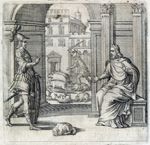
Aiax Telamonius: Boissard, Theatrum vitae humanae (Frankfurt, 1596), emblem 22 quotes a saying from the comment
Iconclass: 51F521:31E Precocity❧death of human being
Loci Communes: Senium praematurum aut mors (Premature old age or death, Vieillesse prématurée ou mort)