Guillaume de La Perrièrre, Le Theatre Des Bons Engins (Lyon, 1545)
Emblem 1
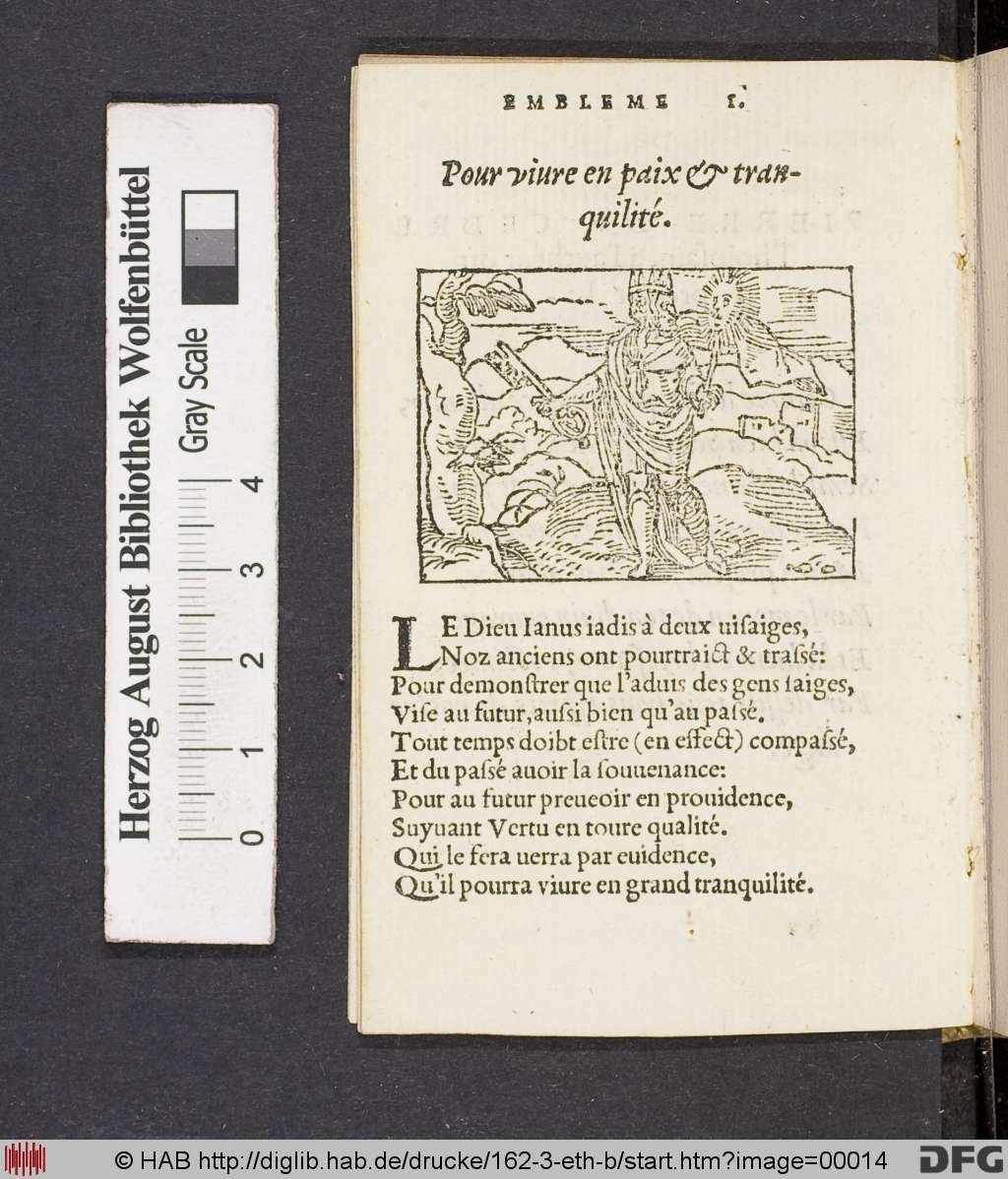
Two-faced Janus holding a sceptre with a radiant sun in his left and a large key in his right hand

Pour viure en paix & tranquilité.
To live in peace and tranquillity.AI-generated
Description of the woodcutAI-generated
A woodcut in a rectangular frame showing a bearded two-faced figure (Janus) standing full-length in an open landscape; one face looks left, the other right, and a radiant sunburst of rays surrounds the right-hand head. He wears a long robe with a mantle and a tall crown or mitre-like headdress, and holds a long staff or sceptre in each hand, the arms spread outward. At the left stands a leafy tree and rocky ground; at the right, on a rise, are buildings and a walled town or fortress; low rocks and tufted ground fill the foreground, with hatched sky above.
Subscriptio
TranscriptionAI-generated
LE Dieu Ianus iadis à deux uisaiges,Noz anciens ont pourtraict & trassé:Pour demonstrer que l'aduis des gens saiges,Vise au futur, aussi bien qu'au passé.Tout temps doibt estre (en effect) compassé,Et du passé auoir la souuenance:Pour au futur preueoir en prouidence,Suyuant Vertu en toure qualité.Qui le fera uerra par euidence,Qu'il pourra viure en grand tranquilité.
TranslationAI-generated
The god Janus of old, with two faces, our ancients portrayed and drew, in order to show that the judgement of wise people aims at the future just as much as at the past. All time must (in effect) be measured out, and one must keep remembrance of the past so as to foresee the future with providence, following Virtue in every quality. Whoever does so will see by evidence that he will be able to live in great tranquillity.
Iconclass
86(POUR VIVRE EN PAIX & TRANQUILITÉ)proverbs, sayings, etc. (POUR VIVRE EN PAIX & TRANQUILITÉ)96A12(story of) Janus24A6sun represented as face, wheel, etc.44B192sceptre, staff (symbol of sovereignty)41A3281key25G3trees25I9landscape with ruins52A51Wisdom; 'Sapienza', 'Sapienza humana', 'Sapienza vera' (Ripa)52A3Memory; 'Memoria' (Ripa)52A2Forethought, Deliberation; 'Previdenza', 'Providenza' (Ripa)56D3Confidence, Security, Tranquillity; 'Confidenza', 'Sicurezza e Tranquillità', 'Sicurtà', 'Sicurtà o Sicurezza', 'Tranquillità' (Ripa)
Suggested Iconclass codesAI-generated
Additional codes proposed for this emblem, not (yet) part of the indexing.
96A12(story of) JanushighThe central figure is the Roman god Janus, matching '(story of) Janus'.
96A128(JANUS' HEAD)Janus' head, two-faced headhighThe bearded figure is explicitly two-faced, one face looking left and the other right, which is exactly 'Janus' head, two-faced head'.
96A128attributes of JanusmediumJanus is shown with his characteristic attributes (key/staff and sceptre), fitting 'attributes of Janus'.
41A3281keymediumHe holds a long key in his right hand, matching the generic object 'key'.
44B192sceptre, staff (symbol of sovereignty)lowThe short sceptre or rod in his left hand corresponds to 'sceptre, staff (symbol of sovereignty)', though its role here is as a divine attribute.
Relationships to the Adagia of ErasmusAI-generated
Suggested relationships between this emblem and adages in Erasmus’ Adagia.
- IV ii 93 Alter Ianus – thematic inventiohigh
The emblem's entire invention is the two-faced Janus ('Le Dieu Ianus iadis à deux uisaiges'), which Erasmus explains as suited 'in providum ac circumspectum' — the prudent, circumspect man, exactly the moral drawn in the subscriptio (foresight plus remembrance).
- III viii 79 A fronte simul et occipitio – thematic inventiohigh
Erasmus glosses this adage as describing 'singularis prudentia, quae constat non praesentium modo scientia, sed et memoria praeteritorum, et futurorum prospicientia' — precisely the emblem's claim that wisdom keeps 'souuenance' of the past so as to 'preueoir en prouidence' the future.
- III i 53 A fronte atque a tergo – thematic inventiomedium
The adage denotes careful inspection 'comparing past with present and future,' looking both forward and backward at once — the exact visual logic of the two-faced Janus whose heads look left and right in the woodcut.
Sources
Record ID: embhab_162-3-eth-b_emblem001
This emblem on the Iconclass site: https://iconclass.org/view/embhab_162-3-eth-b_emblem001
Page in the digital copy of the Herzog August Bibliothek: http://diglib.hab.de/drucke/162-3-eth-b/start.htm?image=00014