Guillaume de La Perrièrre, Le Theatre Des Bons Engins (Lyon, 1545)
Emblem 2
Bacchus and Venus spread a net in which Minerva is caught
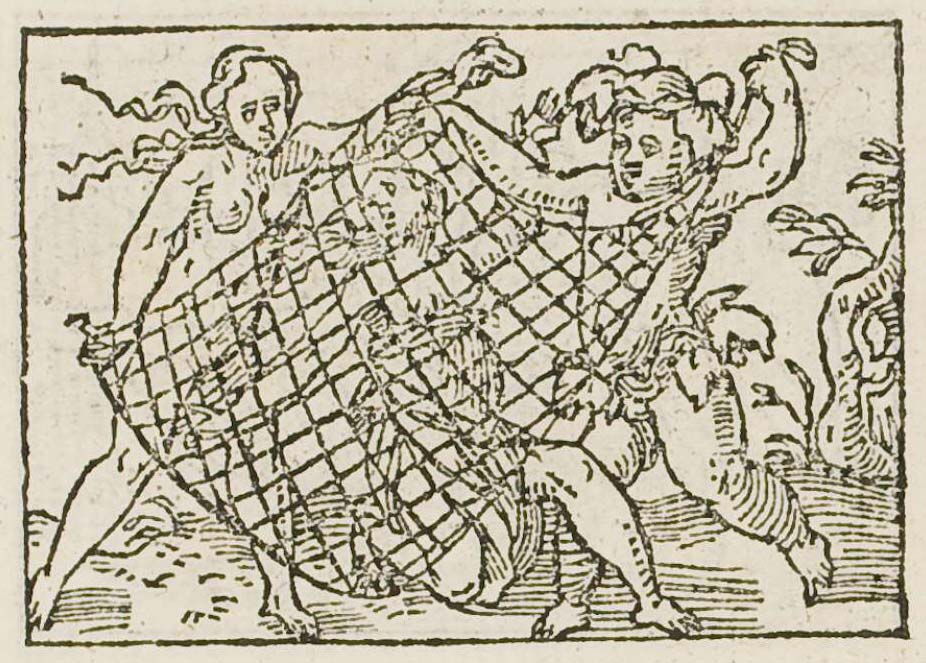
Que Vin & Femme, attrapent le plus saige.
That Wine and Woman catch even the wisest.AI-generated
Description of the woodcutAI-generated
A rectangular woodcut set in an outdoor landscape with a few plants and shrubs at the right and a rocky ground. Three nude or lightly draped figures struggle with a large knotted net that fills the centre of the scene. At the left a female figure with flowing hair and a fluttering scarf holds up one corner of the net; at the right a male figure with curly hair and a billowing drape pulls the other side. Between and beneath them, entangled in the meshes of the net, a third figure wearing a helmet is caught, bending forward with arms and legs showing through the netting.
Subscriptio

TranscriptionAI-generated
LE Dieu Bacchus, en allant à la chasseTrouua Venus, & la vint embrasser,Puis la pria qu'il luy pleust de sa graceL'accompaigner, & quand & luy chasser.Lors d'vn accord pour mieulx le temps passer,Tous leurs filletz allerent si bien tendre,Qu'incontinent Minerue s'y vint prendre.Voire si bien qu'elle n'eut onc passaige,Pour s'enfuyr, ce que nous faict entendre,Qne vin & femme attrapent le plus saige.
TranslationAI-generated
The god Bacchus, going out hunting, found Venus and came to embrace her; then he begged her that it might please her of her grace to accompany him and to hunt along with him. Then, by agreement, the better to pass the time, they went and spread all their nets so well that at once Minerva came and was caught in them — indeed so well that she had no way out to escape; which gives us to understand that wine and woman catch even the wisest.
Iconclass
86(QUE VIN & FEMME, ATTRAPENT LE PLUS SAIGE)proverbs, sayings, etc. (QUE VIN & FEMME, ATTRAPENT LE PLUS SAIGE)92C2(story of) Minerva (Pallas, Athena)92C4(story of) Venus (Aphrodite)92L14aggressive, unfriendly activities and relationships of Bacchus43C11(+415)hunting, chase (+ net)43C11hunting, chase54C4Temptation; 'Tentatione' (Ripa)
Suggested Iconclass codesAI-generated
Additional codes proposed for this emblem, not (yet) part of the indexing.
92B4233Mars and Venus surprised by Vulcan; he catches them in a nethighThe correlate 'Mars and Venus surprised by Vulcan; he catches them in a net' matches the central scene of a large net being drawn around a helmeted (Mars-like) figure by a female and a male figure.
92B423Mars and Venus as loversmediumThe generic 'Mars and Venus as lovers' theme underlies the episode alluded to in the commentary and depicted with the net.
42D39adulterymediumThe correlate 'adultery' corresponds to the commentary's moral theme of the illicit love exposed by the net.
42D392adultery revengedmedium'Adultery revenged' fits the act of the wronged husband trapping the lovers in a net as retribution.
45C221helmetmediumThe correlate 'helmet' matches the entangled figure explicitly described as wearing a helmet.
83(OVID, Metamorphoses IV:167-189)Leuconoë’s story: Mars and VenuslowLeuconoë's story of Mars and Venus is the Ovidian literary source for the net episode referenced in the commentary.
Relationships to the Adagia of ErasmusAI-generated
Suggested relationships between this emblem and adages in Erasmus’ Adagia.
- II iii 97 Sine Cerere et Baccho friget Venus – thematic inventiolow
The emblem's pairing of Bacchus and Venus as joint agents of seduction ('vin & femme') echoes the proverbial coupling of wine and love treated in this adage, though the emblem's point — that the pair ensnare even wise Minerva — is not drawn from its text.
Sources
Record ID: embhab_162-3-eth-b_emblem002
This emblem on the Iconclass site: https://iconclass.org/view/embhab_162-3-eth-b_emblem002
Page in the digital copy of the Herzog August Bibliothek: http://diglib.hab.de/drucke/162-3-eth-b/start.htm?image=00015