III x 1 Quo transgressus etc Where have I transgressed, etc
Inter philosophos vix alium reperias, qui religiosius instituerit adolescentiam quàm Pythagoras, unde & superstitionis nonnihil admiscuit, quòd rudis aetas quemadmodum & indocta multitudo, nudis & apertis philosophiae praecetis regi non queat. Huc nimirum pertinebat carnium interdictus esus, holerum commendatio, & quinquennis ἐχεμυθία, postremo Symbolorum velut oracula quaedam, prius ediscenda quam intelligerentur. Ab huius institutis quaedam aemulati videntur qui nunc solo titulo ferè monachi sunt. Ac minimum quidem peccant qui ventrem ac linguam habent castigatam, tamen quoniam vix hominis est cavere, necubi labatur, proximum est, ut à se quisque subinde gestorum rationem exigat, & si quid erratum est corrigat, si quid cum officio factu, in eo perseveret, atque in melius proficiat. Huius salutiferi praecepti seu Symbolum quoddam tradidit carmen, cuius autoris incertum, nam apud Homerum non reperio. quo delectatus videtur & Plutarchus. nam ne hoc quidem viro quicquam sanctius inter philosophos ethnicos. Carmen autem sic habet: Γῇ παρέβην, τί δ᾽ ἔρεξα, τί μοι δέον οὐκ ἐτελέσθη; id est, Lapsus ubi, quid feci, aut officii quid omissum est? Omnis autem humanae vita lapsus consistit in tribus, aut cum secus facimus quàm oportet, hoc est plus minúsve quàm decet, huis errori respondet illud, πῇ παρέβην; aut facimus quod omissum oportuit, cui respondet illa particula, Τίδ᾽ ἔρεξα; aut omittimus quod factum oportuit. Ad hoc pertinet extrema particula, Τί μοι δέον οὐκ ἐτελέσθη; Qui filium aut uxorem peccantem lenius admonet quam sat est, aut asperius obiurgat, resepiscens merito dicet, πῇ παρέβην; Qui filio praecipit parum honesta, dicet, τί ἔρεξα; Qui peccantem dissimulat, quum expediret admonere, dicet illud, τί μοι δέον οὐκ ἐτελέσθη; Pythagoras igitus solitus est admonere adolescentes, ut quoties domum ingrederentur, hunc versiculum suo cum animo versarent. Ea cogitatio sollicitos reddebat adolescentes, ut si quid forte deliquissent, aut si quid vitii contraxissent ex hominum convictu, id in posterum corrigerent, caverentque. Eam sententiam latius ac fusius explicuit quisquis scripsit carment De viro bono, quod fertur inter appendices operum Vergilianorum, Non prius in dulcem declinat lumina somnum, Omnia quàm longi reputaverit acta diei. Quo praetergressus? quid gestum in tempore, quid non? Cur isti facto decus abfuit? aut ratio illi? Haec docuerunt à Christo alieni, quid oportet facere Christianos? Utinam saltem sacerdotes ac monachi, cum à prolixis splendidisque conviviis ingrediuntur cubiculum, dicant apud sese: Γῇ παρέβην; τί δ᾽ ἔρεξα; τί μοι δέον οὐκ ετελέσθαι; deum immortalem quàm multa nobis succurrerent, & pudenda, & poenitenda?
Among the philosophers you will hardly find one who educated young people more conscientiously than Pythagoras. This caused him to mingle with his teaching much superstition, because untrained youth, like the uneducated masses, cannot be ruled by precepts in clear and unadorned philosophical language. To these superstitions certainly belonged the prohibition on eating meat, the praise of vegetables, and the five-year 'silence,' and finally certain of the precepts, almost of an oracular nature, which had to be learned by heart before they could be understood. Our modern monks, who are monks in name only, seem to have imitated some of this man's teachings, and those who control their bellies and their tongues are the ones who sin least. However, because it is not in man's nature to be on his guard against wavering all the time, the next best thing is that each should constantly demand of himself an account of his actions and, if he has erred in any way, he should correct himself; if he has performed according to his duty, he should persevere therein and make even better progress. One of Pythagoras' salutary teachings, in the form of a symbolic figure, is preserved in a line of verse (its author is unknown for I cannot find it in Homer) which Plutarch seems to have taken delight in, for no one among the pagan philosophers is more saintly than this man. The verse goes like this: [greek]; 'Where have I slipped? What have I done? Or what duty have I omitted?' For every failure in human living consists of one of three things. We do otherwise than we should, that is, more or less than is required; to this error corresponds the question 'Where have I transgressed?' Or we do what we should not have done, to which corresponds the phrase 'What have I done?' Or we fail to do what we should have done, and to this corresponds the last phrase 'What duty have I not done?' If someone admonishes his son or his wife more leniently than is necessary when they sin or rebukes them too harshly, on reflection he will rightly ask, 'Where have I transgressed?' One who teaches a son unworthy things will ask, 'What have I done?' One who neglects a son's sins when it would be opportune to admonish him will ask, 'What duty have I not done?' Pythagoras was in the habit of admonishing young people to recite this verse in their minds whenever they returned home. If they had been wanting perchance in any way or if they had picked up some vice from their contact with men, this meditation made them anxious to correct it and to be wary of it in the future. This idea was developed at greater length and more fully by the person who wrote the poem 'On the Good Man,' which is to be found in the appendices of the works of Virgil:
Before he allows his eyes to close in gentle sleep,
He will have thought over all his deeds the whole day through:
Where have I transgressed? what have I done at the right time? what have I not done?
Why was this deed not fitting? or that one not sensible?
These ideas have been taught by men who did not know Christ. What then should Christians do? If only priests and monks would say to themselves when they returned to their beds from generous and splendid feasts: 'Where have I slipped? What have I done? Or what duty have I not done?' God in heaven, how many things would occur to us to be ashamed of and to repent?
Facsimile: 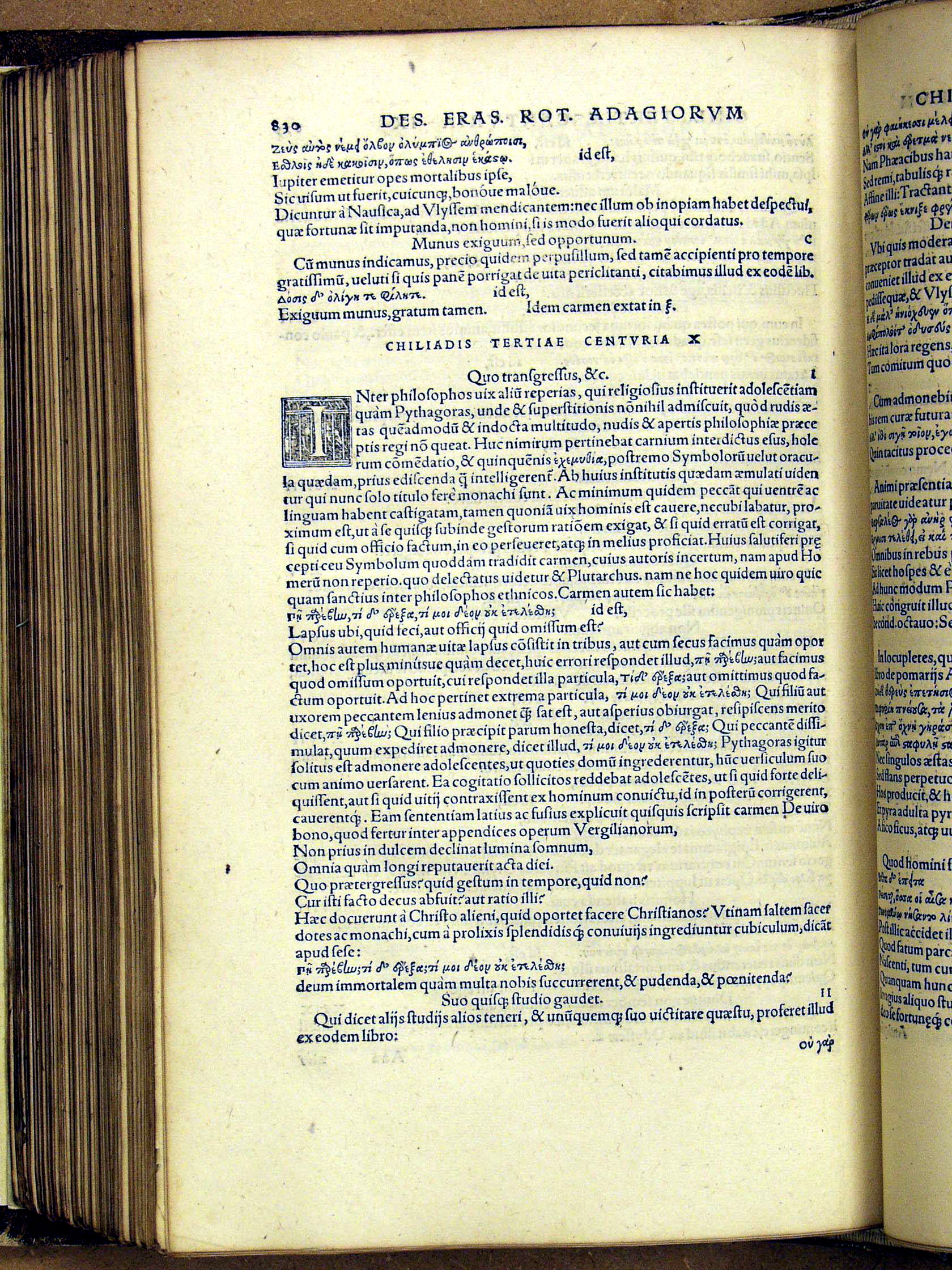
Iconclass: 11Q12 penitence, repentance; 'Penitenza', 'Pentimento', 'Pentimento de'peccati', 'Purgatione de peccati' (Ripa) 12B23 asceticism ~ non-Christian religions 57A42 Compunction, Remorse; 'Compuntione' (Ripa)
Loci Communes: Correctio dicti aut facti (Correction of a word or deed, Correction d'une parole ou d'un acte)
III x 2 Suo quisque studio gaudet Everyone rejoices in his own pursuit
Qui dicet aliis studiis alios teneri, & unumquemque suo victitare quaestu, proferet illud ex eodem libro: Οὐ γὰρ φαιήκεσσι μέλει ἰὸς ἠδὲ φαρέτρη, Αλλ᾽ ἱστοὶ καὶ ἐρετμὰ νεῶν, καὶ νῆες ἐΐσαι. id est, Nam Phaeacibus haud cordi iacula atque pharetra, Sed remi, tabulisque ratis compactilis aequis. Adfine illi: Tractant fabrilia fabri. Pindarus in Pythiis hymno decimo, καὶ γὰρ ἑτέροισιν ἐτέρων ἔρως ἔκνιξε φρένας, Aliis aliarum rerum amor pupugit mentem.
Anyone who wants to say that different people are engrossed in different pursuits and each person lives by his own means will quote this from the same book: 'For the Phaeacians have no regard for arrows or quivers, / But for oars and a ship well-made with even planks.' This is rather like 'Smiths their hammers ply.' And Pindar in the tenth Pythian ode: "The minds of different men are stimulated by love of different things.'
Facsimile: 

Tractant fabrilia fabri: Rollenhagen, Nucleus emblematum (Arnhem, 1618), Cent. II, emblem 14 quotes the comment
Tractant fabrilia fabri: Wither, A collection of emblems (London, 1635), emblem 114 quotes the comment
Iconclass: 51BB2 Dissimilarity, Unlikeness 56B3 Satisfaction, Contentment; 'Contento' (Ripa) 56F12 Contento ~ Malcontento: the pursuit of Happiness
Loci Communes: Philautia (Self-love, Amour-propre)
III x 3 Demittere sese ad aliorum mediocritatem Coming down to the level of others
Ubi quis moderatur data opera res suas, ad aliorum mediocritatem. Veluti si quis praeceptor tradat auditoribus, non quantum ipse docere posset, sed quantum illi capere possint, conveniet illud ex eodem libro de Nausicaa sic habenis moderante cursum mularum, ut pedissequae, & Ulysses pedibus consequi possent: Η δὲ μάλ᾽ ἡνιόχευεν ὅπως ἅμ᾽ ἐποίατο πεζοι, Αμφίπολοίτ᾽ ὀδυσεύς τε, νόῳ δ᾽ ἐπέβαλλεν ἱμάσθλην. id est, Haec ita lora regens, pedes ut comes iret Ulysses Tum comiium quoque turba, modo, rationeque certa Instigat scutica.
When someone limits his effort deliberately to conform to other people's lower level, for example if a teacher provides his listeners not with everything he can teach but with as much as they can take in, then there will be a place for this verse from the same book about Nausicaa who controls the pace of her mules with the reins so that her followers and Ulysses could keep up with her on foot:
She drives so that Ulysses can accompany her on foot
And the whole crowd of her followers, using the whip
With moderation and sure skill.
Facsimile:
Iconclass: 54A43 Temperance, Moderation; 'Misura' (Ripa) 54A6 Helpfulness 57A73 Indulgence, Clemency; 'Clemenza', 'Clemenza & Moderatione', 'Indulgenza' (Ripa)
Loci Communes: Modestia modusque (Modesty and moderation, Modestie et mesure)
III x 4 Mihi curae erit hoc negocium This business will be my concern
Cum admonebimus quempiam, ut omne negocium in nos reiiciat ipse securus, nobis rem curae futuram, conveniet illud ex Odysseae Η. Αλλ᾽ ἰθί σιγῇ τοῖον, ἐγὼ δ᾽ ὁδον ἡγεμονευσω. id est, Quin tacitus procede, viae huius ego fuero dux.
When we want to declare to someone that we will take care of a matter so that he himself can be free of worry and hand over the whole task to us, these words from book 7 of the Odyssey will be suitable: 'But proceed quietly, I will lead the way here.'
III x 5 Animus praesens A firm mind
Animi praesentia utilis ubique, propterea quod timiditas, vel à conscientia, vel ab animi parvitate videatur proficisci. Huic sententiae suffragatur Homericum illud ex eodem libro: Θαρσαλέος γὰρ ἀνὴρ ἐν πᾶσιν ἀμείνων; Εργοισι τελέθει, εἰ καὶ ποθεν ἄλλοθεν ἔλθοι. id est, Omnibus in rebus potior vir fortis & audax Sic licet hospes & è longinquis venerit oris. Ad hunc modum Pallas hortatur Ulyssem, nequid trepidet ingressurus Alcinoi domum. Huic congruit illud quod alibi dictum est, fortes fortuna adiuvat. T. Livius libro ab urbe cond. octavo: Sed eventus docuit fortes fortunam adiuvare.
Firmness of mind is valuable at all times, because timidity seems to be caused either by a bad conscience or by petty-mindedness. This idea is supported by this verse of Homer from the same book: 'A brave and bold man is better in all things, / Even if he is a stranger and comes from distant shores.' This is how Pallas encourages Ulysses not to be afraid as he goes into Alcinous' house. It coincides with an adage recorded elsewhere: 'Fortune favours the brave.' Livy in book 8 of From the Foundation of the City:
But the outcome showed that fortune favours the brave.
III x 6 Locupletum reditus The profits of the wealthy
In locupletes, quibus alius ex alio succedit reditus, accommodabitur illud ex eodem libro de pomariis Alcinoi dictum: Οὐδε` θερεὺς ἐπετήσιος, ἀλλὰ μάλ᾽ αἰεὶ, Ζεφυρίη πνείουσα, τὰ μὲν φύει, ἄλλα δὲ πέσσει, Οχνη ἐπ᾽ ὄχνῃ γηράσκει, μῆλον δ᾽ ἐπὶ μήλῳ, Αὐτὰρ ἐπὶ σταφυλῇ σταφυλὴ, σῦκον δ᾽ ἐπὶ σύκῳ. id est, Nec singulos aestas renovatur in annos, Sed flans perpetuo zephyrus spriamine foetus Hos producit, & hos demittit ab arbore mites, Et pyra adulta pyris succedunt, malaque malis, A fico ficus, atque uvan senescit ab uva.
For the wealthy, for whom one profit follows another, we can adapt this, which is said in the same book about the orchards of Alcinous:
And there is no fresh summer each year,
But the west wind blowing with perpetual breath produces
These fruits and drops them ripe from the trees;
Pears follow full-grown upon pears, apples upon apples,
Figs upon figs mature, and grapes upon grapes.
Facsimile:
Iconclass: 46A16 the rich 46B471 profit (~ commerce) 55A1 Acquisition, Gain, Profit
Loci Communes: Bonae fortunae, copiae, felicitatis aut ominis (Of good fortune, abundance, happiness, or omen, Bonne fortune, abondance, bonheur ou présage)
III x 7 Inevitabile fatum Unavoidable fate
Quod homini fatis decretum est, id eveniet. In hanc sententiam Homerus eodem libro: Ενθα δ᾽ ἔπειτα Γείσεται, ὅσσα οἱ αἶσα κατακλῶθές τε βαρεῖαι, Γεινομένῳ νήσαντο λίνῳ, ὅτέ μιν τέκε μήτηρ. id est, Post illic accidet illi Quod fatum parcaeque graves in stamine nerunt Nascenti, tum cum matris promergeret alvo. Quanquam hunc locum de fatis oportebit ioco duntaxat adhibere. Veluti si quis filium longius aliquo studii causa emandans, negaret sibi curae futurum, quid illic agat, sed id deo se fortunaeque committere.
What is decreed for man by the fates will happen. On this idea we have Homer's lines in the same book:
Thereafter he will suffer
Whatever fate and the grim spinners have spun for him
At his birth when he emerged from his mother's womb.
But this passage about the fates should be used only in a humorous way; for example if someone sends his son to some rather remote place for his education and says he would not care what he does there, but leaves it to the gods and fortune.
Facsimile:
Iconclass: 51C2 Necessity, Inevitability; 'Necessità' (Ripa) 54FF12 Fate, Doom
Loci Communes: Necessitas (Necessity, Nécessité)
III x 8 Aliud cura Worry about something else
Cum negabis esse causam, cur aliquis aut dubitet, aut sollicitus sit exempto scrupulo, accommodabitur illud ex eodem libro: Αλκίνο᾽ ἄλλοτι τοι μελέτω φρεσίν. id est, Alcinoe cures aliud. Item Terentius, Atqui iam repperi, aliud cura.
When you want to say that there is no reason why someone should doubt or continue to be worried by some concern that has been removed, this from the same book will fit: 'Alcinous, worry about something else.' Then there is Terence: 'I have already thought of one; worry about something else.'
Facsimile: 
Iconclass: 52A2:56BB12 Forethought, Deliberation; 'Previdenza', 'Providenza' (Ripa)❧Torment; 'Tribulatione' (Ripa)
Loci Communes: Securitatis et tutae rei (Security and safety, Sécurité et sûreté)
III x 9 Molestus interpellator venter The belly is a troublesome heckler
Venter improbus interpellator, non sinit unquam quempiam oblivisci sui. Id ad aegestatem torqueri poterit, quae mortales ad omnia, tum facienda, tum ferenda solet compellere. Sic autem Ulysses in eodem libro, Οὐ γὰρ τι στυγερῇ ἐπὶ γαστέρι κύντερον ἄλλο, Επλετο ἥτ᾽ ἐκέλευσεν ἕο μνήσασθαι ἀνάγκῃ, Καὶ μάλα τειρόμενον καὶ ἐνὶ φρεσὶ πένθος ἔχοντα. id est, Non est improbior res altera ventre molesto, Quippe vel invitum meminisse sui iubet, et si Valde animo crucieris, et angat pectora maeror.
The stomach is a shameless intruder which never allows anyone to forget it. It could be used figuratively of extreme poverty, which always forces mortals to do and suffer all sorts of things. This is what Ulysses says in the same book:
There is no other thing more shameless than a troublesome stomach,
Which bids a man take thought for it even against his will,
However distressed you may be at heart, whatever affliction torments
your breast.
III x 10 Vulgus suspicax Ordinary people are suspicious
Suspiciosum vulgus, et pleraque malam in partem interpretatur. Homerus in eodem libro: Δύσκηλοι γὰρ τ᾽ εἰμὲν ἐπὶ χθονὶ φῦλ᾽ ἀνθρώπων. id est, Quippe homines plerique sumus male suspiciosi.
Common people are suspicious and often take things in a bad sense. Homer in the same book: 'For we men are mostly quick to suspect the worst.'
Facsimile:
Iconclass: 46A132 villagers; villeins (Dutch: 'dorpers') 46A15 the poor 56DD2 Distrust, Suspicion; 'Sospitione' (Ripa)
Loci Communes: Obtrectatio et maledicentia (Disparagement and slander, Dénigrement et médisance)
III x 11 Nemo cogendus officii causa Do not force anyone by kindness
Nullus hospes retinendus adversum animi sententiam, & invitus. Nemo cogendus, ut cuiusquam utatur beneficio, si nolit. Ad hanc sententiam accommodabitur illud ex eodem lib. Εικ᾽ ἐθελων τε μένοις, ἀέκοντα δέσ᾽ οὔτις ἐρυξει. id est, Si maneas sponte, invitum nemo retinebit. Dicitur ad Ulyssem ab Alcinoo Phaeacum tyranno.
No guest should be kept against his inclination and will. No one should be forced to accept anyone's hospitality if he does not wish it. This idea can be illustrated by this from the same book: 'If you choose to remain, no one shall keep you against your will.' The words are addressed to Ulysses by Alcinous king of the Phaeacians.
III x 12 Malum bono pensatum Misfortune compensated with good
Quoties natura dotem aliquam egregiam largitur, eandem aliquo vitio pensat: aut cum quis beneficium suum aliquo vitiat maleficio, quad rabit illud ex Odysseae Θ. de Demodoco musico dictum: Τὸν περὶ μουσ᾽ ἐφίλησε, δίδου δ᾽ ἀγαθόν τε κακόν τε. Οφθαλμῶν γὰρ ἄμερσε, δίδου δ᾽ ἡδεῖαν ἀοιδὴν. id est, Hunc alios ultra dilexit musa, deditque, Atque boni, atque mali quiddam. Nam lumina ademit, At dedit emulcere suavi pectora cantu.
Whenever Nature bestows some extraordinary gift but counterbalances it with some flaw, or when a person spoils his kindness with some malice, then there will be a place for these words from book 8 of the Odyssey spoken about Demodocus the minstrel:
This man the Muse loved above all others and gave him
Both good and evil. For she deprived him of his sight,
But gave him the gift of softening hearts with sweet song.
Facsimile:
Iconclass: 54F121 Turn of Fate, Wheel of Fortune 54FF11 Adversity, Misfortune, Bad Luck; 'Fortuna infelice', 'Infortunio' (Ripa) 55C2 Giving 57A76 Favourableness
Loci Communes: Inaequalis pensatio (Unequal compensation, Compensation inégale)
III x 13 Omni certaminis genere In any sort of contention
Cum innuemus omni certaminis genere congressum esse, veluti si quis dicat, in omni disciplina disputatum acriter, conveniet illud ex eodem libro, Πύξ τε παλαισμοσύνῃ τε καὶ ἅλμασι ἠδὲ πόδεσσιν. id est, Et pugnis, pedibusque & saltibus, atque palaestra. Item ubi quis ostendit se nullum detractare certamen, sed ad quodvis ingenii experimentum paratum esse, conveniet illud ex eodem libro, Δεῦρ᾽ ἄγε πειρητήτω ἐπείμ᾽ ἐχολώσατε λίην, Η πὺξ ἠέ πάλῃ, ἢ καὶ ποσίν οὔτι μεγαιρω. id est, Huc age, quandoquidem graviter mihi concita mens est, Qui volet, experiatur, pugnis, sivo palaestra, Sive pedum cursu malit, nihil ipse recuso.
When we imply that we have engaged in every sort of contention, for example if someone says that there has been bitter argument on every point of doctrine, then this from the same book will be appropriate: 'In boxing and in racing, in leaping and in wrestling.' Likewise, when someone declares that he refuses no competition, but is prepared for any sort of mental test, the following from the same book will do:
Come here, for I am greatly angered;
Let anyone who wishes try me out in boxing or in wrestling,
Or racing if he will, I care not.
Facsimile:
Iconclass: 54A82 Audacity, Temerity; 'Audacia' (Ripa) 54EE3 Conflict; 'Contrasto' (Ripa)
Loci Communes: Conatus (Effort, endeavor, Effort)
III x 14 Longe vicit First by far
Qui sentiet aliquem ita praecellere, ut periculum non sit, ne quis illi praeripiat palmam, conveniet illud ex eodem libro, Σὺ δὲ θάρσει, τόν δε γ᾽ ἄελθον Οὖτις φαιήκων τῶν δ᾽ εἴξεται οὐδ᾽ ὑπερήσει. id est, At tu fide animo, quando hoc certamine nullus Phaeacum, te nec aequabit, nec superabit.
If we feel someone is so pre-eminent that there is no danger anyone will take the palm from him, then this from the same book will suit: 'But set your mind at rest, as far as this competition is concerned, / No one of the Phaeacians will throw as well or further.'
Facsimile:
Iconclass: 51BB3 Imparity, Inequality, Difference 51E2 Superiority 54F2 Victory
Loci Communes: Excellentia, inaequalitas (Excellence, inequality, Excellence, inégalité)
III x 15 Antiquis debetur veneratio The ancients should be treated with reverence
Cum summis & invictis, vel cum antiquis non est certandum, qui velut extra aleam hominum positi videntur, sed his ultro cedendum: veluti si quis neget sese cum M. Tullio de eloquentia velle conflictari, cum mediocribus non recusare, usurpabit quod eodem in loco dicitur ab Ulysse, Ανδράσι δὲ προτέροισι ἐρϊζέμεν οὐκ ἐθελήσω Οὔθ᾽ ἡρακλῆι οὐτ᾽ εὐρύτῳ οἰχαλιῆι. id est, Cum maioribus haud subeam certamina, vel cum Herculea virtute, vel Euryto Oechialensi.
We should not compete with the greatest and the invincible, or with the ancients, for these seem to be placed beyond the hazards of mortals; to them we should yield willingly. For example, if someone says he does not wish to vie in eloquence with Cicero, but does not want to refuse ordinary rivals, he can use what Ulysses says in the same passage:
With the men of olden times I will not compete,
With Hercules' excellence or with Eurytus of Oechalia.'
Facsimile: 
Iconclass: 51E2:23T23 Superiority❧classical antiquity (historical epoch)
Loci Communes: Excellentia, inaequalitas (Excellence, inequality, Excellence, inégalité)
III x 16 Flagitiorum turpis exitus Crime has an ugly outcome
Cum res perperam instituta, male cedit, conveniet illud ex eodem libro, Οὐκ ἀρετᾷ κακὰ ἐργα. id est, Haud bene succedunt facta improba. Dictum est de Martis adulterio deprehenso.
When an affair that has been wrongly undertaken turns out badly, the following verse from the same book will suit: 'Wicked deeds never turn out well.' This is said of the adultery of Mars when it was discovered.
Facsimile:
Iconclass: 44G3 criminal law; punishment 44G51 crime 57AA741 Revenge, Requital, Retaliation; 'Vendetta' (Ripa)
Loci Communes: Ultio malefacti (Vengeance for a wrongdoing, Vengeance d'un méfait)
III x 17 Fidus amicus A faithful friend
Fidus amicus non est posthabendus germano. Homerus in eodem libro, Η τις που καὶ ἐταῖρος ἀνὴρ κεχαρισμένα εἰδὼς, Εσθλὸς, ἐπεὶ οὐ μέντι κασιγνήτοιο χερείων. id est, Si quis forsan amicus sit, gratusque bonusque, Quandoquidem is non inferior vel fratre putandus.
A faithful friend is to be valued no less than a brother. Homer says in the same book: 'Someone whom chance makes a pleasant and good friend / Is to be valued no less than a brother.'
Facsimile:
Iconclass: 56F231 Fidelity in Friendship; 'Confermatione dell'Amicitia', 'Fede nell'Amicitia' (Ripa)
Loci Communes: Amicitia (Friendship, Amitié)
III x 18 Patria sua cuique iucundissima To every man his own country is most agreeable
Unicuique sua patria iucundissima, quaecumque contigit. Homerus Odysseae I. Ως οὐδὲ γλυκιον ἡς παρτίδος οὐδὲ τοκήων Γίγνεται. id est, Ut nihil est patria propriis ve parentibus ullis Dulcius.
Every man finds his own country most agreeable, whatever land he happens to be in. Homer in book 9 of the Odyssey: 'For nothing is sweeter to any man than his fatherland / And his own parents.'
III x 19 Fuga tutior Flight is safer
Qui dicit tutius esse fuga vincere libidinem, quam contra pugnando, poterit accommodare, quod de Charybde dictum est Odysseae Μ. Οὐ δὲ τις ἐστ᾽ ἀλκὴ, φυγέειν κάρτιστον ἀπ᾽ αὐτῆς. id est, Non est ulla medela, procul fugere optimum ab illa.
Someone who wants to say that it is safer to overcome a violent desire by fleeing from it than by fighting it could adapt what is said about Charybdis in book 12 of the Odyssey: "There is no remedy; the best thing is to flee far from her.'
Facsimile:
Iconclass: 33B9:56F1 flight, running away; pursuing❧Desire; 'Desiderio' (Ripa) 54EE11:56F1 Opposition, Counteraction, Resistance❧Desire; 'Desiderio' (Ripa)
Loci Communes: Discriminis (Danger, crisis, Danger)
III x 20 Alia commintenda, alia caelanda Some things must be trusted to others, some concealed
Non temere quidvis apud quemvis effutiendum, ac ne familiaribus arcana omnia proferenda sunt, verum alia communicare conveniet cum amicis, aut uxoribus, alia caelare. Ad hanc sententiam quadrat illud ex Odysseae Δ. Αλλὰ τὸ μὲν φᾶσθαι, τὸ δὲ γ᾽ ἆν κεκρυμμένον εἶναι. id est, Dicendum est aliud, contra est aliud reticendum.
One should not without good reason divulge no matter what to no matter whom, and not all secrets should be spread around the household; some should be trusted to friends or wives, others hidden. The idea is suitably expressed by this from book 11 of the Odyssey: 'One thing may be said, another, on the other hand, should be withheld.'
Facsimile:
Iconclass: 52DD1 Secrecy, Latency, Concealment; 'Secretezza' (Ripa) 52DD3 Taciturnity; 'Secretezza', 'Secretezza overo Taciturnità' (Ripa)
Loci Communes: Laudata (Praised things, Choses louées)
III x 21 Foemina nihil pestilentius Nothing is more noxious than a woman
Nihil foemina pestilentius. hanc sententiam eodem in libro sic effert Homerus: Ως οὐκ αἰνότερον καὶ κύντερον ἄλλο γυναικὸς. id est, Usque adeo nihil improbius, muliereque peius. Frequenter apud antiquos poetas male audit mulierum genus. Quae quidem & hodiernis temporibus strenue dant operam, ne poetae planè vaniloqui fuisse videantur.
Nothing is more noxious than a woman. The opinion is expressed by Homer in the same book: 'Nothing is more shameless and worse than a woman.' In the ancient poets the female sex is often spoken of badly. And in our own times they constantly strive to ensure that the poets should not seem to have been liars.
III x 22 Effoeta senecta The weakness of old age
Quod in Odysseae Λ dictum est de mortuis, id ad hominem ob longaevitatem, iam defectum viribus, accommodare licebit, aut in eum, qui consternetur animo, Οὐ γὰρ ἔτι σάρκας τε καὶ ὁστέα ἶνες ἔχουσιν. id est, Nam iam non nervis carnes atque ossa cohaerent.
The words in book 11 of the Odyssey about the dead can be applied to a man who has lived too long and lost his strength, or to someone who is frightened: 'For sinews no longer hold flesh and bone together.'
Facsimile:
Iconclass: 31D160 Old Age, 'Senectus'; 'Vecchiezza' (Ripa) 51GG3 Fragility; 'Fragilità' (Ripa) 54AA7 Weakness, Powerlessness, Helplessness; 'Infermità' (Ripa)
Loci Communes: Longae vitae (A long life, Longue vie)
III x 23 Aegre, sed tamen contigit It was difficult, but he achieved it
In eos qui aegre quidem, sed tamen assequuntur, quod optant, quadrabit illud ex eodem lib. Αλλ᾽ ἔτι μὲν γε καὶ ὡς κακάπερ πάσχονες ἵοισθε. id est, Pervenietis adhuc, quanquam mala plurima passi. Dicuntur ad Ulyssem à Tiresia.
For those who achieve what they want, even if with difficulty, this line from the same book will be appropriate: 'You will reach home, though you will have suffered many ills.' These words are spoken to Ulysses by Tiresias.
Facsimile:
Iconclass: 54DD4 Difficulty 54F1 Success; 'Evento buono' (Ripa)
Loci Communes: Difficultatis (Difficulty, Difficulté)
III x 24 Cum amico non certandum aemulatione Do not compete in rivalry with a friend
Cum amico, et benemerito non est suscipiendum certamen, ne quid obscuretur amicitia propter aemulationem, huiusmodi comitem contentionum. Id innuit Homerus in Odysseae Θ. cum Ulysses excipit Laodamantem, quod hospes esset, Τίς ἄν φιλέοντι μάχοιτο; id est, Quis namque benigno cum hospite pugnet? Locum etiam habuerit, ubi dicemus hospitis esse munus cedere iis, apud quos diversatur, etiamsi possit vincere. Nam inibi statim subnectitur huiusmodi sententia: Αφρων γὰρ κεῖνος γε καὶ οὐτιδανὸς πέλει ἀνὴρ, Οστις ξεινοδόκῳ ἔριδα προφέρηται ἀέθλῳ. id est, Vir siquidem vecors est ille, nec unius assis, Quisquis ad eventum certaminis evocat illum, Quem penes hospitio fruitur, tectoque iuvatur.
We should not seek to compete with a friend and one who deserves well of us in case our friendship is overshadowed by the rivalry that accompanies this sort of contention. Homer implies this in book 8 of the Odyssey when Ulysses excludes Laodamas as a competitor because he was his host: 'For who would quarrel with a benevolent host?' It will also be appropriate when we want to say that it is the duty of the guest to give way to those with whom he lodges, even if he could win. For in the same passage there is immediately added this thought:
For he is indeed a foolish man and worthless,
Who would challenge to the outcome of a contest the one
From whose hospitality he benefits and whose house he enjoys.
III x 25 Reiicientis culpam For one who won't accept blame
Adversus eum, qui mali sui causam aliò reiicit, ita ut vulgo factitant, apposite torquebitur illud ex Odys. Λ. dictum ab Elpenoris umbra, qui temulentus perierat apud Circen. Ασέ με δαίμονος αἶσα κακὴ καὶ ἀθέσφατος οἶνος. id est, Mi mala fata deûm nocuerunt, visque Lyaei. Sic alibi Agamemnon dissidii causam in Aten retorquet.
Against the man who throws the cause of his misfortune on someone else, as people commonly do, one can aptly turn this line from book 11 of the Odyssey. It is spoken by the shade of Elpenor who had died because he was drunk in Circe's house: 'An evil fate of the gods was my undoing and too much wine.' There's another place too where Agamemnon similarly throws the blame for a dispute on Ate.
Facsimile: 
Iconclass: 51AA4:57A43 Nothingness, Absence❧Sense of Guilt 52CC2 Denial, Negation 57AA41 Obduracy
Loci Communes: Deprecantis, abominantis (Pleading, abhorring, Qui implore, qui abhorre)
III x 26 Voluptas foeda Abominable pleasures
In voluptatem inhonestam, aut scortum ad perniciem iuvenum omnibus instructum artibus, quadrabit illud ex Odysseae Κ. dictum de Circe, Ηκεν ἅπαντας Η σῦς ἠὲ λύκους ποιήσεται ἠὲ λέοντας. id est, Siquidem omneis Fecerit illa suésve lupósve trucésve leones.
For shameful pleasures, or for a prostitute who is skilled in all the arts that cause the ruin of young people, the following words from book 10 of the Odyssey will suit. They are said of Circe: 'She will change us all to swine or wolves or fierce lions.'
Facsimile:
Iconclass: 33C8110 'Libidine', 'Voluttà' (Ripa) 57AA52 Perversion
Loci Communes: Intemperantia, libido (Intemperance, lust, Intempérance, désir)
III x 27 Aspera vita, sed salubris A hard life, but a healthy one
In vitae rationem, duriusculam quidem, sed tamen ad rectam morum institutionem idoneam, conveniet illud Odysseae I. dictum de Ithaca, Τραχεῖ᾽ ἀλλ᾽ ἀγαθὴ ηουροτρόφος. id est, Aspera, sed iuvenum nutrix bona.
For a way of life that is rather hard but suitable for the proper teaching of morality, an apt verse would be the following about Ithaca from the Odyssey book 9: 'A rugged island, but a good nurse for young men.'
Facsimile:
Iconclass: 49A education 54DD4 Difficulty 55BB1 Poverty; 'Povertà', 'Povertà del doni', 'Povertà in uno ch'habbia bell'ingegno' (Ripa) 57A6 Virtuousness; 'Amor di Virtù', 'Attione virtuosa', 'Guida sicura de' veri honori', 'Virtù', 'Virtù insuperabile' (Ripa)
Loci Communes: Frugalitas (Frugality, Frugalité)
III x 28 Consiliis simul et facto valens Effective both in advice and in action
In hominem consilio pariter ac viribus excellentem, conveniet illud Odysseae Ξ. Οἶος ἐκεῖνος ἔην βουλεύεμεν ἠδὲ μάχεσθαι. id est, Is cuiusmodi erat seu pugna consiliove.
For a man who is as distinguished in counsel as in action a suitable verse will be this one from book 14 of the Odyssey: 'Such a man was this, whether in battle or in counsel.'
Facsimile:
Iconclass: 52E3 Counsel; 'Consiglio' (Ripa) 54D21 Practice; 'Prattica' (Ripa)
Loci Communes: Prudentia conjuncta viribus (Prudence joined with strength, Prudence alliée à la force)
III x 29 Non possum non dicere I cannot help speaking
Ubi quis negat se reticere posse, quod habet in animo, festiviter accommodabit illud ex eodem libro, Εὐξάμενός τε ἔπος ἐρέω, οἶνος γὰρ ἀνώγει ἤλιος. id est, Dicam equidem quiddam iactantius, urget enim me Vinum amens. Eodem in loco quantum possit vinum eleganter ostendit Ulysses. Ita enim consequitur. Ος τ᾽ ἐφέηκε πολύφρονάτερ μᾶλ᾽ ἀεῖσαι, Καὶ θ᾽ ἁπαλὸν γελάσαι, καὶ τ᾽ ὀρχήσασθαι ἀνῆκειεν, Καὶ τε ἔπος προέηκεν ὅπερ τ᾽ ἄῤῥητον ἄμεινον. id est, Vinum quantumcunque gravem atque pudentem Incitat cantum, ac tenerum ridere, chorosque Ducere compellit, nonnunquam quod tacuisse Praestiterat, reserato effutit pectore dictum.
When someone says he cannot keep silent about what he thinks, he can adapt this humorously from the same book: 'For my part I shall say something rather bold, / For foolish wine impels me.' In the same passage Ulysses declares eloquently what wine can do, for he goes on:
Wine excites a man however serious and modest to sing,
And drives him to easy laughter and dancing,
And sometimes he opens up his heart and babbles out
What it would have been better to keep silent.
Facsimile:
Iconclass: 52BB42:31B62359 Impossibility❧being silent 51AA4:52DD3 Nothingness, Absence❧Taciturnity; 'Secretezza', 'Secretezza overo Taciturnità' (Ripa)
Loci Communes: Libertas, veritas (Freedom, truth, Liberté, vérité)
III x 30 Perplexus Trapped
Qui se dicet in maximis versari periculis, nec ullum afulgere subsidium, usurpabit illud ex eodem libro, Οὐ δέ τις ἄλλη Φαίνετο γαιάων, ἀλλ᾽ οὐρανὸς ἠδὲ θάλασσα. id est, Nec ulla apparuit ultra Tellus, sed nobis coelum undique & undique pontus. Idem habetur in Μ.
Anyone who wants to say that he finds himself in the greatest danger and that no help is at hand, can use this from the same book: 'No other land appeared, / But everywhere around us only sky and sea.' The same expression is found in book 12.
Facsimile:
Iconclass: 54DD51 Danger; 'Pericolo' (Ripa) 57AA6223 Ambuscade, Trap; 'Insidia' (Ripa)
Loci Communes: Perplexus (Perplexed, entangled, Perplexe)
III x 31 Abhorrentis ac detestantis For one who loathes and detests
Cum dicemus nos vehementer à vitio quopiam abhorrere, illud ex libro eodem usurpare licebit: Εχθρὸς γὰρ μοι κεῖνος ὁμοῦ αΐδαο πύλῃσι. id est, Is mihi iuxta invisus, ut atri limina Ditis. Idem carmen exstat in Iliados I. sub persona Achillis. Hic ab Ulysse dicitur.
When we want to say that we are violently repelled by some vice, we can use this from the same book: This man is hateful to me as the threshold of the dark gods.' The same verse is found in book 9 of the Iliad spoken by Achilles. Here it is spoken by Ulysses.
Facsimile: 
Iconclass: 56BB4 Disgust, Dislike, Repulsion, Nausea
Loci Communes: Deprecantis, abominantis (Pleading, abhorring, Qui implore, qui abhorre)
III x 32 Sui dissimilis A different face
In sui dissimilem quadrabit ilud ex Odysseae Ν. quod de Pallade dixit Ulysses: Σὲ γὰρ αὐτὴν πάντα εΐσκεις. id est, Nunc ali, nunc rursum alio fis obvia vultu. Idem mire quadrabit in sapientiam, quae variis involucris obtegitur apud priscos, et alia atque alia specie proponitur, praesertim in divinis literis, quae tota fermè constat allegoriis.
For someone who presents a different face a suitable expression would be this, from book 13 of the Odyssey, which Ulysses says of Athena: 'Now you put on one face and now another.' The same expression will be marvellously suitable for the wisdom that is concealed with different wrappings in the ancient writers and is presented in ever changing images, especially in holy scripture, which consists almost entirely of allegories.
Facsimile:
Iconclass: 51AA4:51BB1 Nothingness, Absence❧Absoluteness, Non-relatedness 51K1 Change
Loci Communes: Mutati instituti (A changed custom, Une coutume changée)
III x 33 Nihil ad rem Nothing to do with the subject
In eum, qui dixerit absurde quippiam, & alienum à re proposita, quadrabit illud ex eodem libro, quanquam idem aliis aliquot repetitur locis: Νήπιος εἶς ὦ ξεῖν᾽, ἢ τηλόθεν εἰλήλουθας. id est, Hospes stultus es, aut longinquis advena ab oris. Nuper ades.
For someone who has said something out of place and irrelevant to the subject under discussion, a suitable expression will be this from the same book, although the same is to be found in other places:
Stranger, you are foolish, or a foreigner recently come
From distant shores.
Facsimile:
Nihil ad rem: Cramer, Octoginta emblemata nova (Frankfurt, 1630), emblem 51
Iconclass: 51AA4:51B1 Nothingness, Absence❧Relation 51BB1 Absoluteness, Non-relatedness 52BB53 Nonsense, Absurdity
Loci Communes: Aliena a re (Irrelevant to the matter, Étranger au sujet)
III x 34 Quod adest, boni consule Accept things as they are in good part
Qui admonebit oportere boni consulere, quicquid à fortuna conceditur, usurpabit illud ex Odysseae Ξ. Εσθιε δαιμόνιε ξείνων καὶ τέρπεο τοῖσδε, Οἷα πάρεστι. θεὸς δὲ τό μὲν δώσει τόδ ἐασει Οττικεν ᾧ θυμῷ ἐθέλει. δύναται γὰρ ἅπαντα. id est, Hospes sume cibum, & quorum data copia, laetum his Pasce animum, nam sors dabit haec, rursum illa negabit Utcunque est animo lubitum, valet omnia quippe. His verbis Eumaeus subulcus Ulyssem invitat, ut cibos viles et rusticanos qualescunque essent, boni consuleret. Transferetur ad omnem hominis vitam, quoties admonebimus, ut quemcunque statum sors dederit, in eo laete tranquilleque vivamus. Apud Athenaeum libro decimo, refertur hic senarius: Επὶ τοῖς παροῦσι τὸν βίον διάπλεκε. id est, Quae praesto sunt, in hisce vitam nectito. Isocrates in oratione de pace,στέργειν τοῖς παροῦσιν, ait plerisque hominibus esse difficilimum: & hinc est, quod bellum malunt, quam pacem.
If someone wants to warn that we ought to accept in good part what fortune allows us he will use this from book 14 of the Odyssey:
Stranger, take this food and enjoy such bounty as there is,
For fate will give one thing and refuse another
According to its whim, for it can do all things.
With these words the swineherd Eumaeus invites Ulysses to accept in good part his humble rustic food such as it is. They can be used metaphorically of any aspect of human life whenever we want to recommend that we should live happily and quietly in the position fate has given us. In book 10 of Athenaeus is recorded this verse: 'Whatever is at hand, weave your life with that.' In his speech On the Peace Isocrates says it is very difficult for some men 'to be content with what is present' and that this is why they prefer war to peace.
Facsimile:
Iconclass: 53B1 Acceptance 54FF12 Fate, Doom
Loci Communes: Proximis utendum (One must make use of one's neighbors, Il faut se servir de son prochain)
III x 35 Officium ne collocaris in invitum Do not place an obligation on someone who does not want it
Instar iniuriae fuerit, si quis officium collocet in invitum. In eam sententiam Hom. Odys. O. Ισον τοι κακὸν ἐσθ᾽ ὅς τ᾽ οὐκ ἐθέλοντα νέεσθαι, Ξεῖνον ἐποτρύνῃ, καὶ ὅς ἐσσύμενον κατερύκῃ. Χρὴ ξεῖνον παρέοντα φιλεῖν, ἐθέλοντα δὲ πέμπειν. id est, Iuxta peccat uterque, vel is cui extruditur hospes Invitus, vel qui remoratur abire volentem. Hospes donec adesse volet, tractare benigne Convenit, emittendus ubi discedere quaeret.
It would be in the nature of an insult if a person placed an obligation on someone who does not want it. This idea is expressed by Homer in book 15 of the Odyssey:
Both commit a wrong: the man who drives out a guest
Who is unwilling to go, and the man who detains one who wishes to leave.
As long as he wishes to stay, a guest should be treated kindly;
And when he seeks to leave, he should be allowed to go.
III x 36 Bona spes ostensa Appearance of hope
Cum bona quaepiam spes affulget alicunde, perficiendi quia proposuimus, conveniet illud ex eodem libro, Ως ἄρα οἱ εἰπόντι ἐπέπτατο δεξιὸς ὄρνις. id est, Sic fato felix à dextris advolat ales.
When a sure hope of achieving what we set out to do appears from somewhere, a suitable adage will be the following from the same book: 'Even as he speaks a bird of good omen flies by on the right.'
Facsimile:
Iconclass: 52E21 Good Omen; 'Augurio buono' (Ripa) 56D1 Hope; 'Speranza', 'Speranza delle fatiche' (Ripa)
Loci Communes: Bonae fortunae, copiae, felicitatis aut ominis (Of good fortune, abundance, happiness, or omen, Bonne fortune, abondance, bonheur ou présage)
III x 37 Arrogantia non ferenda Intolerable arrogance
In eos, qui intoleranda sunt arrogantia, non inscite torquebitur illud ex eodem lib. ab Eumaeo dictum in procos: Τῶν ὕβρις τε βίητε σιδήρεον οὐρανὸν ἥκει. id est, Horum visque animusque ferox, contingit Olympum. Idem in Ρ. dicitur Ulysse ad Eumaeum.
For those who show unbearable arrogance, we can adapt quite neatly from the same book the words of Eumaeus about the suitors: 'Their wantonness and violence reaches heaven.' The same expression is used in book 17 by Ulysses speaking to Eumaeus.
Facsimile:
Iconclass: 51H42:57AA644 Abundance; 'Abondanza', 'Abondanza maritima' (Ripa)❧Arrogance; 'Arroganza' (Ripa)
Loci Communes: Arrogantia jactantiaque (Arrogance and boastfulness, Arrogance et vantardise)
III x 38 Domus optima Home is best
Infelicissimum incertis vagari sedibus, quemadmodum faciunt semper ἀνέστιοι, peregreque viventes. Huic astipulatur eodem in libro: Πλαγκτοσύνης δ᾽ οὐ ἔστι κακώτερον ἄλλο βροτοῖσιν. id est, Nil miserabilius, quam incerta sede vagari. Transferri poterit ad eos, qui circumaguntur, quibus libet opinionibus, aut qui subinde mutant amicos, aut institutum vitae.
The most unhappy condition is to be a vagrant without fixed abode, as the [greek] 'homeless' always are, and those who live in foreign countries. Support for this is given in the same book: 'Nothing is more wretched than wandering with no fixed abode.' This could be used metaphorically of those who are pushed this way and that by every sort of idea or who change their friends or their way of life repeatedly.
Facsimile: 

Domus optima: Camerarius, Symbolorum et Emblematum Centuria(e) (Nürnberg, 1590, 1595, 1596, 1604), emblem 191 uses the adage
Domus optima: Borja, Empresas morales (Bruxelles, 1680), emblem 41 uses the adage
Domus optima: De la Feuille, Devises et emblemes anciennes et modernes (Augsburg, 1697), emblem 564 uses the adage
Iconclass: 42B71 family life at home 51E2 Superiority
Loci Communes: Domi vivere (To live at home, Vivre chez soi)
III x 39 Non omnibus contingit It is not given to everyone
Non cuivis fit potestas cum regibus colloquendi: aut non omnibus contingit divinarum literarum penetrare mysteria. Ad hunc sensum non invenuste deflectetur illud ex Odysseae Π. Οὐ γάρ πω πάντεσσι θεοὶ φαίνονται ἐναργεῖς. id est, Haud cuivis manifesta videntur numina divum.
Not everyone has the opportunity to confer with kings; not everyone is given the power to penetrate the mysteries of holy scripture. This meaning may be given quite elegantly by the following line from book 16 of the Odyssey: 'Not to everyone is the will of the gods made manifest.'
III x 40 Auctoritas divinitus Prestige divinely given
Divinitus contingit, ut idem homo nunc magnifiat, nunc despiciatur. Ad id facit illud ex eodem libro, Ρηίδιοιν δὲ θεοῖσι τοὶ οὐρανὸν ἐρὺν ἔχουσι, Η μὲν κύδῆναι θνητὸν βροτὸν, ἢ δε κακῶσαι. id est, Est proclive deis, amplus quos claudit Olympus, Reddere vel despectum hominem, aut adtungere honorem.
It is the will of god that the same man should be highly revered at one moment and despised at another. The following from the same book is suitable for this:
It is easy for the gods, whom broad Olympus houses,
To make a man despised or to grant him honour.
Facsimile:
Iconclass: 51HH3 Paucity, Fewness 53A1:92 Will; 'Volontà' (Ripa)❧gods ~ classical mythology 59B32 Fame; 'Fama', 'Fama buona', 'Fama chiara' (Ripa)
Loci Communes: Bonae fortunae, copiae, felicitatis aut ominis (Of good fortune, abundance, happiness, or omen, Bonne fortune, abondance, bonheur ou présage)
III x 41 Tollenda mali occasio Remove the opportunity for evil
Qui suadebit, ut mali submoveatur occasio, non absurde citabit illud ex eodem lib. Αὐτὸς ἐφέλκεται ἂνδρα σίδηρος. id est, Quippe viros ferrum illicit ipsum. Ita divitiae proliciunt ad luxum, consuetudo puellarum ad amorem.
If you want to persuade people to remove the opportunity for evil, it would not be out of place to quote this from the same book: 'For the iron draws men to it of itself.' Thus wealth tempts one to luxury and familiarity with girls stirs one to lust.
III x 42 Ubi cognitum est quod erat occultum When what was hidden becomes known
Ubi res, quae magno studio celebratur, fuerit aliquo pacto deprehensa, quadrabit illud ex eodem libro, Η τις σφιν τόδ᾽ ἔειπε θεῶν, ἢ εἴσιδον αὐτοὶ. id est, Sive illis deus hoc aliquis deprodidit index, Sive ipsi videre.
When a matter that was concealed with great care is somehow detected, a suitable adage will be this from the same book:
Either some god pointed this out to them
Or they saw it themselves.
Facsimile:
Iconclass: 23A41(+0) Time revealing Truth; Time carrying Truth aloft (+ variant) 52A6 Truth; 'Verità' (Ripa) 52DD1 Secrecy, Latency, Concealment; 'Secretezza' (Ripa)
Loci Communes: Occulta (Hidden things, Choses cachées)
III x 43 Abstinenda vis a regibus Never do violence to kings
Qui dicet haud temere manum immittendam in reges, potentes, aut viros Deo dicatos, adducet illud ex eodem libro: Δεινὸν δὲ γένος βασιλήϊον ἐστὶν Κτείνειν . id est, Res dira, ac plena pericli est, Regale occidisse genus.
If you want to say that for good reason one should not lay hands on kings, on rulers, or on men dedicated to god, you can bring in this from the same book:
It is a fearful thing and full of danger
To have killed one of royal stock.
Facsimile:
Iconclass: 44B16923 regicide 54DD51 Danger; 'Pericolo' (Ripa)
Loci Communes: Vis injustia (Unjust force, Force injuste)
III x 44 Domesticum dissidium Discord in the home
Ad detestandam seditionem domesticam, & mutuam contubernalium inter ipsos discordiam, insidiasque, conveniet illud ex eodem libro, Οὐκ ὁσίη κακὰ ῥάπτειν ἀλλήλοισιν. id est, Impia res moliri inter sese mala.
For the abominable quarrelling that takes place in the home and the discord and intrigues of those who live together, a suitable expression is this from the same book: 'It is an impious thing to plot evil one against the other.'
III x 45 Qui eget, in turba versetur The needy man should keep with the crowd
Etiam hodiernis temporibus vulgo iactatur fabula de caeco mendico, qui iubebat ministro ut eò se duceret, ubi maxima esset hominum procella, addens sententiam populari ioco celebrem, Ibi quaestum esse, ubi sit hominum frequentia. Homerus item Odyss. ρ. Πτωχῷ βέλτιον ἐστὶ κατὰ πτόλιν, ἠὲ κατ᾽ ἄγροὺς Δαῖτα πτωχεύειν. id est, Mendico praestat populosa per oppida coenam. Mendicare suam, quam ruri.
The story is still commonly told nowadays of the blind beggar who ordered his servant to lead him to where there were most people, adding the opinion well known in popular humour that profit is to be made where there are lots of people. Homer has it in book 17 of the Odyssey: 'A beggar does better to beg for his meal in a crowded town / Than in the country.'
III x 46 Officium humilius An unworthy office
Cum quis recusat munus tanquam humilius, parumque sese dignum, applicabit illud ex eodem Odysseae ρ Οὐ γὰρ ἐπὶ σταθμοῖσι μένειν ἔτι τηλίκος εἰμΐ. id est, Nam ut maneam in stabulis iam non mea postulat aetas. Verba sunt Ulyssis ad subulcum.
When someone refuses an office as too humble and not worthy of him, he could apply this line which is also from book 17 of the Odyssey: 'For my age does not require that I should stay at the farmstead.' This is Ulysses speaking to the swineherd.
Facsimile:
Iconclass: 57BB24 Humiliation 94I412 Ulysses meets Eumaeus, the old swine-herd, and goes to the latter's hut (Homer, Odyssey XIV)
Loci Communes: Decretum - in deprehensos (Decree - against those caught in the act, Décret - contre les pris sur le fait); Munus aptum aut ineptum (A gift fitting or unfitting, Un présent convenable ou inconvenant)
III x 47 Vitandae potentum offensae Avoid the rancours of the powerful
Qui dicet formidandos divitum, et principum offensas, propterea quod quantumlibet leviter offensi, graviter indignantur, et, ut ait Plautus, Plumbeas iras gerunt, accommodabit illud ex eodem lib. Χαλεπαὶ δὲ τ᾽ ἀνάκρτων αἰσὶν ὁμοκλαὶ. id est, Sunt formidandae regum, offensaeque. minaeque.
If you want to say that the rancours of the rich and of rulers are to be dreaded because, however slightly they are injured, they take serious offence and, as Plautus says, 'their wrath is a load of lead,' then you may apply this line from the same book:
The rancours and threats of kings are to be feared.
Facsimile: 
Iconclass: 44B1 ruler, sovereign 54DD51 Danger; 'Pericolo' (Ripa) 57AA741 Revenge, Requital, Retaliation; 'Vendetta' (Ripa)
Collectanea (1500): 209
Loci Communes: Ultio malefacti (Vengeance for a wrongdoing, Vengeance d'un méfait)
III x 48 Princeps indiligens The negligent ruler
Indiligens paedagogus corrumpit puerum, malus praeceptor vitiat discipulum, rex improbus populum item corrumpit. Ad hanc sententiam facit illud ex eodem libro. Αὐτὰρ μῆλα κακοὶ φθείρουσι νομῆες. id est, At corrumpit oveis pastor malus. Dicuntur ab Eumaeo subulco ad caprarium.
A careless tutor corrupts the child, a bad teacher spoils the student, and a wicked king corrupts the nation. The idea is effectively expressed by this line from the same book: 'The bad shepherd ruins the sheep.' These words are spoken by the swineherd Eumaeus to the goatherd.
Facsimile:
Iconclass: 44B1 ruler, sovereign 44B62 bad government 49B24 teacher and pupil 54DD52 Risk; 'Ardire ultimo & necessario' (Ripa)
Loci Communes: Indiligentiae (Carelessness, Négligence)
III x 49 Assuevit malis He has grown used to ills
in eum, qui ferendis contumeliis assueverit, congruet illud ex eodem libro, Οὐ γὰρ τι πληγέων ἀδαήμων οὐδὲ βολάων. id est, Iam minime plagas tolerare rudis, neque iactus.
For one who has become accustomed to putting up with injuries, a suitable adage will be this from the same book:
Not at all unused to blows and peltings.
Facsimile:
Iconclass: 53A2 Perseverance, Resolution, Determination; 'Perseveranza' (Ripa) 54A44 Patience; 'Patienza' (Ripa)
Loci Communes: Malum assuetum (Habitual evil, Mal habituel)
III x 50 De alieno liberalis Generous with others' goods
De alieno facile largimur, de nostris non item. Hanc sententiam protulit Antinous in eodem lib. Επεὶ οὔτις ἐπίσχεσις, οὐδ᾽ ἐλεητὺς, Αλλοτριων χαρίσασθαι. id est, Nam res largiri alienas Haud res ulla vetat, neque enim piget. Seneca Epistolarum lib. ii. epistola xvi. Non est quod mireris animum meum, adhuc de alieno liberalis sum. Ita Mitio in Adelphis, Aeschino dicenti, Fac, promisi ego illis, Respondet, Promisisti autem? De te largitor puer.
We give easily of other people's goods, but it is not the same with our own. This idea was expressed by Antinous in the same book:
For there is no hindrance or regret
In giving away another's possessions.
Seneca in book 2 of his Letters number 16: 'You need not wonder at my genius; so far, I have been lavish with other men's possessions.' And when Aeschinus in The Brothers says, 'Do it; I have promised them,' Mitio replies, 'Promised, did you? Be generous with what is your own, my boy.'
Facsimile:
Iconclass: 44G544 theft 55C21 Generosity, Liberality; 'Generosità', 'Liberalità' (Ripa)
Loci Communes: Liberalitas (Generosity, Générosité); Alieno periculo (At another's risk, Au risque d'autrui)
III x 51 Pauper, sed ingeniosus Poor but talented
In hominem tenui cultu, sed egregio tamen corpore, quadrabit illud ex Odysseae σ. Οἵην ἐκ ῥακέων ὁ γέρων ἐπιγωνίδα φαίνει. id est, Quos profert senior pannis è vilibus armos. Dictum est de Ulysse certaturo cum Iro. Lucianus in Hercule Gallico, torquet ad senem ingenio, facundiaque praecellentem.
For a man who is poorly dressed but nevertheless of outstanding physical appearance, a suitable adage will be this from book 18 of the Odyssey: 'Such shoulders the old man shows beneath his humble rags.' This is said of Ulysses when he is about to wrestle with Irus. In his 'Gallic Hercules' Lucian applies it to an old man who is outstandingly clever and eloquent.
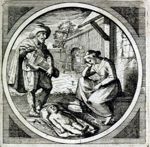
III x 52 Iactantiae comes invidia Envy is the companion of boasting
Qui monebit, ne quis insolentius iactet vel fortunae munera, vel naturae, dotes, ne quando Nemesis exaudiat, auferatque, non intempestiviter usurpabit illud ex eodem libro, Αλλ᾽ ὅγε σιγῇ δῶρα θεῶν ἔχοι ὅττι διδοῖεν. id est: Possideat tacitus, si qua adsunt munera diuum.
If someone wants to warn against boasting excessively of good fortune or natural gifts lest at any time Nemesis overhears and takes them away, it would be a good time to use this from the same book: 'Let him keep in silence whatever gifts he may have of the gods.'
Facsimile:
Iconclass: 33A5 friends 57AA645 Boast; 'Iattanza' (Ripa) 57AA76 Jealousy; 'Gelosia', 'Rammarico del ben'altrui' (Ripa) 92G2 Nemesis (Adrastea)
Loci Communes: Invidia, aemulatio (Envy, rivalry, Envie, rivalité)
III x 53 Verbo tenus amicus A friend in words alone
In eum, qui simulat oratione benevolentiam, caeterum longe diversa parans in animo, quadrabit illud ex eodem libro, Θέλγε δὲ θυμὸν Μελιχίοις ἐπέεσσι, νόος δὲ οἱ ἄλλα μενοίνα. id est: Animum praemollibus isti Lenibat dictis, at mens diversae parabat.
For one whose words make a pretence of good will but who plots something very different a suitable phrase will be this from the same book: 'She beguiled his mind / With gentle words but her thoughts were on other things.'
Facsimile:
Iconclass: 33A5 friends 52AA6 Falsehood 57AA611 Dissimulation, Hypocrisy; 'Hippocresia', 'Simulatione' (Ripa)
Loci Communes: Simulatio, dissimulatio (Pretense, dissimulation, Simulation, dissimulation); Fraus ab amico (Deceit from a friend, Tromperie d'un ami)
III x 54 Nihil recusandum, quod donatur Never refuse a gift
Si quando dices nullum esse recusandum munus, quodcunque offertur, aut adripiendam esse, quoties obtigetit alicuius occasio commoditatis, conveniet illud ex eodem libro, Οὐ γὰρ καλὸν ἀνηνασθαι δόσιν ἐστίν. id est, Donum reiicere haudquaquam decet.
If on occasion you want to say that we should never refuse a gift, whatever is offered, or that we should seize the chance of some advantage whenever it occurs, a suitable adage would be this from the same book: 'It is never a good idea to refuse a gift.'
Facsimile:
Iconclass: 33A41 gifts being accepted 53B1 Acceptance 54B12 Opportunity, Opportuneness, Seasonableness
Loci Communes: Munus boni consulendum (A gift to be taken in good part, Un présent à prendre en bonne part)
III x 55 Adminicula vitae The comforts of life
Omnia quae ad vitae pertinent commoditatem, non ineleganter indicare licebit hoc carmine ex Odysseae Τ. Οἷσιν τ᾽ εὐζώουσι καὶ ἀφνειοὶ καλέονται. id est, E quibus & vivunt recte, ditesque vocantur.
All those things that are important to comfortable living can be quite neatly symbolized by this line from book 19 of the Odyssey: 'Things by which they live well and are reputed wealthy.'
III x 56 Qui per se sufficit A self-sufficient man
Qui negabit sibi opus esse opera aliena, se satis idoneum ad rem peragendam, conveniet illud ex Odysseae ν. Εισί μοι ὀφθαλμοί τε καὶ οὔατα καὶ πόδες ἄμφω, Καὶ νόος ἐν στήθεσσι τετυγμένος οὐδὲ ἀεικής. id est, Sunt oculi mihi, sunt aures geminique pedes sunt. Insit pectoribus mens est, neque stulta nec excors.
For the man who would say he does not need the help of others and is quite fit to complete a task by himself a suitable adage will be this from book 20 of the Odyssey:
I have eyes, ears, and two feet,
And intelligence in my breast that is neither simple nor foolish.
Facsimile: 
Iconclass: 51E1 Independence, Autonomy
Loci Communes: Cum auxilio ; citra auxilium (With help; without help, Avec aide ; sans aide)
III x 57 Novit mala et bona He knows the bad and the good
In eum, qui per aetatem usumque rerum, iam delectum habere potest fugiendorum atque expetendorum, congruet illud ex eodem libro, Δὴ γὰρ νοέω καὶ οἶδα ἕκαστα, Εσθλάτε καὶ τὰ χέρεια. id est: Iamdudum siquidem, novique & sentio cuncta Quae bona, quaeque mala. Ha figura vel hodie nihil vulgatius.
For one who through age and experience of affairs is able to discern between things to be avoided and things to be desired a suitable adage will be this from the same book:
For a long time now I have known and understood all things,
Both what is good and what is evil.
Even nowadays no expression is more common than this.
III x 58 Neque enim ignari sumus For we are no strangers
Ubi quis ad tolerantiam praesentium incommodorum, animat sese praeteritorum malorum recordatione, non infestiviter usurpabit illud ex eodem libro: Τέθλαθι δὴ κραδίη καὶ κύντερον ἄλλο πότ᾽ ἔτλης. id est, Obdures anime, & quondam graviora tulisti. Id aemulans Vergilius. O passi graviora, dabit deus his quoque finem. Durate, & vosmet rebus servate secundis. Consimiliter Horatius in Odis, O fortes, maioraque passi Mecum saepe viri.
When someone takes heart and bears present discomforts by remembering past ills he can with some humour use this from the same book: 'Stand firm, my soul; in the past you have borne worse.' Virgil imitated and developed this with:
You have had worse to bear than this. Now, as before,
Providence will bring your suffering to an end
Hold hard, therefore. Preserve yourselves for better days.
Likewise Horace in the Odes: 'You who have stayed by me through worse disasters, heroes .. .'
Facsimile:
Iconclass: 53A2 Perseverance, Resolution, Determination; 'Perseveranza' (Ripa) 54F122 Vicissitudes of Life
Loci Communes: Malum assuetum (Habitual evil, Mal habituel)
III x 59 Danda venia lapso A slip should be pardoned
Qui dicet aliquando dandam veniam, si quid erratum sit per incuriam, neque enim hominis esse, ut semper exactam praestet diligentiam, usurpabit illud illud ex Odysseae τ. Αλλ᾽ οὐ γὰρ πὼς ἐστὶν αΰπνους ἔμμεναι αἰὲν Ανθρώπους. id est, Haud quaquam fieri potis est, ut pervigil usque Mortalis duret.
If you want to say that we should pardon a mistake that has occurred through neglect, and that a man cannot be expected to give careful attention at every moment, you can use this from book 19 of the Odyssey: 'For it is in no way possible for a mortal to remain / Forever awake.'
Facsimile:
Iconclass: 52CC41 Error; 'Errore' (Ripa) 57A741 Pardon; 'Perdono' (Ripa)
Loci Communes: Experientae secundae (Experience that turns out well, Expérience favorable)
III x 60 Non quidvis continget, quod optaris Not everything you wish for happens
Qui negabit omnia contingere homini quae sperarit, animoque conceperit, accommodabit illud ex eodem libro, Α τοι μὲν ὄνειροι ἀμήχανοι, ἀκρϊτόμυθοι, Γιγνοντ᾽ οὐδέ τε πάντα τελείεται ἀνθρώποισι. id est: Frivola scilicet exsistunt, & inania quaedam Somnia, nec quodcunque vides, sic evenit omne. Atque hoc in loco subiungit pulcherrimum illud de duobus somniorum portis figmentum, quod in sexto Vergilius retulit.
If you want to say that not everything happens as you may have hoped or imagined you can apply this from the same book:
Some dreams, of course, are trifling and vain,
Nor does everything you see turn out to be real.
And in this passage he introduces the very beautiful image of the two gates for dreams which Virgil describes in book 6.
Facsimile:
Iconclass: 51AA7 Imperfection, Incompleteness; 'Imperfettione' (Ripa) 54FF1 Failure
Loci Communes: Votum (A vow, a wish, Vœu)
III x 61 Gaudium dolori iunctum Joy is linked to pain
Cum pariter accidit, quod & gaudeamus & doleamus, quod genus si cui parentes opulenti vita decesserint, partim excruciatur morte suorum, partim gaudet hereditatis obventu, atque accessione libertatis, conveniet illud ex eodem libro, Τὴν δ᾽ ἅμα χάρμα καὶ ἄλγος ἕλε φρένα. id est, Laetitia huic moerorque simul praecordia coepit.
When something happens at which we rejoice and grieve equally - for example, when someone's wealthy parents depart this life, on the one hand he is tormented by their death, on the other he rejoices at gaining his inheritance and becoming free - a suitable adage will be this from the same book:
Joy and grief together came upon her heart.
Facsimile:
Iconclass: 56B:33A53 Joy and Sorrow❧arm in arm (friends)
Loci Communes: Anceps et dubius (Doubtful and uncertain, Incertain et douteux)
III x 62 Mala senium accelerant Misfortunes hasten age
Qui dicet senectam non esse metiendam annis, propterea quod ii, qui se multis laboribus, curisque discruciant, ante diem consenescunt, usurpabit illud ex eodem libro, Αἶψα γὰρ ἐν κακότητι βροτοὶ καταγηράσκουσι. id est, Quippe repente homines curisque malisque senescunt.
If you want to say we should not measure age by years, because when men are tormented by frequent labours and troubles they become old before their time, you can use this from the same book: 'For quickly do men grow old with cares and misfortunes.'
Facsimile:
Iconclass: 31A461 pain 31D7 unnatural aging 56BB1 Pain, Sorrow, Sadness; 'Dolore', 'Dolore di Zeusi' (Ripa)
Loci Communes: Longae vitae (A long life, Longue vie); Senium praematurum aut mors (Premature old age or death, Vieillesse prématurée ou mort)
III x 63 Vita mortalium brevis The life of mortals is short
Qui monebit dandam operam ut apud posteros honestae vitae memoriam relinquamus, quae perpetuo vivat, nam hanc vitam angustis circumscriptam esse terminis, accommodabit illud ex eodem libro, Ανθρωποι δὲ μινυνθάδιοι τελέθουσι. id est, Ast hominis brevibus spatiis constringitur aevum.
If you want to warn that we should do our best to leave with our descendants a worthy memory that will live for ever, for this life is bound by narrow limits, you can apply this from the same book: 'But mortals' lives are confined to brief spans.'
Facsimile:

Ars longa, vita brevis: Cramer, Octoginta emblemata nova (Frankfurt, 1630), emblem 62
Vita brevis: Borja, Empresas morales (Bruxelles, 1680), emblem 19
Iconclass: 31D920 'Velocità della vita humana', 'Vita breve' (Ripa)
Loci Communes: Vita hominis misera et brevis (The life of man, wretched and short, La vie de l'homme, misérable et brève)
III x 64 Verissimiliter mentiens Lies that sound like truth
In eum, qui falsum perinde quasi verum sit, narret, quadrabit illud ex eodem libro, Ισκε ψεύδεα πολλὰ λέγων ἐτύμοισιν ὅμοια. id est, Plurima narrabat figmenta simillima veris. Dictum de Ulysse. notatur & apud Platonem quod Homerus Ulyssem induxerit mendacem, Achillem contrà veracem.
For one who tells a falsehood just as if it were the truth a suitable expression would be this from the same book: 'He made the many falsehoods of his tale seem like truth.' This is said about Ulysses. Plato also remarked that Homer represented Ulysses as a liar, and Achilles on the other hand as truthful.
Facsimile:
Iconclass: 52A6 Truth; 'Verità' (Ripa) 57AA6221 Lie; 'Bugia' (Ripa) 95A(ACHILLES) (story of) Achilles 95A(ULYSSES) (story of) Ulysses
Loci Communes: Simulatio, dissimulatio (Pretense, dissimulation, Simulation, dissimulation); Fucus (Sham, deceptive appearance, Feinte, apparence trompeuse)
III x 65 Sibi malum repperit He invented his own misfortune
In eum, qui suo laeditur invento, quadrabit illud ex Odysseae φ. Οἴτ᾽ αὐτῷ πρώτῳ κακὸν εὕρετο οἰνοβαρείων. id est, Qui sibi perniciem vel primum reperit ipse Vino victus. Dictum est de Euritione, qui primus invenit usum vini, peremptus à Lapithis.
For the man who is harmed by his own discovery, a suitable expression will be this from book 21 of the Odyssey: 'But it was his own harm he caused first, being overcome with wine.' This is said of Eurytion, who was the first to discover the use of wine and was killed by the Lapiths.
Facsimile: 
Iconclass: 52A42:41C711 Invention, Inventiveness; 'Inventione' (Ripa)❧wine ~ alcoholic drinks 58AA12 Self-destruction 92L714112 Theseus kills Eurytion
Loci Communes: Malum accersitum aut retortum (Evil brought upon oneself or turned back, Mal attiré ou retourné)
III x 66 Qui continet arcanum The man who keeps a secret
In eum qui caelat arcanum sibi commissum, neque cuiquam effutit, quadrabit illud in Odysseae φ. Τῇ δ᾽ ἄπτερος ἔπλετο μῦθος. id est, Huic pennis dicta carebant. Hoc est, haud longius avolabant:
For a man who conceals a secret that has been entrusted to him and does not blurt it out to anyone a suitable saying will be this in book 21 of the Odyssey:
For him the words lacked wings.
That is, they flew no further.
Facsimile:
Iconclass: 52DD1 Secrecy, Latency, Concealment; 'Secretezza' (Ripa) 52DD3 Taciturnity; 'Secretezza', 'Secretezza overo Taciturnità' (Ripa)
Loci Communes: Laudata (Praised things, Choses louées)
III x 67 Rem novam aggredior It is a new thing I begin
Si quando significabis te rem arduam ac novam moliturum, & aliis adhuc intentatam, accommodabis illud ex Odysseae χ. Νῦν αὖτε σκοπὸν ἔλλον ὅν οὔπωτις βάλεν ἀνὴρ, Εισομαι αἴκε τύχοιμι. id est, Nunc alium tentabo scopu, si attingere possim, Quem nondum quisquam tetigit. Verba sunt Ulyssis, iam parantis occidere procos.
If at some time you want to indicate that you are about to undertake something difficult and new, something not attempted by anyone else, you can apply this from book 22 of the Odyssey: 'Now I shall attempt another target, to see if I can hit it, one that no one else has hit so far.' These are the words of Ulysses as he prepares to kill the suitors.
III x 68 Benefactorum memoria The memory of good deeds
Ubi quid boni contigit alicui propter veterum benefactorum memoriam, quadrabit illud ex eodem libro, Ως κακοεργίης εὐεργεσίη μέγ᾽ ἀμείνων. id est, Officio fungi multo, ac delinquere praestat.
When a person receives a benefit because someone has remembered past good deeds, a suitable adage will be this from the same book: 'It is far better to do one's duty than to commit evil.'
III x 69 Mortuis non conviciandum Do not insult the dead
Victo non insultandum, nec in mortuum ultra congerenda convicia, quanquam iure sit occisus, huic suffragatur Homerus in eodem libro, Οὐκ ὁσίη κταμένοισιν ἐπ᾽ ἀνδράσιν εὐχετάασθαι. id est, Haud fas est super occisis iactare teipsum. Ulysses ita, de procis extinctis.
A beaten man should not be scoffed at nor should insults be heaped further on a dead man, even if he was justifiably killed. Homer approves of this in the same book: 'It is an inauspicious thing to boast over slain men' - the words of Ulysses about the dead suitors.
Facsimile:
Iconclass: 31E3 the corpse 53DD11:57BB25 Prohibition❧Calumny, Detraction; 'Biasimo vitioso', 'Calunnia', 'Detrattione', 'Maledicenza' (Ripa)
Loci Communes: Obtrectatio et maledicentia (Disparagement and slander, Dénigrement et médisance)
III x 70 Focus luculentus in aedibus A glowing hearth at home
Primum domus ornamentum est, ut luceat focus, proinde qui in aedes immigrant novas, aut in diversorium ingrediuntur, ante omnia iubent ignem incendi. Quod ex Homeri χ. sumptum videtur, apud quem Ulysses, Πῦρ νῦν μοι πρώτιστον ἐνὶ μεγάροισι γενέσθω. id est, Nunc ante omnia mi lucescat in aedibus ignis. Item illud celebratum: Αἰθομένου δὲ πυρὸς γεραρώτερος οἶκος ἰδέσθαι. id est, Silicet accenso domus est ornatior igni. Quo quidem versiculo videtur impendio delectatus Plutarchus, adeo subinde usurpat, et in varios detorquet usus: in commentario De virtute & vitio, refert ad opes, potentiam, gloriam, quae tum fiunt iucundiora, si adsit animus à molestia liber. Rursum in libello, quem Amatorium inscripsit, detorquet ad amantis animum longe splendidiorem, si calor amoris eum inflammarit.
The best ornament of a house is a glowing hearth; this is why those who move into a new house or come to an inn bid first of all that a fire be lit. The idea seems to come from book 22 of Homer, who makes Ulysses say, 'Now first of all let a fire be made for me in the hall.' And this famous line: 'For the home is brighter when the fire is lit.' This verse seems to have greatly delighted Plutarch, so often does he use it and adapt it to various meanings. In the essay 'On Virtue and Vice' he applies it to wealth, power, and fame, which become the more pleasing if the soul is free of troubles; again in the book entitled 'The Lover' he applies it to the heart of the suitor, which glows far more brightly if it is fired by the warmth of love.
III x 71 Qui iure perierunt Those who deserved to die
In eos, qui suo merito pereunt, conveniet illud ex eodem libro, Τούς δὲ μοῖρ᾽ ἐδάμασσε θεῶν, καὶ σχέτλια ἔργα. id est, Hos fatum et malefacta, neci exitioque dederunt. Dictum de procis.
For those who deserve to die a suitable line will be this from the same book: 'These men were destined to be killed, destroyed by their own misdeeds.' The words refer to the suitors.
Facsimile:
Iconclass: 59C3:31E Legality❧death of human being 94I6 the end of the suitors
Loci Communes: Internitio (Utter destruction, Extermination totale)
III x 72 Inexorabilis Unbending
In durum & inexorabilem competet illud ex Odysseae ψ. Σοὶ δ᾽ ἀεὶ κραδίη στερεωτέρη ἐστὶ λίθοιο. id est, At tibi perpetuo cor saxo durius omni est. Ita Telemachus ad matrem.
For one who is hard and pitiless a fitting adage is this line from book 23 of the Odyssey: 'But your heart is ever harder than any stone.' So Telemachus to his mother.
Facsimile:
Iconclass: 51G4(+0):31B Hardness (+ variant)❧mind, spirit 94I3 Penelope, Telemachus, and the suitors (Homer, Odyssey I-IV)
Loci Communes: Asperitas, morositas (Harshness, moroseness, Rudesse, morosité)
III x 73 Recipere animum Regaining courage
Ubi quis re subitaria consternatus, postea recipit sese, conveniet illud ex Odysseae ω. Αὐτὰρ ἐπεὶ ῥ᾽ ἄμπνυτο καὶ ἐς φρένα θυμὸς ἀγέρθη. id est, Ut respiravit, rediitque in pectora sensus.
When someone is confused by a sudden event and then recovers himself, a suitable adage will be this line from book 24 of the Odyssey:
As he caught his breath and his spirit returned into his breast.
Facsimile:
Iconclass: 54F131:54A8 Renovation❧Courage, Bravery, Valiance, Manliness; 'Ardire magnanimo et generoso', 'Gagliardezza', 'Valore', 'Virtù heroica', 'Virtù dell'animo e del corpo' (Ripa)
Loci Communes: Divitum praerogativa (The privilege of the rich, Le privilège des riches)
III x 74 Senum prudentia Wisdom of the aged
De senibus quidem, attamen ob rerum peritiam non idoneis ad negocium aliquod conficiendum, apte dicetur illud ex eodem libro, Καὶ πολιοί περ ἐόντες ἀναγκαῖοι πολεμισταί. id est, Aetas cana quidem, sed non inidonea bello.
Speaking of people who may be old certainly, but who, because of their experience of affairs, are nevertheless quite fit to carry on some occupation, we might aptly say this from the same book: 'Hoary age indeed, but not unfit for war.'
Facsimile: 
Iconclass: 31D160 Old Age, 'Senectus'; 'Vecchiezza' (Ripa) 31B7 wise man 52A51 Wisdom; 'Sapienza', 'Sapienza humana', 'Sapienza vera' (Ripa)
Loci Communes: Prudentia senilis (The prudence of old age, Prudence de la vieillesse)
III x 75 Imperator bonus et idem robustus miles A good commander and a hard soldier too
Refert Plutarchus in commentario de fortuna Alexandri, si modo is liber illius est, cum in convivio propositum esset, qui nam inter versus Homericos maxime probandus videretur, aliis alios praeferentibus, Alexander huic carmini palmam tribuit, quod extat Iliados γ. Αμφότερον, βασιλεύς τ᾽ ἀγαθὸς, κρατέροστ᾽ αἰχμητής. id est, Dux bonus, ac miles praepollens viribus idem. Nam hoc & Agamemnonis laudem expressit, et Alexandri virtutem est vaticinatus. Quanquam mea quidem sententia, non magnum habet momentum in principe corporis robur, plurimum autem consilium & prudentia. Proinde graviter Timotheus, cum Rhetores Charetem quendam efferrent laudibus, iuvenem corporis viribus insignem censerentque eiusmodi belli ducem Atheniensibus esse quaerendum, Haudquaquam, inquit. nam istiusmodi quidem optarim, qui culcitras & stragulas sit exercitui deportaturus: at ducem velim, qui à fronte pariter atque tergo sit oculatus, & quem à perpendendo quid utile factum sit, nulla impediat animi perturbatio.
There is a story by Plutarch in the essay on the 'Fortune of Alexander' (if indeed this book is by him): 'When the question was raised at dinner, which of the verses of Homer was most praiseworthy, and different people expressed their preference for different verses, Alexander awarded the palm to this line which is in book 3 of the Iliad:
A good leader and an outstandingly strong soldier too.
For with this line he both sang the praise of Agamemnon and prophesied the courage of Alexander.' However, in my opinion physical strength does not count for much in a prince, but deliberation and wisdom count for a great deal. For this reason, when orators sang the praises of a certain Chares, a young man of notable physical strength, and gave their opinion that the Athenians should seek to have this sort of leader in war, Timotheus said vehemently, 'Not at all. I would have that sort of man carry mattresses and blankets for the army, but as commander I would have a man who has eyes for "what is both before and behind," and who is not hindered in his determination of what is for the best by any disturbance of his reasoning.'
Facsimile:
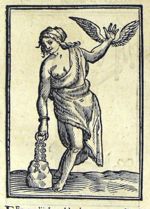
Consilio non robore: Zincgreff, Emblematum Ethico-politicorum (Heidelberg, 1619), emblem 64 joins the adage's moral that wisdom trumps physical strength in a soldier
Iconclass: 45D311:54A2 commander-in-chief, general, marshal❧Carefulness, Diligence; 'Diligenza' (Ripa) 45D313:51G3 private soldier❧Toughness 54A7 Strength, Power; 'Fortezza', 'Fortezza d'Animo e di corpo', 'Fortezza del corpo congiunta con la generosità dell'animo', 'Fortezza & valore del corpo congiunto con la prudenza & virtù del animo', 'Forza' (Ripa)
Loci Communes: Prudentia conjuncta viribus (Prudence joined with strength, Prudence alliée à la force)
III x 76 Capram coelestem orientem conspexerunt They have seen the heavenly she-goat rising
Αἶγα τὴν οὐρανίαν ἐπιτέλλουσαν ἐθεάσαντο. id est, Capram coelestem exorientem aspexerunt. Hoc dici solitum in eos, quibus omnia feliciter, eque animi sententia succederent: propterea quod antiquitus opinione vulgi comprobatum est, qui capram illam Iovis altricem, et ob id in syderum relatam numerum conspexissent, quicquid votis conciperent, eius compotes futuros. Qua de re latius dictum est in adagio ἀμαλθείας κέρας. Hoc autem extat in Plutarchi collectaneis. Idem in libello De poetis audiendis, εὐδαίμων πολύαγρος οὐράνιον αἶγα πλουτοφόρον τρέφων. id est, Felix multorum agrorum possessor, coelestem capram opum largitricem alens. Quanquam apud Athenaeum libro nono, Antiphanes, opinor, commemorat capram caelestem inter animantia apta mensis, τράγοσ ὑλιβάτας, αἴξ οὐρανία, κριός τομΐας. id est, Hircus sylvester, capra coelestis, aries castratus.
[greek], They have gazed at the heavenly she-goat rising. This used to be said of those for whom everything prospered as well as they wished, because in antiquity according to popular opinion it was accepted that those who had observed the she-goat - the one that had been Jupiter's nurse and was therefore placed among the constellations - would be the possessors of whatever they prayed for. This story is explained at greater length in the adage 'Amaltheia's horn.' This one, however, is to be found in the Collected Proverbs of Plutarch. It is also in the essay 'On Listening to Poetry': 'How happy is the owner of many fields who keeps [greek] heavenly goat" to bring him wealth.' However, in Athenaeus book 9, Antiphanes I think mentions the heavenly goat among animals suitable for the table: 'Wild goat, [greek] "heavenly she-goat," castrated ram.'
Facsimile:
Iconclass: 24D1(CAPRA) stars and constellations (CAPRA) 92B1121 Amalthea, the nymph, usually in the shape of a goat, suckles the new-born Jupiter
Loci Communes: Bonae fortunae, copiae, felicitatis aut ominis (Of good fortune, abundance, happiness, or omen, Bonne fortune, abondance, bonheur ou présage)
III x 77 Capra ad festum A she-goat to the festival
Αἴξ εἰς τὴν ἑορτὴν. id est, Capra ad festum. Dici solitum, ubi quis in tempore ad negocium aliquod accederet. Aut ubi quis commode in suam perniciem offert sese. Nam in festis maxime Bacchi, capram immolabant. Refertur in iisdem commentariolis.
[greek], A she-goat to the festival. Used to be said when someone came into an affair opportunely, or when someone exposed himself openly to his own destruction. This was because, at festivals, particularly those of Bacchus, they sacrificed a she-goat. It is recorded in the same collection.
Facsimile:
Iconclass: 12B2123 sacrificial feast ~ non-Christian religions 47I2142 she-goat, nanny-goat 54B12 Opportunity, Opportuneness, Seasonableness 58AA12 Self-destruction
Loci Communes: Tempestiva (Timely things, Choses opportunes)
III x 78 Mox sciemus melius vate Soon we shall know better than the prophet
Ταχ᾽ εἰσόμεθα μέντεων ὑπέρτερον. id est, Mox melius ipso vaete rem cognorimus. Ad eum modum dicebant, qui rem non coniecturis divinabant, sed experimento deprehendere tentarent. Nihil enim epxerimento certius. In iisdem extat Plutarchi Collectaneis. Sumptum autem ex Sophoclis Antigona. At Titus Livius belli Punici secundi, libro ii. eventum appellat stultorum magistrum.
[greek], Soon we shall know the matter better than the prophet himself. This expression was used by people who did not foretell a thing by guessing but tried to understand it by testing it. For there is no better proof than a test. It is recorded in the same Collected Proverbs of Plutarch, but it originates in Sophocles' Antigone. However, in the second book of the Punic War Livy says: 'The outcome is the teacher of fools.'
Facsimile:
Iconclass: 49E9 experiment, test ~ science and technology 52A5 Knowledge; 'Cognitione', 'Cognitione delle cose' (Ripa)
Loci Communes: Incertus eventus - ex eventu judicium (Uncertain outcome - judging by the outcome, Issue incertaine - jugement d'après l'issue)
III x 79 Tinctura Cyzicena Cyzicene dye
Βάμμα κυζικηνὸν. id est, Tinctura Cyzicena. Dedecus non eluendum appellabatur apud Atticos. Dicebaturque in eos, qui metu quippiam indecore facerent. Nam Cyziceni duobus nominibus notati sunt, timiditatis, & molliciei. Recensetur in iisdem collectaneis. Meminit & Hesychius, addens Cyzicenos ob molliciem notatos, quod lones essent. Eadem ferè Aristophanis interptes. Stephanus addit eos fuisse graves Tyrrhenorum praedationibus. Extat apud Aristophanem in Pace, Αν δέπου δέῃ μάχεαθ᾽ ἔχοντα τὴν φοινικίδα, Τηνικαῦτ᾽ αὐτὸς βέβαπται βάμμα κυζικηνικόν. id est, Sicubi pugnare oportet, atque ferre palmulam, Ipsum eum tinctura tingit mox ibi Cyzicenica. Solent autem tincturae insignes à locis habere cognomen. Nec enim ubivis quiliber color tingitur feliciter. Sumili modo dictum est ἔμβαμμα συρακούσιον & βάμμα σαρδανικὸν . Id paroemia detorsit ad mores hominum. Est enim aestimatio rumorque consequens hominum vitam, velut tinctura quaedam. Unde Carbone notari dicuntur qui damnantur. Et notum est illud Ennianum apud Aulum Gellium, Quae tincta malis, aut quae bona dicto. Aristophanis interpres indicat Lacedaemonios puniceis tunicis uti solitos, ne ab hoste sentirentur vulnerati, ob coloris similitudinem. At ignavi mollesque pallescunt. Addemus, quod est apud Herodotum libro quarto. Quum Aethiopum rex conspexisset à rege Persarum missam vestem purpuream, rogavit tincturae rationem. Eam quum ab Ichthyophagis didicisset, δολεροὺς μὲν ἀνθρώπους ἔφη εἶναι, δολερὰ δὲ αὐτέων τὰ ἵματα, id est, Non solum ait homines esse subdolos, sed & vestes illorum esse dolosas.
[greek], Cyzicene dye, was an expression among the Athenians for an ineradicable disgrace. It was said of those who did something shameful from fear, for the Cyzicenes had a reputation for both cowardice and effeminacy. It is listed in the same Collected Proverbs. Hesychius recalls it too, adding that the Cyzicenes were known for their effeminacy, being Ionians. The scholiast of Aristophanes says roughly the same. Stephanus Byzantinus adds that they were overwhelmed by the repeated plundering of the Tyrrhenians. The expression is found in Aristophanes' Peace: 'But if ever it is necessary to fight and wear the scarlet, he himself is immediately "stained with Cyzicene dye."' Distinctive dyes are usually known by the names of places, for not all dyes found everywhere colour well. Thus people speak of 'Syracusan dye' and 'Sardinian dye.' This was used proverbially of men's conduct, for the appraisal and the rumour that follow men's lives act like a dye. Whence people are said to be 'marked with coal' when they are condemned. Well known too is this line of Ennius quoted in Aulus Gellius: 'Affairs dyed with evil or others good to speak of.' The scholiast of Aristophanes tells us the Spartans used to wear red tunics so that they should not be seen to be wounded by the enemy because the colour would be the same. Cowards and weak people on the other hand turn pale. Let me add something that is in book 4 of Herodotus: 'When the king of the Ethiopians looked at a purple cloak sent to him by the Persian king, he asked how it had been dyed. When he learned it was done by the Fish-eaters he said it was not only the men who were cunning, but that even their clothes were deceitful.'
Facsimile: 
Iconclass: 41D43 dyeing (clothes) 52BB42:47C2 Impossibility❧displacing, removing (industrial processes) 61E(CYZICUS) names of cities and villages (CYZICUS)
Loci Communes: Concordia (Harmony, Concorde); Pudor (Shame, modesty, Pudeur)
III x 80 Servabis bovem You will keep watch on the ox
Βουκολησεις. i. Bubulcus eris. Hoc velut aenigmate significabant exilium. Si quidem qui per ostracismum eiiciebantur, in Argivam exulatum ibant. Ac illic bos erat aeneus insigni magnitudine. Refertur in Plutarchi collectaneis. Hesychius testatur extitisse in Phasmate Menandri.
[greek], You will be a cowherd. This was in the nature of a riddle which meant exile. Those who were ostracized went into exile in Argiva where there was a bronze ox of great size. This is recorded in the Collected Proverbs of Plutarch. Hesychius states that it appeared in the Phasma of Menander.
Facsimile:
Iconclass: 44G38 banishment, exile 47I221 herding, herdsman, herdswoman, shepherd, shepherdess, cowherd, etc. 48C2(+6122):47I21111 sculpture (+ bronze ~ arts)❧ox
Loci Communes: Exilium (Exile, Exil); Infortunii sive exitii (Misfortune or ruin, Malheur ou ruine)
III x 81 Embarus sum I am Embarus
Εμβαρός εἰμι. i. Embarus sum. Dictum est olim die insano, deliroque. Referunt autem adagionem ad huiusmodi fabulam. Olim Piraeus insula fuit, id quod ipsum etiam vocabulum adhuc indicat, περᾶν enim transmittere est: in ea, cum Munychus principatum obtineret, templum instituit Dianae, cui cognomen additum Munychiae. Dein cum ursus Dianae sacer quidam ibi repertus, & ab Atheniensibus interfectus esset, fames ingruit: itum est ad oraculum, quaesitumque malo remedium. Respondit Deus, ita demum finem mali futurum, si quis filiam immolasset numini. Unus autem repertus est Embarus, usqueadeo demens, qui polliceretur se filiam immolaturum, ea lege, ut sacerdorium in posteros suos traduceretur. Itaque puellam sollemni ritu ornatam sacrificavit. Fit & huius mentio in Plutarchi collectaneis.
[greek], I am Embarus. This was said formerly of a mad or delirious person. The adage is explained by reference to a story that goes like this. In olden times Piraeus was an island, something that the name itself indicates because [greek] is 'to send across.' When Munychus became the ruler, he built a temple to Diana, to whom the title 'Munychian' was added. Later, when a bear, which is sacred to Diana, was discovered there and was killed by some Athenians, a famine occurred. People resorted to the oracle and sought a remedy for the evil. The god answered that there would be an end to the evil only if someone sacrificed his daughter to the deity. And Embarus alone was found who was mad enough to promise that he would sacrifice his daughter on condition that the priestly office should be granted to his descendants. So his daughter was dressed in the customary way and sacrificed. This too is mentioned in the Collected Proverbs of Plutarch. Hesychius states that it appeared in the Phasma of Menander.
Facsimile:
Iconclass: 12E2122:42G2122 human sacrifice ~ Greek religion❧daughter (first degree family relationships) 52AA51 Folly, Foolishness; 'Pazzia', 'Sciocchezza', 'Stoltitia' (Ripa) 98B(EMBARUS) male persons from classical history (EMBARUS)
Loci Communes: Multi - in stupidos (Many people - against the stupid, Beaucoup de gens - contre les sots)
III x 82 Colophonium suffragium The Colophonian vote
Κολοφωνία ψῆφος. i. Colophonium suffragium. Usurpatur in epistola quapiam Platonis ad Dionysium. Adagium est verbis magis, quam re diversum ab illo, quod in secunda retulimus Chiliade, τὴν κολοφῶνα ἐπέθηκεν. i. Colophonem addidit. Adagionis originem explicant in hunc modum. Cum olim Colophonii domesticis seditionibus tumultuarentur inter sese, evenit ut aliquot ex illis mutatis sedibus, ad Smyrnaeos demigrarent. Dein accidit, ut cum bellum gererent Smyrnaei, ac saepenumero victi discessissent, tandem adhibitis Colophoniis, quos in civitatem receperant, extiterint superiores. Unde institutum est, ut quemadmodum Smyrnaei non vicerant in bello, nisi Colophoniorum accessione, ita nec in suffragiis vincerent, nisi illorum calculum adiungerent. Proinde cum Ionii duodecim civitatibus imperarent, quarum una Smyrna, in publicis consiliis, si quando Smyrnensium aequales fuissent calculi, pars ea vincebat, cui subscripsissent Colophonii illi, quorum opera vicerant in praelio. Nec abhorrent ab his quae refert Iabenus scriptor Graecus. Duodecim Ioniae civitates convenire solitas: id concilium Panionium dicebatur: in quo si forte calculis hinc atque hinc paribus nihil decerni poterat, accersebantur Colophonii, qui victoriam adferebant utricunque parti fuissent suffragati. Itaque proverbium quadrabit, cum significabimus iudicium aut suffragium alicuius plurimum in re quapiam valere. Huius adagii nobis facta est mentio.
[greek], The Colophonian vote. This is used in a letter of Plato to Dionysius. The adage differs in words rather than in meaning from the one we noted in the second chiliad, 'He added the colophon.' The source of the adage is explained in this way. At a time when the Colophonians were in uproar with internal rebellions, some of them happened to move residence and migrated to Smyrna. Later, when the Smyrnaeans were at war and were repeatedly defeated, they finally accepted the help of the Colophonians whom they had welcomed into the city and who had proved themselves superior. Thus the belief was established that, just as the Smyrnaeans had not been able to win in war without the support of the Colophonians, so they would not win elections if they did not also have their vote. Hence when the Ionian rule extended over twelve cities, of which one was Smyrna, and when the votes of the Smyrnaeans were equally divided in public meetings, the party that won was the one that had the support of the Colophonians who had helped them conquer in the war. Relevant to this too are some things related by a Greek writer called Iabenus. The twelve cities of Ionia were accustomed to meet together, and this was called the Pan-Ionian council. If it happened that no decision could be made because the votes on each side were equal, the Colophonians were summoned and victory was accorded to whichever party they supported. So the adage will fit when we want to indicate that someone's judgment or vote is of great moment in some matter. I have already mentioned this adage.
Facsimile:
Iconclass: 44C23 voting, election 51A7 Perfection, Completeness; 'Perfettione', 'Operatione perfetta' (Ripa) 54A6 Helpfulness 54D3 Completion 61E(COLOPHON) names of cities and villages (COLOPHON)
Loci Communes: Perficiendi sive absolvendi (Finishing, completing, Achever, accomplir)
III x 83 Mihi ista curae futura sunt etc. These things will be my care, etc
Εμοὶ μελήσει ταῦτα καὶ λευκαῖς κόραις. id est, Curae ista mihi erunt, ac puellis candidis. Senarius ex oraculo ductus in popularem sermonem. Cum Brennus Gallicis copiis ingrueret in Delphos, Delphi consuluerunt oraculum, quid opus esset facto, Responsum est, hoc quod modo retulimus carmine. Paulo post visus Apollo cum duabus puellis Pallade ac Diana. Nam et his fana sunt apud Delphos. Convenit uti, si quando significabimus nihil esse periculi, negotium iis curae fucurum, ad quos pertinet. Refertur in Plutarchi collectaneis. Ciccro vertit Graecum carmen De divinatione primo: Ego providebo rem istam, & albae virgines.
'[greek], These things I and the white maidens will take care of. This is an oracular trimeter which has been taken into popular speech. When Brennus attacked Delphi with his Gallic forces, the Delphians asked the oracle what they should do. The answer was in the form of the verse I have just quoted. Shortly afterwards Apollo was seen with the two maidens Pallas and Diana, for there are temples to them as well at Delphi. It can be properly used whenever we want to signify that there is no danger, that an affair will be looked after by those whose concern it is. It is included in the Collected Proverbs of Plutarch. Cicero translates the Greek verse in book 1 of On Divination as follows: 'It is I and the white maidens who shall provide for this.'
Facsimile:
Iconclass: 54D5 Safety 92B3721 Delphic oracle 98B(BRENNUS)4 aggressive relationships of Brennus
Loci Communes: Diligentiae (Diligence, Diligence)
III x 84 Festum multas habens A festival has many
Εορτὴ πολλὰς ἄχουσα. i. Festum multas habens, subaudiendum molestias, aut occupationes. Dictum in eos, qui magnas componerent sarcinas, aliquò profecturi. Venustius erit, si deflectatur ad quosdam, qui nihil agunt, quamvis exiguum, nisi magno molimine, longa cunctatione, miro appatatu, ita ut saepenumero tum se, tum reliquos omnes defatigarint apparando, priusquam quicquam incipiant. Natum ab iis, qui festa solent adire. Nam iis mos, multam suppellectilem unà secum convehere, vasa, vestes, sacra, panes, atque id genus alia multa, ne quid deesset, ad solennitatem pertinens. Extat in iisdem Collectaneis.
'[greek], A festival has many, 'troubles' or 'pre-occupations' being understood. Said of people who make up great packages to carry when they are about to travel somewhere. It will be more humorous if it is applied to certain people who do nothing, however trivial, without great effort, long delay, and extraordinary preparation, such that they often exhaust both themselves and everyone else with their preparations before they start anything. It derives from people going to festivals, who were in the habit of taking a great many goods with them: jars, clothes, sacred objects, bread, and lots of other things of that sort, in case anything necessary for the ceremony should be lacking. It is extant in the same Collected Proverbs.
Facsimile: 
Iconclass: 43A festivities 51FF521 Delay 51H3:54D1 Multitude❧Preparation
Loci Communes: Tarditatis et cunctationis (Slowness and delay, Lenteur et retard)
III x 85 Nihil aliae civitates ad Crotonem Other cities are nothing beside Croton
Μάταια τἄλλα παρὰ κρότονα τἄστεα. id est, Sunt reliqua prae Crotone frivola oppida. Theocriti interptes meminit huius proverbii. Licebit accommodare ad rem aut hominem usqueadeo praecellentem, ut reliqui cum hoc collati, nihil esse videantur. Natum fortassis est à pugilum Crotoniatarum excellentia, quorum erat Milo, de quo dictum est aliàs, nempe in proverbio, Crotone salubrius.
[greek], Compared with Croton the rest are wretched little towns. The scholiast of Theocritus recalls this proverb. It can be applied to a thing or a man so outstanding that others seem nothing when placed alongside. The origin is perhaps the excellence of Crotonian boxers, one of whom was the Milo we have mentioned elsewhere, namely in the proverb 'Healthier than Croton.'
Facsimile:
Iconclass: 43C392(+1) wrestling (sport) (+ sportsman, player, etc.) 51E2 Superiority 61E(CROTON) names of cities and villages (CROTON) 98B(MILON) (story of) Milon of Croton
Loci Communes: Excellentia, inaequalitas (Excellence, inequality, Excellence, inégalité)
III x 86 Canis panes somnians A dog dreaming of bread
Sunt quibus proverbiali figura dictum videatur illud apud Theocritum in Piscatoribus. Καὶ γὰρ ἐν ὕπνοις Πᾶσα κύων ἄρτως μαντεύεται, ἰχθύα κἠγών. id est, Siquidem omnis Panes in somnis canis artolatur, at ipse Pisces. Sensus est, unicuique ea per somnum occurrere, quae impense desiderat, quibusque magnopere deditus est. Aristoteles non solum homini, verumetiam caeteris animantibus somnia tribuit, etiam si id in canibus evidentissimum: quippe quos audimus saepenumero dormientes venationem somniare, quae res haud difficile deprehenditur ex ratione latratus, quem edunt sopiti. Proinde nobis rectius quadraturum videtur, si pro ἄρτως legatur ἀγρὼς, aut ἄγρας, id est, agros, aut venationes. Verum hoc tantum eruditis pensitandum proponimus, super hoc pronuntiaturis, ubi codicem emendatiorem erunt nacti. Nobis adhuc non contigit. Ex somniis autem qui ariolentur eventura, ne nostris quidem temporibus desunt, quamquam non probat Aristoteles.
There are certain people who seem to be the target of a proverbial figure in the Fishermen of Theocritus: 'Every dog dreams of [greek] "bread" in his sleep, but I of fish.' The meaning is that everybody dreams about the things he desires eagerly and to which he is most committed. Aristotle attributes dreams not only to men but to all the other animals, although this is most apparent in dogs because, as they sleep, we often hear them dreaming of hunting, as can be quite easily deduced from the nature of the barks they utter while asleep. Therefore, it would seem to me to fit better if instead of [greek] 'bread' we read [greek] or [greek] 'field' or 'hunt.' But I am merely suggesting this should be considered by scholars who can decide on the matter when they have found a more correct manuscript. This has not happened to me so far. Dreams are used to prophesy future events by many people even in our own time, although Aristotle does not approve of it.
Facsimile:
Iconclass: 31B3:41C621 dream❧bread, loaf 34B11(+946) dog (+ sleeping animal(s)) 56F1 Desire; 'Desiderio' (Ripa)
Loci Communes: Votum (A vow, a wish, Vœu)
III x 87 Canis You keep on singing
Αδεις ἔχων. i. Canis, pro eo quod est, nugaris, ineptis, frustra loqueris. Est autem Atticae linguae figura, sicuti παίζεις ἔχων. i. Ludis, sive io caris. Etenim qui canunt non agunt rem seriam, sed tantum, ut aures deliniant voluptate mox peritura.
[greek], You keep on singing. I find this means 'You are being frivolous, talking nonsense, talking vainly.' It is an Attic expression, like [greek] 'you keep on playing, or joking.' So those who are singing are not doing anything serious, but just seeking to charm our ears with a passing pleasure.
III x 88 Aethiops non albescit The African cannot become white
Αἰθίοψ οὐ λευκαίνεται. i. Aethiops non candescit. De iis dici solitum, qui numquam mutaturi sunt ingenium. Quidquid enim nativum, id haud facile mutatur. Fertur Aesopicus apologus de quodam, qui empto Aethiopi, cum eum colorem arbitraretur non nativum esse, sed domini superioris accidisse neglectu, assidua lotura faciem divexavit, ita ut morbum etiam adiungeret, colore nihilo quam antea fuerat, meliore. Fertur et epigramma Luciani nomine: Εἰς τι μάτην νίπτεις δέμας ἰνδικόν; ἴσχεο τέχνης. οὐ δύνασαι δνοφερὸν νύκτα καθηλιάσαι. id est, Auluis Aethiopem frustra, quin desinis artem? Haud unquam efficies, nox sit ut atra, dies.
[greek], The African cannot become shining white. Usually said about those who will never change their nature. For an inborn trait cannot easily be changed. There is a fable of Aesop about a man who bought an African and thinking that the colour of his skin was not natural but had come about because of the neglect of a former master, scrubbed his face for so long that he even made him ill, whilst the colour was no better than it had been before. There is also an epigram attributed to Lucian: 'You wash the African in vain; why not give up the task? / You will never manage to turn black night into day.'
Facsimile:
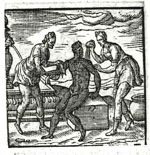
Impossibile: Alciatus, Emblemata (Leiden, 1591), emblem 59
Impossibile: Alciatus, Emblemata (Padua 1621), col. 274 a, emblem 59
Corvus non albescit: Meisner, Politica Politica (Nürnberg, 1700), emblem 647 uses a variation of the adage's imagery
Iconclass: 31AA54 washing and bathing - AA - in the open air 32B321(ETHIOPIAN)(+51) (ETHIOPIAN) peoples of sub-Saharan Africa (ETHIOPIAN) (+ men) 52BB42 Impossibility
Loci Communes: Ingenii malitia et institutio (Malice of character and its formation, Malice d'esprit et son origine)
III x 89 Annas clibanum Annas and the oven
Αννας κρίβανον. i. Annas clibanum, subaudi reperit. Haud nos fugit, hoc alio loco relatum à nobis, verum quoniam toties alia nobis occurrit specie in proverbiorum Collectaneis, libuit admonere, trifariam esse scripturam. Alibi lego, & quidem plerisque in locis, ἄνθρωπος κρίβανον. i. Homo clibanum. Quam equidem lectionem arbitror esse depravatam, Nec obscurum, unde depravandi occasio, iis qui Graecas literas norunt. Alibi invenitur, ἄννος ut vir fuisse videatur. In quibusdam est scriptum, ἄννας ut mulieris, aut certe barbaricum sit vocabulum. Clibanum autem accipimus, non hunc vulgatum, quid enim hoc ad mirandum, aut novum, sed testaceum illum, qui incluso pane, ponitur in clibanis vulgaribus, in quibus panis, aut etiam pisces, aut carnes paulatim lento vapore decoquuntur.
[greek], Annas and the oven. We should understand 'Annas invented the oven.' It does not escape me that I have dealt with this expression elsewhere, but since it crops up so often in collections of proverbs in a different form, I am glad to advise that the written form is threefold. In another place, in several places in fact, I find the reading [greek] 'The man and the oven.' Personally, I think this reading is corrupt. Nor is it difficult to see the source of the corruption for those who know Greek script. In another place I find "Avvos, so that it seems to have been a man in question. In some I am surprised to find the spelling [greek], as if it were a woman's name or at least a foreign word. Clibanus 'oven,' however, I understand not in the common sense - what would be extraordinary or new about that? - but as the earthenware pot that is put in common ovens with the bread inside, and in which bread or even fish or meat is cooked gradually by a slow heat.
III x 90 Archilochum teris Wearing out Archilochus
Αρχίλοξον πατεῖς. i. Archilochum teris, seu calcas, de maledico dicebatur. patei=n autem dictum est, vel quod maledicus assiduus videatur in evoluendis huius poetae carminibus, vel quod huius vestigiis ingreditur. De Archilocho testatur et Horatius: Archilochum proprio rabies armavit lambo. Equidem suspicamur hoc idem esse cum illo, quod alibi posuimus: a)rxilo/xou= patri\s2, id est, Archilochi patria, depravara voce, patei=s2 in patri\s2.
[greek], You are wearing out or treading Archilochus, was used to describe a scandal-monger. [greek] 'to tread' was used either because the scandal-monger seemed to be eager to trot out the verses of this poet or because he followed in his footsteps. Archilochus is described by Horace too: 'It was rage that armed Archilochus with his own iambus.' Personally I think this adage is the same as the one I have noted elsewhere, [greek] 'Archilochus' native land,' the word [greek] being corrupted to [greek].
Facsimile: 

Maledicentia: Alciatus, Emblemata (Leiden, 1591), emblem 51 uses the imagery of Archilochus' tomb
Iconclass: 57BB25 Calumny, Detraction; 'Biasimo vitioso', 'Calunnia', 'Detrattione', 'Maledicenza' (Ripa) 98B(ARCHILOCHUS) male persons from classical history (ARCHILOCHUS)
Loci Communes: Obtrectatio et maledicentia (Disparagement and slander, Dénigrement et médisance)
III x 91 Culicem colant Straining at a gnat
Pleraque sunt in Evangelicis literis à vulgo sumpta. Nec id indignum Christo, quin potius vel maxime congruebat, ut quemadmodum assumpto corpore, velut unus quilibet è nobis esse voluit, ita sermonibus quam maxime familiaribus uteretur, quo nostram humilitatem modis omnibus ad suam proveheret sublimitatem. Verum ex iis non mihi visum fuit plura referre, partim quod quidam poeticis nimium addicti studiis, parum venustum existimant, quicquid sacras literas redoluerit: partim quod ea viderem cuique satis exposita esse. Maxime vero, quod verebar ne quis homo pius existimaret me diviinis literis iniuriam facere, si eas huic operi subinde miscuissem, in quo non modo gentilia pleraque, verumetiam quaedam non admodum munda. Quae nos & inviti, & quam potuimus tectissime retulimus, nec ea quidem omnia. Caeterum ex Evangelicis adagiis illud non possum praetermittere, quod in superstitiosos quosdam, & praepostere meticulosos dictum est praeceptori nostro Iesu, qui vel ignorantes, vel dissimulantes, quibus in rebus sit sit vera Christianaque pietas, in nugis sibi nunc placent, nunc trepidant, in maximis securi, pleni Iudaicarum superstitionum, vera charitate vacui. In hos Christus verae pietatis doctor, Matth. xxiii. huiusmodi torquet proverbium, τὸν κώνοπα διϋλίζουσι, τὴν κάμηλον καταπίνοντες. i. Culicem liquant, camelum glutientes. Ab hoc non abhorret, quod alibi retulimus, ἀνδρίαντα γαργαλίζειν. i. Statuam colare gutture.
There are many expressions in the gospels taken from popular speech. And this was not unworthy of Christ, but rather highly suitable because, just as by assuming a body he wished to be one of us, so he used expressions as familiar as possible in order to raise our humble understanding by every means to his divinity. But it did not seem proper to me to include a large number of these expressions, partly because to people excessively devoted to poetry anything that smacks of sacred scriptures seems unattractive; partly because I believe they are clear enough to anyone; but mostly because I am afraid that some pious individual might consider that I insult holy scripture if I intermingle them in this work where there are not only pagan expressions, but even some not very decent ones. The few I have referred to in spite of this and as discreetly as I could are by no means all. But of all the adages in the gospels I could not leave out this one. It was applied by our lord Jesus Christ to certain superstitious and absurdly punctilious people who do not know or disregard what constitutes real Christian piety, but are delighted or alarmed in turn by trifles, are unconcerned with the most important things, are full of Judaizing superstitions and devoid of true charity. It is against these people, in Matthew 23, that Christ, the teacher of real piety, turns the adage thus: [greek] [greek] [Blind guides who] 'strain at a gnat and swallow a camel.' This is not far from the adage we have recorded elsewhere: ' [greek] 'To try to drink a statue.'
Facsimile:
Iconclass: 41C11:25F24(CAMEL) eating❧hoofed animals: camel 47C141:25F711(GNAT) sorting, selecting of material by sieving, sifting, screening❧insects: gnat 73C762 speeches of Christ against scribes and Pharisees (Matthew 23; Mark 12:38-40; Luke 11:42-52, 20:45-47)
Loci Communes: Absurda, indecora, seu praepostera (Absurd, unbecoming, or preposterous things, Choses absurdes, inconvenantes ou déplacées)
III x 92 Non inest illi dentale It has no tree
Γύης οὐκ ἔνεστιν αὐτῷ. i. Gyes non inest illi. Dici consuevit de quopiam ad rem aliquam parum utili. Sumpta est metaphora ab aratro, cuius pars est γύης, eam nonnulli putant esse, quam Latini dentale vocant. Ea quoniam praecipua videtur, si absit, nihil confici potest aratro. In hunc sensum usurpavit Hesiodus, πρίνου δὲ γύης. Caeterum Homerus pro iugere posuit, agrum πεντεκοντόγυον appellans, id est, centum iugerum.
[greek], It has no tree. This used to be said of anything that was of no use for some particular purpose. The source of the figure is the plough, of which the [greek] 'plough-tree' is a part. Some think this is what Latin speakers called the dentale. Apparently if this particular part is missing, nothing can be done with the plough. Hesiod spoke of 'a ploughtree of holm-oak' in this sense, but Homer used it to mean iugerum, talking of a field as 'fifty guai, that is measuring one hundred iugera.
Facsimile:
Iconclass: 51AA4:25G3 Nothingness, Absence❧trees 54BB3 Inutility, Noxiousness; 'Nocumento', 'Nocumento d'ogni cosa' (Ripa) 54BB6 Worthlessness
Loci Communes: Multi - in stupidos (Many people - against the stupid, Beaucoup de gens - contre les sots)
III x 93 Gigantum arrogantia The pride of the giants
Γιγάντων ἀπόνοια. i. Gigantum amentia. Dicebatur, ubi quis viribus suis fretus, temere, nulloque consilio res non tentandas moliretur. Tractum à notissima gigantum fabula. Proverbium admonet, inauspicato cedere, quaecumque citra consilium, adversus deos, adversus pietatem, adversus ius et aequum, per vim instituuntur. Horatius in Odis: Vis consilii expers, mole ruit suae, Vim temperatam dii quoque provehunt In maius. Homerus item Iliados ψ elegantissima sententia demonstrat, in omni negocio nimio plus habere momenti rationem, consiliumque quàm corporis vires. Μήτι τοι δρυτόμος μέγ᾽ ἀμείνων ἠὲ βίηφι Μήτι δ᾽ αὖτε κυβερνήτης ἐνὶ οἴνοπι πόντῳ Νῆα θοὴν ἰθύνει ἐρεχθομένην ἀνέμοισι Μήτι δ᾽ ἡνίοχος περιγίνεται ἡνιόχοιο. id est, Consilio sane multo, quam robore praestat, Hirsutam quicumque parat succidere silvam. Consiliorursum nauclerus in aequore nigro Dirigit undivagam navim raptantibus austris. Consilio auriga aurigam vincitque praeitque. Aristoteles libro De Rhetor. 2. citat hunc versum trochaicum tacito auctoris nomine: Θνατὰ χρὴ τὸν θνατὸν, οὐκ ἀθάνατα τὸν θνατὸν φρονεῖν. id est, Non decet mortalis ut qui est, curet immertalia: Sed magis mortalis ut qui est, cogitet mortalia.
[greek], The folly of the giants. This used to be said when, relying on his own strength, someone rashly and inconsiderately undertook things that should not have been attempted. The origin is the well-known story of the giants. The adage tells us that anything undertaken unreasonably and by force against the gods, against piety, against the law, against justice will turn out to be ill-fated. Horace in his Odes:
Force without reason topples to its own ruin,
Force moderated is raised by the gods to even greater heights.
In book 23 of the Iliad Homer declares in some very elegant lines that in every sort of affair reason and deliberation are of much greater weight than physical strength:
By cunning much more than by strength
You can cut down heavy timber;
By cunning too the helmsman steers the ship
Buffeted by wind and waves on the dark sea,
By cunning one charioteer beats another and comes first.
In book 2 of the Rhetoric Aristotle quotes this trochaic verse, without naming the author:
It is not proper that one who is mortal should be concerned with immortal things,
But rather one who is mortal should think of mortal things.
Facsimile:

Vis consilii expers mole ruit suam: Bornitz, Emblematum sacrorum et civilium miscellaneorum (Heidelberg, 1659), emblem 70 quotes the comment
Iconclass: 31A421 giants, colossi 57AA644 Arrogance; 'Arroganza' (Ripa)
Loci Communes: Arrogantia jactantiaque (Arrogance and boastfulness, Arrogance et vantardise)
III x 94 Per ignem incedis You are stepping into fire
Εν πυρὶ βέβηκας, id est, Per ignem incedis, id est, versaris in periculoso negocio. Est apud Aristophanem in Lysistrata, Κἂν μὲ χρὴ διὰ τοῦ πυρὸς Θέλω βαδίζειν. id est, Velim & per ignem incedere, si fuerit opus. Horatius in Odis, Periculo saeplenum opus alea Tractas & incedis per ignes Suppositos cineri doloso. Tradunt etiam in eum quadrare, cui celeriter absolvendum est negocium. Qui per ignem incedit, minus laeditur, si suspensis pedibus properet. Confine quod ille dixit apud Senecam Declamator, Per spinas ingredior.
[greek], You are stepping into fire, that is 'You are involved in a risky affair.' It is found in Aristophanes' Lysistrata: 'I would even be willing to step into the fire, if it were necessary.' Horace in his Odes:
You are concerned with a work
That is full of hazards and you step on fire
Lying beneath deceptive ash.
This is said to fit a person who seeks to finish a task rapidly. Someone who steps on fire suffers less harm if he goes quickly on the tips of his toes. This is similar to what a rhetorician in Seneca said: 'I am stepping on thorns.'
Facsimile: 
Iconclass: 31A2711:41B1 walking❧open fire (in general) 54DD52 Risk; 'Ardire ultimo & necessario' (Ripa)
Loci Communes: Discriminis (Danger, crisis, Danger); Intemperantia, libido (Intemperance, lust, Intempérance, désir)
III x 95 Fortis in alium fortiorem incidit One strong man meets another who is stronger
Εσθλὸς ἐὼν ἄλλου κρείττονος ἀντέτυχεν. id est, Forti alius potior contigit, ac melier. Dici solitum, ubi quis nimium fretus suis viribus, aliquando nanciscitur, à quo vincatur. Sumptum putant ab Hyllo Herculis filio, & Euchemo Aegeate. Ita Zenodotus. Suidas huiusmodi verba recenset, tacito autoris nomine: ἔστι μὲν γὰρ ὅτε καὶ ταυτόματον ἀντέπραξε ταῖς ἐπιβολαῖς τῶν ἀγαθῶν ἀνδρῶν. ἔστι δὲ ὅτε πάλιν κατα τὴν παροιμίαν, Εσθλὸς ἐὼν ἄλλου κρείττονος ἀντέτυχεν. Id est, Fit nonnunquam, ut iuxta proverbium, ita per se res bonorum virorum conatibus obsistat. Fit rursus interdum, Forti ut contingat fortior ac melior. Sententia potest videri ducta ex Iliados χ. ubi Hector incidit in Achillem: Πρόσθε μὲν ἐσθλὸς ἔφυγε, δίωκε δέμιν μεγ᾽ ἀμείνων. id est, Fugit qui prius acer erat, cui iam acrior instat.
[greek], One strong man met another stronger and better. This expression is used when someone relies too much on his own strength and then finds someone who beats him. The origin is believed to be Hyllus the son of Hercules and Euchemus of Aegea. This is what Zenodotus says. Suidas records these words without mentioning the author's name: 'It sometimes happens as the proverb says that some matter of its own accord may resist the efforts of good men; on the other hand it happens sometimes [as the proverb says], "For one strong man, another comes along stronger and better."' The idea is visibly taken from the Iliad book 22, when Hector encounters Achilles: One who was previously brave fled, pursued by one yet braver.'
Facsimile:
Iconclass: 45H331 fighting against superior forces 51E2 Superiority 94G233 Achilles pursues Hector around the wall of the city
Loci Communes: Ultio malefacti (Vengeance for a wrongdoing, Vengeance d'un méfait)
III x 96 Gloria futuri Glory is for the future
Τό δὲ τοι κλέος ἐσσομένοιο. i. Gloria futuri, Hemistichium est carminis heroici. Refertur in iisdem Plutarchi Collectaneis. Admonet famam laudemque recte factorum contingere, potissimum apud posteros. Alioqui quemadmodum recte dixit Ovidius, Pascitur in vivis livor, post fata quiescit.
[greek], Glory is for the future. This is a half line of heroic verse. It is cited in the same Collected Proverbs of Plutarch. It warns us that for the most part we achieve fame and reputation for our good deeds in the eyes of those who come after us. Moreover, as Ovid rightly says: 'It is the living envy feeds on; after death it is silent.'
Facsimile:
Iconclass: 23A33 future 59B31 Honour, Glory; 'Ampiezza della Gloria', 'Gloria', 'Gloria de prencipi', 'Gloria & Honore', 'Honore', 'Sublimatà della Gloria' (Ripa)
Loci Communes: Probrum, gloria (Disgrace, glory, Honte, gloire)
III x 97 Insania non omnibus eadem Not everyone is mad in the same way
Μανία γ᾽ οὐ πᾶσιν ὁμοία. id est, Haud est eadem vesania cunctis. Hemistichium heroicum, sicut & illud superius, extat in eisdem Collectaneis. Sensus est, nullum esse mortalem, qui non in aliqua re desipiat. Quanquam alius alio morbo laboret, hic avaritiae, ille libidinis: hic ambitionis, ille invidiae. Quod copiose demonstrat Stoicus Damasippus apud Horatium in Sermonibus. Et in hac hominis calamitate mira ludit varietate natura. Inter hos, qui mente lapsi sunt, alii sibi videntur cornibus taurinis, alii naso praelongo, alii vasa fictilia, non nulli se credunt esse mortuos, alii sibi videntur esse principes, alii doctissimi Philosophi. Novi qui se credit omnium qui sunt aut fuerunt esse multo sceleratissimum: novi qui neminem crederet ipso ulla in re praestantiorem: novi qui se crederet esse Christus, & alterum qui se putaret deum. Argivus ille solus plaudebat in theatro, credens se miros audire tragoedos. Athenaeus libro duodecimo refert de quodam Atheniensi, qui persuasum habebat omnes naves, quae appellerent in Pireum esse suas, easque recensebat, dimittebat, ac deducebat, & appellentes tanto gaudio excipiebat, ac si omnium rerum, quas vehebant esse dominus: at si quid perisset, non amplius quaerebat: si incolumes pervenissent, gaudebat, multa interim cum voluptate vitam agens, donec frater eius Crito è Sicilia advectus, tradidit illum medico, cuius opera liberatus est insania. Caeterum ad se reversus dicere solet, se nunquam vixisse iucundius.
[greek], Not everyone has the same insanity. A half-line of heroic verse, like the previous one, which is extant in the same Collections. The meaning is that there is no mortal who is not in some way foolish, although each one suffers from a different sickness, one from avarice, another from lust, one from ambition, another from envy. This is what Damasippus the Stoic proves amply in Horace's Satires. This ruinous characteristic of men is a game played with wonderful variety by Nature. Among those whose mind has gone there are some who think they have bull's horns, others a very long nose, some think they are earthenware pots, some believe they are dead, some think they are princes, others that they are learned philosophers. I know a man who thinks he is by far the most villainous among the living or the dead; I know a man who believes no one is better in any way than he; I know a man who thinks he is Jesus Christ and another who believes he is God. There was a man of Argos who applauded in an empty theatre fancying he was listening to wonderful tragic actors. In book 12 Athenaeus talks of a certain Athenian who was convinced that he owned all the ships calling at Piraeus; he counted them, sent them forth, or brought them back, welcoming all those visiting the port with as much joy as if he were master of all they carried. But if there was any loss, he made no further enquiry about whether survivors had arrived. He enjoyed himself leading a very pleasant life all the time until his brother Crito came from Sicily and took him to a doctor whose care freed him from his madness. When he had recovered, however, he would say that he had never lived more happily.
Facsimile:
Iconclass: 51BB61:31A4640 Singularity, Uniqueness❧Madness 52AA53 Lack of Self-knowledge
Loci Communes: Difficultatis (Difficulty, Difficulté); Improbi (The dishonest, Les malhonnêtes)
III x 98 Hydrus in dolio A snake in the jar
Υδρος ἐν τῷ πίθῳ. i. Hydrus in dolio. Proverbium hoc nondum apud ullum veterum autorum reperimus, neque Graecum, neque Latinum, & haud scio an de vulgo sumptum sit, neque enim libet credere virum eloquentem, & in literis non postremi nominis ex sese commentum esse. Nam refertur ab Antonio Sabellico in epistola quadam familiari. Addit & fabulam proverbii parentem, huiusmodi: Rusticus quidam cum sensisset minui vinum in dolio conditum, admiratus quid esset rei, circum spicere coepit, num qua rima extillaret liquor, ubi nihil eiusmodi comperisset, pergit vicinos in suspitionem apud sese vocare, ne sese abseute vas relinerent, vinumque potitarent. Obsignat itaque diligenter dolium ad opus exiturus. At reversus signis illaesis, vinum nihilominus imminui videt. Tum vero fortunam agricolarum deplorare, quibus non in vite solum, verumetiam in doliis calamitas praesto esset. Ad extremum exhausto dolio hydrus in imo repertus est vini potor. Ea res in vulgi iocum abiit. Admonet Plinius lib. decimo, capite septuagesimosecundo, serpentes quanquam exiguo indigeant potu, tamen vinum cum est occasio, praecipue appetere. Iuvenalis dem muliere vinosa satyra sexta: Tanquam alia in dolia longus Deciderit serpens, bibit & vomit. Adagium ipsum haudquaquam inelegans, nec aspernandum. Quod si quem nihil movet recens autor, licebit usurpare, cum quis occulta calamitate premitur, causa atque autore non extante. Aut cum diuturni mali tandem autor deprehenditur. Porrò serpentem quem Graeci vocant hydron, Latini natricem vocant, quod in aquis degat. Ex ulcere huius morsu facto defluit copiosus humor aquosus, & grave olens. Ita Dioscorides lib. 6. Plinius libro sexto, capite vigesimotertio, tradit apud insulas quasdam ante Persidem, hydros marinos vicenûm cubitorum terruisse classem.
[greek], A snake in the jar. This is a proverb, I freely confess, which I have so far not located in any ancient author, neither Greek nor Latin; it is perhaps borrowed from the vernacular, for I do not like to believe that a good writer, with no small reputation in letters, has lied knowingly, because it is reported by Antonio Sabellico in one of his Familiar Letters. And he adds a story that was the source of the proverb, which goes like this:
A certain peasant noticed that some wine stored in a cask was diminishing
in quantity and, wondering what the cause was, began looking for the crack
by which the liquid was leaking away. Finding nothing of this sort, he next
suspected his neighbours of breaking the seal on the cask in his absence and
drinking the wine. So he sealed the cask carefully when he was about to go out
to work. But when he came back he found the seals unbroken and the wine
still diminished. Then indeed he bewailed the luck of farmers, for whom ruin
waited not only in their vines but in their casks. Finally, when the cask was
empty they found at the bottom a snake, which was drinking the wine.
The story became a popular joke. Pliny tells us in book 10 chapter 72 that although snakes generally drink little, they are particularly attracted to wine if they have a chance. Juvenal in his sixth satire says of a bibulous woman: 'Like a long snake she falls into a deep barrel and drinks and vomits.' The adage in itself is by no means inelegant or contemptible. And if you are not put off by its modern source you can use it when someone is struck by a disaster that is unexpected because the cause or the author is not obvious, or when the author of a longstanding ill is at last perceived. The snake, for which the Greek word is hydros, is called natrix in Latin because it lives in water. From the swelling made by its bite there flows a plentiful humour which is watery and fetid - this according to Dioscorides book 6. Pliny in book 6 chapter 23 reports that between certain islands off Persia sea snakes twenty cubits long terrified a fleet.
Facsimile: 
Iconclass: 25F42:41C12:41C711 snakes❧drinking❧wine ~ alcoholic drinks 41A773 container of ceramics: jar, jug, pot, vase
Loci Communes: Decretum - in deprehensos (Decree - against those caught in the act, Décret - contre les pris sur le fait)
III x 99 E Massilia venisti You're from Massilia
Εκ μασσαλίας ἥκεις. i. E Massilia venisti. Suidas ait dici solitum de iis, qui cultu parum viris decoro uterentur. Quod Massilienses luxu perditi, muliebrem ferme in modum ornarentur, comis unguento delibutis, capillisque religatis. Huic affine quia refert Athenaeus Dipnosophistarum lib. duodecimo, πλεύσειας εἰς μασσαλίαν, cuius nos alibi mentionem fecimus in proverbio. Naviges Massiliam, & quid super hoc sentiremus, explicuimus.
[greek], You're from Massilia. Suidas affirms this used to be said of those who dressed themselves up in an unmanly way, because the Massilians were given to luxury and adorned themselves like women, besmearing their hair with unguents and tying it up. Related to this is what Athenaeus records in book 12 of the Doctors at Dinner: 'You should sail to Massilia,' which I have mentioned elsewhere in the adage 'You should take ship for Massilia,' and I have explained what I think of this.
Facsimile:
Iconclass: 31A719 womanish man, molly-coddle, milksop 61D(MASSILIA) geographical names of countries, regions, mountains, rivers, etc. (MASSILIA) (MASSILIA)
Loci Communes: Intemperantia, libido (Intemperance, lust, Intempérance, désir)
III x 100 Tibicines mente capti The delirium of flute-players
Athenaeus libro Dipnosophistarum octavo, proverbio iactatum scribit apud priscos, tibicinibus nihil esse mentis, λόγος γὰρ παλαιὸς ὡς ὅτι Ανδρὶ μὲν αὐλητῆρι θεοὶ νόον οὐκ ἐνέφυσαν, Αλλ᾽ ἅμα τῷ φυσᾶν χ᾽ ὡ νόος ἐκπέταται. id est, Dictum enim est pervetustum, quod Dii tibicinibus nunquam mentem inseruere Sed simul ac flarint, avolat ilico mens. De hoc hominum genere plura diximus in proverbio. Tibicinis vitam vivis.
In book 8 of the Doctors at Dinner Athenaeus writes that there was a proverb among the ancients to the effect that flute-players had no intelligence: 'It is an ancient saying that "The gods never endowed flute-players with sense, / For when they blow sense is blown away too.", I have made several remarksabout this sort of person in the adage 'You live the life of a flute-player.'
Facsimile:
Iconclass: 48C7525:48C7351 one person playing wind instrument❧flute, aulos, tibia 52AA1 Stupidity, Poverty of Intellect; 'Stupidità overo Stolidità' (Ripa)
Loci Communes: Multi - in stupidos (Many people - against the stupid, Beaucoup de gens - contre les sots)