IV iii 1 Vita molita Living on milled fare
Αληλεσμένος βίος. i. Vita molita, sive victus, ut ita loquamur, farinatus. Suidas indicat adagium varie accipi: Quosdam usurpare de vita priscorum, qui glandibus vescebantur, fortassis ob id quod illis seculis ignotus adhuc esset carnium & piscium esus, solaque glandium farina victitarent mortales: Alios de his quibus citra laborem vita lauta cotingeret, proptetea quod ali quamdiu post frumenta reperta, farinae faciendae ratio nesciretur. Est autem farina paratior si cui libeat vesci. Alioqui proscindedum aruum, serendum triticum, metendum, excutiendum, molendum, pinsendum: Nonnullos de iis qui in magna rerum, quas desiderarent, affluentia, vitam agerent, ut affine sit illi quod alio positum est loco, οὐ γὰρ ἄκανθα. i. Non enim spinae. Caesar Commentariorum libro primo: Trium mensium molita cibaria sibi quemque domo efferre iubent. Huc adludere videtur Aristophanes in Equitibus, quum Cleon populo blandiens ita loquitur: ἄλλ᾽ ἄλφιτ᾽ ἤδη σοι πορϊῶ ἐσκευασμένα, id est: At ego paratas tibi farinas iam dabo. Cui respondet altera persona, ἔγὼ δὲ μαζίσκας γὲ διαμεμαγμένας Καὶ τοὖψον ὀπτὸν, μηδὲν ἄλλ᾽ εἰμ᾽ ἤσθιε. id est, Bene maceratas ego dabo tibi massulas, Piscemque coctum, nil aliud, quàm vescere, Hoc posterius pertinet ad proverbium quod ante retulimus, Victus maceratus. Rursus in eadem fabula, quum Cleon offerret μαζισκας μεμαγμένσας, alter respondet, ἐγὼ δὲ μυστίλας, μεμυστιλημέας, panem intelligens iam iure maceratum ac madesactum, & ob id paratum esui. Ac mox offert vinum iam temperatum, ut statim possit bibi, ἔχε καὶ πιεῖν κεκραμμένον τριγας καὶ δύω, id est: Dilutum habe, quod ebibas, tria ac duo. Nam olim vinum non bibebatur nisi aqua dilutum, quod apud Germanos insuetum est. Optimam autem temperaturam existimabant, si duobus vini cyathis duo aquae adderentur. Porrò quae parata sunt, ea gratiora esse paulo post declarat populus. Quum enim alter iactaret se suo periculo rapuisse quod dabat, alter coxisse, respondet: Ἄπιθ᾽ οὐ γὰρ, ἀλλὰ τοῦ παραθέντος ἡ χάρις. Significans illi deberi gratia, qui cibum paratum apposuerit.
Αληλεσμένος βίος, Living on milled fare, or to put it another way, Food made of flour. Suidas points out that the proverb is understood in different ways. Some, he says, apply the expression to the life of early man who fed on acorns, perhaps because the eating of meat and fish was still unknown at that period and humans ate only meal made from acorns. Others refer it to those who enjoyed a luxurious life-style free of toil, since the process of making flour was not known for some time after the discovery of wheat. Flour is readily available to whoever wants to eat it, but the earth must be ploughed, the wheat must be sown, harvested, winnowed, ground, and pounded. Others, he adds, apply the proverb to those who lived their lives enjoying a plentiful supply of what they wanted. This would be close in sense to the proverb 'No more thorns' that appears elsewhere in this work. Caesar in the first book of his Commentaries writes, 'They ordered each man to bring for himself from his home a three-month supply of ground wheat.' Aristophanes seems to allude to this proverb in the Knights when Cleon, trying to win over People, says, 'But I shall give you barley meal, already made.' Another character responds to this by saying, 'I shall give you barley cakes, already baked, and fish, already cooked. Do nothing but eat.' The last part relates to the proverb we have reported before, 'Living softly.' Again, in the same play when Cleon offered barley scones, the other counters, 'I'll give you bread scoops,' meaning bread that had already been softened and moistened with gravy and was therefore ready to be eaten. Then he offers wine, already mixed so that it could be drunk immediately. He says, 'Take this wine, mixed three to two.' In antiquity wine was not drunk unless it had been diluted (not a German custom), and in fact the best dilution was thought to be two parts water to two parts wine. A little later, People declares that he prefers food already prepared. For when Cleon boasted that he had stolen at great personal risk what he was giving and the other character said that he had cooked his offering, People says to Cleon, 'Be off with you. I favour him who has served it up.' He meant that he had to support the one who placed before him food ready to eat.
Facsimile: 

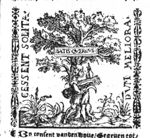
Satis quercus: Printer's device 1272
Iconclass: 25G21(ACORN) fruits: acorn 41C61 flour 47I1 agriculture 54A11 Industriousness, Assiduity; 'Assiduità', 'Industria', 'Zelo' (Ripa)
Loci Communes: Lautitiae (Sumptuousness, luxuries, Somptuosités); Securitatis et tutae rei (Security and safety, Sécurité et sûreté)
IV iii 2 Malum est bonum A blessing can be a bane
Κακόν τὸ καλὸν, ἤντι μὴ καιροῦ τύχη. id est, Bonum malum fit, tempore haud datum suo. Nihil gratum quod intempestivum. Pharmacum in tempore datum, saluti est: secus datum, mortem adfert. Citatur apud Athenaeum lib.7. hic versiculus ex Timone, ὥρη ἐρᾶν, ὥρη δὲ γαμεῖν, ὥρη δὲ πεπανσθαι. id est, Tempus amandi, tempus habendae coniugis, est quod Rebus ab his tandem moneat desistere tempus.
Κακόν τὸ καλὸν, ἤντι μὴ καιροῦ τύχη, A blessing can be a bane if it is not received at the proper time. Nothing that is untimely is pleasing. If given at the proper time, a drug brings recovery; if not, it brings death. In book seven Athenaeus cites this verse from Timon: 'There's a time to love, a time to wed, a time to end all that.'
Facsimile:
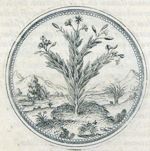
Bonum et malum: Camerarius, Symbolorum et Emblematum Centuria(e) (Nürnberg, 1590, 1595, 1596, 1604), emblem 79
Iconclass: 11Q7562 blessing (either of things or persons), e.g. by anointing 13B42 bewitching, cursing, casting spells 54B121 'Occasio', 'Kairos'; 'Occasione' (Ripa)
Loci Communes: Intempestiva et inepta (Untimely and inept things, Choses inopportunes et ineptes)
IV iii 3 Caricum sepulcrum A Carian tomb
Καρικὸς τάφος. i. Caricum monumentu. De re magnisica sumptuosaque. Sumptum a Mausoli sepulcro, quod est apud caras. Plin. lib. 36. cap. 5. ostendit opus hoc inter septem orbis miracula comemoratum, idque potissimum ob artificum famam. Patebat ab austro et septentrione sexagenos ternos pedes. Brcuius a frontibus, toto circuitu pedes quadringentos undecim. Attollebatur in altitudinem 25. cubitis. Cingebatur columnis 46. Ab oriente caelaverat Scopas, a septetrione Byras, a meridie timotheus, ab occasu Leochares. Opere nondum absoluto periit Artemisia. Latini huiusmodi monumenta vocant mausolea. Martial. lib. 1. Aere nec vacuo pendentia mausoleae. Item Propertius lib. 3. Nec Mausolei dives fortuna sepulcri.
Καρικὸς τάφος, A Carian monument. Said of a splendid and costly object. Derived from the tomb of Mausolus in Caria. Pliny in book thirty-six, chapter five, says that this was thought of as one of the seven wonders of the world, particularly because of the fame of the artists who worked on it:
On the north and south side it stretched for sixty-three feet. The facades are
not so long, the complete perimeter being four hundred and eleven feet. It
rose to a height of twenty-five cubits and was enclosed by forty-six columns.
The east side was carved by Scopas, the north by Bryax, the south by Timotheus
and the west by Leochares.
Artemisia died before it was completed. In Latin such monuments are called mausolea: so Martial in book one, 'the Mausoleum poised on empty air,' and Propertius in his third book, 'not the sumptuousness of the tomb of Mausolus.'
Facsimile:
Iconclass: 25M5 Mausoleum at Halicarnassus (Wonder of the World)
Loci Communes: Profusio (Extravagance, Prodigalité)
IV iii 4 Malum munus A bad gift is as good as a loss
Κακόν γε δῶρον ἵσον ἐστὶ ζημΐᾳ. id est, Munus malum est perinde uts dispendium. Nocet, non iuvat, qui largitur noxia. Veluti si quis adolescenti subministret pecuniam, aut stulto comittat imperium.
Κακόν γε δῶρον ἵσον ἐστὶ ζημΐᾳ, A gift is evil in proportion to the losses it causes. Those who give a harmful gift do not help, but cause damage; for example, if anyone were to supply a young man with money, or entrust a position of authority to a fool or a priesthood to an uneducated man.
Facsimile:
Iconclass: 33A4 bringing gifts; exchanging gifts 54AA5:55A1 Badness❧Acquisition, Gain, Profit 55AA1 Loss
Loci Communes: Munus non munus (A gift that is not a gift, Un présent qui n'en est pas un)
IV iii 5 Inani spe flagrat Burning with empty hopes
Κεναῖσιν ἐλπίσι θερμαίνεται. id est, Inanibus spebus incenditur. In eum, qui srustra sibi magna pollicetur. Spes enim stultis addit animos, etiasi procul absint. Sapiens etiam si sperat, dissimulat, Decetptu apparet ex Sophocle, apud quem Aiax ita loquitur: Οὐκ ἂν πριαίμην οὐδενὸς λόγου βροτὸν Ος τις κεναῖσιν ἐλπίσιν θερμαίνεται. id est, Haud emero virum mente nullae praditum, Quemcumque inanes spes movent et incitant. Aeschynes contra Timarchum, ἐλπίδων κενῶν ἐμπλήσας. i. posteaquàm illum implesset inanibus spebus.
Κεναῖσιν ἐλπίσι θερμαίνεται, He is ablaze with empty hopes. Of a man who futilely promises himself great things. For hope gives courage to the foolish, even if their aspirations are very far from being realized. Even if he has hopes, the wise person conceals them. It is clearly taken from Sophocles, where Ajax says this: 'I would not buy a foolish man who is spurred on by empty hopes.' Aeschines in Against Timarchus: 'After filling him with empty hopes.'
Facsimile: 
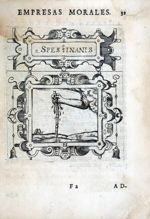
Spes inanis: Borja, Empresas morales (Bruxelles, 1680), emblem 15 paraphrases the adage
Iconclass: 51CC19:56D1 No Result, Lack of Result, Inefficacy, Futility❧Hope; 'Speranza', 'Speranza delle fatiche' (Ripa) 52AA51 Folly, Foolishness; 'Pazzia', 'Sciocchezza', 'Stoltitia' (Ripa) 54BB3 Inutility, Noxiousness; 'Nocumento', 'Nocumento d'ogni cosa' (Ripa)
Loci Communes: Frustrata spes (Frustrated hope, Espoir déçu)
IV iii 6 Volvitur dolium A barrel rolls easily
Κεκύλισθαι ὁ πίθος. i. Revolutum est dolium. In eum qui commovetur alieno exemplo, sive instinctu ad stulte quid faciendum. Nam dolium facili impul su quo velis voluitur. At sapiens tetragono similis, semper fixus et immotus. Apparet esse natum ab historia de Diogene in publico civitatis tumultu voluente dolium, quam resert Lucianus li. de conscribenda historia.
Κεκύλισθαι ὁ πίθος, The barrel is rolled. Said of those who are stirred to do some foolish action, following the example or instigation of others. For a barrel can be rolled to where you want it to go by the slightest push. The wise man, however, is like a cube, always fixed and unmoveable.1 The proverb clearly originated in the story of how Diogenes rolled a barrel at a time of civic turmoil. Lucian tells this story in How History Should Be Written.
Facsimile:
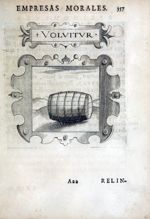
Volvitur: Borja, Empresas morales (Bruxelles, 1680), emblem 175
Iconclass: 47C2433 rolling (industrial process) 52AA51 Folly, Foolishness; 'Pazzia', 'Sciocchezza', 'Stoltitia' (Ripa) 53A21:49D452 Constancy, Tenacity; 'Costanza', 'Tenacità' (Ripa)❧hexahedron, cube 53AA21:41A775 Inconstancy; 'Incostanza', 'Instabilità', 'Instabilità overo Incostanza' (Ripa)❧wooden container: barrel, cask
Loci Communes: Inanis opera (Vain effort, Effort vain)
IV iii 7 Ceram auribus obdis Your ears are stopped with wax
Κηρὸν τοῖς ὠσὶν ἐπαλείφεις, id est, Ceram auribus oblinis. Ineos qui recusant audire vel aequa, vel iniqua. Natum ab Ulyssis cera, qua suas ac sociorum aures obturat apud Homerum, adversus Sirenatum cantilenas.
Κηρὸν τοῖς ὠσὶν ἐπαλείφεις, You stop up your ears with wax. Said of those who refuse to listen to anything, good or bad. Its origin is the story in Homer of how Ulysses blocks up his and his companions' ears with wax to counteract the enchanting song of the Sirens.
Facsimile:
Iconclass: 31A2213 ears 31A412 deaf, deafness 49L651 sealing wax 52E3 Counsel; 'Consiglio' (Ripa) 53DD1:31A32 Refusal❧hearing, listening (one of the five senses)
Loci Communes: Attentio et contra (Attention and its opposite, Attention et son contraire)
IV iii 8 Corvi lusciniis honoratiores Crows are more revered than nightingales
Κόρακες ἀνδόνων αἰδεσιμώτεροι. i. Corvi lusciniis honoratiores. Cum indocti doctis praeferuntur, improbi probis, blaterones eloquentibus, rapaces ac furaces cordatis et integris viris Aut cum plus tribuitur improbitati et audaciae, quam eruditioni ac sapientiae.
Κόρακες ἀνδόνων αἰδεσιμώτεροι, Crows are more revered than nightingales. Used when ignorance is preferred to erudition, wickedness to honesty, blethering nonsense to eloquence, or when plunderers and thieves are preferred to those who are prudent and are of impeccable character; or when more respect is given to wickedness and shameless behaviour than to erudition and wisdom.
Facsimile:
Iconclass: 25F32(CROW) song-birds: crow 25F32(NIGHTINGALE) song-birds: nightingale 52AA1:53A11 Stupidity, Poverty of Intellect; 'Stupidità overo Stolidità' (Ripa)❧Choice; 'Elettione' (Ripa) 57B2 Respect, Reverence, Esteem 59CC21 Inequality, Inequity, Iniquity; 'Iniquità' (Ripa)
Loci Communes: Excellentia, inaequalitas (Excellence, inequality, Excellence, inégalité)
IV iii 9 Commune naufragium A shipwreck shared
Κοινὸν ναύγιον τοῖς πᾶσι παραμύθιον. i . Commune naufragium, omnibus solatium. Multo facilius fertur malum, quod nobis est cum omnibus, art cum multis comune. Quin et hodie iactatur inter Scholasticos: miserum est solatium habere calamitatis socium.
Κοινὸν ναύγιον τοῖς πᾶσι παραμύθιον, A shipwreck shared is consolation to all. We bear a misfortune much more easily if it is common to all or shared with many. Why, even today we hear the scholastics say, 'It is poor consolation to have a companion in disaster.'
Facsimile:
Iconclass: 46A8211(+0) communal sharing of everything (+ variant) 46C291 shipwreck 54FF11 Adversity, Misfortune, Bad Luck; 'Fortuna infelice', 'Infortunio' (Ripa) 56BB19 Consolation 56BB21 Calamity, Distress; 'Calamità', 'Calamità o miseria' (Ripa) 59A1 Sociality
Loci Communes: Infortunii sive exitii (Misfortune or ruin, Malheur ou ruine)
IV iii 10 Cyparissi fructus The fruit of the cypress
Κυπαρίττου καρπὸς. i. Cyparissi fructus, de verbis dictu magnificis, ceterum inutilibus. Proverbium fluxit a natura arboris, quam plin. lib. 16. scribit, natu morosam esse, fructu supervacuam, baccis toruam, foliis amaram, odoreviolentam, ac ne umbra quidem grationsam. Hactenus Plinius Atque huiusmodi cum sit, tamen proceritate, unde et conifera vocatur a poetis, ac perpetuo virore, neque non nascendi difficultate, novu aliquem fructum polliceri videtur. Theophrastus autem libro de causis plantarum scribit semen cupressi adeo esse minutum, ut vix oculis percipi possit Neque enim huius esse fructum totum id quod pilae specie gerit, sed quod cono innascitur, per quam tenue et exile, laricis seminl proximum, quod pilula sua dehiscente dilabitur, nec legi nisi ab experto potest.
Κυπαρίττου καρπὸς, The fruit of the cypress. Applied to fine-sounding, but useless words. The proverb has come from the nature of the tree, which Pliny says in book sixteen 'grows grudgingly, has useless fruit, astringent berries, bitter-tasting leaves, a strong smell, and does not even afford agreeable shade'; so Pliny. Although it has these features, it always seems to promise some new fruit, because of its great height (which is why it is called 'cone-bearing' by poets) and its continuous greenness, and especially because of the slowness of its growth. In book one of Causes of Plants Theophrastus writes:
The seed of the cypress is so tiny that it can scarcely be seen. For its seed
is not the whole fruit, which looks like a ball, but is what grows in the
cone, being extremely thin and narrow (very like the seed of a larch tree),
and when the ball splits open the seed slips out; an expert is needed to
gather it.
Facsimile:
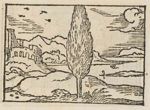
Vne beaulté ne vault rien sans bonté: La Perrière, Le theatre des bons engins (Lyon, 1545), emblem 65 uses the imagery of the fruits of the cypress tree to convey the idea that a beautiful appearance can hide uselessness
Iconclass: 25G21 fruits 25G3(CYPRESS)(+34) trees: cypress (+ bearing fruit) 52D1:31B6235 Communication of Thought❧speaking 54BB3 Inutility, Noxiousness; 'Nocumento', 'Nocumento d'ogni cosa' (Ripa)
IV iii 11 Ματτυάζειν To eat mattya
Athenaeus Dipnosophistarum lib. 14. refert cibi genus, primum a Thessalis repertum, sed quod Athenis quodque fuerit in deliciis, cum subessent imperio Macedonum, quorum lingua dicebatur ματτυα à Graeca voce μάττω, quod est pinso, sive macero: unde dicta sit & μάζα, quae & ipsa proverbio locum fecit, ut ὑπερμαζαν dicerentur, qui lautius viverent: post quicquid esset opiparum & elegans in cibis, ματτυα dicebant, etiam in avibus, piscibus, oleribus ac fartis, & ματτυάζειν, qui suaniter viverent. Citantur in testimonium versus ex Alexide, Σκευάζετ᾽ εὐωχεῖσθε προπόσει πίνετε Λέπεσθε ματτυάζετε. id est, Facite apparatus & epulis incumbite Lepamini atque mattyazete. Caeterum Atticis λέπεσθαι dicuntur, qui intemperanter indulgent Veneri, huc ni fallimur alludetibus, quod λεπίζω sonet deglubo, quae vox et Latinis usurpatione facta est obscoena. λέπος enim Graecis pellem significat. De Mattyis, qui plura volet cognoscere, legat finem decimiquarti libri, quem modo citavi, & mattyis explebitur affatim. Tot autoribus Athenaeus docet quid sit mattya. Idem lib. 4. tradit apud Lacedaemonios ματτύην dicta bellaria, quae post αἴκλον, id erat convivii genus, apud illos dabantur, quae quidem, & ἐπαίκλα vocabantur.Meminit huius cibi & Martialis li. 9. Mattya sola iuvant.
Athenaeus in book fourteen of the Doctors at Dinner tells of a kind of food that was first discovered by the Thessalians but which was also a favourite in Athens when the city was under the control of the Macedonians. This food was called ματτύα in their language, from the Greek word μάττω, meaning 'to pound' or 'to soften.' It was then also called μάζα, and this too gave rise to a proverb: those who lived rather luxuriously were said Υπερμαζᾶν 'To eat too much barley-bread.' Later, the name ματτύα was given to every kind of food that was rich and luxurious, including fowl, fish, vegetables, and stuffings, and those who enjoyed this very pleasant way of life were said Ματτύαζειν 'To be mattya-eaters.' In support are cited verses from Alexis: 'Make preparations, set to the feast, λέπεσθε "husk nuts," and eat mattya.' But in Attic Greek λέπεσθαι is a verb used of those who indulge excessively in sex. This alludes, if I am not mistaken, to the fact that λεπίζω means deglubo 'peel off,' a word that has acquired an obscene meaning in Latin also; for λέπος means 'skin' in Greek. Anyone who wishes to discover more about mattya should read the end of book fourteen, which I have just cited. He will have his fill and more of mattya, so many sources does Athenaeus use to explain the meaning. In book four he also tells us that among the Spartans a dessert was called ματτύη. This was served at the end of an αἶκλον, a form of banquet, and these were also called ἐπαϊκλα. Martial mentions this food in book nine: 'Only mattya delight.'
Facsimile:
Iconclass: 31A3411 agreeable taste 41C10 gastronomy, the art of eating and drinking 41C11 eating 55B2 Luxury, Luxuriousness
Loci Communes: Lautitiae (Sumptuousness, luxuries, Somptuosités)
IV iii 12 Matioloechus Matioloechus
Ματιολοιχὸς vulgato convitio dicebatur liguritor, et in mimimis etiam rebus exquisitus. Quin et Hesychius indicat quod pusillum sit, id Graecis dici ma/tion. Aiunt autem esse cibi cibi genus. Equidem in comentariis Graecorum invenitur ma/tion vocari, quod est mini mum, aut genus mensurae. Proinde quadrat in eos qui per fraudem minimis e rebus sectatur compendium Ἀπὸ τοῦ ματίου καὶ λοχεῦσαι, nisi mavis a λείχειν. Usurpatur ab Aristoph. in Nebulis, intermulta epitheta, quibus virum improbu notat. Interpres tam varie exponit, ut satis sateatur se nescire, scribes dici de eo, qui malinam dat mensura, de parco ac sordido, de eo, qui cogitat inania, sive nan ciscitur frivola.
Used as a common term of abuse for a gourmand and someone who was very fastidious about even the most trivial of things. Hesychius actually points out that[greek] means 'insignificant' in Greek. It is said to be a type of food. In the Greek Collections I find that [greek] either means 'very small' or is a type of measurement. Therefore[greek] fits those who try to save themselves money in even the most trivial things by cheating, being from [greek] and [greek] 'to produce, give birth,' unless you prefer to derive the second part from [greek] Aristophanes uses the word in the Clouds in a list of many epithets that he applies to a scoundrel. The scholiast explains it in several different ways, saying that the word is used of those who give short measure or of those who are mean and miserly, or of those who have silly ideas or who collect worthless objects - a sufficiently clear admission of his ignorance.
Facsimile: 
Iconclass: 41C10 gastronomy, the art of eating and drinking 55B2 Luxury, Luxuriousness 55CC1 Saving, Frugality, Parsimony; 'Parsimonia' (Ripa)
Loci Communes: Asperitas, morositas (Harshness, moroseness, Rudesse, morosité)
IV iii 13 Post Marathonem pugna Another battle follows Marathon
Μετὰ τὴν μαραθῶνα μάχη. i. Post Marathone praelium. Ubi quis post calamitatem in aliam novam rursus incidit. Marathon locus est Atticae, crebris cladibus insignis, ubi acerrima pugna fuit cum Persis. Refert Hetodotus lib. 6. Simile huic: μετὰ τὴν πόλεμον ταραχὴ, Post bellum tumultus.
[greek] Another battle follows Marathon. Used when after one dangerous situation someone encounters another new one. Marathon is a place in Attica, famous for many disasters. A very fierce battle with the Persians took place there. Herodotus tells of it in book six. Similar to this is the proverb Mera [greek] 'After war there is upheaval.'
Facsimile:
Iconclass: 45H3 battle 54DD51 Danger; 'Pericolo' (Ripa) 61E(MARATHON) names of cities and villages (MARATHON)
Loci Communes: Malum conduplicatum aut renovatum (Evil doubled or renewed, Mal redoublé ou renouvelé)
IV iii 14 Ne vities Musicam Don't ruin the music
Μὴ κακούργει τὴν μουσικὴν. i. Ne vities musicam, id est, ne loquaris discrepantia, ne nova moliaris. Plutarchus in Apopht. refert ita loquutum Emerepen, in Phtynidis cantotis organo duas ex novem incidentem sides, quod septem satis esse duceret.
[greek], Don't ruin the music. This means that you should not say discordant words or try new-fangled things. Plutarch relates in his 'Sayings of Spartans' that Emerepes said this when he cut off two of the nine strings on the instrument of Phrynis, a musician, because he thought that seven were sufficient.
Facsimile:
Iconclass: 22D12 disharmonious sound, dissonance 47C31 cutting (industrial process) 48C731 string instruments (bowed) 51DD2 Disharmony, Irregularity
Loci Communes: Modestia modusque (Modesty and moderation, Modestie et mesure)
IV iii 15 Astutior coccyce As crafty as a cuckoo
Μηχανικώτερος κόκκυκος. i. Coccyce astutior, dicebatur, qui astu sibi consuleret. Sumptum ab avis ingenio, ova subicientis in nidos alienos, maxime palumbium, de qua abunde Plinius & Aristoteles.
[greek], Craftier than a cuckoo. Said of those who shrewdly looked after their own interests. Taken from the nature of the bird, which lays its eggs in other birds' nests, especially those of doves. Pliny and Aristotle describe it in great detail.
Facsimile:
Iconclass: 25F39(CUCKOO) other birds: cuckoo 57AA6122 Sponging, Parasitizing 57AA65 Selfishness; 'Interesse', 'Interesse proprio' (Ripa)
Loci Communes: Proprii commodi studium (Pursuit of one's own advantage, Recherche de son propre intérêt)
IV iii 16 Hesperidum mala The apples of the Hesperides
Μῆλα ἑσπερίδων δωρῆσαι. i. Mala Hesperidum largiri, qui magna splendidaque largirentur. Nota est fabula de malis aureis. Huc allusisse videtur Maro noster in Buc. carmine: Aurea mala decem misi, cras altera mittam.
[greek], To give the apples of the Hesperides as a gift. Said of someone giving splendid and magnificent presents. The story of the golden apples is well known. Our Maro seems to allude to it in his Eclogue: 'I have sent ten golden apples, I shall send you another ten tomorrow.'
Facsimile:
Iconclass: 55C21 Generosity, Liberality; 'Generosità', 'Liberalità' (Ripa) 93F3 the golden apples of the Hesperides
Loci Communes: Magnifica promissa (Magnificent promises, Promesses magnifiques)
IV iii 17 Solae Lacaenae viros pariunt Only Spartan women produce men
Μόναι λάκαιναι ἄνδρας τίκτουσι. i. Solae Lacaenae viros pariunt. Apud Lacedaemones fortissimi viri nascebantur, & apud eosdem matres severe natos educabant. Natum est proverbium ex apophthegmate Gorgûs Lacaenae leonidae uxoris, cui cum peregrina regrina quaepiam dixisset, Μόναι τῶν ἀνδρῶν ἄρχετε ὦ λάκαιναι. i. Solae viris imperatis Lacedaemoniae: respondit, Μόναι γὰρ τίκτομεν ἄνδρας id est, Solae enim parimus viros. Refert Plutar. in vita Lycurgi.
[greek], Only Spartan women produce men. The strongest men were born in Sparta, where mothers brought up their sons very strictly. The origin of the proverb is an apophthegm of Gorgo, the Spartan wife of Leonidas. When a foreign women said to her, 'Only you Spartan women hold sway over men,' Gorgo replied, 'Yes, for only we produce men.' The story is told by Plutarch in his Life of Lycurgus.
Facsimile:
Iconclass: 42A211 woman giving birth (lying-in) 54A7 Strength, Power; 'Fortezza', 'Fortezza d'Animo e di corpo', 'Fortezza del corpo congiunta con la generosità dell'animo', 'Fortezza & valore del corpo congiunto con la prudenza & virtù del animo', 'Forza' (Ripa) 54A81 Fearlessness, Intrepidity; 'Intrepidità & Costanza' (Ripa) 98C(SPARTAN WOMEN) (story of) the women of Sparta
Loci Communes: Dignitatis (Dignity, Dignité); Fortitudo (Courage, Courage); Longae vitae (A long life, Longue vie)
IV iii 18 Myrteam coronam ambis You want a crown of myrtle
Μυῤῥινοῦν. i. Myrteam cuperc dicebatur, qui tyrannidem, aut magistratum ambiret. Nam olim principes myrteis corollis coronabatur, siquidem Suidae credimus.
[greek], To want myrtle. Said of some one seeking to be king or magistrate. For in antiquity, if we believe Suidas, leading men of the state were crowned with myrtle wreaths.
Facsimile:
Iconclass: 44B191:25G31(MYRTLE) crown (symbol of sovereignty)❧shrubs: myrtle 56F11 Ambition; 'Ambitione', 'Amor di Fama' (Ripa)
Loci Communes: Dignitatis (Dignity, Dignité)
IV iii 19 Praevertit ancorae jactum Deus God forestalls the dropping of the anchor
Αλλ᾽ ἀντέπεσσε τὴν ἐπ᾽ ἄγκυραν θέος. id est, Sed antevertit ancorae iactum deus. Cum res praeter spem evenit. T raductum a nautis, quibus accidit saepenumero, ut cum parant sese ut ancoram iaciant, in portum appulsuri, repellantur a ventis, et in mediam tempestatem revocentur.
[greek], But God acts before the anchor is dropped. Said when something happens unexpectedly. It comes from sailing. When sailors are preparing to drop anchor as they are about to put into port, their ships are often driven back by the winds and pulled back into the middle of a storm.
Facsimile:
Iconclass: 26C32 storm at sea 46C22 harbouring 52BB3 Surprise, Wonder; 'Maraviglia' (Ripa)
Loci Communes: Frustrata spes (Frustrated hope, Espoir déçu)
IV iii 20 Pro Delo Calauriam Calauria for Delos
Αντὶ δήλου τὴν καλαυρίαν. i. Pro Delo Calauriam. Est in fabulis, Neptunum cum Latona permutationem fecisse, ut illa Calauriam insulam Neptuno concederet, possideret Delum, proque dato Taenaro reciperet Pythonem. Est autem Calauria exigua insula, haud procul à Creta. Pausanias in Corinthiacis tradit Calauriam olim fuisse sacram Apollini, Delphos Neptuno, hos inter se commutasse loca. Meminit eius rei Strabo quoque libro octavo: Troezen, inquit, sacra Posidoni, id est, Neptuno est, unde & Posidonia dicta quondam. Eminet autem è mari ad quindecim stadia: ne ipsa quidem obscura civitas. Huius portui dicto Pogon imminet Calauria, exigua insula, circuitu stadiorum triginta. Hic erat asylum Neptuno sacrum. Et fama est hunc Deum commutatione facta cum Latona, data Delo recepisse Calauriam, Cum Apolline vero, pro Pytho recepisse Taenarum. Ephorus autem ipsum refert oraculum, ἴστον τοι, δῆλόντε καλαυρίαν τε νεμέσθαι, Πυθώντ᾽ ἠγαθέην καὶ ταίναρον ἠνεμόεντα. id est, Nil refert Delos fueriive Calauria culta, Pythósve excellens, an pervia Taenarus auris Ea res in proverbium abiit, quoties manus manum lavat, et officium officio pensatur.
[greek], Calauria for Delos. There is a story that Poseidon made an exchange with Leto: she gave him the island of Calauria and in return took possession of Delos; for giving him Taenaros she received Pytho. Calauria is a small island not far from Crete. In his 'Corinthian Matters' Pausanias tells us that Calauria was once sacred to Apollo, and Delos to Neptune, and that they exchanged these places. Strabo too mentions this in book eight. He says: Troezen was sacred to Poseidon (that is, Neptune). Consequently it was once called Posidonia. It occupies an elevated site about fifteen stades from the sea. The town itself is quite important. Near its port, called Pogon, lies Calauria, a small island, thirty stades in circumference. Here there was a sanctuary sacred to Neptune. The story is that this god made exchanges with Latona and Apollo. He received Calauria in return for Delos, and Taenarus for Pytho. Ephorus reports an actual oracle: 'It makes no difference whether you live on Delos or Calauria, or on lofty Pythos or windy Taenarus.' This was used proverbially whenever 'one hand washed the other' and one service was repaid by another.
Facsimile: 
Iconclass: 25H14:61D(CALAURIA) island❧geographical names of countries, regions, mountains, rivers, etc. (CALAURIA) (CALAURIA) 25H14:61D(DELOS) island❧geographical names of countries, regions, mountains, rivers, etc. (DELOS) (DELOS) 33A4 bringing gifts; exchanging gifts 54A6 Helpfulness 54E11(+0) Necessity of Mutual Co-operation (+ variant) 91B135 Latona (Leto) 92H1 (story of) Neptune (Poseidon)
Collectanea (1500): 694
Loci Communes: Pensatio beneficii vel officii (Repayment of a favor or duty, Rétribution d'un bienfait ou d'un devoir)
IV iii 21 Antiquior Codro As old as Codrus
Πρεσβύτερος κόδρου. De priscis, & ob antiquitatem admirandis. Codrus antiquissimus Atticae rex, cuius alibi nobis facta mentio. Ad huc genus suum referebant, qui generosi videri volebant.
[greek], Older than Codrus. About things that are ancient and worthy of admiration because of this. Codrus was a very ancient king of Attica whom we have mentioned elsewhere. Those who wished to be thought of as noble traced back their family to him.
Facsimile:
Iconclass: 31D160 Old Age, 'Senectus'; 'Vecchiezza' (Ripa) 95A(CODRUS) (story of) Codrus, king of Athens
Loci Communes: Dignitatis (Dignity, Dignité)
IV iii 22 Hirundo totos schoenos anteibit A swallow will be miles ahead
Πρόσω τις χελιδὼν ὅλους σχοίνους παρεῖται. i. Hirundo quae piam totos schoenos praeteribit. Ubi quis immeso vincit intervallo. Nam σχοῖνος Graecis mensurae genus, quae sicut existimat Herod. lib. 2, sexaginta complectitur stadia. Quemadmodum & docet Hermogenes in libello cui titulus: περὶ μεθοδου δεινότητος, ostendens esse verbum Aegyptium, quemadmodum parasanges Persicum. Etiamsi Plinius lib. 12. cap. 14. quadraginta stadia tribuit schoeno, quae efficiant passuum quinque milia. Rursus idem li. 5. cap. 10. scribit schoenum patere stadia triginta, unde varietas videtur accidisse scribarum vitio. Quanquam suspicor hoc loco Chelidonem pro viro accipiendeum, cuius alibi facta est mentio, qui haud scio an cursu celleritateque praecelluerit.
[greek], A swallow will be miles ahead. Said when anyone wins by a huge margin; for [greek] is a Greek measure that is equivalent to sixty stades, as Herodotus thinks in book two. Hermogenes also informs us of this in his essay entitled On the Method of Cleverness, pointing out that it is an Egyptian word, just as parasang is a Persian one. Pliny, however, in book twelve, chapter fourteen, attributes forty stades to the schoenus, thus making it a distance of five miles. In book five, chapter ten, he writes that a schoenus is thirty stades in length. The difference seems to have arisen by a scribal error. I suspect, however, that in this expression [greek] 'swallow' should be understood to be the name of a man, mentioned elsewhere, who probably was outstanding as a fast runner.
Facsimile:
Iconclass: 25F32(SWALLOW) song-birds: swallow 51BB3 Imparity, Inequality, Difference 51G1:54F14 Largeness, Magnitude❧Advantage
Loci Communes: Excellentia, inaequalitas (Excellence, inequality, Excellence, inégalité)
IV iii 23 Nihil cocio est Haggling brings no money
Plautus in Asinaria: Vetus est, nihili cocio est. dictum videtur in eos qui pollicentur in futurum, nec exhibent rem praesentem. Laberius apud Gellium cocionem pervulgato verbo dixit, quem veteres ariolatorem dixerunt. Dicuntur autem haec apud Comicum à lena, quae praedicabat sibi oculatas esse manus, atque id demum credere quod videret. Quod autem alii legunt coactionem, id neque carminis ratio patitur, nisi vocalem elidas. Ex Festo Pompeio propemodum licet coniicere coctionem esse legendum. Ait enim coctiones appellatos à cunctatione, quod in emendis vendendisque mercibus, tarde perveniant ad iusti precii finem. Proinde apud antiquos primam syllabam, per u literam, non per o, scribi solitam. Arbitror huic adstipulari, quod scribit Anneus Seneca libro Epistolarum undecimo, disserens non esse cessandum à benemertendo, quod aliquando inciderimus in hominem ingratum. Et post malam, inquit, segetem serendum est. Saepe quicquid perierat assidua infelicis soli sterilitate, unius anni restituit ubertas. Est tanti, ut gratum invenias, experiri et ingratos. Nemo tam certam habet manum, ut non saepe sallatur. Aberrent, ut aliquando haereant. Post naufragia, maria tentantur. Foeneratorem non fugat à foro coactor. Cito inerti ocio vita torpebit, si relinquendum est, quicquid offendit. Hactenus Seneca: Quo loco num coactor legendum sit, nécne, studiosis expendendum relinquo. Iuxta etymologiam cunctio sive cuntio, aut mutata litera contio dicendum esset, ni quod Festus Pompeius ostendit eundem esse coctionem & cocionem. Is in dictione Arulator, consentit cum Gellio, consirmans eundem esse cocionem cum arulatore. Arulatorem autem dici à voce Graeca αἶρε, id est, tolle, quod merces eas sequatur, ex quibus si quid ceciderit lucri, possit tollere.
Plautus in Comedy of Asses: 'It's an old saying, haggling is worth nothing.' It seems to be said about those who make promises for the future and do not offer ready cash. Gellius tells of Laberius using the very vulgar word cocio for what the early Romans called ariolator 'haggler.' In Plautus the expression is spoken by a bawd who declared that her hands had eyes and that they only believed what they saw. Others read coactio, but this is inadmissible metrically unless one elides the vowel [co'ctio]. From Festus Pompeius one can pretty well conjecture that coctio should be read. For he says that coctiones 'hagglers' received their name from cunctatio 'delaying' because when they were buying or selling merchandise they were very slow in finally reaching the proper price. Accordingly, the ancients customarily spelled the first syllable cu~ and not co-. This is supported, I believe, by what Seneca writes in book eleven of the Letters, arguing that one should not refrain from helping people because one sometimes encounters an ungrateful person.
Even after a bad harvest one must sow. Often the rich harvest of one year
restores all that had been lost through the persistent barrenness of infertile
soil. It is worthwhile experiencing ungrateful persons to find someone who is
grateful. No one has such a sure hand that he is not often deceived. Let them
wander so that they may get stuck sometimes. After shipwrecks, the seas are
put to the test again. A moneylender does not flee the forum because he sees
a coactor 'debt-collector' there. We shall soon waste away in idle leisure if we
avoid whatever harms us.
So much for Seneca. I leave it to scholars to decide whether or not coactor should be read in this place. From the etymology we should read cuntio or cunctio, or, with a change of letter, contio, if Festus Pompeius did not point out that coctio and cocio are the same. On the word arulator he agrees with Gellius, saying that cotio means the same as arulator: 'arulator is derived from the Greek [greek] "pick up" because he follows merchandise so as to pick up anything of value from whatever is dropped.'
Facsimile:
Iconclass: 51MM11:46B44 Slowness, Tardiness; 'Tardità' (Ripa)❧paying (~ commerce) (here also repayment of debt, etc.) 53DD2 Breach of Promise
Loci Communes: Contemptus et vilitatis (Contempt and worthlessness, Mépris et bassesse)
IV iii 24 Non navigas noctu You are not sailing at night
Οὐ νυκτὶ πλοεῖς. i. Non noctu navigas. De eo cui nihil est certi, quod sequatur, propterea quod nocturnis temporibus certius navigant nautae, propter stellarum notas, de quibus aliàs dictum est. Chrysippus, ut citant, negatione, detraxit, νύκτι πλοεῖς, manente, sicut ego quidem arbitramur, eadem sententia. Nam quid alioqui suerat memorandum, si Chrysippus citra negationem extulisset, quasi vero non idem iuris sit in quavis oratione. Quanquam autem nautae noctu stellarum indicia sequuntur, longe tamen certior interdiu navigatio.
[greek], You are not sailing at night. About a person who is not at all sure what course of action to follow. The reason is that sailors navigate more accurately at night-time, because of the stars, about which I have spoken elsewhere. Chrysippus is said to have removed the negative, saying [greek] 'You are sailing at night,' though the sense, in my opinion, remains the same. For why else should it have been mentioned here that Chrysippus had given the proverb without the negative? Surely both expressions are equally valid. And indeed, although the stars guide sailors at night, navigation is much more accurate during the day.
Facsimile:
Iconclass: 23R14 night 46C24(+33) sailing-ship, sailing-boat (+ propulsion of vehicle, ship, etc. by wind) 46C280 'Navigatione' (Ripa)
Loci Communes: Diligentiae (Diligence, Diligence)
IV iii 25 Mores hominum regioni respondent Human character matches habitat
Καὶ τῶν φυτῶν τὰ σπέρματα, καὶ τῶν ἀνθρώπων οἱ βίοι ταῖς χώραις συνεξομοιῦνται. i. Et plantarum semina, & hominum mores ad regionis habitum respondent. Refertur & hoc in Graecorum proverb. Collectaneis. Alioqui non eram adscripturus. Equidem arbitror natum ab apophthegmate, cuius meminit Plutarchus. Ut triticum in nonullis agris degenerat in aliud genus, soli vitio: ita pro qualitate regionis variantur hominum ingenia. Montani asperi fere sunt et inhumani. Littorales serme praedones et immites. Campestres molles et humani. Herodotus in calce libri ultimi, satis declarat primum e Cyri responso narum esse. Etenim cum Persae rerum potiti postularent, ut ex aspera regione, quam tum incolebant, transferrentur in commodiorem ac feraciorem, annuit quidem, sed admonitis, ut post hac sese pararent ad serviendum, non imperandum: φιλέειν γὰρ ἔκ τῶν μαλαχῶν χωρῶν μαλαχοὺς γίνεσθαι. Οὐ γὰρ τοι τῆς αὐτῆς γῆς εἶναι καρπόντε θαυμαστὸν φύειν, καὶ ἄνδρας ἄγαθοὺς τὰ πολέμια. i. Ex mollibus enim regionibus molles homines nasci solere. Neque enim eius dem esse terrae fructum egregium producere, et viros in rebellica prae stantes.
[greek] , Both the seeds of plants and the lifestyles of humans match their habitat. This is also included in the Collections of Greek proverbs. Otherwise I would not have included it. For my part I think that it originates in an apophthegm that Plutarch mentions. Just as grain degenerates into a different strain in some fields, because of the fault of the soil, so the natural disposition of humans varies according to the region in which they live. Mountain people are generally rough and cruel. Those who live by the sea are usually larcenous and pitiless. Plain-dwellers are gentle and kind. Herodotus, at the end of his final book, quite clearly states that this saying originated in a reply given by Cyrus to the Persians. After they acquired their empire, the Persians asked to be moved from the wild region in which they were then living to a more pleasant and more fruitful one. Cyrus granted their request, but he warned them to prepare after that to be slaves instead of rulers: 'Soft men spring from soft lands. For the same land cannot produce both rich harvests and outstanding warriors.'
Facsimile: 
Iconclass: 20 'Natura' (allegorical figure or scene; or as Diana of Ephesus, with many breasts); 'Natura' (Ripa) 36 man and environment 51A5(+0) Intrinsic Nature, Essence, Idea (according to Plato) (+ variant) 54D6 Custom, Habit; 'Consuetudine' (Ripa)
Loci Communes: Similitudinis et congruentiae (Similarity and congruence, Similitude et convenance)
IV iii 26 Cum cane simul et lorum The leash as well as the dog
Σὺν τῷ κυνὶ καὶ τὸν ἱμάντα. i. Una cum cane lorum quoque. Clausula est heroici carminis. Eudemus indicat dici, quoties simul omnia pereunt, ut nihil omnino sit reliqui, no spes quidem recuperadi quod periit.
[greek], The leash as well as the dog. This is the ending of a dactylic hexameter. Eudemus points out that it is said whenever everything is lost at the same time so that nothing at all remains, not even the hope of recovering what has been lost.
Facsimile:
Iconclass: 34B11 dog 34B111(+0) collar (of a dog) (+ variant) 55AA1 Loss 56DD11 Despair; 'Disperatione' (Ripa)
Loci Communes: Internitio (Utter destruction, Extermination totale)
IV iii 27 Teipsum inspice Have a good look at yourself
Μὴ τοῦμὸν ἀλλὰ καὶ τὸ σὸν φῦλος σκόπει. id est, Age non meum, verum & tuum inspicito genus. Teucer in tragoedia quapiam in Agamem nonem sibi generis vitium probro vertente, quod nothus esset, regerit huiusmodi cuoicium, quod & ipse genus duxisset a Clisthene effeminato. Stultum est in alterum dicere, quod in te possit retorqueri. Adagium resertur a Plutarcho.
[greek], Look not just at my family background, but also at your own. In some tragedy when Agamemnon insults Teucer for being a bastard, Teucer throws back this reproach, since Agamemnon was descended from the effeminate Cleisthenes. It is foolish to insult someone with anything that can be hurled back at you. The adage is in Plutarch.
Facsimile:
Iconclass: 31A5111(+0) looking in the mirror; (possibly: contemplation of own beauty) (+ variant) 52AA53 Lack of Self-knowledge
Loci Communes: Philautia (Self-love, Amour-propre)
IV iii 28 Ne mihi vacuam abstergas Don't level off what is empty
Theocritus in Syracusis: Μὴ φυῇ μελιτῶδες ὅς ἁμῶν καρτερὸς εἴη, Πλὰν ἑνὸς, οὐκ ἀλέχω, Μή μοι κεινεὰν ἀπομάξῃς. id est, Ne quis quam exsistat Proserpina, quem do minum, von Except, agnosecamus, ego id non curo, caucto, Abstergas ne mi vacuam. Subesse proverbium videtur in eo quia ait: Μή μοι κενεὰν ἀπομάξῃς. Subaudiendum autem gnaqo\n, xei=ra, aut simile quiddam. Apparet esse comminantis, aut timentis alapam, aut colaphum. Nam locus nondum satis liquet. Erudiris itaque relinquimus excutiendum diligentius. a)poma/ttein, dicuncur et plastae, quiargillam oblinunt, dum fingunt imaginem. Solent quidam simulare officium, quasi velint aliquid sordium a mala abstergere, et interim imprudenti illinunt aliquid sordium. Quemad modum inducunt Bacchu facie, gypso, et vuarum succo oblit. Interpres tamen homo nec admodum doctus, nec diligens, mavult subaudiri mensuram, fortasse χοίνικα. Quod in mensura redundat, abstergetur terete baculo. Fallit igitur qui nondu plenam absterget, ita simulans aliquid redundare. Sentit se non esse illi ancilla, ut ab eo debeat obiurgari. Heri offensi desraudant servos suo dimenso, hoc est, ni fallimur, quod ait, non sum sollicita, ne mihi mensuram vacuam abstergas.
Theocritus in the Women of Syracuse:
Persephone, let there be but one master that we recognize.
This does not bother me. Watch out you do not level off what is empty.
A proverb seems to be present in the words [greek] 'Do not level off what is empty.' We must understand 'jaw,' 'hand,' or something similar. It seems to be spoken by someone who threatens or fears a blow or punch. I say this, for the meaning of the passage has not yet been made clear. We leave it therefore for scholars to unravel the meaning more carefully. The makers of moulds, who smear clay on an object they are replicating, are also said [greek] 'to smooth away' the clay. Some people often pretend to perform a service, as when they seem to be wiping away dirt from someone's cheek, but in fact are smearing the cheek with dirt without the other's being aware of it, so that he is like Bacchus as represented on stage, with his face smeared with gypsum and grape juice. However, the commentator, neither very learned nor attentive, prefers that a measure, perhaps a choinix, be understood. Whatever exceeds the measure is levelled off by wiping away the excess with a smooth stick. So the person who does this to a measuring pot that is not yet full, pretending that there is some excess, is being deceitful. The speaker means that she is not the man's serving woman to be rebuked by him. Angry masters cheat their slaves of their daily ration. If I am not mistaken, the woman's meaning is this: 'I am not worried that you level off my pot when it is empty.'
IV iii 29 Cum fis nanus, cede Yield, since you are a dwarf
Νάνος ὢν ὕπεικε. i. Naus cum sis, cede. De pusillis dictum. Nani emin homunciones appellantur infra modu humani corporis, et prodigiosae brevitatis Iuvenalis: -Nanum Atlanta vocamus. *na/nos2 enim Graece dicitur quasi μὴ ἄνω, quod non escrescat in altum. Citatur Theophrastus, qui senserit nanos dici, quibus pudedum membrum sit iusto maius, quod in ho c hominum genere inveniri probabile est. Quadrabit in tenues, et humilis fortunae homun culos, ac quemadm odum ait Horatius, moduli bipedalis, qui potetes sumptu conantur aequare.
[greek], Yield since you are a dwarf. Said of very tiny people. For humans who are smaller than normal and of unbelievable shortness are called nani. Juvenal: 'We call a dwarf "Atlas."' The word vavos in Greek seems to come from [greek] 'not upwards' because a dwarf does not grow to any height. Theophrastus is cited as believing that those whose genitals were larger than normal were called nani. Probably this can be found to be true of such persons. The expression can be applied aptly to wretched persons who are poor and of low fortune, and, as Horace says, are 'twofooters,' trying to match their superiors in spending.
Facsimile:
Iconclass: 31A422 dwarfs 45L1(+0) surrender ~ war (+ variant)
Loci Communes: Excellentia, inaequalitas (Excellence, inequality, Excellence, inégalité); Paupertas (Poverty, Pauvreté)
IV iii 29A Nocte lucidus, interdiu inutilis Bright at night, useless in daylight
Εν νυκτὶ λαμπρὸς, ἐν φάει δ᾽ ἀνωφελής. id est, In nocte lucens luce vero inutilis. De praeposteris, qui sapiunt, ubi nihil est opus, cum opus est, ibi dormiunt. Ceteru magis videtur competere in eum. qui inter indoctos videatur aliquid esse in literis, inter eruditos nihil sapiat. Aut invertendum est proverbium: Ἐν φάει λαμπρός, ἐν νυκτὶ, δ᾿ ἀνωφελής. Sumptum a gemma quadam, evius alibi fecimus mentionem.
[greek], Bright at night, useless in daytime. Said of persons who do the opposite of what they should - those who are full of ideas when there is no need of them, but who doze off when there is. I myself, however, think that the saying is more suited to those who are thought to have some accomplishment in literature when in the company of the ignorant, but who are ignorant in the company of the learned. Or the proverb should be reversed: 'Bright in daylight, useless at night.' Taken from a precious stone that we have mentioned elsewhere.
Facsimile:
Iconclass: 22C light 23R14 night 23R2 day from sunrise to sunset 54BB2 Unnecessity, Superfluity 54BB3 Inutility, Noxiousness; 'Nocumento', 'Nocumento d'ogni cosa' (Ripa)
Loci Communes: Absurda, indecora, seu praepostera (Absurd, unbecoming, or preposterous things, Choses absurdes, inconvenantes ou déplacées)
IV iii 30 E Tantali horto fructus colligis Gathering fruit from the garden of Tantalus
Ταντάλου κῆπον τρυγᾶς. i. Ex Tan tali horto fructum colligis, id est, ea consectaris, quae nusquam sunt, aut quibus frui non licet. Quod quidem apposite dicetur in mundanis addictos voluptatibus. Nam ii dum his veluti temulenti fruuntur, egregie felices sibi viden tur. Verum sumul atque resipuerunt, iam velut experrecti, in telligunt omnial illa nihil suisse, nisi mentis non admodum sanae somnium.
[greek], You are gathering fruit from the garden of Tantalus. In other words, you are pursuing what does not exist or what you cannot enjoy. It will be appropriate to say this of those who are slaves to worldly pleasures. While they are enjoying such pleasures like drunkards, they think that they are extremely lucky. As soon as they have come to their senses, however, they are like those who have awakened and realize that all these pleasures are only the dreamlike creations of a quite irrational mind.
Facsimile: 
Iconclass: 47I4131 picking fruit 54BB3 Inutility, Noxiousness; 'Nocumento', 'Nocumento d'ogni cosa' (Ripa) 93E81 Tantalus, suffering eternal hunger and thirst
Loci Communes: Absurda, indecora, seu praepostera (Absurd, unbecoming, or preposterous things, Choses absurdes, inconvenantes ou déplacées)
IV iii 31 Telenico pauperior As poor as Telenicus
*teleni/kou pene/steros2, id est, Telenico pauperior. Nam is usque adeo notae paupertatis fuit, ut Seriphii verbum inde sinxerint, dicantque telenikh=s1ai pro evacuare.
[greek], Poorer than Telenicus. His poverty was so notorious that the people of Seriphos fashioned a word after him; they say [greek] 'to do a Telenicos' for 'to empty one's bowels.'
IV iii 32 Telenicia echo An echo of Telenicus
Τελενίκιος ἠχὼ. i. Telenicia echo, recte dicetur oratio fatui. Sic. n. vocant creprtum vasculorum inanium. Sumpto epitheto ab eodem, de quo diximus Telenico. Quamquam Plutarchus inter argute dicta Epaminondae, meminit Tellenis cuius dam pessimitibicinis, cui dissimilimus fuerit Antigenidas. Expendat igitur lector an ab hoc malit deductum proverbium. Etenim de Tellenis cantilenis alias nobis dictum est.
[greek], An echo of Telenicus. It will be appropriate to describe the words of a fool in this way. For this is how the sound of empty barrels is described. The adjective is taken from the same Telenicus about whom we have just spoken. Plutarch, however, mentions among the witty sayings of Epaminondas a certain Tellen, a dreadful flute-player, who was very unlike Antigenidas. Let the reader judge therefore whether he prefers to derive the proverb from this person. And indeed I have spoken elsewhere about Tellen's songs.
Facsimile:
Iconclass: 22D4 echo 31B8 fool, simpleton, numskull 51II2:41A775 Emptiness, Void❧wooden container: barrel, cask 98B(TELENICUS) male persons from classical history (TELENICUS)
Loci Communes: Garrulitas (Talkativeness, Bavardage)
IV iii 33 Terebintho stultior As stupid as a turpentine-tree
Τερεβίνθου ἀνοήτερος. i. Terebintho dementior, in stupidum sibique placentem, quod arbor ea late porrigat ramos, quod est insolenter ostentantium sese, ad haec nigrore insignis, foliis crassis, succo ite pingui et resinoso, tum alias alia specie. Parit quidem cum vite, sed dissimilem fetum.
[greek], More foolish than a terebinth tree. Directed at those who are stupid and very proud of themselves, since this tree spreads its branches far and wide, the characteristic of those who are arrogantly ostentatious. In addition the tree is marked by its black colour, thick foliage, sap that is oily and resinous, and it has a different appearance in different places. It brings forth its fruit at the same time as the vine, but produces a very different kind.
Facsimile:
Iconclass: 25G3(TEREBINTH) trees (TEREBINTH) 25G3(TURPENTINE TREE) trees (TURPENTINE TREE) 52AA1 Stupidity, Poverty of Intellect; 'Stupidità overo Stolidità' (Ripa) 57AA64 Pride, Loftiness; 'Alterezza in persona nata povera civile' (Ripa)
Loci Communes: Multi - in stupidos (Many people - against the stupid, Beaucoup de gens - contre les sots)
IV iii 34 Moenia Semiramidis The walls of Semiramis
Τείχη σεμυράμιδος. i. Muri Semyramidis, de muris inexpugnabilibus dicebatur, egregieque munitis. Ouidius lib. Metamorphoseon quarto: Ubi dicitur altam Coctilibus muris cinxisse Semyramis urbem.
[greek], The walls of Semiramis. This was said of walls that could not be breached and were extremely well fortified. Ovid in the fourth book of the Metamorphoses: 'Where Semiramis is said / To have surrounded her city with walls of brick.'
Facsimile:
Iconclass: 25I146:54A71 city-walls❧Invincibility 45K14 fortified city 61E(SEMIRAMIS) names of cities and villages (SEMIRAMIS)
Loci Communes: Securitatis et tutae rei (Security and safety, Sécurité et sûreté)
IV iii 35 Manum admovere To add your hand to
Τὴν χεῖρα ἐπιβάλλειν. i. Manu apponere dicebantur, qui sese insinuarent in rei cuiuspiam egregiae comm unionem. Translatum à sacris, in quibus nonnunquam fieri solet, ut aliis rem diumam facientibus, alius aliquis advenies, admota victimaemanu, fiat et ipse particeps sacrificii.
[greek], To put a hand to. This was said of those who insinuated themselves into some important event and thereby shared in it. It is taken from ritual where it sometimes happened that when people were offering sacrifice someone else came up and put his hand on the victim so that he himself became part of the ritual.
Facsimile:
Iconclass: 12B212 sacrifice ~ non-Christian religions 31A2512(+934) arm stretched forward (+ reaching for somebody or something, seizing something, touching)
Loci Communes: Industria (Industriousness, Application, diligence); Proprii commodi studium (Pursuit of one's own advantage, Recherche de son propre intérêt)
IV iii 36 Patris est filius He is his father's son
Τοῦ πατρὸς ἐστὶ τὸ παιδίον. i. Patris est filius. Ita loquuntur, ubi quis mores imitatur patrios. Et in genere, eius filium vocamus quemliber, quem moribus expresserit, quod liberi veroparentes referre solenant. Hunc titulum Varro uni ex Menippeis indidit, citante Nonio Marcello. Varronis autem tituli fere proverbiales sunt. Philostratus in Aristide commemorat, sophistam hoe proverbio notasse Alexandru, quod patris ambitionem imitaretur.
[greek], He is his father's son. This is said when anyone imitates his father's traits; and in general we call anyone at all the son of a person whom he resembles in his traits, because almost always children remind one of their parents. Varro gave this title to one of his Menippeans, cited by Nonius Marcellus. Indeed the titles of Varro are usually proverbial. In his Aristides Philostratus mentions that a sophist used this proverb to impugn Alexander because he was imitating his father's ambition.
Facsimile:
Iconclass: 42B7411 father and son(s) (family group) 51B2 Similarity, Likeness
Loci Communes: Similitudinis et congruentiae (Similarity and congruence, Similitude et convenance)
IV iii 37 Parvo emtas carnes Cheap meat feeds the dogs
Τὸ ἐύωνον κρέας οἱ κύνες ἐσθιουσιν. i. Parvo emptas carnes, canes edunt. Quidam putria emunt obsonia, ne plusculu insumant nummorum. Ea cum nullus attingit, canib. aliquoties edenda servantur. Sapit et hoc vulgus horum temporuni.
[greek], It's the dogs that eat cheap meat. Some people buy rotting meat to save some money. When no one touches the meat, it is kept to provide several meals for the dogs. This adage also smacks of the common herd of our own times.
Facsimile:
Iconclass: 34B11(+1) dog (+ feeding animal) 34B11(+945) dog (+ animals eating and drinking) 41C69:54BB6 meat; still life of meat❧Worthlessness
Loci Communes: Sordes et parcimonia (Meanness and stinginess, Bassesse et avarice)
IV iii 38 Qui domi compluitur Not even God pities the man who is rained upon in his own house
Τὸν οἴκοθεν βρεχόμενον οὐδὲ θεὸς οἰκτείρει. i. Qui domi compluitur, huius ne deum quidem miseret, vulgo Graecis iactatum. Sensus est eum modis omnibus suo malo videri dignum, qui sit usque adeo ignavus, ut nec domi suae possit a pluvia tutus esse. Eiusdem farinae cum superiore proverbium.
[greek], Not even God pities the man who is rained upon in his own home. A common saying among the Greeks. The sense is that those who are so lazy that they cannot be safe from rain even in their own homes completely deserve their misfortune. Unless my nose completely deceives me, the proverb is 'of the same flour' as the previous one.
Facsimile:
Iconclass: 26B:41A2 rain❧interior of the house 51AA4:57A75 Nothingness, Absence❧Mercy, Compassion; 'Compassione', 'Misericordia' (Ripa) 54AA11 Sluggishness, Inertia; 'Dapocaggine', 'Pigritia' (Ripa)
Loci Communes: Ignavia et inscitia (Cowardice and ignorance, Lâcheté et ignorance)
IV iii 39 Tragicus Theocrines A Theocrines, the tragic actor
Τραγικὸς θεοκρίνης. i. Tragicus Theocrines. Usurpavit hoc adagium Demosthenes adversus Aeschinem. Theocrines primum tragoediarum auctorfuit, deinde calumniator, et sycophanta. Unde Demosthenes in oratione pro Ctesiphonte, Aeschinem Tragicum Theocrinem vocat. Exstat eiusdem adversus hunc Theocrinem oratio, quan quam nonulli Dinarcho tribuunt. Usus est hoc proverbio divus Hieronymus, ni fallimur, in epistola ad Furiam de viduitate: Ubicumque viderent Christianum, statim illud de trivio, tragiko\s2 qeokri/nhs2. Hoc convicii iaciebant in Christianum, quasi sanctimoniae simulator magnificis verbis aliorum vitam criminaretur.
[greek], Theocrines, the tragic actor. Demosthenes used this adage against Aeschines. Theocrines was first of all an actor in tragedies, then a bringer of false accusations and an informer. Accordingly, in his speech In Defence of Ctesipho Demosthenes calls Aeschines 'A Theocrines, the tragic actor.' A speech of Demosthenes against this Theocrines survives, although some attribute it to Dinarchus. If I am not mistaken, St Jerome uses this proverb in his Letter to Furia on Widowhood: 'Whenever they saw a Christian, they immediately used that expression of the streets: "He's a Theocrines, the tragic actor."' They hurled this insult at Christians on the grounds that they feigned piety and censured in lofty terms how others lived.
Facsimile:
Iconclass: 31A314 spying on someone 45F220 'Spia' (Ripa) 48C8521 actor (on the stage) 57BB25 Calumny, Detraction; 'Biasimo vitioso', 'Calunnia', 'Detrattione', 'Maledicenza' (Ripa) 98B(THEOCRINES) male persons from classical history (THEOCRINES)
IV iii 40 Tragicum malum A tragic misfortune
Τραγικὸν πάθος. i. Tragicum malum, dicetur ingens, cuiusmodi finguntur in tragoediis. Nam ab iis abstinet comoedia. Quintilianus duo facit affectuum genera: quosdam enim atrociores esse, hos amat tragoedia, quosdam mitiores, his utitur comoedia: ac tragicos quidem pa/qh vocant, comicos h)/qh. Tragoedia semper habet tristem exitum, Comoe dia laetum. Unde Plautus citante Festo Pompeio:Comoedice dixit pro suaviter Fuge, heus astitisti et dulce, et comedice.
[greek], A tragic misfortune. It will be applied to a great misfortune of the kind that is portrayed in tragedies; for these are not found in comedy. Quintilian says that there are two kinds of emotions. Some are rather fierce, and those are loved by tragedy. Some are milder, and comedy uses these. Indeed tragic emotions are called [greek] 'passions,' the emotions in comedy are called [greek] 'dispositions.' Tragedy always has a sad ending, comedy a happy one. Accordingly, Plautus, as cited by Festus Pompeius, used the word comoedice 'in the style of comedy' for suaviter 'pleasantly': Euge, heus astitisti et dulce et comoedice 'Hey there, bravo! Your posture is pleasant and in the style of comedy.'
Facsimile: 
Iconclass: 48C85450 'Tragedia' (Ripa) 54FF11 Adversity, Misfortune, Bad Luck; 'Fortuna infelice', 'Infortunio' (Ripa)
Loci Communes: Infortunii sive exitii (Misfortune or ruin, Malheur ou ruine)
IV iii 41 Caecus auribus ac mente Blind in ear and mind
Τυφλὸς τὰ τ᾽ ὦτα, τόντε νοῦν, τὰ τ᾽ ὄμματ᾽ εἶ. id est, Tu simul et aure, et mente, et oculis caecus es. Quadrat in hominem plane stupidum.
[greek], You are blind in ear and mind and eye. This suits a person who is clearly stupid.
Facsimile:
Iconclass: 31A412 deaf, deafness 52AA552 Intellectual Blindness; 'Cecità della Mente' (Ripa)
Loci Communes: Multi - in stupidos (Many people - against the stupid, Beaucoup de gens - contre les sots)
IV iii 42 Caecum insomnium A blind dream
Τυφλὸν ὄνειρον. id est, Caecum insomniu, de re frivola vanaque. Quaedam enim insomnia portendunt aliquid, quaedam inania sunt, quemadmodum sunt et bruta fulmina.
[greek], A blind dream. Said of something trifling and insubstantial; for some dreams prophesy something, some are meaningless. The same goes for lightning bolts that strike blindly.
IV iii 43 Asinos non curo I have no interest in asses
Τῶν δ᾽ ὄνων οὔ μοι μέλει. id est, Caeterum asinos nil moror. Congruit in eum, qui domefticis contentus opibus, non quaerit aliena. Nam cui plaustrum est domi, huic non est opus asinis conductitiis, carmen integrum alibi citavimus.
[greek], I am not interested in asses. This fits a person who is content with his own household possessions and does not seek after what belongs to others; for those who have their own cart do not need the use of hired asses. We have cited the complete line elsewhere.
Facsimile:
Iconclass: 51AA4:57AA76 Nothingness, Absence❧Jealousy; 'Gelosia', 'Rammarico del ben'altrui' (Ripa) 56B3 Satisfaction, Contentment; 'Contento' (Ripa)
Loci Communes: Contemptus et vilitatis (Contempt and worthlessness, Mépris et bassesse)
IV iii 44 Plurium calculus vincit The vote of the majority prevails
Τῶν πλείονων ψῆφος νικᾷ. id est, Plurium calculus vincit. Quoties in consilio creditur multitudini. Plin. in Epist. queritur, noumerari sententias, non expendi. Et Livius: Pars, inquit, maior meliorem vicit.
[greek], The vote of the majority prevails. Whenever in a council we yield to the majority. In his Letters Pliny complains that votes are counted, not weighed, and Livy says, The larger party defeated the better.'
Facsimile:
Iconclass: 44C23 voting, election 44C33 political parties 51BB3:53C11 Imparity, Inequality, Difference❧Authority, Power; 'Dominio', 'Giurisdittione' (Ripa)
Loci Communes: Cedendum multitudini (One must yield to the crowd, Il faut céder à la foule)
IV iii 45 Υπεψηνισμένη Bitten by the bug
Υπεψήνισμένη, dicitur iam propinque partui. Sumpta metaphora à ficis post immissos plsenas maturescentibus. Hoc quid sit, explicuimus in proverbio ἀνερίναστος. Deflecti potest ad ingenium ad hoc aut illud vehementer propensum.
[greek], Bitten by the bug. This is said of a woman who is just about to give birth. The metaphor is taken from figs that begin to mature after small gall-insects have entered them. We have explained this process in the proverb 'You need artificial fertilization.' It can be applied to someone who by his nature is strongly inclined to engage in some activity or another.
Facsimile:
Iconclass: 25F711(+512) insects (+ animal(s) attacking) 25G21(FIG) fruits: fig 42A211 woman giving birth (lying-in) 51FF511 Maturity
IV iii 46 Subditius es You are counterfeit
Υποβολιμαῖος εἶ. id est, Supposititius es. Subdititii sive submissitii vocantur partus adsimulati: inde transfertur in hominem fictum, & per dolum ab alio quopiam allegatum subornatumque. Finitimum illi κιβδηλος ἄνθρωπος.
[greek], You are a supposititious child. Offspring that are not true offspring are called counterfeit or supposititious. On the basis of this the term is applied to a person who is not what he says he is and has been commissioned and suborned by someone for the purposes of deceit. Closely related to [greek] 'a counterfeit man.'
Facsimile:
Iconclass: 42B33(+0) the foundling or the adopted child and its foster-parents (+ variant) 57AA621 Cheat, Deceit; 'Fraude', 'Inganno' (Ripa)
Loci Communes: Nobilitas / obscuritas (Nobility / obscurity, Noblesse / obscurité)
IV iii 47 Subjugus homo A man under the yoke
Υποζυγιώδης ἄνθρωπος. id est, Subiugus homo. Qui non arbitratu suo, sed alieno iussu facit quippiam. Traductum à iumentis iugalibus. Huc pertinent illae metaphorae proverbiales, Mittere sub iugum. Horatius: Sic visum est Veneri, cui placet impares Formas atque animos sub iuga ahenea Saevo mittere cum ioco. Item Deiicere iugum, quod scripsit M. Tullius in prima Philippicarum, Subducere collum iugo. Ovidius, Et tua laesuro subtrahe colla iugo. Excutere iugum.
[greek], A man under the yoke. Of a man who does not do anything that he himself wants to do, but only what another person orders. Taken from animals that are yoked together. Pertinent to this are the following proverbial metaphors, mittere sub iugum 'to send under the yoke,' as in Horace: So Venus decrees; it pleases her in cruel jest To send under brazen yoke Unequal forms and minds. Also, deiicere iugum 'to cast off the yoke,' which Cicero used in his first Philippic; subducere collum iugo 'to draw the neck from the yoke,' as in Ovid: 'And draw your neck from the yoke that will hurt.' Also excutere iugum 'to shake off the yoke.'
IV iii 48 Pistillo nudior As naked as a pestle
Υπέρου γυμνότερος. id est, Pistillo nudior. De vehementer tenui. Cognatum illi: παττάλου γυμνότερος. id est, paxillo nudior. His enim cortex detrahitur.
[greek], As naked as a pestle. Said of those who are dreadfully poor. Related to [greek] 'As naked as a peg'; for the bark is removed from wooden pegs.
IV iii 49 Pistillo calvior As bald as a pestle
Υπέρου φαλακρότερος. id est, Pistillo caluior. Proverbialis item hyperbole, de magnopere glabris, Nam ima pistilli pars, calui cranium referre videtur. Transferri potest ad insigniter egenos, aut simplices, ac dissimulandi ignaros.
[greek], As bald as a pestle. Also a proverbial hyperbole, said of very bald persons; for the bottom part of a pestle seems to resemble a bald man's skull. It can also be applied to those who are in extreme want or those who are ingenuous and incapable of dissimulation.
Facsimile:
Iconclass: 31A5339 baldness 49G831 pestle and mortar 55BB1 Poverty; 'Povertà', 'Povertà del doni', 'Povertà in uno ch'habbia bell'ingegno' (Ripa)
Loci Communes: Forma, deformitas (Beauty, deformity, Beauté, difformité)
IV iii 50 Aurum subaeratum There's copper beneath the gold
Υπόχαλκον χρυσίον. id est, Subaeratum auru, dicetur homo nequaqua sincerus, sed aliud prae se feres, aliud intus occulens. Sumptum a nomismatis adulteratis.
[greek], Gold mixed with copper. An expression applied to a person who is completely insincere, openly displaying one attitude and concealing another within. Taken from debased coins.
Facsimile:
Iconclass: 25D13(COPPER) minerals and metals: copper 25D13(GOLD) minerals and metals: gold 46B311 coin 47C61 mixing (industrial process) 51AA4:54B6 Nothingness, Absence❧Worth, Value 57AA611 Dissimulation, Hypocrisy; 'Hippocresia', 'Simulatione' (Ripa)
Loci Communes: Simulatio, dissimulatio (Pretense, dissimulation, Simulation, dissimulation)
IV iii 51 Nihil de vitello None of the yolk
Νεοττοῦ οὐδέν μοι δίδως. id est, Nihil mihi de vitello dedisti. Quadrat in cos, qui impertiant deteriora, meliora sibi servantes. M. Tull. in libr. De divinatione 2. narrat huius modi fabulam, unde consentaneum est hoc mutuatum esse proverbium: Quidam somniarant se vider ovu ex lecti cubicularis fascia pendens illigatum, id somnium cum ad coniectorem retulislet, responsum est thesautum indicari: proinde foderet eo loco quo se somniaret ovum videre, ubi fodisset, reperit aurum argento circumtectum. Misitque paululum ex argento coniectori, dissimulans inventum aurum. Coniector accipiens, Nihilne, inquit, de vitello?
[greek], You have given me none of the yolk. This suits perfectly those who give to others what is less valuable and keep what is more valuable for themselves. Marcus Tullius in book two of On Divination tells the following story and it is generally agreed that this proverb was borrowed from it. A certain man had dreamed that he saw an egg hanging from his bed tied to a ribbon. When he reported this dream to an interpreter, the reply was that the dream indicated a treasure. He should immediately dig at the spot where he dreamed he saw the egg. When he did so, he found gold completely covered all round with silver. He sent a little of the silver to the interpreter, concealing the discovery of gold. As the interpreter accepted the silver, he said, 'None of the yolk?'
Facsimile:
Iconclass: 25D13(GOLD) minerals and metals: gold 25D13(SILVER) minerals and metals: silver 41C642(+0) eggs, egg-dishes (+ variant) 55CC11 Greed, Covetousness, Cupidity; 'Cupidità' (Ripa) 57AA65 Selfishness; 'Interesse', 'Interesse proprio' (Ripa)
Loci Communes: Sordes et parcimonia (Meanness and stinginess, Bassesse et avarice)
IV iii 52 Queruli in amicitia Critics don't make friends
Οἱ φιλομεμφέες εἰς φιλίην οὐκ εὐφυέες. i. Qui queruli sunt in amicos, non sunt ad amici tia idonei. Connivere ad amicorum vitia, haec res et iungit, iumctos et servat amicos. Sententia videtur desumpta ex Herodoto. Constabit tamen trimeter si legas:oi( filomememfei=s2, ei)s2 fili/an ouk e)ufuei=s2. Nec tamen videmus quid sit filomememfei=s2. Si legimus filomemfei=s2, addenda est coiunctio, oi( de\ filomemfei=s2, ita constabit versus: Qui querulus est, amicitiae haud accommodus.
[greek], Those who criticize their friends are not suited to friendship. To turn a blind eye to the faults of your friends, 'it's this joins friend to friend and keeps them joined.' The sentiment seems to have been taken from Herodotus. We would have a trimeter if we read [greek], but I do not understand the form [greek]. If we read [greek], we must add a particle and read [greek]. In this way the Greek line will scan: Qui querulus est amicitiae haud accommodus 'To criticize a friend ill makes a friend.'
Facsimile: 
Iconclass: 57BB1 Disapprobation, Disapproval, Rebuking 51AA4:56F23 Nothingness, Absence❧Friendship; 'Amicitia' (Ripa) 56F232(+0) Infidelity in Friendship; 'Amicitia senza giovamento' (Ripa) (+ variant)
Loci Communes: Amicitia (Friendship, Amitié)
IV iii 53 Cleomenes superat cubile Cleomenes is too big for his bed
Ο κλεομένης τῆς κοίτης ὑπερέχει. id est, Cleomenes cubile superat. De eo qui magis abundaret rebus supervacaneis quam necessariis. Ductum apparet a quopiam, corpore quàm pro lectuli modo, maiore. Sicut & Iuvenalis: Lectus erat Codro, Procula minor.
[greek], Cleomenes is too big for his bed. About a person who has a greater abundance of what is unnecessary than of what is necessary. It is obviously derived from someone whose body was too large for the size of his bed. So also Juvenal: 'Codrus had a bed too small for Procula.'
IV iii 54 Dives promissis Rich in promises
Ο μὲν λόγος θαυμαστὸς, ὁ δὲ λεγων ἄπιστος. i. Magnifica quidem oratio, caeterum non habetur fides loquenti. Quoties aliquis ingentia pollicetur, quem non videatur praestiturus. Plutarchus in Apophthegmatis regum & imperatorum, tribuit Eudaemonidae, qui quum audisset Stoicum opinor quempiam dixisse, quod solus sapiens esset bonus imperator, ὁ μὲν λόγος θαυμαστὸς, ὁ δὲ λέηων οὐ περισεσάλπισται. id est, Admiranda quidem oratio, caeterum qui dicit, nunquam cinctus fuit tubarum strepitu. Refert idem in Laconicis integre, ὁ μὲν λογος θαυμαστὸς, ὅ δὲ λέγων ἄπιστος, ου γὰρ περισεσάλπισται. Idem conveniet in Theologos, coelestia quaedam docentes, quum orationi vita non respondeat.
[greek], Fine words, but the speaker cannot be believed. Used whenever anyone promises great things that no one thinks he can perform. Plutarch in 'Sayings of Kings and Generals' attributes the following words to Eudaemonidas. When he heard that someone (a Stoic, I believe) had said that only the sage was a good general, he retorted, '[greek] 'The words are wonderful to be sure, but the speaker has never had trumpets sounding around him.' Plutarch gives a fuller version in 'Sayings of Spartans': 'The words are wonderful, but the speaker cannot be believed; for he has never had trumpets sounding around him.' The adage will also suit theologians who give instruction on heavenly matters but whose mode of life does not match their words.
Facsimile:
Iconclass: 53D2 Promise; 'Promissione' (Ripa) 57AA6141 Untrustworthiness, Unreliability 57AA645 Boast; 'Iattanza' (Ripa)
Loci Communes: Fides et gravitas (Trust and seriousness, Confiance et gravité)
IV iii 55 Uterque ambo Each is both
Ο μὲν ἑκάτερος ἀμφότερος, ὁ δὲ ἀμφότερος οὐδέτερος. i. Uterque ambo, ambo neuter. Instar aenigmatis est, cuius meminit Plutarchus in Moralibus, et exstat in Graecis Epigram matis. E duobus fratribus, quorum alteri nomen erat ἑκάτερος, alteri ἀμφότερος, ille bonae frugis erat, hic nequam. Hos cum Philippus vidisset, hoc in eos iocatus esse sertur, Quadrabit in duos aliquos, quorum alterius nwquitiam, alterius probitas compensat.
[greek], Each is both and Both is neither. This is like a riddle; Plutarch mentions it in the Moralia and it is to be found in the Greek epigrams. There were two brothers one of whom was called Each and the other Both, the former being honest, the latter a scoundrel. When Philip saw them he is said to have made this joke against them. The saying will fit two persons when the probity of one balances the villainy of the other.
Facsimile:
Iconclass: 42G2221 brothers (second degree family relationships) 51BB3 Imparity, Inequality, Difference
Loci Communes: Contemptus et vilitatis (Contempt and worthlessness, Mépris et bassesse)
IV iii 56 Os inest orationi The speech has bones
Οστοῦν ἔνεστι τῷ λόγῳ. id est, Sermoni inest os ac vigor. De oratione non inani, sed solidas habente sentetias. Dictum hoc Themistocli tribuitur, videtur e poeta quopiam desumptum.Est enim iambicus Dimeter. Quintilianus item rerum inventione appellat orationis ossa. Sumpta similitudine ab amantium corporibus, quae ossibus sustinentur, colligantur nervis, vestiuntur carnibus, et pelle, cohaerent anima, moventur actu.
'[greek], The speech has bones and muscle. Said of a speech that is not insubstantial, but has weighty proposals. This saying is attributed to Themistocles. It seems to have been taken from some poet, since it is an iambic dimeter. Quintilian also calls the subject matter the 'bones of a speech.' The metaphor is taken from the bodies of living beings. The body is supported by bones, bound together by sinews, and covered with flesh and skin; it coheres with the soul, and moves by propelling itself.
Facsimile:
Iconclass: 31A21(+0) (human) skeleton (+ variant) 31A2263(+0) muscles (+ variant) 31B6235:52A6 speaking❧Truth; 'Verità' (Ripa) 54B6 Worth, Value
Loci Communes: Libertas, veritas (Freedom, truth, Liberté, vérité)
IV iii 57 Fluvius non semper fert secures A river does not always bring axes
Οὐκ ἀεὶ ποταμὸς ἀξίνας φέρει. i. Non semper secures fert fluvius, id est, non protinus tibi speres idem, quod aliis seliciter cessit. Natum ab Apologo Aesopico:Cuidam caedenti silvam, securis e manibus excidit. Mercurius invocatus reddidit argenteam. Neganti suam esse, reddidit auream. Hanc quoque suam esse neganti, ferream tandem restituit, et illas insuper donavit. Alius quidam eundem eventum sperans, data opera, passus est elabi securim. Ea cum periisset, nec Mercurius imploratus adfuisset expostulanti. priorille respondit ad hunc modum: ouk a)ei\ pota/mo\s2 a)ci/nas2 fe/rei. Quamquam hic apologus varie narratur in aliis commentariis, nempe adfuisse Mereurium, et prolata aurea securi rogasse, num ea esset quae periisset, atque eo protinus affirmante suam esse, Maercurium offensum hominis impudentia, nec ferream restituisse.
[greek], A river does not always bring axes. One should not immediately hope for the same good fortune that has befallen others. This originates in one of Aesop's fables. A certain man was cutting down a wood when his axe slipped out of his hands. Mercury was invoked and gave him a silver axe. When the man said that this was not his, Mercury gave him a golden one. When he said that this one too did not belong to him, Mercury finally restored the iron axe and gave him the others in addition. Another fellow, hoping for the same outcome, deliberately allowed his axe to slip away from him. After he had lost it and after Mercury had not appeared in answer to his prayers, he complained bitterly to the other man, who responded in this fashion: 'A river does not always bear axes.' This fable, however, is told differently in other collections, where Mercury did appear, brought forth a silver axe, and asked the man whether it was his. When he immediately said that it was, Mercury was angered by the man's shamelessness and did not restore even the iron one.
Facsimile:
Iconclass: 25H213 river 47I8711(+0) timber floating down the river (+ variant) 47D8(AXE) tools, aids, implements ~ crafts and industries: axe 92B554(+0) Mercury with the woodcutter and his axe (Aesop) (+ variant)
Loci Communes: Frustrata spes (Frustrated hope, Espoir déçu)
IV iii 58 Non est Dithyrambus, si bibat aquam There is no dithyramb if he drinks water
Οὐκ ἔστι διθύραμβος, ἂν ὕδωρ πίνῃ. id est, Haud Dithyrambus est, aquam si potitet. Non adest hilaritas, cum deest vinum: languet poetarum ingenium, ni vino concalescat. unde, teste Flacco: Laudibus arguitur vini vinosus Homerus. Et: Ennius ipse pater, numquam nisi potus ad arma Prosiluit dicenda. Et: Nulla placere diu, nec vivere carmina possunt, Quae scribuntur aquae potoribus. Quin, ut refert in Symposiacis Plutarchus, Aeschylus tragoedias suas potando scripsit. Excitat enim vini calor inveniendi vim, quae torpet nonnumquam in ieiunis, movet phantasias, addit impetus, subministrat fiduciam. Addit Gorgiam non recte suam tragoediam Marti tribuisse, cum Baccho magis sit adscribenda. Dithyrambi canebantur in honorem bac chi, et ipse diqu/rambos2 dictus est, quod bis natus velut e duabus ianuis prodierit.
[greek], There is no dithyramb if he drinks water. There is no joy without wine. Poets' inspiration flags unless it is heated up by wine. This is why Horace says, 'By his praises of wine Homer is proved to be fond of wine,' and 'Father Ennius himself leapt forth to sing of epic battle only when drunk,' and 'No poetry can please for long or really live if written by drinkers of water.' In fact, as Plutarch relates in his 'Table-talk,' Aeschylus drank while he composed his tragedies. For the heat of wine summons up the power of invention (which sometimes languishes in abstainers), stirs imagination, gives forcefulness, supplies confidence. Plutarch adds that Gorgias was wrong in attributing Aeschylus' tragedy to Mars, since it ought to be credited more to Bacchus. Dithyrambs were sung in honour of Bacchus, who himself was called 'Dithyrambos' because he was born twice and, in a manner of speaking, came forth from two doors.
IV iii 59 Post acerba prudentior Sadder but wiser
Παρὰ τὰ δεινὰ φρονιμώτερος. id est, Post mala prudetior. Finitimum illi: Ῥεχθὲν δέ τε νήπιος ἔγνω. Plato in Symposio: Ἃ δὴ καὶ σοὶ λέγω, Ἀγάθων, μὴ ἐξαπατᾶσθαι ὑπὸ τούτου, ἀλλ᾿ ἀπὸ τῶν ἡμετέρων παθημάτων γνόντα εὐλαβηθῆναι, καὶ μὴ κατὰ τὴν παροιμίαν, ὥσπερ νήπιον παθόντα γνῶναι, id est Quae sane & tibi dico Agathon, ne ab hoc fallaris sed meis doctus malis caueas, neque quemadmodum habet prouerbium, stulti more malo accepto sapias. Congruet in eum qui suo malo redditus est cautior.
[greek], After misfortune wiser. Related to this is 'When a thing is done, a fool can see it.' Plato in the Symposium writes, 'I say this to you too, Agathon. Do not be deceived by this man, but learn from my misfortune and do not, as the proverb goes, be wise after misfortune, like a foolish man.' The saying will apply to someone who becomes more cautious because of his misfortune.
Facsimile: 
Iconclass: 52A24 Precaution 54A31 Experience, Mastery; 'Esperienza' (Ripa) 54FF11 Adversity, Misfortune, Bad Luck; 'Fortuna infelice', 'Infortunio' (Ripa) 56BB1 Pain, Sorrow, Sadness; 'Dolore', 'Dolore di Zeusi' (Ripa)
Loci Communes: Sera paenitentia (Late repentance, Repentir tardif)
IV iii 60 Pausone mendicior As poor as Pauson
Παύσωνος πτωχότερος. id est, Pausone mendicior. Pauson pictor quispiam fuit, insigni tenuitate, quemadmodum apud Iuvenalem Codrus Hunc notat Aristopha. In Pluto, apud quem cum Penia exclamasset: Ὦ πόλις Ἄργους, κλύεθ᾿ οἷα λέγει, id est, O urbs Argos, quod ait audi: respondet Chremylus: Παύσωνα κάλει τὸν ξύσσιτον, id est, Pausonem adhibe tibi convivam.
[greek], Poorer than Pauson. Pauson was some painter who was exceptionally poor, like Codrus in Juvenal. Aristophanes impugns him in the Plutus. When Poverty exclaimed, 'O city of Argos, heed what he says,' Chremylus replies, 'Invite Pauson to be your guest at table.'
IV iii 61 Ultra Hyperbolum Worse than Hyperbolus
Υπὲρ τὸν ὑπέρβολον. id est, Vincit Hyperbolum. Hyperbolus quispiam erat, mirum in modum appetens litium. Unde convenit in eos, qui simili laborant morbo. Plutarchus in vita Alcibiadis, Thucydides Peloponnesiaci belli lib. 8. et Aristophanes in Equitibus, ostendit Hyperbolum fuisse hominem modis omnib. improbissimum, nec ulla re clarum. aut potentem, nisi vitio linguae. Praeterea M. Tull. lib. De claris oratoribus, ita scribit de Saturnino: Homo similimus Atheniensis Hyperboli, cuius improbitatem veteres Atticorum comoediae notaverunt. Aristophaves praeter alia scribit, & hoc de Hyperbolo: Ανδρα μοχθηρόν, πολίτην ὀξίνην ὑπέρβολον. id est, Improbum virum, atque civem vapam acidumque Hyperbolum.
[greek], He surpasses Hyperbolus. Hyperbolus was someone who was incredibly litigious. Consequently, the saying fits those who suffer from the same disease. Plutarch in his Life of Alcibiades, Thucydides in book eight of the Peloponnesian War, and Aristophanes in the Knights show that Hyperbolus was a most shameless man in all respects and that all he was distinguished for and competent in was abusive language. In addition, Marcus Tullius writes this about Saturninus in his book On Famous Orators: 'A fellow very like Hyperbolus, whose bad character is impugned in the old Attic comedies.' In addition to other remarks Aristophanes also writes this about Hyperbolus:
Hyperbolus, a shameless man and a sour-tempered, good-for-nothing citizen.
Facsimile:
Iconclass: 44G49 barratry (excessive litigation, vexatious litigation or incitement to it) 44G49 barratry (excessive litigation, vexatious litigation or incitement to it) 98B(HYPERBOLUS) male persons from classical history (HYPERBOLUS)
Loci Communes: Maledicentia (Slander, abusive speech, Médisance); Rixosus (Quarrelsome, Querelleur)
IV iii 62 Sus in volutabro coeni A washed pig rolls in muck
Υς λουσαμένη εἰς κύλισμα βορβορου. id est, Sus iota rediit ad volutabrum luri, cum quis iterat iam expiata flagitia, sicut indicavimus alibi. Extat in Epistolis divi Petri. Huic affine est quod habent Proverbia Sirach, Qui lavatur à mortuo, & iterum tangit mortuum, quid prodest lotio illius?
[greek], A pig when washed returns to the mudpile. Said when anyone repeats a crime for which he has already paid, as we have indicated elsewhere. It appears in the Epistles of Saint Peter. Related to this is what is found among the proverbs of Sirach, 'Wash after touching a corpse and then touch it again, and what have you gained by washing?'
Facsimile:
Iconclass: 47I212(+9536):25D26 pig (+ lying animal)❧mud (soil type) 51B61:52CC41 Repetition❧Error; 'Errore' (Ripa)
Loci Communes: Iteratus error (A repeated error, Erreur répétée)
IV iii 63 Ob textoris erratum Paying for the weaver's mistake
Υφάντου πταίσματος, ὑπήτης ἐρύφθη. id est, Ob textoris erratum, hypetes vapulavit. cum quod hic peccavit, alius dependit. Quid sit hypetes, nondum apud autores repperi.
[greek], The hypetes got a beating for the weaver's mistake. When someone pays for another's mistake. I have not yet discovered in our sources what a hypetes is.
Facsimile:
Iconclass: 44G37 public punishment (death not intended or involved) 52CC41:47H46(+2) Error; 'Errore' (Ripa)❧weaving (+ labourers ~ crafts, industries, agriculture)
Loci Communes: Ultio malefacti (Vengeance for a wrongdoing, Vengeance d'un méfait)
IV iii 64 Mendax Atraphaxis Lying atraphaxis
Ψευδῶν πλέα ἀτραφάξις. id est, Referta mendaciis Arraphaxis. De tumidis ac ventosis. Atraphaxis oleris genus, quod celeriter in altum surgit. Latinis atriplex dicitur, adfinis, ni fallimur, betarum generi, quae et ipsae subito grandescunt aliqui fatuae, Id quod indicat et Theophrastus in historia plantarum, libro primo, capite quinto. Eadem herba ab eodem, libro septimo, capite primo, recensetur inter eas, quae celeriter proveniunt, nempe die a satu octavo. Est caule gtandiore, sed molli carnosaque. Suidas admonet dictam in Cleonem, qui falso calumniaretur equites in concilio, cui cum fides haberi videretur, dictum est Ψευδατραφάξυος πλέαν εἶναι τὴν βουλήν id est, Concilium plenum esse mendaci Atraphaxi, quo dicto simul notata est et Cleonis in calumniando vanitas, et populi facilitas in credendo. Est enim illud proprium calumniae, e levissimo malo subito maximam excitare tragoediam. luhanc serme sentemptiam Suidas. Adagium sumptum est ex Equitibus Aristophanicis.
[greek], Atraphaxis is full of lies. Said of those who are puffed up in pride and are full of wind. Atraphaxis is a kind of green vegetable that grows quickly to a great height. Its Latin name is atriplex, and it is related, if I am not mistaken, to the genus of the beet family, which also grows quickly, but is tasteless. This is what Theophrastus says in his History of Plants, book one, chapter five. The same plant is listed by the same author among those that make a quick appearance, namely on the eight day after being sown. Its stalk is quite large and thick, but it is also soft and fleshy. Suidas tells us that the expression was directed at Cleon, who was falsely accusing the knights in the assembly. When his listeners seemed to be believing him, the following words were said: 'The assembly is full of lying atraphaxis.' They were a rebuke aimed not only at the worthlessness of Cleon's accusations but also at the people's credulity. For it is a characteristic of calumny to elevate the slightest of misdeeds into the greatest tragedy. This is very much what Suidas writes on this saying. The adage was taken from the Knights of Aristophanes.
Facsimile:
Iconclass: 26C winds 41C652(ATRIPLEX) vegetables (ATRIPLEX) 41C652(ATRAPHAXIS) vegetables (ATRAPHAXIS) 57AA645 Boast; 'Iattanza' (Ripa)
Loci Communes: Philautia (Self-love, Amour-propre)
IV iii 65 Inflige plagam ab aratro Land a plough punch
Παῖε τὴν ἀπ᾽ ἀρότρου. id est, Inflige plagam aratri, sive, impinge vomerem, cum iubebimus strenue pugnare licet sine arte. Natum aiunt ab huiusimodi fabula, quam narrat Pausanias lib. Eliac. 3. Glaucus quidam Carystius cum terram aratro proscindenti forte fortuna vomis excidissetab aratro, sublatum aptavit manu vice mallei. Quod ubi conspexisset pater Demylus, iuveem produxit in Olympia, ad pugilum certamen: verum ubi iam artis imperitus, plagis afflictus pene desicetet, pater acclamavit, Παῖε τὴν ἐπ᾿ ἀρότρου ad monens, ut sic peteret hostem, quem admodum vonere solet vulnerare terram. Hac vocerediit animus iuveni, vicitque. Idem postea bis vicit Pythia, octies Nemea, item octies Isthmia, auctos Pausanias.
[greek], Land the plough punch, or, Punch the ploughshare. Spoken when we tell someone to fight with all his strength though he lacks skill. It is said to have sprung from a story like the one told by Pausanias in book two of 'On Elis.' When a certain Glaucus of Carystus was ploughing his land, the ploughshare happened to fall off. He lifted it up and fitted it onto the plough with his hand instead of with a hammer. After seeing this, his father Demylus entered him in the Olympic games, in the boxing competition. Glaucus was inexperienced in boxing skills, and was just about worn out from the shower of blows that he was suffering when his father shouted out, 'Land your plough punch.' He was advising his son to attack his opponent in the way he was accustomed to drive his ploughshare into the earth. These words restored the young man's spirits and he won the match. After this he also had two victories at the Pythian games, eight at the Nemean, and eight at the Isthmian. The source is Pausanias.
Facsimile:
Iconclass: 12E92(OLYMPIC GAMES) Olympic games, in honour of Zeus 31A2743:47I15(PLOUGH) hitting at something❧agricultural implements: plough 43C391(+31) boxing (sport) (+ the winner, victor, of a contest (sports, games, etc.)) 98B(GALUCUS OF CARYSTUS) male persons from classical history (GALUCUS OF CARYSTUS)
IV iii 66 Summis ingredi pedibus To walk on tiptoe
Qui clanculum, aut cautim, ac pedetentim, quod aiunt, conantur aliquid, summis pedi bus ingredi dicuntur. Graeci iucandius efferunt adverbio composito, ἀκροποδιτί, Idem valent illa: Suspenso gradu, et suspensis pedibus. Traductum a gestu eorum, qui sie ingtediumtur, ut strepitum pedum nemo sentiat: aut qui viae diffisi, cautim et levirer sigunt vestigia. Aliquanto diversius est, quod est apud Platonem in Lachete: Καὶ οὐδὲ ἄκρῳ ποδὶ ἐπιβαίνοντας, id est, Ne summo quidem pedeingredientes, quod pertinet ad illam formam: Summis labris degustare, Summis digitis artingere.
Those who attempt something secretly or cautiously or pedetemptim 'step by step,' as they say, are described as 'Walking on tiptoe.' The Greeks express this more pleasingly with a compound adverb [greek]. The following mean the same: suspenso gradu 'with pointed step' and suspensis pedibus 'on pointed feet.' Drawn from the posture of those who walk in such a way that no one may be aware of the sound of their feet or those who plant their feet cautiously and lightly on the ground beneath them because they do not trust it. Somewhat different is what we find in Plato in Laches, 'Not even touching it with the tip of their feet.' This relates to the adages 'To taste with the tip of one's tongue' and 'To touch with the fingertips.'
Facsimile: 
Iconclass: 31A26112(+61) standing or leaning with both legs straight, side by side, standing on tiptoe (+ forward) 31A2711 walking 52DD1 Secrecy, Latency, Concealment; 'Secretezza' (Ripa) 52DD3 Taciturnity; 'Secretezza', 'Secretezza overo Taciturnità' (Ripa)
Loci Communes: Occulta (Hidden things, Choses cachées); Tarditatis et cunctationis (Slowness and delay, Lenteur et retard)
IV iii 67 Coelum digito attingere To touch the heavens with your finger
Proverbiali nimirum hyperbole, digito caelum attingere dicuntur qui longe supra mortalium conditionem, ac diis proximi esse videntur. M. Tullius ad Atticum lib. 2. Nostri autem principes digito se caelum putant att ingere, is mulli barbati in pisicinis sint, qui ad manum accedant. Cognatum illi quod alias ex eodem retulim us: In caelo esse. Ad consimilem mo dum Horatius: Quod si me lyricis vatibus inseris, Sublimi feriam sidera vertice. Ouidius: Huic tu Cum placeas et vertice sidera tangas. Et apud Thaeocritum in Hodoeporis: Ὅττι ποκ᾿ ἤδη Ἀνυσάμην τὸν ἀμνόν, ἐς οὐρανὸν ὕμμιν ἁλεῦμαι, id est, Agnum quando tuli, vobis in sidera abibo. Lysimachus: cum ad Thraciam pervenisset, velut oecupatis extremis regni finibus, Nunc, inquit, Byzantill ad me veniunt, posteaquam ad caelum attingo lancea liam vocem insolentissimam ita castigavit Pasiades Byzantius, qui tum forte aderat, ut diceret, Abeamus, ne lanceae mucro caelum pertundat.
It is certainly proverbial hyperbole when those who seem to be far above the human condition and to be very close to the gods are said 'To touch the heavens with their finger.' Marcus Tullius in book two of Letters to Atticus: 'Our leading men think that they are touching heaven with their finger if in their pools they have bearded mullet that swim right up to their hand.' Related to that expression we have reported elsewhere, 'To be in heaven.' Similarly, Horace:
But if you place me among the lyric bards,
The stars I'll strike with lofty head.
Ovid: 'When him you please and touch the stars with head.' And in Theocritus in the Wayfarers: 'Since I have won the lamb, you will think I've reached the stars.' When Lysimachus had reached Thrace and had occupied only the outermost boundaries of Alexander's kingdom, he said, 'Now the Byzantines come to me since I touch heaven with my spear.' A Byzantian called Pasiades, who happened to be present, reproached this very arrogant remark by saying, 'Let us be off, in case the point of his spear pierces heaven.'
Facsimile:
Iconclass: 31AA2511(+934):24 arm raised upward - AA - both arms or hands (+ reaching for somebody or something, seizing something, touching)❧the heavens (celestial bodies) 57AA644 Arrogance; 'Arroganza' (Ripa)
Loci Communes: Arrogantia jactantiaque (Arrogance and boastfulness, Arrogance et vantardise)
IV iii 68 Corinthiari To play the Corinthian
Κορινθιάζεσθαι, veteres vulgato ioco dicebant eos, qui scortationibus ac lustris indulgerent, quive lenonicium exercerent: qui quaestus hodie nusquam uberior quam apud Venetos. sumptum est a meretricibus Corinthiensibus. de quibus suo loco dictum est. Tantus enim illic honos habebatur meretricibus, ut, quemadmodum ex auctoribus docet Athenaeus, illic in templo Veneris prostarent, atque in sollemnibus precibus illud addisoleat, ut Dii augeret meretricum numerum. Quin et illud refert, meretrieces facto sacro Veneri, civitatem extremo periculo laborantem servasse placata Venere. Proverbii meminit huius Stephanus de urbius, Aristophanis allegans Cocalum.
Often the ancients used to say as a joke that those who indulged in whoring and frequented brothels or those whose trade was pimping [greek] 'Played the Corinthian.' Nowadays Venice is the most profitable place for that trade. The expression originated with the courtesans of Corinth, about whom I have spoken at the appropriate place. For they were held in such great honour in that city that, as Athenaeus informs us from his sources, they prostituted themselves in the temple of Venus and in the solemn prayers a request for the gods to increase the number of courtesans was customarily added. Athenaeus actually says that by sacrificing to Venus the courtesans saved the city when it was in extreme danger, since Venus had been appeased. Stephanus mentions this proverb in About Cities, adducing the Cocalus of Aristophanes.
Facsimile:
Iconclass: 33C51 brothel 33C5211(+0) 'Lais Corinthiaca' (+ variant) 57AA51 Licentiousness, Lasciviousness; 'Lascivia', 'Licenza' (Ripa) 61E(CORINTH) names of cities and villages (CORINTH) 61E(VENICE) names of cities and villages (VENICE)
Loci Communes: Intemperantia, libido (Intemperance, lust, Intempérance, désir)
IV iii 69 Si tanti vitrum, quanti margaritum If glass is worth that much, what price pearls?
Divus Hieronymus in epiftola quadam ad Demetriadem virginem: Solent miseri parentes, et non plenae fidei Christiani, deformes, et aliquo membro debiles silias, quia dignos generos non inveniunt, virginitati tradere, si tanti, ut dicitur, vitrum, quanti margaritum? Utitur eodem complusculis alibi locis, usurpatur et a Tertulliano in libello ad martyres. Hoc dicto summa rerum inaequalitas signisicabatur. Inter gemmas prima laus olim fuit unionibus, vitrum vilissimum: et tamen gemmas nonnihil imitatur. Si tanto studio curas, ut vivat corpus, quam est danda opera, quo vivat animus? Si nihil non facis, quo placeas homini principi, quanto magis enitendum, ut placeas principi Deo. Si tantis sudoribus parantur opes periturae vel usu, vel furto, cur non magis incumbimus, ut caelestes opes accumulemus; In his et huiusmodil locus erit proverbio.
St Jerome in a letter to a young girl called Demetrias says, 'Some wretched parents, Christians but lacking true faith, customarily consign daughters who are ugly and lame to a life of virginity because they cannot find worthy sons-in-law. As the saying goes, "If glass is worth that much, what price pearls?"' He employs the same proverb in several other places. It is also used by Tertullian in his essay To the Martyrs. This saying expressed the greatest possible difference in value that two things could have. Among gems pearls used to be accorded the highest praise, while glass was very cheap, even though to some extent it resembles gems. If you are so devoted in your concern about your physical health, how much attention should be given to the health of your soul? If you do everything to please a mortal Prince, how much more should you strive to please the Divine Prince? If wealth that is procured at the cost of so much sweat will be lost by being spent or stolen, why do we not apply ourselves even more strenuously to heaping up the riches of heaven? The proverb will be appropriate in these and similar circumstances.
Facsimile:
Iconclass: 11S711 beauty, 'Pulchritudo' ~ one of the seven gifts of the body 11S72 the seven gifts of the soul ('les dons de l'esprit') 25F72(OYSTER)(+93) molluscs: oyster (+ pearl ~ product of animal) 31A7211 virginity 42D92 single woman, spinster 48(+632) art (+ glass ~ arts)
Loci Communes: Excellentia, inaequalitas (Excellence, inequality, Excellence, inégalité)
IV iii 70 Haeret in vado He is stuck in shallow water
Divus Ambrosius in commentariis quos aedidit in Evangelium Lucae, non inelegans usurpavit adagium, significans Christi genealogiam, quae diverse feratur ab Evangelistis, explicari non posse. In abruptum, inquit, disputationis venimus: haeremus in vado. Metaphora nimirum à navigio ducta, quod vado illisum, frustra circumagitur. neque cursum institutum tenere potest, id quod evenit his quiincidunt in syrtes, aut in salebras. Ad hunc etiam modum effert proverbium M. Tullius, lib. De finibus bonorumquinto: Venit ad extremum, haeret in salebra. Rursum aliàs eodem in opere: Hic si definire, si dividere potuisset: si loquendi vim, si denique consuetudinem teneret, nunquam in tantas salebras incidisset. Sunt autem salebrae fluminum aut viarum obstacula, à saltu dictae. Non dissimili figura dixit idem Cicero, Aqua haeret. Sic enim scribit Q. fratri: Hic aqua mihi haeret, significans nihil esse profectum in causa. Suspicor dici solitum de causa prorogata. Etenim ut non infunditur aqua nisi dicturo, nec fas est loqui post extillatas clepsydras, ita cum servatur quod reliquum est aquae, interrumpitur dicentis oratio. Plautus in Pseudolo, Perii, nunc homo in medio luto est, nomen nescit, haeret haec res.
In the commentary that he published on the Gospel according to Luke St Ambrose used a rather witty adage to signify that the problem of the genealogy of Christ, which is reported differently by the gospel writers, cannot be resolved. 'In our discussion we have come,' he says, 'to the edge of a precipice. We are stuck in shallow waters.' The metaphor of course is taken from a ship that has run aground on shallows and cannot be turned around and cannot hold the course that was set, as happens to those who encounter sandbanks or reefs. A proverb of this kind is expressed by Cicero in book five of On the Definitions of Good and Evil: 'He came to the edge; he is stuck fast on a reef.' Similarly, elsewhere in the same work: 'If he could have done his definitions and divisions, if he had retained the forcefulness of speaking or held to his normal practice, he would never have landed on such salebrae "obstacles."' Salebrae are obstacles in rivers or on roads, called this from saltus 'jolt.' Cicero expressed the same idea with a similar metaphor: 'The water is blocked.' For this is what he writes to his brother Quintus: 'In this case the water is blocked for me,' meaning that no progress has been made in the case. I suspect that this was usually said about a case that was to be continued later. Just as water is not poured into a water-clock until one is about to speak and it is not permitted to speak after the water-clocks are drained, so an orator's speech can only be interrupted and resumed when the remaining water in the clock is preserved. Plautus in Pseudolus: 'I'm done for. Now the fellow's wallowing in mud. / He doesn't know the name. This affair is stuck.'
IV iii 71 In culmo arare To plough among the stubble
Επὶ καλάμης ἀροῦν. id est, In stipula arare, dicuntur, qui labore numquam intermisso vim mentis exhauriunt: aut qui numquam desinunt ab amicis petere quod dent. Sumpta metaphora animium avidis agricolis, qui segetem non patiuntur umquam interquiescere:sed assidua cultura sucum omnem soli exhauriut, statim a messe nuam ingerentes sementem. Suidas citat ex Lysia.
'[greek], To plough among the stubble. Said of those who never rest from labour and thereby exhaust their mental faculties. Or of those who never stop begging friends to give them something. The metaphor is taken from excessively greedy farmers who never allow their fields to rest but drain all the good out of the soil by continuous cultivation, sowing anew immediately after the harvest. Suidas cites this from Lysias.
Facsimile: 
Iconclass: 47I123 ploughing 51AA4:47I1(+81) Nothingness, Absence❧agriculture (+ soil cultivation ~ agricultural processes)
Loci Communes: Molesti intolerabiles (Unbearable, troublesome people, Gens insupportables)
IV iii 72 Taciturnior Pythagoreis As silent as Pythagoreans
Σιωπηλώτερος ἔσομαι τῶν πυθαγόρᾳ τελεσθέντων. id est, Taciturnior ero quàm hi qui Pythagorae sunt initiati. De vehementer taciturnis usurpari solet. Sumptum a Pythagorae schola, in qua quinquenne silentium indicebatur auditoribus, quam ἐχεμυθίαν vocant, a cohibendo sermone. Suidas proverbri titulo refert, & Zenodotus in Collectaneis.
[greek], I shall be more silent than those who have consecrated themselves to Pythagoras. It is customarily used of those who are extremely taciturn. Taken from the school of Pythagoras in which a five years' silence was imposed on his disciples. This is called [greek], from the fact that they [greek] 'restrain' their [greek] 'speech.' Suidas reports it as a proverb, as does Zenodotus in his Collection.
Facsimile:
Iconclass: 22D9:23B9(5) silence❧other periods (5) 52DD3 Taciturnity; 'Secretezza', 'Secretezza overo Taciturnità' (Ripa) 98B(PYTHAGORAS)3(+0) Pythagoras, the philosopher - representations to which the NAME of a person from classical history may be attached (+ variant)
Loci Communes: Taciturnitas illaudata (Unpraised silence, Silence non loué)
IV iii 73 Attagenae novilunium A francolin's new moon
Ατταγᾶς νουμηνία. id est, Attagenae novilunium. Refertur a Suida: nec explicatur, nisi quod e diversis locis haud difficile coniectura colligi potest, dictum fuisse in trubam abiectorum et servilium hominum. Siquidem Attagen avis est plaustris, versicoloribus plumarum maculis distincta: unde servum hominem stigmaticu, et cui tergum ob plagarum vibices, variis punctis essct picturatum, Attagenam. vocabant. Porro ad novam lunam, sic enim Graeci vocant initiu mensis, dum Kalendas non habeant, et serui distrahebantur apud Athenienses, et militum delectus agebatur.
[greek]., A francolin's new moon. The proverb is reported by Suidas, but is not explained. However, it can be readily conjectured from the different passages where it occurs that it was directed at a crowd of worthless and low-born persons. The francolin is a marsh bird, distinctive because of the multicoloured marks on its plumage. Because of this slaves who were branded and whose backs had different-coloured patches from the weals left by beating were called francolins. The new moon, which the Greeks call the beginning of the month since they do not have a Kalends, was a time when slaves were torn apart as punishment in Athens and when levies of soldiers were held.
IV iii 74 Ingens intervallum A long distance
M. Tullius in Epistolarum ad Atticum lib. vi. senarios hos ceu proverbiales usurpat: Πολλὰ δὲ ἐν μεταιχμΐῳ Νότος κυλίνδει κύματ᾽ εὐρείης ἁλός. id est, Multas at undas voluit in medio Notus Vasti maris. significans illum procul abesse. Licet huc quoque torquere, ut significes rem adhuc procul abesse à periculo.
In book six of his Letters to Atticus Marcus Tullius refers to the following senarii as if they were proverbial: [greek] 'Many are the waves that the South wind stirs up / In the middle of the broad sea.' The meaning is that Atticus is far away. One can stretch the use of the expression to mean also that a situation is still far from being dangerous.
Facsimile:
Iconclass: 25H2311 wave 51II4 Farness
Loci Communes: Differentiae (Differences, Différences)
IV iii 75 Vivus, vidensque Though alive and seeing
Quod in Eunucho dixit Terentius: Vivus, vidensque pereo, M. Tul. indicat proverbiali figura dictum esse. Sic enim scribit in oratione pro P. Sextio:Ille Cyprius miser, qui semper socius, semper amicus fuit, de quo nulla umquam suspicio durior ad senatum, aut Imperatores nostros allata est, vivus, ut aiunt, et videns est cum victu suo, ac vestitu publicatus. Usurpat aliquot locis et Divus Hieronymus Quin et illud quoque cum victu suo, ac vestitu proverbium sapit.
Marcus Tullius points out that what Terence said in the Eunuch, 'Though alive and seeing, I am done for,' was used proverbially. For this is what he writes in his speech For Sextius: 'That wretched Cyprian, who has always been our friend and ally and of whom no harsh suspicion has ever reached the senate or our generals, "Alive and seeing," as the saying goes, has had everything confiscated with fare and finery.' St Jerome also uses it in some passages. In fact cum victu suo ac vestitu 'with fare and finery' also has the flavour of a proverb.
Facsimile:
Iconclass: 31A31 sight, looking (one of the five senses) 31D human life and its ages (young, adult, old, etc.) 54F122 Vicissitudes of Life
Loci Communes: Infortunii sive exitii (Misfortune or ruin, Malheur ou ruine)
IV iii 76 Praestat habere acerbos Bitter enemies are better
M. Tullius in dialogo de amicitia. Scitum est enim illud proverbium Catonis:Multo melius de quibusdam acerbos inimicos mereri, quam eos amicos, qui dulces videantur. Equidem, ut praeclaram esse sententiam fatemur; ita proverbium esse negamus. Primum, quod nullam omnino proverbii speciem prae se ferat: deinde quod proverbia vulgi sunt, non huius atu illius. Unde legendum arbitramur Scitum est enim illud Catonis, aut illud verbum catonis: tamen adscribendum putavimus, ne quis indiligentia praetermissum existimaret.
In his dialogue On Friendship Marcus Tullius writes, 'For that is a shrewd proverb of Cato's: "Some people are much better served by bitter enemies than by friends who only seem sweet."' I certainly admit that this is a quite splendid sentiment, but I would deny that it is a proverb. First of all, it does not have the appearance of a proverb. Secondly, proverbs are popular sayings, not just peculiar to any particular person. I think, therefore, that we should read scitum est enim illud Catonis or scitum est enim illud verbum Catonis 'for those are shrewd words of Cato.' We thought, however, that it should be included in case anyone thought we had overlooked it through carelessness.
Facsimile:
Iconclass: 33B5 enemy 56BB11:56F23 Bitterness; 'Amaritudine' (Ripa)❧Friendship; 'Amicitia' (Ripa) 56F232 Infidelity in Friendship; 'Amicitia senza giovamento' (Ripa) 57AA611 Dissimulation, Hypocrisy; 'Hippocresia', 'Simulatione' (Ripa)
Loci Communes: Adulatio (Flattery, Flatterie); Amicitia (Friendship, Amitié)
IV iii 77 Columnas rumpere Shattering columns
Aelianus prodidit in Aamo quondam fisse animalia vasta magnitudine, Neades vocantur, quorum voce terra rumperetur. Unde proverbium natum in clamosos et improbe loquaeces, ut postes, et columnas dicantur rumpere. Usus est eo Virgilius in Philistum rabulam, et obtrectatorem. Item Iuvenalis: Frontonis platani convulsaque marmora clamant.
Aelian tells us that there were once huge animals in Samos (they are called neades) that could break open the earth with the sound they made. From this originated a proverb directed at persons who were very noisy and excessively talkative. They were said to shatter doorposts and columns. Virgil uses it against Philistus, who was always carping and criticizing him. So also Juvenal:
Fronto's plane trees and tormented statues echo with the sound,
[And columns are shattered by the never-ending recitations.]
Facsimile:
Iconclass: 22D1 loud sound, noise 48C161(+422) column, pillar ~ architecture (+ destroying a work of art) 52D4 Prolixity, Verbosity, Loquacity; 'Loquacità' (Ripa) 58AA1 Destruction
Loci Communes: Clamosus (Noisy, clamorous, Bruyant)
IV iii 78 Leporis vita A hare's life
Λαγώου βίον ζῆν. id est, Leporis vitam vivere dicuntur, qui semper anxii trepidique vivunt. Quod id animal omnium praedae expositum, ne somnum quidem capit, nisi oculis apertis. Demosthenes in Aeschinem: Λαγὼ βίον ἔζης δεδιὼς καὶ τρέμων καὶ ἀεὶ πληγήσεσθαι προσδοκῶν, id est, Leporis vitam vivebas, timens ac tremens. ac semper exspectans ut vapulares. Usus est & Plutarchusin libello, περὶ φιλοπλουτίας, quem pridem Latinum reddidimus. λαγωῶν δειλότεροι scripsit Athanasius in apologia prima: & apud Strabonem: Phrygiis leporibus timidior, de quo dictu est alias per occasionem.
Λαγώου βίον ζῆν, To live the life of a hare, is said of those who live their lives in great anxiety and trepidation. For this animal, an easy prey for all others, even sleeps with its eyes open. Demosthenes Against Aeschines: 'You lived the life of a hare, fearful and trembling and always expecting to be whipped.' Plutarch used it in his essay 'On Love of Riches,' which we translated into Latin some time ago. Athanasius wrote λαγωῶν δειλότεροι 'more cowardly than hares,' in his first Apology. In Strabo too: 'As timid as Phrygian hares,' of which I have spoken elsewhere at the appropriate point.
Facsimile: 
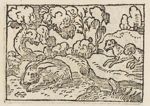
Le mal vivant n'est iamais asseuré: La Perrière, Le theatre des bons engins (Lyon, 1545), emblem 61 uses the imagery of a hare pursued by hunting dogs to express that the guilty always live in fear
Iconclass: 25F26(HARE)(+47) rodents: hare (+ animal psychology) 54AA8 Cowardice 56DD1 Fear, Dread; 'Paura', 'Timidità o Timore', 'Timore' (Ripa)
Loci Communes: Securitatis et tutae rei (Security and safety, Sécurité et sûreté)
IV iii 79 Victi non audent hiscere The conquered dare not even mutter
Νικώμενοι ἄνδρες τῇ ἀγρυξίᾳ δέδενται. id est, Qui vincuntur, silentio vincti sunt. Plutarchus in libello, cui titulus, Quo pato quis utilitartem capere possit ex inimicis, ciratex Pindaro. Convenit cum illo, quod alibi retulimus:Quid, nisi dolor victis? Est autem verbum perquam elegans ἀγρυξία, ubi quis non audet hiscere, a verbo γρύζειν, de quo non semel dictum est.
[greek], The conquered are bound by silence. In his essay entitled 'How One can Profit from Enemies' Plutarch cites this from Pindar. It is similar to what we have reported elsewhere, 'Losers must expect to suffer.' [greek] is a splendid word to use when anyone does not dare to make a sound. From the verb [greek] 'to grunt, grumble,' of which I have spoken more than once.
Facsimile:
Iconclass: 31B62359 being silent 45I7 the defeated (after the battle)
Loci Communes: Vincere et vinci (To conquer and to be conquered, Vaincre et être vaincu)
IV iii 80 Thersitae facies The look of Thersites
Θερσίτειον βλέμμα. id est, Thersitica facies. De prodigiose deformi dici solitum, quod Homerus scripserit hunc omnium, qui ad Troiam venissent, foedissimum fuisse. Ac totu hominem a capite, quod aiunt, usque ad pedes ita graphice depingit, etcor poris vitia, etanimi morbos, ut dicas, pesimum ingenium in domicilio se digno habitasse. Locus apud Homerum lliad. lib. 2. notior quam ut hic referat adducere. Venustius erit. siad animum transferatur, veluti si de formoso, fed moribus improbo dicas: Si corpus ascipias, Nireus est: si animum, plusquam θερσίτειον βλέμμα reperies. Adagii mentionem facit Suidas.
[greek], The look of Thersites. Usually spoken of someone unbelievably ugly, because Homer wrote that Thersites had been the most unsightly of all who had come to Troy. He describes the man from head to feet, as they say, so graphically (and not just his physical flaws but also his moral deficiencies) that one can say that in him a very foul character had a worthy home. The passage in Homer Iliad book two is too well known to be worth citing here. The proverb will have more appeal if you give it a moral application and say of someone who is handsome, but decadent, 'To look at his body, he is Nireus; to look at his character, you will find he surpasses "The look of Thersites."' Suidas mentioned the adage.
Facsimile:
Iconclass: 51DD4 Ugliness 95A(THERSITES) the Greek heroic legends (THERSITES): heroes (THERSITES)
Loci Communes: Forma, deformitas (Beauty, deformity, Beauté, difformité)
IV iii 81 Picifer A jay-bearer
Κιττοφόρος. id est, Picifer, vulgare convicium videtur in hominem infimum et despicatissimae sortis. Siquidem Demosthenes in oratione pro Ctesiphonte dicit Aeschinem hoc nomine ab aniculis compellatum, quemadmodum et λικνοφόρον, quod picas et vannos capite baiularet Nam his in mysteriis Bacchanalibus utebatur, quod ea avis sacra sit Baccho, & vannus in omnibus mysteriis adhibeatur. Unde Maro, Et mystica vannus Iacchi.
[greek], Jay-bearer, seems to be a common term of abuse directed at someone of the lowest rank who is living in the most despicable circumstances. For Demosthenes in his speech For Ctesipho says that old women addressed Aeschines by this word as well as by [greek] 'basket-bearer' because he used to carry jays and winnowing baskets on his head. For jays were used in the Bacchanalian rites since this bird was sacred to Bacchus, and a winnowing basket was used in all mystery rites. Accordingly, Maro writes 'and the mystic basket of Bacchus.'
Facsimile:
Iconclass: 25F32(JAY) song-birds (JAY) 46C121 carrying something 98B(AESCHINES) male persons from classical history (AESCHINES)
Loci Communes: Contemptus et vilitatis (Contempt and worthlessness, Mépris et bassesse); Maledicentia (Slander, abusive speech, Médisance)
IV iii 82 In numerato Ready cash
In numerato habere, si ad animl rem transferatur, proverbii rationem habuerit, velut Octavius Augustus, ut refert Seneca, pronuntiavit de Vinitio oratore, quod ingeniu in numerato haberet: propterea quod in causis agendis ingenio esset praesentissimo, et quidquid aliis praestaret diutina cogitatio, id illi prima statim animi intentio daret. Sumptum est ab liis, qui res suas ad certissimum calculum redegerunt, hoc est, ad pecuniam numeratam. Quintilianus in sexto: De actore, inquit, facile dicente ex tempore dictum est olim, ingenium eum in numerato habere. Vide proverbium, Numero dixisti.
'To have ready cash' may have the status of a proverb if applied metaphorically to mental abilities. Octavius Augustus, for example, as Seneca relates, declared of the orator Vinitius that he had wits like ready cash because when he was pleading cases he had the quickest intellect. Whatever would occur to others only after long thought would strike him the moment he applied his mind to the problem. The phrase was taken from those who liquidated their possessions, that is, changed them to ready cash. Quintilian in his sixth book says, 'Of an orator speaking off the cuff it used to be said that his wits were like ready cash.' See the proverb 'You talked as easily as 1 2 3.'
Facsimile:
Iconclass: 46B312 bank-note 51M11:52A1 Swiftness, Speed; 'Agilità', 'Celerità', 'Velocità' (Ripa)❧Intellect, Intelligence; 'Intelletto', 'Intelligenza' (Ripa) 52A55 Subtlety, Acumen, Lucidity, Wit; 'Acutezza de l'Ingegno', 'Sottilità' (Ripa)
Loci Communes: Proclivitas (contra) (Propensity (against), Penchant (contre))
IV iii 83 Quantum habet Each is only as good as he's worth
Quantum habet quisque, tanti fit. Quod scripsit Horatius in lib. 1. Serm. Satyra 1. Nilsatis, inquit, quia tanti, quantum habeas, sis. Item Iuvenalis satyra tertia: Quantum quisque sua nummorum servat inarca, Tantum habet et fidei. Non recensuissemus inter proverbia, nem quis clamaret nos sententias collegisse, non adagia, nisi D. Augustinus in libro de disciplina Christiana nominatim proverbii titulo citasset. Unde et illud proverbium, inquit, Quantum habebis, tantus eris. Quamquam et Horatius satis indicat vulgo iactatam sententiam eo quod eadem Satyra praecessit: at bona pars hominum deceptacupidine falso. Usurpat et Apuleius in Apologia: Tanti re vera estis, quantu habetis. Videtur ex Euripide venisse in vulgi sermonem. Cuius et hunc versum inrer ceteros refert Seneca: Ubique tanti quisque, quamtum habuit, fuit.
'Everyone is valued according to his possessions.' Horace wrote this in his first satire. 'He says, "I never have enough, because one is only as influential as what one is worth."' So also Juvenal in his third satire: 'A man's word is believed in proportion to the amount of cash he keeps in his strong-box.' I would not have counted this as a proverb for fear that someone might cry out that I had been gathering maxims, not proverbs. St Augustine, however, specifically cited it as a proverb in his book On Christian Teaching. He says, 'Whence arose also that proverb: "You will be as influential as what you are worth."' And yet Horace too shows quite clearly that the sentiment was commonly expressed by his words that precede it: 'But a large number of people, deceived by false cupidity.' Apuleius also uses it in his Apology: 'You are truly only as great as what you are worth.' It seems to have come into common parlance from Euripides, among whose verses Seneca includes this one: Vbique tanti quisque, quantum habuit,fuit 'Everywhere, each was only as influential as what he was worth.'
IV iii 84 Imis ceris eradere To scrape away to the lowest level of wax
Imis ceris eradere, pro eo, quod est, Deler penitus, sic ut nulum omnino memoriae pristinae vestigium exstet. Sumptum ab his, qui in ceratis scriptitant tabulis, his mos est ita nonnumquam versum stylum per summum aequor cerae ducere, ut qualiacumque tamen prioris scripturae remaneant vestigia. Aliquoties funditus delent. D. Hieronymus ad Chrysogonum. Ita nostrae es necessitudinis penitus oblitus, ut illam epistolam quam in corde Christianorum scriptam Apost. refert, non parva litura, sed imis, ut aiunt, ceris eraseris. Conveniet in profundam oblivionem vel amicorum, vel pristinae fortunae, vel si quid est simile.
This means 'to delete completely,' so that not the slightest trace of what was originally written remains. Taken from those who write on wax tablets. Their practice is sometimes to invert their stilus and draw it over the top level of the wax in such a way that some traces of the former writing remain. Sometimes they erase it completely. St Jerome to Chrysogenus: 'You have so completely forgotten our friendship that you have erased that letter said by the Apostle to be written in the hearts of Christians, not changing it to a slight extent but, as the saying goes, erasing it down to the bottom of the wax.' The proverb will be suitable when friends or former circumstances are completely forgotten, or in some similar situation.
IV iii 85 Macilenta manu pinguem pedem Thin hand, swollen foot
Hesiodus in opere quod inscripsit Opera et dies, uclut a nigmate quodam explicavit paupertatem, Λεπτῇ δὲ παχὺν πόδα χειρί πιέζοις. id est, Cracili autem manu pinguem pedem premas.Manus enim gracilescunt fame, pedes intumescunt frigore. Carmen sic habet: Μήσε κακοῦ χειμῶνος ἀμηχανίη καραμάρψῃ Σὺν πενίῃ, λεπτῇ δὲ παχὺν πόδα χειρὶ πιέζοις. id est, Ne te deprendant inopem mala tempor abrumae, Atque pedem premere incipiat manus arida pinguem. Ucnustius erit, si longius transferatur ad viaticum parandum senectuti, aut similia.
[greek], Press your swollen foot with a thin hand. This is how in his poem entitled Works and Days Hesiod described poverty, in a kind of riddle. For the hands become thin through hunger, while the feet swell up through cold. The poem reads as follows: 'May the hard times of winter not find you resourceless, / And may you not press your swollen foot with a thin hand.' It will be more attractive if it is used in a more metaphorical sense - to saving money for old age or something similar.
IV iii 86 Non semper erit aestas Summer will not last forever
Ad eundem ferme sensum pertinet & illud ex eodem libro, Οὐκ αἰεὶ θέρος ἐσσεῖται. ποιεῖσθε καλιάς. id est, Aestas non semper fuerit, componite nidos. Non semper virebit aetas, para, quo se recipiat senectus. Aut, non semper erit prospera fortuna, munias animum philosophiae decretis, quo fortunam adversam possis contemnere. Admonet & Cato agricolas, cogitent, quam loga sit hiems. Notus 'est apologus de formicis exprobranribus cicadae, quod totam aestatem nihil aliud quam cecinisset otiosa, eoque mendicaret in hieme. Hoc dictum oportuit adolescetium pileis inscribi. Neque enim tantum ad monet parandam esse rem in sene ctam: verumetiam eruditionem, virtuem, honestam famam, quae praesidia sunt optima senectutis.
Quite close in sense to this is what is said in the same work, [greek] 'Summer will not last forever; make your nests.' We shall not always be young and strong. Prepare for your old age. Or, good fortune will not last forever; fortify your mind with the tenets of philosophy so that you shrug off adversity. Cato too advises farmers to think how long winter lasts. There is the well-known fable about the ants that chastized the cicada for having idled away the whole summer doing nothing except singing and for having to beg in winter because of this. The proverb should have been inscribed on young men's caps. For its advice is that for our old age we should acquire not only money but also learning, virtue, and a good reputation, the best means of support when we are old.
Facsimile: 
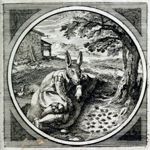
Ignavis fortuna repugnat: Cramer, Octoginta emblemata nova (Frankfurt, 1630), emblem 63 uses the imagery of the ants working all summer
Vade ad formicam piger: Cats, Spiegel (The Hague, 1632), emblem 53 uses the imagery of the ants working all summer
Non aestas est laeta diu, componite nidos: Printer's device 0177 uses the imagery of the ants working all summer
Non aestas est laeta diu, componite nidos: Printer's device 1654 uses the imagery of the ants working all summer
Non aestas est laeta diu, componite nidos: Printer's device 1655 uses the imagery of the ants working all summer
Non aestas est laeta diu, componite nidos: Printer's device 1916 uses the imagery of the ants working all summer
De cicada et formica: Aesop's fables (London, 1687), fable 83 about the ant and the grasshopper
Formica et cicada: Faerno, Centum Fabulae (Antwerp, 1585), fable 7 about the ant and the grasshopper
Iconclass: 25F711(ANT) insects: ant 25F711(CICADA) insects: cicada 54D1 Preparation
Loci Communes: Occasio (Opportunity, Occasion)
IV iii 87 Cum exossis suum rodit pedem When a polypus gnaws its own foot
Consimili sigura significavit egestatem in eodem opere, Οτ᾽ ἀνόστεος ὅν πόδα τένδει. id est, Quando pcdes edit ipse suos is, qui caret osse. Exossem vocat Polypum, quod ossibus careat. Is creditus est nonnullis sua brachia rodere, cum deest cibus. Est enim edacissimus, quamquam Plinius existimat id illi accidere a conchis, verum praecisa renasci credit, quemadmodum caudas lacertis. Alcaeus apud Athenaeum libro septimo, Εδωδ᾽ ἐμαυτὸν ὡς πολύπους. id est, Comedo meipsum more Polyps. Unde & αὐτοφάγος dictus. Verum hanc opinioem & Athenaeus reicit.
Hesiod described poverty in the same work, using a similar metaphor: [greek] 'When the boneless one eats its own feet.' He uses the term exossis 'the boneless one' for the sea-polypus because it has no bones. Some believed that the polypus gnawed its limbs when it did not have food, for it is very greedy. Pliny, however, thinks that shellfish do this to it; but he believes that the limbs grew back again, like lizards' tails, after they had been cut off. Alcaeus, cited in book seven of Athenaeus: 'I am devouring myself like a polypus.' Accordingly, the polypus was also called 'self-devourer.' But Athenaeus also rejects this belief.
Facsimile:
Iconclass: 25F72(POLYP)(+45):25F72(POLYP)(+341) molluscs: polyp (+ animals eating and drinking)❧molluscs: polyp (+ claws, paws of an animal) 41C19 insatiable hunger or thirst 58AA12 Self-destruction
IV iii 88 Centum plaustri trabes A wagon has a hundred planks
Tam simile est proverbio, quam est ovum ovo, quod scripsit Hesiodus in eodem opere, cui titulus, ἔργα καὶ ἑμέραι: Εκατὸν δὲ τε δούραθ᾽ ἁμαξης. id est, Centum autem lignu plaustrum compingitur unum. Eo tempestiviter utemus, cum siguisicab misid, quod a nobis petilui, magno ecostare. Facmoi alienis voimur, non expendentes quati constitermt ei qui praebet. Carmen Hesiodi sic habet, Ρηΐδιον γὰρ ἔπος εἰπειν, βόε δὸς καὶ ἅμαξαν, Ρηΐδιον δ᾽ ἀπανήνασθαι. πάρα δ᾽ ἔργα βόεσσι. Φησὶ δ᾽ ἀνὴρ φρένας ἀφνειὸς πήξασθαι ἅμαξαν Νήπιος, οὐ δὲ τό γ᾽ οἶδ᾽ ἑκατὸν δέ τε δούραθ᾽ ἁμάξης. id est, Nam dictu est proclive, dato plaustrumque bovesque Atprolive negare. sed en tauris labor instat, Cogttat ast animo dives, compingere plaustrum Stuletus et haud novit, centum id compactile lignis. Itaque quoties adid, quod quod moli tutaliquos, piuribus adminiculis opus est, velut ad gerendum magistratum, ad scribendum librum, ad munus contionandi, ad instituendam familiam, ad longinquam peregrinationem, non inepte usurpabimus Hesiodi verbum: ἑκατὸν δέ τε δούραθ᾽ ἁμάξης.
What Hesiod wrote in the same work, entitled Works and Days, is as like a proverb 'As one egg is like another': [greek] 'A hundred planks are needed to make a wagon.' It will be appropriate to use this to point out that what we are being asked for costs a great deal. For it is easy for us to use other persons' goods without reckoning how much they cost the lender. This is what Hesiod's poem says:
It is easy to say, 'Lend me your oxen and your cart.'
It is easy to say, 'No. My bulls have much work to do.'
The wise man undertakes to build a wagon,
The foolish man does not know that it is built from a hundred planks.
And so whenever someone needs different kinds of help for what he is undertaking, for example, holding a magistracy, writing a book, composing a public address, setting up house, travelling abroad in distant lands, it will be quite appropriate for us to use Hesiod's phrase, 'A wagon has a hundred planks.'
Facsimile:
Iconclass: 46C145 (farm) wagon, freight wagon, cart 49D11(100):47G5432 numerals (100)❧plank, board ~ building material 52EE1:54A6 Asking, Question, Interrogation❧Helpfulness 54DD4 Difficulty
Loci Communes: Difficultatis (Difficulty, Difficulté)
IV iii 89 Araneas ejicere To cast out spiders' webs
Habet illud quoque proverbii speciem, quod est apud eundem in eodem opere: Εκ δ᾽ ἀγγέων ἑλάσειας ἀράχνεια. id est: Vasis eicias, quas nectit aranta telas. Sic enim signisicant inanitatem et inopiam etiam hodie. Ad eundem modum Catull. Nam tui catulli Plenus sacculus est aranearum. Quo dicto nunc nihil est vulgo vulgatisu. Lucianus in Pseudologista: εὐρώτος καὶ ἀραχνίων μέστα. id est, Carie & araneis differta.
What is in the same work by the same author also has the appearance of a proverb: '[greek] 'You should cast out spiders' webs from your pots.' Even today we indicate poverty and emptiness in this way. Similarly, Catullus: 'For the purse of your friend Catullus is full of spiders' webs.' Nowadays, there is no more common expression than this one. Lucian in Pseudologista: 'Stuffed full of rotting matter and spiders' webs.'
IV iii 90 Muris circumcurrentibus Surrounding walls
Τῶν τίχων περιτρεχόντῶν. i. Parietibus circum currentibus. Plutarchus in Symposiacis decade septima problemate quinto, indicat muliebre fuisse proverbium; quo secietum signisicabant, muris videlicet testes et arbitos arcenubus. At bonorum vitorum huiusmodi volupates etiam ac lusus ait oportet esse, ut nihil egeant vallo parietum: Licebituti, cum significabimus aliquid ali monstri, et obid captari secretum.
[greek], Surrounding walls. Plutarch in his 'Table-talk,' in the seventh decade and fifth problem, says that this was a proverb used by women to mean something was being kept secret, obviously because walls keep away witnesses and listeners. He says, however, that the pleasures and amusements of upright men ought to be such that they have no need of the protection of walls. One may use this expression to mean that some wondrous thing is being devised in secret and that because of this other persons are trying to find out about it.
Facsimile: 
Iconclass: 41A54 fence, wall, paling 41A635 fenced or walled garden; 'Hortus Conclusus' 52DD1 Secrecy, Latency, Concealment; 'Secretezza' (Ripa)
Loci Communes: Occulta (Hidden things, Choses cachées)
IV iii 91 Κερασβόλος Horn-struck
In eodem opere problemate secundo, docet homines praefractos, et asperis moribus, & intractabiles κερασβόλους vocari solitos, quam vocem haud satis commode verteris Latine. Sumptam autem metaphoram ab agricolis, apud quos semina quae prius quam in tesram decidant, incidant in cotnua boum, κερασβόλα, dicantur παρὰ τὸ εἰς κέρατα βάλλεσθαι. Haec aiunt provenire ceteris multo duriora, unde et ἀτεράμονα vocantur. Qui scripsit Etymologicon, indicat hanc vocem semel duntaxat usurpatam a Platone, sumptamque aleguminibus, quaenec igni, necaqua mollescant;cuiusmodi quaedam videmus admixta leguminibus minuta nigraque. Locus est apud Plat. lib. De legib. 9. Quo quidem loco videtur interpres ignorasie quae sint κερασβόλα. Vertit enim legumina fulminis tactu praedura, quasi dictum esset κεραυνοβόλα. Porrò cur id accidat, ut semina quae in comua boum impegerint, aut non proveniant, aut proveniant sicciora durioraque. Plutarch. hano affert causam, quod ea quae a manu calida statim excepta terra foventur, magis adiuvantur calore, qui seminibus est amicus. At quae in cornua incidamt, proiecta magis videntur quam seminata, et mora figus colligunt. Theophrast. dubitat num frivolum sit, quod de cerasbolis iactant agricolae.
In the same work, in the second problem, Plutarch tells us that persons who are very stern and fierce and of harsh character are accustomed to be called [greek], a word that is not very easily translated into Latin. The metaphor is taken from agriculture when seeds drop on the horns of bulls before falling onto the earth. These seeds are named [greek], from their striking ([greek]) against horns ([greek]). Such seeds are said to be much harder than all others. Consequently, they are also called [greek] 'hard.' The author of the Etymologicon says that this word was used only once by Plato and that it was taken from legumes that neither fire nor water could soften. We see some things of this kind, small and black, mingled with legumes. The passage occurs in Plato, book nine of On the Laws. In this passage indeed the translator appears not to have known what [greek] are. For he translates the word as 'legumes hardened by being struck with lightning,' as if the word were [greek]. Furthermore, Plutarch gives the reason why seeds that strike against the horns of oxen either come to nothing or turn out drier and harder. Those seeds that the earth nurtures immediately after receiving them from a warm hand are helped because of the heat that is good for seeds. But those that are dashed on horns seem to have been scattered rather than planted; they become chilled because they do not immediately enter the soil. Theophrastus doubts whether what the farmers say about cerasbola is worth anything.
Facsimile:
Iconclass: 25G2111 seed 47I2111(+9332) bull (+ antlers; horn) 51G4 Hardness
Loci Communes: Asperitas, morositas (Harshness, moroseness, Rudesse, morosité)
IV iii 92 Respublica virum docet Politics instruct a man
Πόλις ἄνδρα διδάσκει. i. Res publica virum docet. Signisicat neminem ad rem gerendam idoneum esse posse, nisiqui sit usu exercitatus. Plutarchus citat ex Simonide, tametsi hemistichium carminis heroici. Quantumlibet diu versatus in agro, non fies idoneus administrandae rei publicae nisi vixeris in foro, in curia, in frequenti populo. Allusit huc Socrates Platonicus, cum invitatus ad loca amoena in agris, respondit se cupidum esse discendi, arbores autem nihil docere.
[greek], Politics instruct a man. It means that no one can be equipped to do anything unless he has been trained for it by experience. Plutarch cites it from Simonides, though it is only half of a dactylic hexameter. However long you have lived in the countryside, you will not become suited for administering affairs of the state unless you have spent your life in the forum, in the senate house, in the packed assembly. In Plato Socrates alluded to this when he replied to an invitation to visit beautiful areas in the country; he said that he was eager to learn, but trees do not teach one anything.
Facsimile:
Iconclass: 44C3 politics 49A education
Loci Communes: Experientae seu pericliationis (Experience or risk-taking, Expérience ou mise à l'épreuve)
IV iii 93 Faber cum sis etc. You are a carpenter, stick to your trade
Plutar. in praeceptis civilibus, senarium haud dubie proverbialem, ex Euripi. citat: Τὲκτων γὰρ ὤν, οὐκ ἔπραττες ξυλουργικά. id est, Cum sis faber, opera haud facis fabrilia, Congruet in eum, qui tentat ad quae non est idoneus, vel ob imperitiam, vel ob naturam alienam, veluti si quis infans et ad persuadendum ineptus, sucipiat legationem, aut indiligens dispenset rem domestica: aut senex, sive invalidus militiam capessat. Iamdudum et illud Horatianum cessit in proverbium, quod hin imitatum videtur, Tractant fabrilia fabri.
In his 'Civil Precepts' Plutarch cites from Euripides the following senarius, clearly proverbial: [greek] 'Although you are a carpenter, you do not work in wood.' This will suit persons who attempt something for which they are unsuited, either through lack of training or inappropriate nature. For example, if someone who is inarticulate and untrained in the arts of persuasion undertakes the role of an ambassador, or if a careless person manages the household expenses, or if an old or weak man joins the army, or if a priest engages in hunting or if a Scotist in rhetoric. Those words of Horace, tractant fabrilia fabri 'artisans work the material for which they are trained,' apparently based on this verse of Euripides, have been proverbial for a long time now.
Facsimile:
Iconclass: 47B1611 carpenter 47E organization of craft and industry 49A education 51F2 Continuity 54E43 Preservation, Sustenance; 'Salvezza', 'Sostanza' (Ripa)
Loci Communes: Absurda, indecora, seu praepostera (Absurd, unbecoming, or preposterous things, Choses absurdes, inconvenantes ou déplacées)
IV iii 94 Aquam ignis miscere Mixing fire and water
Inter proverbia, quibus ἀδύνατον significamus, referendum & illud, πῦρ ὕδατι μιγνύναι, id est, Ignem aquae miscere. Plutarchus in libello, cui titulum fecit: περὶ πρώτου ψυχροῦ, adducit huius proverbii testimonium, studens probare aquae proprium esse frigiditatem, potius quamaeris. Pugnat autem utraque qualitate ignis cum aqua, quippe calidus & siccus cum humida et frigida. Narrat eodem in loco morem fuisse apud Persa, ut supplex in fluium descenderet, ignem gestans, minitans ni conswqueretur quae petebat, se ignem missurum in aquam. Atque ad eum modum impetrabat quidem quae rogabat, sed mulctabatur, quod minatus esset se facturum id, quod esset contra rerum naturam. Nam aqua hostis est ignis, eumque semperextinguit. Id supplicandi genus apud barbaros maximum habebatur, et in quo non esset sas recusare quod petebatur. M. Tull. Philip. 13. Prius unda cum flamma redibit in gratiam. Rursus prius undam flammamque, ut ait poeta quispiam, prius denique omnia, quam ut cum Antoniis Res pub. aut Antonii cum Repub. redeant in gratiam.
[greek], To mix fire with water. This proverb ought also to be included among those indicating what is impossible. In his essay entitled 'On Primordial Cold,' where Plutarch is eager to prove that coldness is a property of water rather than of air, he adduces the evidence of this proverb. Water fights with fire in both its properties; for the hot and the dry fight with the moist and the cold. In the same passage he says that it was a Persian custom for supplicants to go into a river carrying fire and to threaten to hurl the fire into the water if they were not given what they sought. In this way they certainly got what they wanted, but they were punished because they had threatened to do what was contrary to nature. For water is the enemy of fire and always extinguishes it. Among nonGreeks this mode of supplication was thought to carry most weight and one where it would not be proper to refuse the request. Marcus Tullius in the thirteenth Philippic: 'Wave and flame will sooner be reconciled.' Again, 'Sooner will wave and flame, as some poet said, sooner will all elements be in harmony than the republic will be reconciled with men like Antony or men like Antony with the republic.'
Facsimile:
Iconclass: 47C61:21C:21C mixing (industrial process)❧fire (one of the four elements)❧fire (one of the four elements) 52BB42 Impossibility
Loci Communes: Absurda, indecora, seu praepostera (Absurd, unbecoming, or preposterous things, Choses absurdes, inconvenantes ou déplacées)
IV iii 95 Velut e specula As if from a watch-tower
Ως ἀπὸ σκοπιᾶς. i. Velut e specula. Similitudo proverbialis, cum quis rem velut oculis subiectam, totam undique contemplatur. Siquidem ex alto commodissime spectantur omnia, propterea quod nihil obstet. quod impediat prospectum. Utitur Plutarchus in libello, cui titulus, De Romanorum fortuna.
[greek], As if from a watch-tower. A simile used proverbially when anyone examines something in its entirety from every angle. For it is most advantageous to look at all things from a height, since nothing stands in the way to impede one's view. Plutarch uses it in his essay entitled 'On the Fortune of the Romans.'
Facsimile: 
Iconclass: 44G211 tower sentry 48C14111(+0) bird's eye view ~ representation of building (+ variant) 54A2 Carefulness, Diligence; 'Diligenza' (Ripa)
Loci Communes: Perspicuitas (Clarity, Clarté)
IV iii 96 Velut in cratere The cup of friendship
Ωσπερ ἀν κρατῆρι φιλοτησίῳ. i. Velut in cratere philotesio. Proverbialis et haec collatio, qua significabimus res antea turbulentas componi, sedarique, et prius inter sese inimicos in gratiam redigi: dicitur autem crater philotesius, quem in conviviis porrigunt aliis alii, ceu amicitiae symbolum, ac pignus. Veluti qui filiam alicui desponderet futuro genero praelibans φιλοτήσιον κρατῆρα porrigebat. Scythae quoque amicitias, quaru sunt pertinacissimi, cratere conciliabant, ut testatur in Toxaride Lucianus. Quin et Christus ipse nostrae religionis princeps, arcanam illam cum suis amicitiam poculo consecravit.
[greek], As if in a cup of friendship. This simile is also proverbial. By it we shall show that situations once racked by disorder are now settled and calmed down and that previous enemies are reconciled in friendship. The glass that everyone stretches out to each other at banquets is called the cup of friendship, a symbol and pledge of amity. An example is when a man who was betrothing his daughter proffered the cup of friendship to his future son-in-law, after first taking a sip. The Scythians too used to seal friendships, to which they were extremely devoted, by a cup of wine, as Lucian attests in On Friendship. Even Christ himself, Prince of our religion, consecrated the mystery of his love for his followers with a cup.
IV iii 97 Sero venisti You have come too late
Οψ᾽ ἦλθες. i. Sero venisti, Competit in eos, qui post tempus rem aliquam aggrediuntur, veluti si iam aetatis vitio frigidus uxorem paret ducere, aut grandior literas addiscere. Natum ex oraculo, quod Pythia vates edidit cuidam consulenti, num deberet ad rem publicam tractandam accedere: ὀψέ μ᾽ ἦλθες ἀρχὴν καὶ δημαγωγίαν διζήμενος, καὶ παρ᾽ ὥραν στρατηγίου κόπτεις θύραν. id est, Sero venisti, me de principatu et rei publicae administratione consulens, et alieno tempore militiae pulsas ianuam. Meminit Plutarchus in commentario, cui titulus, εἰ πρεςβυτέρῳ πολιτευτέον.
[greek], You have come too late. This fits those who undertake something after the appropriate time, like someone whose desires have been cooled by old age preparing to marry or someone starting to learn new languages when he is quite old. It originated with the oracle that the Pythian priestess gave to a man who consulted her on whether he ought to enter politics. 'You have come too late in consulting me about high political office and administering the state, and you knock on the door at a time unsuited for war.' Plutarch mentions it in his essay entitled 'Ought an Older Man to Enter Politics?'
Facsimile:
Iconclass: 51FF52 Lateness 54DD3:44C3 Start❧politics
Loci Communes: Serum remedium aut tempestivum (A late remedy or a timely one, Remède tardif ou opportun); Tarditatis et cunctationis (Slowness and delay, Lenteur et retard)
IV iii 98 Prius antidotum quam venenum Antidote before poison
Divus Hieronymus adversus Ruffinum respondemps, Quomodo eorum praefationes librorum, quos nescias, accuses, quae quodam vaticinio suturae calumniae responderunt, implentes proverbium, Prius antidotum quam venenum, subaudi adhibes. Convenietuti, quoties aliquis se purgat antequam accusetur. Antidotus enim adversus venena datur. Hanc nemo sumit, nisi gustato veneno. Quamquam sunt qui se praemuniant antidotis, ne noceat, si fors contingat sumere tosicum. Quaemadmodum fecisle legimus Mithridatem.
St Jerome, replying to Rufinus: 'In this way you should censure the prefaces of books unknown to you whose future charges you have foreseen, thus fulfilling the proverb "Antidote before poison."' You need to understand 'take' with the proverb. It can be appropriately used whenever someone clears himself of a charge that has not yet been laid against him. For an antidote is given to combat poison. No one takes it unless he has tasted poison. There are some, however, who fortify themselves in advance through antidotes so that any poison that they may perchance take will not do them any harm. We read that Mithridates did this.
Facsimile:
Iconclass: 31E2333 violent death by poison 49G812 poison ~ medicine 51F521 Precocity
Loci Communes: Absurda, indecora, seu praepostera (Absurd, unbecoming, or preposterous things, Choses absurdes, inconvenantes ou déplacées)
IV iii 99 Statua taciturnior As mute as a statue
His etiam temposibus in proverbio est: Statua taciturnior. In hominem vehementer infantem, ac tacitum. Usus est hyperbole Horatius in epist. ad Iulium Florum: Statua taciturnius exit Plerunque & risu populum quatit. Itidem Iuvenalis divitem quem piam, sed insantem et indoctum, Mercurii statuae similem facit, Truncoque simillsmus Hermae. Consimili forma D. Chrysostomus lib. περὶ ἱεροσύνης vi. De tardo & stupido, τοῦτο δὴ τὸ ἡμέτερον τῶν οὐδὲν διοίσει. id est, Tum illud quod Graeci dicere solemus, a saxeis nihil differet, quod & alibi retulimus. Xenophon in Symposio: ἐλείνων γοῦν μὲν ἂν ἧττον φωνὴν ἀκούσαις, ἢ τῶν λιθίνων. id est, Illorum igitur vocem minus audias, quam saxearum statuarum. Statuae frequenter habent speciem sapientum, et eloquentium virorum, ipsae tamen nihil loquuntur.
Even in our times there is the proverb 'As mute as a statue.' Directed at a person who is extremely tongue-tied and taciturn. Horace used this hyperbole in his Letter to Julius Florus: 'He emerges mute as a statue for the most part and makes the people shake with laughter.' Similarly, Juvenal describes a man who is rich but cannot speak publicly and is unlettered as being like a statue of Mercury: 'Very like a limbless Hermes.' There is a similar form of the proverb in St Chrysostom in his sixth book About Priesthood, used of someone slow and stupid: 'Then, as we Greeks are wont to say, he will be no different from statues.' We have spoken of this on another occasion as well. Xenophon in his Symposium: 'Their voices were more inaudible than those of stone statues.' Statues often have the appearance of wise and eloquent men, but they themselves can say nothing.
Facsimile:
Iconclass: 48C24 piece of sculpture, reproduction of a piece of sculpture 52DD3 Taciturnity; 'Secretezza', 'Secretezza overo Taciturnità' (Ripa)
Loci Communes: Taciturnitas illaudata (Unpraised silence, Silence non loué)
IV iii 100 Hoc noveram priusquam Theognis natus est I knew this before Theognis was born
Plutarchus in libello, cui titulus: Philosophum maxime debere disputare cum principibus, irridens eos, qui duplicem facerent philosophiae rationem, alteram in affectibus istam, quae a Mercurio Hegemone, id est, ductore prosicisceretur: alteram in efferendo positam, quam Diactorus mercurius, id est, nuntius largiretur: ἔωλόν ἐστιν, inquit, καὶ ὑποπιπτετων τῳ τουτοΐ μὲν ᾔδειν πρὶν θεόγνιν γεγονέναι. id est, Frivolum & obsoletum est,coniungaturque cum illo: Hoc noveram antequam Theognis natus est. Usurpat idem in eandem sententiam, in libello, cui titulus: περὶ τοῦ μὴ χρᾶν ἔμμετρα νῦν τὴν πυθίαν, citans è comico quopiam. A. Gellius lib. 1. Noctium Atticarum, cap. iii. citat ex Lucilio. Contra patriam, inquit Cicero, arma pro amico sumen da non sunt Hoc profecto nemo ignoravit, & priusquam Theognis, ut Lucilius ait, nasceretur. Non est dubitandum, quin hic senarius sit proverbialis, quo rem frigidam & inepeam significabant. Apparet sumptum a Theognide tragoediarum scriptore, quem frigidissimum fuisse testatur Suidas, et ni fallimur memoria, Plato. Nam fuit huius nominis alter quoque, cuius exstant sententiae,
In his work entitled 'The Philosopher Ought to Argue with Princes' Plutarch mocks those who would make two kinds of philosophy, one situated in the mind that originated with Mercury Hegemon, that is, 'Mercury the Leader,' the other based on utterance that was granted generously by Mercury Diactoros, that is, 'Mercury the Messenger.' He says, 'It's worthless and out of date; that saying should be applied to it, [greek] "I knew this before Theognis was born."' He also uses this proverb to refute the same belief in his work entitled 'Why the Pythia No Longer Gives Oracles in Verse,' citing it from some writer of comedy.2 In his first book of Attic Nights, chapter 3, Aulus Gellius cites from Lucilius: 'Cicero says, "Arms ought not to be taken up for a friend against one's country." To be sure, everyone knew this, even, as Lucilius says, "before Theognis was born."' There can be no doubt that this senarius is proverbial, used to indicate something that was trivial and foolish. It apparently refers to Theognis, a writer of tragedies, whose style was extremely frigid, according to Suidas and, if I am not mistaken, Plato. I give this informationas there was also another writer of this name whose aphorisms survive.
Facsimile:
Iconclass: 42A2:98B(THEOGNIS) confinement, birth❧male persons from classical history (THEOGNIS) 51F52 Earliness
Loci Communes: Contemptus et vilitatis (Contempt and worthlessness, Mépris et bassesse)