IV vi 1 Plenis velis At full sail
PASSIS velis, plenisque velis agere dicuntur, qui toto impetu summoque conatu moliuntur aliquid. Ita M. Tull. pro domo sua ad Pont. Quid tandem si tu in illis Rei pub. tenebris caecisque nubibus et procellis senatum a gubernaculis deiecisses, populum e navi exturbasses, ipse Archipirata cum grege praedonum impurissimo plenis velis navigasses, si quae tum promulgasti, constituisti, promisisti, vendidisti, perferre potuisses, qui locus terrarum vacuus extraordinariis fascibus atque imperio Clodiano fuisset? Hactenus Cicero. Philostrat. in Polemone: ἐπεὶ δὲ ἥκουσεν εὐφράτου τοῦ τυρίου, πληρέσιν ἰστίοις ἐς τὴν ἐκείνου φιλοσοφίαν ἀφῆκεν, id est, Posteaquam audivit Euphratem Tyrium, plenis velis ad illius philosophiam se contulit. De similibus figuris alias a nobis non semel dictum est.
Those who undertake something with all their energy and devotion are said to be going 'At full sail' and 'with sails spread.' So Marcus Tullius in his speech to the priests concerning his home:
When those black and stormy clouds enveloped the state, what if you had
cast the senate from the helm, tossed the people overboard, and you yourself,
the arch-pirate, had proceeded at full sail? If you had gone through with
what you had then promulgated, what you had decided to do, what you had
promised, what you had sold, which place on earth would have been free of
the extraordinary power and authority of Clodius?
So Cicero. Philostratus in his Polemon: 'After he heard Euphrates of Tyre, he rushed [greek] "At full sail" to embrace his philosophy.' I have spoken more than once elsewhere about similar expressions.
IV vi 2 Pecunia absque peculio Money without savings
Apparet olim fuisse proverbium inter agricolas iactatum, Pecuniam sine peculio fragilem esse. Refertur Pandect. li. 32. tit. de legat. et fideicom. capite, Si chorus. His verbis, quae mobilia mea erunt, do, lego, nummos ibi repositos, ut mutui darentur, non esse legatos Proculus ait. At eos quos praesidii causa sepositos habet, ut quibusdam bellis civilibus factitassent, eos legato contineri. et saepe audisse rusticos senes ita dicentes: Pecuniam sine peculio fragilem esse: pecuniam appellantes, quod praesidii causa reponeretur. Retulimus alibi proverbium, quod admonet ne totam substantiam uni credamus navi, ne nihil supersit unde damnum sarciatur, si navis interierit. ita solent senes summam aliquam seponere, ne nihil superesset, si res incendio, bello aut furto periret. Si libebit adabgium alio deflectere, poterit accommodari ad eum qui non omnia consilia sua communicat amicis. Aut qui felicitatis summam non ponit in rebus extrariis, sed in animi bonis, ut illis casu perditis habeat quo confugiat, nec despondeat animum. Quod enim proprie nostrum est, peculium dicitur. Ea vero demum proprie nostra sunt, quae fortuna non potest eripere.
Money without savings is precarious. This seems to have been a proverb used by farmers in ancient times. It is given in the Pandects book thirtytwo, the chapter entitled 'On legacies and bequests,' the section beginning 'If a group ...'
The words 'my moveable goods I give and bequeath' mean that money stored
there for the purpose of loans is not bequeathed. So Proculus says. But money
that has been put aside as a safeguard, as had been done in some of the civil
wars, is part of the inheritance. Proculus also said that he had often heard
old men of the countryside saying, 'Money without peculium is precarious,'
meaning by peculium money that had been put aside as a safeguard
We have adduced elsewhere a proverb that warns us not to entrust all our wealth to one ship, in case there is nothing left to make good the loss if the ship goes down. This is why old men often keep a sum of money separate from the rest of their possessions; they will have something left if their property is lost through fire, war, or theft. If you would like to use the proverb metaphorically, it will suit a person who does not share all his plans with his friends or a person who finds complete happiness not in material things, but in the blessings of the mind. When material things are lost by misfortune, he has something to take refuge in and is not in despair. For what properly belongs to us is called peculium and those things that are properly ours cannot be snatched away from us by chance events.
Facsimile: 
Iconclass: 46B31 money 54D5 Safety 55CC1 Saving, Frugality, Parsimony; 'Parsimonia' (Ripa)
Loci Communes: Cum auxilio ; citra auxilium (With help; without help, Avec aide ; sans aide)
IV vi 3 Rana cum locusta A frog against a locust
Impar certamen expressit hac figura Theocritus in Thalysiis: Βάτραχος δὲ ποτ᾽ ἀκρίδας ὥς τις ἐρισδω. id est, Sic certo Veluti si certet rana locustis. Addit Scholiastes Graecis ranam dici Βάτραχον quasi βοάτραχον ob vocis asperitatem.
Theocritus used this figure to express an unequal contest in his First-fruits: [greek] 'I am like a frog competing against locusts.' The scholiast adds that the Greek word for a frog was [greek] (that is, [greek]) because of the rough sound of its voice.
Facsimile:
Iconclass: 25F51(FROG) tailless amphibians: frog 25F711(GRASS-HOPPER) insects: grass-hopper 25F711(LOCUST) insects (LOCUST) 51BB3 Imparity, Inequality, Difference
Loci Communes: Excellentia, inaequalitas (Excellence, inequality, Excellence, inégalité)
IV vi 4 Musarum aves Birds of the Muses
Μουσῶν ὄρνιθος, id est, In eadem Ecloga dicti sunt poetae, quia assidue modulentur sua carmina. Καὶ μοισᾶν ὄρνιχες ὅσοι ποτὶ χῖον ἀοιδὸν, Αντία κωκκύζοντες ἐτώσια μοχθίζοντι. id est, Quotquot aves musarum, audent certare poetae Chio, coccysando, opera conantur inani.
[greek], Birds of the Muses. This is how poets are described in the same eclogue, because they continuously sing their verses: 'And all the birds of the Muses, the poets who dare with their crowing / To vie with the Chian bard, are toiling in vain.'
Facsimile: 
Iconclass: 25F3:92D4 birds❧(story of the) Muses; 'Muse' (Ripa) 48C91 writer, poet, author
Loci Communes: Inanis opera (Vain effort, Effort vain)
IV vi 5 Ad pedes, ad caput At my feet, up to my head
Non sine proverbii specie dictum videtur illud Theocriti in Pastoribus, de rebus copiosis & affluentibus: Ων μοι πρὸς κεφαλῇ, καὶ πὰρ ποσὶ κώεα κεῖνται. id est, Ad caput, adque pedes, quarum me Vellera cingunt. Sermo est pastoris iactantis opes suas, quibus undique affluebat.
These words of Theocritus in the Herdsmen, relating to abundant and plentiful possessions, have the appearance of a proverb: 'Their fleeces surround me, up to my head, and at my feet.' The words are those of a shepherd boasting of his wealth, which surrounds him on all sides.
IV vi 6 Psydracia Lie pimples
Theocritus in Aita: Ψεύδεα ῥινὸς ὕπερθεν ἀραιᾶς οὐκ ἀναφυσῶ. id est, Non mihi nascentur nares mendacia supra. Scholiastes addit apud Sicalos, qui supra nares haberent pustulas albas, quas illi vocant ψυδράκια sive ἴονθους aut ὀνθίους pro mendacibus haberi solitos vulgo. Quia et hodie vul-] go dicunt: Nasus tuus arguit mihi te mentiri. Idem iocus est vulgi de miraculis unguium, quin et ipsas narium pustulas Graeci yeu/s1mata vocant: ut indicat idem Scholiastes. Amans hoc aenigmate significat se nihil mentiturum de amica. Iones ψύδρακας appellant pustulas. Hinc diminutivum ψυδράκια, ἐξανθήματα, quod in summa cute efflorescant. Res ipsa plane superstitiosa est, & casum esse puto quòd novi quendam cui non natus tantum, sed tota penè facies psydraciis erat operta. Nec ullum unquam animal vidi vanius aut impudentibus mendax.
Theocritus in his Aites: [greek] 'Lies will not grow above my nostrils.' The scholiast adds that in Sicily those who had white pustules on their nose, called [greek], were commonly regarded as liars. In fact even nowadays a common saying is 'Your nose proves that you are lying.' (There is a similar popular joke about the spots on nails.) Indeed the Greek word for the actual pustules on the nose is [greek] as the same scholiast informs us. In the poem a lover uses these rather puzzling words to mean that he will not tell any lies about his girlfriend. The Ionians give the name of [greek] to several kinds of pustules. The diminutive of this is [greek]. Also called [greek], because they break out on the surface of the skin. The whole idea of this is pure superstition and I think it just chance that I know someone - the most deceitful and shameless liar I have ever known - whose whole face and not just his nose was covered with pustules.
IV vi 7 Cum sacco adire To come with a sack
Proverbiali schemate dictum est quod adfertur ex Paulo libro Pand. 46. tit. de solu. et liber. cap. Quod dicimus, inquit, in eo herede, qui fideiussori testatus id quod ante aditam hereditatem ab eo solutum est debere statim solvere, cum aliquo scilicet temperamento temporis intelligendum est, nec enim cum sacco adire debet. Haec ibi. Non dubium est, quin hic sermo fuerit vulgo iactatus de quovis qui postulat, ut statim exhibeatur quod petit. Alioqui non ad omnia recipienda sacco est opus, velut ad oleum aut vinum; Graecis θυλακίζειν dicitur, qui cum pera sequens postulat aliquid, qui mos est mendicorum: unde proverbium, mendicorum peras semper esse inanes. θύλακος autem vas est farinarium. Hesychius indicat eam vocem fuisse peculiarem Tarentinis.
An expression that is taken from Paulus in book forty-six of the Pandects, the chapter entitled 'On performances and releases,' the section beginning 'As for our saying,' sounds like a proverb. He writes: 'As for our saying that the heir should immediately pay what is due to the testator's executor before he actually receives the inheritance, some leeway as to time should be understood. For he need not come with a sack when he takes up the inheritance.' That is what we read there. There is no doubt that this was an expression commonly said of anyone who demanded that he be given immediately what he sought. (Moreover, for some things, such as olive oil or wine, there is no need of a sack.) In Greek [greek] is the verb used to describe someone who asks for something, bag in hand, as is the way of beggars, whence the proverb 'Beggar's wallets are always empty.' And indeed [greek] is the word for a flour sack. Hesychius informs us that this word [greek] = 'to beg'] was peculiar to the people of Tarentum.
Facsimile:
Iconclass: 46C121:41A777 carrying something❧container of textile material: bag, sack, net 51M12 Haste
Loci Communes: Improbi (The dishonest, Les malhonnêtes)
IV vi 8 Officere luminibus To obstruct someone's light
Officere luminibus dicitur, qui gloriam alterius obscurat. Hic sermonis color sumptus est ex literis iureconsultorum, in quibus cavetur ex servitutibus praediorum, ne vicinus altius sublato aedificio officiat luminibus vicini. Ita Paulus Pandect. lib. 8. tit. De servitutibus urbanorum praediorum. cap. iii. Luminum, inquit, servitute constituta id acquisitum videtur, ut vicinus lumina nostra excipiat. Quum autem servitus imponitur, ne luminibus officiatur, hoc maxime adepti videmur, ne ius sit vicino invitis nobis altius aedificare, atque ita minuere lumina nostrorum aedificiorum. Id eleganter aliò detorsit M. Tullius in Bruto, Nam ut Philisci & Thucydidis concisis sententiis interdum etiam non satis apertis officit Theopompus elationem atque altitudine orationis suae, quod idem Lysiae Demosthenes: sic Catonis luminibus obstruxit haec posteriorum quasi exaggerata altius oratio. Idem pro C. Rabirio Posthumo, de C. Caesare loquens. Nec amicum pudentem corruere patitur, nec illius animi aciem perstringit splendore sui nominis, nec mentis quasi luminibus officit altitudo fortunae & gloriae.
'To obstruct someone's light' is said of a person who obscures the glory of another. This figurative use was taken from legal texts in accordance with which, in order to comply with servitudes placed on estates, no one should block his neighbour's light by constructing a building of too great a height. So Paulus in Pandects book eight, the chapter entitled 'On urban praedial servitudes,' section three. He says:
When a servitude giving a right to light is established, what seems to have
been acquired is a right that our neighbour should respect the light that we
enjoy. When, however, a servitude is imposed, to the effect that there should be
no blockage of light, we seem to have obtained this right, that our neighbour
is not permitted to raise the height of his buildings against our wishes in such
a way as to diminish the light that our buildings receive.
Marcus Tullius very elegantly applied this expression to something else in his Brutus: 'For just as Theopompus cast into the shade Philiscus' and Thucydides' pithy though sometimes unclear mode of expression through his lofty and elevated style (and Demosthenes did the same to Lysias), so the lights of Cato were dimmed by the towering style of those who came after him.' Also in In Defence of Caius Rabirius Postumus, speaking of Julius Caesar: 'And he does not allow his modest friend to fall. He does not dull the brilliance of that man's intellect by the splendour of his own name, nor does the loftiness of his fortune and reputation block out the radiance, so to speak, of the other's mind.'
Facsimile:
Iconclass: 41A3:51I6 parts (of house or building)❧High, Top 51E2 Superiority 54EE2:22C1 Hindrance, Obstruction❧natural light
Loci Communes: Excellentia, inaequalitas (Excellence, inequality, Excellence, inégalité)
IV vi 9 Manu longa, et manu brevi tradere To give with a long reach and a short reach
Libro Pandectarum quadragesimosexto, tit. De solutionibus scribitur hunc in modum: Pecuniam mihi debes aut aliam rem. Si in conspectu meo ponere te iubeam, efficitur, ut et tu statim libereris, et mea esse incipiat. Nam tunc quod a nullo corporaliter eius rei possessio detinetur, acquisita mihi et quodammodo manu longa tradita existimanda est Simili figura dictum est brevi manu dare, lib. Pandect. 23. tit. de iure dotium, capite. Licet soleat. Quoties autem extraneus accepto fert debitori dotis constituendae causa, si quidem nuptiae insecutae non fuerint, liberatio non sequetur, nisi forte sic accepto tulit, ut velit mulieri in totum donatum. Tunc enim credendum est brevi manu acceptum a muliere, et marito datum. Quae si deflectas, plus habebunt veneris: veluti qui promissis agit, ace spem tantum ostendit, longa manu dat, quod animo contueri possis, non statim tollere. Contra, qui praesens ac statim exhibet quod promittit, brevi manu dat. Pueri assem ostendunt elephanto, nec audent porrigere. De longis regum manibus alibi dictum est.
In the Pandects book forty-six, in the chapter entitled 'On performances,' we read as follows: 'You owe me money or something else. If I should tell you to place it within sight of me, the result is that you are immediately released of it and it becomes mine. The reason is that because no one has physical possession of that object it must be thought to have been acquired by me and to have been delivered "With a long reach," so to speak.' There is a similar figure in the expression to give 'With a short reach' in the Pandects book twenty-three, the section entitled 'On the law of dowries,' the chapter beginning 'Although customarily': 'Whenever a third party releases a debtor in order to set up a dowry, if the marriage does not take place, release from the debt will be void unless by chance the creditor wanted to make a gift of the whole sum to the woman. For then one must believe that it had been given Brevi manu "With a short reach" [= "readily"] to the woman and then given by her to her husband.' These expressions will be more attractive if applied to other circumstances. For example, a man who does nothing more than give promises and only offers hope of their fulfilment, gives 'With a long reach.' He gives you something for you to imagine receiving without your being able to take it away on the spot. On the contrary, the man who immediately and personally provides what he promises gives 'With a short reach.' Children do no more than show a penny to elephants and do not dare to stretch out and give it to them. I have discussed elsewhere 'Kings have long hands.'
Facsimile: 
Iconclass: 31A2512(+934) arm stretched forward (+ reaching for somebody or something, seizing something, touching) 51I4(+0) Nearness (+ variant) 51II4(+0) Farness (+ variant) 53D2 Promise; 'Promissione' (Ripa) 53DD2 Breach of Promise
Loci Communes: Fides et gravitas (Trust and seriousness, Confiance et gravité)
IV vi 10 Iynge trahor A wryneck draws me to it
Qui vehementi & impotenti desiderio trahuntur ad aliquid, Iynge trahi dicuntur. Ita Pindarus in Nemeis hymno 4. ἴϋγγι ἕλκομαι ἧτορ, id est. Iynge trahor anmo. Interpres addit huiusmodi fabulam, Iyngem aiunt fuisse filiam Echus, alii Pithus, quae cum amatoriis venenis incitasset Iovem in amorem Ius, a Iunone irata versa est in avem, qua mulieres uti consueverunt in amatoriis veneficiis, quemadmodum indicat Theocritus in Pharmaceutria: Ιυγξ ἕλκε τὺ τήμον ἐμὸν ποτὶ δῶμα τὸν ἄνδρα. id est, Per te Iynx meus ille domum vir quaeso trahatur. Quidam Iyngem vertunt motacillam, quod caudam assidue moveat.
Those who are attracted to something by a strong and uncontrollable desire are said to be 'drawn by a wryneck.' So Pindar in the Nemeans hymn 4: [greek] 'I am drawn in my heart by a wryneck.' The scholiast adds the following story. Iunx is said to have been the daughter of Echo or, according to some, of Peitho. When she had made Jupiter lust after Io through love potions, Juno was angry and turned her into the bird that women have been accustomed to use in love magic, as Theocritus tells us in the Pharmaceutria: 'Through you, wryneck, may that man be drawn to my home.' Because the iunx continuously moves its tail, some translate the word as motacilla 'wagtail.'
IV vi 11 Dii omnia possunt The gods are all powerful
Hemistichium Homericum: Θεοὶ δέ τε πάντα δύνανται. id est, At coelestes omnia possunt. Quadrabit in eos, quibus promptum est facere quidquid animo collibitum fuerit, sive iure, sive iniuria. Pindarus in Pythiis hymno 3. qeo\s2 a(/pan e)pelpi/des1i te/kmar a)nu/etai, id est, Deus autem pro sua libidine omnem exitum perficit.
A hemistich from Homer: [greek] 'But the gods are all powerful.' It will suit monarchs who are quick to do whatever they fancy, whether it is right or wrong. Pindar in the Pythians hymn three: 'The god brings everything to fruition just as he wishes.'
Facsimile:
Iconclass: 51E2:53C11 Superiority❧Authority, Power; 'Dominio', 'Giurisdittione' (Ripa) 92 gods ~ classical mythology
Loci Communes: Excellentia, inaequalitas (Excellence, inequality, Excellence, inégalité)
IV vi 12 Timidi mater non flet A cautious man's mother sheds no tears
Probus Aemilius in vita Thrasybuli, testatur hoc velut aenigma vulgo sactatum, timidi matrem non flere, quod in bello qui contemnunt hostem, nihilque metuendum ducunt, quoniam sibi parum cavent, fere pereunt, et matribus luctum afferunt cum orbitate. Contra qui nihil non metuit, neque quidquam omnino contemnit, in tutioribus utens consiliis, raro venit in periculum. Thrasybulus enim cum indixisset bellum triginta tyrannis, qui Athenas oppresserant, et castellum Atticae Philen occupasset, non plures secum habuit quam triginta commilitones. Hoc, inquit, initium fuit salutis Atticorum, hoc robur libertatis clarissimae civitatis. Neque vero hic non contemputs est primo a tyrannis, neque eius sollicitudo, quae quidem res et illis contemnentibus perniciei, et huic despecto saluti fuit. Hoc enim illos ad persequendum segnes, hos autem tempore ad comparandum dato fecit robustiores. Quo magis praeceptum illud omnium in ammis esse debet, nihil in bello oportere contemni, nec sine causa dici, Timidi matrem flere non solere. Quamquam satis constat hunc locum depravate legi, unde conicitur sic scriptum fuisse: Neque vero hic modo contemptus est primo a tyrannis, sed eius etiam solitudo. Itaque modo depravatumest in non, et solitudo in sollicitudinem, et depravatio deinde trahit depravationem, ut ansa anfam. Sentit. n. Probus ipsum Thrasybulum, ut hominem mediocriter nobilem, ac divitem despectur fuisse tyrannis. Deinde hoc magis fuisse contemptui, quod tam paucos haberet suae factionis homines. Retulimus alibi de fortitudine, quae e rumpit in nervum.
In his Life of Thrasybulus Probus Aemilius attests that 'A fearful man's mother does not weep,' a rather puzzling expression, was a common saying. The meaning is that those who in war think lightly of their enemy and believe nothing is to be feared do not take enough precautions and are usually killed, causing their mothers great grief at the loss of their sons. Quite the opposite is the man who has some fear and takes nothing lightly; he employs safer counsels and rarely comes into danger. Thrasybulus declared war on the thirty tyrants who had taken control of Athens. When he had occupied Phile, a fortress of Attica, he had only thirty fellow soldiers. Probus says:
This was the first step towards saving Attica, this was the force that led to
the freeing of that most famous state. The tyrants thought lightly of him at
first [neque vero hie non contemptus] and had no fears about him [neque eius
solicitudo]. Their contempt of Thrasybulus, however, led to their destruction
and his victory. For they were sluggish in hunting him down, while he and
his men became stronger by being given time to prepare for the fray. There is
all the more cause to keep in mind the precept that nothing should be taken
lightly in war, and that for good reason it is said that a fearful man's mother
is not wont to weep.
However, it is quite clear that this passage is corrupt, and I conjecture that it was originally written as follows: 'But the tyrants took lightly not only him [neque vero hic modo contemptus] but also the small number [solitudo] of his followers.' The word modo was corrupted into non and solitudo into solicitudo, and then corruption precipitated more corruption, just as one opportunity leads to another. Probus believes that Thrasybulus himself was despised by the tyrants because he was a man of modest rank and wealth, and then the fact that he had so few supporters added even more to their contempt. We have spoken elsewhere of the strength that 'breaks its string.'
Facsimile:
Iconclass: 42B121 mother with son(s) (mother-love) 51AA4:31B6214 Nothingness, Absence❧weeping 51AA4:56BB1 Nothingness, Absence❧Pain, Sorrow, Sadness; 'Dolore', 'Dolore di Zeusi' (Ripa) 52A24 Precaution
Loci Communes: Prudentia (Prudence, Prudence); Securitatis et tutae rei (Security and safety, Sécurité et sûreté)
IV vi 13 Teuthidum more Like squids
THemistocles, ut in ipsius vita refort Plutarchus, Eretrieo cuidam exprobrans ignaviam dixit: ἦ γὰρ ἔφη καὶ ὑμῖν περὶ πολέμου τίς ἐστι λόγος, οἵ καθάπερ αἱ τευθίδες μάχαιρά μὲν ἔχετε, καρδί αν δὲ οὐκ ἔχετε. i. Sane inquit, et vobis aliquid de bello dicendum est, qui Teutidum in morem gladium quidem habetis, cor autem non habetis. Quidam Teuthidas putant esse, quas nos vocamus sepias. Sepia autem de genere mollium est, et ar bitramur huic generi cor non inesse.
Themistocles, as Plutarch relates, in his Life of Themistocles, once taunted an Eretrian for cowardice, saying, 'To be sure, you too can only speak about war since, "Like squids," you have a sword, but no heart.' Some think that squids are what we call cuttlefish. And indeed the cuttlefish belongs to the mollusc family, a family that I think has no heart.
IV vi 14 Samii litterati Lettered Samians
Plutarchus in vita Periclis citat hunc versiculum ex Aristophane Comico: Σαμΐων ὁ δῆμός ἐστιν ὡς πολυγράμματος. id est, Populus Samiorum Valde literatus est. Arbitramur hoc inde dictum, quod cum Samii captivis Atheniensium inussissent noctuam, Atheniensis vicissim Samiorum captivis inurebant Samaenam, quam in collectaneis opinamur dictam σάμην. Id erat navis genus lato ventre, a prora veluti suilli rostri speciem prae ferens, unde & hic versus iactatus est: Ναῦς δὲ τις ὠκυπόρος σαμΐα ὑὸς εἶδος ἔχουσα. id est: Navis erat Velox Samia, specieque suilla. Dicta est Samaena, quod a Samiis reperta sit. Conveniet igitur in cicatricosos, et stigmatum plenos. Hesychius et Suidas addunt apud poetam dictum in Babylonios e pistrino prodeuntes, stigmatibus notatos. Verum Aristoteles etiam huius dicti monstrat originem. Cum Samiorum gens esset afflicta a tyrannis, ob inopiam administrantium rem publicam, coacti sunt aliquot e seruis admittere in consortium administrandi magistratus. Sic Aristoteles. Servile est autem ac noxium, stigmatis notari. Apud Plautum in Cassina: Si hic literatus me sinat. Literatum appellans notis inustis insignem. Plinius lib. xviii. cap. iii. inscriptos appellat. At nunc eadem illa, vincti pedes, damnatae manus, inscripti vultus, exeercent. De Attagena diximus alias. Nec desunt qui causam diversam afferant, quod apud Samios inventae sunt vigintiquatuor literae e Callistrato. Sic Andron in tripode. Idem Ionum liteias tradidit Atheniensibus. Probabile est igitur a repertis traditisque literis, iocum fuisse versum ad stigmata. Nam Samii simul et accipiebant, et tradebant infames notas. Nicanor Alexandrinus grammaticus populari ioco dictus est stigmaticus, quod de scripturae distinctiunculis, quas Graeci στιγμὰς appellant, curiose scripserit.
In his Life of Pericles Plutarch cites this verse from Aristophanes, the writer of comedy: [greek] 'The Samians are a highly lettered people.' I think that this originated when the Samians branded Athenian prisoners with the mark of an owl and the Athenians retaliated by using the brand-mark of a samaena on Samian prisoners. In the Collections I think the word is [greek]. (A samaena was a kind of ship, broad-beamed and with the prow having the appearance of a boar's snout. This gave rise to the following verse: 'It was a swift ship, Samian, and with the appearance of a boar.' It was called a samaena, because it was invented by the Samians.) The saying will suit, therefore, those who are heavily scarred and covered with brand-marks. Hesychius and Suidas also say that in Aristophanes the expression was directed at the Babylonians as they came out of a mill, marked with brands. Aristotle, however, points out a different origin for the saying. After the Samians had been crushed by tyrants, there was a shortage of men who could govern the state. They were compelled, therefore, to allow some slaves to share in holding magistracies. So Aristotle. To be branded is a distinguishing feature of slaves and criminals. In the Casina of Plautus ('If this lettered fellow would allow me') 'lettered' is applied to someone distinguished by brand-marks. Pliny in book eighteen, chapter three, calls such persons inscripti: 'But now these same things are done by feet in chains, criminal hands, lettered faces.' About the francolin we have spoken elsewhere. Some give a quite different origin for the proverb - that the alphabet of twenty-four letters was invented in Samos by Callistratus. So Andron in his Tripod. Callistratus also gave the Ionian alphabet to the Athenians. It is probable therefore that the joke originated with the discovery and spread of writing and that it was then applied to branding. For the Samians not only took from elsewhere the use of brandmarks to indicate shameful behaviour but they also passed them on to others. There was a popular joke directed at Nicanor of Alexandria, a philologist; he was called Punctilious because he wrote in great detail on punctuation marks, which the Greeks call [greek].
IV vi 15 Samii mores Samian ways
Σαμιακὸς πρόπος, id est, Samii mores. Quidam referunt ad calumniandi vitium, quod, ut dictum est, Samii notas et inurerent aliis, et paterentur ab aliis. Alii malunt referre ad novam navigii speciem, quam apud eos reperit Polycrates tyrannus. Itaque quadrabit in eos, qui suos quosdam habent mores a ceterorum moribus dissidentes.
[greek], Samian ways. Some relate it to the vice of laying false accusations because, as has been said, the Samians not only branded some people but also suffered the same at the hands of others. Others prefer to relate it to a new kind of ship that the tyrant Polycrates first made in Samos. Accordingly it will suit those who have certain customs that differ from those of everyone else.
IV vi 16 Λακκόπλουτοι Pit-rich
Calliae barbarus quispiam clam indicavit magnam auri vim in puteum quendam coniectam. Is et occidit indicem, ne proderer, et aurum sustulit. Ubi res innotuit, in comoediarum iocum versa est, ut qui malis artib. subito ditescerent, lakko/ploutoi dicerentur. Refert Plutarchus in vita Aristidis. Attigit &Hesychius.
A barbarian secretly pointed out to Callias a great store of gold that had been thrown into a pit. Callias killed the informant (so that he would not divulge what he knew) and also took away the gold. This gained notoriety and it became a common joke in comedies for those who suddenly became rich by crooked means to be called [greek] 'Pit-rich.' Plutarch recounts this in the Life of Aristides. Hesychius also touched on it.
IV vi 17 Abydus, Abydenus Abydus, an Abydenian
Abydenorum mores in proverbium abierunt. Nam Abydeni dicti sunt Sycophantae, seu molles et effeminati. Meminit adagii Pausanias et Suidas, quorum hic ???endit etiam res nihili, nugasque meras Abydum dici, quemadmodum de Tricis et Apinis alibi retulimus: opinamur quod id temporis frigeret Abydus ob vetustatem. Unde Sinopen meretricem Abydum vulgo dictam indicat Athenaeus lib. 13. vod iam anus a nemine adiretur. Hesychius indicat quempiam apud poetam quendam ἀβυδοκόμαν dictum, quod de sycophantia sese venditabat. Suidas, ni fallimur, alicubi citat ex Aristophane. Zenodotus sic effert proverbium ἄβυδος πόλις, id est, Abydus civitas. Stephanus indicat proverbium dictum ab Abydenis Milesiis. Nam hinc profecta est Abydus Hellespontica. Verum haec propius attinent ad proverbium quod ante retulimus: Ne temere Abydum.
The customs and behaviour of the people of Abydus became proverbial, since those who brought false charges or those who were soft and effeminate men were called Abydenians. Pausanias and Suidas mention the adage. The latter points out that Abydus was a term applied to worthless things and pure rubbish (as we have recounted elsewhere when explaining 'Stuff and nonsense'). The reason, I think, is that at that time Abydus was very unattractive because it was old and run-down. Because of this Athenaeus points out in book thirteen that the courtesan Sinope was commonly called Abydus because she was old and could attract no clients. Hesychius tells us that someone is called [greek] by some poet because he prided himself on bringing false charges. Suidas, if I am not mistaken, somewhere cites this from Aristophanes. Zenodotus gives the proverb in this form: [greek] 'The city of Abydus.' Stephanus points out that the proverb originally applied to the Milesian Abydenians. For Abydus on the Hellespont was founded by Miletus. These matters, however, are more relevant to the proverb we have already spoken of, 'Not rashly to Abydus.'
Facsimile: 
Iconclass: 31A719 womanish man, molly-coddle, milksop 32B2(ABYDENIANS) historical peoples and nationalities (ABYDENIANS) 54BB6 Worthlessness 61E(ABYDOS) names of cities and villages (ABYDOS)
IV vi 18 Αθερίζειν Not worth harvesting
Graecis Αθερίζεται quod reiicitur ac nihil fit. Translatum à summis hordei spicis, quae ceu cuspides habent, quae nulli sunt usui, sed inter metendum pereunt. Eas Graeci vocant Atheras. Sic ex Galeno annotavit vir ille divinus Hermolaus Barbarus.. Sunt qui putent spicas inutiles ac reiiculas dici Athericas, quod à messoribus ac triturantibus negligantur.
In Greek something that is rejected and worth nothing is said [greek] 'To be unharvested,' a metaphor taken from the top of barley spikes, which have sharp points, are worthless, and are lost in the harvesting. In Greek they are called atheres. This was noted by that marvellous scholar Ermolao Barbaro, drawing on Galen. Some think that ears that are useless and discarded are called atherices because harvesters and threshers ignored them.
Facsimile:
Iconclass: 53DD1:47I14 Refusal❧harvest 54BB6 Worthlessness
Loci Communes: Contemptus et vilitatis (Contempt and worthlessness, Mépris et bassesse)
IV vi 19 Manuari To put one's hand to
Sicut fures multis artibus inftructi sunt, ita studium illorum variis nominibus appellabatur: velut involare et manticulari, pro eodem Laberius citante Nonio Marcello dixit, Manuari. nec dubium quin ea vox ioco populari fuerit iactata, quemadmodum et hodie, quoniam furandi verbum nimis odiosum est, mitiore verbo dicunt, digitavit, si quid furto sublatum volunt intelligi, simul ut effugiant actionem iniuriarum. Quid ais? Appellas me furem? Nequaquam, sed manuatorem. Huiusmodi voces obsoletae non carent gratia, si in loco adhibeantur, nec sine προεπιπλήξει, ut prisci loquebantur, aut, Ut vetere verbo utamur.
Thieves are skilled in many ways, and what they do has many different names, for example, 'to swoop on' and 'to purse-snatch.' For the same idea Laberius, according to Nonius Marcellus, used manuari, and there is no doubt that this word was a popular humorous expression. Even today, since the verb 'steal' is very offensive, people use a milder expression, 'he has fingered it,' if they want to point out that something has been stolen. At the same time they want to avoid an action for slander: 'See here. Are you calling me a thief?' 'Not at all, you're a hand-merchant.' Such obsolete expressions are not without charm, if they are used at the appropriate time and if prefaced with an apologetic remark such as 'as the ancients used to say' or 'to use an ancient expression.'
Facsimile:
Iconclass: 31A2246 fingers 44G541 pickpocket
Loci Communes: Rapacitas et avaritia (Rapacity and greed, Rapacité et avarice)
IV vi 20 Ad Coronidem usque Right to the final flourish
Μέχρι τῆς κορωνίδος, id est, Usque ad coronidem, cum extremum finem rei cuiuspiam significamus. A navibus translatum putant literatores, quibus aliquid rostri speciem gerens solet addi. Nam Corone Graecis cornicem sonat, coronis corniculam. Apud Homerum usurpatur κορωνη pro anulo, aut si quid apponitur ostio. Idem velut ornamenti gratia perfectis omnibus additur. Unde Eustathius indicat laetum rerum finem χρυσῆν κορώνην proverbio dici solere. Plutarchus in lib. de fortuna Alexandri refert Philoxenum a Dionysio coniectum in latomias, id erat nomen teterrimo carceri, quod tragoediam quam illi castigandam tradiderit, ἀπὸ τῆς ἀρχῆς μέχρι τῆς κορωνίδος περιέγραψεν, videlicet cirumducta linea significans totam esse dispungendam. Idem adversus Stoicos: Et Εκ παρόδου καὶ ἀρχῆς ἄχρι κορωνίδος. id est, ab ingressu et initio usque ad coronidem. Iucundius erit quoties transfertur ad animum, veluti si quis studiorum coronidem dicat, aut moneat, ut egregiis coeptis auream addat coronidem: aut vitae laudabiliter actae iubeat auream imponi coronidem, hoc est, mortem piam. Quamquam coronis dicitur interdum, quod accedit absoluto operi, ut Martialis, Multaque coronide longus, qualia sunt in conviviis, quae Graeci vocant e)pidorpi/s1mata, sive μεταδόρπια quod cenis addantur: Latini, ni fallimur, bellaria vocant. Cuius vocis eadem fuerit gratia, si ad res animi transferatur, velut ad accessionem quaestioni prompositae additam, aut aliud simile. Postremo grammatici quoties persona actoris eodem metri genere finit quo coeperat, Coronidem vocant: eamque notant velut rostri figuram exprimentibus lineis. Attigeramus hoc proverbium, in eo, quod est: A capite usque ad calcem, sed tribus duntaxat verbis.
[greek], Right to the final flourish. When we mean the very end of something. Philologists think that this was taken from ships to which something with the appearance of a beak used to be added. For in Greek corone means a crow, while coronis is the diminutive form. In Homer [greek] is used in the sense of a ring or anything else that is attached to a door, being added as an ornament when everything else has been completed. This is why Eustathius points out that a happy ending to anything is often described as a golden flourish. Plutarch in his essay 'On the Fortune of Alexander' tells of how Philoxenus was thrown into the Quarries (that was what the most terrible prison was called) by Dionysius, who had given him a tragedy of his to correct. Philoxenus 'marked it for correction from the very beginning right to the final flourish,' obviously indicating by the line he drew round it all that the whole play needed revision. Plutarch also in 'Against the Stoics': 'From the entrance and beginning right to the final flourish.' It will be more attractive when applied to intellectual matters, for example, if one were to say 'the flourish of someone's studies' and if one were to advise someone to add a golden flourish to an outstanding enterprise or if one were to ask that a life lived in the most praiseworthy way be given a golden flourish, in other words, a pious death. And yet coronis is sometimes that which is added to a work that is complete, as in Martial, 'long with many an addition.' What the Greeks call [greek] at banquets because they are added to dinners are called bellaria in Latin if I am not mistaken. This word will also be attractive if applied to intellectual topics, such as an addition made to a problem that is being aired or to something similar. Finally, commentators call it a coronis when in a play a character ends a speech with the same metre with which he began and they note it with a mark in the shape of a beak. We touched on this proverb in 'From head to heel,' but only 'In three words.'
Facsimile: 
Iconclass: 51A7 Perfection, Completeness; 'Perfettione', 'Operatione perfetta' (Ripa) 51FF5 End; 'Fine' (Ripa) 54D3 Completion
Loci Communes: Perficiendi sive absolvendi (Finishing, completing, Achever, accomplir)
IV vi 21 Sine, ut incolumis redeat Let the man live
Habet proverbii speciem, quod est apud Theocritum in Hodoeporis, Αἴα λέγ᾽ λέηεις, καὶ τὸν ξένον εἰς πόλιν αὖθις Ζῶντ᾽ ἄφες. id est, Dic age, si quid dicis, et hospes ut unde profectus, Vivus eo redeat, permittito. Sic & hodie dicimu siis, qui verbis minacibus et conviciis ferociunt: Eia sine hominem vivere. Verba sunt Laconis ad Comatam, qui de se arroganter in alterum contumeliose fuerat locutus. Tametsi locum varie interpretatur Scholiastes.
An expression in Theocritus in the Wayfarers looks like a proverb: 'Come, say what you want to and allow our friend to return alive / To where he came from.' Even today we say to those who rant and rave at someone with threats and abuse, 'Ah! Come, let the man live.' These are the words of Lacon to Comatas when the latter had spoken in arrogant terms about himself and had hurled a term of abuse at someone else. However, the scholiast interprets the passage in different ways.
Facsimile:
Iconclass: 57AA645 Boast; 'Iattanza' (Ripa) 57A75 Mercy, Compassion; 'Compassione', 'Misericordia' (Ripa)
Loci Communes: Arrogantia jactantiaque (Arrogance and boastfulness, Arrogance et vantardise)
IV vi 22 E vestigio On the spot
Non ignotum est Latinis è vestigio fieri, quod citra moram ac protinus fit, quod prisci dicebant Extemplo. Eadem figura reperitus & apud Graecos ἐκ ποδὸς pro ilico, velut in Theocriti verno itinere: Ος ἐκ ποδός ἄνυε κράναν. id est, Qui tum protinus extruxit fontem. De ἐκ ποδὸς, quod significat ab imis, velut à pedibus usque ad caput, dictum est alibi.
It is quite common to say in Latin of something done without delay and immediately (for which the ancients used the expression extemplo) that it was done E vestigio 'On the spot.' The same figure is found also in Greek: [greek] for 'immediately,' for example in the Spring Journey of Theocritus: 'He immediately ([greek]) created the fountain.' About [greek], which means 'from the very bottom,' as in 'from the feet up to the head,' I have spoken elsewhere.
IV vi 23 Quisquis tarde venit ad coenam Whoever comes late to a dinner ...
Theocriti scholiastes indicat hos senarios proverbio fuisse iactatos: Οστις ἐπὶ δεῖπνον ὀψὲ κληθεὶς ἔρχεται, Η χολός ἐστιν, ἢ οὐ διδωσι συμβολας. id est, Quisquis vocatus tardus ad cenam venit, Aut claudus est, aut non dat ille symbolas. Et Theocritus sic habet, Η μετά δαῖτα κλητὸς ἐπείγεαι. id est, An quoquam ad cenam properas conviva vocatus? Et addit, eos, qui vocati sunt celerius ire, qui non vocati tardius. Etenim, qui vocatus se venturum promisit, incivile putat, si convivatori sit in mora. Qui non vocatus venit, vel pudore tardior est, vel quod exclusus spe alterius convivii. Ita qui symbolam dedit, properat ne mulctetur damno, si post tempus venerit. Qui non dedit, huius rei securus, ut lubet, ambulat.
The scholiast of Theocritus points out that the following iambic lines were spoken proverbially:
Whoever comes late to a dinner to which he has been invited
Is either lame or does not contribute to it.
Theocritus reads as follows: 'Are you rushing to a dinner to which you have been invited?' The scholiast adds that those who have been invited to a meal proceed more quickly, while those who have not been invited go more slowly. To be sure, someone who has been invited to dinner and has promised to come thinks it impolite to cause delay for his host. A person who has not been invited arrives late either because of a sense of shame or because his hopes of a meal elsewhere have been dashed. A guest who has contributed to the meal hurries to avoid suffering a loss if he arrives late. The man who has not contributed is untroubled by the thought of a loss and strolls along as it suits him.
Facsimile:
Iconclass: 41C43 evening meal, dinner, supper 51FF52 Lateness
Loci Communes: Tarditatis et cunctationis (Slowness and delay, Lenteur et retard)
IV vi 24 Gargara bonorum Heaps of possessions
Innumerabilem hominum rerumve vim prisci gargara dicebant, ficta voce, a strepitu quem facit hominum congregatorum multitudo, qut rerum effusarum copia. Aristomenes ἐν βοηθοῖς apud Suidam, et Aristophanis interpretem: Ενδον γὰρ ἡμῖν γάργαρα. id est, Nobis enim intus gargara. Citatur et Tragicus quispiam, Sophron opinamur, qui scripserit, χρημάτων γάργαρα. id est, Pecuniarum gargara. Unde et gargai/rw verbum, quod significat perstrep prae multitudine. Ut Cratinus: Ανδρῶν ἀρίστων πάσα γαργαίρει πόλις. id est, Urbs universa haec optimis strepit viris. Rursum ex fabula cui titulus λίμναι citatur hic versiculus: Ανδρῶν επακτῶν πᾶσα γάργαιῤ ἑστία. id est, Viris adactus tota perstrepit domus. Ceterum, quod est apud Homerum, κάρκαιρε δὲ γαῖα πόδεσσι, id est, Pedibus quoque terra strepebat, mutata literula κάρκαιρε dictum pro ga/rgaire. Denique cancros existimant dictos γαργαρούς ob pedum multitudinem. Macrobius libro Saturnalium v. docet Gargara montem esse, et eiusdem nominis oppidum monti subiectum in Mysia, ut apparet, quae frugum est feracissima, ut hinc factum sit, ut qui immensam rerum copiam signficare vellet, gargara nominaret. Exempla citat ex Alcaeo, Aristomene, quae scribarum inscitia desiderantur. Aristophanes ἐν ἀχαρνεῦσι, risus causa duas voces coniunxit, immensam multitudinem significantes ἁδ᾽ ὠδυνήωην ψαμμοσικοσιογάργαρα. Siquidem ψαμμοσικόσια dicunt Graeci, quae vel aequant harenarum numerum, ad eam formam qua dicunt τριακόσια& ἑξακόσια. Alexis apud Athenaeum lib. vi, ἐβόα καλῶν τὸν οἰκεταν ἐν᾽ ὄντα καὶ μόνον, ὀνόμασιν δὲ χρώμενος ψαμμακοσίοις. id est, Famulum intonahat evocans Unum atque solum, ceterum vocabulis Utens ad id innumeris. Loquitur de paupere ostentatore diutiarum, qui cum non haberet nisi unum famulum tamen pro foribus evocabat eundem variis nominibus, ut hospites crederent plurimos esse domi. Et huius compositae vocis meminit Macrobius loco, quem modo citavimus.
In antiquity a huge crowd of people or a huge amount of objects was called gargara, the word being fashioned, I imagine, from the sound made by a huge assembly of people or by many objects being flung about. Aristomenes in the Helpers, cited by Suidas and the scholiast of Aristophanes: 'There are [greek] "heaps" inside.' Also cited is a writer of tragedy (Sophron, I think) who wrote, 'Heaps of money for us.' Whence comes the verb [greek] which means 'to make a great noise' because it connotes a large number of people. Cratinus: 'The whole city resounds with the sound of fine men.' The following verse is cited from a play entitled the Marshes: 'The whole house resounds with the noise of men who have been brought there.' In Homer, however, with a change of one letter [greek] is written for [greek] 'The earth resounded with the noise of feet.' Finally, crabs are thought to be called [greek] because of the number of their legs. Macrobius in book five of the Saturnalia informs us that Gargara was a mountain and that a town of that name lay below the mountain, in Mysia, I think, an area that produces great harvests. Because of this anyone who wanted to indicate a huge abundance of things called it 'Gargara.' He cites examples from Alcaeus and Aristomenes, but these have been omitted through the carelessness of scribes. As a joke Aristophanes in Acharnians joined two words meaning a great amount: 'What pains have I endured - sandy-thousands in number.' For in Greek [greek] is an expression to denote a quantity that equals the number of the grains of sand, being based on the form of numerals such as [greek] 'three thousand' and [greek]. 'six thousand.' Alexis is cited in Athenaeus book six: 'He bellowed at his one, solitary slave to come out, using sandy-thousand names.' The subject is a poor man who was pretending to be rich and was showing off his apparent wealth. Although he had only one slave, he called at the door for this same person under different names, so that his guests might believe that he had a large number of slaves in his home. Macrobius mentions this composite word in the passage we have just pointed out.
Facsimile: 
Iconclass: 51H3:55B Multitude❧Possession 61D(GARGARA) geographical names of countries, regions, mountains, rivers, etc. (GARGARA) (GARGARA)
Loci Communes: Bonae fortunae, copiae, felicitatis aut ominis (Of good fortune, abundance, happiness, or omen, Bonne fortune, abondance, bonheur ou présage)
IV vi 25 Onobatis Ass-rider
Apud Cumanos mulier in adulterio deprehensa ducebatur in forum, ut illic lapidi insistens omnibus esset conspicua. Deinde impositam asino, atque ita per totam civitatem circumductam reducebant ad lapidem, ut ibi rursus esset omnibus spectaculo. His actis habebatur infamis per omnem vitam, et ignominiae gratia ὀνοβατις dicebatur, quod asinum equitasset. Lapis aurem nefastus ac detestabilis habebatur, in quo steterat mulier. Quadrabit in quamvis prostitutae famae. Asinus apud Cumanos erat iocus proverbialis, qua de re nobis dictum est alias. Illud hic adnotandum, quomodo decreverit legum severitas. Apud Hebraeos adulter lapidatur. Apud Romanos aliquando minitabatur lex Iulia. Apud Cumanos summa ignominia supplicii loco erat. Nunc apud Christianos ludus est adulterium. apud quos tamen matrimonium est sacramentum. Quid superest, nisi ut praemia vivae defodiebantur. Nunc violare virginem Christo dicatam, pietas est. Verum quod ad proverbium attinet, refertur à Plutarcho in Problematis.
In Cumae a woman caught in adultery was led into the market place. There she stood on a stone so that everyone could see her. Then she was placed on an ass and led round the whole town before being led back to the stone to be once again a spectacle for all. After this she was regarded as disreputable for her whole life, and to mark her disgrace she was called [greek] 'Assrider,' because she had ridden an ass. The stone on which the woman had stood was thought of as ill-omened and cursed. The term will suit anyone known to be a prostitute. 'An ass at Cumae' was a humorous proverb that we have spoken about elsewhere. I should give a note here on the severity of punishment prescribed by law in the past. In Jewish law an adulteress was stoned. At Rome the lex Iulia was a deterrent for some time. For the people of Cumae the extreme disgrace stood as punishment. Nowadays for Christians adultery is a game, even though marriage is a sacrament to them. All that is missing is a reward for those who have seduced many husbands' wives! At one time unchaste priestesses were buried alive; now it is an act of piety to violate a girl dedicated to Christ. As far as the proverb is concerned, however, it is reported by Plutarch in his 'Problems.'
Facsimile:
Iconclass: 32B2(CUMAEAN) historical peoples and nationalities (CUMAEAN) 33C52 whore, prostitute 42DD391 adulterer - DD - adulteress 44G371 public ridicule, scorn 46C13142 ass, donkey 57BB24 Humiliation
Loci Communes: Improbi (The dishonest, Les malhonnêtes); Impudicitia (Unchastity, Impudicité)
IV vi 26 Monophagi Single-diners
Μονοφάγοι dici poterunt sordidi & inhospitales, qui neminem invitant ad convivium. Aeginensium qui ad bellum Troianum profecti fuerant, multi perierant in pugna, plures tempestas absorpserat. Paucos igitur, qui domum incolumes redierunt, quum recepissent cognati, videntes reliquos cives ob desiderium suorum in luctu ac moerore versari, non arbitrati sunt convenire, ut vel palàm laeticiam suam declarent, vel diis ob illorum salutem rem divinam facerent: sed suos quisque quos incolumes receperant, domi clam, conviviis & gratulationibus excipiebant, ipsi ministrantes patribus, cognatis, fratribus, ac necessariis, neminem alienum admittentes. Hoc imitantes Aeginetae, quum Neptuno sacrificant, dies sedecim gestantes Thiasos, quos vocant, clàm apud sese convivia celebrant, neque servorum quisque adesse sinitur. Mox Veneri sacrificantes festum soluunt. Itaque qui sic sacrificabant, μονοφάγοι dicebantur.
[greek], Single-diners, can be applied to mean and inhospitable persons
who never invite anyone to dine with them.
Of the Aeginetans who had gone to the Trojan war many perished in battle, and more had been lost in the storm at sea on their way home. When the relatives of the few who returned home in safety received them, they saw that the rest of the citizens were grief-stricken and in mourning for the loss of their family members. They did not think it was right either to display openly their own joy or to sacrifice to the gods in thanks for the safe return of their relatives. Instead, they received the family members who had returned safely into their own homes and there they privately feasted and gave thanks. They attended to their own fathers, kinsmen, brothers, and relatives on their own, and admitted no one who was not part of their family. It is in imitation of this that the Aeginetans feast privately in their own houses for sixteen days when they sacrifice to Neptune, holding what are called 'club-dinners'; no slave is allowed to be present. Then they sacrifice to Venus and end the festival. For this reason those who sacrificed in this way were called 'Singlediners.'
Facsimile:
Iconclass: 32A44 miser 41C43 evening meal, dinner, supper 51HH2 Particularity, Individuality 55CC1 Saving, Frugality, Parsimony; 'Parsimonia' (Ripa)
Loci Communes: Sordes et parcimonia (Meanness and stinginess, Bassesse et avarice)
IV vi 27 Eamus Athenas Let us go to Athens
Ιωμεν εἰς ἀθήνας. i. Eamus Athenas. Plutarchus in vita Thesei refert Athenienses Minois violentia, simulque rerum inopia afflictos, inisse fedus cum illo, his quidem conditionibus, ut quotannis in Cretam mitterent septem pueros, ac totidem puellas (quos quidam existimant a Minotauro solitos interimi. Aristoteles dissentit) sed cum vetusti cuiusdam voti religione tenerentur Cretenses, illas hominum primitias mittebant in Delphos: quibus eo proficiscentibus, adiunxerunt sese multi Cretensium filii. Ceterum cum illic ob terrae sterilitatem aegre sibi pararent victum, venerunt in eam Italiae partem, quae quondam Iapygia dicta est. Hinc in Thraciam profecti, Bottiaei dicti. sunt. Unde virgines Bottiaeorum sacrificio quodam absoluto, canere solent, Eamus Athenas, his verbis testificantes desiderium patriae quondam relictae. Huius sententiae citat autorem Aristotelem in Repub. Bottiaeorum. Licebit uti, si quando nos melioris fortunae relictae paenitebit.
[greek], Let us go to Athens. Plutarch in his Life of Theseus tells of how the Athenians were once sore-pressed simultaneously by the savage aggressiveness of Minos and a shortage of food. They made a treaty with Minos, agreeing to send seven girls and boys to Crete every year. Some think that these were usually killed by the Minotaur. Aristotle disagrees. Since the Cretans were bound by an ancient vow, they sent them to Delphi as human first-offerings. As they were setting out, many young Cretan boys joined them. However, they could hardly provide themselves with sufficient food there because of the infertile soil, and travelled to that part of Italy that was once called Iapygia. Then they set out for Thrace and were called Bottiaeans. This is why the girls of the Bottiaeans used to sing when they had performed a particular sacred rite, 'Let us go to Athens.' By these words they showed how much they missed the land that they had left. Plutarch gives Aristotle in his Constitution of the Bottiaeans as the source of this expression. The expression can be used whenever we regret the loss of better fortune.
Facsimile: 
Iconclass: 44G38(+0) banishment, exile (+ variant) 46C514 arrival and return ~ travelling 61E(ATHENS) names of cities and villages (ATHENS) 94M31(+0) the Athenian youths draw lots for the yearly tribute to Crete: seven youths and seven maidens to be devoured by the Minotaur (+ variant)
Loci Communes: Degenerantium in pejus (Degenerating for the worse, Dégénérer en pire)
IV vi 28 Abderitica mens An Abderan mentality
Abderitae in stuporis insaniaeque fabulam abiere, quod perspicuum est ex epigrammate Martialis lib. x. de eo, qui damnatus in theatro repraesentavit Mutium Scaevolam, ac manum imposuit igni, sed acrioribus paratis suppliciis, ni faceret. Si patiens fortisque tibi durusque videtur, Abderitanae pectora plebis habes. De Boeotis, et Batavis alias nobis dictum est. Abderitanis autem natura peculiarem fuisse mentis stuporem indicat M. Tullius in libris De natura Deorum. Et Plinius libro 25. cap. 8. docet huic urbi vicina esse pascua, in quibus equipasti inflammantur rabie, quemadmodum apud Potniam asini. Est autem in Thracia, condita dictaque ab Abdera sorore Diomedis, patria Democrati physici, iuxta Pomponium Melam. Stephanus civitatem dictam autumat ab Abderito filio Erimi, Herculi adamato, quem Diomedis equi dilaceraverant.
The people of Abdera became a byword for stupidity and madness. This is clear from an epigram of Martial in book ten: 'If you think him brave, tough, and impervious to pain, / You have the wits of the Abderans for a brain.' The poem is about a condemned criminal who took the part of Mucius Scaevola on stage and placed his hand in a fire. He had been ordered to do so, however, and was under the threat of even worse punishment if he disobeyed. I have spoken about the Boeotians and the Batavians elsewhere. In his books On the Nature of the Gods Marcus Tullius points out that the Abderans were particularly dim-witted by nature. And Pliny informs us in book twenty-five, chapter eight, that the pasturage near this city caused madness in the horses that had grazed on it, as happens with asses in Potnia. The city is in Thrace, was founded by Abdera, the sister of Diomedes, and was named after her. It is the native land of Democritus, the natural philosopher, according to Pomponius Mela. Stephanus says that the town was named after Abderitus, the son of Erimus, with whom Hercules was in love and who was torn apart by the horses of Diomedes.
Facsimile:
Silentium: Alciatus, Emblemata (Padua 1621), col. 67B, emblem 11
Iconclass: 52AA1 Stupidity, Poverty of Intellect; 'Stupidità overo Stolidità' (Ripa) 61E(ABDERA) names of cities and villages (ABDERA)
Loci Communes: Multi - in stupidos (Many people - against the stupid, Beaucoup de gens - contre les sots)
IV vi 29 Maritimi mores As temperamental as the sea
NON abest a proverbii specie, quia Plautus in Cistellaria dixit: Maritimos mores, pro variis et inconstantibus, quales fere sunt amantium, qui cum ferantur impotentibus cupiditatibus, tamen sibi non constant. Queritur autem apud Comicum adolescens de amore mentem in varios affectus rapiente. Ita, inquit, mihi omnia ingenia sunt: quod lubet, non lubet iam id continuo. Ita me amor lapsum animi ludificat, fugat, agit, appetit, raptat, retinet, iactat, largitur, quod dat non dat, deludit. Modo quod suasit, dissuadet: quod dissuadet, id ostentat. Maritimis moribus mecum experitur. Quemadmodum autem mare numquam conquiescit, et subinde mutat faciem: ita ferunt homines maritimos nonnihil ex maris ingenio referre. De Euripo dictum est nobis alias.
'The way of the sea,' an expression used by Plautus in the Casket Comedy, looks very much like a proverb, meaning a volatile and inconstant temperament. This is generally true of lovers, who are carried along by intemperate passion but whose feelings are not consistent. In Plautus a young man complains about Love which causes different moods in him:
These are all the moods I experience. What pleases me, displeases me a minute
later. Love mocks me in my errors, drives me off, hounds me, goes after me,
seizes me, holds me back, tosses me away, gives lavishly, does not give what
he gives. Love makes sport of me. What he has just advised he warns against.
What he has warned against he makes tempting. He makes trial of me by
taking on the character of the sea.
Just as the sea is never at rest and its appearance continuously changes, so sailors are said to take on something of the sea's nature. I have spoken about Euripus elsewhere.
Facsimile:
Iconclass: 25H2322 sea 53AA21 Inconstancy; 'Incostanza', 'Instabilità', 'Instabilità overo Incostanza' (Ripa) 56F2514 'Instabilità overo incostanza d'amore' (Ripa)
Loci Communes: Inconstantiae, perfidiae, versutiae (Inconstancy, treachery, cunning, Inconstance, perfidie, ruse)
IV vi 30 Pecuniae pedibus compensantur Feet make up for funds
Inter Catonis dicta, quae proverbiorum vice celebrantur, refertur et illud, Pecuniam pedibus compensari, quod tamen in libris eius viri nondum reperimus: sed fieri potest, ut hoc M. Tullius ioco dixerit. Neque dissimile veri est multas Catonis sententias fuisse celebres, quas ille dixit tantum, non scripsit. Ciceronis ex oratione pro L. Flacco verba subscribamus, Si te Crassi agri delectabant, hic alicubi in Crustumino, aut in Capenati paravisses. Verum esto, Catonis est dictum, pedibus compensari pecuniam, longe omnino a Tiberi ad Caicum etc. Sententiam autem hanc esse arbitramur, si longius absit fundus plus impendiorum esse domino, et minus ad eum redire lucri. Id damni sarcitur pedibus domini, si non gravetur subinde fundum invisere.
Among the sayings of Cato, which are frequently regarded as proverbs, there is 'Feet compensate for money,' although I have not yet found it in that author's works. But it is possible that Marcus Tullius ascribed it to him as a joke. And it is quite probable that many of Cato's sayings that he did not write down but only uttered were well known. I shall append Cicero's words from his speech In Defence of Lucius Flaccus:
If you fancied fertile land, you would have acquired it somewhere in this
area at Crustumium or at Capena. But so be it! There is a saying of Cato,
'Feet make up for funds.' The rivers Tiber and the Caicus are very distant
from each other.
I think the meaning is as follows. If an estate is rather remote, the owner incurs more costs and makes less profit from it; but this loss is made good by the owner's feet if he does not begrudge frequent visits to his estate.
Facsimile:
Iconclass: 31A2255 foot 46B31 money 51II4:25H18 Farness❧cultivated land
Loci Communes: Alibi diminutum alibi redditum (Diminished in one place, restored in another, Diminué ici, rendu là)
IV vi 31 Ne incalceatus in montes Don't climb a mountain unshod
Theocritus ἐν νομεῦσι, Εἰς ὁρος ὅκχ᾽ ἕρπεις μὴ ἀνάλιπος ἔρχεω βάττε, Εν γὰρ ὅρει ῥάμνοι τε καὶ ἀσπάλαθοι κομόωντι. id est, Batte cave pedibus nudis perrepere montem, Quipperubis, tribulisque viret mons undique densus. Qui suscipit vitae genus, armet sese adversus occursura incommoda, ne paeniteat suscepti.
Theocritus in the Herdsmen: 'Battus, beware of climbing a mountain in feet that are bare, / For a mountain is all thick with bramble and tare.' A person who chooses a particular kind of life should equip himself for the problems he will meet lest he repent of what he has undertaken.
IV vi 32 Non incedis per ignem You are not walking on fire
Οὐ γὰρ ἐπὶ πυρὸς βέβηκας. id est, Non incedis per ignem. Theocritus in Hodoeporis, Μὴ σπεῦδ᾽, οὐ γὰρ τοι πυρὶ θάλπεο. id est, Non propera, neque enim igne calescis. Scholiastes indicat subesse proverbium, quo significabant aliquem plus satis festinare. Nam pastor, ut erat, protinus volebat canendi certamen inire. Alter non probans tantam celeritatem, provocat ad locum commodiorem. Properant enim qui per ignem incedunt, et celeritas reddit elementum innoxium: quemadmodum non laeditur, qui manum per mediam flammam mittit, aut prunam ardentem subito mau correptam abicit. Qui versatur in re periculosa, dicitur etipse per ignem incedere. De quo prius nobis dictum est.
[greek], You are not walking on fire. Theocritus in the Wayfarers: 'Don't hurry, for you are not on fire.' The scholiast points out that underlying these words there is a proverb that was used to signify that someone was in too much of a hurry. For the shepherd in the poem wants to begin the song contest just where he is. The other man does not approve of such haste and invites him to go to a more pleasant spot. Those who go through fire do so hurriedly and the speed renders the fire harmless. No one is hurt if he quickly draws his hand through the middle of a flame or quickly snatches up a burning coal and throws it away. A person who is in a dangerous situation is also said to be walking through fire. I have spoken about this earlier.
IV vi 33 Calamoboas Pen-shouter
Antipater quum nec vellet, nec posset congredi comminus cum Carneade, qui magna vehementia invehebatur in Stoicos, semet ad scribendum vertit, multosque libros aedidit maledicos & ineptos, in quibus passim contradicebat Carneadi. Hinc vulgo cognomen adeptus est καλαμοβόου, quod non lingua, sed calamo vociferatur. Meminit Plutarchus in libello περὶ τῆς ἀδολεσχίας.
When Carneades was attacking the Stoics with great forcefulness, Antipater would not and could not confront him face to face. He therefore turned to writing and published many works that were abusive in tone and foolish in content. In these he contradicted Carneades on every page. Because of this he was given in common parlance the nickname [greek] 'Pen-shouter,' because he shouted not with his tongue, but with his pen. Plutarch mentions this in his essay 'On Garrulity.'
Facsimile: 
Iconclass: 31B62351(+0):49L51 crying, shouting (+ variant)❧pen
Loci Communes: Clamosus (Noisy, clamorous, Bruyant)
IV vi 34 Non soli Atride amant uxores Not only Atreus' sons love their wives
Quoties significabimus suma cuique dolere iniuriam, contumeliam aut damnum, nec oportere quemquam impune laedi, conveniet Homericus ille versus ex Iliados ι. Η μοῦνοι φιλέουσ᾽ ἀλόχους μερόπων ἀνθρώπων Ατρεῖδαε; id est, Num solis hominum Atridis affectus amorque Uxorum est? Eum Sextus Caelius, citante Ulpiane ceu vulgo iactatum adfert lib. Pandect. 48. Titulo ad legem Iuliam de adulteriis, lege, Si uxor. Virgilius imitates est lib. Aeneidosus. Nec solos tangit Atridas Iste dolor.
Whenever we want to mean that a man is hurt when he experiences wrongdoing, insults, or financial loss, and that no one ought to tolerate this without punishing the offenders, Homer's line from Iliad 9 will be suitable: [greek]; 'Surely not just the Atreidae love their wives?' Sextus Coelius, cited by Ulpian, adduces this as a common saying in the Pandects book forty-eight, the chapter entitled 'On the Lex Iulia concerning adultery,' the law that begins 'If a wife.' Virgil imitated this in Aeneid book nine: 'Such anguish touches not only the Atreidae.'
Facsimile:
Iconclass: 42D33(+0) happy marriage (+ variant) 57AA741 Revenge, Requital, Retaliation; 'Vendetta' (Ripa) 95A(AGAMEMNON) Agamemnon 95A(MENELAUS) (story of) Menelaus
Loci Communes: Non solus ille (He is not the only one, Il n'est pas le seul)
IV vi 35 Auris Batava A Dutch ear
Quemadmodum Graeci dicunt, βοιώτιον οὔς. i. Boeoticam aurem pro pingui crassaque, itidem Martialis Epigrammatum li. 6. Batavam aurem dixit agrestem, inelegantem tetricamque: Tu ne es, tu ne ait, ille Martialis? Cuius nequitias iocosque novit, Aurem qui modo non habet Batavam. Sic enim legit Domitius Calderinus, quamquam nonnulli mutarant, pro Batavam, severam. Erant Batavi Germaniae populi, Cathorum pars, qui domestica seditione pulsi, extrema Gallicae orae vacua cultoribus, simulque insulam inter vada sitam occupavere: quam mare Oceanum a fronte, Rhenus amnis tergum ac altera circumluit. Genstum bello valida, ut quae germanicis bellis esset exercitatissima, tum opibus pollens, quod Romana militia non exhauriretur, quandoquidem erat his cum Imperio societas, ut viros tantum armaque ministrarent, quemadmodum copiosius prodidit Cornelius Tacitus lib. 20. Convenit inter plerosque doctos, nec id refragantibus coniecturis, eam insulam, cuius meminit Tacitus, esse quam nunc Hollandiam vocant, terram mihi semper & celebrandam, & venerandam, ut cui vitae huius initium debeam. Atque utinam illi nos tam possimus honestamento vicissim esse, quam illa nobis non est poenitenda. Nam quod Martialis eam gentem rusticitatis insimulat, quod eandem Lucanus trucem vocat: aut nihil ad nos pertinet, aut etiam laudi vertendum arbitror utrumque. Siquidem quae gens non aliquando fuit rudior? Aut quando Romana gens laudatior, quam cum praeter agriculturam, & militiam, nihil artium nosset? Quod si quondam in Batavos dicta sunt, contendet aliquis ad huius temporis rationem pertinere, quae maior laus Hollandiae meae poterit tribui, quàm si dicatur à Martialis iocis abhorrere, quos etiam ipse nequitias appellat? Utinamque Christianis vel ombibus aures essent Batavae, quo pestilentes eius poetae facetias, aut non admitterent, aut certe his non caperentur. Quod si quis id rusticitatem vocare velit, nons convicium haud illibenter agnoscimus, videlicet cum integris Lacedaemoniis, cum priscis illis Sabinis, cum laudatissimis Catonibus commune. Lucanus autem, opinor, ita truces appellat Batavos, ut Vergilius acrem Romanum. Alioqui si mores domesticos spectes, non alia gens est ad humanitatem, ad benignitatem propensior: cuique minus adsit vel feritatis, vel truculentiae. Ingenium simplex, & ab insidiis, omnique fuco alienum, nullis gravibus obnoxium vitiis, tantum ad voluptatem, praecipue conviviorum aliquanto deditius. Cuius rei causam esse puto miram rerum omnium exuberantiam; quibus voluptatis studium iritari solet: idque partim ob commoditatem importationum, quod non solum occupat duo nobilissimorum fluminum ostia, Mosae, Rhenique, verumetiam quod aliquanta sui parte Oceano alluitur, partim ob nativam regionis ubertatem, ut quae passim navigabilibus, ac piscosis interluatur fluviis, pascuis uberrimis abundet. Ad haec avium infinitam copiam paludes, saltuque suppeditant. Proinde negant alilam inveniri regionem, quae simili spacio, tantum oppidorum contineat mediocri quidem magnitudine, sed incredibili politia. In domestica supellectilis nitore, palmam uni concedunt Hollandiae negociatores quibus pleraque pars orbis est peragrata. Mediocrite eruditorm, nusquam gentium frequentior numerus. Ad exquisitam eruditionem, praesertim antiquam, quòd non perinde multi perveniant, aut vitae luxus in causa est, aut quod apud illos plus honoris habet egregiae morum integritati, quàm egregia doctrinae. Nam ingenium non esse negatum illis, plurimis constat argumentis, quanquam mihi sanè quàm mediocre contigit, ne dicam exiguum ut caetera pleraque.
Just as the Greeks say [greek] 'A Boeotian ear,' referring to someone who is dull and stupid, so in book six of his Epigrams Martial said Batava auris 'A Batavian ear,' of someone who was dour, unrefined, and graceless: 'Are you, says he, the poet Martial, / Whose risque jests are plainly caught / By all but those with a Batavian ear?' Batavam 'Batavian' is the reading of Domizio Calderini, although some had read severam 'austere.' The Batavians were a German tribe, part of the Catti, who were expelled as a result of civil war. They then occupied the northernmost part of the coastal region of Gaul, at that time uninhabited, and also an island situated between two stretches of water, being washed by the ocean at the front, and bounded by the Rhine at the sides and back. This tribe was not only formidable in war, as a result of much experience in the Germanic wars, but it was also very wealthy, since its resources were not drained by demands made upon them by the Roman army. The tribe had an agreement with Rome to supply it with only men and arms. This is what Tacitus tells us at considerable length in book twenty. Many scholars agree (and there are no opinions to the contrary) that the island mentioned by Tacitus is what is now called Holland, a land that I will always honour and revere since I owe my life's beginning to it. I only hope that the honour I can bring to it will match the pride it gives me. Although Martial accuses this people of a lack of any sophistication and Lucan calls them 'ferocious,' I think that both charges can be turned into praise, if they actually apply to us. Which nation has not been rather primitive at some time? And when was the Roman race more deserving of praise than when the only arts it knew were warfare and agriculture? But if anyone will argue that what was once said against the Batavians applies to what we are now, what higher praise can be given my dear Holland than for people to say that it abhors Martial's humour, which even the author himself describes as indecent. I even wish that all Christians had 'Dutch ears' so that they would not grant audience to that poet's corrupting witticisms or certainly not find them appealing. If anyone wishes to regard this as 'a lack of sophistication,' we shall gladly admit the charge, one we share with the high-principled Spartans, the ancient Sabines, the noble Catos. I think, however, that Lucan calls the Batavians 'ferocious' in the sense that Virgil calls the Romans 'spirited.' If one looks at how the Dutch conduct themselves in everyday life, no other nation is more humane or generous and less wild or fierce. By nature they are straightforward, free of treachery and deceit, prone to no serious vices, although they are somewhat too fond of pleasure, particularly of feasting. The reason for this, I think, is the marvellous abundance of everything that customarily stimulates the pursuit of pleasure. This abundance comes partly from the ease with which they can import goods (since the country is located at the mouths of two rivers, the Rhine and the Meuse, and part of it is washed by the ocean), and partly from the natural fertility of the region itself, since it is everywhere intersected by navigable rivers that are well-stocked with fish, and it abounds in rich pastures. Moreover, the marshes and glades provide an inexhaustible supply of birds. It is said that no other region can be found that contains so many towns in such a small area. Admittedly, they are of modest size but they are unbelievably clean and attractive in appearance. Merchants who have travelled over most of the world regard Holland as unequalled for the splendour of its domestic furniture. Nowhere is there a country with a larger number of moderately well-educated citizens, though not as many as one would expect are outstandingly erudite, particularly in ancient studies. The reason is either the luxury in which they live or their greater reverence for moral excellence than for distinction in scholarship. For it is indisputable, as many examples show, that they are not lacking in intellectual power. I, however, have this only to a modest, even tiny, degree, as is true of everything else of me.
Facsimile: 
Iconclass: 32B311(DUTCH):31A2213 Europeans: Dutch❧ears 43A1 periodic celebrations, popular feasts 43A2 private festivities, merry company 51AA4:57AA642 Nothingness, Absence❧Sophistication 55B1 Wealth, Opulence; 'Opulenza', 'Richezza' (Ripa) 57A611 Frankness, Loyalty; 'Lealtà', 'Realtà' (Ripa)
Loci Communes: Judicandi (Judging, Juger); Multi - in stupidos (Many people - against the stupid, Beaucoup de gens - contre les sots)
IV vi 36 Κρουνοχυτρολήραιον Nonsense-spouter
Κρουνοχυτρολήραιον Hominem stulte nugacem Graeci vocabant Κρουνοχυτρολήραιον, voce ridicule composita, à κρουνὸς, quae proptie dicitur aqua impetuscatens, et χύτρα olla, et ληρεῖν quod est nugari, Ollas autem stupidos appellamus. Refertur à Suida. Exstat apud Aristophanem in Equitibus, quo dicto notasse videtur homines immodice nugaces. Nam & λήρους quidam fontes dici putant para\ to\ li/an r(ei=n. Indicat hoc Ulpianus enatrans tertiam Demosthenis Olynthiacam. Alibi terulimus proverbium, Lusciniae nugis insidentes ἀηδόνες λέσχαις ἐγκαθήμεναι. Sed post comperimus λέσχας Graecis dici nonnunquam sedilia quaedam publica, in quibus Athenienses otiosi complures pariter sedebant, quibuslibet de rebus inter se nugantes, Qualia sunt hemicyclia. In testimonium proferunt hoc carmen ex Homero, Οὐκ ἐθέλεις εὕδειν χαλκήϊον ἐς δόμον ἐλθὼν ἤπου ἐς λέσχην. Haec sedilia fuisse Apollini consecrata scripsit Cleanthes. Quidam eum deum appellant λέσχην ὄρϊον.
[greek], Nonsense-spouter, was the name given by the Greeks to someone who chattered on in a foolish manner. It is a comic compound formed from [greek], which properly means 'a rushing spring,' and [greek] 'a pot' and [greek] 'to talk rubbish.' And in fact 'pots' is a term we apply to stupid persons. The word is given by Suidas. It is to be found in Aristophanes in the Knights. He seems to have criticized excessive chatterers with this word. For some people believe that fountains are also called [greek], from [greek] 'to flow excessively.' Ulpian points this out in his commentary on the Third Olynthiac of Demosthenes. Elsewhere we gave the proverb 'Nightingales perching on trifles' ([greek]). Later, however, I discovered that in Greek [greek] sometimes means some public benches on which Athenians used to sit with several others when they were at leisure, chatting about anything at all. These were rather like public meeting places. As testimony this verse from Homer is adduced: 'Do you not want to enter the brazen house and sleep / Or perchance you want to go to the lounging-place?' Cleanthes wrote that these benches were consecrated to Apollo. Some call that god 'Guardian of the Meetings in the Assembly Place.'
Facsimile:
Iconclass: 25H211 spring, source of river or stream 52D4 Prolixity, Verbosity, Loquacity; 'Loquacità' (Ripa)
Loci Communes: Garrulitas (Talkativeness, Bavardage); Nugalia (Trifles, Bagatelles)
IV vi 37 Fabarum arrosor Gnawer of beans
Κυαμοτρὼξ. i. Fabarum arrosor dicebatur, qui in creandis magistratibus vendebat sua suffragia, eoque quaestus gratia sedulo versabatur in comitiis. Quod utinam hodie non fieret in creandis summis ecclesiae, proceribus, & orbis monarcha. Tunc à populo convicio notati sunt, qui magistratulum ambienti favebant accepta pecunia: Nunc palàm donantur ingentia praemia, qui suffragantur in creando summo pontifice & Caesare. Quin & ipsi principes quidam simpliciter vendunt magistratus, & miramur collabi civitatum disciplinam. Priusquam repertus est usus calculorum, quos Graeci ψήφους appellant, suffragia nigris et albis fabis ferebantur. Unde fabis victitare dicebantur, quibus hinc erat quaestus. Suidas citat senarium, sed ut fere solet, tacito auctoris nomine: Κρινεῖ δὲ τούτους οὐ κυαμοτρὼξ ἀττικός. id est: Hos iudicabit non fabae esor Atticus. Proverbii meminit et Hesychius, indicans hunc morem fuisse apud Aetolos, ut cui alba faba obtigisset, is magistratum susciperet. Unde ferre suffragia, sive sortiri, κυαμεύειν appellabant, et iudicem kuamobo/lon. nam et in iudiciis quibusdam non voce sed calculis ferebantur sententiae. Manet in hoidernum usque diem mos, ut in Epiphaniis rex convivii faba deligatur. Extar autem et apud Aristophanem in Equitibus: Νῷν γὰρ δεσπότης ἄγροικος ὀργὴν, κυαμομτρὼξ. id est, Nobis agresti est dominus ira, qui fabas Arrodit. Dici poterit et in tenuem parcumque. Nam hinc sumpta est metaphora in magistratus affectatores, aut ex suffragiis suis venantes quaestum.
[greek], Gnawer of beans, was the name given to those who sold their votes at the elections of magistrates and so loitered in the election area in order to make money. I only wish that this did not happen today when the leading princes of the church and the monarch of the world are being elected. In those days the general populace hurled abuse at those who accepted money to support the candidates for office. Nowadays huge rewards are openly given to the voters at the elections of the Pope or the Emperor. In fact, some princes themselves openly sell offices. Can we be surprised then at the moral deterioration in civic life? Before the use of pebbles ([greek] in Greek) for voting was invented, votes were cast with white and black beans. This is why those who made their living from selling their votes were said 'to live on beans.' Suidas quotes an iambic verse, but without naming the author, as is often the case: 'No Attic gnawer of beans will judge these men.' Hesychius too mentions the proverb, pointing out that it was the custom in Aetolia for the man who drew a white bean to take up the magistracy. This is why the word [greek] in used in the sense 'to vote' or 'to draw lots.' A juryman was also called 'a caster of beans.' For even in some trials votes were cast, not verbally, but with pebbles. The custom has survived right up to the present day; at Epiphany a bean decides the choice of king of the feast. It is found also in Aristophanes in the Knights: 'We have a master with the temper of a countryman, a bean-gnawer.' It can be applied to someone who is very poor and thrifty. For it was from this notion that the metaphor was taken and then applied to those who seek election or to those who try to make a living from their votes.
Facsimile:
Iconclass: 31B6234:25G21(BEANS) chewing❧fruits: beans 44C23 voting, election 59CC221 Corruptibility, Venality, Corruption
Loci Communes: Injustitia (Injustice, Injustice); Rapacitas et avaritia (Rapacity and greed, Rapacité et avarice)
IV vi 38 Manci pera Cripplemari's Pouch
Narrant locum fuisse vicinum Hymetto, cui nomen fuerit κυλλοῦ πήρα, id est, claudi mantica, in eo fuisse templum simulque fontem, unde feminae steriles bibebant et fiebant fecundae. Suidas indicat et composite dici kulloph/ran, admonens esse proverbium in eos, qui artificio vim admovent naturae. Hesychius ostendit Aristophanem in Centauro, lupanar appellasse κυλλοῦ πήραν, quod huius nominis locus declivis sit ac praeceps. Conveniet in illos, qui bulbis, aliisve medicamentis irritant libidinem. Quidam elleboro succurrunt ingenio, & quibusdam medicaminibus memoriae.
There is said to have been a place near Hymettus called [greek] 'Crippleman's Pouch.' In it there was a temple and a fountain, after drinking from which sterile women became fertile. Suidas points out that it was also called [greek], a compound word. He tells us that this was a proverb directed at those who attempted to change the natural state of affairs by some stratagem or contrivance. Hesychius informs us that in his Centaur Aristophanes calls a brothel 'Crippleman's Pouch,' because the place of that name is steep and precipitous. The proverb will suit those who use onions and other medications as an aphrodisiac. Some people use hellebore and certain memory-aiding drugs to improve their mental faculties.
Facsimile:
Iconclass: 31A415 crippled 41D268 bag 54F13 Progress, Improvement, Recovery
Loci Communes: Impudentia (Shamelessness, Impudence); Veneficia (Poisonings, Empoisonnements)
IV vi 39 Undarum in ulnis In the arms of the waves
Suidas refert hunc Senarium ex Aristophane: Καὶ ταῦτ᾽ ἄχοντες κυμάτων ἐν ἀγκάλαις. id est, Atque id quidem cum essent in Ulnis fluctuum. In ulnis undarum esse dicebantur, qui in summis rerum difficultatibus versabantur. Neque enim suaviter iactant maris undae, quos amplexae fuerint. Adlusum est ad nutrices quae pueros in ulnis circumferunt, & agitatione movent, ut fiant vegetiores, quod ipsum infantibus natura gratum est, somnosq ve conciliat. Verum alia est fluctuum iactatio.
Suidas quotes this iambic line from Aristophanes: [greek] 'And that too when they were in the arms of the waves.' Those who were in the severest difficulties were said to be 'In the arms of the waves.' For the waves of the sea do not toss in any gentle way those who are held in their embrace. The expression refers to how nurses carry round children in their arms and rock them vigorously with the result that they become quite excited; for infants, however, rocking is actually pleasant by its very nature and induces sleep. The tossing of the waves is quite different.
Facsimile: 
Iconclass: 25H2311 wave 31A2541 gripping someone by the arm 54DD51 Danger; 'Pericolo' (Ripa)
Loci Communes: Discriminis (Danger, crisis, Danger)
IV vi 40 Fluctus mutus A soundless wave
Κῦμα κωφόν. i. Fluctum mutum appellabant, qui nondum edebat fragorem, sed iam incipiebat intumescere. Primum enim tacitis undis insurgit mare, mos exasperata tempestate, procul fremit ac resonat. Dici potest de bili hominis, quae nondum erupit in convitium, sed tacite inardescit. Veluti si dicas: Cede κῦματι κωφῷ, desine contendere, ne deisputatio exeat in rixam. Aut obsiste κῦματι κωφῷ, reprime iram effervescentem.
[greek], A soundless wave, was the description of a wave that had not yet given out a resounding crash but was already beginning to swell. For at first the sea swells and the waves make no noise, but then when the storm worsens the roar of the sea can be heard at a great distance. The expression can be said of a man's anger that has not yet exploded into open abuse but is silently beginning to burn. For example, if you were to say, 'Yield to the soundless wave,' meaning 'Cease arguing lest the dispute ends up in brawling,' or 'Withstand the soundless wave,' meaning 'Keep your boiling anger in check.'
IV vi 41 Caricum vinum Carian wine
Καρικὸς οἶνος, Suidas indicat fuisse proverbium de vino, ut opinamur, tenui, quod non adfert hilaritatem, qualis erat Carica musa, de qua dictum est alias. Quidquid enim vile, lugubre, molestum, aut querulum, Caricum dicebatur. Sed haud scimus an apud Suidam pro οἶμος scriptum sit οἶνος, nisi quod Hesychius nescimus, quid attingit de Carica vite, velut inculta et incomposita. Nam genus hoc militare, negligit agricolationem.
[greek], Carian wine. Suidas points out that this was a proverbial expression - referring, I think, to wine that was weak and did not produce any feeling of well-being. Similar to 'Carian Music,' of which I have spoken elsewhere. Anything or anyone that was cheap or doleful, or troublesome or querulous was called 'Carian.' I rather think that in Suidas [greek] 'wine' may have been written for [greek] 'path,' but Hesychius refers briefly to Carian vines as being uncultivated and growing wild. For this warlike race has no time for agriculture.
Facsimile:
Iconclass: 41C7113 kinds of wine 54BB6 Worthlessness 61D(CARIA) geographical names of countries, regions, mountains, rivers, etc. (CARIA) (CARIA)
Loci Communes: Contemptus et vilitatis (Contempt and worthlessness, Mépris et bassesse)
IV vi 42 Οἴολυκος Sheep-wolf
Herodotus in Melpomene, hoc est libro quarto refert, cum Theres quidam adornaret longinquam navigationem, ac filius ipsius adolescens negaret se futurum eius navigationis comitem, τοιγαροῦν ἔφη ἀυτὸν καταλείψειν ὄϊν ἐν λύκοισι. i. Itaque relinquam eum inquit, ovem inter lupos. Ex eo dicto nomen inditum est adolescentulo οἴολυκος, voce composita ex ove et lupo. Dici poterit in hominem desertum ac destitutum auxilio. Quod si quis negabit hoc esse proverbium, patiatur appendicem esse eius quod alibi retulimus: Ovem lupo commisisti. Nam probabile est ab hac historia natum proverbium.
Reported by Herodotus in his Melpomene, that is, book four. When a certain Theres was preparing for a very long voyage and his son, a youth, said that he was not going to accompany him, he said, 'I shall leave him, therefore, as a sheep among wolves.' From these words the young man was given the name [greek] 'Sheep-wolf,' a compound formed from Greek words for 'sheep' and 'wolf.' It may be said of a man who is completely on his own and has no one to help him. Whoever says that this is not a proverb should accept it as an appendix to the proverb we have given elsewhere, 'You have entrusted a sheep to a wolf.' For in all probability that proverb had its origin in this story.
Facsimile:
Iconclass: 47I213:25F23(WOLF) sheep❧beasts of prey, predatory animals: wolf 51E1 Independence, Autonomy 51II5 Isolation
Loci Communes: Discriminis (Danger, crisis, Danger)
IV vi 43 Ναικισσορεύειν To squawk like a jay
Ναικισσορεύειν dicebantur qui studio quidpiam elevarent. Alii putant ναικισσορεῖς dici solitum ei, qui cum videretur confiteri, non confitebatur, perplexis verbis occultans mendacium, quod fere solent haeretici in discrimen adducti. Vox composita videtur à ναὶ, quod est affirmantis, et κίσση pica, et ῥέω, quod est fluo, quod involuta loquacitate negent, quod affirmare videntur, rursus affirment quod negant. Meminit Hesychius.
[greek], To squawk like a jay. This was said of those who were eager to disparage anything. Others think that 'you squawk like a jay' was said to a person who did not actually confess to something, although he seemed to do so; for he concealed his lies with obscure and ambiguous expressions, as heretics usually do when under cross-examination. The word seems to be a compound from [greek], which has asseverative force, and [greek] 'a jay' and [greek] 'to flow.' By their convoluted loquacity they deny what they appear to affirm, and affirm what they deny. It is Hesychius who mentions this expression.
Facsimile:
Iconclass: 25F32(JAY BIRD) song-birds (JAY BIRD) 31B62351 crying, shouting 57AA611 Dissimulation, Hypocrisy; 'Hippocresia', 'Simulatione' (Ripa)
Loci Communes: Simulatio, dissimulatio (Pretense, dissimulation, Simulation, dissimulation)
IV vi 44 Cui nullum negocium erat, Harmenen muro cinxit He who had nothing to do, built a wall round Harmene
Strabo lib. geographiae 12. refert huiusmodi proverbium: Οστις ἔργον οὐδὲν εἶχεν, ἁρμένην ἐτειχισεν. id est, Qui negotii nil habebat, Harmenae murum addidit. Est enim trochaicus tetrameter. Tradit autem Harmenem vicum esse Sinopensium, portum habentem. Cuius meminit et Stephanus, situm indicans in Paphlagonia, & à nonnullis dictam ἁρμήνην, quod hic sanè carminis ratio non patitur. Neuter indicat originem aut sensum adagii. Coniectare licet vicum fuisse frigidum, quem aliquis cinxerit muro ut fieret oppidulum aeque frigidum. Non enim dixit e)/ktis1en, quod interpres videtur somniasse, qui vertit construxit, sed ἐτείχισεν, hoc est, muro cinxit.
In his Geography book twelve Strabo reports the following proverb: [greek] 'The man who built a wall around Harmene had nothing else to do.' It is a trochaic tetrameter. He tells us that Harmene was a village where the harbour of Sinope was located. Stephanus too mentions it, pointing out that it was situated in Paphlagonia and was called by some '[greek], a form that the metre does not permit here of course. Neither writer indicates the origin or meaning of the adage. One may conjecture that someone surrounded a village with a wall to keep out the cold. The result, however, was that in place of a cold village he created a little town that was equally cold! I say 'surrounded with a wall,' for the text does not read [greek] 'he built,' which the translator seems to have dreamed up when he translated the verb as construxit, but [greek], which means 'he surrounded it with a wall.'
Facsimile:
Iconclass: 47G:25I246 building activities❧village-walls 54BB2 Unnecessity, Superfluity 61E(HARMENE) names of cities and villages (HARMENE)
Loci Communes: Inanis opera (Vain effort, Effort vain)
IV vi 45 Nec animans nec inanime Neither animate or inanimate
Proverbiali figura dictum est apud Platonem li. De legibus. 8. πάντων τῶν τε ἐμψύχων καὶ τῶν ἀψύχων, id est, Omnium & animantium & inanimorum, cum nihil omnino significamus excipiendum. Simili figura dicimus, Iuvenumque, senumque, et bipedum ac quadrupedum nequissimus. Item: Nec diis, nec hominibus placet, Nec vivis parcit, nec mortuis. Locum Platonis citavimus integrum in proverbio σκιαμαχεῖν.
Y[greek], Everything, both animate and inanimate. This proverb, meaning that nothing is excluded, is found in Plato On the Laws book eight. By a similar figure we say 'young and old' and 'the vilest of two-footed and four-footed beings,' 'it pleases neither gods nor humans' and 'he spares neither the living nor the dead.' We have quoted the complete passage from Plato in 'Shadow-boxing.'
Facsimile:
Iconclass: 31E5(+0) life versus death (+ variant) 51A7 Perfection, Completeness; 'Perfettione', 'Operatione perfetta' (Ripa)
Loci Communes: Omnia (All things, Toutes choses)
IV vi 46 In idem conspirare To breathe in harmony for the same thing
Εἰς ταὐτὸν ξυμφῦσαι. In unum coalescere. Plato de legibus. 4. τὸ δὲ συμπνεῦσαι καὶ καθάπερ ἰππέων ζεῦγος, καθ᾽ ἕνα εἰς ταὐτὸν, τὸ λεγόμενσν, ξυμφῦσαι, χρόνου πολλοὺ καὶ παγχάλεπον. i. Caeterum conspirare ac velut equitum iugum, singulos in idem, ut dici solet, coalescere, multo eget tempore, estque per difficile. Interpres ξυκφῦσαι vertit, unum & idem efflare, quum magis videatur dictum à φύω nascor, Itaque mihi magis arrisit coalescendi verbum. Quanquam huius rei iudicium doctis defero. Si iungas duos equos inter se ignotos, non ferunt sese. Tandem assuetudine diutina, posteaquam uterque alterius halitui assueverit, concordes sunt. Itaque pariter anhelasas sub eodem iugo gignit concordiam. Et Vergilius ait, Udoque docent inolescere libro.
[greek], To grow together (coalescere) and become one. Plato in On the Laws book four: 'But for each of us conspirare "to breathe in harmony" and, like a team of horses, coalescere "to grow together" and become one, as the saying goes, needs much time and is very difficult to accomplish.' The translator renders [greek] by unum et idem efflare 'to breathe together as one and the same,' although the word seems rather to come from [greek] 'to be born' (nascor). It is more appealing to me, therefore, to translate it as coalescere 'to grow together.' However, I leave it to scholars to judge. If you yoke together two horses that do not know each other, neither tolerates the other. Only after a long time, when they have become accustomed to each other and become used to the other's panting, do they act in unison. Therefore, to pant together under the same yoke produces concord. And Virgil says, 'And they train them inolescere "to grow together" in the dank bark.'
IV vi 47 Hic telam texuit, ille deduxit One finished the web, the other took it apart
Apud Iulium Pollucem lib. 7. cap. 10. refertur senarius suppresso auctoris nomine ni forsitan Nicophanes est in Pandora: ὁ δ᾽ ἐξυφαίνεθ᾽ ἱστοὺς, ὁ δὲ διάζεται. Quamquam legendum arbitramur: ὁ μὲν ἐξυφαίνεθ᾽ ἱστὸν, ὁ δὲ διάζεται, sive quod probabilius est διέζετο. nam vocem ἱστοὺς etiam metri ratio respuit: Iam si nobis textor quispiam Graecus exponeret quid sit διάζεσθαι, quod ut indicat Pollux, Attici dicebant: προφορεῖσθαι, non esset difficile proverbii sensum enarrare. Nam Suidas tantum habet: διάζομαι τὸν στήμονα. Hesychius paululum lucis addiderat, dicens: διέζετο, διεσχίζετο, si διέζετο veniret a themate διάζομαι. Quid si διάζεσθαι est stamini, quod superest, addere, sensu erit: Alter orsus est, alter perfecit.
In Julius Pollux book seven, chapter ten, a senarius is quoted, without the author's name being given (unless perhaps he is Nicophanes in his Pandora): '[greek] 'One finished the web, the other takes it apart.' I think, however, that we should read [greek] (or more probably [greek]) since larovs is also inadmissible for metrical reasons. Now if some Greek weaver were to explain to us the meaning of [greek], which, as Pollux points out, has the meaning of [greek] 'to pass the weft across the warp' in Attic Greek, it would not be difficult to explain the sense of the proverb. I say this, for all that Suidas gives us is [greek] the warp.' Hesychius casts some light on the question, when he says the meaning of [greek] is [greek] 'he split apart' (though [greek] should be part of the verb [greek]. If [greek] means 'to add what remains to the weft,' the sense will be 'One person began it, another completed it.'
Facsimile: 
Iconclass: 47H46(+5) weaving (+ basic industrial processes) 54D3 Completion 54DD3 Start
Loci Communes: Perficiendi sive absolvendi (Finishing, completing, Achever, accomplir)
IV vi 48 Σκιαμαχεῖν Shadow-boxing
Olim qui inaniter laborabant, σκιαμαχεῖν dicebantur, hoc est cum umbra pugnare. Plato li. De legibus. 8. καὶ ἔπι πάντων τῶν τε ἐμψύχων καὶ τῶν ἀψύχων ἀπορήσαντές ποτε, ἐρημΐᾳ συγγυμναστῶν, ἆραγε οὐκ ἐτολμήσαμεν ἂν αυτοὶ πρὸς ἡμᾶς αὐτοὺς, σκιαμαχεῖν ὄντως; Ad haec,si quando omnibus & animatis & inanimis destituti, nullum haberemus concertatorem, num substinebimus ipsi contra nos ipsos, vere umbraticam exercere pugnam? Idem in Apologia Socratis: Αλλ᾽ ἀνάγκη ἀτεχνῶς ὥσπερ σκιαμαχεῖν ἀπολογούμενόντε, καὶ ἐλέγχειν μηδενὸς ἀπορινομένου. i. Sed necesse est omnino, ut cum umbra pugnem, simul & defendens & accusans, quum nemo responderit. Idem de Rep. li. 7. Αλλ᾽ οὐκ ὄναρ ὡς νῦν αἱ πολλαὶ, ὑπὸ σκιαμαχούντων τε πρὸς ἀλλήλους καὶ στασιαζοντων περὶ τὸ ἄρχειν, οἰκοῦνται. i. Non per somnium, ut nunc complures civitates, ab iis qui cum umbra pugnant, ac de principatu seditiones excitant, habitantur. Huc fortasse pertinet quod scribit Florus Epitome in librum Titi Livii 49. Quum enim Scipio rem in Africa fortiter ac feliciter gereret, Cato in senatu reliquos, qui militarent in Africa umbris militare dicebat, Scipionem vigore. Iulius li sexto indicat eos qui molliter ac deliciose viverent, σκιατροφίας appellari solitos, velut educatos in umbra, & ob hoc impatientes pulveris atque solis, & σκιατροφεῖσθαι, qui voluptatibus effoeminantur. Nam luxus & libido lucifugae sunt, amant tenebras & secretum. Porro ludus umbraticae pugnae durat etiam hodie non illepidus. Hunc qui exercet pro utroque respondet, & pro se, & pro umbra. Hoc admonere visum, quo magis liqueat quod ex apologia citavimus. Meminit & Lucianus in Sectis. Vide proverbium cum Larvis luctari.
[greek], To fight with one's shadow. In antiquity this was said of those who laboured to no purpose. Plato in book eight of the Laws: 'Moreover, if ever we have no opponent, either living or lifeless and inanimate, because there is no one to train with, surely we will not refrain from shadowboxing with ourselves?' The same author in his Apology of Socrates: 'I simply have to shadow-box, both defending and accusing myself at the same time since no one has responded to what I say.' Also in the Republic book seven: 'We shall not be like several states that nowadays, as in a dream, are inhabited by those who fight with shadows and stir up disputes about who should hold office.' Perhaps what Florus writes in the epitome of book forty-nine of Livy is pertinent to this proverb. For when Scipio was fighting bravely and successfully in Africa, Cato said in the senate 'that all the others who were serving in Africa were merely shadow-boxing; only Scipio was fighting with vigour.' Julius Pollux points out in book six that those who lived a soft and luxurious life were often called [greek], meaning 'People reared in the shade,' and because of this way of life they were unable to tolerate dust and sunlight. He also says that those who are completely enervated by pleasures were said [greek]i 'to live in the shade.' For luxury and lust shun light and embrace darkness and secrecy. An amusing performance of shadow-boxing survives even up to the present time. The person who performs it takes two parts, both his own and his shadow's. I thought I should mention this so that the passage we have cited from the Apology would be more readily understood. Lucian mentions the proverb in the Sects. See the proverb 'To wrestle with ghosts.'
Facsimile:
Iconclass: 31A283 man fighting his own shadow 43C391 boxing (sport) 54BB3 Inutility, Noxiousness; 'Nocumento', 'Nocumento d'ogni cosa' (Ripa)
Loci Communes: Inanis opera (Vain effort, Effort vain)
IV vi 49 Per fluvium traducere To take across the river
Διαβιβάζειν τὸν ποταμὸν. i. Transmittere per flumen dicebantur, qui difficultatem explicabant rei, quam ineruditiores aut invalidiores explicare non poterant. Translatum a torrentibus aut fluviis profundioribus, quam ut cuius tutum sit traicere. Itaque qui sunt robustiores atque exercitatiores, pueros, mulieres, aut alioqui imbecilles sus ceptos in humeros transmittunt. Plato li. De leg. 10. ἐγὼ σφῶ ὥσπερ νῦν δὴ δεξάμενος διαβιβῶ τὸν ποταμὸν . i. Ego vos quemadmodum modo feci, susceptos, ultra fluvium transferam. Verba sunt hospitis Atheniensis, qui disputationem tradit Cliniae et Mugillo, pollicens se adfuturum, si quid haeserint.
[greek], To take across the river. This was said of those who solved a difficult problem that was too much for weaker or less clever persons. A metaphor taken from rushing streams or from rivers that are too deep to be crossed by just anyone. And so those who are stronger and more experienced put the women, children, and others who are in any way enfeebled on their shoulders and take them across. Plato in On the Laws book ten: 'As I have just done, I shall pick you up and take you across the river.' The speaker is the Athenian traveller, who speaks these words when he hands over his role in the debate to Clinias and Megillus and promises that he will be at hand if they get stuck in any way.
IV vi 50 Gangamon A gangamon
Iulius Pollux lib. 10. cap. 40. docet genus esse retis involutis flexibus sinuosum ac perplexum, quod à graecis dicatur γαγγάμων à γῶ quia est capio, ut indicat Etymologicus, putans & γαγ γάμην appellari, unde et γαγγάμουλκοὺς dici, qui piscantur hoc retis genere, & γαγγαμεῖς. Aut idem est cum sagena aut similimum. Pollux citat Aeschylum, qui negotium involutum et explicatu difficile, γαγγάμωνα dixerit, quemadmodum dicimus, nassam. Unde ventris locum circa umbilicum γαγγάμωνα dictum, quod illic appareat circumvolutio quaedam nervorum. Fortassis et interior alvus sic appellatur, quod intestina in sese complicentur, ne mox effluant stercora.
Julius Pollux informs us in book ten, chapter forty, that this was a kind of net that was very long and winding with many pockets at different points, called in Greek a [greek], from [greek] 'capture' as the Etymologist points out. He thinks it is also called a [greek]. Because of this those who fish with this kind of net are called [greek] 'draggers of [greek] and [greek]. This may be the same as a seine net or something very similar. Pollux cites Aeschylus, who called a situation that was complicated and difficult to resolve a [greek], in the way that we use the term nassa 'a fish snare.' This is why the part of the stomach around the navel is called the [greek], because a network of muscles, so to speak, seems to surround the navel. Perhaps the innards of the belly are also called this because the intestines are convoluted to prevent waste material flowing out immediately.
Facsimile:
Iconclass: 43C12(+415) fishing (sports) (+ net) 61G(GANGAMON) names of artefacts and man-made objects (GANGAMON) (GANGAMON)
Loci Communes: Perplexus (Perplexed, entangled, Perplexe)
IV vi 51 Sacer manipulus A sacred band
Ιερὸς λόχος. i. Sacer manipulus olim dicebatur, quemadmodum dicimus sacram ancoram iaciendam, aut rem ad triarios rediisse. Athen. lib. 13. declarat apud Thebanos exercitus partem fuisse quam illi ἱερὸν λόχον nominabant, eam constitisse ex amantibus et amatis, et ob id praecipuum belli robur in his fuisse situm, quod reddat fortissimos ad mortis etiam contemptum animans. Usus erit, si quis dicat rem Christianam hodie a monachis velut a sacro manipulo pendere.
[greek], A sacred band. In antiquity this was used in a similar way to 'The sheet-anchor needs to be dropped' or 'It is up to the third line now.' Athenaeus says in book thirteen that at Thebes a part of the army was called the sacred band and was made up of men who were lovers. The Thebans' greatest strength in war rested on these men because love gives men the greatest courage, emboldening them even to the point of thinking nothing of death. An example of its use will be if anyone were to say that today Christendom depends on a sacred band, meaning monks.
IV vi 52 Postico discedere To leave by the back door
Galenus περὶ τῶν φυσικῶν δυνάμεων li. secundo, εἰ δὲ ἐκ πολλῶν σύγκειται, τῇ κηπαιᾴ κατα τὴν παροιμΐαν πρὸς ἀσκλεπιάδην ἀπεχωρήσαμεν. i. Si ex pluribus constat, postico, quod dici solet, ad Asclepiadem recessimus sive defecimus. Postico autem recedere dicitur qui furtim abit, aliis insciis sese subducens. Sic Horat. Postico falle clientem, quod et hodie non raro fa ciunt magnates. Idem alia forma dixit: In Aristippi furtim praecepta relabor. Thomas Linacer vir incomparabili doctrina, khpai/a| vertit per horti posticum. Aedes quibus est adiunctus hortus duas habet ianuas, anticam, et posticam. Antica spectat ad publicam viam, postica ducit ad hortum: per hanc elabebantur, qui clanculum abire cupiebant. Quosdam pudet παλινῳδεῖν, sed dissimulanter transeunt in alienam sententiam, alii per occasionem subducunt se negotiis. In hos congruet proverbium.
Galen in On Natural Faculties book twenty-two: 'If it consists of more, [greek] "We have retreated to (or escaped) by the back door," as the saying goes, to Asclepiades' position.' 'To leave by the back door' is said of someone who leaves secretly, stealing away without others' knowing it. So Horace: 'Escape from your client by the back door,' something that powerful men do even today. The same author also said, using a different expression, 'I shall slip back secretly into the precepts of Aristippus.' Thomas Linacre, a man of incomparable learning, translates [greek] in Galen by per horti posticum 'by the garden door.' A house with a garden has two doors, a front and a back. The front looks out on the public street, the back door leads to the garden. Those who wanted to leave secretly slipped away through the latter. Some people are ashamed to recant their beliefs; instead, they secretly adopt someone else's views. Others take an opportunity to sneak away from troublesome affairs. The proverb will fit such persons.
Facsimile: 
Iconclass: 33A2;52DD1 41A32:41A312 door❧rear façade
Loci Communes: Simulatio, dissimulatio (Pretense, dissimulation, Simulation, dissimulation)
IV vi 53 Utres Thylaci Wine skins, flour sacks
Ασκὸς καὶ θύλακος. i. Uter et Thylacus dicebatur, qui cibo potuique indulgebat. ἀσκος enim uter est vinarius, θύλακος vas farinarium. Athenaeus libro undecimo refert hos versus ex Alexidis Hesione, qui dicuntur sub persona Herculis, Ητησε κύλικα, καὶ λαβὼν ἐξῆς πυκνὰς Ελκει, καταντλεῖ, κατάτε τὴν παροιμίαν Αεί ποτ᾽ εὖ μὲν ἀσκὸς, εὖ δὲ θύλακος Ανθρωπος. id est, Calicem poposcit, ac datum, crebre bibens Trahitque et hausit, et ut habet proverbium, Semper bene uter, thylacus semper bene est Hemo. Itidem Horatius: Si ventri bene, si lateri, pedibusque tuis, quid Divitia poterunt regales addere maius. De lurconibus ac ventribus dictum est alias non semel.
[greek], Wine skin and floursack. Said of someone who indulged excessively in food and wine. For [greek] is a skin for holding wine, [greek] is a container for flour. In book eleven Athenaeus cites these verses from the Hesione of Alexis, spoken by the character Heracles:
He asked for a wine cup and when he got it he drank
From it again and again, draining and emptying it;
As the proverb says, it is ever good for a man to be a wineskin
And a flour sack.
Similarly Horace: 'If your belly is full and your body and feet are fine, / Will the wealth of a king give any greater boon?' I have spoken quite often about drunkards and gourmandisers elsewhere.
Facsimile:
Iconclass: 41A776:41C711 container of leather: leather bag❧wine ~ alcoholic drinks 41A777:41C61 container of textile material: bag, sack, net❧flour
Loci Communes: Luxus et mollicies (Luxury and softness, Luxe et mollesse)
IV vi 54 Ignarium dare To give a firestone
Seneca lib. de Beneficiis 4. refert, ut vulgo iactatum, Ut doleat, inquit, tibi, ut postea consideratius loquaris, quod dicere solemus, ignarium dabo. De lapide pyrete sentit, ni fallimur, quem alii vivum, nonnulli ignarium vocant, quod plurim um habeat ignis, ut attritu digitos adurat, et alioqui ponderosissimus. Itaque dicebatur ignarium dare, qui suggereret, quod dolore quodam revocaret hominem a peccando, quemadmodum lapis digito additus vel pondere vel attritu non sinit hominem oblivisci, cuius gratia sumpserat eum. M. Tullius haud absimili forma dixit in Antonium Philipp. 2. Num exspectas, dum te stimulis fodiam? haec te si ullam habes partem sensus lacerat, haec cruentat oratio. Terentius: noli fodere latus. Persius, Atque aliquis cubito stantem prope tangens. His enim gestibus admonemus, quemadmodum & vellendo aurem, de quo nobis prius dictum est.
Seneca in On Kindnesses book four reports this as a popular saying. He says, 'To give you pain, to make you consider more carefully what you say after this, I shall give you a firestone, as we are accustomed to say.' He is thinking of flint, if I am not mistaken, which some call 'living stone,' or 'firestone' because it contains within it a great deal of fire, so that it burns one's fingers if one rubs it, and it is also very heavy. And so a person was said to give a firestone if he suggested something that would cause pain and thereby deter a man from going astray. Similarly, if you tie a stone to your finger, its weight or its rubbing does not allow you to forget why you had tied it. Marcus Tullius used a similar expression in his second Philippic against Antony: 'Surely you are not waiting for me to stick a goad in you? If you have one whit of feeling, this speech tears you to pieces, and covers you in blood.' Terence: 'Don't poke me in the ribs.' Persius: 'And someone nudging the person standing beside him with his elbow.' For we use such gestures when we warn someone, in the same way that we pluck someone's ear, about which I have talked earlier.
IV vi 55 In morbo consumat Let him use it in sickness
Seneca lib. de Beneficiis 2. Quingenti, inquit, denarii sunt, illud, quod dici solet, in morbo consumat. Zeno cuidam promiserat quingentos denarios mutuo admonitus ab amicis, hominem esse malae fidei, tamen credidit, vel ob hoc quia promiserat, et summa erat exilis. Solent igitur creditores cum sentiunt non reddituros creditam pecuniam, nec existimant operae pretium ob tantillum legibus agere, dicere, habeat, consumat in morbo. Qui sermo dubium habet sensum. Potest enim ab amico dici, qui nolit deesse amico, quod im pendat si morbus inciderit: potest et ab inimico, qui malo viro morbum optet.
Seneca in On Kindnesses book four says, 'It is only five hundred denarii. As the saying goes, "Let him use it in sickness."' Zeno had promised to lend someone five hundred denarii. Though warned by his friends that the fellow was completely untrustworthy, he lent the money all the same, since he had promised to do so and the amount was trifling. Therefore, when creditors realize that they have lent money to someone who will not pay it back and yet do not think it worthwhile to go to court for such a small amount, they are accustomed to say, 'Let him keep it. Let him use it in sickness.' The sense of these words is ambiguous. For it can be said by someone who does not want his friend to be short of money to spend if sickness befalls him. It can also be said by a scoundrel's enemy who prays for sickness to fall on him.
IV vi 56 Vel Megaram usque To go even to Megara
Manet is sermonis color et hodie, ubi quid significamus magni pretii, nobisque vehementer expetitum, dicimus, huius rei gratia vel in Indiam usque proficiscere. Aut digna res est, cuius gratia vel in Hiberniam usque navigetur. Socrates apud Plat. in Phaedro, ἦ γὰρ ἄν ἀστεῖοι καὶ δημωφελεῖς εἴεν οἱ λόγοι, ἔγω γε οὖν οὕτως ἐπιτεθύμηκα ἀκοῦσαι, ὥστε ἄν βαδίζων ποιῇ τὸν περίπατον μεγάραδε, καὶ κατα ἡροδικον προσβὰς τῷ τείχει πάλιν ἀπίῃς, οὐ μή σου ἀπολειφθῶ. i. Nam profecto festivi et in publicum utiles fuerint sermones. Nobis sane tanta cupiditas est audiendi, ut si pedibus vel Megaram usque ambules, ac mox iuxta morem Herodici, ubi ad moenia accesseris, denuo abscedas, non te sim relicturus. Ambigue dictum kata h(ro/dikon. Incertum enim utrum Herodicus quispiam hoc dixerit, an Herodicus aliquis in populi risum abierit, qui cum tantum itineris confecisset, vel oblitus aliquid, vel mutata sententia, a moenibus Megarensibus redierit Athenas, quomodo Phaedria Terentianus a diverticulo redit in urbem. Unde hoc ipsum iuxta Herodicum proverbii speciem habet, in hominem incerti consilii, aut qui sero mutat sententiam, cum deliberandum sit antequam incipias. Simile illi: Dignum propter quod vadimonium deseratur.
This kind of expression survives even to this day. For when we want to describe something that is very valuable and that we want very badly, we say, 'For this I would go even to India,' or 'This is so valuable that it is worthwhile to sail even as far as Ireland to get it.' Socrates in Plato's Phaedrus: 'To be sure what you say would be attractive and useful to the people. I for my part so want to hear it that I won't leave you even if you walk all the way to Megara and then, [greek] "in the manner of Herodicus," turn back again the moment you arrive at the walls.' The meaning of the words [greek] is unclear. For it is uncertain whether this was a saying of a certain Herodicus or whether there was a Herodicus who turned back to Athens from the very walls of Megara, after completing such a long journey, either because he had forgotten something or had simply changed his mind. As a result of this he became the butt of a popular joke. (In the same way Terence's Phaedria turns back to the city at the very moment he reaches the actual cut-off for his country house.) The phrase itself [greek] 'like Herodicus' has the appearance of a proverb, directed at someone who cannot make up his mind what to do or who is too late in changing his mind (too late, since there is need for careful deliberation before one undertakes anything). The proverb is similar to 'Worth breaking bail for.'
Facsimile:
Iconclass: 31A2711:61E(MEGARA) walking❧names of cities and villages (MEGARA) 53A2 Perseverance, Resolution, Determination; 'Perseveranza' (Ripa) 54A11 Industriousness, Assiduity; 'Assiduità', 'Industria', 'Zelo' (Ripa)
Loci Communes: Magni momenti (Of great importance, Grande importance)
IV vi 57 Omnem vocem mittere To use every kind of tone
Πᾶσαν φωνὴν ἵεσθαι. i. Omnem vocem mittere dicebantur, qui nihil omittebant, quo persuaderent. Etenim qui totus est in hoc ut persuadeat, nunc argumentatur, nunc obiurgat, nunc blanditur, nunc pollicetur, nunc minitatur, καὶ παντοῖος γίνεται, ut flectat audientem, Plato De legibus 10. μηδαμῶς ὦ ξένε, ἀλλ᾽ εἴπερ τυγχάνει γε οὖσα καὶ σμικράπειθώτις περὶ τὰ τοιαῦτα, δεῖ μηδαμῆ κάμνειν, τόνγε ἄξιον καὶ μικροὺ νομοθετην, ἀλλὰ πᾶσαν τὸ λεγόμενον, φωνὴν ἱέντα, τῶν παλαιῶ. νόμῳ ἐπίκουρον γίγνεσθαι λόγῳ, ὡς εἰσῒ θεοὶ. i. Nequaquam ô hospes, sed si forte fuerit vel exigua persuadendi ratio, circa huiusmodi, haudquaquam oportet defatigari; praesertim legum auctorem, si modo ullius sit pretii, quin potius emissa, quod dici solet, omni voce, veteri legi suppetias ferre debet, docens rationibus esse deos. Idem in Phaedro, τούτου τοι ἕνεκα χρὴ πάντας τοὺς λόγους ἄνω καὶ κάτω μεταστρέφοντα ἐπισκοπεῖν. i. Huius itaque gratia oportet, omnibus rationibus sursum deorsum versatis, despicere, etc. Sumptum videtur ab incantamentis, in quibus si parum movent preces, adhibent efficaciores. Id alicubi indicat Plato, tametsi locus in praesentia non succurrit. Indicabitur cum occurrerit, Vide num omnem vocem, dicat omnem contentionem. Solent enim patroni causarum cum magno studio causam agunt vocem intendere. Paulus Apost. ad Galatas cap. quarto, quum ait, ἤθελον δὲ παρεῖναι πρὸς ὑμᾶς ἄρτι, καὶ ἀλλάξαι τὴν φωνὴν μου, tale quiddam sensisse videtur. Nam qui nunc obiurgat, nunc blanditur, nunc se praedicat, nunc semet demittit, nunc territat, nunc consolatur, utcumque postulat eorum utilitas, quos perire non vult, veluti doctus incantator mutat vocem suam, ut aliquo pacto persuadeat.
[greek], To adopt every kind of tone. This was said of those who used everything at their disposal to persuade others. For certainly a person whose sole aim is to persuade others sometimes argues, sometimes upbraids; at times he flatters, at other times he promises; sometimes he threatens and assumes every kind of role in order to affect his listener. Plato in his Laws book ten:
Far from it, stranger. If there is even a slight means of persuading you on such
matters, in no way should one give up through exhaustion. This is especially
true for the maker of laws if he is worth anything. No, rather, using every
kind of tone, as the saying goes, he ought to defend the old belief, showing
by his arguments that there are gods.
The same author in Phaedrus: 'This makes it necessary for us to examine carefully all our arguments this way and that and see whether .. .' The phrase seems to have originated in the way in which incantations were uttered; using this kind of delivery makes pleas that are not having much success more effective. Plato points this out somewhere, though the passage does not come to mind at the moment. When it does, I shall point it out. Perhaps omnis vox means 'to speak as vigorously as possible.' For lawyers usually raise their voice when pleading a case with all their passion. Something like this seems to have been meant by the apostle Paul in his letter to the Galatians, chapter 4, when he says, 'I wish I were among you and could modify my tone.' For the man who employs at different times rebukes, flattery, preaching, humility, threats, and consolation - whatever may serve the interests of those for whose survival he is concerned - changes his tone all the time, like a skilled precentor, in order to persuade in some way or other.
IV vi 58 Magadari To play the Lydian flute
Μαγαδίζειν sive μαγαδεύειν, dicebantur olim, qui bilingues essent, eodem ore laudantes ac vituperantes, blandientes et obiurgantes, pudice, et obscene loquentes. De magadide multa disserit Athenaeus lib. 14. dubitans citharae ne genus sit, an fistulae. Quidam eandem putant cum sambuca, nonnulli et cum pectine. Verum hoc nihil ad proverbium, quando constat organum esse δίφωνον, quod simul emittit geminam vocem, gravem, et acutam, harmonia quae dicitur δὶα πασῶν. Citatur ex Alexandride hic senarius: Μάγαδιν λαλήσω, μικρὸν ἅμασοι καὶ μέγαν. id est, Magnum ac pusillum, proloquar Magadin simul. Ait vetustum esse genus, repertum a Lydis, nomen inditum est a Thrace quodam, cui nomen erat Magdus. Alii putant inventum esse Sapphus. Pindarus magadin appellat ψαλμὸν ἀντίφθογγον, qualis est cantio, cum simul concinnunt viri et pueri impuberes. Hac de re nonnihil attigimus in proverbio, Ex eodem ore calidum et frigidum efflare.
[greek], To play the magadis, was said of those who were 'bilingual': from the same mouth came praise and abuse, flattery and condemnation, seemly expressions and indecent language. Athenaeus says a great deal about the magadis in book fourteen, and is inclined to think that it is a type of lyre or pipe. Some think that it is the same as the sambuca, others the pectis. But this has nothing to do with the proverb since it is generally agreed that the magadis is a two-pitched instrument, emitting two notes at the same time, one deep in pitch and one high, a combination that is called [greek]. This iambic line from Alexandrides is cited: [greek] 'I shall play the magadis, the small and the great at the same time.' Athenaeus says that this is an ancient type of instrument, invented by the Lydians. It got its name from a Thracian whose name was Magdus. Others think that it was an invention of Sappho. Pindar calls the magadis a 'song for two voices,' as when men and young boys sing together. We touched on this to some extent in the proverb 'Out of one mouth to blow hot and cold.'
IV vi 59 Chalcenterus With guts of bronze
Χαλκέντερος olim dicebatur insigniter patiens laborum, atque indefatigabilis, velut habens aerea intestina, qualem fabulae narrant fuisse Talo custodem insulae Cretae. Hoc cognomen inditum est Didymo grammatico, ob incredibilem numerum librorum, quos scripsisse dicitur. Eadem de causa Origenes dictus est Adamantinus.
In antiquity [greek] was used to describe someone who had outstanding endurance and was indefatigable; such a person seemed to have guts made of bronze, like the legendary Talus, who guarded the island of Crete. This nickname was given to the grammarian Didymus because of the incredible number of books that he is said to have written. For the same reason Origen was called adamantinus 'man of steel.'
Facsimile: 
Iconclass: 31A2234:25D13(BRONZE) intestines❧minerals and metals (BRONZE) 53A2 Perseverance, Resolution, Determination; 'Perseveranza' (Ripa)
Loci Communes: Tolerantia (Tolerance, endurance, Tolérance)
IV vi 60 Origanum tueri The look of oregano
Ορίγανον βλέπειν, dicebantur qui robur et masculum animum praeferebant. Suidas refert hoc carmen ex Aristophane, uti conicimus, licet metro depravato, Παρέξομ᾽ αὐτὸν ἀνδρεῖον τὸ λῆμα, καὶ βλέποντα τ᾽ ὀρίγανον. id est, Praebebo meipsum animo virilem, ac tuentem origanum. Sumptum ab acrimonia herbae, ut respondeat illis alibi dictis, tueri sinapi aut nasturtium. Quidam cunilam vocant, eius generis, quod Dioscorides appellat heracleoticum. Nam est aliud genus dictum o)ni/tis2, est tertium quod Panaces Heracleum vocant. Ita Dioscorides lib. 3. Plin. lib. 20. cap. 14. tradit origanum non dissimile pulegio silvestri.
[greek], To have the look of oregano. This was said of a person who showed great strength and a masculine spirit. Suidas cites this verse from Aristophanes, although the metre is faulty: 'I shall display a manly spirit and have the look of oregano.' Taken from the bitterness of the herb, so that it is similar to 'The look of mustard' and to 'Cress,' mentioned elsewhere. Some call the herb cunila, of the type that Dioscorides calls 'Heraclean.' For there is another type called [greek] 'marjoram' and a third called 'Heraclean wound-wort.' So Dioscorides book three. Pliny tells us in book twenty, chapter fourteen, that oregano is not dissimilar to wild flea-bane.
Facsimile:
Iconclass: 25G4(ORIGANUM) plants and herbs: origanum 31A711 masculinity 54A7 Strength, Power; 'Fortezza', 'Fortezza d'Animo e di corpo', 'Fortezza del corpo congiunta con la generosità dell'animo', 'Fortezza & valore del corpo congiunto con la prudenza & virtù del animo', 'Forza' (Ripa)
Loci Communes: Torvitas (Grimness, fierceness, Air farouche)
IV vi 61 Thurium lema A rushing resolve
Θούριον λῆμα dicebant animum intrepidum et ad bellum paratum. Nam λῆμα genere neutro Graecis sonat, voluntatem, animum sive propositum, aut dignitatem & auctoritatem: vox dicta a λῶ quod est volo. Nam λῆμμα quod scribitur per geminum μμ, venit a λὰβω sive λαμβάνω, est argumentum, quod assumitur ad probationem. Thurion autem dicitur quidavid est behemens ac bellicum. Unde Hom. θούριδα ἀλκὴν, id est, Thurium robur appellat. Quin & ipse Mars dictus est θοῦρος, à θορεῖν quod est insilire. Suidas citat ex Aristopha. Invenitur & θούριος λόγοσ, pro sermone divinitus afflato, ac behementi, cum quis intrepide cum auctoritate loquitur.
[greek], A rushing resolve, was an expression used to describe a disposition that was fearless and ready for war. For [greek], neuter in gender, means in Greek 'desire,' 'spirit' or 'purpose' or 'rank' or 'authority,' the word coming from [greek] 'to wish' ([greek], written with a double mu, comes from [greek] or [greek]) 'to take, assume,' and is an argument that is assumed for a proof). Whatever is strong and warlike is called thurios. Whence Homer describes [greek] 'strength' as [greek] 'rushing.' Moreover, even Mars himself is called [greek], from [greek] 'to leap upon.' Suidas quotes from Aristophanes. We also find [greek], meaning words that are powerful and divinely inspired, and used when anyone speaks fearlessly and with authority.
IV vi 62 Nic elephantus ebiberet Not even an elephant could empty it
Οὐδ᾽ ἂν ἐλέφας ἐκπίοι, id est, Ne elephantus quidem ebiberet. De poculo praegrandi, cum elephantus proboscide immensam aquarum vim cum libet, hauriat. Athenaeus libro undecimo citat ex Epinico: Ελέφας ἐλέφαντα περιάγει ῥυτὸν Χωροῦντα δυο χόας, ὅν οὐδ᾽ ἂν ἐλέφας ἐκπίοι. id est, Duas choas capientem, ut hunc ne elephas quidem Ebibere possit. Rhytus autem poculi genus est, specie cornu, quod videtur eburneum fuisse, impositum imagini elephanti. Subicit autem: οὐδὲν ἐλέφαντος γὰρ διαφέρεις οὐδὲ σὺ, id est, Nam ne tu quidem quidquam differs ab elephanto, ut esset quadruplex elelphnti mentio. Proverbium hoc posterius ante retulimus, hoc loco non citato. Potro choa mensurae genus est. Dicetur in librum insulsum ac loquacem, quem ne patientissimus quidem perlegere sustineat.
Οὐδ᾽ ἂν ἐλέφας ἐκπίοι, Not even an elephant could empty it. Said of a huge cup since an elephant can easily drink up an immense amount of water with its trunk. Athenaeus in book eleven quotes from Epinicus:
An elephant carries round an elephant rhyton
Holding two choes, so that not even an elephant
Could drink it dry.
A rhyton is a type of cup, shaped like a horn, that seems to have been made of ivory with the representation of an elephant at one end. He adds,
Neither are you different from an elephant
(this being therefore the fourth mention of an elephant in this passage). We have spoken previously of this proverb, without however citing this passage. A choa is a type of measure. The phrase will be applied to a dull and long book that not even the hardiest of men could bear to read it in its entirety.
Facsimile: 
Iconclass: 25F25(ELEPHANT)(+45) trunked animals: elephant (+ animals eating and drinking) 51G1:41C321 Largeness, Magnitude❧cup 56BB31:49N Boredom❧reading
Loci Communes: Bibacitas (Excessive drinking, Penchant pour la boisson)
IV vi 63 Κυαθιζειν To be a wine-ladler
Qui poculis indulgebant, κυαθιζειν dicebantur, quasi dicas cyathissare, quemadmodum cothonizin, de quo nobis prius dictum est. Indicavit & hoc Athenaeus. Mihi videtur potius in eos convenire, qui parce bibunt, nec sextarios hauriunt, sed cyathis subinde repetitis, tamen inebriantur. Solent enim quidam ita proponere: Quisque bibet heminam non amplius, & saepenumero fit ut paulatim incalescente libidine, plus bibant.
Those who indulged excessively in wine were said [greek] 'To ladle wine,' the same words as cyathissare, like [greek], of which I have spoken earlier. Athenaeus pointed this out too. I think it better suits those who drink a little at a time and do not quaff pint-pots, but become inebriated because they go back continually to sip from the ladle. Some individuals often make the following proposal: 'We shall each drink a half-pint, no more.' Often, however, their desire for drink gradually heats up and they consume more than they planned.
Facsimile:
Iconclass: 31B52 drunkenness 41C27(LADLE) kitchen-utensils: ladle 41C711 wine ~ alcoholic drinks
Loci Communes: Bibacitas (Excessive drinking, Penchant pour la boisson)
IV vi 64 Sacer piscis A sacred fish
Ιερὸς ἰχθὺς. i. Sacer piscis dicebatur, cui nemo nocebat, sed sui iuris erat. Suidas indicat esse apud Homerum. Quidquid enim ingens ac praeclarum haberi volebant. veteres, ἱερὸν appellabant, velut apud Homerum ἱερὸν μένος ἀλκινόοιο, id est, sacra vis Alcinoi. Per iocum dici poterit in hominem praegrandem & in precio habitum, cum sit stupidus et infans. Meminit & Athenaeus.
Ιερὸς ἰχθὺς, A sacred fish, was the description applied to a fish that no one harmed and was subject to no constraints. Suidas points out that the phrase appears in Homer. The ancients applied the term hieros 'sacred' to whatever they thought should be regarded as great and distinguished; for example, 'the sacred might of Alcinous' in Homer. It may be said of a very grand and highly regarded man, even if he is stupid and inarticulate. Athenaeus also mentions this proverb.
Facsimile:
Iconclass: 25F6 fishes 57A69(+0) Holiness; 'Santità' (Ripa) (+ variant)
Loci Communes: Multi - in stupidos (Many people - against the stupid, Beaucoup de gens - contre les sots)
IV vi 65 Φελλίνας Cork-man
Φελλίνας levis dicitur, quasi dicas suberinus. Nam φέλλος cortex est arboris semper fluitans, qui Latinis dicitur Suber. Unde & φελλεὺς dicitur locus asper ac petricosus, aptior ad pascendas capras, quam ferendas fruges, quod terra veluti supernatet saxis. Unde & φελλεύειν dicitur, quia fluitat, nec habet radices. Quin & hodie lingua Britannica commodum hominem minimeque difficilem, φελλέα vocat. Hanc morum levitatem Graeci vocant εὐήθειαν, quae vox in vitium sonat. Plato li. De Repub 3. εὐλογία ἄρα καὶ εὐαρμοστία καὶ εὐξχημοσύνη καὶ εὐρυθμΐα , εὐηθείᾳ ἀκολουθεῖ, οὐχ ἥν ἄνοιαν οὖσαν ὑποκοριζομενοι καλοῦμεν ὡς εὐήθειαν, ἀλλὰ τὴν ὡς ἀληθῶς, εὖτε καὶ καλῶς τὸ ἧθος καρεσκευασμένην διανοιαν. i. Ergo sermonis probitas, morum compositio, decus et concinnitas sequitur εὐήθειαν, non hanc inquam, quam vitio blandientes, vocamus eo nomine, quasi sit morum bonitas, cum sit amentia, sed mentem vere moribus bonis pulchrisque instructam. De his nonnihil attigimus in proverbio: Subere levior. De profundo sulco animi dictum est alias.
Φελλίνας means 'light' or suberinus 'made of cork.' For φέλλος is tree-bark that always floats, the Latin equivalent being suber. This is why φελλεὺς is also used to describe ground that is rough and rocky, and more suited for pasturing goats than planting crops, because the terrain is like very shallow water whose surface floats, so to speak, just above rocks that lie below it. This is also why what floats and does not have roots is said φελλεύειν 'to float like a cork.' Indeed, even today the English word for a man who is obliging and is in no way difficult is φελλέα 'fellow.' The Greeks call such easy-going behaviour εὐήθειαν, a word that can have a pejorative connotation. Plato Republic book three:
Good speech, then, proper behaviour, and elegant and graceful movement
accompany a truly good disposition, not that disposition that we call by a
flattering name (as if it were a mark of good character, when it is really
foolishness), but a disposition that is truly equipped with fine and noble
traits.
We said a little about this in the proverb 'Lighter than cork.' 'A deep furrow of the mind' has been discussed elsewhere.
Facsimile:
Iconclass: 25G22(CORK) (non-fruit) products of plants or trees (CORK) 52AA551 Shallowness of Mind
Loci Communes: Inconstantiae, perfidiae, versutiae (Inconstancy, treachery, cunning, Inconstance, perfidie, ruse)
IV vi 66 Methysocottabi Cottabus-drunk
Vulgari convicio μεθυσοκότταβοι dicebantur bene poti, quasi cottabo temulenti. Cottabus enim poculi genus est. Athenaeus li. 15. refert ex necsio quo autore, ex Aristoph. ni fallor: Πόρνην δὲ σίμαιθαν ἴοντες μεγάραδε Νεανίαι κλέπτουσι μεθυσοκότταβοι. id est, Scortum Simaethan, Megaram abegit ac tulit Furto, iuventus cottabis probe uvida.
μεθυσοκότταβοι, Drunk with the cottabus, was a common insult for drunkards. For the cottabus is a kind of wine-cup. In book fifteen Athenaeus cites the following from some author (Aristophanes, if I am not mistaken): 'The young men drove off the whore Simaetha to Megara / And, cottabusdrunk, stole her away.'
Facsimile:
Iconclass: 31B52 drunkenness 41C321:41C711 cup❧wine ~ alcoholic drinks 61G(COTTABUS) names of artefacts and man-made objects (COTTABUS) (COTTABUS)
Loci Communes: Luxus et mollicies (Luxury and softness, Luxe et mollesse)
IV vi 67 ἴσον ἴσῳ Half and half
ἴσον ἴσῳ. i. par pari dicebant, ubi quid ex aequo moderatum significabant. Sermo ductus à potoribus, qui frequenter de aequalitate disputant, interdum pugnis & ensibus. Sed olim aequalitas erat, ut tantumdem adderetur aquae quantum esset vini. Athenaeus lib. 11. ex Aristophanis fabula, cui titulus Philonides, citat, Τοιγαροῦν ἐμοι μὲν ἀρτίως ὁ δεσπότης Δι᾽ ἀρετὴν τῶν θητίκλείων εὐκύκλωτον ἀσπίδα Υπεραφρίζουσαν τρυφῶσαν, ἴσον ἴσῳ κεκραμμένην Προσφέρων εδωκεν. id est, Proinde iam nuper meus In Thericleis mihi virtutis ergò praestitae, Scutum herus pulchre rotundum, deferens dono dedit, Spuma inundans, delicatum, temperatum par pari. Ex Stratone comico citat hoc carmen: Ερμῆς ὅν ἕλκυσ᾽ οἱ μὲν ἐκ προχιδίου Οἱ δ᾽ ἐκ καδίσκου ἴσον ἴσῳ κεκραμμένου. id est, Sors, quam trahunt alii quidem e prochidio, Alii Cadisco temperato parpari. Primus trochaicus est imperfectus, et hic legendum arbitramur prochoidion, utrumque est vas vinarium, ἑρμῆς autem pro sorte ponitur, quae prima ducitur, ut alias docuimus. Idem eodem libro refert ex Hermippo, Απνευσ᾽ ἐκπιὼν Ως ἂντις ἥδιστ᾽ ἴσον ἴσῳ [sic: ιστῳ] κεκραμμένον. id est, Quem spiritu uno exhauseram, Suavissime, contemperatum par pari. Alibi retulimus par pari, verum non est idem proverbium. Illud de pensatione dicitur, hoc de mixtura aequali. Velut utinam natura vitam hominum miscuisset ἴσον ἴσῳ, nunc nimio plus est mali quam boni. Haec autem verba ἴσον ἴσῳ ponuntur velut absolute, praeter rationem constructionis, quemadmodum dicimus διὰ πασῶν.
ἴσον ἴσῳ, Equal with equal. This expression was used to mean that something had been modified so that it contained equal amounts of its ingredients. It is taken from drinkers, who often quarrel, sometime with fists and swords, about the proportions to be applied when mixing drinks. In antiquity equality meant that to the wine an equal amount of water was added. Athenaeus book eleven quotes from a play of Aristophanes entitled Philonides:
Therefore my master recently gave me a round-shaped bowl
Of highest quality among those made by Thericles,
Filled to the brim with foam, splendid, mixed equal with equal.
From Straton, the writer of comedies, he cites these verses: 'The lot which some draw from a little wine-jug, / Others from a cask mixed half and half. The first trochaic line is flawed and I think [greek] should be read here for [greek] Both are wine containers. [greek] is used here of the lot that is drawn first, as we have shown elsewhere. Athenaeus in the same book also quotes from Hermippus: 'I have drunk in the wine, without stopping to take breath, / Wine mixed in the sweetest way, half and half. We have given elsewhere the proverb Par pari 'Like to like.' That one is concerned with how different things are considered to be of equal value, this one is concerned with equal mixture. These words [greek] are used absolutely, without regard to the syntactic construction, just as we say [greek] 'diapason.'
Facsimile: 
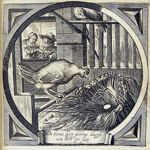
De Hinne leydt geerne daerse een nest ey siet: Cats, Spiegel (The Hague, 1632), emblem 23 uses the imagery of a chicken only laying an egg where she sees a nest egg to convey the message of the woman that she will only enter a relationship on equal terms; Cats also quotes the adage directly
Iconclass: 51HH1:51B3 Part, Section, Aspect❧Parity, Equality
Loci Communes: Aequalitas (Equality, Égalité)
IV vi 68 Recto pectore With an upright heart
Ammianus Marcellinus lib. 17 His literis diu libratis, recto pectore, quod dicitur, considerateque responsum est. Recto pectore dictum est pro eo quod erat ingenue citraque dissimulationem, ut veritatis simplex est oratio. Qui probant quod probandum est, damnant quod damnandum est, recto pectore loquuntur. Qui nihil non probant, aut nihil non damnant, non agunt recto pectore
Ammianus Marcellinus book seventeen: 'When this letter had been considered for a long time, a response was given after great thought and, as the saying goes, "With an upright heart."' 'With an upright heart' means 'sincerely, without dissimulation,' since 'True speech is simple.' Those who approve of what ought to be approved and condemn what ought to be condemned speak 'With an upright heart.' Those who approve or condemn everything do not act 'With an upright heart.'
Facsimile:
Iconclass: 31A2221(+63) heart (+ upward) 57A612 Sincerity; 'Purità et Sincerità d'animo', 'Sincerità' (Ripa)
Loci Communes: Fides et gravitas (Trust and seriousness, Confiance et gravité)
IV vi 69 Cothonisare To be in one's cups
Κωθωνίζειν sive Κωθωνίζεσθαι dicebantur, qui largius biberent, et potationem largiorem κωθωνισμὸν appellabant. Eam Mnaesitheus medicus apud Athenaeum lib. 11. putat conducere valetudini corporum, Plato corrigendis moribus, Seneca ingenio, excludunt tamen ebrietatem, nec id nisi raro fieri sinunt. Ακροκώθωνες, sive ut scripsit quisquis collegit Etymologicon, ἀκρατοκώθονες, dicti qui meracius biberent, quos Hesychius putat dictos ἀκροθώρακας. Adscribit enim me/qus1oi. Verum ex Plutarcho in Symposiacis, et Aristotele in Problematibus, apparet ἀκροθώρακας dici, qui nondum prorsus ebrii sunt, toto corpore rigato, sed pectore summo duntaxat. Indicat et Iulius Pollux libro 6. ex auctore Hyperide: et Athenaeus citans eundem in oratione contra Demosthenem. e)pikwqwni/zesqai pro intemperantius bibere refert Pollux ex auctore Critia. Cothon autem poculi genus est, de quo nonnihil alias attigimus.
[greek], To drink from a cothon, was said of those who drank heavily, and[greek] was the name given to a rather heavy drinking session. Mnesitheus, a doctor mentioned in Athenaeus book eleven, thinks that such a session is conducive to good health, Plato believes that it is good for improving character, Seneca says it lifts the spirits. Nevertheless, they forbid complete drunkenness and they allow this to happen only rarely. Those who drank undiluted wine were called [greek] or [greek], as the word is written by whoever put together the Etymology. Hesychius thinks that they are called [greek]. For he explains this word as meaning [greek] 'drunken.' But from Plutarch in 'Table-talk' and Aristotle in his Problems it appears that [greek] describes those who are not yet completely drunk; their whole body is inebriated, but their rational faculties are only partly affected. The word [greek] is mentioned by both Julius Pollux in book six, quoting from Hyperides, and Athenaeus, citing the same author in his speech against Demosthenes. Pollux cites [greek] in the sense 'to drink intemperately' from Critias. A cothon is a type of cup, which we have touched on elsewhere.
Facsimile:
Iconclass: 31B52 drunkenness 41C12:41C71 drinking❧alcoholic drinks 41C321:41C711 cup❧wine ~ alcoholic drinks 61G(COTHON) names of artefacts and man-made objects (COTHON) (COTHON)
Loci Communes: Bibacitas (Excessive drinking, Penchant pour la boisson)
IV vi 70 Τρυγόβιοι Drinkers of dregs
Homines sordidos, ac parcos olim popularis iocus trugobi/ous2 appellabat, quasi faece victitantes. Qui splendidiores sunt, ubi ventum est ad faecem, aperiunt aliud vas. At ego novi divites, qui fecem novem annorum apponerent in mensa, liberis & amicis non vulgaribus. Quidam adeo natura miseri sunt, ut non patiantur bibi vinum, nisi posteaquam vel acuit vel evapuit. Adagium indicavit Pollux li. 6. cap. 4. Eustathius ostendit perparcos τρυσιβίους dici, quod anxii cumque gemitu vivant. Ridetur apud Aulum Gellium libro undecimo, capite septimo, qui de nimium frugali quodam dixerit, Hic eques Romanus apludam edit et floces bibit. Prisci rustici frumenti furfurem appellabant apludam, flocem, vini faecem è vinaceis expressam, quemadmodum fraces ex oleis.
In antiquity those who were mean and very thrifty were often jokingly called [greek] 'Those who live on dregs.' Those who live in a more splendid way open a new bottle when they get to the dregs of the one they are drinking. Yet I know some rich men who put nine-year-old lees on the table not only for their sons but also for distinguished friends. Some people are by nature such cheapskates that they serve only wine that has turned sour or gone flat. Pollux gives the adage in book six, chapter four. Eustathius tells us that those who were very niggardly were called [greek], because they groaned and worried their way through life. In Aulus Gellius book eleven, chapter seven, a man provokes laughter when he says of a very frugal person, 'This Roman knight eats apluda and drinks flocces.' Farmers of old called the chaff of grain apluda, and the lees of wine crushed from grapeskins (like the dregs of oil from olives) they called flocces.
Facsimile:
Iconclass: 32A44 miser 41C12:41C672 drinking❧vinegar
Loci Communes: Sordes et parcimonia (Meanness and stinginess, Bassesse et avarice)
IV vi 71 Loquax talpa A mole who never stops talking
Homo nullius iudicii, sed tamen impendio verbosus, loquax talpa dictus est populari convicio. Quod primum dictum est in Iulianum Capellam, posteaquam venerat in publicum odium: nam talpae nostri, ut caeci sunt, ita sunt aeque muti. Idem dictus est πίθηκος ἐν πορφύρᾳ, id est, simia purpurata, cuius alibi meminimus. Refert Ammianus libro 17.
It was a common insult to call a man who had no judgment but who talked interminably a mole who never stopped talking. It was first said of Julianus Capella when he had incurred the hatred of all his citizens. The point of the insult is that the moles we are familiar with are not only blind but are also quite dumb. The same kind of person was also called [greek] 'An ape in purple,' which we have mentioned elsewhere. Ammianus gives us the proverb in book seventeen.
Facsimile:
Iconclass: 25F29(MOLE):31B6235 other mammals: mole❧speaking 51F2 Continuity 52D4 Prolixity, Verbosity, Loquacity; 'Loquacità' (Ripa)
Loci Communes: Multi - in stupidos (Many people - against the stupid, Beaucoup de gens - contre les sots)
IV vi 72 Non contis, aut ramulis Not by poles or branches
Idem libro eodem de Antonio quodam ad honorem mensae regalis apud Persas evecto et ad ius ferendae sententiae admisso, non contis, inquit, qut ramulis, ut aiunt, id est, non flexiloquis ambagibus vel obscuris, sed velificatione plena, in rem publ. ferebatur, eoque incitans re gem. Quamquam pro ramulo, legendum arbitramur remulo: nam contis & remis im pellunt navim, qui ventos habent adversos. Pars est magis adagii, quod alibi recensuimus, Velis remisque, quàm novum adagium.
Ammianus, in the same book, says of a certain Antonius who had been elevated to the honour of sharing the Persian royal table and had been given the right to vote, 'It was not by poles or ramulis "by branches," as the saying goes (in other words, not by ambiguous and obscure subterfuges), but at full sail that he attacked his country, and thereby urged on the king.' However, I think remulo 'by little oar' should be read for ramulo 'by branch'; for when winds are adverse, sailors impel their ship with poles and oars. This is really part of the adage that we listed elsewhere, 'With oars and sails,' rather than a new one.
Facsimile: 
Iconclass: 46C2323 oaring, sculling 46C24111 sail
Collectanea (1500): 470
Loci Communes: Vehementia, languor (Vehemence, listlessness, Véhémence, langueur)
IV vi 73 Extra calcem Off course
Idem lib. 21. Ne igitur extra calcem, quod dicitur, sermo decurrens lecturo fastidium ferat, ad explicanda prospecta revertamur. Quamquam arbitramur scripturam vitiatam, legendum aunt esse extra callem, pro extra viam, quod alibi nobis dictum est, ubi quis digreditur a re proposita.
The same author in book twenty-one: 'So that our words will not bore the future reader, by running Extra calcem "Beyond the mark," as the saying goes, let us return to describing the events that had been foreseen.' I think, however, that there is a corruption here and that extra callem 'off the track' should be read in the sense of extra viam, which we have spoken of elsewhere, when anyone wanders from his intended purpose.
Facsimile:
Iconclass: 25D12(CHALK) kinds of non-precious stone: chalk 43C21213 race-track 51I1 Limited, Defined Space
Loci Communes: Aberrandi (Going astray, S'égarer)
IV vi 74 Ex perpendiculo With a plumb-line
Idem libro eodem, ex perpendiculo dixit, pro eo quod erat exacto iudicio, Palatinas inquit dignitates, velut ex quodam tribuens perpendiculo: et sub eo nemo celsum aliquid acturus, in regiam repentinus adhibitus est, vel incognitus. Ad hanc formam et illa pertinent quae cum alibi frequenter, tum apud Gellium sunt libro secundo, cap. primo, ad amussim exigere, et librili perpendere, et ad aequilibrium aestimare. Et apud Plinium libro 36. cap. 25. ad regulam ac libellam exigere. Praeterea digitis metiri, trutina pensare, ad unguem facere, aliaque quorum nonnulla suis locis indicavimus, quae omnia plus habent veneris, si ad res animi transferantur. Sumpta metaphora a perpediculo fabrorum, quo exploran t vel aequalitatem soli, vel parietis rectitudinem. Amussis est pensilis, in imo plumbum habens affixum, additur in medio regulae quae constat duobus gnomonibus, hac explorant aequalitatem soli. M. Tullius in Verrem actione tertia: Tu Verres hic, quod moliare, nihil habes, nisi forte vis ad perpendiculum columnas exigere. Dicunt ei fere nullam esse columnam, quae ad perpendiculum esse possit. Nam hercle inquit, sic agamus, columnae ad perpendiculum exigantur, etc.
The same author in the same book used the expression 'With a plumb-line,' meaning 'with precise judgment.' He says, 'He assigned the offices of the palace with a plumb-line, as it were, and under him no one who was to hold a lofty position was brought into the court suddenly or untested.' Related to this expression are those which, as well as occurring frequently elsewhere, are to be found in Gellius book two, chapter one: ad amussim exigere 'to demand a precise equivalent,' librili perpendere 'to weigh in the balance,' ad aequilibrium aestimare 'to estimate an exact equivalent.' Also in Pliny book thirty-six, chapter twenty-five: ad regulam ac libellam exigere 'to finish to rule and level.' In addition there is Digitis metiri 'To count up on one's fingers,' Trutina pensare 'To weigh in the scale,' Ad unguent facere 'To do something to the finger-nail' and others, some of which we have pointed out at the appropriate place. All these expressions have more charm if applied to intellectual matters. The metaphor is taken from workmen's plumb-lines, with which they check whether a floor is level or a wall is perpendicular. An amussis is a string with a piece of lead attached to it at the bottom, and is fixed to the middle of a measuring rule consisting of two squares. With this they test whether the ground is level. Marcus Tullius in the third speech against Verres:
'You, Verres, have nothing to do here unless perhaps you wish to make sure
that the columns are exactly plumb.' They tell him that there is scarcely any
column that can be exactly plumb. 'Damn it then,' he says, let's do it. Let us
demand that the columns be exactly plumb.'
Facsimile:
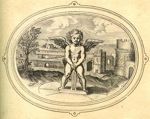
Ad amussim: Vaenius, Amorum emblemata (Antwerp, 1608), emblem 39
Iconclass: 47G6(PLUMB-LINE) tools and machines ~ building: plumb-line 52D2:52A52 Clarity, Precision❧Judgement, Discrimination; 'Giuditio' (Ripa)
Loci Communes: Diligentiae (Diligence, Diligence)
IV vi 75 Acolo non ficu Morsels, not figs
Ακόλῳ τὰ χείλκοῦ σύκῳ βῦσαι. id est, Acolo non ficui immergere labra. Suidas indicat dictum, ubi promitteretur prospera valetudo, aut significaretur rebus fortiter utendum. Nam ἀκόλους Graeci vocant, minutas offulas. Interdum et fragmenta panis, παρὰ τὸ μὴ κολλᾶσθαι, i. quod non cohaereant. Hesychius indicat a)ko/lous2 vescentem reddere bilis expertes ac placidos, cum ficus incendat sanguinem. Vidimus aliquos si quando bilem vellent eximere, dies aliquot nihil sumere praeter offulas pauculas ex aqua cum paululo butyti recentis decocta. Quidam addunt herbarum ac radicum pauxillum. Proverbium hortatur ad victum tenuem.
[greek], Put your lips on a morsel, not a fig. Suidas points out that this was said when good health was promised or when someone meant that one should face circumstances bravely. For in Greek [greek] refers to tiny pieces of food, sometimes even morsels of bread. It is derived from [greek] 'not to be joined' because the pieces do not stick together. Hesychius says that eating [greek] gets rid of anger and makes one calm, while figs enflame the blood. When Italians want to get rid of bile, we have seen them eat nothing for several days except a few morsels of bread, dipped in a sauce made from water and a little fresh butter. Sometimes a few herbs or roots are added. The proverb encourages us to eat modestly.
IV vi 76 Πενταπλόα A cup of five
Athenaeus lib. 11. commemorat poculi genus, quod olim πεντάπλοον dicebatur, quod in publicis ludis adhibeatur. Ephebi quidam cursu contendebant Athenas. Currebant autem gestantes viteum ramum onustum fructu, qui dicebatur ὄσχος. Initium cursus erat a templo Bacchi usque ad templum Palladis, cui cognomen σκιῤῥάς. Victor in eo certamine capiebat calicem dictum πετάπλοον. atque ita tripudiabat in chorea. Nomen inditum calici, quod in eo quinque rerum species essent commixtae, vinum, mel, caseus, farina & paululum olei. Accommodari poterit ad orationem ex variis argumentis consarcinatam. Simile quoddam vas erat fictile, quod Graeci κέρνος appellant, Baccho sacrum. In eo plures erant rerum species, sed distinctae cyathulis inter se connexis. Athenaeus nominatim receset circiter sedecim. Ut igitur farraginem dicimus rem variam, atque ex diversis generibus conflatam, ita poterimus vel πεντάπλοον vel κέρνος, dicere. De copiae Cornu dictum est alias. Nec his dissimile est quod satyram dixere prisci, de quo suo dicetur loco.
Athenaeus book eleven mentions a kind of cup that in ancient times was called 'A cup of five,' used at public festivals. Some youths used to take part in a race to Athens, carrying a vine branch laden with fruit as they ran. This was called an [greek] The race began at the temple of Bacchus and ended at the temple of Athena Scirras. The winner in this contest received a cup called 'a cup of five' and then leapt around in a group of dancers. The cup got this name because five kinds of things were mixed in it: wine, honey, cheese, ground barley, and a little olive oil. The expression can be applied to a speech in which different arguments have been stitched together. There was a similar earthenware vessel (called a [greek] 'tray' in Greek) that was used in the worship of Bacchus. In this were placed a greater number of things but these were kept separate in little cups that were joined together. Athenaeus lists about sixteen by name. Therefore, we can use the terms [greek] or [greek] as the equivalent of farrago 'a hodge-podge,' which we use to denote something that is multifaceted and composed of different kinds of things. About 'Horn of plenty' I have spoken elsewhere. Quite similar to these expressions is what the ancients called satyra, of which I shall speak in its proper place.
Facsimile:
Iconclass: 25G4(BARLEY) plants and herbs: barley 41C263(+0) mixing, combining (preparing food) (+ variant) 41C321:49D11(5) cup❧numerals: 5 41C636 honey 41C6412 cheese 41C671(+1):25G21(OLIVE) oils and vegetable fats (+ taking (particular) foodstuffs: eating, drinking, smoking, chewing, etc.)❧fruits: olive 41C711 wine ~ alcoholic drinks 51BB4 Multiformity, Variety
Loci Communes: Mixta (Mixed things, Choses mêlées)
IV vi 77 More Carico In Carian fashion
Σχήμαιτ καρικῷ, id est, Figura sive modo Carico, fieri dicebatur, quod sordide incompositeque fiebat, praesertim in rebus obscenis: quod tamen ad alia transferri potest, velut ad mores indecoros atque inciviles, ad orationem inconditam. Legimus & πλοίῳ καρικῷ, id est, nave Carica.
[greek], In Carian form or fashion. This was said of anything that was done in a disgusting and crude way, particularly with respect to obscene matters. However, it can be applied to other things, such as unseemly and impolite manners or to a speech that is badly organized. We also find [greek] 'in a Carian ship.'
Facsimile:
Iconclass: 54BB6 Worthlessness 56BB4 Disgust, Dislike, Repulsion, Nausea 61D(CARIA) geographical names of countries, regions, mountains, rivers, etc. (CARIA) (CARIA)
Loci Communes: Absurda, indecora, seu praepostera (Absurd, unbecoming, or preposterous things, Choses absurdes, inconvenantes ou déplacées)
IV vi 78 Μυσικαρφί Choking on straw
Μυσικαρφί, dicebantur agere, qui dure ac sicce viverent. Vox ficta videtur à mure & palea, quod mus in re pusilla vehementer laboret: nisi malumus dictum a μύσσω quod est sicco, & μύσις praefocatio, quasi si quis festuca praefocetur. Nam Hesychius indicat sic hanc vocem pronuntiandam, ut dicitur, a)koniti\, usurpatam autem a Cratino in fabula, cui titulus, Horae. Alii virum quempiam μυσίκαρφον dictum existimant, qui ex se quidem nihil venustiorum dicteriorum afferre poterat, sed tamen libenter aliorum dictis adridebat. Et huius nominis mentionem factam, apud Aristophanem Comicum. Torquebitur igitur in hominem parcum ac sordidum, aut in frigide iocosum.
[greek] was said of those who had a hard and austere life. The word seems to be fashioned from the Greek words [greek] 'mouse' and [greek] 'straw' because a mouse expends a great amount of effort on insignificant things, unless we prefer a derivation from [greek] 'to dry,' and [greek] 'suffocation,' in the sense that someone is suffocated by straw. Hesychius points out that this word should be taken to be similar to [greek] 'without effort.' Used by Cratinus in the play entitled Horae. Others think that there was some man called [greek] who was incapable of producing any witty sayings of his own, but nevertheless enjoyed laughing at what other persons said. There is mention of this name in Apollophanes, the writer of comedies. It will be applied therefore to a mean and miserly man or to one who tries unsuccessfully to be amusing.
Facsimile: 
Iconclass: 31E23141 deprivation of air, choking 41B12(STRAW) burning as process: straw 54DD4 Difficulty 55CC1 Saving, Frugality, Parsimony; 'Parsimonia' (Ripa)
Loci Communes: Frugalitas (Frugality, Frugalité)
IV vi 79 Μύτης A mutterer-fish
Impendio tacitus, aut in Venerem solutior dicebatur μύτης, quasi dicas mutitor, a mu\ mutorum syllaba, de quo nobis alias dictum est. Est huius nominis piscis femina, quae sine mare non pascitur. Hinc et in libidinosos, aut supra modum uxorios. Rectius autem in virosas feminas. Auctor Hesychius:
Someone who hardly ever said anything or who was rather loose in his sexual behaviour was called μύτης 'a mutterer' from mu, the only sound that mutes can make. I have spoken of this elsewhere. A female fish of this name does not feed unless accompanied by its mate. Hence the proverb applies to lustful persons or to those who are too dependent on their wives, although more correctly it applies to women who are too dependent on their husbands. The source is Hesychius.
Facsimile:
Iconclass: 25F6 fishes 31A4121 deaf-mute, deaf and dumb 52DD3 Taciturnity; 'Secretezza', 'Secretezza overo Taciturnità' (Ripa) 57AA51 Licentiousness, Lasciviousness; 'Lascivia', 'Licenza' (Ripa)
Loci Communes: Luxus et mollicies (Luxury and softness, Luxe et mollesse)
IV vi 80 Qui inspuerit in cavernam formicarum, etc Whoever spits on an ants' nest ...
Idem indicat vulgari sermone suisse iactatum, ὡς ὁ πτύσας εἰς μυρμηκιὰν, οἶδεῖ τὰ χείλη. i. Quod qui inspuerit in agmen formicaru, huic intumescant labra: Hoc seu vere fit, ut ex halitus repercussu virus aliquod afficiat conspuentis os, seu temere creditum, torqueri poterit in cos, qui multitudinem imbecillam quidem, sed tamen numerosam, et concordem provocant. Hesychius auctorem citat Dinolochum. Is fuit Comoediarum scriptor, Epicharmi filius.
The same author points out that there was a common saying [greek] 'The lips of the man who spits on an ants' nest swell up.' Whether it really happens that air is forced from an ants' nest, bringing some infection that affects the spitter's mouth or whether this is a foolish belief, it can be applied to those who stir up the hostility of a crowd of weaklings. Although these are weak individually, they are very numerous and can act together. Hesychius cites Dinolochus as the source. He was a writer of comedies, the son of Epicharmus.
Facsimile:
Iconclass: 25F711(ANT)(+421) insects: ant (+ nest, den, burrow) 31A65 spitting 33B14:54AA7 threatening behaviour, challenging❧Weakness, Powerlessness, Helplessness; 'Infermità' (Ripa)
Loci Communes: Malum accersitum aut retortum (Evil brought upon oneself or turned back, Mal attiré ou retourné)
IV vi 81 Nemo sibi nascitur No one is born just for himself
Haec sententia Platonis sic est ab eruditis omnibus celebrata, ut optimo iure possit inter proverbia recenseri. Eam primus Plato prodidit in epistola, quam scripsit ad Archytam: Αλλὰ κᾀκεῖνο δεῖ σε ἐνθυμεῖσθαι, ὅτι ἕκαστος ἡμῶν οὐχ ἀΥτῷ μοννον γέγονεν, ἀλλὰ τῆς γενέσεως ἡμῶν, τὸ μέντι ἡ πατρὶς μερίζεται, τὸ δέτι οἱ γέννσαντες, τὸ δὲ οἱ λοιποὶ φίλοι, πολλὰ δὲ καὶ τοῖς καιροῖς δίδοται τοῖς τὸν βίον ἡμῶν καταλαμβάνουσι. i. Quin et illud tibi considerandum est, quod quisque nostrum, non sibi tantum natus est, sed ortus nostri partem sibi vendicat patria, partem parentes, partem amici ceteri. Multa vero dantur et occasionibus, quae incidunt in vitam nostram. Adducit hunc locum Marcus Tullius libro de Officiis primo. Sed quemadmodum, inquit, ut praeclare scriptum est a Platone, non nobis solum nati sumus, ortusque nostri partem patria vendicat, partem parentes, partem amici. Quam sententiam cum dilucide, commode et eleganter verterit Cicero, miramur quare Seneca dicere maluit: Nemo sibi contigit. Nam videtur exprimere voluisse illud ἔγνετο, sic enim scribit ad Lucilium lib. 5. epist.32. Vis scire quid sit, quod faciat homines avidos futuri? Nemo sibi contigit. Videtur enim hoc imputare parentibus, quod non statim expetimus optima. Subicit enim: Optaverunt itaque tibi alia parentes tui, sed ego contra, omnium tibi eorum contemptum opto, quorum illi copiam. Vota illorum multos compilant, ut te locupletent. Idem studii fuisse videtur Quintiliano, ut omnia secus diceret, quam dixerat Cicero. Quare fit, ut non raro dicat inelegantius, atque etiam obscurius.
This saying of Plato is used so frequently by all learned men that it can, with every justification, be listed among proverbs. Plato was the first to use it, in a letter that he wrote to Archytas:
That too you must consider, that [greek] 'each of
us is not born just for himself.' Our native land claims for itself part of us. A
part of us is claimed by our parents, a part by all our other friends. Much is
given too to the circumstances that befall us in our lives.
Marcus Tullius adduces this passage in On Duty book one. He says, 'But since, as Plato wrote so brilliantly, we are not born just for ourselves, and our country, our parents and our friends all claim part of us.' Since Cicero translated this saying so clearly and appropriately, I am surprised that Seneca preferred to say nemo sibi contigit 'no one has yet found himself.' For he seems to have wished to render [greek] in this way. For this is what he writes in To Lucilius book five, letter thirty-two: 'Do you want to know what it is that makes mortals so greedy for the future? No one has yet found himself.' For he seems to blame parents for the fact that we do not immediately search after what is finest. For he adds: 'And so your parents prayed for other things for you, but I pray that you may despise all these things that your parents wanted for you in abundance. Their prayers plunder many others to enrich you.' Quintilian seems to have had the same desire - to express differently everything that Cicero had said. Therefore he often writes more inelegantly and even more obscurely.
Facsimile:
Nemo sibi natus: Lawson, A nevv orchard and garden (London, 1618), title illustration with adage's paraphrase
Iconclass: 52A53 Self-knowledge 59A1 Sociality
Loci Communes: Amicitia (Friendship, Amitié)
IV vi 82 Piraeus non fert vasa inania The Piraeus does not have empty vessels
Iulius Pollux lib. 6. ca. 6. refert hoc ex Aristotele. τὸν πειρέα μὴ κεναγγίαν ἄγειν, id est, Piraeum non vehere vasa inania. Pireus portus erat Atticae. Huc appellabant vasa mercibus onusta. Eodem conveniebant adolescentes convivium acturi, indicat hoc Antipho in Eunucho Terentiana: Aliquot adolescentuli coimus in Piraeo in hunc diem, ut de symbolis essemus. Est eiusdem nominis portus Corinthiacus, ubi consentaneum est maiorem fuisse luxum. Hinc ductum scomma in eos, qui gaudent semper cibo, potque distendi. Expende num apud Pollucem legendum πειραιέα, ut ad hominem referatur, quando Stephaus indicat, locum & hominem qui prius Piraeus dicebatur, postea dictum πειραιέα.
Julius Pollux in book six, chapter six, cites this from Aristotle: [greek] 'The Piraeus does not have empty vessels.' The Piraeus was the harbour of Attica, and ships laden with merchandise put in there. Young men who were going to have a party met in this same place. Antipho points this out in Terence's Eunuch: 'We young sparks met at the Piraeus to club together for a party today.' The harbour of Corinth, where it is generally agreed there was greater luxury, has the same name. This led to the proverb being used humorously of those who always take pleasure in being stuffed full of food and wine. Consider whether [greek] should be read in Pollux [for [greek]], referring to an individual, since Stephanus points out that a place and a man previously called 'Piraeus' later became [greek].
Facsimile:
Iconclass: 46C223 harbour 55B2 Luxury, Luxuriousness 61E(PIRAEUS) names of cities and villages (PIRAEUS)
Loci Communes: Luxus et mollicies (Luxury and softness, Luxe et mollesse)
IV vi 83 Cradophagus A figleaf-eater
Rusticum & sordidum veteres κραδοφάγον per iocum appellabant, quasi κραδαιοφάγον, Nam κράδαια vocant arboris fici folia. Iidem dicebantur βαλανοφάγοι quasi prisco more glandibus viventes.
As a joke the ancients used to describe a miserly man who lived in the country as a [greek], in the sense of [greek] 'A figleaf-eater.' For [greek] is the name given to the leaves of a fig-tree. The same persons were called [greek], meaning those who ate acorns, as was done in early times.
Facsimile:
Iconclass: 32A44 miser 41C11:25G3(FIG-TREE)(+27) eating❧trees: fig-tree (+ leaf) 55CC1 Saving, Frugality, Parsimony; 'Parsimonia' (Ripa)
Loci Communes: Sordes et parcimonia (Meanness and stinginess, Bassesse et avarice)
IV vi 84 Sapiens divinat A wise man prophesies
Donatus in Hecyram indicat proverbium esse divinare sapientem, quia ex coniecturis prudenter collatis colligit vetum, non solum de praeteritis, verum etiam de futuris, quamquam in fabula, quidem Laches divinans tota errat via. Cuius tamen coniecturam approbans Phidippus ait: plane hoc dminat, nam id est. Reliqua pete ex proverbio: Qui bene coniciet.
In his commentary on the Mother-in-law Donatus points out that 'A wise man prophesies' is a proverb. By carefully examining all the evidence a wise man can deduce the truth not only about past events but also about future ones. In fact, in the play Laches goes completely astray in his conclusions. Yet Phidippus approves of them and says, 'This man has clearly second sight. For the situation is just as he says.' See the proverb 'He who guesses right.'
IV vi 85 Ιαμβίζειν To iambicize
Ιαμβίζειν prisci dixerunt, pro convitiari, ac maledicere, voce ducta ab lambe femina insignite maledica: Probabilius est ab Iambo pede ductum, qui conviciis repertus est, impetum fe rientis atque impetentis exprimens. In quo congruit et illud, quod a brevi orsus desinit in longam, quemadmodum iniuria ex levioribus initiis exit in gravem tragoediam, quod indicavit et Homerus, ἥτ᾽ ὀλίγη μὲν τὰ πρῶτα, id est, Quae primum exigua est Unde et hominem ad conviciandum propensum ἰάμβιλον appellant. Huiusmodi ferme Suidas et Hesychius.
[greek], To iambicize. This was used by the ancients in the sense of 'to revile' and 'to curse,' the word being derived from Iambe, a woman renowned for her abusive language. More probably the word is derived from the iambic measure that is found in invective, since this measure has the forcefulness of someone striking and attacking, the foot beginning with a short element and ending in a long one. In the same way a wrongdoing may start out as something minor but then result in great tragedy, as even Homer also pointed out: [greek] 'small to start with.' This is why a fellow prone to invective is called [greek]. This is very much what Suidas and Hesychius say.
Facsimile: 
Iconclass: 31B6235 speaking 33B15
Loci Communes: Maledicentia (Slander, abusive speech, Médisance)
IV vi 86 Testaceum flagellum An earthenware whip
Κεραμεικὴ μάστιξ. i.Testaceum flagellum dicebatur ostracismus, de quo nobis abunde dictum est in proverbio Ostraci conversio. Flagellum autem vocabant, quod hoc exigerentur in exilium, Testaceum, quod testulis soleant ea ferri suffragia.
[greek], An earthenware whip. Another name for ostracism, about which I have spoken at great length in the proverb 'The turning of a potsherd.' It was called 'a whip' because it was with this that men were driven into exile, 'earthenware' because votes were customarily cast on potsherds.
IV vi 87 Arietis ministerium Doing a good turn to a ram
Κριοῦ διακονία, Arietis ministerium, Suidas & Zenodotus sic referunt, quasi dicisolitum de officio in ingratos collocato. Siquidem aries cornibus ferit pascentem. Hesychius ita refert, quasi congruat in eos qui spe cuiusuis praemioli inserviunt indignis. Cum pueros invitamus ad ministerium, pollicemut aliquid, puta talos aut nuces. Itidem in apologo quopiam dixit Aries, inunge, dabo tibi talos. Addita stellula in editione Aldina indicat κατέλειψεν esse verbum subdititium, legendum est κατάλειψον ab ἀλείφω. Huius obiter mentionem fecimus in proverbio: Aries nutricationis praemium: Est aliud in ingratos proverbium, quod supetius a nobis relatum est: Αντ᾽ εὐεργεσίης ἀγαμέμνονα δῆσαν ἀχαιοὶ, id est: Pro benefactis vinxerunt Agamemnona Graii. Reperitur citatum citra auctoris titulum. Interim in scholis Graecanicis invenitur: in porticu Stoae, quae varia dicebatur et regis, complures fuisse Mercurii statuas, partim a plebeis, partim a principibus positas, una erat ex his quae carmen hoc insculptum habebat antiquis literis. Hinc venit in proverbium. Hoc quidquid est suo loco erat addendum, sed iam ea charta exietaemanus.
[greek], Doing a good turn to a ram. Suidas and Zenodotus say that this was often said of doing a good turn for ingrates; for a ram butts the person who feeds it. Hesychius describes the expression as suiting those who serve unworthy masters in the hope of some trifling reward. When we invite children to do a service for us, we promise them something: knucklebones or nuts, for example. Similarly (in some fable, I think) a ram said, 'Put oil on my food and I will give you knuckle-bones.' The addition of an asterisk in the Aldine edition indicates that [greek] is a corruption. I think that [greek] 'dress with oil' from [greek] 'to anoint' should be read. We mentioned this proverb in passing in 'The ram paid for its upbringing.' There is another proverb directed at ingrates that we have given earlier: 'In return for his kindness the Greeks bound Agamemnon,' which I came across without its source being identified. Meanwhile I have discovered in Notes on Greek Words that in the portico of the Stoa called 'Painted' and 'Royal' there were several statues of Mercury, some erected by ordinary people, others by leading men. One of these had this verse inscribed in ancient letters. Then the expression became proverbial. This note, such as it is, should have been added at the appropriate place, but that page had already left my hands.
Facsimile:
Iconclass: 47I2131 ram 54A6 Helpfulness 57AA8 Ingratitude; 'Ingratitudine' (Ripa)
Loci Communes: Ingratitudo (Ingratitude, Ingratitude)
IV vi 88 In tuum ipsius caput On your own head may it fall
Quoties in autorem mali malam retorquetur aut recidit, Graeci dicunt: Εἰς τὴν αὐτοῦ κεφαλὴν. Demosthenes in oratione: περὶ παραπρεσβείας, οὐκ οὖν τάυτα συνηύχετο οὗτος καὶ κατητᾶτο τῇ πατρίδι, ἅ νῦν εἰς κεφαλὴν ὑμᾶς αὐτῳ δεῖ τρέψαι. i. Haec igitur optabat iste, patriaeque imprecabatur, quae nunc vos oportet in ipsius caput vertere. Ita Ctesippus in Euthydemo Platonis, εἰ μῆ ἀγροικότερον ἦν εἰπεῖν, εἶπον ἄν σοι εἰς κεφαλὴν. i.Nisi dictu rusticius esset, dicerem tibi in caput. Nam sophista collegerat, cos procurare interitum adolescentis, qui vellent eum doctum evadere, cum nondum esset doctus: nam perit quod desinit esse quod erat, & incipit esse quod non erat. Ita Maro: Quod Dii prius omen in ipsum Convertant. Apud Aristophanem in Pluto, Penia ratiocinatur si omnes homines ditescerent, fore ut Chremylus ipse cogeretur arare, fodere, reliquosque labores exhaurire, ut iam afflictior viveret dives, quam ante hac vixerat pauper. Chremylus autem memor laborum, quos in paupertate pertulerat, abominatur hoc verbum, et in Peniae caput reprecatur dicens: ἐς κεφαλὴν σοι, id est, in caput tibi: ut subaudias, recidat. Celius ad M. Ciceronem, libro 8. At Domitius cum manus ad os opposuit, te ad 9. Kalend. Iun. subrostrarii, quod illorum capiti sit, dissiparant perisse.
Whenever misfortune redounds on the person who caused it, the Greeks say [greek] 'On your own head may it fall.' Demosthenes in his speech On the Faithless Embassy: 'This, then, was what that man prayed for and this was how he cursed his country. Now you should turn it on his own head.' Ctesippus in the Euthydemus of Plato: 'If it were not rather boorish of me to do so, I would say "On your head."' The sophist believed that those who wanted a young man to turn out wise were preparing his destruction, even though he was not yet wise; for what ceases to be what it was and begins to be what it was not is destroyed. So Maro: 'May the gods first turn that omen on you yourself.' In Aristophanes in the Plutus Poverty reasons that if all men were to become rich Chremylus himself would be compelled to plough, to dig and to endure all the other labours. He would live a harder life when rich than he had when poor. Chremylus, remembering the toils he had endured in poverty, expresses the hope that what was said will not come to pass and prays in turn for it to fall on the head of Poverty, saying 'On your head,' (with 'may it fall' to be understood). Caelius to Marcus Cicero in book eight: 'But when Domitius put his fingers to his lips, on May 24 the loafers in the forum had spread it abroad that you had perished - may that fall on their heads.'
Facsimile:
Iconclass: 31EE224(+0) accidental death by falling objects - EE - getting wounded by accident (death not involved) (+ variant) 54FF11 Adversity, Misfortune, Bad Luck; 'Fortuna infelice', 'Infortunio' (Ripa) 57BB13 Punishment; 'Castigo', 'Pena', 'Punitione' (Ripa)
Loci Communes: Malum accersitum aut retortum (Evil brought upon oneself or turned back, Mal attiré ou retourné)
IV vi 89 Iracundior Adria As angry as the Adriatic
Qui moribus parum est commodis, et irritabili ingenio, Adriae comparatur proverbio. Ita Flacci amica, qui cum fecerat divortium: Tu levior cortice, et improbo Iracundier Adria. Ipse fatetur se subiracundo fuisso ingenio. Irasci celerem, at sic ut placabilis essem. Item in satyra, cuius initium, Iam dudum ausculto. Aeschines in Demosthenem, dicit eum moribus fuisse adeo asperis et inconstantibus, ut cum Adria facilius sit habere commercium quam cum illo: non quod illud mare sit ceteris saevius, imo vix aliud mitius, sed ita visum est nonnullis, qui si navigassent mare Britannicum aut Danicum, faterentur Adriam indignum esse maris vocabulo.
A person who has a very unpleasant nature and an irritable disposition is proverbially compared to the Adriatic. So the girlfriend of Flaccus, from whom he had separated: 'You are more fickle than cork / And angrier than - the terrible Adriatic.' Horace himself admits that he is prone to anger: 'Quick to anger, but such that I can be appeased.' Also in the satire that begins 'I've been listening for some time now.' Aeschines accuses Demosthenes of being so truculent and unpredictable that it is easier to deal with the Adriatic than with him. Not that this sea is stormier than any other - in fact, there is scarcely one that is more calm - but this was what the Italians thought. If they had sailed the English Channel or the Danish sea, they would admit that the Adriatic does not deserve to be called a sea.
IV vi 90 Bos marinus A sea-ox
Βοῦς ἐνάλιος, id est, Bos maritimus, de magnis, insulsis et ad nihil utilibus, quales sunt phocae, tantum pascentes, nec operi, nec esui utiles, contra quam boves terrestes. Refertur a Suida. Suspicamur autem legendum Βοῦς ἐνάυλιος, ut sit idem quod mox sequitur Βοῦς ἐν αὐλίῳ κάθῃ, id. est, bos in stabulo sedes. Sic enim refertur in collectaneis Tarthaei ac Didymi. Estque hemistichium Iambici trimetri.
[greek], A sea-ox. Said of things that are huge, stupid, and of no use at all, like seals. All they do is eat, and they are useless for doing work or as food, quite the opposite of land oxen. The expression is reported by Suidas. I suspect, however, that we should read [greek], so that it is the same as the one that follows immediately: [greek] 'you sit like an ox in the stable.' For this is how it is given in the Collections of Tarrhaeus and Didymus. It is the hemistich of an iambic trimeter.
Facsimile: 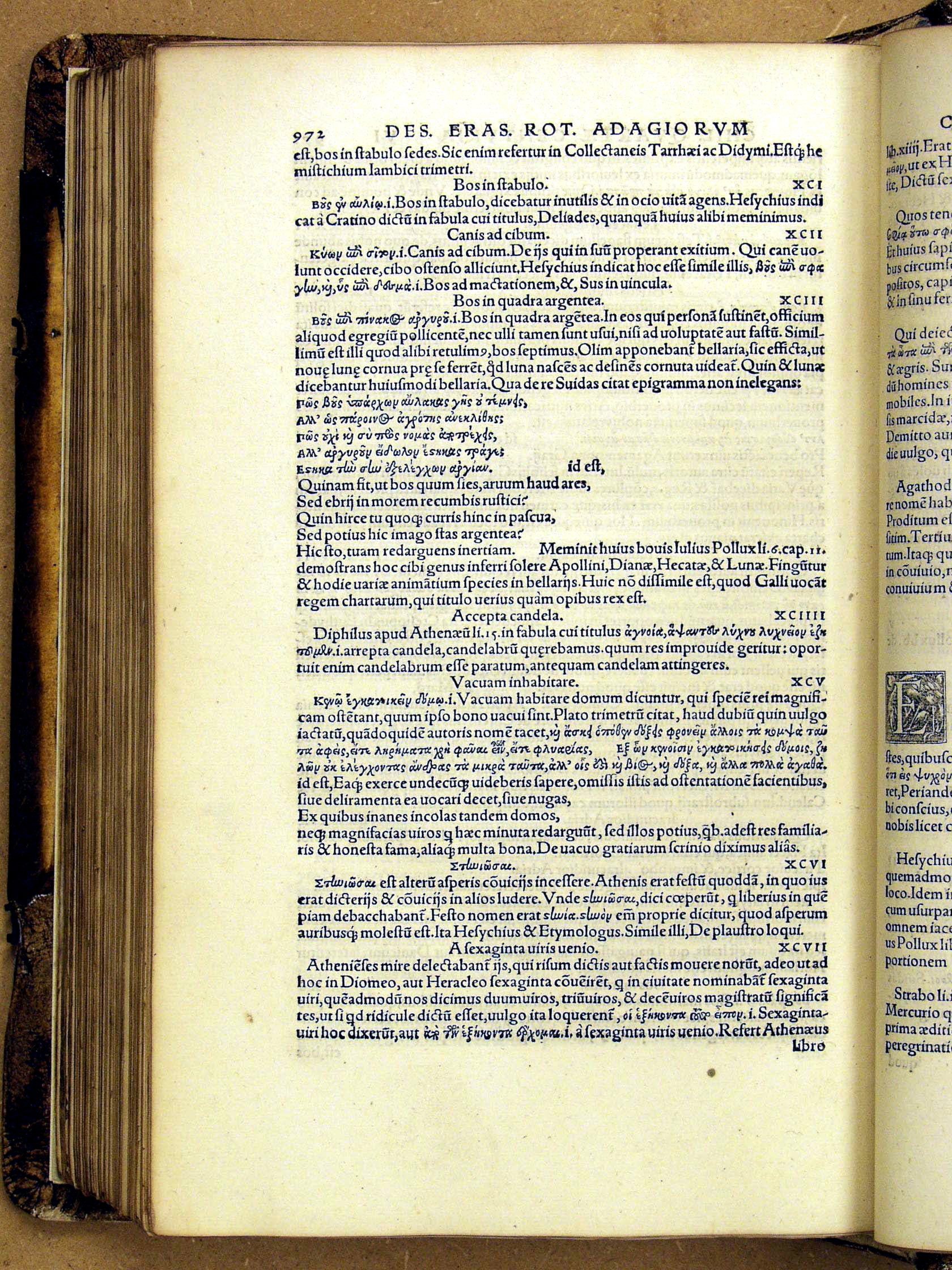
Iconclass: 25FF27(SEA-OX) swimming mammals (SEA-OX) - FF - fabulous animals 52AA1 Stupidity, Poverty of Intellect; 'Stupidità overo Stolidità' (Ripa) 54BB3 Inutility, Noxiousness; 'Nocumento', 'Nocumento d'ogni cosa' (Ripa)
Loci Communes: Multi - in stupidos (Many people - against the stupid, Beaucoup de gens - contre les sots)
IV vi 91 Bos in stabulo An ox in the stable
Βοῦς ἐν αὐλίῳ. ι. Bos in stabulo, dicebatur inutilis et in otio vitam agens. Hesychius indicat a Cratino dictum in fabula, cui titulus, Deliades, quamquam huius alibi meminimus.
[greek], An ox in the stable, described someone who was useless and spent his life in leisure. Hesychius points out that it was said by Cratinus in the play entitled the Women of Delos. However, we have mentioned this proverb elsewhere.
Facsimile:
Iconclass: 47I21111 ox 47I2271 stall, stable 54BB3 Inutility, Noxiousness; 'Nocumento', 'Nocumento d'ogni cosa' (Ripa)
Loci Communes: Luxus et mollicies (Luxury and softness, Luxe et mollesse)
IV vi 92 Canis ad cibum A dog to food
Κύων ἐπὶ σῖτον. i. Canis ad cibum. De iis, qui in suum properant exitium. Qui canem volunt occidere, cibo ostenso alliciunt. Hesychius indicat hoc esse simile illis: βοῦς ἐπὶ σφαγὴν,καὶ, ὗς ἐπὶ δεσμὰ. i. Bos ad mactationem, et sus in vincula.
[greek], A dog to food. Said of those who hurry to their own destruction. A dog is enticed by food by those who wish to kill it. Hesychius points out that this is like [greek] 'an ox to slaughter' and [greek] 'a pig to chains.'
Facsimile:
Iconclass: 34B11(+9451) dog (+ animal in search of food) 34B11(+95212) dog (+ running animal) 58AA12 Self-destruction
Loci Communes: Inanis opera (Vain effort, Effort vain); Insidiae (Ambush, treachery, Embûches)
IV vi 93 Bos in quadra argentea An ox on a silver plate
Βοῦς ἐπὶ πίνακος ἀργυροῦ. i. Bos in quadra argentea. In eos qui personam sustinent, officium aliquod egregium pollicentem, nec ulli tamen sunt usui, nisi ad voluptatem aut fastum. Similimum est illi, quod alibi retulimus: Bos septimus. Olim apponebantur bellaria, sic efficta, ut novae lunae cornua prae se ferrent, quia luna nascens ac desinens cornuta videatur. Quin et lunae dicebantur huiusmodi bellaria. Qua de re Suidas citat epigramma: Πῶς βοῦς ὑπάρχων αὔλακας γῆς οὐ τέμνεις, Αλλ᾽ ὡς πάροινος ἀγρότης ἀνεκλίθης; Πῶς οὐχί καὶ σὺ πρὸς νομὰς ἀποτρέχεις, Αλλ᾽ ἀργυροῦν εἴδωλον ἔστηκας τράγες Εστηκα τὴν σὺν ἐξελέγχων ἀργίαν. id est, Quidnam fit, ut bos cum sies, arvum haud ares, Sed ebrii in morem recumbis rustici? Quin hirce tu quoque curris hinc in pascua, Sed potius hic imago stas argentea? Hicsto, tuam redarguens inertiam. Meminit huius bovis Iul. Pollux li. 6. cap. 11. demonstrans hoc cibi genus inferri solere Apollini Dianae, Hecatae, et Lunae. Finguntur & hodie variae animantium species in bellariis. Huic non dissimile est, quod Galli vocant regem chartarum, qui titulo verius, quam opibus rex est.
[greek], An ox on a silver plate. Of those who give the appearance that they do an outstanding service but are good only for enjoying themselves and looking down on others. It is very like the one we have given elsewhere, 'The seventh ox.' In antiquity sweets were served in the shape of the horns of the new moon (for, when new and when waning, the moon looks like a horn). With respect to this proverb Suidas cites a quite elegant epigram:
How is it that you, an ox, do not plough the field,
But recline there, like a drunken peasant?
Goat, why do you too not rush to pasture,
But instead stand here, a silver image?
I stand here, rebuking your idleness.
In book six, chapter eleven, Julius Pollux mentions this ox, pointing out that this kind of food was customarily offered to Apollo, Diana, Hecate, and Moon. Even today sweets are fashioned in the form of different animals. What the French call roi de cartes 'a paper king' (who is a king in name only rather than in wealth and power) is quite similar to this expression.
Facsimile:
Iconclass: 41C341:25D13(SILVER) dish, plate, saucer❧minerals and metals: silver 41C635(+2) sweets, dainties (+ foodstuffs, drink, etc. on a plate) 47I21111 ox 57AA64 Pride, Loftiness; 'Alterezza in persona nata povera civile' (Ripa)
Loci Communes: Honos indigno habitus (Honor given to the unworthy, Honneur accordé à qui ne le mérite pas)
IV vi 94 Accepta candela With candle in hand
Diphilus apud Athenaeum li. 15. in fabula cui titulus, ἀγνοία, ἅψαντες λύχνου λυχνεῖον ἐζητοῦμεν. i. adrepta candela, candelabrum quaerebamus, cum res improvide geritur: oportuit enim candelabrum esse paratum, antequam candelam attingeres.
Diphilus, cited in Athenaeus book fifteen, in the play entitled Ignorance: [greek] 'we snatched up the candle and then looked for the candlestick.' You should have the candlestick at hand before you even touch the candle.
Facsimile:
Iconclass: 31A2512(+933) arm stretched forward (+ holding something) 41B31 candle 52AA5 Ignorance; 'Ignoranza', 'Ignoranza di tutte le cose', 'Ignoranza in un ricco senza lettere' (Ripa)
Loci Communes: Absurda, indecora, seu praepostera (Absurd, unbecoming, or preposterous things, Choses absurdes, inconvenantes ou déplacées)
IV vi 95 Vacuam inhabitare To live in an empty house
Κενῷ ἔγκατοικεῖν δόμῳ, id est, Vacuam habitare domum dicuntur, qui speciem rei magnificam ostentant, cum ipso bono vacui sint. Plato trimetrum citat, haud dubium, quin vulgo iactatum, quandoquidem auctoris nomen tacet, καὶ ἄσκει ὁπόωεν δόξεις φρονεῖν ἄλλοις τὰ κομψα ταῦτα ἀφεὶς, εἴτε ληρήματα χρὴ φᾶναι εἶναι, εἴτε φλυαρίας, Εξ ὧν κενοῖσιν ἐγκατοικήσεις δόμοις, ζηλῶν οὐκ ἐλέγχοντας ἄνδρας τὰ μικρὰ ταῦτα, ἀλλ᾽ οἷς ἐστὶ καὶ βίος, καὶ δόξα, καὶ ἄλλα πολλὰ ἀγαθὰ. id est, Eaque exerce undecumque videberis sapere, omissis istis ad ostenrationem facientibus, sive deliramenta ea vocari decet, sive nugas. Ex quibus inanes incoles tandem domos. neque magnifacias viros: qui haec minuta redarguunt; sed illos potius, quibus adest res familiaris, et honesta fama, aliaque multa bona. De vacuo gratiarum scrinio diximus alias.
[greek], To live in an empty house. Said of those who put on a magnificent show of wealth, although they have not a single possession to their name. Plato quotes a trimeter, obviously one that was commonly spoken, since he does not give the author's name: 'Work at those things that will bring you wisdom, dropping those that are just for show, called nonsense or trifles as you will, "Things that will bring you to live in empty halls."' Do not put great value on men who confute trifling arguments but rather value those who have substance and an honourable reputation and many other fine attributes. We have spoken elsewhere about 'the empty box' of the Graces.
Facsimile:
Iconclass: 51II2:41A2 Emptiness, Void❧interior of the house 57AA611 Dissimulation, Hypocrisy; 'Hippocresia', 'Simulatione' (Ripa)
Loci Communes: Inanis opera (Vain effort, Effort vain)
IV vi 96 Στηνιῶσαι To Steniacize
Στὴνιῶσαι est alterum asperis convitiis incessere. Athenis erat festum quoddam, in quo ius erat dicteriis et convitiis in alios ludere. Unde στηνιῶσαι, dici coeperunt, qui liberius in quempiam debacchabantur. Festo nomen erat στηνία. στηνὸν enim proprie dicitur, quod asperum auribusque molestum est. Ita Hesychius et Etymologus. Simile illi, de plaustro loqui.
[greek], To Steniacize. This means to hurl fierce abuse at someone. In Athens there was a festival at which people were permitted to make fun of each other with witticisms and insults. As a result of this, anyone who raved too freely at some individual was said 'To Steniacize.' The name of the festival was [greek]. The word [greek] properly describes something that is harsh and annoying to the ears. So Hesychius and the Etymologist. Similar to 'Wagon-language.'
Facsimile:
Iconclass: 12E91(STENIA) feasts and festivals in honour of the Greek gods (STENIA) 33B11 mocking, insulting; teasing 57BB22 Insult; 'Ingiuria', 'Offesa' (Ripa)
Loci Communes: Maledicentia (Slander, abusive speech, Médisance)
IV vi 97 A sexaginta viris venio I'm coming from the Sixtymen
Athenienses mire delectabantur iis, qui risum dictis aut factis movere norunt, adeo ut ad hoc in diomeo, aut heracleo sexaginta convenirent,qui in civitate nominabantur sexaginta viri, quemadmodum nos dicimus duumviros, triumviros et decemviros, magistratum significantes, ut si quid ridicule dictum esset, vulgo ita loquerentur οἱ ἑξήκοντα τοῦτο εἶπον, id est, Sexagintaviri hoc dixerunt, aut ἀπὸ τῶν ἑξήκοντα ἔρχομαι. i. a sexaginta viris venio. Refert Athenaeus lib. xiiii. Erat Athenaeis tribus quae dicebatur διομῶν, a Diomo quodam Colytti filio, unde διομεῖον, ut ex Hesychio licet conicere. Poterit per ironiam dici in dictum illepidum, et agreste, dictum sexaginta viris dignum: aut in stulte dicacem, hic nobis venit a sexaginta viris.
The Athenians took wondrous delight in those who could rouse laughter by their words or actions, so much so that sixty men used to gather in Diomeia or in the temple of Heracles for this very purpose and were called 'the Sixtymen' (just as we say 'duumvirs,' 'triumvirs,' and 'decemvirs,' meaning magistracies). As a result of this, whenever anything funny had been said, an expression commonly used was, 'The Sixtymen said this' or [greek] [greek] 'I have just come from the Sixtymen.' Athenaeus tells of this in book fourteen. In Athens there was a tribe called [greek], named after a certain Diomus, son of Colyttus, whence [greek], as can be gathered from Hesychius. One can say ironically of a crude or graceless turn of phrase 'a phrase worthy of the Sixtymen' or of someone who tries to be witty in a foolish way one can say, This fellow has come to us from the Sixtymen.'
Facsimile: 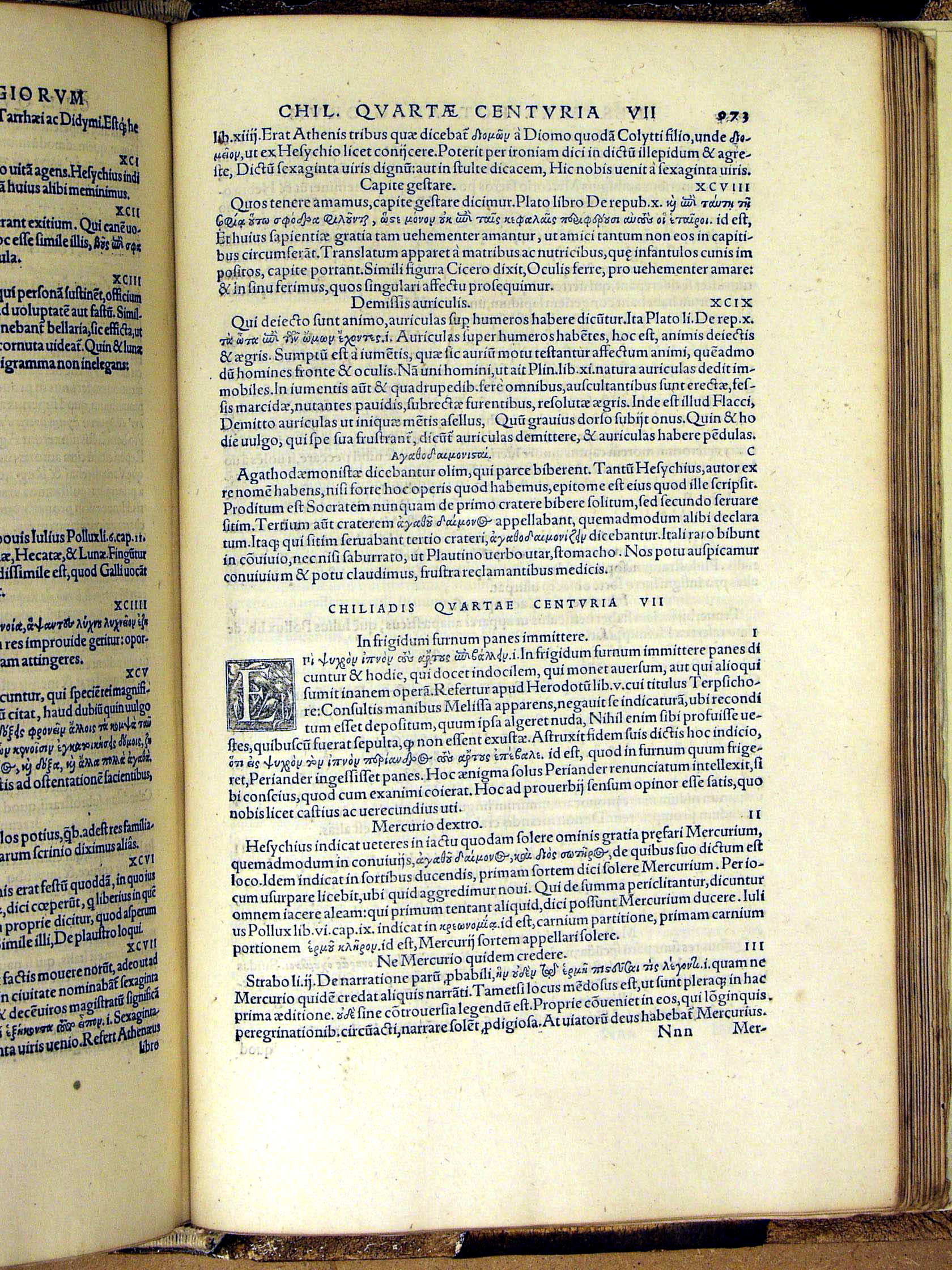
Iconclass: 31D14(+3):49D11(60) adult man (+ sideview, profile)❧numerals (60) 48C8546 comedy 52A55 Subtlety, Acumen, Lucidity, Wit; 'Acutezza de l'Ingegno', 'Sottilità' (Ripa)
Loci Communes: Scurrilitas (Buffoonery, Bouffonnerie)
IV vi 98 Capite gestare To carry on our head
Quos tenere amamus, capite gestare dicimur. Plato libro De Republ. X. καὶ ἐπὶ ταίτῃ τῇ σοφίᾳ οὕτω σφόδρα φιλοῦνται, ὥστε μόνον οὐκ ταῖς κεφαλαῖς περιφέρουσι αὐτοὺς οἱ ἑταῖροι, id est, Et huius sapientiae gratia tam vehementer amantur, ut amici tatum non cos in capitibus circumferant. Translatum apparet a matribus ac nutricibus, quae infantulos cunis im positos, capite portant. Simili figura Cicero dixit: Oculis ferre, pro vehementer amare: et in sinu ferimus, quos singulari affectu prosequimur.
We are said 'To carry on our head' those whom we love dearly. Plato the Republic book ten: 'Because of their wisdom they are loved so deeply that their friends almost carry them around on their heads.' It is clearly a metaphor taken from mothers and nurses who put their babies in cradles and carry them on their heads. Using a similar figure, Cicero said oculis ferre 'to carry in the eyes' meaning 'to love deeply.' And 'we carry in our bosom' those on whom we lavish outstanding affection.
IV vi 99 Demissis auriculus With ears lowered
Qui deiecto sunt animo, auriculas super humeros habere dicuntur. Ita Plato li. De rep. x. τὸ ὦτα ἐπὶ τῶν ὤμων ἔχοντες. i. Auriculas super humeros habentes, hoc est, animis deiectis & aegris. Sumptum est à iumentis, quae sic aurium motu testantur affectum animi, quemadmodum homines fronte & oculis. Nam uni homini, ut ait Plin. lib. xi. natura auriculas dedit immobiles. In iumentis autem & quadrupedib. ferè omnibus, auscultantibus sunt erectae. fessis marcidae, nutantes pavidis, subrectae furentibus, resolutae aegris. inde est illud Flacci, Demitto auriculas ut iniquae mentis asellus, Quum gravius dorso subiit onus. Quin & hovulgo, quispe sua frustrantur, dicuntur auriculas demittere, & auriculas habere pendulas.
Those who are dejected are said 'to have their ears on their shoulders.' So Plato in his Republic book ten: [greek] 'Having their ears on their shoulders,' in other words, being dejected and unhappy. Taken from work-animals who show how they feel by the movement of their ears, just as humans do with their brow and eyes. For, as Pliny, says in book eleven, only to humans did nature give ears that do not move. The ears of work-animals and almost all quadrupeds prick up when they are listening, are languid when they are tired, twitch when they are frightened, and almost completely prick up when they are angry; they droop when the animals are sick. This is why Flaccus writes, 'I droop my ears like an ill-tempered ass / When it takes up too heavy a load on its back.' In fact, even today those whose hopes are disappointed are said 'to lower their ears' and 'to have droopy ears.'
Facsimile:
Iconclass: 31A2213(+64) ears (+ downward) 56BB2 Unhappiness; 'Infelicità' (Ripa)
IV vi 100 Αγαθοδαιμονισταί To be in the service of good luck
Agathodaemonistae dicebantur olim, qui parce biberent. Tantum Hesychius, autor ex re nomen habens, nisi forte hoc operis quod habemus, epitome est eius quod ille scripsit. Proditum est Socratem nunquam de primo cratere bibere solitum, sed secundo servare sitim. Tertium qutem craterem ἀγαθοῦδαιμονος appellabant, quemadmodum alibi declaratum. Itaque qui sitim servabant tertio crateri, ἀγαθοδαιμονίζείν dicebantur. Itali raro bibunt in convivio, nec nisi saburrato, ut Plautino verbo utar, stomacho. Nos potu auspicamur convivium & potu claudimus, frustra reclamantibus medicis.
In antiquity those who drank sparingly were called 'Agathodaimonistae.' That is all Hesychius tells us, an author whose name matches his content, unless perhaps the work that we have is an epitome of what he actually wrote. The story has come down to us that Socrates never drank from the first mixing bowl, but kept his thirst for the second. The third bowl, however, was called [greek] 'Here's to good luck,' as has been shown elsewhere. And so those who kept their thirst for the third bowl were said 'To be in the service of good luck.' The Italians rarely drink at a feast and only if their stomachs are ballasted with food, to use Plautus' expression. We, however, begin the feast with drink, and end it with drink, while the doctors protest in vain.
Facsimile:
Iconclass: 41C711 wine ~ alcoholic drinks 54A43 Temperance, Moderation; 'Misura' (Ripa) 54F12 Luck, Fortune, Lot; 'Fato', 'Fortuna', 'Fortuna aurea', 'Fortuna buona', 'Fortuna pacifica overo clemente', 'Sorte' (Ripa)
Loci Communes: Temperantia (Temperance, Tempérance)