IV vii 1 In frigidum furnum panes immitere To put loaves in a cold oven
Επὶ ψυχρὸν ἰπνὸν τοὺς ἄρτους ἐπιβαλλειν. i. In frigidum furnum immittere panes dicuntur et hodie, qui docet indocilem, qui monet aversum, aut qui alioqui sumit inanem operam. Refertur apud Herodotum libro quinto, cui titulus Terpsichore. Consultis manibus Melissa apparens, negavit se indicaturam, ubi reconditum esset depositum, cum ipsa algeret nuda. Nihil enim sibi profuisse vestes, quibuscum fuerat sepulta, quod non essent exustae. Astruxit fidem suis dictis hoc indicio, ὅτι εἰς ψυχρὸν τὸν ἰπνὸν περίανδρος τοὺς ἄρτους ἐπέβαλε. id est, quod in furnum cum frigeret, Periander ingessisset panes. Hoc aenigma solus Periader renuntiatum intellexit, si bi conscius, quod cum exanimi coierat. Hoc ad proverbii sensum opinamur esse satis, quo nobis licet castius, ac verecundius uti.
[greek], To put loaves in a cold oven. Even today this is said of a person who tries to teach those incapable of learning or gives advice to those disinclined to take it or undertakes some other hopeless task. It is to be found in Herodotus book five, the book entitled Terpsichore. When the shades of the underworld were consulted, Melissa appeared and said that she would not reveal where a sum of money had been hidden, since she herself was cold and naked. For the clothes with which she had been buried had been of no use to her since they had not been burned. She gave credence to what she said by the following revelation: 'Periander put his loaves in an oven when it was cold.' When this puzzling statement was reported, only Periander understood it, since he knew that he had had intercourse with Melissa when she was dead. I think this is enough to explain the sense of the proverb. We can use it in a less indecent and more seemly way.
Facsimile: 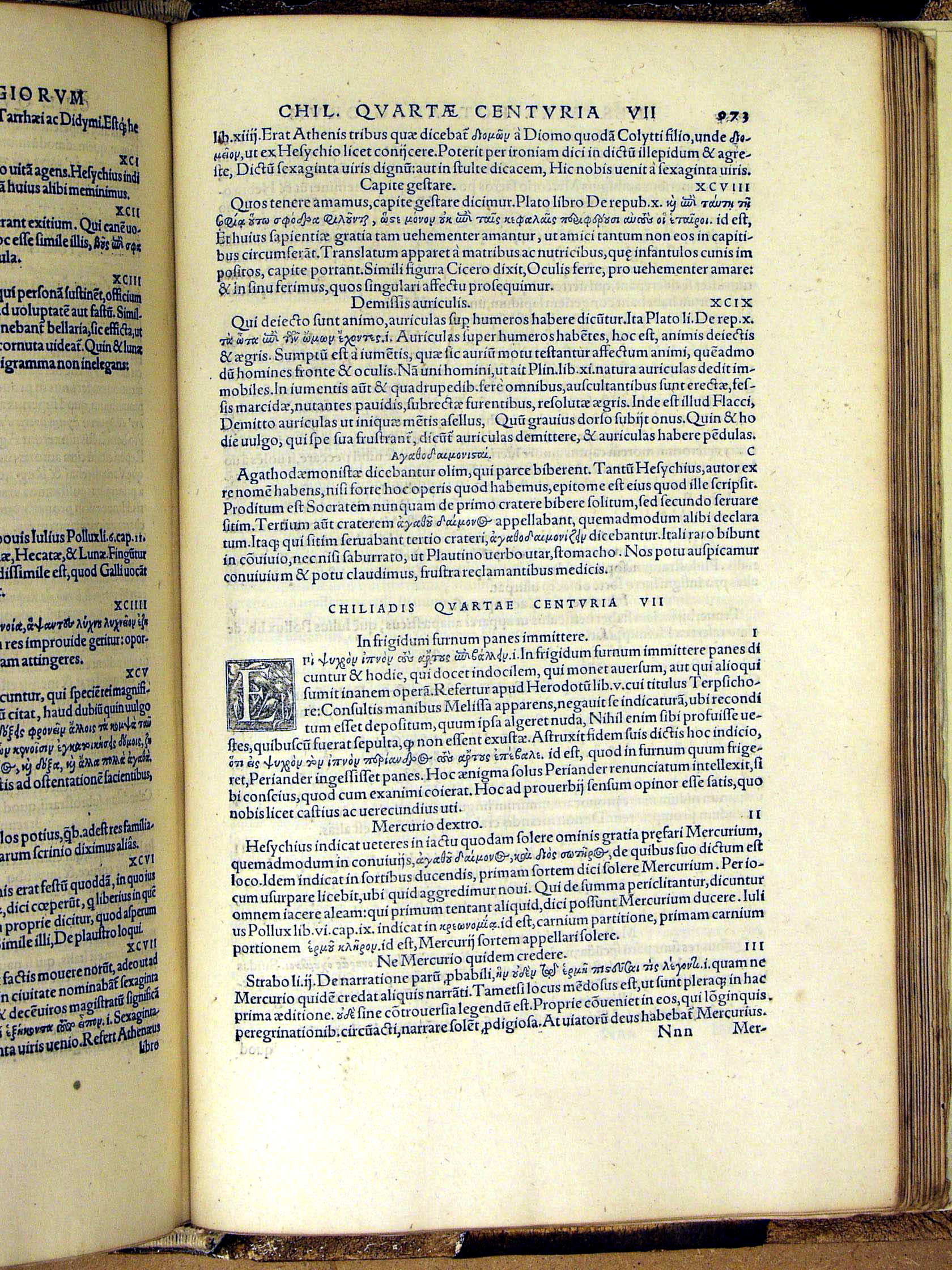
Iconclass: 41C2543:22E2 oven ~ kitchen❧coldness 41C621 bread, loaf 54BB2 Unnecessity, Superfluity
Loci Communes: Inanis opera (Vain effort, Effort vain)
IV vii 2 Mercurio dextro May Mercury be with me
Hesychius indicat vereres in iactu quodam solere omnis gratia praefari Mercurium, quemadmodum in conviviis, ἀγαθοῦδαίμονος, καὶ διὸς σωτῆρος, de quibus suo dictum est loco. Idem indicat in sortibus ducedis, primam sortem dici solere Mercurium. Per iocum usurpare licebit ubi quid aggredimur novi. Qui de summa periclitantur, dicuntur, omnem iacere aleam, qui primum tentant aliquid, dici possunt Mercurium ducere. Iulius Pollux libro sexto, capite nono indicat in κρεωνομΐa/ , id est, carnium partitione, primam carnium portionem ἑρμοῦ κλῆρον, id est, Mercurii sortem appellari solere.
Hesychius points out that in antiquity those who were about to throw dice were accustomed to address Mercury for good luck, just as 'Here's to good luck,' or 'To Zeus the Deliverer' was said at banquets. I have spoken of these at the appropriate place. The same author points out that when lots were being drawn the first lot was customarily called 'Mercury.' We can use it jokingly whenever we undertake anything new. Those who risk everything are said 'To cast all the dice,' while those who are just beginning some enterprise can be said 'to be drawing Mercury.' In book six, chapter nine, Julius Pollux points out that when the meat of a sacrificial victim was being distributed the first portion was usually called [greek] 'Mercury's lot.'
Facsimile:
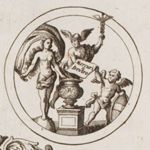
Mercurio dextro: Kolb, Das Frolockende Augspurg (Augsburg, 1716), emblem
Iconclass: 13B423 incantation, magic sentence 43C552 dice 54DD3 Start 54F12 Luck, Fortune, Lot; 'Fato', 'Fortuna', 'Fortuna aurea', 'Fortuna buona', 'Fortuna pacifica overo clemente', 'Sorte' (Ripa) 92B57 specific aspects, allegorical aspects of Mercury; Mercury as patron
Loci Communes: Ominandi (Foreboding, omens, Présager)
IV vii 3 Ne Mercurio quidem credere Not even Mercury would be believed
Strabo libro secundo de narratione parum probabili: ἥν οὐδὲν τῷ ἑρμῆ πιστεῦσαι τὶς λέγοντι, id est, quam ne Mercurio quidem creat aliquis narranti. Tametsi locus mendosus est, ut sunt pleraque in hac prima editione. οὐδὲ sine controversia legendum est. Proprie conveniet in eos, qui longinquis peregrinationibus circumacti, narrare solent prodigiosa. At viatorum Deus habebatur Mercurius.
[greek], Not even Mercury would be believed by anyone if he said this. Strabo in book two says this about a story that is scarcely believable. However, the text of this passage is faulty, as is true of many others in this first edition. Without any doubt [greek] must be read. It will be appropriate to say this of those who have travelled on long and distant journeys and often tell of miraculous happenings. Mercury was regarded as the god of travellers.
IV vii 4 Mercuriale A gift of Mercury
Ερμεῖον Graeci vocabant lucrum praeter expectationem oblatum, a primitiis quas olim in viis ponebant Mercurio. iis viatores vescebantur. Alii malunt ductum ab aceruis lapidum, quos in itineribus ambiguis Mercurio sacros ponebant, quorum meminerunt & Hebraeorum proverbia: Sicut qui mittit lapidem in acervum Mercurii, ita qui tribuit insipienti honorem, quanquam hic varie translatus est Graecis. Quidam ita sunt interpretari, ὅς ἐποδεσμεύει λίθον ἐν σφενδόνῃ, ὅμοίος ἐστι τῷ διδόντι ἄφρονι δόξαν, id est, qui religat lapidem in funda, similis est tribuenti stulto gloriam. Alii pro hermaeo verterunt πολυάνδρειον, qui locus est multorum sepulturae destinatus, et lapidem accipiunt non quodvis saxum, sed gemmam. Nec multum inter se discrepant, qui verterunt polyandrium, et qui hermaeum. Nam et sepulcra plebeiorum habebant congeriem lapidum, unde illud Maronis: Monte sub hoc lapidum tegitur Ballista sepultus. In locum sordidum, ac funestum, stulte mittas gemmam. Non enim ornat locum, sed sordidatur a loco. In Hermaeum vero si mittas quemvis lapidem, nihil est gratiae. Nec enim exstat in turba lapidum, singulorum officium: si gemmam, multo stultior es. Sed illorum est argutissima sententia, qui verterunt fundam. Non enim tantum perit officium tuum, sed in tuum malum resilit: veluti si stulto lapidem innectas fundae, dedisti quo te feriat. Verum haec non sunt proprie huius instituti. Suidas citat haec absque nomenclatura: Οὐ κατα τσὺς ἄλλους ἀγαπήσας τὸ ἑρμαῖον. οὐδὲ οἰηθεὶς ἄρα μηδὲν ἀδικεῖν εἰ ἑκὼν παῤ ἐκόντος ὁτιοῦν ἐωνήσατο. id est, Non iuxta ceterorum morem captus amore lucri, nec arbitratus se nihil peccare, si volens a volente quidvis mercatus esset. Idem refert hanc sententiam tacito item auctoris nomine; Ερμαῖον ἐστὶ τῶν κακοήθων ἅπας ἐπιεινκὴς. id est, Lucrum est improborum, quisquis est humanus, ac modestus. Bonorum enim lenitas, invitat malorum aucaciam. Refert et illud ex Damasceno ut apparet: καὶ ἐδόκει ἑρμαίῳ ἐντετυχέναι, ὁ μοὶ περιτυχὼν. id est, Videbatur sibi in hermaeum incidisse, quisquis in me inciderat. Recreat enim viatorem, ubi dubius de via reperit acervum Mercurii. Idem acervus dicitur λόφος ἑρμαῖος, id est, tumulus sive collis Mercurialis. Philostratus in sophistis Hermaeum appellat thesaurum in aedificio repertum, et alias pro insigni lucro forte obiecto usurpat.
In Greek, profit that befalls one unexpectedly was called a [greek] 'A gift of Hermes' from the first offerings for the god that used to be placed on roads and were eaten by travellers. Others prefer to derive it from the piles of stones that were placed as a sacred offering to the god at points where it was not clear which road to take. These cairns are referred to even in the Proverbs of the Hebrews: 'He who throws a stone on Mercury's heap is like the man who gives honour to a fool.' This verse, however, has been translated in different ways in Greek. Some have rendered it in this way: 'He who ties a stone to his sling is like the man who gives honour to a fool.' Instead of [greek] 'Mercury's heap' others give the translation [greek], which is a place set aside for many burials, and take 'stone' in the sense of 'jewel,' not referring to just any rock. There is little difference in translating the original term by 'cemetery' or by 'heap of stones,' for the graves of ordinary people were covered by a pile of stones. Whence Maro's words: 'Ballista is buried, covered under this mountain of stones.' It is foolish to hurl a precious stone into a place of death and dirt. For a jewel does not enhance such a place, but is defiled by it. There is no point in throwing a stone on to a heap of stones, for in a cairn an individual stone serves no particular purpose. If, however, you throw a jewel on to a heap, you are much more foolish. The most perceptive view, however, belonged to those who translated the word in question as 'sling.' For the meaning is that so far from doing what you are supposed to do, your action actually redounds to your misfortune; if you tie a stone to a fool's sling, you have provided the means for him to strike you. The expression is not confined to this custom of heaping up stones. Suidas cites the following without giving the author's name: 'Unlike others, he is not obsessed with [greek] "the love of profit" and does not think he is guiltless if he has bought at a profit something from someone who willingly sold it.' He also reports this saying, again without naming the author: 'Whoever is gentle and kind is a [greek] "a source of profit" to villains.' For the gentleness of upright persons emboldens criminals. He also gives the following, apparently from the Damascan. 'Whoever bumped into me thought that he had come upon a [greek] "a windfall."' For a traveller who is lost takes fresh heart when he finds a cairn of Mercury. Such a cairn is also called [greek] 'a mound or hill of Mercury.' Philostratus in the Sophists calls a treasure that had been discovered in a building a hermaion, and elsewhere uses the term in the sense of a great profit that befalls one fortuitously.
Facsimile: 
Iconclass: 52BB3 Surprise, Wonder; 'Maraviglia' (Ripa) 54F12 Luck, Fortune, Lot; 'Fato', 'Fortuna', 'Fortuna aurea', 'Fortuna buona', 'Fortuna pacifica overo clemente', 'Sorte' (Ripa) 92B5:33A4 (story of) Mercury (Hermes)❧bringing gifts; exchanging gifts
Loci Communes: Praeter spem bonum aut malum (Good or bad beyond expectation, Bien ou mal inattendu)
IV vii 5 Filum nevisti, et acu opus est You have spun the thread; now you want a needle
Proverbii faciem habet versiculus ut apparet anapaesticus, quem Iulius Pollux libro decimo refert ex Hermippi fatis: Ρἅμμα ἐπέκλωσας, προσδεῖ καὶ ῥαφίδος Filum ductum est, opus est & acu. Cum significamus non satis esse coepisse, nisi pari industria perficias. Didicisti artem, superest exercitatio. Didicisti grammaticam, restat dialectica. Didicisti sacras literas, restat bona vita.
A verse, clearly in anapests, that Julius Pollux gives in book ten from the Fates of Hermippus has the appearance of a proverb: [greek] 'The thread's been spun; now you want a needle.' The meaning is that it is not enough to have begun a task unless you complete it with equal effort. 'You have learned the art, what remains is to practise it.' 'You have learned grammar, dialectic remains.' 'You know the Bible, what remains is to lead a good life.'
Facsimile:
Iconclass: 41D4411 needle ~ sewing 47H31 spinning (manufacture of yarn) 47H352 (ball of) yarn 54D3 Completion
Loci Communes: Perficiendi sive absolvendi (Finishing, completing, Achever, accomplir)
IV vii 6 Calvus quum fis Although you are bald
Gregorius Theologus in epistola quadam ad Eustochium sophistam, quem lacessiverat: καὶ οὐδὲ ὑπὸ τῆς παροιμίας τῆς ἰδιωτικῆς ἐπαιδεύθην φαλακρὸς ὢν κριοῦ μὴ νυστάζειν ἀντιπρόσωπος, μηδὲ τὴν σφηκίαν κατ᾽ ἐμαυτοῦ, γλῶσσαν πρὸς τὸ κακῶς λέγειν ἐτοιμοτέραν.id est, Ac non saltem a proverbio plebeio didicerim, cum sim calvus non obversa fronte obnuere arieti, neque vespatum nidum in me provocare, nimirum linguam ad maledicendum quam ab benedicendum promptiorem. De non irritandis crabronibus dictum est alias.
Gregory the theologian, in a letter to the sophist Eustochius whom he had attacked: 'And I have not even followed the common proverb [greek] "Although bald," which told me that I ought not to clash head to head with a ram or to stir up a wasps' nest against me; in other words, I ought not to provoke a tongue more ready to curse than to flatter.'
I have spoken elsewhere about not stirring up hornets.
Facsimile:
Iconclass: 31A5339 baldness 33B14 threatening behaviour, challenging 47I243(+9512) swarm ~ bees (+ animal(s) attacking) 52A24 Precaution
Loci Communes: Discriminis (Danger, crisis, Danger)
IV vii 7 Argenteus puteus A silver well
Φρέαρ ἀργυροῦν. i. Argenteus puteus. Athenaeus lib. undecimo, indicat olim ingens poculum dici solitum puteum atgenteum: nam cyathi pusilli erant. Sunt et hodie qui delectantur e profundis poculis haurire, atque ut in quit ille, proluere labra, habentes in ore proverbium: Multa aqua ori admota probe macerari barbam. Iocus est a tonsoribus, qui rasuri prius calida macerant barbam.
[greek], A silver well. Athenaeus in book eleven points out that in antiquity a huge wine bowl was customarily called 'a silver well,' since wine-ladles were quite small. Even nowadays some take pleasure in draining wine from deep cups and 'in soaking their lips,' as the poet writes; at the same time they say the proverb 'You need a lot of water to soak a beard.' The joke comes from barbers who soak the beard with lots of warm water before shaving it.
Facsimile:
Iconclass: 25D13(SILVER):41A3911 minerals and metals: silver❧well 41C7111(+0):51G1 glass of wine (+ variant)❧Largeness, Magnitude
Loci Communes: Bibacitas (Excessive drinking, Penchant pour la boisson)
IV vii 8 Malo asino vehitur Riding on a wretched ass
Quibus res sunt parum secundae, mala asella vehi dicuntur, ἐπ᾽ ὄνου πονηρᾶς ὀχούμενοι. Suidas ceu proverbiale refert, in dictione ponhro\s2. Felices enim eximiis equis insidere gaudent, quo celerius proveniant eo quo volunt, nec inscite iacietur in hominem parum feliciter coniugatum.
[greek], Riding on a wretched ass. Said of those for whom things are not going at all well. Suidas gives this expression, as a proverb, under the entry [greek]. The point of the expression is that those who are successful enjoy riding on fine horses so that they may reach their destination more quickly. It will be quite witty to use it of a man who is unhappily married.
Facsimile:
Iconclass: 46C13142 ass, donkey 54FF11 Adversity, Misfortune, Bad Luck; 'Fortuna infelice', 'Infortunio' (Ripa)
Loci Communes: Infortunii sive exitii (Misfortune or ruin, Malheur ou ruine)
IV vii 9 Allium in retibus Garlic in nets
Σκόροδον ἐν δικτύοις. i. Allium in retibus, de sordido commeatu dicebatur, hinc natum, quod Attici quoties navigationem, aut expeditionem adornabant, commercabantur allia, eaque retibus imposita secum ferebant. Item in obsidionibus urbium in pretio erat allium, unde illud citra nomen laturam apud Suidam, ἀπόλλυμαι τὰ σκόροδα πορθούμενος, id est, Perdo allia in obsidione. Thraces praecipue delectantur alliis, utpote calidis, cum regionem inhabitent frigidam. Quin et hodie nautarum deliciae sunt allium, non ingratus et rusticorum cibus, utcumque exsecratus Horatio Locus erit adagio, si quem admoneas, ut philosophiae studium aggressutus, paret sese ad frugalem victum, ad vigilias ac labores, sine quibus non paratur eruditio, σκόροδον ἐν δικτύοις.
[greek], Garlic in nets. This expression was used to describe cheap provisions. Its origin lies in a common practice of the people of Attica. Whenever they were preparing for a voyage or an expedition, they would buy up garlic, put it in nets, and take it with them. Garlic was also valuable when cities were being besieged, whence the following, quoted without source in Suidas: 'I lose garlic in the siege.' The Thracians in particular like garlic since it is sharp-tasting and they live in a cold country. In fact even today garlic is a favourite of sailors, and country-people like it too, however much it was cursed by Horace. A suitable occasion for the adage will be when someone is about to undertake the study of philosophy and you tell him he must prepare himself for a frugal way of living and for long nights of study and hard toil. Your advice will be 'Garlic in nets!'
Facsimile: 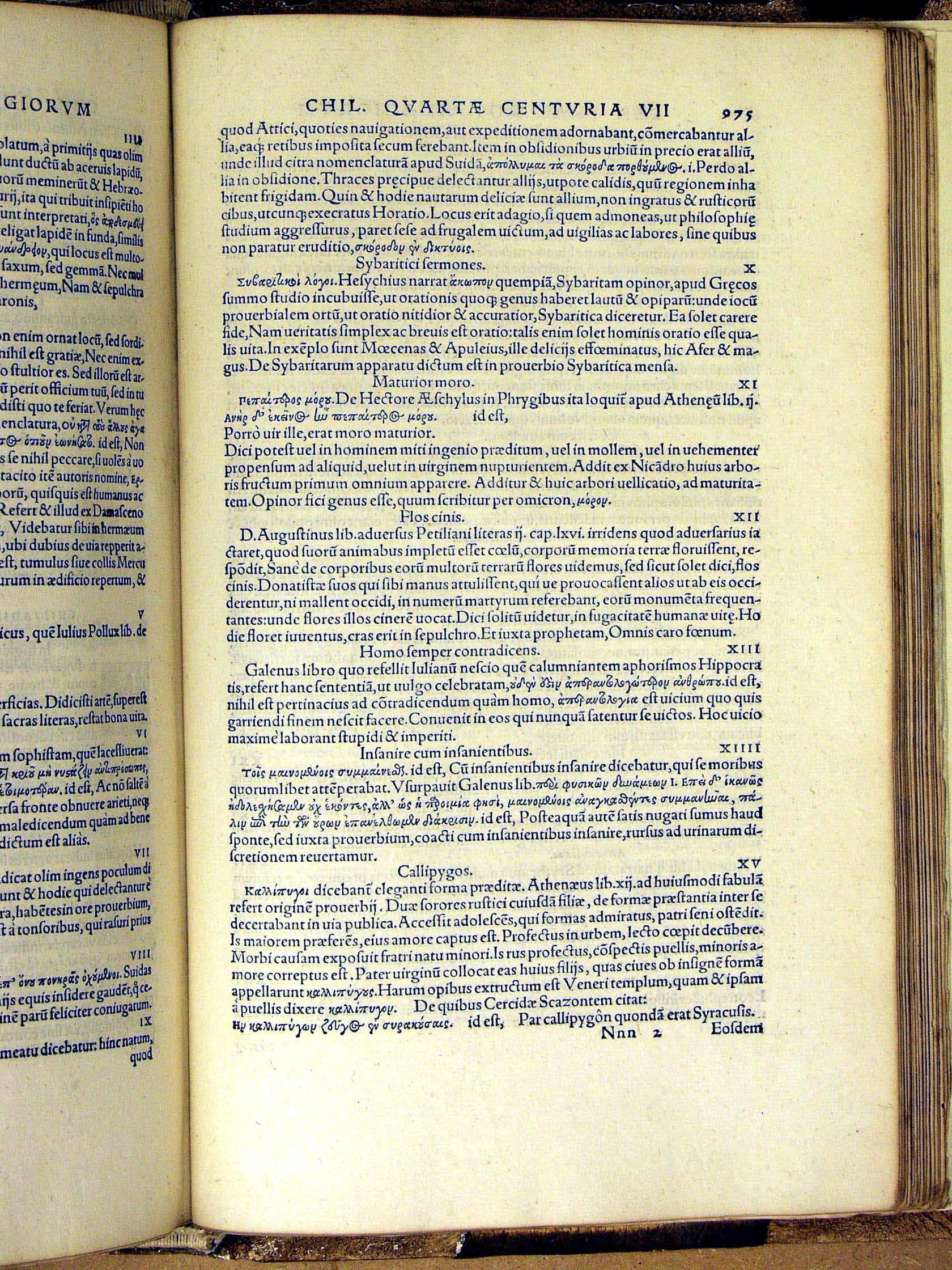
Iconclass: 25G4(GARLIC) plants and herbs: garlic 46C1211 carrying something in basket, bag, rucksack, etc. 55B2 Luxury, Luxuriousness 55CC1 Saving, Frugality, Parsimony; 'Parsimonia' (Ripa)
Loci Communes: Frugalitas (Frugality, Frugalité)
IV vii 10 Sybaritici sermones Sybaritic style
Συβαρϊτιοὶ λόγοι. Hesychius narrat ἄκωπον quempiam, Sybaritam opinamur, apud Graecos summo studio incubuisse, ut orationis quoque genus haberet lautum et opiparum, unde iocum proverbialem ortum, ut oratio nitidior et accuratior, Sybaritica diceretur. Ea solet carere fide. Nam veritatis simplex ac brevis est oratio: talis enim solet hominis oratio esse qualis vita. In exemplo sunt Mecaenas et Apuleius ille deliciis effemitus, hic Afer et magus. De Sybaritarum apparatu dictum est in proverbio Sybaritica mensa.
[greek], Sybaritic style. Hesychius tells of a Greek called Akopus (a man of Sybaris, I think), who worked extremely hard to acquire a luxuriant and rich style of speaking to match his life-style. This gave rise to a humorous proverb that called an exquisite and highly polished style 'Sybaritic' Such a style is usually not persuasive since 'the language of truth is simple and short.' 'As the man is, so is his talk.' Examples of this are Maecenas and Apuleius; the former lived luxuriously and was effeminate, the latter was an African and a sorcerer. I have spoken of the magnificent splendour of the Sybarites in the proverb 'A Sybaritic table.'
Facsimile:
Iconclass: 49C113 'Rhetorica', 'Eloquentia' (~ trivium); 'Rettorica' (Ripa) 54AA43 Intemperance, Immoderation 57AA642 Sophistication 61E(SYBARIS) names of cities and villages (SYBARIS)
Loci Communes: Arrogantia jactantiaque (Arrogance and boastfulness, Arrogance et vantardise)
IV vii 11 Maturior moro As soft as a ripe fig
Πεπαιτερος μόρου. De Hectore Aeschylus in Phrygibus ita loquitur apud Athenaeum libro 2. Ανὴρ δ᾽ ἐκεῖνος ἦν πεπαίτερος μόρου. id est, Porro vir ille, erat moro maturior. Dici potest vel in hominem miti ingenio praeditum, vel in mollem, vel in vehementer propensum ad aliquid velut in virginem nupturientem. Addit ex Nicandro huius arboris fructum primum omnium apparere. Additur et huic arbori vellicatio, ad maturitatem. Opinamur fici genus esse, cum scribitur per omicron, μόρον.
[greek], Riper than a fig. Athenaeus in book two quotes a fragment of Aeschylus in the Phrygians that refers to Hector: 'That fellow was softer than a ripe fig.' It can be said of a man with a very mild disposition or of one who is effeminate or of someone who craves something, like a girl who is itching to marry. Athenaeus adds, from Nicander, that the fruit of this tree appears earlier than any other. Small cuts are also made in the fruit to aid the ripening. When the word is written [greek], with an omicron, it refers to a kind of fig, in my opinion.
Facsimile:
Iconclass: 25G21(FIG):51FF511 fruits: fig❧Maturity 31A719 womanish man, molly-coddle, milksop
Loci Communes: Proclivitas (contra) (Propensity (against), Penchant (contre))
IV vii 12 Flos cinis A flower is but ash
Divus Augustinus libro adversus Petiliani literas 2. cap. 66. irridens quod adversarius iactaret, quod suorum animabus impletum esset caelum, corporum memoria terrae floruissent, respondit: Sane de corporibus eorum multorum terrarum flores videmus, sed sicut solet dici, flos cinis. Donatistae suos qui sibi manus attulissent, quive provocassent alios, ut ab eis occiderentur, ni mallent occidi, in numerum martyrum referebant, eorum monumenta frequentantes: unde flores illos cinerem vocat. Dici solitum videtur in fugacitatem humanae vitae. Hodie floret iuventus, cras erit in sepulcro.
St Augustine in his work In Answer to the Letter of Petilianus, at book two, chapter sixty-six, mocks his adversary because he boasted that the sky was filled with the souls of his followers and that the earth blossomed with the memory of their bodies. In his reply he said, 'We certainly see the flowers of the earth issuing from the bodies of that vast number, but, as the saying goes, "A flower is but ash."' The Donatists regarded as martyrs those followers of theirs who had killed themselves or who had called upon others (who did not wish to die) to put them to death. They constantly visited the martyrs' tombs, and this is why Augustine calls the flowers there 'ash.' It seems to have been customarily said of the ephemeral nature of human existence. Today young men are in the bloom of life; tomorrow they will be in their tomb. And according to the prophet 'all flesh is grass.'
Facsimile:
Iconclass: 11R7(+0) 'Vanitas' symbols (+ variant) 25G41 flowers 41B152 ash 54F122 Vicissitudes of Life
Loci Communes: Fortunae commutatio (Change of fortune, Changement de fortune)
IV vii 13 Homo semper contradicens It is human never to stop arguing
Galenus lib. quo refellit Iulianum quendam calumniamtem aphorismos Hippocratis, refert hanc sententiam ut vulgo celebratam: οὐδὲ ἐστὶν ἀπερανδτολογώτερον ἀνθρώπου. id est, nihil est pertinacius ad contradicendum, quam homo: ἀπεραντολογια est vitium quo quis garriendi finem nescit facere. Convenit in eos, qui nunquam fatentur se victos. Hoc vitio maxime laborant stupidi et imperiti.
Galen, in the book in which he refutes someone called Julian who attacked the Aphorisms of Hippocrates, quotes the following expression as a very common one: [greek] 'There is nothing more stubborn in arguing than a human being.' [greek] 'ceaseless talking' is a vice that does not permit one to know when to stop chattering. It suits those who never admit that they have been defeated in an argument. The stupid and inexperienced suffer very greatly from this vice.
Facsimile:
Iconclass: 52D4 Prolixity, Verbosity, Loquacity; 'Loquacità' (Ripa) 54D31:33B1 Continuance❧quarrel, argument
Loci Communes: Garrulitas (Talkativeness, Bavardage)
IV vii 14 Insanire cum insanientibus To take on the madness of the mad
Τοῖς μαινομένοις συμμαίνεσθαι. id est, Cum insanientibus insanire dicebatur, qui se moribus quorumlibet attemperabat. Usurpavit Galenus lib. περὶ φυσικῶν δυνάμεων Ι Επεὶ δ᾽ ἱκανῶς ἠδολεσχήσαμεν οὐχ ἑκόντες, ἀλλ᾽ ὡς ἡ παροιμία φησὶ, μαινομένοις ἀναγκασθέντες συμμανῦναι, πάλιν ἐπὶ τὴν τῶν οὔρων ἐπάνελθωμεν διάκρισιν. id est, Posteaquam autem satis nugati sumus haud sponte, sed iuxta proverbium, coacti cum insanientibus insanire, rursus ad urinarum discretionem revertamur.
[greek], To share in the madness of the mad. This was said of anyone who modified his own behaviour to match that of others, no matter who they were. Galen used it in book one of On the Natural Faculties: 'Now that we have sufficiently indulged in trifles - not voluntarily, but under compulsion "To take on the madness of the mad," as the proverb says - let us return again to the investigation into urine.'
Facsimile:
Iconclass: 31A4640 Madness 51B6 Imitation; 'Imitatione' (Ripa) 51EE1 Dependence
Loci Communes: Obsecundantis (Complying, being obliging, Se conformer, obéir)
IV vii 15 Callipygos Beautifully-buttocked
Καλλίπυγοι dicebantur eleganti forma praeditae. Athenaeus lib. 12. ad huiusmodi fabulam refert originem proverbii, Duae sorores rustici cuiusdam filiae, de formae praestantia inter se decertabant, in via publica. Adcessit adolescens, qui formas admiratus, patri seni ostendit. Is maiorem praeferens, eius amore captus est. Profectus in urbem, lecto coepit decumbere. Morbi causam exposuit fratri natu minori. Is rus profectus, conspectis puellis, minoris amore correptus est. Pater virginum collocat eas huius filiis, quas cives ob infignem formam appellarunt καλλιπύγους. Harum opibus extructum est Veneri templum, quam et ipsam a puellis dixere καλλίπυγον. De quibus Χercidae Scazontem citat. Ην καλλιπύγων ζεῦγος ἐν συρακούσαις. id est, Par callipygôn quondam erat Syracusis. Eosdem appellant πυγάργους, ut alibi diximus in proverbio λευκόπυγοι
Those who had an elegant body were said to be [greek] 'Wellbuttocked.' Athenaeus in book twelve relates the origin of the proverb to the following story. Two sisters, the daughters of a countryman, were vying with each other on a public road as to which of them was more beautiful. A young man came up. He was struck by their beauty and pointed this out to his father. He preferred the older sister and fell madly in love with her. When he returned to the city he fell sick and explained the cause of his illness to his younger brother, who went to the countryside and after seeing the girls fell in love with the younger one. The father of the girls betrothed them to the other man's sons. The citizens called the girls 'well-buttocked' because of their outstanding beauty. The girls acquired wealth and this was used to build a temple to Venus who was herself also called 'well-buttocked' after the girls. Athenaeus cites a scazon of Cercidas about them: 'Once there was a well-buttocked pair in Syracuse.' An expression with similar meaning is [greek] 'pale-bottomed men,' as we have related elsewhere, in the proverb [greek] 'Whitebottomed.'
Facsimile: 
Iconclass: 51D4:31AA2237 Beauty; 'Bellezza' (Ripa)❧buttocks, 'partes posteriores' - AA - female human figure 92C473(CALLIPYGOS) other specific aspects of Venus (CALLIPYGOS)
Loci Communes: Forma, deformitas (Beauty, deformity, Beauté, difformité)
IV vii 16 Quod volumus sanctum est Our wish is for what is holy
Divus Augustinus lib. contra Cresconium grammaticum 4: Non iam ut vetus proverbium fertur, quod volumus sanctum est, sed etiam quando volumus et quamdiu volumus. Alibi, ni fallimur, citat ex Ticonio Donatiano. Est hemistichium carminis heroici. Genus hoc hominum hodie regnat in mundo, qui pietatem non exigunt ad Christi regulam, sed ad suos affectus: & quicquid vehementer amant, hoc videri volunt etiam sanctum, in rebus natura sceleratissimis sibi mire blandientes. Sanctum autumant gestare tale cingulum. quam obrem? quia parvo negocio cupiunt haberi pro sanctis. At neque sobrie neque caste volunt vivere, nec iniurias perpeti. quur ita? quia durum est ac difficile.
Saint Augustine in book four of Against Cresconius the Grammarian: 'No longer is it a case of "Our wish is only for what is holy," as the old proverb says. Instead, something is holy whenever we wish it and as long as we wish it.' Elsewhere, if I am not mistaken, he cites it as being from Ticonius the Donatist. The expression constitutes half of a dactylic hexameter. Nowadays a class of men who do not measure piety by the rule of Christ but by their own desires hold sway in this world. They want whatever they passionately desire to be regarded as sacred too, marvellously deluding themselves as they indulge in what is by nature most foul. They say that just wearing the belt they do is holy. Why? Because they wish to be regarded as holy with little effort on their part. But they do not wish to live in sobriety and purity, and they are unwilling to endure insults. Why so? Because that is hard and difficult.
Facsimile:
Iconclass: 56F241 Narcissism 57A69 Holiness; 'Santità' (Ripa)
Loci Communes: Philautia (Self-love, Amour-propre)
IV vii 17 Ne crepitu quidem digiti dignum Worth not even the snap of a finger
Athenaeus lib. xii. De Sardanapali epitaphio loquens: καὶ τελευτήσας δεὶκνυσιν ἐν τῷ μνή ματος τύπῳ τοῖς δακτύλοις, οἵου καταγέλωτος ἐστὶ ἄξια τὰ τῶν ἀνθρώπων πράγματα, οὐκ ἄξια ὄντα ψόφου δακτύλων. i. Et mortuus declarat in monumenti statua digitis, quam deridiculae sint res hominum, ne digitorum quidem crepitu dignae. Mox Aristobulus apud eundem indicat Sardanapali sepulcro impositam fuisse statuam, dexterae manus digitis ea specie compositis, qua solemus edere crepitum. Et gestus is, et proverbium in hodiernum usque diem manet apud nostrates, cum aiunt ne huius quidem facio.
Athenaeus in book twelve, speaking of the tomb of Sardanapalus: 'And in death, in the statue on his tomb Sardanapalus shows by his fingers how insignificant human affairs are, [greek] "Worth not even the snap of a finger."' Aristobulus, cited later in the same author, informs us that on the statue that had been placed on the tomb of Sardanapalus the fingers of the right hand had been brought together in the way that we do when we snap them. Both the gesture and the proverb survive up to the present day among our countrymen, when they say, 'I don't give this for it.'
Facsimile:

Omnia nec tanti: Zincgreff, Emblematum Ethico-politicorum (Heidelberg, 1619), emblem 93 uses the comment's imagery
Humanarum rerum contemptus - Hic iacet Sardanapalus: Borja, Empresas morales (Bruxelles, 1680), emblem 98 uses the comment's imagery
Iconclass: 31A25543(+32) snapping one's fingers (+ right side visible; right - (r. hand, r. foot, etc.)) 54BB5:58B21 Unimportance❧Human Life; 'Vita humana', 'Vita inquieta', 'Vita e l'animo' (Ripa) 98B(SARDANAPALUS)3 (story of) Sardanapalus - representations to which the NAME of a person from classical history may be attached
Loci Communes: Contemptus et vilitatis (Contempt and worthlessness, Mépris et bassesse)
IV vii 18 Coriaceum auxilium A leather prop
Σκυτίνη ἐπικουρία, id est, Coriaceum sive Pelliceum auxilium apud Atticos infirmum et imbecille dicebatur. Refertur apud Hesychium. Athenaeus lib. 12. indicat dictum in quendam Sannyrionem macilentum, quia praeter pellem nihil haberet. Apud eundem lib. 13. Antiphanes philosophos macilentos notans: μετὰ σοφιστῶν νὴ δία λεπτῶν, ἀσίτῶν, σκυτίνων, id est, Cum sophistis per Iovem macilentis, impastis, pelliceis. Tales erant olim philosophi, & hodie sunt qui vultu tristes vendunt sanctimonias.
[greek], A prop of leather, Prop of skin. The Greek expression described assistance that was weak and feeble. It is given by Hesychius. Athenaeus book twelve points out that this was said of an extremely lean man called Sannyrion because he was nothing but skin and bone. Also cited in Athenaeus, in book thirteen, is Antiphanes, who criticizes skinny philosophers: Tn the company of sophists who are, in heaven's name, lean, unfed, and nothing but skin and bones.' That is how philosophers were in antiquity; today there are those who 'advertize their virtue by their sullen, downcast countenances.'
IV vii 19 Tanagraeus cetus A Tanagran monster
Obesum, ac praegrandi corporis mole ταναγραῖον κῆτος appellabant, à Tanagra Boeotiae civitate, quam Homerus γραῖαν vocat, Lycophron Poemandriam appellat, maritimam, ad quam delatus coetus immani magnitudine proverbio locum dedit. Refertur ab Athenaeo lib. 12.
Someone who was very fat and had a huge body mass was called a [greek] 'A Tanagran monster,' named after Tanagra, a city in Boeotia that Homer calls [greek] and Lycophron calls Poemandria, located on the coast. The beaching of a huge sea-creature there gave rise to the proverb. The phrase is given by Athenaeus in book twelve.
Facsimile:
Iconclass: 25FF27(+0) fabulous animals ~ swimming mammals (+ variant) 25FF6 fabulous animals ~ fishes 32A21 fat (human type)
Loci Communes: Multi - in stupidos (Many people - against the stupid, Beaucoup de gens - contre les sots)
IV vii 20 Legatus non caeditur, neque violatur An envoy is not beaten or violated
Scholiastes in Iliados quartum refert hoc proverbium: πρέσβυς οὐ τύπτεται οὐ δὲ ὑβρίζεται, id est, Orator nec percutitur, nec violatur. Quod praeconum genus olim habitum fuerit sacrum. Id iure gentium receptum est, ut legati publica fide veniant et redeant inviolati, etiamsi perferant atrocia, quales erant olim feciales ac patres patrati. Nunc in mediis etiam bellis caduceatoribus parcitur. Deflecti poterit ad bene monentem, sive recta consulentem, sive contionantem libere. Legatus est, refert madata sui principis, aut agit negotium publicum, non est fas illi vim admovere.
The scholiast on book four of the Iliad gives this proverb: [greek] .'An envoy is not struck or violated.' The reason for the proverb is that in antiquity heralds were regarded as inviolate. This has come down into international law, so that envoys come and go under a general guarantee of safety, even if they deliver frightening messages, as the fetiales and the patres patrati once did. Nowadays even in the middle of wars no harm is done to those who carry the insignia of an envoy. The proverb can be turned so as to apply to anyone who gives good advice or counsel or harangues an assembly in an unrestrained manner: 'He is an envoy; he is reporting his prince's instructions' or 'He is engaged on state business; it is not right for him to be assaulted.'
Facsimile:
Iconclass: 45I4(+0) negotiations for truce (+ variant) 46A123 herald 46E1 messenger 54D5 Safety
Loci Communes: Fides et gravitas (Trust and seriousness, Confiance et gravité); Securitatis et tutae rei (Security and safety, Sécurité et sûreté)
IV vii 21 Herculani lecti Herculean couches
Ηράκλειοι στωμναὶ. id est, Herculani lecti, dicebantur molles ac delicati. Testis est Athenaeus lib. xii. quod dictu mirum est, cum Cynici sibi vindicent Herculem. Sed is, qui haec loquitur apud Athenaeum, hoc agit, ut persuadeat Herculem mollem, ac voluptariam egisse vitam: ceterum quae de illius laboribus feruntur apud poetas, mera esse figmenta. Sic homines blandiuntur suis vitis.
[greek], Herculean couches. This was what soft and luxurious couches were called. Athenaeus in book twelve is the source of this. The expression is extremely surprising since the Cynics claim Hercules as their champion, just as today the Carmelites claim the prophet Elijah for themselves. In Athenaeus, however, the aim of the person who says this is to persuade others that Hercules lived a soft and luxurious life, and that the stories about his labours in the poets are pure figments of their imagination. This is how we justify indulging our vices.
Facsimile:
Iconclass: 41A722:51GG4 couch, sofa, settee❧Softness (matter) 94L (story of) Hercules (Heracles)
Loci Communes: Luxus et mollicies (Luxury and softness, Luxe et mollesse)
IV vii 22 Αποσκυθισαι A Scythian shave
Athenaeus libro ii. narrat, quod Scythae, cum multis calamitatibus premerentur, perlusum, ac delicias omnibus populis, quibus imperabant detondebant comam: unde ceteri rasuram ignominiae ludibriique causa factam, appellabant ἀποσκυθίσαι. Simile quiddam legimus ii. Reglib. cap. x. Anon rasit dimidium barbae servis David, praeciditque vestesusque ad nates, nimirum ignominiae causa. Quae res atrocis belli causa fuit. Convenit in quosdam asperis moribus, quibuscum vix quisquam habet commercium, nisi discedat cum ignominia.
Athenaeus in book twelve recounts that when the Scythians were being overwhelmed by many disasters they had the hair of all the peoples they ruled over shaved close. This they did as an amusing frolic. As a result, all other peoples called a shave whose purpose was to arouse shame and mockery 'A Scythian shave.' We read of something similar in Second Kings chapter 10: 'Anon shaved off half the beards of David's servants and cut off the lower part of their garments up to the buttocks,' clearly to cause them shame. This action was the cause of a savage war. The proverb will suit certain persons who have such a cruel disposition that scarcely anyone can have dealings with them without coming away humiliated.
Facsimile:
Iconclass: 31A5353(+927) shaving, being shaved (+ punishing) 32B2(SCYTHIANS) historical peoples: Scythians 71H5251 Hanun, king of the Ammonites, mistreats David's messengers: their beards are shaven off and their clothes are cut off
Loci Communes: Probrum, gloria (Disgrace, glory, Honte, gloire)
IV vii 23 Macilentior Leotrephide As skinny as Leotrephides
Λεπτοτερον λεωτρεφίδου καὶ θουμαντίδος. id est, Gracilius Leotrephide ac Thaumantide. Leotrephides insigni macilentia corporis comicorum salibus locum dedit, in quem Hermippi versus referuntur apud Athenaeum lib. xii. Θύουσιν ἤδη βοΐδια Λεωτρεφίδου λεπτοπερα καὶ θαυμάντιδος. id est, Immolant nunc buculas Exiliores Leotrephide ac Thaumantide. Notatus est a multis et Cinesias petas, procero, sed tam gracili corpore, ut corticibus arborum cirumcinxerit, ne inflecteretur, ob id ab Aristophane dictus filu/rinos. Nobilitatus est et Phileta poeta, qui globos plumbeos pedibus addebat, ne ventis abriperetur. Tanta erat corpusculi tenuitas. Congruet in homines exiles, ac praetenues. Iucundius erit, si transferatur ad inopiam ingenii, aut dictionem aridam, ieiunam et exsanguem.
[greek], Thinner than Leotrephides and Thaumantis. Leotrephides was so extraordinarily lean that he provided the comic writers with an opportunity to use their wit. In Athenaeus book twelve the verses of Hermippus that are directed at him are given: They are now sacrificing heifers that are skinnier than Leotrephides and Thaumantis.' The poet Cinesias was also criticized by many writers. He was tall, but so thin that he put on a girdle made of tree-bark to prevent his body bending over. For this reason Aristophanes called him 'linden.' The poet Philetas also gained notoriety; he was so thin that he added lumps of lead to his feet so that the wind would not carry him away. The proverb will suit persons who are puny and very thin. It will be more pleasing if it is applied metaphorically to lack of talent or to a style of speaking that is dry, feeble and insubstantial.
Facsimile: 
Iconclass: 32A22 thin (human type) 98B(LEOTREPHIDES) male persons from classical history (LEOTREPHIDES)
Loci Communes: Sordes et parcimonia (Meanness and stinginess, Bassesse et avarice)
IV vii 24 Cape nihil, et serva bene Take nothing and watch it well
Λάβε μηδὲν, καὶ κράτει καλῶς. i. Cape nihil, et serva bene. Videtur in eos dictum, qui cum doceant frivola, tamen iubent auditores meminisse. Galenus de Platonis et Hippocratis placitis lib. iii. οὕτω γὰρ μόνως οἶμαι πεισθῆσεται τὸ κατα τὴν παροιμΐαν λεγόμενον ὑπάρχειν αὐτῇ, το λάβε μηδὲν καὶ κράτει καλῶς. i. Siquidem hoc uno modo persuadebitur, quod adsit illi illud proverbii, Cape nihil, et serva bene. Congruet in doctrinam inutilem ac falsam.
[greek], Take nothing and watch it well. It appears to be said of those who give worthless information, yet tell their listeners to remember it. Galen On the Principles of Plato and Hippocrates in book three: 'For only in this way will I believe that the proverb "Take nothing and watch it well" applies here.' The proverb will suit false and useless teaching.
Facsimile:
Iconclass: 51AA4 Nothingness, Absence 54BB2:49B(+2) Unnecessity, Superfluity❧scholastic education, tuition (+ lesson, lecture)
Loci Communes: Nugalia (Trifles, Bagatelles); Inanis opera (Vain effort, Effort vain)
IV vii 25 Μυοσόβαι Fly-flappers
Et hodie vulgo dicuntur μυιοσόβαι, id est, muscarum abactoes, qui frivolis officiis cuipiam observiunt, quod a Persarum deliciis natum indicat Athenaeus lib. 12. qui in conviviis μυιοσόβας adhibeant, quod nunc apud Italos plebeium est. Et muios1obei=n est abigere muscas, quod quadrabit etiam in illos, qui tenere amant quempiam, ut minimo etiam illius incommodo offendantur, ut conveniat cum illo quod alibi retu limus ex Homero, Ως ὅτε μήτηρ Παιδὸς ἐεργει μυῖαν ὅθ᾽ ἡδεϊ λέξεται ὕπνῳ. id est, Non secus atque genitrix. Muscam arcet puero somno mulcente cubanti.
Even today those who perform trivial services for someone are commonly called [greek] 'Fly-flappers.' Athenaeus in book eleven points out that this had its origin in the luxurious customs of the Persians, who employed fly-repellers at banquets, as is now very common in Italy. The verb [greek] means 'to drive away flies.' The expression will suit even those who love someone so tenderly that they are upset if their beloved suffers even the slightest inconvenience and agrees with what we cited elsewhere from Homer: 'Just as a mother brushes off a fly from her child when he lies quietly in soothing sleep.'
IV vii 26 Miserior monomachis As doleful as a duellist
Non caret proverbii specie quod ex Posidippo Comico refert Athen. li. iiii. τῶν μονομαχούντῶν. id est, miserior his, qui monomachiam exercent. Nam hi durissima lege committuntur, ut aut alter, aut uterquepereat. Carmen sic habet, Ο μὴ πεπλευκὼς οὐδὲν ἑώρακεν κακὸν, Τῶν μονομαχούντῶν ἐσμὲν ἀθλιώτεροι. id est, Vidit mali nil, navigandi qui est rudis, Ipsis monomachis miseriores nos sumus. Hos Latini vocabant gladiatores, quo spectaculo cum nihil possit immanius esse, tamen olim Romanis erat in deliciis. Lepidius fiet, si transferatur ad contentionem cum homine improbissimo susceptam, quasi pugnam dicas gladiatoriam.
What Athenaeus quotes in book four from the comic writer Posidippus has the appearance of a proverb: [greek] 'More wretched than those who fight in single combat.' For these fight with each other under the cruellest of conditions: one of them must die. The verses are as follows: 'He who has never sailed has never seen any trouble; / We sailors are more wretched than duellists.' In Latin such men were called gladiatores 'gladiators.' They provided the most barbaric of spectacles, but it was a favourite one of the Romans. The expression will have more charm if it is applied metaphorically to a dispute that you are engaged in with the vilest of men, meaning that it is as if you are fighting with a gladiator.
Facsimile:
Iconclass: 33B2 duelling 43C3961 fight of gladiators 56BB22 Misery; 'Miseria mondana' (Ripa)
Loci Communes: Infortunii sive exitii (Misfortune or ruin, Malheur ou ruine)
IV vii 27 Zenonium est et lentem coquere You are a Zeno even if you are cooking lentils
Timon Phliasius apud Athen. li. iiii. καὶ ζηνώνειον γὲ φακὴν ἐψεῖν. i. Zenonis est & lentem coquere. Zenon Stoicorum princeps fuit, qui docet sapientem omnia recte facere, nec referre quid agat, sed in minimis pariter ac maximis sapientem esse sui similem. Ex quo consequitur, ad lenticulam recte coquendam opus esse sapientia Zenonis. Natum ex apoptheg. quod refert Diog. Laertius. Cum enim Zenon dissereret, sapientem omnia recte facere, quidam irridens obiecit, Igitur et lenticulam recte coquet. Zenon annuit et collectionem approbavit. Serio licebit uti, cum dicem us esse viri boni etiam in rebus minutissimis sui similem esse: aut egregium artificem, in quacumque materia declarare qualis sit artifex.
Timon of Phlius in Athenaeus book four: [greek] 'You are a Zeno even when cooking lentils.' Zeno was the founder of the Stoics. He teaches that every action of the wise man is virtuous and that it does not matter what he does. The wise man is still the wise man whether he is engaged in the most trivial or most important activity. It follows from this that we need the wisdom of Zeno to cook lentils properly. Its origin is in an apophthegm reported by Diogenes Laertius. For when Zeno was arguing that everything the wise man did was virtuous, someone laughed at him and rejoined, 'He'll be virtuous then even when he is cooking lentils!' Zeno agreed and approved of the comparison. The proverb can be used in a serious vein when we want to say that a good man is true to himself even in the most insignificant of things or that an outstanding craftsman shows his skill whatever kind of material he is working in.
Facsimile:
Iconclass: 31B7 wise man 41C25:25G2111(LENTIL) cooking food❧seed (LENTIL) 57A6 Virtuousness; 'Amor di Virtù', 'Attione virtuosa', 'Guida sicura de' veri honori', 'Virtù', 'Virtù insuperabile' (Ripa) 54BB5:57A24 Unimportance❧Task 98B(ZENO) male persons from classical history (ZENO)
Loci Communes: Curiositas (Curiosity, Curiosité)
IV vii 28 Olivam ne comedas Don't eat an olive
Chrysippus apud Athenaeum li. x. in opere περὶ τοῦ καλοῦ tradit huiusmodi sententiam, μή ποτε ἐλαίαν ἐσθι᾽, ἀκαλύφην ἔχων χειμῶνος ὥρᾳ. i. Ne quando comederis oleam, cum habeas urticam hiberno tempore. Opinamur illum sentire de herba, non de pisce. Nec usum adagii videmus, nisi si quando significabimus extremam victus parismoniam, ut nec uriticae quidquam adhibeatur condimeti. Mox subicit βολβοφακῆν velut delicias, cibi genus ut Graeca vox indicat ex bulbis et lenticula confectum. βολβοφακῆν, βαβαὶ, βαβαὶ, Urtica calida est, sed minoris constat quàm oleum. Subindicat autem aestivis mensibus nec oleo nec urtica opus esse. Talis victus decebat istos, qui sibi videntur Pauli & Antonii, luxu propriores Sardanapalo.
In Athenaeus book ten the following expression from Chrysippus in his work On the Good is cited: [greek] 'Never eat an olive when you have a nettle in winter-time.' I believe that he is thinking of the plant and not the fish. I see no use for the adage unless we ever want to describe such extreme thrift in someone's diet that no condiment is added even to nettles. He then adds that [greek] is a favourite dish made, as the Greek word indicates, from onions and lentils: [greek] 'Onion and lentil soup. Wonderful! Wonderful!' Nettles have a sharp taste, but are cheaper than oil. He is implying that in the summer months there is no need of either olive oil or nettles. Such a diet would suit those who think that they are like Paul or Antony even though they are more like Sardanapalus in their luxurious fare.
Facsimile:
Iconclass: 25G21(OLIVE) fruits: olive 41C11 eating 55CC1 Saving, Frugality, Parsimony; 'Parsimonia' (Ripa)
Loci Communes: Frugalitas (Frugality, Frugalité)
IV vii 29 Olla lenticulam attigit The pot has grasped the lentils
Epicharmus apud Athenaeum eo, quem modo citavimus loco, χύτρα δὲ φακέας ἥψετο, Sed olla lenticulam attigit. conveniet in eoc, qui vehementer propensi sunt ad aliquid, velut huc nati, ut ultro nulla data occasione se conferant ad id, quod appetunt. Olla ficilis videtur ama re lentem, ac veluti ultro venire ad lentem. Simile illi, quod alibi retulimus: Ipsa olera olla legit, et equum in planiciem.
Epicharmus, as quoted in Athenaeus in the passage we have just cited: [greek] 'But the pot has grasped the lentils.' It will suit those who have an insatiable desire for something. It is as if they are born to pursue what they desire, even if they have no opportunity of acquiring it. An earthenware pot is thought to love lentils and to come to them as if of its own accord. This proverb is like those we have given elsewhere - 'The pot picks its own greens,' 'The horse to the plain.'
Facsimile: 
Iconclass: 25G2111(LENTIL) seed (LENTIL) 41A773 container of ceramics: jar, jug, pot, vase 55CC11 Greed, Covetousness, Cupidity; 'Cupidità' (Ripa)
Loci Communes: Proclivitas (contra) (Propensity (against), Penchant (contre))
IV vii 30 Qui non zelat No jealousy, no love
D. Augustinus adversus Adimantum cap. xiii. indicat vulgo iactatum, qui non zelat non amat. Quod sane et hodie fertur, cum negant illic ese amorem, ubi non est zelotypia. Verum est ex amoris vehementia nasci zelotypiam, sed eadem interdum nascitur ex inopia mentis.
'He who is not jealous does not love.' Saint Augustine in Against Adimantus at chapter 13 refers to this as a common expression. Even today we say this when we mean that love cannot exist without jealousy. It is true that jealousy springs from strong feelings of love, but it can also be prompted by sheer foolishness. In scripture God is called 'jealous,' because he wishes us to love him alone and does not permit anything to be loved other than himself, unless it is loved because of him.
IV vii 31 Lens Deus God Lentil
Apud Athenaeum lib. iiii. refertur hic triemter, ut apparet, proverbialis: Φακός σε δαὶμων, καὶ φακὴ τύχη λάβοι. id est, Te lens deus corripiat, & fortunae lens. Φακός dicitur lens cruda, φακὴ cocta, ut indicat etymologus. Conveniet quoties eadem ad fastidium iterantur. Daemon autem Graecis fortunam sonat, unde cacodaemones dicuntur infelices, & idem sonat τύχη, nec interest, nisi quod daemon est mas, τύχη foemina..
In Athenaeus book four this trimeter, apparently proverbial, is quoted: [greek] 'May God Lentil and Fortune Lentil seize you.' [greek] means uncooked lentils, [greek] cooked ones, as the Etymologist points out. It will be suitable to use the expression when the same things are being repeated over and over ad nauseam? In Greek daimon means fortune, so that those who are unlucky are called cacodaemones; [greek] means the same, the sole difference being that daemon is masculine and [greek] feminine.
Facsimile:
Iconclass: 51B61 Repetition 56BB31 Boredom 92:25G2111(LENTIL) gods ~ classical mythology❧seed (LENTIL)
Loci Communes: Taedium ex iteratione (Tedium from repetition, Lassitude due à la répétition)
IV vii 32 Trabs in omnibus A plank in everything
Δοκὸς δ᾽ ἐπὶ πᾶσι τέτυκται, i. Trabs in omnibus facta est. Videtur hemistichium ex poeta quopiam, quo significatum est nihil esse tam certum quin obstet scrupulus, cogens nos ad exactiorem rei considerationem. De trabe in oculis meminit Evangelium. Porro Graeca vox δόκος anceps est ad Trabem, quam δοκὸν malunt sonare, & ad considerationem, quam δόκον. Notum est illud Socratis φρόντισον, id est, sollicite considera. Diverbium refert Galenus de Differentiis pulsuum lib. iii. Translatum apparet ab aratione, quam difficilem reddit trabs subinde occurrens in aruo proscindendo.
[greek], A plank has been fashioned in all things. It seems to be a half-line from some poet. It means that nothing is so certain that some doubts do not occur, compelling us to consider the situation more carefully. The gospel mentions a plank in the eyes. The Greek work has a double meaning, 'plank' when it is pronounced [greek], or 'opinion' when it is pronounced [greek]. The warning of Socrates, [greek] 'consider carefully,' is well known. Galen cites the expression in On the Differences of Pulses book three. It appears to be drawn from ploughing, which is made difficult because the plough-beam continually meets resistance while the earth is being turned over.
Facsimile:
Iconclass: 47G5432 plank, board ~ building material 52C1 Consideration; 'Consideratione' (Ripa)
Loci Communes: Difficultatis (Difficulty, Difficulté)
IV vii 33 Ex libro gubernatores Steersmen from a book
Γαlenus in libro quem conscripsit de suis libris, Αλλ᾽ οἱ μὴ μαθόντες παρὰ διδασκάλοοις, ἐοικότες δὲ κατα τὴν παροιμΐαν, τοῖς ἐκ βιβλίου κυβερνήταις ταῦτα ζητουσι, id est, Caeterum qui non didicerunt sub praeceptoribus, sed iuxta proverbium similes sunt gubernatoribus è libro, istiusmodi quaerunt. Idem lib. De compositione pharmacorum tertio, ἐοικυῖα τοῖς κατα τὴν παροιμΐαν λεγομένοις ἐκ βιβλίου κυβερνήταις. id est, Adsimilis iis, qui proverbio dicuntur gubernatores e libro. De mutis magistris alibi dictum est.
Galen in the work that he wrote about his own books: 'Those, however, who have not learned under teachers but are, as the proverb says, [greek] "Steersmen from a book" seek these things.' The same author in book three of On the Composition of Medicines: 'Like those who are said in the proverb to be "Steersmen from a book."' I have spoken elsewhere about 'Silent teachers.'
Facsimile:
Iconclass: 46C2711(STEERSMAN) seaman (STEERSMAN) 49M32 book
Loci Communes: Oblivio (Forgetfulness, Oubli)
IV vii 34 Fractis auribus Cauliflower ears
Galenus contra Thrasybulum, ὧν ἐστὶ τὰ θαυμαστὰ ταυτὶ συγγράννατα, νῦν ὑπὸ τῶν τὰ ὦτα κατεαγότων περιερόμενα. id est, Quorum sunt admirandi isti libri, qui circumferuntur ab his qui fra ctas gerunt aures, De pugilibus, ni fallimur, sentit, qui postea facti medici scribunt libros: aut potius de libris imperitorum medicorum, qui leguntur a pugilibus, qui solent habere laceras aures more suum, oculos sigillatos, totam faciem tuberibus notatam, ex arte quam exercent. Galenus enim crebro destomachatur in athletarum genus, Usus est hoc adagio Plato in Gorgia, nec satis liquet quo sensu. Etenim cum Socrates dixisset se audire, quod Pericles reddidisset Athenienses deteriores, nimirum ignavos ac timidos, loquaces et avaros, ut primus mercenaria stipendia instituisset: Callicles respondet, τοῦ τὰ ὦτα κατεαγότων ἀκούεις ταῦ τα ὦ σώκρατες, id est, Ab his qui aures habent fractas audis ista ô Socrates. Sentit de athletis et barbaris, quibus ignavi videntur a militari ferocia alieni. Hanc coniecturam nostram tantisper valere volumus, dum aliquid afferetur exploratius. De perforatis auribus dictum est alias. Conveniet in hominem pugnacem, et ut notantem multos, ita notatum a multis.
Galen against Thrasybulus: 'Those books of theirs that are carried around by [greek] "Those with mangled ears" are wonderful.' If I am not mistaken, he is thinking of boxers who later become doctors and write books, or, more likely, of the books of inexperienced doctors that are read by boxers. These boxers usually have mutilated ears like pigs, black eyes, and their whole face is marked with swellings - all this from the profession they practise. For Galen frequently vents his spleen on athletes. Plato used this adage in the Gorgias, though in what sense it is not quite clear. Socrates said that he heard that since Pericles had been the first to institute payment for public service it was he who had caused the moral decline of the Athenians; they became cowardly and timid, loquacious and greedy. Callicles replies, 'You hear this from those who have mangled ears.' I believe he is thinking of athletes and barbarians, who think that any one who is averse to the savagery of war is a coward. This is an interpretation of mine that I would like to be accepted only until something else is suggested after more detailed consideration. On 'pierced ears' I have spoken elsewhere. It will suit a belligerent man, one who criticizes many people and is criticized in turn by many.
Facsimile:
Iconclass: 31A4133 41C652(CAULIFLOWER) vegetables (CAULIFLOWER) 43C391(+1) boxing (sport) (+ sportsman, player, etc.)
Loci Communes: Probrum, gloria (Disgrace, glory, Honte, gloire)
IV vii 35 Corvus albus A white crow
De raris inventu dixit Iuvenalis: Corvo quoque rarior albo. Ammianus in epigrammate, Θᾶττον ἔην λευκοὺς κόρακας πτηνάς τε χελώνας Ευρεῖν. id est, Aut albus corvus prius, aut testudo volucris, In venictur. Galenus. lib. περὶ φυσικῶν δυνάμεων primo, taxans Lycum quendam, qui nec Erasistratum sequeretur, nec ipse verum afferret, ait, ὥστε ὁ λύκος οὔτ᾽ ἀληθῆ λέγων φαίνεται οὔτε ἐρασιστράτεια. λευκῷ τοίνυν κατα τὴν παροιμΐαν ἔοικε κόρακι, μήτε αὐτοῖς τοῖς κόραξιν ἀναμιχθῆναι δυναμένῳ διά τὴν χρόαν, μήτε ταῖς περιστεραῖς διὰ τὸ μέγεθος. id est, Itaque Lycus, dum palam est eum neque vera loqui, neque eadem cum Erasistrato, similis videtur albo coruo, qui necipsis coruis admisceri possit ob colorem, nec columbis ob magnitudinem. Conveniet in hominem sui ingenii, et alienum a sensu communi. Sunt enim quos pudet usquam cum quoquam consentire, quasi nihil verum sit, nisi diversum sit.
About things that are rarely found Juvenal said, 'Even rarer than a white crow.' Ammianus in an epigram: [greek] 'Sooner will you find a white crow or a winged tortoise.' Galen in book one of On the Natural Faculties, reproaching a certain Lycus since he neither represented accurately the views of Erasistratus nor spoke the truth himself, says, 'Therefore since Lycus clearly neither tells the truth nor follows Erasistratus, he seems to be like a white crow. For this bird cannot mingle even with other crows because of its colour or with pigeons because of its size.' The term will suit a person who always has his own independent way of thinking and is opposed to what is generally believed by all. Some persons are ashamed to agree with anyone on any occasion, thinking that only the opposite of what is said can be true.
Facsimile: 
Iconclass: 22C4(WHITE):25F32(CROW) colours, pigments, and paints: white❧song-birds: crow 51BB61 Singularity, Uniqueness
Loci Communes: Inanis opera (Vain effort, Effort vain); Judicandi (Judging, Juger)
IV vii 36 Asino fabulam Telling a story to an ass
Galenus περὶ φυσικῶν δυνάμεων lib. iii. τοῖς δ᾽ ἄλλοις οὕτω γενήσεται τὸ γράμμα περιττὸν, ὡς εἰ καὶ μυθον ὄνῳ τις λέγει. i. Reliquis vero tam inutile fuerit scriptum, quam si quis asino narret fabulam. Extat in Graecorum Collectaneis, ὄνῳ τις ἔλεγε μῦθον, ὁ δὲ τὰ ὦτα ἐκινει. id est, Asino quispiam narrabat fabulam, at ille movebat aures. Ad hoc allusit Galen. lib. de Differentia pulsuum secundo, ἐπὶ τούτοις ὁ μὲν γέρων ὥσπερ ὄνος ἔσειεν ἤδη τὰ ὦτα. id est, Ad haec senex quidem ille, velut asinus quatiebat auriculas, opinamur, quod non assentiretur: est nobis de his alias dictum nonnihil.
Galen On the Natural Faculties in book three: 'As for the others, what I have written will be as useless as "Telling a story to an ass."' In the Collection of Greek Proverbs one finds [greek] 'Someone was telling a story to an ass, and it twitched its ears.' Galen in On the Difference of Pulses book two: 'At this the old man shook his ears like an ass,' meaning, I believe, that he did not agree. I think we have said something about this elsewhere.
Facsimile:
Iconclass: 33A341:46C13142 story teller; listening to story teller❧ass, donkey 54BB2 Unnecessity, Superfluity
Loci Communes: Inanis opera (Vain effort, Effort vain); Multi - in stupidos (Many people - against the stupid, Beaucoup de gens - contre les sots)
IV vii 37 Sub aliena arbore fructum Picking fruit under someone else's tree
Ex aliena arbore fructum legere dicuntur, qui fruuntur aliorum laboribus. Ita Fabius apud Livium lib. ab urbe cond. x. Fabius, inquit, quam arborem conseruisset, sub ea legere alium fructum, indignum ducere. Finitimum est illi: Alienam messem metit.
'To pick fruit from someone else's tree.' This is said of those who enjoy the fruit of other persons' labours. So Fabius in Livy From the Foundation of the City in book ten. Livy writes, 'Fabius thought it improper that someone else should pick the fruit from under the tree that he had planted.' It is closely related to 'You are reaping another's harvest.'
Facsimile:
Iconclass: 47I4131 picking fruit 55CC3 Borrowing, Hiring
Loci Communes: Citra laborem (Without effort, Sans effort)
IV vii 38 Milium terebrare To drill a hole in a grain of millet
Κέγχρον τρυπᾶν. i. Milium perforare dicuntur, qui in re difficili, sed prorsus inutili laborant. Galenus libro de Praescientia, taxans sophistas, qui putant philosophiae studium vehementer inutile, sic loquitur, Αλλ᾽ ἁπάντων μαθημάτων ἀχρήστατον, τοῦτο νενομήκασιν, ὁμοίως τῷ κέγχρον τρυπᾶν. i. Quin potius omnium disciplinarum hoc existimant inutilissimum, perinde, ut milium perterebra re. Sic enim arbitramur legendum, cum in editis libris habeatur τὸ κέγχρον, i. minutum leguminis genus, quod haud facile perterebres gemmarum more, cum perterebrati nullus sit usus. Simile studium fuit illius, qui grana milii e longinquo mittebat per foramen acus.
[greek], To drill a hole in a grain of millet. Said of those who toil over something that is very difficult to accomplish but is totally useless. Galen, in his work On Foreknowledge, says the following when he is criticizing sophists who think that the study of philosophy is quite worthless: 'Rather, they think that this is the most useless of all disciplines, [greek] "like drilling a hole in a grain of millet."' (This is how I think the text should read, although the published editions have [greek].) Millet is a small kind of legume that it would be difficult to drill through, as might be done with pearls. Even if pierced, however, it would be useless. The activity of a man who from a far distance tried to throw millet grains through the eye of a needle was similar.
Facsimile:
Iconclass: 47C8 boring, drilling, piercing (industrial processes) 54BB2 Unnecessity, Superfluity 54DD4 Difficulty
Loci Communes: Inanis opera (Vain effort, Effort vain)
IV vii 39 Lanam in officinam fullonis Wool to a fuller's workshop
Qui praepostere rem gerunt, veluti si quis Theologo committat puerum in grammaticis rudimentis instituendum, lanam in officinam fullonis ferre dicitur. Fullonum n. ars, non rudem lanam, sed iam contextum pannum tractat. Galenus de Differentia pulsuum li. ii. ὥς τις δὲ ἀκριβῶς τούτοις ἕπεσθαι βούλετο, γεγυμνάσθαι πρότερον χρὴ περὶ τάς καρηγορίας, τὸ γὰρ τοῦ Αρκεσιλάου καλὸν, ὡς ουδεὶς πόκον εἰς γναφεῖον φέρει. Τάξις γὰρ ἐστιν ὥσπερ ἐρίων ἐργασίας, οὕτων καὶ μαθημάτων διδασκαλίας. i. Quod si quis haec exacte velit assequi, prius exercitatum esse oportuit circa praedicamenta. Nam scitum est, quod dixit Arcesilaus: Nemo defert lanam in officinam fullonis. Quemadmodum. n. est ordo in operandis lanis, ita est et in disciplinis. Refert hunc inter Academicos Laertius, qui solitus sit non ferre eos qui liberales disciplin as non suo tempore attingerent, ut si quis velit discere poecticen, aut rhetoricen ignarus grammatices.
To bring wool to a fuller's workshop. This is said of those who do something at an inappropriate time, for example, those who entrust a child to a theologian when he still needs to be educated in the basics of grammar. For the fuller's art is not applied to wool in its raw state, but to material that has already been woven. Galen On the Difference of Pulses book two:
Whoever wants to deal with these in a precise manner, ought to be first well
trained in categories. For it is a shrewd saying of Arcesilaus, [greek]
'No one brings wool to a fuller's workshop.' There is a sequence
to be followed in intellectual disciplines, just as there is in the working of
wool.
Diogenes Laertius tells of Arcesilaus when he is talking about the philosophers of the Academy. He was a person who did not usually tolerate those who took up the liberal disciplines at an inappropriate time - for example, if someone ignorant of grammar wished to learn about poetry or rhetoric.
Facsimile:
Iconclass: 47H14 wool (material ~ textile and clothing industry) 47H5341(+11) fulling ~ cloth finishing (+ indoors; in laboratory, factory, barn, etc.) 51F521 Precocity
Loci Communes: Absurda, indecora, seu praepostera (Absurd, unbecoming, or preposterous things, Choses absurdes, inconvenantes ou déplacées)
IV vii 40 De fumo ad flammam From the smoke into the fire
Ammianus Marcellinus lib. xiiii. Utque solet manum iniectantibus fatis hebetari sensus hominum, et obtundi, his illecebris ad meliorem exspectationem erectus, egressusque Antiochiam, Melevo dictante, prorsus ire tendebatde fumo, ut proverbium loquitur vetus, ad flammam. De eo dictum, qui se a rebus dubiis, in praesens exitium coniecit. Alibi retulimus ex Plauto, Flamma fumo est proxima.
Ammianus Marcellinus in book fourteen:
And as the senses of human beings are wont to be blunted and crushed when
fate lays hands on them, he was spurred on by these allurements to greater
hopes. He left Antioch, on the orders of Melevus, and hurried straight 'From
the smoke into the fire/ as the old proverb has it.
Said of a man who rushed from what was already a dangerous situation into one that brought immediate destruction. From Plautus we have given elsewhere 'Fire follows smoke.'
Facsimile:
Iconclass: 41B1 open fire (in general) 41B162 smoke 54DD51 Danger; 'Pericolo' (Ripa)
Loci Communes: Malum conduplicatum aut renovatum (Evil doubled or renewed, Mal redoublé ou renouvelé)
IV vii 41 Calicum remiges Rowers of wine-cups
Κυλίκων ἐρεται. i. Calicum remiges dicti sunt, qui assidue perpotarent, vinum pro remo ducentes. Ita Dionysius cognomento aereus, apud Athenaeum lib. x. in Elegiis, Κάντινες οἶνον ἄγοντες ἐν εἰρεσίᾳ διονύσου, Συμποσίου ναῦται καὶ κυλίκων ἐρέται. id est, Si qui vina trahunt in remigio tibi Bacche Petandi nautae, remigium calicum. Ingens poculum quasi sinus est, In hoc trahunt, non remis, sed lingua, neque raro saciunt naufragium, ia ctura cum pecuniae, tum mentis.
[greek], Rowers of wine-cups. An expression applied to those who drink continuously, drawing in wine as if pulling on an oar. So Dionysius, nicknamed 'The Brazen/ in his Elegies, as cited in Athenaeus book ten:
Whoever in your crew, Bacchus, draw in the wine,
Mariners of drinking, rowers of wine-cups.
A huge goblet is like a bay, and to empty it such persons use their tongues, as oars are used in rowing; often they are shipwrecked, losing their money as well as their wits.
Facsimile:
Iconclass: 31B521 drunkard 41C7111 glass of wine 43C223(+0) rowing, canoeing, etc. (sport) (+ variant)
Loci Communes: Bibacitas (Excessive drinking, Penchant pour la boisson)
IV vii 42 Ab unguibus incipere To begin with the nails
Εκ τῶν ὀνύχων ἄρχεσθαι, dicuntur, qui à levissimis minimeque ad rem per tinentibus ordiuntur. Ita Basilius in epistola quadam, καταγέλαστόν ἐστιν, ἐκ τῶν ὀνύχων ἄρχεσθαι, καὶ μὴ αὐταῖς αὐτῶν κε φαλαῖς διαλέγεσθαι. i. ridiculum est ex unguibus initium sumere, ac non potius cum ipsis illorum capitibus colloqui. Caput rei dicitur quod est illius praecipuum. Usus erit quoties admonebimus, ut omissis parergis ac frivolis, agatur de causa. Aut si quis velit emendare reraeub statum,ordiatur a prin cipibus potius, quam ab humilibus, qui non multum afferunt momenti, vel ad perniciem civitatis, vel ad salutem.
Those who undertake some task by doing what is very insignificant and has very little relevance to the matter at hand are said [greek] 'To begin with the nails.' So Basil in a letter: 'It is ridiculous to begin with the nails and not rather deal with the actual "heads" of the matter.' The most important part of anything is called its 'head.' We can use this expression when we advise someone to put aside what is trifling and irrelevant and deal with the actual case; or when we advise anyone who wishes to improve the state of his country to begin with the leading men rather than with the low-born. For the latter play little part in ruining a city or in saving it.
Facsimile: 
Iconclass: 54BB5 Unimportance 54DD3:31A2247 Start❧nails (fingers)
Loci Communes: Aliena curantis - ad rem pertinentia (Meddling in others' affairs - relevant matters, Qui se mêle des affaires d'autrui - choses pertinentes)
IV vii 43 Muscae Flies
Μῦιαι olim dicebantur, qui delectabantur aliena mensa, quos Plautus muribus comparat semper alienum edentibus cibum. Apud Athenaeum lib. 6. parasitus quispiam se muscae confert, Δειπνεῖν ἄκλητος, μῦια. id est, Quod in vocatus canitare amo, musca sum. Advolat enim hoc insectum ad cibum alienum, et aegre potest abigi. Apud eundem Hegesander narrat, cum Alexander dixisset, se morderi a muscis, sic vocabat parasitos, iamque conarctur illas abigere: Cinesias unus eius ordinis, qui forte aderat, profecto aliae muscae siticulosae magis urgebunt te semel gustato tuo sanguine. Exstat apologus de erinacio, qui voluit vulpi μυιοσόβης esse. Plautus in Mercatore deflexit ad hominem curiosum et ad omnia advolantem. Musca est meus pater. Nihil pote illum clam haberi, Nec sacrum, nec tam profanum quicquam est, quin adsit ibi ilico.
In antiquity those who took pleasure in someone else's food were called [greek] 'Flies.' Plautus compares such men to mice that always eat food belonging to someone else. In Athenaeus book six a parasite compares himself to a fly: 'I am a fly, since I love to dine uninvited.' For this insect flies to someone else's food and can scarcely be driven away. Also in Athenaeus, Hegesander records how when Alexander said that he was being bitten by flies (his term for parasites) and was trying to drive them off, Cinesias, one such man who happened to be at hand, said, 'Surely other thirsty flies will assail you all the more once they have tasted your blood.' A fable survives about a hedgehog who wanted to be a fly-repeller for a fox. Plautus in the Merchant used the expression to describe a man who was curious and rushed to be present at everything that was going on:
My father's a fly. Nothing can be done without his knowing of it,
Nothing sacred or profane without his being immediately present there.
Facsimile:
Iconclass: 25F711(FLY) insects: fly 31A314 spying on someone 32A45 parasite, sponger
Loci Communes: Parasiti (Parasites, hangers-on, Parasites)
IV vii 44 Baeon malus piscis A tiddler is a worthless fish
Athenaeus libro vii. testatur apud Atticos fuisse proverbium, μή μοι βαιὼν, κακὸς ἰχθὺς. id est, Ne mihi Baeon piscis nequam. Nec indicat usum proverbii, tantum ostendit apud Epicharmum, Βαίονα, dictum piscem quendam. Nomen inditum videtur a brevitate. Laudantur enim magni pisces. Diectur in hospitem ingratum, ac molestum.
Athenaeus in book seven attests that there was an Attic proverb [greek] 'No tiddler for me, it's a worthless fish.' He does not illustrate how the proverb is used, only pointing out that in Epicharmus [greek] is the name of a fish. It seems to get its name from its small size. For huge fish are praised. The expression can be used of a guest who is unwelcome and a nuisance.
Facsimile:
Iconclass: 41C68(STICKLEBACK) fish (STICKLEBACK) 54BB6 Worthlessness
Loci Communes: Deprecantis, abominantis (Pleading, abhorring, Qui implore, qui abhorre)
IV vii 45 De sportula coenare A basket dinner
Athenaeus libro viii. Graeci τὸ ἀπὸ σπυρίδος δεῖπνον. i. coenam è sportula proprie vocabant, quoties aliquis sibi parasset cenam, eaque in sportulam composita, iret apud alium cenaturus. Quod genus & hodie durat inter homines frugi, qui nec gravari volunt sumptu, nec alios gravare. Lepidius erit, si transferatur ad eum, qui sic adit discendi gratia, ut ipse vicissim afferat quod deceat, ut siat eruditionis permutatio.
[greek], The basket dinner. This was a Greek expression properly used whenever someone prepared his own dinner, put it in a basket and went off to eat it at someone else's house. So Athenaeus in book eight. This custom lasts even today among frugal people, who do not wish to burden themselves or others with any expense. The expression will have more charm if it is applied metaphorically to a man who comes to study under someone, but who can in turn make some appropriate contribution. In this way there will be an exchange of learning.
IV vii 46 Tibicen vapulat The flautist gets the beating
Eubulus apud Athenaeum lib. ix. ait fuisse morem, si quid peccasset coquus, tibicinem solere vapulare. Philyllius apud eundem, Οτι ἄν τύχῃ Μάγειρος ἀδικήσας, τὸν αὐλητὴν λαβεῖν Πληγάς. id est, Quicquid coquus Peccaverit, tibicen accipere solet Plagas Proinde coquus quispiam apud eundem ait, se non rem priscam, sed ab ipso inventam narrare, ἵνα μὴ, inquit, ὁ αὐλητὴς πληγὰς λάβῃ, id est, ne tibicen vapulet. Ob id opinamur, quod coquos laedere tutum non sit, iuxta sententiam aliquanto post apud eundem citatam: Οὐδεὶς μάγειρον ἀδικήσας, ἀθρῶος διέφηγεν. id est, Nullus homo laesus indemnis evasit coquo. Quamquam Graecus versiculus non vacat mendo.
In Athenaeus in book nine Eubulus is cited as saying that it was the custom for the flautist to be beaten if the cook made a mistake. Philyllius, also in Athenaeus: 'Whenever a cook makes a mistake, [greek] "It's the flautist who gets the beating."' In the same vein, also in Athenaeus, a cook says that he is not reporting some ancient belief, but one that he himself has made up. He then says, 'Not that I want the flautist to get a beating.' The point of this, I think, is that it is not safe to beat cooks, in accordance with a saying that is cited somewhat later in Athenaeus: 'No one has escaped unscathed after wronging a cook.' However, the Greek verse is not free of error.
Facsimile:
Iconclass: 41C221 cook 44G3731(+0) flogging, scourging (in public) (+ variant) 48C72:48C7351 musician❧flute, aulos, tibia 52CC41 Error; 'Errore' (Ripa)
Loci Communes: Puniri pro alio (To be punished for another, Être puni à la place d'un autre)
IV vii 47 Exsecrationes serere To sow curses
Αρὰς ἐπισπεῖραι. i. Execrationes serere, dicebantur qui diris devoverent aliquem: inde natum quod apud Cyprios esset sollemne, quoties sererent hordeum, addito sale, deuovere quibus male vellent. Tantum Hesychius. Docet Plin. quaedam non feliciter seri, nisi cum conviciis. Esse etiam genus, quod terrae infoditur, ac pede compressa additur exsecratio, Ne unquam exeas. De Lindiorum sacro diximus alias.
[greek], To sow curses. This was said of those who laid curses on anyone. It arose from a custom of the Cyprians, who added salt whenever they were sowing barley and cursed those to whom they wished harm. So Hesychius. Pliny tells us that some crops did not have good harvests unless one shouted abuse when they were being sown; when one kind of crop was dug into the ground, the earth was stamped down with the foot and a curse was added, 'May you never come out.' We have spoken elsewhere of 'A Lindian sacrifice.'
Facsimile:
Iconclass: 13B42 bewitching, cursing, casting spells 47I131 sowing
Loci Communes: Maledicentia (Slander, abusive speech, Médisance)
IV vii 48 Aqua et terra reddamini May you become water and earth
Υδωρ καὶ γαῖα γένοισθε. id est, In terram vertamini aquamque. Pro eo, quod est, redigamini in nihilum, ac pereatis. Hemistichium hoc sic refertur ab Hesychio, quasi proverbio iactatum. Sumptum est autem ex Iliados h. Nam his verbis Menelaus increpat Graecorum ignaviam, quod nullus auderet cum Hectore provocante monomachiam suscipere. Αλλ᾽ ὑμεῖς μὲν πάντες ὕδωρ καὶ γαῖα γένοισθε. Interpretatur Plutarchus in vita Homeri, et Alexander Aphrodiseus libr. primo, problem. 77. reddit causam physicam cur ita locutus sit Homerus. Ex terra ae aqua gignuntur omnia, et in haec resolvuntur omnia. Ab hac forma non abhorret, quod ex Epicharmo citat Plutarchus in consolatione ad Apollonium: συνεκρίθη καὶ διεκρίθη, καὶ ἀπῆλθον ὅθεν ἦλθε πὰλιν, γᾶ μὲν εἰς γᾶν, πνεῦμα δὲ ἄνω. τί τῶν δε χαλεπόν; οὑδὲ ἔν. id est, Concreta sunt, & discreta sunt, & abierunt rursum unde venerant, terra quidem in terram, spiritus vero sursum. In his quid acerbum? nihil. loquitur de morte quae est dissolutio corporis et animae. M. Tullius libro Tusculanarum quaestionum tertio citat ex Euripide: Reddenda est terrae terra, tum vita omnibus Metenda ut fruges, sic iubet necessitas, Hanc sententiam Antiochus scribit placuisse Chrysippo, sed dissentiente Carneade. Eandem sententiam αἰνιγματικῶς protulit Ecclesiastes Hebraeus. Denique Aristoteles Rhetoricorum lib. ii. subindicat, qui olim servitutem profitebantur, eos terram et aquam domino tradere solitos, velut omnium rerum ius abdicantes, & in herum transferentes, καὶ ὅτι, inquit, διδόναι γῆν καὶ ὕδωρ, δουλεύειν ἐστὶ. Et quod dare terram et aquam servire est.
[greek], May you be turned into earth and water, meaning 'May you be reduced to nothing and perish.' This hemistich is cited by Hesychius as if it were proverbial. It was taken from the Iliad book seven. It is in these words that Menelaus taunts the Greeks for their cowardice because none dared to take up Hector's challenge of fighting in single combat with him: 'But may you all become water and earth.' Plutarch explains it in his Life of Homer, and Alexander of Aphrodisias, in book one, problem seventy-seven, gives the physical reasons for Homer's words. Everything is created from earth and water and everything returns to these elements. Very similar is what Plutarch quotes from Epicharmus in his 'Consolation to Apollonius': 'Everything was brought together or separated; everything returned whence it came, earth to earth and the soul upward into the air above. What is so terrible about this? Nothing.' He is speaking about death, which is the separation of the body and the soul. In book three of his Tusculan Questions Cicero cites from Euripides:
Earth must be given back to earth, then the life of all must be
Harvested, like the grain. So Necessity commands.
Antiochus writes that Chrysippus agreed with this view, but that Carneades disagreed. The Preacher of the Old Testament uttered the same thought in an enigmatic way. Finally, Aristotle in his Rhetoric book two implies that those who accepted slavery were accustomed to hand over earth and water to their master, as if they were giving up all their rights and transferring them to him. He says, 'Because to give earth and water is to be a slave.'
Facsimile: 
Iconclass: 13B42 bewitching, cursing, casting spells 21B earth (one of the four elements) 21D water (one of the four elements) 46A18 slavery; serfs and enslaved persons
Loci Communes: Infortunii sive exitii (Misfortune or ruin, Malheur ou ruine)
IV vii 49 Mars communis Mars is on everyone's side
Incertum ac varium belli eventum notant hoc dicto: Αρης κοινὸς, id est, Mars comunis. Sumptum est ex Homericae Iliad. Σ. Ξυνὸς ἐνυάλιος καὶ τοι κτανέοντα κατέκτα. id est, Communis Mars, inque vicem perimit perimentem. Quod dictum Arstoteles libr. rethoricorum secundo inter proverbiales sententias commemorat. Rursus eodem libro: Νίκη δ᾽ ἀπαμείβεται ἄνδρας. id est, Nunc his nunc illis contingit vincere. Titus Livius belli Punici libr. decimo, Cum tuas vires, tum vim fortunae, Martemque belli communem propone animo; utrinque ferrum, corpora humana erant: nusquam minus quam in bello eventus respondent. Rursus ab urbe cond. libro octavo. Quid illum facturum fuisse, si, quod belli casus serunt, Marsque communis adversa pugna evenisset? Iterum eodem libro, Nostra certamina romani non verba legatorum, nec hominum quisquam disceprator, sed campus Campanus, in quo concurrendum est, & arma, & communis Mars belli decernet. Et in eodem alias: Ibi in conciliis Numitius imperator eorum, affirmando communem vere Martem belli, utramque aciem pari caede prostravisse, &c. Rursum lib. ab. urbe cond. 7. Samnitium, inquit, bellum ancipiti Marte gestum. Apud eundem frequens est aequo Marte discessum est, quoties neutri parti cessit victoria. M. Tullius Philippica undecima: Sed, ut concedam incertos exitus esse belli, Martem communem, tamen pro libertate, vitae periculo decernendum. De Marte communi nonnihil attigimus in proverbio: Omnium rerum vicissitudo. Porro ἐνυάλιος Homero Mars dicitur, ab ἐνυὼ quam belli fortunam esse putant.
[greek], Mars is common to all. This expression marked how uncertain and varied the outcome of a war could be. It was taken from Homer, Iliad book eighteen: 'Mars is impartial, and in turn destroys the destroyer.' This saying is mentioned by Aristotle in his Rhetoric book two as being a proverbial expression. Homer, also in the same book: 'Victory falls to one side, then the other.' Titus Livius in book ten of the Punic War: 'Think not only of your resources but also of the power of fortune and of how Mars fights in war on both sides. Each side had weapons and human bodies. In war more than in anything else the outcome does not match resources.' Again in book eight of From the Founding of the City: 'What would he have done if the battle had gone against him, the luck of war being what it is, and with Mars fighting on both sides?' Again in the same book: 'Romans, no envoys' words, no arbitrator will resolve our differences. They will be settled by the Campanian plain, where we must join battle, by our weapons and by Mars who fights on all sides in war.' And elsewhere in the same book: 'There in the councils Numitius, their general, by declaring that Mars who truly fights on all sides in war laid low both armies in equal slaughter,.. .' Again in book seven of From the Founding of the City he says, 'The Samnite war was fought with Mars favouring both sides.' In the same author there is the common phrase 'They left the battle field, with Mars equal' whenever neither side gained victory. Marcus Tullius, in Philippics eleven: 'But though I grant that the outcome of war is uncertain and that Mars fights on both sides, nevertheless we must fight for our freedom even at the risk of our lives.' We touched on this proverb in the adage 'All things do change.' A further point. Mars is called [greek] in Homer. The name comes from [greek], which is thought to mean 'the fortune of war.'
Facsimile:
Iconclass: 52BB41:45H3 Uncertainty❧battle 54F122 Vicissitudes of Life 59C22:92B4 Impartiality❧(story of) Mars (Ares)
Loci Communes: Incertus eventus (Uncertain outcome, Issue incertaine)
IV vii 50 Lex in manibus The law in one's hands
Εν χειρῶν νόμῳ. id est, Lege manuum dicitur, cum res vi geritur, non ex praescripto legum. Aeschines contra Timarchum, φυλατέον δὲ τοῖς μὲν ὀλιγαρχικοῖς καὶ τοῖς τὴν ἄνισον πολιτείαν πολιτευομένοις, τοὺς ἐν χειρῶν νόμῳ τὰς πολιτείας καταλύοντας. id est, His vero qui sequuntur oligarchiam, et apud quos inaequalis est rei pub. administratio, cavendi sunt qui lege quae est in manibus sita, civitatis statum labefactant. Manuum legem appellat violentiam, sive ius belli. Usus est in hunc sensum Polybius historiae lib. primo, τῶν δὲ πολεμίων οὕς ποτε κρατήσειε, τοὺς μὲν ἐν χειρῶν νόμῳ διέφθειρε, τοὺςδὲ ζωαγρείᾳ πρὸς αὐτὸν εἰσαναχθέντας ὑπέβαλε τοῖς θηρίοις. id est, Ex hostibus quoscumque devicisset aliquando, alios violenta manu perimebat, eos vero qui vivi capti ad eum adducebantur, bestiis obiciebat. Rursus lib. ii: Εν δὲ τούτῳ τῷ καιρῷ συνέβη γάϊον μὲν τὸν ὕπατον παραβόλως ἀγωνιζόμενον, ἐν χειρῶν νόμῳ τελευτῆσαι τὸν βίον. id est, Per idem hoc tempus accidit, ut Caius consul dum audacius pugnat, manuum lege vitam finierit. De αὕτη κυρία dictum est aliâs. Apud Plautum servus quispiam minitatur se manu litem acturum.
[greek], By the law of hands. This is said when something is done by force and not according to what law prescribes. Aeschines Against Timarchus: 'Those who support oligarchy, who do not favour equality in how the state is governed, must beware of those who destroy the constitution of our country by taking the law into their own hands.' By 'the law of hands' he means violence or martial law. Polybius used it in this sense in his History book one: 'Of all the enemies whom he had conquered, some he killed [greek] "With violent hand." Those captives who were brought to him alive he threw to the beasts.' Again in book two: 'Meanwhile it happened that the consul Gaius died "by the law of hands" while fighting bravely.' I have spoken elsewhere about [greek] 'This is sovereign.' In Plautus a slave threatens to bring a suit 'by hand.'
Facsimile:
Iconclass: 31A2245(+933) hand (+ holding something) 44G8 informal justice, self-help 54AA4 Vehemence, Violence, Fierceness; 'Sforza con Inganno', 'Violenza' (Ripa)
Loci Communes: Vis injustia (Unjust force, Force injuste)
IV vii 51 Nihil inanius, quam multa scire Nothing is more useless than much knowledge
Apud Athenaeum libro xiii, Hippon qui dictus est ἄθεος, citatur auctor huius versiculi: Πουλυμθημοσύνης τῆς οὐ κενεώτερον ἄλλο. id est, Non aliud mage inane puta quam plurima scire. Citatur idem ex Timone, Πουλυμθημοσύνης τῆς οὐ κενεώτερον ἄλλο Conveniet in eos qui malunt multa discere quàm utilia. Hebraeus Ecclesiastes non abhorret ab hac sententia: qui apponit scientiam, apponit & dolorem, & in multa scientia multa indignatio. Contra laudata est Hippiae πολυμαθεία.
In Athenaeus book thirteen Hippon, who was given the name [greek] 'godless,' is cited as the author of this verse: 'Nothing is more useless than much learning.' The same line is also quoted from Timon. It will suit those who prefer to learn a lot of things rather than what is useful. The Preacher of the Hebrews expresses the same sentiments: 'He who increases knowledge increases sorrow as well, and in much knowledge there is great vexation.' Hippias, however, was praised for his vast learning.
Facsimile: 
Iconclass: 52A12 Curiosity, Inquisitiveness, Desire of Knowledge; 'Curiosità' (Ripa) 54BB3 Inutility, Noxiousness; 'Nocumento', 'Nocumento d'ogni cosa' (Ripa) 51H4:52A5 Plenitude❧Knowledge; 'Cognitione', 'Cognitione delle cose' (Ripa)
Loci Communes: Inanis opera (Vain effort, Effort vain); Nugalia (Trifles, Bagatelles)
IV vii 52 Κύκλω περίελκειν To drag round in circles
Qui arte circumagit quempiam, ut cum se putet aliquid egisse, nihil egerit, aut inde recidat unde volebat extricari. ku/klou perie/lkesqai dicitur. Ita Plato in Charmide, ὦ μιαρὲ, ἔφην ἐγὼ, πάλαι μὲ περιέλκεις κύκλῳ ἀποκρυπτομενος, O scelerate inquam, iam dudum me in orbem circumagis non sentientem. Fit enim hoc arte sophistica, ut qui contra disputat, post asseveret ambagibus circumactus quod prius negabat, aut contra. Metaphora ducta ab equis, qui circumacti, eò reducuntur, unde prius resiliebant pavidi. Similis ludus exercetur in Labyrinthis. Confine illi: In easdem ansas incidisti.
[greek], To be dragged round in circles. Said of those who have been led around so skilfully that although they think they have accomplished something they have actually accomplished nothing or they fall back into the same position from which they wanted to escape. So Plato in the Charmides: 'You scoundrel, you have been dragging me round in circles without my being aware of it.' Through sophistry an opponent in an argument is led round by a wandering route to admit what he previously denied, or deny what he previously admitted. The metaphor is taken from horses that are led round and brought back to the place from which they earlier recoiled in fear. A similar deceit is practised in speeches called 'labyrinths.' Related to 'You are caught in the same grip.'
Facsimile:
Iconclass: 31A25432:49D36 leading someone by the hand or wrist❧circle (~ planimetry, geometry) 52BB52 Sophism
Loci Communes: Fraus ab amico (Deceit from a friend, Tromperie d'un ami)
IV vii 53 Jovis lac Jove's milk
Quod insigniter esset lautum in cibis, Iovis lac veteres appellabant. Eurip. apud Athen lib. xiiii. Καὶ τυρὸς ὀπίας ἐστὶ, καὶ διὸς γάλα. id est, Est succulentus caseusque & lac Iovis. Apud eum frequenter inter ciborum delicias commemoratur, διὸς ἐγκέφαλος, de quo alias diximus. Persae, si quid esset exquisite lautem, appellabant διὸς καὶ βασιλέως ἐγκέφαλον, id est, Iovis et regis cerebrum: propterea quod rex Persarum solet dare praemium honorarium, si quis novum aliquod edulii genus reperisset. Clearchus apud eundam lib. xii. quanquam eadem multis aliis verbis commemorat. Videntur antique quidquid eximium videri volebant, Iovi tribuisse. Inde illud e Satyra. Et Iovis auribus ista Servas.
The ancients called what was particularly sumptuous in the way of food 'Jove's milk.' Euripides, quoted in Athenaeus book fourteen:
There is succulent cheese and [greek] 'Jove's milk.'
In Athenaeus there is frequent mention of [greek] 'Jove's brain' as an example of sumptuous food. We have talked about this elsewhere. The Persians called extraordinarily luxurious food 'Jove's brain and the king's' because the Persian king customarily gave a special prize if anyone invented a new kind of dish. Clearchus says much the same, as quoted in Athenaeus book twelve, though in quite different words. The ancients seem to have wanted to attribute all that was very special to Jove. So from a satire: 'And you keep these for the ears of Jupiter.'
Facsimile:
Iconclass: 41C6413 milk 55B2 Luxury, Luxuriousness 92B1 (story of) Jupiter (Zeus)
Loci Communes: Lautitiae (Sumptuousness, luxuries, Somptuosités)
IV vii 54 Maesonica dicteria Maesonian quips
Dicteria petulantius iacta, prisci Maesonica vocabant, σκώμματα μαισωνικὰ, a Maesone quodam histrione comaediarum Megarensi, cuius inventum est persona, quam a repertore, Graeci mai/s1wna vocabant, reperit enim personam famuli & coqui. Quin & veteres Graeci coquum urbanum mai/s1wna vocabant, exterum τέττιγα. In comaediis autem semper inducuntur coqui dicaces, praesertim apud Plautum. Id testatur Philemon alicubi, Σφίγγ᾽ ἄῤῥεν᾽, οὐ μάγειρον εἰς τὴν οἰκίαν, Εἴληφ᾽. ἁπλῶς γὰρ οὐδὲν μὰ τοὺς θεοὺς ὧν λέγειν συνίημι. id est. Recept in aedes non coquum, sed masculum Sphingem, nihil enim per deos intelligo Simpliciter, ex his quae loquitur. Convenit cum Hipponacteo praeconio.
The ancients called [greek] 'witticisms' that were rather impudent [greek] 'Maesonian quips' from a certain Maeson, a comic actor from Megara, who invented a character that the Greeks called 'Maeson' after him. For he first introduced the characters of a slave and cook to the stage. In fact the ancient Greeks called a cook who was a fellow-citizen a [greek], and one who was a foreigner a 'cicada.' Cooks in comedies are always talkative, especially in Plautus. Philemon attests to this somewhere:
It's not a cook I've taken into my house,
But a male Sphynx. For I swear
I cannot understand anything at all of what he says.
It is similar to 'A testimonial in Hipponax' vein.'
Facsimile:
Iconclass: 48C8521:98B(MAESON) actor (on the stage)❧male persons from classical history (MAESON) 48C8546 comedy 56B131 Joke; 'Giuoco (dall'antico)' (Ripa) 57AA5 Indecency, Impudence; 'Sfacciatigine' (Ripa)
Loci Communes: Maledicentia (Slander, abusive speech, Médisance)
IV vii 55 Necessitas magistra Necessity is a teacher
Suidas ex Carchedonio citat hoc proverbium, Χρεία διδάσκει, κᾂν ἄμουσος ἦ, σοφὸν. id est, Catum e rudi reddit magistra necessitas. Tempus, rerum usus, ipsaque necessitas excitat ingenium ad discendas artes. Idem indicat Graecorum sententia σοφία πενίαν ἔλαχεν. & apud Aristophanem Penia iactat se artium inventricem. A Persio venter dicitur magister artis ingeniique largitor. Et ut ait Q. Curtius: Necessitas ignaviam acuit.
Suidas cites this proverb from the Carthaginian: [greek] 'Need as teacher turns even an ignorant man into a clever one.' Opportunity, experience, and necessity itself stimulate the mind to learn skills. The same sense is given by the Greek aphorism [greek] 'Wisdom has drawn poverty as her lot'; in Aristophanes Poverty boasts that she is the inventor of the arts. In Persius the belly is called 'master of art and bestower of wit.'And, as Quintus Curtius says, 'Necessity is a goad to cowardice.'
Facsimile:
Iconclass: 46C1461(+0) prick, goad (+ variant) 49B(+3) scholastic education, tuition (+ teacher, professor) 51C2 Necessity, Inevitability; 'Necessità' (Ripa)
Loci Communes: Necessitas (Necessity, Nécessité)
IV vii 56 Victus spinosus A thorny life
Βίος ἀκανθώδης. i. Vita spinosa, aspera, dura, ac prisca, qualem agebant illi, quibus glandes erant loco placentarum. Suidas coniungit hoc Atticis proverbiis, quibus mollem ac delicatam vitam declaramus, veluti contrarium. Idem indicat eodem sensu dici, βίον ἀβίωτον. id est, vitam non vitalem, hoc est, tristem & insuavem. nam Latinis interdum vivere dicuntur, non qui spirant tantum, sed qui genialiter vivunt. Contra Graecis ἀβίοτως ἔχειν dicuntur, quibus desunt vitae praesidia. Aeschines adversus Timarchum, ἀτιμῶν τοιαύτην γυναῖκα, καὶ τὸν βίον, ἀβίωτον αὐτῇ παρασκευάζων. id est, Ignominia notans eiusmodi mulierem, & vitam non vitalem reddens. Turpiter enim vivere, non est vivere. Potest intelligi & de accisis facultatibus. Idem in oratione περὶ τῆς παραπρευβείας, ἀβιωτον εἰναι μοι τὸν λοιπὸν βίον νομΐζω. i. Reliquam vitam mihi non vivendam existimo, hoc est, infelicem & calamitosam.
[greek], A thorny life. This describes a life that is rough, hard, and primitive, like the one led by those who had acorns in place of cakes. Suidas links this with Attic proverbs that we use to indicate a soft and luxurious life, the opposite of what this one means. He also points out that [greek] 'a life that is no life' (vita non vitalis), one that is miserable and unpleasant, has the same sense. For in Latin vivere 'to live' is sometimes used not just of those who merely breathe but of those who have lives that are full of enjoyment. Conversely, in Greek those who lack the necessities of life are said [greek] 'to be dead.' Aeschines in Against Timarchus: 'Branding such a woman with shame and giving her a life that is no life.' For to live in disgrace is the same as not living. It can be understood to refer to straitened resources as well. The same author in his speech On the Treacherous Embassy: 'I think the rest of my life is not worth living,' in other words, it is miserable and wretched.
Facsimile: 
Iconclass: 25G31(+223) shrubs (+ thorn, prickle) 56BB22 Misery; 'Miseria mondana' (Ripa)
Loci Communes: Infortunii sive exitii (Misfortune or ruin, Malheur ou ruine)
IV vii 57 Bestia bestiam novit Beast knows beast
Aristoteles lib. Rhetoricon primo, inter similitudinis & affinitatis proverbia refert & hoc: Εγνωκε δὴ θὴρ θῆρα. id est, Novit profecto fer a feram. Videtur fragmentum iambici trimetri, utcumque depravatum est apud Aristotelem. θὴρ Graecis bestia dicitur, sed proprie fera aut noxia, quod genus sunt apri, lupi, & viperae. Unde hominem moribus efferatis, ingenioque agresti, θηριώδη vocant. Congruet, ubi conucnit inter duos pariter improbos. Simile illi: Furemque fur cognovit, et lupum lupus.
[greek], A wild beast assuredly knows another. Aristotle in book one of his Rhetoric gives this proverb as one of those indicating similarity and affinity. It seems to be part of an iambic trimeter, however corrupt it is as quoted by Aristotle. In Greek [greek] means 'beast,' but properly it refers to a wild or harmful one, such as boars, wolves and snakes. Therefore a man who is savage and uncivilized is described as [greek] 'beastlike.' It will be suitable to use when two persons equally wicked come together. Similar to 'Thief knoweth thief and wolf to wolf is known.'
Facsimile:
Iconclass: 25F23 beasts of prey, predatory animals 51B2 Similarity, Likeness
Loci Communes: Improbi (The dishonest, Les malhonnêtes)
IV vii 58 Caeci praescriptio The orders of a blind man
Τυφλοῦ παρακέλευσις. i. Caeci iussio sive exhortatio, dicitur absurda, quoties ipse, qui praescribit, non intelligit quid dicat. Socrates apud Platonem in Theaeteto, redarguens absurdam Theaeteti praeceptionem, iubentis, ut qui rectam haberent opinionem, rectae opinioni assentiren confert illius orationem loro, aut pistillo circumvolubili, sed rectius putat dicendum, Caeci iussionem: τυφλοῦ δὲ παρακέλευσις ἂν καλοῖτο δικαίοτερον. τὸ γὰρ ἃ ἔχομεν ταῦτα προσλαβεῖν κελεύειν, ἵνα μάθωμεν ἃ δοξάζομεν, πάνυ γενναίως ἔοικεν ἐσκοτωμένῳ. id est, Sed rectius caeci praeceptio dicatur: siquidem iubere, ut ea, quae habemus, acpiamus, ut discamus, ea quae opinamur; plane convenit homini insigniter caliganti. Alias relatum est nobis illud Horatii: Caecus uti si monstret iter. Item: Caeca speculatio.
[greek], The order (or exhortation) of a blind man. This means something that is absurd, as when the very man who gives an order does not understand what he is saying. Socrates in Plato, in Theaetetus, criticizes the absurd instructions given by Theaetetus when he tells those who already hold the correct notion of something to agree to this correct notion; he compares Theaetetus' words to an undecipherable message or to a pestle that goes round and round for ever. He thinks they should more correctly be called 'The orders of a blind man': 'But they would more correctly be called the orders of a blind man since to tell us to get hold of what we already have in order to learn what we already know clearly befits a fellow who is utterly blind.' We have given elsewhere Horace's 'Though he is blind who shows youwhere to go' and 'A blind man's watch.'
IV vii 59 Ibyci equus Ibycus' horse
Ιβύκειος ἵππος. i. Ibyci equus in iocum proverbialem abiisse videtur, de iis qui nolentes praeter aetatem ac vires ad periculosum negotium adigerentur. Dicti originem refert Plato in Parmenide. Ibyco poetae equus erat iam annosus athleta, multis certaminibus detritus. Is cum ad certamen currui iungeretur, extimuit, videlicet expertus eiusmodi ludorum aleam. Ridente populo Ibycus surgens, equus, inquit, domini similis est; nam et ipse iam senex ad amandum compellor: equo suo sese comparans, quod ipse non minus intempestivus eslet ad amores, quam vetulus equus ad certamen. Nam admonet hoc quoque Suidas, Ibycum vulgo male audisse ob adolescentulorum amorem. Hac imagine Parmenides queritur se senem adigi ad rerum difficilimarum explicationem: Huc allusisse videtur Horatius in epistolis: Non eadem est aetas, non mens. et Solve senescentem mature sanus equum, ne Peccet ad extremum ridendus et ilia ducat. De lbici gruibus dictume st alias.
Ιβύκειος ἵππος, The horse of Ibycus. This seems to have become a humorous proverb, said of those who were forced unwillingly into a dangerous enterprise that was beyond their age and strength to endure. Plato in Parmenides gives the origin of the expression. The poet Ibycus had a horse, an old racing one, worn out by many contests. When it was being hitched to a chariot for a race, it showed great terror, obviously having experienced the danger of such games. When the populace laughed at this, Ibycus stood up and said, The horse is like his master. For I am old and yet still suffer the compulsion of falling in love.' He was comparing himself to his horse, since love affairs were no less unsuited to him because of his age than races were to his horse. For Suidas tells us this too, that Ibycus had a bad reputation for his love of boys. Parmenides uses this comparison when he is complaining that he is an old man but is being forced to explain extremely difficult things. Horace seems to have alluded to this in his Epistles: 'My years are not the same, neither is my mind,' and
If you are wise let loose the horse that is getting old,
Lest he fail at the end amid jeers, straining his flanks for breath.
Perhaps someone will think that I am not unlike the horse of Ibycus while I am being turned on this treadmill of adages. I have spoken elsewhere about 'Ibycus' cranes.'
Facsimile: 
Iconclass: 33C61 pederasty, sexual contact between man and boy 48C91:98B(IBYCUS) writer, poet, author❧(story of) Ibycus 54DD52 Risk; 'Ardire ultimo & necessario' (Ripa)
Loci Communes: Intempestiva et inepta (Untimely and inept things, Choses inopportunes et ineptes)
IV vii 60 In crastinum seria Serious things are for the morrow
Εἰς αὔριον τα σπουδαῖα id est, In crastinum seria. Plutarchus In vita Pelopidae narrat hanc vocem apud Graecos abiisse in proverbium. Originem dedit Archias vir opulentus ac potens, sed parum sobrius. Huic inter connivium allata est epistola, qui pertulit, admonuit, ut statim legeret: de seriis enim rebus scriptam esse, tum ille vino madidus risit. οὐκοῦν, inquit, εἰς αὔριον τὰ σπουδαῖα, id est, in crastinum igitur seria, simulque acceptam epistolam pulvillo supposuit, cui insidebat, ac sermonem cum Phillida coeptum pergebat. Quin et hodie incivile est in conviviis tractare seria. Apud Hollandos recitatur fabula non aliena ab hoc adagio. Quidam in convivio accumbebat igni vicinior, ita ut ima vestis adureretur. Id animadvertens e convivis quidam, habeo, inquit, quod tibi nuntiem. tum alter, si quid inquit, tristius est, nolo audire in convivio, ubi convenit festiva, laetaque esse omnia. Non est, inquit, admodum laetum, mox alter, post convivium, inquit, seria, ubi cenatum esset hilariter, Nunc, inquit dicito quidquid voles. Ostendit illi vestem a tergo enormiter adustam. Ibi stomachari coepit, quod non admonuisset in tempore. Volebam, inquit, at tu vetabas, μετὰ δεῖπνον σπουδαῖα.
Εἰς αὔριον τα σπουδαῖα, Serious things are for tomorrow. Plutarch in his Life of Pelopidas says that this expression became proverbial among the Greeks. It originated with Archias, a rich and powerful man, but not a very sober one. At a banquet a letter was brought to him. The bearer advised him to read it immediately since it was concerned with serious matters. Then Archias, quite drunk, laughed and said, 'Serious things are tomorrow's concern.' At the same time he took the letter, placed it under the cushion on which he was sitting and continued with the conversation that he had begun with Phillidas. Even today it is impolite to deal with serious matters at parties. When I was a young man in Holland I heard a story that is not irrelevant to this adage. A certain person at a party was reclining too near the fire, the result being that the bottom of his clothing was being burned. One of the guests noticed this and said, 'I have something to tell you.' Then the other said, 'If it is something sad, I don't want to hear it at a party where everything should be happy and gay.' 'It's not at all something happy.' Then the other said, 'Serious things are for after dinner.' When they had dined in festive spirit, he said, 'Now tell me whatever you want.' The other pointed out to him that the back of his clothing was extensively burned. Thereupon the fellow became angry because he had not been told of this at the time. 'I wished to do so,' the other said, 'but you told me not to: μετὰ δεῖπνον σπουδαῖα "Serious things are for after dinner."'
Facsimile:
Iconclass: 23Q8 tomorrow 51MM12 Lingering 57A66 Seriousness
Loci Communes: Intempestiva et inepta (Untimely and inept things, Choses inopportunes et ineptes)
IV vii 61 Cuniculis oppugnare To assail with tunnels
Υπονόμοις πολεμίζειν. i. Cuniculis bellare, dicitur, qui non aperta vi, sed dissimulanter, ac dolis rem gerit. Contra qui palam agit quod agit, machinis agere dicitur. Caii Caesaris potentia iam ad manifestam tyrannidem spectante, Catulus Luctatius vir summae apud Ro manos dignitatis, surgens in senatu ait, οὐκ ἔτι ὑπονόμοι Caesar, ἀλλ᾽ ἤδη μηχαναῖς αἰρεῖ τὴν πολιτείαν. i. Caesar non iam cuniculis, sed machinis tollit rem publicam. Suffossiones clam fiunt, machinae, hoc est arietes, onagri, ballistae palam admoventur. Dictum Plutarchus refert in vita Caii Caesaris. Plus veneris habebit, si ad res animi transferatur, veluti si quis dicat malos genios interdum oppugnare nos machinis cum palam terret aut illectant, interdum cuniculis, quoties falsa specie pietatis imponunt obrepuntque incautis.
[greek], To wage war with tunnels. Said of someone who does not act with open force, but with stealth and deceit. On the contrary he who acts openly is said to act with siege-engines. When the power held by Julius Caesar was moving towards open monarchy, Catulus Lutatius, a man of the highest standing among the Romans, rose in the senate and said, 'Caesar is no longer destroying the republic with tunnels, but with war-machines.' Tunnels are built secretly; war-machines - that is, rams, catapults, missilelaunchers - are employed openly. The proverb will have more charm if applied metaphorically to matters of the mind; for example, if someone were to say that evil spirits sometimes attack us with war-machines when they openly frighten us or try to win us over, or that they sometimes assail us by tunnels whenever they use a false display of piety to trick us, creeping up on us unawares.
Facsimile: 

Virtuti placuit dolus: Zincgreff, Emblematum Ethico-politicorum (Heidelberg, 1619), emblem 15 deals with the adage's topic of valour and stratagems
Iconclass: 45H12(+0) surprise attack (from ambush) (+ variant) 45K27:46C114 breaking into city or fortress ~ siege❧underground road, tunnel
Loci Communes: Insidiae (Ambush, treachery, Embûches)
IV vii 62 Exitii nulla ratio Death deprives us of our wits
Ολέθρου οὐδεὶς λόγος. i. Exitii nulla ratio. Refert Plutarchus in vita Eumenis. Is quum satagens rerum suarum, superiorem adisset Phrygiam, intra Celenas hibernavit: ubi quoniam reperit Alcetam, Polemonem et Cocimum de imperio contra ipsum decertantes, τοῦτο ἦν, ἔφη, τὸ λεγόμενον, ὀλέθρου δὲ οὐδεὶς λόγος Exitii nulla ratio. Sentiens opinamur, cum imminet homini fatale exitium, Deum adimere consilium ac rationem, Apparet esse hemisichium caminis Iambici ὀλέθρου δ᾽ οὐδεὶς λόγος. Huic affine est, quod habet Quintilianus li. 5. De coniectura loquens, Praeterea, inquit, cur potissimum illo modo sit aggressus: qui et ipse diligentissime tractatur pro eodem locus, an etiam si nulla ratione ductus est, impetu raptus sit et absque sententia. Nam vulgo dicitur, scelera non habere consilium.
[greek], There's no rationality in death. Plutarch gives this in his Life of Eumenes. Eumenes was very busy with his responsibilities and had gone to Upper Phrygia, spending the winter at Celaenae. When he discovered that Alcetas, Polemon, and Docimus were determined to fight it out with him for the leadership, he said, 'Death has no rationality.' He was thinking, I believe, that when death hangs over a man a god takes away his planning and reasoning. [greek] seems to comprise half of an iambic verse. Similar to this is what we find in Quintilian, when talking about coniectura. He says:
Moreover, why would Milo have attacked him in that place, in that manner?
(This is a point that is discussed with great detail in his defence.) If reason
did not lead him, was he actually carried away by the impulse of the moment,
having lost his wits? For there is a common saying: Scelera non habere consilia
'Crimes have no rational plan.'
Facsimile:
Iconclass: 31E1 dying 52BB5 Irrationality
Loci Communes: Temeritas (Recklessness, Témérité)
IV vii 63 Qui lucerna egent, infundunt oleum Those who need a lamp pour oil in it
Plutarchus in vita Periclis refert Anaxagoram Pericili in administranda Rep. magno adiumento fuisse, verum ubi iam gravaret senectus, & à Pericle publicis intento negociis negligeretur, decreverat inedia finire vitam. Id ubi rescivit Pericles, accurrit ad aedes philosophi, precibusque et lacrimis conatus est illum ab instituto revocare, idque sua ipsius causa magis, quam Anaxagorae, atille iam agens animam dixit, ὦ περίκλεις, καὶ οἱ τοῦ λύχνου χρεῖαν ἔχοντες, ἔλαιον ἐπιχέουσιν. i. O Pericles, & quibus lucerna est opus infundunt oleum: exprobrans illi negelctum amici, unde non vulgarem capiebat utilitatem, cum qui egent lucerna, ob usum qualem cumque curent illam, abstergentes atque infundentes oleum. Et quibus opus est fructu, stercorant agrum.
Plutarch in his Life of Pericles recounts that Anaxagoras was of great help to Pericles in governing the state. When the philosopher was worn out by old age and was being neglected by Pericles, who was engrossed in public affairs, he decided to starve himself to death. Pericles learned of this and hurried to the philosopher's house. He tried by pleas and tears to make him give up his plan - more for his own sake than for Anaxagoras'. But Anaxagoras, already on the point of death, said, [greek] 'Pericles, those too who need a lamp pour oil in it.' He was rebuking Pericles for having neglected a friend from whom he had derived great benefit. Those who need a lamp for any purpose at all look after it; they clean it and fill it with oil. Those who need grain spread dung on their land.
Facsimile:

Nisi infundas oleum: Zincgreff, Emblematum Ethico-politicorum (Heidelberg, 1619), emblem 42 paraphrases the adage and uses its imagery
Iconclass: 41B34 oil-lamp 51AA4:41B12(OIL) Nothingness, Absence❧burning as process: oil 54AA2:56F23 Negligence; 'Negligenza' (Ripa)❧Friendship; 'Amicitia' (Ripa)
IV vii 64 In ventrem insilire To kick in the belly
Ες τὴν γαστέρα ἐνάλλεσθαι In ventrem irrumpere dicitur, qui cuam omnem ad cibum ac potum confert. Ita Plutarchus de Lucullo in ipsius vita. Ατε δὴ μὴ θεατρικῶς μηδὲ ἐπιδεικτικῶς λουκούλλου πολεμοῦντος, ἀλλὰ δὴ τοῦτο τὸ λεγόμενον εἰς τὴν γαστέρα ἐναλλομένου, καὶ ὅπως ὑφαιρέ σει τὴν τροφὴν ἅπαντα πραγματευομένου. i. Utpote cum Lucullus iam non palam, neque ad ostentationem bellaret, sed quemadmodum dici solet in ventrem impetum faceret, nihil non moliens, ut hosti commeatum subtraheret. Non hic repetemus, quomodo locum hunc vertit Leonardus Iustinianus. Sunt quos non alia ratione melius vincas quam si ventrem impetas. Huius stratagematis exemplum edidit nobis ille non minus eruditione quàm stemmatis clarus Hermanus à nova aquila Comes. A Dominicano quoddam proscissus erat praefatiuncula, quasi staret à Capnione, degenerans à maiorum suorum moribus ac pietate. Expostulavit cum maledico, minitans omnia. tanto magis ille ferociebat, Tandem amici Comitis hoc iniere consilium: Denuntiarum collegio, si maledicum abiicerent, se caeteros sodales, pro innoxiis habituros. Sin minus, in omnes velle retorquere quod omnium consensu maledicus ille fuisset ausus. Quum negligerent denuntiatio, missus est qui interdiceret ne quisquam ex eo sodalitio colligeret ova caseôsve in ditione Comitis aut cognatorum illius. Neglectum est interdictum, item est ad Ooptochiam ac tyrologiam: sed posteaquam irrumpentibus. Comitis famulis aegre evaserunt, orta inter sodales seditione, Maledicus ad conditiones pacis coactus, chirographo testatus est se Comitem semper habuisse, & habere & habiturus esse, pro docto, generoso & pio viro. fassus est se illa scripsisse quae obiiciebantur, neque enim licebat inficiari quod per typographos erat evulgatum. At quae scripserat in Comitem, non competebant nisi in hominem degenerem ac impietatis fautorem. Itaque suo chirographo nihil aliud effecit, nisi ut maledicentiae adiungeret scurrilem impudentiam. Hac tamen satisfactione vir animi generosissimi vereque Christiani fuit contentus, me vehementer approbante. Puto huc respexisse Terentium, quum ait, Pugnos in ventrem ingere. Nam parasiti nulla parte magis laedi possunt quàm ventre.
[greek], To leap on the belly. Said of someone who devotes all his energy to the question of food and drink. So Plutarch in his Life of Lucullus about that very man: 'Lucullus was not waging war openly or for mere display but, as the saying goes, "He was kicking the enemy in its stomach," doing everything to deprive it of its provisions.' I shall not repeat here how Leonardo Giustiniano translated the passage. There are some whom you overcome only by attacking their stomach. Count Hermann of Neuenahr, distinguished by his learning as much as by his lineage, provided an example of this strategy. He was attacked by a certain Dominican in a preface for supporting Capnion and thereby not living up to the character and piety of his ancestors. He took issue with the defamer, threatening all kinds of things. The Dominican ranted and raved all the more. Finally the count's friends adopted the following plan. They informed the Dominican's college that they would hold the defamer's colleagues to be innocent if it expelled him. If the college did not do so, they intended to hold all responsible, on the grounds that it was with the agreement of them all that the slanderer had dared to act. When this threat was ignored, someone was sent to forbid any member of the order from collecting eggs or cheeses in the region governed by the count or his relatives. The ban was ignored and the monks continued to go about begging for eggs and gathering cheeses. But after the count's servants attacked them and they barely escaped, dissension arose among the college members and the defamer was compelled to agree to the conditions of peace. He signed a declaration that he regarded the count as a learned, noble, and devout man, that he had always thought of him in this way and would always do so in the future. He admitted that he had written what they were alleging (for he could not deny what had appeared in print), but said that what he had written against the count applied only to a man who was degenerate and a supporter of heresy. The result of this was that his signed declaration simply added brazen impudence to his slanderous words. Nevertheless the count, noble-minded and a true Christian, was content with this apology, and I strongly approved. I think that Terence had this idea in mind when he said, 'Punch him in the belly.' For no part of a parasite can be hurt more than his stomach.
Facsimile:
Iconclass: 58AA1:45C31 Destruction❧food supply
Loci Communes: Sordes et parcimonia (Meanness and stinginess, Bassesse et avarice)
IV vii 65 O Domus antiqua quam disparsi domino dominaris O house of Antius, what a different master rules you
Videtur & illud Ennii carmen proverbiis asscribendum, quod refert M. Tullius Off. li bro primo, O domus antiqua quàm dispari domino dominaris. Id conveniet in disciplinam commutatam in peius eorum vitio qui successerunt. Velut in domum, in urbem, in Academiam, in monasterium aut collegium ad peiora degenerans. Quanquam suspicor carmen Ennianum in codicibus esse vitiatum, legendum autem: O domus Anti quàm dispari domino dominaris. ut notarit Antii successorem. Iam quoniam in dispari, prima syllaba natura longa est sublatos, quod Ennius subinde facit: nisi forte pro Anti mavis Anci, aut Anni, quem Lucilius taxat aliâs: fit brevis. Itaque constat metrum. Scriba parum eruditus, putans antiquam unicam esse dictionem, mutavit, antiqua. Alius nolens omittere quod erat in plerisque codicibus, adiecit quàm. Respexit huc M. Tullius Philippica secunda, O tecta ipsa misera quàm dispari domino: quanquam quomodo iste dominus? sed tamen quàm à dispari tenebantur.
The verse of Ennius, cited by M. Tullius in On Duties in book one, ought, I think, to be regarded as a proverb: O domus antiqua, quam dispari domino dominaris. 'O ancient house, what a different master rules you.' This will suit an institution that has deteriorated because of the shortcomings of its current members; for example, a house, a city, an academy, a monastery, or a college that declines from its earlier standards. And yet I suspect that the verse of Ennius has been corrupted in the manuscripts and that one should read O domus Anti, quam dispari domino dominaris 'O house of Antius, what a different master rules you,' so that the line criticizes the successor of Antius. The first syllable of dispari is long by nature, but if you suppress s, as Ennius frequently does, the syllable becomes short and the metre is good. (You may prefer to read And or Anni, whom Lucilius attacks on different occasions, instead of Anti.) An ignorant scribe then thought that Anti quam was one word and changed it to antiqua; another one, not wishing to omit what was in most manuscripts, added quam. Marcus Tullius had this in mind in the second Philippic: 'O wretched house, "With what a different owner." And yet how was such a man the owner? With what a different tenant, then.'
Facsimile: 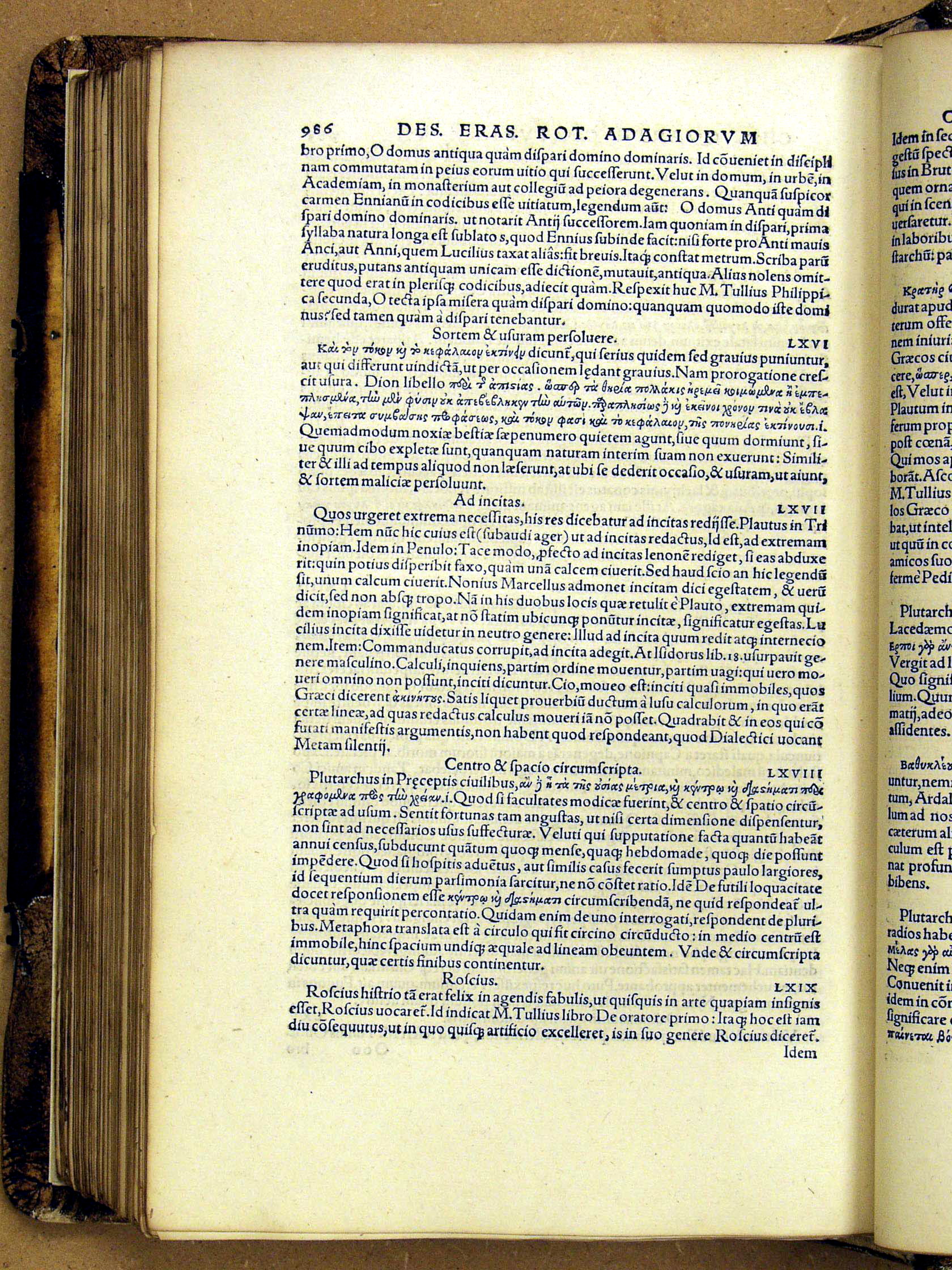
Iconclass: 54FF13:42G1 Regression, Deterioration, Relapse❧family lineage, pedigree, genealogical tree or table 98B(ANTIUS) male persons from classical history (ANTIUS)
Loci Communes: Degenerantium in pejus (Degenerating for the worse, Dégénérer en pire)
IV vii 66 Sortem et usuram persolvere To pay off both principal and interest
Καὶ τὸν τόκον καὶ τὸ κεφάλαιον ἐκτίνεν dicuntur, qui serius quidem sed gravius puniuntur, aut qui differunt vindictam, ut per occasionem laedant gravius. Nam prorogatione crescit usura. Dion libello περὶ τῆς ἀπιστίας. ὥσπερ τὰ θηρία πολλάκις ἠρεμεῖ κοιμώμενα ἢ ἐμπεπλησμένα, τὴν μὲν φύσιν οὐκ ἐπεβέβληκεν τὴν αὑτῶν. παραπλησίως δὲ καὶ ἐκεῖνοι χρόνον τινὰ οὐκ ἔβλαψαν, ἔπειτα συμβάσης προφάσεως, καὶ τόκον φασὶ καὶ τό κεφάλαιον, τῆς πονηρίας ἐκτίνουσι. i. Quemadmodum noxiae bestiae saepenumero quietem agunt, sive cum dormiunt, sive cum cibo expeltae sunt, quamquam naturam interim suam non exuerunt. Similiter et illi ad tempus aliquod non laeserunt, at ubi se dederit occasio, et usuram, ut aiunt, & sortem malitiae persolvunt.
[greek], To pay off both principal and interest. Said of those whose punishment, though delayed, is more severe; or of those who postpone exacting punishment so that they may inflict more serious harm when the opportunity arises. For the interest increases if a loan is extended. Dio in his essay On Distrust:
Wild beasts are often quiet, either when sleeping or when they are filled with
food, but they have not cast off their nature. Similarly these men too have not
done harm on just any occasion, but whenever an opportunity presented itself,
and, as the saying goes, they pay in full both the interest and the principal of
their wickedness.
Facsimile:
Iconclass: 46B44 paying (~ commerce) (here also repayment of debt, etc.) 46B4711 interest (~ commerce)
Loci Communes: Ultio malefacti (Vengeance for a wrongdoing, Vengeance d'un méfait)
IV vii 67 Ad incitas To a standstill
Quos urgeret extrema necessitas, his res dicebatur ad incitas rediisse. Plautus in Trinummo; Hem nunc hic cuius est, subaudi ager, ut ad incitas redatus, id est, ad extremam inopiam. Idem in Poeniulo; Tace modo, prosecto ad incitas lenonem rediget, si eas abduxerit, quin potius disperibit faxo, quam unam calcem civerit. Sed haud scimus an hic legendumsit, unum calcum civerit. Nonius Marcellus admonet incitam dici egestatem, et verum dicit, sed non absque tropo. Nam in his duobus locis, quae retulit e Plauto, extremam quidem inopiam significat, at non statim ubicumque ponuntur incitae, significatur egestas. Lucilius incita dixisse videtur in neutro genere. Illud ad incita cum redit atque internecionem. Item. Commanducatus corrupit, ad incita adegit. At Isidorus libro 18. usurpavit genere masculino. Calculi inquiens, partim ordine moventur, partim vagi, qui vero muoveri omnino non possunt inciti dicuntur. Cio, moveo est, inciti quasi immobiles, quos Graeci dicerent ἀκινήτους. Satis liquet proverbium ductum a lusu calculorum, in quo erant certae lineae ad quas redactus calculus moveri iam non posset. Quadrabit et in eos, qui confutati manifestis argumentis, non habent quod respondeant; quod Dialectici vocant Metam silentii.
Those hard pressed by extreme necessity were said 'to have come to a standstill.' Plautus in the Three-shilling Day: 'Oh! How reduced to a standstill he is, the man who owns it' (understand 'farm'), meaning that he is reduced to extreme want. The same author in the Carthaginian:
Just be quiet,
He'll reduce the pimp to a standstill, if he takes them away.
I warrant he'll be done for and not move unam calcem 'one piece.'
But probably one should read unum calcum 'one counter.' Nonius Marcellus tells us that incita means 'want' and he is correct, but this meaning is only metaphorical. For although the word does indeed denote extreme want in these two passages that he adduced from Plautus, incitae does not mean 'want' wherever it occurs. Lucilius seems to have used the form incita in the neuter: 'When that came ad incita "to a standstill" and utter destruction.' Also: 'He chewed him up and ruined him, reducing him to a standstill.' But Isidore in book eighteen used the word in the masculine gender, saying, 'Sometimes counters are moved in order, sometimes at random. Those which cannot be moved at all are called inciti.' The verb cio means 'to move' and so inciti means 'unmoveable,' [greek] in Greek. It is quite clear that the proverb derives from a game of counters in which there were certain lines at which a counter, if forced back to that point, could no longer be moved. The proverb will suit those who are refuted by clear proofs and have nothing to reply - what the dialecticians call 'the utmost point of silence.'
IV vii 68 Centro et spatio circumscripta Limited by centre and radius
Plutarchus in Praeceptis civilibus, ἂν δὲ ἦ τὰ τῆς οὐσίας μέτρια, καὶ κέντρῳ καὶ διαστήματι περιγραφομενα πρὸς τὴν χρείαν. i., Quod si facultates modicae fuerint, et centro et spatio circumscriptae ad usum. Sentit forunas tam angustas, ut nisi certa dimensione dispensentur, non sint ad necessarios usus suffecturae. Veluti qui supputatione facta quantum habeant annui census, subducunt quantum quoque mense, quaque hebdomade, quoque die possint imperdere. Quod si hospitis adventus, aut similis casus fecerit sumptus paulo largiores, id sequentium dierum parsimonia sarcitur, ne non constet ratio. Idem de futili loquacitate docet responsionem esse κέντρῷ και διαστήμνατι circum scribendam, ne quid respondeatur ultra quam requirit percunctatio. Quidam enim de uno interrogati, respondent de pluribus. Metaphora translata est, a circulo qui sit circino circumducto: in medio, centrum est immobile, hinc spatium undique aequale ad lineam obeuntem. Unde et circumscripta dicuntur, quae certis finibus continentur.
Plutarch in his 'Civil Precepts': 'If your resources are modest and limited for use [greek] "By centre and radius."' He is thinking of resources that are so scant that unless they are disbursed in fixed portions they will not suffice for the necessities of life. For example, some calculate how much their annual income is and reckon how much they can spend each month, each week, and each day. But if a guest arrives or something similar occurs that causes rather more expense, they compensate for this by being thrifty on the following days so that their budget will hold good. The same author informs us in 'On Garrulity' that a reply ought to be circumscribed 'By centre and radius' so that no response should go beyond what the question requires. For some persons reply about several things when asked about one. The metaphor is taken from a circle which is made with a pair of compasses. In the middle the centre is fixed and the distance from here to all points on the circumference is the same. Because of this things that are confined within fixed boundaries are also termed 'circumscribed.'
IV vii 69 Roscius A Roscius
Roscius histrio tam erat felix in agendis fabulis, ut quisquis in arte quapiam insignis esset, Roscius vocaretur. Id indicat M. Tullius lib. de Oratore 1. Itaque hoc est iamdiu consecutus, ut in quo quisque artificio excelleret, is in suo genere Roscius diceretur. Idem in secundo de Oratore. Soleo. saepe mirari eorum imprudentiam, quiagunt in scena, gestum spectante Roscio. Quis enim se commovere potest, cuius ille vitia non videat? Rursus in Bruto: Et in scena Roscium esse intelligat. Hic est ille Roscius Ciceronis concertator, quem ornavithoc elogio, ut diceret, Virum fuisset tam bonum, ut unus indignus esset, qui in scenam prodiret, et eundem tam praeclarum artificem, ut solus dignus esser qui in scena versaretur. Eodem igitur tropo, quo vehementer in consiliis callidum Daedalum vocamus, in laboribus patientem Herculem, in disputando invictum Achillem, in iudicando Aristarchum, parronum in causis agendis egregie dextrum, Roscium licebit appellare.
Roscius was such a successful actor that anyone who was distinguished in any activity was called a Roscius. Marcus Tullius points this out in the Making of an Orator book one: 'And so he had, long reached such excellence that whoever excelled in his own profession was called a Roscius in his own field.' The same author in the Making of an Orator book two:' I often wonder at the shamelessness of those who act when Roscius is in the audience. For who can make even a move on the stage without Roscius seeing his deficiencies?' Again in Brutus: 'A spectator will think that the orator he is listening to is like Roscius on the stage.' This is the famous Roscius with whom Cicero used to have competitions and whom he complimented in the following way, saying that because he had been such an honourable man he alone should never go on stage and that because he was such a distinguished actor he alone deserved to be on stage. Therefore, just as we call someone who is very clever and inventive a Daedalus, one who can endure many toils a Hercules, one who is invincible in debate an Achilles, one who is unsurpassable in critical judgment an Aristarchus, so we use the same trope to call an orator who is outstandingly skilled in pleading cases a Roscius.
Facsimile: 
Iconclass: 48C8521 actor (on the stage) 54F1 Success; 'Evento buono' (Ripa) 98B(ROSCIUS) male persons from classical history (ROSCIUS)
Collectanea (1500): 173
Loci Communes: Dignitatis (Dignity, Dignité)
IV vii 70 Philotesius crater The cup of friendship
Κρατὴρ φιλοτήσιος dicitur quo in conviviis conciliantur amicitiae, qui mos etiamnum durat apud Germanos, quibus turpissimum est, post acceptum Philotesium pculum, veterum offenfarum quamvis capitalium meinisse, ne iudices quidem admitterent actionem iniuriarum. Plutarchus in commentario de fortuna Alexandri, qui barbaros armis, Graecos civilibus institutis conabatur ad humaniorem ac sanctiorem vitae rationem adducere, ὥσπερ, inquit, ἐν κρατῆρι φιλοτησίῳ μίξας τοὺς βίους, καὶ τὰ ἤθη, καὶ τοὺς γάμους καὶ διαίτας, id est, Velut in philotesio poculo miscens vitas, mores, coniugia ac vivendi rationes. Apud Plautum in Pseudolo, servus ebrius, Diis proximum putat, manu candida cantarum dulciferum propinare mitissimam amicitiam. Hesychius indicat hanc φιλοτησίαν solere adhiberi post cenam, cum in signum amicitiae ex eodem poculo, de eodem vino bibunt omnes. Asconius Pedianus in actionem adversus Verrem tertiam, putat hoc esse, quod M. Tullius criminatur Verrem cum suis potasse more Graeco. Nam vulgus existimat illos Graeco more bibere, qui largius ac cyathis grandioribus bibunt. At ipse magis probat, ut intelligamus eos Graeco more bibere, qui merum bibunt. Id autem solent facere Graeci, ut cum in convivio libant, primum salutent Deos paululum e cyatho profundentes: dein amicos suos: totiesque bibunt merum, quoties Deos aut caros suos nominatim vocant. Ita fermè Pedianus. Quidam putant hunc craterem etiam ἀγαθοῦ δαίμονος appellari.
[greek], A cup of friendship. This is the name given to the cup at banquets by which friendships are made. This custom continues even now among the Germans who think it most shameful to mention old offences, however grave, once the cup of friendship has been taken. Neither would judges allow a suit for slander in these circumstances. In Plutarch's essay 'On the Fortune of Alexander' the king, who tried to bring a more humane and more just way of life to barbarians by force and to Greeks by public institutions, said, 'Mingling lives, customs, marriages, and ways of living as if in a cup of friendship.' In Plautus a drunk slave thinks that 'it is closest to the gods ... to drink, with pure hand, to the most pleasant of friendships from the cup of pleasure.' Hesychius points out that this cup of friendship is customarily brought out after dinner, when as a sign of friendship everyone drinks the same wine from the same cup. This custom survives even now among us, but it is rarer because of the fear of syphilis, a disease from which many suffer. Asconius Pedianus, commenting on the third speech against Verres, thinks that Marcus Tullius charges Verres with this, that he drank with his friend in Greek fashion. For the common folk think that those who drink copiously and in somewhat excessive measures drink like the Greeks. Asconius himself, however, is inclined to favour a different view, that we should understand 'to drink in Greek fashion' to mean 'to drink undiluted wine.' It was the custom of the Greeks when they poured libations at a banquet to toast the gods first, pouring out a little wine from the cup, then to toast their friends. Whenever they called upon a god or those dear to them by name they drank undiluted wine. This is what Pedianus says for the most part. Some think that this cup is also called the cup to good fortune.
IV vii 71 Cithara incitat ad bellum The lyre incites to war
Plutarchus libro de fortuna Alexandri secundo, declarat hunc versiculum apud Lacedaemonios solere decantari: Ερποι γὰρ ἄντα τῷ σιδήρῳ τὸ καλῶς κιθαρίσδειν. id est, Vergit ad letale ferrum, lepide Cithara canere. Quo significabant certis citharaemodis sedari motus animorum, aliis addi vigorem ad proelium. Cum Alexander audisset Antigenidam tibia modos incinentem, qui vocantur Har= matii, adeo inflammatus est, ut simul cum armis exurgens manus iniecerit in proxime assidentes.
Plutarch in book two of 'On the Fortune of Alexander' declares that the following verse was customarily sung by the Spartans: [greek] 'Sweet singing on the lyre stirs one to deadly steel.' By this they meant that certain tunes on the lyre calm the passions, while others give strength for battle. When Alexander heard Antigenidas playing tunes on the pipe that were called 'chariot tunes,' he was so stirred up that he stood up with his weapons and seized the men sitting closest to him.
IV vii 72 Bathyclis poculum Bathycles' cup
Βαθυκλέους κύλιξ. id est, Bathyclis calix, dictum videtur in eos, qui divitiis suis soli fruuntur, nemini quidquam impartientes. Apud Plutarchum in convivio septem sapientum Ardalus quidam sic alloquitur Aesopum. Tu numquam huc transmittes poculum ad nos, scum videas istos tamquam Bathyclis calicem inter sese transmittere, ceterum alii nemini impertientes. Cui respondet Aesopus. At ne hoc quidem poculum est publicum. Siquidem uni Soloni iam dudum astat. Bathycles Graecis sonat profundae gloriae, quo nomine videtur fuisse quispiam dives sibi vivens sibique bibens.
[greek], Bathycles' cup. This seems to have been said of those who keep the enjoyment of their wealth to themselves and never give anyone anything. In Plutarch in 'The Banquet of the Seven Sages' a certain Ardalus says this to Aesop: 'Will you never hand over the cup here to us, when you see those men passing it to each other, like Bathycles' cup, but never giving it to anyone else?' Aesop replies to him, 'But this cup is not public property. For it has been standing beside Solon alone for a long time.' In Greek 'Bathycles' means 'of deep glory,' apparently the name of a rich man who lived for himself and drank for himself.
Facsimile:
Iconclass: 32A44 miser 41C321 cup 98B(BATHYCLES) male persons from classical history (BATHYCLES)
Loci Communes: Sordes et parcimonia (Meanness and stinginess, Bassesse et avarice)
IV vii 73 Lunae radiis non maturescit botrus Moonbeams do not ripen grapes
Plutarchus hunc Ionis senarium ceu proverbialem adfert, disserens, quod Luna quoniam radios habet imbecilliores quam sol, excitare possit humores, concoquere non possit: Μέλας γὰρ αὐταῖς οὐ πεπαίνεται βότρυς. id est, Neque enim his niger maturus efficitur botrus. Conunit in eos, qui conantur, quia ob defectum virium non queunt, perficere. Refert idem in commentario de facie apparente in orbe lunae. Accedet plus veneris, si volentes significare disciplinas humanas non praestare felicitatem, dicamus, μέλας γὰρ αὐταῖς οὐ πεπαίνεται βότρυς. In αὐταῖς subaudiendum est, ἀκτῖσιν, id est, radiis.
Plutarch cites this iambic verse of Ion as if it were proverbial, arguing that since the moon has weaker rays than the sun it can induce grapes to swell with moisture but cannot ripen them: [greek] 'For the dark-clustered grapes are not ripened by them.' This adage suits those who undertake what they cannot complete because they have insufficient strength. He also quotes this in his essay The Face on the Moon.' It will be more attractive if we say, 'For these do not ripen the darkclustered grapes' when we wish to mean that human accomplishments do not bring happiness. With 'these' we must understand 'rays.'
Facsimile:
Iconclass: 24B61 moonbeams 47I4223(+8939):51FF511 grape (+ other characteristics of plant growth)❧Maturity 51HH41:22E1 Insufficiency❧heat
Loci Communes: Auxilium (Help, Aide); Perficiendi sive absolvendi (Finishing, completing, Achever, accomplir)
IV vii 74 Calliae defluunt pennae Callias is shedding his feathers
Callias apud Graecos quispiam suit, qui per luxum, ac libidinem patrimonium abligurierat, In eum vulgaris iocus exstitit, Καλλίας πτεροῤῥυεῖ. i. Calliae defluunt pennae. Solet enim hoc interdum avibus accidere, vel morbo, vel certis anni temporibus. Quemadmodum et quadrupedibus quibusdam mutantur pili aut villi. Unde et deplumati dicuntur ac detonsi, qui facultatibus exuti sunt. Hoc verbum πτεροῤῥυεῖν frequenter per iocum usurpatur apud Aristophanem in Avibus.
There was a Greek called Callias who had gobbled up his patrimony in luxury and lust. A popular joke arose about him: [greek] 'Callias is shedding his feathers.' Sometimes this happens to birds either because of disease or because of the time of year, in the way that changes occur also in the coats and fur of quadrupeds. This is why those who have been stripped of their possessions are said to have been 'plucked' and 'sheared.' The verb [greek] is frequently used by Aristophanes in the Birds in a humorous sense.
Facsimile: 
Iconclass: 25F3(+482):25F3(+352) birds (+ renewal of exterior of animals)❧birds (+ feathers) 55C11 Squandering, Extravagance, Prodigality, Waste; 'Prodigalità' (Ripa) 98B(CALLIAS) male persons from classical history (CALLIAS)
Loci Communes: Profusio (Extravagance, Prodigalité)
IV vii 75 Εν πλάτει In a broad way
ἐν πλάτει dictum, accipiendum interpretantur Graeci, cum paululum ultra praescriptum significant esse concedendum, praesertim in his, quae sunt humanitatis. Veluti si quis pollicitus solutionem ad diem Augusti decimum, reddat postridie. Iulianus Pandectarum libro 46. Titulo de solut. et lib. cap. Ratum autem dominus habere debet, mox cum primum certior factus est, sed hoc ἐν πλάτει, et cum quodam spatio temporis accipi debet. Et hunc Iuliani locum citat Ulpianus, eodem libro tit. rem ratam haberi, cap. Quo enim rursus libro 13. titul. de condictione triticaria, cap. in hac actione. Verius est, inquit, quod Servius ait condemnatioms tempus spectandum: si vero desierit esse in rebus humanis, mortis tempus. Sed etiam ἐν πλάτει secundum Celsum erit spectandum. Non enim debet brevissimum vitae tempus aestimare. Iterum libro 22. titulo de probationibus, cap. penultimo, Nec hoc quaeirtur, num aliquis meminerit quo die aut quo consule factum sit, sed num hoc aliquo pacto probari possit, quando id opus factum sit: et hoc Graeci ἐν πλάτει dicere solent, & caetera. Hactenus Pandectae. Verum illud pla/tei, non norunt Caletii, qui ad horam undecimam iussi claudere portas civitatis, statim ad primum nolae ictum occludunt, repulsis, & qui foris stant, & qui egredi cupiunt, utrisque portae proximis. Cum denuntiatur anathema qui ad diem praescriptum non solverint, liberantur a fulmine, si ab eo die intra decimum quartum liberarint fidem suam. Haec ad iuris aequitatem pertinem.
In Greek a statement must be taken [greek] 'In a broad sense' when some concession should be made to what has been prescribed, especially when there is cause to show consideration; for example, if someone who has promised payment on August 10 gives the money on the following day. Julian in book forty-six of the Pandects, in the chapter entitled 'On performances and releases,' the part beginning 'The principal': 'The principal must ratify it as soon as he has been informed. But this ought to be taken in a broad sense and with some concession as to time.' Ulpian also cites this passage of Julian in the same book, in the chapter entitled 'To hold the matter confirmed,' the part beginning 'For to what purpose.' Again in book thirteen, in the chapter entitled 'On the obligations relating to fixed quantities,' the part beginning 'Under this action,' he says:
Under this action, it is better what Servius says, that the time of condemnation
ought to be considered. If death has ensued, the time of death should be
considered, but understood 'In a broad sense,' according to Celsus. For the
valuation should not focus on the very last minute of life.
Again, in book twenty-two, in the chapter 'On proofs,' the penultimate
part:
And the question is not whether someone remembers on what day or under
what consul the deed was done, but whether the date can be proved in some
way. And the Greeks are accustomed to say 'In a broad sense.'
So much for the Pandects.
However, 'In a broad sense' is not recognized by the citizens of Calais. Ordered to close the city gates at the eleventh hour, they shut them on the first chime of the bell, pushing back those who are outside or those who want to leave, although both groups are very close to the gate. When a punishment is threatened against those who have not paid on the prescribed day, they are saved from catastrophe if they fulfil their pledge within fourteen days. This relates to the need for there to be equity in law.
Facsimile:
Iconclass: 52C1 Consideration; 'Consideratione' (Ripa) 52DD2 Unclarity, Imprecision 57A73 Indulgence, Clemency; 'Clemenza', 'Clemenza & Moderatione', 'Indulgenza' (Ripa)
Loci Communes: Perspicacitas (Perspicacity, Perspicacité)
IV vii 76 Per Satyram A hodge-podge
Variarum rerum mixturam sparsim nulloque ordine congestarum veteres Satyram appellabant. Apparet vocem primum deductam a lascivia Satyrorum, tamere nunc buc nunc illuc salientium, Hinc deflexa est ad cibi genus, quod ex diversis herbarum formis conflatum est: praeterea ad lancem variis rerum generibus Onustam, quae sic diis offerebatur, non adsimilis illi poculo, quod Graeci πεντάπλοον, quintuplici rerum differentia, siut ke/rnos a mixtura vocabant, de quo nobis supra dictum est. Festus ait, Saturam sive Satyram dici cibum variis rerum generibus conditum, aut legem aliis multis confertam legibus. staque in sanctione legum adscribi solere, neve per Satytam dertogato, aut abrogaro, cum significant totam legem esse servandam. Citat Annium Luscum ex oratione quam habuit adversus Tyberium Gracchum: Imperium quod plebs per Satyram dedetat, id abrogatumest. Citat etC. Laelium ex ea quam pro se dixit. Postero die quasi per Satyram legem sententiis exquisitis, in deditionem accipitur. Legem Satyram interpretantur, quae eadem multas res complecitur: quemadmodum Iugurtha acceptus est in deditionem, sed multis praescriptis conditionibus, ut tribinta daret Elephantos, pecus atque equos multos, cum magno argenti pondere. Usus est hoc adagio Iustinianus in praefatione Pandectarum: Et primoquidem, inquit, anno hoc opus tradebatur legentibus, non secundum edicti perpetui ordinationem, sed passim et quasi per Satyram collectum, et utile cum inutilibus permixtum, maxima autem parte inutilibus deputata. Itidem Sallustius in bello Iugurthino. Qua si per Satyram sententiis exquisi tis in deditionem accipitur. Haec Sallustius dicit de Iugurtha, necsunt in cuiusquam oratione, nec ibi quisquam aderat Laelius, unde necesse ast locum apud Festum esse nurilum. Verba Laelii sunt omissa, simul cum nomenclarura Sallustii.
A mixture of different ingredients that were heaped together at random and in no fixed order was called by the ancients a satyra. The word is clearly derived initially from the wantonness of satyrs who leapt about wildly, now this way, now that. Then it was applied to a kind of food that was put together from different kinds of plants, then to a plate that was laden with different kinds of things and was offered in this form to the gods. It is not unlike that goblet called [greek] in Greek, from the five-fold ingredients, or [greek], from the fact that ingredients are mixed together. We have talked about this above. Festus says that satura or satyra was the name given to food that was seasoned with different kinds of ingredients or to a law that was packed full of many different regulations. The law was customarily passed with the terms 'Do not deduct or annul any part of the whole' (meaning that the whole law had to be kept). He cites Annius Luscus from a speech that he delivered against Tiberius Gracchus: 'The authority that the plebs had given per saturam has been abrogated.' He also cited Caius Laelius from the speech he delivered on his own behalf: 'On the next day his surrender is accepted, but on carefully worded terms, like a lex satura.' A lex satura is explained as one that included many topics, just as Jugurtha's surrender was accepted with many terms laid out: he was to give thirty elephants, cattle, and many horses, as well as a considerable weight of silver. Justinian used this adage in the preface of the Pandects:
And this work was not issued to those reading in their first year following
the order in the edictum perpetuum, but material has been gathered from ev-
erywhere and put together 'as a hodge-podge,' the useful being mixed with
the useless, much the greater amount being devoted to the useless.
In the same way Sallust in the War against Jugurtha: 'His surrender is accepted under terms as complex as a lex satura.' Sallust says this of Jugurtha, and they do not appear in anyone's speech, not was there any Laelius present. Hence the passage in Festus must be lacunose. The words of Laelius have been lost along with Sallust's name.
Facsimile:
Iconclass: 41C263:51DD1 mixing, combining (preparing food)❧Disorder, Confusion, Derangement, Disorganization, Chaos 92L41 satyr(s) (in general)
Loci Communes: Indiligentiae (Carelessness, Négligence); Luxus et mollicies (Luxury and softness, Luxe et mollesse)
IV vii 77 Ne praeceps fueris ad jurandum Do not rush to swear an oath
Non nullis haud vulgariter eruditis videtur et hoc adagiis annumerandum, quod refert Ulpia. lib. Pandect. 12. capit. 13. Titu. de iureiurando circa finem. Siquis, inquit, iuraverit in re pecuniaria per genium principis, dare se non oportere, vel mtra certum tempus, et peiteraverit, vel si dare oportere, vel mtra certum tempus iuraverit se soluturum, nec solverit, Imperator noster cum patre rescripsit, fustibus castigatum dimittere, et ita ei superindici, προπετῶς μὴ ὄμνυε, id est, ne fueris ad iurandum praeceps. habebit proverbii speciem, si quis hominem post acceptum malum admoneat, προπετῶς μὴ ὄμνυε.
Some very learned scholars think that what is cited by Ulpian in the Pandects book twelve, in section 13 of the chapter entitled 'On oaths,' near the end, should be regarded as a proverb. He says:
If, regarding a financial matter, anyone swears by the spirit of the emperor
that he ought not to pay, or at least should do so only within a fixed time, and
swears falsely that he ought to pay, or swears that he will pay within a fixed
time and does not pay, it is held by rescript of the emperor and his father
that he should be sent away to be flogged and that above him there should be
displayed a sign with the words [greek] 'Do not rush to swear an
oath.'
This will have the ring of a proverb if one warns someone who has suffered harm, 'Do not rush to swear an oath.'
Facsimile: 
Iconclass: 51MM11:44G151 Slowness, Tardiness; 'Tardità' (Ripa)❧swearing an oath (with two fingers raised)
Loci Communes: Temeritas (Recklessness, Témérité)
IV vii 78 Ex syngrapha agere To act by the letter of the law
Sunt et illae formae a ivi econsultis ductae versae in proverbium. Ex syngrapha agere, obsignatis tabulis agere. pro eo quod est rigide parum que civiliter, sed velur ex obligatione. Ciceto pro Murena: pergitis ne vos tamquam ex syngrapha agere cum populo? Syugraha Latinis sonat conscriptionem, quod utriusque manu conscripta utrisque parribus tradi soleat, et in hocsyngataphae differunt a tabulis, quod tabulae ab una parte tantum servari consueverint. A chirographo. tabulis, codicillis differt Syngrapha, quod in illis non scribantur nisi acta, in hac etiam contra fidem actionis pactio venit, et non numerata pecunia aut non integre numerata pro temporaria voluntate hominum scribi solet. Ita propemodum Asconius Pedianus in Verrinarum 3.
In addition these formulas drawn from the law became proverbial: Ex syngrapha agere 'To act by the letter of the law,' and Obsignatis tabulis agere 'To act in accordance with sealed writings/ meaning to act 'rigidly and cruelly, but in accordance with what one is bound by.' Cicero in In Defence of Murena: 'Do you continue to deal with the people as if by the letter of the law?' The Latin equivalent of syngrapha is conscriptio 'a writing together,' because the agreement is drawn up by and customarily given to two parties. Syngraphae differ in this respect from tabulae in that the latter are customarily retained by only one party. They differ from a chirographum, tabulae, and codicilli in that these contain only a record of what has been done, while in the syngrapha there is also a clause about the breaking of the agreement. And they are customarily written with the temporary acquiescence of the parties, without the payment having been calculated or without the price having been completely paid. This is very much what Asconius Pedianus says in his commentary on the Third Verrine.
IV vii 79 Injuria solvit amorem Scorn breaks up love
In Graecorum Epigrammatibus proverbii titulo citatur ὑβρις ἔρωτας ἔλυσε, id est, iniuria sive contumelia solvit amores, quod contemptus amor plerumque vertitur iram, ira in odium. Sic in comoedia Phoedria: Exclusit, revocat, redeam? Non si me obsecret. Item Horatius: Nam si quid in Flacco viri est, Non fert assiduas potiori te dare noctes, Et quaeret iratus parem, Nec semel offensae cedet constantia formae, Si certus intrar it dolor. In epigrammate quaeritur amans hoc dictum falso iactari vulgo, quod ipse ab amica exclusus non sine convitio, cum iurasset se toto anno non rediturum ad illam postridie diluculo supplex ad eam redierit. Carmen sic habet, ὕβρις ἔρωτας ἔλυσε, μάτην ὅδε μῦθος ἀλᾶται, ὕβρις ἐμὴν ἐρεθει μᾶλλον ἐρωμανίην. id est, Falsum est quod iactant iniuria solvit amores, Morbum quippe meum provocat illa magis. In genere tamen verum est officiis mutuis tali benevolentiam, iniuriis exstingui.
In the Greek epigrams there is cited as a proverb ὑβρις ἔρωτας ἔλυσε 'Scorn (or abuse) breaks up love-affairs/ the point being that love, when slighted, generally turns into anger, and anger turns into hatred. So Phaedria in a comedy: 'She has shut me out; she calls me back. Shall I return? Not even if she begs me.' Similarly Horace:
For if there is anything of a man in Horace
He will not brook you giving night after night to a favoured rival,
And in anger he will seek another mate.
Nor, once certain pain has entered, will his resolve yield to your beauty,
Proven odious on more than one occasion.
In the epigram a lover complains that this common saying is untrue. He himself has been shut out by his girlfriend who has also heaped scorn on him. Although he had sworn that he would not return to her for a whole year, he came back to her the next day at dawn as a suppliant. The verses are as following:
What they say is false, that scorn breaks up love affairs.
For scorn stirs up my love-sickness even more.
Nevertheless, in general, it is true that affection between persons is nourished by mutual assistance, and destroyed by scorn.
IV vii 80 Diserte saltare To dance eloquently
Cornelius Tacitus in dialogo De oratoribus significat hoc convicium fuisse vulgo iactatum in oratores suorum temporum, qui lascivia verborum & levitate sententiarum licentiaque compositionis histrionales modos exprimebant, atque adeo laudis, & gloriae, ingeniique loco iactabant, saltari cantarique commentarios suos, oratores temere dicere, histriones diserte saltare. Argutia dicti in hoc sita est: oratores histrionice dicebant, quod illis erat indecorum, histriones ad oratorum actionem sese accomodabant: ita factum est, ut illi peius dicerent, hi saltarent melius. Histrionum est saltare, oratorum dicere, quod qui perite faciunt, diserti vocantur. locus autem duo diversa coniunxit.
'Orators speak without restraint, actors dance with eloquence.' According to Cornelius Tacitus in his Dialogue on Orators this was a common insult directed at orators of his time. In the wantonness of their words, the shallowness of their thoughts and the undisciplined way in which their speeches were organized they spoke like actors; and indeed they boasted that it was praiseworthy and a sign of their glory and genius that their works were chanted and danced to. The wit of the expression lies in this: orators were speaking like actors, which was unseemly for them, while actors took over the orators' style of delivery. The result was that orators spoke worse than they had in the past and actors danced better. Dancing is part of an actor's job, to speak is the orator's and those who do it skilfully are called eloquent. The joke combines two opposites.
Facsimile:
Iconclass: 33A34:48C8521 person addressing a group, orator❧actor (on the stage) 43C91:52D3 one person dancing alone❧Eloquence; 'Eloquenza', 'Fermezza & Gravità dell'Oratione' (Ripa)
Loci Communes: Absurda, indecora, seu praepostera (Absurd, unbecoming, or preposterous things, Choses absurdes, inconvenantes ou déplacées)
IV vii 81 Quod pulchrum, idem amicum What is beautiful is also loved
Τὸ καλὸν φίλον. i. Quod pulchrum amicum. Inter proverbia conciliantium amicitiam, refertur et hoc apud Platonem in Lyside. καὶ κινδυνεύει κατα τὴν ἀρχαῖαν παροιμίαν, τὸ καλὸν φίλον εἶναι. i. Ac propemodum apparet iuxta vetus proverbium, quod pulchrum est, amicum esse. Qui commodi gratia amat, non amat vere, sed quod pulchrum est per se amatur. Unde Aristoteles, percunctanti qui fieret ut libentius colloqueremur cum formosis quam cum deformibus respondit, eam percunctationem esse caecorum. Nihil autem virtute pulchrius, eoque nec amabilius quidquam.
[greek], What is beautiful is loved. Among the proverbs relating to those who become friends this one is given in Plato in Lysis:
And I am inclined to think that, in accordance with an old proverb, 'What is
beautiful is loved."
He who loves for his own advantage does not truly love. What is beautiful is loved for its own sake. That is why, when someone asked Aristotle how it was that we took more pleasure in conversing with handsome persons than with ugly ones, he replied that only the blind could ask such a question. Nothing is more beautiful than virtue and therefore nothing can be more loved.
Facsimile:
Iconclass: 51D4 Beauty; 'Bellezza' (Ripa) 56F2 (personifications and symbolic representations of) Love; 'Amore (secondo Seneca)' (Ripa)
Loci Communes: Forma, deformitas (Beauty, deformity, Beauté, difformité)
IV vii 82 Mortuo leoni et lepores insultant Even hares attack a lion when it's dead
Extat epigramma Graecum, cuius argumentum sumptum est ex Homericae Iliad. x. ubi Hectorem ab Achille iam interfectum circum sistunt Graeci mortuo insultantes, nec quisquam erat, qui exstincto non aliquod vulnus infligeret. Sic enim habet Homerus, ἄλλοι δὲ περίδραμον ὑιὲς ἀχαιῶν, οἵ καὶ θνήσαντος φυὴν καὶ εἶδος ἀγητὸν ἕκτορος, οὐδ᾽ ἄρα οἱ τὶς ἀνουτητίγε παρέστη. id est, At reliqui accurrunt Graii, cinguntque cadaver Nec tamen astitit exanimi sine vulnere quisquam. Ac paulo post: ὡς ἄρα τις εἴπεσκε, καὶ οὐτήσασκε παραστὰς. id est, Dixerat haec aliquis, simul et vulnus dedit astans. Epigramma sic habet, βάλλετε νῦν μετὰ πότμον ἐμὸν δέμας, ὅττι καὶ αὐτοὶ Νεκροῦ σῶμα λέοντος ἐφυβρίζουσι λαγωοι. id est, Nunc telis petitote meum post fata cadaver, Audet vellepus exanimi insultare leoni. Dictum est alias de his, qui mordent mortuos, cum laruis luctatur, & cum umbris depugnant.
There is a Greek epigram the topic of which goes back to Homer's Iliad book twenty-two, where the Greeks stood around the body of Hector defiling it after he had been killed by Achilles. Every one of them inflicted a wound on the corpse. For this is what we have in Homer:
But the rest of the Greeks ran up and surrounded the corpse
Of Hector, in awe of his outstanding body and appearance,
Yet no one stood by the corpse without stabbing it.
And a little later: 'So someone said, and as he stood by he inflicted a wound.' The epigram reads:
Assail my body with your spears now that I am dead. Even a hare
Dares to attack a dead lion.
I have spoken elsewhere about those who inflict hurt on corpses, wrestle with ghosts, and fight with shadows.
Facsimile: 
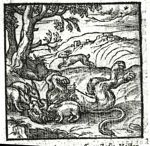
Cum larvis non luctandum: Alciatus, Emblemata (Leiden, 1591), emblem 153
Mortuo leoni et lepores insultant: De la Court, Sinryke Fabulen (Amsterdam, 1685), emblem 40
Mortuo leoni etiam lepores insultant: Cats, Spiegel (The Hague, 1632), emblem 114
Iconclass: 25F23(LION)(+63) beasts of prey, predatory animals: lion (+ dying animal; death of animal; dead animal) 25F26(HARE)(+512) rodents: hare (+ animal(s) attacking) 54AA8 Cowardice 54D5 Safety
Loci Communes: Securitatis et tutae rei (Security and safety, Sécurité et sûreté)
IV vii 83 Lingua non redarguta The tongue is not refuted
Plato in Theaetete: Ατὰρ ὡς ἔοικεν ἐὰν ὅτι ἐστὶν, εὐριπίδείοντι ξυμβήσεται, ἡ μὲν γλῶττα ἀνέλεγκτος ἡμῖν ἔσται, ἡ δὲ φρὴν οὐκ ἀνέλεγκτος. i. At ut videtur si posse responderis, Euripideum quiddam nobis accidet, lin gua quidem nobis erit irredarguta, mens autem non erit irredarguta. In eos quadrat, qui rationibus convicti, non cedunt tamen, sed tergiversantur reclamantes adversus suam ipsorum conscientiam.
Plato in Theaetetus: 'But apparently, if you reply that it is possible, a verse of Euripides will be relevant: [greek] 'Our tongue will not be refuted, but our mind will be.' The adage will suit those who are refuted by arguments but do not yield. Instead they engage in evasion, fiercely resisting what they know in their hearts.
Facsimile:
Iconclass: 31A22141 tongue 52CC2:52A6 Denial, Negation❧Truth; 'Verità' (Ripa) 53DD1 Refusal
Loci Communes: Impudentia (Shamelessness, Impudence)
IV vii 84 Pugno tenere To hold in one's fist
ἀπρὶξ ταῖν χεροῖν λαβέσθαι. i. Pugno stringere dicitur, quod ipso contactu sentitur. Sic Plato in Theaeteteo: οἱ οὐδὲν ἄλλο οιόμενοι εἶναι, ἢ οὗ ἂν δύνωνται ἀπρὶξ ταῖν χεροῖν λαβέσθαι. i. qui nihil esse putant, quicquid non possint strictim maib. apprehendere. Loquitur de his, qui non existimant quicquam esse in rerum natura praeter res corporeas, et sensibus expositas: actiones, generationes, et huis generis alia, quae intellectu, non sensibus percipiuntur, existimant esse inania vocabula. Talis visus est Platoni Diogrenes, qui dicebat, se cyathos et mensas videre, cyathitates ac menseitates, quas Plato commemorabat, non videre. Sed vicissim audivit, Nimirum oculos, quibus cyathi et mensae videntur, habes: mentem, qua cyathitates ac menseitates cernuntur, non habes. Tam crassum ingeniorum genus Plato, veluti profanum a philosophiae mysteriis iubet arceri. Verius enim sunt, quae non videntur, quam quae videntur, et certius ea scimus, quae ratione colligimus, quam quae manibus contrectamus: sensuum enim iudicium fallax est.
[greek], To hold tightly in one's fist. So Plato in Theaetetus: Those who think that nothing is real except what that they can hold tightly in their two hands.' He is talking about those who do not think that there is anything in the universe except what is physical and can be perceived by the senses. Actions or processes or other such things that are perceived by the intellect and not with the senses are just empty words in their opinion. Plato thought Diogenes was such a person. Diogenes said that he saw goblets and tables, but did not see the 'goblet-ness' or 'table-ness' that Plato talked about. This was the answer he received: 'To be sure you have eyes with which goblets and tables are seen; you do not have a mind to perceive "goblet-ness" and "table-ness."' Plato says that such unperceptive persons ought to be kept away from the mysteries of philosophy because they are, so to speak, uninitiated. For what is not seen exists more truly than what is seen and we know with more certainty what we infer by reasoning than what we touch with our hands. For the judgment of the senses is deceptive.
Facsimile:
Iconclass: 31A25513(+933) hand made into a fist (+ holding something) 52B5 Rationality, Reasoning; 'Ratiocinatione o Discorso' (Ripa) 52BB21 Incredulity
Loci Communes: Securitatis et tutae rei (Security and safety, Sécurité et sûreté)
IV vii 85 Haud solide No firm notion
Οὐ παγίως. i. Haud firmiter. Plato in Theaeteto, miror quamobrem proverbii loco retulerit, nisi forte ob metaphoram duriusculam, Οὐ παγίως, addidit, ὥς φασιν. Agit enim illic Socrates de his, quae suapte nature firma non sunt, sed aliis adhaerentia reciprocis motibus variantur, ut sint aut non sint, velut album & nigrum, agens & patiens: locus sic habet: καὶ πάντα τὸν αὐτὸν πρόπον ὑποληπτεον, αὐτό μὲν κατ᾽ αὐτὸ μηδὲν εἶναι, ὅ δὴ καὶ τότε ἐλέγομεν. ἐν δὲ τῇ πρὸς ἄλληλα ὁμιλίᾳ πάντα γίγνεσθαι καὶ παντοῖα ἀπὸ τῆς κινήσεως. ἐπεὶ καὶ τὸ ποιοῦν εἶναίτι καὶ τὸ πάσχον αὐτῶν, ἐπὶ ἑνὸς νοῆσαι, ὥς φασιν, οὐκ εἶναι παγίως. i. Atque ad eundem modum de reliquis sentiendum est, unumquodque per se nihil esse, quod sanè ego & tu dicebamus, sed in mutuo inter se congressu omnia fieri, & omnifaria, videlicet à motu. Quandoquidem & agens esse aliquid, & patiens, unumquodque per se intelligere, sicut aiunt, solide non possumus. Aristoteles lib. Rhet. 2. ait, senes ob rerum experientiam semper addubitare, neque quicque asseverrare, sed omnibus dictis addere, ἴσως καὶ τάχα, id est, forte & forsita. παγίως δὲ οὐδὲν. i. nihil fixe. πάγιον Graecis dicitur quod compactum est, à πήγω quod est fogo sive compingo. Inde παγίως pro solide & certò. Accidentia quodammodo fluunt. Substantia solida est: & eorum quae dicuntur ad aliquid, ratio pendet aliunde: patris enim ratio perit patri si moriatur filius, quum nihilo secius subsistat patris substantia. Quin & Latinis soli dicuntur, bona immobilia: & à solo solidum dicitur quod integrum est & compactum, Id Osci solum vocant pro toto. Iuvenal. Nobilitas sola est atque unica virtus. Sic hanc vocem frequenter usurpat divus Hieronymus. Hinc Sextus Pompeius Festus, dicta putat soliferra tela, quae tota ferrea sunt: & hominem solertem, quod omneis arteis calleat: Et solenne, quod omnibus annis fit. Indidem & terram solum dicimus, quod fixa sit & compacta, non profluens aeris & aquarum more. Huic contrarium est quod habet M. Tullius lib. De finibus secundo: Quae dici eadem de caeteris virtutibus possent, quarum omnium fundamenta vos in una voluptate, tanquam in aqua ponitis. Vox à Graecis deducta videtur, ὅλον, & aspiratione versa in s, solum.
[greek], Not firmly. I am surprised that Plato in Theaetetus gave this as a proverb, but perhaps it was because of the rather harsh metaphor that he added, 'as they say.' For Socrates is discussing there those things that are not constant in their own nature, but vary by contact with other elements and by reciprocal motions in such a way that they exist or do not exist. Examples are black and white, or acting on and being acted upon. This is how the passage reads:
And we must think about the other things in the same way, namely, that each
single thing has no being just in itself, as we said before, but that all things
are created in all their variety through union with each other, that is, as a
result of their motion. For we cannot have any firm notion, as they say, of
what is active or passive in any single case.
Aristotle in his Rhetoric in book two says that old men always have some diffidence because of their experience and are never dogmatic about anything, but always add 'perhaps' and 'perchance' or 'nothing is firm.' What is solid is said to be [greek] in Greek, from [greek], meaning 'to fix' or 'to join together.' From this we get [greek], meaning 'solidly' and 'in a fixed fashion.' Accidental properties have some fluidity, while the essential nature of something is immoveable, and the function of those things that are called accidentals depends on other things. For this reason the property of being a father is lost if a man's son should die, since the nature of a father rests on nothing else. In fact in Latin res soli 'things of the soil' are said to be immoveable possessions, and it is from solum 'earth' that what is complete and firm is called 'solid.' (In Oscan solum is used in the sense 'whole.') Juvenal: 'Noble birth is the sole and single virtue.' St Jerome often uses this word in this way. Because it can have this sense Sextus Pompeius Festus thinks that spears that are wholly made of iron are called soliferrea, that a man is called solers if he is skilled in all arts, and that what is done every year is described as solemne. For the same reason we call the earth solum because it is fixed and firm, not moving around like air and water. The opposite of this is what we find in Marcus Tullius in On Definitions of Good and Evil book two: This can be said of the other virtues, the basis of which you place in pleasure alone, which is like water.' The word comes from the Greek [greek] 'whole,' the rough breathing changing into s, thus giving solum.
IV vii 86 Aut abi aut exuere Either go off or strip off
Plato in Theaeteto significat apud Lacedaemonios hunc fuisse morem, ut in publicis cer raminibus neminem congerent ad congressum, sed legem edicebant h)\ a)pie/nai, h)\ a)podunesqai, id est, aut abire, aut exui. Grecis autem a)podun/esqai dicuntur, qui se parant certamini, quod campestriati luctarentur olim, cetera nudi. Unde haec ipsa vox, a)podun/esqai, quoties transfertur ad rem animi, velut ad disputandum, aut repugnandum carni, proverbii vim habet. Ita frequenter usuerpat divus Chrysostomus, ac D. Basilius. Simile estid. quod alibi dicitur. Aut bibat, aut abeat.
Plato points out in his Theaetetus that the Spartans had this custom of not compelling anyone to wrestle in the public games but promulgated a law [greek] 'Either leave or strip off.' In Greek those who prepare themselves for competition are said to strip off, because they wrestled naked except for a loin cloth. This is the reason that the very words 'strip off have the force of a proverb whenever they are transferred to mental activities, such as debating or resisting the desires of the flesh. St Chrysostom and St Basil often use the word in this way. It is similar to what we have discussed elsewhere, 'He must either drink or quit.'
Facsimile: 
Iconclass: 31A552 undressing oneself, getting undressed 33B2:43C392 duelling❧wrestling (sport) 53A11 Choice; 'Elettione' (Ripa)
Loci Communes: Servire tempori (To serve the times, Se plier aux circonstances); Similitudinis et congruentiae (Similarity and congruence, Similitude et convenance)
IV vii 87 Crisonem Himeraeum praecurre To run faster than Crison of Himera
Prodigiosa celeritas Crisonis videtur locum dedisse proverbio. Sic enim Socrates apud Platonem in Protagora, rogatus ut institutam cum Protagora disputationem perageret: βουλοῖμιν ἂν χαρίζεσθαι σοι εἴ μου δυνατὰ δέοιο. Νῦν δε ἐστὶν, ὥσπερ ἂν εἰ δέοίομου κρΐσωνι τῷ ἱμεραίῳ δρομεῖ ἀκμάζοντι ἕπεσθαι, ἢ τῶ δολιχοδρόμων τῷ ἢ τῶν ἡμεροδρόμων διαθεῖν τε καὶ ἕπεσθαι. i. Optarim quidem tibi morem gerere, si quod petis, meae facultatis esset. Nunc perinde est, ac si me roges, ut Crisonem Himeraeum insignem cursorem sequar, aut dolichodromon quempiam, aut hemerodromon perpetuo aequem cursu sequarque. Himera Siciliae civitas est, quam quam eiusdem nominis est altera in Africa. Unde Crison dictus est Himeraeus, celeritate currendi celebris, qualem refert. li. 7. Plin. fuisse Philippidem et Canistium Lacedaemonium, cumave his Philonidem Alexandri Magni cursorem. Dolichodromi dicebantur, qui perpetuo inpetu 12. stadia decurrebant. Hemerodromi, qui totum diem a mane usque ad vesperam citra respirationem rationem currebant. Plinius scribit puerum novem natum annos a meridie usque ad vesperam continuasse cursum. Unde Graeci poetae solem appellant ἡμεροδρόμων, quod singulis diebus cursum suum peragat, quasi vero noctus requiescat in diversorio Thetidis.
The amazing speed of Crison seems to have given rise to a proverb. For this is what Socrates says in Plato's Protagoras, when asked to complete the debate with Protagoras that had been undertaken: 'I would be willing to oblige you if I could do what you ask. But it's as if you are asking me to keep up with Crison of Himera, the famous runner, or run stride for stride with some miler or long-distance runner.' Himera is a city in Sicily, although there is another one with the same name in Africa. Crison was therefore called 'Himeraean.' He was famous for his fast running, comparable, as Pliny tells in book seven, to Philippides, Canistius of Sparta, and Philonides, Alexander the Great's runner. Runners called dolichodromi ran twelve stades at full speed, hemerodromi ran the whole day from morning until nightfall without a rest. (Pliny writes that there was a nine-year-old boy who ran continuously from noon until nightfall.) This is why the Greek poets call the sun [greek]: it completes its course each day, resting, as it were, at night in the abode of Thetis.
Facsimile:
Iconclass: 43C211(+1) running, race (+ sportsman, player, etc.) 51M11 Swiftness, Speed; 'Agilità', 'Celerità', 'Velocità' (Ripa) 98B(CANISTIUS OF SPARTA) male persons from classical history (CANISTIUS OF SPARTA) 98B(CRISON OF HIMERA) male persons from classical history (CRISON OF HIMERA) 98B(PHILONIDES) male persons from classical history (PHILONIDES) 98B(PHILIPPIDES) male persons from classical history (PHILIPPIDES)
Loci Communes: Impossibilia (Impossible things, Choses impossibles)
IV vii 88 Charadrion imitans Imitating a curlew
Χαραδριὸν μιμούμενος. i. Chardrion imitans, dici solitum de dissimulante, ac rem utilem occultante. Suidas refert hunc senarium Scazontem ex Hipponacte, Καὶ μὴν καλύπτει μῶν χαραδριὸν περνᾶς;. id est. Et num Charadrion quaeso venditor caelat? Item Aristophanes in Avibus, ἂλλως ἂρ᾽ ὁ ὔπωψ ὡς ἔοικ᾽ εἰς τὴν λοχμὴν ἐμβὰς ἐπῶζε χαραδριὸν μιμούμενος. id est, Alioqui upupa ut videtur saltum ingressa abdidit sese, Charadrion imitans. Quo loco interpres fere cum Suida consentiens, narrat huis avi vim inesse medicam, ut illius aspectu facile sanetur, qui laborant ictero sive regio morbo, eamque ob causam, qui vendunt, occultant eam, ne licitator remedium sentiat prius quam emerit. Addit eam avem mutare colorem ad similitudinem eorum quibus amovetur, non deesse tamen qui sentiant non aspectum, sed esum avis, habere remedium. Vocem autem distingui accentu, nam si pronunties ultima acuta χαραδριὸν declarari avem, si penultima acuta χαράδριον diminutivum a χάραδρα, significari voraginem, sive terrae hiatum, quod in hunc delabens aqua melodiam quandam reddere videtur. Tantum ex his. quae indiligenter a Suida sunt congesta, tradere licuit. Meminit huius avis et alias Comicus in eadem fabula: ὕδωρ ἐφόρουν κάτωθεν εἰς τὸν ἄερα οἱ χαράδριοι. i. aquam ex imo portabant in aerem Charadrii. Interpres addit avi nomen inditum, quod in voraginib. gaudeat versari. Socrates apud Platonem in Gorgia, cum Callinicen eo pellexisset, ut fateretur beatam vitam non esse sitam in copia rerum, sed in perpetuo influxu: nam qui satur est, aut non sitit, quoniam nec molestiam sentit nec voluptatem, lapidis more vivit, potius quam hominis: ita subiicit: χαραδριοῦ τινὰ αὖ σὺ βίον λέγεις, ἀλλ᾽ οὐ νεκροῦ οὐ δὲ λίθου. i. Rursus tu Charadrii quandam narras vitam, non mortui, lapidisve. Marsilius vertit avem, cum Socrates videatur sentire de voragine, in quam cum perpetuo decurrat aqua, numquam tamen expletur: nisi forte Charadrius avis est de numero voracium, quemadmodum & Larus, ut hinc nomen invenerit à Charadra ductum.
[greek], Imitating a curlew. Customarily said of someone hiding and concealing something useful. Suidas cites this scazon from Hipponax: 'And surely, pray tell, the vendor is not concealing a curlew? Also Aristophanes in the Birds:
The hoopoe apparently entered the glade
And hid itself, imitating the curlew.
The scholiast on this passage is in general agreement with Suidas and says that this bird had a healing power; whenever those suffering from jaundice or regius morbus 'the royal disease,' as it is called in Latin, saw it, they were immediately cured. For this reason vendors hid the bird so that a buyer would not be cured before he actually purchased it. He adds that the bird changes colour to match its surroundings. Some, however, think that the cure comes not from seeing the bird, but from eating it. The word can be accented differently; for if you pronounce it with an acute on the final syllable ([greek]) it means the bird, if you put the acute on the penultimate ([greek], diminutive of [greek]), it means whirlpool or a chasm in the earth. The reason [for [greek] 'whirlpool, chasm' being similar to [greek] 'curlew'] is that when water flows into a chasm there is a melodious sound. We have been able to report only so much from what has been carelessly heaped together by Suidas. The comic writer also mentions this bird in the same play: 'The curlews brought water into the air from below.' The scholiast adds that the bird was given its name because it liked to frequent whirlpools. In Plato in Gorgias Socrates enticed Callinices into admitting that a blessed life did not rest on abundance of possessions but on perpetual influx - for the man who is full or is not thirsty has the life of a stone rather than of a man, since he feels neither discomfort not pleasure. He adds the following: 'You mean the life of a charadrion, not of a corpse or of a stone.' Marsilio translates the word as 'bird' although Socrates seems to be thinking of a chasm which is never filled, even if water runs into it unceasingly. Unless perhaps the curlew is one of the greedy birds like the sea-mew and gets its name from charadra 'chasm.'
Facsimile:
Iconclass: 25F37(CURLEW) shore-birds and wading-birds (CURLEW) 46A16311(+0) hiding, concealing, burying a treasure (+ variant) 51B6 Imitation; 'Imitatione' (Ripa)
Loci Communes: Simulatio, dissimulatio (Pretense, dissimulation, Simulation, dissimulation)
IV vii 89 Quantum pedibus potes As fast as your feet can carry you
Socrates in Gorgia Platonis ita loquitur: σωφροσύνην μὲν διωκτέον καὶ ἀσκητέον, ἀκολασίαν δὲ φευκτέον, ὡς ἔχει ποδῶν ἕκαστος ἡμῶν.Temperantiam quidem sectari atque exercere oportet. Contra intemperantiam fugere, quantum quisque nostrum pedibus valet. Id quo longius transfertur a rebus corporeis, hoc magis accedit ad proverbium celeritatis. Quod in cor pore sunt pedes, hoc in animo sunt affectus, quibus expetimus aliquid aut refugimus.
Socrates in Plato's Gorgias says the following: 'We should pursue and practise temperance, while fleeing from intemperance [greek] "As fast as our feet can carry us."' If these words are not used literally with reference to corporeal things, they gain the status of a proverb, one that relates to speed. What the feet are to the body, the emotions, with which we long for or shun something, are to the mind.
IV vii 90 Vasis instar Like a pitcher
Αγγείου δίκην. i. Vasis instar loqui dicitur, qui cum ob imperitiam ex se nihil possit adferre, ab aliis audita profert. Fons ex se liquorem habet, vas ni aliunde infuderis siccum est. Homines autem qui vacant eruditione, per aures implentur. Socrates in Phaedro Platonis: ὅτι μὲν οὖν παράτε ἐμαυτοῦ οὐδεν αὐτῶν ἐννενόηκα εὖ οἶδα, συνειδὼς ἐμαυτῳ ἀμαθείαν, λείπεται δὴ οἶμαι ἐξ ἀλλοτρίων ποθὲν ναμάτων δία τῆς ἀκοῆς πεπληρῶσθαί με δίκην ἀγγείου. i. Nihil horum ex mcipso excogitavi fateor, imperitiae mihi conscius. Super est igitur opinior, ut alicunde ex alienis fluentis per aures fuerim impletus instar vasis.
[greek], Like a pitcher. Said of the way someone speaks when he can contribute nothing of his own to a discussion because of his inexperience but spouts what he has heard from others.A spring produces its own water, a pitcher is dry unless you have poured something into it. Persons who lack learning get filled through their ears. Socrates in Plato's Phaedrus: 'I thought up nothing of these things by myself, I admit, since I am aware of my own ignorance. All that is left to say, therefore, is that, like a pitcher, I have been filled through my ears with someone else's streams.'
Facsimile: 
Iconclass: 41A773 container of ceramics: jar, jug, pot, vase 55CC3:21D Borrowing, Hiring❧water (one of the four elements) 55CC3:52A41 Borrowing, Hiring❧Idea, Concept; 'Idea' (Ripa)
Loci Communes: Multi - in stupidos (Many people - against the stupid, Beaucoup de gens - contre les sots)
IV vii 91 Ut lupus ovem As the wolf loves the sheep
Ως λύκος ἄρνα φιλεῖ. i. Ut lupus ovem amat, qui sui commodi gratia simulat amore. Nam is vulgo dicitur amor, cum revera sit odium. Iuvenis enim cum puellam venatur, ut illi pudicitiam, thesaurum incomparabilem eripiat, ut pro honesta fama turpi rumore traducat, ut parentibus. amicis ac bonis omnibus invisam reddat: denique ut quod est omnium carissimum, bonam mentem eripiat, quaeso quid deterius hostis faciat hosti? Socrates citat carmen in Phaedro, veluti populari usu iactatum: ὡς λύκοι ἄρνα φιλουσ, ὡς παῖδα φιλοῦσιν ἐρασταὶ. id est, Ut lupi oves, ita amat puerum vesanus amator. Maro: Torua laenae lupum sequitur, lupus ipse capellam, Florentem cytisum sequitur lasciva capella. Et Horatius: - Non ego te tigris ut aspera, Getulus ve leo frangere prosequor.
[greek], As a wolf loves sheep. Of a person who pretends to love for his own advantage (for this is commonly called love' although in fact it is hatred). When a young man pursues a young girl to rob her of her chastity, an incomparable treasure, to expose her to disgraceful gossip instead of her enjoying a good name, to make her hated by her parents, friends and all good persons, and finally to deprive her of a sound state of mind, the most valuable possession of all - tell me, is there a worse thing that enemies could do to each other? Socrates cites a verse in the Phaedrus as if it were in popular use:
As wolves love sheep, so a lover madly loves his boy.
Maro:
The savage lioness pursues the wolf, the wolf itself the goat,
The sportive goat searches for the flowering clover.
And Horace:
I do not pursue you to mangle you
Like a fierce tigress or an African lion.
Facsimile:
Iconclass: 25F23(WOLF)(+47) beasts of prey, predatory animals: wolf (+ animal psychology) 47I213 sheep 56F2522 'Tormento d'amore' (Ripa) 57AA65:56F2 Selfishness; 'Interesse', 'Interesse proprio' (Ripa)❧(personifications and symbolic representations of) Love; 'Amore (secondo Seneca)' (Ripa)
Loci Communes: Amor (Love, Amour); Lacessentis (Provoking, Provoquer); Odium (Hatred, Haine)
IV vii 92 In navibus educatus Reared on ships
ἐν νηυσίν τεθραμμένος. i. in navibus educatus dicebatur, qui rudis esset et alienus a moribus liberalibus, sensuque communi. Solet enim fere nauticum genus suo elemento respondere, quod a civilium hominum commercio submotum vivat. Ita Plato in Phaedro, πῶς οὐκ ἂν οἴει αὑτὸν ἡγεῖσθαι ἀκούειν ἐν ναυσιπου τεθραμμένων. i.An non putas illum existimaturum, sese audire homines in navibus salicubi, educatos. Plaut. in Cistellaria, mores agrestes appellat maritimos, imo potius inconstantes quod mare vicibus aestuariis accedat recedatque. Plauti verba sic habent: Ita me amor lapsum animi ludificat, fugat, agit, appetit, raptat, retinet, iactat largitur, quod dat non dat, deludit, modo quod suasit dissuadet, quod dissuasit id ostentat, maritimus moribus mecum experitur, ita meum frangit amantem animum.
[greek], Reared on ships. Said of a person who lacked any experience of anything and had no knowledge of social behaviour or of common moral standards. For generally sailors often become like the element they are familiar with because they live remote from contact with civilized men. So Plato in his Phaedrus: 'Or don't you think that he will think that he is listening to men brought up somewhere on ships.' Plautus in the Casket Comedy calls uncivilized behaviour 'sea-like,' or rather this is what he calls unpredictable behaviour, because the sea ebbs and flows in alternating tides:
So does Love mock me in my demented state, puts me to flight, hounds me,
comes after me, snatches me, holds me, throws me, bestows largesse, does not
give what he gives, tricks me. What he has just advised he advises against, he
advocates what he advises against. He makes trial of me like the sea, to such
an extent does he break my lover's heart.
Facsimile:
Iconclass: 46C2711 seaman 51AA4:49A Nothingness, Absence❧education
Loci Communes: Multi - in stupidos (Many people - against the stupid, Beaucoup de gens - contre les sots)
IV vii 93 Quod utile honestum What is useful is virtuous
Τὸ μὲν ὠφέλιμον καλόν, τὸ δὲ βλαβερὸν αἰσχρόν. i. quod utile est, honestum est: quod autem noxium, turpe. Hoc Plato de Repub. quinto refert quasi vulgo iactatum, κάλλιστα γὰρ δὴ τοῦτο καὶ λέγεται καὶ λελὲξεται, ὅτι τὸ μὲν ὠφέλιμον καλὸν, τὸ δὲ βλαβερὸν αἰσχρὸν. i. Nam pulcherrime profecto hoc & dicitur & dicetur, quod utile est, id esse honestum, quod noxium, id esse turpe. Agit enim illic de foeminis ad omnia masculorum munia pariter vocandis, si modo reperiantur aeque utiles reip. Vult igitus illarum corpora nudari civitatis custodibus, & si videantur habiles, unà cum masculis publicitus exerceri. Vehementer autem contemnit illos qui rideant nudata foeminarum corpora, modo ob reip. commodum. Dubitat & M. Tullius an turpe sit viro bono nudum saltare in foro, si liceat eiusmodi saltatione servare rempub. sed hominum vulgus invertit sententiam, honestum esse quicquid est utile, quum philosophis nihil sit utile, nisi quod honestum est.
[greek], What is useful is good, while what is harmful is disgraceful. Plato in book five of the Republic cites this as if it were a common saying: 'For this is and will be a most noble saying, what is useful is virtuous, what is harmful is disgraceful.' He is discussing there the question of women being called to perform all the tasks that men do, provided they are found to be as useful as men to the state. He wants them, therefore, to be stripped naked as guardians of the state and, if they seem suitable, to exercise publicly alongside males. He is extremely contemptuous of those who laugh at women whose sole purpose in being naked is the public good. Marcus Tullius also considers it arguable whether it is shameful for an upstanding citizen to dance naked in the forum if the state can be saved by such dancing. But the general populace inverts this view, saying that whatever is useful is good, although philosophers think that only what is good is useful.
Facsimile:
Iconclass: 54B3:57A6 Utility, Usefulness; 'Utilità' (Ripa)❧Virtuousness; 'Amor di Virtù', 'Attione virtuosa', 'Guida sicura de' veri honori', 'Virtù', 'Virtù insuperabile' (Ripa)
Loci Communes: Rapacitas et avaritia (Rapacity and greed, Rapacité et avarice)
IV vii 94 Magis quam sol Heracliti More quickly than Heraclitus' sun
Qui sine spe reparationis deficiunt, eos Socrates apud Platonem de Repub. lib. 6. μᾶλλον τοῦ ἡρακλειτείου ἡλίου ἀποσβέννυσθαι. hoc est, magis ipso Heracliti sole exstingui dixit. Agit illic de senibus, qui ad perdiscendas philosophiae difficultates idonei non sunt in adolescentia defatigari. Heraclitus enim existimavit solem scaphae speciem habere, eiusque lumen deficere quoties cavum ad superiora vertitur, sed rursus fieri lucidam postquam invertitur. Non dissimile somnium de sole prodidit Xenophanes, qui pu tavit eum in occasu perire, sed exortu novum fieri solem. At senes numquam renovantur ad vigorem iuvenilem. Huc adlusisse videtur Horatius in Odis: Damna tamen celeres reparant caelestia lunae, Nos ubi decidimus, &c.
Socrates in Plato in the Republic book six said that those who are failing without hope of recovery [greek] 'Are extinguished more quickly than Heraclitus' sun.' Heraclitus thought that the sun was shaped like a skiff and that it suffered an eclipse whenever its interior faced upwards, but it became bright again after turning over. Xenophanes gave a rather similar silly explanation of the sun. He thought that it perished when it set and that when it rose again the sun was a newly created one. But old men can never be rejuvenated to the level of having the strength they had in their youth. Horace seems to have alluded to this in his Odes: 'The moon quickly replenishes its heavenly losses; / We when we set .. .'
Facsimile:
Iconclass: 24A sun as celestial body 54FF1 Failure 98B(HERACLITUS) (story of) Heraclitus, the philosopher
Loci Communes: Exitium honestum (An honorable ruin, Une perte honorable)
IV vii 95 Coenum barbaricum Barbaric filth
Βόρβορος βαρβαρικὸς. id est, Coenum barbaricum, pro vehementi stupore mentis apud Platonem lib. de Rep. 2. ponitur. Laudat enim illic dialecticam, quae sola mente ignorantiae immersam erigit attollitque a vulgaribus opinionibus, ad solidam veri cognitionem: καὶ τῷ ὄντι, inquit, ἐν βορβορῳ βαρβαρικῷ τινι τὸ τῆς ψυχῆς ὄμμα κατορωρυγμένον ἠρέμα ἕλκει καὶ ἀνάγει ἄνω. id est, Ac re vera barbarico quodam coeno demersum animi oculum, paulatim trahit subuehitque sursum. Barbarus à barbaro per contemptum dictum videtur.
[greek], Barbaric filth. This is used in the sense of great mental torpidity in Plato in the Republic book two. There he is praising dialectic, which alone stimulates a mind that is immersed in ignorance and raises it from holding trivial beliefs to attaining a solid knowledge of the truth. He says, 'And it is quite true that dialectic gradually draws out the soul's eye that is immersed in barbaric filth and lifts it up.' The word barbarus seems to come from borboros 'filth' as a mark of contempt.
Facsimile: 
Iconclass: 52B5112 Bad, Evil, Wrong 54AA5 Badness
Loci Communes: Contemptus et vilitatis (Contempt and worthlessness, Mépris et bassesse)
IV vii 96 Non e quercu aut saxo Not from oak or rock
Οὐκ ἐκ δρυὸς ἢ ἐκ πέτρας. id est, Non è quercu saxôve, cum significamus non constare materia externa, sed ex animi virtutibus. Veluti vulgus civitatem appellat, muros ac domos e lapidibusque lignisque constructas. Ecclesiam appellat stur cturam simili materia congestam, cum revera civitas constet hominum moribus, & ecclesia sit animorum in vera religione consensus. Plato lib. de repub. 8. ἢ οϊει ἐκ δρυὸς ποθεν ἢ ἐκ πέτρας τὰς πολιτείας γίγνεσθαι, ἀλλ᾽ οὐχὶ εκ τῶν ἐν ταῖς πόλεσιν. id est, An existimas è quercu qualibet, aut e saxo res pub. fieri, ac non potius ex moribus eorum, qui in civitatibus versantur.
[greek], Not from oak or rock. Used when we want to indicate that something consists of spiritual qualities and not of physical material. For example, ordinary people mean by 'city' the walls and houses constructed from stones and timber, by 'church' the structure put together from similar material, when in fact a city consists of the character of its inhabitants and a church is the consensus of souls in true religion. Plato in the Republic book eight: 'Or do you think that states are made somehow from oak or from rock and not rather from the character of those who live in them?'
Facsimile:
Iconclass: 31B mind, spirit 51AA2 Immateriality 51AA4:25G3(OAK) Nothingness, Absence❧trees: oak 51AA4:25H112 Nothingness, Absence❧rocks
Loci Communes: Torvitas (Grimness, fierceness, Air farouche)
IV vii 97 Psallium injicere To put on a curb-chain
Ψάλλιον ἐκβάλλειν. id est, Psallium iniicere dicuntur, qui ferocientem animum moderamine quopiam premunt, metaphora sumpta ab equis animosioribus. Plato lib. De legibus iii. ὁ δὲ τρίτος σωτὴρ ὑμῖν, ἔτι σπαργῶσαν καὶ θυμουμένην ἀρχὴν ὁρῶν, οἶον ψάλλιον ἐνέβαλεν αὐτῇ, τὴν τῶν ἐφόρων δύναμιν. id est, At tertius vobis servator, luxuriantem etiamnum frequentemque conspiciens principatum, veluti psallium illi iniecit, Ephororum potentiam. De Lacedaemoniorum republica loquitur, in qua quinque Ephori sunt instituti, ad temperandam regiam potentiam. Psallium autem est circulus, qui freno additur, unde et pro freno ponitur interdum. Nisi forte adlusit ad bubalos, qui circulo ferreo naribus iniecto circumaguntur, unde proverbium Naribus trahere, quod alio dictum est loco.
[greek], To put on a curb-chain. Said of those who curb a wild disposition with some means of control. A metaphor taken from high-spirited horses. Plato in On the Laws book three: 'Your third saviour saw that the rulers were still being extravagant, noisy and unruly, and so he imposed on them, like a curb-chain, the power of the ephors.' He is speaking of the state of Sparta in which five ephors were appointed to modify the power of the kings. The curb-chain is a small circular chain attached to the bridle, and because of this the word is sometimes used also in the sense of 'bridle.' But perhaps the expression was an allusion to bulls being led around by an iron ring attached to their nostrils. Whence the proverb, 'To lead one by the nose,' which we have talked about elsewhere.
Facsimile:
Iconclass: 34A21 breaking to saddle, bridle, etc. ~ wild horses 47I2262(+0) nose ring(ing), ear tag(ging), etc. ~ marking cattle (+ variant)
Loci Communes: Modestia modusque (Modesty and moderation, Modestie et mesure)
IV vii 98 Principium, medium, finis Beginning, middle, and end
Plato libro De legibus quarto. refert hoc quasi vulgo decantatum, deum universitatem rerum omnium complecti, hoc est, principium, medium et finem. Ab illo enim omnium quae sunt, initium, incrementum, & summa. Ανδρες τοίνυν φῶμεν πρὸς αὐτοὺς, ὁ μὲν δὴ θεὸς, ὥσπερ ὁ παλαιὸς λόγος, ἀρχήντε καὶ τελευτὴν κατα μέσα τῶν ὄντων ἁπάντων ἔχων, εὐθεῖαν παραίνει, κατα φύσιν περιπορεύομενος. id est, Sic igitur illis loquamur Deus quidem ô viri, quemadmodum et vetere proverbio dicitur, omnium quae sunt, principium, finem ac medium continens, rectum peragit cursum, secundum naturam circumiens.
Plato in On the Laws book four reports the following as if it were a very common utterance: 'God embraces the whole universe, that is, the beginning, middle, and end.' For from God comes the beginning, the growth, and the complete creation of all that exists. 'Let us say to them, "Sirs, God to be sure, as the old proverb says, holds the beginning, end, and middle of all that exists, and moves straight through the cycle of nature."'
Facsimile:
Iconclass: 51F5 Beginning; 'Principio' (Ripa) 51FF5 End; 'Fine' (Ripa) 51F8 Middle
Loci Communes: Totum ut nihil reliqui (The whole, so that nothing remains, Le tout, sans rien laisser)
IV vii 99 Orphica vita An Orphic life
Ορφικὸν βίον. i.Orphicam vitam Plato libro de legibus 6. dixit vitam innoxiam, et a luxu sanguinolentisque dapibus puram. Huiusmodi siquidem vitae rationem Orpheus instituisse videtur, ut non solum sanguine pecudum non in quinarent aras deorum, verum ne vesci quidem ullius animantis carnibus sustinerent, sed libis ac frugibus melle conspersis sacra facerent, nec aliis ipsi vescerentur. Platonis verba sunt haec: ἀλλ᾽ ὀρφικοί τινες λεγόμενοι βίοι ἐγρύοντο ὑμῶν τοῖς τότε. id est, Sed orphica quaedam, ut dicitur, vita tum erat vestris illo faeculo. Videtur Orpheus hoc conatus apud Thraces, quod Pythagoras tentavit apud Ionios, Numa apud Romanos.
[greek], An Orphic life. In On the Laws book six Plato says that this is a life free of sin, one that is untouched by luxury and undefiled by food with blood in it. For Orpheus seems to have established such a way of living. Not only did humans not defile the altars of the gods with the blood of beasts, they also forbore from eating the flesh of any animal. Instead, they sacrificed with cakes and grain sprinkled with honey, and they themselves did not eat anything else. These are Plato's words: 'But your ancestors at that time had "An Orphic life," as the saying goes.' Orpheus seems to have attempted in Thrace what Pythagoras tried in Ionia and Numa in Rome.
IV vii 100 Candidus fermo White speech
Λευκὸς λόγος Graecis dicitur oratio dilucida persicuáque, à colore qui inter caeteros plurimum habet lucis. Unde λευκότερον εἰπεῖν dicuntur qui clarius efferunt quod sentiunt, hos est, σαφέστερον. Et λευκὴ φωνὴ dicitur, quae facile penetrat aures auditorum. Huiusmodi metaphorae sunt, quae sumuntur è propinquo, ut quum sentire dicuntur aut videre, qui rem intelligunt: tenere, qui meminerunt: odorari, qui suspicantur: caecutire, qui errant. E proximo ducuntur, quum quod oculorum est, transfertur ad aures, velut hoc.
[greek], White speech. This was a Greek expression for speech that is clear and easily understood, from the colour that has the greatest light of all. Therefore those who express their thoughts quite clearly are said [greek] [greek] 'to speak more brightly,' that is [greek] 'more clearly,' and a voice that easily reaches the ears of an audience is called a [greek] 'a bright voice.' There are metaphors such as the one in this expression that draw from a closely related field, as when those who understand something are said 'to feel' or 'to see,' those who remember something are said 'to retain,' those who are suspicious are said 'to get a whiff,' those who err are said 'to be blind.' The metaphors are drawn from a very closely related field whena function of the eyes is transferred to the ears, as in this one.
Facsimile:
Iconclass: 22C4(WHITE) colours, pigments, and paints: white 46A632 address, talk, lecture (~ meeting) 52D2 Clarity, Precision
Loci Communes: Perspicuitas (Clarity, Clarté)