IV ix 1 Nummo addicere To knock down for a penny
Apud Iurisconsultos proverbiale est, nummo addicere, pro eo quod est, minimo vendere. Est autem fucus, quo legibus imponitur prohibentibus donationes. Ulpianus li. Pandect. 19. tit. Locati. Si quis conduxerit nummo uno, conductio nulla est, quia et hoc donationis instar inducit. Idem lib. 1. tit. De re iudicata: Si quis et conduxit, et rogavit praecario uti possideret, si quidem nummo uno conduxit, nulla dubitatio est, quin et praecarium solum teneat. vetum addubitamus, num in his exemplis pro conduxit et conductio, legendum sit condixit & condictio. Suetonius in Iulio Caesate: Bello civili supra alias donationes amplissima praedia nummo addixit. Valerius Max. lib. 2. c. de Gratitudine: Pollinctoribus exsequiarum apparatus Sestertio num moipsis praebentibus est addictus. Itidem Plau. in Pseudolo: Numquam hoc eris nummo divitior. Nummo dixit, pro vilissimo precio.
In the Jurisconsults, we find the proverbial phrase 'To knock down for a penny,' meaning 'to sell for a trivial sum.' This is actually a subterfuge, designed to circumvent laws prohibiting gifts. Ulpian in the Pandects, book nineteen, title 'On lease and hire': 'If anyone shall lease for one penny, the lease is void, because this has the semblance of a gift.' Again, in book one, title 'On matters brought to judgment': 'Where anyone hires something and asks that he may possess it by tenancy at will, if he hired it for one penny, there is no doubt that he holds it only by tenancy at will.. .' I rather think however that in these examples one should read not conduxit, conductio 'hires, hiring' but condixit, condictio 'contracts, contract.' Suetonius, in his life of Julius Caesar, writes, 'During the Civil War, in addition to other presents, he knocked down some splendid estates to her for a penny.' Valerius Maximus, in book two, section On gratitude, says that the undertakers contracted 'to provide all the necessaries for the funeral for a penny piece.' Likewise Plautus, in the Pseudolus, writes, 'You will never be a penny piece the richer.' By 'a penny piece' he meant the smallest possible amount.
Facsimile: 
Iconclass: 46B412 selling 54BB6:46B311 Worthlessness❧coin
Loci Communes: Contemptus et vilitatis (Contempt and worthlessness, Mépris et bassesse)
IV ix 2 Vero verius Truer than truth
Cum nihil possit esse vero verius, tamen proverbiali tropo dicimus vero verius, quod prorsus in dubitatum habeti volumus. Martialis in Gallicum quendam, cui ex more saepe repetebatur illud: Dic verum mihi marce, dic amabo: Vero verius, inuqit, ergo quod sit, audi. Verum Gallice non libenter audis. Non dissimili forma dicimus Certo certius, quanquam nihil prohibet aliud alio certius esse. Ulpianus lib. Pandect. 23. tit. De testamentaria tutela: Testamento datos sponsores non esse cogendos satisdare rem salva fore, certo certius est.
Though nothing can be truer than truth, all the same we use the proverbial expression 'Truer than truth' for something which we want to be taken as absolutely indubitable. Martial attacks a certain Gallicus, who forever had on his lips the words: 'Tell me, Marcus, tell me the truth, I pray.' He replies, 'To what is truer than the truth then lend an ear - You do not like, Gallicus, the truth to hear.' Similarly we say, 'surer than sure.' Though it is perfectly possible for one thing to be surer than another. Ulpian, in book twenty-three of the Pandects, title 'On testamentary guardianship': 'It is surer than sure that testamentary guardians may not be compelled to give security for the preservation of the property.'
Facsimile:
Iconclass: 52A6 Truth; 'Verità' (Ripa) 52B41 Certainty
Loci Communes: Libertas, veritas (Freedom, truth, Liberté, vérité)
IV ix 3 Vento vivere Live on the wind
Hodieque vulgo tritissimum, est, ut eos dicant vento vivere, qui nullo vivunt impendio: et addunt: more siluri, quod plerisque creditum est, eum piscem aura saginari, quod idem creditum est de Chamaeleonte. Alexander Imperator lib. Codicis 5. tit. De aliment. pupil. praest. Nec ferendus inquit, est iuvenis, qui cum praesens esset, studiique eruditus atque alitus esset, si ea per alium se consecutum non probet, sumptus tecuset, quasi vento vixerit, aut nullo liberi homini studio imbui meruerit.
Even today people commonly say that those who live without visible means of support 'Live on the wind,' and, they add, 'like a catfish,' as it is widely believed that the catfish feeds on air, as the chameleon is supposed to do. The emperor Alexander, in book five of the Codex, title 'On the maintenance to be provided for those under puberty': 'Nor is any young person to be upheld, who, in spite of being visibly present, educated and maintained, if he cannot demonstrate that he has received these benefits through another, denies that any expenditure has been incurred, as if he has lived on the wind or has not been given the education proper to a gentleman.'
Facsimile:
Iconclass: 41C11:26C eating❧winds 52BB42 Impossibility
Loci Communes: Impossibilia (Impossible things, Choses impossibles)
IV ix 4 Tuas res tibi habeto Take your things and go
Caius iuriscosultus Pandect. lib. 44. tit. De divortiis, ostendit fuisse receptum, ut divortium his verbis petageretur: Tuas res tibi habero, tuas res tibi agito. Quorum altero reddit dotem, altero abdicat ab se tutotis munus, in rebus uxoriis. Haec autem forma verborum perscripta est, ne vel non ratum esset divortium, fi nullis sollemnibus verbis perageretur: vel inauspicatum et odiosum, si verbis civilibus perageretur. Itidem in discutiendis sponsalibus visum est uti his verbis, Conditione tua non utar. Haec proverbii gratiam habebunt, si cui civiliter renuntiabimus amicitiam. sed festivius erit, si ad res animi transferantur, veluti si quis dicat, Monachi vitam professus est, mundum iussit sua sibi habere, suas sibi res agere. Item si quis ambiat consortium nostrum, quem iudicamus nobis inutilem huic apte dicetur: tua conditione non utar, pro eo quod erat, non utar tua familiaritate. Eleganter usus est Plautus in Trinum. ubi Lysiteles adolescens multa quaeritur de miseriis amantium, ac meditatur amorem eicere ex animo. Apagesis, amor, tuas res tibi habe, amor mihi amicus ne suas umquam. sine tropo usus est in Amphitryone: Valeas, tibi habeas res tuas, reddas meas.
In book forty-four of the Pandects, title 'On divorce and repudiation,' the jurisconsult Gaius shows that it was customary for a man divorcing his wife to employ the words: 'Take your things and go; manage your own affairs.' The first form of words returned the dowry, the second renounced the function of guardian in respect of the wife's property. This mode of expression was prescribed to prevent the divorce being invalid if no formal phraseology were employed, or to prevent the proceedings turning unpleasant and inauspicious if intemperate language were used. Likewise, in repudiating a betrothal, the prescribed words were: 'I do not accept your proposal.' We can use these formulae like well-worn sayings politely to reject someone's offer of friendship, but it will be rather amusing to transfer them to the things of the mind. For example, if we say, 'He has taken up the monastic life; he has told the world to take its things and go, to look after its own affairs.' If someone that we do not think has anything to offer us is seeking our acquaintance, we can say to him, appropriately enough, 'I do not accept your proposal,' instead of, 'I do not accept your friendship.' Plautus has a nice application of the words in Three-shilling Day, where young Lysiteles is complaining about the miseries endured by lovers and is considering expelling love from his mind: 'On your way, Love, if you please. Take your things and go. / Never, Love, shall you consort with me.' In Amphitryo Plautus used the formula in its literal sense: 'Good-bye! Take your things and give back mine.'
IV ix 5 Gamma Betam persequitur Gamma chases after Beta
Procopius lib. 3. de bello Vuandalico refert Carthagine antiquum proverbium à pueris iactari solere. Quod Gamma quandoque Betam, et rursus Beta Gammam persequitur. Suspicamur puerorum lusum huc spectasse, quod inter vicinos frequenter oriatur dissidium. Verum hic puerile dictum detortum ad rerum eventum, quod Gizericus Bonifacium expulisset: Postea Gilimerem Belisatius. Proverbium non est natum ex eventu, sed puerorum Carthaginensium aenigma fuit, velut oraculum eius quod accidit postea.
In book three of the Vandal War, Procopius tells us that the children of Carthage used to chant an old saying, 'Gamma comes chasing after Beta, and then comes Beta chasing Gamma.' I think these words used by children in fun really referred to the fact that neighbours often quarrel, but the childish saying was made to apply to actual historical events, namely that Gaiseric drove out Boniface and then later on Belisarius drove out Gelimer. The saying did not arise from the events, but the riddling words chanted by the Carthaginian children were a kind of prophecy of what happened thereafter.
IV ix 6 Pulcrum sepulcri elogio A fine thing to have upon one's tomb
Nonvidebatur in proverbiorum classem referendum, nisi nominatim proverbii titulo referretur apud Procopium libro De bello Persico primo, sub persona Augustae lustiniamum maritum sic allqoventis. Igitur optime Imperator, volenti nunc vivere procul dubio nullo negotio licet, pecuniae nobis magna vis, mare opportunum, navigsa multa. Considera tamen ne servato tibi contingat, vitae iucunditatem cum mortis ad extremum acerbitate commutate, nobis autem antiquum sane placet pronerbium, quam pulchrum, est in sepulcri elogio imperatorem adscribi. Quosdam novi qui in extremo vitae magnis impendiis redemerunt galerum cardinalicium, ut in sepulchro titulus asscriberetur
I would not class this as a proverb if it were not specifically referred to as such by Procopius, in book one of the Persian War, where the Empress is represented as addressing her husband Justinian to the following effect: 'So, noble Emperor, if you wish to preserve your life, you can undoubtedly do so, and easily enough. We have an enormous supply of money, the sea is close at hand, we have plenty of ships. Consider however that you may save yourself and then find that you have exchanged the happiness of life for the bitterness of death at the last. To me at any rate the old proverb rings true: A fine thing it is to have upon one's tomb - the title "Emperor!"' I have known people who at the very end of their lives have at great expense bought themselves the cardinal's hat, so that the title 'Cardinal' could be inscribed upon their tombs.
Facsimile: 
Iconclass: 42E311 gravestone, tombstone 49L8:44B112 inscription❧emperor 57AA644 Arrogance; 'Arroganza' (Ripa) 57AA645 Boast; 'Iattanza' (Ripa)
Loci Communes: Arrogantia jactantiaque (Arrogance and boastfulness, Arrogance et vantardise)
IV ix 7 Primum apes abigendae First you must drive off the bees
Agathius de bello Gothico libro tertio: Placebant haec dicta Ulilago Herulorum praefecto, unde id usurpatum proverbium, et barbarum et parui momenti, utile tamen et alicuius enegiae: Identidem praedicabat primum abigendas apes, deinde ae mel subtrahendum. Sensit Buzes primum hostium copias adventantes esse submovendas, quo possint Asia potiri, sumptum a curatoribus apum, qui quo mel eripiant ex alvearibus, apes fumo, aut alio quovis modo abigunt.
Agathias in book three of the Gothic War writes, 'What was said pleased Ulilagus, headman of the Heruli. Consequently this proverb came into popular use, a barbarian saying of no great moment, but a useful one nonetheless and marked by a certain vigour. He was for ever proclaiming "First you must drive off the bees, then you may take the honey." Buzes was well aware that they must first clear the advancing enemy host out of the way, if they were to gain control of Asia.' The saying is derived from bee-keeping. Bee-keepers drive off the bees with smoke or by some other means, in order to extract the honey from the hives.
Facsimile:
Iconclass: 34A9 man tormenting animal(s) 34F3 54D5 Safety
Loci Communes: Securitatis et tutae rei (Security and safety, Sécurité et sûreté)
IV ix 8 Porrigere manus Extend a helping hand
Porrigere manus, pro auxilio esse, vulgatissimum est, sed elegans. Ulpianus Pandectarum li. xlii. tit. De re iudicata: Sed si emptor cui pignora sunt addicta exequente iudice precium non soluit, utrum adversus emptorem porrigere manus debent iisdem iudices, qui sentiam exequuntur, videndum est. M. tullius in oratione post reditum: Qui mihi primus afflicto & iacenti, consularem fidem, dextramque porrexit. Festivius erit de rebus animi: veluti si dicas, Animo deiecto manum porrigit philosophia: aut, In Theologiae difficultatibus aestuanti saepe manum porrigit Dialectica, aut linguarum peritia.
'Extend a helping hand' for 'to lend assistance' is a common enough expression, but a stylish one too. Ulpian in book forty-two of the Pandects, title 'On matters brought to judgment': 'If the buyer to whom the pledges were assigned by the judge's decision does not pay the purchase price, we must see whether the same judges who made the decision should extend a helping hand to call the purchaser to account.' Cicero, in the speech delivered after his return from exile: 'When I lay in the depths of misery and affliction, he was the first to extend a helping hand to me, to offer me the support of a man of consular rank.' It will be wittier to use the phrase metaphorically, saying, for example, that 'Philosophy extends a helping hand to the depressed spirit,' or that 'To someone floundering amidst the difficulties raised by theology, dialectic - or linguistic expertise - often extends a helping hand.'
Facsimile:
Iconclass: 31A2512(+916) arm stretched forward (+ helping) 54A6 Helpfulness
Loci Communes: Cum auxilio ; citra auxilium (With help; without help, Avec aide ; sans aide)
IV ix 9 Optima quidem aqua Water is indeed the best of things
Αριστον μὲν ὕδωρ. i. Optima quidem aqua, videtur in proverbium abiisse, quoties rei vehementer laudatae praefertur aliquid melius: quemadmodum Pindarus auspicans hymnos Olympiacos, aquam quidem fatetur esse optimam, sed aurum praefert, quod ignis in morem noctu luceat. Sunt enim haec duo praecipua elementa, apua et ignis: unde Aqua et igni interdicitur, quos vita indignos iudicamus. Aristoteles libro Rhet. 3. ut vulgo iactatum citat, ὅθεν, inquit, λέγεται, ἄριστον μὲν ὕδωρ. Quaedam enim ob id praeferuntur, quod sint rariora. Alioqui aqua est magis necessaria, quam aurum. Meminit adagii Plutarchus in Commentario, in quo quaerit, utrum aqua an ignis sit utilor. Supra modum efferenti philosophiam, is qui fateatur quidem philosophiam esse rem praeclaram, sed qua potior sit Theologia, facete succinet illud Pindarici carminis fragmenum, ἄριστον μὲν ὕδωρ.
[greek], Water is indeed the best of things. This seems to have become a proverbial saying for use when we advance something as being better than something else that is highly thought of. Pindar starts off his Olympian Odes by saying that water is indeed a very good thing, but he then gives the preference to gold because it gleams by night like fire. Water and fire are two chief elements, which is why those we consider unfit to live are debarred from fire and water. Aristotle, in book three of the Rhetoric, cites the saying as being in common use: 'This,' he says, 'is why they say, "Water is the best of things."' Some things are rated highly for their rarity value. In general however water is more necessary than gold. Plutarch has these words in mind in his essay, 'Whether Fire or Water is More Useful.' If someone is praising philosophy inordinately, a person who agrees that philosophy is indeed an excellent thing but still inferior to theology, can wittily sing along, intoning this fragment from Pindar, 'Water is indeed the best of things.'
Facsimile:
Iconclass: 21D water (one of the four elements) 51E2 Superiority 54B6 Worth, Value
Loci Communes: Excellentia, inaequalitas (Excellence, inequality, Excellence, inégalité)
IV ix 10 Non oportet hospitem semper hospitem esse The stranger must not ever stranger be
Aristoteles libro Rhetoricorum tertio, nullo auctore citat ceu vulgo iactatum: οὐδεῖ τὸν ξένον, ξένον ἀεὶ εἶναι. i. Non oportet hospitem semper hospitem esse. Hospites dicuntur ignari eius loci in quo vivunt. Sed turpe est diu in eadem civitate vivete, et semper esse peregrinum. Videtur iambicus trimeter correptus. Turpe est in eadem disciplina diu versatum esse, & nihil scire.
Aristotle, in book three of the Rhetoric, cites the following words, without however naming any author, as something commonly said: 'The stranger must not ever stranger be.' People are called strangers when they are not familiar with the place where they live. However, it is shameful to live a long time in the same city and remain always a foreigner. (The words seem to form a faulty iambic trimeter.) It is shameful to spend a long time studying the same subject and know nothing.
IV ix 11 Moriendum priusquam etc. One must die before ...
Ibidem commemorat Alexandridae dictum, ut vulgò celebre ac laudatum. καλόν γ᾽ ἀποθανεῖν πρὶν θανὰατον δρᾶν ἄξιον. i. Honestum est mori, priusquam aliquid morte dignum commiseris. Sensus est, ut ipse exponit Aristoteles: Decet mori morte indignum: sive, honestum est mori, quum nihil morte dignum admiseris.
In the same place, Aristotle cites, as something well known and popular, a line from Alexandrides:
Good it is to die before you do
What makes death come deservedly to you.
As Aristotle himself tells us, this means: 'The right thing is to die when you do not deserve to die,' or 'Death is honourable when you have done nothing deserving of death.'
Facsimile:
Iconclass: 31E13 'Ars moriendi' 59B31 Honour, Glory; 'Ampiezza della Gloria', 'Gloria', 'Gloria de prencipi', 'Gloria & Honore', 'Honore', 'Sublimatà della Gloria' (Ripa)
Loci Communes: Indiligentiae (Carelessness, Négligence)
IV ix 12 Sustollere manus Raise hands on high
Qui vehementer gaudent, quasi res divitinitus geratur ex animi sententia, sustollere manus dicuntur. M. Tullius Epist. li. 7. Sustulimus manus ego & Balbus. Tanta fuit oportunitas, ut illud nescio quid non fortuitum, sed divinum videretur. Idem in Academicis: Hortensius autem vehementer admirans, quod quidem perpetuo Lucilio loquente fecerat, ut etiam manus saepe tolleret. Horatius satyra quinta: Importunus amat laudari, donec ohe iam Ad coelum manibus sublatis dixerit, urge.
Those who are absolutely delighted because things have turned out as they want, apparently by divine agency, are said to 'Raise their hands on high.' Cicero, in book seven of his Letters: 'Balbus and I raised our hands on high. The thing was so opportune that it seemed not accidental but a gift from the gods.' Again, in Academic Questions: 'Hortensius was absolutely amazed, as he had been all the time Lucullus was speaking, so much so that he often raised his hands on high.' Horace in his fifth satire: 'Day in, day out, he wants your praise - then keep at him / Till he raises hands on high and "Hold, enough!" exclaims.
Facsimile:
Iconclass: 31AA2511(+912) arm raised upward - AA - both arms or hands (+ laughing, joy) 56B1 Pleasure, Enjoyment, Joy; 'Allegrezza', 'Allegrezza da le medaglie', 'Allegrezza, letitia e giubilo', 'Diletto', 'Piacere', 'Piacere honesto' (Ripa)
Loci Communes: Tristitia, laetitia (Sadness, joy, Tristesse, joie)
IV ix 13 More Romano In blunt Roman fashion
In eadem epistola M. Tull. non sine proverbii specie dixit, more Romano, pro eo quod est, simpliciter & absque fuco potius quam erudite. Tales enim fuerunt illi Romani prisci, Graecorum dissimiles. De quo, in quit, homine tibi spondeo, non illo vetere verbo meo, quod cum ad te de Milone scripsissem, iure lusisit, sed more Romano cum homines non inepti loquuntur, probiorem hominem, meliorem virum, prudentiorem esse neminem. Penes Romanos erat rusticana veritas. Talem inducit libro de finibus secundo. Quod nostri quidem optime disputant. nihil opus esse eum qui philosophus futurus sit, scitre literas. Itaque ut maiores nostri ab aratro adduxerunt Cincinnatum illum, ut dictator esset, sic vos de Pelasgis omnibus colligite, bonos quidem viros, sed certe non semper eruditos. Idem ad Trebatium libro septimo. Balbus mihi confitmavit te divitem futurum: id utrum Romano more locutus sit, bene numatum te futurum, an quomodo Stoici dicunt, omnes esse divites qui caelo et terra frui possunt, postea videro. Romano more dixit, pro indocto & simplici. Nam Stoici subtiliter definiunt divitem ac pauperem. Ac mox ad eundem: Ego te Balbo cum ad nos proficiscetur, more Romano commendaho.
Cicero was, it seems, using a proverbial expression, when, in the same letter, he employed the phrase More Romano 'In Roman fashion,' meaning 'straightforwardly, without misrepresentation, not cleverly.' Such were those famous Romans of old, quite different from the Greeks. Cicero writes, 'I guarantee, not using that previous phrase of mine, which you quite properly made fun of, when I wrote to you about Milo, but in blunt Roman fashion as used by men who are not at all socially gauche, that there isn't a sounder, better, more sensible fellow.' The Romans saw 'truth' as unsophisticated. A 'truth' of this sort is brought into book two of Cicero's book on Definitions of Good and Evil: 'Our teachers argue strongly that the future philosopher has no need of an advanced education. Just as our ancestors summoned the great Cincinnatus from the plough to become dictator, so you collect from all kinds of primitive societies men who may well be good, but are certainly not always men of education.' Cicero again, writing to Trebatius in book seven: 'Balbus assured me you were going to be rich. I will find out later whether he said this in plain Roman fashion, meaning you were going to make a lot of money, or whether he was talking like the Stoics, who say that anyone is rich who can enjoy the sky and the earth.' By 'plain Roman fashion' he meant 'unsophisticated and simple.' The Stoic definition of 'rich' and 'poor' was a subtle one. A little later, writing to the same Trebatius, Cicero says, 'When Balbus comes to visit, I will recommend you to him in frank Roman fashion.'
Facsimile: 
Iconclass: 32B2(ROMANS) historical peoples: Romans 52AA55 Bluntness, Obtuseness, Dullness 57A642 Simplicity; 'Simplicità' (Ripa)
Loci Communes: Aperte et crasse (Openly and bluntly, Ouvertement et grossièrement)
IV ix 14 Lacryma nihil citius arescit Nothing dries faster than a tear
M. Tullius libro De inventione priore, praecipiens ne orator posteaquam iudicis animum commovit ad misericordiam, diutius commoretur in quaestione, adducit Apollonii dictum, οὐδὲν θᾶσσον ξηραίνεσθαι δακρύου. i. Lacryma nihil citius arescere, quod vehemens affectus facile vertitur in taedium.
In the first book of his On Invention Cicero tells the orator that once he has stirred pity in the hearts of the jury, he should not linger over this 'pathetic appeal,' quoting in support of this recommendation the precept of Apollonius: [greek] 'Nothing dries faster than a tear.' People have soon had enough of strong emotion.
Facsimile:
Iconclass: 31A25344(+)) 31B62141 tears 51M11 Swiftness, Speed; 'Agilità', 'Celerità', 'Velocità' (Ripa) 57A75 Mercy, Compassion; 'Compassione', 'Misericordia' (Ripa)
Loci Communes: Inconstantiae, perfidiae, versutiae (Inconstancy, treachery, cunning, Inconstance, perfidie, ruse)
IV ix 15 Ex potestate exisse Gone out of control
Exisse è potestate dicebantur, qui à mente excidissent, & qui spreta ratione, cupiditatum arbitrio praecipites ferebantur. M. Tullius libro Tusculanarum quaestionum tertio: Eos inquit, sanos intelligi necesse est. Itaque nihil melius quàm quod est in consuetudine sermonis Latini, quum exisse è potestate dicimus eos qui effrenati feruntur, aut libidine aut iracundia. Ac mox: Qui igitus exisse è potestate dicuntur, ideo dicuntur, quia non sunt in potestae mentis, cui regnum totius animi à natura tributum est. Haec M. Tullius: unde Compotes atque impotes mentis dicimus, & Impotenter commoti dicuntur, qui animum non habent in sua potestate, sed feruntur affectuum arbitrio. Formula sermonis detorta videtur à iureconsultis, apud quos filii ex iustis nuptiis procreati dicuntur esse in potestate parentum, nisi emancipentur, aut nisi pater moriatur. Rursus emancipati dicuntur exisse de potestate parentum.
People who have lost their senses and are swept along, deaf to the voice of reason, blindly following where their cravings lead, are said to have 'Gone out of control.' Cicero, in the third book of the Tusculan Disputations, writes, 'We must consider sane those people ... So the best thing is to say of these that they are "out of control," using the expression commonly applied to people who lose their grip on themselves and are carried away by lust or anger.' And a little further on: 'People who are said to be "out of control" are so described because they are not under the control of the mind, which nature has appointed as governor of the non-physical part of man.' So Cicero writes. We accordingly speak of people being compos mentis or non compos mentis 'in control' or 'not in control of their senses,' and people are said to be 'uncontrollably deranged' when their mental processes are not under their control but are at the mercy of their emotions. The basic form of words comes from the jurists: children born of lawful marriage are 'subject to the control of parents,' unless they are emancipated or the father dies. Those who are emancipated 'have gone from the control of parents.'
Facsimile:
Iconclass: 51AA4:53B3 Nothingness, Absence❧Self-control; 'Dominio di se stesso' (Ripa)
Loci Communes: Intemperantia, libido (Intemperance, lust, Intempérance, désir)
IV ix 16 Gallonius Gallonius
Etiam ipsa luxuries multos nobilitavit, ut Aesopum & Apitium. M. Tullius celebravit Gallonium a Lucillio traditum, idque locis compluribus. In oratione pro Caecinna: Quid ergo est? Non usque eo tamen ut in capita fortunasque honestissimoru virorum dominentur hi qui relicta bonorum virorum disciplina, et quaestum et sumptum Gallonii sequi maluerunt. Item pro P. Quintio meminit Gallonii. Rursus lib. De finibus 2. refert è Lucilio, O Publi, ô gurges, Galloni es homo miser, inquit, coenasti in vita nunquam bene, quum omnia in isto consumis squilla, acipensere cum decumano. Haec Lucilius facit loquentem Lelium lapatho coenare solitum, Gallonio lurconi, & omnia gulae ventrisque delectatione metienti. Gallonii meminit M. Tullius li. De finibus ii. Sed qui ad volupratem omnia referens vivit ut Gallonius, loquitur ut frugi ille Piso, non audio.
Some people like Aesopus and Apicius have actually become famous for their extravagant life-style. The Gallonius who appears in Lucilius' poem was honoured with mention by Cicero, and in more than one place at that. In the speech in defence of Caecina, for example, Cicero writes, 'So what follows? This does not mean that we go on to accept the idea that the lives and fortunes of respectable citizens should be at the mercy of persons who have abandoned the self-control exercised by decent men and chosen to emulate the getting and spending of a Gallonius.' He mentions him in the speech in defence of Quinctius as well, and also in book two of Definitions of Good and Evil, where he quotes the following lines from Lucilius:
Publius Gallonius, says he, you swill food down like a drain,
Yet in all your life, poor fellow, you never a good meal attain,
For all that you squander on sea-food dishes
And sturgeon of monster size.
Lucilius puts these words into the mouth of Laelius, who dined off sorrel, addressing Gallonius, a glutton measuring everything by the pleasure it afforded to gullet and belly. Cicero mentions Gallonius again in book two of Definitions of Good and Evil, where he says, 'I have no time for someone who lives with pleasure as his yardstick, like Gallonius, and at the same time talks like Piso the Uncorrupt.'
IV ix 17 Vultu saepe laeditur pietas Even a look can strike a blow against filial respect
M. Tullius in oratione pro Roscio obiter citat sentetiam à sapientibus iactatam. Etenim, inquit, si id quod praeclare a sapientibus dicitur, vultu saepe laeditur pietas, quod supplicium satis acre reperietur in eum, qui mortem obtulerit parenti, pro quo mori ipsum si res postulatit, iura divina atque humana cogebant. Proverbium admonet pietatem erga parentes adeo religiose colendam, ut non solu non offendamus eos verbis aut factis impiis, sed ne vultu quidem atrociore aut contumaciore. Habent enim oculi, frons & ipse vultus suum sermonem. Evangelium altius repetit, nimirum ab ipso fonte cordis in quo concipitur ira. Ea erumpit in vocem indignationis, sed incertam: proximus gradus est manifestum convicium, tertius homicidium.
In his speech in defence of Roscius, Cicero makes passing reference to a saying often on the lips of wise men. 'If,' he says, 'as the wise have so strikingly expressed it, "Even a look can strike a blow against filial respect," can one find a punishment sufficiently severe for a man who has actually murdered the parent for whom every sanction, human and divine, demanded that he should sacrifice his own life, should that be necessary?' The saying reminds us that we must devote such scrupulous care to maintaining our love and respect for our parents that we do not offend them with an angry or rebellious look, let alone with insolent words or deeds. The eyes, the brow, the face, all speak their own language. The Gospel goes even deeper, to the depths of the heart, where anger has its origin. Anger bursts out in an exclamation of resentment which as yet does not say anything definite. The next stage is open abuse, the third murder.
IV ix 18 Culleo dignus, aut non uno culleo dignus Fit for the sack, or, One sack is not enough
Cum hominem enormiter scelerosum significare volumus, eum culleo dignum dicimus. Hoc supplicium erat parricidis, id est, qui parentem occidissent. Quanquam apud pri scos parricidium dicebatur, quoties homo hominem occidisset, hoc est, par parem, videlicet eo saeculo, quo crudelitas erat occidisse bovem, avem, aut gallum gallinaceum. Dein quum cepisset, esse vulgate, ut homo occideret hominem, parricidii vox ad summae impiertatis significationem deflexa est. Culleus autem erat saccus coriaceus, cui insuebatur parricida, simul immissa vipera, simia, et gallo gallinaceo, atque ita proiciebatur in profluentem. M. Tullius pro Roscio Amerino: Quanto maiores nostri sapientius, qui quum intelligerent nihil esse tam sanctum, quod non aliquando violaret audacia, supplicium in parricidas excogitaverunt, ut quos natura retinere in officio non potuisset, magnitudine poenae à maleficio summo arcerentur: insui volvertunt culleum vivos, atque ita in flumen deici. ô singulaem sapientiam iudicum, nonne videntur hunc hominem ex rerum natura sustulisse & eripuisse, cui repente caelum, solem, aquam terramque ademerunt: ut qui eum necasset, unde ipse natus esset, careret his rebus omnibus, ex quibus omnia nata esse dicuntur, etc. Proin Iuvenalis impietatem cuiusdam exaggerans, negat illi satis esse serpentem unum, aut culleum unum. Natrat suetonius quosdam statuae Neronis apposuisse culleum cum elogio: Merueras, sed ego quid possum?
We use the phrase 'Fit for the sack,' of somebody we consider utterly wicked. 'The sack' was the punishment reserved for a parricide, that is, someone who had killed a parent. In early times 'parricide' meant killing any other human being. The word was derived from par 'equal,' that is, a man killing a fellow man. This was in the period when it was considered a savage deed to kill an ox, a goose, a barnyard cock. Then, when killing people became commonplace, the word 'parricide' was limited in meaning to refer only to the supreme act of impiety. 'The sack' was a sack of leather, into which the person who had murdered a parent was sewn, together with a snake, a monkey, and a barnyard cock. Then the whole thing was thrown into running water. Cicero says in his speech in defence of Roscius of Ameria, 'How much wiser did our own ancestors show themselves! They realized that nothing was so sacred that man's audacity would not one day profane it, so they thought up a special punishment for parricide, intending that those whom natural feeling could not hold to their duty should be deterred from the supreme deed of wickedness by the enormity of the penalty. They wanted such persons to be sewn into a sack alive and then thrown into a river. What remarkable wisdom those judges displayed! By cutting off the perpetrator in one move from sky, sun, water, earth, they expelled and excised him from the natural world, so that the killer of the one who had given him life should be himself deprived of all those elements which are themselves the source of all life.' Juvenal magnifies the enormity of this act of impiety on the part of a certain person by saying that one serpent, one sack is not enough for him. Suetonius tells us that some persons put a leather bag over Nero's statue, and wrote on it, 'You deserved this. But what can I do?'
Facsimile: 
Note: Iconclass concept 42B54 not yet approved on 19-01-2011
Iconclass: 25F22 monkeys, apes 25F42 snakes 31E23111(+6) drowning, ’walking the plank' (+ execution (by judicial verdict)) 34B232(+922) fowl (cock, hen, chicken, etc.) (+ male animal) 41A776 container of leather: leather bag 42B54 parricide, killing a parent (or another close relative) 44G321(SACK) instruments of torture, execution or punishment (SACK) 52B5112 Bad, Evil, Wrong 54AA5 Badness
Loci Communes: Decretum - in deprehensos (Decree - against those caught in the act, Décret - contre les pris sur le fait)
IV ix 19 Ratio quidem apparet etc. The accounts are clear enough
Plautus in Trinummo: Nequaquam. Argenti ratio comparet tamen, cui Stasinus, Ratio quidem Hercle apparet, argentum oixetai. Nam haec est germana eius loci lectio, quam alii varie mendosam commimscuntur. Usus est M. Tullius in Pisonem: Quas rationes si cognoveris, intelliges nemini plus quam mihi literas profuisse. Ita enim sunt perscriptae scite ae literate, ut scriba ad aerarium qui eas retulit, perscriptis rationibus secum ipse caput sinistra manu perfricans, commurmuratus sit: Ratio quidem Hercle apparet, argemtum οἴχεται. Itidem Geta Teretianus in Phormione. Non ratio nobis, sed argentum deerat. M. Tullius ad Q. Fratrem libro secundo, epistola ultima: Quamquam sunt facta verbis difficiliora. Eodem pertinet illud, Pulchre dixti.
Plautus, in the Three-shilling Day: 'But these accounts don't seem clear.' To which Stasinus replies, 'Good Lord, the accounts are clear enough; it's the money that's cleared off.' This is the true reading here, though various people have thought up different ways of corrupting it. Cicero used this same line in his speech attacking Piso: 'If you inspect these accounts, you will realize that I more than anyone have profited from receiving an education. They are written out so expertly, with such style, that the treasury clerk who recorded them, after copying them out, scratched his head with his left hand and muttered to himself, "Good Lord, the accounts are clear enough; it's the money that's cleared off."' Terence's Geta says something similar in Phormio: 'It wasn't calculation that was missing, just the cash.' Cicero, writing to his brother Quintus in the last letter in book two: 'Although it's easier said than done.' We can include with this, 'Fine words!'
Facsimile:
Iconclass: 44G544 theft 49D53:51A7 counting, calculating❧Perfection, Completeness; 'Perfettione', 'Operatione perfetta' (Ripa) 57AA621 Cheat, Deceit; 'Fraude', 'Inganno' (Ripa)
Loci Communes: Inculpatus (Blameless, Irréprochable)
IV ix 20 Omnia praeter animam Everything bar the soul
Cum nihil non datum significamus, praeter vitam, dicimus omnia tradita, praeter animam. Mar. Tullius pro Roscio Amerino: Quod si tibi causa nulla est, cur hunc miserum tanta calamitate affici velis, si tibi omnia sua praeter animam tradidit, nec sibi quicquam paternum, ne monumenti quidem caudsa reservavit, etc. Simili figura. Animam habere dicuntur, qui plusquam omnia debent. Terent. Quid si animam debet? Rursus: omnia debet, praeter animam.
When we want to express the idea that nothing has been held back, saving only life itself, we say, 'Everything bar the soul.' Cicero, in his speech defending Roscius of Ameria says, 'If you have no justification for wishing to inflict such misery on this unfortunate man, if he has surrendered everything to you bar his soul, if he has kept back nothing that was his father's, not even a memento .. ' A similar phrase, 'to owe one's very soul,' is used of those who owe more than they are worth: Terence: 'What if he owes his very soul?' Or, the other way round, 'He owes everything bar his own soul.'
IV ix 21 De reduvia queritur He complains of a whitlow
Περὶ τῆς παρωνυχίας μέμφεται ὁ τῷ μείζονι ἔνοχος κακῷ, id est, De reduvia quaeritur maiori obnoxius malo. Ubi quis pravo pudore, levissimis malis quaerit temedium, dissimulans maiora. Hoc affectu sunt complures, ut etiam apud medicum dissimulent morbum, praecipue podagrici. Narrat Plutarchus quendam consuluisse medicum de vitio unguium, quum color argueret illum esse vitiato epate. At medicus intelligens ineptum hominis pudorem, nihil inquit, tibi peticuli est a reduvia, sed gravius malum urgette. Huc allusit M. Tullius in oratione pro Roscio Amerino. Intelligo ante tempus haec perscrutari, & propemodum errare, qui cum capiti Sexti Roscii mederi debeam, reduviam curem.
[greek], A man suffering from a serious illness complains of a whitlow. Used when somebody from a false sense of shame seeks a remedy for some trivial complaint and conceals a serious one. Many people act like this. They even try to deceive the doctor, especially sufferers from gout. Plutarch tells of a man who consulted a doctor about a whitlow, when it was obvious from his complexion that he was suffering from a diseased liver. The doctor saw through his foolish embarrassment and said to him, 'The whitlow is the least of your problems. You are seriously ill.' Cicero refers to this in his speech in defence of Roscius of Ameria: 'I am well aware that I am being premature in discussing this matter at this point and am probably making a mistake in attending to a whitlow when I should be finding a remedy to save Sextus Roscius' life.'
Facsimile:
Iconclass: 31A4632 infections and wounds
Loci Communes: Simulatio, dissimulatio (Pretense, dissimulation, Simulation, dissimulation)
IV ix 22 Ad libellam debere To owe according to the balance
Qui pecuniam praesentem ac iusti ponderis debet, ad libellam debere dicitur. Nam olim ad libram dabatur pecunia, non ad numetum, Inde illa vulgata, expendere, expensum ferre, dependere, rependere, impendere, pro sumptum facere, sumptuum rationem reddere, solvere, reso luere, et insumere Marcus Tullius pro Roscio Amerino. Nisi planum facit HS. LIII. ad libellam sibi deberi, perdit litem.
A person who owes cash of a specified amount is said to owe 'precisely,' that is, 'according to the balance.' For cash payments were in times past made using scales, not by counting out individual coins. This is the origin of common expressions such as Latin expendere 'incur expense,' expensum ferre 'enter expenses as paid,' dependere 'expend,' rependere 'pay in recompense,' impendere 'spend on.' Cicero in the speech defending Roscius of Ameria writes, 'Unless he can prove that fifty-three thousand sesterces precisely is the sum he is owed, he loses his case.'
Facsimile:
Iconclass: 46B3311 scales 46B332 weighing gold or money 46B451 debit, debt
Loci Communes: Diligentiae (Diligence, Diligence); Rigor (Strictness, rigidity, Rigueur)
IV ix 23 Hoc municeps aut vicinus nunciavit Some fellow-townsman or a neighbour brought the news
M. Tullius in eadem oratione: Soletis, cum aliquid huiuscem odi auditis, Iudices, contino dicere, necesse est aliquem municipem aut vicinum dixisse. Solent enim a vicinis ac municipibus vicinorum ac munleipum scelera potissimum prodi. Quod et hodie vulgo dicunt, dedecus homini a contertaneis aut civibus oriri. Nam si quod fortunae incommodum, si qua vitas labes, ab illis quoniam sciunt proditur.
In the same speech, Cicero says, 'When you hear something like this, gentlemen of the jury, your immediate response is always to say that someone from the same town or a neighbour brought the news.' The misdeeds of neighbours or citizens are always most likely to be betrayed by neighbours or inhabitants of the same place. Even today, people commonly say that it's fellow-countrymen and neighbours that are responsible for someone being disgraced. If some misfortune occurs, or some slip-up, they will tell of it, because they know.
IV ix 24 Dea excogitavit The goddess thought of it
Aristophanes in Equitibus: Τὸ μὲν νόημα τῆς θεοῦ, τὸ δὲ κλέμμ᾽ ἐμὸν. id est, Excotigavit dea, meum sed furtum erat. Non sine proverbii specie dictum est in Rhetores, qui apud populum iactabant Minervam ipsis quod suaderent misisse in mentem, et tamen rerum gestatum gloriam sibi vindicabant. Color sumptus est ex Homero, ubi quoties fati ratio reddi non potest, Pallas dicitur suggessisse. Pallas Atheniensium erat protectrix. Comicus autem ioci gratia, pro πρᾶγμα posuit κλέμμα, notans Cleonis rapacitatem.
Aristophanes in the Knights: [greek] 'The goddess it was that thought of it; the theft was mine entirely.' This apparently proverbial saying was directed at orators who boasted to the people that Minerva had suggested to them the policy which they were trying to put across and then claimed the credit when it turned out well. The general idea comes from Homer where any deed for which there is no rational explanation is said to have been inspired by Pallas. Pallas was the protecting deity of Athens. The comic poet in the line quoted above substitutes 'theft' for 'deed,' so as to make a joke about Cleon's rapacity.
Facsimile: 
Iconclass: 52BB5 Irrationality 57AA645 Boast; 'Iattanza' (Ripa) 92C2 (story of) Minerva (Pallas, Athena)
Loci Communes: Arrogantia jactantiaque (Arrogance and boastfulness, Arrogance et vantardise)
IV ix 25 Usus est altera natura Habit is a second nature
NIhil hoc dicto celebratius, ἔθος ἄλλη φύσις. i. usus, altera natura. Natura nihil efficacius potentiusve. Unde Satyricus: Custode et cura natura potentior omnt. Huic parem aut certe proximam vim habet assuetudo. Aristoteles libro Rhet. i. disputans de iucundis, cocet eat iucunda esse, quae vel se cundum naturam sunt, vel quod huic proximum est, consueta. Nihil enim putat interecesse inter naturam et usum, nisi quod interest inter sem per et plerumque. Perpetuum enim est, quod indidit natura, frequens, quod usus affixit. Proinde sanctissimum consiliusm dedit, qui iussit ut a tenetis sta tim annis optima eligamus, quae post usu future sint etiam iucunda.
No saying is better known than the following: [greek] 'Habit is a second nature.' Nothing is more effective or more powerful than nature. As the Satirist puts it, 'Nature more potent than any guardian or care.' In book one of the Rhetoric, Aristotle is discussing pleasure and says that pleasure arises either from what accords with the natural condition, or from the nearest thing to this, that is, from what is habitual. He thinks the only difference between nature and habit is the difference between 'always' and 'mostly.' Anything implanted by nature is permanent, what is instilled by habit is usual. So it was admirable counsel given by the man who said that we should from our earliest days always choose what is best. In later years this will through habit become pleasurable as well.
Facsimile:

Iconclass: 51A5 Intrinsic Nature, Essence, Idea (according to Plato) 54D6 Custom, Habit; 'Consuetudine' (Ripa)
Loci Communes: Malum assuetum (Habitual evil, Mal habituel)
IV ix 26 Necessitas molesta Necessity is disagreeable
Mox eodem in loco citat sententiam ceuvulgo iactatam, ostenesn esse molesta, quae secundum naturam non sunt. Vis autem pugnat cum natura, eoque molesta omnibus necessitas. καὶ ὀρθῶς, inquit, εἴρηται, πᾶν γὰρ ἀναγκαῖον πρᾶγμα ἀνιαρὸν ἔφυ. i. Et recte dictum est. Quicquid enim est necessarium natura, molestum est. Verum optimis non assuescimus, nisi initio adhibeatur aliqua vis: sed quod prius erat violentum, ac proinde molestum, adsuetudine primum fit leve, postea etiam iucundum.
Immediately after the passage cited above, Aristotle quotes a well-known line to the effect that anything that does not come naturally is disagreeable. Compulsion is at odds with nature and so everybody finds irksome something they are forced to do. 'This is a very true saying,' he goes on. [greek] 'That which must be done is of its nature hateful.' However, we do not accustom ourselves to what is best unless some compulsion is applied at the beginning. The thing that was forced upon us at the start and was then hateful, as we get used to it, ceases to be burdensome and finally becomes actually pleasurable.
IV ix 27 Jucunda malorum praeteritorum memoria The remembrance of past sorrows is pleasurable
Inibi refert et hanc sententiam proverbialem ex poeta quopiam, ἀλλ᾽ ηδὺ τὸν σωθέντα μεμνῆσθαι πονων id est, Meminisse laborum suave qui servatus est: Idem illud: Καὶ μέγα γάρ τε καὶ ἄλγεσι τέρπεται ἀνὴρ Μνήμενος, ὅστις πολλὰ πάθοι καὶ πολλὰ ἐόργοι. id est: Magnopere est iucunda viro renovata dolorum Mentio, qui permulta tulit, permultaque gessit. Huius & alibi meminimus.
In the same section, Aristotle goes on to cite the following proverbial sentiment from some poet or other: 'Pleasure it is, when delivered, past sufferings to recall.' He also cites this: 'Great pleasure it gives a man past sorrows to remember / When he has much endured and many a deed performed.' I have already treated this subject earlier.
IV ix 28 Suffragium optimum To the best of one's judgment
Aristoteles Rhethoricorum libro primo, videtur hoc attingere tamquam in foro iactatum, γνώμῃ ἀρὶστῃ. i. suffragio optimo. Quum enim multa sint probationum genera quae extra causam petuntur, ac Graecis dicuntur ἄτεχνοι, velut leges, testes, pacta, tormenta, iusiurandum, optima probatio est ex coniecturis, quae illi εἰκότα vocant: μάρτυρας μὲν μὴ ἔχοντι, ὅτι ἐκ τῶν εἰκότων δεῖ κρΐνειν, καὶ τοῦτο ἐστὶ, τὸ γνώμῃ τῇ ἀρίστῃ. i. Ei vero qui testes non habet, hic erat locus, ex probabilibus signis esse iudicandum: & hoc est quod dicitur, Suffragio optimo.
In the first book of the Rhetoric, Aristotle touches on a phrase that was much used in judicial contexts, 'To the best of one's judgment.' While there are many methods of winning assent dependent on material drawn from outside the case, called by the Greeks [greek] 'not of the art,' that is, given proofs, such as laws, witnesses, contracts, evidence obtained under torture, and oaths, the best proof is that using 'probabilities,' for which the Greek word is [greek]. What Aristotle says is, 'If witnesses are lacking, the speaker will argue that the judges have to base their decision on probabilities, acting, as they say, [greek] "To the best of one's judgment."'
Facsimile:
Iconclass: 52A52 Judgement, Discrimination; 'Giuditio' (Ripa) 52B31 Probability 53B2 Decisiveness, Decision
Loci Communes: Fides et gravitas (Trust and seriousness, Confiance et gravité)
IV ix 29 Tanquam ad aram As if to an altar
De sacra ancora dictum est alias. Illi similimum est ad aram, cum extremum refugium intelligi volumus. Inde sumptum, quod olim, qui extrema necessitate urgebantur, ad aras deorum soleant confugere, unde nefas erat quemquam detrahere M. Tullius in oratione pro Roscio Comoedo: Quod item nuper in Etote Comoedo usuvenit, qui postea quam è scena non modo sibilis, sed etiam convicio explodebatur, sicut ad ara confugit in nunius domum, discriplinan, partrocinium, nomen, Idem lib. 3. de natura deorum. Quod vos, inquit, cum facere non potestis, tamquam ad aram confugitis ad deum Idem actione in Verrem quarta: Magistratuum autem nostrotum iniurias iat multorum tulerunt, ut numquam ante hoc tempus ad aram legum, praefidiumque vestrum publico consilio confugerent. Ovidius Epistolarum libro quarto: Unica fortunis ara reperta meis. Plautus in Mostellaria: Ad aram confugisti.
I have written elsewhere of 'the sheet-anchor.' Very like this is the saying, 'To an altar,' meaning, 'the last resort.' Those who were in desperate straits used to take refuge at the altars of the gods, and to drag anyone away from there was an offence against heaven - hence our phrase. Cicero, in his speech in defence of Roscius the actor, says, 'The same thing happened recently in the case of Eros, the comedy actor. When he was not merely hissed off the stage but subjected to a barrage of insults, he took refuge, as at an altar, in the house of this man, subject to his instruction, protected by his name.' Again, in book three of On the Nature of the Gods, he writes, 'When you cannot do so, you resort to the supernatural, as if to an altar.' Again, in the fourth part of his attack on Verres: 'They endured injustices from many a magistrate of ours, yet never before this did they as a community betake themselves to the altar of the laws and claim your protection.' Ovid, in book four of the Epistles: 'Thou, the sole altar for my fortunes found.' Plautus, in the Haunted House: 'You've taken refuge at the altar.'
Facsimile:
Iconclass: 11Q7141 altar 12B62 altar ~ non-Christian religions 54D5 Safety 54E42 Protection; 'Custodia', 'Difesa contra nimici, malefici & venefici', 'Difesa contra pericoli', 'Riparo da i tradimenti' (Ripa) 56D3 Confidence, Security, Tranquillity; 'Confidenza', 'Sicurezza e Tranquillità', 'Sicurtà', 'Sicurtà o Sicurezza', 'Tranquillità' (Ripa)
Loci Communes: Securitatis et tutae rei (Security and safety, Sécurité et sûreté)
IV ix 30 Ad asylum confugere Flee to sanctuary
Huic cognatum est: ad asylum confugere. M. Tull. actione in Verrem 3. Se quaestorem prohibitum esse dicebat, quo minus e phano Dianae servum suum, qui in illud asylum confugisset, abduceret. Haec fient venustiota et παροιμιωδέστερα, si ad animi tes transferantur.
Very similar to the last is Ad asylum confugere 'Flee to sanctuary.' Cicero, in the third part of his attack on Verres, writes, 'He used to say that, when quaestor, he had been prevented from removing from the shrine of Diana his own slave, who had taken refuge in that sanctuary.' If you use these phrases metaphorically to refer to things of the mind, they will be more engaging and [greek] 'more proverbial.'
Facsimile: 
Iconclass: 12B61 temple, shrine ~ non-Christian religions 54D5 Safety 54E42 Protection; 'Custodia', 'Difesa contra nimici, malefici & venefici', 'Difesa contra pericoli', 'Riparo da i tradimenti' (Ripa) 56D3 Confidence, Security, Tranquillity; 'Confidenza', 'Sicurezza e Tranquillità', 'Sicurtà', 'Sicurtà o Sicurezza', 'Tranquillità' (Ripa)
Loci Communes: Securitatis et tutae rei (Security and safety, Sécurité et sûreté)
IV ix 31 Arx Citadel
Non abhorret ab hac forma arcis metaphora, quum tutissimum ac validissimum praesidium significamus. M. Tul. in Verrem actione 6. Idem ad vos privatim iudices confugit, utitur hac lege qua iudicium est, communi arce sociorum. Rursus in eadem: Hic locus est igitur unus quò perfugiant, hic portus, haec arx, haec ara sociorum. Item pro Roscio Comoedo: Haec lex socialis est, hoc ius nationum exterarum est, hanc habent arcem minus aliquanto munitam quidem quam antea, veruntamen, &c. Item pro Sylla: Ego vitam omnium, statum orbis terrae, urbem hanc denique, sedem omnium nostrum, arcem regum ac nationum exterarum, lumen gentium, domicilium imperii, quinque hominum amentium ac perditorum poena redemi. Idem in Epist. famil. scribens P. Lentulo, quod erat in causa praecipuum, Arcem causae vocat. Non potuit, inquit, magis in arcem causae illius invadere. Aristoteles praefans in rhetorica ad Alexandrum, εἰδότας καλῶς ὡς ἀκρόπολίς ἐστι σωτηρίας, ἡ διά τοῦ συμφέροντος γιναμένη θεωρία, quum pulchre nossent, arcem esse salutis, utilitatis considerationem quae fit oratione.
Related to the last is the metaphorical use of the word 'citadel,' meaning the strongest and most secure defence. Cicero, writing in the sixth part of his attack on Verres: 'This same man turns to you now, gentlemen of the jury, as a private individual, appealing to the law under which this court is constituted, the law which acts as a universal citadel for all communities associated with us.' Later on in this same speech: 'This is the one place of refuge whither our allies may flee, this is their harbour, this their citadel, this their altar.' Similarly, in the speech in defence of the actor Roscius: 'This is a law for the benefit of allies, this is a sanction devised to help foreign nations, this is their citadel, not as secure to be sure as it used to be, but all the same .. .' Again, in the speech in defence of Sulla: 'By the execution of five mad and desperate men, I saved the lives of everyone, the security of the world, this city in fact which is the home territory of all of us, the citadel of foreign nations and kings, a light to their peoples and the home of empire.' Cicero again, in a letter addressed to P. Lentulus, calls the real point at issue the 'citadel of the matter.'5 Aristotle, in the preface to his Rhetoric addressed to Alexander, writes, 'Since they knew full well that the consideration of what is expedient, based on reason, is the [greek] "citadel" of salvation.'
Facsimile:
Iconclass: 44G:45K13 law and jurisprudence❧fortress 54E42 Protection; 'Custodia', 'Difesa contra nimici, malefici & venefici', 'Difesa contra pericoli', 'Riparo da i tradimenti' (Ripa)
Loci Communes: Securitatis et tutae rei (Security and safety, Sécurité et sûreté)
IV ix 32 Ne vestigium quidem Not even a vestige or trace
Quoties hominem aut rem penitus abolitam significamus, ne vestigium quidem superesse dicimus, vestigium istius in foro non esset relictum. Rursus quinta: Providendum diligenter, ne quod in vita vestigium libidinis appareat. Item in oratione contra Rullum: Corinthi vestigium vix relictum erat. In eadem: Ut ipse locus eorum qui cum hac urbe de imperio certarunt, vestigia calamitatis ostenderet. Item pro Cluentio: Quum interea Cluentianae pecuniae vestigium nullum invenitis. Idem pro lege Manilia: cuius legiones sic in Asiam venerunt, ut non modo manus tanti exercitus, sed ne vestigium quidem cuiquam pacato nocuisse videatur. Item pro L. Flacco: Legatos in vincula coniectos, nominis prope Romani memoriam, cum vestigio imperii, non modo ex aedibus Graecorum, verum etiam ex literis esse deletam. Idem pro Sylla: ut qui paulo ante consul designatus fuisset, repente nullum pristinae dignitatis vestigium retineret. Idem ad Cn. Plancum lib. 5. Ne vestigium quidem ullum est reliquum nobis dignitatis. Rursus ad Papirium Paetum libro 9. Ego autem existimes licet quod lubet, mirifice capior facetiis, maxime nostratibus, praesertim quum eas videam primum oblitas Latio, tum quum in urbem nostram est infusa peregrinitas, nunc etiam braccatis & transalpinis nationibus, ut nullum veteris leporis vestigium appareat. Pro vestigio dixit imaginem Philippica 5. Quae nisi autoritate senatus rescindantur, quoniam ingressi in spem Reipub. recuperandae sumus, imago nulla liberae civitatis relinquetur. Idem in epistola ad Q. fratrem: Non enim vidisses fratrem tuum, non eum quem noras, non eum quem flens flentem, prosequentem proficiscens dimiseras, ne vestigium quidem eius nec simulacrum, sed quandam effigiem spirantis mortui. Idem aliis verbis expressit, ad Att. libro quarto, epistola Occupationum mearum. Amisimus mi Ponponi omnem non modo succum ac sanguinem, sed etiam colorem & speciem pristinae civitatis. Rursus epistola prima libri decimi familiarium: Nec omnino simulacrum aliquod aut vestigium civitatis.
Whenever we want to say that someone or something has been completely destroyed, we say that 'Not a vestige' remains. Cicero, in the third part of his attack on Verres: 'If we felt the same indignation over others' wrongs as we do over our own, there would not be a vestige of him left in the forum.' Again, in the fifth: 'You have to take great care that not a trace of lust is to be found in your own life.' Again, in his speech attacking Rullus: 'Hardly a vestige of Corinth was left.' And another example from the same speech: 'that even the site should preserve the signs of the calamity that overtook the people who measured themselves against this city for dominion of the world.' Cicero again, in the speech defending Cluentius: 'And meantime you can find no vestige of any cash that can be traced back to Cluentius.' Again, in the speech in support of the measure proposed by Manilius: 'His legions went into Asia in such a way that not only did no hand in all that army injure anyone who did not resist, but not even traces of its passage did them any harm.' Again, speaking on behalf of Flaccus: 'Our representatives thrown into prison, the very memory of the name of Rome together with every vestige of our rule deleted not merely from Greek settlements but from Greek records.' Again, speaking on behalf of Sulla: 'The man who a short time before had been consul designate suddenly found himself without a trace of his former status.' Cicero again in book five of his letters, writing to Plancus: 'Not a vestige of my former standing is left to me.' Again in book nine, writing to Papirius Paetus: 'Think what you will, I am much taken with witticisms, especially those in our native Roman style, especially when I observe such wit to have been contaminated, first of all by the territory round Rome as outsiders poured into our city, and nowadays by wearers of trews and dwellers beyond the Alps, so that no trace of the old elegant wit remains.' In the fifth Philippic, he uses 'shadow' instead of 'vestige': 'Unless these measures are repealed by authority of the Senate, now that we have begun to hope for a restoration of the republican constitution, not a shadow of a free state will be left.' Cicero again, in a letter to his brother Quintus: 'You would not have seen your brother, not the man you knew, not the man you sent back as he escorted you on your way, both of us in tears, not a semblance, just the ghost of the living dead.' He expressed the same idea again in different words in the fourth book of his letters to Atticus, in the one beginning, 'You can tell how preoccupied I am': 'We have lost, my dear Pomponius, not merely the substance, the life-blood of our former country, but even its semblance and appearance.' Again, in the first letter in the tenth book of Letters to Friends: 'Not a semblance, not a vestige, of the free state.'
Facsimile:
Iconclass: 58AA1:54D3 Destruction❧Completion
Loci Communes: Exitium honestum (An honorable ruin, Une perte honorable)
IV ix 33 Diobolares Twopenny fellows
Quem minimi precii volumus intelligi, diobolarem olim vocabant. Obolus enim nummus erat aereus. Id primum dictum est in meretrices plebeias minimoque venales, post deflexum est ad quemvis hominem aut rem egregie vilem & contemnendam. Meminit Festus Pompeius. Plautus vile scortum diobolarium appellat.
Diobolaris, Worth two obols, was the ancient word for someone of no account, the obol being a small bronze coin. The word referred at first to common prostitutes who could be had for a very small sum, but was later used for anybody or anything that was vile and contemptible. Festus Pompeius records the usage. Plautus calls a low prostitute diobolarium 'a twopenny slut.'
Facsimile:
Iconclass: 33C52 whore, prostitute 46B311 coin 54BB6 Worthlessness 59BB4 Despicableness
Loci Communes: Contemptus et vilitatis (Contempt and worthlessness, Mépris et bassesse)
IV ix 34 Equitandi peritus ne cantet The horseman should not take to singing
ἱππωσυνήν δεδαὼς μὴ ᾄδη. i. Equitandi peritus, ne cantet. Sumptum a poeta quopiam, in eum, qui professus res serias versatur in nugis. Equitatio militatis est, et ad bellum pertinet. Musici sunt imbelles ac voluptatum insectatores. Gregorius Theologus in epistola ad Eudoxum thetorem, ἱππωσυνήν δεδαῶτα μὴ ᾄδειν ἡ ποίησις, μήτι γένηται, μὴ καὶ τῆς ἱππωσυνής διαμάρτῃς, καὶ τς ᾠδῆς. id est, Eum qui didicit artem equitandi, non vult canere poesis, ne qua eveniat, ut simul et in equitando abertet & in canendo. Nondum liquet e quo poeta sumptum sit, sed dictum videtur in thebanos, qui duas artes praecipue discebant, equitandi et canendi tibiis, cum altera parum alteri congruat.
[greek], The horseman should not take to singing. A sentiment originating with some poet or other and directed at a person who, after practising a serious occupation, turns to frivolities. Horsemanship is a soldier's skill and relates to war. Musicians are useless in war and their sole concern is pleasure. Gregory the Theologian writes in a letter to Eudoxus, the teacher of rhetoric, 'The poem will not have a horseman making music, for you may finish up a failure both as a horseman and as a musician.' I have not yet identified the source of the quotation, but the saying seems to have been directed at the Thebans, who studied two skills in particular, horsemanship and playing the pipe, though one does not really go with the other.
Facsimile: 
Iconclass: 46C131 riding a horse, ass, or mule; rider, horseman 48C75511 male singer 52AA511:51K1 Ridiculousness❧Change
Loci Communes: Scurrilitas (Buffoonery, Bouffonnerie)
IV ix 35 Spartae servi maxime servi Nowhere more a slave than at Sparta
Plutarchus in vita Lycurigi refert, ceu vulgo iactatum ἐν λακεδαίμονι τὸν ἐλεύθερον μάλιστα ἐλεύθερον εἶναι, καὶ τὸν δοῦλον μάλιστα δοῦλον. i. Apud Lacedaemonios qui liber est, eum maxime liberum esse. Contra qui servus est, maxime servum esse. Apud Lacedaemonios ingenuis non erat fas discere aut exercere ullum opificium, aut negotiationem, aut agriculturam, sed haec omnia per Helotas, id erat servorum genus, quibus nefas erat ullam artem liberalem vel discere vel exercere, agebant, quos ipsos durissime tractabant. Cogebantur adesse conviviis, et illic inebriari, cantiones ridiculas canere, et saltationes indecoras agere, ut horum exemplo ingenui discerent, quam indecora foedaque res sit temulentia, Quin et Ephori cum inirent magistratum, solent Helotibus bellum indicere, quo fas esset illos occidere. His rationib. ad tantam seruiturem adigebantur, ut nihil auderent iniussu dominorum: adeo ut cum Thebani, qui eruptione facta in Laconicam quosdam ex Helotibus ceperant, iuberent illos canere cantiones Terpandri, Alcmanis et Spondontis Laconici, responderint, id heriles filias nolle. Generosior Spartano, alias nobis dictum.
In his Life of Lycurgus, Plutarch records an apparently well-known saying, 'Among the Spartans a free man is freer than anywhere else, but a slave is a slave absolutely.' At Sparta free-born persons were prohibited from learning or practising any trade or engaging in business or agriculture. All these activities were performed by Helots, a type of slave, who were forbidden to learn or practise any liberal art. These Helots the Spartans treated harshly. They were compelled to be present at dinner-parties and there to drink until intoxicated, sing ridiculous songs, and perform lewd dances, so that the free-born might learn from their example how disgusting and shaming drunkenness was. Moreover, when the Ephors entered on their office, they used to declare war on the Helots, thus making it no wrong to kill them. All this reduced the Helots so such a state of servitude that they dared do nothing without the consent of their masters. Indeed, when the Thebans made an incursion into Spartan territory and captured some Helots, they bade them sing the songs of Terpander, Alcman, and Spendon, the Spartan poets, but the Helots replied that their masters' daughters did not permit it. I have dealt elsewhere with the saying, 'As spirited as a Spartan.'
Facsimile:
Iconclass: 46A18 slavery; serfs and enslaved persons 61E(SPARTA) names of cities and villages (SPARTA)
IV ix 36 Vespertilio A bat
Vespertiliones videntur appellari, qui gravati aere alieno, luce domi se continent, ne a creditoribus appellentur, noctu prodeunt. Ulpianus li. Pandect 21 tit. De Evictionibus Si quis ita stiplulanti spondeat, sanum esse, surem non esse, vespertilionem non esse, &c. inutilis stipulatio quibusdam videtur, quia si quis est in hac causa, impossibile est quod promittitur. Si non est, frustra est. Sed ego puto verius, hanc stipulationem, furem non esse, sanum esse, vespertilionem non esse, utilem esse: hoc enim continere, quod interest horum quid esse, vel horum quid non esse Hactenus Ulpianus. Quam quam hoc loco quidam pro vespertilione legunt vespillonem aut versipellem. Alciatus inter iureconsultos undequaque doctissimus in commentariis suis de Retum significationibus, putat ve spertilionem dictum, quemadmodum modo diximus, qui metu creditorum interdiu latitat, noctu prodit. Nam animal hinc dictum, quod vespeti volet, indicat Nonius Marcellus. Adagium esse sumptum videtur ex apologo quopiam, sive Aesopi, sive alterius illum imitati. (Nam Aesopo videtur indignus) qui narrat vespertilionem, mergum et rubum, iniisse societatem, ut conflatis sortibus pariter negotiarentur. Vespertilionem contulisse pecuniam a foeneratoribus mutuo sumptam, Mergum aliud quippiam, Rubum vestem. Cu omnes e naufragio nudi enatassent, vespertilionem metu creditorum interdiu latitare, noctu volare tantum, mergum obsidere littora, ac subinde collum demittere in fundum, sicubi reperiat merces suas, vel eiectas in litus, vel in fundo haerentes: rubum praetereuntium adhaerere vestibus, siquam forte suam repetiat. Poterat videri parum quadrare, servum aere alieno gravatum esse, quis enim credat servo? nisi legeremus apud Terentium, Davum Getae, quod debebat reddidisse. Nobis tamen videtur vespertilionis nomen, et in fugitivum fervum competere, qui noctu ab hero solitus sit subducere sese, latitatque ubi periculum est, ne agnoscatur. Nam inibi mox proximo capite, pro ve spertilione ponit erronem ac fugitivum, cum quis, inquit, stipulatur furem non esse, fugitivum non esse, etronem non esse. Prisci tamen ea voce secus usi sunt, videlicet pro homine ancipitis fidei, qui nec huius ordinis sit, nec illius, cum utroque tamen colludat: eo quod vespertilio sit utrumque, ut nec inter volucres, nec inter mures habeat locum, Alas habet, sed pennas non habet: volitat, sed sub vesperam. Dentes habet, quod avium nulla. Varro in Agathone citante Nonio: Quid multa? factus sum vespertilio, neque in muribus plane, neque in volucribus sum. Vespertilionis convitium torqueri poterit & in amantes, qui noctu volitant, quos Plautus in Trinummo vocat tenebricolas. Elegans, inquit, despoliator latebricolarum hominum corruptor.
People who are so deeply in debt that they stay at home during the day to prevent their creditors presenting them with a demand for payment, coming out only at night, are called 'bats' or 'fly-by-nights.' Ulpian, in book twentyone of the Pandects, title 'On evictions,' writes:
If anyone gives a guarantee when so requested that the slave is of sound
mind, no thief, no bat etc ... Some are of the opinion that to ask for such
a guarantee is useless, because if the slave in question is in such a case, the
master cannot make the declaration, and if he is not, there is no point in his
doing so. In my opinion the declaration 'not to be a thief, to be of sound mind,
not to be a bat' does have a use; the essential point is that it is of concern to
the buyer that he should be or not be any of these things.
In this extract, some people read not vespertilio 'bat' but vespillo 'corpserobber,' or versipellis 'were-wolf.' Alciati, who has the most extensive knowledge of any among the jurisconsults, says in his commentaries on nomenclature that vespertilio 'bat' signifies, as I said above, a person who skulks by day for fear of his creditors and comes out only by night. The bat is called vespertilio in Latin because vesperi volat 'it flies in the evening,' an etymology found in Nonius Marcellus. The usage seems to be derived from one of Aesop's fables, or more likely one written by some imitator, as it does not seem good enough for Aesop. This fable tells how a bat, a gull, and a bramble went into partnership, pooling their assets and trading as a group. The bat contributed money he had raised on loan, the gull goods of some sort, the bramble clothing. After they had been shipwrecked and had escaped with nothing but their lives, the bat took to hiding by day for fear of his creditors and flying only by night, the gull haunted the shores, ducking his head in the water to see if he could find his merchandise either cast up on the shore or caught on the bottom, the bramble clung to the clothes of passers-by, in case he could discover any garment that was his own. It might seem unlikely that a slave could be in debt, for who would lend to a slave? - though in Terence we do find that Davus has repaid Geta what he owed him. It seems to me however that the word vespertilio 'bat' could also be applied to a runaway slave, as a runaway slave usually absconds from his master during the night and hides away somewhere while there is any danger of his being recognized. In the next section, Ulpian has, instead of 'bat,' the terms 'runaway' and 'fugitive.' He writes, 'when anyone guarantees that he is no thief, fugitive, or runaway.' In early times the word 'bat' had a different meaning, that is, a man of dubious loyalty, belonging neither to this group or to that but playing along with both. The bat likewise is double-natured and does not belong with either birds or mice: it has wings but no feathers; it flies, but only at dusk; it has teeth, which no bird has. Nonius cites a line of Varro's Agatho: 'To say no more, I have become a bat - I'm neither mouse nor bird.' 'Bat' can also be used to disparage lovers who flit about by night. Plautus in the Three-shilling Day refers to them as 'Lurkers in the shadows': 'Love likes nice things. He's a despoiler, and a perverter of men / Who hang about in shady places.'
Facsimile:
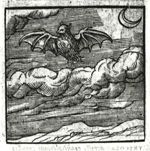
Vespertilio: Alciatus, Emblemata (Leiden, 1591), emblem 61
Iconclass: 23R14 night 25F28(BAT) flying mammals: bat 46B451 debit, debt
Loci Communes: Inconstantiae, perfidiae, versutiae (Inconstancy, treachery, cunning, Inconstance, perfidie, ruse)
IV ix 37 In folle offere Proffer in a purse
Callistratus li. Pandect. 35. tit. De cond. & demonst. cap. Cum servus: Nos, inquit, neque conditionem meram putamus esse, quae in datione exsistit, neque meram conditionem quae in facto consistit, sed eam conditionem, quae ex quadam mixtura consistit. Nam non utique si ille in folle reliqua obtulit, liber erit: non enim testator hoc sensit, sed illud, ut rationes reddat, quomodo servus reddere solet: id est, legendas offetre rationes primum, deinde computandas, ut explorari possit, computationes probae an improbae referantur, accepta, relata recte an non recte. Apparet in folle dictum, pro eo quod erat, inexplorate, inexplicate et confuse, sicut qui syngraphas et pecuniam sacculo inclusas offert.
In the Pandects, book thirty-five, title 'On conditions and particularizations,' chapter 'When a slave,' Callistratus writes:
It is our opinion that the condition is not simply one of giving something
or doing something, but is a condition of mixed content. For if he offers the
rest 'in a purse,' he will in no way be free. For the testator did not intend
this, but meant him to present his accounts as a slave usually does, that is, to
present them first of all so that they can be read, and secondly in a manner
that allows the figures to be checked, so that it is possible to see whether
the calculations have been correctly recorded or not and the credits properly
entered.
It looks as if the phrase 'in a purse' means 'not examined, not explained, unclear,' like someone supplying documents and money concealed in a bag.
IV ix 38 Malus choraules, bonus symphoniacus Bad accompanist, great chorister
Divus Augustinus in epistola ad Aureliamum. Et refertur in Decretis Causa 16. Quaest. prima, cap. Legi epistolam: commemorat vulgo illud iactatum: Malus choraules, bonus symphoniacus: ubi quis in suo genere contemptus, in praestantiore habetur in precio: veluti si quis poeta ineptus profiteatur medicinam, et inter praeclaros medicos habeatur. Augustini verba sunt haec: Ordini clericorum sit indignissime iniuria, si desertores monasterioreum ad militiam clericorum eligantur, cum ex his, qui in monasterio permanent, non tamen nisi probatiores ac meliores in clerum assumere soleamus: nisi forte sicut vulgares dicunt, malus choraules, bonus symphoniacus est, ita ipsi vulgares de nobis iocabuntur, dicentes, malus monachus, bonus clericus est. Sumptum apparet ex M Tullio, qui in oratione pro Murena ita loquitur: Itaque mihi videntur initio multo hoc maluisse: postquam id assequi non potuissent, illuc potissimum sunt delapsi. ut autem in Graecis artificibus eos aulaedos esse, qui citharoedi fieri non potucrint, sic nonnullos videmus, qui oratores evadere non potuerunt, eos ad iutis studium devenire.
In a letter to Aurelianus (and you will find the words cited in the Decretum Cause 16, Question 1, canon beginning, 'I have read your letter'), Augustine quotes the popular saying, 'Bad accompanist, great chorister.' This refers to someone who is despised in his original calling, but later on proceeds to a higher one and comes to be highly thought of, for example, a bad poet becoming a distinguished doctor. Augustine actually says, 'A grievous wrong is done to the order of clergy if deserters from the monasteries are to be enrolled in the ranks of the secular clergy, since it is our practice to receive into the clergy only the best and most highly regarded of those who actually abide steadfastly in their monasteries; unless maybe the same ordinary folk who say, "Bad accompanist, great chorister," are also to laugh at us and say, "Bad monk, great cleric."' The idea seems to come from Cicero, who says in his speech in defence of Murena, 'I get the impression that at the outset they saw this as much more desirable, but when they could not achieve a high enough standard, they settled for the other thing instead. Among Greek musicians, we find that pipe-players are those who were unable to master the lyre. Likewise, we observe quite a number of failed orators who have taken to jurisprudence.'
Facsimile: 
Iconclass: 48C7542 musician(s) accompanying singer(s) 48C7552(+15) choir (+ artist at work with assistants or pupils) 52A51:51K1 Wisdom; 'Sapienza', 'Sapienza humana', 'Sapienza vera' (Ripa)❧Change
Loci Communes: Honos indigno habitus (Honor given to the unworthy, Honneur accordé à qui ne le mérite pas)
IV ix 39 Nutu atque renutu By a nod or shake of the head
Cui summam potentiam adscribimus, eius nutu ac renutu cuncta geri dicimus. Multum est verbo efficere quod velis, at plus est idem efficere nutu ac renutu. M. Tullius actione in Verrem tertia: Nisi ad nutum tuum praesto fuerit, nisi libidini tuae cupiditatique paruerit. Idem pro Caecinna: An certius quicquam obiici potest, quàm quod is cui obiicit, ne nutu quidem infirmare conetur? Idem contra Rullum: Tamen omnes vobis pecunias ad nutum vestrum penderent. Idem Epist. famil lib. undecimo, Interfecto enim rege, regios omneis nutus tuemur. Rursus lib. 13. epist. prima: Nec dubitat, quin ego à te nutu hoc consequi possim. In eodem ad Silium propraetorem: Ut libentissimis Graecis, nutu quod velis consequare. Plinius li. Epist. primo, ad Octavium Rufum indicat esse sumptum ex Homero, qui fingit Iovem solo nutu probare aut reiicere hominum vota. Verba Plinii asscribam: Vide in quo me fastigio collocaris, quum mihi idem potestatis idemque regni dederis, quod Homerus Iovi Optimo Maximo, Τῶδ᾽ ἕτερον μὲν ἔδωκε πατὴρ, ἕτερον ἀνένευσεν. Nam ego quoque simili nutu ac renutu respondere voto tuo possum.
To indicate that someone has supreme power, we say that everything happens according to a nod or shake of his head. It's a great thing to get what you want done by a mere word, but it's even more to achieve it 'By a nod or shake of the head.' Cicero, in the third part of his attack on Verres, writes, 'Unless it is ready there at your nod, unless it submits to your lust and greed .. .' Again, speaking in defence of Caecina: 'Can any more incontrovertible charge be brought against anyone than a charge which he doesn't attempt to refute even by a shake of his head?' Again, attacking Rullus: 'that all should still pay sums of money over to you on the nod.' Again, in the eleventh book of his Letters to Friends: 'The king is dead, but we still observe the king's every nod.' Again, in the first letter in book thirteen: 'He does not doubt that I could with a mere nod get you to agree to this.' In the same book, writing to the propraetor Silius: 'with the result that you can get whatever you want done with a mere nod, with the full cooperation of the Greeks.' Pliny makes it clear in the first book of his Letters, writing to Octavius Rufus, that the phrase originates with Homer, who represents Jove granting or rejecting the prayers of men 'with a mere nod.' To quote what Pliny says: 'See what a pinnacle you have set me on, when you attribute to me the same power and dominion that Homer attributes to Jupiter Greatest and Best, saying "Part of his prayer did the Father grant him, / At the other he shook his head." For I too can respond to your entreaty with a similar nod or shake of my head.'
Facsimile:
Iconclass: 31A221(+64) head (human) (+ downward) 31A221(+65) head (human) (+ sideways) 53C11 Authority, Power; 'Dominio', 'Giurisdittione' (Ripa) 59B41 Regality, Majesty; 'Maestà regia', 'Regalità' (Ripa)
Loci Communes: Potentes (The powerful, Les puissants)
IV ix 40 Ne bestiae quidem ferre possent Not even wild beasts could stand it
Proverbialis hyperbole est apud M. Tullium actione in Verrem quinta: Postremo ut odor Apronii teterrimus oris & corporis, quem, ut aiunt, ne bestiae quidem ferre possent, uni isti suavis & iucundus videretur. Confine est illi quod alibi retulimus. Balbinum polypus Agnae delectar. Idem in Catil. invectiva 5. Tantus enim illorum temporum dolor inustus est, ut iam ista non modo homines, sed ne pecudes quidem mihi passurae esse videantur. Paulo diversius dixit in epist. ad Atticum, cuius initium, Quaeris ex me, lib. 1. Et quod omnes non modo homines, verum etiam pecudes factum esse sciebant.
Cicero uses an exaggerated expression of a proverbial nature in the fifth part of his attack on Verres: 'More than that, the stench emanating from Apronius' mouth and person, so revolting that not even wild beasts, as they say, could stand it, he alone found sweet and pleasant.' This is like the line we discussed earlier, 'Balbinus loves the polyp that he sees on Agne's nose.' Cicero again, in his third invective directed against Catiline: 'Those times inflicted such searing pain that now wild beasts, it seems to me, could not endure such things, let alone men.' He has a variation on this idea in book one of his Letters to Atticus, the one that begins 'You ask me ...': 'a thing which not only men but the very cattle know to be a fact.'
Facsimile:
Iconclass: 25F23 beasts of prey, predatory animals 31A22221:31A332 breathing, respiration❧disagreeable, repellent smell
Loci Communes: Molesti intolerabiles (Unbearable, troublesome people, Gens insupportables)
IV ix 41 Cossi Grubs
Olim vulgari convicio Cossi dicebantur homines natura rugosi, à similitudine vermium qui lignis innascuntur. Li natura rugas habent, ut se contrahant ac porrigant. Horum Plinius meminit compluribus locis, ut li. 11. cap. 33. Rursus lib. 30. cap. 13. Libri vero 17 ca. 24. indicat huius generis grandiores in cibis atque etiam in luxu fuisse antiquitus. Meminit & Hieronymus adversus Iovinianum lib. 2. Graeci προφερεῖς vocant, qui quum sint iuniores, tamen vultum senium prae se ferunt. Autor Festus Pompeius.
In times past people with creases in their flesh were popularly called by the insulting term 'grubs,' from their similarity to a sort of worm living in stumps of wood. These creatures have natural creases to enable them to draw themselves up and stretch out again. Pliny mentions these grubs in several places, for example, book eleven, chapter thirty-three, and book thirty, chapter thirteen. In book seventeen, chapter twenty-four, he tells us that larger specimens were in early times used for food and even considered a delicacy. Jerome also mentions this in book two of his Against Jovinianus. The Greek word [greek] 'premature' is used for young people who look far older than their years. The information about the word cossi comes from Festus Pompeius.
Facsimile:
Iconclass: 25F711(+413) insects (+ 'larva', grub) 31B6251(+0) creased, wrinkled forehead (+ variant)
Loci Communes: Senium praematurum aut mors (Premature old age or death, Vieillesse prématurée ou mort)
IV ix 42 Menia columna The Maenian Column
Quemadmodum dicimus De trivio, aud de lapide, hominem vehementer contemptum significantes, ita M. Tullius in Verrem actione prima, à columna Menia dixit: Tantáne, inquit, vobis inopia esse videor amicorum, ut mihi non ex his quos mecum adduxerim, sed de populo subscriptor addatur: vobis autem tanta inopia reorum, ut mihi causam praeripere conemi ni potiusque aliquos à columna Menia vestri ordinis reos reperiatis? Asconius Pedianus indicat apud columnam Meniam sordidos reos, veluti fures, aut servos nequam apud triumviros capitales solere iudicari. cognomen autem inditum à Menio, qui quum domum suam venderet Catonin & Flacco censoribus, ut ibi basilica aedificaretur, exceperat ius sibi unius columnae, super quam tectum proiiceret, & provolantibus tabulatis, inde ipse & posteri eius spectare munus gladiatorium possent, quod etiam tum in foro dabatur. Hinc Meniae cognomen. ad tales autem causas quae illic agebantur, adhibebantur sordidi causidici.
We speak of someone being 'out of the gutter' or 'off the block' to mean 'utterly contemptible.' We find a similar idea in Cicero, who writes, in the first part of his attack on Verres, 'Do you think me so bereft of friends that I have to have someone to sign the accusation allocated to me, not from among the gentlemen I have brought with me, but out of the general populace? And are you so short of people to prosecute that you have to try to take this case away from me, instead of finding guilty persons of your own sort to prosecute out of the crowd at the Maenian Column?' Asconius Pedianus tells us that petty criminals, such as thieves or bad slaves, were tried before the triumviri capitales at Maenius' Column. The landmark got its name from one Maenius, who 'sold his house to the censors, Cato and Flaccus, so that the site could be used for a basilica, but reserved to himself the right of constructing a column with a roof and projecting wooden balconies, from which he and his posterity could watch the gladiatorial games, which even then were still laid on in the forum.' This is why it was called Maenius' Column. Only the lowest of court hacks were brought in to act in the sort of cases that were tried there.
Facsimile: 
Iconclass: 48C161:61G(MAENIAN COLUMN) column, pillar ~ architecture❧names of artefacts and man-made objects (MAENIAN COLUMN) (MAENIAN COLUMN) 59BB4 Despicableness
Loci Communes: Contemptus et vilitatis (Contempt and worthlessness, Mépris et bassesse)
IV ix 43 Circeo poculo Circean cup
De Circes virga nobis ante dictum est. Adsimili forma M. Tullius usus est Circeo poculo, de homine subito in alium mutato, Actione in Verrem prima. Sed repente è vestigio ex homine tauquam aliquo Circeo poculo factus est Verres, redit ad se, atque ad mores suos. In verbis Ciceronis tacita allusio est ex ambiguo vocis. Nam Verris porcus est maialis nonum castratus.
I have already written about Circe's magic wand. Cicero used a similar phrase, 'Circean cup/ when talking about someone suddenly transformed. In the first part of his attack on Verres, he says, 'But all of a sudden, in a flash, as if by some Circean cup, he turned from being a man into a Verres; he became himself again, and reverted to his normal character.' We have a play on words concealed here: 'Verres' has a double meaning, since verres, in addition to being a personal name, is also the word for an uncastrated hog.
Facsimile:
Iconclass: 51M11:13D2 Swiftness, Speed; 'Agilità', 'Celerità', 'Velocità' (Ripa)❧transformation, metamorphosis of person 51M11:51K1 Swiftness, Speed; 'Agilità', 'Celerità', 'Velocità' (Ripa)❧Change 97C8(+0) Ulysses' companions changed into swine: when they drink from the cup offered by Circe, the enchantress, Ulysses' companions change into swine (Ovid, Metamorphoses XIV 276) (+ variant)
Loci Communes: Mutati instituti (A changed custom, Une coutume changée)
IV ix 44 Ex sinu illius His bosom friend
Quos ex intima familiaritate volumus intelligi, hos è sinu illius aut illius esse dicimus. M. Tullius actione in Verrem tertia: Verres simul ac tetigit proviciam, statim Messanam literas dedit, Dionem evocavit, calumniatores ex sinu suo apposuit, qui illam haereditatem Veneri Erycinae commissam esse dicerent. Idem actione quarta: Satisne vobis magnam pecuniam Venerius homo, qui è Chelidonis sinu in provinciam profectus esset, Veneris nomine quaesisse videtur? Idem in Catilinam invectiva secunda: Postremum autem genus est non solum numero, verum etiam genere ipso atque vita, quod proprium est Catilinae, de eius delectu, imò vero de complexu eius ac sinu. Plutarchus in vita Catonis Uticensis simili forma dixit, γαβίνιον παῦλον ἐκ τῶν πομπηίου κόλπων ἀνθρωπον. i. Gabinium Paulum ex Pompei sinu hominem. Qui locus nobis antea citatus est in proverbio: In sinu gaudere, sed sensu nonnihil diverso. De grege illo nobis ante dictum est. M. Tullius aliquoties gregales appellat, eiusdem sodalitii congerrones.
We say that someone is so-and-so's 'bosom friend' to mean that they are on the closest possible terms. Cicero writes, in the third part of his attack on Verres, 'The moment Verres set foot in the province, he sent a letter to Messana, summoned Dio to appear, and put in some of his bosom pals to act as accusers and make a false declaration that the inheritance in question had been forfeited to the Venus of Mount Eryx.' Cicero again, in the fourth part: 'Do you think this sum was large enough, this sum demanded in the name of the goddess of love by this man who was so devoted to her service, who tore himself from Chelidon's bosom to go to his province?' Again, in his second speech attacking Catiline, Cicero says, 'The last group are not merely by their numbers but in their type and their manner of life Catiline's specials, recruited by him, his closest associates, friends of his bosom.' Plutarch uses a similar phrase in his Life of Cato of Utica: 'Gabinius Paulus, [greek] "one of Pompey's bosom friends."' I cited this passage before, when discussing the proverb 'To rejoice in one's bosom' but the sense of that is somewhat different. I have already discussed 'One of that gang.' Cicero several times uses the word gregales 'members of the same company' for 'cronies in the same group.'
Facsimile:
Iconclass: 31A222 chest, bust 31A22210(+0) heart symbolism (+ variant) 33A5 friends
Loci Communes: Amicitia (Friendship, Amitié)
IV ix 45 Circumpedes Foot-servants
Qui proxime adsunt, cinguntque quempiam ad obsequium parati, circumpedes esse dicuntur. M. Tullius actione in Verrem tertia: Circumpedes autem homines formosos & literatos suos esse dicebat, se emisse. Ita perpetua familiaritate iunctos dixit circumpedes, quemadmodum A manibus, à pedibus appellamus, qui nobis domestice inserviunt.
Those who attend a person closely and stand about him ready to do his will are said to be 'about his feet,' that is, 'Foot-servants.' Cicero, in the third part of his attack on Verres, writes, 'But the foot-servants who were goodlooking and educated, he said were his own, that he had bought them.' So Cicero used this phrase circumpedes for servants in a long-standing close relationship, just as we call our domestic servants 'handmaids' and 'footmen.'
Facsimile:
Iconclass: 42F53 manservant, footman 46A1251 page, footboy
Loci Communes: Contagio morum (The contagion of habits, Contagion des mœurs); Diligentiae (Diligence, Diligence)
IV ix 46 Ne tempestas quidem nocere possit Not even a storm can harm
In homines insigniter nudos et inopes, non sine proverbii specie dixit M. Tull. actione in Verrem 5. Ceteros Leontinos, quibus non modo Apronius in agris, sed ne tempestas quidem ulla nocere potuit, exspectare nolite. Et enim non modo incommodi nihil coeperunt, sed etiam in Apronianis illis rapinis, in quaestu sunt compendioque versati, &c. Allusum est autem in Apronii vocabulo ad aprum Calydonium. Et qui possident aliquid rerum, aut habent in agris, aut in mari his tempestas nocere potest. Cui vero nulla tempestas nocere potest, is nec in agris possidet quicquam, ut agricolae, nec in navibus, ut negociatores.
Cicero used this apparently proverbial expression in the fifth part of his attack on Verres, with reference to people who owned nothing, who were quite without possessions: 'Don't expect to hear anything from the other inhabitants of Leontini, as not even storms could damage their farms, let alone Apronius. They suffered no misfortune - in fact, in all those rampagings and plunderings of the boorish Apronius, they were at an advantage and came off well.' There is a joke here - the name Apronius suggests the Calydonian Boar. People who have possessions or own land or go to sea can be harmed by a storm. Someone whom 'no storm can harm' neither owns land, like a farmer, nor has cargoes on shipboard, like a merchant.
IV ix 47 Ballio Ballio
Nomina quaedam ob insignem improbitatem abierunt in proverbiu: quod interdum à veris, interdum a fictis in comoedia personis sumitur. Nam Marcus Tullius in actionibus suis subinde C. Fannium Chaeream quendam Ballionem appellat, veluti pro Roscio Comoedo. Qui iccirco capite et superciliis, inquit, sempet est rasis, ne ullum pilum boni viri habere dicatur. Cuius personam praeclare Roscius in scena tractare consuevit, neque tamen pro beneficio ei par gratia refertur: nam Ballionem illum improbissimum et periutissimum lenonem cum agit, agit Chaeream: persona illa lutulenta, impura, invisa, in huius moribus natura vitaque est expressa. Rursus in eadem: Vix mediusfidius tu Fauni a Ballione aut aliquo eive simili postulare auderes et im petrare posses: Ballionem inducit Plautus in Pseudolo, leonem impurissimum, rapacissimum, improbissimum: nomen confictum est a ba/llein, quod semper aliquid praedae venetur leno: vel a balli/zw, quod lasciviarum ac saltationum sit architectus.
Some people have been so remarkably wicked that their names have become proverbial. Sometimes they are real people, sometimes characters in comedies. Cicero several times refers to a certain Gaius Fannius Chaerea in his speeches as 'Ballio,' for example, in his speech defending the actor Roscius: 'He always has his hair and eyebrows shaved off, so that no one can say there is "even a hair" of a good man on him. Roscius has often portrayed this character well on the stage, but doesn't get the thanks for this service that he deserves. When he acts Ballio, that scoundrelly, lying pimp, he is acting Chaerea. That hateful, foul, polluted character in the play becomes alive and real in Chaerea's nature, manners, activities.' Later on in the same speech, Cicero says, 'Upon my word, Fannius, you would hardly dare to ask such a thing of Ballio and his like, nor would you be likely to get it.' Ballio is a character in Plautus' Pseudolus, a vicious, grasping, unprincipled pimp. The name has been invented on the basis of Greek [greek] 'to hit,' because a pimp is always on the look-out for some prey or other; or of Greek [greek] 'to jump about, have a ball,' because he is the impresario of licentiousness and wild activities.
Facsimile:
Iconclass: 54AA5 Badness 82A(BALLIO) male literary characters (BALLIO) 83(PLAUTUS, Pseudolus) (PLAUTUS, Pseudolus) specific works of literature (with AUTHOR, Title)
Loci Communes: Improbi (The dishonest, Les malhonnêtes)
IV ix 48 Ostiatim Seriatim, in detail
Eleganter nec sine proverbii specie M. Tullius dixit, ostiatim, pro singulatim, sive nomi natim, in Verrem actionem sexta: Hic nolite expectare, dum ego hoc crimen agam ostiatim: ab Aeschylo Tyndaritano pateram abstulisse, abs Thrasone item Tyndaritano patellam, &c. Lucundius erit si transferatur ad res animi: ut si quis è singulis libris, aut capitulis autorum petat testimonia aut probationes, dicetur ostiatim petere. Eodem fermè sensu ad Atticum lib. ii. Epistola, Accepi aliquot, dixit κατὰ λεπτὸν: Ac ne forte quaeras κατὰ λεπτὸν de singulis rebus, universa res eo est deducta, spes ut nulla sit.
Cicero employs a neat and apparently well-established usage when he uses Ostiatim 'From door to door,' with the meaning 'one by one, in detail, specifically.' This is found in the sixth part of his attack on Verres: 'Don't expect me to go through this accusation ostiatim "in detail": a bowl filched from Aeschylus, an inhabitant of Tyndaris; a plate from Thrason, also of Tyndaris, etc.' It will be even nicer if the word is used in an intellectual context, if for example someone looking for proof texts and corroborative statements in separate books or chapters of various authorities is said to do so ostiatim 'knocking on successive doors.' Cicero uses a comparable Greek expression [greek], when writing to Atticus in the letter which begins, 'I've received several letters from you.' He says, 'Don't ask [greek] "in detail" about the situation. The whole thing has got to such a state that there is no hope.'
IV ix 49 Domi nobilis A man of standing in his locality
Qui non opibus tantum aut potentia clarus est, sed ex nobilibus nobilis prognatus est, hunc Cicero subinde domi nobilem vocat, Actione in Verrem tertia: Ignem ex lignis viridibus atque humidis in loco angusto fieri iussit: Ibi hominem ingenuum, domi nobilem, populi Romani socium atque amicum, fumo excruciatum semivivum reliquit. Idem actione quarta: Sopater quidam fuit Haliciensis, homo domi suae cum primis locuples atque honestus. Rursus actione quinta: Itaque quum Pillenus Herbitensis, homo disertus et prudens, & domi nobilis. Item pro Cluentio: Quas literas A. Aurius vir fortis, & experiens, & domi nobilis. Rursus ad Qu. fratrem Epistol. lib. ii. M. Orfium equitem Romanum commendat, hominem domi splendidum, gratiosum etiam extra domum. Conveniet in eum, qui suis virtutibus magnus & clarus est.
Cicero on several occasions uses the phrase 'A man of standing in his locality' of a man who is not merely rich and influential but a member of a family of quality. In the third part of his attack on Verres, he writes, 'He had a fire made from damp green wood in an enclosed space and there subjected to the torture of suffocation from breathing in smoke and left more dead than alive a man of free birth and of considerable standing in the area, an associate and recognized friend of the Roman people.' Again, in the fourth part: 'There was a certain Sopater from the town of Halicyae, a rich and highly respected person in his local area .. .' Again, in the fifth part: 'So when Philenus of Herbita, a wise and eloquent man, a person of standing in the area .. .' Again, in his speech defending Cluentius: 'These letters Aulus Aurius, a courageous and enterprising man, much respected in the neighbourhood .. .' Writing to his brother Quintus in a letter in book two, he recommends one Marcus Orfius, a Roman knight, whom he describes as a man 'of some consequence on his home territory and influential in wider circles as well.' The phrase will fit anyone who is great and distinguished by reason of his native qualities.
Facsimile: 
Iconclass: 42G family, relationship, descent 59B33 Respectability; 'Precedenza et Preminenza de titoli' (Ripa)
Loci Communes: Nobilitas / obscuritas (Nobility / obscurity, Noblesse / obscurité)
IV ix 50 Obtorto collo With one's neck in a noose, by the throat
Qui vi compellitur, obtorto collo trahi dicitur. Marcus Tullius Actione in Verrem sexta: Hinc illa Verrea nata sunt, quod in convivium Sextem Cominium protrahi iussit, in quem scyphum de manu iacere conatus est, quem obtorta gula de convivio in vincula atque in tenebras abripi iussit. Idem pro Cluentio: Nec quicquam prius est factum, quàm ut illum persequeretur, & collo obtorto ad subsellia reduceret, ut relique posset perorare. Plautus in AMphitryone dixit, obstricto collo: Ob istud indignum dictum obstricto collo hac te diripiam. Item in eadem fabula: Quin ego hinc Amphitryonem collo obstricto traham. Idem in Poenulo: Dubito fugere hinc in malam crucem, priusquam obtorto collo ad praetorum trahor. Rursus in Rudentibus: Opta ocyus, rapi te obtorto collo mavis, an trahi. Atque inibi paulo post: Subveni mi Charmides, rapior obtorto collo.
Anyone who is subject to violent compulsion is said to be dragged off 'With his neck in a noose.' Cicero writes, in the sixth part of his attack on Verres, 'That was the origin of the "Festival of Verres." During the celebratory party, he had Sextus Cominius dragged in, he tried to throw a goblet at him and then ordered him to be haled off to the chains and darkness of prison with his neck in a noose.' Cicero again, speaking in defence of Cluentius: 'So he at once set off after him and dragged him back to court in a headlock, so that he could deliver the rest of his oratorical tour de force.' Plautus had a variant on this phrase in the Amphitryo, obstricto collo: 'For that reason I'll thrash you and wring your neck.' And again in the same play: 'Why don't I grab Amphitryo by the throat and drag him off?' Plautus again, in the Carthaginian: 'Why don't I take myself off to the devil / Before I'm haled off by the throat to face the magistrate?' Plautus, in the Rope: 'Say quick now, would you rather be hauled off / With your neck in a noose, or dragged off?' And a little later: 'Help me, Charmides! I'm being dragged off with my neck in a noose.'
Facsimile:
Annotation: 31A2216 = provisional concept: neck
Iconclass: 31A2216 31A2734 being dragged 44G321(NOOSE) instruments of torture, execution or punishment (NOOSE) 53C21 Compulsion
Loci Communes: Rigor (Strictness, rigidity, Rigueur); Vis injustia (Unjust force, Force injuste)
IV ix 51 Canes venatici Hunting dogs
Qui venandi studio tenentur, habent canes emissarios, qui vestigiorum odore feras exploratas, et repertas latratu produnt. De Coryceis alibi diximus. M. Tul. Actione in Verrem sexta. Apponit de suis candibus quendam, qui dicat se Diodorum Melitensem rei capitalis reum velle facere. Ibidem aliquanto post: Qui simul atque in oppidum quodpiam venerat, immittebantur illi continuo Cybiratici canes: qui investigabant ac perscrutabantur omnia Duos fratres Cybiritas appellat canes, quod ad furandum Verres illorum oculis, sed suis manibus uteretur. Solet autem canibus a regione cognomen indi, ut Melitaeis. Ac superius in eadem; Qui postesquam venerunt, miraudum in modum canes venaticos diceres, ita odorabantur et omnia vestigabant, &c.
Keen huntsmen have dogs which are sent on ahead. These track down the prey by scent and reveal its whereabouts by baying. I have already discussed the Corycaeans. In the sixth part of his attack on Verres, Cicero writes, 'He laid on one of his "dogs" to state that he intended to arraign Diodorus of Malta on a capital charge.' A little further on: 'As soon as he arrived in a town anywhere, those Cibyrian hounds of his were unleashed, and they tracked down and investigated everything.' He calls the two brothers 'Cibyrian hounds' because in his depredations Verres employed their eyes, but used his own hands. Breeds of dog are usually named after the area they come from, for example, Maltese. A little earlier Cicero writes, 'After they arrived there, they so wonderfully sniffed out and tracked down everything - you'd have said they were hunting dogs - that .. .'
Facsimile:
Iconclass: 31A22552(+0) foot-print, track (+ variant) 43C1147 hunting dogs
Loci Communes: Curiositas (Curiosity, Curiosité)
IV ix 52 Mercenarium praeconium Self-interested commendation
Laudes non ex animo tributas, sed commodi gratia per adulationem oblatas M. Tullius actione in Verrem 3. Mercenarium praeconium appellat. Itque cum a te caput illud tam multis verbis merceario praeconio esset ornatum, ecquis inventus est postea praetor qui illud idem eiceret? Quamquam scimus in vulgatis codicibus pro praeconio haberi prooemio, an recte, docti viderint.
Praises which are not heartfelt but offered by way of flattery to gain some advantage are called by Cicero 'Self-interested commendation.' This is in the third attack on Verres: 'After you had tricked out that particular clause with so much verbiage, so much self-interested commendation, did any praetor who ever came after you reproduce that wording?' I am well aware that widely used printed texts here read prooemium 'preamble' rather than praeconium 'commendation,' but whether rightly or no, scholars may judge.
IV ix 53 Manus precium Labour costs, fee
M. Tulliu sActione in Verrem tertia, Lapis aliquis caedendus et apparandus fuit, machina sua, Nam illo non saxum, non materia advecta est, tantum operis & in ista locatione fuit, quantum paucae operae fabrorum mercedis tulerunt, & manusc precium, machinae. Manus precium appellare videtur, mercedem non quae datur pro materia, sed quae artis nomine, debetur Architecto. Idem in Pisonem: Quum vero non modo postulante atque eo cogente, sed invito atque oppresso senatu, non modo nullo populi Romani studio, sed nullo ferente suffragium libero, provincia ista tibi manus precium fuerit, non eversae per te, sed perditae civitatis, & caetera. Ita Caius in libro De verborum significationibus, cap. Mulieris: Quoniam in manus precio plus est, quàm in re. Et paulo ante praecedit, Res abesse videntur, ut Sabinus ait, & Pedius probat, etiam eae quarum corpus manet, forma mutatur: & ideo si corruptae sunt vel transfiguratae, videri abesse, quoniam, &c. Detorqueri poterit in eos qui institutione formant ad virtutem, aut corrumpunt discipulos.
Cicero, in the third attack on Verres: 'A certain amount of marble had to be cut and prepared, using the proper tools. No stone, no timber, was transported to the site. There was nothing more involved in the job than the wages of a few masons, the fee, the tools.' Cicero seems to use the phrase manus pretium for payments made not for materials but as a fee to the architect for his professional skills. Cicero again, in his attack on Piso: 'It was not by a senate that begged and coerced you but by a reluctant senate under duress, not with the enthusiastic support of the Roman people but by a vote in which not a single free-born man participated, that that province was handed over to you as a fee for overturning, nay utterly destroying, the state.' Gaius, 'On the meaning of terms,' in the section beginning, 'Woman': 'Since there is often more in the paid-for workmanship than in the actual article.' This follows on from: 'As Sabinus says, a view in which Pedius concurs, property is considered lost when the substance remains but the form is changed; accordingly, if property is damaged or altered, it is treated as lost, since .. .' This can be applied to those who by their instruction either mould their pupils to virtue or change them for the worse.
Facsimile: 
Iconclass: 46A172 paying of wages
Loci Communes: Industria (Industriousness, Application, diligence)
IV ix 54 Decumanum Every tenth one
Olim decumnum ovum dicebant, & fluctum decumanum pro magno, quod à rusticis ac nautis observatum sit, decimum quodque ovum nasci caeteris maius, & decimum quemque fluctum caeteris esse vehementiorem. Unde Ovidius: Decimae ruit impetus undae. Hinc quicquid ingens esset, decumanum vocari coeptum. Ut Lucil. Acipensere cum decumano.
In times past, people used phrases like 'the tenth egg,' 'the tenth wave,' to mean 'huge,' because farmers and sailors observed that every tenth egg laid was bigger than the previous nine and every tenth wave was more powerful than the ones preceding it. So Ovid writes:
The onslaught of the tenth wave comes crashing
Down upon the ship.
Consequently, anything huge came to be called 'tenth,' for example Lucilius' phrase: 'tenth sturgeon,' that is, 'monstrous.'
Facsimile:
Iconclass: 49D11(10) numerals: 10 51G1 Largeness, Magnitude 51H4 Plenitude
Loci Communes: Arrogantia jactantiaque (Arrogance and boastfulness, Arrogance et vantardise)
IV ix 55 Palmarium facinus A crowning deed
Palmarium facinus, pro insigniac triumpho digno dixit Terentius in Eunucho: Tum hoc alterum, id vero est, quod mihi puto palmatium. Pro eodem M. Tullius dixit, Palmas. Ut pro Sexto Roscio Amerino: Si quemadmodum paratum esse audio testis prodierit, tum alias quoque suas palmas cognoscet. Rursus Philippica undecima: Sexta palma urbana, etiam in gladiatore, difficilis: sed haec iudicum culpa, non mea est. Plautus in Mustellaria, palmam item usurpavit in malam partem, loquens de adolescente, qui ex moribus continentisssimis degenerat ad mores corruptissimos. Is nunc in aliam partem palmam possidet.
Palmarium facinus, A deed that takes the palm, a crowning achievement, a phrase equivalent to 'special, worth a triumph,' is used by Terence in the Eunuch: 'Then there's this second thing, which I see as my crowning deed.' Cicero uses palmae 'palms of victory,' that is, 'prize achievement' to mean the same thing, for example, in his speech in defence of Sextus Roscius of Ameria: 'If he presents himself as a witness, which is what I hear they have arranged between them, he will learn of other prize achievements on his part.' Again, in his eleventh Philippic oration: 'It is difficult, even for a gladiator, to carry off the palm for the sixth time in Rome; but that was the judges' fault, not mine.' Plautus uses palma 'prize' with a pejorative meaning in the Haunted House: a young man who had previously behaved in a most exemplary manner had taken to behaving in a quite disgraceful way and a character in the play remarks, 'Now he takes the prize for quite the opposite thing.'
Facsimile:
Iconclass: 45I611(+0) crowning the victor with laurel (+ variant) 54F1 Success; 'Evento buono' (Ripa)
Loci Communes: Arrogantia jactantiaque (Arrogance and boastfulness, Arrogance et vantardise)
IV ix 56 Commovere sacra To stir the holy objects
Plautus in Pseudolo: Commovere sacra dixit, pro eo quod erat, extrema experiri praesidia Hinc dictum apparet, quod rebus desperatis, soleant homines ad deorum praesidia confugere. Velut hodie, Lutetiae, cum supra modum inundat Sequana, corpus divae Genovesae a montis acuti templo defertur, ad aedem virgini matri sacram. Sed vide num pro sacra legendum sit saga, ut intelligas arma, de quo iam diximus: Sequitur enim protinus, quo pacto et quantas soleam turbellas dare. Deinde verba sunt quasi bellum denunciantis: Nunc ne quis dictum sibi neget, dico omni pube praesente in concione omni populo, omnibus amicis notisque edico meis: In hunc diem à me ut caveant, ne credant mihi. Idem servus & deinceps bellica loquitur.
In Pseudolus Plautus uses the phrase Commovere sacra 'To stir the holy objects' to mean 'to try the last line of defence.' When the situation is desperate, men flee to the protection of the gods, hence this phrase. Nowadays in Paris, for example, when the Seine rises and overflows its banks, the bones of Sainte Genevieve are carried from the church at Montaigu down to the cathedral of Notre Dame. It's possible that, instead of sacra, the phrase here should read commovere saga 'to shake out the soldiers' capes,' meaning 'to take to arms,' a usage I discussed earlier. I suggest this because the next line in Plautus says, 'You know how I can create quite a tidy commotion,' and the character then goes on to make a mock declaration of war:
Now let no one say he was not notified.
To all able-bodied persons here present in this assembly,
To all the people, to all friends, to all that know me,
I make this proclamation - this day they must
Beware of me and trust me not.
And the speaker, a slave, continues to spout war-talk in the next section of the play.
IV ix 57 Quasi dies dicta sit As if waiting for one's case to come to trial
Olim rei solent esse maesti squalidique, lugentibus similes, quo indices ad misericordiam inflecterent. Hinc illud Plautinum in Asinaria: Quem videam aque mastum esse, ut quasi dies dicta si siet.
At one time people awaiting trial would go about long-faced and unkempt, like people in mourning, hoping to stir pity in the hearts of the judges. Hence the line in Plautus' Comedy of Asses:
You look as doleful as if you're waiting
For your case to come to trial.
Facsimile:
Iconclass: 41D(+7) fashion, clothing (+ worn or torn clothes) 44G1 administration of justice, trial 57A75 Mercy, Compassion; 'Compassione', 'Misericordia' (Ripa)
Loci Communes: Tristitia, laetitia (Sadness, joy, Tristesse, joie)
IV ix 58 Βεργαΐζειν To romance
Stephanus scribit βέργην esse civitatem Thraciae, sive ut Strabo refert vicum. Eius gentis improbi mores in proverbium abierunt, ut diceretur bergai+/zein, qui nihil sani loquetentur. Tota enim natio Thracum multis nominibus male audiebat, sed praecipue ob morum truculentiam ac perfidiam. Thrax erat Polymnestor, qui victricia arma sequutus, Polydorum obtruncavit, & auro vi potitus est.
Stephanus tells us that [greek] was a town in Thrace, or, according to Strabo, a village.' The bad character of the inhabitants became proverbial, so that people who never said anything reasonable were said [greek] 'To romance.' The Thracians as a whole were spoken ill of on many counts, but mainly for their belligerence and treachery. Polymnestor was a Thracian - he was the man who 'joined the winning side, murdered Polydorus, and thus by violence secured the gold.'
Facsimile:
Iconclass: 32B2(THRACIANS) historical peoples: Thracians 52BB53 Nonsense, Absurdity 61D(THRACE) geographical names of countries, regions, mountains, rivers, etc. (THRACE) (THRACE) 61E(ΒΈΡΓΗΝ) names of cities and villages (ΒΈΡΓΗΝ)
Loci Communes: Improbi (The dishonest, Les malhonnêtes)
IV ix 59 Summo pede Dip the toes
Ακρῳ ποδὶ id est, Summo pede cadem fi gura dictum est, qua summo digito. Negatur summo pede attigisse disciplivam, qui numquam ingressus est, nec attigit limen illius. Extat apud Platonem in Lachete, cuius loci alibi, ni fallimur, secimus mentionem.
[greek], Dip the toes, is the same kind of expression as 'Touch with the finger-tips.' A person is said to have not 'dipped his toes' into a subject, when he has never entered into it, never even touched the threshold. The Greek phrase is found in Plato's Laches and I have, I think, already quoted it elsewhere.
Facsimile:
Iconclass: 31A2256(+934) toes (+ reaching for somebody or something, seizing something, touching) 31A2256(+936) toes (+ stretching oneself) 52AA5 Ignorance; 'Ignoranza', 'Ignoranza di tutte le cose', 'Ignoranza in un ricco senza lettere' (Ripa)
Loci Communes: Indiligentiae (Carelessness, Négligence)
IV ix 60 Usurae nauticae Bottomry interest
Apud Iurisconsul. usurae nauticae dicuntur centesimae magnaeque. Negotiaturi sortem interdum accipiunt mutuo. Quoniam autem, qui nauticam exercent negotiationem, se suaque ventis et vudis committunt, foeneratotes maiorem usuram exigebant. Interdum accipiebant mutuum in una civitate, quod in alia redderent: veluti si negotiator Venertiae pecuniam acciperet, reddendam Brugis. Hoc genus negotiationis, quod utriusque perculo fit, a Graecis dicicitur, a)mfotero/ploun, Idque mutuum vocabatur da/neion nautiko\n. Usus est Demosthenes in Oratione adversus Dionysiodorum: Dicebatur et e)/kdosis2, quo verbo usus est Demosthenes contra Aphobum, quod foris daretur. Porro de foenore nautico titulus est in Pandectis lib. 22. Fam pecuniam Modestinus vocat traiectitiam, sed non solus. Paulus appellat usuras maritimas. Idem titulus est in Codice lib. 4. Hoc indicare, satis est paroemiographo. Qui quaerit exaciora, inde petat.
In the Jurisconsults, a high rate of interest, such as twelve percent per annum, is called 'bottomry interest.' Businessmen often borrow a capital sum to finance a venture. Because a merchant-venturer entrusts himself and all he has to the winds and waves, the money-lenders demanded a higher rate of interest. Sometimes the merchants took out the loan in one city and arranged to repay it in another, like borrowing money in Venice to be repaid in Bruges. Any arrangement of this sort which involves a risk to both parties is called in Greek [greek]. A general loan of this kind was generally called [greek] 'a shipping or bottomry loan,' a phrase which occurs in Demosthenes' speech against Dionysiodorus. It is also called [greek] 'an out-loan' (a term which Demosthenes uses in his speech against Aphobus), because it is lent on ships and goods going abroad. There is a title on bottomry interest in book twenty-two of the Pandects - Modestinus calls the sum involved 'a transmarine loan.' Paulus speaks of 'maritime interest,' and so do others. The same title occurs in book four of the Codex. As I am only explaining an adage, I need not go into further detail. Anyone who wants more information can consult the sources just mentioned.
Facsimile:
Iconclass: 46B512 money-lender, usurer 51H4:46B4711 Plenitude❧interest (~ commerce) 55C3 Lending, Letting
Loci Communes: Lucrum ex scelere (Gain from crime, Gain par le crime)
IV ix 61 Philosophari Philosophizing
Qui sententias serias dicunt, Graecis dicuntur φιλοσοφεῖν, quod aliquoties est apud Plautum. Hinc translatum est ad cuiuscunque rei vehemens ac serium studium. Sic usus est Isocrates in oratione De pace. Et Menander in Thrasyleonte: φιλοσοφεῖ δὲ τοῦτο ὅπως καταπράξεται τὸν γάμον. id est, hoc studet ut conficiat nuptias. Philosophari pro temperare affectibus, & adversus res acerbas infracto esse animo, frequenter usurpat Chrysostomus, eamque animi moderationem appellat philosophiam: quibus vocibus apparet fuisse delectatos, & divum Basilium, & Gregorium Nazianzenum. M. Tullius lib. ad Atticum ii. Sed quid ego haec, quae cupio deponere & toto animo atque omni cura φιλοσοφεῖν; Et alibi in iisdem, sed φιλοσοφητέον. sentiens omnia aequo animo ferenda. Sic & Flaccus, atque mea me Virtutem involvo. Aliisque compluribus locis utitur in hunc modum ea voce, veluti lib. iiii. Vobis ἐμφιλοσοφῆσαι possum. hoc est, in amicitia vestra sic acquiescere, ut reliqua negligam forti animo. Occurrit aliquoties & apud Plautum, si quid dicitur gravius ac sententiosius. In Captivis, Salva res est, philosophatur quoque, iam non mendax modo est.
The Greek word [greek] 'Philosophize' or 'moralize' is used of people who utter weighty and sententious remarks. We find it so used several times in Plautus. The meaning was then extended to refer to any strongly-felt and serious concern. We find it with this meaning in Isocrates' speech On the Peace, and Menander writes in the Thrasyleon, 'This is all his philosophy, to bring about this match.' Chrysostom often uses 'philosophize' to mean keeping the emotions under control and facing up to misfortune with a mind unmoved, and he calls such discipline of the spirit 'philosophy.' St Basil and Gregory of Nazianzus also like using the words in this way. Cicero writes in the second book of his letters to Atticus, 'But why do I bother with all this? - I want to have done with it and devote myself wholeheartedly and without distraction to philosophizing.' And, writing to Atticus again: 'But one has to philosophize' - meaning that one must endure things with equanimity. (Horace says in similar vein, 'So I wrap my virtue round me.') Cicero uses the word in the same way in quite a number of places, for example, in the fourth book of letters: 'I can exercise my philosophizing on you,' meaning, 'I can find such pleasure in your friendship that I can bravely make light of everything else.' The word is found several times in Plautus too, when something weighty and sententious is said, for example, in the Prisoners: 'All's well! He's not just telling lies now, he's moralizing!'
Facsimile: 
Iconclass: 49C20 'Philosophia'; 'Filosofia' (Ripa) 54A4 Calmness, Equanimity, Imperturbability 57A66 Seriousness
Loci Communes: Temperantia (Temperance, Tempérance)
IV ix 62 Doribus Dorice loqui Dorians may speak the Doric
Proverbii faciem habet quod Gorgo in Syracusiis apud Theocritum respondet hospiti, admonenti ut desinant turturum more garrire: Δωρίσδεν δ᾽ ἔξεστι δωκῶ τοῖς δωρίεσσι. id est, Dorissare tamen fas Doribus arbitramur esse. Conveniet in homines natura loquaces, Aut cum oratio respondet moribus et ingenio, Velut cum Poenus fraudulenter loquitur, aut leon lenone digna.
Gorgo, in Theocritus' Syracusan Women, seems to be using a proverbial expression, when she says to a stranger who tells her and her friend to stop cooing like turtle-doves, 'Dorians, I suppose, may speak the Doric!' This saying will fit people who are natural chatterboxes, or whose manner of speaking corresponds to their character and nature, if, for example, a Carthaginian speaks deceitfully, or a pimp says what you expect pimps to say.
Facsimile:
Iconclass: 32B2(DORIANS) historical peoples and nationalities (DORIANS) 46A51 attempt to make oneself understood ~ linguistic communication 51B5:32B Identity❧peoples; ethnic groups; nationalities 52D4 Prolixity, Verbosity, Loquacity; 'Loquacità' (Ripa)
Loci Communes: Similitudinis et congruentiae (Similarity and congruence, Similitude et convenance)
IV ix 63 Somnium hybernum A winter dream
Χειμερινὸς ὄνειρος. i. Hibernum somnium dicitur prolixa natratio, sed inepta, quod hyeme noctes sint longiores et proinde longiora somnia. Lucianus in somnio: μεταξὺ δὲ λέγοντος ἡρακλεις ἔφητις, ὡς μακρὸν τὸ ἐνύπνιον καὶ δικανικόν. εἶτ᾽ ἄλλος ὑπέκρουσε, χειμερινὸς ὄνειρος id est, Sed interim dum haec loquor Papae dixetit aliquis ut longum insomnium ac forense, mox alius subiecerit, Hibernum somnium. Dicanicum dixit, vel quod duae personae inter se decertent, vel quod forenses causae multis clepsydris perorentur.
[greek], A winter dream. This refers to a long, tedious narrative, because in winter the nights are long and so dreams go on longer as well. Lucian, in the Dream: 'As I was speaking, someone remarked, "Heavens! What a long dream, a real lawcourt one!" And someone else interposed, "Yes, a winter dream indeed!" ' By calling it a 'lawcourt' dream, the speaker meant either that two figures are involved in the argument, or that the water-clock has to run through many times before a law-suit reaches its conclusion.
IV ix 64 Alios tragoedos provocat He challenges the other tragedians
Τοὺς ἑτέρους τραγῳδοὺς ἀγωνιεῖται. i. Adversus reliquos tragaedos sese parat. Refertur ex Lycurgi sophistae oratione adversus Demadem. Didymus ostendit dici solitum in eos qui sese componunt instruuntque adversus partem adversam. Translatum videtur a certaminibus Baccho sacris, in quibus tragoedorum fervebat concertatio.
[greek], He readies himself to compete against the other tragedians. This comes from the speech of the sophist Lycurgus against Demades. Didymus tells us that the phrase was applied to people who collect their thoughts and prepare themselves to face the opposition. It seems to originate in the contests in honour of Bacchus, in which the rivalry of the tragedians reached fever-pitch.
Facsimile:
Iconclass: 33B14(+0) threatening behaviour, challenging (+ variant) 48C85450(+1) 'Tragedia' (Ripa) (+ artist at work) 54EE33 Competition, Rivalry, Emulation; 'Emulatione' (Ripa)
Loci Communes: Pertinacia (Stubbornness, Obstination)
IV ix 65 Deserere vadimonium Break bail
Olim & turpe erat & damnosum, vadimonium deserere, nec excusabatur vadimonii promissor, nisi ob causas egregie graves. M. Tullius invectiva in Catilinam secunda: Itaque ego illum exercitum, ex Gallicanis legionibus, & cum hoc delectu, quem in agro Piceno & Gallico Qu. Metellus habuit, ex his copiis quae à nobis quotidie comparantur, magnopere contemno, collectum ex senibus desperatis, agresti luxuria, ex rusticis mendiculis, ex decoctoribus, ex his qui vadimonia deserere, quàm illum exercitum maluerunt. Et Horatianus ille garrulus qui vadato respondere debebat, dubitat utrum mallet Horatium deserere an vadimonium. Alibi commemoratum est nobis, Dignum ob quod vadimonium deseratur, de re maximi momenti.
At one time it was reprehensible and damaging To break bail,' and the guarantor was exonerated only for very weighty reasons. Cicero writes in his second speech attacking Catiline, 'As for that "army," compared with our Gallic legions and the men recently enlisted by Quintus Metellus in Picene and Gallic territory, compared with the forces which we are assembling daily, I see it as utterly contemptible, an assemblage of desperate superannuated men, peasants on the rampage, penniless rustics, bankrupts, men who chose to break bail rather than miss out on joining that army.' And that non-stop talker in Horace who was due to appear in court can't make up his mind whether to break bail or let Horace slip. I have already discussed 'Worth breaking bail for,' a phrase used to refer to something of the greatest importance.
Facsimile:
Iconclass: 44G3191 release from prison on bail 53DD2 Breach of Promise
Loci Communes: Necessitas (Necessity, Nécessité)
IV ix 66 Πομπεύειν Ribaldry
Veteres πομπεύειν. dicebant conviciari, πομπείας convicia, hinc natum quod in pompis Bacchanalibus quidam è curribus convicia iaciebant in alios, et vicissim ab illis impetebantur Citantur hi versus e Menandri Perinthia, Επὶ τῶν ἀμαξῶν εἰσὶ πομπεῖαι τινές σφόδρα λοιδοροι. id est, In curribus nonnulla sunt dicteria Acerba valde. De plaustro loqui dictum est aliàs.
For the ancients, [greek] 'processing,' came to mean 'jeering, abusing,' and [greek] 'processions' meant 'raillery.' This was because in the processions in honour of Bacchus some people sat on wagons and hurled abuse at others and were themselves assailed in turn. The following lines are cited from Menander's Woman of Perinthos: 'When the wagons are rolling, some mighty/ Powerful abuse is heard.' I have already discussed 'Wagonlanguage.'
Facsimile:
Iconclass: 12B216 procession ~ non-Christian religions 31B62351(+92) crying, shouting (+ relations with aggressive, hostile character (expressive connotations)) 33B11 mocking, insulting; teasing
Loci Communes: Arrogantia jactantiaque (Arrogance and boastfulness, Arrogance et vantardise)
IV ix 67 Securim injicere Lay the axe
Securim inicere dicuntur, qui vehementer laedunt, ac vulnerant. M. Tullis pro L. Murena: Sed tamen Serui, quam te securim putas iniecisse petitioni tuae, cum tu populum Romanum in eum metum adduxisti. Atque inibi paullo superius, quod hic securim dixit, velut ex ponens appellat plagam: Atque ex omnibus illa plaga est iniecta petitioni tuae, non tacente me maxima. Item pro Plancio: Quam graviorem potuerunt Rei pub. infligere securim. Idem in epistola ad Q. Fratrem lib. secundo. Tenediorum igitur libertas, securi Tenedia praecisa est. Et Demosthenes Phocionem appellare solet suorum argumentorum securim. Frequentia sunt apud Plautum. Inicere tragulam, inicere pilum, inicere telum Omnia tela in patriam intenta, dixit Cicero de proninciis consularibus.
People are said to 'Lay the axe' when they do serious harm and damage. Cicero, defending Lucius Murena: 'Do you realize, Servius, how you laid the axe to your candidature when you made the electorate afraid ...?' A little earlier, instead of using the word 'axe,' he spells it out more clearly with 'blow': 'And you struck the greatest blow of all to your own candidature, one which I warned you about .. .' Again, when defending Plancius: 'How could they more effectively lay the axe to the country .. .?' Cicero again, in the second book of letters to his brother Quintus: 'The independence of the people of Tenedos was chopped off short with an axe from Tenedos.' Demosthenes used to call Phocion 'the pruning knife of his arguments.' Plautus often uses figurative phrases like 'hurl the spear, throw the javelin, shoot the arrow.' Cicero spoke of 'every weapon being trained on the country' in his speech on the consular provinces.
Facsimile: 
Iconclass: 31A2743 hitting at something 31A4690 Health, 'Sanitas'; 'Sanità' (Ripa) 47D8(AXE) tools, aids, implements ~ crafts and industries: axe
Loci Communes: Malum accersitum aut retortum (Evil brought upon oneself or turned back, Mal attiré ou retourné)
IV ix 68 Sale nihil utilius Nothing more beneficial than salt
Comperio & hoc à dictis proverbii titulo commemoratum: Humano corpori, nihil esse utilius sale & sole. Salem etiam hodie omnibus cibis admiscemus, olim apricatio vehementer laudabatur à medicis. Apud Hebraeos nefas erat ullam immolare victimam absque sale.
I find that scholars treat the following as a maxim: 'Nothing is more beneficial to the human body than salt and sun.' Even today we put salt on all our food, and doctors in the past set great store by sunshine. The Jews were forbidden to offer any sacrifice without salt.
Facsimile:
Iconclass: 24A8 sunlight 41C661 salt
Loci Communes: Bonae fortunae, copiae, felicitatis aut ominis (Of good fortune, abundance, happiness, or omen, Bonne fortune, abondance, bonheur ou présage)
IV ix 69 Apud equum et virginem At `The Horse and Girl'
Aeschines adversus timarchum refert. Athenis fuisse quendam tantae severitatis, ut filiam quod impudice se gesserit, nec integrita tem suam servarit usque ad matrimonium, deportarit in locum desertum, atque ibi una cum equo iuclusetit haud dubie fame perituram. Eiusque domicilii solum sua etiamnum aetate superfuisse tradit, quod ex re dicebatur παῤ ἵππον καὶ κόρην. id est, apud equum et virginem. Dici potest in exemplum immodicae saveritatis.
In his speech against Timarchus, Aeschines tells us that there lived a man at Athens so strict that when his daughter behaved shamelessly and lost her virginity before marriage, he took her away to a lonely place and there shut her up with a horse and left her to die of hunger. He tells us that in his time the foundation of the building was still there, and was called from the incident [greek] 'At "The Horse and Girl."' The phrase can be used to signal some instance of excessive severity.
Facsimile:
Iconclass: 33C42 defloration, loss of virginity (and symbols) 42B8(+0) correction of naughty children (+ variant) 44G373 corporal punishment in public
Loci Communes: Rigor (Strictness, rigidity, Rigueur); Crudelitas (Cruelty, Cruauté)
IV ix 70 Ad vinum diserti Orators over the bottle
Cicero in Oratione pro M. Celio, ad vinum disertos appellat, qui ad serias causas agendas inepti, inter pocula multa garriunt, ubi nihil opus. Qui se numquam profecto si istum in locum processerint, explicabunt, quam volent in conviviis faceti, dicaces, nonnumquam etiam ad vinum diserti sint. Alia fori vis est, alia triclinii. Notum est illud Flacci. Fecundi calices, quem non fecere disertum? M. Tullius allusit ad morem priscu, quo causae ad aquae modum agebantur. Ea dividebatur in tres partes, una infundebatur actori, altera reo, tertia iudici. At qui ad vinum diserti sunt, ad aquam fere muti sunt.
In his speech defending Caelius, Cicero applies the phrase 'Orators over the bottle' to men who are poor speakers on serious issues but find plenty to say over their cups where such eloquence is unnecessary: 'who will never extricate themselves if they once get into that spot. They are really witty and great conversationalists at parties, over the bottle they quite often become real orators - but the dining-room is one thing, the courts are another.' Horace has a well-known line: 'Was ever any man not made more eloquent / By the fructifying cup?' Cicero's passage also hints at the ancient practice of using water to measure the time allocated to the conduct of the case. The water was divided into three portions and poured into water-clocks, one portion being allocated to the prosecution, one to the defence, one to the judge. Those who are 'Orators over the bottle' become practically dumb 'over the water.'
Facsimile:
Iconclass: 41C7112(+1) bottle of wine (+ taking (particular) foodstuffs: eating, drinking, smoking, chewing, etc.) 52D4 Prolixity, Verbosity, Loquacity; 'Loquacità' (Ripa) 54BB2:52D3 Unnecessity, Superfluity❧Eloquence; 'Eloquenza', 'Fermezza & Gravità dell'Oratione' (Ripa)
Loci Communes: Garrulitas (Talkativeness, Bavardage)
IV ix 71 Sicco junco With a dry rush
Proverbii speciem habet quod est apud Aeschinem, περὶ τῆς παραπρεσβείας, ὁλοσχοίνῳ ἀβρόχῳ. id, est, iunco, sive fune sicco. πηγὰς δὲ δὴ λόγων ἀφθόνους ἔχειν επηγγέλλετο, καὶ περὶ τῶν δικαίων τῶ ὑπὲρ ἀμφιπόλεως καὶ τῆς ἀρχῆς τοῦ πολέμου τοιαῦτα ἐρεῖν ἔφη, ὥστε ἀποῤῥάψειν τό φιλίππου στόμα ὁλοσχοίνῳ ἀβρόχῳ. id est, Iam vero & rationum copiosos fontes habere se iactabat, atque de iure Amphipolis deque belli origine talia dicturum, ut Philippi os sicco fune obvincturus esset, ἄβροχος dici potest, vel siccum, quodque non rigatur, vel quod laqueum non habeat. Nam iunci gaudent humido, et ex his interdum texuntur funes. Hesichius indicat ὁλόσχοινον, idem esse quod ὀξύσχοινον. id est, Iuncum marinum, ad haec ὁλότροχον, id est, versatilem. Denique & περιφερῆ λίθον, id est, rotundum ac volubile saxum. Itaque perpendat eruditus lector, an ὁλό σχοινον ἄβροχον, intelligat orationem salsam, non aqua marina, sed acribus ac pungentibus rationibus. Quin & in illis verbis, πηγὰς λόγων, subest proverbium: quum ingentem copiam significabant. Frequens est apud Chrysostomum.
We find what appears to be a proverbial expression in Aeschines' speech On the False Legation: [greek] 'With a dry rush or rope.' He says, 'Now he declared that he had well-springs of argument and would say such things concerning our rights over Amphipolis and the origin of the war, that he would sew up Philip's mouth with a dry rush.' A thing can be called [greek] either because it is dry and not full of moisture or because it is free from knots. For rushes both like moist conditions and are sometimes used to weave ropes. Hesychius tells us that [greek] is the same as [greek] 'the sea club-rush.' He adds [greek] 'turnable,' and then [greek] 'a rounded stone that rolls easily.' So the learned reader may well ask himself whether he might not interpret [greek] as 'salty words,' salty, not with sea-water, but with sharp and telling arguments. There is even a proverbial saying lurking in the phrase 'well-springs of argument,' if it means 'an abundant supply.' This metaphorical use of [greek] 'well-spring' occurs often in Chrysostom.
Facsimile:
Iconclass: 31B59(+0) sobriety; 'Sobrietà', 'Astinenza' (Ripa) (+ variant) 47G541(+0) reeds, rushes ~ building material (+ variant)
Loci Communes: Taciturnitas illaudata (Unpraised silence, Silence non loué)
IV ix 72 Supercilium salit My eyebrow twitches
Quoties bona quaedam spes titillat animum nostrum, dicere licebit nobis salire supercilium. Ita Pseudolus apud Plautum in sui nominis fabula, amanti de argento quaerenti, At id futurum unde? respondet, Unde dicam, nescio, nisi quia futurum est, ita supercilium salit. Sumptum a vulgi superstitione, qui futurorum auguria captat ex corporis affectibus, ut si quod membrum pruriat praeter euridentem causam, si dexter oculus saliat, si auris dextra tinniat. Non me fallit aliter legi apud Plautum: Verum et ipsa sententia et metri ratio docet esse legendum, ut a me positum est. Sic enim legendi sunt senarii Iambici. Verum ego te amantem ne pave non deseram. Spero alicunde hodie me bona opera, aut hac mea Tibi inventur um esse auxilium argentarium. Ad id futurum unde? unde dicam nescio, Nisi quia futurum est, ita supercilium salit.
Whenever some happy expectation tickles our fancy, we can say that 'our eyebrow twitches.' In Plautus' play Pseudolus (so called after its chief character), the young man in love asks where the money is going to come from, and Pseudolus replies; 'From where it comes I've no idea. / I only know that come it will, my eyebrow twitches so.' This saying arises from the superstitious belief held by many ordinary people, who interpret physical sensations as a sign of what is going to come, if, for example, one has an unexplained itch somewhere, if one's right eye twitches, if there is a ringing sound in one's right ear. I am well aware that the text of Plautus can be read differently, but the sense of the passage and the requirements of the metre show that the way I wrote it above must be correct. The metre is iambic senarii, and the lines should be read as follows:
Have no fear, I'll not desert you in your love affair.
I trust, today, from somewhere, by my good offices, or this hand of mine
To get you some assistance - of the money kind. -
But that will come from where? - From where it comes I've no idea.
I only know that come it will, my eyebrow twitches so.
Facsimile:
Iconclass: 31B59(+0) sobriety; 'Sobrietà', 'Astinenza' (Ripa) (+ variant) 31B6215(+0) frowned eyebrows (+ variant) 52E21 Good Omen; 'Augurio buono' (Ripa)
Collectanea (1500): 231
Loci Communes: Bonae fortunae, copiae, felicitatis aut ominis (Of good fortune, abundance, happiness, or omen, Bonne fortune, abondance, bonheur ou présage)
IV ix 73 Duobus digitis primoribus With the tips of two fingers
Quod aude arripimus tota manu sumimus, aut ut habet proverbium ambabus. Contra qui parce sumunt, duobus digitis accipiunt. Plautus in Bachidibus: Quid igitur stulte quo niam occasio ad eam rem fuit, Mea virtute parta, ut quantum velles, tantum sumeres. Hoc tu digitulis duobus sumebas primoribus: sentit de pollice et indice. Rursus in Poenulo: Tenetis rem, vix quidem Herele, ita pauxilla est, digitis primoribus: Ad res animi translatum plusculum habebit Veneris, ut, Tanta occasio non erat tibi duobus digitis primoribus accipienda, sed toto arripienda corpore.
When we seize upon something avidly, we take it 'with the whole hand,' or, as the saying goes, 'with both hands.' Whereas those who take something in a niggardly manner, do it 'with two fingers.' Plautus in the Bacchis Sisters: 'What, you fool! When you had the chance which / I engineered for you, to take just what you fancied, / Did you pick with just two fingers?' I imagine he means the thumb and index finger. Again in the Carthaginian: 'You've got it! - Upon my word, hardly with our finger-tips, the thing's so small!' If transferred to a non-material thing, the phrase will be rather pleasing: 'You should not have picked at such an opportunity with two finger-tips, but rather embraced it with your whole body.'
Facsimile: 
Iconclass: 31A2554(+933) postures and gestures of thumb and other fingers (+ holding something) 51MM12 Lingering
Loci Communes: Sordes et parcimonia (Meanness and stinginess, Bassesse et avarice)
IV ix 74 Madusa A booze-up
In Pseudolo Plautina servus ebrius, ita loquitur: Ego nunc probe habeo madusam. Festus Pompeius indicat apud priscos madusam dici solete temulentu, dubitatque utrum à Graecis deductum sit, quibus ebrius est μέθυσος, an à Latino verbo madere quod probe poti vino madidi dicantur. Quod si Madusa sonat ebrium, non ebrietatem, absurdus sermo est, habeo madusam. Unde sic arbitramur legendum: Ego nunc probe habeo madusa, ita victu ecurato. Servus in ebrietate videtur sibi felix, ut solutus omni metu curisque, & omnium tristium oblitus. Dixerit aliquis, quid haec ad proverbia? Imo quemadmodum peregrina vocabula novitatis commendatione in proverbium abierunt, ita et obsoleta quaedam.
In Plautus' Pseudolus, the tipsy slave says, 'Oh, habeo madusam "I am having myself a really lovely booze-up."' From Festus Pompeius we learn that madusa was an old word meaning 'tipsy, drunk.' He suggests it could be Greek in origin ([greek] is Greek for 'drunk'), or else it could come from the Latin word madere 'to be soaked,' as the word used for people who are absolutely inebriated is madidi 'soaked.' But if madusa means 'drunk,' not 'drunkenness,' it does not make sense to say habeo madusam 'I'm having a drunk.' So I think the text should read in this line not habeo madusam but habeo madusa: 'I'm having lots of drinky-winkies with lovely things to eat ...' In his inebriated state, the slave thinks himself really happy, free from all fear and care, with all his misfortunes forgotten. You may well ask, 'What has this to do with proverbs?' Well, just as foreign phrases become sayings because of their novelty value, so do obsolete ones sometimes.
Facsimile:
Iconclass: 31B52 drunkenness 52AA6:56B2 Falsehood❧Happiness, Felicity
Loci Communes: Bibacitas (Excessive drinking, Penchant pour la boisson)
IV ix 75 Talum reponere Put the counter back
Τὸν πεττὸν ἀναθέσθαι. i. Rursus talum ponere dicebantur, qui quod parum ex sententia evenerat, curis ut aiunt posterioribus corrigebant. Antiphon in oratione De concordia: a)naqe/sqai de w(/sper petto\n to\n bi/on ou)k e)stin, id est, Vitam perinde atque talum denuo ponere non licet. Vitam semel actam rursus iterare non est datum. Licet tamen iuxta Mitionis Terentiani dictum, prioris vitae lapsus melioribus factis corrigere. Amissa vita non est quod corrigas.
[greek] Put the counter back, take back the move. People are said to do this when they put right something that had not turned out as they intended, with 'a second try,' as the saying goes. Antiphon, in his speech on concord, says, 'One cannot cancel a move in life as one can a move in a game.' It is not granted us to replay life once it has passed. All the same, as Micio says in Terence's play, one can with better deeds rectify the mistakes of earlier life. Once life is lost there is nothing you can put right.
Facsimile:
Iconclass: 51B61:54D11 Repetition❧Attempt, Trial 52B42 Possibility 52BB42 Impossibility
Loci Communes: Mutandae sententiae (Changing one's opinion, Changer d'avis)
IV ix 76 Dorice concinere To sing together in Dorian mode
Qui dissentiunt, dicuntur non concinere harmonia Dorica. Id proverbio iactatum vidertur in eos quorum oratio dissentiret a factis. Plato in Lachete: οὐκ ἄρα που κατα τὸν σὸν λόγον Δωρίστὶ ἡρμόσμεθα ἐγώτε καὶ σὺ ὦ λάχης. τὰ γὰρ ἐργα οὐ συμφωνεὶ ἡμῖν τοῖς λόγοις. i. Nequaquam igitur iuxta sermonem tuum Dorica concinnimus harmonia, ego ac tu Laches. Nam facta nobis haud consonant verbis. Inter musices genera Doricum maxime probatum est, ut medie temperatum inter Lydium et Phrygium.
Of people who disagree, it is said that they do not 'Sing together in Dorian mode.' The saying seems to be used to twit those whose words do not accord with their deeds; Plato in Laches: 'From what you say, Laches, you and I are not singing together in Dorian mode. For our deeds do not accord with our words.' Among the various species of music, the Dorian was the most highly thought of, its character being intermediate between the Lydian and the Phrygian.
Facsimile:
Iconclass: 48C755(+7242):23T27(DORIAN) vocal music, singing (+ classical art)❧modern division of historical epochs ~ centuries (DORIAN) 49K321 word 54D2 Action; 'Operatione manifesta' (Ripa) 54EE31 Disagreement, Discord; 'Discordia' (Ripa)
IV ix 77 Praesentibus rebus consulendum Take thought for the here and now
Procopius belli Gorthici lib. 1. Vetus nimirum me subit dictum, quod utique praesentibus rebus ut consulatur iniungit. Arbitramur esse idem, quod alias ex Platone retulimus dei= to\ pro\n eu)= tiqe/nai. quod praeteriit, in integrum revocari non potest: consultationem de futuris variae interrumpunt occasiones, quod urget inprimis curandum est.
Procopius, in book one of the War against the Goths: 'A really old saying comes to mind which bids us take thought for the here and now.' I think this is essentially the same as the saying I quoted earlier from Plato: 8ei [greek] 'Make the best of what you have.' What is once done cannot be recalled and made undone; all kinds of contingencies interfere with our plans for the future; one's first thoughts must be for the demands of the immediate situation.
Facsimile:
Sic ex instantibus aeternitas: Borja, Empresas morales (Bruxelles, 1680), emblem 70 illustrates the ideas about the "here and now" of the adage
Iconclass: 23A32 present 51I4 Nearness
Loci Communes: Prudentia (Prudence, Prudence); Tempestiva (Timely things, Choses opportunes)
IV ix 78 Mutare vestem To change one's clothes
Mutare vestem praeter usum vulgarem frequenter usurpatur à M. Tullio, ut mutare vestem dicantur, qui lugerent mortuum, aut essent rei: Nam rei quoque pullati aut squalidi quondam incedebant, stultissimo more: Quur enim lugeant nondum damnati? & ut saepe fit, innocentes? Quanquam & senatus mutata veste dolorem suum aliquando testatus est. M. Tullius pro Sextio: Lex erat lata, vastato ac relicto foro, & sicariis servisque traditio, & ea lex, quae ne ferretur, senatus fuerat veste mutata. In eadem: erat igitur in luctu senatus, squalebat civitas publico consilio, mutata veste. Ac mox: Quum subito edicunt duo consules, ut ad suum vestitum Senatores redirent. Item mox: Néve hunc suum dolorem veste mutata significarent, sive illa vestis mutatio ad luctum ipsorum, sive ad deprecandum valebat. Idem Epist. ad Q. fratrem lib. ii Cato legem tulit de imperio Lentuli abrogando. Vestem filius mutavit. Rursum in eadem: Qui ne vestitum quidem defendissent, &c. Vestitum appellat, qui vestem non mutarat. Proverbialius erit, si dicas: Hic casus indignus est, ob quem quis vestem mutet. hoc est indignus est gravi luctu.
In addition to its everyday meaning, this phrase often occurs in Cicero with reference to people who were either mourning a death or were accused of some crime. These were all said 'To change their clothes,' because not only mourners but also people about to stand trial used to go about in dark or deliberately dirtied clothes. In the case of these last it was a stupid custom. What was the point of lamenting before they were condemned, and when they were, very often, innocent? Yet the Senate too sometimes expressed its unhappiness by 'changing clothes.' Cicero, in his speech in defence of Sestius: 'The bill was passed, the Forum being empty and deserted, abandoned to thugs and slaves, a bill moreover which the Senate had tried to block by appearing "in changed dress."' Again: 'The Senate was plunged in grief, the whole country was in its mourning clothes, everyone had by general consent "changed dress."' Again: 'when the two consuls suddenly issue a decree that the Senate should return to its normal dress.' And shortly after: 'not show the sorrow they felt by "changing dress," whether the purpose of that change of garb was to express their own grief or to make an appeal .. .?' Cicero again, in book two of the letters to his brother Quintus: 'Cato carried a bill cancelling Lentulus' command. His son "changed clothes."' And another phrase from the same speech: 'though they had not defended him when in normal, dress.' 'In normal dress' means 'not having changed clothes.' You can give the expression a proverbial turn by saying, 'An event not worth changing clothes for,' that is, not worth shedding tears over.
Facsimile:
Iconclass: 31A551 dressing oneself, getting dressed 42E411 mourning dress 51F51:41D2 Newness❧clothes, costume
Loci Communes: Tristitia, laetitia (Sadness, joy, Tristesse, joie)
IV ix 79 Fumosae imagines Smoke-darkened portraits
Καπνώδεις εἰκόνες. i. Fumosae imagines in eos dicebatur, qui iactarent pervetustam generis nobilitatem. M. T. in Pisonem: Obrepsisti ad honores errore hominum, commendatione fumosarum imaginum, quarum nihil simile habes praeter colorem. Iuvenalis veteres ceras appellat: tota licet veteres exornent undique cerae Atria, nobilitas sola est atque unica virtus. Ibidem facetissime deridet, Curios iam dimidios, nasumque minorem Corvini.
Καπνώδεις εἰκόνες, Smoke-darkened family portraits, a phrase used to deride those who bragged about the centuries-old nobility of their family. Cicero, in his speech attacking Piso: 'You sneaked into office by misjudgment on the part of the voters, commended by those smoke-darkened family portraits, which you resemble in no way, apart from your colour.' Juvenal calls these family portraits 'ancient waxen forms': 'Though ancient waxen forms adorn your halls on every wall / The one and true nobility is - virtue.' Earlier in the same poem, he pokes fun at 'famous Curii, half gone, / And Corvinus with his nose chipped off.'
Facsimile:
Nobilitas sola est atque unica virtus: Reusner, Aureolorum Emblematum (Strasbourg, 1587), emblem 27 quotes the comment
Nobilitas sola est atque unica virtus: Printer's device 0694 quotes the comment
Qualis non unde satus: Zincgreff, Emblematum Ethico-politicorum (Heidelberg, 1619), emblem 74 uses the imagery of a horse of noble lineage to argue that nobility stems from virtue alone
Iconclass: 42G11 series of ancestral portraits, 'Ahnengalerie' 57A6 Virtuousness; 'Amor di Virtù', 'Attione virtuosa', 'Guida sicura de' veri honori', 'Virtù', 'Virtù insuperabile' (Ripa) 57AA645 Boast; 'Iattanza' (Ripa) 59B33 Respectability; 'Precedenza et Preminenza de titoli' (Ripa)
Loci Communes: Nobilitas / obscuritas (Nobility / obscurity, Noblesse / obscurité)
IV ix 80 Sal et mensa Salt and table
Apud priscos hospitii ius fuisse sanctissimum alias nobis est dictum. Id contrahebatur salis & mensae consortio. Quem admodum apud Germanos acceptus a propinante cyathus adimit omne ius agendi iniuriarum. Aeschines de perperam obita legatione: τοὺς γὰρ τῆς πόλεως ἅλας καὶ τὴν δημοσίαν τράπεζαν περὶ πλείστου δή φησι ποιεῖσθαι. i. Etenim civitatis salem, publicamque mensam, ait se plurimi facere. Non exciderat hoc proverbium antea commemoratum, verum hoc exemplum, hospitii publici religionem nobis commendat, eoque commemorandum putavimus. Manent huius hospitalitatis publicae vestigia in hunc usque diem apud Germanos.
I have already written about the ancient view of hospitality as a most sacred rite. It was established by the sharing of 'Salt and table.' In the same way, amongst the Germans, to accept the cup when one's health is drunk abolishes any right to initiate legal proceedings for injury. Aeschines, in the speech On the False Legation: 'For he says he values highly the city's salt and its public table.' I had not forgotten that I had commented on this proverb before, but this last example urges on us a reverence for the rite of hospitality when provided publicly, not privately, so I thought it worth bringing in. Traces of this public rite of hospitality survive until the present day among the Germans.
IV ix 81 Saliares dapes Banquets fit for Salian priests
Vetustissimum sacerdortum genus, fuit apud Romanos Salii, dicti quod Ancylia, quae credebantur caelo delapsa, saltantes ferrent. Hinc opiparum convivium ac magnificum Saliare dicitur. Horatius in Odis: Nunc est bibendu, nunc pede libere Pulsandatellus, nune Saliaribus Ornare pulvinar deorum Tempus erat dapthus sodales. Arbitramur autem Horatium Saliares pro pontisicales dixisse, hoc est, speciem pro genere. Nam in om nibus sacris adhibebatur apparatus splendidus ac magnificus, quae cura delegata erat septem viris epulonibus. Aristippus reprehensus quod homo philosophus sumptuose viveret, si inquit, hoc esset crimen, dii non paterentur in suis sacris. De pontificali coena nobis alibi dictum est.
The Salii or Leaping Priests were a very ancient Roman priesthood, so called because they used to perform a ritual leaping dance as they carried round the ancilia, which were supposed to have fallen from heaven. Any particularly rich and splendid banquet was called 'Salian' after them. See Horace in the Odes:
Now is the time to drink, to beat
With merry foot the earth; high time,
My friends, before the sacred couch
To spread a banquet Salian.
'Salian' banquet here means 'priestly,' I think (species for genus)? All sacred rites involved much magnificent pomp and circumstance, and the supervision of all this was delegated to the septemviri epulones 'the Seven Banquetmen.' People found fault with Aristippus for enjoying a luxurious life-style when he professed to be a philosopher. 'If there were anything wrong in that,' he replied, 'the gods would not allow it in their worship.' I have written elsewhere of 'A dinner for a pontiff.'
Facsimile: 
Iconclass: 12F51(SALII) priest (SALII) ~ Roman religion 31A2721 jumping up 51H42:41C5 Abundance; 'Abondanza', 'Abondanza maritima' (Ripa)❧celebration meal, feast, banquet
Loci Communes: Sumptuosa (Costly, sumptuous things, Choses somptueuses)
IV ix 82 Falsum probum A sneer without foundation
Sententia proverbialis est apud Aeschine in otatione: περὶ παραπρεσβείας. τὸ γὰρ ψευδὲς ὄνειδος οὐ παραιτέρω τῆς ἀκοῆς ἀφικνεῖται, id est, falsum probrum non pervenit ultra aures. Qui audit convicium cuius sibi conscius est, gravitet animo vulneratur. At qui falso probro aspergitur, non perinde commovetur. Non enim descendit altius in animum hominis rectae conscientiae.
Aeschines expresses a proverbial sentiment in the speech On the False Legation when he says that [greek] 'A sneer without foundation' goes no further than the ears. If a man is the butt of taunts which he secretly knows to be justified, he is cut to the heart, but anyone assailed by sneers which have no foundation does not mind so much. Such sneers do not thrust so deep into the heart of a man whose conscience is clear.
IV ix 83 Ne insciens quidem verum dicit He doesn't tell the truth even by accident
Aliquanto post addit hyperbolen proverbialem: συμπέπλεγμαι δὲ ἐν τῇ πολιτείᾳ, καθ᾽ ὑπερβολην ἀνθρώπῳ γόητι καὶ πόνῇρθ, ὅς οὐδ᾽ ἂν ἄκων ἀληθές οὐδὲν εἴποι. i. In rep. vero involutus sum cum homine, supra modum impostore et improbo, qui ne insciens quidem quicquam veri possit dicere. Hoc tropo notat hominem insigniter vanum. Alioqui solent etiam natura mendaces, interdum lapsu linguae, ac per incogitantiam aliquid veri dicere. Fertur et hodie vulgo apud nostrates de vano: Fortunatus est ad dicendum verum: quasi numquam loquatur verum, nisi imprudens. Quod enim accidit praeter animi destinationem, fortunae tribuitur.
A little further on, Aeschines uses an exaggerated expression of a proverbial nature: 'In these political activities I have got involved with a man beyond all measure tricky and unprincipled, [greek] "Who couldn't tell the truth even by accident."' This figurative expression draws attention to the man's total unreliability, as on the whole even people to whom lying comes naturally sometimes either by a slip of the tongue or by a moment's inattention do say something true. There's a saying used nowadays by my own countrymen about someone who can't be relied on: 'He's lucky if he tells the truth.' As if he would never tell the truth except by accident. Anything that happens without our intending it is ascribed to fortune.
IV ix 84 Capillis trahere Seize by the hair
Τῶν τριχῶν ἕλκειν. i. capillis trahere dicuntur qui vi perpellunt, quod & hodie dicitur, auribus trahere. Aeschines in oratione, quam modo citavimus: οὐ καρασχοίμην τὴν ὕβριν, ἀλλὰ παραθερμανθεὶς ὅθ᾽ ἡμᾶς εἰστία ξενοδόκος τῶν ἑταίρων τίς τοῦ φιλίππου, ἑλκοίμην τῶν τριχῶν, καὶ λαβὼν ῥυτῆρα μαστιγοῖμι την αἰχμάλωτον γυναῖκα. i. non perpessus fuissem contumeliam, sed incanduissem cum nos exciperet convivio quidam e Philippi amicis excipiendis hospitibus praefectus, et capillis traxissem, et arrepto loro flagellassem captivam mulierem. Plautus in Menaechmis, sed quis hic est, qui me capillo hinc de curru deripit? Opinamur allusum ad Palladem Homericam, quae Achillem capillis reuocavit a pugna. Idem in Mercatore. Me istam capillo pertracturum in viam, nisi hinc abducit. De naribus trahi, obtorto collo, obtorat gula, nobis alias dictum est. Quo longius a rebus corporeis recedet metaphora, hoc erit venustior, veluti si quis dicat: lasciviam capillis trahendam et ieiuniis, laboribusque castigandam.
[greek], To seize by the hair, a phrase used of those who compel by force. Nowadays we also say 'To drag by the ears.' Aeschines, in the speech I have just quoted: 'that I would not have put up with the insult, but would have blazed up, when we were actually being entertained by the member of Philip's entourage who was entrusted with organizing hospitality for guests, and would have seized a captive woman by the hair, taken a strap and thrashed her.' In the Two Menaechmuses, Plautus writes, 'But who is this who by the hair tears me from my car?' I think there is a reference here to Pallas Athene in Homer, who stops Achilles fighting by pulling at his hair. Plautus again, in the Merchant: 'I'll drag that girl by her hair out into the street, / Unless he takes her hence.' I have already discussed 'Lead by the nose,' 'With one's neck in a noose,' 'With one's throat in a stranglehold.' It will be nice to apply the metaphor in a less physical context and say something like 'One must seize licentious living by the hair and tame it by fasting and toil.'
Facsimile:
Iconclass: 31A25441(+92) gripping someone by the hair (+ relations with aggressive, hostile character (expressive connotations))
Loci Communes: Vis injustia (Unjust force, Force injuste)
IV ix 85 Scytha malus An evil Scythian
Tanta erat barbaries immanitasque Scyticae gentis, ut ipsa etiam appellatio cesserit in proverbium, quemadmodum hodie crudelem hominem appellamus Turcam, & immane facinus Turcicum. Aeschines in oratione: περὶ παραπρεσβείας, καὶ δέομαι σῶσαίμε, καὶ μὴ τῷ λογογραφῳ καὶ σκύθῃ κακῷ ὄντι παραδοῦναι, Obsecro ut servetis me, néve logographo, maloque Scythae me tradatis.
The Scythians were so barbaric and brutal that their very name became proverbial, just as we today call a cruel man 'a Turk,' and a dreadful deed 'a Turkish act.' Aeschines, in the speech On the False Legation: 'I beg you, save me, do not hand me over to that speech-peddler, that evil Scythian.'
Facsimile:
Iconclass: 32B2(SCYTHIANS) historical peoples: Scythians 57AA91 Cruelty, Ferocity; 'Crudeltà', 'Ferocità' (Ripa)
Loci Communes: Asperitas, morositas (Harshness, moroseness, Rudesse, morosité)
IV ix 86 Mali principii malus finis Ill beginning, an ill ending
Αρχῆς κακῆς τέλος κακὸν, id est, Orsus mali sinis malus. Iambicus dimeter ex Aeolo poeta refertur. Quae rectis consiliis instituuntur, etiamsi qua incidat difficultas, tamen sortiuntur aliquando laetum exitu: contra quae pravis rationibus inceptantur, quamvis initio succedant, tamen habent infelicem exitum.
[greek], An ill start, an ill ending. This is said to be an iambic dimeter from the poet Aeolus. Things well set up at the beginning still reach a happy conclusion eventually, even if problems intervene on the way; but things that start off wrong ultimately come to a bad end, even if they go well at first.
Facsimile: 
Iconclass: 54FF11:51F5 Adversity, Misfortune, Bad Luck; 'Fortuna infelice', 'Infortunio' (Ripa)❧Beginning; 'Principio' (Ripa) 54FF11:51FF5 Adversity, Misfortune, Bad Luck; 'Fortuna infelice', 'Infortunio' (Ripa)❧End; 'Fine' (Ripa)
Loci Communes: Incertus eventus - ex eventu judicium (Uncertain outcome - judging by the outcome, Issue incertaine - jugement d'après l'issue)
IV ix 87 Laureolam in mustaceis quaerere To look for the sprig of bay in the must-cake
M. Tullius in Epistolis ad Atticum: Bibulus coepit laureolam in mustaceo quaerere, hoc est, ex frivolis negotiis captare fama haud praeclaram, neque magnificam. Est autem mustaceum sive mustaceus libi genus, cui aliquid additur de virga lauri derasum, ac decoquitur suppositis lauri foliis, ut indicat Cato lib. de agricultura. Unde Plin. lib. xv. cap. xxx. Mustaceum dictum putat tertium lauri genus, quod ad eum usum adhibebatur. Alioqui laurus erat triumphalis ornamentum aedium principalium ac pontificiarum. Hanc qui non oterant assequi laurum, in mustaceo quaerebant laureolam. M. Tull. Epistolarum ad Atticum lib. v. Epistola cuius initium: Saturnalibus mane: Bibulus, inquit, credo voluit hac appellatione inani nobis esse par. In eodem Amano coepit laureolam in mustaceo quaerere. Cicero in provincia res praeclaras gesserat, Bibulus frigebat. Idem ad M. Coelium Ruffum lib. ii. Qualemcumque triumphum laureolam appellat: velles enim, ais, tantum modo, ut haberem negotii, quod esset ad laurcolam satis.
Cicero, writing to Atticus: 'Bibulus has started looking for the bay-sprig in the must-cake,' that is, is trying to squeeze a little bit of minor notability out of insignificant activities. Mustaceus or mustaceum is a kind of cake made with the grated bark of the bay and cooked on a bed of bay-leaves, as it says in Cato's book On Agriculture. (In consequence, Pliny, in book fifteen, chapter thirty, thinks that mustaceus is the name given to a third species of bay used for that purpose.) Generally speaking, bay was associated with triumphs and was used to adorn the residences of leading citizens and priests. Those who could not win bays of that sort used 'To look for the bay-sprig in the must-cake.' Cicero, writing to Atticus in the letter in book five that begins, 'On the morning of the Saturnalia ...': 'Bibulus, I believe, wants to get this empty title in order to be equal with me. In that same territory of Amanus, he's started looking for the bay-sprig in the mustcake.' Cicero had had some real achievements in the province, Bibulus was quite ineffective. Cicero again, in the second book of letters, writing to Marcus Caelius Rufus, calls a triumph of any sort 'a sprig of bay': 'You say you would like me to have just enough trouble to earn a sprig of bay.'
Facsimile:
Iconclass: 25G3(LAUREL)(+221) trees: laurel (+ sprig, twig) 54BB5 Unimportance
Loci Communes: Arrogantia jactantiaque (Arrogance and boastfulness, Arrogance et vantardise)
IV ix 88 Si tu proreta If you're the look-out
Non tam ficus ficui similis est, quam est simile proverbio quod est apud Plautum in Rudentibus. Si tu proreta isti navi es, ego gubernator ero. Quo licebit uti, quoties neuter alteri in negotio quopiam vult cedere. Nam prora ea pars navis est, quae in appellando percutit littus, puppis est posterior, in qua sedet, qui clavum regit. Habent enim nautae singulis distributa munia, quorum praecipua sunt proretae & gubernatores. Unde proverbium prora & puppis. Prora Graeca vox est, cui parti, qui praesidet, πρωρεὺς & πρωπατης illis appellatur, unde πρωρατεύεσθαι, proram regere. Suspicor autem Plautum & alteram vocem Graece posuisse ut priori Graecae responderet κυβερνήτης. Nam si gubernator legas, versus trochaicus antepenultimo loco habebit brevem syllabam, gubernator ero, quod carminis ratio nullo pacto recipit, Si tu proreta isti navi es, ego κυβερνήτης ero. Verum hoc quicquid est, eruditorum iudicio relinquo. Honestior autem navis pars est puppis. Unde Virgilianus Aeneas, stat celsa in puppi. Et M. T. Cornificio libro xii. Quamobrem mi Quinte conscende nobiscum, & quidem ad puppim.
'If you're the proreta "look-out" on that ship, then I'll be the gubernator "steersman."' So Plautus writes in the Rope, and the words look just as much like a proverb as one fig looks like another fig. You can use this one when you have two people, neither of whom will give way to the other in the matter in hand. The prow is the part of the ship which strikes the shore when coming in to land; the poop is the stern section, and the one who controls the rudder sits there. Every member of the crew has his allotted function, and the most important are the look-outs and the steersmen. Hence the proverb 'Stem and stern.' Prora 'prow' is a Greek word, and the man who is in command there is called by them[greek] or [greek], from which comes the verb [greek] 'to control the prow.' I suspect that, in this line, Plautus made the second noun Greek as well, to correspond with the other Greek word. If you read the Latin term gubernator here, the trochaic line will have a short syllable in the antepenultimate position, which the metre does not allow. So read: Si tu proreta isti navi es, ego [greek] ero. But I leave this point for scholars to discuss. The poop is the more significant part of the ship, which is why we find Aeneas in Virgil standing 'on the lofty poop'; and Cicero, writing to Cornificius in book twelve of the letters, says, 'So, my dear Quintus, embark with us, and what's more, join us on the poop.'
Facsimile:
Iconclass: 46C215(PROW) parts of ship's exterior (PROW) 46C2852 at the helm (manoeuvering) 46C2854(+0) look-out in the crow's nest (+ variant)
Loci Communes: Ominandi (Foreboding, omens, Présager)
IV ix 89 Hedera lascivior More wanton than ivy
Non sine proverbii specie dictum est, quod hederae natura sit omnia complexu suo vincire. Unde Flaccus arctissimum amicae complexum significare volens ait in Odis: Arctius atque hedera procera astringitur ilex. Lentis adhaerens brachiis. Rursus alibi: Lascivis hederis ambitiosius Sed complexusuo enecat arbores, quod idem amantibus facitunt lascivae puellae. Und Romae Flamini Dialinefas erat tangere hederam, atque adeo ne nominare quidem faserat. Hoc aenigmate declatavit antiquitas, quanta puritas, quataque castitas deceat sacerdotem, atque adeo quanta libertas: nam amare mera seruitus est. Nec anulum solidum gestare concessum erat, aut ullum omnino in corpore nodum habere, ut testatur Festus Pompeius, opinor quòd oporteat sacerdotem ab omni angore liberum esse, nec ullius mali sibi conscium.
These words have a very proverbial ring, because it is the nature of ivy to wind round things and bind them fast. So Horace in the Odes, describing the courtesan's clinging embrace, says, 'Tighter than the ivy binding, about the lofty holm-oak twining, / Your soft arms about me winding.' In another place, he writes, 'Tighter than / Wanton ivies twine the tendrils of your embrace.' Ivy kills trees with its embrace and girls of easy virtue do the same to their lovers. For this reason, the Flamen Dialis at Rome was forbidden to touch ivy, or for that matter, even to name it. By this riddling prohibition, the ancients proclaimed how pure and chaste a priest must be, and indeed how free, for the passion of love is nothing but slavery. He was not allowed to wear a ring that was a complete circle or to have any kind of knot about his person, as Festus Pompeius tells us, the reason being, I imagine, that a priest should be free from all vexation of spirit and have a totally clear conscience.
Facsimile:
Nuisible copulation: Aneau, Imagination poétique (Lyon, 1552), emblem 43 uses the imagery of ivy winding itself around a tree, eventually strangling it, ungratefully
Ingratitude on doibt fuyr grandement: La Perrière, Le theatre des bons engins (Lyon, 1545), emblem 82 uses the imagery of ivy winding itself around a tree, eventually strangling it, ungratefully
Iconclass: 25G4(IVY) plants and herbs: ivy 33C233 (lovers) embracing each other, 'symplegma' 57AA51 Licentiousness, Lasciviousness; 'Lascivia', 'Licenza' (Ripa)
Loci Communes: Intemperantia, libido (Intemperance, lust, Intempérance, désir)
IV ix 90 Nugae theatri Stage nonsense
Plautus in Comoedia Pseudolo, nugas theatri appellat, quottidiana convicia, quae in meretrices, lenones et parasitosiaciebantura comoediarum actoribus. Sic ibi Ballio leno rogatus quid ipsi dixisset quispiam? Nugas inquid theatti, quae in comoedus solent lenonidici, quae pueri sciunt, Malum et scelerosum, et periurum aiebant esse me, sic leno. His autem conviciis non oportebat quemquam offendi, ut aiebat Socrates, nihilo Hercle magis quam in magno convivio, libetius dicitis. Quin etiam totum hoc quod in comoediis agitur, nugae theatri dici potuerut: veluti iuvenes amare, senes iurgare, servos heris imponere, lenas sitire et cetera. Aliquanto secus dictum est M. Tul. qui theatri vocem traxit ad significationem ostentationis. Velut in oratione pro Rabirio: Multas equidem C. Caesaris virtutes magnas incredibilesque cognovi, sed sunt ceterae maioribus quasi theatris propositae & poenae populares, castris locum capere, et cetera. Unde et Theatrica dicuntur quae multitudinis favorem captant.
Plautus uses the phrase 'Stage nonsense' in the Pseudolus to refer to the standard insults which characters in comedy were always throwing at tarts, pimps, and professional toadies. In the play, the pimp Ballio is asked what somebody or other had said to him and he replies:
Just stage nonsense, things that people always say
To a pimp in comedy, things known to every boy -
That I'm a scoundrel, steeped in wickedness,
And never keep my word.
So says the pimp. Such insults are not to be taken any more seriously, for Heaven's sake, as Socrates used to say, than the rather uninhibited comments bandied about at a grand dinner. In fact, the whole business of comedy could be called 'stage nonsense' - young men falling in love, old men being grumpy, slaves getting the better of their masters, bawds being fond of the bottle, and so on. Cicero has a somewhat different idea when he uses the word 'theatre' to imply 'show, attention-seeking.' In the speech on behalf of Rabirius, he says, 'I am well aware of Caesar's many virtues, great and incredible as they are, but the rest are displayed in greater theatres and are popular in their appeal - strategic choice of camp-site, etc.' Accordingly, any line of conduct calculated to win popular favour can be called 'theatrical' or 'stagey.'
IV ix 91 Εν ἐπιτομῇ In brief
M. Tullius Epistolarum ad Atticum lib. v. epistola cuius initium, Saturnalibus mane. Hoc iam sic habeto, nec hoc exercitum, hic tanta negocia geri potuisse. Quae cognosces ἐν ἐπιτομῇ. Sic enim concedis mihi proximis literis. ἐν ἐπιτομῇ. dixit, pro eo quod erat, δία βραχέων, summatim & compendio, recisis iis, quae minus ad rem pertinent. Hinc enim Graeca vox dicitur ἐπιτέμνειν. id est, accidere. Cui contrarium videtur, quod alibi dictum est ἐν πλάτει
Cicero writing to Atticus in the letter in book five which begins, 'On the morning of the Saturnalia ...': 'You can take it that with this army in this place such mighty deeds were not to be done. You will learn [greek] what deeds were done, for according to your last letter you allow me that.' Cicero used [greek] with the same meaning as another Greek phrase ha [greek] 'In short,' 'in summary form/ 'cutting out the inessentials.' Hence the Greek verb [greek] 'to shorten, cut back.' The opposite of [greek] is [greek] 'in a broad way,' which I have already discussed.
Facsimile: 
Iconclass: 52D21 Conciseness
Loci Communes: Breviloquentia (Brevity of speech, Brièveté du discours)
IV ix 92 Juxta cum ignarissimis No more than the most ignorant of men
Non sine proverbii specie Simo senex apud Plautum in Pseudulo rogatus à Ballione, Iam ne scis quae sit haec res, respondet, Iuxta cum ignarissimis. Sentiens se nihil omnino scire, nihiloque plus quam hi qui maxime sunt ignari. Consimilis forma sermonis frequens est apud veteres, ad personam, ut, Tam mihi charus es, quàm qui charissimus. ad tempus, ut, Pamphilus amabat, ut quum maxime. ad rem, Istud officium tam mihi fuit gratum, quàm quod est gratissimum. Tam odi temulentiam, quàm quae maxime.
In Plautus' Pseudolus, old Simo uses a proverbial sort of expression when Ballio asks him, 'Don't you see what's going on?' and he replies, 'No, no more than the most ignorant of men.' He knows he knows nothing, not a scrap more than those who know nothing at all. The ancient Romans often used another similar type of expression, which could be used of people, as in 'You're as dear to me as the dearest can be'; or of time, as in 'Pamphilus was then as deep in love as ever he was'; or of a thing, as in 'That good turn was as gratifying as the most gratifying thing there is,' or, 'I hate drunkenness as a thing most hateful.'
IV ix 93 Pleno modio In full measure
Ante dictum est nobis plena manu fieri, quod largiter, minimeque maligne dicitut. M. Tul. ad Atticum lib. vi. Epistola 1: similima figura dixit, pleno modio: Si illa iam habent pleno modio, verborum honorem, invitationem crebram &c. Nam antea dixerat, se publicanorum usutas, affatim laudasse.
I have already discussed the phrase 'In handfuls,' used of something done generously and unstintingly. Cicero uses a similar phrase, 'In full measure,' in the first letter to Atticus in book six: 'If they already have these satisfactions in full measure - addressed in complimentary terms, frequently invited .. .' He had just before written that he had expressed in extravagant terms his approval of the interest rate charged by the tax-collectors.
Facsimile:
Iconclass: 51A7 Perfection, Completeness; 'Perfettione', 'Operatione perfetta' (Ripa) 51H42 Abundance; 'Abondanza', 'Abondanza maritima' (Ripa) 55C21 Generosity, Liberality; 'Generosità', 'Liberalità' (Ripa)
Loci Communes: Liberalitas (Generosity, Générosité)
IV ix 94 Agninis lactibus alligare canem Tie up a dog with lamb's chitterlings
Ballio in Pseudolo Plautina. Quia pol qua opera credam tibi, una opera alligem fugitivum canem anginis lactibus. Qui canem alligat intestinis agninis, is non modo canem amittit, verum et praedam ultro dederit fugitivo. Sic qui credit hominini malae fidei, et rem perdit & frustra obligatum habet eum, qui non est solvendo. Lactes enim dicuntur intestina molliora.
Ballio, in Plautus' play Pseudolus:
If I lent to you, it would be just the same
As tying up a dog that runs away
With lamb's chitterlings for rope.
Anyone who ties up a dog with lamb's entrails not only loses the dog, but gives the runaway something to run off with into the bargain. Likewise, anyone who makes a loan to someone whose credit is bad loses his money and any hold he has over the other fellow is worthless because he hasn't the means to pay. Chitterlings are the softer entrails of an animal.
Facsimile:
Iconclass: 34E3 animals tied up 57AA6141:46B451 Untrustworthiness, Unreliability❧debit, debt 47I2133(+9323) lamb (+ entrails, internal organs of an animal)
Loci Communes: Absurda, indecora, seu praepostera (Absurd, unbecoming, or preposterous things, Choses absurdes, inconvenantes ou déplacées)
IV ix 95 Superavit dolum Trojanum Better than that Trojan trick
Apud Plautum in Pseudolo, senex laudans servum suum, quod arte nova, structis insidiis per subornatum quendam imposuerit Ballinoi lenoni, ita loquitur: Superavit dolum Troianum, atque vicit Pseudolus. Sentit autem de equo Troiano e trabibus contexto: de quo iam saepius diximus. Quemadmodum aute Graeci per subornatum Sinonem imposuere Troianis, ita Pseudolus per Harpagem imposuit lenoni.
In Plautus' Pseudolus, the old man is praising his slave for thinking up a new dodge and tricking the pimp Ballio by getting someone to come and play a part in an elaborate hoax he's set up. What he says is: 'It was better than that Trojan trick; the victory goes to Pseudolus.' He's referring to that Trojan horse made out of planks of wood, which I've mentioned often enough. The Greeks deceived the Trojans by coaching Sinon in his part. Pseudolus likewise deceived the pimp through Harpax.
IV ix 96 Laryngizein To roar
Λαρυγγίζειν Graecis dicuntur, qui non loquuntur naturali modo, sed dilatato gutture effundunt immanem vocem. Quemadmodum et canunt non nulli. Hoc vitium Demosthenes obiecit Aeschini, quod non ex animo loquens, vocem praeter naturam intenderet: Neque enim oratoris est, affectus clamore movere, sed argumentis, & rem velut oculis subiiciendo.
The Greeks use the verb [greek] of people who don't speak in a natural way but dilate their throats and let out a great roar. Some people even sing like that. Demosthenes finds fault with Aeschines for doing just that, accusing him of straining his voice unnaturally because he was not speaking from the heart. It is not the job of an orator to stir his audience by shouting, but by argumentation and setting the thing vividly before them.
Facsimile:
Iconclass: 22D1 loud sound, noise 31B62351 crying, shouting
Loci Communes: Clamosus (Noisy, clamorous, Bruyant)
IV ix 97 Oculis ac manibus By eye and hand
Quod omnibus modis compertum est, oculis et manibus deprehensum dicitur. M. Tullius pro Cluentio: Cum manifeste venenum deprehendisset, quod vit matris Oppianicus ei paravisset, et res non coniectura, sed oculis ac manibus teneretur, neque in causa ulla dubitatio posset esse, accusavit. Oculis magis creditur, quam auribus. Quidam porro adeo sunt δυσπειθεῖς, ut nisi manibus contrectent, non credant. Quemadmodum de Thoma Didymo narrat Evangelica historia.
Something that has been thoroughly and completely ascertained is grasped 'By eye and hand.' Cicero, in the speech in defence of Cluentius: 'When he had actually intercepted the poison which Oppianicus, his step-father, had prepared for him, and the affair was not now a matter of conjecture but was "grasped by eye and hand," and when there could not be any dubiety in the matter, then he brought the accusation.' People believe their eyes rather than their ears, and some people are so [greek] 'hard of persuasion' that they will not believe unless they can actually handle with their hands, as we are told of Thomas Didymus in the Gospel narrative.
IV ix 98 Ut herba solstitialis Like the solstice plant
Apud Plautum in Pseudolo amas de spe subito deiectus, ita loquitur: Quasi solstitialis herba paulisper fui, repente exortus sum, repentino occidi. De Ephemero animalculo nobis alias dictum est. Sunt qui hoc loco solstitialem herbam intelligi velint Heliotropium. Atqui tamesi Heliotropium circumagitur ad solem spectans, nusquam tamen legimus, eam eodem die nasci ac mori. Vero propius est, Plautum sentire de herba Ephemero, cuius aliquot locis meminit Dioscorides, veluti libro quarto, capite 698. Item aliis nonnullis. Rursus lib. vi. cap. cxi. Is duo facit genera, alterum Colchium, quod illic affatim quiaventat, a quibus bulb. erraticus sive agrestis dicitur, quod sub exitum autumni florem effundit subcandidum, non dissimilem croceo. Alterum, quod Irim silvestem appellant, foliis lilii sed tenuioribus, caule pa ri, florem habet ceruleum amarum, cuius descriptionem habet Plinius libro 25. capite 13. Colchicon bulib similitudine allicit ignaros, et iugulat, quemadmodum et fungi. Sed praesens remedium est lac Bubulum. De hac herba non dubium est quin Plautus senserit. Nam Dioscorides ait provenire sub exitum autumni, hoc est, circa solstitium brumale. Nam autumnus Romanis & Graecis serior est quam nobis. Et Theophrastus Ephemeron appellatam putat, quod ultra diem non vivat, idem praedicans de herba, quod Aristoteles de animante eiusdem nominis.
In Plautus' Pseudolus, the young man in love suddenly has his hopes dashed and says, 'Just like the solstice plant, I lasted but a moment: / I sprang up of a sudden and as quickly died.' I have written elsewhere of the ephemeron, the little insect that lives only a day. Some people interpret this 'solstice plant' as the heliotrope, but although the heliotrope turns and keeps its face towards the sun, we do not read anywhere that it dies the same day as it appears. It's more likely that Plautus was thinking of the ephemeron, a plant which Dioscorides mentions in a number of places, such as book four, chapter 698, and passim. In book six, chapter 111, he posits two types, one the colchicum, so called because it grows in abundance in Colchis. The inhabitants call it the 'wild' or 'meadow' bulb. Towards the end of autumn, it produces a whitish flower, not unlike the saffron. The other is called 'wild iris,' has leaves like a lily but finer, and a similar stem. Its flowers are blueish and pungent. Pliny describes it in book twenty-five, chapter thirteen. Because it is similar to edible bulbs, the colchicum attracts the unwary and causes death, as poisonous fungi do - but cow's milk is an effective antidote. There is no doubt that Plautus was really thinking of this plant, as Dioscorides says that it appears around the end of autumn, that is, I presume, about the time of the winter solstice, for autumn comes later with the Romans and Greeks than with us. Theophrastus thinks this plant is called ephemeron because the flower doesn't live more than a day, attributing the same characteristic to the plant as Aristotle attributed to the creature of the same name.
Facsimile: 

Iconclass: 25G41(COLCHICUM) flowers (COLCHICUM) 25G41(AUTUMN CROCUS) flowers (AUTUMN CROCUS) 25GG41(EPHEMERON) fabulous flowers (EPHEMERON) 31D92 short life 56B22 Short Felicity; 'Felicità breve' (Ripa)
Loci Communes: Contemptus et vilitatis (Contempt and worthlessness, Mépris et bassesse); Vita hominis misera et brevis (The life of man, wretched and short, La vie de l'homme, misérable et brève)
IV ix 99 In herbis In the blade
In herbis esse dicuntur, quae nondum maturuerunt, sed spem modo bonam de se praebent: dixit Marcus Tullius in oratione pro M. Caelio: Sed ego non loquor de sapientia, quae non cadit in hanc aetatem, de impetu animi loquor, de cupiditate vincendi, de ardore mentis ad gloriam, quae studia iam in his aetatibus nostris contractiora esse debeant, in adolescentia vero tanquam in herbis significant, quae virtutis maturitas, etquamtae fruges industriae sint futurae. Hoc proverbium alibi nobis dictum meminimus, sed hunc locum adicere visum est. Ex quo si quid damni capit lector, est quod queratur: si quis cavilletur non captare numerum, silebit, si perpenderit innumera proverbia caeteris admixta, non referri in Chiliadum numerum
We use the phrase 'In the blade' of things that have not yet reached maturity, but merely hold out good hopes of what they will become. Cicero, in his speech in defence of Marcus Caelius: 'I am not speaking of wisdom, which one does not expect to find in a person of this age. I am speaking of ardour, the passionate desire for victory, the burning impulse to win glory, enthusiasms which are properly somewhat circumscribed in men of our age, but in youth presage, 'in the blade' as it were, the fine characteristics that maturity will bring, the harvest of vigorous activity yet to come.' I do remember that I have discussed this proverb before, but I have decided to add it here. If this does the reader any harm, he has grounds for complaint, but if he is simply raising the frivolous objection that I am just trying to make up the numbers, he will hold his tongue once he considers the countless proverbs included in with others to which I have not given a separate number.
Facsimile:
Iconclass: 51F511 Immaturity 52B3 Expectation 53D2 Promise; 'Promissione' (Ripa) 56D1 Hope; 'Speranza', 'Speranza delle fatiche' (Ripa)
Loci Communes: Spes pertinax (Persistent hope, Espoir tenace)
IV ix 100 Nullius coloris Of no colour
Alibi commemoravimus de modis omnibus ignoto solere dici, albus an ater sit nescio. Huic simillimum est, quia ait Harpax apud Plautum. Quem Pseudolum, quas tu pradicas fallacias mihi, quem ego hominem nullius coloris novi. Vehementius est, quam si dixisset, al bus an ater. Et paulo post, pro eo, quod dici solet, non novi hominem. Neque istum, inquit, Pseudolum mortalis qui siet, novi neque scio. Rursus in eadem: Qui suum repetunt, alienum reddunt nato nemini. Idem in Rudentibus: Dominus huic ne frustra sis, nisi ego nemo natus est. Rursus in Mustellaria: curabitur, tamquam si intus nemo in aedibus habitet. Iterum in eadem: Natus nemo in aedibus fuit.
I wrote earlier about the saying, 'I know not whether you are dark or fair,' used of someone totally unknown. Very similar is the remark made by Harpax in Plautus:
What Pseudolus, what trick are you on about?
He's a man of no colour as far as I'm concerned.
This is putting it more strongly than saying, 'whether he's dark or fair.' A little further on in the play, instead of saying, 'I don't know the fellow,' he says, 'As for that Pseudolus, who on earth he is, I don't know, / Nor have I any idea.' We have a similar sort of idea elsewhere in the play: 'Their own cash they call in, other people's they return to - not a mother's son.' Again, in the Rope: 'The owner for this, make no mistake, apart from me is / - Not a mother's son.' Again, in the Haunted House: 'I'll see it's done - just as if not a mother's son / Were living in the house.' The same phrasein another line from the same play: 'Not a mother's son inside the house.'