IV x 1 Et praedam et praemium Plunder and prize
Quoties significamus omnino quippiam auferendum, sive iure, sive iniuria, dicemus et pramium et praedam auferendum. Praemium datur pro meritis, praeda per vim aut arte abducitur. Ballio in eadem fabula. Aufertur id praemium à me, quod promisi per iocum. Cui respondet senex, De improbis viris auferri praemium et praedam decet. Sentiens malos quovis modo spoliandos, eo quod si quid male fit malis, benefactum est: Sicuti benedictum est, quod dignis maledicitur.
Whenever we want to say that something must be appropriated by any and every possible means, whether right or wrong, we will use the phrase 'seize prize and plunder.' A 'prize' is awarded on merit, 'plunder' is something taken by force or craft. In the play I quoted above, Ballio says, 'So it's taken off me, the prize I promised as a joke.' The old man replies, 'From villains it is only right to take both prize and plunder.' He means that evil men should be robbed at every opportunity, because a bad thing done to a bad man is a good deed, just as an abusive remark directed at someone who deserves it is something well said.
Facsimile: 
Iconclass: 45L31 booty, spoil 55A12 Reward, 'Praemium'; 'Premio', 'Remuneratione' (Ripa) 57B3 Justification, Vindication
Loci Communes: Totum ut nihil reliqui (The whole, so that nothing remains, Le tout, sans rien laisser)
IV x 2 E natali emortualem facere Turn birthday into funeral day
In eadem fabula Ballio leno coactus reddere argentum dicit: Certu est, mihi hunc emortualem facere ex natali die. Emortuale dixit pro tristi, ac funesto, natalem pro laeto ac felici.
In the same play, the pimp Ballio is forced to pay over the money and he says, 'I've decided to make today my funeral day instead of my birthday.' 'Funeral day' here means dismal and disastrous, whereas 'birthday' is happy and successful.
Facsimile:
Iconclass: 31D4 birthday 42E23 burial 46B44 paying (~ commerce) (here also repayment of debt, etc.)
Loci Communes: Absurda, indecora, seu praepostera (Absurd, unbecoming, or preposterous things, Choses absurdes, inconvenantes ou déplacées)
IV x 3 Catone hoc contenti fumus Satisfied with Cato as he is
Inter ea quae Caesar August. quottidiano sermone solet usurpare, Suetonius & illud commemorat, quod quoties significabat praesentem reru statum esse boni consulendum, dicebat, contenti sumus hoc Catone. Cato Uticensis conarus est tueri praesentem Reipub. statum exclusa tyrannide, at non successit: vicit ea pars quae tyrannidem videbatur affectare. Augustus autem in hoc cum Catone sentiebat, quod praesentem Rei publicae statum nollet immutari. Itaque ipsi quodammodo sui temporis Cato fuit. Retulimus ex Macrobio inter apophthegmata, Caesarem Augustum aliquando venisse in aedes, in quibus habitaverat Cato. Hic quum Strabo in gratiam Augusti incusaret Caronis pervicacia, quod sibi necem consciscere, quam Iulio victori se submittere maluisset: Augustus respondit, Quisquis praesentem civitatis statum mutari non vult, is et civis et vir bonus est. Eodem dicto & Catonis memoriam tutatus est, et sibi consuluit, ne quis in posterum adfectaret res novas.
Suetonius records a number of sayings that the emperor Augustus liked to use in everyday conversation. Among these is one he used to mean that one must be satisfied with things as they are: 'We are satisfied with Cato as he is.' Cato of Utica endeavoured to preserve the Republic as it was and resist the transfer of power to a single individual, but without success. The party triumphed that apparently favoured rule by one man. Augustus so far agreed with Cato in not desiring any change in the constitutional arrangements of his own time, and so was a kind of contemporary Cato. I have already quoted in my Apophthegmata the incident recorded in Macrobius where the emperor Augustus came to the house where Cato once lived. Thinking to please Augustus, Strabo started to inveigh against Cato's obstinacy in preferring to take his own life rather than submit to the victorious Julius Caesar. Augustus replied, 'Anyone who does not wish for any change in the existing constitution is both a good citizen and a good man.' These words paid tribute to Cato's memory, but also served Augustus' own purposes, as indicating that no future change in the political order was to be countenanced.
Facsimile:
Iconclass: 53A22 Stability, Firmness; 'Fermezza', 'Stabilimento', 'Stabilità' (Ripa) 56B3 Satisfaction, Contentment; 'Contento' (Ripa) 98B(AUGUSTUS)5 non-aggressive activities of Augustus 98B(CATO THE ELDER) (story of) Marcus Porcius Cato the Elder
Loci Communes: Aequanimitas (Equanimity, Équanimité)
IV x 4 Edax triremis Hungry trireme
Αδδηφάγοι τριήρεις, id est, Edaces triremes, dicuntur quod magnis constent impendiis. Translatum videtur ab egregiis equis etad certamina alitis, quos oportet esse voraces. Exstat apud Lysiam oratorem. Alcaeus autem in comoedotragoedia, locernas bibulas ἀδδυφάγους dixit, quod multum absumant olei. Proverbti speciem haec habebunt, si ad hominem prodigum immodicique, impendii transferantur, quemadmodum edax cutrus, de quo nobis dictum prius.
[greek], Hungry triremes, so called because their maintenance involves great expense. The idea has been transferred to ships from thoroughbred horses, which are reared and fed for use in racing and very properly have enormous appetites. The phrase occurs in the orator Lysias. Alcaeus also uses the word in a tragicomedy, where he calls thirsty lamps [greek], because they 'consume a lot' of oil. The words will have a proverbial ring, like the 'greedy racing-car' that I discussed earlier, if they are applied to a spendthrift fellow who squanders vast sums of money.
Facsimile: 
Iconclass: 41C119 hunger 46C23221 trireme, galley 55C11 Squandering, Extravagance, Prodigality, Waste; 'Prodigalità' (Ripa)
Loci Communes: Sumptuosa (Costly, sumptuous things, Choses somptueuses)
IV x 5 Obolo dignus Worth a penny
Αξιος ὀβολοῦ. id est, dignus obolo per iocum dicebatur, qui in aliquo numero vellet haberi. Translatum a consuetudine Rei publicae Atheniensium, qua qui per senatum adscribebantur in numerum virorum, et ob id δόκιμοι vocabantur, iis in singulos dies dabatur obolus ex aeratio publico, quemadmodum tradit Aristoteles in Politicis. Alii malunt duos dari solitos. Et fieri potest, ut post duplicata sit mercedula. Huius rei meminit Lysias in oratione περὶ τοῦ ἀδυνά τοῦ. Et haud scimus an huc alluserit Aristophanes in Equitibus: ἀνὴρ γεγένηται τοῖσι πολλοῖς τοὐβολοῦ. ἀδύνατοι dicebantur, qui trium mensium spatios corpore claudicatent. Quemadmodum ἀδοκίμαστοι dicebantur, qui nondum erant in virorum numerum adscripti, nec dum obolo digni iudicati.
[greek], Worth a penny, jokingly said of someone who wants to be thought of some account. The phrase derives ultimately from the Athenian custom whereby those whom the council of elders admitted to the list of adult males and who were accordingly described as [greek] 'approved,' received one obol 'penny,' a day from the public purse. So Aristotle tells us in the Politics. Some authorities say it was two obols, and it is possible that the small emolument was later doubled. Lysias refers to this obol payment in the speech On Behalf of the Disabled Person, and probably Aristophanes was alluding to it in the line in the Knights: '... has been such a man to most of those who get the penny dole.' Persons who were incapacitated for three months were classified as [greek] 'disabled.' Likewise, those who were on scrutiny not admitted to the ranks of men nor yet considered worthy of the penny were called [greek] 'not approved.'
Facsimile:
Iconclass: 44C2 the right to vote, the compulsory vote 46B311 coin 59B5 Merit; 'Merito' (Ripa)
Loci Communes: Contemptus et vilitatis (Contempt and worthlessness, Mépris et bassesse)
IV x 6 Areopagita taciturnior Closer than an Areopagite
Αρεοπαγίτου στεγανώτερος. i. Areopagita taciturnior dicebatur, qui commissum arcanum optime contineret. Alciphron in epistola quadam γενοῦμοι τὸ νὺν ἀρεωπαγίτου στεγανώερος. id est, Esto mihi nunc Areopagita taciturnior, στεγανὸς enim dicitur, non qui tacet ipse, sed qui continet arcanum, nec effutit usquam, translatum est a vasis solidis, nec ulla ex parte perstillantibus, Athenis in Areopago causae capitales audiebatur, idque noctu, magna attentione. Et forrassis nefas erat illis, quae ibi fuissent acta apud vulgus efftire. Extant & hodie apud Vesphalos reliquiae generis iudicum. Certi vulgo dicuntur. Qui in hunc ordinem admittuntur, magna religione adiguntur ad silentium. Est enim ratio quaedam deprehendendi crimina, quam nullus mtelligit, praeter illos iuratos.
[greek], Closer than an Areopagite, said of one who guards well a secret entrusted to him. Alciphron writes in one of his Letters, 'Become now for me closer than an Areopagite.' 'Close' in this sense means not simply holding one's tongue but specifically keeping a secret, not blabbing it abroad. The Greek word for this, [greek], was originally used of pots that were solid, not leaking anywhere. In Athens, capital charges were brought before the Areopagus and the case was heard at night, with scrupulous attention. Maybe it was strictly forbidden for the members of the council to talk openly about the proceedings there. Today there are survivals in Westphalia of this kind of judge, popularly known as 'The Sure,' and those admitted to this group take a solemn oath of silence, for there is some way of detecting crime known only to these who have so sworn.
Facsimile:
Iconclass: 44G11 court session (court of justice) 44G13 magistracy, judges 52DD3 Taciturnity; 'Secretezza', 'Secretezza overo Taciturnità' (Ripa)
Collectanea (1500): 212
Loci Communes: Laudata (Praised things, Choses louées)
IV x 7 Αδελφίζειν To call brother
Αδελφίζειν dicuntur, qui vocabulis adoptivis alicui blandiuntur, quod hodieque apud Italos est vulgatissimum, ut quibus blandiuntur, fraterculos appellent. Dicutm est autem ἀδελφίζειν appellare fratrem, quemadmodum dicimus εὐδαιμονίζειν καὶ μακαρίζειν. Horatius in Satyris, Frater, pater, adde: Ut cuique est aetas coram, nec verbo percius absens. Huius exemplum est apud Aristophanem in Equitibus. Item apud Plautum, cum aliàs, tum in Pseudolo. Sic amans herus blanditur servo suo: Dic utrum patrem an matrem te resalutem Pseudole.
This means trying to ingratiate oneself with others by addressing them as if they were members of one's family. This is very common today among the Italians - they address those they want to please as Tittle brother.' This Greek verb [greek]'to call brother,' is the same kind of formation as [greek] 'to call happy and blessed.' Horace writes in the Satires, 'And tack on "brother, father," / According to his age, merrily make him your relation.' Again, in the same work: 'When we were together, you heard me call you "father"; / And in your absence I called you "father" still.' There is an example of this usage in Aristophanes' Knights, and there are several in Plautus, including one in Pseudolus. There the young master in love effuses over his slave, saying, 'Tell me, Pseudolus, tell me do, shall I call you "father" / Or call you "mother dear"?'
IV x 8 Veterata vaticinari Trot out the same stale prophecy
Alibi retulim us ἀρχαῖα λέγειν, frivola loqui. Ballio in Pseudolo Plautina ad atrocia convicia, quibus à duobus impetitur, respondet, vetera vaticinaminil. Conveniet in eos qui nihil adferunt novi, sed iam olim vulgo iactatum. Nam vatum est, aut aliquid novi dicere quod nondum accidit, aut aliquid ptoferre, quod nulli cognitum est. Solent enim prognostae quidam mira quaedam divinare de praeteritis annis. Lenoni nihil est novi audire, scelestus, periurus, sacrilegus.
I have already discussed the phrase [greek] 'to talk rubbish.' In Plautus' play Pseudolus, when the other two characters hurl the most shocking abuse at him, Ballio replies, 'Out you trot the same stale prophecy.' The phrase can be used of persons who offer nothing new, but only something that has long been common knowledge, for the true function of the prophet is either to declare something new that has not yet occurred, or to reveal something not known to anybody. Indeed, some persons with the gift of foreknowledge divine wonderful things about times gone by. There is nothing new in a pimp hearing himself called 'villain, perjurer, irreligious.'
Facsimile:
Iconclass: 51FF51:52E2 Oldness❧Prediction, Prophecy; 'Augurio', 'Divinatione', 'Profetia' (Ripa) 52BB53 Nonsense, Absurdity
Loci Communes: Rapacitas et avaritia (Rapacity and greed, Rapacité et avarice)
IV x 9 Eadem queri Make the same complaint
Ξυναυλίαν κλαίειν, dicuntur, qui simul iisdem de malis queruntur, inde sumptum, quod apud veteres interdum duo tibicines eaudem cantionem sonabant. Aristophanes in Equitibus: Ξυναυλίαν κλάυσωμεν, οὐλύμπου νόμον. id est, Modis Olymps concinamus tristia. Olymus quidam fuit Marsyae discipulus. Is conscripsit de lugubribus modis tibia canendis. At Marsyae male cessit musica. Discipulus igitur magistro accinitu lugubria.
[greek], To moan in concert. This phrase is used of people who join together to bemoan the same woes. The phrase derives from the practice in ancient times of two aulos-players sometimes playing the same melody together in concert. Aristophanes in the Knights: 'So we can moan together to one of Olympus' tunes.' This Olympus was some pupil or other of Marsyas. He wrote about doleful music for the aulos. Marsyas' music did him no good, so the pupil composed laments in honour of his master.
IV x 10 Schoenicolae Wearers of rush-scent
Festus Pompeius indicat olim schoenicolas appellata scorta plebeia ac vilia, ab unguento vilisimo quo oblinuntur. Plautus in Poenulo: Miseras, schoeno delibutas, schoenicolas sordidas.
Festus Pompeius tells us that this was at one time used of common low-class prostitutes, referring to the cheap perfume they drenched themselves in. Plautus, in the Carthaginian: 'Wretched creatures, stinking of cheap scent, rank with rush-pong, unwashed .. .'
Facsimile:
Iconclass: 33C52 whore, prostitute 31A5142:31A332 perfumes❧disagreeable, repellent smell
Loci Communes: Fucus (Sham, deceptive appearance, Feinte, apparence trompeuse)
IV x 11 Luto lutulentior Fouler than filth
Avaros quaestusque supra modum avidos, impuros, ac sordidos dicimus. Id Plautus ὑπερβολικῶς exaggerat in Poenulo: Sed lenone isthoc Lyco illius domi non lutum est lutulentius. Nonnumquam declarat hominem scelerosum etcontaminatum potius quam sordidum. Ut Cicero in oratione pro domo sua ad pontifices. O coenum, ô portentum, ô scelus. Et Pisonem alicubi lutum appellat. Sic enim appellat lutum, quemadmodum subinde vo cat scelerosum, Labem ac maculam. Itidem subinde facem, procellam, ac tempestatem appellat tumultus auctorem.
We call misers and people obsessed with making a profit 'shabby' and 'dirty.' Plautus expresses the same idea hyperbolically in the Carthaginian: 'Filth itself couldn't be filthier than that pimp Lycus, her boss.' The word 'filth' often means 'wicked' or 'corrupt' rather than plain 'dirty.' Cicero, in the speech about his house made before the priests, calls someone 'Scum! Monstrosity! Villainy!' And somewhere or other, as I recall, he refers to Piso as 'filth.' His use of 'filth' here is just like his frequent use of 'blot,' 'smut,' for a villain. Likewise, he often calls someone who disturbs public order 'a firebrand,' 'a whirl-wind,' 'a tempest.'
Facsimile: 
Iconclass: 32A44 miser 59BB4 Despicableness
Loci Communes: Sordes et parcimonia (Meanness and stinginess, Bassesse et avarice)
IV x 12 Διακωδωνίζειν Shake the bell at
Διακωδωνίζειν, Demosthenes dixit pro explorare, atque examinare. Sumptum putant ab iis, qui noctu cum tintinabulo circumeunt excubias, ne quis dormiat, aut ut hoc signo declarent se vigilare. Sive ab iis, qui coturnices tinunabulo experiuntur, num sint ad pugnam idoneae, ut visum est Aristarcho. Nec desunt qui malint inde ductum, quod ad eundem modum explorari soleant equi, an tubarum, et armorum strepitum laturi sint. Simili modo conviciis olim explorabantur initiandi mysteriis, cuius consuetudinis vestigium adhuc servant Theologorum scholae.
Demosthenes used this Greek term in the sense of 'try out,' 'examine.' It is thought to come from those who go round the watch at night with a bell to make sure that no one is asleep, or so that the watchmen can indicate that they are awake when the bell sounds. Or else from those who try out quails with a bell to see whether they are good for fighting, as Aristarchus has it. Some prefer to explain it as derived from the similar practice of testing horses to see whether they can stand the noise of trumpets and battle. At one time candidates for initiation into the mysteries were tested in a similar way with verbal abuse, and the theological schools still preserve remnants of this custom.
Facsimile:
Iconclass: 22D1 loud sound, noise 54D11 Attempt, Trial 46E521 bell ~ acoustic signalling
Loci Communes: Nobilitas / obscuritas (Nobility / obscurity, Noblesse / obscurité)
IV x 13 Ferrum et flamma Sword and flame
Quum exitiale bellum significamus, ferro flammaque rem geri dicimus, sive ferro, ignique. M. Tullius in oratione pro L. Flacco: O dii immortales quid hoc miserius, nos qui P. Lentulo ferrum et flammam de manibus extorsimus, imperitae multitudinis iudicio confidimus. Mox in eadem: O nox illa, quae pene aeternas huic urbi tenebras attulisti, quum Galli ad bellum, Catilina ad urbem, coniurati ad ferrum et flammam vocabantur. Rursum pro Sylla: Cuius nuper ferrum retuderim, flammamque restinxerim. In oratione pro domo sua, addit saxa: Deinde cum ille saxis, et ignibus, et ferro, vastitatem meis aedibus intulisset. Item pro Planco: Quorum vidisti toto illo anno ferrum in foro, flammam in aedibus, vim in tota urbe versari.
A totally destructive war, we say, is waged with 'Sword and flame,' or 'Sword and fire.' Cicero, in his speech for Lucius Flaccus: 'Good God! What could be worse than this? A situation in which we, who wrested sword and flame from the hands of Publius Lentulus now trust to the judgment of the ignorant multitude.' Or later in the same speech: 'Oh that night, the one that almost brought eternal darkness on this city, when the call went out to the Gauls to make war, to Catiline to march on the city, to the conspirators to seize sword and flame.' Again, in the speech on behalf of Sulla: 'whose sword I so recently blunted, whose flame I quenched.' In the speech about his house he adds 'rocks': 'Then when he had brought devastation upon my house with rocks and fire and sword.' Again, speaking on behalf of Plancus: 'Throughout that year you saw their sword in the forum, their flame in the buildings, their violence throughout the city.'
Facsimile:
Annotation: Dutch: Te vuur en te zwaard
Iconclass: 41B121 flame 45C13(SWORD) hacking and thrusting weapons: sword 58AA1 Destruction
Loci Communes: Minantis (Threatening, Menacer)
IV x 14 Montes frumenti Mountains of grain
De montibus auri hobis alibi dictum est. Sed quemadmodum Musca ad quasvis res transfertur, quum negamus quicquam tale esse, nulla mihi musca in aedibus, ita montes ad quarumlibet rerum affluentem copiam transferuntur Plautus in Pseudolo: Quibus cunctis montes maximl accerui frumenti sunt domi. Vox haec montes superest sermoni, nisi quod ex usu vulgari addita auget copiae significationem. Itidem in usum venit oppido pro valde, quum tantam retum copiam intelligerent agricolae, quanta satis esset vel oppido. Plautus in Mustellaria, Montem erroris dixit pro errore gravissimo. Nec salus nobis saluti iam esse si cupiat potest, Ita alium erroris montem maximum ad portum modo conspicatus sum, herus advenit peregre, periit Tranio. Si legas ita mox alium, constabit vetsus trochaicus. In Milite dixit montes argenti: Tum montes atgenti non massas habet.
I have already discussed 'mountains of gold.' Now, we can use the word 'fly' in any context to indicate that we have absolutely nothing of whatever it is; for example, 'There isn't a fly in the house.' Likewise, 'mountains' can be used for anything of which there is a huge abundance; for example, Plautus in the Pseudolus: 'They've all got heaps, great mountains of grain.' 'Mountains' is really superfluous here, but it has been added because it is such a familiar usage and reinforces the idea of abundance. Similarly, oppido came to be used for 'very much,' when farmers wanted to say they had as much of something as would be enough oppido 'for a town.' In the Haunted House, Plautus says mons erroris 'a mountain of a perplexity,' meaning a serious worry:
Salvation herself cannot save me now if she would.
For sure, another huge mountain of perplexity I've just seen
Down at the harbour. Master's back from abroad. Tranio's had it.
If you insert mox and read ita mox alium 'for sure, this very minute, another ...' the proper rhythm of the trochaic verse will be restored. In the Braggart Soldier, Plautus writes 'mountains of silver': 'He has mountains of silver, not mere lumps of it.'
Facsimile:
Iconclass: 25H11(+0):47I111 mountains (+ variant)❧cereal, grain, corn (grass with grains, grown for food, e.g.: wheat, rice, rye, oats, maize, buckwheat, millet)
Loci Communes: Magnifica promissa (Magnificent promises, Promesses magnifiques)
IV x 15 Post homines natos Since the human race began
Quoties universos homines intelligi volumus, Post homines natos dicimus. M. Tullius in oratione pro domo sua ad Pontifices: Quid homini post homines natos turpissimo, sceleratissimo, contaminatissimo, quis illam opimam fertilemque Syriam, quis bellum pacatissimis gentibus, quis pecuniam ad emendos agros constituam, ereptam vi ex Caesaris rebus actis, quis imperium infinitum dedit? Rursus in eadem: At id quod crimini dabant, non modo peccatum non erat, sed erat res post homines natos pulcherrima. Item pro Cornelio Balbo: Etenim quum pro sua patria pauci post genus hominum natum reperti sint, qui nullis praemiis propositis, vitam suam hostium telis obiecerint, &c. Idem pro Milone: Unius post homines natos fortissimi viri. Item in Antonium: Duo teterrima & spurcissima capita post homines natos, Dolobella & Antonius. Idem de optimo genere oratorum: Optimus longe post homines natos. Idem in Bruto: Longe autem post natos homines improbissimus Caius Servilius Glaucia.
To express the idea of 'the whole human race,' we say 'Since the human race began.' Cicero, in the speech he made before the priests concerning his house: 'Well then, who gave this fellow, the most foul, wicked, and degraded person ever seen since the human race began, who gave him that rich, fertile province of Syria, allowed him to bring war on people living totally at peace, who turned over to him, forcibly diverted from Caesar's legislative measures, money earmarked for purchasing land, who gave him power without limits?' Later on in the same speech: 'The thing I was accused of was not only no crime but the finest deed since the human race began.' Cicero again, speaking in defence of Cornelius Balbus: 'Since very few have been found since human kind began, who would expose their lives to the enemy's fire for their own country without the inducement of some reward .. .' Again, speaking in defence of Milo: 'The bravest man since the human race began.' Again, attacking Antony: 'The two most disgusting and abominable individuals since the human race began, Dolabella and Antony.' Again, in his book on the ideal orator: 'By far the best since the human race began,' and also in Brutus: 'Servilius Glauca was by far the most unconscionable since the human race began.'
IV x 16 Post hominum memoriam In all human memory
Huis simillimum est, Post hominum memoriam. M. Tullius in oratione ad Pontifices, pro domo sua: Grave crimen est hoc, & vehemens, & post hominum memoriam, iudiciaque de pecuniis repetundis constituta gravissimum. Item in oratione De aruspicum responsis: Vobis vero referentibus post hominum memoriam fortissimi atque optimi consules. Idem pro Planco, Aderat mecum senatus, & quidem veste mutata, quod pro uno post hominum memoriam publico consilio susceptum est> Ibidem: Nihil post hominum memoriam gloriosius. Item pro eodem: Consules post hominum memoriam teterrimi atque turpissimi. Item ad Plancum Epist. fam. lib. x. Nihil post hominum memoriam gloriosius, nihil gratius, ne tempore quidem ipso opportunius accidere vidi, quàm tuas Plance literas. Rursus ad Bru tum lib. xi. Quare hortatore tu quidem non eges, si ne in illa quidem re quae à te gesta est post hominum memoriam maxima, hortatorem desiderasti. Rursum pro Sestio: Quid enim quisquam potest ex omni memoria sumere illustrius quàm pro me uno cive, & bonos omnes provato consensu, et universum senatum publico consilio mutasse vestem? Idem in Catilinam: In hoc autem uno post hominum memoriam maximo crudelissimoque bello. Ibidem: Bellum intestinum ac domesticum post hominum memoriam crudellisimum & maximum. Idem pro Rabirio perduellione: Post hominum memoriam rem nullam maiorem. Idem pro lege Manilia: Quae in omnibus hominibus nova post hominum memoriam constituta sunt, Rursus in Vatinium testem: In omni memoria inauditum.
Very similar to the last is the phrase 'In all human memory.' Cicero, in the speech made before the priests concerning his house: 'This is a grave and serious accusation, the gravest, in fact, in all human memory, since courts were first established to deal with cases of extortion.' Again, in his speech dealing with the reply given by the College of Diviners: 'In response to the motion put by you, the finest, the most courageous consuls in all human memory.' Again, speaking on behalf of Plancus: 'The Senate stood by me and, what's more, adopted mourning dress, the only occasion on which this was done officially for a single individual in all human memory.' For Plancus again: 'Nothing more magnificent in all human memory.' And again: 'The foulest and wickedest consuls in all human memory.' And writing to Plancus, in the tenth book of his letters to friends: 'Nothing more magnificent, more welcome in all human memory, nothing more opportune in its timing, have I ever seen turn up than your letter, my dear Plancus.' Again, in the eleventh book, writing to Brutus: 'You at any rate need no one to urge you on, seeing you felt no need of anyone to encourage you even in performing the greatest deed that ever was done in all human memory.' Speaking on behalf of Sestius: 'Out of all human memory, what could anyone select that was more honorific than having all good men by private consent and the whole senate by official decision go into mourning dress on behalf of myself, one individual citizen?' Again, when attacking Catiline: 'In this one war, the greatest and most vicious in all human memory'; and from another place in the same speech: 'An internal, civil war, the most vicious, the greatest, in all human memory.' Again, speaking on behalf of Rabirius when charged with treason: 'No case of more significant import in all human memory.' Speaking in support of Manilius' proposed legislation: 'Everything done without any precedent to be found in all human memory, anywhere among all mankind.' Finally, in his enquiry into Vatinius' suitability to give evidence: 'Absolutely unheard of in the whole of human memory.'
IV x 17 Εξορχεῖσθαι Dance off
Qui fugiunt, & ab eo quod agitur aliò se vertunt. Graecis ἐξορχεῖσθαι dicuntur, sumpta metaphora a saltationibus, praesertim sacris, unde subtrahere sese inauspicarum erat: quemadmodum indicatum est in proverbio, Omnia secunda, saltat senex. Notum est quod refert Herodotus de Hippoclide, qui indecora saltatione excidit a spe nuptiarum, & audivit, ἀπορχήσαόγε τὸν γάμον.
Those who run away and take themselves off to something other than the matter in hand are said in Greek [greek] 'To dance off.' The metaphor comes from dancing, especially dancing as part of a religious ceremony, as it was ill-omened to break off from that. This is shown by the proverb, 'All's well: the old man dances.' There is a well-known story in Herodotus about Hippocleides, who lost the girl he expected to marry by dancing in an indecent manner, and was rewarded with the remark, 'You have danced away your marriage.'
Facsimile:
Iconclass: 43C9 dancing 57AA2 Evasion of Duty, Dereliction of Duty
Loci Communes: Aliena a re (Irrelevant to the matter, Étranger au sujet)
IV x 18 Peristromata Campanica Campanian curtains
Origenes opus quoddam varias tractans materias, strwmatei=s2 inscripsit, sumpta metaphora ab auleis et stragulis picturatis, quibus olim divites impense delectabantur. Quod ad hominem versipellem transferri potest. Siquidem aulea explicata aut complicata, & rursus aliter atque aliter complicata varias rerum formas praebent. Leno in Pseudolo Plautina minitatur suis famulis hoc modo. Ita ego vestra latera loris faciam ut valide varia sint, ut ne peristromata quidem aeque picta sint Campanica. Campania cum floreret opibus, praeter modum luxui ac deliciis indulgebat. Campanicis peristromatibus Plautus adiungit Alexandrina tapetia. De Attagena dictum est aliàs.
Origen called a work of his that dealt with miscellaneous topics, Stromateis 'Tapestries,' a metaphorical application of the word used for the embroidered hangings and coverlets which were at one time a source of great delight to the rich. The phrase can be applied to an inconstant person, as hangings show different patterns according as they are spread out or pleated, or arranged in various other ways. In Plautus' play Pseudolus, the pimp threatens his servants in these words: 'I'll use my strap and paint such a fancy pattern on your ribs / That curtains from Campania won't be near so colourful.' Campania in its heyday indulged excessively in soft living and luxuries. (Plautus mentions Alexandrian carpets as well as Campanian curtains.) I have spoken earlier of the francolin.
Facsimile:
Iconclass: 41A422 hangings and drapery 41D2651 embroidery (ornamentation) 53AA21 Inconstancy; 'Incostanza', 'Instabilità', 'Instabilità overo Incostanza' (Ripa) 55B2 Luxury, Luxuriousness 61D(CAMPANIA) geographical names of countries, regions, mountains, rivers, etc. (CAMPANIA) (CAMPANIA)
Loci Communes: Arrogantia jactantiaque (Arrogance and boastfulness, Arrogance et vantardise)
IV x 19 Fors domina campi Lady Luck, ruler of the hustings
In creandis magistratibus non semper vincebat, qui potior esset, sed cui fortuna favebat. Nam a populi suffragiis res omnis pendebat. M. Tull. in Pisonem: Sed omitto ut sit factus uterque nostrum, sit sanè Fors domina campi, magnificentius est dicere, quemadmodum gesserimus consulatum.
In the appointment of magistrates, it was not always the best candidate who was successful, but the one that fortune favoured, for everything depended on the popular vote. Cicero, attacking Piso, says, 'I am not dwelling on the way either of us got elected - granted that Lady Luck rules the hustings after all - there is more scope for congratulation in discussing what we did while we held the office of consul.'
Facsimile:
Iconclass: 54B121 'Occasio', 'Kairos'; 'Occasione' (Ripa) 54F12 Luck, Fortune, Lot; 'Fato', 'Fortuna', 'Fortuna aurea', 'Fortuna buona', 'Fortuna pacifica overo clemente', 'Sorte' (Ripa)
Loci Communes: Fortunae commutatio (Change of fortune, Changement de fortune)
IV x 20 Fulmentum lectum Choice fulmentum
Nonius Marcellus indicat proverbium quoddam esse frequens apud Varronem: Fulmentum lectum scandunt. Nec exponit quid sit fulmentum, neque quis sit proverbii sensus, tantum indicat fulmentum dici neutro genere, et fulmentas foeminino.
Nonius Marcellus tells us that there was a proverbial saying often used by Varro, Fulmentum lectum scandunt 'They climb the choice fulmentum.' But he doesn't explain what fulmentum is or give the sense of the proverb. He merely says that the word occurs either as a neuter form fulmentum, or as a feminine fulmenta.
Facsimile:
Iconclass: 53A11 Choice; 'Elettione' (Ripa) 61K(FULMENTUM) (FULMENTUM) historical names (FULMENTUM)
Loci Communes: Absurda, indecora, seu praepostera (Absurd, unbecoming, or preposterous things, Choses absurdes, inconvenantes ou déplacées)
IV x 21 Parthi quo plus biberint The more a Parthian drinks
De Parthis vetere proverbio dictum est, quo plus biberint, eo plus sitire. Habet hoc temulentia, ut posteaquam obsurduit palatum, magis ac magis cupiant haurite. Apte dicetur in avaros, ac studiosos, crescit enim discendi cupido cum eruditione.
There's an old proverb about the Parthians, 'The more they drink, the thirstier they get.' It's typical of people who are drunk that, once the palate has got beyond registering taste, they just want to swill down more and more. The proverb can be used of misers, or indeed of students, because as one acquires knowledge so the desire for learning grows.
Facsimile:
Iconclass: 31B52 drunkenness 32B2(PARTHIANS) historical peoples and nationalities (PARTHIANS) 41C19 insatiable hunger or thirst 52A12 Curiosity, Inquisitiveness, Desire of Knowledge; 'Curiosità' (Ripa) 56BB32 Insatiableness
Loci Communes: Bibacitas (Excessive drinking, Penchant pour la boisson)
IV x 22 Scraptae Gob-hawkers
Scraptae populari convicio dicebantur mulieres nugaces nulliusque rei: a screo, quod est oris purlentiam eicio cum sonitu. Unde screa pro rebus vilissimis accipiebant. Fortasse quadrabit in anus, subinde screantes, ac tussientes. Ita Festus. Nonius autem putat esse convicium in deformes meretrices, citans hunc Plauti versum ex Vidularia, Scraptae, scrupedae, strictivilae, sordidae.
A term of popular abuse applied to low-class women of no account, derived from the verb screo 'to hawk,' that is, noisily to clear the mouth of purulent matter. Screa 'phlegm' was likewise used for anything worthless and contemptible. One could possibly use the word of old women who are always hawking and coughing. That is Festus' explanation. Nonius thinks it's a term of abuse for unattractive prostitutes, and cites a line from Plautus' play, the Travelling-Bag: 'gob-hawkers, with knobbly ankles, unsteady on their feet, unclean.'
Facsimile:
Iconclass: 31AA463322 coughing - AA - female human figure 31AA651 spittle, spit - AA - female human figure 31D172 ugly old woman, hag 33C52 whore, prostitute 46A15 the poor
Loci Communes: Contemptus et vilitatis (Contempt and worthlessness, Mépris et bassesse)
IV x 23 Ex Phelleo To come from Phelleus
Εκ φελλέως ἐλθεῖν. i. Ex Phelleo venire dicebantur, qui ex humili fortuna asperaque vita ad dignitatem emersissent. Nam Graecis felleu\s2 dicitur locus aptus pascendis capris, asper, pumicosus, ac sterilis. Nam huiusmodi pascuis caprae delectantur. Aristophanes in Nebulis. Οταν μὲν οὒν τὰς αἶγας ἐκ τοῦ φελλέως Ωσπερ ὁ πατήρσου διφθέραν ἐνημμένος. Est huius nominis locus Atticae montanus ac petricosus, cuius meminit & Stephanus, nisi quod montem φελλὰς vocat, fortassis scriptura mendosa. De his nonnihil attigimus in proverbiis. Subere levior, &, Phellinas.
People who rose to eminence from obscurity and difficult circumstances were said [greek] 'To come from Phelleus.' In Greek, [greek] was a word meaning 'hard, stony, and barren,' applied to an area suitable for pasturing goats, as goats are happy to feed in this kind of place. In the Clouds, Aristophanes writes, 'When you bring in the goats from Phelleus, / Clad like your father in a jerkin of leather.' There is a hilly, stony place in Attica actually called Phelleus, mentioned by Stephanus also, though he calls the hill Phellas, which may be a mistake in writing. I have touched on this material already in the adages 'Lighter than cork' and 'Phellinas.'
Facsimile:
Iconclass: 51G4 Hardness 53C11 Authority, Power; 'Dominio', 'Giurisdittione' (Ripa) 54DD4 Difficulty 55BB1 Poverty; 'Povertà', 'Povertà del doni', 'Povertà in uno ch'habbia bell'ingegno' (Ripa) 61D(PHELLEUS) geographical names of countries, regions, mountains, rivers, etc. (PHELLEUS) (PHELLEUS)
Loci Communes: Sordes et parcimonia (Meanness and stinginess, Bassesse et avarice)
IV x 24 In foro veritas No deception in the market-place
Εν ἀγορᾷ ἀψευδεῖν. id est, In foro abstinendum a mendacio. Lex erat apud Athenienses, ut in foro rerum venalium vanitas omnis abesset. Theophrastus in libris De legibus ostendit Agoranomis duo praecipue curanda, ut omnia in foro composite citraque tumultum agantur, deinde ut abstineant a mendaciis, non vendentes modo, verum etiam ementes. Hinc est quod apud Laertium Anacharsis ait se mirari, quod Athenienses lege prohiberent in foro mendacium, cum nusquam frequentius aut imprudentius mentirentur.
[greek], Refrain from misrepresentation in the market-place. The Athenians had a law which required the avoidance of all dishonesty in the market-place. Theophrastus tells us in his books On the Laws that the market controllers were concerned with ensuring two things in particular: first, that all the business of the market was carried on in an orderly manner, free from all disturbance, and second, that both the sellers and the buyers refrained from deception. This is the context of Anacharsis' comment, recorded in Diogenes Laertius: he said he was surprised that the Athenians had a law against cheating in the market-place, when they cheated and lied more often and more impudently there than they did anywhere else.
IV x 25 Oculum excludere Knock my eye out
Hac figura vulgus adimit omnem spem petenti, ut dicat, si hoc impetraris, oculum mihi excludito, aut dentem extundito. Senex in Pseudolo Plautina: Excludite Hercule oculum si dedero. Sensit quiduis potius futurum, quam ut servo daret argentum pro amica filii. Itidem Phormio Terentianus: Vel oculum excludito, est ubi ulciscar, locus.
People use this colloquial turn of phrase to inform someone making a request that he hasn't a hope. They say, 'If I say yes, knock my eye out, knock my tooth out.' The old father in Plautus' Pseudolus says:
'on my word, knock my eye out if I give it you.'
He means that the last thing he'll do is give the slave the money to buy his son's light-o'-love. Similarly, Phormio in Terence's play of that name: 'Knock an eye out if you like - there's somewhere I can make you pay for this.'
Facsimile: 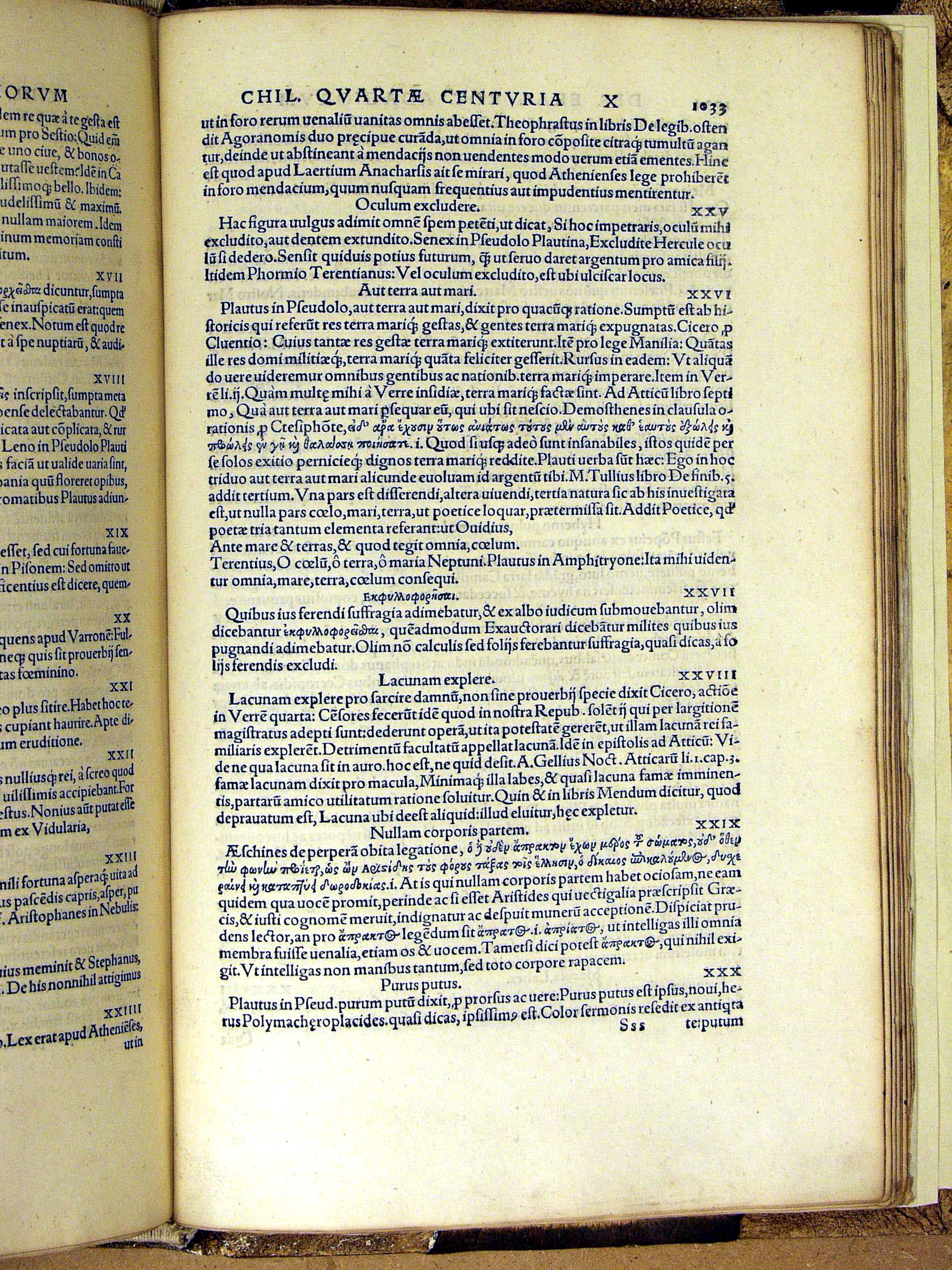
Iconclass: 31A2212 eyes 31A319 interference with sight 33B33(+0) slap in the face (+ variant) 53BB1 Rejection 53DD1 Refusal
Loci Communes: Vis injustia (Unjust force, Force injuste)
IV x 26 Aut terra aut mari By land or sea
Plautus in Pseudolo, aut terra aut mari, dixit pro quacunque ratione. Sumptum est ab historicis, qui referunt res terra marique gestas, et gentes terra marique expugnatas. Cicero pro Cluentio: Cuius tantae res gestae terra marique exstiterunt. Item pro lege Manilia: Quantas ille res domi militiaeque, terra marique quanta feliciter gesserit. Rursus in eadem: Ut aliquando vere videremur omnibus gentibus ac nationib. terra marique imperare. Item in Verrem li. ii. Quam multae mihi a Verre insidiae, terra marique factae sint. Ad Atticum libro septimo, Qua aut terra aut mari persequar eum, qui ubi sit nescio. Demosthenes in clausula orationis pro Ctesiphonte: εἰδ᾽ ἄρα ἔχουσιν οὕτως ἀνιάτως τούτους μὲν αὐτοὺς καθ᾽ ἑαυτοὺς ἐξώλεις καὶ πρώλεις ἐν γῇ καὶ θαλάσσῃ ποιήσατε. i. Quod si usque adeo sunt insanabiles, istos quidem per se solos exitio pernicieque dignos terra marique reddite. Plauti verba sunt haec: Ego in hoc triduo aut terra, aut mari alicunde evolvam id argentum tibi. M. Tull. lib. De finibus 5. addit tertium: Una pars est disserendi, altera vivendi, tertia natura sic ab his investigata est, ut nulla pars caelo, mari, terra, ut poetice loquar, praetermissa sit. Addit Poetice, quod poetae tria tantum elementa referant, ut Ovidius: Ante mare et terras, & quod tegit omnia, coelum. Terentius: O caelum, ô terra, ô maria Neptuni. Plautus in Amphitrione. Ita mihi videntur omnia, mare. terra, caelum consequi.
In Pseudolus, Plautus wrote 'By land or sea,' meaning 'in any way whatsoever.' The phrase comes from the historians, who record exploits performed by land and sea, nations defeated in battle by land and sea. Cicero, in his speech for Cluentius: 'who has so many achievements to his credit by land and sea.' Again, speaking in support of Manilius' proposed legislation: 'What mighty exploits of his have we seen at home and abroad, by land and sea, how many missions brought to a successful conclusion!' Another example from the same speech: 'So that at last we were truly seen to rule all peoples and nations by land and sea.' Again, in the second of his speeches attacking Verres: 'though many plots were laid against me by Verres by land and sea.' In the seventh book of his letters to Atticus: 'How can I follow by land or sea a person whose whereabouts I don't know?' Demosthenes, in the closing section of his speech on behalf of Ctesiphon: 'If they are so beyond redemption, consign these same people and these alone to complete and utter destruction by land and sea.' Plautus uses the phrase like this:
I'll dredge up the money for you somehow by land or sea
Within the next three days.
In the fifth book of his work on Definitions of Good and Evil, Cicero adds a third term: 'One part deals with speaking, one with living, and in the third the natural world is so thoroughly investigated by them that no part in air, land, or sea, to use a poetic phrase, has been passed over.' He says 'poetic,' because the poets list only the three elements, as, for example, Ovid: 'Before there was sea or land or sky that overarches all'; Terence: 'O heaven! O earth! O Neptune's seas!'; Plautus, in the Amphitryo: 'All things now, sea and earth and sky, seem to me to be conspiring.'
Facsimile:
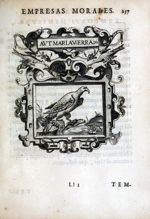
Aut terra, aut mari: Borja, Empresas morales (Bruxelles, 1680), emblem 125
Iconclass: 25H landscapes 25H2322 sea 54B1 Means
Loci Communes: Conatus (Effort, endeavor, Effort)
IV x 27 Εκφυλλοφορῆσαι To out-leaf
Quibus ius ferendi suffragia adimebatur, et ex albo iudicum submovebantur, olim dicebantur ἐκφυλλοφορεῖσθαι, quemadmodum Εxauctorari dicebantur milites quibus ius pugnandi adimebatur. Olim non calculis sed foliis ferebantur suffragia, quasi dicas à foliis ferendis excludi.
Those who lost the right to vote and were removed from the list of jurymen were said to be 'Out-leaved,' just as soldiers who lost the right to be in the fighting force were said to be 'out-warranted.' Originally votes were cast not with pebbles but with leaves, so it's like saying that they were 'excluded from casting leaves.'
Facsimile:
Iconclass: 44C2 the right to vote, the compulsory vote 44C222(+0) voting ballot (+ variant) 53DD11 Prohibition 55AA1 Loss
Loci Communes: Contagio morum (The contagion of habits, Contagion des mœurs)
IV x 28 Lacunam explere Fill up the gap
Lacunam explere pro sarcire damnum, non sine proverbii specie dixit Cicero, actione in Verrem quarta: Censores fecerunt idem quod in nostra Repub. solent ii qui per largitione magistratus adepti sunt: dederunt operam, ut ita potestatem gererent, ut illam lacunam rei familiaris explerent. Detrimentum facultatum appellat lacunam. Idem in epistolis ad Atticum: Vide ne qua lacuna sit in auro. hoc est, ne quid desit. A. Gellius Noct. Atticarum li. 1. cap. 3. famae lacunam dixit pro macula, Minimaque illa labes, & quasi lacuna famae imminentis, partarum amico utilitatum ratione soluitur. Quin & in libris Mendum dicitur, quod depravatum est, Lacuna ubi deest aliquid: illud eluitur, haec expletur.
Cicero's use of the phrase Lacunam explere 'To fill up the gap,' to mean 'make good the loss,' in his fourth speech attacking Verres, has a proverbial look about it: 'The censors did exactly what people in this country always do when they have secured their office through bribery: they proceeded to use their position of authority so as to fill up the gap in their financial resources.' He calls the reduction in their assets 'a gap.' Again, writing to Atticus: 'See that there's no gap in the gold,' that is, that there is no shortfall. Aulus Gellius in book one, chapter three of his Attic Nights, calls a stain on one's reputation a 'gap': That slight stain, that kind of a gap that his reputation will incur, is made up for by the advantages won for his friend.' In texts, a 'fault' occurs where the reading is corrupt, whereas a 'gap' or lacuna occurs where there is something missing. One is emended, the other supplied.
Facsimile:
Iconclass: 25H1122 ravine, chasm, abyss, canyon 46B44 paying (~ commerce) (here also repayment of debt, etc.) 55AA1 Loss
Loci Communes: Rapacitas et avaritia (Rapacity and greed, Rapacité et avarice)
IV x 29 Nullam corporis partem No part of his body
Aeschines de perperam obita legatione: ὁ δὲ οὐδὲν ἄπρακτον ἔχων μέρος τοῦ σώματος, οὐδ᾽ ὅθεν τὴν φωνὴν προΐεται, ὡς ὢν Αριστίδης τοὺς φόρους τάξας τοῖς ἑλλησιν, ὁ δίκαιος ἐπικαλούμενος, δυσχεραίνει καὶ καταπτύει δωροσδοκίας. i. At is, qui nullam corporis partem habet otiosam, ne eam quidem qua vocem promit, perinde ac si esset Aristides, qui vectigalia praescripsit Graecis, & iusti cognomen meruit, indignatur ac despuit munerum acceptionem. Dispiciat prudens lector, an pro ἀπρακτος legendum sit ἄπρατος, i. ἀπρίατος, ut intelligas illi omnia membra fuisse venalia, etiam os et vocem Tametsi dici potest ἀπρακτος, qui nihil exigit. Ut intelligas non manibus tantum, sed toto corpore rapacem.
Aeschines, in the speech On the False Legation: 'Indeed, [greek] "Letting no part of his body lie idle," not even the part where his words come streaming out, acting like an Aristides, the man who fixed the tribute-quotas for the Greeks and earned the nickname "The Just," he gets all indignant and spits out the word "bribes."' Consider, learned reader, whether one should here read not [greek] 'idle, inactive,' but [greek], that is, 'unsold,' meaning that every part of his body could be bought, even his mouth and voice. Though indeed [greek] can mean 'making no demands,' giving one to understand that he grabbed not only with his hands but with his whole body.
Facsimile:
Iconclass: 31A22 parts of the human body (skeleton excepted) 46B911(+0) bribery (+ variant) 51H1 Totality, the Whole 59CC221 Corruptibility, Venality, Corruption
Loci Communes: Rapacitas et avaritia (Rapacity and greed, Rapacité et avarice)
IV x 30 Purus putus Clean and clear
Plautus in Pseud. purum putum dixit, pro prorsus ac vere: Purus putus est ipsus, novi, herus Polymachaeroplacides. quasi dicas, ipsissimus est. Color sermonis resedit ex antiquita te: putum enim illi dicebant, purgatum, unde & vites putare dicunt, & reiectamenta nucum aut similium rerum dicuntur putamina. proverbium ortum videtur ex aurificum officinis, qui ea forma dicebant Purum putum, quemadmodum qua iureconsulti dicunt, sarta tecta.
In the Pseudolus, Plautus used the phrase 'Clean and clear' to mean 'absolutely, sure as anything': 'Clean and clear, it is he - I know him - the master Polymachaeroplacides.' It's like saying 'his absolute and very self.' The overtones of the word still reflect the way it was used in early times, as the ancients used putus to mean 'cleansed,' hence putare 'to cleanse' or 'prune' vines, and the discarded shells from nuts and such-like are called putamina 'cleanings.' The phrase seems to have originated with goldsmiths, who coined 'Clean and clear' just as the jurisconsults did Sarta tecta 'Wind-proof and water-tight.'
Facsimile: 
Annotation: Cf. klipp und klar
Iconclass: 22C6 52B41 Certainty
Loci Communes: Similitudinis et congruentiae (Similarity and congruence, Similitude et convenance)
IV x 31 Meis auspiciis Under my own auspices
Meis auspiciis pro meo arbitrio, meisque praesidiis dixit Maro Aeneidos iiii. Quod si fata meis paterentur ducere vitam Auspiciis, & sponte mea componere curas. Translatum ab imperatoribus Romanis, quibus mos erat, non committere praelium nisi consultis auspiciis. Eius autem auspiciis res geri dicebatur, penes quem summa rei gerendae potestas erat. Huic simillimum est qoud alibi retulimus, Meo Marte. Tullius in Verrem lib. 5. Praesertim quum vos vestro Marte his rebus omnibus abundetis. Nostro Marte fit, quod fit nullis auxiliis aliunde ascitis.
'Under my own auspices,' that is, by my own choosing, depending on my own resources. So Virgil, in Aeneid book four: 'But if the fates allowed me of my own choosing to conduct my life / And soothe my heart-ache as I myself should will.' The phrase originates with Roman commanders who joined battle only after consulting the auspices. Any subsequent fighting was then said to be done 'under the auspices' of the person in supreme command. Very similar to this is the phrase I discussed earlier, 'By our own prowess.' Cicero, in the fifth of his Verrine speeches: 'Especially since you have plenty of all these things, thanks to your own prowess.' A thing happens 'thanks to our own prowess' when no outside help is required to bring it about.
Facsimile:
Iconclass: 51E1 Independence, Autonomy 53A11 Choice; 'Elettione' (Ripa)
Loci Communes: Cum auxilio ; citra auxilium (With help; without help, Avec aide ; sans aide)
IV x 32 Vestigiis inhaerere Tread in the tracks of
Qui imitatur exempla progenitorum, maiorum vestigiis inhaerere dicitur. M. Tullius pro P. Sestio: Quem in maiorum suorum vestigiis stare oportebat. Translatum à viatoribus, qui observant vestigia praecedentium, ne quid aberrent. Similiter qui degenerant à progenitorum aut praeceptorum exemplis, ab illorum vestigiis dicuntur recedere. Et alienis vestigiis ingredei, qui nihil ex se gignunt novi, sed aliorum inventis inhaerent.
A man who follows the example of his forebears is said to 'Tread in his ancestors' tracks.' Cicero, in his speech for Publius Sestius: 'A man who should have been standing in the tracks made by his ancestors.' The saying comes from travellers who mark carefully the tracks of those who have gone before, so that they do not go off the path. Similarly, those who fall away from the example of their forefathers or their teachers are said to 'abandon their tracks.' People who produce nothing original but stick to what others have discovered are said to 'tread in others' tracks.'
Facsimile:
Iconclass: 31A22552 foot-print, track 42G1 family lineage, pedigree, genealogical tree or table 51B2 Similarity, Likeness 51F1 Precedence 51FF1 Subsequence
Loci Communes: Similitudinis et congruentiae (Similarity and congruence, Similitude et convenance)
IV x 33 Dulce et amarum Sweet and bitter
Plautus in Pseudolo non sine proverbii specie dixit dulce et amarum, pro laetis ac tristibus. Amans adolescens de epistola amicae: Dulce amarumque una nunc misces mihi. Idem in eadem fabula: Dulcia atque amara apud te sum elocutus omnia. Scis amorem, scis laborem, scis egestatem meam. Idem in Truculento: Nunc posteaquam scimus dulce atque amarum quid sit de pecunia.
Plautus is using a proverbial expression in Pseudolus when he writes 'Sweet and bitter' for 'happy and sad.' The young man in love says about the note from his girlfriend, 'You bring me sweet and bitter mixed together.' Later on in the same play: 'Sweet and bitter, I've confided all to you. / You know my passion, you know my problem, you know my lack of cash.' Plautus again in Truculentus: 'Now I know the sweet and bitter, the things that money brings.'
Facsimile:
L'homme est ioyeux, puis soubdain deuient triste: La Perrière, Le theatre des bons engins (Lyon, 1545), emblem 57 uses the imagery of Jupiter mixing sweet and bitter, visualizing the adage
Dulcia quandoque amara fieri: [Anonymous], Thronus Cupidinis (Amsterdam, 1620), emblem 8
Ex amaro dulce - Das Bitter zu vertreiben: Woytt, Emblematischer Parnassus (Augsburg, 1727), emblem 42
Dulcescit amarum: Camerarius, Symbolorum et Emblematum Centuria(e) (Nürnberg, 1590, 1595, 1596, 1604), emblem 81
Post amara dulcia: Whitney, A choice of emblemes (Leiden, 1586), emblem 173
Iconclass: 31A342 sweet (taste) 31A345 bitter (taste) 56B1 Pleasure, Enjoyment, Joy; 'Allegrezza', 'Allegrezza da le medaglie', 'Allegrezza, letitia e giubilo', 'Diletto', 'Piacere', 'Piacere honesto' (Ripa) 56BB1 Pain, Sorrow, Sadness; 'Dolore', 'Dolore di Zeusi' (Ripa)
Loci Communes: Omnia (All things, Toutes choses)
IV x 34 Hyberno pulvere, verno luto Dust in winter, mud in spring
Festus Pompeius ex antiquo carmine citat, nec asscribit autoris nomen: unde intelligitur vulgo decantari solitum. In eo inducitur pater de agriculura praecipiens filio, his verbis, Hyberno pulvere, verno luto, grandia farra Camille metas. Quibus verbis arbitror significatum, far si seminetur serena hyeme, & succedat ver humidum, copiosius provenire.
Festus Pompeius cites a line from an old poem without naming an author, from which we can deduce that it was a piece of popular wisdom. In it we find a father giving his son instruction in farming, and he says, 'Dust in winter, mud in spring - fat barley-ears, my boy, you'll reap.' I think this means that if barley is sown in a clear bright winter followed by a wet spring a good crop results.
Facsimile:
Iconclass: 23D41 winter, 'Hyems'; 'Inverno' (Ripa) 23D42 spring, 'Ver'; 'Primavera' (Ripa) 25D26 mud (soil type) 25D29 dust (soil type) 25H183(+0) field filled with a crop (+ variant)
Loci Communes: Tempestiva (Timely things, Choses opportunes)
IV x 35 Αιξωνεύεσθαι Talk Aexonian
Quemadmodum multa proverbia retulimus e gentium moribus desumpta, ita αἰξωνεύεσθαι olim dicebautur calumniandi morbo obnoxii, quia is populus hoc nomine taxatus sit veterum Comoediarum salibus, quemadmodum indicat Stephanus docens, Aexoniam esse Magnesiae civitatem. Est autem et a)icwnh/ ultima acuta, populus tribus Cecropidis, ab utraque voce deducitur a)icwneu\s2. Citant testem Menandrum en kanhfo/rw|. Plato in dialogo de fortitudine, οὐδὲν ἐρῶ πρὸς ταῦτα κ᾽ ἐχων εἰπεῖν, μὴ μέ φῃς ὡς ἀληθῶς αἰξωνέα εἶναι. i. Nihil ad ista respondeo, quum quod dicam habeam, ne me merito dicas Aexonensem esse. Marsilius vertit maledicum et calumniatorem.
We have already listed many proverbial sayings derived from national characteristics. Here we have another, [greek] 'Talk Aexonian,' applied to people who can't stop making slanderous accusations. The people of Aexonia were lampooned for this trait in Old Comedy, as Stephanus tells us, adding the information that Aexonia is a place in Magnesia. He also mentions [greek], with an accent on the final syllable, the name of a deme in the Cecropian tribe. The adjective [greek] 'Aexonian' could be derived from either. This information about the Aexonians is supported by references to Menander's the Basket-Bearer, and to Plato's dialogue on courage: T will say nothing to that, though I could easily do so, or you might well call me Aexonian.' Marsilius translates 'Aexonian' as 'foulmouthed' and 'slanderous.'
Facsimile:
Iconclass: 32B2(AEXONIANS) historical peoples and nationalities (AEXONIANS) 33B13 slander 49K32 language ~ philology 57BB25 Calumny, Detraction; 'Biasimo vitioso', 'Calunnia', 'Detrattione', 'Maledicenza' (Ripa)
Loci Communes: Arrogantia jactantiaque (Arrogance and boastfulness, Arrogance et vantardise)
IV x 36 Gallam bibere oportet He needs to drink gall-nut
Qui plus satis indulgent ventri gulaeque proverbiali ioco iubebantur gallam bibere. Is est fructus sub autumnum adnascens arboribus, praecipue robori, specie rotundae nucis. De cuius natura multa prodiderunt Plinius, Dioscorides, Galenus ac Theophrastus. Vim habet astringendi exsiccandique, et ob id utilis ad multa. Inde illud Lucilii cum nepotes, ac lurcones iubet gallam bibere, et rugas inducere ventri, sentiens coarctandos esse ventres. Refert Sex. Pompeius Fest. Simile est Horatianum illud, cum scribit ventres nepotum inurendos candenti lamina.
Those who over-indulged belly and gullet were humorously told 'To drink gall-nut.' Gall-nuts are fruits which develop on trees, especially oaks, in the autumn and look like round nuts. There is a good deal of information about them in Pliny, Dioscorides, Galen, and Theophrastus. Their effect is astringent and drying, and for that reason they have many applications. Hence that line of Lucilius, where he bids spendthrifts and guzzlers 'drink gall-nuts and take a tuck in the belly,' that is, reduce their appetites. Sextus Pompeius Festus quotes the line. Horace has a line of similar import, where he writes that 'spendthrifts' bellies should be branded with a red-hot iron.'
Facsimile:
Iconclass: 25G21(GALL-NUT) fruits (GALL-NUT) 32A21 fat (human type) 41C19 insatiable hunger or thirst 56BB32 Insatiableness
Loci Communes: Intemperantia, libido (Intemperance, lust, Intempérance, désir)
IV x 37 Sontica causa Compelling reason
Naevius poeta, citante Festo Sonticam causam appellat admodum gravem, in hoc trochaico catalectico: Sonticam esse causam oportet, quamobrem perdas mulierem. Translatum à duodecim tabulis, quae sonticum morbum appellant non vulgarem, sed tam molestum, ut reus non cogatur apud iudices comparere.
The poet Naevius, in a trochaic tetrameter catalectic cited by Festus, uses the phrase sontica causa, meaning a really compelling reason: 'There must be some compelling reason why / You should destroy the woman.' The word originates in the Twelve Tables, where an illness is called 'compelling' if it is not an everyday complaint but one so serious that a defendant cannot be forced to appear in court.
IV x 38 Macula, Labes Stain, blot
Frequens est apud M. Tullium, ut hominem infamem ac scelerosum maculam, labem, sordes, lutum appellet, pro eo Plautus citante Festo suasum dixit, Quia tibi suaso infecisti propudiosa pallulam. Suasum Festus putat esse maculam quae fit in veste alba e stillicidio fumoso. Plautinus Trochaicus quadrabit in eos, qui famam honestam, vel à maioribus traditam, vel benefactis partam, aliquo scelere contaminant.
Cicero often calls a notorious evil-doer 'stain, blot, filth, dirt.' Festus cites a line from Plautus where the word suasum occurs with similar meaning: 'Because, you shameful wretch, you've stained your dress with suasum "lampblack."' Festus thinks suasum is a stain made by smoky drip onto a white garment. Plautus' tetrameter could be applied to those who have an honest name, either handed down from their forebears or won by good deeds, but who stain it with some wickedness.
Facsimile: 
Iconclass: 25D26 mud (soil type) 51DD11 Contamination
Loci Communes: Probrum, gloria (Disgrace, glory, Honte, gloire)
IV x 39 Capere crines Seize the locks
Plautus in Mustellaria capere crines dixit, pro arripere occasionem oblatam, et arreptam retinere. Sumptum vel ex illo deo, quem Graeci vocant καιρόν, Nam eum fingunt fronte capillata, occipitio calvo: vel ex hominum consuetudine, qui crinibus remorantur, quem nolint abire. Si tibi acceptum est fore tibi unicum, sempiternum, atque illum amatorem tibi proprium futurum in vita. Soli gerendum censeo morem, et capiendos crines, ut fama est, hominis, et in sole pecuniam invenire.
In the Haunted House, Plautus writes 'Seize the locks' for seizing the opportunity offered and making the most of it. The phrase comes either from the god the Greeks call [greek] 'Opportunity,' who is represented with hair on the front of his head but bald at the back, or from the custom of holding onto the hair of someone you don't want to get away. What Plautus writes is as follows:
If you're sure he'll be yours for ever,
That you'll hold your lover all your life,
Then I suppose you'd better put yourself
At his disposal only, seize the fellow's locks, as the saying goes,
And make your money that way.
Facsimile:
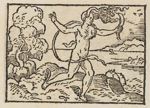
Ne refusons Fortune, quand à nous se presente: La Perrière, Le theatre des bons engins (Lyon, 1545), emblem 63 uses the imagery of Occasio as sculpted by Lysippus and its motto paraphrases the adage
Au monde n'est rien plus cher, que le temps: La Perrière, Le theatre des bons engins (Lyon, 1545), emblem 71 uses the imagery of a man holding on to a winged clock to express the value of timing
Iconclass: 31A25441 gripping someone by the hair 54B1213 Seizing an Opportunity 96A5(OCCASIO) Occasio as Roman personification
Loci Communes: Occasio (Opportunity, Occasion)
IV x 40 Nihil est miserius quam animus conscius. Saepe etiam est olitor Nothing is more miserable than a guilty conscience
Saepe etiam est olitor valde opportuna loquutus, ut habet proverbium. Apud Plautum in Mustellaria Tranio servus nequissimus sententiam profert, quovis dignam Theologo, nihil est miserius quam animus hominis conscius. Convenit cum Hebraeorum dicto, Secura mens quasi iuge convivium. Item cum illo, Conscientia mille testes. Et Horatius felix esse iudicat, Nil conscire sibi, nulla pallescere culpa.
'Even a gardener oft speaks to the point,' as the proverb goes. In Plautus' play, the Haunted House, Tranio, who is a slave of shocking character, utters a sentiment worthy of any theologian: 'Nothing is more miserable than a guilty conscience.' This agrees with the Hebrew saying 'A cheerful heart has a continual feast,' and with this: 'Conscience is a thousand witnesses.' Horace considers that happiness consists in 'a conscience that does not accuse, no guilty thought to pale one's cheek.'
Facsimile:

Nil conscire sibi: Borja, Empresas morales (Bruxelles, 1680), emblem 177 quotes the comment
Iconclass: 57A3 Conscience; 'Coscienza' (Ripa) 57A43 Sense of Guilt 54AA52 Guiltiness 54A52 Guiltlessness
Loci Communes: Consilium (Counsel, advice, Conseil); Fuerunt non sunt (They were, they are no more, Ils furent, ils ne sont plus)
IV x 41 Celei supellex Celeus' goods and chattels
Vilem et rusticanam suppellectilem Celei fuisse dictam indicat Maro Georg. lib. 1. Virgea praeterea Celei vilisque suppellex. Item Ovidius lib. Fastorum quarto: Sors sua cusque loco est, qui nunc Cerealis Eleusis Dicitur hic Celei rura fuere senis. Ille domum glandes excussaque mora rubetis Portat et arsuris arida ligna focis. Filia parva duas redigebat monte capellas, Et tener in cunis filius ager erat. Celeus rex erat Eleusine, pater Triptolemi, cui Ceres quod esset ab illo excepta hospitio, commonstravit omnem agriculturae rationem. Verba Plauti sunt haec. Quasi suppellex Celionis, palus palo proximus est. Mirum est autem a Plauto primam syllabam in Celione produci, cum ab aliis corripiatur. Nam Celionem pro Celio dictum nihil est novi, sio et scorpium dicimus et scorpionem.
A line from Virgil's Georgics, book one, shows that simple rustic equipment could be called 'Celeus' goods': 'You'll need as well what's made of withies, / Celeus' goods of little worth." See the story related in Ovid's Fasti:
Places too have their allotted fate.
That now called Eleusis, Ceres' place,
Once was the farm of aged Celeus.
He was returning home with load of acorns,
Berries too from brambles plucked,
Dry wood to burn upon his hearth.
His little daughter from the hills
Was bringing home the goats,
And in his cradle lay his baby son, unwell.
Celeus was king of Eleusis, and the father of Triptolemus, to whom Ceres revealed the principles of agriculture, because Celeus offered her hospitality. Plautus has a line: 'Like Celio's goods and chattels, peg next to peg.' It's surprising that Plautus here gives Celio a long first syllable when the name has a short syllable elsewhere. There is nothing unusual in having Celio for Celeus: compare the two forms scorpio, scorpius 'scorpion.'
IV x 42 Ampullacea Flask-rich
Plautus in Menaechmis videtur ampullaceam vocare mulierem magnifice cultam, carmen sic fertur; quando te auratam et vestitam beno habet, ampulla spem. Recte perhibent, melius sanam est mulier mentem sumere. Ampulla spem, certum est depravatas esse voces. Quidam reponunt ampullosam, verum hanc dictionem Trochaici carminis ratio non patitur. Ampullaceam, et metro congruit et sensui. Plinius lib. 15. inter genera pyrorum commemorat ampullacea. Qui tamen locus haud scimus an mendo vacet. verba Plinii sic habent. Ab odore myrrhapia, laurea, nardina, a tempore hordearia, à collo ampullacea, et Coriolana.
Plautus seems to use the word ampullacea in The Two Menaechmuses to describe a woman who is splendidly dressed and well kitted out. The text actually says, 'Since he keeps you well found in jewellery and clothes, with flask hope (ampula spent). / They're quite right when they say, my girl, it's better to be sensible.' It's quite obvious that the words ampula spem are corrupt. Some people keep the reading ampullosam 'with many a flask,' but that does not fit the trochaic metre. Ampullaceam fits both metre and sense. The word occurs in Pliny book fifteen, where he is listing types of pears, though possibly the text is corrupt there too. What Pliny says is:
The myrrh-pear, the bay-leaf pear, the nard-pear are so called from their
smell; the barley-pear from the season when it is ripe, the ampullacea 'flask-
pear' from its long neck, and the Coriolan .. ?
Facsimile:
Iconclass: 41D26 accessories (~ clothing) 57AA641 Immodesty
Loci Communes: Arrogantia jactantiaque (Arrogance and boastfulness, Arrogance et vantardise)
IV x 43 Cyatho non emam I wouldn't give a dram
Non absque specie proverbii Miles apud Plautum in Poenulo dixit: Proh nebulae, cuius ego cyatho septem noctes non emam, loquitus de muliere fastidiosa, sed non perinde formosa, et cyathum dixit pro minimo pretio, cui res erat cum cyathis. Cyathus minimum erat poculum, crater amplius.
The soldier in Plautus' play, the Carthaginian, is using a proverbial expression when he says, 'Pshaw! Hot air! I wouldn't give a dram for seven nights with her!' He is speaking of a girl who gives herself airs but is not particularly good-looking. By 'dram' the soldier means the smallest possible amount. Being a soldier, he's used to measures of drink. The dram-measure (cyathus) is the smallest size of drink, the bowl (crater) is considerably larger.
Facsimile:
Iconclass: 51GG1 Littleness, Smallness 57AA645 Boast; 'Iattanza' (Ripa)
Loci Communes: Contemptus et vilitatis (Contempt and worthlessness, Mépris et bassesse)
IV x 44 Rex sum I'm a king
Quemadmodum olim insignem felicitatem significantes dicebant, Deus sum, aut in caelo sum. Ita Plautus in Poenulo dicit: Rex sum, si ego illum hodie ad me hominem allexero. Verba sunt Lyci lenonis, sperantis se divitem fore, si quendam bene nummatum ad se pertaxisset.
At one time, to indicate great good fortune, people said, 'I'm a god,' or 'I'm in heaven.' Plautus similarly says in the Carthaginian, 'I'm a king, if I can get him to my place today.' He puts the words into the mouth of the pimp Lycus, who hopes his fortune will be made if he can entice some man with plenty of ready money into his establishment.
Facsimile:
Iconclass: 33C55 pimp (brothel scene) 44B113 king 54F12 Luck, Fortune, Lot; 'Fato', 'Fortuna', 'Fortuna aurea', 'Fortuna buona', 'Fortuna pacifica overo clemente', 'Sorte' (Ripa)
Loci Communes: Bonae fortunae, copiae, felicitatis aut ominis (Of good fortune, abundance, happiness, or omen, Bonne fortune, abondance, bonheur ou présage)
IV x 45 Cribro crebius Through more slots than a sieve
Scite dictum est Plauto, nec sine proverbii schemate, cribro crebrius, pro eo quod erat, plurimis locis, ac passim. Villam integundam intelligo totam mihi. Nam nunc pellucet ea quam cribrum crebrius. Vulgus de futili ac loquaci dicit, tam solidus est quam cribrum.
An amusing phrase used by Plautus with a kind of proverbial ring: 'Through more slots than a sieve/ meaning 'in very many places, all over': 1 see I must re-roof the whole of my house - / As it is, it lets in daylight through more slots than a sieve.' A stupid chatterbox is commonly said to be 'as watertight as a sieve.'
Facsimile:
Iconclass: 41C27(SIEVE) kitchen-utensils: sieve 41A362 roof-covering 52D4 Prolixity, Verbosity, Loquacity; 'Loquacità' (Ripa)
Loci Communes: Garrulitas (Talkativeness, Bavardage)
IV x 46 Et operam et retiam perdere Waste both toil and net
Plautus in Rudentibus. Iam nunc operam ludos facit et retiam. Id quidem citra tropum dictum est a sene, qui Crippum servum piscatum mi serat, cum esset noctu orta tempestas gravissima. Venustius erit, si tropo adhibito dicatur in captatorem, cui non successit aucupium. Porro retiam Plautus antique dixit pro rete. Affine est illi, quod alibi retulimus. Oleum & operam perdidi: & Opera & impensa periit.
Plautus in the Rope: 'As it is, he's making mock of toil and net as well.' Here it is meant quite literally by the old master, as he had sent his slave Gripus fishing in spite of the great storm the night before. It will be more satisfying to use it metaphorically with reference to a person hoping to extract a legacy from someone, but whose hunting fails to net the bird. Plautus here used the old form retia for later rete 'net.' This saying is related to the ones I discussed earlier, 'I have wasted both oil and toil' and 'Care and cost lost.'
Facsimile: 
Iconclass: 54BB3 Inutility, Noxiousness; 'Nocumento', 'Nocumento d'ogni cosa' (Ripa) 58AA3 Unproductiveness, Fruitlessness, Lost Labour, Wasted Labour 26C3 storm 47K42 fishing net
Loci Communes: Inanis opera (Vain effort, Effort vain)
IV x 47 Virtute duce, comite fortuna Guided by virtue, fortune attending
M. Tullius epist. fa. li decimo ad Plancum: Omnia summa consequutus es, virtute duce, comite fortuna. Hoc adeo graviter commodeque dictum est, ut à quibusdam pulicitus symboli vice sit usurpatum. Virtus eligit quod est optimum. Quod si non succedit, tamen in rebus praeclaris, ut in magnis, etiam voluisse pulchrum est. Sin succedit: prima laus debetur virtuti, tanquam egregii facinoris duci: proxima fortunae, quae virtuti subservierit.
Cicero, writing to Plancus, in the tenth book of his Letters to Friends: 'You have achieved all that is best - "Guided by virtue, fortune attending."' This is such a worthy sentiment and so neatly expressed that some people have adopted it as their public motto. Virtue chooses what is best, but if the undertaking does not succeed, in noble endeavours as in great ones, even to have shown the will is a fine thing. If however success does follow, praise is due in the first instance to virtue, who leads the way in deeds of note, secondly to fortune, as one that follows in virtue's train.
Facsimile:
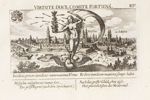
Virtute duce, comite fortuna: Meisner, Politica Politica (Nürnberg, 1700), emblem 137
Virtuti fortuna comes: Alciatus, Emblemata (Leiden, 1591), emblem 118
Virtuti fortuna comes: Printer's device 0858
Virtutis fortuna comes: Paradin, Les devises héroïques (Antwerp, 1563), emblem 98
Duce virtute, comite fortuna: Isselburg, Emblemata politica (Nürnberg, 1617) emblem 9
Virtute duce, comite fortuna: Meisner, Politica Politica (Nürnberg, 1700), emblem 137
Virtute duce comite fortuna: Rollenhagen, Nucleus emblematum (Arnhem, 1618), Cent. II, emblem 5
Virtute duce comite fortuna: Wither, A collection of emblems (London, 1635), emblem 105
Iconclass: 54D11 Attempt, Trial 54F12 Luck, Fortune, Lot; 'Fato', 'Fortuna', 'Fortuna aurea', 'Fortuna buona', 'Fortuna pacifica overo clemente', 'Sorte' (Ripa) 57A6 Virtuousness; 'Amor di Virtù', 'Attione virtuosa', 'Guida sicura de' veri honori', 'Virtù', 'Virtù insuperabile' (Ripa)
Loci Communes: Bonae fortunae, copiae, felicitatis aut ominis (Of good fortune, abundance, happiness, or omen, Bonne fortune, abondance, bonheur ou présage)
IV x 48 Croesi pecuniae teruncium addere Add a penny to Croesus' millions
M. Tull. lib. de finibus 4. Itaque in quibus propter earum exiguitatem observatio consequtur, saepe accidit ut nihil interesse nostra fateamur, sint illa nec ne sint, ut in sole, quod a te dicebatur, lucernam adhibere, nihil interest, aut teruncium addere Croesi pecuniae. Teruncii nummi a tribus unciis dicti vilitas proverbio locum fecit. Croesus Lydorum rex inter prodigiose divites celebratur.
Cicero in book four of Definitions of Good and Evil: 'With regard to objects which are so small that they have to be searched out, it is often the case that we have to say it doesn't matter to us whether they exist or not, just as "Adding a torch to the light of the sun" (the example you adduced) is of no significance, or adding a penny (teruncius) to Croesus' millions.' The teruncius was so called because it was worth three times (ter) an ounce piece (uncia), and became a proverbial example of something of little value. Croesus, king of Lydia, was famous for being one of the world's inordinately rich men.
Facsimile:
Iconclass: 51GG1 Littleness, Smallness 54BB6 Worthlessness 55B1 Wealth, Opulence; 'Opulenza', 'Richezza' (Ripa)
Loci Communes: Accessio pusilla aut nimia (A trifling or excessive addition, Un ajout minime ou excessif)
IV x 49 Barbati Wearers of the beard
Apparet apud Romanos proverbiali ioco barbatos dici consuesse, homines priscis ac simplicibus moribus, rustiacanaeque veritatis: quod illic sero receptum sit barbam radere aut tonderi. Siquidem autore Plinio, P. Ticinius Mena primus è Sicilia tonsorem induxit, anno ab urbe condita quadringentesimo quinquagesimo quarto, quum hactenus fuissent intonsi. M. Tullius li. De finibus quarto: Hoc vero te ferre non potuisse, quod antiqui illi quasi barbati, ut nos de nostris solemus dicere, crediderunt: eius qui honest viveret, si idem & bene valeret, & bene audiret, copiosusque esset, optabiliorem fore vitam, melioremque & magis expetendam quàm illius, qui aeque vir bonus, multis modis esset ut Ennii Alcmaeon, Circumventus, morbo, exilio atque inopia. Illi igitur antiqui non tam acute optabiliorem illam vitam putant praestantiorem, beatiorem. Stoici autem, &c. Eò spectat illud Iuvenalis, Facile est barbato imponere regi.
It seems that the Romans had a proverbial joke phrase, 'Wearers of the beard,' which they used to refer to men of old-fashioned simple ways and rustic honesty. The Romans did in fact adopt the practice of shaving or trimming the beard only late on. According to Pliny, it was Publius Ticinius Mena who first imported a barber from Sicily in the four-hundredand-fifty-fourth year of Rome's history. Until that time they had let their beards grow. Cicero, in the fourth book of his Definitions of Good and Evil, writes: You should have said that you couldn't accept the belief of those ancient thinkers, those 'Wearers of the beard,' as we might call them, using that phrase we have for some of our own contemporaries. This belief of theirs was that a good man, who lived a decent life and also enjoyed good health and a good reputation and had adequate means to live on, would have a preferable life of better quality and more to be desired than a man, equally good, but also, 'in many a way,' like Ennius' Alcmaeon, 'by sickness, exile and poverty ensnared.' Those ancient thinkers rather naively considered the more desirable life to be superior, happier. The Stoics, however .. .'
This line of Juvenal illustrates the same idea: 'It's easy to deceive a bearded king.'
Facsimile:
Iconclass: 31A534 beard 56B42 Coarseness, Rusticity
Loci Communes: Prudentia senilis (The prudence of old age, Prudence de la vieillesse)
IV x 50 Vestigium ponere To tread on
Vestigium ponere, pro attingere, dixit M. Tullius lib. De finibus quinto: Quanquam id quidem infinitum est in hac urbe: quacunque enim ingredimur, in aliquam historiam vestigium ponimus. Refertur quiddam perquam facetum cuiusdam, Stratonici ni fallor, qui in oppido quadam summis pedibus ingrediebatur, circumspectans interim: rogantibus quod ageret, respondit se timere, ne quem calcaret praeconem, innuens illic esse praeconum immodicam turbam. M. Tullius eiusdem operis lib. 5. Quid enim? Sapientia pedem ubi poneret non habeat, sublatis officiis omnibus. Scio mihi alibi factam mentionem proverbii, Pedem ubi ponat non habet. Verum hic locus tum non occurrebat, indignus qui praetermitteretur, eo quo ostendi elegantem usum huius metaphorae in rebus animi. Sentit enim, nullum esse locum sapientiae, si tollatur officiorum delectus.
Vestigium ponere, To tread upon, come across, was used by Cicero in book five of his Definitions of Good and Evil: 'Although there is an endless supply in this city - wherever we go, we tread on some bit of history.' There's an amusing tale told of someone, Stratonicus, I think, who was walking about on tiptoe in some town or other, looking round as he did so, and when he was asked what he was doing, he said he was afraid of treading on a town-crier, hinting at the excessive numbers of town-criers in the place. Cicero, again in book five of the above work: 'Why! Wisdom wouldn't have a place to set her foot if you take away all the duties of life.' I know I have already discussed the proverb 'He has no place to set his foot,' but at the time I didn't remember this example, and it's too good to be passed over, as it illustrates a nice metaphorical use of the phrase, applied to the things of the mind. Cicero means that there is no place for wisdom if there is no weighing of duties.
Facsimile:
Iconclass: 31A2726 trampling, treading, stamping on someone or something 51H3 Multitude
Loci Communes: Initium laudatum (A praised beginning, Un commencement loué)
IV x 51 Priscis credendum Believe the ancients
M. Tull. in libello De universitate, Credendum, inquit, nimirum est veteribus, & priscis, ut aiunt, viris, qui se progeniem deorum esse dicebant. Incertum utrum Cicero sentiat eam sententiam fuisse vulgo decantatam, an notet vocem prisci, qua declaramus homines extremae antiquitatis, quorum origo, quoniam posteris erat incogniaa, fere referebatur ad deos.
In his fragmentary work On the Universe, Cicero says, 'We must of course believe the men of old, the ancients, as they say, who claimed they were the offspring of the gods. It is not clear whether Cicero means that the whole expression was commonly bandied about, or whether he was marking just the word 'ancient,' which we use for persons belonging to a far distant age, whose origin was unknown to their descendants and so was usually ascribed to the gods.
Facsimile:
Iconclass: 52B21 Credulity 91E origin of man 92 gods ~ classical mythology
Loci Communes: Fides et gravitas (Trust and seriousness, Confiance et gravité)
IV x 52 Omnes intus Everyone's inside
Theocritus in Syracusanis: Κάλλιστ᾽, ἐνδοῖ πᾶσαι, ὁ τὰν νυὸν εἶπ᾽ ἀποκλάξας. id est, Optime habet, cunctae sunt intus, fertur ut olim Inclusa sponsa sponsus dixisse. Scholiastes admonet esse proverbium, e tali casu natum, ut conicimus. Sponsus quidam pertesus sponsam exclusit aedibus; cumque illa pulsaret fores cupiens recipi, sponsus respon dit, ἐνδοῖ πᾶσαι. id est, omnes sunt intus. forte cum sponsa ex more duceretur ad aedes sponsi, ille occlusis foribus ita locutus est. Accommodari potest ad usum magis serium, veluti si ambienti in amicorum numerum recipi, qui sit indignus amicitia, respondeatur πᾶσαι ἐνδοῖ. Aut, quod vero propius est, cum significabimus omnia esse in tuto. Siquidem ἀποκλείω non solum sonat excludo, verum etiam includo, quod semotum in tuto esse volumus, unde ἀπόκλεισμα pro custodia. Itaque fieri potest ut sponsus sponsa in thalamum reclusa caeteras submoverit, dicens, omnes intus. Sponso una sufficit, ceteras ut supervacaneas exclusit. κλάξ Siculis dicitur clavis, inde ἀποκλάζω ἀποκλείω.
As Theocritus wrote in the Syracusan Women: Κάλλιστ᾽, ἐνδοῖ πᾶσαι, ὁ τὰν νυὸν εἶπ᾽ ἀποκλάξας, 'Splendid! Everyone's inside - as the young man said, shutting the door on his bride.' The ancient commentator tells us that we have a proverb here. My guess is that its origin was as follows: the husband got weary of his wife and shut her out of the house. When she knocked at the door and asked to be taken back, the husband replied, 'Everyone's inside!' Or maybe, when the bride was conducted according to custom to her husband's house, he shut the door and spoke these words. This can be given a more serious application if someone unworthy to be received as a friend is angling to be accepted into one's circle. One can then reply, 'Everyone's inside.' Or - a more likely explanation - we will use it to mean everything is safe and secure, since the Greek verb [greek] can mean not only 'to shut out,' but also 'to shut in' something we want to be set aside and kept safe. Hence the Greek noun [greek], meaning 'guard-house.' So it is possible that the bridegroom shut his bride into the marriage-chamber and excluded all the other females, saying, 'Everyone's inside.' One woman is enough for the bridegroom, so he excluded the rest as supernumerary! [greek] is the Sicilian word for 'key,' hence [greek].
IV x 53 Esurienti ne occurras Don't go near a hungry man
In eodem Idyllio proverbii faciem habet et illud in fine. Gorgo hortans ad reditum, quod maritus esset iracundus addiicit: Πεινῶντί γε μηδέ ποτ᾽ ἐνθης. id est, Absit ut unquam occurreris esurienti. Fames enim exasperat iracundiam. Unde apud Plautum aliquis iracundius loquentem rogat quampridem edisset. Apud eundem est, Fames et mora bilem in narem conciunt.
There is a line at the end of the same Idyll which looks like a proverb. Gorgo is anxious to get home because her husband is short-tempered, and she adds: [greek] 'Don't go near a hungry man.' Hunger makes the temper worse. So in Plautus somebody asks a person talking crossly how long it is since he had a meal. Also in Plautus we find: 'Being kept waiting for a meal when one is hungry drives the bile up one's nose.'
Facsimile: 
Iconclass: 41C119 hunger 56E21 Irascibility
Loci Communes: Invidia, aemulatio (Envy, rivalry, Envie, rivalité)
IV x 54 Opus ad opus Toil on toil
Addam & illud ex eodem, ἔργον ἐπ᾽ ἔργῳ, quo nullum operae finem significamus. Verba sunt mulieris de marito conquerentis, quod emisset lanam sordidam ac rudem, in qua plurimum esset operis sibi. Ita Maro de vita colenda: Cui numquam exhausti satis est.
Here's another one from the same poem: [greek] 'Toil on toil,' meaning no end to the task. Here the woman is complaining about her husband because he had bought dirty, coarse wool, involving her in a lot of work. Virgil too, speaking of the cultivation of vines: 'On this there is never spent of pains enough.'
Facsimile:
Iconclass: 51F2:47E11 Continuity❧home production 54A11 Industriousness, Assiduity; 'Assiduità', 'Industria', 'Zelo' (Ripa)
Loci Communes: Profusio (Extravagance, Prodigalité)
IV x 55 Tredicem cubitorum Over eight feet tall
Homines insigniter procero corpore & hisce temporibus populari ioco taxantur, ut ignavi et inutiles. Quod ut alia pleraque manasse videtur ab antiquitate. Sic enim in eodem carmine Proxinoa de marito loquitur, ἀνὴρ τρισκαιδεκάτηχυς, id est, vir tredecim cubitorum, hyperbolicos significans enormiter procerum, quum esset tam insulsus, ut è mercatu pro nitro salem attulerit. De Caliga Maximini nobis alias dictum est. Prisci praelongos homines ridiculi gratia Longuriones appellabant. Varro in Tripalo apud Nonium, Ego nihil narro, adeo haec ita curat, qui ante me est, nescio qui longurio.
Very tall men are laughed at even today for being slow and useless. Like many other things, this has worked its way down to us from antiquity. In that same poem, Praxinoa calls her husband [greek] 'a fellow over eight feet tall,' exaggerating his height, because he was so stupid he went to the market and brought home salt instead of soap. I have already written about 'The boot of Maximinus.' The ancients jokingly called very tall men 'long-shanks.' Varro in Tripalus, cited by Nonius: 'I say nothing; the fellow in front of me, some long-shanks, is taking care of it all.'
Facsimile:
Iconclass: 31A421 giants, colossi 52AA1 Stupidity, Poverty of Intellect; 'Stupidità overo Stolidità' (Ripa) 41C661 salt 31A5461 soap 46B11 market
Loci Communes: Multi - in stupidos (Many people - against the stupid, Beaucoup de gens - contre les sots)
IV x 56 Volam pedis ostendere Show the sole of one's foot
Τὸ κοῖλον τοῦ ποδὸς δεῖξαι. i. cavum sive volam pedis ostendere dicuntur, qui in bello fugiunt, quod apud historicos frequentissime dicitur, Vertere terga, proverbium refertur ab Hesychio. Dicitur & hodie vulgo in fugaces, calcaneum ostendere.
[greek], To show the hollow or sole of one's foot. This is said of those who take to flight in battle. In the Roman historians, we very frequently find the Latin equivalent 'turn the back,' that is, turn tail. The Greek proverb is reported in Hesychius. Even today we say of runaways that they 'show a clean pair of heels.'
Facsimile:
Iconclass: 31A2255 foot 45H3:33B9 battle❧flight, running away; pursuing
Loci Communes: Metus poena (Fear as punishment, La peur comme châtiment)
IV x 57 Factum transactum Done and dealt with
Apud iurisprudentes sollennia sunt haec: Factum transactum, quoties sentiunt nihil praetermissum, quod ad negocii tractationem pertinet. M. Tullius in Catilinam invectiva tertia: Atque illud quod faciendum primum fuit, factum atque transactum est. Est alicubi & apud Terentium, aliosque complures melioris notae scriptores.
The Jurists are constantly using the phrase Factum transactum 'Done and dealt with,' to mean that nothing relevant to the business in hand has been omitted. Cicero, in his third speech attacking Catiline: 'The thing that needed to be done first of all has been done and dealt with.' The phrase occurs in Terence too, and many other reputable authors.
Facsimile:
Iconclass: 54D3 Completion 44G16 lawyer, attorney at law
Loci Communes: Diligentiae (Diligence, Diligence)
IV x 58 Maeandri Meanders
Quum res agitur non simpliciter, sed vafris & obliquis consiliis, Maeandros dicimus, metaphora sumpta à fluvio Maeandro. qui sinuosus ac flexuosus labitur: unde & nomen habere videtur quasi oberret quaerens hominum consortia. M. Tullius in Pisonem: Quos tu Maeandros dum omnes solitudines persequeris, quae diverticula flexionesque quaesisti? utitur & Prudentius in hymno, quod alibi nobis citatum est in proverbio Labyrintho. fluvius est Lydiam flexuosis recursibus perfundens. De quo Plinius lib. 5. cap. xxix. Maeander ortus è lacu in monte Aulocrene, plurimisque adfusus oppidis & repletus fluminibus, crebris ita sinuosus flexibus, ut saepe credatur reverti, Apamenam primum pervagatur regionem: mox Eumeneticam ac dein Bargylioticos campos, postremo Cariam, placidus omneísque eos agros fertilissimo rigans limo: ad decimum à Mileto stadium, lenis illabitur mari. Est et picturae genus Maeander, in morem labyrinthorum flexuosis ambagibus implexum, quod oris chlamydum addi solet. Unde Maro Aeneidos libro quinto. Victori chlamydem auratam, quam plurima circum Purpurea Maeaendro duplici Meliboea cucurrit.
When some business is carried through not straightforwardly but with deceitful and devious machinations, we speak of 'Meanders,' a metaphor derived from the river Meander, which twists and bends in its course, and gets its name from this, as it 'wanders about seeking human communities.' Cicero, in his speech attacking Piso: 'What meanderings, as you threaded your way through every uninhabited district, what diversions, what roundabout routes did you choose?' Prudentius uses the word in one of his hymns which I quoted above in the adage 'A labyrinth.' The Meander is a river which waters Lydia, bending and flowing back on itself. Pliny writes of it in book five, chapter twenty-nine: 'The Meander has its source in a lake in the mountainous region of Aulocrene. It flows close by many towns, and is often enlarged by tributaries. Its curves are so tortuous that it is often believed to flow backwards. Its course takes it first through the region of Apamena, then that of Eumenia, then the Bargyliotic Plains, and finally Caria. It is a tranquil river, irrigating all those lands with extremely fertile deposits of mud. About ten stades from Miletus it gently debouches into the sea.' 'Meander' is also the name of an embroidery pattern put round the borders of cloaks, consisting of an intertwining line wrapped round on itself like a labyrinth. See Virgil Aeneid, book five: 'To the victor, a gold-embroidered cloak with border wide / Of Meliboean purple, where two meanders intertwine.'
Facsimile:
Iconclass: 25H2130(MEANDER)(+0) personification of river Meander; 'Historia' (Ripa) (+ variant)
Loci Communes: Totum ut nihil reliqui (The whole, so that nothing remains, Le tout, sans rien laisser)
IV x 59 Masculum Masculine
Masculus apud veteres non semper significat sexum, sed interdum quicquid vegetum solidum ac robustum est, masculum dicitur. Exemplum Nonius Marcellus citat ex Varronis fabula cui titulus ὄνος λύρας, Vincor non esse masculum ad rem. Grammatici putant ab Horatio marem vitellum dictum, solidum ac firmum, de ovis oblongis ita loquitur in Sermonibus. Namque marem cohibent callosa vitellum. Vergilius quoque mascula tura dicit alba & meliora. Lepidius erit si ad incorporea transferatur: veluti quum excelsum fortemque animum masculum appellamus.
The ancients used the word masculus 'masculine' not only to signify gender but also for anything vigorous, solid, and robust. Nonius Marcellus cites an example from one of Varro's Satires, called [greek] 'The ass hears music': 'I am convinced there's nothing masculine for the business.' The grammarians think Horace meant 'firm and solid,' when he wrote of 'a male yolk.' This is in the Satires, where he writes as follows of long-shaped eggs: 'For they are thicker shelled and contain a male yolk.' Virgil too describes the white and better sort of frankincense as 'masculine.' It will have a nice touch if you transfer the word to abstract things, for example, calling a noble and strong spirit 'masculine.'
IV x 60 Intra labia risit He kept his laughter within his mouth
De risu Sardonio nobis aliàs dictum est. Similem describit Theocritus in Thalysia. Καὶ μ᾽ ἀτρέμας εἶπε σεσαρὼς ὄμματι μειδίοωντι, γέλως δέ οἱ εἴχετο χειλεὺς. id est, Et me est affatus, diducto leniter ore, Arridenti oculo, risus vero labium intra Haesit. Homerus risum Sardonium dixit amarulentum. Hic describit risum modestum & amicum, qui si erumpat, Cachinus fit indecorus.
I have already written of the 'Sardonic grin.' Theocritus writes of something similar in his Thalysia: 'And calmly he addressed me, his lips just parting and with twinkling eye, / And the laughter stayed within his mouth.' Homer calls a bitter laugh 'sardonic.' Theocritus is describing a civilized, friendly laugh, which becomes an unseemly hoot if it is allowed to break out.
IV x 61 Pingui mensura With fat measure
Πίονι μετρῳ, id est, Pingui mensura dixit in eodem carmine, pro eo quod erat astatim & largiter. Μάλα γὰρ σφισι πΐονι μέτρῳ. Αδαίμων ἔκριθον ἀνεπλήρωσεν ἀλωὰν. id est, Illis fortunante deo bona copia frugum Arearum campos mensura implevii opima. Simillimum est illi quod ante diximus, Plena manu, & Ambabus manil.
[greek], With fat measure, used by Theocritus in the same poem, meaning ample and generous: 'For indeed with measure fat / The goddess has piled high their threshing-floor with barley.' This is similar to the adages I discussed earlier, 'In handfuls' and 'To take with both hands.'
Facsimile: 
Iconclass: 55C21 Generosity, Liberality; 'Generosità', 'Liberalità' (Ripa) 41C671(+0) oils and vegetable fats (+ variant)
Loci Communes: Liberalitas (Generosity, Générosité)
IV x 62 Fato metelli By fate the Metelli
Asconius Pedianus in oratione pro Milone, refert Naevii poetae Senarium iactatum in familiam Metellorum quòd Consules designarentur, arbitrio fortunae, quae campi domina dicitur verius, quàm suis meritis. Fato Metelli Romae fiunt Consules. Ad id tum Metellus Consul iratus respondit Senario hypercatalectio, quem ait & Saturnium appellari. Dabunt malum Metelli Naevio poetae. Ad id tecte allusit M. Tullius quum ait, Te non fato, ut caeteros ex nostra familia. dictum facete & contumeliose in Metellos, torqueri poterit in eos, qui praeter meritum suum ad opes ac dignitates provehentur.
In his commentary on Cicero's speech in defence of Milo, Asconius Pedianus cites a senarius of the poet Naevius aimed at the Metelli and implying that they became consuls not on their merits but at the whim of Fortune, ruler of the hustings, as they call her. The line runs: 'By Fate here in Rome Metelli become consuls.' This annoyed the Metellus who was consul at the time and he replied in a hypercatalectic senarius, a verse form which Asconius says was also called a Saturnian: 'Evil will the Metelli bring on poet Naevius.' Cicero makes an oblique reference to this exchange when he says, 'Unlike the rest of your family, you were not "By Fate" .. .' This amusing gibe at the Metelli can be turned against anyone advanced beyond his merits to wealth and honour.
Facsimile:
Iconclass: 51AA4:59B5 Nothingness, Absence❧Merit; 'Merito' (Ripa) 54F12 Luck, Fortune, Lot; 'Fato', 'Fortuna', 'Fortuna aurea', 'Fortuna buona', 'Fortuna pacifica overo clemente', 'Sorte' (Ripa) 98B(METELLI)3 male persons from classical history (METELLI) - representations to which the NAME of a person from classical history may be attached
Loci Communes: Honos indigno habitus (Honor given to the unworthy, Honneur accordé à qui ne le mérite pas)
IV x 63 Non habet, cui indormiat He hasn't a thing to sleep on
Theocritus in Hodoeporis, Οὐδὲ γὰρ Εὐμάρᾳ τῳ δεσπότῃ ἦς τοι ἐνεῦδεν. id est, Eumarae siquidem domino nec vellus erat, cui Indormiret. Hoc colore Lacon pastor designat extremam caprarii cuiusdam inopiam, cui nec pellis esset hircina, in qua somnum caperet. Solent enim veteres in animantium tergoribus & discumbere et dormire. Apud Homerum proci in bubulis tergoribus agitant convivia. Et hodie dicimus, non habet lectum, aut non habet stramenta quibus indormiat.
Theocritus in the Wayfarers: [greek] 'For not even your master Eumaras had a skin on which to sleep.'1 The shepherd Lacon makes this tendentious remark to insinuate the utter poverty of some goatherd or other who didn't have even a goatskin on which to sleep. The ancients used to lie on animal skins both at table and in bed. In Homer the suitors are lying on ox-skins as they feast. Even today we say, 'He hasn't a bed, or a mattress, to sleep on.'
IV x 64 Asinus asino et sus sui pulcer Ass looks lovely to ass and pig to pig
ὄνος ὄνῳ κάλλιστον. i. Asinus asino pulcherrimus, simile simili placet. Alcimus apud Diogenem Laertium inter multa quae collegit ex Platonis philosophi & Epicharmi Comici scriptis, quibus persuadere conatur philosophum à comicis multa fuisse suffuratum, & hos refert Senarios. Θαυμαστὸν οὐδὲν ἐστὶ με ταῦθ᾽ οὕτω λέγειν, Καὶ ἀνδάνειν αὐτοῖσιν αὐτοὺς, καὶ δοκεῖν Καλῶς πεφυκέναι, καὶ γὰρ ἡ κύων κυνὶ Κάλλιστον εἰμεν φαίνεται, καὶ βοῦς βοΐ ὄνος τ᾽ ὄνῳ κάλλιστον, ὗς δὲ τῷ συὶ;. id est, Res mira non est, tista si sic proloquor, Ipsique nobis si placemus invicem, Pulchreque nati si videmur, nam et cant Pulcherrimus canis videtur, bos bovi, Asinus ascello pulcher est, et sus sui. Conveniet ubi inter inhonestos similitudo morum et instituti conciliat benevolentiam, veluti cum miles placet militi, aleator aleatori, potator potatori, sophista sophistae. Mirum est ab Epicharmo praeteritam simiam, cum nullum animal sibi placeat impensius.
[greek] An ass looks most lovely to another ass. Likes attract each other. Diogenes Laertius quotes a number of extracts which Alcimus assembled out of Plato and the comic writer Epicharmus, by which he hoped to show that the philosopher had filched a great deal from the comic writers. Among these we find the following lines in iambic metre:
It is no wonder that we speak thus,
That we admire ourselves, and think
Ourselves fine creatures, for to a dog
Another dog looks good, and to an ox an ox.
One ass to another lovely seems, and pig to pig.
This can be used when disreputable persons strike up a relationship based on their similarity of character and way of life, for example, soldiers together, or gamblers, or drinkers, or sophists. It's surprising that Epicharmus didn't bring in the ape, since no other animal is more satisfied with its own kind.
Facsimile: 
Iconclass: 46C13142 ass, donkey 47I212 pig 34B11 dog 51B2 Similarity, Likeness 56F13 (Feeling of) Attraction
Loci Communes: Alia aliis placent (Different things please different people, Chacun ses goûts); Similitudinis et congruentiae (Similarity and congruence, Similitude et convenance)
IV x 65 Pediculi Platonis Plato's lice
Οἱ πλάτωνος φθεῖρες, id est, Platonis pediculi, in proverbium abierunt, ut referente Laertio in vita huius philosophi, testatur Myronianus in opere, cui titulum fecit De similibus, hinc coniectans hoc morbo perisse Platonem, quod vulgo pediculi Platonis appellarentur. Graeci fqeiri/as1in appellant. Morbus est foedus et cruciabilis, quo periit & L. Sylla tametsi de genere mortis variae sunt scriptorum opiniones. Myronianus nullum indicat usum proverbii. Suspicari tamen licet, dictum in sordidos, quod philosophi minimum indulgeant nitoribus externis, dum circa mentis cultum toti sunt occupati.
[greek], Plato's lice. These have become proverbial, as Myronianus gives us to understand. In his work on Parallels, as cited by Diogenes Laertius in his life of Plato, Myronianus deduces that Plato died of the louse disease, because people commonly speak of 'Plato's lice.' The Greek name for this disease is phthiriasis. It is a disgusting and painful condition. Lucius Sulla died of it as well, though we do find in the ancient writers differing opinions as to the manner of his death. Myronianus says nothing about the use of the proverb. One can however deduce that it was directed at those of dirty habits, because philosophers pay very little attention to polishing the outer man, being absorbed in the cultivation of the mind.
Facsimile:
Iconclass: 25F711(LOUSE) insects: louse 31A59 absence of hygiene, uncleanliness 31E212 death by disease 98B(PLATO)68(+8) male persons from classical history (PLATO) - death of person from classical history (+ belonging to Greek history)
Loci Communes: Sordes et parcimonia (Meanness and stinginess, Bassesse et avarice)
IV x 66 Vates secum auferat omen Let the prophet keep his doom
In eos, qui nobis dira minitantur, aut acerba praenuntiant, conveniet illud Theocriti in Bucoliastis: Αυτὰρ ὁ μάντις ὁ τήλεμος ἐχθρ᾽ ἔγορεύων Εχθρὰ φέροι ποττ᾽ οἶκον. ὅπως τεκέεσσι φυλάξη. id est, Telemus at vates, mihi qui canitomnia dira, Dira domum referat, quo natis illa reservet. Iurarat Cyclops per unicum oculum suum, qui videret omnia semperque visurus esset. At Telemus vates illi praedixerat fore, ut ab Ulysse exocularetur. hoc omen Cyclops reiicit in vatem & illius liberos. Ita Vergilius Quod dii prius omen in ipsum Convertant. Et rursus: Dii capiti ipsius generique reservent. Itidem Homerus Iliad. Δ. Σὺν σφῇσιν κεφαλῇσι γυναιξίτε καὶ τεκέεσσι. Simile illi Platonico: In tuum ipsius caput.
We can apply to those who threaten us with dire consequences or prophesy a nasty fate these lines of Theocritus from his poem, The Rustic SingingMatch: 'But the seer Telemos, threatening me with doom, / May take home his doom and save it for his children.' The Cyclops had sworn by his one eye, which, he said, saw everything and always would. The seer Telemos however had predicted that Ulysses would put out that eye. The Cyclops turns the prediction back on the seer and his children. Similarly in Virgil: 'That prediction may the gods turn back on him that made it!' And again: 'Such sufferings may the gods reserve for him and his children's children!' Also Homer in Iliad book four: 'With their own heads, with their wives and their children they pay.' This is like Plato's expression, 'on your own head.'
Facsimile:
Iconclass: 52E22 Bad Omen; 'Augurio cattivo' (Ripa)
Loci Communes: Deprecantis, abominantis (Pleading, abhorring, Qui implore, qui abhorre)
IV x 67 In ultimas terras To the ends of the earth
ἐπ᾽ ἔσχατα γῆς. i. Ad extrema terra, quum locum vehementer semotum intelligi volumus. Theocritus in Syracusiis: Ταῦτ᾽ ὁ πάραρος τῆνος ἐπ᾽ ἔσχατα γῆς ἔλαβ᾽ ἐνθὼν ἰλεὸν οὐκ οἴκησιν. id est, Huc veniens meus ille insulsus ad ultima terrae Antrum non aedes posuit. Uxor incusat maritum quòd in loco nimium semoto domicilium sibi pararit, & cavum verius quam domicilium. Est frequens apud Ciceronem in ultimas terras, Velut actione in Verrem sexta: Quemadmodum accepturas hoc nationes caeteras, quemadmodum huius tui facti famam in regna aliorum atque in ultimas terras perventuram putasti? Idem pro P. Sylla. Iam vero illud quam incredibile quam absurdum, qui Romae caedem facere, qui hanc urbem inflammare vellet, eum familiarissimum suum dimitter ab se, emandare in ultimas terras? Item Philippica 13. Saxam vero Decidium praeterire qui possum, hominem deductum ex ultimis gentibus. Rursus ad P. Lentulum epist. fam. li. primo. Recordare enim quibus ex ultimis terris miseris, nec hoc pertimueris. Idem lib. 15. ad Marcellum. nos quidem longinqui & à teipso missi in ultimas gentes. Apud divum Hieronymum frequens est, monstrum in ultimas terras deportandum. Plautus in Mustellaria: Sd etiam in terras solas, orasque ultimas sum circumvectus.
[greek], To the ends of the earth, that is, an extremely remote place. Theocritus in his Idyll about the Syracusan women: 'That's my fine man for you! He goes to the end of the world / And takes not a house but a den for beasts.' The wife is blaming her husband for taking a house in a very remote place, and, what's more, something fit for beasts rather than human habitation. Cicero often uses the phrase 'To the ends of the earth,' as in his sixth speech attacking Verres: 'How did you think other nations were going to react to this, what impression did you imagine the news of this deed of yours would make when it reached the realms of other kings and spread to the ends of the earth?' Cicero again, speaking in defence of Sulla: 'What an incredible, what a ridiculous idea, to think that the person who wanted to stage a massacre in Rome, who planned to send the city up in flames, would pack his closest associate off and give him a job to do at the ends of the earth!' And in the thirteenth Philippic: 'How can I pass over Saxa Decidius, a man haled from nations on the edge of the world?' Again, writing to Publius Lentulus in the first book of his Letters to Friends: 'Just call to mind the people for whose benefit you sent from the ends of the earth, and don't be afraid .. .' Again in the fifteenth book, writing to Marcus Marcellus: 'Though we are far away and dispatched by you to the ends of the earth.' St. Jerome often uses the phrase, for example, 'a monster to be relegated to the ends of the earth.' Plautus, in the Haunted House: 'I've been to desert lands as well, sailed past the furthest shores.'
IV x 68 Talia gignit bellum Such things are born of war
Senarium hunc M. Tullius epist. ad Q. Fratrem lib. 2. ceu vulgo iactatum adducit: Τοιαῦθ᾽ ὁ τλήμων πόλεμος ἐξεργάζεται. id est, Similia bellum calamitosum perficit. Sentiens è dissidiis eorum, qui rempub. administrant multa gigni absurda. verba Ciceronis sic habent: Summum otium forense, sed senescentis magis civitatis quam acquiescentis. Sententia autem mea in senatu eiusmodi, magis ut alii nobis adsentiatur quàm nosmetipsi. τοιαῦθ᾽ ὁ τλήμων πόλεμος ἐξεργάζεται. id translatum ad privatam discordiam plusculum habebit gratiae.
In book two of his letters to his brother Quintus, Cicero quotes the following line from a Greek play, obviously assuming it to be well known: [greek]i 'Such deeds does dreadful war engender.' In the context, he means that many farcical situations arise from the dissensions of those in power. His actual words are: 'There is absolutely no movement on the political front, but this is because the country is in decline rather than happy with the situation. The views I expressed in the Senate are more likely to convince other people than convince myself. "Such dreadful deeds does war engender."' If transferred to private quarrels, the phrase will be even more satisfactory.
Facsimile:
Iconclass: 45A14 consequences of war
Loci Communes: Malum accersitum aut retortum (Evil brought upon oneself or turned back, Mal attiré ou retourné)
IV x 69 Vera fronte With honest brow
Quae ex animo citraque fucum dicuntur geruntûrve, vera fronte fieri dicuntur. M. Tullius pro C. Rabirio: At si verum tum verissima fronte dixerunt, nunc mentiuntur: si nunc mentiti sunt, doceant nos verum. Contra, dicemus mendaci fronte fieri quod geritur per simulationem. Quemadmodum M. Tullius ad Qu. fratrem, si non fallit titulus: ait: frons, oculi, vultus persaepe mentiuntur, oratio vero saepissime. Frons & oculi maxime declarant animi affectum: nam verba fingere non est difficile, sed ut ait Ovidius, perdifficile est crimen non prodere vultu. Et apud Maronem Dido: Spem vultu simulat, premit altum corde dolorem. Terentius in Sene seipsum excruciante: Vah, etiam vultus fingit carnifex. Et in Phormione Geta componit vultum Antiphonis in congressum patris, quem tamen retinere non potuit.
Anything said or done sincerely and without dissimulation is said to be done 'With honest brow.' Cicero, when defending Gaius Rabirius: 'If they then spoke the truth with totally honest brow, they are now lying; if they then lied, let them tell us the truth.' Conversely, anything done with dissimulation we say is done 'with deceitful brow.' Cicero, writing to his brother, if the letter is correctly ascribed to him, says that 'brow, eyes, face, often lie, words oftenest of all.' The brow and the eyes best reveal what the mind is thinking. Words can be falsified without difficulty, but, as Ovid says, 'How hard it is for guilt to wear a guiltless face!' Dido in Virgil 'wears false hope upon her face, and crushes down her trouble deep within her heart.' Terence, in the Self-Tormenter: 'Bah! The villain even invents faces.' And in the Phormio, Geta helps Antiphon to put on the right expression to meet his father, but the lad cannot keep it up.
Facsimile: 
Iconclass: 57A61 Honesty; 'Honestà' (Ripa) 31A22111(BROW) parts of the face (BROW)
Loci Communes: Libertas, veritas (Freedom, truth, Liberté, vérité)
IV x 70 Porcus Trojanus A Trojan pig
Gulae veteres architecti & hoc commenti sunt, ut bos aut camelus, totus apponeretur, differtus intus variis animantium generibus. Hinc et porcus Troianus venit in populi fabulam, cui hoc nomen inditum est, quod ita varias animantium species utero tegeret, quemadmodum Durius equus texit armatos viros. Macrobius lib. Saturnalium iii. refert Cincium in oratione qua suasit legem Fanniam de moderandis sumptibus, obiecisse suo seculo, quod porcum Troianum mensis inferrent. Mihi si detur optio, malim porcum Troianum quam equum: conveniet in opipara convivia, aut in hominem variis deliciis expletum.
The ancient architects of gastronomic extravagance even thought up the idea of serving at dinner a whole ox or camel stuffed with all kinds of other creatures. They also invented the 'Trojan pig,' which has gone into popular speech, so called because it concealed within its womb various species of living creatures, just as the Wooden Horse concealed the armed warriors. In book three of the Saturnalia, Macrobius tells us that when Cincius was making his speech advocating the passing of the Lex Fannia (the purpose of which was to curb extravagance), he slated his contemporaries for serving the Trojan Pig at their dinners. If I had the choice, I would rather have the Trojan Pig than the Trojan Horse! The saying will fit either splendid banquets or a man stuffed with all kinds of delicacies.
Facsimile:
Iconclass: 41C691 slaughtered ox or pig 55C11 Squandering, Extravagance, Prodigality, Waste; 'Prodigalità' (Ripa) 94H151(+0) the Trojan horse (+ variant)
Loci Communes: Luxus et mollicies (Luxury and softness, Luxe et mollesse)
IV x 71 Pilus in medio A hair in between
MInimum discriminis significantes dicimus pilum interesse, id vehementius est, quam si dicas culmum latum. Theocritus in Thyocicho: Λασῶ δὲ μανεὶς πόκα. Θρίξ ἀνὰ μέσσον. id est, At me imprudentem capiet vesania tandem Vix pilus in medio est. Verba sunt amantis ac metuentis, ne tandem amor exeat in insaniam, a qua tam parum absit, ut vix pilus sit in medio. Consimili tropo Plautus dixit in Mustellaria: Pluma haud interest patronus an cliens probior siet, Homini cui nulla in pectore est audacia. Non interest pluma dixit, pro nihil omnino refert. Asinius Pollio M. Ciceroni: Nullum enim vestigium abs te discessurus sum.
We speak of things being 'A hair's breadth apart,' when we mean that the difference is minimal. This is a stronger expression than saying 'a straw's breadth.' Theocritus, in his Idyll, Thyonicus: 'I'll maybe find I've gone mad. [greek] "I'm only a hair's breadth off it."' The speaker is a man in love who fears his passion may send him mad, and he's so close to it that there is hardly 'A hair in between.' Plautus has a similar use in the Haunted House: 'It doesn't matter a feather whether patron or client is the better man. / A man without any boldness in his breast .. .' 'It doesn't matter a feather' means 'it is quite irrelevant.' Asinius Pollio in a letter to Cicero: 'I won't stir a foot's breadth away from you.'
Facsimile:
Iconclass: 51GG1:51BB2 Littleness, Smallness❧Dissimilarity, Unlikeness 31A22621 hair
Loci Communes: Differentiae (Differences, Différences)
IV x 72 Musopatagos Muse-struck
Μουσοπάταγος, dicitur qui percitus est et attonitus furore Musarum. Ita Maro in Georgicis: Quarum perculsus amore Sacra fero. Transfertur ad eos, qui sua poemata sic amant, quemadmodum parentes liberos. M. Tullius ad Qu. fratrem lib. ii. Non me Hercle quisquam μουσοπάταγος libentius sua recentia poemata legit, quam ego te audio. Horatius: Versus amat, hoc studet unum.
[greek] is a word used of someone who is 'smitten' or 'struck' by the wild inspiration of the Muses. See Virgil in the Georgics: 'whose holy offerings I bear, smitten with love for them.' It can also be used of those who love their own poetic creations as parents love their offspring. See Cicero in the second book of letters to his brother Quintus: 'Good heavens, no Muse-struck person ever reads his latest poem with more pleasure than I feel when listening to you.' Compare Horace's line: 'He loves poetry; this is his sole concern.'
IV x 73 Ut Phrygius amavit Pieriam As Phrygius loved Pieria
Plutarchus in libro περὶ γυναικῶν ἀρετῶν ostendit ad suam usque aetatem durasse consuetudinem ut uxores optarent sic amari a viris, ὡς φρύγιος ἠράσθη πιερίας, id est, quemadmodum Phrygius amavit Pleriam. Id ortum est ab hivismodi historia. Ionum qui in Miletum commigrarant, nonnulli seditione mora adversus Nelei filios, secesserunt Myuntem, atque ibi sedem constituerunt, multis iniuriis affecti a Milesiis, qui cum illis bellum agitabant ob defectionem, verum nec atrociter, nec excluso omni commercio, sed nonnullis diebus festis mulieres e Myunte Miletum itabant. Erat autem ex his qui secesserant vir quidam nomine Pythes, cuius uxor dicta est Hyppigia, filia Pieria: cum autem Mileti die festo sacrificaretur Dianae, quam illi Neleidam cognominant, misit eo uxorem filiam id praecatus, ut sibi festo liceret interesse. Ex Nelei vero filiis longe potentissimus erat Phrygius, is captus amore Pieriae, cogitabat qua re posset puellae quam maxime gratum facere. Cumque illa dixisset nihil accidere posse gratius, quam si efficeret sibi liberum frequenter Miletum commeare multis virginibus comitatam; ex his verbis Phrygius intelligens ab illa quaeri pacem et amicitiam civibus suis, bellum composuit. Hinc Pieriae nomen & apud Milesios & apud Myuntios mire gratiosum esse coepit, adeo ut puellae quae viris nuberent, ominis causa praecari soleant, utinam sic amer a viro, ut Pieriam amavit Phrygius.
We learn from Plutarch's book 'On Noble Deeds Performed by Women' that even in his day women were still praying to be loved by their husbands 'As Phrygius loved Pieria.' This is the story behind the words. Some of the Ionians who had migrated to Miletus rebelled against the sons of Neleus, took themselves off to Myous, and settled there. They suffered much at the hands of the inhabitants of Miletus, who maintained a state of war against them because of their defection, but the war was not prosecuted with total ferocity, nor was all communication between the two communities at an end, but quite often on festal days the women from Myous would go to Miletus. One of those who seceded was a man called Pythes, who had a wife called Hippygia and a daughter Pieria. On one feast-day in Miletus, sacrifice was being offered to Diana, who is there called Neleis, and Pythes sent his wife and daughter, who had begged to be allowed to attend the festival. By far the most powerful of the sons of Neleus was Phrygius. He fell in love with Pieria, and was wondering what he could do that would best please her. She said that nothing could please her more than if he would make it possible for her to come to Miletus frequently and bring many girls with her. Phrygius understood from this that she was asking for peace and friendship for her fellow-citizens, so he declared an end to hostilities. Consequently, Pieria was highly honoured in Miletus as well as Myous, so that all the girls who were getting married used to pray, as a good omen, 'May I be loved by my husband as Phrygius loved Pieria.'
Facsimile:
Iconclass: 56F22 Reciprocal Love 98B(PHRYGIUS)(+8) male persons from classical history (PHRYGIUS) (+ belonging to Greek history) 98C(PIERIA)(+8) female persons from classical history (PIERIA) (+ belonging to Greek history)
IV x 74 Vita hominis peregrinatio The life of man is a time of exile
Παρεπιδημία τις ἐστὶν ὁ βίος. id est, Peregrintio quaedam est vita. Socrates in Axiocho Platonis adfert hanc sententiam ut vulgo apud omnes decantatam. quanquam is dialogus habetur inter nothos, videtur esse potius hominis Christiani, qui Platonem voluerit imitari. Haec enim sententia frequenter occurrit in sacris voluminibus, vitam hanc esse exilium, esse incolatum & peregrinationem: quanquam & Socrates Platonicus narrat animas hominum è coelo fuisse delapsas, quò sibi per philosophiae studium parant reditum.
[greek], Life is a sort of time in exile. In Plato's Axiochus, Socrates adduces this sentiment as a popular saying known to everybody - though this dialogue is considered spurious. Its author was more likely a Christian who wanted to imitate Plato, as this sentiment is often found in Holy Scripture, namely, that this life is life as an exile, life as an alien, life in a land that is not our true home. Though even Socrates as depicted by Plato does say that the souls of men have fallen from heaven and endeavour to return there by the study of philosophy.
Facsimile: 
Iconclass: 11R the life of man 58B21 Human Life; 'Vita humana', 'Vita inquieta', 'Vita e l'animo' (Ripa) 44G38(+0) banishment, exile (+ variant)
Loci Communes: Vincere et vinci (To conquer and to be conquered, Vaincre et être vaincu)
IV x 75 Tota hulcus est The whole thing is a festering sore
In eodem dialogo, ad laudatam agriculturam, ita respondet Socrates, ἀλλ᾽ οὐχ ὅλη ὥς φασιν ἕλκος, ἀεὶ λύπης πρόφασιν εὑρισκόμενον. i. Verum an non tota quod aiunt, hulcus est, semper molestiarum occasionem ex se gignens? Id quidem esse verum declaravit Vulteius Horatianus. Caeterum quicquid nobis vehementer molestum est, Hulcus, Vomicam & Carcinoma solemus appellare. Quemadmodum de Caesare Augusto literis proditum est, quod Iulias filiam & neptem, & Agrippam prius adoptatum, postea abdicatum, non aliter appellare solet, quam tres Vomicas suas ac tria Carcinomata: adeoque detestabatur mores illorum minime frugales, ut ad omnem illorum mentionem soleat exclamare versu Homerico: Αἴθ᾽ ὄφελον ἄγαμος τε μένειν ἄγονος τ᾽ ἀπολέσθαι. id est, O utinam celebs mansissem, orbusque perissem. Atque hic quoque versus inter proverbiales merito referendus est, usurpandus ab his qui infeliciter duxerunt uxores, aut liberos paenitendos susceperunt. Conveniet & in hominem molestis moribus. Theocri. in epitaphio Adon. acerbum dolorem ποτικάρδιον ἕλκος appellat: Αγριον ἄγριον ἕλκος ἔχει κατα μηρὸν ἄδωνις, Μειζον δ ἁ κυθερεια φέρει ποτικάρδιον ἕλκος. id est, Dirum dirum vulnus habet circa iguem Adonis: Sed maius Cytherea gerit sub pectore vulnus.
In the same dialogue, after someone has praised agriculture, Socrates replies: [greek] "But isn't the whole thing a festering sore," as they say, always producing some reason for grief?' Horace's Vulteius agreed with that sentiment. Anything that is a trial and tribulation we call a sore, an abscess, a canker. We read that Caesar Augustus used to call the two Julias, his daughter and grand-daughter, and Agrippa, whom he first adopted and later repudiated, his three 'abscesses,' his three 'cankers.' He so hated their extravagant behaviour that whenever they were mentioned he used to cry out, adapting Homer's words: 'Would that I had never wed, that I had childless died.' This verse too could well be treated as proverbial and used by men who have made an unhappy marriage or found themselves with disappointing children. The head phrase will do also for a man of unpleasant character. In his Lament for Adonis, Theocritus calls a bitter grief 'a festering wound in the heart': 'Deep, deep is the wound dealt to Adonis' groin; / Deeper still the wound that festers in Cytherea's heart.'
Facsimile:
Iconclass: 31A4632 infections and wounds 54FF11 Adversity, Misfortune, Bad Luck; 'Fortuna infelice', 'Infortunio' (Ripa)
Loci Communes: Molesti intolerabiles (Unbearable, troublesome people, Gens insupportables)
IV x 76 Ex cohorte Praetoris The governor's squad
Qui ad omnem nutum praesto sunt, & cum autoritate delegantur ad hoc, aut ad illud exequendum, ex cohorte praetoris appellari dicuntur. M. Tullius ad Qu. frat. epistola prima: Quos vero aut ex domesticis convictoribus, aut ex necessariis apparitoribus tecum esse noluisti, qui quasi ex cohorte praetoris appellari solent, horum non modo facta, sed etiam dicta nobis praestanda sunt &c. Ministri praetorum non egent alia excusatione, quam ut dicant se quod fecerunt, illorum iussu fecisse: ut iam in praetorem sit actio, non in ministros. simile imperium in quosdam cibo officiisque sic devinctos, ut nihil ausint recusare.
Those who stand ready to obey every nod and are given authority to carry out this or that task are, as we are told, referred to as 'The governor's squad.' Cicero, in the first letter to his brother Quintus: 'As for the private associates and personal attendants you have chosen to accompany you, the ones that people usually refer to as a sort of "governor's squad," we have to take responsibility not only for what they do but even for what they say.' A governor's subordinates need no other excuse than to say they were carrying out orders, so that any complaint is directed at the governor, not at themselves as his agents. The same kind of control is exercised over persons who are so beholden to someone for their keep and various obligements that they dare not say no to any request.
IV x 77 Lucernam accendere possis You could light a lantern
Vehementem iram hac hyperbole exaggeravit Theocritus in Thyonicho: Κἤφατ᾽ ἔτ᾽ εὐμαρέως κεν ἀπ᾽ αὐτῆς καὶ λύχνον ἅψαις. id est, Incaluitque ira, facile accendisse lucernam. Ex ipsa ut possis. Verba sunt amantis ac de protervia puellae conquerentis, quae quum in convivio sileret, quidam illi dixit, Non loqueris, lupum vidisti: illa ad nomen lupi vehementer incanduit. Aderat enim adolescens nomine Lupus, quem adamabat. Irati dicuntur ardere. Similis hyperbole, licet sordidior, & hodie fertur apud nostrates ita loquentes, Adeo exarsit ira, ut ovum ad illius frontem posses decoquere.
This is Theocritus' exaggerated way of describing furious anger in his Thyonicus: 'She went bright red. [greek] "You could easily have lit a lantern at her face." The words are spoken by a lover who is complaining about his girlfriend's provoking behaviour. When she refused to speak at the party, someone said to her, 'Lost your tongue? Seen a wolf?' and at the word 'wolf she went red as fire, because there was present a young man she fancied, called Wolf. Angry people are said to burn. We have a similar, if cruder, exaggerated expression today: 'He was so hot with rage you could have fried an egg on his face.'
IV x 78 Semper aliquem virum magnum Ever for some great man ...
Αλλ᾽ ἀιεί τινα φῶτα μέγαν, hoc hemistichium M. Tullius ut vulgo iactatum adducit in epistola ad Qu. fratrem, cuius initium: Statius ad me venit: Quod autem expectationem tui concursumque eum qui erat futurus si unà tecum decederet, neque antea visus esset sustulit, id mihi non incommode visum est accidisse. Exhaustus est enim sermo hominum, & multae emissae iam eiusmodi voces, ἀλλ᾽ ἀιείτινα φῶτα μέγαν, quae te absente confecta esse laetor. Unde sumptum sit hemistichium nondum liquet, nisi quod fortasse pro αἰεὶ legendum est, αἴτει, id est postula, aut ἀιτεῖ, id est, postulat & requirit.
[greek]: Cicero quotes this half line as something very well known in the letter to his brother Quintus that begins, 'Statius came to see me': His arrival did away with all the expectation that would have attached to yourself and all the crowds that would have gathered if he had left together with you and had never been seen before. And that seemed to me no bad thing. People have said all they had to say, and much of it was to the effect that 'ever for some great man ...' I am glad that all this was over and done with while you were still away.
It's not clear where this half line comes from. Possibly instead of [greek] 'ever,' one should read [greek] 'ask for,' or [greek] 'he asks for' or 'he seeks.'
Facsimile:
Iconclass: 54B5:31D14 Importance, Preponderance❧adult man
Loci Communes: Fides et gravitas (Trust and seriousness, Confiance et gravité)
IV x 79 Ne si ad Jovis quidem aulam Not even if to Jove's temple
Qui metuunt malum, ad asylum, ad aram, ad arcem, ad statuas principis, ad divorum phana confugiunt. Verum à morte nullum est effugium. Id ita Sophocles expressit versibus: ὅταν γὰρ ὁ καιρὸς τοῦ θανεῖν ἐλθὼν τύχη Οὐδ ἂν πρὸς αυλὰς ζηνὸς ἐκφύγη μολὼν. id est, Ubi mortis urget tempus, ad Iovis atria Si fugeris, effugere non possis tamen. Proverbii species est in illis verbis, velad Iovis quidem atrium, quod pro tutissimo posuit refugio. Huc confugerat Aquila insectante scarabeo.
Those who fear some harm take refuge at a sanctuary, at an altar, at a citadel, at the emperor's statues, at the temples of the gods. But there is no place where one can take refuge from death, a thought which Sophocles expressed in the following lines:
Whensoe'er the hour of death shall hard upon you press,
Go even to Jove's temple if you will, but still escape you cannot.
The words that look proverbial here are [greek] 'Not even to Jove's temple,' meaning the safest place of sanctuary. It was here that the eagle took refuge when persecuted by the beetle.
Facsimile: 
Iconclass: 52BB42:56D21 Impossibility❧Refuge; 'Refugio' (Ripa) 58BB1 Mortality, Extinction of Life 12E61 temple, shrine ~ Greek religion 12E13(ZEUS) representations ~ gods, demi-gods, heroes, etc. (ZEUS) (ZEUS) 12E13(JUPITER) representations ~ gods, demi-gods, heroes, etc. (JUPITER) (JUPITER)
Loci Communes: Securitatis et tutae rei (Security and safety, Sécurité et sûreté); Tristitia, laetitia (Sadness, joy, Tristesse, joie)
IV x 80 Oracula loqui Speak oracles
Χρησμοὺς λέγειν, id est, Oracula loqui dicuntur, qui certa & indubitata loquuntur, Theocritus in Syracusiis: Χρησμοὺς ἁ πρεσβῦτις ἀπώχετο θεσπίξασα. id est, Haec anus abscessit, divorum oracla loquuta. τὰ ἐκ τρίποδος aliàs dictum est, & Sybillae folium. M. Tullius ad Brutum epistola cuius initium, Scripta et obsignata iam: Haec ex oraculo Apollinis Pythii aedita tibi puta. Idem de finibus quinto: Quia quum à Zenone inquam hoc magnifice tanquam ex oraculo aeditur, virtus ad beatae vivendam se ipsa contenta est.
[greek], To speak oracles, applied to those who say things that are unquestionably true. Theocritus in the Syracusan Women: 'The old lady spoke some oracles before she went.' I have already discussed 'Straight from the tripod' and 'A leaf from the Sibyl's book.' Cicero, in the letter to Brutus which begins, 'My letter was already signed and sealed,' says, 'You may take this as an oracle straight from Pythian Apollo.' Cicero again, in the fifth book of his Definitions of Good and Evil: 'Because, I replied, when Zeno makes the magnificent statement, coming straight, as it were, from the oracle's mouth, "For the purpose of the happy life, virtue needs nothing outside itself ..." '
Facsimile:
Iconclass: 52A6 Truth; 'Verità' (Ripa) 12E25 oracle ~ Greek religion 12F25 oracle ~ Roman religion
Loci Communes: Libertas, veritas (Freedom, truth, Liberté, vérité)
IV x 81 Non ab Hymetto Not from Hymettus
Crassam philosophiam ac rustisanam, quam discimus ex congressu plebeiorum, non ex commentariis Zenonis aut Platonis, M. Tullius ad Qu. fratrem lib. ii. appellat philosophiam ab area Syra. Nos enim inquit, ita philologi sumus, ut vel cum fabris habitare possimus, Habemus hanc philosophiam non ab Hymetto, sed ab area Syra. Hymettus Atticae mons est, vude Hymettia mella. Cui opponit aream Syram, subindicans rusticanam simplicitatem. Nam paullo ante nonnihil attigerat de dicteriis argutis. Apparet id temporis M. Tullium in praedio quodam aedificasse. Quanquam haud sci an hic locus, quoniam varius habetur in exemplaribus, mendo vacet. Dispiciat eruditus lector, an pro area syra legendum sit, ex hara Syra, sic enim loquitur in Pilonem: ex hara productae non schola. Syri barbarie nobiles erant id temporis, quemadmodum Attici lepore dictorum.
In a letter from book two of the letters to his brother Quintus, Cicero speaks of 'philosophy from the Syrian district,' meaning 'simple and home-spun,' the sort we learn from mixing with ordinary, humble folk, not from the treatises of Zeno and Plato. The relevant section reads: 'We are scholars of such a sort that we can even live with the workmen. We got this philosophy not from Hymettus but from the Syrian district.'1 Hymettus is a hill in Attica; it's where the honey of Hymettus comes from. He contrasts with Hymettus the 'Syrian district,' which thus suggests uncultured simplicity, especially as he had been speaking of sophisticated, cultivated conversation just before. It seems that Cicero had had some building work done on his property at the time. Though I do wonder whether the text is corrupt here, as various readings are offered in the editions. The learned reader might consider whether instead of area Syra 'the Syrian district' one should read ex hara Syra 'from the Syrian sty.' Compare what Cicero says in his speech attacking Piso: 'product of the sty, not the school.' The Syrians were as famous for their lack of civilization at that time as the Athenians were for their cultured wit.
Facsimile:
Iconclass: 57A642 Simplicity; 'Simplicità' (Ripa)
Loci Communes: Lautitiae (Sumptuousness, luxuries, Somptuosités)
IV x 82 Cymbalum mundi The world's cymbal
Plinius maior in praefatione ad Imperatorem Vespasianum refert, Apionem grammaticum à Tyberio Caesare Cymbalum mundi consuesse vocari, ob nominis, ut opinor, celebritatem: quum publicae, inquit, famae tympanum potius videri posset. Is Apion aiebat eos ab se donari immortalitate, ad quos aliqua componebat. Huc Tyberius alludens appellabat illum cymbalum mundi, quod hominem honesta fama donaret, quae per universum mundum amabiliter resonaret. Plinius autem ob arrogantiam mavult illum appellari tympanum publicae famae, quod famam daret potius quam honestam famam. Nam resonat & tympanum, sed inamoeno strepitu. Allusisse videtur huc, quod tympana fiunt è pelle asinina.
In his Preface addressed to the Emperor Vespasian, Pliny the Elder tells us that Apion, the literary scholar, was called by the Emperor Tiberius 'The world's cymbal,' no doubt because of the fame he enjoyed, though, Pliny adds, he would be better thought of as 'the drum of the world's reputation.' This Apion used to say that he bestowed immortality on anyone to whom he dedicated a work. It was in reference to this that Tiberius called him 'The world's cymbal,' meaning that he bestowed on people fair fame, which resounded pleasingly round the world. Because of his arrogance, Pliny thought he should be called 'the drum of the world's reputation,' because he bestowed fame, but not necessarily fair fame. A drum resounds, but the noise is not attractive. There is also the thought that drums are made of ass-skin.
Facsimile:
Iconclass: 59B32 Fame; 'Fama', 'Fama buona', 'Fama chiara' (Ripa) 57B1 Praise, Approbation, Approval; 'Lode' (Ripa) 48C7344(CYMBAL) other percussion instruments (CYMBAL)
Loci Communes: Nobilitas / obscuritas (Nobility / obscurity, Noblesse / obscurité)
IV x 83 In beato omnia beata With the rich all things are rich
A divitibus omnia magnifice fiunt, à tenuibus frugaliter. Praxinoe in Charitibus Theocriti, laudans Prolemaeum, quod Adonidis festum magnificis sumptibus apparasset, non nisi proverbii specie dixit, ἐν ὀλβίῳ ὄλβια πάντα. id est, In divite ditia cuncta. Usus erit, si dicas ab homine docto omnia docte fieri, à pio pie, à rege regaliter.
The rich do everything magnificently, the poor sparingly. In Theocritus' Graces, Praxinoe is praising Ptolemy for celebrating the festival of Adonis magnificently, with no expense spared, and says, apparently using a proverbial expression, 'With the rich, all things are rich.' You can adapt this idea by saying a scholar does all in a scholarly way, a pious man in a pious way, a king in a kingly way.
Facsimile:
Iconclass: 46A16 the rich 55C11 Squandering, Extravagance, Prodigality, Waste; 'Prodigalità' (Ripa)
Loci Communes: Sumptuosa (Costly, sumptuous things, Choses somptueuses)
IV x 84 Digitum quae proferat Nowhere to put a finger out
Schemate proverbiali M. Tullius dixit pro A. Caecinna, Digitum quà proferat non habet, hyperbolicôs indicans illi nihil prorsus esse quod dicatagatve, locus sic habet: Denique ista nimia quae dominatur in civitate potentia, in hoc solo genere quiescit, quid agat, quomodo aggtediatur iudicem, qua denique digitum proferat non habet. Sumptum est a gestu rherorum, qui varius traditur a Quintiliano, simplicissimus est proferre digitum, quod plebeiorum est & rusticorum.
Cicero was using a proverbial figure of speech when he said in his speech defending Aulus Caecina, 'It has "Nowhere to put a finger out,"' an exaggerated expression, meaning that there is absolutely nothing that can be said or done. The whole passage reads as follows: 'In short, that excessive influence which holds sway elsewhere in the state, in this one type of case has no effect; it does not know how to proceed, how to get at the jury, where to put a finger out.' The phrase is derived from the gestures used by orators, the various types of which are described by Quintilian. The simplest gesture is pointing the finger, used by common, unmannered people.
Facsimile:
Iconclass: 31A25552(+939) index finger forwards, pointing, indicating (+ other neutral connotations) 54BB2 Unnecessity, Superfluity 54BB4 Inefficiency 54BB5 Unimportance
Loci Communes: Causa indefensa (An undefended case, Cause indéfendue)
IV x 85 Tristis littera The sinister letter
M. Tullius pro Milone: Quod nisi vidisset posse absolvi eum qui fateretur, quum videret nos fateri, neque quaeri unquam iussisset, nec vos hanc tam salutarem in iudicando literam, quàm illam tristem dedissetis. Tristem literam appellat θ. salutarem τ. quod hac absolveretur reus, illa damnaretur. de quo non nihil attigimus in proverbio Theta praefigere. Asconius Pedianus, si modo codices mendo vacant, indicat θ fuisse notam damnationis, τ. absolutionis. N.L. ampliationis, hoc est, non liquere. T. Livius dixiti tristiorem notam.
Cicero, speaking in defence of Milo: 'He was well aware that a defendant who admits to a crime may nonetheless be acquitted. Otherwise, seeing that we admitted to the charge, he would never have ordered a trial, nor would you have had this life-giving letter to vote with, as well as the sinister one.' 'The sinister letter' is the Greek [greek], the 'life-giving' one, [greek]. The latter was used to acquit the defendant, the former to condemn. I have already said something about this in the adage 'To prefix a theta.' It is Asconius Pedianus who says (that is, if the texts are free from error) that [greek] was used to condemn, [greek] to acquit, and NL (that is, non liquet) to give a verdict of 'not proven.' Livy used the phrase 'a more sinister mark.'
Facsimile:
Iconclass: 49L13(θ) Greek script (θ) 57BB14 Condemnation
Loci Communes: Damnandi (Condemning, Condamner)
IV x 86 Jovis germen Scion of Jove
Εκ διὸς ἔρνος. i. Ex Iove germen dicebatur insigni virtute praeditus, verba sunt pastoris ad pastorem musices pulchre peritum, cui honoris gratia clavam dono dedit. Clava autem gestamen est Herculis, ex Iove prognati, observatum est à priscis, à poetis Iovis filios semper induci civiles et humanos, contra Neptuni truces & asperos. Musica autem civilitatis magistra est. Carmen sic habet: Οὕνεκεν ἐσσὶ Πᾶν ἐπ᾽ ἀληθείᾳ πεπλασμένον ἐκ διὸς ἔρνος. id est, Es siquidem tu, Revera sactum ac prognatum ipso ex Iove germen. Interpres tamen mavult eò referre, quod qui vera loquuntur, ex Iove prognati dicuntur, adducens carmen Homericum: Οὐ γὰρ ἐμὸν παλινάγρετον οὐδ᾽ ἀπατηλὸν, ὅττικεν κεφαλῇ κατανεύσω. id est, Haud etenim fallax erit aut revocabile quicquam Quod capite annuero. Pastor ob id laudatur quod ingenue profiteratur se non conferendum cum insignibus musicis. Qualis inducitur & à Marone: Me quoque dicunt Vatem pastores, sed non ego credulus illis.
[greek], Scion of Jove, a phrase used of a man endowed with remarkable ability. A shepherd so addresses another shepherd who is wonderfully skilled in music, and to whom he makes the gift of a club to do him honour. The club is the typical accoutrement of Hercules, offspring of Jove, and the ancients observed that the poets always depict the sons of Jove as civilized and humane, the sons of Neptune on the other hand as fierce and wild. Music indeed teaches civilized behaviour. The poem says, 'Since you are in all truth a scion formed of very Jove.' However, the ancient commentator on the passage thinks that the line refers to the fact that those who speak truth are said to be the offspring of Jove, and to support this view, he quotes the words that Homer gives to Jove:
Nothing of mine can be recalled, nor can it ever deceive
When once I give it my nod.
The shepherd is at this point being praised for modestly rejecting any comparison between himself and famous musicians. Virgil shows him in a similar light:
The shepherds say
That I'm inspired, but I'm not one to believe them.
Facsimile: 
Iconclass: 52A13 Talent 48B142 prodigious talent of the young artist 92B19(+0) (story of) Jupiter (Zeus) - offspring, companion(s), train etc. (+ variant)
Loci Communes: Nobilitas / obscuritas (Nobility / obscurity, Noblesse / obscurité)
IV x 87 Musarem aves Birds of the Muses' flock
Μουσῶν ὄρνιθας. i. Musarum aves, non absque proverbii specie Theocritus in Thalysia appellat poetas, quod Lusciniarum in mortem assidue canant sua poemata. Scholiastes admonet omnes aves canoras Musarum aves appellari. Sentit autem sibi displicere poetas, qui cuculorum more audent Homero occinere.
[greek], Birds of the Muses. In his Idyll, Thalysia, Theocritus applies this apparently proverbial expression to poets, the reason being that they are like nightingales, singing their songs unceasingly. The commentator on the passage remarks that all song birds are 'Birds of the Muses' flock,' but Theocritus gives us to understand that he hates those poets who are arrogant enough to pit their cuckoo-calls against Homer.
Facsimile:
Iconclass: 25F32 song-birds 48C9101 the poet and his muse
Loci Communes: Garrulitas (Talkativeness, Bavardage)
IV x 88 Nullus dies omnino malus No day is bad from start to finish
Astrologi designant quosdam dies forrunatos aut infelices, sed his, aut his rebus: nullo tamen die indulgendum est otio, quod nullus sit adeo inauspicatus, quin alicui negotio sit felix, si quis recte utatur concesso tempore, dies infaustus gerendo bello, aut navigationi, felix est administrandae rei familiari. Nullus autem dies non prosper parandae bonae menti. Fatetur hoc Hesiodus: περὶ ἔργων καὶ ἡμερῶν: Καὶ οὔποτε πάγκακον ἤμαρ. id est, Omni ex parte dies malus haud obvenerit unquam.
Astrologers mark certain days as lucky or unlucky for doing this or that. But no day should be spent in idleness, because no day is so inauspicious that it cannot be good for something, if one makes proper use of the time thus made available. A day that is not propitious for fighting or sailing can be well spent on sorting out one's private affairs. And there isn't any day that isn't favourable for improving one's mind. The sentiment comes from Hesiod's Works and Days: 'Never is the day entirely bad.'
IV x 89 Guttam aspergere Add a drop of dressing
Quum ex magno lucro paululum quiddam alicui dedicitur, guttam aspergi dicimus. M. Tullius in oratione pro A. Cluentio: Atque etiam ipse conditor totius negocii Guttam aspergit huic Bulbo. Itqaque minime amarus is visus est, qui aliquid ex eius semrone speculae degustarat. Eodem schemate dicimus micam auri, pro minima portiuncula. Sed in verbis M. Tullii praeter tropum proverbialem subest facetissima allusio in propriis nominibus. Stelemus promiserat magnam pecuniae vim iudici Bulbo. Nam id erat iudici nomen. Stelemus autem qui totum hoc negocium condiebat (hinc enim dictus est conditor media producta, non à condendeo conditor prima acuta) adiungit Bulbo alterum iudicem cui nomen Gutta. ea res Bulbum reddidit alacriorem. Solent autem coqui bulbis, id est ceparum genus, addere condimenta quo fiant dulciores. Solent autem coqui bulbis, id est ceparum genus, addere confimenta qo fiant dulciores. Ad id alludens Cicero, Itaque, inquit, minime amarus is visus est. Hinc & guttatim fieri dicitur, quod fit paulatim. Plautus in mercatore, Cor guttatim contabescit, quasi in aquam indideris salem. Et guttatim donat, qui saepe, sed minuta largitur.
When a small amount is sliced off a lucrative deal for someone, we can say he's had 'a drop of dressing added.' See Cicero, speaking on behalf of Aulus Cluentius: 'And the one who cooked up the whole business also added a drop of dressing to this Bulbus. Consequently, anyone who got a little smack of hope from what he was saying didn't think him at all a distasteful fellow.' (A 'speck' of gold is a similar sort of phrase for a very tiny amount.) Apart from the proverbial turn of phrase in Cicero's words, there is also an amusing pun on the names. Stelemus had promised a large sum of money to one of the jurors called Bulbus - the name means 'Onion.' This Stelemus, who was cooking up the whole business - he's called in Latin conditor with the second syllable long, that is, 'seasoner,' not conditor with a short syllable, 'originator' - adds to Bulbus another juror who was called Gutta, which means 'Drop.' This livened Bulbus up, for cooks add seasonings to edible bulbs, which are a sort of onion, to take the sharpness off, and Cicero is suggesting this when he says that he seemed by no means 'a distasteful fellow.' Anything that happens gradually is said to do so 'drop by drop.' See Plautus, in the Merchant 'My heart will melt away drop by drop, like salt put in water.' Anyone who makes frequent but tiny gifts gives 'a drop at a time.'
Facsimile:
Iconclass: 51GG1 Littleness, Smallness 41C66 seasonings, spices 41C265 ornamenting, decorating, dressing (preparing food)
Loci Communes: Munerum corruptela (Corruption by gifts, Corruption par les présents)
IV x 90 Rectam instas viam You're on the right track
Rem acu tetigisti, huic similimum est quod habet Plautus in Asinaria: Est ne hoc ut dico Libane? Lib. Rectam instas viam, ea res est. Ut qui falluntur, dicuntur tota aberrare via, ita qui rem coniectant, dicuntur rectam insistere viam: quod schema mire tritum est & hodie vulgo illiterato. Simili schemate dictum est in Cassina, Nunc pol ego demum in rectam redii semitam, pro eo, quod erat, rem ipsam deprehendi.
'You have touched the issue with a needlepoint' is very like 'You're on the right track,' which occurs in Plautus' play, the Comedy of Asses: 'Isn't it as I say, Libanus? - You're on the right track. That's how it is.' Those who are mistaken are said to be right off track, and those who have a good idea what's going on are said to be 'on the right track.' This is a very common colloquial expression even today. There's a very similar turn of phrase in Casina: 'At least I'm back on track,' meaning, 'I really understand things now.'
IV x 91 Aeacidinae minae Threats worthy of Achilles
In eadem ita loquitur mercator: siquidem hercle Aeacidinis minis animisque expletus incedit. Iratus si me terigerit, iratus vapulabit: non sine proverbii specie dictum est pro atrocibus ac superbissimis minis, versus patitur ut pro Aeacidinis legatur Aeacinis. Nam id nonnulli divinant, sed probabilius est poetam sentire de Achille Aeaci nepote, quem Homerus ubique facit stomachabundum ac minabundum: velut in primo statim Iliados libro, ubi sic incandescit in Agamemnonem ut manum admoveat capulo, à conviciis ad pugnas venturus, nisi Pallas eum capillis revocasset. Quin et ipsum opus ab Achillis ira habet exordium, μῆνιν ἄειδε θεά. Quod quidam afferunt de Aeaco manium iudice, non videmus quid ad hunc faciat locum. Quicquid etiam invictum & insuperabile volumus intelligi, Achilleum dicimus.
In the same play, the trader says:
He can come bursting with threatenings and wrath fit for Achilles,
But if your angry chap lays a finger on me, your angry chap
Will get a thrashing.
This seems to be a proverbial phrase for dreadful overbearing threats. The verse form would indeed allow the reading Aeacinae 'fit for Aeacus' rather than Aeacidinae 'fit for Achilles,' and some people have proposed this reading, but Plautus is most likely thinking of Aeacus' descendant Achilles, whom Homer constantly represents as short-tempered and aggressive, as, for example, at the beginning of the first book of the Iliad, where he is so incensed against Agamemnon that he lays his hand on the hilt of his sword and would have moved from angry words to actual blows if Pallas Athene had not caught him by the hair and held him back. The whole work in fact starts with Achilles' wrath - the very first words are, [greek] 'Wrath, o goddess, is the theme .. .' I can't see the relevance in this context of the remarks some commentators make about Aeacus, the judge of the dead. Besides, anything indomitable and invincible is called 'Achillean.'
Facsimile: 
Iconclass: 53C22 Menace, Intimidation; 'Minaccie' (Ripa) 95A(ACHILLES)4 (story of) Achilles - aggressive, unfriendly activities and relationships
Loci Communes: Minantis (Threatening, Menacer)
IV x 92 Oleo nitidius Shiny as oil
Olei nitor adeo venerat in proverbium, ut mysticae quoque literae iubeant facie oleo uncta dissimulare tristitiam ieiunii. Plautus in Truculento de amica pulchre compta. Fervide ut tota floret, ut oleum nitide nitet. Oleum nitorem ac lucem addit rebus omnibus.
The shine of oil has become so proverbial that even Sacred Scripture bids us anoint our faces and conceal the gloom of fasting. In Truculentus, Plautus speaks of a courtesan all dressed up in her best as follows: 'She glows! She's all flowers! She's as shiny as oil!' Oil adds brightness and lustre to everything.
Facsimile:
Iconclass: 31A5143 ointments 22C5 reflection (light in general)
Loci Communes: Fucus (Sham, deceptive appearance, Feinte, apparence trompeuse)
IV x 93 Herculis quaestus Hercules' profits
Herculis quaestum pro magnis impendiis dixit Plautus in Mustellaria: Dapsiles sumptus facit, perdidit patrem, unus istic servus acerrimus Tranio, is vel Herculis conterere quaestum potis est. Alias dictum est, olim plerosque decimam lucri partem Herculi vovere solitos. Huius favore persuaserunt sibi rem fore auctiorem. Ex tam multis autem decimis oportuit immensam pecuniarum vim conflari. Quaestum appellat facete, quasi Hercules suum favorem vendiderit.
In the Haunted House, Plautus speaks of 'Hercules' profits,' meaning 'huge spending':
He spends enough money to lay on a banquet!
He's ruined his father!
That one single slave, that Tranio, sharpest of fellows,
Could easily squander the profits of Hercules.
I have already recorded that most people in ancient times were accustomed to dedicate a tenth of their profits to Hercules, convincing themselves that their business would flourish through Hercules' favour. All these tenths necessarily added up to a huge sum of money. Plautus humorously calls it 'Hercules' profits,' as if Hercules sold his favour.
IV x 94 Posterius dictum Told too late
Doctum doces, Memorem mones, Scienti loqueris, aliaque eius formae antea retulimus. Eundem sensum festivissime extulit Plautus in Asinaria: cum enim Demenaetus quaeritans de moribus uxoris dixisset, Fateor eam esse importunam atque incommodam, respondit Libanus servus, Posterius isthuc dixti quam credo tibi. hoc est, sciebam priusquam diceres. Nec video quamobrem Nonius hic posterius interpretetur minus. Ne id quidem caret proverbiali schemate, quod mox sequitur: Tu primus sentis, nos tamen praenoscimus. Dedecus ille domus sciet ultimus, ait Satyricus. & Terentius, Is solus nescit omnia. sed aliena mala licet priores intelligamus non dolent nobis: sensus igitur mali primum ad illos pervenit, ad quos res attinet, notitia ad alios.
'You are teaching the taught, reminding the mindful, talking to one who knows' and other similar phrases have been discussed earlier. Plautus expresses the same idea in an amusing way in the Comedy of Asses. Demaenetus is complaining about his wife and says, 'I must admit that she's unreasonable and difficult.' Libanus replies, 'You told me that after (posterius) I believed you,' that is, 'I knew that before you said it.' I do not see why Nonius here explains posterius 'after' as meaning minus 'less.' The following line in Plautus has a proverbial sound too: 'You are the first to feel it, but we knew it before.' As the Satirist says, 'He will be the last to know the shame brought on his house.' And Terence: 'He's the only one who doesn't know it all.' Even if we know of others' misfortunes before they do, it doesn't grieve us. It is the people it affects who have a real sense of the misfortune, others merely know of it.
Facsimile:
Iconclass: 51FF52 Lateness
Loci Communes: Inanis opera (Vain effort, Effort vain); Intempestiva et inepta (Untimely and inept things, Choses inopportunes et ineptes)
IV x 95 Tanquam de specula As if from a watch-tower
Qui futura longe prospiciunt prospiciunt eveniant, tanquam de specula praevidisse dicuntur. M. Tullius ad Ser. Suplitium libro quarto: Multo enim ante tanquam ex aliqua specula prospexi tempestatem futuram, &c. Habent enim non oppida tantum & arces, sed & naves speculas suas: inde periti naucleri prospiciunt imminere ventos aut turbines.
Those who foresee future events long before they happen are said to see them in advance 'As if from a watch-tower.' Cicero, writing to Servius Sulpicius in book four of his Letters to Friends: 'I saw the storm that was coming long before it happened, as if from a watch-tower.' Not only towns and fortified positions have their look-out posts, but ships too, and from them skilled captains can observe in advance that winds and storms are imminent.
IV x 96 Verbis conceptis pejerare Perjure oneself in set form of words
Olim iuraturo solemnibus verbis praeibatur, quo iusiurandum esset firmius. Plautus in Asinaria: Ubi conceptis verbis sciens libenter peieraveris. Idem in Bacchidibus: Ego iusiurandum verbis conceptis dedi, daturum me hodie mulieri. Interdum iurans tenebat aram, quo maior esset iusiurandi religio. Itaque sanctissimum iusiurandum significantes, dicebant, Nec si aram tenens iuraveris, credam tibi. M. Tullius in oratione pro L. Flacco: Ergo is qui si aram tenens iuraret, nemo crederet, per epistolam quod volet iniuratus probabit?
At one time a person who was taking an oath had to repeat a prescribed form of words dictated to him, so as to make the oath more binding. Plautus, in the Comedy of Asses: 'times when you merrily and consciously perjured yourself in set form of words.' Again, in the Bacchis Sisters: 'I gave an undertaking in set form of words / That I would this day give to the woman .. .' Sometimes the person taking the oath grasped an altar to increase the solemn binding force of the oath. So, when they wanted to indicate an oath of the most solemn kind, they could say something like, 'Even if you swear with your hands on the altar, I won't believe you.' Cicero, for example, in the speech defending Lucius Flaccus: 'Is a man whom no one would believe if he swore with his hands grasping the altar, going to get us to accept what he wants without any oath, just by writing a letter?'
IV x 97 Agones Agones
Admonuimus Antigonum regem Demetrii nepotem militari ioco dictum Dosonem, quod omnibus polliceretur, dicens δώσω, nec praestaret semper pollicita. Ita qui apud Romanos percutiebant victimam, Agones dicti sunt, quod ex more priusquam ferirent, populum rogabant, Agón' id est, ago ne? Ovidius in Fastis, Semper agátne rogat, nec nisi iussus agit. Agonum meminit Lactantius Statii enarrator. Quadrabit in contatores, qui semper deliberant, neque quicquam aggrediuntur.
I have already told how King Antigonus, grandson of Demetrius, was given the humorous nickname Doson by his soldiers, because he was always making promises, saying (in Greek) [greek] 'I'll give' and then not always fulfilling his promise. The Romans had a similar sort of word, Agones, a name for the officiants who killed the sacrificial victim, because it was customary for them to ask the people before striking the blow, 'Agon?' that is, 'Am I to proceed?' See Ovid in his versified calendar: 'Always he asks whether he should proceed, and never / Does he proceed unbidden.' Lactantius writes about Agones in his commentary on Statius. The word will be appropriate to ditherers, who are always considering and never actually embarking on any course of action.
Facsimile:
Iconclass: 12F2121 animal sacrifice ~ Roman religion 51MM11 Slowness, Tardiness; 'Tardità' (Ripa) 52BB2 Doubt; 'Dubbio' (Ripa) 54D2 Action; 'Operatione manifesta' (Ripa)
Loci Communes: Tarditatis et cunctationis (Slowness and delay, Lenteur et retard)
IV x 98 Fungus putidus A rotten mushroom
Senem iam delirum et inutilem Plautus in Bacchidibus fungum putidum appellat: fungi licet natura insipidi, olim in delitiis erant, et adhuc sunt apud Italos, sed teneri ac recentes: vetulis nihil insipidius. Verba Plauti sic habent: Terrae odium ambulat. Iam nihil sapit, nihil sentit, tanti est, quanti fungus putidus. Quin et hoc ipsum terrae odium, proverbii figuram habet, velut illud, telluris inutile pondus. Idem in Bacchidibus, inter stoliditatis convicia ponit et fungos: Stulti, stolidi, fatui, fungi, bardi, blenni, buccones. In Mostellaria pro stolido fruticem appellat. Nec verisimile loquere, nec verum frutex. In caeteris arboribus est nonnulla imago dignitatis ac prudentiae. Frutex temere nascitur, expers cultus, & aut nullum habet fructum, aut silvestrem & inutilem.
In the Bacchis Sisters, Plautus calls a useless, witless old fellow 'A rotten mushroom.' Mushrooms, though naturally rather tasteless, were at one time considered a delicacy, and still are in Italy, but only if fresh and tender. Nothing is more unpalatable than stale ones. Plautus writes:
He walks around, cumbering the earth,
Witless, senseless, as useless as a rotten mushroom.
The words 'cumbering the earth' themselves have a proverbial ring, like, 'a useless weight upon the earth.' Again in the same play, 'mushroom' is one of the abusive words Plautus uses for stupidity: 'Silly, stupid, moronic mushrooms, doddering, drivelling dolts.' In the Haunted House, he uses 'thicket' to call someone 'thick': 'You don't talk sense or truth, you thicket.' Other trees can be seen as an image of dignity and intelligence, but thickets grow haphazard, know nothing of cultivation, and either bear no fruit or only what is wild and useless.
Facsimile: 
Iconclass: 25G541(+363) mushrooms (+ (very) old plant) 54BB3 Inutility, Noxiousness; 'Nocumento', 'Nocumento d'ogni cosa' (Ripa)
Loci Communes: Ingrata ob vetustatem (Unpleasant because of age, Déplaisant à cause de l'ancienneté); Contemptus et vilitatis (Contempt and worthlessness, Mépris et bassesse)
IV x 99 Vivum noveris Know a man while he's alive
Antea retulimus, vivorum meminisse oportet. Id meretricula in Truculento Plautina detorquet in alium sensum, amatorem pro mortuo ducens, qui desierat esse dando. Dum vivit, inquit, hominem noveris, ubi mortuus est quiescas: Te dum vivebas noveram. Pecunia iuxta Hesiodum anima est mortalibus, hac amissa, exanimis est homo.
I have already discussed 'One should remember the living.' The courtesan in Plautus' Truculentus gives a new twist to the idea, treating her lover as a dead man now he's stopped being a source of presents. She says:
While a man's alive, you may know him.
Once he's dead, you may let him be.
You I knew when you were alive.
According to Hesiod, it's cash that gives men life. Once that's gone, a fellow's dead.
Facsimile:
Iconclass: 31E5 life versus death 55C21 Generosity, Liberality; 'Generosità', 'Liberalità' (Ripa) 58B21 Human Life; 'Vita humana', 'Vita inquieta', 'Vita e l'animo' (Ripa)
Loci Communes: Ingratitudo (Ingratitude, Ingratitude)
IV x 100 Lippo oculo similis Like a runny eye
Videmus quosdam his moribus, ut eos aequo animo ferre non queas: rursus ita industrios & ad obsequium expositos, ut quoties sese offert occasio, non possis cavere, quin aliquid illis commitas. Lippus oculus manuum contactu laeditur, & tamen naturale est nobis illuc habere manum ubi dolet. Plautus in Persa: Ego nec libenter servio, neque satis sum hero ex sententia. Sed quasi lippo oculo me herus meus, manum abstinere haud quit tamen: Quin mihi imperet, & quin me suis negociis praefulciat. Item in Bacchidibus: Lippi illic oculi servus est simillimus. Si non est, nolis esse neque desideres: Si est abstinere quin attingas non queas.
There are people of such a nature that you find it difficult to put up with them, but they are so active and so eager to do you service that whenever the occasion arises you can't prevent yourself from giving them something to do for you. A sore eye gets worse if you rub it and yet it's natural to put your hand to the place that hurts. Plautus writes in the Persian:
I'm not a willing slave and I'm not as my master would have me be.
But I'm like a runny eye to him - he still can't keep his hands away,
He has to give me orders and make use of me
To bolster up his plans.
Plautus again, in the Bacchis Sisters:
That slave is like a runny eye. If you haven't got one
You don't want it, don't feel the lack of it,
But if you get one, you can't prevent yourself from touching it.
Facsimile:
Aemulatio impar: Alciatus, Emblemata (Padua, 1621), col. 610 b, emblem 142
Iconclass: 31A411 disabilities affecting the eyes 31B6263(+0) scratching one's head (+ variant)
Loci Communes: Molesti intolerabiles (Unbearable, troublesome people, Gens insupportables)