III iv 1 Chamaeleonte mutabilior As changeable as a chameleon
ΧΑμαιλέοντος εὐμεταβολώτερος. id est, Chamaeleonte mutabilior. Chamaeleon commemoratur inter animantia, quae colorem mutant. Huius figuram diligenter describit Aristoteles libro De naturis animantium secundo. Quod ad coloris mutationem attinet, haec tradit, τῆς δὲ χροιᾶς ἡ μεταβολὴ, ἐμφυσωμένῳ αὐτῷ γίνεται. ἔχει δὲ καὶ μέλαιναν ταύτην οὐ πόῤῥω τῆς τῶ κροκοδείλων, καὶ ὠχρὰν καθάπερ οἱ σαῦροι, μέλανι, ὥσπερ τὰ παρδάλια, διαπεποικιλμένην. γίνεται δὲ καθ᾽ ἅπαν τὸ σῶμα αὐτοῦ ἡ τοιαύτη μεταβολή, καὶ γὰρ οἱ ὀφθαλμοὶ συμμεταβάλλουσιν ὁμοίως τῷ λοιπῷ ώματι, καὶ ἡ κέρκος. ἡ δὲ κίνησις αὐτοῦ νωθὴς ἰσχυρῶς ἐστὶ καθάπερ ἡ τῶ χελωνῶν. ἀποθνήσκων δὲ ὠχρὸς γίνεται, καὶ τελευτήσαντος αὐτοῦ ἡ χροιὰ τοιαύτη ἐστὶ. id est, Mutatur autem illi color, cum inflatur. Fitque is nunc niger, non absimilis crocodilorum, nunc pallidus, cuiusmodi lacertarum, nunc rursum nigris variegatus maculis, qualis est pardorum. Accidit autem huiusmodi mutatio coloris per omne corpus, siquidem & oculi & cauda, in eundem cum reliquo corpore abeunt colorem. Motus huius animantis admodum segnis, qualis est fermè testudinum: pallescit moriens: exanimato color idem durat. Hactenus Aristoteles. His fermè consentanea tradidit Plinius libro octavo, capite trigesimotertio, illud addens, hoc animal toto corpore reddere colorem quemcunque proximum attigerit, praeter rubrum & album. Competit igitur adagium in hominem versipellem, sive inconstantem, ac pro tempore sese vertentem in omnem habitum. Plato in Ione, ἀλλ᾽ ἀτεχνῶς ὥσπερ ὁ πρωτεὺς παντοδαπὸς γίγνη, στρεφόμενος ἄνω καὶ κάτω. id est, Sed prorsus Protei in morem temet in omnem vertis speciem, dum sursum ac deorsum volueris. Aristoteles Moralium Nicomachiorum primo, Chamaeleontis vocem usurpat ad exprimendum inconstantiae vitium.
ΧΑμαιλέοντος εὐμεταβολώτερος, As changeable as a chameleon. The chameleon is recorded among animals that change their colour. Aristotle describes its appearance carefully in the second book of his Nature of Animals. As far as the changing of colour is concerned, he reports as follows:
Its colour changes when it is breathed on. This becomes at one time black, not
unlike the colour of crocodiles, at another pale, like lizards', at yet another a
spotted black such as that of leopards. This sort of change of colour occurs
over the whole body. Even the eyes and tail end up becoming the same colour
as the rest of the body. The animal's movement is sluggish, very much like
that of the tortoise. It turns pale when it is dying. This same colour persists
after death.
That is what Aristotle has to say. Quite compatible with these remarks is what Pliny reports in book 8 chapter 33, with the addition that this animal imitates with its whole body whatever colour it is near, except red and white. The adage therefore can be applied to the man who is a turncoat, or who is inconstant and adopts any appearance to suit the time. Plato says in the Ion: 'But you change into every possible shape, absolutely like Proteus, as you twist back and forth.' In the first book of the Nicomachean Ethics, Aristotle uses the word 'chameleon' to describe the vice of inconstancy.
Facsimile: 
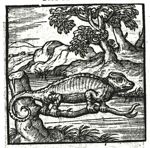
In adulatores: Alciatus, Emblemata (Leiden, 1591), emblem 53 applies the chameleon's imagery to flatterers
In adulatores: Schoonhovius, Emblemata (Gouda, 1618), emblem 53: is the animal climbing a rock in the background a chameleon?
Iconclass: 25F41(CHAMELEON)(+483) lizards: chameleon (+ external changes of animal(s) in relation to their environment) 53AA21 Inconstancy; 'Incostanza', 'Instabilità', 'Instabilità overo Incostanza' (Ripa)
Loci Communes: Inconstantiae, perfidiae, versutiae (Inconstancy, treachery, cunning, Inconstance, perfidie, ruse)
III iv 2 Suus cuique crepitus bene olet Everyone thinks his own fart smells sweet
Εκαστος αὑτοῦ τὸ βδέμα, μήλου γλυκίον ἡγεῖται. id est, Unusquisque suum ipsius crepitum malo suaviorem existimat. Hoc est, nemo est cui sua mala non videantur vel optima. Aristoteles, Moralium Nicomachiorum nono, τὰ πολλὰ γὰρ οὐ τὸ ἴσον τιμῶσιν, οἱ ἄχοντες καὶ οἱ βουλόμενοι λαβεῖν. τὰ γὰρ οἰκεῖα καὶ ἅ διδόασιν ἑκαστοις φαίνεται πολλοῦ ἄξια. id est, pleraque enim non eodem pretio aestimantur ab his qui habent, & ab his qui cupiunt accipere. Nam sua cuique, & quae dat, videntur esse multi pretii. Hic locus magis congruebat proverbio, Suum cuique pulchrum, sed ea pagina iam exierat manus nostras. Proverbium de crepitu suspicamur ab Apostolio e vulgi fece haustum, Nondum enim quenquam reperi, cui suus crepitus bene oleret. Illud verum est, homines vehementius abhorrere ab alienis excrementis & crepitu, quàm suis.
Εκαστος αὑτοῦ τὸ βδέμα, μήλου γλυκίον ἡγεῖται, Everyone thinks his own fart smells as sweet as apples; there is no one, in other words, to whom his own faults do not seem to be his best qualities. In the Nicomachean Ethics book 9, Aristotle says: 'For most things are not reckoned at the same price by those who possess them and by those who wish to acquire them. For to everyone his own goods, and what he gives, seem to be of great value.' This passage was better suited to the proverb 'What is one's own is beautiful,' but that page has already passed out of my hands. I suspect this proverb about the fart was drawn by Apostolius from the dregs of the common herd, for I have never yet heard of anyone to whom his own fart smelled sweet. It is true that men shrink from other men's excrement and farts more violently than from their own.
Facsimile: 
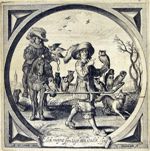
Elck meynt sijn uyl een valck te zijn: Cats, Spiegel (The Hague, 1632), emblem 12 uses the imagery of a fowler selling owls to convey the idea of love's prejudice; the comment also uses a Dutch translation of the adage
Iconclass: 31A621:31A331 flatulence❧agreeable smell 56F241 Narcissism
Loci Communes: Philautia (Self-love, Amour-propre)
III iv 3 E poculo perforato bibere To drink from a cup with a hole in it
Εκ τετριμμὲνης κύλικος πιεῖν. id est, E perforato poculo bibere, dicuntur qui futiles sunt, parumque feliciter continent arcana sibi credita. Sapit & hoc vulgus.
Εκ τετριμμὲνης κύλικος πιεῖν, To drink from a cup with a hole in it. This is said of those who cannot contain anything and who cannot manage to keep to themselves the secrets entrusted to them. This one smacks of the common herd too.
Facsimile:
Iconclass: 41C12 drinking 41C321(+9) cup (+ broken, damaged tableware, etc.) 52D1 Communication of Thought 52D4 Prolixity, Verbosity, Loquacity; 'Loquacità' (Ripa)
Loci Communes: Inconstantiae, perfidiae, versutiae (Inconstancy, treachery, cunning, Inconstance, perfidie, ruse)
III iv 4 In pulicis morsu deum invocat He calls on God for a flea bite
Εν ψύλλας δήξει θεὸν ἐπικαλεῖται, id est In pulicis morsu deum invocat, in eos dictum, qui quantumlibet levi de re graviter perturbantur, perinde ut in maxima. Tractum ab apologo qui fertur inter Aesopicos: Quidam offensus dolore pulicis pedem mordentis subsedit, & Herculem ἀλεξίκακον imploravit: mox desiliente pulice, male precatus est Herculi, qui quum in tantillo periculo vocatus non tulisset opem, non videri verisimile, eum in gravioribus adfuturum. Simile est quod refert Aristoteles Moralium Nicomachiorum septimo, de vehementer timidis, οἷος δεδίεναι πάντα κᾂν ψοφήσῃ μῦς. veluti qui metuit omnia, si vel mus obstrepat. hanc timiditatem appellat θηριώδη, hoc est, ferinam.
Εν ψύλλας δήξει θεὸν ἐπικαλεῖται, He calls on God for a flea bite. Said of those who are as seriously upset by any small thing as they are in a very important matter. It is drawn from a fable found among those of Aesop. A certain individual, distressed by the pain of a flea biting his foot, sat down and called upon Hercules 'defender against evil.' The flea soon hopped off, and he cursed Hercules, who, not having helped when called in such a small peril, seemed unlikely to come for more serious ones. This is similar to what Aristotle says in book 7 of the Nicomachean Ethics concerning those who are excessively timid: 'Like someone who is afraid of everything, even if a mouse makes a noise.' He calls such timidity that 'of a wild animal.'
Facsimile:
Iconclass: 11Q21 one person praying 25F711(FLEA)(+512) insects: flea (+ animal(s) attacking) 54BB5 Unimportance 56DD1 Fear, Dread; 'Paura', 'Timidità o Timore', 'Timore' (Ripa)
Loci Communes: Inanis metus (Groundless fear, Peur vaine); Timiditas (Timidity, Timidité)
III iv 5 Κίβδηλος. id est adulterinus Adulterated
Quod simplex non est, neque syncerum, id vulgato verbo Graeci κίβδηλον vocant. Hinc ducto vocabulo, quod aliud prae se ferant, aliud tegant, παρὰ τὸ κεύθειν τὸ δῆλον, vel quod Athenienses ob summum in Chios odium, si cui male vellent, huius nomen numismati solent insculpere, addita litera, iisque in terram subiectis dira imprecari. παρὰ τὸ χίους βδελύττειν. sed proprie nummum subaeratum κίβδηλον appellant: & κίβδηλίαν insynceritatem seu corruptelam: velut Aristophanes, Πολλὴν ἀφεῖλε τοῦ βίου κινδηλίαν. id est, Corruptionem vitae ademit plurimaem. Et κίβδηλεύειν corrumpere fuco: & qui pallent, κιβδηλιῶντας appellant, quod aliquid morbi, vitiíve subesse videatur. Quemadmodum in nummis quoque color nonnunquam arguit fucum. Conveniet igitur in amicitiam insynceram & fictam, aut in hominem blando vultu, sed animo virulento: aut in eum qui sanctimoniam habitu prae se ferat, quum vita sit impia: veluti Pisides, citante Suida, Πραγμάτων πάντως δύο Κιβδηλός ἐστιν ἐργάτης οἷς, ὡς λόγος. id est, Rerum duarum prorsus unus autor est, Vulgo ut loquuntur, quisquis insyncerus est. Aut in orationem insynceram, ut Plato libro De legibus V. τὰς δὲ ἆν τιμὰς δεῖ σκοπεῖν καὶ τούτων τίνες ἀληθεῖς, καὶ ὅσαι κίβδηλοι. id est, Rursum honores oportet considerare, quinam ex his veri sint, qui adulterini. Rursum eodem in libro, ὅπως μήτε αὐτὸς κίβδηλός ποτε φανεῖτε ὁτῳοῦν, ἁπλῶς δὲ καὶ ἀληθεὶς ἀεί. i. Ut neque ipse adulterinus aliquando cuiquam appareat, sed simplex & verax semper. Hoc igitur à nummis traductum, si ad diversas res traducatur, proverbiale fiet. Sed huius rei mentionem fecimus in proverbio πονηροῦ κόμματος.
Anything that is not untainted and not pure the Greeks refer to by the widely used word [greek], a word derived from the fact that people may do one thing openly and conceal another, from to [greek] 'to conceal what is manifest.' Or from [greek] 'to abominate the Chians,' because the Athenians with their extreme hatred of the Chians, if they wish someone ill, have the custom of inscribing his name on a coin, with the letter Chi added; they throw these on the ground and pronounce fearful curses. But the first meaning of [greek] is 'a coin which has copper in it,' and [greek] is 'debasement' or 'means of corruption,' as in Aristophanes: 'He took away much corruption from life.' Also, [greek] is 'to pass something off deceitfully,' and those who lose their natural colour are said to be [greek], because there seems to be beneath the skin some sickness or defect, in the same way that the colour sometimes betrays an alloy in coins. So the word will be appropriate for insincere and feigned friendship, or for the man with smiling face but poisonous heart, or for the man who puts on a show of sanctimoniousness when he lives an impious life. As Pisides, quoted by Suidas, says: 'Anyone who is the author of two entirely different things is insincere,' as the saying goes.
Or it will be appropriate for insincere speech, as Plato says in book 5 of his Laws: 'Again we must consider titles, and which of these is true and which are false.' And again in the same book: 'So that he too should not at times seem false to anyone, but always plain and truthful.' So this word, derived from coins, will acquire proverbial force if applied metaphorically to quite different things. But we mentioned this subject in the proverb [greek] 'Of a bad stamp.'
III iv 6 Nemo malus hoc sciet Nobody who is wicked shall know this
Οὐδεὶς κακὸς εἴσεται τοῦτο. id est, Nullus malus hoc sciet, quoties rem egregiam & cognitu dignam significamus. Plato De legibus lib. quinto, ὁστον γὰρ δὴ τὸ νῦν ἐπιταττόμενον ἀγαθὸν ὂν τύγχάνει πάσαις ταῖς πειθομέναις πόλεσιν, τὴν ἑπομένην κατασκευὴν προσλαβὸν, κατὰ τὴν παλαιὰν παροιμίαν, οὐδεὶς εἴσεταί ποτε κακὸς ὢν, ἀλλ᾽ ἔμπειρός τε καὶ ἐπιεικὴς ἔθεσι γενόμενος. id est, Quantum enim bonum sit, quod nunc praecipitur, omnibus rebus publicis, si modo paruerint, ordinem & apparatum adducens, nullus unquam iners & malus cognoscet, quemadmodum veteri proverbio dicitur, verum & peritus, & moribus aequis praeditus. Huic confine est, quod idem posuit in Lachete, οὐ πᾶσα ὗς τοῦτο εἴσεται. id est, Non sus quivis hoc norit. Natum apparet à mysteriis deorum, quae non nisi ab initiatis ac puris cognosci fas erat.
Οὐδεὶς κακὸς εἴσεται τοῦτο, No wicked person shall know this. Said whenever we mean something that is extraordinary and worth knowing. In the fifth book of the Laws Plato says: 'How good is what is ordained now, bringing order and its trappings to all states, if only they conform; "no one in any way ignorant or wicked will get to know them," as the ancient proverb says, but only one who is experienced, and endowed with virtuous habits.' Similar to this is what the same author writes in the Laches: 'Not every pig will get to know this.' It appears to have arisen from the mysteries of the pagan gods, which only the initiated and the pure were allowed to know.
Facsimile: 
Iconclass: 52AA5:54B6 Ignorance; 'Ignoranza', 'Ignoranza di tutte le cose', 'Ignoranza in un ricco senza lettere' (Ripa)❧Worth, Value
Collectanea (1500): 785
Loci Communes: Difficultatis (Difficulty, Difficulté)
III iv 7 Moenia ferrea, non terrea Walls of iron, not earth
Plato libro De legibus sexto, περὶ δὲ τειχῶν ὦ μέγιλλε, ἔγω γ᾽ ἂν τῇ σπάρτῃ ξυμφεροίμην, τὸ καθεύδειν ἐᾷν ἐν τῇ γῇ καρακείμενα τὰ τείχη, καὶ μὴ ἐπανιστάναι τῶνδε εἵνεκα. καλῶς μὲν καὶ ὁ ποιητικός ὑπὲρ αὐτῶν λόγος ὑμνεῖται, τὸ χαλκᾶ καὶ σιδηρᾶ δεῖν εἶναι τὰ τείχη, μᾶλλον ἢ γηΐνα. id est, De moenibus autem Megille equidem cum Sparta consenserim, ut moenia videlicet humi deposita, dormire sinamus, neque huius rei gratia rursum velimus excitare. Recte quidem & poeticum dictum super his canitur, Moenia aerea magis ac ferrea esse oportere quàm terrea Proverbio iactatum fuisse videtur, & habet veluti aenigmatis figuram. Innuit autem, non oportere tutamentum civitatis in moenibus collocare, sed in viris armatis, quorum consensus murorum inexpugnabilium vice, civitatem optime tuetur. Alludit autem Plato ad apophthegma Laconicum, cuius meminit Plutarch. Equidem arbitror & Horatium huc leviter allusisse, quum ait, Hic murus aheneus esto.
Plato, in the sixth book of the Laws: 'But as to the walls, Megillus, I indeed would agree with Sparta that we should allow walls that have been razed to the ground to sleep and not wake them up, and for this reason. There is a poetic saying about these matters which is rightly celebrated: "Walls should be of bronze and iron rather than of earth."' It seems to have been used as a proverb, and it has something of the appearance of a riddle. It suggests, however, that it is not in walls that the safety of a city should be placed but in armed men, whose unity, serving as unassailable walls, protects it best of all. Plato, however, is alluding to the Spartan saying that Plutarch mentions. I think, for myself, that Horace too hinted at this when he says: be this our wall of bronze.
III iv 8 Nemo nos insequitur Nobody is chasing us
Plato lib. De legibus decimo, ὡς οὐδὲν ἐν τῳ παρόντι δεῖ προτιμᾶν βραχυλογίαν μᾶλλον ἢ μῆκος. οὐδεὶς γὰρ ἡμᾶς τὸ λεγόμενον ἐπείγων διώκει. id est, Nam in praesentia nihil est cur breviloquentiam prolixitati anteponamus. Quandoquidem nemo nos insequitur, qui festinare compellat, quemadmodum vulgo dicunt. Hoc paroemiae etiam hodie tritum manet, quum significant liberum esse, diutius in re quapiam immorari. Nemo nos, inquiunt, impellit.
Plato in book 10 of the Laws: 'For at present there is no reason why we should prefer brevity to prolixity. [greek] "because nobody is chasing us and forcing us to hurry," as the saying goes.' This proverb remains common even today; when people indicate that one is free to spend longer on any matter, they say, 'Nobody is pushing us.'
Facsimile:
Iconclass: 51AA4:33B9 Nothingness, Absence❧flight, running away; pursuing 51MM11 Slowness, Tardiness; 'Tardità' (Ripa) 51MM12 Lingering
Loci Communes: Tarditatis et cunctationis (Slowness and delay, Lenteur et retard)
III iv 9 Mare proluit omnia mortalium mala The sea washes away all mortal ills
Θάλασσα κλύζει πάντα τ᾽ ἀνθρώπων κακὰ, id est, Hominum universa proluit pelaguo mala. Refertur ab Eustathio in primum Iliados Homericae. Extat autem apud Euripidem in Iphigenia Taurica. Natum est ab eventu huiusmodi. Refert Diogenes Laertius, Euripidem Platoni comitem fuisse peregrinationis, quum Aegyptum adiret: ubi cum morbo suo corriperetur, comitiali, ni fallor, sacerdotes Aegyptii mersione marina sanarunt hominem. Hinc postea versiculum hunc composuisse, Κλύζει θάλασσα πάντα τ᾽ ἀνθρώπων κακά Tanquam aqua marina morbis omnibus mederetur. Quin hodie morsos à cane rabido, si novies mergantur in mare, putant à rabie liberari.
Θάλασσα κλύζει πάντα τ᾽ ἀνθρώπων κακὰ, The sea washes away all the ills of men. This is mentioned by Eustathius, commenting on the first book of Homer's Iliad. But it is also found in Euripides' Iphigenia in Tauris. It arose from some such incident as the following: Diogenes Laertius relates that Euripides was a travelling companion of Plato when he went to Egypt. There he was seized by his sickness, epilepsy, if I am not mistaken, and the Egyptian priests cured the man by immersion in the sea. Hence he subsequently composed this verse: 'The sea doth wash away all human ills,' as if the water of the sea cured all ills. Better still, it is thought nowadays that those bitten by a mad dog are relieved of rabies if they are immersed nine times in the sea.
Facsimile:
Iconclass: 25H2311:49G23 wave❧healing of sick person 31A46 diseases
Loci Communes: Improbi (The dishonest, Les malhonnêtes)
III iv 10 Canere de Telamone Sing the song of Telamon
Αδειν τὰ τελαμῶνος. id est, Canere cantionem Telamonis. De querulo sermone dictum proverbium, quod Telamon impotentius fleverit, Aiacem filium periisse apud Troiam, praesertim hoc genere mortis. Eustathius enarrans carmen illud Homericum, quod est in Catalogo navium, αἴας δ᾽ ἐκ σαλαμῖνος ἄγεν δύο καὶ δέκα νῆας . commemorat hanc paroemiam, καὶ τὸ ἄδειν τελαμῶνος παροιμιακῶς λεχθὲν, ἀπὸ σκολίου μέλους οὗ ἡ ἀρχὴ, παῖ τελαμῶνος αἶαν αἰχμητά. id est, Et quod proverbio dicitur canere cantionem Telamonis, ab aliquo cantu, cuius initium, Fili Telamonis Aiax belliger. Simillimum est illud, quod alibi retulimus, ἀδμήτου μέλος καὶ ἁρμοδίου μέλος. id est, Admeti cantilena & Harmodii cantilena.
Αδειν τὰ τελαμῶνος, To sing the song of Telamon. A proverb said about words of lamentation, because Telamon wept uncontrollably for his son Ajax, who perished at Troy, and particularly for the way he died. Eustathius, commenting on the verse of Homer which is in the catalogue of ships, 'And Ajax led from Salamis twelve ships,' calls this proverb to mind: 'And what is said in the proverb, "To sing the song of Telamon," from the "slanting" song, which begins: "O son of Telamon, warlike Ajax."' It is very similar to something we have recorded elsewhere: [greek] 'Admetus' dirge' and '[greek] "The Harmodius song.'
Facsimile:
Iconclass: 42E132 lamentation (~ burial rites) 56BB121 Lamentation; 'Querela a Dio' (Ripa) 95A(TELAMON)6:48C755 the Greek heroic legends (TELAMON): heroes (TELAMON) - suffering, misfortune❧vocal music, singing
Loci Communes: Tristitia, laetitia (Sadness, joy, Tristesse, joie)
III iv 11 Argiva calumnia Argive accusation
Αργεῖα φορὰ id est, Argiva insectatio, de calumniosis & delatoribus dici solitum. Nam Argivos olim notavit antiquitas, tanquam sycophantas & litium avidos. Testis Eustathius in Catalogum navium, adagium ex Pausania citans. Testis & Diogenianus in Collectaneis.
Αργεῖα φορὰ, Argive persecution. Usually said of libellers and informers, because the ancients branded the Argives as informers and avid litigants. Eustathius' commentary on the catalogue of ships bears witness to this, quoting the proverb from Pausanias, as does Diogenianus in his Collected Proverbs.
III iv 12 Initio confidens, in facto timidus Bold at the start, timid in the act
Eustathius enarrans septimum Iliados librum huiusmodi refert paroemiam, θρασὺς πρὸ ἔργου, ἐκ πολλοῦ κακός. id est, Audax ante negotium plerunque ignavus. Citat idem ex Epicharmo, κακὸς θαῤῥεῖ μαλ᾽ αὐτόθεν, ἔπειτα δὲ φεύγει. id est, Ignavus statim admodum de se confidit, post autem fugit. Videmus hoc usu venire vulgo, ut qui sunt audacissimi, & magniloquentissimi, prius quam appareat periculum, ubi res virum postulat, ibi sint animi nullius.
Commenting on the seventh book of the Iliad Eustathius gives a proverb like this: [greek] 'One who is bold before action is most often a coward.' The same author quotes from Epicharmus: 'The coward is completely confident in himself at first, but then flees.' We see it commonly happens that people are very brave and boastful before the danger appears, but when the business demands a man then they have no courage.
III iv 13 Γοργὸν βλέπειν. Having a Gorgon's eye
Γοργὸν βλέπειν, aliquoties apud Lucianum, pro acribus oculis obtueri. Sumptum è fabula Persei & Gorgûs. γοργόν dictum putant παρὰ τῆς οργῆς, quod irati acribus oculis obtueantur. Item Homerus Iliados Θ de Hectore, Γοργοῦς ὄμματ᾽ ἔχων ἠδὲ βροτολοιγοῦ ἄρηος. id est, Gorgoneis oculis, quales & Martis atrocis. μανικὸν βλέπειν alias commemoravimus.
Γοργὸν βλέπειν. Sometimes found in Lucian for 'looking with keen eyes.' Taken from the legend of Perseus and the Gorgon. It is thought the word 'Gorgon' comes [greek] 'from anger,' because angry people have a fierce look. Likewise Homer, in the Iliad book 8, speaking of Hector: 'With Gorgon eyes like those of cruel Mars.' [greek] 'To look mad,' we have mentioned elsewhere.
III iv 14 Tolle digitum Raise your finger
Αἶρε δάκτυλον. id est, Tolle digitum: victum te fatere. Nam hoc signo, qui in conflictu succubuisset, τὴν ἡττὴν agnoscebat. Persius in Satyra v. Nil tibi concessit ratio? digitum exere, peccas. Cognatum illi quod alio dictum est loco, Dare herbam. Huc, ni fallor, respexit divus Hieronymus in dialogo Luciferiani & Orthodoxi, quum ait: En tollo manum, cedò, vicisti. Athenaeus lib. sexto, ex Antiphane refert hos versus, in tragicos poetas, Οταν μηδὲν δύνωντ᾽ εἰπεῖν ἔτι, Κομιδῆ δ᾽ ἀπειρήκασιν ἐν τοῖς δράμασιν, Αἴρουσιν ὥσπερ δάκτυλον τὴν μηχανην. id est, Ubi nil habeant, quod dicere queant amplius, Sed prorsus haerent explicanda in fabula, Repente tollunt machinam digiti vice. Paulo aliter usus videtur M. Tullius lib. in Verrem vi. Accurrunt tamen tutores, digitum tollit Iunius patruus. Nam hic videtur esse gestus comprobantis, aut se profitentis emptorem sive conductorem. Siquidem & hoc pacto olim ferebantur suffragia, & in auctionibus eodem, qui volebat, declarat se emptorem aut conductorem.
Αἶρε δάκτυλον, Raise your finger. Confess yourself beaten. Because with this signal the one who had been overcome in a fight acknowledged his defeat. Persius in Satire 5: 'Not one point has reason granted you; hold out your finger, and you cannot do it right.' Related to what is mentioned elsewhere: 'Yield the palm.' It was to this, if I am not mistaken, that St Jerome alluded in the Dialogue between a Luciferian and an Orthodox Christian, when he says: 'There! I raise my hand. I yield. You have won.' Athenaeus, in book 6, quotes these verses from Antiphanes about tragic poets:
When they are at a loss for something more to say,
But are completely perplexed about how to continue the play,
They suddenly raise a crane instead of raising their finger.
Cicero seems to have a slightly different usage from this in book 6 of the Verrines: 'The guardians hasten up; uncle Junius raises his finger.' For this appears to be a gesture of approval or the way in which someone declares himself to be a buyer or a hirer. Votes were cast this way, and in auctions whoever wished to be a buyer or a hirer showed it in the same manner.
Facsimile: 
Iconclass: 31A25551(+94):54FF2 index finger upwards (+ relations with sad character (expressive connotations))❧Defeat
Loci Communes: Vincere et vinci (To conquer and to be conquered, Vaincre et être vaincu)
III iv 15 Videberis, me videns, plane Martem videre You will seem, when you see me, to see Mars himself
Βλέπειν γὰρ ἀντικρὺς δόξῃς μ᾽ ἄρην.id est, Martem videre me, videberis palàm. De his qui se strenue pollicebantur opitulaturos, ac Martem quendam acturos. Est alicubi apud Aristophanem: Nam locus nondum occurrit.
Βλέπειν γὰρ ἀντικρὺς δόξῃς μ᾽ ἄρην, It will seem plain to you that in me you are looking at Mars. Said of those who offer promptly and vigorously to be helpful, and to be ready to play the role of a Mars. It is in Aristophanes somewhere, but the place escapes me at the moment.
Facsimile:
Iconclass: 45C4331(+0) helpfulness of soldiers (+ variant) 54A6 Helpfulness 57AA645 Boast; 'Iattanza' (Ripa) 92B4 (story of) Mars (Ares)
Loci Communes: Magnifica promissa (Magnificent promises, Promesses magnifiques); Arrogantia jactantiaque (Arrogance and boastfulness, Arrogance et vantardise)
III iv 16 Bos in civitate An ox in the city
Βοῦς ἐν πόλει. id est, Bos est in civitate. Dicitur ubi quis ad novos hunores evehitur. Lysias bovis imaginem aeream in arce collocavit Athenis, Ea res in vulgi iocum cessit: nam in agris boum usus est, non in urbibus. Quadrabit & in eos qui praeter meritum evehuntur ad summos honores, veluti quum scortator indoctus fit episcopus aut abbas.
Βοῦς ἐν πόλει, An ox in the city. Said when someone is appointed to a new office. Lysias placed a bronze image of an ox in the citadel in Athens, and this became a joke among the common people, for oxen are useful in the country, not in towns. So it will be applied to those who are elevated beyond their deserts to the highest honours, as when some ignorant fornicator is made a bishop or an abbot.
Facsimile:
Iconclass: 25I1 city-view in general; 'veduta' 44B232 city council 48C24(+6122):47I21111 piece of sculpture, reproduction of a piece of sculpture (+ bronze ~ arts)❧ox
Loci Communes: Dignitatis (Dignity, Dignité)
III iv 17 Brasidas quidem vir bonus Brasidas indeed is a good man
Βρασίδας μὲν ἀνὴρ ἀγαθὸς, ἁ δὲ λακεδαίμων πολλοὺς ἔχει κάῤῥονας, id est, Brasidas vir bonus quidem ille, sed Lacedaemon multos habet praestantiores. Adversus eos, qui se non modo primos, verumetiam solos existimant. Natum ex apophthegmate, quemadmodum docet Plutarchus in Laconicis, & item in vita Lycurgi. Finitimum illi, Multi Manii Ariciae.
Βρασίδας μὲν ἀνὴρ ἀγαθὸς, ἁ δὲ λακεδαίμων πολλοὺς ἔχει κάῤῥονας, This Brasidas is indeed a good man, but Sparta has a lot who are better. Against those who reckon that they are not only very distinguished, but the only ones. It comes from an apophthegm, as Plutarch tells us in his 'Sayings of Spartans,' and again in his life of Lycurgus. Very similar to another one, 'Many men called Manius at Aricia.'
Facsimile:
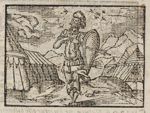
Perfidus familiaris: Aneau, Picta poesis (Lyon, 1564), emblem 9 uses the imagery of Brasidas
Victoria cruenta: Whitney, A choice of emblemes (Leiden, 1586), emblem 147 uses the imagery of Brasidas
Iconclass: 98B(BRASIDAS) male persons from classical history (BRASIDAS)
Loci Communes: Non solus ille (He is not the only one, Il n'est pas le seul)
III iv 18 Hedera post Anthisteria Ivy after the Anthisteria
Α κισσὸς μετ᾽ ἀνθιστήρια, id est, Hedera post anthisteria. Quum sero quippiam adhibetur. nam hinc habent nomen, quod eo mense plurima è terra efflorescant. Apparet in iis ludis morem fuisse coronari hedera. De anthisteriis, id est floralibus festis, diximus in proverbio, κάρες θύραζε, id est, Cares foras: videntur illa fuisse quae Latini vocant Bacchanalia. Hedera autem Baccho sacra erat, unde κιττοφόροι dicti, qui in ludis illis ferebant hederas. Convenit cum eo, quod alibi retulimus, μετὰ τὴν ἑορτὴν, id est, post festum.
Α κισσὸς μετ᾽ ἀνθιστήρια, Ivy after the Anthisteria. When something happens too late. The reason for the name is that in that month many things blossom from the earth. It seems it was the custom in these games to be crowned with ivy. We have spoken of the Anthisteria, that is the Festival of Flora, in the proverb [greek] 'Carians out!' It seems to be what the Romans called the Bacchanalia. The ivy was sacred to Bacchus, whence those who won the ivy in those games were called 'ivy-wearers.' This proverb goes with one we have noted elsewhere: [greek] 'After the feast.'
Facsimile:
Iconclass: 25G4(IVY) plants and herbs: ivy 51FF52 Lateness 92L18(VINE) attributes of Bacchus: vine 92L191 thiasos, i.e. Bacchus' revel-rout, bacchanal without Bacchus
Loci Communes: Sera paenitentia (Late repentance, Repentir tardif)
III iv 19 Ex Academia venis You come straight out of the Academy
Ακαδημίηθεν ἥκεις. id est, Ex Academia venis. De severo & composito seu docto. Sumptum à Platonis schola. Quanquam & per ironiam torqueri poterit in fastuosum, & vultu tetrico philosophum agentem. Quin Athenaeus lib. xii. significat dictum in nitidos & cultu insigni, quod his Plato delectaretur mundiciis. Ita Antiphanes philosophum elegantius cultum ubi depinxisset, apud hunc ipsum, τί μακρὰ δεῖ λέγειν; ὅλως αὐτὴν ὁρᾶν γὰρ τὴν ἀκαδημίαν δοκῶ. id est, Sed quid necesse est plura dicere? ipsam videre videor mihi academiam.
Ακαδημίηθεν ἥκεις, You come straight out of the Academy. Said of a grave and impassive or learned individual, with reference to the school of Plato - although it could also be turned ironically against someone playing the disdainful philosopher with sombre face. Athenaeus in book 12 indicates rather that it is said of refined people, of excessive elegance, because Plato delighted in such refinements. Similarly, when Antiphanes portrayed the most elegantly dressed philosopher, this same author says: 'But what need is there to say more? It seems to me I see the Academy itself.'
Facsimile:
Iconclass: 49C33 learned society, academy of sciences 57AA644 Arrogance; 'Arroganza' (Ripa) 59A2 Refinement, Taste
Loci Communes: Arrogantia jactantiaque (Arrogance and boastfulness, Arrogance et vantardise)
III iv 20 Senem erigere Correcting an old man
Γέροντα δ᾽ ὀρθοῦν φλαῦρον ὅς νέος πέσοι. id est, Erigere durum est, qui cadat iuvenis, senem. Haud facile dediscuntur à senibus vitia, quae pueri didicerint, & in omnem inhaeserint vitam. Et tamen in senecta quoque conandum, ut vitiis careamus, quantumvis inhaeserint.
Γέροντα δ᾽ ὀρθοῦν φλαῦρον ὅς νέος πέσοι, It is hard to raise up an old man who fell as a youth. It is not at all easy for old men to unlearn the vices that they learned as boys and that have become ingrained in their whole way of life. Yet in old age too we have to try to be without vices, however ingrained they may be.
Facsimile: 
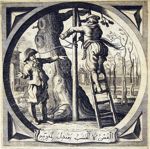
Rami correcti rectificantur, trabs minime: Cats, Spiegel (The Hague, 1632), emblem 1 uses the adage's imagery
Iconclass: 57BB12:31D16 Correction; 'Correttione' (Ripa)❧old man
Loci Communes: Serum remedium aut tempestivum (A late remedy or a timely one, Remède tardif ou opportun)
III iv 21 Terra defossum habes You are keeping something hidden in the ground
Γῇ κρύψας ἔχεις. id est, Terra defossum habes. In eum qui non impertit, neque profert suas dotes. Sumptum ab avaris, thesaurum humo defodientibus. Quod apud Plautum facit Euclio. Itidem Horatius in Epodis: Haud paravero, Quod aut avarus ut Chremes terra premam, Discinctus aut perdam ut nepos.
[greek] you are keeping something hidden in the ground. Said of someone who does not share or show his gifts. Derived from misers who bury their treasure in the ground. This is what Euclio does in Plautus. Horace has the same in the Epodes:
I shall have saved nothing
That either like miserly Chremes I can bury in the earth,
Or that I can lose like a reckless prodigal.
Facsimile:
Iconclass: 32A44 miser 46A16311 hiding, concealing, burying a treasure
Loci Communes: Occulta (Hidden things, Choses cachées)
III iv 22 Senescit bos The ox is getting old
Γηρᾷ ὁ βοῦς, τὰ δ ἔργα πολλᾲ τοῦ βοός. id est, Bos consenescit, at opera multa sunt bovis. Cum ob aetatis imbecillitatem aliquis inutilis redditur ad obeundum munus. Nam divitum vulgus haud aliter ministris utitur, quàm equis & canibus, aut paulo etiam inhumanius: dum usui sunt, alliciunt: ubi senuerint, reiiciunt. Unde consultum est, ut unusquisque sibi paret, quo senectutem suam commodius foveat, alatque, ne tum cogatur ex aliena liberalitate pendere, cum à nemine non contemnetur: Ac meminerit Diogenis apophthegmatis, qui rogatus, quidnam esset in hac vita calamitosissimum, respondit, γέρων ἄπορος. id est, Senex egens.
[greek], The ox is getting old, but there is much work for the ox. Said when someone becomes unfit to do his job because of the weakness of old age. For the ordinary run of wealthy people treat their servants as if they were no more than horses and dogs, or even rather more inhumanely. While they are of some use, they curry favour with them when they have become old, they reject them. This is why it was considered wise for everyone to procure for himself the means to provide for and support his old age in some comfort, so that he would not be obliged to depend on someone else's generosity, for this is despised by everyone. And he should remember that Diogenes, when he was asked what was the greatest calamity in this life, answered: 'An old man destitute.'
Facsimile:
Iconclass: 31D91 long life 47I21111(+924) ox (+ very old animal) 54AA7 Weakness, Powerlessness, Helplessness; 'Infermità' (Ripa)
Loci Communes: Longae vitae (A long life, Longue vie)
III iv 23 Sus acina dependes You are a pig who will pay for the grapes
Αποτίσεις χοῖρε γίγαρτα. id est, Acinos sus improba pendes. Lues quod admisisti, reddes quod abstulisti, non sine foenore. Quadrabit, ubi pusillum commodi magno dependitur malo. Natum apparet à rustico quopiam, qui verbis hisce comminatus sit sui pascenti racemos.
'[greek], You are a greedy pig who will pay for the grapes. You will pay a penalty for what you have done; you will pay back what you have taken away, and with interest. It will be applicable when some trifling gain is paid for with a great evil. It arose probably when some rustic threatened his pig with these words as it feasted on bunches of grapes.
Facsimile:
Iconclass: 44G3 criminal law; punishment 46B44 paying (~ commerce) (here also repayment of debt, etc.) 47I212:55CC11 pig❧Greed, Covetousness, Cupidity; 'Cupidità' (Ripa) 47I4222 bunch of grapes
Loci Communes: Ultio malefacti (Vengeance for a wrongdoing, Vengeance d'un méfait)
III iv 24 Dum cessat boreas Until the north wind stops
Aristoteles in Problematis sectione vigesimasexta, problemate quadragesimoseptimo, iuxta Theodori supputationem, testatur hunc versiculum proverbio celebrem fuisse: Αρχομένου τε νότου,καὶ λήγοντος βορέαο. id est, Surgit ubi notus exoriens, boreasque residit. Quo significabant tempus opportunum prosperae navigationi. Subauditur enim δεῖ πλεῖν, sive εὖ πλεῖν, propterea quod auster minus vehemens oritur: desinit autem perquàm vehemens, diversum accidit in Aquilone. Atque huius rei philosophus causam admodum probabilem reddit. Non enim, inquit, ad septentrionem potiusquàm ad meridiem vergimus, & aquilo stat à septentrionibus, auster à meridie. Hinc fit, ut ille statim vehementior proxima invadat loca, deinde vehementiam suam ad longius remotos transferat, propinquis ortui mitior Hic ediverso, ad meridiem positos, primum urgeat: post ubi praeteriit, mitior ad nos veniat. Licebit & longius detorquere proverbium, nec id sine gratia, si quando significabimus tempus adesse commodum & aptum gerendae rei, ut cum illo congruat, quod alibi positum est: Cum pluit, molendum.
In his Problems section 26 problem 47, according to the numbering of Theodorus, Aristotle declares this verse was well known as a proverb:
'[greek] 'When the south wind begins to rise, and the north wind dies down.' This meant weather suitable for favourable navigation. For there is understood [greek] 'it is time to set sail' or [greek] 'good sailing,' because the south wind is less violent when it comes up, but very violent as it ends. The opposite happens with the north wind. And the Philosopher gives the most probable cause of this saying: 'For we lie further towards the north than to the south, and Aquilo blows from the north, Auster from the south. Hence it comes about that the former assails the nearest regions more violently, then moves its violence on to more remote places becoming milder in those closer to its origin. The former, on the contrary, first bears hard on places towards the south, and afterwards, when it has passed on, is more gentle when it reaches us.' One may stretch the proverb further, and quite aptly, when we want to indicate that the time is convenient and right for doing something, so that it fits in with the one which is published somewhere else: 'When it is raining, get on with the grinding.'
Facsimile:
Iconclass: 26C121:54DD31 north wind, 'Aquilo', 'Boreas', 'Septentrionarius' (one of eight directions)❧Interruption, Cessation 54B121 'Occasio', 'Kairos'; 'Occasione' (Ripa)
Loci Communes: Tempestiva (Timely things, Choses opportunes)
III iv 25 Invulnerabilis ut Caeneus Invulnerable like Caeneus
Ατρωτος ὑπάρχεις ὡς καινεύς. id est, Invulnerabilis es ut Caeneus. De his, qui laedi non possunt. Est in poetarum fabulis, Caeneum munere Neptuni nullo telo vulnerari potuisse. Caeterum iuxta sidem historiae, Caeneum Thessalum quempiam aiunt fuisse, rei bellicae cum primis peritum, adeo ut cum multis proeliis interfuisset, nunquam vulnus acceperit. Denique cum Lapithis auxilium ferret adversus Centauros, deprehensus solus, ab hostium multitudine obrutus est, citraque corporis vulnus extinctus. Itaque Lapithae, cadavere integro reperto, sparserunt rumorem, Caeneum in omni vita invulnerabilem fuisse, Venustius enuntiabitur per comparationem.
[greek], You are invulnerable like Caeneus. Said of those who cannot be hurt. It is stated in the poets' tales that Caeneus, by Neptune's help, could not be injured by any missile. But according to history Caeneus was a certain Thessalian, among the most skilled in fighting, and so skilled that, though he was involved in many battles, he never received a wound. Finally, when he went to the help of the Lapiths against the Centaurs he was taken alone by surprise, overwhelmed by a multitude of enemies, and killed without any bodily wound. And so the Lapiths, finding the unwounded body, spread the rumour that Caeneus had been invulnerable throughout his whole life. It will be quite a graceful comparison to make.
Facsimile:
Iconclass: 54A7297K1 92L714113 the invulnerable hero Caeneus, the Lapith (i.e. the girl Caenis metamorphosed), is overwhelmed by a huge pile of wood
Loci Communes: Vincere et vinci (To conquer and to be conquered, Vaincre et être vaincu)
III iv 26 Sale perunctus hic adiuvabitur A rub with salt will do this man good
Αλσὶν διασμηχθεὶς ὄναιτ᾽ ἂν οὑτοσί.id est, Acri sale hic perlutus adiuvabitur. In eos dicebatur, qui vel aetate, vel vino delirarent. Quidam ab utribus translatum existimant, qui sale loti redduntur meliores, quod salis acrimonia, coriorum crassitudinem emendet. Itidem temulentia laborantes mos erat sale & oleo perungere, id adversus ebrietatem remedium existimabatur. Quidam à vasis testaceis ductum malunt, quae sale imbuuntur, quo fidelius contineant liquorem infusum. Sumptum est autem proverbium ex Aristophanis Nebulis.
'[greek], This man will benefit if he is rubbed with bitter salt. This used to be said of those who were out of their senses, either because of age or because of wine. Some think the metaphorical use is derived from leather bottles, because their condition is improved if they are washed with salt; the corrosiveness of salt improves the consistency of the hide. In the same way it was the custom to smear people who were ill through drunkenness with salt and oil; this was thought to be a remedy for inebriety. Some prefer to think it is derived from earthenware jars which are impregnated with salt and so contain better the liquid put in them. And indeed the proverb is found in Aristophanes' Clouds.
Facsimile:
Iconclass: 49G23 healing of sick person 49G23:31B521 healing of sick person❧drunkard 49G39:41C661 massage ~ medical treatment❧salt
Loci Communes: Bibacitas (Excessive drinking, Penchant pour la boisson)
III iv 27 Haec iustitia This is justice
Αὕτη τοι δίκη ἐστὶ θεῶν οἱ ὄλυμπον ἔχουσι. id est, Divum haec iustitia est, magnus quos claudit Olympus. Dici solitum, quoties poenas darent scelesti, veluti diis ipsis ultoribus. Sumptum est ex Hom.
[greek], This is the justice of the gods, whom great Olympus encloses. Customarily said whenever criminals were punished, as if by the avenging gods themselves. It comes from Homer.
III iv 28 Atqui non est apud aram consultandum But the place for deliberation is not before the altar
Αλλ᾽ οὐδὲν δεῖ περὶ τὸν βωμὸν τὰς ἐπινοίας. id est, Atqui nihil opus iuxta aram cogitare. Consultandum antequam incipias, in ipso negoχio sera consultatio. Sumptum `α sacrificis, qui pro ritu sacrorum omnia praeparant, prius quam accedant ad aram. Nam in ipsis sacris periculosum existimabatur, si quid parum rite dictum ac factum fuisset à sacerdotibus aut patrimis ac matrimis. Declarat M. Tullius in oratione De responsis aruspicum, An si ludus constitit, aut tibicen repente conticuit, aut puer ille matrimus & matrima si terram non tenuit, aut thensam, aut lorum omisit, aut si aedilis verbo aut nutu aberravit, ludi sunt non rite facit.
'[greek], But there must be no deliberation before the altar. You should deliberate before you start; discussion during the business itself is too late. Derived from priests who prepare everything for the ritual of sacred observances before they approach the altar. For it was thought to be dangerous if, during the actual ceremony, anything was said or done not according to the rite by priests with a living parent. Cicero explains this in his speech On the Responses of the Augurs: 'What? If the celebration has come to a stop, or if the flute-player has suddenly fallen silent, or if that boy or girl whose mother is alive has not kept their place, or has not kept hold of the chariot, or has dropped the reins, or if the aedile has made a mistake in word or gesture; are the celebrations not done according to the rite?'
Facsimile: 
Iconclass: 12B62 altar ~ non-Christian religions 49C4(+0):51FF52 discussion, dialogue, dispute ~ scholar, philosopher (+ variant)❧Lateness 54D1 Preparation
Loci Communes: Sera paenitentia (Late repentance, Repentir tardif)
III iv 29 Mars haud concutit sua ipsius arma Mars never shuffles his own weapons about
Αρης τὰ αὐτοῦ ὅπλα οὐ σαλεύει. id est, Mars sua ipsius arma non iactat. Commode feruntur quibus assuevimus, quaeque nobis quadrant, etiam si sint gravissima. Iactamus enim, quod incommode ferimus. Unde Iuvenalis: Nec iactare iugum vita didicere magistra. Ita studiorum labor qui occideret athletam, non gravat eruditum.
[greek], Mars does not fret about his own arms. Things we have become accustomed to and which suit us are easily borne, even if they are very heavy. We fret under things which we find hard to bear. Hence Juvenal says: 'Life has taught them not to fret under the yoke.' So the labour of study, which would kill an athlete, does not trouble the scholar.
Facsimile:
Iconclass: 46C121:45C1 carrying something❧weapons 51GG2:45C22 Lightness; 'Leggierezza' (Ripa)❧armour 92B4 (story of) Mars (Ares)
Loci Communes: Similitudinis et congruentiae (Similarity and congruence, Similitude et convenance)
III iv 30 Smaragdus in luce obscurus An emerald, dark in the light
Αρίγνωτος σμάραγδος, ἐν μὲν τῷ φάει σκοτενός. id est, Insignis smaragdus, in luce quidem obscurus. In eos iaci solitum, qui praepostere ibi semet occultarent, ubi maxime conveniebat edere virtutis specimen. Plinius inter smaragdorum varietates commemorat, qui dicti sint caeci, quòd colore sint obscuriore. Id vitii magis in sole deprehenditur, quum ingens color ille suaviter virens, nec sole mutetur, nec umbra, nec lucernis, ac ne aquis quidem. Quemadmodum idem docet Plinius libro trigesimoseptimo, cap. vi.
[greek], A notable emerald, dark even in daylight. A rebuke customarily hurled at those who absurdly hide themselves just when they should most give an example of virtue. Pliny mentions among the varieties of emeralds some that are said to be 'blind,' because they are rather dark in colour. This fault can be seen most in sunlight, since that intense, delightfully green colour is not changed by the sun, or by shade, or by lamps, or even by liquids. Pliny tells us the same in book 37 chapter 6.
Facsimile:
Iconclass: 22C9 darkness 23R14 night 25D11(EMERALD) precious and semiprecious stones: emerald 52DD1 Secrecy, Latency, Concealment; 'Secretezza' (Ripa)
Loci Communes: Absurda, indecora, seu praepostera (Absurd, unbecoming, or preposterous things, Choses absurdes, inconvenantes ou déplacées)
III iv 31 Martis pullus A fledgling of Mars
Αρεος νεοττόν. id est, Martis pullum, vocant ad bella magnopere propensum. Aristophanes in Avibus. Αρεσος νεοττὸς, ὦ νεοττὲ δέσποτα. id est, Pullus Gradivi, ó pulle rector atque here. Sentit autem de gallo, qui quòd omnium avium sit pugnacissimus bellacissimusque, unde & crista & calcaribus armatus est, Marti sacer est. Vel quòd is olim fuerit adolescens Marti in deliciis habitus, qui consueverit observare, Marte cum Venere cubante ne quis deorum interveniret. Deinde cum illo dormiente Sol advenisset, Marsque turpiter esset deprehensus, iratus Gallum adolescentem in avem commutavit, manentibus etiamnum pristinae naturae vestigiis. Narrat hanc fabulam Lucianus in Gallo. Proverbii meminit & Laertius in vita Diogenis Cynici.
One who is much inclined to fighting battles is called [greek], A fledgling of Mars. Aristophanes in the Birds says: [greek] 'Fledgling of Gradivus. - O fledgling ruler and master.' But he is referring to the cockerel, which is the most pugnacious and warlike of all birds and therefore, being equipped with both crest and claws, sacred to Mars. Or because this bird was formerly a young man who was a favourite of Mars, and who kept watch, when Mars lay with Venus, lest any of the gods should intrude. Then, when the sun rose and the youth was sleeping, Mars was caught in disgrace and in his anger changed the young Gallus into a bird, which still keeps traces of its original nature. Lucian tells this tale in his Cockerel. Diogenes Laertius too recalls the proverb in his life of Diogenes the Cynic.
Facsimile:
Iconclass: 92B42321 Mars and Venus making love, Gallus (Alectryon) changing into a cock 92B48(COCK) attributes of Mars (COCK)
III iv 32 Utrem mergis vento plenum You are trying to sink a bladder full of air
Ασκὸν βαπτίζεις πνεύματος πληρῆ. id est, Ventrem mergis vento plenum. Competit in eum, qui frustra conatur, ut qui castigat inemendabilem, quod inflatus uter, quantumvis immergas, rursum emicet. Natum videtur ex oraculo Sibyllae, quod illa αedidit de civitate Atheniensi, Ασκὸς βαπτίση, δύναι δέ τοι οὐ θέμις ἔσται. id est, Uter tingeris, sed mergere nemo valebit.
'[greek], You are trying to sink a bladder full of air. Suitable for one who makes vain efforts, like someone who rebukes the incorrigible, because an inflated bladder, however hard you push it under, springs up again. Derived, it seems, from an oracle pronounced by the Sybil concerning the city of Athens: 'You may have wet the bladder, but no one will be strong enough to sink it.'
Facsimile:
Iconclass: 21D water (one of the four elements) 31A2235:21A bladder❧air (one of the four elements) 31A2748(+64) pushing something (+ downward) 54BB3 Inutility, Noxiousness; 'Nocumento', 'Nocumento d'ogni cosa' (Ripa)
Loci Communes: Inanis opera (Vain effort, Effort vain)
III iv 33 Durus alloquiis Deaf to entreaty
Ατηκτος ἄνθρωπος προσηγορήμασιν. id est, Immobilis sive inflexibilis alloquio. Ductum à cera, quae tractando mollescit. ἄτηκτον autem dicitur, quòd non queat liquefieri. Competit igitur in hominem inexorabilem.
[greek], Immovable or unbending to entreaty. Derived from wax, which becomes soft when it is handled. What cannot be liquefied is said to be [greek], so this fits a man who is inexorable.
Facsimile:
Iconclass: 31A412 deaf, deafness 53C13 Sternness; 'Rigore' (Ripa)
Loci Communes: Rigor (Strictness, rigidity, Rigueur); Asperitas, morositas (Harshness, moroseness, Rudesse, morosité)
III iv 34 Profectus ad Apaturia Gone to the Apaturia
Απιὼν ες ἀπατούρϊα ἐπανηκ᾽ ἐς θαργηλιῶνα. id est, Profectus ad apaturia, rediit Maio. Dici solitum in eos qui licentius immorarentur negocio cuipiam. Athenis festum erat, quod Apaturia vocabant, id triduo peragebatur. Primum diem appellabant δόρπειαν, propterea quòd sub noctem convenientes φράτορες convivium agerent. Secundum appellabant ἀνάῤῥυσιν, quòd in eo rem divinam facerent Iovi Phratrio, ac Minervae, tertium κουρεῶτιν, quòd iuvenes & puellae in gentem transcriberentur. Meminit Suidas copiosius de hoc festo: verum ea non multum attinent ad explicandum proverbium.
'[greek], Having set out for the Apaturia, he returns in May. Usually said of those who lingered excessively over some business. In Athens there was a festival called the Apaturia which lasted three days. They called the first day [greek], because the members of the phratry assembled just before nightfall for a banquet. The second day they called [greek], because in it they performed sacred rites for Jove, protector of the Phratrae and Minerva. The third was [greek], because the young boys and girls were enrolled in the clan. Suidas recalls rather a lot things about this festival, but they do not have much to do with the explanation of the proverb.
Facsimile: 
Iconclass: 12E91(APATURIA) feasts and festivals in honour of the Greek gods (APATURIA) 46C512 departure ~ travelling 51MM11 Slowness, Tardiness; 'Tardità' (Ripa)
Loci Communes: Tarditatis et cunctationis (Slowness and delay, Lenteur et retard)
III iv 35 Ego tibi de alliis loquor, tu respondes de cepis I talk to you about garlic, and you answer about onions
Εγὼ σκόροδά σοι λέγω, σὺ δὲ κρόμμυ᾽ ἀποκρίνεις. id est, Ego tibi loquor de alliis, tu respondes de cepis. Similimum illi: a)/mas2 a)ph/|toun, cum aliud respondetur, quam rogaris, vel contra, cum inepte respondetur inepte sciscitanti. Confinia sunt inter sese cepae & allia.
'[greek], I talk to you about garlic, and you answer with onions. This is very similar to another: [greek] 'Sickles I asked for.' Said when some answer is given that was unrelated to a question, or, on the other hand, when a silly answer is given to a silly question. Garlic and onions are related to each other.
Facsimile:
Iconclass: 25G22(ONION) (non-fruit) products of plants or trees: onion 25G4(GARLIC) plants and herbs: garlic 31B6235 speaking 52BB53 Nonsense, Absurdity
Loci Communes: Aliena a re (Irrelevant to the matter, Étranger au sujet)
III iv 36 Aurificem te futurum credebas You thought you were going to strike gold
Χρυσοχοήσειν ᾤου. id est, Aurificem te futurum arbitrabare. Natum aiunt ab huiusmodi quodam eventu. Invaluerat aliquando fama apud vulgus Atheniensium, in Hymetto monte magna auri fragmenta videri, quae à formicis illis pugnacibus servarentur. Itaque quidam creduli sumptis armis exierunt illas expugnaturi, qui quum re infecta, frustraque sumpto labore redirent in urbem, irrisi sunt à caeteris civibus, illud obiectantibus, σὺ δὲ ᾤου χρυσοχοήσειν. id est, tu credebas te futurum aurum. Meminit huius rei Eubulus in fabula cui titulus Glaucus. Ημεῖς ποτ᾽ ἄνδρας κεκροπίδας ἐπείσαμεν, Λαβόντες εἰς ὑμηττὸν ἐξελθεῖν ὅπλα, Καὶ σὺ ἐπὶ μύρμηκας ἡμερῶν τριῶν ὡς χρυσοτεύκτου ψήγματος πεφῃνότος. id est, Quoniam viris nos Cecropidis persuasimus, Sumptis ut armis montem Hymettum incurrerent, Contraque formicas cibaria tridui Ferrent, velut fragmentula auri fusilis Apparuissent. In penultimo versu aut mendum est, aut defectus: fortasse pro σὺ legendum σῖτον. Itaque certe constabit versus: Καὶ σῖτον ἐπὶ μύρμηκας ἡμερῶν τριῶν. Extat & apud Platonem libro De republica quinto, τί δὲ ἦν ὁ σὸς θρασύμαχος, χρυσοχόης, εἰς τούδε νῦν ἐνθάδε ἀφῖχθαι, ἀλλ᾽ οὐ λόγων ἀκουσόμενος. i. Quid autem erat tuus Thrasymachus, si auri fusor, ad eos, qui nunc hic sunt advenisset, ac non potius rationes auditurus. Aeschines. ἀποφοιτήσας περὶ τούτῳ δῆλον ὅτι χρυσοχοεῖν ἐμάνθανεν, ἀλλ᾽ οὐ τὸ προσκείμενον αὐτῷ πράττειν ἢ πάσχεν. id est, quum hinc se subduxerit, perspicuum est quòd aurum fundere didicit, potius quàm id facere patíve, quod ipsi propositum erat. Paroemia conveniet, ubi quis ingetes spes animo concepit, sed discedit frustratus. Quod fere solet accidere iis, qui suo sumptu mittunt, qui terras pervestigent incognitas, aut qui in fornaces alcimisticas omnia sua profundunt.
[greek], You thought you were going to be a goldsmith. It is said this was derived from some such occurrence as this. At one time a rumour had become rife among the common people of Athens that on Mount Hymettus were to be seen large pieces of gold which were guarded by the fighting ants they have there. So certain credulous people seized their arms and went out to conquer them. When these people came back to the city, without accomplishing anything and doing all the work for nothing, they were laughed at by the rest of the citizens, who jeered at them: [greek] 'You thought you would be smelting gold.' Eubulus recalls this in a play entitled Glaucus:
We once persuaded some Athenian men
To take arms, assault Mount Hymettos
And bear rations for three days against the ants,
In the belief that small fragments of melted gold
Had appeared.
In the penultimate line there is either an error or something missing; perhaps we should read [greek] 'provisions' for [greek] 'you.' In this way the verse will scan properly: [greek]. In Plato, book 5 of the Republic, we have: 'But what was your Thrasymachus, if he had come as a goldsmith to those who are here now, and not as someone willing to listen to arguments?' And in Aeschines: 'When he withdrew here, it is very clear that he learned to smelt gold rather than do or suffer what was intended for him.' The proverb will be appropriate when someone has conceived great expectations but is disappointed in the outcome. This nearly always happens to those who send men to explore unknown lands, or who pour all they have into alchemical furnaces.
Facsimile:
Iconclass: 46A1611 treasure hunting, goldrush 48C311 jeweller, goldsmith, silversmith 52B21 Credulity
Loci Communes: Frustrata spes (Frustrated hope, Espoir déçu)
III iv 37 Seiuncta sunt Merrhae ac Siloam fluenta The waters of Merrha and Siloam are far apart
Χωρὶς τὰ μεῤῥᾶ καὶ σιλωὰν ῥεύματα. id est, Seiuncta sunt Merrhae ac Siloam flumina. De longo intervallo dissitis inter sese: veluti si quis dicat, inter amicum & adulatorem plurimum interesse. Finitimum illi, χωρὶς τὰ τῶν μυσῶν καὶ φρυγῶν. id est, separatae sunt possessiones Mysorum & Phrygum. Apparet neotericum esse proverbium, & haud scio an ab Apostolio additum ex literis ecclesiasticis. Siquidem Merrha vocatur locus in quo Moses aquas pestilentes & amaras, iniecto ligno dulces reddidit ac salubres. Caeterum ad aquas Siloam missus est à Iesu caecus evangelicus, quo visum reciperet. Unde appares salutares fuisse dissimillimas aquis Merrhae.
[greek], The rivers of Merrha and Siloam are far apart. About things that are extremely remote from each other. As someone might say, 'There is a big difference between a friend and a flatterer.' Very similar to that other one: [greek] 'The lands of the Mysians and the Phrygians are far apart.' It seems the proverb is modern, and I rather think it was added by Apostolius from patristic literature, since Merrha is the name of the place where Moses made the pestilent and bitter waters fresh and healthy by throwing in wood. But it was to the pool of Siloam that the blind man in the Gospel was sent by Jesus, to recover his sight. From this it appears that salutary waters were very different from the waters of Merrha.
Facsimile:
Iconclass: 25H213 river 51BB2 Dissimilarity, Unlikeness 51II4 Farness 61D(MERRHA) geographical names of countries, regions, mountains, rivers, etc. (MERRHA) (MERRHA) 61D(SILOAM) geographical names of countries, regions, mountains, rivers, etc. (SILOAM) (SILOAM) 71E12412 Moses throws a piece of wood into the water of Marah, which then becomes sweet
Loci Communes: Differentiae (Differences, Différences)
III iv 38 Ψευδόπυρα. False fires
Ψευδόπυρα οἷον τὰ σά. De minis ac terriculis inanibus: aut quum ostenditur arte periculum, cum re nullum sit periculum. Translatum à militari astutia, qua fit, ut ad territandos hostes noctu diversis locis ignes incendant, ut ingens exercitus esse credatur. Eos ignes adsimulatos, ψευδόπυρα vocant. Non habebit proverbii gratiam, nisi transferas ad eos qui fumis verborum territare student aliquem, aut in fraudem illicere. Sic enim interdum falluntur & nautae.
'[greek], For yours are false fires. Said of deterrents and scarecrows, or when the appearance of danger is created artificially, there being none in reality. The metaphor is derived from a military ruse in which, in order to frighten the enemy, fires are lit in a number of places at night, so that it is thought there is a very large army present; these counterfeit fires they call [greek]. It will not have the charm of a proverb unless you apply it metaphorically to people who use a smokescreen of words to frighten someone or trap them in a fraud. Even sailors can sometimes be deceived in this way.
Facsimile:
Iconclass: 41B162 smoke 57AA6131 Guile, Artfulness, Craftiness, Deceitfulness
Loci Communes: Minantis (Threatening, Menacer)
III iv 39 Psyra Bacchum Bacchus to Psyra
Ψύρα τὸν δίονυσον. id est, Psyra Bacchum. Stephanus & Suidas citant è Cratino, ψύρα τὸν δίονυσον ἄγοντες. id est, in Psyra Bacchum ducentes. Rursum ἐν νεμέσει, ψύρα τε τὴν σπάρτην ἄγεις. id est, Et in Psyra Spartam ducis. Annotatum est & ab Hermolao Barbaro. Dictitatum adagium, ubi vinum appositum in convivio nemo gustat: aut de sordido apparatu. Psyra pusilla quaepiam insula est haud procul à Chio, in qua vinum non provenit. Meminit & Strabo libro xiiii. Hanc Homerus Odysseae Γ ψυρίην appellat. In Graecorum commentariis reperi scriptum aliquoties ψυρᾷ, finali circumflexo, sed mendose, ni fallor.
[greek], Bacchus to Psyra. Stephanus and Suidas quote from Cratinus: Taking Bacchus to Psyra,' and again in his Nemesis: 'And you are taking Sparta to Psyra.' This proverb is noted by Ermolao Barbaro too. The adage was used frequently when no one liked the wine set out at a banquet, or of mean preparations. Psyra is a tiny island not far from Chios, on which wine cannot be produced. Strabo too recalls it in book 14. This is the island Homer calls Psyria in book 3 of the Odyssey. In Greek commentaries I have sometimes seen [greek], with a circumflex on the final syllable, but this is incorrect if I am not mistaken.
Facsimile: 
Iconclass: 31A3412:41C711 disagreeable taste❧wine ~ alcoholic drinks 61D(PSYRA) geographical names of countries, regions, mountains, rivers, etc. (PSYRA) (PSYRA) 92L1 (story of) Bacchus (Dionysus), Liber
Loci Communes: Sordes et parcimonia (Meanness and stinginess, Bassesse et avarice)
III iv 40 Caput vacuum cerebro A head devoid of brains
ὦ οἵα κεφαλὴ, καὶ ἐγκέφαλον οὐκ ἔχει. id est, O quale caput, & cerebrum non habet. De his, qui corporis specie praecellunt, ingenio carentes. Natum ex apologo, qui circumfertur inter Aesopicos. Vulgo quoque vaecordibus & insipidis aiunt, cerebro vacuum esse caput.
[greek], O what a head, and it has no brains! Said of those who have a splendid physical appearance but lack intelligence. Derived from a fable which is included in those of Aesop. In the vernacular too they say to stupid and silly people that their heads are devoid of brains.
Facsimile:
Iconclass: 51AA4:31A22151 Nothingness, Absence❧brains 51D4 Beauty; 'Bellezza' (Ripa)
Loci Communes: Multi - in stupidos (Many people - against the stupid, Beaucoup de gens - contre les sots)
III iv 41 Crudelis Bacchus Bacchus is cruel
Ωμηστὴς δίονυσος. id est, Crudelis Bacchus. Baccho quondam vivos homines sacrificari mos erat. Unde in crudeles convenit, sive quod temulentia reddat feroces, et immites.
'[greek], Bacchus is cruel. It was the custom at one time that men were sacrificed live to Bacchus. So the saying is applicable to people who are cruel, or it is appropriate because drunkenness makes people fierce and harsh.
III iv 42 Hoc calciamentum consuit Histiaeus, Aristagoras induit This shoe was stitched by Histiaeus, Aristagoras put it on
Τοῦτο ὑπόδημα ἔῤῥαψε μὲν ἱστιαῖος, ὑπεδύσατο δὲ ἀρισταγόρας. id est, Hoc calciamentum Histiaeus quidem consuit, caeterum Aristagoras induit. Diogenianus admonet dici solitum in eos, qui callide sua malefacta in alios reiciunt. Adagium natum est ex huiusmodi historia: Histiaeus quispiam patria Samius, Dario amicus, ab eodem in Persidem missus est: illic diutius commoranti incessit patriae revisendae desiderium: verum quum à rege commeatum impetrare non posset, scribit ad Aristagoram ex fratre nepotem, ut Iones ad defectionem sollicitaret, videlicet ut hac occasione dimitteretur. Excogitavit autem novum literarum transmittendarum genus, cuius meminit & Aulus Gellius Noctium Atticarum lib. xvii. cap. ix. Servo cuidam spectatae fidei, diu oculos aegros habenti, capillum ex omni capite, tanquam medendi causa deradit, caputque eius leve litterarum formis compingit. His literis quae voluerat, scripsit: hominem postea quoad capillus adolesceret, domi continet: renatis pilis, ad Aristagoram mittit. Et quum ad eum veneris, inquit, mandasse me dicito, ut caput tuum, sicut nuper egomet feci, deradat. Servus ut imperatum erat, ad Aristagoram venit, mandatum domini adfert. Is non esse frustra ratus, capite deraso literas legit, ac mente Histiaei cognita, totam fermè Ioniam ad defectionem traxit. Darius posteaquam haec cognovisset, descivisse Iones, Histiaeum in consilium adhibet, quem potissimum in Asiam mittere oporteat ad res componendas. Is persuadet ut sese mittat, utpote idoneum ad sarciendam defectionem Ionum. Itaque posteaquam in Asiam devenisset, iamque in suspicionem venisset Sardium praefecto, tanquam autor huius motus fuisset, hoc audivit ab eodem: οὑτω τοί ἱστιαῖε ἔχει κατὰ ταῦτα τὰ πρηγματα, τοῦτο τὸ ὑπόδημα ἔῤῥαψας μὲν σὺ, ὑπεδύσατο δὲ ὁ ἀρισταγόρης. Sic hae res habent Histiaee: tu quidem calceum hunc consuisti, caeterum Aristagoras induit. Meminit & Herodotus quinto & sexto libro, in hunc modum efferens quemadmodum retuli. Significabat autem eius consilii primum fontem & autorem fuisse Histiaeum, administratorem Aristagoram. Ea vox deinde, ut fit, vulgo cognita commenti novitate, in populi fabulam abiit. Videtur magis convenire, quoties in astutis & improbis consiliis alteri alter auxilio est, mutuaque opera sese iuvant. Nam dare consilium, est tanquam calceum consuere, uti consilio & exequi, est velut inducere calciamentum.
[greek], This shoe was stitched by Histiaeus certainly, but Aristagoras put it on. Diogenianus informs us that this used to be said to rebuke those who craftily shift the blame for their misdeeds onto others. The adage derives from the following story: Histiaeus, an individual from Samos and a friend of Darius, was sent by him to Persia. Staying there for some time, he was seized by a desire to see his homeland again. But finding he could not obtain free passage from the king he wrote to Aristagoras, a nephew by his brother, asking him to induce the Ionians to revolt, the purpose being of course that this would be the occasion for him to be sent away. However, he devised a novel way of sending his letter, which Aulus Gellius recalls in book 17 chapter 9 of the Attic Nights: He shaved off all the hair from the head of a well-trusted slave who had suffered for a long time with an infection of the eyes, as if to cure him, and covered his smooth scalp with writing. In this way he wrote what he wanted. He then kept the man at home until the hair grew back. When the hair had regrown, he sent him to Aristagoras, saying, 'When you reach him, say that my message was that he should shave your head, as I have just done.' The slave went to Aristagoras, according to his orders, and gave him his master's message. Aristagoras, thinking that this was not without reason, shaved the slave's head, read the letter, and, recognizing Histiaeus' intention, drew almost the whole of Ionia into a rebellion. When Darius learned the news that the Ionians had revolted, he summoned Histiaeus to ask whom it was most appropriate to send to Asia Minor to settle matters. The latter persuaded him to send himself as being most suitable for settling the Ionians' revolt. And so, after he had reached Asia Minor and had then fallen under suspicion of the prefect of the Sardians as having been the author of this insurrection, he heard the prefect say this: 'This is the truth of this matter, Histiaeus: it was you who stitched this shoe, and Aristagoras that put it on.' Herodotus recalls the story too in his fifth and sixth books, reporting it as I have told it. And indeed he made it clear that Histiaeus was the source and author of this counsel and that Aristagoras was the one who put it into effect. Then this expression, as often happens, became known to ordinary people because of the novelty of the lie, and it passed into a popular story. It seems to be most applicable whenever one person supports another in crafty and dishonest deliberations and they bring mutual assistance to each other. For giving advice is like stitching the shoe, and making use of the advice and carrying it out is like wearing it.
Facsimile:
Iconclass: 41D2332 shoes, sandals 47H73 shoe-maker, cobbler 57AA6131:57BB3 Guile, Artfulness, Craftiness, Deceitfulness❧Accusation, Incrimination 98B(ARISTAGORAS) male persons from classical history (ARISTAGORAS) 98B(HISTIAEUS) male persons from classical history (HISTIAEUS)
Loci Communes: Inconstantiae, perfidiae, versutiae (Inconstancy, treachery, cunning, Inconstance, perfidie, ruse)
III iv 43 Quae non posuisti, ne tollas Do not take away what you did not put in place
Α μὴ κατέθου, μὴ ἀνέλου. i. Quae non posuisti, ne sustollas. Citatur à Platone lib. De legibus xi. tanquam ex poeta quopiam. Laertius refert inter Solonis leges, sentiens opinor de terminis agrorum non movendis, quos maiores fixissent. Convenit in furaces, & in eos qui repetunt quod non crediderunt: item qui sibi postulant, acceptum ferri, quod non praestiterunt.
[greek], Do not take away what you did not put in place. This is quoted by Plato in book 11 of the Laws, apparently from some poet. Laertius reports it among the laws of Solon, having in mind, I think, the prohibition on moving field boundaries fixed by ancestors. It is applicable to thievish people, and to those who ask for repayment of what they have not lent, and likewise to those who demand to be given credit for undertakings they have not fulfilled.
III iv 44 Bulbos quaerit He's looking for onions
Βολβοὺς ζητεῖ. id est, Bulbos quaerit. Iocus proverbialis in eos qui iuxia Persium, Obstipo capite defiunt lumina terrae. Plutarchus in Symposiacis, καὶ γὰρ ὁ γελώμενος οὑτοσὶ, καὶ παροιμιώδης ἔφη, βολβὸς οὐ μικρότητι διαφεύγει τὸν κεραυνὸν, ἀλλ᾽ ἔχων δύναμιν ἀντιπαθῆ, καθάπερ ἡ συκῦ καὶ τὸ δέρμα τῆς φώκης. id est, Etenim ridiculus iste, inquit, & proverbio obnoxius bulbus haud ideo fulmen effugit, quod pusillus sit, sed quod vim habeat contrariam fulmini, quemadmodum & ficus arbor, & vituli marini pellis. Porrò risus proverbialis, de quo meminit Plutarchus, sumptus est, ut opinor, ex Aristophanis Nebulis, ubi Strepsiades Socratis ingrediens scholam, admiratur discipulos Socratis prono capite terram spectantes. Respondentique cuipiam, Ζητοῦσιν οὗτοι τὰ κατὰ γῆς, βολβοὺς ἄρα Ζητοῦσι; μὴ νῦν τοῦτό γε φροντίζετε, Εγὼ γὰρ οἰδ᾽ ἵν᾽ εἰσὶ.id est: Quaerunt habet quae terra. Strepsiades. Bulbos scilicet Quaerunt, rei sed cura ne quid istius Vos angat, ego enim novi ubi sunt magni & boni. Quod si quis malit referre ad id, quod est apud eundem poetam in Pluto, ταυτὸν θύμον φαγόντες, id est, Qui easdem mecum cepas edistis, equidem haud magnopere repugnarim. Significat autem tenues amicos, quique, ut ait Terentius, paupertatem unà tulerunt gravem. Persius item Satyra quarta, de sordido & impendie tenaci, parcoque. Hoc bene sit, tunicatum cum sale mordens Cepe, & farratam pueris plaudentibus ollam. Extat apud eundem Aristophanem in Contionatricibus & alius de bulbo iocus huiusmodi, καταφαγὼν βολβῶν χύτραν, id est, Qui devoravit bulborum ollam. Verba sunt aniculae ad iuvenem detrectantem coitum, quod unus duabus par esse non posset, καλῶς, inquit, ἐπειδὰν καταφάγης βολβῶν χύτραν. Nam balbos iritare Venerem testatur & Martialis: Nil aliud bulbis, quàm satur esse potes. Et Columella in carmine: Iam Megaris veniant genttalia semina bulbi. Sunt autem multae bulbi species, sed omnes, inquit Dioscorides lib. iii. habent acrimoniam, & calore venerem stimulant, quemadmodum eruca, de qua Columella, Excitet ut Veneri tardos eruca maritos. Suidas duo de cepis adagia refert, κρόμμυα ἐσθίειν. id est, Cepas edere, & κρομμύων ὀσφραίνεσθαι, id est, Cepas odorari, quae suo reddidimus loco.
[greek], He's looking for onions. A proverbial joke against those who, according to Persius, 'keep their heads down and their eyes fixed on the ground.' In his 'Table-talk' Plutarch has: 'For this much ridiculed and now proverbial bulb, he says, is protected from lightning not because it is very small, but because it has a power to resist lightning, like the fig tree and the skin of the sea-cow.' Further the proverbial joke which Plutarch alludes to is taken, I think, from the Clouds of Aristophanes, when Strepsiades, entering Socrates' school, expresses wonder at the disciples of Socrates who are all looking at the ground with bent heads. And to someone who answers, "They seek things beneath the earth,' Strepsiades says:
Then it's onions
They are looking for. But don't let anything of that sort
Trouble you, for I have discovered where there are fine big ones.
If anyone wants to link this with what is in the Plutus by the same writer, 'You who have eaten the same onions with me,' I would certainly not have had any great objection. But it refers to needy friends who, as Terence says, 'have born great poverty together.' And there is Persius in his fourth Satire about a mean person, one sparing of expenditure and frugal [who grumbles]:' "I hope it will be all right," as he salts and gnaws on an onion / Still in its skin, while the slaves celebrate a full jar.' There is another joke of this sort about the onion also in Aristophanes, in the Women in Parliament: 'Having devoured a pot of onions.' These are words spoken by an old woman to a young man who was refusing to have intercourse, because he could not take on two women on his own. She says: 'You will, when you have eaten a pot of onions .. .' For Martial too claims that onions are an aphrodisiac: 'You can do nothing but satisfy your hunger with onions.' And Columella in his verse: 'Now from Megara let the fruitful seeds of the hyacinth come.' However, there are many species of bulb, but according to Dioscorides book 2, 'all have a pungency of taste and incite sexual desire with their heat, like the rocket lettuce.' Columella says of this: 'It may, like rocket, rouse sluggish husbands to make love.' Suidas passes on two adages about onions: [greek] 'To eat onions,' and [greek] 'To sniff onions.' We have given these their own place.
Facsimile: 
Iconclass: 25G22(ONION) (non-fruit) products of plants or trees: onion 31B6212 looking downwards 33C72 aphrodisiacs 55CC1 Saving, Frugality, Parsimony; 'Parsimonia' (Ripa)
Loci Communes: Inanis opera (Vain effort, Effort vain)
III iv 45 Exacta via viaticum quaerere To seek money for the journey already completed
Seneca in libello De moribus: Quid enim stultius est, qu`αm quod dici solet, via deficiente, viaticum quaerere, aut augere? Quadrat in senes avaros. Laborat enim ea aetas plerunque hoc vi io, ut quo minus superest vitae, hoc magis sit de victu sollicita. Contra iuventus huius studii vel maxime negligens est. M. Tullius in Catone Maiore: Avaritia vero senilis quid sibi velit, non intelligo. Potest enim quicquam esse absurdius, quàm quo minus viae restat, eo plus viatici quaerere?
In his De moribus Seneca says: 'For, as they say, what is sillier than seeking or accumulating the money for a journey when there is no further to go?' The adage suits greedy old people. This age group generally labours under this vice, that the less time they have to live, the more they become worried about their livelihood. On the other hand, young people are as careless as can be about this concern. In the Elder Cato Cicero says: 'But as for the avarice of old people, I cannot understand what purpose it has. For can there be anything more absurd than to seek more and more provision when less and less of the journey remains?'
Facsimile:
Iconclass: 31D160 Old Age, 'Senectus'; 'Vecchiezza' (Ripa) 46C514(+64) arrival and return ~ travelling (+ arrival, coming to anchor, at anchor) 52AA511 Ridiculousness 55CC11 Greed, Covetousness, Cupidity; 'Cupidità' (Ripa)
Loci Communes: Absurda, indecora, seu praepostera (Absurd, unbecoming, or preposterous things, Choses absurdes, inconvenantes ou déplacées)
III iv 46 Ventis tradere To cast to the winds
Ventis tradere, pro eo quod est, oblivisci, atque ex animo eiicere. Servius proverbialem figuram admonet esse. Vergilius in decimo Aeneidos, Nec ferre videt sua gaudia ventos. Idem alibi, Sed aurae Omnia discerpunt. Rursus idem: Partim Mente dedit, partm volucreis discerpit in auras. Item Horatius in Odis, Tristitiam & metus, Tradam protervis in mare Creticum Portare ventis. Ovidius, Cunctáne in aequoreos abierunt irrita ventos? Cunctáne letheis mersa feruntur aquis. Idem, Quae tibi sunt facienda tamen cognosce, nec Euris Da mea nec tepidis verba ferenda Notis.
To cast to the winds is used to mean 'to forget,' 'to cast out of one's mind.' Servius informs us that it is a proverbial expression. Virgil says in the tenth book of the Aeneid: 'and sees not that the winds carry off his joys.' And elsewhere: 'but the winds scatter all things,' and again: 'Part he granted in his heart, and part he scattered to the flying winds.' Horace, in the Odes, has:
Sadness and fears
I shall confide to wild winds
To carry away to the Cretan sea.
And Ovid:
Have all these things blown away in vain in the wind from the sea?
Are they all born away drowned in the waters of Lethe?
And again:
Know what things you must do, and do not give my words
To the east wind nor to the warm southerly to be borne away.
III iv 47 Os infrene An unbridled mouth
Αχάλινον στόμα. id est, Os infrene, vocant os petulans, & maledicum. Sumpta metapho ra ab equis, nullo freno coercitis. Ita Plato libro De legibus tertio, ἀχάλινα στόματα vocat, Euripidem opinor imitatus, qui in Baccis, Τῶν ἀχαλίνων στομάτων ἀνόμου τε ἀφροσύνας τέλος δυστυχίαν esse scripsit, quemadmodum alibi meminimus. Plutarchus De liberis educandis, ἀθύρω τον στόμα dixit, quasi ianitoris egens. Aristophanes in Ranis, αὐθαδόστομον Εχοντ᾽ ἀχάλινον, ἀκρατὲς, ἀπύλωτον στόμα. id est,, Oris improbi, Infrene habentem intemperans, & ostii Os indigum. Iulius Pollux docet id genus homines dici ἀθυρογλώττους, qua vocem usurpat Euripides in Oreste: Κᾶπι τῳ δ᾽ ἀνίσταται Ανήρτις ἀθυρόγλωσσος, ἰσχύων θράσει, Αργεῖος οὐκ ἀργεῖος ἠναγκασμένος, Θορύβῳ δὲ πίσυνος; κᾀμαθεῖ παῤῥησία Γιθανὸς ἐτ᾽ αὐτοὺς περισβαλεῖν κακῷ τινί. id est, Sub ista surgit quispiam vir cuius os Carebat ostio, valens audacia. Argivus haud Argivus, huc adactus est Turbae obsequens, & imperita audacia: Qui orationis posset eloquentia Malo vel ipsos principes involvere. Sic Euripides depingit oratorum stolidum, sed utinam haec forma non competeret in tam multos concionatores, non evangelicos, sed sycophanticos, ac meros adulatores.
'[greek], An unbridled mouth, is said of one who speaks impudently and abusively. The figure comes from horses unrestrained by any bridle. In book 3 of the Laws Plato speaks of 'unbridled mouths,' imitating Euripides I think, who writes in the Bacchanals: 'Of unbridled mouths and wicked folly, the end is disaster,' as we have recalled elsewhere. Plutarch, in 'On the Education of Children,' said 'needing a janitor,' as it were. Aristophanes in the Frogs has '[A man] of shameless speech / Having an unbridled, intemperate mouth without a gate.' Julius Pollux informs us that this sort of man is said to be [greek], a term that Euripides uses in the Orestes:
About this time, up comes some man whose mouth
Lacked a door. Mighty in his audacity,
This Argive no Argive was so outrageous
In his compliance to the crowd and his clumsy impudence,
That he threatened with the eloquence of his speech
To topple princes themselves.
This is how Euripides portrays the foolish orator. If only this description did not fit so many preachers - I don't mean the evangelistic ones, but the sycophants and pure flatterers.
Facsimile: 
Iconclass: 31B6235:57AA5 speaking❧Indecency, Impudence; 'Sfacciatigine' (Ripa)
Loci Communes: Garrulitas (Talkativeness, Bavardage)
III iv 48 Ego ac tu idem trahimus iugum You and I bear the same yoke
Εγώ τε καὶ σύ τὸν αὐτὸν ἕλκομεν ζυγόν. id est, Idem egoque tuque ducimus pariter iugum. De his qui similibus vitiis aut malis obnoxii sunt, Non dissimile illi, In eadem es navi, quanquam hoc magis pertinet ad commune periculum. Plinius in Epistolis alicubi dixit. Ex aequo iugum ducere, pro eo quod est, negocii vices pariter sustinere. Translatum à bubus arantibus. Huc allusisse videtur Horatius libro Odarum primo, Diffugiunt cadis Cum fece siccatis amici, Ferte iugum pariter dolosi.
'[greek], Both you and I bear the same yoke equally. Said of those who are prone to similar vices or evils. Not unlike 'You are in the same boat,' although this refers more to a common danger. Pliny, somewhere in his Letters, said, 'to bear the yoke equally,' meaning to bear the ups and downs of business equally, a figure drawn from oxen ploughing. Horace seems to be alluding to this in the first book of the Odes:
When the wine-jars
Are drained to the dregs friends scatter,
Too crafty to bear the yoke equally.
Facsimile:
Iconclass: 46C1212 carrying something with yoke 51B3 Parity, Equality
Loci Communes: Similitudinis et congruentiae (Similarity and congruence, Similitude et convenance)
III iv 49 Res indicabit The facts will show
Αὐτὸ δείξει, subaudi ἔργον. id est, Res ipsa indicabit. Cum significamus experimento exituque perspici sermonis veritatem. Utitur Plato in Theaeteto. Nam illic Socrates exhortans ad inquisitionem rei, ὁ τὸν ποταμὸν καθηγούμενος ὧ θεαίτητε ἔφη, ἄρα δείξει αὐτὸ, καὶ τοῦτο ἐὰν ἵοντες ἐρεύνῶμεν, τάχ᾽ ἂν ἐμπόδιον γενόμενον αὐτὸ φήνειε τὸ ζητούμενον, μένουσι δὲ δῆλον οὐδέν. id est, qui aliis per flumen iturus dux erat ó Theaetete dicebat, ipsa indicabit. Et hoc si pergamus inquirere, fortassis apparebit quid nobis obstet. At si maneamus, nihil erit perspicuum. Natum videtur à casu. Quidam ingressurus fluvium ut aliis sequuturis dux esset, percontantibus illis num esset aqua profunda: respondit αὐτὸ δείξει id est, ipsa indicabit. Marsilius enim sic vertit, quasi subaudiendum esset ὕδωρ, in Platone, quum illic praecedat ποταμός. Suidas putat subaudiendum, ἔργον, id est, ipsa res. Usus est Aristophanes in Lysistrata, Τοὔργον τάχ᾽ αὐτὸ δείξει. id est, Res ipsa mox probabit. Pindarus in Nemeis, ἐν δὲ πειρᾷ τεέος διαφαίνεται ὧν τις ἐξοχότερος γένηται. id est, In experimento vero tandem apparet, quibus sit aliquis praestantior. Huic finitimum, τὸ πρᾶγμα λέγει. id est, res ipsa loquitur, apud Lucianum in Toxaride: item illud Aristophanicum in Vespis, Τὸ πρᾶγμα φανέρον ἐστιν, αὐτὸ γὰρ βοᾷ. id est, Res est palàm, quando ipse per se clamitat. Id imitatus M. Tullius in oratione quadam dixit, totam hominis effigiem, malitiam quandam clamitare.
[greek], with [greek] understood, The facts themselves will show. When we mean that the truth of what is said is ascertained in the experience and the outcome. Plato uses it in the Theaetetus, for there Socrates says: 'Theaetetus, the fellow who led the way into the river said [greek] "The outcome will show." And so if we pursue this inquiry perhaps the nature of our problem will become apparent; but if we stay here, nothing will be clear.' This seems to be derived from a particular incident. Someone about to wade into a river, to show the way to others who are to follow, is asked if the water is deep, and answers [greek] 'Experience will show.' Marsilio translates this passage of Plato as though the word [greek] 'water' is to be understood, because the word [greek] 'river' comes just before it. Suidas thinks [greek], the fact itself, is to be understood. Aristophanes used the expression in the Lysistrata: 'The facts will soon prove it.' And Pindar in the Nemeans: 'But experience finally shows which of the others he excels.' Close to this is: 'The facts talk' in Lucian's Toxaris. Then there is Aristophanes' expression in the Wasps: 'The fact is manifest, since it shouts aloud for itself.' Imitating this, Marcus Tullius said in one of his orations: 'The whole appearance of the man shouted his malice.'
Facsimile:
Iconclass: 49C212 logic, 'Logica'; 'Logica' (Ripa) 52B52:52A6 Syllogism, Demonstration❧Truth; 'Verità' (Ripa) 54D2 Action; 'Operatione manifesta' (Ripa)
Loci Communes: Incertus eventus - ex eventu judicium (Uncertain outcome - judging by the outcome, Issue incertaine - jugement d'après l'issue)
III iv 50 Omissa hypera, pedem insequeris You let go the brace and run after the sheet
Αφεὶς τὴν ὑπέραν, τὸν πόδα διώκει.id est, Omissa hypera, pedem sectatur. Convenit, ubi quis omissis his quae magis ad rem attinebant, levicula quaepiam curat. Hyperae nautici funes sunt, quibus antennarum cornua traducuntur. Pedem autem vocant imam clavi partem. Verum hyperarum maximus usus in navigando. Suidas adagium citat ex Hyperide. Item qui scripsit scholia in Demosthenem, ex libro περὶ ταρίχους primo.
'[greek], He lets go the brace and runs after the footrope. This applies when someone passes over what matters most and worries about some minor things. The braces are ropes on ships by which the ends of the yardarms are brought round. The 'foot' is what they call the bottom of the rudder. In fact the braces are what are most used in sailing. Suidas quotes the proverb from Hyperides, as does the author of the scholia on Demosthenes, from book 1 of In defence of Chaerephilus on the salt fish.
Facsimile:
Iconclass: 46C2411(BRACE) parts of sailing-ship's rigging (BRACE) 46C215(RUDDER) parts of ship's exterior: rudder 53A11:54BB5 Choice; 'Elettione' (Ripa)❧Unimportance
Loci Communes: Aliena a re (Irrelevant to the matter, Étranger au sujet)
III iv 51 Becceselenus Moonstruck
Βεκκεσέληνος, Proverbio dicebatur stupidus ac delirus, sideratus, aut ad modum senex. Beccus Phrygum antiquissima lingua panem significat: autore Herodoto lib. ii. σελήνου lunam. Unde Arcades, qui volunt mortalium omnium antiquissimi videri, προσέληνοι dicuntur, tanquam antiquiores ipsa luna. Quod notat Apollonius lib. Argonauticôn iiii. Αρκάδες οἵ καὶ πρόσθε σεληναίης ὑδέονται. Psammiticchus autem rex, hoc argumento deprehendit, Phrygios omnium antiquissimos fuisse, quod pueri qui nullam vocem hominis audierant, Becchum sonarent. Suidas hoc loco iocans, negat mirum videri debere, si caprarum vocem imitati sunt, qui fuerunt à capra nutriti. Nam id asserit Herodotus. Utitur Plutarchus libro primo De vitis philosophorum, καὶ γὰρ πλάτων ὁ μεγαλόφωνος εἰπὼν, ὁ θεὸς ἔπλασε τὸν κόσμον πρὸς ἑαυτοῦ ὑπόδειγμα, ὄζει λήρου βεκκεσελήνου, κατὰ γε τοὺς τῆς ἀρχαίας κωμωδίας ποιητάς. id est, Etenim Plato vocalis quum ait: Deus condidit mundum ad suam ipsius imaginem, olet delirationem Becceselenam, quemadmodum loquuntur veteris comoediae scriptores. Sumptum est proverbium ex Aristophanis Nebulis, Καὶ πῶς ὦ μωρὲ σὺ καὶ κρονίων ὄζων καὶ βεκκεσέληνε. id est, Et quo pacto stolide tu, & Saturnia olens, & Becceselene. Quo loco complura super hac dictione referuntur ab interprete, si quis fortè requirit: ego quod ad adagii explanationem iudicavi fore satis, attigi.
Βεκκεσέληνος, a proverbial expression for one who is senseless or deranged, possessed, or completely senile. Beccus in the ancient Phrygian language means 'bread,' according to Herodotus book 2, and [greek] means 'moon.' Hence the Arcadians, who wish to be thought the most ancient of all mortals, are said to be [greek] 'pre-selenian,' as if they were older than the moon itself. Apollonius notes this in book 4 of the Argonautica: 'Arcadians who are said to have lived before the moon.' But King Psammitichus claims, using this word as proof, that the Phrygians were the most ancient of all, because some children, who had never heard a human voice, reportedly made the sound 'beccus.' Suidas jokes about this and says there should be no cause for wonder if those fed by a goat imitated the sound of goats, for Herodotus reports this as a fact. Plutarch uses the expression in book 1 of 'On the Lives of Philosophers': 'For when loud-talking Plato says "God made the world in his own image," he smacks of the "Becceselenian" madness, as the writers of the old comedy say.' The proverb comes from Aristophanes' Clouds: 'How, you Cronosreeking dotard, can it be old when the moon was young?' The scholiast reports several things about this expression, if more is perhaps wanted. As for me, I have mentioned what I judged to be enough to explain the adage.
Facsimile: 
Iconclass: 24B moon as celestial body 31A4640 Madness 47I214(+949) goat (+ audible means of communication of animal(s): roaring, crying, singing, barking, mewing, neighing, chirping, etc.)
Loci Communes: Multi - in stupidos (Many people - against the stupid, Beaucoup de gens - contre les sots)
III iv 52 Imperitus anaxyride indutus omnibus id ostentat The ignorant man who has just put on trousers shows them off to everyone
Αμαθὴς ἀναξυρίδα περιθέμενος, πᾶσι ταύτην ἐνδείκνει. id est, Imperitus subligaculum sive brachas indutus passim eas ostendit. In eum congruit, qui propter insolentiam etiam ineptissimis rebus effertur. Nam rerum imperitis quicquid peregrinum ac novum est, videtur elegas. Eruditi quidam putant anaxyridem Graecis dici, quas Latini vocant bracchas, sive feminalia, quae tegebant mediam corporis partem unà cum feminibus. Brachae igitur Barbaricae vestis genus erat, sed praecipue Gallorum quorundam: unde & Gallia Brachata dicta est. Anaxyridem vero et Persis in usu fuisse declarat Strabo. Vidimus Venetiae patritios iuvenes si quando peregrinantur, gaudere Gallicis subuculis, absque veste superiore, quod idem domi non faciunt. Quadrabit & in eos, qui sibi videntur aliquid, quod Gallice loquantur inter Germanos, aut qui vocibus obsoletis, obscuris aut peregrinis venditant sese. Subolet hoc ab Apostolio additum ex huius aetatis adagiis.
'[greek], The ignorant man who has just put on pants or breeches shows them off to everyone. This is applicable to the man who, because of his inexperience, is entranced by even the most absurd things. For to people inexperienced in the world anything foreign or new seems smart. Some scholars think that anaxyris is the Greek for what in Latin is called bracchae 'breeches' or feminalia, which covered the middle part of the body and the thighs. Bracchae then were a type of barbarian clothing, but particularly of certain Gallic tribes. Hence Gaul is sometimes called Gallia bracchata. But anaxyris was used by the Persians, according to Strabo. And we have seen young patricians from Venice, when they are abroad, who delight in wearing French breeches without any upper garment - which they do not do at home. And it will suit those who fancy themselves because they speak French among Germans, or who show off by using obsolete, obscure, or unusual words. This adage has an air of being added by Apostolius from among modern ones.
Facsimile:
Iconclass: 51F51:41D231 Newness❧trousers, breeches 57AA644 Arrogance; 'Arroganza' (Ripa)
Loci Communes: Arrogantia jactantiaque (Arrogance and boastfulness, Arrogance et vantardise)
III iv 53 Minervae suffragium Minerva's vote
Η ἀθηνᾶς ψῆφος. i. Minervae suffragium. De exacto iudicio. contrarium illi, ὗς ἔκρινεν. i. sus iudicavit. Sed lepidius fiet, si per ironiam efferatur in stupidum & nullius iudicii hominem.
'[greek], Minerva's vote. Said of a careful judgment, and the opposite of 'A pig gave judgment.' But it will be more wittily applied if it is said ironically of a man who is stupid and of no judgment.
Facsimile:
Iconclass: 54A2:52C1 Carefulness, Diligence; 'Diligenza' (Ripa)❧Consideration; 'Consideratione' (Ripa) 92C271 Minerva as patroness
Loci Communes: Fides et gravitas (Trust and seriousness, Confiance et gravité)
III iv 54 Per parietem loqui Talking through a wall
Διὰ τοίχου λαλεῖν. id est, Per parietem loqui. Dicitur qui ridicule quid facit. Sive quod obstante pariete neuter alterum audit, sive quod ad eum modum colloquuntur amantes: ut testatur Ovidius de Pyramo & Thysbe.
[greek], To talk through a wall. Said of anyone who does something absurd, either because neither hears the other when there is a wall between, or because this is how lovers talk, as Ovid testifies of Pyramus and Thisbe.
Facsimile:
Iconclass: 31B6235 speaking 33A35:41A54 conversation, dialogue; conversation piece❧fence, wall, paling 52BB5 Irrationality
Loci Communes: Absurda, indecora, seu praepostera (Absurd, unbecoming, or preposterous things, Choses absurdes, inconvenantes ou déplacées)
III iv 55 Intervallo perit fames, et optime perditur Time kills hunger and is the best way to overcome it
Διὰ μεσοῦ καὶ λιμὸς ἔῤῥαι καὶ κάλλιστ᾽ ἀπόλλυται. id est, Intercapedine optime perit fames. Mora multis rebus affert temedium, et maxime iracundiae. Invenitur etiam hoc in terpretamentum, ut sit sensus: Exstincto famelico, fames item pereat necessum est.
[greek], Time is the best way to kill hunger. A pause brings a cure for many things, and most of all for anger. We even find this interpreted as if the meaning were: 'When the starving man is dead, hunger must necessarily die with him.'
Facsimile:
Iconclass: 23 time 41C119 hunger 51MM11 Slowness, Tardiness; 'Tardità' (Ripa) 54A44 Patience; 'Patienza' (Ripa)
Loci Communes: Tarditatis et cunctationis (Slowness and delay, Lenteur et retard)
III iv 56 Statuam faucibus colas You are trying to drink a statue
Ανδρίαντα γαργαλίζεις. id est, Statuam colas gutture. De re maiorem in modum absurda, quaeque fieri nullo pacto possit: veluti si quis hominem praepotentem et invictum frustra conetur opprimere. Nec enim liquescit statua.
'[greek], You are trying to pour a statue down your throat. Said of some particularly absurd undertaking, which cannot possibly be fulfilled, like trying vainly to crush a very powerful and invincible man. A statue, of course, does not turn to liquid.
Facsimile:
Iconclass: 41C12:48C24 drinking❧piece of sculpture, reproduction of a piece of sculpture 52AA1 Stupidity, Poverty of Intellect; 'Stupidità overo Stolidità' (Ripa) 52BB42 Impossibility
Loci Communes: Luxus et mollicies (Luxury and softness, Luxe et mollesse)
III iv 57 Insperabilem vitam vivis You live a life one could not hope for
Ανέλπιστον βίον ζῆς. id est, Insperatam vitam agis. Sic enim loquuntur Attici, hos est vitam mirificam, & quam ne sperare quidem auderet quisquam: aut in qua non spes alat animum, sed ipsae res adsint. Extat apud Pindarum.
'[greek], You lead an unhoped-for life. This is an Attic expression meaning a wonderful life such as one would not even dare to hope for, or in which the spirit is not kept alive by hope, but what is hoped for is really present. It is found in Pindar.
Facsimile:
Iconclass: 51E2:56D1 Superiority❧Hope; 'Speranza', 'Speranza delle fatiche' (Ripa) 56B3 Satisfaction, Contentment; 'Contento' (Ripa)
Loci Communes: Praeter spem bonum aut malum (Good or bad beyond expectation, Bien ou mal inattendu)
III iv 58 Amens longus Big and foolish
Ανους ὁ μαρκὸς, id est, Amens qui longus, hoc est, quod unlgo dictitant, praelongis mentem deesse, pusillis nimium adesse animorum. Sumptum videtur ex Sophocle, apud quem hi versus sunt in Aiace flagellifero, Οὐ γὰρ οἱ πλατεῖς Οὐδ᾽ εὐρύνωτοι φῶτες ἀσφαλέστατοι, Αλλ᾽ οἱ φρονοῦντες εὖ. id est, Non enim his Qui porriguntur mole vasta corporis, Latoque tergo, niti oportere maxime, Verum mage illis, qui valent prudentia. Videtur in eadem fermè sententia fuisse Homerus, Tydeum fingens corpore pusillo, caeterum strenuum, Sic enim ait Iliados Ε. Τυδεύς τοι μικρὸς μὲν ἔην δέμας, ἀλλὰ μαχητής. id est, Strenuus in pugna Tydeus, sed corpore parvus. Idem habetur in obscoeno carmine, Utilior Tydeus, qui, si quid credis Homero, Ingenio pugnax, corpore parvus erat. Et apud Statium: Maior in exiguo regnabat corpore virtus.
[greek], The big man is a fool, or, as the popular saying has it: 'Tall people lack brains, little ones have too much confidence.' It seems to come from Sophocles, who has these lines in his Ajax the Whipbearer:
For it is not on those
Who present a vast mass of a body,
And a broad back, that one should chiefly depend,
But rather on those who are pre-eminent in wisdom.
It seems that Homer was of the same mind, when he portrayed Tydeus as small in body but energetic, for this is what he says in book 5 of the Iliad: 'Tydeus, aggressive in battle, though small of body.' The same is to be found in an obscene poem: 'More effective was Tydeus who, if you give Homer any credence, / Was a battler by temperament though small of body.' And in Statius: 'Greater valour reigned in a meagre body.'
Facsimile: 
Iconclass: 31A421 giants, colossi 31B8 fool, simpleton, numskull
Loci Communes: Praelongi (Very long, protracted things, Choses très longues)
III iv 59 Antiopae luctus Antiope's sorrow
Αντίοπης θρῆνος. id est, Antiopae luctus. Dici consuevit, ubi quis immerens calamitatibus affligitur, deinde malis eximitur. Natum adagium ab Antiopae fabula, quae Nictei filia fuisse narratur. Ea cum esset à cive quodam vitiata, pater gravius irascens, ad fratrem Lycum mittit, ut de ea supplicium sumeret: at ille, quod uterum ferre videret, misertus, pepercerat. Itaque peperit Zethum & Amphionem, quos ille in montem abiecit. Erat autem huic uxor nomine Dirce, quae simul atque sensit virum suum Lycum Antiopae captum amore, puellam in montem abductam tauri cervicibus alligat, suspensis à cornibus tedis ardentibus, parans illam hoc exitii genere conficere. Verum ad vociferationem Antiopae concursum est, cum à vicinis rusticis, tum ab Amphione Zethoque, qui matrem agnitam eripiunt, et à Dirce poenas sumunt.
'[greek], Antiope's sorrow. This used to be said when someone was undeservedly afflicted by misfortunes and was then rescued from their troubles. The adage is drawn from the legend of Antiope who, according to the story, was the daughter of Nycteus. She was defiled by a certain citizen, and her father in great anger sent an order to his brother Lycus to punish her; but he, seeing she was pregnant, took pity on her and spared her. And so she bore Zethus and Amphion, whom Lycus exposed on a mountain. Lycus, however, had a wife called Dirce, who, as soon as she perceived that her husband was in love with Antiope, had her abducted to a mountain and tied to the neck of a bull, with burning torches hanging from the horns, intending to put an end to her with this sort of torture. But people came running at Antiope's cries, peasants in the vicinity and in particular Amphion and Zethus; they recognized their mother, rescued her, and took revenge on Dirce.
Facsimile:
Iconclass: 95A(AMPHION & ZETHUS)11 birth of Amphion and Zethus, sons of Antiope by Jupiter 95B(ANTIOPE)61 Antiope cruelly treated by Dirce
Loci Communes: Infortunii sive exitii (Misfortune or ruin, Malheur ou ruine)
III iv 60 Fuge procul a viro maiore Run a long way from a bigger man
Αλευ᾽ ἀπὸ μείζονος ἀνδρός. id est, Qui te fortior est, hunc tu vitare memento. Cave a commercio potentium: habe commercium cum aequalibus. E enim optimatum familiaritas, aut servum facit & turpem, aut si nescias adulari, periculis obicit. Cum paribus ut multo suavior, ita tutior etiam vita est. Pindarus in Nemeis εἴδει δεκάτῳ χαλεπὰ δ᾽ ἔρις ἄνθρώποις ὁμιλεῖν κρεσσόνων. id est, Cave certamen congredi cum hominibus potentioribus. Congruit cum eo quod alibi dictum est: Procul à Iove & fulmine: & illo, Longae regum manus. Herodotus in Urania, καὶ γὰρ δύναμις ὑπὲρ ἄνθρωπον ἡ βασιλεος ἐστὶ καὶ χεὶρ ὑπερμήκης. id est, Etenim potentia regis supra hominem est & manus praelonga. Hoc magis conveniebat illi proverbio, sed quum locus occurreret in Herodoto, typograhus priores chartas absolverat.
[greek], If someone is stronger than you, remember you and he should not meet. Beware of dealing with the powerful; have your dealings with equals. Familiarity with the upper class either makes you slavish and base, or, if you do not know how to flatter, puts you in danger. Life with one's equals is both much more pleasant and much more safe. Pindar says in the Nemeans: 'Beware of joining battle with more powerful men.' This coincides with what we have said elsewhere, 'Away from Jove and from the thunderbolt' and 'Kings have long hands.' Herodotus in the 'Urania' says: 'And kings have power indeed over men and very long arms.' This was more appropriate for the latter proverb, but when the passage in Herodotus came to my notice, the printer had already finished the earlier pages.
Facsimile:
Iconclass: 46A21 contrast between rich and poor 52A24 Precaution 51E2:53C11 Superiority❧Authority, Power; 'Dominio', 'Giurisdittione' (Ripa)
Loci Communes: Discriminis (Danger, crisis, Danger)
III iv 61 Absque baculo ne ingreditor Never walk without a staff
Ανευ ξύλου μὴ βάδιζε, id est, Absque ligno ne ingrediare. Inermis ne sis: ve rum semper ad manum sit, quo depellas, si quis forte quaerat laedere. Natum aiunt a Cleomene quodam Atheniensium duce. Is cum esset in insaniam versus, quod omnibus haberetur exosus, baculum gestans, obambulare consuevit, quo propulsaret impetentes.
[greek], Don't walk without a stick. Do not be unarmed, but always have to hand the means to beat off anyone who may try to harm you. Said to have originated with a certain Cleomenes, a leader of the Athenians. This man went mad, because he was hated by everyone, and would walk about carrying a staff with which to drive off attackers.
Facsimile:
Iconclass: 31A2711 walking 41D263 walking-stick, staff, cane 52A24 Precaution 54E41 Self-defence
Loci Communes: Metus poena (Fear as punishment, La peur comme châtiment)
III iv 62 Omnem facultatem indutus est He is wearing all his wealth
Απασαν τὴν οὐσίαν ἠμφίασται. id est, Universam substantiam indutus est. De pauper, qui praeter vestitum nihil praeterea rerum possidet: alioquin ἀνέστιος καὶ ἀνόλβιος Quod quidem & hodie vulgato ioco dicunt, ad hunc modum: Cum subsilio, facultates omnes meae commoventur. Notum illud Biantis philosophi dictum: Omnia mea mecum porto. Plautus in Rudentibus, Hoc quod induta sum, summae opes.
Απασαν τὴν οὐσίαν ἠμφίασται, He is dressed with all his wealth. Said of a pauper who, apart from what he wears, has no possessions. In another form, 'homeless and luckless.' This is expressed nowadays too in a popular jest, like this: 'When I jump, all my possessions go up with me.' The saying of Bias the philosopher is well known: I carry all my possessions with me.' And Plautus in the Rope has: 'What I am wearing is the sum of my resources.'
Facsimile:
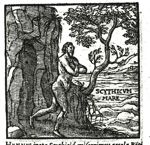
Omnia mea mecum porto: Alciatus, Emblemata (Leiden, 1591), emblem 37 quotes the comment
Omnia mea mecum porto: Rollenhagen, Nucleus emblematum (Arnhem, 1618), Cent. I, emblem 74 quotes the comment
Omnia mea mecum porto: Weigel, Gedankenmuster (Nürnberg, 1700), emblem 257 quotes the comment
Omnia mea mecum porto: Hulsius, Epitome Emblematum (Nürnberg, 1602), emblem 9 quotes the comment
Omnia mea mecum porto: Wither, A collection of emblems (London, 1635), emblem 74 quotes the comment
Iconclass: 41D29 clothed in rags 46A151 beggar 46A162(+0) exhibition of wealth (+ variant)
III iv 63 Hostis non hostis No enemy, but still an enemy
Απόλεμος πολέμιος. id est, Citra bellum hostis. Dicitur qui nulla lacessitus iniuria, tamen quae sunt hostium facit, aut qui pacis obtextu facit hostilia. Conveniet etiam in illos, qui prius quàm expostulaverint de iniuria cum amico, iam laedunt inimice.
'[greek], An enemy when there is no war. Said of someone who is not provoked by any injury but behaves like an enemy, or who commits hostilities under cover of peace. It will suit particularly those who, without discussing a complaint about an injury with a friend, immediately make an unfriendly attack.
Facsimile:
Iconclass: 33B5 enemy 51AA4:33B14 Nothingness, Absence❧threatening behaviour, challenging 56FF23 Enmity; 'Inimicitia', 'Inimicitia mortale' (Ripa)
Loci Communes: Ingratitudo (Ingratitude, Ingratitude)
III iv 64 Nephasti dies Unpropitious days
Αποφράδες ἡμέραι. id est, Nephasti dies. Olim vocabantur inauspicati, & quibus publica non licebat agere. Unde receptum, ut homines invisos ac detestandos, ἀποφράδες appellarent. Testis Lucianus in huius vocis calumniatorem. Apud Atticos huiusmodi dies erant septem, quibus inferiae peragebantur manibus, eoque habebantur inauspicati. Ad haec veterum superstitio sibi persuasit & lunae certos dies sinistri auspicii esse, veluti lunae senescentis, quartam, quintam & secundam, quos & ἀπεικάδας appellabant. Rursus dies in quibus rei capitis damnabantur, ἀποφράδας veluti funestos. Postremo dies insigni quapiam calamitate funesti, ἀποφράδες dicti sunt. Horatius, Ille & nephasto te posuit die. Horum dierum meminit Plato libro De legibus septimo, negans illos esse καθαροὺς, id est puros, sed ἀποφράδας appellat ut funestos & sepeliendis mortuis sacros. Ea vox deinde translata est ad homines execrandos, & abominandae maliciae, teste versiculo, Ανθρωπος ἀποφρὰς, καὶ βλέπων ἀπιστίαν. id est, Homo nephastus, & ore perfidum tuens. Eadem est autem Graecae vocis etymologia quae Latinae παρὰ τὸ φράζω. Huiusmodi fermè Suidas, Hesychius, & Etymologicus. Quin & homines detestandos sacros dicimus, ut Horatius, Sacer intestabilis esto. Verg. etiam ad animi rem transtulit, Auri sacra fames.
'[greek], Unpropitious days. These used to be called 'days without auspices,' on which no public business could be done. Hence the habit of calling people who were hated and deserved to be abominated [greek]. Lucian is witness to this in his essay against the mistaken critic on the topic of [greek]. Among the Athenians there were seven such days, on which sacrifices were made to the shades of the dead, and which were held for that reason to be inauspicious. Further, the superstition of the ancients led them to believe that certain days of the lunar cycle were of sinister omen, such as the fourth, the fifth and the second of the waning moon, which they also called [greek]. And again, days on which people were condemned to loss of civil rights were [greek]. Finally the days on which some exceptional calamity was mourned were said to be [greek]. Horace says: "The man who planted you did it on an ill-omened day.' Plato recalls these days in book 7 of the Laws when he says that they are not [greek] 'pure,' but calls them [greek], being days of mourning and sacred to the burial of the dead. The term was then used figuratively of men who were to be cursed, men of abominable evil, as this verse shows: 'A man ill-starred, and looking malice from his eyes.' The etymology of the Greek word is the same as the Latin, from [greek]. Suidas, Hesychius and the Etymologist all explain it more or less in this way. Further, we say that contemptible men are sacri 'accursed,' as Horace does: 'The accursed shall be disqualified from giving evidence.' Virgil even uses it figuratively of a mental state: 'The accursed hunger for gold.'
Facsimile: 
Auri sacra fames: De Bry, Proscenium Vitae Humanae (Frankfurt, 1627), emblem 9 quotes the comment
Iconclass: 23R1:52E22 day of 24 hours, natural day❧Bad Omen; 'Augurio cattivo' (Ripa) 57AA7 Malevolence, Maliciousness; 'Malevolenza', 'Malignità', 'Malvagità' (Ripa)
Loci Communes: Execrandi (Cursing, Maudire); Infortunii sive exitii (Misfortune or ruin, Malheur ou ruine)
III iv 65 Anus cothonissat The old woman is in her cups
Γρᾶες κωθωνιζομεναι Anus eothonizantes. De vetulis indecore lascivientibus. κώθων enim temulentum significat: inde fictum verbum κωθωνίζειν. Athenaeus libro undecimo variis auctoribus cothonem esse ostendit poculi genus, unde dicatur κωθωνίζεσθαι, pro inebriari, & κωθωνισμὸς ipsa temulentia. Et Hesychius admonet, Graecis hominem tumulentum appellari cothonem, quemadmodum Latini lagenam vocant aut utrem. Horatius in Odis, in anum uxorem pauperis Ibyci: Te lanae prope nobilem Tonsae Lucertam, non citharae decent, Nec flos purpureus rosae, Nec poti vetulam faece tenus cadi. De anu saltante dictum est alias.
[greek], Old women in their cups. Said of old women who are being indecently wanton. For [greek] means 'drunk'; from this is formed the verb [greek]. In book 11, Athenaeus shows that in several authors cothon is a type of cup; thence may be derived [greek], for 'to get drunk,' and [greek], the state of drunkenness. Hesychius informs us that the Greeks called a drunken man a cothon, just as the Romans say lagena 'a flagon' or uter 'a wineskin.' In the Odes, Horace says of the old woman who was the wife of the poor man Ibycus:
Wool shorn near noble Luceria
Is fit for you, not the music of a cithara,
Nor the purple flower of the rose,
And not for you, old woman, wine jars drained to the dregs.
An old woman dancing has been described elsewhere.
Facsimile:
Iconclass: 31D17:31B521 old woman❧drunkard
Loci Communes: Absurda, indecora, seu praepostera (Absurd, unbecoming, or preposterous things, Choses absurdes, inconvenantes ou déplacées)
III iv 66 Anus hircum olet The old woman smells like a goat
Γραῦς ἀναθυᾷ. i. Anus hircum redolet. De vetula libidinante, propterea quod alarum ac reliquarum partium odor excitatur ad libidinem incensis. Horatius in anum huiusmodi: Nanque sagacius unus odoror Polypus an gravis hirsutis cubet hircus in alis, Quàm canis acer, ubi lateat sus.
[greek], The old woman smells like a goat. Said of an old woman who is indulging in debauchery, because armpits and other parts smell strongly in those aroused to lust. Horace speaks of the old woman thus:
For I can smell out for myself whether a polyp
Or a great goat lies in your hairy armpits more shrewdly
Than a keen-nosed hound can smell where a sow is hidden.
Facsimile:
Iconclass: 31AA332:47I214 disagreeable, repellent smell - AA - female human figure❧goat 31D17 old woman 57AA51 Licentiousness, Lasciviousness; 'Lascivia', 'Licenza' (Ripa)
Loci Communes: Intemperantia, libido (Intemperance, lust, Intempérance, désir)
III iv 67 Nudo capite Barefaced
Γυμνῇ κεφαλῇ, id est, Nudo capite facere quaepiam dicuntur, qui palam, ac citra pudorem omnem faciunt. Qui rem pudendam faciebant, iis mos erat centombus caput operire. Plautus in Captivi duo: Ipsi de foro tam aperto capite ad lenones eunt, quam in tribu aperto capite fontes condemnant reos. Neque refert utrum hic aperto, an operto legas per ironiam: nam sensus idem utriusque lectionis. Usus est hoc proverbii titulo & Cyrillus, interpretans Ioannis Euangelium, et divus Chrysostomus in Encomio Babylae marryris. Tegit et Socrates faciem apud Plaronem in Phaedro dicturus vituperationem amoris.
Γυμνῇ κεφαλῇ, Barefaced. People are said to do things barefaced when they do them openly and without any sense of shame. Those who did something shameful were customarily made to cover their heads with rags. Plautus in the Two Captives: 'These men go from the forum to the pimps barefaced, with their heads uncovered just as they do in court when they pronounce the accused guilty.' And it does not matter whether you read aperto 'uncovered' here or, ironically, operto 'covered,' for the two readings come to the same thing. Cyril used this proverbial tag too, in his commentary on the Gospel of John, and St Chrysostom in his Praise of Babyla the martyr. And in Plato's Phaedrus, Socrates covers his face when he is about to pronounce his invective on love.
Facsimile:
Iconclass: 31A2211 face 51AA4:41D2211 Nothingness, Absence❧veil 57AA4 Shamelessness
Loci Communes: Impudentia (Shamelessness, Impudence)
III iv 68 In re mala, animo si bono utare, adjuvat In an evil pass it helps if you face it with courage
Meretur omnino Plautinus ille senarius ex Captivis duobus, ut inter adagia recenseatur:In re mala, animo si bono utare, adiuvat. Fortiter ferendo vincitur malum, quod evitari non potest. Eandem sententiam paulo se cus explicat in Pseudolo:Bonus animus in re mala dimidium est mali.
This verse from Plautus' Two Captives certainly deserves to be counted as an adage: 'In an evil pass it helps if you face it with courage.' Evil that cannot be avoided is defeated by bearing it with courage. He expresses the same sentiment slightly differently in the Pseudolus: 'Courage in an evil pass halves the evil.'
Facsimile:
Iconclass: 54A8 Courage, Bravery, Valiance, Manliness; 'Ardire magnanimo et generoso', 'Gagliardezza', 'Valore', 'Virtù heroica', 'Virtù dell'animo e del corpo' (Ripa) 54EE11:54DD51 Opposition, Counteraction, Resistance❧Danger; 'Pericolo' (Ripa)
Loci Communes: Aequanimitas (Equanimity, Équanimité)
III iv 69 Mulieris oculus A woman's eye
Γυναικὸς ὄμμα τοῖς ἀκμάζουσιν βέλος. id est, Mulieris oculus spiculum iuvenibus est. Et Virgilius: Uritque videndo Foemina. Idem: Ut vidi, ut perii, ut me malus abstulit error. Illud alias recensuimus, ἐκ τοῦ ὁρᾶν γίγνεται τὸ ἐρᾶν, id est, Ex aspectu nascitur amor.
Γυναικὸς ὄμμα τοῖς ἀκμάζουσιν βέλος, A woman's eye is an arrow to youth in its prime. Virgil says: 'The sight of the female sets him on fire.' And the same author: 'I saw, I was lost, the wild delusion seized me!' We have recorded elsewhere this other one: 'Love is born of a look.'
Facsimile:

Me malus abstulit error: Camerarius, Symbolorum et Emblematum Centuria(e) (Nürnberg, 1590, 1595, 1596, 1604), emblem 321 quotes the comment
Iconclass: 31A2212:45C15(ARROW) eyes❧archer's weapons: arrow 54DD51:31A31 Danger; 'Pericolo' (Ripa)❧sight, looking (one of the five senses) 33C211 love at first sight
III iv 70 Decempes umbra The ten-foot shadow
Δεκάπους σκιὰ ἐστὶ, id est, Decempes umbra est, id est, cenandi tempus. Veteres umbris notabant horas diei. Lucianus in Gallo: Συνεχὲς ἐπισκοπῶν ὁποσαποῦν τὸ στιχοῖον εἴη. i. Assidue observans quot pedes haberet linea. Olim qui vocabant ad cenam, designabant ad quam umbram solarii vellent adesse convivas. Itidem qui vocabantur ne venirent ante tempus, rogabant, ad quotam lineam esset veniendum. Porro umbra decem pedum erat gratissima parasitis, cenae spem faciens, quemadmodum et fumus largior exiliens e culina. Huius adagii usum nullum videmus, nisi si quis significare volens hominem vehementer edacem, dicat illi magnopere placere umbram decempedem. Aut nihil agere quempiam nisi observare umbram decempedem: quomodo utitur Aristophanes in Contionatricibus: Σοὶ δὲ μελήσιε Οταν ἢ δεκάπουν τὸ στιχοῖον Λιπαρῶς χαρεῖν ἐπὶ δεῖπνον. id est,Verum hoc fuerit tibi curae, Ubi facta sit umbra decempes, Ad lautam accurrere cenam. Ammianus li. 23. tradit, apud Persas nullam horam praescriptam sumendi cibum praetet quam regibus, sed suum cuique ventrem solarium esse, et apud Plautum, si satis commeminimus, para situs quispiam destomachatur in eos, qui horologiorum usum commenti sunt, cum venter sit optimum horologium. Adagium refertur a Suida.
Δεκάπους σκιὰ ἐστὶ, There is a ten-foot shadow, or 'It's time for dinner.' The ancients reckoned the time of day by the length of the shadow. Lucian in the Cockerel says: 'Observing carefully how many feet long the shadow was.' Formerly those who issued invitations to a meal specified the shadow-length on the sundial at which they wanted the guests to arrive. Likewise those who were invited, to avoid coming too early, asked 'at what mark' people were supposed to come. Moreover the ten-foot shadow was the one most welcome to parasites, creating the hope of a meal, like the abundant smoke spreading from the kitchen. I can see no use for this adage, unless someone wanting to indicate that a man was excessively greedy should say that he particularly likes the ten-foot shadow, or that someone does nothing but watch for the ten-foot shadow, as Aristophanes uses it in the Women in Parliament:
But this would be your concern
When the shadow reached the ten-foot line
To hasten to your rich evening meal.
In book 23 Ammianus reports that among the Persians there was no fixed time for taking food, except for the kings, but that everyone's belly was his own sundial. And in Plautus, if I remember correctly, a certain parasite vents his spleen at those who invented the clock, when the stomach is the best clock. The adage is recorded by Suidas.
Facsimile: 
Iconclass: 23U21(+0) sundial (+ variant) 41C43:23 evening meal, dinner, supper❧time 49D11(10):31A2255:22C81 numerals: 10❧foot❧shadow of an object
Loci Communes: Luxus et mollicies (Luxury and softness, Luxe et mollesse)
III iv 71 Altera navigatio The next best way to sail
Δεύτερος πλοῦς. i. Secundarius cursus vocabatur, cum vento destituti, remis navim impellerent. Nam ὁ ἐξ οὐρίας πλοῦς πρῶτος. i. Cum secundis ventis navigaretur, ea prima navigatio dicebatur, autore Pausania, quem citat Eustathius in secundum Odysseae librum, quo loco proverbii quoque mentionem facit. Aristoteles li. Moralium Nicomachiorum 2. ἐπεὶ οὖν τοῦ μέτρου τυχᾶν ἄκρως χαλεπὸν, κατα τὸ δεύτερόν φασι πλοῦν, τὰ ἐλάχιστα ληπτέον τῶν κακῶν. i. Quando igitur medium exacte consequi difficile est, iuxta secundum, ut aiunt, cursum, minima malorum sumenda sunt. Philosophus sentit virtutem in medio esse sitam. At id quoniam interdum difficile est assequi, monet ut quàm levissime aberremus. Huc pertinet illud Aristophanis in Concionatricibus, Νῦν μὲν γὰρ οὔτε θέομεν, οὔτε ἐλαύνομεν. id est, Nam nunc nec aura impellimur nec remige. Interpres admonet nautas quum vento destituuntur, ad remos confugere. Convenit, ubi quoties quae potissima fuerant, non continguunt, ad proxima confugitur auxilia. Cognatum est illi quod alibi retulimus, δευτέρων φροντίδων ἀμεινόνων. Usurpavit hoc Ioannes Chrysostomus homilia in Matthaeum prima, Επειδὴ δὲ ταύτην διεκρουσάμεθα τὴν χάριν, φέρε κ᾽ ἄν τὸ διεύτερον ἀσπασώμεθα πλοῦν. i. Posteaquam vero ab hac gratia sumus excussi, age vel secundum amplectamur cursum. Atque hic statim in ipso, quod aiunt, portu impegit interpres Anianus, sic enim hunc locum reddidit: Quia vero hanc à nobis excussimus gratiam, vel secundas divitias expetamus: etiam si in vulgatis per typosgraphos exemplaribus pro excussimus, vobis esse nautas imitandos, qui quum recto cursu non possunt eò pervenire quò volunt, tamen vel remigio, vel oblique navigatione conantur eodem pertendere. Fefellit autem interpretem proverbii ignoratio, & ideo ex πλοῦν fecit πλοῦτον. Haec indico non ut traducam Anianum, cuius industriae debent studiosi, sed ut errorem tollam. Extat Naumachii, Christiani ut suspicor poetae, carmen quo primum hortatur ad virginitatem, matrimonium appellans secundarium cursum. Εἰ δὲ σε καὶ κοινοῖο πόθος βίοτοιο κιχάνοι, Καὶ τοῦτο προδαεὶς ἐρέω πῶς χρή σε περᾶσαι Τὸν πλοῦν ὥς φασιν, τὸ δεύτερον εὔφρονι θυμῷ. id est, Quod si te vulgaris amor vitae tenet, addam Hoc quo uti didici, quo pacto cursus ut aiunt, Hic alter tibi sit peragendus mente sagaci. Allusit huc Cicero in Oratore ad Brutum, Quod si quem aut natura sua, aut illa praestantis ingenii vis forte deficiet, aut minus instructus erit magnarum artium disciplinis, teneat tamen eum cursum quem poterit. Prima enim sequentem, honestum est in secundis tertiisque consistere. Summam celeritatem significans utrunque coniunxit Philippica prima: Tum vero sum tanta cupiditate incensus ad reditum, ut mihi nulli neque remi, neque venti satisfacerent.
Δεύτερος πλοῦς, The next best way to sail. This is what they said when the wind failed and they drove the ship with the oars. For, according to Pausanias, there is a saying 'When you can go with following winds, that is the best way'; he is quoted by Eustathius in his commentary on the Odyssey book 2, where he also mentions the proverb. Aristotle says in book 2 of the Nicomachean Ethics: 'And so when it is difficult to follow the middle path exactly, you will incur the least trouble along the next best way, as they say.' The Philosopher holds that virtue is located in the middle path, but advises us, since this is sometimes difficult to achieve, to move away from it as little as possible. Aristophanes' remark in the Women in Parliament is pertinent here: 'For now we are not driven either by wind or by oar.' The scholiast tells us that sailors resort to oars when they are forsaken by the wind. It is appropriate that, whenever the means which would be most effective are not to hand, we should resort to the nearest means of help. There is a related proverb, which we have recorded elsewhere: 'Second thoughts are better.' John Chrysostom used this in his first homily on Matthew: 'But after we have cast out this state of grace, let us embrace the next best way.' And here the translator Anianus was immediately shipwrecked, as they say, in the harbour itself, when he translated this passage thus: 'But because we drove away this grace from ourselves, let us wish at least for favourable prosperity' - even if, in the copies published by the printers, excusamus is found for excussimus, and expectamus for expetamus. Chrysostom is maintaining at this point that the first and best choice is not to make use of scripture, but that, having fallen from what was best, we should follow the example of sailors, who, when they cannot reach the point they want by a straight course, try nevertheless to continue in that direction either by rowing or by tacking. But ignorance of the proverb led the translator astray, and so for [greek] 'way,' 'course,' he read [greek] 'wealth.' I indicate these points not to expose Anianus, to whose work scholars are indebted, but in order to remove an error. There is extant a poem by Naumachius, a Christian poet I suspect, in which he commends virginity first, and calls marriage the next best way:
But if the common love of life holds you, let me add
What I have learned to practise, how you should
Prudently pursue, as they say, this other way.
Cicero alludes to this in the Perfect Orator. 'But if perhaps someone lacks physical endowment, or outstanding intellectual ability, or if he is less well instructed in cultural studies, let him nevertheless follow the path that he can. For one who is striving for the first place it is no disgrace to stop with the second or third alternatives.' When he wanted an expression for 'maximum speed,' he put the two together in the first Philippic: 'But at that moment I was inflamed with such desire to return that no oars nor any winds could satisfy me.'
Facsimile:
Iconclass: 26C9 absence of wind, calm 46C2323 oaring, sculling 46C24(+31) sailing-ship, sailing-boat (+ propulsion of vehicle, ship, etc. by human power)
Loci Communes: Festinationis (Haste, Hâte); Proximis utendum (One must make use of one's neighbors, Il faut se servir de son prochain)
III iv 72 Diagoras Melius Diagoras of Melos
Διαγόρας ὁ μήλιος. i. Diagoras Melius. In sceleratum ac foedifragum & impium. Hic capta Melo vixit, et Atheniensium sacrorum mysteria usque adeo contempsit, ut complures averterit a religione, dercrrueritque ne iam vellent initiari. Praeterea arcana illa mysteria, quae nefas est profanis edere, ille impius in vulgus ex tulit mod8s omnibus irridens. Quas ob res ab Atheniensibus proscriptus est, eamque proscriptionem palam in aerea columna posuerunt, addito praemii loco talento, si quis hominem occidisset, si quis vivum adduxisset, duobus. Meminit huius Aristophanes in Avibus, Ην ἀποκτείνῃ τὶς ὑμῶν διαγόραν τὸν μήλιον, Λαμβάνειν τάλαντον, ἤν τε τῶν τυράννων τίς τινα Τῶν τεθνηκότων ἀποκτείνῃ. id est, Si quis e vobis Diagoram Melium interfecerit, Praemptum seret talentum, sique quis quem e mortuis Interemerit tyrannis,
Διαγόρας ὁ μήλιος, Diagoras of Melos. A name for the wicked, perfidious, and impious. After the capture of Melos, this man lived in Athens and expressed such contempt for the rites of Athenian sacred observances that he turned many against religion and discouraged them from wanting to be initiated. Worse than this, in his impiety he divulged publicly the occult mysteries that it is sacrilegious to reveal to the uninitiated, mocking them in all sorts of ways. For these acts he was proscribed by the Athenians, who posted the proscription in public on a bronze column, a talent being offered in addition as a reward if anyone killed the man, two talents if anyone brought him back alive. Aristophanes recalls this in the Birds:
If any one of you should kill Diagoras the Melian,
He will carry off a reward of one talent - so too anyone
Who does away with one of the dead tyrants.
Facsimile:
Iconclass: 33B11:12E mocking, insulting; teasing❧Greek religion (including Minoan and Mycenaean culture) 57AA62 Infidelity, Perfidy; 'Perfidia' (Ripa) 98B(DIAGORAS MELIUS) male persons from classical history (DIAGORAS MELIUS)
Loci Communes: Improbi (The dishonest, Les malhonnêtes)
III iv 73 Sedecim pedibus superavit He was the best by sixteen feet
Haudquaquam alienum est a proverbiali figura, quod in Pericle scripsit Aristides, nempe Periclem oratorem reliquos in dicendo sexdecim praeterisse pedibus, λέγων, inquit, ὡς ἑκκαιδεκα μὲν ποδῶν ἔρει τοῦς ῥητορας ἐν τοῖς λόγοις, μόνου δὲ πειθώτις ἐπεκάθιζειν ἐν τοῖς χείλεσι, πάντα δὲ εἶναι φλυαρίαν πρὸς ἐκεῖνον i. Dicens illum sexdecim pedibus vicisse Rhetores dicendo, atque in unius illius labiis insedisse suadelam quandam. Cetera vero omnia nugas prae hoc fuisse. Itaque sexdecim pedibus pro maximo intervallo dixit. Sumpta metaphora a stadiis cursorum. Locus autem hic de Pericle est apud Eupolim comicum, in comoedia cui titulus: Δῆμοι Κράτιστος οὗτος ἐγένετ᾽ ἀνθρώπων λέγειν, Ο ποτε παρέλθει ὥσπερ οἱ ἀγαθοὶ δρομεῖς Εκκαίδεκα ποδῶν ᾖρε λέγων τοὺς ῥητορας. Ταχὺς λέγειν μὲν, πρὸς δὲ αὐτοῦ τῶν τάχυ, Πειθώτις ἐπεκάθιζεν ἐν τοῖς χείλεσιν. id est: Hic inter homines plurimum unus polluit Dicendo, quoties praeteribat, utt bonus Agilisque cursor, sexdecim spatio pedum Linquebat a se ceteros iam rhetores. Sermone celer erat, celeritati aderat huic Suadela quaedam illius insidens labris. Hos versus et Aristph. adducit in Acharnensibus ex Demis Eupolis adiunctis his duobus. Οὔτως ἐκήλει, καὶ μόνος τῶν ῥητόρων, Τὸ κέντρον ἐγκατέλιπε ποῖς ἀκρωμένοις. id est: Adeo movebat, atque solus rhetorum, Aculeum in animis liquit audientium. M. Tull. in Bruto: Quam deam, inquit, in Periclis labris scripsit Eupolis sessitavisse. Huius immodicam eloquentiam idem taxavit in eadem comoedia: Εντεῦθεν ὀργῇ περικλέης ὁ ὀλυμπιος Ηστραπτ᾽ ἐβρόντα, ξυνεκύκα τὴν ἑλλάδα. id est: Pericles at indignatus hinc Olympius. Tonat, coruscat, miscet omnem Graectam. Porro quod ad suadelam attinet id imitatus Ennius apud Ciceronem in Catone Maiore, M. Cethegum Suadae medullam dixit. Ab huius proverbii forma non discrepar illud Aristophanis: ἐκ τῶν νεφελῶν Τῶν ἑλλήνων εἶναι λέγειν ἑκατὸν σταδίοισιν άῤιστον.id est: Ut Graiorum dicat gentem stadiis praecedere centum: Lepidius etiam erit, si pro pedibus parasangas dixeris.
There is an expression in Aristides' Pericles that is nothing short of a proverbial figure - namely, that Pericles as an orator excelled everyone else by sixteen feet. He says: 'Saying this man had beaten the Rhetoricians in speaking by sixteen feet, and in his mouth alone dwelt this sort of persuasiveness; everything else was trifling beside this.' So 'sixteen feet' is an expression for 'the greatest distance.' The figure is derived from the race track, and indeed this passage about Pericles is to be found in Eupolis the comic writer, in a comedy entitled Demoi:
This man alone had the mastery by far among men
In rhetoric, outstripping them every time; like a good
And agile runner, sixteen feet of space
He left between himself and other orators.
He was fluent in speaking, and with this fluency
A certain persuasiveness dwelt naturally in his speech.
Aristophanes too alludes to these lines and the next two from Eupolis' Demoi in his Achamians:
He was so moving, and alone among rhetoricians
He left a deep impression in the minds of his hearers.
Cicero in his Brutus says Eupolis wrote that it was as if the goddess sat upon the lips of Pericles. Aristophanes reproached Pericles for excessive eloquence in the same comedy: 'But Olympian Pericles, indignant at this, / Thunders, shakes, stirs up the whole of Greece.' One more point in connection with suadela 'persuasiveness': Ennius, as reported by Cicero in his Elder Cato, repeated the remark that Marcus Cethegus was Suadae medulla 'the marrow, essence of Suadela.' The form of this proverb is not unlike Aristophanes' expression in the Clouds: T shall be said to surpass the men of Greece by a hundred miles.' The adage will sound even more witty if, instead of 'feet,' you say 'parasangs.'
Facsimile: 
Iconclass: 49D11(16):31A2255 numerals: 16❧foot
Loci Communes: Excellentia, inaequalitas (Excellence, inequality, Excellence, inégalité)
III iv 74 Saxum volutum non obducitur musco A rolling stone gathers no moss
Λίθος κυλινδόμενος τὸ φῦκος οὐ ποιεῖ. id est: Musco lapis volutus haud obducitur. Qui non potest eodem in loco consistere, raro sit, ut ditescat. Id totidem paene verbis etiam hodie dicunt. Simile illud Fabii: Planta, quae saepius transfertur, non coalescit.
[greek], A rolling stone gathers no moss. Someone who cannot stay in the same place rarely prospers. Even today it is still said in almost as many words. Very similar is that expression of Fabius: 'A plant often moved does not take root.'
Facsimile:
Iconclass: 25H1124:47C2433 boulder, stone❧rolling (industrial process) 51AA4:25G52 Nothingness, Absence❧mosses 54AA46 Unrest, Restlessness, Inquietude; 'Inquietudine' (Ripa)
Loci Communes: Assiduitas (Diligence, persistence, Assiduité)
III iv 75 Lityersam cantionem canis You are singing the Lityerses
Λίτερσαν ὠδὴν ᾄδεις, i. Lityersam cantionem canis. Lityerses notus erat Midae Regis. Hic cum ageret in Celaenis, exceptos eos, qui advenissent, compellebat, ut secum meterent, dein de praesectis capitibus, reliquum corpus manipulis involuebar. Idem instituit, ut in honorem Midae thericos, id est, aestivus, aut messorius hymnus caneretur, unde ductum proverbium, ut qui non ex animo canerent, aut qui coacti canerent, hi Lityersam cantionem canere dicerentur. Menander in Chalcedonio: Αδοντα λιτυέρσὴν ἀπ᾽ ἀρίστου τέως Meminit huius fabulae Iulius Pollux lib. De rerum vocabulis 4. capite περὶ ἀσμάτων ἐθνικῶν. Sed hoc novat, Lityersam loris caedere solitum, quos metendo vicisset, sed cum qliquando incidisset in messorem se robustiorem, ab eo trucidatum fuisse. Quosdam autem auctores esse, Herculis manu periisse. Proinde cantionem eam ad patris desiderium leniendum fuisse repertam. Lityersae meminit & Theocritus.
[greek], You are singing the Lityerses. Lityerses was a bastard son of king Midas who, when he was living in Celaenae and guests happened to arrive, forced them to reap corn with him, then cut off their heads and wrapped the rest of the body in the sheaves. This same man instituted the singing of a thericos, a summer or harvest song, in honour of Midas, from which we get the proverb that says, Those who do not sing willingly or are forced to sing, sing Lityerses' song. Menander in the Chalcedon: 'Singing the Lityerses from lunch on.' Julius Pollux recalls this legend in his Vocabulary book 4, in the chapter 'On national songs.' But he invented the idea that Lityerses used to strangle those whom he defeated in reaping duels, and that he was slain when he encountered a reaper stronger than himself. According to him too there are certain authors who say he died at the hands of Hercules, and therefore that this song was invented to assuage his father's grief. Lityerses is also mentioned by Theocritus.
Facsimile:
Iconclass: 31E23621 violent death by beheading 47I1111(+84) ears of corn (+ harvesting ~ agricultural processes) 57AA91 Cruelty, Ferocity; 'Crudeltà', 'Ferocità' (Ripa) 95A(LITYERSES) the Greek heroic legends (LITYERSES): heroes (LITYERSES)
Loci Communes: Tristitia, laetitia (Sadness, joy, Tristesse, joie)
III iv 76 Lydum in planiciem provocas You are calling a Lydian onto the plain
Λυδὸν εἰς πεδίον προσκαλεῖς, id est, Lydum in campum provocas. In eum competit, qui lacessit iamdudum ad id propensum, ac promptum. Notati sunt Lydi, quod ad bellum capessendum aequo propensiores essent. Herodotus lib. 1. docet Lydos aequitatu valuisse. Proinde Croesus optat Iones equitatu venire oppugnatum Lydos. Finitimum ei, quod alibi recensuimus, τὸν ἵππον εἰς πεδίον.
[greek], You are calling a Lydian onto the plain. Applicable to a man who provokes someone to something he has long been willing and ready for. The Lydians were particularly noted for their excessive willingness to engage in battle. Herodotus tells us in book 1 that the Lydians were superior in their horsemanship; accordingly Croesus wants the Ionians to attack the Lydians with cavalry. This is closely related to one we have described elsewhere: [greek] 'The horse to the plain.'
Facsimile: 
Iconclass: 25H16 plain 45H32(+22) charge ~ battle (+ cavalry, horsemen) 61D(LYDIA) geographical names of countries, regions, mountains, rivers, etc. (LYDIA) (LYDIA)
Loci Communes: Proclivitas (contra) (Propensity (against), Penchant (contre))
III iv 77 Sublata lucerna nihil interest inter mulieres When the lamp is removed there's no difference between women
Λύχνου ἀρθέντος γυνὴ πᾶσα ἡ αὐτή. id est, Lucerna sublata, nihil discriminis inter mulieres. Sentit Adagium nullam mulierem non esse impudicam, si detur facultas sine teste peccandi. Recenset Apostolius, & usurpatur à Plutarcho in Praeceptis connubialibus.
Λύχνου ἀρθέντος γυνὴ πᾶσα ἡ αὐτή, When the lamp is removed there's no difference between women. The adage implies there are no women who are not immodest if there is an opportunity for sin without a witness. It is recorded by Apostolius, and used by Plutarch in his 'Precepts on Marriage.'
III iv 78 Lysicrates alter A second Lysicrates
Λυσικράτης ἕτερος. i. Alter Lysicrates. Lysicrates quidam in vulgi fabulam abiit, quod capillos iam canos nigro tingeret, quo iuvenis etiamdum videretur. Cuiusmodi ridetur apud Martialem Ollus, comam tingens, cum barbam non posset.
Λυσικράτης ἕτερος, A second Lysicrates. A certain Lysicrates became a popular legend because he tinted his greying hair with black, so that he would seem still young. Ollus, in Martial, is mocked in this way, because he tints his hair when he cannot tint his beard.
III iv 79 Lysistrati divitias habes You have the wealth of Lysistratus
Λυσιστράτου πλοῦτον πλουτεῖς, id est, Lysistrati divitiis dives es, Proverbialis ironia de magnopere tenuibus. A Lysistrato quodam tractum, extremae paupertatis homine.
Λυσιστράτου πλοῦτον πλουτεῖς, You are rich with the riches of Lysistratus. A proverb used ironically about people who are exceedingly poor. It originates with some Lysistratus who was a man of extreme poverty.
III iv 80 Expecta bos aliquando herbam You can expect grass sometime, ox
Μένε βοῦς ποτὲ βοτάνην, id est, Expecta bos olim herbam. Dicendum ubi quid sero contingit. Laborat enim bos in agricolando, sed aliquando gustatura herbam enatam. Finitimum illi, Et adhuc tua messis in herba est.
Μένε βοῦς ποτὲ βοτάνην, Expect grass sometime, ox. To be said when something comes late. For the ox labours in the field, but in the hope of tasting fresh grass sometime. Very closely related to: 'And your harvest is still in the green.'
Facsimile:
Iconclass: 25H17 meadow, pasture 47I21111 ox 51FF52:56D1 Lateness❧Hope; 'Speranza', 'Speranza delle fatiche' (Ripa) 51MM11 Slowness, Tardiness; 'Tardità' (Ripa) 52B3 Expectation 54B1211 Waiting for an Opportunity
Loci Communes: Tarditatis et cunctationis (Slowness and delay, Lenteur et retard)
III iv 81 Expecta anus Old woman, wait
Μένε γραῦ, ἐμον σε παῖδα φιλήσοντα, id est, Exspecta anus meum filium, te suaviaturum. Nam priusquam adolescat puer, illa decesserit. Confine superiori, cum sera spes ostenditur.
Μένε γραῦ, ἐμον σε παῖδα φιλήσοντα, Old woman, wait for my son who will love you. For before the boy grows up, she will have died. Related to the preceding one, when hope comes late.
Facsimile:
Iconclass: 31D11221 boy (child between toddler and youth) 31D17 old woman 51FF52:56D1 Lateness❧Hope; 'Speranza', 'Speranza delle fatiche' (Ripa) 54B1211 Waiting for an Opportunity
Loci Communes: Tarditatis et cunctationis (Slowness and delay, Lenteur et retard)
III iv 82 Magnus versator in re pusilla A big mover in a little affair
Μέγας κύληκτὴς ἐν μικρῷ γε πράγματι. id est, Versator ingens in negocio levi. Nam addita coniunctiuncula constabit versus. Quadrat in eos, qui arte parum honesta sibu divitias parant. Natum ab Eudamidae apophthegmate. Is erat Archidami filius, frater Agidis. Quum musicus quidam feliciter videretur cecinisse, quispiam ex iis qui aderant, rogabat Eudamidam, quid de eo sentiret, respondit, μέγας κηληκτὰς ἐν μικρῷ πράγματι. i. Magnus delinitor in re parva, quod existimaret operosam esse scientiam sed nihil adferentem utilitatis. Recensetur à paroemiographis. Refertur & a Plutarcho in Laconicis, nisi quod illic legitur, κηληκτὴς, quod oratorum sit delinere, ac movere affectus. Huic non dissimile est quod Musonius ait apud Aulum Gellium, li. 5, ca. 1. in eos qui modulatu vocum ac lenociniis verborum excitant inanem applausum auditorum, Scito, inquit, illic non philosophum loqui, sed tibicinem canere.
[greek], A mighty mover in a trifling business (for with the addition of the particle the Greek verse will scan). This is appropriate to use against those who acquire wealth for themselves by less than honest means. It derives from a saying of Eudamidas; he was the son of Archidamus and brother of Agis. When a certain musician appeared to have sung well, someone among those present asked Eudamidas what he thought of it and he replied: [greek] 'He's a big charmer in a small affair' - because he reckoned his knowledge of the art was thorough but produced nothing useful. The story is recorded by the paroemiographers, and related by Plutarch in his 'Sayings of Spartans,' except that in the latter we read [greek], because this is the orators' power to charm and move. Not unlike this is what Musonius says in Aulus Gellius book 5 chapter 1 of those who, by the modulation of their voice and the meretricious charm of words excite the fatuous applause of their hearers: 'Know,' he says, 'that it's not a philosopher speaking but a flute player piping.'
Facsimile:
Iconclass: 48C75(+54) making music; musician with instrument (+ competitions, contests ~ arts) 54BB5 Unimportance 57AA613 Cunning, Slyness; 'Astutia ingannevole' (Ripa) 57AA621 Cheat, Deceit; 'Fraude', 'Inganno' (Ripa)
Loci Communes: Inconstantiae, perfidiae, versutiae (Inconstancy, treachery, cunning, Inconstance, perfidie, ruse)
III iv 83 Surdaster cum surdastro litigabat Hard-of-hearing versus Nearly deaf
Δύσκωφος δυσκώφῳ ἐκρίνετο, ὁ δὲ κριτὴς κωφότερος.. i. Surdaster cum surdastro litigabat: Iudex autem erat utroque surdior. Cum res agitur inter undequaque ridiculos ac stultos. Extat in hanc sententiam epigramma Graecum Nicarchi, Δύσκωφῳ δύσκωφος ἔκρινετο, καὶ πολὺ μᾶλλον Ην ὁ κριτὴς τούτων τῶν δύο κωφότερος. Ων ὁ μὲν ἀντέλεγεν, τὸ ἐνοίκιον αὐτὸν ὀφείλειν Μηνῶν πενθ᾽, ὁ δ᾽ ἔφη, νυκτὸς ἀληλεκέναι Εμβλέψας δ᾽ αὐτοῖς ὁ κριτὴς λέγει. ἐς τί μάχεσθι; Μητὴρ ἐσθ᾽ ὑμῖν; ἀμφότεροι τρέφετε. Id Thomas Morus olim adolescens, scite vertit hunc in modum: Lis agitur, surdusque reus, surdus fuit actor, Ipse tamen iudex, surdus utroque maegis. Pro aedibus hic petit aes, quinto iam mense peracto. Ille refert, tota nocte mihi acta mola est. Aspicit hos iudex, et quid contenditis? inquit, An non utrique est mater? utrique alite.
[greek], A nearly deaf man had a case against another equally deaf, but the judge was deafer than both - used when there is a dispute between people in every way ridiculous and stupid. There survives a Greek epigram of Nicarchus on this maxim, which Thomas More, in his youth, translated cleverly thus:
The case is on, the defendant was deaf and the plaintiff was deaf,
But the judge himself was more deaf than both.
The plaintiff demands the rent for the house, these five months past;
The defendant claims 'All night my mill-stone has been grinding.'
The judge looks at them and asks 'Why are you disputing?
Is she not the mother of both of you? Look after her both of you.'
Facsimile:
Iconclass: 44G13:31A412 magistracy, judges❧deaf, deafness 44G41 litigation, legal proceedings, lawsuit 46A54 communication with the deaf or dumb 51B2 Similarity, Likeness 52AA511 Ridiculousness
Loci Communes: Similitudinis et congruentiae (Similarity and congruence, Similitude et convenance)
III iv 84 Docui te urinandi artem I taught you how to dive
Εδίδαξάσε κυβιστᾶν, καὶ σὺ βυθίσαι με ζητεῖς. i. Docui te urinandi artem, & tu me vis demergere. In eos quadrat, qui benefacta malefactis retaliant, & beneficium acceptum in eius ipsius vertunt perniciem, a qo acceperunt. Sapit fecem.
'[greek], I taught you to dive and you try to drown me. Applicable to those who pay back good deeds with bad, and turn a benefit received into harm for the very one from whom they received it. It smacks of the dregs.
Facsimile: 
Iconclass: 31A2775 diving (movement in water) 31E23111 drowning, ’walking the plank' 57AA8 Ingratitude; 'Ingratitudine' (Ripa)
Loci Communes: Malum accersitum aut retortum (Evil brought upon oneself or turned back, Mal attiré ou retourné)
III iv 85 Pro eleganti medico malus poeta Instead of an exclusive physician, a bad poet
Αντὶ χαρίεντοις ἰατροῦ, κακὸς ποιητὴς καλεῖσθαι ἐπιθυμεῖς. i. Pro venusto medico malus poeta dici cupis. In eum dici solitum, qui non contentus artis suae professione, in qua locum mediocrem obtinebat, pergit aliena profiteri, in quibus non perinde sit exercitatus, nec parem proinde gloriam reportaturus. Periander quispiam non incelebri fama medicus, et eius artis vel cum primis doctus, ad poetices studium deflexit, & ineptos quosdam versiculos scribere coepit. Hinc vulgaris iocus increbuit. Plutarchus in Apophthegmatis Laconicis tribuit hoc dictum Archidamo Agesilai filio.
Ἀντὶ χαρίεντοις ἰατροῦ, κακὸς ποιητὴς καλεῖσθαι ἐπιθυμεῖς, Instead of a fashionable physician, you want to be called a bad poet. Customarily said of one who, not content with the skills of his own profession in which he had a moderate standing, persists in making a profession of other matters in which he is not so practised and therefore not likely to win an equal reputation. A certain Periander, a physician of wide reputation and as learned as the best in this art, turned his attention to poetry and began to write some inept verse. From this a popular joke became a proverb. In his 'Sayings of Spartans' Plutarch attributed this saying to Archidamus son of Agesilaus.
Facsimile:
Iconclass: 51E2:49G1 Superiority❧physician, doctor 54AA34:48C911 Mediocrity❧author, poet writing 56BB3 Dissatisfaction
Loci Communes: Mutati instituti (A changed custom, Une coutume changée)
III iv 86 A remo ad tribunal From the oar to the bench
Απὸ κώπης ἐς τὸ βῆμα. i. A remo ad tribunal. Dici solitum, ubi quis repente ab infima conditione provehitur ad honesti muneris administrationem. Id quod haud scio an ulli contigerit felicius quam Iulio secundo. Nam fama est hunc iuvenem ad stipem scalmum remo subigere solitum, & tamen à remulco non solum ad tribunal, verum etiam ad summum illud rerum humanarum culmen evectus est. Nec contentus hoc fastigio, pontificiae ditionis pomeria multum protulit: longius etiam producturus, si per mortis inclementiam vitam illi producere licuisset. Taxat Demadem oratorem Syrianus Hermogenis interpres, qui citra cognitionem artis, statim ad agendas causas irruperit, ἀπο τῆς κώπης ἀνίπτοις τὸ τοῦ λόγου χερσιν ἐπὶ τὸ βῆμα πηδήσας. i. Qui illotis, ut aiunt, manibus à remo ad tribunal irruit.
Ἀπὸ κώπης ἐς τὸ βῆμα, From a galley oar to the magistrate's bench. Usually said when someone rises suddenly from the lowest condition to holding an honourable office. I don't think this could be applied to anyone more aptly than to Julius II. For tradition has it that as a youth this man used to row a boat to earn a penny, and yet he was raised from the tow-rope not only to the bench but to the highest summit of mortal affairs. And not content with this summit he expanded greatly the bounds of papal authority, and would have extended them still further if unmerciful death had allowed him to extend his life. Syrianus the commentator of Hermogenes reproaches Demades the orator because, without any knowledge of the art, he rushed into pleading cases: 'He dashes, "With unwashed hands," as they say, from the oar to the bench.'
Facsimile:
Iconclass: 11P3111:61B2(JULIUS II [pope]) pope❧historical person (JULIUS II [pope]) 44G13 magistracy, judges 46C23221 trireme, galley 54F121 Turn of Fate, Wheel of Fortune 59B2 Advancement, Promotion
Loci Communes: Fortunae commutatio (Change of fortune, Changement de fortune)
III iv 87 In coelum expuis You are spitting against heaven
Ες οὐρανὸν πτύεις, id est, In caelum expuis, id est, facis quod in tuum ipsius recidat caput. Aut obloqueris his, qui facile possint laedere. Siquidem qui in caelum expuit, primum videtur caelites ipsos adficere contumelia: deinde fit saepius, ut sputum in ipsius faciem recidat. Confine illi: πρὸς κέντρα λακτίζειν i. Adversus stimulum calcitrare.
'[greek], You are spitting at the sky. That is, what you are doing may fall back on your own head. Or, you are speaking against those who can easily harm you. Because anyone who spits against heaven seems in the first place to be showing contempt for the gods themselves; then it happens most often that the spit falls back in his own face. It is quite similar to [greek] 'To kick against the goad.'
Facsimile:
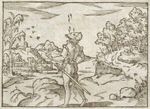
Cernis ut hic caelum foedo: de Bèze, Icones (Genève, 1580), emblem XXVI paraphrases the adage
Iconclass: 31A65(+63):24 spitting (+ upward)❧the heavens (celestial bodies) 58AA12 Self-destruction
Loci Communes: Malum accersitum aut retortum (Evil brought upon oneself or turned back, Mal attiré ou retourné)
III iv 88 Unus deus et plures amici One God and many friends
Εἶς θεὸς καὶ πολλοὶ φίλοι, id est, Unus Deus, et plures amici. Proverbium admonet quam plurimos esse parandos amicos, quod hi secundum Deum plurimum opitulari possint. Quamquam Hesiodo non probatur πολυφιλία, neque rursum ἀξενία. Opinor & hoc à vulgo mutuo sumptum, non ex autoribus.
[greek], One God and many friends. A proverb that counsels providing oneself with as many friends as possible, because they can be the greatest help after God. Hesiod, however, did not approve of multiplicity of friends or, on the other hand, of inhospitality. I suppose this one too is borrowed from common speech, not from writers.
III iv 89 Si caseum haberem, non desiderarem opsonium If I had cheese, I wouldn't want meat
Εἰ τυρὸν εἶχον, οὐκ ἂν ἐδεόμην ὄψου, id est, Si caseum haberem, non egerem obsonio. Dicendum, ubi quis minimis vilissimisque contentus est. Refertur apud Plutarchum in Laconicis, cum Lacon quispiam cauponi dedisset parandum obsonium, atque is peteret caseum et oleum, quibus illud condiret, Non opus, inquit Lacon, fuisset mihi obsonio, si caseum habuissem. Si quis pro caseo malit hoc loco butyrum, cum eo non pugnabimus: videtur enim butyrum magis congruere oleo.
[greek], If I had cheese, I wouldn't need meat. To be said when someone is content with the least and meanest things. There is a story in Plutarch's 'Sayings of Spartans,' that when a certain Lacedemonian gave an innkeeper some meat to cook and the latter asked for cheese and oil to flavour it, the Lacedemonian said, 'There would be no need for meat if I had cheese.' If anyone prefers butyrum 'butter' in this passage instead of caseum 'cheese,' I shall not dispute with him; for it seems 'butter' is more consistent with 'oil,' even if, with the Italians, even the driest cheese is a condiment.
III iv 90 In antrum haud legitimum stimulum impingis To push the goad into an unlawful hole
Εἰς τριμαλιὴν οὐχ ὁσίλην τὸ κέντρον ὠθεῖς, id est, In foramen haud licitu, stimulum trudis. Dicterium Sotadis in Philadelphum, qui sororem Arsinoen exemplo Iovis uxorem duxerat, quo quidem dicto offensus rex, capitis supplicium sumpsit de eo, qui dixerat. Meminit Plutarchus in libello, De liberis educandis.
[greek], You are sticking the goad into an illicit hole. A sarcasm of Sotades against Philadelphus, who, following the example of Jove, married his sister Arsinoe. The king took offence at this remark and inflicted capital punishment on the author. Plutarch recalls this in his treatise 'On the Education of Children.'
Facsimile:
Iconclass: 42D2 (civil) marriage ceremonies 57BB3:42G29 Accusation, Incrimination❧incest 98B(SOTADES)68 male persons from classical history (SOTADES) - death of person from classical history 98B(PTOLEMY II)2 (story of) Ptolemy Philadelphus - love-affairs of person from classical history 98B(PTOLEMY II)4 (story of) Ptolemy Philadelphus - aggressive relationships of person from classical history 98C(ARSINOE II)2 (story of) Arsinoe II - love-affairs of person from classical history
Loci Communes: Vis injustia (Unjust force, Force injuste)
III iv 91 Quanquam non dixeris, tamen apparet e pelle You may say nothing, but it shows from your face
Εἰ μὴ λέγεις, ἀπὸ τοῦ δέρματος φαίνῃ. i. Etiam si non dicas, pelle prae te fers. Res ipsa redarguit mendacem, & oris habitus. Unde illud Ciceronis, Nisi fingeres, non sic diceres, Videtur ex apologo natum.
[greek], Even if you say nothing you show it by your appearance. The truth and the look on the face confute the liar. Whence that sally of Cicero: 'If you were not lying, you would not speak so.' It seems to have originated from a fable.
Facsimile:
Iconclass: 31B62:52B53 morphology of facial expression❧Proof 31B62359 being silent 57AA6221 Lie; 'Bugia' (Ripa)
Loci Communes: Conjecturae (Conjectures, Conjectures)
III iv 92 Decipula murem cepit The net catches the mouse
Εἴληφεν ἡ παγὶς τὸν μῦν. i. Laqueus murem cepit. De recte meritoque deprehensis, & malo dignis. Quasi dicas, lupus in foveam incidit, aut aper in casses.
[greek], The net catches the mouse. Said of those who are rightly and deservedly caught and worthy of punishment. As if you were to say 'The wolf falls into the trap' or 'A boar in a net.'
Facsimile:
Iconclass: 34D111 mouse trap 43C11126(+4141) hunt ~ rodents (+ snare) 57BB13 Punishment; 'Castigo', 'Pena', 'Punitione' (Ripa)
Loci Communes: Decretum - in deprehensos (Decree - against those caught in the act, Décret - contre les pris sur le fait)
III iv 93 Iisdem e literis comoedia ac tragoedia componitur Comedy and Tragedy are written with the same letters
Εκ τῶν αὐτῶν τραγῳδία γίνεται καὶ κωμῳδία γραμμάτων. i. Ex iisdem literis comoedia tragoediaque componitur. Convenit in eos, qui eadem de re norunt diversa fingere, Aut qui eadem opera diversa possunt.
'[greek], It is with the same letters that both comedy and tragedy are written. This suits those who know how to make different things from the same material, or those who can vary products that are the same.
Facsimile: 
Iconclass: 48C8545 tragedy 48C8546 comedy 51B3:49L1 Parity, Equality❧letters, alphabet, script
Loci Communes: Anceps et dubius (Doubtful and uncertain, Incertain et douteux)
III iv 94 A fronte praecipitium, a tergo lupi An abyss in front, and wolves behind
Εμπροσθεν κρημνὸς, ὄπισθεν λύκοι. i. A fronte praecipitium, à tergo lupi. Quum aliquis hinc atque hinc duobus maximis premitur malis, ut in utrunque inciderit, pereundum sit.
[greek], An abyss in front, and wolves behind. When someone is hard pressed on both sides by two great evils, so that whichever he falls into, he is bound to be lost.
Facsimile:
Iconclass: 25F23(WOLF)(+451) beasts of prey, predatory animals: wolf (+ animal in search of food) 25H1122 ravine, chasm, abyss, canyon 54DD51 Danger; 'Pericolo' (Ripa) 56DD11 Despair; 'Disperatione' (Ripa)
Loci Communes: Discriminis (Danger, crisis, Danger)
III iv 95 Oscitante uno deinde oscitat et alter When one yawns another yawns too
Ενὸς χανόντος μετέσχηκεν ἕτερος. i. Cum oscitat unus, statim oscitat & alter. Dicendum quoties exemplo peccati, statim provocatur aliquis ad simile facinus. Fit autem hoc occulta quadam naturae vi, ut qui viderit oscitantem, cogatur & ipse oscitare, Cuius rei causam etiam reddere conantur philosophi. Simili modo transeunt & quidam animorum affectus. Socrates apud Platonem in Charmide, καὶ ὁ κριτίας ἀκούσας ταῦτα, καὶ ἰδών με ἀποροῦντα, ὥσπερ οἱ τοὺς χασμωμένους καταντικρὺ ὁρῶντες ταυτὸν τοῦτο ξυμπάσχουσιν, κακεῖνος ἔδοχέ μοι ὑπ᾽ ἐμοῦ ἀποροῦντος ἀναγκασθῆναι καὶ αὐτὸς ἁλῶναι ὑπὸ ἀπορίας. i. Haec ubi audivit Critias, meque vidisset haesitantem, quemadmodum ii qui ex adverso videnr oscitantes, eodem affectu corripiuntur, itidem & ille mihi visus est mea dubitatione cogi, ut & ipse à dubitatione corriperetur. Oscitantiam autem Latini vocant torporem & indiligentiam. Qui cum ignavis vivit,facile fit illorum similis, Omnes enim proclives sumus à labore ad libidinem, ut ait Comicus. Torpedo piscis suo contactu protinus torpidum reddit. Plato in Menone, δοκεῖς μοι ὁμοίοτατος εἶναι ταύτῃ τῇ πλατείᾳ νάρκῃ τῇ θαλαττίᾳ, καὶ γὰρ αὕτη τὸν ἀεὶ πλησιάζοντα καὶ ἁπτομενον νορκᾶν ποιεῖ, καὶ σὺ δοκεῖς μοι νῦν ἐμὲτοιοῦτόν τι πεποιηκέναι ναρκᾶν. i. Videris mihi similimus esse isti latae torpedini marinae. Nam haec quoque semper eum qui accedit ac tangit, torpidum reddit. Et tu videris mihi quoque tale quiddam fecisse, ut torpeam.
'[greek], When one yawns, immediately another yawns too. Applicable whenever, by an example of sin, someone is provoked to a similar deed. This happens by some obscure power of nature, so that anyone who sees someone yawning is forced to yawn himself. The philosophers even try to give an explanation of this. Some emotions are communicated in a similar way. Socrates, in Plato's Charmides, says, 'When Critias heard these things, and had seen me perplexed, just like those who, seeing someone opposite yawning, are seized by the same impulse, so he seemed to me to be constrained by my doubt, so that he too was seized by doubt.' However, the Romans used the word oscitantia for torpor and laziness. Anyone who lives with the idle easily becomes like them. 'We all have a natural inclination away from work' as the comic writer says. The torpedo fish makes people torpid at once by its touch. Plato says, in the Meno: 'You seem to me to be very like the flat torpedo fish, for this always makes anyone who approaches and touches it torpid, and you seem to have done something like this to me so that I am sluggish.'
Facsimile:
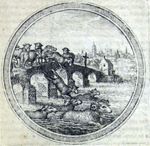
Iconclass: 31B14 yawning 51B2 Similarity, Likeness 51B6 Imitation; 'Imitatione' (Ripa)
Loci Communes: Contagio morum (The contagion of habits, Contagion des mœurs)
III iv 96 Inter caecos regnat strabus Among the blind the cross-eyed man is king
Εν τοῖς τόποις τῶν τυφλῶν λάμων βασιλεύει. i. In regione caecorum rex est luscus. Inter indoctos, qui semidoctus est, doctissimus habetur. Inter mendicos, qui paululum habet nummorum, Croesus est. Sapit vulgi faecem.
'[greek], In the kingdom of the blind the one-eyed man is king. Among the uneducated, one who is half-educated is considered very learned. Among beggars, one who has a few pennies is a Croesus. It smacks of the common dregs.
Facsimile:
Annotation: In het land der blinden is één-oog koning
Iconclass: 31A2212:49D11(1) eyes❧numerals (1) 31A319 interference with sight 44:31A4111 state; law; political life❧blind, blindness 31B62171 one eye closed, winking 91B2 the Cyclopes
Loci Communes: Excellentia, inaequalitas (Excellence, inequality, Excellence, inégalité)
III iv 97 In area latitas Hiding on a threshing floor
Εν ἅλῳ δρασκάζεις. i. In area occultaris. De eo qui in eo versatur negocio, ut non possit non esse conspicuus. Aut qui sic latitat, ut à nemine tamen non conspiciatur. Nam in area nullae latebrae.
[greek], You are hiding on a threshing floor. Said of one who is involved in business such that he cannot be inconspicuous. Or of one who hides in such a way that he can be seen by everyone, for on a threshing floor there is nowhere to hide.
Facsimile:
Iconclass: 43C71131(+0) hide-and-seek (+ variant) 47I148(+11) threshing (+ indoors; in laboratory, factory, barn, etc.) 51AA4:54E42 Nothingness, Absence❧Protection; 'Custodia', 'Difesa contra nimici, malefici & venefici', 'Difesa contra pericoli', 'Riparo da i tradimenti' (Ripa)
Loci Communes: Decretum - in deprehensos (Decree - against those caught in the act, Décret - contre les pris sur le fait)
III iv 98 Cum licet fugere, ne quaere litem When you can run away, don't look for a quarrel
Εξὸν φυγεῖν μὴ ζήτει δίκην. i. Cum fugiendi potestas est, ne quaere litem. Ab Alcibiadis apophthegmate natum. Is cum è Sicilia citaretur ab Atheniensibus, ut criminibus responderet, abdidit sese, negans litigandum esse, si quo modo liceret effugere. Subiicientibus aliis, Non igitur confidis patriae de te iudicaturae. Imò, inquit, ne matri quidem crediderim. Metuerem enim ne fors imprudens albi calculi loco nigrum immitteret. Alcibiadis sentetiae subscriberet, quisquis litium expertus est. Graecis unico verbo dicuntur φυγοδικεῖν, qui litem detrectant.
'[greek], When there is the possibility of fleeing, do not seek a quarrel. Derived from a saying of Alcibiades. When he was summoned from Sicily by the Athenians to answer charges, he refused to go, saying there was no need to go to law if by some means he could get away. To others who suggested, 'Do you not trust your country to judge you?' he replied, 'On the contrary, I would not trust my mother. For I should be afraid that she might in ignorance put a black stone in place of a white one, or that anyone experienced in lawsuits would subscribe to Alcibiades' view [of the law].' The Greeks have the one word [greek] 'to shun a lawsuit' for those who refuse litigation.
Facsimile:
Iconclass: 53A11:33B9 Choice; 'Elettione' (Ripa)❧flight, running away; pursuing 51AA4:33B1 Nothingness, Absence❧quarrel, argument
Loci Communes: Occupatio (Occupation, business, Occupation)
III iv 99 In tergore bovis desedit Seated on the ox's hide
Επὶ βύρσης ἐκαθέζετο. i. In tergore bovis desedit, id est, supplex implorat auxilia. Natum adagium à consuetudine vernacula Scythis, quemadmodum testatur Lucianus in Taxaride. Nam apud hos si quis forte laesus esset, neque suppeteret ulciscendi facultas, immolato bove carnes minutim sectas coquebat, ipse in tergore humi strato sedebat, manibus in tergum reductis. Idque maximum supplicandi genus apud illos habebatur. Accedebat quicumque vellet opitulari, & carnium portione gustata, dextroque pede tergori imposito, pollicebatur pro viribus auxilio futurum. Atque hoc foedus apud Scythas sanctissimum habebatur.
'[greek], He sat on the ox's hide, that is, as a suppliant asking for help. An adage originating from a custom native to the Scythians, as Lucian records in the Toxaris. For among those people, if someone was by chance harmed, and had insufficient power to take revenge, he killed an ox, cut the flesh into small pieces and cooked it. He himself sat on the hide of the animal, which was spread out on the ground, with his hands behind his back. This was considered among them to be the strongest sort of supplication. Anyone who wished to give help approached, tasted a portion of the meat, placed his right foot on the animal's hide, and promised that he would do all he could to help. Among the Scythians, such a covenant was held to be most sacred.
Facsimile:
Iconclass: 31A2351 sitting on the ground 31AA25171(+911) arm bent behind the back - AA - both arms or hands (+ saluting, showing reverence) 32B2(SCYTHIANS) historical peoples: Scythians 47I21111(+9351) ox (+ skin, fleece, hide, fur, leather) 53CC3 Supplication; 'Supplicatione' (Ripa)
Loci Communes: Ultio malefacti (Vengeance for a wrongdoing, Vengeance d'un méfait)
III iv 100 Hospes indigenam The foreigner drove out the native
Επηλυς τὸν ἔνοικον. i. Advena inquilinum, subaudiendum, ἐξέβαλεν. id est, eiecit. Usus fuerit, cum alienae professionis quispiam alium in propria vincit arte. Quod genus, si theologus in arte grammatica superet grammatices professorem. Aut si arrogatus, aut adoptivus, filium eiceret è familia, aut miles adscitius eiceret colonos.
[greek], The newcomer drove out the local; the word [greek] 'drove out' is understood. It would have been used when someone of a different profession beats another in his own skill, such as when a theologian shows himself better in grammar than a teacher of grammar. Or when a child who has been taken in or adopted displaces the son from a family, or if some outsider of a soldier should drive out native farmers.
Facsimile:
Iconclass: 51L5:44C13 Ascent❧immigration 51LL5:44C1(+0) Descent❧nationality, citizenship (+ variant)
Loci Communes: Vis injustia (Unjust force, Force injuste)