IV viii 1 Ambrones Ambrones
AMbrones olim. vulgo dicebantur, qui rapto malisque artibus viverent. Originem indicat Festus Pompeius, admonens eam suisse Galliarum gentem, quam cum mare inundam finibus suis depulisset, per aliena oberrantes rapinis ac praedationibus se suosque alere coeperunt. Manus erat formidabilis, non numero tantum: dicuntur enim fuisse triginta milia, verum etiam tum animorum ferocia, tum ratione puganandi. Siquidem conferti rhythmis et concentu quodam in hostem ferebantur, subinde tonantes: Ambrones Ambrones: sive ut hac voce suos in unum convocarent, sive ut hostibus terrorem incuterent. Ab his victi fuerant Romani duces, Manlius et Cepio: sed primum a Ligurib. fractisunt, mox a C. Mario prostrati, tandem ad aquas Sextias una cum Cimbris ac Teut onibus de leti sunt. Ita ferme Iulius Florus in Epitoma libri 68. et Plutarchus in vita C. Marii. Simili modo Cilicis vocabulum abiit in convicium rapacitatis ac praedationis.
Ambrones was a term once commonly applied to people who lived by thieving and wickedness. Festus Pompeius gives the origin of the name, informing us that the Ambrones were a Gallic tribe driven out of their own territory by the flooding in of the sea, who then overran other people's lands and took to maintaining themselves and their dependents by looting and plundering. Their army inspired terror, not only by reason of their numbers - thirty thousand is the figure given - but by their savagery and method of fighting. They bore down on the enemy in close formation keeping in time together and shouting out in a kind of chant, 'Ambrones, Ambrones,' whether this was to keep their own troops together or to inspire terror in the enemy. They had defeated the Roman generals Manlius and Caepio, but were themselves vanquished first of all by the Ligurians, afterwards suffering a crushing defeat at the hands of Gaius Marius, and were finally annihilated by him at Aquae Sextiae, together with the Cimbri and Teutones. This is more or less what Julius Florus says in his epitome of book sixty-eight, also Plutarch in his life of Gaius Marius. Similarly the name 'Cilician' developed into a term of abuse, implying pillaging and plundering.
Facsimile: 
Iconclass: 32B2(AMBRONES) historical peoples: Ambrones 44G54 thief 56DD1 Fear, Dread; 'Paura', 'Timidità o Timore', 'Timore' (Ripa)
Loci Communes: Improbi (The dishonest, Les malhonnêtes)
IV viii 2 Vinaria angina Wine-quinsy
De ἀργυράγχη. i. angina argentaria quae multis praeter Demosthenem vocem intercipit, iam antea diximus. At Festus Pompeius indicat ioco iactatum in eos, qui vino praefocantur laborare vinaria Angina, quam οινάγχην possis dicere. Ipse novi Romae quendam haud vulgariter eruditum, qui hac angina serio periit. Hermicus appellabant, natione Lusitanus. Correptus erat febricula vir corpore supra modum obeso, & ob id spirituosus. De cumbentem invisit Christophorus Fischerus, patria Anglus. Vin tu, inquit, Hermice auscultare medicis meras nugas praescribentibus? Propinavit aegroto, iubens bono esse animo. Ille persuasus hausit affatim, ac mox intercluso spiritu coepit animam agere. Quosdam ebrietas è taciturnis reddit loquacissimos, quosdam contrà tam mutos quam ullus est piscis, citra valetudinis periculum. Utinam haec οἰνάγχη minus frequens esset apud Germanos.
We dealt earlier with [greek] 'the silver-quinsy,' which causes many people besides Demosthenes to lose their voice. Festus Pompeius tells us that it was jokingly said of those who choked over their wine that they were suffering from 'wine-quinsy,' which you could call [greek] in Greek. I knew a man of considerable scholarship in Rome who actually died of this 'quinsy.' He was a Portuguese called Hermicus. He was very fat and short of breath and he caught a fever. As he lay on his sick-bed, he was visited by Christopher Fisher, an Englishman, who said to him, 'Hermicus, you don't want to pay any attention to the stupid prescriptions the doctors give you. You'll wash this disease out of your system better with a pot of good wine.' So saying, he at once sent out for a bottle of four-year-old Corsican wine. He drank the invalid's health and told him to take heart. Thus persuaded, Hermicus took a deep draught, but immediately choked and began to breathe his last. Drunkenness sometimes turns silent individuals into chatterers, sometimes makes people 'dumb as a fish,' without however any permanent damage to their health. I wish this 'wine-quinsy' were not so prevalent among the Germans.
Facsimile:
Iconclass: 31A463322 coughing 31B52 drunkenness 31E23141 deprivation of air, choking 41C711 wine ~ alcoholic drinks
Loci Communes: Bibacitas (Excessive drinking, Penchant pour la boisson)
IV viii 3 Titivillitium A tinker's cuss
Titivillitium vox erat olim nullam quidem rem certam declarans, sed velut interictio contemptum extremum indicabat, qualis est apud Graecos πεπαλὸ. Palutus citante Fest. Pompeio: Non ego isthuc verbum emptitem titivilitio, id est, re ad mordum vili, Locus autem est in Caffina. Similis vox est apud eundem Festum Buttubata, qua tamen usus sit Nevius, pro nugatoriis nihilque rebus. Nonius autem putat pipulum, convicii fuisse vocem. Plautus in Aulul. Ita me bene amet Laverna, iam nisi vasa reddi iubes, pipulo hic differam ante aedes.
Titivillitium was a word meaning nothing very definite, but when used as a sort of interjection it indicated utter contempt, like the Greek [greek]. Plautus uses titivillitium in a line cited by Festus Pompeius: 'I wouldn't give a tinker's cuss for talk like that.' (The line comes from the Casina.) Festus gives another similar word, buttubata, used by Naevius for trifles and things of no value. Nonius however thinks the word pipalo meant 'insult,' 'abuse,' as in the lines from Plautus' Pot of Gold: "So help me Laverna, if you don't have my pots brought back, I'll stand outside in the street and by yelling names pipalo differam 'I'll rip up your reputation.'"
Facsimile:
Iconclass: 49K321:57BB21 word❧Contempt 52BB53:49K321 Nonsense, Absurdity❧word
Loci Communes: Contemptus et vilitatis (Contempt and worthlessness, Mépris et bassesse)
IV viii 4 Nihil potest, nec addi nec adimi Nothing can be either added or taken away
De perfectis operibus ita vulgo dici solitum indicat Aristoteles libro Moralium Nicomachiorum secundo: ὅθεν εἰώθασιν ἐπι λέγειν τοῖς εὖ ἔχουσιν εργοις, ὅτι οὐκ ἀφελεῖν ἐστιν, οὔτε προσθεῖναι. id est Unde de operibus quae bene habent, ita solent praedicare, nec adimere possis, nec addere. Nam ut bene sit aliquid praestat mediocritas, tollit excessus aut defectus: excessum inducit, qui addit: defectum, qui adimit. De Lucilio scripsit Horatius: Cum fluet lutulentus, erat quod tollere velles. De Demosthene ac Cicerone dictum est, illi nihil posse demi, huic nihil posse addi.
Aristotle tells us in book two of the Nicomachean Ethics that people used to say this of a totally satisfactory creation: 'Accordingly people often say in connection with works of art that turn out well that [greek] "You can neither take away nor add anything."' For excellence, the mean is required; excess or deficiency destroys it. Any one who adds, creates excess; anyone who takes away, generates deficiency. Horace wrote of Lucilius: 'There are things one would remove from his turbid stream.' Of Demosthenes and Cicero it was said that 'nothing could be taken from the former, nothing added to the latter.'
Facsimile:
Iconclass: 51A7 Perfection, Completeness; 'Perfettione', 'Operatione perfetta' (Ripa) 56B3 Satisfaction, Contentment; 'Contento' (Ripa)
Loci Communes: Perficiendi sive absolvendi (Finishing, completing, Achever, accomplir)
IV viii 5 Virtus simplex Virtue is simple
Dubitati possit utrum versus sit vulgo iactatus, quem ut omnibus notissimum citra nomenclaturam retulerit Ethicorum 2. Aristoteles, an imprudenti exciderit ver. sus pentameter. Disserens enim e sententia Pythagorae, errorem esse infinitum, virtutem finitam, quemadmodum in nemore mille modis aberratur a recta via, cum ea sit unica: eoque vitium esse in procilivi, virtutem in arduo, quemadmodum facile est a scopo aberrare, sed scopum attingere difficile est: subiungit, ἐσθλοὶ μὲν γὰρ ἀπλῶς, παντοδαπῶς δὲ κακοί. id est, Est simplex virtus, omnigenum vitium.
It is not clear whether Aristotle, in the second book of the Nicomachean Ethics, was quoting a verse so well known that he did not need to name the author, or whether he wrote a pentameter verse by accident. It occurs in the passage where he is quoting Pythagoras' view that evil is infinite, virtue finite (for example, there is only one right track through a wood but one can go off it in a thousand ways). Consequently, vice is easy, virtue is hard, just as missing the target is easy, hitting it difficult. Aristotle then goes on to say, [greek] 'Virtue itself is simple, vice comes in many forms.'
IV viii 6 Extra fumum et undam Away from the smoke and the swell
Aristoteles eodem libro refert versum Homericum ut vulgo decantatum: ὡς τοῦ μὲν καπνοῦ καὶ κύματος ἐκτὸς ἔεργε νῆα. id est, Afumo navium simul atque a fluctibus arce. Aristoteles indicate esse verba Calypsus adhortantis Ulyssem, ut neque nimium littori vicinus naviget, fumum secutus, neque se profundo credat pelago, sed in medio secet viam: quod ibi periculum sit a saxis et vadis, hic ab undis. Argyropulus autem interpres ea verba tribuit Circe, quid secutus nescio.
In the same book, Aristotle cites an often-quoted line of Homer: 'Do you keep the boat [greek] "Away from the smoke and the swell."' He attributes the words to Calypso, who had advised Ulysses neither to sail too close to the shore-line, following the smoke, nor to entrust himself to the deep, but to cleave a way between the two. For on the one hand, there was danger from rocks and shallows, on the other, from great seas. (Argyropylus in his translation attributes the words to Circe, I know not on what authority.)
Facsimile: 
Iconclass: 25H2311 wave 41B162 smoke 51I5 Middle; 'Mezo' (Ripa) 54D5 Safety 94I21(+0) Ulysses is kindly received by the nymph Calypso on the island of Ogygia (Homer, Odyssey XII) (+ variant)
Loci Communes: Securitatis et tutae rei (Security and safety, Sécurité et sûreté)
IV viii 7 Communis tanquam Sisapo Jointly owned like Sisapo
Proverbiali schemate sine controversia dictum est. M. Tullius Philippica secunda: Domum dico? Quid erat in terris, ubi in tuo pedem poneres? praeter unum Misenum, quod cum sociis tamquam Sisaponem tenebas, Sensit Antonium Misenum non habuisse, ut veram possessionem, sed ut venam redemptam ad quaestum. Plinius libro trigesimotertio, capite septimo, docet minium, quod Graeci μίλτον appellabant, nonnulli Cinnabar, apud priscos non tantum summo in pretio, sed etiam in magna religione suisse. Nam festis diebus simulacra deorum minio oblinebantur, quemadmodum et triumphantes, quod tamen Calba senex in se fieri passus non est, ut refert Cornelius Tacitus. Sisapo autem Beticae oppidum est, olim Romanis vectigale, venas habens miniarias. Neque enim temere Romam aliunde minium advehebaltur. Negat autem Plinius ullius rei Romanis fuisse diligentiorem custodiam. Neque enim ibi fas erat perfici minium, excoquique, ubi nascebatur: vena signata ad dena milia fere pondo annua, Romae lavabatur. In vendendo lex praescribebat pretii modum, ne in immensum excederet. Sed multis modis adulterabatur, unde inquit praeda societati. Et mox dominio adulterino: Hoc ergo adulteratur in officinis sociorum. Ex his liquet eam regionem inmultos socios fuisse divisam, quemadmodum et hodie metalla argentaria aurariave iuxta certos tractus a redemptoribus occupantur.
This is without question a proverbial expression. In the second Philippic, Cicero says, 'Home, do I say? There wasn't a spot on earth where you could set foot on something that you could call your own - apart from the one place at Misenum, and that you held in joint ownership with your partners like Sisapo.' He meant that Antony did not own the estate at Misenum outright but held it on the same terms as an ore deposit bought up by concessionaires. Pliny tells us in book thirty-three, chapter seven, that red lead (which the Greeks call [greek], others 'cinnabar') was not only highly valued by the ancients but treated as a holy substance. On festal days, the statues of the gods were daubed with red lead, as were generals celebrating a triumph (though Galba, who was old, would not let it be done to him, as Corneliius Tacitus tell us). Sisapo is a place in Baetica, at one time a source of revenue to the Romans, where there were red-lead mines. Hardly anywhere else supplied Rome with the substance. Pliny tell us that 'the Romans supervised its production more carefully than anything else. It was not permitted to complete the process and refine it where it was produced. Up to ten thousand pounds in weight were sent to Rome per year under seal and purified there. The price at which it could be sold was controlled by law to prevent it rising out of all proportion.' But, as Pliny says, 'it was adulterated in many ways, providing rich pickings for the partnership.' Later on he says, concerning the adulterated substance, 'It is adulterated at the diggings of the partners.' This makes it clear that the whole area was divided up among many partners, just as today various contractors have a specified stretch of a gold or silver mine.
Facsimile:
Iconclass: 25D13(RED LEAD) minerals and metals (RED LEAD) 25D13(MINIUM) minerals and metals (MINIUM)
Loci Communes: Rapacitas et avaritia (Rapacity and greed, Rapacité et avarice)
IV viii 8 Quanta vix coelo capi possit More than the heavens can contain
Hac hyperbola M. Tullius Philippica secunda famae celebritatem expressit, de his loquens qui C. Iulium tyrannidem affectantem occiderunt: praesertim quum illi eam gloriam consequuti sint, quae vix coelo capi posse videatur. Vergilius: Imperium terris, sed famam terminat astris. At maro Daphnidem facit & ultra sidera notum. Et Horatius, Sublimi feriam vertice sidera. Apud M. Tullium frequenter obvium est: In coelum laudibus ferre.
Cicero employed this hyperbole to express illustrious renown when speaking in the second Philippic of those who murdered Julius Caesar because he was aiming to set himself up as tyrant: 'Especially since these people have won for themselves such a glory that the heavens can scarce contain it.' Virgil writes, 'His rule he extends to earth's extremes, / His glory to the stars.' But he makes Daphnis 'famed even beyond the stars.' Horace writes, 'I shall strike the stars with my exalted head.' We often find in Cicero the expression 'to laud someone to the skies.'
Facsimile:
Iconclass: 51G1 Largeness, Magnitude 59B3 Repute, Renown; 'Splendore del nome' (Ripa)
Loci Communes: Nobilitas / obscuritas (Nobility / obscurity, Noblesse / obscurité)
IV viii 9 Modo palliatus, modo togatus Now in pallium, now in toga
In hominem inconstantem ac lubricae fidei, diversarumque partium eleganter torquebitur, veluti, si quis subinde mutato vitae genere, cum Cidarim gestet Theologicam, nunc cum paludamento militari incedat. M. Tullius Philippica quinta; Accipiet ne accusationem, is, qui quaestioni praeerit Graeci iudicis, modo palliati, modo togarti? Pallium, Graecorum est, ut toga Romanorum: utraquae tamen vestis pacis est, quemadmodum saga sunt belli.
This phrase would provide a neat dig at an unreliable man of shifting loyalties and changing allegiance, someone, for example, who keeps altering his way of life and sometimes appears in ecclesiastical tiara, sometimes in general's uniform. Cicero in the fifth Philippic: 'Will the presiding magistrate accept the excuse of a Greek juryman, who appears sometimes in a pallium, sometimes in a toga?' The pallium is a Greek garment, just as the toga is Roman. Both however are civilian garb, just as the sagum is military.
Facsimile:
Iconclass: 41D211(TOGA) dress, gown (TOGA) 41D223(PALLIUM) clothing for the upper part of the body (PALLIUM) 57AA6141 Untrustworthiness, Unreliability
Loci Communes: Inconstantiae, perfidiae, versutiae (Inconstancy, treachery, cunning, Inconstance, perfidie, ruse)
IV viii 10 Ad saga On with the soldier's cape
Sagum tunicula erat militaris. M. Tullius non sine specie proverbii aliquoties dicit, Ad saga iri, pro eo quod est, apparari bellum, & ad arma procurrere. Ita Philippica sexta: Properent quod video facturos, vos saga parate. Est enim ita decretum, ut si ille autoritati senatus non paruisset, ad saga iretur. Rursum in eadem: Iustitium edici, saga sumi, dixi placere. Et superius in quinta: Iustitium indici, saga sumi, dico oportere. Post in septima: Arma, saga, bellum flagitaverunt. Rursus 8. Delectus tota Italia decreti, sublatis vacationibus saga cras sumentur. Iterum in eadem: Equidem P.C. quanquam hoc honore usi togati esse solent, quum est in armis civitas, statui tamen à vobis caeterisque civibus in tanta atrocitate temporis tantaque perturbatione populum Romanum non differre vestitu. Rursus Philippica xiii. Te non intelligis delectu tota Italia habito, consulibus missis, Caesare ornato, sagis denique sumptis, hostem iudicatum? Ac xiiii. frequenter, ad saga issemus, cras sagati prodeamus, ad saga sumenda discedere, ad saga iuisse, redisse ad togas. Actione in Verrem tertia, coniungit similia: Quum coegeris homines miseros & calamitosos quasi desperatis nostris legibus & iudiciis, ad vim, ad manus, ad arma confugere.
The sagum was a short cape worn by soldiers. Cicero several times uses an apparently proverbial expression, 'to don the soldier's cape,' meaning to prepare for war, to rush to arms. In the sixth Philippic he writes: 'Let them go quickly then, which I see they intend to do in any case. Do you however get out your soldiers' capes, since the House has passed a decree to the effect that "if he does not submit to authority, then capes will be donned."' Again in the same speech: 'I proposed that a state of emergency should be declared, capes put on.' Earlier, in the fifth Philippic: 'It is my view that a state of emergency should be declared and capes put on.' Later, in the seventh: 'They called for arms, capes, war.' In the eighth: 'Men have been called up all over Italy, no exemptions granted; tomorrow capes will be worn.' Again in the same speech: 'For my part, honourable members of this House, though persons of my eminence usually wear civilian dress even when the whole country is under arms, I have nonetheless decided that at such a dreadful time, when the nation is in such turmoil, I must dress the same way as you and the rest of the Roman people.' Again in the thirteenth: 'Levies are being raised throughout Italy, consuls sent forth, Caesar honoured, capes being worn. Does all this not make you realize that you are seen as a public enemy?' Similar phrases often occur in the fourteenth: 'We took to our capes'; 'we should don capes again tomorrow'; 'go away to put on capes'; 'to have put on capes and then returned to civilian dress.' We find a similar string of phrases in the third Verrine: 'After you forced these wretched unfortunate men, despairing of Roman law and Roman justice, to resort to violence, to fighting, to weapons.'
Facsimile:
Iconclass: 31A551 dressing oneself, getting dressed 45C2:41D212(SAGUM) military clothing and other equipment (uniforms, cap, armour, helmet, etc.)❧? 54D1 Preparation
Loci Communes: Vis injustia (Unjust force, Force injuste)
IV viii 11 Igni ferroque minari Threaten with fire and sword
Qui extremam denunciant inimicitiam, igni ferroque minari dicuntur, quod verbum & hodie vulgo tritissimum est. Qui civilius bellum gerunt, tantum abigunt praedas, à caede incendioque abstinent. M. Tullius Philippica xiii. Sanctiore erunt, credo, iure legati quam duo con sules, contra quos arma fert, quàm Mutina quam obsidet, quam patria cui igni ferroque minitatur. Rursum Philippica xii. Huic urbi ferro ignique minitantur. Venustius erit quoties ad animi res transfertur, veluti si quis dicat philosophos cuipiam igni ferroque minitari, quod in eum parent atrociter scribere. Sic quibuscum nolumus nobis quicquam esse commercii, iis aqua & igni interdicimus.
Those who profess unmitigated hostility are said to 'Threaten with fire and sword,' an expression still in common use today. Those who wage war in a civilized fashion confine themselves to looting and abstain from slaughter and putting to the torch. Cicero writes in the thirteenth Philippic, 'He will of course treat ambassadors with more respect than he does the two consuls, to whom he offers armed resistance, than the town of Mutina, which he is actually besieging, than his country, which he threatens with fire and sword.' Again in the twelfth Philippic: 'who threatens this city with fire and sword.' It will be even neater to use the phrase metaphorically referring to intellectual pursuits, like saying that philosophers 'threaten someone with fire and sword' when they propose to attack him mercilessly in writing. Likewise, we 'debar from fire and water' those with whom we do not wish to have any dealings at all.
Facsimile: 
Iconclass: 21C fire (one of the four elements) 45C13(SWORD) hacking and thrusting weapons: sword 45L42 setting on fire (of conquered city) 53C22 Menace, Intimidation; 'Minaccie' (Ripa)
Loci Communes: Minantis (Threatening, Menacer)
IV viii 12 Neque terrae motus timet, neque fluctus He fears neither earthquake nor raging sea
Aristoteles lib. Moralium Nicomachiorum 3. docentes eos, qui non habitu virtutis, sed immanitate quadam naturae nihil omnino formidant, nequaquam appellandos esse fortes, sed μαιμομένους καὶ ἀναλγήτους, hoc est, insanos & stupidos sensusque expertes. εἴη δὲ , inquit, ἄντις μαινόμενος καὶ ἀναλγητος, εἰ μηθὲν φοβοῖτο μήτε σεισμοὺς μήτε κύματα, καθάπερ φασὶ τοὺς κελτοὺς. i. Fuerit autem quispiam insanus, ac doloris sensu bacans, si nihil metuat, neque terrae concussiones, neque fluctus, quemadmodum de Celtis praedicant. Nihil enim horribilius mari commoto, terrae vero concussio videtur inferorum ad superorum sedem eruptionem minitari: Tanta autem erat quarundam Galliae Germaniaeque gentium immanitas, ut nec his terrerentur, quae maxime sunt natura horrenda, Quod autem Aristoteles μαινόμενον & ἀναλγητον pro eodem usurpat, arbitramur huc respexisse Diogenem, qui rogatus quis ipsi videretur Socrates, μαινόμενος inquit, videlicet, eo quod adversus omnem corporis molestiam obduruerat, cum alioque esset omnium iniuriarum tolerantissimus, nisi forte Diogenes hoc quoque stupori tribuebat non virtuti, quod ne colaphis quidem provocari posset, ut vel tantillum exandesceret.
In book three of the Nicomachean Ethics, Aristotle puts forward the view that people who fear nothing because they are naturally brutal, not because they are endowed with courage, should be called not brave but mad, stolid, insensate. He writes: 'A person would be mad and insensate [greek]"if he feared nothing, neither earthquake nor raging sea," as they say of the Celts .. .' Nothing is more terrifying than the sea in turmoil; an earthquake seems to presage Hell bursting out into the world above. Yet some tribes of Gaul and Germany were so brutal that they had no fear even of what is naturally horrendous. Aristotle here equates 'mad' with 'insensate,' and I presume that Diogenes had the same idea in mind when someone asked him his opinion of Socrates and he replied, 'Mad' - Socrates, who was in any case able to withstand all kinds of injury, had inured himself to any and every bodily discomfort. Unless possibly Diogenes also attributed to insensitivity rather than virtue the fact that Socrates could not be provoked even by physical violence to lose his temper in the slightest.
IV viii 13 Calceos mutare Change one's shoes
Non sine specie proverbii Ciceroni dictus est mutasse calceos, qui nullo suo merito senatoriam dignitatem usurpavit, cuius insigne erat nigro calceo addita lunula circa talum. M. Tullii verba sic habent: Est etiam Asinius quidam senator voluntarius, lectus ipse à se. Apertam vidit curiam post Caesaris mortem, mutavit calceos, pater conscriptus repente factus est. Quemadmodum clavus aureus in toga signum erat senatoriae dignitatis, ita nigra aluta circa talos addita, declarabat eandem dignitatem.
Cicero was apparently using a proverbial expression when he said of a certain person that he had 'Changed his shoes,' when, quite without justification, he took to himself the rank of senator, which entitled the holder to wear black boots with a crescent-shaped decoration at the ankle. What Cicero said was: 'There is also some Asinius or other, a volunteer senator, self-appointed. After Caesar's death he saw the House wide open, he changed his shoes, and all of a sudden became a senator.' A gold stripe on the toga was a sign of senatorial rank; so also was the black leather added at the ankle.
Facsimile:
Iconclass: 44B1619(+0) usurpation (+ variant) 51K1:41D2332 Change❧shoes, sandals
Loci Communes: Honos indigno habitus (Honor given to the unworthy, Honneur accordé à qui ne le mérite pas)
IV viii 14 Campana superbia Campanian arrogance
Felicitatis comes esset solet ferocia. Campaniam autem Italiae quondam fuisse regionem longe beatissimam testantur, tum alii complures, tum Pli. lib. 3. c. 5. Hinc inquit, felix illa Campania est, ab hoc sinu incipiunt vitiferi colles, et temulentia nobilis succo per omnes terras inclito, at que ut veteres dixere, summum Liberi patris cum Cerere certamen: et cetera quae sequuntur, de fertilitate simul et amoenitate Campaniae. Constat autem Capuam olim cum Roma de Principatu concertasse. Hinc Campana superbia, et Campana arrogantia in proverbium venit. M. Tullius in oratione pro Rullo: Itaque illam Campanam arrogantiam, atque intolerandam ferociam, ratione et consilio maiores nostri, ad inertissimum ac desidiosissimum otium perduxerunt. Sic et crudelitatis infamiam effugerunt, quod urbem ex Italia pulcherrimam non sustulerunt, et multum in posterum providerunt, quod nervis urbis omnibus exsectis urbem ipsam solutam ac debilitatam, reliquerunt. In eadem aliquanto post, Capuam domicilium superbiae sedemque luxuriae vocat. Itaque electi coloni Capuae in domicilio superbiae atque in sedibus luzuriae collocati. Quemadmodum in oratione habita in senatu post reditum suum: Capuae ne, inquit, te putabas, in qua urbe domicilium quondam superbiae fuit, consulem esse, sicut eras eo tempore. Rursus in fragmento orationis contra eundem: Qui locus propter ubertatem agrorum, abundantiamque rerum omium superbiam et crudelitatem genuisse dicitur. Ac mox: Si luxuries Annibalem ipsum Capuae corrupit, si superbia nata inibi esse, ex Campanorum fastidio dicitur. Titus item Livius libro primae Decad. 9. scribit Campanis ingenitam esse superbiam. Ad haec Aulus Gell. lib. 11, c. 24. Naevianum epitaphium, quod in se ipsum timidius praedicat, ait esse plenum Campanae superbiae. Opinamur autem Naevium fuisse Campanum. Ita quemadmodum olim omnem insignem perfidiam populus Punicam appellat, sic cuiuslibet ferociam Campanam appellabat. At nunc de moribus gentis nihil dicam, caeterum quum ipse per Campaniam iter facerem, nusquam repperi succum illum per omnes. terras inclytum. Nusquam gutta vini Phalerni, Caleni, Massici, Setini, Cecubi, Surrentini. Imò minimum abfuit, quin in ipsa, qua nunc monstratur, Capua, vinaria angina fuerimus praefocati. Im plevimus totam phialam saccaro contuso, Vicit vinum, quovis aceto acerbius. Fere defrutis utuntur, quod alio qui non durent usque ad proximam vindemiam. Et ubi sunt illa lauta vina, quorum nomen patriamque vetustas delevit? Pulveris affatim hausimus. Adeo natura nihil in rebus humanis patitur esse perpetuum.
Insolence usually accompanies prosperity. Many ancient writers tell us that Campania was once easily the richest region in Italy. Pliny for example in book three writes, 'Next comes the famous and fertile land of Campania. From the gulf rise hills covered with vineyards, producing a noble tipple with a fruitiness renowned throughout the world. As the ancients said, Father Bacchus vies with Ceres for first place .. .' and so on, speaking not only of the fertility of Campania but of its delightfulness too. And indeed Capua once challenged Rome for supremacy, with the result that 'Campanian pride, Campanian arrogance' became a by-word. Cicero in his speech against Rullus:
That famous Campanian arrogance, that intolerable insolence, our ancestors
deliberately and as a matter of policy reduced to utter indolence and apathy.
They escaped the infamy of cruelty by refraining from destroying the finest
city in Italy, yet at the same time took thought for the future by cutting all
the sinews of the city and leaving it limp and impotent.
A little later in the same speech he calls Campania 'the home of arrogance, the seat of licentiousness' - his words are 'colonists selected and settled in Capua, in the home of arrogance, the seat of licentiousness.' Again, in the speech he made to the senate after his restoration, Cicero says, 'Did you imagine you were consul - for you held that office at that time - in Capua, once the very home of arrogance?' Again in the fragmentary speech attacking the same person: 'The place which by reason of its fertility and abundant supplies of everything needful is reputed to have spawned arrogance and hardness of heart.' And shortly after: 'If the luxurious life-style corrupted Hannibal himself at Capua, if arrogance was born there, as they say, out of the haughty attitudes of the Campanians .. .' Livy writes in the ninth book of his first decade that 'arrogance was endemic among the Campanians.' Furthermore, Aulus Gellius in book eleven, chapter twentyfour, says that the boastful epitaph that Naevius composed for himself was 'full of Campanian arrogance.' (But Naevius was, I think, not a Campanian.) Just as any remarkable example of treacherous dealing was at one time commonly called 'Punic,' so any piece of insolence was called 'Campanian.' I will make no comment on the character of those who inhabit the region today, but when I travelled through Campania myself, I found not a trace of that 'fruitiness renowned throughout the world,' never a drop of Falernian, Massic, Caecuban, of those famous wines from Cales, Sezza, Sorrento. We all but choked with the 'wine-quinsy' in the place today called Capua. We filled the whole cup with sugar, but the wine, sharper than vinegar, won the day. As a general rule, they boil the wine down because otherwise it won't keep until the next vintage. Where are those celebrated wines? The passage of time has destroyed their name and their place of origin. We drank in dust enough. Truly, nature allows nothing of man's works to endure.
Facsimile: 
Iconclass: 55B1 Wealth, Opulence; 'Opulenza', 'Richezza' (Ripa) 57AA644 Arrogance; 'Arroganza' (Ripa) 61D(CAMPANIA) geographical names of countries, regions, mountains, rivers, etc. (CAMPANIA) (CAMPANIA)
Loci Communes: Arrogantia jactantiaque (Arrogance and boastfulness, Arrogance et vantardise)
IV viii 15 Αὐτοβοᾶν Self-crying
Ante retulimus proverbium αὐτὸς αὑτὸν αὐλεῖ. i. ipse sui tibicen est. Huic simillimum est quod unico verbo Graeci dicunt αὐτοβοᾶν, si quis suavoce se ipsum praedicat, hoc est, ipse sui praeconem agit. Solent enim praecones hominum venalium artes ae dotes evulgare, quo magis emptorem irritarent. Ridiculum autem habetur, hominem sui praeconem esse. Congruit cum eo quod alibi diximus οἴκοθεν ὁ μάρτυς. Proverbium refertur apud Suidam. Simili figura dicunt Attici, αὐτοῖς ῥήμασιν ἀπόλοιο, unà cum ipsis dictis pereas, et Aristophanes in Equitibus, τὸν παφλάγονα αὐταῖσι βουλαῖς ἀπολέσειαν οἱ θεοὶ. Paphlagonem ipsis cum consiliis perdant dii. Et mox, αὐταῖς διαβολαῖς. id est, unà cum ipsis calumniis.
We dealt earlier with the saying [greek] 'He is his own fluteplayer.' The single Greek word [greek] 'Self-crying,' expresses a similar idea, when someone recommends himself, or acts as his own auctioneer. Auctioneers cry up the skills and endowments of slaves for sale in order to make people eager to buy. But it is thought ridiculous for a man to cry up himself. The same idea is found in another saying we dealt with earlier, 'A home-grown witness,' which is recorded in Suidas. The Athenians in similar vein say, 'Down with you and all your prating.' Aristophanes in the Knights: 'Damn Paphlagon and all his plots'; and a bit later: 'together with all his lies.'
Facsimile:
Iconclass: 31B62351 crying, shouting 56F24 Self-love; 'Amor di se stesso' (Ripa) 57AA4 Shamelessness 57AA645 Boast; 'Iattanza' (Ripa)
Loci Communes: Arrogantia jactantiaque (Arrogance and boastfulness, Arrogance et vantardise)
IV viii 16 Sterilem fundum ne colas Don't cultivate barren land
Στεῖρον ἀγρονν μὴ σπείρειν. id est, Agrum sterilem ne colas. Refertur in ter leges Platonicas. Hoc aenigmate lex apud Platonem verecunde deterret a venere mascula, si satis comeminimus. In octavo de Legibus, ait illos facere sementem in petras. Petest tamen ad alios usus accommodari. Ne doceas indocilem, ne felicitatem quaeras indivitiis, Non enim pariunt homini beatitudinem. Palutus in Amphytrione. Nam uxorem usurpariam perinde est praeberier, ac si agrum sterilem sarriendum colloces.
[greek], Don't cultivate barren land. This is found in Plato's Laws. If I recall aright, in its context in Plato, the precept is a cryptic way of discouraging active male homosexual love. In the eighth book of the Laws, he says that they cast their seed on stones. The saying can however be put to other uses: Don't teach the unteachable; Don't look for happiness in riches, for they do not bring real joy. Plautus in the Amphitryo:
To lend your wife to another man is just the same
As to rent out a barren field for sowing.
Facsimile:
Iconclass: 54BB3 Inutility, Noxiousness; 'Nocumento', 'Nocumento d'ogni cosa' (Ripa) 57BB1:33C6 Disapprobation, Disapproval, Rebuking❧homosexual love 58AA3:25H181 Unproductiveness, Fruitlessness, Lost Labour, Wasted Labour❧waste land, no man's land
Loci Communes: Inanis opera (Vain effort, Effort vain)
IV viii 17 Scarabaeus citius faciet mel Sooner will a dung-beetle make honey
Ad τῶν ἀδυνάτων, classem pertinent, quae referuntur in Epigrammate Palladae, Citius mel facit scarabeus aut lac culex, Θᾶττον ποιήσει μέλι κάνθαρος ἢ γάλα κώνωψ. id est, Mel citius faciet scarabeus, et ante culex lac.
Two phrases found in an epigram of Palladas are examples of the type of expression classified as [greek] 'impossibilities': 'Sooner will a dung-beetle honey make / Or else a gnat give milk.'
Facsimile:
Iconclass: 25F711(DUNG-BEETLE)(+9):41C636 insects: dung-beetle (+ products of animals)❧honey 25F711(GNAT)(+9):41C6413 insects: gnat (+ products of animals)❧milk 52BB42 Impossibility
Loci Communes: Impossibilia (Impossible things, Choses impossibles)
IV viii 18 Terram video I see land
Qui molesti prolixique laboris finem adesse significat dicere solet, ghn= o(rw=, id est, terram video. Sumptum a navigantibus. Quinctus Curtius libro quarto. Haud secus quam profundum aequor ingressi terram oculis requirunt. Plautus in Mercacatoro, Equidem iam me cesebam esse in terra. M. Tullius in oratione pro L. Murena. Quod si portu solven tibus, ii qui iam in portum ex alto invehuntur, praecipere summo studio solent, et tempestatum rationem, et praedonum, et locorum: quod natura affert ut eis faveamus, qui eadem pericula quibus nos perfuncti sumus; ingrediuntur: quo tandem animo me esse oportet prope iam ex magna iactatione terram videntem, in hunc cui video maximas rei pub. tempestates esse subeundas. Idem in Catone seniore: Quasi terram videam: sentiens instare vitae finem. Diogenes cum prolixum volumen recitans tandem eo pervenisset, ut libri finem videret, Bene habet, inquit amici, γῆν ὁρῶ, id est, terram video.
To signify that the end of some long hard task is at hand, people say [greek] 'I see land.' It is an expression taken from sea-faring. Quintus Curtius in book four: 'Just like those far out on the deep sea, they looked around for sight of land.' Plautus, in the Merchant: 'And I thought I'd reached dry land.' Cicero, in his speech on behalf of Lucius Murena: 'Those just sailing into harbour after a long sea voyage eagerly give advice to those who are leaving port about the likelihood of storms and the pirate situation and what all the different places are like, because it is natural to feel kindly towards those who are to face the perils we have just escaped. So what should be my feelings, who am just coming into sight of land after a terrible tossing, towards this man whom I see having to go out and face dreadful political storms?' Cicero again in the Elder Cato: 'I seem to see land,' where Cato intimates that he feels the end of life approaching. When Diogenes was reading out from a very long scroll and reached the point where he could actually see the end of it, he said, 'All's well, friends. I can see land.'
Facsimile:
Iconclass: 46C28(+63) navigation and manoeuvering ~ ship (+ under way, at sea (~ travelling)) 51L41:54D3 Approach❧Completion
Loci Communes: Taedium ex iteratione (Tedium from repetition, Lassitude due à la répétition)
IV viii 19 Incantatione quavis efficacius More effective than any spell
Πάσης ἐπῳδῆς ἐνεργότερον. i. Quavis incantatione efficacius. Priscis persuasum erat prodigiosam inesse vim vocibus incantatorum, adeo ut mysticus quoque psalmus mentionem faciat venefici incantantis sapienter, & populum numinis iussis nequaquam obtemperantem comparat aspidi surdae. Plato in epistola ad Hermiam, Erastum, & Coriscum, οἶμαι γὰρ δίκῃ τε καὶ αἰδοῖ τοὺς παρ᾽ ἡμῶν ἐντεῦθεν ἐλθοντας λόγους ἐπῳδης ἡστινοῦν μᾶλλον ἂν συμφῦσαι καὶ συνδῆσαι πάλιν εἰς τὴν προϋπάρχουσαν φιλότητά τε καὶ κοινωνίαν. id est, Arbitror enim sermones hinc a nobis profectos, iustitia ac pudore vos quavis incantatione magis conciliaturos ac redacturos in pristinam concordiam.
[greek], More effective than any spell. The ancients believed that immense power was inherent in the words of incantations. So the Psalmist speaks allegorically of 'the voice of charmers or of the cunning enchanter' and compares the people that would not obey the commands of the Divinity to 'the deaf adder that stops its ear.' Plato, in the Letter to Hermias, Erastus, and Conscius: 'I believe that these words of mine will, through shame and a realization of what is right, reconcile you and restore you to your former amity more effectively than any magic spell.'
IV viii 20 Invidus vicini oculus Envious is the neighbour's eye
Aliclytus Eucymoni.δυσμενὴς γὰρ καὶ βάσκανος ὁ τῶν γειτόνων ὀφθαλμὸς, φησὶν ἡ παροιμΐα. id est, Malevolus et invidus vicinorum oculus, inquit proverbium. Respexit, ad Hesiodium dictum de figulo, cantore, & vicino, quod alibi retulimus. Sic Ouidius: Fertilior seges est alieno semper in agro, Vicinumque pecus grandius uber habet.
Aliclytus to Eucymon: [greek], 'Hostile and envious is the eye of neighbours, as the proverb says.' This refers, I think, to what Hesiod says about potters, singers, and neighbours, which I referred to earlier. Ovid similarly says, 'Another's crops are heavier still than thine / And heavier udders grace thy neighbour's kine.'
Facsimile:
Iconclass: 33A7 neighbour 57AA76 Jealousy; 'Gelosia', 'Rammarico del ben'altrui' (Ripa)
Loci Communes: Invidia, aemulatio (Envy, rivalry, Envie, rivalité)
IV viii 21 Eodem collyrio mederi omnibus One salve for all sores
Leges admonitiones et obiurgationes non oportet omnibus easdem admovere, sed pro gentium temporum & ingeniorum varietate sermonem artemperare. Hanc dexteritem B. Hieronymus enarrans epistolam ad Ephesios, laudat in Apostolo Paulo, qui factus est omnia ominibus, ut omnes lucrifaceret. Verba Hieronuymi citantur dist. xxix. Nec ad instar, inquit, imperiti medici uno collyrio omnium oculos vult curare. Alibi retulimus ex Galeno: Eundem calceum omni pedi inducere.
One should not apply the same rules, advice or reproaches to all situations, but adjust one's words to match different nationalities, times, natures. St Jerome, in his commentary on Ephesians, commends this versatility in the Apostle Paul, who became 'all things to all people, that he might save all.' Jerome's words are cited in Distinctio twenty-nine: 'He does not, like an inexperienced doctor, try to treat everybody's eyes with one salve.' We have already quoted the saying from Galen, 'to fit the same shoe on every foot.'
Facsimile: 
Iconclass: 51K2:51L41 Mutability; 'Immutatione' (Ripa)❧Approach 51BB4:49G3 Multiformity, Variety❧medical examination, medical treatment
Loci Communes: Absurda, indecora, seu praepostera (Absurd, unbecoming, or preposterous things, Choses absurdes, inconvenantes ou déplacées)
IV viii 22 Funditus, radicitus, etc. From the foundations, root and all, and similar phrases
Quod prorsus ac citra spem instaurationis perditur, funditus ac radicitus tolli dicitur, quorum alterum sumptum est ab aedificio, cum aequatur solo, alterum ab arboribus, cum non solum amputantur rami, verum etiam ipsa stirps inciditur, aut una cum radicibus tollitur. Acinetus Phoebianae exprobrans amicae quod ab ea rebus omnibus exutus iam fastidiretur, οὕτως, inquit, ὅλον μὲ αὐτὴ κατα παροιμΐαν ἀνατρέψασα δουλεύειν ἐπηνάγκασας. id est, Sic ubi me iuxta proverbium totum subvertisti, insuper et in seruitutem redegisti, Plautus in Trinummo: Qui illius sapientiam et meam fidelitatem, et celata omnia pene ille ignavus funditus pessundedit. Idem in Mustellaria pro eodem dixit, cum fundam ento. Non videor mihi sarcire posse aedes meas, quin totae perpetuo ruant, quin cum fundamento perierint, nec quisquam esse auxilio queat. Quod nos dicimus radicitus sive a stirpe, Graeci dicunt ἐκπρεμνίζειν, quasi dicas, Extirpare. Quo verbo usus est Cic. libello de fato: Extirpari autem et funditus tolli ut is ipse etc. Idem pro Sexto Roscio Amerino: Et ex eo Titus Roscius, non paululum nescio quid in rem suam convertit, sed hunc funditus evertit. Idem in Verrem lib. 4. Nam me dies, vox, latera deficient, si hoc nunc vociferari velim, quam miserum indignumque sit istius nomine apud eos diem festum esse, qui sese istius opera funditus exstinctos esse arbitrantur. Rususin eundem lib. 5. Labefactarat enim vehementer aratores iam superior annus: proximus vero funditus cverterat. Idem pro domo sua ad pontisices: Et funditus everteres civitatem. In eadem, ut eius qui perniciosa Rei pub. consilia coepisset, omnis memoria funditus ex oculis hominum ac mentibus tolleretur. Item in epist. ad Q. fratrem prima: Sin autem omnibus in rebus obsequemur funditus eos perire patiemur. Rursus ad eundem: Remp. funditus amisimus. Item in eadem: Vides ne me non radicitus evellere omnes actiones tuas? Multum accedet gratiae, si ad animum deflectatur: veluti si quis dicat am bitionem, avaritiam, ac libidinem, funditus ac ra dicitus ex animo revellendam.
Anything utterly destroyed beyond all hope of restoration is said to be removed 'From the foundations' and taken away 'Root and all.' The first phrase derives from buildings razed to the ground, the second from trees that not only have their branches lopped but have their trunks chopped right down or are even dug out, root and all. When Acinetus wrote to his girlfriend Phoebiana complaining that she had stripped him of everything and then rejected him, he said, 'You have laid me in ruins, as the saying goes, and then reduced me to slavery.' Plautus in the Three-shilling Day has:
How that giddy fellow almost entirely overthrew
My friend's wise plan, my careful stewardship,
The entire secret business.
In the Haunted House he uses a similar phrase, 'foundations and all':
I don't see how I can
Repair my house, prevent the whole thing falling down,
Going to ruin, foundations and all,
Nor can anyone help me.
The Greek equivalent of Latin radicitus 'root and all' or a stirpe 'right from the base' is the verb [greek] that is, exstirpare 'root out.' There is an example of exstirpare in Cicero's essay On Fate: 'but to have them exstirpari 'rooted out' and funditus 'totally' eliminated, so that the person .. .' Here are other examples of funditus 'totally, absolutely' taken from Cicero. In his defence of Sextus Roscius: 'Titus Roscius did not merely abstract some trifling amount from the estate for his own benefit, but stripped my client absolutely of every possession'; in the fourth Verrine: 'I should run out of time, voice and lung-power if I were to expatiate at this point on the shame and iniquity of a festival in Verres' honour having to be celebrated by the very people who considered Verres entirely responsible for their being brought totally to ruination'; and in the fifth: 'the previous year had already dealt a serious blow to the farmers; the next one had utterly destroyed them'; in the speech he made before the priests, Concerning his house: 'so that you might utterly destroy the state from its very foundations'; and a little later: 'so that any reminder of the man who had plotted the destruction of the state should be utterly erased from the sight and from the thoughts of all'; in the first of his letters to his brother Quintus: 'If we kow-tow to them, we shall allow the people ... to perish utterly'; and, in another letter: 'We have absolutely lost our grip on the country.' And an example of radicitus from the above speech: 'So you see I am not trying to tear out everything you did by the roots.' The phrase can be even more satisfactorily applied to the mind, if one says, for example, that ambition, avarice, and lust must be totally deleted, thoroughly extirpated from the mind.
Facsimile:
Iconclass: 47C2:25G3(+24) displacing, removing (industrial processes)❧trees (+ root, tuber) 51A7:58AA1 Perfection, Completeness; 'Perfettione', 'Operatione perfetta' (Ripa)❧Destruction
Loci Communes: Internitio (Utter destruction, Extermination totale)
IV viii 23 In ore atque oculis Before the face, in the sight of
Quae propalam fiunt, in ore atque oculis omnium fieri dicuntur. M. Tullius in Verrem lib. v. Quum haec confessus eris quae in foro palàm Syracusis in ore atque oculis provinciae gesta sunt. Rursus in Divinatione: In mentem tibi non venit, quid negocii sit causam publisustinere? vitam alterius totam explicare? atque eam non modo in animis iudicum, sed etiam in oculis conspectuque omnium exponere? &c. Os fortassis hic dixit pro aspectu. ALioqui In ore omnium dicuntur esse, de quibus rumor est publicus. Et In oculis ferre dicimur, quos observamus, curaeque habemus.
Anything done publicly is said to be done 'Before the face' and 'In the sight of all.' Cicero in the fifth Verrine: 'Once you have admitted to these things that were done openly, in the Forum, at Syracuse, before the face and in full sight of the whole province .. ' Again, in his Divination: 'Has it never occurred to you to consider what an undertaking it is to embark on a public prosecution, to lay open another's whole life for inspection, to set it out not only before the minds of the jury but before the eyes and in the sight of all?' In the first example, Cicero perhaps used os 'face' to mean 'sight.' But generally the phrase in ore omnium means 'on the lips of all,' that is, to be the subject of common talk. We can also 'carry in our eyes' those we protect and care for.
Facsimile:
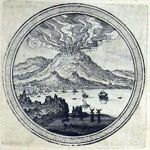
Iconclass: 52D1 Communication of Thought 57A6131 Guilelessness, Artlessness, Openness, Ingenuousness
Loci Communes: Nobilitas / obscuritas (Nobility / obscurity, Noblesse / obscurité); Notus (Known, famous, Connu)
IV viii 24 Myconiorum more Like the Myconians
Μυκονίων δίκην. i. Myconiorum more dicebanrur ad convivium ac cedere, qui ultro venirent, non vocati. Myconus una cycladum est: ipsa gens ob rerum inopiam cogebatur sese conviviis ingerere: unde iocus proverbialis. Apud Athenaeum archilochus lacerat Periclem, quod invocatus irrueret in convivia, μυκονίων δίκᾳ, quem iocum et alibi retulimus, Myconiorum morum vestigia videas et hodie in quibusdam Hibernis. qua de re quidam olim fabulam non illepidam recitavit, imo non fabulam, sed rem ipso teste gestam. Hibernus quidam ignotus, ingressus aulam principis tepore prandii, non invitatus accubuit mensae regiorum satellitum. Qui videntes avem peregrinam, rogarunt cuias esset, professus est patriam, rogarunt, num quod officium haberet in aula, nullum inquit, sed habere cupio. Illi admirantes hominis impudentiam, iusserunt surgere atque abire, hoc inquit faciam, pransus; quid multis? Vicit improbitate, nec locum in acie deseruit Hibernus. Tandem ira versa in risum, rogarunt hominem qua tandem fronte ausus esset ignotus, et alienus sese in regiam familiam ingerere; quoniam, inquit sciebam regem satis esse divitem ad dandum mihi prandium.
[greek], Like the Myconians. People who gate-crashed a party were said to turn up 'Like the Myconians.' Myconos is one of the Cyclades and the people were so poor they were obliged to push themselves in among the guests, hence the mocking proverb. Athenaeus cites Archilochus' lambasting of Pericles for thrusting himself uninvited into convivial gatherings 'like the Myconians.' We have already treated this phrase elsewhere. Even today you still find traces of 'Myconian' behaviour among the Irish. On which subject, William Lord Mountjoy told me a rather amusing story, not, however, a fiction but something he saw with his own eyes. A completely unknown Irishman entered the King's palace at the hour of dinner and sat down quite uninvited with the King's entourage. When they saw the exotic bird, they asked him where he came from. He named his country. They then asked whether he had any position at court. 'No,' he replied, 'but I would like to have one.' They were amazed at the fellow's impudence and told him to get up and go. 'Certainly,' said he, 'when I've had my dinner.' To cut a long story short, the Irishman did not retreat but carried the day by his sheer effrontery. Their anger turned to amusement and they asked him how he, a nobody and a foreigner, had the face to push himself in amongst the King's household. 'Well,' said he, 'I knew the King could afford to give me my dinner.'
Facsimile:
Iconclass: 32B311(IRISH) Europeans: Irish 32B311(MYCONIANS) indigenous European peoples (MYCONIANS) 55BB1 Poverty; 'Povertà', 'Povertà del doni', 'Povertà in uno ch'habbia bell'ingegno' (Ripa)
Loci Communes: Parasiti (Parasites, hangers-on, Parasites)
IV viii 25 Solem adjuvare facibus Add light to the sun with torches
Alioqui retulimus τὸ φῶς ἡλίῳ δανίζεις. Huic similimum est, quod refert Gratianus ex Anacleto Papa, causa. 6. q. prima, in eos qui hic usurpant sibi divinum iudicium, quod nullus hominum poterit effugere. Nam incerta sunt hominum iudicia, neque secus sese habent ad iudicia dei, quam fax ad solem. Si omnia, in quit, in hoc saeculo vindicata essent, locum divina iudicia non haberent. Supetuacuis laborat impendiis, qui solem certat facib. adiuvare etc. Quamquam in libris vulgaribus librarii pro facibus depravarant fascibus.
We have already dealt elsewhere with [greek] 'You lend light to the sun.' Very similar is this other phrase quoted by Gratian from Pope Anacletus in cause six, question one, where he attacks those who in this world think they have the right to dispense the judgment of God which no man shall escape. The judgments of men are indeed unsure and, compared to the judgments of God, are like torches compared to the sun. 'If everything in this world,' he writes, 'received its just deserts, there would be no place for divine judgment. It is wasted effort to seek to add light to the sun with torches ...' Though in common copies of the work, scribes have corrupted facibus 'with torches' to fascibus 'with faggots.'
Facsimile: 
Iconclass: 24A8 sunlight 41B32(+1) torch (+ kindling a light; lit, burning light, lamp, candle) 52BB53 Nonsense, Absurdity 54BB2 Unnecessity, Superfluity
Loci Communes: Absurda, indecora, seu praepostera (Absurd, unbecoming, or preposterous things, Choses absurdes, inconvenantes ou déplacées)
IV viii 26 Censoria virgula The obelus of censure
Tritissimum est apud eruditos, Censoriam virgam appellare iodicandi auctoritatem, praesertim cum supercilio, a magistratu Romano sumptum. Cuius formae est, quod ait Beatus Hieronymus in dialogo adversus Luciferianos: Nemo pote st Christi palmam sibi assumere, nemo ante diem iudicii de hominibus iudicare. Videtur autem Hieronymus allusisse ad caput Deuteronomii xxv. ubi iusticiae palma dicitur, quae à iudicibus tradebatur ei, qui probasset suam innocentiam, causamque vicisset. Hanc palmam verè Christus habet, nec eam tradit indigno, quoniam solus iudicio non fallitur, quum in humanis iudiciis plurimum sit & erroris & caliginis
Scholars very commonly use the term 'Obelus of censure' for authoritative judgment, especially when expressing disapproval. This is derived from the Roman magistrate [the censor]. We can class with this Jerome's words in the dialogue against the Luciferians: 'No one can lay claim to the palm of Christ, no one pass judgment on men before the day of judgment.' Jerome seems to be alluding to Deuteronomy twenty-five, where the palm of justice is a palm given by the judges to one who had proved his innocence and won his case. This palm Christ truly has, and he does not give it to any undeserving person, since he alone never errs in judgment, whereas in human judgments there is plenty of error and darkness.
IV viii 27 Trochi in morem Like a whipping-top
Βέμβικος δίκην. id est, Trochi in morem, de versatilibus & inconstantibus dici solitum. Est enim bembix trochus, quem pueri flagello circumagunt. Suidas citat ex Aristophane, βέμβικος οὐδὲν διαφέρειν δεῖ. id est, non oportet quicquam à trocho differre. Locus is est in Avibus. Hesychius dictum putat in eum, qui in fuga non tenuerit rectam viam, sed in orbem fuerit circumactus. Quod mihi quondam usu venit à Sletstadio petenti Basileam. Forte incidimus in quendam equitem, quo duce quum in nemore diutius obequitarem, rogabam an certò nosset viam.Aiebat. quum non esset finis, Oportet in quam nos errare: nam tres iam horas versamur in nemore, quod intra horam solemus emetiri.Quid multis? Compertum est minimum abfuisse, quin eò rediremus unde veneramus. Bembix autem magno impetu movetur, sed in orbe, ut fugiens non effugiat. Simili tropo stultorum inconstantiam notat Syrach. ille sapiens Hebraeus, capite trigesimotertio: Praecordia fatui quasi rota curri, et quasi axis versatilis cogitatus illius. Apud Plautum interdum dicitur aliquis trocho aut rota figuli versatilior.
[greek], Like a whipping top, said of inconstant and changeable people. A bembix is a top which boys whip to make it spin. Suidas cites a line from Aristophanes: 'must be just like a whipping-top.' (The line is from Birds.) Hesychius thinks it refers to someone running away who does not keep to the right path but goes round in circles. This happened to me once when I was going from Selestat to Basel. I fell in with another horseman and led by him rode about in a certain wood for ages. Eventually I asked him if he was sure of the way, and he assured me that he was. When there seemed no end of it, I said, 'We must have gone wrong somewhere. We've been in this wood for three hours now, and it usually takes only an hour to get through it.' To cut a long story short, it turned out that we were almost back where we started. A whipping-top moves with great energy, but in a circle, so that it flees but does not escape. Sirach, the wise Hebrew, chapter thirty-three, uses a similar figure to describe the inconstancy of the fool: 'The heart of the foolish is like a cart-wheel; and his thoughts are like a rolling axle-tree.' Plautus sometimes says someone 'turns quicker than a top' or 'than a potter's wheel.'
Facsimile:
Iconclass: 31A27481 turning something, (causing) circular movement 43C7222 whipping a top 48C34(POTTER'S WHEEL) tools, implements of craftsman: potter's wheel 51K2 Mutability; 'Immutatione' (Ripa) 53AA21 Inconstancy; 'Incostanza', 'Instabilità', 'Instabilità overo Incostanza' (Ripa)
Loci Communes: Inconstantiae, perfidiae, versutiae (Inconstancy, treachery, cunning, Inconstance, perfidie, ruse)
IV viii 28 Praestat canem irritare quam anum Better provoke a dog than an old woman
Refertur ex Menandro, Πολὺ χεῖρον εστὶν ἐρετίσαι γραῦν ἢ κύνα. id est, Plus est periculi anum lacessere quàm canem. Hebraeorum sententiae negant ullam iram atrociorem esse ira muliebri. Irritabile enim ac vindex mulierum genus, partim ob rationis inopiam, partim ob animi humilitatem. Nam verae magnanimitatis est quasdam iniurias negligere, neque quosvis homines dignari ira sua. Est autem formidabile animal mulier cum ad sexus vitium accedit senectus. Canis irritatus tantum oblatrat, interdum et mordet: at aniculae praeter linguae venenum, interdum instructae sunt malis artibus veneficiis & incantamentis. Itaque nonulli ingenti suo malo experti sunt esse verissimum, quod dixit Menander.
There is a line in Menander which says, 'Worse by far it is an old woman to rouse than a dog.' According to the sayings of the Hebrews, there is no anger more violent than a woman's. The whole sex is easily provoked and vindictive, partly through irrationality, partly through pettiness. The truly great spirit will ignore certain injuries and think it beneath him to be angry with all and sundry. Woman, however, is a formidable creature when to the normal faults of the sex are added advancing years. A dog when roused merely barks, sometimes even bites; but old hags not only have poisonous tongues but skill in evil arts as well, in poisonings and spells. Many have discovered to their cost the truth of Menander's words.
Facsimile:
Iconclass: 31D17 old woman 34B11 dog 52A24 Precaution 56E2 Rage, Anger
Loci Communes: Senium praematurum aut mors (Premature old age or death, Vieillesse prématurée ou mort)
IV viii 29 Pecuniosus damnari non potest A rich man cannot be found guilty
M. Tullius in Verrem actione secunda, ait hoc omnium sermone percrebuisse, non apud Romanos tantum, verum etiam apud exteras nationes, in iudicii illorum temporum pecuniosum, quamvis sit nocens, neminem posse damnari. Et in eundem oratione tertia: Reus est enim, inquit, nocentissimus. Qui si condemnatur, desinent homines dicere, his iudiciis pecuniam plurimum posse. Sin abso lvitur, desinemus nos de Iudiciis transfrerendis recusare. Huic affine quid aliquoties repetitur apud Salustium in bello Iugurthino, Romae esse venalia omnia. Nunc amisit Roma imperium, utinam & dictum non haereret.
In the second part of his attack on Verres, Cicero says that it was universally acknowledged 'not merely among Romans but among foreign nations as well, that, with the courts constituted as they now are, no man with welllined pockets, however guilty he might be, can be convicted.' And in the third part: 'The guilt of the accused is indubitable. If he is convicted, men will no longer say that in these courts money is the thing that matters. If he is acquitted, I for my part shall no longer oppose the transference of the courts to others.' Similar to this is the idea occurring several times in Sallust's Jugurthine War: 'In Rome everything has its price.' Rome has now lost its empire. I wish that the saying did not still stick.
Facsimile:
Iconclass: 44G112 judicial verdict 44G690 'Corruttella ne' giudici' (Ripa) 46A16 the rich
Loci Communes: Munerum corruptela (Corruption by gifts, Corruption par les présents)
IV viii 30 Inter manum et mentum Between the hand and the chin
Festus Pompeius indicat esse proverbium apud Latinos, sed ex illo Graeco dictum: πολλὰ μεταξὺ πέλει κύλικος καὶ χείλεος ἀκροῦ. Cuius originem ita refert: quum Chalcas vitem sereret, quidam augur vicinus praeteriens, dixit illum errare. Non enim ei fas esse novum vinum degustare. Tantum colligere licuit e fragmenris, quae nobis quorundam stoliditas superesse voluit ex auctore undiquaque docitissimo. Proverbium admonet in hominum vita nihil esse certi. Nam saepenumero fit, ut quod nos maxime tenere credimus, casus aliquis inopinatus in tervertat. Veluti cum quis manu tenet poculum, minimumque spatii sit inter manum et mentum, tamen interdum fit, ut is moriatur antequam bibat, Hoc proverbium variis modis effertur, eiusque originem alii aliter prodiderunt, de quibus satis opinamur dictum est in proverbio. Multa cadunt inter calcem supremaque labra. Hic ideo retulimus quod aliis verbis commemoretur a Festo, in quibus non nihil est gratiae ex prosonomasia: Manum et mentum.
Festus records this as a proverb in use among the Romans but ultimately derived from a Greek one, [greek] 'Many a thing befalls between the cup and the brush of the lips.' He records its origin as follows: 'Chalcas was planting vines when a seer who lived in the neighbourhood happened to pass by and remarked that Chalcas was under a misapprehension - it would not be granted to him [to taste] the new wine.' That's all we can gather from the fragmentary text, which is all that somebody or other's stupidity has left us of this author who is so thoroughly knowledgeable on every subject. The proverb reminds us that there is nothing certain in human life. Very often the very thing that we think we have in our grasp some unexpected chance snatches away. It is like someone holding a cup so close that there is only a small space between the hand and the chin and even so, as sometimes happens, dying before he can drink. The proverb is explained in various ways, and different writers give different accounts of its origin, all of which I treated in some detail above when discussing the proverb 'There's many a slip 'twixt the cup and the lip.' I have introduced it here because Festus gives it in different words, which in the Latin have a nice alliterative ring, manum 'hand' and mentum 'chin.'
Facsimile: 
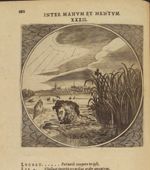
Inter manum et mentum: Cats, Proteus (Rotterdam, 1627), emblem 32
Many a slip twixt the cup and the lip: Cats, Moral Emblems (London, 1860), emblem 18
Iconclass: 31A22111(CHIN) parts of the face (CHIN) 31A253 postures and gestures of arms and hands in relation to the head 52BB3 Surprise, Wonder; 'Maraviglia' (Ripa) 52BB41 Uncertainty 54F122 Vicissitudes of Life
Loci Communes: Fortunae commutatio (Change of fortune, Changement de fortune)
IV viii 31 Colophonium calciamentum Colophonian footwear
Κολοφώνειον ὑπόδημα. id est, Colophonium claciamentum dicebatur cavum. Nam antiqui fere soleis utebantur, quae infimam pedum partem tantum munirent. Unde quadrabit in hominem stolidum et incompositum, et rusticanum. Per lutum ituris convenit tale calciamentum. Venuste itaque dixeris, in fordidis auctoribus versaturo opus esse calceis Colophoniis. Huic contrarium vel calciamentum Sycionium, cui cognomen inditum a Sicy one civitate Peloponnesi, ut indicat Stephanus, atque etiam Sextus Pompeius Festus, neuter tamen indicat usum adagii. M. Tullius indicat Sicyonios calceos fuisse perbellos, sed aptiores feminis et effeminatis, quam viris. M. Tullii verba subscribemus: Quinetiam cum et scriptam orationem desertus orator Lysias attulisset ad Socratem, quam si videretur edisceret, ac pro se in iudicio uteretur non invitus legit, et commode scriptam esse dixit. Sed, inquit, ut si mihi calceos Sicyonios attulisses non uterer, quamvis essent habiles et apti ad pedes, quianon essent viriles: sic illam oraionem disertam sibi et oratoriam videri, fortem & virilem non videri.
[greek], Colophonian footwear, was a name for clogs. The ancients usually wore a simple sandal that only protected the sole of the foot. I have seen among my own countrymen a form of footwear made of hollowed-out wood, called in the vulgar tongue a 'hollow block.' This is why the term can be applied to a thick, clumsy, rustic fellow. This kind of footwear is appropriate if you have to make your way through mire. So you could wittily say of someone who was about to work on texts containing filthy material that he needed 'Colophonian clogs.' The opposite of this is 'Sicyonian shoes,' named after Sicyon, a town in the Peloponnese, as we are told by Stephanus and Sextus Pompeius Festus mentions them too, though neither explains the saying. Cicero gives us to understand that 'Sicyonian shoes' were very pretty, more suitable for women and fops than for men. This is what Cicero says: 'Again, when Lysias, the eloquent speaker, brought Socrates a ready-written speech, which he could learn off if he wanted and use it to defend himself at his trial, he read it willingly enough and said it fitted the circumstances very nicely, "but," said he, "if you had brought me Sicyonian shoes, I would not wear them, however comfortable and well-fitting they were"; that is, he thought the speech eloquent and one that did credit to Lysias as an orator, but he did not consider it manly or courageous.'
Facsimile:
Iconclass: 41D2333 wooden shoes, clogs 56DD32 Alarm, Fright; 'Spavento', 'Terrore' (Ripa) 59AA2 Ill-breeding, Bad Taste 61E(COLOPHON) names of cities and villages (COLOPHON)
Loci Communes: Multi - in stupidos (Many people - against the stupid, Beaucoup de gens - contre les sots)
IV viii 32 Manduces Jaws
Manduces dicebantur, vehementer famelici, aut qui minis inanibus terrorem incuterent. Festus Pompeius tradit in pompis olim inter cateras ridiculas ac formidolosas imagines ire solere effigiem, magnis malis, late dehiscente rictu, et ingentem dentibus sonitum facientem. Eam manducem appellabant. Apud Plautum in Rudentibus, ita loquitur Charmides parasitus: Quid si aliquo ad ludos pro manduce me locem, quapropter? quia pol clare crepito dentibus. Enatarat parasitus e naufragio, totusque horrebat prae frigore. Unde paulo post dicit se omnia corusca loqui. Aut de hac, aut de simili effigie sentire videtur. Martialis cum ait: Sum siguli lusus, rufi persona Batavi. Quae tu derides, haec timet ora puer. Hoc genus imaginum Graeci vocant mormolu/kia, quod lupina specie terrent pueros, ut a plorando desisterent.
Manduces, Jaws, was a name for people who were always hungry, or for those who inspired terror with empty threats. Festus tells us that at one time in processions, as well as other extravagant and frightening figures, there would be an effigy with huge jaws gaping wide open and making a great clacking with its teeth, called Mandux 'Jaws.' In Plautus' play the Rope, the professional toady, Charmides, says, 'Suppose I hire myself out somewhere as a Mandux at the games? For why? My teeth are gnashing nicely.' He had just swum ashore from a shipwreck and was shivering all over with cold. A little later, he says his voice has 'got the rattles.' Martial was thinking of this figure or something like it when he wrote: 'Worked in red clay, a Dutchman's phiz am I. / I move your laughter, but make the children cry.' The Greeks call this sort of bogey[greek] 'fright-wolf,' because they used to frighten children with the spectacle of a wolf to make them stop crying.
IV viii 33 Ubi tu Cajus, ibi ego Caja Where you are Gaius, there I am Gaia
Plutarchus in Problematibus Romanis, quaerit unde mos ille natus sit, ut qui sponsam ad sponsum deducerent illam haec verba profari, o(/pou s1u\ ka/i+os2 e)gw\ ka/i+a, id est, Ubi tu Caius, ego Caia. Dubitatque an prisci voluerint sponsam his verbis depacisci cum sponso, ut interipsos omnia essent communia, pariterque im perarent in familia, quasi diceret, ut tu domus et auctor, ita ego domina domus atque hera. Forma sermonis sumpta videtur a iurisconsulitis, qui pro quibusvis nominibus ponunt C. Seium et L. Titium, quemadmodum philosophi Dionem ac Theonem. Unde et illud proverbium, quod alibi citatuimus ex Varrone. idem Actii, quod Titii, cum par duorum ius significatur. An potius omnis causa Caia nominetur, quod fuerit quaedam Caia Cecilia, mulier cum eleganti forma tum probatissimis moribus, antea dicta Tananquil: quae nupsit uni e fillis Tarquinii, videlicet Tarquinio Prisco. Huic Caiae Romani posuerunt statuam aeream in templo Sancti. Sic enim scribit Plutarchus ἐν τῷ τοῦ σάγκτου ἱερῷ. Is erat Deus olim hoc nomine cultus apud Romanos, unus e numero duodecim selectorum. Ibidem antiquitus erant reposita illius sandalia et colus, quorum illa testabantur eam domi manentem familiae curam habuisse, hac industriam signisicabat, quod muliebres operas diligenter obierit, lanificii studiosa. Huius itaque nominis mentio sponsam admonebat, ut talis esset suo marito, qualis Caia Cecilia fuerat suo. Inter priscas nuptiarum ceremonias servabatur, etillud quod inauspicatum habebatur, vel sponsum, vel sponsam propriis appellare nominibus. Quin et in hodiernum usque diem observatur, ut sponsa relicto cognomento gentilitio transcat ad congnomen viri, ut Hectoris Andromache. Proverbium e coniugio natum inter coniu ges maneat, nisi quod potest et ad sororem, fratremque accommodari.
In his 'Roman Questions,' Plutarch discusses the origin of the custom according to which those who conducted the bride to her husband bade her speak the words, 'Where you are Gaius, there I am Gaia.' His first suggestion is that the ancients desired the bride, in speaking these words, to enter into an agreement with her husband that they would share everything and have equal authority in the household, saying in effect, 'Where you are lord and master of the house, there I am lady and mistress.' The form of the saying is derived from the Jurisconsults, who use 'Gaius Sestius' and 'Lucius Titius' as any two representative people, as the philosophers use 'Dion' and 'Theon.' (Hence the adage which I cited earlier from Varro, 'Accius and Titius take alike,' meaning that they had equal rights.) Plutarch's second suggestion is that the woman is called Gaia as a good omen, because there was a certain Gaia Caecilia, previously called Tanaquil, who was both beautiful and virtuous. She was married to one of the sons of Tarquin, Tarquinius Priscus in fact. The Romans placed a bronze statue of this lady in the temple of Sanctus (that at any rate is the form of the name given in Plutarch's text). He was a god at one time worshipped under this name by the Romans, one of the twelve special divinities. In ancient times the lady's sandals and distaff were laid up in his temple. The sandals were a sign that she stayed at home and looked after the household, the distaff indicated her industry, in diligently performing the work of women and applying herself to her spinning. The use of the name Gaia reminded the bride to be to her husband what Gaia Caecilia was to hers. Among other observances connected with ancient marriage ceremonies was the belief that it was illomened to call bridegroom or bride by their proper names. Even today it is customary for the bride to give up her own family name and take her husband's name, just as Andromache is addressed as 'Andromache of Hector.' The saying, which originated with the married state, should remain special to husband and wife, though it could be adapted to brother and sister.
Facsimile: 
Iconclass: 42D16 marriage contract 59C21 Equality, Equity, Fairness, Righteousness; 'Equalità', 'Equità', 'Giuditio giusto', 'Ordine dritto e giusto', 'Ugualità' (Ripa)
Loci Communes: Similitudinis et congruentiae (Similarity and congruence, Similitude et convenance)
IV viii 34 Rumor publicus non omnino frustra est General report not always groundless
Carmen Hesiodi celebratissimum citat Ariftoteles libro Moralium Nicomach. vii. Φήμη δ᾽ οὔτοι πάμπαν ἀπόλλυται, ἥν τινα λαοὶ Πολλοὶ φεμΐζωσιν.. id est, Haudquaquam in totum rumor perit ille, per ora Qui volitat populis compluribus. Philosphus hunc versiculum adducit velut argumentum probaile, voluptatem esse summum bonum, quod eam et homines expetant, et bruta animantia.
In the seventh book of his Nicomachean Ethics, Aristotle quotes some wellknown lines from Hesiod: 'Rumour dies hard that many folk have uttered.' The philosopher adduces this brief poetic extract as a probable argument in support of the view that pleasure is the supreme good because men as well as beasts pursue it.
Facsimile:
Iconclass: 52C111 Public Opinion; 'Opinione' (Ripa) 52D5 Rumour; 'Rumore' (Ripa)
Loci Communes: Notus (Known, famous, Connu)
IV viii 35 Quadratus homo A four-square man
Aristoteles moralium Nicomachiorum i, disputans adversus eos, qui felicitatem hominis bonis externis definiunt, quae fortunae arbitrio dantur simul et eripiuntur, dicit ad hanc rationem felicem, Chamaeleontem quempiam induci, ut qui subinde mutatis rebus nunc felix sit, nunc infelix, quemadmodum Chamaeleon ad speciem rerum quibus admovetur, mutat colorem, cum vera felicitas praecipue sita sit in bonis animi. Unde colligit, qui vere beatus sit, nihil obstare, quo minus per omnem vitam sit beatus, ac subiicit, ἀεὶ γὰρ ἢ μάλιστα πάντως πράξει καὶ θεωρήσει τὰ κατ᾽ ἀρετὴν, καὶ τὰς τύχας οἴσει κάλλιστα καὶ πάντη πάντως ἐμμελῶς ὅγ᾽ ἀληθῶς ἀγαθὸς καὶ τετράγωνος ἄνου ψογου. i. Semper enim aut quam maxime, omnino faciet et contemplabitur quae sunt virtutis: ac fortunae casus optime feret, ac prorsus omni ex parte modulate, is sane, qui vere bonus est et quadrangulus, carens omni vitio. Libro Rhetoricorum 3. meminit hius dicti inter genera metaphorarum. Haec autem figura in quamcumque partem voluatur, sui similis est. Ita spiens, quaecumque inciderit fortuna, non mutat animum. Venustius erit, si viri fortis animum nec ullis fortunae casibus labefactabilem dicamus τετράγωνον.
In the first book of his Nicomachean Ethics, Aristotle takes issue with those who equate human happiness with external blessings, which come and go at the whim of fortune. He says that, according to this line of thought, our happy man appears as a kind of chameleon, being sometimes happy, sometimes unhappy, according as his circumstances change, just as the chameleon changes colour if placed on a different coloured background. True happiness on the other hand lies in the blessings of the mind, from which he deduces that there is no reason why the truly happy man should not remain happy all his life. He goes on:
For the person who will always or as far as possible act and think in a way
consonant with virtue and suffer the mishaps of fortune as well as can possibly
be done, in an absolutely consonant manner, will be the person who is truly
good, a four-square man, free from all that can be faulted.
(In the third book of his Rhetoric, he uses this same phrase, 'a four-square man,' to illustrate a type of metaphor.) Now a square remains a square, whichever side it falls on. In the same way, the wise man remains unchanged in his essential self, however events fall out. It will be even neater to apply the term 'four-square' to the actual mind of the wise man, which remains unshaken in face of fortune's blows.
Facsimile:
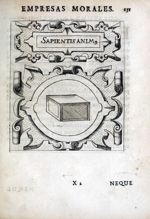
Sapientis animus: Borja, Empresas morales (Bruxelles, 1680), emblem 75 uses the imagery of a cube as a symbol of a stable, happy man
Iconclass: 49D342(SQUARE) regular quadrilateral: square 49D452 hexahedron, cube 53A21 Constancy, Tenacity; 'Costanza', 'Tenacità' (Ripa) 56B2 Happiness, Felicity 57A6 Virtuousness; 'Amor di Virtù', 'Attione virtuosa', 'Guida sicura de' veri honori', 'Virtù', 'Virtù insuperabile' (Ripa)
Loci Communes: Perficiendi sive absolvendi (Finishing, completing, Achever, accomplir)
IV viii 36 Merces constituatur Let the price be agreed for a friend
Plutarchus in vita Thesei tradit fuisse quendam Pittheum avum Thesei maternum, à quo Hippolytus ille pudicus fuerit institutus. Is gnomologiis, quae tum temporis praecipua habebatur sapientia, clarus erat. Ex eius sententiis hanc nam suisse ferunt. Μισθὸς δ᾽ ἀνδρὶ φίλῳ εἰρημένος ἄρκος ἔστω. id est, Aequa viro merces sac praestituatur amico. Aristoteles nono Moralium Nicomachiorum, narrat Protagoram cum nemine discipulorum solere pacisci, verum ubi idam didicissent quae volebant, iussit ipsos despicere, quanti aestimarent ea, quae didicerant, et quicquid ab illis dabatur, accipiebat. Hoc animo qui sunt, iis in hoc genere commerciorum putat esse satis Pitthei praeceptum, qui iubet amico viro statui mercedem iustam et aequam. Bene haberet, si medici quoque nihil paciscerentur, sed aegro levato acciperent, quod daretur. Nam quod Aristoteles inibi refert de quibusdam sophistis, qui neminem recipiebant in disciplinam, nisi numerata mercede, mox acceptis nummis non praestabant quod erantpolliciti: videmus interdum fieri a chirurgis ac medicis malae fidei: ac fere comperiuntur esse impostores, qui stipulantur ingens praemium, nec admovent manum, nisi aut tota summa, aut maxima pars statim numeretur.
In his Life of Theseus, Plutarch tells us of a certain Pittheus, the maternal grandfather of Theseus and instructor of the famously chaste Hippolytus. Pittheus was famous for his wise saws, which at the time were held to enshrine the highest sapience. This is supposed to be one of them: [greek], 'Agree the price and make it fair when dealing with a friend.' Aristotle tells us in the ninth book of his Nicomachean Ethics that Protagoras never settled with his students in advance what fees they should pay, but once they had acquired the knowledge they desired, he told them to reckon how much they thought it was worth and then he would accept whatever they gave him. Aristotle thinks that people of this persuasion would find the precept of Pittheus perfectly adequate in transactions of this sort, since he recommends fixing a fair and just reward for a friend. It would be a good thing if doctors too did not fix a fee in advance but accepted what they were offered, once the patient had recovered. In the same passage, Aristotle tells us that certain sophists would not admit anyone to their courses unless the fee were paid cash down, and then, having pocketed the money, failed to deliver what they had promised. We sometimes see shady doctors and surgeons doing exactly the same thing. The ones who demand an enormous fee and will not lift a finger unless the whole sum or at least the greater part of it is actually paid on the spot are usually discovered to be quacks.
IV viii 37 A bonis bona disce Learn goodness from the good
Aristoteles Moralium Nicomachiorum 9. ostendens virtutem optime disci convictu bonorum, quod amici se mutuo corrigunt, si quid erratum est, et sese vicissim ad honestas excitant actiones, citat carmen veluti notum, ἐσθλῶν μὲν γὰρ ἀπ᾽ ἐσθλα. Versus autem est Theognidis, cuius meminit Xenophon in commentatio de dictis ac factis Socratis. Aiebat enim inter unguenta nullum oleum melius olere, quam quo ungebantur athletae. Amaracinum et foliatum feminis esse relinquenda. Rogatus quid deceret olere senes, respondit probitatem. Dein rogatus ubi hoc unguentum venderetur, Theognidis hemistichio respondit, Εσθλῶν μὲν γὰρ ἀπ᾽ ἐσθλὰ διδάξεαι. id est, Qui bonus est, ab eo bona discito. Itidem & noster γνωμογράφος: Disce, sed a doctis.
In the ninth book of his Nicomachean Ethics, Aristotle is demonstrating that virtue is learnt best from the company of good men, since friends correct each other if any error is committed and find themselves spurred on to virtuous action by the presence of others. To support this argument, he quotes as if well-known some words of poetry: 'goodness from the good.' The quotation is actually from Theognis, and it also occurs in Xenophon's account of the sayings and doings of Socrates. Socrates was saying that the best of all perfumes was the oil used by athletes. Oil of marjoram and spikenard were best left to women. When asked what old men should smell of, he replied, 'Integrity.' When asked in turn where this perfume could be purchased, he quoted in reply these words from a line of Theognis: 'From the good do thou goodness learn.' Our own writer of maxims says in similar vein: 'Learn, but only from those who have been well taught.'
Facsimile:
Iconclass: 54A5 Goodness; 'Bontà' (Ripa) 54C31 Example 57A613 Integrity
Loci Communes: Contagio morum (The contagion of habits, Contagion des mœurs)
IV viii 38 Asinus stramenta mavult quam aurum The ass prefers straw to gold
Aristoteles lib. Moralium Nicomachiorum 10. disputans non eandem omnibus esse voluptatem, cum aliis rebus delectetur canis, aliis equus, aliis homo, citat Heraclitum qui dixerit, ὄνους σύρματ᾽ ἂν ἑλέσθαι μᾶλλον ἢ χρυσὸν, ἥδιον γὰρ χρυσοῦ τροφὴ ὄνοις, id est, Asinos stramenta malle quam aurum, quod asinis pabulum auro sit iucumn dius, Atque hac quidem in parte asini plus sapiunt quam homines. Illi rem aestimant usu, nos inutilibus atque etiam no-] xiis rebus ex animi persuasione ingentia statuimus precia. Notus est apologus de gallo, qui gemmam in sterquilinio repertam contempsit. Gallus enim mavult putre granum, quam margaritam aut adamantem. Ita qui ventris sunt mancipia, compotationem temulentam omnibus disciplinis liberalibus anteponunt.
In the tenth book of the Nicomachean Ethics, Aristotle is saying that pleasure is not the same for all creatures, since the dog, the horse, the man, take pleasure in different things. He then quotes from Heraclitus: 'Asses would choose straw in preference to gold, because food gives them more pleasure than gold.' Here indeed asses are wiser than men. Asses judge things according to their usefulness, we set great price on useless or even harmful things because of some preconceived notion. Everyone knows the fable about the barnyard cock who spurned the gem he uncovered in the dunghill. A cock prefers a perishable barleycorn to a pearl or a diamond. Likewise those who are slaves to their bellies think more of drunken revelry than all liberal disciplines.
Facsimile: 
Iconclass: 25D13(GOLD) minerals and metals: gold 46C13142:52A51 ass, donkey❧Wisdom; 'Sapienza', 'Sapienza humana', 'Sapienza vera' (Ripa) 47I17(STRAW) agricultural products and by-products: straw 51BB4 Multiformity, Variety 53A11:54B3 Choice; 'Elettione' (Ripa)❧Utility, Usefulness; 'Utilità' (Ripa)
Collectanea (1500): 29
Loci Communes: Multi - in stupidos (Many people - against the stupid, Beaucoup de gens - contre les sots)
IV viii 39 Jocandum ut seria agas Play in order to be serious
Eodem libro refert sententiam Anacharsidis, qui taxarit eos; qui seria agunt ut iocentur, cum iocus in hoc interdum admittendus sit, ut seriis rebus vacare liceat. Velut qui per omnem vitam magnis laboribus hoc agunt, ut fiant boni saltatores, aut egregii tibicines. Aristotelis verba sunt haec, σπουδάζειν δὲ καὶ πονεῖν παιδιᾶς χάριν, ἠλίθιον φαίνεται καὶ λίαν παιδικὸν, παίζειν δὲ ὅπως σπουδάζῃ, κατ᾽ ἀνάχαρσιν ὀρθως ἔχειν δοκεῖ. id est, Studere vero ac laborare ludendi gratia, stolidum videtur atque admodum puerile. At ludere ut agas seria, iuxta Anacharsidis senrentiam, recte videtur habere.
In the same book, Aristotle cites the criticism of Anacharsis, directed at those who treat trivial pursuits as serious business, as for example putting a life-time of effort into becoming a good dancer or a skilled wind-player. Play is really something that should be indulged in only from time to time in order to make possible concentration on serious subjects. Aristotle actually says, 'It looks foolish and very childish to treat what is only a pastime as something that matters and to devote a great deal of energy to it. But to play in order to achieve something worthwhile is, according to Anacharsis, quite acceptable.'
Facsimile:
Iconclass: 51HH11:23 Divisibility❧time 57A66 Seriousness 57AA66 Frivolity
Loci Communes: Absurda, indecora, seu praepostera (Absurd, unbecoming, or preposterous things, Choses absurdes, inconvenantes ou déplacées)
IV viii 40 Cyclopum more Like the Cyclopes
In eodem rursus libro Cylopicam vitam appellabat, ubi nullis publieis legibus vivitur, sed quisquis suo arbitratu res gerit, ἐν δὲ ταῖς πλείσταις τῶν πόλεων ἐξημέληται περὶ τῶν τοιούτων, καὶ ζῆ ἕκαστος, ὡς βούλεται, κυκλωπικῶς θεμιστεύων παίδων ἢ ἀλόχου. id est, In caeteris autem civitatibus super his, hoc est educatione liberorum, nulla est habita cura, sed quisque vivit ut vult, Cyclopum ritu de liberis et uxore fas nefasque statuens. Cyclopes enim sparsim habitare feuntur in montibus, nulla specie vitae civilis, sed in suo quisque antro facit quod lubet. Ne religio quidem apud illos ulla. κύκλωπος βιος alibi nobis dictus est.
In the same book again, Aristotle calls 'Cyclopean' a life subject to no public regulation, where everyone does what he chooses: 'In the majority of cities there is no action taken on these matters (that is, the education of children), but everyone lives as he sees fit, like a Cyclops determining for himself how wives and children are to be treated.' The Cyclopes, it is said, lived scattered over the mountains with no semblance of civilized life, but each doing what he pleased in his own cave. Nor did they have any kind of religion. I have already dealt with the saying, To live like the Cyclopes.'
Facsimile:
Iconclass: 53BB6 Indiscipline 91B2(+7) the Cyclopes (+ specific aspects, allegorical aspects)
Loci Communes: Vis injustia (Unjust force, Force injuste)
IV viii 41 In leporinis Live on hare-pie
Εν λαγώοις, id est, In leporinis carnibus vivere dicebantur, qui laute atque in deliciis vitam agebat. Nam leporinam olim in deliciis habitam declarat Martialis. Inter aves, turdus si quis me iudice certet, Inter quadrupes gloria prima lepus. Attestatur & proverbium: Tute lepus es, & pulpamentum quaeris. Aristophanes in Vespis. Sunt, inquit, mille civitates, quae nunc nobis tributum solvunt. Harum unicuique si quis in peret ut viginti alat viros, Δύο μυριάδες τῶν δημοτικῶν ἔζων ἐν πᾶσι λαγώοις, Καὶ στεφάνοισιν παντοδαμοῖσιν, καὶ πύῳ καὶ πυαρίτῃ. id est, Viginti milia populorum viverent in omnibus leporinis omnigenisque coronis, & pyo, & pyarite. Πύον autem Graeci vocant lac, quod animal primum reddit à partu, & pyariten hinc factam decoctionem. Interpres citat carmen ex Homero ni fallor: Πύον δαιμόμενοι κ᾽ ἐμπιπλάμενοι πυατίτην. id est, Epulantes pyo, et explentes sese pyarite. Rursus Aristophanes in equitibus, cum Cleon et adversarius certatim promittunt lautissimas epulas populo: multis deliciarum generibus nominatis, promittunt et leporinae carcarnes, quasi summae exquisitaeque deliciae.
[greek]. Those who lived in ease and luxury were said to 'Live on harepie.' Martial is evidence for the fact that hare's meat was once considered a delicacy: 'Of birds the thrush, if I my thoughts declare, / Of quadrupeds, the glory is the hare.' There is also the proverb: 'A hare thyself, and goest in quest of game?' Aristophanes says in the Wasps: 'A thousand cities pay us tribute. If each one of them were ordered to provide for twenty men, then:'
Twenty thousand of the common folk
Would live on meat of hares,
With all sorts of garlands.
First milk and curdled beastings.
(The Greek word for 'first milk,' which is taken from the animal when it has just borne its young, is puon, and a clotted form of this is called pyarites.) The ancient commentator on this passage of Aristophanes cites a line (from Homer, I think): 'Feasting on first milk, gorging on beastings.' In Aristophanes again, when Cleon and his rival are vying with each other in promising a really magnificent meal to the people, among all the other fancy foods, they promise hare's flesh as something very special and a great delicacy.
Facsimile:
Iconclass: 25F26(HARE) rodents: hare 41C692(HARE-PIE) kinds of meat (HARE-PIE) 55B2 Luxury, Luxuriousness
Loci Communes: Lautitiae (Sumptuousness, luxuries, Somptuosités)
IV viii 42 Matrem sequimini porci Piglets, after your mother
Επεσθε μητρὶ χοῖροι. id est, Post matrem adesse porci. Id subinde repetitur apud Aristophanem in Pluto. Interpres admonet iocum esse proverbialem in stupidos & indoctos. Sus enim Minervae opponitur iuxta proverbium. Veluti si quis diceret in docti praeceptoris indoctus discipnius, ἕπεσθε μητρὶ χοῖροι. Quadrabit et in gulae ventrique deditos.
[greek], Piglets, after your mother. This is found several times, for example, in Aristophanes' Plutus. The ancient commentator tells us it's a proverbial joke directed against the stupid and ignorant. According to another proverb, the sow is the opposite of Minerva. One could say, 'Piglets, after your mother,' to the ignorant students of an ignorant teacher. The saying also fits those who are slaves to gullet and belly.
Facsimile:
Iconclass: 47I2122 sow 47I2123 piglet, suckling pig 52AA1 Stupidity, Poverty of Intellect; 'Stupidità overo Stolidità' (Ripa)
Loci Communes: Luxus et mollicies (Luxury and softness, Luxe et mollesse)
IV viii 43 Aristylli more Like Aristyllus
Idem eodem in loco, σύδ᾽ ἀρίστυλλος ὑποχάσκων ἐρεῖς. Tu vero Aristyllus subhians dices. Interpres admonet Aristyllum fuisse poetam deformem ore semper hiate. Quem obiter taxat Aristophanes, cuius et meminit ἐν ἐκκλησιαζούσαις, Tragicum autem est & histrionicum, ore nimium diducto loqui. At nobis videtur magis taxatus Aristyllus, quod ore paullulum diducto loqueretur, ut vos magna ex parte prodiret per nares stridula, qualis est porcorum, quod vitium in quorundam pronuntiatione cantuque videmus.
Aristophanes again, in the same passage from the Plutus: 'You'll be an Aristyllus and say with jaw half-agape .. .' The ancient commentator on the passage tells us that Aristyllus was a poet with a facial deformity that made his mouth always hang open. Aristophanes makes fun of him elsewhere, for example in the Women in Parliament. Now actors employing tragic diction do open the mouth unnaturally wide, but to my way of thinking, Aristyllus was really taken to task for speaking without opening his mouth properly, so that he spoke through his nose with a shrill squeal like a pig's. We know people who speak and sing in that way.
Facsimile:
Iconclass: 31A413:31B6232 deformations of the head❧mouth slightly open 98B(ARISTYLLUS) male persons from classical history (ARISTYLLUS)
Loci Communes: Forma, deformitas (Beauty, deformity, Beauté, difformité)
IV viii 44 Citeria Citeria
Citeriae convitium in homines impendio loquaces olim iactatum est. Cato in M. Caelium: Quid ego dicerem amplius, quem denique credo, in pompam vectitatum iri iudis pro Citeria, atque spectatoribus sermocinaturum. Festus Pompeius admonet, Citeriam dictam fuisse quandam effigiem argutam acloquacem, quae ridiculi gratia in pompis vehi soleat crepitum et strepitum assidue edens. Nunc in pompis non circum fertur Citeria, sed multi Citerias habent domi, factitiis illis multo magis obstreperas.
Citeria was a term of abuse at one time directed at people who talked too much. Cato, in his speech against Marcus Caelius: 'What more need I say? He'll be paraded about at the Games, I suppose, as a Citeria, and will bandy words with the on-lookers.' Festus tells us that this Citeria was an amusing and loquacious figure, carried along in procession to raise a laugh, making a great noise and racket all the time. These clown figures are no longer carried about in processions, but many people have them at home, making a great deal more noise than the artificial ones.
Facsimile: 
Iconclass: 52D41 Trifles, 'Nugae' 61G(CITERIA) names of artefacts and man-made objects (CITERIA) (CITERIA)
Loci Communes: Garrulitas (Talkativeness, Bavardage)
IV viii 45 Ostrei in morem haeret Sticks like a limpet
Ωσπερ λεπὰς προσίσχεται. id est ostrei sive conchylii in morem adhaeret. Aristophanes dixit in anum, quae aegre a iuvene divellebatur, Ως εὐτονως ὦ ζεῦ βασιλεῦ τὸ γραΐδιον Ωσπερ λεπὰς τῷ μειρακίῳ προσίσχεται. id est, O Iuppiter, quam forttter conchae modo Isthaec anicula adhaeret adolescentulo. Est concharum genus, quod capillamentis quibusdam inter se cohaeret, quo tutius sit adversus undarum motus.
[greek], Sticks like a mollusc or shellfish. Aristophanes says of an old woman who can hardly be dragged away from a young man: 'Jupiter, how tightly the old hag / Sticks to the lad like a limpet.' There is a type of mollusc which bind themselves together with filaments so as to have more protection against the motion of the waves.
Facsimile:
Iconclass: 31D17 old woman 33CC32 pursuit of a woman, prowling - CC - pursuit of a man 47C435 glueing (industrial process)
Loci Communes: Pertinacia (Stubbornness, Obstination)
IV viii 46 Hodie nihil succedit Nothing's going right today
Plautinus Amphytrio in sui nominis fabula citat adagii titulo: nihil est, ut dici solet, quod hodie bene succedat mihi. Allusit autem ad vulgi superstitionem, cui quidam dies credebantur rebus gerendis auspicati, quidam infelices: Quod si unum atque alterum parum successit ex sententia hinc aestimantes totum diem, dicunt, hodie nihil succedet, & ab omnibus negotiis abstinent.
In the play named after him, Plautus' Amphitryo uses these words, which he takes to be proverbial: 'Not a thing, as they say, can go well today.' He is referring to the popular belief that some days were lucky for doing things, some unlucky. If one or two things go wrong, they judge the whole day by that and say, 'Nothing will go right today,' and refrain from doing anything important.
Facsimile:
Iconclass: 23R2 day from sunrise to sunset 54FF11 Adversity, Misfortune, Bad Luck; 'Fortuna infelice', 'Infortunio' (Ripa)
Loci Communes: Infortunii sive exitii (Misfortune or ruin, Malheur ou ruine)
IV viii 47 Nec currimus, nec remigamus Neither running nor rowing
Aristophanes ἐν ἐκκλησιαζούσαις, facit mulieres ho cmolienres ut occupent Rem pub. quod hactenus ad omni functione submotae nihil egerint: Νῦν μὲν γὰρ οὔτε θέομεν, οὔτ᾽ ἐλάυνομεν. id est, Neque currimus nunc, nec iuvamur remige. Metaphora sumpta est a nautis ad Rei pub. gubernationem. Nautae currere dicuntur, cum venti sunt secundi, ἐλαύνειν, cum destituti ventis, remigio navim impellunt, qui cursus dicitur secundarius ὁ δεύτερος πλοῦς. Sentiunt se nec pace, nec bello ad ulla vocari munia. Apte torquebitur et in illos, qui frustra conantes nihil proficiunt, videlicet adversante fortuna.
In the Women in Parliament, Aristophanes has the women plotting to take over the state, because hitherto they have been prevented from performing any function and have done nothing: 'Now we neither run nor drive with oars.' The metaphor is taken from sea-farers, and applied to the running of the state. Sailors are said 'to run' before a following wind, 'to drive' when the wind fails and they have to use oars to propel the ship. This is called 6 [greek], 'the second sailing.' The women feel that they are not asked to do anything in either peace or war. The saying can be neatly applied to those who make no progress in spite of all their efforts, because fortune is against them.
Facsimile:
Iconclass: 44B government, the State; 'Politica', 'Auttorità o Potestà' (Ripa) 46C2323 oaring, sculling 46C24 sailing-ship, sailing-boat
Loci Communes: Necessitas (Necessity, Nécessité); Perplexus (Perplexed, entangled, Perplexe)
IV viii 48 Ut luti bajuli Like carriers of mortar
Ωσπερ πηλοφοροῦντες. id est, Ut lutum baiulantes. Apud Aristophanem in Contionatricibus quaeruntur feminae, populum Atheniensem non convenire ad contionem, nisi dato singulis obolo, cum ante suo victu consultarent. de Repub. πηλοφορίαν autem postui pro omnium quaestuariarum artium sordidissima. Apte torquebitur in eos, qui functionibus honestis ad abiectum quaestum abutuntur: veluti qui concionantur, sacrificant, sepeliunt, ministrant sacramenta, non facturi, nisi detur aliquid in manum, ὥσπερ οἱ πηλοφοροῦντες. Nota est sacra historia de Hebraeis apud Aegyptios ἐν πήλῳ καὶ πλίνθῳ servientibus.
[greek], Like carriers of mortar. The women in Aristophanes' Women in Parliament complain that the citizens of Athens will no longer come to the assembly unless they get a coin in the hand, although previously they would pay their own expenses when debating matters of public concern. 'Carrying mortar' is the lowest of all ways of earning a living. The words of the saying can be applied to any who use a respected position as an opportunity for sordid gain, for example, those who preach, perform the Mass, bury, or minister the sacraments, but refuse to function unless something is slipped into their hand, 'like carriers of mortar.' There is the well-known passage in the Bible about the children of Israel being slaves to the Egyptians, 'with hard service in mortar and brick.'
Facsimile:
Iconclass: 46C121:47G53 carrying something❧clay and sand, etc. ~ building material 59CC221 Corruptibility, Venality, Corruption
Loci Communes: Contemptus et vilitatis (Contempt and worthlessness, Mépris et bassesse)
IV viii 49 Tam multa quam sapiens As much as a man of sense
Αρistoteles lib. Rhet. iii. admonens, ne orator nimium crebris enthymematibus vatatur, sed tantum intermisceat, subicit hoc carmen Homeri, ni fallimur, ceu vulgo iactatum: Ω φίλ᾽ ἐπεὶ τόσα εἶπες, ὅσ᾽ ἂν πεπνυμένος ἀνὴρ. id est, Quandoquidem nobis tam multae locutus amice es, Quam multa prudens vir diceret atque peritus. Conveniet in hominem multa loquentem potius quam opportuna, τόσα, inquit Aristoteles, ἀλλ᾽ οὐ τοιαῦτα, tam multa, at non talia. Neque enim perinde refert quam multa loquamur, sed quam ad rem facientia. Quemadmodum philosophus quidam dixit, non eos pro doctis habendos, qui multa didicissent, sed qui utilia.
In book three of the Rhetoric, Aristotle advises the speaker not to employ a continuous succession of enthymemes, but to mix them with other matter. He then quotes the apparently well-known line of verse (from Homer, unless I am mistaken):
Since, my friend, you have said as much
As a man of discretion would say ..
This could be addressed to someone who speaks at length but not to the matter in hand. 'As much,' says Aristotle, but not 'in such a way.' What matters is not how much we say, but how relevant it is. In similar vein a philosopher once remarked that we should consider learned not those who have learned a great deal but those who have learned something of use.
Facsimile:
Iconclass: 52D4 Prolixity, Verbosity, Loquacity; 'Loquacità' (Ripa) 54BB5 Unimportance
Loci Communes: Garrulitas (Talkativeness, Bavardage)
IV viii 50 Hoc jam et vates sciunt Even the seers know it now
Idem aliquanto post disserens quod in consultationibus apud populum dicere multo sit difficilius, quam in iudiciis causas agere, eo quod qui suadet, de futuris loquitur, qui accusat aut defendit de praeteritis, et ad haec legem habet pro fundamento, quo habito facile est reperire demonstrationem: Subiungit Epimenidis Cretensis sententiam, ὅ επιστητὸν ἤδη καὶ μάντεσι. id est, quod, videlicet factum, sciri iam poetest a divinis. Addit Epimenidem solere non de futuris, quae sciri non possunt, sed de praeteritis vaticinari, verum occultis. Nam est hoc quoddam divinandi genus. Apte torquebitur iocus in rem tandem compartam, quae diu fefellerat.
A little further on, Aristotle is saying that it is much more difficult to put one's case to the people than to make a speech in the courts. The man who is trying to win support for his proposals has to talk about things that have not yet happened, whereas a prosecutor or defending counsel talks about past realities, and, what's more, has the law as a starting point. With this as a basis, it is easy to develop your line of argument. In passing, Aristotle quotes the saying of Epimenides of Crete: 'That (what has already happened) is a matter of knowledge even to the diviners.' He adds that Epimenides did not make pronouncements about future events, which cannot be known, but about ones in the past that were however not known about. This too is a form of divination. (St Paul calls Epimenides a prophet.) This sarcastic comment can be used about something hitherto unknown which has at long last come to light.
IV viii 51 Novi nummi New coinage
Ex Plauto apparet non esse novum, publicam monetam im singulos annos cudi deteriorem. Sic enim praefatut in Cassinam. Qui utuntur vino vetere sapienter puto, Et qui libenter veteres spectant fabulas. Antiqua enim opera & verba cum vobis placens, Aequum placere est ante veteres fabulas. Nam nunc nova qua prodeunt comoediae Multo sunt nequiores, quam nummi novi.
It is clear from a passage in Plautus that it's nothing new to find every fresh issue of coinage more debased than last year's. This is what he says in the Prologue to the Casina:
Those who drink old wine I consider wise.
And those who go to see the plays of older days.
Since you appreciate the words and deeds of ancient times,
It's likely you'll prefer as well the older plays.
For those new comedies that come upon the stage
Are more debased by far than is our latest coinage.
Facsimile: 
Iconclass: 54FF13:46B311 Regression, Deterioration, Relapse❧coin
Loci Communes: Degenerantium in pejus (Degenerating for the worse, Dégénérer en pire)
IV viii 52 Θράττειν To play Thracian
DIctum est a nobis in superioribus κρητίζειν, abiisse in proverbium fraudulentiae. Idem obscurius indicatur per qra/ttein, quae vox Graecis significat turbare aut molestum esse Quod si respicias ad qra/ttas2, quae sunt ancillae Thraciae, significat decipere, et Thraciis dolis tractare. Theodorus de Nicone Citharoedo dixit, θράττει σε. Nicon autem erat Thrax. Hoc si nescias, dictum amittit gratiam Refert Aristoteles libro Rhetoricorum. Arbitramur huc allusisse Aristophanem in Equitibus, ubi Nicias iussus audacter eloqui quod haberet, respendit: ἀλλ᾽ οὐκ ἔνι μοι τὸ θρέττε, interpres admoner θρέττε barbaricam esse vocem, quae fiduciam significet, et ad audeudum animet, quasi quis dicat sume Thracum audaciam.
I have already written about [greek] 'To play Cretan,' which has become a by-word indicating treachery. To say [greek] 'To play Thracian' is a somewhat cryptic way of saying the same thing. The ordinary meaning of this in Greek is 'to create a disturbance, be a nuisance,' but a glance back at the entry [greek] 'Thracian slave-girls' suggests the meaning 'deceiving and acting with Thracian guile.' Theodorus said of Nicon, the harp-player, [greek]. And indeed, Nicon was Thracian. If you don't know this, you don't see the joke. This is in Aristotle's Rhetoric book three. I think Aristophanes was after the same idea in the Knights, where Nicias is urged to say what he has to say with boldness. He replies, [greek]'I haven't any thrash.' The ancient commentator tells us that the word used here, [greek], is a foreign word meaning 'confidence,' used to give people courage, like saying to someone 'Assume Thracian boldness.'
Facsimile:
Iconclass: 32B2(THRACIANS) historical peoples: Thracians 57AA621 Cheat, Deceit; 'Fraude', 'Inganno' (Ripa)
IV viii 53 Neque dicta neque facta Never said and never done
Μήτε δεδραμένα μήτε εἰρημένα. Non dubium quin proverbiali schemate vehementer falsa dicamus, neque dicta nequefacta. Quod genus illud, neque scriptum neque dictum. Nam de veris mendacio mixtis dicimus facta atque infecta. Aristophanes in Contionatricibus, ἀλλὰ πέραινε μόνον, μήτε δεδραμένα μήτ᾽ εἰρημένα πωπρότερον. Age perora tantum, neque facta neque dicta unquam prius. Comicus ioco monet, ut omnia nova dicat, quia vetera cum fastidio audiantur. Egregie veto novum sit oportet, quod neque dictum est antea neque factum, quum iuxta sapientis Hebraei dictum, nihil sit novum sub sole. M. Tullius in orationibus frequenter, novo more factum ait, cuius nullum unquam extitit exemplum.
[greek]. We are obviously using a proverbial turn of phrase when we say of something totally false 'Never said and never done.' Similarly, 'Never written and never drawn.' Where truth is mingled with falsehood, we say 'Some things done, some not done.' Aristophanes in the Women in Parliament: 'Now just discourse on things never done or said before.' The character in the play is jokingly telling the other person to make sure everything she says is new, because people don't want to hear about what is old. Something never said or done before must be really new, because, as the wise man of the Hebrews said, 'There is nothing new under the sun.' In his speeches, Cicero often uses the phrase novo more 'without precedent' for something which has never occurred before.
IV viii 54 Salvete equorum filiae Hail, daughters of stallions
Apparet ioco vulgari fuisse iactatum, in eos, qui emolumenti gratia blandiuntur. Refert Aristoteles li. Rhet. 3. In certamine mulorum cum is qui vicerat, dixisset exile precium pro carmine, Simonides recusavit, indignans mulos celebrari suo poemate, verum ubi victor dedisset satis magnum praemium, carmen tale fecit: Χαίρετ᾽ ἀελλοπόδων θυγατέρες ἵππων. id est, Salvetote volucripedum soboles equorum. Siluit enim quod essent ex asinis quoque nati, et quod honestius erat expressit, equorum filias appellans.
This is a popular joke, directed at those who flatter in return for money. Aristotle records the story in book three of the Rhetoric. When the victor in a mule-race offered Simonides only a small fee for writing a victory ode, he refused the commission, saying that he resented the idea that his poetry should celebrate half-asses. When however the victor offered him a fee he considered adequate, he wrote the following line: 'Hail, ye daughters of stallions, galloping fast as the storm.' He passed over the fact that they were the offspring of asses too, and concentrated on the more creditable feature, calling them 'daughters of stallions.'
Facsimile:
Iconclass: 46C13141(+721) horse (+ young animal) 57AA6121 Flattery; 'Adulatione' (Ripa) 59CC221 Corruptibility, Venality, Corruption
Loci Communes: Adulatio (Flattery, Flatterie); Munerum corruptela (Corruption by gifts, Corruption par les présents)
IV viii 55 Mithragyrtes, non dadachus An itinerant priest of Mithras, no Torchbearer
Is qui in tunctione quapiam sordidas contemptasque partes aguit, Mithragyrtes dicetur, daduchus esse negabitur. Eoque Iphicrates Calliam μιθραγύρτην οὐ δαδοῦχον appellabat. Significans illum non fuisse initiatum sacris, sed tamen velle videti. Mithras apud Persas sol dicitur, quem illi deorum summu ivum iudicant. Unde Mithragyrtae dici videntur, qui obambulant cum simulatis mysteriis, ac rudibus impenunt. Nam hoc genus hominum et olim fuisse, declarat Apuleitus.
Anyone who is allotted a humble and despised role at any function can be called 'An itinerant priest of Mithras, no Torchbearer.' That is what Iphicrates called Callias, meaning that he had not been initiated into the sacred rites, though he wanted to give the impression that he had. Among the Persians, the sun is called Mithras and they consider him the supreme god. So 'itinerant priests of Mithras' would seem to refer to those who travel about with fake religious objects, deceiving the ignorant. The existence of such types even in ancient times is confirmed by Apuleius when he was in ass-form. They are very like those characters today who carry round relics of St Antony, St Cornelius or John the Baptist, not as aids to piety but as a source of gain.
Facsimile:
Iconclass: 12G51 priest ~ Mithraism and other Hellenistic or Late Roman (provincial) religions (including ancient Iranian religions) 46B412:11Q652 selling❧relics (and reliquaries)
Loci Communes: Contemptus et vilitatis (Contempt and worthlessness, Mépris et bassesse)
IV viii 56 Sibi parat malum, qui alteri parat He that plots ill for another lays up ill for himself
Versiculum hunc Aristot. Rhet. 3. citat titulo Democriti Chii, Οἵτ᾽ αὐτῷ κακὰ τεύχει ἀνὴρ ἄλλῳ κακὰ τεύχων. id est, Ipse sibt mala cudit quisque alii mala cudens. Nemo potest alterum iniuria afficere, nisi perius laedat se ipsum. Qui alium fraudat pecunia, setpsum spoliat bona mente, gravius se ipsum laedit quam alterum: verissime itaque dictum est: Ipsus selaedit, alium qui laedere quaerit.
In book three of the Rhetoric, Aristotle quotes the following verse from Democritus of Chios: 'Each man that fashions another's ill, fashions ill for himself.' No one can injure another without first injuring himself. A man who cheats another of money, robs himself of peace of mind and harms himself more than the other. So it is very true that 'he that seeks to hurt another hurts himself.'
Facsimile:

Iconclass: 58AA1 Destruction 58AA12 Self-destruction
Loci Communes: Malum accersitum aut retortum (Evil brought upon oneself or turned back, Mal attiré ou retourné)
IV viii 57 Trabem bajulans Carrying the plank
Αρistoteles libro Rhetoricorum 3. disputans de quibusdam verbis, quae non habent gratiam, nisi pronuntiatione gestuque adiuventur, alioqui, inquit, γίνεται ὁ τὴν δοκὸν φέρων, id est, fitilie trabem gestans. Id accidit in dictionibus, praesertim nominibus propriis ac pronominibus, et vocibus crebro repetitiis, quae tacitam habent Emphasin: Ut Thersites contemnit Achillem: Et tu me asimum vocas? Similiter et in asyndetis, ut veni, vidi, vici. Et si qua sunt similia, quae sine commendatione actionis non habent eadem gratiam. Quod genus Terentianum illud Exclusit, revocat, redeam? Et mox: Ego ne illam? quae illum? quae me, quae non. Sine modo Rursus illud in Adelphis: Storax, non rediit hac noncte Aeschinus a cena. Storax enim vocantis vox est, et ob id clarius pronuntianda, reliqua saeclim loquitur. Nihil addubitamus, quin assumptum sit ex fabula quapiam. Nam ὁ τὴν δοκὸν φέρων, finis est iambici trimetri. Qui trabe onustus est, non est idoneus ad gesticulationem, sed oneri sese accommodet, oportet. Talis opinamut persona risus gratia alicubi producta fuerat in comoedia. Interdum inducuntur σκευοφόροι gestantes sarcinas. Cuiusmodi sunt, quibus dicitur in Andria. Vos isthaec intro auferte. Et in Hecyra Sosia: Tales aut nihil dicunt, aut gestu non respondent pronuntiationi. Vide, num Aristoteles sentiat de Athlantibus, qui trabibus aedisicium sustinentibus supponi solent. Videntur enim laborare, cum nihil agant. Actio autem quasi vita est orationis. Vitae indicium est motus. Tale quiddam in tragoediis erat dorufo/rhma, tatitum adstabat, nihil agens. Et fortassis pro ὁ δοκὸν φέρων scriptum erat ὁ δορυφορῶν, sed nihil pronunciamus. Excutiant eruditi.
In book three of the Rhetoric, Aristotle is discussing examples of words that need emphasis and gesture to get their effect. Otherwise, he says, it's a case of 'the man that carries the plank.' This applies to separate words, especially proper names and pronouns, and to repeated words, which carry more than their surface meaning. For example: 'Thersites despises Achilles?'; 'Do you call me an ass?' Also in the figure of asyndeton, for example, 'I came, I saw, I conquered,' and other similar expressions, all of which lose their effect if not enhanced by dramatic delivery. For example, in Terence: 'Shut out! Called back! Return?'; and a little further on: I her - ? who me - ? who won't - ?' Terence again, this time from the Brothers: 'Storax! Aeschines didn't come home from the party last night.' The character starts off by shouting for Storax, so that has to be delivered in a much louder voice, the rest he says to himself. I believe that the words ὁ τὴν δοκὸν φέρων 'the man carrying the plank' come from some play or other, because they form the end of an iambic trimeter. A person carrying a plank can't be expected to do any acting, he just has to concentrate on carrying it. Some such figure, I imagine, was introduced into a comedy to raise a laugh. Sometimes [greek] 'baggage carriers' appear in a play, like the ones in the Woman of Andros, who are told, 'Get that stuff inside!' Or Sosia, in the Mother-in-Law. These are the sort of characters who either aren't given anything to say, or only words that don't require dramatic delivery. Possibly Aristotle was thinking of the figures of Atlas which are placed under the supporting beams of a building, because they appear to be making a great effort, but are not actually moving. Delivery is the life of a speech, and the sign of life is movement. The equivalent of 'baggage-carriers' in tragedy is [greek] 'spear-carriers' or 'bodyguard.' They simply stand about the stage doing nothing. Perhaps Aristotle originally wrote [greek] 'carrying the spear' not [greek] 'carrying the plank.' This is just a suggestion - Aristotelian scholars can look into the problem.
Facsimile: 
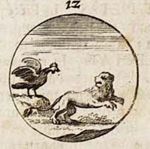
Veni, vidi, vici: De la Feuille, Devises et emblemes anciennes et modernes (Augsburg, 1697), emblem 418 quotes the comment
Iconclass: 46C121 carrying something 47G5432 plank, board ~ building material 49C113 'Rhetorica', 'Eloquentia' (~ trivium); 'Rettorica' (Ripa)
Loci Communes: Absurda, indecora, seu praepostera (Absurd, unbecoming, or preposterous things, Choses absurdes, inconvenantes ou déplacées)
IV viii 58 Quae quia ipse facit What anyone does himself
Aristoteles Rheroricorum lib. 2. disputans de affectibus, referthoc dictum ut vulgo iactatum, ἃ γάρ τις αὐτὸς ποιεῖ, ταῦτα λέγεται τοῖς πέλας μὴ νεμεσᾶν. id est, Nam quae quis ipse facit, haec dicitur vicinis non vertere vitio. Convenit cum illo Terentiano: Homine imperito nil quidqu est iniustius, qui nihil nisi quod ipse facit rectum putat. Sunt enim qui damnent, quicquid ipsi non possunt assequi.
In book two of the Rhetoric, where Aristotle is discussing emotions, he quotes the following apparently popular saying: 'They say that whatever anyone does himself, he doesn't resent his neighbours doing.' The corollary of this is the line in Terence: 'There really is nothing more unfair than an ignorant man - he doesn't approve of anything that he doesn't do himself.' Some people disparage anything that they can't achieve themselves.
Facsimile:
Iconclass: 51B3:54E Parity, Equality❧Reciprocal Action
Loci Communes: Philautia (Self-love, Amour-propre)
IV viii 59 Cognatio movet invidiam Kinship generates resentment
Aristoteles eodem lib. docens invidiam oriti erga vicina et cognata: nullus enim invidet olim defunctis, aut diversi generis, aut immenso intervallo superioribus, inferioribusve: adducit huius versiculi testimonum, Τὸ συγγενὲς γὰρ καὶ φθονεῖν ἐπίσταται. id est, Etenim imuidere novit ipsa affinitas. Unde qui eo altitudinis processerunt, utrinuidiam gloria superatint, extra omnem aleam, extraque invidiae tela esse dicuntur.
In the same book, Aristotle tells us that resentment is felt towards what is near and related to us. No one feels resentment towards those who have long been dead, or are quite different, or vastly superior or inferior. To support his argument he quotes the following line: 'Kith and kin know what resentment is.' Those who have reached such heights that their very distinction makes any ill-will ineffective are said to be 'beyond all hazard and out of envy's range.'
Facsimile:
Iconclass: 42G2 family relationships (first, second, third and fourth degree), generations 52B12 Brooding
Loci Communes: Invidia, aemulatio (Envy, rivalry, Envie, rivalité)
IV viii 60 Sapiens non eget The wise man is never in need
Ibidem inter sententias refert hoc carmen: Χρὴ δ᾽ ποθ᾽ ἕστις ἀρτίφρων πέφυκ᾽ ἀνὴρ. id est, Haud unquam eget, qui mente sana est praeditus. Sive quod magnae sint opes habere bonam mentem, sive quod sapienti facile est ditescere si velit. Velut Aristippus eiectus naufragio, repetit a quibus humaniter exciperetur Idem cum Dionysius talentum petenti diceret, Nonne docebas sapientem non egere? Da, inquit, et respondebo. Dedit rex, ac mox exegit responsum. Tum Aristippus, nonne verum dixi sapientem non egere?
In the same book, where he is discussing maxims, Aristotle quotes the following line:
The man with sound mind endowed never is in need.
This is true, either because the possession of a sound mind is in itself wealth, or because it is easy for the wise man to become rich if he so desires. See for example Aristippus, who found people to give him hospitality after he was shipwrecked. On another occasion, when he asked Dionysius for a considerable sum of money, Dionysius said, 'Did you not teach that the wise man was never in need?' Aristippus replied, 'Give me the money and then I will give you your answer.' The ruler gave him the money and demanded the answer to his question. Aristippus then said, 'Wasn't I right to say that the wise man is never in need?'
IV viii 61 Multa incredibilia Much that seems beyond belief
Idem in eodem opere citat hunc senarium ceu proverbialem, Απιστ᾽ ἀληθῆ πολλὰ συμβαίνει βροτοῖς. Hac sententia putat utendum ei qui gaudet mentiri, & quod fingit, vult haberi pro vero. Et aliquanto post eandem sententiam refert ex Agathone, Τάχ᾽ ἄντις εἰκὸς αὐτὸ τοῦτ᾽ εἶναι λέγοι, βροτῖσι πολλὰ τυγχάνειν οὐκ εἰκοτα. id est, Probabile hoc fortassis aliquis dixerit, Permulta hominibus inopinata obtingere.
In the same work, Aristotle quotes the following line of verse as proverbial: 'Much that is unbelievable comes true for mortal men.' He suggests that this saying should be employed by a speaker who enjoys making false statements and wants his words to be accepted as the truth. A little later, he quotes some lines of Agathon expressing a similar sort of idea:
Well might one say that this is probable -
Much that is improbable will truly come to pass.
Facsimile:
Iconclass: 52BB21 Incredulity 52B31 Probability 52BB31 Improbability
Loci Communes: Praeter spem bonum aut malum (Good or bad beyond expectation, Bien ou mal inattendu)
IV viii 62 Lecythem habet in malis She has the bottle by her chops
Εχειν λήκυθον πρὸς ταῖς γνάθοις. id est, Lecythum habere ad malas, tectum et aenigmaticum convitium est in anus, quae rugas illitis pigmentis dissimulant. Qualis erat Phryne meretrix, iam vertula, nec tamen a quaestu recedens. Aristoph. in Contionatricibus: Φρύνην ἔχουσαν λήκυθον πρὸς ταῖς γνάθοις. id est, Phrinen gerentem Lecybumiuxta genas. Lecythum appellat vasculum unguentarium unde fucatur facies. Eadem solita est dicere, multos bibere faecem ob vini nobilitatem, quod ad illam ἔξωρον, propter scorti celebre nomen commearent amantes, quo gloriari possent sibi cum Phryne suisse rem.
[greek], To have the bottle by one's chops. This is a veiled and cryptic jibe at old women who disguise their wrinkles with thick make-up, like the courtesan Phryne, who did not retire from the business even when she was old. See Aristophanes in the Women in Parliament: 'Phryne holding the bottle to her chops.' By her 'bottle,' Aristophanes means a small container for cosmetics. Phryne used to say that many still drank the dregs because the wine had been superlative. So great was her fame that many a client came to her when she was passee, simply to be able to boast that he had had an assignation with Phryne.
Facsimile: 
Iconclass: 31A513 making up 31A51452(+0) perfume bottle (+ variant) 31D17:33C52 old woman❧whore, prostitute 98C(PHRYNE) (story of) Phryne
Loci Communes: Fucus (Sham, deceptive appearance, Feinte, apparence trompeuse)
IV viii 63 Piscis eget sale Fish needs salt
Ιχθὺς δεῖται ἁλὸς. id est, Piscis eget sale. De re absurda etincredibili. Nec enim verisimile est, pisces in mari agentes opus habere sale. Hoc videtur a populo reclamatum Androcli Pitensi, cum legem quandam reprehendens dlxisset: δέονται οἱ νόμοι νόμου διορθώσοντος. id est, Egent leges lege corrεctrice, καὶ γὰρ ἰχθηες ἁλὸς. Nam et pisces sale. Leges enim in hoc datae sunt, ut ad harum regulam corrigantur hominum actiones. Quod si ipsae leges indigent correctione, leges non sunt. Idque non minus absurdum sit, quam si pisces marini dicantur egere sale. Refert Aristoteleles in Rhetoricis.
[greek], Fish needs salt. For something ridiculous and unbelievable. It is not very likely that fish that spend their lives in the sea should need salt. When Androcles of the deme Pitthus was pointing out the deficiencies in a particular law and said, 'Laws need a law to put them right,' the people shouted back, 'Yes, and fish need salt.' The purpose of laws is to provide a standard by which men's actions can be corrected, but if the laws themselves require correction, they cease to be laws. That is as ridiculous as salt-water fish requiring salt. This is all to be found in Aristotle's Rhetoric.
Facsimile:
Iconclass: 25F6 fishes 51C2:41C661 Necessity, Inevitability; 'Necessità' (Ripa)❧salt 52AA511 Ridiculousness
Loci Communes: Accessio pusilla aut nimia (A trifling or excessive addition, Un ajout minime ou excessif)
IV viii 64 Baccae egent oleo Olives need oil
Ibidem mox subicit aliud eiusdem formae, τὰ στέμφυλα δεῖται ἐλαίου, id est, Baccae egent oleo. Neque enim credibile est illi opus esse oleo, unde nascitur oleum. E baccis autem olivarum exprimitur oleum. Cognatum illi, quod ante retulimus: Ipsi fontes sitiunt.
This is the same sort of saying as the previous one and follows on from it in Aristotle. Again, it is not very credible that the source of oil should itself need oil - oil is produced by pressing olive-berries. It is very like a saying I discussed earlier: The springs themselves are thirsty.'
Facsimile:
Iconclass: 25G21(OLIVE) fruits: olive 51C2:41C671 Necessity, Inevitability; 'Necessità' (Ripa)❧oils and vegetable fats 52AA511 Ridiculousness
Loci Communes: Absurda, indecora, seu praepostera (Absurd, unbecoming, or preposterous things, Choses absurdes, inconvenantes ou déplacées)
IV viii 65 Avis ex avibus Bird of a long line of birds
Ορνις ἐκ τῶν ὀρνέων. id est, Avis ex avibus, proverbii forma dictus est Aristophani per ironiam vir nobilis, quasi bonus ex bonis prognatus, Τὸν ἔποφ᾽ ὅς ὄρνις ἐγένετ᾽ ἐκ τῶν ὀρνέων. id est, Upupam haxce quae prognata abavibus est avis. Qui de nobilitate gloriantur, repetunt ab avis et atavis gentis stemmata. Nam empta nobilitas, aut nuper parta, non perinde magni fit.
[greek], Bird descended from birds. A 'proverbial' saying used by Aristophanes to make mock of a man of noble birth, supposedly 'a good man of a long line of good men': 'This hoopoe, a bird descended from a long line of birds.' Those who pride themselves on their nobility trace their descent back through generations of ancestors. Nobility acquired by purchase or only recently achieved is no such great thing.
Facsimile:
Iconclass: 25F39(HOOPOE) other birds: hoopoe 42G11(+0) series of ancestral portraits, 'Ahnengalerie' (+ variant) 51F51:46A12 Newness❧nobility and patriciate; chivalry, knighthood
Loci Communes: Nobilitas / obscuritas (Nobility / obscurity, Noblesse / obscurité)
IV viii 66 De lapidi volam Give the rock a kick
Interpres Aristophanis indicat puros si quando viderint aves, dicere solere, Da lapidi volam et cadent omnes. Convenit, ubi quis sectatur quae non possit assequi, aut minatur iis, quibus non potest nocete. In comoedia quispiam ait se velle strepitu excitare aves: alter iocans, respondet, τῳ σκέλειθένε τὴν πέτραν, id est, Tibia lapidem feri. Atqui interim aves nihil habent incommodi, sed manus, aut pes percutiens saxum: eoque iubet alter, ut ipse capite percutiat lapidem, quo strepitus fiat duplex.
The ancient commentator on Aristophanes tells us that when boys see birds they say, 'Give the rock a kick and they'll all fall down.' This is a useful saying when someone is aiming at something he cannot achieve or threatening people he cannot harm. In the comedy, one of the characters says he'll make a noise and rouse the birds. The other jokingly replies, 'Kick the rock then.' This of course is not going to incommode the birds in the slightest, only hurt his foot or hand when it strikes the rock. So the first man tells the other to bang his head against the rock and make twice the noise.
Facsimile:
Iconclass: 31A2744:25H1124 kicking something❧boulder, stone 43C1113 bird hunting
Loci Communes: Inanis metus (Groundless fear, Peur vaine)
IV viii 67 Ne quaeras Deus esse Seek not to become God
Μὴ ζήτει θεὸς γενέσθαι. id est, Ne quaerefieri deus. In hominem undequaque beatum in hacvita. Pindarus in Olympiacon hymno quinto. ὑγίεντα δ᾽ εἴτις ὄλβον ἄρδει, ἐξαρκεῶν κτεάνεσσι καὶ εὐλογίαν προστιθεὶς, μὴ ματεύσῃ θεὸς γενέσθαι. i. Si quis autem opes cum sanitate coniunctas auget, ac suis possessionibus contentus est, atque his adiunxit honestam famam, ne petat a diis, ut fiat deus. Itidem apud nostrates vulgo dieitur: Sat fortunatus es. Quis tibi vis? Num postulas esse deus?
[greek], Seek not to become God. A saying directed at a man who has every blessing in this life. Pindar in the fifth Olympian ode:
If a man has established sound prosperity
And enjoys his good in quiet content
And to those blessings adds fair fame,
Let him not pray heaven to make him God.
My own countrymen often say, 'You're well enough off. What are you after? Do you expect to be God?'
Facsimile:
Iconclass: 53B6 Discipline 56B3 Satisfaction, Contentment; 'Contento' (Ripa) 57A641 Discretion, Modesty; 'Discretione', 'Modestia' (Ripa) 92 gods ~ classical mythology
Loci Communes: Modestia modusque (Modesty and moderation, Modestie et mesure)
IV viii 68 Operi incipienti favendum Applaud the first beginnings
Celebratissimum est, Honos alit artes, et virtus laudata crescit. Ita Pindarus Olympiaco hym. vi. ἀρχομένου δ᾽ ἔργου πρόσωπον χρὴ θέμεν τηλαυγὲς. i. In nitio facinoris, oportet facie millustrem addere: hocest favendum aliquid egregii facinoris aggredientibus, simul ut ipsis addatur animus, & alii ad aemulatinem provocentur. At nunc plerique moleste obstrepunt, si quis quid tentet eximium. Potest et hic sensus accipi. Qui famam affectat, hunc oportet ab egregio quopiam facinore auspicari. Permagni siquidem refert, unde nominis sumas exordia.
It's a well-known saying that 'Honours nourish arts,' also that 'Virtue grows with praise.' Pindar in the sixth Olympian ode: 'To a fresh start must a brilliant face be given,' that is, one must applaud those starting out on some splendid project, both in order to encourage them and to stir others to emulate them. As it is, most people carp and criticize if anyone tries to achieve something out of the ordinary. One can also take the saying to mean, 'Anyone who desires to win fame must start off with something really remarkable.' It matters a great deal how you first make your name.
Facsimile:

Honos alit artes: Printer's device 0816 quotes the comments
Honos alit artes: Printer's device 0817 quotes the comments
Iconclass: 48A7121 applause; 'claque' 51F5 Beginning; 'Principio' (Ripa) 51H5 Growth, Increase
Loci Communes: Initium laudatum (A praised beginning, Un commencement loué)
IV viii 69 Nec apud homines, nec in mari Neither among men, nor yet upon the sea
Ibidem et illud proverbiali schemate dictum est, ἀκίνδυνοι δ᾽ ἀρεταὶ οὔτε παρ᾽ ἀνδράσιν, οὐτ᾽ ἐν ναυσι κοίλαι τίμιαι. id est, Virtutes autem periculi expertes, neque apud homines, neque in cavis navibus habentur in pretio, pro eo quod erat, nusquam, quasi dicas, neque terra, neque mari. Ipsa autem sententia convenit cum illo Hesiodio decantatissimo: Virtutem posuere dei sudere parandam. Nemo magnam laudem paravit absque periculo: Eoque Pindarus bellum appaellat κυδιάνειρον, quod viris pariat illustre nomen. Tropus proverbialis est in his verbis, nec in terra nec in mari. Et pugnatur terra marique.
In the same hymn, Pindar writes some other lines with a proverbial ring: 'Distinction won without venture receives no honour, / Neither among men nor yet in hollow ships.' The sentiment agrees with the oft-quoted line of Hesiod: 'Toil is the price of excellence - Heaven wills it so.' No one ever achieved great fame without risk. That is why Pindar calls war [greek] 'the bringer of glory to men.' We have a proverbial turn of phrase in the words 'Neither by land or sea' and also in fighting 'By land and sea.'
Facsimile:
Iconclass: 54DD52 Risk; 'Ardire ultimo & necessario' (Ripa) 59B32 Fame; 'Fama', 'Fama buona', 'Fama chiara' (Ripa)
Loci Communes: Nusquam (Nowhere, Nulle part)
IV viii 70 In hoc calceamento pedem habet He has his foot in this shoe
Dictum ibidem & illud adagii forma: ἴστω γὰρ ἐν τούτῳ πεδίλῳ δαιμόνιον πόδ᾽ ἔχων. id est, Novit enim se in hoc calciamento fortunatum habere pedem, pro eo, quod est, novit has laudes in ipsum competere. Olim magnae deliciae erant in soleis & calceis. Nam pedilon Graecis est calciamenti genus, varium et picturatum dictum παρὰ τὸ τῷ ποδὶ περιειλεῖσθαι, eo quod pedi applicetur. Ut autem non omnis calceus convenit cuilibet pedi, ita nec quaevis laus in quemvis congruit.
In the same ode, Pindar brings in yet another proverbial sentiment: 'He may be sure his blessed foot is in this pedilon "shoe,"' that is, he knows that this praise belongs to him. In ancient times shoes and sandals could be items of great luxury. The Greek pedilon was a brightly coloured embroidered sandal, so called because it is 'fastened round the foot,' pedin Greek. The same shoe does not fit every foot. Even so the same praise is not appropriate to any and every person.
Facsimile: 
Iconclass: 41D2332 shoes, sandals 59B32 Fame; 'Fama', 'Fama buona', 'Fama chiara' (Ripa)
Loci Communes: Initium laudatum (A praised beginning, Un commencement loué)
IV viii 71 Virtus gloriam parit Virtue begets glory
In eodem Encomio, τιμῶντες δ᾽ ἀρετὰς, ἐς φανερὰν ὁδὸν ἔρχονται. τεκμαίρει δὲ χρῆμ᾽ ἕκαστον. id est, Quibus virtutes in precio sunt, ii perveniunt ad illustrem viam. Nobilitat autem suum quenque opus. Sentit benefactis potius qui opibus parari veram gloriam: Nec uno modo contingere honestam famam, sed sua quenque virtute fieri clarum. Homerum illustravit poetice, Demosthenem eloquentia, Aristidem integritas, Themistoclem res praeclare gestae, itidem & alii aliis modis inclaruerunt.
Pindar again, in the same victory ode: 'Those that value virtue walk the path of fame; / Each man's activity proclaims him.' The poet gives us to understand that the true glory proceeds from deeds of virtue, not from wealth, and that there is more than one way to achieve distinction. Each person becomes famous for his own particular prowess. Homer is remembered for his poetry, Demosthenes for his eloquence, Aristides for his incorruptibility, Themistocles for his military successes; and many others have made a name for themselves, each in their own separate way.
Facsimile:
Iconclass: 57A6 Virtuousness; 'Amor di Virtù', 'Attione virtuosa', 'Guida sicura de' veri honori', 'Virtù', 'Virtù insuperabile' (Ripa) 59B31 Honour, Glory; 'Ampiezza della Gloria', 'Gloria', 'Gloria de prencipi', 'Gloria & Honore', 'Honore', 'Sublimatà della Gloria' (Ripa)
Loci Communes: Nobilitas / obscuritas (Nobility / obscurity, Noblesse / obscurité)
IV viii 72 Bonum est duabus niti ancoris Safe riding at two anchors
Rursus in eodem, Αγαθαὶ δὲ πέλον - τ᾽ ἐν χειμερίᾳ νυκτὶ θοᾶς ἐκ ναὸς ἀπεσκίμφθαι, δύ᾽ ἄγκυραι. Bonae sunt in hyberna nocte duae ancorae, ad laxandum è celeri navi, id est, bonum est duplici praesidio niti, ut si alterum destituat, altero invemur, quemadmodum is victor, quem laudat, geminam habebat patriam, ut si quid accidisset alteri, ad alteram se reciperet. De hoc dictum est nobis aliâs, ἐπὶ δυοῖν ὁρμεῖν.
Pindar again, in the same ode: 'Good it is in wintry night / From the swift ship / Two anchors to let down,' that is, it is good to have two lines of defence, so that if one fails us, we may fall back on the other. The recipient of this victory ode had two homelands, so that if disaster befell the one, he could betake himself to the other. I have already treated this under the heading, 'Secured by two anchors.'
Facsimile:
Iconclass: 46C215(ANCHOR) parts of ship's exterior: anchor 49D11(2) numerals: 2 54D5 Safety 54E4 Defence
Loci Communes: Securitatis et tutae rei (Security and safety, Sécurité et sûreté)
IV viii 73 E domo in domum From home to home
Hanc sermonis formam aliquoties habemus obviam apud Pindarum & Aristophanem οἴκοθεν οἴκαδε, quum significant aliquem propriis virtutibus quippiam egregiae laudis peperisse suae domui patriaeve. Velut in eodem Encomio, οἴκοθεν οἴκαδ᾽ ἀπὸ στυμφαλίων τειχέων.. id est, à domo in domum à Stymphali moenibus. Gratiosior minusque invidiae obnoxia virtus est, quae ab avis atavisque demanavit ad posteros.
Several times in Pindar and Aristophanes, we find the phrase [greek] 'From home to home,' meaning that someone has of his own innate abilities and powers won some special glory for his family or country. For example, in the same victory ode we have: 'From home to home, from the walls of Stymphalos.' A particular ability is more easily accepted, is less cause for resentment, when it is handed down through the generations from distant ancestors.
Facsimile:
Iconclass: 42G1 family lineage, pedigree, genealogical tree or table 54A33 Skill, Ability; 'Artificio', 'Prontezza' (Ripa)
Loci Communes: Nobilitas / obscuritas (Nobility / obscurity, Noblesse / obscurité)
IV viii 74 Quod dici solet The usual
Plautus in eadem fabula, rem dictu obscoenam, tropo subindicat. Iurat illic quidam per omnes deos, cuidam nihil esse rei cum puella: ut ille cum illa neque cubat, neque ambulat, neque osculatur, neque illud quod dici solet.
In the same play, Plautus uses a roundabout expression to suggest something too lewd to be named directly. One of the characters swears by all the gods that another character has absolutely nothing to do with the girl in question. He isn't having dinner with her, walking with her, kissing her, or doing 'the usual.'
Facsimile:
Iconclass: 33C8110 'Libidine', 'Voluttà' (Ripa) 54D6 Custom, Habit; 'Consuetudine' (Ripa)
Loci Communes: Impudicitia (Unchastity, Impudicité)
IV viii 75 Domi pugnans more galli As aggressive as a cock in his own backyard
Ενδομάχας ἅτ᾽ ἀλέκτωρ. i. Domi pugnax more galli. In eum, qui semper domi desidens, non audet, vel in bellum, vel in certamina proficisci foras. Nam hoc animal pugnacissimum quidem est, sed domi. Nihil autem confert Reip. nec ea certamina celebrantur. Ita quidem interpres: sed addubitamus tamen an scriptum sit, ἐνδομύχας, id est, domi abditus. ἐνδομάχης dictio nove composita, ab ἐντὸς & μάχομαι. Haerebit in istos qui domi perpetuo rixantur, cum foris sint placidissimis morbus. Convenit cum eo, quod alibi diximus, Domi leones.
[greek], Aggressive at home like a barnyard cock. A saying directed at a man who skulks at home and never ventures out to join in any war or conflict - the cock is an aggressive creature, but only on his own territory. Such a man contributes nothing to his country and his battles are inglorious. (So the commentators explain it, but all the same I wonder whether the true reading is [greek] 'lurking within.' [greek] is a new word, made up of [greek] 'within' and [greek] 'fight.') The saying will fit people who are always quarrelling at home but are peaceable enough outside. This is like the saying I discussed earlier, 'Lions at home.'
Facsimile:
Iconclass: 33B14 threatening behaviour, challenging 34B232(+51) fowl (cock, hen, chicken, etc.) (+ male animal) 41A512 backyard
Loci Communes: Ignavia et inscitia (Cowardice and ignorance, Lâcheté et ignorance)
IV viii 76 Nec Deus, nec homo Neither god nor man
Hoc schema proverbiale frequenter obvium est apud poetas, diis hominibusque invitis, proh deum atque hominum fidem. Ibi de divinis atque humanis cernitur. Horatius: Non dii, nan homines, non concessere columnae. Pindarus in Pythiis hymno 3. κλέπτει τέμιν, οὐ θεὸς βροτὸς, ἔργοις οὔτε βουλαῖς. id est, Nec deus illum fallit nec homo, nec factis nec consiliis. laudat Apollinem, qui cum omnia sciat, nihil tamen mentiatur.
We often find these two words linked in a proverbial-type figure in the poets: 'in defiance of gods and men'; 'by the faith of gods and men.' There the words mean 'divine and human.' In Horace we have: 'That the gods allow not, neither men, / Nor yet the booksellers' stalls.' In Pindar's third Pythian: 'No god, no man, can him deceive, by counsel or by deed.' He is praising Apollo, who, though he knows all things, yet will have nothing to do with deceit.
Facsimile:
Iconclass: 3 Human Being, Man in General 52BB42 Impossibility 92 gods ~ classical mythology
Loci Communes: Impossibilia (Impossible things, Choses impossibles)
IV viii 77 Apud matrem manere Tied to his mother's apron-strings
Παρὰ ματρὶ μένειν, dicebantur, qui per ignaviam semper domi manentes, nihil audent praeclari facinoris. Pindarus Pythiorum Oda iiii, μή τινα λειπομενον τὸν ἀκίνδυνον παρὰ ματρὶ μὲνειν, id est, ne quis immunis a periculo relictus apud matrem maneret. Loquitur ni fallimur, de argonautis, quis advaci peregrinatione quaerebant gloriam, Iunonis auspiciis. Molles et effeminati temporibus Augustini μαμμήθρεπτοι dicebantur. Sive quod ab aviis essent enucati, quae nepotulos suos tenetius amant, quam ipsae matres, sive quod Graeci μάμμην diminutive dicunt materculam, quin et hodie vulgus matris filium appellat adolescentem delicatius educatum, ac tales dicebantur Martissare.
[greek], To stay at their mother's side, was said of those who always stay at home and never venture on any bold enterprise out of cowardice. Pindar, in the fourth Pythian: 'Lest any be left at home safe / From danger at his mother's side.' He is speaking, I think, of the Argonauts who sought glory in bold exploration, inspired by Juno. In the time of Augustine, weak and effeminate persons were called 'Mammy's boys.' This could mean 'brought up by Grandmother' (in Greek, mamme), as grandmothers always bestow a more indulgent affection on the grandchildren than the children's mothers do; or mamme could be a diminutive meaning 'Mummy.' Even today a youth brought up too soft is commonly known as a 'mother's boy,' and such persons used to be said 'to take after their mothers.'
Facsimile: 
Iconclass: 31A719 womanish man, molly-coddle, milksop 41D2321 apron 42B7421 mother and son(s) (family group) 54AA8 Cowardice
Loci Communes: Ignavia et inscitia (Cowardice and ignorance, Lâcheté et ignorance); Domi vivere (To live at home, Vivre chez soi)
IV viii 78 Sine canibus et retibus Without dogs and nets
Ανευ κυνῶν τε καὶ λίνων. i. Absque canibus et retibus. Hoc quidem schemate Pindarus Numerorum Oda iii. significavit summam celeritatem. Quis enim pedibus assequatur cervos, nisi aut à canibus remorentur, aut implicentur retibus? Conveniet tamen in eos, qui clanculariis artibus capiunt praedam. Pindati verba sic habent: κτείνοντ᾽ ἐλάφους ἄνευ κυνῶν δολίων θ᾽ ἑρκέων. id est, cervos occidentem sine canibus, ac dolosis retibus: Dicertur et in eos, qui non alienis praesidiis, sed proprio Marte rem gerunt.
[greek], Without dogs and hunting-nets. In Nemean Odes three, Pindar used this form of words to indicate supreme swiftness of foot. For what ordinary person could keep up with deer on foot unless they were slowed down by dogs or caught in the nets? The saying will however fit people who capture their prey by stealthy moves. What Pindar says is: 'Slaying the deer without dogs or snaring nets.' It will also apply to people who do something without outside help, in their own strength.
Facsimile:
Iconclass: 51AA4:43C1147 Nothingness, Absence❧hunting dogs 51AA4:43C1112(+415) Nothingness, Absence❧hunt ~ mammals (+ net)
Loci Communes: Cum auxilio ; citra auxilium (With help; without help, Avec aide ; sans aide)
IV viii 79 Et scelii filium abominor I can't bear Scellius' son either
Hic est affectus humanus, ut st quis vel hominem, vel quamcunque rem vehementer oderit, non solum a commemoratione, verum etiam a cognatis vocibus abhorreat. Id eleganter expressit Aristophanes in Avibus. Ibi persona quaedam sic loquitur: Αριστοκρατεῖσθαι δῆλος εἶ ζητῶν. id est, Aristocratiam palam est te quaertre. Altera respondet, Ηκιστα, καὶ τὸν σκελλίου βδελύττομαι. id est, Minime, se ipsum Scellii natum quoque Abominor. Scellii filius dictus est Aristocrates. Hoc nomen iure invisum est detestanti Aristocratiam, quod ea vox abonimandae rei memoriam tenovet.
If anybody absolutely loathes somebody or something, it's a natural reaction for him to avoid using not only the actual name but any word that sounds like it. Aristophanes has a nice example in the Birds. One character there says, 'It's clear you like aristocracy.' The other replies, 'No, I don't. I can't bear Scellius' son either.' Scellius' son was called Aristocrates. Anyone who detested aristocracy would obviously find the name Aristocrates obnoxious, because it reminded him of the thing he found odious.
IV viii 80 Larinum verbum A fat and lardy word
Λαρϊνὸν ἔπος, id est, larinum verbum appellabant ingens atque egregium, hinc orto proverbio, quod in Latissa boves sint praegrandes, ac praepingues. Alii putant Larinos dictos obesos ac praegrandes, a larino quedam pastore supra modum mu gno corpore. Boves autem praegran des pasci in Epiro, posteritatem boum Geryonis. Aristophanes in Avibus: Αλλὰ λέγειν ζητῶ τι πάλαι Μέγα καὶ λαρινὸν ἔπος τι. id est, Sed tibi Iam quare dudum grande verbum dicere, Atque Larinon. Huc petinet quod Graeci rebus ingentibus bovem addunt, ut βουφάγος, edax, fimili modo Latini veteres Lucam dicebant pro grandi.
[greek], A fat and lardy word, meaning something large and out of the ordinary. The usage originates from the fact that in Larissa the cattle are very large and well-fleshed. Another explanation is that very large fat people were called 'lardy' after a shepherd called Larinus, who was enormous. There is a breed of very large cattle in Epirus, descended from the cattle of Geryon. Aristophanes in the Birds: 'I've long been itching to say a mighty word, a lardy one.' It's worth adding that the Greeks add 'ox' to words to express the idea of hugeness, as in 'ox-eating,' meaning 'with an enormous appetite.' Similarly, the early speakers of Latin used the word luca to mean 'large.'
Facsimile:
Iconclass: 41C695:49K321 fat, lard❧word 51G1 Largeness, Magnitude
Loci Communes: Magni momenti (Of great importance, Grande importance)
IV viii 81 Herniosi in campum Up, ye castrated, and to the fields
Κόκκυ, ψωλοι πεδίονδε. i. Coccy, herniosi in campum. Aristophanes in avibus refert proverbii loco: tou=t) a)r) e)kei=n h)=n t) ou)pos a)lhqw=s2 ko/kku ywloi\ pedi/onde, Quorum verborum hic sensus est: Hoc est vere, quod proverbio dicitur, coccu, herniosi in campum, subaudi venite, quid haec avis canit paullo ante messem, velut agricolas provocans ad laborem metendi, unde Hesiodus h)=mos ko/kkuc kokku/zei. Quod autem ywloi\ dixit pro agricolis, obiter taxavit Aegyptios, apud quos plerique sunt exsecti, qui omnes ad vocem cuculi coguntur esse in agris. Fingit enim olim apud Aegyptios regnasse cuculum priusquam fieret avis. Quin hodie parum viri, et ob hoc uxores cum aliis habentes communes, vulgo cuculi vocantur Alias annotavimus ex Horatio, cuculos a viatoribus appellarisolere, qui tum demum venissent ad colendam vineam, cum auditus esset cuculus. Canit autem iam adulto vere, quia sero prorepit e nido, que sibi parat sub hiemen in cavis arboribus, exuens se plumis, atque his sese involuens, congestis in commeatum malis ac pyris. Interpres Aristophanis admonet esse peoverbium ko/kku ywloi\ pedi/onde, cum segnes ipsum tempus provocat ad industriam.
[greek], Cuckoo! Up, ye castrated, and to the fields. Aristophanes quotes this as a proverbial saying in the Birds: 'So that's what the saying really means, "Cuckoo! Up, ye castrated, and to the fields!"' with 'come' understood. The cuckoo begins to call shortly before harvest time, as if summoning the farmers to the labour of harvesting. See Hesiod's line: 'When the cuckoo first calls "Cuckoo."' When Aristophanes uses the word 'castrated' (Greek [greek]) for farmers, he is in passing making a jibe at the Egyptians, most of whom had been 'cut,' and who were all compelled to get into the fields when the cuckoo called. In the play, he makes out that Cuckoo once ruled in Egypt before he was turned into a bird. Even today undersexed men who find themselves sharing their wives with other men are commonly called 'cuckolds.' I have discussed elsewhere Horace's passage about passers-by calling out 'Cuckoo!' to those who only started tending their vines when they heard the cuckoo. The cuckoo calls only when spring is well on, emerging late from its nest. It builds this in winter in hollow trees, pulling out its feathers and wrapping itself in them, feeding off a store of apples and pears. The ancient commentator on this line of Aristophanes tells us that 'Cuckoo! Up, ye castrated, and to the fields' is a proverb. It is one to be used when the very lateness of the hour compels the idle to bestir themselves.
Facsimile:
Iconclass: 25F39(CUCKOO)(+49) other birds: cuckoo (+ audible means of communication of animal(s): roaring, crying, singing, barking, mewing, neighing, chirping, etc.) 33C711 castrated person 47I14 harvest
Loci Communes: Tempestiva (Timely things, Choses opportunes)
IV viii 82 Μελλονικιᾶν Hang about like Nicias
Nicias traducebatur, quod cunctator esset in re militari, qualis apud Romanos fuisse narratur Fabius, eoque iocularem vocem finxic vetus comaedia, μελλονικιᾶν ex μέλλειν, quod est, cunctari, & νικίας, qui fuit dux Atheniensibus. Aristophanes in Avibus, οὐχὶ νυστάζειν ἔτι ὥρα᾽ στὶν οὐδὲ μελλονικιᾶν, Αλλ᾽ ὡς τάχιστα δεῖ τι δρᾶν. id est, Porro oscitandi tempus baud est amplius, Nec more Niciae decet cunctarier, Sed oportet aliquid agere quam celerrime.
People complained that Nicias was a 'delayer' when it came to military action, just as Fabius is said to have been among the Romans. So the Old Comedy invented a joke word [greek], made up of [greek] 'to be always on the point of, to delay,' and [greek], the Athenian commander's name. Aristophanes in the Birds:
This is no time for us to doze
Or hang about like Nicias.
We must do something fast.
Facsimile:
Iconclass: 45D311 commander-in-chief, general, marshal 51FF521 Delay 98B(NICIAS) male persons from classical history (NICIAS)
Loci Communes: Tarditatis et cunctationis (Slowness and delay, Lenteur et retard)
IV viii 83 Fumus Smoke
Καπνὸς dicuntur promissa magnifica quidem, sed inania. Unde fumos vendere, et fumos offundere. Hoc nomen inditum Theageni cuidam. qui cum pauper esset, affectavit tamen haberi praedives, ac magnificus negotiator, unde vulgo dictus est καπνὸς. Aristophanis interpres auctorem citat Eupolim Comicum in fabula, cui titulus δῆμοι
[greek], Smoke, is a word for magnificent, empty promises, hence the sayings, 'To sell smoke,' 'to blow out smoke.' Kapnos was the name given to one Theagenes. He was poor, but tried to give the impression that he was a rich and important businessman, so he was known as Kapnos 'Smoke' or 'Hot Air.' The ancient commentator on Aristophanes gives as his authority for this Eupolis, in his comedy Demoi.
Facsimile:
Iconclass: 41B162 smoke 53DD2 Breach of Promise 57AA645 Boast; 'Iattanza' (Ripa)
Loci Communes: Contemptus et vilitatis (Contempt and worthlessness, Mépris et bassesse)
IV viii 84 Pariter remum ducere All pull together
Qui simul remigant certis numeris impellunt remos, ut inter se consentiant, alioqui nihil acturi. Hinc Aristophanes in Auibus dixit, ὁμοῤῥοθῶ, pro assentior, & eodem enitor quo tu. Vox composita est ab ὁμοῦ simul, & ῥοθέω impetu feror. ὁμοῤῥοθῶ, συνθελω, συμπαραινήσας ἔχω. id est, eodem nitor, consentio, collaudo. Interpres admonet hoc verbum esse sumptum e fabula Sophoclis cui titulus πηλεύς.
Oarsmen have to row to a definite rhythm in order to keep the oars moving together, otherwise they will get nowhere. Aristophanes in the Birds used the verb [greek] 'I'm pulling with you,' meaning, 'I agree, I have the same aim as you.' This word is made up of [greek] 'at the same time' and [greek] 'I rush.' The full line says: 'I pull with you, my will concords, I have consented.' The ancient commentator tells us that the word was taken from Sophocles' Peleus.
IV viii 85 Ipsis et Chiis And for the people of Chios too
Αὐτοῖς καὶ χίοις, Non obscurum est has voces ex sollemni more vulgo iactatas, quoties aliquis sibi bona praecabatur & amicis. Sic enim praecatur apud Aristophanem Avis: διδόναι νεφελοκοκκυγιεῦσιν ὑγίειαν καὶ σωτηρίαν αὐτοὶσι καὶ χίοισι. id est, Ut detis Nephelococcygiensibus Bonam valetudinem et incolumitatem, Ipsis et Chiis. Interpres ostendit hunc sermonis colorem ductum ex publica Atheniensium consuetudine, qui in sollemnib. comprecationbius ac sacrificiis bonaa diis precantes Reip. addebant καὶ χίοισιν. Atque huius historiae testem citat Thepompum in 12. libro rerum Philippic. fortasse quod e Chio nonnullam haberent Athenienses commoditatem. Qui si uni bene precatur, nulla facta mentione amicorum aut bene metitorum, facete succinetur καὶ χίοισιν.
[greek]. It is clear that these words were traditionally employed by ordinary people whenever anyone was praying for blessings for himself and his friends. One of the birds in Aristophanes prays as follows:
On the Cuckoolanders please bestow
Safety and health, and on the Chians too.
The ancient commentator tells us that this style of words was derived from a regular feature of Athenian public life - whenever they besought the gods for blessings on the state in their solemn supplications and sacrifices, they used to add the words, 'and for the Chians too.' He gives as his authority for this statement Theopompos in the History of Philip book twelve. It was, I presume, because the Athenians benefited considerably from Chios. Anyone who prays for himself alone, not mentioning friends and benefactors, may facetiously intone, 'and for the Chians too.'
Facsimile: 
Iconclass: 12B211 prayer ~ non-Christian religions 61D(CHIOS) geographical names of countries, regions, mountains, rivers, etc. (CHIOS) (CHIOS)
Loci Communes: Amicitia (Friendship, Amitié)
IV viii 86 Alas addere To lend wings
Αναπτερεῖν vulgo dicebantur, qui urbis alicui adderent animum, inque bonam spem erigerent. Aristophanes in Avibus: οὐκ ἀκήκοας Οταν λέγωσιν οἱ πατέρες ἑκάστοτε Τοῖς μειρακίοις ἐν τοῖσι κουρείοισιν τάδι; Δεινῶς τε μοῦ τὸ μειράκιον ὁ διοτρέφης Λέγων ἀνεπτέρηκεν ὥσθ᾽ ἰππηλατεῖν. id est, Num tibi auditum illud est Quod officinis undique in tonsoriis Cani patres loquuntur adoloscentibus: Mire Diotrephes et meo adolescentulo Alas loquendo affiait, ut iam gestat Equitare. Narrant Diotrephen fuisse quempiam praedivitem, qui maiorem in modum delectatus est alendis equis, unde et postes Hipparchus factus est: huius hortaru exemploque multi iuvenes accendebantur ad curas equestres: patres autem oderunt hoc studii genus in filiis, quod imiodicis conster impendiis.
People were commonly said '[greek] 'To lend wings' when they emboldened others and made them enthusiastic. Aristophanes in the Birds:
You must have heard
Fathers in the barber's shop say to the lads,
'Diotrephes has by his words supplied my boy with wings
And made him wondrous keen on horses.'
We are told that Diotrephes was a very rich man who was a fanatical breeder of horses, because of which he was later appointed Commander of Cavalry. His example and encouragement fired many young men with a passion for horses, but the fathers hated this enthusiasm on the part of their sons because it was a very expensive hobby.
IV viii 87 Χηναλώπηξ Fox-goose
Theagenes quod esset garrulus ac stpidus more anserum, et versipellis more vulpium, vulgari ioco dictus est ξυναλώπηξ, voce composita ex ansere et vulpe. Quaνquam Didymo magis probatur anseris nomen additum, quod avitio ac praesertim anserinis supra modum delectaretur, videlicet vulpium more. Anseris iecur olim in summis erat deliciis. Huius adagii meminit Aristophanes in Avibus.
Theagenes was as clamorous and stupid as a goose and as slippery as a fox, so he was popularly known by the nickname Chenalopex, made up of two Greek words meaning 'goose' and 'fox.' Didymus prefers the explanation that he was called 'Goose' because he was excessively fond of eating birds, especially a goose - just like a fox. (Goose-liver was a great delicacy in the ancient world.) Aristophanes mentions the nickname briefly in the Birds.
Facsimile:
Iconclass: 25F36(GOOSE)(+94):52AA1 ?❧Stupidity, Poverty of Intellect; 'Stupidità overo Stolidità' (Ripa) 25F23(FOX):57AA6131 beasts of prey, predatory animals: fox❧Guile, Artfulness, Craftiness, Deceitfulness
Loci Communes: Mixta (Mixed things, Choses mêlées); Inconstantiae, perfidiae, versutiae (Inconstancy, treachery, cunning, Inconstance, perfidie, ruse)
IV viii 88 Concinere To sing in concert, to agree
Τῆν ξυναυλίαν κλαίειν. Est iisdem de rebus similiter queri. Aristophanes in Equitibus ἵνα Ξυναύλίαν κλάυσωμεν, οὐλύμπου νόμον. id est, Modos uti concinamus tibiis Olympicos. ξυναυλίαν appellant, sive cum plures tibiis eandem canunt cantionem, sive cum cithara tibia accinitur. Olympus autem fuit Marsyae discipulus, qui scripsit De odis lugubribus. Quin & hoc ipsum Olympi modos, de querulis, habet proverbii speciem, quemadmodum ἰαλεμΐζειν, & Carica musa.
[greek] means 'to moan in concert.' Aristophanes in the Knights: 'So we can moan in concert to one of Olympus' tunes.' By [greek] 'concert,' the Greeks meant either several auloi playing in unison or one aulos accompanying a lyre. Olympus was a pupil of Marsyas, and wrote about sorrowful music. The words 'Olympus' tunes,' referring to songs of lament, have a proverbial ring, like 'sing like Ialemus,' 'Carian music.'
IV viii 89 Respublica nihil ad Musicum Politics is not for the man of culture
Haec persuasio quemadmodum olim multorum animos occupavit, ita nunc quoque multis inhaeret, ut credant doctos ac probos viros non esse accommodos ad gubernandam Rem pub. Plato abstinuit, Socrates frustra tentavit, Demostheni ac Ciceroni parum feliciter cessit. Denique mater Neronis deterruit filium a studio philosophiae, quod existimaretur inutile gesturo principatum. Ad haec D. Augustinus redarguit in epistola quosda, qui iactabant Euangelicam philosophiam officere Rem pub administranti. Id venuste expressit Atistophanes in Equitibus. Nam illic principatum recusanti quod musices esset imperiuts ita respondetur: Η δημαγωγία γὰρ οὐ πρὸς μουσικοῦ Ετ᾽ ἐστὶν ἀνδρὸς, οὐ δὲ χρηστοῦ τοὺς πρόπους, id est, At gerere nunc Remp. non est viri, Qui musicus sit, ac probatis moribus Musices nomine omnem liberalem eruditionem designabant veteres.
Educated, able men are not suited to be political leaders. Many in the ancient world believed this and the same view is commonly held today. Plato abstained from political involvement, Socrates had an unsuccessful attempt at it, the political careers of Demosthenes and Cicero brought them disaster. The mother of Nero urged her son not to study philosophy, as it was deemed to be of no use to one who was destined to occupy the chief position in the state. On the other hand, in his Letters St Augustine demolishes the arguments of certain people who put forward the view that the philosophy of the Gospel was incompatible with effective government. Aristophanes puts the first idea nicely in the Knights. A character there refuses the position of ruler because he knows nothing of music. He gets the reply, 'Leading the people is no job for a man / Who's musical or whose character is sound.' Under 'music' the ancients included every discipline that forms part of a liberal education.
Facsimile: 
Iconclass: 44C34 politician, e.g. party leader 49C3 scholar, philosopher 56FF23 Enmity; 'Inimicitia', 'Inimicitia mortale' (Ripa)
Loci Communes: Aliena a re (Irrelevant to the matter, Étranger au sujet)
IV viii 90 Verbis coquinariis With cookery words
Ρἥματα μαγειρϊκὰ. i. Verba coquorum, venuste dixit in eadem fabula pto verbis mollibus, blandis ac dulcibus. Coquorum enim est condimentis edulcare cibum per se subausterum. Monetur illic quispiam ut populum Athen. blandiloquentia demulceat. Carmen sic habet: ὑπογλυκαίνων ῥήμασιν μαγειρικοῖς id est, Deliniens eos coquorum verbulis. μαγειρικοις dixit, pro μελιχίοις, hoc est, placidis ac dulcibus. Habebit gratiam, si quis dicat Epicuri philosophiam demulcere vulgarium animos ῥημασι μαγειρικοῖς, quod voluptatem asserat esse summum bonum.
In the same play, Aristophanes amusingly uses the phrase [greek] 'Cookery words' to mean soft, sweet, enticing words. Cooks use flavourings to sweeten something that is naturally rather bitter. In the play, one of the characters is being encouraged to butter up the Athenian people by saying things that will please them. The line reads: 'Cajoling them with little bits of cookery words.' Aristophanes used the adjective 'cookery' instead of 'sugary.' A good use for this phrase will be to say that the philosophy of Epicurus seduces the minds of ignorant people 'with cookery words,' because he asserts that pleasure is the highest good.
IV viii 91 Liba Coalemo Make an offering to Coalemus
Σπένδε τῷ κοαλέμῳ. i. Liba Coalemo. Competit in eum, cui sua improbitas fuit bono. fingit enim Comicus daemonis nomen, im probitatem innuens. Perinde quasi quis dicat, sacrisica mwri/a|, si quis morionem agens, evectus sit ad opes ac dignitatem. Nam Graecis κοάλεμος fatuum ac stultum significat, à κοῶ pro νοῶ. Nam Callimachus pro ἐνόησεν dixit ἐκόησεν. Hinc ἀναλόγως κοῦς, pro νοῦς, & ἀλέω quod mente erret. Simili figura Gratiis litasse dicuntur, qui fortunati sunt in amicitiis conciliandis. Habent & temulenti Comum deum, & fures deam Lavernam. Itaque furtis ditato, facete diceretur: Liba Lavernae.
[greek], Make an offering to Coalemus. This is a saying for someone who has done well out of behaving outrageously. The comic poet pretends that this is the name of a wicked spirit, inspiring effrontery. It's like someone saying 'Sacrifice to Folly,' if a person plays the fool and is advanced to wealth and position. The Greek word [greek] basically means 'stupid, foolish.' The verb [greek] has the same meaning as [greek] 'perceive, think.' (Callimachus wrote [greek], equivalent to [greek] 'he was so minded.') So, by analogy, [greek], equivalent to [greek] 'mind,' which is put together with [greek] 'flee,' because he is 'out of his wits.' Similarly, people are said to have 'made an offering to the Graces,' when they have been blessed in winning friends. Drunkards have their god Comus, and thieves their goddess Laverna. So one could say jokingly to someone who had grown rich by dishonesty, 'Make an offering to Laverna.'
Facsimile:
Iconclass: 12B212:52AA51 sacrifice ~ non-Christian religions❧Folly, Foolishness; 'Pazzia', 'Sciocchezza', 'Stoltitia' (Ripa) 13A1(COALEMUS)
Loci Communes: Fortunata stultitia (Fortunate foolishness, Sottise heureuse)
IV viii 92 Spirat caecias Blowing north-easterlies
De Caecia vento nubes ad se pertrabente satis dictum est nobis in supertioribus. Ad venti naturam alludens Aristophanes in Equitibus dixit, Ως οὕτος ἤδη καικίας, καὶ συκοφαντίας πνεῖ. id est, Ut iste spirat Cacias et sycophantias iam. Interpres admonet proverbii, quamquam in Aldina editione, pro καικίας depravate legitur κακίας, cum hane vocem metri ratio non admittat. Caecias autem poeta posuit pro turbis ac litibus. Notatur enim ibi Cleon ut delator & criminator.
I have already written about the Caecias, the north-east wind that attracts clouds. Aristophanes was referring to the nature of this wind when he wrote in the Knights, 'He's blowing squally north-easterlies and betrayedwinds now!' The ancient commentator remarks on the proverbial use, but Aldus' Greek text wrongly reads [greek] 'wickednesses,' not [greek] 'northeasterlies,' though the metre will not admit of this. By 'north-easterlies' the poet meant commotions and law-suits. Cleon is here being pilloried as a layer of information and a bringer of charges.
Facsimile:
Iconclass: 26C122 northeast wind, 'Kaikias' (Caecias) (one of eight directions) 44G41 litigation, legal proceedings, lawsuit
Loci Communes: Rixosus (Quarrelsome, Querelleur)
IV viii 93 Latum et angustum Broad and narrow
Nemini obscurum arbitramut proverbiali schemate dictum esse apud Aristoph. in Equitibus sub persona Cleonis: cui quum esset obiectum, quod nutricum more male paruisset populum, qui paullulum praemansi inserret in os, maximam partem ipse deglutiret, respondet, Καὶ νὴ δε᾽ ὑπόγε δεξιότητος τῆς ἐμῆς Δύναμαι ποιεῖν τὸν δῆμον εὐρὺν τῆς στενόν. id est, Ita per Iovem. Nam dexteritate ego mea Exilem et amplum valeo populum reddere. Macrescunt enim pueri male pasti, rursus bene pasti fiunt obesi. Apposite torquebitur in eos, qui adolescentes recte docent aut secus, quive populo dextre contionatur aut secus. Siquidem hae res plurimum habent momenti ad mores populi vel ad honesta formandos, vel ad vitia depravandos.
It is quite obvious, I think, that Aristophanes is using a proverbial phrase when he puts these words into Cleon's mouth in the Knights. Cleon had just been accused of behaving like a nurse and not feeding the people properly, but chewing over the food first and popping a morsel into their mouths but swallowing most himself. He replies, 'True, by Jove! So skilled am I / That I can make the people '[greek] "Broad or narrow."' Indeed, ill-fed children grow thin but they fatten up again if properly fed. The saying might well be turned to fit those who teach the young well or badly, or to an orator who harangues the people skilfully or otherwise, for these things contribute greatly to establishing good or bad public morals.
Facsimile:
Iconclass: 32A2 fat and thin (human types) 51HH41:41C111 Insufficiency❧giving food
Loci Communes: Omnia (All things, Toutes choses)
IV viii 94 Scarabaeo citius persuaseris You would sooner persuade a dung-beetle
Θᾶσσον ὁ κάνθαρος ἂν μεταπεισθείη. i. Citius Scarabeum in diversam sententiam pertraxeris. De iis, qui malis assueverunt, a quibus tame revocari non possunt, eo quod assuetis videantur optima. Lucianus in Pseudologista, οὐτε γὰρ αὐτός ποτε βελτίων γένοιο πρὸς τὴν ἐπιτίμησιν, οὐ μᾶλλον ἢ κάνθαρος μεταπεισθεῖη ἂν μεκέτι τοιαῦτα κυλινδεῖν, ἅπαξ αὐτοῖς συνήθης γενόμενος. i. neque enim ipse unquam fietes melior increpatione mea, nihilo magis quam scarabeo persuaderi posset, ne amplius talia voluat, posteaquam semel illis assuevit. Scarabeus fetus suos educat in stercore praecipue caprino, et indidem pascit, atque ibidem habitat. Excrementa vero fingunt in sphaerulas, easque in nidum deuluunt, capite in terram demilsso, posterioribus pedibus in altum erectis. Nemo facile abducitur a vitiis, in quibus natus & educatus est, & quae per se sunt foedissima, videntur et pulchra et dulci diutinae consvertudinis commendatione.
[greek], You would sooner get a dung-beetle to change its mind. A saying applicable to those who have got used to what is bad and cannot be induced to give it up because, out of familiarity with it, they have come to believe it the best. Lucian in the Pretended Critic: 'No censure of mine would ever make you improve, any more than a dungbeetle could ever be persuaded to give up rolling those things, now it has grown accustomed to them.' The dung-beetle rears its young in dung, especially goat-dung, feeds on dung, lives in dung. These beetles shape the excrement into little balls and roll these along to the nest, with their heads down to the ground and their back legs raised up. No one is easily detached from vices when he is born and brought up amidst them. Long familiarity makes things which are actually disgusting seem attractive and agreeable.
Facsimile:
Iconclass: 51KK2:25F711(DUNG-BEETLE) Immutability❧insects: dung-beetle 54D6:57AA1 Custom, Habit; 'Consuetudine' (Ripa)❧Bad Behaviour
Loci Communes: Impossibilia (Impossible things, Choses impossibles); Malum assuetum (Habitual evil, Mal habituel)
IV viii 95 Alienis soleis uti Wear someone else's slippers
Αλλοτρίοις βλαυτίοις χρῆσθαι. i. Alienis soleis uti dicuntur, qui moribus aliorum ad suum abutuntur emolumentum. Aristophanes in Equitibus, Οὐκ ἀλλ᾽ ὅπερ πίνων ἀνὴρ πέπονθ᾽ ὅταν χεσειῇ Τοῖσιν τρόποις τοῖς σοῖσιν, ὥσπερ βλαυτίοισι χρῶμαι. Quibus verbis negat se circumvenire populum Atheniensem, sed facere, quod solent qui defident in compotationibus, & urgente alvo surgunt, arreptis alienis soleis, sive quod festinant, sive quod ebrii sunt. Ita ille abutebatur moribus populi Atheniensis, qui cibo corrumpi volebat, & blanda libentius audiebat quam salutatia. Apparet olim Graecos absque soleis solere accumbere. Exituri domum poscebant soleas. Hinc quaestus Lopodyttis. Quidam etiam nudi accumbebant.
[greek] Wear another person's slippers, was said of those who copy others' ways for their own ends. Aristophanes in the Knights:
Not at all! But like a chap who's drinking at a party
And needs a visit to the loo, I grab my neighbour's slippers -
And take your ways for my own.
The character says he is not tricking the Athenian people, but doing what people at a party do when they have to go out suddenly to answer nature's call, and pick up somebody else's shoes, either because they are in a hurry or because they are drunk. The character he is addressing was playing on the nature of the Athenian people, who were willing to be bribed with handouts and were more ready to listen to what was pleasing than to what was good for them. The Greeks it seems took off their foot-gear when reclining at table, and 'asked for their sandals' when ready to go home. This gave great scope to the stealers of clothes. Some people even reclined at dinner naked.
IV viii 96 Longum proemium audiendi cupido The preamble is long when one is eager to hear
Proverbii speciem habet, quod est apud Platonem libro De Republica 4. μακρὸν τὸ παροιμιον τῷ ἐπιθυμοῦντι ἀκοῦσαι. id est, Longum prooemium audiendi cupido. Qui rem ipsam cupit, cognoscere huic longum est omne prooemium. Unde illud Teren. vah, etiam prooemium mihi occeptat, Et Athenis praeco, qui dicendi potestatem faciebat rhetoribus praefabatur, ἂνευ παροιμΐων καὶ παθῶν, id est, fine prooemiis & affectibus: quod haec extra causam sint.
In Plato, Republic book four, we have [greek], 'The preamble is long when one is eager to hear.' This sounds like a proverb. Anyone who is eager to get to the nub of the matter finds any preamble long. See also the line in Terence: 'Oh dear, he's starting off with a preamble {prooemium occeptat)!' At Athens, the official who told the speakers that they could now deliver their addresses used to instruct them, before they started, to do so 'without preamble or emotional appeal,' because such things are extraneous to the matter in hand.
Facsimile: 
Iconclass: 51B61 Repetition 51MM11:54DD3 Slowness, Tardiness; 'Tardità' (Ripa)❧Start 51M12 Haste
Loci Communes: Taedium ex iteratione (Tedium from repetition, Lassitude due à la répétition)
IV viii 97 Omnia praeclara dicis Well said, all of it
Socrates apud Platonem in Euthydemo, εἰρωνεύων suo more, quod adversarius absurda quaedam collegisset, videlicet Socratem scire quod nesciebat, & rursum nescire quod sciebat, εἶεν, inquit, ὦ εὐθύδημε, τὸ γὰρ λεγόμενον, καλὰ δὴ πάντα λέγεις. id est, Esto ô Euthydeme, Nam, ut dici soet, omnia sanè praeclara dicis. Marsilius pro esto, vertit en, Eóque legisse videtur, non εἶεν, sed εἰν aut εἰνὶ, quod Graecis sonat En. Ut sit admirantis εἰρωνικῶς. Putóque hanc fuisse germanam Platonis scripturam. Nam Esto nihil facit ad praesentem sententiam. Nihil enim concedit, sed ut rem inauditam admiratur per irrisionem, ut omittam interim, quod εἶεν magis est optantis quàm concedentis. Plato aliis aliquot locis adagii titulo citat, Pulchre dicis: quod arbitror è poeta quopiam desumptum. Nam apud Theocritum Praxinoe loquitur: ναί, καλὸν εἶπας. id est, Sic est, dixisti pulchre.
In Plato's Euthydemus, where Socrates is being ironical in his usual way. The person with whom he is arguing had drawn some absurd conclusions, namely that Socrates knew what he did not know and did not know what he knew. Socrates says to him: [greek] "let it be so" then, Euthydemus, for, as the saying goes, "Well said, all of it."' In his translation of the work, Marsilius does not here use esto, the Latin for let it be so,' but en 'See that!' Presumably his Greek text read, not elev 'let it be so,' but elv or elvi, the Greek equivalent of Latin en, 'See that!' This makes the remark express ironic admiration. I think this is what Plato really wrote. For 'let it be so' does not fit the context - Socrates concedes nothing but mockingly expresses admiration as at something unheard of, to say nothing of the fact that elev does not express concession, 'let it be so,' but a wish, 'may it be so.' Plato uses 'Well said' in several places as a common saying, a phrase which I think he has taken from some poet or other. In Theocritus, for example, Praxinoe says, 'Indeed! Truly said!'
IV viii 98 Quod recte datum est What's once given
Plato in Philebo, ostendit proverbium a pueris usurpatum, non oportere reposci, quod semel datum est. ἡμεῖς δὲ δὴ λέγομεν, καθάπερ οἱ παὶδες, ὅτι τῶν ὀρθῶς δοθέντων, ἀφαίρεσις οὐκ ἔστι, id est, Nos autem dicimus id quod solent pueri, quae recte data sunt, non licere rursus eripi. Hoc eo dicebat,quod Socates solet ab integro repetita disputatione, quae prius concessa fuerat rutsus in dubium vocare. Simile quiddam & hodie iactatur inter pueros, ubi quis quod dedit, reposcit. Adeo dicta huiusmodi pertot saecula, perque tot vationes ad nos usque demanarunt.
You should not ask something back that you have once given away. Plato tells us in Philebus that this was a saying used by children: 'We say to you what children say to each other - "No taking back once you've given it!"' He said this because it was Socrates' habit to go back to where the argument had started and call into question again points that had already been conceded. Even today children have much the same kind of retort. So we see sayings like this coming right down to us over the ages via so many nations.
Facsimile:
Iconclass: 51KK1:33A41 Permanence❧gifts being accepted
Loci Communes: Liberalitas (Generosity, Générosité)
IV viii 99 Funiculum ad lapidem Lay the line against the stone
Τὴν σπάρτην πρὸς τὸν λίθον ἄγειν. id est, Funiculum lapidi admovere di cuntur, qui curam omnem adhibent, ne quid geratur in Repubica secus quàm oportet. Beatus Chrysostomus homilia in priorem ad Corinthios epistolam 35. σκόπει πῶς πάλιν ἐνταῦθα πρὸς τὴν σπάρτην τὸν λίθον ἄγει τὴν οἰκοδομὴν πανταχοῦ ζητῶν τῆς ἐκκλησίας.. id est, Consideta ut hic rursus funiculum admenet ad lapidem, ubique quaerens aedificationem ecclesiae. Translatum est ab Architectis, qui non credunt oculis snis, sed ad perpendiculum explorant lapidum aequalitatem. Quod est exactae diligentiae.
People who are endeavouring to make sure that the state is being governed as it should be are said [greek] To apply the line to the stone.' St Chrysostom, in section thirty-five of his sermon on the First Epistle to the Corinthians: 'See how he again applies the line to the stone, seeking in all things the edification of the Church.' The idea is taken from master-builders, who don't rely on the eye but test the regularity of the stonework with a plumb-line. This is what careful exactitude requires.
Facsimile:
Iconclass: 44B61 good government 47G6(PLUMB-LINE) tools and machines ~ building: plumb-line
Loci Communes: Diligentiae (Diligence, Diligence)
IV viii 100 Hoc tu mihi dices You'll tell me
Apud Platonem libro De Republica nono, Socrati interroganti, quo pacto viveret vir tyrannicus, respondet Adimantus, τὸ τῶν παιζοντων τοῦτο συ καὶ ἐμοὶ ἐρεῖς. id est, Istud tu mihi, quod ioco dici solet, dices. Usus erit, quum responsio invidiosa reiicitur in percontatorem, aut quum is qui percontatur, talis est, ut oporteat ipsum rectius scire quod ab alio cupit discere.
In Plato's Republic, book nine, when Socrates asks how a tyrannous man lives, Adeimantus replies, 'As people say when they want to tease someone, [greek] "You'll tell me.'" This can be used when a reply that would not be welcome is turned back on the questioner, or when the questioner is someone who ought to know the answer better than the one he questions.
Facsimile:
Iconclass: 33B11 mocking, insulting; teasing 52E1 Response, Answer, Solution 52EE1 Asking, Question, Interrogation
Loci Communes: Repellentis (Repelling, rejecting, Repousser)