Jacob Cats, Spiegel (The Hague, 1632)
Emblem 31
An elderly man is pointing at a young woman while pulling at the dress of his son; in the background a hunter is pulling at the leash of his dogs who are unwilling to chase hares
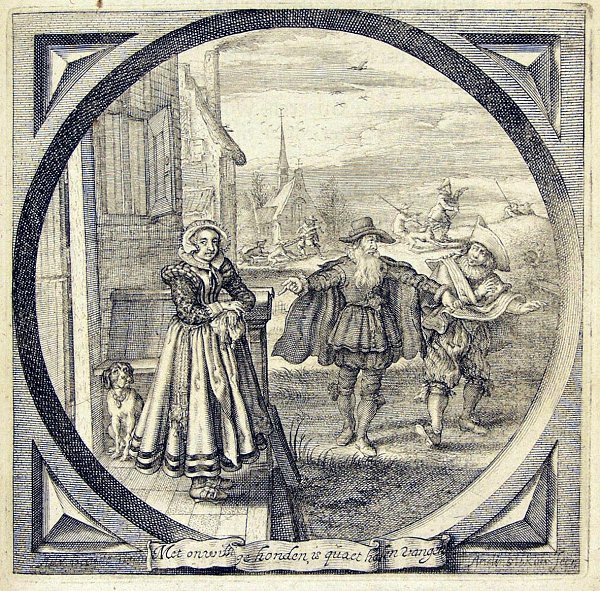
Met onwillige honden ist quaet hasen vangenLatin
With unwilling dogs it is hard to catch hares.AI-generated
Description of the imageAI-generated
Within a large oval frame (with hatched corner spandrels) a village scene. At the left a young woman in a lace cap, ruff and a richly trimmed gown stands in the open doorway of a timber house, her hands folded before her, a spotted dog with a collar sitting at her feet beside a bench. In the middle an old bearded man in a broad-brimmed hat and cloak strides toward her, pointing at her with his right hand while with his left he drags along a younger man behind him. The young man, in a plumed hat, cloak and wide breeches, leans backwards and pulls away, turning his head and stretching out his arm in refusal. In the background a village street with a church with a tall spire, and beyond, in open fields, hunters with long poles and dogs coursing hares; birds fly in the sky. On a banderole at the bottom of the plate is written the motto; at the lower corners the engravers' signatures.
Subscriptio


TranscriptionAI-generated
Daer woont een vrijster hier ontrent, Voor rijck by alle man bekent, Een hupse, rappe, fluxe meyt, Die hares vaders koeyen weyt; Van leden kloeck, van lijve vol, Van lippen dick, van koonen bol; Voor al gesont gelijck een vis, En groen gelijck het groenste lis, En jeugdigh als de maegde-palm, Int kort' een vrijster als een salm. Maer dat ick prijse boven al, Is, datse vry wat halen sal Als peet-meuy Griet eens wort een lijck, Want die is uytter-maten rijck. Ick wou dat Claes, mijn liefste kint, Tot haer soo was, als ick, gesint, En dat hy daer eens vryen wou, Soo kreegh hy wis een rijcke vrou; Want siet de vader van de meyt Die heeftet my als toe-geseyt, Maer Claes is soo een vreemden haen, Hy wil niet eens uyt vryen gaen, Als daer hy hoofsche kappen vint, Daer is de joncker toe-gesint. Maer segh doch eens wat isset hof? 'Ken houwer niet een brijsel of, Ick prijse meer het edel gelt, Daer nae de gantsche werelt helt, Dat heeft al vry wat beter aert, Want daer is datmen wel af vaert. Maer wat een spijt! siet, onse Claes En wil niet bijten aen het aes, Want hy veracht mijn wijsen raet, Het schijnt dat hy sijn voordeel haet. Hoe dickmaels heb' ick hem geleyt Tot by, tot voor, tot aen de meyt, Maer hy staet ick en weet niet hoe, Hy spreecktse niet, of luttel toe; Hy geeuwt, en toont met sijn gelaet Dat hy daer gants onlustigh staet; Hy neemtse niet eens byder handt, Hy schencktse noyt een minne-pandt, Yet aerdighs inde stadt gekocht, Of uyt een ander rijck gebrocht; En offet schoon hier jaer-mart is Hy kooptse niet een kerremis, Noch riem, noch ringh, noch moyen douck, Iae sellef niet een soeten kouck; Hy dicht haer noyt een minne-liet, Daer in men geest en leven siet, En of de soete tijt genaeckt De koele gast blijft ongeraeckt; Hy plant haer noyt een groene mey, Hy sent haer noyt een kievits-ey, Hy brengt haer noyt een jongen haes, Is dat niet wel een rechte Claes? Maer noch laet ick het geven staen, Hoewel het beter is gedaen; Hy neemt van haer niet eens een ringh, Een neus-douck, of een ander dingh, Gelijck de vryers van het landt Dit dickmael plegen met verstandt: Want neemt een geestigh jongman wat, Het geeft hem dickmael dit en dat, Het maeckt dat hy den naesten dagh Met eeren weder komen magh, Want siet de vryer is beleeft Als hy 'tgenomen weder geeft; Maer dese knecht, wat ick hem rae, En vraegter niet ter werelt nae. Al hangter schoon een rose-krans, Hy leydtse noyt eens aen den dans, Hy brengt haer noyt eens inden tuyn, Hy rijdt met haer noyt in den duyn; Hy gaet met haer noyt in den doel, Maer blijft geduerigh even koel; En dat noyt rechte vryers doen, Hy neemt sijn af-scheyt sonder soen, Iae slaet geen hant schier aen sijn muts; Is dat niet wel een rechte kluts? Voorwaer als ick dees grillen merck, Soo roep ick; ô 'tis plompaerts werck Dat yemant sijn geluck versiet Als sich de kanze schoone biet! Nu vind' ick eerst dat dit bedrijf Gaet naer de reden van mijn wijf, Die seyt, Ey man houdt u gerust, Ons Claes heeft daer geen vryens lust; Hy broet wat anders inden sin, En wat is doch gedwonge min? Is niet een vryer over al Een vry-heer waer hy vryen sal? Is vryen niet een vry bejagh Daer toe men niemant dwingen mach? Daer wast geen liefde door gewelt; Dus laet den jongman ongequelt, En laet hem soecken sijn geval Daer hem sijn herte leyden sal; " Men vindt doch noyt de putten goet " Daer in men water dragen moet. Hoewel een wey-man siet het wilt, Dat sachtjens voor hem henen drilt, Dat om hem loopt, dat op hem siet, En sich als aen den jager biet, Noch efter tast hy dickmael mis Indien sijn Wind' onlustigh is; Want jaegt sijn hont maer uyt bedwangh, Soo blijft de jager sonder vangh.
TranslationAI-generated
There lives a young unmarried woman hereabouts, known to everybody as rich, a neat, nimble, brisk girl, who pastures her father's cows; sturdy of limb, full of body, thick of lip, round of cheek; above all healthy as a fish, and fresh as the greenest reed, and youthful as the maiden's palm; in short, a girl like a salmon. But what I praise above all is that she will indeed come into something when godmother-aunt Griet one day becomes a corpse, for she is exceedingly rich. I wish that Claes, my dearest child, were minded toward her as I am, and that he would once go courting there: then he would surely get a rich wife; for see, the girl's father has as good as promised her to me. But Claes is such a strange cock: he will not once go out courting, except where he finds courtly hoods — that is what the young gentleman has his mind on. But tell me once, what is the court? I would not give a crumb for it; I rather praise the noble money, toward which the whole world leans; that has a far better nature, for that is what one prospers by. But what a pity! see, our Claes will not bite at the bait, for he despises my wise counsel; it seems he hates his own advantage. How often have I led him up to, before, right to the girl; but he stands there I know not how, he does not speak to her, or very little; he yawns, and shows by his face that he stands there wholly without pleasure; he does not once take her by the hand, he never gives her a love-token, something pretty bought in town, or brought from another realm; and even though there is a yearly fair here, he does not buy her a fairing, nor belt, nor ring, nor fine kerchief, no, not even a sweet cake; he never composes her a love-song in which one sees spirit and life; and though the sweet season draws near, the cool fellow remains untouched; he never plants her a green maypole, he never sends her a lapwing's egg, he never brings her a young hare — is that not indeed a proper Claes (simpleton)? But still I let the giving pass, although it is better done; he does not even take from her a ring, a handkerchief or some other thing, as the country suitors often do, and with good sense: for if a witty young man takes something, it often brings him this and that, it makes it possible for him to come back with honour the next day, for see, the suitor is courteous when he gives back what he took; but this lad, whatever I advise him, does not care in the world about it. Though a rose-garland hangs there fair, he never once leads her to the dance, he never once takes her into the garden, he never rides with her in the dunes, he never goes with her to the shooting-range, but remains continually just as cool; and — what true suitors never do — he takes his leave without a kiss, indeed scarcely lays a hand to his cap: is that not indeed a proper blockhead? Truly, when I note these whims, I cry out: oh, it is a boor's work for anyone to overlook his good fortune when the fair chance offers itself! Now for the first time I find that this behaviour agrees with my wife's reasoning, who says: Eh, husband, be at ease, our Claes has no desire for courting there; he is hatching something else in his mind, and what is forced love after all? Is not a suitor everywhere a free lord as to where he shall court? Is courting not a free chase to which no one may be compelled? No love grows there by force; so leave the young man untormented, and let him seek his fortune where his heart shall lead him; "one never finds those wells good into which one must carry the water." Although a huntsman sees the game that trips gently along before him, that runs around him, that looks at him and as it were offers itself to the hunter, yet he often misses it if his greyhound is unwilling; for if his dog hunts only under compulsion, then the hunter stays without a catch.
CommentaryAI-generated
2 passages · original left, translation right (click to fold)
De oude vader spreeckt.
The old father speaks. (marginal speaker-note)
Lat. Invitos boves in plaustra inducere incommodum. Nederd. Met onwillige peerden ist quaet rijdē. Lat. Invitis equis plaustrum agere difficile. Nederd. 't Sijn quade putten daermen 'twater in dragen moet. Lat. Invito beneficium non datur. Nederd. Al is de vrijster steeg noch wortse wel de bruyt/ Maer wil de vryer niet/so is de vrientschap uyt. Hoogd. Mit vnwilligen hunden ist nicht gut jagen. Nederl. Venari invitis haud facile est canibus. Hoogd. Wenn der hund nicht lustig ist zum jagen/ so reitet er auff dem hindern. Franç. Tout par amour rien par force. Lat. Quidquid exprimitur grave est. Sen. oct. act. 2. Vi quod fit præter naturam est. Arist. 5. Phys. cap. 3. Invitum qui servat idem facit occidenti. Lat. Stultitia est venatum ducere invitos canes. Plaut. Non extorquebis amari. Claud. Blanditijs, non imperio fit dulcis Venus. Seneca. Omne coactum tragicum habet exitum. Bald. ad l. neque ab initio. C. de nupt. Den willigen is goet trecken. Nederd. Charicles, apud Achillem Statium, Pater, inquit, divitijs inhians ingratam mihi affinitatem affectat; me miserum! pecuniæ trador ut uxori mancipium sim. Lat. Men dwingt geen menschē totte trou/ Men leyt geen vryers by de mou/ Men paert geē vrijsters tegēs danck/ De liefd' en wil doch geen bedwanck. Nederl. Si quis plura hac de re desideret videat Cypræum Iurisconsultum de sponsalibus. pag. 236. Lat.
Lat. It is inconvenient to lead unwilling oxen into the wagon. / Dutch: With unwilling horses it is bad riding. / Lat. It is difficult to drive a wagon with unwilling horses. / Dutch: Those are bad wells into which one has to carry the water. / Lat. A benefit is not given to one who does not want it. / Dutch: Though the girl be stubborn, she may yet become the bride; but if the suitor will not, then the friendship is over. / German: With unwilling dogs it is not good hunting. / [Dutch rubric] Lat. It is not easy to hunt with unwilling dogs. / German: When the dog is not eager for the hunt, he rides upon his hindquarters. / French: Everything by love, nothing by force. / Lat. Whatever is extorted is burdensome. Seneca, Octavia, act 2. / Whatever is done by force is contrary to nature. Aristotle, Physics 5, ch. 3. / Lat. He who preserves a man against his will does the same as one who kills him. / Plautus: It is folly to lead unwilling dogs to the hunt. / Claudian: You will not extort being loved. / Seneca: Venus is made sweet by caresses, not by command. / Everything forced has a tragic outcome. Baldus on the law 'neque ab initio', Codex, on marriages. / Dutch: The willing are easy to draw along. / Charicles, in Achilles Tatius: 'My father,' he says, 'gaping after riches, is contriving for me a marriage-alliance I dislike; wretched me! I am handed over to money, to be a slave to a wife.' / Dutch: One forces no one into marriage, one does not lead suitors by the sleeve, one does not couple girls against their will; love will have no compulsion. / Lat. If anyone desires more on this subject, let him see Cypraeus the jurist, On Betrothals, p. 236.
Iconclass
86(MET ONWILLIGE HONDEN IST QUAET HASEN VANGEN)proverbs, sayings, etc. (MET ONWILLIGE HONDEN IST QUAET HASEN VANGEN)
Suggested Iconclass codesAI-generated
Additional codes proposed for this emblem, not (yet) part of the indexing.
53C21CompulsionhighThe correlate 'Compulsion' directly matches the emblem's theme of forcing an unwilling party ('Everything by love, nothing by force'; 'whatever is extorted is burdensome'), shown by the father dragging his resisting son.
42D1betrothalmediumThe correlate 'betrothal' matches the scene of a father attempting to conclude a match between his son and the girl standing in the doorway, with the commentary citing Cypraeus 'On Betrothals'.
33C21courtingmediumThe correlate 'courting' fits the depicted act of bringing a (reluctant) suitor to the young woman at her door, the commentary speaking of the suitor and the match.
42Dbetrothal and marriagelowThe broader correlate 'betrothal and marriage' covers the emblem's subject of a forced marriage alliance, though the more specific 42D1 is preferable.
Relationships to the Adagia of ErasmusAI-generated
Suggested relationships between this emblem and adages in Erasmus’ Adagia.
- I i 42 Invita Minerva – thematic inventiolow
The emblem's whole argument — that nothing good comes of an undertaking pursued against one's natural inclination ('Vi quod fit praeter naturam est'; 'Omne coactum tragicum habet exitum') — matches Erasmus's adage on acting 'with Minerva unwilling', i.e. against one's own bent; there is no verbal quotation, only the shared commonplace.
Sources
Record ID: embstma_1288_emblem031
This emblem on the Iconclass site: https://iconclass.org/view/embstma_1288_emblem031
Copy: University Library, Glasgow, Stirling Maxwell 1288