I i 1 Amicorum communia omnia Between friends all is common
ΤΑ τῶν φίλων κοινὰ, id est, Amicorum communia sunt omnia. Quoniam non aliud hoc proverbio, neque salubrius, neque celeratius, libuit hinc adagiorum recensionem velut omine felici auspicari. Quod quidem si tam esset fixum in hominum animis, quam nulli non est in ore, profecto maxima malorum parte vita nostra levaretur. Ex hoc proverbio Socrates colligebat, omnia bonorum esse virorum non secus, quam deorum. Deorum, inquit, sunt omnia. Boni viri deorum sunt amici, & amicorum inter se communia sunt omnia. Bonorum igitur virorum sunt omnia. Refertur apud Euripidem in Oreste, Κοινὰ γὰρ τὰ τῶν φίλων. id est: Inter enim amicos cuncta sunt communia. Idem in Phoenissis, Κοινὰ γὰρ φίλων ἄχη. id est., Communis omnis est amicorum dolor. Idem in Andromacha, Φἰλων γὰρ οὐδὲν, ἴδιον, oἳ πνες φἰλοι Ὀρθῶς πεφύκασ’, ἀλλὰ κοινὰ χρήματα. id est, Nam vere amicis proprium prorsus nihil Sed inter ipsos cuncta sunt communia. Terent. in Adelphis: Nam vetus quidem hoc verbum, amicorum inter se communia esse omnia. Testantur & apud Menandrum fuisse in eadem fabula, M. Tullius lib. Offic. i. Ut in Graecorum, inquit, proverbio est, amicorum esse omnia communia. Citatur & ab Aristot. lib. Moralium viii. & a Platone de Legib. v. Quo loco conatur demonstrare, felicissimum reipubl. statum, rerum omnium communitate constare, πρώτη μεν τοίνυν πόλισ τε ἐστὶ καὶ πο λιτεία, καὶ νόμοι ἄριστοι, ὃπου τό πάλαι λεγόμενον ἄν γίγνηται κατὰ πᾶσαν τὴν πόλιν ὃτι μάλιστα. λέγεται δὲ, ὡσ ὄντως ἐστὶ κοινὰ τὰ φίλων. id est, Prima quidem igitur civitas est & reip. status, ac le ges optimae, ubi quod iam olim dicitur, per omnem civitatem quàm maxime fieri potest, observabitur. Dictum est autem vere, res amicorum communes esse. Idem ait, felicem ac beatam fore civitatem, in qua non audirentur haec verba: meum & non meum. Sed dictu mirum quàm non placeat, imò quam lapidetur à Christianis Platonis illa communitas, cum nihil unquam ab ethnico philosopho dictum sit magis ex Christi sententia. Aristoteles lib. Politic. ii. temperat Platonis sententiam, volens possessionem ac proprietatem esse penes certos: caeterum ob usum, virtutem & societatem civilem, omnia communia iuxta proverbium. Martialis lib. ii. iocatur in quendam Candidum, cui semper in ore fuerit hoc adagium, cum alioqui nihil impartitet amicis, Candide κοινὰ φίλων, sunt haec tua Candide πάντα Quae tu magniloquus nocte dieque sonas. Atque ita concludit epigramma: Das nihil, & dicis Candide κοινὰ φίλων. Eleganter Theophrastus apud Plutarchum in commentariolo, cui titulus: περι φιλαδελφίας, Εἰ κοινὰ τὰ φίλων ἐστὶ, μάλιστα δεῖ κοινοὺσ τῶν φίλων εἶναι τοὺς φίλους, id est, Si res amicorum communes, maxime convenit, ut amicorum item amici sint communes. M. Tullius lib. de Leg. i. videtur hoc adagium Pythagorae tribuere, cum ait: Unde enim illa Pythagorica vox, τὰ φίλων κοινὰ κὰι φιλίαν ἰσότητα, id est, Res amicorum communes, & amicitiam aequalita tem. Praeterea Timaeus apud Diogenem Laertium tradit, hoc dictum primum à Pythago ra profectum fuisse. A. Gellius Noct. Attic.libr. i. cap. ix. testatur, Pythagoram non solum huius sententiae parentem fuisse, verum etiam huiusmodi quandam vitae ac facultatum com munionem induxisse, qualem Christus inter omneis Christianos esse vult. Nam quicun que ab illo in cohorem illam disciplinarum recepti fuissent, quod quisque pecuniae familiaeque habebant, in medium dabant: quod re atque verbo Romano appellatur κοινόβιον. id est, coenobium, nimirum à vitae fortunarumque societate.
Τὰ τῶν φίλων κοινὰ, Between friends all is common. Since there is nothing more wholesome or more generally accepted than this proverb, it seemed good to place it as a favourable omen at the head of this collection of adages. If only it were so fixed in men's minds as it is frequent on everybody's lips, most of the evils of our lives would promptly be removed. From this proverb Socrates deduced that all things belong to all good men, just as they do to the gods. For to the gods, said he, belong all things; good men are friends of the gods; and among friends all possessions are in common. Therefore good men own everything. It is quoted by Euripides in his Orestes: 'Shared in common are the possessions of friends,' and again in the Phoenissae: 'All grief of friends is shared.' Again in the Andromache: 'True friends have nothing of their own, but with them all is common.' Terence says in the Adelphoe 'For there is an old proverb, that between friends all is common.' It is said that this was also in Menander, in a play of the same name. Cicero in the first book of the De Officiis says 'As the Greek proverb has it, all things are in common between friends,' and it is quoted by Aristotle in the eighth book of his Ethics and by Plato in the Laws, book 5. Plato is trying to show that the happiest condition of a society consists in the community of all possessions: 'So the first kind of city and polity and the best laws are found where the old saying is maintained as much as possible throughout the whole city; and the saying is that friends really have all things in common.' Plato also says that a state would be happy and blessed in which these words 'mine' and 'not mine' were never to be heard. But it is extraordinary how Christians dislike this common ownership of Plato's, how in fact they cast stones at it, although nothing was ever said by a pagan philosopher which comes closer to the mind of Christ. Aristotle in book 2 of the Politics moderates the opinion of Plato by saying that possession and legal ownership should be vested in certain definite persons, but otherwise all should be in common according to the proverb, for the sake of convenience, virtuous living and social harmony. Martial in book 2 pokes fun at a certain Candidus, who was always quoting this adage, but otherwise gave nothing to his friends: '0 Candidus, what's mine is yours, you say; / Grandly you chant this maxim night and day,' and the epigram ends thus: "'What's mine is yours," yet naught you give away.' An elegant remark of Theophrastus is quoted in Plutarch, in the little essay entitled 'On Brotherly Love': 'If friends' possessions are in common, then friends' friends still more should be in common too.' Cicero in the first book of the De legibus seems to attribute this adage to Pythagoras, when he says: 'Hence that word of Pythagoras "Between friends things are in common, and friendship is equality."' In Diogenes Laertius also Timaeus reports that this saying first began with Pythagoras. Aulus Gellius in his Attic Nights, book i chapter 9, bears witness that not only was Pythagoras the author of this saying, but he also instituted a kind of sharing of life and property in this way, the very thing Christ wants to happen among Christians. For all those who were admitted by Pythagoras into that well-known band who followed his instruction would give to the common fund whatever money and family property they possessed. This is called in Latin, in a word which expresses the facts, coenobium, clearly from community of life and fortunes.
Facsimile: 
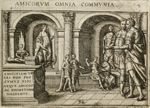
Amicorum omnia communia: Boissard, Emblematum liber (Frankfurt, 1593), emblem XXXII
Amantibus omnia communia: Vaenius, Amorum emblemata (Antwerp, 1608), emblem 7 paraphrases the adage
Iconclass: 33A5 friends 46A8211 communal sharing of everything 55C5 Sharing 56F23 Friendship; 'Amicitia' (Ripa)
Collectanea (1500): 94
Loci Communes: Amicitia (Friendship, Amitié)
I i 2 Amicitia aequalitas. Amicus alter ipse Friendship is equality. A friend is another self
Haec quoque ad Pythagoram auctorem referunt, quòd eandem complectantur sententiam τὴν φιλίαν ἰσότητα εἶναι, καὶ μὶαν ψυχήν τὸν φίλον ἓτερον αὑτὸν, id est, amicitiam aequalitatem esse & eandem animam, & amicum alterum ipsum. Neque enim quicquam non commune, ubi fortunarum aequalitas: neque dissensio, ubi idem animus: neque divortium, ubi coagmentatio duorum in unum. Aristoteles Magnorum moralium lib. ii. o̔́ταν βουλόμεθα σφόδρα φί λον εἰπεῖν, μία φαμὲν ψυχὴ ἡ ἐμὴ καὶ ἡ τούτου. id est, Quoties volumus vehementer amicum dicere, unà inquimus anima mea & huius. Idem eodem lib. ἔστι γὰρ, ὥς φαμεν, ὁ φίλος ἕτερος ἐγὼ id est, Est enim, ut dicere solemus, amicus, alter ego. Plato lib. de Legib. vi. citat tanquam vetus dictum, & ceu proverbio iactatum, παλαιὸς γὰρ ὁ λογος ἀληθὴς ὢν, ὡς ἰσότης φιλότητα ἀπεργάζεται, μάλα μὲν ὀρθῶς εἴρηται, καὶ ἐμμελῶς, id est, Nam vetus illud verbum, & ve re & eleganter dictum est, aequalitatem amicitiae auctorem esse. Neque tamen id sentit Pla to, iuvenibus ac senibus, doctis atque indoctis, stultis ac sapientibus, robustis ac debilibus omnia aequalia exhibenda esse, sed cuique pro sua dignitate distribui oportere. Alioqui, quemadmodum ait inibi Plato: τοῖς ἀνίσοις τὰ ἶσα ἄνισα γίγνοιντ' ἂν. id est, inaequalibus aequalia erunt inaequalia. Et ut summum ius in summam inuriam vertitur, ita summa aequalitas, summa fit inaequlitas. Quemadmodum festiviter dixit Plinius, aequalitare in ferendis senten tiis nihil inveniri posse inaequalius. Quanquam hoc quoque quidam ex Homero sumptum existimant; apud quem est illud aliquoties, ἶσον ἐμῇ κεφαλῇ , id est, Aeque atque meum ipsius caput. Nec ab hoc dissidet Hebraeorum lex, iubens ut proximum perinde ut nosmetipsos diligamus. Atque haec omnia Aristoteles lib. Moralium ix. proverbii titulo citat. PYTHAGORAE SYMBOLA Sed quandoquidem in Pythagorae mentionem incidimus, non gravabor & reliqua illius symbola, priscis illis oraculorum instar celebrata, adscribere, quae quidem in praesen tia licuit apud Graecos invenire scriptores. Nam ea, tametsi prima, quod aiunt, fronte superstitiosa quaepiam ac deridicula videantur, tamen si quis allegoriam eruat, videbit nihil aliud esse, quam quaedam recte vivendi praecepta. nihil enim opus est Tyrrhenorum imitari superstitionem, qui haec etiam citra ullam allegoriam observant, ut testatur in Symposiacis Plutarchus. Idem in vita Numae tradit quaedam huius generis symbola Numae convenisse cum Pythagoricis. Ne gustaris, quibus nigra est cauda. Μὴ γεύεσθαι τῶν μελανούρων. id est, Ne gustes ex iis quibus est nigra cauda. Interpretatur Plutarch. in comment. De liberis instituendis, ne commercium habeas cum improbis, & iis qui sunt nigris ac infamibus moribus. Tryphon grammaticus inter aenigmatis exempla hoc quoque commemorans interpretatur hoc modo, ψευδῇ λόγον μὴ ποίεσθαι. Τὸ γὰρ ψεῦδος ἐν τοῖς ἐσχατοισ μέρεσι μελαίνεται, καὶ ἀμαυροῦται. id est, Ne mendacem sermonem protuleris. Mendacium enim in extremis partibus nigrescit & obscuratur. Quidam ad sepiam piscem referunt, qui atramento quod in cauda gestat, semet occulit. Quamquam Plinius libr. xxxii. capite ultimo, Melanurum inter pisces recenset, cum de sepiis multa prioribus libris disseruerit, ut videatur non idem esse piscis Melanurus & Sepia. Theodorus Gaza melanurum Ocula tam vertit, quem piscem nominat tantum loco quem modo indicavimus. Stateram ne transgrediaris. Mὴ ζυγὸν ὑπερβαίνειν. id est, Stateram ne transilias, hoc est, Ne quid facias praeter ius & aequum. Nam stateram olim aequitatis symbolum habuisse vulgo, vel Doricum illud proverbium indicat, σταχάωης δικαιότερος, id est, trutina iustior. Ad eum modum dum interpreta tur Demetrius Byzantius apud Athenaeum lib. Dipnosoph. x. Choenici ne insideas. Χοίωικι μὴ ἐπικάθισαι, id est, Choenici ne insideas. Interpretatur divus Hieronymus, de victu ne fueris solicitus in diem crastenum. Est enim Choenix demensum, & cibus di > urnus, ut apud Homerum Odysseas τ. Οὐ γὰρ ἀεργὸν ἀνέξομαι, ὅσκεν ἐμῆς γὲ Χοίνικοσ ἅπτηται. id est, Namque operae immunem haud patiar, quicunque meam unquam Choenica contigerit. Eodem pacto Laert. et Suidas exponunt. Porrò servis olim cibus diurnus choenice distribuebatur, ut illi vicissim operis pensum persolverent, quam ob causam Apollo Pythius Corinthios χοινικομέτρας appellavit, quia servos possiderent quadragies sexies mille. Auctor Athenaeus lib. vi. Plutarchus autem longe diversius, puta, non indulgendum ocio, sed industria prospiciendum victum, ne desit in posterum. Idem in Symposiacis huius symboli meminit, his quidem verbis: μετὰ τῆς Πυθαγορικῆς χοίνικοσ, ἐφ' ᾗς ἀπηγόπευε καθῆσθαι, διδάσκων ἡμᾶς, ἀεί τι τοῦ παρόντοσ εἰς τὸ μέλλον ἀπολίπειν, καὶ τῆς αὔριον ἐν τῇ σήμερον μνημονεύειν. hoc est, Unà cum Pythagorica choenice, in qua vetuit desidere, docens nos ut ex eo quod praesens est, semper aliquid in futurum relinquamus, & crastini diei in hodierno memine rimus. Existimat autem idem maiores significare voluisse, quibus religiosum habitum est, mensas inanes tollere. Demetrius Byzantius apud Athenaeum interpretatur, non oportere specta re tantum quae praesentis diei sunt, quin crastinum semper esse exspectandum, propemodum cum Plutarcho consentiens. Ego certe, quandoquidem in huiusmodi symbolis divinare non solum licet, verumetiam necesse est, opinor Pythagoricum hoc aenigma sumptum ex Homeri loco quem modo citavimus: significarique, non oportere per inertiam ocium & cibum alienum sectari, sed sua quenque industria sibi parare facultates, quibus mundiciam vitae sustineat. Parasiticum enim ac foedum aliena vivere quadra, nec ullam artem callere, qua possis οἰκόσιτος vivere. Notat id Homerus etiam in Iro, cum ait Odysseae σ μετὰ δ' ἔπρεπε γαστέρι μᾶργῃ, Ἀζυχὲς φαγέμεν, καὶ πιέμεν. οὐ δὲ οἱ ᾖν ἴς, Οὐ δὲ βίη. id est, Sed ventre insignis inerti Assidue bibere atque edere. ast industria nulla Nullaque vis aderat. Nec abhorret hinc illud Pauli apostoli, ne ipsum quidem in celebre vulgo: Qui non laborat, nec manducat. Cum nobis adornaretur sexta, ni fallor, Chiliadum aeditio, nempe anno ab orbe redempto M.D.XVII. commodum in lucem exiit opus Antiquarum lect. Lu dovici Caelii Rhodigini, de quo quid in totum sentiam, non habeo necesse nunc ferre sententiam: tametsi ipse operis gustus, nam delibavi duntaxat, protinus arguit hominem inexplebili legendi aviditate per omne genus autorum circumvolitantem, & ex retextis aliorum sertis novas subinde corollas concinnare gaudentem. Quod autem Georgii Vallae, Volaterrani, meique nusquam, quod quidem compererim, admiscuerit mentionem, quorum tamen commentariis nonnihil adiutum fuisse probabile est, scio iudicio factum, non livore: etiamsi hoc ipsum tractans sumbolum, negat se quicque adferre velle in medium, quod in aliorum commentariis rebulliat (sic enim ille loquitur) cum non pauca adducat quae in meis Chiliadibus reperio. Nec enim arbitror ad me pertinere, quod ille gignit etiam proverbia, sed cuiusmodi chiliadas sexcentas explere possis, si fors ea res cordi sit. Ubi plusculum ocii continget, non gravabimur attentius etiam observare, si quid illic sic quod ad nostrum hoc institutum pertineat, haudquaquam hominem sua laude fraudaturi, si quid contulerit. Caeterum quod ad huius aenigmatis explanationem attinet, non me fugit quid de choenice, deque stragulis convolutis divinarit ille, cuius equidem commentum in prae sentia nec probo, nec refello. mihi certe non libeat ad istum divinare modum, si quid alioquin à probis autoribus suppeditetur: quae praesidia simul atque nos defecerint, tum fortè divinabimus & ipsi, sed ita ut in huiusmodi rebus non multum operae seriae ponamus. Quorsum enim attinet anxie disquirere quid senserit is, qui data opera curavit ne possit intelligi? Cum haec scriberem, ex eruditorum literis cognovi, Rhodginum obisse supremum vitae diem, non sine gravi dolore studiosorum & iactura studiorum. Narrant enim qui illum domestice norunt, fuisse virum integritatis Christianae, nullo studiorum labore fatigabilem, cum ad extremam senectutem pervenerit. Itaque tot virtutibus facile condono, si minus candide de nobis sensit. Plus enim apud me valet publica stu diorum utilitas, quàm mei nominis ratio. Ne cuius dexteram inieceris. Μὴ παντὶ ἐμβάλλειν δεξιὰν. id est, Ne cuivis porrigas dexteram, hoc est: Ne temere quemlibet in familiaritatem admittas, sed deligas quem diligas. Idem citatur atque exponitur à Plutarcho, ἐν τῷ περὶ τῆς πολυφιλίας. Convenit cum illo Solonis apohtheg., quod ex Apollodoro refert Diogenes Laertius, φίλιους μή ταχὺ κτῶ, ὅυς δ'ἄν κτησῃ μὴ αποδοκίμαζε. id est, Amicos ne cito pares, quos autem paraveris, ne reiice. Arctum anulum ne gestato. Μὴ φορεῖν στενὸν δακτύλιον. id est, Arctum anulum ne gestato, Hoc est, interprete divo Hieronymo, ne vixeris anxie. & ne temet in servitutem coniicias, aut in eiusmodi vitae institutum, unde te non queas extricare. Siquidem quisquis anulum angustum gestat, is sibi quodammodo vincula iniicit. Ignem ne gladio fodito. Πῦρ σιδήρῳ μὴ σκαλεύειν. id est, Ignem gladio ne fodito, hoc est, Ira percitum ne lacessas quin magis concedere convenit, & blandis verbis tumidum animum placare. Ita divus Hie ronymus, & apud Athenaeum Demetrius Byzantius. Diogenes Laertius exponit, poten tium & ferocium iracundiam non esse convitiis exagitandam, propterea quod flamma, quo magis exagitatur, hoc magis atque magis invalescit. Neque dissentit ab hoc interpretamento Plutar chus. Quamquam Plato lib. De legib. vi. sic usurpavit, ut de iis dici solitum videatur, qui frustra moliuntur, quod effici nullo pacto queat, ostendens id lusus genus quoddam fuisse, ut ignem gladio dissecarent. Ad eundem fermè sensum retulit divus Basilius in Epistola ad nepotes: ut idem sibi velint, Ignem gladio dissecare, & Cribro haurire aquam. Huc nimirum allusit Lucianus in ii. Verarum narrationum lib. cum ex insulis fortunatis dimitteretur, fingens se à Rhadamantho admonitum, ut si quando rediret in hunc nostrum orbem, tria quaedam observaret, μὴ πῦρ μαχαίρᾳ σκαλεύειν, μήτε θὲπμουσ ἐσθίειν, μήτε παιδὶ ὑπὲρ τὰ ὀκτωκαίδεκα ἔτη πλησιὰζειν. id est, Ne gladio ignem diverberaret, ne lupinis vesceretur, ne se puero decimumoctavum annum egresso adiungeret. Si quidem horum meminisset, futu rum, ut aliquando ad eam insulam reverteretur. Horatius hoc dicto videtur indicare crudelitatem cum insania coniunctam. Amor enim per se furor est, qui si erumpat in pugnas ac caedes, ignis gladio perfoditur. Libro Sermonum ii. Satyra iii. His adde cruorem, Atque ignem gladio scrutare. Cor ne edito. Μή ἐσθίειν τήν καρδίαν. id est, Cor ne edito. Hoc est, ne curis tuum ipsius animum excrucies. Ad hunc modum enarrat Demetrius Byzantius apud Athenaeum. Aut, ne sollicitudinibus vitam reddas breviorem. Aristot. enim. lib. De partibus animalium iii. narrat, cor esse fontem omnium sensuum, vitaeque ac sanguinis. Aristoph. in Nebulis: Ομωσ δὲ θυμὸν δακὼν ἔφιν. id est, Animum tamen mordens meum, sic inquam. Item Theognis, Καί δάκνομαι ψυχὴν, καὶ δίχα θυμὸν ἔχω. id est, Et rodor mentem, sumque animi ambiguus. Videtur ex Homero sumptum, apud quem est Iliados ζ Ἤτοι ὁ καππεδίον τὸ αλήϊον οἶος ἀλᾶτο, Ὃν θυμὸν κατέδων, πάτον ἀνθρώπων ἀλεέινων. Solus at ille quidem vacuis errabat in agris Cor adedens curis, hominum vestigia vitans. Et Ω. Σὴν, ἔδεαι κραδίην id est, tuum edis cor. Item Odysseae Ι Ἔνθα δύο νύκτας, δύο τ' ἤματα συνεχὲς αἰεὶ Κείμεθ' ὁμοῦ, καμάτῳ τε καὶ ἄλγεσι θυμὸν ἔδοντες. id est, Hic soles nocteisque duas consedimus, usque Rodentes animum curis simul atque labore. Item Iliados α. Σὺ δ' ἔνδοθι θυμὸν ἀμύξεις. id est, Tu intus praecordia rodes. A fabis abstineto. Κυάμων ἀπέχεσθαι. id est, A fabis abstineto. Huius aenigmatis varia reperitur interpretatio. Plutarchus in comment. De liberis educandis, ad hunc enarrat modum. Abstinendum à tractandis reipub. muneribus, propterea quod antiquitus in creandis magistratibus suffragia per fabas vice calculorum ferebantur. Quamquam idem in Probl. diversam ad fert causam: nempe quod omnia legumina ventum et humorem impurum adferant corpori bus, atque hanc ob causam ad Venerem incitent. In eadem sententia M. Tullius item fuisse videtur, qui in lib. De divinatione .i. scribit ad hunc modum. Iubet igitur Plato sic ad som num proficisci corporibus affectis, ut nihil sit quod errorem animis perturbationuemque adferat. Ex quo etiam Pythagoreis interdictum putatur, ne faba vescerentur, quae res habet inflationem magnam. Is cibus tranquillitatem mentis quaerentibus constat esse contra rius. Aristoxenus tamen apud A. Gellium libro .iiii. capite .xi. refellit hanc opinionem, affirmans Pythagoram nullo legumine saepius usum quàm fabis, quòd is cibus & alvum sensim subduceret & levigaret. Porrò Gellius de cyamo non esitato, causam erroris fuisse putat, quòd in Empedoclis carmine, qui disciplinas Pythagoricas sectatus est, ver sus hic invenitur, Δειλοί πως δειλοί κυάμων άπὸ χεῖρας ἑλἐσθαι id est, Ah miseri à cyamo, miseri subducite dextras. Opinati enim sunt plerique, κύαμον legumentum vulgo dici. Sed qui diligentius scitiusque carmina Empedoclis arbitrati sunt (utar enim verbis Gellianis) κυάμους hoc in loco testi culos significare dicunt: eosque more Pythagorae operte atque symbolice κυάμους appella tos, quasi sint εἰς τὸ κύειν δεινοὶ , καὶ αἴτιοι τοῦ κύειν. id est, ad ferendum uterum efficaces, causaeque ferendi uteri, & geniturae humanae vim praebeant. Idcirco Empedoclem versu isto non à fabulo edendo, sed à rei Venereae proluvio voluisse homines deducere. De causis intellectae fabae haec ex Aristotele refert Laertius, φησὶ δὲ Ἀριστοτέλησ ἐν τῷ περὶ κυάμων, παραγγέλειν αὐτὸν ἀπέχεσθαι τῶν κυάμων, ἢτοι ὅτι αἰδοίοις εἰσὶν ὅμοιοι, ἢ ὅτι ἀΐδου πύλαισ. Ἀγόνα τον γὰρ μόνον. Ἢ ὅτι φθείρει, ἢ ὅτι τῇ του ὅλοθ φύσει ὅμοιον, ἢ ὅτι ὀλιγαρχικόν. Κληροῦνται γοῦν αὐτοῖς. id est, Ait autem Aristot. in lib. De fabis, illum iussisse à fabis abstineri, vel quod pudendis essent similes, vel quod inferorum portis (unum enim hoc legumen expers geniturae) vel quod corrumpat, vel quod universi naturae simile, vel quod ad oligarchiam pertineat, nam fabis sortiuntur. Cum eo quod postremo loco attigit Aristot. convenit quorundam sententia, qui putant Pythagoram hoc aenigmate deterruisse à capessenda republica. Mihi magis etiam arridet, quod addit is qui historias quas Gregorius Nazianzenus attigit, collegit, edere fabas, qui lucro corrupti ferunt suffragia. Plutarchus apud eundem Gellium testatur, Aristotelem scriptum reliquisse, quod Pythagoras μήτρας καὶ καρδίας, καὶ ἀκαλυφῆς, καὶ τοιούτων τινῶν ἄλλων ἀπέχετο. id est, vulva, corde, & marina urtica, atque id genus quibusdam aliis abstinuerit. Theon grammaticus apud Plutarch. in Symp. narrat, apud Aegyptios tantam esse fabarum religionem, ut eas neque serant, neque comedant, imò nec aspicere fas sit, Herodoto teste. Quin & apud Romanos inter funesta habebantur fabae, quippe quas nec tangere, nec nominare Diali Flamini liceret, quod ad mortuos pertinere putarentur. Nam et lemuribus ia ciebantur larvis, et patentalibus adhibebantur sacrificiis, & in flore earum literae luctus appaerer videntur, ut testatur Festus Pompeius. Plinius existimat ob id à Pythagora da mnatam fabam, quod hebetet sensus, & pariat insomnia, vel quòd animae mortuorum sint in ea. Qua de causa & in parentalibus assumitur. Unde & Plutarchus testatur, legumi na potissimum valere ad evocandos manes. Varro ob hoc flaminem ea non vesci tradit, quo niam & in flore eius literae lugubres inveniuntur. Caeterum, quod Plutarchus in Probl. rerum priscarum inter caetera refert, ob id damnatas fabas, quod Lethes & Erebi sint cognomines, quid sibi velit, non satis intelligebam: nisi quod consultis Graecis codicibus, comperi tandem vel librarii vel interpretis errorem. Siquidem & Graeca habent:πότερον ὡς οἱ Πυθαγορικοὶ τοὺς μὲν κυάμους ἀφωσιοῦντο διὰ τὰς λεγομένας ἀιτίας, τὸν δὲ λὰθυρον καὶ τὸν ἐρὲβινθον ὡς παρωνύμους τοῦ ἐρὲβους καὶ τῆς λήθης. id est, an quòd Pythagorici fabas quidem abominaban tur ob causas quae feruntur, lathyrum autem & erebinthum, quòd nomen à Lethe & Erebo deductum habeant? Hactenus Plutarchi verba retulimus. Lathyrus autem & Ere binthus ciceris genera sunt. Lethe Graecis oblivionem sonat. Erebus à caligine nomen habet: inauspicatae voces sapientiae studiosis. Hic lapsus in hoc profuit, ut Latini codicis mendum ostenderimus, ne quis ad eundem impingat lapidem. Cibum in matellam ne immittas. Σιτίον εἰς ἀμίδα μὴ ἐμβάλλειν id est, Cibum in matellam ne immittas. Interpretatur Plutarchus, ne sermonem urbanum immittas in animum hominis improbi. Nam oratio cibus est animi: is corrumpitur et putrescit, si in animum insyncerum inciderit. Hoc est quod apud Gellium admonet Epictetus, etiam atque etiam videndum, in cuiusmodi animum mittamus sermonem. Etenim, si in vas insyncerum immiserimus, in acetum aut lotium verti. Huc allu sit Horat. Syncerum est nisi vas, quodcunque infundis, acescit. Ad finem ubi perveneris, ne velis reverti. Μὴ ἐπιστρέφεσθαι ἐπὶ τοὺς ὅρους ἐλθόντα. id est, Ne reflectas ubi ad terminos perveneris hoc est, interprete Plutarcho: Cum aderit fatalis dies, viderisque vitae finem adesse, aequo animo feras, neque turpi vitae cupiditate exanimeris. In vita Numae paulo secus refert, Βα δίζοντας εἰς ἀποδημίας, μὴ μεταστρέφεσθαι. hoc est, qui peregrinationem ingressi funt, ne revertantur. Hieronymus aliter: Post mortem hanc ne desideres vitam. Quemadmodum vulgo quosdam dicentes audimus Virgilianum illud, O mihi praeteritos referat si Iuppiter annos! Superis impari numero, inferis pari sacrificandum. Τοῖς μὲν οὐρανίοις περισσὰ θύειν, ἀρτια δὲ τοῖς χθονίοις, id est, Superis quidem imparib. sacrifi candum, inferis vero paribus. Sed refert tantum ut aenigma Pythagoricum, non interpretatur. Ceterum in problematibus Rom. antiquitatum, docet apud veteres primum mensem diis coelestibus habitum sacrum, secundum vero diis inferis, in quo & lustrationibus quibusdam uti mos erat, & mortuis parentabant. Quin etiam totius mensis tres dies principes & au tores esse voluerunt, Calendarum, Nonarum, & Iduum, quos festos ac sacros habebant ve luti diis superis dicatos: qui hos sequerentur, hoc est postridie Calendas, Nonas, & Idus, diis manibus attribuebant, ac proinde nefastos ac religiosos iudicabant. Sic & apud Grae cos tertius crater sospitatori Iovi, secundus semideis ac daemonibus tribuebatur. Principi um autem omnis numeri est ἑνὰς cui adversatur δυὰς, inter pares numeros primus, nec fi nem habes, nec perfectus, cum ternio sit absolutus. Ac de numerorum quidem mysteriis multa reperies apud Platone & Pythagoricos, nonnulla etiam apud priscos theologos. Quod ad explicandum huius symboli sensum attinet, arbitror illud significatum, de um quoniam mens est simplicissima, & in se ipso perfecta, dotibus animi potissimum delectari. Nam quae corporis sunt, composita sunt, ac propagatione in immensum multiplicantur, cum animus sit simplex, immortalis, & se ipso contentus. Per publicam viam ne ambules. Λεωφόρου μὴ βαδὶζειν. id est, Per publicam viam ne ambules. Divus Hieronymus exponit, Ne vulgi sequaris errores. Numquam enim tam bene cum rebus humanis actum est, ut optima plurimis placuerint. Unde quidam hoc sic efferunt: Viam regiam declinato, per semitas ingreditor. Quod quidem praeceptum non abhorret ab Evangelica doctrina, quae monet, ut declinata via spaciosa per quam ambulant plerique, per angustam ingrediamur viam, à paucis quidem tritam, sed ducentem ad immortalitatem. Tollenti onus auxiliare, deponenti nequaquam. Φορτίον συγκαθαιρεῖν, μὴ δὲ συνεπιτιθέναι.Divus Hieronymus hoc ita refert: Oneratis superimponendum onus, deponentibus non connitendum. Putatque hunc esse sensum: Ad virtutem incedentibus augenda praecepta, tradentes se ocio relinquendos. Unde proferendum hoc pacto, Φορτίον συγκαθαιρεῖν, μὴ δὲ συνεπιτιθέναι. id est, Tollenti onus auxiliandum, haud adiuvandus tamen qui deponat. Hoc admonendum putavi, quod in quibusdam impressis codicibus depravatum est hoc symbolum. Ollae vestigium in cinere turbato. Χύτρασ ἴχνος συγγεῖν ἐν τῇ τέφρᾳ. id est, Ollae vestigium in cinere turbato. Plutarchus in Symposiacis interpretatur, nullum evidens iracundiae vestigium oportere relinqui: sed simul atque deferbuerit, atque resederit animi tumor, omnem praeteritorum malorum memoriam penitus tollendam esse. Unguium, criniumque praesegminane commingito. Ἀπονυχίσμασι καὶ κουραῖς μὴ ἐπουρεῖν, μὴ δὲ ἐφίστασθαι. id est, Unguium criniumque praesegmi na ne commingito, neque insistito. Huius nullum adhuc interpretamentum reperi. Verum conijcio sensum hunc esse: si quos habeamus affines, aut cognatos humiles et inutiles, eos tamen non esse usquequaque spernendos, & contumeliis insectandos. Extra publicam viam ne deflectas. Ἐκτὸς λεωφόρου μὴ βαδὶζειν. id est, Extra viam publicam ne ingrediaris. Hoc quoque refertur inter Pythagorica symbola à Diogene Laertio, tametsi superiori diversum. Neque est quod hanc miremur pugnantiam: quandoquidem ut recte praeceptum est, loquendum ut plures, sapiendum ut pauci: ita sunt quaedam, in quibus cum vulgo convenire dexteritatis est: sunt rursum in quibus à vulgo quam maxime dissidere virum bonum oportet. Recte Flaccus: Interdum & vulgus rectum videt, est ubi peccet. Quae uncis sunt unguibus, ne nutrias. Γαμψώνυχα μὴ τρέφειν, id est, Quae sunt unguibus uncis, ne nutrias. Rapacitatem fugito, interprete Tryphone. Equidem arbitramur convenire cum illo Aeschyli dicto, quod suo reddemus loco, Catulum leonis non esse alendum in repub. hoc est, non admittendos δημοβόρους, ut ait Homerus, Βασιλὲας, reges populi devoratores: aut factiosos, & praepotentes, qui opus civium ad paucos contrahunt, id quod nunc solenne est. . Adversus solem ne loquitor. Πρὸς τὸν ἥλιον τετραμμένον μὴ λαλεῖν Adversus solem ne loquitor. Hoc est, manife stis ne repugnes. Nam quod maxime constat, maximeque in confesso est, id sole clarius dicimus. Ergo contra solem loquitur, qui dicit: Nil intra est oleam, nil extra est in nuce duri. Gladium acutum avertas. Ὀξεῖαν μάχαιραν ἀποστρέφειν id est, Ensem acutum avertas. Opinor innui, à periculosis negociis abstinendum. Nam fertur & aliud proverbium, μὴ παιδὶ μάχαιραν, Ne puero gladium, subaudiendum committas. Adversus solem ne meiito. Πρὸς τὸν ἥλιον τετραμμένον μὴ ὀμιχεῖν. id est, Adversus solem ne meiito. Opinor commendari verecundia. Tametsi Plinius superstitiosam huius rei causam reddit libr. xxviii. cap. vi. Verba ipsius subscribam: Auguria valetudinis ex urina traduntur. Si mane candida, dein rufa sit, illo modo cocoquere, hoc concoxisse significatur. Mala signa rubrae, pessima nigrae. Mala bullantis & crassae: in qua quod subsidit, si albu est, significat circa articulos aut viscera dolorem imminere. Eadem viridis, morbum viscerum: pallida, bilis: rubens, sanguinis. Ma la & in qua veluti furfures atque nubeculae apparent. Diluta quoque alba, vitiosa est. Mortifera vero crassa, gravi odore. Et in pueris tenuis ac diluta. Magi vetant eius rei causa contra solem lunamque nudari, aut umbram cuiusquam ab ipsa aspergi. Hesiodus iuxta obstantia reddi suadet, ne deum nudatio aliquem offendat. Locus hic, quem Plinius citat, & ex quo symbolum Pythagorae sumptum apparet, est in opere, cui titulus Εργα καὶ ἡμέραι Μὴ δ' ἀντ' ἠελίοιο τετραμμένος ὀρθὸς ὀμιχεῖν, Αὐτὰρ ἐπεί κεδύῃ μεμνημένος ἔς ἀνιόντα. Μὴ τ'ἐν ὁδῷ, μὴ τ'ἐκτὸς ὁδοῦ προβάδην οὐρήσης Μὴ δ'ἀπογυμνωθεὶς, μακάρων τοι νύκτες ἔασσιν. Ἑζόμενος δ'ὅγε θεῖος ἀνὴρ πεπνθμένα εἰδὼς, Ἢ ὅγε πρὸς τοῖχον πελάσας εὐερχέος αὐλῆς. id est: . Adversus solem rectus ne meiito, verum ut Occiderit, donec redeat, facere ista memento. Sed neque progrediens, lotium disperseris umquam Inve viis, extrave vias, neque membra renudes. Micturus, siquidem divis nox sacra beatis. At qui vir fuerit prudensque priusque recumbens, Sive domus muris admotus corpore, meiet. Hirundines sub eodem tecto ne habeas. Ομωροφίους χελιδόνας μὴ ἔχειν, hoc est, Hirundines ne habeas sub eodem tecto. Divus Hieronymus Aristotelis auctoritatem secutus, interpretatur abstimendum à commercio garrulorum et susurrorum. Verum hoc interpretamentum refellitur apud Plutarchum Sym posiacôn decade octava. Nam haud aequum videri, ut avem domesticam & humani convictus citra noxam amantem, perinde ut sanguinariam, & rapacem propellamus. Quod enim de garrulitate causantur, id esse frivolum, cum gallos, graculos, perdices, picas, cumque his alias complureis multo magis obstreperas non arcaeamus à domestico contubernio, imò nihil penè minus in hirundinem convenire, quam garrulitatem. Ne id quidem accipiendum videtur, quòd quidam Pythagoricum symbolum ad tragoediam quae de hirundine fertur, referunt, quasi triste omne secum adferat. Nam hac ratione philomenam item eiici oportere, ut quae ad eandem pertineat tragoediam. Itaque vero propius videtur, ob id improbatam hirundinem, quòd eidem malo videatur obnoxia, quo infames habentur aves aduncis unguibus. Siquidem carnibus victitat & cicadas, animal maxime vocale ac musis sacrum, venatur: praeterea humi volans minutis animantibus insidiatur, deinde sola avium in tectis versatur, nullam adferes utilitatem. Nam ciconia quum ne tecto quidem utatur nostro, tamen haudquaquam mediocrem cotubernii gratiam refert, bufones, serpentes, hostes hominum è medio tollens. Contra hirundo, postea quam sub nostro tecto suos educavit pullos, abit nulla relata gratia communicati hospitii. Denique quod est omnium gravissimum, duo duntaxat animalia domestica sunt, quae nunquam humano convictu mansuescunt, neque tactum, admittunt, neque consuetudinem, neque ullius rei aut disciplinae communionem. Musca semper pavitat, ne quid mali patiatur, & ob hanc causam indocilis ac semifera. Hirundo item natura videtur hominem exosum habere, proinde nec cicuratur, utpote diffidens semper, semperque suspicans mali quippi am. His de rebus recte Pythagoras convictorem ingratum parumque firmum, hirundinis symbolo monuit ablegandum. Huiusmodi fermè Plutarchus eo quem ostendi loco. Quibus illud unum videtur addendum, Ciceronem, seu quisquis is fuit, in Rhetoricis ad Herennium, infidae amicitiae similitudinem ab hirundinibus mutuari, quae vere ineunte praesto sint, hyeme instante devolent. Stragula semper convoluta habeto. Τὰ στρώματα ἀεὶ συνδεδεμένα ἔχειν, id est, Stragula semper convoluta habeto. Id his quoque temporibus inelegans, et inurbanum habetur, si quis stragula lecti non componat. Quid autem sibi velit hoc symbolum, aliis divinandum relinquo. Tametsi suspicamur commendatam verecundiam, etiam his in rebus, quibus cogimur naturae necessitati satisfacere. In anulo dei figuram ne gestato. Ἐν δακτυλίῳ, θεοῦ εἰκόνα μὴ περιφέρειν . id est, In anulo, dei imaginem ne circumferas. Fortassis admonet, non passim admiscendam dei mentionem. Sellam oleo ne absterseris. Λαδίῳ εἰς θάκον μὴ ὀμόπγνυσθαι. id est, Ne sedem absterseris oleo. Nec huius interpretamentum occurrit. Arbitror innui, non esse abutendum rebus optimis ad ea quibus neque dignae videntur, neque utiles. Coronam ne carpito. Στέφανον μὴ δρέπεσθαι. id est, Coronam ne carpseris. Divus Hieronymus adversus Rufinum interpretatur, urbium leges observandas esse, non violandas, neque reprehendendas, quod urbium turrita moenia coronarum speciem praebeant. Quae deciderint, ne tollito. Τὰ πεσόντα μὴ ἀναιρεῖσθαι. id est, Quae deciderint ne tollas. Admonet ut assuescamus moderatius cibum sumere. Aristophanes in Heroibus, teste Laertio, superstitiosam huius symboli causam adfert. Heroum enim esse quae ceciderint è mensa, eoque nefas gustare. Alii sic efferunt, μὴ δὲ γεύεσθαι ἅττ' ἂν ἐντὸς τραπέζης καταπέσε. id est, Ne gustato, quaecumque in mensa deciderint. A gallo candido abstineas. Ἀλεκτρυόνος μὴ ἅπτεσθαι λευκοῦ. id est, Albo gallo ne manum admoliaris, quod Mensi sacer sit, utpote horarum nuncius. Panem ne frangito. Ἄρτον μὴ καταγνύειν id est, Panem ne frangito. Admonet; non esse dirimendam amicitiam: propterea quod antiquitus amicitia pane conciliabatur. Unde & Christus princeps noster distributo pane, perpetuam inter suos amicitiam consecrabat, Proinde non convenire frangi id per quod amici conglutinarentur. Salem apponito. Τὸν ἅλα παρατίθεσθαι. id est, Salem apponito. Admonet iustitiam & aequitatem omni adhibendam negocio. Sal enim quicquam occupaverit servat, & ex rebus purissimis constat, aqua & mari. In via ne seces ligna. Ἐν ὁδῷ μὴ σχίζειν ξύλα. id est, In via ne seces ligna. Quidam exponunt, non esse discruciandam & abbreviandam vitam curis & anxiis cogitationibus. Ne libaris diis ex vitibus non amputatis. Μὴ σπένδειν θεοῖς ἐξ ἀμπέλων ἀτμήτων id est, Ne libaris diis ex vitibus non amputatis. Nihil gratum superis, quod non purum purgatumque sit. Hoc aenigma Plutarchus tribuit Numae in ipsius vita, divinans eo mansuetudinem commendari, quae pars sit pietatis: quemadmodum & Evangelica doctrina reiicit munera ferocis, qui nolit fratri suo reconciliari. Quod enim purgatum non est, agreste est, & farina conducit leniendis quae dura sunt. Addit enim quod mox subiiciam. Ne sacrificato sine farina. Μὴ θύειν ἄτερ ἀλφίτων. id est, Absque farina ne sacrificato. Hoc aenigma morum mansuetudinem commendat, ut dictum est. Adorato circumactus. Προσκυνεῖν περιφερόμενος, id est, Adorandum circumactu corporis. Nimirum ad imitationem coeli perpetua vertigine circumacti. Coelum autem, deum antiquitas credidit. Plutarchus & hoc tribuit Numae, ceu peculiare. Ac meminit quidem de coeli circumactu, caeterum addit et alias interpretationes: videlicet cum sacra spectent exortum solis, qui adorat vertens se circumacto corpore ad orientem, videtur semet ad deum convertere, factoque circulo per utranque mundi partem vota facere. Subiicit & tertiam, quam videtur maxime probare. Corporis vertigine significari rotas Aegyptias, sentit opinor de hieroglyphicis, quibus illi significabant, nihil in rebus humanis esse stabile aut perpetuum, sed utcunque visum fuerit deo vitam nostram vertere ac voluere, aequum esse ut boni consulamus. Adoraturi sedeant. Καθῆσθαι προσκυνήσοντας. id est, Adoraturi sedeant, Significat vota certa concipere oportere, & in his quae sunt optima perseverare. Et hoc Plutarchus asscribit Numae, nisi quod in aedito per Aldinos volumine προσκυνήσαντας legimus, non προσκυνήσοντας, addens id fuisse velut augurium vota rata firmaque fore. Addit quibusdam hanc quietem videri distinctionem actionum, tanquam qui priori actioni finem imposuerint, sedentes apud deos, initium alterius actionis ab iisdem auspicentur. Quidam arbitrantur alium subesse sensum, quòd oporteat eos qui sacris operantur, non obiter ac velut aliud agentes hoc facere, sed vacuos ac totos rei divinae intentos. Unde Plutarchus idem tradit, quoties pontifex auguria seu sacra aggrediebatur, praecones clamabant, Hoc age. Ea vox hortabatur, ut qui sacra adirent, reverenter & attente id facerent. Idem in Problematibus rerum priscarum refert, qui diis vota fecissent, in templis manere & quietem agere solitos, quod actiones huius vitae frequenter involuant hominem molestiis. Surgens è lecto, vestigium corporis confundito. Ἀναστὰς ἐξ εὐνῆς συνταράττειν τὰ στρώματα. id est, Cum surrexeris, stragulas confundito. Videtur idem cum superiore de stragulis complicandis. A piscibus abstineto. Ἰχθύων μὴ γεύεσθαι id est, Pisces ne gustato. Quamobrem Pythagoras ab urtica marina iusserit abstinere, fortassis illud in causa fuit, quod is piscis Hecatae sit sacer, propter mysterium ternionis, quem aiunt huic deae dicatum: Sed qua gratia reliquorum item piscium esum interdixerit, non aequè promptum fuerit expedire. Quanquam apud Plutarchum in Quaestionibus convivialibus, quispiam huiusmodi causam adfert, Pisces quodammodo Pythagoricae disciplinae contubernales videri, propter ἐχεμυθίαν, id est, silentium. ita ut etiam in proverbium abierit, ἀφωνότερος ἰχθύος. id est, Magis mutus quam piscis. Theon grammaticus apud eundem Plutarchum diversam rationem allegat. Nam piscem maris indigenam & alumnum esse, elementi videlicet non solum alienissimi, verumetiam inimicissimi naturae hominis. Neque enim deos hinc ali, quemadmodum de stellis opinantur Stoici: quin parentem & servatorem regionis Aegyptiorum Osiridem in hoc deiectum perisse. Proinde nec aqua maris ad potum utuntur, nec quicquam eorum quae in eo gignuntur, alunturque purum & ad hominis usum accommodatum existimant, ut cum quibus nec aerem communem, neque regionem habeamus communem. Quinimo aer hic, per quem reliqua omnia vivunt alunturque, illis perniciem adfert, tanquam praeter naturam, citraque usum & genitis & viventibus. Neque mirum, inquit, si ab animantibus abstinent, propter elementum maris ab humana natura alienis, nec ob id idoneis quae cum nostro spiritu ac sanguine misceantur, quando neque nautas alloqui dignantur Aegyptii, si quando fiant obvii quippe qui ex mari victum sibi parent. Rursum Sylla eodem in loco causam aliam adducit: nempe Pythagoram ferè vesci solitum iis quae fuissent diis immolata, primitiis illis dicatis. Atqui nullus piscis idoneus ad sacrificium. Plutarchus ipse rationes superiores ita refellit, ut dicat, hoc ipso nomine magis oportere vesci piscibus, quòd peregrini generis esse videantur. Immane enim planeque Cyclopicum esse, si quae sunt eiusdem generis, mutuo laniatu pascantur. Nam quod narrant, aliquando Pythagoram empto retium iactu, pisces captos emisisse, non eos contempsit velut hostes & alienigenas, sed tanquam amicis iam factis & captivis pepercit, persoluto illorum nomine precio. Reddit autem duplicem causam, quare Pythagorae non probaretur piscium esus, partim quod res cum iniustitia coniuncta videretur, persequi, occidere, vorare animal, quod ipsa natura nullo pacto laedat hominem, aut laedere possit. Deinde quod non ad necessitatem, sed ad luxum, supervacaneamque gulae voluptatem pertineat piscium esus. Hinc esse quod Homerus fecerit, non Graecos solum, cum circa Hellespontum militarent, à piscibus abstinentes, verumetiam Phaeacas ipsos, alioqui helluones. Ne procis quidem lurconibus marinum obsonium apposuit, cum utrique insulares essent. Nam apud hos maiorem ferè videmus tum immanitatem tum luxum. Neque socii Ulyssis unquam aut hamo, aut retibus usi sunt, donec farina suppeteret. Verum omni commeatu absumpto, paulo prius quam sacros Soli boves devorarent, piscari coeperunt: non obsonii causa, sed ob famem depellendam. Commemorantur hoc loco apud Plu tarchum, & alia nonnulla de piscium abstinentia, sed haec ad symboli interpretationem satis esse visa sunt. Tribuitur Pythagorae & illa nobilis sententia, teste Plutarcho in commentario De exilio, Ἔλου βίον τὸν ἄριστον, ἡδὺν δὲ αὐτὸν συνήθεια ποιήσει. id est, Optimam vitae rationem elige, eam iucundam reddet consuetudo. Divus Hieronymus hoc etiam dogma Pythagoricum refert, quo vir ille totius moralis philosophiae summam complexus videtur. Δεῖ φυγαδεύειν πάντα τρόπον καὶ ἐκκόπτειν τὴν νόσον ἀπὸ τοῦ σώματος, τὴν ἀπαιδευσίαν ἀπὸ τῆς ψυχῆς, τὴν ἀσέλγειαν ἀπὸ γαστρὸς, τὴν στάσιν ἀπὸ πὸλεως, τὴν διαφωνίαν ἀπὸ τῆς οἰκί ας, καὶ κοινῆ ἀπὸ πὰντων τὸ ἀκρατές. id est, Fugare convenit, ac modis omnibus resecare morbum à corpore, inscitiam ab animo, luxuriem à ventre, seditionem à civitate, discordiam à familia, in summa ab omni negotio intemperantiam. Non bene imperat, nisi qui paruerit imperio.
These also are ascribed to Pythagoras as their author, containing as they do the same opinion, that friendship is equality and having one soul, and that a friend is a second self. For there is nothing not shared where there is equality of fortune; nor is there any dissension where the mind is one and the same, nor any separation where two are joined in one. Aristotle in the Magna Moralia, book 2: 'Whenever we wish to say emphatically "friend" we say "My soul and his are one."' Again, in the same book: 'for a friend, as we say, is a second self.' Plato in book 6 of the Laws quotes it as an old saying and accepted as a proverb: 'There is a saying old and true and finely phrased, that equality is the maker of friendship.' However, Plato did not think that everything should be offered equally to young and old, learned and unlearned, stupid and wise, strong and weak, but that distribution should be made to each according to his worth. Otherwise, as he says in the same passage, 'to unequal people equal things will be unequal;' and just as extreme right turns into extreme wrong, so equality pushed to extremes becomes extreme inequality. Pliny observed wittily that in counting votes there is nothing to be found more unequal than equality. Some think however that this also came out of Homer, where one sometimes finds the expression 'as much as my own life.' The law of the Hebrews does not differ from this, when it commands us to love our neighbour as ourselves. And Aristotle quotes all this as proverbial in his Ethics, book 9. THE PRECEPTS OF PYTHAGORAS But since I have happened to mention Pythagoras, I will not hesitate to set down the rest of his precepts, which circulated among the Ancients with the force of oracles - such at least as Ι have been able to find in Greek authors at the time of writing. Although at first blush, as they say, some of these injunctions may seem superstitious and laughable, yet if one pulls out the allegory one will see that they are nothing else but precepts for the good life. There is ηο need to imitate the superstition of the Etruscans, who obeyed them literally, as Plutarch testifies in his `Table-talk.' He also states in his life of Numa that some of Numa's precepts of this kind agreed with those of Pythagoras. Ne gustaris quίbus nigra est cauda Μὴ γεύεσθαι τῶν μελανούρων, Taste not of anything with a black tail. Plutarch interprets this in his essay 'Οn the Education of Children' as meaning Do not have anything to do with wicked people and those whose character is black and disreputable. The grammarian Tryphon, discussing this also among his examples of riddling phrases, interprets it as follows: 'Do not tell a lie. For a lie grows blacker in the end, and brings darkness wίth it.' Some think this is a reference to the cuttle-fish, which hides itself in the ink it carries in its tail. But Pliny, in the last chapter of book 32, lists among the fishes a black-tail, melanurus, though he has discussed the cuttle-fish lengthily in previous books, so that it appears that the melanurus and the cuttle-fish are not the same. Theodorus Gaza translates melanurus by oculata, eye-fish, a kind he mentions only in the place Ι have just indicated. Stateram ne transgrediaris Μὴ ζυγόν ὑπερβαίνειν, Exceed not the balance, that is, Υου shall not do anything which is not just and right. For the balance was commonly held in old days to be α symbol of equity, as is shown by that Doric proverb: As fair as a pair of scales. Demetrius of Byzantium gives the same interpretatίon in book το of Athenaeus' Doctors at Dinner. Choenici ne insideas Χοίνικι μὴ ἐπικάθισαι, Do not sit οn the grain-measure. St Jerome says this means Do not worry about food for the morrow. The choenix was α slave's ration, the daily allowance, as in Homer, Odyssey 19: 'Not idle shall Ι αllow him to remain who has had α daily portion from me,' a choinix. Laertius and Suidas give the same explanation. It was the custom in old time to distribute the day's ration to the slaves by this measure, and they in turn were to furnish α day's work; so the Pythian Αροllο calls the Corinthians choenίxmeasurers, because they possessed forty-six thousand slaves. The source of this information is Athenaeus, book 6. Plutarch however takes it quite differently, as follows: ίt is not right to indulge in leisure, but one must work diligently for one's living, so as not to be in want later. The same author recalls this precept in his'Table-talk,' in these words:'Together with Pythagoras' grain-measure οn which he forbade us to sit, teaching us to leave some of what we have for the future, and every day to think of the day to come.' But he also sees in it a reference to our ancestors, who had a religious scruple against taking away the tables empty. Demetrius of Byzantium in Athenaeus interprets this as meaning that we should not look only at the present but always take thought for the future; in this he almost agrees with Plutarch. For my part at least, since when one is dealing with this kind of precept it is not only allowable but necessary to make a guess, I should say that this Pythagorean riddle is taken from the passage I have just quoted in Homer; and that it means that we should not idly seek leisure and sustenance from others, but acquire through our own industry the means to sustain life decently. For it is parasitical and dishonourable 'to live on the crumbs from another man's table,' and have no skills whereby one can pay for the food in one's own home. Homer blames this in Irus, when he says in Odyssey 18: Known for his idle belly,
To eat and drink unceasingly. In him
Was neither strength nor might.
The remark of the Apostle Paul concurs with this, and it too is in common circulation: 'If any will not work, neither shall he eat.' As I was preparing the sixth edition (if I am not mistaken) of my Adagia, that is, in the year of grace 1517, a book saw the light just at that moment, the Antiquae lectiones of Ludovicus Caelius Rhodiginus. There is no need to give an opinion now as to the book in general. However a first taste of it (for I have only taken a sip) at once indicated that the author was a man who flitted round among writers of every kind with an insatiable desire to read, and delighted in taking to pieces the garlands of other people to plait them into new wreaths. The fact that he nowhere, so far as I could find out, mentioned the name of Giorgio Valla of Volterra, or my name: (although it is probable that he was helped to a certain extent by our collections) I know to have been the result of discretion and not malice; even if, when he is writing about this very precept he asserts that he does not wish to put anything forward which bubbles up in anyone else's work (this is how he talks), and at the same time he produces a good many things which I find in my own Chiliades. I do not think it any concern of mine that he should also beget proverbs of his own, though of a kind with which one could fill out hundreds of Chiliades, if one had a mind to it. When I have a little more time, I shall not hesitate to take a more careful look and see if there is anything in this book which belongs to this project of mine - not wishing to defraud the man of his due credit if he has made a contribution. As far as concerns the interpretation of this riddle, I am aware of his guesses about the grainmeasure and the rolled-up blankets, but at present I neither accept nor reject his discovery. Personally, I do not feel free to make guesses in this way, if there is any help to be had in other ways from reliable authors. As soon as this protection fails me, I shall perhaps do some guessing too, but without putting too much serious work into such things. What is the point of anxiously searching out the meaning of an author who has taken great care not to be understood? When I was writing this, I learnt through letters from scholars that Rhodiginus had breathed his last - a great grief to all who love learning, and a loss to learning itself. Those who knew him in his private life say that he was a man of true Christian character, untiring in his studious labours though he reached extreme old age. In the face of such virtues, I cannot hold it against him if he was not quite fair to me. The value of learning to the public is more important to me than the matter of my own reputation. Ne cuivis dextram inieceris Μή παντὶ ἐμβάλλειν δεξιάν Do not hold out your right hand to all and sundry; that is, do not rashly admit to your friendship no matter whom, but choose whom you cherish. This is quoted and explained by Plutarch in his 'On Having Many Friends.' It agrees with that remark of Solon, which Diogenes Laertius records out of Apollodorus: 'Do not make friends quickly; but when made, do not reject them.' Arctum anulum ne gestato Μὴ φορεῖν στενὸν δακτύλιον, Do not wear a tight-fitting ring. According to St Jerome this means: Do not live in anxiety, and do not plunge yourself into slavery or into a manner of life from which you cannot extricate yourself. For whoever wears a tight-fitting ring puts himself, as it were, in fetters. Ignem ne gladio fodito Πῦρ σιδήρῳ μὴ σκαλεύειν, Stir not the fire with a sword, that is, Do not provoke a man who is already in a rage. It is wiser to give way, and soothe the fuming spirit with gentle words. So says St Jerome, and Demetrius of Byzantium in Athenaeus. Diogenes Laertius explains that the wrath of the mighty and the fierce should not be stirred up by recriminations, because a flame grows stronger and stronger the more it is stirred up. Plutarch does not disagree with this interpretation. But Plato in the sixth book of the Laws used it in such a way as to make it seem to refer normally to those people who vainly attempt something which can by no means be done; he explains that it was a kind of game 'to cut fire with a sword.' St Basil in the letter to his nephews gave it much the same meaning, so that to cut the fire with a sword has the same effect as to draw water in a sieve. Certainly Lucian was alluding to this in book 2 of his True Stories, when on leaving the Fortunate Isles he imagines himself warned by Rhadamanthus to observe three rules when he should return to this world of ours: 'not to stir the fire with a sword, not to eat lupins, and not to become attached to a boy over eighteen years of age.' If he were mindful of these things, he might someday return to that island. Horace seems to apply this saying to cruelty joined with insanity; for love is in itself madness, and if it breaks out in fighting and slaughter, the fire is pierced with a sword. In the third satire of book 2: `To these add bloodshed, and poke the fire with a sword.' Cor ne edito Μὴ ἐσθίειν τὴν καρδίαν, Do not eat your heart out, that is, Do not torture your own soul with cares (in Athenaeus, Demetrius of Byzantium interprets it in this way) or Do not shorten your life by worry. Aristotle in his On the Parts of Animals, book 3, says the heart is the source of all the senses, and of life and blood. Aristophanes in the Clouds: 'Nevertheless biting my heart I said.' Theognis too: 'Something bites my heart; my spirit is divided.' It :eems to have been taken from Homer, who writes in Iliad 6: 'Alone he wandered in the empty plains, / Eating his heart out with cares, shunning the path of men.' And in book 24: 'You are eating your heart out.' So in the Odyssey, book 9: 'There two whole nights and two whole days we lay / Eating our hearts with weariness and pain.' And in the Iliad, book 1: 'You tear your inmost heart.' A fabis abstineto Κυάμων ἀπέχεσθαι, Abstain from beans. There are various interpretations of this riddle. Plutarch in his essay'On the Education of Children' explains it in this way; one must abstain from holding public office, because in Antiquity, when magistrates were to be elected, the votes were taken by beans instead of pebbles. However in his 'Problems' he gives a different reason, that all leguminous plants affect the body with wind and tainted humours, and accordingly arouse sexual passion. Cicero seems to have been of the same opinion, as he writes thus in the On Divination, book 1: 'Therefore Plato prescribes that one should seek sleep in such a disposition of body that nothing can confuse or disturb the mind. It is thought that this is why the Pythagoreans are forbidden to eat beans, a thing highly conducive to wind. That kind of food, according to him, is unfavourable to those who seek tranquility of mind.' But Aristoxenus in Aulus Gellius, book 4 chapter ii, rejects this opinion, affirming that there was no leguminous vegetable more frequently used by Pythagoras than beans, because that food gently purges and soothes the bowels. Gellius thinks that 'the cause of this mistake as to habitual abstention from eating the cyamus was a line found in a poem by Empedocles, a follower of Pythagoras: "Ah! wretched, wretched men! Draw back your hands; / Touch not that cyamus." Most people believe that cyamus was a common term for a leguminous plant. But those who have considered the poems of Empedocles with more care and intelligence' (I will quote the words of Gellius) 'think that in this passage kuamoi signifies testicles; and that in the Pythagorean fashion they were called kuamoi figuratively and symbolically, as if they were efficacious' in helping the womb to conceive or 'in causing conception, and were favourable to human procreation. Thus that line of Empedocles is not intended, according to them, to deter people from eating beans but from excessive sexual indulgence.' Laertius quotes the following from Aristotle about the reason for forbidding beans: 'Aristotle says in his book on beans that he [Pythagoras] ordained abstention from beans because they resembled the privy parts or the gates of Hades, for this vegetable alone is devoid of generative power; or because it has injurious properties, or because it resembles the nature of the universe, or belongs to an oligarchical system because beans are used in electing men to office.' This last point mentioned by Aristotle coincides with the opinion of certain authors, who believe Pythagoras to have used this riddle to deter people from seeking public office. For myself, I prefer the explanation added by the writer who collected the incidents referred to by Gregory of Nazianzus: that those who 'eat beans' are men corrupted by bribery in the casting of their votes. In Gellius again Plutarch bears witness that Aristotle left on record how Pythagoras 'abstained from eating the matrix, the heart, the seaanemone and some other things of this sort.' Theon the grammarian tells in Plutarch's 'Table-talk' that among the Egyptians there were such strong religious feelings against beans that they neither sowed nor ate them, nor was it permissible even to look at them - so says Herodotus. In Rome moreover beans were thought to be one of the things that denoted death, and in fact it was forbidden for the priest of Jove to touch them 'or name them, because they were thought to belong to the dead. For they were scattered before ghosts and spectres and used in sacrifices at the Parentalia, and on their flowers there seem to appear letters that indicate mourning,' as Festus Pompeius testifies. Pliny thinks that beans were condemned by Pythagoras because they dull the senses and cause dreams, or because the spirits of the dead are in them; hence their use at the Parentalia too. Hence Plutarch asserts that pulse-foods are most powerful in the evocation of spirits. Varro records that the reason why the priest did not eat them was the presence of the sinister letters found on the flowers. In any case, when Plutarch relates among other things in his 'Antiquarian Problems' that beans were forbidden because they were synonymous with Lethe and Erebus, I did not quite understand the meaning of this; but finally on consulting the Greek manuscripts I gathered that there had been an error, either of copyist or translator. The Greek text runs thus: 'Did they, like the Pythagoreans, abominate beans for the reasons which are commonly given, but vetch and chick-pea because they take their names lathyrus and erebinthus from Lethe and Erebus?' I have given Plutarch's actual words. He was thinking of lathyrus and erebinthus, which are kinds of chick-pea; Lethe means forgetfulness in Greek and Erebus takes its name from darkness - and both are ill-omened words to the student of wisdom. This mistake had its uses, in allowing me to show up a fault in the Latin text and so prevent anyone from stumbling over the same stone. Cibum in matellam ne immittas Σιτίον εἰς ἀμίδα μὴ ἐμβάλλειν, Do not put food in a chamber-pot. Plutarch interprets this saying as meaning that one should not pour courteous words into the mind of a bad man; for speech is the food of the mind, and it decays and goes rotten if it falls into a mind that is impure. This means, as Epictetus warns us in Gellius, that we must look with great care to see what kind of mind we are making the recipient of our words. For if we put them into an impure container, he says, they will turn to vinegar or urine. Horace refers to this with his 'A dirty bottle sours all you pour in.' Ad finem ubi perveneris, ne velis reverti Μὴ ἐπιστρέφεσθαι ἐπὶ τοὺς ὅρους ἐλθόντα, Do not turn back when you have come to the final stage: that is, according to Plutarch, when the day selected by fate has come and 'you see the end of life approaching, you are to bear it with serenity, and not lose heart' through a shameful desire for life. In his life of Numa he writes rather differently: 'Those who have set out on a journey should not turn back.' Jerome speaks otherwise: 'After death, thou shalt not wish for this life,' in the way we so often hear people repeating those words of Virgil: '0 my lost years, if Jove would bring them back!' Superis impari numero, inferis pari sacrificandum Τοῖς μὲν οὐρανίοις περισσὰ θύειν, ἄρτια δὲ τοῖς χθονίοις, Sacrificing must be by odd numbers to the gods above, but by even numbers to the gods below. This he only quotes as a riddle of Pythagoras, and does not explain. However, in his 'Problems of Roman Antiquity' he tells us the first month was sacred to the gods of heaven and the second to the gods of the underworld, and in the latter month it was customary to undergo certain purification ceremonies, and they offered sacrifices for departed members of the family. Moreover they wished to mark three days of a complete month as important and influential, the calends, nones, and ides, which they kept as festivals and holy days, as though sacred to the gods of heaven; the following days, that is the day after the calends, the nones, and the ides, they gave to the spirits of the underworld, and hence they regarded these days as evil and unlucky. In the same way too among the Greeks the third bowl of wine was dedicated to Jove the saviour, the second to demigods and daemons. The beginning of all number is the monad, one, and the dyad, two, is in opposition to it, first among even numbers, having no end and no completion, while three is absolute. You will find much about the mysteries of number in Plato and the Pythagoreans, and even something in the early theological writers. As to the interpretation of this precept, I think it means that God, being Mind in its singleness and perfect in itself, takes delight above all in the endowments of the spirit. For what belongs to Body is composite, and can be propagated by multiplication to infinity; while Spirit is simple, immortal, and desiring nothing but itself. Per publicam viam ne ambules Λεθφόρου μὴ βαδίζειν Walk not in the public highway. St Jerome's explana¬tion is: Do not follow common errors. For human affairs have never gone so well that the best pleases the majority. Hence some express it like this: 'Refuse the king's highway and take the byroads.' This piece of advice agrees with the teaching of the Gospel, which recommends us to avoid the broad road where most people walk, and take the narrow way, trodden by few but leading to immortality. Tollenti onus auxiliare, deponenti nequaquam Φορτίον συγκαθαιρεῖν, μὴ δὲ συνεπιτιθέναι, St Jerome cites it in this form: 'To the burdened another burden must be added; no help should be given to those who lay their burden down.' He thinks the meaning is that those who strive towards virtue should be given an increasing burden of instructions, while those who give themselves up to idleness must be left alone. So the proverb is to be quoted in this form: Φορτίον συγκαθαιρεῖν, μὴ δὲ συνάποτιθέναι. I thought it necessary to point this out, because in some printed books this precept is corrupt. Ollae vestigium in cinere Χύτρας ἴχνος συγχεῖν ἔ τῇ τέφρᾳ, Obliterate the trace of the pot in the ashes. Plutarch in his 'Table-talk' interprets this to mean that no evident trace of anger should be left, but as soon as resentment has cooled down and subsided, every recollection of past injuries must be wiped out. Unguium criniumque praesegmina ne commingito Ἀπονυχίσμασι καὶ κουραῖς μὴ ἐπουρεῖν μὴ δὲ ἐφίστασθαι, Do not make water on clippings from nails or hair nor tread on them. So far I have found no explanation of this. But I conjecture the meaning to be: if we have relatives or kindred who are lowly and unprofitable, we should not con¬stantly pour scorn on them nor cover them with reproaches. Extra publicam viam ne deflectas Εκτὸς λεωφόρου μὴ βαδίζειν, Do not walk outside the public highway. This also is quoted by Diogenes Laertius as a Pythagorean precept, although it is the opposite of the one cited above. We need not be surprised at this contradiction since, as has been rightly laid down, one should speak like the many but think like the few, and yet at the same time there are matters in which it is the part of a skilful man to agree with the multitude, and others in which a good man must entirely differ from it. Horace well says: 'At times even the common herd sees right, / At times 'tis wrong.' Quae uncis sunt unguibus ne nutrias Φαμψώνυχα μὴ τρέφειν, Feed not things that have sharp claws. Shun rapacity, explains Tryphon. For my part I think it agrees with the saying of Aeschylus, which I shall give in its due place, 'The lion's cub must not be fostered in the state;' that is, no admittance for 'people-devouring kings,' as Homer has it, or for those who create factions and powerful individuals who concentrate the wealth of the citizens in few hands, which is now the usual practice. Adversus solem ne loquitor Πρὸς τὸν ἥλιον τετραμμένον μὴ λαλεῖν, Speak not facing towards the sun, that is: Do not contest what is evident. For when something is established and generally acknowledged, we say it is as clear as the sun. So it is 'speaking against the sun' to say 'Olive no kernel hath nor nut no shell.' Gladium acutum avertas Ὀξεῖαν μάχαιραν ἀποστρέφειν Turn aside the sharp blade. I take this to mean: Avoid dangerous matters. For there is another proverb too: A sword in the hand of a child (we must understand Put not). Adversus solem ne meiito Πρὸς τὸν ἥλιον τετραμμένον μὴ ὀμιχεῖν, Do not make water facing towards the sun. I think this is a recommendation to behave with modesty. However Pliny gives a superstitious origin for this, book 8 chapter 6-I quote his actual words: 'From the urine one may draw conclusions as to the state of health. If it is clear in the morning and later turns reddish, this signifies on the first occasion that digestion is taking place, then that it has taken place. It is a bad sign if the urine is red, very bad if it is black; if it has bubbles in it and it is thick, this is bad, and if the deposit is white, this indicates that there will be pain in the joints and in the viscera. Green urine indicates an illness of the viscera, pale of the bile, red of the blood. It is bad when specks appear in it or when it is cloudy, and also when watery and white; but when it is thick and strong-smelling, it foretells death. Similarly in children when it is thin and watery. Ancient sages rule against baring oneself for this purpose in front of sun or moon, and against making water on anyone's shadow. Hesiod recommends that this should be done against a wall, for fear of offending some deity by nakedness.' The passage which Pliny quotes, and from which the precept of Pythagoras is clearly taken, is in the poem entitled Works and Days: Forbear to let your water flow away Turn'd upright towards the sun's all-seeing ray; E'en when his splendour sets, till morn has glowed Take heed; nor sprinkle, as you walk, the road, Nor the roadside; nor bare affront the sight, For there are gods that watch and guard the night. The holy man discreet sits silently, And to some sheep-fold's fenced wall draws nigh. Hirundinem sub eodem tecto ne habeas Oμωφοφίους χελιδόνας μὴ ἔχειν, shall not have swallows under the same roof. St Jerome, following the authority of Aristotle, interprets this to mean that we should shun the company of garrulous people and talebearers. But this explanation is rejected in Plutarch, in the eighth decade of his 'Table-talk'; for it would seem unjust to drive away as if bloodthirsty and rapacious a household bird, which loves to live with man and does no harm. As for the pretext of its garrulity, he says that it is nonsense, as we do not refuse to admit hens, jackdaws, partridges and magpies and many other much noisier birds to live with us; and indeed hardly anything is further from the swallow than garrulity. Nor does it seem acceptable to refer the Pythagorean precept, as some do, to the tragic story which is told about the swallow, as if it brought an evil omen. For on that score we should have likewise to reject the nightingale, since it is implicated in the same tragedy. It seems more likely that the swallow is under the same condemnation as those birds which are in bad odour because they have hooked claws. It lives in fact on flesh, and it hunts cicadas, the most vocal of creatures and sacred to the Muses; it also preys stealthily on tiny insects, flying low along the ground, and then it is the only bird that makes its home in roofs without doing anything useful. The stork, for instance, even when it does not make use of our roof, still makes no small return for hospitality by removing toads and snakes, the enemies of man, from our midst. The swallow on the other hand raises its chicks under our roof and then makes off, without returning any thanks for the hospitality it has been given. Finally, and most important of all, there are only two domestic creatures which never grow tame through living with man, and will never allow themselves to be touched nor admit of companionship nor share any thing or any discipline. The fly is always afraid of being hurt, and so remains unteachable and half-wild; and the swallow appears to have a natural hatred of man, and thus cannot be tamed, but is always distrustful, always suspecting some harm. On this account Pythagoras rightly recommended us by his precept about the swallow to keep at a distance an ungrateful and untrustworthy companion. Plutarch says something like this in the passage I have indicated. There seems only one thing to add: Cicero, or whoever wrote the Rhetorica ad Herennium, borrows an emblem for faithless friendship from the swallows, which come with the beginning of spring and fly away at the approach of winter. Stragula semper convoluta habeto Τὰ στρώματα ἀεὶ συνδεδεμένα ἔχειν Always have the bedclothes folded up. In these days also it is considered rough and uncivilized not to make one's bed. However I leave it to others to guess what this precept means. I suspect though that it is a recommendation to modesty, even in those things which we are obliged to do to satisfy a necessity of nature. In anulo Dei figuram ne gestato Ἐν δακτυλίῳ θεοῦ εἰκόνα μὴ περίφερειν, Do not wear the image of God in a ring. Perhaps this is a warning not to bandy the name of God about everywhere. Sellam oleo ne absterseris Λαδίῳ εἰς θάκον μὴ ὀμόπγνυσθαι Do not wipe a seat with oil. There is no explanation of this either. I think the sense is: Do not put the best things to unworthy or unprofitable use. Coronam ne carpito Στέφανον μὴ δρέπεσθαιPluck not a garland for yourself. St Jerome Against Rufinus interprets this to mean that the laws of cities must be observed, not flouted or criticized, because the castellated walls of cities have the appearance of a garland. Quae deciderint ne tollito Τὰ πεσόντα μὴ ἀναιρεῖσθαι, Do not pick up what has fallen. This tells us to become accustomed to a moderate diet. Aristophanes in the Heroes, according to Laertius, offers a superstitious origin for this precept; what fell from the table was the property of the heroes, and therefore it was forbidden to taste of it. Others put it thus: Taste not of what has fallen at table. A gallo candido abstineas Ἀλεκτρυόνος μὴ ἅπτεσθαι λευκοῦ Do not lay hands on a white cock, because it is sacred to the Month, being the herald of the hours. Panem ne frangito Ἄρτον μὴ καταγνύειν Do not break bread. This warns us not to break off a friendship, because in ancient times friendship was ratified by bread. Hence Christ our Prince by distributing bread consecrated a perpetual friendship among His own, and so it is not seemly that that should be broken by which friends are joined together. Salem apponito Τὸν ἅλα παρατίθεσθαι, Put salt on the table. This warns us that justice and right should be part of every transaction. Whatever it has penetrated, salt preserves; and it consists of the purest of things, water and sea. In via ne seces ligna Ἐν ὁδῷ μὴ σχίζειν ξύλα, Do not cut up logs on the road. Some explain this as meaning: Do not torment and shorten your life with cares and anxious thoughts. Ne libaris diis ex vitibus non amputatis Μὴ σπένδειν θεοῖς ἐξ ἀμπέλων ἀτμήτων, Pour no libations to the gods from unpruned vines. Nothing is pleasing to the gods which is not pure and purged. This riddle is attributed to Numa by Plutarch in his life of Numa, and he guesses it to be a commendation of gentleness, which is part of piety; just as the teaching of the Gospel rejects the offering of the ruthless man who will not agree to be reconciled with his brother. Anything which is not pruned is wild, and meal helps to soften anything hard; for he adds what I shall put next. Ne sacrificato sine farina Μὴ θύειν ἄτερ ἀλφίτων, Make no sacrifice without meal. This enigma recommends gentleness in conduct, as has been said. Adorato circumactus Προσκυνεῖν περιφερόμενος, Turn your body as you worship. No doubt in imitation of the perpetual wheeling of the heavens; moreover the Ancients believed that the sky was a god. Plutarch ascribes this also to Numa as peculiar to him. He does indeed mention the wheeling of the sky, but he also adds other interpretations: as for instance when shrines face the rising sun, and the worshipper, turning himself to the east by a movement of the body, seems to turn himself towards God and by describing a circle to send out his prayer to both halves of the world. He adds a third meaning, which he seems to like the best: the turning of the body signifies the Egyptian wheels. I take it that he is thinking of the hieroglyphics by which they signified that nothing in human affairs is stable or eternal, but that, however it shall please God to change and turn our life, it is right for us to accept His will. Adoraturi sedeant Καθῆσθαι προσκυνήσοντας, Let those who intend to worship be seated. This signifies that we should concentrate on our prayers, and should pray steadily for what is best. This too Plutarch ascribes to Numa in his life of Numa (except that in the volume published by the Aldine press we read the word for worship in the past, not the future tense), adding that this was like a good augury that our prayers will be accepted and answered. He goes on to say that some people see in this sitting quiet a way of making a break between one activity and the next, as if those who have brought their former activity to an end by sitting still in the presence of the gods are asking them at the same time to bless the action that is to follow. Others think that there is a suggestion of a different kind: that those who celebrate a religious ceremony should not do so heedlessly and as though their minds were on something else, but in singleness of heart, concentrating on the divine office. That is why, as Plutarch also relates, whenever the priest began to take the auspices or perform the rite, the heralds cried'Attend, attend!' That cry was an admonition that those who approach sacred things should do so with reverence and concentration. In his 'Antiquarian Problems' he mentions that it was customary for those who had made vows to the gods to lodge in the temples and keep a retreat, because action in this life often involves a man in troubles. Surgens e lecto, vestigium corporis confundito. Ἀναστας ἐξ εὐνῆς συνταράττειν τὰ στρώματα, When you rise, shake up the bedclothes. This seems the same as the former, on folding the blankets. A piscibus abstineto Ἰχθυων μὴγεύεσθαι, Do not taste fish. The reason why Pythagoras commanded abstinence from the urtica marina or sea-anemone is possibly because that creature is sacred to Hecate, on account of the mystery of the number three, which they say is dedicated to this goddess; but why he should forbid the eating of all other fish is not so easily explained. Though in Plutarch, in his 'Table-talk,' someone produces this explanation, that fish seem in a way to be fellow-students of the Pythagorean philosophy, owing to their silence, so that As dumb as a fish has passed into a proverb. Theon the grammarian, also in Plutarch, alleges a different reason. Fish are natives of the sea and nourished by it, and it is an element not merely most foreign, but most hostile, to the nature of man. For the gods gain no sustenance from it, as for instance the Stoics believe they do from the stars; even the parent and preserver of the land of Egypt, Osiris, perished by being cast into it. So the Egyptians do not use sea-water for drinking, nor think anything which is born in it or nourished by it either clean or useful for the purposes of man; for they do not breathe the same air as we do, nor have we any region we can share with them. Indeed this air of ours, which is life and nourishment to all else, brings death to them, as to creatures which are born and live in unnatural and exceptional conditions. It is no wonder, he says, if the Egyptians abstain from creatures which are foreign to man's nature because their element is the sea, which for the same reason are unfit to be mixed with our breath and our blood; neither do they deign in any case to speak to sailors when they meet them, because they make their living from the sea. In the same passage Sylla advances yet another reason, that the custom of Pythagoras was to eat only things that had been sacrificed to the gods, after the first-fruits had been dedicated. But no fish is suitable for sacrifice. Plutarch himself rejects both of these interpretations, saying that the apparently alien character of fish should provide all the more reason for eating them. To live on creatures of the same sort as oneself by mutual slaughter is monstrous and quite worthy of a Cyclops. For when, as the story goes, Pythagoras one day bought a whole catch and let the caught fish go, he was not scorning them as enemies and aliens but sparing them as new-made friends and captives, after paying the price on their behalf. He gives two reasons why Pythagoras did not approve of the eating of fish: it was partly because he thought there was an element of injustice in pursuing, killing and devouring a creature which by its very nature does no harm at all to man nor ever could. Secondly, because the eating of fish is not a result of necessity, but a luxury, a superfluous pleasure for the glutton. Hence, he says, Homer represents not only the Greeks, when they were warring round the Hellespont, as abstaining from fish, but also the Phaeacians, who were otherwise great trenchermen. He did not set seafood even before his greedy suitors, although both he and they were islanders. For it is among these that we see a greater degree of both cruelty and luxury. The companions of Ulysses never used hook or nets, as long as they had supplies of flour. But when they had eaten all their stores, just before they devoured the sacred oxen of the Sun, they began to fish, not for a more interesting diet, but to repel hunger. There are other points about abstention from fish which are mentioned in this passage of Plutarch, but these seemed sufficient for the interpretation of the precept. To Pythagoras is also ascribed that fine saying, as Plutarch records in his essay 'On Exile': 'Choose the best rule of life, and custom will render it delightful.' St Jerome also records this Pythagorean principle, in which that great man seems to have comprised the whole of moral philosophy: 'These things we must chase from us, and cut away by all means in our power - sickness from the body, ignorance from the mind, gluttony from the belly, sedition from the state, discord from the family, intemperance in short from every activity of life.'
Facsimile: 


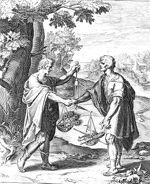
Amicitiae trutina: Vaenius, Emblemata Horatiana (Antwerp, 1612), emblem 66
Accroissement d'yre est à eschever: Corrozet, Hecatomgraphie (Paris, 1540), emblem 42's epigram quotes the adage's comment
Gens courroucez on ne doibt irriter: La Perrière, Le theatre des bons engins (Lyon, 1545), emblem 7 uses the imagery of a man stirring a fire with a sword, illustrating the Pythagorean saying that is also quoted in the adage's comment
On ne se doibt consumer par tristesse: La Perrière, Le theatre des bons engins (Lyon, 1545), emblem 8 uses the imagery of a man eating his heart, illustrating the Pythagorean saying that is also quoted in the adage's comment
Le plus souuent le fol soymesme lye: La Perrière, Le theatre des bons engins (Lyon, 1545), emblem 9 uses the imagery of a man about to put a ring on his finger, illustrating the Pythagorean saying that you should not wear a tight ring, also quoted in the adage's comment
Iconclass: 25F72(BLACK-TAIL) molluscs (BLACK-TAIL) 25F72(CUTTLE-FISH) molluscs: cuttle-fish 33A5 friends 46B3311 scales 49D52 measuring 51B3 Parity, Equality 51B5 Identity 56F23 Friendship; 'Amicitia' (Ripa) 73C74592 'You shall love your neighbour as yourself' ~ doctrine of Christ on love, etc.
Collectanea (1500): 93, 95, 98, 99, 100, 101, 102, 103, 104, 105, 106, 107
Loci Communes: Absurda, indecora, seu praepostera (Absurd, unbecoming, or preposterous things, Choses absurdes, inconvenantes ou déplacées); Amicitia (Friendship, Amitié); Contagio morum (The contagion of habits, Contagion des mœurs)
I i 3 Nemo bene imperat, nisi qui paruerit imperio No one is a good commander who has not been under command
Οὐκ ἔστιν εὖ ἄρξειν μὴ ἀρχέντα. id est, Fieri non potest, ut bene gerat imperium, qui non tulerit imperium. Manet hoc adagium, hodieque vulgo celebre, neminem recte dominum agere, qui non antè ministrum gesserit. Citat autem Aristoteles Polit. lib. iii. διὸ λέγεται καὶ τοῦτο καλῶς, ὡς οὐκ ἔστιν εὖ ἄρξειν, μὴ ἀρχέντα. id est, Quapropter illud etiam recte dicitur, Neminem bene imperium gerere, qui non ipse prius sub imperio fuerit. Rursum eodem lib. τόν τε γὰρ μέλλοντα ἄρχειν καλῶς, ἀρχθῆναί φασι δεῖν πρῶτον. id est, Eum enim qui bene sit administraturus imperium, aiunt imperium ferre prius oportere. Magis proverbialiter extulit Plato, lib. De Legib. vi. Δεῖ δὴ πάντ' ἄνδρα διανοεῖσθαι περὶ ἁπάντων ἀνθρωπων, ὡς ὁ μὴ δουλεύσας οὐδ' ἂν δεσπότης γένοιτο ἄξιος ἐπαίνου. id est, Iam illud oportet unumquemque de mortalibus universis cogitare, qui non servierit, eum haudquaquam dominum fore laude dignum. Plutarchus in ducem imperitum, Οὐτε γὰρ πίπτοντος ἐστίν ὀρθοῦν, οὔτε διδάσκειν ἀγνοοῦντος, οὔτε ἀκοσμοῦντος κόσμειν, ἢ τάττειν ἀτακτοῦντος, ἢ ἄρχειν μὴ ἀρχομένου. id est, Neque enim lapsi partes sunt alios erigere, neque inscii docere, neque incompositi componere, neque ordinare, inordinati, neque imperare qui imperium non sit passus. Idem hoc laudis peculiariter tribuit Agesilao, ἐλθεῖν ἐπὶ τὸ ἄρχειν μὴ ἀπαίδευτον τοῦ ἄρχεσθαι. id est, Venisse ad imperium, non indoctum parere imperio. Seneca lib. De ira. ii. Nemo regere potest, nisi qui & regi. Natum adagium à nobili illo Solonis apophthegmate, quod in eius vita refert Diogenes Laertius, Ἅρχε πρῶτον μαθὼν ἄρχεσθαι. id est, Imperium gere, sed ubi prius imperium ferre didiceris. Itaque referri potest vel ad eos, qui prius alieno parendo imperio discunt imperium in alios gerere: vel qui prius cupiditatibus imperant suis, quàm in alios exerceant imperium. Neque enim idoneus est ut aliis dominetur, qui ipse servit affectibus: neque rex aliis esse potest, nisi quem ratio rexerit.
Οὐκ ἔστιν εὖ ἄρξειν μὴ ἀρχθέντα, It is impossible for one to rule well, who has not been ruled himself. This proverb is still extant and is well known today; no one is a good master who has not previously been a servant. Aristotle quotes this in the Politics, book 3: 'Therefore this also is rightly said, that no one can rule well who has not himself been ruled,' and in the same book, 'For they say that it is necessary for the one who is going to rule well to be ruled first himself.' Plato expresses it in a more proverbial form, in the Laws, book 6: 'Now it is necessary that every man think this about all men, that the one who has not been a servant will by no means become a master worthy of praise.' Plutarch, 'To An Uneducated Ruler': 'For those who have fallen are unequal to the task of setting up others, nor is it for the ignorant to teach, or the disorderly to create order, or the undisciplined to impose discipline, or for one to rule who has not undergone rule.' The same writer gives this particular praise to Agesilaus, that he came to a position of command well trained in obeying command. Seneca, On Anger, book 2: 'No one can rule but the man who can also be ruled.' The proverb arose out of that famous saying of Solon, which is quoted in his Life by Diogenes Laertius: 'Rule, but after first learning to be ruled.' It can be applied either to those who by first obeying others' rule learn to rule others, or to those who exercise control over their own desires before they take control of other people. A person who is a slave to his own emotions is certainly not fit to rule over others; and he cannot be a king to others unless his own king is reason.
Facsimile:
Iconclass: 44B61 good government 45D311 commander-in-chief, general, marshal 53B5 Obedience; 'Obedienza' (Ripa)
Loci Communes: Divitum praerogativa (The privilege of the rich, Le privilège des riches)
I i 4 Adonidis horti Gardens of Adonis
Ἀδώνιδος κῆποι, id est, Adonidis horti, de rebus leviculis dicebatur, parumque frugiferis, & ad brevem, praesentemque modo voluptatem idoneis. Pausanias testatur, Adonidis hortos olim in deliciis fuisse, lactucis potissimum ac foeniculis frequentes, in quibus semina haud aliter atque in testa deponi consueverint: eoque rem in proverbium abiisse, contra futiles ac nugones homines, & voluptatibus ineptis natos: cuiusmodi sunt cantores, sophistae, poetae lascivi, cupediarii, atque id genus alii. Erant autem ii horti Veneri sacri, propter Adonidem eius amasium, primo aetatis flore praereptum, atque in florem conversum. Horum mentionem facit Plato in Phaedro: ὁ νοῦν ἔχων γεωργὸς, ὧν σπερμάτων κήδοιτο, καὶ ἔγκαρπα βούλοιτο γε νέσθαι, πότερα σπουδῇ ἂν θέρους εἰς Ἀδώνιδος κῆπους ἀρῶν, χαίροι θεωρῶν καλους ἐν ἡμέραισιν ὀκτὼ γινομένους. ἢ ταῦτα μὲν δὴ παιδιᾶς τε καὶ ἑορτῆς χὰριν δρῴη ἂν, ὅτε καὶ ποιεῖ. id est, Num agricola, qui sapiat, semina quae curae haberet, quaeque cuperet aliquando fructum adferre, aestatis tempore, summo studio in Adonidis hortos mittet, gaudetque spectare eos intra dies octo iam pulchros effectos: an ea quidem per lusum, ac festi gratia faciet, si quando tamen fecerit? Item Plutarchus in commentario, cui titulus, περὶ τοῦ βραδέως ὑπὸ θείου τιμωροθμένου, id est, de eo qui à numine sero punitur: ἀλλὰ μικρός τις καὶ κενόσπουδος ὁ θεός ἐστιν, ὥς τε μηδὲν ἡμῶν ἐχόντως θεῖον ἐν αὐτοῖς, μηδὲ προσόμοιον ἀμωσγέπως ἐκείνῳ, καὶ διαρκὲς καὶ βέβαιον, ἀλλὰ φύλλοις, ὡς Ὅμηρος ἔφη, παραπλησίως ἀπομαραινομενων παντάπασι καὶ φθεινόντων ἐν ὀλίγῳ, ποιεῖσθαι λόγον τοσοῦτον, ὥσπερ αἱ τοὺς Ἀδώνιδος κῆπους, ἐπ' ὀστράκοις τισὶ τιθηνούμεναι και θεραπεύουσαι γυναῖκες, ἐφημέρους ψυχὰς ἐν σαρκὶ τρυφερᾷ, καὶ βίου ῥὶζαν ἰσχυρὰν οὐ δεχομένῃ βλαστανούσας, εἷτα ἀποσβεννυμένας ἀεὶ ὑπὸ τῆς τυχούσης προφάσεως. id est, Immo morosior quispiam, & levicularum rerum curiosus est deus, qui cum nihil habeamus divinum in nobis, neque quod ullo modo ad illius similitudinem accedat, quodque constet ac stabile perpetuumque sit, quin magis foliorum ritu, quemadmodum ait Homerus, undequaque marcescamus, intereamusque brevi, tantam nostri curam habeat: non aliter, quàm mulieres, quae Adonidis hortos, ad dies pauculos vernantes, in testulis quibusdam nutriunt foventque animas brevi duraturas, in carne tenera, & solidam vitae radicem non recipiente suppullulantes, ac mox ad quamvis occasionem interituras. Meminit & Theocritus Idyllio Θ Πὰρ δ' ἁπαλοὶ κᾶποι, πεφυλαγμένον ἐν ταλαρίσκοις Αργυρέοις. id est, Adsunt & teneri calathis candentibus horti Servati. Effertur paroemia etiam hoc modo, Ἀκαρπότερος τῆς Ἀδώνιδος κήπων.. id est, Infructuosior Adonidis hortis. Non dissimili figura Isaeus apud Philostratum iuveniles voluptates appellat ταντάλου κήπους, quòd umbris ac somniis persimiles sint, nec expleant hominis animum, sed iritent potius. Similiter Pollux sophistae Athenodori dictionem appellabat Tantali hortos, quòd iuvenilis esset ac levis, speciem prae se ferens, quasi esset aliquid, cum nihil esset.
Ἀδώνιδος κῆποι, Gardens of Adonis, used to be applied to trivial things, which served no useful purpose and were suitable only for giving a brief passing pleasure. Pausanias tells how people used to be very fond of 'Adonis-gardens, well stocked particularly with lettuce and fennel; they would plant seeds in them just as one does in pots. Thus the thing became a proverb directed against worthless, trifling men,' born for silly pleasures - people like singers, sophists, bawdy poets, confectioners and so on. These gardens were sacred to Venus, on account of her darling Adonis, who was snatched away in his first bloom and turned into a flower. Plato makes mention of this in the Phaedrus: 'Would a sensible husbandman who has seeds which he cares for and wants to come to fruition sometime, plant them in gardens of Adonis in the summer and be pleased to see them become beautiful in eight days, or would he do these things for the sake of sport and amusement, if he does them at all?' Thus also Plutarch, in the treatise entitled 'On the Delays of the Divine Vengeance': 'Nay, God is so particular and concerned with trifles that although we have nothing divine in us, nothing which in any way resembles him, nothing consistent and stable, but rather in the manner of leaves, as Homer says, we begin to wither away and shortly die, yet he has such a care for us (just like the women who cherish and care for gardens of Adonis that bloom for a few days in earthenware pots), that he cherishes our short-lived souls sprouting in tender flesh that is incapable of any strong root of life, who are soon, for any chance cause, to perish.' Theocritus recalls this in idyll 15: 'Frail gardens, in bright silver baskets kept.' The proverb is also known in the form: 'more fruitless than gardens of Adonis.' In a metaphor not unlike this, Isaeus, according to Philostratus, calls youthful pleasures 'gardens of Tantalus' because they are just like shadows and dreams, and do not satisfy the soul of a man, but rather irritate it. Similarly Pollux called the style of Athenodorus the sophist 'gardens of Tantalus' because it was smooth and youthful and gave the appearance of having something in it, when there was nothing at all.
Facsimile: 
Iconclass: 25G(+35) plants; vegetation (+ withering, leaves or flowers falling off) 25G4(FENNEL) plants and herbs (FENNEL) 25G4(LETTUCE) plants and herbs: lettuce 41A6 garden 41A673 potted plants 92C491 (story of) Adonis
Collectanea (1500): 700
Loci Communes: Intemperantia, libido (Intemperance, lust, Intempérance, désir)
I i 5 Infixo aculeo fugere To flee after planting the dart
Βαλὼν φεύξεσθαι οἴει. id est, Iaculo immisso fugiturum te putas? Metaphora proverbialis, ubi quis dicto convitio, seu maleficio quopiam peracto, statim subducit sese, ne vel tueri cogat quod dixerit, aut ne mutuum recipiat, Eryximachus medicus in convivio Platonis Aristophani discedere paranti, ne cogeretur & ipse laudare Cupidinem, ac iocis quibusdam poeticis eludenti: Βαλὼν γε, φᾶναι ὦ Ἀριστόφανες, οἴε εκφεύξεσηαι; ἀλλὰ πρόσεχε τὸν νοῦν, καὶ οὕτως λὲγε, ὡς δώσων λόγον. ἴσως μέν τοι, ἂν δοξῇ μοι, ἀφήσω σε. id est, Ut videtur, inquit, Aristophanes, immiso in nos iaculo fugiturum te credis? Quin tu animum adverte, atque ita loquere, tamquam rationem redditurus. Sanè, si mihi videbitur, fortassis te dimittam. Utitur item in Phaedone, & in primo De rep. lib. quanquam hoc loco mutet metaphoram, & ad balneatorem iniecta aqua discendentem referat, ταῦτα εἰπὼν ὁ θρασύμαχος ἐν νῷ εἷχεν ἀπιέναι, ὥσπερ βαλανεὺς ἡμῶν καταντλήσας κατὰ τῶν ώτων ἀφρόον καὶ πολὺν τόν λόγον, id est, Haec locutus Thrasymachus, in animo habebat discedere, ceu balneator quispiam, offusis in aures copiosis, ac multis verbis. Ac mox eodem in loco, οἶον ἐμβαλὼν λόγον, ἐν νῷ ἔχεις ἀπιέναι, id est, Velut iniecto dicto paras discedere. Respexit ad proverbium Plutarchus in commentario De iis qui tarde puniuntur, à numine. ἀλλ' οὐδ' εἰ βαλὼν, εἷπεν, ἀπηλλάγη, καλῶς εἷχε περιορᾶν τὸ βέλος ἐγκείμενον. id est, Quin etiam si discessit, inquit, immisso iaculo, non convenit telum inhaerens negligere. Allusit ad hanc paroemiam Aristoteles in tertio Naturalium auditionum lib.. Refellens enim Anaxagorae sententiam, qui dixisset, infinitum immotum esse, & in se ipso conquiescere, negat satis esse dixisse tantum, & aufugere, quum causam etiam reddere debuerit, quamobrem infinitum moveri non posset, οὐ γαρ, inquit, ἱκανὸν, τὸ οὕτως εἰπόντα ἀπηλλάχθαι, ut obiter & orthographiam emendem, non Aristotelis, sed typographi. Quadrabit igitur in eos, qui velut oracula quaedam pronuntiant, aliis coniectandi materiam ministrantes, ut qui non interpretentur quamobrem ita senserint. Translatum videtur ab apibus, aut vespis, quae infixo aculeo, statim aufugiunt. Id enim innuit Plato in Phaedone. Potest & ad Parthos referri, qui iaculo coniecto in hostem, mox equis versis se fuga proripiunt, nec audent cominus congredi. Simillimum est huic, quod est apud Cice ronem libro De finibus bonorum quarto: Scrupulum, inquit, abeunti: sed videbimus. Solet enim scrupulus esse molestus ambulantibus. Idem apertius in oratione pro L. Flacco: Flacco vero quid profuit, qui valuit tam diu, dum huc prodiret. Mortuus est aculeo iam dimisso, ac dicto testimonio.
Βαλὼν φεύξεσθαι οἴει, Do you think you can shoot and run? A proverbial metaphor; someone has uttered an accusation or committed some misdeed, and immediately removes himself, so as to escape being forced to uphold what he has said, or having the same treatment meted out to himself. Eryximachus the doctor, in the Symposium of Plato, says to Aristophanes, who is on the point of leaving so that he may not himself have to praise Cupid, and escaping with a few poetic jokes: 'As it seems, Aristophanes, you think you can shoot and run. Pay attention and speak as if you were going to render an account. Then perhaps if it seems good to me I'll let you go.' He makes use of it also in the Phaedo, and in the Republic, book i, though in this place he changes the metaphor and speaks of the bath-attendant who has thrown water over his client and gone away: 'Having said this Thrasymachus had it in mind to leave, like a bath-attendant having poured a flood of words about our ears.' And soon after in the same place, 'Having cast such a word, do you have it in mind to leave?' Plutarch thought of the proverb in the essay 'On the Delays of the Divine Vengeance': 'But even if he did go off after casting his weapon, it does not do to disregard the arrow that is in the wound.' Aristotle alluded to this proverb in the third book of his Lectures on Physics. Refuting the opinion of Anaxagoras, who had said that infinity was immobile and at rest in itself, he averred that it had not been enough to say that and then retreat, when he ought also to have stated the reason why infinity could not be moved: 'It is not enough, having said these things, to go away' (in passing I amend the spelling, not Aristotle's but the printer's). This will fit those people who make statements in oracular fashion, giving others grounds for a speculation, since they do not explain why they think in this way. It seems to be adapted from bees or wasps, which plant their sting and immediately fly away. This is what Plato is suggesting in the Phaedo. It may also be a reference to the Parthians, who cast their javelins against the enemy and then wheel their horses and take flight, not daring to come to close quarters. Something very like this is in Cicero, De finibus, book 4: 'That's a sharp stone to the departing one, but we shall see.' A sharp pointed stone is usually troublesome to walkers. He says this more clearly in his speech Pro Flacco: 'What did it profit Flaccus? The man was in good health until the moment when he came forward here; he died when he had shot his bolt and given his evidence.'
Facsimile: 
Iconclass: 25F711(BEE)(+5262) insects: bee (+ flying animal(s)) 25F711(BEE)(+512) insects: bee (+ animal(s) attacking) 25F711(WASP)(+512) insects: wasp (+ animal(s) attacking) 25F711(WASP)(+5262) insects: wasp (+ flying animal(s)) 31A545(+0) taking a bath (+ variant) 31A56 servant 33B9 flight, running away; pursuing 45C15(ARROW)(+63) archer's weapons: arrow (+ handling of weapons) 47(+82) crafts and industries (+ sowing, planting ~ agricultural processes)
Loci Communes: Obtrectatio et maledicentia (Disparagement and slander, Dénigrement et médisance)
I i 6 Nodum solvere To undo the knot
Κὰθαμμα λύειν. id est, Nodum solvere, dicebatur qui negocium alioqui impeditum facile conficeret. Natum hinc aiunt, quod tradunt Midam curru nodis quibusdam inexplicabilibus è corni libro connexo vectari solitum. De hoc in templo reposito proditus erat apud Phrygas rumor, ut qui vinculum illius soluisset, eum Asiae imperio potiturum. Alexander Magnus explicuit, exempto clavo qui iugum temoni connectebat: quidam aiunt gladio dissecuisse. Cuius historiae alio loco mentionem faciemus, in proverbio Herculanus nodus. M. Tullius Epist. ad Attic. lib. v. Caesari nullus honos à Senatu habeatur, dum hic nodus expeditur. Id est, dum hoc negocium conficitur.
Κὰθαμμα λύειν, To undo the knot, used to be said of a person who easily completed a job that everyone found difficult. It arose, they say, from the tradition about Midas, who used to ride in a chariot harnessed with inextricable knots of cornel-bark. This chariot was placed in a temple, and it was generally said among the Phrygians that anyone who could loose the bonds that held it would become the ruler of Asia. Alexander the Great undid it by removing the pin which fixed the yoke to the pole; some say by cutting the knot with a sword. I shall mention this story in another place, in the proverb Herculaneus nodus. Cicero says in the fifth book of his Letters to Atticus: 'No consideration should be paid to Caesar by the senate until this knot is loosed,' that is, until this business is completed.
Facsimile:
Annotation: De knoop doorhakken
Annotation: Gordian knot
Iconclass: 47C4291 untying a knot 95A(GORDIUS)81 the Gordian knot (attribute of Gordius) 98B(ALEXANDER THE GREAT)531 Alexander cuts the Gordian knot with his sword
Loci Communes: Perficiendi sive absolvendi (Finishing, completing, Achever, accomplir)
I i 7 Dodonaeum aes Dodonean bronze
Δωδωναῖον χαλκεῖον. id est, Dodonaeum cymbalum, aut tintinnabulum. In hominem dici consuevit improbae atque importunae loquacitatis. Zenodotus citat ex Ariphoro Menandri. Tradit autem in Dodona duas fuisse sublimes columnas, in altera positam pelvim aeream, in altera pensile pueri simulacrum, flagellum aereum manu tollentis: quoties autem ventus vehementius flaverit, fieri ut scutica impulsa crebrius lebetem feriat, isque percussus tinnitum reddat ad multum etiam temporis resonantem. Alii referunt ad aera Corinthia, quae prae ceteris clarius tinniant. Meminit huius adagii Stephanus in dictione Dodone. Iuvenalis ad adagium allusisse videtur, cum ait, Tot pariter pelves, tot tintinnabula credas Pulsari. muliebrem garrulitatem taxans. Suidas diversam adagii adfert interpretationem ex Daemone. Ait enim oraculum Iovis, quod olim erat in Dodona, lebetibus aereis undique cinctum fuisse, ita ut invicem sese contingerent. Itaque necessum erat fieri, ut uno quopiam pulsato, vicissim & omnes resonarent, sonitu per contactum ab aliis ad alios succedente. Durabatque in longum tempus tinnitus ille, videlicet in orbem redeunte sono. Putatque paroemiam dictam in sordidos, & quantumvis pusilla de re querulos. Verum Aristoteles hoc commentum ut ficticium refellit, adferens aliud interpretamentum, quod modo retulimus, de columnis duabus, & simulacro pueri. Plutarch. in commentario περὶ τῆς ἀδολεσχίας indicat, in Olympia porticum quandam fuisse, ratione mathematica ita compositam, ut pro una voce multas redderet, atque ob id ἑπτάφωνον appellatam. Cumque hac confert homines impendio loquaces, quos si verbulo tangas, continuo referunt tantum verborum, ut nullus omnino sit garriendi finis. Meminit huius adagionis & Iulius Pollux lib. vi. cap. de loquacibus, his verbis τὸ ἐκ Δωδώνης χαλκεῖον.
Δωδωναῖον χαλκεῖον, A cymbal, or bell, from Dodona. This is usually said of a man whose garrulity is excessive and ill-timed. Zenodotus quotes it from the Ariphorus of Menander. He relates that there were in Dodona two lofty columns: on one of them was fixed a bronze basin, on the other hung the figure of a boy holding a bronze whip in his hand, and whenever the wind blew with any force it would often happen that the thong struck the cauldron which gave out a ringing sound at each blow, the reverberations of which lasted a long time. Others think it refers to Corinthian bronze vessels, which have a clearer ring than the rest. Stephanus mentions this adage under the word 'Dodona.' Juvenal seems to have alluded to it when he says, 'You would think / As many basins or as many bells / were sounding,' rebuking the talkativeness of women. Suidas provides a different interpretation for the proverb from Demo. He says that the oracle of Jove, formerly in Dodona, was hung all round with bronze cauldrons, so that they touched each other. In this way it was inevitable that when any one of them was struck, all the others rang in turn, the sound running by contact from one to another. That clanging would last for a long time, as the sound made full circle. He thinks too that the proverb was applied to misers, and to people who complain about the slightest thing. It is true that Aristotle rejects this interpretation as fictitious, and proposes the other meaning which has been mentioned above, the two columns and the figure of the boy. Plutarch in his essay 'On Garrulity' declares that in Olympia there was a certain portico which was so constructed by mathematical computation that it gave back many notes in answer to one, and for this reason was called 'Seven Voices.' He compares this with immensely talkative men: you may speak one little word to them and they immediately return such a spate of words that there is no end to the chatter. Julius Pollux also refers to this adage in his sixth book, in the chapter on chatterers, by the words 'the bronze of Dodona.
Facsimile:
Iconclass: 12E64(DODONA) Dodona, place of worship of Zeus ~ Greek religion 46E521 bell ~ acoustic signalling 48(+6122) art (+ bronze ~ arts) 52D4 Prolixity, Verbosity, Loquacity; 'Loquacità' (Ripa)
Collectanea (1500): 676
Loci Communes: Garrulitas (Talkativeness, Bavardage)
I i 8 Prora et puppis Stem and stern
Πρώρα καὶ πρύμνη. id est, Prora vel puppis. M. Tullius lib. Familiarium epist. ultimo, scribens ad Tyronem suum, paroemiam hanc refert his verbis: Mihi prora & puppis, ut Graecorum proverbium est, fuit à me tui dimittendi, ut rationes meas explicares. Prora itaque & puppi, summam consilii nostri significamus: propterea quod à prora & puppi, tamquam à capite & calce pendeat tota navis. Apud Graecos invenio pronunciatum hoc pacto, τὰ ἐκ πρώρας, καὶ τὰ ἐκ πρύμνης ἀπόλλυται. id est, à prora pariter atque à puppi pereunt: sive prora pariter ac puppis perit, hoc est, ad internecionem. Philostratus in Heroicis: Αλλὰ δεῖ προσδεδέσθαι τῇ νηί, καθάπερ τὸν Ὀδυσσέα, εἰδὲ μὴ, καὶ τὰ ἐκ πρώρας φασὶ καὶ ἐκ πρυμνης ἀπολεῖ ται. id est, Sed oportet Ulyssis in morem navi alligatum esse, alioqui & prora, quod dici solet & puppis perit. Consimili figura dictum est in Apocalypsi: ἐγὼ εἰμι ἄλφα καὶ ω. Ego sum alpha & ω. Ego sum rerum omnium summa. Omnia proficiscuntur à me, velut à fonte, & ad eundem omnia referuntur, tanquam ad felicitatis portum. Nam alpha α Graecis prima litera est, ω magnum postrema. Neque dissidet hinc illud Theocriticum in Encomio Ptolemaei: Ανδρῶν αὗ Πτολεμαῖος ἐνὶ πρώτεσσι λεγέσθω, Καὶ πύματος, καὶ μέσσος. id est, Ast hominum in numero decuntetur Ptolemaeus, Primus & ultimus ac medius. Item Virgilianum illud: A te principium tibi desinet. Huc pertinet quod Demosthenes pronuntiationem, τὸ πρῶτον, τὸ δεύτερον, καὶ τὸ τρίτον esse dixit, universam eloquentiam intelligens. Plato de Legib. lib. iiii. ὁ μὲν δὴ θεὸς, ὥσπερ καὶ ὁ παλαιὸς λὸγος, ἀρχήν τε, καὶ τελευτὴν, καὶ μέσα τῶν ὄντων ἁπάντων ἔχων. id est, Iam Deus quidem ipse, quemadmodum vetusto verbo dicitur, tum initium, tum finem, tum medium rerum omnium complectens. Plutarch. in commentario De liberis educandis: ὅτι ἕν πρῶτον, καὶ μέσον, καὶ τελευταῖον ἐν τούτοις κεφάλαιον, ἀγωγὴ σπουδαῖα, καὶ παιδεία νόμιμος ἐστι. id est, quod una res, primum et medium, ac postremum hic caput est, proba institutio, legitimaque eruditio. Aristot. lib. Rhet. iii refert ex Alcidamante quodam, qui philosophiam, legum vallum ac fossam appellarit, omne legum praesidium in philosophia situm innuens. At philosophus eam metaphoram tanquam duram, ac frigidam damnat: quasi vero non durior sit illa superior, πρώρα καὶ πρύμνη. Verum in oratione seria, fortassis vitiosae fuerint: in adagiis non item offendit durities, ut quae saepenumero vel aenigmatum simillima sint, eaque fermè laudatissima videantur, quae paulo longius detorta fuerint. Proinde quoties summam totius negotii, & omne momentum, praesidiumque significabimus, proram & puppim, aut fossam & vallum dicemus: ut, Pietas studiorum nostrorum prora & puppis esse debet. Quibusdam omnium rationum prora & puppis est pecunia. Adversus Carthaginiensium vim Scipio fossa pariter & vallum erat, id est, praecipuum tutamentum.
Πρώρα καὶ πρύμνη, Stem and stern. Cicero, in the last book of his Letters to Friends, writing to his beloved Tyro, refers to this proverb in these words: 'The stem and stern (as the Greek proverb goes) of my sending you away from me was that you might straighten out my financial affairs.' By 'stem and stern' we mean to sum up our intentions; because the whole ship depends on stem and stern, as it were on 'head and heel.' In Greek I find it said in this form, 'they perished stem and stern,' or 'stem is lost and stern too,' that is, to complete destruction. Philostratus in the Heroicus: 'But it is necessary to be tied to the ship like Ulysses, otherwise all perishes, stem and stern as they say.' A similar figure is used in the Apocalypse: 'I am alpha and omega,' I am the sum of all things. All things proceed from me as from a source, and all things come back to me, as to a haven of bliss. Now alpha is the first letter in Greek, omega the last. Not unlike this is the phrase of Theocritus in the Praise of Ptolemy, 'But Ptolemy shall be celebrated among all men as the first, and last, and middle.' So Virgil's phrase: 'My first notes were inspired by you, yours shall be the last.' To this belongs the description of delivery by Demosthenes, calling it the first, second, and third, in fact the whole of eloquence. Plato in the Laws, book 4: 'The god himself, as the old saying goes, holding the beginning and end and middle of all things.' Plutarch in the essay 'On the Education of Childreri :'That the first, middle and final point in these matters is a good education and proper instruction.' Aristotle in book 3 of the Rhetoric quotes from a certain Alcidamas who called philosophy the 'ditch and rampart' of the laws, meaning that all safeguards for law resided in philosophy. But the philosopher rejects this metaphor as harsh and insipid, as if the foregoing 'stem and stern' were not harsher still. In serious oratory, certainly, these expressions might be unsuitable; in proverbs this roughness is less offensive, because they are often of a riddling nature, and those often seem most successful which are used in a rather more strained sense. Thus whenever we wish to describe the sum of the whole business, everything that is important and essential for it, we shall say stem and stern, or rampart and ditch; for instance, Piety ought to be the stem and stern of our studies. For some people the stem and stern of every consideration is money. Against the might of the Carthaginians Scipio was rampart and ditch, ie the principal safeguard.
Facsimile: 
Annotation: From top to bottom
A te principium, tibi desinet: De la Feuille, Devises et emblemes anciennes et modernes (Augsburg, 1697), emblem 708 quotes the comment
Iconclass: 46C215(BOW) parts of ship's exterior: bow 46C215(STERN) parts of ship's exterior (STERN)
Loci Communes: Perficiendi sive absolvendi - ab initio ad finem (Finishing, completing - from beginning to end, Achever, accomplir - du début à la fin)
I i 9 Umbrae Shadows
Σκιὰι, id est umbrae, proverbiali ioco dicebantur olim ii qui venirent ad convivium, non ipsi quidem vocati, sed comites eorum qui vocati fuerant, sic illos sequentes, velut umbra corpus ultro sequitur. Ad hanc paroemiam allusit Horatius Epist. lib. primo scribens ad Torquatum: Brutam tibi, Septimiumque,> Et nisi coena prior, potiorque puella Sabinum Detinet: ad summam, locus est & pluribus umbris: Sed nimis arctqa premunt olidae convivia caprae Hoc loco neque Acron proverbii facit mentionem. opinor quod rem vulgo iactatam, ceu notam praeterierit. Christophorus Landinus, vir alioqui doctus, umbras interpretatur loca in rure operta umbris, in quibus commode discumbant convivae. Praeterea capras interpretatur scurras mordaces. Postremo: Dic quotus esse velis, ad hunc exponit modum: Rescribe, cuius fortunae homines tibi convivas adhibeam. Nam si cupis digniores te, eris postremus: si inferiores, eris primus. Haec non fueram adscripturus, nisi conduceret ostendisse in quae deliramenta virum eruditum adigat nonnunquam unius proverbioli ignorantia. Sensus autem Horatiani carminis sic habet: Admonet Torquatum , ut ad coenam veniat, paucis comitatus, videlicet Bruta, Septimio & Sabino: non quod sit defuturus in accubitu locus, si velit plureis umbras secum adducere: verum id futurum incommodi, ut alarum odor offendat convivii suavitatem, si angustius sedeatur. Deinde si velit omnino plureis umbras, id est, comites, praemoneat se de numero, ne non respondeat apparatus. Brutam itaque, Septimium & Sabinum umbras Torquati vocat, si veniant, non ipsi quidem invitati, sed à Torquato quem vocarat Horatius, ceu comites adducti. Idem alibi: Cum Servilio Balatrone Vibidius, quos Moecenas adduxerat umbras. id est, Ultrones comites. Plutarchus συμποσιακῶν libro vii. quid sint umbrae, narrat his verbis: τὸ δὲ τῶν ἐπικλήτων ἔθος, οὕς νῦν σκιὰς καλοῦσιν, οὐ κεκλημένους αὐτοὺς, ἀλλ' ὑπὸ τῶν κεκλημένων ἐπὶ τὸ δεῖπνον ἀγομένους, ἐζητεῖτο πόθεν ἔσχε τὴν ἀρχὴν. ἐδόκει δὲ ἀπὸ σωκράτους, ἀριστόδημον ἀναπείσαντος οὐ κεκλημνον εἰς ἀγάθωνος ἰέναι σὺν αὐτῷ, καὶ παθόνται τι γελοῖον. ἔλαθε γὰρ τὴν ὁδὸν ὑπολειφθεὶς τὸ φῶς ἔχοντος. id est, Mos autem adducendi comites, quos nunc umbras appellant, non ipsos quidem vocatos, sed ab aliis qui vocati fuerant ad convivium adductos, quaesitum est undenam inoleverit. Existimabant natum à Socrate, qui Aristodemo persuaserit ut non vocatus, secum ad Agathonis convivium accederet. Acciderat enim Aristodemo ridiculum quiddam. Siquidem cum inter eundum non sentiret Socratem à tergo relictum , prior ingressus est planè velut umbra corpus praecedens, lumine à tergo sequente. Hactenus Plutarchus. Est autem haec de Socrate & Aristodemo fabula apud Platonem in dialogo, cui titulus συμπόσιον
ΣκιὰιShadows: the name given in a proverbial and humorous way to those who came to a dinner without being invited themselves, but as companions to those who had been invited, following them without question as the shadow follows the body. Horace alluded to this proverb in the first book of the Epistles, writing to Torquatus: Your Brutus and Septimius I'll invite,
And if he's not engaged to better cheer
Or a kind girl, Sabinus shall be here.
Still there is room for other shades, but note -
Too crowded feasts are scented with the goat.
In this place Acron makes no mention of the proverb, passing it over, I imagine, as something everybody uses and knows. Cristoforo Landino, in general a man of learning, interprets 'shadows' as places in the country covered with shade, where the guests could recline at ease. And then he interprets'goats' as sharp-tongued jesters. Further on, he explains'say how many you would like to be on the day' in the following way: 'write and tell me what kind of men, of what rank, you would wish me to invite with you; for if you want them to be above you, you will be the last, if lower than you, you will be the first.' I would not have thought of quoting this, except that it helps to show to what lengths of absurdity a learned man can be pushed sometimes by the ignorance of one little proverb. The meaning of Horace's poem is as follows: he suggests to Torquatus that he should come to the dinner accompanied by a few friends, for instance Brutus, Septimius and Sabinus; not that there will not be room for more `shadows' if he wishes to bring them with him, but the disadvantage of being crowded together would be that the smell of perspiration would interfere with the sweetness of the banquet. Further, if he wishes to bring several 'shadows' or companions he should warn Horace of the number, lest the preparations should not be adequate. Thus he calls Brutus, Septimius and Sabinus the 'shadows' of Torquatus, if they come not as invited guests but as companions brought by Torquatus, whom Horace has invited. In another place he says, 'Servilius, Balatro, Vibidius were there, / brought by Maecenas as his shadows,' that is, coming of their own accord. Plutarch in his 'Table-talk' relates what 'shadows' are in these words: 'The question was raised as to the origin of the custom of bringing along guests, now called shadows, these not themselves invited, but brought to a meal by those who were invited. They thought it began with Socrates, who persuaded Aristodemus, although he was not invited, to accompany him to a party at Agathon's. A funny thing had happened to Aristodemus. Not realizing that Socrates had been left behind on their way, he went in first, just like a shadow going ahead of a person who has the light at his back.' Thus far Plutarch. This story about Socrates and Aristodemus is in the dialogue of Plato called the Symposium.
Facsimile:
Iconclass: 22C8 shadow
Loci Communes: Dissimilitudinis et incongruentiae (Dissimilarity and incongruity, Dissemblance et incongruité); Divitum praerogativa (The privilege of the rich, Le privilège des riches)
I i 10 Nihil ad Parmenonis suem Nothing like Parmeno's pig
Οὐδὲν πρὸς τὴν παρμένοντοσ ὖν. id est, Nihil ad Parmenonis suem. De aemulatione dictum, quae longo intervallo abesset ab eo, quod imitaretur. Plutarch. in Symp. v. Decad. ii. Prob. quo pacto natum sit adagium, narrat ad hanc fermè sententiam. Parmeno quispiam fuit ex hominum eorum genere, qui nostris etiam temporibus varias animantium & hominum voces ita scite imitantur ac repraesentant, ut audientibus tantum, non etiam videntibus, verae non imitatae voces videantur. Neque desunt quos hoc artificium maiorem in modum delectet. Parmenon igitur hac arte vulgo ut iucundissimus, ita etiam celeberrimus fuisse perhibetur: quem cum reliqui conarentur aemulari, ac protinus ab omnibus diceretur illud: εὖ μὲν, ἀλλ' οὐδὲν πρὸς τὸν παρμένοντος ὖν. hoc est, Recte quidem, verum nihil ad Parmenonis suem: quidam prodiit, veram suculam sub alis occultatam gestans. Huius vocem cum populus imitaticiam esse crederet, statimque sicut solent, reclamarent, τί οὖν αὕτη πρὸς τὸν παρμένοντος?id est, Quid haec ad Parmenonis suem? vera sue deprompta, ac propalam ostensa, refellit illorum iudicium: utpote non ex vero, sed ex imaginatione profectum. Meminit idem Parmenonis ac suis adumbratae, in comment. De audiendis poetis. Nec intempestiviter utemur hoc adagio, quoties aliquis, opinione deceptus, de re perperam iudicat. Veluti si quis epigramma parum eruditum ac neotericum supra modum admiraretur, persuasus antiquum esse. Rursum, si quod antiquum esset & eruditum, ceu nuperum damnaret. Tantum enim valet haec imaginatio, ut eruditissimis etiam viris in iudicando imponat.
Οὐδὲν πρὸς τὴν παρμένοντοσ ὖν, Nothing like Parmeno's pig. This is said about emulation, when it falls far short of what it was imitating. Plutarch in his 'Table-talk,' in the second problem of the fifth decade, gives this account of how the proverb came into being. Parmeno was one of those people (and they exist also in our time) who imitate the various voices of men and of animals so cleverly and make them sound so present, that the hearers (though not the observers) think they hear real and not imitated voices. And there is no lack of people who are particularly delighted with this trick. Parmeno is said to have been in great favour with the people, and extremely well known owing to this skill. When others tried to emulate him, and everybody said 'That's all very well, but nothing like Parmeno's pig,' someone came forward carrying a real piglet hidden under his arm. When the people thought the sound was an imitation and immediately cried as usual 'What's that to Parmeno's pig?' he proved by producing the real pig and showing it round that their judgment was wrong, and founded not on truth but imagination. The same author mentions Parmeno and this sham pig in his essay 'On How to Study Poetry.' We can use this adage appositely whenever anyone is deceived by conjecture into making a false judgment. For instance if someone should immensely admire an ignorant and new-fangled epigram, thinking it to be ancient. On the other hand, if he should dismiss as recent something which was ancient and learned. For the force of imagination is such that it can deceive the judgment of even the most erudite men.
Facsimile: 
Iconclass: 47I212 pig 98B(PARMENO) male persons from classical history (PARMENO) 51B2 Similarity, Likeness 51B6 Imitation; 'Imitatione' (Ripa) 51E2 Superiority 59CC21 Inequality, Inequity, Iniquity; 'Iniquità' (Ripa)
Loci Communes: Excellentia, inaequalitas (Excellence, inequality, Excellence, inégalité)
I i 11 Syncretismus Syncretism
Συγκρητισμὸς. Cretico proverbio dicebatur, quoties fieret, ut qui modo videbantur hostes acerrimi, repente in summam concordiam redigerentur: id quod frequenter evenire solet, maxime siquando malum aliquod inciderit utrisque commune. Plutarchus in comment περὶ φιλαδελφίας, id est, de fraterna charitate, recenset, simulque explicat paroemiam his verbis: Ἔτι τοίνυν ἐκεῖνο δεῖ μνημονεύειν ἐν ταῖς πρὸς τοὺς ἀδελφοὺς, καὶ φυλάττειν τὸ τοῖς φίλοις αὑτῶν ὁμιλεῖν καὶ πλησιάζειν τότε μάλιστα, φεύφειν δὲ τοὺς ἐχθροὺς καὶ προσδέχεσθαι,μιμούμενον αὐτὸ γοῦν τοῦτο τῶν κρητῶν, οἳ πολλαάκις στασιάζοντεσ ἀλλήλοις καὶ πολεμοῦντες, ἔξωθεν ἐπιόντων πολεμίων διελύοντο καὶ συνίσταντο, καὶ τοῦτο ἧν ὁ καλούμενος ὑπ' αὐτῶν συγκρητισμός. id est, Praeterea oportebit & illud meminisse, fratribus inter se dissidentibus, observareque ut potissi mum eo tempore consuetudinem habeas & convictum cum illorum amicis. Rursum inimicos fugias, neque admittas ad familiaritatem, illud videlicet Cretensium exemplum secutus, qui frequenter quum factionibus & bellis intestinis inter sese pugnarent, invadentibus aliunde hostibus, omissa contentione coniuncti sunt: atque is erat, quem illi syncretismum appellabant. Hactenus Plutarchus. Simile quiddam refert de Sudracis & Mallis Quintus Curtius libro .ix. quos aliàs bellare inter se solitos, periculi societas iunxerat imminente Alexandro. Pertinet huc quod aliàs ex Aristot. referemus: συνάγει τοὺς ἀνθρώποθς τὰ κακὰ. id est. Conciliant homines mala. Adagium recte accommodabitur & in illos qui amicitiam ineunt, non quod sese ex animo diligant, sed quod alter alterius opis egeat: aut quo veluti coniunctis copiis communem inimicum pessundent. Id quod his temporibus saepenumero factitari videmus, ut arma iungant, alioqui inter se infensissimis animis. Tanta inest & Christianis hominibus ulciscendi rabies. Refertur & ab Apostolio quodam Byzantino, recentissimo apud Graecos proverbiorum coacervatore.
Συγκρητισμὸς, 'Syncretism' was the word used in a Cretan proverb whenever it happened that those who recently seemed to be most deadly enemies suddenly came into complete agreement. This often happens, especially when some misfortune strikes which is common to them both. Plutarch in the essay'On Brotherly Love' reviews the proverb and explains it in the following words: 'Furthermore it will be necessary to keep this in mind, when brothers are quarrelling, to preserve our familiarity with the brothers' friends and to associate with them especially at that time; but to avoid and shun their enemies, following that example at least of the Cretans, who often fought among themselves in factions and intestine strife, but when an enemy from outside attacked them they put aside their difference and stood together; and this was called "syncretism" by them.' Thus far Plutarch. Something of the same kind is mentioned by Quintus Curtius, book 9, regarding the Sudraci and Malli, 'who were otherwise accustomed to make war on each other, but were united by the common danger at the threat of Alexander's coming.' A phrase belongs here, which we shall mention elsewhere out of Aristotle: 'Troubles bring men together.' This adage will also be rightly used to describe those who enter on a friendship not because they sincerely love each other, but because each has need of the other's resources; or where forces are joined to destroy a common enemy. In our own time we see this happen over and over again, that a military pact is made between those who are the bitterest enemies. There is such a fury for vengeance even among Christian men. This is mentioned by a certain Apostolius of Byzantium, a very recent compiler of proverbs among the Greeks.
Facsimile:
Iconclass: 54E31 Agreement, Unity; 'Concordia', 'Concordia insuperabile', 'Concordia militare', 'Concordia di Pace', 'Unione civile' (Ripa) 56F23 Friendship; 'Amicitia' (Ripa)
Loci Communes: Amicitia (Friendship, Amitié)
I i 12 Qui circa salem et fabam Around salt and beans
Περὶ ἅλα καὶ κύαμον. id est, Iuxta salem & fabam. In eos dicebatur, qui se simularent scire quod nescirent. Siquidem divini responsuri, fabam & salem apponebant. Unde qui inter sese de rebus arcanis communicarent, τοὺς περὶ ἅλα καὶ κύαμον. appellabant. Ad hunc quidem modum scriptum legitur in Diogeniano, reliquisque Graecarum paroemiarum collectoribus. Verum Plutarchus in Sympos. probl. Decad. iiii. non fabam, sed cuminum scribit, nisi forte depravatus est codex: Εκεῖνο δέ πως ὑμσς λέληθε τοὺς περὶ ἅλα καὶ κύμινον, ὅτι τὸ μὲν ποικὶλον ἐστι, τὸ δὲ ἥδιον. id est, At illud fortasse vos fugit, quod aiunt, qui iuxta salem ac cuminum, quod illud quidem lautius, hoc suavius. Rursum eiusdem operis Decade v. Ἐζήτει φλῶρος ἐστιωμένων ἡμῶν παρ' αὐτῷ, τίνες ἂν εἷεν οἱ περὶ ἅλα καὶ κύμινον ἐν παροιμίᾳ λεγόμενοι. id est, Quaerebat Florus, quum apud ipsum coenaremus, quinam essent qui in proverbio iuxta salem & cuminum dicerentur. Apollophanes autem grammaticus sic eam quaestionem dissolvit, ut dicat adagium summam familiaritatem significare. Siquidem, qui magnopere inter se familiares sunt, hi vel salem, vel cuminum unà cenant, neque requirunt apparatum ullum ciborum. Unde & ille iocus est Octavii Caesaris ad quendam, à quo fuerat convivio perparco, frugalique acceptus: nesciebam me tibi esse tam familiarem. Huc pertinet etiam illud quod suo loco referemus: ἅλα καὶ τράπεζαν μὴ παραβαίνειν. id est, non oportet transgredi salem ac mensam. hoc est, amicitiae ius quod his rebus conciliatur, non est violandum. Porrò salis nomine frugalem victum innui, passim ex poetis licet cognoscere. Horatius in Odis: Vivitur paruo hene, cui paternum Splendet in mensa tenui salinum. Idem in Sermonibus: Modo sit mihi mensa tripes, & Concha salis puri. Verum in divinationibus videtur magis religionis causa solitus apponi. Cur autem hic honos sali potissimum sit habitus, quaeritur apud Plutarch. in eo quem modo citavi loco. Nam & Homerus salem divinum appellat, & Plato scripsit salem rebus divinis amicissimum, familiarissimumque. Proinde Aegyptii honoris causa prorsum à sale abstinent, adeo ut ne panibus quidem vescantur sale conditis. Tametsi Plutarch. arbitratur Aegyptios hac gratia potius abstinuisse, si quando pure vivere vellent, quod praecipuè libidinem iritare putetur, idque propter calorem. Praeterea non est veri dissimile, illos abdicasse sibi salem, tanquam condimentum omnium suavissimum, Ita ut non immerito opsoniorum opsonium appellari possit. Nam sunt qui hac de causa salem gratiam nominarint, quod citra hunc omnia videantur insipida, ingrataque. Quanquam illud maxime divinum in se sal habere videtur, quod à corporibus vita destitutis putrefactionem ac tabem arcet, neque sinit prorsum interire, diu morti velut resistens, animaeque quoad licet, vice fingens. Atqui nihil est anima divinius. Huius ut est officium, animantia tueri, continereque, neque sinere compaginem dilabi: itidem sal animae exemplo cohibet corporum harmoniam ad tabem tendentium, & membrorum inter sese amicitiam conservat. Hac eadem ratione, fulguris ignem sacrum ac divinum arbitramur, quod ictorum corpora multo tempore perdurent, neque putrescant. Habet & illud quasi divinum sal, quod vim quandam gignendi genuinam habere credatur, vel hoc argumento, quod sicuti paulo superius dictum est, seminalem vigorem expergefacit, acuitque. Proinde qui canibus alendis dant operam, salsis carnibus ac salsamentis eos pascunt, quo ad gignendum reddantur alacriores. Accedit huc, quod è navibus marinis immensa murium vis soleat enasci. Neque desunt qui dicant, mulieres etiam citra virilem operam fieri gravidas, si salem lingant. Praeterea putant huc allusisse poetas, qui non sine causa finxerunt, Venerem geniturae princi pem è salo natam fuisse, quam etiam ἁλιγενῆ. id est, saligenam cognominant. Quin iidem deos omneis marinos foecundos, & plurimorum liberorum progenitores faciunt. Denique nullum est animal, neque terrestre, neque volatile, perinde foecundum, ut sunt omnia marina. Huiusmodi fermè de sale disseruntur apud Plutarch. quae quidem hoc magis libuit referre, quod in Christianis etiam mysteriis, praecippue baptismi, quo renascimur, ac denuo gignimur ad salutem, sal in primis admisceatur, ut ex his quae veteres de sale senserunt, nonnihil etiam theologus ad suum usum possit accommodare.
Περὶ ἅλα καὶ κύαμον, Around salt and beans, was said of those who pretended to know what they did not know; because the soothsayers about to make a pronouncement employed salt and beans. So those who talked secrets among themselves, were called 'men concerned with salt and beans.' It is to be found in this form in Diogenianus and in the other compilers of Greek proverbs. Plutarch, however, in the fourth decade of his 'Problems At Table' writes not 'beans' but 'cummin,' unless the text is corrupt: 'This somehow has escaped you who are concerned with salt and cummin, that the one is more varied but the other is sweeter.' Again in the fifth decade of the same work: 'Florus was asking, when we were dining with him, who these might be who are referred to in the proverb as "concerned with salt and cummin."' But Apollophanes the grammarian solved this question by saying that the adage signifies extreme familiarity. Those, in fact, who are closely intimate with each other eat together, with either salt or cummin, and require no elaborate preparation of dishes. Hence that jesting remark of Octavius Caesar to someone who had invited him to a frugal repast: 'I didn't know I was such a close friend of yours.' Here belongs another phrase which I shall refer to in its place: 'One must not transgress salt and trencher.' That is, one must not transgress against the right of friendship, which is established by these things. On the other hand, the use of salt to mean frugality of living is often to be recognized in the poets. Horace, in the Odes:
He lives well on little,
Who keeps upon his frugal board
The ancestral salt-cellar.
And again in the Satires: 'Give me only a three-legged table / and a shell of pure salt.'
However it seems to be in divinations, more for religious reasons, that salt is customarily employed. Why this honour should be particularly accorded to salt, is a question asked in Plutarch, in the place I have just quoted; for Homer also calls salt divine, and Plato wrote that salt is closely and intimately bound up with divine things. For this reason the Egyptians abstained from salt, out of reverence, so completely that they could not even eat salted bread. Plutarch, however, thinks that the Egyptians were more likely to have abstained for this reason, that they wished to live purely, because it is thought especially likely to arouse desire, owing to heat. It is also not unlikely that they renounced salt because it is the tastiest condiment of all, so much so that it can deservedly be called the relish of relishes. For this reason there are those who term salt 'grace,' because without it everything seems tasteless and disagreeable. But the most divine quality of salt seems to be that it shields dead bodies from corruption and decay, and does not allow them to die at once, resisting death for a long time and thus as far as it may acting like the soul - and nothing is diviner than the soul. It is the office of the soul to protect and hold together living beings, and not to allow the structure to collapse; and in the same way salt, like the soul, maintains the harmony of bodies which are tending to decay, and preserves the alliance of the members among themselves. On the same grounds they think the lightning-flash sacred and divine, because bodies struck by lightning last a long time without mouldering away.
Salt has another almost divine quality: it is thought to possess some real power in connection with procreation, especially for the reason (as has been said above) that it arouses and encourages a lusty seed. Thus people who rear dogs feed them on salt meat and salty foods so as to make them active breeders. One might add that a huge quantity of mice are usually bred in sea-going ships. And there are some who say that if women lick salt they can become pregnant without the help of men. It is thought too that the poets had this in mind, and not without reason imagined Venus, the goddess of birth, to be born from the sea, calling her `salt-born.' Indeed they make all the sea-gods fertile, the fathers of many children. Finally, there is no creature on earth or in the air so fecund as all the sea-creatures.
Questions of this kind about salt are discussed in the pages of Plutarch, and I chose all the more to mention them because in Christian rites also, and especially in baptism, when we are born again and have our new birth to salvation, salt has an important place; so that from these views of the ancients about salt, even the theologian may find something suited to his use.
Facsimile: 
Iconclass: 25G4(BEAN) plants and herbs: bean 41C661 salt
Loci Communes: Amicitia (Friendship, Amitié)
I i 13 Duabus ancoris fultus Secured by two anchors
Επὶ δυοῖν ὁρμεῖ. id est, Duabus nixus in portu sedet, subaudiendum ancoris. De firmis & immotis, & qui rem suam probe constabilierunt. Ductum à navibus intra portum tuto manentibus à prora simul & à puppi proiectis ancoris. Meminit Aristides in Panath. Ab eadem metaphora ductum est, quod adversus Ctesiphontem dixit Demosth. Οὐκ ἐπὶ τῆς αὐτῆς ὁρμεῖ τοῖς πολλοῖς, subaudiendum ἀγκύρας, id est, Haud eadem ancora nixus est qua vulgus hominum.
Επὶ δυοῖν ὁρμεῖ, He sits in harbour moored by two (anchors, understood); referring to fixed and steadfast people, who have established their affairs well. It is taken from ships which are safely berthed in the harbour, with anchors let down from both stem and stern. Aristides mentions this in his Panathenaicus. Drawn from the same metaphor is the phrase used by Demosthenes against Ctesiphon: 'He does not rely on the same (we must supply, anchor) as the general run of men.'
Facsimile:
Iconclass: 46C215(ANCHOR) parts of ship's exterior: anchor 54D5 Safety 56D3 Confidence, Security, Tranquillity; 'Confidenza', 'Sicurezza e Tranquillità', 'Sicurtà', 'Sicurtà o Sicurezza', 'Tranquillità' (Ripa)
Loci Communes: Securitatis et tutae rei (Security and safety, Sécurité et sûreté)
I i 14 Sine capite fabula A story without a head
Ακὲφαλος μῦθος, id est, Sine capite sermo, dicitur imperfectus ac mutilus. Plato lib. De legib. vi. Οὔκουν δή που λέγων γε ἂν, μῦθον ἀκέφαλον ἑκὼν καταλίποιμι, πλανώμενος γὰρ ἂν ἀπάντῃ τοιοῦτος ὤν, ἄμορφος φαίνοιτο. id est, Nequaquam profecto, postea quam dicendi partes suscepi, sermonem absque capite libens reliquerim. Etenim si oberrans talis occurrat alicui, foedus videretur. Rursus in Georgia: Ἀλλ' οὐδὲ οὺς μὺθους φασὶ μεταξὺ θέμις εἷναι καταλείπειν, ἀλλ' ἐπιθέντας κεφαλὴν, ἵνα μὴ ἄνεθ κεφαλῆς περιῒῃ. id est, At ne sermones quidem interim aiunt fas esse deserere, quin potius imponendum illis caput, ne sine capite obambulent. Fortassis allusit ad id, quod refert Plutarchus in dialogo De defectis oraculis. Apud Cretenses festum quoddam novis & absurdis caeremoniis agebatur, ostenso hominis simulacro sine capite. Hunc aiebant Homerioni patrem fuisse, qui constuprata per vim Nympha, sine capite fuerit repertus. Proverbium refertur à Zenodoto.
Ακὲφαλος μῦθος, A headless tale is used of one imperfect and incomplete. Plato in the Laws, book 6: 'Certainly after I took up the function of speaking, I would be most unwilling to leave our talk headless; for if anyone met it wandering about like that, it would seem ugly.' Again in the Gorgias: 'But they say it is not right to leave stories half-finished, but one should put a head on them lest they walk about without a head.' Perhaps this is an allusion to what Plutarch relates in his dialogue 'On the Obsolescence of Oracles.' In Crete a certain festival was carried out with novel and ridiculous ceremonies, which included displaying a man's dummy without a head. They said that this was the father of Homerion, who was found without a head after ravishing a nymph. This proverb is referred to by Zenodotus.
Facsimile: 
Iconclass: 31A4411(+0) 'Acephalia', 'Blemyae', i.e. beings without head (+ variant) 51AA7 Imperfection, Incompleteness; 'Imperfettione' (Ripa) 84 tales and fairy tales 52D4 Prolixity, Verbosity, Loquacity; 'Loquacità' (Ripa)
Collectanea (1500): 412
Loci Communes: Garrulitas (Talkativeness, Bavardage); Injustitia (Injustice, Injustice)
I i 15 Inter sacrum et saxum Between the shrine and the stone
Tyndarus apud Plautum, alter è captivis, cum iam proditis dolis esset deprehensus, nec haberet quanam arte posset elabi: Nunc ego, inquit, omnino occidi. Nunc ego inter sacrum saxumque sto, nec quid faciam scio. Apuleius Asini sui lib. xi. Plurimum ergo duri tia paupertatis intercedente, quod ait vetus proverbium, inter sacrum & saxum positus cruciabar. Explicat autem Apuleius allegoriam adagii, videlicet alludens ad sacerdotium cui erat initiandus & paupertatem saxo duriorem, per quam non suppetebant sumptus. Sumptum apparet ex priscis foederis feriendi caeremoniis, in quibus fecialis porcum saxo feriebat: haec interim pronuncians: Qui prior populus foedus rumpet, Iupiter ita eum feriat, quemadmodum ego porcum hoc lapide ferio. Sed undecumque fluxit adagium, satis liquet dici solitum in eos, qui perplexi ad extremum periculum rediguntur.
Tyndarus, in Plautus, one of the prisoners, whose wiles had been detected and who, being thus exposed, had no skill left by which he could escape, said 'Now I am done for, now I am between the shrine and the stone, and I do not know what to do.' Apuleius in the eleventh book of his Ass: 'And so, as the misery of poverty had come upon me, in the words of the old proverb, I was desperately tormented between the shrine and the stone.' Apuleius explains the allegory in the adage, clearly referring to the priestly office to which he was to be admitted, and to poverty, harder than a stone, which meant that he could not pay his way. It appears to have been taken from the early ceremonies attending the making of a treaty, when the fetial priest struck a pig with a stone, speaking these words at the same time: 'Whichever people first breaks this treaty, let Jupiter strike that people just as I am now striking this pig with a stone.' But whatever was the origin of the proverb, it is clear enough that it is usually applied to those who are in confusion and driven into the greatest danger.
Facsimile:
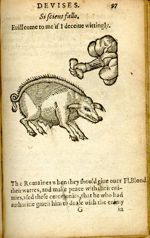
Si sciens fallo: Paradin, Heroical devises (London, 1591), emblem 47
Si sciens fallo: Wither, A collection of emblems (London, 1635), emblem 38
Si sciens fallo: Paradin, Les devises héroïques (Antwerp, 1563), emblem 47
Iconclass: 12B61 temple, shrine ~ non-Christian religions 25H1124 boulder, stone 31A2245(+933) hand (+ holding something) 31A2743 hitting at something 47I212 pig 57A6142 Oath
Collectanea (1500): 28
Loci Communes: Discriminis (Danger, crisis, Danger)
I i 16 Inter malleum et incudem Between the hammer and the anvil
Μεταξὺ τοῦ ἄκμονος id est, Inter incudem & malleum. Huic non dissimile refertur ab Origene theologo, quadam in Hieremiam homilia, his quidem verbis: nam Graeca desideramus: Iam quoddam est apud nationes tritum vulgi sermone proverbium, ut de his qui anxietatibus & ingentibus malis premuntur, dicant: Inter malleum sunt & incudem.
Μεταξὺ τοῦ ἄκμονος, Between the hammer and the anvil. Something like this is mentioned by the theologian Origen, in a homily on Jeremiah, in these very words (for we lack the Greek): 'Now there is a proverb often used in popular speech among the gentiles, when they say about people who are oppressed by dread and by great misfortune, "They are between the hammer and the anvil."'
Facsimile:
Annotation: Suringar XCVII
Annotation: adag_andries1550_63_1
Iconclass: 47D8(ANVIL) tools, aids, implements ~ crafts and industries: anvil 47D8(HAMMER) tools, aids, implements ~ crafts and industries: hammer 54FF11 Adversity, Misfortune, Bad Luck; 'Fortuna infelice', 'Infortunio' (Ripa)
Loci Communes: Discriminis (Danger, crisis, Danger)
I i 17 Nunc meae in arctum coguntur copiae Now my forces are pressed into a narrow space
Rem eandem diversa significat allegoria Terent. in Heauton. cum ait: In angustum oppidò nunc meae coguntur copiae. Metaphora sumpta ab exercitu qui laborat, iniquo conclusus loco, et undique obsidetur ab hostibus, ut difficile sit effugere.
The same thing is signified by a different metaphor in Terence in the Heautontimorumenos, when he says, 'Strictly into a narrow place are myforces pressed.' The metaphor comes from an army which is in difficulties, enclosed in an unfavourable place, and surrounded on all sides by enemies so that it can hardly escape.
Facsimile:
Iconclass: 45F33 troop concentration 45H2 being attacked; defence 51I1 Limited, Defined Space 56BB21 Calamity, Distress; 'Calamità', 'Calamità o miseria' (Ripa)
Loci Communes: Perplexus (Perplexed, entangled, Perplexe); Proclivitas (contra) (Propensity (against), Penchant (contre))
I i 18 In acie novaculae On the razor's edge
Nec abhorret à superioribus illud quod ab Homero sumptum, maximisque celebratum auctoribus, in adagionem abiit: ἐπὶ ξυροῦ ἀκμῆς. id est, in novaculae cuspide, sive acie, pro eo quod est in summo discrimine. Sic enim in Iliadis decimo loquitur Nestor: Νῦν γὰρ δὴ πάντεσσιν ἐπὶ ξυροῦ ἵσταται ἀκμῆς, Ἢ μάλα λοιγρὸς ὄλεθρος Ἀχαιοῖς ἠὲ βιῶναi. id est, Nunc etenim cunctis sitares in cuspide ferri est. Vivánt ne, an tristi exitio absumantur Achivi. Sophocles in Antigone: Φρόνει βεβὼς αὗ νῦν ἐπὶ ξυροῦ τόχης. Sunt autem Tiresiae vatis verba, Creontem admonentis, ut sapiat in tanto constitutus periculo. Rursum in Epigrammatibus: Εὐρώπης ἀσίης τε δορυσθενέες βασιλῆες, Ὑμῖν ἀμφοτέροισιν ἐπὶ ξυροῦ ἵσταται ἀκμή. id est, Europa atque Asiae reges Mavorte potentes Nunc vobis utrisque novaculae in acumine res est. De Menelao & Paride singulari certamine decernentibus, uter Helena potiretur. Theocritus in Dioscuris: Ανθρώπον σωτῆρας ἐπὶ ξυροῦ ἤδη ἐόντων. id est, Certa salus hominum iam ferri in cuspide stantum. Sumptum videtur à circulatoribus, qui in cuspide gladiorum ingrediuntur, aut ab iis qui ferrum manu contrectant, ut admonent in hunc auctorem edita scholia.
Not unlike the preceding is the saying taken from Homer, and well-known among the greatest authors, which became an adage: ἐπὶ ξυροῦ ἀκμῆς, On the blade, or the edge, of the razor, meaning 'in the greatest danger.' So Nestor speaks in the Iliad, book 10:
For now we all stand on the razor's edge,
Whether for the Achaeans it be life
Or sore destruction.
Sophocles in the Antigone: 'Think now once again / You tread upon the razor's edge of fate.' These are the words of Teiresias the seer, warning Creon, to let him know in how great danger he stands. Again in the Epigrams: 'Kings of Europe and Asia powerful in war, / Now both of you are on the razor's edge.' This refers to Menelaus and Paris, deciding by single combat which of them should gain possession of Helen. Theocritus in the Dioscuri: 'Certain salvation of men standing on dagger's point.' This seems to be taken from conjurors, who walk on the points of swords, or from people who handle blades, as the scholia published on this author tell us.
Facsimile:
Iconclass: 31A5351 razor 49D421 edge ~ stereometry 54DD51 Danger; 'Pericolo' (Ripa) 94F32 Venus intervenes in the duel between Paris and Menelaus: she covers Paris with a cloud and leads him to his room
Loci Communes: Discriminis (Danger, crisis, Danger)
I i 19 Res est in cardine Things are at a turning point
Huic non omnino diversum est illud: Res in cardine, quod Servius proverbium esse admonuit, enarrans illud Maronis: Haud tanto cessabit cardine rerum. Putatque perinde valere, quasi dicas: Res est in articulo. M. Tullius: In eo cardo rei vertitur, dixit, pro eo quod est, ex hoc tota res pendet. Quintil. lib. xii. Nam, ut taceam de negligentibus, quorum nihil refert ubi litium cardo vertatur. Idem lib. v. Nam si fatetur, multis ex causis potuit cruenta esse vestis: si negat, hic causae cardinem ponit, in quo si victus fuerit, etiam in sequentibus ruit. Sumptum ab ostiis quae cardinibus sustinentur volvunturque.
Not very different from this is the phrase 'Things are at a turning-point' or hinge, which Servius points out as an adage, when explaining Virgil: 'Insuch a turn of things she'll not delay,' and he thinks this is equal to saying that the matter is at a turning-point. Cicero says 'the matter hinges on this,' meaning 'on this the whole thing depends.' Quintilian, in book 12: 'Not to speak of the careless people, to whom it matters not at all on what the hinge of lawsuits turns.' The same, in book 5: 'For if he confesses, there might be many reasons for the garment to be stained with blood: if he denies, he places the crucial point, on which his case hinges, here, and if he should be worsted in that, he falls down in the rest also.' This is taken from doors, which are supported on hinges on which they turn.
Facsimile:
Iconclass: 54F121 Turn of Fate, Wheel of Fortune 51K1 Change
Collectanea (1500): 831
Loci Communes: Discriminis (Danger, crisis, Danger)
I i 20 Novacula in cotem The razor against the whetstone
Ξυρὸς εἰς ἀκόνην. id est, Novacula in cotem. Dici solitum in eos, qui fortè in eas res inci derunt, in quas minime volebant. Neque novacula potest incommodius cadere, quam si in cotem incurrat. Ab hoc non ita multum abhorret illud Horatianum, Et fragili quaerens illisere dentem, Infringet solido. Recte accommodabitur & in eum qui laedendi cupidus, tandem hominem nactus est à quo vicissim laedatur, cum illi nocere non possit. Siquidem novacula, si in molle quippiam inciderit, dissecat: si in cotem, retunditur. Huc respexit Tarquinius, qui dixit sibi in animo esse, ut Actius Navius augur novacula cotem discinderet: significans in cotem nihil posse novaculam. quamquam ab augure factum quod ille fieri posse non credebat, refert Livius lib. i.
Ξυρὸς εἰς ἀκόνην, The razor against the whetstone. This is usually applied to those who happen to meet the very circumstances which they least wanted to encounter. The razor could not fall more inconveniently that in striking the whetstone. Not far removed from this is that remark of Horace: 'Thinking to plunge his teeth into the crumb, / He'll break them on a stone.' This proverb will be rightly applied to the man who is eager to hurt others,and finally meets someone who is able in turn to hurt him, while remaining invulnerable. Just so a razor, if it meets something soft, cuts it up, but if it meets a whetstone it is blunted. It was of this that Tarquin was thinking when he said that he had it in mind how Actius Navius the augur divided a whetstone with a razor, meaning that the razor was powerless against the whetstone, although Livy tells in book 1 how the augur had done what he thought impossible.
Facsimile: 
Superstitio religioni proxima: Paradin, Princeliicke Devisen (Leiden, 1615), emblem 125
Superstitio religioni proxima: Paradin, Les devises héroïques (Antwerp, 1563), emblem 125
Veritati nihil difficile: Borja, Empresas morales (Bruxelles, 1680), emblem 88
Terar dum prosim: Printer's device 0676 - sample of a razor against a whetstone
Iconclass: 31A5351 razor 47C55 sharpening, grinding (industrial processes) 47D8(GRINDSTONE) tools, aids, implements ~ crafts and industries: grindstone
Loci Communes: Infortunii sive exitii (Misfortune or ruin, Malheur ou ruine)
I i 21 Caliga Maximini The boot of Maximinus
Caliga Maximini vulgo dictitatum est, in homines insulsos, & immodicae proceritatis. Id adagii refert Iulius Capitolinus, in vita Maximini Imperatoris. Nam, cum esset, inquiens, Maximinus pedum ut diximus, octo & prope semis, calciamentum, id est, campagium regium, quidam in luco qui est inter Aquileiam et Arziam posuerunt, quod constat pede maius fuisse hominis vestigio atque mensura. Unde etiam vulgo tractum est, cum de longis atque ineptis hominibus diceretur: Caliga Maximini. Hactenus Iulius. Ergo proverbium rectius usurpabitur, si cum odio contemptúve dicatur, propterea quòd is Maximinus, unde natum esse constat, invisissimus esset pariter & populo Romano, & Senatui: quippe Thrax natione, deinde sordido genere, postremo moribus barbaris ac feris. Quin etiam nunc homines insignitae proceritatis vulgo male audiunt, tanquam socordes, atque inertes.
The boot of Maximinus is a popular saying against men of immoderate height and awkwardness. Julius Capitolinus refers to this proverbial use in his life of the emperor Maximinus: 'Now since, as we said, Maximinus was eight and a half feet tall, or nearly so, his shoe, or rather his imperial boot, was placed by some people in the grove which lies between Aquileia and Arzia; and it is known to have been longer by a foot than any footprint or measure of a man. From this is derived the popular saying about tall and stupid men: the boot of Maximinus.' So far Julius. Thus the proverb may more suitably be used if it is spoken with hatred and contempt, because that Maximinus from whom it seems it arose was detested both by the Roman people and the Senate, as being Thracian by race, moreover of base birth, and lastly barbarous and savage in his conduct. Indeed even now the common people speak ill of unusually tall men, as if they were sluggards and blockheads.
Facsimile:
Iconclass: 31A421 giants, colossi 41D23321 boots 98B(MAXIMINUS I) male persons from classical history (MAXIMINUS I)
Loci Communes: Praelongi (Very long, protracted things, Choses très longues)
I i 22 Clematis Aegyptia The Egyptian clematis
Huic confine est, quod à Phalereo Demetrio refertur, Κληματὶς αἰγυπτία id est, Clematis Aegyptia. Id ait ioco dici solitum in eos qui corpore praeter modum procero atque atro colore essent: natum hauc dubie ab eius herbae specie, de qua meminit Diosc. lib. iiii. Plin. lib. xxiiii. cap. xv. Itali, inquit, centunculum vocant rostratis foliis ad similitudinem capitis penularum, iacens in arvis. Graeci autem clematidem appellant: Sed, cum clematidis multae sint species, quas inibi recenset Plin. una duntaxat proverbio locum fecisse videtur, ea nimirum quae clematis Aegyptia cognomine dicitur. Dicitur autem quod hanc maxime gignat Aegyptus, folio lauri longo tenuique, adversus serpentes & privatim aspides, ex aceto pota efficax, quae eadem ab aliis daphnoides, ab aliis polygonoides vocatur. Laertius in vita Zenonis ex auctoritate Apollonii scribit, Zenonem gracili fuisse corpore, statu procero, atra cute. Deinde autorem citat Chrysippum, qui in secundo proverbiorum suorum libro scripserit, ob eam causam à quodam clematidem Aegyptiam fuisse dictum.
Close to the foregoing proverb is what Demetrius of Phalerum reports, Κληματὶς αἰγυπτία the Egyptian clematis, which he says is often used jokingly about people who are unusually tall in stature and of dark complexion. No doubt it comes from the appearance of that plant, which is mentioned by Dioscorides in his fourth book. Pliny, book 24 chapter 15, says: 'The Italians call it centunculus; it has beaked leaves in the shape of a hood, and creeps in the fields. But the Greeks call it clematis.' But though there are many forms of clematis, which Pliny lists in this passage, only one seems to have given rise to the proverb, and that is the one known by the name of Egyptian clematis. It is said that this grows mostly in Egypt, that it has a long thin leaf like the bay, and is efficacious, when taken in vinegar, against snakes, particularly vipers. Some call it daphnoides and some polygonoides. Laertius in the life of Zeno writes on the authority of Apollonius that Zeno was slender in build, tall in stature and dark of complexion; then he quotes Chrysippus as having written in the second book of his Proverbs that someone called Zeno an 'Egyptian clematis' for this reason.
Facsimile:
Iconclass: 25G4(CLEMATIS AEGYPTIA) plants and herbs (CLEMATIS AEGYPTIA) 25G41(BINDWEED) flowers (BINDWEED) 31A421 giants, colossi
Collectanea (1500): 698
Loci Communes: Praelongi (Very long, protracted things, Choses très longues)
I i 23 Res ad triarios rediit Back to the third line
Romanum exstat adagium, elegans cum primis & annotandum: Res ad triarios rediit. Eo licebit uti, cum significabimus rem eò periculi redactam esse, ut extremo conatu, summisque viribus sit enitendum & ad suprema confugiendum consilia, quibus si nihil prosiciatur, iam nihil reliquum esse videatur, unde subsidium sperare possis. Veluti si in disceptatione quapiam literaria, mediocribus ambigentibus, ad unum aliquem summae doctrinae virum rem deferre cogeremur: aut in ancipiti negocio potentissimorum amicorum opem implorare compelleremur, quos non nisi maxima quadam adacti necessitate soleamus interpellare. Denique si cum vulgaribus illis consiliis res explicari nequit, ad novum aliquod & egregie callidum confugitur. Quemadmodum Terent. ille Phormio in sui nominis fabula, cum significaret neque in Antiphone, neque in Phaedria, neque in Geta satis esse praesidii ad retundendam senis saevitiam: Ad te, inquit, Phormio summa redit. Natum est adagium à ratione modoque componendi Romani exercitus. Refertur autem pariter & explicatur à T. Livio, primae Deca. lib. viii. cuius verba libuit subscribere. Postremo in plures ordines acies distribuebatur. Ordo enim sexagenos, sive ut alii legunt, sexcenos milites, duos centuriones, vexillarium unum habebat. Prima acies hastati erant, manipuli xv, distantes inter se modicum spacium. Manipulus leves vicenos milites, aliam turbam scutatorum habebat. Leves autem, qui hastam tantum gessaque gererent, vocabantur. Haec prima frons in acie florem iuvenum pubescentium ad militiam habebat. Robustior inde aetas totidem manipulorum, quibus principibus est nomen. Hos sequebantur scutati omnes, insignibus maxime armis. Hoc triginta manipulorum agmen antepilanos appellabant, quia sub signis iam alii quinde cim ordines locabantur, ex quibus ordo unusquisque tres partes habebat. Earum unamquamque primum pilum vocabant. Tribus ex vexillis constabat. Vexillum clxxxiii, ut alii, sex homines erant. Primum vexillum triarios ducebat, veteranum militem spectatae virtutis. Secundum rorarios minoris roboris aetate factisque. Tertium accensos, minimae fiduciae manum. Eo & in postremam aciem reiiciebantur. Ubi his ordinibus exercitus instructus esset, hastati omnium primi pugnam inibant. Si hastati profligare hostem non possent, pede presso eos retrocedentes, in intervalla ordinum principes recipiebant. Tum principum pugna erat, hastati sequebantur. Triarii sub vexillis considebant, sinistro crure porrecto, scuta innixa humeris, hastas subrecta cuspide, in terram fixas, ut haud secus quam vallo septa inhorreret acies, tenentes. Si apud principes quoque haud satis prospere esset pugnatum, à prima acie ad triarios sensim referebantur: inde rem ad triarios redisse, cum laboratur, proverbio increbruit. Triarii consurgentes, ubi in intervalla ordinum suorum principes & hastatos recepissent, extemplo compressis ordinibus velut claudebant vias, unoque continente agmine, iam nulla spe post relicta, in hostem incidebant. Id erat formidolosissimum hosti, cum velut victos insecuti novam repente aciem exurgentem auctam numero cernebant. Hactenus T. Livius, cuius ex verbis satis arbitror liquere proverbium, ut nostra interpretatione iam non sit opus. Item Veget. De re milit. lib. ii. declarat post omnes acies solere collocari triarios, omni armorum genere instructos, qui genu posito subsidebant: ut si primam aciem vinci contigisset, ab iis integrato praelio victoria repararetur. Modestus in libello De vocabulis rei militaris: Sextus, inquit, ordo post omnes à firmissimis & scutatis & omni genere armorum munitis, bellatores tenebat, quos antiqui triarios appellabant. Hi ut requieti & integri acrius invaderent hostes, post ultimas acies sedere consueverunt & si quid in primis ordinibus accidisset, de eorum viribus reparaturis spes tota pendebat. Flavius Vopiscus in vita Firmi Imperatoris, indicat robustissimum quemque militem in triarios allegi solitum, docens eum nervis robustissimis fuisse, hoc argumento, quod triarium quoque vinceret.
There is a Roman adage, one of the choicest and well worth commenting on: 'Things were back to the third line.' This will be suitable when we wish to convey that things have reached such a point of danger that final efforts and the greatest energy have to be exerted, and recourse had to desperate measures; and if these are no good there seems nothing left to which we can look for help. For instance, in some literary discussion, when men of ordinary attainments wrangle, we may be forced to submit the matter to one man of consummate learning. Or in a transaction of uncertain outcome we may be compelled to beg for help from our most powerful friends, to whom we should never have thought of appealing unless driven by the most dire necessity. Or it may be impossible to resolve things by more everyday methods, and one must have recourse to something new and really clever.
Thus Phormio in Terence in the play of the same name, when he meant that neither Antiphon nor Phaedria nor Geta would be a defence sufficient to blunt the old mari s rage, remarks 'It's you now, Phormio - the whole thing comes back to you.'
The adage arose from the arrangement and disposition of the Roman army. It is mentioned and explained by Livy in the eighth book of the first decade, in terms which it seems best to quote: 'Finally, the battle-line was divided into several ranks. A rank consisted of sixty soldiers' (though some read six hundred), 'two centurions, one standard-bearer. The first line, or hastati, comprised fifteen maniples, stationed a short distance apart. The maniple had twenty light-armed soldiers, and the rest of their number were "shieldmen"; those were called "light-armed" who carried only a spear and javelins. This front line in the battle contained the flower of the young men who were growing ripe for service. Behind these came a line of the same number of maniples, made up of older and stronger men; these were called the principes. Those who followed them were all shieldmen, who were the most showily armed of all. This body of thirty maniples they called the antepilani, because behind the standards again there were stationed fifteen other ranks, each of which had three sections, the first section in every rank being known as primus pilus. The rank consisted of three vexilla or banners; a vexillum numbered a hundred and eighty-three' (some say eighty-six) 'men. The first banner led the triarii, veteran soldiers of proven valour; the second banner the rorarii, less effective because younger and less experienced; the third the accensi, who were the least dependable and were, for that reason, assigned to the rearmost line. When an army had been marshalled in these ranks, the hastati were the first to engage. If the hastati were unable to rout the enemy, they retreated slowly and were received by the principes into the intervals between their ranks. The principes then took up the fighting, and the hastati followed them. The triarii knelt beneath their banners, with the left leg advanced, having their shields leaning against their shoulders and their spears thrust into the ground and pointing upwards, so that their battle-line was fortified with a sort of bristling palisade. If the principes too were unsuccessful in their fight, they fell back slowly from the battle-line on the triarii. From this arose the adage "To have come back to the third line," when things are going badly. The triarii, rising up after they had received the principes and hastati into the intervals between their ranks, would at once draw their ranks together and close the lanes, as it were; then, with no more reserves behind to count on, they would charge the enemy in one compact array. This was a thing exceedingly disheartening to the enemy who, pursuing those whom they supposed they had conquered, all at once beheld a new line rising up with augmented numbers.' Thus far Livy, from whose words I think the proverb is clear enough not to need any further explanation from me.
Vegetius also in his De re militari, book 2, says that the triarii were customarily placed behind all the other lines, and armed with all kinds of weapons; they took up a kneeling position, so that if it happened that the front line was beaten, they could regain the victory by reopening the battle. Modestus in his book On Military Terms says: 'The sixth rank, behind all the others, was selected from the most reliable men, both shieldmen and those armed with all kinds of weapons, and held the warriors whom the Ancients called triarii. These, so as to attack the enemy the more vigorously for being fresh and fully rested, used to sit down behind the last lines, and if there had been a setback in the ranks in front of them, the entire hope hung on the strength of the triarii being able to make good the loss.' Flavius Vopiscus in his life of the emperor Firmus suggests that it was usual to choose the stoutest of the soldiers for the triarii, when he tells us that he had great muscular strength on the evidence of his having even defeated a triarius.
Facsimile: 
Iconclass: 45D3 ranks (in the army, navy, air force) 49D11(3) numerals: 3 49D32 line (~ planimetry, geometry) 54E4 Defence
Loci Communes: Experientae seu pericliationis (Experience or risk-taking, Expérience ou mise à l'épreuve)
I i 24 Sacram ancoram solvere To let go the sheet-anchor
Huic finitimum est illud, quod apud Graecos celebratur: ἱεράν ἄγκυραν χαλάζειν. id est, Sacram solvere ancoram, quoties ad extrema praesidia confugitur. Translatum à nautis, qui maximam ac validissimam ancoram sacram vocant, eamque tum demum mittunt, cum extremo laborant discrimine. Lucian. in Iove tragoedo: Ἄκουσον δὴ ἱερὰν φασὶν ἄγκυραν, καὶ ἥν οὐδεμιᾷ μηχανῇ ἀποῤῥήξεις. id est, Audi iam sacram, ut aiunt, ancoram, quamque nulla vi queas abrumpere. Sic enim appellat angumentum insolubile. Rursum Drapetis: Εδοξεν οὗν σκοπουμένους τὴν ὑστάτην ἄγκυραν, ἥν ἱερὰν οἱ ναυτιλλόμενοί φασι, καθιέναι. id est, Visum est igitur re perpensa, extremam ancoram, quam nautae sacram nominant, demittere. Rursum in Apologia: Μία μοι ἲσως ἐκείνη ἄγκυρα ἔτι ἄβροχος. id est, Mihi fortassis una illa anchora adhuc superest integra, id est: Illud mihi adhuc superest, quò possim confugere. Euripides in Helena: Αγκυρα δή μου τὰς τύχας ὀχεῖ μόνη . id est, Mihi ab unica fortuna pendet ancora. Hoc est, Una duntaxat spes mihi superest. Aristides in Themistocle: Καὶ ὥσπερ τῆς ἱερᾶς ἀγκύρας τῆς ἐκείνου φωνῆς ἐχόμενοι. id est, Ac velut à sacra ancora de illius voce pendentes. Divus Chrysost. de Lazaro concione iiii. conscientiam appellat ἱεράν ἄγκυραν, quòd illa nunquam patiatur hominem abripi vi cupiditatem, veluti ventorum procella, quin obnitatur.
Closely similar is a well-known phrase in Greek, ἱεράν ἄγκυραν χαλάζειν, 'to let go the sheet-anchor,' whenever one falls back on the final defences. It is borrowed from sailors, who call the biggest and most efficient anchor 'sacred' (sheet-anchor) and only let it go when they are labouring under extreme difficulties. Lucian in his Jupiter tragoedus: 'Hear now the sheetanchor, as they say, which you cannot sever by any force.' For so he describes an insoluble argument. Again in the Fugitives: 'Therefore it seemed best for those considering the matter to lower the last anchor which sailors call "sacred."' Again in the Apology: 'Perhaps I still have that one anchor unbroken,' that is, there is still something left for me to take refuge in. Euripides in the Helena: 'A single anchor stays my destiny,' that is, only one hope is left me. Aristides in Themistocles: 'Hanging on his voice as on a sheet-anchor.' St Chrysostom, in his fourth sermon On Lazarus, calls the conscience a sheet-anchor, because it never allows a man to be carried away by the force of his desires, as by a storm of wind, without making a struggle.
Facsimile:
Annotation: plechtanker?
Iconclass: 46C215(SHEET-ANCHOR)(+62) parts of ship's exterior (SHEET-ANCHOR) (+ departure; weighing anchor) 53A22 Stability, Firmness; 'Fermezza', 'Stabilimento', 'Stabilità' (Ripa) 54E4 Defence 57A6141 Trustworthiness, Reliability
Collectanea (1500): 602
Loci Communes: Experientae seu pericliationis (Experience or risk-taking, Expérience ou mise à l'épreuve)
I i 25 Movebo talum a sacra linea I will move the counter from the sacred line
Idem pollere putat Diogenianus, κινῶ τὸν ἀφ' ἱερᾶς. id est, Sacrae lineae talum moveo. De iis qui extrema parant experiri. Id Iulius Pollux lib, ix. exponens, ait a ludo quopiam tesserarum natum esse adagium. Lusum autem fuisse huiusmodi, ut utrique ludentium essent calculi quinque, totidem impositi lineis: unde & Sophocles dixerit: πέσσα πεντέγραμμα, id est, Tesserae quinque linearum. Inter eas lineas, utrinque quinas, unam fuisse mediam, quam sacram vocabant: unde, qui talum movisset, is sacrae lineae calculum movere dicebatur. Id vero non fiebat, nisi cum res posceret, ut ludens ad extrema confugeret auxilia. Usurpat hoc adagium Plato lib. de Legib. v: καθάπερ πεττῶν ἀφ' ἱεροῦ. id est, Tamquam à sacra tessera. Plutarchus in lib. qui inscribitur, An seni sit gerenda respub. Τελευταίαν ὡσπερ τὸν ἀφ' ἱερᾶς ἐπάγουσιν ἡμῖν τὸ γῆρας. id est, Postremam nobis, tamquam à sacra linea senectam allegant; hoc est, veluti causam gravissimam. Idem commentario De comparatione terrestrium ac marinorum: Φέρε κινίσοντες τὴν ἀφ' ἱερᾶς, βραχέα περὶ θεότητος αὐτῶν καὶ μαντικῆς εἰπωμεν. id est, Age moto talo à sacra linea, paucis de divinitate eorum & divinatione dicamus. Rursum idem adversus Colotam Epicureum: Εὐθὺς οὗν τὸν ἀφ' ἱερᾶς κεκίνηκεν ὁ Κολώτης. id est, Protinus igitur talum à sacra movit Colotes. hoc est, statim id quod est gravissimum, aggressus est, ut impugnaret Apollonis de Socrate iudicium. Idem in vita Mar cii Coriolani de civitate Romana ob Coriolani minas perturbata. ἄρα τὴν ἀφ' ἱερᾶς ἀφῆκεν. id est, Sublatam à sacra linea tesseram misit. Desperatis enim rebus ad deorum religionem confugiebat, supplicatum missis sacrificis, aedituis, initiatoribus, auguribus, &c. Huc allusit et Theocritus in Bucoliastis: Καὶ τὸν ἀπὸ γραμμᾶς κινεῖ λίθον. id est, Atque à lineola lapidem movet, de quo nobis & alias facta mentio.
.The same force is given, says Diogenianus, by the following: κινῶ τὸν ἀφ' ἱερᾶς, 'I move the counter from the sacred line,' used of those who are about to resort to extreme methods. Julius Pollux explains in his ninth book that this proverb comes from a certain game of counters. He says it was played like this: each player had five counters, placed on the same number of lines (hence Sophocles too speaks of 'five-line counters'). Between these lines, five on each side, was one middle line which was called'sacred'; and anyone who moved the counter from that was said to move his man from the sacred line. This was never done unless the situation demanded that the player should fall back on his last resources. Plato makes use of this in the Laws, book 5: 'As if the counters were moved from the sacred line.' Plutarch in the essay entitled 'Whether An Old Man Should Engage in Public Affairs' says 'And finally they adduce to us old age, like a move from the sacred line,' meaning 'as a very weighty reason.' The same author in the essay 'On A Comparison Between Creatures of Land and Sea' says 'Come, making the move from the sacred line, let us speak briefly about their divinity and powers of divination.' Again, in the 'Against Colotes' the Epicurean: 'Colotes promptly therefore made the move from the sacred line,' that is, he started in at once on the most serious point by attacking the judgment of Apollo about Socrates. The same author, writing in his life of Martius Coriolanus about the dismay of the city of Rome on account of the threats of Coriolanus: 'It moved the counter from the sacred line.' For the city, in despair at its situation, took refuge in worship of the gods by prayers, sacrifices, priests, initiators, augurs and so on. Theocritus alludes to this in his Bucoliastae: 'And from the line she moves the stone,' which I have also mentioned elsewhere.
Facsimile: 
Iconclass: 43C726(+0) (playing at) knuckle-bones, 'astragali' (+ variant) 49D11(5) numerals: 5 49D32 line (~ planimetry, geometry) 54E4 Defence
Loci Communes: Experientae seu pericliationis (Experience or risk-taking, Expérience ou mise à l'épreuve)
I i 26 Nudior leberide As bare as a snake's sloughed skin
Γυμνότερος λεβηρίδος id est, Nudior leberide, de vehementer tenuibus. Leberis enim serpentis exuvium significat, quo nihil potest esse inanius. Accidit autem hoc omnibus ferè, quae cortice integuntur, sed molliore: velut stellioni, lacertae, praecipue serpentibus: atque haec fermè bis exuunt, vere & autumno, praesertim vipera. Serpenti primum ab oculis incipit decedere pellis, ita, ut obcaecari videatur iis, qui rem non intelligunt: atque una nocte & die, senectus tota exuitur à capite usque ad caudam. Ex insectis reiuvenescunt silpha & culex, eaque, quorum pennae vaginis obteguntur, ut scarabei, item locustae & cicadae. In genere marinorum exuit & cancer, idque saepius anno. Atque hoc exuvium Graecis etiam σύφαρ dicitur, cuius mira sentitur tum levitas, tum siccitas, universo humore in novum foetum consumpto, auctor Aristot. lib. De nat. animantium viii. Ait Suidas Leberidem hominem fuisse supra modum pauperem, ita ut vulgari sermoni locum fecerit. Athenaeus in Dipnosophistis: σαυτὸν ἀποφαίνεις κενώτερον λεβηρίδος. id est, Ostendis teipsum inaniorem leberide.
Γυμνότερος λεβηρίδος, As bare as a snake's sloughed skin, referring to extremely flimsy things. The leberis is the sloughed skin of a snake, than which nothing could be emptier. This happens to almost all those creatures which are protected by a covering, but of the softer sort, such as the gecko, the lizard and particularly snakes; and these shed their skins about twice a year, in spring and autumn, vipers in particular. In the snake, the skin first begins to peel away at the eyes, so that they seem to be going blind, to those who do not understand the process; and in one night and day their old age is I stripped off, from head to tail. Among the insect the silpha and gnat renew their youth, and those whose wings are covered with a case like beetles, locusts and cicadas. Among sea-creatures, the crab sheds its shell, and that more than once in the year. This also is called a slough (syphar) by the Greeks, and its lightness and dryness is extraordinary to feel; all the mois- J ture has been used to build up the new growth, as Aristotle says (in the eighth book of his De natura animantium). Suidas says leberis was the name of an extremely poor man, so that it came to be used in common parlance. Athenaeus in Doctors at Dinner: 'You show yourself as empty as a snakeskin.'
Facsimile:
Iconclass: 25F42(+351) snakes (+ skin, fleece, hide, fur, leather) 25F42(+4821) snakes (+ shedding of skin of animal(s)) 32A22 thin (human type) 51II2 Emptiness, Void
I i 27 Qui quae vult dicit, quae non vult audiet He who says what he would will hear what he would not
Si dixeris quae vis, quae non vis audies. Divus Hieronymus in Rufinum nominatim proverbii loco citat: Nihilque super hoc audies, inquit, nisi illud è trivio, Quum dixeris quae vis, audies quae non vis. Terentius in Andria: Si mihi pergit quae vult dicere, quae non vult audiet. Rursum in prologo Phorm. Benedictus si certasset, audisset hene. Eodem allusit in prologo Andriae: Desinant maledicere, malefacta ne noscant sua. Obscurius etiam in prologo Eun. Tum si quis est, qui dictum in se inclementius existimet esse, sic existimet, sciat responsum non dictum esse. responsum enim vocat, convicium convicio redditum. Sed hic locus admonet, ut quorundam errorem coarguam, qui inmargine adscripserant, me in hi sque sequuntur legere, quia laesit prius: imò sic legebatur in vulgatis exemplaribus. ego primus ex fide veterum restitui germanam lectionem, nimirum hanc, quale sit, prius Qui bene vertendo, & eas describendo male, ex Graecis bonis, Latinas fecit non bonas, Idem Menandri phasma nunc nuper dedit. ut quale sit, idem valeat quod apud Graecos οἶον, apud Latinos velut, aut quod genus sit, quibus utimur exemplum proposituri. Meminerat enim de convicio regerendo, eius mox subiicit exexmplum. deinde prius respondet ad adverbium quod sequitur, nuper. Qui prius male verterat multas fabulas, quarum non meminisse. Verum ut ad rem redeamus, primus huius adagii pater Homerus fuisse videtur, apud quem hic versus est in Iliadis Y. Οπποῖον δ' εἴπησθαι έπος. τοῖον δ' ἐπακούσαις. id est, Talia dicentur tibi, qualia dixeris ipse. Item Hesiodus lib. cui titulus, Opera & dies, Εἰ δὲ κακόν τ' εἴποις τάχα κ' αυτὸς μεῖζον ἀκούσαις id est, Fors male dicenti dicentur plurae vicissim. Rursus in eodem: Εἰ δέ κεν ἄρχῃ Η τι ἔπος εἰπὼν ἀποθύμιον, ἠὲ καὶ ἔρξας, Δὶς τόσα τίννεσθαι μεμνημένος Si quod prior ipse Aut verbum, aut factum, dicásve gerásve molestum. Ad te cum duplici rediturum foenore noris. Euripides in Alcestide: Εἰ δ' ἡμᾶς κακως Ἐρεῖς, ἀκούσῃ πολλὰ κοὐψευδῆ κακά id est, Si dixeris nobis male, Mala invicem permulta, nec falsa audies. Longe venustius idem extulit Sophocles citante Plutarcho, Φιλεῖ γὰρ γλῶτταν ἐκχέας μάτην, Ακῶν ἀκούειν οὕς ἑκὼν εἷπῃ λόγους. id est, Etenim solet qui dicta temere iecerit, Audire nolens verba, quae dixit volens. Refertur ex Sophocle: Φιλεῖ δὲ πολλὴν γλῶσσαν ἐκχέας μάτην, Ακῶν ἀκούειν οὕς ἑκὼν εἷπεν κακῶς id est, Qui multa temere verba fudit, is solet Audire nolens quae volens dixit male. Quin etiam his nostris temporibus eiusmodi quiddam vulgo dictictant: Ut salutabis, ita & resalutaberis, hoc est: ut tua fuerit oratio, ita tibi respondebitur. Plautus: Contumeliam si dices, audies. Caecilius in Chrysio apud Gellium: Audibis male, si male dicis mihi. Eodem pertinet Euripideum illud apud autores passim obvium: Αχαλίνων σομάτων, ἀνόμου τ' ἀφροσύνης τὸ τέλος δυστυχία. id est, Infrenis oris & iniquae vecordiae finis seu vectigal calamitas. Celebratur & hoc inter Chilonis apophthegmata: Μὴ κακολογεῖν τοὺς πλησίον, εἰδὲ μὴ ἀκούσεσθαι ἐφ' οἶς λυπήσεσθαι. id est, Non esse maledicendum iis, quibus cum agimus: alioquin audituros quae molestiam adferant. Huc arbitror adscribendum versiculum quem Quintil. ut vulgo iactatum citat, Nec male respondit, male enim prior ille rogarat.
If you say what you like, you will hear what you don't like. St Jerome quotes this expressly as a proverb in his Against Rufinus: 'You will hear nothing on this subject except what is said in the street: "when you say what you like, _ you will hear what you don't like."' Terence in the Andria: 'If he proceeds to say what he likes to me, he'll hear what he doesn't like.' Again in the prologue to the Phormio: 'If he had tried with kind words, he would have heard something kind.' He made the same allusion in the prologue to the Andria: 'Let them cease from bad words, in case their bad deeds come to I light.' It is less clear in the prologue to the Eunuchus: 'If there be anyone who thinks something ungentle has been said against him, let him think this, let him know no reply has been made,' for he means by a reply, an insult in return for an insult. But this passage suggests to me that I might here discuss the mistake made by some critics who have said in a marginal note that in the following sentences I read quia lesit 'because he first did the injury,' and indeed this was the reading of the commonly accepted editions. However, it was I who first restored the true reading based on the old copies, which is as follows: 'Such as the man (quale sit) who first by translating well and then copying wrong made bad Latin plays out of good Greek ones, and has recently produced the Phasma of Menander.' Here quale sit means the same as the Greek hoion, in Latin'as if' or'of this kind' - expressions which we use when we are going to give an example. He has remembered about the insult which was to be returned, and then adds an instance of this, the word 'first' corresponding to the following adverb 'recently.' He says in fact: the same man who first translated many plays which you do not remember has now recently produced a stupid play called Phasma, which you can certainly call to mind.
But to return to the subject. The first begetter of this adage appears to have been Homer, who has this line in the Iliad, book 2o: 'The word you speak is the word you will hear.' Hesiod too, in the poem called Works and Days: 'If you speak evil, you will yourself soon hear worse.' Again in the same author:
If by yourself the first
In word or deed some ill is said or done,
Know it shall come back twofold to yourself.
Euripides in the Alcestis: 'If you speak evil of us / Much evil will you hear, and that not false.' Plutarch quotes a much finer passage of Sophocles:
The man who rashly pours out many words
Often must hear against his will the wrong
He willed to say.
Just so in our own day people often say something of the same sort, 'the greeting you give is the greeting you will get,' that is, the reply will correspond to your own words. Plautus: 'If you speak scorn, you will hear it.' Caecilius in his Chrysium (quoted by Gellius) 'You'll hear ill words if you speak ill words to me.' Of the same kind is the phrase of Euripides we meet often in the authors: 'Of unchecked speech and wicked folly, the end (or reward) is disaster.' This is celebrated among the sayings of Chilon: 'There must be no evil-speaking of those with whom we have to deal; otherwise we shall hear words which bring trouble.' Here I think we should add the line quoted by Quintilian as a common saying: 'Not wrong was his reply, / For wrong was the other's question.'
Facsimile: 
Annotation: Wie kaatst moet de bal verwachten
Le mocqueur doibt endurer mocquerie: La Perrière, Le theatre des bons engins (Lyon, 1545), emblem 41 uses the imagery of a game of tennis to express that who says whatever he wants must expect a reply
Iconclass: 31A32 hearing, listening (one of the five senses) 31B6235 speaking
Loci Communes: Mali retaliatio (Retaliation of evil, Rendre le mal pour le mal)
I i 28 Sero sapiunt Phryges The Phrygians learn wisdom too late
Hoc proverbium ex vetustissima tragoedia Livii Andronici mutuo sumptum est, quae inscribitur, Equus Troianus: Sero sapiunt Phryges. Usurpatur à Cic. in Epist. famil. In equo, inquit, Troiano, scis esse, Sero sapiunt Phryges. Convenit in eos, quos stulte factorum sero paenitet. Siquidem Troiani tot iam acceptis cladibus, vix decimo demum anno de restituenda Helena consultare coeperunt: quam si statim initio reposcenti Menelao reddidissent, innumerabilibus sese calamitatibus subduxissent. Euripidides in Oreste: Οψέ γε φρονεῖς εὗ, τότε λιποῦς' αἰσχρῶς δόμους id est, At nunc profecto serius sapis bene, Cum nunc penates turpiter reliqueris. Nam verba sunt ad Helenam Electrae. Refertur & à Festo Pompeio proverbii titulo. Demades autore Plutarcho dicere solebat, Athenienses numquam decernere pacem, nisi pullis vestibus indutos: innuens eos bellandi cupidiores, quam sat esset, nec nisi clade suorum admonitos de pace cogitare. At nos quanto sumus Atheniensibus vecoriores, qui ne tot quidem annorum malis docti bellum odimus, nec de pace, quam inter Christianos perpetuam esse oportebat, tandem incipimus cogitare.
This proverb is taken from that very old tragedy of Livius Andronicus entitled The Trojan Horse. It is used by Cicero in his Letters to Friends: `You know you are in the Trojan horse; the Phrygians learn wisdom too late.' It fits those people who repent too late of the stupidities they have committed. The Trojans, for instance, after so many disasters, only began to think of giving back Helen when nearly ten years had elapsed; whereas if they had handed her back at the very beginning when Menelaus asked for her, they would have saved themselves from innumerable calamities. Euripides in the Orestes: 'Now you are prudent late / Since then you left your house in shame.' The words are those of Electra to Helen. This is mentioned also by Festus Pompeius as being a proverb. According to Plutarch, Demades used to say that the Athenians never decided to make peace until they wore mourning; meaning that they had such an unnecessary lust for war that only the destruction of their own kinsmen could warn them to think of peace. But how much more insensate are we than the Athenians! Not even the misfortunes of so many years have taught us to hate war, nor do we even now at long last begin to think about peace, which ought to be perpetual between Christians.
Facsimile:
Sero sapiunt Phryges: Whitney, A choice of emblemes (Leiden, 1586), emblem 84
Iconclass: 32B2(PHRYGIANS) historical peoples and nationalities (PHRYGIANS) 51FF52 Lateness 52A51 Wisdom; 'Sapienza', 'Sapienza humana', 'Sapienza vera' (Ripa) 57A41 Regret 61D(PHRYGIA) geographical names of countries, regions, mountains, rivers, etc. (PHRYGIA) (PHRYGIA)
Collectanea (1500): 132
Loci Communes: Sera paenitentia (Late repentance, Repentir tardif)
I i 29 Piscator ictus sapiet Once stung, the fisherman will be wiser
Eandem habet sententiam illud apud Graecos celebratissimum: ἁλιεὺς πληφεὶς νόον οἴσει, id est, Piscator percussus sapiet. Idque ferunt ab huiusmodi quodam eventu natum: Cum piscator quispiam piscibus, quos intra rete tenebat, manum admovisset, atque à scorpio pisce feriretur, Ictus, inquit, sapiam. Itaque suo malo doctus, cavit in posterum. Plinius libro xxxii. demonstrat id esse peculiare draconi & scorpio pisci, ut laedant aculeis, si manu tollantur. Zenodotus ait paroemiam extare apud Sophoclem.
The same thought is to be found in that proverb which was very familiar in Greek, ἁλιεὺς πληφεὶς νόον οἴσει, The fisherman once stung will learn sense. They say this arose from an event of this kind: when some fisherman put his hand on the fish in his net and was stung by a sea-scorpion, he said 'I shall be the wiser for being stung.' So, taught by his pain, he was careful in the future. Pliny, book 32, explains that it is characteristic of the serpent and sea-scorpion to wound with their spines if touched by the hand. Zenodotus says the proverb is to be found in Sophocles.
Facsimile:
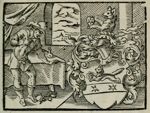
Quae nocuere iuvant: Taurellus, Emblemata Physico-Ethica (Nürnberg, 1602), emblem 20 uses the scorpion for the pictura
Iconclass: 31EE23333 violent death by bite or sting of poisonous animal - EE - death not certain; wounded person 43C128 fisherman 52A51 Wisdom; 'Sapienza', 'Sapienza humana', 'Sapienza vera' (Ripa) 54A31 Experience, Mastery; 'Esperienza' (Ripa) 57A41 Regret
Loci Communes: Incertus eventus - ex eventu judicium (Uncertain outcome - judging by the outcome, Issue incertaine - jugement d'après l'issue); Sera paenitentia (Late repentance, Repentir tardif)
I i 30 Factum stultus cognoscit When a thing is done, a fool can see it
Idem aliter effertur ab aliis, ῥεχθὲν δέ τε νήπιος ἔγνω. id est, Rem peractam stultus intellexit. Sumptum est autem ex Homero, qui pluribus locis hanc usurpavit sententiam. Ut in Iliados Π & Υ. Μήτε ἀντίος ἵστασ' ἐμοῖο, Πρίν τι κακὸν παθέειν. ῥεχθὲν δέ τε νήπιος ἔγνω. id est, Mihi obvius ire caveti, prius quàm Noxae aliquid capias: nam factum novit & excors. Huc allusit Euripides in Bacchis: Κακοῦ γὰρ ἐγγὺς ὢν ἐμάνθανεν. Nam didicit affinis malo. De Pentheo, qui sero, nec nisi sua pernicie doctus, coepit revereri Bacchum. Neque huic diversum est, quod admonet senarius ille, inter Graecanicas sententias celebris: Η δὲ μετάνοια γίγνετ' ἀνθρώποις κρίσις id est: Tum iudicant homines, ubi iam paenitet. Eodem pertinet Virgilianum illud, Discite iustitiam moniti & non temere divos. Item illud Demosthenicum: Non emo tanti paenitere. Unde perquam eleganter Fabius apud Titum Livium, Euentum, stultorum magistrum appellat: Nec eventus docet hoc, inquiens, qui stultorum magister est, sed ratio. Plinius in Panegyrico, quem Traiano dixit, huiusmodi seram & infrugiferam prudentiam, miseram vocat: Terror, inquit, & metus & misera illa ex periculis facta prudentia, monebat ut à Rep. (erat autem omnino nulla Respub.) oculos, aures, animos averteremus.
Another version of the same thing: ῥεχθὲν δέ τε νήπιος ἔγνω When the thing is done, the fool understands it. This comes from Homer, who makes use of this idea several times. So in the Iliad, 17 and 20:
Beware of coming to challenge me
Before suffering some harm; even a fool perceives
A deed once done.
Euripides alludes to it in the Bacchae: 'For he learnt by experiencing evil.' This refers to Pentheus, who began late, and not until he was taught by his own misfortune, to revere Bacchus. This is no different from the warning of that famous line, current among the Greek maxims: 'A man learns judgment as he learns regret.' Virgil's phrase belongs here: 'Be warned, / Learn to deal justly and not scorn the gods.' Demosthenes said the same thing: 'I don't buy repentance at such a price.' And so Fabius, in Livy, very elegantly calls the outcome the teacher of fools: 'It is not the outcome, the teacher of fools, which teaches this,' he says, 'but reason.' Pliny, in the Panegyric he delivered before Trajan, calls this kind of tardy and fruitless prudence 'pitiful': 'Fear,' he says, 'and dread and that pitiful prudence gained from danger, warned us to avert our eyes, our ears, our minds, from the State (there was practically no State at all).'
Facsimile: 
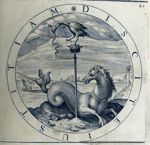
Discite iustitiam: Wither, A collection of emblems (London, 1635), emblem 121 quotes the comment
Discite iustitiam: Rollenhagen, Nucleus emblematum (Arnhem, 1618), Cent. II, emblem 21 quotes the comment
Discite iustitiam moniti: Paradin, Les devises héroïques (Antwerp, 1563), emblem 162 quotes the comment
Iconclass: 31B8 fool, simpleton, numskull 51CC1 Effect, Result
Loci Communes: Sera paenitentia (Late repentance, Repentir tardif)
I i 31 Malo accepto stultus sapit Trouble experienced makes a fool wise
Paulo diversius extulit Hesiodus, eandem tamen sententiam, cum ait in libro, cui ti tulus, Opera & dies: Δίκη ὑπερύβριον ἴσχει, Εἰς τέλος ἐξελθοῦσα, παθὼν δέ τε νήπιος ἔγνω. id est: Tandem sua poena nocentem Consequitur, passusque sapit tum denique stultus. Ad quam sententiam videtur alludere & Homerus in Iliados Ψ. ἵνα γνοίης ἀποτίνων. id est, Uti tuo damno cognoscas. Plato in Symposio, ἃ δὴ καὶ σοι λέγω, ὧ ἀγάθων, μὴ ἐξαπατᾶσθαι ὑπὸ τούτου, ἀλλὰ ἀπὸ τῶν ἡμετέρων παθημάτων γνόντα εὐλαβηθῆναι, καὶ μὴ κατὰ τὴν παροιμίαν ὥσπερ νήπιον παθόντα γνῶναι. id est, Quae sane tibi quoque dico Agathon, ne ab hoc fallaris, sed, ex cognitis his, quae nobis acciderunt, caveas: nec iuxta proverbium veluti stultus post acceptum malum sapias. Huc referendum & Plautinum illud in Mercat. Feliciter is sapit, qui alieno periculo sapit. In eandem sententiam Tibullus elegiarum libro tertio: Felix, quicumque dolore Alterius, disces posse carere tuo. Huc alludunt & illae sero sapientum voces: Nunc scio quid sit amor. Nunc ego & illam scelestam, & me miserum esse sentio. Ah, vix tandem sensi stolidus. Videtur adagium ex illa vetustissima fabula manasse, de duobus fratribus Prometheo atque Epimetheo, quae quidem refertur apud Hesiodum, ad hanc ferme sententiam: Iuppiter iratus Prometheo propter ignem furto sublatum è coelo, ac mortalibus redditum, cupiensque illum simili retaliare dolo, Vulcano negocium dat, ut è luto puellae simulacrum quanto maximo posset artificio fingat. Id simulatque factum est, singulos deos deasque monet, ut ei simulachro suas quisque dotes adiungerent. Unde & virgini Pandorae nomen affictum apparet. Hanc igitur, omnibus formae, cultus, ingenii, linguaeque dotibus cumulatam, Iupiter cum pyxide pulcherrima quidem illa, sed intus omne calamitatum genus occulente, ad Prometheum mittit. Is recusato munere, fratrem admonet, ut, si quid muneris sese absente mitteretur, ne reciperet. Redit Pandora, persuasoque Epimetheo, pyxidem donat. Eam simul ac aperuisset, evolantibusque morbis sensisset Iovis ἄδωρα δωρα, sero nimirum sapere coepit. Ubi Hesiodus palàm ad adagionem adludens ait: Αὐτὰρ ὁ δεξάμενος, ὅτε δὴ κακὸν εἷχ', ενόησε. id est, Accepit: tactusque malo, tum denique sensit. Idem significat in Theogonia: Haec, inquit, peperit προμηθέα Ποικίλον αἰολομῆτιν, ἁμαρτίνοόν τ' ἐπιμηθέα Prometheum vafrum nominans, ac variis instructum consiliis, Epimetheum, post erratum sapientem. Unde & Pindarus in Pythiis, appellat illum ὀψίνοον quasi sero sapientem. Quod ipsa etiam indicant vocabula. Nam προμηθεὺς Graecis eum significat, cui prius quam rem aggrediatur, suppetit consilium: ἐπιμηθεὺς, cui, re peracta, tum demum consilium in mentem venit. προμηθεύεσθαι, est consilio malis imminentibus occurrere. Lucianus in dialogo quodam, ex comico quopiam citat hunc versiculum dictum in Cleonem, quod sero, nec nisi confecto negotio saperet: Κλέων προμηθεὺς ἐστὶ μετὰ τὰ πρὰγματα. id est. Rebus peractis est Cleon Prometheus. Idem in calce eiusdem dialogi: ἐπεὶ τό γε μεταβουλεύεσθαι. ἐπιμηθὲως ἔργον, οὐ προμηθέως ἐστὶν. id est, Nam illud quidem post rem consulere, Epimethei est, non Promethei. Effertur enim ad hunc modum paroemia: παρὰ τὰ δεινὰ φρονιμώτερος. Post mala prudentior. Rursum hoc pacto: ἐξ ὦν ἕπαθες, ἔμαθες. id est, ut sententiam magis, quàm verba reddam, Quae nocent, docent. At multo consultius est, alienis malis prudentiorem reddi, iuxta Graecam sententiam: Βλέπων παπαίδευμ' εἰς τὰ ἄλλων κακά. id est, Aliena spectans, doctus evasi, mala. Circumfertur & illud nostrati vulgo iactatum: Mortaleis pudore & iactura doctiores evadere.
Hesiod expressed the same thought, though a little differently, when he said in his book entitled Works and Days: 'His punishment the wicked man receives / At last, but only pain instructs the fool.' Homer too seems to allude to the same saying in the Iliad, book 23: `... so that paying up, you 11 know the truth.' Plato in the Symposium: 'I am saying this to you also, Agathon, so that you may not be deceived by this, but take warning from the knowledge of what happened to us; and that you should not, like the fool in the proverb, learn wisdom through the experience of evil.' Plautus' phrase in the Mercator is to be classed with this: 'Happy is he who learns wisdom at another's cost.' Similarly in the Elegies of Tibullus, book 3: 'How happy is he, whosoe'er he be, / Who from another's woe learns woe to flee.' This is what those speeches of the tardily-wise mean: 'Now I know what love is.' 'Now I understand that she is wicked and that I am wretched."Ah, fool that I am, I have just tumbled to it at last.' The adage seems to spring from that very old story about the two brethren, Prometheus and Epimetheus, which is told in Hesiod, more or less in this way. Jupiter was angry with Prometheus because he had stolen fire from heaven and given it to men; and wishing to play a similar trick on him, gave Vulcan the job of making the figure of a girl out of clay, with the greatest possible skill. When this was done, he required each of the gods and goddesses to endow this image with his or her gifts. This is clearly why the name Pandora was invented for the maiden. Then, when the image had been showered with all the endowments of beauty, accomplishment, brains and speech, Jupiter sent her to Prometheus with a box, beautiful indeed, but concealing inside it every kind of misfortune. Prometheus refused the present, and warned his brother that if any kind of gift was brought in his absence, it must not be accepted. Back comes Pandora and, having persuaded Epimetheus, she gives him the box. As soon as he had opened it, and understood, as the diseases flew out, that Jove's 'gifts were no gifts,' he began to be wise, but too late. Hesiod clearly refers to the adage when he says 'He took it, and touched by woe understood at last.' He says the same in the Theogony: she gave birth to Prometheus, 'the cunning one' (so he calls him) 'of many wiles / And Epimetheus, whom mistakes made wise.' Hence Pindar in the Pythians calls him 'late-wise.' Their very names indicate this. For Prometheus means in Greek a man who takes counsel before acting, and Epimetheus one who acts first, and only then does common sense enter his head. To act like Prometheus, prometheuesthai, is to meet misfortunes when they threaten by taking thought. Lucian in one of his dialogues quotes from some comedy-writer or other the following line, attacking Cleon on the ground that he was only wise too late when the business was all over: 'Cleon is a Prometheus after the fact.' Again, at the end of the same dialogue: 'To take counsel after the event is like Epimetheus, not Prometheus.' The proverb is also found in the form παρὰ τὰ δεινὰ φρονιμώτερος, More prudent after hard experience, and again in this form: ἐξ ὦν ἕπαθες, ἔμαθες, From what you suffer, you learn, or (giving the sense rather than the words) What hurts is what teaches, Quae nocent docent. But it is much more circumspect to learn prudence from the ills of others, according to the Greek saying: `I learnt my lesson watching others' ills.' There is a word going round among my own people: 'It is through shame and loss that mortals grow wiser.'
Facsimile: 
Stultus malo accepto sapit: Bocchi, Symbolicarum quaestionum (Bologna, 1574), emblem 69
Quae nocuere iuvant: Taurellus, Emblemata Physico-Ethica (Nürnberg, 1602), emblem 20 paraphrases the comment
Quae nocent docent: Weigel, Gedankenmuster (Nürnberg, 1700), emblem 104 quotes the comment
Quae nocent docent: Weigel, Gedankenmuster (Nürnberg, 1700), emblem 210 quotes the comment
Iconclass: 31B8 fool, simpleton, numskull 54A31 Experience, Mastery; 'Esperienza' (Ripa)
Loci Communes: Sera paenitentia (Late repentance, Repentir tardif)
I i 32 Aliquid mali, propter vicinum malum Something bad from a bad neighbour
Lysimachus apud Plaut. in Mercatore. Nunc ego verum esse illud verbum experior, aliquid mali esse propter vicinum malum. Quibus ex Plauti verbis satis liquet, hanc sententiam vulgari sermone fuisse celebratam. Eam Hesiodus eleganter expressit in opere, cui titulus, Opera & dies: Εἰ γὰρ τοι χρῆμ' ἐγχώριον ἄλλο γένηται, Γείτονες ἄζωστοι ἔκιον, ζώσαντο δὲ πηοί. Πῆμα κακὸς γείτων ὅσσον τ' ἀγαθὸς μέγ' ὄνειαρ. Εμμορέ τοι τιμῆς, ὅσ τ' ἔμμορε γείτονος ἐσθλοῦ. Οὐ δ' ἂν βοῦς ἀπόλοιτ' εἰ μή γείτων κακὸς εἴη. id est, Si qua domi inciderit tibi res, tunc ilico omissis Adsunt vicini zonis, cinguntur at ipsi Affines. noxa est vicinus ut improbus ingens, Contra ita maxima commoditas, si commodus adsit. Deest honor huic, bona quem vicinia deficit: at nec Intereat bos, ni vicinus ubi improbus adsit. Neque tantum inter privatos vicinos haec sententia locum habet, verum etiam experimentis observatum est, populos à vicinis subversos. Quemadmodum Aetolis & Acarnanibus evenit, qui se mutuis cladibus everterunt, inter se finitimi. Item Carthaginensibus et Byontinis, quarum historiarum meminerunt Hesiodi interpretes. Huc videtur leviter allusisse Virgilius in Eclogis, cum ait: Nec mala vicini pecoris contagia laedent. Et, Mantua vae miserae nimium vicina Cremonae. Admonet autem paroemia, uti bonorum convictum, & consuetudinem expetamus, à malis nos quam maxime possumus, abducamus. Proinde scitum est illud Themistoclis apud Plutarc. qui cum praedium quoddam venderet, hoc quoque praeconem addere iussit, ὅτι καὶ ἀγαθοὺς ἔχει γείτονας. id est, quòd vicinos etiam haberet bonos, quasi vicini commendatione futurum esset longe vendibilius. Neque multum abhorret hinc illud eiusdem Hesiodi carmen: Πολλάκι καὶ ξύμπτασα πόλις κακοῦ ἀνδρὸς ἐπαυρεῖ. id est, Saepe mali malefacta viri populus luit omnis.
Lysimachus in the Mercator of Plautus: 'Now I am finding out the truth of that saying, something bad comes from a bad neighbour.' From these words of Plautus it is abundantly clear that this remark was well known in common speech. Hesiod voiced it elegantly in the book called Works and Days:
When trouble falls at home the neighbours come
Without their belts, relations gird themselves;
An evil neighbour is a mighty woe,
A useful one the greatest boon; to him
Who lacks good neighbours there's a lack of honour,
Nor would an ox die, were there no bad neighbour.
This saying holds good not only as between private neighbours, but experience has shown whole peoples overthrown by their neighbours. This happened to the Aetolians and Acarnanians, who destroyed each other by mutual conflict, close as their borders were. So also the Carthaginians and Byontini, whose history is told by the scholiasts on Hesiod. Virgil appears to have made a passing allusion to this in the Eclogues: 'No harm will come to them from neighbouring flocks', and 'Poor Mantua, too near to doomed Cremona.' The proverb is a warning that we should seek out the society and companionship of good men, and separate ourselves as much as possible from bad ones. So it was clever of Themistocles in Plutarch when he was selling an estate, to cause the auctioneer to add 'that it had also good neighbours,' as if this recommendation would make it much more saleable. And not so very far away from this is the saying from the poem of that same Hesiod: 'Oft the whole people suffers for one bad man's misdeed.'
Facsimile:
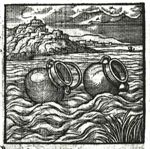
Aliquid mali propter vicinum malum: Alciatus, Emblemata (Leiden, 1591), emblem 165
Bonis a divitibus nihil timendum: Alciatus, Emblemata (Padua, 1621), col. 181 a, emblem 32
Bellorum eventus ut riusque partis malo: Lebey de Batilly, Emblemata (Frankfurt, 1596), emblem 11 uses the Alciatus emblem in the pictura's background
Aliquid mali propter vicinum malum: Whitney, A choice of emblemes (Leiden, 1586), emblem 175
Galathea wacht u wel: Visscher, Sinnepoppen (Amsterdam, 1614), emblem 50 uses the imagery of a metal and an earthenware pot floating in a river
Iconclass: 33A7 neighbour 52B5112 Bad, Evil, Wrong
Collectanea (1500): 221
Loci Communes: Malus vicinus (A bad neighbor, Un mauvais voisin)
I i 33 Manus manum fricat One hand rubs another
Socrates in Axiocho Platonis ait Prodico sophistae hunc Epicharmi comici versiculum semper in ore fuisse: Η δὲ χεὶρ τὴν χεῖρα κνίζει, δός τι καὶ λάβοις τι. id est, Affricat manum manus, da quiddam & aliquid accipe: videlicet hominis quaestum facete taxans, qui neminem gratis doceret, & à quo se quoque quae tum dicturus esset, didicisse affirmabat, at ne id quidem gratuito, imo numerata mercede. Sententia digna tum homine Siculo, tum vafro poeta. Sic enim illum appellat Cic. Monet autem, neminem fermè mortalium inveniri, qui velit in quempiam beneficium collocare, à quo non speret aliquid emolumenti vicissim ad se rediturum, sed officium invitari officio, beneficium beneficio provocari. Idem adagium effertur & hoc pacto: χεὶρ χεῖρα νίπτει. id est, Manum manus lavat. Idem pollet utraque metaphora. Nam mutua commoditas est, quoties vel fricat, vel abluit manus manum. Circumfertur inter Graecanicas sententias huiusmodi distichon: Ανὴρ γὰρ ἄνδρα, καὶ πόλις σώζει πόλιν Χεὶρ χεῖρα νίπτει, δάκτυλός τε δάκτυλον. id est, Urbs servat urbem, servat itidem vir virum, Manus manum, digitumque digitus abluit. Utitur eo & Seneca in ludicro libello De morte Claudii. Caesaris.
Socrates in the Axiochus of Plato says that Prodicus the sophist was always quoting this line of the comic poet Epicharmus: 'Hand rubs hand; give something, and you get something.' Here Socrates is poking fun at the profiteering of a man who never taught anyone for nothing, and from whom he himself admitted that he had learnt what he was then about to say, and that not gratis - far from it, he had paid in coin. A notion worthy of a Sicilian, or of a 'crafty poet,' for that is what Cicero calls him. It warns us that there is almost no one to be found among mortals who is willing to bestow a benefit on anyone else, without hoping that some profit will redound to himself; a favour is the result of another favour, one kindness is called forth by another kindness. The same adage exists in the form 'One hand washes the other.' The two metaphors have the same force, for it is a matter of mutual convenience when one hand rubs or washes another. Among the Greek maxims this couplet is in circulation: 'Town preserves town, one man likewise another; / Hand washes hand and finger washes finger.' Seneca makes use of this too in his amusing skit on the death of the emperor Claudius.
Facsimile:
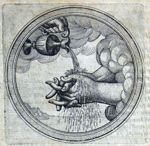
Alterius altera poscit opem: Zincgreff, Emblematum Ethico-politicorum (Heidelberg, 1619), emblem 98
Manus manum lava: Wither, A collection of emblems (London, 1635), emblem 128
Mortuo leoni etiam lepores insultant: Cats, Spiegel (The Hague, 1632), emblem 114
Amor, ut pila, vices exigit: Cats, Spiegel (The Hague, 1632), emblem 11 uses the imagery of the game of shuttlecock to convey the idea of reciprocal love and also quotes the adage in its comment
Iconclass: 31A25222 rubbing, wringing one's hands 51KK3 Interchange, Exchange 53D12 Favour; 'Favore' (Ripa) 54A6 Helpfulness
Collectanea (1500): 5
Loci Communes: Pensatio beneficii vel officii (Repayment of a favor or duty, Rétribution d'un bienfait ou d'un devoir)
I i 34 Gratia gratiam parit One favour begets another
Eandem sententiam Sophocles simpliciter extulit in Oedipo Coloneo: Η χάρις χάριν φέρει. id est, Gratiam adfert gratia. Rursum apud eundem in Aiace Mastigo phoro: Χάρις χάριν γάρ ἐστιν ἡ τίκτους' ἀεί. id est, Beneficium semper beneficium parit. Quod Hesiodus velut enarrans in primo Georg. Τὸν φιλέοντα φιλεῖν, καὶ τῷ προσιόντι προσεῖναι, Καὶ δόμεν ὅς κεν δῷ, καὶ μὴ δόμεν ὅς κεν μὴ δῷ. Δώτῃ μέν τις ἔδωκεν, ἀδώτῃ δ' οὔτις ἔδωκεν.. id est: Aequum ut ametur amans: qui accedit, iungitor illi. Da, tibi qui dederit: qui non dederit tibi, ne da. Danti aliquis dedit, at non danti non dedit ullus. Quibus significatur beneficium invitari beneficio, & officium officio provocari. Euripides in Helena: Χάρις γὰρ ἀντὶ χάριτος ἐλθέτω. id est, Beneficium benesicio respondeat.
The same thought is simply expressed by Sophocles in the Oedipus Coloneus: 'A favour favour brings.' Again in the Ajax Mastigophoros: 'Always one favour begets another.' Hesiod expands on this, as it were, in the first book of his Georgics:
Be a friend to a friend, and frequent the one who frequents you,
Give to the one who gives, and not to the one who gives not;
One gives to the giver, no one gives to the giftless.
By this it is meant that a benefit is induced by a benefit, a kindness provoked by a kindness. Euripides in the Helena: 'Let favour come in return for favour.'
Facsimile: 
Annotation: De ene dienst is de andere waard
χάρις χάριν φέρει - Gratia gratia parit: Maccio, Emblemata (Bologna, 1628), emblem 74, quoting both Greek and Latin
Amor, ut pila, vices exigit: Cats, Spiegel (The Hague, 1632), emblem 11 uses the imagery of the game of shuttlecock to convey the idea of reciprocal love and also quotes the adage in its comment
Iconclass: 51KK3 Interchange, Exchange 53D12 Favour; 'Favore' (Ripa) 54A6 Helpfulness 57A8 Gratitude; 'Gratitudine', 'Memoria grata de beneficii ricevuti' (Ripa)
Loci Communes: Pensatio beneficii vel officii (Repayment of a favor or duty, Rétribution d'un bienfait ou d'un devoir); Gratitudo (Gratitude, Gratitude)
I i 35 Par pari referre To render like for like
Terentius in Eunucho paroemiam usurpat, superiori non admodum dissimilem: Par pari referto. Qua monemur ut tales simus in alios, quales in nos illos experimur. Ac iuxta Medeam Euripideam amicis simus amici; inimicis infesti, in perfidos perfidi, parcos par ci, clamosos clamosi, impudentes improbi: denique utcunque meritum merito simili retaliemus. Idem in prologo Phor. Quod ab ipso allatum est, sibi id esse relatum putet. Non inconcinne tum quoque usurpaverimus, si quando verba verbis, blandicias blandiciis, promissa promissis pensamus. Huc pertinet illud non illepidum, quod refert Aristot. lib. Moral. 9. Dionysius citharoedum accersiverat, ut sibi caneret in nuptiis: atque cum eo his pactus est legibus ut quo doctius meliusque caneret, hoc copiosiorem ferret mercedem. Annixus est omni artificio citharoedus uti quam scitissime caneret, sperans amplissimum praemium. At postridie pactam mercedem reposcenti musico, qui conduxerat, ait iam persolvisse sese quod esset pollicitus: nempe par pari retulisse, proque voluptate reposuisse voluptatem, spem lucri significans: quae quidem hoc maior fuerat, quo magis ex arte cantasset. Verum hoc loco negat philosophus par pari relatum: propterea, quia alter id quod volebat accepit: alter eo quod expetebat, frustratus est. Huc videtur respexisse Euripides, cum ait in Andromache, Σώφρων καθ' ἡμᾶς σώφρον' ἀντιλήψεται, Θυμούμενος δὲ τεύξεται θυμουμένων. id est, Modestus in nos sentiet modestum item, Commotus autem nos reperiet concitos. Porrò proverbium natum videri potest à compotationibus veterum Graecorum, apud quos aequalibus cyathis bibere mos erat. Archippus in Amphitryone secunda apud Athenaeum, lib.x. Τίς ἐκέρασε σφῶν ὧ κακόδαιμον ἴσον ἴσῳ; id est, Qui par sceleste miscuit vobis pari? Item Cratinus in Pytine, Τὸν δ' ἴσον ἴσῳ φέροντ' ἐγώγ' ἐκτίσομαι, id est, At par pari reddenti, ego respondero. Item lib. vi. Οὐ διὰ τῶν ἐν τῇ ῥώμῃ ἴσον ἴσῳ ιχθὺν πωλούντων. id est, Non per eos, qui Romae piscem vendunt, parem pari: sentiens singulos precio aestimatos vendi. Erat haec vox ἴσον ἴσῳ, sollennis inter propinandum, ut ex eodem autore facile liquet. Ea significabant, aut pares esse cyathos, aut tantundem additum aquae, quantum inesset vini. Huius formae sunt illa: paria facere, pro pensare ex ae quo, & parem calculum ponere. Plinius ad Flaccum: Accepi pulcherrimos turdos, cum quibus parem calculum ponere, nec urbis copiis ex Laurentino, nec maris iam turbidi tempestatibus possum. M. Tullius libro De oratore ad Brutum, Par pari retulit ad schema rhetoricum, quo membra orationis pari syllabarum numero sibi respondent. Nam, inquit, quum aut par pari refertur, aut contrarium contrario opponitur, aut quae similiter cadunt verba, verbis comparantur, quicquid ita concluditur, plerunque fit, ut numerose cadat.
ἴσον ἴσῳ ἐπιφέρειν, To render like for like. Terence in the Eunuchus makes use of an adage not unlike the preceding: 'Render like for like.' This teaches us that we should behave to others as we find them behaving to us. Like the Medea of Euripides we are to be friends to our friends, hostile to our enemies, false to the false, mean to the mean, noisy with the noisy, shameless with the vile; and finally we are to return every good service with a similar one. Thus in the prologue to the Phormio: 'Let him be aware that whatever he brought will be given back to him again.' It would not be inappropriate to use this when we repay words with words, flattery with flattery, promises with promises. There is an amusing instance of this in the Ethics of Aristotle, book 9. Dionysius summoned a lute-player to play at his wedding, and made an agreement with him on these terms, that the more skilfully and sweetly he played, the more generous would be his fee. The musician made an effort to use all his skill to play beautifully, hoping for a really ample reward. But the next day, when the musician who had made the bargain asked for his pay, Dionysius declared that he had already carried out his promise: he had returned like for like, he said, he had repaid pleasure with pleasure, and by this he meant the hope of gain, which had indeed risen higher and higher the more skilfully the man played. However the philosopher denies that this was rendering like for like; because the one (Dionysius) got what he wanted, while the other was cheated of what he was looking for. This seems to have been what Euripides was thinking of when he says in the Andromache: 'Moderate towards us, he will find me moderate; / But if he rages, he will see us rage.' The proverb may perhaps have arisen from the habits of the ancient Greeks at drinking-parties, when they customarily used ladles of equal size. Archippus in his second Amphitryon, cited by Athenaeus book io: 'Which of you, O wretch, mixed it half and half?' Similarly Cratinus in his Pytine: 'But the man that brings me half and half I shall pay in full.' Again in book 6: 'Not through those who sell fish at Rome, like for like,' meaning that the fish were priced for sale separately.
This expression 'like for like' was normal in drinking healths, as can easily be seen from the same author. By this they meant either that the ladles were the same size, or that the same amount of water was added as there was of wine. Those other phrases are similar: `to strike a balance' for to recompense on equal terms, and `level reckoning.' Pliny writes to Flaccus: 'Thank you for those magnificent thrushes, for which I fear level reckoning is out of the question, either from my city supplies as I am now in my place at Laurentum, or with anything from the sea which is now rough with all these storms.' Cicero, in his Orator addressed to Brutus, reduces 'like for like' to the level of a rhetorical figure, in which the parts of a sentence have an equal and corresponding number of syllables: 'For when like is matched with like, or unlike is contrasted with unlike, or words are set against words of similar endings, whatever is elaborated in this way generally has an agreeably rhythmical cadence.'
Facsimile:
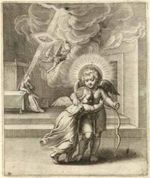
Par pari: Vaenius, Amoris divini emblemata (Antwerp, 1615), emblem 56
Iconclass: 51KK3 Interchange, Exchange 51B3 Parity, Equality
Loci Communes: Pensatio beneficii vel officii (Repayment of a favor or duty, Rétribution d'un bienfait ou d'un devoir)
I i 36 Eadem mensura By the same measure
Quod modo retulimus, videtur pariter & ad officii, & ad iniuriae relationem pertinere, verum ad beneficii pensationem magis referendum, quod ait Hesiodus: Αὐτῷ τῷ μέτρῳ, καὶ λώϊον, αἰ κε δύνησαι. id est Aut mensura eadem, aut melius quoque, si qua facultas. Quod docet, officium remetiendum esse eadem mensura, aut etiam copiosiore, si suppetat facultas: prorsumque hac parte imitandos esse foecundos agros, qui sementem depositam multo cum foenore reddere consueverunt. Citatur à Luciano proverbii vice in Imaginibus αὐτῷ μέτρῳ φασὶ καὶ λώϊον. i. Eadem mensura, quod aiunt, aut melius. M. Tull. Epist. ad Attic. lib. xiii. Ego autem me parabam ad id quod ille mihi misisset, ut αὐτῷ τῷ μέτρῳ καὶ λώϊον, si modo potuissem. Nam hocetiam Hesiodus adscribit, αἰ κε δύνηαι. Hoc adagio non gravatus est uti praeceptor noster Christus in Evangelio, cum ait futurum, ut qua mensura fuerimus aliis emensi, eadem nobis alii remetiantur. Sic enim loquitur apud Mattaeum: Εν ᾦ γὰρ κρίματι κρίνετε, κριθήσεσθε. καὶ ἐν ᾦ μέτρῳ μετρεῖτε, μετρηθήσεται ὑμῖν. id est, In quo iudicio iudicatis, in eo iudicabimini: Et qua mensura metimini aliis, illa remetientur vobis.
What we have just mentioned seems to relate to the repaying of kind offices and injuries alike, but is more to be applied to the return of benefits, as Hesiod says: 'With the same measure, or better if you can,' by which he means that we should repay a kindness in the same measure, or even more fully if opportunity offers; and in this way we should imitate fertile fields, which usually yield a big increase on the seed sown in them. It is quoted as a proverb by Lucian in the Imagines: 'With the same measure, they say, or better.' Cicero in the thirteenth book of the Letters to Atticus: 'I for my part was making ready to pay him for his offering "in measure like, and better too" - that is, if I had been able to, for even Hesiod adds "if thou canst."' Our teacher Christ did not hesitate to use this adage in the Gospel, when he says that it shall be so, that whatever measure we have used in dealing with others will be dealt out to us again. For he speaks thus in Matthew: 'For with what judgment ye judge, ye shall be judged; and with what measure ye mete, it shall be measured to you again.'
Facsimile: 
Iconclass: 49D52 measuring 51B3 Parity, Equality
Loci Communes: Pensatio beneficii vel officii (Repayment of a favor or duty, Rétribution d'un bienfait ou d'un devoir)
I i 37 Crassa Minerva. Pingui Minerva. With a stupid Minerva, a crass Minerva
Minerva, iuxta poetarum fabulas, artibus atque ingeniis praesidet. Unde & illud fluxit, Invita Minerva. Praeterea illud: Pingui, seu crassa Minerva, quod quidem iam olim proverbii vice celebratur. Columella lib. De re rust. xii. cap.i. In hac autem, inquit, ruris disciplina non consideratur eiusmodi scrupulositas, sed quod dicitur, pingui Minerva, quantumvis utile continget villico tempestatis futurae praesagium. Idem in primi libri praefatione: Potest enim nec subtilissima, nec rursum (quod aiunt) pingui Minerva, res agrestis administrari. Idem lib. x. Nec tamen Hipparchi subtilitas, pinguioribus, ut aiunt, rusticorum literis necessaria est. Dicitur pinguiore Minerva fieri, quod inconditius simpliciusque quasique indoctius fit, non autem exquisita arte, nec exactissima cura. Unde & Priapus ille, cum rem obscoenam quam poterat urbanius per involucra verborum petere, nudis verbis rogat: Crassa, inquit, Minerva mea est. Et Horatius philosophum describens, non exactis illis Stoicorum rationibus atque argutiis instructum, sed veluti citra artem philosophiam moribus exprimentem, neque tam disertum, quàm simplicem ac syncerum, Rusticus, inquit, anormis, sapiens, crassaque Minerva. A. Gellius lib. xiiii. cap. i. Nequaquam tamen id censebat in tam brevi exiguoque vitae spacio, quantovis hominis ingenio comprehendi posse, & percipi, sed coniectari pauca quaedam, & ut verbo ipsius utar, παχύτερον id est, crassius, & pingui Minerva.
Minerva, according to poets' tales, presides over the arts and the talents. From this sprang the phrase 'Against Minerva s will,' as well as 'With a crass' or 'stupid Minerva,' already in common use as a proverb in old time. Columella in book 12 of his Agriculture, chapter i: 'But in this science of agriculture such minute accuracy is not called for; what they call crass mother-wit [pingui Minerva] will provide the farm-bailiff with an indication of future weather which is of great value.' Columella again, in the preface to the first book: 'The business of farming can be carried on without great subtlety of intellect, but what they call crass mother-wit [pingui Minerva] is not enough.' Again in the tenth book: 'And yet the subtlety of Hipparchus is not required for what they call the more crass education of country folk.' A thing is said to be done pinguiore Minerva, by crass mother-wit, when it is done in a way that is artless and crude and, as it were, inexpert, without refined art or careful exactitude. So that old Priapus, when he asks in plain terms for an improper privilege, which he might have asked for more politely under a veil of words, says `My Minerva is a bit crass.' And Horace, describing a philosopher who was not armed with those famous close reasonings and sophistries of the Stoics, but expressed his philosophy in his way of life, as though without art, and was not eloquent but rather simple and sincere: 'Bound to no school, a rustic sage was he, / Of homely motherwit.' Aulus Gellius, book 14 chapter 1: 'He gave it as his opinion that this could certainly not be perceived and comprehended by the mind of a man, however great, in so short and cramped a space as a lifetime, but a few things might be guessed at, and to use his own words "in a rough and ready style" [crassius, et pingui Minerva].'
Facsimile:
Iconclass: 52AA1 Stupidity, Poverty of Intellect; 'Stupidità overo Stolidità' (Ripa) 56B42 Coarseness, Rusticity 92C27 specific aspects, allegorical aspects of Minerva; Minerva as patroness
Loci Communes: Aperte et crasse (Openly and bluntly, Ouvertement et grossièrement)
I i 38 Crassiore Musa Of the more clumsy Muse
Παχυτέρᾳ μούσῃ. i. Crassiore Musa. Eandem paroemiam sic extulit Quintil. Instit. orat. lib. i. Libet propter quosdam imperitiores etiam crassiore, ut vocant, Musa dubitationem huius utilitatis eximere. Invenitur aliquoties apud scriptores non inidoneos, pinguiore formula, pro eo quod est planius atque intelligibilius. Dictum est & Latine loqui, pro eo quod est aperte & simpliciter. M. Tullius in Verrem: Latine me scitote, non accusatorie loqui. Idem in Philip. Sed ut solent ii qui plane & Latine loquuntur. In Priapeiis, Simplicius multo est, da paedicare, Latine. Dicere.
Παχυτέρᾳ μούσῃ, Of the more clumsy Muse. The same proverb is expressed thus by Quintilian in his Institutiones oratoriae, book i: 'I should like for the sake of those who are inexperienced or, as they say, of the more clumsy Muse, to remove any doubt about the value of this.' Sometimes in writers not without authority one finds 'To a cruder pattern,' Pinguiore formula, for 'clearer and more intelligible.' There is also the phrase 'to speak Latin,' meaning 'openly and simply.' Cicero in the Verrines: 'I am not using the language of a prosecutor, but speaking Latin, you must know.' And again in the Philippics: 'As they say who speak open and plain Latin.' In the Priapeia: `Simpler far to say / In good plain Latin, Let me bugger you.'
Facsimile:
Iconclass: 56B42 Coarseness, Rusticity 92D4 (story of the) Muses; 'Muse' (Ripa)
Loci Communes: Aperte et crasse (Openly and bluntly, Ouvertement et grossièrement)
I i 39 Rudius ac planius More roughly and more plainly
Inelegantius quidem est illud apud Graecos, sed idem tamen pollet: ἀμαθέστερον καὶ σαφέστερον εἰπὲ. quod apud eundem refertur Gellium: Nosti enim, inquit, credo verbum illud vetus & pervulgatum, ἀμαθέστερον εἰπὲ καὶ σαφέστερον. id est, Indoctius rudiusque quodammodo loquere & apertius; ac clarius fare. Sumptum apparet ex Aristophanis comoedia, cui titulus Βάτραχοι. id est, Ranae. ἀμαθέστερόν πως εἰπὲ καὶ σαφέστερον. id est, Indoctius proloquitor, atque clarius. Quo carmine Bacchus Euripidis obscuritatem taxat, qui nescio quid parum dilucide proposuerat. Suidas & interpres admonet subesse proverbium quod hunc ad modum feratur: Σαφέστερόν μοι κ' ἀμαθέστερον φράσον. id est, Apertius mihi loquere, atque indoctius. Suspicor inde sumptum, quod antiquitus illi σοφοὶ, quos vocant, solebant mysteria sapientiae quibusdam aenigmatum involucris data opera obtegere: videlicet ne profana turba, ac nondum philosophiae sacris initiata posset assequi. Quin & hodie nonnulli philosophiae ac theologiae professores, cum ea quandoque tradant, quae quaevis muliercula aut cerdo dicturus sit, tamen quo docti videantur, rem spinis quibusdam ac verborum portentis implicant & involuunt. Sic Plato numeris suis obscuravit suam philosophiam: Sic Aristoteles multa mathematicis collationibus reddidit obscuriora.
The Greeks have a phrase which is less elegant but has the same force: ἀμαθέστερον καὶ σαφέστερον εἰπὲ, Speak more roughly and more plainly.
It is found in the same Gellius when he says 'For you know, I think, that old and widespread expression, "speak more roughly and more plainly,"' meaning 'speak in an ignorant and rough style to express yourself more openly and clearly.' It comes apparently from a comedy of Aristophanes, the Frogs: 'Speak thou unlearnedly and speak the clearer.' In this line Bacchus blames Euripides for obscurity, since he has made some rather unclear proposition. Suidas and the scholiast indicate that there is a proverb hidden here, which circulates under the form: 'Speak to me more clearly and with less learning.' I surmise that this proverb originated from the fact that in old days those great sages, o-oOoi as they are called, used to take great care to wrap up the mysteries of wisdom in certain coverings of enigma, seemingly to prevent the common herd, not yet initiated into the rites of philosophy, from following their drift. Indeed, even today there are some who profess to be expert in philosophy and theology who do the same: when they are propounding something which any woman or a cobbler might say, they have to envelop and involve it in all sorts of difficulties and extraordinary language in order to appear learned. So Plato made his philosophy obscure by his numbers and so Aristotle rendered many things still more obscure by mathematical parallels.
Facsimile:
Iconclass: 56B42 Coarseness, Rusticity 57A642 Simplicity; 'Simplicità' (Ripa)
Loci Communes: Perspicuitas (Clarity, Clarté)
I i 40 Sus Minervam The sow (teaches) Minerva
Tritissimum apud Latinos autores adagium, ὖς τὴν ἀθηνᾶν. Sus Minervam, sub audiendum, docet aut monet. dici solitum quoties indoctus quispiam atque insulsus eum docere conatur, à quo sit ipse magis docendus: aut, ut Festi Pompeii verbis utamur, cum quis id docet alterum, cuius ipse est inscius. Propterea quod Minervae artium & ingeniorum, ut diximus tutela tribuitur à poetis. Porrò sue nullum aliud animal magis brutum, magisque sordidum, ut quod stercoribus impense gaudeat, vel ob iecoris magnitudinem, quae sedes est concupiscentiae ac libidinis: vel ob narium crassitudinem & olfactum hebetem. unde fit ut non offendatur foetore: tum adeo pronum, ciboque deditum, ut si forte sursum aspicere cogatur, protinus stupore sileat ob insolentiam, ut tradit Alexander Aphrodiseus. Nec est aliud magis indocile, proinde non ad usum aliquem, quemadmodum pecudes nonnullae, sed ad epulas duntaxat à natura donatum videtur. Cui rei testis est Plinius lib. viii. cap. li. Animalium, inquit, hoc maxime brutum: animamque ei pro sale datam, non illepide existimabatur. Idem affirmat Varro lib. De re rustica ii. Suillum, inquit, pecus donatum à natura dicunt ad epulandum. Itaque his animam datam pro sale, quae servaret carnem. Atque haec quidem verba quid sibi velint, explicat M. Tullius lib. De finibus bonorum v. Etenim omnium rerum, inquit, quas & creat natura & tuetur, quae aut sine animo sunt, aut non multo secus, eorum summum bonum in corpore est, ut non inscite illud dictum videatur in suem, animum illi pecudi datum pro sale, ne putresceret. Sunt autem bestiae, in quibus inest aliquid simile virtutis, ut in leonibus, ut in canibus, ut in equis, in quibus non corporum solum, ut in suibus, sed etiam animorum aliqua ex parte motus aliquos videmus. Aristoteles in Physiognomicis scribit, exigua fronte homines, indociles, et ad disciplinas ineptos videri, atque ad suum genus pertinere, tanquam à docilitate humanisque artibus longe omnium alienissimum. Nam reliqua fermè docilitatis esse capacia. Unde nunc vulgo insipidosistos & quasi ventri atque abdomini natos, sues appellare consuevimus. Quin & Suetonius in catalogo illustrium grammaticorum, refert Palaemonem arrogantia tanta fuisse, ut M. Varronem porcum appellaret, secum & natas & morituras literas. Praeterea si quid indoctum atque illiteratum significare volumus, id ex hara profectum dicimus. Quemadmodum M. Tullius in Pisonem: Ex hara productae, non schola. Hinc igitur natum adagium, Sus Minervam. L. Caesar apud Cicer. lib. De oratore ii. Sic ego, inquit, Crasso audiente primum loquar de facetiis & docebo sus, ut aiunt, oratorem eum, quem cum Catulus nuper audisset, foenum alios aiebat esse oportere. Idem Cicer. lib. de Academicis quaestionibus primo: Nam etsi non sus Minervam, ut aiunt, tamen inepte quisquis Minervam docet. Hieronymus in Rufinum: Praetermitto Graecos quorum tu iactas scientiam, & dum peregrina sectaris, penè tui sermonis oblitus es, ne vetere proverbio, Sus Minervam docere videatur. Usurpat idem verbis commutatis in epistola ad Marcellam, cuius initium: Mensuram charitas non habet. M. Varro & Euemerus adagium ad fabulas retulerunt, id quod ex Pompeii verbis licet coniicere. Quam rem, inquit, in medio, quod aiunt, positam, ineptis μύθοις involuere maluerunt, quam simpliciter referre. Celebratur à multis Demost. scomma, qui, cum Demades vociferaretur in eum: Δημοσθένης ἐμὲ βέλεται διορθοῦν ἡ ὖς τὴν ἀθηνᾶν. id est, Demosthenes vult me corrigere sus Minervam.: respondit: αὕτη μέντοι πέρυσιν ἡ ἀθηνᾶ μοιχεύουσα εἰλήφθη. id est. Atqui nuper haec Minerva in adulterio fuit deprehensa. Dictum allusit ad Minervam virginem.
This adage is a very common one among Latin authors: ὖς τὴν ἀθηνᾶν, The sow teaches or advises (understood) Minerva. This was usually said whenever some ignorant and silly person attempts to teach the one by whom he ought rather to be taught; or, to borrow the words of Festus Pompeius, 'when one instructs another in what he himself does not know.' The point is that the guardianship of the arts, and of the talents, is ascribed by the poets, as I have said, to Minerva. Furthermore, there is no animal more brutish than a pig, or more filthy, whether because it eagerly revels in dung, or because of the huge size of its liver, the seat of concupiscence and lust; or because of the grossness of its nose and dulled sense of smell, which results in its not finding a foul stench offensive. Added to which it is so turned towards the ground, so intent on its food, that if by any chance it is forced to look upwards it is struck dumb with stupefaction, this being so unusual, as we are told by Alexander of Aphrodisias. Nor is there any other animal more unmanageable, just as if it were intended by nature not for any other purpose (as some beasts are) but solely for the pleasure of the table. Pliny testifies to this, book 8 chapter 51: 'This is the most irrational of animals, and it used to be thought (not unamusingly) that a soul was given it only as salt.' Varro says the same in his Agriculture, book 2: 'They say that the swinish tribe was provided by nature for good food, and that they were only given a soul to act like salt and preserve the flesh.'
The meaning of these words is explained by Cicero in the fifth book of the De finibus: 'For the inanimate or nearly inanimate creatures that are created and preserved by nature have all of them their supreme good in the body; hence it has been cleverly said, as I think, about the pig, that a soul has been bestowed upon this animal to serve as salt, and keep it from going bad. But there are some animals which possess something resembling virtue, lions for example and dogs and horses; in these we may observe not only bodily movements as in pigs, but in some degree a sort of mental activity also.' Aristotle in his Physiognomonica writes that men with low foreheads seem to be unteachable and unsuited to processes of learning, and to belong to the swinish kind, as though utterly foreign to docility and the arts of men. For almost all other creatures are capable, he says, of being taught; so that now we commonly call swine those people who are slow-witted and seem born for belly and stomach. Suetonius too in his list of famous grammarians reports that Palaemon had arrogance enough to call Varro a pig, as if literature had been born and was to die with himself. If we want to indicate that something is uncultured and illiterate, we say it comes out of the sty, as Cicero puts it in the In Pisonem: 'products of the sty, not of the school.' That is what gave rise to this adage, 'The sow teaches Minerva.' In Cicero, in the second book of the De oratore, Lucius Caesar says: 'So in the hearing of Crassus I will speak first of humour, and play the sow teaching the great orator, of whom Catulus said, when he heard him recently, that the other speakers ought to eat hay.' Cicero again in the Academic Questions, book i: 'Even if it be not a case of the proverbial sow teaching Minerva, anyway whoever teaches Minerva is doing a silly thing.' Jerome Against Rufinus: 'I leave aside the Greeks, whose wisdom you vaunt, and while you are running after foreign things you have almost forgotten your own language, in case it should seem, in the words of the old proverb, that the sow was teaching Minerva.' He also uses it in different words in the letter to Marcellus beginning 'Charity knows no measure.' Varro and Euemerus refer the adage to fables, or at least one may guess this from the words of Pompeius: 'This thing lies open to all as they say, yet they prefer to wrap it up in stupid stories rather than quote it simply.' The jeering answer of Demosthenes is well known, when Demades shouted at him 'Demosthenes wants to correct me like the sow teaching Minerva,' and he replied, 'But last year this Minerva was taken in adultery.' The saying refers to the fact that Minerva was a virgin goddess.
Facsimile: 
Iconclass: 29A1 'mundus inversus', the reversed world, the topsy-turvy world, 'le monde bestourné' 47I2122 sow 49B scholastic education, tuition 92C27 specific aspects, allegorical aspects of Minerva; Minerva as patroness
Collectanea (1500): 438
Loci Communes: Absurda, indecora, seu praepostera (Absurd, unbecoming, or preposterous things, Choses absurdes, inconvenantes ou déplacées)
I i 41 Sus cum Minerva certamen suscepit A sow competed with Minerva
Cum hoc aut idem, aut certè quam maxime finitimum, quod apud Theocritum legitur in Hodoeporis, Υς ποτ' ἀθηναίαν ἔριν ἤρισε. id est, Cum diva est ausus sus decertare Minerva. Quoties indocti stolidique, & depugnare parati, non verentur summos in omni doctrina viros in certamen literarium provocare. Theocriti enarrator sic efferri vulgo παροιμίαν scribit, Υς ὢν πρὸς ἀθήνην ἔρείζεις. id est. Sus cum sis, cum Minerva contendis. Scholiastes nescio quis addit, eos ἔρίζειν dici, qui verbis certant, ἔρείζειν qui factis. quo magis ridiculum est, si sus indocilis certet cum Minerva disciplinarum praeside.
The same, or something extremely like it, is found in the Wayfarers of Theocritus: 'Once a sow dared to enter into strife with divine Minerva.' It is used whenever the ignorant and stupid, spoiling for a fight, are not afraid to challenge men of the greatest expertise to a literary duel. The annotator of Theocritus writes that this proverb is generally used in the form: 'Sow as you are, you contend with Minerva.' Some unknown scholiast adds that those who fight with words are said to `contend' ἔρίζειν while another word ἔρείδειν is used of those who fight with deeds - which makes it the more ridiculous if a sow, the unteachable, contends with Minerva, who presides over liberal studies.
Facsimile:
Iconclass: 47I2122 sow 54EE33 Competition, Rivalry, Emulation; 'Emulatione' (Ripa) 92C27 specific aspects, allegorical aspects of Minerva; Minerva as patroness
Loci Communes: Absurda, indecora, seu praepostera (Absurd, unbecoming, or preposterous things, Choses absurdes, inconvenantes ou déplacées)
I i 42 Invita Minerva Against Minerva's will
Latinis & illud est celebratissimum, Invita Minerva, pro eo quod est, refragante ingenio, repugnante natura, non favente coelo. Cicero in Officiis: Invita, ut aiunt, Minerva. Idem libro Epistolarum familiarium xii: Ouinquatribus frequenti senatu causam tuam egi, non invita Minerva. Rursum eiusdem operis lib. iii. Idque, quoniam tu ita vis, puta me non invita Minerva facturum. Horatius, Tu nihil invita dices, faciésve Minerva. Huc allusit Seneca, cum dixit, Male respondere coacta ingenia.
In Latin there is another very popular saying, 'against Minerva's will,' for something which is done against one's bent, in defiance of nature, without the blessing of heaven. Cicero in De officiis: 'against Minerva s will, as they say.' Again in his Letters to Friends, book 12: 'During the Quinquatria I pleaded your cause before a full house, not without the blessing of Minerva.' Also in the same work, book 3: 'As it is your wish, I may say that I shall do so "not against Minerva's will."' Horace says, 'Naught without Minerva s aid shall you do or say.' Seneca was alluding to this when he said'Force a mind and it will not respond.'
Facsimile: 
Iconclass: 53A1 Will; 'Volontà' (Ripa) 54EE11 Opposition, Counteraction, Resistance 92C27 specific aspects, allegorical aspects of Minerva; Minerva as patroness
Loci Communes: Proclivitas (contra) (Propensity (against), Penchant (contre))
I i 43 Abiit et taurus in sylvam The bull too went off into the wood
Εβα καὶ ταῦρος ἀν ὕλαν. id est, Abiit et taurus in silvam. Pastorale proverbium, allegoria subturpicula, significans divortium, ac neglectum veteris amicae. Tametsi licebit in usum verecundiorem trahere hoc modo, si per iocum accommodabitur ad eos, qui pristinos amicos negligere videntur, & à familiarium congerronumque grege desuescere. Aut in illos etiam, qui à solitis desciscunt studiis, diversumque vitae sequuntur institutum. Theocritus in Idyllio, cuius titulus est Theonycho, nominatim etiam proverbii vice refert, Αἷνος θὴν λέγεταί τις, ἔβα καὶ ταῦρος ἀν' ὕλαν. id est, Fertur & hoc olim, in sylvam secedere taurum. Queritur autem amans, se iam pridem ab amica relictum, plurimumque iam esse temporis ostendit, quod Cynisca, id est, Catella, nam id erat nomen puellae, se Lyco quodam oblectet, neque omnino curet ad pristinam redire consuetudinem: non magis quam tauri, qui & ipsi nonnumquam à vaccarum armentis secedunt, & aut reliquis aggregantur tauris, aut solitarii per nemora vagantur, nullo foeminarum desiderio tacti. Eum secessum, eumque vacarum neglectum, quasique divortium, pastores peculiari verbo vocant ἀτιμαγελεῖν, voce nimirum composita ἐκ τοῦ ἀτιμεῖν τὸ ἀτιμάζεῖν καὶ καταφρονεῖν, quod est despicere, negligereque, ac pro nihilo ducere: & ἐκ τοῦ αγέλη, quod armentum sonat. Actum ἀτιμαγελεῖν, dicuntur tauri, cum segregati à vaccarum commercio, adeo non curant illas, ut non modo coitum non appetant, sed ne pascuis quidem iisdem uti velint. Hunc animantis morem, simulque vocem ipsam ei tributam rei demonstrat Aristoteles lib. De natura animalium vi. his verbis: Ο δὲ ταῦρος ὅταν ὥρα τῆς ὀχείας ᾗ, τότε γίνεται σύμμονος, καὶ μάχεται τοῖς ἀλλοις. τὸν δὲ πρότερον χρόνον μετ' ἀλλήλων εἰσὶν, ὅ καλεῖται ἀτιμαγελεῖν. πολλάκις γὰρ οἱ γε ἐν τῇ ἠπείρῳ, οὐ φαίνονται τριῶν μηνῶν, ὅλως δὲ τὰ ἄγρια πάντα ἢ τὰ πλεῖστα, οὐ συννμονται ταῖς θηλείαις πρὸ τῆς ὥρας τοῦ ὀχεύειν. Ea verba nos appendemus magis quam annumerabimus, hoc modo: At taurus, cum tempus coitus adfuerit, tum demum incipit communibus cum vaccis pascuis uti, cumque reliquis tauris dimicat. Nam ante id temporis inter sese pascuntur, quod quidam appellant ἀτιμαγελεῖν. Sanè qui sunt in Epiro provincia tauri, saepenumero trium mensium spacio non apparent. Porrò fera animantia, aut omnia, aut certe pleraque ante tempus coeundi non aggregantur ad communes cum foeminis pascuas. Illus admonitu dignum visum est, in versione Theodori Gazae, pro Graeca voce ἀτιμαγελεῖν, quam Romana lingua nullo pacto reddere potest; scriptum esse coarmentari. Idque verbi doctis etiam viris non parum caliginis offudit, ita ut depravatum apud Aristotelem locum existiment, commutataque lectione, longe diversum sensum inducant, putentque Theodorum in transferendo non mediocriter hallucinatum. At ego tota re diligentius pensiculata, videre videor Aristotelicorum verborum sententiam cirta ullius vocis commutationem adamussim quadrare: videlicet taurum aggregari cum vaccis, & in iisdem versari pascuis, appetente coitus tempore, eique non convenire cum reliquis taurorum armentis, sed bellum cum aliis gerere: reliquis autem temporibus tauros cum tauris socialiter iisdem uti pascuis, neque foeminarum convictum sequi, sed inter sese agere: quod idem accidat in feris fermè omnibus. Hanc autem taurorum cum tauris societatem, neglectis vaccarum armentis, vocari ἀτιμαγελεῖν. Quaeso quid hic scrupuli, cur Aristotelicam lectionem mutandam existimemus: nisi si quid offendit mutatus numerus, in ταῦρος et εἰσίν, id quod Aristoteli praesertim eo in opere penè familiare deprehenditur. Dictionem autem illam coarmentari, non germanam, sed suppositiciam esse, dubium non est, & aut librariorum incuria, aut alicuius parum eruditi temeritate inductuam. Suspicor enim legendum, vel dearmentari, vel abarmentari. Neque enim adduci possumus, ut credam Theodorum hominem tam in omni doctrinae genere absolutum, fuisse lapsum, praesertim in voce, neque magnopere prodigiosa, nec inusitata Graecis auctoribus, utpote cuius vim vel ipsa statim indicat etymologia: praeterea quae apud Theocritum autorem usque adeo notum vulgatumque legatur, ἐν νομεῖ ἢ βωκόλοις. id est, in pastore, sive bubulcis: Χ' οἱ μὲν ἁμᾶ βόσκοιντο, καὶ ἐν φύλλοισι πλανῶντο Οὐδὲν ἀτιμαγελεῦντες, id est, Atque hi pascuntur simul, inque comantibus herbis. Errant, & nonnulla gregis divortia quaerunt. Ad haec Suidas ostendit, ταῦρον ἀτιμάγελον appellatum τὸν τῆς ἀγέλης καταφρονοῦντα, id est, qui negligeret armentum. Huc mihi videtur nonnihil allusisse Virgilius in Sileno: Ah virgo infelix, tu nunc in montibus erras: Ille latus niveum molli fultus hyacintho Ilice sub nigra pallentes ruminat herbas, Aut aliquam in magno sequilur grege. claudite nymphae Dictaeae, nymphae nemorum iam claudite saltus. Si qua forte ferant oculis sese obvia nostris Errabunda bovis vestigia: forsitan illum, Aut herba captum viridi, aut armenta secutum Perducant aliquae stabula ad Gortynia vaccae. Cum enim ait, Ille latus niveum molli fultus hyacintho Ilice sub nigra pallentes ruminat herbas, taurum innuit ἀτιμάγελον. Item cum ait: Errabunda bovis vestigia. Significat autem poeta taurum quem adamabat Pasiphae, aut prorsus ἀτιμαγελεῖν, aut earenus ἀτιμαγελεῖν, ut, suo armento neglecto, vaccas alias sequeretur. Porrò de pugna taurorum inter ipsos coitus tempore, meminit idem Maro lib. Georg. tertio: Nec mos bellantes unà stabulare, sed alter Victus abit, longeque ignotis exulat oris Multa gemens ignominiam, plagasque superbi Victoris, tum quos amisit inultus amores. Et stabula aspectans, regnis excessit avitis. Equidem arbitror hanc ipsam vocem si deflectatur alio, proverbialem esse, quemadmodum sunt et illae καπροῦν & ἱππομανεῖν, ad eamque potissimum respexisse Theocritum, cum ait proverbio dici: Εβα καὶ ταῦρος ἀν ὕλαν Scholia, quae feruntur in Theocritum, habent ἔβα κεν ταῦρος, pro καὶ coniunctione copulativa, mutata κεν expletiva: addunt esse proverbium de his dici solitum qui abessent non reversuri. Taurus enim si semel aufugerit in sylvam, capi non potest. Unde non inconcinne quis dixerit, maritum diutius ab uxore secubantem, ἀτιμαγελεῖν: & eum qui familiares desierit invisere, ἀτιμαγελεῖν: & qui diutius à Musis, ac librorum abstinuerit contubernio, ἀτιμαγελεῖν. Item qui a convictu hominum abhorreat, secumque vivat, ἀτιμαγελον licebit appellare. Et qui à legitimo contubernio aberrarit, secesseritque non inepte dicetur ἀτιμαγελεῖν. Nec prorsus abhorret ab hac forma, quod est apud Aristoph. in Lysistrata, Οἴκοι δὲ ἀταυρώτη διάξω τὸν βίον. id est, Domi absque Tauro coelibem vitam exigam. Sic enim significavit vitam coelibem foeminae, negligentis taurum, id est, maritum. Sic & Horatius: Pereat male quae te Lesbia, quaerenti taurum, monstravit inertem.
Εβα καὶ ταῦρος ἀν ὕλαν, The bull too went off into the wood. A pastoral proverb, with rather an ugly meaning, signifying divorce or neglect of an old love. However it will be allowable to turn it into a more decent use, for instance by jocularly applying it to people who seem to neglect their early friends, and to lose touch with the group of their old companions and acquaintances; or to those who desert their wonted studies and take up a different kind of life. Theocritus in the idyll entitled Theonychus speaks of it expressly as a proverb: 'In truth a certain tale is told, / The bull went off into the wood.' The lover is complaining in fact that he has been deserted by his lady-love, a long while back, and explains that for some time Cynisca (or Puppy-dog, for that was the girl's name) has been delighting herself with a certain Lycus and has not the slightest desire to return to their former association; any more than bulls, which also sometimes forsake the herd of cows and either seek the company of other bulls or roam alone through the glades, untouched by any desire for the female.
This departure and neglect of the cows, this divorce, as it were, is given a special name by herdsmen: they call it atimagelein, a word apparently composed of two words, the first meaning to neglect or despise, and the second meaning the herd. And bulls are said to do this when they are parted from the company of the females and not only take no notice of them, to the point of not desiring coition, but they do not even wish to use the same pastures. This habit of the animal and the name given to it is explained by Aristotle in the Nature of Animals, book 6 (I will translate the sense rather than enumerate the words): 'But the bull, when the mating season comes, then feeds with the herd and fights with the other bulls. Before that they graze by themselves, which is referred to as "straying." Often the bulls in Epirus do not appear for three months, and on the whole all wild animals, or most of them, do not graze with the females before breeding time.' It seemed to me worth remarking that in the translation by Theodorus Gaza the Greek word atimagelein, for which there is no Latin equivalent, is given as coarmentari. This term has thrown great obscurity on the passage for scholars, to such an extent that they think the text of Aristotle corrupt, and by changing that reading they extract a very different meaning, and think Theodorus to have gone considerably astray in his translation. But for my part, after close consideration of the whole thing, I seem to see that the meaning of Aristotle's words exactly fits the sense, without the alteration of any word. What he means is that the bull runs with the cows and feeds in the same pastures as mating time approaches, and does not agree with the rest of the herd of males, but fights them; at other times the bulls sociably share the pastures, not seeking out the company of the females but living together among themselves, a thing which occurs with almost all wild animals. This social behaviour of bulls with bulls, to the neglect of the cows, is called atimagelein. I wonder what kind of scruple makes us think that the reading of Aristotle should be changed, unless the trouble is caused by a shift in number (plural for singular), a thing often detected in Aristotle, particularly in this work. But the word coarmentari is certainly not genuine, but supposititious, either due to the negligence of copyists or rashly produced by some person lacking learning. For I suspect the reading should be dearmentari or abarmentari. Nor can I be brought to believe that Theodorus, a man so perfectly versed in every kind of learned subject, should have made a mistake, especially over a word which is not extraordinarily rare or unusual among the Greek authors, and of which the sense is indicated by the very etymology; particularly when it is to be found in such a well-known and widely read author as Theocritus, in the Shepherd, or the Oxherds: 'And they graze together, and in the long-tressed grasses / They wander, seeking no separation from the herd.' Suidas shows that atimagelos is the name given to the bull which neglects the herd. I think this is what Virgil is alluding to in Silenus:
Ah, woeful maiden wandering through the hills!
He rests on hyacinth his snowy sides,
He crops pale grass beneath dark ilex-trees
Or else pursues a heifer of the herd.
'Come, Nymphs, and close the forest glades for me,
Close them, ye nymphs of Crete, while there is hope
That I may glimpse his wandering tracks; maybe
Some green grass tempted him, or with the herd
Some heifers led him to Gortyna's stall.'
When he says 'he rests on hyacinth his snowy sides, / He crops pale grass beneath dark ilex-trees,' he is describing the bull'straying' and also when he speaks of the 'wandering tracks' of the bull. The poet means that bull beloved of Pasiphae, who goes straight off alone, or goes off to such good purpose that neglecting his own herd, he follows other cows. A mention of the fights between bulls at mating time occurs in the same Virgil in book 3 of the Georgics:
Nor is it their way
To fight and stay together; one, defeated,
Seeks distant shores for exile, and bewails
His shame, the blows of his proud enemy,
And his lost love; and leaves his fathers' halls
With many a sad look back at his own field.
It seems to me that the term, when applied in a different sense, becomes proverbial, just like those others kaproun and hippomanein, to want the boar or the stallion, and it is of this term that Theocritus is thinking when he says it is proverbially said 'the bull went into the wood.'
The current scholia on Theocritus have the particle ken instead of the copulative conjunction kai; they add that the proverb is used of those who go away never to return. When once the bull has escaped to the wood he can never be caught again. Hence it would not be inappropriate to use this of a husband who spends a long period sleeping apart from his wife, or of one who has ceased to visit his friends, or who has long abstained from the Muses or from living with books. A person who detests the company of other people and lives alone can be called a'strayer.' And it can well be applied to someone who has wandered away from his own home and abandoned it. This is not unlike the phrase used by Aristophanes in the Lysistrata: 'At home I'll lead my life without a bull,' for so he designates the celibate life of a woman, neglecting the bull, that is, her husband. So in Horace: 'May Lesbia perish evilly, / who, when I was seeking a bull, showed me an inert one - you.'
I i 44 Annus producit, non ager The year, not the field, produces the yield
Ετος φέρει, οὐχὶ ἄρουρα. id est, Annus producit segetem, non arvum. Hemistichion proverbiale, quod refertur à Theoph. lib. De plantis. viii. Πρὸς αὔξησιν δὲ καὶ τροφὴν μέγιστα μὲν ἡ τοῦ ἀέρος κράσις συμβάλλεται, καὶ ὅλως, ἡ τοῦ ἔτος κατάστασις. εὐκαίρων γὰρ ὑδάτων, καὶ εὐδιων, καὶχειμώνων γινομένων, ἅπαντα εὔφορα καὶ πολυκαρπα. κᾂν ἐν ἁλμώδεσι καὶ λεπτογείος ᾗ. διὸ καὶ παροιμιαζόμενος λέγουσιν, οὐκ ἄλλως, ὅτι ἔτος φέρει, οὐχὶ ἄρουρα, μέγα δὲ καὶ αἱ χῶραι διαφἔρουσιν. id est, Ad incrementum autem alimentumque plurimum quidem coeli temperies, & in totum anni conditio iuvat. Etenim, si imbres, serenitates, & hyemes accidant opportunae, cuncta felicius atque uberius proveniunt, etiam in salsuginosis, ac parum pinguibus agris. Unde non ab re est, quod proverbio dicunt, Annum producere fructum, non arvum. Veruntamen non parui refert, quae sit regionum ratio. Hic illud obiter admonendum duximus, in impressis exemplari bus legi, οὐ καλῶς, id est, non recte: atque hoc ipsum, ut mea quidem est opinio, οὐ καλῶς, partim quod Theodorus Gaza verterit hoc loco non perperam: partim quod non perinde quadret ad Theophrasti sententiam. Nam is fatetur verum esse, plurimum habere momen ti coeli conditionem, id quod etiam proverbio testatum sit, quo non sine causa tota proventus ratio tribuitur aeri, tamen nonnihil etiam discriminis situm esse in ipso soli ingenio. Proinde legendum suspicor pro οὐ καλῶς, οὐκ ἄλλῶς, id est, non temere. Quanquam equidem video & illud οὐ καλῶς, utcunque posse defendi. Nimirum ut Theophrastus improbet vulgare dictum, quod coelo momentum omne tribuit, cum & à soli ratione magna pars pendeat. Mihi tamen superior lectio magis arridet, atque huic meae sententiae doctos calculum suum addituros existimo. Repetit idem adagium lib. De causis plantarum tertio, rationem reddens, cur in frigidis pariter & calidis regionibus triticum proveniat, haud negans agri naturam nonnihil conferre ad fertilitatem, sed multo maximum momentum habere aetem circumfusum, & cuiusmodi coeli ventorumque temperies contingat, tum ad quos flatus oppositus sit ager. Meminit & Plutarchus in Symposiacis, decade septima, problemate secundo. Porrò si libebit usum proverbii dilatare, non intem pestiviter accommodabitur in hanc sententiam, si quis dicat, ad virtutem educationem lon ge plus adferre momenti quàm genus: ac planè perparvi referre, quibus maioribus sis natus, sed multo maxime quibus rationibus educatus, quibusque moribus sis institutus. Nam coelum velut educat, quod progignit terra. Ad hoc adagii videtur adlusisse Euripides in Hecuba, quam ita loquentem facit. Οὔκουν δεινὸν, εἰ γῆ μὲν κακὴ Τυχοῦς καιροῦ θεόθεν, εύστάχυν φέρει Χρηστὴ δ' ἁμαρτοῦσ', ὦν χρεὼν αὐτὴν τυχεῖν Κακὸν δίδωσι καρπόν; ἀνθρώποις δ' ἀεὶ Ὁ μὲν πονηρός, οὐδὲν ἄλλο, πλὴν κακός. Ὁ δ' ἐσθλὸς, ἐσθλὸς, οὐδὲ συμφορᾶς ὑπὸ Φύσιν διέφθειρ', ἀλλὰ χρηστὸς ἐστ' ἀεὶ. Ἀρ' οἱ τεκόντες διαφέρουσιν, ἢ τροφαί Ἔχει γέ τοι τι καὶ τὸ τρεφῆναι καλῶς Δίδαξιν ἐσθλοῦ. id est, Non novum ergo, si mala Favente coelo, terra fert segetem bonam: Bona, destituta quibus opus fuerat, malum Fructum aedit. At mortalium quisquis malus, Nil possit aliud esse, quàm semper malus, Frugi usque frugi. Sors nec ingenium viri Adversa vitiat, sed probus semper manet. Utrum id parentum, an educantium magis? Recte educari, scilicet nonnullam habet Doctrinam honesti. Videtur Hecuba plusculum tribuere geniturae quam institutioni, miraturque, proinde non idem evenire in mortalium moribus, quod in proventu segetum accidat. Porrò quanto plus valeat institutio quam genus, Lycurgus eleganter ostendit, prolatis apud multitudinem duobus canibus, quorum alter ingenerosa matre natus, propter institutionem gnaviter feram est insecutus: alter generosis ortus parentibus, quòd institutus non esset, turpiter relicta fera, ad odorem panis ac cibi restitit.
Ετος φέρει, οὐχὶ ἄρουρα, The year, not the field, produces the yield. This is a proverbial half-line referred to by Theophrastus, On Plants, book 8: 'Growth and nourishment is greatly aided by the climate, and the state of the year in general. For if showers, fine days and storms come at the right time, everything will grow successfully and in profusion, even in salt soil and infertile fields. So what the proverb says is not far from the truth, that "the year not the field produces the yield." However the soil of the region makes a great difference.'
Here I think I ought to remark in passing that in the printed copies I have read ou kalos, that is, 'not rightly,' and this very reading itself is in my opinion ou kal6s, partly because Theodorus Gaza translated it by non perperam (not incorrectly) and partly because it does not entirely square with Theophrastus' thought. He, in fact, is asserting that the state of the weather is of great importance, as the proverb also bears witness, which says not without reason that the size of the crop can be entirely attributed to the weather; however some difference is made by the actual nature of the soil. Thus I surmise the true reading to be οὐ καλῶς, 'not far from the truth.' All the same I can see that the former reading, οὐ καλῶς might also be defended. Doubtless Theophrastus did not approve the common saying which makes the climate responsible for everything, when the type of soil is also an important factor. To my mind, however, the reading above is the more attractive, and I think my opinion will be endorsed by men of learning. The same author turns to the adage again in the third book of the Causes of Plants, when he is discussing why wheat flourishes both in cold and warm regions; he does not deny that the nature of the land contributes something to fertility, but says that by far the most important thing is the surrounding air, the mingled tempering of weather and winds, and the winds to which the land is exposed. Plutarch too in his 'Table-talk,' decade 7 problem 2, mentions this.
If one wishes to extend the use of this proverb, it may quite appropriately express this thought, that education is of far greater importance than race in forming character, and it is of no great moment who your ancestors were, but much more important on what lines you were brought up, what principles you were taught. For it is the climate which 'educates' what the earth produces. Euripides seems to have alluded to this adage in the Hecuba, when he makes her say:
No new thing is it, for bad land to bear
Good crops if heaven send good seasons; or,
Lacking in that it needs, good soil may give
Bad fruit. But as for men, let one be bad,
Never can he be otherwise than bad;
Worth remains worthy to the end; good minds,
Unchanged by adverse fate, retain their goodness.
Is this from parents or from nurture gained?
Some little knowledge of the right may come
From good upbringing.
Hecuba seems to attribute more to lineage than to teaching, and wonders why the same thing does not apply in the human character as in the harvest-field. However Lycurgus gave a splendid example showing how much more powerful education is than race, by displaying to the people two dogs: one was born of a common bitch, but owing to its training it rushed valiantly after the quarry, while the other, from pedigree stock, but untrained, stood still at the smell of bread and food and disgracefully gave up the chase.
Facsimile: 

Iconclass: 23C1 'Annus', personification of the year; 'Anno', 'Carro dell'anno' (Ripa) 23D seasons of the year (esp. personifications); 'Stagione', 'Le quattro stagioni dell'anno' (Ripa) 47I14 harvest
Loci Communes: Divitum praerogativa (The privilege of the rich, Le privilège des riches)
I i 45 In vado In shallow water
Metaphora proverbialis: In vado esse, pro eo quod est, In tuto, citraque discrimen, sumpta à natantibus, aut navigantibus. Terentius, Omnis res in vado est. Plautus in Aulularia: Haec propemodum iam esse in vado salutis res videtur. Vadum autem est aquae fundus, in quo quisquis constiterit, is iam effugit periculum ne mergatur.
A proverbial metaphor which means 'in safety,' 'out of danger,' taken from swimmers or navigators. Terence: 'Everything is in shallow water.' Plautus, Aulularia: 'This affair seems now to be almost in safe and shallow waters.' Vadum, a ford, is the depth in which anyone who stands up has already escaped the peril of drowning.
Facsimile:
Iconclass: 25H21 water course 54D5 Safety
Collectanea (1500): 281
Loci Communes: Securitatis et tutae rei (Security and safety, Sécurité et sûreté)
I i 46 In portu navigare To navigate in harbour
Affinis est huic allegoria, ἐν λιμένι πλεῖν, id est, In portu navigare, qua significamus nos iam à periculo abesse. Propterea quòd qui mediis adhuc in fluctibus navigant, hi ventorum & aestus arbitrio navigant. Contrà qui iam intra portum sunt, nihil habent negocii cum undis ac ventis. Unde vulgatissima metaphora, hominem in cuius praesidio conquiescimus, portum appellamus. Et qui sese ad tranquillam tutamque aliquam vitae rationem traducunt, in portum se recipere dicuntur. Terentius in Andria: Nunc huius periculo fit: Ego in portu navigo. Maro paulo diversius in Aeneidos libro septimo, Nunc mihi parta quies, omnisque in limine portus.
Similar to this is the allegorical saying, ἐν λιμένι πλεῖν, To navigate in harbour, by which we mean that we are now out of danger. Anyone who steers his ship in the midst of the waves is still sailing at the mercy of winds and storm, but those who are already in the harbour have nothing more to do with winds and waves. Thus by a very well-known metaphor we call a man in whose protection we trust our 'haven.' And those who commit themselves to a tranquil and safe way of life are said to have come into port. Terence in the Andria: 'Now the danger is his, I navigate in harbour.' Virgil says it a little differently in the Aeneid, book 7: `Now rest is mine, I am quite at the harbour's mouth.'
Facsimile: 

Dum desaevit hiems: Borja, Empresas morales (Bruxelles, 1680), emblem 24 uses the imagery of a ship safe in a harbour for the winter
Fortiter occupa portem: Borja, Empresas morales (Bruxelles, 1680), emblem 24 uses the imagery of a ship safely entering a harbour
Iconclass: 46C22 harbouring 54D5 Safety
Loci Communes: Securitatis et tutae rei (Security and safety, Sécurité et sûreté)
I i 47 Bos lassus fortius figit pedem The tired ox treads the more firmly
Divus Hieronym. oppido quam elegans adagium usurpavit, ad beatum Aurelium August. scribens, eumque deterrere cupiens, ne iuvenis senem provocet. Propterea quod tardius quidem ad pugnam excitantur hi, qui iam sunt aetate quasi fessi: verum iidem gravius saeviunt, atque urgent, si quando senilis illa virtus iritata recaluit. Memento, inquit, Daretis & Entelli, & vulgaris proverbii, quod bos lassus fortius figat pedem. A veteri triturae more ductum apparet, cum circumactis à bubus super manipulos plaustris, grana excutiebantur: partim à rotis in hoc armatis, partim à taurorum ungulis. Et lex illa Mosaica, quam citat Apostolus Paulus ad Timotheum vetat, ne bovi trituranti os obligetur. Itaque bos lassus, quoniam gravius figit pedem, magis est ad trituram idoneus. At non item equus ad cursum. Potest allusum videri & ad hoc quod iuvenes corporis agilitate praepollent. Senes in stataria pugna ac viribus superiores sunt. id quod & Virgil. in Daretis & Entelli congressu declarat. Nec admodum hinc abludit illud quod in Graecorum collectaneis positum reperio, ἀτρέμας βοῦς. id est, Lente bos, subaudiendum movet pedem. Nam sensim quidem movet, at gravius premit.
St Jerome, with great elegance, makes use of this adage when writing to St Augustine, wishing to dissuade him, being still young, from challenging an older man. The point is that those who are already tired because of their age are slower to be provoked to battle, but they are the ones who are fiercer and more pressing when that elderly courage of theirs, aroused, grows hot again: 'Remember,' he says, 'Dares and Entellus, and the well-known proverb, that the tired ox treads more firmly.' It appears to be borrowed from the old method of threshing, when the grain is shaken out by ox-waggons being driven round and round over the sheaves; this is done partly by the wheels armed for this purpose and partly by the hooves of the oxen. And the Mosaic law, quoted by the Apostle Paul to Timothy, forbids the muzzling of the ox which treads out the corn. Thus the tired ox, because it stamps harder with its hoof, is more suitable for threshing. But the tired horse is not so good for running. There might also seem to be an allusion here to the fact that young men excel in agility while old men are stronger when it comes to a fixed battle, as Virgil shows in the fight between Dares and Entellus. Nor is the phrase (which I find in the Greek collections) 'slowly the ox' (one must supply 'moves its hoof') very different from this. For it moves its hoof gradually, but presses harder.
Facsimile:
Iconclass: 47I21111 ox 53A22 Stability, Firmness; 'Fermezza', 'Stabilimento', 'Stabilità' (Ripa) 54A7 Strength, Power; 'Fortezza', 'Fortezza d'Animo e di corpo', 'Fortezza del corpo congiunta con la generosità dell'animo', 'Fortezza & valore del corpo congiunto con la prudenza & virtù del animo', 'Forza' (Ripa)
Collectanea (1500): 278
Loci Communes: Ultio malefacti (Vengeance for a wrongdoing, Vengeance d'un méfait)
I i 48 Tota erras via You are entirely on the wrong road
Τῇ πάσῃ ὁδῷ ἀφαμαρτάνεσθαι. i. Tota aberrare via, proverbium est in eos, qui vehementer aberrant. Terent. in Eun. Tota erras via. Translatum à viatoribus, qui nonnumquam ita solent aberrare à via, ut non sine dispendio quidem, tamen quò tendebant, perveniant: nonnumquam sic aberrant, ut longe divertant, & in diversum tendant. Unde & exorbitare dicuntur, qui à vero aberrant. Aristot. in Ethicis: Haud tota aberrant via. Idem Naturalium lib. i. scribit priscos illos philosophos naturalium causarum scrutatores, exorbitasse, ac velut è via depulsos prorsus aberrasse à vero. Sumptum est ex Aristoph. Pluto: Η τῆς ὁδοῦ τὸ παράπαν ἡμαρτήκαμεν; Viáne tota prorsus exerravimus? Quinetiam hodie dictitant eos in via esse, qui recto consilio quippiam instituunt: extra viam, qui qua non oportet ratione rem aggrediuntur. Sunt fermè proverbiales & illae metaphorae doctis usitatissimae, Depellere à via, reducere in viam, monstrare viam, facere viam, sternere viam, aperire viam, praecludere viam, intercludere viam. Cicero in prima Philipp. Quod si putas, totam ignoras viam gloriae. Celebre habetur & illud apophthegma, Bene currunt, sed extra viam: Καλῶς μὲν τρέχουσιν, ἀλλ' ἐκτὸς τῆς ὁδοῦ
Τῇ πάσῃ ὁδῷ ἀφαμαρτάνεσθαι, To stray entirely from the road. The proverb is aimed at those who are wildly astray. Terence in the Eunuchus: 'You are entirely on the wrong road.' It comes from travellers, who sometimes miss their way but get to their destination in the end at some expense, or sometimes miss it so badly that they are turned far aside and go in the opposite direction. So people who err from the truth are said to leave the track (exorbitare). Aristotle in the Ethics, 'They are not totally on the wrong road.' The same author in the Physics, book i, writes of those early philosophers who examined natural causes, that'they went off the track, and like people thrust out of the road, utterly deviated from the truth.' This is taken from Aristophanes' Plutus: 'Or have we missd the road entirely?' Just so nowadays they say 'they are on the right road' when people start something on a proper plan, and 'off the track' for those who tackle an affair by the wrong methods. There are other metaphors, proverbial in form and most often used by scholars: 'to thrust from the road,"to lead back to the road,"to show the way,' 'to make a way,' 'to smooth the way,"to open the way,' 'to close the way,' 'to cut off the way.' Cicero in the first Philippic: 'If you think so, you are totally blind to the true way of glory.' There is also that familiar saying: 'They run well, but not on the right road.'
Facsimile:
Iconclass: 46C519 getting lost; having lost one's way; losing one's way
Collectanea (1500): 274
Loci Communes: Aberrandi (Going astray, S'égarer)
I i 49 Toto coelo errare To be entirely astray (by the whole sky)
Huic confine est, quod usurpat Macrobius Saturnal. lib. tertio. Numquámne, inquit, Praetextate tibi venit in mentem, toto, ut aiunt, coelo errasse Virgilium? Sumptum videtur ex Aristophanis Ranis: Εὐθὺς γὰρ ἡμάρτηκεν οὐράνιόν γ' ὅσον Ab Euripide dicitur in Aeschylum, qui plurimum errasset in his quae dixerat. Metaphora ducta, vel à Phaethontis, aut Cereris fabula: vel à navigantibus, qui coeli siderumque observatione cursum moderantur: proinde naucleri, cum vehementer aberrant, in coeli parte longe diversa cynosuram imaginantur nonnumquam, totoque aberrant cursu. Nisi malu mus coelum pro regione accipere, velut Horatius: Coelum non animum mutant, qui trans mare currunt.
Close to this is what Macrobius uses in the Saturnalia, book 3: 'Did it never come into your head, Praetextatus, that Virgil was quite wrong (wrong, as they say, by the whole sky)?' This seems to be taken from Aristophanes' Frogs: 'Straightway he has erred sky-high.' It is said by Euripides against Aeschylus, who had been quite wrong in what he said. The metaphor is taken either from the story of Phaethon, or from that of Ceres; or from steersmen, who direct their course by observation of the sky and the stars, just as skippers who are badly astray sometimes imagine they see the Bear in quite a different part of the sky, and are totally out of their course. We might of course prefer to take 'sky' for region, as Horace does: 'Those who through the ocean range / The region, not themselves, do change.'
Facsimile:
Iconclass: 46C20 'Navigatione' (Ripa) 46C519 getting lost; having lost one's way; losing one's way
Loci Communes: Aberrandi (Going astray, S'égarer)
I i 50 Suo iumento sibi malum accersere To fetch trouble for oneself on one's own beast
Qui ipse sibi malorum est autor, suo iumento sibi malum accersere dicitur, tanquam suo sumptu suaque opera, quasi suopte plaustro malorum sarcinam adporter sibi. Plautus in Amphitryone: Ipse homo sibi à me malam rem accersit iumento suo. Sumpta metaphora à plaustris onerariis. Nam id quoque significat iumentum, autore Gellio libro vigesimo, capite primo: aut certe ab animalibus tergo vectantibus onera.
The person who is the author of his own misfortunes is said to 'fetch trouble for himself on his own beast'; it is at his own expense, by his own effort, as it were in his own waggon, that he goes to fetch a pack of troubles for himself. Plautus in the Amphitryo: 'That man brought trouble from me on his own beast.' The metaphor comes from baggage-waggons, for the pack-animal (jumentum) can mean this, according to Gellius, book Zo chapter r, or in any case from animals carrying burdens on their backs.
Facsimile:
Iconclass: 46C133 pack-animal 54FF11 Adversity, Misfortune, Bad Luck; 'Fortuna infelice', 'Infortunio' (Ripa) 58AA12 Self-destruction
Collectanea (1500): 237
Loci Communes: Malum accersitum aut retortum (Evil brought upon oneself or turned back, Mal attiré ou retourné)
I i 51 Suo sibi hunc iugulo gladio, suo telo I am cutting his throat with his own sword, with his own weapon
Suo gladio, suóve telo iugulari dicitur, qui suis ipsius dictis revincitur, aut qui suopte invento, dolove capitur: denique in quem quocumque modo, seu dictum, seu factum retorquetur, quod ab ipso profectum sit: veluti si quis exemplo Protagorae antistrephon dilemma in eum, qui properosuerit, retorqueat: aut si quemadmodum Phalaris, Perillum mali repertorem, suo invento conficiat. Itaque in Adel. Terentii, Mitio senex fratris Demeae saevitiam incre pans, huiusmodi utitur sententia: Hoc unum affert vitii senecta, attentiores ad rem sumus quam oportet. Eandem Demea paulo post in fratrem retorquens: Postremo, inquit, non meum illud verbum facio, quod tu Mitio bene et sapienter dixti dudum, Vitium commune omnium est, quod nimium ad rem in senecta attenti sumus: Hanc maculam nos decet effugere. Hac ratione cum Mitio constringeretur, adigereturque ut agrum, quem rogabatur, daret: tum Demea, Suo, inquit, sibi hunc iugulo gladio. Translata metaphora ab his, qui in pugna suis ipsorum telis aliquoties confodiuntur. Plautus in Amphit. Atque hunc telo suo sibi, malicia sua, à foribus pellere. Cicero pro Cecinna, Aut tuo, quemadmodum dicitur gladio aut nostro, defensio tua conficiatur necesse est. Huc allusit Ovidius in Epist. Heroidum: Remigiumque dedi, quo me fugiturus abires: Heu patior telis vulnera facta meis. Eodem pertinent & illa Ciceronis: In tuum ipse mucronem incurras, necesse est. Rursum, Hic est defensionis tuae mucro, in eum incurrat oratio tua, necesse est. Neque vehementer hinc abludit Livianum illud lib. ii. de secundo bello Punico: Sentiebat Hannibal suis se artibus peti. Lucianus in Piscatoribus: ὡς περ' ἡμῶν τὰ τοξεύματα, ὡς φὴς, λαβὼν καθ' ἡμῶν ἐτόξευες.i. Quae quidem tela à nobis, ut fateris, sumpta, adversus nos iaculatus es. Tradit Plutarch. Brasidam ducem educto è corpore telo, eodem confodisse eum, qui miserat. Marius unus è triginta tyrannis, à milite quodam interemptus narratur à Trebellio Pollione, qui adoriens dixerit: Hic est gladius, quem ipse fecisti: nam Marius ante imperium faber ferrarius fuerat, & eius militis opera in fabrili officina usus. Hunc igitur vere suo gladio dixeris iugulatum.
'To be killed with his own sword or weapon is said of the man who is refuted by his own words, or caught by a trick invented by himself; anyone, in fact, whose word or deed can be used as a retort against himself, though coming from him in the first place. Take for instance someone who follows the example of Protagoras by taking the converse and turning a dilemma round against the person who propounded it; or like Phalaris, taking Perillus the inventor of a torture and putting an end to him through his own invention. Thus in the Adelphoe of Terence, the old man Mitio complains of the harshness of his brother Demea and makes the following remark: 'This is the particular vice which old age brings, it makes us more grasping than we should be.' A little later Demea retorts against his brother: 'Finally I don't take to myself that observation you, Mitio, made just now - how right and wise you were! It is a common fault of us all to be too grasping in our old age, and we ought to shun this defect.' When Mitio, compelled by this reasoning, was forced to hand over the field for which he was being asked, Demea s remark is 'I am cutting his throat with his own sword.' The metaphor is borrowed from those who sometimes during a battle manage to get stabbed with their own weapons. Plautus in the Amphitryo: 'And this man is to be turned out of the house with his own weapon, his own wicked cunning.' Cicero in the Pro Caecina: 'Your case is doomed to be destroyed, either by your own sword, as the saying is, or by mine.' Ovid alluded to this in the Heroides: 'The oars to flee away from me, I gave them you; / I suffer from the wounds my own darts made.' These words of Cicero's concern the same thing: 'You'll have to run on your own sword's point,' and again, 'This is the sword-point of your defence, and your speech will be obliged to run on to it.' Nor is Livy's phrase very different, in book 2 of the Second Punic War: 'Hannibal knew he was being attacked by his own stratagems.' Lucian in the Fishermen: 'The arrows which, as you admit, you took from us, you aimed against us.' Plutarch relates that when Brasidas the general had a weapon extracted from his body, he used it to stab the man who had thrown it. Marius, one of the Thirty Tyrants, was struck down by a certain soldier, who said as he attacked (according to Trebellius Pollio): 'This is the sword you made yourself,' for Marius had been a blacksmith before he came to power, and had employed that very soldier in his smithy. Here indeed was one who could have been said to be killed with his own sword.
Facsimile: 
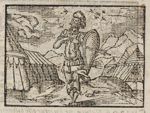
Perfidus familiaris: Aneau, Picta poesis (Lyon, 1564), emblem 9 uses the imagery of Brasidas
Victoria cruenta: Whitney, A choice of emblemes (Leiden, 1586), emblem 147 uses the imagery of Brasidas
Iconclass: 31E234631 violent death by sword 58AA12 Self-destruction
Collectanea (1500): 53
Loci Communes: Malum accersitum aut retortum (Evil brought upon oneself or turned back, Mal attiré ou retourné)
I i 52 Indicit in foveam quam fecit He fell into the pit which he had made
Idem pollet illud quod in Odis Davidicis refertur psal. vii. Λάκκον ὤρυξε καὶ ἀνέσκαψεν αὐτὸν, καὶ ἐμπεσεῖται εἰς βόθρον, ὅν εἰργάσατο. i. Lacum fodit & aperuit eum, & incidet in foveam quam fecit. Translatum vel ab his, qui foveis effossis, aut reliquis id genus decipulis insidiantur feris: vel à bellis, in quibus aliquoties suffossis cuniculis hostis hostem captat.
The same meaning is found in that passage of the Odes of David, Psalm 7: 'He made a pit, and digged it, and is fallen into the ditch which he made.' Adapted from those who dig pits or other snares and decoy wild animals into them; or else from wars, in which one enemy sometimes tries to capture another by means of underground tunnels.
Facsimile:
Talio: Bornitz, Emblematum sacrorum et civilium miscellaneorum (Heidelberg, 1659), emblem 23
Iconclass: 25H115 pit, hole 31A2731 falling 31E2348 violent death ~ being thrown (from a height), being thrown into a pit 58AA12 Self-destruction
Loci Communes: Malum accersitum aut retortum (Evil brought upon oneself or turned back, Mal attiré ou retourné)
I i 53 Suo ipsius laqueo captus est He was caught in his own noose
Nec aliud sibi vult, quod apud eundem legitur psal. ix. Εν παγίδι ταύτῃ, ᾖ ἔκρυψαν, συνελήφθη ὁ ποὺς αὐτῶν. i. In ipso laqueo quem absconderant, comprehensus est spes eorum. Nota metaphora, nempe mutuo sumpta ab his, qui instructis pedicis, avibus aut feris insidias tendunt.
Much the same is what we read in the same author, Psalm 9: 'In the net which they hid is their own foot taken.' A well-known metaphor, taken from those who spread out snares and lie in wait for birds or beasts.
Facsimile:
Iconclass: 43C1(+4141) sports, games ~ animals (+ snare) 58AA12 Self-destruction
Loci Communes: Malum accersitum aut retortum (Evil brought upon oneself or turned back, Mal attiré ou retourné)
I i 54 Hanc technam in teipsum struxisti You constructed this device against yourself
Eandem sententiam aliter expressit Lucianus: Ὥστε σόφισμα κατὰ σαυτοῦ συντέθεικας .i. Itaque commentum in tuum ipsius exitium reperisti. De haeredipeta, qui quum divitem ex asse haeredem scripsisset, ac testamentum protulisset, quod divitem ad idem faciendum provocaret, tecti ruina subito oppressus est, ac sua reliquic illi cuius facultatibus inhiarat. Utendum erit, cum dolus in alterum excogitatus, in caput autoris recidit, ita ut non raro consuevit accidere.
The same idea is expressed in another way by Lucian: 'So you came a cropper owing to your own invention.' This concerns a man who was looking for an inheritance, and wrote down a rich man as his only heir and showed him the will, hoping that the said rich man would do the same by him. But suddenly the roof collapsed and crushed the testator, so that he left everything to the very man whose wealth he had coveted. This should be used when a trick intended for another person rebounds on to the head of its originator, a thing which quite often happens.
Facsimile:
Iconclass: 57AA6131 Guile, Artfulness, Craftiness, Deceitfulness 58AA12 Self-destruction
Loci Communes: Malum accersitum aut retortum (Evil brought upon oneself or turned back, Mal attiré ou retourné)
I i 55 Turdus ipse sibi malum cacat The thrush's droppings are its own harm
His similimum est illud Graecorum adagium: Κίχλα χέζει αὑτῇ κακὸν. id est, Turdus ipse sibi malum cacat. In illos dici solitum, qui sibiipsis ministrarent exitii causam. Siquidem viscum, autore Plinio, non provenit, nisi maturatum in ventre, ac redditum per avium alvum, maxime palumbium ac turdorum. Cuius rei meminit & Servius in sextum Aeneidos. Aristoteles item lib. De natura animantium ix. tria turdorum genera facit, quorum primo ἰξοβόρον vocatum ait: aut, ut Atheneus, ἰξοφὰγον, nimirum quod visco vescatur. Quoniam autem visco capiuntur aves, ipsae si malum cacant videlicet. Plautus paulo diversius extulit: Ipsa, inquiens, sibi avis mortem creat. Quanquam equidem non dubitem affirmare, à Plauto cacat non creat fuisse scriptum: deinde locum à quopiam semidocto, & Graecanici proverbii ignaro depravatum, supposita voce adulterina creat. Sophocles in Antigone: Ος τισ δ' ἀνωφέλητα φυτεύει τέκνα, Τί τόν δ' ἂν εἴποις ἄλλο, πλὴν αὐτῷ πόνους Φῦσαι, πολὺν δὲ τοῖσιν ἐχθροῖσιν γέλων; id est, Inutiles quicumque liberos serit, Quid aliud hunc, quàm sibi creare dixeris Ipsi dolores, atque risum malevolis? In hos igitur quadrabit paroemia, aut in eos, qui potentes sibi generos asciscunt, à quibus postea per vim opprimantur.
Very like these is the Greek adage: Κίχλα χέζει αὑτῇ κακὸν, The thrush's droppings are its own harm. It is used of those who procure for themselves the cause of their ruin. In fact, according to Pliny, birdlime is only produced by being matured in the stomach and passed out through the bowels of birds, especially of doves and thrushes. Servius mentions this in his commentary on Aeneid 6. Aristotle in the Nature of Animals, book 9, distinguishes three sorts of thrush, the first called ixoboron, or as Athenaeus says ixophagon, because it feeds on mistletoe. Since birds are caught by birdlime, it is clear that their droppings are their own harm. Plautus has it a little differently: 'the bird itself,' he says, 'creates its own death.' But I have no doubt that Plautus really wrote cacat (excretes) rather than creat (creates), and that the passage was then corrupted by some half-educated person who did not know the Greek proverb, and substituted the wrong term creat. Sophocles in Antigone:
He who begets unhelpful sons,
What would you say save troubles for himself
He breeds, and for his foes a laughing-stock?
The proverb will fit this case, or the case of those who take to themselves powerful sons-in-law, who later become their oppressors.
Facsimile:
Iconclass: 25F32(THRUSH)(+4591) song-birds: thrush (+ excrement, dung of animal(s)) 58AA12 Self-destruction
Loci Communes: Malum accersitum aut retortum (Evil brought upon oneself or turned back, Mal attiré ou retourné)
I i 56 Ipse sibi mali fontem reperit He himself discovered the source of his woe
Extat item apud eosdem senarius proverbio celebratus, Αὐτὸς γὰρ εὖρε τοῦ κακοῦ την πη τύαν. id est. Ipsius mali sibi reperit coagulum. Aut, Αὐτὸς εὖρε τοῦ κακοῦ πηγήν. id est, Ipseλβ reperit mali fontem. Sic Aeschυλθσ in Persis: Νῦν κακῶν ἔοικε πηγὴ πᾶσιν εὑρῆσθαι φίλοις. id est, Nunc mali fons est repertus, ut videtur omnibus. Versus est Trochaicus. Sunt enim & perniciosi fontes, quorum aqua gustata mortem, aut insaniam adferat, quos praestiterat non reperisse.
There is also among the same people a line in frequent use as a proverb, Αὐτὸς γὰρ εὖρε τοῦ κακοῦ την πητύαν, He found himself the bond of his misfortune, Or Αὐτὸς εὖρε τοῦ κακοῦ πηγήν, He found himself the fountain of his woe. So Aeschylus in the Persae: 'Now, it seems that a fountain of evil / Has been discovered for all our friends.' This is a trochaic line. There are in fact noxious springs, and to taste the water from them causes death or insanity; it would have been better not to have discovered them.
Facsimile: 
Iconclass: 51C1 Cause 58AA12 Self-destruction
Collectanea (1500): 135
Loci Communes: Malum accersitum aut retortum (Evil brought upon oneself or turned back, Mal attiré ou retourné)
I i 57 Capra gladium The goat (found) the sword
Eodem ferme pertinet, ἂιξ μάχαιραν. id est, Capra gladium. subaudi, reperit. In eos dicitur, qui ipsi reperiunt, quo pereant. Ortum est autem adagium ab huiusmodi quodam eventu. Olim cum Corinthii Iunoni Acraeae, nam id illi cognomen, rem divinam facere pararent: huius Iunonis statuam aiunt à Medea positam fuisse: atque hi, qui ad praebendam hostiam erant conducti, defosso sub terra cultro, oblitos sese assimularent, capra pedibus excalpens eum eruit, prodiditque: itaque mactata est. Quidam sic efferunt paroemiam: ἂιξ δοῦσα τὴν μάχαιραν. id est, Capra cultrum praebens. Quidam hoc pacto: ὄϊς τὴν μάχαιραν. id est. Ovis cultrum.
This belongs to the same kind, ἂιξ μάχαιραν, The goat (found, understood) the sword. This is said of those who themselves discover what is to ruin them. It arose from the following circumstance. Once when the Corinthians were preparing to celebrate the rites of Acraean Juno (for that was the name given to her, and it is said that a statue of this Juno was set up by Medea), and those who had been hired to provide the sacrificial victim buried the knife in the ground and pretended to have forgotten it, the goat scratching with its feet uncovered the knife, dug it out and was thereupon sacrificed with it. Some give the form of this adage as 'the goat supplying the knife,' and others as 'the sheep (supplies) the knife.'
Facsimile:
Iconclass: 45C13(SWORD) hacking and thrusting weapons: sword 47I214 goat
Loci Communes: Malum accersitum aut retortum (Evil brought upon oneself or turned back, Mal attiré ou retourné)
I i 58 Cornix scorpium The crow (caught) the scorpion
His confine est & illud, Κορώνη τὴν σκορπίον. id est, Cornix scorpium, subaudi, rapuit Quadrat in hos, qui parant eos laedere, unde tantundem mali sint vicissim accepturi. Quemadmodum cornix correpto scorpio, arcuata illius cauda, vulnus accepit letale, periitque. Extat super hac re Graecum epigramma Archiae, quod non gravabor adscribere. Εν πότε παμφαίνοντι μελάντερος αἰθέρα ναίων, Σκορπίον ἐκ γαίης εἷδε θορόντα κόραξ. Ον μάρψας ὥρουσεν, ὁ δ' ἀΐξαντος ἐπ' οὗδας Οὐ βραδὺς, εὐκέντρῳ πὲζαν ἒτθψε βέλει Καὶ ζωῆς μιν ἄμερτεν. ἴδ' ὅσσον ἔτευχεν ἐπ' ἄλλῳ, Εκ κείνου τλήμω αὐτὸς ἔδεκτο μόρον.. id est, Scorpius è terra prorepserat, idque vidente Corvo, qui coelo victitat in liquido. Corripuit visum, fugitque: sed hic ut humum ales Contigerat, telo mox ferit atque necat. Ecce tibi, quod in hunc avis insidiosa parabat, Inde sibi accivit ipsa necem misera. Atque id in rebus humanis frequenter usu venire solet, ut qui cepisse videatur, ipse captus sit. Quemadmodum & Horatius: Graecia capta ferum victorem cepit.
Close in meaning also is this, Κορώνη τὴν σκορπίον, The crow (caught) the scorpion. It fits those who are preparing to harm others, by whom they in turn will suffer just as much harm. The crow seized a scorpion, but its tail curved up and the crow got a fatal wound and died. There is a Greek epigram about this by Archias, which I am not unwilling to translate:
A scorpion had crept from the earth, and a crow
Spied it as he sought his living in the limpid sky.
He snatched what he saw and fled. But just as the bird
Touched the ground, the scorpion struck with his sting, and killed him.
Behold, the death the insidious bird was preparing
For the other, the wretch achieved it for himself.
And in human affairs it often happens that the one who seems to be the captor is himself caught. So Horace writes: 'Thus captive Greece took her rude victor captive.'
Facsimile:
Iusta ultio: Alciatus, Emblemata (Leiden, 1591), emblem 172
Tel cuyde vaincre, qui en fin est vaincu: La Perrière, Le theatre des bons engins (Lyon, 1545), emblem 84 uses the imagery of the goshawk who hunts a partridge but is caught himself instead, to express the same moral the adage conveys with the imagery of a crow and a scorpion
Iconclass: 25F32(CROW) song-birds: crow 25F715 scorpions
Collectanea (1500): 263
Loci Communes: Malum accersitum aut retortum (Evil brought upon oneself or turned back, Mal attiré ou retourné)
I i 59 Calidum prandium comedisti You have eaten a hot dinner
Huc alludere videtur & Plautinum illud; Calidum hodie prandium prandidisti, id est, Fecisti, quod tibi magno malo sit futurum. Ab his sumptum, qui se noxiis ac letiferis ingurgitant cibis, postea ventris tormina sensuri.
The following sentence of Plautus seems to refer to this: 'Today you have eaten a hot dinner,' that is, you have done something which will cause you great trouble. This comes from people who stuff themselves with unwholesome and deadly food and are likely to feel the pains of colic.
Facsimile:
Iconclass: 31E23319(+0) violent death by overfeeding, force feeding (+ variant) 31E23331(+0) violent death by poison in food (+ variant)
Loci Communes: Malum accersitum aut retortum (Evil brought upon oneself or turned back, Mal attiré ou retourné)
I i 60 Irritare crabrones To stir up hornets
Τᾶς σφηκιὰς ἐρεθίζειν. i. Iritare crabrones. Ad hanc sententiam referendum est & illud, quod est apud Plautum in Amphit. Iritabis crabrones. Id dictum est à poeta in mulierum ingenium: quibus iratis si repugnes, magis provoces, neque sine tuo malo discedas. Est autem crabro insecti genus affine vespis, pertinacissimum aculeoque pestilentissimo. Siquidem refert Plinius Naturalis hist. lib. xi. cap. xxi . crabronum ictus haud temere sine febri esse. Additque traditum à quibusdam, ter novenis huius animantis punctis interfici hominem. Aristot. lib. De partibus animalium ix. praeter alia quae de crabronibus commemorat, illud quoque tradit, cum in apum genere quaedam aculeis careant, ut fuci, & reges, vespae quoque nonnullae sine aculeis inveniantur, nulli crabrones reperiuntur non armati aculeo. Quanquam de duce, num aculeatus sit, nonnihil addubitat. Utitur hoc adagio Divus Hieronymus in quadam epist. Eandem sententiam sic idem extulit Plautus, mutata allegoria, Bacchae bacchanti si velis adversarier, Ex insana insaniorem facies: feriet saepius. Sin obsequaris, una te solvas plaga. Nam mos erat, uti Bacchanalia celebrantes obvios thyrsis ferirent. Aristoph. in Lysistrata, nam hoc titulo inscriptam comperi: Ην μήτις, ὥσπερ σφηκιὰν βλίττῃ με κ' ἐρετίζῃ. Nisi si quis uti vesparium, fraudet me, stimuletque. Allusit hunc, opinor, qui scripsit epitaphium Archilochi, poetae maledici, Ηρέμα δὴ παράμειψον ὁδοιπόρε. μή ποτε τοῦδε Κινήσῃς τύμβῳ σφῆκας ἐφεζομένους.. id est, Ne fors crabrones qui huic insedere sepulcro, Irites, tacitum carpe viator iter. Xenoph. lib. iiii. indicat unde natum sit: nimirum ab his, qui student eximere vespas ab antris suis. ὁρῶ δ' ἔγω γ', ἔφη, καὶ ὁπόσοι σφῆκας ἐξαιρεῖν βούλονται, ἐὰν μὲν ἐκθέοντας τοὺς σφῆκας πειρῶνται θηρᾶν, ὑπὸ πολλῶν τυπτομένους. id est, Et ego, inquit, video etiam eos quicunque crabrones excipere volunt, siquidem evolantes conentur venari, à multis feriri crabronibus.
Τᾶς σφηκιὰς ἐρεθίζεινTo stir up hornets. To this saying we must refer what Plautus has in the Amphitryo, `You'll stir up the hornets.' Here the poet is using it against the mentality of women: once they have been annoyed, you will only provoke them more by having a fight and you will get the worst of it. The hornet is a kind of insect related to the wasp; highly pertinacious and with a most virulent sting. Pliny in the Natural History, book ii chapter 21, says that the sting of a hornet hardly ever fails to cause fever. He adds that according to some accounts a man is killed by thrice nine stings from this insect. Aristotle in book 9 of On the Parts of Animals remarks, among the other things he says about hornets, that while there are some bees which have no sting, such as drones and queens, and some stingless wasps are also to be found, no hornet is ever discovered unarmed with a sting. But whether the leader has a sting, he is in some doubt. St Jerome uses this adage in one of his letters. Plautus expresses the same idea with a change of metaphor:
Oppose a bacchant in her bacchic frenzy:
You'll make the mad madder and get hit the more;
Yield to her then, and get off with one blow.
The custom was that those who celebrated the Bacchanalia would strike the bystanders with their wands. Aristophanes in the Lysistrata (for that is the name I find given to it): 'Unless someone should, as it were, rob / My wasp's nest and provoke me'. It is to this, I think, that the writer refers who wrote the epitaph on Archilochus the scurrilous poet: 'Stranger, on tiptoe pass, and do not wake / The wasps for ever perched upon his tomb.' Xenophon in his fourth book explains how the proverb arose, namely from efforts to drive wasps out of their nests: 'And I see, he said, that those too who want to drive wasps out of their nests, if they try to catch them as they are flying out, are stung by many of them.'
Facsimile: 

Maledicentia: Alciatus, Emblemata (Leiden, 1591), emblem 51
Dulcia quandoque amara fieri: Alciatus, Emblemata (Leiden, 1591), emblem 60
Iconclass: 25F711(HORNET)(+511) insects: hornet (+ animal(s) threatening) 54DD31(+0) Interruption, Cessation (+ variant)
Collectanea (1500): 54
Loci Communes: Lacessentis (Provoking, Provoquer); Malum accersitum aut retortum (Evil brought upon oneself or turned back, Mal attiré ou retourné)
I i 61 Leonem stimulas You are goading the lion
Consimilem vim habet, quod à Diogeniano refertur, τόν λέοντα νύπτεις, id est, Leonem pungis, seu vellicas. De his, qui potentem ac ferocem in suum ipsius exitium provocant atque extimulant. Notior est metaphora, quàm ut sit explicanda.
The same force belongs to the proverb mentioned by Diogenianus, τόν λέοντα νύπτεις, You are pricking, or pinching, the lion. This applies to people who provoke and goad someone powerful and fierce, to their own destruction. The metaphor is too well known to need explanation.
Facsimile:
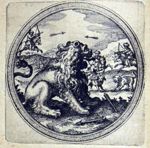
Sese terrore tuetur: Zincgreff, Emblematum Ethico-politicorum (Heidelberg, 1619), emblem 5 uses the adage's imagery of attackers being afraid of a fierce lion
Iconclass: 25F23(LION)(+511) beasts of prey, predatory animals: lion (+ animal(s) threatening) 46C1461 prick, goad
Loci Communes: Malum accersitum aut retortum (Evil brought upon oneself or turned back, Mal attiré ou retourné)
I i 62 Malum bene conditum ne moveris Do not disturb a well-surpressed evil
Idem pollet & illud: Μὴ κινεῖν κακὸν εὗ κείμενον, id est, Ne moveris malum bene conditum, sive quiescens. In eos, qui sua stultitia sibi turbas excitant: aut qui mala iam tempore sepulta resuscitant renovantque. Proverbium retulisse videtur Theognis hoc versu, Πολλάκι γὰρ τὸ κακὸν κατακείμενον ἔνδον ἄμεινον. id est, Nam persaepe malum praestat domi habere repostum. Huic simillimum est illud: Sopitos suscitat ignes.
The same meaning lies in this phrase, Μὴ κινεῖν κακὸν εὗ κείμενον, Do not disturb a well-suppressed evil, or one which is inactive. This is aimed at those who stir up trouble for themselves by their own stupidity, or who resurrect and revive old abuses long buried. Theognis seems to have recalled the proverb in this line: 'For ofttimes it is best to hide away evil at home.' Very like this is that other phrase, 'He rouses sleeping fires.'
Facsimile:
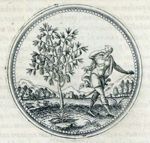
Iconclass: 52B5112 Bad, Evil, Wrong
Collectanea (1500): 640
Loci Communes: Malum accersitum aut retortum (Evil brought upon oneself or turned back, Mal attiré ou retourné)
I i 63 Octipedem excitas You are waking up Eight-feet
Cratinus in Thrattis apud Suidam, ὀκτώπουν ἀνεγείρεις. id est, Octipedem excitas, nimirum scorpium, cui pedes sunt octo, ac plerunque sub saxis abditus cubat, quem non nisi tuo periculo suscites propter venenum, quod in cauda gestat.
Cratinus in his Thrattae, quoted by Suidas, ὀκτώπουν ἀνεγείρεις, You are waking up Eight-feet, that is, the scorpion, which has eight feet and usually lies hidden and dormant under a stone; you rouse him at your peril, because of the poison he carries in his tail.
Facsimile:
Iconclass: 25F715 scorpions 31B17 waking up
Loci Communes: Malum accersitum aut retortum (Evil brought upon oneself or turned back, Mal attiré ou retourné)
I i 64 Movere Camarinam To move Camarina
Κινεῖν τὴν καμαρίνην. id est, Movere Camarinam, est sibiipsi malum accersere. Lucianus De apophrade: ὁρᾷς ὡς ἄμεινον ἧν σοι ἀκίνητον τὴν Καμαρίναν ἐᾶν. id est, Vides quanto satius tibi fuerit, Camarinam immotam sinere. Unde natum sit adagium, Servius grammaticus explicat, Virgilianum illum locum enarrans in tertio Aeneidos, Et fatis nunquam concessa moveri Apparet Camarina procul. Camarina, inquit, palus est iuxta oppidum eiusdem nominis, quae cum olim siccata, pestilentiam creasset, consuluerunt oraculum an penitus eam desiccare praestaret. Vetuit deus Camarinam moveri. At illi exiccarunt, non obtemperantes oraculo & cessavit quidem pestilentia, sed per eam ingressis hostibus poenas dederunt neglecti oraculi. Eadem fermè commemorat & Suidas, illud insuper addens, quibusdam Camarinam esse fruticem, cuius ramos si quis commoveat quatiatque, tetrum quendam odorem aedere. Verum mihi superior sententia magis videtur ad verisimilitudinem accedere. Meminit huius adagii Stephanus quoque versu heroico, effertque ad hunc modum, Μὴ κινεῖν Καμαρίναν, ἀκίνητος γὰρ ἀμείνων Ne moveas Camarinam, etenim non tangere praestat. Ait autem Camarinam oppidum, & eiusdem nominis paludem esse in Sicilia. Meminit & Silius libro decimoquarto Maronem imitatus, Et cui non licitum fatis Camarina moveri.
Κινεῖν τὴν καμαρίνην, To move Camarina, is to bring trouble upon oneself. Lucian in Apophrade: `You see that it would have been better for you to leave Camarina unmoved.' The origin of the adage is explained by Servius the grammarian, in commenting on that passage of Virgil in Aeneid 3: 'And Camarina shows up far away, / Ne er to be moved; so have the fates decreed.' 'Camarina,' he says, 'is a fen near the town of that name, which once exhaled pestilence when it dried up. The people consulted the oracle to ask whether they would be doing right to drain it altogether. The God forbade them to move Camarina. But they did drain it, instead of obeying the oracle, and the pestilence ceased; but their enemies came in across it, and they were well punished for not attending to the oracle.' Suidas mentions this too, with an additional explanation, that some say camarina was a shrub, whose branches gave off a foul smell if anyone disturbed or shook them. But it seems to me that the former opinion comes nearer to the likeness of truth. Stephanus mentions this adage also, in a hexameter line, and reports it in this fashion: 'Move not Camarina, for it is best not moved.' But he says Camarina is a town, and a marsh of that name, in Sicily. Silius mentions it in book 14, imitating Virgil: 'And Camarina, which the fates would not allow to be moved.'
Facsimile:
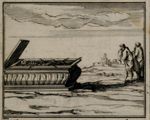
Camarinam ne moveto - Lass den Schmutz ungestört: Callot, Lux claustri, emblem 20
Iconclass: 25H19 swamps and polders 61D(CAMARINA) geographical names of countries, regions, mountains, rivers, etc. (CAMARINA) (CAMARINA)
Loci Communes: Malum accersitum aut retortum (Evil brought upon oneself or turned back, Mal attiré ou retourné)
I i 65 Anagyrum commoves You are moving Anagyrus
Superiori neutiquam dissimile videtur illud apud Graecos celebratum, ἀνάγυρον κινεῖς. id est, Anagyrum commoves. In eos, qui sibiipsis malorum autores essent: quique in suam ipsorum perniciem quempiam iritarent. Unde ducta sit paroemia, varie narratur ab autoribus. Alii ad fruticis naturam referunt, cuius meminit in tertio lib. Dioscorides, quem quidam magyrum, quidam anagyrum appellent: nonnulli acopon, medicamentis quidem effi cacem, verum odore maiorem in modum gravi, maxime si manu teratur: cuius fructus gustatus vehementem vomitum promovet. Unde vel ab odoris molestia, quae carpentem consequitur, adagium ductum videri potest, quandoquidem & acopi vocabulum indidem apparet repertum: vel à concitandi vomitus efficacia. Meminit huius & Plinius lib. xxvii. cap. iiii. Sunt, qui dicant Anagyrum locum esse in Attica quae ad tribum pertineat Erecthteidem, autore Stephano, ubi frutex quidam gravissimi odoris plurimus proveniat, ut anagyrum pro frutice non secus accipiamus, quàm Anticyram pro elleboro. Rursum alii Anagyrum genium quendam existimant, qui propter violatum sacellum suum vicinos omnes funditus everterit. Atque huius adagii mentionem fieri apud Aristophanem in Lysistrata. Et sanè apud Aristophanem locus sic habet: Πόθεν εἷσιν; ἀναγυρουντόθεν νὴ τὸν Δία Ο γοῦν ἀναγυρός μοι κεκινῆσθαι δοκεῖ. id est, Unde advenit? ab Anagyro. ergo per Iovem Anagyrus esse motus apparet mihi. Suidas huiusmodi fermè commemorat: Anagyrasion quendam genium fuisse, sic à loco quem diximus, cognominatum, qui senem vicinum, quod lucum suum incidisset, hunc ad modum ultus sit. Senis concubinae insanum quendam amorem immisit in illius filium: quae cum adolescentis animum pellicere non posset, eum ultro apud patrem detulit, quod sese de stupro non desineret interpellare. Pater persuasus à muliere, filium è tecto praecipitem dedit ac interemit. Deinde facti poenitens, semetipsum laqueo praefocavit. Postremo mulier sese in puteum abiecit. Atque huius fabulae citat autorem Hieronymum, haud scio quem, in opere De tragoediarum scriptoribus.
Very little different from the foregoing is the saying, current in Greek: ἀνάγυρον κινεῖς , You are moving Anagyrus. It fitted those who were the authors of their own misfortunes, and who provoked another and so brought about their own downfall. The origin of the proverb is related differently by the authorities. Some refer it to the nature of the shrub which is mentioned by Dioscorides in his third book, and which some call magyrus and others anagyrus, and others again acopon, efficacious as a medicine, but having a very strong odour, especially when rubbed by the hand; the fruit when eaten produces violent vomiting. The proverb seems to arise either from the disagreeable smell which results from cutting it (since indeed the word acopon is evidently traceable to the same source), or else from its power of producing vomiting. Pliny also mentions this, book 27 chapter 4. There are those who say that Anagyrus is a place in Attica, which belongs to the Erechtheid tribe (my authority is Stephanus), where there is a prolific growth of a certain bush with a heavy odour, so that we take the name anagyrus for the shrub, just as Anticyra is used for the hellebore. Others again think that Anagyrus is the name of a certain local deity, whose sanctuary was violated, and who for this reason destroyed all those living in his vicinity. This adage is mentioned by Aristophanes in the Lysistrata. And in fact the passage in Aristophanes runs thus: 'Whence come they? From Anagyrus, by Zeus. At least it seems we've stirred up Anagyrus.'
Suidas tells roughly the following story: Anagyrasius was a certain tutelar deity, named so from the place just mentioned, who took revenge on an old man living close by, because he had cut down his grove; and this is how he did it. He sent a furious passion for the old man's son into the heart of the father's concubine, who when she found that she could not entice the young man, took the step of accusing him to his father, saying that he continually pestered her to commit adultery. The father, persuaded by the woman, threw his son down from the roof and killed him. Then, overcome with remorse for the deed, he hanged himself. Finally the woman threw herself into a well. As authority for this story he cites a certain Hieronymus, I am not sure who, in a work entitled On Writers of Tragedy.
Facsimile: 
Iconclass: 25G31(ANAGYRUS) shrubs (ANAGYRUS) 31A332 disagreeable, repellent smell 58AA12 Self-destruction 12E13(ANAGYRASIUS) representations ~ gods, demi-gods, heroes, etc. (ANAGYRASIUS) (ANAGYRASIUS)
Collectanea (1500): 723
Loci Communes: Malum accersitum aut retortum (Evil brought upon oneself or turned back, Mal attiré ou retourné)
I i 66 Capra contra sese cornua The goat (turns) its own horns against itself
Η ἂιξ καθ' ἑαυτῦς τὰ κέρατα. id est, Capra contra semetipsam cornua. Ad superiorum classem pertinet, ab apologo natum. Capra quaepiam cum esset iaculo vulnerata, circumspectans, undenam id mali sibi evenisset, arcum contemplans, caprinis cornibus compactum, dixit ad hunc modum, κατ' ἑμαθτῆς ἔφυσα τὰ κέρατα. id est, In meam ipsius perniciem produxi cornua.
Ἡ ἂιξ καθ' ἑαυτῦς τὰ κέρατα, The goat (turns) its horns against itself. This belongs to the preceding group, and comes from a fable. A goat, wounded by an arrow, looked round to see where this hurt had come from, and seeing the bow made of goat's horn, it said, 'I grew those horns for my own destruction.'
Facsimile:
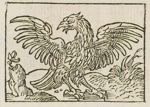
Ostons de nous cela qui nous deçoit: La Perrière, Le theatre des bons engins (Lyon, 1545), emblem 52 uses the imagery of the eagle, like the goat of the adage's comment, being shot with an arrow of its own feathers
Iconclass: 47I214(+9332) goat (+ antlers; horn) 58AA12 Self-destruction
Loci Communes: Malum accersitum aut retortum (Evil brought upon oneself or turned back, Mal attiré ou retourné)
I i 67 Atlas coelum Atlas (supported) the sky
Ατλας τὸν οὐρανὸν. id est, Atlas caelum, subaudiedum, ὑπεδέξατο. id est, suscepit. Dici solitum de his, qui sese magnis & molestis involuunt negociis, ipsique sibi malum accersunt. Nam hic Coelum hospitio excepit. Deprehensus autem, quod illi struxisset insidias, praeceps datus est in mare Atlanticum. Porrò notior est, quam ut hoc loco sit referenda, de Atlante fabula, coelum humeris & vertice sustinente.
Ατλας τὸν οὐρανὸν, Atlas the sky (supported, understood). This is said about people who get themselves entangled in great and grievous matters, thus seeking out trouble for themselves. For this man received hospitality in heaven; but caught in the act of laying an ambush against it, he was flung into the Atlantic Ocean. But really there is no need to relate here the well-known story of Atlas, supporting the sky on his head and shoulders.
Facsimile:
Sustinet nec fastidit: De la Feuille, Devises et emblemes anciennes et modernes (Augsburg, 1697), emblem 390
Atlante maior: Vaenius, Amorum emblemata (Antwerp, 1608), emblem 19
Nemo duobus: De Montenay, Cent Emblèmes Chrestiens (Frankfurt, 1619), emblem 56
Sustinet, nec fatiscit: Giovio, Dialogo dell' Imprese (Lyon, 1574), emblem 92
Iconclass: 54DD4 Difficulty 91B13661 Atlas supporting the heavens on his shoulders
Loci Communes: Malum accersitum aut retortum (Evil brought upon oneself or turned back, Mal attiré ou retourné)
I i 68 Deus ex improviso apparens Unexpected appearance of a god
Θεὸς ἀπὸ μηχανῆς ἐπιφανεὶς. id est, Deus ex improviso apparens. In eos dicitur quibus in rebus perplexis praeter spem exoritur aliquis qui salutem adferat, negociique difficultatem expediat. Sumptum est à consuetudine tragoediarum, in quarum plerisque machinis quibusdam deus aliquis ostendebatur: idque non in scena ipsa, sed è sublimi, qui repentè commutatis rebus fabulae finem imponeret. Id quod testatur & M. Tullius lib. De natura deorum primo, ut cum sic ait: Quod quia quemadmodum natura efficere sine aliqua mente possit, non videtis, ut tragici poetae, cum explicare argumenti exitum non potestis, confugitis ad deum: cuius operam profecto non desideraretis, si immensam & interminatam in omneis partes magnitudinem regionum videretis. Nec dubium est, quin Tullius imitatus hic sit illud ex Platonis Cratylo: Εἰ μὴ ἄρα δὴ, ὥσπερ οἱ τραγῳδοποιοὶ, ἐπειδάν τι ἀπορῶσιν, ἐπὶ τὰς μηχανὰς ἀποφεύγοθσι, θεοὺς αἴροντες. i. Nisi sanè, quemadmodum tragoediarum scriptores, sicubi haeserint, ad machinas confugiunt, deos sustollentes. Quem Platonis locum ob ignoratum proverbium, Latinus interpres perperam aut certe obscure vertit. Nimirum hunc in modum: Nisi fortè quemadmodum tragici, quoties ambigunt, commenticiis quibusdam machinamentis ad deos confugiunt. Ad eundem lapidem impegisse videtur qui Lysandri vitam transtulit è Plutarcho. Quum enim Lysander instituisset innovare remp. perpenderetque negocium esse difficlius quam ut vulgaribus consiliis posset expediri, fecit quod poetae solent in tragoedia, fictis oraculis ac deorum religione studuit quod constituerat efficere. Graeca sic habent, ὥσπερ ἐν τραγῳδίᾳ μηχανὴν αἴρων πρὸς τοὺς πολίτας, λόγια πυθόχρηστα καὶ χρησμοὺς συνετίθει καὶ κατεσκεύασεν. id est, Quemadmodum in tragoedia machinam tollens apud cives, responsa velut à Pythio red dita & oracula componebat apparabatque. Idem subobscure, sed sanè quam eleganter, indicat Arist. lib. τῶν μετὰ τὰ φυσικὰ primo, Αναξαγόρας τε γὰρ, inquiens, μηχανῇ χρῆτας τῷ νῷ πρὸς τὴν κοσμοποιΐαν. ὅτ' ἂν γὰρ ἀπορήσῃ διά τινα αἰτίαν ἐξ ἀνάγκης ἐστι, τότε ἕλκει αὐτόν. ἐν δὲ τοῖς ἄλλοις πάντα μάλλον αἰτιᾶται τῶν γινομένων ἢ νοῦν. Quae quidem verba sic licebit vertere: Nam Anaxagoras mente perinde, quasi deo quopiam tragico, qui repente solet ostendi, utitur ad condendum mundum. Etenim cum haeret in explicanda causa, quare necessario sit, tum illam adducit. Porrò reliquis in rebus, quidvis potius causam facit eorum quae fiunt, quam mentem. Unde in Graecorum tragoediis illud penè solenne est: Πολλαὶ μορφαὶ τῶν δαιμονίων. i. Multae formae deorum, &c. Cum inducto numine fabulam explicant: veluti in Oreste Eurip. Apollo in mediis tumultibus apparens res turbatissimas subito componit. Huius rei exemplum videtur ab Homero ductum, qui quemadmodum Iliad. i. Palladem inducti, ut ferocientem Achillem compesceret, ita compluribus aliis locis numen aliquod allegat. Quod quidem Horat. in Arte poet. vetat in comoediis fieri, nisi rerum difficultas maior sit, quam up possit humana ope explicari: Nec deus intersit, nisi dignus vindice nodus Inciderit. Qua ratione Plaut. in Amphyt. Iovem induxit, eoque tragico comoediam vocat. Lucianus in Philops. Καὶ τὸ τοῦ λόγου, θεὸν ἀπὸ μηχανῆς ἐπεισκληθῆναί μοι τοῦτον ῴμην ἀπὸ τῆς τύχης. id est, Ac iuxta proverbium, arbitrabar hunc mihi perinde quasi deum quempiam repente apparentem, à fortuna fuisse adductum. Allusit eodem in lib. De mercede servientibus: Οἰκεῖοι γὰρ τῆς τοιαύτης τραγῳδίας οὖτοι γε, ἢ τιν' ἄλλον ἐκ μηχανῆς θεὸν ἐπὶ τῷ καρχησίῷ καθεζόμενον. id est, Nam hi peculiariter ad huiusmodi tragoediam pertinent. Aut alium Deum quempiam de repente exortum, atque in antennis considentem. Huc respexit Eurip. in Iphigenia Aulidensi, θεὸς ἐγὼ πέφηνά σοι μέγιστος. id est, Equidem deus tibi maximus apparui. Lucianus in Sectis, Επιστὰς, τὸ τῶν τραγῳδῶν τοῦτο, θεὸς ἐκ μηχανῆς ἐπιφανείς. id est, Assistens, iuxta tragoedorum proverbium, Deus ex improviso ostensus, apud Athen. lib. vi, lurconem quendam querentem facit poeta nescio quis, quod piscium venditores vix ostensos pisces statim subducerent, Καὶ θᾶττον ἀποπέμπουσι τοὺς ὠνημένους Απὸ μηχανῆς πωλοῦντες, ὥσπερ οἱ θεοί. id est, Et venditos mox eximunt aspectui, Venduntque tamquam è machina, ritu deûm. Proinde quoties salus ex insperato ostenditur, id deo solet adscribi. Ita Plinius lib. xxv. Quippe etiam in repertis alias invenit casus, alias ut vere dixerim, deus. Idem lib. xxvii. Hic ergo casus, hic est ille, qui plurima invenit in vita deus.
Θεὸς ἀπὸ μηχανῆς ἐπιφανεὶς, A god appearing suddenly from the machine. This is applied to people who find, in the midst of their perplexities, some unhoped-for person who comes to their rescue and solves the problem for them. It is taken from a habitual practice in tragedies, in many of which some god was revealed by means of certain machines, not on the stage itself, but coming down from above so that he could finish off the play by a sudden change in the plot. Cicero witnesses to this in book i of the On the Nature of the Gods, as when he says this: 'You on the contrary cannot see how nature can achieve all this without the aid of some intelligence, and so, like the tragic poets, being unable to bring the plot of your drama to a denouement, you have recourse to a god; whose intervention you assuredly would not require if you would but contemplate the measureless and boundless extent of space that stretches in every direction.' There is no doubt that Cicero here is imitating a passage from the Cratylus of Plato: 'Unless, just as the writers of tragedy do when they are at a loss, they take refuge in machines, hoisting up gods.' This passage of Plato has been translated quite wrongly, or at least obscurely, by the Latin translator, because he did not know the proverb. For he puts it like this: 'Unless like the tragic poets, whenever they are undecided, they take refuge with the gods by means of some imaginary machines.' The same stumbling-block seems to have got in the way of the writer who translated the life of Lysander from Plutarch. When Lysander decided to make changes in the state and reflected that the proposition was too difficult to tackle by the ordinary methods, he did what the poets do in tragedy, he planned how to achieve what he wished by means of false oracles and reverence for the gods. The Greek is as follows: 'Just as in a tragedy, bringing a machine before the public, he composed and concocted oracular replies purporting to come from the Pythian Apollo.' The same is indicated rather vaguely, but with true elegance, by Aristotle in his Metaphysics, book T, in words which one may translate as follows: 'For Anaxagoras uses mind, like some god of tragedy suddenly shown forth as a device for the making of the world. And when he is at a loss in explaining the cause of what necessarily is, then he brings in mind. But in all other matters he ascribes the cause to anything rather than to mind.'
Hence there is the frequent phrase in Greek tragedy, 'Many are the forms of the gods, etc.' They work out the plot by the introduction of a god; as in Euripides' Orestes, where Apollo appears in the midst of the uproar and at once settles the disturbed situation. An example of this seems to be taken from Homer, when in the Iliad, book z, he introduces Pallas to placate the enraged Achilles; and he brings forward some divinity in various other places. But Horace, in the Art of Poetry, says that this should not be done in comedy, unless the situation is so difficult that it cannot be unravelled by human effort: 'Nor let a God in person be displayed / Unless the labouring plot deserve his aid.' In agreement with this, Plautus introduced Jove into the Amphitryo and for that reason called it a tragicomedy. Lucian in Philopseudes: 'And I thought that this one was chosen for me by fate as a god from the machine, as the saying goes.' Again in On Salaried Posts: 'For these specially pertain to tragedies of this sort; or some other god from the machine, sitting on the mast-head.' Euripides thought of this in the Iphigenia in Aulis. 'Truly I appeared to you as a great god.' Lucian in The Sects, 'There you stood, like that adage beloved of tragedy-writers, a god appearing from a machine.' In Athenaeus, book 6, some poet or other makes a certain gluttonous fellow complain that the sellers of fish just show their goods and then immediately snatch them away: 'And they quickly remove the goods from sight, / And sell them like gods from the machine.' just so, whenever salvation comes from some unexpected quarter, it is usually ascribed to a god. Thus Pliny writes in book 25: 'Even in what has been discovered chance has sometimes been the finder; at other times, to speak the truth, the finder was a god.' Again, in book 27: 'Therefore this is chance, this is that god who discovered most things in life.'
Facsimile: 
Iconclass: 12B13 representations ~ gods, demi-gods, heroes, etc. (non-Christian religions) 51A4 Presence 52BB3 Surprise, Wonder; 'Maraviglia' (Ripa)
Collectanea (1500): 144
Loci Communes: Praeter spem bonum aut malum (Good or bad beyond expectation, Bien ou mal inattendu); Sera paenitentia (Late repentance, Repentir tardif)
I i 69 Homo homini deus Man is a god to man
Non admodum hinc abludit & illud: ἄνθρωπος ἀνθρώπου δαιμόνιον. id est, Homo homini deus, quod dici solet de eo, qui subitam atque insperatam attulit salutem, aut qui magno quopiam beneficio iuvit. Antiquitas enim nihil aliud existimabat esse deum, quam prodesse mortalibus. Unde frugum, vini, legum, autores, & quicumque ad vitae commoditatem aliquid attulisset, eos pro diis habebat antiquitas: adeo, ut & beluas quasdam pro numinibus coluerit: velut apud Aegyptios ciconiam, quòd serpentes, qui certo anni tempore ex Arabicis paludibus subvolant, obviam profecta, arcere, conficereque credatur: Apud Romanos An serem quod Capitolinam arcem expergefactis clangore custodibus, ab irruptione Gallorum servavit. Quod indicat M. Tullius, cum lib. De natura deorum primo scribit: Concludam, beluas à Barbaris propter beneficium consecratas. Quin & autore Prodico Chio corpora quaedam inanima pro diis habita sunt, velut sol, luna, aqua, terra, quod ad vitam conducere viderentur, quodque horum commoditate mortales maiorem in modum delectarentur. Scythae, quemadmodum in Toxaride testatur Lucianus, per ventum & gladium, tanquam per deos iurant, propterea quòd ille spirandi sit autor, hic mortis. Sed quoniam, ut inquit Cicero, plurima homini ab homine vel commoda, vel incommoda solent oriri, & dei proprium est vel servare, vel benefacere: idcirco qui in gravi periculo succurrit, quíve ingenti quopiam afficit beneficio, quoniam dei quasi vice fungitur, ei cui prodest, deus dicitur extitisse. Huic adstipulatur illa sollennis apud Homerum atque Hesiodum clausula, Θεοὶ δωτῆρες ἐάων. id est, Dii bonorum largitores. Et, quod ait Strabo lib. x. Recte dictum est, mortales tunc maxime deos imitari, cum benefici sunt. Idem libro xvii. tradit, Aegyptios quosdam duplicem facere deum, immortalem, qui rerum omnium sit autor, & mortalem ignoti nominis: tum à quibus be neficio sint affecti, eos fermè pro diis colunt. Praeterea vulgo quoque, qui in rebus perplexis ac desperatis, aut ancipiti periculo servantur, à deo quopiam aiunt sese servatos. Horatius, Sic me servavit Apollo. Rursum in Odis, in bello per Mercurium, & iterum ab arboris ictu sese Fauni ope servatum scribit. Eodem allusit Iuvenalis, cum ait: Quadraginta tibi si quis deus aut similis diis, Et melior fatis donaret homuncio. Item Virgilius in Tityro, O Meliboee, deus nobis haec ocia fecit; Nanque erit ille mihi semper Deus: illius aram Saepe tener nostris ab ovibus imbuet agnus. Deinde reddit causam, quare sit Caesarem loco numinis habiturus, beneficium subtexens: Ille meas errare boves, ut cernis, & ipsum Ludere quae vellem calamo permisit agresti. Plinius Secundus, lib. Naturalis historiae ii. manifestius Graecam παροιμίαν indicavit, sed tam impie sentiens de diis, quam paulo pòst de animarum immortalitate, deque corporum resurrectione desipienter. Nam cum & multitudinem deorum irrisisset, & uni illi summo, quem aut mundum hunc, aut naturam nescio quam esse putat, prorsus ademisset curam mortalium, Deus est, inquit, mortali iuvare mortalem. Et haec ad aeternam gloriam via. Hac proceres iere Romani, hac nunc coelesti passu cum liberis suis vadit maximus omnis aevi rector Vespasianus Augustus, fessis rebus subveniens: Hic est vetustissimus referendi bene merentibus gratiam mos, ut tales numinibus adscribant. Quippe & omnium aliorum nomina deorum, & quae supra siderum retuli, ex omnium nata sunt meritis. Hactenus Plinius. Ovidius: Conveniens homini est hominem servare voluptas, Et melius nulla quaeritur arte favor. Plutarchus in commentario, quem inscripsit Adversus principem indoctum, negat deos hoc nomine felices esse, quod quam diutissime vivant, sed quod virtutis sint principes & autores. Porrò Paulus virtutum summam ad charitatem refert: charitatem autem in eo sitam, ut de quamplurimis quamoptime mereamur. Huc respexit Gregorius Nazianzenus in oratione De cura pauperum: Fias, inquit, aerumnoso deus, misericordiam dei imitando. nihil enim aequè divinum habet homo ac beneficentiam. Quanquam autem apud Christianos dei appellatio non est ulli mortalium vel per iocum communicanda, neque omnino tam insignis tamque foeda adulatio est in mores nostros recipienda: tamen fieri potest, ut huius adagii sit usus, neque improbus, neque in concinnus, si quis hoc modo dicat: Cum tantis malis premerer, ut nemo mortalium aut vellet, aut posset opitulari, tu unus mihi praeter spem extitisti, tuoque beneficio me non servasti modo periturum alioqui, verumetiam ornatiorem aliquanto fecisti, quam antea fuerim. Ut aut omnino nusquam, aut in nobis certe duobus, locum habeat vetus illud Graecorum adagium, ἄνθρωπος ἀνθρώπου δαιμόνιον. Aut hoc modo: Literis debeo omnia, etiam vitam: sed ipsas tibi debeo literas, qui mihi tua liberalitate suppeditas alisque ocium meum. Quid autem est quod Graeci dicunt, ἄνθρωπος ἀνθρώπου δαιμόνιον; si hoc non est? Aut hoc pacto: Qui mediocri beneficio iuvat, sit sanè amicus: verum qui arte sua, singularique cura atque industria vitam iamiam fugientem retinet, ac restituit, id quod utique facit medicus, quid aliudest, quam quod Graeci dictitant, ἄνθρωπος ἀνθρώπου δαιμόνιον; Aut sic: Eum in locum res erat deducta, ut ne ipsa quidem salus posset auxiliari. Ibi tu mihi veluti praesens quoddam numen extitisti, & mira celeritate depulsis incommodis, in pristinum locum restituisti, nec sperantem, nec exspectantem, ut intelligerem illud non temere dictum à Graecis, ἄνθρωπος ἀνθρώπου δαιμόνιον. Aut sic: In reliquis quidem rebus mihi semper amicissimus fuisti: in hac vero causa non amicissimus modo, verumetiam penè dixerim, quod Graeci dicunt, ἄνθρωπος ἀνθρώπου δαιμόνιον.
Not far from this is the phrase ἄνθρωπος ἀνθρώπου δαιμόνιον, Man is a god to man, usually said about one who has conferred sudden and unlooked-for salvation, or who has brought help by some great benefaction. To be a god, thought the ancients, was simply and solely to be of value to mortal men; thus the ancient world made gods out of the originators of grain, wine, laws, anyone who had contributed something to the betterment of life. To such an extent was this true, that they worshipped certain animals, as the Egyptians worshipped the stork, because it was believed to seek out, drive away and kill the snakes which came up at a certain time of year from the marshlands of Arabia. The Romans also held the goose sacred, because its noise woke the guards and so saved the stronghold of the Capitol from the invading Gauls. This is what Cicero means when he writes in the first book of his On the Nature of the Gods: 'I will make my point thus: these animals are deified by the barbarians for the benefits which they confer.'
According to Prodicus of Ceos, some inanimate bodies have been held to be gods, such as the sun, the moon, water, earth, because they seemed conducive to life, and mortals particularly rejoiced in their benefits. The Scythians, as Lucian tells us in Toxaris, swear by wind and sword as if they were gods, because the one gives breath, the other death. But since, as Cicero says, the advantages and misfortunes of men are for the most part derived from mankind, and the special quality of God is to preserve or do good, thus it comes about that whoever brings rescue in dire peril, or is the means of conferring some immense benefit, performs as it were the office of God, and is said to have stood as a god to the beneficiary. Agreeing with this we have that customary expression used by Homer and by Hesiod, 'the gods, the givers of all good things,' and what Strabo says in his tenth book, 'It is rightly said, that it is when mortals are beneficent that they most closely imitate the gods.' The same writer says, in book 17, that for some Egyptians God was twofold: immortal, the creator of all things, and mortal, of an unknown name; and thus they gave almost divine honours to those who conferred benefits upon them. In common parlance, too, people who are preserved in desperate and involved situations, or in deadly peril, say that some god had preserved them. Horace: 'Thus Apollo saved me.' Again in the Odes, he says he was saved in war by Mercury, and once more by Faunus from the fall of a tree. Juvenal makes the same allusion when he says,
Would any god, or godlike man below
Four hundred sesterces on you bestow,
Kinder than fate ...
And Virgil in Tityrus,
O Meliboeus, a god gave us this respite;
To me that man for ever shall be God,
And on his altar fume a tender lamb
From our own flocks ... Then he gives the reason why he will consider Caesar among the divinities, adding the benefit conferred:
He, he it was who gave my cattle leave
To stray thus freely, and myself allowed
The play I wished for with my rustic pipe.
Pliny in the Natural History, book 2, is more clearly referring to the Greek proverb, but speaks as irreverently about the gods as he does a little later about the immortality of souls and foolishly about the resurrection of bodies. For after gibing at the multiplicity of gods, and utterly refusing to attribute the care of mortals to the one supreme divinity which he takes to be either the world or some kind of Nature, he says: 'To be a god is to bring aid to a mortal, though mortal oneself. And this is the way to eternal glory. By this went the great men of Rome, by this now advances with divine step, with his children, Vespasianus Augustus, the greatest ruler of all time, bringing help in disaster. This is the oldest way of giving thanks to those who deserved well, to number them with the gods. For even the names of all the other gods, and those I have recorded above of the stars, have sprung from the merits of men.' Thus far Pliny. Ovid says: "Tis a fitting pleasure for man to save man; / There is no better way of seeking favour.' Plutarch in the essay 'To An Uneducated Ruler' says that the gods are not blessed because they live for ever, but because they are the lords and authors of virtue. Paul, though, places the height of virtue in charity; but charity which consists in doing the greatest good to the greatest number. Gregory of Nazianzus thought of this in his oration On the Care of the Poor: `By imitating the mercy of God you will become God to the sufferer, for man has nothing so divine as kindness.'
Among Christians the name of God ought not to be given to any mortal man even in jest, and such extraordinary and disgusting flattery must be altogether unacceptable to our moral code; yet it can happen that this adage finds a use, and not an immoral nor unfitting one. For instance, one might say, 'At a time when I was labouring under such great misfortunes that no mortal man either wished to help me or could do so, you alone came to my aid - it was more than I had hoped for - and not only rescued me by your kindness (otherwise I should have perished) but made me better fitted for life than I had been before. Between us two, if ever, that old Greek proverb can apply, man is a god to man.' Or one might speak thus: 'I owe everything to letters, even my life; but I owe letters to you, who by your liberality procure me leisure and support me in it. What is this, if not what the Greeks mean when they say, "man is a god to man?"' Or in this way: 'To do a small kindness certainly proves a man is a friend; but to spend skill and wonderful care and attention so as to retain a life which is ebbing away, and restore it, as a doctor does, what is that but what the Greeks say, man is a god to man?' Again, 'Matters had come to such a point that not Salvation itself could bring aid. Then you came upon me like the presence of a god, and dispersed my troubles with marvellous speed, and set me back where I was before, not expecting nor hoping for such a thing - so that I might understand that it was no idle word of the Greeks, "man is a god to man."' Or again, 'In other things, indeed, you have always been the greatest friend to me, but in this juncture you were not only my greatest friend, but I might almost say, as the Greeks do, "a man who is a god to man."'
Facsimile: 

Homo homini deus: Vaenius, Doctrine des Moeurs - Moralia Horatiana (Paris, 1646), emblem 17
Homo homini deus: Coustau, Pegma (Lyon, 1555), emblem s.n.
Mutuum auxilium: Whitney, A choice of emblemes (Leiden, 1586), emblem 71 quotes the adage in the gloss
Iconclass: 11M33 Charity, 'Caritas'; 'Carità' (Ripa) ~ one of the Three Theological Virtues 12B13 representations ~ gods, demi-gods, heroes, etc. (non-Christian religions) 54A6 Helpfulness 56F23 Friendship; 'Amicitia' (Ripa)
Collectanea (1500): 91
Loci Communes: Praeter spem bonum aut malum (Good or bad beyond expectation, Bien ou mal inattendu)
I i 70 Homo homini lupus Man is a wolf to man
ἄνθρωπος ἀνθρώπου λύκος. id est: Homo homini lupus. Superiori quasi diversum est, ac velut hinc effictum videtur, quod usurpavit Plautus in Asinaria: Homo homini lupus. Quo monemur, ne quid fidamus homini ignoto, sed perinde atque à lupo caveamus. Lupus est, inquit, homo homini, non homo, qui qualis sit non novit.
ἄνθρωπος ἀνθρώπου λύκος, Man is a wolf to man. Almost the opposite of the foregoing, and in a way derived from it apparently, is the phrase of Plautus in the Asinaria, 'Man is a wolf to man.' Here we are warned not to trust ourselves to an unknown person, but to beware of him as of a wolf. 'A man is a wolf and not a man,' he says, 'to the one who knows nothing of his character.'
Facsimile:
Homo homini lupus: Whitney, A choice of emblemes (Leiden, 1586), emblem 150
Homo homini mors: Meisner, Politica Politica (Nürnberg, 1700), emblem 36
Homo homini daemon: Meisner, Politica Politica (Nürnberg, 1700), emblem 798
Iconclass: 25F23(WOLF) beasts of prey, predatory animals: wolf 56FF23 Enmity; 'Inimicitia', 'Inimicitia mortale' (Ripa) 57AA6141 Untrustworthiness, Unreliability
Collectanea (1500): 63
Loci Communes: Diffidentia (Distrust, Méfiance)
I i 71 Coturnix Herculem A quail saved Hercules
Ορτυξ ἔσωσεν Ἡρακλῆν τὸν καρτερόν. id est, Servavit Herculem coturnix strenuum. Senarius est Graecis, proverbii vice celebratus, quem tamen Zenodotus negat apud ullum veterum scriptorum inveniri. caeterum dici solitum, de iis, qui in periculo servati essent ab his à quibus minime sperarant. Adagionis originem ad huiusmodi fabulam referunt: Coturnicem quandam Herculi in deliciis fuisse, cuius nidore cum viva incenderetur, ille mortuus sit in vitam restitutus. Meminit huius fabulae Athenaeus quoque lib. ix. scribens Herculem lovis & Asteriae filium in Libyam proficiscentem à Typhone fuisse in teremptum: revocatum autem in vitam odore coturnicis, illi ab Iolao admotae, & ob eam causam Phoenices Herculi coturnicem sacrificare.
Ορτυξ ἔσωσεν Ἡρακλῆν τὸν καρτερόν, A quail saved Hercules, that man of might. This is an iambic six-foot line in Greek, which is current as a proverb, though Zenodotus says it cannot be found in any of the old writers. It was usually said about people who had been preserved in danger by those from whom they expected it least. They trace the origin of the adage to the following fable. Hercules had a favourite quail, and when it was burnt alive, the smell brought him back from death. Athenaeus also mentions the story in his ninth book, where he writes that Hercules, the son of Jupiter and Asteria, was slain by Typhon as he was setting out to go to Libya; but he was restored to life by the odour of a quail which Iolaus gave him to smell, and for this reason the Phoenicians sacrifice quails to Hercules.
Facsimile: 
Iconclass: 25F38(QUAIL) walker and runner birds: quail 34F2 animal taking care of man 51L51 Resurrection; 'Ressurrettione' (Ripa) 94L (story of) Hercules (Heracles)
Collectanea (1500): 445
Loci Communes: Praeter spem bonum aut malum (Good or bad beyond expectation, Bien ou mal inattendu)
I i 72 Genius malus An evil genius
Ei quodquidem modo retulimus, Homo homini deus: contrarium videtur genius malus, quem Graeci dicunt ἀλάστορα, quo nomine vocamus eos, quibus incommodorum nostrorum maximam partem acceptam ferimus, idque etiam hodie vulgato sermone. Sunt enim omnino quidam his aut illis ita inauspicati, ut tanquam fatum quoddam malum, atque in perniciem illorum nati, iure videri possint. Porrò proverbium apparet è priscorum opinione profectum, qui singulis binos genios attribuunt, quos daemones vocant: neque hominibus modo, verumetiam locis atque aedibus, quorum alter perniciem nobis moliatur, alter iuvare studeat: cuius sententiae fuit Empedocles, citante Plutarcho in libel. De ani mi tranquillitate. Quò pertinet illud Bruti, quod in eius vita memorat idem Plutarchus. Nam Bruto cum dies ille fatalis immineret, & in Asia nocte ferme intempesta ex more vigilaret in tabernaculo, lucerna iam emoriente, videre visus est personam quandam tragicam, & humana specie malorem. Atque ille protinus, ut erat animo interrito, percontatus est, quisnam esset aut hominum aut deorum. Cui illa cum murmure: Tuus sum, Brute, genius malus, Philippis me videbis. Eadem itaque imago rursus apparuit confligenti Philippis, quae quidem illi pugna postrema fuit. Huic consimilem quandam fabulam idem refert de M. Antonio, atque Augusto: videlicet hos, reliquis quidem in rebus amanter, summaque inter sese concordia agitasse: caeterum in ludis quos ad aemulationem quandam aedebant, Octavium semper superiorem esse solitum. Eam rem Antonium non mediocriter discruciasse. Fuisse autem in Antoniano comitatu magum quempiam Aegyptium. Is seu quod vere nosset eius fatum, seu quod ad gratiam Cleopatrae fingeret, eum admonuit, ut à Caesare se quantum posset, seiungeret: quod ipsius genius, alacer alioqui, genium illius reformidaret: quoque propius accessisset, hoc humilior deiectiorque videretur. Testatur & Plato Socrati peculiarem quendam fuisse genium, de quo scripsit Apul. & Plutarch. De genio sensisse videtur Terent. cum ait in Phorm. Mihi usu venit, hoc scio. Memini relinqui me, deo irato meo. Quin et nostrates theologi veteres illos, opinor, secuti, duos unicuique genios, quos angelos vocant, ab ipso protinus exordio vitae adscribunt: amicum, qui commoda nostra procuret: malum, qui modis omnibus in exitium nostrum immineat. Bonum genium explicat Naevius in Stalagmonis apud Donatum: A deo meo propitio meus homo est. Item Persius: Diis iratis, genioque sinistro. Postremo proverbium resipiunt in genere omnia illa: Iratis Diis, Propitiis diis. Terent.: Nescio, nisi deos iratos fuisse mihi satis scio; qui auscultaverim ei. Horat. in Sermonibus: Immeritusque laborat. Iratis natus paries diis, atque poetis. Idem rursum, Vertumnis quotquot sunt, natus iniquis. Idem in Odis, Divis orte bonis optime Romulae Custos gentis abes. Homerus Iliad. ε. Θεὸς νύ τις ἐστὶ κοτήεις. id est, Deus quispiam iratus est. Et Virgilius, Diis equidem auspicibus reor, & Iunone secunda. Eodem pertinent & haec: Solus à diis diligere Antipho: &, Dii nos respiciunt: &, Modo Iuppiter adsit: & Si quem numina laeva sinunt: &, Dexter adsit Apollo: atque id genus sexcenta passim apud poetas obvia. Erit autem venustius, si ad speciem descenderis: ut, Hic scribit carmina, Musis, quotquot sunt, iratis. Canit irato Apolline. Eam causam egit ineptissime, planeque irata Suadela. Marte sinistro pugnavimus. Neptuno propitio navigavimus. Mercurio, opinor, irato, cum hoc veteratore sum pactus. Irata Venere dat operam liberis, de eo, qui deformes filios, progeneret. Invita Minerva, qui parum feliciter artem exerceat.
The saying just reported, 'Man is a god to man,' seems to have its opposite in the 'evil genius' which the Greeks call alastor; this is the name we give to those whom we blame for our misfortunes, for the most part, and it remains in common speech to the present day. There are some people who have such an unlucky effect on certain others that they can really appear to be their evil destiny, and born to destroy them. The proverb, however, seems to have arisen from the view of the ancients that each person had two attendant spirits whom they call daemones - and not people only, but also places and buildings are said to have spirits - and one of these plots our destruction while the other tries to come to our aid. Empedocles thought this, according to Plutarch's quotation in his essay 'On Tranquillity of Mind.' There is a connection here with what the same Plutarch says in his life of Brutus. For when that famous day of doom was approaching for Brutus, and he was watching in his tent in Asia far into the night, as his custom was, by the dying light of a lantern, he seemed to see a figure of tragic aspect and superhuman size. Undismayed, he asked at once who it might be, among gods and men. In a low voice the vision muttered, 'I am your evil genius, Brutus; you will see me at Philippi.' The same apparition came before him again as he fought at Philippi, and that was his last battle. A similar story is told by him about Mark Antony and Augustus: they were on very good terms with each other and lived in friendship, but in the games, where they were rivals, Octavius always used to be the winner. This was a source of some distress for Antony. He had however in his retinue a certain Egyptian soothsayer. Whether this man really knew Antony's destiny or whether he was inventing something to please Cleopatra, he gave Antony a warning to separate himself as much as possible from Caesar, because his own genius, otherwise valiant, was intimidated by Caesar's genius, and the closer he came to Caesar the more he would appear humiliated and downtrodden. Plato also bears witness that Socrates had a familiar spirit, and Apuleius and Plutarch wrote of this too. Terence seems to refer to the genius when he says in the Phormio, 'I have found it so, I can tell you; I have in mind that I am deserted and that my god is angry with me.' And indeed our own theologians (following the ancients, I imagine) attribute to each person from the very beginning of his life two genii which they call angels; one is our friend, and procures for us the things that are good, the other is evil, and he is intent on bringing about our ruin in every possible way. The good genius is expressed by Naevius in his Stalagmus, quoted by Donatus: 'Mine is so favourable to me, he is my man.' Also Persius: 'with the displeasure of the gods, and with an unlucky genius.' All of these expressions: with the wrath of the gods, with the favour of the gods, have a flavour of this proverb. Terence: 'I do not know, except that I know well enough that the gods are angry with me for having given ear to him.' Horace in the Satires: 'The blameless wall is the one to suffer, / The wall that grew in spite of gods and poets.' Again, 'Born in unlucky seasons, whate'er they be.' And again in the Odes,
Thou art not here, absent too long,
Sprung from the good gods, protector of the race
Of Romulus.
Homer, Iliad 5: 'Truly it is some angered god.' And Virgil: 'I think it is with the favour of the gods and Juno's blessing.' These other phrases also belong here: 'Antipho, you are the only beloved of the gods'; and 'The gods are mindful of us'; and, 'If only Jupiter is with us'; and 'If the unpropitious deities allow anyone'; and 'May Apollo be on our right hand'; and hundreds of other such passages met with in the poets.
This will be more attractive if you use it of a particular power: 'This man writes his poems without the favour of the Muses one and all'; 'He sings with Apollo against him.' 'He pleaded that cause clumsily, obviously the goddess of Persuasion was angry with him.' 'We fought with Mars against us.' 'We sailed with the favour of Neptune.' 'When I made an agreement with that old fox, I must have had Mercury against me.' 'He is striving for children against the will of Venus,' about someone who begets deformed sons. 'Minerva unwilling' of someone who practises his art unskilfully.
Facsimile:
Iconclass: 54AA51 Evil Genius; 'Genio cattivo' (Ripa)
Collectanea (1500): 256
Loci Communes: Infortunii sive exitii (Misfortune or ruin, Malheur ou ruine)
I i 73 Dextro Hercule, aut amico Hercule With Hercules at my side, or Hercules being my friend
Eiusdem est generis, sed obscurius, quod apud Horatium legitur, Dives amico Hercule. Et item apud Persium, O si Sub rastris crepet argenti mihi seria, dextro Hercule. Quod quidem in eos competit, qui in accumulandis opibus sunt bene fortunati. Idque inde natum existimant, quod Hercules moriturus dixerit, eos opulentos futuros, qui sibi decimam bonorum suorum partem consecrassent. Proinde locupletes plerosque ita facere solitos. Tametsi Plutarchus in Probl. huius consuetudinis aliam adfert causam, puta quod ipse quondam Hercules, boum, quos Geryoni abstulerat, in Palatino decimam partem immolarit, vel quòd Romanos ab Hetruscis decimari solitos liberarit..
Of the same kind, but more obscure, is the allusion in Horace: 'Rich, by the friendship of Hercules,' and again in Persius:
If only
A money-jar might tinkle under my mattock,
Hercules being at my side!
The allusion fits those who are lucky in acquiring wealth. This is thought to arise from what Hercules is supposed to have said before he died: that anyone who would dedicate a tenth of his goods to him would become rich. So many wealthy men were accustomed to do this. But Plutarch in his 'Problems' gives another reason for this custom, that Hercules himself once sacrificed on the Palatine a tenth part of the oxen he had taken from Geryon; or because he freed the Romans from the tenth they used to pay as tribute to the Etruscans.
I i 74 Diis hominibusque plaudentibus With the applause of gods and men
Proverbialis est & illa hyperbole, Diis hominibusque plaudentibus: pro eo quod est feliciter atque auspicato. Cic. ad Q. fratrem: Vatinium à quo palam oppugnabatur, arbitratu nostro concidimus, diis hominibusque plaudentibus. Idem lib. Epist. famil. i. Neque solum dixi, sed etiam sic facio, diis hominibusque approbantibus. Rursum ad Q. fratrem lib. iii. in diversam sententiam vertit proverbium: Nisi noster, inquit, Pompeius diis hominibusque invitis negocium inverterit. Quanquam hoc ipsum per se, deos hominesque proverbiale nimirum est ob figuram, atque apud poetas penè solenne: Deum atque hominum fidem diis atque hominibus invisus. Neque deos neque homines metuit. Homerus, Αθάνατοι τε θεοὶ, θηντοί τ' ἄνθρωποι. id est, Numina nescia mortis, Mortalesque homines. Rursum, Πατήρ ἀνδρῶν τε θεῶν τε. id est, Parens hominumque deumque.
That well-known hyperbole is also proverbial, 'with the applause of gods and men,' for something done successfully and with good auspices. Cicero to his brother Quintus: `I annihilated Vatinius, who was openly attacking him, just as the fancy took me, with the applause of gods and men.' The same, in his Letters to Friends, book i: 'I not only said so, but I do so as well, to the delight of gods and men.' Then to his brother Quintus, book 3, he turns the proverb round: 'Unless our friend Pompey, to the disgust of gods and men, upsets the whole affair.' Although 'gods and men' by itself is proverbial because figurative, and often met with in the poets: 'By the faith of gods and men!"Detested by gods and men."Neither gods nor men does he fear.' Homer: 'Immortal gods and mortal men,' and again: 'Parent of men and gods.'
Facsimile: 
Iconclass: 12B13 representations ~ gods, demi-gods, heroes, etc. (non-Christian religions) 31 man in a general biological sense 48A7121 applause; 'claque'
Loci Communes: Bonae fortunae, copiae, felicitatis aut ominis (Of good fortune, abundance, happiness, or omen, Bonne fortune, abondance, bonheur ou présage)
I i 75 Bonis avibus, malis avibus With good or bad auspices (birds)
Ad hoc genus pertinet & illud, Bonis, aut malis avibus: cum rem feliciter, aut secus cedere significamus, ab augurum observatione sumptum. Horatius in Odis: Mala soluta navis exit alite, Ferens olentem Meutum. Et rursum, Mala ducis avi domum, Quam multo repetet Graecia milite. Atque iterum alibi, Scriberis Vario fortis, & hostium Victor Maeonii carminis alite. Homerus Iliados ω. Μή δὲ μοι αὐτὴ Ορνὶς μεγάροισι κακὸς πέλευ. id est, Néve avis hic infausta mil i perrexeris esse. Verba sunt Priami ad uxorem dehortantem, ne solus in castra Achillis proficisceretur, Hectoris cadaver auro redempturus, ac multa tristia, ita ut assolent mulieres, ominantem. Aversa avi dixit Latinus quispiam tragoediarum scriptor, qui de Agamemnone contra auspicia solvente ita loquitur: Solvere imperat, secundo rumore aversaque avi. Refertur à M. Tullio lib. de Divinatione. i. Ad hanc formam referenda sunt & illa: fausto omine, bene ominata, bonis auspiciis, inauspicato, felicibus auguriis, atque id genus alia quae ab augurum arte sumpta, in communem sermonem abierunt.
The phrase 'with good or bad auspices' also belongs to this class; by it we signify success or failure in our undertakings. It is derived from the observation of the augurs. Horace says in the Odes: 'With evil auspices the ship sets sail, / Bearing unsavoury Maevius.' And again:
Ill-augured are you now
Who take her homeward whom all Greece shall seek
To take again with might.
And yet again, 'Valiant victor in war, thou shalt be sung / By Varius, that winged Maeonian poet,' Homer, Iliad 24: `So do not you yourself become for me / A bird of evil omen here.' These are the words of Priam to his wife, who was beseeching him not to go alone to the camp of Achilles to recover the body of Hector, and foretelling many misfortunes, as women usually do. 'With the birds against him' is used by a certain Latin writer of tragedies, who speaks in this way of Agamemnon setting sail against the auspices: `He gives orders to set sail, with rumour for him, and the birds against him.' Cicero refers to this in book z of his On Divination. There are other phrases to be referred to this form: 'with a fair omen,' 'well-omened,' 'with good auspices,' 'inauspiciously,' 'with happy auguries,' and so forth; phrases arising from the art of the soothsayer and taken over by popular speech.
Facsimile:
Iconclass: 12F52(AUGUR) 'augur' ~ Roman religion 25F3 birds 52E2 Prediction, Prophecy; 'Augurio', 'Divinatione', 'Profetia' (Ripa)
Collectanea (1500): 236
Loci Communes: Bonae fortunae, copiae, felicitatis aut ominis (Of good fortune, abundance, happiness, or omen, Bonne fortune, abondance, bonheur ou présage)
I i 76 Noctua volat The owl flies
Ex eadem superstitione manavit & illud Graecanicum, γλαὺξ ἵπταται, sive ἵπτατο. id est, Noctua volat, sive volavit. Nam priscis Atheniensibus noctuae volatus, victoriae symbolum existimabatur: propterea quod avis haec Minervae sacra crederetur, quae quidem dicta est etiam male consulta Atheniensium bene fortunare. Qua de re copiosius aliquanto dicemus in proverbio, Atheniensium inconsulta temeritas. Inde rebus felicius, atque ex animi sententia succedentibus dici consuevit, Noctua volat. Autores Zenodotus & Suidas. Non illepide dicetur volasse noctua, quoties res non viribus, sed pecuniarum interventu confecta creditur, quod Atheniensium numisma noctuant haberet insculptam. Unde & illud, Laurioticae noctuae, quod alibi recensetur. Plutarchus in vita Periclis tradit, illi è superiore navis tabulato concionanti, noctuam ad dextram advolasse, ac malo insedisse: quod omen effecit, ut omnes irent in illius sententiam.
From that same superstition springs the Greek phrase, γλαὺξ ἵπταται, or ἵπτατο, The owl flies, or flew. For the early Athenians the flight of the owl was taken as a symbol of victory, because this bird was believed to be sacred to Minerva, who was said to give her blessing even to the wrong decisions of the Athenians. On this subject we shall say more in connection with the proverb 'Thoughtless and headstrong like Athenians.' Thus, when things went better, and turned out according to wish, it was said 'the owl flies.' This is in Zenodotus and Suidas. The owl may be said to have flown, quite wittily, when an affair is believed to have been settled not by effort but by a financial bargain: for the coinage of Athens bore the stamp of an owl. Hence that other phrase, 'Lauriotic owls,' which is treated elsewhere. Plutarch, in his life of Pericles, tells how his hero was making a speech from the upper deck of a ship when an owl flew to his right side and perched on the mast; the omen resulted in everyone agreeing with his opinion.
Facsimile:
Iconclass: 25F34(+5262) owls (+ flying animal(s))
Loci Communes: Bonae fortunae, copiae, felicitatis aut ominis (Of good fortune, abundance, happiness, or omen, Bonne fortune, abondance, bonheur ou présage)
I i 77 Quarta luna nati Born on the fourth day of the new moon
Εν τετράδι γεγεννηθῆναι, id est, Quarta luna nati, dicuntur qui parum feliciter nati sunt, ut autor est Eustathius in lib. Iliad. II, propterea quod Hercules hac luna natus feratur, cuius omnis vita voluptatum omnium expers, ac laborum plena fuit. Dici potest & in eos qui laboribus sibi neutiquam frugiferis fatigantur, Herculis videlicet exemplo qui iuvandis aliis sudavit, sibi inutilis. Pyrrhus apud Lucium Florum dicebat se sibi videri Herculis sidere natum, quòd quo pluribus victoriis Romanos concideret, hoc acriores in ipsum coorirentur. Id quod Horat. eleganter transtulit ad Annibalem: Ut hydra secto corpore firmior Vinci dolentem creutt in Herculem.
Εν τετράδι γεγεννηθῆναι, To be born on the fourth. This describes people whose birth is unlucky (see Eustathius on Iliad 2), because Hercules is said to have been born at this stage of the moon, and his whole life was deprived of all pleasure and filled with toil. It can be used about those who weary themselves by labours which bring no reward, like Hercules, who toiled to help others and was useless to himself. Pyrrhus, in Lucius Florus, said he thought he was born under Hercules' star, because the more victories he won against the Romans, the more fiercely they returned to the attack against him. Horace made an elegant application of this to Hannibal: 'Flourishing as fiercely as the severed Hydra / Sprouted at Hercules, chafing in defeat.'
Facsimile: 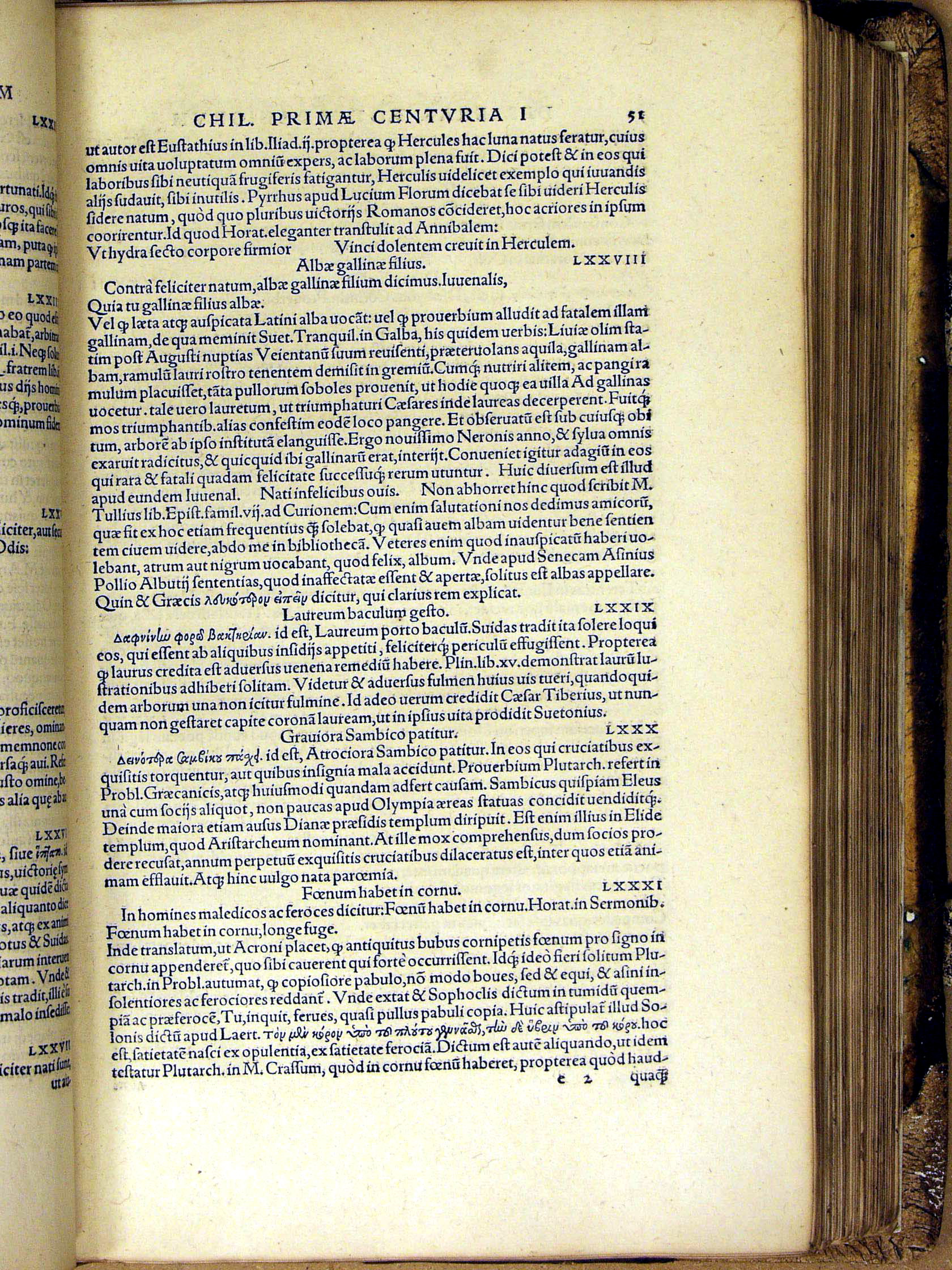
Iconclass: 24C217 Luna and her children ('Planetenkinder') 52E22 Bad Omen; 'Augurio cattivo' (Ripa)
Collectanea (1500): 496
Loci Communes: Aliis sapere (To be wise for others, Être sage pour autrui)
I i 78 Albae gallinae filius A son of the white hen
Contrà feliciter natum, albae gallinae filium dicimus, Iuvenalis, Quia tu gallinae filius albae. Vel quod laeta atque auspicata Latini alba vocant: vel quod proverbium alludit ad fatalem illam gallinam, de qua meminit Suet. Tranquil. in Galba, his quidem verbis: Liviae olim statim post Augusti nuptias Veientanum suum revisenti, praetervolans aquila, gallinam albam, ramulum lauri rostro tenentem demisit in gremium. Cumque nutriri alitem, ac pangi ramulum placuisset, tanta pullorum soboles provenit, ut hodie quoque ea villa Ad gallinas vocetur. tale vero lauretum, ut triumphaturi Caesares inde laureas decerperent. Fuitque mos triumphantibus alias confestim eodem loco pangere. Et observatum est sub cuiusque obitum, arborem ab ipso institutam elanguisse. Ergo novissimo Neronis anno, & sylva omnis exaruit radicitus, & quicquid ibi gallinarum erat, interiit. Conveniet igitur adagium in eos qui rara & fatali quadam felicitate successuque rerum utuntur. Huic diversum est illud apud eundem Iuvenal.: Nati infelicibus ovis. Non abhorret hinc quod scribit M. Tullius lib. Epist. famil. vii. ad Curionem: Cum enim salutationi nos dedimus amicorum, quae fit ex hoc etiam frequentius quam solebat, quod quasi avem albam videntur bene sentientem civem videre, abdo me in bibliothecam. Veteres enim quod inauspicatum haberi volebant, atrum aut nigrum vocabant, quod felix, album. Unde apud Senecam Asinius Pollio Albutii sententias, quod inaffectatae essent & apertae, solitus est albas appellare. Quin & Graecis λευκότερον εἰπεῖν dicitur, qui clarius rem explicat.
The lucky man, on the contrary, we call a son of the white hen.' Juvenal: 'because you are a son of the white hen.' This is either because Latin uses 'white' for joyful and auspicious things, or because the proverb alludes to that fateful hen recalled by Suetonius in his life of Galba, in these words: 'When Livia was revisiting her villa near Veii soon after her marriage to Augustus, an eagle flying overhead dropped a white hen with a sprig of bay in its beak on to her lap. When she had decided to feed the bird and plant the sprig, there grew up such a flock of chickens that even today the villa is called "house of hens." The bay grove was such that Caesars about to have a triumph picked their bays from it. It was the custom for those who celebrated a triumph to plant other bay trees forthwith in the same place. And it was observed that shortly before the death of someone, the tree set by him drooped. So in Nero s last year the whole grove dried up by the roots and whatever was left in the way of poultry died.'
So the adage will fit those who experience some rare and predestined good fortune and success in their affairs. Another phrase of Juvenal's means the opposite: 'Born from unlucky eggs.' Not unlike this is what Cicero writes in the seventh book of his Letters to Curio: 'For after devoting myself to the : reception of my friends, a function more numerously attended than heretofore, because to them the sight of a fellow-citizen of sound sentiments is just as if they saw a white bird, I hide myself away in my library.' For the ancients, what they wished to be thought inauspicious they called dark or black, and the fortunate, white. Hence Asinius Pollio, quoted by Seneca: 'As . for the opinions of Albutius, because they were unaffected and frank, he was wont to call them white.' And in Greek the phrase `to speak more whitely' is used of the person who explains something more clearly.
Facsimile:
Iconclass: 34B232(+52) fowl (cock, hen, chicken, etc.) (+ female animal) 42B121(+0) mother with son(s) (mother-love) (+ variant) 52E21 Good Omen; 'Augurio buono' (Ripa) 54F12 Luck, Fortune, Lot; 'Fato', 'Fortuna', 'Fortuna aurea', 'Fortuna buona', 'Fortuna pacifica overo clemente', 'Sorte' (Ripa)
Collectanea (1500): 817
Loci Communes: Bonae fortunae, copiae, felicitatis aut ominis (Of good fortune, abundance, happiness, or omen, Bonne fortune, abondance, bonheur ou présage)
I i 79 Laureum baculum gesto I bear the staff of bay
Δαφνίην φορῶ βακτηρίαν. id est, Laureum porto baculum. Suidas tradit ita solere loqui eos, qui essent ab aliquibus insidiis appetiti, feliciterque periculum effugissent. Propterea quia laurus credita est adversus venena remedium habere. Plin. lib. xv. demonstrat laurum lustrationibus adhiberi solitam. Videtur & adversus fulmen huius vis tueri, quandoquidem arborum una non icitur fulmine. Id adeo verum credidit Caesar Tiberius, ut nunquam non gestaret capite coronam lauream, ut in ipsius vita prodidit Suetonius.
Δαφνίην φορῶ βακτηρίαν, I bear the staff of bay. Suidas tells how this expression was used by people who were the victims of plotting, and luckily escaped the danger. This was because the bay tree was believed to contain a cure for poison. Pliny, book 15, shows that bay was used in lustration rites; it seems that its power also avails against lightning, since this tree alone is not struck by lightning. Tiberius Caesar was so convinced of this that he never went without his wreath of bay on his head, according to his life by Suetonius.
Facsimile:
Annotation: Bay tree = laurel tree?
Iconclass: 25G3(BAY TREE) trees (BAY TREE) 25G3(LAUREL) trees: laurel
Loci Communes: Bonae fortunae, copiae, felicitatis aut ominis (Of good fortune, abundance, happiness, or omen, Bonne fortune, abondance, bonheur ou présage)
I i 80 Graviora Sambico patitur He suffers worse tortures than Sambicus
Δεινότερα Σαμβίκου πάσχηει. id est, Atrociora Sambico patitur. In eos qui cruciatibus exquisitis torquentur, aut quibus insignia mala accidunt. Proverbium Plutarch. refert in Probl. Graecanicis, atque huiusmodi quandam adfert causam. Sambicus quispiam Eleus unà cum sociis aliquot, non paucas apud Olympia aereas statuas concidit vendiditque. Deinde maiora etiam ausus Dianae praesidis templum diripuit. Est enim illius in Elide templum, quod Aristarcheum nominant. At ille mox comprehensus, dum socios prodere recusat, annum perpetuum exquisitis cruciatibus dilaceratus est, inter quos etiam animam efflavit. Atque hinc vulgo nata paroemia.
Δεινότερα Σαμβίκου πάσχηει, He suffers worse tortures than Sambicus. Of those who are tormented by exquisite pain or to whom notable evils occur. Plutarch mentions this proverb in his 'Greek Questions,' and gives an origin as follows: Sambicus was a man of Elis, who with a few confederates cut to pieces a number of bronze statues at Olympia and sold them. Then with even greater daring, he plundered the temple of Diana the protectress (there is a temple to her in Elis which they call the Aristarcheum). But he was soon captured, and while he refused to betray his associates, he underwent searching tortures for a whole year, and under these he breathed his last. Hence the proverb came into common speech.
Facsimile:
Iconclass: 44G33 torture 98B(SAMBICUS)6 male persons from classical history (SAMBICUS) - suffering, misfortune of person from classical history
Collectanea (1500): 825
Loci Communes: Infortunii sive exitii (Misfortune or ruin, Malheur ou ruine)
I i 81 Foenum habet in cornu He has hay on his horn
In homines maledicos ac feroces dicitur: Foenum habet in cornu. Horat. in Sermonibus Foenum habet in cornus, longe fuge. Inde translatum, ut Acroni placet, quod antiquitus bubus cornipetis foenum pro signo in cornu appenderetur, quo sibi caverent qui fortè occurrissent. Idque ideò fieri solitum Plutarch. in Probl. autumat, quod copiosore pabulo, non modo boves, sed & equi, & asini insolentiores ac ferociores reddantur. Unde extat & Sophoclis dictum in tumidum quempiam ac praeferocem, Tu, inquit, ferves, quasi pullus pabuli copia. Huic astipulatur illud Solonis dictum apud Laertium: Τὸν μὲν κόρον ὑπὸ τοῦ πλούτου γεννᾶσθαι, τὴν δὲ ὕβριν ὑπὸ τοῦ κόρου. hoc est, satietatem nasci ex opulentia, ex satietate ferociam. Dictum est autem aliquando, ut idem testatur Plutarch. in M. Crassum, quòd in cornu foenum haberet, propterea quòd haud quaquam impune lacesseretur, homo praedives ac potens, & simultatum persequentissimus. At postea Caesar dictus est ei foenum detraxisse: quod omnibus illum ut cornipetam taurum fugientibus ac formidantibus, ipse primus ausus fuerit illi resistere. Usurpat adagium hoc etiam divus Hieron. in epistola quadam, minitans his à quibus fortè esset lacessendus.
This is said of angry and abusive men: He has hay on his horn. Horace, in the Satires: 'He has hay on his horn, beware.' This originates, in the view of Acron, from the fact that in ancient times hay was attached to the horn of a bull given to goring, as a sign that people who came up by chance should be warned to take care. Plutarch indicates in his 'Problems' that this is done because not only bulls, but horses and donkeys grow insolent and fierce through being too well fed. This is the meaning of Sophocles' expression about an over-weening and belligerent person: 'You seethe with insolence' he says 'like a colt overfed.' That saying of Solon, in Laertius, agrees with this: 'Satiety is begotten by wealth, but insolence by satiety.' It was sometimes said of Crassus (as the same Plutarch testifies) that he had hay on his horn, because he never let an injury pass unavenged, being a very rich and powerful man, and inveterate in pursuing feuds. But later on Caesar is said to have pulled the hay off him, because when everyone else was fleeing from him in fear as from a bull who uses his horns, he, Caesar, first dared to stand up to him. St Jerome uses this adage also, in one of his letters, when he is threatening those by whom he might be attacked.
Facsimile: 
Iconclass: 47I17(HAY) agricultural products and by-products: hay 47I2111(+9332) bull (+ antlers; horn)
Collectanea (1500): 241a
Loci Communes: Philautia (Self-love, Amour-propre)
I i 82 Cornutam bestiam petis You attack a horned beast
Consimilem ferme sensum habet Plautinum illud, Cornutam bestiam petis, de eo qui lacessit eum qui paratus sit retaliare iniuriam, quemque non nisi tuo malo provoces. Huc spectavit Horatius in Odis, Parata tollo cornua.
There is a similar meaning in the phrase of Plautus, 'you attack a horned beast,' referring to someone who assaults a person who is ready to repay the injury, and whom one persecutes at one's own peril. Horace had this in mind in the Odes: 'I raise my ready horns.'
Facsimile:
Iconclass: 31A(+9223) the (nude) human figure; 'Corpo humano' (Ripa) (+ attacking somebody) 25F(+332) animals (+ antlers; horn)
Loci Communes: Malum accersitum aut retortum (Evil brought upon oneself or turned back, Mal attiré ou retourné)
I i 83 Dionysius Corinthi Dionysius in Corinth
Διονύσιος ἐν κορίνθῳ. id est, Dionysius Corinthi. Proverbialis allegoria qua significamus aliquem è summa dignitate atque imperio, ad privatam humilemque redactum fortunam: quemadmodum Dionysius Syracusarum tyrannus expulsus imperio, Corinthi pueros literas ac musicam mercede docuit. Cic. epistol. ad Atticum lib. ix. De optimatibus sit sanè ita ut vis. Sed nosti illud: Διονύσιος ἐν κορίνθῳ. Quintil. Instit. orat. lib. viii. Est in exemplis allegoria, si non praedicta ratione ponantur. Nam ut Dionysium Corinthi esse, quo Graeci omnes utuntur, ita plura similia dici possunt. Hic Cic. cum ait, Nosti illud. & Quintil. Quo Graeci omnes utuntur, nimirum uterque vulgo iactatum fuisse significat. Caeterum unde natum sit adagium, Plutarchus aperuit in libello cui titulus, Περὶ τῆς ἀδολεσχίας. id est, de futili loquacitate. Laudans enim breviter & graviter dicta, commemorat & illud à Lacedaemonibus responsum Regi Philippo bellum minanti ferocientique. Διονύσιος ἐν κορίνθῳ. Quibus ubi rex rescripsisset, si quando in Laconicam duxisset exercitum, eversurum se Lacedaemonios, verbo duntaxat responderunt, ἄικα, id est, si. Plato ter navigavit in Siciliam, non sine sinistri rumoris aspergine. Unde Molon, qui inimicum in Platonem gerebat animum, dicebat non esse mirum, si Dionysius esset Corinthi, sed si Plato in Sicilia. Regem enim urgebat necessitas, Platonem solicitabat ambitio.
Διονύσιος ἐν κορίνθῳ, Dionysius in Corinth. An allegory with proverbial force, by which we indicate a person reduced from the highest rank of authority to a humble status in private life, just as Dionysius the tyrant of Syracuse, after being thrust from power, became a paid teacher of letters and music to boys at Corinth. Cicero in the Letters to Atticus, book q: 'About the optimates, let it be as you wish; but you know the saying Dionysius in Corinth.' Quintilian Institutions, book 8: `Historical instances are a source of allegory, if they are not cited for some specified reason. Take the phrase Dionysius in Corinth, which is so common in Greek: many similar examples can be used.' When Cicero says 'You know the saying' and Quintilian 'which is so common in Greek,' both of course show that this was a common expression. Plutarch explains in his essay 'On Pointless Garrulity' how the adage arose. When he is praising terse and weighty sayings, he recalls the reply of the Spartans to King Philip, who was threatening them with war and taking a very fierce line: 'Dionysius in Corinth.' The king wrote back to them saying that if he were ever to lead an army into Laconia, he would destroy the Spartans; they replied in just one word 'If.' Plato made three voyages to Sicily, not without arousing adverse comment. Hence Molon, who had a great dislike of Plato, used to say that it was no surprise if Dionysius were in Corinth, but what was surprising was to see Plato in Sicily. The king was driven by necessity; Plato was tempted by ambition.
Facsimile:
Iconclass: 54F122 Vicissitudes of Life 98B(DIONYSIUS II)51 Dionysius II, tyrant of Syracuse, being expelled from Sicily, goes to Corinth where he becomes a schoolmaster to support himself
Loci Communes: Fortunae commutatio (Change of fortune, Changement de fortune)
I i 84 In me haec cudetur faba These beans will be pounded on me
Terentius in Eunucho: At enim isthaec in me cudetur faba: hoc est, Donato interprete, in me malum hoc recidet, in me haec vindicabitur culpa. Translatum vel à faba, quae cum siliquis exuritur, ac batuitur, aut fustibus intertunditur, ita ut fit in areis more rusticorum, non ipsa perinde laborat, sed id demum in quo cuditur. Alii malunt ad male coctam fabam referre, quae si quando non maduerit, sed dura permanserit, ab iratis heris supra coqui caput saxo nonnunquam comminui consuevit, tamquam fabam ulciscentibus, non coquum, cum universum interim malum ad coquum perveniat.
Terence in the Eunuchus: 'But these beans will be pounded on me,' that is (says Donatus' commentary) 'This trouble will recoil on me, I shall be the one to be blamed for it.' It is transferred, it seems, from beans, which are shelled and then pounded or beaten with flails, as is done on country threshing-floors, and they do not get as much damage as the surface on which they are pounded. Others prefer to think the proverb refers to badly-cooked beans; if they did not soften but remained hard, the angry master of the house would sometimes pound them with a stone on the cook's head, as if wreaking vengeance on the beans and not on the cook - but it was the cook who got the worst of it.
Facsimile:
Iconclass: 25G4(BEAN) plants and herbs: bean 47C38 smashing, crushing (industrial processes)
Collectanea (1500): 526
Loci Communes: Ultio malefacti (Vengeance for a wrongdoing, Vengeance d'un méfait)
I i 85 Tute hoc intristi, omne tibi exedundum est You made this dish and you must eat it all up
Non diversum superiori Donatus admonuit, illud quod apud eundem poetam legitur in Phormione, Tute hoc intristi, tibi omne est exedendum. Verba sunt Phormionis parasiti, qui quoniam fuerat autor consilii de ducenda puella, aequum esse putat, ut suo periculo rem item expediat. Translatum putant ab alliato rusticorum mortario. Quae quidem sententia, vel hodie quoque vulgo nostrati in ore est. Et altera huic simillima: Colo quod aptasti, ipsi tibi nendum est, id est, tu incipiundi autor extitisti, nunc idem explices oportet.
Donatus points out a proverb not unlike the foregoing, which is to be read in the same poet, in the Phormio: 'You yourself made this dish and you must eat it all up.' The words are those of the parasite, Phormio, who since he originated the plan of abducting the girl, thinks it only right that he should finish the matter off at his own expense. It is thought to be taken from the rustic dish pounded up with garlic. The same maxim is on people's lips in our own day. There is also another similar saying, `You got it ready for the distaff and now you must spin it yourself,' ie, you began the affair and now you are the one who must settle it.
Facsimile:
Iconclass: 41C11 eating 41C221 cook
Collectanea (1500): 533
Loci Communes: Malum accersitum aut retortum (Evil brought upon oneself or turned back, Mal attiré ou retourné)
I i 86 Faber compedes quas fecit, ipse gestet Let the smith who made the fetters wear them
Ausonius in Trochaicis suis Terentiano proverbio confine quoddam subnectit, & poetae metaphoram altera quadam interpretatur metaphora, Tu molestus flagitator lege molestae carmina. Tibi quod intristi, exedundum est: sic vetus verbum iubet, Compedes, quas ipse fecit, ipsus ut gestet faber. Competit in eos, qui sibiipsis autores sunt malorum. Videtur autem è Theognide poeta sumptum, qui ait: Οὔτις ἀνὴρ φίλε Κύρνε πέδας χαλκεύεται αὐτῷ. id est, Vincula nemo sibi cudit carissime Cyrne. Huic simile quiddam, humilius quidem, sed tamen aptum vulgo dicitur: Flagellum ipse paravit, quo vapularet. Idque sumptum à pueris, aut servis, qui coguntur aliquoties ipsi parare virgas, quibus vapulent.
Ausonius in his trochaics adds to the proverb from Terence something very like it, and interprets the poet's metaphor by a different one:
You troublesome claimant, here are some troublesome verses for you.
You must eat what you have cooked: so the old proverb demands.
The fetters he made himself the blacksmith must wear.
It fits those who are the authors of their own misfortune. But it seems to be taken from the poet Theognis, who says 'No man, dear Cyrnus, forges fetters for himself.' Something like this, of a humbler kind, but apt, is said in common speech: 'He prepared a rod for his own back,' and that is derived from boys or servants who are sometimes made to prepare themselves the rods with which they are to be beaten.
Facsimile:
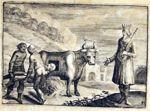
Malum consilium consultori pessimum: Schoonhovius, Emblemata (Gouda, 1618), emblem 21 uses similar imagery
Hij heeft een roede tot zijn eigen aars gemaakt: Pers, Bellerophon (Amsterdam, 1614), emblem 18 uses similar imagery
Malum consilium consultori pessimum - il nuy à soy qui conseille injustice: Boissard, Emblemes (Metz, 1595), emblem XXIX uses similar imagery
Malum consilium consultori pessimum: Boissard, Emblematum liber (Frankfurt, 1593), emblem XXIX uses similar imagery
Malum consilium consultori pessimum: Schoonhovius, Emblemata (Gouda, 1618), emblem 38 uses similar imagery
Malum consilium consultori pessimum: Carleton, A thankfull remembrance of Gods mercie (London, 1630), uses similar imagery for a background scene
Invidia tormentorum maximum: Meisner, Politica Politica (Nürnberg, 1700), emblem 727 uses similar imagery
Ingenio experior funera digna meo: Giovio, Dialogo dell' Imprese (Lyon, 1574), emblem 32 uses similar imagery
Perillus - Qui ruit laetatur alterius, non erit impunitus: Valvasor, Theatrum mortis (Laibach, 1682), emblem 72 uses similar imagery
Grande malum invidia: Vaenius, Emblemata Horatiana (Antwerp, 1612), emblem 45 uses similar imagery for a background
Des mauvais conseils & que ceux qui les donnent s'en trouvent mal: Baudoin, Recueil d'emblemes (Paris, 1639), emblem 8 uses similar imagery
De Perillo et tauro aeneo: Meyer, Homo Microcosmus (Frankfurt, 1670), emblem 28 uses similar imagery
Iconclass: 44G(+32) law and jurisprudence (+ handcuffs, fetters) 44G3129 (person) in fetters, not imprisoned 47B111 smith, blacksmith
Collectanea (1500): 758
Loci Communes: Malum accersitum aut retortum (Evil brought upon oneself or turned back, Mal attiré ou retourné)
I i 87 Ipsi testudines edite, qui cepistis Eat the turtles you caught yourselves
His confine proverbium refertur à Graecis scriptoribus: Αὐτοὶ χελώνας ἐσθίεσθ' οἵπερ εἵλετε. id est, Qui prendidistis, iidem edite testudines. In eos iacitur, qui posteaquam inconsulte quippiam adorti sunt, aliorum implorant auxilium, quos suo negotio admisceant. Paroemiam ex huiusmodi quodam apologo natam existimant. Piscatores aliquot iacto reti, testudines eduxerunt. Eas cum essent inter se partiti, neque sufficerent omnibus comedendis, Mercurium fortè accedentem invitarunt ad convivium. At is intelligens se nequaquam humanitatis gratia vocari, sed ut eos fastidito cibo sublevaret, recusavit, iussitque ut ipsi suas testudines ederent, quas cepissent. Sunt autem autore Plin. in Carmania populi, qui testudinum carnibus victitent, unde & nomen illis attributum, χελωνοφάγοις. Apud quos affirmant inveniri testudines tanta magnitudine, ut earum testis casas integant.
A proverb like this is mentioned in the Greek collections: Αὐτοὶ χελώνας ἐσθίεσθ' οἵπερ εἵλετε, You caught the turtles, now you must eat them. It is cast at people who have thoughtlessly undertaken something and then beg the help of others so as to involve them in their business. The proverb is thought to have arisen from the following fable. Some fishermen cast their nets and drew out some turtles. When they had shared them out among the party, and found there were not enough people to eat them up, they invited Mercury, who happened to come on the scene, to join the feast. But he perceived that it was not out of kindness that he was invited, but so that he could relieve them of some of their unwanted food; so he refused, and told them they must eat up the turtles they had caught. According to Pliny, there are tribes in Carmania who live on the flesh of turtles, and this is why they are nicknamed chelonophagoi (turtle-eaters). It is said that among them turtles are to be found of such a size that they roof their huts with their shells.
Facsimile: 
Iconclass: 25F44 tortoises, turtles 41C11 eating 43C1151 catching animals
Collectanea (1500): 814
Loci Communes: Malum accersitum aut retortum (Evil brought upon oneself or turned back, Mal attiré ou retourné)
I i 88 Aderit Temessaeus genius The Temessaean spirit will be there
Strabo lib. Geographiae vi. refert Temessam ab Lao primam urbem esse Brutiae, ipsius aetate dictam Tempsam, quam ab Ausoniis conditam, Thoantis comites Aetoli deinde tenuerint, atque his expulsis Brutii, demum Hannibal et Romani funditus everterint. Iuxta hanc sacellum fuisse oleastris circumseptum, Politae cuidam ex Ulyssis comitibus sacrum. Hunc, quod esset à Barbaris violatus, graveis iras in eo exercuisse: adeo ut in proverbium abierit, dicerentque cavendum, ne Temessaeus genius immineret. Deinde Locrensibus Epizephyreis urbe potitis, Euthymum quendam, ut inquit Aelianus, ex Italia illuc venisse pugilem inclytum, & insigni robore, qui & lapidem ingenti magnitudine gestaverit, qui Locris ostendi soleat. Hunc cum Polite congressum ac victorem è certamine discessisse, atque ita finitimos huius opera liberatos à tributo, quod ille consueverat extorquere. Quin & compulisse illum, ut quod per vim abstulerat, redderet etiam cum foenore. Atque hinc proverbium natum putant, iis qui sordidos & iniustos quaestus faciunt, adfore Temessaeum genium. quo significabant, aliquando dependenda cum foenore, quae praeter ius, & fraude seu vi rapuissent. Pausanias in Eliacis paulo diversius rem narrat: nempe comitem quendam Ulyssis ob virginem constupratam occisum fuisse, atque ob id larvas eius, nisi quotannis oblata virgine placarentur, grassari solitas, ac perniciem adferre omni sexui atque aetati. Atque hunc quidem eius loci genium vulgo fuisse creditum, quem Euthymus pugil Temessam reversus compescuerit, virgine quam devoverant, liberata, atque in matrimonium accepta. Apud Strab. mihi locus in codice Graeco videtur non vacare menda. Sic enim legimus in aeditione Aldina: ὥστε τοὺς περιοίκους δασμολογεῖν αὐτῷ κατὰ τὸ λὸγιον καὶ παροιμίαν εἷναι πρὸς αὐτοὺς, μηδ' εἰς τὸν ἥρωα τῶν ἐν Τεμέση λεγὸντων ἐπικεῖσθαι αὐτοῖς. Fortasse tolerabilior erit lectio, si tolles coniunctionem δὲ, & pro λεγόντων reponas λεγόμενον. Caeterum cum Strabo recenseat proverbium priusquam referat cohibitum heroem, indicat potius in eos dici solitum, qui potentiorem se lacessunt. Etiamsi nihil vetat proverbium ad varios usus accommodari.
Strabo, in his Geography, book 6, reports that Temessa after Laus was the chief town of Brutia, and called Tempsa in his time. It was founded by the Ausonians, and then held by the Aetolians, companions of Thoas, and after their expulsion by the Brutians it was finally completely overthrown by Hannibal and the Romans. Near it, he says, there was a shrine hedged round with wild olive, and dedicated to Polites, one of the companions of Ulysses. When his shrine was violated by the barbarians, he let fly his anger against them, so that it became a proverb, and they said, 'Beware, lest the Temessaean spirit should threaten you.' Later, when the Epizephyrian Locrians had obtained possession of the town, there came from Italy (so says Aelian) a well-known pugilist of enormous strength, a certain Euthymus, who wielded a huge stone (it is normally on show at Locri). This man had an encounter with Polites, and came off victor in the fight; and so the neighbouring peoples were liberated from the tribute that Polites had been accustomed to extort from them. He even compelled Polites to restore with interest what he had taken. It is thought that the proverb is derived from this: people who make immoral and unjust gains will find the Temessaean spirit at hand; by which was meant that some time or other whatever had been snatched by illegal means, by force or fraud, will have to be repaid with interest.
Pausanias, in his book on Elis, tells the story a little differently. He says that a certain companion of Ulysses had been killed for ravishing a girl, and for this reason his ghost used to walk and bring destruction to all ages and both sexes, unless it were placated by the yearly sacrifice of a virgin. And it was generally supposed that this was the genius of that place, whom Euthymus the pugilist suppressed on his return to Temessa, and he set free the maiden who had been dedicated for sacrifice and married her.
The passage in Strabo seems to me to be not without error in the Greek text. This is what we read in the Aldine edition: 'So that the dwellers in the country round collected tribute for him in accordance with an oracle, and there was in use a proverb referring to them ... saying (legonton) that the guardian spirit of Temessa presses hard upon them.' Perhaps the reading will be more acceptable if you eliminate the conjunction de, and for legonton read legomenon. However, the fact that Strabo relates the proverb before referring to the defeat of the hero suggests that it was used against those who attack a more powerful person than themselves. Even so, there is no reason why the proverb should not be adapted to several uses.
Facsimile:
Iconclass: 13A1 spirit, ghost 61E(TEMESSA) names of cities and villages (TEMESSA)
Collectanea (1500): 366
Loci Communes: Ultio malefacti (Vengeance for a wrongdoing, Vengeance d'un méfait)
I i 89 Termeria mala Termerian evils
Τερμέρια κακὰ. id est, Termeria mala. Veteri proverbio dicuntur ingentia, maxime quoties mala quae quis in alios impegerit, aliquando in ipsius caput retaliantur. Huius adagii meminit Plutarch. in vita Thesei, qui cum Herculis exemplo terras obiret, nocentes quos superasset, eadem poena solitus est afficere, quam illi per saevitiam in alios exercuissent. Nam Hercules Damascum de rupe aeditissima praecipitem dedit, Busyridem parentavit, Antaeum palaestra superatum occidit. Cygnum gladiatorum more confecit, Denique Termerum humana capita confringentem, verberibus itidem contudit. Unde in eos in quos sua malefacta retorquentur, proverbio dicitur: Termerium malum. In hanc fermè sententiam Plutarch. in vita Thesei. Est autem supplicii genus vel in primis favorabile, cum poena sceleri respondet, quemadmodum de Thurino fumi venditore, fumo necato legimus: & Perillo, quem Phalaris aeneo impositum tauro, suo ipsius invento perdidit. Illud perquam festivum, quod in Vita Gallieni Imperatoris refertur. Cum quidam vitreas gemmas pro veris imperatrici vendidisset, atque ea re deprehensa, vindicari flagitaret, ille venditorem rapi iussit, tanquam leonibus obiiciendum: deinde caponem emittit, ac cunctis rem tam ridiculam admirantibus, per praeconem denunciari iussit: Imposturam fecit, & passus est: atque ita negociatorem dimisit. Sed de Termeriis malis Suida multo aliam adfert interpretationem: nempe locum quendam esse in Caria, cui nomen Termerio, quo tyranni quandoque pro carcere soleant uti. Situm autem esse inter Melum & Halicarnassum. Ex hoc cum postea praedarentur latrones, neque depelli possent, quod esset locus admodum munitus, abiisse in proverbium. Quanquam Stephanus Termeram urbem in Lycia ponit, quam ait à Termero sortitam vocabulum. Postremo Termeria mala dicta videri possunt, quasi extrema mala. Nam τέρμα Graece, finem significat, & τερμερίαν ἡμέραν extremum vitae diem vocant. Porrò Latini, quod summum videri volunt ac maximum, id extremum appellant: ut Extrema dementia, extrema insania. Neque secus Graeci, ἐσχατον κακὸν, extremum malum pro maximo dicunt. Et ἐσχάτων ἔσχατα, extremorum extrema, quasi plus quam maxima.
Τερμέρια κακὰ, Termerian evils. In the old proverb this is used of great evils, especially those which, when a man has forced them on others, recoil on his own head. Plutarch recalls this adage in his life of Theseus, who used to travel through the world after the manner of Hercules, making the criminals whom he overcame undergo the same punishment as they had wreaked on others in their fury. Hercules, for instance, threw Damascus from a high rock; Busiris he offered up in sacrifice; Antaeus he killed, after worsting him in wrestling; Cygnus he slew in gladiatorial style. Finally Termerus, who had knocked people's heads together, he crushed in the same way with blows. Thus the proverbial saying'a Termerian evil' is used of people whose misdoings recoil on their own heads. Plutarch uses it this way in his life of Theseus. There is a type of punishment, eminently to be approved of, which exactly fits the crime, as when we read of the man from Thurii who sold smoke and was himself smoked to death; and Perillus, whom Phalaris shut up in the bronze bull, thus destroying him by his own invention. There is a particularly good story told in the life of the emperor Gallienus. A man had sold false jewels for real to the empress and when the thing was found out, he cried out for punishment. The emperor ordered the vendor to be seized as if he were to be thrown to the lions, and let out a capon on him instead. When all the spectators were amazed at so absurd a spectacle, he ordered the herald to proclaim: `Sham were his wares, and sham his punishment': and so he sent the merchant away.
Suidas offers quite a different interpretation of 'Termerian evils': he says there is a place in Caria, called Termerium, which at some time or other was used by tyrants as a prison. It was situated between Melos and Halicarnassus. Robbers used this in later times as a base for plundering, and they could not be driven out because the place was well fortified, and so it became a proverb. Stephanus though, places the town of Termera in Lycia, and says its name is drawn from Termerus.
Finally, 'Termerian evils' may be taken to mean the last extremity of evil. For terma means end in Greek, and they call the last day of life termerian hemeran. In Latin too the word 'extreme' is used when they wish to signify highest or greatest: for instance extreme madness, extreme frenzy. The Greeks likewise say eschaton kakon, 'an extreme evil,' and ἐσχάτων ἔσχατα, 'the extreme of extremes,' 'greater than the greatest,' as it were.
Facsimile: 
Iconclass: 52B5112 Bad, Evil, Wrong 57AA741 Revenge, Requital, Retaliation; 'Vendetta' (Ripa) 98B(TERMERUS) male persons from classical history (TERMERUS)
Loci Communes: Mali retaliatio (Retaliation of evil, Rendre le mal pour le mal)
I i 90 Neoptolemi vindicta The revenge of Neoptolemus
Νεοπτολέμειος τίσις. id est, Neoptolemica vindicta. Superiori similimum est, ubi quis eadem patitur cuiusmodi patravit in alios. Id Pausanias in Messeniacis refert, & exponit his verbis: Περιῆλθε μέν τοι καὶ αὐτοὺς Λακεδαιμονίους ἀνὰ χρόνον ἡ Νεοπτολέμεοις καλουμένη τίσις. Νεοπτολέμῳ γὰρ τῷ ἀχιλλέως ἀποκτείναντι Πρίαμον ἐπὶ ἐσχάρᾳ τοῦ ἐρκίου, συνέπεσε καὶ αὐτον ἐν δελφοῖς πρὸς τῷ βωμῷ τοῦ ἀπόλλωνος ἀποσφαγῆναι. καὶ ἀπὸ τούτου τὸ παθεῖν ὁποῖόν τις καὶ ἔδρασε, νεοπτολέμειον τίσιν ὀνομάζουσιν. id est, Sanè persuasit Lacedaemonios progressu temporis Neoptolemea, sicut vocant, vindicta. Siquidem Neoptolemo Achillis filio, qui Priamum in ipsis palatii focis occiderat, vicissim evenit, ut et ipse apud Delphos ad Apollinis aram occideretur: atque hinc ortum, ut ubi quis idem patitur quod in alios fecit, Neoptolemeam vindictam appellent. Euripides in Oreste sub persona Apollinis de Neoptolemo, Θανεῖν γὰρ αὐτῷ μοῖρα δελφικῷ ξίρει. id est, In fato enim illi est Delphico gladie mori.
Νεοπτολέμειος τίσις, The revenge of Neoptolemus. This is exactly similar to the preceding: when what a man has done to others, he suffers himself. Pausanias in his book on Messene reports it and explains it as follows: 'Indeed in time what is called the revenge of Neoptolemus encompassed the Lacedemonians. For it happened that Neoptolemus, the son of Achilles, who killed Priam in the very heart of his palace, was himself slain at the altar of Apollo, and from this to suffer what one has oneself done they call a Neoptolomean revenge.' Euripides in the Orestes, where in the character of Apollo it is said of Neoptolemus: 'It is his fate to die by the Delphic sword.'
Facsimile:
Iconclass: 57AA741 Revenge, Requital, Retaliation; 'Vendetta' (Ripa) 95A(NEOPTOLEMUS)68 death of Neoptolemus: he is killed in Delphi, possibly by Orestes
Loci Communes: Mali retaliatio (Retaliation of evil, Rendre le mal pour le mal)
I i 91 Servire scenae To be a slave to your theatre
M. Tullius servire scenae dixit, pro eo quod est servire tempori, & rebus praesentibus sese accommodare. Translata ab histrionibus fabularum metaphora, qui non suopte iudicio agunt, sed hoc unum spectant, ut quovis modo populi oculis placeant, alioqui explodendi, exibilandique. Sic enim scribit ad Brutum: Tibi nunc populo & scenae, ut dicitur, serviendum est. Nam in te non solum exercitus tui, sed omnium civium, ac penè gentium coniecti sunt oculi. Quadrabit & in eos qui negocium aliquod susceperunt illustre, unde necesse sit, aut cum summa laude, aut summa cum infamia discedere, propter plurimorum exspectationem. Porrò tempori serviendum esse viro sapienti, monuit & Phocylides, Καιρῷ λατρεύειν, μήτ' ἀντιπνέειν ἀνέμοισιν. id est, Temporibus semper cautus servire memento, Nec reflare velis adversum flamina venti. Porrò metaphora haec ducta est à navigantibus, quos necesse est semel ingressos mare ventorum atque aestus arbitrio ferri, frustra conaturos, si velint adversus ista pugnare.
Cicero said To be a slave to your theatre, meaning to serve the time, to accommodate oneself to the present situation. This is a metaphor taken from the actors in plays, who do not behave according to their own judgment but think of one thing only - pleasing the eyes of the public somehow or other, otherwise they will be slow-clapped and hissed off the stage. He writes thus to Brutus: 'Now your business is to be a slave to the people and your public, as they say. For not only the eyes of your army are upon you, but those of all the citizens and almost the whole world.' This can be said of people who have undertaken some important affair, from which they must emerge either with the highest credit or the utmost shame, because so many people are watching them. To serve the time is indeed the part of the wise man, as Phocylides warns us: 'Remember, always wary, to serve the times; blow not against the wind.' However the metaphor here is taken from mariners, who once they have set out must be tossed at the will of winds and tides; it would be vain for them to strive to put up a resistance.
Facsimile:
Iconclass: 46A18 slavery; serfs and enslaved persons 48C85 theatre, theatrical performance 57AA646(+0) Complacency, Self-conceit (+ variant)
Loci Communes: Servire tempori (To serve the times, Se plier aux circonstances)
I i 92 Uti foro To take the market as you find it
Huic affine est, τῇ ἀγορᾷ χρῆσθαι, uti foro, pro eo quod est praesentem rerum statum boni consulere, & utcumque sese obtulerit fortuna, ita animum applicare. Terent. in Phorm. Scisti uti foro. Donatus vulgare proverbium admonet esse, ductamque metaphoram à mercatoribus, qui non ante locum commercii praescribunt quanti vendant quae advehunt, sed secundum annonam fori, quam deprehenderint, consilium de non vendendis, aut vendendis mercibus sumunt. Seneca: Utamur foro, & quod sors feret, aequo feramus animo. Idem epistola lxxii. sub manu nasci dixit, pro ex tempore. Ergo consilium, inquit, sub die nasci debet, & hoc quoque tardum est nimis: sub manu, quod aiunt, nascatur.
Close to this is the saying, τῇ ἀγορᾷ χρῆσθαι, , To take the market as you find it, meaning to make the best of the present state of affairs, and to turn one's mind wherever fortune presents itself. Terence says in the Phormio 'You knew how to make the best of the market.' Donatus explains that the proverb is a popular one, and the metaphor taken from merchants, 'who do not set a price for what they have brought before they reach the place of sale, but after finding out the current market prices they decide whether or not to sell their wares.' Seneca: 'Let us take the market as we find it, and what chance may bring, let us bear with equanimity.' Again in Epistle 72 he used the phrase 'to spring up under one's hand' for when the moment comes: 'The plan must be born on the day, and even this is too slow; it must spring up, as they say, under one's hand.'
Facsimile:
Iconclass: 46B11 market 54F122 Vicissitudes of Life
Collectanea (1500): 187
Loci Communes: Servire tempori (To serve the times, Se plier aux circonstances)
I i 93 Polypi mentem obtine Adopt the outlook of a polyp
Extat apud Graecos adagium in hunc ordinem referendum, Πολύποδος νόον ἴσχε, id est, Polypi mentem obtine. Quo iubemur pro tempore, alios atque alios mores, alium atque alium vultum sumere. Quod in Ulysse videtur Homerus laudare, qui eum πολύτροπον appellat, id est, moribus versatilibus. Adagium natum est à piscis huius ingenio, de quo meminit Plin. lib. ix. cap. xxix. Praeterea Lucian. in sermone Menelai ac Protei: scribuntque colorem mutare maxime in metu. Nam persequentibus piscatoribus, petris affigit sese, & cuicunque petrae adhaeserit, eius colorem corpore imitatur, videlicet ne queat deprehendi. Quin ut refert Basilius magnus, pisces imagine falsa decepti, nonnunquam annatant, ultro sese praedoni offerentes. Porrò proverbium sumptum est ex Theognide, cuius hodie distichon est de polypo. Citaturque à Plutarcho in libello περὶ πολυφιλίας, Πουλύποδος νόον ἴσχε πολυπλόκου, ὅς ποτὶ πέτρῃ Τῇ προσομιλίζει, τοῖος ἰδεῖν ἐφάνη.. id est, Mentem haebeas vafri polypi, qui protinus illa, Se quibus admorit, saxae colore refert. Clearchus in proverbiis, teste Athenaeo, citat hoc distichon, tacito auctoris nomine, Πουλύποδός μοι τέκνον ἔχων νόον ἀμφίλοχ' ἥρως, Τοῖσιν ἐφαρμόζων, ὦν καὶ πρὸς δῆμον ἵχηε. id est, Polypi ingenio mihi sis nate Amphiloche heros, Ut temet populo, quemcunque accesseris, aptes. Citat idem carmen Plutarch. ex Pindaro. Unde & versus ille proverbialis celebratur, Αλλοτε δ' ἀλλοῖον τελεθεῖν καὶ χώρου ἕπεσθαι. id est: Proque loco nunc hunc fieri, nunc expedit illum. Qui nos admonet, uti nos ad omnem vitae rationem accommodemus, ac Proteum quendam agentes, prout res postulabit, in quamlibet formam transfiguremus. Plutarch. item ἄλλοῖος γένομαι, dixit, pro eo quod est, in diversam eo sententiam. Quod quidem notat & Aristophanes in Pluto, qui monet vivendum esse τρόποις ἐπιχωρίοις. id est, Moribus regionis ac vernaculis. Eodem pertinet & illud, νόμος καὶ χώρα. id est, Lex etiam ipsa regio. Quo significatum est, unicuique regioni quaedam peculiaria esse instituta, quae hospites non damnare, sed pro virili nostra imitari atque exprimere debeamus. Neque quisquam existimet hoc adagio doceri foedam adulationem, qua quidam omnibus omnia assentantur, aut vitiosam morum inaequalitatem, quam Horatius eleganter taxat in Sermonibus, quamque historici notant in Catilina, atque in Anedio Cassio imperatore: denique literae divinae in quovis improbo, cum aiunt stultum perinde atque lunam immutari, cum sapiens solis exemplo sui semper sit similis. Nam in Alcibiade dubites vitione, an laudi danda sit: certe felicissima quaedam & admiranda fuit morum & ingenii dexteritas, qui sic polypum agebat, ut Athenis dicteriis & salibus luderet, equos aleret, comiter & eleganter viveret. Idem apud Lacedaemonios radebatur, pallium gestabat, frigida lavabat. Apud Thraces belligerabatur, ac potabat. Ubi vero pervenisset ad Tiaphernem, deliciis, mollicie, fastuque iuxta gentis morem est usus. Sed est quaedam difficilis ac praefracta, morosaque simplicitas imperitorum, qua postulant, ut omnes ubique ipsorum duntaxat moribus vivant, & quicquid aliis placet, id damnant. Rursum est honesta quaedam ratio, qua boni viri nonnunquam alienis moribus obsecundant, ne vel odiosi sint, vel prodesse non possint, aut ut è magnis periculis semet, aut suos eximant. Quemadmodum fecit Ulysses apud Polyphemum multa simulans, apud procos mendicum agens. Item Brutus adsimulata stoliditate. David etiam simulata insania. Quin & divus Paulus apostolus, sancta quadam iantantia gloriatur, hac pia vafricie sese usum esse, atque omnia factum omnibus, ut omnes Christo lucrifaceret. Quanquam nihil vetat in notandis vitiis usum adagii latius trahere, nempe in homines versatili quodam ingenio natos, qui talem ubique personam induunt, quales sunt ii, cum quibus contigit agere. Quod genus eleganter descripsit Plautus in Bacchidibus: Nullus, inquiens, frugi esse potest homo, nisi qui bene & male facere tenet. Improbus cum improbis sit, harpaget, furibus furetur quod queat. Versipellem frugi convenit esse hominem, pectus cui sapit: bonus sit bonis, malus sit malis. Utcumque res sit, ita animum habeat. Eupolis apud Athenaeum, Ανήρ πολίτης πωλύπους ἐς τὸν τρόπον. id est, Urbanus homo, qui moribus sit polypus. Plutarchus in causis naturalibus citat ex Pindaro versus hos. Ποντίου θηρὸς χρωτὶ μάλιστα τὸν νόον προσφέρων, ταῖς πάσαις πολίεσσιν ὁμιλεῖ. id est, Marinae belluae colori maximè mentem accommodans, cum omnibus civitatibus consuetudinem habet. Atque eodem in loco causam reddit, cur id huic accidat pisci. Similem quandam metaphoram Aristoteles à chamaeleonte duxit, primo Moralium lib.. Ait enim, si quis à fortuna pendeat, cum illa subinde mutetur, futurum ut veluti chamaeleon quispiam identidem varietur, nunc felix, nunc miser: utcunque fors alio atque alio vultu respexerit, ita hunc quoque vultum atque animum mutare. De chamaeleonte meminit Plinius libro xxviii. capite viii. scribens hoc animal magnitudine fermè par esse crocodilo: cae terum spinae acutiore curvatura, et caudae amplitudine distare. Nullum, inquit, animal pavidius existimatur: & ideo versicoloris esse demutationis. Plutarchus in comment. De adulatione scribit chamaeleontem quemvis imitari colorem praeterquam candidum. Idem in Symposiacis conatur causam reddere de polypo, quamobrem non tantum mutet colorem, quod & hominibus accidit in metu: verumetiam sese ad saxi, quodcumque id fuerit, colorem accommodet. Sunt & aves quaedam, quae colorem pariter & vocem mutent pro temporibus anni, ut autor est idem Plinius li. x. cap. xxix & Aristot. lib. De natura animantium ix. In voce mutanda principatum obtinet luscinia. Unde & apud Euripidem Hecuba Polyxenam imitari lusciniam iubet, seseque in omnem vocem vertere, si quo modo queat Ulyssi persuadere, ne perimatur.
There is in Greek an adage one can put in this class: Πολύποδος νόον ἴσχε, Adopt the outlook of the polyp. This recommends us to take up for the time being this or that kind of behaviour, this or that kind of face. Homer seems to praise this in Ulysses, and calls him' a man of many turnings,' changeful in his ways. The adage originates from the nature of this fish, of which Pliny speaks, book 9 chapter 29. Lucian too, in the conversation of Menelaus and Proteus; they write that it changes colour especially in fear. When the fishermen are out after it, it attaches itself to rocks, and its body takes the colour of whatever rock it sticks to, obviously to escape being caught. In fact St Basil reports that fish are sometimes taken in by its deceptive appearance, and swim up, offering themselves to be caught. The proverb is taken from Theognis, whose couplet about the polyp exists today. He is also quoted by Plutarch in his essay 'On Having Many Friends': 'Adopt the attitude of the many-coloured polyp; / Moving towards a rock, it straightway takes its hue.'
Clearchus quotes this couplet among proverbs according to Athenaeus (the author's name is not given): 'O hero, son Amphilochus, take on the polyp's way, / Whatever nation you shall meet, let you become as they.' Plutarch cites the same poem out of Pindar. Thus there is a well-known proverbial line: "Tis best in season to be this, or that.' This advises us to suit ourselves to every contingency of life, acting the part of Proteus, and changing ourselves into any form as the situation demands. In the same way Plutarch said, 'I turn to a different opinion.' Aristophanes makes the same observation in the Plutus, telling us to live in the style of the region, in local style. The saying Noµos Kai Xwp«, Custom of the country, points in the same direction. This means that in every region there are certain established things, which as guests we should not condemn, but do our best to copy and act on them. Let no one think that by this adage we are taught a disgusting type of flattery, which assents to everything in everybody, or an improper changeability in behaviour, of the sort which Horace elegantly castigates in the Satires, and which historians remark in Catiline and in the emperor Anedius Cassius, and Holy Scripture in any bad man when it says 'the fool is as inconstant as the moori : the wise man is like the sun, always himself.
In Alcibiades one may wonder whether this changeableness is to be taken as a vice or a virtue; he certainly had a happy and enviable dexterity of mind and character, which made him act the polyp, so that 'in Athens he amused himself with jokes and sallies, bred horses, and lived in pleasant elegant style, while among the Spartans he was close-shaved, wore a cloak and took cold baths. Among the Thracians he was warlike and took to drinking. But when he came to Tisaphernes, he followed the custom of the people and enjoyed pleasures, soft living and ostentation.' There is however a kind of downrightness, edgy and harsh and unsmiling, among inexperienced people; they require everyone to live solely in his own way, and whatever pleases others they condemn. On the contrary there is a sensible attitude which makes good men comply on occasion with a different mode of conduct, to avoid either being disliked or being unable to be of use, or else for the sake of rescuing themselves or their households from great dangers. Ulysses acted like this with Polyphemus, making a great many pretences, and with the suitors, when he acted the part of a beggar. Brutus too feigned stupidity, David even pretended to be mad. And St Paul too congratulates himself, with a kind of saintly boasting, on having used a pious pretence, and become all things to all men, that he might win all for Christ.
There is also nothing to prevent us using the adage in a wider sense, when we are observing people's faults, against the conduct of men endowed with versatile minds who take on the character of those with whom they have to do, whoever they are. Plautus aptly describes this kind of person in the Bacchides: 'Not a soul can be worth anything, unless he knows how to be good and bad both. He must be a rascal among rascals, rob robbers, steal what he can. A chap that's worth anything, a chap with a fine intellect, has to be able to change his skin. He must be good with the good and bad with the bad; whatever the situation calls for, that he's got to be.' Eupolis in Athenaeus: 'A city man, a polyp in his manners.' Plutarch in his 'On Natural Causes' quotes these lines from Pindar: 'Adapting the mind to the colour of the sea-creature, / He mingles with all cities.' And in the same place he gives the reason why this happens to the fish.
Aristotle draws a similar metaphor from the chameleon, in his Ethics, book i. He says that anyone who is dependent on fortune, with its sudden changes, will be like a chameleon, continually altering, now happy, now cast down; every time chance puts on a different face, this man changes his face and his mentality. Pliny mentions the chameleon, book 28 chapter 8, where he writes that this creature is about equal in size to the crocodile, but differs from it by its sharply-curved spine and breadth of tail. No creature, he says, is thought to be more easily frightened, and hence these changes of colour. Plutarch, in his essay 'On Flattery,' writes that the chameleon imitates every colour except white. He also tries, in the 'Table-talk,' to explain why the polyp does not only change colour, which happens to men when they are afraid, but also matches itself to the rock, whatever colour that may be. There are some birds too which change both colour and song according to the season of the year; Pliny, book io, chapter 29, is the authority, and Aristotle in book 9 on the Nature of Animals. This change of song is most notable in the nightingale. This is why Hecuba, in Euripides, orders Polyxena to imitate the nightingale and try all kinds of speech, so as to persuade Ulysses that she should not be killed.
Facsimile: 

Iconclass: 25F72(POLYP) molluscs: polyp 51BB4 Multiformity, Variety
Collectanea (1500): 255
Loci Communes: Inconstantiae, perfidiae, versutiae (Inconstancy, treachery, cunning, Inconstance, perfidie, ruse); Servire tempori (To serve the times, Se plier aux circonstances)
I i 94 Cothurno versatilior As versatile as a buskin
Εὐμεταβολώτερος κοθόρνου. id est, Versatilior cothurno, dictum est in hominem parum constantem, lubricaque fide, quíve incertae & ancipitis esset factionis: similitudine ducta à calceamento, quod Graeci κόθορνον, Latini mutata literula cothurnum vocant, quo mos erat uti tragoediarum actoribus. Erat autem τετράγωνον καὶ ἀμφοτεροδέξιον. id est, Quadrangulum, & utrilibet conveniens pedi, quodque vel dextro vel sinistro pedi poterat accommodari. Suidas addit eiusmodi fuisse, ut viris pariter ac mulieribus congrueret. Quod idem testatur illud Maronis: Alte suras vincire cothurno. Proverbium autem duobus effertur modis, per comparationem εὐμεταβολώτερος κοθόρνου, & per denominationem, ut hominem ipsum, qui se diversis applicat partibus, κόθορνον appellemus. Sic enim vocatus est Theramenes rhetor Atheniensis, Prodici Chii discipulus: propterea quòd quasi duabus sederet sellis, idem & populi, & triginta virûm partibus studens, & nunc huius, nunc illius factionis esse videretur, vel potius utriusque. Plutarchus in praeceptis civilibus, ἀλλ' ἐνταῦθα δεῖ μάλιστα τὸν Θηραμένους κόθορνον ὑποδούμενον, ἀμφοτέροις ὁμιλεῖν, καὶ μηδετέροις προστίθεσθαι. id est, Sed hic oportet maximè Theramenis cothurnum induentem, cum utrisque versati, & neutris accedere. Lucianus in Amoribus, ὡς καὶ ἐγώ γ' ἄν εὐξαίμην, εἴπερ ἧν ἐν δυνατῷ, γενέσθαι Θηραμένης ἐκεῖνος ὁ κόθορνος, ἵνα ἄμφω νενικηκότες ἔξισοι βαδιζοιτε. id est, Itaque optarim sanè, si modo fieri possit, Theramenes ille fieri, qui cothurnus est dictus, ut ambo ex aequo victores discederetis. Idem in Pseudologista, Καὶ ὁ μὲν κόθορνν τινα εἷπεν, εἰκάσας αὐτοῦ τὸν βίον ἀμφίβολον ὄντα τοῖς τοιούτος ὑποδήμασιν. id est, Et alius ei cothurni nomen imposuit: nimirum mores hominis inconstantes & ancipites, id genus calciamentis conferens Plutarchus indicat et Niciae duci ob morum vafriciem cothurni cognomen fuisse vulgo tributum. Male audit hoc nomine Marcus etiam Tullius. Homerus Martem, ni fallor, subinde mutantem parteis, novo verbo ἀλλοπρόσαλλον appellat. Nihil autem vetat quo minus adagium in bonam trahatur partem, ut si quis hominem facilibus moribus, & quadam ingenii dexteritate cum quovis hominum genere congruentem κόθορνον appellet: quam ob causam Homerus Ulyssem πολύτρο- πον dixit, quòd quamvis personam apte gereret, mendici, patrisfamiliâs.
Εὐμεταβολώτερος κοθόρνου, As versatile as a buskin. This was used of a fickle and unreliable man, belonging to a doubtful and wavering party, by a metaphor which comes from the shoe called kothornos in Greek and cothurnus (one letter being changed) in Latin; a footgear usually adopted by the actors in tragedy. It was 'square and suitable to either foot,' so that it could be worn on the right or on the left. Suidas adds that it was of a kind that both men and women could wear. Virgil is a witness to this: 'to bind the buskin high up on the calf.' The proverb is employed in two ways, in a comparison (as versatile as a buskin) and in metonymy, when we call the man himself, who joins first one and then the other party, a buskin. This was the term used of Theramenes the Athenian rhetorician, the disciple of Prodicus of Ceos, because he sat as it were on two stools, trying to please the people and the Thirty, and seeming to be now on the side of one party and now on the other, or rather on both. Plutarch in his 'Precepts of Statecraft': 'But here it is especially fitting to put on the buskin of Theramenes, conversing with both sides but joining neither.' Lucian in the Amores: 'So I at least would wish, if it were possible, to become Theramenes called the cothurnus, in order that both of you might depart equally victorious.' Again in the Pseudologista :'And another called him cothurnus, likening his inconstant and equivocal behaviour to that kind of shoe.' Plutarch remarks that Nicias the general was commonly nicknamed the Buskin, owing to the craftiness of his behaviour. Cicero, even, had this reproach levelled at him. Homer, if I am not mistaken, speaks of Mars suddenly changing sides, and uses a new word, alloprosallos. There is no reason, however, why we should not use the proverb in a good sense; one might call a man a cothurnus because he had easy ways, a certain mobility of intellect, and a capacity for getting on with all kinds of people. For this reason Homer calls Ulysses a'man of many turnings' because he could play any part to perfection - the general, the beggar, the head of the house.
Facsimile:
Iconclass: 41D2332(BUSKIN) shoes, sandals (BUSKIN) 51BB4 Multiformity, Variety
Collectanea (1500): 353
Loci Communes: Inconstantiae, perfidiae, versutiae (Inconstancy, treachery, cunning, Inconstance, perfidie, ruse)
I i 95 Magis varius quam hydra As variable as the hydra
Ποικιλώτερος ὕδρας. id est, Magis varius quam hydra. De callidis ac dolosis, quod hydra serpens sit versicoloribus notulis distincta. Apte dicetur in vafros ac versipelles, aut etiam parum sibi constantes. Refertur senarius hic apud Athenaeum lib. Dipnosophistôn iii. Εποιήσατ' αὐτὸν ποικιλώτερον ταῶ. id est, Fecistis hunc pavonibus varium magis. His affine est, quod Mnaseae Colophonio poetae Salpae cognomen populari ioco fuit inditum, eo quod in carmine varius esset. nam is piscis mire picturatus est, aureis rubentibusque lineis à cervice ad caudam usque per argentea latera certis intervallis deductis, quum alioqui sit illaudati saporis.
Ποικιλώτερος ὕδρας, As variable as the hydra. Spoken of the artful and wily, because the hydra is a snake with many-coloured markings. It will be neatly used against crafty people, clever at dissimulation, or people who are not consistent with themselves. The following line is referred to in Athenaeus, in the third book of his Doctors at Dinner:'You made him more colourful than a peacock.' This is not unlike the nickname Salpa, given to the poet Mnaseas of Colophon as a popular jest, because he was so various in his poetry; for this fish is wonderfully marked, with reddish gold lines drawn from head to tail, and spaced along its silvery sides. But its flavour has nothing to recommend it.
Facsimile:
Iconclass: 25FF4231 'hydra'; 'Hidra' (Ripa) 51BB4 Multiformity, Variety
Loci Communes: Inconstantiae, perfidiae, versutiae (Inconstancy, treachery, cunning, Inconstance, perfidie, ruse)
I i 96 Gygis anulus The ring of Gyges
Γύγου δακτύλιος. id est, Gygis anulus. Quadrat vel in homines inconstantibus moribus, vel in fortunatos, qui veluti virgula divina, quicquid optant, id suo arbitrio consequuntur. Huius adagii mentionem facit Lucian. in Votis, ubi quispiam optat sibi complures anulos eiusmodi, quales habebat Gyges, alium quo ditesceret, alium quo gratus et amabilis redderetur, alium per quem liceret volare, quocunque lubitum esset. Nam priscorum superstitio plurimum tribuit anulorum efficaciae, ita ut venditarentur incantamentis varie efficaces: alii contra morsus ferarum: alii adversus calumniam, alii ad alia, vel depellenda incommoda, vel commoda concilianda iis qui gestarent. Unde apud Aristophanem in Pluto: Dicaeus Sycophantae minanti iudicium, Ούδὲν προτιμῶ σου, φορῶ γὰρ πριάμενος Τὸν δακτύλιον τόνδε παρ' εὐδάμου δραχμῆς. id est, Non facio te huius, quando gesta hunc anulum, Pretio drachmae, mercatus ipsum ab Eudama. Et rursum in eadem fabula: Αλλ' οὐκ ἔνεστι συκοφάντου δήγματος. id est, Attamen ad ictum sycophantae non inest. Subauditur, remedium. De anulo loquitur, aludens ad ferarum morsus. Natum est autem proverbium ex huiusmodi quadam fabula, quam non gravatus est referre Plato lib. De rep. ii. Neque nos item pigebit hoc loco recensere. Gyges quidam Lydi pater, pastor quispiam erat mercenarius, eius regis, qui per id temporis imperabat Lydorum populo. Cum autem esset aliquando saevissima tempestas coorta, imbrium maxima vis accidit, fulgura denique, terrae etiam quassatio, ita ut in ea regione, in qua tum Gyges forte pascebat armenta, terra ingenti hiatu sese diduceret. Quod cum ille animadvertisset, solus, nam caeteri pastores territi diffugerant, in hiatum descendit, atque ibi tum alia quaedam dictu mira conspexit, tum equum quendam aeneum ingentem ac cavum. Inerat fenestra in equi latere, per eam vidit in eius alvo cadaver hominis, maius humana specie. Huic nihil aderat vestium, aut gestaminum, praeter aureum anulum digito impositum. Eum ubi sustulisset, regressus è specu, paucis post diebus ad pastorum coetum rediit, in quo legatus de peculiorum rationibus, ad regem in menses singulos referendis, creatus erat. Hic cum apud alios assedisset, animadvertit, ut si quando fortè gemmam anulo inclusam introrsum verteret, repente fieret, ut à nemine conspiceretur, ac perinde quasi non adesset, ita de eo reliqui fabularentur. Quod quidem factum admiratus, rursum anuli palam extrorsum convertit, moxque pastoribus conspicuus esse coepit. Eius rei cum ille diligentius, & saepius fecisset periculum, iamque sat exploratum haberet, hanc inesse vim anulo, ut versa ad se gemma, inconspicuus esset, versa ad alios, conspicuus, effecit ut pastorum nomine legatus ad regem mitteretur. Profectus & uxorem regiam stupravit, & de rege trucidando, cum ea consilium iniit. Denique confecto illo, ipse, regina in matrimonium ducta, è pastore repente factus est rex, idque anuli fatalis beneficio. Meminit eiusdem lib. de repub. x. Refert & M. Tullius lib. De officiis iii. Porrò Herodotus lib. i. rem multo aliter narrat, nec ullam annuli facit mentionem. Huic simillimum illud: ἅδου κυνῆ, id est, Orci galerus, quod alio reddemus loco.
Γύγου δακτύλιος, Gyges' ring. This suits either men of fickle character, or the lucky ones who get everything they want by just wishing for it, as by the wave of a magic wand. Lucian recalls this proverb in Wishes, where someone wishes he had several rings like that of Gyges, one so that he could get rich, one to make him attractive and lovable, another to help him to fly wherever the fancy took him. In early times superstition credited rings with great efficacy, and indeed they used to be sold as possessing various powers through enchantment, some against the bite of wild beasts, some against slander, some for other purposes, either to repel bad luck or attract good luck for those who wore them. Hence in Aristophanes, in the Plutus, Dicaeus says to the sycophant threatening judgment, 'I take no heed of you, because I wear this ring Eudamus sold me for a drachma.' And again in the same play, 'But it has none against the sycophant's blow' (remedy, understood). He is speaking of a ring, and the allusion is to the bite of wild beasts. The proverb is derived from a story of this sort, which Plato does not disdain to tell in his Republic, book 2. I likewise will not find it irksome to go over it here. A certain Gyges, the father of Lydus, was a herdsman in the service of the king who at that time ruled over the Lydians. One day a furious storm arose, torrents of rain fell, finally there was lightning and even an earthquake, so that in the region where Gyges happened to be grazing his flocks the earth split open, leaving a great chasm. When he saw this (he alone, because all the other shepherds had fled in terror) he went down into the chasm, and there, among other sights marvellous to relate, he saw a huge bronze horse, hollow inside. There was an aperture in the horse's flank, and looking through this he saw in its belly the corpse of a man, of more than human size. No clothing was on it nor any accoutrements, only a gold ring on one finger. This Gyges took, and turned back out of the cavern. A few days later he returned to the assembly of shepherds in which the business was to elect an envoy to take the king, month by month, the proceeds of his flocks. When Gyges had taken his place among the rest, he noticed that if he happened to turn inwards the jewel set in the ring, it came about at once that no one could see him, and they all talked about him just as if he had not been present. Amazed at this, he turned the bezel of the ring outwards again and began at once to be visible to the herdsmen. When he had tested this carefully and often, and had ascertained that the ring had this power to make him invisible when the jewel faced himself and visible when it faced towards others, he contrived to get himself sent by the shepherds as their envoy to the king. He went off, seduced the king's wife, and plotted with her to murder the king. After disposing of him, and marrying the queen, he rapidly became king from being a shepherd - and all because of the ring of destiny. Plato mentions the same in the Republic, book 10. Cicero also refers to this in the De officiis, book 3. Herodotus, in his first book, tells the story very differently, without making any mention of a ring. Very similar to this is the cap of Orcus, which I shall mention in another place.
Facsimile: 
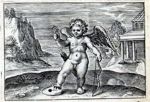
Inconcussa fide: Vaenius, Emblemata aliquot selectiora amatoria (Amsterdam, 1618), emblem 19
Iconclass: 98B(GYGES)51(+0) from a corpse lying in a bronze horse Gyges takes a magic ring, which has the power of making someone invisible (+ variant)
Collectanea (1500): 341
Loci Communes: Bonae fortunae, copiae, felicitatis aut ominis (Of good fortune, abundance, happiness, or omen, Bonne fortune, abondance, bonheur ou présage)
I i 97 Virgula divina The magic wand
Ab hoc non admodum dissidet virgula divina, quoties quicquid optamus, id citra humanam operam, quasi divinitus nobis significamus contingere. Propterea quod antiquitas, quemadmodum in anulis, ita et in virgis ferendis existimavit aliquam fatalem, ac ceu magicam inesse virtutem. M. Cic. lib. De officiis i. Quòd si nobis omnia, quae ad victum cultumque pertinent, virgula, ut aiunt, divina suppeditarentur. Citatur aliquoties & apud Nonium Marcellum, Varro in virgula divina, ut appareat hunc fuisse titulum alicuius ex Menippeis, qui nimirum & ipsi plerique feruntur proverbiales. Adagium natum videri potest potissimum ab illa virga Homerica, quam ille Palladi tribuit, adeo celebri, ut de ea Antisthenes Cynicae sectae conditor, librum conscripserit, eam cum suo, ut coniicio, baculo conferens. Huius locis compluribus meminit Homerus, cum Ulyssem è sene squalido repente in iuvenem vertit, nitidumque facit, ac formosulum, Odisseae Ν. Ως ἄρα μιν φαμένη ῥάβδῳ ἐπεμάσσατ' Ἀθήνη, i.e. Sic effata virum virga demulsit Athena. Eundem rursus ex iuvene vertens in senem, Odysseae π. Αγχι παριστομένη Λαερτιάδην Ὀδυσῆα Ράβδῳ ἐπιπληγυῖα πάλιν ποίησε γέροντα. id est, i.e. Cominus assistens Ithacensem Pallas Ulyssem Restituit senio divinae verbere virgae. Rursum in eodem libro, cum eum iuventuti reddit, ac robur adauget, Η καὶ χρυσείν ῥάβδῳ ἐπεμάσσατ' Ἀθήνη. id est, Dixit, & aureola virga demulsit Athene. Eundem ad modum Mercurio quoque ut incantatori virgam monstrificam tribuit, quam caduceum vocant, Odisseae ω. Εχε δὲ ῥάβδον μετὰ χερσὶν Καλὴν χρυσείην. τῇ δ' ἀνδρῶν ὄμματα θέλγει Ων ἐθέλει, τοὺς δ' αὗτε καὶ ὑπνώοντας ἐγείρει. id est, Tum manibus virgam capit aureolam, atque decoram: Hac quibus est visum, demulcet lumina somno, Atque altis rursum dissolvit lumina somno. Eadem fermè repetit Odysseae Ε. & Iliados. Ω. Αὐτίκ' ἔπειθ' ὑπὸ ποσσὶν ἐδήσατο καλὰ πέδιλα Αμβροσια χρύσεια, τά μιν φέρον ἠμέν ἐφ' ὑγρὴν Η δ' ἐπ' ἀπείρονα γαῖαν ἅμα πνοιῇς ἀνέμοιο. Εἵλετο δὲ ῥάβδον, τᾖ ἀνδρῶν ὄμματα θέλγει Ων ἐθέλει, τοὺς δ' αὗτε καὶ ὑπνώοντας ἐγείρει. id est, Mox ubi iam pedibus talaria subdidit aurea, Pulchraque & ambrosiam spirantia, quae simul illum Aera per liquidum, simul ampla per aequora vastae Telluris, venti flatu comitante, ferebant: Tum virgam capit, hac demulcet lumma somno Quoruncumque velit, somnum quoque pellit eadem. Hunc imitatus Maro, sic eiusdem caduceum describit Aeneidos quarto. Tum virgam capit. hac animas ille evocat orco Pallenteis, alias sub tristia tartara mittit, Dat somnos, adimitque, & lumina morte resignat. Illa fretus, agit ventos, & turbida tranat Nubila. Neque Circae ad sua monstra peragenda virga defuit in transformandis sociis Ulyssis, Odys. Κ. Ράβδῳ πεπληγυῖα κατὰ συφέοισιν ἐέργνυ Οἵδε συῶν μὲν ἔχον κεφαλάς.. id est, Compulit in numerum porcorum verbere virgae Percussos, & erant illis capita ecce suillae. Rursum paulo inferius, Οππότε κεν Κίρκη σ' ἐλάσει περιμήκεϊ ῥάβδῳ. id est, Circe ubi te feriet praelongae verbere virgae. Aliquanto post, Ulysses solus epoto Circes poculo, non transformatus in pecudem, Αὐτὰρ ἐπεὶ δῶκεν τε καὶ ἔκπιον, οὐδέ μ' ἔθελξεν Ράβδῳ πεπληγυῖα. id est, Verum ubi porrectum poculum ebiberam, neque virga Ictum me demulsit. Denique cum ad gratiam Ulyssis, socios pristinae restituit figurae, virgae ministerium adhibuit.Quinetiam in literis Hebraeorum, Moyses in edendis prodigiis virga utitur. Hanc in anguem vertit, hanc in pristinam formam restituit, hac fluminis aquam vertit in sanguinem, extinctis piscibus, hac excivit cynipes, hac diduxit undas rubri maris, hac è silice percussa fontem elicuit. Fortassis huc pertinet, quod regibus etiam virga tribuebatur, quam sceptrum vocant. Unde apud Homerum aliquoties, Σκηπτοῦχοι βασιλῆες. id est, Sceptrigeri reges. Eodem respicit, quod alibi retulimus, laureum porto baculum.
There is not much difference between this and the 'magic wand': by this we mean that whatever we desire we obtain, as if by divine aid and without the help of man. It was thought in Antiquity that the carrying of wands, like rings, held some fated and as it were, magical virtue. Cicero in his De officiis, book i: 'But if all that is essential to our wants and comfort were supplied by some magic wand, as they say...' Varro's Magic Wand is also quoted sometimes in Nonius Marcellus, so that clearly this was the title of one of his Menippean Satires, most of which of course had proverbial titles. The adage seems to be derived particularly from the wand in Homer, which he attributes to Pallas, so famous that the founder of the Cynic sect, Antisthenes, wrote a book about it, comparing it, I imagine, with his own staff. Homer mentions this in many places; when it changes Ulysses suddenly from a dreary old man into a youth and makes him spruce and handsome (Odyssey 13): 'Having spoken thus Athena touched him with her wand.' Again, turning him from a youth into an old man, Odyssey 16: 'Standing close by, Pallas struck the Ithacan Ulysses / And with her rod made him an old man again.' In the same book, again, when she turns him back into a youth and increases his strength: 'Athena spoke, and touched him with her golden wand.' In the same way he credits Mercury, as an enchanter, with a wondrous wand which he calls a caduceus, Odyssey 24:
And in his hands he held a wand, golden and fair;
With it he soothes the eyes of men with sleep,
If he so wills, or waves their sleep away.
He says almost the same in Odyssey 5 and in Iliad 24:
Straight then he shod his feet with lovely sandals
Golden, ambrosial-scented, and they bore him
Through limpid air and over boundless lands
Swift as the wind: with him he took the rod
With which he soothes the eyes of men with sleep,
If so he wills, or waves their sleep away.
Virgil, in imitation of this, describes his caduceus in the fourth Aeneid:
He takes the rod: with this he calls from death
The pallid shades, and with it others sends
To the sad underworld.
He gives sleep, takes it back,
Opens the eyes in death; and on this wand
Trusting, he drives the winds, and sails along
Through the wild clouds.
Circe was not without her wand for performing marvels, when she transformed the companions of Ulysses: 'Striking them with a wand she drove them to join the pigs, / And lo, they had the heads of swine.' Then a little further on: 'When Circe strikes you with her long long wand.' A little later, Ulysses is the only one to have drunk from Circe's cup without being transformed into a beast: 'But when I drained the drink she gave, / She did not enchant me, striking with her wand.' Finally when to please Ulysses Circe restored his companions to their former shapes, she made use of her wand.
Indeed, even in Hebrew literature Moses uses a rod in performing miracles. He changed it into a snake, he restored it to its first shape, with it he turned the river water into blood, killing the fish, he called forth lice, he divided the waves of the Red Sea, he struck the rock and called out a stream of water.
Perhaps one might add here that kings also have a wand attributed to them, called a sceptre: hence in several places in Homer, 'sceptre-bearing kings.' The same meaning is to be found in the adage we have quoted elsewhere, 'I bear the staff of bay.'
Facsimile: 
Iconclass: 13C33 magic wand 97C81 Ulysses' companions are changed into all kinds of animals
Loci Communes: Bonae fortunae, copiae, felicitatis aut ominis (Of good fortune, abundance, happiness, or omen, Bonne fortune, abondance, bonheur ou présage)
I i 98 Stultus stulta loquitur Fools in their folly speak
Euripides in Bacchis. Μωρὰ γὰρ μωρὸς λέγει. id est, Nam stulta stulti oratio est. Totidem verbis propheta noster Esaias eam sententiam extulit. Seneca ad Lucilium: Apud Graecos, inquit, in proverbium cessit: Talis hominibus fuit oratio, qualis vita. Hoc cuiusmodi fuerit parum liquet, nisi quod tale quoddam carmen extat, Graecis celebratum: Ανδρὸς χαρακτήρ ἐκ λόγου γνωρίζεται. id est, Hominis figurae or atione agnoscitur. Democritus philosophus apud Laertium orationem ἔιδωλον τοῦ βίου. i. Vitae simulacrum, quandamque velut umbram esse dicebat. Qua quidem sententia nihil dici poterat verius. Nam nullo in speculo melius, expressiusque relucet figura corporis, quàm in oratione pectoris ima go repraesentatur. Neque secius homines ex sermone, quam aerea vasa tinnitu dignoscuntur.
Euripides in the Bacchae: Μωρὰ γὰρ μωρὸς λέγει, Fools in their folly speak. Our prophet Isaiah expresses the same thing in just the same words. Seneca to Lucilius: 'The Greeks have a proverb that as men's life is, so is their talk.' What this was like is not clear, except that there is a verse very like it current in Greek: 'Man's character is known from what he says.' In Laertius, the philosopher Democritus called speech 'the mirror of life,' a sort of reflection of it, as it were. Nothing could be said more truly. For no mirror reflects the bodily appearance better or more definitely than speech reflects the image of the heart. Men are discerned by their words just as brazen vessels are by their resonance.
Facsimile: 
Iconclass: 31B6235 speaking 31B8 fool, simpleton, numskull 52AA51 Folly, Foolishness; 'Pazzia', 'Sciocchezza', 'Stoltitia' (Ripa)
Loci Communes: Similitudinis et congruentiae (Similarity and congruence, Similitude et convenance)
I i 99 Scindere penulam To tear the cloak
Hodieque vulgo tritissimum est scindere penulam, pro eo quod est impensius retinere hospitem atque invitare prolixius: quod qui faciunt, manu in penulam iniecta, quasi vi conantur remorari. Id adagium ex antiquitate fluxit, ut alia complura. Cicero ad Atti cum lib. xiii. de Varrone loquens: Venit, inquit, ad me, & quidem id temporis, ut retinendus esset. At ego ita egi, ut non scinderem penulam. Memini enim tui, & multa erant, nosque imparati. Quid refert? paulopost C. Capito cum T. Carinate. Horum ego vix attigi penulam, tamen remanserunt.
Even today too it is a very common popular expression 'to tear the cloak,' meaning to retain a guest with eagerness, or to invite him with urgency; people who do this lay hands on the travelling-cloak as if trying to force someone to stay. This adage springs from Antiquity, like many others. Cicero Letters to Atticus, book 13, speaking of Varro, says: 'He called, and at such an hour I had to ask him to stay. But I took care not to tear his coat (I remember your phrase, "they were many and we were unprepared"). No use! Soon after came C. Capito and T. Carinas. Their coats I hardly touched. However they stayed.'
Facsimile:
Iconclass: 31A2549 gripping someone by other parts of the body 41D212 coat, cape
Loci Communes: Hospitalitas (Hospitality, Hospitalité)
I i 100 Oculis magis habenda fides, quam auribus Better trust eyes than ears
Ωτίων πιστότεροι ὀφθαλμοί. id est, Oculis credendum potius quam auribus. Quae cernuntur, certiora sunt quàm quae audiuntur. Item Horatius, Nec retinent patulae commissae fidelius aures. Idem in Arte poetica: Segnius iritant animos demissa per aurem Quàm quae sunt oculis subiecta fidelibus, & quae Ipse sibi tradit spectator. Quanquam id quidem paulo alienius. Propius huc pertinet quod Plautus manus lenae vocat oculatas, non auritas, ut quae id demum crederent, quod viderent. Rursum, quod historia quam gestarum rerum esse volunt, dicta sit παρὰ τὸ ἱστορεῖν, quod est videre. Postremo figmentum illud Vergilianum de duabus apud inferos portis: Eburna, qua significant ea quae per os exeunt, ob dentium eburnum candorem. Et Cornea, qua quae conspiciuntur oculis, volut intelligi, ob pupularum nigrorem. In summa, ad cognitionem magis faciunt aures, ad fidem faciendam certiores sunt oculi. Unde & vulgo, si quis fabulam narret, parum verisimilem, rogare consuevimus, num ea conspexerit. Quod si neget, verum audisse modo, ridetur. Proverbium refertur in epistola Iuliani ad Leontium: ὁ λόγος ποῖος ὁ θούριος ὧτα εἷπεν ἀνθρώποις ὀφθαλμῶν ἀπισότερα. id est, Sermo quidam Thurius dixit, aures hominibus minus esse fideles, quam oculos. Thurium appellavit, indicans Herodotum dicti autorem, vel ob impetum divinum, vel quod is scriptor apud Thurios vixit, & mortuus est: Sumptus est autem ex Chione, ὦτα γὰρ ἀνθρώποισιν ἐόντα ἀπιστότερα ὀφθαλμῶν. id est, Nam aures hominibus minus fideles sunt quàm oculi.
Ωτίων πιστότεροι ὀφθαλμοί, Eyes are to be believed rather than ears. What is seen is more certain than what is heard. So Horace: 'Wide-open ears / Entrusted secrets ill retain.' Again in the Art of Poetry:
Tidings that come by ear we find
Less actively distress the mind,
Than what the looker-on espies
Thrust plainly'neath his faithful eyes.
Though perhaps that is a little different. Closer to the meaning is Plautus' phrase when he called a bawd's hands 'eyed' not 'eared,' meaning that in the end they believe only what they see. Again, when people wish to represent a story as actual fact, they use a word derived from historein, which means 'to see.' Finally there is that fiction of Virgil's about the two gates of the underworld, one of ivory, by which is meant what comes out of the mouth, because of the ivory whiteness of the teeth, and the other of horn, by which is meant what is seen by the eyes, because of the blackness of the pupil. In a word, ears do more for knowing, eyes are surer in producing confidence. And so in ordinary speech, when someone tells an unlikely story, we usually enquire if he has seen these things. If he says no, he only heard them, he gets laughed at.
The proverb is found in Julian's letter to Leontius, 'A certain Thurian saying has it, men's ears are less faithful than their eyes.' He called it Thurian to indicate that Herodotus was the author of the saying, either because of his divine inspiration, or because that writer lived and died at Thurii; however it was taken from his Clio, 'For ears are less faithful to men than eyes.'
Facsimile:
Iconclass: 31A31 sight, looking (one of the five senses) 31A32 hearing, listening (one of the five senses)
Loci Communes: Fides et gravitas (Trust and seriousness, Confiance et gravité)