Guillaume de La Perrièrre, Le Theatre Des Bons Engins (Lyon, 1545)
Emblem 7
A soldier stirring a blazing fire with a swordAI-generated
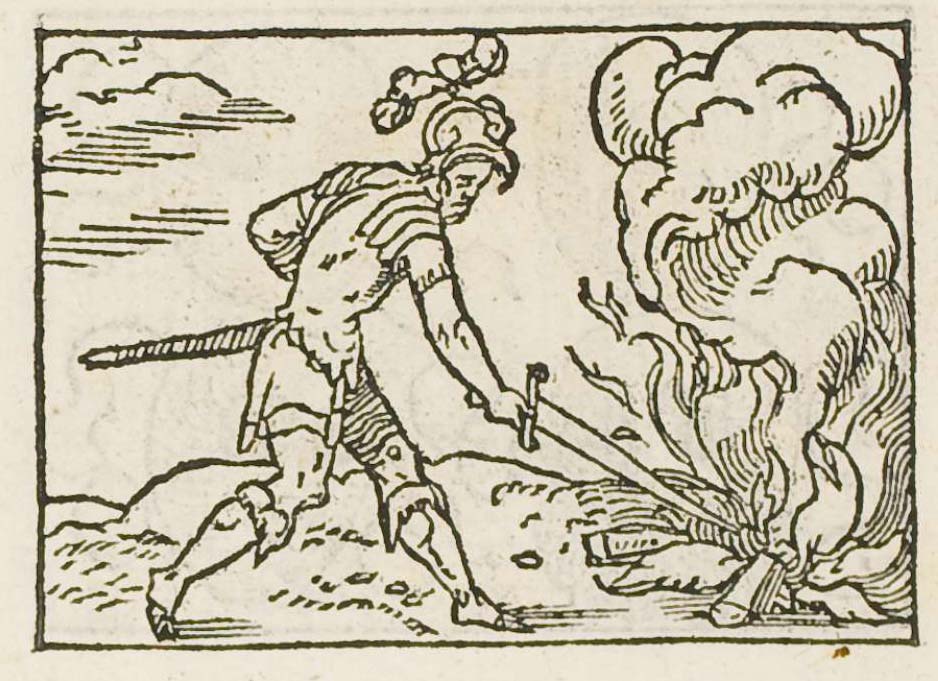
Gens courroucez on ne doibt irriter.
Emblem VII. One ought not to provoke angry people.AI-generated
Description of the woodcutAI-generated
A woodcut in a rectangular frame. In an open landscape with clouds at the left, a soldier wearing a plumed helmet, short tunic and armoured leg-pieces strides forward, his long sword hanging at his left side. Leaning forward, he holds a long blade or rod in both hands and thrusts it into a blazing fire of logs at the lower right, from which large billows of flame and smoke rise up the right half of the picture.
Subscriptio

TranscriptionAI-generated
LE feu de glaiue attiser ne conuientComme lon lict au dict pythagorique,Lequel ainsi que le propos aduientSera reduict en sens allegorique.Ce beau pourtraict clairement nous expliqueQue gens irez ne deuons irriter,Ains que plustost les deuons inuiterA bonne amour, par doulceur de parolle:Car aultrement lon les faict conciterEt enflammer plus fort leur chaulde colle.
TranslationAI-generated
It is not fitting to stir the fire with a sword, as one reads in the Pythagorean saying, which, as the matter requires, will be reduced to an allegorical sense. This fine picture clearly explains to us that we must not provoke angry people, but rather that we should invite them to good will by the gentleness of words: for otherwise one stirs them up and inflames their hot anger all the more.
Iconclass
86(GENS COURROUCEZ ON NE DOIBT IRRITER)proverbs, sayings, etc. (GENS COURROUCEZ ON NE DOIBT IRRITER)31D14adult man45C221helmet45C22armour45C13(SWORD)hacking and thrusting weapons: sword41B16camp-fire; watch-fire41B13stirring up a fire56E2Rage, Anger32A11choleric temperament54C2Recommendation, Inducement, Incitement
Suggested Iconclass codesAI-generated
Additional codes proposed for this emblem, not (yet) part of the indexing.
98B(PYTHAGORAS)Pythagoras, the philosopherhighThe image illustrates the Pythagorean precept 'ignem gladio ne fodias' (do not stir the fire with a sword), so the philosopher Pythagoras is the source figure behind the emblem.
45C13(SWORD)hacking and thrusting weapons: swordhighThe correlate 'hacking and thrusting weapons: sword' matches both the long sword hanging at the soldier's side and the blade he thrusts into the fire.
56E2Rage, Angermedium'Rage, Anger' corresponds to the emblem's moral of not inflaming an already angry man, the fire standing for wrath.
45Bthe soldier; the soldier's lifemedium'The soldier; the soldier's life' fits the armoured, helmeted and sword-bearing figure who is the sole actor in the scene.
33Baggressive relationships, enmity, animositylow'Aggressive relationships, enmity, animosity' loosely matches the emblem's theme of provoking hostility by stirring the fire with a weapon.
Relationships to the Adagia of ErasmusAI-generated
Suggested relationships between this emblem and adages in Erasmus’ Adagia.
- I i 3 Nemo bene imperat, nisi qui paruerit imperio – direct mottohigh
The subscriptio explicitly cites the Pythagorean precept 'Le feu de glaiue attiser ne conuient ... au dict pythagorique' (ignem gladio ne fodias), which is Erasmus's adage I i 3, and the picture shows a soldier thrusting a blade into a blazing fire; Erasmus likewise glosses it as 'do not provoke a man already inflamed with anger.'
- I i 60 Irritare crabrones – thematic inventiomedium
The emblem's moral — 'gens irez ne deuons irriter', since provoking them only inflames their anger to one's own harm — is exactly the lesson of 'To stir up hornets', which Erasmus associates with angry people whom one only provokes further, not without injury to oneself.
- II v 51 Ne gladium tollas mulier – thematic inventiolow
Erasmus explains this sword-adage as 'ne mineris, aut ne lacessas inimicum' — do not provoke an enemy you cannot then subdue — which parallels the emblem's warning against irritating already angry men with word or steel.
- III vi 83 Temulentus dormiens non est excitandus – thematic inventiolow
Both belong to the same proverbial family of 'do not disturb what is already dangerous' (malum bene conditum ne moveas); the emblem urges gentle words rather than stirring up passions that lie smouldering.
Sources
Record ID: embhab_162-3-eth-b_emblem007
This emblem on the Iconclass site: https://iconclass.org/view/embhab_162-3-eth-b_emblem007
Page in the digital copy of the Herzog August Bibliothek: http://diglib.hab.de/drucke/162-3-eth-b/start.htm?image=00020