II v 1 Spartam nactus es, hanc orna Sparta is your portion; do your best for her
Ην ἔλαχες σπάρταν, κόσμει, id est, Spartam quam nactus es, orna, sive administra, admonet adagium, ut quamcunque provinciam erimus forte nacti, ei nos accommodemus, proque huius dignitate nos geramus. M. Tullius ad Atticum libro iiii. epistola vi. Reliquum est: σπάρταν ἔλαχες, τάυταν κόσμει. Non me hercle possum. Et Philoxeno ignosco, qui reduci in carcerem maluit. Idem ad eundem lib. i. Eam causam, quam mihi dicis obtigisse σπάρταν, non modo nunquam deseram, sed etiamsi ab illa deserar in mea pristina sententia permanebo. Quod à Cicerone refertur, carmen est anapaesticum, è tragoedia quapiam, Spartam nactus es, hac exorna. Theocriti Scholiastes indicat allusum ad hoc proverbium in Hodoeporis, Αὐτόθι μοι ποτέρισδε, καὶ αὐτόθι βουκολιάσδευ. Τὰν σαυτοῦ πατέων ἔχε τὰς δρύας. id est, Mecum isthic certa, simul isthic pascito tauros, Et terram calcans propriam, ne desere quercus. Proverbium igitur ad varios usus licebit accommodare: vel cum admonebimus, ut suam quisque personam, quam suscepit, cum decoro tueatur. Episcopus es: ne satrapam agas, sed episcopum, Maritus es, cura quae mariti sunt officia. Aulicus es, aulicum age. Iudex es, ne iam amicum, aut inimicum, sed iudicem agas. Principatus tibi contigit, principis officio fungere. Privatus es, ut privatum te gere. Sic propemodum usus est Aristophanes. (Nam huic inscribitur comoedia, cui titulus θεσμοφορϊάζουσαι.) Χρὴ γὰρ ποιητὴν ἄνδρα πρὸς τὰ δράμματα Α δεῖ ποιεῖν, πρὸς ταῦτα τοὺς τρόπους ἔχειν. id est, Decet poetam accommodari moribus, Utcunque ad argumenta, quae traectaverit. Vel cum iubebimus unumquenque sua sorte contentum esse oportere, quaecumque contigit. Quemadmodum enim peritus gubernator in omni tempestate bonum praestat nauclerum, ita vir sapiens in omni fortuna sapienter se gerit. Est ampla res familiaris, sapieter administra. Non est, utere paupertatis commodis. Contigit eruditio, utere ad bene vivendum. Non contigit, ne macereris, sufficit pietas ad consequendam salutem. Plutarchus in commentario περὶ τῆς εὐθυμΐας, admonens ut suam quisque sortem boni consulat, σπάρτην, inquit, ἔλαχες, ταύτην κόσμει, id est, Sparta tibi obtigit, hanc exorna. In eodem libello monet hoc dictum à Solone proditum. Citatur autem ex Euripide. Σπάρτην ἔλαχες, κείνην κόσμει, Τὰς δὲ Μυκήνας ἡμεῖς ἰδίᾳ. id est, Spartam nactus es, hancce guberna, Sors est proprie nostra Mycenae. Videntur verba esse Agamemnonis ad Menelaum. Quod confine est illi Platonico: τὸ παρὸν εὖ τιθέσθαι, id est, Quod praesens est, bene dispone, sive boni consule. Nunc vulgus hominum magis incumbit augendae rei, quam bene administrandae, contra quam recte monet Socrates in Theaeteto Platonis, κρεῖττον γὰρ που σμικρὸν εὖ, εἰ πολὺ μὴ ἱκανῶς περᾶναι, id est, Nam satius est, pusillum bene, quam multum non ut oportet peragere. Hanc igitur sententiam passim in principum aulis insculpi oportuit, σπάρταν ἔλαχες, ταύταν κόσμει: quorum vix ullum reperias, qui vere cogitet quid sit principis agere persona, quíve sua ditione contentus, non conetur aliquid imperii sui finibus addere. Principis munus est, modis omnibus reipublicae commodis providere, publicam tueri libertatem: alere pacem, excludere quam minimo suorum exitio maleficia, dare operam ut sanctos, & integros habeat magistratus. Cum igitur harum rerum securus, ludit alea, saltat, scortatur, musicatur, venatur, negociatur, breviter alibi intentus est totus: tum occinendum est adagium, σπάρταν ἔλαχες, τάυταν κόσμει. Rursum ubi neglecta quae contigit ditione, foris agit, aliis inhians imperiis, suos in summum adducit discrimen, suos exhaurit funditus, seque pariter & universam fortunam aleae belli subiicit, ut unum aut alterum oppidulum adiiciat suis finibus, tum suggerendum adagium: Spartam nactus es.. Nihil principi pulchrius, quam ut hoc quicquid est regni, quod fortuna dedit, sua sapientia, virtute, diligentia reddat ornatius. Contigit opidulum, imitare Epaminondam: fac ut frigidum illud oppidulum tua opera multo reddas celebrius, ac locupletius. Contigit fera & intractabilis natio, da operam, ut eam paulatim cicurem & legibus obtemperantem reddas. Contigit regnum parum splendidum: noli vexare finitimos, sed hoc quod habes, citra alienum detrimentum exorna. Vix unquam feliciter cessit peregrinae ditionis affectatio. Quasdam nationes ingenium ac linguae sonus discrevit, ut Germanos & Hispanos: quosdam ipsa natura diduxit, ut insulares mari, Italos mari simul & Alpium molibus: nonnullis casus suos terminos dedit. Si quisque quod nactus sit, nitatur ornare, nimirum ubique florebunt omnia: Et inter amicos nempe Christianos, omnia erunt omnium communia. Nunc saepenumero fit, ut dum aliena labefactare nitimur, nostra funditus subvertamus: & ut feliciter cedat res, tanto nostrorum civium sanguine, tantis sumptibus, tot periculis, tot sudoribus, tot orbitatibus, tot denique nunque enumerandis malis, emimus titulum nescio quem innane, & magni nominis fumum. Xerxes, Cyrus, Alexander Magnus & vixissent diutius, & veriorem gloriam essent consecuti, si suas civitates recte administrare, quam alienas armis vexare maluissent. Carolus Burgundionum dux, huius proavus, si vim ingenii qua pollebat, si magnitudinem animi contulisset ad sua locupletanda potius quam ad expugnanda aliena: nec infelicem mortem oppetisset in bello, & inter laudatissimos principes haberi poterat. Magna pars nostrae ditionis id temporis fatali quadam peste tenebatur. Stultissima videlicet, sed omnium perniciosissima dissensione, omnibus in duas factiones divisis: quarum alteri nomen erat ab hamo, alteri à pisce asello. Pugnabat civitas cum civitate, vicus cum vico, domus cum domo: saepe, quos idem lectus iungebat, factio diversa segregabat: & fratrem à fratre, ruptis naturae vinculis distrahebat. Passim latrociniis, iurgiis, caedibus, rapinis fervebant omnia. Et interim bonus ille princeps, perinde quasi haec nihil ad rem pertinerent, procul aliorum oppugnabat moenia, Carolus Galliarum rex, huius nominis octavus, peragrata Italia, reversus est ad suos: sed tanto suo suorumque malo ac periculo, ut poenituerit eius felicitatis. Denique sunt qui affirment, eum ad senectutem pervenire potuisse, si Italiam Italis reliquisset. Quid dicam de Philippo, hius Caroli patre? Adiit Hispanias, non Martis aleam experturus, sed accersitus ad regni partem capessendam: pacata undique omnia. Et tamen hanc tam felicem peregrinationem quam flevit patria, non ferendis exactionibus expilat"? Ipse magno vitae periculo non semel laboravit: Franciscus Buslidium archiepiscopum Byzontinum amisit, virum modis omnibus incomparabilem. Sed tamen utcunque rediit, non licuit iis malis ita defungi. Denuo reliquit suos, saevissima iactatus tempestate delatus est in Angliam, tum temporis non admodum aequam nostratibus. Quid illic acciderit, quid passus fuerit, quid pollicitus, quo pacto dimissus sit, non libet commemorare. Servivite necessitatie, fateor & ignosco, sed quod erat necesse in eam venire necessitatem? Nec iis admonitus malis, de repetenda patria cogitavit. Hispaniae revisendae erant, ubi periret iuvenis ad res maximas natus, nisi ipse suam sibi invidisset felicitatem. Atque unius hominis mors simul & patriam optimo principe, & Maximilianum unico orbavit filio. Quid dicam de Christianissimo Francorum rege Ludovico, eius nominis duodecimo? Adortus est Venetus, id temporis, ut videbant, inexpugnabiles, unico conflictu tot oppida restituit Romano pontifici Iulio, tot Imperatori Maximiliano, tot sibi recepit. Rediit rebus felicissime, sicuti videbant, confrectis. Verum quantum malorum pelagus hinc exundavit in Gallos? Qui suo sanguine tot insignes triumphos Iulio pepererant, eiusdem opera maiore sanguinis iactura, ex Italiae finibus eiecti: parum hoc, & quo non tandem ingnominiae stigmate notati? Quod ni Iulium mors intercepisset, vidissemus regnum illud totius orbis florentissimum, funditus eversum. Quid aunt de Serenissimo Scotorum rege Iacobo commemorem? Is vir absolutam felicitatem absolutae laudi adiunxerat, si perpetuo suis se finibus continuisset. Erat ea corporis specie, ut vel procul regem posses agnoscere. Ingenii vis mira, incredibilis rerem omnium cognitio, invicta animi magnitudo, vere regia pectrois sublimitas, summa comitas, effusissima liberalitas. Denique nulla virtus erat quae magnum deceret principem, in qua ille non sic excelleret, ut inimicorum quoque suffragio laudaretur. Contigerat uxor Margareta serenissimi Anlorum regis Henrici octavi soror: ea forma, ea prudentia, ea in maritum charitate, ut non aliam à superis optare potuisset. Regnum Scotiae, quod multis & opibus & celebritate incolarum, & splendore fertur cedere: sic suis virtutibus illustrarat, sic auxerat, sic ornarat, ut veram egregii principis laudem meruerit, si intra hoc gloriae suae stadium constitisset. Sed ô nunquam felicem regno, raro principi, regis discessum: dum nimium amico in Gallorum regem animo, quo Britanniae regem magnis rerum minis Gallias impetentem avertere, & ad insulae suae defensionem revocaret, egressus regnis sui fines, Anglos bello lacessit. Quid multis? Fortiter quidem, sed infeliciter periit, non tam sibi quam regno. Periit adhuc aevo vigens. Diu Scotia tanto princie, diu Margareta tali marito, diu filius (nam filius ex ea sustulerat) tali patre frui potuisset, atque ipse vicissim & his omnibus & sua gloria, nisi sibi vitam invidisset. Caesus est unà cum fortissimo patre filius, & filius eo patre dignissimus Alexander archiepiscopus, titulo divi Andreae, iuvenis quidem viginti fermè natus annos: in quo nullam consummati viri laudem desiderares. Mira formae gratia, mira dignitas, heroica proceritas, ingenium placidissimum quidem illud, sed tamen ad cognitionem omnium disciplinarum acerrimum. Nam mihi fuit cum eo quondam in urbe Senensi domestica consuetudo: quo tempore à nobis in rhetorum praeceptis, Graecanicisque literis exercebatur. Deum immortalem quàm velox, quàm felix, quam ad quidvis sequax ingenium, quàm multa simul complecti poterat? Eodem tempore discebat iureconsultorum literas: nec eas admodum gratas, ob admixtam barbariem & odiosam interpretum verbositatem. Audiebat dicendi praecept, & praescripto themate declamabat, pariter & calamum exercent & linguam. Discebat Graece, & quotidie quod traditum fuerat, stato reddebat tempore. Horis pomeridianis, musicis operam dabat, monochordiis, tibiis, testudini. Modulabatur & voce nonnunquam. Ne ipsum quidem convivii tempus studiorum vacabat fructu. Sacrificus perpetuo salutarem aliquem librum recitabat: puta decreta pontificum, aut divum Hieronymum, aut Ambrosium: ne unquam recitatis vox interrumpebatur, nisi si quid alteruter doctorum, inter quos medius accumbebat, admonnuisset, aut ipse parum assequens quod legebatur, sciscitatus esset aliquid. Rursum à convivio fabulae, sed breves, & hae quoque literis conditae. Proinde nulla omnino vitae pars vacabat studio, nisi quae rei divinae somnoque daretur. Nam etiamsi quid superfuisset temporis, quod tam variis studiorum vicibus non suppetebat, tamen si quid forte supererat, id historicorum lectioni dabat. Nam hac cognitione praecipue capiebatur. His itaque rebus factum est, ut adulescentulus vixdum decimumoctavum egressus annum, tantum in omni literarum genere consecutus fuerit, quantum in quovis viro iure mireris. Nec illud in hoc usu venit, quod ferè solet in aliis, ut ad literas felix, ad bonos mores minus esset appositus. Verecundi mores erant, sic tamen ut miram agnosceres prudentiam. Animus sublimis, & à sordidis istis affectibus procul semotus: sed ita, ut nihil adesset ferocitatis, nihil fastidii. Nihil non sentiebat, permulta dissimulabat: nec unquam ad iracundiam poterat incitari. Tanta erat naturae lenitas, animique moderatio. Salibus impendio delectabatur, sed eruditis ac minime dentatis. hoc est, non nigro Momi, sed candido Mercurii sale tinctis. Si quid turbae domi natum fuisset inter famulos, mirum quanta dexteritae, quantoque candore solitus sit conponere. Denique religionis erat & pietatis plurimum, superstitionis nihil. In summa, nemo fuit dignior, qui ex rege, & ex illo rege nasceretur. Utinam autem in parentem pietas quam fuit admirabilis, tam fuisset & felix. Comitatus est in bellum, ne usquam patri deesset. Quaeso quid tibi cum Mavorte, omnium poeticorum deorum stupidissimo, qui musis, imò qui Christo eras initiatus? Quid isti formae, quid isti aetati, quid naturae tam miti, quid ingenio tam candido, cum taratantaris, bombardis, & ferro? Denique quid eruditio cum acie? quid episcopo cum armis? Imposuit nimirum tibi immodica quaedam in parentem pietas, dumque nimium fortiter amas patrem, infeliciter cum patre caesus occubuisti. Tot naturae dotes, tot virtutes, tot eximias spes, unica pugnae procella absorbuit. Periit & nostratum rerum nonnihil. Nempe quod in erudiendo te sumpsimus operae, quodque mea partum industria mihi in te vindico. At quantus felicitatis cumulus, nihi genius aliquis malus regem huc impulisset, ut regni sui limites egressus, in alienis agris cum ferocissima gente Martem experiri vellet? Utinam quod praeclare coeperat, perficere maluisset. hoc est, σπάρτην ἣν ἔλαχε κοσμεῖν. Regibus proprius ac pulcherrimus laudum campus intra regni fines est. In apum gente caetera quidem huc & illuc volatu divagantur: solus rex, ut aculeo caret, ita pro portione corporis alas habet multo minores, ut ad volatum parum sit idoneus. Veteres ita Venerem fingebant, ut pedibus testudinem premeret: id innuentes, matremfamilias ab aedibus nusquam oportere discedere, quippe cuius omne officium intra domesticos parietes contineatur. Atqui multo magis ad rem pertinebat, principem hoc admoneri symbolo: qui si quid peccat, non unius familiae, sed orbis totius malo peccat. An parum est domi negociorum, ut foris sint accersenda? Tanta est ubique scelerum sentina, tot sacrilegia, tot latrocinia, tot oppressiones, tot iniuriae, tot contumeliae, tot magistratuum corruptelae, tot leges, aut à tyrannis institutae, aut in tyrannidis ministreium detortae, ut illa minutiora ne dicam, neglectas oppidorum vias, collabentes aedes sacras, incuratas fluminum ripas. His ita mederi, ut in remedium, quam minimum de sanguine tuorum impendas, ut respublica beneficium sentiat, non sentiat impendium, an non egregium principis munus, & immortali laude dignum? Quod si cupis omnino gloriae tuae pomeria ultra ditionis tuae fines extendere, fac ut qui finitimi sunt, magnitudinem tuam benefactis, non malefactis experiantur. Exuris villas, proteris segetes, demoliris urbes, abigis pecora, trucidas homines, atque ita denique te magnum declaras. bellum certamen, si id cum latrone suscepisses. Hesiodus scripsit, malum vicinum magnam esse noxam: contrà bonum, ingens esse commodum. Hoc in te probent finitimi tui: fac ita te mirentur magnum, ut ament benignum. Verum satis iam dolori nostro satis datum discipuli memoriae. Superest ut ad proverbiorum recensionem redeamus.
Ἥν ἔλαχες Σπάρτην κόσμει, Sparta has fallen to your lot; be an honour to her, or rule her well. The purport of this adage is that, whatever sphere of activity may chance to be ours, we should adapt ourselves to it, and live up to the standard that it sets. Cicero in his Letters to Atticus, book 4 letter 6: 'Nothing is left but "Sparta is your portion; do your best for her." I simply can't, and can understand why Philoxenus preferred to be sent back to jail.' Again in the same collection, in book 1: 'That is why, when you say that Sparta is my portion, I shall never desert her; and what is more, if she deserts me, I shall stand by my original convictions.' The words Cicero quotes form an anapaestic line from some tragedy. The scholiast on Theocritus points out an allusion to this proverb in his Wayfarers: 'Compete from there then, and pasture your oxen from there. / Tread your own beat and keep your oaks.'
It will thus be permissible to apply the proverb to various purposes; when, for instance, we urge someone to maintain in a proper spirit the role which he has adopted. If you are a bishop, behave like a bishop, not an oriental prince. If you're a husband, mind you fulfil a husband's duties; if a courtier, than play the part of a courtier; if a judge, be no man's private friend or enemy, but be a judge. Has Fortune given you a princedom? - do your princely duty. Are you a private person? - act as a private person ought. This is very much how Aristophanes uses the phrase (for his is the name attached to the comedy called Thesmophoriazusae): 'The poet his behaviour must adapt / To suit the play that he's obliged to write.' Equally, when we tell any individual that it is his duty to be content with the lot that has befallen him; for like an experienced ship's-captain, who shows his seamanship in any weather, a wise man acts a wise man's part in any circumstances. If you have an ample fortune, use it wisely; if the reverse, enjoy the blessings of a modest station. If you have had a good education, make it serve a good life; if not, do not repine, for godliness is sufficient to secure salvation. Plutarch in his essay 'On Tranquillity of Mind/ making the point that everyone should be content with what he has, says 'Sparta has fallen to your lot; do your best for her.' In the same essay he tells us that this saying was uttered by Solon. It is however cited from Euripides: 'Sparta's your portion, Sparta you must rule; / Mycenae ours.' (The words seem addressed by Agamemnon to Menelaus.) This is close to Plato's 'Make the best of what you have' or 'Take it in good part.' But the mass of people nowadays are more devoted to increasing what they have than to making the most of it; against which we are rightly warned by Socrates' words in Plato's Theaetetus: 'For surely it is better to do something small well than something large inadequately.'
And so it would be right for this sentence 'Sparta is your portion; do your best for her' to be inscribed everywhere in the Courts of princes; for you will hardly find one who truly considers what it means to play a prince's part, or who is content with the authority he has and does not attempt to add something to the extent of his dominions. It is a prince's duty to provide by all the means in his power for the well-being of the commonwealth, to protect public liberty, to cherish peace, to banish wrongdoing with the least possible sacrifice of his own subjects, and to see to it that he has virtuous and upright servants. And so, when he does not spare a thought for these things, but amuses himself with gaming, dancing, wenching, music, hunting, or business deals, and in a word is wholly occupied in other things, that is the time to din into his ears the adage 'Sparta is your portion; do your best for her.' Again, when he neglects the dominions which are already his and spends his time abroad, thirsting for the territory of others; when he brings his own subjects into great peril, exhausts his people utterly, and stakes alike himself and his whole fortune on the hazards of war, in order that he may add to his territories two or three petty towns; it is then he should be reminded of the adage 'Sparta is your portion.' Nothing brings a prince more credit than to take such dominions as Fortune has given him, and make them more flourishing by his own wisdom, virtue and activity. Your lot is a small town: take Epaminondas as your model, and make that small dull town far more populous and richer by your efforts. Your lot is a barbarous and intractable race of men: make it your business to tame them and render them law-abiding by degrees. Your lot may be a crown without much glory: do not challenge your neighbours, but improve what you have without inflicting loss on others. The desire for foreign dominions has very rarely turned out well. Some nations have been made separate by their character and language, like the Germans and the Spaniards; some men nature herself has isolated, the islanders by the sea, the Italians at the same time by the sea and the great mass of the Alps; some have been given their proper boundaries by chance. If every prince were to try to improve what he has been given, we may be sure all things would flourish universally; and among friends of course, who are Christians, all things will be common to all. As things are, it often happens that we try to undermine the possessions of others, and entirely overthrow our own; or, even granting things go well, the blood of all those of our fellow-citizens, all that expense, such dangers and such efforts and so many childless homes, and in a word evils past counting, purchase some empty title and the smoke of a great name. Xerxes and Cyrus and Alexander the Great would have lived longer and won more solid glory, had they preferred the good government of their own states to the harrassment by force of arms of states that were not theirs. Charles, duke of Burgundy, great-grandfather of the present duke, had he turned his outstanding intellectual gifts and his noble spirit to the enriching of his own dominions instead of conquering other men's, would not have met a wretched death in war, and might have been numbered among the most admired of princes. A great part of my native realm was at that time in the grip of a sort of fatal pestilence, a very foolish but uniquely disastrous civil strife; the whole population was split into two camps, of which one took its name from a hook and the other from a codfish. City fought against city, village against village, house against house; often those who were united by sharing the same bed were divided by a difference of party, which broke the bonds of natural affection and rent brother from brother. Everywhere was a turmoil of robbery, strife, bloodshed and rapine; and all the time that excellent prince, just as though this were not his business, was far away, laying siege to the walls of strangers.
Charles, king of France, eighth of that name, after ranging over Italy returned to his own people; but at the price of such distress and danger for himself and them as made them repent of his success. Some even maintain that he might have reached old age, had he left Italy to the Italians.
What shall I say of Philip, father of this present Charles? He set off for Spain, not to risk the hazards of war but because he was summoned to assume his share of the kingdom. There was universal peace; and yet that auspicious expedition - what tears it cost his country, plundered by unbearable taxation! He himself was more than once in great peril of death. He lost Frangois de Busleyden, archbishop of Besangon, a man without peer in every way. Somehow or other, none the less, he returned; but he was not allowed to be quit of his troubles so lightly. Once again he left his own people and, after being most cruelly tossed by a storm, he was cast up on the coast of England, which was at that time none too friendly to my countrymen. How he fared then, the treatment he received, the promises he made, on what conditions he was sent away, are subjects on which I would rather not dwell. He was the slave of necessity, of course, and I forgive him; but why was it necessary to subject himself to that necessity? Nor did he learn his lesson from these troubles and think of returning to his own country; he had to revisit Spain, and there he died, a young man born to do great things, had he not begrudged himself his own good fortune. Thus one man's death at one stroke deprived his country of an excellent prince and Maximilian of an only son.
What am I to say of the Most Christian king of France, Louis XII? He attacked Venice, which at that time seemed invincible, and in one conflict restored all those towns to the Roman pontiff Julius and to the Emperor Maximilian, and won so many for himself, returning, as it seemed, in triumph. But as a result what a sea of troubles came flooding into France! With their own blood the French had won all those famous victories for Julius, and it was Julius' doing that with still greater bloodshed they were expelled from Italian soil. Nor was this all, and they were branded with every form of ignominy. Had Julius not been carried off by death, we should have seen that kingdom, the most properous in the whole world, utterly overthrown.
Of James, most serene king of Scots, what am I to say? Prosperity and reputation, both without flaw, were his, if he had confined himself permanently within his own frontiers. He was so handsome that even from afar you could see he was a king; he had great powers of mind, incredible and universal knowledge, and unconquerable spirit, a truly royal nobility of feeling, the most perfect courtesy, the most open-handed generosity; there is, in short, no good quality that might grace a great prince in which he did not so far excel as to win praise even from his enemies. He was blessed with a wife - Margaret, sister of his most serene majesty King Henry the eighth of England - of such beauty, such good sense and such devotion to her husband, that he could not have asked heaven for a different queen. On the kingdom of Scotland, which in wealth, in the number of its inhabitants and in grandeur is thought to fall short of many others, he had shed such lustre by his own qualities, and had so exalted, so embellished it, that he deserved the true praise of an outstanding prince, if he had kept within this field of action in his quest for glory. But alas, when a king leaves his kingdom, this is never a blessing for the country, and rarely for the prince. In an excess of friendly feeling for the king of France, and in hopes of diverting the English king, who was mounting serious and active threats against the French, and recalling him to the defence of his island, he crossed the frontier of his own kingdom and opened hostilities against the English. In brief, he perished, bravely but disastrously, not so much for himself as for his kingdom, and perished while still in his prime. Long might Scotland have enjoyed such a great prince; long might Margaret have enjoyed such a husband, his son (for he had had a son by her) such a father, and he in his turn all these blessings and his own renown, had he not begrudged himself a longer life.
Killed with that valiant father was a son, a son worthy of such a father, Alexander archbishop of Saint Andrews, a young man only some twenty years of age, in whom no quality that would grace a man in his maturity was lacking. Strikingly handsome and dignified, and of heroic stature, he had a very placid temperament, but none the less was very quick to acquire knowledge in every field. I once lived under the same roof in the city of Siena, at a time when I was coaching him in rhetoric and Greek. What gifts he had, in heaven's name! How quick his mind, how fertile, how ready to follow any clue, how capable of grasping many things at once! At the same time he was learning law, but did not much enjoy his lawbooks with the element of barbarism in their style and the tedious verbosity of the commentators. He used to have lessons on rhetorical theory, and declaimed on a prescribed theme, practising at the same time both pen and tongue. He was learning Greek, and every day used to return at the agreed time the exercise that had been set him. The afternoons were given up to his music teachers, in the monochord, the flute and the zither; sometimes he also sang. Even dinner-time did not fail to contribute to his studies. The chaplain used to read continuously some improving book, the Papal Decrees perhaps or St Jerome or Ambrose; nor was he ever interrupted as he read, unless one or other of the two learned men between whom the archbishop was sitting had drawn attention to some point, or he himself, not fully understanding what was read, had asked some question. After dinner again there was conversation, but not for long, and it was spiced with sound learning. No part of his life in fact was exempt from study, except for what was given to divine service and to sleep. For even if there had been any time to spare (and time did not suffice for so great a variety of studies) - if in spite of this there was any time left over, he spent it on reading the historians, for history was his favourite subject.
The result of all this was that, when a youth scarcely more than eighteen years old, his achievements in every department of learning were such as you would rightly admire in a grown man. Nor was it the case with him, as it is with so many others, that he had a natural gift for learning but was less disposed to good behaviour. He was shy by nature, but it was a shyness in which you could detect remarkable good sense. His spirit was lofty, and far above the usual unworthy desires, but in a way that avoided both the disdainful and the farouche. Sensitive as he was, he often concealed his feelings, nor could he ever be provoked to lose his temper; such was his gentle nature and his fairness of mind. In wit he took great delight, but it must be educated and have no cutting edge, seasoned with the white salt of Mercury, not the black salt of Momus. Had there been any domestic trouble among his household, the skill and plain speaking with which he normally dealt with it were remarkable. Last but not least, his was a very devout religious nature, without a trace of superstition; no one, in a word, was ever more worthy to be a king's son and the son of that king.
If only his devotion to his father, admirable as it was, had been equally fortunate! Resolved never to fail his father, he went with him to the war. What pray had you to do with Mars, the stupidest of all the gods of poetry, when you were already enlisted as a disciple of the Muses and, what is more, of Christ himself? With your handsome person, your youth, your gentle nature, and your fairness of mind, what could they mean to you, the trumpet-calls, the cannon and the sword? What place has learning in the line of battle, or a bishop sword in hand? It was, no doubt, excessive filial devotion that misled you. You proved your love for your father with a courage that was too great, and unhappily fell with your father on the field of battle. Those gifts of nature, those high qualities, those splendid hopes, were all sunk in the hurricane of a single fight. Something of mine was lost there too: the pains I had devoted to teaching you, and so much of you as was made by my efforts, I claim as my share in you.
And what supreme felicity there might have been, had not some evil genius driven the king to pass the frontiers of his own kingdom and try the fortunes of war in foreign fields against a nation noted for ferocity! If only he had been willing to complete the task he had begun so admirably, of doing the best for the Sparta which was his portion! Kings find their proper and their noblest field for distinction within the frontiers of their realm. Take the commonwealth of bees: the other citizens fly hither and thither at will; only the king is without a sting, and he only has much smaller wings in proportion to his body, so that he is not well-fitted for flight. The Ancients used to represent Venus with her feet resting on a tortoise-shell, to convey the message that the mother of a family ought never to leave the house, since all her duties are confined within domestic walls. It was in any case much more the point for the prince to take warning from his emblem, for if he does wrong, his wrongdoing entails unhappiness, not for a single family but for the whole round world.
Has he so little business in his own country that he must look for trouble in foreign parts? Crime like a great cesspit lies everywhere, all that sacrilege and robbery, that oppression injury and insult; those fraudulent magistrates, those laws enacted by tyrants or wrested to the service of tyranny; to say nothing of the small-scale scandals, the neglected roads between our towns, the churches falling into ruin, the river-banks neglected. To heal these evils in such a way that you expend on the remedy as little as possible of your people's blood, and the commonwealth feels the benefit without feeling the expense, is surely a splendid task for any prince and earns him immortal renown. If, however, all your desire is to extend the horizon of your glory beyond the bounds of your own realm, see to it that your neighbours learn your greatness from the benefits you confer on them, not from your misdeeds. Do you burn farms and trample crops, demolish cities, drive off flocks and herds and slaughter human beings? Are these the only means by which you show your greatness? A pretty contest, had you been matched against a pirate! Hesiod wrote that 'an evil neighbour is a mighty woe,' a good one on the other hand an enormous boon. Let your neighbours see this proved true in you; let them admire your greatness, in so far as your goodness wins their affection. But I have given rein enough to my grief, and to the memory of my disciple; it remains to return to my catalogue of proverbs.
Facsimile: 


Iconclass: 53B1:51C2 Acceptance❧Necessity, Inevitability; 'Necessità' (Ripa) 53B1:51EE11 Acceptance❧Restriction, Limitation 53CC21 Readiness to Comply 54A6 Helpfulness 54E32 Compliance 57A611 Frankness, Loyalty; 'Lealtà', 'Realtà' (Ripa) 57AA647 Hybris 61B2(CHARLES THE BOLD, Duke of Burgundy) historical person (CHARLES THE BOLD, Duke of Burgundy) 61B2(CHARLES VIII [of France]) historical person (CHARLES VIII [of France]) 61B2(FRANÇOIS DE BUSLEYDEN) historical person (FRANÇOIS DE BUSLEYDEN) 61B2(JAMES IV [of Scotland]) historical person (JAMES IV [of Scotland]) 61B2(LOUIS XII [of France]) historical person (LOUIS XII [of France]) 61B2(MAXIMILIAN I [of the Holy Roman Empire]) historical person (MAXIMILIAN I [of the Holy Roman Empire]) 61B2(PHILIP THE HANDSOME, Duke of Burgundy) historical person (PHILIP THE HANDSOME, Duke of Burgundy) 61D(SPARTA) geographical names of countries, regions, mountains, rivers, etc. (SPARTA) (SPARTA) 61I(HOEKSE EN KABELJAUWSE TWISTEN) names of historical events and situations (HOEKSE EN KABELJAUWSE TWISTEN) 61I(HOOK AND COD WARS) names of historical events and situations (HOOK AND COD WARS)
Loci Communes: Servire tempori (To serve the times, Se plier aux circonstances)
II v 2 Contigit et malis venatio Rascals are sometimes lucky in the hunt
Δέδοται καὶ κακοῖσιν ἄγρα, id est, Contigit & ignavis è venatu praeda. ubi quid feliciter obtigit immerenti, quodque fortunae magis, quàm illius industriae sit acceptum ferendum. Allegoria sumpta à venatu, in quo vel praecipue dominatur fortuna. Virtus minimum adfert momenti. At eruditio nemini contigit nisi labore parta. Regnum obvenit dormientibus, opes affluunt cessantibus nonnunquam: honores accidunt etiam fugitantibus: caeterum quae vere bona sunt, nostra industria parentur oportet. Suspicor inde natum quod olim mos fuerit, quod venatu captum esset, omnibus impartiri, etiam immerentibus. Ita Theocritus in Piscatoribus, Ως καὶ τὰν ἄργαν τ᾽ ωνείρατα πάντα μερίζειν. id est, Sic uti venatum partiri insomnia cuncta. Quemadmodum arcana non committimus nisi selectis amicis, ita somnia narramus quibuslibet. Proverbium refertur à Suida è Zenodoto. Si pro δέδοται legas δίδοτο, sive δέδοτο, erit initium carminis trochaici. Nam probabile est è poeta quopiam decerptum.
Δέδοται καὶ κακοῖσιν ἄγρα, Cowards too sometimes have good hunting. Used when success comes to someone who does not deserve it, success that must be ascribed to good fortune rather then to any efforts made by himself. The allegory is taken from hunting, in which more than in most things luck is paramount and merit carries very little weight. Learning on the other hand comes no man's way unless he works for it. Men become monarchs while they sleep, wealth sometimes comes in plenty to the idle, honours are conferred even on those who shun them; but what is of real worth must needs be won by our own efforts. This proverb originates, I suspect, from the old custom of dividing what had been taken in a day's hunting among those present, whether they had earned it or not. So Theocritus in The Fishermen: 'I share our catch; share with me all your dreams.' We do not entrust our secrets to any but chosen friends; and in the same spirit there are some people to whom we tell all. The proverb is given by Suidas, who gets it from Zenodotus.
If you were to read δέδοται or δίδοτο or δέδοτο, it will be the beginning of a trochaic line; for it is probably taken from some poet or other.
Facsimile:
Iconclass: 43C114:32A42 hunter❧coward 43C1131 the kill (~ hunting) 51AA4:54D12 Nothingness, Absence❧Exercise; 'Essercitio' (Ripa) 54F12 Luck, Fortune, Lot; 'Fato', 'Fortuna', 'Fortuna aurea', 'Fortuna buona', 'Fortuna pacifica overo clemente', 'Sorte' (Ripa) 55A12 Reward, 'Praemium'; 'Premio', 'Remuneratione' (Ripa)
Loci Communes: Bonae fortunae, copiae, felicitatis aut ominis (Of good fortune, abundance, happiness, or omen, Bonne fortune, abondance, bonheur ou présage)
II v 3 Ire per extentum funem To walk the tightrope
Proverbiali figura dixit Horatius, Ire per extentum funem, Pro eo quod est, rem factu perquam difficilem praestare, neque vel tantillum aberrare. Sumptum à funambulis, ut Acroni placet, qui non sine summa arte, summoque usu, per funem protensum ingrediuntur. Quae res, sicuti coniicere licet, priscis ingenti miraculo fuit. Hodie nihil vulgatius. Horatii carmen hoc est, Ille per extentum funem mihi posse videtur Ire poeta, meum qui pectus inaniter angit.
Horace uses To walk the tightrope' as a proverbial metaphor, equivalent to doing something very difficult without putting a foot wrong. Derived, Acron thinks, from circus-artists who, with consummate skill and long experience, walk along a tight-stretched rope, a feat by which we may well suppose that the Ancients were much astonished, though in our day nothing is more ordinary. Horace's lines are: 'That poet could methinks the tightrope walk, / Who plucks my heart-strings with mere idle talk.'
Facsimile:
Iconclass: 43A3721 tight-ropewalker 54DD4 Difficulty
Collectanea (1500): 318
Loci Communes: Difficultatis (Difficulty, Difficulté)
II v 4 Annus est Years ago
Arbitror nemini dubium fore, quin illa quoque inter proverbiales hyperbolas referri debeant, Annus est, seculum est, atque id genus alia. Terentius in Seipsum excruciante, Et nosti mores mulierum, dum comuntur, dum moliuntur, annus est. Idem alibi, Iamdudum aetatem, pro admodum dudum. Plautus in Asinaria, Aetatem velim servire, Libanum qui conveniam modo. Et, Seculum est, quod nihil abs te redditur literarum. Proinde tempus praelongum huiusmodi figuris significabimus.
No one would hesitate, I think, to give proverbial status to such exaggerations as 'Years ago,' 'Ages ago,' and others of the kind. Terence in The Self-tormenter. 'You know what women are: while they're making themselves up and getting under weigh, a year goes by.' And in another passage: 'Long? It's been an age already,' for a very long time. Plautus in the Asinaria: 'I'd gladly serve for ages, if I could only fall in with Libanus.' And 'It's an age already since I had a letter from you.' So we shall use metaphors of this kind to convey a long stretch of time.
Facsimile:
Iconclass: 23C1 'Annus', personification of the year; 'Anno', 'Carro dell'anno' (Ripa) 51MM11 Slowness, Tardiness; 'Tardità' (Ripa) 54DD311 Waiting, Watching
Collectanea (1500): 552
Loci Communes: Tarditatis et cunctationis (Slowness and delay, Lenteur et retard)
II v 5 Dies adimit aegritudinem Time tempers grief
Menedemus in ἑαυτὸντιμωρουμένῳ Terentiana nominatim adagii vice refert, Aut ego, inquiens, profecto ingenio egregie ad miseriam natus sum, aut illud falsum est, quo vulgo audio dici, diem adimere aegritudinem hominibus. Eodem spectasse videtur Sophocles in Aiace flagellifero, Χρόνος γὰρ εὐμαρὴς θέος. id est, Tempus enim facilis deus. videlicet quod omnia leniat, molliatque. Ovidius, quod male fers, assuesce, feres. bene multa vetustas. Lenit. Euripides in Alcestide, χρόνος μαλάξει σέ. id est, Tempus dolorem leniet. Marcus Tullius libro Tusculanarum quaestionum iii. Quod ita esse dies declarat, quae procedens ita mitigat, ut iisdem malis manentibus non modo leniatur aegritudo, sed in plerisque tollatur. Idem Epistolarum libro quinto: Nam quod allatura est diuturnitas, id nos praecipere consilio prudentiaque debemus. Citatur ex Iphiclo, Αύπης δὲ πάσης ἐστὶν ἰατρὸς χρόνος. id est, Tempus molestiis medetur omnibus. Euripides, Μέλλοντ᾽ ἰατρὸς τῇ νόσῳ διδοὺς χρόνον, Ιἀσατ᾽ ἢδη μᾶλλον, ἢ τεμών χρόα. id est, Medicus dedit qui temporis morbo moram, Is plus remedii, quàm cutis sector dedit.
Menedemus in Terence's Heautontimorumenos cites this in so many words as an adage: 'Either I'm born express for misery, / Or there's no truth in what I hear men say, / That time will temper grief.' Sophocles seems to have had the same thing in mind in his Ajax with the scourge: 'For Time's a kindly god,' no doubt because he is the great healer and peacemaker. Ovid: 'What you find hard to bear, the habit formed, / Will easy be; time lightens many loads.' Euripides in the Alcestis: 'Time will relax your grief.' Cicero in book three of the Tusculan Questions: 'That this is so is shown by time, the passage of which has such a softening effect that, though troubles remain the same, the pain of them is not merely relieved but in many cases removed altogether.' And again in book five of the Letters: The effect that will be produced by lapse of time it is our duty to accelerate by wise and thoughtful action.' A line is cited from Iphiclus: Time the great healer of every sort of pain.' Euripides: The leech who time prescribes for your disease / Heals more forthwith than he who plies the knife.'
Facsimile:
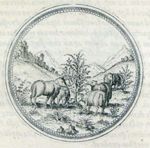
Iconclass: 23A4:54A6:56BB2 allegorical representations of the effects of time❧Helpfulness❧Unhappiness; 'Infelicità' (Ripa) 49G233(+0) spiritual healing (+ variant)
Collectanea (1500): 554
Loci Communes: Malum assuetum (Habitual evil, Mal habituel)
II v 6 Lucernam adhibes in meridie You use a lantern at midday
Λύχνον ἐν μεσημβρίᾳ ἅπτεις, id est, Lucernam accendis in meridie, id est, facis non suo tempore. Aut explicas quae per se sunt clarissima. Quorsum enim lucernis opus clarissima lu ce? Natum videri potest à ridiculo Diogenis facto, qui adhibita interdiu lucerna, rogatusque quidnam sibi vellet, respondit, ἄνθρωπον ζητῶ id est, Hominem quaero, quemadmodum testatur Diogenes Laertius. Seneca libro de Beata vita, indicat hoc fieri solere per superstitionem, si quando denunciabatur ira numinis: Cum, inquit, sistrum aliquis concutiens ex imperio mentitur: quum aliquis secandi lacertos suos artifex, brachia atque humeros supensa manu cruentat: quum aliqua genibus per viam repens ululat, laurumque linteatus senex & medio lucernam die praeferens, conclamat iratum aliquem deorum, concurritis & auditis.
Λύχνον ἐν μεσημβρίᾳ ἅπτεις, You light a lantern at midday, which means, You do something at the wrong moment, or you explain something perfectly obvious. For what is the use of lamps when daylight is at its brightest? This might be thought to take its rise from a humorous gesture of Diogenes, who carried a lantern in broad daylight, and when asked what he would be at, replied: 'I'm looking for a man.' So Diogenes Laertius records. Seneca in his essay 'On the Happy Life' shows that this was done from superstitious motives, when the anger of a deity threatened: 'When someone rattles a sistrum and falsely declares that he does it under orders; when someone who has a trick of slashing his forearm draws blood with light strokes from arms and shoulders; when a woman crawls on her knees howling through the streets; when an old man dressed in linen and carrying a bay-branch and a lantern in broad daylight dolefully proclaims that some god is angry, you gather in crowds and listen.'
Facsimile: 
Plures pelle ...: La Perrière, Morosophie (Lyon, 1553), emblem 31 uses the imagery of Diogenes
Iconclass: 13B423 incantation, magic sentence 23R113 noon 41B33 lantern 56DD1 Fear, Dread; 'Paura', 'Timidità o Timore', 'Timore' (Ripa) 98B(DIOGENES)52 Diogenes, carrying a lighted lantarn by daylight, trying to find an honest man, usually in a crowded market-place
Collectanea (1500): 630
Loci Communes: Absurda, indecora, seu praepostera (Absurd, unbecoming, or preposterous things, Choses absurdes, inconvenantes ou déplacées)
II v 7 Soli lumen inferre To hold a candle to the sun
Quintilianus Institutionum oratoriarum libro quinto, titulo, de usu argumentorum, similima huic figurae dixit, eum soli lumen inferre, qui rem per se evidentissimam conaretur argumentationibus probare. Videtur idem cum illo, quod alio retulimus loco, ἁλίῳ τὸ φῶς δανείζειν, id est, Soli mutuare lumen.
Quintilian in book five of his Principles of Oratory, in the chapter on the uses of evidence, used a metaphor very like this when he said that a man who tried to establish by argument a point that was in itself entirely obvious, was holding a candle to the sun. To all appearance identical with one I have recorded elsewhere: To lend light to the sun.
Facsimile:
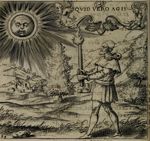
Quid vero agis: De Montenay, Cent Emblèmes Chrestiens (Frankfurt, 1619), emblem 93
Iconclass: 24A8 sunlight 41B31(+1) candle (+ kindling a light; lit, burning light, lamp, candle) 52AA511 Ridiculousness 54BB3 Inutility, Noxiousness; 'Nocumento', 'Nocumento d'ogni cosa' (Ripa)
Loci Communes: Absurda, indecora, seu praepostera (Absurd, unbecoming, or preposterous things, Choses absurdes, inconvenantes ou déplacées)
II v 8 Zoili Zoilus and his like
Zoili audax quidem, sed parum felix, mordacitas proverbio locum fecit, ut vulgo Zoili vocentur, alienarum laudum obtrectatores, & alienorum laborum reprehensores. Martial. Pendentem volo Zoilum videre. Hic Zoilus sophista quispiam fuit, hoc facinore potissimum nobilitatus, quia Homerum poetarum omnium principem ausus est libris aliquot in eum scriptis incessere: unde Ομηρομάστιγος cognomen meruit, quod ipsum etiam abiit in proverbium: sic enim appellari coepti nobilium autorum castigatores, vel Plinio teste in praefatione Historiae naturalis. Et Vergiliomastiges, quorum de numero fuit Pero. Zoilus igitur commentarios in Hometum compositos Ptolemaeo tyranno Aegyptiorum obtulit, ingens videlicet praemium à rege sperans. Verum cum nihil mitteretur, penuria coactus, misit qui peterent. Ibi Ptolemaeus ait se mirari, cum Homerus tot annos defunctus tot hominum millia pasceret, Zoilum egere, Homero doctiorem. Denique per occasionem supplicio affectus est. Quanquam de mortis genere diversa tradunt autores.
Zoilus, with his biting tongue, was bold enough but missed his target, and gave rise to a proverb: we commonly give the name of Zoilus to those who blacken other men's fair fame and find fault with the result of other men's labours. Martial: 'I would see Zoilus on tenterhooks.' The original Zoilus was a sophist, whose most distinguished achievement was to have had the audacity to write several books attacking Homer, the prince of poets. This earned him the name of Homeromastix, scourge of Homer; and this too passed into a proverb, for it began to be used of those who criticized famous authors, as we learn from Pliny in the preface to his Natural History. There were Virgilomastiges too, scourges of Virgil, one of whom was Pero. So this Zoilus, having written his critical works on Homer, dedicated them to Ptolemy, tyrant of Egypt, and hoped for an enormous reward from the king. When however nothing was forthcoming, and he was obliged by penury to send and ask, Ptolemy expressed his surprise that Homer, who had been dead for so many years, still provided so many men with their daily bread, and Zoilus, who was so much cleverer than Homer, was starving. At length, as a result of something that happened, he suffered capital punishment, though about the manner of his death the authorities tell differing stories.
Facsimile:
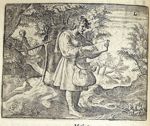
Ey siet! hoe Zoilus sijns naesten feylen teeckent ...: Vondel, Gulden Winkel (Amsterdam, 1622), emblem 41
Iconclass: 48A221 negative criticism by (professional) critic 98B(HOMER)3 (story of) Homer - representations to which the NAME of a person from classical history may be attached 98B(ZOILUS)4(+8) male persons from classical history (ZOILUS) - aggressive relationships of person from classical history (+ belonging to Greek history)
Loci Communes: Invidia, aemulatio (Envy, rivalry, Envie, rivalité); Obtrectatio et maledicentia (Disparagement and slander, Dénigrement et médisance)
II v 9 Bona Cillicon Cillicon is doing well
Αγαθὰ Κιλλικών. id est, Bona Cillicon, subaudiendum, facit, aut habet. Convenit ubi quis malefactis ac foedis artibus sibi paravit opes. Huic adagio locum fecit Cillicon quidam, natione Milesius: qui prodita Prienensibus Mileto patria, ampliter quidem, sed foede ditatus est. Is cum proditionem moliens rogaretur quidnam esset facturus, respondit, πάντ᾽ ἀγαθά, id est, Omnia bona. Unde proverbium effertur etiam ad hunc modum, πάντ᾽ αγαθὰ ὡς ἔφη κιλλικών, id est, Omnia bona, velut inquit Cillicon. Autores Suidas & Zenodotus. Alludit huc et Aristophanes ἐν εἰρήνῃ, Οὐδὲν πονηρὸν, ἀλλ᾽ ὅπερ καὶ Κιλλικών. id est: Mali nihil, verum quod inquit Cillicon. Interpres adiicit Cillicontis exitium. Prodita à Cilliconte insula Theagenes quidam Syrius commigrarat Samum, atque illic vendebat carnes. Ab hoc cum Cillicon carnes emere vellet, tradidit illi, ut quod superesset amputaret. At ille porrecta machaera, manum hominis abscidit, Ista, inquiens, manu non prodes alteram civitatem.
Αγαθὰ Κιλλικών, Cillicon is doing well; we must understand that he either is doing something well, or has done well out of it. Appropriate for a person who has grown rich on the profits of crime or dishonourable intrigues. It was a man called Cillicon who gave rise to the adage, a native of Miletus who betrayed his country to the city of Priene and reaped a harvest of riches and dishonour. While planning his treachery, he was asked what his intentions were and replied 'All things well.' So the proverb can take another form: 'All well, as Cillicon used to say.' The authorities are Suidas and Zenodotus. Aristophanes too refers to it in the Peace: 'Nothing wrong; all just as Cillicon said.' The scholiast adds an account of Cillicon's end. After the island of Samos had been betrayed by Cillicon, a Syrian by name of Theagenes went to settle there and opened a butcher's shop. Cillicon went to buy a joint from him, and handed him the piece so that he could cut off what the customer did not want. Whereupon the man lifted his chopper and cut off Cillicon's hand, saying 'With that hand at least you will never betray another city.'
Facsimile:
Iconclass: 54F14 Advantage 55B1 Wealth, Opulence; 'Opulenza', 'Richezza' (Ripa) 57AA6142 Betrayal 61D(MILETUS) geographical names of countries, regions, mountains, rivers, etc. (MILETUS) (MILETUS) 61D(PRIENE) geographical names of countries, regions, mountains, rivers, etc. (PRIENE) (PRIENE) 98B(CILLICON)4 male persons from classical history (CILLICON) - aggressive relationships of person from classical history
Collectanea (1500): 190
Loci Communes: Magnifica promissa (Magnificent promises, Promesses magnifiques)
II v 10 Plumbeo jugulare gladio To cut a man's throat with a leaden sword
Plumbeo iugulare gladio, est futili levique argumento convincere quempiam. M. Tullius ad Atticum: Cum illum plumbeo gladio iugulatum tamen iri diceret. Idem in libris De finibus bonorum, frigidum argumentum, plumbeum appellat pugionem. Quemadmodum Aurelius Augustinus libro adversus Iulianum 3. Et tamen, inquit, dialecticorum quasi iaculis oneratus acutis in certamen procedis, et iactas plumbeos pugiones. Demosthenes in oratione contra Aristogitonem prima, οὔτε γὰρ μαγείρῳ μαχαίρας οὐδέν ἐστ᾽ ὄφελος ἥτις οὐ τέμνεται. id est, Neque enim coquo machaerae ullus est usus, quae non secat.
To cut a man's throat with a leaden sword is to refute someone with worthless and trifling argument. Cicero, writing to Atticus: 'Though he said that a leaden sword would be enough to cut his throat.' Again, in his book On the Definitions of Good and Evil he calls an argument that cuts no ice 'a dagger of lead.' In the same way Augustine in book 3 of his Contra ]ulianum has 'And yet you go forth to battle burdened with what you think are the sharp javelins of dialectic, and boast of your dagger of lead.' Demosthenes in his first speech against Aristogeiton: 'After all, a knife is no use to a cook if it will not cut.'
Facsimile:
Iconclass: 31A25443(+9223) gripping someone by the throat (+ attacking somebody) 31E234632(+3) violent death by dagger, knife (+ death in a fight) 45C13(SWORD):25D13(LEAD) hacking and thrusting weapons: sword❧minerals and metals: lead 52AA55 Bluntness, Obtuseness, Dullness 53DD11 Prohibition
Collectanea (1500): 777
Loci Communes: Contemptus et vilitatis (Contempt and worthlessness, Mépris et bassesse)
II v 11 Leonem radere To shave a lion
Λέοντα ξυρεῖν. id est, Leonem radere dicuntur, qui feroces & praepotentes arte tractant et illudunt magno suo periculo. Usurpavit hoc adagium Socrates apud Platonem libro de Republica primo, negans se usqueadeo dementem esse, ut leonem ausit tondere, & Thrasymacho, homini praeferoci illudere. οἴει γὰρ ἄν με οὕτω μανῆναι, ὥστε ξυρεῖν ἐπιχειρεῖν λέοντα καὶ συκοφαντεῖν θρασύμαχον. Nam agni citra periculum tondentur vellunturque, leo nullo modo tractari vult. Ad hoc adagium allusisse videtur Martialis Epigrammatum libro decimo, quum ait, Quare si pudor est, Ligella, noli Barbam vellere mortuo leoni. Vertit enim poeta in iocum, quasi tutum esset & ignavum, leonem iam non sentientem vellere. Per leonem autem innuit pudenda muliebria, iam emortua senio. Id Aristides in Panathenaicis, ad Periclem à Platone taxatum refert, Ως θ᾽ ὅρα μὴ λέοντα ξυρεῖν ἐπιχειρῶμεν, οὐ Θρασύμαχον συκοφαντεῖν ἐπιχειροῦντες, ἀλλὰ κωμῳδεῖν Περικλέα, καὶ ταῦτα δειλίας. id est, ltaque vide ne leonem radere conemur, non Thrasymachum calumniari volentes, sed Periclem taxare, praesertim de timiditate.
Λέοντα ξυρεῖν, To shave a lion, is applied to those who use finesse in their dealing with the fierce and the powerful, and make fun of them at great risk to themselves. Socrates uses this adage in the first book of Plato's Republic, where he says he 'was not so crazy as to risk trying to shave a lion and make fun of that very formidable character Thrasymachus.' Lambs can be shorn and plucked without danger, but no lion takes kindly to the knife. Martial was clearly alluding to this adage in the tenth book of his Epigrams: 'And so for pity's sake, Ligella, stop plucking a dead lion by the beard.' The poet turns it into a joke, as though it were quite safe and needed no courage to pluck a lion that can no longer feel anything; though by 'lion' he hints at a woman's privy parts when old and dead. Aristides in the Panathenaicus applies it to Pericles when criticized by Plato: 'Make sure we do not try to shave a lion, not by making fun of Thrasymachus but by mocking Pericles, and especially for cowardice.'
Facsimile: 
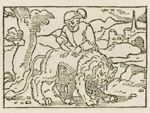
Pour te iouer cherche bille pareille: La Perrière, Le theatre des bons engins (Lyon, 1545), emblem 3 uses the imagery of a man shaving a lion
Iconclass: 25F23(LION) beasts of prey, predatory animals: lion 31A5353(+0) shaving, being shaved (+ variant) 54A8:52A55 Courage, Bravery, Valiance, Manliness; 'Ardire magnanimo et generoso', 'Gagliardezza', 'Valore', 'Virtù heroica', 'Virtù dell'animo e del corpo' (Ripa)❧Subtlety, Acumen, Lucidity, Wit; 'Acutezza de l'Ingegno', 'Sottilità' (Ripa)
Collectanea (1500): 628
Loci Communes: Malum accersitum aut retortum (Evil brought upon oneself or turned back, Mal attiré ou retourné)
II v 12 Ne mihi Suffenus essem Not to be my own Suffenus
Ne mihi Suffenus essem, ne mihi ipsi blandirer, ac stulte meipsum admirarer. Suffenus erat poeta longe ineptissimus, in aliorum vitia dicax, ad sua caecus. Itaque proverbium receptum, ut, qui sibi inaniter placerent, Suffeni dicerentur. Catullus in epigrammate: Idem infaceto est infacetior rure, Simul poemata attigit: neque idem unquam Aeque est beatus, ac poema cum scribit, Tam gaudet in se, tamque se ipse miratur. Ibidem, Quem non in aliqua re videre Suffenum Possis. Suffeni simillimum Mevium facit Horatius, suis ignoscentem vitiis, aliena mordacissime insectantem, Egomet mi ignosco, Mevius inquit.
Not to flatter myself, and make a fool of myself by my conceit. Suffenus was an exceedingly incompetent poet, eloquent on the subject of other men's faults and blind to his own. Hence arose a current proverb, and those who were foolishly pleased with themselves were called 'Suffenuses.' Catullus in one of his epigrams:
Duller is he than country dullness' self,
Once he takes pen in hand, yet ne'er so happy
As when he scribbles verse; then is he all
Self-admiration and self-centred bliss,'
And again: There's Suffenus-touch about us all.' Horace makes his Maevius very like Suffenus, blind to his own faults and bitterly attacking those of others: 'I have excuses for myself, says Maevius.'
Facsimile:
Iconclass: 48A221 negative criticism by (professional) critic 54AA3:48C911 Incompetence❧author, poet writing 57AA644 Arrogance; 'Arroganza' (Ripa) 57AA647 Hybris 98B(SUFFENUS) male persons from classical history (SUFFENUS)
Collectanea (1500): 669
Loci Communes: Arrogantia jactantiaque (Arrogance and boastfulness, Arrogance et vantardise)
II v 13 Siculus omphacizat A Sicilian picking unripe grapes
Σικελὸς ὀμφακίζει, id est, Siculus omphacissat. Omphaca Graeci dicunt vuam acerbam & immaturam, ἀπὸ τοῦ ὠμοὺς φαγεῖν, id est, quod crudi comedantur. Unde dicebatur in eos, qui libidine furandi quantumlibet vilia tollerent furto. Ductum à furacitate Siculorum. Non perperam dicetur & in illos, qui ob immodicam & praeproperam aviditatem, quo pusillum lucelli faciant sibi, damnum ingens aliis inferunt. Sunt qui credant quadrare posse in eos qui bellissima quaeque sibi decerpunt: ut Syrus ille Terentianus. Zenodotus ait ex Epicharmo sumptum. Refertur & à Suida.
Σικελὸς ὀμφακίζει, A Sicilian picking unripe grapes. Greek has a word omphaka for sour grapes which are not yet ready to pick, derived from ômos, raw, and phagein, to eat, because they are eaten raw. Hence this phrase was used of those who had such a passion for thieving that they made off with quite worthless things. Derived from the Sicilian love of stealing. It will also not be wrong to use it of those people whose excessive greed makes them impatient, so that to secure some trifling gain for themselves they inflict immense loss on others. Some believe it can be made to fit those who take all the best things for themselves, like Syrus in Terence. Zenodotus says it comes from Epicharmus. It is also recorded by Suidas.
Facsimile:
Iconclass: 32B311(SICILIAN) indigenous European peoples (SICILIAN) 44G544 theft 47I422(+8934) vine (+ bearing fruit) 47I4223:51F511 grape❧Immaturity 51F521 Precocity 51M12 Haste
Collectanea (1500): 670
Loci Communes: Festinatio praepropera (Overhasty haste, Précipitation excessive)
II v 14 Anus simia sero quidem An aged ape needs time
Γέρων πίθηκος ἁλίσκεται μὲν, μετὰ χρόνον δ᾽ ἁλίσκεται. id est, Anus simia sero quidem capitur, sed tamen aliquando capitur. Ubi versutus aliquis, qui diu eluserit, tandem dat poenas. Valebit ad exhortandum, ut quisque veris rationibus agat si velit esse tutus, ne fidat callidis quidem, sed inhonestis consiliis. Nullum enim tam instructum dolis, ut perpetuo fallat, sed tandem casus aliquis in apertum profert dissimulatam malitiam.
Γέρων πίθηκος ἁλίσκεται μὲν, μετὰ χρόνον δ᾽ ἁλίσκεται, An aged ape can be taken, but only after many days. When some cunning fellow, who has long escaped detection, pays the penalty at last. Will be useful in urging that a man should play straight if he wants to be safe, and not put his trust in tactics that are skilful but not honest, for no one has such a stock of stratagems that he can deceive people all the time; sooner or later some accident brings hidden villainy into the open.
Facsimile:
Iconclass: 25F22(+24) monkeys, apes (+ very old animal) 43C1151 catching animals 54A44 Patience; 'Patienza' (Ripa) 57AA613 Cunning, Slyness; 'Astutia ingannevole' (Ripa)
Loci Communes: Ultio malefacti (Vengeance for a wrongdoing, Vengeance d'un méfait)
II v 15 Secundo aestu With a following tide
Κατὰ ῥοῦν προχωρεῖν. id est, Secundo aestu procedere. Proverbialis & frequens apud autores metaphora. Sumpta à nautis, quibus facilior cursus, cum flumen, aut etiam maris aestus secundus est. Lucianus in Iove tragoedo, Ταυτὶ μὲν ἤδη κατὰ ῥοῦν προχωρεῖ τῷ Δάμιδι. id est, Haec iam Damidi secundo aestu succedunt. Item alibi, Τὰ δ᾽ ἄλλα κατὰ ῥοῦν φέρεται. id est, Reliqua secundo feruntur aestu. Quanquam hic paulo diversius est usus. Momus enim deos incusat, quod negligant res mortalium, sinentes eas veluti prono flumine, quolibet ferri. Proinde κατὰ ῥοῦν φέρεσθαι dixit, temere ferri, nullo moderante. Aeschylus in Persis, Οτ᾽ ἂν δ᾽ ὁ δαίμων εὐροῇ, πεποιθέναι Τὸν αὐτὸν αἰεὶ δαίμον᾽ οὐριεῖν τύχης. id est, Fortuna ubi fuerit secunda, credere Fore item secundam semper atque eodem modo.
Κατὰ ῥοῦν προχωρεῖν, To proceed with a following tide, is a proverbial metaphor often found in the best authors. It is taken from sailors, who make an easier passage when the current, or even the tides in the sea, are in their favour. Lucian in his Jupiter tragoedus: Tn all this so far Damis has had a favouring tide.' And in another passage: 'Everything else is carried by a following tide,' though the sense there is slightly different. Momus is blaming the gods for their neglect of mortal affairs, which they allow to drift, as it were, down stream. So he uses the phrase 'to go with the tide' or 'the current' for being carried along aimlessly with no supervision. Aeschylus in the Persae: 'When fortune's breeze blows fair, to stand convinced / That the same wind of luck will always blow.'
Facsimile:
Iconclass: 25H2312 tide 54B12 Opportunity, Opportuneness, Seasonableness 54E32 Compliance
Collectanea (1500): 609
Loci Communes: Bonae fortunae, copiae, felicitatis aut ominis (Of good fortune, abundance, happiness, or omen, Bonne fortune, abondance, bonheur ou présage)
II v 16 Secundis ventis With a fair wind
Εξ οὐρίου φέρεσθαι. id est, Secundo ferri vento. Refertur à Suida. Secundis ventis navigare dicitur, cui res ex sententia succedunt. Graeci venustius, ἐξ οὐρίας, tanquam à puppi. Libanius sophista in declamatione quadam, Οὕτω γνώμης ἔχουσιν, ἐξ οὐρίας φιλεῖ τὰ πράγματα φέρεσθαι. id est, Qui sic animo sunt affecti, iis solent res ex sententia succedere. M. Tullius Epistolarum ad Atticum libro secundo: Quid si etiam Caesarem, cuius nunc venti valde se cundi sunt, reddo meliorem? Plautus in Bacchidibus: Pulchre haec confertur ratis. sentiens rem commode procedere. Apud eundem Tranio, qui hero triennium absente, genialiter interim, ac sanè musice vixerat una cum filio: tandem hero reverso, cum praeter crucem nihil speraret: Nunc, inquit, ventus navim deserit. Horatius in Sermonibus, Non agimur tumidis velis aquilone secundo, Non tamen adversis aetatem ducimus austris. Quin hoc ipsum Naufragium pro infortunio, proverbii vim habet, sicut & Incendium. Quandoquidem autem pleraque Homeri proverbiorum vice sunt usurpata, quid vetat & illud inter adagia referri, quod est apud eum poetam perquam frequens? Φέρων ἄνεμός τε καὶ ὕδωρ. id est, Ferens & ventus & aestus. Quoties res ex omni parte feliciter procedit. Item illud crebrum apud eundem, Τὴν δ᾽ ἄνεμός τε κυβερνήτης τ᾽ ἴθυνεν. id est, Ast illam ventusque gubernatorque regebat. cum ad fortunae favorem accedit etiam industria. Pindarus in Pythiis hymno primo, Ναυσιφορηγτοις, Ες πλοὸν ἀρχομένοις δ᾽ ἀνδράσι πρῶτα χάρϊς Πομπαῖον ἐλθεῖν οὖρον.. id est, Nauticis viris navigationem apparantibus prima gratia est, si veniat ventus prosper ac secundus.
Εξ οὐρίου φέρεσθαι, To be carried by a fair wind, is recorded by Suidas. A man is said to have a fair wind for his voyage when things go as he would wish. The Greek phrase is more expressive, because it suggests a wind from the stern. Libanius the sophist in one of his declamations has 'They who approach things in this spirit often find their plans have a fair wind.' Cicero in book 2 of his Letters to Atticus: Take Caesar, who enjoys a very favourable wind just now: suppose I make even him a better man.' Plautus in the Bacchides: This ship's running very well/ meaning that all proceeds according to plan. In Plautus again, when Tranio's master has been away for three years, leaving him and the son of the house to spend a most agreeable and highly civilized time; and now the master is returned, and the slave sees nothing to hope for but the rack: 'Now' says he 'there's no wind in my sails any more.' Horace in the Satires: 'My canvas swells not with fair northern gales, / Yet 'tis no adverse south that mocks my sails.'
For that matter, the very use of 'shipwreck' for misfortunes has the force of a proverb, and 'conflagration' likewise. And if we remember how many phrases in Homer are used as proverbs, what prevents us from including among adages that phrase of which he is very fond: 'Wind and water kept her true on course,' whenever something goes well from all points of view. There is another phrase in common use in the same poet: 'But wind and steersman held her straight on course/ when the favour of fortune is seconded by industry. Pindar in the first hymn of his Pythians: 'For mariners setting out on their voyage the first of blessings is a favouring breeze.'
Facsimile: 
Iconclass: 26C:54A6 winds❧Helpfulness 26C:54F14 winds❧Advantage 46C24 sailing-ship, sailing-boat 54B12 Opportunity, Opportuneness, Seasonableness 54E32 Compliance
Collectanea (1500): 184
Loci Communes: Amicitia (Friendship, Amitié); Bonae fortunae, copiae, felicitatis aut ominis (Of good fortune, abundance, happiness, or omen, Bonne fortune, abondance, bonheur ou présage)
II v 17 Parni scaphula Parnis' skiff
Τὸ Πάρνους σκαφίδιον, id est, Parni scaphula. Convenit in eos, qui ob res minutulas multum litium et querelarum movent. Sumptum à Parno quopiam, qui ob naviculam ereptam, populo molestissimus fuisse legitur. Autor Diogenianus. Cum enim huius causa frequenter ad populum deferretur, tandem in popularem iocum abiit, velut illud ὁ διὸς κόρινθος.
Πάρνου σκαφίδιον, Parnus' skiff, suits those who for some affair of no moment raise endless quarrels and complaints. It comes from a man called Parnus, who had a small boat which was stolen, and is said on this account to have made himself a public nuisance. Diogenianus is the authority. Motions were constantly brought before the public assembly about this boat, and at length it became a current jest, like 'Corinthus son of Jove.'
Facsimile:
Iconclass: 44G544 theft 46C232 rowing-boat, canoe, etc. 51B61:56E1 Repetition❧Irritation 56BB33 Grumbling, Complaint; 'Pianto', 'Querela' (Ripa) 98B(PARNUS) male persons from classical history (PARNUS)
Collectanea (1500): 677
Loci Communes: Taedium ex iteratione (Tedium from repetition, Lassitude due à la répétition)
II v 18 Ne puero gladium A sword in the hand of a child
Μὴ παιδὶ τὴν μάχαιραν. id est, Ne puero gladium, subaudiendum, commiseris. Allegoria proverbialis, admonens non esse mandandam potestatem vel adulescentibus, vel imperitis ac stultis: qua tum in suam, tum aliorum perniciem sint abusuri. Ne iuveni commiseris administrationem pecuniae: ne puero gladium. Ne regnum impuberi: ne puero gladium. Ne stulto concionandi apud populum partes delegaris: ne puero gladium. Ne magistratum mandaris stultis: ne puero gladium. Ne inerudito, parumque cordata commiseris episcopi munus, Μὴ παιδὶ τὴν μάχαιραν. Plutarchus in libello, cui titulus, Οτι καὶ γυναῖκας κακὰς παιδευτέον, citante Stobaeo (Nam is liber nondum emersit in lucem) Μὴ παιδὶ μάχαιραν ἡ παροιμΐα φησὶν, Εγὼ δὲ φαίην ἂν, μὴ παιδὶ πλοῦτον, μὴ δὲ ἀνδρὶ ἀπαιδευσίαν. i. Ne puero gladium, ait proverbium. Ego vero dixerim, Ne puero divitias, néve viro imperitiam. Significat pecuniam pestiferam adolescentibus, viro inscitiam. Idem in Problematis Symposiacis, Εἰ δὲ μὴ, δετόον ὥσπερ παισὶν ἀτρεμεῖν μὴ δυναμένοις, οὐ δόρυ καὶ ξίφος, ἀλλὰ πλαταφὴν καὶ σφαῖραν. id est, Sin minus dare oportet, veluti pueris non valentibus conquiescere: non hastam aut ensem, sed crepitaculum aut sphaeram. Usurpavit & Athenaeus libro Dipnosophistarum quinto in philosophum, cui commissum esset imperium. Non usquequaquam diversum est ab hac forma, quod eleganter simul & graviter dictum est ab Henrico Britanniae rege, eius nominis septimo, viro tum acri iudicio, tum Laconicis dictis mire valenti, cum theologum quempiam ex horum genere, quos mendicantes vocant, concionantem audisset: isque effreni lingua in principum vitam magna non libertate, sed insania debacchatus fuisset (Nam sunt qui hac quoque via famam affectent.) Videbatur, inquit, furiosi manibus commissus gladius.
Μὴ παιδὶ τὴν μάχαιραν, The sword in the hand of a child (we must supply Put not), is an allegory with proverbial status, warning us not to entrust power to adolescents or to men without experience or common sense, because they will misuse it and both they and others will suffer. Give no young man the management of money: it is a sword in the hand of a child. Do not entrust the kingdom to an infant: a sword in the hand of a child. Do not delegate the office of public preaching to a fool: a sword in the hand of a child. Nor trust fools with public office: a sword in the hand of a child. Do not commit the duties of a bishop to an ill-educated and unintelligent man: a sword in the hand of a child. Plutarch in the essay he entitled 'Even bad women should be educated' (as preserved in Stobaeus, for the original has not yet emerged into the light of day): 'Put not a sword into the hand of a child, says the proverb; but I would rather say Trust not a child with riches or a grown man with ignorance.' He means that money is most destructive of the young, and ignorance of those in the prime of life. Plutarch again in his 'Table-talk': 'Otherwise we must treat them like children who cannot sit still, and give them, not a spear or a sword but a rattle and a ball.' Athenaeus also used it in book 5 of the Doctors at Dinner of a philosopher entrusted with supreme power.
This form of words is not much unlike a remark, both witty and weighty, once made by the English king, Henry VII, who was both a man of keen judgement and a master of laconic speech. He once heard a sermon by a theologian of the sort they call Mendicants; and after the preacher had let fly in unbridled language on the life of princes (this was madness rather than licence), for there are some who go even to these lengths to win a reputation, the king said 'It was like a sword put into the hands of a maniac.'
Facsimile:
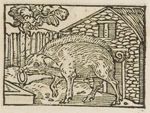
Un chascun doibt moderer son estat: La Perrière, Le theatre des bons engins (Lyon, 1545), emblem 24 uses the imagery of a pig with a golden ring through its snout and quotes the adage in its subscriptio
Iconclass: 31D112 child 45C13(SWORD) hacking and thrusting weapons: sword 51F511 Immaturity 51F521 Precocity 57AA21 Irresponsibility
Collectanea (1500): 637
Loci Communes: Discriminis (Danger, crisis, Danger); Dissimilitudinis et incongruentiae (Dissimilarity and incongruity, Dissemblance et incongruité)
II v 19 Lindii sacrum A Lindian sacrifice
Λίνδιοι τὴν θυσίαν. id est, Lindii sacrum, subaudi, faciunt. Dicebatur in eos, qui inauspicato rem divinam faciebant. Sumptum ab historia cuius meminit etiam Lactantius in Institutionibus Christianae religionis, libro primo. Hercules olim agricolae cuidam Lindio duos boves per vim eripuit, & mactatis illis convivium sibi paravit. Senex autem Herculi comedenti, cum multa in eum male dicta congereret, voluptati pariter, & risui fit: ita ut Herculem dixisse ferant, nullum unquam convivium sibi iucundius accidisse. Sed haud ab re fuerit Lactantii verba subscribere. Apud Lindum, inquit, quod est oppidum Rhodi, Herculis sacra sunt, quorum à caeteris longe diversus est ritus: siquidem non εὐφημΐᾳ, ut Graeci vocant, sed maledictis & execratione celebrantur. Eaque pro violatis habet, si quando inter solenneis ritus vel imprudenti alicui exciderit bonum verbum. Cuius rei haec ratio redditur, si tamen ulla esse in rebus vanissimis potest. Hercules cum eò delatus esset, famemque pateretur, aratorem quendam aspexit operantem, ab eoque petere coepit, ut sibi unum bovem venderet. Enimvero ille negavit fieri posse: quia spes sua omnis colendae terrae duobus illis iuvencis niteretur. Hercules solita violentia usus, quia unum accipere non potuit, utrumque sustulit. At ille infelix, cum boves suos mactari videret, iniuriam suam maledictis ultus est, quod homini eleganti & urbano gratissimum fuit. Nam dum comitibus suis epulas apparat, dumque alienos boves devorat, illum sibi amarissime conviciantem cum risu & cachinnis audiebat. Sed postquàm Herculi divinos honores, ob admirationem virtutis deferri placuit à civibus, ei ara posita est, quam de facto βούζυγον, id est, bovis iugum nominarunt: ad quam duo iuncti boves immolarentur, sicut illi quos abstulerat aratori, eumque ipsum sibi constituit sacerdotem: ac praecepit iisdem maledictis semper in celebrandis sacrificiis uteretur, quia negaret se unquam epulatum iucundius. Hucusque Lactantiana reddidimus verba. Zenodotus addit, hunc apud Lindios inolevisse morem, iubente etiam oraculo, ut inter peragenda sacra, convicia quaedam iactarentur. Meminit huius & Gregorius Nazianzenus in Orationibus stelieuticis. Adagium ad multos usus accommodari potest, vel ad rixosum convivium, seu disputationem, vel ad rem quampiam, malis omnibus institutam.
Λίνδιοι τὴν θυσίαν, The Lindians (we must supply, thus offer) sacrifice, was used of people who made offerings to the gods when the auspices were against them. It is taken from a story told among others by Lactantius in the first book of his Principles of the Christian Religion. Hercules once seized two oxen by force from a husbandman at Lindos, slaughtered them, and got his dinner ready. As he ate, the old man rained curses on him, which both gratified him and made him laugh; so that Hercules is reported to have said that he never enjoyed a dinner so much. But it will not be out of place to give Lactantius' own words. 'At Lindos' he says, 'which is a town in the island of Rhodes, there are sacrifices in honour of Hercules, of which the ritual is very unlike that used elsewhere: for they are performed, not in what the Greeks call euphemia, a holy silence, but to the accompaniment of curses and execrations, and they are held to be null and void if during the ceremony anyone lets fall a word of good omen, even by accident. The reason for this is said to be as follows, if one can use the word reason of such gross absurdities. Hercules, having arrived in Lindos, was famished; and seeing a local man busy ploughing, he besought him to sell him one of his oxen. The man said this was impossible, for his hopes of cultivating his ground rested entirely on those two oxen. Hercules, in his usual rough way, being unable to acquire one ox, seized both. The unfortunate owner, seeing his oxen slaughtered, vented his rage at the wrongs he suffered in curses, which gave his elegant and well-bred guest great pleasure. While he got ready a feast for his companions and wolfed down the oxen that were another man's property, he listened to the owner's torrents of abuse with roars of laughter. However, once the citizens had decided to pay divine honours to Hercules on account of his valiant exploits, an altar was built for him which they named from this story bouzygos, which means an ox-yoke; and on this two yoked oxen were to be sacrificed, like those which he had seized from the ploughman. The man himself he appointed priest, and instructed him while performing sacrifice always to utter the same curses, on the ground that he had never enjoyed a dinner so much.' In all this I give Lactantius' text. Zenodotus adds that this custom grew up in Lindos because they were also told by an oracle to utter certain curses while performing sacrifice. Gregory of Nazianzus also mentions it in his Steleutic Orations. The adage can be turned to many uses, to a quarrelsome dinner-party for instance, or a disputation, or any enterprise begun with evil omens.
Facsimile: 
Iconclass: 12E212 sacrifice ~ Greek religion 13B423(+0) incantation, magic sentence (+ variant) 32B311(LINDIANS) indigenous European peoples (LINDIANS) 52E22 Bad Omen; 'Augurio cattivo' (Ripa) 94L4125 Thiodamas is ploughing with a yoke of oxen; Hercules arrives, kills one of the oxen, and eats it (Philostratus, Imagines II 22)
Collectanea (1500): 623
Loci Communes: Rixosus (Quarrelsome, Querelleur)
II v 20 Megarensium lacrymae Megarian tears
Μεγαρέων δάκρυα, id est, Megarensium lachrymae, dicebantur vel fictae, nec ex vero dolore profectae, vel vi adactae. Diogenianus ad huiusmodi refert historiam. Bacchius quidam Corinthius, Clytii Megarensium regis filiam uxorem duxerat. Ea defuncta Clytius complures virgines & adolescentes Corinthum misit: qui in funeralibus pompis puellam deplorarent, lacrimis utique fictis: Ut qui conducti plorant in funere, dicunt, Et faciunt prope plura dolentibus ex animo. Contra Iuvenalis, Ploratur lachrymis amissa pecunia veris. Suidas aliam adfert causam. Apud Megarenses enim permultam allii copiam esse, huius acrimonia multis exprimi lachrymas vel invitis. Proinde apud Aristophanem, qui lachrymatur, allium olfacere per iocum dicitur. Igitur si ad simulatum dolorem accommodes, proverbium affine fuerit illi, Flere ad novercae tumulum.
Μεγαρέων δάκρυα, Megarian tears, were either fictitious and not the outcome of real grief, or extorted by force. Diogenianus traces the expression to the following incident. A certain Corinthian called Bacchius had married a daughter of Clithius king of Megara. When she died, Clythius sent a number of maidens and young men to Corinth to lament for the princess in her funeral procession; but their tears were of course fictitious, 'as hireling mourners at a funeral / say and do more than those who really grieve.' Conversely Juvenal: 'When money's lost, the tears are genuine.' Suidas offers another explanation. In Megara, he says, garlic grows very freely, and its sharp tang wrings tears out of many people even against their will. So in Aristophanes it is said humorously of a character with tears in his eyes that he must have been sniffing garlic. If then you were to adapt this proverb to pretended grief, it will be very close to Weeping at your stepmother's funeral.
Facsimile:
Iconclass: 32B311(MEGARIANS) indigenous European peoples (MEGARIANS) 57AA611 Dissimulation, Hypocrisy; 'Hippocresia', 'Simulatione' (Ripa) 57AA622:56BB22 Mendacity❧Misery; 'Miseria mondana' (Ripa)
Loci Communes: Simulatio, dissimulatio (Pretense, dissimulation, Simulation, dissimulation)
II v 21 Ventus neque manere sinit neque navigare This wind will let me neither stay nor sail
Ανεμος οὔτε μένειν ἐᾷ, οὐτε πλεῖν. id est, Ventus neque manere sinit, neque navigare. Philoctetes apud Aeschylum, Ενθ᾽ οὔτε μΐμνειν ἄνεμος, οὔτε πλεῖν ἐᾷ.. id est Ubi nec manere, nec ire ventus annuit. Similimum est illi, Lupum auribus teneo. Usus erit, ubi quis in eas rerum angustias inciderit, ut nec relinquere negocium sit integrum, nec absolvendi sit facultas. Mutuo sumpta metaphora à saevissima ventorum tempestate, cum nautis periculosissima est navigatio, neque tutum tamen ancoram iacere. Q. Curtius lib. 8. citra figuram extulit hoc pacto: Attonitisque auribus stupens agmen, nec progredi, nec considere audebat. Refertur à Diogeniano.
Ἄνεμος οὔτε μένειν ἐᾷ οὐτε πλεῖν, This wind will let me neither stay nor sail. The words are used by Philoctetes in Aeschylus. The effect is very close to the adage I have a wolf by the ears. It will be useful when a man finds himself in such a difficult situation that it is not open to him to break off what he is doing nor has he the ability to finish it. The metaphor is borrowed from winds of gale force, which makes it very dangerous for mariners to set sail, and yet it is not safe to cast anchor. Quintus Curtius in book 8 sets out the position without metaphor in the words 'Astonished at what they heard, the army dared neither advance nor halt.' It is recorded by Diogenianus.
Facsimile:
Iconclass: 26C32 storm at sea 52BB42:46C512 Impossibility❧departure ~ travelling 52BB42:46C514 Impossibility❧arrival and return ~ travelling 54DD4 Difficulty 54DD51:53B2 Danger; 'Pericolo' (Ripa)❧Decisiveness, Decision
Collectanea (1500): 357
Loci Communes: Perplexus (Perplexed, entangled, Perplexe)
II v 22 Vulpes non iterum capitur laqueo No fox is caught twice in a trap
Αλλ᾽ οὐκ αὖθις ἀλώπηξ πάγαις. id est, At non iterum vulpes laqueis, subaudiendum capitur. Qui sapit, Οὐ δὶς πρὸς τὸν αὐτὸν προσκρούει λίθον. id est, non iterum ad eundem offendit lapidem. Stupidi est hominis, in malum gustatum iterum incidere. In Plutarchi collectaneis effertur hunc ad modum, ἀλώπηξ διαφυγοῦσα πάγας αὖθις οὐχ ἁλίσκεται, id est, Vulpes, quae semel effugerit laqueos, non capitur iterum. Huic animanti natura inest astutia, quemadmodum leonibus audacia. Sic Pindarus in Isthmiis hymno quarto, Τολμᾷ γὰρ εἰκὼν θυμὸν ἐριβρεμὲταν θηρὰν λέοντων ἐν πόνῳ. μῆτιν δ᾽ ἀλώπηξ, id est, virum forrem ob robur leoni, ob prudentiam vulpi comparat. Confine est illi quod alibi retulimus, Iterum ad eundem lapidem impingere, quod usurpavit Gregorius Theologus in epistola quadam ad Bosphorium, δὶς γὰρ πρὸς τὸν αὐτὸν λίθον προπαίειν τοῖς ἀνοήτοις μόνοις ἡ παροιμία δίδωσιν. id est, Bis enim ad eundem lapidem impingere, solis stultis concedit proverbium.
Ἀλλ᾽ οὐκ αὖθις ἀλώπηξ πάγαις, No fox twice in a trap (we have to supply, is caught). A man of sense 'does not stumble twice at the same stone'; it is the stupid man who falls a second time into the trouble he has already tasted. In Plutarch's collection it is expressed in the form 'A fox that has once escaped the trap is not caught a second time.' Cunning is a natural quality of this creature, as courage is of the lion; thus Pindar in the fourth hymn of the Isthmians compares his hero in strength to a lion and in cleverness to a fox. Related to one I have recorded elsewhere, To trip twice over the same stone. This was used by Gregory the Theologian in one of his letters, addressed to Bosphorius: 'Only fools are allowed by the proverb to trip twice over the same stone.'
Facsimile:
Iconclass: 43C111231(+414):51BB61 fox hunting (+ trap)❧Singularity, Uniqueness 43C1151 catching animals
Collectanea (1500): 838
Loci Communes: Iteratus error (A repeated error, Erreur répétée)
II v 23 Abydena illatio Interruption, Abydos fashion
Αβυδηνὸν ἐπιφόρημα. id est, Abydena illatio, sive irruptio. Dici solitum, ubi quis obstrepit, aut convivantibus, aut aliud quippiam agentibus, & tumultu molestiam affert. Zenodotus ait extare proverbium apud Eudoxum in fabula, cui titulus Suppositicius. Atque hinc esse natum, quod olim Abydenis mos fuerit, si quem civem, aut hospitem acciperent convivio, praeterea in sacris, ac sollennibus epulis, ut post unguentum & coronas, infantes à nutricibus inducerentur, circumferrenturque suaviandi. Vagientibus autem & clamantibus pueris, garrientibus item & obstrepentibus nutriculis, convivium tumultuosum & iniucundum reddebatur. Ergo cum, amicis aliquot suaviter colloquentibus, interveniet rabula quispiam & immodice loquax, qui confabulationem sua loquacitate sit inamoenam redditurus, recte dicemus, ἀβυδηνὸν ἐπιφόρημα. Tametsi in quibusdam codicibus, ἐπιφώνημα legi, id est, acclamatio: verum, ut opinor, mendose: quandoquidem Athenaeus lib. Dipnosophistarum 14. mentionem facit huius adagii, demonstrans complurium autorum testimoniis, ἐπιφορήματα dici bellaria, sive secundas mensas: ab inferendo, non ab acclamando. Quin & Stephanus ἐπιφόρημα legit, non ἐπιφώνημα. Itidem Zendotus & Suidas. Solus Hesychius legit ἐπιφώνημα, indicans & hoc dici in eos qui hospites calumniabantur. Caeterum quod in nonnullis codicibus scriptum visitur ἀβυδηνῶν pro ἀβυδηνὸν, minimum interest ad sensum.
Ἀβυδηνὸν ἐπιφόρημα, An introduction or interruption in the style of Abydos. Customarily used when someone interrupts a dinner-party or some other activity and causes a tiresome disturbance. Zenodotus says the proverb is found in Eudoxus, in his play The Changeling. Its source, he says, is an old custom at Abydos. When they entertained a fellow-citizen or a visitor to dinner, and also in their regular religious feasts, after the perfumes and garlands had been distributed, they used to bring in their infant children, and they were carried round by their nurses to be kissed. The children whimpered and screamed, and the nurses chattered noisily and gossiped, and the result was a noisy and unpleasant party. So when a group of friends are agreeably engaged in conversation, and some noisy fellow, some chatterbox bursts in who will make their talk disagreeable by his loquacity, we shall rightly call this an interruption, Abydos fashion; though in some copies I have found epiphonema, an interjection. Wrongly, I think; for Athenaeus in book 24 of the Doctors at Dinner mentions this adage, and shows from the evidence of several authorities that epiphoremata means dessert, or second course, from bringing in, not from interrupting noisily. Stephanus too reads epiphorema, not epiphonema, and so do Zenodotus and Suidas. Hesychius alone reads epiphonema, explaining that it was applied to those who made unjust accusations against the visitors. In any case, a variant reading found in some copies, 'of the Abydenes' instead of 'Abydos fashion,' makes very little difference to the sense.
Facsimile: 
Iconclass: 22D1 loud sound, noise 43C75 mischief-making play 54DD31:43A2 Interruption, Cessation❧private festivities, merry company 61E(ABYDOS) names of cities and villages (ABYDOS)
Loci Communes: Clamosus (Noisy, clamorous, Bruyant)
II v 24 Mendici pero non impletur A beggar's satchel is never filled
Πτωχοῦ πῆρα οὐ πίμπλαται, id est, Mendici pera non impletur. Zenodotus ait ex Callimacho sumptum. Sensus per se liquet, nempe inexplebilem esse mendacitatem. Nam quo plura dederis iis qui animo sunt mendico, hoc plura petunt. Deflecti potest vel ad improbos, qui semper aliquid flagitant ab amicis: vel in divites, quibus nihil est satis: vel in principes δημοβόρους, quorum rapacitatem nullae plebis expilationes possunt explere. Aptissime congruet in illos, qui libidini, cupiditati, ambitioni, reliquisque id genus affectibus addicti sunt. Nam iis illud evenit, ut quo intemperantius explent sese, hoc magis magisque sitiant, esuriantque. Id quod innuit etiam evangelica parabola de filio prodigo, cui ne siliquis quidem contigit explere famem.
Πτωχοῦ πῆρα οὐ πίμπλαται, A beggar's satchel is never filled. Zenodotus says this comes from Callimachus. The meaning of itself is clear enough: the demands of beggars are insatiable, for the more you give to people who have a beggar's disposition, the more they ask. It can be diverted, either to the selfish who are always making some demand on their friends, or to the rich who are never satisfied, or to princes who 'feed on their people' and whose rapacity cannot be sated by any plundering of common folk. It will be highly suitable for those who are the slaves of lechery, greed, ambition and all the other vices of that sort; for it is their common experience that the more unlimited their self-indulgence, the greater and ever greater is their hunger and thirst. This is suggested too by the parable in the Gospels of the prodigal son, who could not satisfy his hunger even with husks.
Facsimile:
Iconclass: 46A151 beggar 56BB32 Insatiableness 73C864 the parable of the prodigal son (Luke 15:11-32)
Loci Communes: Rapacitas et avaritia (Rapacity and greed, Rapacité et avarice)
II v 25 Laconicae lunae Spartan moons
Λακωνικὰς σελήνας, id est, Laconicas lunas, subaudiendum, causaris, aut eiusmodi quippiam. De promissis aut pactis incertis, atque infirmis dicebatur. Nam, ut aiunt, Lacones, si quando pactum auxilium poscerentur, lunas causabantur, atque hoc praetextu suffugiebant, quod, ut testatur Lucianus, legem tulisset Lycurgus ne praelium inirent, nisi plenilunio. In caeteris item negociis auspicandis, lunae rationes superstitiosius observabant: atque hinc occasio proverbii. Ad hoc, ni fallor, allusit M. Tullius in epistola quadam ad Atticum, cuius initium est, Dionysius vir optimus, li. 7. Ego, quoniam quarto Non. Ian. compitalitius dies, nolo eo die in Albanum venire, molestus familiae. Veniam tertio Nonarum. Igitur inde ad urbem prid. Non. Tua σεληνὶς quem in diem incurrat, nescio: sed prorsus commoveri te incommodo valetudinis tuae nolo. Quanquam haud clàm est, hoc loco in vulgatis codicibus ληνὶς scriptum esse, non σεληνὶς. Nonnulli ληψῖς mutaverant: verum sensus huc vocat, ut σεληνὶς, id est, lunula, legamus. Cum enim significasset, quos dies observasset, aut delegisset ipse, veluti superstitiosior, adiecit de Attico, Tua lunula in quem incidat diem, nescio. ludens & in illius superstitionem: sed ita tamen, ut valetudinis rationem haberi velit ab Attico. Convenit cum eo quod aliàs recensuimus, Accessei luna.
Λακωνικὰς σελήνας, Spartan moons (we must supply, are your excuse, or something of the kind), was used where promises or undertakings were unsafe and unreliable. Tradition says that whenever the Spartans were asked to provide some help which they had promised to supply, they used the moon as an excuse, and so got out of their obligations; because, as Lucian assures us, Lycurgus had passed a law that they should never fight a battle except at the full moon. In starting other enterprises they were equally superstitious in observing its phases; and hence arose the proverb. It was to this, if I am not mistaken, that Cicero alluded in one of his Letters to Atticus, book 7 (it begins Dionysius vir optimus): 'For my part, the second of January being Compitalia, I would rather not reach my Alban place on that day and be a nuisance to the household. I shall arrive on the third, and therefore get to town on the fourth. I don't know what day your crescent moon is due; but I am very anxious you should not move at any risk to your health.' I am well aware that in this passage the current copies have lepsis and not selenis. Some people have adopted lepsis but the sense requires us to read selenis, the crescent. Cicero has indicated how he has been observing the calendar and what day he has chosen, as though superstition meant something to him, and now he says to Atticus 'I don't know what day your crescent is due,' playfully suggesting that he too has his superstitions, though his real point is that Atticus should look after his health. It agrees with one I have discussed elsewhere: Accessaei luna, Accessaeus' moon.
Facsimile:
Iconclass: 13G superstition, popular belief 24B1 waxing moon, i.e. facing this way: ) 24B2 full moon 24B3 waning moon, i.e. facing this way ( 32B311(SPARTANS) indigenous European peoples (SPARTANS) 53BB2 Hesitation
Collectanea (1500): 632
Loci Communes: Inconstantiae, perfidiae, versutiae (Inconstancy, treachery, cunning, Inconstance, perfidie, ruse)
II v 26 Lucerna pinguior, et Lecytho pinguior Oilier than a lamp, and Sleeker than an oil-bottle
Λιπαρώτερος λύχνου, λιπαρώτερος ληκυθίου, id est, Pinguior lucerna, pinguior lecytho. Videtur ironia proverbialis in eos qui cum sint edaces, nihilo tamen inde fiunt habitiores. quemadmodum lucerna plurimum absumit olei, neque tamen fit unquam saginatior. Fortassis non absurde deflectetur in homines crasso iudicio, aut luxui deditos, aut voluptarios. Refertur à Diogeniano.
Λιπαρώτερος λύχνου, Λιπαρώτερος ληκυθίου, Oilier than a lamp, or an oil-bottle. This proverb seems to be an ironical comment on men who are heavy eaters but never put on any weight, like a lamp which consumes a great deal of oil but never gets any fatter. It will perhaps not be absurd, if diverted to thick-headed men, or men devoted to luxury and pleasure. Recorded by Diogenianus.
Facsimile:
Iconclass: 32A22 thin (human type) 41B34 oil-lamp 41C19 insatiable hunger or thirst 56BB32 Insatiableness
Collectanea (1500): 633
Loci Communes: Multi - in stupidos (Many people - against the stupid, Beaucoup de gens - contre les sots)
II v 27 Ad mensuram aquam bibunt, citra mensuram offam comedentes They drink water by measure and eat meat without measure
Μέτρῳ μὲν ὕδωρ πίνοντες, ἀμετρίῃ δὲ μάζαν ἔδοντες id est, Ad mensuram bibentes aquam, cicra mensuram offam edentes. Zenodotus scribit, hunc versiculum, oraculo proditum in Sybaritas, in vulgi sermonem abiisse, qui ob immoderatum luxum à Crotoniatis subversi sunt: quemadmodum alibi retulimus. Unde poterit accommodari, vel in eos, qui ex sum mis deliciis, opibusque rediguntur ad extremam inopiam: vel in eos qui praepostere sunt sordidi, parcissimi in rebus minutissimis, in magnis negligentes: cuiusmodi plerosque videas mortales. Est autem versus heroicus, qui tamen in omnibus, quos adhuc viderim, codicibus depravate legitur. Restituetur autem hoc pacto, Μέτρῳ ὕδωρ πίνοντες, ἀμέτρως μάζαν ἔδοντες. Consimilis formae est illud Theocriti in Bucoliastis, Καὶ φεύγει φιλέοντα, καὶ οὐ φιλέοντα διώκει. id est, Aversum insequitur, rursum aversatur amantem.
Μέτρῳ μὲν ὕδωρ πίνοντες, ἀμετρίῃ δὲ μάζαν ἔδοντες, Drinking water by measure, eating meat without measure. Zenodotus says this was a line of verse delivered to the Sybarites by an oracle, and passed into a common proverb, for they were overthrown by Croton on account of their immoderate love of luxury, as I have recorded elsewhere. Hence it can be adapted either to those who are reduced from great luxury and riches to the depths of poverty, or to people whose meanness has things in the wrong order: they are very sparing in things of no account, and neglect what is important (most of the men one comes across are in this class). It is a hexameter line, but is read corruptly in all the copies I have yet seen; it can be restored like this: Μέτρῳ ὕδωρ πίνοντες, ἀμέτρως μάζαν ἔδοντες. There is a line of similar shape in Theocritus in the Bucoliastae: Καὶ φεύγει φιλέοντα, καὶ οὐ φιλέοντα διώκει, they turn away from a lover and pursue one who does not love them.
Facsimile: 
Iconclass: 32B311(SYBARITES) indigenous European peoples (SYBARITES) 41C12:21D:54A43 drinking❧water (one of the four elements)❧Temperance, Moderation; 'Misura' (Ripa) 41C11:41C69:54AA43 eating❧meat; still life of meat❧Intemperance, Immoderation 52AA511 Ridiculousness 55B2 Luxury, Luxuriousness
Collectanea (1500): 636
Loci Communes: Absurda, indecora, seu praepostera (Absurd, unbecoming, or preposterous things, Choses absurdes, inconvenantes ou déplacées)
II v 28 In toga saltantis personam inducere To put a dancer on the stage wearing a toga
Saltantis personam in toga inducere, est quippiam facere neutiquam decorum: veluti si senex, aut theologus ineptiat. Aut si quis seriis misceat ludicra. Martialis in praefatione secundi libri, Noli ergo si tibi videtur, rem facere ridiculam, & in toga saltantis inducere personam. Toga civium erat Romanorum, & honoris gratia sumebatur ab iis qui iam excessissent è pueritia, deposita praetexta, ipso cultu virilem animum ac mores profitentibus, unde & virilis toga dicebatur. Hinc illud Ciceronis in Philip. Sumpsisti virilem togam, quam statim muliebrem stolam reddidisti. Quin & pacis tempore gestabatur, quemadmodum sagum in bello. Unde M. Tullius in Philippicis subinde iubet, depositis togis saga sumere. Et idem, Caedat arma togae. Item Lucanus de Pompeio, Praetulit arma togae, sed pacem armatus amavit.
To put a dancer on the stage wearing a toga, is to do something contrary to all the proprieties, like an old man or a theologian talking nonsense or someone mixing jokes with serious business. Martial in the preface to his second book: Tray do nothing so ridiculous; do not put a dancer on the stage wearing a toga.' The toga was the proper dress of a Roman citizen, and was worn as a sign of their status by those who had already outgrown their boyhood and laid aside the gown with a purple stripe, thus declaring by the very clothes they wore that in mind and character there were come to man's estate. Hence they spoke of the toga virilis, the grown man's gown. Hence that cut of Cicero's in the Philippics: 'You put on a man's gown, and turned it promptly into a woman's skirt.' It was also worn in time of peace, as the sagum or military cloak was in war. Hence Cicero in the Philippics sometimes tells his hearers to lay aside the toga and put on the military cloak. And again: 'Let arms to toga yield.' Lucan too, speaking of Pompey: 'Arms were his choice and not the toga, and yet in arms he was a lover of peace.'
Facsimile:
Iconclass: 41D21(TOGA) clothes covering the entire body (TOGA) 48C813 set, scenery ~ stage 48C8421 male dancer 59AA3 Vulgarity
Collectanea (1500): 655
Loci Communes: Absurda, indecora, seu praepostera (Absurd, unbecoming, or preposterous things, Choses absurdes, inconvenantes ou déplacées)
II v 29 Inexploratus homo A man untried
Αβασάνιστος ἄνθρωπος. id est, Inexploratus homo, id est, ἀνεξέταστος, ἀγύμναστος, ἀδοκίμαστος. id est, inexpensus, inexpertus, non probatus. Suidas Aelianus citat autorem in li. De providentia, qui ἀβασάνιστος dixerit, dolore vacuum, eo quod Graecis βασανίζεινsit etiam torquere. Subest autem metaphora in ἀβασάνιστος. Βάσανος enim coticula est, qua solet aurum explorari, Latini vocant indicem. Extat Chilonis dictum: Id aurum esse homini, quod index lapis est auro. hoc est, non aliter ingenium hominis auro spectari, quàm indice spectatur aurum.
Ἀβασάνιστος ἄνθρωπος, A man untried, in other words anexetastos, agymnastos, adokimastos, not tested, not practised, not approved. Suidas cites Aelian in his book On Providence as authority for the use of abasanistos in the sense of 'one who has never felt pain,' because basanizein in Greek means to torture. But there is an underlying metaphor in the word; for basanos means the touchstone (index in Latin) with which they normally test gold. A saying of Chilon survived to the effect that 'Gold is to men what the touchstone is to gold'; you can test a man's character with gold as you can test gold with a touchstone.
Facsimile:
Iconclass: 48C34(TOUCH-STONE) tools, implements of craftsman: touch-stone 51AA4 Nothingness, Absence 54D11 Attempt, Trial
Loci Communes: Absurda, indecora, seu praepostera (Absurd, unbecoming, or preposterous things, Choses absurdes, inconvenantes ou déplacées); Improbi (The dishonest, Les malhonnêtes)
II v 30 Abronis vita A life like Abron's
Αβρωνος βίος, id est, Abronis vita. De molliter ac deliciose viventibus. Sumptum à moribus Abronis cuiuspiam notae luxuriae: quemadmodum apud nos Apicius & Aesopus luxu nobilitati sunt. Graeci quicquid delicatum ac molle, ἀβρὸν & πάναβρον appellant: unde ἀβροδίαιτος, lauti victus & opipare victitans. Refertur à Zenodoto:
Ἄβρωνος βίος, Abron's life, used of those who live in luxury and ease. Taken from the behaviour of a man called Abron, whose luxurious way of living was notorious, as with us Apicius and Aesop are celebrated for their extravagance. Greek uses abron and panabron of anything soft and effeminate; and hence is derived abrodiaitos for a man of expensive tastes and luxurious habits. Preserved by Zenodotus.
Facsimile:
Iconclass: 31A719 womanish man, molly-coddle, milksop 55B2 Luxury, Luxuriousness 98B(ABRON) male persons from classical history (ABRON)
Loci Communes: Luxus et mollicies (Luxury and softness, Luxe et mollesse)
II v 31 Inest et formicae et serpho bilis Even ant and gnat have their gall
Ενεστι κἂν μύρμηκι κἂν σέρφῳ χολή. id est, Formicae inest sua bilis, & serpho sua. Admonet adagium, non esse contemnendum inimicum quempiam, nec ullum temere lacessendum, quandoquidem nullum animal tam minutum aut imbecillum, quod irritatum non excandescat ira. Quadrabit & in homunculos nullis praeditos viribus, tamen vindictam molientes, ira, ut solet, animos suppeditante. Serphus minutulum animal non dissimile formicae. Brasidas, autore Plutarcho, cum manum in caricas temere misisset, & à mure inibi forte fortuna latente morderetur, Papae, inquit, ut nullum est animal tam pusillum, neque tam invalidum, quod lacessitum, non cupiat ulcisci sese.
Ἔνεστι κᾂν μύρμηκι κᾂν σέρφῳ χολή Even the ant and gnat, serphus, have their gall. The lesson of the adage is that no enemy should be despised or heedlessly provoked, for no living creature is so small and weak that it cannot grow angry if irritated. This will also suit human beings of no stature or strength, who yet plan their revenge, when anger gives them spirit, as it often does. The serphus is a small creature not unlike an ant. Brasidas, according to Plutarch, once put his hand without thinking into some figs, and was bitten by a mouse which by pure chance was hiding in them. 'Just look!' he cried; 'there is no creature so small and so feeble that it will not want to defend itself if provoked.'
Facsimile:
Ingentia marmora findit: Camerarius, Symbolorum et Emblematum Centuria(e) (Nürnberg, 1590, 1595, 1596, 1604), emblem 22 uses the imagery of a fig-branch evetnaully splitting a marble monument to convey the idea of an opponent's ultimate revenge
Iconclass: 25F711(ANT) insects: ant 25F711(GNAT) insects: gnat 31A22322 gall bladder 32A11 choleric temperament 45F8 challenging the enemy 52AA52 Misjudgment 54E41 Self-defence
Collectanea (1500): 200
Loci Communes: Ultio malefacti (Vengeance for a wrongdoing, Vengeance d'un méfait)
II v 32 Manum fingere To mould by hand
Manu fingere, est arte curaque formare. Metaphora sumpta ab iis qui è cera, sive argilla fingunt imagines. Lucius Anneus Seneca in epistolis: Quaedam ingenia facilia & expedita: quaedam manu, ut aiunt, facienda sunt. Idem lib. De beneficiis 6. Discamus, inquit, beneficia secure debere, & occasiones reddendorum observare, non manu facere. Manu facere dixit, pro, nostra opera accersere. Itidem Plinius lib. 18 Fateamur ergo culpam, ne his quidem quae nascuntur contenti, quando plura eorum genera manu fiunt. Iuvenalis item in Satyra septima, Exigite ut mores pueri ceu pollice ducat, Ut si quis cera vultum facit. Tibullus libro primo, Et manibus canas fingere velle comas. loquitur de tingente capillos arte. Persius Satyra quinta, Artificemque tuo ducit sub pollice vultum M. Tullius in Bruto, factum appellat elaboratum: Sed ut intellectum est, quantam vim haberet accurata & facta quodammodo oratio. Metaphora sumpta est à plastis ac fabris, qui rudi materiae inducunt effigiem. Unde & factum argentum dicitur, cui opponitur rude.
To mould something by hand is to shape it with skill and care. The image is taken from those who mould figures from wax or clay. Lucius Annaeus Seneca in one of his Letters: 'Some natures are easy and straightforward; some have, as the saying goes, to be moulded by hand.' Seneca again in book 6 of the De beneficiis says 'We must learn to carry the obligation to return a kindness with an easy mind, and wait for an opportunity to repay it rather than manufacture one.' He uses 'manufacture' in the sense of seeking one by our own efforts. Pliny too in book 18: 'Let us confess then that it is our own fault if we are not content with what grows naturally but manufacture several sorts ourselves.' Juvenal in his seventh satire: 'Insist that he mould the child's character as an artist models a wax portrait with his thumb.' Tibullus in book one: 'Try with his fingers to mould his snowy hair,' speaking of the attempt to dye hair artificially. Persius in satire five: 'And assumes plastic features under your hand.' Cicero in the Brutus uses factum, 'hand-wrought,' for 'carefully contrived': 'But when it was realised how much power was exercised by a well finished and as it were hand-wrought style.' The metaphor is taken from modellers and foundry-men, who persuade a raw material to take shape. Hence we speak of wrought silver, as distinct from the raw metal.
Facsimile: 
Iconclass: 47C62 moulding, drawing (industrial process) 48C211(+63) sculptor making a model, bozzetto (+ clay, sand, etc. ~ arts) 52A13 Talent 54A2 Carefulness, Diligence; 'Diligenza' (Ripa) 54A33 Skill, Ability; 'Artificio', 'Prontezza' (Ripa)
Collectanea (1500): 828
Loci Communes: Industria (Industriousness, Application, diligence)
II v 33 Locrense pactum Locrian loyalty
Λοκρῶν σύνθημα, id est, Locrensium pactum. De foedifragis dictum, cuiusmodi quondam habiti Locrenses, quod foedere prodito, quod cum Peloponnesiis inierant, ad Heraclidarum partes defecerint. Vel, ut quibusdam placet, quod Siculos eluserint, non praestita fide. Haec propemodum Zenodotus. Refertur iisdem fermè verbis ab Eustathio in Boeotiam Homeri.
Λοκρῶν σύνθημα, Locrian loyalty, was used of those who violated treaties, for the Locrians in old days had a reputation for doing this; they broke a treaty they had made with the Peloponnesians, and deserted them to join the Heracleidae. Or, as some say, they were thought to have deceived the Sicilians by not keeping faith with them. So more or less Zenodotus. Recorded in almost the same words by Eustathius in his commentary on Homer's Boeotia.
Facsimile:
Iconclass: 57A611 Frankness, Loyalty; 'Lealtà', 'Realtà' (Ripa) 57AA6141 Untrustworthiness, Unreliability 57AA621 Cheat, Deceit; 'Fraude', 'Inganno' (Ripa) 61E(LOCRI) names of cities and villages (LOCRI)
Collectanea (1500): 625
Loci Communes: Inconstantiae, perfidiae, versutiae (Inconstancy, treachery, cunning, Inconstance, perfidie, ruse)
II v 34 Cassioticus nodus The Cassius knot
Κασσιώτικον ἅμμα. Cassioticus nodus. De moribus vafris ac versutis dici consuevit. Cassius mons est, & eiusdem nominis civitas in Aegypto vicina Pelusio. Et genti quasi genuinum ac gentilitium est, miros quosdam nodos nectere. Huic affine, quod alio diximus loco, ἡράκλειον ἅμμα, id est, Herculeus nodus, quo arctissimam atque indissolubilem amicitiam significamus. In caduceo Mercuriali duo sunt serpentes, masculus & foemina, qui medio corporum complexu nodum efficiunt Herculanum. Ab eo supernae partes sic ad osculum coeunt, ut flexu circulum efficiant: infernae simili flexu ad caducei capulum revocantur, qua parte item caudae coeunt utriusque. Hanc imaginem caducei, adhuc videre est in nomismatibus antiquis. E quibus opinor symbolum suum mutuatus est Ioannes Frobenius, typographorum huius aetatis diligentissimus: & cui plurimum debent sacrarum literarum candidati: nisi quod extra circulum, quem serpentes faciunt capitibus inter se coeuntes, addita est columba sceptro insidens. Hunc nodum Mercurio consecrarunt Aegyptii, innuentes foedera non oportere unquam dissolvi, verum plurimum valere debere: unde & Herculano cognomen additum. Quanquam Galli, & haud scio an etiam Aegyptii, non alium putant Herculem quàm Mercurium. Refertur apud Diogenianum ac Suidam, adagium de Cassiotico nodo. Stephanus aliter effert, nimirum hoc pacto, κασσιώτικα ἱμάτια, id est, Cassiotica pallia. nisi forte pro ἱμάτια scriptum erat ἱμάντια, id est, lora.
Κασσιώτικον ἅμμα, The knot from Cassius, was commonly used with reference to cunning rogues. Cassius is a hill, and a city of the same name, in Egypt near Pelusium. The inhabitants have an inborn natural capacity for tying the most surprising knots. This is related to the Hercules knot of which I have spoken elsewhere, which is used as a symbol of very close and inseparable friendship. On the caduceus, Mercury's wand, there are two serpents male and female, twisted together in the middle of their bodies to make a Hercules knot. The parts above this knot approach to embrace one another in such a way that as they curve they form a circle; the lower parts curve back in a similar way to the handle of the wand, and there again the two tails are united. This representation of the caduceus is still to be seen on ancient coins. It was from them, I imagine, that Johann Froben borrowed his mark - the most industrious of our modern printers, and a man who has laid students of sacred literature under the greatest debt. The only difference is that outside the circle formed by the serpents as they bring their heads together he has added a dove that sits on the wand. This knot was consecrated to Mercury by the Egyptians to indicate that agreements once made should never be broken but should retain great strength; and that is why it is also called a Hercules knot. Though the Gauls, and maybe the Egyptians too, identify Hercules with Mercury. Diogenianus and Suidas record the Cassius knot as an adage. Stephanus gives it another form, viz.
Kασσιώτικα ἱμάτια, Cassian garments; unless perhaps himatia, garments was originally himantia, thongs.
Facsimile:
Iconclass: 47C421 types of knots 49M431 device (trade-mark of printer or publisher) 56F23 Friendship; 'Amicitia' (Ripa) 57A6141 Trustworthiness, Reliability 61B2(FROBEN, JOHANNES)3 historical person (FROBEN, JOHANNES) - other representations to which the NAME of a historical person may be attached (FROBEN, JOHANNES) 61E(CASSIUS) names of cities and villages (CASSIUS) 92B58(CADUCEUS) caduceus (staff with two snakes, attribute of Mercury)
Collectanea (1500): 607
Loci Communes: Inconstantiae, perfidiae, versutiae (Inconstancy, treachery, cunning, Inconstance, perfidie, ruse)
II v 35 Bonus cantor, bonus cupediaris A good fiddler or a good pastrycook, all's one
Αγαθὸς ψάλτης, ἀγαθὸς ζωμοποιὸς. i. Bonus cantor, bonus cupediarius. In vituperium musicae artis dictum, quasi eiusdem sit hominis, aures delectare cantu, & platum cupediis. Archidamus Zeusippi filius, cum quidam sibi commendaretur hoc nomine, quod bonus esset cantor: At hic, inquit, apud nos bonus cupediarius.
Ἀγαθὸς ψάλτης, ἀγαθὸς ζωμοποιὸς, A good fiddler or a good pastrycook, all's one. Uttered to show contempt for the art of music, for it suggests that the same man could tickle your ears with his playing and your palate with his pastries. A man was once recommended to Archidamus son of Zeusippus on the ground that he was a good musician; to which he replied 'In my country we should rate him as a good cook.'
Facsimile:
Iconclass: 47B1813 pastry cook 48C7521:48C7311 one person playing string instrument (bowed)❧violin, fiddle 51B3 Parity, Equality 57BB21:48C7 Contempt❧music
Loci Communes: Similitudinis et congruentiae (Similarity and congruence, Similitude et convenance)
II v 36 Ad amussim applica lapidem, non ad lapidem amussim Gauge your stone against the ruler, not the ruler against the stone
Plutarchus in commentariolo, cui titulus, Quo pacto quis intelligere possit se profecisse, trochaicum hunc proverbialem refert, Πρὸς στάθμῃ πέτρον τίθεσθαι, μή τι πρὸς πέτρῳ στάθμην. id est, Lapis amussi est applicandus, non amussis ad petram. Admonet, vitam ad leges esse corrigendam, non contrà leges ad mores nostros trahendas esse: ut id faciamus, quod honestum sit: non id rectum existimemus, quod facimus. De Lesbia regula retulimus alibi.
Plutarch in his essay entitled 'How a Man can check that he has made Progress' quotes the following trochaic line: 'Gauge your marble by the ruler, not your ruler by the stone.' The message of this is that we should amend our way of life according to the laws, and not the other way round, distorting the law to suit the way we live, so that we follow the path of honour and do not think that what we do must be right. The 'Lesbian rule' I have treated of elsewhere.
Facsimile:
Ad amussim: Vaenius, Emblemata aliquot selectiora amatoria (Amsterdam, 1618), emblem 24
Iconclass: 25D12 kinds of non-precious stone 49D511(RULER) drawing-instruments: ruler 53B5:44G Obedience; 'Obedienza' (Ripa)❧law and jurisprudence
Loci Communes: Justitia (Justice, Justice); Correctio dicti aut facti (Correction of a word or deed, Correction d'une parole ou d'un acte)
II v 37 Extra quaerere sese To seek outside oneself
Proverbiali schemate dictum à Persio, Satyra prima, Examenque improbum in illa Castiges trutina, nec te quaesiveris extra. id est, tuis te facultatibus metiaris, non populari opinione. Respondit illi quod idem alibi dixit, Tecum habita. Nam domi habemus, quae proprie nostra sunt, nec aliunde petenda. Qui non est contentus recti conscientia, sed famam spectat, ἔξω βλέπειν. id est, foras prospicere dicitur. Plutarchus in commentario, qui inscribitur, Quemadmodum quis intelligere possit se profecisse, Δῆλός ἐστιν ἔξω βλέπων ἔτι, καὶ πρὸς δόξαν ἑλκόμενος. id est, Palam est illum adhuc foras prospicere, & opinione famaque duci. Huc pertinet illud quoque quod alibi retulimus. Αλλότριος βοῦς πολλάκις ἔξω βλέπει. id est, Extraneus bos saepe prospectat foras. Nimirum domi multa desiderans. Porrò sapiens omnia sua bona secum portat in seipso, totus instar mundi teres atque rotundus.
There is a proverbial look about a phrase in Persius' first satire: 'In that great scale the lying tongue set straight, / Nor seek outside yourself,' meaning 'Measure yourself by your own capacity and not by public opinion.' It corresponds to something the same author says elsewhere: 'Be your own lodger.' It is the things we 'have at home' that are really ours and do not need to be got from some other source. The man who is not content with a good conscience, but has one eye on reputation, is said to look 'outside himself.' Plutarch in the essay entitled 'How a man can check that he has made progress': 'It is clear that he still looks outside himself, and is swayed by public opinion.' Here too belongs another which I have recorded elsewhere: 'A borrowed ox is always looking over the hedge,' for of course where he is, he finds much not to his liking. In short, a wise man 'carries all his belongings round with him;' based wholly on himself, he is 'right and tight like the round world.'
Facsimile: 
Nec te quaesiveris extra: Camerarius, Symbolorum et Emblematum Centuria(e) (Nürnberg, 1590, 1595, 1596, 1604), emblem 399 quotes the comment
Ne te quaesi[v]eris extra: Borja, Empresas morales (Bruxelles, 1680), emblem quotes the comment
Iconclass: 52A53 Self-knowledge 57A3 Conscience; 'Coscienza' (Ripa) 54AA21:52C111 Indifference❧Public Opinion; 'Opinione' (Ripa)
Collectanea (1500): 227
Loci Communes: Simulatio, dissimulatio (Pretense, dissimulation, Simulation, dissimulation)
II v 38 Aliorum medicus, ipse ulceribus scates You physic others, full of sores yourself
Plutarchus in commentario, cui titulus, Quo pacto quis ab inimico iuvari possit, hunc senarium ex tragoedia quapiam allegat, Αλλων ἰατρὸς, αὐτὸς ἕλκεσι βρύων. id est, Aliis medens, at ipsus ulceribus scatens. In eos torquendus est, qui errata castigant incessuntque aliena, intercutibus vitiis ipsi madentes. Illud vulgo tritissimum: Medice, tibi ipsi medicus esto. Gregorius in Apologia de fuga sua, ἢ τῆς παροιμΐας πόῤῥω θέωμεν, ἄλλοις ἰατρεύειν ἐπιχειροῦντες, αὐτοὶ βρύοντες ἕλκεσι. id est, aut proverbium procul effugiamus, aliis mederi parantes, ipsi scatentes ulceribus. Non dissimilem sententiam refert M. Tullius Philip. 12. Etenim qui multorum custodem se profitetur, eum sapientes sui primum capitis aiunt custodem esse oportere. Xenophon in Convivio simile quiddam indicat vulgo iactatum in divinatores, οἱ μάντιες λέγονται δήπου, ἄλλοις μὲν προαγορεύειν τὸ μέλλον, ἑαυτοῖς δὲ μὴ προορᾷν τὸ ἐπιὸν. id est, Aiunt sane divinos aliis quidem praedicere futura, sibi ipsis verò non prospicere quod instat.
Plutarch in the essay entitled 'How to profit by one's Enemies' cites an iambic line from some tragedy or other: 'He physics others, full of sores himself.' This can be turned against those who criticize other men's faults and put them to rights, while steeped in faults themselves beneath the skin. Everyone knows the old saying 'Physician, heal thyself.' Gregory in his Defence of his own Flight: 'Or may give a wide berth to the old proverb, trying to physic others while full of sores ourselves.' There is an aphorism not unlike this in Cicero, in the twelfth Phillipic: 'For the man who sets himself up as the defender of others ought (so wise men say) to know first of all how to defend himself.' Xenophon in his Symposium shows that some such criticism was commonly levelled at soothsayers: 'They say, I believe, that soothsayers foretell the future to others, but do not foresee what is in store for themselves.'
Facsimile:
Iconclass: 49G1 physician, doctor 49G31 examination, diagnosis; physician speaking with patient 52A53 Self-knowledge 52AA53 Lack of Self-knowledge 52E3 Counsel; 'Consiglio' (Ripa)
Loci Communes: Aliis sapere (To be wise for others, Être sage pour autrui); Aliena curantis (Meddling in others' affairs, Qui se mêle des affaires d'autrui)
II v 39 Tragice loqui To use tragic language
Τραγικώτερον λαλεῖν. id est, Tragice loqui. Est verbis uti magnificentioribus. Est enim tragicorum character sublimis, amatque tragoedia ampullas & sesquipedalia verba. Menander apud Plutarchum in consolatorio commentario ad Apollonium, Εἰ δ᾽ ἐπὶ τοῖς αὐτοῖς νόμοις, ἐφ᾽ οἷσπερ ἡμεῖς ἔπασας τὸν ἀέρα τὸν κοινὸν, ἵνα σοι τραγικώτερον λαλῶ. id est, Quod si iisdem legibus, quibus & nos hausisti communem aerem, ut tibi Tragice loquar. Utitur & Plato libro De republica tertio. Gregorius Theologus in epistola quadam, Αλλ᾽ οὐκ ἦν οἶμαι πράττοντα τραγικῶς, πανηγυρίζειν κωμικῶς. id est, Non licebat, opinor, cum ageres tragice, festum agere comice. Idem in epistola ad Basilium, ὢ γῆ καὶ ἥλιε, ἀὴρ καὶ ἀρετὴ, τραγῳδίσω γὰρτι μικρὸν. id est, O terra & sol, aer & virtus. quanquam suspicor pro ἀρετὴ scriptum fuisse αἰθηρ, quemadmodum ex ἀὴρ fecerat ἀνὴρ. Nam qui primus has epistolas aedidit, adeo videtur callere Graece, ut vix legat. Est subinde apud Lucianum ἐκτραγῳδίζειν, pro eo quod est magnificentius eloqui, & rem verbis ampliorem reddere: & φορτικῶς λαλεῖν, pro, grandius & fastuosius dicere.
Τραγικώτερον λαλεῖν, To speak in tragic language, is to use grand words; for tragic authors have an exalted style, and tragedy loves 'bombast and words a foot and a half long.' Menander, cited by Plutarch in his essay 'Consolation addressed to Appolonius': 'But if 'twas on the selfsame terms as we / You drew this breath of life which we all share / (I give you somewhat in the tragic vein).' Plato too uses it in book 3 of the Republic. Gregory the Theologian in one of his Letters: 'But it was, I suppose, impossible, while you were acting in tragic vein, to spend the holiday in comic fashion.' And again in a letter to Basil: 'O earth and sun, O air and virtue - for I will give you a few words in the tragic vein.' Though I suspect that for arete, virtue he wrote aithêr, sky, just as aêr had become anêr, man; for the first editor of these letters seems to have been such a Greek scholar that he could hardly read them. From time to time in Lucian we have ektragodizein for the use of grandiloquent language and style that inflates the subject-matter, and phortikos lalein 'vulgarity of style' for coarse and pompous expressions.
II v 40 Tragicum tueri To have that tragic look
Τραγῳδικὸν βλέπειν, id est, Tragicum tueri. Non dissimili figura dixit Aristophanes in Pluto, πενίαν, id est, paupertatem describens, Βλέπει γέτοι μανικόν τι καὶ τραγῳδικόν. id est, Tragicum tuetur, ac furiale quippiam. Quadrabit vel in fastuosos, vel in tristes ac luctuosos.
Τραγῳδικὸν βλέπειν, To have a tragic look. There is a similar image in Aristophanes, when he says in the Plutus, describing Poverty: 'At any rate there's madness in her eye; / She has that tragic look.' This will suit either pompous people or those who are sunk in grief and melancholy.
Facsimile:
Iconclass: 32A14 melancholic temperament 32A7:48C8545 characters (human types)❧tragedy 56BB1 Pain, Sorrow, Sadness; 'Dolore', 'Dolore di Zeusi' (Ripa) 57AA641 Immodesty
Loci Communes: Tristitia, laetitia (Sadness, joy, Tristesse, joie)
II v 41 Lingua juravit My tongue did swear it
Illud è tragoedia cessit in proverbium, ἡ γλῶσσ᾽ ὄμωσεν, id est, Lingua turavit. Ubi quis non praestat fidem promissi: aut ubi non ex animo pollicetur. Est apud Euripidem in Hippolyto coronato: Ηγλῶσσ᾽ ὀμώμοχ᾽, ἡ δὲ φρὴν ἀνώμοτος. id est, Iuratae lingua est, animus iniuratus est. Hunc versiculum incessiverunt Comicorum convicia. Aristophanes in Bacchis, Η φρένα μὲν οὐκ ἐθέλουσαν ὀμόσαι καθ᾽ ἱερῶν, Γλῶτταν δ᾽ ἐπορκήσασαν ἰδία τῆς φρενός.. id est, Aut mentem, quae nolit per sacra iurare, Linguam autem iuratam, seorsum ab animo. Item in Ranis, taxans Euripidem, Ηγλῶττ᾽ ὀμώμοκ᾽, αἰσχύλον δ᾽ αἱρήσομαι. id est, Iurata lingua est, Aeschylum autem praeferam. Sic & Pindarus in Isthmiis, encomio quinto, laudans quendam cordatae veracisque linguae dicit, Γλῶσσα δ᾽ οὐκ ἔξω φρενῶν. id est, Lingua vero non extra mentem. Euripidis dictum citatur à Plat. in Theaet. ἐὰν ἀποκρίνῃ ὅτι ἐστὶν, Εὐριπίδειόν τι ξυμβήσεται, ἡ μὲν γλῶττα ἀνέλεγκτος ἡμῖν ἔσται, ἡ δὲ φρὴν οὐκ ἀνέλεγκτος. i. Si respondetis esse, eveniet nobis quiddam Euripideum, lingua vobis erit irredarguta, caeterum mens non erit irredarguta.
A well-known phrase in tragedy which passed into proverb: Ἡ γλῶσσ᾽ ὄμωσεν , My tongue did swear it, when a man does not keep a promise, or when he promises but does not mean it. It comes in Euripides in the Hippolytus crowned: 'My tongue did swear it, but my heart is free.' This line was much attacked by the writers of comedy. Aristophanes in the Bacchae: 'Or mind that could not bring itself to swear over the offerings, and tongue that swore without the mind but did not mean to keep it.' And again in the Frogs, criticizing Euripides: 'My tongue hath sworn, and I'll choose Aeschylus.' So Pindar too, in the fifth victory-ode of the Isthmians, praises an upright man of honest speech with the words 'His tongue from his mind is never parted.' This saying from Euripides is cited by Plato in the Theaetetus: 'If you reply that it is so, the situation will be something like that in Euripides: our tongues will be free from question, but our hearts by no means so.'
Facsimile: 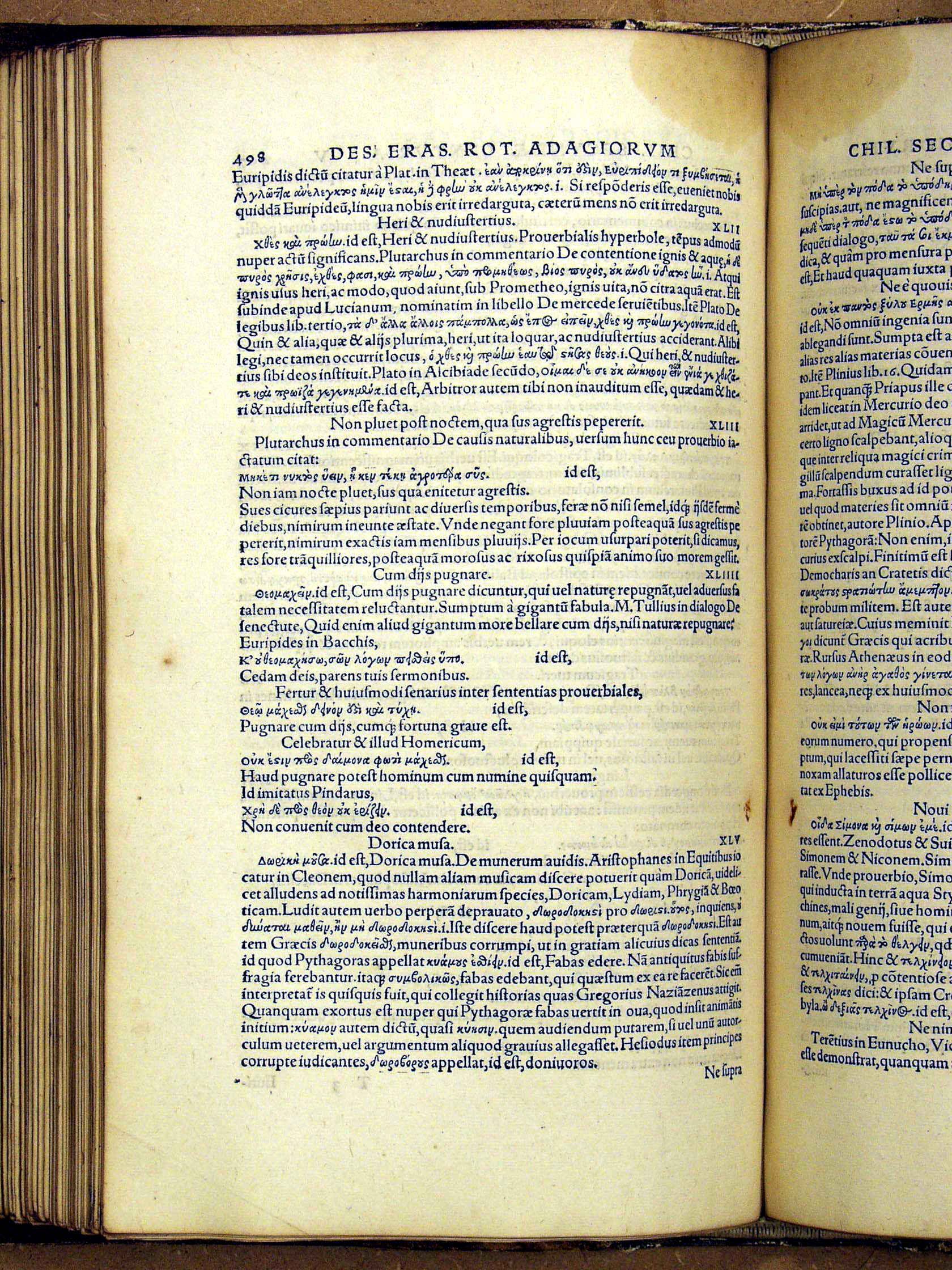
Iconclass: 31A22141 tongue 57AA612:53D2 Insincerity❧Promise; 'Promissione' (Ripa) 53DD2 Breach of Promise
Loci Communes: Inconstantiae, perfidiae, versutiae (Inconstancy, treachery, cunning, Inconstance, perfidie, ruse)
II v 42 Heri et nudius tertius Yesterday and the day before
Χθὲς καὶ πρώην. id est, Heri & nudiustertius. Proverbialis hyperbole, tempus admodum nuper actum significans. Plutarchus in commentario De contentione ignis & aquae, ἡ δὲ πυρὸς χρῆσις, ἐχθὲς, φασι, καὶ πρώην, ὑπὸ προμηθέως, βίος πυρὸς, οὐκ ἄνευ ὕδατος ἦν i. Atqui ignis usus heri, ac modo, quia aiunt, sub Prometheo, ignis vita, non citra aquam erat. Est subinde apud Lucianum, nominatim in libello De mercede servientibus. Item Plato De legibus lib. tertio, τὰ δ᾽ ἄλλα ἄλλοις πάμπολλα, ὡς ἔπος εἰπεῖν, χθὲς καὶ πρώην γεγονότα. id est, Quin & alia, quae & aliis plurima, heri, ut ita loquar, ac nudiustertius acciderant. Alibi legi, nec tamen occurrit locus, ὁ χθὲς καὶ πρώην ἑαυτῷ στῆσας θεοὺς. i. Qui heri, & nudiustertius sibi deos instituit. Plato in Alcibiade secundo, Οἶμαι δέ σε οὐκ ἀνηκοον εἶναι ἔνιά γε χθιζάτε καὶ πρωϊὰ γεγενημένα, id est, Arbitror autem tibi non inauditum esse, quaedam & heri & nudiustertius esse facta.
Χθὲς καὶ πρώην, Yesterday and the day before, was a proverbial exaggeration, denoting time that has very recently elapsed. Plutarch in his essay 'On the Conflict between Fire and Water': The use of fire was discovered yesterday or the day before, as they say, by Prometheus; fire was life, but not without water.' It occurs several times in Lucian, especially in the essay On Salaried Posts. Plato too in the third book of the Laws: 'And all the many other things that have happened at different times, yesterday and the day before as the phrase goes.' I have read somewhere else, but cannot remember where, 'He who set up gods for himself yesterday or the day before.' Plato in the Second Alcibiades: 'I think it will be no surprise to you that some things should have happened yesterday and the day before.'
Facsimile:
Iconclass: 23R1 day of 24 hours, natural day 51F3 Priority, Pre-eminence 51I4 Nearness 51II4 Farness
Loci Communes: Nupera (Recent things, Choses récentes)
II v 43 Non pluet post noctem, qua sus agrestis pepererit The wild sow's farrow will bring a fine morrow
Plutarchus in commentario De causis naturalibus, versum hunc ceu proverbio iactatum citat: Μηκέτι νυκτὸς ὕειν,ἧ κεν τέκῃ ἀγροτέρα σῦς. id est, Non iam nocte pluet, sus qua enitetur agrestis. Sues cicures saepius pariunt ac diversis temporibus, ferae non nisi semel, idque iisdem fermè diebus, nimirum ineunte aestate. Unde negant fore pluviam posteaquam sus agrestis pepererit, nimirum exactis iam mensibus pluviis. Per iocum usurpari poterit, si dicamus, res fore tranquilliores, posteaquam morosus ac rixosus quispiam animo suo morem gessit.
Plutarch in his essay 'On Natural Causes' cites this line as a current proverb: 'The rain will cease in the night when the wild sow farrows.' The domesticated sow farrows more than once and at different times of the year, the wild animal once only and as a rule at the same season, that is, at the beginning of the summer. Hence they say that once the wild sow has farrowed there will be no more rain, because the rainy months are then over. It will be possible to use it in jest, suppose we wish to say that things will be quieter, once some quarrelsome person who is difficult to please has relieved his feelings.
Facsimile:
Iconclass: 47I2122(+941) sow (+ birth of an animal) 51F5:23D43 Beginning; 'Principio' (Ripa)❧summer, 'Aestas'; 'Estate' (Ripa)
Loci Communes: Conjecturae (Conjectures, Conjectures)
II v 44 Cum diis pugnare To fight against the gods
Θεομαχεῖν, id est, Cum diis pugnare dicuntur, qui vel naturae repugnant, vel adversus fatalem necessitatem reluctantur. Sumptum à gigantum fabula. M. Tullius in dialogo De senectute, Quid enim aliud gigantum more bellare cum diis, nisi naturae repugnare? Euripides in Bacchis, Κ᾽ οὐθεομαχήσω, σῶν λόγων πεισθείς ὕπο. id est, Cedam deis, parens tuis sermonibus. Fertur & huiusmodi senarius inter sententias proverbiales, Θεῷ μάχεσθαι δεινόν ἐστὶ καὶ τὺχῃ. id est, Pugnare cum diis, cumque fortuna grave est. Celebratur & illud Homericum, Οὐκ ἔστιν πρὸς δαίμονα φωτὶ μάχεσθαι. id est, Haud pugnare potest hominum cum numine quisquam. Id imitatus Pindarus, Χρὴ δὲ πρὸς θεὸν οὐκ ἐρίζειν. id est, Non convenit cum deo contendere.
Θεομαχεῖν, To fight against the gods, is used of those who either fly in the face of nature or struggle against the decrees of destiny. Taken from the fable of the Giants. Cicero in his dialogue On Old Age: 'What can be the meaning of war against the gods such as the Giants fought, except to fly in the face of nature?' Euripides in the Bacchae: 'Your words persuade me; I'll not fight with heaven.' There is also an iambic line to this effect in the collection of proverbial aphorisms: Tis hard with fortune and with god to fight,' and a well-known phrase in Homer: 'No mortal man can fight against the gods,' and an echo of it in Pindar: 'And it is right not to strive with God.'
Facsimile:
Iconclass: 54BB3 Inutility, Noxiousness; 'Nocumento', 'Nocumento d'ogni cosa' (Ripa) 91C21 battle of the Giants against the gods: gigantomachy
Loci Communes: Inanis opera (Vain effort, Effort vain)
II v 45 Dorica musa The Dorian muse
Δωρικὴ μοῦσα, id est, Dorica musa. De munerum avidis. Aristophanes in Equitibus iocatur in Cleonem, quod nullam aliam musicam discere potuerit quàm Doricam, videlicet alludens ad notissimas harmoniarum species, Doricam, Lydiam, Phrygiam & Boeoticam. Ludit autem verbo perperam depravato, δωροδοκηστὶ pro δωριστι. οὗτος, inquiens, οὐ δύναται μαθεῖν, ἢν μὴ δωροδοκηστὶ. i. Iste discere haud potest praeterquam δωροδοκηστὶ. Est autem Graecis δωροδοκεῖσθαι, muneribus corrumpi, ut in gratiam alicuius dicas sententiam. id quod Pythagoras appellat κυάμους ἐσθιειν, fabas edere. Nam antiquitus fabis suffragia ferebantur. itaque συμβολικῶς, fabas edebant, qui quaestum ex ea re facerent. Sic enim interpretatur is quisquis fuit, qui collegit historias quas Gregorius Nazianzenus attigit. Quanquam exortus est nuper qui Pythagorae fabas vertit in ova, quod insit animantis initium: κύαμον autem dictum, quasi κύησιν. quem audiendum putaremus, si vel unum autorculum veterem, vel argumentum aliquod gravius allegasset. Hesiodus item principes corrupte iudicantes, δωροβόρους appellat, id est, donivoros.
Δωρικὴ Μοῦσα, The Dorian Muse, of those who are greedy for bribes. Aristophanes in the Knights says humorously of Cleon that he has never been able to master any form of music except the Dorian, alluding of course to those celebrated types of harmony, the Dorian, Lydian, Phrygian and Boeotian modes. He brings out the joke by distorting the word, using for dôristi, in the Dorian mode, dôrodokêsti, because dôrodokêisthai is the Greek for corruptly accepting bribes in return for giving someone your vote, what Pythagoras called 'eating beans.' For in old days they used beans to vote with, so that metaphorically those who made money out of their votes could be said to eat beans. Such at least is the explanation given by the man, whoever he was, who collected the historical allusions in Gregory of Nazianzus. Though someone has appeared lately who turns Pythagoras' beans into eggs, because they contain the embryo of a living creature, and thinks kyamos, bean is connected with kyêsis, conception. I would think him worth attention, had he produced even one minor ancient authority or some argument of any weight. Hesiod too calls princes who give corrupt judgment dôroboroi, bribe-eaters.
Facsimile:
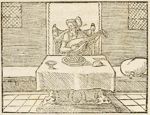
Dorica musa: Coustau, Pegma (Lyon, 1555), emblem s.n. also quotes the comment about 'eating beans'
Iconclass: 32B2(DORIANS) historical peoples and nationalities (DORIANS) 46B911 bribery 59CC221 Corruptibility, Venality, Corruption 92D4 (story of the) Muses; 'Muse' (Ripa)
Collectanea (1500): 835
Loci Communes: Munerum corruptela (Corruption by gifts, Corruption par les présents)
II v 46 Ne supra pedem calceus Let not the shoe be too big for the foot
Μὴ ὑπὲρ τὸν πόδα τὸ ὑπόδημα. id est, Ne ultra pedem calceus. id est, ne maiora viribus suscipias. aut, ne magnificentius te geras quam pro tua conditione. Lucianus in imaginibus μηδὲ ὑπὲρ τὸν πόδα ἔστω τὸ ὑπόδημα. id est, Neque maior pede sit calceus. Rursum in proxime sequenti dialogo, ταῦτά σι ἔκμετρα ἔδοξε, καὶ ὑπερ τὸν πόδα. id est, Haec tibi visa sunt immodica, & quàm pro mensura pedis maiora. Rursum in Gallo, καὶ οὐχι κατα λογοντοῦ ποδός id est, Et haudquaquam iuxta pedis rationem.
Μὴ ὑπὲρ τὸν πόδα τὸ ὑπόδημα, Let not the shoe be too big for the foot, do not (that is) undertake tasks beyond your strength, or Do not live more grandly than suits your station in life. Lucian in his Images: 'Let not the shoe be larger than the foot.' And again in the dialogue that follows: This seemed to you excessive, and too big for the foot.' Again in the Gallus: 'And by no means in proportion to the foot.'
Facsimile: 
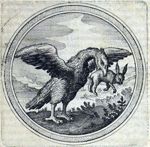
Iconclass: 31A2255:41D2332:51B3 foot❧shoes, sandals❧Parity, Equality 54A431 the Golden Mean; 'Mediocrità' (Ripa)
Loci Communes: Modestia modusque (Modesty and moderation, Modestie et mesure)
II v 47 Ne a quovis ligno Mercurius fiat Do not make a Mercury out of any and every wood
Οὐκ ἐκ παντὸς ξύλου Ερμῆς ἂν γένοιτο. id est, Non è quovis ligno Mercurius fingi posset. id est, Non omnium ingenia sunt accommodata disciplinis. Quidam enim, ut ait Fabius, rus ablegandi sunt. Sumpta est allegoria à fabris, qui materiam deligunt. Quandoquidem ad alias res alias materias convenire, copiose demonstrat Theophrastus lib. De plantis quinto. Item Plinius lib. 16. Quidam superstitiosius exquirunt materiam, unde numen exculpant. Et quanquam Priapus ille deus facilis & crassus, haud gravatur ficulnus esse, non tamen idem liceat in Mercurio deo tam ingenioso, totque praedito artibus. Tametsi mihi magis arridet, ut ad Magicum Mercurii simulachrum referatur, quem non ex quavis materia, sed certo ligno scalpebant, alioqui non futurum idoneum ad magicae artis usum. Unde id quoque inter reliqua magici criminis argumenta obiectum fuerat Apuleio, quod Mercurii sigillum scalpendum curasset ligno buxi, quemadmodum ostendit ipse apologia Magiae prima. Fortassis buxus ad id potissimum deligebatur, vel quod hominis pallorem prae se ferat, vel quod materies sit omnium maximè aeterna. Nam & adversus ignem quoque ferri rigorem obtinet, autore Plinio. Apuleius in apologia Magiae prima proverbium refert ad autorem Pythagoram: Non enim, inquit, ex omni ligno, ut Pythagoras dicebat, debet Mercurius exscalpi. Finitimum est huic quod est apud Athenaeum lib. 5. Incertum autem utrum Democharis an Cratetis dictum, Εκ θύμβρας ουδεὶς ἂν δύναιτο κατασκευάσαι λόγχην, οὐδὲ ἐκ σωκράτους στρατιώτην ἄμεμπτον. i. Ex thymbra nemo queat conficere lanceam, neque è Socrate probum militem. Est autem thymbra oleris genus aut fruticis non dissimile thymo aut satureiae. Cuius meminit Plinius lib. 19. cap. 8. condimentis aptum, unde & θυμβροφάγοι dicuntur Graecis qui acribus delectantur, quod dicetur & in eos quibus res sunt asperae. Rursus Athenaeus in eodem lib. ἀλλ᾽ οὔτε ἐκ θύμβρας, ἔφη Δημοχάρης, λόγχη, οὔτε ἐκ τοιούτων λόγων ἀνὴρ ἀγαθὸς γίνεται, id est, Sed neque è thymbra, quemadmodum inquit Demochares, lancea, neque ex huiusmodi sermonibus vir bonus fit.
Οὐκ ἐκ παντὸς ξύλου Ἑρμῆς ἂν γένοιτο, A Mercury could not be made out of every piece of wood. All men (that is) are not adapted by their natural gifts for education; for some, as Quintilian says, should be confined to the country. The image is taken from craftsmen choosing a piece of timber; for that different timbers are suitable for different purposes is shown at length by Theophrastus in his fifth book On Plants. Pliny too in book 16 says that some people are very scrupulous in their choice of timber for making the statue of some deity; and though Priapus, that coarse and easy-going god, has no objection to being made of figwood, one must not do the same for Mercury, who is so intelligent and gifted with so many skills. Though I myself prefer the suggestion that this applies to an image of Mercury made for use in magic; for then they did not carve him out of the first wood that came to hand, but out of some particular kind, since otherwise he would not be suitable for use in the black arts. Hence it was that among the evidence for the crime of witchcraft brought against Apuleius, one count was that he had ordered the carving of an image of Mercury in boxwood, as Apuleius himself shows in his first Apology against the charge of magic. Boxwood was perhaps the first choice for this because its colour is that of a man who has turned pale, or because of all woods it has the longest life. Even against fire it maintains, according to Pliny, the resistance of iron. Apuleius in his first Apology traces the proverb to Pythagoras as the source: 'for a Mercury' he says 'ought not to be made, according to Pythagoras, out of every wood.' There is something related to this in the fifth book of Athenaeus (whether the saying belongs to Demochares or Crates is uncertain): 'No one could make a spear-shaft out of savory, or a good soldier out of Socrates.' Savory, thymbra, is a sort of garden herb or shrub not unlike thyme or satureia, mentioned by Pliny, book 19 chapter 8, as suitable for use in sauces, whence Greek gets a word thymbrophagoi, savory-eaters, for those who like a sharp taste, which will also be used of people suffering a bitter fate. Athenaeus again in the same book has: 'But you cannot make a spear-shaft, as Demochares said, out of savory, nor a good man out of such conversation as this.'
Facsimile:
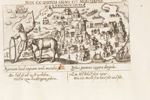
Non ex quovis ligno fit Mercurius: Meisner, Politica Politica (Nürnberg, 1700), emblem 747
Iconclass: 47C14 sorting, selecting of material 48C24:92B5 piece of sculpture, reproduction of a piece of sculpture❧(story of) Mercury (Hermes) 51EE11 Restriction, Limitation 53A11 Choice; 'Elettione' (Ripa)
Loci Communes: Munus aptum aut ineptum (A gift fitting or unfitting, Un présent convenable ou inconvenant)
II v 48 Non sum ex istis heroibus I'm am not one of that class of heroes
Οὐκ εἰμὶ τούτων τῶν ἡρώων. id est, Non sum de numero istorum herorum. id est, non sum ex eorum numero, qui propensiores sunt ad laedendum quàm benemerendum. A geniis sumptum, qui lacessiti saepe perniciem adferunt, perraro iuvant. Unde qui se commodum, non noxam allaturos esse pollicebantur, hoc utebantur adagio. Zenodotus Menandrum citat ex Ephebis.
Οὐκ εἰμὶ τούτων τῶν ἡρώων, I'm not one of that class of heroes, not one of those people, that is, who are more given to doing an injury than a service. Taken from the spirits who, once roused, often bring destruction and rarely are of any help. Hence this adage was in use among those who were promising to do good, not harm. Zenodotus cites Menander, from the Ephebi.
Facsimile:
Iconclass: 54B3 Utility, Usefulness; 'Utilità' (Ripa) 95A the Greek heroic legends (II): heroes 95B the Greek heroic legends (II): heroines
Loci Communes: Similitudinis et congruentiae (Similarity and congruence, Similitude et convenance)
II v 49 Novi Simonem et Simon me I know Simon and Simon knows me
Οἶδα Σίμονα καὶ σίμων ἐμὲ, id est, Novi Simonem, & me Simon. De iis dicebatur, qui pares essent. Zenodotus & Suidas scribit duos fuisse ductores, notae utrunque improbitatis, Simonem & Niconem. Simonem autem, quod vitiis antecelleret, alterius famam obscurasse. Unde proverbio, Simonem unum nominant. Tradunt hos duos Telchines fuisse, qui inducta in terram aqua Stygia, Arnon aedificarint. Vocantur autem apud Graecos Telchines, mali genii, sive homines fascinatores & malefici. Strabo li. 10. meminit Telchinum, aitque novem fuisse, qui è Rhodo Rheam sint comitati in Cretam. τελχῖνας autem dictos volunt, παρὰ τὸ θέλγειν, quod est obscurare sive demulcere, quod homines illectos circumveniant. Hinc & τελχίνειον, sive τελχινῶδες, dicunt, quicquid insigniter est improbum: & τελχιταίνειν, pro contentiose ac pervicaciter agere. Addit Etymologus, omnes Cretenses τελχῖνας dici: & ipsam Cretam dictam τελχίονα. Adagium usurpat Chrysostomus in Babyla, ὢ δεξιᾶς τελχῖνος, id est, ô dextram Telchinis. Sic enim appellat nocentem dextram.
Οἶδα Σίμονα καὶ σίμων ἐμὲ, I know Simon and Simon knows me, was said of two men who were equal in wickedness and who mutually knew and understood each other's faults. Zenodotus and Suidas tells us that there were two leading men, both famous rascals, called Simon and Nicon; but that Simon, who was the bigger rascal of the two, put the other's reputation in the shade. Hence Simon alone is mentioned in the proverb. According to tradition they were two of the Telchines, who brought the water of the Styx into the country where they built Arnon.
The name Techines is given in Greek to evil spirits, or to men who practise magic and the black arts. Strabo speaks of the Telchines in book 10, and says there were nine of them, who accompanied Rhea on her journey from Rhodes to Crete. The name is supposed to be derived from the Greek verb thelgein, to darken or soothe, because they get the better of people by bewitching them. Hence too an adjective telchineion or telchinôdes is used of something outstandingly wicked, and there is a verb telchitainein for quarrelsome and obstinate behaviour. The compiler of the Etymologicum adds that all inhabitants of Crete are called Telchines and Crete itself Telchiona. Chrysostom uses the adage in his Babylas: 'A Telchin's hand in that!' meaning the right hand of a rascal.
Facsimile:
Iconclass: 32A7:57AA6131 characters (human types)❧Guile, Artfulness, Craftiness, Deceitfulness 51B2 Similarity, Likeness 92L297 Telchines 98B(NICON) male persons from classical history (NICON) 98B(SIMON) male persons from classical history (SIMON)
Collectanea (1500): 820
Loci Communes: Improbi (The dishonest, Les malhonnêtes); Similitudinis et congruentiae (Similarity and congruence, Similitude et convenance)
II v 50 Ne nimium callidum hoc sit modo It may be too cunning this way
Terentius in Eunucho, Vide ne nimium callidum hoc sit modo Donatus proverbium esse demonstrat, quanquam anceps est lectio. Potest enim utrumque legi, & calidum & cal lidum: ut prius illud adfestinatum consilium, alterum ad nimis astutum referatur. Siquidem utraque parum feliciter evenire solent, vel quae nimium calent, id est, quae praecipitantius instituuntur, vel quae nimium audacibus aguntur dolis. Et sicut autore apud Titum Livium, Fabio Maximo, temeritas non solum stulta, verumetiam infelix plerunque est, ita versutia nonnunquam ad summum discrimen adducit. Qui callidum legunt, respicere videntur ad id quod paulo superius dixerat Chaerea, Nunquam vidi melius consilium dari. Qui calidum legunt per unicum l, & mea quidem sententia rectius, Graecam figuram agnoscunt. Quoniam θερμὸν, illi tum scelestum, tum praeceps & audax facinus vocant. Sic enim Penia in Pluto Aristophanica de senibus, qui rem novam moliuntur, ut Pluto caeco restituant oculos, Ω θερμὸν ἔργον, κᾀνόσιον, καὶ παράνομον. id est, Calidum ô facinus, & impium, & nefarium. Interpres exponit θερνὸν, παράδοξον, τολμηρὸν, εὐκίνητον. id est, inauditum, audax & praeceps, ac temerarium. Item Sophocles in Antigone, Θερμὴν ἐπὶ ψυχροῖστι καρδίαν ἔχεις. id est, In frigidis tibi mens calet negociis. Obiurgatur Antigone, quod nimium avide cuperet sepelire fratrem. Et Plutarchus Symposiacon Decade quinta, significat ζωρότερον quibusdam significare τὸ θερμὸν, ut Achilles apud Homerum, iubens Patroclum miscere ζωρότερον, exegerit celeritatem ministerii. Quemadmodum nos quoque, inquit, saepenumero iubemus ministris θερμότερον ἅπτεσθαι τῆς διακονίας, id est, Calidius ac celerius adire ministerium.
Terence in the Eunuchus: 'Be careful: it may be too cunning this way.' Donatus makes it clear that this is a proverb, though the true reading is in doubt, for one can put either calidum, hot or callidum, cunning; of which the first would apply to hasty decision and the second to an over-ingenious one. For both courses are usually unsuccessful, doing things in heat, which means setting out in too much of a hurry, and going too far in the use of subterfuge. Fabius Maximus in Livy tells us that to be rash is not only foolish, it is usually unsuccessful; and that in the same way there are times when cunning lands one in great emergencies. Those who read callidum, cunning seem to think there is a reference to something Chaerea has said shortly before: 'Never did I see a man give better advice.' Those who read calidum, hot, with one /, and in my view they are more likely to be right, detect a Greek allusion; for thermos, the Greek for hot, is applied both to criminal acts and to acts which are hasty and rash. Thus Penia (Poverty) in the Plutus of Aristophanes says of the old men who are planning a revolution with the purpose of giving blind Plutus (Riches) back his sight: 'Hot work indeed and impious and wrong.' The scholiast explains 'hot' as meaning extraordinary and headstrong and rash. Similarly Sophocles in the Antigone: 'Hot is the heart you bring to this cold task.' Antigone is thus rebuked for being too eager to bury her brother. And Plutarch in the fifth decade of his Table-talk' makes it clear that some people took zôroteron, stronger, to signify heat, so that when Achilles in Homer tells Patroclus to mix the wine 'stronger,' he was really demanding that he should do his work faster; 'just as we ourselves' he says, 'often tell our servants to put more warmth into their work, meaning more energy and speed.'
Facsimile: 
Iconclass: 52AA21 Rashness, Imprudence, Recklessness 54AA43:51M12 Intemperance, Immoderation❧Haste 54AA43:52A43 Intemperance, Immoderation❧Ingenuity; 'Ingegno' (Ripa) 54BB13 Intempestivity, Inopportuneness, Unseasonableness
Collectanea (1500): 531
Loci Communes: Festinationis (Haste, Hâte)
II v 51 Ne gladium tollas mulier Woman must never draw a sword
Μὴ μάχαιραν αἶρε θῆλυ. id est, Ne machaeram tolle mulier. Hemistichium est carminis trochaici. Ne suscipias negocii molem, cum nequeas auxiliari. Virorum enim est, Αμύνασθαι περὶ πάτρης, ut inquit Homerus. Potest & in hunc trahi sensum, ne spem ostendas, quam praestare non possis. Ne mineris, aut ne lacessas inimicum, cum lacessitum non queas profligare. Brutus notat Ciceronem, quod Antonium concionibus suis irritaret, quem irritatum non potuerit comprimere, hoc est, gladium tolleret mulier.
Μὴ μάχαιραν αἶρε θῆλυ, Woman must never draw sword, is half of a trochaic line. Do not take the weight of a piece of business when you can be no help. It is men's work 'to fight in defence of their fatherland,' as Homer puts it. This can also be taken to mean that you should not hold out hopes which you cannot fulfill; you should not threaten or provoke your enemy when, after the provocation, you cannot finish him off. Brutus criticizes Cicero for rousing Antony with his speeches when, having roused him, he has been unable to put him down, like a woman drawing the sword.
Facsimile:
Iconclass: 31A72 female sex; woman 51AA4:45C13(SWORD) Nothingness, Absence❧hacking and thrusting weapons: sword 54DD31 Interruption, Cessation
Collectanea (1500): 644
Loci Communes: Cum auxilio ; citra auxilium (With help; without help, Avec aide ; sans aide)
II v 52 Nec sibi nec aliis utilis No use to himself nor to others
Qui prorsus inutiles sunt, & fruges consumere nati, schemate proverbiali, nec sibi nec aliis utiles dicuntur. M. Tullius in libris Officiorum: Quamobrem, ut ante dixi, contemnuntur ii qui nec sibi, nec aliis prosunt, ut dicitur: In quibus nullus labor, nulla cura, nulla industria est. Sumptum est ex nobili illo carmine Hesiodi, ex opere quod inscribitur ἐργα καὶ ἡμέραι, quod subinde citat Atistoteles: Οὗτος μὲν πανάριστος, ὃς αὐτῷ πάντα νοήσει φρασσάμενος, τάτ᾽ ἔπειτα καὶ ἐς τέλος ᾖσιν ἀμείνω. Εσθλὸς δ᾽ αὖ κᾀκεῖνος, ὅς εὖ εἰπόντι πίθηται, Ος δέ κε μήθ᾽ αὑτῷ νοέῃ, μὴτ᾽ ἄλλου ἀκούων Εν θυμῷ βάλληται, ὅδ᾽ αὖτ᾽ ἀχρήϊος ἀνὴρ. id est, Omnia quiper se sapiat, longe optimus ille est, Multo ante expendens quanam sint optima factu: Is tamen & frugi est, qui paret recta monenti. At qui nec per se sapiat, neque mente reponat Ex aliis audita, vir undique inutilis hic est. Horum carminum sententiam T. Livius sanè quàm eleganter & commode reddidit. Saepe ergo, inquit, audivi milites, eum primum esse virum, qui ipse consulat, quid in rem sit. Secundum, eum qui bene monenti obediat. Qui nec ipse consulere, nec alteri parere scit, eum extremi ingenii esse. Huius generis haud paucos videas mortales, qui cum ipsi ob mentis inopiam nequeant dispicere, quid facto sit opus, dictu tamen mirum, quàm sint praefracti, quamque non admittant alienum consilium, videlicet asinum illum Horatianum referentes, qui, cum nec viam nosset, nec duci pareret, in rupem praeceps datus est Hesiodi carmen Zeno, teste Diogene, sic invertit. Κεῖνος μὲν πανάριστος, ὅς εὖ εἰπόντι πίθηται. Εσθλός δ᾽ αὖ κᾀκεῖνος, ὃς αὐτὸς πάντα νοήσει. id est, Optimus ille quidem, qui paretrecta monenti. Rursus at ille bonus, qui per sese omnia novit. Videlicet anteponens eum, qui bene pareret, ei qui bene saperet. Huic enim intelligentiam duntaxat adesse, illi vero etiam usum & exercitationem.
Those who are perfectly useless, and 'born to consume the fruits of the earth,' are described in a proverbial formula as 'of no use to themselves or to others.' Cicero in his book On Moral Obligation: 'And so, as I said earlier, this is why we condemn those who make no effort, take no trouble, have no staying power.' This comes from a famous line of Hesiod's, in the poem entitled Works and Days, which is cited from time to time by Aristotle: 'That man stands first who thinks of all things for himself, / Considering what later and in the end will prove the better course. / He too is good who follows the right advice given him by others; / But he who neither thinks for himself nor listens to another, / He is no use.' The sense of these lines is given most elegantly and aptly by Livy as follows: 'I have often heard it said, my men, that he is best who makes up his own mind what should be done; next comes the man who follows good advice. But he who knows neither how to make his own plans nor to follow good advice, his gifts are lowest in the scale.' Mortals of this description are not hard to find who, though they themselves from lack of sense cannot discern what needs to be done, yet are astonishingly obstinate and unwilling to take advice from others, recalling that donkey in Horace who, since he neither knew the way nor obeyed his driver, fell headlong over the cliff. Hesiod's lines, according to Diogenes, were thus turned inside out by Zeno: That man stands first who follows the right advice; / He too is good who thinks of all things for himself.' In fact, he preferred the teachable man to the intelligent one, because he had practice and experience, while the latter had only brains.
Facsimile: 
Iconclass: 52AA2 Absent-mindedness 53BB4 Unwillingness 54BB3 Inutility, Noxiousness; 'Nocumento', 'Nocumento d'ogni cosa' (Ripa)
Loci Communes: Ignavia et inscitia (Cowardice and ignorance, Lâcheté et ignorance)
II v 53 Neque compluitur, neque sole aduritur Neither wet with the rain, nor scorched by the sun
Οὔθ᾽ ὕεται, οὔτε ἡλιοῦται, id est, Neque compluitur, neque sole aduritur. De eo dici solitum, qui procul ab omni incommoditate semotus, vitam ageret. Cui contrarium illud Horatianum, Sudavit & alsit. Et pulveris & solis, & caelestis aquae patiens latus. Negociatores, milites, athletae, nautae, atque id genus homines soli ferendo, & imbribus tolerandis assuescant oportet. Qui domi molliter vivit, ab his malis abest. Quamobrem in hominem delicatum, & ad labores ferendos inhabilem quadrabit. Aristophanes in Ranis Bacchi mollitiem notans: Καὶ μήτε θερμὴν, μήτ᾽ ἄγαν ψυχρὰν φράσῃς. id est, Nec aestuosam, nec nimis cedo frigidam. Refertur à Zenodoto proverbium.
Οὔθ᾽ ὕεται, οὔτε ἡλιοῦται, Neither wet with the rain nor scorched by the sun, was currently applied to the man who spent his life untouched by an inconvenience. The opposite is Horace's 'He sweated and he froze,' and 'dust and blazing sun,' and 'his flanks familiar with rain from heaven.' Merchants, soldiers, athletes, sailors and others of their kind must learn the habit of bearing sun and rain; he who lives softly at home is far from troubles such as these. So this will suit a man softly nurtured and unfit to endure hardship. Aristophanes in the Frogs, criticizing Bacchus for his effeminacy: 'And let the way be neither too hot nor too cold.' The proverb is recorded by Zenodotus.
Facsimile:
Iconclass: 51AA4:26B Nothingness, Absence❧rain 51AA4:22E12:24A8 Nothingness, Absence❧burning❧sunlight 54AA31 Inexperience
Loci Communes: Ignavia et inscitia (Cowardice and ignorance, Lâcheté et ignorance)
II v 54 Simiarum pulcherrima deformis est The prettiest ape is hideous
Τῶν πιθήκων εὐμορφότατος δύσμορφός ἐστι, id est, Simiarum pulcherrima deformis. Recte dicetur de his quae ipso genere sunt vitiosa, neque prorsus conferenda cum vel extremis eorum quae sunt in honestorum ordine: veluti si quis dicat lenonem integerrimum esse perjurum, aut honestissumum histrionem infamem: aut optimum Mevii carmen malum esse. Citatur à Platone, & ad Heraclitum autorem refertur.
Τῶν πιθήκων εὐμορφότατος δύσμορφός ἐστι, The prettiest ape is hideous, will rightly be applied to things which are intrinsically defective, and by no means to be compared with even the lowest specimens of the class of things that possess any merit; just as one might say that the worthiest of brothel-keepers will be a perjurer or the most esteemed actor a rascal or Maevius' best poem sorry stuff. It is cited by Plato, and referred to Heraclitus as its source.
Facsimile:
Iconclass: 25F22:51D4 monkeys, apes❧Beauty; 'Bellezza' (Ripa) 51DD4 Ugliness
Collectanea (1500): 822
Loci Communes: Forma, deformitas (Beauty, deformity, Beauté, difformité)
II v 55 Quaerens obsonium vestem perdidi Seeking a dinner, I have lost my coat
Ζητῶν γὰρ ὄψον θοιμάτιον ἀπώλεσα. id est, Obsonium dum quaero, vestem perdidi. Ubi res pessime cadit: aut cum pusilla quaedam captantes, maiora perdimus. Refertur à Suida, & ab aliis, nec indicant unde sit natum. Quanquam obscurum non est, ab eventu profectum esse, quo fur quispiam, dum studet cibum tollere, comprehensus vix pallio quoque relicto, effugit. Allusit ad hoc proverbium Aristophanes, Διὰ ταῦτα δὴ καὶ θοιμάτιον ἀπώλεσας. id est, Ob haec tibi vestis quoque periit insuper.
Ζητῶν γὰρ ὄψον θοιμάτιον ἀπώλεσα, While I sought a dinner I lost my coat. Used when things go very badly, or when in the course of trying to secure some small advantage we lose something much more important. Recorded by Suidas and by other sources, but they give no indication of its origin. Though it is not hard to see that it must come from some actual incident, in which a thief bent on stealing food was caught, and escaped not without difficulty and by throwing away his cloak. Aristophanes alludes to the proverb: 'And that was why you lost your cloak as well.'
Facsimile:
Iconclass: 41C43 evening meal, dinner, supper 41D212 coat, cape 51GG1:54F11 Littleness, Smallness❧Welfare, Prosperity; 'Felicità publica', 'Prosperità della vita', 'Salute' (Ripa) 51G1:54FF11 Largeness, Magnitude❧Adversity, Misfortune, Bad Luck; 'Fortuna infelice', 'Infortunio' (Ripa)
Loci Communes: Frustrata spes (Frustrated hope, Espoir déçu)
II v 56 Citius elephantum sub ala celes Sooner hide an elephant under your arm
Lucianus in indoctum, θᾶττον ἂν πέντε ἐλέφαντας ὑπὸ μάλης κρύψειας ἢ ἕνα κίναιδον. i. Citius quinque elephantos sub ala tegas, quàm unum cinaedum. De iis, qui dissimulari nullo pacto possunt, quin notis aliquibus prodant animi norbum. Est autem figura proverbialis in hyperbole: cui cognatum illud apud M. Tullium ex Ennio, lib. de oratore 2. Flammam à sapiente facilius in ore ardente opprimi, quàm ut bona dicta teneat.
Lucian Against an Ignoramus: 'You would sooner hide five elephants under your arm than one catamite.' Of men who cannot conceal their defects of personality: some tell-tale mark or other will always betray them. The proverbial metaphor takes the form called hyperbole, and is related to one cited by Cicero in book 2 of the De oratore from Ennius: 'It is easier for a wise man to keep his mouth full of burning fire than to suppress good advice.'
Facsimile:
Iconclass: 31A224(+933):25F25(ELEPHANT) arms (+ holding something)❧trunked animals: elephant 52BB42 Impossibility 52DD1 Secrecy, Latency, Concealment; 'Secretezza' (Ripa)
Loci Communes: Impossibilia (Impossible things, Choses impossibles)
II v 57 Felix Corinthus, at ego sim Teneates Corinth is a fine town, but Tenea for me
Εὐδαίμων γε Κόρινθος, ἐγὼ δ᾽ εἴην Τενεάτης. id est, Fortunata Corinthus, at ipse siem Teneates. Tenea vicus quidam haud procul à Corintho nemorosus & amoenus. Porrò Corinthiorum opulentia insignis fuit. Strabo libro octavo scribit, hunc versum oraculo proditum fuisse cuidam Asiano, consulenti num praestaret Corinthum demigrare. Unde videtur sicut alia pleraque in vulgi sermonem abiisse: atque adeo refertur in catalogo Graecanicorum adagiorum. Tempestivum fuerit hoc uti, quoties in contenitone duorum, non inficiabimur alterum per se praestantius, verum alterum amgis arridere placereque animo nostro. Veluti si quis dicat, Equidem fateor iuris scientiam, & ad rem & ad famam comparandam magis idoneam, quàm sit poetica, verum Εὐδαίμων γε Κόρινθος, ἐγὼ δ᾽ εἴην Τενεάτης. Sit illud melius aut utilius, hoc animo meo gratius. Strabo admonet, à quibusdam pro Τενεάτης perperam legi τεγεάτης. Nam Tegea civitas est Arcadiae.
Εὐδαίμων γε Κόρινθος, ἐγὼ δ᾽ εἴην Τενεάτης, Corinth is a fine town, but Tenea for me. Tenea is a village not far from Corinth, in a wooded situation of much charm; and on the other hand the wealth of the Corinthians was famous. Strabo in book 8 writes that this line was the oracle's reply to a man from Asia who asked whether he should move to Corinth. From him it seems to have passed like so many others into common speech, and it is actually recorded in the list of Greek adages. It will be timely to use this whenever there is a choice between two things, one of which we freely admit is grander, while the other is attractive and more what we like ourselves. One might say, for instance, I admit that the study of law is a better way to become rich and famous than writing poetry; but though Corinth is a fine town, it's Tenea for me. Let one be better or more profitable, the other is what I like. Strabo tells us that some read Tegea for Tenea, but wrongly; for Tegea is a city in Arcadia.
Facsimile:
Iconclass: 25II2(+0):61E(TENEA) village - II - ideal landscapes (+ variant)❧names of cities and villages (TENEA) 61E(CORINTH) names of cities and villages (CORINTH) 53A11 Choice; 'Elettione' (Ripa) 56F131:61E(TENEA) Power of Attraction❧names of cities and villages (TENEA)
Loci Communes: Alia aliis placent (Different things please different people, Chacun ses goûts)
II v 58 Asinus in paleas A donkey on the straw
Ονος εἰς ἄρχυρα. id est, Asinus in paleas: subaudiendum, incidit. Dici solitum, ubi cuipiam fortuna lautior praeter spem obtigerit, aut nactus sorte fuerit aliquis, quo vel praecipue gaudeat: veluti si quem ostreorum avidum videas affatim vescentem illis, non importune dixeris, ὄνος εἰς ἄχυρα. id est, Asinus in paleas. In fragmentis secundi libri Dipnosophistarum citatur hic senarius ex Philomenis Comoediis, Ονος βαδίζεις εἰς ἄχυρα τραγημάτων. id est, Iam vadis asinus in paleas tragematum. Iuncundius erit, si lognius transferas, puta, si quis cupienter legat poetam, quo peculiariter delectetur. Conveniet & in hunc usum, ubi quis inscitia rem contaminat, veluti si barbarus & illiteratus bonum autorem malis commentariis inquinet. Quemadmodum Thomas ac Nicolaus suis glossematis, & Passavantius aeque insulsis additionibus, eximium opus De civitate dei conspurcarunt. Gaudet enim asinus volutatione, & omnia confundit hac lascivia. Quod indicat Apuleius quoque, cum horti areolas omnes volutationibus corporis à se turbatas scribit. Adagium ab eventu natum esse nemo non videt.
Ὄνος εἰς ἄχυρα, A donkey on the straw; we must understand, has fallen upon, or has found, the straw. Used by custom when some large and unexpected piece of good fortune has befallen a man, or he has secured by chance something that gives him special pleasure. If for instance you saw a man very fond of oysters demolishing a large plateful, you might well say The donkey has found the straw.' In the fragments of book 2 of the Doctors at Dinner, an iambic line is quoted from Philemon the comic poet: 'You make your way to the good things like an ass to the straw.' It will have more point if applied to something quite unrelated, for instance to someone eagerly reading a poet to whose works he is devoted. It will also suit a different use, when someone produces confusion through ignorance, an illiterate barbarian for instance befouling a good author with disgraceful notes, as Thomas and Nicolaus with their glosses and Passavant with his no less foolish additions have muddied that noble work the City of God. For an ass loves rolling, and while enjoying himself like this makes chaos of everything, as Apuleius too illustrates when he describes how he rolled on all the garden beds and wrecked them. That the adage arose from some incident is clear enough.
Facsimile: 
Iconclass: 46C13142 ass, donkey 47I17(STRAW) agricultural products and by-products: straw 54B121 'Occasio', 'Kairos'; 'Occasione' (Ripa) 54F12 Luck, Fortune, Lot; 'Fato', 'Fortuna', 'Fortuna aurea', 'Fortuna buona', 'Fortuna pacifica overo clemente', 'Sorte' (Ripa)
Loci Communes: Bonae fortunae, copiae, felicitatis aut ominis (Of good fortune, abundance, happiness, or omen, Bonne fortune, abondance, bonheur ou présage)
II v 59 Alia voce psittacus, alia coturnix loquitur Parrot and quail speak with different voices
Proverbiali schemate dixit Martialis in clancularium quendam poetam, qui, corniculam Aesopicam referens, suos ineptos versiculos nomine Martialis in vulgus spargebat, ratus futurum, ut titulo decepti lectores, Martialis esse crederent, Credis hoc Prisce, Voce ut loquatur psittacus coturnicis. Conveniet in musicos aut poetas longe dispari stilo, longeque dissimili facultate. Psittacus inter aves proxime voces humanas exprimit. Coturnices pugnaces magis quàm loquaces. Unde Ovidius in Epitaphio psittaci, Ecce coturnices inter sua praelia vivunt.
A proverbial formula, used by Martial when attacking an anonymous poet who, like Aesop's crow, put about his own worthless verses under Martial's name, thinking that his readers would be taken in by the title and suppose them to be Martial's: 'Think you, Priscus, that a parrot can speak with the voice of a quail?' This will suit musicians or poets of widely differing styles and widely unequal capacity. Of all birds the parrot comes nearest to reproducing human speech; quails are pugnacious rather than loquacious. Hence Ovid in his 'Parrot's Epitaph': 'How quails do live from one fight to the next.'
Facsimile:
Iconclass: 25F35(PARROT)(+49) ornamental birds: parrot (+ audible means of communication of animal(s): roaring, crying, singing, barking, mewing, neighing, chirping, etc.) 25F38(QUAIL)(+49) walker and runner birds: quail (+ audible means of communication of animal(s): roaring, crying, singing, barking, mewing, neighing, chirping, etc.) 51BB2:31B62350(+0) Dissimilarity, Unlikeness❧voice (+ variant)
Collectanea (1500): 663
Loci Communes: Dissimilitudinis et incongruentiae (Dissimilarity and incongruity, Dissemblance et incongruité)
II v 60 Calvus comatus A bald man with long hair
Calvus comatus apud eundem Martialem, haud dubie figura proverbiali: Calvo turpius est nihil comato. Rursus idem, Calvus cum fueris, eris comatus. Apte dicetur in eum qui veris bonis nudus, adsciticiis se venditat. Veluti, si quis indoctus aliena pro suis aederet: aut si quis dissimulet esse se quod est, veluti si senex assuto galericulo, aut tinctis capillis affectet videti iuvenis: si deformis, adhibito fuco velit haberi sormosa.
A bald man with long hair, which occurs, like our last, in Martial, is a phrase obviously proverbial in form: 'Nothing is uglier than a bald man with long hair.' Again in Martial: 'When you've gone bald, you still will have long hair.' This will be fittingly used of one who has no real good qualities, and set himself off with pretences; an uneducated man, for instance, publishing what others have written as his own work, or someone trying to conceal what he really is, like an old man trying to look young by wearing a wig or dyeing his hair, or an ugly woman painting her face in hopes of being thought handsome.
Facsimile:
Iconclass: 31D162:31A5331 ugly old man❧wig 31D172:31AA513 ugly old woman, hag❧making up - AA - (for) women 31A5339 baldness 31A5334 lock of hair 31D52 adults behaving like children 57AA611 Dissimulation, Hypocrisy; 'Hippocresia', 'Simulatione' (Ripa)
Collectanea (1500): 665
Loci Communes: Dissimilitudinis et incongruentiae (Dissimilarity and incongruity, Dissemblance et incongruité)
II v 61 Primum Aegina pueros optimos alit Of old, Aegina bears the most noble sons
Τὰ πρῶτ᾽ ἀρίστους παῖδας Αιγιν᾽ ἐκτρέφει. id est, Aegina primitus optimos pueros alit. De re quapiam quae melioribus initiis coepta, paulatim ad deterius delabitur, ut pleraque mortalium faciunt. Exortum adagium ob Achillem, Patroclum, Aiacem, Neoptolemum, quod hi virtute praecelluerint, cum essent Aegientae. Concinit his Strabo lib. 8. ostendens ex hac insula profectum Aeacum cum sua posteritate. Nam Stephanus insulae nomen inditum putat ab Aegineta Aeaci matre. Eandem aliquando maris imperium tenuisse, quae ne cum Atheniensibus quidem in navali ad Salaminem praelio de principatu certare dubitaverit, quum Persae Graeciam invaderent. Huius meminit etiam Homerus. Est autem Cycladum nobilissima, quae diu dicta fuit Oenone, ut indicat idem Strabo & Stephanus. Ob laborum autem tolerantiam & industriam frugalitatemque dicti sunt Aeginetae Myrmidones: quum enim haberent terram superne lapidosam, inferne frumentis idoneam, fodientes in cavernis habitare visi sunt formicarum more, & asportandis lapidibus quodammodo eius animantis industriam representare. Deinde labente morum integritate, male coeperunt audire Aeginetae: id quod proverbiis aliquot testatum est, quorum est illud, Aeginenses neque tertii neque quarti, ut dictum est in proverbio de Megarensibus. Non dissimile illi, Quondam fuerunt strennui Milesii.
Τὰ πρῶτ᾽ ἀρίστους παῖδας Αἴγιν᾽ ἐκτρέφει, Of old, Aegina bears most noble sons, is used of anything which from a promising start gradually deteriorates, as happens with most mortal things. The adage arose from Achilles, Patroclus, Ajax, Neoptolemus, who were men of great valour, though they all came from Aegina. Strabo, book 8, agrees, pointing out that Aeacus and his line started in this island; for Stephanus thinks it took its name from Aegina, the mother of Aeacus. At one time it held command of the sea, and was prepared, he says, to dispute the supremacy even with Athens, in the sea-battle at Salamis during the Persian invasion of Greece. Aegina is also mentioned by Homer. It is the best known of the Cyclades, and was for a long time called Oenone, as we learn from Strabo again, and from Stephanus. Their capacity for hard work and their industry and frugality earned the Aeginetans the name of Myrmidons; for their land being covered with stones on the surface though suitable for grain-crops underneath, as they dug it they seemed to live in caverns like ants, and almost to reproduce that little creature's industrial life as they carried away the stones. Then their native strength of character declined, and the Aeginetans began to have a bad reputation, for which there is evidence in several proverbs, among them The Aeginetans are neither the third nor the fourth, as I have said when dealing with a similar proverb about the Megarians. Not unlike that other one, The Milesians were valiant in the days of yore.
Facsimile:
Iconclass: 44B111 series of rulers 54DD3:54F12 Start❧Luck, Fortune, Lot; 'Fato', 'Fortuna', 'Fortuna aurea', 'Fortuna buona', 'Fortuna pacifica overo clemente', 'Sorte' (Ripa) 54FF13 Regression, Deterioration, Relapse 61D(AEGINA) geographical names of countries, regions, mountains, rivers, etc. (AEGINA) (AEGINA)
Collectanea (1500): 682
Loci Communes: Initium laudatum (A praised beginning, Un commencement loué)
II v 62 Irrisibilis lapis The laughless rock
Αγέλαστος πέτρα. id est, Irrisibile saxum. De re vehementer acerba, tristique Ostendebatur olim saxum quoddam in Attica, in quo ferebatur consedisse Ceres, cum relicto coelo, succensis facibus, Proserpinam à Plutone raptam quaereret. Porrò cum Eleusinem pervenisset, ibi tristis in saxo quodam insedit, quod ob eam ipsam causam ἀγέλαστον appellabant. Autor Zenodotus. Quadrabit in severos ac tetricos, quosque vocant ἀγέλαστους, quorum in numero Socratem ponit Plinius, Perιclem Aristides. Neque perperam accommodabitur ad rem magnopere molestam.
Ἀγέλαστος πέτρα, The laughless rock. Of anything very sad and painful. In old days a rock used to be shown to visitors in Attica, on which tradition had it that Ceres sat, when she abandoned heaven and sought with lighted torches for Proserpine, who had been carried off by Pluto. When in the course of this she reached Eleusis, she took her seat sadly on a certain rock, which they called the Laughless Rock for this very reason. Zenodotus is the authority. It will be suitable for severe and gloomy characters, for whom Greek uses the same word agelastos, laughless; among whose number Pliny puts Socrates and Aristides puts Pericles. Nor will it fit badly for anything that is most unpleasant.
Facsimile: 
Iconclass: 25H1124 boulder, stone 32A7:51G4 characters (human types)❧Hardness 56BB1 Pain, Sorrow, Sadness; 'Dolore', 'Dolore di Zeusi' (Ripa) 92M13 most important deeds: Ceres in search of her daughter Proserpina, whom Pluto carried off
Collectanea (1500): 211
Loci Communes: Tristitia, laetitia (Sadness, joy, Tristesse, joie)
II v 63 Agamemnonis hostia Agamemnon's victim
Αγαμέμνονος θυσία. id est, Agamemnonis victima. Quondam in duros & persuasu difficiles dicebatur. inde natum, quod Agamemnone rem divinam in Troia facturo, bos effugerit, vixque multo negocio comprehensus, reductus est. tantum Zenodotus. Quadrabit etiam in eos, qui nolentes & adacti quippiam agunt. Olim in sacris spectabatur, ut hostia lenis ac volens adstaret. Quod si refracto fune profugisset, infaustum omen habebatur. Mihi videtur & hue posse referri, quod Agamemnon in Aulide filiam Iphigeniam sacrificavit, sed admoduin invitus. Recensetur à Zenodoto.
Ἀγαμέμνονος θυσία, Agamemnon's victim, was applied at one time to hard, obstinate men. It comes from the story how, when Agamemnon was preparing to offer a sacrifice at Troy, the bull escaped and was recaptured and brought back with the greatest difficulty. Thus far Zenodotus. It will also be suitable for those who do something unwillingly and under compulsion. It was a point of importance at sacrifices in the old days that the sacrificial animal should come mildly and readily to the altar, and if it broke the rope and ran away, this was considered a sinister omen. It seems to me that this could also be referred to Agamemnon's sacrifice of his daughter Iphigenia in Aulis, though sorely against his will. Listed by Zenodotus.
Facsimile:
Iconclass: 12E2121:47I2111 animal sacrifice ~ Greek religion❧bull 53C21 Compulsion 94D132(+0) the sacrifice of Iphigenia (+ variant)
Loci Communes: Asperitas, morositas (Harshness, moroseness, Rudesse, morosité)
II v 64 Mactata hostia lenior Gentler than a tested sacrifice
Mactata hostia lenior, proverbiali figura dixit Horatius in Odis: Mactata veniet lenior hostia. De spontaneis ac mansuetis. Sumptum est à sacrificiis, in quibus explorabatur hostia ducto per frontem cultro, idque mactare vocabant. Unde qui spectata sunt virtute, eos mactos virtute vocant.
As gentle as a tested sacrifice is used as a proverbial formula by Horace in the Odes: 'She will come, gentler than a tested sacrifice.' Of those who move mildly and of their own accord. Taken from sacrifices, in which the sacrificial animal was tested by drawing a knife across its forehead, for which action mactare was the word. Hence men of proven valour were called in Latin macti virtute.
Facsimile:
Iconclass: 12E2121:53CC21 animal sacrifice ~ Greek religion❧Readiness to Comply 57A77 Friendliness, Gentleness, Affability; 'Affabilità, piacevolezza, amabilità', 'Animo piacevole, trattabile & amorevole', 'Benignità' (Ripa)
Loci Communes: Mansuetudo (Gentleness, Douceur)
II v 65 Exiguum malum, ingens bonum A small evil and a great good
Μικρὸν κακὸν μέγ᾽ ἀγαθὸν. id est, Pusillum malum, ingens bonum. Admonet adagium, ex paululo incommodi, laboreque exiguo, summa, maximaque commoda colligi. Refertur à Diogeniano. Nam discrepat hinc Musonii sententia, quam commemorat Aulus Gellius lib. 16. capite 1. ἄντι πράξῃς καλὸν μετὰ πόνου, ὁ μὲν πόνος οἴχεται, τὸ δὲ καλὸν μένει. ἄντι ποιήσῃς αἰσχρὸν μεθ᾽ ἡδονῆς, τὸ μὲν ἡδὺ οἴχεται, τὸ δὲ αἰσχρὸν μένει. id est, Si quid feceris honestum cum labore, labor abit, honestum manet. Si quid feceris turpe cum voluptate, voluptas abit, turpitudo manet. Eandem sententiam Cato, minus quidem modulate, minusque rotunde, sed tamen fideliter extulit ad hunc modum: Cogitate cum animis vestris, si quid per laborem recte feceritis, labor ille à vobis cito recedet, benefactum à vobis, dum vivetis, non abscedet. Sed si qua per voluptatem nequiter feceritis, voluptas cito abibit, nequiter factum illud apud vos semper manebit.
Μικρὸν κακὸν μέγ᾽ ἀγαθὸν, A small evil and a great good. The message of this adage is that very great and important advantages can be secured at the price of small disadvantages and trifling exertions. It is recorded by Diogenianus. There is no disagreement between this and an aphorism of Musonius recalled by Aulus Gellius,1 book 16 chapter i: 'If you do something good by working hard for it, the work is forgotten and the good remains; if you do something disgraceful and enjoy it, the enjoyment is forgotten and the disgrace remains.' The same maxim is expressed by Cato, with less subtlety and less rhetorical skill but accurately, as follows: 'Consider within yourselves, if you do something right by working hard, the labour will quickly pass away; but the good deed will never leave you as long as you live. But if any of you act dishonourably in search of pleasure, the pleasure will quickly pass away, and the dishonourable action will be with you for ever.'
II v 66 Attici Eleusinia The Athenians and their Eleusinia
Αττικοὶ ἐλευσίνια. id est, Attici Eleusinia, subaudiendum καθ᾽ ἑαυτοὺς. id est, inter sese. Duris apud Zenodotum, ait paroemiam usurpari solitam, si quando convenissent inter sese aliqui secretò de re quapiam arcana tractantes. Ducta metaphora à mysteriis sacrorum Eleusiniorum, quae in honorem Ceretis agebantur apud Eleusim, summa religione, mysticisque caeremoniis, à quibus arcebantur prophani. Capitale autem erat ex his mysteriis quicquam in vulgus efferre: cuiusmodi videntur fuisse apud Romanos sacra Bonae deae, quam eandem C. Bassus apud Lactantium Fatuam appellatam tradidit. Nam haec & noctu & in operto fiebant, & exclusis maribus.
Ἀττικοὶ Ἐλευσίνια, The Athenians and their Eleusinia; we must understand that they kept them to themselves. Duris, cited by Zenodotus, says that the proverb was commonly used when a number of people had come to an agreement privately after discussing some topic in secret. The metaphor is derived from the secret rites of the Eleusinian mysteries, which were celebrated at Eleusis in honour of Ceres with intense fervour and mysterious ceremonies, from which the uninitiated were excluded. To publish any part of these mysteries was a capital offence, as seems to have been the case in Rome with the ceremonies of the Bona Dea, who is said by Gaius Bassus, cited by Lactantius, to have been called Fatua. These in the same way were performed by night and under cover, and males were excluded.
Facsimile:
Iconclass: 12E84(ELEUSIS) Eleusinian mysteries, in honour of Demeter 32B311(ATHENIANS) indigenous European peoples (ATHENIANS) 52DD11 Secret
Collectanea (1500): 578
Loci Communes: Occulta (Hidden things, Choses cachées)
II v 67 Hermionis vice Instead of Hermion
Ανθ᾽ ἑρμΐονος, id est, Hermionis vice, addendum ex usu sententiae verbum, quod eam expleat, puta fuero tibi, aut mea domus, aut haec urbs erit vobis, aut aliud simile quippiam. Valet autem perinde quasi dicas, loco asyli tibi fuero, vel instrar arae, quae te tutum reddat. Est Hermione templum in Peloponneso, sacrum Cereri ac Proserpinae, ad quod qui confugerint, tuti sunt propter loci religionem. Zenodotus Aristophanem citat in Babyloniis, qui huius adagii fecerit mentionem. Effertur bifariam ea vox, ἕρμιον, καὶ ἑμίονα, ut ἀπὸ τῆς κάλυκος καλύκη. autor Stephanus.
Ἀνθ᾽ Ἑρμίονος, Instead of Hermion. We must add some word to the sentence in accordance with usage to fill out the sense; for instance 'I will be to you' or 'My house' or 'This city will be to you,' or something else of the same kind. It means much the same as if you said 'I will be your place of refuge' or 'an altar of sanctuary to keep you safe.' Hermione is a temple in the Peloponnese dedicated to Ceres and Proserpine, and all who take sanctuary there are protected by the holiness of the place. Zenodotus cites the Babylonians of Aristophanes as having mentioned the adage. There are two forms of the word, Hermion and Hermiona, like kalukê from kalux. Stephanus is the authority.
Facsimile:
Iconclass: 44G291 asylum, sanctuary 54D5 Safety 56D21 Refuge; 'Refugio' (Ripa) 12E61:61F(HERMION) temple, shrine ~ Greek religion❧names of historical buildings, sites, streets, etc. (HERMION)
Loci Communes: Securitatis et tutae rei (Security and safety, Sécurité et sûreté)
II v 68 Antronius asinus An Antronian ass
Αντρώνιος ὄνος. id est, Antronius asinus olim dicebatur, qui deformi praegrandique mole corporis esset, caeterum ingenio stupido bardoque. Antron autem civitas erat Thessaliae, nomen inde sortita, quod cavernis & specubus abundaret. Illic aiunt asinos insigni magnitudine quondam fuisse, unde proverbium increbuit. Autores Stephanus & Suidas. Attingit proverbium & Homeri Scholiastes in Iliados β. Extat & hodie iocus vulgaris in homines magno corpore, quasi ii parum sapiant: quasique natura sic paria facere gaudeat, ut quod corporis addiderit moli, detrahat ingenio. Traditur à nonnullis, apud Antronios ingentes reperiri molares lapides, quorum qui substernuntur, ob segnitiem & quietem, ὄνους vocant Graeci. Lapidem autem vocamus stupidum & amentem.
Ἀντρώνιος ὄνος, An Antronian ass, was in old days applied to a man of shapeless and overgrown physical bulk, and at the same time in mind a booby and a blockhead. Antron was a city in Thessaly, which got its name from its abundance of caverns and grottoes. Here, they say, the asses were at one time exceptionally large, which gave the proverb its currency. The authorities are Stephanus and Suidas. The proverb is also touched on by the scholiast on Homer Iliad 2. Even today there is a popular jibe levelled against the corpulent to the effect that their brains are not very plentiful, as though nature had struck a balance, and amused herself by subtracting from their minds the mass that she had added to their bodies. Some say that Antronian territory is a source of immense millstones; and the lower one of each pair of stones, as being idle and motionless, is called in Greek onos, the donkey. 'Stone' is a word we use in Latin for stupid and brainless people.
Facsimile: 
Iconclass: 25F91:46C13142 monsters larger than normal❧ass, donkey 31A421 giants, colossi 52AA1 Stupidity, Poverty of Intellect; 'Stupidità overo Stolidità' (Ripa) 61D(ANTRON) geographical names of countries, regions, mountains, rivers, etc. (ANTRON) (ANTRON)
Loci Communes: Multi - in stupidos (Many people - against the stupid, Beaucoup de gens - contre les sots)
II v 69 Ventorum stationes Where the wind lies
Ανέμων στάσεις, id est, Ventorum stationes. De rebus multo usu observatis, perspectisque. Apparet, paroemiam integre sic esse pronunciandam, ἀνέμων στάσεις γινώσκουσιν οἱ ἐγχώριοι. id est, Ventorum stationes norunt indigenae. Sunt enim plerisque regionibus sui quidam venti, quorum naturam optime norunt incolae regionis illis obnoxiae: qualis est Atheniensibus Scyron, paulum ab Argeste deflexus, reliquae Graeciae ignotus: Narbonensi Galliae Circius, à turbine & vertigine sic appellatus: sive Certius, ut vocat Cato, ventus apud illos clarissimus, nec ulli violentia inferior. Idem non modo in reliquis coeli partibus ignotus, sed ne Viennam quidem eiusdem provinciae urbem attingens. At Auster in Aegyptum non penetrat, ut autor est apud Plinium Fabianus. Iapyx Apulis est familiaris, & Atabulus Apuliae certis montibus notus ac pestilens, unde & vocabulum inditum. Sunt & alii permulti cuiusque regionis indigenae, ut apud Gellium testatur Favorinus. Ad haec est nonnullis alis aliis regionibus vis ac natura. Nam ut testatur in Problematis Aristoteles, Hellespontias, qui idem Scyron vocatur, Atticae terrae, insulisque vicinis imbrem adfert: Aquilo Hellesponto ac Cyrenae, Auster Lesbo. Atque hic cum apud alios sit tepidus & pluvius, Africae frigidus est ac serenus, ubi rursus Aquilo pluvius, autore Plinio. Etesiae quae & statis anni temporibus oriuntur, & certis horis diei spirant & conquiescunt, in Hispania & Asia flant ab oriente, in Ponto ab Aquilone, in reliquis mundi partibus à meridie. Suidas haec verba refert, incertum unde sumpta, ἐγχώριοι γὰρ οὐ μόνον τὰς τῶν ἀνέμων στάσεις κατα τὴν παροιμίαν, ἀλλὰ καὶ τὰ τῶν ἐγχωριάν ἀνθρώπων ηωη κάλλιστα γινώσκουσιν. hoc est, Indigenae enim, non solum ventorum stationes, iuxta proverbium, verumetiam indigenarum hominum mores pulcherrime norunt. Licebit in hunc usum trahere, ut dicas, suae cuique gentis ingenium esse cognitum, suos cuique familiares esse notissimos, suam cuique uxorem maximè esse cognitam, suam cuique notam artem, in qua sit quàm diutissime versatus.
Ἀνέμων στάσεις, Where the wind lies, is used of things which long experience has watched and surveyed. Clearly the full form of the proverb should be The natives know where the wind lies; for most parts of the world have some special wind of their own, the nature of which is best known to those who dwell in the region exposed to them; the Scyron, for example, at Athens, a minor deviation of the northwest wind unknown to the rest of Greece. In Narbonese Gaul there was the Circius, so called from its rotary and eddying motion, or Certius, as Cato calls it; this was a very well-known wind in that region 'which yielded to none in strength, but it was unknown under other quarters of the sky and never even reached a city in that province called Vienne. The south wind does not penetrate as far as Egypt;' so Fabianus says, cited by Pliny. The lapyx is familiar to the Apulians, and the Atabulus well-known and unhealthy on some particular mountains in Apulia, whence it gets its name. There are a great many other winds which are localised in particular districts, as Favorinus testifies in Gellius; besides which, some vary in strength and nature from one region to another. For, as Aristotle assures us in the Problems, the Hellespontias, which is also called the Scyron, brings rain 'to the land of Attica and the adjacent islands, the north wind to the Hellespont and Cyrene, and the south wind to Lesbos.' And the south wind, though warm and rainy in other places, is cold in Africa and brings fine weather; the north wind on the other hand is rainy; so Pliny says. The Etesian winds, which both arise at fixed times of the year and blow and die away at fixed times of the day, 'blow from the east in Spain and Asia, from the north in Pontus, and in the remaining parts of the world from the south.' Suidas records the following words, though it is not certain where he found them: 'For the inhabitants know best not only, as the proverb puts it, where the wind lies, but also the character of the natives.' It will be permissable to adapt this for use in support of such statements as that every nation knows its own character best, every man best knows his own friends, every man is most familiar with his own wife, every man is an expert in the profession in which he has spent most of his life.
Facsimile:
Iconclass: 52A5:26C11 Knowledge; 'Cognitione', 'Cognitione delle cose' (Ripa)❧the four main directions of the wind 54A31 Experience, Mastery; 'Esperienza' (Ripa)
Loci Communes: Inconstantiae, perfidiae, versutiae (Inconstancy, treachery, cunning, Inconstance, perfidie, ruse)
II v 70 Venti campus A field for wind
Ανέμου πεδίον, id est, Venti campus. In hominem instabilem, levem, & inconstantem dicebatur. Refertur à Diogeniano. Nam in planicie venti liberius huc atque illuc divagantur, nullo coherciti obstaculo. Et Homerus subinde vana vocat ἀνεμώλια. Et ὑπηνέμια dicuntur, quae solida non sunt, sed subventanea. Denique instabiles ventosos dicimus. Horatius, Romae Tibur amo ventosus, Tibure Romam. Idem, Non ego ventosae venor suffragia plebis. Postremo domum undique perflabilem, non illepide dixeris ἀνέμων πεδίον. Pindarus Olympiorum hymno 2., varias rerum humanarum vices eleganter expressit, ῥοαὶ δ᾽ ἄλλοτ᾽ ἄλλαι Εὐθυμιῶν τε μετὰ καὶ Πόνων εἰς ἄνδρας ἔβαν. id est, Nunc alii, nunc alii fluxus, & cum tranquillitate & cum laboribus in homines venere. Hoc translatum videri potest & ab aestuariis maris reciprocationibus. Caeterum in Encomio septimo sententiam eandem extulit metaphora sumpra à ventis, qui non semper spirant iidem. Εν δὲ μιᾷ μοίρᾳ χρὸνου Αλλοτ᾽ ἄλλαι διαθύσσοισιν αὖραι. id est, In una parte temporis nunc hae nunc aliae discurrunt autae. Rursus hymno 12. idem effert, metaphora sumpta à tesseris: Πολλὰ δ᾽ ἀνθρώποις παρὰ γνώμαν ἔτεσαν Εμπαλιν μὲν τέρψιος, οἱ δ᾽ ἀνιαραῖς Αντικύρσαντες ζάλαις, Εσλὸν βαθὺ πύματος χρόνῳ..
Ἀνέμου πεδίον, A field for the wind, was used of an unstable man, easily turned, always changing his mind. It is recorded by Diogenianus. For in open country the winds blow as they please this way and that, with no obstacle to restrain them. Homer in several places calls unreal things anemôlia, vain as the wind, and hypênemia, full of wind, is applied to what is not solid but merely inflated. And we call unreliable people 'vain as the wind.' Horace: 'Vain as the wind, in Rome I Tibur love, / In Tibur Rome.' Again: 'Not mine to court the plaudits of the mob, / Vain as the wind.' Then again a house which is draughty in every direction may neatly be called 'a field for the winds.' Pindar in the second hymn of his Olympians found an elegant expression for the vicissitudes of human life: 'But different are the currents that at different times come upon men with happiness and with toil.' This might also be taken as a metaphor from the to-and-fro of tides in the sea. However that may be, in the seventh encomium he expresses the same sentiment in a metaphor drawn from the winds, which do not always blow from the same quarter: 'But in a single allotted span of time the winds change swiftly now this way and now that.' Again in the twelfth hymn he puts the same thing in a metaphor drawn from the fall of dice: 'Many things fall out as men did not expect: for some reversal of joy, while others, breasting a surging sea of troubles, in a short space of time exchange their woe for deep-rooted success.'
Facsimile:
Iconclass: 26C4 weather-vane 53CC21 Readiness to Comply
Loci Communes: Inconstantiae, perfidiae, versutiae (Inconstancy, treachery, cunning, Inconstance, perfidie, ruse)
II v 71 Ubi cervi abjiciunt cornua Where the stags cast their horns
Οπου αἱ ἔλαφοι τὰ κέρατα ἀποβάλλουσιν. id est, Ubi cervi cornua abiiciunt. Hoc adagio significabant velut αἰνιγματικῶς, quempiam in negocio difficili versari. Siquidem cervi cornua deposituri secedunt in loca aspera atque inaccessa. Conveniet & in eos qui à communi hominum convictu subducunt sese, Timonem illum Atheniensem ob id ipsum μισάνθρωπον appellatum, imitantes. Quadrabit item, ubi locum vehementer abditum abstrusumque significabimus. Postremo quod innuemus nusquam inveniri, illic esse dicemus, ubi cervi cornua abiiciunt: ut quemadmodum Ad Graecas calendas de tempore, itidem hoc, de loco dicatur. Veluti si quis dicat ad hunc modum, Ubi gestum est illud praeclarum facinus, quod iactas? Illic opinor, ὁπου αἱ ἔλαφοι τὰ κέρατα ἀποβάλλουσιν. Plin. lib. viii. cap. tricesimo secundo, de cervis cornua mutantibus scribit in hunc modum, Cornua mares habent, solique animalium omnibus annis, stato veris tempore amittunt. Ideo sub ipsam diem quam maximè invia perunt. Latent amissis, velut inermes, sed & ipsi bono suo invidentes. Dextrum cornu negant inveniri, ceu medicamento aliquo praeditum. Idque mirabilius fatendum est, cum & in vivariis mutent omnibus annis: defodi ab iis putant. Hactenus ille. Meminit huiusce proverbii & Aristoteles lib. De natura animantium nono, cuius verba non pigebit adscribere. ἔτι δὲ ὁ ἄῤῥην ὅταν γένηται παχύς, γίνεται δὲ σφόδρα πίων, ὀπώρης οὔσης οὐδα μοῦ ποιεῖ ἑαυτὸν φανερὸν, ἀλλ᾽ ἐκτοπίζει, ὡς διὰ τὴν παχύτητα εὐάλωτος ὤν. ἀποβάλλουσι δὲ καὶ τὰ κέρατα ἐν τόποις χαλεποῖς καὶ δυσεξεύρτοις. ὅθεν καὶ ἡ παρπιμΐα γέγονεν, οὗ αἱ ἄλαφοι τὰ κέρατα ἀποβάλλουσι. ὥσπερ γὰρ ὃπλα ἀποβεβληκυῖαι, φυλάττονται ὁρᾶσθαι. λέγεται δὲ ὡς τὸ ἀριστερὸν κέρας, οὐδείσπω ἑώρακεν, ἀποκρύπτειν γὰρ αὐτὸ, ὡς ἔχον τινὰ φαρμακείαν. i. Praeterea mas posteaquam pinguerit, pinguescit autem admodum, idque autumno, nequaquam sese conspiciendum praebet. Verum secedit è medio, quippe qui propter corpulentiam, tum facile capi possit. Ad haec abiiciunt & cornua locis asperis, inventuque difficilimis. Unde proverbium etiam natum est, Ubi cervi abiiciunt cornua. Nam ut iam armis suis exuti, cavent ne conspiciantur. Aiunt sinistrum cornu à nemine adhuc visum esse. Abdere enim illud cervos, tanquam remedium aliquod in se habeat. Quanquam Plutatchus in commentario De Pythiis oraculis oratione prorsa redditis, ostendit hoc oraculum aeditum fuisse de Procle tyranno, ut illi fugere ac migrare liceret eò ubi cervicornu abiiciunt, significante deo ut defoderetur, & è medio prorsus tolleretur. Idem meminit adagii Symposiacon decade septima. problemate secundo.
Ὃπου αἱ ἔλαφοι τὰ κέρατα ἀποβάλλουσιν, Where stags cast their horns. This adage was used to convey in a sort of riddle that someone was engaged on a very difficult enterprise. For stags when about to shed their antlers retire to rough and inaccessible places. It will be suitable for those also who withdraw from the common society of their fellow-creatures, like Timon of Athens who for that very reason was called 'the Misanthrope.' It will be useful too when we wish to convey that some place is exceedingly remote and well hidden. Last but not least, when we would suggest that a thing cannot be found anywhere, we shall say that it exists at the place where the stags cast their horns, so that this can be used of space just as At the Greek calends is used of time. One could say, for example: 'Where did you perform that famous deed of which you boast so much? In the place, I dare say, where the stags cast their horns.' Pliny, book 8 chapter 32, writes of stags changing their antlers as follows: 'The males have antlers and, alone among living creatures, lose them every year at a fixed time in the spring. For this purpose, when the day approaches, they make for inaccessible places, and when they have lost their horns lie hid, as being defenceless, but also because they grudge man a benefit which is theirs to confer. They say the right horn is never found, containing as it does a valuable drug; and this, we must admit, is the more surprising when they change their antlers every year even in deer-parks. It is thought that they bury them.' So Pliny. This proverb is also mentioned by Aristotle in the ninth book of his On the Nature of Living Creatures, and I shall not hesitate to add here what he says. 'Again, the male, when he grows fat (and he does grow very fat every autumn), does not expose himself to be seen but conceals himself, knowing that when he is so heavy he can easily be taken. Besides which, they also shed their antlers in rough places difficult to find. Hence too the proverb Where do the stags cast their horns? For having thrown away their defensive weapons, they are now very careful not to be seen. They say that no one has ever set eyes on a left-hand horn, because the stags hide them, as containing some valuable remedy.' Though Plutarch in his essay 'Why are the Pythian Oracles now given in prose?' makes it clear than an oracle was uttered in these terms regarding Procles the tyrant, that he must go into exile and depart for the place where the stags shed their horns; by which the god meant that he must be buried, and removed from the face of the earth. He also mentions the adage in his 'Table-talk,' in the second problem of the seventh decade.
Facsimile: 
Iconclass: 51K3:25F24(STAG)(+332) Substitution❧hoofed animals: stag (+ antlers; horn) 51II5 Isolation
Loci Communes: Nusquam (Nowhere, Nulle part)
II v 72 Verberare lapidem To belabour a stone
Planesium meretrix apud Plautum, amatorem admonens, ne servum, qui iam ad plagas obduruerat occallueratque pulset, manui potius quam illi nociturus. Noli, inquit, amabo verberare lapidem, ne laedas manum. Apte dicetur, ubi quis obiurgat incastigabilem, aut docet indocilem, aut inanem operam sumit in re quacunque.
Planesium the courtesan in Plautus warns her lover not to beat his slave, who has long been hardened to blows and is quite impervious, because he will only hurt his own hand rather than his victim. 'Pray do not belabour that stone' she says; 'you'll damage your hand.' This will be suitable for anyone who tries to correct the incorrigible or teach the unteachable or undertakes a hopeless task of any kind.
Facsimile:
Iconclass: 31A2743:25H1124 hitting at something❧boulder, stone 54BB3:57BB12 Inutility, Noxiousness; 'Nocumento', 'Nocumento d'ogni cosa' (Ripa)❧Correction; 'Correttione' (Ripa)
Collectanea (1500): 68
Loci Communes: Inanis opera (Vain effort, Effort vain)
II v 73 Inescare homines To dangle the bait before men
Proverbiali metaphora dixit Terentius in Adelphis, Abi, nunquam rem facies. Nescis inescare homines Sannio. Ducta est ab iis qui praefixo aeri cibo pisces illiciunt. Apposite vero dictum est lenoni, cuius artis est, primum huiusmodi velut escis illectare iuvenes, ut postea totos devoret. Et escam per translationem appellant illecebram illam quae trahit in fraudem. Unde Plato, quemadmodum in Catone maiore testatur Cicero, τὴν ἡδονην δέλεαρ κακῶν, hoc est, voluptatem malorum escam dicit, quod ea videlicet homines capiantur, ut hamo pisces. Graeci simplici verbo metaphoram efferunt, δελεαιζειν, τὸ δελέατι θηρεύειν. id est esca captare. Aristophanes in Equitibus: Cleoni obiicienti, quod facile populum sibi conciliasset blanditiis, respondet Alantopola, καὶ σὺ γὰρ αὐτὸς πολὺμικροτέρων τούτων δελεάτεσσιν εἷλες recriminans quod ipse abiectius blandiendo populum inescasset. Accedet non parum gratiae si deflectatur in bonam partem, tum ad res animi: veluti si quis dicat, puerorum animos gloriae quibusdam illecebris aut blandimentis ad amorem studiorum inescandos, principum ingenia laudibus ad amorem virtutis inescanda.
Terence in the Adelphoe uses a proverbial metaphor when he writes 'Off with you! You'll never do any business, Sannio. You don't know how to dangle the bait before men.' This is taken from those who attract fish with food fixed on a hook, and it is appropriately spoken to a pander, whose business it is, first to inveigle young men with bait like this, and later to gobble them up altogether. He uses esca, food, as a metaphor for the sort of attraction which exposes a man to fraud. Hence Plato, as Cicero bears witness in the Cato major, calls pleasure the bait that leads men into evil ways, because they are taken by it as fish are by the hook. Greek expresses the metaphor by a simple verb, deleazein, to catch with bait. In the Knights of Aristophanes, when Cleon objects that the common people have been won over easily by spurious blandishments, the Sausage-seller replies 'Why, you yourself captured them with far smaller bait than this,' retorting that Cleon had dangled bait before the people with more humiliating flattery. This will gain not a little in effect if it is turned to a good sense and then adapted to things of the mind; if one were to say, for instance, that children's minds must be attracted to their lessons by dangling the bait, the attractive idea, of reputation, and the minds of princes attracted to the love of virtue by baiting the hook with praise.
Facsimile:
Iconclass: 43C121(+425) angling (+ hunting with fish, bait) 57AA621 Cheat, Deceit; 'Fraude', 'Inganno' (Ripa)
Loci Communes: Insidiae (Ambush, treachery, Embûches)
II v 74 Vorare hamum To swallow the hook
Neque minus elegans illud in Curculione, Meus est, hamum vorat. De lenone, cui fraus intendebatur, epistolam qua decipiendus erat, lecturiente. Lucianus, καταπίειν τὸ ἄγκυστρον. Item apud Horatium in Epistolis: Occultum visus decurrere piscis ad hamum. Idem Plautus in Bacchidibus eandem sententiam simili extulit metaphora, Nunc ab transenna hic turdus lumbricum petit. Alterum à piscantibus, alterum ab aucupio ductum est. Nos item in epigrammate quodam ad hanc paroemiam sic allusimus, Non stulti usque adeo sumus futuri, ut Gustatum toties voremus hamum, Unco plus semel aere sauciati. Vel sero sapiemus, & nocentem Tandem carpere desinemus escam.
No less neat is a phrase in the Curculio: 'I have him; he swallows the hook,' said of the pander who is the target of a deception, and who is eagerly beginning to read the letter which is to lead him astray. Lucian has exactly the same words in Greek. Horace too in his Epistles writes The fish is seen to make for the hidden hook.' Plautus again in the Bacchides expressed the same sentiment in a similar metaphor: This thrush is picking his worm out of the trap.' One image is provided by fishermen and one by fowlers. I too in one of my epigrams have alluded to this proverb in the following words: 'In future I shall not be so foolish as to swallow the hook I have had so often in my mouth, wounded more than once by its barbed bronze. Even at this late hour I will learn wisdom, and cease at length to snatch at the bait that does so much harm.'
Facsimile: 
Iconclass: 43C121(+41614) angling (+ fish-hook) 43C13(+431) fowling, fowler (+ food ~ lures (hunting)) 57AA621 Cheat, Deceit; 'Fraude', 'Inganno' (Ripa)
Collectanea (1500): 69
Loci Communes: Rapacitas et avaritia (Rapacity and greed, Rapacité et avarice)
II v 75 Vulcanus tibi vaticinatus est You have it from Vulcan's mouth
Αφθάς σοι λελάληκεν, id est, Vulcanus tibi vaticinatus est. Refertur à Suida. Suspicor dictum est ubi quis crederet se rem habere certam, velut ex oraculo auditam. φθὰς apud Memphiticos Vulcanus dicitur, unde, literulae accessione, ἀφθὰς, velut στάχυς ἄσταχυς.
Αφθάς σοι λελάληκεν, You have it from Vulcan's mouth, is recorded by Suidas. It was used, I suppose, when a man thought he had the final answer to some question, as though he had heard it from an oracle. Phthas in Memphis is a name for Vulcan, and by the addition of one small letter it becomes Aphthas, as stachys becomes astachys.
Facsimile:
Iconclass: 31A2214 mouth 52E1 Response, Answer, Solution 92B2 (story of) Vulcan (Hephaestus)
Loci Communes: Nuntius laetus (Happy news, Heureuse nouvelle)
II v 76 Cantilenam eandem canis You sing the same song
Τὸ αὐτὸ ᾄδεις ᾆσμα, i. Cantilenam eandem canis. De eo qui molestus est saepius eadem inculcans. Nihil enim odiosius, quam quod semper idem est. Dorio leno in Phormione Terentiana, Cantilenam eandem canis, & mirabar si quid adferres novi. Familiare poetis est, nuncium, cantilenam appellare. Euripides in Ione: Τίς ἥδε μοῦσα, χ᾽ ὡ φόβος τίνων πέρι; id est: Quae cantio haec, quibusve derebus metus? Idem in Hecuba, Ηξει τὶ μέλος γοερὸν γοεραῖς. id est, Aliqua accedet cantio tristis tristibus. Sumptum est à cantoribus, qui si quando diutius eandem occinant cantionem, taedium adferunt auribus. Proinde periti subinde variant carminis genus, quo satietatem devitent.
Τὸ αὐτὸ ᾄδεις ἄσμα, You sing the same song. Of a man who is tedious because he says the same thing so often; for nothing is more tiresome than what is always the same. Dorio, the pander in Terence's Phormio: 'You sing the same old song, and I was wondering if you would have any new suggestion.' It is poetical usage to say 'a song' for 'news.' Euripides in the Ion: 'What song is this? This fear, whence does it spring?' And again in the Hecuba: 'A song of woe will come upon us in our woeful state.' This is taken from singers, who grow wearisome if they go on too long singing the same tune. Skilled performers therefore change the nature of the music now and again, so that we may not feel that we have had too much.
Facsimile:
Iconclass: 48C755 vocal music, singing 48C7562:51B3 vocal popular music❧Parity, Equality 51B61 Repetition 56BB31 Boredom
Collectanea (1500): 428
Loci Communes: Taedium ex iteratione (Tedium from repetition, Lassitude due à la répétition)
II v 77 Caligare in sole To blink in the sunlight
Apud Quintilianum legitur, ut eleganter, ita & proverbialiter dictum, Caligare in sole, pro eo quod est, in re clarissima caecutire: idque solet accidere vitiosis oculis, qui nihil vident in luce quam maximè perspicua, videlicet sensum debilem obruente vi splendoris. Idem evenit noctuis & lusciosis. Nam iis lumen pro tenebris est. Non invenuste torquebitur in istos qui velut obscurum causantur, quicquid eruditum fuerit: quibus tenebricosa est vel Ciceronis oratio. noctem enim in oculis circunferunt. Quemadmodum apud Senecam Portius dicebat, quendam spinas in pedibus habere, cum se per spinas ingredi quereretur, videlicet ingenii vitium in argumentum conferens. At pedes, inquit, tui spinas habent, non locus. Itidem isti noctem qua se praedicant offendi in bonis autoribus, in oculis secum adferunt, non in libris reperiunt.
We find in Quintilian an elegant phrase, which is also proverbial in shape, To blink in the sunlight, when a man does not see clearly though the subject is perfectly lucid. This often happens to people with poor eyesight, who see nothing however bright the light may be, because their weak perceptions are overwhelmed by its brilliance. The same thing happens to owls, and to sufferers from a certain form of weak sight, to whom sunlight is what darkness is to us. There will be some point in diverting this to those who complain of anything learned as though it were obscure; they find darkness even in a speech by Cicero, because they carry darkness round with them in their own eyes. In the same way, Portius in Seneca used to say that a man who complained that he was always treading on thorns must have thorns on his own feet, turning a natural weakness of the man himself for use against him. 'It's your feet' he says 'have the thorns, and not the ground.' In the same way the people I speak of bring with them in their own eyes the night which they say they cannot tolerate in the best authors, and do not find it in their works.
Facsimile:
Annotation: Quintilianus, Institutio oratoria 1. 2,19 [Cf. Digitale Bibliothek Band 27: Lexikon lateinischer Zitate, S. 1198]
Iconclass: 24A8 sunlight 31A41140 31A319 interference with sight 52D2 Clarity, Precision 52DD21 Confusion, Obscurity; 'Confusione' (Ripa)
Collectanea (1500): 380
Loci Communes: Absurda, indecora, seu praepostera (Absurd, unbecoming, or preposterous things, Choses absurdes, inconvenantes ou déplacées)
II v 78 Bos adversus seipsum pulverem movet The ox raises the dust to its own harm
Βοῦς ἐφ᾽ ἑαυτῷ κονιεῖται, id est, Bos adversus se ipsum pulverem movet, sive festinat. Ubi quis ad suum ipsius malum voles lubensque ducitur. Nam boves, ut sunt mansueti, facile se praebent vinciendos, neque gravatim obtemperant iugo. κονιεῖν enim Graecis significat festinandi studio ciere pulverem. Quidam accommodant in eos, qui prudentes ac scientes semet in praevisum periculum iniiciunt, bovis in morem, qui sibi patitur iniici vincula, quibus ad caedem ducatur. Refertur à Zenodoto.
Βοῦς ἐφ᾽ ἑαυτῷ κονιεῖται, The ox raises the dust (or, hastens) to its own harm. When a man is drawn on freely and willingly to his own undoing. Oxen, being gentle creatures, allow themselves to be harnessed without difficulty and submit to the yoke without reluctance. The Greek word koniein means to raise the dust from a wish to make haste. Some people make it fit those who willingly and with their eyes open run into difficulties which they have foreseen, as an ox allows the halter to be put on it, by which it will be led to the slaughter. Recorded by Zenodotus.
Facsimile:
Iconclass: 25D29 dust (soil type) 47I21111 ox 51M12 Haste 58AA12 Self-destruction
Loci Communes: Malum accersitum aut retortum (Evil brought upon oneself or turned back, Mal attiré ou retourné)
II v 79 Tragicus rex A tragedy king
Τραγικὸς βασιλεὺς, id est, Tragicus rex, dici potest vel factuosus ac turgidus, vel qui nomine duntaxat rex sit, caeterum viribus parum polleat: quemadmodum Gallico proverbio chartaceum regem appellant τὸν αὐτοκράτερα, ceu titulo regem verius quàm opibus aut ditione. Dionysius Pheraeum, quod decem menses potitus imperio mox vita decesserit, τραγικὸν βασιλέα dixit. Nam in tragoediis tantisper durat imperium, dum fabula peragatur. tum deposita persona, qui paulo ante fuerat Agamemnon, aut etiam Iupiter, tressis homuntio discedit domum.
Τραγικὸς βασιλεύς, A tragedy king, can be applied either to a proud and pompous man, or to one who is a king in name alone but has little power, as the French proverb uses 'a paper king' of a ruler who is a king in name rather than in wealth or power. Dionysius described the tyrant of Pherae, who held power for ten months and then died, as a tragedy king. For in a tragedy on the stage a king's power lasts only till the play is finished. The mask is then laid aside, and the man who just now was Agamemnon or even Jupiter goes home, dear at threepence.
Facsimile:
Iconclass: 44B113:54AA7 king❧Weakness, Powerlessness, Helplessness; 'Infermità' (Ripa) 48C8545 tragedy
Loci Communes: Contemptus et vilitatis (Contempt and worthlessness, Mépris et bassesse)
II v 80 Contra retiarium ferula A rod against a net-man
Martialis in epistolari quadam praefatione, Denique videas, an te delectet contra retiarium ferula: id est, an id faciendum tibi putes, quod nemo non damnet, atque exibilet. Domitius Calderinus interpres admonet subesse proverbium, dici solitum in eos, qui infirmo praesidio contra maximè instructum pugnarent. Quanquam idem paulo post aliò dilabitur, nempe huc, gladiatores olim si minus placuissent, ferula caesos eiici solere. Huic finitimum est illud Gellianum lib. Noctium primo, cap. ii. An non contra istum baculum moveas? heus homo, quid mecum tibi. Itaque ferulam aut baculum movere contra quempiam, est refragari & insolentius repellere sententiam. Est aurem ferula ligni genus, quo quondam pueri caedebantur, atque item milites, si quid contra disciplinam facere viderentur. Opinor idem factitare solere in ludis gladiatoriis huiusmodi certaminibus praefectos.
Martial in one of his prefatory letters: 'And then pray consider whether you enjoy watching a rod against a net-man,' whether, that is, you find tolerable something which everyone dislikes and greets with catcalls. Domizio Calderini the commentator points out that a proverb underlies this, commonly applied to those who fight with inadequate armament against an adversary who is really well equipped. Though a little later Domizio drifts off on another tack, saying in effect that gladiators who failed to give satisfaction were normally beaten with rods and thrown out. This is close to something in Gellius in book 1 chapter 2 of the Nights: 'Would you not raise your stick against him? My good man, what have I to do with you?' Thus to lift your rod or stick against someone is to contradict him and reject his opinion in an insulting way. The rod is a wooden object with which children used to be beaten, and soldiers too, if they were thought to do anything contrary to good discipline. I imagine that in the schools for gladiators those who were in charge of such contests used to do the same.
Facsimile: 
Iconclass: 43C3961 fight of gladiators 45C11(NET) casting weapons (NET) 45C12(ROD) weapons for striking a blow (ROD) 51BB3 Imparity, Inequality, Difference 51BB5 Contrariety; 'Contrarietà' (Ripa)
Loci Communes: Damnandi (Condemning, Condamner)
II v 81 Mulier imperator et mulier miles A woman as commander-in-chief and women soldiers
Γυνὴ στρατηγεῖ, καὶ γύνὴ στρατεύεται. id est: Et foemina dux est, foemina aeque miles est. Senarius est proverbialis, quoties totum negocium ignavis commissum est, quumque & ii qui praesunt, & ii qui parent, pariter sunt formidolosi. Apud Athenaeum lib. iii. citatur Alexis in fabula, cui titulus γυναικοστρατία. Natura foeminam in hoc finxit, non ut imperet, sed ut pareat, vel Graeco versiculo teste, Γυναικὶ δ᾽ ἄρχειν οὐ δίδωσιν ἡ φύσις. id est, Natura non dedit imperare foeminis. Etenim quod in homine ratio & affectus, id in vita vir & mulier, ac iuxta Moysen, demiurgus ille foeminam viro subiecit. Tametsi Plato non omnino arcet mulierum genus ab administranda Repub. si qua modo reperiatur idonea. Tacite videtur huc allusisse Aeschines contra Timarchum, κατιδὼν γὰρ οἰκιαν πλουσίαν καὶ οὐκ εὐνομουμένην, ἧς ἡγεμὼν μὲν ἦν γυνὴ μέγα φρονοῦσα καὶ νοῦν οὐκ ἔχουσα, Quum vidisset domum opulentam, maleque gubernatam, cuius dux erat mulier superba & excors. Iucundior erit sententia, quoties longius deflectetur, veluti si quis autorem ac praecipuum peripateticae philosophiae ducem appellet Tartaretum. Ita Virgilius, Tanti dux foemina facti. Et in actis Apostolicis Paulus dux verbi dicitur. Sic Galenus alicubi Aristotelem appellat τοῦ λόγου πατέρα, quod ab ipso profecta esset sententia.
Γυνὴ στρατηγεῖ, καὶ γύνὴ στρατεύεται, A woman general and a woman soldier. A proverbial iambic line, used whenever some piece of business is wholly entrusted to cowards, and both those who command and those who obey are alike easily frightened. Athenaeus in book 3 cites a play by Alexis called The Regiment of Women. Nature has made women not to command but to obey, as is shown among others things by that Greek line 'But Nature gives no woman power to rule.' For what reason and emotion are in human beings, man and woman are in life, and according to Moses the Creator made woman subject to man. Though Plato does not entirely banish the female sex from the government of the state, provided suitable women can be found. Aeschines seems to have tacitly alluded to this in his speech Against Timarchus: 'Finding a household that was rich and badly governed, the management being in the hands of a proud and brainless woman.' The aphorism will be more agreeable, the further its use is diverted; if one were to say, for instance that Tartaretus is the author and principal leader of the Peripatetic philosophy. So Virgil: 'Of this great deed a woman was the leader.' And in the Acts of the Apostles Paul is called 'leader of the word.' So Galen somewhere calls Aristotle 'father of the argument,' because the opinion in question started with him.
II v 82 Trutina justius As fair as a pair of scales
Δικαιότερον σταχάνης, i. Iustius trutina. Doricum proverbium de iis qui insigni in corruptaque sunt aequitate. Dores enim τὴν τρυτάνην, id est, Trutinam, σταχάνην vocant. Est autem id librae genus, quo vel minutissimum ponderis momentum sentitur dignosciturque. Larini quoque exactam aequalitatem Aequilibrium appellant. Unde & Aequa lance fieri dicitur, quod pari iure fit citra personatum respectum. Ita Modestinus Pandect. lib. xlii. titulo De re iudicata. Quod & in persona mulieris aequa lance servari, aequitatis suggerit ratio. Item Iustinianus Cod. v. titulo De naturalibus liberis. Quapropter sancimus in huiusmodi casibus omneis liberos sive ante dotalia instrumenta edita sunt sive postea, una eademque lance trutinati. Adsimili figura dixit Nicarchus in Epigrammate: Γέγονεν δ᾽ ὀρθοτερος κανόνος. id est, Rectior est factus regula quàm ulla fiet.
Δικαιότερον σταχάνης, As fair as a pair of scales. A Doric proverb for men of very great and incorruptible fairness of mind, stachanê being the Doric word for trutanê, scales. This is a kind of weighing machine by which the very minutest change in weight can be felt and detected. Latin also has a word aequilibrium for a state of exact balance. Hence too we speak of 'giving equal weight' when something is done with absolute fairness and no respect of persons. Thus Modestinus in the Pandects, book 42, in the title De re judicata: 'And considerations of equity suggest that this should be maintained with equal weight in the case of a female.' Similarly Justinian in book 5 of the Code, in the title De naturalibus liberis: 'Accordingly we approve that in cases of this kind all the children, whether born prior to the issue of the documents relating to dowry or later, should be given equal weight.' Nicarchus uses a similar metaphor in an epigram: 'Straighter than any ruler.'
Facsimile:
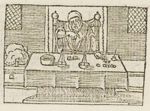
On doibt garder Iustice en toute chose: La Perrière, Le theatre des bons engins (Lyon, 1545), emblem 10 uses the imagery of a well-balanced pair of scales to express fairness
Iconclass: 46B3311 scales 59C21 Equality, Equity, Fairness, Righteousness; 'Equalità', 'Equità', 'Giuditio giusto', 'Ordine dritto e giusto', 'Ugualità' (Ripa)
II v 83 Sterilius agrippo More barren than a wild-olive
Ακαρπότερος ἀγρίππου, id est, Sterilior agrippo. Laconicum adagium est, de iis qui extremae sunt paupertatis, neque quicquam facultatum possident. Quadrat & in ignavos, nulliusque industriae homines. Lacones oleam sylvestrem agrippum vocant. Tantum Zenodotus & Suidas.
Ακαρπότερος ἀγρίππου, More barren than a wild-olive, is a Spartan adage, applied to those who are desperately poor and possess no resources at all. It also suits lazy men and those who have no wish to work. The Spartans use agrippos for a wild-olive. So Zenodotus and Suidas, and that is all we know.
Facsimile:
Iconclass: 25G3(WILD OLIVE) trees (WILD OLIVE) 25H181 waste land, no man's land 46A155 outcasts, pariahs
Loci Communes: Paupertas (Poverty, Pauvreté); Ignavia et inscitia (Cowardice and ignorance, Lâcheté et ignorance)
II v 84 Jovis suffragium Jupiter's vote
Διὸς ψῆφος, i. Iovis suffragium dicebatur sacrum & inviolatum. Unde sententiam eius cuius sit velut irrefragabilis autoritas, Iovis suffragium recte dixeris. Aut per ironiam ubi quis arrogantius de re quapiam pronunciat, suamque opinionem pro lege atque oraculo postulat accipi, subiicietur διὸς ψῆφος. Aiunt enim locum, in quo Neptunus & Minerva iudicium peregerunt, utrius nomine auspiciisque civitas Atheniensium institueretur, Iovis suffragium appellatum fuisse. Suidas Cratinum citat ex Archilochiis, Ενθα διὸς μεγάλου θῶκος πεσσοί τε καλουνται. id est, Magni ubi dicuntur tali, sedesque tonantis. Nam & talis olim ferebantur suffragia, nimirum à sortientibus.
Διὸς ψῆφος, Jupiter's vote, was said to be sacrosanct and inviolable; and so you might well use the phrase of the opinion of anyone possessed of authority that cannot be contradicted, or sarcastically, whenever anyone makes an arrogant pronouncement on some subject expects his opinion to be accepted with the force of law or like an oracle, you can fairly comment 'Jupiter's vote.' For they say that the place where Neptune and Minerva obtained a decision in their dispute, which of them should give his name and patronage to the new city of Athens, was called Jupiter's Vote. Suidas cites the Archilochians of Cratinus: 'Where is the seat, and votes, of mighty Jove.' (For 'votes' he uses the word for 'knucklebones,' which were often employed for making choices, especially when this was done by casting lots.)
Facsimile:
Iconclass: 53B2 Decisiveness, Decision 53C11 Authority, Power; 'Dominio', 'Giurisdittione' (Ripa) 92B1 (story of) Jupiter (Zeus)
Loci Communes: Fides et gravitas (Trust and seriousness, Confiance et gravité)
II v 85 In nervum ire To go to the bowstring
In nervum ire, Donatus, aut quisquis is fuit interpres Phormionis Terentianae, demonstrat esse proverbium, pro eo quod est decipere. Sumptam à sagittariis metaphoram, quibus illud evenit interdum, ut dum nimium tendunt arcum rumpant, aut sibi nervum aliquem fatigent, ut confine sit illi, de quo dictum est aliàs, ἀποῤῥήξομεν τό καλώδιον πάνυ τεινομενον. Dictum est autem, In nervum ibit, pro eo quod est, in vincula ibit. Antiquitus enim qui solvendo non essent, vincti tradebantur creditoribus, donec opera compensarent cre ditam summam. Veretur enim adulescens amans, ubi eum in locum traheretur Phormio ut aut puellam domum ducere cogeretur ex pacto, aut certe pecuniam acceptam renumerare, ni faciat vinciendus, & iuxta leges corpote luiturus, quod aere non posset, sibi magis consulturum illum, ut vel prodat omne commentum, vel vere mulierem abducat. Porrò Coniicere in nervum, & Eximere è nervo, pro eo quod est, ob aes alienum vinctos abducere. Sed verba Terentii subscribam: At enim non ducet, novi. Caeterum cum argentum repetent, nostra causa scilicet in nervum potius ibit.
Donatus (or the scholiast on Terence's Phormio, whoever he was) shows that To go to the bowstring is a proverb meaning 'to deceive.' The image is taken, he says, from archers, who sometimes find that, if they draw a bow with too much force, they break the string, or overstrain one of their own sinews, so that this is close to a proverb of which I have treated elsewhere, To stretch the rope till it breaks. But in nervum ibit He will go to the bowstring is a way of saying He will be put in chains; for in the old days debtors who could not pay were bound and handed over to their creditors, until they paid off their borrowings by forced labour. The young lover in the play is afraid that if Phormio were to be forced into the position where he had either to take the girl home in accordance with the contract or at least to repay the money he had received, under penalty of being bound if he does not do so, and of having to repay according to law by his own labour the debt he cannot pay in cash, he would do what is best for himself, and either betray the whole plot or abduct the girl in earnest. Thus the word for 'bowstring' can also mean 'prison' in phrases like 'to throw into prison' and 'to release from prison,' in the context of carrying people off bound for unpaid debt. But I will add Terence's actual words: 'He will not marry her, I know. But when they want the money back, for our sakes he will prefer to go to prison, in nervum ibit.'
Facsimile: 
Iconclass: 45C15(BOW) archer's weapons: bow 45C15(BOWSTRING) archer's weapons (BOWSTRING) 57AA621 Cheat, Deceit; 'Fraude', 'Inganno' (Ripa)
Loci Communes: Discriminis (Danger, crisis, Danger)
II v 86 Ipse semet canit He sings his own praises
Αὐτὸς αὑτὸν αὐλεῖ, id est, Ipse suimet tibicem est. hoc est, ipse cuiusmodi sit, factis ipsis declarat. Tibicines enim olim laudes fortium virorum decantabant. Proinde qui recte gestis sibi satis magnam gloriam comparat, quorsum huic necessum est conducere buccinatorem laudum suarum? Adagium in utramlibet partem poterit applicari, bonam vel malam: Nihil huic opus tibicine, qui suis egregie gestis sat illustris est. Aut, nihil opus huius vitam insectari, satis per se foedam atque infamem. Conveniet & in illos qui semetipsos laudant, qui mos est gallis gallinaceis, etiam cum e pugna se proripuerunt. Plato in Theaeteto, φαινόμεθά μοι ἀλεκτρυόνος ἀγενοῦς δίκην, πρὶν νενικηκέναι, ἀποπηδήσαντες ἀπὸ τοῦ λόγου ᾄδειν. id est, Videmur mihi ignavi galli in morem, quum ante victoriam à sermone resilierimus, canere.
Αὐτὸς αὑτὸν αὐλεῖ, literally, He is his own flute-player, he himself, in other words, makes clear by his actions what sort of man he is. For flute-players in the old days used to sing the praises of heroes. Now why should a man who acquires all the reputation he wants by his own prowess need to hire someone else to trumpet his renown? The adage can be used in both senses, good and bad. This man needs not trumpeter; he is famous enough on his own distinguished record.' Or 'No need to unmask this man's life; its dishonour and infamy are there for all to see.'
It will also suit those who praise themselves, a habit of fighting-cocks even when they have run away from the contest. Plato in the Theaetetus: 'We shall look like cocks of a very poor strain if we drop the argument suddenly and start crowing before we have won.
II v 87 Ipse dixit He said himself
Αὐτὸς ἔφα, id est, ipse dixit. Quoties tantam esse cuiuspiam autoritatem significamus, ut ea vel citra rationem ad quidvis credendum sufficiat. Ut, In arcanis literis satis est, αὐτὸς ἔφα: in reliquis non item. Adagium autem à Pythagora natum, qui quo plus venerationis & autoritatis sibi suisque conciliaret, in dissertationibus dicere solitus est, αὐτὸς ἔφα, id est, Ipse dixit. perinde quasi non sua referret, sed ab oraculo quopiam accepta. Ea vox deinde in vulgarem abiit sermonem. Huiusmodi fermè Suidas. Diogenes Laertius indicat hoc dictum à Pythagora Zacynthio manasse. Quanquam M. Tullius libro De natura deorum primo, secus rem narrat. Non enim, inquit, tam autores in disputando, quàm rationis momenta quaerenda sunt. Quinetiam obest plerunque iis qui discere volunt autoritas eorum qui se docere profitentur. Desinunt enim suum iudicium adhibere: id habent ratum, quod ab eo quem probant, iudicatum vident. Nec vero probare soleo id quod de Pythagoricis accepimus, quos ferunt, si quid affitmarent in disputando, quum ex his quaereretur, quare ita esset, respondere solitos, Ipse dixit. Ipse autem, erat Pythagoras. Tantum opinio praeiudicata poterat, ut etiam sine ratione valeret autoritas. Quintilianus in Institutionibus: Nam & inviti iudices, inquit, audiunt praesumentem parteis suas: nec hoc oratori contingere inter adversarios, quod Pythagorae inter discipulos contigit, potest: Ipse dixit. Sed istud magis minúsve vitiosum est, pro personis dicentium. Allusit horsum & Aristophanes ἐν νεφέλαις, Φέρε, τίς γὰρ οὑτος, ὁ ὐπὶ τῆς κρεμάθρας ἀνὴρ; Αὐτός. τίς αὐτός; σωφράτης, τίς σωκράτης; Ιθ᾽ αὐτὸς ἀναβόησον αὐτόν μοι μέγα. Αὐτός μὲν οὖν σὺ κάλεσον, οὐ γὰρ μοι σχολή. id est, Dic age quis est iste cremathrae insidens homo? Ipse est. quis ipse? Socrates. quis Socrates? Ab ipsius ipsum voce magna mihi voca. Quin ipse magis accerse, non mi est ocium. Quod autem dixit, ὁ ἐπὶ κρεμάθρας, ut hoc obiter indicem, risus causa novatum, cum Socratem intelligi vellet, animo suspenso nubes suspicientem. Nam cremathra vasculum est pensile, in quo obsoniorum reliquiae consueverunt reponi. Dicitur autem bifariam, simpliciter aliquoties, sed frequentius per ironiam, veluti si quis Aristotelem, ceu oraculum citanti dicat, αὐτὸς ἔφα, rationem dicti flagitans, neque contentus simplici scriptoris autoritate. Conveniet etiam, quoties sententiae vel invidiam, vel defensionem à nobis ad ipsum autorem reiicimus. Iuvenalis, Sic volo, sic iubeo, sic pro ratione voluntas. Melius Horatius, Nullius addictus iurare in verba magistri. Illud admonendum videtur, αὐτὸς ἔφη, in hac paroemia perinde valere, quasi dicas, Dominus dixit, ut Pythagoras ab Aegyptiorum vatibus videatur didicisse figuram hanc prophetis familiare. Aristophanes in Ranis, Φράσον ταῖς ὀρχηστρίσιν, ὅτι αὐτὸς εἰσέρχομαι. id est, Dis saltatricibus meipsum advenire. Hoc est, herum, quòd is quodammodo & famulis missis advenire videatur. Item in prophetis arcanis, Ecce ipse adsum, id est, dominus & autor. Huc pertinent quae nobis antea dicta sunt proverbio, Infixo aculeo. Sic Augustinus alicubi recensens opinionem Manichaei, ni fallor, Haec, inquit, Manichaeus dixit, atque abiit: notans illum, quod sat haberet dixisse, quum docendum esset quod dixerat. Galenus item lib. περὶ φυσικῶν δυνάμεων primo, ταῦτα καὶ τὰ τοιαῦτα εἰπὼν, ἐξαίφνης ἀπταίστῳ καὶ σαφεῖ στόματι τελευτῶν ἀποπηδάσας ἀπήει, καταλλιπὼν ἡμᾶς, ὡς μηδε πιθανῆς τινὸς ἀντιλογίας εὐπορῆσαι δυναμένους. id est, Haec & his similia loquutus, repente ore nihil cunctante quasi labi non posset, verbis apertis absolvit sermonem, moxque proripiens sese abiit, nobis ita relictis, quasi nihil omino reperire possemus quod vel probabiliter contradiceremus.
Αὐτὸς ἔφα, He said himself. Whenever we wish to convey that one man's authority is so great as to justify our belief in something even with no reason given, in the way that 'He said himself is sufficient in Holy Scripture, though not in other texts. The adage took its rise from Pythagoras who, in order to achieve more respect and authority for himself and his school, used to say in his lectures 'He said himself,' just as though he were repeating not his own opinions but utterances that he had received from some oracle. The words then migrated into common speech. Such is more or less the account given by Suidas. Diogenes Laertius gives us to understand that the remark stems from Pythagoras of Zacynthus. All the same, Cicero in the first book of his On the Nature of the Gods tells a different story: 'For in a discussion we should look not for authorities but for reason to sway the balance. In fact the authority of those who profess themselves teachers is often a handicap to those who wish to learn; they cease to use their own judgement, and accept as authoritative whatever verdict they find passed by the judge of their choice. Nor do I normally approve a habit I have heard ascribed to the Pythagoreans; it is said that when they asserted something in a discussion to be true, and were asked why this was so, they were wont to reply 'He said so himself.' The "himself" of course was Pythagoras. Such was the effect of an opinion predetermined, that authority carried the day, even with no appeal to reason.' Quintilian in the Principles: 'For juries give a reluctant hearing to the man who takes for granted that his case is right, nor can counsel rely on finding among his opponents the principle to which Pythagoras could appeal among his disciples, He said so himself.' But this approach is sometimes more defective, sometimes less; it depends on the sort of man who uses it. Aristophanes also alludes to this in the Clouds:
Tell me, who's this man swinging in the basket?
Himself. - And who's himself? - Why, Socrates.
Who's Socrates? Call him - a good loud shout.
No, no: call him yourself. I haven't time.
(When he says 'swinging in the basket,' I may explain in passing, this is a new and humorous idea: he wants us to understand that Socrates is contemplating the clouds, with his mind set on higher things. The kremathra of which he speaks is a hanging container in which the left-over remains of food used to be kept.) The phrase is used in two ways, sometimes with its simple meaning but more often ironically; for example to someone citing Aristotle as an oracle one might reply 'No doubt he said so himself,' to show that one needed his reasons and was not satisfied with the bare authority of the writer. It will be useful too when we wish to transfer the unpopularity of some opinion, or the task of defending it, from ourselves to the man who is really responsible. Juvenal: 'Such is my will and pleasure; if I please, / That's good enough for you.' Horace is better: 'To no man's words in blind allegiance pledged.'
It is perhaps worth pointing out that 'He said himself in this proverb has much the same force as Thus saith the lord,' so that Pythagoras might be thought to have learnt this phrase, which is familiar to us in the Prophets, from the seers in Egypt. Aristophanes in the Frogs: 'Go, tell the girls, / His lordship has arrived - and here I am,' meaning that the master arrives in some sense, even if he only sends his servants. In the same way in the scriptural prophets 'Here I am/ meaning 'your lord and master.'
Here belongs what I have said earlier on the proverb After planting the dart. Thus Augustine in some passage where he reviews the opinion of Manichaeus, if I remember right: 'Manichaeus said this, and departed,' his point being that he was content to have stated his view, when he should have argued it. Galen too On the Natural faculties, book 1: 'Having said this and more like it without preparation and without hesitation, as though what he said could not be wrong or be misunderstood, he ended by dashing off and leaving us where we were, as though we were quite unable to produce any counter argument with even a shadow of probability.'
Facsimile: 
Iconclass: 31B6235 speaking 52B11 Contemplation 53C11 Authority, Power; 'Dominio', 'Giurisdittione' (Ripa) 57AA644 Arrogance; 'Arroganza' (Ripa)
Loci Communes: Arrogantia jactantiaque (Arrogance and boastfulness, Arrogance et vantardise)
II v 88 Te ipsum non alens canes alis You keep hounds though you cannot keep yourself
Αὐτὸν οὐ τρέφων κύνας τρέφεις. id est, Cum temetipsum non alas, canes alis. In eum dicebatur, qui cum per inopiam sibi quae sunt ad vitam necessaria suppeditare non posset, conaretur aut equos, aut famulos habere domi. Apposite dicetur adversus istos, quibus cum ob rei familiaris angustiam vix suppetat quo vitam sustineant, tamen per ambitionem conantur fastu vestium, reliquoque strepitu potentes et opulentos imitari. Breviter conveniet in omnes, qui quae ad voluptatem aut splendorem pertinent, curant, neglectis his quae magis sunt necessaria. Porrò necessariis prima debetur cura, dignitati posterior: veluti si quis in eruditione comparanda laboret, vitae securus de qua periclitetur.
Αὐτὸν οὐ τρέφων κύνας τρέφεις, You keep hounds though you cannot keep yourself, was said of a man who was so poor that he could not provide himself with the necessities of life, and yet tried to keep either horses or servants. It will be aptly used against those who have so little money that they can hardly support life, yet are ambitious and try to ape the rich and powerful with splendid garments and all the bustle of the great. In a word, it will fit everyone who takes thought for the pleasures and grandeurs of life, and neglects the things that are more badly needed. The necessities of life should have our attention first, and after them our social position; otherwise we shall be like one who toils to become a good scholar, and gives no thought to his livelihood, which is at risk.
Facsimile:
Iconclass: 46A15 the poor 51B6:46A16 Imitation; 'Imitatione' (Ripa)❧the rich 55BB1 Poverty; 'Povertà', 'Povertà del doni', 'Povertà in uno ch'habbia bell'ingegno' (Ripa)
Loci Communes: Absurda, indecora, seu praepostera (Absurd, unbecoming, or preposterous things, Choses absurdes, inconvenantes ou déplacées)
II v 89 Terrae intestina The bowels of the earth
Γῆς ἔντερα. id est, Terrae intestina. Dicebantur vilia, nullisque precii. Saxa vero terrae viscera dicuntur. Refertur à Diogeniano. Terrae enim intestina sunt saxs: & lapides appellamus homines inutiles. Simile illi. Ετώσιον ἄχθος ἀρούρης. id est, Telluris inutile pondus.
Γῆς ἔντερα, The bowels of the earth, was an expression used of worthless things of no value. Rocks are called 'the bowels of the earth.' This is recorded by Diogenianus. The bowels of the earth are rocks; and we call useless men 'stones.' It is like that other phrase, 'A useless burden on the earth.'
Facsimile:
Iconclass: 51A51:25 Interior, Interiority❧earth, world as celestial body 54BB3 Inutility, Noxiousness; 'Nocumento', 'Nocumento d'ogni cosa' (Ripa) 54BB6 Worthlessness
Loci Communes: Multi - in stupidos (Many people - against the stupid, Beaucoup de gens - contre les sots)
II v 90 Tenedius tibicen A flute-player from Tenedos
Τενέδιος αὐλητὴς, id est, Tenedius tibicen, dicebatur testis falsus & calumniator. hinc natum quod Philonome tibicinem suum subornavit, qui testaretur apud Cygnum, ipsam à Tenne de stupro fuisse interpellatam ac vi etiam tentatam. Haec fermè Stephanus in catalogo urbium. De Tenedo saepe iam dictum est alibi.
Τενέδιος αὐλητὴς, A flute-player from Tenedos, was a phrase for a deceitful witness who gave fabricated evidence, which arose from the fact that Philonome suborned her flute-player to report falsely to Cygnus that she had received improper advances from Tennes and even been physically assaulted. So Stephanus in his catalogue of cities. Of Tenedos I have already spoken frequently elsewhere.
Facsimile:
Iconclass: 44G159 perjury 48C7351 flute, aulos, tibia 48C7525 one person playing wind instrument 61D(TENEDOS) geographical names of countries, regions, mountains, rivers, etc. (TENEDOS) (TENEDOS)
Loci Communes: Improbi (The dishonest, Les malhonnêtes)
II v 91 Cyrbes malorum Whole statute-books of wrong
Κύρβεις κακῶν, id est, Cyrbes malorum. De vehementer improbis, et omni facinorum genere contaminatis. Apud Athenienses tabulae quaedam erant quadrae, in quibus leges descriptae proponebantur, praeterea variae delinquentium poenae. Has illi κύρβεις appellant, apud Lucianum ἄξωνες dicuntur. Non dissimile est illi quod alibi retulimus, ἰλιὰς κακῶν. id est, Ilias malorum. Simili figura apud Athenaeum libro ix. dixit Antiphanes opinor, καὶ ταῦτα μέν μοι τῶν κακῶν παροψίδες. id est, Et hic malorum mihi catinus extitit. Solent enim in eodem disco varia eduliorum genera apponi, sed quae voluptatem adferant. quo gratior est tropus, deflectens in contrarium, quasi dicas, Ilias bonorum.
Κύρβεις κακῶν, Statute-books full of wrong. Of abandoned rascals, stained with every sort of crime. In Athens there were certain four-sided prisms, on which laws were inscribed as a means of publication, and with them the various penalties laid down for offenders. These they called kyrbeis, and in Lucian the word is 'axles.' This is not unlike one I have recorded elsewhere, An Iliad of woes. A similar metaphor is used in Athenaeus, book 9, by Antiphanes if I remember right: 'And here I found a whole great dish of woes.' For different sorts of food are often set out on the same dish, all designed to look attractive. This makes the image all the more effective, if you turn it round, as one might speak of An Iliad of blessings.
Facsimile:
Iconclass: 44G51 crime 46B3211(+0) tally (+ variant) 51H3 Multitude
Loci Communes: Infortunii sive exitii (Misfortune or ruin, Malheur ou ruine)
II v 92 Aries nutricationes mercedem persolvit The ram paid for its upbringing
Κριὸς τροφεῖα ἀπέτισεν, id est, Aries alituram rependit. Citatur ex Menandro. Quadrat ubi quis pro benefactis maleficium reponit. Allegoria sumpta est ab eo, quod aries cornibus impetat, aut vas in quo pabulum apponitur, ipsosque quorum opera nutritus est, aut etiam nutritur, cornibus incessit. Effertur & ad hunc modum proverbium, κριοῦ διακονία, id est, Arietis ministerium, pro officio collato in ingratum, qui beneficium iniuria penset. Huic affine quod est apud Aristophanem in Vespis, ἡ χάραξ τὴν ἄμπελον id est, Vallus item.
Κριὸς τροφεῖα ἀπέτισεν, The ram paid the cost of its upbringing. Cited from Menander. Suitable when anyone repays a good turn with a bad one. The image derives from the fact that the ram attacks with its horns the bucket or other container in which food is set before it, and butts the very people who provide it with food and perhaps actually feed it. The proverb is also expressed in the form Κριοῦ διακονία, A ram's recompense, used when someone has done a kindness to an ungrateful man, and is repaid with injury. This is related to that phrase in Aristophanes, in the Wasps: 'The prop has let down the vine.'
Facsimile:
Iconclass: 46B44(+0) paying (~ commerce) (here also repayment of debt, etc.) (+ variant) 47I2131(+9512) ram (+ animal(s) attacking) 49A education 57AA8 Ingratitude; 'Ingratitudine' (Ripa)
Loci Communes: Ingratitudo (Ingratitude, Ingratitude)
II v 93 A Dorio ad Phrygian From Dorian to Phrygian
Απὸ δωρίου ἐπὶ φρύγιον, i. à Dorio ad Phrygium venite dicebatur, qui à vita temperatiore ad luxum sese convertisset, aut qui à fortuna mediocri se contulisset ad maiorem vitae strepitum. Sumpta metaphora à notissimis illis veterum harmoniarum generibus, in qui bus Dorium moderatius: quemadmodum indicat Suidas referens haec verba ex incerto auctore nescio quo, τὴν δὲ τροφὴν ἐκληρώσατο μετρίαν, καὶ ἄθρυπτον, οὔτε κακουργοῦσαν διὰ πενίαν, οὔτε διὰ πλοῦτον βλακεύουσαν, ἀλλὰ μέσην καὶ μουσικὴν, τὸν Δώριον τροπον τῆς τύχης ἀληθῶς ἡρμοσμένην. id est, Victum autem sortitus erat moderatum, deliciarum expertem, neque sordidum, ac molestum ob inopiam, neque ob divitias dissolutum, sed medium quendam ac modulatum, vere ad Dorium fortunae modum attemperatum. Refert & alium locum suppresso auctoris nomine, ni fallor, οὐ φανοῦμαι στρογγύλων λογάρια, αὐτὰς δὲ τὰς θέσεις τῶν νοημάτῶν εἰς μέσον τιθέμενος μόνον, οὐ τῆς γλώττης τὸν τόνον ὑπο τῆς διαλέξεως εἰς ἐπιστροφὴν μεθαρμόσαιμι, ἀπὸ δωρίου φασὶν ἐπὶ φρύγιον. Quae tametsi difficile est apte vertere si nescias quid praecedat aut sequatur, tamen apponamus divinationem meam donec locus occurterit. Non videbor hominum rotunde loquentium verbula, sed ipsos sensus in medium adferens, tantum non ipsius linguae tonum à disputatione ad attentionem adaptavero. Quanquam apud Suidam legitur μόνον εἰ. Ex his verbis apparet, Dorium modum fuisse delicatiorem, Phrygium severiorem. Apuleius Floridorum lib. i. palàm indicat, Doricam musicam à Phrygia longe diversissimam fuisse, quandoquidem haec ad religionem inflammabat animos, illa ad bellum inflammabat. Apulei verba sic habent. Tibicen quidam fuit Antigenidas, omnis voculae melleus modulator, & idem omnimodis peritus modificator, seu tu velles Aeolion simplex, seu Asium varium, seu Lydium querulum seu Phrygium religiosum, seu Dorium bellicosum. Hactenus Apuleius: cui si credimus, non porest esse temperatus modus Dorius, qui ad bellum accendit, nisi forte ituris in praelium moderatius canebant tibiae, quod illic plus valeat sibi praesens animus, quàm furore percitus. Verum an in Apulei verbis, pro Aeolion legendum sit, Aetolicum sive Aetolium, & pro Asium, Iassium sive Iastium ab Iade sive ἰαστὶ , ut Ionicum intelligas modum, doctis expendendum relinquo. Quanquam his non satis congruunt quae refert Lucianus in Harmonide: καὶ ἑκάστης ἁρμονίας διαφυλάττειν τὸ ἴδιον, τῆς φρυγίου τὸ ἔνθεον, τῆς λυ δίας τὸ βακχικὸν, τῆς δωρίου τὸ σεμνὸν, τῆς ἰωνικῆς τὸ γλαφύρόν.i. Uniuscuiusque harmoniae servare proprietatem, Phrygiae divinum impetum, quod Apul. vertit religiosum, Lydiae bacchanalem furorem, sive licentiam, Doricae severitatem, Ionicae iucunditatem, quod Apuleius videtur transtulisse varium. Contrà Dion in commentariis de regno refert, Alexandrum Magnum ad bellum accendi solere, Timotheo musico Dorium incinente. Athenaeus lib. xiiii. Doricae harmoniae tribuit τὸ ἀνδρῶδες, καὶ τὸ μεγαλοπρεπὲς, καὶ τὸ σφοδρόν. id est, severitatem, maiestatem ac vehementiam, ut quae neque dissoluta sit, neque hilaris, sed tristis, minimeque varia. Iam his recentior Boetius in praefatione libri De musica, ostendit hanc artem ad movendos affectus praecipuam habere vim, proque ratione modorum, alios atque alios animi motus vel excitare, vel sedare. Addit Pythagoram incentione modi Phrygii incitatum adolescentem patria barbarum, quippe Taurominitanum, vino temulentum, ira furentem, quum iam aedibus amicae, quae rivalem admiserat, ignem admovere tentaret, tibicina iussa spondeos succinere, ad sobriam mentem revocasse. Boetius refert iuvenem Phrygio modo fuisse incitatum, ac mutato modo ad se redisse, nec exprimit in quem modum sit mutatus Phrygius. M. Tullius quem illic citat Boetius, neutrius meminit modi, tantum ait spondeorum incentione fuisse sedatum adolescentem. Si Timotheus Dorio modo concitabat Alexandrum ad bellum, & hic adolescens ad expugnandam domum Phrygio fuit accensus, apparet modos hos non multum inter se discrepare. Lucianus Phrygio tribuit τὸ ἔνθεον, id est, furorem, sed sacrum duntaxat. Huius autem furoris Plato tria facit genera, unum quod poetis immittant Musae, alterum quod varibus immittit Apollo, tertium quod amantibus Cupido. Habet autem & Bacchus & Mars furorem suum. Itaque iuvenis ille triplici furore correptus, insaniebat, Bacchi, Cupidinis & Martis. Pyrrhichios autem ad proelium acuere aliàs docuimus, unde illud πυῤῥιχην βλέπειν de trucibus & commotis. Pyrrhichio autem contrarius est spondeus. Quod ni Boetius dixisset mutatum modum, probabile esse poterat eundem modum Phrygium, & incitare pyrrhichiis, & sedare spondeis. Et haud scio an Boetius quum ait immutatum modum, sentiat non mutatas harmonias, sed vocum celeritatem. Videtur locus proverbio, quum ad diversa transitur: veluti si quis de Rhetorum praeceptis sermonem exorsus ad Theologicam materiam digrediatur. Equidem arbitror veteres de generibus harmoniarum diversa tradidisse, quod ipsa mutatis gentium moribus pariter sint immutata. priscorum enim Asianorum laudata est severitas, priusquam luxu effeminarentur. Idem usu venit Laconibus, in quibus sunt Dores. Hinc illa mixturarum nomina ὑποδώριον, μιξολύδιον, ὑερμιξολύδιον. Athenaeus hypodorium modum putat eundem esse cum Aeolio, cui tribuit tumorem ac fastum, & submolle quiddam. Quidam musices studiosi affirmant difficilimum esse transitum à Dorio ad Phrygium. Ostendimus & aliàs, Phrygium melos, σκολιὸν appellatum, & in funebribus naeniis adhiberi solitum. Quod si Dorius cantus Phrygio diversus est, utpote qui ad belli cupiditatem inflammet, consentaneum est illum pyrrhichiis constitisse, quandoquidem spondeo contrarius est pyrrhichius. Verum de his harmoniarum generibus permulta Plato in libris de rep. Rursus in Lachete docet hanc esse verè Doricam cantionem, & Graecam harmoniam non Phrygiam: neque Ionicam, neque Lydiam, si vita concordet cum oratione bona. Nonnulla Plutarchus in libro de musica. Nos quantum ad percipiendum adagii sensum sat est, attigimus.
A man was said to pass From Dorian to Phrygian, Απὸ δωρίου ἐπὶ φρύγιον, who had turned from a more abstemious way of living to a life of luxury, or who had passed from a modest situation to one of more noise and bustle. The metaphor is taken from those very familiar kinds of harmony used by the Ancients, of which the Dorian was the more restrained, as Suidas indicates, quoting the following words from an author whose name I do not know: The way of life that had fallen to his lot was moderate and far from luxurious, such as would neither blight a man's prospects through poverty or sap his energies through too much wealth; it was a middle way, well-tuned and truly adapted to the Dorian mode of fortune.' Suidas also refers to another passage, suppressing, if I am not mistaken, the author's name; it is not easy to give an appropriate rendering of this without knowing what precedes or follows, but I will add my own guesswork, to serve until the passage turns up: 'It will be clear that I put forward, not the chosen language of men of rotund utterance but their actual meaning; only I shall not have from Dorian (as they say) to Phrygian.' Though in Suidas the reading is not monon ou 'only I shall not have,' but monon ei, 'only if I have.' From these words it is clear that the Dorian mode was more delicate and the Phrygian more severe. Apuleius in the first book of his Florida makes it quite plain that the Dorian style in music was very different from Phrygian, since one aroused the mind to religious feelings and the other fired it with martial ardour. Apuleius' words run as follows: 'There was a flute-player once called Antigenidas, whose control of every note was sweet as honey, a master too in the management of every mode, whether you wished him to play the simple Aeolian, the versatile Asian, the plaintive Lydian, the solemn Phrygian or warlike Dorian.' Such are Apuleius' words; and if he is right, the Dorian, which kindles men with martial ardour, cannot be a temperate mode, unless maybe the flutes played calming music to men on their way into battle, because at that moment self-control is more use than wild enthusiasm. Whether in the passage from Apuleius we should read 'Aetolian' (Aetolicum or Aetolium) for 'Aeolian' and 'Ionian' (lassium or lastium, from las or lasti) for 'Asian', I leave open for the consideration of the learned. Though this does not agree properly with what Lucian writes in his Harmonides: 'And each mode has its special character, divine force' (what Apuleius calls 'solemnity') 'in the Phrygian, Bacchic enthusiasm in the Lydian, severity in the Dorian, cheerfulness in the Ionian' (which Apuleius seems to have rendered by Versatility'). Dion on the other hand, in his essay 'On Kingship,' records that the fighting spirit of Alexander the Great was always aroused when the musician Timotheus played in the Dorian mode. Athenaeus in book 14 credits the Dorian mode with 'manly severity and majesty and force,' neither languishing nor gay, but solemn and the reverse of versatile.
A later author, Boethius in the preface to his work On Music, shows how this art has a special power of rousing our feelings, and that the feelings it rouses or calms differ from one mode to another. He adds the story of a young man, a barbarian by birth (for he came from Taormina), who had been excited by music played in the Phrygian mode, and was drunk and furiously angry; when he was already trying to set fire to the house of his mistress, who had admitted a rival, Pythagoras told the flute-girl to change to a spondaic rhythm, and so restored him to sanity. Boethius says the young man had been excited by the Phrygian mode, and returned to his senses when the mode was changed; but he does not tell us what mode replaced the Phrygian. Cicero, who is quoted in this passage by Boethius, mentions neither mode, and only says that the young man was pacified by music in spondaic rhythm. If it was with the Dorian mode that Timotheus used to rouse Alexander to war, and with the Phrygian that this young man was fired to attack the house, it would seem that there was not much difference between these two modes. Lucian ascribes madness, to entheon, to the Phrygian, but madness of a sacred kind. Of this Plato establishes three sorts: one inflicted on poets by the Muses, one on seers by Apollo, and the third on lovers by the god of love. Bacchus and Mars have their own madness too. Thus the young man in the story, when he went out of his mind, had been seized by madness of three kinds, from Bacchus, Cupid and Mars. That a pyrrhic rhythm rouses men to battle, I have shown elsewhere, for this is the source of To have a pyrrhic look in the eye, used of fierce excited people; and the pyrrhic is the opposite of the spondee. Had not Boethius spoken of a change of mode, we might have accepted that the same Phrygian mode could rouse with pyrrhic rhythms and calm with spondees. And it seems possible that Boethius, in speaking of a change of mode, meant a change not of harmony but of rhythmic speed.
There is clearly a place for the proverb when there is a change of subject, when, for instance, a man starts with the principles of rhetoric and digresses to speak of theology. I myself suppose that the Ancients have given us different accounts of the systems of harmony, because the system itself changed with changes in the behaviour of society. In early days the people of Asia were reputed for their discipline, before they were softened by luxury. The same happened to the Spartans, among whom were Dorians. Hence those names for mixtures of mode, hypodorian, mixolydian and hypermixolydian. Athenaeus thinks the hypodorian mode is the same as the Aeolian, to which he attributes pomp and circumstance and a touch of effeminacy. Some music-scholars affirm that to change from Dorian to Phrygian is very difficult. I have shown elsewhere that there was a Phrygian form of song called skolion, which was also commonly used in the dirges at funerals. If Dorian music is different from Phrygian, inasmuch as it arouses martial ardour, everyone must agree that it consisted of pyrrhics, since the pyrrhic is the opposite of the spondee. But there is a great deal about these kinds of harmony in Plato's Republic, and again in the Laches he teaches us that the true Dorian harmony, and the true Greek harmony (neither Phrygian nor Ionian nor Lydian) is to be found when there is complete harmony in a virtuous man between his life and language. Plutarch has something to say in his essay 'On Music.' For my part, I have said enough to make clear the meaning of the adage.
Facsimile: 

Iconclass: 23T27(DORIAN)(+0) modern division of historical epochs ~ centuries (DORIAN) (+ variant) 23T27(PHRYGIAN)(+0) modern division of historical epochs ~ centuries (PHRYGIAN) (+ variant) 54A43 Temperance, Moderation; 'Misura' (Ripa) 55B2 Luxury, Luxuriousness
Loci Communes: Mutati instituti (A changed custom, Une coutume changée)
II v 94 A carcere From the starting-pen
Απὸ βαλβίδος. i. A carcere, sive repagulo, id est, ab ipso rei principio. Sumptum à certaminibus equestribus, ubi cursus initium est à carceribus, id est, repagulis, finis meta. Itaque cum exorsum negocii significamus, Ab ipsis carceribus dicimus: quum finem, Ad metam usque. Veluti si quis dicat foedum esse, si quis artifex ab ipso statim carcere peccet, aut neminem tam ignavum, qui non ἀπὸ βαλβίδος strenuus esse videatur. Extat apud Aristophanem. Confine quod alibi positum est, ἀπὸ γραμμῆς. id est, A linea.
Ἀπὸ βαλβίδος, From the starting-pen or the starting-rope, that is, from the very beginning of a thing. Taken from horse-racing, in which the course begins at the starting-pens or starting-rope and the meta or finishing-post is the end. And so, when we wish to convey the starting of some enterprise, we say 'Right from the starting-pen,' and if it's the end, 'Right to the finishing-post.' A man might say, for example, that it is disgraceful for a craftsman to make blunders 'right from the very starting-pens,' or that no one is so idle that he does not wish to give an effect of activity, at least on the starting-line. It is found in Aristophanes. Related to one I have placed elsewhere: From scratch.
Facsimile:
Iconclass: 43C21213:41A5421 race-track❧barrier 54DD3 Start
Loci Communes: Perficiendi sive absolvendi - ab initio ad finem (Finishing, completing - from beginning to end, Achever, accomplir - du début à la fin)
II v 95 A caelo ad terram From heaven to earth
Απὸ οὐρανοῦ μέχρι γῆς. id est, A coelo ad terram. Proverbialis figura, perinde valens quasi dicas, quacunque de re, ab extremo initio usque ad supremum finem. Sic apud Plautum in Persa licitatori roganti, num ex puella quaedam scitari liceret, venditor quantum vellet percontari permittens, A coelo, inquit, ad terram, quod lubet.
Ἀπὸ οὐρανοῦ μέχρι γῆς, From heaven to earth, is a proverbial phrase with the same meaning as if you were to say 'About anything you please, right from the beginning to the very end.' So in Plautus, in the Persa, when a purchaser enquires if he may ask the girl some questions, the seller, to give him permission to ask as many questions as he wishes, replies 'From heaven to earth, whatever you please.'
Facsimile:
Iconclass: 11S heaven, celestial paradise, New Earth 25 earth, world as celestial body 51F5 Beginning; 'Principio' (Ripa) 51FF5 End; 'Fine' (Ripa) 51H1 Totality, the Whole
Loci Communes: Perficiendi sive absolvendi - ab initio ad finem (Finishing, completing - from beginning to end, Achever, accomplir - du début à la fin)
II v 96 Mores amici noveris, non oderis Know your friend's weaknesses but hate them not
Porphyrion in Horatium, hunc versum proverbialem admonet fuisse, Mores amici noveris, non oderis. Eum nos inter Graecas sententias repertum restituimus. Est enim huiusmodi, Φίλου τρόπους γίνωσκε, μισήσῃς δὲ μὴ. Admonet in amicorum moribus quaedam vitia dissimulanda, sic ut intelligantur quidem, sed tamen tolerentur, ne severior & oculatior in observandis amici malis subvertas amicitiam. Atque id praecepti locum habebit in levioribus morbis, non in his quae ad famam, aut ingens periculum pertinent amicorum. Non nosse amici vitia, est hominis parum diligentis quos diligat: odisse, parum civilis. Noscenda sunt, ut aut corrigas, aut certe minuas: at non sic, ut ob ea videaris amicum odisse. Siquidem nulli futurus est amicus, qui nihil vitiorum in amico ferre possit.
Porphyrion in his commentary on Horace tells us that this line was proverbial: 'Know you friend's weaknesses but hate them not.' I found this among the Greek aphorisms, and have restored the original; for it runs like this: 'Love a friend's ways indeed, but hate them not.' The point is that certain faults of character in our friends should be overlooked, on the basis that we should understand them and at the same time tolerate them, for fear that if you are too strict and too sharpsighted in observing your friend's defects, you will undermine the friendship. And this will rank as a command when lesser faults are concerned, but not in those that reflect on our friends' honour or may land them in very great danger. Ignorance of his friends' faults is the mark of a man who has made no choice of those he will cherish; resentment of them shows discourtesy. You should recognize them, so that you can either correct them, or at least reduce their force, but not to the extent that makes you seem to dislike a friend. For the man who can tolerate no faults in a friend will have no friends.
Facsimile:
Iconclass: 51AA4:56FF2 Nothingness, Absence❧Hate; 'Odio capitale' (Ripa) 52A5:54AA72 Knowledge; 'Cognitione', 'Cognitione delle cose' (Ripa)❧Vulnerability 56F231 Fidelity in Friendship; 'Confermatione dell'Amicitia', 'Fede nell'Amicitia' (Ripa) 57A72 Tolerance, Long-suffering; 'Longanimità', 'Toleranza' (Ripa)
Loci Communes: Amicitia (Friendship, Amitié)
II v 97 Bithus contra Bacchium Bithus against Bacchius
Bithus & Bacchius nobile par gladiatorum fuit, quorum mentionem Suetonius quoque fecit, pares arte, pares audacia. Proinde quoties duo aequaliter improbi contendunt inter sese, ita ut neuter alteri velit concedere, non intempestiviter dicemus, Bacchium cum Bitho commissum. Horatius in Sermonibus, Uti non Compositus melius cum Bitho Bacchius. Rupili Persiique, parem inter ipsos improbitatem & maledicentiam significans. Quicquid insigniter improbum est, & ad omnem contentionem paratum, gladiatorium appellamus: Gladiatoria corporis firmitas, gladiatoria audacia, gladiatoriis animis ad me affectant viam. Marcus Tullius in Philippicis, Antonii fratrem aliquoties Mirmillonem appellat, ut in Philippica sexta: Etiám ne ab hoc Mirmillone Asiatico, senatus mandata, legatorum verba audientur?
Bithus and Bacchius were a well-known pair of gladiators, mentioned by Suetonius, a good match both in skill and courage. Consequently, whenever two rascals of equal quality are in such conflict that neither will yield to the other, it will not be out of place if we say 'Here's Bacchius matched with Bithus.' Horace in his Satires: 'Never was Bacchius better matched with Bithus,' where his point was that Rupilius and Persius were equal alike in their rascality and their command of bad language. Anything really criminal and ready for a fight of any kind we call 'gladiatorial': the physical strength of a gladiator, a gladiator's brutal daring, 'They plan their attack on me in gladiatorial style.' Cicero in the Philippics sometimes calls Antony's brother 'a mirmillo,' as in the sixth Philippic: 'Shall even the resolutions of the senate and the reports of its official representatives be accessible to this mirmillo from Asia?'
Facsimile:
Iconclass: 43C3961 fight of gladiators 98B(BACCHIUS) male persons from classical history (BACCHIUS) 98B(BITHUS) male persons from classical history (BITHUS) 51B3:54A7 Parity, Equality❧Strength, Power; 'Fortezza', 'Fortezza d'Animo e di corpo', 'Fortezza del corpo congiunta con la generosità dell'animo', 'Fortezza & valore del corpo congiunto con la prudenza & virtù del animo', 'Forza' (Ripa)
Loci Communes: Similitudinis et congruentiae (Similarity and congruence, Similitude et convenance)
II v 98 Esernius cum Pacidiano Esernius versus Pacidianus
Simile fuerit illud ex Lucilio, Esernius cum Pacidiano compositus. Erant & hi gladiatores per omnia pares, longeque omnium nobilissimi. M. Tullius in lib. De optimo oratorum genere: A me autem, quo maximis minima conferam, gladiatorum par nobilissimum inducitur. Aeschines tanquam Esernius, ut ait Lucilius, non spurcus homo, sed doctus & acer, cum Pacidiano hoc componitur, optimus longe post homines natos. Eiusmodi fermè spectaculum nobis exhibuerunt, non sine magna omnium voluptate, superioribus hi sce diebus Londini apud Britannos duo theologi: quorum alter erat magnus ille StandiFranciscanorum quos conventuales vocant in ea insula κορυφαῖος, homo mire vocalis, Scotista strenuus, animo intrepido: tum iis lateribus, eaque corporis firmitate, ut vel triarius miles, vel gladiator esse posset, ni theologus esset. Alter Italus ex eorum sodalitio quos vulgus fratres Servitas appellat, ob id ut accipio, quod licet sint scarabeis nigriores, tamen uni virgini Mariae serviant, neque cum Christo, neque cum quopiam alioqui divorum quicquam habeant commercii. Verum hic ut fortassis eruditione non inferior erat, ita gladiatoriis illis dotibus longe impar, ut ego quidem sentio. Is ubi sese ex more sub quadragesimam sacram in Bratanniam recepisset, quo declararet sese non omnino lusisse operam, quam theologicis literis annos iam aliquot impenderat Lutertiae, conclusiones, ut vocant, aliquot, proponere coepit inter eruditos disputandas, quarum pleraeque ad negociatores pertinebant, excepta prima quae ad divi Francisci contumeliam videbatur pertinere. Ea habebat hanc fermè sententiam, Peccare fratres Minores si pecuniam accipiant, sive ipsi, sive per alios, & ex consequenti peccare, qui illis pecuniam darent, quod quisquis ministraret occasionem peccandi, peccaret ipse quoque. Atque ut hoc auderet homo peregrinus, haec perpulit occasio. Diversabant hic Servita apud Augustinianos, qui se vocant Eremitas, κατ᾽ ἀντίφρασιν opinor. Ii Londini non mediocrem quaestum faciunt ex negociatoribus praesertim Italis, & ob id invisi Minoritis. Standicius igitur quo quaestum illum ad suos averteret, in concione monuit populum, etiam atque etiam viderent quibus confiterentur. Nam duobus tantum ordinibus à pontifice datum ius audiendi peccata quorumlibet, nimirum Minoritis & Iacobitis. haec quoniam ad famem vocare videretur reliquos ordines, inito consilio subornarunt Servitam, qui tam capitalem iniuriam thematiis ulcisceretur, quod linguae Britannicae rudis loqui populo non posset. Affiguntur igitur omnibus templis & angulis conclusiones de quibus dicere coeperam. Huius rumor paulatim, ut fit, sparsus, cum ad Standicianas aures pervenisset, ibi vir pius excelsique animi, se dignas iras animo concipit. Minatur dira: et omnino res ad magnam aliquam trafoediam spectare videbatur, ni deus aliquis ἀπὸ μηχανῆς intervenisset. Intelligebat enim vir sapiens, rem ad Saguntinam famem spectare, si eiusmodi propositio vel audita fuisset publice. Et inter ipsos is sanctissium habetur, quisquis nummorum quam plurimum possidet. Quid multa? Coactus est Servita adire hominem, quo se purgaret, & illius placaret animum. Ibat homo gravate. Territabant enim hospitem complures, quod dictitarent Standicium hominem esse virulentum, clamosum, bilis immodicae: tum apud promiscuam plebem, puta naviculatores, aurigas, & calcearios, veteramentarios, fullones, aliosque id genus proceres, esse aliquid: deinde tanto animi robore, ut unus adversus Britannorum ecclesiam, immunitatis causam fortissime sustinuerit, ob id sacerdotibus & episcopis omnibus invisus, ac bonae plebis parti, quae clericis bene vult. Ut coram ventum est, Servita, quoniam non theologiam modo, verumetiam Rhetoricen attigerat, hoc exordio aggressus hominem sibi conciliare: Egregie pater, inquit, haud sanè volens huc venio, quod audiam à plerique te esse impotenter iracundum, & si quibusdam credendum est, etiam furiosum. Atque hactenus μάλα ἔντέχνως captata benevolentia, rem paucis subiecit. Attamen, inquit, quoniam hi patres id tantopere à me contenderunt, adsum auditurus si quid velis. Hic alter protinus magnis conviciis debacchari in homine, conclusionem esse scandalosam, offensivam piarum aurium, haeresim sapientem, irreverentialem in seraphicum ordinem divi Francisci, ipsum mox poenas daturum, ni eam recantet. Contra Servita, ut fortem virum decuit, respondit se disputandam proposuisse, non recantandam. Ad tam impiam vocem supra modum commotus Standicius, iubet hominem paulisper operiri, ac sese proripit intro. Servita ne hic quidem obtemperans tanto viro, coeperat iam abire. At ille mox accitis satellitibus aliquot suis cucullatis (habet enim permultos, nec minus robustus, nec minus audaces regiis) abeuntem assequutus, correptum pedibus ceu Cacum quempiam introrsum trahit: ibi Servita destitutus, et extrema metuens, quod in deploratis rebus fieri solet, Iesum implorat: Iesum, Iesum, quanta potest voce identidem exclamans. Nusquam erat Iesus inter Franciscanos, sed trabebatur interim miser: verum è vicino ad Iesum nomen exciti quidam opifices ementarii, cum saxis & instrumentis suis accurrebant, & hominem à satellitum illorum manibus eripuerunt. Atque hic fuit illius fabulae primus actus. Proximus autem ma gnis utrinque conviciis actus est, utriusque partis ducibus passim quiritantibus apud suam factionem. Servita votivam etiam tabellam Iesu servatori suspendisse dicitur, argumento coloribus expresso, & asscripto epigrammate. Iam fabula cito populum pervagata, ad Cardinalis etiam aures, qui eius regni praeses ac iudex est, penetrarat. Is ut est festivo ingenio, ratus spectaculum haud iniucundum, ambos apud se sisti iubet. Accusat Standicius fortiter. Servita gnaviter defendit. Cardinalis pronunciat, quandoquidem scholastica disputabilisque esset proposito, uti mox à pascha Iovis die publice disputarent in aede divi Pauli. id est templum eius insulae celeberrimum. Neutra pars pugnam detrectat. Adornant sese duces, apparant sese milites: affliguntur valvis, compitis ac palis omnibus, conclusiones: concurritur & è longinquo ad hoc spectaculi. Diversa hominum studia, sed omnium aequa expectatio. Ne longum faciam: aderat dies pugnae destinatus, doctis atque indoctis differta omnia. Et ecce quorundam opera factum est, ut à rege per Cardinalem interdictum exiret, ne quid ageretur. Ibi Standicius quo gloriam eam in se derivaret, dimissis aliquot è suis, spargit per omnem populum, Servitam supplicem sibi ad genua accidisse: deprecatunque, ne disputatio procederet. Iamque id plerisque persuasum erat, cum alter hospes Anglice nesciret, nisi nescio quis deus Servitae in mentem misisset quiddam. Is enim conscenso suggestu, sic multitudinem est allocutus: Doctissimi doctores, vosque caeteri praestantissimi viri: erat hodie futura disputatio, sed reverendissimus Cardinalis ob iustas causas iussit supersedere, ne quid frustra expectetis. Minores ubi vident tantam gloriae praedam sibi è manibus eripi, adoriuntur hominem, etiam in medio templo dilaniaturi, ni providens Cardinalis illi custodes aliquot suae familiae notos adiunxisset. Minores igitur quod illic solum licebat, motis capitibus multa procul minati, rursus ad Cardinalem, magnis clamoribus Servitam accusant: qui contra regium interdictum ausus sit apud populum testari, se paratum ad defendendam conclusionem tam impiam. Iubetur utraque pars adesse. Standicius praeter satellites suos, etiam puerum cucullatum adduxerat, iam tum Scotissantem, Tanti refert à teneris recte institutui. Eum, dum per diversa atria ad Cardinalis adytum penetrat, ostentat magnatibus aulicis. Nam ille plerisque notus est magis quam charus. Affirmat fore ut puerille Servitam conficiat, proteratque. Ventum est, agit Standicius, ut puer cum illo committatur. At negat Cardinalis decorum, si cum homine graduato, ut vocant, puer committeretur. Nam Servita theologiae bacalaureus erat, currens an sedens, formatus an mox formandus, incertum: Obiectus est igitur Minorita quispiam, sed Italus Italo, ut cornix cornici configeret oculos. Docti aliquot & proceres arrectis auribus circumstant. Ibi Minorita porrecto brachio: Tun', inquit, ais peccare Minores, si tracent pecuniam? Aio. Negas pontificem posse indulgere, ut liceat? Haud nego. At nobis indulsit. Credo. Licet igitur. Haud repugno. Mentitur igitur tua conclusio. Hoc telum sic elusit Servita: Mea, inquit, conclusio de Minoribus pronunciat. Illis non licet: vobis qui Minores non estis, licet. Imò, inquit, alter, bulla pontificia nos Minores vocat. Vocat, ait Servita, sed addit, conventuales. Sic enim minores conventuales Minores sunt, ut homo mortuus est homo. Hic cum obmutuisset Minorita, non enim expectarat eam solutionem, Cardinalis admiratus dialecticum acumen, arrisit non insuavitre. Standicius ubi videt primam coitionem parum feliciter processisse, ipse prodi in harenam, ac vultu minaci, & intento brachio: Aio, inquit, te excommunicatum. Et mox neganti: Est nobis, inquit, bulla pontificia, quae excommunicat omnes, qui dicere ausint, fratres Minores conventuales apud Anglos peccare, si recipiant pecuniam: tu vidisti bullam, & affirmas, ergo es excommunicatus. Hic planè iam ἔμβροχος tenebatur Servita, nisi elapsus esset, ut diceret bullam loqui de Minoribus conventualibus, qui minores non essent, suam conclusionem loqui de Minoribus absolute. Cardinalis qui animi gratia magis quam serio haec ageret, sic utrunque dimisit, ut nondum satis liqueret, uter esset vir fortior. Servita Lutetiam repetiit, triumphum illic acturus. Standiciani contra apud suos iactitant illum à puero superatum, sic ut nihil haberet quod hisceret. Conclusio manet Oxoniae Cantabrigiaeque in scholis theologicis disputanda. Hoc spectaculi quoniam nobis vehementer iucundum fuit, volui tibi optime lector eam voluptatem communicare, ut hac amoenitate lectionis taedium levares.
There is a well-known phrase very like this in Lucilius: Esernius matched against Pacidianus. They too were gladiators, a well-matched pair and far more distinguished than all their contemporaries. Cicero in his book On the Best Kind of Orator: 'For my part, to compare small things with great, I bring onto the stage a famous pair of gladiators. Aeschines takes the part of Esernius, "no filthy fellow he," as Lucilius puts it, but a skilled and doughty fighter, "is matched with our Pacidianus, and is far / The best that ever was since men were men."'
A spectacle very like this was presented to us in these last few days in London, England, to the great delight of all those present, by two theologians. One of whom was that great figure, Standish, the archimandrite of the Franciscans who in that isle are called conventuals, a powerful speaker and tireless Scotist who knows not fear, and a man of such sinews and physical vigour that he might well have been a guardsman or a prizefighter, had he not been a theologian. The other was an Italian, a member of the community commonly called the Servite Friars, the reason being (so they tell me) that, though as black as beetles, they serve the Virgin Mary as their only mistress, and have no truck with Christ or any of the saints besides. This man, however, though in learning perhaps not inferior, was quite unequal, in my opinion, in all those gifts that make a gladiator. Having retired to England shortly before Lent as his custom was, he wanted to demonstrate that the efforts he had expended in Paris for several years already on the study of theology had not been wasted, and so he proceded to put forward a number of conclusions, as they call them, for discussion in academic circles, most of which related to commercial problems, but not the first, which was taken to cast some aspersions on St Francis. The text was something to this effect: that the Friars Minor commit sin if they accept money, whether personally or through a third party, and in consequence those who give them money also commit sin, for whoever furnished another with the opportunity to commit sin, sinned himself also.
The cause that moved a foreigner to take this bold step was as follows. This Servite was lodging with the Augustinians who call themselves Hermits, I suppose by some principle of opposites. The Augustinians in London do very well out of the merchants, Italians especially, and this made the Minorites jealous. The man Standish therefore, in hopes of diverting this source of income to his own Order, warned the congregation in a sermon to be extremely careful in the choice of a confessor; only two Orders had been authorized by the Holy Father to hear any man's confession, the Minorites and the Jacobites. As this would clearly reduce the other Orders to starvation, they put their heads together, and suborned the Servite, whose ignorance of English did not permit him to preach in public, to seek satisfaction for such an outrageous attack by a series of academic theses. Fixed up therefore on every church door and at every street corner were to be seen the 'conclusions' of which I began to tell.
The news of this spread gradually, as it usually does; and when it reached the ears of Standish, the spirit of that holy and high-hearted hero was fired with appropriate wrath. Dire were his threats, and all seemed set for some great and tragic outcome, when some god intervened, as they say, from the machine. Our wise philosopher saw clearly that the affair would end in famine at Saguntum, if such a proposition were even to get a hearing in public; and among themselves they reckon most saintly the man who has most coin. To cut a long story short, the Servite was forced to go and see Standish in order to apologize and pacify him. He went with great reluctance. He was a stranger, and there were plenty of people to frighten him with the news that Standish was a poisonous man, and noisy, and had an ungovernable temper; that he was thought to be something by common people, sailors perhaps and cart-drivers and cobblers, old-clothes dealers and fullers and other such leaders of society; and that he had sufficient self-confidence to stand out alone against the whole English Church in a most valiant defense of the case for immunity, which had made him unpopular with all priests and bishops and a large part of those ordinary folk who wish well to the secular clergy. When the Servite was ushered into the presence, having dabbled in rhetoric as well as theology, he attempted to secure the man's goodwill by the following exordium: 'Worshipful father,' says he, 'I have come, to be sure, most reluctantly, having heard from several sources that you are ungovernably angry and, if some of my informants are to be believed, actually mad.' Having thus, fully in accordance with the rules of the art, secured his hearer's goodwill, he went on briefly as follows: 'But in any case, as these fathers have so strongly urged me to do so, I have come to hear if you have anything to say.' At this the other man exploded, and abused him roundly. His 'conclusion' was a perfect scandal; it was offensive to pious ears, it stank of heresy, it showed gross contempt of the Seraphic Order of St Francis, and its author would soon pay the penalty if he did not recant. The Servite replied, as a brave man should, that he had put it forward for discussion, and there was no call for recantation. At such godless words Standish lost all control over his emotions; he told the man to wait a moment, and rushed into the house. The Servite, who on this point also was reluctant to obey the great man, was already preceding to depart. His opponent, rapidly summoning several of his bodyguard in their monastic habit, of whom he has a large number, as muscular and as bold as any king's, caught up with him as he retreated, seized him, and dragged him into the house feet first like a second Cacus. Thereupon the poor Servite, desolate and fearing his end was near, did as men often do in an extremity: he appealed to Jesus, crying 'Jesus, Jesus' over and over again at the top of his voice. Among the Franciscans Jesus was nowhere to be found, and all the time the wretch was being dragged along; but there were some builder's workmen in the neighbourhood, who were aroused by the name of Jesus, and came running up with stones, and with the tools of their trade, and rescued the man by force from the hands of that bodyguard. And that was the first act of the play.
The next act opened with torrents of abuse on either side, as the leaders of both parties appealed to their supporters. The Servite is even said to have hung up a votive picture in gratitude to Jesus his saviour, in which the story was portrayed in colour, with an epigram appended. By now the tale had spread rapidly through the population, and had even got as far as the ears of the cardinal, who is the chief magistrate and judge of that kingdom. Having a sense of humour, and thinking this might be an entertaining spectacle, he ordered both of them to appear before him. Standish delivered a severe attack, and the Servite defended himself vigorously. The cardinal decided, this being a scholastic proposition and open to debate, that immediately after Easter, on the Thursday, they should hold a public discussion in St Paul's Cathedral, which is the most famous church in the island. Neither side declined battle. The chieftains arm themselves, their soldiers get ready for the fray. The 'conclusions' are nailed up on every door, at every crossroad and on every fence; people gather even from long distances to see the fun. Men hold opposite views, but all are at one in their excitement. Not to make a long story of it, the day came that had been fixed for the battle, and with learned and unlearned the place was packed, when lo and behold, the efforts of certain people had secured an order from the king, announced by the cardinal, that things should go no further. Whereupon Standish, to secure all the credit for himself, sent some of his people separately to put it about all through the crowd that the Servite had thrown himself humbly at his feet and begged him that the dispute might not proceed. Most of them were already convinced of this, the other man being a foreigner and unable to speak English, had not some god given the Servite a bright idea. He went up into the pulpit, and addressed the crowd in these words: 'Right learned doctors, and all other honourable men, there was to have been a dispute today, but his Eminence the Cardinal for good and sufficient reason has given orders to cancel it, so do not wait in vain for something to happen.' The Minorites, seeing the prize of so great a victory torn from their grasp, fell upon the man, and would have torn him to pieces right there in the cathedral, had not the cardinal seen this coming and attached a few men to him to protect him who were known to his own household.
So the Minorites wagged their heads at him and uttered a great many threats from a safe distance, which was all they were allowed to do; and then they accused the Servite a second time before the cardinal with a lot of uproar for having dared to breach the royal prohibition and go on record before a public audience that he was prepared to defend such an impious 'conclusion.' Both parties were ordered to appear. Standish beside his bodyguard had also brought a boy in a monastic habit, who was already learning his Scotus; such is the importance of being correctly brought up from an early age. This boy he proudly displayed to the magnates of the court, as they passed through the different rooms to the cardinal's privy chamber; for Standish was known to many of them, better known than loved. He assured them that they would see the boy polish off the Servite and trample him under foot. 'We have got to the stage' said Standish 'when a boy can be pitted against him.' But the cardinal said it was improper to pit a boy against a man who was a graduate, as they call it; for the Servite was a bachelor of theology, though whether currens or sedens, formatus or shortly to become so, is uncertain. So a Minorite was put forward, this time an Italian confronting an Italian, so that one crow might pick out the other crow's eyes. A number of scholars and leading members of the court stood round listening eagerly. 'Do you maintain' began the Minorite with arm outstretched 'that the Friars commit sin if they handle money?' 'Yes,' he said, 'I do.' 'Do you deny that the Pope has power to issue a privilege to make it lawful?' 'No,' he said, 'I do not.' 'But the Pope has given us a privilege.' 'I dare say.' 'So then it is lawful.' 'I have nothing against that.' 'So then your "conclusion" is a lie.' This weapon the Servite dodged like this: 'My "conclusion" he said 'makes a statement about the Friars Minor. It is not lawful for them; for you, who are not Friars Minor, it is lawful.' 'But the papal bull' said the other man 'calls us Friars Minor.' 'So it does' said the Servite, 'but it adds the words "who are conventuals;" for conventual friars are Friars Minor in the same way that a dead man is a man.' This silenced the Minorite, for it was a solution he had not seen coming; and the cardinal, admired this skill in argument with a pleasant smile. When Standish saw that the first round had gone so badly, he entered the ring himself, and said with a threatening frown and outstretched arm: 'I maintain that you are excommunicated.' When the other said no, he went on 'We have a papal bull which excommunicates everyone who dares to say the the conventual Friars Minor in England commit a sin if they accept money. You have seen the bull, and you say this: therefore you are excommunicated.' At this point the Servite was fairly in trouble, had he not wormed his way out by saying that the bull spoke of conventual Friars Minor, who were not really such, while his conclusion referred to Friars Minor without qualification. The cardinal, whose object in all this had been entertainment rather than serious business, dismissed them both in such terms that it was not yet quite clear which was the stronger man. The Servite returned to Paris to enjoy his triumph there; the Standish party on the other hand put it about among themselves that he was defeated by a boy and reduced to complete silence. The 'conclusion' remains to be discussed at Oxford and Cambridge in the schools of theology. This spectacle I found so exceedingly entertaining, dear reader, that I thought I would share my pleasure with you, so that you could lighten the tedium of your reading with this agreeable relief.
Facsimile: 

Iconclass: 11L532 disputing theologians 43C3961 fight of gladiators 98B(ESERNIUS) male persons from classical history (ESERNIUS) 98B(PACIDIANUS) male persons from classical history (PACIDIANUS) 51B3:54A7 Parity, Equality❧Strength, Power; 'Fortezza', 'Fortezza d'Animo e di corpo', 'Fortezza del corpo congiunta con la generosità dell'animo', 'Fortezza & valore del corpo congiunto con la prudenza & virtù del animo', 'Forza' (Ripa) 61B2(STANDISH, HENRY) historical person (STANDISH, HENRY) 94L4115 Cacus, the fire-breathing monster is killed in his cave by Hercules
Loci Communes: Similitudinis et congruentiae (Similarity and congruence, Similitude et convenance)
II v 99 Bis septem plagis polypus contusus A polyp crushed with fourteen blows
Δὶς ἑπτὰ πληγαῖς πουλύπους πιλούμενος. id est, Plagis adactus polypus quatuor decem. Dici solitum, ubi quis multo tandem malo fit emendatior. Quemadmodum accidit indomitis adolescentibus, qui plurimorum experientia malorum tandem cicurantur. Conveniet & in eos qui duriore ingenio praediti, non nisi gravibus suppliciis corriguntur. Aiunt polypum piscem captum diu multumque tundi caedique solere, quo mitior fiat, & ad esum accommodatior. Autor Zenodotus.
Δὶς ἑπτὰ πληγαῖς πουλύπους πιλούμενος, A polyp crushed with blows twice sevenfold. In use when a man is eventually improved by a series of misfortunes, as happens to the young and headstrong as they grow up and are tamed in the end by long experience of disaster. It will also suit those who are naturally stubborn and require severe punishment to correct their faults. The polyp, they say, is a fish which when taken is usually subjected to prolonged and severe pounding and beating to soften it and make it edible. Zenodotus is the authority.
Facsimile: 
Iconclass: 25F72(POLYP) molluscs: polyp 41C264 smoothing, beating (preparing food) 51GG4 Softness (matter) 54A31 Experience, Mastery; 'Esperienza' (Ripa) 54FF11:49A Adversity, Misfortune, Bad Luck; 'Fortuna infelice', 'Infortunio' (Ripa)❧education
Loci Communes: Assiduitas (Diligence, persistence, Assiduité)
II v 100 Mopso Nisa datur Nisa is Mopsus' bride
Schema proverbiale videtur & illud apud Vergilium in Pharmaceutria: Mopso Nisa datur: Cum praeter omnium spem res praeclara contigit cuipiam prorsus indigno, ut nihil iam non posse sperari vel à quovis appareat: Mopso Nisa datur: quid non speremus amantes? Est autem emphasis in nominibus. Nam Mopsum dicens, intelligit infimum, abiectissimumque pastorem: Nisam, puellam insigni forma. Non abludit hinc illud Sophoclis in Aiace flagellifero, Οὐκ ἔστ᾽ ἄελπτον οὐδὲν. id est, Nihil est, quod haud sperare liceat. In eandem sententiam Linus apud Stobaeum: Ελπεῖσθαι χρὴ πάντ᾽ ἐπεὶ οὐκ ἔστ᾽ οὐδὲν ἄελπτον. Ρᾴδια πάντα θεῷ τελέσαι, καὶ ἀνήνυτον οὐδὲν. id est, Speres cuncta, nihil quod non contingere possit, Omnia sunt magnis factu proclivia divis.
There seems to be something proverbial about this phrase in Virgil, in the Sorceress: 'Nisa is Mopsus' bride.' When, against universal expectation, some great success befalls a man who is quite unworthy, making it clear that there is no longer any limit to what anyone may hope for: 'Nisa is Mopsus' bride: what may we lovers not hope for?' There is also some point in the names; for when we say 'Mopsus,' we think of a despicable shepherd of the lowest class, and Nisa suggests a very beautiful girl. Sophocles is not far from this in the Ajax: 'Nought is beyond the reach of hope.' And to the same effect Linus, preserved by Stobaeus: 'Never despair, for nothing is past hope; / All things God brings to pass; nought is impossible.'
Facsimile:
Iconclass: 31D13:51D4 adolescent, young woman, maiden❧Beauty; 'Bellezza' (Ripa) 42D31 unequal couple, ill-matched couple 47I221:51DD4 herding, herdsman, herdswoman, shepherd, shepherdess, cowherd, etc.❧Ugliness 51F2:56D1 Continuity❧Hope; 'Speranza', 'Speranza delle fatiche' (Ripa) 82A(MOPSUS) male literary characters (MOPSUS) 82AA(NISA) female literary characters (NISA)
Collectanea (1500): 810
Loci Communes: Praeter spem bonum aut malum (Good or bad beyond expectation, Bien ou mal inattendu)