Jacob Cats, Spiegel (The Hague, 1632)
Emblem 56

't Zijn stercke beenen die weelde dragen konnenDutch
They are strong legs that can carry prosperity.AI-generated
Description of the imageAI-generated
Within a large oval frame (the corners of the plate filled with dark triangular spandrels) a young man strides forward across a landscape, bent slightly under a burden on his shoulders: a richly dressed woman sits astride his neck and shoulders, her enormous billowing skirts spreading over his head and back. She wears a plumed headdress, a lace collar and pearls; in her raised right hand she holds a goblet together with flowers/foliage, while with her left she tips out a stream of coins that fall through the air at the left. The man wears a doublet with slashed sleeves, wide breeches, a ruff-like collar, bucket-top boots with spurs, and a rapier at his side; he grips the woman's leg/shoe with one hand. In the left middle distance small figures tumble and dance: a man falling backwards with legs in the air, another gesticulating figure beside him, and a woman standing with raised arms. In the background are a flat landscape with a village church tower, shrubs and birds in the sky. Below the oval a ribbon banderole bears the motto in script; at lower left the inscription 'A. v. Venne in', at lower right 'D. V. Bremden Scul.'
Subscriptio
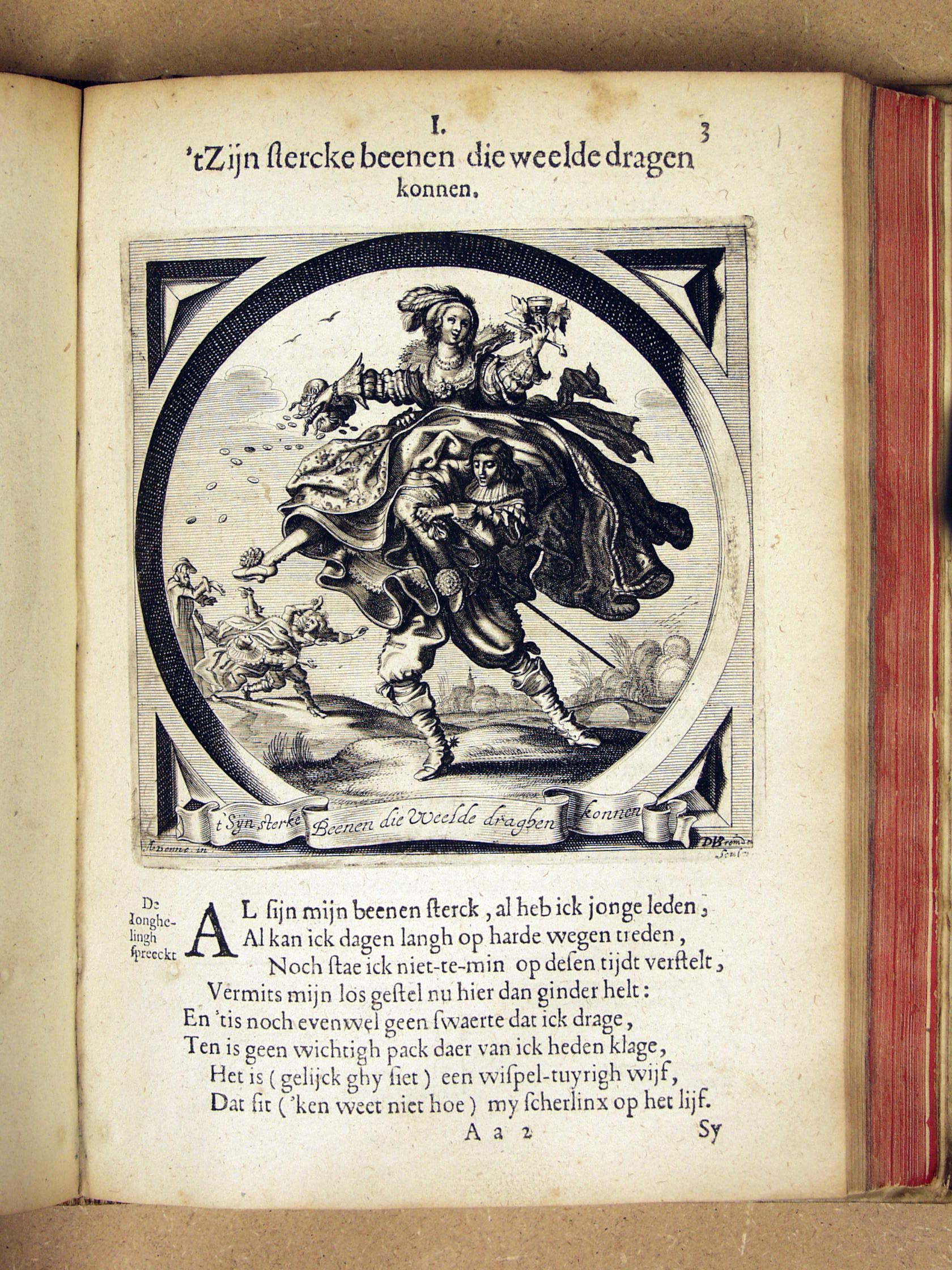


TranscriptionAI-generated
De Jonghelingh spreeckt. AL sijn mijn beenen sterck, al heb ick jonge leden, Al kan ick dagen langh op harde wegen treden, Noch stae ick niet-te-min op desen tijdt verstelt, Vermits mijn lös gestel nu hier dan ginder helt: En 'tis noch evenwel geen swaerte dat ick drage, Ten is geen wichtigh pack daer van ick heden klage, Het is (gelijck ghy siet) een wispel-tuyrigh wijf, Dat sit ('ken weet niet hoe) my scherlinx op het lijf. Sy heeft een selsaem hooft, vol alderhande grillen, Sy heeft een dertel hert, en dan oock ronde billen, Sy krevelt evenstaegh en moet in roere zijn; De rust is haer verdriet, het stille wesen, pijn. Ick hebbe grooter last voor desen moeten dragen, 'kEn vondt noch evenwel geen reden om te klagen, Want hoe het immer ging, ick droeg het wichtig pack, Ick droegh het daer ick wou, oock sonder ongemack: Maer dit aelweerdigh dingh gaet buyten alle reden, Het ruckt my daer het wil, en druckt my opte leden, En schoon ick voor my sie, soo veel ick immer kan, Noch swier ick onder haer gelijck een droncken man. Maer, Leser, nae my dunckt, ghy wenst om eens te weten Hoe dat sy, dien ick draegh, in Hollandt wort geheten; Wel hoortet met eē woort: Vrou VVeeld' is hare naem, Tot jock, tot enckel spel, en anders niet bequaem; Sy heeft soo vreemden aert, soo bijster malle kueren, Geen heldt, geen machtigh reus, en kander onder dueren, Want krijgtse maer een voet oock op een deftigh man, 'Tis hondert tegen een soo hyse voeren kan: Of weeter eenigh mensch haer lossen aert te dwingen, Soo datse niet geheel, en mach int wilde springen, Ten gaeter evenwel niet al gelijck het sou, De geck wil niet-te-min by wijlen uytten mou. Wel, Vrienden, tot besluyt, soo Weelde koomt getreden, Of met een vollen loop naer uvvent toe gereden; Soo grijptse met bescheyt, en houdtse dapper vast, Want siet! al isse licht, het is een svvare last.
TranslationAI-generated
The Young Man speaks. Though my legs are strong, though I have young limbs, though I can tread hard roads for days on end, nevertheless I now stand confounded, because my loose load leans now this way, now that. And yet it is no weight that I carry, it is no heavy pack that I complain of today; it is (as you see) a fickle woman, who sits (I know not how) astride upon my body. She has an odd head, full of all kinds of whims; she has a wanton heart, and also round buttocks; she is forever itching and must be in motion; rest is her grief, quietness is pain to her. I have had to carry greater loads before this, and yet I found no reason to complain, for however it went, I bore the heavy pack, I carried it where I wished, and without discomfort too. But this pestering thing goes beyond all reason; it jerks me wherever it will and presses on my limbs, and though I look before me as much as ever I can, still I reel under her like a drunken man. But, Reader, as it seems to me, you wish to know for once how she whom I carry is called in Holland. Well, hear it in one word: Lady Luxury (Prosperity) is her name, fit for jesting, for mere play, and good for nothing else. She has so strange a nature, such utterly mad caprices, that no hero, no mighty giant can endure beneath her; for if she gets but one foot on even a serious man, it is a hundred to one whether he can carry her. Or if any person knows how to curb her loose nature, so that she may not altogether leap about wildly, still it does not all go as it should: the fool will nonetheless peep out of the sleeve from time to time. Well, friends, in conclusion: if Prosperity comes walking, or comes riding at full gallop toward your home, then seize her with discretion and hold her bravely fast; for see, though she is light, she is a heavy burden.
CommentaryAI-generated
22 passages · original left, translation right (click to fold)
Nederl. Alle dingen kan men dragen Vtgenomen goede dagen.
Vol maeckt dol.
Armoede dwingt, Weelde springt.
Nederl. In voorspoet Is toesien goet.
Als 'tverken vol is / so stortet den troch om.
Als de lammeren sat zijn / so spelense / of soo slapense.
Nederl. Een wel-gevoede rammen joucken de hoornen.
Dutch. All things can be borne, except good days.
Fullness makes madness.
Poverty constrains, prosperity leaps.
Dutch. In prosperity it is good to take care.
When the pig is full, it knocks the trough over.
When the lambs are satisfied, they play, or else they sleep.
Dutch. Well-fed rams have itching horns.
Hoogd. Wen gluck zu wohl wil / den machets zum narren.
Kein schermesser schärfter schirt Denn wenn ein bettler edel wird.
Es müssen starke beine sein Die gute tage mögen tragen.
Dem gluck ist niemant starck genug.
Auff einem vollen bauch stehet ein frölich haupt.
High German. When fortune favours a man too well, it makes a fool of him.
No razor shears more sharply than when a beggar becomes a nobleman.
There must be strong legs that can bear good days.
For fortune nobody is strong enough.
On a full belly sits a merry head.
Salust. Secundae res etiam sapientum animos fatigant.
Sallust. Prosperity wears out even the minds of wise men.
Lat. Arietibus bene pastis pruriunt cornua.
Latin. Well-fed rams have itching horns.
--- Non est durabile semper, esse bene. --
-- It is not lasting for ever, to be well off. --
Franç. Quand le bas est plein, le haut est puant.
Quand un fol est bien, il n'y se peut tenir.
Force argent, & belle amye Faict bien souvent penser follie.
French. When the lower part is full, the upper part stinks.
When a fool is well off, he cannot keep himself there.
Much money and a fair mistress very often make one think of folly.
Lat. Luxuriant animi rebus plerumque secundis, Nec facilè est aequâ commoda mente pati.
Latin. Minds usually run riot in favourable circumstances, nor is it easy to bear good fortune with an even mind.
Satietas parit ferociam.
Satiety breeds insolence.
Theogn. Τίκτει τὸ κόρος ὕβριν.
Theognis. Satiety begets insolence.
Pindarus. Ὕβρις κόρου μήτηρ.
Pindar. Insolence is the mother of satiety.
Franç. Il n'y à point d'argent qui se despense plus prodigalement que celuy d'une succession recente.
Il n'est rien si superbe qu'un sot de basse condition eslevé à quelque dignité.
French. There is no money that is spent more lavishly than that of a recent inheritance.
There is nothing so haughty as a fool of low condition raised to some dignity.
Ital. El mal tien conorte, y el bien non ay quien le soporte. --.i.
(marked 'Italian', but Spanish) Evil has its consolation, but good there is no one who can bear it.
Franç. Le mal à du confort & le bien personne ne peut supporter.
French. Evil has its comfort, and good nobody can bear.
Ital. Non è fierezza à la fierezza eguale d'Un humile & vil huomo quando alto sale.
Italian. There is no pride equal to the pride of a humble and base man when he rises high.
Senec. Periculosa foelicitatis intemperantia est.
Seneca. Lack of restraint in good fortune is dangerous.
Tacit. Diu sordidus, repentè dives mutationē fortunae malè tegit.
Tacitus. One long squalid and suddenly rich badly conceals the change of his fortune.
Lat. Fortuna quem nimium fovet, stultum facit.
Latin. Fortune makes a fool of him whom she favours too much.
Flor. Quid enim aliud civiles furores peperit, quam nimia foelicitas?
Florus. For what else gave birth to civil madness than excessive prosperity?
Vid. multa in hanc rem apud Richt. axiom. histor. 33. oecon. 95.
Vid. arabica ad hanc rem Adagia apud Erp. cent. 1. 67.
See much on this matter in Richter, Axiomata historica 33, oeconomica 95.
See the Arabic Adages on this matter in Erpenius, century 1, no. 67.
Gijs was een jonge wulp, hy kon geen weelde dragen, En wou voor al een wijf, en ging het Fijtjen vragen, Een spits, een vinnigh dingh, een plage voor een huys, Vry moytjens op-getoyt, maer, efter niet te pluys. Fy wiste, nae den eysch, haer saecken wel te drijven, Fy had een rappe tongh, en konde deftigh kijven; En 'twas genoegh bekent, en 'twert oock Gijs geseyt, Maer des al-niet-te-min, hy wou de lieve meyt. Fy weet de weyger-kunst, en laet den vryer draven, Fy weet hem op de maet, en nae de kunst te laven; Fy, des al niet-te-min, die maeckt een kort besluyt, Want Gijs die was een bloet, en Fy die werdt de bruyt. De bruyloft wort geraemt, men noot meest al de vrienden, Men noodter boven dat oock dieder niet en dienden, Het voor-spel mette feest, de eerst' en tweede nacht, Die worden al gelijck met vreugde door-gebracht; Maer als de derde Son quam nae de trou geresen, Doen schoot Gijs uytten slaep, en woude meester wesen, Daer gingh Fy tegen aen, en yder even kloeck, Maer Gijs die bolt te kort, en Fy behoudt den broeck; Dies gaet de goede man met neer-geslagen wangen, Hy laet sijn moedigh hooft, hy laet sijn ooren hangen, Hy roept schier even-staegh: Och waer ick weder vry, Eerst wasset, Fijtje lief, nu isset niet als, 'tfy! 'tFy dat ick oyt began; 'tfy dat ick immer troude, Och waer ick dat ick was, ick weet wat dat ick soude; 'tFy van mijn wrange Fy, en van haer fellen aert; 'tFy van den slimmen dach daer op ick ben gepaert. Dit roept de droeve Gijs oock dickmael gantsche dagen, Want hy wort staegh begraeut, en somtijts oock geslagen, Wel Gijs ghy waert niet wijs, want siet u sot bedrijf, Om een lit wel te doen soo lijdt het gantsche lijf.
Gijs was a young pup, he could not bear prosperity, and above all wanted a wife, and went to ask Fijtje — a sharp, snappish thing, a plague for a house, prettily dressed up, but yet not to be trusted. Fy knew, as required, how to drive her affairs well; Fy had a nimble tongue and could scold stoutly; and it was well enough known, and was also told to Gijs, but nonetheless he wanted the dear girl. Fy knows the art of refusing, and lets the suitor trot; Fy knows how to keep him to the measure and to refresh him by the rules; Fy, nonetheless, makes a short conclusion, for Gijs was a simpleton, and Fy became the bride. The wedding is arranged, almost all the friends are invited; besides that they invited even those who were of no use there; the prelude with the feast, the first and second night, were all alike passed in joy. But when the third sun had risen after the marriage, then Gijs shot out of sleep and wanted to be master; Fy went against him, and each as bold as the other, but Gijs falls short and Fy keeps the breeches. So the good man goes about with downcast cheeks, he lets his proud head and his ears hang; he cries almost continually: Oh, were I free again! At first it was 'dear Fijtje', now it is nothing but 'fie!' Fie that I ever began it; fie that I ever married; oh, were I where I was, I know what I would do. Fie on my sour Fy and on her fierce nature; fie on the wretched day on which I was mated. This the sorrowful Gijs cries often for whole days, for he is constantly berated and sometimes beaten too. Well Gijs, you were not wise, for see your foolish doing: to please one member, the whole body suffers.
Franç. Apres la feste On gratte la teste.
Au jour d'huy marié, demain marry.
Franç. Qui en haste se marie, à loisir se repent.
Qui se marie par amours A bonnes nuicts & mauvais jours.
French. After the feast one scratches one's head.
Married today, sorry tomorrow.
French. He who marries in haste repents at leisure.
He who marries for love has good nights and bad days.
Hou, Leser, staet, En eer ghy gaet, Hoort noch een vvoort, En treet dan voort; Siet onse Griet Die vondt verdriet, En groote pijn In maeght te zijn, Sy vvou en sou Zijn ymants vrou, Tot leet en spijt Van die't benijt, Daer kome van Al vvatter kan. VVel, onse maeght Die vvort gevraeght, Die vvort versocht, Die is verkocht, VVant Grietje nam Met dat het quam; Nu heefts' een man Die niet en kan, Die niet en vveet Als dat hy eet, Als dat hy drinckt, Als dat hy singht, Als dat hy springt Als dat hy vinckt, Als dat hy gaet, Als dat hy staet, En somtijts eens sijn vrouvve slaet. Nu vint ons Griet Gants svvaer verdriet En groote pijn In vrou te zijn, Sy roept, Eylaes! Ick vvas te dvvaes Dat ick soo ras Verslingert vvas. Maer tot haer quaet En is geen raet, Als datse lijt, En datse mijt, En neder-sight, En stille svvijght, VVant rasschen trou Is langh berou.
Hold, Reader, stay, and before you go, hear one more word, and then step on. See our Griet, who found grief and great pain in being a maid; she wanted and would be somebody's wife, to the sorrow and vexation of those who envied it — let come of it whatever may. Well, our maid is asked for, she is courted, she is sold, for Grietje took the first that came. Now she has a husband who can do nothing, who knows nothing but how to eat, how to drink, how to sing, how to leap, how to drink deep, how to walk, how to stand, and sometimes to beat his wife. Now our Griet finds right heavy grief and great pain in being a wife. She cries, Alas! I was too foolish that I was so quickly infatuated. But for her trouble there is no remedy but that she suffer, and that she avoid, and look down, and keep silent; for a hasty marriage is a long repentance.
Iconclass
86('T ZIJN STERCKE BEENEN DIE WEELDE DRAGEN KONNEN)proverbs, sayings, etc. ('T ZIJN STERCKE BEENEN DIE WEELDE DRAGEN KONNEN)
Suggested Iconclass codesAI-generated
Additional codes proposed for this emblem, not (yet) part of the indexing.
41C322mug, beaker, goblethighThe correlate 'mug, beaker, goblet' matches the goblet the richly dressed woman holds aloft in her right hand.
54F11Welfare, Prosperity; 'Felicità publica', 'Prosperità della vita', 'Salute' (Ripa)high'Welfare, Prosperity' is the central allegorical subject — the burden of 'good days'/prosperity personified as the woman riding on the man's shoulders.
54F12Luck, Fortune, Lot; 'Fato', 'Fortuna', 'Fortuna aurea', 'Fortuna buona', 'Fortuna pacifica overo clemente', 'Sorte' (Ripa)medium'Luck, Fortune' fits the commentary's repeated maxims that nobody is strong enough for fortune and that fortune makes a fool of him she favours too much.
52AA51Folly, Foolishness; 'Pazzia', 'Sciocchezza', 'Stoltitia' (Ripa)medium'Folly, Foolishness' corresponds to the emblem's point that fullness makes madness and that money and a fair mistress make one think of folly.
55B2Luxury, Luxuriousnessmedium'Luxury, Luxuriousness' matches the lavishly dressed, pearl-adorned woman scattering coins as the embodiment of self-indulgent abundance.
41C18saturation, satiation ~ eating and drinkinglow'Saturation, satiation ~ eating and drinking' echoes the proverbs about the full pig overturning the trough and the merry head on a full belly.
56BB41Satietylow'Satiety' as an abstract concept is explicitly invoked by the quoted adages 'Satiety breeds insolence' (Theognis, Pindar).
42D3marriage, married couple, 'matrimonium'low'Marriage, married couple' relates to the appended verse tales of Gijs and Fijtje and of Griet, where hasty marriage brings lasting regret, though the plate itself shows no wedding.
Relationships to the Adagia of ErasmusAI-generated
Suggested relationships between this emblem and adages in Erasmus’ Adagia.
- I vi 96 Ne quid nimis – thematic inventiolow
The emblem's cluster of sayings on excess ('Periculosa felicitatis intemperantia est', 'Satietas parit ferociam', 'Luxuriant animi rebus plerumque secundis') shares the moral of the golden mean that Erasmus expounds under 'Nothing to excess', though there is no quotation of the adage or its essay.
Sources
Record ID: embstma_1288_emblem056
This emblem on the Iconclass site: https://iconclass.org/view/embstma_1288_emblem056
Copy: University Library, Glasgow, Stirling Maxwell 1288