Jacob Cats, Spiegel (The Hague, 1632)
Emblem 57
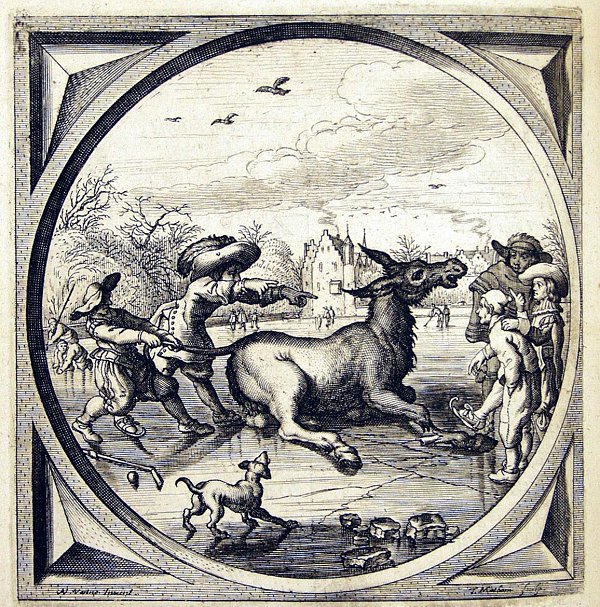
Wan dem Esel zu woll ist, so gehet er auffs eisz tantzenGerman
When the ass is too well off, he goes dancing on the ice.AI-generated
Description of the imageAI-generated
An oval engraving set in a rectangular frame with hatched corner spandrels. A winter scene on a frozen river or canal: a large donkey, mouth open and braying, has lost its footing and is sprawling on the ice, its forelegs buckling under it. Two men wearing ice-skates, one in a broad plumed hat, hold a rope or halter attached to the animal; one of them points ahead with outstretched arm while the other leans back pulling. At the right stand four spectators (a man in a broad hat, a boy, and two others), one holding a pair of skates, watching and gesturing. A small dog with a collar trots on the ice in the foreground near a hockey-stick-like 'kolf' club and chunks of broken ice. In the middle distance skaters move about on the ice, and beyond them lie a town with stepped-gable houses and a church tower, bare winter trees at the left, with birds flying in the clouded sky. Signed at the lower left 'A. v. Venne Invent.' and lower right 'J. Matham sculp.'
Subscriptio


TranscriptionAI-generated
Een Esel van de meul eens vroeger los gelaten, Gaet dolen in de stadt, en proncken achter straten, Hy voelt hem onbelast, hy voelt hem wonder vvel, Dies krijght hy grooten lust tot alle selsaem spel; Het beest dat vreughde socht, en niet en vvas te vreden Met vryheyt, met gemack, en met gesonde leden, Koomt juyst ontrent eē graft daer d'een en d'ander glijt, En daer het vveeligh volck op gladde schaetsen rijt; Dit staet hem wonder aen, daer koomt hy nae gedrongen, Daer treet hy opte baen, en doeter vreemde sprongen, Maer siet! terwijl het dier onaerdigh staet en malt, Gebeurtet dattet glipt en plots ter neder valt, Daer schreeut het lompich beest, daer is sijn been gebroké, Daer heeft 'tmisbruyckt geluck sijn leet aen hem gewroké, In 't kort' het grilligh dier dat light daer uyt-gestreckt, En wort noch evenwel van alle man begeckt. Wat isser menigh mensch die in sijn beste dagen Heeft ick en weet niet wat voor dingen aengeslagen? En die in sijn bedrijf mocht vast en seker gaen Is haestich neer-gestort, alleen uyt sotte waen! Wat isser menich mensch die neder is gevallen Om dat hy buyten schreef in weelde dorste mallen! Nu dat is esels werck; dus vrienden, zijdy wijs, Blijft daer ghy seker gaet, en houdt u van het ijs.
TranslationAI-generated
An ass once let loose early from the mill goes wandering in the town and strutting through the back streets; he feels himself unburdened, he feels wonderfully well, and so he gets a great appetite for all sorts of odd sport. The beast that sought pleasure, and was not content with freedom, with ease, and with sound limbs, comes right up to a canal where one man and another is sliding, and where the wanton folk ride on slippery skates. This pleases him wonderfully; he presses up to it, steps out onto the track and makes strange leaps there; but look! while the animal stands and fools about awkwardly, it happens that he slips and suddenly falls down. Then the clumsy beast cries out, then his leg is broken, then the abused good fortune has avenged its injury on him; in short, the capricious animal lies there stretched out, and is still mocked by everyone. How many a man there is who in his best days has undertaken I know not what sort of things! And one who in his business might have gone firmly and safely has quickly been cast down, merely out of foolish conceit. How many a man there is who has fallen down because he dared, in prosperity, to play the fool beyond the mark! Now that is ass's work; therefore, friends, if you are wise, stay where you go safely, and keep off the ice.
CommentaryAI-generated
43 passages · original left, translation right (click to fold)
Een esel alst hem wel gaet / dan gaet hy op't ijs danssen / en breeckt sijn been.
An ass, when things go well with him, then goes dancing on the ice and breaks his leg.
Hooge klimmers / en diepe swemmers slaen meest qualijck.
High climbers and deep swimmers mostly turn out badly.
Celuy ne scauroit tomber de bien haut qui n'a monté que bien peu.
He who has climbed only a little cannot fall from very high.
Facilior currentibus, quam repentibus lapsus.
A fall is easier for those who run than for those who creep.
Soo wel klaeght die wel is / als die 't wee is.
He who is well off complains just as much as he who is in pain.
Houdt het schip midde-waters.
Keep the ship in mid-water.
Wacht voor den gijp.
Beware of the jibe (sudden swing of the sail).
Οἶνος οὐκ ἔχει πηδάλιον.
Wine has no rudder.
Vinum caret clano.
Wine lacks a rudder.
Il vin non ha timone.
Wine has no helm.
Wo wein eingehet / da gehet witz aus.
Where wine goes in, there wit goes out.
Wen die sack-peiff niet vol ist / so kirt sie nit.
When the bagpipe is not full, it does not sound.
Veel freude steeckt in einem weinfaß.
Much joy sits in a wine-cask.
Voller kropff / toller kopff.
A full crop, a mad head.
Sine cerere & Baccho friget Venus.
Without Ceres and Bacchus, Venus grows cold.
Vinum lac veneris.
Wine is the milk of Venus.
Ay carin doma ynge oinamas.
(Turkish proverb:) A hungry belly does not dance.
Vrsus nisi satur non saltat.
The bear does not dance unless he is full.
Itschelum doli doli, gidelum deli deli.
(Turkish proverb:) Let us drink full cups, let us go away quite mad.
Wollen wir gar auß trinken / so werden wir zu narren.
If we drink the cup right out, we become fools.
Vor essen wird kein tantz.
Before eating there is no dancing.
Apres la panse, Vient la danse.
After the belly comes the dance.
Op een vollen buyck staet een vrolick hooft.
On a full belly stands a merry head.
Venter mero æstuans despumat in libidinem.
A belly seething with unmixed wine foams over into lust.
Nemo saltat sobrius nisi forte insanit, neque in solitudine neque in convivio moderato.
No one dances sober, unless perhaps he is mad, neither in solitude nor at a moderate banquet.
Cic. Nec omnino in voluptatis regno virtutem posse consistere.
Cicero: And that virtue cannot at all stand firm in the kingdom of pleasure.
Ovid. Luxuriant animi rebus plerumque secundis Nec facile est æqua commoda mente pati.
Ovid: Minds commonly run riot in prosperity, nor is it easy to bear good fortune with a balanced mind.
Quant l'orgueil chevance le premier, honte domage le suivent de pres. dictum Lodovici undecimi.
When pride rides in front, shame and harm follow close behind. — a saying of Louis the Eleventh.
L'aise des Sots les tue, & la prosperité des fols les perd. Prov. 1. 32.
The ease of the simple kills them, and the prosperity of fools destroys them. Proverbs 1:32.
De Leser gelieve sich, in plaetse van een plate, die hier nae-gelaten is, by inbeeldinge voor te stellen een schipper die voor de vvint zeylende, door de gijb sijn schuyt om-vverpt.
Let the Reader please, in place of a plate, which has here been omitted, imagine to himself a skipper who, sailing before the wind, capsizes his boat through the jibe.
Fortuna vitrea est cum splendet frangitur.
Fortune is of glass: when it shines, it breaks.
La fortune est constumiere pinser en flattant.
Fortune is accustomed to pinch while flattering.
Wann das glück am höchsten ist / so versehe dich deß falls.
When fortune is at its highest, then expect the fall.
Wann der hochmuth auff gehet / so gehet das glück nieder.
When pride rises, fortune goes down.
In voorspoet siet toe.
In prosperity, take heed.
Nemo confidat nimiü secundis In utraque sorte sis utriusque memor.
Let no one trust too much in prosperity; in either lot be mindful of both.
Ogni cosa si supporta, eccetto il buon tempo.
Everything can be endured, except good times.
Il n'est asseurè qui trop haut est mōté.
He is not safe who has climbed too high.
Hohe steiger fallen gern.
High climbers are apt to fall.
Gute schwimmer ertrincken gern.
Good swimmers are apt to drown.
'Tis goede / jae goddelicken raedt / in voorspoet op tegenspoet / ende in teghenspoet op voorspoet te dencken / want soo doende zijn die beyde best getempert.
It is good, yes divine, counsel in prosperity to think of adversity, and in adversity of prosperity; for by doing so both are best tempered.
Syrach. 11. 26. Au jour de prosperité les maux ne soient point mis en oubly & aux jours des afflictions qu'il te souviene des biens.
Sirach 11:26. In the day of prosperity let evils not be forgotten, and in the days of afflictions let there be remembrance of good things.
Joseph Hal. saint. cons. 4. Comme tous corps naturels sont meslez, ainsi faut il que soit nostre disposition morale. Si nostre joye n'est assaisonnée avec tristesse, c'est follie, si nostre tristesse n'est temperée avec quelque meslange de joye, c'est une tristesse infernale & desesperée. Si dong la joye vient toute seule, il la faut demander ou qu'elle à laissé sa compagne, & tousjours au despit d'elle la joindre à la tristesse à fin que tandis que l'une repugne à l'autre toutes deux nous soient anyes.
Joseph Hall, Holy Meditations 4. As all natural bodies are mixed, so must our moral disposition be. If our joy is not seasoned with sadness, it is folly; if our sadness is not tempered with some admixture of joy, it is an infernal and despairing sadness. If then joy comes all alone, we must ask it where it has left its companion, and always, in spite of it, join it to sadness, so that while the one resists the other both may be friendly to us.
Iconclass
86(WAN DEM ESEL ZU WOLL IST, SO GEHET ER AUFFS EISZ TANTZEN)proverbs, sayings, etc. (WAN DEM ESEL ZU WOLL IST, SO GEHET ER AUFFS EISZ TANTZEN)
Suggested Iconclass codesAI-generated
Additional codes proposed for this emblem, not (yet) part of the indexing.
31B52drunkennesslowThe correlate 'drunkenness' matches the commentary's extended moralizing on wine ('Where wine goes in, there wit goes out', 'no one dances sober', the full belly and mad head), though drunkenness is not visibly depicted.
54F11Welfare, Prosperity; 'Felicità publica', 'Prosperità della vita', 'Salute' (Ripa)lowThe correlate 'Welfare, Prosperity' corresponds to the emblem's central argued theme that prosperity ('when things go well with him') makes the ass dance on the ice and fall, though no personification of Prosperity is shown.
Relationships to the Adagia of ErasmusAI-generated
Suggested relationships between this emblem and adages in Erasmus’ Adagia.
- II iii 18 Vinum claret clavo – direct mottohigh
The emblem's marginal proverb-cluster quotes the adage verbatim in three languages — Greek 'Οἶνος οὐκ ἔχει πηδάλιον', Latin 'Vinum caret clavo (clavo)', Italian 'Il vin non ha timone' — exactly Erasmus's headword and the Greek form (τὸν οἶνον οὐκ ἔχειν πηδάλια) he cites from Athenaeus.
- II iii 97 Sine Cerere et Baccho friget Venus – direct mottohigh
The Latin commentary gives 'Sine cerere & Baccho friget Venus' word for word, the headword of Erasmus II iii 97, and surrounds it with the same Terentian/Juvenalian theme of food and wine inflaming lust ('Venter mero aestuans despumat in libidinem').
- II iii 19 Vinum senem etiam vel nolentem saltare compellit – thematic inventiomedium
The emblem's cluster on drink and dancing ('Vrsus nisi satur non saltat', 'Vor essen wird kein tantz', 'Apres la panse vient la danse', 'Nemo saltat sobrius') reproduces precisely the point of this adage, that surfeit and wine drive even the unfit to dance — here the well-fed ass capering on the ice.
- II ii 61 Sapientia vino ombumbatur – thematic inventiomedium
The German proverb in the commentary, 'Wo wein eingehet / da gehet witz aus' (and 'Voller kropff / toller kopff', 'Wollen wir gar auß trinken / so werden wir zu narren'), is a vernacular equivalent of Erasmus's adage that wine darkens wisdom, cited by him from Pliny and Ecclesiasticus.
- I iv 35 Asinus ad lyram – thematic inventiolow
The central image — an ass awkwardly attempting an art utterly unsuited to it (skating/dancing) and being laughed at by all the bystanders — is the classic matter of Erasmus's proverbial ass unfit for the lyre, though no text of it is quoted.
Sources
Record ID: embstma_1288_emblem057
This emblem on the Iconclass site: https://iconclass.org/view/embstma_1288_emblem057
Copy: University Library, Glasgow, Stirling Maxwell 1288