I iv 1 Non est cuiuslibet Corinthum appellere It is not given to everyone to land at Corinth
ΟΥ παντὸς ἀνδρὸς ἐς κόρινθόν ἐσθ᾽ ὁ πλοῦς. id est, Non est datum cuivis Corinthum appellere. Vetustum iuxtà, ac venustum adagium de rebus arduis, & aditu periculosis, quasque non sit cuiuslibet hominis affectare. Inde natum quòd, ut refertur apud Suidam, nec facilis, nec satis tutus sit nautis in Corinthiacum portum appulsus. Nam Strabo libro Geographiae octavo, aliò refert originem proverbii, nempe ad luxum & meretrices Corinthiorum. Ostendit enim Corinthum, quòd in Isthmo esset, duosque haberet portus, alterum adversus Asiam, alterum Italiae oppositum, negociatorum frequentia locupletissimam fuisse. In eadem templum fuisse Veneri sacrum, adeoque locupletatum, ut plus mille puellas haberet, quas Corinthii Veneri consecrarant, ut in eius honorem prostarent. Itaque harum gratia frequens in urbem multitudo undique confluebat, unde civitas maiorem in modum ditabatur: quin etiam negociatores, hospites ac nautae, propter urbis luxum deliciasque immoderatos sumptus facientes exhauriebantur. Atque hinc manasse vulgo proverbium, Cuiuslibet non est Corinthum appellere. Horatius, & A. Gellius ad Laidem nobile scortum referunt adagium. Nam ille in Epistolis ad hunc modum scribit: Principibus placuisse viris non ultima laus est. Non cuivis homini contingit adire Corinthum: Sedit, qui timuit, ne non succederet. Ad Aristippum videlicet alludens, quem Laidi consuevisse notum est, & ita consuevisse, ut gloriaretur se unum habere Laidem, reliquos haberi à Laide. Hic, nempe Gellius lib. i. cap. vii ex Phocione Peripatetico huiusmodi refert historiam: Lais, inquit, Corinthia, ob elegantiam venustatemque formae grandem pecuniam demerebat. Conventusque ad eam ditiorum hominum ex omni Graecia celebres erant, neque admittebatur, nisi qui dabat, quia poposcerat. Poscebat autem illa nimiam quantitatem. Hinc aiunt natum esse illud frequens apud Graecos adagium: Οὐ παντὸς ἀνδρὸς ἐς Κόρινθόν ἐσθ᾽ ὁ πλοῦς Quòd frustra iret Corinthum ad Laidem, qui non quiret dare quod posceretur. Ad hanc ille Demosthenes clanculum adit, & ut sui copiam faceret petit. At Laïs μυρίας δράχμας, id est, decem drachmarum milia poposcit. Tali petulantia mulieris, atque pecuniae magnitudine ictus, expavidusque Demosthenes avertitur, & discedens: Ego, inquit, poenitere tanti non emo, οὐκ ὠνοῦμαι μυρίων δραχμῶν μεταμέλειαν, id est, Non emo decem drachmarum millibus poenitudinem. Alii malunt in genere ad omnes Corinthiorum meretrices referre, qua rum rapacitatem etiam vetus comoedia taxavit. Aristophanes in Pluto: Καὶ τάς γ᾽ ἑταίρας φασὶν τὰς Κορινθίας Οταν μὲν αὐτὰς τὶς πένης πηρῶν τύχῃ Οὐδὲ προσέχειν τὸν νοῦν, ἐὰν δὲ πλούσιος Τὸν πρωκτὸν αὐτὰς εὐθὺς ὡς τοῦτον τρέπειν Quos equidem versiculos haud gravarer Latinos facere, si quam sunt elegantes, tam essent etiam verecundi. Strabo meminit apophthegmatis cuiusdam meretricii, ex quo licebit earum avaritiam coniicere. Nam cum matrona quaedam cuipiam huius ordinis probro obiiceret inertiam, quod nihil ageret operis, nulloque lanificio exerceretur: Imo, inquit, ego illa qualiscumque sum, iam ternas telas exiguo temporis spatio pertexui. Mihi tamen non videtur absurdum, si paroemia referatur ad periculosam in Corinthum navigationem, de qua meminit eodem in lib. Strabo. Ut hinc postea derivata sit ad alios usus. Parasitus ille Comicus eleganter detorsit proverbium: Οὐ παντὸς ἀνδρὸς ἐπὶ τράπεζάν ἐσθ᾽ ὁ πλοῦς Adire mensam, haud hominis est cuiuslibet. Citatur autem à Stobaeo, ex Nicolao quodam poeta comico. Meminit & exponit hanc paroemiam & Eustathius, enarrans navium catalogum, additque eam imitatam ex illo versu Sophocleo, Οὐκ ἐνθάδ᾽ οἱ πλοῖ τοῖσι σώφροσι βροτῶν. id est, Non à modestis navigatur huc viris. Extat hic versus, cuius meminit Eustathius apud Sophoclem in Philotecta. Proinde dupler erit usus adagii, vel cum significamus rem esse maiorem, quàm pro viribus eius qui conatur aggredi: veluti si quis parum felici natus ingenio, parumque viatico instructus, destinet sequi literas: aut qui sit imbecilli corpusculo, Paulos & Antonios studeat aemulari: vel quoties aliquis negotium parum tutum aggredi parat, quod non temere soleat feliciter evenire, veluti si quis apud iudices δωροφάγους litem instituat nunquam finiendam, aut principum aulis sese addicat, aut bellum suscipiat. Nihil enim ferè horum ita bene consuevit evenire, ut non poeniteat consilii.
Οὐ παντὸς ἀνδρὸς ἐς Κόρινθόν ἐσθ᾽ ὁ πλοῦς, It is not given to everyone to land at Corinth. A proverb as fine as it is old, regarding things which are dangerous and difficult to approach, and not to be attempted by all and sundry. It originated, according to Suidas, from the fact that the approach to the harbour of Corinth is neither easy nor without danger to sailors. Strabo, in the eighth book of his Geography, gives another origin for the proverb, deriving it from the luxury of Corinth and its courtesans. He shows that Corinth, being on the Isthmus, had two harbours, one looking towards Asia and one facing Italy, and was thus extremely rich owing to the crowds of traders. In this city, he says, there was a temple dedicated to Venus, so rich that it had over a thousand girls whom the Corinthians had consecrated to Venus as prostitutes in her honour. And so for their sake a large multitude crowded into the city, with the result that the public funds became enriched on a vast scale; but the traders, visitors and sailors were drained of resources by the extravagance to which the city's luxury and voluptuousness led them. Hence the proverb got abroad, 'it is not for everyone to land at Corinth.' Horace and Aulus Gellius refer the proverb to the distinguished courtesan Lais. The former writes in his Epistles: To have pleased great men is not the finest praise, Tis not for every man to go to Corinth He stayed at home, who feared lest he should fail. He is apparently alluding to Aristippus, who is known to have been intimate with Lais, and so intimate that his boast was that he alone possessed Lais, and the others were possessed by her. The latter, Gellius, contributes this story, book 1 chapter 8, from Phocion the Peripatetic: 'Lais, the Corinthian woman, earned vast sums by her elegance and beauty. It was notorious that the richest men of all Greece went to see her but no one was admitted unless he gave whatever she had asked. And that girl asked far too much, hence the oft-quoted proverb in Greek 'Not every man can go to Corinth,' because it would be in vain to go there to see Lais if one could not give what she asked. The great Demosthenes went to her in private, and asked for her bounty. But Lais demanded ten thousand drachmas. Demosthenes, much struck and alarmed by the woman's impudence and the amount of money, withdrew, and said as he departed, 'I'm not spending ten thousand drachmas on something I should be sorry for.' Others prefer to relate this proverb to all the harlots of Corinth in general; their rapacity was also commented on in the Old Comedy. Aristophanes says in the Plutus: And they say Corinthian courtesans, When a poor man approaches them by chance They ignore him, but if a rich man does They straightway turn their prôktos to him ... I would not hesitate to translate these lines into Latin if they were as decent as they are elegant. Strabo records the remark of a certain prostitute, which gives an illustration of their greed. When a married lady taxed one of this order with shameful idleness, because she did not work and spent no time on her weaving, the girl said 'Indeed I do; I may be what I am, but I have worked off three pieces of cloth in no time at all.' However, it seems to me that there is no absurdity in taking the proverb to refer to the dangerous navigational approach to Corinth, which Strabo mentions in the same book. From this meaning it would later be turned to other uses. The hanger-on in the comedy twisted it in a neat way: 'It isn't everyone who can get near the table.' Stobaeus quotes it from Nicolaus, a comic poet, and Eustathius too recalls and explains it in his commentary on the Catalogue of Ships, adding that it is an imitation from a line of Sophocles: The sailing's not this way for prudent mortals.' This line of Sophocles which Eustathius quotes is from the Philoctetes. There are thus two ways of using the proverb: either when we are describing something too big for the powers of the person who is attempting it (for instance, a person may aim at becoming a scholar without having the natural endowments or the necessary funds, or one who is weakly in body might try to emulate a Paul or an Antony); or else when someone is preparing to tackle a dangerous business, which is not likely to have a happy outcome, for instance if he should begin a never-ending lawsuit before gift-eating judges, or should give himself up to Court life or undertake a war. None of these usually has so good an outcome that there is no occasion to repent of the course of action.
Facsimile: 

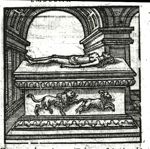
Tumulus meretricis: Alciatus, Emblemata (Leiden, 1591), emblem 74
Iconclass: 33C5211 'Lais Corinthiaca' 46C22 harbouring 54DD4 Difficulty 61E(CORINTH) names of cities and villages (CORINTH)
Collectanea (1500): 124
Loci Communes: Difficultatis (Difficulty, Difficulté)
I iv 2 Satis quercus Acorns have had their day
Αλις δρύος, i. Sat quercus. Vetus adagium in eos, qui relicto victu sordido, ad elegantiorem, lautioremque digrediuntur. Inde profectum, quod prisci illi mortales rudes atque in culti, simulatque Ceres usum frumenti monstravit, glandibus victitare desierunt. Quanquam Plinius libro xvi. testatur, & sua aetate multas gentes glande victitasse: apud Hispanos etiam in deliciis habitam, adeo ut bellariorum vice secundis mensis inferretur. Huiusmodi nimirum tragemata conveniebant iis, quibus dentrificii loco lotium esset. Nec inconcinne quadrabit in eos, qui relicta antiqua illa virtute, ad mores consiliaque sui seculi sese transferunt, ac recentiorum moribus incipiint uti. Hunc ad modum videtur usus Cicero, scribens ad Atticum lib. ii. in epistola cuius initium, Multa me solicitant. Clodii contentiones quae mihi proponuntur, modice me tangunt: eteniam vel subire eas videor summa cum dignitate, vel declinare nulla cum molestia posse. Dices fortassis, ἅλις tamquam δρυός Saluti, si me amas, consule. Me miserum, cur non ades? Atque ita quidem in omnibus legitur exemplaribus, verum equidem doctis, uti spero, comprobaturis, sic legendum esse contenderim. Dignitatis tanquam δρυὸς ἅλις, Saluti, si me amas, consule: ut intelligas dignitatis rationem quasi quercum, & priscum illud virtutis studium omittendum esse, post hac saluti potius consulendum quam famae. Id quod & alibi scribit sibi esse in animo, nempe ad eundem Atticum lib. iiii. Subturpicula mihi videbatur esse palinodia, sed valeant vera, recta, honesta consilia. Apertius velut interpretatur adagium ad hunc ipsum lib. ii. Quid ergo, inquies? Istos mercede conductos habebimus? Quid faciemus, si aliter non possumus? An libertinis atque etiam servis serviamus? Sed ut tu ais, ἅλις σπουδῆς. Ex ponens nimirum quid intellexerit δρυὸς, hoc est, probitatem ac virtutem. Nihil autem prohibet, quo minus & in genere proverbium usurpemus, quoties pristinum aliquod studium, aut institutum relinquitur.
Ἅλις δρύος, Acorns have had their day [literally, enough of the oak]. An old adage, aimed at those who have left behind a squalid way of life and proceeded to a more polished and wealthier one. It comes from the fact that early men, rough and wild as they were, abandoned the habit of living on acorns as soon as Ceres showed them the use of grain. Pliny testifies, however, in book 16 that in his time many races lived on acorns, and among the Spanish they were a great delicacy, so much so that they were brought in after dinner as a dessert. A sweetmeat like that was eminently suitable to a people who used urine to clean their teeth. The proverb is not inapplicable to those who leave behind the fine old-fashioned virtues and take up with the behaviour and outlook of their times, beginning to copy the ways of modern folk. Cicero seems to have used it like this, when he writes to Atticus, book 2 (in the letter which begins, 'I have many things on my mind ...'): The combats with Clodius which I have to expect give me only moderate concern, for I think I can either face them with all honour or decline them without embarrassment. Perhaps you will say "Like acorns, these have had their day. Think of safety if you love me." Oh dear, why are you not here?' The passage reads thus in all the texts, but I think learned readers will agree with me when I say it should run: 'Perhaps you will say that honour, like acorns, has had its day. Think of safety if you love me,' by which you may understand that all thought for honour (like acorns) and the old-fashioned striving for virtue are to be left behind, and henceforward safety is to be considered rather than reputation. He writes elsewhere that this is in his mind (Letters to Atticus, book 4): 'Recantation had a look of pettiness to me; but farewell true, upright, honest counsels.' The proverb is rather more clearly explained in book 2 of the same: 'What will you say? Are we to consider those people to have been bribed? What shall we do, if there is no other possibility? Are we to serve freedmen, even slaves? But as you say, zeal has had its day' - explaining in fact what the acorns mean, that is, probity and principle. There is no reason why we should not use this in general as a proverb, whenever some old-established interest or principle is given up.
Facsimile: 
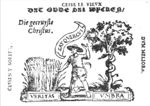
Satis quercus: Printer's device 0724
Satis quercus: Printer's device 1272
Satis quercus: Printer's device 1292
Iconclass: 25G21(ACORN) fruits: acorn 51FF5 End; 'Fine' (Ripa)
Collectanea (1500): 486
Loci Communes: Proficientium in melius (Improving for the better, Progresser vers le mieux)
I iv 3 Fenestram aperire, et similes metaphorae To open a window, and similar metaphors
Aperire fenestram: pro eo quod est, occasionem, ac velut ansam ministrare. Terent. ἐν ἑαυτὸν τιμωρουμένῳ: Hui quantam fenestram ad nequitiam patefeceris? Verum hoc non nisi in malam partem, illud etiam in bonam, Aperire ianuam: Plinius Suetonio Tranquillo: Atque adeo illa actio mihi aures hominum, illa ianuam famae patefecit. Plutarchus in lib. de Osiride: μεγάλας μὲν τῷ ἀθέῳ λεῷ κλισιάδας ἀνοίγοντας. id est, Magna impiae plebi repagula aperientes. Eiusdem formae & illud Ciceron. pro Planco, Quanquam qua nolui ianua in causam ingressus sum. Item illa, Aperire viam, praestruere viam, praecludere viam, iacere fundamenta: quorum alibi meminimus. Diverso quidem sensu philosophus quidam Cynicus dictus est θυρεπανοικτὴς, quòd in omnium aedes irrumperet, reprehensurus si quid displiceret: sed tamen ea vox torqueri potest ad eos, qui ceteris viam aperiunt.
'To open a window' is to give an opportunity, or, so to speak, a handle. Terence in the Heautontimorumenos: 'Ha, what a window onto wickedness you will have opened!' This is always used in a bad sense, but 'to open the door' also in a good one. Pliny to Suetonius Tranquillus: 'And indeed that speech of mine opened the ears of men, and the door of fame.' Plutarch in the essay 'On Osiris': 'Opening great gates for the godless people.' On the same lines is that remark of Cicero's when defending Plancus: 'Since I have entered into the case by a door by which I was reluctant to enter it.' Then those others, 'to open the way,' 'to make ready the way,' 'to bar the way/ 'to lay the foundations,' which we have mentioned elsewhere. A certain Cynic philosopher was called 'the gate-crasher,' in a different sense, because he used to burst into anyone's house to voice his objections to anything he disliked; but the same expression can be used for those who show the way to others.
Facsimile:
Iconclass: 41A331 opening the window 54B121 'Occasio', 'Kairos'; 'Occasione' (Ripa)
Loci Communes: Occasio (Opportunity, Occasion)
I iv 4 Ansam quaerere, et consimiles metaphorae To look for a handle, and similar metaphors
Ansa est, qua quippiam prenditur ac tenetur. Hinc ducta metaphora, varias adagiorum formas praebuit. Plautus in Persa: An non vides hunc ansam quaerere? id est, captare occasionem rescindendae irritandaeque pactionis. Quod quidem à Graecorum tractum est figura, apud quos frequens est, λαβὴν ζητεῖν παρέχειν λαβὴν. id est, ansam quaerere, praebere ansam. Aristophanes in Lysistrata: Εἰ γὰρ ἐνδώσει τις ἡμῶν ταῖς δὲ κᾂν σμικρὰν λαβὴν Οὐδὲν ἐλλείψουσιν αὗται λιπαρᾶς χειρουργίας. id est, Si qua per nos vel pusilla data sit ansa foeminis, Pinguis ipsae nil relinquunt protinus chirurgiae. Plato lib. De legibus tertio, καὶ ὁ λόγος ἡμῖν οἶον λαβὴν ἀποδίδωσιν. id est, & ipse sermo nobis velut ansam praebet. Aristides in Pericle, τὴν τοῦ βασκαίνειν δοκεῖν παρέχειν λαβὴν. id est, ansam praebere, ut invidere videatur. Idem adsimili figura dixit in Timone: Οὐ δὲ δίδωσι χώραν τῇ βλασφημίᾳ. i. neque dat locum convicio. Rursum Plato libro De legibus septimo, Ut contentionis ansas multis praebuerint. Rursum De republica libro viii. indicat metaphoram sumptam à palaestritis, quorum haec ars est, sic componere corpus, ut prehendi non possint: πάλιν τοίνυν ὥσπερ παλαιστὴς τὴν αὐτὴν λαβὴν πάρεχε. i. Rursus igitur tanquam palaestrita eandem ansam praebe. Eodem pertinet, In easdem ansas incidere, & Ansam arripere, ansam praeterire, ansam negligere: & si qua sunt alia. Epictetus in Enchiridio suo scripsit, unicuique rei binas esse ansas, alteram qua teneri possit, alteram qua non possit. Arripiendum igitur unumquodque ea qua possit teneri, i. bona undique excerpenda, mala toleranda. Philosophus quidam adolescentes nullis mathematicis disciplinis instructos noluit admittere, quòd diceret illis deesse ansam philosophiae. Plutarch. autem in libello De au diendis poetis, eleganter scripsit, multas esse corporis partes, per quas sese insinuant vitia, virtuti vero unicam esse ansam, aures adolescentulorum si purae fuerint, nullisque assentato rum & corruptotum hominum sermonibus occupatae.
A handle is what enables something to be seized and held. The metaphor from this supplies various kinds of adage. Plautus in the Persa: 'Do you not see how this man is looking for a handle?' - that is, on the watch for an opportunity to go back on an agreement and invalidate it. This is taken from the Greek metaphor, as it is common for them to say 'to look for a handle, to supply a handle.' Aristophanes in the Lysistrata: Tor if one of us gives them a handle however small, / These women will not forego their comfortable crafts.' Plato, Laws, book 3: 'And the word itself gives us a handle.' Aristides in Pericles: To give a handle that he might seem to be envious.' The same author said in Timon, using a similar metaphor, 'Nor does he give room for false accusation/ and Plato again in the Laws, book 7: 'That they might furnish many with handles for disagreement.' Again in book 8 of the Republic, he points out that the metaphor is taken from wrestlers, whose greatest skill is to arrange the body so that it cannot be seized: 'Again like a wrestler offer the same hold.' The same applies to 'chancing upon the same handles' or opportunities, 'to grasp a handle,' 'to let a handle slip,' 'to neglect a handle,' and possibly others. Epictetus in his Enchiridion wrote that everything has two handles: by one it can be held, but not by the other. Therefore it is important to grasp everything by the handle by which it can be held: that is, to choose the good everywhere and bear with the evil. A certain philosopher refused to admit young people without instruction in mathematics, because he said they were without a handle to philosophy. But Plutarch wrote beautifully in his essay 'On How to Study Poetry,' that there are many parts of the body by which vices can creep in, but there is one approach or handle to virtue and one only - the ears of the young if they have been pure, not taken up by the talk of men who flatter and corrupt them.
Facsimile: 
Iconclass: 31A2745 grasping something 31A31 sight, looking (one of the five senses) 54B121 'Occasio', 'Kairos'; 'Occasione' (Ripa)
Collectanea (1500): 482
Loci Communes: Commodum interversum (An advantage diverted, Avantage détourné)
I iv 5 Cyclopis donum The gift of the Cyclops
Κύκλωπος δωρεά. id est, Cyclopis munus: pro eo quod est, munus inutile. Cuiusmodi sunt fermè tyrannorum & latronum beneficia, qui solent hoc ipsum magni beneficii loco imputare, quod aut minus, aut serius noceant. In hanc sententiam Cicero Philippica secunda: Quod est aliud P. C. beneficium latronum, nisi ut commemorare possint iis se vitam dedisse, quibus non ademerint? Lucian. ἐν καταπλῷ: Οὐ πάνυ μὲ ἡ τοῦ Κύκλωπος ἐκείνη εὐφραίνει δωρεὰ, τὸ ὑπισχνεῖσθαι, ὅτι πύματον ἐγὼ τόν οὖτιν κατέδομαι. i. Haud admodum me Cyclopis illud donum delectat, videlicet quod ita pollicetur: Ego Utin postremum devorabo. Verba sunt Micylli cerdonis, qui, cum esset questus quòd non statim cum aliis in cymbam Charontis reciperetur, atque hoc ipsum Clotho Parca, beneficii vice imputaret, quod interim tantillum morae lucrifaceret, ne descenderet ad inferos, ad hunc modum respondit, Neque dubium quin Lucianus Homericum locum retulerit, qui est in Odysseae lib. ix. ubi Cyclops Polyphemus delectatus dulci vino, quod illi donarat Ulysses, munus promittit, quo accepto ille sit magnopere gavisurus, ut denuo sibi ministret de sua lagena. Dedit Ulysses spe muneris iterum atque iterum. Porrò ubi iam vino delinitum crederet mitius responsurum, reposcit Ulysses munus promissum. Cui Cyclops hunc in modum respondit: Οὖτιν ἐγὼ πύματον ἔδομαι μετὰ οἷς ἑτάροισι, Τοὺς δ᾽ ἄλλους πρόσθεν. τὸ δέ τοι ξεινήιον ἔσται. id est, Post socios mihi, postremusque vorabitur Utis, At reliqui prius: hoc ex me tibi munus habebis. Caeterum οὔτις Graece, nullum significat: quod nomen finxerat Ulysses, quo Polyphemum posset deludere.
Κύκλωπος δωρεά, A present from the Cyclops. This means 'a useless gift.' The favours of tyrants and brigands are of this sort: if they do no harm, or only do it later, they claim this as a great benefaction in itself. Cicero writes to this effect in the second Philippic: 'How are brigands benefactors, except to be able to maintain that they have granted life to those from whom they have not taken it?' Lucian in Cataplus: 'That gift of the Cyclops delights me not at all - his promise "I shall eat Noman last."' The words are those of Micyllus the cobbler: when he had complained that he was not received at once with the others into Charon's boat, and Clotho, one of the Fates, expected him to be grateful for it as a favour, that he should be granted a short delay before going down to the underworld, he replied in this fashion. There is no doubt that Lucian was recalling the passage in Homer, in the ninth book of the Odyssey, where the Cyclops Polyphemus, delighted with the sweet wine Ulysses had given him, promises a present which would make Ulysses vastly happy - so that he would offer the Cyclops another draught from his flagon. Ulysses gave him more, and more again, in the hope of this present. Then when he thought the Cyclops well softened up with wine and likely to reply gently, Ulysses asked for the promised gift. The Cyclops replied: 'First I'll devour your friends, then you, Outis. The others first: that's your present from me.' Outis in Greek means No man, and this was the name Ulysses had invented for himself to delude Polyphemus.
Facsimile:
Iconclass: 55C2 Giving 94I132 Polyphemus devours some of Ulysses' companions
Loci Communes: Munus non munus (A gift that is not a gift, Un présent qui n'en est pas un)
I iv 6 Tuis te pingam coloribus I'll paint you in your own colours
Tuis te pingam coloribus: id est, Talem te describam, qualis es. Translatum à pictoribus, qui nonnunquam faciem hominis ita ut est exprimunt, ac repraesentant, nonnumquam alienis fucant coloribus. Aut etiam allusum est ad Aesopicam corniculam, quae se coloribus alienis venditavit. Divus Hieronymus in Rufinum: Possem & ego te tuis coloribus pingere, & insanire contra insanientem. Ibidem rursum: Scire enim te iactas crimina, quae tibi soli amicissimo sim confessus, & haec in medium prolaturum, meisque me coloribus esse pingendum. Plinius in praefatione historiae mundi: Et ne in totum videar Graecos insectari, ex illis nos velim intelligi, pingique coloribus, quos in libellis his invenies. Et Cicero lib. Epistolarum ad Quintum fratrem secundo, epistola ultima: Tuis coloribus, meo penicillo. Quanquam hoc paulo diversius.
I will paint you in your own colours, that is, I'll describe you as you really are. Taken from painters, who sometimes portray and exhibit a man's face as it really is, and sometimes beautify it with false colours. Or perhaps the allusion is to the crow in Aesop, who passed himself off in colours not his own. St Jerome against Rufinus: 'I might also paint you in your own colours, and rave against a raving man.' In the same work again: 'You boast that you know of crimes which I have confessed to you alone as to my best friend, and you say you will declare these publicly and that I must be painted with my true colours.' Pliny in the preface to the History of the World: 'And lest I should seem to be speaking altogether ill of the Greeks, I would wish us to be understood through them, and to be painted in those colours which you will find in these books.' And Cicero in Letters to His Brother Quintus, book 2, the last letter: 'in your colours, but with my own brush.' This, however, is slightly different.
Facsimile:
Iconclass: 22C4 colours, pigments, and paints 32A7 characters (human types) 48C51 painting (including book-illumination, miniature-painting) 52A6 Truth; 'Verità' (Ripa)
Collectanea (1500): 821
Loci Communes: Obtrectatio et maledicentia (Disparagement and slander, Dénigrement et médisance)
I iv 7 Ornatus ex tuis virtutibus Adorned according to your virtues
Hinc non multum abludit illa ironia Terentiana. Ornatus ex tuis virtutibus. in Adelphis: Si regnum possiderem, ornatus esses ex tuis virtutibus. id est, haberes praemia tuis factis digna. Nam olim reges honorem habebant iis, qui facinus aliquod praeclarum aedidissent.
Terence's ironic remark comes close to this in meaning; it occurs in the Adelphoe: 'If I were king, you should be adorned according to your virtues,' that is, you should have rewards fitting your deeds. For in old times kings used to pay great honour to those who had perpetrated some famous deed.
Facsimile:
Iconclass: 33A4 bringing gifts; exchanging gifts 44A4(+0) decorations, honours (as symbols of the state, etc.) (+ variant) 57A6 Virtuousness; 'Amor di Virtù', 'Attione virtuosa', 'Guida sicura de' veri honori', 'Virtù', 'Virtù insuperabile' (Ripa)
Loci Communes: Ultio malefacti (Vengeance for a wrongdoing, Vengeance d'un méfait)
I iv 8 Domi Milesia Leave (Milesian) luxury at home
Οἴκοι τὰ μιλήσια, id est, Domi Milesia. In eos dici solitum, qui ibi domesticum luxum celebrant, ubi minime probatur, Nam domi liberum est unicuique suo more vivere. Hospitis autem est, ut eorum, apud quos diversatur & cultum & mores tum laudet tum imitetur quoad potest, certe sua non iactet, aliena damnans. Id quod facere solent quidam homines imperiti, qui quocunque terrarum venerint, omnium omnia vituperant, sua nimis importune laudibus tollunt, etiam vitia pro summis virtutibus efferentes. Refertur adagium ab Angelo Politiano in Miscellaneis, additque inde natum, quòd olim Milesio cuidam hospiti, cum apud Lacedaemonios delicias patrias extolleret, ad hunc modum responsum fuerit: οἴκοι τὰ μιλήσια, μὴ γὰρ ἐνθάδε, i. Domi, non hic Milesia. huius sententiae citans auctorem Zenodotum quendam adagiorum collectorem. Feruntur quidem Zenobii cuiusdam collectanea, quem an ille Zenodotum appellet, nondum satis mihi liquet: verum in his Collectaneis huiusmodi quandam invenio fabulam, quam eandem refert Suidas: Aristagoras quidam Milesius Lacedaemonem profectus, postulabat ut Ionibus à Persis bello vexatis suppetias ferrent. Is autem, cum in concionem prodisset, insolita apud Lacedaemonios vestitus mun dicie, aliisque deliciis Ionicis affluens, quidam ex Ephoris eum hoc dicto submonuisse fertur, oἴκοι τὰ μιλήσια, id est, domi Milesia. Porrò Ephorus Lacedaemoniorum est magistratus, cuius munus est de contractibus cognoscere, ut autor est Aristoteles iii. lib. Politicorum: alioqui vox ipsa sonat, quasi dicas inspectorem. Caeterum Athenaeus libro xii. causam adagionis secus narrat, nempe Milesios luxum Colophoniorum imitatos, morbum suum finitimis etiam regionibus tradidisse. Hoc nomine cum male audirent, sese admonebant, ut domi suis deliciis uterentur, non etiam traducerent. Effertque proverbium ad hunc modum: οἴκοι τὰ μιλήσια κᾀπιχώρια, καὶ μὴ ἐν μέσῳ, id est, Domi Milesia, ac vernacula, non in propatulo. Ut autem Lacedaemoniorum severitas multorum literis est celebrata, ita Milesiorum luxus in hominum sermonem abiit, adeo ut quicquid molle, parumque virille velint intelligi, Milesium appellent. Unde Aristides quidam libro suo, fabulis obscoenis scatenti, titulum indidit, μιλησιακῶν. Et Lucianus in Amoribus, sermones amatorios lascivos, Milesios vocat. Martianus Capella: Nam certe, inquit, μύθους poeticae etiam diversitatis delicias Milesiacas. Quin & Apuleius in carmine iambico, quo asinum suum auspicari voluit, demulcentes & prurientes narrationes suas sermonem Milesium vocat. Iulius Capitolinus in vita Clodii Albini: Milesias, inquit, nonnulli eius dicunt, quarum fama non ignobilis habetur, quamvis mediocriter scriptae sunt. Et haec de fabulis Apuleianis dici, testantur ea quae paulo post citat ex epistola Severi: Maior fuit dolor, quod illum pro literato laudandum duxistis, cum ille naeniis quibusdam anilibus occupatus, inter Milesias Punicas Apulei sui, & ludicra literaria consenesceret. Hactenus Capitolinus. Quod autem sui Apulei dixit, illuc pertinet, quod & Albinus ipse, itidem ut Apuleius Afer esset. Caeterum praecipua Milesiorum mollicies in vestitu, propterea quod apud illos texta essent omnium mollissima. Unde & Tyrius Maximus Milesios εὐιματοτάτους vocat, nimirum à cultus elegantia. Et Vergilius in Georgicis delicatissima vellera, Milesia nominat. Horatius item: Alter Mileti textam, cane peius & angue Vitabit chlamydem. vestem molliculam, parumque severam significans. Aristophanes in Ranis: Στρώμασι μι- λησίοις ἀνατετραμμένος, id est, Stragulis Milesiis involutus. Horum meminit & Theocritus, & complures alii scriptores. Sed ad intelligendum adagii sensum, iam plus satis. Allusit ad proverbium Euripides in Helena: Οὐκοῦν ἐκεῖ που σεμνὸς ἦσθ᾽, οὐκ ἐνθάδε id est, Magnificus illic forte eras, non hic item. Allusit & Antiphanes apud Athenaeum libro quarto his quidem versibus, Εν λακεδαίμονι Γέγονας, ἐκείνων τῶν νόμων μεθεκτέον Εστίν. βάδιζ᾽ ἐπὶ δεῖπνον εἰς τὰ φιδίτια. Απόλαυε ζωμοῦ, καὶ φόρει τοὺς βύστακας Μὴ καταφρόνει, μήδ᾽ ἕπερ᾽ ἐπιζήτει καλά. id est, Quando agis apud Lacedaemonem, Vivas oportet moribus Laconicis. Coenatum eas in phiditia Laconica, Nigro fruare iure quod ibi apponitur, Gestesque bystacas, cave contempseris Quicquam, boníve aliud requiras insuper.
Οἴκοι τὰ Μιλήσια, Leave Milesian things at home. This is usually said about people who parade their domestic luxury in a place where it is least acceptable; for everyone is free to live in his own way in his own house. However, it is the duty of a guest to praise the dress and customs of those with whom he is staying, and to imitate them as far as he can, but in any case not to vaunt his own way of life and scorn any other. This is what some inexperienced people are apt to do; wherever they go in the world they pour scorn on everyone and everything, praising what is their own to the skies, even extolling vices as the highest virtues. The adage is mentioned by Angelo Poliziano in his Miscellanea, and he adds that it comes from the story of a certain Milesian who was once a guest of the Spartans, and boasted of the delights of his own country. The reply came: 'Your Milesian things are at home, not here.' He quotes as the author of this proverb a certain Zenodotus, a collector of adages. There are indeed extant the collections of one Zenobius, but whether he is the man whom Poliziano calls Zenodotus, I cannot say. However in these collections I find a story of this sort which Suidas also records. One Aristagoras, a Milesian, went to Sparta to ask for help for the lonians, who were being harried by the Persians. But when he appeared before the assembly, dressed with an elegance unusual among the Spartans, and overflowing with other luxuries from Ionia, one of the ephors is said to have warned him, 'Leave Milesian delights at home.' An ephor is one of the Spartan magistrates, whose duty is to investigate questions of contract, as Aristotle affirms in the third book of his Politics; the very form of the word indicates that it means 'overseer.' Athenaeus, however, gives a different reason for the proverb in book 12: he says that the Milesians had imitated the luxury of the people of Colophon and had infected the regions round about with this disease. Finding themselves unpopular on this account, they took warning that their refinements should be enjoyed in the home, not exhibited abroad. He quotes the proverb in the form: 'Milesian things at home, strictly domestic, not in public view.' Just as the austerity of the Spartans is famous in literature, so the luxury of the Milesians became a byword, so much so that when people want to describe anything soft and effeminate they call it Milesian. Thus a certain Aristides entitled his book which was full of improper stories, Milesian Tales. And Lucian in the Amores calls the lascivious talk of lovers 'Milesian.' Martianus Capella speaks of the 'Milesian delights of all the different myths found in the poets.' Apuleius, too, in the iambic poem with which he chose to inaugurate his Ass, calls his enticing and wanton stories 'Milesian talk/ Julius Capitolinus in the Life of Clodius Albinus: 'Some people speak of his Milesian tales, which enjoy a not undistinguished reputation, although they are poorly written.' And that this was also said of the stories of Apuleius, appears from what Julius Capitolinus quotes a little later on from a letter of Severus: 'It was a matter for greater regret that you should have thought him deserving of praise as a writer, since he spent his time on some nonsensical old-wives' tales, and grew old between the Punic Milesian tales of his dear Apuleius and literary frivolity.' Thus far Capitolinus. He speaks of 'his dear Apuleius' because Albinus himself like Apuleius was an African. The luxury of the Milesians, however, was mainly in dress, because they produced the softest of all textiles. Hence Maximus Tyrius calls the Milesians euhimatotatoi [superbly cloaked] on account of the elegance of their costume. And Virgil in the Georgics calls the softest fleeces Milesian. Horace too: 'Another shuns the Milesian-woven cloak / Worse than a dog or snake/ meaning a cosy garment, not austere enough. Aristophanes in the Frogs says 'bundled up in Milesian bedclothes,' and Theocritus too and many other writers speak of these. But this is more than enough for the understanding of the proverb. Euripides alludes to it in the Helena, 'Revered you may have been out there, not here.' And Antiphanes in Athenaeus, book 4, alludes to it in these lines:
When you go to Sparta,
You must do as Sparta does;
Go to their mess to dine,
And their black broth enjoy;
Wear a moustache and be careful
To scorn nothing, to ask for nothing better.
Facsimile: 
Iconclass: 41D2 clothes, costume 55B2 Luxury, Luxuriousness 61E(MILESIA) names of cities and villages (MILESIA)
Collectanea (1500): 480
Loci Communes: Tempestiva (Timely things, Choses opportunes)
I iv 9 Mense maio nubunt malae Bad women marry in May
Romanorum adagium extat apud Nasonem: Mense Maio nubunt malae. Dici potest in mulieres intempestivae libidinis: aut in eos, qui alieno tempore quicquam faciunt: aut qui parum auscipato quid aggrediuntur. Nam olim inauspicatum existimabatur, mulieres Maio mense nubere: sive quod eo mense umbra Remi occisi à fratris Celere, creditur apparuisse nutritio suo Faustulo, atque Accae Laurentiae, mandasseque, ut manibus suis iusta persolverentur. Unde & Romulo autore, festa Remuria dicta, posteritas mutata litera Lemuria, velut à lemuribus appellare coepit. Et umbris maiorum his diebus parentari solitum: atque ob id dies illi inter ferales habiti, ac nuptiis nefasti. Ovidius in Fastis: Nec viduae taedis eadem, nec virginis apta Tempora, quae nupsit, nec diuturna fuit. Hac quoque de causa, si te pro verbia tangunt, Mense malas Maio nubere vulgus ait. Plutarchus in Problematis alias quasdam causas refert, quam ob rem hoc mense abstineretur à nuptiis: vel quod medius intercedat inter Aprilem, Veneri sacrum, & Iunium Iunoni dicatum, quarum utraque dea nuptiis praesidet. Proinde propter auspicium deae, aut maturantes paulum nubebant Aprile, aut pusillum prorogantes Iunio. Vel propter funesta quaedam piacula, quibus per id temporis utebantur Romani, hominum effigies de ponte in Tiberim praecipitantes, cum antea Graecos consuevissent. Atque ob id Flaminiam Iunonis sacerdotem, quasi luctum illis diebus agere, nec ullo solenni cultu solitam uti. vel quod Maius à natu maiorbus, Iunius à iunioribus denominatus esse videatur. Porrò nuptiis grandior aetas ut intempestiva, ita inauspicata. Quapropter scripsit Euripides: Αλλ᾽ ἢ τὸ γῆρας τὼν κύπριν χαίρειν ἐᾷ, Η τ᾽ ἀφρόδτη τοῖς γέρουσιν ἄχθεται. id est, Verum senecta iubet valere Cypridem, Et ipsa rursum infensa senibus est Venus
This old Roman adage is to be found in Ovid: Bad women marry in May. It can be said about women who choose the wrong time to be voluptuous, or about people who do something at an inopportune moment, or who make a beginning without good auspices. For in old days it was thought inauspicious for women to marry in May, perhaps because it was in that month that the ghost of Remus, killed by his brother's guard, is believed to have appeared to his foster-father Faustulus and to Acca Laurentia, and to have commanded that due honours be paid to his shade. So the festival established by Romulus and called 'Remuria' began to be called by later generations 'Lemuria' (one letter being changed) as if it came from lemures, or spectres. It was the custom to pay service at this time to the shades of ancestors, and so those days were observed as part of the festival of the dead, and thought unlucky for weddings. Ovid in the Fasti: The times are unsuitable for marriage, both of widow and maid;
She who marries then will not live long.
For the same reason, if you give weight to proverbs,
Common folk say bad women wed in May.
Plutarch in the 'Problems' gives other reasons why people should abstain from marrying in this month. For one thing, it comes between April (sacred to Venus) and June (dedicated to Juno) and both these goddesses preside over weddings; so to gain the favour of the goddess the people who were rather in a hurry married in April, and those who wanted to put it off a little married in June. Another reason was connected with certain mournful rites which the Romans used to observe at that time, by throwing human effigies from the bridge into the Tiber, as they had formerly been used to throw Greeks. On this account the priestess of Juno spent these days as it were in mourning, and did not perform any solemn rite. A further reason was that May seems to take its name from 'elder' [maiores] and June from 'younger' (juniores) and a more advanced age is unseasonable and unlucky for marriage. Thus Euripides wrote: 'But old age bids the Cyprian farewell / And Venus is the enemy of old men.'
Facsimile: 
Iconclass: 23I22 May; 'Maggio' (Ripa) 42D2 (civil) marriage ceremonies 42D36 bad wife
Loci Communes: Intempestiva et inepta (Untimely and inept things, Choses inopportunes et ineptes)
I iv 10 Ovem lupo commisisti You have handed the sheep over to the wolf
Τῷ λύκῳ τὴν ὄιν. id est, Lupo ovem. Terentius in Eunucho: Scelesta, ovem lupo commisisti. De Chaerea ephebo, cui velut eunucho virgo soli credita est. Donatus admonet proverbium esse, quod contineat foemineam reverentiam, meretricium sensum. Concinne hoc utemur, quoties ei servandum aliquid committitur, cuius gratia custodem magis oporteat adhiberi. Cicero tertia Philippica: Etenim in concione dixerat se custodem futurum urbis, usque ad calendas Maias, ad urbem exercitum habiturum. O praeclarum custodem, ovium, ut aiunt, lupum: custósne urbis, an direptor & vexator esset Antonius? Unde quadrare videtur, quoties inimico negocium committitur, quique nobis pessime velit: propterea quod lupus & agnus genuino quodam odio dissident. Id quod ostendit etiam Homerus in Iliados X. Ως οὐκ ἐστὶ λέουσι καὶ ἀνδράσιν ὅρκια πιστὰ, Οὐδὲ λύκοι τε καὶ ἄρνες ὁμόφρονα θυμὸν ἔχουσιν Αλλὰ κακὰ φρονέουσιν διαμπερὲς ἀλλήλοισιν. id est, Foedus uti non tutum homini, saevoque leoni, Utque ovibus prorsum concordia nulla lupisque, Sed semper cupiunt male, seque odere vicissim. Item Horatius in Odis: Lupis & agnis quanta sortito obtigit, Tecum mihi discordia est. Huc adscribendum illud, quod refert Suidas: Πρὶν καὶ λύκος ὄιν ποιμανεύσει. id est, Prius etiam lupus ovem pascet. de re neutiquam verisimili. Huic confine Plautinum illud in Milite: Bono cella suppromo credita. Sed propius accedit, quod est in Truculento: Nam oves illius haud longe absunt à lupis.
Τῷ λύκῳ τὴν ὄϊν, The sheep to the wolf. Terence says in the Eunuchus, 'You wicked woman, you have handed the sheep over to the wolf,' speaking of the young man Chaerea, to whom alone the maiden has been entrusted under the belief that he is a eunuch. Donatus picks this out as a proverb, which contains respect for women combined with a lascivious idea. We can use it appropriately whenever something is committed to the care of a person, whose presence would be a better justification for placing it under guard. Cicero in the third Philippic: 'For he had declared in a speech that he would be the city's guardian, and would keep his army near the city till the first of May. What an excellent guardian of sheep, say they, is a wolf! Would Antonius be the guardian of the city, or rather its plunderer and harasser?' Hence it seems to fit the case, when an affair is handed over to an enemy, one who has the worst intentions towards us; because the wolf and the lamb have a natural antipathy for each other. Homer also shows this in the Iliad, book 22:
Between lions and men there are no faithful oaths,
Nor do wolves and lambs agree,
But always they have evil intentions and hate each other.
And Horace in the Odes: 'Great is the enmity 'twixt wolf and lamb / By nature fixed - and between me and you.' To this we may add the saying quoted by Suidas, 'sooner the wolf will pasture the lamb,' to mean anything entirely unlikely. Plautus has something like it in the Miles: 'The pantry is in the care of a good butler's boy/ but he gets nearer still in the Truculentus: 'His sheep are not far from the wolves.'
Facsimile:
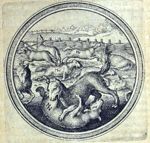
Pereunt nullo discrime: Zincgreff, Emblematum Ethico-politicorum (Heidelberg, 1619), emblem 29 uses the adage's imagery of the wolf's bloodthirst
Iconclass: 25F23(WOLF) beasts of prey, predatory animals: wolf 34C protection of animals 47I213 sheep 55C2 Giving
Collectanea (1500): 540
Loci Communes: Discriminis (Danger, crisis, Danger)
I iv 11 Mustelae sevum Suet for the weasel
Γαλῇ στέαρ. i. Mustelae pingue, subaudiendum, das, aut committis. Cum ea dantur, quorum qui accipiunt, natura sunt appetentissimi. Gaudet enim hoc animal praecipue sevo. Veluti si quis laudaret laudis avidissimum: aut ad bibendum provocaret, natura bibosum: aut ad aleam invitaret, quibus hic ludus impendio gratus esset. Refertur adagium à Diogeniano.
Γαλῇ στέαρ, Fat for the weasel. The sense is, you give or hand over (understood) 'fat to the weasel,' when what is given is the very thing the recipient has a natural appetite for; this animal is particularly fond of fat. Thus it may happen that one praises a man who is specially avid for praise, or one incites a naturally bibulous person to drink, or invites people to play at dice who have a passion for the game. The adage is found in Diogenianus.
Facsimile:
Iconclass: 25F23(WEASEL) beasts of prey, predatory animals: weasel 41C695 fat, lard
Collectanea (1500): 308
Loci Communes: Proclivitas (contra) (Propensity (against), Penchant (contre))
I iv 12 Nullam hodie lineam duxi I haven't done a stroke today
Τήμερον οὐδεμίαν γραμμὴν ἤγαγον. i. Hodie nullam lineam duxi. Ab Apelle pictore natum adagium: in eos quadrat: quibus cessatum ab exercitio studii, artisque suae. Id refertur à Plinio libro trigestimoquinto, cap. x. cuius verba non gravabor in hoc commentarium transcribere: Scitum est, inquit, inter Protogenem & eum quod accidit. Ille Rhodi vivebat, quò cum Appelles adnavigasset, avidus cognoscendi opera eius, fama tantum sibi cogniti, continuo officinam petit. Aberat ipse, sed tabulam magnae amplitudinis in machinam aptatam picturae, anus una custodiebat. Haec Protogenem foris esse respondit, interrogavitque à quo quaesitum diceret. Ab hoc, inquit Apelles: arreptoque penicillo, lineam ex colore duxit summae tenuitatis per tabulam. Reverso Protegene, quae gesta erant anus indicavit. Ferunt artificem protinus contemplatum subtilitatem, dixisse: Apellem venisse. Non enim cadere in alium tam absolutum opus: ipsum tunc alio colore tenuiorem lineam in ipsa illa duxisse, praecepisseque abeuntem, si redisset ille, ostenderet, adiiceretque hunc esse quem quaereret. Atque ita evenit. Revertitur enim Apelles, sed vinci erubescens, tertio colore lineas secuit, nullum relinquens amplius subtilitari locum. At Protogenes victum se confessus, in portum devolavit, hospitem quaerens. Placuit sic eam tabulam posteris tradi, omnium quidem, sed artificum praecipue miraculo. Consumptam eam constat priore incendio domus Caesaris in palatio, avide ante à nobis spectatam, spatiosiore amplitudine, nihil aliud continentem, quàm lineas visum effugientes, inter egregia multorum opera inani similem, & eo ipso allicientem, omnique opere nobiliorem. Apelli fuit alioqui perpetua consuetudo, nunquam tam occupatam diem agendi, ut non lineam ducendo exerceret artem, quod ab eo in proverbium venit. Hactenus Plinius. Caeterum ad hanc lineam, qua protinus agnitus est à Protogene, respexit Statius in Hercule Vindice Epitrapezio, cum ait: Linea quae veterem longe fateatur Apellem.
Τήμερον οὐδεμὶαν γραμμὴν ἤγαγον, I haven't done a stroke today. The adage takes its origin from the painter Apelles. It applies to those who have taken an idle moment from their study or their art. This is recorded by Pliny, book 35 chapter 10, and it is a pleasure to me to quote his words in these notes: 'It is well known what occurred between Protogenes and Apelles. Protogenes lived in Rhodes, and when Apelles sailed there, he was eager to examine the work of a man whom he knew only by his reputation. He looked for the workshop at once. Protogenes was not there, but a large picture stood on the easel, and only one old woman was in charge. She said that Protogenes was out, and asked who she should say had enquired for him. "This man," said Apelles, and taking the brush, he drew a line in colour, of the greatest thinness, across the picture. When Protogenes returned, the old woman showed him what had been done. They say that as soon as he saw the delicacy of the line, he said "Apelles has been here." So perfect a piece of work could not belong to anyone else. Then he himself drew with another colour a still thinner line along the first one, and went away, directing that if the other returned, she should show it to him and say that this was the man he was looking for. So it fell out. Apelles did come back, and blushing at the thought of being defeated, cut across the lines with a third colour, leaving no room for further minuteness. Protogenes admitted himself vanquished, and rushed to the harbour to find his guest. It was resolved to hand the picture down to posterity as it was, as a wonder to all but especially to artists. It is known that it was burnt in the first fire in Caesar's house on the Palatine, but before that we had eagerly examined it. Though of large size, it contained nothing but lines vanishing from sight, and among the excellent work of many other painters it seemed empty, but for that very reason full of attractiveness, and finer than any other work. It was the constant habit of Apelles never to pass a day, however fully occupied, without practising his art by drawing a line, and so the proverb arose from him.' Thus far Pliny. It was moreover to this line, by which he was immediately recognized by Protogenes, that Statius referred in Hercules Vindex on the Dinner-Table, when he says The line which speaks afar the old Apelles.'
Facsimile: 
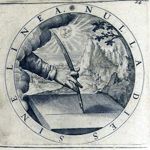
Nulla dies sine linea: Wither, A collection of emblems (London, 1635), emblem 124
Nulla hora sine linea: De la Feuille, Devises et emblemes anciennes et modernes (Augsburg, 1697), emblem 610
Nulla dies sine linea: Reifenberg, Emblemata Politica (Amsterdam, 1632), emblem 19
Nulla dies sine linea: White, A replie to Iesuit Fisher (London, 1624), frontispiece
Iconclass: 23R1 day of 24 hours, natural day 49D32 line (~ planimetry, geometry)
Collectanea (1500): 152
Loci Communes: Ignavia et inscitia (Cowardice and ignorance, Lâcheté et ignorance)
I iv 13 Neque natare, neque literas Neither swim nor read
Μήτε νεῖν, μήτε γράμματα. i. Neque natare, neque literas, subaudiendum, novit. In eos dicitur, qui supra modum indocti sunt, nihilque prorsus bonarum artium in pueritia didicerunt. Nam haec duo statim discebant pueri Athenis. Atque adeo Romae quoque: id quod satis declarat Suetonius in Augusto: Nepotes, inquiens, & literas, & natare: aliaque rudimenta per se plerunque docuit. Idem de Caligula prodidit, quod ad caetera magnopere docilis, natare tamen nescierit, velut postremum hoc nemo nesciret. Plato lib. De legibus iii. Τοὺς δὲ ἐναντίον ἔχοντας τούτων, ὡς σοφούς τε προσρητέον ἂν, κᾂ τὸ λεγόμενον, μήτε γράμματα μήτε νεῖν ἐπιστῶνται, Qui vero contra affecti, sapientes appellandi, etiam si neque literas, ut dicitur, neque natare sciant. Item Aristides in Apologia communi quatuor. oratorum, Αλλ᾽ ὡς τὸ λεγόμενον δὴ τοῦτο, οὔτε γράμματα, οὔτε νεῖν εἰδότα ἐλέγχειν ἀξιῶν. id est, Sed, quemadmodum dici consuevit, perinde coarguendum existimans, quasi qui neque literas, neque natare norit.
Μήτε νεῖν, μήτε γράμματα, He can (which must be supplied) neither swim nor read. This is said about people who are unusually ignorant and have learnt absolutely nothing in childhood in the way of useful knowledge. For these two skills were the first things learnt by the boys in Athens. And in Rome too, as Suetonius asserts plainly enough in his Augustus: 'He himself, for the most part, taught his nephews letters, and swimming, and the other rudiments.' The same author reveals that Caligula, although very quick to learn other things, did not know how to swim - as if this were the very last thing anybody would not know. Plato in the Laws, book 3: Those who take the contrary part are to be called wise, even if they know neither how to read nor how to swim, as the saying goes.' Aristides also in the Joint Defence of Four Orators: 'But as the saying goes, deeming it right to reject him as one who knows neither how to read nor how to swim.'
Facsimile:
Iconclass: 31A2773 swimming (movement in water) 49N reading 54AA33 Inability, Maladroitness, Awkwardness
Collectanea (1500): 641
Loci Communes: Ignavia et inscitia (Cowardice and ignorance, Lâcheté et ignorance)
I iv 14 Mordere frenum To bite on the bit
Mordere frenum D. Brutus lib. Familiarum epistolarum xi. posuisse videtur pro eo quod est, vel leviter repugnare servituri. Si frenum momorderis, peream, si te omnes, quotquot sunt, conantem loqui ferre poterunt. hoc est, si utcunque significaveris te servitutem iniquo animo ferre. Ad hanc sententiam faciunt, quae respondet Cicero: Si timidus, inquiens, essem, tamen ista epistola omnem mihi metum abstersises: sed ut mones, frenum momordi. Etenim qui te incluso, omnem spem habuerim in te, quid nunc putas? Quanquàm Papinius in Epithalamio Stellae & Violantillae in diversum sensum usurpavit, nempe pro eo quod est, servitutem accipere, frenumque recipere. Fama tace, subiit leges, & frena momordit. id est, Admisit vincula matrimonii. Quanquam an etiam in hunc sensum verba Ciceronis accipi possint, doctis excutiendum relinquo. Proverbium sumptum videtur è fabula Aeschyli, quae inscribitur Prometheus, in qua sic loquitur Mercurius: Τὲγγῃ γὰρ οὐδὲν, οὐδὲ μαλθάκῃ λίταις Εμαῖς, δακὼν δὲ στόμιον ὡς νεοζύγης Πῶλος βιάζῃ, καὶ πρὸς ἡνιας μάχῃ. id est, Precibus nihil mitescis inflexus meis. Sed frena mordens, pullus indomitus velut, Ferociens, pugnas habenas vincere.
Decimus Brutus in book 11 of the Letters to Friends, seems to use To bite on the bit in the sense of rebelling even lightly against servitude: 'If you bite on the bit, I'll stake my life that not one of the whole lot will be able to face you if you attempt to speak,' that is, if you indicate in any way that you resent servitude. This is borne out by Cicero's reply: 'Even if I were timorous, that letter of yours would have wiped away all fear from my heart. But, as you advise, I have bitten on the bit. Indeed, seeing that during your confinement I rested all my hopes upon you, what do you imagine I am doing now?' But Papinius in the Wedding Hymn of Stella and Violantilla takes it in a different sense, doubtless meaning 'to accept servitude,' to receive the bit: 'Silence, rumour: he has taken his orders and bitten on the bit,' that is, he has accepted the fetters of marriage. However, I leave to the learned the question whether the words of Cicero can be understood in this sense. The proverb seems to be taken from the play of Aeschylus called Prometheus, where Mercury speaks as follows:
For you are not touched or softened by my prayers;
Biting the bit like a newly-yoked colt,
You rage and strive against the reins.
Facsimile:
Iconclass: 31B62341 biting 46C131612 bit
Collectanea (1500): 296
Loci Communes: Frustrata spes (Frustrated hope, Espoir déçu); Ira (Anger, Colère)
I iv 15 Manibus pedibusque With hands and feet
Extremum conatum significantes dicimus: Manibus pedibusque. Nam per manus declaratur industria conficiendi negotii, per pedes maturandi celeritas. Davus in Andria Terentiana: Ego hoc Pamphile tibi pro servitio debeo conari manibus pedibusque. Utitur hoc adagio semel atque iterum Aeschines in oratione contra Demosthenem Homerus Iliados Υ. Αλλ᾽ ὅσσον μὲν ἐγὼ δύναμαι χερσίν τε ποσίν τε. id est, Imò quicquid ego possum manibus pedibusque.
To express the greatest effort we say 'with hands and feet/ because hands indicate diligence in bringing something to a conclusion, feet indicate swiftness in getting it done. Davus in the Andria of Terence: 'I am obliged, Pamphilus, in service to you, to strive with hands and feet.' Aeschines uses this adage more than once in his speech against Demosthenes. Homer, Iliad 20: 'But whatever I can do with hands and feet.'
Facsimile:
Manibus pedibusque labora: Meisner, Politica Politica (Nürnberg, 1700), emblem 592
Iconclass: 31A2245 hand 31A2255 foot
Collectanea (1500): 40
Loci Communes: Conatus (Effort, endeavor, Effort)
I iv 16 Omnibus nervis With every sinew
Eundem habet sensum, Omnibus nervis, id est, summa vi, summoque studio. Nam robur iuxta philosophos, in nervis situm. Unde & Nervos intendere, expedire nervos: & nervosa dicimus, quae vegeta validaque, minimeque languida. Cicero ad Q. fratrem: Sic contende omnibus nervis & facultatibus. Idem lib. xv. Epist. famil. Omnes nervos in eo contendas. Item Verrinarum actione secunda: In quo omnes nervos aetatis, industriaeque meae contenderem.
This has much the same sense: with all one's force, with all one's concentration. For strength lies in the sinews, so say the philosophers. Hence we say 'to stretch the sinews,' 'to prepare the sinews,' and we call those things 'sinewy' which are lively and vigorous, not in the least sluggish. Cicero to his brother Quintus: 'So strive with every sinew and all your capacity.' Again in the Letters to Friends, book 15: 'You may strive towards this with every sinew,' and again in the second Verrine: 'Such that my manhood and determination may fitly strain every sinew to bear it.'
I iv 17 Velis equisque With sail and horse
Similem conatum significat, Velis equisque ad fugiendum aut assequendum magis, quàm ad efficiendum. M. Tullius ad. Qu. fratrem libro secundo: Sic ego, qui in isto homine colendo tam indormivi diu, te me hercle saepe excitante, cursu corrigam tarditatem, tum equis, tum velis. Quo quidem loco, in vulgatis exemplaribus, pro Velis, viris scriptum habetur. Idem Officiorum libro tertio: Quibus obsoletis floret Epicurus, eiusdem ferè autor adiutórque sententiae. Cum his equis velísque, ut dicitur, si honestum tueri ac retinere sententia est, decertandum est. In quibus exemplis usus est eadem metaphora paulo diversius, ut qui illic respexerit ad celeritatem, hic ad utrunque pugnae genus equestre ac navale.
The same sense of endeavour is in this saying 'with sail and horse,' more for flight or pursuit than achievement. Cicero, Letters to His Brother Quintus, book 2: 'So I, who have been asleep so long over the matter of paying court to your friend (though you, heaven knows, repeatedly tried to rouse me) shall make up for my slowness by galloping, with horses and sails too.' However in this place the ordinary texts have men [viris] for sails [velis]. Again, in De officiis, book 3: 'Now that these schools are out of date, Epicurus has come into vogue-an advocate and supporter of practically the same doctrine. Against such a philosophy we must fight it out with horse and sail as the saying is, if our purpose is to defend and maintain what is right.' In these examples he used the metaphor in a slightly different way, first with reference to speed and then to two different kinds of warfare, with cavalry or at sea.
I iv 18 Remis velisque With oars and sails
Huic similimum est, Remis velisque. Inde translatum, quod cum navis simul & remigio & velo impellitur, summus est nautarum conatus. Cicero lib. Tusc. quaest. iii. Tetra res est, misera, detestabilis, omni contentione, velis, ut ita dicam, remisque fugienda. Idem in prima Philippica: Tum vero tanta sum cupiditate incensus ad reditum, ut mihi nulli neque remi neque venti satisfacerent. Plautus in Asinaria: Remigio velóque quantumcunque poteris, festina & fuge. Quum remigio navis impellitur, Graeci δεύτερον πλοῦν, id est, secundarium cursum appellant: quum velis fertur, dicitur ἱσϊοδρομεῖν: quum secundis ventis, οὐριοδρομεῖν. Vertit in diversum, hoc est, in significationem tarditatis, metaphoram Aristophanes, ἐν ἐκκλησιαζούσαις , Νῦν μὲν γὰρ οὔτε θέομεν, οὔτε ἐλαύνομεν, id est, Neque currimus nunc, nec aliàs impellimur. Interpres exponit: Neque ventis, neque remis navigamus. Quanquam nihil prohibet ad equestrem cursum referri. Vergilius simpliciter extulit in Aeneidos tertio: Laevam cuncta cohors remis ventisque petivit. Ad hanc formam pertinet, quod ait Plato lib. De legibus nono: Τὰς δὲ τῶν κακῶν ξυνουσίας φεύγε ἀμεταστρεπτί, id est, Malorum autem consuetudines fugito irreversim. hoc est, ne respiciens quidem à tergo. Allusit autem ad Eurydices fabulam, cui lex erat dicta, ne respiceret. Item in Genesi, Lot iubetur è Sodomis fugere ἀμεταστρεπτί Et Vergilius, Transque caput iace, ne respexeris.
With oars and sails is very similar, and comes from the fact that when the ship is driven onwards by rowers and sails both together, the greatest effort of the sailors is being put forth. Cicero, Tusculan Questions, book 3: For it is a loathsome thing, wretched and execrable, and ought to be avoided (so to speak) with all power of sails and oars.' Again, in the first Philippic: Then indeed I was fired with such eagerness to return, that no oars, no winds were swift enough for me.' Plautus in the Asmara: 'As fast as you can, with oar and sail, hurry away and flee.' When the ship is propelled by oarsmen, the Greeks call this Δεύτερος πλοῦς, the 'secondary mode of travel': when it is carried along by sail, they use the word 'sail-borne' but when it runs before a following wind, they have a word 'breeze-borne' The metaphor is reversed by Aristophanes, to mean tardiness, in the Ecclesiazusae: 'Now we neither run nor are otherwise driven along,' and the commentator explains, 'we are travelling neither with sails nor oars.' However there is nothing to prevent the proverb being used for horse-racing. Virgil expresses it simply in the third Aeneid: 'Then all our company made to port with oars and sails.' In this category falls the phrase of Plato in the ninth book of the Laws: 'From the society of evil men you must flee irreversim,' that is, not even looking back. He referred to the story of Eurydice, who was commanded never to look back. So in Genesis, Lot is ordered to flee from Sodom 'without turning round' and Virgil says, 'Cast them over your head; do not look back.'
I iv 19 Navibus atque quadrigis With ships and chariots
Pro summo studio, summáque festinatione, Flaccus dixit, Navibus atque quadrigis, in Epi. Strenua nos exercet inertia: navibus atque Quadrigis petimus bene vivere, quod pelis, hic est. Plutarchus adversus usuram: Μηδὲ σύγε ἱπποσύνας τε μένειν, μηδὲ οχήματα ζευκτὰ, κερασφόρα καὶ κατάρτυρα, ἃ τόκοι ταγεῖς καταλάμβάνουσι καί παρατρέχουσιν, αλλ᾽ ὄνῳ τινί τῷ τυχόντι, καὶ καβάλλῃ χρώμενος φεῦγε πολέμιον, και τύραννον δανειστήν. id est, Ne vero tu aut equitatum oppertus fueris, aut vehicula iugalia cornigera, & argento picta, quae celeres usurae assequuntur, & praetercurrunt, verum asino quopiam, quemcunque fortè nactus fueris, aut caballo fuge hostem, ac tyrannum foeneratorem.
Horace used 'With ships and chariots' to mean 'with the greatest eagerness, the greatest haste,' in his Epistles:
A stenuous inactivity drives us on.
With ship and chariot the good life pursue-
But what you seek is here.
Plutarch in his attack on usury: 'So do not wait for splendid horses or chariots veneered with horn, plated with silver, which borrowing rapidly overtakes and outruns; rather make use of the first donkey or sorry hack that offers and escape that enemy and tyrant, the moneylender.'
Facsimile: 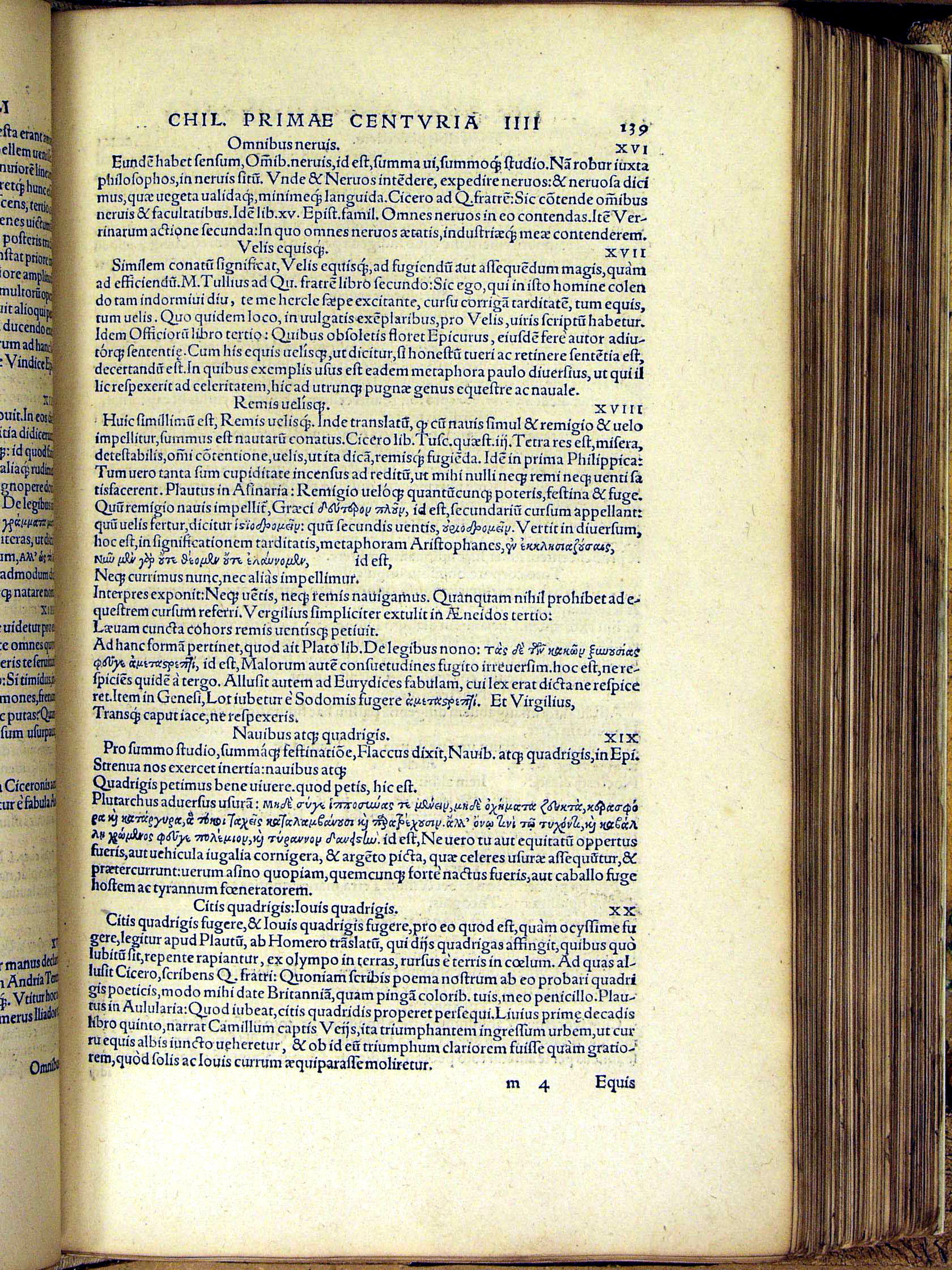
Iconclass: 43A421 chariot, triumphal car 46C21 ships (in general)
Loci Communes: Festinationis (Haste, Hâte)
I iv 20 Citis quadrigis; Iovis quadrigis With swift chariots; with the chariots of Jove
Citis quadrigis fugere, & Iovis quadrigis fugere, pro eo quod est, quàm ocyssime fugere, legitur apud Plautum. ab Homero translatum, qui diis quadrigas affingit, quibus quò lubitum sit, repente rapiantur, ex olympo in terras, rursus è terris in coelum. Ad quas allusit Cicero, scribens Q. fratri: Quoniam scribis poema nostrum ab eo probari quadrigis poeticis, modo mihi date Britanniam, quam pingam coloribus tuis, meo penicillo. Plautus in Aulularia: Quod iubeat, citis quadrigis properet persequi. Livius primae decadis libro quinto, narrat Camillum captis Veiis, ita triumphantem ingressum urbem, ut curru equis albis iuncto veheretur, & ob id eum triumphum clariorem fuisse quàm gratiorem, quòd solis ac Iovis currum aequiparasse moliretur.
To flee 'with swift chariots, with Jove's chariots,' that is, as rapidly as possible, is found in Plautus, borrowed from Homer, who credits the gods with chariots which carry them off at once wherever they wish to be from Olympus to earth, and from earth to heaven. Cicero alludes to this, writing to his brother Quintus: 'Since you write that my poem meets with his approval on the car of poesy, only you must give me Britain for a subject, so that I may paint it in your colours, but with my own brush.' Plautus in the Aulularia: 'Let him hasten to obey these orders with swift chariots.' Livy, in the first decade, book 5, tells how Camillus, after taking Veii, made a triumphal entry into the town in a chariot drawn by white horses, and for this reason the triumph achieved more notoriety than popularity, because he was attempting to vie with the chariots of the Sun and of Jove.
Facsimile:
Iconclass: 43A421 chariot, triumphal car 51M1 Fast Motion 92B18(CHARIOT) attributes of Jupiter (CHARIOT)
Loci Communes: Festinationis (Haste, Hâte)
I iv 21 Equis albis praecedere To lead the way with white horses
Ubi quem aliis quapiam in re longe superiorem significabant, longoque anteire intervallo, eum albis equis praecedere dicebant, vel quod antiquitus equi albi meliores haberentur: vel quod victores in triumpho albis equis vectari soleant: vel quod albi equi fortunatiores & auspicatiores esse credantur, ut ad equestre certamen referamus metaphoram. Quod quidem indicat Apuleius, cum ait: Postquam ardua montium, & rosida cespitum, & glebosa camporum emersi, me equo indigena peralbo vehens, iam eo quoque admodum fesso. Neque enim temere addit, vel indigena, id est, Thessalico, vel albo, nam utrunque pertinet ad emphasim pernicitatis. Horatius in Sermonibus de Persio quodam: Durus homo, atque odio qui possit vincere regem: Confidens, tumidusque adeo sermonis amari, Sisennas, Barros ut equis praecurret albis. Erant autem Sisenna & Barrus homines quidam insignita maledicentia: etiam si Acron barbaros legit, ut sit epitheton. Neque dissimile huic Plautinum illud in Asinaria: Nam, si huic occasioni tempus sese subterduxerit, nunquam aedepol albis quadrigis indipiscet postea. Graeci simpliciter dicunt παριππεῦσαι pro longe antecellere, quod equestris cursus sit expeditior.
When they wished to say that someone was far superior to others in some particular way, surpassing them by a great distance, they would say that he 'led the way with white horses,' either because in ancient times white horses were considered the best, or because victors were usually drawn by white horses in a triumph, or because white horses were believed to be lucky and likely to prosper, if we apply the metaphor to equestrian contests. Apuleius indicates this when he says 'After I got clear of the steep hills, the dewy meadows, and the muddy fields, riding on a pure white native horse, and one already fairly tired.' It is not without reason that he adds 'native' (that is, from Thessaly) and 'white,' for both contribute to the idea of fleetness. Horace in the Satires, on a certain Persius:
Presumptuous, vain and obstinate was he,
Able in hatred to defeat a king,
In bitterness of speech so far outstripping
Sisenna, Barrus and their kind, as if
He led the way with white horses.
Sisennna and Barrus were great slanderers; although Acron reads barros as if it were an adjective. The phrase of Plautus in the Asinaria is similar: 'For if this chance is let slide, he'll never catch it again, by Jove, not with a chariot and four white horses.' Greek simply says 'to ride ahead' for 'to surpass by far,'/ because travel by horses is the swiftest.
Facsimile: 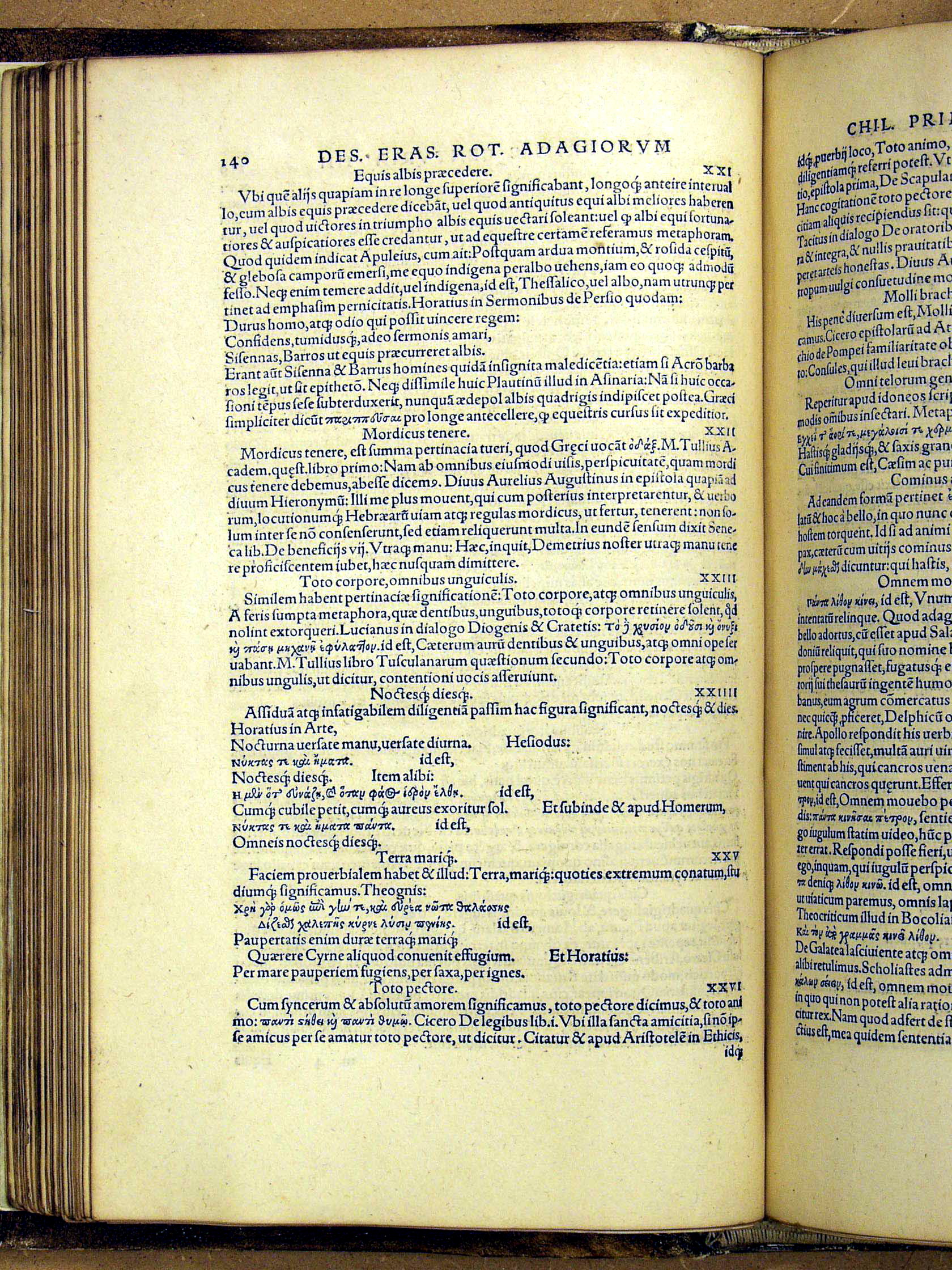
Iconclass: 22C4(WHITE) colours, pigments, and paints: white 46C13141 horse 51E2 Superiority
Collectanea (1500): 275
Loci Communes: Excellentia, inaequalitas (Excellence, inequality, Excellence, inégalité); Festinationis (Haste, Hâte); Pertinacia (Stubbornness, Obstination)
I iv 22 Mordicus tenere To hold fast with one's teeth
Mordicus tenere, est summa pertinacia tueri, quod Graeci vocant ὀδάξ. M. Tullius Academ quaest. libro primo: Nam ab omnibus eiusmodi visis, perspicuitatem, quam mordicus tenere debemus, abesse dicemus: Divus Aurelius Augustinus in epistola quapiam ad divum Hieronymum: Illi me plus movent, qui cum posterius interpretarentur, & verborum, locutionumque Hebraearum viam atque regulas mordicus, ut fertur, tenerent: non solum inter se non consenserunt, sed etiam reliquerunt multa. In eundem sensum dixit Seneca lib. De beneficiis vii. Utraque manu: Haec, inquit, Demetrius noster utraque manu tenere proficientem iubet, haec nusquam dimittere.
To hold fast with one's teeth is to guard with the utmost pertinacity, ὀδάξ in Greek. Cicero in the first book of his Academic Questions: 'We shall declare that all presentations of this nature are devoid of perspicuity, to which we are bound to cling with clenched teeth.' St Augustine in one of his letters to St Jerome: Those disturb me more who, though their versions were more recent and though they held on with clenched teeth, as the saying is, to the method and the rules of Hebrew in both words and idioms, not only did not agree among themselves, but even left many things out.' In the same way Seneca says in book 7 of his De beneficiis 'With both hands': 'Our good Demetrius recommends the learner to hold on to these things with both hands, and never let go of them.'
Facsimile:
Iconclass: 31A2112(+933) teeth (+ holding something)
Loci Communes: Pertinacia (Stubbornness, Obstination)
I iv 23 Toto corpore, omnibus unguiculis With the whole body, with all one's nails (claws)
Similem habent pertinaciae significationem: Toto corpore, atque omnibus unguiculis, A feris sumpta metaphora, quae dentibus, unguibus, totoque corpore retinere solent, quod nolint extorqueri. Lucianus in dialogo Diogenis &Cratetis: Τὸ δὲ χρηυσίον ὀδοῦσι καὶ ὄνυξι καὶ πάσῃ μηχανῇ ἐφύλαττον. id est, Caeterum aurum dentibus & unguibus, atque omni ope servabant. M. Tullius libro Tusculanarum quaestionum secundo: Toto corpore atque omnibus ungulis, ut dicitur, contentioni vocis asserviunt.
With one's whole body, and With every claw, have the same sense of pertinacity. The metaphor is taken from wild animals, who hold on with teeth and claws and their whole body to anything that they refuse to have wrenched away. Lucian in the dialogue of Diogenes and Crates: 'But the gold they safeguarded with their teeth and claws and any device they had.' Cicero in his Tusculan Questions, book 2: 'With the whole force of the body, with all their nails, as the saying is, they second the straining of the voice.'
Facsimile:
Iconclass: 31A the (nude) human figure; 'Corpo humano' (Ripa) 31A2247 nails (fingers) 51H1 Totality, the Whole
Loci Communes: Pertinacia (Stubbornness, Obstination); Conatus (Effort, endeavor, Effort)
I iv 24 Noctes diesque By night and day
Assiduam atque infatigabilem diligentiam passim hac figura significant, noctesque & dies. Horatius in Arte, Nocturna versate manu, versate diurna. hesiodus: Νύκτας τε καὶ ἤματα. id est, Noctesque diesque. Item alibi: Η μὲν ὅτ᾽ εὐναζῃ, καὶ ὅταν φάος ἱερὸν ἔλθῃ. id est, Cumque cubile petit, cumque aureus exoritur sol. et subinde & apud Homerum, Νύκτας τε καὶ ἤματα πάντα. id est, Omneis noctesque diesque.
Ceaseless and tireless industry is often expressed by this figure, By night and day. Horace, in the Art of Poetry: Turn them over by night and by day.' Hesiod: 'Nights and days,' and elsewhere: 'Both when he goes to bed and when returns/The golden sun.' It is often found in Homer also: 'All the nights and days.'
Facsimile:
Iconclass: 23R day and night
Loci Communes: Assiduitas (Diligence, persistence, Assiduité)
I iv 25 Terra marique By land and sea
Faciem proverbialem habet & illud: Terra, marique: quoties extremum conatum, studiumque significamus. Theognis: Χρὴ γὰρ ὁμῶς ἐπὶ γῆν τε, καὶ εὐρέα νῶτα θαλάσσης Δίζεσθαι χαλεπῆς κύρνε λύσιν πενίης id est, Paupertatis enim durae, terraque marique Quaerere Cyrne aliquod convenit effugium. Et Horatius: Per mare pauperiem fugiens, per saxa, per ignes.
By land and sea also has the look of a proverb, used whenever we describe great effort and eager desire. Theognis: 'For over land and sea, Cyrnus,/ Some freedom must be sought from wretched poverty.' And Horace: 'Fleeing from poverty through sea, through rocks, through fire.'
Facsimile:
Iconclass: 25H1 landscapes in the temperate zone 25H23 sea (seascape)
Loci Communes: Conatus (Effort, endeavor, Effort)
I iv 26 Toto pectore With the whole heart
Cum syncerum & absolutum amorem significamus, toto pectore dicimus, & toto animo: παντὶ στήθει καὶ παντὶ θυμῷ. Cicero De legibus lib. i. Ubi illa sancta amicitia, si non ipse amicus per se amatur toto pectore, ut dicitur. Citatur & apud Aristotelem in Ethicis, idque proverbi loco, toto animo, παντὶ θυμῷ. Quanquam illud Toto pectore etiam ad studium diligentiamque referri potest. Ut facit M. Tullius lib. Epistolarum familiarium decimotertio, epistola prima, De Scapulanis hortis toto pectore cogitemus. Idem lib. duodecimo: Hanc cogitationem toto pectore amplectare. Seneca epist. iii. Diu cogita an tibi in amicitiam aliquis recipiendus sit: quum placuerit fieri, toto illum pectore admitte. Cornelius Tacitus in dialogo De oratoribus: Quae sinceritas ac disciplina eò pertinebat, ut syncera & integra, & nullis pravitatibus detorta uniuscuiusque natura toto statim pectore arriperet arteis honestas. Divus Augustinus, Totis, ut aiunt, visceribus alicubi dixit, veluti tropum vulgi consuetudine molliens. Hebraei dicunt Toto corde.
When we describe sincere and perfect love, we say 'whole-hearted' or 'with all one's soul,' παντὶ στήθει καὶ παντὶ θύμῷ. Cicero in the first book of the De legibus: 'What becomes of that sacred thing, friendship, if the friend himself is not loved for his own sake with the whole heart, as people say?' Aristotle too in the Ethics quotes, and quotes as a proverb, 'with the whole soul.' 'With the whole heart' however can also refer to earnest study and diligence. Cicero uses it in this way in his Letters to Friends, book 13 epistle 1. 'Let us whole-heartedly consider Scapula's house and gardens.' Again in book 12: 'Give yourself up whole-heartedly to this thought.' Seneca, letter 3: 'Ponder for a long time whether you should admit a given person to your friendship; but when you have decided to admit him, welcome him with your whole heart.' Cornelius Tacitus in the Dialogue on Orators: 'And this singleness of mind and strict upbringing pointed to one result: each of them had a single-minded integrity, not warped by any vicious habits, which could absorb the liberal arts at once with the whole heart.' St Augustine has somewhere 'with the whole vitals, as they say,' as though the image was made less coarse by popular usage. 'With the whole heart' is the phrase in Hebrew.
Facsimile: 
Iconclass: 31A2221 heart 51H1 Totality, the Whole
Loci Communes: Conatus (Effort, endeavor, Effort)
I iv 27 Molli brachio, levi brachio With a gentle touch, a light touch
His penè diversum est, Molli brachio, & Levi brachio, cum indiligentem operam significamus. Cicero epistolarum ad Atticum lib. secundo: Quod me quodammodo molli brachio de Pompei familiaritate obiurgas, nolim ita existimes. Idem ad eundem libro quarto: Consules, qui illud levi brachio egissent, rem ad senatum detulerunt.
With a gentle touch, a light touch Almost the opposite of these are With a gentle touch, With a light touch [literally 'arm'], by which we signify work not taken seriously. Cicero in the second book of the Letters to Atticus: 'As you take me to task with a gentle touch, as it were, for my friendly relations with Pompey, I should not wish you to think thus.' To the same, book 4: The consuls, who handled the business with a light touch, referred the position to the senate.'
Facsimile:
Iconclass: 31A2512(+934) arm stretched forward (+ reaching for somebody or something, seizing something, touching) 51GG2 Lightness; 'Leggierezza' (Ripa) 57A77 Friendliness, Gentleness, Affability; 'Affabilità, piacevolezza, amabilità', 'Animo piacevole, trattabile & amorevole', 'Benignità' (Ripa)
Loci Communes: Indiligentiae (Carelessness, Négligence)
I iv 28 Omni telorum genere oppugnare To fight with every kind of weapon
Reperitur apud idoneos scriptores, Omni telorum genere oppugnare, pro eo quod est, modis omnibus insectari. Metaphora sumpta videri potest ex illo versiculo Homerico, Εγξεΐ τ᾽ ἄορί τε, μεγάλοισί τε χερμάδίοισιν. id est, Hastisque gladiisque, & saxis grandibus urgent. Cui finitimum est, Caesim ac punctim. Nam his duobus modis hostem impetimus.
This is found among the appropriate writers to mean 'to pursue in every possible way.' The metaphor may seem to be taken from that Homeric line: 'With spear and sword and immense stones they press.' Close to this is 'with cut and thrust,' these being the two ways by which we assail the enemy.
I iv 29 Cominus atque eminus At close quarters and at long range
Ad eandem formam pertinet ἐγγύθεν καὶ πόῤῥωθεν, id est, Cominus atque eminus. Translatum & hoc à bello, in quo nunc conserti pugnant gladiis, nunc machinis procul tela in hostem torquent. Id si ad animi res transferatur, fiet venustius. Cum hominibus habenda pax, caeterum cum vitiis cominus atque eminus pugnandum. Qui cominus pugnant, συστάδην μάχεσθαι dicuntur: qui hastis, διὰ δοράτων μάχεσθαι dicuntur.
Ἐγγύθεν καὶ πόῤῥωθεν, At close quarters and at long range, belongs to the same form and is also from war, in which the fighting is now hand-to-hand with swords, now with machines which hurl missiles at the enemy from a distance. If this is transferred to the things of the mind, it will be more attractive: peace must be kept between men, but with vices we must fight, both at close quarters and at long range. Hand-to-hand fighting in Greek is συστάδην μάχεσθαι, spear-fighting is διὰ δοράτων μάχεσθαι .
Facsimile:

Cominus et eminus: Giovio, Dialogo dell' Imprese (Lyon, 1574), emblem 6
Cominus aut eminus idem: Vaenius, Emblemata sive Symbola (Bruxelles, 1624), emblem 72
Comminus et eminus: Camerarius, Symbolorum et Emblematum Centuria(e) (Nürnberg, 1590, 1595, 1596, 1604), emblem 184
Iconclass: 51I4 Nearness 51II4 Farness
Loci Communes: Conatus (Effort, endeavor, Effort); Lacessentis (Provoking, Provoquer)
I iv 30 Omnem movere lapidem To leave no stone unturned
Πάντα λίθον κίνει, id est, Unumquenque move lapidem. hoc est, omnia experire, nihilque intentatum relinque. Quod adagium hoc pacto natum esse plerique ferunt: Xerxes Graecos bello adortus, cum esset apud Salaminem superatus, ipse quidem inde se movit, verum Mardonium reliquit, qui suo nomine bellum prosequeretur. At cum hic quoque in Plateis parum prospere pugnasset, fugatusque esset, fama vulgo invaluit, Mardonium intra ambitum tentorii sui thesaurum ingente humo defossum reliquisse. Hac spe pellectus Polycrates Thebanus, eum agrum commercatus est. Verum ubi iam multum diuque thesaurum quaesisset, nec quicquam proficeret, Delphicum oraculum consuluit, qua ratione posset eas pecunias invenire. Apollo respondit his verbis: πάντα λίθον κίνει, id est, Unumquenque move lapidem. Id simul atque fecisset, multam auri vim reperisse ferunt. Sunt qui metaphoram sumptam existiment ab his, qui cancros venantur in littore. Nam hi plerunque sub saxis latitant, quae movent qui cancros quaerunt. Effertur adagium etiam ad hunc modum: πάντα κινήσω πέτρον, id est, Omnem movebo petram, hoc est, omnia periclitabor. Euripides in Heraclidis: πάντα κινῆσαι πέτρον, sentiens nihil non fieri. Plinius Iunior in quadam epistola: Ego iugulum statim video, hunc premo. Premit certe quod elegit, sed in eligendo frequenter errat. Respondi posse fieri: ut genu esset, aut tibia, aut talus, ubi iugulum putaret. At ego, inquam, qui iugulum perspicere non possum, omnia pertento, omnia experior, πάντα, denique λίθον κινῶ. id est, omnem lapidem moveo. Divus Basilius ad nepotes: Ad quod ut viaticum paremus, omnis lapis, ut dici solet, movendus est. Fortassis huc allusit & Theocriticum illud in Bucoliastis: Καὶ τὸν ἀπὸ γραμμᾶς κινεῖ λίθον De Galatea lasciviente, atque omnia tentante, quo Polyphemum in se provocaret, id quod alibi retulimus. Scholiastes admonet proverbio dici, significans idem valere quod πάντα κάλων σέιειν, id est, omnem movere funem. Addit metaphoram sumptam à ludo quopiam, in quo qui non potest alia ratione vincere concertatorem, movet à linea lapidem, qui dicitur rex. Nam quod adfert de statua saxea, quam sua forma movere possit Galatea, coactius est, mea quidem sententia.
Πάντα λίθον κίνει, Leave no stone unturned: that is, try everything, leave nothing unattempted. Many writers say that this adage arose in the following way. When Xerxes made war on the Greeks, and was vanquished at Salamis, he himself moved away from there but left Mardonius behind to carry on the war in his name. When the latter had also been worsted in the fight at Plataeae, and had taken flight, a rumour got about that Mardonius had left an immense treasure buried in the ground near his tent. Incited by this prospect, Polycrates, a Theban, bought that piece of ground. However, when he had looked for the treasure long and thoroughly, and had made no progress, he consulted the oracle of Delphi, as to how he could find that money. Apollo replied in these words 'Leave no stone unturned.' As soon as he had done this, he found, they say, a great hoard of gold. Others think the metaphor comes from those who hunt for crabs along the seashore; for the crabs usually lie hidden under rocks which the people looking for them move. The adage is also found with the word rock petra instead of stone lapis, πάντα κινήσω πέτρον, meaning Til risk everything.' Euripides in the Heraclidae, where the phrase means 'to leave nothing undone.' Pliny the Younger in one of his letters: 'I make straight for the throat and concentrate on that. He certainly concentrates on his chosen target, but he often makes a bad choice. I pointed out that it might be the knee or shin or ankle when he thought he had the throat. I can't see the throat, I said, so my method is to feel my way and try everything - in fact I leave no stone unturned.' St Basil to his nephews: 'For the preparations for our journey, we must, as they say, leave no stone unturned.' Perhaps Theocritus is alluding to this in his Boucoliastae: 'And from the line she moves the stone.' He is speaking of Galatea wantonly trying everything to make Polyphemus angry with her; I have mentioned this elsewhere. The commentator points out that this is a proverb and means the same as 'to shake out every rope.' He adds that the metaphor comes from some sort of game in which a player who cannot vanquish his opponent by any other means moves from the back line a piece called the 'king.' However, what he says about the stone statue which Galatea could move by her beauty is more far-fetched, in my opinion.
Facsimile:
Iconclass: 25H1124 boulder, stone 31A27481 turning something, (causing) circular movement 51H1 Totality, the Whole 54D11 Attempt, Trial 54D3 Completion
Collectanea (1500): 449
Loci Communes: Experientae seu pericliationis (Experience or risk-taking, Expérience ou mise à l'épreuve)
I iv 31 Omnem rudentum movere To move every rope
πάντα κάλων σείειν, id est, omnem funem movere. Aliunde ducta metaphora, sensum eundem efficit. Aristophanes in Equitibus: Νῦν δεῖ σὲ πάντα δὴ κάλων ἐξιέναι, Καὶ λῆμμα θούριον φορεῖν, καὶ λόγους ἀφύκτους Quorum versuum hic est sensus, Nunc te necesse est omnem rudentem expedire, Et lemma ferre vehemens, ac rationes inevitabiles. Lucianus in Pseudomante: Καῖ πάντα κάλων ἐκινουν ἀμύνασθαι βουλόμενος, id est, Atque omnem movebam funem, hominem ulcisci cupiens. Apollonius in epistola ad Euphratem: πάντα φασὶ δεῖν τὸν ἔμπορον κάλων σέιεν, id est, Negociatorem aiunt omnem funem movere oportere. Usurpavit & Plato in dialogo cui titulus Sisyphus, σκοπῶμεν νὴ δΐα, ὑπερφυῶς μὲν οὖν τὸ λεγόμενόν γε πάντα κάλων εφέντες, καῖ πᾶσαν φωνὴν ἐφιέντες. id est, Consideremus itaque per Iovem, exacte omnem quod aiunt rudentem laxantes, & omnem vocem emittentes. Iulius Pollux lib. de vocabulis rerum primo: ἐπλὲομεν πάντα ἀνασέισαντες κάλων, καὶ ἅπασι κάλοις, id est, Navigabamus omni moto rudente, & omnibus rudentibus. Ad eum modum significat difficilem navigationem, in qua sint omnia tentanda.
Πάντα κάλων σείειν, To shake out every rope. This has a different figurative origin but the same meaning. Aristophanes in the Knights: 'Now you must let out every rope, And keep your spirit high and words ineluctable.' Lucian in his False Prophet: 'And I began to move every rope wishing to get revenge.' Apollonius in the Epistle to Euphrates: They say that a merchant ought to move every rope.' Plato in the dialogue entitled Sisyphus: 'Let us therefore reflect carefully, by heaven! letting out, as they say, every rope, and uttering all sounds.' Julius Pollux in his Vocabulary, book i: 'We sailed letting out every rope,' and 'with all our cordage.' In this way he describes a difficult voyage, in which everything must be tried.
Facsimile: 
Iconclass: 47D8(ROPE) tools, aids, implements ~ crafts and industries: rope 51H1 Totality, the Whole 51L1 Motion 54D11 Attempt, Trial 54D3 Completion
Loci Communes: Experientae seu pericliationis (Experience or risk-taking, Expérience ou mise à l'épreuve)
I iv 32 Omnem iacere aleam To cast all the dice
Omnem iacere aleam, est rem universam periclitari, fortunaeque arbitrio committere. Siquidem alea fortunae ludus est magis quàm artis. Unde proverbiali figura si quando ancipitem rei eventum significamus, quasi non ab arbitrio iacientis, sed à fortuna pendentis, aleam iaci dicimus. Ita Terentius in Adelphis, vitam hominum perinde dixit esse, quasi cum ludas tesseris, ut quod iactu non cecidit, id arte ut corrigas. Lucianus in dialogo, cui titulus ὑπὲρ τῶν εἰκόνων: Τολμήσω ἀναῤῥίψαι τὸν κύβον, id est, audebo tesseram iacere. Euripides in Rheso: Χρὴ δ᾽ ἐπ᾽ ἀξίοις πονεῖν, Ψυξὴν προβάλλοντ᾽ ἐν κύβοισι δαίμονος. id est, Par est labore digna ferre praemia, Quicunque vitam fortis obiicit aleae. Aristides in Pericle: Καὶ εἰς ὑπὲρ πάντων κύβος ἀνεῤῥίπτετο, σωμάτων, χρημάτων, δόξης, ἡγεμο νίας. id est, Una super omnibus alea iaciebatur, vita, pecuniis, fama, principatu. C. Caesar ad Rubiconem, qui fluvius Italiam à Gallia disterminat, paulisper secum haesitans, animoque reputans, quàm arduam rem moliretur, posteaquàm ostento est animus additus: Eamus, inquit, quò deorum ostenta, quo inimicorum iniquitas vocat: iacta esto alea. Plutarchus in Apophthegmatis ad hunc modum dixisse refert: πᾶς ἀνεῤῥίφθω κύβος, id est, Omnis iacta sit alea. Ad quod alludens Lucanus: Cadat alea fati, Alterutrum mersura caput. Plutarchus in vita Coriolani, extremam aleam in eundem sensum usurpasse videtur, ὥσπερ ἔσχατον κύβον ἀφίεντα, id est, Velut extrema iacta alea. Item Petronius Arbiter: Iudice fortuna cadat alea. M. Tullius libro De divinatione ii. Non perspicitis aleam quandam inesse hostiis deligendis, praesertim cum res ipsa doceat. Quum enim tristissima exta sine capite fuerint, quibus nihil videtur esse dirius, proxima hostia litatur saepe pulcherrime. Hic Tullius aleam dixit, casum. Proverbium desumptum videtur ex Menandro. Nam Athenaeus libro decimotertio, haec citat illius carmina è comoedia quae inscribitur Arrhephorus, sive Tibicina: Οὐ γαμεῖς ἐὰν νοῦν ἔχεις, τοῦτον καταλιπὼν τὸν βίον. Γεγάμηκα γὰρ αὐτος, διὸ τοσοῦτό σοι παραινῶ μὴ γαμεῖν. id est: Si quidem sapis, ne coniugem unquam duxeris. Duxi ipse, proinde suadeo ne duxeris. Huic alter respondet: Δεδογμένον τὸ πρᾶγμα, ἀνεῤῥίφθω κύβος. id est. Decreta res est, esto iacta haec alea. Graeci versus apud Athenaeum nonnihil corrupti sunt scribarum inscitia. Sed nullo negocio possunt restitui. Sic enim scriptos primum arbitror, Οὐ γαμεῖς εἰ νοῦν ἔχεις γε καταλιπὼν τοῦτον βίον. Γεγάμηκα γὰρ αὐτὸς, διὸ τοσοῦτον μὴ γαμεῖν, νῦν σοι παραινῶ.. Plato vitam humanam, teste Plutarcho, similem esse dixit alearum ludo, in quo & iacere oporteat accommoda, & iis quae ceciderunt, recte uti. Quid cadat, id fortunae in manu est: distribuere vero recte, quae forte ceciderunt, id in nobis situm est. Quam collationem imitatus fuisse videtur Terentius in Adelphis.
To cast all the dice means to risk everything, to commit all to the will of fortune. Dice, in fact, is a game of chance rather than skill. So in a figurative way, when we describe a thing of uncertain outcome, as if it depended not on the will of the thrower but on luck, we say 'the die is cast.' Thus Terence in the Adelphoe said that 'the life of man is like playing the dice - what does not fall right in the throw you must correct by skill.' Lucian in the dialogue entitled For the Images: T shall dare to cast the dice.' Euripides in the Rhesus: 'He should receive a reward worthy of his toil / Who risks his life on Fortune's dice!' Aristides in Pericles: 'And a single die was cast on behalf of everything, life, money, reputation, political leadership.' When Caesar came to the Rubicon, the river which divides Italy from Gaul, he hesitated privately and considered in his mind what a difficult thing he was proposing to do; when his spirits were revived by a sign, he said, 'Let us go whither we are called by the portents of the gods and the wickedness of our enemies; let the die be cast.' Plutarch in the Apophthegmata recalls that a phrase like this was used, 'let every die be cast.' Lucan has an allusion to this. 'Let the die of fate be cast, / Which will sink one or the other.' Plutarch in the Life of Coriolanus seems to have used the term 'last dice' in the same sense, 'throwing, as it were, the last dice.' And so Petronius Arbiter: The die is cast, let Fortune be the judge.' Cicero in his On Divination, book 2: 'Do you fail to see in choosing the victim it is almost like a throw of the dice, especially as facts prove it? For when the entrails of the first victim are disastrous and have been without a head, which is the most fatal of all signs, it often happens that the sacrifice of the next victim is altogether favourable.' Here Cicero is using 'dice' for chance. It seems as if the adage were derived from Menander; for Athenaeus, book 13, gives some lines from a comedy of his called Arrhephorus, or the Flute-Player: 'If you are wise you will not marry, leaving this life behind. I myself did marry, therefore I urge you not to marry.' To this the other replies: The matter's settled, let this die be cast.' The Greek lines in Athenaeus are rather deformed by the ignorance of the scribes. But they can be restored with very little trouble. I think they were first written like this [second version follows]. According to Plutarch, Plato said that life is like a game of dice; one must throw properly, and whatever falls to one's lot, one must use it rightly. What falls, is in the hand of fortune; but to apportion rightly what has fallen to us by chance, is for us to do. This is the comparison which Terence seems to have imitated in the Adelphoe.
Facsimile: 
Iconclass: 31A2741 throwing something 43C552 dice 51H1 Totality, the Whole 54DD52 Risk; 'Ardire ultimo & necessario' (Ripa) 54F12 Luck, Fortune, Lot; 'Fato', 'Fortuna', 'Fortuna aurea', 'Fortuna buona', 'Fortuna pacifica overo clemente', 'Sorte' (Ripa)
Loci Communes: Experientae seu pericliationis (Experience or risk-taking, Expérience ou mise à l'épreuve); Incertus eventus (Uncertain outcome, Issue incertaine)
I iv 33 Vela ventis permittere To spread the sails to the wind
Neque dissimili figura dixit Quintilianus in praefatione Institutionum oratoriarum: Permittamus vela ventis, & oram solventibus bene precemur. hoc est: aeditionis ancipitem eventum utcunque cadet experiamur. Simillimum est illud apud Senecam in Agamemnone: Fluctibus dedi ratem, hoc est, rem fortuvae arbitrio commisi. Theognis: Οὕνεκα νῦν φέρομεσθαι καθ᾽ ἱστία λευκὰ βαλόντες. id est, Quare nunc ferimur tendentes carbasa ventis. Venuste Graecis πλησίστιος φερέσθαι dicitur, qui toto pectore summoque conatu rapitur ad aliquid. Ita Plutarchus in Catone seniore de Scipione. Hunc Cato reprehendebat quod largitione corrumperet. Scipio respondit, sibi non opus esse quaestore nimium diligenti, cum ipse πλησίστιος, id est, plenis velis ad bellum raperetur. Ovidius: Et quoniam magno feror aequore, plenaque ventis Vela dedi.
Quintilian uses a similar figure in the preface to his Institutiones Oratoriae: 'Let us spread our sails to the winds, and wish good luck to those who leave the shore,' that is, let us try out the uncertain fate of publishing, whatever may befall. Seneca in the Agamemnon has a very similar saying, 'I gave my craft to the waves,' that is, I committed my all to the will of fortune. Theognis: 'Wherefore now we are borne on, unfurling to the winds our white sails.' The Greeks beautifully say 'to be carried along by swelling white sails' for someone who is urged towards some goal with all his heart and all his efforts. So Plutarch on Scipio, in the 'Elder Cato.' Cato rebuked Scipio for using bribes for corruption. Scipio replied that he had no need of an over-diligent treasurer since he himself was carried on 'with swelling sails' towards war. Ovid: 'And because I am carried along on the great sea and have spread full sails to the winds.'
Facsimile:
Iconclass: 26C winds 46C24111 sail 47C23 spreading (industrial process)
Collectanea (1500): 776
Loci Communes: Experientae seu pericliationis (Experience or risk-taking, Expérience ou mise à l'épreuve)
I iv 34 Sub omni lapide scorpius dormit Under every stone sleeps a scorpion
Υπὸ παντὶ λίθῳ σκορπίος εὕδει. id est, Sub omni lapide scorpius dormit, aut (ut metri quoque ratio servetur, est enim anapaesticus dimeter) Est sub lapide scorpius omni. Admonet adagium cavendum esse, ne quis apud captiosos et calumniosos temere loquatur: quicquid enim attigerit, periculum esse, ne mordeatur. Constat autem scorpios solere sub saxis cubitare, quae si quis tollat incautius, fit ut ictus vulnus accipiat. Conveniet & in morosos, qui quidvis causari solent: vel in pigros, qui frivola quaedam praetexentes suffugiunt laborem. Aristophanes ἐν θεσμοφοριαζούσαις, Τὴν παροιμΐαν δ᾽ ἐπαινῶ Τὴν παλαιὰν, ὑπὸ λίθῳ γὰρ παντί που Χρὴ μὴ δάκῃ ῥητωρ ἀθρεῖν. id est: Sermo mi vetus probatur, Nam decet lapide sub omni Mordeat ne rhetor, observare. Nicandri commentator, hunc senarium citat ex Captivis Sophoclis: Εν παντὶ γᾶρ τε σκορπίος φρουρεῖ λίθῳ. id est: Etenim sub omni lapide scorpius excubat. hoc est, nihil tutum, & omnia cavenda.
Υπὸ παντὶ λίθῳ σκορπίος εὕδει, Under every stone sleeps a scorpion, or to keep the metre (an anapaestic dimeter), est sub lapide scorpius omni. The adage warns us that a man should beware of speaking heedlessly in the presence of fault-finders and slanderers; for whatever he touches, there is a risk that he will be stung. Scorpions do normally hide under stones, and if a rash person dislodges them he will get himself stung and be wounded. This aptly fits ill-tempered people who will argue about anything, or lazy ones, who will use the most trivial excuses to escape doing a job of work. Aristophanes in the Thesmophoriazusae:
I praise the ancient proverb,
One must look beneath every stone
Lest a politician bite you.
The commentator on Nicander cites the following line from the Captives of Sophocles: 'For under every stone a scorpion keeps watch.' That is, nothing is safe, everything demands caution.
Facsimile:
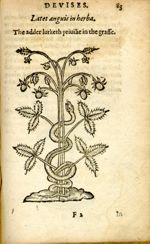
Latet anguis in herba: Paradin, Heroical devises (London, 1591), emblem 40 uses the imagery of a snake hiding in the grass to convey the idea of hidden danger
Iconclass: 25F715(+46) scorpions (+ sleeping animal(s)) 25H1124 boulder, stone
Collectanea (1500): 687
Loci Communes: Insidiae (Ambush, treachery, Embûches); Calumnia (Slander, Calomnie)
I iv 35 Asinus ad lyram An ass to the lyre
Ονος λύρας, subaudi ἀκροατὴς, id est. Asinus lyrae auscultator. In eos, qui propter imperitiam nullo sunt iudicio, crassisque auribus. Hunc titulum proverbialem M. Varro satyrae suae cuidam indidit. Eiusdem apud Gellium extant haec verba è satyra, cui titulus, Testamentum: Si quis mihi filius unus, plurésve in decem mensibus gignuntur: si erunt ὄνοι λύ ρας, id est, asini ad lyram, exhaeredes sunto. ὄνους λύρας, appellat indociles bonarum artium, atque intractabiles. Divus Hieronymus ad Marcellam: Quos ego cum possem meo iure contemnere (asino quippe lyra superflue canit) tamen ne nos superbiae, ut facere solent, arguant. Et idem adversus Vigilantium. Quanquam stulte faciam, magistro cunctorum magistros quaerere, & ei modum imponere, qui loqui nescit, & tacere non potest. Verum est illud apud Graecos proverbium, ὄνους λύρας. Lucianus de his, qui mercede serviunt: Τί γὰρ κοινόν φασι λύρᾳ καὶ ὄνῳ; id est, Quid enim commercii, quod dici solet, asino cum lyra? Idem adversus indoctum: ἀλλ᾽ ὄνος λύρας ἀκούεις κινῶν τὰ ὦτα. id est. Sed asinus lyram audis, auriculas movens. Unde & hoc pacto effertur adagium: ὄνος τὰ ὦτα κινῶν, id est, Asinus auriculas movens. Rursum ad hunc modum: ὄνος τὶς ἔλεγε μῦθον, ὁ δὲ τὰ ὦτα ἐκίνει. id est. Asino quidam narrabat fabulam, at ille auriculas movebat. In eos, qui cum nihil intelligant, tamen perinde quasi nihil non intelligant, ita nutibus alludunt, aut arrident dicentibus. Est autem asino naturale, subinde movere auriculas, veluti significanti se iam intelligere, cum nihil eriam audierit. Aliquando referunt ad asinum non auscultantem lyram, sed ipsum canere conantem. Lucianus: Καὶ μάλιστα ὁπόταν ᾄδη, καὶ ἀβρὸς εἶναι θέλῃ, ὄηος αὐτολυρίζων φασὶ, id est, Maxime si quando canit, cupitque festivus ac lepidus videri, asinus, ut aiunt, ipse lyra canens. Idem in Pseudologista: τοῦτο δὴ τὸ τοῦ λόγου, ὄνον κιθαρίζειν πειρόμενον ὁρῶν, id est, Iuxta hoc ipsum quod vulgo dici solet, asinum conspiciens cithara canere tentantem. Citatur & hic versiculus: Ονος λύρας ἢκουσε, καὶ σάλπιγγος ὗς. id est, Asinus lyram auscultavit, & porcus tubam. Recte torquebitur in eos, qui indecore tentant artificium, cuius sunt imperiti, & à quo natura abhorrent. Festiviter invertit adagium Stratonicus apud Athenaeum libro Dipnosophistarum viii. Erat Cleon quispiam, cui nomen inditum bovi: is cum scite caneret voce, caeterum lyra non perinde uteretur, Stratonicus ubi canentem adisset: Olim, inquit, asinus ad lyram dictus est, nunc vero bos ad lyram.
Ονος λύρας, An ass [we must supply, listening] to the lyre. This is a hit at people who lack judgment through their ignorance, people who have dull ears. Varro gave this proverbial title to one of his Satires. In Gellius are to be found these words of his, extracted from the Satire entitled The Will: 'If an only son, or more than one, is born to me in ten months, and if they turn out to be asses at the lyre, they shall be disinherited'; meaning by this phrase unteachable, as far as good learning is concerned, and unmanageable. St Jerome to Marcella: 'Although I could justifiably set these people aside, since it is useless for the lyre to play to the ass, yet lest they accuse us of pride, as they usually do ...' and again against Vigilantius: 'Although it is a stupid thing that I am doing, to seek masters for the master of all, and to place a restraint on him, who does not know how to speak and cannot keep silent. There is a true proverb in Greek, An ass to the lyre.' Lucian On Salaried Posts: 'For what communication can there be, as they say, between the ass and the lyre?' And Against An Ignoramus: 'But you are an ass listening to the lyre and wagging your ears.' Hence the adage is used in this form, 'the ass twitching its ears,' or again, 'Someone told a story to an ass, and it twitched its ears.' This is turned against those people who understand nothing, and yet make play with nods and smiles to those who are talking, as if there were nothing they did not understand. It is natural to the donkey to twitch its ears as if to convey that it has understood, when it has not even heard. Sometimes applied to the ass not listening to the lyre, but trying to play itself. Lucian: 'Especially when he plays, he wants to appear merry and charming, an ass, as they say, himself playing on the lyre.' Again in Pseudologista: 'As the popular saying goes, an ass seeing the lyre and trying to play.' This line is also quoted: 'The donkey listened to the lyre, the porker to the trumpet.' This can be applied to people who make an unseemly attempt to follow a craft of which they have no experience, having rather a natural unfitness for it. Stratonicus turns it round amusingly in Athenaeus, Doctors at Dinner, book 8: There was a certain Cleon, nicknamed the Bull, who sang well, but had not an equal knowledge of the lyre. When Stratonicus heard him play, he said, There was an old saying about an ass at the lyre, but now it's the bull at the lyre.'
Facsimile: 
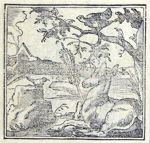
Non in sermone, sed virtute: Reusner, Aureolorum Emblematum (Strasbourg, 1587), emblem 92
Asinus ad lyram: De Bry, Proscenium Vitae Humanae (Frankfurt, 1627), emblem 69
Asinus ad lyram: Meisner, Politica Politica (Nürnberg, 1700), emblem 795
Iconclass: 46C13142 ass, donkey 48C7321 lyre, cithara, psaltery 48C78 listening to music 52AA52 Misjudgment
Loci Communes: Dissimilitudinis et incongruentiae (Dissimilarity and incongruity, Dissemblance et incongruité)
I iv 36 Sus tubam audivit The pig heard the trumpet
Σάλπιγγος ὗς ἤκουε, id est, Tubam sus audivit. In eos quadrabit, qui res quidem egregias audiunt, verum eas neque intelligunt, neque mirantur. Aut in eos, qui iis quae audiunt, neque gaudent neque commoventur. Equi tubarum clangore concitantur ad bellum: suem abigat citius, quàm animet ad pugnam. Extat apud Suidam huiusmodi senarius: Ονος λύρας ἤκουε, καὶ σάλπιγγοσς ὗς. id est, Asinus lyram, sus audiit stolidus tubam.
Σάλπιγγος ὗς ἤκουε, The pig heard the trumpet. This will fit people who hear good talk but neither understand nor admire it; or those who are neither pleased nor moved by what they hear. Horses are incited to war by the sound of the trumpet, but it drives the pig away rather than inspiring it to fight. Suidas gives an iambic line of this kind: 'Unmoved the donkey hears the lyre, the pig the trumpet.'
I iv 37 Nihil graculo cum fidibus A jackdaw has no business with a lute
Nihil graculo cum fidibus, id est, Nihil stolidis, & imperitis cum bonis literis. Nam graculus avis est ineptae molestaeque garrulitatis, atque obstrepera, adeò ut à voce qua sonat, nomen inditum putent, autore Quintil. i. Institut. lib. Tum sui generis conventus amat, quo mutuo garritu strepitus fiat odiosior. Porrò cithara silentium postulat, & aures attentas. A. Gellius Noct. Atticarum extrema lucubratione, sanè quàm eleganter hoc adagium torquet in quosdam pinguiore ingenio homines, stolidaque loquacitate praeditos, prophanos, ἀμοῦσους, id est, à musarum sacris alienos, qui politiores literas,elegantioremque doctrinam vel ridere possunt, vel etiam contemnere, intelligere nequaquam possunt, quos ea demum iuvant, quae ipsi scilicet didicerunt, sordida, muta, indocta. Hi pari importunitate & alienae doctrinae obturbant, & suam inscitiam passim vendicant & inculcant, neminem prae se non contemnentes. Hoc igitur hominum genus Gellius à suis commentariis, quibus nihil fieri potest neque tersius, neque eruditius, quasi fuste quodam abigens. Vetus est, inquit, adagium, Nihil graculo cum fidibus.
A jackdaw has no business with a lute. That is, stupid and ignorant people have nothing to do with good learning. For the jackdaw is a silly troublesome chatterbox, and a noisy one, so much so that it is thought the name comes from the chatter, according to Quintilian in the first book of the Institutions: Then it loves to congregate with its kind, so as to make the noise more tedious by general chattering.' But the lute requires silence and attentive ears. At the end of the preface of the Attic Nights of Aulus Gellius, this adage is neatly turned against certain dull-witted fellows endowed with stupid loquacity, profane, amousoi (that is, averse to the rites of the Muses), people who can either laugh at polished literature and refined knowledge or even despise it, but never understand it; people who only appreciate what they themselves have learnt, of course - squalid, wordless, ignorant stuff. These people are equally insistent on disturbing the teaching of others and advertising their own ignorance and forcing it on everybody; they despise anyone except themselves. This is the kind of man Gellius is taking a stick to in his collections, the most polished and erudite possible. There is an old adage,' says he, 'a jackdaw has no business with a lute.'
Facsimile:
Iconclass: 25F32(JACKDAW) song-birds: jackdaw 48C7323 lute, and special forms of lute, e.g.: theorbo 48C78 listening to music
Collectanea (1500): 3
Loci Communes: Dissimilitudinis et incongruentiae (Dissimilarity and incongruity, Dissemblance et incongruité)
I iv 38 Nihil cum amaracino sui A pig has nothing to do with marjoram
Atque ei continenter simile quoddam subnectit: Nihil cum amaracino sui, hoc est, stolidis vel optima putent, displicentque. Amaracus herbae genus, Siculorum lingua à Cynarae Cyprii regis eiusdem nominis filio dictum, quem in hanc herbam conversum fuisse fabulis proditum est. Caeterum Servius in primum Aeneidos, scribit Amaracum puerum fuisse regis unguentarium, qui casu lapsus dum ferret unguenta, maiorem confusione odorem creavit, unde & optima unguenta amaracina dici coeperint. hunc postea in herbam amaracum fuisse conversum. Eadem dicitur & sansucum, & aliis atque aliis nominibus, ut autor est Dioscorides in tertio libro, aitque gratissimi esse odoris, atque totam odoratam. Plinius lib. xiii. cap. i. inter unguenta nobilia & amaracini facit mentionem, refertque quondam in Coo fuisse laudatissimum, postea eodem in loco praelatum Melinum: deinde docet variis unguentis admisceri sansucum, quemadmodum & Telino: quin etiam ex simplicis amaraci succo nobilissimum unguentum confici. Idem lib. xxi. cap. xxii. scribit in Cypro sansucum laudatissimum & odoratissimum nasci, eiusque varia ostendit remedia: atque ex eo oleum quoque fieri, quod amaracinum seu sansucinum vocetur. Cum igitur huiusmodi sit amaracinum, contrà sue nihil immundius, nihil sordium amantius (quamobrem dixit Vergilius: Immundi memixere sues. Praeterea Flaccus: Vel amica luto sus. Et:, Lutulenta ruit sus.) nihil profecto minus convenit rostro suillo, quàm deliciae unguentariae; quipe cui id demum dulce olet, quod coenum olet. Maximè quòd inter unguenta, peculiari quadam naturae proprietate amaracinum inimicum est suillo generi, ita ut illis veneni instar sit, si quidem credimus Lucretio, cuius in sexto libro hi sunt versus: Denique amaracinum fugitat sus, & timet omne Unguentum, nam setigeris subus acre venenum est. Suem olim Aegyptii beluam usque adeo spurcam ducebant, ut si quis vel transiens contigisset, continuo properaret ad flumen, se pariter ac vestem abluturus. Subulcos etiam indigenas adeo invisos haberi, ut nec in templa recipiantur, nec ad matrimonium aut affinitates admittantur: autor Herodotus lib. ii. Ad hoc adagium adiusisse videtur M. Tullius cum ait: Illi alabastrus unguenti plena putet. id est, optima pro pessimis displicent. Simile quiddam dici posset de scarabaeo, cui unguentum pro stercore est, oletum pro unguento: id quod vulgo quoque dici solere propemodum innuit Plutarchus in commentario, in quo Stoicorum dogmata cum poetarum dictis componit: λέγονται οἱ κάνθαροι τὸ μύρον ἀποπλιπεῖν, τα δὲ δυσώδη διώκειν. id est, Aiunt scarabeos unguentum fugere, graveolentia sectari.
He (Gellius) immediately adds another similar phrase: 'A pig has nothing to do with marjoram/ meaning that to stupid people the very best things are stinking and unpleasant. Marjoram is a kind of plant named in the Sicilian tongue after a son of Cynaras, king of Cyprus, called Amaracus who is said in legend to have been changed into this plant. But Servius, on book i of the Aeneid, writes that Amaracus was the king's page in charge of perfumes, who accidentally fell while carrying them and created a supreme scent by the mixture; hence the best perfumes began to be called amaracina, and he was later changed into this plant. It is also called samsucum, and has many other names, as Dioscorides asserts in his third book, where he says it has a most delightful perfume, and every part of it is scented. Pliny, book 13 chapter i, mentions amaracinum among the finest perfumes, and tells how in Cos it was once highly praised; later melinum was preferred there. Then he shows that samsucum is mixed with various other perfumes, such as telinum, though a splendid ointment can be made from the juice of the amaracus itself. Pliny also writes, book 21 chapter 22, that the most highly prized and scented samsucum comes from Cyprus, and he explores various uses of it as remedies. An oil is also made from it, called amaracinum or samsucinum. This, then, is what amaracinum is like, and on the contrary there is nothing dirtier than the pig, and nothing that likes dirt more. For this reason Virgil says, 'Foul pigs remember,' and Horace, 'or else mud-loving swine,' and 'Gallops the miry pig.' Nothing is less suited to a pig's snout than refinements of perfume; what smells sweet to it is what smells of filth. This is particularly true of marjoram, among all the scents; it is inimical to the swinish tribe through some particular property of its own, and virtually poisonous to them, if we are to believe Lucretius, who has these lines in his sixth book: 'In fact the pig flees marjoram, and fears / All scent, stark poison to the bristly swine.' The Egyptians of old considered the pig such a disgusting animal that if anyone had happened to touch one in passing he would at once run to the river to wash himself and his clothes. Swineherds, even native to the country, they held in such detestation that they were not admitted into the temples, and marriage and relationships arising from marriage were forbidden to them, according to Herodotus, book 2. Cicero appears to have been thinking of this proverb when he says 'to so-and-so an alabaster vase full of scent smells bad,' meaning that the best things are as distasteful to him as the worst. Something of the same sort can be said of the dung-beetle; to him perfume is dung and filth is perfume. Plutarch suggests that this was currently said in common speech, when he says in his essay comparing the doctrines of the Stoics with the words of the poets: They say that beetles flee from perfume but pursue a foul smell.'
Facsimile: 
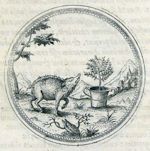
Non tibi spiro: De la Feuille, Devises et emblemes anciennes et modernes (Augsburg, 1697), emblem 424 uses the imagery of a boar smelling marjoram
Vertu mesprisee des ignorantz: La Perrière, Le theatre des bons engins (Lyon, 1545), emblem 17 uses the imagery of a pig being interested in dung and fodder and not in perfume, to express the idea that idiots do not value learning
Iconclass: 25G4(MARJORAM) plants and herbs: marjoram 47I212 pig
Loci Communes: Dissimilitudinis et incongruentiae (Dissimilarity and incongruity, Dissemblance et incongruité)
I iv 39 Quid cani et balneo? What has a dog to do with a bath?
Τί κοινὸν κυνὶ καὶ βαλανείῳ, id est, Quid commune cani cum balneo? Hoc equidem adagium eo libentius refero, quod mihi refricat, renovatque memoriam pariter ac desiderium Rodolphi Agricolae Frisii, quem ego virum totius tim Germaniae, tum Italiae publico, summóque honore nomino: illius, quae genuerit: huius, quae literis optimis instituerit. Nihil enim unquam hoc cisalpinus orbis produxit omnibus literariis dotibus absolutius, absit invidia dicto. Nulla erat honest disciplina, in qua vir ille non poterat cum summis artificibus contendere: Inter Graecos graecissimus, inter Latinos latinissimus. In carmine Maronem alterum dixisses: in oratione Politianum quendam lepore referebat, maiestate superabat. oratio vel extemporalis adeo pura, adeo germana, ut non Frisius quempiam, sed urbis Romanae vernaculum loqui contenderes. Eloquentiae tam absolutae parem adiunxerat eruditionem. Philosophiae mysteria omnia penetraverat. Nulla pars musices, quam non exactissime calleret. Extremo vitem fatorum invidia virum terris eripuit, nondum annos natum quadraginta, sicut accipio. Extant paucula quaedam illius monimenta, epistolae quaepiam, carmina item varii generis, Axiochus Platonis Latinus factus, Isocrates ad Demonicum versus. Tum una atque altera oratio habita in publico scholasticorum Ferrariensium coetu: nam illic & didicit, & publice docuit. Latitabant apud nescio quos, commentarii dialectices: nuper in publicum prodierunt, sed mutili. Verterat et Luciani Diologos aliquot: sed, ut ipse erat gloriae negligens, & plerique mortales rem alienam sanè quam indiligenter curare solent, nondum in lucem emerserunt. Quanquam haec ipsa quae extant, tametsi ne aedit quidem ab ipso, planè divinitatem quandam hominis prae se ferunt. Verum ne videar homo Germanus immodico patriae studio caecutire, Hermolai Barbari Veneti, de eo epitaphium subscribam, elegantissimum profecto, & de quo dubites, utro sit dignius, ipso ne qui scripsit, an hoc quem eo exornavit. Est autem huiusmodi: Invida clauserunt hoc marmore fata Rodolphum Agricolam, Frisii spemque decúsque soli. Scilicet hoc vivo meruit Germania, laudis Quicquid habet Latium, Graecia quicquid habet. Quaeso quid nostro Rodolpho potuit amplius, aut omnino magnificentius contingere, quam testimonium tam splendidum, tam plenum, idque redditum non vivo, sed iam vita defuncto? Ne quis ab amore magis quam à iudicio profectum causari possit: Deinde non à Germano, ne quid patriae communis studium elevet testimonii pondus: denique ab eo viro, qui non solum Italiam suam, verumetiam omne seculum hoc nostrum illustrarit: cuius tanta est apud omneis eruditos autoritas, ut impudentissimum sit ab eo dissentire: tam insignis in restituendis literis utilitas, ut aut à literis omnibus alienissium, aut certe ingratissimus habeatur, apud quem Hermolai memoria non sit sacrosancta. His itaque tam plenis, tamque absolutis viri laudibus, equidem fateor me peculiarius etiam atque impensius favere, quod mihi admodum adhuc puero contigit, uti praeceptore, huius discipulo Alexandro Hegio Vuesphalo, qui ludum aliquan do celebrem oppidi Daventriensius moderabatur, in quo nos olim admodum pueri utriusque linguae prima didicimus elementa: vir, ut paucis dicam, praeceptoris sui simillimus: tam inculpatae vitae, quam doctrinae non trivialis: in quo unum illud vel Momus ipse calumniari fortasse potuisset, quod famae plus aequo negligens, nullam posteritatis haberet rationem. Pro inde si qua scripsit, ita scripsit, ut rem ludicram haud seriam egisse videatur, Quanquam vel sic scripta, sunt eiusmodi ut eruditorum calculis immortalitatem promereantur. Itaque in hanc digressionem non temere sum expatiatus: non quo gloriose Germaniae laudes iacta rem, sed ut grati discipuli vicibus fungerer, & utriusque memoriae debitum officium utcunque persolverem: propterea quod alteri, velut filii debeam pietatem, alteri tanquam nepotis charitatem. Nunc ad adagium, quod me quondam puellum, Graecanicae linguae rudem adhuc, didicisse memini ex epistola quadam longe doctissima Rodolphi mei, qua quidemille senatui Hantverpiensi, summa tum fide, tum facundia suadere conatur, ut ludo literario praeficiant aliquem, qui bonas literas didicerit, nec, uti solent, infanti theologo, aut physico id muneris committant: qui cum se quacunque de re dicere posse confidat, ipsum dicere quid sit, ignoret. Quid enim is faciet in ludo literario? Profecto, ut Graeco diverbio utar, id ipsum quod canis in balneo. Lucianus adversum ineruditum: καὶ τῶν ὁρώντων ἕκαστος εὐθύς τὸ προχειρότατον ἐκεὶνο ἐπιφθέγγεται, τί κοινόν κυνὶ καὶ βαλανείῳ κύων , id est, Atque unusquisque conspicientium protinus illud vulgo tritissimum in te iacit: Quid cani cum balneo? Idem in Parasito: καὶ ἐμοί γε δοκεῖ, ἐν συμποσιῳ φιλόσοφος τοιοῦτον ἐστιν, οἷον ἐν βαλανείῳ κύων, id est, Ac mihi mea quidem sententia, tale quiddam videtur philosophus in convivio, quale canis in balneo. Quadrabit in eos, qui ad rem quampiam prorsus sunt inutiles, ita ut in balneo nullus est omnino canum usus.
Τί κοινὸν κυνὶ καὶ βαλανείῳ; What has a dog to do with a bath? I quote this adage with all the more pleasure because it refreshes and renews my memory, and my affection, for Rodolphus Agricola of Friesland, whom I name as the man in all Germany and Italy most worthy of the highest public honour: in Germany, because she gave him birth, in Italy, because she made him a great scholar. No one was ever born this side of the Alps more completely endowed with all literary gifts; let this be said without prejudice. There was no branch of fine learning in which that great man could not vie with the most eminent masters. Among the Greeks he was the best Greek of them all, among the Latins the best Latin. As a poet you would have said he was a second Virgil; as a writer of prose he had the charm of a Poliziano, but more dignity. His style, even extempore, had such purity, such naturalness, that you would maintain it was not a Frisian who spoke, but a native of ancient Rome herself. Such perfect eloquence was paired with the same degree of learning. He had delved into all the mysteries of philosophy. There was no part of music in which he was not accurately versed. At the very end of his life he had bent his whole mind on the study of Hebrew and the Holy Scripture. In the midst of these efforts he was snatched from this world by the envy of the fates, not yet forty years old, as I am told. There are a few literary remains of his work, some letters, poems of various kinds; the Axiochus of Plato translated into Latin, and a version of Isocrates' To Demon-icus. Then there are a couple of lectures given in public session in the University of Ferrara, for it was there he both learnt and gave open lectures. There were lying hidden in some people's possession his treatises on dialectic, and they have recently appeared, but in a mutilated state. He had also translated some of Lucian's dialogues. But since he himself cared little for glory, and most mortals are, to say the least of it, careless in looking after the work of others, none of these have yet seen the light. But the works which are extant, even if not published by himself, give plain proof of something divine about the man. Let it not be thought that I as a German am blinded by patriotic feeling; to avoid this I will transcribe the epitaph written for him by Ermolao Barbaro of Venice. It is superb, and one might find it difficult to decide whether it was more worthy of the man who wrote it or the man it was written about. Here it is: Under this stone, the jealous Fates decreed The Frisian hope, his country's light, should come, Rudolph Agricola; in life, indeed, He brought such praise to Germany his home As ever Greece could have, or ever Rome. What ampler or more magnificent tribute could be paid to our dear Rodol-phus than this splendid testimony, so complete, and offered not to a living man but to one already dead - so there is no question of its proceeding from affection rather than from judgment? and to a German, so there is no possibility that love for a country they both shared should diminish the weight of the testimony? And it came from that man who had brought glory not only to his native Italy, but to this whole age of ours; whose authority is such among all learned men that it would be most impertinent to disagree with him; whose work in restoring literature is so outstandingly valuable that anyone would have to be utterly impervious to culture, or at least utterly ungrateful, who did not hold the memory of Ermolao as sacrosanct. Such full and ungrudging praise of this man has, I confess, a singular charm for me, because I happened while yet a boy to have his disciple Alexander Hegius as my teacher. He was headmaster of the once famous school of the town of Deventer, where I learned the rudiments of both languages when I was almost a child. To put it in a few words, he was a man just like his master: as upright in his life as he was serious in his teaching. Momus himself could have found no fault in him except one, that he cared less for fame than he need have done, and took no heed of posterity. If he wrote anything, he wrote as if he were playing a game rather than doing something serious. And yet these writings, so written, are of the sort which the learned world votes worthy of immortality. So it was not without thought that I plunged into this digression; not to boast of the glory of Germany, but to perform the duty of a grateful pupil, and acquit myself of the debt I owe to the memory of both these men, because I owe to one the loving respect of a son, and to the other the affection of a grandson. Now to turn to the adage, which I remember having learnt from a certain very learned letter of my beloved Rodolphus, at a time when I was a mere child and as yet ignorant of Greek. In this letter he is trying to persuade the town council of Antwerp, with conviction and eloquence, that they should appoint as master of their school someone proficient in liberal studies, and not (as they usually do) entrust this office to an inarticulate theologian or naturalist, the sort of man who is sure he has something to say about everything but has no notion of what it is to speak. 'What good would he be in a school? As much good, to use the Greek repartee, as a dog in a bath.' Lucian Against an Ignoramus: 'And each one of the onlookers immediately voices that very handy proverb: what do a dog and a bath have in common?' Again in the Parasite: 'But to my way of thinking, a philosopher at a drinking-party is just like a dog in a bath.' So this is to be applied to those who are totally useless for certain purposes, just as there is no use for dogs in a bath.
Facsimile: 
Note: A long note about Rudolphus Agricola in the commentary
Iconclass: 34B11 dog 41A2411 bath-tub
Collectanea (1500): 25
Loci Communes: Dissimilitudinis et incongruentiae (Dissimilarity and incongruity, Dissemblance et incongruité)
I iv 40 Asinum sub freno currere doces You teach a donkey to race with a bit
Asinum sub freno currete doces, hoc est, doces indocilem. Nam equus ad cursum idoneus, asinus ad equestrem cursum inutilis. Horatius: Infelix operam perdas, ut si quis asellum In campum doceat parentem currere freno. Acron admonet, provetbialiter dictum de asino. Est autem diversum illi, quod alibi retulimus, τὸν ἵππον εἰς πεδίον, id est, Equum in campum.
You teach a donkey to race with a bit. That is, you are teaching the unteach-able. For a horse is suitable for racing but a donkey is useless in a horse race. Horace: 'You waste your labour, as if one should try / To make an ass run docile to the curb.' Acron indicates that this is a proverbial saying about donkeys. There is another one different from this, which we have quoted elsewhere: The horse to the plain.'
Facsimile:
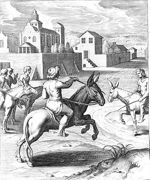
Amicitiam fovet munificentia: Vaenius, Emblemata Horatiana (Antwerp, 1612), emblem 55
Iconclass: 43C2121(+11) horse-racing (+ training (sports, games, etc.)) 46C13142 ass, donkey 46C131612 bit 54BB3 Inutility, Noxiousness; 'Nocumento', 'Nocumento d'ogni cosa' (Ripa)
Collectanea (1500): 555
Loci Communes: Inanis opera (Vain effort, Effort vain)
I iv 41 Alienam metis messem You are reaping another's harvest
Αλλότριον ἀμᾷς θέρος, id est, Alienam metis messem. Duplex est usus huius adagii, quippe quod pariter & in eos convenit, qui commoditatibus aliena partis opera potiuntur: & in hos, qui negocium non suum parum diligenter curant. Ducta metaphora à vetusto more, quo vicini rustici in demetenda segete mutuam inter sese operam commodabant: Fit autem hominum more, ut in suopte quisque negocio longe sit attentior quam in alieno. Id quod eleganter admonet Apologus ille de Cassita, quem non pigeret referre, nisi promptum esset cuilibet apud A. Gellium legere. Potest & eò referri, quod aliquoties fit, ut eiectis iis qui sementem fecerunt, alii in eorum locum succedant, citraque laborem alienis fruantur sudoribus. Unde Maronis illud: En queis consevimus agros? Aristophanes in Equitibus: Τ ἀλλότριον ἀμῶν θέρος, id est, Alienam metens messem. Dictum est in Cleonem, qui in rem paratam, multisque laboribus à Demosthene prius labefactam veniens, Pylo capta, gloriam omnem victoriae in se transtulit, Demostheni praeter invidiam nihil relictum. Cui confine est illud Homeri ex Odysseae libro primo: Επεὶ ἀλλοτριον βίοτον νήποινον ἔδουσιν. id est. Quandoquidem impune victum comedunt alienum. Eandem sententiam Aristophanes in eadem fabula sic extulit: Εγὼ δὲ περιπατῶν γ᾽ ἀπ᾽ ἐργαστηρίου Εψάντος ἑτέρου τὴν χύτραν ὑφλόμην. id est, Ego obambulans ab officina longius, Alio coquente, ollam paratam sustuli.
'Αλλότριον ἀμᾷς θέρος, You are reaping another's harvest. There are two ways of using this adage: it fits equally well when applied to people who take over advantages gained by the labour of others, and to those who are not diligent enough about their own affairs. The metaphor arises from the old custom among neighbouring farmers of lending each other aid in reaping their crops. It is the way of men to be much more attentive to their own business than to that of others. This is neatly expressed by that old fable about the crested lark, which I would readily tell, if it were not easy for anyone to read it in Aulus Gellius. It can also refer to a thing which sometimes happens, when those who have done the sowing are thrown out and others take their place, and enjoy the fruits of others' toil with no trouble to themselves. Hence Virgil's phrase, 'for whom did we sow our fields?' Aristophanes in the Knights: 'reaping someone else's harvest.' This is against Cleon, who came when everything was ready and the result had been prepared with great efforts by Demosthenes, captured Pylos, and took over all the glory of the victory for himself, leaving Demosthenes nothing but unpopularity. Homer says something like this in the Odyssey, book i: 'Since with impunity they eat another's sustenance.' And Aristophanes in the play just mentioned expresses the same idea: 'Walking about, I stole from a shop / The prepared pot cooked by another.'
Facsimile:
Iconclass: 47I141 reaping, picking, mowing ~ harvest
Collectanea (1500): 141
Loci Communes: Alieno periculo (At another's risk, Au risque d'autrui)
I iv 42 Penelopes telam retexere To unravel Penelope's web
Penelopes telam retexere, est inanem operam sumere, & rursum destruere quod effeceris. Natum ex Homero, qui lib. Odysseae secundo fingit Penelopen Ulyssis uxorem, procos iam urgentes, hac conditione delusisse, ut tum se promitteret nupturam ubi telam quam habebat in manibus, absoluisset. Quam conditionem postea quàm illi accepissent, mulier astuta, quod interdiu texuisset, id noctu retexere coepit: Ενθα καὶ ἠματίη μὲν ὑφαίνεσκεν μέγαν ἱστόν, Νύκτας δ᾽ ἀλλύεσκεν ἐπὴν δαΐδας παραθεῖτο. id est, Illa diurna quidem ingentem contexere telam, Verum eadem admotis solvebat nocte lucernis. Usurpat hoc adagium Plato in Phaedone. Item Cicero Academ. quaest. lib. ii. Quid quod eadem, inquit, illa ars, quasi Penelopes telam retexens, tollit ad extremum superiora. Sentit autem de dialectica, quae iisdem illis rationibus, quibus confirmavit aliquid, rursum solvit ac destruit, ut nihil iam actum videatur. Seneca De beneficiis quinto: Quid enim boni est, nodos operose solvere, quos ipse ut solveres feceris? Aristides in defensione quatuor oratorum: καὶ οὐκ οἶδα ὅν τιν᾽ ἱστὸν ἀναλύοντες, ὅσον ἂν προκόψωσι τῆς σοφίας, τοσοῦτ᾽ ἀνταφαιροῦσι με γάλα φρονοῦτες, id est, Et telam nescio quam retexentes. Quantum enim faciunt compendii in sapientia, tantum rursum dispendii, dum arrogantes evadunt. Hoc quoniam aliis proverbiis, quae mox dicemus, subnectit, indicat nimirum & hoc esse proverbium.
To unravel Penelope's web. That is, to take up a useless task, and then undo what one has done. It comes from Homer, who in the second book of the Odyssey makes Penelope, the wife of Ulysses, hoodwink the suitors who are already pressing her urgently, by making this condition, that she will marry when she has finished the piece of weaving she has in hand. They agreed to the condition, and the clever woman began every night to unravel what she had woven during the day: 'Every day she kept weaving a large web, / But in the night, with torches placed beside her, she unravelled it.' Plato takes over this adage in the Phaedo. So does Cicero in the Academic Questions, book 2: 'What of the fact that this same science destroys at the end the steps that came before, like Penelope unweaving her web?' He is thinking of dialectic, which by the same reasoning which has been used to make an assertion subsequently weakens and destroys it, so that nothing seems to have been settled. Seneca, De beneficiis, book 5: Tor what is the good of laboriously untying knots which you yourself have made in order that you might untie them?' Aristides in the Defence of Four Orators: 'And unravelling I know not what web; for whatever wisdom they have gained, they lose as much by turning out so arrogant.' Since he joins this to other proverbs which we shall mention later, he indicates clearly that this too is a proverb.
Facsimile: 
Iconclass: 47C429 unravelling, untying (industrial processes) 94I341(+0) Penelope weaving Laertes' shroud (Homer, Odyssey II 94-100; XIX 138-155) (+ variant) 54BB3 Inutility, Noxiousness; 'Nocumento', 'Nocumento d'ogni cosa' (Ripa)
Collectanea (1500): 399
Loci Communes: Inanis opera (Vain effort, Effort vain)
I iv 43 Annosam arborem transplantare To transplant an aged tree
Γεράνδρυον μεταφυτεύειν, id est, Vetulam arborem transplantare. In eos dicitur, qui sero atque exacta iam aetate conantur dediscere, quibus diu iuvenes assueverint. Aut simpliciter de iis, quae frustra molimur, Neque enim loco movenda arbor, ubi iam alte fixerit radices, sed cum plantula adhuc est. Nam veteres negabant arborem transferri oportere, vel minorem bima, vel maiorem trima: teste Plinio. Videtur autem adagium ad quercum peculiarius pertinere, quae omnium altissime radices agit: Ut et ἀπὸ τῆς δρυὸς γεράνδρυον. Sive quod hanc arborem omnium primam arbitrantur fuisse. Quapropter & Iovi sacra arbor, & sylva Dodonaea querna fuit, unde prima omnium oracula reddita creduntur. Eleganter usus est hoc adagio Seneca lib. epistolarum xiii. Epistola prima: Haec, inquit, si nimium tristia videbuntur, villae imputabis, in qua didici ab Aegialo diligentissimo patrefamiliàs (is enim nunc huius agri possessor est) quamvis vetus arbustum posse transferri. Haec nobis senibus discere necessarium est, quorum nemo non olivetum alteri ponit.
Γεράνδρυον μεταφυτεύειν, To transplant an aged tree, is said about people who at a late time of life, already past their prime, try to unlearn the customs they have been long used to as young men. Or it may be simply applied to those things which we attempt in vain. A tree must not be moved from its place when the roots have already struck deep, but while it is still a small plant. The ancients declared that a tree should not be transplanted at less than two years old or more than three, so says Pliny. The proverb appears to apply particularly to the oak, which of all trees strikes its roots deepest (thus the word used in Greek for 'aged tree' derives from the word for oak); or perhaps it is because this is thought to have been the first of all trees. For this reason it was sacred to Jove, and the wood of Dodona was an oak wood, from which the first of all the oracles are believed to have proceeded. Seneca made elegant use of this proverb in his book of Letters, Letter 86: 'If what I am saying shall seem to you too pessimistic, charge it up against the country-house where I have learned a lesson from Aegialus, a most careful householder and now the owner of this estate; he taught me that a tree can be transplanted, no matter how far gone in years. We old men must learn this precept; for there is none of us who is not planting an olive-grove for his successor.'
Facsimile:
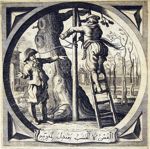
Quercus: Alciatus, Emblemata (Padua, 1621), col. 853 a, emblem 200's comment cites the adage
Rami correcti rectificantur, trabs minimè: Cats, Spiegel (The Hague, 1632), emblem 1 uses the adage's imagery and its comment quotes the adage
Iconclass: 25G3(+363) trees (+ (very) old plant) 47I132 transplanting, setting out plants 54BB3 Inutility, Noxiousness; 'Nocumento', 'Nocumento d'ogni cosa' (Ripa)
Collectanea (1500): 311
Loci Communes: Intempestiva et inepta (Untimely and inept things, Choses inopportunes et ineptes)
I iv 44 Arenam metiris You are measuring the sands
Αμμον μετρεῖς, id est. Harenae modum quaeris, sive metiris. hoc est, rem infiniti laboris atque in explicabilem inceptas. aut, fiustra conaris, quod nequeas efficere. Athenaeus lib. sexto, Alexidem quendam adducit, qui innumera dixerit ψαμμακόσια, velut aequantia numerum harenarum, ὀνόμασι δὲ χρώμενον ψαμμακόσιοις, id est, nominibus utens harenaginta, ut Graece vocis figmentum imiter'. Plato in Theaeteto, Μᾶλλον αὐτὸν λέληθεν ἢ οἱ τῆς θαλασσης λεγόμενοι χόες, id est, Magis illum latet, quàm maris, ut dicitur, harenae.
Ἄμμον μετρεῖς, You are seeking the measure of the sands, or counting them. This is a way of saying: you are taking on something which involves infinite toil, which you can never bring to an end; or else you are attempting something in vain, which you can never achieve. Athenaeus, book 6, gives the instance of a certain Alexis, who used the expression 'sand-hundred' for innumerable as if equal to the sand: 'using sand-numbered names' if I am to imitate the invented Greek word. Plato in the Theaetetus, 'Is more hidden from him than, as they say, the sands of the sea.'
Facsimile:
Iconclass: 25D23 sand (soil type) 49D53 counting, calculating 54BB3 Inutility, Noxiousness; 'Nocumento', 'Nocumento d'ogni cosa' (Ripa)
Collectanea (1500): 138
Loci Communes: Inanis opera (Vain effort, Effort vain)
I iv 45 Undas numeras You are counting the waves
Κύματα μετρεῖς, id est, Undas numeras. Eundem cum proximo sensum habet. Vergilius utranque paroemiam eleganter attigit libro Georgicon secundo: Quem si scire velit, Libyci velit aequoris idem Discere quàm multae zephyro turbentur harenae. Aut ubi navigiis violentior incidit Eurus, Nosse quot Ionii veniant ad littora fluctus. Theocritus in Charitibus: Αλλ᾽ ἶσος γὰρ ὁ μόχθος ἐπ᾽ ἀόνι κύματα μετρεῖν Οσσ᾽ ἄνεμος χέρσον δε μετὰ γλαυκᾶς ἁλος ὠθεῖ. id est, Nanque perinde siet quasi si numerare labores, Quod venti è pelago trudant ad littora fluctus. Videri potest ab Aesopico quodam apologo natum adagium, quem refert Lucianus in Sectis: Olim quendam in maris litore sedisse, conantem singulas undas pernumerare: cumque undas undis trudentibus obrueretur, animoque male angeretur, quod eas numero complecti non posset, adiens callida vulpes opportuno consilio sic hominem sublevavit. Quid angeris, inquit, propter undas, quae praeter eunt? Hinc numerare incipias oportet, illas missas facias.
Κύματα μετρεῖς, You are counting the waves. This has the same meaning as the previous one, and both are elegantly touched on by Virgil in the second book of his Georgics:
If you wish to know their number, go and tot up the grains
Of sand that are whirled around by a sand-storm in the Sahara,
Or count the waves that break along Adriatic coasts
When an easterly gale comes down in gusts upon the shipping.
Theocritus in The Graces: 'But it is like the toil of measuring the waves on the beach/As many as the wind drives shoreward from the sea.' This seems to have come from an Aesopic fable recounted by Lucian in his Sects. Once a man sat by the seashore, trying to count the waves one by one; but he was defeated by waves following close on other waves, and distressed in his mind because he could not number them. Then a crafty fox encouraged him with a timely piece of advice. 'Why are you distressed,' it said, 'about the waves which pass? You should begin counting from here, and consider the rest as finished with.'
Facsimile:
Iconclass: 25H2311 wave 49D53 counting, calculating 54BB3 Inutility, Noxiousness; 'Nocumento', 'Nocumento d'ogni cosa' (Ripa)
Loci Communes: Inanis opera (Vain effort, Effort vain)
I iv 46 Surdo oppedere To break wind in front of a deaf man
Παρὰ κωφῷ αποπαρδεῖν. id est, Apud surdum crepitum aedere, dicitur ubi quid frustra fit. Aut ubi peccatur apud stupidos, qui non queant sentire. Sive cum conviciis incessitur is qui perinde negligit, quasi non audiat. Refertur à Diogeniano, & à Suida.
Παρὰ κωφῷ αποπαρδεῖν, To break wind in the presence of the deaf, is said when an action is useless, or when some fault is committed against stupid people who cannot perceive it, or reproaches are heaped on a person who takes no notice, just as if he had not heard. It is mentioned by Diogenianus and Suidas.
Facsimile:
Iconclass: 31A412 deaf, deafness 31A621 flatulence 54BB3 Inutility, Noxiousness; 'Nocumento', 'Nocumento d'ogni cosa' (Ripa)
Loci Communes: Inanis opera (Vain effort, Effort vain)
I iv 47 Aranearum telas texere To spin spiders' webs
Τὰ ἀράχνια ὑφαίνειν, id est, Aranearum telas texere. Est in re frivola, nulliusque frugis, infinitum atque anxium capere laborem. Refertur proverbii vice à divo Basilio in initio enarrationis Hexameron. Unde & apud Diogenem Laertium in vita Zenonis, philoso phus quidam rationes dialecticas, aranearum textis similes esse dicebat, quae cum operosum quiddam atque exactum prae se ferant, tamen nugatoriae sint atque imbecilles. Et alius quispiam leges cum aranearum textis comparabat, quae cum à magnis avibus facile discinderentur, muscas duntaxat irretirent.
Τὰ ἀράχνια ὑφαίνειν, To spin spiders' webs. This means to spend infinite and anxious efforts on some futile thing that is worth nothing. It is mentioned as a proverb by St Basil at the beginning of his exposition of the Hexameron. So also in the life of Zeno by Diogenes Laertius, a certain philosopher used to say that dialectical reasoning is like spiders' webs, which look like something constructed with care and accuracy, but are really trifling and fragile. Someone else compared the laws to webs spun by spiders, which are easily torn apart by big birds and only trap flies.
Facsimile: 
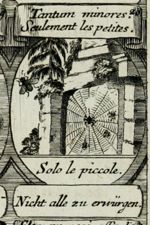
Tantum minores - Nicht alle zu erwürgen: Woytt, Emblematischer Parnassus (Augsburg, 1727), emblem 520
Weltliche Gesetz - Leges politicae: Murer, XL Emblemata (Zürich, 1622), emblem 40
Des Menschen leben is wie spinnenweben - Sicut tela aranearum: Abraham a S. Clara, Allgemeiner Todten-Spiegel (Würzburg, 1711), emblem 58
Matura: Wither, A collection of emblems (London, 1635), emblem 18, where a spider replaces a crab
Lex exlex: Paradin, Les devises héroïques (Antwerp, 1563), emblem 80
Non intrandum aut penetrandum: Cats, Proteus (Rotterdam, 1627), emblem 40
Violentior exit: Camerarius, Symbolorum et Emblematum Centuria(e) (Nürnberg, 1590, 1595, 1596, 1604), emblem 299
In sophistas: Schoonhovius, Emblemata (Gouda, 1618), emblem 64
In corruptos iudices: Schoonhovius, Emblemata (Gouda, 1618), emblem 68 uses the adage's imagery to convey the idea that the web of the law only catches the poor and weak
Le Pouure on hayt, le Riche est soubstenu: La Perrière, Le theatre des bons engins (Lyon, 1545), emblem 49 uses the adage's imagery to convey the idea that the web of the law only catches the poor and weak
Les riches s'exemptent des loix, mais les povres y demeuren: Gueroult, Le premier livre des emblemes (Lyon, 1550), emblem 9 uses the adage's imagery to convey the idea that the web of the law only catches the poor and weak
Vanitas, ingenii acies subtilis vera, quia subtilis, inutilis: Bourgogne, Mundi lapis Lydius (Antwerp, 1639), emblem 1
In centro: Zincgreff, Emblematum Ethico-politicorum (Heidelberg, 1619), emblem 37
Funiculi vanitatum: Borja, Empresas morales (Bruxelles, 1680), emblem 63 uses the imagery of the web to illustrate the idea of work spent on something of little value
Iconclass: 25F713(+4712) spiders (+ animals nesting; making nests, lodges, webs, etc.) 54BB3 Inutility, Noxiousness; 'Nocumento', 'Nocumento d'ogni cosa' (Ripa)
Loci Communes: Inanis opera (Vain effort, Effort vain)
I iv 48 Laterem lavas You are washing a brick
Feruntur huic confines aliquot apud Graecos paroemiae, quibus operam inanem significamus, veluti πλίνθον πλύνεις, id est, Laterem lavas, id quod usurpat Terentius in Phorminione, Loquar ne? Incendam. Taceam? instigem. Purgem me? Laterem lavem. Theocritus in Charitibus: Καὶ ὕδατι νίζειν θολερὰν ἰοείδει πλίνθον. id est, Et nigram silicem lavisse liquentibus undis.
There are several proverbs of this kind used in Greek, by which we signify unprofitable work; as for example Πλίνθον πλύνεις, You are washing a brick, which is used by Terence in the Phormio, 'Shall I speak? I shall rouse anger. Shall I be silent? I shall provoke him. Shall I try to clear myself? I shall be washing a brick.' Theocritus in The Graces: 'And to have washed a black stone in clear water.'
Facsimile:
Iconclass: 47C13 cleaning of material 47G532 tiles, bricks ~ building material 54BB3 Inutility, Noxiousness; 'Nocumento', 'Nocumento d'ogni cosa' (Ripa)
Collectanea (1500): 408
Loci Communes: Inanis opera (Vain effort, Effort vain)
I iv 49 Lapidem elixas You are boiling a stone
Cui simillimum est, quod refertur apud Aristophanem in comoedia cui titulus σφῆκες, λιθον ἕψεις, id est, Lapidem decoquis. pro eo quod est, inaniter laboras. Αλλ᾽ ὅτ᾽ ἄν ἀντιβο λοίη τις, κάτω κύπτων ἄν ὅντω οὕτω λίθον ἕψεις, ἔλεγεν. id est. Quin ubi quis obsecraverit, demisso sic capite, lapidem decoquis, inquit. Neque enim unquam mollescit lapis, quantumvis diutina coctione. Generaliter convenit in quamvis inanem operam, speciatim in hominem durum, nullisque precibus mollescentem.
Something very like this is quoted by Aristophanes in a comedy entitled Wasps: Λίθον ἕψεις, You are cooking a stone, in the sense of 'you are toiling in vain': 'But when anyone entreated, lowering his head thus, he used to say: "You cook a stone."' For a stone never softens, however long it is boiled. This will suit in general any vain effort, particularly directed against a hard man whom no prayers can mollify.
Facsimile:
Iconclass: 25H1124 boulder, stone 41C25 cooking food
Loci Communes: Inanis opera (Vain effort, Effort vain)
I iv 50 Aethiopem lavas; Aethiopem dealbas You are washing, or whitening, an Ethiopian
Eandem vim habent, αἰθίοπα σμήχεις, id est, Aethiopem lavas. Et, αἰθίοπα λευκαίνεις, id est, Aethiopem dealbas. Lucianus in libro contra indoctum: Καὶ κατὰ τὴν παροιμίαν, αἰθιοπα σμηχειν ἐπιχειρῶ, id est, Ac iuxta proverbium, Aethiopem lavare conor. Nam nativus ille Aethiopum nigror, quem Plinius ex vicini syderis vapore putat accidere, nulla abluitur aqua, neque ulla ratione candescit. Hoc item peculiariter quadrabit, cum res parum honesta verborum fucis adornatur, aut cum laudatur illaudatus, aut docetur indocilis. Adagium ortum videri potest ab Aesopica fabula. Nam quidam mercatus Aethiopem, & existimans eum colorem non natura, sed superioris domini negligentia accidisse, nihil non adhibuit eorum, quibus vestes candefieri solent: adeoque perpetuis lotionibus miserum diuexavit, ut illum in morbum impulerit, colore, qui fuerat, manente.
These expressions have the same meaning: Αἰθίοπα σμήχεις, You are washing an Ethiopian, and Αἰθίοπα λευκαίνεις, You are whitening an Ethiopian. Lucian, Against An Ignoramus: 'And according to the proverb I am trying to wash an Ethiopian.' That inborn blackness of the Ethiopian, which Pliny thinks to be a result of heat from the nearness of the sun, cannot be washed away with water nor whitened by any means whatever. This will be particularly apposite when a matter of doubtful morality is decorated by a gloss of words, or when praise is given to one who does not deserve praise, or an unteachable person is being taught. The adage, it seems, comes from a fable of Aesop. A man bought an Ethiopian, and thinking his colour was not natural, but the result of a former master's negligence, he tried everything which is used to whiten clothes, and so tormented the poor creature with perpetual washing that he made the man ill - but still he stayed the colour he had always been.
Facsimile:
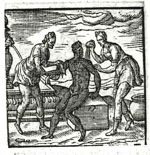
Impossibile: Alciatus, Emblemata (Leiden, 1591), emblem 59
Aethiopem lavare: Whitney, A choice of emblemes (Leiden, 1586), emblem 63
Quod potes id tenta: Reusner, Aureolorum Emblematum (Strasbourg, 1587), emblem 112
Iconclass: 31A54 washing and bathing 32B321(ETHIOPIAN)(+51) (ETHIOPIAN) peoples of sub-Saharan Africa (ETHIOPIAN) (+ men) 54BB3 Inutility, Noxiousness; 'Nocumento', 'Nocumento d'ogni cosa' (Ripa)
Collectanea (1500): 407
Loci Communes: Inanis opera (Vain effort, Effort vain)
I iv 51 Arare littus To plough the seashore
Αἰγιαλὸν ἀροῦν, id est, Arare litus. Est sterilem operam sumere. Ausonius ad Theonem, Quid geris extremis positus telluris in oris Cultor harenarum vates, cui littus arandum? Significans eum inaniter laborare. Huius peculiaris usus erit, cum officium impenditur in eum, à quo nihil sis fructus aliquando percepturus: veluti si quis doceat ὄνον λύρας, aut beneficium collocet in ingratu. Salsitas enim facit, ut littorales orae fermè sint steriles: quod etiam proverbio testatum est: ἁλμυρὸν γειτόνημα, id est, Salsuginosa vicinia, pro sterili. Est autem adeo sterilis humor marinus, ut nec arbores ferat. Atque huiusce rei varias adfert causas Plutarchus in commentario De causis naturalibus, primo statim problemate.
Αἰγιαλὸν ἀροῦν, To plough the seashore. This means to take fruitless pains. Ausonius to Theon: 'What are you labouring on, there at the world's end,/O poet tiller of sands, fated to plough the shore?' meaning that he was labouring in vain. There will be a special appropriateness in using this when a kindness is bestowed on one from whom you will never see any return; for instance if one were to teach the donkey to play the lyre, or were to do a favour to an ungrateful person. For the salt causes the seashore to remain almost sterile, and there is even a proverb about this: 'a brackish neighbourhood' meaning infertile. And sea-water is so sterile that it will not even grow trees. Various causes for this are adduced by Plutarch in his essay 'On Natural Causes,' in the very first problem.
Facsimile:
Iconclass: 47I123 ploughing 25H133 beach 54BB3 Inutility, Noxiousness; 'Nocumento', 'Nocumento d'ogni cosa' (Ripa)
Loci Communes: Inanis opera (Vain effort, Effort vain)
I iv 52 Arenae mandas semina You are sowing seed in the sand
Εἰς ψάμμον σπείρεις, id est, Harenae mandas semina. Propterea quod steriles harenae maximè littorales, nec idoneae ad sementem. Oenone Paridi apud Ovidium, Quid facis, Oenone, quid harenae semina mandas? Non profecturis littora bubus aras. Atqui in nostra Brabantia sunt agricolae tam industrii, qui sitientissimas harenas cogant & triticum ferre.
Εἰς ψάμμον σπείρεις, You are sowing seed in the sand. Sands being sterile, especially along the shore, they are unsuitable for sowing. Oenone to Paris, in Ovid: 'What are you doing, Oenone, why sow your seeds in the sand?/ You plough the sea-shore with oxen that will bring no harvest.' But in my native Brabant there are husbandmen so industrious that they force the thirstiest sands to bear, and to bear wheat.
Facsimile:
Iconclass: 25D23 sand (soil type) 47I131 sowing 54BB3 Inutility, Noxiousness; 'Nocumento', 'Nocumento d'ogni cosa' (Ripa)
Loci Communes: Inanis opera (Vain effort, Effort vain)
I iv 53 In aqua sementem facis You are sowing seed in the water
Εἰς ὕδωρ σπείρεις, id est, In aqua sementem iacis. Theognis, Ισον καὶ σπείρειν πόντον ἁλὸς πολιῆς, id est, Par ut qui aequoreis semina mandet aquis. Loquitur de his, qui beneficium conferunt in ingratos atque improbos homines: idque perinde perire dicit, quasi sementem facias in undis marinis. Aristophanis interpres & hoc pacto effert proverbium, κατὰ θαλάττης σπείρεις, id est, in mari sementem facis.
Εἰς ὕδωρ σπείρεις, You are sowing seed in water. Theognis: 'Just as if one should throw seed into the grey salt sea.' He is speaking of those who confer a benefit on ungrateful and wicked men: it is as entirely lost as if one were sowing seeds in the waves of the sea. The scholiast on Aristophanes quotes this proverb also (using thalassa instead of hydor): 'You are sowing the sea.'
Facsimile:
Iconclass: 25H2322 sea 47I131 sowing
Loci Communes: Inanis opera (Vain effort, Effort vain)
I iv 54 In saxis seminas You are sowing among rocks
Κατὰ πετρῶν σπείρεις, id est, In saxis sementem facis. Quò quidem allusisse credi potest alle goria evangelica de semine, quod in petras inciderit. Nam hoc terrae genus ferè sterile est, vel quia non potest aratro proscindi, vel quia quod satum est, non habet quò radices agat.
Κατὰ πετρῶν σπείρεις, You are sowing among the rocks. It is quite possible that the parable in the Gospel about the seed which fell on stony ground is an allusion to this proverb. For soil of this kind is usually sterile, either because it cannot be broken up by the plough, or because what is sown can find nowhere to put down its roots.
Facsimile: 
Iconclass: 25H112 rocks 47I131 sowing 54BB3 Inutility, Noxiousness; 'Nocumento', 'Nocumento d'ogni cosa' (Ripa)
Loci Communes: Inanis opera (Vain effort, Effort vain)
I iv 55 Ignem dissecare To cleave fire
Εἰς τὸ πῦρ ξαίνειν, id est, Ignem diverberare. Ad hanc formam pertinet, quamquam hoc inter Pythagorica retulimus symbola. Aristides in communi defensione quatuor Rhetorum, ἐλελήθεις δὲ ἄρα σαυτὸν ἁπάσαις ταῖς παροιμιαις ἐνεχομενος, εἰς πῦρ ξαίνων, καὶ λίθον ἕψων, καὶ σπεί ρων τὰς πὲτρασ;, id est, Non intelligebas autem teipsum omnibus illis proverbiis obnoxium esse: quod ignem diverberares, quod lapidem elixares, quod in saxis sementem faceres? Taxat Platonem, qui apud Dionysium tyrannum nullum omnino fecerit operae precium.
Εἰς τὸ πῦρ ξαίνειν, To belabour fire, belongs to the same category, though we have included it with the precepts of Pythagoras. Aristides in the Joint Defence of Four Orators: 'Didn't you realise that you were exposed to all the proverbs: belabouring a fire, boiling a stone, and sowing the rocks?' He is reproaching Plato for not doing anything worthwhile at the court of Diony-sius the tyrant.
Facsimile:
Iconclass: 21C fire (one of the four elements) 47C312 cleaving, splitting (industrial processes) 54BB3 Inutility, Noxiousness; 'Nocumento', 'Nocumento d'ogni cosa' (Ripa)
Loci Communes: Inanis opera (Vain effort, Effort vain)
I iv 56 In aqua scribis You write in water
Καθ᾽ ὕδατος γράφεις, ἢ εἰς ὕδωρ γράφεις,, id est, In aqua scribis. hoc est, nihil agis. Lucianus in Tyranno: Παίζεις ὦ Χάρων ἢ καθ᾽ ὕδατός φασιν ἤδη γράφεις, παρὰ μικύλλου τινὰ ὀβολὸν προσδοκῶν, id est, Utrum ludis Charon, an iam in aqua (quod aiunt) scribis, qui quidem à Micyllo obolum aliquem exspectes? Plato in Phaedro: Οὐκ ἄρα σπουδῇ αὐτὰ ἐν ὕδατι γράψει μέλανι, σπείρων διὰ καλάμου;, id est, Num haec studiose in aqua scribet nigra, seminans calamo? Extat huiusmodi senarius inter sententias Graecas: Ανδρων φαύλων ὅρκον εἰς ὕδωρ γράφε. id est, Hominum improborum inscribe iusiurandum aquae. Id ita depravat Xenarchus in Pentathlo apud Athenaeum libro decimo, Ορκον δ᾽ ἐγὼ γυναικὸς εἰς ὕδωρ γράφω. id est, Inscribo vino si qua iurat foemina. Item Catullus, Mulier cupido quod dicit amanti, In vento & rapida scribere oportet aqua.
Καθ᾽ ὕδατος γράφεις or εἰς ὕδωρ γράφεις,, You write in water, that is, you are wasting your time. Lucian in The Tyrant: 'Are you joking, Charon, or are you, as they say, writing in water, if you expect anything in the way of an obol from Micyllus?' Plato in the Phaedrus: 'Will he not then write these things carefully in black water, sowing with his pen?' There is a line of verse to this effect among the Greek maxims: 'The oaths of wicked men are writ in water.' Xenarchus misquotes this in his Pentathlon, cited by Athenaeus in his tenth book: To me, a woman's oath is writ in wine.' And then Catullus: 'What a woman says to her ardent lover should be written in wind and in running water.'
Facsimile:
Vanitas. Dulcis Symphonia - Veritas. Prius fluit quam fuit: Bourgogne, Mundi lapis Lydius (Antwerp, 1639), emblem 17
Iconclass: 21D water (one of the four elements) 49L11 handwriting, writing as activity
Collectanea (1500): 610
Loci Communes: Inanis opera (Vain effort, Effort vain)
I iv 57 In arena aedificas You are building on the sand
Εἰς ψάμμον οἰκοδομεῖς, id est, In harena aedificas. Ad quod evangelica parabola videtur alludere. Non consistit, quod super harenam struxeris. Proinde recte usurpabitur, ubi quis negocium aggreditur inutile futurum, utpote non recte iactis ante fundamentis.
Εἰς ψάμμον οἰκοδομεῖς, You are building on the sand. The parable in the Gospel seems to allude to this. What one has built on the sand does not remain firm. This can be appropriately applied when someone has undertaken a piece of work which is bound to be useless, because the foundations have not been properly laid.
Facsimile:
Iconclass: 25D23 sand (soil type) 47G building activities 54BB3 Inutility, Noxiousness; 'Nocumento', 'Nocumento d'ogni cosa' (Ripa)
Loci Communes: Inanis opera (Vain effort, Effort vain)
I iv 58 Ventos colis You are tilling the winds
Ανέμους γεωργεῖς, id est, Ventos colis. Colis autem dico, pro eo quod est, agricolationem exerces. Refertur à Zenodoto: dicitur in eos, qui è suis laboribus nihil fructus reportant.
'Ανέμους γεωργεῖς, You are tilling the winds. (I am using colis, you are tilling, to mean 'bringing into cultivation.') This is found in Zenodotus. It is said of people who reap no profit from their labours.
Facsimile:
Iconclass: 26C winds 47I13 cultivation ~ agriculture 54BB3 Inutility, Noxiousness; 'Nocumento', 'Nocumento d'ogni cosa' (Ripa)
Loci Communes: Inanis opera (Vain effort, Effort vain)
I iv 59 Ferrum natare doces You are teaching iron to swim
Σίδηρον πλεῖν διδάσκεις, id est, Ferrum fluitare doces. De iis, qui rem conantur, quae repugnante natura, nequaquam fieri possit.
Σίδηρον πλεῖν διδάσκεις, You are teaching iron to swim. This refers to people who try to do something against nature, something which can never be done.
Facsimile:
Iconclass: 25D13(IRON) minerals and metals: iron 31A2773 swimming (movement in water) 43C221(+11) swimming (sport) (+ training (sports, games, etc.)) 54BB3 Inutility, Noxiousness; 'Nocumento', 'Nocumento d'ogni cosa' (Ripa)
Loci Communes: Inanis opera (Vain effort, Effort vain)
I iv 60 Cribro aquam haurire To draw water in a sieve
Κοσκίνῳ ὕδωρ ἀντλεῖ, ἢ ἐπιφέρει, id est, Cribro aquam haurit. Quod etiam in obliviosos non inconcinne dicetur. Plautus in Pseudolo: Non pluris refert, quàm si imbrem in cribrum geras. Id autem olim inter ἀδυνατώτατα habitum, vel illud est argumento, quod inter prodigia refertur, Tuciam virginem Vestalem, aquam cribro tulisse, anno ab urbe condita sexcentesimonono, teste Plinio lib. xxviii. cap. ii. Cuius meminit Dionysius Halicarnasseus lib. Romanarum antiquitatum secundo. Sumptum à fabula Danaidum puellarum, quas Plato scripsit apud inferos hoc poenae genus pendere, ut assidue aquam in dolium pertusum vasis item pertusis inferant. Alciphron in epistola Galeni ad Cyrtonem: Καὶ τὸ λεγόμενον δὴ τοῦτο εἰς δάναϊδῶν τοὺς ἀμφορέας ἐκχέομεν πίθους.. id est: Ac iuxta proverbium, amphoras in Danaidum dolia infundimus. Lucianus in Timone: Ὡσπερ ἐκ κοφίνου τετρυπημένου. id est: Tanquam è cophino perterebrato. Effertur & hunc ad modum: εἰς πίθον τετρημένον ὕδωρ ἀντλεῖς, id est: In dolium pertusum aquam hauris. Plautus in Pseudolo: In pertusum ingerimus dicta dolium: operam ludimus.
Κοσκίνῳ ὕδωρ ἀντλεῖ, ἢ ἐπιφέρει, He draws water in a sieve. This can be applied, not unsuitably, to forgetful people. Plautus in the Pseudolus: 'It is as profitless as to catch a shower of rain in a sieve.' That this was formerly included among the adunatotata [impossible things] is shown by the fact that when Tucia, a Vestal virgin, carried water in a sieve, this was counted among wonders; it was in the year 609 from the foundation of the city, according to Pliny, book 28 chapter 2. Dionysius of Halicarnassus recalls it too in his Roman Antiquities, book 2. It is derived from the story of the Danaids, whom Plato described as undergoing this kind of punishment in the underworld; they had to carry water continually in leaky jars to a leaky tub. Alciphron in a letter from Galen to Cyrto: 'And, as the saying goes, we are emptying pitchers into the jars of the Danaids.' Lucian in Timon: 'As if from a basket with holes in it.' It is also found in the form, 'You are carrying water to a leaky tub.' Plautus in the Pseudolus: 'We are pouring our words into a leaky tub, labouring in vain.'
Facsimile:
Geene beuzelingen, maar 't regte: Hoogstraten, Zegepraal der goddelijke liefde (Gouda, 1709), emblem 42
Story of Tuccia: Manuscript Valerius Maximius, The Hague KB 66 B 13 (Loire region, c. 1475), Tuccia carries water in a sieve
Futilitas, libido, et avaritia meretricum: Aneau, Picta poesis (Lyon, 1564), emblem 74
Transeat: Wither, A collection of emblems (London, 1635), emblem 20
Garder les biens de la maison: Corrozet, Hecatomgraphie (Paris, 1540), emblem 96
Frustra: Whitney, A choice of emblemes (Leiden, 1586), emblem 12
Qui suyt Amour en fin aura disette: La Perrière, Le theatre des bons engins (Lyon, 1545), emblem 77 uses the imagery of a man pouring liquid from a jug into a sieve held by blindfolded Cupid to express the idea that spending too much on Love will lead to ruin
Iconclass: 21D water (one of the four elements) 41C27(SIEVE) kitchen-utensils: sieve 46C121 carrying something 52AA3 Forgetfulness 54BB3 Inutility, Noxiousness; 'Nocumento', 'Nocumento d'ogni cosa' (Ripa) 93E85 the Danaids pouring water into a perforated vessel 98C(TUCCIA)51 the Vestal virgin Tuccia, accused of fornication, carries water in a sieve to prove her chastity
Collectanea (1500): 230
Loci Communes: Inanis opera (Vain effort, Effort vain)
I iv 61 Apud fimum odorum vaporem spargis You are sprinkling scent on manure
Εἰς κόπρον θυμιᾷς. id est: In fimum aromatum odorem spargis. Nam perit omnis fragrantia, fimique foetore vincitur. Est apud Suidam. Conveniet autem in eos, qui rem egregiam indignis adhibent: quod genus est illud, In lente unguentum.
Εἰς κόπρον θυμιᾷς, You are sprinkling scent on manure. All scent vanishes and is overcome by the smell of manure. Suidas has this. It is suitable for those who offer something excellent to unworthy people. A similar phrase is Perfume on the lentils.
Facsimile:
Iconclass: 25F(+4591) animals (+ excrement, dung of animal(s)) 31A5142 perfumes 54BB3 Inutility, Noxiousness; 'Nocumento', 'Nocumento d'ogni cosa' (Ripa)
Loci Communes: Inanis opera (Vain effort, Effort vain)
I iv 62 Oleum et operam perdidi I have wasted both oil and toil
Eodem pertinet & illud, quod est apud Plautum in Poenulo: Tum pol ego & oleum & operam perdidi. id est, quicquid insumpsi, seu rei, seu laboris, id frustra insumptum est. Metapho ra ducta est à gladiatorum, ac palaestritarum certaminibus: in quibus certaturi, unguentis quibusdam oleaceis perungebantur. Cicero in Epistolis: Nam quid ego te athletas putem desiderare, qui gladiatores contempseris? in quibus ipse Pompeias profitetur se & oleum & operam perdidisse. Quanquam potest & ad lucubrantium lucernas referri: sicuti Cicero fecisse videtur, scribens ad Atticum lib. xiii. Ante lucem cum scriberem contra Epicureos, de eodem oleo & opera exaravi nescio quid ad te, & ante lucem dedi. Idem ad eundem alibi: Non defleamus, ne & oleum & opera nostrae philologiae perierit: sed conferamus tranquillo animo. Quo quidem in loco plus habet gratiae, quod ad rem animi translatum sit. Ergo hic oleum pro sumptu positum est. Nam & sic effertur adagium. Plautus in Rudentibus: Et operam & sumptum perdunt. Eodem pertinet etiam illud, quod corvus ille salutator sonare didicerat: Opera & impensa periit. Cuius fabulae meminit Macrobius lib. Saturnalium ii. Eam, quoniam haudquaquam indigna memoratu videtur, non gravabor adscribere, idque ipsius verbis. Sublimis, inquit, Actiaca victoria revertebatur Octavius. Occurrit ei inter gratulantes corvum tenens, quem instituerat hoc dicere, Ave Caesar victor Imperator. Miratus Caesar officiosam avem, viginti milibus nummúm emit. Socius opificis, ad quem nihil ex illa liberalitate pervenerat, affirmaverat Caesari illum habere & alium corvum, quem ut afferre cogeretur, rogavit. Allatus, verba quae didicerat, expressit: Ave victor Imperator Antoni. Nihil exasperatus, satis duxit iubere illum dividere donarium cum contubernali. Salutatus similiter à psittaco, emi iussit eum, Idem miratus in pica, hanc quoque redemit. Exemplum sutorem pauperem sollicitavit, ut corvum institueret ad parem salutationem: qui impendio exhaustus, saepe ad avem non respondentem dicere solebat, Opera & impensa periit. Aliquando tamen corvus coepit dicere dictatam salutationem. Hac audita dum transit Augustus respondit, Satis domi salutatorum talium habeo. Superfuit corvo memoria, ut & illa quibus dominum querentem solebat audire, subtexeret, Opera & impensa periit. Ad quod Caesar risit, emique avem iussit, quanti nullam adhuc emerat. Hactenus Macrobii verba reddidimus. Divus Hieronymus ad Pammachium, videtur huic adagio velut alterum quoddam adagium subtexuisse: Oleum perdit & impensas, qui bovem mittit ad ceroma. Siquidem hoc ipsum, Bovem ad ceroma mittere, proverbium sapit: pro eo quod est, docere indocilem: aut ad id muneris quempiam asciscere, ad quod obeundum minime sit idoneus, videlicet ingenio repugnante. Nam ceroma dicitur unguentum, quo olim ungebantur athletae. id ex oleo certisque terrae generibus conficiebatur. Porrò ad certamina bos inutilis est.
To this class belongs the saying of Plautus in the Poenulus: 'Heavens, I have wasted both oil and toil/ meaning that whatever I spent, whether money or labour, was spent in vain. The metaphor comes from the contests of gladiators and athletes: when about to compete they anoint themselves with oily unguents. Cicero in his Letters: 'As to the athletes, why should I suppose that you miss them - you, who treated the gladiators so contemptuously? And on them Pompey himself admits that he wasted both oil and toil.' It can however refer to the lamps of writers; and Cicero seems to have meant this when writing to Atticus, book 13: 'When I was writing against the Epicureans, before daybreak, I jotted down something to you using the same oil and toil, and despatched it before dawn.' To the same, in another place, he says: 'Let us not lament, in case we lose the oil and toil of our study, but let us discuss with a quiet mind.' This is all the pleasanter here because it is transferred to the realm of the mind. The oil, here, refers to expense, and the adage has also this form, as in Plautus in the Rudentes: They lose both work and outlay.' Here belongs that phrase which the talking raven learned to say, 'Care and cost lost.' Macrobius tells this story in book 2 of the Saturnalia. As the tale seems worth the telling, I will readily write it down here, and in his own words. 'Octavius was returning in high triumph from his victory at Actium. Among those who hurried to congratulate him was a man carrying a raven, which he had taught to say "Hail, victorious Caesar, hail, emperor." Caesar was amazed at the obliging bird, and bought it for twenty thousand nummi. A partner of the successful trainer's, who had not laid hands on any of the cash, had informed Caesar that the man also had another raven, and asked that he might be commanded to bring it. When he brought it, the words he had taught it to say were "Hail, victorious Antony, emperor." Good-humouredly, Octavius thought it sufficient to order him to share the present made to his mate. When he was similarly greeted by a parrot, he ordered that to be bought. A magpie which astonished him by the same trick was bought too. These events prompted a certain poor cobbler to teach a raven a similar salutation; at the end of his resources, he often used to say to the unresponsive bird, "Care and cost lost." Finally, however, the raven did begin to say the oft-repeated greeting. Augustus heard it as he passed, and replied, "I have enough of these compliment-mongers in my house." A memory came to the raven which moved it to add what it had heard its scolding master say so often: "Care and cost lost." The emperor laughed at this, and had the bird bought at a higher price than any he had paid before.' Thus far I have quoted the words of Macrobius. Writing to Pammachius, St Jerome seems to have subjoined another proverb to this one: 'he loses oil and expense, who sends an ox to the wrestling-ring' [ceroma]. This phrase about the ox and the wrestling-ring sounds like a proverb, meaning to teach the unteachable or to appoint somebody to an office for which he is least fitted, and which is foreign to his whole character. For ceroma is the name of the ointment with which athletes formerly used to anoint themselves, made out of oil and certain kinds of earth. For contests, the ox is quite useless.
Facsimile: 
Iconclass: 41C671 oils and vegetable fats 46A170 Labour 55C11 Squandering, Extravagance, Prodigality, Waste; 'Prodigalità' (Ripa) 54BB3 Inutility, Noxiousness; 'Nocumento', 'Nocumento d'ogni cosa' (Ripa)
Loci Communes: Inanis opera (Vain effort, Effort vain)
I iv 63 Reti ventos venaris You are chasing the winds with a net
Δικτύῳ ἄνεμον θηρᾶς. id est, Reti ventos captas. De frustra laborantibus: aut qui stulte sequuntur ea, quae nulla sit assequendi spes: Aut qui rem inanem inaniter captant. Nam utre contineri ventus potest, reti nequaquam.
Δικτύῳ ἄνεμον θηρᾶς, You are trying to catch the wind in a net. Used of people who toil in vain, or who chase foolishly after things they have no hope of catching, or who snatch in a futile way after futility. The wind can be contained in a bladder but never in a net.
Facsimile:
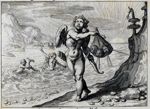
Niet aen ghevanghen - Verba dedit: Hooft, Emblemata amatoria (Amsterdam, 1611), emblem 25
Impossible est de changer vieil abus: La Perrière, Le theatre des bons engins (Lyon, 1545), emblem 36 uses the imagery of a man trying to catch the winds in a net to express that it is impossible to change an old abuse
Iconclass: 26C winds 43C12(+415) fishing (sports) (+ net) 54BB3 Inutility, Noxiousness; 'Nocumento', 'Nocumento d'ogni cosa' (Ripa)
Loci Communes: Inanis opera (Vain effort, Effort vain)
I iv 64 Tranquillum aethera remigas You are plying windless air
Αἰθέρα νήνεμον ἐρέσσεις. id est: Aere tranquillo remigas. Apud Zenodotum refertur de incassum laborantibus: perinde est quasi dicas, Aerem diverberas, remigantium more.
Αἰθέρα νήνεμον ἐρέσσεις, You are rowing in still air. In Zenodotus this is used of people who work in vain, as if one said 'You are cleaving the air, as rowers do.'
Facsimile:
Iconclass: 21A air (one of the four elements) 26C9 absence of wind, calm 46C2322 rowing facing backward, pulling 47C312 cleaving, splitting (industrial processes) 54BB3 Inutility, Noxiousness; 'Nocumento', 'Nocumento d'ogni cosa' (Ripa)
Loci Communes: Inanis opera (Vain effort, Effort vain)
I iv 65 Mortuum flagellas You are flogging a dead body
Νεκρὸν μαστίζεις, id est, Mortuum flagellas. In eos, qui obiurgant illos, qui nihil prorsus obiurgatione commoveantur: Aut qui vita defunctos insectantur ac laverant.
Νεκρὸν μαστίζεις, You flog a dead man. Said of people who scold others, who are not to be moved in the least by scolding; or who attack and outrage the dead.
Facsimile:
Iconclass: 31E3 the corpse 44G3731 flogging, scourging (in public) 54BB3 Inutility, Noxiousness; 'Nocumento', 'Nocumento d'ogni cosa' (Ripa)
Loci Communes: Inanis opera (Vain effort, Effort vain)
I iv 66 Ollam exornas You are decorating a cooking-pot
Χύτραν ποικίλλεις, id est, Ollam exornas, sive picturas. De iis, qui in re vehementer absurda frustra conantur. Ineptus enim labor, ollae vasi contempto, & culinariis usibus destinato, picturae lenocinium adhibere. Cui simillimum quiddam vulgo iactatur, Bracteis aureis inaurare iuglandium putamina.
Χύτραν ποικίλλεις, You are adorning or decorating a cooking-pot, is said of people who make great and useless efforts for quite ridiculous reasons. It is lost labour to paint designs on a kitchen pot, a despised object meant for cooking. There is another common saying something like this, To apply gold-leaf to walnut-shells.
Facsimile:
Iconclass: 41C27(COOKING-POT) kitchen-utensils (COOKING-POT) 48C35 ornamenting, decorating ~ applied arts 54BB3 Inutility, Noxiousness; 'Nocumento', 'Nocumento d'ogni cosa' (Ripa)
Loci Communes: Inanis opera (Vain effort, Effort vain)
I iv 67 Ovum adglunitas You are sticking an egg together
Ωὸν κολλήεις, id est, Ovum glutino compingis. Refertur à Diogeniano. Ridicule laborat, qui fractum ovi putamen glutino sarcire & coagmentare conetur.
Ὠὸν κολλήεις, You are sticking an egg together. This is mentioned by Diogenianus. It is a ridiculous task to piece together a broken eggshell and mend it with glue.
Facsimile:
Iconclass: 25F(+91) animals (+ egg) 31A2746 breaking something 47C435 glueing (industrial process) 54BB3 Inutility, Noxiousness; 'Nocumento', 'Nocumento d'ogni cosa' (Ripa)
Loci Communes: Inanis opera (Vain effort, Effort vain)
I iv 68 Utrem caedis You are beating a wine-skin
Ασκὸν δέρεις, id est, Utrem caedis, aut utrem excorias. Extat apud Aristophanem in Nubibus. Ad quod allusisse videtur Apuleius in Asino, cum meminit de tribus utribus à se percussis, ac vulneratis. Sumptum vel à Bacchi sacris, vel ab iis, qui percussis utribus inanem movent strepitum.
Ἀσκὸν δέρεις, You are beating a wineskin, or, skinning a leather bottle; it is to be found in Aristophanes in the Clouds. Apuleius seems to have alluded to this in the Ass, when he recalls the three leather bottles which he struck and wounded. This may be taken from the rites of Bacchus, or from those who make an empty noise by banging on skins.
Facsimile:
Iconclass: 31A2743 hitting at something 41A776 container of leather: leather bag 41C711 wine ~ alcoholic drinks 54BB3 Inutility, Noxiousness; 'Nocumento', 'Nocumento d'ogni cosa' (Ripa)
Collectanea (1500): 424
Loci Communes: Inanis opera (Vain effort, Effort vain)
I iv 69 Utrem vellis You are plucking a wine-skin
Huic simillimum, ἀσκὸν τίλλεις, id est, Utrem vellis. vel quod non sentiat, vel quod pilis careat.
Very similar to this is 'Ἀσκὸν τίλλεις, You are plucking a wineskin, either because it has no feeling, or because it has no hairs.
Facsimile: 
Iconclass: 41A776 container of leather: leather bag 41C711 wine ~ alcoholic drinks 47I224(+0) shearing (sheep) (+ variant) 54BB3 Inutility, Noxiousness; 'Nocumento', 'Nocumento d'ogni cosa' (Ripa)
Loci Communes: Inanis opera (Vain effort, Effort vain)
I iv 70 Actum agere To reopen a closed subject
Terentius in Phormione: Ohe actum, aiunt, ne agas, τὸ πραχθὲν μὴ πρὰξῃς. A iudiciorum consuetudine sumptum, qua fas non est iterum agere causam, de qua iam sit pronunciatum. Plautus: Rem actam agis, id est, incassum laboras. Q. Fabius apud T. Livium Dec. iii. li. viii. Scio multis vestrum videri, patres conscripti, rem actam hodierno die agi, & frustra habiturum orationem, qui tanquam de integra re, de Africa provincia sententiam dixerit. M. Tullius libello De amicitia, indicat dici solitum de negocio, quod praepostere geritur. Sed cum multis, inquit, in rebus negligentia plectimur, tum maximè in amicis & deligendis & colendis, Praeposteris enim utimur consiliis, & acta agimus, quod vetamur proverbio.
Terence in the Phormio: 'Here! Don't reopen a closed subject, as they say.' This is taken from the practice of the lawcourts, under which it is not permitted to reopen a case once judgment has been given. Plautus: 'You are pleading a case already finished,' that is, you are working to no purpose. Quintus Fabius in Livy, decade 3 book 8: 'I know that to many of you, senators, it seems to-day that we are reopening a closed subject, and that he will speak to no purpose who expresses an opinion about the province of Africa as though the question were not yet settled.' Cicero in his little book on friendship suggests that this was customarily used of a piece of business conducted in the wrong order: 'But we suffer from carelessness in many of our undertakings; in none more than in selecting and cultivating our friends. We put things back to front, and go over things already settled, in defiance of the old proverb.'
Facsimile:
Iconclass: 46A633 debate, discussion (~ meeting) 51FF5 End; 'Fine' (Ripa) 54BB3 Inutility, Noxiousness; 'Nocumento', 'Nocumento d'ogni cosa' (Ripa)
Loci Communes: Inanis opera (Vain effort, Effort vain)
I iv 71 Cotem alis You are feeding a whetstone
Ακόνην σιτίζεις. id est, Cotem alis. Dicitur in homines edaces, plurimique cibi: qui nihilo tamen habitiores inde reddantur. Nam in cotis macilentiam hodieque vulgo iactatur adagium, cum aiunt, Tam pinguem quàm cotem, macilentum quempiam esse significantes. Hermolaus Barbarus in epistola quadam ad Picum interpretatur hoc proverbium pro male collocare beneficium, unde non sit reditura gratia: ut affine sit illi, quod alibi dicetur: Ale luporum catulos: quum ex beneficio redit mala gratia.
'Ακόνην σιτίζεις, You are feeding a whetstone. This is said about gluttonous people, who eat a lot and are in no better condition for that. There is a common proverb going about today which refers to the leanness of whetstones: they say 'as fat as a whetstone' when they mean 'emaciated.' Ermolao Barbaro, in a letter to Pico, explains this proverb as meaning 'to bestow a kindness wrongly and get no thanks for it'; so that it would be close to the other one which will be recorded elsewhere, Feed the wolf's cubs, when poor thanks are returned for a benefit.
Facsimile:
Iconclass: 41C111 giving food 47D8(GRINDSTONE) tools, aids, implements ~ crafts and industries: grindstone 54BB3 Inutility, Noxiousness; 'Nocumento', 'Nocumento d'ogni cosa' (Ripa)
Loci Communes: Inanis opera (Vain effort, Effort vain)
I iv 72 Hylam inclamas You are calling for Hylas
Υλαν κραυγάζεις. id est, Hylam inclamas. De frustra vociferantibus: aut in genere, de nihil proficientibus. Ab huiusmodi casu natum adagium. Hylas Theodamantis filius, cum esset inter argonautas formosus adolescens, adamatus est ab Hercule. Is cum esset in Mysia, forte aquatum egressus, in fonte periit: unde & à Nymphis adamatus ac raptus fingitur. Ad hunc vestigandum missus est Polyphemus, qui ingenti vociferatione nomen inclamabat Hylae, neque quicquam tamen profecit. Atque hinc ortum proverbium. Vergilius videtur ad nautarum clamorem retulisse, cum ait: His adiungit, Hylam nautae quo fonte relictum Clamassent, ut littus Hyla, Hyla omne sonaret. Meminit huius et Theocrit. in Idyl. Ν. τρὶς μὲν ὕλαν ἀϋσεν, ὅσον βαθὺς ἄρυσε λαιμὸς, τρὶς δ᾽ ἂν ὁ παῖς ὑπάκουσεν, ἀραιὰ δὲ ἵκετο φωνή. id est, Ter quanto potuisset Hylam clamore vocabat, Mugitum intendens imo de gutture vocis. Ter puer audiit, ac tenuis vox perculit aures. Nihil obstat, quo minus ad sacrorum consuetudinem referatur, quae in Hylae rapti memoriam sunt instituta: in quibus Hylae nomen inclamabatur. Id fuerit venustius atque concinnius, ubi quis rem absentem frustra desiderat, vel deplorans, vel optans. Ut si quis ad inopiam redactus, optaret sibi centum talenta, quae quondam habuisset. Ad hanc paroemiam respexisse videtur Aristophanes in Pluto: Ποθεῖς τὸν οὐ παρόντα, καὶ μάτην καλεῖς. id est, Desideras absentem, inaniter vocans. De Mercurio dictum, placentas illas deplorante, quas in sacris consueverat aliquando edere.
Υλαν κραυγάζεις, You are calling for Hylas. Said about people who shout with no result, or generally about those who make no progress. The proverb was derived from the following event. Hylas, the son of Theodamas, was one of the Argonauts, a beautiful youth beloved by Hercules. When he was in Mysia, he went out to fetch water, fell into the spring and was drowned. It is said that the Nymphs fell in love with him and carried him away. Polyphemus was sent to find him, and went calling his name 'Hylas!' with great shouts, but he had no success. Hence the proverb arose. Virgil seems to relate it to the shouts of the sailors, when he says:
He joins to these Hylas, left by the sailors beside a spring,
Shouting for him, till the whole coast rang with the name
Hylas, Hylas.
Theocritus too remembers it in idyll 13: Thrice he called 'Hylas' with the loudest shout he could muster From his deep throat; and thrice the lad heard, But faintly his voice struck the ear. There is no reason why it should not refer to the sacred rites instituted in memory of the snatching away of Hylas; his name was shouted during these rites. It would be more elegant and apt to use it for someone longing for something he lacks, weeping for it or wishing for it. So a man reduced to poverty might long for the hundred talents he used to possess. Aristophanes seems to have thought of this proverb in the Plutus: 'You long for one not present and you call in vain.' This is said of Mercury, lamenting for the cakes which he had once been accustomed to eat during the ceremonies.
Facsimile:
Iconclass: 31B62351 crying, shouting 94A331(+0) Hylas abducted by the nymphs whilst fetching water (+ variant) 54BB3 Inutility, Noxiousness; 'Nocumento', 'Nocumento d'ogni cosa' (Ripa)
Collectanea (1500): 678
Loci Communes: Inanis opera (Vain effort, Effort vain)
I iv 73 Inaniter aquam consumis You are wasting water (time)
Αλλως ἀναλίσκεις ὕδωρ. id est, Inaniter consumis aquam. In eos quadrabit, qui frustra suadent. A prisco more iudiciorum sumptum, in quibus ad clepsydrae modum dicebatur. Aeschynes contra Demosth. ostendit primam aquam infundi solere actoribus, alteram patronis, tertiam iudicibus, ad poenam constituendam, nisi primis sententiis reus fuisset absolutus. Et Demosth. Aeschinem provocat, ut vel in sua aqua, si possit, dicat, quod decretum fuisset ipso unquam autore scriptum: ἀναστὰς καὶ ἐν τῷ ἐμῷ ὕδατι εἰπάτω. Huc alludens Lucianus, ἐν τῷ περὶ τῶν ἐπῖ μῖσθῷ συνόντων, in rhetorem quendam iocatur, qui apud barbaros in convivio diceret, non ad aquae, sed ad amphorae vinariae modum. Idem in Bis accusato: Εκείνης γὰρ τό γε νῦν ῥέον, i. Nam illius sanè in praesentia fluit aqua. Videtur id subindicare Plato in Theaeteto, cum ait, quosdam πρὸς μικρὸν ὕδωρ, id est, ad pusillum aquae docere posse quae gesta sint. Idem in eodem: Κατεπείγει γὰρ ὕδωρ ῥέον, id est, Urget enim aqua fluens. quod oratoris sit ad praescriptas clepsydras dicere. Apul. in Asino aureo: Rursum praeconis amplo boatu citatus accusator quidam senior exurgit, & ad dicendi spacium, vasculo quodam in vicem colli graciliter fistulato, ac per hoc guttatim defluo, infusa aqua, populum sic adorat. Plinius iunior Falconi: Et qui iubere posset tacere quemcunque, huic silentium clepsydra indici. Idem Arriano: Dixi horis penè quinque. Nam viginti clepsydris, quas spaciosissimas acceperam, sunt additae quatuor. Quintilianus lib. xii. Et si quid ipse tibi sumas, probandum est, & laboratam, congestamque dierum ac noctium studio actionem, aqua deficit. Marcus Tullius in calce secundi libri Tusculanarum quaestionum, Cras ergo ad clepsydram, sic enim dicimus. Idem De oratore lib. iii. de Pericle loquens: At hunc, inquit, non clamator aliquis ad clepsydram latrare docuerat, sed (ut accepimus) Clazomenius ille Anaxagoras, vir summus in maximarum rerum scientia. Philetas apud Athenaeum li. ii. τοςαὐτα ὥ- σπερ οἱ ῥήτορες πρὸς ὕδωρ εἶπον. id est, Tantum, ut solet rhetores, ad aquam dixi. fuerat autem de aqua sermo. Hinc captata est allusionis gratia. Demades iocabatur in Demosth. ὕδροπότην, quod caeteri quidem ad aquam dicerent, Demosthenes ad aquam scriberet. Philostratus in Adriano sophista τοὺς ἀπὸ κλεψύδρας appellat sophistas qui aqua exercebantur. Porrò prisci lineis & umbris horas distinguebant. P. Scipio Nasica primus reperit clepsydram, qua nubilo quoque die & noctibus, horae distinguerentur. Nunc pro clepsydris, clepsammis & αὐτομάτοις utuntur horologiis.
Αλλως ἀναλίσκεις ὕδωρ, You are wasting water (time). This will be suitable for people who try to persuade others, but in vain. It comes from the ancient custom of judicial trials, when a time-limit was set by the water-clock. Aeschines, speaking against Demosthenes, explains that the first measure of water was poured in for the plaintiffs, the second for the defence, the third for the judges to decide on the penalty, unless the accused had been acquitted by the first votes. And Demosthenes challenges Aeschines to say if he can, in his own water-time if need be, what decree had ever been passed on a proposal moved by him: 'Let him get up and speak - yes, he can have my own water-time.' Lucian, playing with the idea in On Salaried Posts In Great Houses, jokes about a professional rhetorician who made speeches at drinking-parties among the barbarians measured not by water but by the wine-jar. Again in Twice Accused: 'For the water that is running now is hers.' Plato seems to suggest this in the Theaetetus, when he says that some people can report what has been done in the least possible water-time. Again, in the same work, 'The running water urges on,' because the orator's business is to speak by the periods allowed him on the clock. Apuleius in the Golden Ass: 'Again, when summoned by the herald with a great roar, an older prosecutor rose and for a set space of time (there was a vessel with a sort of thin pipe by way of a neck, through which water poured into it came slowly drop by drop) he made an appeal to the people, as follows.' Pliny the Younger, writing to Falco: 'And anyone who can order someone else to be quiet, should have silence imposed on him by the clock.' The same to Arrianus again: 'I spoke for nearly five hours. For my twenty periods by the clock, which I had supposed ample when I accepted them, were increased by four.' Quintilian, book 12: 'And if you make an assumption, you have to prove it, and there is not enough water-time for the speech you have worked on and built up with days and nights of study.' Cicero at the end of the second book of his Tusculan Questions: 'Tomorrow then by the water-clock; for that is how we speak.' Cicero again in the De oratore, book 3, speaking of Pericles: 'But this man had not been taught by some noisy declaimer to rant by the water-clock, but (as we understand) his teacher was the great Anaxagoras of Clazomenae, a man with a supreme grasp of the most important subjects.' Philetas, in Athe-naeus, book 2: 'I have said so much, like orators who talk by the clock'; for his speech had actually been about water. In this lies the charm of the allusion. Demades used to joke about Demosthenes 'the water-drinker,' saying that others timed their speeches by water but Demosthenes timed his writing by it. Philostratus in his life of Adrian the sophist calls sophists 'water-clock men,' because they practised against the clock. In early times lines and shadows were used to tell the hours. The first to invent a water-clock was Publius Scipio Nasica, and then one could tell the time even on a cloudy day or at night. Now they use instead of water-clocks hourglasses and automatic clocks.
Facsimile: 
Iconclass: 21D water (one of the four elements) 23U23 water clock 55C11 Squandering, Extravagance, Prodigality, Waste; 'Prodigalità' (Ripa)
Loci Communes: Inanis opera (Vain effort, Effort vain)
I iv 74 In aere piscari, venari in mare To fish in the air, to hunt in the sea
Eiusdem generis sunt & illa, quae Plautus usurpat in Asinaria: In aere piscari, & in mari venari iaculo. Quadrabunt simpliciter in eos, qui frustra moliuntur τὰ ἀδύνατα, aut qui praepostere ibi quaerunt aliquid, ubi ne sperari quidem possit. Ut si quis in magistratibus vitam tranquillam, in voluptatibus beatam, in opibus felicem quaerat. Itaque Libanus servus ab hero suo Demaeneto iussus ut uxorem ipsius argento defraudaret, significans nulla ratione fieri posse, ut à muliere tenacissima quicquam auferretur: Iube, inquit, una me opera piscari in aere, venari autem iaculo in medio mari.
Of the same sort are the phrases Plautus makes use of in the Asinaria: 'to fish in the air, to hunt with a spear in the sea.' These will directly fit those people who try in vain to achieve the impossible, or who look in the wrong place for something they can never hope to find there. For instance, a man might seek a quiet life in magisterial office, or a blessed one in the midst of pleasure, or a happy one in the midst of wealth. So Libanus the slave, ordered by his master Demaenetus to get money away by fraud from the latter's own wife, indicates by his reply that there is no way of taking anything away from a really close-fisted woman: 'Order me at one and the same time to go fishing in the air, and hunting with a javelin in the midst of the sea.'
Facsimile:
Iconclass: 25F6(+526) fishes (+ animal(s) moving in the air) 25F6(+527) fishes (+ animal(s) moving in water) 29A1 'mundus inversus', the reversed world, the topsy-turvy world, 'le monde bestourné' 43C11 hunting, chase 43C12 fishing (sports)
Collectanea (1500): 56
Loci Communes: Absurda, indecora, seu praepostera (Absurd, unbecoming, or preposterous things, Choses absurdes, inconvenantes ou déplacées)
I iv 75 Aquam e pumice postulas You are asking for water out of a pumice stone
Superiori non admodum diversum, quod apud eundem poetam legitur: Aquam è pumice postulare, pro eo quod est, frustra ab alio petere, cuius ipse à quo petas, maximè sit indigus. Nihil enim pumice lapide siccius, nihil siticulosius. Perinde ac si quis ab indoctissimo doceri postulet, ab inconsultissimo consilium expectet, ab egeno munus, ab inope praesidium: denique ab avaro ac tenaci pecuniam. Plaut. Nam tu aquam è pumice nunc postulas, qui ipsus sitiat. Pumex (inquit idem) non aeque est aridus, atque hic senex. Est autem pumex lapis cavernosus, quo solent poliri codices: naturae adeo siccae, ut, si in urceum bullientem immiseris, fernorem extinguat: non solum ad tempus, sed in totum. Nec aliud in causa putat esse Theophrastus, nisi quod vehementissima siccitate spumam totam ad se trahere nitatur. Meminit & de Chio quopiam Eudemo, qui pumice acri consperso aceto, munire sese consueverit, ut post septimam ellebori potionem, nec balneis, nec vini potatione provocaretur ad vomitum.
We find in the same poet something not very different from the above: 'to look for water from a pumice-stone,' meaning to seek in vain to obtain something from a person who is in great need of it himself. For nothing is dryer than a pumice-stone, or more thirsty for water; it is just as if we were to ask for teaching from the most untaught, to expect advice from the most ill-advised, or a present from a pauper, protection from the helpless, money from a close-fisted miser. Plautus: 'For you are asking now for water from a pumice-stone, which is thirsty itself.' 'The pumice-stone,' says the same author, 'is not as dry as this old man.' The pumice is a stone full of holes, which is used to polish books; so dry in its nature that if you put it into a boiling pot, it will stop the boiling, not only for a time but altogether. There is no other cause for this, thinks Theophrastus, than that because of its extreme dryness it strives to draw all the froth into itself. He recalls the case of a certain Eudemus of Chios, who habitually provided himself with a pumice stone sprinkled with vinegar, so that after the seventh draught of hellebore he could not be provoked to vomit either by baths or by drinking wine.
Facsimile:
Iconclass: 21D water (one of the four elements) 25D12(PUMICE) kinds of non-precious stone: pumice 54BB3 Inutility, Noxiousness; 'Nocumento', 'Nocumento d'ogni cosa' (Ripa)
Collectanea (1500): 249
Loci Communes: Inanis opera (Vain effort, Effort vain)
I iv 76 Nudo vestimenta detrahere To drag the clothes off a naked man
Ad hanc sententiam pertinet hoc quoque, quod ab eodem est usurpatum poeta: Nudo vestimenta detrahere, pro eo quod est, ab eo sperare emolumentum, cui ne sit quidem quod auferri queat. Sic enim idem Libanus in Asinaria Plautina admonitus ab hero, ut ab ipso per fallaciam argentum abraderet, quo filio emeretur amica: Maximas, inquit, nugas agis, Nudo detrahere vestimenta me iubes. Adducit & D. Chrysostomus proverbium vulgo iactatum, quo dicebant, Nec à centum viris unum nudum spoliari posse. Apuleius Asinus libro primo scripsit, Nudum nec à decem palaestritis posse spoliari.
This also belongs to the same line of thought, and is used by the same poet: To drag the clothes off a naked man, meaning to hope for gain from a person who has nothing that can be taken away. Thus the aforesaid Libanus, in the Asinaria of Plautus, is ordered by his master to steal from himself, by a trick, the money to buy a girl for his son, and he says: 'You're joking - you want me to get the clothes off a naked man.' St Chrysostom also quotes a popular proverb, to the effect that 'a hundred men cannot despoil one naked man.' Apuleius, in the first book of the Ass, wrote that 'a naked man cannot be robbed by ten wrestlers.'
Facsimile:
Iconclass: 31A(+89) the (nude) human figure; 'Corpo humano' (Ripa) (+ nude human being) 31A5541 stripping, undressing someone else
Collectanea (1500): 57
Loci Communes: Absurda, indecora, seu praepostera (Absurd, unbecoming, or preposterous things, Choses absurdes, inconvenantes ou déplacées); Inanis opera (Vain effort, Effort vain)
I iv 77 Anthericum metere To reap asphodel-stalks
Τὸν ἀνθέρικον θερίζειν. id est, Anthericum metere, dicebantur, qui laborem inanem ac sterilem caperet. Anthericus, herbae genus, quod meti non possit, sed velli manibus necesse est, velut & linum. Antherices vocantur summa spicarum fastigia, sive atheres. Herodotus asphodeli caules antherices vocat, teste Suida: quos et tenaciores ait esse, quàm ut frangi queant. Antherici meminit & Plinius lib. xxi. cap. xvii. In Graecorum commentariis reperio promiscue positum Antherices, & atherices.
Τὸν ἀνθέρικον θερίζειν, To reap asphodel-stalks, was said of those who take on useless and fruitless work. Asphodel is a kind of plant which cannot be mown, but must be pulled up by hand like flax. The word antherices means the tips of ears of grain, or awns. Herodotus calls the stalks of asphodel antherices, according to Suidas, and he says they are too tough to be broken. Pliny, book 21 chapter 17, mentions asphodel-stalks: 'In the Greek compilations I find antherices and atherices used indifferently.'
Facsimile:
Iconclass: 25G4(ASPHODEL) plants and herbs (ASPHODEL) 47I141 reaping, picking, mowing ~ harvest 54BB3 Inutility, Noxiousness; 'Nocumento', 'Nocumento d'ogni cosa' (Ripa)
Loci Communes: Inanis opera (Vain effort, Effort vain)
I iv 78 Ex arena funiculum nectis You are twisting a rope of sand
Εκ τῆς ψάμμου σχοινίον πλέκειν. id est, Ex harena funiculum nectere. Est frustra conari, quod nulla ratione potest effici. Quid enim stultius, quam ex harena quae nullo modo cohaerescit funem velle nectere? Proverbium utrunque, nempe tum hoc, tum quod proximè retulimus, usurpat Aristides in communi defensione quatuor oratorum: Καταδύντες δὲ εἰς τοὺς χηραμοὺς, ἐκει τὰ θαυμαστὰ σοφίζοντες σκιᾷ τινί λόγους ἀνασπῶντες, ἔφης ὦ σοφοκλῆς, τὸν ἀνθέρικον θερίζοντες, τὸ ἐκ τῆς ψάμμου σχοινίον πλέκοντες, οὐκ οἶδα ὅντί᾽ ἱστὸν ἀναλύοντες.. id est, Verum abdentes sese in secessus quosdam, illic admirandam illam comminiscuntur sapientiam, umbra quadam adtrahentes verba, quemadmodum abs te dictum est Sophocles, anthericum metentes, ex harena nectentes funiculum, et haud scio quam retexentes telam. Significat his adagiis, umbraticum illud philosophorum studium nihil omnino fructus adferre. Columel. in praefatione carminis De cultura hortorum. Nam etsi multa sunt eius quasi membra, de quibus aliquid possumus effari, tamen eadem tam exigua sunt, ut, quod aiunt Graeci, ex incomprehensibili parvitate harenae funis effici non possit. Proverbium peculiariter accommodabitur ad usus huiusmodi: si quis conetur in concordiam redigere, moribus longe dissimilimos, & inter quos nihil omnino convenit: aut si quis orationem ex argumentis dissonis contexat, quasi Chimaeram quandam fingens, & huiusmodi monstrum, cuiusmodi describit Horatius: Humano capite, equina cervice, reliquis item membris ex variis animantium generibus ita collatis, Ut turpiter atrum Desinat in piscem, mulier formosa superne.
'Εκ τῆς ψάμμου σχοινίον πλέκειν., To twist a rope of sand. This means trying in vain to do what can by no means be done. What could be sillier than to want to twist a rope out of sand, which cannot stick together? Both proverbs, this and the one just quoted, are used by Aristides in his Joint Defence of Four Orators: 'But hiding themselves in holes, and there inventing their marvellous wisdom, they draw together words in shadow, as you say, O Sophocles, reaping asphodel, weaving rope from sand, unravelling I know not what web.' By these adages he indicated that the private study of the philosophers bears no fruit at all. Columella in the preface of his poem on gardening: Tor although there are many parts of this of which we could speak, they are so tiny that, as the Greeks say, from their incomprehensible smallness one cannot make a rope of sand.' The proverb can be particularly adapted to use as follows: if one should try to bring into agreement people who are far apart in way of life, with nothing whatever in common; or if one should put together a speech woven out of discordant arguments, creating a kind of chimaera or a monster like that described by Horace, with a man's head on a horse's neck and with the rest of the limbs collected from different kinds of animal, 'making a woman beautiful from the waist up end miserably in a black fish.'
Facsimile: 
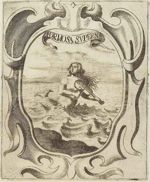
Formosa superne: Saavedra, Idea de un principe (München, 1640), emblem 47 quotes the comment
Iconclass: 25D23 sand (soil type) 47H41 rope-making 52BB42 Impossibility
Loci Communes: Impossibilia (Impossible things, Choses impossibles)
I iv 79 Ab asino lanam Wool from a donkey
Cui finitimum est & illud, ὄνου πόκας ζητεῖς, id est, Asini lanas quaeris. De iis, qui stulte quaerunt ea quae nusquam sunt. Effertur adagium etiam ad hunc modum: ὄνου πόκαι. id est, Asini lanae. Aristophanes: Τὶς εἰς τὸ λήθης πεδίον, τὶς εἰς ὄνου πόκας; id est, Asini quis ad lanas? quis in Lethes solum? Per Asini lanam, res vanas significans, & quae nusquam sunt. Trimeter Graecis constat si tollas alterum, τὶς.
Very nearly the same is this phrase, about people who stupidly search for what does not exist: Ὄνου πόκας ζητεῖς, You are looking for wool from a donkey. The proverb is also found in the form 'donkey's wool.' Aristophanes: 'Who's for the plain of Lethe? Who for donkey's wool?' Meaning by ass's wool something empty and non-existent. The phrase makes a Greek trimeter if you leave out the second tis.
Facsimile:
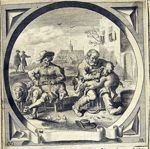
Assai rumore e poca lana: Cats, Spiegel (The Hague, 1632), emblem 79
Iconclass: 46C13142 ass, donkey 47H14 wool (material ~ textile and clothing industry) 52BB42 Impossibility 54BB3 Inutility, Noxiousness; 'Nocumento', 'Nocumento d'ogni cosa' (Ripa)
Collectanea (1500): 355
Loci Communes: Impossibilia (Impossible things, Choses impossibles); Inanis opera (Vain effort, Effort vain)
I iv 80 Asinum tondes You are shearing a donkey
Eundem sensum haber, τὸν ὄνον κείρεις, id est, Asinum tondes. De his, qui rem absurdam atque inutilem aggrediuntur, propterea quod asinum neque pectere possis propter villos, neque tondere cum lanam non habeat. Huius meminit Aristophanes in Ranis.
Τὸν ὄνον κείρεις, You are shearing the donkey. This has the same sense, and is used of people who attempt something ridiculous and useless, because you can neither comb a donkey, with its shaggy hair, nor shear it, because it has no wool. Aristophanes recalls it in the Frogs.
Facsimile:
Assai rumore e poca lana: Cats, Spiegel (The Hague, 1632), emblem 79
Iconclass: 46C13142 ass, donkey 47H14 wool (material ~ textile and clothing industry) 47I224(+0) shearing (sheep) (+ variant) 54BB3 Inutility, Noxiousness; 'Nocumento', 'Nocumento d'ogni cosa' (Ripa)
Loci Communes: Inanis opera (Vain effort, Effort vain)
I iv 81 Lupi alas quaeris You are looking for the wolf's wings
Λύκου πτερὰ ζητεῖς. id est, Lupi alas quaeris. De iis, qui quaerunt ea, quae nusquam sunt. Aut ubi quis verbo duntaxat territat, alioqui re numquam facturus, quod minatur. Neque enim fieri potest, ut lupus alatus inveniatur. Proverbium recensetur à Suida.
Λύκου πτερὰ ζητεῖς, You are looking for the wolf's wings. Used of people who seek something which does not exist, or when someone produces alarm merely by words, making a threat he will never carry out. It is quite impossible that a wolf should ever turn up with wings. The proverb is listed by Suidas.
Facsimile:
Iconclass: 25F23(WOLF)(+342) beasts of prey, predatory animals: wolf (+ wings of an animal) 31A31 sight, looking (one of the five senses)
Collectanea (1500): 626
Loci Communes: Absurda, indecora, seu praepostera (Absurd, unbecoming, or preposterous things, Choses absurdes, inconvenantes ou déplacées)
I iv 82 Quae apud inferos The things in Hades
Eodem loco interpres admonet & huius adagii, tanquam eundem habentis sensum, τὰ ἐν ἄδου. i. Ea quae apud inferos. Citátque Aristarchum autorem: idque inde natum putat, quod Cratinus finxerit quendam apud inferos funem torquentem: asinum autem arrodentem ea quae ille iam torsisset, atque ita inaniter laborare qui torquebat. Quanquam illud, τὰ ἐν ἄδου, generaliter ad omnia pertinet, quae poetarum fabulis traduntur nulli credita nisi pueris: unde cum inania, somniisque similia significabimus, apte dicemus τὰ ἐν ἄδου. Athenaeus lib. Dipnosophistarum iii. refert, Democritum scripsisse volumen, cui titulus fuerit, τὰ περὶ τῶν ἐν ἄδου, prodigiosis, ut coniectandum est, refertum fabulis, & hinc potest videri ductum proverbium.
In the same place the commentator mentions this proverb also, as if it had the same meaning: Tὰ ἐν ἄδου, The things in Hades, and he quotes Aristarchus as his authority, and thinks it arose from the story in Cratinus of a man in the underworld twisting a rope while a donkey chewed off the part he had already twisted, so that the twister's work was quite in vain. This phrase 'the things in Hades' relates however in general to everything that the poets' stories tell us, not to be believed except by children; so when we describe empty dreams or the like we can appropriately say 'the things in Hades.' Athenaeus relates in book 4 of his Doctors at Dinner that Democritus wrote a book with this title, About What Is In Hades, probably stuffed with monstrous fables, and it may be from this that the proverb arose.
Facsimile:
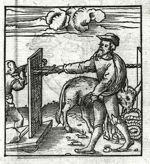
Ocni effigies de his qui meretricibus donant, quod in bonos usus verti debeat: Alciatus, Emblemata (Paris, 1534), emblem 17
Fundamentum familiae uxor: Reusner, Aureolorum Emblematum (Strasbourg, 1587), emblem 53
Iconclass: 47H41 rope-making 93E Hades, the Underworld 93E86 Ocnus, usually twisting a cord which is eaten by an ass as soon as it is being made
Loci Communes: Occulta (Hidden things, Choses cachées); Vanitas (Vanity, Vanité)
I iv 83 Contorquet piger funiculum The sluggard twists the rope
Huic adeo simile est, ut idem videri possit, quod de ocno. id est, pigro asino refert Pausanias in Phocicis, apud Ionas, ut ait, celebratum: συνάγει ὄκνος τὴν θώμιγγα, id est, Torquet piger funiculum. Ipsius verba super hac re subscribam: Μετὰ δὲ αὐτοὺς ἀνήρ ἐστι καθήμενος, ἐπιγράμμα δὲ ὄκνον εἶναι λέγει τὸν ἄνθρωπον.πεποίηται μὲν πλέκων σχοινίον. παρέστηκε δὲ θήλεα ὄνος ἐπεσθίουσα τὸ πεπλεγμένον ἀεὶ τοῦ σχοινίου. τοῦτον εἶναι τὸν ὄκνον, φίλεργὸν φασιν ἄνθρωπον, γυναῖκα δὲ ἔχειν δαπανηρὰν, καὶ ὁπόσα συλλέξαιτο ἐργαζόμενος, οὐ πολύ ἄν ὕστερον ὑπὸ ἐκείνης ἀνήλωτο. οἶδα δὲ καὶ ὑπὸ ἰώνων, ὁπότε ἴδοιεν τινὰ πονοῦντα ἐπὶ οὐδενὶ ὄνησιν φέροντι, ὑπὸ τούτου εἰρημένον, ὡς ὁ ἀνὴρ οὖτος συνάγει τοῦ θώμιγγα. id est, Post hos vir quidam est sedens, titulus indicat eum ὄκνον esse. Factus est autem ad hunc modum, ut ipse funiculum torqueat, astante asella, quae quod tortum fuerit assidue abrodat. Hunc Ocnum ait hominem esse indu strium, operique intentum, sed uxorem habere sumptuosam ac prodigam, ut, quicquid is suo labore corraserit, id mox absumatur ab illa. Cognitum est mihi, etiam ab Ionibus dici solere, si quem conspexissent in re quapiam elaborantem, quae nihil adferret emolumenti, Hic homo funiculum Ocni contorquet. Videtur argumentum picturae sumptum ab occasione vocis ancipitem obtinentis significatum. Siquidem συνάγειν τον βίον, aiunt Graeci, pro comparare victum. Colligit autem qui rem auget, dissipat qui profundit. Atque hoc quidem argumentum apparet olim multorum artificum operibus fuisse celebratum. Siquidem Plinius in historia mundi inter Socratis egregii pictoris argumenta, commemorat & de asino spartum arrodente. Et piger, inquit, qui appellatur ocnos, spartum torquens, quod asellus arrodit. Fertur idem picturae genus & Delphis fuisse, à Polygnoto Thasio dicatum. Quo quidem negant desidem & ignavum significatum, quemadmodum existimat Varro, imò laboriosum magis & industrium, sed cui sit uxor prodiga. Eoque Pausanias ait, non marem asellum, sed foeminam in pictura fuisse. Idem argumetum, marmore caelatum, Romae duobus visitari locis, nempe in capitolio & in hortis Vaticanis, Hermolaus Barbarus testis est. Usus est hoc adagio & Propertius: Dignior obliquo funem qui torqueat ocno, Aeternusque tuam pascat aselle famem. Verum illud interim admirandum, cur Plinius eum scripserit appellatum ocnum, id est, pigrum, qui funem torqueret, ac non magis asellum arrodentem. Maxime cum Propertius non eum ocnon appellet qui torqueat, sed illi torqueri funem: ut asinum intelligas citius, quàm torquentem. Meminit huius adagii Plutarchus in commentario περὶ τῆς εὐθυμίας. Αλλ᾽ ὥσπερ ἐν ᾄδου ζωγραφούμενος σχοινοπλόκος, ᾧ τινι παρίησιν ἐπιβοσκομένῳ καταναλίσκει τὸ πλεκόμενον. id est: Sed quemadmodum apud inferos depictus is qui funem torquet: cui adest, qui depascens absumit id, quod tortum fuerit.
So similar as to seem almost the same, is what Pausanias tells in his Phocica, about Ocnus the ass, or the 'lazy ass,' well known, he says, among the lonians: Συνάγει Ὄκνος τὴν θώμιγγα, The sluggard twists the rope. I will give his own words: 'Beyond these there is a man sitting, and the inscription indicates that he is Ocnus [sloth]. He is portrayed in this way: he is twisting a rope, and a she-ass standing near by is continually gnawing away at what he has twisted. They say that this Ocnus is an industrious man bent on his work, but he has an extravagant and spendthrift wife, so that whatever he gets together by working is soon wasted by her. I can testify that if the lonians see someone labouring away at something which brings in no profit, they habitually say, "this man is twisting the rope of Ocnus."' The subject of the picture seems to have been taken from a word with a double meaning. The Greeks say 'to get together a living' for 'to procure one's livelihood.' The one who increases his substance gets together; the one who squanders scatters it. And this subject seems to have been illustrated in old days by the work of many artists. Pliny, in his History of the World, describes among the themes of the famous painter Socrates the picture of an ass gnawing a rope. 'And the sluggard' he says 'called Ocnus, twisting the rope which the ass chews off.' It is said that the same picture was at Delphi, dedicated by Polygnotus the Thasian. However, they deny that it means an idle and indolent man, as Varro thought, but much more a diligent and industrious one with an extravagant wife. So Pausanias says that the donkey in the picture was a female and not a male. Ermolao Barbaro testifies that a carving illustrating the same subject is on show at two places in Rome, namely on the Capitol and in the gardens of the Vatican. Propertius also made use of this proverb: 'Worthier' he says,
To twist the rope for Ocnus sideways sitting,
And feed for aye the ass that's always eating.
It is curious, by the way, that Pliny should say the man who twisted the rope was called Ocnus, which means lazy, and not rather the gnawing ass, especially as Propertius does not give the name Ocnus, lazy, to the man who twists, but says that the rope is being twisted for him; so that one would think 'lazy' was applicable to the ass rather than the rope-maker. Plutarch recalls this adage in his essay 'On Tranquillity of Mind': 'But it is just like the man in the picture of the underworld who is twisting a rope, and close to him stands one who eats away what he has made.'
Facsimile: 
Ocni effigies de his qui meretricibus donant, quod in bonos usus verti debeat: Alciatus, Emblemata (Paris, 1534), emblem 17
Fundamentum familiae uxor: Reusner, Aureolorum Emblematum (Strasbourg, 1587), emblem 53
Iconclass: 42D36:55C11 bad wife❧Squandering, Extravagance, Prodigality, Waste; 'Prodigalità' (Ripa) 47H41 rope-making 93E Hades, the Underworld 93E86 Ocnus, usually twisting a cord which is eaten by an ass as soon as it is being made 54BB3 Inutility, Noxiousness; 'Nocumento', 'Nocumento d'ogni cosa' (Ripa)
Collectanea (1500): 27
Loci Communes: Inanis opera (Vain effort, Effort vain)
I iv 84 Littori loqueris You are talking to the seashore
Αἰγιαλῷ λαλεῖς. id est: Littori loqueris. Refertur à Graecis adagiorum collectoribus. Dictum in eos, qui frustra vel suadent, vel orant: perinde quasi surdo loquantur. Nam littora propter assiduum fluctuum fragorem surda dicuntur. Ovidius: Surdior ille freto clamantem nomen Orestis, Traxit inornatis in sua tecta comis.
Αἰγιαλῷ λαλεῖς, You are talking to the seashore. This is quoted in the Greek collections. It is said of people who advise or pray in vain, as if they spoke to the deaf. For the seashores are called deaf because of the continual noise of the waves. Ovid: 'Deafer to me than the sea as I shrieked out the name of Orestes, /He dragged me with hair all disarrayed into his palace.'
Facsimile:
Iconclass: 25H133 beach 31B6235 speaking 33A341 story teller; listening to story teller 54BB3 Inutility, Noxiousness; 'Nocumento', 'Nocumento d'ogni cosa' (Ripa) 54BB6 Worthlessness 11R51 scenes symbolizing 'Vanitas'
Loci Communes: Inanis opera (Vain effort, Effort vain)
I iv 85 Vento loqueris You are talking to the wind
Suidas addit & hoc, Ανέμῳ διαλέγῃ, id est: Vento loqueris. Pro eo, quod est, inaniter. Nam ventus omnia dissipat, cogitque evanescere. Unde & Auris discerpta mandata dixit Vergilius, quae abierant in oblivionem. Plautus in Mostellaria: Hic nescit quidem nisi foenus fabulari vento. Consimili figura apud Athenaeum legitur: γῇ καὶ οὐρανῷ λαλεῖν. id est, Caelo ac terrae loqui.
Suidas adds this one: Ἀνέμῳ διαλέγῃ, You are talking to the wind. It means 'in vain' because the wind blows everything away and makes it disappear. Virgil spoke of 'commands scattered on the breezes' which had vanished in oblivion. Plautus, Mostellaria: 'The only word he knows to cry to the wind is "interest."' In Athenaeus we read, with a similar metaphor, 'to call on heaven and earth.'
Facsimile:
Iconclass: 26C winds 31B6235 speaking 33A341 story teller; listening to story teller 54BB3 Inutility, Noxiousness; 'Nocumento', 'Nocumento d'ogni cosa' (Ripa) 11R51 scenes symbolizing 'Vanitas'
Loci Communes: Inanis opera (Vain effort, Effort vain)
I iv 86 Mortua verbo facit He addresses the dead
Νεκρῷ λέγουσα μύθους εἰς οὖς. id est, Mortuo ad aurem fabulam narrans. Plautus: Mortuo verba nunc facio. Terentius: Verba fiunt mortuo. Rursum Plautus: Nihilo pluris refert, quam si ad sepulcrum mortuo dicat iocum. Pertinet huc quod est apud Aeschylum in Agamemnone. Εοικα θρηνεῖν ζῶσα πρὸς τύμβον μάτην. id est, Frustra ad sepulcrum viva ploro mortui. Natum adagium à ridicula consuetudine verterum, vita defunctos ter voce cientium: unde & conclamati dicebantur: praeterea in pompis funeralibus multa deplorantium erga mortuum. Quem morem irridet Lucianus in libello De luctu,quem nos Latinum fecimus.
Νεκρῷ λέγουσα μύθους εἰς οὖς, Telling a story to a dead man's ear. Plautus says 'Now I am talking to the dead.' Terence: 'Words are spoken to the dead.' Plautus again: 'It makes no more difference than if a joke were told to a dead man in his tomb.' Apposite here is what is said by Aeschylus in the Agamemnon: 'Alive, I wail in vain to the tomb of the dead.' The proverb arises from the foolish custom of the ancients, of calling three times the name of the deceased. For this reason they are called 'the lamented' [conclamati] especially at funerals were there is much bewailing of the dead man. This custom is derided by Lucian in his essay on Mourning, which I have translated into Latin.
Facsimile:
Iconclass: 31B6235 speaking 31E3 the corpse 33A341 story teller; listening to story teller
Collectanea (1500): 199
Loci Communes: Inanis opera (Vain effort, Effort vain)
I iv 87 Surdo canis, surdo fabulam narras You are singing, or telling a story to the deaf
Eandem vim habet, κωφῷ ἄδεις, id est: Surdo canis. Vergilius in Bucolicis: Non canimus surdis, respondent omnia sylvae. Horatius: Narrare putaret asello. Fabellam surdo. Terentius in Heautontimorumeno: Nae ille haud scit, quàm mihi nunc surdo narret fabulam. Item T. Livius de bello Macedonico libro x. Quae vereor ne vanis auribus cecinerint. Aeschylus in ἑπτὰ ἐπὶ θήβαις, Ηκουσας ἢ οὐκ ἤκουσας; ἢ κωφῇ λέγω; id est, An audisti, an non audisti? num surdo loquor? Allusit huc Ovidius Amorum li. iii. Quid iuvat ad surdas si cantet Phemius aures? Quid miserum Thamyram picta tabella iuvat? Ortum videtur à ridiculo casu: quo saepe fit, ut hospes incidat in surdum, quem percontetur multa, ridentibus iis qui surdum noverunt.
This has the same force: Κωφῷ ἄδεις, You sing to a deaf man. Virgil in the Bucolics: 'We are not singing to the deaf; the woods echo it all.' Horace: 'He'd think a tale were told / To a deaf ass.' Terence in the Heautontimorumenos: Truly he hardly knows what a story he is telling to my deaf ears.' Livy in the Macedonian War, book 10: 'I am afraid they were singing to empty ears.' Aeschylus in the Seven Against Thebes: 'Did you hear, or did you not? Am I talking to the deaf?' Ovid alludes to this in the Amores, book 3: 'If Phemius sings to deaf ears, what's the use? What use is a picture to poor Thamyras?' This seems to have arisen from a ridiculous situation, when it often happens that a stranger chances upon a deaf man and asks him many questions, to the amusement of those who know him to be deaf.
Facsimile: 
Iconclass: 31A412 deaf, deafness 31B6235 speaking 33A341 story teller; listening to story teller 48C755 vocal music, singing 54BB3 Inutility, Noxiousness; 'Nocumento', 'Nocumento d'ogni cosa' (Ripa)
Loci Communes: Inanis opera (Vain effort, Effort vain)
I iv 88 Frustra canis You sing in vain
Αλλως ᾄδεις id est, Frustra canis. Πρὸς κενὴν ψάλλεις. id est, In vanum cantas. De iis, qui frustra suadent. A cantoribus ductum, qui cum ingrati sunt auditoribus, inaniter canunt, cum à nemine audiantur: aut qui canunt suo sumptu, nihil auferentes praemii. Nam cantilenam Graeci proverbiali metaphora frequenter appellant orationem. Inde est illud Euripidis Hecuba: Ηξει τὶ μέλος. id est, Veniet aliqua cantilena. Et, Eandem cantilenam canis, &, Ad aures occinere, & παρὰ τὸ μέλος φθεγξάμενος. id est, praeter cantum sonans. Usurpavit adagium hoc, ac simul exposuit Lycophron poeta: Τοὶ γὰρ ψαλάξεις εἰς κενὸν νεύρᾶς κτύπον Ασιτα κᾀδώρητα φορμΐζων μέλη. id est, Itaque ciebis irritos fidium sonos, Ieiuna & indonata pulsans carmina. Interpres addit proverbium ad hunc etiam efferri modum: Εἰς κενὸν κρούεις τὰς χορδάς. id est, Frustra pulsas chordas. Sumptum autem à citharoedis, qui sic canunt, ut nihil accipiant muneris, & domi cibum capiant: hoc est, suo sumptu, suoque victu, quemadmodum ait Plautus, aliis cantent. Nisi cui videbitur ad apologum Aesopi referendum, de tibicine frustra pices invitante cantilenis. Nam audierat Arionis fabulam.
Ἀλλως ᾄδεις, You sing or play in vain. Said of those who urge to no purpose. Derived from singers, who when they are unpleas-ing to their audience 'sing in vain' because no one listens, or those who sing at their own expense and carry away no reward. The Greeks often use the proverbial metaphor of singing to describe a speech. Hence the phrase in the Hecuba of Euripides: 'Some song will come.' And 'you are singing the same song,' and 'croaking in one's ears' and 'going beyond the song.' The poet Lycophron used and at the same time explained this saying: Thus you will rouse the idle notes of the lyre, / Playing your foodless unrewarded songs.' The commentator adds that the proverb is sometimes found in this form, 'you are touching the lute-strings in vain.' But this is from lute-players, who sing without being paid anything, and get their food at home, that is at their own expense and cost, as Plautus says, 'they sing for others.' Perhaps one might see here a reference to the fable of Aesop, about the flute-player who tried in vain to charm the fishes by his music. For he had heard the story of Arion.
Facsimile:
Iconclass: 48C755 vocal music, singing 54BB3 Inutility, Noxiousness; 'Nocumento', 'Nocumento d'ogni cosa' (Ripa)
Collectanea (1500): 451
Loci Communes: Inanis opera (Vain effort, Effort vain)
I iv 89 Lapidi loqueris You are speaking to a stone
Λίθῳ διαλέγῃ, Lapidi loqueris. Eundem sensum habet. Et apud Terentium in ἑαυτὸν Lapis pro stupido brutoque homine ponitur aliquoties. Non inscitum est, quod refert Laertius: Cuidam interroganti, qua nam in re melior esset evasurus filius si erudiretur, Si nihil aliud, inquit Aristippus, certe in theatro non sedebit lapis super lapidem.
Λίθῳ διαλέγῃ, You are speaking to a stone. This has the same meaning. In Terence in the Heautontimorumenos 'stone' is several times used for a stupid, dull sort of man. There was good sense in the reply quoted by Laertius to the person who asked Aristippus what improvement education would bring to his son: 'If nothing else,' said Aristippus, 'he won't sit in the theatre like one stone sitting on another'.
Facsimile:
Iconclass: 25H1124 boulder, stone 31B6235 speaking 33A341 story teller; listening to story teller 54BB3 Inutility, Noxiousness; 'Nocumento', 'Nocumento d'ogni cosa' (Ripa)
Loci Communes: Inanis opera (Vain effort, Effort vain)
I iv 90 Parieti loqueris You are talking to the wall
Πρὸς τὸν τοῖχον λαλεῖς. id est, Parieti loqueris. Et hoc quoque refertur à Graecis collectoribus. Effertur & ad hunc modum, Διὰ τοίχου λαλεῖν. id est, Per parietem loqui. Dici consuevit, ubi quis rei quippiam faceret vehementer absurdae. Fortassis ab amantibus sumptum, qui ad fores ac fenestras, aut etiam parietes amicarum perinde loquuntur nonnunquam, quasi sensus aliquis illis adsit. Plautus in Truculento usurpat pro eo, quod est tacituro loqui: Ego, inquit, ero paries, loquere tu.
Πρὸς τὸν τοῖχον λαλεῖς, You are talking to a wall. This also is found in the Greek collections, and also in the form 'to talk through the wall.' It used to be said about anyone who did something particularly absurd. Perhaps it came from lovers, who sometimes talk to the doors and windows, or even the walls of their sweethearts, as if there were understanding in them. Plautus in the Truculentus adopts it in the sense of speaking to one who will keep quiet: 'I will be a wall; you go ahead and talk.'
Facsimile:
Iconclass: 31B6235 speaking 33A341 story teller; listening to story teller 41A54 fence, wall, paling 54BB3 Inutility, Noxiousness; 'Nocumento', 'Nocumento d'ogni cosa' (Ripa)
Loci Communes: Inanis opera (Vain effort, Effort vain)
I iv 91 Nugas agere To play the fool
Latinis perinde atque Graecis tritum adagium: Nugas agere, pro eo quod est, rem frivolam, ac nihili facere, seu frustra conari, λῆρον ληρεῖς, Atticis familiare, i. Nugas nugaris. Aristoph. in Nebulis, Socratem subtilium nugarum antistitem vocat, quasi frivolarum argutiarum autorem, Σύ τε λεπτοτάτων λήρων ἱερεῦ. λῆρος μακρὸς dixit Galenus libro περὶ δυνάμεων φυσικῶν ii. λῆρος οὖν μακρός ἐστιν ἅπασα τὴν πόρων ὑπόθεσις εις φυσικὴν ἐνέργειαν.. Magnae igitur nugae sunt omnis pororum suppositio ad vim naturalem. Iucundius fit cum refertur ad persona, velut apud Athenaeum lib. vi. Οἱ δὲ ποιηταί φησι, λῆρος εἰσὶν. id est: Porrò poetas nugas esse praedicat. Dicunt & ὑθλεῖς. i. deliras, ac desipis, quod est translatum ab aniculis, quae postea quàm aetatis vitio coeperint desipiscere, futiles quasdam nugas blaterare solent. Ausonius ad Paulum: Phoebus iubet verum loqui. Et si Pierias patitur lirare sorores, Nusquam ipse torquet aulaca. In quibus versibus obscurior est allusio, ac propè dicerim inepta. Nam homo bilinguis pariter ad utrunque sermonem, & duplicem nominis significatum respexit. Siquidem λῆρος Graecis nugas significat, & lirae seu porcae Latinis vocantur sulci. Nam agricolae primum proscindunt, deinde comminuunt glebas, postremo lirant. Proinde subtexuit, nunquam ipse torquet αὔλακα. Olim enim agriculatores delirare dicebantur, qui à recto sulcorum ordine deflecterent. Inde transsumptum ad eos, qui desipiscunt.
A proverb familiar in Greek and Latin alike, To play the fool, meaning to do something trivial and silly, or to make efforts in vain. A phrase familiar in Attic Greek is 'to fool with foolery,' λῆρον ληρεῖς. Aristophanes in the Clouds calls Socrates the high-priest of subtle foolery, the originator, so to speak, of witty frivolities: 'You, the high priest of most subtle foolery.' Galen said in his On the Natural Faculties, book 2: Thus every hypothesis of ducts as an explanation for natural functioning is complete foolery.' It is more amusing when applied to an individual, as in Athenaeus, book 6: 'But, he says, poets are foolery.' They also say 'you are crazy,' 'you are being nonsensical,' taking this over from old women who are beginning to get weak in the head with age and usually babble foolish nonsense. Ausonius to Paulus:
Phoebus demands that we should speak the truth.
He may let the Pierian sisters rave,
But he himself will never twist the furrow.
In these lines the allusion is rather obscure, I might almost say out of place. Bilingual as he was, the man had in mind both languages and a double meaning of the word. In Greek lews means nonsense and in Latin lirae or porcae are words for furrow. Ploughmen first open up the ground, then break up the clods, then plough a furrow [lirant]. Then he adds 'never does he twist a furrow.' Formerly ploughmen were said delirare when they deviated from the straight line of the furrow. And so it is transferred to people who are doting.
Facsimile:
Iconclass: 31B8 fool, simpleton, numskull 52AA51 Folly, Foolishness; 'Pazzia', 'Sciocchezza', 'Stoltitia' (Ripa) 57AA611 Dissimulation, Hypocrisy; 'Hippocresia', 'Simulatione' (Ripa) 54BB3 Inutility, Noxiousness; 'Nocumento', 'Nocumento d'ogni cosa' (Ripa)
Loci Communes: Nugalia (Trifles, Bagatelles)
I iv 92 In coelum iacularis You are shooting at heaven
Ες τὸν οὐρανὸν τοξεύεις. i. in coelum sagittam torques. Est apud Zenodotum ac Suidam, de iis qui frustra laborant: aut qui audent eos lacessere, quos non possunt laedere. nihil enim ferire potest, qui in coelum torquet, nisi quod divos videtur petere. At non raro fit, ut iaculum in ipsum mittentem recidat. Extat huiusmodi quaedam sententiam in proverbiis etiam Hebraeorum, nempè apud Ecclecsiasticum cap. xxvii. Qui in altum mittit, super caput eius cadet, & plaga dolosa dolosi dividet vulnera: & qui foveam fodit, incidet in eam: & qui statuit lapidem proximo suo, offendetur in eo: & qui laqueum alii ponit, peribit in illo.
'Ες τὸν οὐρανὸν τοξεύεις, You are aiming your arrow at the sky. This is found in Zenodotus and Suidas; it refers to people who toil in vain, or who dare to attack those whom they cannot harm. For the man who shoots at the skies can never hit anything; he only seems to be attacking the gods. It often happens that his missile falls back on himself. There is something like this in the proverbs of the Hebrews too, namely in Ecclesiasticus chapter 27: 'Whoever throws a stone straight up, it shall fall on his own head; and a treacherous blow opens up wounds for the treacherous. He who digs a pit will fall into it, and he who has set up a stone for his neighbour will fall over it, and he who sets a snare for another will perish in it.'
Facsimile: 
Iconclass: 24F firmament, sky 43C421 shooting with bow and arrow, archery (~ games of skill) 54BB3 Inutility, Noxiousness; 'Nocumento', 'Nocumento d'ogni cosa' (Ripa)
Collectanea (1500): 373
Loci Communes: Inanis opera (Vain effort, Effort vain)
I iv 93 Delphinum cauda ligas You are tying a dolphin by the tail
Δελφῖνα πρὸς τὸν οὐραῖον δεῖς. i. Delphinum cauda alligas. In eos qui quippiam incassum conantur. Propterea quod delphinus cauda sit lubrica, nec ea parte teneri queat. Aut quod cauda sit valida, cuius agitatione fertur et naves aliquando subvertere, ut hac parte sit invictus. Quadrabit & in eos, qui ea via quempiam aggrediuntur, qua nequaquam possit superari.
Δελφῖνα πρὸς τὸν οὐραῖον δεῖς, You are tying a dolphin by the tail. This refers to people who try to do something in vain; because the dolphin has a slippery tail and cannot be held by that part, or else because the tail is so strong that ships are sometimes overturned by its thrashing, so that there is no catching it at that end. This is also applicable to those who make an attack on someone using means by which he cannot possibly be overcome.
Facsimile:
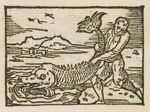
Difficile est de dompter vne femme: La Perrière, Le theatre des bons engins (Lyon, 1545), emblem 96 uses the imagery of a man trying to restrain a dolphin to express that it impossible to control a woman
Iconclass: 25F27(DOLPHIN)(+343) swimming mammals: dolphin (+ tail of an animal) 34E3(+0) animals tied up (+ variant) 43C1151 catching animals 54BB3 Inutility, Noxiousness; 'Nocumento', 'Nocumento d'ogni cosa' (Ripa)
Collectanea (1500): 331
Loci Communes: Inanis opera (Vain effort, Effort vain)
I iv 94 Cauda tenes anguillam You are holding an eel by the tail
Απ᾽ οὐρᾶς τὴν ἔγχελυν ἔχεις. id est. Cauda tenes anguillam. In eos apte dicetur, quibus res est cum hominibus lubrica fide, perfidisque, aut qui rem fugitivam atque incertam aliquam habent, quam tueri diu non possint.
Απ᾽ οὐρᾶς τὴν ἔγχελυν ἔχεις, You are holding the eel by the tail. This comes in appropriately when people have to do with untrustworthy and treacherous men, or have possessions of a fleeting and uncertain kind which they cannot retain for long.
Facsimile:

In deprehensum: Alciatus, Emblemata (Leiden, 1591), emblem 21
Sese terrore tuetur: Zincgreff, Emblematum Ethico-politicorum (Heidelberg, 1619), emblem 8 uses the adage's imagery of eel's slipperiness
La Foy de Femme est de peu de duree: La Perrière, Le theatre des bons engins (Lyon, 1545), emblem 88 uses the imagery of a man trying to hold on to an eel with one hand while holding the hand of a woman with the other, to express that a 'woman's fidelity is quickly lost'
Iconclass: 25F63(+343) eels (+ tail of an animal) 43C1151 catching animals 54BB3 Inutility, Noxiousness; 'Nocumento', 'Nocumento d'ogni cosa' (Ripa)
Loci Communes: Inanis opera (Vain effort, Effort vain)
I iv 95 Folio ficulno tenes anguillam You are holding an eel in a fig-leaf
Huic diversum est illud: τῷ θρίῳ τὴν ἔγχελυν. id est, Folio ficulno anguillam, subaudiendum, tenes. Ubi quis, alioqui fugax & lubricus, arctiore nodo tenetur, quàm possit elabi. Nam fici folium scabrum est, ut cui nomen etiam inditum ab asperitate scripserit Plutarchus: atque ob id ad retinendam anguillam natura lubricam, vel maximè idoneum.
τῷ θρίῳ τὴν ἔγχελυν, (we must supply, You are holding) the eel in the fig-leaf. This is a little different: used when an otherwise evasive, slippery person is held by a grip too tight for him to escape. A fig-leaf has a rough surface, so much so that Plutarch wrote that its name was synonymous with harshness; and for that reason perfectly adapted for keeping hold of a slippery eel.
Facsimile:
In deprehensum: Alciatus, Emblemata (Leiden, 1591), emblem 21
Sero sapiunt Phryges: Whitney, A choice of emblemes (Leiden, 1586), emblem 84
Iconclass: 25F63 eels 25G21(FIG)(+27) fruits: fig (+ leaf) 43C1151 catching animals
Collectanea (1500): 686
Loci Communes: Decretum - in deprehensos (Decree - against those caught in the act, Décret - contre les pris sur le fait)
I iv 96 Medius teneris You are gripped by the middle
Huic sententiae confine est illud apud Aristophanem in Ranis, νῦν ἔχῃ μέσος. id est, Nunc medius teneris, De eo qui sic tenetur, ut extricare sese nulla ratione possit. Translatum à palaestritis atque athletis, qui si quem medium corripuerint, facile vincunt. Sunt autem verba Aeaci ad Bacchum: Αλλὰ νῦν ἔχῃ μέσος. id est, At nunc medius tenere. Eodem pertinet illud apud Terentium: Sublimem medium arriperem.
Close to the previous saying is the remark of Aristophanes in the Frogs: νῦν ἔχῃ μέσος , Now you are held by the middle, of someone held in such a way that he cannot possibly extricate himself. It comes from wrestlers and athletes, who have an easy victory if they have seized someone by the middle. These are the words of Aeacus to Bacchus: 'But now you are held by the middle.' To the same belongs the phrase of Terence, 'I'd catch him round the waist and lift him up.'
Facsimile:
Iconclass: 31A2226 torso 31A2549 gripping someone by other parts of the body
Loci Communes: Decretum - in deprehensos (Decree - against those caught in the act, Décret - contre les pris sur le fait)
I iv 97 Delphinum natare doces You teach a dolphin to swim
Δελφῖνα νήχεσθαι διδάσκεις. id est. Delphinum natare doces. In eos competit, qui monere quempiam conantur in ea re, in qua cum sit ipse exercitatissimus, nihil eget doctore. Nam Delphinus in natando pernicissimi impetus est, ita ut non modo superet omne natatilium genus velocitate, verumetiam terrestrium animantium, ut autor Aelianus lib. xii. Quin & naves transilit, seque contento spiritu, teli in morem eiaculatur.
Δελφῖνα νήχεσθαι διδάσκεις, You teach a dolphin to swim. This fits those who try to give advice to another person on a subject of which he has great experience, and so needs no teacher. The dolphin has the swiftest impetuosity in swimming, so that it not only exceeds in speed every kind of swimming creature, but all land animals too; see Aelianus, book 12. It even leaps over ships, and holding its breath propels itself forward like a missile.
Facsimile:
Iconclass: 25F27(DOLPHIN) swimming mammals: dolphin 31A2773 swimming (movement in water) 34(+7) man and animal (+ exercising, performing animal) 43C221(+11) swimming (sport) (+ training (sports, games, etc.)) 51M11 Swiftness, Speed; 'Agilità', 'Celerità', 'Velocità' (Ripa) 54BB3 Inutility, Noxiousness; 'Nocumento', 'Nocumento d'ogni cosa' (Ripa)
Collectanea (1500): 499
Loci Communes: Inanis opera (Vain effort, Effort vain)
I iv 98 Aquilam volare doces You teach an eagle to fly
Αετὸν ἵπτασθαι διδάσκεις. i. Aquilam volare doces. Diversa metaphora sententiam eandem declarat. Quod enim Delphini inter pisces, id Aquila inter volucres. Quibus id etiam commune, quod uterque παιδεραστὴς esse narratur. Allusisse videtur huc Gregorius in epistola quadam ad Eudoxum rhetorem, Τοὺς πολλοὺς ἔα χαίρειν, καὶ εἶναι κολοιοὺς πτῆσιν ἀετοὺς δοκιμάζοντας, Sine volare vulgus, sine esse graculos, qui volatum aquilarum probent.
'Αετὸν ἵπτασθαι διδάσκεις., You teach an eagle to fly. The same sense comes out of a different metaphor. As the dolphin among fish, so is the eagle among birds. They have one thing in common, that it is said each has a love for boys. Gregory seems to have been hinting at this in a letter to Eudoxus the Rhetor: 'Say farewell to the common herd, consider those to be jackdaws who test the flight of eagles.'
Facsimile:
Iconclass: 25F33(EAGLE) predatory birds: eagle 31A2762 flying 34(+7) man and animal (+ exercising, performing animal) 54BB3 Inutility, Noxiousness; 'Nocumento', 'Nocumento d'ogni cosa' (Ripa)
Loci Communes: Inanis opera (Vain effort, Effort vain)
I iv 99 In eodem haesitas luto You are sticking in the same mud
Terentius in Phormione: In eodem haesitas luto. In eos competit, qui sic implicantur negocio cuipiam, ut se nequeant extricare. A viatoribus translatum, qui simul atque in lutum inciderint, cum alterum pedem conantur educere, altero altius immerguntur. Rursum, ut hunc extrahant, alter quem eduxerant, denuo est infigendus. Eodem alludens Horatius: Nequicquam, inquit, coeno cupiens evellere plantam. Huic simile est, In eodem haesitare vestigo. Quint. Curtius lib. iiii. Tertium diem metu exangues, iam armis suis oneratos in eodem vestigio haerere.
Terence says in the Phormio: 'You are sticking in the same mud.' It applies to those who are so involved in some affair that they cannot extricate themselves. It comes from travellers, when they fall into the mire and try to pull one foot out and the other sinks deeper in; and then to pull this one out, the one they had freed has to be stuck again. Horace says about this: 'Wishing in vain to pluck your foot out of the mire.' Similar to this is 'to stick in the same track': Quintus Curtius, book 4: 'On the third day, livid with fear, weighed down by their arms, they stuck in the same track.'
Facsimile:
Iconclass: 25D26 mud (soil type) 51LL1 Rest, Immobility, Stasis 54BB3 Inutility, Noxiousness; 'Nocumento', 'Nocumento d'ogni cosa' (Ripa)
Collectanea (1500): 44
Loci Communes: Inanis opera (Vain effort, Effort vain)
I iv 100 In aqua haeret He is stuck in the water
Usurpatur huic non dissimile proverbium à M. Tullio lib. Officiorum iii. Dicit ille quidem multa multis locis, sed aqua haeret, ut aiunt. Significat autem Epicurum parum secum in disputando constare, seque ipsum involuere, dum ea quae dicit alibi, pugnant cum iis quae dixit alibi, atque ita quasi fluctuare, neque in solido consistere. Id quod evenire solet iis, qui cum aberrant à vero, verborum fucis rem involuunt. Translatum apparet vel à fluitantibus, qui vado destituti, huc atque illuc iactantur; quoque magis se commovent, hoc maiore periculo laborant. Aut certe ab oratorum clepsydra, de qua memininus alibi, ut eum in aqua haerere dicamus, qui sese destillata iam aqua, tamen è causa non potest expedire. Cic. ad Q. Fratrem lib. ii. Quod idibus & postridie fuerat dictum de agro Campano actum iri, non est actum. In hac causa mihi aqua haeret. Incertum, utrum significet eam actionem integram sibi relinqui, an causam esse inextricabilem. Huc referendum illud, quod paulo superius ex Quintiliano citavimus. Et laboratam, congestamque dierum ac noctium labore actione, aqua deficit. Nec abhorrent ea quae post dicemus in proverbio, Haeret in vado.
A proverb something like this is quoted by Cicero in De officiis, book 3: 'In many passages he has much to say, but he sticks in the water, as the phrase is.' He is describing Epicurus, too little consistent in disputation and getting himself mixed up, so that what he says in one place contradicts what he said in another, and so he floats about, as it were, and never reaches solid ground. This happens to people who wander from the truth and wrap the matter up in deceitful words. It seems to be taken from people floating, who have lost touch with the bottom and are thrown hither and thither; the more they struggle, the greater danger they are in. Or else from the water-clocks of orators, which we have mentioned elsewhere; we say a man 'sticks in the water' when he cannot extricate himself from the case for the defence even when the water has all run out. Cicero to his brother Quintus, book 2: 'What had been said should be done on the ides and the next day about the land in Campania, has not been done. In this case the water sticks for me.' It is uncertain whether he means that the whole lawsuit was left to him, or that the case was incapable of resolution. Here we may place what we quoted previously out of Quintilian: There is not enough water for the speech you have worked on and built up with days and nights of study.' What I shall say later about the proverb 'He is sticking in shallow water' is not dissimilar.
