II ii 1 Tristis scytale A depressing despatch
Αχνυμένη σκυτάλη, id est, Tristis scytale. De re tristi, seriaque dicebatur, aut de nuncio, qui dolorem adferret. Meminit huius Aristophanes in Lysistrata. Refertur à Diogeniano. Quin Aristophanes grammaticum librum conscripsit περὶ τῆς σκυτάλης ἀχνυμένης, citaturque ab Athenaeo libro Dipnosophistarum tertio. Plutarchuns in convivio septem sapientam, τὴν τοῦ αἰθίοπος ἐπίταξιν οὐδὲν ἄντις, ἄλλο, πλὴν ἀχνυμένην σκυτάλην προσείπῃ, id est, Aethiopis mandatum istud, quid aliud appelles, quam scytalam tristem? M. Tullius ad Atticum: Habes scytalam Laconicam. Quod quidem videtur non absurde, vel ad epistolam perbrevem, vel ad obscuram & arcanis de rebus conscriptam, vel ad solicitam ac tristia nunciantem ac mandantem accommodari posse. Quid sit autem Scytale Laconica, docet Aulus Gellius Noctium Atticarum libro decimoseptimo, capite nono. Sed ipsius verba praestiterit adscribere. Lacedaemonii autem, inquit, veteres, cum dissimulare & occultare literas, publice ad imperatores suos missas volebant, ne si ab hostibus exceptae forent, consilia sua noscerentur, epistolas id genus factas mittebant. Surculi duo erant teretes, oblongi, pari crassamento, eiusdemque longitudinis, derasi atque ornati consimiliter. Unus imperatori in bellum proficiscenti dabatur. Alterum domi magistratus, cum iure, atque cum signo habebant. Quando usus venerat literarum secretiorum, circum eum surculum lorum modicae tenuitatis, longum autem quantum rei satis erant complicabant, volumine rotundo, ac simplici, ita ut orae adiunctae undique & cohaerentes lori quod plicabatur coirent. Literas deinde in eo loro per transversas iuncturarum oras, versibus ab imo ad summum proficiscentibus, inscribebant. Id lorum literis ita praescriptis revolutum ex surculo, imperatori commenti illius conscio mittebant. revolutio autem lori literas truncas atque mutilas reddebat, membraque earum & apices in parteis diversissimas spargebat. Propterea si id lorum in manibus hostium inciderat, nihil quicquam coniectari ex eo loco quibat. Sed ubi ille, ad quem erat missum acceperat, surculo compari, quem habebat, capto, ad finem perinde ut debere fieri sciebat, circumplicabat, atque literae per ambitum eundem surculi coalescentes, rursum coibant, integramque & incorruptam epistolam & facilem legi praestabant. Hoc genus epistolae Lacedaemonii σκυτάλην, id est, loricatum surculum, appellant. Hactenus A. Gellius. Meminit huiusce rei Plutarchus in Lysandro: cui Pharnabazus rex supposititia scytala imposuit. Suidas eadem fermè refert, quae Gellius de scytala. Strabo Geographiae lib. 1. hyperbolam hanc quoque commemorat, Ager angustior est, quàm scytala Laconica.
Ἀχνυμένη σκυτάλη, A depressing despatch, was used of anything sad and serious, or of the messenger who brought sadness. Aristophanes mentions this in the Lysistrata. It is recorded by Diogenianus. Indeed Aristophanes the grammarian wrote a treatise On the Depressing Despatch, and it is quoted by Athenaeus in the third book of his Doctors at Dinner. Plutarch in his 'Dinner of the "Seven Sages"': 'As for the request of the king of Ethiopia, what else could one call it except a depressing despatch?' Cicero in a letter to Atticus: 'There's a Spartan despatch for you!' This, I take it, could reasonably be applied to a letter which is either very short, or hard to understand and written on some mysterious subject, or anxious and full of unwelcome news and orders. The meaning of the phrase 'A Spartan despatch' we learn from Aulus Gellius in book 17 chapter 9 of his Attic Nights but it will be better to copy out his own words. The early Spartans/ he says, 'when they wished to conceal and keep secret the contents of a letter sent openly to their generals, so that if it were to be intercepted by the enemy, their plans would not become public, used to send despatches of a special form. They took two round pieces of wood, longer than they were thick, of equal diameter and the same length, polished and finished in the same manner. One of these was given to a general leaving for the field; the other was kept at home officially by the magistrates under seal. When they needed to send an unusually secret message, they rolled round their piece of wood a strip of leather which was fairly narrow and as long as the subject required; they rolled it round and round in one layer, in such a way that the adjacent edges of the leather as it was rolled were in close contact. They then wrote the message on it across the joins in lines running from one end to the other. The leather strip with this writing on it was then unrolled from its piece of wood, and sent to the general, who was in on the secret; but the unwinding of the strip made all the letters formless and imperfect, and spread the lines and dots of which they were made up all over the place. Consequently, if the strip happened to fall into enemy hands, no guess could be made from the leather as to the sense. When however it reached the man to whom it had been sent, he took the identical wooden rod, with which he was provided, and rolled the complete leather round it in what he knew to be the proper way, so that the letters joined up again and came together, the wooden staff being of the same thickness, and so provided a complete and undamaged text of the despatch, which could be read with ease. This type of despatch the Spartans called a skytale, which means a rod with a leather thong round it.' Such is the account in Aulus Gellius. The same thing is mentioned by Plutarch in his life of Lysander, who was imposed upon by King Pharnabazus with a forged skytale. Suidas says much the same of the skytale as Gellius. Strabo in the first book of his Geography also cites an exaggerated use of the idea: 'His property covers less ground than a Spartan despatch.'
Facsimile: 

Iconclass: 46E221:49L32 letter, envelope❧cryptography, secret writing 46E23 sending and receiving postal matter 56BB1 Pain, Sorrow, Sadness; 'Dolore', 'Dolore di Zeusi' (Ripa) 61E(SPARTA) names of cities and villages (SPARTA)
Loci Communes: Tristitia, laetitia (Sadness, joy, Tristesse, joie)
II ii 2 Hirundinum musea Swallow-choirs
Χελιδόνων μουσεῖα, id est, Hirundinum musea. Aristophanes in Ranis: Επιφυλλίδες ταῦτ᾽ ἐστι καὶ στωμύλματα, Χελιδόνων μουσεῖα, λωβηταὶ τέχνης. id est,, Sunt ista folia, & stulta blateramina, Musea hirundinum, artis ac subversio. Interpres admonet, proverbium esse in impendio loquaces, et obstreperos. Hirundines enim inepto garritu plus taedii auditoribus afferre, quam voluptatis. Est enim haec avis minime canora, sed molesto quodam stridore. Unde apud Pythagoricos loquacitatis symbolum esse meruit, cum vetant, ne quis hirundinem sub eodem habeat tecto. Apte dicetur in poetas indoctos, oratores loquaces magis, quam eloquentes, aut in coetum hominum inepte loquacium.
Χελιδόνων μουσεῖα, Swallow-choirs. Aristophanes in the Frogs: 'All leaves, not fruit are they, rank chatterboxes, / Mere swallow-choirs, disgracers of their art.' The scholiast points out that this is a proverb, used of extremely garrulous and obstreperous people; for swallows with their foolish chatter are more tedious than agreeable to listen to, the swallow being a poor songster with a tiresome harsh note. Hence it was thought suitable to be a symbol of loquacity among the Pythagoreans, when they say that no man should keep a swallow under his roof. It can be fitly applied to bad poets, speakers with more verbiage than eloquence, or any gathering of people who never stop talking.
Facsimile:
Contre les brocardeurs: Corrozet, Hecatomgraphie (Paris, 1540), emblem 4 uses the imagery of the noisy swallow
Iconclass: 25F32(SWALLOW)(+441) song-birds: swallow (+ herd, group of animals) 25F32(SWALLOW)(+49) song-birds: swallow (+ audible means of communication of animal(s): roaring, crying, singing, barking, mewing, neighing, chirping, etc.) 52D4 Prolixity, Verbosity, Loquacity; 'Loquacità' (Ripa)
Loci Communes: Garrulitas (Talkativeness, Bavardage)
II ii 3 Lusciniae nugis insidentes Nightingales perching on trifles
Ανδόνες λέσχαις ἐγκαθήμεναι, id est, Lusciniae nugis insidentes. Proximum illud ad imperitos, et tamen garrulos convenit, hoc ad eruditos, qui tamen immodice suo studio delectentur. Quod genus sunt poetae potissimumum. Plaut. in Bacchid. ad puellam transtulit, Metuo, inquit, ne lusciniolae defuerit cantio. Quanquam in Graeco proverbio iocosa depravatio videtur inesse, ut pro λόχμαις dictum sit λέσχαις. Sumptum est autem ab incredibili canendi tum studio, tum arte, quae huic aviculae tribuitur. Siquidem, ut narrat Plin. lib. 10. cap. 29. diebus ac noctibus quindecim continuis citra intermissionem canit, desante se frondium germine. Multis nominib. admiratione digna avis. Primum tanta vox in tam paruo corpusculo, tam pertinax spiritus: deinde in una perfecta musicae scientia. Modulatus editur sonus: & nunc continuo spiritu trahitur in longum, nunc variatur inflexo, nunc distinguitur conciso, copulatur intorto, promittitur, revocatur, infuscatur ex inopinato (interdum & secum ipsa murmurat) plenus, gravis, acutus, creber, extentus, ubi visum est, vibrans, summus, medius, imus. Breviter, omnia tam parvulis in faucibus, quae tot exquisitis tibiarum tormentis ars hominum excogitavit. Ac ne quis dubitet artis esse, plures singulis sunt cantus, & non idem omnibus, sed suus cuique. Certant inter se, palamque animosa contentio est: Victa morte finit saepe vitam, spiritu prius deficiente quàm cantu. Meditantur aliae iuniores, versusque quos imitentur accipiunt. Audit discipula intentione magna & reddit, vicibusque reticent. Intelligitur emendatae correctio, & in docente quaedam reprehensio. Haec & alia nonnulla de lusciniarum cantu refert Plinius, quo diximus loco.
Ἀνδόνες λέσχαις ἐγκαθήμεναι, Nightingales perching on trifles. The preceding adage was appropriate for people who, though uneducated, are always talking; this one is for learned men too much in love with their own favourite subjects, a class of which poets are prominent members. Plautus in the Bacchides transfers it to a young woman: 'I fear' he says 'the nightingale will forget her song.' Though it looks as if there were a corruption, introduced by some humourist, in the Greek proverb, and leschais, trifles has been put for lochmais, thickets. This derives from the incredible passion for singing, and the equally great skill, attributed to this small bird. As Pliny recounts in book 10 chapter 29, 'for fifteen days and nights on end she sings without giving over, when the leaves are opening and growing thick.' On many counts this bird earns our admiration. To begin with, 'such a volume of song from so small a body, and such unbroken power of breath; and then the perfect knowledge of music in one individual. The sound as it issues is all modulations, at one moment drawn out to great length with no pause for breath, at another varied by changes of pitch, punctuated by quick breaths, linked by trilling, withdrawn with promise of more to come or becoming husky unexpectedly. Sometimes she seems to murmur to herself alone, sometimes the note is full; it is low or high, repeated or prolonged, as she thinks fit, or vibrating; high, middle and low. In a word, in that tiny throat is all the technique which human skill has devised for the exquisite complications of the flute. And no one need doubt whether this is the result of skill; for each individual bird has more than one song, nor do they all have the same song, but each has its own. They compete among themselves, and the rivalry is passionate and undisguised; the defeated bird is often content to die and still sings with its last breath. Others, the younger ones, practise, and are given musical phrases for them to reproduce. The pupil listens with close attention and repeats, and then by turns they are silent; the improvement in the bird which has been corrected is unmistakable, and so is an air, as it were, of disapproval in the teacher.' This and more on the nightingale's song is recorded by Pliny in the place I spoke of.
Facsimile: 
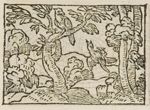
Pour tout sçauoir il ne se fault tuer: La Perrière, Le theatre des bons engins (Lyon, 1545), emblem 34 uses the imagery of the nightingale exhausting itself to express the danger of excess run by poets and scholars
Melior doctrina parentum: De la Feuille, Devises et emblemes anciennes et modernes (Augsburg, 1697), emblem 309
Iconclass: 25F32(NIGHTINGALE)(+49) song-birds: nightingale (+ audible means of communication of animal(s): roaring, crying, singing, barking, mewing, neighing, chirping, etc.) 48C91 writer, poet, author 49C31 group of scholars or philosophers 52D4 Prolixity, Verbosity, Loquacity; 'Loquacità' (Ripa)
Loci Communes: Garrulitas (Talkativeness, Bavardage)
II ii 4 Asinus portans mysteria An ass that bears the mysteries
Ονος ἄγων μυστήρϊα, id est, Asinus portans mysteria. In eum dicebatur, qui praeter dignitatem in munere quopiam versabatur. Veluti, si quis ignarus literarum, bibliothecae praefectus esset. Aristophanes in Ranis: Νὴ τὸν δι᾽ ἐγώ γ᾽ οὖν ὄνος ἄγων μυστήρϊα. Ατὰρ οὐ καθέξω ταῦτα τὸν πλείω χρόνον. id est, Ita per Iovem sum asinus vehens mysteria. Verum ista non iam sustinebo diutius. Interpres affirmat inde natum adagium, quod olim quibus ad peragenda sacra Eleusinia opus erat, asino imposita deportabantur. Quadrabit & in eos, quorum opera aliis duntaxat est usui, cum ad ipsos praeter molestiam nihil interim redeat. Veluti si quis cibos aliis gestet, quibus ipsi non liceat vesci. Huc allusisse videtur Apuleius, cum se fingit asinum Cererem deam circumferetem. Suidas adscribit Daemonem ad lapidem molarem referre, quem Graeci ὄνον appellant. propterea quod in sacris, molis frumentariis coronas imponere consueverint. Itaque torquebitur eleganter in eos, quibus immerentibus honos habetur. Veluti cum indoctis doctoris titulus, pileum & anulus, aliaque id genus insignia tribuuntur.
Ὄνος ἄγων μυστήρϊα, An ass that bears the mysteries, was said of a man who occupied a more important office than he deserved - someone, for example, of no education made head of a library. Aristophanes in the Frogs: 'God knows, an ass that bears the mysteries / Am I; but I'll not carry them much longer.' The scholiast declares that the adage took its rise from the practice of loading an ass with the objects that had in the old days to be taken to Eleusis for the celebrations. It will also suit those who labour solely for the advantage of other people, while they themselves get nothing but trouble meanwhile, a man for example who carries food for others of which he is not allowed to partake himself. It looks as though Apuleius were alluding to this when he makes himself out to be an ass carrying the goddess Ceres round the district. Suidas adds that Demon referred it to the upper millstone, which is called onos, donkey, in Greek, because it was a Greek custom at festivals to decorate their grain-mills with garlands. So to divert this to men who enjoy honours they do not deserve will have an elegant effect, as for instance when ignorant men are given the title, bonnet and ring of a doctor and similar distinctions.
Facsimile:
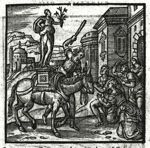
Non tibi sed religioni: Alciatus, Emblemata (Padua, 1621), col. 49 a, emblem 7
Non tibi sed religioni': Alciatus, Emblemata (Leiden, 1591), emblem 7
Non tibi sed religioni: Alciatus, Emblemata (Paris, 1534), emblem 35
Ehrsucht - Ambitio: Murer, XL Emblemata (Zürich, 1622), emblem 8
Ignorance esleuee, & Science abbaissee: La Perrière, Le theatre des bons engins (Lyon, 1545), emblem 13 uses the imagery of an ass to express the connection of asininity and high office
Iconclass: 12E84(ELEUSIS) Eleusinian mysteries, in honour of Demeter 13C3 magic objects and 'apotropaia' 46C13142(+75246):12B63 ass, donkey (+ animal(s) carrying something)❧statues, paintings, etc. ~ objects of worship (non-Christian religions) 57AA641 Immodesty 57A65 Unselfishness
Loci Communes: Dissimilitudinis et incongruentiae (Dissimilarity and incongruity, Dissemblance et incongruité)
II ii 5 Iterum tranquillitatem video Again I spy a calm
Αὖθις αὖ γαλην᾽ ὁρῶ. id est, Rursum denique tranquillitatem adspicio. Aristophanes interpres proverbium esse scribit, quo nos significamus è malis emergere, fortuna in melius commutata. A navigantibus ducta metaphora, quibus conquiescente procella, grata solet esse tranquillitas. Aristophanes in Ranis, Εξεστι δ᾽ ὥσπερ ἡγέλοχος ἡμῖν λέγειν, Εκ κυμάτων γὰρ αὖθις αὖ γαλην᾽ ὁρῶ. id est, Ut Hegelochus nobis item fas dicere, Tranquillum ab undis, rursus iterum conspicor. Hegelochus erat histrio quispiam tragoediarum, ne quem vox ignota remoretur. Notat autem obiter Aristophanes Euripidis ταυτολογίαν, apud quem hic versus est in Oreste, Αὖθις αὖ γαλην᾽ ὁρῶ. quam eandem irrisit etiam Stratis. Quanquam videtur & allusio subesse in Graecanicis verbis γαλην᾽ ὁρῶ, id est, felem video, et γαλην᾽ ὁρῶ, id est, tranquilla video. Atqui vicissim Euripides apud eum comicum Aeschylum. taxat, qui bis idem dixerit, in hisce versibus, Δὶς ταυτὸν ἡμῖν εἶπεν ὁ σοφὸς αἰσχύλος, Ηκω γὰρ εἰς γῆν φησὶ, καὶ κατέρχομαι. Νὴ τὸν δί᾽, ὥσπερ εἴτις εἴποι γείτονι, Χρῆσον σὺ μάκτραν, εἰ δὲ βούλει, κάρδοπον. id est, Sapiens bis idem est nobis locutus Aeschylus. Ad terram enim, inquit, venio & accedo. velut Si per Iovem, vicino ita quis dicat suo: Mactram aut canistrum, si libet, mihi commoda. Pindarus in Isthmiis, Αλλὰ νῦν μοι γαιάοχος εὐδίαν ἄππασσεν ἐκ χειμῶνος. id est, Sed nunc Neptunus mihi tranquillitatem praebuit ex tempestate.
Αὖθις αὖ γαλην᾽ ὁρῶ, Again I see a calm. The scholiast on Aristophanes says this is a proverb, by which we convey that we are emerging from our troubles, our luck having taken a turn for the better. The metaphor derives from sailors, who normally welcome a calm when the storm has blown over. Aristophanes in the Frogs: 'For we can say, as said Hegelochus, / Calm after storm again, again I spy.' Hegelochus was the name of an actor who performed in tragedy, so no one need be held up by the unfamiliar word. Aristophanes criticizes in passing Euripides' habit of saying the same thing twice, for in the Orestes he has the words 'A calm again, again I spy.' The same fault was also made fun of by Strata's. Though a play on words also seems to underly the Greek, between galen hard, I see a weasel, and galen' horo, I see a calm. And yet in the same comic poet Euripides in his turn criticizes Aeschylus for repeating himself, in these lines:
Your clever Aeschylus said the same thing twice: Back to this land I come and I return.'
Why, sure enough, it's just as one might say
Lend me a kneading-trough or, if you like, a dough-trough.'
Pindar in the Isthmians: 'But now the Earth-shaker has sent me calm in place of storm.'
Facsimile:
Iconclass: 26C9 absence of wind, calm 31A31 sight, looking (one of the five senses) 51B61 Repetition 54F12 Luck, Fortune, Lot; 'Fato', 'Fortuna', 'Fortuna aurea', 'Fortuna buona', 'Fortuna pacifica overo clemente', 'Sorte' (Ripa)
Loci Communes: Taedium ex iteratione (Tedium from repetition, Lassitude due à la répétition)
II ii 6 In tranquillio est In calm water
Ad hanc formam pertinet Terentianum illud ex Eunucho, Tum autem Phaedriae meo fratri gaudeo esse amorem in tranquillo. Item illud, Qui te in scopulum è tranquillo auferat. Et quod alibi diximus, Ego in portu navigo. Item illud, In terra sunt. Eadem autem loquutionis specie dicimus, In tranquillo, qua dicimus In tuto, in proclivi.
To the same formula belongs a phrase of Terence in the Eunuchus: Then I'm so glad my brother Phaedria's passion is in calm water.' And again: To sweep you from calm water on the rocks'; and an expression of which I have treated elsewhere: 'I navigate in harbour.' And another:3 They are on dry land.' The phrase 'In calm water' is of the same type as 'In safety' and 'Downhill work.'
Facsimile:
Iconclass: 26C9 absence of wind, calm 54A46 Rest; 'Quiete' (Ripa) 54D5 Safety
Collectanea (1500): 542
Loci Communes: Securitatis et tutae rei (Security and safety, Sécurité et sûreté)
II ii 7 Septennis cum sit, nondum edidit dentes He's seven years old, and not yet cut his teeth
Επταετὴς ὢν ὀδόντας οὐκ ἔφυσεν. id est, Cum sit septem natus annos, nondum tamen dentes produxit. Aristophanis interpres admonet proverbio dici solere. Mihi quadrare videtur in eum, qui natu grandis, tamen adhuc quasi puerum agit. Aut qui diu commoratus alicubi, nihil adhuc autoritatis aut honoris sit assecutus. Metaphora mutuo sumpta videtur ab infantibus, quibus circiter annum aetatis septimum, omnes dentes soleant enasci. Aristophanes in Ranis; Σκώψωμεν ἀρχίδημον, Ος ἑπτὲτης ὤν, οὐκ ἔφυσε φράτορας, id est, Taxemus Archidemum, Septennis hic nondum tribules aedidit. Ubi poeta, captans iocandi occasionem, pro ὀδόντας, φράτορας, mutavit. Taxat enim obiter Archidemum quempiam, qui morem Atheniensium neglexerat, apud quos hospes septem annos in ea versatus civitate, in civium numerum adscriptus, iam velut in cognationem, ac ius illorum asciscebatur.
Ἑπταετὴς ὢν ὀδόντας οὐκ ἔφυσεν, Though he is seven years old, he has not yet cut any teeth. The scholiast on Aristophanes points out that this is in common use as a proverb. It seems to me to suit a man who, although already grown up, still behaves like a child, or who has lived in a place for a long time without as yet acquiring any influence or reputation. The image seems to be borrowed from small children, who as a rule cut all their teeth about by the time they reach their seventh year. Aristophanes in the Frogs: 'Shall we make fun of Archidemus, who after seven years has still not acquired a set of clansmen?' - where the poet, to secure his jest, has substituted 'clansmen' for 'teeth'. He is poking fun in passing at a certain Archidemus, who had failed to observe the Athenian custom, which prescribed that a foreigner who had spent seven years in the city was added to the register of citizens and was co-opted, as it were, into the enjoyment of kinship and civic rights.
Facsimile: 
Iconclass: 31D11221 boy (child between toddler and youth) 31D30(+0) 0-10 years (+ variant) 42A562 child shedding its teeth 49D11(7) numerals: 7 51F511 Immaturity
Loci Communes: Multi - in stupidos (Many people - against the stupid, Beaucoup de gens - contre les sots)
II ii 8 De pulchro ligno vel strangulare If you must be hanged, let it be on fair gallows
Απὸ καλοῦ ξύλου κᾂν ἀπάγξασθαι. id est, De pulchro ligno etiam strangulari convenit. Admonet paroemia, calamitatem tolerabiliorem esse, si cum honestate fuerit coniuncta, & dedecore vacaverit. Veluti, si virgo vitietur à generoso ac praedivite amante. Aristophanes in Ranis ad proverbium alludens: Εξ ἀξίου γοῦν του ξύλου Ην τι καὶ πάσχητε, πάσχεν τοῖς σοφοῖς δοκήσετε. id est, Digno si quid è ligno rei Perferetis, ferre cordatis videbimini viris. Quasi minus miserum sit suspendium, si ex arbore pendeat insigni. Circumfertur huic simillim um proverbium etiam hodie apud nostrates: Si demergendus sim, in aqua pura me demergam: hoc est, si pereundum est, honesta morte perire satius. Aut si peccandum, honestiore peccandum titulo. Potest referri & ad eos, qui vincuntur quidem, sed à victore tam insigni, ut honestius, et optabilius videatur sic vinci, quam alios quosdam vicisse. Unde est Virgilian um illud: Aeneae magni dextra cadis. Et apud Ovidium, Aiax pudendum sibi putat cum Ulysse vel certasse, etiam si victor discesserit. Mecum, inquit, certasse feretur. Item apud Homerum Iliados φ. ad hunc modum loquitur Achilles, Ως μ᾽ ὄφελ᾽ ἕκρωρ κτεῖναι ὅς ἐνθάδε τέτραφ᾽ ἄριστος Τῷ κἀγαθὸς μὲν ἔπεφν᾽ ἀγαθὸν δέκεν ἐξενάριξε Νῦν δὲ μελευγαλέῳ θανάτῳ ἥμαρτο ἁλῶναι. id est, O si me necet, huc qui egit fortissimus Hector, Tum gnavus gnavi victus virtute perirem. Nunc me fata volunt obscura morte perire. Pindarus in Pythiis hymno tertio, non dissimili sensu dixit καλὸν πῆμα, id est, pulchra noxa: de Ixione loquitur, qui deceptus imagine Iunonis sibi paravit exitium.
Απὸ καλοῦ ξύλου κᾆν ἀπάγξασθαι, literally, From a fair gallows it is fitting even to be hanged. The message of the proverb is that calamity is easier to bear, if it has honourable associations and is free from disgrace; if, for instance, a girl is ravished by a lover who is well-born and very rich. Aristophanes alludes to the proverb in the Frogs, when he says: 'At least you'll be thought by the clever to suffer, / If suffer you must, on a suitable tree/ as though it were less lamentable to be hanged, if you hang on an exceptional tree. A proverb very like this is in circulation today among my fellow-countrymen: If I must be drowned, drown me in clear water, meaning that if one must die, it is better to die an honourable death, or if one must sin, to sin with a more or less honourable excuse. It can also be applied to those who are defeated, but lose to a winner of such distinction that it might be thought more honourable and more desirable to lose on such terms than to defeat other possible competitors. Hence that phrase in Virgil: Tis great Aeneas' hand by which you fall.' And Ajax in Ovid thinks it discreditable for him so much as to compete with Ulysses, even if he is to come off the victor; 'He will win renown,' he says, 'from having fought with me.' In Homer too, in book 21 of the Iliad, Achilles speaks as follows: 'O that I had been slain by Hector, the most valiant native of this land! A brave man would have killed me, and found a victim no less brave. But now I am fated to die a wretched death.' Pindar, in the third hymn of his Pythians, uses in a not dissimilar sense the phrase καλὸν πῆμα, precious bane; he speaks of Ixion, who was deceived by a phantasm of Juno and brought about his own destruction.
Facsimile:
Iconclass: 33C49 rape, violation 44G321(GALLOWS):51D4 instruments of torture, execution or punishment: gallows❧Beauty; 'Bellezza' (Ripa) 46A12 nobility and patriciate; chivalry, knighthood 55B1 Wealth, Opulence; 'Opulenza', 'Richezza' (Ripa) 59B31:56BB21 Honour, Glory; 'Ampiezza della Gloria', 'Gloria', 'Gloria de prencipi', 'Gloria & Honore', 'Honore', 'Sublimatà della Gloria' (Ripa)❧Calamity, Distress; 'Calamità', 'Calamità o miseria' (Ripa)
Loci Communes: Exitium honestum (An honorable ruin, Une perte honorable)
II ii 9 Non Chius sed Cius From Ceos he, not Chios
Didymus proverbium subesse putat in his Aristophanis verbis: οὐ χὶος ἀλλὰ κῖος. i. Non Chius, sed Cius, propter vulgato scommate notatam gentis inconstantiam, ac volubilitatem, pro temporis ratione commutantis institutum, ac idem ad fortunae commoditatem accommodantis. Aristophanis carmina è Ranis sunt haec, in Theramenem: Πέπτωκεν ἔξω τῶν κακῶν, οὐ χῖος ἀλλὰ κῖος. id est, Evolavit è malis, haud Chius, sed Cius. Quanquam hoc loco Aristarchus Cous legit, non Cius. Theramenes enim Cous fuisse dicitur. Fortassis allusum ad id, quod is Theramenes fuerit Prodici Coi discipulus. Huius mentionem facit & Lucianus in Amoribus ὤστε ἔγωγε ἄν εὐξαίμην, εἴπερ ἦν ἐν δυνατῷ, γενεσθαι θηραμένης ἐκεῖνος ὁ κόθορνος. id est, Itaque & ipse quoque, si fieri possit, optarim Theramenes fieri ille cothurnus. Nisi forte allusum est ad vocum affinitatem, cum res longe discrepet. Nam Chii male audiebant ob mores effoeminatos, cum Cii nec tibicinas, nec meretrices reciperent in civitatem, ut indicat Athenaeus libro 13. Itaque qui pauloante nugator, mox veluti alius sumat vultum tetricum, in hunc recte dicetur: οὐ χῖος ἀλλὰ κῖος. Aristarchus qui legit Cous, videtur ad taxillorum lusum spectasse, in quo iactus qui Cous dicitur, habebat sex: Chius unum duntaxat. Itaque Cous felicior erat iactus. Quo dicto indicat Theramenem nunquam infeliciter consuluisse. Eupolis qui legit Cius, putat Theramenem ascitum in Ciorum civitatem, cum natus esset Cous. Didymus tamen effert proverbium, οὐ χῖος ἀλλὰ κῖος, ut mutatio nominis indicet hominis versatile ingenium ac tempori serviens, semper ad potiorem partem sese accommodans. Huiusmodi fermè referuntur in commentariis eius fabulae. Porrò de cothurno diximus alibi.
Didymus thinks that a proverb underlies this phrase in Aristophanes: οὐ Χῖος ἀλλὰ Κῖος, From Ceos he, not Chios, on account of the notorious fickleness and instability of the inhabitants, for the way they changed their policy in accordance with their circumstances and adapted their pledged faith to their varying fortunes was a subject for common abuse. Aristophanes has these lines in the Frogs in an attack on Theramenes: 'He has thrown himself clear of his troubles; from Ceos he, not Chios.' Though in this passage Aristarchus read Cos for Ceos, because Theramenes is said to have come from Cos. There is perhaps an allusion to the fact that this Theramenes was a pupil of Prodicus of Ceos. He is also mentioned by Lucian in his Amores: 'So I at least would wish, if it were possible, to become Theramenes, called the cothurnus [buskin].' Unless perhaps this alludes to the relationship between the names, although the underlying things are very different; for the Chiots had a bad reputation for effeminate behaviour, while the people of Ceos admitted no flute-players and no prostitutes into their city, as Athenaeus testifies in book 13. If therefore we have a man who not long ago was a worthless fellow and now, as though he had become a different person, assumes a puritanical expression, we shall rightly say of him 'From Ceos he, not Chios.' Aristarchus, who read 'from Cos,' seems to have been thinking of the game of dice, in which what they called the Coan throw was worth six and the Chiot only one. The Coan throw was therefore more profitable, and he suggests by this remark that Theramenes' policy always paid off. Eupolis, who reads 'of Ceos,' thinks that Theramenes was a naturalized citizen of Ceos, though born a Coan. Didymus however gives the proverb, in the form 'From Ceos he, not Chios,' to make the change of name convey the man's slippery and time-serving character, always adapting himself to the winning side. This is very much what is given in the scholia on the play. Besides which, I have spoken of the cothurnus or buskin elsewhere.
Facsimile: 
Iconclass: 53AA21 Inconstancy; 'Incostanza', 'Instabilità', 'Instabilità overo Incostanza' (Ripa) 61D(CEOS) geographical names of countries, regions, mountains, rivers, etc. (CEOS) (CEOS) 61D(CHIOS) geographical names of countries, regions, mountains, rivers, etc. (CHIOS) (CHIOS)
Loci Communes: Inconstantiae, perfidiae, versutiae (Inconstancy, treachery, cunning, Inconstance, perfidie, ruse)
II ii 10 Extra oleas Beyond the olive-trees
Εκτὸς τῶν ἐλαιῶν φέρεται. i. Extra oleas fertur. ubi quis terminos praescriptos transgreditur, aut aliena, nec ad rem pertinentia facit, dicitve. Aristophanes in Ranis: Μὴ δὲ ὁ θυμὸς ἁρπάσας Εκτὸς οἴσε τῶν ἐλαιῶν. id est, Ita nec te concitum rapiat extra olivas. Interpres adagium hinc natum ait, Stadia in quibus currendi certamina peragebantur, oleis per seriem positis, utrinque sepiebantur, quas praeterire non licebat: proinde, qui praeteriisset oleas, extra stadium currere videbatur.
Ἐκτὸς τῶν ἐλαιῶν φέρεται, He runs beyond the olive-trees. When a man oversteps the prescribed limits, or does or says irrelevant things which have no connection with the matter in hand. Aristophanes in the Frags: 'Do not let passion seize you and carry you beyond the olive-trees.' The scholiast gives the following source for the adage. The running-track on which footraces were contested was bounded on both sides by olive-trees planted in rows, which it was not permitted to cross; and anyone who had 'gone beyond the olives' was held to be running outside the limits of the course.
Facsimile:
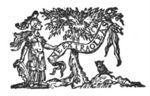
Ne extra oleas: Printer's device 0439
Ne extra oleas: Printer's device 0440
Ne extra oleas: Printer's device 0479
Ne extra oleas: Printer's device 0481
Ne extra oleas: Printer's device 0482
Ne extra oleas: Printer's device 0615
Ne extra oleas: Printer's device 0620
Ne extra oleas: Printer's device 0699
Ne extra oleas: Printer's device 0707
Iconclass: 25G3(OLIVE-TREE) trees: olive-tree 43C211 running, race 51I1 Limited, Defined Space
Loci Communes: Aliena a re (Irrelevant to the matter, Étranger au sujet); Dissimilitudinis et incongruentiae (Dissimilarity and incongruity, Dissemblance et incongruité)
II ii 11 Coronam quidem gestans, caeterum siti perditus Wearing a garland, yet destroyed by thirst
Στέφανον μὲν ἔχων, δίψῃ δὲ ἀπολωλώς. id est, Coronam quidem gestans, ceterum siti perditus: In temulentum, et lurconem apte torquebitur, quique obligurita re, redactus sit ad inopiam. Aristophanes im Equitibus: Ωσπερ Κοννᾶς, στέφανον μὲν ἔχων αὖον, δίψῃ δ᾽ ἀπολωλώς, id est, Quemadmodum Connas coronam quidem gestans aridam, verum siti perditus. Taxat autem Cratinum comicum tanquam ebriosum ac delirantem. Effertur adagium & ad hunc modum apud Diogenianum, Δελφὸς ἀνὴρ στέφανον μὲν ἔχων, δίψῃ δ᾽ ἀπολωλώς. id est, Vir Delphus cum portet serta, siti exanimatur. Natum est à moribus Connae cuiusdam. Is primum erat tibicen vinosus, atque in conviviis assidue coronatus potabat. Nam priscis mos erat in compotationibus coronas gestare. Deinde è tibicine factus est Olympionices, atque in Olympiis saepe victor coronam tulit unde Cratinus eum πολυστέφανον vocat. Alioqui pauperrimus, neque tantillo ditior factus suis victoriis. Nihil enim habuisse fertur, praeter oleastrum.
Στέφανον μὲν ἔχων, δίψῃ δὲ ἀπολωλώς, Wearing a garland, yet destroyed by thirst, will be aptly diverted to a drunkard and a glutton, and one who has wasted his property in riotous living and is reduced to penury. Aristophanes in the Knights: 'Like Connas, wearing a withered garland, yet destroyed by thirst.' He is criticizing Cratinus the comic poet for being drunk and crazy. The adage is also given by Diogenianus in this form: 'A Delphian with a garland on his head, destroyed by thirst.' It took its rise from the character of a man called Connas, who at first was a drunken flute-player, and spent his time drinking constantly at parties with a garland on his head; for it was an ancient custom to wear garlands at drinking-parties. He then abandoned the flute, and emerged as an Olympic victor, often wearing the garland as a victor at the Olympic games. This led Cratinus to call him 'the many-crowned,' although in every other respect he was desperately poor, and not a scrap better off for all his victories; for beside his wild-olive, they say, he had nothing.
Facsimile:
Iconclass: 31B52 drunkenness 41C129 thirst 43A(+12) festivities (+ wreath, garland ~ festive activities) 48A41(+0) honouring the artist with laurel wreath (+ variant) 48C72 musician 48C7351(+1) flute, aulos, tibia (+ artist at work) 55B2 Luxury, Luxuriousness 98B(CONNAS) male persons from classical history (CONNAS)
Loci Communes: Luxus et mollicies (Luxury and softness, Luxe et mollesse)
II ii 12 Aphya in ignem Whitebait on the fire
Αφύα ἐς πῦρ, id est, Aphya ad ignem. Proverbium in ea, quae celeriter intereunt, aut absumuntur, sive quae facile, ac statim conficiuntur. Nam Aphya piscis genus candidum, molle, ac tenerum, quod admotum igni protinus decoquitur. Unde meretrices aliquot aphyas dictas indicat Athenaeus lib. 13. quod essent candidae, graciles, & oculis praegrandibus. Talis enim apua. Frigitur autem in oleo ferventi: unde fertur & illud apud Graecos, ἀφυῶν τιμὴ ἔλαιον. id est, Aphyarum honor oleum: ac protinus, ut contigerunt oleum fervens, iam decoctae sunt, adeo ut ilico cum oleo stridant, statimque percoctae tollantur è patella. Hunc piscem Suidas scribit etiam ἄφρον, id est, spumam appellari, propter candorem, & ἐγγραυλιν, complura commemorans eius genera. Athenaeus libro septimo quibusdam & ἀφρύνη dici, nimirum à spuma, & ob id Veneri sacrum, quod eam poetarum fabulae gignant è spuma maris. Idem eorum, quae supra diximus, Clearchum adducit autorem, addens & ad hunc modum efferri paroemiam, ϊδε πῦρ ἀφύα id est, Aphya vidit ignem. Quasi vidisse modo sufficiat ad decoctionem. Itaque si puella iam nubilis statim sponso viso incalescat, conveniet ϊδε πῦρ ἀφύα. Non dissimile ei quod alibi recensuimus, τὸν ἵππον εἰς πεδίον id est, Equum in planiciem.
ἈΑφύα ἐς πῦρ, Whitebait on the fire. Proverbial for things which perish or are consumed rapidly, or are easily and quickly disposed of. Whitebait are a kind of fish, white in colour, soft and delicate, which cooks very rapidly when brought near the fire. Hence, according to Athenaeus, book 13, some courtesans 'were called whitebait, because like whitebait they were white and slender and had very large eyes.' They are fried in boiling oil, and so there is another phrase in Greek, ἀφυῶν τιμὴ ἔλαιον, Oil is an honour to whitebait; and the moment they touch the boiling oil they are cooked, so that they and the oil at once begin to splutter, and they are instantly fried through and lifted from the pan. Suidas tells us that these fish are also called aphros, which means foam, being so white, and also engraulis, anchovies, and he lists many sorts. Athenaeus, book 7, tells us that some called them aphrye, a name derived of course from the word for foam, and they were therefore sacred to Venus because poets' tales make her born from sea-foam. As the authority for what I have said above he adduces Clearchus, adding that the proverb was also used in the form Ἴδε πῦρ ἀφύα, The whitebait has seen the fire, as though to have set eyes on the fire were enough to cook it properly. So if a girl of marriageable age falls in love the moment she sees her intended husband, The whitebait has seen the fire' will be an apt comment. It is not unlike one I have recorded elsewhere: The horse to the plain.
Facsimile:
Iconclass: 25F62(WHITEBAIT) bony fishes (WHITEBAIT) 33C218 awakening love 41C2541 open fire, fire-place, stove (in kitchen) 51GG4 Softness (matter) 51M11 Swiftness, Speed; 'Agilità', 'Celerità', 'Velocità' (Ripa) 54AA72 Vulnerability
Loci Communes: Festinationis (Haste, Hâte)
II ii 13 Boliti poenam A penalty for turds
Βολίτου δίκην. id est, Boliti poenam dicunt, ubi quis de re frivola nihilique plectitur. Bolitus autem Graecis significat stercus quodvis, sed proprie bubulum. Porrò Solon legem tulit, quae poenam minabatur etiam iis, qui bubulum stercus furto sustulissent. Huc allusit Aristophanes in Equitibus: Τοῖς βολίτοις ἡττομενος. id est, Bubulis stercoribus victus. Hesychius putat Graecis idem βόλβιτον & βόλιτον, nisi quod prius illud Ionum sit peculiare: Idem indicat Etymologus. Sic autem appellari bovis excrementa, quod liquidiora sint quam caeterorum animantium: citat autem & Hipponactem, qui βολίτου κασιγνήτην dixerit foeminam opinor, extreme contemptam. Et βολίτινον velut è bubulo stercore conflatum. Cynulcus apud Athenaeum libro 13. ἀλλὰ βολίτινον ἔχων θάτερον σκέλος. id est, Sed è bubulo stercore conflatum habens alterum crus. In Phrysiorum agris videre est do mos bolitinis parietibus, in aliis bubulum stercus ad ignis materiam siccari. Quin & hodie nostrates, quem insigniter contemnunt, βόλιτον appellant.
Βολίτου δίκην, A penalty for turds, is used when someone is punished for some trifling offence of no account. Bolitus in Greek means excrement of any kind, but properly the droppings of cattle. Solon in fact passed a law, threatening penalties even for the theft of cow-dung. Aristophanes alludes to this in the Knights: 'Worsted by cattle-dung.' Hesychius thinks there was no distinction in Greek between bolbitos and bolitos, except that the former is an Ionic word; and the Etymologicum makes the same suggestion, saying that the word is used for the droppings of cattle, because they are more liquid than those of other animals. He also cites Hipponax, who used the phrase 'turd's own sister' of a woman for whom no doubt he felt the greatest contempt, and a word bolitinos to mean 'composed of cow-dung.' Cynulcus in Athenaeus, book 13: 'But with one leg made of cattle-dung.' In the countryside in Friesland one can see cottages with walls made of manure, and in others piles of cow-dung drying for use as fuel. In our own day my countrymen still apply the word 'shit' to a man they particularly despise.
Facsimile: 
Iconclass: 44G3 criminal law; punishment 47I2112(+94591) cow (+ excrement, dung of animal(s))
Loci Communes: Calumnia (Slander, Calomnie); Ultio malefacti (Vengeance for a wrongdoing, Vengeance d'un méfait)
II ii 14 Haud unquam arcet ostium The door is never barred
Οὐδέποτ᾽ ἴσχει ἡ θύρα. id est, Haud unquam arcet ostium. Interpres Aristophanis paroemiam admonet esse de iis, qui impendio sunt hospitales, quorum fores semper patentes neminem excludunt. Sumptum ait ex Eupolidis comoedia, cui titulus φίλοι. Eleganter accommodabitur, vel ad credulum, qui quodvis mendacium admittat auribus, vel in mulierem nulli negantem.
Οὐδέποτ᾽ ἴσχει ἡ θύρα, The door is never barred. The scholiast on Aristophanes says this is a proverbial expression for any very hospitable people, whose door is always open and turns no one away. He says it is taken from a comedy by Eupolis called Friends. It will be neatly adapted either to a credulous man, whose ears are always open to any falsehood, or to a woman who never says no.
Facsimile:
Iconclass: 41A3211 open door 59A5 Hospitality; 'Hospitalità' (Ripa)
Loci Communes: Hospitalitas (Hospitality, Hospitalité)
II ii 15 Semper aliquis in Cydonis domo There's always someone in Cydon's house
Αεί τις ἐν κύδωνος, Semper aliquis in Cydonis domo. Cydon Corinthius quispiam erat, adeo insignis hospitalitate, ut etiam proverbio locum fecerit. Refertur à Suida pariter & à Zenodoto, neque non ab Aristophanis interprete. Haec cum non careant gratia, quotiens simpliciter accommodantur ad homines φιλοξένους, tamen plusculum habebunt Veneris, si ad animum deflectantur: veluti si quis admoneat pium hominem, ne sinat animum suum quibuslibet cogitationibus patere.
Ἀεί τις ἐν Κύδωνος, There's always someone in Cydon's house. Cydon was a Corinthian, so renowned for his hospitality that it actually became proverbial. It is recorded alike by Suidas and Zenodotus, and also by the scholiast on Aristophanes. This is not without its attractions in a straightforward application to hospitable people; but will be rather more elegant if diverted to things of the mind - if, for example, one were telling a religious man not to expose his mind to any and every thought indiscriminately.
Facsimile:
Iconclass: 59A5 Hospitality; 'Hospitalità' (Ripa) 98B(CYDON) male persons from classical history (CYDON)
Loci Communes: Hospitalitas (Hospitality, Hospitalité)
II ii 16 Summis unguibus ingredi To walk on tiptoe
Επ᾽ ἄκρων ὀνύχων, id est, Summis ungulis. Metaphora proverbialis in eos, qui avidius auscultant. Nam ii solent semet in summos pedes erigere: Καὶ ἐπ᾽ ἄκρων ὀνύχων βαδίζων, id est, Summis ingrediens pedum unguibus, in fastuosos. Refertur adagium ab Aristophanis interpete ἐν ἀχαρνεῦσι, putatque huc allusisse poetam, cum ait, Εὐθὺ διὰ τοὺς στεφάνους ἐπ᾽ ἄκρων τῶν πυγιδίων ἐκάθεσθε. id est, Summis natibus mox residetis, animos addente corona. id est, efferimini, vobisque placetis.
Επ᾽ ἄκρων ὀνύχων, On tiptoe. A proverbial image for people very keenly listening; for they often rise on the tips of their toes. 'Walking on tiptoe' is also used of pompous people. The adage is recorded by the scholiast on Aristophanes' Acharnians, and he thinks it was alluded to by the poet in the words: Then when you hear of the garlands you sit up on the tips of your little backsides,' meaning that you are elated and highly pleased with yourselves.
Facsimile:
Iconclass: 31A26112(+0) standing or leaning with both legs straight, side by side, standing on tiptoe (+ variant) 31A2711 walking 31A329 eavesdropper 57AA644 Arrogance; 'Arroganza' (Ripa)
Loci Communes: Arrogantia jactantiaque (Arrogance and boastfulness, Arrogance et vantardise)
II ii 17 Haud impune vindemiam facies You will not gather the vintage without paying for it
Οὐκ ἔρήμας τρυγήσεις, id est, Haud impune vindemiam facies. In eos competet, qui, nullo servante, impune decerpunt vuas. Aristophanes in Vespis: Αλλ᾽ οὐκ ερήμας ὤεθ᾽ οὕτω ῥᾳδίως τρυγήσειν. id est, At ne existim etis vos adeo facile, atque impune vindemiam facturos. Nam ἐρήμας Graeci fieri dicunt, quod fit nullo prohibente, nulloque obsistente. Confine est illi, quod alio referemus loco: Γλυκεῖ᾽ ὀπῶρα φύλακος ἐκλελειπότος. id est: Est dulce pomum, verum ubi custos abest. Solent enim vitibus & pomariis adhiberi custodes, praeserrim autumno, cum iam maturi foetus furem invitant. Itdem dicunt ἐρήμην κατηγορεῖν, καὶ ἐρήμην δίκην γράφειν, & ἐρήμην νικᾶν, & ἐρήμην κρίνειν ἢ κατακρίνειν, quemadmodum indicavimus alibi.
Οὐκ ἔρήμας τρυγήσεις, You will not gather the vintage without paying for it, will apply to those who pluck grapes with impunity because no one is there to protect them. Aristophanes in the Wasps: 'But do not think you'll pick the vintage so easily without paying for it (eremas).' For in Greek a thing is said to happen eremas when it is not forbidden and there is no opposition. It is related to one I shall record in another place: 'Sweet is the fruit when the watchman is not there.' For watchmen are often posted in vineyards and orchards, especially in autumn when the fruit is ripe and invites thieves. They also use erêmên in phrases like 'to prosecute an undefended suit,' 'to indict a man in his absence,' 'to win by default/ and 'to judge' or 'condemn in absentia,' as I have shown elsewhere.
Facsimile:
Iconclass: 31A31 sight, looking (one of the five senses) 44G544 theft 46B44 paying (~ commerce) (here also repayment of debt, etc.) 47I423 vintage, grape harvest 54E42:51AA4 Protection; 'Custodia', 'Difesa contra nimici, malefici & venefici', 'Difesa contra pericoli', 'Riparo da i tradimenti' (Ripa)❧Nothingness, Absence
Loci Communes: Ultio malefacti (Vengeance for a wrongdoing, Vengeance d'un méfait)
II ii 18 Mens est in tergoribus My mind is on hides
Ο νοῦς ἐστὶν ἐν τοῖς σκύτεσιν. id est, Animus est in tergoribus. de sollicitis dictitari solitum, quique malum aliquod imminens timere videntur. Aristophanes in comoedia, cui titulus Pax, Η μάρτομεν ταῦτ᾽, ἀλλὰ συγγνώμην ἔχε Ο νοῦς γὰρ ἡμῶν ἦν τότ᾽ τοῖς σκύτεσιν. id est, Peccavimus quidem ista, sed veniam dabis. Tum nanque noster animus in coriis erat. Methaphora sumpta est, vel à loris, quibus caeduntur servi. (Nam haec è bubulis tergoribus secantur. Unde Plautinum aenigma. Ubi vivos homines mortui incursant boves) vel à clypeis, qui bubulo corio solent obduci. Proinde congruet vel in eos, qui flagra metuunt: vel in hos, quos belli impendentis metus habet sollicitos. Non dissimile Terentianum illud ex Eunucho: Iamdudum animus est in patinis. Item illud Aristophanicum in Vespis de homine litium avido: Ο νοῦς πέταται νύκτα περὶ τὴν κλεψύδραν. id est: At volat anim us nocte circa clepsydram. Breviter, quacunque in re sumus intenti, in ea re dicimur esse.
Ο νοῦς ἐστὶν ἐν τοῖς σκύτεσιν, My mind is on hides, is habitually said of worried people and of those who seem to fear some impending disaster. Aristophanes, in the comedy called the Peace: 'Yes, this was my mistake; but pardon me, / My mind was all on hides.' The image is derived either from the thongs with which slaves were flogged, because these are usually cut from bull's hide (whence that riddling remark in Plautus. There, where dead beeves draw blood from living men'), or from shields, which are covered in neats' leather. It will therefore suit both those who fear a flogging and men who are anxious for fear of an outbreak of war. It is not unlike that phrase in the Eunuchus of Terence: 'My mind's long been on pots and pans.' There is another like it in Aristophanes' Wasps of a greedy man: 'My mind at night flutters round the water-clock.' In a word, we are said to be 'on' something, when we think of nothing else.
Facsimile:
Iconclass: 31B mind, spirit 47I2111(+9351) bull (+ skin, fleece, hide, fur, leather) 52AA2 Absent-mindedness 54A21 Anxiety, Solicitude; 'Sollecitudine' (Ripa) 56DD1 Fear, Dread; 'Paura', 'Timidità o Timore', 'Timore' (Ripa)
Loci Communes: Sollicitudo (Anxiety, care, Souci)
II ii 19 Σκύτη βλέπει He has hides before his eyes
Σκύτη βλὲπει. id est, ut verbo verbum reddam, tergora tuetur. Confine proximo, quo significabant quempiam prae se ferentem vultu, quod mali quippiam instare suspicaretur: idque coniecturis aliquibus colligeret: veluti si quis conspectis boum tergoribus, bellum futurum collige ret, quod his integantur clypei. Citatur Adagium ex Eupolidis fabula, cui titulus Chrysogenes: Ατεχνῶς μὲν οὖν τὸ λεγόμενον σκύτη βλέπει. id est, Planè quod aiunt obtuetur tergora. Fortasse nec illud absurdum fuerit, hinc natum proverbium dicere, quod in clypeis barbaricae quaepiam & horrendae facies depingi sculpive solent barbarorum, aut Cyclopum, aut beluarum etiam, ut eam ob causam qui truculento essent vultu, σκύτη βλέπειν dicerentur. Athenaeus lib. xiii: Οὐ πολλάσε σωφρονήσαντος, καὶ διδάξαντος σκύτη βλέπειν id est, Qui nihilo te fecit emendatiorem, tantumque docuit torvum obtueri. Sentit enim, discipulum à philosopho nihil aliud didicisse, quàm supercilium & vultus truculentiam. Quanquam hoc adagium in sua duntaxat lingua gratiam habere potest. Aristophanes in Vespis: Εγώσε τήμερον βλέπειν σκύτη ποιησω. id est, Ego hoc quidem faxo die, te tergora obtueri.
Σκύτη βλέπει, rendered literally, is He looks hides. Close to the preceding, they used it to convey that a man had in his face the look of one suspecting that things would go wrong and inferring this from various indications; for instance, a man who caught sight of some ox-hides might infer that war was imminent, because shields are covered with hide. The adage is quoted from Eupolis' play Chrysogenes: 'He simply, as the saying goes, looks hides.' It will perhaps not be absurd to suggest that the proverb originated in the practice of painting or carving on shields sundry barbarous and terrifying designs, savages and Cyclopses and even wild beasts, so that for this reason men of ferocious appearance were said to 'look hides.' Athenaeus in book 13: 'Who made you not much more sensible and merely taught you to look hides.' He means that the philosopher's pupil learnt nothing from him except a proud look and ferocious appearance. Though this adage can have no attractions except in the original language. Aristophanes in the Wasps: 'I'll teach you to look hides this very day.'
Facsimile: 
Iconclass: 31A31 sight, looking (one of the five senses) 47I2111(+9351) bull (+ skin, fleece, hide, fur, leather) 52AA2 Absent-mindedness 54A21 Anxiety, Solicitude; 'Sollecitudine' (Ripa) 56DD1 Fear, Dread; 'Paura', 'Timidità o Timore', 'Timore' (Ripa)
Loci Communes: Sollicitudo (Anxiety, care, Souci)
II ii 20 Cochleare crescet The spoon will grow
Δοῖδυξ αὔξει, id est, Cochleare crescet. Chrysippus apud Zenodotum & Aristophanis interpretem ait, hanc paroemiam dici solere in pusillos homunciones per ironiam. Nam cochleare et pusillum est & contortum. Aristophanes in Equitibus: Σκεύη δύο χρησίμα δοῖδυξ ἤδε τορύνη. id est, Duo utilia vasa, cochleare & toryna. Est autem Toryna, qua movetur olla.
Δοῖδυξ αὔξει, The spoon will grow. Chrysippus, quoted by Zenodotus and the scholiast on Aristophanes, says that this proverb used to be applied ironically to men of very small stature; for a spoon is both small and crooked. Aristophanes in the Knights: 'Two useful weapons, spoon and ladle too.' 'Ladle' here, toryne, is the thing with which they stir a stewpan.
Facsimile:
Iconclass: 31A422 dwarfs 41C313 spoon 51H5 Growth, Increase 57BB241 Irony 57BB242 Sarcasm
Loci Communes: Contemptus et vilitatis (Contempt and worthlessness, Mépris et bassesse)
II ii 21 Connae calculus Connas' vote
Κόννου ψῆφος. id est, Connae calculus, in hominem, aut rem nihili, nulliusque momenti. Proverbium manavit à Conna quopiam citharoedo, sive, ut quidam volunt, lyrista ex eorum numero, qui citra vocem organo canebant. Sunt qui dicunt, Connam fuisse quendam extremae sortis hominem, qui devorato patrimonio pauperrimus fuerit. Callistratus, apud Aristophanis interpretem ad hunc modum effert paroemiam, κόννου θρίον. id est, Connae ficulnum folium, quod eo lusitare sit solitus, Aristophanes in Fucis: Σὲ μὲν ἡγοῦνται κόννου ψῆφον, id est, Te quidem Connae suffragium existimant: hoc est, nihili ducunt:
Κόννου ψῆφος, Connas' vote, used of a person or thing that is worthless and of no importance. The proverb arose from a certain Connas, who was a professional player on the cithara (some say, the lyre), one of the sort who played the instrument but did not sing. Some maintain that Connas was a man of very humble origins, who had run through his patrimony and was penniless. Callistratus, cited by the scholiast on Aristophanes, gives the proverb in the form Κόννου θρίον, Connas' figleaf, because he used to amuse himself with one. Aristophanes in the Wasps: 'They think you Connas' vote,' that is, they think nothing of you.
Facsimile:
Iconclass: 44C23 voting, election 54BB2:52C11 Unnecessity, Superfluity❧Opinion 98B(CONNAS) male persons from classical history (CONNAS)
Loci Communes: Contemptus et vilitatis (Contempt and worthlessness, Mépris et bassesse)
II ii 22 Unicum arbustum haud alit duos erithacos One bush does not support two robbins
Μία λόχμη οὐ τρέφει δύο ἐριθάκους. i. Idem arbustum non alit duos erithacos. Zenodotus autor est, hoc adagio notatos illos, qui ex rebus minutis festinant ditescere. Mihi videtur non intempestiviter dici posse in eos, quibus parum convenit, nec in eodem munere concorditer versari queunt. Est autem Erithacus, avis quaedam solitaria, ut eodem in saltu non temere nisi unam invenias. Hanc Theodorus Gaza nunc Sylviam, nunc rubeculam interpretatur. Thomas magister ait à quibusdam ἐριθέα vocari ab aliis ἐρίθυλον, à plerisque ἐριθακον. Aristophanes eleganter ad hoc allusit adagium in Vespis, Οὐ γὰρ ἄνποτε Τρέφειν δύναιτ᾽ ἂν μία λόχμη κλέπτα δύω. id est: Non enim fieri potest, Fures ut unquam saltus alat unus duos. Non omnino dissimile est huic quod dixisse fertur Alexander Magnus: Mundum non capere duos soles.
Μία λόχμη οὐ τρέφει δύο ἐριθάκους, The same bush does not support two robins. Zenodotus is our authority for the use of this adage as a comment on those who are in a hurry to get rich from very small resources. It seems to me that it could be applied not unfittingly to people who cannot agree, and are incapable of working in harmony at the same task. The robin is a solitary bird, so that you would not often find more than one in the same piece of woodland. Theodorus Gaza renders the word by sylvia in one passage and rubecula in another. Thomas Magister says that some call it eritheus, some erithylus, and the majority erithacus. Aristophanes has a neat allusion to this adage in the Wasps: 'For it could never be / That one small thicket should support two thieves.' It is not entirely unlike that dictum ascribed to Alexander the Great: 'The sky has no room for two suns.'
Facsimile:
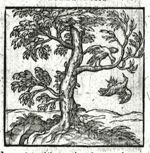
Parvam culinam duobus ganeonibus non sufficere: Alciatus, Emblemata (Leiden, 1591), emblem 93
Parvam culinam duobus ganeonibus non sufficere: Whitney, A choice of emblemes (Leiden, 1586), emblem 60
Ne Amor, ne signoria, Vuole compagnia: Cats, Spiegel (The Hague 1632), emblem 14's comment quotes the adage both in its Latin and Greek form
Iconclass: 25F32(ROBIN)(+511):49D11(2) song-birds: robin (+ animal(s) threatening)❧numerals: 2 25G31 shrubs 49D11(2) numerals: 2 51BB61 Singularity, Uniqueness 54EE33 Competition, Rivalry, Emulation; 'Emulatione' (Ripa)
Loci Communes: Invidia, aemulatio (Envy, rivalry, Envie, rivalité)
II ii 23 Pedibus ingredior, natare enim non didici I go on foot, for I have not learned to swim
Πεζῇ βαδιζω, νεῖν γὰρ οὐκ ἐπίσταμαι. id est, Ambulo pedes: nandi imperitus scilicet. Proverbialis senarius, in eum, qui maiorum rerum imperitus, minutioribus negotiis sese exercet. Aut qui, propter imperitiam privatus & humilis vivit: aut qui sese necessario confert ad aliud genus, quandoquidem ad illud, aut illud, nequaquam est idoneus: veluti si quis negociator fiat, ad literas indocilis. Refertur huic assimilis versus: Πεζῇ βαδιζων, οὐκ ἐπίσταμαι σκάπτειν. id est: Fodere imperitus pedibus ambulo meis. Apud Aristophanem in Avibus sycophanta similiter excusat suam professionem: τί γὰρ πάθω, σκάπτειν οὐκ ἐπίσταμαι. id est, Quid quaeso facerem, quando fodere nescio. Huc videtur referendum & evangelicum illud: fodere non valeo, σκάπτειν οὐ δύναμαι, Fossionem enim, pro quavis opera mercenaria posuit Aristophanes in Vespis, Συγγνωθι, κιθαρίζειν γὰρ οὐκ ειπισταται. id est: Ignosce, neque enim canere doctus est chely. Nimirum alludens ad vulgatum adagium, perinde quasi dicat: Reliquarum imperitus artium, furto tantum rem parat. Idem in Equitibus: Οὐδὲ μουσικὴν ἐπίσταμαι. id est: Ne musicam quidem scio.
Πεζῇ βαδιζω, νεῖν γὰρ οὐκ ἐπίσταμαι, I go on foot, not having learned to swim. A proverbial iambic line, on those who have no experience of important business and deal with less important matters, or who through lack of experience live a private and humble life, or who of necessity turn to some other walk of life because for this or that they are quite unfitted, for instance if a man were to become a merchant because he is not capable of a literary education. There is another line like it: 'I walk on foot and know not how to dig.' In Aristophanes, in the Birds, a professional informer defends his calling in the same way: 'What could I do, who know not how to dig?' With these we should, I think, associate that phrase in the Gospels, 'I cannot dig;' for it puts digging as a type for any paid labour. Aristophanes in the Wasps: 'Forgive him; he's not learned to play the lyre;' this is an allusion, I take it, to the familiar adage, as who should say: 'Having no skill in the other arts, he can only live by thieving.' Again in the Knights: T know no music either.'
Facsimile: 
Iconclass: 31A2711 walking 31A2773 swimming (movement in water) 51C2 Necessity, Inevitability; 'Necessità' (Ripa) 54AA3 Incompetence 54AA31 Inexperience
Loci Communes: Imperitia (Inexperience, lack of skill, Inexpérience)
II ii 24 Una domus non alit duos canes One household does not keep two dogs
Εἷς οἶκος οὐ δύναται τρέφειν τοὺς δύο κύνας. id est, Eadem domus non bene canes alit duos. Proverbio iactatus senarius in eos, inter quos parum convenit propter idem Iucrum, quod communiter expetunt. Sic idem regnum non fert duos tyrannos. Eadem respublica non fert duos expilatores. Idem munus, non fert duos ambitiosos, quorum uterque conetur tenere primas. Refertur ab Aristophanis interprete.
Εἷς οἶκος οὐ δύναται τρέφειν τοὺς δύο κύνας, The same household cannot well keep two dogs. An iambic line in common use as a proverb, applied to those who cannot get on together because there is one advantage which both seek to obtain. In the same way one kingdom cannot bear two tyrants, one commonwealth cannot support two men's exactions, the same office has no room for two competitors each of whom tries to hold first place. It is recorded by the scholiast on Aristophanes.
Facsimile:
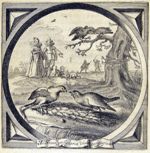
Ne Amor, ne signoria, Vuole compagnia: Cats, Spiegel (The Hague 1632), emblem 14's comment quotes the adage and additional sayings cited by Erasmus
Iconclass: 34B11(+9511):49D11(2) dog (+ animal(s) threatening)❧numerals: 2 42F(+0) household management; housewife at work (+ variant) 51BB61 Singularity, Uniqueness 54EE33 Competition, Rivalry, Emulation; 'Emulatione' (Ripa)
Loci Communes: Invidia, aemulatio (Envy, rivalry, Envie, rivalité)
II ii 25 Vallus vitem decepit The prop has let down the vine
Η χάραξ τὴν ἄμπελον ἐξηπάτησεν, id est, Vallus vitem decepit. Ubi quispiam ab eo fallitur aut laeditur à quo pendebat, cuiusque fidei nitebatur. Traductum à vallis, quibus alligatae fulciuntur vites. Fit autem interdum, ut illi radicibus actis, ramis ac frondibus suis vitem strangulent, aut prostrati palmitem secum trahant. Aristophanes in Vespis, Εἶτα νῦν ἐξηπάτησεν ἡ χάραξ τὴν ἄμπελον; id est, Itane circumvenit ipse vineam palus suam?
Η χάραξ τὴν ἄμπελον ἐξηπάτησεν, The prop has let down the vine. When someone is deceived or injured by a person he depended on and in whose loyalty he trusted. A metaphor from the poles to which vines are tied up for support; for it sometimes happens that they take root and strangle the vine with their own branches and foliage, or they fall over and bring the vine-branches down with them. Aristophanes in the Wasps: 'Is that really what has happened? Has the prop let down the vine?'
Facsimile:
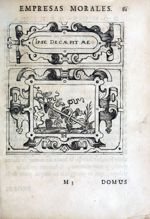
Ipse decepit me: Borja, Empresas morales (Bruxelles, 1680), emblem 40 paraphrases the adage and uses the imagery of the falling vine
Iconclass: 47I15(PROP)(+33) agricultural implements (PROP) (+ aids ~ crafts, industries, agriculture) 47I422 vine 54FF1 Failure 57AA6141 Untrustworthiness, Unreliability
Loci Communes: Fraus ab amico (Deceit from a friend, Tromperie d'un ami)
II ii 26 Trepidat in morem galli cuiuspiam He cowers like a cock
Πτήσσει ὥς τις ἀλέκτωρ. id est, Trepidat tanquam gallus gallinaceus. In male affectum & commotum, aut etiam pavitantem, opportune dicetur. Πτησσειν enim Graecis fugitare significat, atque expavescere, peculiariter autem de avibus dicitur. Aristophanes in Vespis, Πτήσσει φρύνιχος ὥσπερ ἀλέκτωρ. id est: Galli in morem Phrynichus horret. Fuit hic Phrynichus Melanthae filius, Atheniensis tragoediarum scriptor, quem Athenienses mille drachmis mulctarunt, quod Milesiorum excidium tragoedia complexus esset. Quod quidem ego non adscripturius eram inter adagia, nisi commentarius Aristophanis hoc nominatim proverbii loco retulisset. Meminit huius & Plutarch. in Alcibiade, qui cum antea fuisset ferox & insolens, ex Socratis familiaritate, cuius singularem integritatem suspiciebat, coepit esse mansuetus ac modestus. Citat autem hunc senarium è poeta quopiam: Επτηξ᾽ ἀλέκτωρ ὡς, κλίνας πτερόν. id est, Pavidus refugit, more gallinacei, Quum victus alas illi summittit suas. Meminit huius & in vita Pelopidae. Certamen autem gallorum apud veteres sollenniter ac publicitus exhibebatur. Caeterum, quanquam animal natura pugnax est, tamen gallus, ubi se sentit imparem in conflictu, mire deiectus ac supplex profugit, risum praebens spectatoribus.
Πτήσσει ὥς τις ἀλέκτωρ, He cowers like a cock, will be aptly used of a man who is upset and disturbed and even frightened; for the verb in Greek means to want to run away and to be terrified, and it is especially used of birds. Aristophanes in the Wasps: 'Phrynichus cowers like a cock.' This Phrynichus son of Melanthas was a writer of tragedies in Athens, who was fined by the Athenians a thousand drachmas for making a tragedy out of the destruction of Miletus. I would not myself have included this among adages, had not the commentary on Aristophanes definitely recorded it as a proverb. It is also mentioned by Plutarch in his life of Alcibiades, who had previously been rough and insolent, but he became a friend of Socrates, and had such respect for his singular integrity that he became civilized and modest. Plutarch quotes from some poet the following line: 'He cowered like a cock with trailing wing.' He mentions this again in his life of Pelopidas. Cock-fighting was a regular and public entertainment in Antiquity; and a fighting-cock, though pugnacious by nature, loses heart surprisingly if it feels it is getting the worse of a contest and runs humbly away, to the merriment of the spectators.
II ii 27 Non magis parcemus quam lupis We shall give them no more quarter than we would to wolves
Οὐ φεισόμεθα μᾶλλον ἢ λύκων, id est, haud magis parcemus ac lupis. Aristophanis interpres proverbialem figuram esse admonet, inde natam, quod antiquitus lex ad interficiendos lupos etiam praemio invitabat apud Atticos. Etenim qui lupi catulum interemisset, huic talentum: qui adultum occidisset, duo talenta dabantur. Unde & Apollinem, λύκειον καὶ λυκοκτόνον cognominarunt. Aristophanes in Avibus: Φεισόμεθα γὰρ τιτῶνδε μᾶλλον ἢ λύκων; id est: Quid enim his magis parcemus, atque ipsis lupis?
Οὐ φεισόμεθα μᾶλλον ἢ λύκων, We shall give them no more quarter than we would to wolves. The scholiast on Aristophanes points out that this is a proverbial image, derived from the ancient practice of offering a bounty by law to encourage the killing of wolves in Attica. The man who had killed a wolf-cub was given one talent as a reward, and the killer of a full-grown wolf was given two. Hence they called Apollo 'wolf-god' and 'wolf-slayer.' Aristophanes in the Birds: 'Why do we give them more quarter than we would to actual wolves?'
Facsimile:
Iconclass: 25F23(WOLF)(+64) beasts of prey, predatory animals: wolf (+ animal killed by man) 34C2 giving shelter to wild animals 54D5 Safety
Loci Communes: Crudelitas (Cruelty, Cruauté)
II ii 28 Nisi si qua vidit avis Unless some bird saw it
Πλὴν εἴτις εἶδεν ὄρνις. id est, Nisi si qua vidit avis. Hyperbole proverbialis de re vehementer occulta. Aristophanes in Avibus: Οὐδεὶς εἶδεν τὸν θησαυρὸν τὸν ἐμὸν, πλὴν εἴτις ἂν ὄρνις. id est, Nemo meum vidit thesaurum, nisi forsan si qua avis usquam. Suidas etiam hunc versiculum citat ex Aristophane: Οὐδεὶς με θεωρεῖ πλὴν ὁ παριπτάμενος ὄρνις. id est, Nemo me contuetur, nisi praetervolans avis.
Πλὴν εἴτις εἶδεν ὄρνις, Unless some bird saw it, is a proverbial exaggeration, to express something excessively secret. Aristophanes in the Birds: 'No one has seen my treasure, unless some bird saw it.' Suidas also cites this line from Aristophanes: 'No one surveys me except the passing bird.'
Facsimile:
Iconclass: 25F3:31A314(+0) birds❧spying on someone (+ variant) 52DD11 Secret
Loci Communes: Occulta (Hidden things, Choses cachées)
II ii 29 Perdicis crura Legs like Mr Partridge
Πέρδικος σκέλος. id est, Perdicis tibia. Perdix caupo quispiam erat claudus, ab Aristophane locis aliquot notatus, unde et in proverbium abiit. Cuius mentionem fecit Aristophanes grammaticus in proverbiis orationis solutae. Dicebatur in crura gracilia, distortaque. Refertur à Suida, Περδίκειος ποὺς. id est, Perdicis pes. In loripedes quadrat. Citatur hoc carmen apud Athenaeum in primi libri fragmentis: Εγχει πιεῖν μοι καὶ τὸ πέρδικος σκέλος. Αμιδα δότω τὶς, ἢ πλακοῦντα τὶς δότω. id est, Infunde bibere, & crura perdicis mihi. Matulam det aliquis, aut placentam porrigat. Verum haud videtur hoc ad proverbium admodum facere.
Πέρδικος σκέλος, Shins like Mr Partridge. Partridge was a small trader, who was lame, and he is criticized in several places in Aristophanes, and thus has passed into a proverb. Aristophanes the grammarian speaks of it in his Proverbs in Prose. It was applied to legs that were thin and crooked. Suidas records Περδίκειος ποὺς, A foot like Partridge's; this suits those with deformed feet. The following lines are quoted by Athenaeus in the fragments of his first book: 'Bring me a drink and bring me partridge legs; / Give me a chamber-pot, or give me a cake.' But this does not seem to throw much light on the proverb.
Facsimile: 
Iconclass: 25F38(PARTRIDGE)(+341) walker and runner birds: partridge (+ claws, paws of an animal) 31A415 crippled 31A4151 club-foot 98B(PERDIX) male persons from classical history (PERDIX)
Loci Communes: Forma, deformitas (Beauty, deformity, Beauté, difformité)
II ii 30 Tolle calcar Raise your spur
Αἶρε πλῆκτρον ἀμυντήριον. id est, Tolle calcar ultorium. Extat adagium in Aristophanis Avibus: Αἶρε πλῆκτρον, εἰ μάχη. id est, Tolle calcar, si pugnas. In eum dici solitum, qui iam ultionem non parat. Mutuo sumpta metaphora à gallis pugnam inituris, quibus ferrei stimuli quidam alligari solent, quo se tueantur inter certandum: quanquam autore Aristotele libro De animalibus ii. cap. xii. natura calcar addidit ex avium genere iis, quae ob corporis molem sint ad volatum minus idoneae. Cuiusmodi sunt galli. Id confirmat Plinius lib. x. Et regnum, inquit, in quacunque sunt domo exercent: dimicatione paritur hoc quoque inter ipsos, velut ideo tela adnata cruribus suis intelligentes: nec finis, saepe commorientibus.
Αἶρε πλῆκτρον ἀμυντήριον, Raise a spur in your defence. The adage is found in the Birds of Aristophanes: 'Raise your spur if you mean to fight.' Commonly said of a man already preparing to defend himself. The image is borrowed from fighting-cocks about to engage, to which iron spikes of a kind are sometimes fastened with which they can defend themselves in the struggle although, as Aristotle testifies in his On Animals, book 2 chapter 12, 'Nature has given spurs to those among the birds which from the weight of their bodies are less well adapted for flight/ a class which includes cocks. Pliny confirms this in book 10: 'And they hold absolute sway,' he says, 'in any household in which they find themselves, which they achieve by fighting among themselves, as though they knew that that was the purpose of the weapons attached by nature to their legs; nor are there any limits, but often both alike are killed.'
Facsimile:
Iconclass: 34B232(+934) fowl (cock, hen, chicken, etc.) (+ limbs of an animal) 43C1431 cock-fighting 46C1462(+0) spur (+ variant) 54E4 Defence
Loci Communes: Minantis (Threatening, Menacer)
II ii 31 Minus habes mentis quam dithramborum poetae You have less sense than the men who write dithyrambs
Διθυραμβοποιῶν νοῦν ἔχεις ἐλάττονα. id est, Minus sapis scriptoribus Dithyrambicis. In stupidos, ac furiosos torquetur. Adagium annotatur ab Aristophanis interprete in Avibus. sumptum à poetis Dithyrambicis, qui Baccho afflati furebant, unde & Horatius: Aut insanit homo, aut versus facit, In Odis, Pindari grandiloquentiam attollens, Seu, inquit, per audaces nova dithyrambos Verba devoluit, numerisque fertur Lege solutis. Philostratus in Sophistis immoderatam in dicendo vehementiam ac granditatem aliquoties appellat τὸ διθυραμνβῶδες, eosque dicit ἐκβακχεύειν καὶ ὑπερβακχεύειν.
Διθυραμβοποιῶν νοῦν ἔχεις ἐλάττονα, You have less sense than the dithyrambic poets. This is twisted to suit dull-witted crazy people. The adage is reported by the scholiast on Aristophanes' Birds. It derives from poets who wrote dithyrambs under the inspiration of Bacchic frenzy. Hence too Horace's words 'Either the man is mad, or he scribbles verse.' In the Odes, when praising Pindar's grand style, he has: 'Or in bold dithyrambs rolls down a flood / Of words new-minted, loosed from metre's laws.' Philostratus in his Sophists several times calls unbridled vehemence and grandeur of style 'the dithyrambic touch,' and says the writers are 'carried away by Bacchic frenzy.'
Facsimile:
Iconclass: 48C91 writer, poet, author 52AA51 Folly, Foolishness; 'Pazzia', 'Sciocchezza', 'Stoltitia' (Ripa) 52BB6 Frenzy 92L191 thiasos, i.e. Bacchus' revel-rout, bacchanal without Bacchus
Loci Communes: Multi - in stupidos (Many people - against the stupid, Beaucoup de gens - contre les sots)
II ii 32 Corcyraea scutica A whiplash from Corcyra
Κερκυραῖα μάστιξ. id est, Cercyraeum flagrum. De re supervacaneo cultu exornata. Quadrabit & in ea, quibus ornatus additur neutiquam decorus aut congruus. Cercyraeis quoniam crebris seditionibus agitabantur, mos erat gestare flagra ingentia, ansis eburneis exornata. Quidam aiunt, ea duplicia fuisse. Itaque in proverbium abierunt. Autor interpres Aristophanis in Aves. Lycurgus rhetor quum ob immodicam linguae libertatem è concione eiiceretur, exclamavit, ὦ κερκυραῖα μάστιξ, ὡς πολλῶν ταλάντων ἀξία εἶ. id est, ô Cercyraea scutica, quàm multa vales talenta. Notans populum inutilem, magno tamen alendum. Refert Plutarchus in vita decem rhetorum.
Κερκυραῖα μάστιξ, A Corcyrean whip. Of something covered with unnecessary decoration. It will also suit things to which ornament has been added which is by no means either beautiful or appropriate. The men of Corcyra, which was subject to continual riots, took to carrying great big whips, decorated with ivory handles; and some say they had double thongs. Hence they became proverbial. The authority for this is the scholiast on Aristophanes' Birds. The orator Lycurgas, when thrown out of a meeting for his excessively abusive language, exclaimed 'O Corcyrean whip, how many talents you do cost!', which was a criticism of the mob for being so useless and so expensive to feed. Plutarch records this in his 'Lives of the Ten Orators.'
Facsimile:
Iconclass: 46C1463 whip 54BB3 Inutility, Noxiousness; 'Nocumento', 'Nocumento d'ogni cosa' (Ripa) 61D(CORFU) geographical names of countries, regions, mountains, rivers, etc. (CORFU) (CORFU)
Loci Communes: Mira nova (Wonderful new things, Choses nouvelles et étonnantes)
II ii 33 Larus Seamew
Κέπφος, λάρος. id est, Cepphus larus. In garrulum ac vecordem dicebantur, praecipue qui cuiusvis rei cupiditate deceptus capitur: ab avis ingenio ductum, quam spuma marina gaudere tradunt. Capitur autem ad hunc modum, Obiicitur spuma primum longiore intervallo. Deinde propius propiusque. Postremo manibus gestantes exbibent. Larus itaque cibi aviditate captus comprehenditur. Aristophan. utitur in Pluto, Interpres admonet cognomen esse proverbiale. Rursum in Nebulis Cleonem larum vocat, quod furtis ac rapinis inhiaret. Lucianus in libello De mercede servientibus, σαυτὸν δὲ παρακαλέσας θαῤῥεὶν, ἐπιχείρει τῇ ἄγρᾳ εἰ θέλεις, καθάπερ ὁ λάρος ὅλον περιχανὼν τὸ δέλεαρ. id est, Sumpta vero fiducia, venatum aggredere, si videtur, lari in morem, totam escam ore devorans. Athenaeus lib. Dipnosophistarum x. indicat avem hanc Herculi attributam à priscis, quod & ille fuerit ἀδδηφάγος, atque itidem βουφάγον esse vocatam. Olim praecipuus gurgitum luxus erat in piscibus, id quod omnium libri testantur, quicunque vel apud Graecos, vel apud Latinos scripserunt de hoc genere (Quo magis mirum est hodie religionis causa vulgus piscibus vesci) Proinde congruet & in obsonatores, quod Larus avis piscium sit appetens.
Κέπφος, λάρος, Seagull, seamew, was used of a talkative and stupid man, especially one who is taken in and deceived by the desire for some worthless thing; it is drawn from the natural behaviour of a bird which is said to be attracted by sea-foam. The way it is taken is as follows: they offer it foam from some distance at first, then from nearer and nearer, and finally display the foam in handfuls. Thus the seamew is overcome by greed and easily taken. Aristophanes uses this in the Plutus. The scholiast tells us that the nickname is proverbial. Again, in the Clouds he calls Cleon a seamew on account of his appetite for theft and pillage. Lucian in his essay On Salaried Posts: 'Summon up your courage and try to enjoy your hunting, like the seamew that swallows the bait in one gulp.' Athenaeus in book ten of the Doctors at Dinner suggests that this bird was regarded by the Ancients as sacred to Hercules because he too was greedy, and also that it was given the name 'beefeater' [i.e. 'glutton']. In the old days the greedy man's favourite treat was fish, a fact which is borne out by all ancient authors, both Greek and Latin, who have written on the subject; it is the more surprising that fish is commonly eaten nowadays for religious reasons. And so it will also be suitable for gourmets, the seamew being a bird with a notable appetite for fish.
Facsimile: 
Iconclass: 25F36(SEAGULL) water-birds (SEAGULL) 25F36(SEAMEW) water-birds (SEAMEW) 52D4 Prolixity, Verbosity, Loquacity; 'Loquacità' (Ripa) 54BB6 Worthlessness 55CC11 Greed, Covetousness, Cupidity; 'Cupidità' (Ripa)
Loci Communes: Rapacitas et avaritia (Rapacity and greed, Rapacité et avarice)
II ii 34 Cepphus parturit The gull is about to lay
Κέπφος ὠδίνει, larus parturit. Dicebatur in eos, qui pollicerentur ingentia, deinde nihil promissis dignum praestarent. Est enim larus avis, multa plumarum copia circumtecta, caeterum carnibus exiguis: pariens autem vociferatur. Recensetur adagium ab Aristophanis interprete, in comoedia cui titulus, Pax. Confine est illi: Parturiunt montes, nascetur ridiculus mus.
Κέπφος ὠδίνει, The seamew is about to lay, used to be said of those who made great promises and then did nothing to justify them; for the seamew is a bird covered with dense plummage but very little flesh, and it utters a loud cry when laying. The adage is recorded by the scholiast on Aristophanes, in the comedy called Peace. It is related to The mountains labour; forth will creep a mouse.
Facsimile:
Iconclass: 25F36(SEAGULL) water-birds (SEAGULL) 53D2 Promise; 'Promissione' (Ripa) 53DD2 Breach of Promise 57AA645 Boast; 'Iattanza' (Ripa)
Loci Communes: Magnifica promissa (Magnificent promises, Promesses magnifiques); Frustrata spes (Frustrated hope, Espoir déçu)
II ii 35 Canis festinans caecos parit catulos The hasty bitch brings forth blind whelps
Η κύων σπεύδουσα τυφλὰ τίκτει. id est, Canis festinans caecos parit catulos. In eos iaciebatur, qui nimio festinandi studio rem parum absolutam edunt: ut si quis operis parum elimati praecipitet aeditionem. Hinc natum, quod canis quia celerius pariat, catulos caecos velut adhuc immaturos edit. Aristoteles libro De generatione animalium 4. demonstrat, id potissimum evenire in animantibus, quae multifidis sunt pedibus, & numerosum alunt foetum, ut vulpes, ursa, leaena, canis, lupa. Nam haec omnia caecos pariunt catulos, quaedam etiam informes adhue aedunt. In causa putat, quod cum corporis humor non sufficiat alendo tam numeroso foetui, natura partum imperfectum potius educit. Galenus item libro quem conseripsit de semine, τὰς δὲ κύνας ἤδη που καὶ ἡ παροιμΐα φησὶν τυφλὰ τίκτειν ὑπὸ σπουδῆς. id est, Canes vero etiam proverbio iactatum est, ob festinationem caeca parere: quanquam canum catulos Galenus mavult imperfectos dici quàm caecos, quum talpae proprie caecae dicantur. Animantia, quae foetus edunt caecos ἀλαοτόκα vocantur Graecis, quasi Latine dicas caecipara. Alludit ad paroemiam Aristophanes in Pace: Η κώδων ἀκαλανθὶς ἐπειγομένη τυφλὰ τίκτει. id est: Caeca parit properato acalanthis tinnula nixu. Et interim Graeci grammatici dubitant, quid sit Acalanthis: alii putant nomen insignis canis, deductum παρὰ τὸ ἀκαλὸν θεῖν, id est, quod placide currat. Sunt rursus qui suspicentur avem esse. κώδων autem tintinabulum est, quo in aedibus magnatum, & collegiis, convocantur familiares ad officium. Alii suspicantur dictum παρὰ τὸ ἀκάλλειν. id est, à blandiendo, quòd notis adblandiens canis, allatrat hospites. Sic divinant Aristophanis interpres, Etymologus & Suidas.
Η κύων σπεύδουσα τυφλὰ τίκτει, The hasty bitch brings forth blind whelps, used to be aimed at people who produce an imperfect result through being in too much of a hurry; if a man, for example, were to rush into print a work which he had not properly polished. It comes from the fact that a bitch, because she produces her litter so quickly, bears her puppies blind, as though they were still immature. Aristotle in book 4 of his On the Generation of Animals shows how this happens particularly in creatures which have divided feet and rear a numerous brood, the vixen for instance, the she-bear, the lioness, the bitch and the she-wolf. All these produce blind whelps, and some of them bring fourth young which are still shapeless. He thinks the reason is that, the bodily moisture being insufficient to supply such a number of offspring, nature prefers to bring them to birth unfinished. Galen too in the book which he wrote On the Sperm says 'It is already, as we know, proverbial that bitches produce blind whelps through haste;' though Galen would rather call a bitch's puppies unfinished than blind, while 'blind' is properly applied to moles. Animals which produce blind young are called in Greek alaotoka, for which the Latin might be caecipara. Aristophanes alludes to the proverb in the Peace: 'The noisy [kodon] acalanthis in its haste brings forth blind brood.' At the same time, Greek scholars hesitate over the meaning of acalanthis. Some suppose it to be the name of a well-known breed of dog, derived from akalon, smooth and thein, to run, because it has a smooth motion when running; some on the other hand suspect it to be a bird, and kodon is the bell which in the houses of the great, and nowadays in our colleges, summons members of the community to their duties. Others suspect a connection with akallein, to flatter, because a dog fawns on those it knows and barks at strangers. Such are the guesses of the scholiast on Aristophanes, of the Etymologicon and of Suidas.
Facsimile:

Sapiens in omnibus providus: Schoonhovius, Emblemata (Gouda, 1618), emblem 52 uses the imagery of the hasty bitch in its own comment
Iconclass: 34B11(+52):51M12 dog (+ female animal)❧Haste 34B11(+53):31A4111 dog (+ young animal)❧blind, blindness 51F511 Immaturity
Loci Communes: Festinatio praepropera (Overhasty haste, Précipitation excessive)
II ii 36 In canis podicem inspicere To look into a dog's anus
Aristophanes ἐν ἐκκλησιαζούσαις, Τούτῳ μὲν εἶπον ὀς κυνὸς πυγὴν ὁρᾷν. id est, Canis quidem hunc inspicere iussi podicem. Interpres admonet vulgo dici solere in caecutientes, adscribens & hunc trochaicum, Ες κυνὸς πυγὴν ὁρᾶσθαι καὶ τριῶν ἀλωπέκων. id est, In canis despicere podicem, triumque vulpium. Allusit eódem & in Acharnensibus, Τοῖς ὀστίνοις φυσῆτε τὸν πρωκτὸν κυνὸς. Obscoenius est, quàm ut vertere libeat. Has profecto nugas pigeret adscribere, ni propositum esset operi suscepto per omnia satisfacere, καὶ ἦν ἔλαχον σπάρτην κοσμεῖν.
Aristophanes in the Ecclesiazusae: 'I told him to go and look into a dog's anus.' The scholiast informs us that this was commonly applied to near-sighted people, and he adds a trochaic line about peering up the breech of a bitch and three vixens. He alludes to it again in the Acharnians: 'Blow up the dog's arse on your pipes of bone.' The line is too obscene to give much pleasure to the translator. In fact, I could hardly bring myself to write out such rubbish, were I not determined to perform my allotted task at all points and, having received this Sparta as my portion, to do my best for her.
Facsimile:
Iconclass: 31A31 sight, looking (one of the five senses) 31A4114 near-sightedness, myopia 34B11(+9322):31A22371(+0) dog (+ buttocks of an animal)❧anus (+ variant)
Loci Communes: Caecutientia (Poor eyesight, near-blindness, Mauvaise vue); Obscuritas (Obscurity, Obscurité)
II ii 37 Tentantes ad Troiam pervenerunt Graeci Trying got the Greeks to Troy
Theocritus in Syracusis, tentando, atque experiendo quantumlibet etiam ardua perfici, figura proverbiali significans, Ες Τροίην, inquit, πειρώμενοι ἦλθον ἀχαιοί Καλλιστα παίδων πείρᾳ θὴν πάντα τελεῖται. id est, Tentando ad Troiam venere Pelasgi. Cuncta, puellarum pulcherrima, perficit usus.
Theocritus in his Syracusan Women, when he wishes to convey that trying and experiment can get things done however arduous, uses a proverbial image: 'Trying, fair lady, got the Greeks to Troy; / All things are done by trying.'
Facsimile:
Iconclass: 47F11 research, experiment (~ production) 53A21 Constancy, Tenacity; 'Costanza', 'Tenacità' (Ripa) 54F1 Success; 'Evento buono' (Ripa) 94H2 the fall of Troy; Troy burning
Loci Communes: Experientae seu pericliationis (Experience or risk-taking, Expérience ou mise à l'épreuve)
II ii 38 Deum sequere Follow God
Plutarchus in libello De audiendo, refert hoc adagium, quod & inter septem Graeciae sapientum oracula celebratur, ἕπου θεῷ. id est, Sequere deum. Putat hunc esse sensum: Obtempera rationi. Quasi cuique debeat oraculum esse, quicquid in pectore dictaverit ratio. Unde & Vergilius dixit: An cuique deus sua dira cupido. Cui versus ille Graecis celebratus adstipulatur. Ο νοῦς γὰρ ἡμῖν ἐστιν ἐν ἐκάστῳ θεός. id est, Inest enim suus cutque animus, deus. Et Menander apud Plutarchum. Ο νοῦς γὰρ ἡμῶν ὁ θεὸς. id est, Nam noster animus numen est. Et consimilia quaedam apud Lucanum dicit Cato Uticensis. Sumptum videtur ex Homericae Iliadis libro primo, ubi Achilles Palladi obtemperans haec dicit: Οσκε θεοῖς ἐπιπείθηται, μάλα τ᾽ ἔκλυον αὐτοῦ. id est, Qui diis paruerit, proni huius vota receptant. Apud eundem est hoc hemistichium non uno loco positum, καὶ τὶς θεὸς ἡγεμόνευε. id est, Quin et divum aliquis ductor fuit. Plato in Critone, ἔα τοίνυν, ὦ κρίτων, καὶ πράττωμεν ταύτῃ, ἐπειδὴ ταύτῃ ὁ θεὸς ὑφηγαῖται. id est, Sine igitur ô Crito, & hoc pacto agamus, quandoquidem hac nos ducit Deus. Cicero lib. De finibus iii. commemorat inter praecepta veterum sapientum, quae constat proverbiorum vice celebrata. Quaeque sunt, inquit, vetera praecepta sapientum, qui iubent tempori parere, & sequi deum, & se noscere, & nihil nimis.
Plutarch in his essay 'On How to Study Poetry' records this adage, which is also familiar as one of the sayings of the Greek Seven Sages: Ἔπου θεῷ, Follow God. He thinks the phrase means 'Follow the lead of reason,' as though every individual ought to regard as his oracle the dictates of reason in his own bosom. Hence too Virgil's question 'Does each man's dread desire become his god?', which is supported by the well-known Greek line 'Because the mind in each of us is god,' and Menander, cited by Plutarch: 'Because the mind in us is God.' Similar sentiments are uttered by Cato of Utica in Lucan. It looks as though it were taken from the first book of Homer's Iliad, where Achilles as he does what Pallas tells him says 'Obey the gods and they will hear your prayers.' In Homer too there is a half-line which occurs more than once: 'And some god leads the way.' Plato in the Crito: 'Very well then, Crito, let us act accordingly, since this is where God leads the way.' Cicero in book 3 of the De finibus mentions it among the dicta of ancient sages which are known to have circulated with proverbial force: 'And those dicta' he says 'of the ancient sages which bid us "serve the time" and "follow God" and "know ourselves" and seek "nothing to excess".'
Facsimile: 
Iconclass: 12B13 representations ~ gods, demi-gods, heroes, etc. (non-Christian religions) 52B2 Admission, Belief 52B51 Reason; 'Ragione' (Ripa) 53B5 Obedience; 'Obedienza' (Ripa)
Loci Communes: Obsecundantis (Complying, being obliging, Se conformer, obéir)
II ii 39 Lingua quo vadis? Tongue, whither wouldst thou?
Γλῶσσα ποῖ πορεύῃ; πόλιν ὀρθώσουσα καὶ πάλιν ἀναστρέψουσα. id est, Lingua quo vadis? Erectum civitatem, eandem denuo subversura. Refertur à Suida, Zenodoto, Diogeniano. Docet linguam plurimum utilitatis afferre mortalibus, & eandem rursum plurimam adferre perniciem, tametsi membrum corporis sit perquam exiguum. Proinde divus Iacobus apostolus eam clavo navis adsimilem facit, quae cum pars sit minima, tamen totam navem aut servat, aut evertit. Bias, referente Plutarcho in libello De audiendo, rursum in alio De loquacitate, Amasidi, Aegyptiorum tyranno, iubenti, ut sibi quod esset in victimae, quam ad illum miserat, carnibus & optimum & pessimum mitteret, linguam resectam misit, innuens huius usum esse praecipuum, sive prodesse cupias, sive nocere. Nec inscite dictum est à Solomone capite decimo octavo, Mors & vita in manibus linguae.
Γλῶσσα ποῖ πορεύῃ; Πόλιν ὀρθώσουσα καὶ πάλιν ἀναστρέψουσα, Tongue, whither wouldst thou? To build a city, and then again to overthrow it. Recorded by Suidas, Zenodotus and Diogenianus. Its message is that the tongue can be the greatest benefit to mortals and again can bring on them the greatest disasters, although as a member of the body it is very small indeed. Hence the apostle St James compares it to a nail in a ship's timbers, which is a very small part of the whole and yet either keeps the ship safe and sound or destroys it. Plutarch in his essay 'On How to Study' tells a story of Bias, which recurs in his 'On Garrulity;' when Amasis, tyrant of Egypt, told Bias to bring him the best and worst pieces of meat in the victim which he sent him, Bias cut out the tongue and sent that, indicating that it was the outstanding instrument, whether you wish to do good or harm. There is much point in Solomon's remark in chapter 18, that 'Death and life are in the power of the tongue.'
Facsimile:
Lingua quo tendis: Rollenhagen, Nucleus emblematum (Arnhem, 1618), Cent. I, emblem 42
Lingua quo tendis: Wither, A collection of emblems (London, 1635), emblem 42
Quo tendis?: Paradin, Les devises héroïques (Antwerp, 1563), emblem 70
Iconclass: 31A22141 tongue 31E23622 violent death by tearing out of tongue 52D4 Prolixity, Verbosity, Loquacity; 'Loquacità' (Ripa) 98B(AMASIS)3 male persons from classical history (AMASIS) - representations to which the NAME of a person from classical history may be attached 98B(BIAS)3 (story of) Bias, one of the Seven Sages - representations to which the NAME of a person from classical history may be attached
Loci Communes: Garrulitas (Talkativeness, Bavardage)
II ii 40 Ollas ostentare To make a display of pots
Χύτρας ἐπιδείκνυσθαι. id est, ollas ostentare, est rem per se ridiculam ac sordidam, perinde ut maximam efferre. Plutarch. in libello De auscultando, taxans sophistas, quibus mos erat ἀδόξους, id est, infames materias verborum fucis exornare, cum vomitum, febrim, Busiridem, atque id genus alia laudant, καὶ νὴ Δία, inquit, χύτρας ἐπιδεικνύμενοι, id est, Ac per Iovem ollas ostentantes. Non quod prorsus improbandum sit, si quis vel exercendi, vel laxandi ingenii gratia, ludat nonnunquam in huiusmodi argumentis, modo iocus sit eruditus, & cum voluptate misceat nonnihil utilitatis. Quandoquidem ridentem dicere verum, quid vetat? Imò fit, ut citra offensam & gratius irrepat in animos mortalium veritas huiusmodi lenociniis commendata: adeo, ut Aulus Gellius non dubitet ridiculas Aesopi fabellas tetricis illis & è caelo delapsis Stoicorum dogmatis anteponere. Lusit & ipse Plutarchus in Gryllo, festiviter sanè, sed ita tamen, ut philosophum iocari, non scurram, possis agnoscere. Lusimus & nos ante complureis annos μωρίας ἐγκώμιον, cui non plus septem dierum operam impenidmus, idque nullis librorum adminiculis adiuti. Nam nostra sarcina nondum advecta tum erat. Hoc quicquid est libelli, video candidis ingeniis, & iis qui bonis literis sunt initiati, magnopere probari, qui praeter iocandi festivitatem affirmant illic esse non pauca, quae ad corrigendos hominum mores magis conferant, quàm Aristot. Ethica, aut Politica dogmata, qui paganus plus quam paganice hisce de rebus praecepit. Et tamen audio nonnullos offendi, sed paucos, atque hos eiusmodi ut nihil probent, nisi barbarum, insulsum, & ab omnibus Musis alienissimum. Ipsi Iuvenalem legunt alioquin acerrimi poetarum hostes, quo principum, sacerdorum, negociatorum, ac praecipue mulierum vitia in concionibus suis insectentur, quae saepius ita depingunt, ut obscoenitatem doceant. Ego, cum argumentum susceptum ab hoc non abhorreret, & ubique tantus pateret campus, neque mordeo quempiam nominatim, nisi forte meipsum, & odiosam illam scelerum ac vitiorum Camarinam nusquam movens, ridicula quaedam magis quam foeda paucis attingo, Sed taxas, inquiunt, episcopos, taxas theologos, taxas principes, Primum non animadvertunt, quam hoc ipsum faciam moderate, minimeque odiose. Deinde non meminerunt illius regulae, quam toties inculcat divus Hieronymus, ubi generalis de vitiis disputatio est, ibi nullius personae esse iniuriam, nequae carbone notati quenquam quasi malus sit, sed omnes admoneri, ne sint mali: nisi forte illud contendant, omneis principies esse sapientes. omnes theologos absolu tos: omnes episcopos & pontifices esse tales, quales fuerunt Paulus & Marinus: universos monachos ac sacerdotes, Antonios esse & Hieronymos. Denique non perpendunt id, quod in dialogis est potissimum, personae decorum: & Erasmum imaginantur loqui, non Moriam. Quasi vero si quis Ethnicum cum Christiano loquentem faciat, nefas sit Ethnicum quicquam dicere, quod abhorreat à doctrina Christiana. Postremo cum tyranni quoque cum à morionibus quidvis audiunt, rideant, parumque civile putent, ullis offendi dicteriis, mirum est istos, nescio quos, ab ipsa Moria nihil omnino posse audire, quasi quicquid de vitiis utcunque fuerit dictum, id prorsum ad ipsos pertineat. Sed hac de re iam amplius satis. Ad ollas redire praestat. Ergo proverbium affine fuerit illi, quod alibi dictum est, χύτραν ποικιλλεις, id est, Ollam variegas.
Χύτρας ἐπιδείκνυσθαι, To make a display of pots, is to produce something sordid and contemptible in itself as though it were of great importance. Plutarch in his essay 'On How to Study,' criticizing the sophists for their practice of dressing up unseemly topics in the language of panegyric, vomit for instance and fever and Busiris and others of the kind, says 'making, if you please, a display of pots.' Not that it would invite immediate disapproval if a man were to amuse himself with this sort of subject for practice or as a relaxation, provided there was style and knowledge in his levity and something profitable as well as entertaining; for 'to speak truth with a smile no rule forbids.' The result in fact is that truth makes its way without offence into the minds of mortals and finds a warmer welcome, when it has attractions of this kind to recommend it. So true is this that Aulus Gellius has no hesitation in preferring Aesop's amusing fables to all those sour-faced doctrines of the Stoics that came down from heaven. Plutarch himself took to humorous writing in his 'Gryllus,' which is amusing enough to be sure, but with the limitation that one can always recognize the philosopher in playful mood rather than the professional humourist.
I wrote a humorous work myself some years ago, my Praise of Folly. I spent seven days' work on it at most, and did so without the help of any books, for at that time my baggage had not yet arrived. Whatever the merits of that small book, I observe that it is thought very well of by fair-minded men and those who have been properly grounded in the classics; and apart from its gaiety and humour, they maintain that there are a number of things in it which do more to raise the standard of human behaviour than Aristotle's Ethics or Politics, for his teaching in this field, pagan as he was, is of a level one would not expect from a pagan. And yet I hear that some people take offence; but they are few in number, and the sort who approve of nothing except what is barbarous, tasteless and innocent of all commerce with the Muses. They themselves read Juvenal, sworn foes as they are of other forms of poetry, in order to nourish the attacks in their sermons on the vices of princes, priests, merchants and particularly women; and they often describe those vices in language which might provide a lesson in obscenity. For my part, though my chosen subject was not incompatible with it and such a wide field lay before me in all directions, I attack no individual in particular except perchance myself, I leave unmoved that loathsome Camarina of crimes and vices, and touch on a few points with more fun in them than filth. But you criticize bishops, they say, bishops and theologians and princes. But, for one thing, they fail to notice the moderation, the freedom from all spite, with which I do what they say; and then again they fail to bear in mind that principle so often urged on us by St Jerome, that in a general discussion of vice no slur is cast on any individual, and no one gets a black mark as an offender, but everyone is put on notice not to offend. Or is their point really that all princes are wise, all theologians faultless, all bishops and pontiffs are what Paul and Martin were, all monks and priest so many Anthonys and Jeromes? Then they take no account of a cardinal principle in dialogue, that the words must suit the speaker, and imagine it is Erasmus speaking and not Folly. Just as though, if one were to compose a discussion between a pagan and a Christian, it would be anathema for the pagan to say anything that did not square with Christian teaching. Last but not least, even despots laugh at what they hear said by their jesters, and think it uncivilized to take offence at their remarks; and it is surprising if these men, whoever they may be, cannot listen to a single word spoken by Folly herself, as though anything said in any context about vices must inevitably be to their address. But on this topic I have already said more than enough; we must return to our pots. Thus this proverb is related to one of which I have spoken elsewhere: You are decorating a cooking-pot.
Facsimile: 
Iconclass: 41A773 container of ceramics: jar, jug, pot, vase 41C36(+0) (dinner-)service displayed on sideboard (+ variant) 46A1621(+0) display of jewels, etc. (+ variant) 54BB3 Inutility, Noxiousness; 'Nocumento', 'Nocumento d'ogni cosa' (Ripa) 57AA645 Boast; 'Iattanza' (Ripa)
Loci Communes: Inanis opera (Vain effort, Effort vain)
II ii 41 Puer glaciem The Child and the Ice
Ο παῖς κρυσταλλον. i. Puer glaciem. Dicebatur in eos, qui, cum retinere quippiam non possint, nolunt tamen amittere. Veluti, si quis magistratum recuset deponere, cui gerendo sit impar, aut a munere nolit absolvi, quod tueri tamen non possit. Competet et in eos, qui sponte nolint a se amovere, quod tamen aliquanto post sit elapsurum. Ut, cum opes urgemus, premimusque, mox nihilominus nos relicturas. Aut, cum rem noxiam urgemus, nec volumus amittere, quod laedit. Refertur a Zenodoto, Suida, Diogeniano. Meminit Plutarchus & explicat lib. De futili loquacitate. Sumptum videtur è Sophocle, qui amorem comparat pueris, qui glaciem conspectam arripiunt manibus ac delectantur: sed ea mox liquescente, nec facile possunt abicere lubricam massam, nec retinere noxiam. itidem amor nec excuti potest ob voluptatem adiunctam, nec retineri ob molestias admixtas voluptatibus maiores.
Ὁ παῖς κρυσταλλον, The child and the ice, was said of people who, although unable to retain their hold on something, are unwilling all the same to let it go; if a man, for instance, refuses to resign some public office which he is incapable of holding, or is unwilling to be released for some duty which he cannot perform. It will be suitable also for those who are reluctant to give up of their own accord something that will slip from their grasp sooner or later, for example when we are devoted to the pursuit of riches, though they will soon desert us none the less, or when we pursue something that is bad for us and are unwilling to lose what does us harm. Recorded by Zenodotus, Suidas and Diogenianus. Plutarch mentions and explains it in his essay 'On Pointless Garrulity.'
It seems to be derived from Sophocles. Love, he says, is like children who, when they see a piece of ice, snatch it up and are delighted with it; but as it soon begins to melt, they can neither throw away the slippery lump with any ease or retain it without discomfort. In the same way, love cannot be thrown off because of the pleasure it brings with it nor preserved because of the unhappiness mingled with it, which is greater than the pleasures.
Facsimile:
Iconclass: 26D42 icicle 31A251(+933) postures and gestures of arms and hands in general (+ holding something) 31D112 child 53A211 Obstinacy; 'Ostinatione', 'Pertinacia' (Ripa)
Loci Communes: Malum accersitum aut retortum (Evil brought upon oneself or turned back, Mal attiré ou retourné)
II ii 42 Unum ad unum One to one
Εν πρὸς ἕν, φασιν, inquit Lucianus, id est, Unum ad unum, nimirum figuram proverbialem esse significans, cum exactius singula singulis componantur. Theocritus in Pastore: Εμὶν δέ τυ βοκολιάσδευ ἓν ποθ᾽ ἕν, id est, si libet ad verbum reddi, Tu vero mihi pascito boves Unum ad unum. Sic enim quidam eruditi legunt. Plato lib. De legibus v. δεῖ δὲ πάντα ἄνδρα, ἓν πρὸς ἓν τοῦτο σπεύδειν . Reddetur & hoc ad verbum, Oportet autem omnem, unum ad unum, ad hoc festinare, hoc est, pro se quenque. Idem in libro vi. ἓν ἐφ᾽ ἑνὶ παρέχειν. Utitur & lib. i. planè proverbiali figura, ἓν πρὸς ἓν. rursum libro iiii. ἀνθ᾽ ἑνὸς ἓν. Translatum videri potest à proelio, quoties acriter res geritur, singulis adversus singulos dimicantibus. Nisi malumus ad Laconicum illud apophthegma referre. Narrat enim Plutarchus in libello De futili loquacitate, Lacedaemonios aliquando unum legatum ad Demetrium regem misisse. Cumque stomacharetur tyrannus, vociferareturque, Unum inquiens, ad me Lacedaemonii? legatum nihil attonitum respondisse. Unum ad unum. Nec absurde dixeris, à mathematicis mutuo sumptum, quorum est haec loquendi figura peculiaris, ἓν πρὸς ἓν, id est, Unum ad unum, sic enim proportionem constare dicunt, quam vocant, parilitatis, sive aequalitatis.
Εν πρὸς ἕν, φασιν, One to one as they say, comes in Lucian, who makes it clear that this is a proverbial expression for the precise matching of two things one against the other. Theocritus in his Herdsman (if I may be allowed to give a literal rendering): 'Do you mind my cows, one to one.' For this is the reading of some scholars. Plato in the fifth book of the Laws: 'Every man ought to hasten to this end, one to one/ that is, each for himself (for I will give this also literally). Again in book 6: To provide one for one.' He also uses 'One to one' clearly as a proverb in the first book, and again in book 4 'One for one.' This could be thought a metaphor from battle, in which whenever the situation becomes acute it develops into single combat. Unless we prefer to derive it from a well-known Laconic reply. Plutarch tells us in his 'On Pointless Garrulity' that the Spartans once sent a single envoy to treat with King Demetrius. The king was furious, and shouted 'Do the Spartans dare to send me one man?' To which the envoy, not in the least put out, replied 'Yes: one to one.' Nor would it be foolish if you were to say that it was borrowed from mathematics; for mathematicians in their professional idiom use 'One to one' to describe the ratio which they call equality.
Facsimile:
Una ad unum: Weigel, Gedankenmuster (Nürnberg, 1700), emblem 288
Iconclass: 49D11(1) numerals (1) 51B3 Parity, Equality 51BB61 Singularity, Uniqueness
Loci Communes: Diligentiae (Diligence, Diligence)
II ii 43 In nocte consilium Night is the mother of counsel
Εν νυκτὶ βουλὴ, id est, In nocte consilium. Admonet adagium, non esse praecipitandum consilium, neque statim ad primos animi impetus quippiam agendum. Nox autem propter solitudinem ac silentium, vel maxime ad considerandum, consultandumque de rebus gravibus est idonea. Praeterea saepenumero fit, ut somnus, sedata cupiditate, pristinam sententiam vertat. Unde etiam vulgo dicitur ab idiotis nostratibus, super hac re indormiam, ubi significant se per otium deliberaturos. Porro praeceps consilium inauspicatum esse solere, et vulgato sermone dicitur, et eleganter admonuit Sophocles apud Plutarchum libello de garrulitate: Οὐ γάρ τι βουλῆς ταυτὸ καὶ δρόμου τέλος. id est, Cursus enim haud est fin is idem, et consilii. Siquidem in cursu vincit, qui celerrimus sit, in consultando contatio tutior est, periculosa celeritas. Plutarchus in Symposiacis, decade septima, problemate nono, citat Platonem, qui scripserit, apud Lacedaemonios, ni fallior, fuisse νυκτερινὸν σύλλογον, id est, Nocturnum conventum gravissimorum, ad quem difficilimae causae reiciebantur. Addit, apud veteres noctem ἐυφρονην fuisse vocatam, παρὰ τὸ εὖ φρονεῖν, a bene sapiendo.
Ἐν νυκτὶ βουλὴ, Night is the mother of counsel. The lesson of the adage is that plans should not be made in a hurry, nor should any action be taken precipitately on the first impulse. Night, with its loneliness and silence, is the proper time above all for considering serious questions and making up one's mind. It also happens often that sleep, by lulling our passions to rest, makes us change our original view; and hence there is actually a phrase in common use among my uneducated fellow-countrymen: 'I must sleep on this,' when they wish to convey that they will consider something at leisure. It is indeed a common saying that as a rule to make up one's mind in a hurry is asking for trouble, and the point was elegantly made by Sophocles, in a line quoted by Plutarch in his essay 'On Garrulity:' 'Running and reason different ends pursue.' In a race the fastest wins; in taking counsel hesitation is safer and haste is dangerous. Plutarch in his 'Table-talk,' decade j problem 9, cites Plato as saying that among the Spartans, if I remember right, the most important people held a 'nightly council/ to which the most difficult problems were referred. And he adds that in olden times the word for night was euphronê, from eu phronein, to think well and wisely.
Facsimile:
In nocte consilium: Covarrubias, Emblemas Morales (Madrid, 1610), emblem 247
In nocte consilium: Wither, A collection of emblems (London, 1635), emblem 9
In nocte consilium: Rollenhagen, Nucleus emblematum (Arnhem, 1618), Cent. I, emblem 9
Nox habet consilium: Aneau, Picta poesis (Lyon, 1564), emblem 41
Consiglio: Ripa, Iconologia, of uytbeeldingen des verstands (Amsterdam, 1644), personification of Consiglio
Iconclass: 23R14 night 42A30 motherhood 52E3 Counsel; 'Consiglio' (Ripa) 57A67 Reasonableness
Loci Communes: Diligentiae (Diligence, Diligence)
II ii 44 Ubi quis dolet, ibidem et manum habet Where the sore is, there is the hand
Οπου τὶς ἀλγεῖ, κεῖσε καὶ τὴν χεῖρ᾽ ἔχει. id est, Ubi dolet quis, ibi & manum frequens habet. Senarius proverbialis, quem refert Plutarch. lib. De futili loquacitate. Natum est dictum a naturali hominum consuetudine, qua fit, ut ei corporis parti quae dolet, frequenter manus admoveamus. Tempestiviter utemur, cum significabimus, quempiam ea tractare, deque iis libenter verba facere, quae movent animum. Stobaeus idem refert ad hunc modum: Οπου τὶς ἀλγεῖ, κεῖσε καὶ τὸν νοῦν ἔχει id est, Ubi quis dolet, illic & mentem habet. Allusisse videtur ad proverbium Cicero Epistolarum ad Atticum. lib. iii. Sed non faciam, ut aut tuum animum angam querelis, aut meis vulneribus saepius manum afferam. Item Plautus in Persa: Quasi lippo oculo me meus herus utitur, manum abstinere haud quit tamen. Plutarch. huc torquet, ubi quid sive dolet sive delectat, ibi quisque linguam habet. Sic laudibus arguitur vini vinosus Homerus, et Pindarus taxatur, ut φιλάργυρος, quia multus in laudando auro. Nam hoc pacto statim auspicatur Olympia, ἄριστον μὲν ὑδωρ, ὁ δὲ χρυσὸς, αἰθόμενον πῦρ ἃτε, διαπρέπει νυκτὶ μεγάνορος ἔξοχα πλούτου, id est, Optima quidem aqua, ceterum aurum, velut ardens ignis, eminet noctu, magnisicas supra opes. Rursum in Isthmiis hymno iii, καὶ μεγασθενῆ νομϊσαν χρυσὸν ἄνθρωποι περιώσιον ἄλλων, id est, Et multipotens iudicarunt aurum homines eximium in caeteris.
Ὅπου τὶς ἀλγεῖ, κεῖσε καὶ τὴν χεῖρ᾽ ἔχει, Where the sore is, there often is the hand, is a proverbial iambic line, recorded by Plutarch in his essay 'On Pointless Garrulity.' The saying took its rise from the natural habit of mankind which makes us frequently put a hand to any part of the body which hurts. We shall use it appropriately when we wish to convey that someone dwells on things that make him uneasy and is very ready to talk about them. Stobaeus records the same thing in this form: 'Where a man suffers, there his thoughts are fixed.' Cicero seems to have had the proverb in mind in the third book of his Letters to Atticus: 'But I will not let myself either cause you anxiety by my complaints or put my hand too often to my own wounds.' Plautus too in the Persa: 'My master uses me like a sore eye, but all the same he cannot keep his hands off me.' Plutarch turns it to fit anything that either hurts or gives pleasure, for a man's tongue dwells on either. Thus 'his praise of wine proves Homer fond of it/ and Pindar is criticized for avarice because he spends so many words in praise of gold. These are the very first words of his Olympian Odes: 'Water is beyond price, and gold like fire blazing in the night shines out beyond all other lordly wealth.' Again in the third hymn of the Isthmians: 'And men have come to reckon gold a thing of great power beyond all else.'
II ii 45 Plus apud Campanos unguenti quam apud caeteros olei fit More scent is made in Campania than oil elsewhere
Plinius naturalis historiae lib. xviii. cap. xi. In Campania tamen, inquit, laudatissimus campus est. Montibus subiacet nimbosis, totis quidem xl. mil. pass. planicie. Gratia terrae eius, ut protinus soli natura dicatur, pulverea summa, inferior bibula, & pumicis fistulans vice. Montium quoque culpa in bonum cedit. Crebros enim imbres percolat atque transmittit. Nec diluit, aut madore voluit propter facilitatem culturae. Eadem acceptum humorem nullis fontibus reddit, sed temperat, & concoquens, intra se vice succi continet. Seritur toto anno, panico semel, bis farre. Et tamen vere segetes quae interquievere fundunt rosam, odoratiorem sativa. Adeo terra non cessat parere. Unde vulgo dictum, Plus apud Campanos unguenti, quàm apud caeteros olei fieri. Quantum autem universas terras campus circumcampanus antecedit, tantum ipsum pars eius quae Laboriae vocatur, quem Phlegraeum Graeci appellant. Hactenus Plinius. Si cui placebit adagium ad allegoriam trahere, poterit accommodari, vel in regionem, vel in hominem adeo caeteris antecellentem, ut apud hunc maior sit exquisitarum rerum copia, quàm apud alios mediocrium, aut vulgarium.
Pliny in his Natural History, book 18 chapter 11, says: 'In Campania however there is level ground with a very high reputation. It lies at the foot of cloud-capped mountains, and is quite flat for all of forty miles. The high quality of the land, to begin at once with the nature of the soil, is due to its being light on the surface and absorbent lower down, being porous almost like pumice. What is a fault in the mountains turns to its advantage; for it filters the abundant rainfall and passes it onwards, and feels no need to be loosened or irrigated for ease of cultivation. At the same time it has no springs through which it can return the water that reaches it, but blends it and digests it, and retains it like sap. It is planted all the year round, once with Indian millet and twice with spelt; and yet in the spring the fields which have been resting produce roses which are more fragrant than the cultivated rose. So true it is that the land never ceases to produce. Hence the common saying that more scent is made in Campania than oil elsewhere. The same difference that lies between the soil of Campania and all other soils is found between it and the part called Laboria, in Greek Phlegraea.' So Pliny. If anyone wishes to make an allegorical use of the adage, it will be found applicable to any region, or any individual, so outstanding that rarities are more plentiful there than ordinary or common things elsewhere.
Facsimile: 
Iconclass: 31A331 agreeable smell 41C671 oils and vegetable fats 58A3 Fruitfulness, Productiveness, Fertility, Fecundity; 'Fecondità' (Ripa) 61D(CAMPANIA) geographical names of countries, regions, mountains, rivers, etc. (CAMPANIA) (CAMPANIA)
Loci Communes: Excellentia, inaequalitas (Excellence, inequality, Excellence, inégalité)
II ii 46 Ne via quidem eadem cum illo vult ingredi He will not even walk the same road with him
Μηδὲ τὴν αὐτὴν ὁδὸν βαδίζειν, i. Ne via quidem eadem ingredi dicuntur, qui extremo dissident odio, adeo ut non solum mensa tectóve communi non sustineant uti, sed ne via quidem communi velint ambulare. Unde & vulgata dicunt ironia. Usque adeo illum amat, ut si forte fortuna fuerit obvius, in aliam deflectat viam. Plutarch. in commentario, περὶ φιλαδελφίας, τῶν δὲ ἀδελφῷ μηδὲ τὴν αὐτὴν ὁδὸν οἰόμενος δεῖν βαδιζειν, id est, Cum fratre vero ne via quidem eadem sibi putans ingrediendum esse. Huic congruit proverbialis ille versiculus: Κακῷ σὺν ἀνδρὶ μηδ᾽ ὅλως ὁδοιπόρου id est, Viro scelesto ne viae fueris comes.
Μηδὲ τὴν αὐτὴν ὁδὸν βαδίζειν. Men are said 'not even to walk the same road' who hate each other so intensely that, beside finding it intolerable to sit at a common table or live under the same roof, they will not even walk along a common road. Hence the sarcasm of the, popular saying: He loves him so dearly that if he happens to see him coming, he takes refuge down the next turning. Plutarch in his essay 'On Brotherly Love': 'But thinks he ought not even to walk along the same road his brother takes.' The same view is taken in the proverbial line: 'Share not your journey with a wicked man.'
II ii 47 Extra cantionem Out of tune
Παρὰ τὸ μέλος, i. Extra cantum agi, dicíve dicunt, quod ad rem non pertinet. Etiam si proverbio in alienam transfuso linguam perit genuina illa gratia. Siquidem παρὰ μέλος perinde sonat, quasi dicas, parum modulate, parum concinne, parum apte, parum decore. Nam quod in musica est μέλος, id in vita decorum. Lucianus in Eunucho: καὶ εφ᾽ ὧν ἄντις ᾐδέσθαη παρὰ μέλος τὶ φθεγξάμενος. id est, Et apud quos vereretur aliquis praeter catum quippiam dicere, id est, quod à re esset alienius. Imitatus est hanc figuram ex Platone, qui lib. De legibus iii. scribit ad hunc modum: παρὰ μέλος ἐμοί γε ἂν δοκῇς φθέγξασθαι, id est, Praeter cantilenam mihi dicturus fuisse videris. Et in Critia: Παρὰ μέλος δὲ εἰτι περὶ αὐτῶν ἄκοντες εἴπομεν δίκηην τὴν πρέπουσαν ἐπιτιθέναι, id est, Quod si quid extra cantionem imprudentes de ipsis su mus locuti, congruam poenam exigere. Aristophanes in Contionatricibus, eleganter unico verbo dixit, παραχορδιεῖν, pro quod est, absona, nec ad rem facientia loqui. προσέχων ὅπως Μηδὲν παραχορδιῇς, ὧν δεῖ σ᾽ ἀποδείξαι. id est, Attente cavens, Ut ne quid alienum loquare & absonum Ab his, tibi quae sunt probanda. Aristotel. lib. Rhetoricorum iii. notat à poetis quibusdam dictum, ἀχορδον καὶ ἄλυρον μέλος, cantionem dissonam, nec fidibus respondentem. Apte torquebitur in eos, qui secus vivunt, quàm docent. Finitimum est huic, quod alibi retulimus, οὐδὲν πρὸς ἔπος, nihil ad verbum, seu nihil ad carmen. Quo quidem Aristophanes, ἐν ἐκκλησιαζούσαις, nove utitur pro temere. Οὐ γὰρ τὸν ἐμὸν ἱδρῶτα καὶ φειδωλίαν Οὐδεν πρὸς ἔπος κ᾽ ἀνοήτως ἐκβαλῶ. id est, Neque enim meo sudore quod paraverim, Meaque parsimonia, temere ac nihil Ad rem profudero. οὐδὲν πρὸς ἔπος, Scholia exponunt, ὡς ἔτυχε, ἕνεκα μηδενὸς. i. temere, & absque causa. Posterior versus Graecus non constat suis pedibus. Restituetur si legamus, οὐδέν τε πρὸς ἔπος κᾀνοήτως ἐκβαλῶ. Quod carmen quidem duximus satius, vel alieniore citare loco, quàm eo studiosum fraudare lectorem. Natum, ut videtur, ab apophthegmate Themistoclis, qui Simonidi poetae petenti quiddam à se parum aequum, respondit ad hunc modum: Neque tu bon us esses poeta, si praeter cantum caneres, neque ego bonus princeps, si praeter leges iudicem. Sumptum est ab antiquis cantoribus, qui vocem ad lyram accommodabant. Aut certe à concentu vocalium musicorum, ubi si quis dissonat ab harmonia, graviter offendit aures. Lucianus ἐξαγώνια vocat, quae ad causam non pertinent. M. Tullius ὁδοῦ πάρεργα, quae aliena à re proposita.
Παρὰ τὸ μέλος, Out of tune, is used of things said or done which are out of place, though when the proverb is translated into another language it loses its native grace. For the phrase 'out of tune' is equivalent to saying inharmoniously, unsuitably, inappropriately, improperly; for what tune is in music, propriety is in life. Lucian in The Eunuch: 'And among whom a man might be afraid to say something out of tune,' meaning astray from the matter in hand. He got the idea of this image from Plato, who writes as follows in the third book of the Laws: 'It looks to me as though you would have said something out of tune,' and in the Critias: 'And if we have spoken of them unintentionally out of tune, to exact a suitable penalty.' Aristophanes in the Ecclesiazusae elegantly uses a single word parachordiein, to strike a false note, for saying something out of key and irrelevant: 'Taking special care not to strike a wrong note in all the things you have to prove.' Aristotle in book three of the Rhetoric criticizes a phrase used by some poets, 'A tuneless strain that answers not the strings.' This will be suitable for diversion to those whose way of life is different from their teaching. Close to this is one I have recorded elsewhere: Οὐδὲν πρὸς ἔπος, Nothing to the point, or Nothing to do with the verse. Aristophanes makes a new use of it in the Ecclesiazusae for 'rashly': 'Shall I my savings and my toil and sweat / So far from the verse, so senselessly outpour?' The scholiast explains that 'So far from the verse' means casually, to no good purpose. The second line in the Greek does not stand on its own feet; it will be mended if we insert a te and a kai. I have thought it better to quote this verse here, even in a passage where it does not fit very well, instead of concealing it from the reader who wishes to learn. It arose, by the look of it, from a remark of Themistocles. When the poet Simonides asked him for some favour which was not just, he replied as follows: 'You would not be a good poet if you sang out of tune, nor should I be a good prince if I gave judgment against the law.' This is derived from the solo singers of Antiquity, who accompanied their own voices on the lyre, or, if not that, from choral singing, for if one man goes off the right note, the effect is highly objectionable. Lucian uses the word exagonia, literally 'not included in the competition,' for things that are irrelevant; Cicero a Greek phrase meaning 'a bypath' for something not to the point.
Facsimile: 
Iconclass: 22D12 disharmonious sound, dissonance 48C7 music 57A Good and Bad Behaviour, Moral Qualities
Loci Communes: Dissimilitudinis et incongruentiae (Dissimilarity and incongruity, Dissemblance et incongruité)
II ii 48 Ignis mare mulier, tria mala Fire, sea, and woman, here be three evils
Circumfertur apud Graecos & hic trimeter proverbialis: Πῦρ καὶ θάλασσα καὶ γυνὴ, κακὰ τρία id est, Ignis fretumque & mulier, haec mala tria. Nam incendio nihil formidabilius, mare item periculosissimum est. Unde & Aeschylus in Persis: Αμαχον κῆμα θαλάσσης. id est, Maris haud vincitur unda. His autem simillimum quiddam esse mulierem sentit paroemia Porrò mulierem omnem esse malam, perquàm venuste significavit Lacon quidam, qui cum uxorem duxisset perpusillam, dicebat, E malis, quod minimum esset, eligendum. Fatetur & apud Euripidem Medea, foeminarum genus esse malum: Αλλ᾽ ἐσμὲν οἷον ἐσμὲν, οὐκ ἐρῶ κακὸν, γυναῖκες. id est, Sumus quidem quales sumus nos foeminae, Neque enim malae ausim dicere. Euripides apud Planudem in vita Aesopi, inter omnia mala principatum tribuit mulieri, Πολλαὶ μὲν ἐργαὶ κυμάτων θαλασσίων Πολλαὶ δὲ ποταμῶν, καὶ πυρὸς θερμοῦ πνοαὶ Δεινὸν δὲ πενία, δεινὰ δ᾽ ἄλλα μυρία Πλὴν οὐδὲν οὕτω δεινὸν, ὡς γυνὴ κακή. id est, Furore multo saevit iratum mare, Pronique fluvii, & ignis acris impetus, Inopia acerba, acerba alia quàm plurima, Sed nil ita acerbum & nexium, ut mulier mala.
Here is another proverbial line which circulated in Greek: Πῦρ καὶ θάλασσα καὶ γυνὴ, κακὰ τρία . Nothing is more terrifying than a house on fire, and the sea too is full of perils, so that Aeschylus writes in the Persae of 'the sea's unconquered waves.' That women are something very like them is the meaning of the proverb. In fact, the view that every woman is bad was very neatly conveyed by a certain Lacon who, after marrying a very diminutive wife, used to say that of evils one should choose the least. Medea too in Euripides admits that the female sex are a bad lot: 'We're what we are, we women; I'll not say / An evil.' Euripides, quoted by Planudes in his life of Aesop, assigns the first place among all evils to womankind: Constant the fury of the ocean wave, Of raging rivers and hot streams of fire Frightful is poverty and much else besides, But naught so frightful as a wicked woman.
II ii 49 Falces postulabam Sickles I asked for
Αμας ἀπῄτουν, id est, Falces postulabam. In eos, qui respondent id, quod ad rem nihil attinet. Plutarchus in commentario, περὶ ἀδολεσχίας admonet, ut qui velit accurate respondere, mentem rogantis diligenter perdiscat: ne illud fiat, quod proverbio dici consuevit, ἄμας ἀπῄτουν. Est autem senarius proverbialis apud Suidam & Zenodotum: Αμας ἀπῄτουν, οἵδ᾽ ἀπυρνοῦντο σκάφας id est, Falces petebam, at hi ligones denegant. Videtur hinc natum, quod agricolae cuipiam, a vicino falcem commodato petenti, negaverit ille, sibi ligonem esse domi. Theocriti scholiastes in Pastoribus annotavit, Atticis ἄμην dici, quod communis Graecorum lingua vocat δίκελλαν, sive σκαπάνην, id est, ligonem, quod si σκάφη, idem significat, quod σκαπάνη, ridiculum erit in responso, perinde, ac si si quis petenti gladium, neget se habere ensem. Sunt, qui sentiat σκάφην esse poculi genus, aut vasis cavi.
Ἄμας ἀπῄτουν, I asked for sickles, used of those who return an answer which is entirely off the point. Plutarch in his essay 'On Garrulity' points out that anyone who wishes to give an accurate reply should take trouble to discover exactly what his questioner means, to avoid the result summed up in the familiar proverb 'Sickles I asked for.' A proverbial iambic line is found in Suidas and in Zenodotus: 'Sickles I asked for, and they said "Nospades."' It looks as though the source of this must be some husbandman who asked a neighbour to lend him a sickle, whereon the other man replied that he did not possess a spade. The scholiast on Theocritus' Shepherds makes the comment that the word used [for sickle], amê, means in Attic Greek what in the common language is called a mattock or a spade; but if [the second word in our line], skaphê, equally means spade, the answer has a touch of absurdity, as it would if a man asked for a sword replied that he had no blade. Some are of the opinion that skaphê means a kind of drinking-cup or hollow vessel.
Facsimile: 
Iconclass: 47I15(SICKLE) agricultural implements: sickle 52EE1 Asking, Question, Interrogation 54A2 Carefulness, Diligence; 'Diligenza' (Ripa)
Loci Communes: Aliena a re (Irrelevant to the matter, Étranger au sujet)
II ii 50 Alba avis A white bird
Λευκὸς ὄρνις, id est, Alba avis: pro re nova, atque auspicata dixit M. Tullius in Epist. familiaribus lib. vii: Cum enim salutationi nos dedimus amicorum, quae fit hoc etiam frequentius quàm solebat; quod quasi albam avem videntur bene sentientem civem videre, abdo me in bibliothecam. Quadrabit & in rem admodum raram & inusitatam, quod aves perpaucae sint hoc colore: Ita Iuvenalis: Corvo quoque rarior albo. De albae gallinae filio, dictum est alibi.
Λευκὸς ὄρνις, A white bird, was used of something unexpected and auspicious by Cicero in his Letters to Friends, book 7: 'After devoting myself to the formal greetings of my friends, of which there is much more than there used to be, because even to set eyes on a citizen of sound principles they find as rare as the sight of a white bird, I take refuge in my library.' This will be suitable for anything rare and unusual, since so few birds are this colour. It is Juvenal's 'As rare as a white crow.' Of 'the son of a white hen' I have spoken elsewhere.
II ii 51 In alieno choro pedem ponere To set foot in other men's dances
Εν ἀλλοτρίῳ χορῷ πόδα τίθεσθαι, id est, In alieno choro pedem ponere, est sese miscere negociis alienis, & aliorum sibi vendicare partes. Plutarchus in commentario, quem inscripsit: Quo pacto se ipsum aliquis citra invidiam laudare possit, τὸν μὲν γὰρ ἐν ἀλλοτρίῳ χορῷ πόδα τιθέντα περίεργον ἡ παροιμϊα καὶ γελοῖον ἀποδείκνυσι. id est, Eum quidem, qui alieno choro pedem imponit, curiosum, ac ridiculum esse proverbium declarat. Idem in Symposiacis, ἐγὼ δὲ καίπερ ἐν ἀλλοτρίῳ χορῷ πόδα λιθεῖς εἶπον. id est, Ego vero, tametsi pedem in alienum inferens chorum dicebam. hoc est, respondens de re, quae ad philosophi professionem non pertinebat. Affinis est huic adagio metaphora perquam elegans, neque discrepans à specie proverbiali, qua usus est Aristides in Miltiade, Μιλτιάδην δὲ τὸν ἐν Μαραθῶνι, ποῦ χοροῦ τάξομεν;. i., Porro Miltiadem, qui est apud Marathonem, qua chori parte collocabimus? Interpres addit metaphoram sumptam à choris Dionysiacis. Certe constat, mutuo sumptum à choreis ac saltationibus. Quibus si quis ignotus admisceat sese, derideatur, atque exsibiletur ilico. Plato in Euthydemo, τὴν δε σοφίαν ποῦ χοροῦ τάξομεν, ἐν τοῖς ἀγαθοῖς, ἤ πῶς λέγεις; id est, Hanc sapientiam in quo choro statuemus, inter bona, aut quid censes?
Ἐν ἀλλοτρίῳ χορῷ πόδα τίθεσθαι, To set foot in other men's dances, is to get mixed up in other people's business and claim to act a part that is meant for others. Plutarch in the essay he entitled 'How a Man may Praise Himself without Giving Offence': 'He who sets foot in other men's dances is declared by the proverb to be a busybody and a fool.' Again, in his Table-talk': 'But I spoke out, though I knew I was setting foot in another man's dance,' replying, that is, to a question that fell outside a philosopher's field. There is an image very close to this adage and very elegant in itself, which has the look of a proverb; it is used by Aristides when writing of Miltiades. 'But Miltiades at Marathon - in what part of the choir shall we put him?' The scholiast adds that the metaphor is taken from choirs in the worship of Dionysus. It is at any rate clearly borrowed from those dances and reels which cannot be joined by a man who does not know them without incurring mockery and instant catcalls. Plato in the Euthydemus: 'Wisdom now, in what part of the choir are we to put it? Among the good things? Or what is your opinion?'
Facsimile:
Iconclass: 43C911 man dancing alone 52AA511 Ridiculousness 54DD31 Interruption, Cessation
Loci Communes: Aliena curantis (Meddling in others' affairs, Qui se mêle des affaires d'autrui)
II ii 52 Ne magna loquaris Do not talk big
Μὴ μεγάλα λέγε, id est, ne grandia loquaris. Refertur à Diogeniano, admonet temperandum esse à magniloquentia, iactantiaque, qua nihil omnium intolerabilius. Dictum est autem propter Nemesim deam, quae grandiloquentiam huiusmodi non sinit impunitam. M. Tullius Epistolarum ad Atticum libro quarto, epistola octava: Μήπω μὲγ᾽ εἴπῃς πρὶν τέλους ἀντιάσας. id est, Ne quando iactes, ni prtus perfeceris. Aristophanes in Ranis. Ω δαιμόνι᾽ ἀνδρῶν, μὴ μεγάλα λίαν λέγε. id est, Mirande vir, ne magna nimium dixeris. His verbis Bacchus reprimit Euripidem, per arrogantiam semet anteponentem Aeschylo. Sophocles in Aiace flagellifero: Μηδὲν μέγ᾽ εἴπῃς, οὐχ ὁρᾷς ἴν᾽ εἶ κακοῦς id est, Ne magna loquere, non vides, quo insis malo? Theocritus in Cyclope: Μηδὲν μέγα μυθεῦ. id est, Ne quid sublime loquaris. Theognis: Μή ποτε Κυρν᾽ ἀγεορᾶσθαι ἔπος μέγα, οἶδε γὰρ οὐδεὶς Ανθρώπων ὅτι νὺξ χ᾽ ἡμέρα ἀνδρὶ τελεῖ. id est, Verbum Cyrne cave magnum ne dixeris unquam. Nescis quidnam homini nóxve, diésve ferat. Plato in Phaedone, Μὴ μέγα λέγε, μήτις ἡμῶν βασκανία περιξέψῃ τὸν λόγον τὸν μέλλοντα λέγεσθαι. id est, Ne loquere grandia, ne qua nobis invidia futuram orationem interturbet. Antiquitas enim finxit deam Nemesim, iactantiae ultricem. Ita Pindarus in Isthmiis hymno quarto: Αλλ᾽ ὅμως καύχημα κατάβρεχε σιγᾷ. ζεὺς τάδε καὶ τὰ νέμει. id est, Attamen gloriationem obnubila silentio. Iupiter haec & illa partitur. Est enim unica placandae invidiae ratio, si quid accidit boni, ad autorem deum referatur. Idem in Nemeis hymno decimo: Εστι δὲ καὶ κόρος ἀνθρώπων βαρὺς ἀντιάσαι. id est, Est autem grave in hominum invidiam incidere. Est enim invidum mortalium ingenium, nec ulla re citius saturatur, quam audiendis laudibus. Idem eiusdem operis hymno quinto: αἰδὲομαι μέγα εἰπεῖν. Huc allusisse videtur Virgilius, libro decimo: Dixerat ille aliquid magnum. Invenitur saepius & μέγα φρονεῖν, pro eo, quod est insolentem atque elatum esse. Sophocles in Oedipo tyranno: Φρονεῖν γὰρ ὡς γυνὴ μέγα. id est, Sentire enim altum ut femina. Exstat & senarius proverbialis: Οτ᾽ εὐτυχεῖς μάλιστα, μὴ μέγα φρόνει. id est, Ne quid tume, cum res secundae maximè. Et μέγα πνέειν, id est, Magnum spirare. Euripides in Bacchis: Κᾄν πνέων ἔλθῃ μέγα. id est, Quamvis magnum spirans venias. Eleganter Horatius huiusmodi grandiloquentiam, Ampullas & sesquipedalia verba vocat in Arte poetica, Proicit ampullas & sesquipedalia verba. Terentius in militem gloriosum & magnifica verba. Legimus & τραγικῶς λέγειν, id est, Loqui tragice, et ἐκτραγῳδίζειν, pro eo quod est, magnificis verbis efferre. Horat. in Epist. Et spirat tragicum satis, & feliciter audet. Tametsi non fugit, poetam hoc loco simpliciter dixisse, spirat tragicum.
Μὴ μεγάλα λέγε, Do not talk big. Recorded by Diogenianus. It warns us to refrain from conceited talk and boasting, than which there is nothing more insufferable. It is said with reference to the goddess Nemesis, who does not let this sort of grand talk go scot-free. Cicero in his Letters to Atticus, book 4 letter 8: 'Never talk big till you have reached your goal.' Aristophanes in the Frogs: 'Now, honoured sir, pray do not talk so big.' The words are used by Bacchus in reproving Euripides for his arrogance in setting himself up above Aeschylus. Sophocles in the Ajax Bearing a Scourge: Talk not so big; do you not see how great your plight?' Theocritus in the Cyclops: 'Speak not so big.' Theognis: 'Cyrnus, forbear to speak in boastful strain; / No man doth know what night and day may bring.' Plato in the Phaedo: 'Do not talk big, for fear that envy interrupts our unfinished argument' - for the Ancients imagined a goddess called Nemesis, who punished boastful talk. So too Pindar in the fourth hymn of his Isthmians: 'But steep your boasting none the less in silence, for Jupiter sends one thing now, and now another;' for the only way to appease envy is to refer every good thing that happens to God as its source. Again, in the tenth hymn of the Nemeans: There is too the envy of mankind, which is a serious thing to encounter.' Jealousy is native in mortals, and there is nothing of which we tire so soon as listening to other men's praises. Pindar again, in the fifth hymn of the same book: I feel restraint in telling of a mighty deed.' Virgil seems to have been thinking of this in book ten: 'He had uttered a great boast.' Often too we find μέγα φρονεῖν, To think big, for to be insolent and conceited. Sophocles in the Oedipus Tyrannus To have grand ideas, for a woman.' There is also a proverbial iambic line: Think not high thoughts, when things are at their best,' And μέγα πνέειν, To breathe proudly, to give oneself airs. Euripides in the Bacchae: Though he come breathing pride.' Horace has an elegant phrase for this sort of grand language in his Art of Poetry: he calls it 'bombast and words one and a half feet long.' Terence of a braggart soldier: 'and words magnificent.' We also find τραγικῶς λέγειν, To speak in tragic vein, and ἐκτραγῳδίζειν, To express in tragic language, meaning 'to use grand words.' Horace in the Epistles: 'He breathes in tragic vein, and by his daring hits the mark.' Though I see well enough that in this passage the poet has used a straightforward phrase, 'tragic breath.'
II ii 53 Exercitatio potest omnia Practice can do everything
Μελέτη πάντα δύναται, id est, Cura omnia potest. Laertius hanc sententiam Periandro tribuit, qui Isthmum etiam tentarit perfodere: significat autem, nihil esse tam arduum, quod diligentia curaque non efficiatur. Vergilius in Georgicis: Labor omnia vincit Improbus, & duris urgens in rebus egestas. Exstat apud Graecos proverbialis sententia: θεοὶ τἀγαθὰ τοῖς πόνοις πωλοῦνται. id est, Dii bona laboribus vendunt. Huc allusit Horatius: Perrupit Acheronta Herculeus labor. Sophocles in Electra: Πόνου τοι χωρὶς οὐδὲν εὐτυχει. id est, Citra laborem nihil bene est. Fertur & versus Menandri, πάντα τὰ ζητούμενα Δεῖσθαι μερίμνης φασὶν οἱ σοφώτεροι. id est, Quaecunque votis expetuntur, praedicant Egere curis, qui valent prudentia. Simplicius Antiphanes, Τῆς ἐπιμελείας πάντα δοῦλα γίγνεται. id est, Domat atque subigit cuncta diligentia. Quanquam autem in praesentia non est, neque propositi, neque operis huius, quicquid ad huiusmodi sententias facit, in unum converrere, tamen haud gravabimur, quandoquidem casus obtulit, adscribere verba Senecae ex libro De ira ii. Atque nihil est, inquit, tam difficile & arduum, quod non humana mens vincat, et in familiaritatem perducat assidua meditatio. Nullique sunt tam feri, suique iuris affectus, ut non disciplina perdomentur. Quodcunque imperavit animus, obtinuit. Quidam nunquam ridere consueti sunt. Vino quidam, alii Venere, quidam omni humore interdixere corporibus. Alius contentus brevi somno vigiliam indefatigabilem extendit. Didicerunt tenuissimis & adversis funibus currere, & ingentia vixque humanis toleranda viribus onera portare, & in immensam altitudinem mergi, ac sine ulla respirandi vice perpeti maria. Mille sunt alia, in quibus pertinacia impedimentum omne transcendit, ostenditque nihil esse difficile, cuius sibi ipsa mens patientiam indixerit.
Μελέτη πάντα δύναται, Care can do everything. Laertius attributes this maxim to Periander, who even tried to cut a canal through the Isthmus. The meaning is that nothing is too difficult to be achieved by diligence and taking pains. Virgil in the Georgics: 'Toil conquers all, / Persistent toil, and need in hardships dire.' There is a proverbial maxim in Greek: 'Work is the currency for which the gods sell all good things.' Horace alludes to this in the words 'By toiling Hercules Acheron was breached.' Sophocles in the Electra: 'Nought without toil can prosper.' There is also a familiar line from Menander: 'All that men want needs toil; so say the wise.' It is put even more simply by Antiphanes: Take pains, and everything becomes your slave.'
Although it is not my present purpose, nor suitable to the work on which I am engaged, to sweep together into one whatever is relevant to aphorisms of this kind, I feel no compunction, since chance has put it in my way, in copying here what Seneca says in book 2 of his On Anger: 'And yet nothing is so difficult or so arduous that it cannot be mastered by the spirit of man and reduced to familiarity by constant practice; nor are any people so wild and so enamoured of their own liberty, that discipline will not tame them. Whenever the mind has demanded obedience, it has secured it. Some men have formed the habit of never smiling. Some have forbidden their bodies the enjoyment of wine, some of sexual pleasure, some of drink in any form. Some are content with a minimum of sleep, and prolong their waking hours without exhaustion. Some have learned to run on slender uphill ropes, to bear enormous burdens almost insupportable by human strength, to dive into prodigious depths and endure the ocean without a moment to draw breath. There are many, many other fields in which determination has overcome every obstacle and shown that nothing is difficult, if the mind, its own master, has decreed that it shall be endured.'
Facsimile: 

Met arbeydt krijgtmen vyer uyt den steen: Cats, Spiegel (The Hague, 1632), emblem 15 uses the imagery of a fire started with a flint and now warming lovers, to convey the idea that practice gets you what you want; adage and emblem cite closely related sources
De boom en valt ten eersten slagh niet: Cats, Spiegel (The Hague, 1632), emblem 24 uses the adage's imagery: two friends are looking at a felled tree while a woodcutter continues to cut off branches - conveying the idea of perseverance; adage and emblem cite the same sources
Iconclass: 53A21 Constancy, Tenacity; 'Costanza', 'Tenacità' (Ripa) 54A2 Carefulness, Diligence; 'Diligenza' (Ripa) 54D21 Practice; 'Prattica' (Ripa) 46A170 Labour 54F2 Victory
Loci Communes: Assiduitas (Diligence, persistence, Assiduité)
II ii 54 Quid primum aut ultimum? What first, what last?
Τί πρῶτον ἢ τί ὕστατον; id est, Quid primum, aut ultimum? Figura proverbialis, qua utimur quoties aut rerum copiam tantam significamus, ut haesitemus, unde potissimum ex ordiamur: aut cum perplexi dubitamus, quid primum agere debeamus. Lucian. in libello, cui titulus, De mercede servientibus, καὶ τί σι πρῶτον, ὦ φιλότης, ἤτι ὕστατόν φασι καταλέσω τούτων ἅ πάσχειν ἢ ποιεῖν ἀνάγκη τοὺς ἐπὶ μισθῷ συνόντας; id est, Quidnam tibi primum, amice, aut quid postremum, ut dici solet, commemorem, ex his quae & pati & facere coguntur ii, qui mercede serviunt? Porrò Lucian. desumpsit ex Odysseae lib. nono, in quo Ulysses ad hunc loquitur modum: Τί πρῶτον, τί δ᾽ ἔπειτα, τί δ᾽ ὑστάτιον καταλέξω; id est, Quid primum, quid mox, & quae tandem ultima dicam? Iuvenalis: Quò te circumagis? quae prima, aut ultima ponas? Eiusdem characteris est illud Euripidis in Iunone insaniente: Ω μοι τίν᾽ ἡμῶν πρωτον, ἢ τίν᾽ ὕστατον Πρὸς στέρνα θῶμαι; id est, Quem vestrum ohe quem pectori admoveam meo Primum ultimúmve.
Τί πρῶτον ἢ τί ὕστατον; What first or what last? A proverbial form of words, used either when we wish to convey that we have so much material that we hesitate where best to start, or when we are in some perplexity and do not know what action to take first. Lucian, in his essay entitled On Salaried Posts: 'What shall I tell you first, dear friend, what last, as the saying goes, of all that those who hold salaried posts are compelled to suffer and to do?' Lucian in fact took this from the Odyssey, book 9, where Ulysses speaks in this fashion: 'What first, what next, what last shall I describe?' Juvenal Turn where you will, what to put first, what last?' Of the same minting is that remark of Euripides' in the Hercules furens: 'Alas, which of you shall I clasp to my bosom first or last?'
Facsimile: 
Iconclass: 51F5 Beginning; 'Principio' (Ripa) 51FF5 End; 'Fine' (Ripa) 51H4 Plenitude 52BB2 Doubt; 'Dubbio' (Ripa)
Loci Communes: Anceps et dubius (Doubtful and uncertain, Incertain et douteux); Obtrectatio et maledicentia (Disparagement and slander, Dénigrement et médisance)
II ii 55 Dente Theonino rodi To be gnawed with Theon's tooth
Theonino dente rodi dicuntur, qui conviciis lacerantur. Sumptum à Theone poeta quodam rabiosae loquacitatis, petulantissimaeque maledicentiae: unde & Ausonius in carmine hendecasyllabo, poetam quempiam indoctum & mordacem theonem appellat: Nec posthac metues ubique dictum: Hic est ille Theon poeta falsus, Bonorum mala carminum Laverna. Horatius in Epistolis: Dente Theonine qui circumroditur. Neque dissimili figura est usus in epistola ad Iulium Florum: Hic delectatur iambis, Ille Bionaeis sermonibus. Acron admonet, Bionem philosophum fuisse, qui mordacissimis dialogis laceravit poetas, sic, ut nec Homero parceret. Porphyrion autumat Aristophanis comici patrem fuisse. Zoili quoque mordacitas propemodum in proverbio est, sed ut invidum intelligas magis quàm oblatratorem. Horatius hoc vitium, alicubi succum loliginis vocat, & salem nigrum, quod cum morsu addat & famae maculam.
The victims of malicious and slanderous attacks are said to be 'gnawed with Theon's tooth.' The origin was a virulent and voluble poet called Theon who was scandalously abusive, so that Ausonius in some hendecasyllabic lines calls an ignorant and scurrilous poet a Theon: 'Nor henceforth will you fear to have it said everywhere, This is that Theon, the poet and the wit, the bad thief of good lines by other men.' Horace in his Epistles: 'He who is gnawed by a Theonian tooth.' He uses a very similar metaphor in the epistle addressed to Julius Florus: 'One man prefers iambics, another delights in Bion's satiric vein.' Acron tells us that Bion was a philosopher who attacked poetry in a series of bitter dialogues, with such spite that he did not even spare Homer. Porphyrion asserts that he was the father of Aristophanes the comic poet. Zoilus too has almost become proverbial for the bitterness of his attacks, but with a colouring of jealousy rather than plain abuse. Horace calls this fault in another place 'ink of cuttle-fish', and also 'black salt' because besides giving pain it blackens a man's reputation.
Facsimile:
Iconclass: 31A2112 teeth 33B13 slander 48C91 writer, poet, author 98B(THEON) male persons from classical history (THEON)
Collectanea (1500): 155
Loci Communes: Obtrectatio et maledicentia (Disparagement and slander, Dénigrement et médisance)
II ii 56 Hipponacteum praeconium A testimonial in Hipponax' vein
Hipponacteum praeconium, pro infami nota dixit M. Tullius, nimirum proverbiali schemate, in epistolis familiaribus de Tigellio quodam ita scribens: Eumque addictum iam tum puto esse Calvi Licinii Hipponacteo praeconio. Nam Hipponax poeta fuit Iambographus, amarulentus, ac notae mordacitatis, qui, autore Dionysio Halicarnasseo, trimetrum Archilochium de industria in Scazontem infregit, cum inimicos lacerare vellet, quo videlicet feriret fortius. Hic Bupalum & Anthermon, quod ab his deformi specie pictus esset, versibus iambicis insectatus legitur. Erat autem Hipponacti notabilis in vultu foeditas, quamobrem quidam imaginem eius proposuere in ridentium circulis, quorum aliquot suis carminibus creditur ad laqueum compulisse. Negat id esse verum Plinius, libro tricesimo sexto, capite quinto.
A testimonial in Hipponax' vein was used by Cicero in the sense of a scurrilous attack, and of course it has the look of a proverb. In his Letters to Friends, writing of a certain Tigellius, he says 'And I fancy he has already been knocked down for a song with a testimonial in Hipponax' vein from Licinius Calvus.' This Hipponax was a poet who wrote in the iambic metre and was famous for his bitterness and scurrility; according to Dionysius of Halicarnassus, he deliberately broke down the Archilochian trimeter into a scazon iambic, when he wished to tear his victims to pieces, because this gave him a more powerful weapon. He is said to have made an attack in iambic verse on Bupalus and Anthermos, because they had produced a portrait of him, showing his repulsive appearance. For Hipponax was remarkably ugly, and so certain people 'set up his picture as a target for public derision'; and it is said that the verses he wrote in reply 'drove some of them to hang themselves.' Pliny however, book 36 chapter 5, denies the truth of this.
Facsimile:
Iconclass: 33B11 mocking, insulting; teasing 48C91 writer, poet, author 56BB11 Bitterness; 'Amaritudine' (Ripa) 98B(HIPPONAX)4 male persons from classical history (HIPPONAX) - aggressive relationships of person from classical history
Loci Communes: Obtrectatio et maledicentia (Disparagement and slander, Dénigrement et médisance)
II ii 57 Archilochia edicta Archilochian edicts
Adagionis faciem habet & illud, quod Cicero scribit ad Atticum, libro secundo: Itaque Archilochia in illum edicta Bibuli, populo ita sunt iucunda, ut eum locum, in quo proponuntur, prae multitudine eorum, qui legunt, transire nequeamus. Archilochia edicta, contumeliosa vocat ac virulenta. Archilochi poetae mordacitas vulgo celebratissima fuit. Is Lycamben socerum, à quo fuerat repudiatus, huiusque filiam adeo virulentis versibus insectaus est, ut uterque se laqueo praefocaverit.
Some words used by Cicero in the second book of his Letters to Atticus also have the look of a proverb: 'So Bibulus' Archilochian edicts against him are received with such public delight that we cannot get past the place where they are posted up because of the crowd of people reading them.' By calling them Archilochian, he means that the edicts are libellous and bitterly hostile. The poet Archilochus was notorious for his scathing language. He attacked Lycambes, who had neglected him as a son-in-law, and Lycambes' daughter, with verses of such bitterness that they both hanged themselves.
Facsimile:
Iconclass: 33B1 quarrel, argument 56BB11 Bitterness; 'Amaritudine' (Ripa) 98B(ARCHILOCHUS)3 male persons from classical history (ARCHILOCHUS) - representations to which the NAME of a person from classical history may be attached
Loci Communes: Maledicentia (Slander, abusive speech, Médisance)
II ii 58 Archilochi patria Archilochus' native land
Αρχιλόχου πατρὶς, id est, Archilochi patria. Diogenianus testatur hoc dici solere de mordacibus ac maledicis. Videas enim populos nonnullos natura dicaces, cuiusmodi fuisse feruntur Siculi.
[no essay text found]
Facsimile:
Iconclass: 32B peoples; ethnic groups; nationalities 56BB11 Bitterness; 'Amaritudine' (Ripa) 98B(ARCHILOCHUS)3 male persons from classical history (ARCHILOCHUS) - representations to which the NAME of a person from classical history may be attached
Loci Communes: Obtrectatio et maledicentia (Disparagement and slander, Dénigrement et médisance)
II ii 59 Genuino mordere To gnaw with one's cheek tooth
Qui clanculum obtrectant lacerantque quempiam, eum genuino mordere dicuntur. Persius: Et genuinum fregit in illis. Lucilium sentiens poetam Satyricum. Item divus Hieronymus: Possim respondere, si velim: possim genuinum laesus infigere. Dentes autem genuini sunt omnium reconditissimi ac propemodum operti gingiva. Sero emergunt homini, nempe circiter annum vigesimum: multis & octogesimo, ut autor est Plinius lib. xi. capite trigesimoseptimo. Et ob id haud ab re, livoris atque obtrectationis morbo dicati. Potest non absurde referri & ad viperae denticulos illos, quibus eam venenum infundere putant. Plinius eodem, quod modo citavimus, capite: Nam hi quoque sunt viperis sub gena fistulosi. Potest & ad canes referri, qui postremis dentibus ossa duriora circumrodunt. Omnis autem obtrectatio morsus dicitur. Unde Aristophanes iocatur, in anulo non inesse remedium adversus sycophantae morsum. Diogenes apud Laertium rogatus, cuius nam animantis morsus esset perniciosissimus: Ex feris, inquit, obtrectatoris: ex cicuribus adulatoris. Hoc venenum Horatius Loliginis succum appellat.
Those who criticise a man and tear him to pieces in secret are said to gnaw him with their cheek-tooth. Persius: 'And broke his cheek-tooth on them/ meaning Lucilius the satiric poet. So too St Jerome: I could reply if I wished, I could fasten my cheek-tooth on him who injured me.' Cheek-teeth are the furthest back of all teeth and almost hidden in the gums. In man they are cut very late, around the twentieth year in fact, and in many people not till the eightieth, as Pliny informs us, book 11 chapter 37. Thus it is not unsuitable that they should be dedicated to the disease of envy and calumny. This can also be referred without absurdity to the fangs through which the viper is supposed to inject its venom. Pliny, in the chapter which I have already quoted: 'For these too are situated in the viper below the jaw, and are pierced by a channel.' This can also be taken from dogs, which gnaw the harder of their bones with the last teeth in the row; for every kind of calumny can be described as gnawing. Hence the joke in Aristophanes that a physician's ring contains no remedy against the bite of a blackmailer. Diogenes in Laertius, when asked what living creature has the most dangerous bite, replied: 'Among wild beasts the informer, and among tame ones the flatterer.' This is the venom which Horace calls 'pure juice of cuttle-fish.'
Facsimile: 
Iconclass: 31A21122:52A51 back teeth, molars❧Wisdom; 'Sapienza', 'Sapienza humana', 'Sapienza vera' (Ripa) 31EE2333310(+0) 57AA76 Jealousy; 'Gelosia', 'Rammarico del ben'altrui' (Ripa) 57BB25 Calumny, Detraction; 'Biasimo vitioso', 'Calunnia', 'Detrattione', 'Maledicenza' (Ripa)
Collectanea (1500): 241
Loci Communes: Obtrectatio et maledicentia (Disparagement and slander, Dénigrement et médisance)
II ii 60 Aureo piscari hamo To fish with a golden hook
Aureo piscari hamo, dicuntur, qui mediocris commodi cupiditate periculum adeunt, ut maximarum rerum faciant iacturam. Commemoratur inter facete dicta Octavii Caesaris à Suetonio. Fit enim nonnunquam, ut piscis hamum etiam ipsum secum auferat. Porrò metaphorae pleraeque à piscatione ductae proverbii vice sunt usurpatae. Sicut Expiscari apud Terent. pro eo quod est diligenter elicere, atque exquirere. Vorare hamum apud Plautum. Semper tibi pendeat hamus, apud Nasonem. Quod si quis pugnet, Augusti dictum non esse proverbium, certe proverbiale est, nec indignum, quod in hunc ordinem adlegatur. Potest fieri ut quibusdam etiam hoc libuerit, aureo hamo piscari. Siquidem autore Suetonio, Nero Caesar reti aurato, funibus purpura, coccoque nexis, piscari solitus est. Proinde quoties sic ambimus quippiam, ut, si potiamur optatis, mediocre sit emolumentum sin fallat spes, damnum ingens, apte dicemur aureo piscari hamo. Id quod frequenter usu venit iis, qui scrutantur abditas terrae venas, sed frequentius, qui vulgo dicuntur Alcumistae, de quibus apud Athenaeum lib. vi. venuste dixit Phalereus Demetrius, ὅτι πολλάκις καταναλώσαντες τὰ φανερὰ τῶν ἀδήλων ἕνεκα, ἅ μὲν ἔμελλεν οὐκ ἔλαβον, ἃ δὲ εἶχον ἀπέβαλον. id est, Quod frequenter certis consumptis incertorum gratia, quae se capturos sperabant non ceperunt; quae vero habebant, abiecerunt.
Those who through desire for some moderate advantage run the risk of making really large losses are said to fish with a golden hook. This is recorded by Suetonius among the witty remarks of Octavius Caesar; for it sometimes happens that the fish carries off the actual hook. Observe that most of the metaphors drawn from fishing are current as proverbs; 'to fish out' for example in Terence for making diligent search and bringing into the light, 'swallowing the hook' in Plautus, and Ovid's 'Keep your hook in the water.' If anyone contends that Augustus' dictum is not a proverb, it is at least proverbial, and not unworthy to be promoted to this rank. It may be that some people would also like to use 'fish with a golden net'; for Suetonius tells us that the Emperor Nero was accustomed to fish 'with a gilded net bound with purple and scarlet ropes.' In effect then, whenever we are set on an object such that, if we get what we want, it does us very little good and, if our hopes are vain, we make an enormous loss, we shall aptly be said to fish with a golden hook. This is a common experience for those who prospect for veins of metal hidden in the earth, and even more so for those who are commonly called alchemists, of whom Demetrius of Phalerum neatly says in the sixth book of Athenaeus, 'that often by expending what is certain for the sake of what is quite uncertain they have not secured what they hoped to secure, and what they had they have lost.'
Facsimile:
Iconclass: 43C121(+41614):25D13(GOLD) angling (+ fish-hook)❧minerals and metals: gold 54DD52 Risk; 'Ardire ultimo & necessario' (Ripa) 55AA1 Loss
Loci Communes: Temeritas (Recklessness, Témérité); Discriminis (Danger, crisis, Danger)
II ii 61 Sapientia vino ombumbatur Wine darkens wisdom
Plinius historiae mundi libro vigesimotertio, cap. i. Vinum ieiunos bibere novitio in vento inutilissimum est. Curas, vigoremque animi impedit, ad procinctum tendentibus, somno accommodatum, ac securitatibus: iamque dudum hoc fuit, quod Homerica illa Helena ante cibum ministravit. Sic quoque in proverbium cessit, Sapientiam vino obumbrari. Hactenus Plinius. Porro, quod Plinius citat, est Odysseae quarto. In proverbiis item ecclesiasticis duo referentur, quae sapientem etiam dementent, vinum, & mulieres.
Pliny in his History of the World, book 23 chapter 1: To drink wine on an empty stomach is a most unprofitable innovation. It is a handicap to thought and mental activity in men who are preceding towards some decisive action; it encourages sleep and false security. This was the reason why long ago Helen in Homer gave them wine before the meal. Pliny's reference, as a matter of fact, is to the fourth book of the Odyssey. In the proverbs of Ecclesiasticus also two things are recorded which put out the wits even of a wise man, wine and women.
Facsimile:
Iconclass: 31B52 drunkenness 41C711 wine ~ alcoholic drinks 52A511 Wisdom of the Fool
Loci Communes: Luxus et mollicies (Luxury and softness, Luxe et mollesse)
II ii 62 Homines frugi omnia recte faciunt Worthy men always do right
M. Tullius lib. Tusculanarum quaestionum iiii. Frugalitatis nomen tanquam ad caput referre volumus: quod nisi eo nomine virtutes continerentur, numquam illud tam pervulgatum esset, ut iam proverbii locum obtineret: Homines frugi, omnia recte facere. Hactenus Cicero. Docet adagium, quosdam improbos homines certis in rebus nonnunquam esse usui, ac praeclare se gerere: verum ubique ac perpetuo praestare virum integrum atque inculpatum, id eius demum esse videtur, qui natura vereque sit probus. Alludit ad hanc sententiam Euripides in Hecuba, cum ait: Ανθρώποις δ᾽ ἀεὶ, Ο μὲν πονηρὸς οὐδὲν ἄλλο πλὴν κακὸς, Οδ᾽ εσθλὸς, ἐσθλὸς, οὐδε συμφορᾶς ὕπο Φύσιν διέφθειῤ ἀλλὰ χρηστός ἐστ᾽ ἀεί. id est: Caeterum in mortalibus Quisquis malus, nil aliud esse quàm malus: Frugi usque frugi est: non enim ingenium gravis Fortuna vitiat, sed probus semper manet. Idem in Iphigenia in Aulide: Οδ᾽ ὀρθὸς, Εσθλὸν σαφὲς ἀεὶ, id est, At, qui probus, Is palàm est semper probus. Aristoteles libro Moralium septimo: Τό, τε γὰρ ἀγαθὸν ἁπλοῦν, τὸ δὲ κακὸν πολύμορφον. καὶ ἀγαθὸς μὲν ὅμοιος ἀεὶ, καὶ οὐ μεταβάλλεται τὸ ἦθος, ὁ δὲ φαῦλος καὶ ὁ ἄφρων οὐδὲν ἔοικεν ἕωθεν καὶ ἑσπέρας. id est, Siquidem, quod bonum, idem simplex, contrà quod malum, id varium est. Et, qui bonus, is semper sui similis, neque unquam commutat mores. At quisquis improbus & stultus, haudquaquam idem esse videtur mane & vesperi. Huic mire concinit illud literarum arcanarum: Stultus ut luna mutatur, sapiens permanet ut sol.
Cicero in book 4 of his Tusculan Questions: I wish to trace the category of moral worth [frugalitas] to its fountain-head, as it were, because, unless the virtues were comprised under that heading, the old saying could never have acquired such general currency as already to have the status of a proverb, Worthy men [frugi] always do right.' So Cicero. The lesson of the adage is that, while some dishonest people are sometimes useful and distinguish themselves in a definite field, to show oneself in all places and at all times a man of honour and above reproach seems to be the prerogative of him who is by nature and in truth a good man. Euripides refers to this view in the Hecuba:
But as for men, let one be bad,
Never can he be otherwise than bad.
Worth remains worthy to the end; good minds
Unchanged by adverse fate, retain their goodness.
Again in the Iphigeneia in Aulis: 'But the good man is openly and always good.' Aristotle in the seventh book of the Ethics: Tor the good is simple and the bad complex, and the good man is always like himself and his character does not change; but the bad man and the fool do not look the same morning and evening.' There is remarkable agreement between this and the words of Holy Scripture: 'The fool changeth as the moon, but the wise man endureth as the sun.'
Facsimile: 
Iconclass: 54A5 Goodness; 'Bontà' (Ripa) 57A6 Virtuousness; 'Amor di Virtù', 'Attione virtuosa', 'Guida sicura de' veri honori', 'Virtù', 'Virtù insuperabile' (Ripa) 57A61 Honesty; 'Honestà' (Ripa) 24A sun as celestial body 24B moon as celestial body 53A22 Stability, Firmness; 'Fermezza', 'Stabilimento', 'Stabilità' (Ripa) 53AA21 Inconstancy; 'Incostanza', 'Instabilità', 'Instabilità overo Incostanza' (Ripa) 52A51 Wisdom; 'Sapienza', 'Sapienza humana', 'Sapienza vera' (Ripa) 52AA51 Folly, Foolishness; 'Pazzia', 'Sciocchezza', 'Stoltitia' (Ripa)
Loci Communes: Arrogantia jactantiaque (Arrogance and boastfulness, Arrogance et vantardise); Justitia (Justice, Justice)
II ii 63 Fallacia alia aliam trudit One fraud treads on the heels of another
Terentius in Andria: Fallacia alia aliam trudit, Donatus admonet proverbiali figura dictum. Sumptum à consuetudine conantium fallere, ac dolos dolis consarcinantium, ne deprehendantur. Unde Consutis dolis dixit Plautus. Et Sutelas appellat huiusmodi technas. Et δόλους ὑφαίνειν apud Homerum, id est, dolos texere.
Terence in the Andria: 'One fraud treads on the heels of another.' Donatus points out that this is proverbial in form. It derives from the practice of those who attempt to deceive, and cobble up one deception with another so as not to be found out. Hence Plautus' phrase 'a patchwork of frauds,' and he calls tricks of this kind 'stitchery.' And there is 'weaving a web of wiles' in Homer.
Facsimile:
Fallacia alia aliam trudit: Meisner, Politica Politica (Nürnberg, 1700), emblem 672
Iconclass: 51H3 Multitude 57AA621 Cheat, Deceit; 'Fraude', 'Inganno' (Ripa) 57AA6221 Lie; 'Bugia' (Ripa) 85(DE VULPECULA ET CICONIA) fable 85: De vulpecula et ciconia
Loci Communes: Malum conduplicatum aut renovatum (Evil doubled or renewed, Mal redoublé ou renouvelé)
II ii 64 Sera in fundo parsimonia It's too late to spare when the bottom is bare
Proverbialis sententia, apud Senecam in prima epistola. Sera in fundo parsimonia, digna profecto, quae omni scrinio, omni cado, omni cellae penuariae inscribatur. Admonet in tempore parcendum rebus necessariis, neque imitandum profusorum vulgus, qui tum denique incipiunt parcere, posteaquam viderint minim um superesse. Erit elegantior sententia, si traducatur ad res animi, veluti si quis admoneat iuvenes, ne sinant optimos illos annos inaniter effluere, ne illis eveniat quod plerisque solet evenire, ut iam natu grandes animum ad res honestas applicent: & cum perpusillum vitae supersit, tum tempori parcere incipiant. Seram enim in fundo parcimoniam esse. Proverbium sumptum apparet ex Hesiodo, cuius hi sunt versus in opere, cui titulus, Opera & dies: Αρχομένου δὲ πίθου καὶ λήγοντος κορέσασθαι Μεσσοθι φείδεσθαι. δειλὴ δ᾽ ἐπὶ πυθμένι φειδώ. id est, Plena ubi dolia sunt, aut iam prope inania vini, Tum satiare, sed in medio fac parcior esto. Absurdum siquidem & grave, in imo parcere fundo. Allusit huc Persius Satyra ii. Donec deceptus & expes, Nequicquam fundo suspiret nummus in imo. Plutarchus in Symposiacis Decadis septimae, problemate tertio, indicat poetam admonuisse tum esse bibendum vinum, cum est optimum. Vinum autem in medio saluberrimum optimumque esse potu, quemadmodum summa pars olei potissimum laudatur, mellis infima. Primum, quod vini vis calor est, is autem videtur maxime colligi circa medium, proinde id optimum esse servare. Deinde vini pars inferior vicina fecis corrumpitur, summa pars ab aere proximo laeditur. Nam aerem inimicum esse vino vel illud satis arguit, quod dolio pleno vinum minus vapescit, quam semipleno. Tum quod terra defossa, ut aer attingere non possit, quàm diutissime vigorem suum conservat. Theocritus item in Charitibus: Κενεᾶς ἐπὶ μυθμένι χηλοῦς. id est: Vacuae fundo capsae, scrinium inane significans.
A proverbial aphorism cited by Seneca in the first of his letters: 'It's too late to spare when the bottom is bare,' it is indeed worthy to be inscribed over every store-cupboard, on every cask and in every larder. It warns us to be sparing of essentials in good time, and not to imitate that widespread form of extravagance which does not begin to economize until at long last it sees that very little is left. The aphorism will gain in elegance if transferred to things of the mind; for instance, if one were to warn the young not to let the best years of life drift idly by, for fear they may suffer the common experience of turning their attention to things worth doing when they are already full-grown, and beginning to husband their time only when very little of life is left them; for 'It's too late to spare when the bottom is bare.' The proverb is evidently taken from Hesiod, who has the following lines in his poem entitled Works and Days: 'When you begin on the cask, or are ending it, drink what you fancy; / Half-way down go slow. He's a craven who spares at the bottom.' And Persius in his second satire: 'Till at last, disappointed and despairing, the solitary coin sighs unavailingly at the bottom of the chest.' Plutarch in his 'Table-talk,' decade 7 problem 3, suggests as the poet's meaning that we should drink wine when it is at its best. Wine in the middle of the cask, he says, is the most health-giving and the best for drinking, in the same way that the upper layers of olive-oil are the most highly thought-of, and the lowest layers of honey. First, because the power of wine is a form of heat, and heat seems to be concentrated principally in the middle of things, so that the middle is the best part to keep. Secondly, the lowest part of wine is contaminated by being nearest to the lees, while the top layer is spoilt by exposure to the air. For to prove that wine and air are enemies we need look no further than the way in which a full cask is less likely to turn to vinegar than one which is half full. Then there is the fact that wine buried in the ground, so that the air has no access to it, maintains its strength for a very long time. Theocritus too in the Graces has 'in the bottom of the empty box' for an empty chest.
Facsimile:
Sera parsimonia fundo: Vaenius, Emblemata sive Symbola (Bruxelles, 1624), emblem 189
Sera parsimonia: Sambucus, Emblemata (Antwerp, 1564), emblem 70
Iconclass: 41A775:51I12 wooden container: barrel, cask❧? 51FF52 Lateness 55BB1 Poverty; 'Povertà', 'Povertà del doni', 'Povertà in uno ch'habbia bell'ingegno' (Ripa) 55CC1 Saving, Frugality, Parsimony; 'Parsimonia' (Ripa)
Loci Communes: Sera paenitentia (Late repentance, Repentir tardif)
II ii 65 Sybaritica mensa A Sybaritic table
Συβαριτικὴ τράπεζα. id est, Sybaritica mensa. De convivio dicebatur nimium apparato. Natum à gentis eius moribus. Est enim Sybaris oppidum vicinum Crotoni, ut testis est Herodotus libro quinto. Stephanus indicat postea Thurion appellatum. Unde Sybaritae dicti, gens in architectura voluptatum operosissima, Suida teste, luxu, deliciisque adeo notablis, ut quicquid effoeminatum, quicquid molle, quicquid accurata atque ambitiosa luxuria paratum esset, id vulgo Sybariticum diceretur. Unde Ovidius in libro Tristium secundo scribens ad Augustum: Nec qui composuit nuper Sybaritida, fugit. Sybaritida vocat opus Hemitheonis cuiusdam cinaedi Sybaritae, de generibus voluptatum & obscoenarum deliciarum. Item Martialis libro duodecimo: Qui certant, inquit, Sybariticis libellis. Philo Hebraeus in vita Moysi, Sybariticas nequitias vocat lasciva poemata. Maximus Tyrius in dissertione tertia de voluptatibus, Sybariticas saltationes commemorat. Aristoteles lib. Moralium Eudemiorum primo, Smyndiridem quoque Sybaritam comparem Sar danapalo inter voluptuarios nominavit. Suidas fabulas aniles, aut parum pudicas, Sybariticas appellatas scribit. Idem refert Sybaritas instituisse, ut equi ad tibiae cantum saltare condiscerent. Et luxuriosos Sybaritas appellatos: & Sybarissare, Sybaritarum ritu deliciis indulgere dictum. Adstipulatur & Quintilianus lib. iii.: Frugalitas, inquiens, apud Sybaritas forsan odio foret. Plutarchus in convivio septem sapientum, tradit apud Sybaritas hunc fuisse morem, ut mulieres ab usque anno priore ad convivium vocarentur, quo se per ocium auro vestibusque possent exornare. Haec atque huiusmodi fermè referuntur ab Angelo Politiano Miscellaneorum cap. xv. Caeterum convivium Sybariticum depingit, ac missus Sybaritici meminit Aelius Lampridius in Heliogabali vita, Imperatoris luxu perditissimi, adeo ut nomen invenerit, vulgo dictus Apicius. Sed Lampridii verba subscribam: Semper, inquit, sanè aut inter flores sedit, aut inter odores preciosos. Amabat sibi precia maiora dici earum rerum, quae mensae parabantur, orexin in convivio hanc esse asserens. Sexcentorum struthionum capita una coena multis exhibuit ad edenda cerebella. Exhibuit aliquando et tale convivium, ut haberet viginti & duo fercula ingentium epularum, sed per singula lavarentur, & mulieribus uterentur, & ipse & amici cum iureiurando, quod efficerent voluptatem. Celebravit item tale convivium, ut apud amicos singulos singuli missus appararentur: & cum alter maneret in Capitolio, alter in Palatio, alter in Caelio, alter trans Tyberim, & ut quisque mansisset, tamen per ordinem in eorum domibus singula fercula ederentur, ireturque ad omnium domos. Sic unum convivium vix toto die finitum est, cum & lavarent per singula fercula, & mulieribus uterentur. Sybariticum missum semper habuit ex oleo & garo, quem quo anno Sybaritae repererunt, perierunt. De Sybaritarum tum luxu, tum interitu, permulta commemorat & Athenaeus in Dipnosophistis, quum alibi, tum libro duodecimo, in quibus & illud: Sybaritas nullam artem recipere in suam civitatem quae sine strepitu non potest exerceri, veluti fabrorum aerariorum, aut lignariorum ac similium, ne quid sit quod dormientibus obstrepat. Ob eandem causam gallum gallinaceum fas non est in civitate ali. Alia praeterea deliciarum argumenta refert illic, si cui vacat legere. Aristophanes ἐν εἰρήνῃ, συβαριζειν dixit, pro eo quod est, opipare, ac genialiter vivere. Ηδη δ᾽ ἐξέσται τόθ᾽ ὑμῖν, Πλεῖν, μένειν, κινεῖν, καθεύδειν Ες πανηγύρεις θεωρεῖν Εστιᾶσθαι, κοτταβίζειν, Συβαρίζειν.. id est, Iam verò licebit vobis navigare, manere, movere, dormire, in festis spectare, convivio accipi, cottabo ludere, Sybarissare. Gregorius Theologus ad Basilium simili tropo mensam luxu redundantem, Alcinoi dixit, οὐχ ὡς λωτοφάγου πενίαν, ἀλλ᾽ ὡς ἀλκινόου τράπεζαν. id est, Non ad lotophagorum inopiam, sed Alcinoi mensam.
Συβαριτικὴ τράπεζα, A Sybaritic table, was the name given to an excessively elaborate dinner, and arose from the Sybarites' way of life. Sybaris is a. town near Croton, as Herodotus tells us in his fifth book. Stephanus shows that later it bore the name of Thurii. Hence the word Sybarites, for a people who devoted immense efforts to the planning of their pleasures. According to Suidas, they were so notable for luxury and soft living that anything effeminate or self-indulgent, or the product of a painstaking and enterprising love of comfort, was commonly called Sybaritic. Hence Ovid in book 2 of the Tristia, addressing Augustus: 'Nor was he lately into exile thrown / Who wrote the Sybaritic Book.' He gives that name to the work of Hemitheon, a male prostitute from Sybaris, which was a treatise on pleasures of every kind and obscene gratifications. Martial too in book 12: 'Which challenge Sybaris and all its filth.' Philo Judaeus in his Life of Moses calls lascivious verses 'Sybarite depravities.' Maximus of Tyre in his third dissertation on Pleasure speaks of 'Sybaritical dancing.' Aristotle in the first book of his Eudemian Ethics names a Sybarite called Smyndirides as a voluptuary comparable with Sardanapalus. Suidas writes that old wives' tales or improper stories were called Sybaritical; he also records that it was the people of Sybaris who first established the custom of teaching horses to dance to the music of the flute; that idle effeminate people were called Sybarites, and that there was a word 'to Sybarize' for living the sort of luxurious life they led. Quintilian in book three agrees; 'Economy' he says 'would perhaps be detested in Sybaris.' Plutarch in his 'Dinner of the Seven Sages' says it was the custom in Sybaris to invite women to dinner a year in advance, to give them plenty of time to deck themselves out with gold and fine dresses. This and other things of the same kind are recorded by Angelo Poliziano in his Miscellanea, chapter 15.
Apart from that, 'a Sybarite dinner' is described, and 'Sybarite courses' at table are mentioned, by Aelius Lampridius in his life of Heliogabalus, an emperor of such dissolute life that it earned him a nickname, for he was commonly called Apicius 'Dainty.' But I will copy here what Lampridius says. 'He always took his seat among banks of flowers or costly perfumes. He liked to be told the exorbitant price of what was being got ready for his table, saying that this gave him an appetite for his dinner. He once laid on six hundred ostrich-heads at a single supper for a large party, that his guests might eat the brains. He sometimes gave a party of a peculiar kind; he would have twenty-two dishes suitable for a grand feast, but between the courses he and his friends would take a bath and enjoy sexual intercourse, and he would make them swear that they would enjoy themselves. He also gave a dinner of another fashion. The individual dishes were got ready, each at the home of one of his friends; and though one of them lived on the Capitol, another on the Palatine, another on the Caelian and another across the Tiber or wherever it might be, all the same the courses were served in their houses in due order, and the party moved from house to house. Thus one party was scarcely finished after a whole day, for they went to the bath and had sexual intercourse between the courses. He always had a Sybarite dish with oil and fish sauce, which was invented in the year that Sybaris was destroyed.' On the luxury and destruction of Sybaris Athenaeus has much to say in the Doctors at Dinner, especially in book 12, where he tells us among other things that the Sybarites would admit no craft into the city that could not be practised without noise, coppersmiths, carpenters and the like, for fear that it might interfere with their sleep. For the same reason to keep a rooster in the city was forbidden. Besides which he produces other evidence of their effeminacy, if anyone has time to read him. Aristophanes in the Peace uses 'to Sybarize' for an extravagant and self-indulgent way of life: 'Henceforth it will be in your power to go on a voyage or to stay at home, to stir things up or lie abed, to have a good seat at the festivals, to go out to dinner, to play cottabos, to Sybarize.'
Gregory the Theologian in a letter to Basil uses a similar figure when he calls a luxurious and lavish meal A dinner for Alcinous: 'Not to the penury of lotus-eaters but to a dinner for Alcinous.'
Facsimile: 
Iconclass: 11N35 Gluttony, Intemperance, 'Gula'; 'Gola', 'Ingordigia', 'Ingordigia overo Avidità', 'Voracità' (Ripa) ~ personification of one of the Seven Deadly Sins 11S716 voluptuousness, pleasure, 'Voluptas' ~ one of the seven gifts of the body 31A719(+0) womanish man, molly-coddle, milksop (+ variant) 41C3 laid table: table-ware, table-decoration, etc. 54AA43 Intemperance, Immoderation 61E(SYBARIS) names of cities and villages (SYBARIS)
Collectanea (1500): 198
Loci Communes: Luxus et mollicies (Luxury and softness, Luxe et mollesse)
II ii 66 Sybaritica calamitas A Sybarite calamity
Συβαριτικὴ συμφορὰ, id est, Sybaritica clades. Stephanus tanquam proverbium notavit. Porrò quemadmodum Sybaritae perierint, idem narrat ad hunc modum. Oraculum huiusmodi acceperant: Εὔδαιμον συβαρῖτα, πανεύδαιμον, σὺ μὲν ἀιεὶ Εν δαλίῃσι θεῶν τιμῶν γένος ἀιὲν ἐόντων Εὐτ᾽ ἂν δὴ πρότερον θνητὸν θείοιο σεβίζῃ Τηνίκα σοι πόλεμός τε καὶ ἐμφύλιος στάσις ἥξει. id est, Felix omnino felix Sybarita futurus, Dum rebus laetis venerabere numina divûm. At simul atque illis mortalis homo anteferetur, Tum veniet bellumque tibi, atque domestica turba. Evenit deinde, ut Sybarita quispiam servum loris caederet in agro, qui cum ad numinis aram confugisset, nihilominus persequente domino caedebatur. Quod ubi vidit sibi nihil profuisse numinis reverentiam, protinus ad monumentum patris herilis confugit, atque ibi demum religione commotus herus, destitit à caedendo. Itaque iuxta dei responsum, à Crotoniatis eversi sunt Sybaritae. Aelius Lampridius in vita Heliogabali, scribit eos eodem anno periisse, quo missum ex oleo & garo reperissent: quem ob id Sybariticum vocabant, ut modo diximus. Caeterum de Sybaritarum luxu, deque calamitate, permulta retulit Athe naeus libro duodecimo, si cui haec non satis faciunt. Quadrabit adagium in eos, qui neglectu deorum, aut ob intemperantem luxum subvertuntur.
Συβαριτικὴ συμφορὰ, To fall like Sybaris. Stephanus has recorded this as a proverb, and tells moreover of the way the Sybarites perished, which was as follows. They had received an oracle to this effect: 'Thrice-happy Sybaris, if evermore you honour in your festivals the gods who live for ever. But once you reverence a mortal man more than a god, then war shall come upon you and internal turmoil.' Later, it so happened that a citizen of Sybaris was giving one of the slaves on his country estate a flogging; and when the man took sanctuary at the altar of some god, his master pursued him and he was flogged no less hard. When he saw that reverence for the gods secured him no protection, he fled straight to the tomb of his master's father, and there at last his master felt some scruples and stopped flogging him. And so, in accordance with what the oracle had answered, Sybaris was overthrown by Croton. Aelius Lampridius in his life of Heliogabalus places this destruction in the same year in which they had invented a dish dressed with oil and fish-sauce, which was therefore called the Sybarite dish, as I have just explained. For that matter, there is plenty about the luxury of the Sybarites, and the disaster that befell them in book 12 of Athenaeus, if what I have said is not enough. The adage will be appropriate for those who are overthrown through neglect of the gods or by unlimited self-indulgence.
Facsimile: 
Iconclass: 12E25 oracle ~ Greek religion 45L4 destruction of conquered city 56BB21 Calamity, Distress; 'Calamità', 'Calamità o miseria' (Ripa) 61E(SYBARIS) names of cities and villages (SYBARIS)
Loci Communes: Infortunii sive exitii (Misfortune or ruin, Malheur ou ruine)
II ii 67 Sybaritae per plateas Sybarites in the streets
Συβαρίται διὰ πλατείας, id est, Sybaritae per plateas, Contra fastuosius ingredientes per viam, seseque velut ostentantes. Sumptum adagium à fastu luxuque Sybaritarum. Aphricanus in oratione quae Cestis inscribitur: Sed enim, inquit, Sybaritae fastu praeturgidi. Venustius erit, si paulo longius detorqueatur: veluti si de homine insolentius se gerente, aut arrogantius de se loquente, aut de stylophaleratiore, dicas, συβαρίτης διὰ πλατείας. Cognatum est illi, quod alio dictum est loco, ἀρειοπαγίτης. Refertur adagium à Suida, atque Zenodoto.
Συβαρίται διὰ πλατείας, Sybarites in the streets, is used of people who have a pompous way of walking down the street, as though to show what fine fellows they are. The adage is derived from the pomp and luxury of the people of Sybaris. Africanus in the speech entitled Cestis has 'But Sybarites swollen with pride.' It will be more attractive if somewhat forcibly adapted to a rather different context; if, for example, you were to call a man whose behaviour is insolent or his talk arrogant about himself or his style bombastic 'a Sybarite in the street.' Related to one of which I have treated elsewhere, An Areopagite. The adage is recorded by Suidas and Zenodotus.
Facsimile:
Iconclass: 25I141 street 31A27111 pacing, striding 44C1:61E(SYBARIS) nationality, citizenship❧names of cities and villages (SYBARIS) 57AA64 Pride, Loftiness; 'Alterezza in persona nata povera civile' (Ripa)
Collectanea (1500): 479
Loci Communes: Arrogantia jactantiaque (Arrogance and boastfulness, Arrogance et vantardise); Luxus et mollicies (Luxury and softness, Luxe et mollesse)
II ii 68 Syracusana mensa A Syracusan table
Συρακουσία τράπεζα, id est, Syracusana mensa, praelauta, atque opipara dicebatur. Syracusani enim ut erant olim opibus florentissimi, ita voluptatibus ac deliciis addictissimi. Lucianus in dialogo Simili ac Polystrati: καὶ τράπεζαι, inquit, ὑπὲρ τὰς ἐν σικελίᾳ, id est, Ac mensae Siculis lautiores Athenaeus lib. duodecimo διαβόητοι δέ εἰσιν ἐπὶ τρυφῇ καὶ αἱ τῶν σικελῶν τράπεζαι. id est, Celebres sunt ob delicias & Siculorum mensae. Addit, ex Clearchi autoritate, Siculos dicere, apud se mare quoque dulce esse, quod gaudeant eduliis quae mare porrigit. Meminit Siculae mensae Diogenes in epistola quadam ad Aristippum. Item Aristides in Pericle. Denique Strabo lib. sexto, & haec aliaque plura commemorat. Plutarchus in vita Niciae ex Diphilo refert, παχὺς, ὠνθυλευμένος στέατι σικελικῷ, id est, Pinguis & abdomine Siculo stercoratus sive saginatus. quod miror quare Latinus interpres vertendum putarit, delibutus, cum ὄνθος significet stercus bubulum, utilissimum agrorum letamen. Plato in epistola quadam ad propinquos Dionis, negat sibi felicem illam vitam in Siculis Italicisque mensis ac reliquis voluptatibus sitam unquam placuisse. De Syracusanorum luxu meminit & Aristoteles in Politia eius gentis, addens Dionysium minorem nonnunquam ad nonagesimum usque diem ebrium perseverasse, atque ob eam rem caecutientibus ac vitiosis oculis fuisse. Narrat Theophrastus apud Athenaeum, amicos illius & compotores in conviviis adsimulare solitos, non videre sese vel cibos vel calices appositos: videlicet, ad eum modum adulantes regi caecutienti, Unde διονυσιοκόλακες sunt appellati. Apud eundem Aristophanes ἐν δαιταλεῦσιν, Αλλ᾽ οὐ γὰρ ἐμάθετε ταῦτα ἐμοῦ πέμποντος, Αλλὰ μᾶλλον πίνειν, ἔπειτ᾽ ᾄδειν κακῶς, συρακουσίων τραπεζαν συβαρίτιδας τ᾽ εὐωχίας, id est, At qui haec quidem me duce non didicistis, verum bibere potius, deinde male canere, Syracusanorum mensam Sybariticaque convivia. Item Plato de Rep tertio, Συρακουσίαν δὲ ὦ φίλε, τράπεζαν καὶ σικελικην ποικιλίαν ὄψου ὡς ἔοικας οὐκ αἰνεῖς. id est, Syracusanam amice mensam, & Siculam in obsoniis varietatem non videris approbare. Athenaeus libro decimoquarto citat Cratinum, qui praelautam culinam ac bene fumantem ac suaviter olentem describens, ita loquitur: Οἰκεῖ τις ὡς ἔοικεν ἐν τῷ χάσματι Λιβανωτοπώλης, ἢ μάγειρος σικελικὸς. id est: Habitare mi hoc videtur aliquis in specu, Qui thura odora vendit, aut Siculus coquus. Apud eundem mox Aristophanes quoque laudat Siculos coquos, ut arte condiendi praestantes. Verum his temporibus Siculi frugalitatem Hispanicam & Italicam sic imitantur, ut propemodum superent, huiusque proverbii gloriam planè perdiderunt. Quanquam Athenaeus in Dipnosophistis, inter opiparas mensas etiam Italicas recenset. At his sanè temporibus priscam illam frugalitatis laudem sibi vendicarunt: quemadmodum & Graeci ad pristinam illam temulentiae gloriam postliminio redierunt. Unde Faustus Andrelinus Foroliviensis poeta non solum laureatus, verum etiam regius, atque etiam si diis placet, regineus, vetus congerro meus, qui plus quam triginta iam annos in celeberrima Parrisiorum Academia poeticen docet, in carmine quod de pavimento Parrisiensi inscripsit, adagionem in Anglos, derivavit. Mensa, inquiens, Britanna placet. Et haud scio unde natum sit hoc vulgatissimum apud Gallos proverbium, ut cum hominem vehementer cibo distentum velint intelligi, dicant, Tam satur est quàm Anglus. Verum iidem ut illis attribuunt πολυφαγιάν, ita nobis πολυποσιάν adscribunt
Συρακουσία τράπεζα, A Syracusan table, was used to mean extravagant and luxurious eating; for the Syracusans, being in the old days very prosperous and rich, were much given to the pleasures of the table. Lucian in his dialogue between Similus and Poly stratus: 'And dinners richer than those they eat in Sicily.' Athenaeus in book 12: The dinner-tables in Sicily too are famous for their luxury.' And he adds on the authority of Clearchus that the Sicilians used to say even the sea was sweet in their part of the world, because they were so much addicted to the seafood which it produced. 'A Sicilian table' is mentioned by Diogenes in one of his letters, addressed to Aristippus. The same is true of Aristides in his Pericles. And then Strabo records this and much else in his sixth book. Plutarch in his life of Nicias quotes from Diphilus: 'Obese, fertilized [onthyloumenos] with good Sicilian fat,' or perhaps 'and stuffed' rather than 'fertilized' (strange how the Latin translator could think of rendering it 'soaked in'), onthos having the sense of 'cow-dung,' that very valuable manure on the farm. Plato in one of his letters, addressed to the kinsmen of Dion, says that he never enjoyed the prosperous life that was led among the dinner-tables and other luxuries of Sicily and Italy.
The luxury of the Syracusans is also spoken of by Aristotle in his Constitution of Syracuse, and he adds that the younger Dionysius was sometimes drunk for ninety days at a stretch, as a result of which he had defective vision and could hardly see. Theophrastus, cited by Athenaeus, relates that his friends and boon-companions at his drinking-parties used to pretend that they could not see the dishes or drinking-cups that were put on the table, this being a way of flattering their blear-eyed sovereign, which earned them the nickname of Dionysius' toadies. He also quotes Aristophanes in the Banqueters:
But when I sent you, it was not this you learnt;
It was drinking, and singing out of tune, and Syracusan dinners,
And the good living in Sybaris.
Plato too in the third book of the Republic: 'But a Syracusan table, my friend, and those elaborate Sicilian meals do not seem to meet with your approval.' Athenaeus in book 14 cites from Cratinus' description of a very grand kitchen, with everything steaming at once and smelling delicious: 'Within this cave, it seems to me, there dwells / A seller of incense, or a Sicilian cook.' And Antiphanes, cited shortly after by the same author, praises Sicilian cooks as past-masters in the culinary art. Nowadays, however, Sicily has adopted the frugality of the Spaniards and Italians and bids fair to surpass them, so that they have almost lost the credit given them by this proverb. It is true that Athenaeus in his Doctors at Dinner lists Italy too among places where there is good cooking; but in our own time they have again laid claim to their historic reputation for frugality, just as the Greeks for their part have belatedly resumed their ancient name as drunkards. Hence my old crony Fausto Andrelini of Forli, who is not only a poet laureate but court poet to a king and even (God save the mark) to a queen, who has been teaching poetry now in the famous university of Paris for over thirty years, in a poem which he entitled 'On the Pavement of Paris' turned this adage to apply to the English. 'I like your English dinners/ he says. And there is a very common proverb in France, the origin of which I do not know; when they wish to convey that someone is grossly distended with food, they say 'He's as bloated as an Englishman.' But if they attribute polyphagy to the English, my own people are credited with polyposy.
Facsimile: 
Iconclass: 41C3 laid table: table-ware, table-decoration, etc. 55B2 Luxury, Luxuriousness 61E(SYRACUSE) names of cities and villages (SYRACUSE)
Loci Communes: Luxus et mollicies (Luxury and softness, Luxe et mollesse)
II ii 69 Spithama vitae Brief span of life
Σπιθαμὴ τοῦ βίου, id est, Spithama vitae, hoc est, modus vitae perpusillus. Proverbialis est figura mutuo sumpta à rerum mensoribus, apud quos Spithama seu palmus digitos duodecim continet quantum fermè longissimo digitorum porrectu complecti licet. Quin hodie quoque pusillum homunculum, palmum aut pugillum hominis appellant idiotae nostrates. Translatum à fabris, qui quatuor digitis coniunctis metiuntur materiam. eam mensuram appellat palaestram. interdum diducta manu à summo pollicis, usque ad summum digiti medii, quam vocant σπιθαμὴν. Psal. xxxviii. ἰδοὺ παλαιστὰς ἔθου τὰς ἡμέρας μου,, brevissimum vitae spatium designans. Refertur adagium à Diogeniano.
Σπιθαμὴ τοῦ βίου, Brief span of life, a space of life, that is, which is very short. A proverbial metaphor, borrowed from those who measure things; for they use 'span' or 'palm' for a space of twelve finger-breadths, roughly the longest distance that can be spanned by a man's outstretched fingers. Even to-day uneducated people in my native country call a man of very small stature 'a handsbreadth of a man' or 'a torn thumb.' This is taken from carpenters, who measure their wood by joining four fingers together, which they call a palaesta, and sometimes with an open hand, from the tip of the thumb to the tip of the middle finger, which they call a 'span.' Psalm 38: 'Behold thou hast made my days as it were a span long,' meaning a very short life. The adage is recorded by Diogenianus.
Facsimile:
Iconclass: 31D920 'Velocità della vita humana', 'Vita breve' (Ripa)
Collectanea (1500): 671
Loci Communes: Vita hominis misera et brevis (The life of man, wretched and short, La vie de l'homme, misérable et brève)
II ii 70 Temporis punctum A point of time
Στιγμὴ χρόνου. id est, Punctum temporis. Simili figura dixit Terentius, Tum temporis ad hoc punctum mihi est. id est, spatium brevissimum. M. Tullius Philippica ii. Attende paulisper, cogitationemque sobrii hominis ad temporis punctum suscipe. Idem viii. Opus ostendebat munitionemque legatis: ne punctum quidem temporis quum legati adessent, oppugnatio respiravit. Apud mathematicos enim punctum indivisibilis quaedam pars est lineae, cuius, ut inquit Euclides, pars nulla est. Plutarchus De pueris instituendis, Στιγμὴ χρόνου πᾶς ἐστὶν ὁ βίος. id est, Temporis punctum est omnis vita.
Στιγμὴ χρόνου, A point of time. Terence uses a similar metaphor when he says 'I have but a point of time for this/ meaning a very brief space. Cicero in his second Philippic: 'Wait just a moment; let me give you for a brief point of time the thinking of a man of sense.' And again in the eighth: 'He showed our representatives the siege-work and the fortifications; and not for one brief point of time, while they were there, was there any let-up in the siege.' In mathematics a point is the indivisible part of a line, which itself, as Euclid says, has no parts. Plutarch 'On the Education of Children': 'The whole of life is but a point of time.'
Facsimile:
Puncto & in puncto: Borja, Empresas morales (Bruxelles, 1680), emblem 26 paraphrases the adage and uses its imagery about the 'vita brevis'
Iconclass: 31D920 'Velocità della vita humana', 'Vita breve' (Ripa) 49D31:23 point (~ planimetry, geometry)❧time
Loci Communes: Vita hominis misera et brevis (The life of man, wretched and short, La vie de l'homme, misérable et brève)
II ii 71 Nova Hymettia, Falerna vetera New Hymettan and old Falernian
Macrobius lib. Saturnalium septimo, Cur Disari mel & vinum diversis aetatibus habentur optima? Mel, quod recentissimum: vinum, quod vetustissimum. Unde est & illud proverbium, quo utuntur gulones: Mulsum quod probe temperes, miscendum est novo Hymetio, falerno vetulo. Quod adagium non videmus ubi nobis possit usui esse, sed tamen adscripsimus, ne nihil omnino de popinis mutuati videremur. Nisi forte placeat eò torqueri, ut dicamus, è diversis rebus quaedam optime conflari.
Macrobius in book 7 of his Saturnalia: 'Why is it, Disarius, that honey and wine are thought to be at their best at such very different ages, honey when as fresh and wine when as old as possible? Whence comes that proverbial saying familiar to epicures: To get a really well-balanced honey-wine, mix new Hymettan and old Falernian.' How this adage can be of any use to us, I do not see; but I have included it that I may not seem to have borrowed nothing whatever from tavern life. Unless perhaps you take a fancy to adapt it, to mean that admirable results are sometimes produced from the mixture of opposites.
Facsimile:
Iconclass: 41C636 honey 41C711 wine ~ alcoholic drinks 47C61 mixing (industrial process) 54EE11 Opposition, Counteraction, Resistance
Loci Communes: Mixta (Mixed things, Choses mêlées)
II ii 72 Qui multa rapuerit, pauca suffragatoribus dederit, salvus erit He who helps himself on grand scale and gives his backers little, will be allright
Aelius Lampridius in vita Alexandri Severi. Idem, inquit, addebat sententiam de furibus notam, & Graece quidem, quae Latine hoc significat: Qui multa rapuerit, pauca suffragatoribus dederit, salvus erit. Quae Graece talis est: Ο πολλὰ κλέψας, ὀλίγα δοὺς, ἐκφεύξεται. id est: Qui multa tollit, pauca dat, servabitur. Admonet adagium, (id quod nostris quoque temporibus vulgo factitant fures non omnino stupidi) non nisi magnis praedis iniiciendam manum, ut supersit, quo iudicem, si forte sit opus, corrumpant atque exoculent. Caeterum qui parva tollunt, deprehensi pendent, ut pote quibus nihil sit quod impertiant praefectis.
Aelius Lampridius in his life of Alexander Severus: 'He used to add,' he says, 'and in the original Greek, a well-known maxim about thieves, which runs in Latin as follows: "He who helps himself on a grand scale and gives his backers little, will be all right."' In Greek it goes like this: Ὁ πολλὰ κλέψας, ὀλίγα δοὺς, ἐκφεύξεται , Steal much, give little, and you will be safe. The lesson of the adage, which is commonly followed in our own days too by thieves who are not wholly stupid, is that they should confine their rapacity to the big prizes, so as to have something to spare, if the need arises, with which to bribe the judge and make him look the other way. Small-scale thieves, if they are caught, are hanged, because they have nothing they can spare with the prefect of police.
Facsimile:
Iconclass: 44G544:51H3 theft❧Multitude 46B911 bribery 55C2:51HH3 Giving❧Paucity, Fewness
Loci Communes: Munerum corruptela (Corruption by gifts, Corruption par les présents)
II ii 73 In simpulo In a ladle
M. Tullius lib. De legibus tertio, agens de lege tabellaria. hoc est, de iure ferendorum per tabellam suffragiorum, Et avus quidem noster, inquit, singulari virtute in hoc municipio quoad vixit, restitit M. Gratidio, cuius in matrimonio sororem, quiam nostram, habebat, ferenti legem tabellariam. Excitabat enim fluctus in simpulo, ut dicitur, Gratidius, quos post filius eius Marius in Aegaeo excitavit mari. Hactenus Cicero. Quantum igitur coniectura consequi licet, in simpulo fieri dicebant, quod vel clanculum, vel in re minuta, atque humili fieret. Est enim simpulum, autore Festo, vas parvum, non dissimile cyatho, unde mulieres divinis rebus deditae, simpulatrices vocentur. M. Varro scribit, vas esse minutim fundens, in cuius locum successerit epichysis. unde veteres res minutas, nulliusque precii simpularias appellabant. Plinius lib. xxxv. cap. xii. In sacris quidem etiam inter has opes non myrrhinis, crystallinisve, sed fictilibus prolibatur simpulis innocentius. Attestatur & M. Varro cum apud Nonium Marcellum ait, deos ipsos vili simpulo invitari. Item Apuleius. In hodiernum, inquit, populus Romanus diis immortalibus simpulo & catino fictili sacrificat. Sunt qui pro Sympulo legant Sympuvium, cuius meminit Iuvenalis satyra sexta. Aut quis Sympuvium ridere Numae, nigrumque catinum, Aut Vaticano fragiles de monte patellas Ausus erat? M. Tullius in Paradoxis, Quid autem Numa Pompilius? minúsne gratas diis immortalibus capedines ac fictiles urnulas fuisse quam Deliacas pateras arbitramur? Polemon apud Athenaeum libro undecimo tradit, ad ipsius etiamnum aetatem Graecos quosdam bibere solitos ex fictilibus, velut Argivos in publicis conviviis, ac Lacedaemonios in festis, aut epiniciis, aut nuptiis virginum. Proin de non absurdum mihi videtur, si quis existimet sumptam allegoriam à puerorum lusu, quo solent per fistulam angustam in simpulum inflantes, quasi fluctus quosdam & aquae strepitum exitare.
Cicero in the third book of his De legibus, where he is discussing an electoral law, the right (that is) to record votes on a voting-tablet, says: 'And my grandfather showed exceptional and lifelong courage in this municipality in his opposition to Marcus Gratidius, whose sister, my grandmother, was his wife, when he proposed an electoral law. For Gratidius was raising the same waves in a ladle, as the saying goes, that his son Marius afterwards raised in the Aegean sea.' Thus Cicero. So, as far as we can reconstruct the background, things were said to happen 'in a ladle' which were done either in secret or in a narrow and unimportant field. For a simpulum or ladle, according to Festus, was a small vessel something like a cyathus from which women who specialised in religious rites became known as simpulatrices, ladlers. Marcus Varro writes that it was a vessel capable of pouring little by little, which was replaced by the beaker, which led the Ancients to give the name 'simpularian' to small things of no value. Pliny, book 35 chapter 12; 'In religious rites, even when they had reached this standard of wealth, they poured their libations from ladles made not of agate or rock-crystal but of pottery.' (How much more innocent!) This is supported by Marcus Varro, quoted by Nonius Marcellus, when he says that the gods themselves are attracted by a cheap ladle." Apuleius too says that 'down to this day the Roman people sacrifice to the immortal gods in earthenware ladles and bowls.' For simpulum some read simpuvium, a word used by Juvenal in his sixth satire: 'In those days who dared sneer at Nero's ladle and black bowl and those cracked dishes from the Vatican?' Cicero in his Paradoxa: 'And what of Numa Pompilius? Are we to suppose that his ladles and his little earthenware pots were less welcome to the immortal gods than Delian dishes would have been?' Polemon in book 11 of Athenaeus tells us that down to his own day some of the Greeks were still accustomed to drinking out of cups of earthenware. The Argives for example in their public dinners and the Spartans at festivals or when celebrating a victory or a marriage. And so it does not seem absurd to me if anyone supposes this to be an allegory taken from a children's game, in which they blow through a narrow pipe into a ladle and so raise waves of a kind and splashing in the water.
Facsimile: 
Iconclass: 41C27(LADLE) kitchen-utensils: ladle 41C313 spoon 54BB5 Unimportance
Loci Communes: Occulta (Hidden things, Choses cachées)
II ii 74 Proteo mutabilior As many shapes as Proteus
Πρωτέως ποικιλώτερος, id est. Proteo mutabilior, in vafrum & versipellem competit Lucianus in sacrificiis, Iovem ποικιλώτερος αὐτοῦ πρωτέως appellat, quod se subinde in alias atque alias formas transfiguraret. Plato in Ione, Αλλ᾽ ἀτεχνῶς ὥσπερ ὁ πρωρεὺς παντοδαπὸς γίγνῃ, στρεφόμενος ἄνω καὶ κάτω. id est, Sed prorsus, Protei in morem, in omnem speciem verteris, sursum ac deorsum teipsum distorquens. Horatius in eos, qui facile vertunt sententiam. Quo teneam vultus mutantem Protea nodo? Idem alibi: Effugiet tamen haec sceleratus vincula Proteus. Protea vocat tergiversantem, & quem Graeci vocant δυσφώρατον, id est, deprehensu difficilem. Porrò fabulam Protei notiorem arbitramur, quam ut hic sit recensenda. Extat apud Homerum Odysseae quarto, & apud Maronem quarto item Georgicon. Simili figura diceretur et Vertumno inconstantior. Nam hic deus in omnigenam speciem sese variat, unde & nomen reperit apud Latinos. Horatius: Vertumnis, quotquot sunt, natus iniquis. Huius meminit Ovidius, describens quemadmodum, amans Pomonam deam, alias subinde formas assumpserit. Et εὐμεταβολώτερος ἐμπούσης. id est, Empusa mutabilior. Cuius mentionem fecit Lucianus in commentario De saltationibus: Ιδοις τ᾽ ἂν οὖν αὐτοὺς πρὸς τὸν αὐτὸν καιρὸν ὠκέως διαλλωττομένους, καὶ αὐτὸν μιμουμένους τὸν πρωτέα. εἰκάζειν δὲ χρὴ καὶ τὴν ἔμπουσαν τὴν ἐςμυρίας μορφὰς μεταβαλλομένην, id est, Videbis igitur ipsos eodem in tempore subito in aliam transfigurari speciem, atque ipsum referre Proteum. Quin & Empusae exemplum conferre oportet, quae sese in innumerabiles vertit formas. Meminit huius Aristophanes in Ranis, Καὶ μὴν ὁρῶ νὴ τὸν δία θηρίον μέγα. Ποῖον τι; δεινὸν. παντόδαπον γοῦν γίγνεται. Τότε μὲν βοῦς, νυνὶ δ᾽ ὀρεὺς, τότε δ᾽ αὖ γυνὴ Θραιοτάτη τὶς. ποῦ ἐστὶ; φέρ᾽ ἐπ᾽ αὐτὴν ῒω. Αλλ᾽ οὔκ ἔτ᾽ αὖ γύνη᾽στιν, ἀλλ᾽ ἤδη κύων Εμπουσα τοίνυν γ᾽ ἐστι. id est, At maximam profecto video beluam. Qualem? Novam, quae in cuncta subito vertitur, Modo bos, modo autem mula, rursum foemina Pulcherrima. Age ubi est? rectà ad illam iam feror. At rursus haud est mulier, imò iam canis. Empusa proinde est. Interpres adscribit, Empusam spectrum quoddam esse, quod ab Hecate soleat emitti videndum miseris & calamitosis. Id subinde consuevit aliis atque aliis formis exhibere sese. Quidam existimant meridianis horis apparere solitum iis, qui parentant manibus. Quod quidem haud scio an recte possit referri ad id quod extat in psalmis Hebraeorum ἀπὸ συμπτώματος καὶ δαιμονίου μεσημβρινοῦ. id est, Ab occursu & daemonio meridiano. Sunt, qui hanc ipsam Hecaten affirment esse. narrant autem uno videri pede, unde & nomen inditum putant ἔμπουσαν, οἱονεὶ ἑνιποδα, Demosthenes ait Aeschinis matrem, cui ipse Leucothoae nomen mutasset, appellatam fuisse Empusam, eo quod quaestus gratia quidvis & faceret & pateretur.
Πρωτέως ποικιλώτερος, As many shapes as Proteus, fits any cunning fellow and jack-of-all-trades. Lucian in his Sacrifices says Jove has as many shapes as Proteus himself, because he was always turning himself into different things. Plato in the Ion: 'But just like Proteus, you take all sorts of shapes, and twist yourself back and forth.' Horace, of people who easily change their opinions: 'With what knot am I to bind / This Proteus, constantly changing his mind?' And in another passage: 'But Proteus (curse him!) will evade these bonds.' By Proteus he means one who twists and turns, for whom Greek has a word dysphoratos, hard to pin down. As for the story of Proteus, it is, I think, too well known to need retelling here. It can be found in Homer in book 4 of the Odyssey, and in Virgil's Georgics, also in the fourth book.
Using a similar image, one could also say Versatile as Vertumnus. He is another god who changes into every kind of shape, whence he gets his Latin name. Horace: 'Vertumnus in all shapes frowned on his cradle.' Ovid tells of him, and describes how, as he wooed the goddess Pomona, he assumed one form after another. There is also Εὐμεταβολώτερος ἐμπούσης, As changeable as Empusa. She is spoken of by Lucian in his essay On Dancing: 'So you will see them all at the same moment suddenly changing their shapes, recalling Proteus himself; or one should compare them to Empusa, who could change herself into a thousand different forms.' She is referred to by Aristophanes in the Frogs: But look! Great heavens, I see a monstrous beast! What's it like? Terrible, and changes shape, Now ox, now mule. Now it's a pretty girl. Where is she? Let me get at her! No, no: No more a girl, 'tis now a barking dog. I know: it's an empusa. The scholiast adds that an empusa is a sort of spectre sent by Hecate to be visible to misery and disaster; and its habit is to show itself in constantly varying forms. Some think that its custom is to appear around the middle of the day to those who are sacrificing to the dead. I am not sure, however, that it may be rightly connected with that phrase in the Hebrew Psalter: 'From strange meetings and from the demon that walketh in the noonday.' Some are sure this is Hecate in person; for they say that it is seen to have only one foot, which makes them think the name empusa comes from the Greek words for 'one' and 'foot.' Demosthenes says that Aeschines' mother, whose name Aeschines himself had changed to Leucothea, was called Empusa, because she was prepared to do anything, and have anything done to her, for money.
Facsimile:
Iconclass: 51K1 Change 92H4 Proteus 94K23 Menelaus (disguised in seal skins, as directed by Eidothea) falls upon Proteus who tries to avoid answering his questions by assuming different shapes 96A1821 Vertumnus and Pomona 53AA21 Inconstancy; 'Incostanza', 'Instabilità', 'Instabilità overo Incostanza' (Ripa)
Loci Communes: Inconstantiae, perfidiae, versutiae (Inconstancy, treachery, cunning, Inconstance, perfidie, ruse)
II ii 75 Amicus magis necessarius quam ignis et aqua A friend is more necessary than fire and water
Αναγκαιότερος πυρὸς καὶ ὕδατος ὁ φίλος. id est, Amicus magis necessarius, quam ignis, & aqua. Hyperbole proverbialis, admonens neminem esse tam divitem aut potentem, quin opus habeat amicorum officiis. Quemadmodum enim citra ignem & aquam non constat hominum vita, ita nec sine consuetudine atque opera familiarium, quos ob id ipsum Latini necessarios vocant, ut amicitiam necessitudinem. Innuit adagium, duo quaedam maxima commoda colligi ex amicitia. voluptatem, & usum. Nihil est enim neque iucundius igni, neque utilius aqua. Quamobrem scripsit Horatius: Nil ego contulerim iucundo sanus amico. Item Euripides apud Plutarchum: Εἰς ὄμματ᾽ ἐύνου φωτὸς ἐμβλέψαι γλυκύ. id est, Dulce est tueri hominis amici lumina. Recensetur adagium à Plutarcho, commentario, quem inscripsit, Quo pacto sit dignoscendus assentator ab amico, Καθ᾽ ὅ δὴ καὶ λέγεται, πυρὸς καὶ ὕδατος ὁ φίλος ἀναγκαιοτερος, id est, Quapropter dicunt etiam, amicum igni quoque, & aqua magis necessarium esse. Exstat & apud Aristotelem in Moralibus, & apud Ciceronem in Laelio. Hodieque vulgus indoctum habet in ore, quod est verissimum: Tolerabilius vivi sine pecuniis, quam sine amicis.
Ἀναγκαιότερος πυρὸς καὶ ὕδατος ὁ φίλος, A friend is more necessary than fire and water. A proverbial exaggeration, which points out that no man is so rich or powerful that he can dispense with the services a friend can render. Human life cannot exist without fire and water; and in the same way it must have the society and help of friends, who for that very reason are called in Latin necessaries, and friendship is necessitudo. The adage suggests that two very great advantages are to be derived from friendship, pleasure and profit; for nothing is as pleasant as fire or as indispensable as water. Hence Horace's words: 'For while I'm in my senses, there is nothing I would compare with a congenial friend.' Euripides too, quoted by Plutarch: "Tis sweet to look upon a friendly face.' The adage is considered by Plutarch in the essay which he entitled 'How a Flatterer is to be Distinguished from a Friend:' 'Which is why they say that a friend is more necessary than fire and water.' It occurs also in Aristotle in the Ethics, and in Cicero in his Laelius. Even in our own day there is a saying current among the uneducated which is perfectly true, that life would be more bearable without money than without friends.
Facsimile: 
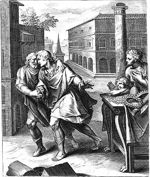
Nil ego contulerim iucundo sanus amico: Vaenius, Emblemata Horatiana (Antwerp, 1612), emblem 65 quotes the comment
Amicitia absque virtute: Borja, Empresas morales (Bruxelles, 1680), the comment of emblem 47 quotes the adage
Iconclass: 21C fire (one of the four elements) 21D water (one of the four elements) 33A5 friends 54E11 Necessity of Mutual Co-operation
Loci Communes: Amicitia (Friendship, Amitié)
II ii 76 Lupus circum puteum chorum agit The wolf dances round the well
Λύκος περὶ τὸ φρέαρ χορεύει, id est, Lupus circum puteum chorum agit. In eos dicetur, qui sumpta inaniter opera, spe sua frustrantur. Aiunt enim lupo morem esse, ut si quando sitiat, nec tuto se possit demittere, circum puteum oberret, frustra inhians aquae, quam non possit contingere. Sunt, qui paroemiam inde ductam existiment, quod aliquando veniat usu, ut lupus pecudem aliquam, aut hominem insectetur: qui postea quam se in puteum quempiam altiorem metu demiserit, obambulat ille, velutique saltantium in modum, in orbem circumagitur, praedae cupiditate, qua tamen potiri non queat. Plutarchus in commentario, cui tituius, quomodo possit adulator ab amico dignosci: ᾧ χρώμενοι προσαπολλυπυουσιν αὐτοὺς, τὴν περὶ τὸ φρεαρ ὀρχησιν ἀτεχνῶς ὀρχούμενοι, id est, Qua qui utuntur, seipsos quoque in perniciem adducunt, revera saltationem illam circum puteum saltantes. Loquitur autem de dicacitate intemperanti & virulenta, qua fit, ut nec illis quicquam utilitatis adferamus, in quos dicimus, & nobis ipsis maximum malum conciliemus. Refertur adagium à Zenodoto, Suida, Diogeniano.
Λύκος περὶ τὸ φρέαρ χορεύει, The wolf dances round the well, will be said of those who take pains to no purpose and are disappointed. They say it is habitual for a wolf, when thirsty and unable to get down in safety to the level of the water, to roam round the well, gaping vainly at the water which he cannot reach. Some think the proverb is taken from what happens occasionally: a wolf pursues a farm animal, or even a man, who takes refuge in fear in some well which is fairly deep, and he then roams to and fro and goes round in circles, as people do in a dance, longing for the prey which he is unable to reach. Plutarch, in the essay which he called 'How to Tell a Flatterer from a Friend,' says 'And when they behave like this, they are also preparing their own destruction, for they are simply dancing on the edge of the well.' He speaks of the uncontrolled scurrility and bitterness, which means that we make no useful contribution to those whom we attack, and lay up very great trouble for ourselves in the future. The adage is recorded by Zenodotus, Suidas and Diogenianus.
Facsimile:
Iconclass: 25F23(WOLF)(+561):43C9 beasts of prey, predatory animals: wolf (+ animal(s) standing on the hind legs)❧dancing 41A3911 well 54BB3 Inutility, Noxiousness; 'Nocumento', 'Nocumento d'ogni cosa' (Ripa)
Collectanea (1500): 627
Loci Communes: Frustrata spes (Frustrated hope, Espoir déçu)
II ii 77 Lydius currus A Lydian chariot
Λύδιον ἅρμα, id est, Lydius currus. Hoc scommate notabantur, qui in certamine quopiam longe caeteris essent inferiores: & παρὰ λυδιον ἅρμα θέεις. id est, Iuxta Lydium currum curris. Plutarchus in libello quem inscribit, de dignoscendo assentatore ab amico, Τον δὲ κρείττονα τρέμει καὶ δέδοικεν, οὐ μὰ δία παρὰ λύδιον ἅρμα μεζὸς οἰχνεύων, ἀλλὰ παρὰ χρυσὸν ἑφθον. id est, Caeterum superiorem metuit ac veretur, non hercle ad currum Lydium pedes ingrediens, sed ad aurum purum. Refertur adagium à Diogeniano. Quidam ad Pelopem Lydum referunt, qui suo curru vicerit Oenomaum socerum, in quibus est Gregorius Nazianzenus, sic usurpans, ut dicat se tanto esse inferiorem eximiis Basilii virtutibus, quantum pedes abest à Lydio curru. Effertur & ad hunc, ut diximus, modum paroemia: Παρὰ λύδιον ἅρμα θέειν. id est, Praeter Lydium currum currere: aut iuxta Lydium currum: ut pedes intelligatur certare cum Lydio curru velocissimo, quod quidem certamen nimis inique comparatum videatur. Achilles apud Euripidem in Iphigenia Aulidensi, pedestri cursu certat cum quadriga, & vincit. Plutarchus in vita Niciae è Pindaro allegat, Οὐ γὰρ μὰ δία, inquit, παρὰ λύδιον ἅρμα πεζος οἰχνεύων, ὥς φησι πινδαρος. id est, Non enim per Iovem iuxta Lydium currum pedes incedens, ut inquit Pindarus. Herodotus libro primo tradit, olim Lydios prae caeteris equitatu valuisse, nec aliter ferè nisi ex equis pugnare.
Λύδιον ἅρμα, A Lydian chariot, was a derisive expression applied to those who in any contest were markedly inferior to the rest; also You run alongside a Lydian chariot. Plutarch in the essay he entitled 'How to Tell a Flatterer from a Friend': 'He goes in fear and trembling of his betters, not to be sure because he is trudging afoot alongside a Lydian chariot, but he is compared with refined gold.' The adage is recorded by Diogenianus. Some refer it to Pelops the Lydian, who defeated Oenomaus his father-in-law in a chariot-race; among them is Gregory of Nazianzus, who uses it to convey that he is as far inferior to Basil with his distinguished merits as a foot-soldier is from a Lydian chariot.
The proverb is also used in the form I have indicated: Παρὰ λύδιον ἅρμα θέειν , To run against, or alongside, a Lydian chariot, with the suggestion that one is running on foot against a Lydian chariot, which is very fast, so that it would seem to be a most unequal contest. Achilles in Euripides, in the Iphigeneia in Aulis, competes on foot against a four-horse chariot, and wins. Plutarch in his life of Nicias quotes from Pindar: 'Not to be sure because he is trudging afoot against a Lydian chariot, as Pindar puts it.' Herodotus in his first book tells us that in the old days the Lydians were better horsemen than any others, and hardly ever fought except on horseback.
Facsimile:
Iconclass: 43A4211 Roman chariot, quadriga ~ triumph 51BB3 Imparity, Inequality, Difference 51EE2 Inferiority 54EE33 Competition, Rivalry, Emulation; 'Emulatione' (Ripa) 61D(LYDIA) geographical names of countries, regions, mountains, rivers, etc. (LYDIA) (LYDIA)
Loci Communes: Excellentia, inaequalitas (Excellence, inequality, Excellence, inégalité)
II ii 78 Cinclus Wagtail
Κίγκλοι, id est, Cincli, rusticano proverbio dicebantur praeter modum pauperes, quibus neque domus esset, neque quidquam, quod suum possent dicere. Qualem Catullus describit Furium, cui neque villula fuerit, neque domus, neque arca. Cinclus enim avis quaedam est imbecillis, atque invalida, ita ut non possit ipsa sibi proprium nidum parare, proinde ova nidis supponit alienis. Unde & rustici verterunt in adagionem, ut mendicos & errones Cinclos vocent. Autor Aelianus lib. De naturis animantium duodecimo. Quod genus homines Graeci ἀνεστίους vocant. hoc est, expertes penatium. Suidas tradit Cinclum avem esse maritimam, gracilem, nulloque fermè corpore, cui peculiare sit clunium pennas subinde movere, unde & nomen additum σεισοπυγιδι, nimirum ab agitatione caudae: Eam proverbio fecisse locum, quo Menander sit usus in Thaide? Πτωχότερος εἶ λεβηρίδος καὶ κιγκάλου. id est, Mendicior Leberide, atque cincalo. Hinc κιγκλιζειν dici, pro eo quod est, commoveri, & obstrepere.
Κίγκλοι, Wagtails, was proverbially used by country people as a name for the very poor, who had no home nor anything else that they could call their own. The Furius described by Catullus was like that: 'No country cot was his,' no house and home, no purse. For the wagtail is a bird so weak and feeble that it cannot build its own nest, and so has to lay in the nests of other birds; and for that reason countryfolk have made an adage of it and call beggars and vagabonds 'wagtails.' The authority for this is Aelian in book 12 of his Nature of Animals. People of this kind are called in Greek anestioi, which means 'having no hearth.' Suidas tells us that the cinclus or wagtail is a bird of the seacoast, light in weight and with almost no body, which has a peculiar habit of constantly jerking its tail-feathers; whence too it gets the name seisopygidi from the way it jerks its tail. This gave rise, he says, to a proverb used by Menander in his Thais: 'You are as beggarly as serpent's slough or wagtail;' and hence came the verb kigklizein for to make a commotion or disturbance.
II ii 79 Quae sub alis fiunt Underarm actions
Αἱ ὑπὸ μάλης πράξεις, id est. Facta subalaria, Proverbiali figura dixisse videtur. Plutarch. in commentario, quod inscribitur, quo pacto sit dignoscendus adulator ab amico: Πόνου, inquiens, καὶ σπουδῆς ἁπάσης ἀπολειπόμενος, ἐν ταῖς ὑπὸ μάλης πράξεσιν ἀπροφάσιστός ἐστιν, id est, Ad laborem & res honestas segnis, in his rebus, quae sub ala fiunt, nihil recusat. De adulatore loquitur, ad honesta officia tum pigro, tum inutili, ad voluptuaria ministeria prompto: videlicet ad scortum cum fide adducendum, ad comparanda opsonia, ad instruendum convivium. Equidem opinor, ob id adulationi sub alis sedem datam esse, quod hae corporis partes titillationem praecipuè sentiant, sive ob cutis tenuitatem, sive quod insolitus nobis earum contactus partium; sive quod is locus venulas habeat, quibus frictu calefactis, eiusmodi nascatur delectatio. Aristoteles sectione xxxv. Problemate ii. indicat, sub alis potissimum, ac sub pedum vestigiis fieri titillationem, coniectans in causa esse, vel quod ibi cutis sit mollior, velo quod contactus sit insolens, quod idem usu venit in auribus. Quid autem aliud est adulatio, quam aurium pruritus quidam, & gargarizatio? Unde Lucianus in dialogo quodam Charontis, Menippi & Mercurii, philosophum quempiam omnibus exuens vitiis: ἐν ἔτι τὸ βαρύτατον ὑπὸ μάλης ἔχει. Τί ὦ μένιππε; κολακίαν ὦ Ερμῆ, πολλὰ ἐν τῶ. βίῳ χρησιμεύσασαν αὐτῷ. id est, Unum quiddam adhuc sub alis gestat, quod est omnium gravissimum. Quidnam, Menippe? Adulationem Mercuri, quae illi plurimum attulit emolumenti in vita. nisi si quis malit ὑπὸ μάλης, ita dictum, ut alibi Lucianus dixit, ὑπὸ κόλπου, sub sinu, significans eum Veneris usum, qui non vacat turpitudine. Nam oscula, quaeque supra sinum fiunt, utcunque cum honestate possunt cohaerere, caeterum infra sinum, οὐδὲν ὑγιὲς.
Αἱ ὑπὸ μάλης πράξεις, Underarm actions, looks like a phrase of proverbial form, and is used by Plutarch in his essay entitled 'How to Tell a Flatterer from a Friend.' 'Industry' he says 'and serious business are too much for him; but when it's underarm actions, he makes no excuses.' He speaks of a toady, who for any honourable service is as idle as he is incompetent, but is always ready in the cause of pleasure: to fetch a loose woman he can really be trusted, to buy expensive food, to design a dinner-party. I think myself that flattery is located 'underarm' because the armpits are especially sensitive to tickling, either from the thinness of the skin in that part of the body, or because we are not used to have it touched, or because it is so well supplied with small veins which are warmed by rubbing and so produce an agreeable sensation of the kind. Aristotle in his Problems, section 35 problem 2, remarks that the armpit and the sole of the foot are particularly sensitive to tickling, and supposes the reason to be either the softness of the skin or the unfamiliarity of the sensation; which is also true of the ears. And what is flattery but a sort of itching and tickling of the ear? Hence Lucian in one of his Dialogues, the one between Charon, Menippus and Mercury, in the course of stripping a philosopher of all his faults, makes Menippus say: 'He's still got one, the heaviest of all, under his arm.' 'What's that, Menippus?' asks Mercury. 'Flattery, my dear Mercury, which he found so profitable while he was alive.' Unless anyone prefers to take 'under the arm' in the way Lucian elsewhere uses 'under the belt,' of sexual behaviour which is not free from indecency. For kissing, and what goes on above the belt, can in one way or another be respectable but what is below is rotten to the core.
Facsimile: 
Iconclass: 31A2241(+0) upper arm (+ variant) 31A2243 lower arm 31AA2541(+91) gripping someone by the arm - AA - both arms or hands (+ relations with friendly, non-aggressive character (expressive connotations)) 33A5 friends 57AA6121 Flattery; 'Adulatione' (Ripa)
Loci Communes: Intemperantia, libido (Intemperance, lust, Intempérance, désir)
II ii 80 Simul sorbere et flare difficile It is hard to suck and blow at the same time
Tranio servus apud Plautum in Mostellaria, obiurgatus est ab hero, quod non maturius redisset: cum ille se aliubi fuisse diceret, nec simul apud herum esse potuisse, & illud quod iussus fuerat, peragere: Si voles, inquit, verbum hoc cogitare, simul flare, sorbereque, haud factu facile est. Commode utemur hoc adagio, si quando significabimus, negocia quaepiam id genus esse, ut pariter ab iisdem tractari non queant. Veluti si quis conetur simul & literis & voluptatibus vacare: simul amoribus & parsimoniae indulgere: simul uxori studiisque satisfacere: simul & poeticis & theologicis studiis operam dare: simul & mundo servire & Christo. Quemadmodum fieri non potest, ut quis eodem in tempore sorbeat, hausto spiritu: & flet, emisso halitu. Affine videtur huic adagio dictum illud Evangelicum, Nemo potest duobus dominis servire, Nemo potest deo servire & mammonae. Item illud Phocionis ad Antipatrum: Οὐ δύνασαί μοι καὶ φίλῳ χρῆσθαι, καὶ κόλακι, id est, Non potes me simul & adulatore uti, & amico. Ad haec senarius ille, qui falsò Senecae inscribitur: Amare & sapere, vix deo conceditur. Quodque ait, Terentium imitatus Horatius: Nihilo plus explicet, ac si Insanire paret certa ratione, modoque. M. Tullius Philippica undecima: Duas tamen res magnas praesertim, non modo agere uno tempore, sed ne cogitando quidem explicare quisquam potest.
Tranio, a slave in Plautus' Mostellaria, is abused by his master for not returning sooner; and after saying that he was elsewhere, and could not at the same moment both attend on his master and finish what he had been told to do, he adds 'If you will please consider the old saying that to blow and suck at the same time is by no means easy.' We shall find an apt use for this adage whever we wish to convey that two pieces of business are of such a kind that the same person cannot equally perform them both; for example, if a man tried to devote himself at the same to both study and pleasure, to go a-courting and save money, to satisfy the claims of his wife and his research, to give his time simultaneously to poetry and theology, to serve both the world and Christ. It is no less impossible than for a person at the same time to suck, drawing in his breath, and to blow, breathing out. There is a well-known saying in the Gospels which is clearly related to this adage: 'No man can serve two masters. No man can serve God and Mammon.' And Phocion's remark to Antipater: 'You cannot treat me at the same time as both a flatterer and a friend.' Then there is that couplet wrongly ascribed to Seneca: To be wise and eke to love / Is granted scarce to god above,' and an echo of Terence in Horace: 'He'd no more sort it out than if he tried / To go mad by the book and rave by rote.' Cicero in the eleventh Philippic: 'But two important pieces of business are more than any man can master at the same time, let alone bring them both to a conclusion.'
Facsimile:
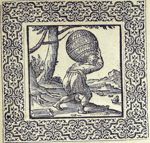
Nemo potest duobus dominis servire: Whitney, A choice of emblemes (Leiden, 1586), emblem 240 quotes the comment
Deo, non Mammonae: Meisner, Politica Politica (Nürnberg, 1700), emblem 384 paraphrases an adage from the comment
Iconclass: 31B6241 cheeks rounded 42A542(+0) thumb-sucking (+ variant) 43C74312(+0) blowing a home-made whistle (+ variant) 51F4 Simultaneity 52BB42 Impossibility 54DD4 Difficulty 73C7422 'you cannot serve God and mammon' ~ doctrine of Christ on possessions (Matthew 6:24; Luke 16:13) 73C831 'no servant can serve two masters' ~ proverbial saying of Christ (Matthew 6:24; Luke 16:13)
Collectanea (1500): 185
Loci Communes: Impossibilia (Impossible things, Choses impossibles)
II ii 80A Umbram metiri To measure the shadow
[transcription not found for adag_erasmus_1180A in adagia1200.xml]
[transcription not found for adag_erasmus_1180A in adagia1200_en.xml]
Iconclass: 22C8 shadow 49D52 measuring 52AA511 Ridiculousness 52BB42 Impossibility
Loci Communes: Inanis opera (Vain effort, Effort vain)
II ii 81 Manum admoventi fortuna est imploranda Set your hand to the work before you appeal to Fortune
Τὰν χεῖρα πολιφέροντα δεῖ τὰν τύχαν ἐπικαλεῖν, id est, Manum admoventi fortuna invocanda est. Admonet adagium, ita fidendum esse divino auxilio, ut nihilo segnius, quantum in nobis est, etiam ipsi nostra adnitamur industria: alioqui non adituros superos, inertium ac desidiosorum vota. Quemadmodum eleganter scripsit Alexander Hegius, primus pueritiae meae doctor haudquaquam poenitendus: Solas iure deus preces, Quo nemo magis impiger, Aut infestior ocio, Aversatur inertium. Plutarchus in Apophthegmatis Lacedaemonicis, refert apud eam gentem deos deasque omnes hastatos fingi solere, Venerem etiam ipsam armis indutam, tanquam ne illi quidem ocium agant, sed bellicis studiis exerceantur: Addunt, inquit, & proverbium, Τὰν χεῖρα ποτιφέροντα τὰν τύχαν καλεῖν. id est, Manum admoventi sunt vocanda numina. Aeschylus apud Stobaeum, Φιλεῖ δὲ τῷ κάμνοντι συσπεύδειν θεὸς. id est, Huic qui laborat, numen adesse assolet. In eandem sententiam Pindarus in Nemeis: Πρὸς ἄκρον ἀρετᾶς ἦλθον οἵτε πόνων ἐγεύσαντο, σὺν θεοῦ δὲ τύχῃ, id est, Ad summum virtutis apicem pervenerunt, qui gustarunt labores, non autem sine dei fortuna. Proinde nec ita fidendum industriae, ut divinam opem negligamus: nec ita rursum pendendum ab illa, ut nostrum praetermittamus officium. Allusisse videtur huc Aeschyl. in Persis: Εγὼ δέπου, Διὰ μακροῦ χρόνου τὰ δ᾽ ἤυχουν ἐκτελευτῆσαι θεοὺς, Αλλ᾽ ὅταν σπεύδῃ τις αὐτὸς, χ᾽ ὡ θεὸς συνάπτεται. id est, Plurimo iam tempore a deis Optaveram haec ut dextra conficerent mihi. at Ubi vigilas ipse, dii quoque admovent manum. Refertur ex eodem: Φιλεῖ δὲ τῷ κάμνοντι συσπεύδειν θεὸς. id est, Adesse gaudet sed laboranti deus. Nonnulli, quorum est Suidas, adagionis originem ad apologum referunt. Rusticus quidam quum plaustrum haereret in lama, ociosus invocabat Herculem. At ille adstans, Admove, inquit, manum rotae, ac stimula boves, itaque deum invoca: Τὴν χεῖρα προσφέροντα τὸν θεόν καλεῖν.
Τὰν χεῖρα πολιφέροντα δεῖ τὰν τύχαν ἐπικαλεῖν, Set your hand to the work before you appeal to Fortune. The lesson of the adage is that, while we ought to trust in divine help, we should strive none the less, as far as in us lies, by our own efforts; otherwise heaven will not listen to the prayers of indolent and lazy men. As it was neatly put by Alexander Hegius, my first teacher as a child (nor have I the least cause to regret it) God, the most active force there is, Is idleness' persistent foe The only prayers he will not hear Are those of sloth, and rightly so.
Plutarch in his 'Sayings of Spartans' records that in Sparta even the gods and goddesses are all represented with spears in their hands, and Venus herself wears armour, as though even they may not be idle but are active in the arts of war. They add, he says, a proverb: Set your hand to the work before you appeal to Fortune. Aeschylus, cited by Stobaeus: 'God loves to help the man who helps himself.' To the same effect Pindar in the Nemeans: They came to the summit of valour who took their share of toil; but it was with good fortune from god.' And so we ought not to be so confident in our own efforts that we neglect the help of heaven, nor on the other hand so dependent on that help that we let our own duty go by default.
Aeschylus seems to refer to this in the Persians: 'Long have I prayed that the gods would bring these things to pass; but when a man makes an effort himself, then god too takes a hand.' From the same source is quoted the line 'God loves to help the man who helps himself.' Some authorities, Suidas among them, trace the origin of the adage to a fable. There was a countryman once whose wagon struck in a boggy place, and he did nothing himself and called for help to Hercules. Hercules appeared. 'Put your shoulder to the wheel' he said 'and goad your oxen, and then appeal to heaven. Set your hand to the work before you appeal to a god.'
Facsimile: 

Adspirat fortuna labori: Zincgreff, Emblematum Ethico-politicorum (Heidelberg, 1619), emblem 19 uses the imagery of a favourable wind helping a ship that is already rowed forward to illustrate the adage's moral
Si tu requiers à Dieu ayde, ayde toy: La Perrière, Le theatre des bons engins (Lyon, 1545), emblem 95 uses the imagery of a man whose donkey collapsed to convey the idea that he should first try to help the donkey himself before invoking Fortune; the adage's comment also uses a story about a wagon stuck in the mud
Iconclass: 54A11 Industriousness, Assiduity; 'Assiduità', 'Industria', 'Zelo' (Ripa) 54C22:54F12 Appeal❧Luck, Fortune, Lot; 'Fato', 'Fortuna', 'Fortuna aurea', 'Fortuna buona', 'Fortuna pacifica overo clemente', 'Sorte' (Ripa) 49B24 teacher and pupil 61B2(HEGIUS, ALEXANDER)3 historical person (HEGIUS, ALEXANDER) - other representations to which the NAME of a historical person may be attached (HEGIUS, ALEXANDER)
Loci Communes: Industria (Industriousness, Application, diligence)
II ii 82 Quam quisque norit artem, in hac se exerceat Each man had best employ what skill he has
M. Tullius Tusculanarum quaestionum libro primo: Sed hic quidem quamvis eruditus sit, sicut est, haec magistro concedat Aristoteli, canere ipse doceat. Bene enim illo proverbio Graecorum praecipitur, Quam quisque norit artem, in hac se exerceat. Hactenus Cicero. Est autem senarius iambicus, admonens, ut quarum rerum sumus periti, in his duntaxat disputandis tractandisque versemur: quarum vero sumus rudes, eas doctioribus concedamus, neque professionem alienam nobis vindicemus, neque in messem alienam mittamus falcem, neve sutores ultra crepidam iudicemus. Apud A. Gellium Plato ex Euripide citat, sed in sensum non nihil diversum à Ciceroniano; nempe suo quemque vitae instituto studioque impensae delectari, quod in eo se laudem aliquam asecuturum confidat. Accidit, inquit, illis illud Euripidis: Qua in re clarus quisque est, ad eam properat, & diei partem illi plurimam impertit, in qua ipse se exuperet: contrà, in qua stupidior ac nihili sit, inde effugit, eamque contemnit. Porrò versus, quem Latine refert M. Tullius, est apud Aristophanem in fabula, cui titulus σφῆκες: is est eiusmodi:, Ερδοι τὶς ἥν ἕκαστος εἰδείη τέχνην. id est, Quam quisque novit artem, in hac se exercitet: Quo quidem loco interpres admonet, inter proverbia celebrari. Usurpavit Stratonicus citharoedus apud Athenaeum lib. viii. Qui musico cuipiam, qui prius fuerat holitor, de harmonia cum ipso disputanti, respondit, ἔρδοι τὶς ἥν ἕκαστος εἰδείη τέχνην. Quanquam in aeditione Aldina legitur ᾄδοι pro ἔρδοι. Ad hoc proverbium allusit Horatius ita scribens: Navem agere, ignarus navis timet: abrotanum aegro Noni audet, nisi qui didicit, dare. Quod medicorum est. Promittunt medici: tractant fabrilia fabri. Scribimus indocti, doctique poemata passim. Idem in epistola ad Villicum: Quam scit uterque lubens censebo exerceat artem. Huc pertinet illud Pindaricum, quod refert Plutarchus in commentario, quem scripsit, περὶ τῆς εὐθυμϊας, Υφ᾽ ἅρμασιν ἵππος, ἐν δ᾽ αῤότρῳ βοῦς, παρὰ ναῦν δ᾽ ἰθύνει τάχιστα δέλφις. κάπρῳ δὲ βουλεύοντι φόνον, κύνα δεῖ τλάθυμον ἐξευρεῖν. id est, Equus in quadrigis, in aratro bos. Navem ocyssime praevertitur delphinus: apro caedem molienti inveniendus est canis laborum patiens. Videlicet significat, unumquenque adhibendum ad id quo valet. Athenaeus lib. octavo, cum Ptolemaeus cum Stratonico citharoedo contentiosius disputaret de citharistica, ἕτερον ἔφη ἐστὶν ὦ βασιλοῦ σκῆπτρον, ἕτερον δὲ πλῆκτρον. id est, Aliud est, inquit, rex sceptrum, aliud plectrum. Et apud Plinium lib. trigesimoquinto, cap. decimo. Apelles Alexandro Magno, in officina multa imperite disserenti de pictura, comiter suasit silentium, admonens, illum rideri à pueris, qui colores terebant.
Cicero in book 1 of his Tusculan Questions: 'But as for him, however learned he may be, and learned he certainly is, he should leave these questions to his master Aristotle, and confine himself to teaching music. For there is good sense in that Greek proverb "Each man had best employ what skill he has".' Thus far Cicero. This is a six-foot iambic line, which counsels us to spend our time in considering and working on those subjects only with which we are familiar; while those of which we have no experience we should yield to people who are better instructed, not claiming other men's skills nor putting our sickle into another man's harvest nor criticizing like the cobbler who will not stick to his last. Plato in Aulus Gellius quotes it from Euripides, but in a sense somewhat different from that found in Cicero: that every man is peculiarly satisfied with his own way of life and purpose, because he is confident that it will bring some credit. They have, he says, the experience described by Euripides: Each man hastens to take up the thing he is good at, and devotes the greatest part of his day to the subject in which he has scope for self-improvement; but anything for which he is less gifted and in which he can do no good, he avoids, and counts it of no value. Furthermore, the line which Cicero quotes in Latin is to be found in Aristophanes, in the Wasps: 'Each man had best employ what skill he has;' and the scholiast on that passage tells us that it was a proverb in common use. Stratonicus the lyre-player uses it in Athenaeus, book 8. A musical amateur who had previously been a gardener was arguing with him on some question of harmony; and he retorted 'Each man had best employ what skill he has,' though the Aldine edition has adoi, sing for erdoi, employ. Horace thought of the proverb when he wrote:
Who knows not ships will fear to venture aught, Nor southernwood prescribe, who's not been taught, Leeches their physic, smiths their hammers ply -Skilled and unskilled, we all can versify.
And again in his letter to his farm-bailiff: 'Each of us in my view should practise the art he understands.'
Here belongs that sentiment of Pindar which Plutarch cites in his essay 'On Tranquillity of Mind': 'Horses in chariots, oxen to the plough; a dolphin can swim faster than any ship, and against a wild boar bent on slaughter we must find a hound of good courage.' His point of course is, that everything should be used for its proper purpose. Athenaeus in book 8: when Ptolemy was hotly disputing on some point of technique with Stratonicus the lyre-player, he said 'A sceptre, your majesty, is one thing, and a plectrum another.' And in Pliny, book 35 chapter 10, when Alexander the Great was holding forth on painting in a very ignorant manner in Apelles' studio, the artist tactfully advised him to be silent, pointing out that he was being laughed at by the slave-boys who were grinding the colours.
II ii 83 Dedi malum et accepi I got as bad as I gave
Dedi malum & accepi. Beticum adagium est, quo licebit uti, quoties eiusmodi permutatio videbitur facta, ut malum pro malo sit redditum, & par pari relatum: veluti, si quis improbum generum dedisset, ac nurum item improbam recepisset. Recensetur & explicatur à Plinio iuniore in Epistolis. Caecilius, inquit, Classicus, homo foedus, & aperte malus, proconsulatum in ea parte non minus violenter quam sordide gesserat, eodem anno, quo in Africa Marius Priscus. Erat autem Priscus ex Betica, ex Africa Classicus: inde dictum Beticorum (ut plerunque dolor etiam venustos facit) non illepidum ferebatur: Dedi malum & accepi. Congruet & in eos qui liberos suos committunt malis praeceptoribus, & recipiunt eos peiores quàm tradiderant. Rursum in eos, qui lacessunt illos, unde gravius laeduntur, quod usu venire tradunt iis, qui in Aegypto venantur onagros. Nam animal lacessitum frequenter calcitrando lapides missos retorquet in iaculantes tanto impetu, ut pectora insequentium penetrent, aut caput fractis ossibus displodant. Unde & instrumento bellico nomen inditum. autor Ammianus libro vigesimotertio.
I got as bad as I gave is an adage from Baetica, which it will be possible to use whenever the sort of exchange appears to have taken place by which one evil is traded for another - tit for tat, in fact, as if a rascal's father might have passed him off to someone as a son-in-law and acquired a rascally daughter-in-law in return. This is described and explained by Pliny the Younger in his Letters: 'Caecilius Classicus,' he says, 'a horrible fellow, an undisguised villain, had served as proconsul there, and shown himself both brutal and extortionate, in the same year that Marius Priscus had served in Africa. Priscus came from Baetica and Classicus from Africa, and the people of Baetica were reported as saying, not without wit (for we often find that distress actually makes a man epigrammatic) "We got as bad as we gave."' It will also fit those who entrust their children to bad teachers and get them back worse than when they parted with them. Or those again who do an injury to others and suffer worse injury in return, as happens (they say) to those who hunt wild-asses in Egypt; for the animal when assailed with a shower of stones often returns the stones against its assailants, by using its hooves, with such force that they pierce the chests of its pursuers or break open their heads, cracking the skull. Hence the name wild-ass or onager given to a form of artillery, as we learn from Ammianus book 23.
Facsimile: 
Iconclass: 54AA5 Badness 55C2 Giving 55CC2 Receiving 25F24(ONAGER) hoofed animals: onager
Collectanea (1500): 49
Loci Communes: Mali retaliatio (Retaliation of evil, Rendre le mal pour le mal)
II ii 84 Carpet citius aliquis quam imitabitur Sooner critized than imitated
Μωμήσεταί τις μᾶλλον ἢ μιμήσεται. id est, Reprehendet aliquis citius, atque imitabitur. Senarius hic Apollodori pictoris operibus inscribi consuevit, qui primus umbrarum imitationem invenit. Refertur ad hunc modum, μωμήσεται τις θᾶσσον ἢ μιμήσεται. Apte dicetur de re quapiam artis absolutae, atque inimitabili. Porrò res egregias multo proclivius est carpere, quàm aemulari. Caeterum est elegans προσονομασία in duabus vocibus Graecanicis μωμήσεται, & μιμήσεται, quae cum sono minime distent, tamen res declarant longe diversissimas. Huc allusit Plinius lib. trigesimoseptimo, capite undecimo, Imitati multi, aequavit nemo. Theognis in eandem sententiam, Μωμεῦνται δέ με πολλοὶ ὁμῶς κακοὶ ἠδὲ καὶ ἐσθλοὶ, Μιμεῖσθαι δ᾽ οὐδεὶς τῶν ἀσόθων δύναται. id est, Carpunt me plures docti indoctique, imitari Nos indoctorum de grege neme valet.
Μωμήσεταί τις μᾶλλον ἢ μιμήσεται, Far more will this be blamed than imitated. This line was customarily inscribed on the works of Appollodorus, the painter who first discovered how to represent light and shade. It is also recorded in the form Sooner will this be blamed than imitated. It will be aptly applied to any perfect work of art which is beyond imitation. It is in fact much easier to find fault with excellence than to rival it. There is, by the way, an elegant play on words in the two Greek verbs used, mômesetai, criticize, and mimesetai, imitate: they differ very little in sound, but mean very, very different things. Pliny alluded to this in book 35 chapter 11: 'Imitated by many, equalled by none.' Theognis writes to the same effect: 'Many alike both bad and good berate me, / But none of these dull dogs can imitate me.'
Facsimile:
Nis cum deficit, spectatorem non habet: Borja, Empresas morales (Bruxelles, 1680), emblem 37 uses the iea that it is easier to criticize than to emulate
Iconclass: 48A2 criticizing and discussing art, art criticism 51B6 Imitation; 'Imitatione' (Ripa) 92G4(+0) (story of) Momus (+ variant)
Loci Communes: Obtrectatio et maledicentia (Disparagement and slander, Dénigrement et médisance)
II ii 85 In foribus adesse To be at the door
Περὶ τὰς θύρας, id est, In foribus adesse, dicitur allegoria proverbiali, quod instat, iamque in proximo est. Plutarchus Πυρετοῦ περὶ θύρας ὄντος, id est, Cum febris in foribus adest. Sic & orbis opifex in arcanis literis ad Cain fratricidam: Sin male egeris, statim in foribus peccatum tuum aderit.
Περὶ τὰς θύρας, To be at the door, is used proverbially as an image for something that impends and is now close at hand. Plutarch: 'When fever is at the door.' So too in Scripture the Creator says to Cain who killed his brother: 'But if thou doest not well, thy sin will forthwith be at the door.'
Facsimile:
Iconclass: 41A32 door 51I4 Nearness 51L41 Approach
Loci Communes: Discriminis (Danger, crisis, Danger); Festinationis (Haste, Hâte); Simulatio, dissimulatio (Pretense, dissimulation, Simulation, dissimulation)
II ii 86 Lacon, alia asinus illius portat Lacon one thing, his ass carries others
Αλλα μὲν Λάκων λέγει, ἄλλα δὲ Λάκωνος ὄνος φέρει, id est, Alia quidem Lacon dicit, alia Laconis asinus portat. Effertur apud quosdam & ad hunc modum paroemia: Αλλα μὲν Λεύκων, ἄλλα δὲ Λεύκωνοσ ὄνος φέρει. id est, Alia Leucon, alia Leuconis asinus portat. In eos dicebatur quorum oratio dissentiret à factis. Natum aiunt ab huiusmodi quodam eventu. Agricola quispiam nomine Leucon, solitus est utres melle plenos storeis obvoluere. Rogatus autem ab exactoribus vectigalium, quid nam portaret, ordeum se portare respondebat, videlicet, quo minus pecuniae persolveret. Sed cum evenisset aliquando, ut lapsus in terram asinus onus effudisset, accurrerunt exactores, in reponendis sarcinis auxilio futuri. Verum ubi interim cognovissent, mel in utribus esse, non ordeum, Leuconem obtorto collo abduxerunt, tanquam qui se debito vectigali fraudasset. Atque illud ridentes addiderunt, Alia Leucon, alia portat asinus. Nam in nonnullis codicibus, dicit, non additur, atque ita mea sententia dictum festivius redditur. Ea vox postea versa est in adagionem. Refertur à Zenodoto, & à Diogeniano.
Ἄλλα μὲν Λάκων λέγει, ἄλλα δὲ Λάκωνος ὄνος φέρει, Lacon says one thing, Lacon's ass carries others. In some sources the proverb is also recorded in this form: Ἄλλα μὲν Λεύκων, ἄλλα δὲ Λεύκωνοσ ὄνος φέρει, Leucon one thing, but Leucon's ass carries others. It was used of those whose words were at variance with their actions. They say it arose from an incident something like this. A certain farmer, Leucon by name, had the habit of wrapping up skins full of honey in straw mats. When asked by the excisemen what he was carrying, he used to say he carried a load of barley, in order of course to reduce the tax he had to pay. One day it so happened that his ass fell and spilt its load, and the excisemen came running up to help him replace the bundles. While doing so they noticed that the skins were full of honey and not barley, and they haled Leucon off by the scruff of the neck, as a man who had defrauded them of the excise that was due. Laughing heartily, they added: 'Leucon one thing, but his ass carries others;' for in some manuscripts the word 'says' is omitted, and in my opinion this gives the remark more point. The words later became an adage; it is recorded by Zenodotus and by Diogenianus.
Facsimile:
Iconclass: 46A14 farmers 46C13142(+75246) ass, donkey (+ animal(s) carrying something) 57AA621 Cheat, Deceit; 'Fraude', 'Inganno' (Ripa) 98B(LACON) male persons from classical history (LACON)
Loci Communes: Simulatio, dissimulatio (Pretense, dissimulation, Simulation, dissimulation)
II ii 87 Corpore effugere To dodge with the body
Corpore effugere, est periculum iam imminens, ac penè premens, arte quadam declinare. Translatum à gladiatoribus, ictum modico corporis flexu fallentibus. M. Tullius in Catilinam invectione prima, Quot ego tuas petitiones ita coniectas, ut vitari posse non viderentur, parva quadam declinatione, &, ut aiunt, corpore effugi. Hactenus Cicero. Itaque quoties aliquem discrimine quàm minimo à periculo abfuisse significabimus, corpore declinatum malum dicemus. Minus enim periclitantur, qui moenibus aut alio quopiam obiectu defenduntur: verum qui nudi telis obiecti, nihil habent quo se tueantur, nisi commodo corporis deflexu, ii demum in extremo periculo versari videntur. Penè diversa figura dixit Catullus, Contra nos tela ista tua evitamus amictu, id est, Facile depellimus, non secus quàm muscarum insultus.
To dodge with the body is to use some subtle manoeuvre to evade a danger which is already imminent and virtually immediate. This is a metaphor from gladiators, avoiding a blow by a slight bodily swerve. Cicero in his first Catilinarian Oration: 'Think of all the blows you delivered in such a way that they seemed unavoidable, which I escaped by swerving slightly and dodged them, as the phrase goes, with my body!' These are Cicero's words. Thus, whenever we wish to convey that someone has escaped a danger by the narrowest possible margin, we shall say that he dodged disaster with his body. They are in less danger who have walls or some other solid protection to defend them; those openly exposed to the enemy's weapons with no chance of preserving their lives except a well-timed swaying of the body - it is they whom one would think to be in utmost peril. Almost the opposite sense is conveyed by Catullus when he writes 'I for my part dodge those blows of yours with my garment,' meaning that he repels them easily, as one would an attack of flies.
Facsimile: 
Iconclass: 31A27(+923) movements of the human body (+ defending oneself) 45G2(+1) (military) self-protection (+ during the battle)
Loci Communes: Elabendi (Slipping away, escaping, S'échapper); Discriminis (Danger, crisis, Danger)
II ii 88 De alieno ludis corio You gamble with another man's hide
De alieno corio ludere, proverbio dicuntur, qui securius agunt, sed alieno periculo. Sumpta allegoria vel à coriariis, vel ab Apologo quopiam, vel à servis, qui si quid peccatum sit, tergo dant poenas. Apuleius in Asino aureo libro septimo, Quod si quomodo caeteri latrones persenserint, non rursus recurres ad asinum, & rursum exitium mihi parabis. Revera ludis de alieno corio. Verba sunt asini, puellam accusantis, quòd cum prius illius culpa fuisset in discrimen adductus in fuga, nunc denuo committat, ut sit rursum fugiendum, idque suo potissimum periculo. Allusum est autem ad asini corium, quod mortuis detrahitur. Est simile quiddam & apud Plautum: De meo tergo degitur corium. id est, res meo fit periculo. Neque dissimile quod refert Festus, Pro scapulis. id est, pro periculo plagarum. Non admodum abludit ab hac forma, quod Seneca iocatur in Declamationibus: Cicero patri de corio Cestii satisfecit. Nam is Cestius erat ex eorum numero, qui contemnebant Ciceronis ingenium. hic cum forte accumberet in eodem convivio cum Cicerone, M. Tullii filio, qui tum Asiam obtinebat, & submonente quopiam è famulis, cognitum esset, eum esse Cestium, cuius iudicio nihil sciret M. Tullius: ilico sublatus è convivio, iussus est flagris caedi. Circumfertur apud nostratium vulgus non absimile huic proverbium, Ex alieno tergore lata secari lora. Quo quidem significant, unumquenque minus esse parcum in alieno quàm in suo. Tertullianus in libello De pallio, secus aliquanto usurpavit: Hoc soli chamaeleonti datum, quod vulgo dictum est, de suo corio ludere. Sentit chamaeleontem pro suo arbitrio vertere colorem cutis.
To gamble with another man's hide is a proverbial expression for those who act without thinking, but at other people's risk. The figure is taken either from leather-sellers, or from some fable, or from slaves who pay the penalty for any mistake with the skin off their backs. Apuleius in the Golden Ass, book 7: 'If the rest of the gang see what you're up to, surely you will again take refuge in the ass, and bring destruction on my head a second time. You are really and truly gambling with another man's hide.' The ass is speaking, and his grievance against the girl is that, having already through her own fault put him in great danger in their attempt to escape, she is now again acting in such a way that they will have to run away a second time, and the risk will be mainly his. The allusion is to an ass's hide, which is stripped off them when they are dead. There is something very like it in Plautus too: The hide is being stripped off my back,' meaning, I shall have to pay for this. And there is a similar phrase in Festus, 'on behalf of my shoulder-blades,' referring to the risk of a flogging. There is not much distance between this formula and a humorous remark of Seneca in his Declamations: The younger Cicero avenged his father at the price of Cestius' hide.' This Cestius was one of those who despised Cicero's abilities. He was once seated at the same dinner-party as Cicero the son, whose father was at the time governor of Asia, and when he discovered, on a tip-off from one of the servants, that this man was the Cestius in whose judgment his father, the great Cicero, was an ignoramus, he had him immediately removed from the table and whipped.
A proverb not unlike this is in circulation among the common people in my native country: To cut large thongs of other men's leather; by which they mean that everybody is less economical of other people's property than of his own. Tertullian in his De pallio uses it rather differently: The chamae-leon alone is allowed, as the common saying has it, to gamble with its own hide.' His point is that a chamaeleon can change the colour of its skin to please itself.
Facsimile:
Iconclass: 25F(+351) animals (+ skin, fleece, hide, fur, leather) 31A2262 skin (human) 43C5(+0) games of calculation and chance, e.g.: card games, gambling, puzzles, etc. (+ variant) 54DD52 Risk; 'Ardire ultimo & necessario' (Ripa) 57AA65 Selfishness; 'Interesse', 'Interesse proprio' (Ripa)
Loci Communes: Alieno periculo (At another's risk, Au risque d'autrui)
II ii 89 In herba esse To be in the blade
Ubi spem immaturam indicamus, ac longius adhuc abesse ut consequaris, in herba esse dicimus. Sumpta metaphora à segetibus, teneris adhuc & herbescentibus, de quibus nihil adhuc certi sibi possit agricola polliceri, propterea quod plurimi casus solent incidere, qui non sinant cultorem optato potiri. Verum ubi iam demessam segetem in horrea convexit, tum demum utcunque tutum est bene sperare. Ovidius in epistola Helenae ad Paridem: Sed nimium properas, & adhuc tua messis in herba est. Haec mora sit voto forsan amica tuo. Persius in satyra sexta, Emole, quid metuis? occa, & seges altera in herba est. Cornelius Tacitus in dialogo De oratoribus, In herba dixit, pro eo quod est, momentaneum moxque periturum, quia ante tempus decerptum. Agit illic de plausu qui datur poetis recitantibus sua carmina. Omnis, inquit, illa laus intra unum, aut alterum diem, velut in herba vel flore praecepta, ad nullam certam & solidam pervenit frugem, nec aut amicitiam inde refert, aut clientelam, aut mansurum in animo cuiusquam beneficium, sed clamorem vagum, & voces inanes & gaudium volucre.
When we wish to convey that hopes are immature and success is still a long way off, we say that things are 'in the blade.' The metaphor is taken from cereal crops that are still young and look like grass, from which the husbandman can as yet promise himself no definite return, because so many accidents can happen to prevent the grower from achieving his objective. When however he has reaped the crop and carried it into his barn, the moment has at last come to hope, within limits, for success. Ovid, in Helen's letter to Paris: 'Your crop's yet in the blade; more haste, less speed. / Delay perchance may bring you what you need.' Persius in his sixth satire: 'Grind all your grain. Just harrow (who's afraid?) / And your next crop's already in the blade.' Cornelius Tacitus in his Dialogue on Orators uses 'in the blade' for something that lasts but a short time and will soon be over because it has been gathered before its time. Speaking of the applause given to poets who recite their own works, he says: 'All that credit is gone in two or three days. As though it had been plucked in the blade or in the flower, it achieves no real or solid fruit; it wins no friends and no dependants, and leaves in no man's mind a lasting sense of a benefit conferred, only shifting noise and empty words and fleeting enjoyment.'
Facsimile:
Iconclass: 47I14 harvest 51F511 Immaturity 51F52 Earliness 51II4 Farness
Loci Communes: Incertus eventus (Uncertain outcome, Issue incertaine)
II ii 90 In alieno foro litigare To plead in a strange court
Proverbium resipit haec quoque figura, In alieno foro litigare, pro eo quod est, in re nova, cuique nondum assueveris, versari. Habent enim diversa fora diversas litium formulas, variasque tractandarum causarum rationes: quarum qui rudis sit, is tanquam hospes in peregrina regione, multa desideret necesse est. Martialis in praefatione libri duodecimi, Accipe ergo rationem, in qua hoc maximum & primum est, quod civitatis aures quibus assueveram, quaero, & videor mihi in alieno foro litigare.
Another metaphor which has the flavour of a proverb is To plead in a strange court, for being engaged on unfamiliar business, to which you have not yet grown accustomed. Different courts prescribe different formulas for pleading and different principles for the conduct of a case; and the man who is ignorant of these is like a stranger in a foreign country and is bound to find himself in many ways at a loss. Martial in the preface to his book 12: 'And I will tell you why. First and foremost because I seem deprived of my familiar audience, and have the feeling that I plead in a strange court.'
II ii 91 In seditione vel Androclides belli ducem agit In civil war even Androclides is a general
Εν δὲ διχοστασΐῃ κ᾽ Ανδροκλείδης πολεμαρχεῖ. id est, Seditione orta dux est etiam Androclides. Carmen Heroicum proverbio celebratum, in homines contemptos & humiles, qui per occasionem aliquam incidentem, dignitatem sortiuntur. Quemadmodum in rerum tumultu nonnumquam infimi quidam pro tempore regnant. Detorqueri potest ad malos principes, qui rebus pacatis minus valent in Rep. atque ob id aliquoties data opera rerum motus excitant arte tyrannica, quo commodius suo arbitratu populum compilent . Aut in theologos quosdam, eo nomine indignos, qui dissidium ac tumultus concitant in plebe Christiana, quod nimirum hac occasione celebres reddantur, maluntque publico omnium malo nobilitari, quam inglorii vivere. Refertur à Suida, Diogeniano, atque item à Plutarcho in vita Niciae, & apud eundem in commentario, περὶ φιλαδελφίας. Effertur etiam ad hunc modum, Εν δὲ διχοστασΐῃ καὶ πάγκακος ἔμμορε τιμῆς. id est, Rebus turbatis, vel pessimus est in honore. Citat idem in comparatione Lysandri & Syllae, nisi quod illic Aldina editio mendose habet, πάγκαλος pro πάγκακος. Rursum effertur hoc pacto, Εν γὰρ ἀμηχανΐῃ καὶ καρκῖνος ἔμμορε τιμῆς. id est, Fert rebus desperatis & cancer honorem. Ad hanc sententiam pertinet & illud, Graecis proverbii vice celebratum: Καιροῦ τυχὼν γὰρ πτωχὸς ἰσχύει μέγα. id est, Mendicus etiam plurimum in loco potest.
Ἐν δὲ διχοστασΐῃ κ᾽ Ανδροκλείδης πολεμαρχεῖ, Once civil war breaks out even Androclides can play the general. A hexameter line, current as a proverb, on mean and contemptible men who by some accident achieve an important place; as for example in civil disturbance men of the lowest sort bear rule for a season. It can be adapted to wicked princes, who in time of peace have less power in the state, and for that very reason sometimes deliberately use their skill as tyrants to stir up revolution, so that they can conveniently pillage the people as they please. Or it might be applied to certain theologians unworthy of the name, who arouse divisions and discord among Christian folk, to get an opportunity to make a name for themselves, and would rather be famous while everyone else is miserable than live in obscurity. It is recorded by Suidas and Diogenianus, and also by Plutarch in his life of Nicias and in his essay 'On Brotherly Love.' It is also expressed in this form: 'In civil strife honour befals even the scoundrel [pankakos].' Plutarch cites this too, in his 'Comparison of Lysander and Sulla/ except that there the Aldine edition reads in error pankalos, hero, for pankakos, scoundrel. Another form is 'When things are desperate, a crab wins honour.' This maxim bears some relation to another which was current in Greek as a proverb: 'Once given his chance, a beggar can do great things.'
Facsimile: 
Iconclass: 44F2 civil war 45D311 commander-in-chief, general, marshal 54AA3 Incompetence 98B(ANDROCLIDES) male persons from classical history (ANDROCLIDES)
Loci Communes: Honos indigno habitus (Honor given to the unworthy, Honneur accordé à qui ne le mérite pas); Tumultus (Turmoil, Tumulte)
II ii 92 Inter indoctos etiam corydus sonat In tuneless company the lark can sing
Εν ἀμούσοις καὶ κόρυδος φθέγγεται. id est, Inter amusos etiam Corydus sonat. Quadrabit in quosdam, qui apud idiotas audent sese velut eruditos venditare, inter doctos alioqui prorsus elingues: id quod citra metaphoram eleganter extulit Euripides in Hippolyto coronato: Οἱ γὰρ σοφοῖς Φαῦλοι, παρ᾽ ὄχλῳ μουσικώτεροι λέγειν.. id est, Apud eruditos qui nihil valent, apud Plebem imperitam praeeminent facundia. Corydus, vilissimum aviculae genus, minimeque canorum, strepit tamen utcunque inter aves mutas, apud lusciniam canens ferri nequaquam posset. Huc adscribendum arbitror, quod, ut refert Athenaeus lib. sexto, non illepide dixit Philoxenus parasitus, cognomento Pternocopis, in alterum parasitum nomine Corydum: quum enim incidisset sermo, quod turdi magno emerentur, praesente Corydo, de quo rumor erat obsceni obsequii. At ego, inquit, memini Corydum obolo fuisse aestimatum. Parasitis autem solent indi nomina contemptus. Quanquam hic Corydus narratur in dictis fuisse lepidus. Corydum autem minime canorum esse testatur & Graecum epigramma, licet ἄδηλον, Εἰ κύκνῳ δύναται κόρυδος παραπλήσιον ᾄδειν, Τολμῶειν δ᾽ ἐρΐσαι σκῶπες ἀηδονίσιν, Εἰ κόκκυξ τέττιγος ἐρεῖ λιγυρώτερος εἶναι, Ισα ποιεῖν καὶ ἐγὼ παλλαδίῳ δύναμαι. id est, Si corydus cycnum queat aequiparare canendo, Noctua concertet si philomela tibi, Coccyx si iactet se voce anteire cicadam, Tunc ego palladio par potero esse meo.
Ἐν ἀμούσοις καὶ κόρυδος φθέγγεται, In tuneless company even the lark can sing, will be suitable for some people who in ignorant society put themselves forward as learned men, but among the educated are perfectly tongue-tied, a situation elegantly expressed without the use of metaphor by Euripides in the Hippolytus crowned: Those who among the wise are nothing worth / Before a mob are eloquent enough.' The corydus or lark is a small bird of no value which does not sing at all, but makes some sort of noise among birds that have no voice; singing against a nightingale it would be quite intolerable. I think I should add here a reply not without point made, according to Athenaeus, book 6, by Philoxenus, a parasite whose nickname was Pternocopis, to another parasite called Corydus. Conversation had turned to the high price of thrushes, in the presence of Corydus, who had the reputation of having been a male prostitute. 'Why,' said Philoxenus, 'I remember a time when you could have a corydus for an obol.' Parasites are often given names expressive of contempt; though the story goes that this Corydus was happy in repartee. That the corydus was a most untuneful bird is also shown by a Greek epigram, though the author is unknown:
When larks with swans in song shall dare compete And owls with nightingales make bold to vie, Cuckoos as crickets boast to sing as sweet, We'll write alike, Palladius and I.
Facsimile:
Iconclass: 25F32(LARK)(+49) song-birds: lark (+ audible means of communication of animal(s): roaring, crying, singing, barking, mewing, neighing, chirping, etc.) 51DD4 Ugliness 54AA3 Incompetence
Loci Communes: Contemptus et vilitatis (Contempt and worthlessness, Mépris et bassesse)
II ii 93 Quaevis terra patria Home is everywhere
Πᾶσα γῆ πατρίς. id est, Quaevis terra patria. Hemistichium est oraculi, quondam redditi Meleo Pelasgo, de victoria consulenti: cuius meminit et Mnaseas, teste Zenodoto, & Dionysius Chalcidensis. Admonet adagium, virum sapientem ac bonum, ubicunque gentium vixerit, felicem esse. Unde et Socrates interrogatus, cuiatis esset, κοσμικὸν, id est, mundanum se esse respondit. Idem innuit Aristophanes in Pluto, cum ait, Πατρὶς φὰρ ἐστὶ πᾶσ᾽ ἵν᾽ ἂν πράττῃ τὶς εὖ. id est, Illic enim patria est, ubi tibi sit bene. Dicuntur haec à Mercurio, cupiente vel caelo relicto, in Chremyli iam divitis ascisci familiam: usqueadeo credebat ibi demum esse patriam homini, ubicunque feliciter ageret, illic exilium, ubi parum commode viveret. Fertur hic quoque versiculus proverbialis: Τοῖς γὰρ καλῶς πράσσουσι πᾶσα γῆ πατρίς. id est, Solum omne patria prospere quicunque agit. Cicero Tusculanarum quaestionum libro quinto, significat esse dictum Teucri, ex tragoe dia quapiam. Itaque ad omnem rationem Teucri vox accommodari potest: Patria est, ubicunque est bene.
Πᾶσα γῆ πατρίς, Home is everywhere, is a half-line from an oracle given to Meleus the Pelasgian, when he was enquiring about victory, and it is mentioned by Mnaseas, according to Zenodotus, and by Dionysius of Chalcis. The point of the adage is that a wise and good man is happy, in whatever part of the world he may live. Hence Socrates, when asked of what country he was a citizen, replied that he was a citizen of the world. Aristophanes hints at this in the Plutus when he says 'For home is everywhere where you're well treated.' The words are uttered by Mercury, who wishes, even at the price of leaving heaven, to become a member of Chremylus' household, now that he's so rich; so strong is his conviction that home is there and there only where a man can live happily, and where he would live in discomfort is exile. There is also a proverbial line that runs as follows: 'Prosperity makes every country home.' Cicero in book 5 of his Tusculan Questions indicates that the words were said by Teucer in a tragedy: 'And so that saying of Teucer's can be adapted to every system, that a man's own country is anywhere where he is well off.'
Facsimile: 
Iconclass: 44C1:25 nationality, citizenship❧earth, world as celestial body
Loci Communes: Bonae fortunae, copiae, felicitatis aut ominis (Of good fortune, abundance, happiness, or omen, Bonne fortune, abondance, bonheur ou présage)
II ii 94 Odium Vatinianum Hate worthy of Vatinius
Odium Vatinianum, pro capitali, ac vehementer acerbo. Vatinius, in quem acerrime M. Tullius invectus est, in tantum odium populi Romani pervenerat, iam detectis illius flagitiis, ut in proverbium cesserit, odium Vatinianum. Catullus, Munere isto Odissem te odio Vatiniano.
Hate worthy of Vatinius means excessively bitter and deadly hatred. Vatinius, who was bitterly attacked by Cicero, had become so deeply loathed by the Roman people when his crimes were detected, that Hate worthy of Vatinius passed into a proverb. Catullus: Tor that present I would hate you as I hate Vatinius.'
II ii 95 Odium novercale Stepmotherly hatred
Consimili figura legimus, odium novercale, propterea quod novercis omnibus innatum sit fatale quoddam & irreconciliabile odium in privignos. id quod eleganter indicat epigramma Graecum, quod haud gravabimur adscribere. Fertur autem titulo Callimachi, nec illo quidem in lignum autore: Στήλην μητρυιῆς μικρὰν λίθον ἔστεφε κοῦρος Ως βίον ἤλλάχθαι, καὶ προτον οἴομενος. Η δὲ τάφῳ κλιθεῖσα κατέκτανε παῖδα πεσοῦσα. Φεύγετε μητρυιῆς καὶ τάφον οἱ πρόγονοι. Quorum carminum elegantiam cum haud nesciremus nos non assecuturos, tamen quo possent intelligi, utcunque vertimus, Exiguo lapidi puer addit serta novercae, Mutasse ut vitam, sic ratus ingenium. At puerum extinguit tumulo haec illapsa. novercae Privigni exanimem vel tumulum fugite. Euripides in Alcestide: Εχθρὰ γὰρ ἐπιοῦσα μητρυιὰ τέκνοις Τοῖς πρόσθ᾽, ἐχίδνης οὐδὲν ἠπιοτέρα. id est, Hostis noverca est ante natis liberis, Nihiloque mitior nocente vipera.
We use a similar image when we speak of stepmotherly hatred, for innate in every stepmother is a sort of predestined and irreconcilable hatred for her stepchildren, as is made clear in a stylish Greek epigram which I shall give myself the pleasure of transcribing. It has come down to us under the name of Callimachus, and is not unworthy to have him as its author. Though I knew myself unable to match the elegance of these lines, I have rendered them as best I could to make them easier to understand. 'A boy once set a garland on his stepmother's tomb - it was but a small piece of marble -thinking she had parted from her ill-nature as she had from his life. The tomb in which she lay fell on him and killed him; children, beware your stepmother's tomb, dead though she may be.' Euripides in the Alcestis: To the earlier children a stepmother is an enemy merciless as any viper.'
II ii 96 Perdidisti vinum infusa aqua You've spoilt the wine by pouring in water
Απώλεσας τὸν οἶνον ἐπιχέας ὕδωρ. id est, Vini liquorem perdidisti infusa aqua. Verba sunt Polyphemi ex tragoedia Aristii, cui titulus Cyclops, teste Chamaeleonte in Satyris. Sic enim increpat Ulyssem vinum aqua temperantem. Antiquitus merum bibebant, non sine noxa, donec Staphilius Sirrheni filius, ostendisset vinum aqua diluere. Nam huius hoc inventum, teste Plinio libro septimo. Dicetur in eos, qui in initio quaedam recte faciunt: deinde quamvis levi de causa, benefacta malefactis subvertunt. Ulpianus apud Athenaeum in eum, qui βαλλίζουσιν dixerat, pro κωμάζουσιν, idque barbare, Σὺ δὲ ἡμῖν ἐκ γῆς συβούρας ὄνομα πριάμενος, ἀπώλεσας τὸν οἲνον, ἐπιχέας ὕδωρ. id est, Tu vero nobis ex terra subulca vocabulum mercatus, perdidisti vinum infusa aqua. Cyclops enim, ut barbarus ac temulentus, (talem inducit etiam Homerus) sic existimat vinum aqua corrumpi: cum è diverso sapientum iudicio, reddatur melius ac salubrius. Unde & Plato admonet, ut Bacchum, temulentum deum Nymphis sobriis deabus temperemus. Idem docet epigramma Graecum Meleagri, id est huiusmodi: Αἱ νύμφαι τὸν βάκχον, ὁτ᾽ ἐκ πυρὸς ἥλαθ᾽ ὁ κοῦρος Νίψαν, ὑπὲρ τέφρης ἄρτι κυλιόμενον. Τοὔνεκα σὺν νύμφαις βρόμιος φίλος. ἢμ δένιν εἴργῃς Μίσγεσθαι, δέξῃ πῦρ ἔτι καιόμενον. id est, Bacchus ut è flammis puer exiliisset, in undis Tinxerunt Nymphae sordidum adhuc cinere: Hinc iunctus Nymphis est Bacchus gratus. at ignem Ardentem capies, hunc nisi miscueris. Quanquam vinum largius dilutum illud habet noxae, quod in posterum diem gravius dolet caput qui biberit, quam si merum bibisset. Aristoteles id esse putat in causa, quod vinum per se crassius accessione aquae factum subtilius, citius penetrat angusta capitis foramina: meri noxam, cuius adhuc multam vim obtinet, eodem transmittens: praeterea concoctu difficilius est.
Ἀπώλεσας τὸν οἶνον ἐπιχέας ὕδωρ, You have spoilt the wine by pouring in water. The words were spoken of Polyphemus, according to Chamaeleo in his Satires, in a tragedy by Aristias called The Cyclops. In these words he rebuked Ulysses for mixing wine with water. For in early times they drank their wine neat, and suffered for it, until Staphilius son of Sirrhenus had shown them how to dilute it with water; it was he who invented the practice, according to Pliny, book 7. This will be used of those who start by doing something right, and then for some, it may be, trifling cause undermine the good they have done by their mistakes. Ulpian in Athenaeus, attacking a man who had used the word ballizousin, they jump about, for kômazousin, they revel, using a barbarous pronunciation too, says: 'But you, who have brought some word from a land where they keep pigs, have spoilt our wine by pouring in water.' The Cyclops, being a barbarian and a sot (for so he is represented by Homer), thinks this practice ruins the wine, while on the other hand it is the verdict of the wise that it is improved and made more wholesome. Hence Plato advises us that Bacchus, being a tipsy god, should be controlled by those sober deities, the Nymphs. A Greek epigram by Meleager teaches the same lesson; it runs as follows: 'When the infant Bacchus leapt from the fire, it was the Nymphs who washed away the ash in which he had so lately lain. Bacchus and the Nymphs in company are still a joy; but if you forbid him to mingle with them, you'll find that early fire is burning still.' Though wine heavily diluted has one bad effect, in that the man who drinks it has a more severe headache next day than he who drank his wine neat. Aristotle thinks the reason for this is that wine in itself is somewhat dense, and when made more subtle by the admixture of water, it achieves more rapid penetration of the narrow passages in the head, and so communicates to the head the evil principle of the unmixed wine, much of the strength of which it still retains; besides which, it is more difficult to digest.
Facsimile:
In statuam Bacchi: Alciatus, Emblemata (Leiden, 1591), emblem 25's comment uses the imagery of diluting wine
Iconclass: 21D water (one of the four elements) 41C263 mixing, combining (preparing food) 41C711 wine ~ alcoholic drinks 52CC41 Error; 'Errore' (Ripa)
Loci Communes: Beneficium correptum (A favor withdrawn, Bienfait retiré)
II ii 97 Abjecit hastam. Rhipsaspis He threw away his spear
Hastam abiicere dicitur utique proverbiali figura, qui causae suae diffisus, abiicit animum, ac desinit contra conari. Cicero pro L. Murena, Vidésne tu illum tristem demissum? Iacet, diffidit, abiecit hastam. Graecis item proverbiali convicio dicuntur ῥιψάσπιδες, ignavi ac timidi, quique in acie locum deserunt, ac clypeum abiiciunt. quo probro notatus est Demosthenes. Lucianus in Iove Tragoedo, Καὶ δῆλός ἐστιν ἀπορῥιψων τὴν ἀσπίδα. i. Ac planè videtur scutum abiecturus. Usque adeo vero probrosum habebatur antiquitus clypeum abiicere, ut Lacedaemonii Archilochum è finibus suis iusserint excedere, quod scripsisset, satius esse clypeum abiicere, quàm interire, teste Plutarcho in Apophthegmatis Laconicis. Id Archilochi distichon refertur ab Aristophane in fabula, cui titulus εἰρήνη, estque huiusmodi: Ασπίδι μὲν Σαΐων τὶς ἀγάλλεται, ἣν παρὰ θάμνῳ Εντὸς ἀμώμητον κάλλιπον οὐκ ἐθέλων. id est, Scuto aliquis gaudet Saiorum, ego quod bene pulchrum Deserui nolens inter opaca rubi. Interpres admonet, Saios esse Thraciae populos, adversus quos bellans Archilochus, fugerit abiecto clypeo. Cuius exemplum postea secutus est Demosthenes, ad dicendum, quam pugnandum, instructior. Notarur apud Aristophanem et Cleonymus hoc nomine, ut in Vespis, Απέβαλε τὴν ἀσπιδα. id est, Abiecit clypeum. Quin & Isocrates in oratione quam scripsit de pace, declarat infames olim habitos qui vel ordinem deseruissent, vel clypeum abiecissent. Idem indicat Aeschines adversus Timarchum, quod qui non fuisset in bello, aut qui hastam abiecisset, ei non licebat in concione quidquam agere. Postremo Aristoteles libro Moralium quinto, inter ea quae lex vetat commemorat τὸ μὴ λιπεῖν τὴν τάξιν, μηδὲ φεύγειν, μηδὲ ῥιπτειν τὰ ὅπλα. id est, non deserere ordinem, non fugere, non abiicere arma. Et aliquanto post, agens de iniustis, qui tamen πλεονέκται dici non possunt, quod nihil capiant inde lucri, exempli loco ponit τοὺς ῥίψαντας ἀσπίδας δία δειλίας, id est, qui ob metum & ignaviam clypeos abiecerunt. Tale quiddam, opinor, subindicat Horatius in Lyricis, cum ait, Tecum Philippos & celerem fugam Sensi, relicta non bene parmula. Qu. Curtius lib. 3. Tum caeteri dissipantur metu, & quà cuique patebat ad fugam via, erumpunt, arma iacientes quae paulo ante ad tutelam corporum sumpserant: adeo pavor etiam auxilia formidabat. Est aliquoties apud Iulium Caesarem, abiectis armis. Sed quo longius receditur à simplici sermone, hoc maior est adagii gratia: veluti si quis eum qui non reluctatur turpia suggerenti daemoni, sed statim obsequitur, appellet rhipsaspidem. Huius proverbii facta nobis est antea mentio.
A man is said to throw away the spear, at least in a proverbial image, who loses faith in his cause, gives up hope, and abandons the struggle. Cicero in his defence of Murena: 'Do you see him sad and depressed? There he lies in despair; he has thrown away his spear.' Greek too has a proverbial expression of contempt, rhipsaspides, those who throw away the shield, for the cowardly and despairing and those who abandon their place in the line and leave their shields behind them, a scandalous charge which was brought against Demosthenes. Lucian in his Jupiter tragoedus: 'And it is clear that he will throw away his shield.' So intense was thought to be in Antiquity the disgrace of throwing away your shield, that the Spartans ordered Archilochus to leave the country for writing that it was better to throw away your shield than your life, as Plutarch tells us in his 'Sayings of Spartans.' Archilochus' two lines are quoted by Aristophanes in a play of his called the Peace, and run as follows: 'Some Saian now rejoices, who has my blameless shield, / Which in a bush I sadly left, before I quit the field.' The scholiast informs us that the Saians were a people in Thrace, and that in the war against them Archilochus abandoned his shield and ran away. His example was afterwards followed by Demosthenes, who was readier with the tongue than the sword. Cleonymus too gets a black mark for this in Aristophanes, for instance in the Wasps: 'He threw away his shield.' Isocrates also in his oration On the Peace makes it clear that in old days men were thought to be in disgrace who had either deserted the ranks or thrown away their shields. Aeschines suggests the same thing in his speech against Timarchus, because a man who had been absent in battle or had thrown away his spear was not allowed to move any business in the public assembly. Last but not least, Aristotle in book 5 of the Ethics lists among things forbidden by law 'abandoning one's post, taking to flight, and throwing away one's arms.' And a little further on, speaking of unjust men who all the same cannot be called greedy because they get no financial advantage out of it, gives as an example 'those who throw away their shields from cowardly fear.' Something of the sort, I imagine, is glanced at on the side by Horace in his lyrics: 'With you I saw Philippi, and swiftly left the field, / Where I gained little credit, and lost my poor old shield.' Quintus Curtius in book 3: Then the rest scattered in panic, breaking out wherever the nearest opportunity offered and throwing away their arms, which they had taken to shortly before in self-defence; so frightened were they even of the auxiliary troops.' The phrase 'throwing away their arms' occurs sometimes in Julius Caesar. But the further the adage departs from its simple meaning, the more effective it becomes; for instance, if one were to call a man who does not resist the wicked suggestions of the devil, but gives in at once, a rhipsaspis, one who throws away his shield. I have already mentioned this proverb earlier.
Facsimile: 
Iconclass: 45C11(SPEAR)(+63) casting weapons: spear (+ handling of weapons) 54AA8 Cowardice
II ii 98 Mentiuntur multa cantores Singers tell many lies
Πολλὰ ψευδονται ἀοιδοί. i. Multa mentiuntur cantores. In eos quadrabit, qui ad gratiam loquuntur, & auribus blandiuntur. Inde ductum, quod cantores hoc modo spectantes, ut delectent ac placeant, pleraque canunt in laudem auditorum falsa. Nihil enim veritate gravius, nihil assentatione suavius. Aristoteles lib. τῶν μετὰ τὰ φυσικὰ primo, ἀλλὰ κατὰ τὴν παροι μίαν, πολλὰ ψεύδονται ἀοιδοι, id est, Sed iuxta proverbium, Multa mentiuntur poetae. Est autem, ni me fallit memoria, hemistichium Homericum, de citharoedis solitis in convivio canere. At hoc dictum quosdam usque adeo movet, ut prorsus ab omnibus omnium poetarum scriptis abstineant, non minima portione eruditionis.
Πολλὰ ψευδονται ἀοιδοί, Singers tell many lies, will suit those who speak to win popularity and merely tickle the ears. It comes from the fact that singers, whose only object is to delight and give pleasure, produce for the most part what redounds to the credit of the audience, but is not true; for nothing is more solemn than the truth, or more agreeable than flattery. Aristotle in the first book of the Metaphysics: 'But, as the proverb says, many the lies that poets tell.' It is a half line, if my memory is correct, from Homer, applied to the minstrels who sang by custom at feasts. But some people I could name are so deeply impressed by this remark that they abstain entirely from all the works of all poets, which provide not the least important part of a liberal education.
II ii 99 Accissare To feign indifference
Ακκίζειν, id est, Accissare, Graeco proverbio dicebantur, qui, cum maximè cuperent accipere quippiam, tamen ficte recusabant: qui mos hodie quoque multis dutat. Scribunt, Acco mulierem fuisse quampiam notae stultitiae, quae solita sit ad speculum, cum imagine sua, perinde, atque cum alia muliere confabulari: ut hinc vulgo, quae stultius aut ineptius aliquid agerent, accissare dicerentur, & Accus nomine compellarentur. Apparet, illud etiam moribus huius mulieris adfuisse, ut recusaret, quae tamen cupiebat: unde & Accismus, ficta huiusmodi recusatio dicatur. M. Tullius ad Atticum lib. Epistolarum secundo. Hoc, opinor, certi sumus, perisse omnia: quid enim ἀκκιζομεθα tam diu? id est, quid dissimulamus? Lucianus in libello De mercede servientibus, Ο δὲ ἀκκιζομενος, ἄπαγε. παρὰ σοῦ ἐγώ; id est, At ille accissans, Aufer, inquit. ego ne abs te? Idem in Amoribus Πάντα δὴ περιελὼν ἀκκισμόν, id est, Omni sublato accismo, id est, tergiversatione. Rursus in eodem sermone, Πολὺς δὲ ὁ μετὰ τῶν ἀνδρῶν ἀκκισμὸς, id est, Multus autem viris adest accismus. Item Philemon apud Athenaeum li 13. Οὐκ ἔστ᾽ ουδὲ εἷς ἀκκισμὸς, οὐδὲ λῆρος. id est, Nec ullus est Accismus, aut nugatio. Plutarchus indicat, Acco & Alphito mulieres fuisse, per quas foeminae deterrerent pueros à peccando. Usurpat hanc vocem & Plato in Gorgia, Αλλ᾽ ἀκκίζῃ ὦ Καλλίκλεις.
Ἀκκίζειν, To be coy, or To fight shy, was a Greek proverbial expression, used of those who very much wish to accept something, but pretend to refuse it, a trick which many still practise at the present day. We read that there was once a woman called Acco, whose folly was notorious; she used to sit in front of her mirror and converse with it as though it was another woman, so that those whose behaviour was very foolish or silly were said 'to behave like Acco' and were given her name. This woman seems also to have had the trick of refusing something she wanted, and so this sort of feigned refusal was called Accism. Cicero in the second book of his Letters to Atticus: 'This is, I feel certain, the end of everything; why should I fight shy of facing the facts?' that is, try to conceal them from myself. Lucian in his essay On Salaried Posts: 'But he, playing very coy, What, am I to leave you?' And again in the Amores: 'Getting rid of all coyness,' that is, tergiversation, and again in the same essay: 'A great deal of coyness towards the men.' Philemon too in Athenaeus, book 13: 'Nor is there any coyness or nonsense.' Plutarch shows that Acco and Alphito were women used by nursemaids to frighten children out of wrong doing. Plato also uses the word, in the Gorgias: 'What, Callicles, are you feeling shy?'
Facsimile: 
Iconclass: 53DD1 Refusal 54AA21 Indifference 57AA611 Dissimulation, Hypocrisy; 'Hippocresia', 'Simulatione' (Ripa) 98C(ACCO) female persons from classical history (ACCO)
Loci Communes: Simulatio, dissimulatio (Pretense, dissimulation, Simulation, dissimulation)
II ii 100 Scytha accissans asinum The Scythian fighting shy of the donkey
Ακκιζόμενος Σκύθης τὸν ὄνον, id est, Accissans Scytha asinum. Adversus eos qui verbis aversantur, quod re cupiunt. Id ad huiusmodi fabulam referunt: Quidam, conspecto asini cadavere, Scythae cuidam, qui forte aderat, dixit, En quod coenes. Ille primum aspernatus atque abominatus, postea tamen apparavit, cenavitque. Ita fermè Suidas & Zenodotus. Hesychius secus effert, Σκύθης ὄνειον δαῖτα. id est, Scytha asininum convivium, ut subaudias, repperit: si tamen hic locus apud Hesychium mendo vacat. Nam mutilum esse constat, & fortassis ὄνειον dictum est pro utili, sic, tamen, ut allusum sit ad asinum.
Ἀκκιζόμενος Σκύθης τὸν ὄνον, The Scythian fighting shy of the donkey, is used against those who protest in words against something they really want. It is traced back to a fable something like this. A man once caught sight of a dead donkey, and said to the Scythian who happened to be handy: 'Look, there's a supper for you.' The Scythian refused it at first with disgust; but after a time he dressed it and ate it for his supper. So Suidas, more or less, and Zenodotus. Hesychius puts it differently: Σκύθης ὄνειον δαῖτα, The Scythian and the donkey-dinner, so that we must supply 'discovered,' always assuming Hesychius' text is sound. For it is known to be damaged; and it may be that the word oneion means 'useful,' though with some allusion to the donkey.
Facsimile:
Iconclass: 32B2(SCYTHIANS) historical peoples: Scythians 41C692(DONKEY)(+1) kinds of meat (DONKEY) (+ taking (particular) foodstuffs: eating, drinking, smoking, chewing, etc.) 46C13142 ass, donkey 57AA611 Dissimulation, Hypocrisy; 'Hippocresia', 'Simulatione' (Ripa)
Loci Communes: Simulatio, dissimulatio (Pretense, dissimulation, Simulation, dissimulation)