Guillaume de La Perrièrre, Le Theatre Des Bons Engins (Lyon, 1545)
Emblem 95
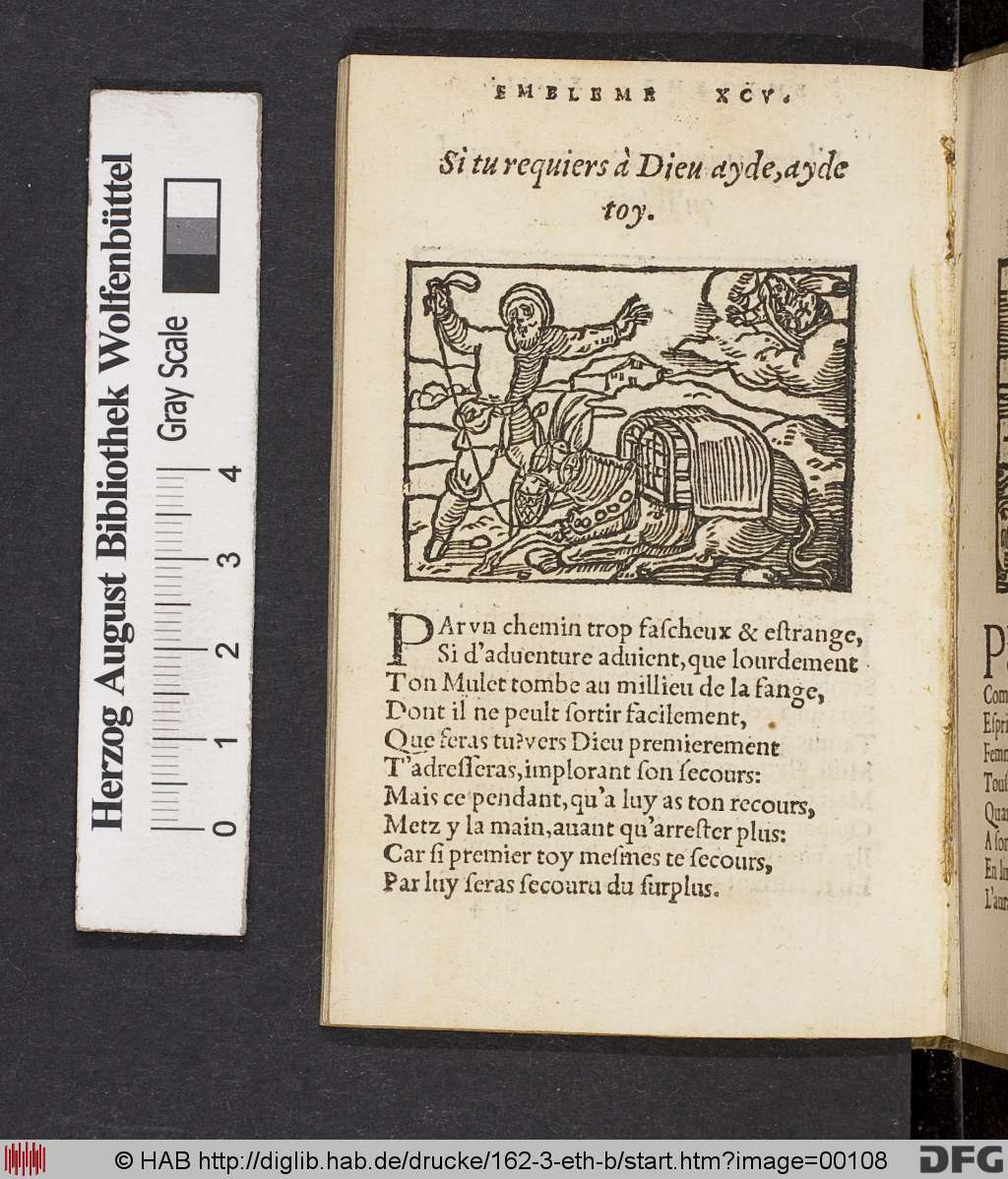
A carter with a whip beside his fallen mule; God appears in the cloudsAI-generated

Si tu requiers à Dieu ayde, ayde toy.
Emblem 95. If you ask God for help, help yourself.AI-generated
Description of the woodcutAI-generated
A woodcut in a rectangular frame. In the foreground a bearded traveller or carter in a hooded cap and short tunic stands with his left arm raised holding a whip and his right arm flung out, beside a pack-mule that has collapsed on its side in muddy ground, its load and saddle-pack still strapped on; a large covered pack or bale lies at the right. In the upper right corner a bearded figure appears amid clouds, leaning out of the sky toward the man. In the background is a hilly landscape with a few small houses and a road.
Subscriptio
TranscriptionAI-generated
PAr vn chemin trop fascheux & estrange,Si d'aduenture aduient, que lourdementTon Mulet tombe au millieu de la fange,Dont il ne peult sortir facilement,Que feras tu? vers Dieu premierementT'adresseras, implorant son secours:Mais ce pendant, qu'a luy as ton recours,Metz y la main, auant qu'arrester plus:Car si premier toy mesmes te secours,Par luy seras secouru du surplus.
TranslationAI-generated
Along a road too troublesome and strange, if by chance it happens that your mule falls heavily into the middle of the mire, from which it cannot easily get out — what will you do? First you will turn to God, imploring his help; but meanwhile, while you have recourse to him, put your own hand to it, before delaying any longer: for if you first help yourself, you will by him be helped with the rest.
Iconclass
86(SI TU REQUIERS À DIEU AYDE, AYDE TOY)proverbs, sayings, etc. (SI TU REQUIERS À DIEU AYDE, AYDE TOY)46C13143(+7536)mule (+ lying animal)46C55luggage, travel requisites31D14(+917)adult man (+ beseeching)11C2God the Father represented as human being, usually with crown or tiara or sceptre and/or globe25I3farm or solitary house in landscape54B4Efficiency54EReciprocal Action
Suggested Iconclass codesAI-generated
Additional codes proposed for this emblem, not (yet) part of the indexing.
94L7specific aspects, allegorical aspects of Hercules; Hercules as patronmediumThe bearded figure leaning out of the clouds toward the stranded carter is Hercules invoked as helper/patron, matching 'specific aspects, allegorical aspects of Hercules; Hercules as patron' rather than any of his narrative labours.
12F211prayer ~ Roman religionlowThe carter with arms flung out appealing to a pagan deity (Hercules) appearing in the sky corresponds to 'prayer ~ Roman religion'.
11Q211daily (vocal) prayer by one personlowThe scene shows a single person vocally imploring a god, which loosely matches '(vocal) prayer by one person', though the context is pagan rather than Christian devotion.
Relationships to the Adagia of ErasmusAI-generated
Suggested relationships between this emblem and adages in Erasmus’ Adagia.
- I vi 17 Dii facientes adiuvant – direct mottohigh
The motto 'Si tu requiers à Dieu ayde, ayde toy' is a vernacular rendering of 'Dii facientes adiuvant' — divine help goes to those who are themselves active, not to the idle, exactly as the subscriptio's advice to pray but meanwhile put your own hand to the mule.
- I vi 18 Cum Minerva manum quoque move – thematic inventiohigh
Erasmus' essay recounts the carter whose ass was stuck fast in the mud and who idly implored Hercules, to which the god replied he should first set his own hand to the struggling beast; the woodcut (driver with whip, mule collapsed in the mire, god leaning from the clouds) and the subscriptio reproduce that very anecdote and its moral.
- II ii 81 Manum admoventi fortuna est imploranda – thematic inventiohigh
The adage teaches exactly the emblem's lesson: trust divine aid, yet strive no less with your own industry, since heaven does not hear the prayers of the lazy — the subscriptio's 'put your own hand to it' while invoking God.
- III ix 55 Industriam adiuvat deus – thematic inventiomedium
Erasmus' maxim that part of an undertaking is managed by one's own effort and part supplied by a god matches the emblem's division of labour between the traveller's own hand and God's help with 'le surplus'.
Sources
Record ID: embhab_162-3-eth-b_emblem095
This emblem on the Iconclass site: https://iconclass.org/view/embhab_162-3-eth-b_emblem095
Page in the digital copy of the Herzog August Bibliothek: http://diglib.hab.de/drucke/162-3-eth-b/start.htm?image=00108