I vi 1 Saepe etiam est olitor valde opportuna locutus Even a gardner oft speaks to the point
Aulus Gellius in Noctibus suis lib. ii. cap. vi. testatur hunc versiculum olim proverbio fuisse celebratum: Πολλάκι καὶ κήπωρος ἀνὴρ μάλα καίριον εἶπεν id est, Saepe etiam est holitor valde opportuna locutus. Quo quidem admonemur, non esse fastidiendam salutarem sententiam propter autoris humilitatem: nam fieri nonnunquam, ut aliquis infimae sortis ac notae vir, aut minime doctus, dicat quiddam haudquaquam aspernandum etiam summis viris. Huic respondet illud Caecilianum apud Ciceronem in Tusculanis quaestionibus, Saepe est etiam sub pallio sordido sapientia. Neque dissonat Plautinum illud in Captivi duo: Ut summa saepe ingenia in occulto latent. Porrò quod ad Graecum attinet adagium, lectorem admonendum putavi, hunc quidem ad modum in omnibus, quos adhuc viderim, Gellianis codicibus inveniri scriptum. Verum sicuti recordor, aliquando scrupuli iniecit mihi, ac mendum subesse monuit Paulus Bombasius Bononiensis, inter bonarum literarum professores eius civitatis ut multo doctissimus, ita longe primi nominis: idque iure optimo, quippe qui primus ibi Graecas pariter ac Latinas literas pari facultate publice privatimque docere coeperit: vir alioqui naris emunctissimae, acerrimique iudicii. Mihi vero tum propter egregiam ac multiiugam eruditionem, tum ob incredibilem quandam morum suavitatem ita coniunctus, ut haud sciam, an cum ullo mortalium unquam mihi fuerit vel arctior necessitudo, vel consuetuodo iucundior. Hunc igitur in literariis illis nostris confabulationibus aliquando dixisse memini, nequaquam adulterinam videri: suspicari vero sese, ut pleraque sunt apud eum autorem depravata, pro μωρὸς, nescio quem holitorem, illud κήπωρον submisse. At tum quidem, quanquam & admodum verisimile videretur, & plurimum apud me valeret hominis tam eruditi iudicium, tamen haud etiam sum ausus, in tanto exemplarium consenmsu solus dissentire. Verum dum sursum ac deorsum in Graecis autoribus oberro, forte fortuna in collectaneis quibusdam, nullum quidem autoris titulum praeferentibus sed eiusmodi tamen, ut aut Stobaei, aut certe ex hoc decerpta viderentur, huiusmodi carmen invenio, citatum ex Aeschyli tragoedia, cui titulus, Phryges: Πολλάκι τοι καὶ μωρὸς ἀνὴρ κατακαίρϊον εἰπε id est, Saepe etiam stultus fuit opportuna locutus. Proinde prorsum in Bombasii mei pedibus eo sententiam, atque omnibus eruditis eundum censeo, ut μωρὸς legatur pro κήπωρος, maximè, quod eadem sententia totidem verbis etiam vulgo nunc dicitur, A viro stulto nonnunquam sapiens dictum proficisci. Respondet autem ad illam, quam superius ex Euripide citavimus, Μωρὰ γὰρ μωρὸς λέγει id est, Nam stulta stultus loquitur. Etenim hoc tametsi vere dictum est, tamen fit nonnunquam, ut fatuus vel casu, vel imprudens aliquid egregie dicat, & ad rem vehementer accommodatum. Id quod accidere saepenumero videmus. Quid enim potuit vel ab homine salsissimo dici accommodatius, quam quod narrat Suetonius dictum à quodam, qui mente parum constabat, in Pompeium & Iulium Caesarem: Salve rex, salve regina. Cum Pompeius regni affectati laboraret invidia, Caesarem rumor esset Nicomedi Regi uxoris vice fuisse.
Aulus Gellius in his Nights, book 2 chapter 6, records that this line circulated in old days as a proverb: Πολλάκι καὶ κηπωρὸς ἀνὴρ μάλα καίριον εἶπεν, Even a gardener oft speaks to the point. It warns us not to despise salutary advice because it comes from a humble source; for it sometimes happens that a man of lowly position and of no account, or of very little education, says something that even persons in high place should not despise. A counterpart is Caecilius' remark in Cicero's Tusculan Questions: 'Under a ragged coat oft wisdom lies.' Nor does that line in Plautus disagree, in his Captivi: 'How oft concealment hides our greatest wits!' As for the Greek adage, I think the reader should be warned that it is found in this form in all the texts of Gellius I have yet seen. But, as I remember, my misgivings were aroused one day, and the existence of some corruption was pointed out to me, by Paolo Bombace of Bologna, much the most learned of the teachers of the humanities in that city, and by far the most celebrated; and rightly so, for it was he who first began to teach both Greek and Latin there with equal qualifications both publicly and in private. He is in any case a man of exquisite taste and very keen judgment; and I myself am so closely linked with him both for his outstanding and many-sided learning and for his exceptional charm of character, that I doubt whether I have ever had a more intimate relationship with any fellow-creature or more enjoyed any man's society. I remember his saying once, in the course of those long literary discussions we used to have, that he did not like the word keporos, gardener, in that proverb in Gellius, and thought that it was clearly spurious and interpolated. He himself suspected, he said, in view of many similar corruptions in the text of that author, that the word moros, fool, had been replaced with keporos by some keen gardener. At the time, although this seemed highly probable, and the opinion of so eminent a scholar carried great weight with me, yet I did not dare to disagree all by myself with the consensus of so many copies. In the course, however, of my desultory wanderings among Greek authors, I fell in by chance with a collection of extracts, which bore no compiler's name but might have been put together by Stobaeus or at any rate excerpted from him. There I found the following line, cited from a tragedy of Aeschylus called The Phrygians: 'Even a foolish man oft speaks to the point,' with kai môros for kepôros. Without hesitation I voted, and I consider that all scholars should vote, for my friend Bombace's proposal that môros should be read instead of keporos, all the more so as the same sentiment in so many words is still current among us at the present day: 'Even a fool sometimes speaks a wise word.' Moreover it balances the opinion I have quoted above from Euripides: 'Fools in their folly speak.' For, true as that is, yet it does occur sometimes that a silly man, either by accident or inadvertently, says something excellent and very much to the point. We often see this happen. What could the most exquisite wit have produced more apt than the greeting of which Suetonius tells, offered to Pompey and Julius Caesar by a man somewhat unsettled in his wits? - 'All hail, our gracious king and queen!' It being remembered that Pompey was suspected of plans to make himself king, and rumour had it that Caesar had been enjoyed as his consort by King Nicomedes.
Facsimile: 
Iconclass: 31B6235 speaking 41A68 cultivation of (ornamental) garden 52A51 Wisdom; 'Sapienza', 'Sapienza humana', 'Sapienza vera' (Ripa) 52A511 Wisdom of the Fool 52A6 Truth; 'Verità' (Ripa)
Collectanea (1500): 167
Loci Communes: Fuerunt non sunt (They were, they are no more, Ils furent, ils ne sont plus)
I vi 2 Copiae cornu A horn of plenty
Αμαλθείας κέρας.. i. Copiae cornu. Cum affatim omnia superesse significamus, copiae cornu dicimus. Translatum à pervetusta fabula, quae varie narratur apud autores. Quidam ad hunc modum narrant, Rhea Iovem enixa, metu patris infantem in Creta occuluit, nutriendum à duabus nymphis, Adrastea & Ida, Melissei filiabus. Hae nutricaverunt illum caprae cuiusdam lacte, cuius nomen fuerat Amalthea: eam capram Iupiter iam adultus in sydera retulit, vocaturque à Graecis αἲξ οὐρανία. id est, capra coelestis. Huius alterum cornu nymphis nutricibus dedit, videlicet officii praemium, hanc adiiciens facultatem, ut quicquid optassent, id illis ex eo cornu largiter suppullularet. Ovidius Fastorum libro v. paulo diversius fabulam narrat hoc pacto, Nais Amalthea, Cretaea nobilis Ida, Dicitur in sylvis occuluisse Iovem. Hic fuit hoedorum mater formosa duorum, Inter Dictaeos conspicienda greges, Cornibus aeriis, atque in sua terga recurvis, Ubere, quod nutrix posset habere Iovis. Lac dabat illa deo, sed fregit in arbore cornu, Truncaque dimidia parte decoris erat. Sustulit hoc nymphe, cinxitque decentibus herbis, Et plenum pomis, ad Iovis ora tulit. Ille ubi res coeli tenuit, solioque paterno Sedit, & invicto nil Iove maius erat. Sydera nutricem, nutricis fertile cornu Fecit, quod dominae nunc quoque nomen habet. Legimus & Herculem Aetolis donasse copiae cornu, propter coercitum cornu fluminis Acheloi: quare regionem illam antea sterilem, fertilissimam reddidit: cornu nimirum laborum duritiem significante, frugibus feracitatem. Hunc igitur titulum Phocion quidam Peripateticus libro suo indidit, ut testatur Aulus Gellius. Plinius item ostedit Graecos aliquot hanc inscriptionem nimis arrogantem suis commentariis imposuisse, tanquam nihil in eis non contineretur, & quidvis inde peti, atque accipi possit. Lucian. de mercede servientibus, Καὶ ἕξεις τῆς ἀμαλθείας κεράς, καὶ ἀμέλξεις ὀρνίθων γάλα. i. Et habebis copiae cornu, & lac gellinaceum emulgebis. Philostratus Dionem sophistam appellat ἀμαλθείας κεράς, velut omni genere virtutum expolitum. Plautinus quidam servus, epistolam quandam copiae cornu vocat, quod plurimum ex ea commodorum capi posset. Aulus Gellius lib. xiiii. capite sexto, Et simul dat mihi librum grandi volumine, doctrinis omnigenis, ut ipse dicebat, praescatentem. Accipio cupidus & lubens, tanquam si copiae cornu nactus essem. Apud Athenaeum Philoxeus secundam mensam variis cupediis instructam, copiae cornu vocat. Citatur à Suida carmen huiusmodi, Ενθ᾽ ἵνα μοι βίος ἐστὶν ἀμαλθείας κέρας αἰγὸς. id est, Caprae ubi Amaltheae praebet mihi pabula cornu. Carmen est heroicum. Effertur adagium hoc quoque pacto, αἲξ οὐρουνία, id est, capra coelestis. Comoedia vetus notat Polyagrum quendam, uxorem ad quaestum prostituentem, quam coelestem capram vocat, ob immensum quaestum, ut testatur Plutarchus in commentario De audiendis poetis, Εὐδαίμων πολύαγρος οὐράνιον αἶγα πλουτοφόρον τρέφων.i. Fortunatus Polyager, (id est, multorum agrorum possessor) coelestem capram opes afferentem alens. Idem alibi adversus Stoicos, ὁ δὲ τὴν στωική λαβὼν ἀμάλθειαν. id est, At qui Stoicam acceperit Amalthaeam, irridens paradoxa Stoicorum, qui suo sapienti tribuunt universa, divitias, libertatem, sanitatem, regnum. Horatius in Odis: Beata pleno Copia cornu.
Αμαλθείας κέρας., Amalthea's horn, or A horn of plenty. When we wish to convey that there is abundance of everything, we speak of a cornucopia or horn of plenty. The image is taken from a very early myth, told by our authorities in various forms. In some it runs like this. Rhea, having given birth to Jupiter, hid her baby in Crete for fear of his father, to be nursed by two nymphs, Adrastea and Ida, daughters of Melisseus. They fed him on the milk of a she-goat called Amalthea; and Jupiter, when he was grown up, set this goat among the stars, where it is called in Greek the Heavenly She-goat. One of its horns he gave to the nymphs who had nursed him as a reward for their kindness, bestowing on it the remarkable property of producing a generous supply of anything they might want. Ovid in book 5 of his Fasti tells a rather different story:
The Naiad Amalthea in a grove
On Cretan Ida hid the infant Jove.
Conspicuous roamed, Mount Dicte's flocks among,
The lovely mother of two likely young,
A goat, with lofty backward-curving horn
And teats such as Jove's nurse might well adorn.
She gave the god her milk; but on an oak
One horn, half of her pride, (good lack!) she broke.
The nymph retrieved it, wreathed it in sweet slips,
Filled it with fruit and set it to Jove's lips.
When he won heaven, and on his father's throne
Jove reigned invincible and reigned alone,
Stars he his nurse and nurse's horn did make;
Still in the sky 'tis famous for her sake.
We read also how Hercules gave the Aetolians a horn of plenty, because he disciplined a horn or branch of the river Achelous, and thereby turned a region previously barren into most fertile country, the horn presumably representing the hardness of his labours and its plentiful contents the resulting fertility. So 'Horn of Plenty' was chosen by Phocion, a philosopher of the Peripatetic school, as a title for his book, as Aulus Gellius tells us. Pliny too informs us that several Greeks used this rather grandiloquent label for their compilations, as though they contained everything without exception, and whatever one wanted was to be sought and found there. Lucian in his Salaried Posts in Great Houses writes 'And you shall possess Amalthea's horn, and drink hen's milk.' Philostratus calls Dion the sophist 'a horn of Amalthea,' because he was so packed with excellence of every kind. One of Plautus' slaves calls a letter in the play a horn of plenty, because he sees himself getting so much advantage out of it. Aulus Gellius, book 14 chapter 6: 'With these words he offered me a stout volume packed, so he assured me, with information of every kind. I accepted it with alacrity, feeling as if I had acquired a horn of plenty.' Philoxenus in Athenaeus calls a table loaded with delicious desserts of many kinds a cornucopia. Suidas quotes a line: 'There, where life seems an Amalthea's horn'; it is an epic hexameter.
The adageis also used in the form 'A heavenly she-goat.' One of the old comedies pillories a certain Polyagrus who lived on his wife's immoral earnings, and calls her a heavenly she-goat, because she brings him in a large income, as Plutarch records in his essay 'How to study poetry': 'How blest is Polyagrus! - he who keeps / A heavenly goat to bring him gold enough' (Polyagrus means 'landed proprietor'). Again in another place, in an attack on the Stoics, he has 'But he who is blest with the Stoic Amalthea,' making fun of the paradoxical theory of the Stoics, who reckon that their ideal wise man possesses everything - wealth, freedom, health, and royalty. Horace in his Odes: 'And Plenty, lavish with her brimming horn.'
Facsimile: 
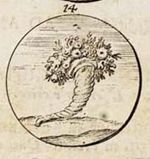
Hercules munus: De la Feuille, Devises et emblemes anciennes et modernes (Augsburg, 1697), emblem 633
Iconclass: 92B11221 'Cornucopia', Horn of Plenty
Collectanea (1500): 497
Loci Communes: Bonae fortunae, copiae, felicitatis aut ominis (Of good fortune, abundance, happiness, or omen, Bonne fortune, abondance, bonheur ou présage); Mixta (Mixed things, Choses mêlées)
I vi 3 Lac gallinaceum Hen's milk
Ορνίθων γάλα. id est, Gallinarum lac, eundem habet sensum. Dicitur enim in opulentos, & quibus quidvis rerum suppeditat. Aut de raris inventu, atque ob id preciosis: ut sit hyperbole, significans nihil omnino desse. Plin. in praefatione historiae mundi, irridens Graecorum deliciosas quasdam & magnificas inscriptiones: Cerion, inquit, inscripsere, quod volebant intelligi favum, alii κέρας ἀμαλθείας, quod copiae cornu, velut lactis gallinacei sperare possis in volumine haustum. Aristophanes in Vespis, Εγὼ γὰρ οὐδ᾽ ἂν ὀρνίθων γὰλα Αντὶ τοῦ βίου λάβοιμ᾽ ἂν, οὗ με νῦν ἀποστερεῖς. id est, Non lac Hercle gallinaceum Hacce pro vita capiam, quam mi adimis in praesentia. Eustathius in quartum Odysseae, citat hoc adagium ex Anaxagorae fabula, cui titulus, ὠά Rursum Aristophanes comicus in fabula, cui titulus, ὄρνιθες, Δώσομεν ὑμῖν Αὐτοῖς, παισὶ. παίδων παοσὶν Πλουθυγίειαν, εὐδαιμονίαν, Βίον, εἰρήνην, νεότηται, γέλωτα, Χοροὺς, θαλίας, γάλατ᾽ ὀρνιθων, Ως τε παρέσται ὑμιν κοπιᾷν Υπὸ τῶν ἀγαθῶν. id est, Dabimus vobis ipsis, filiis, filiorum filiis, opulentiam bonae valetudinis, felicitatem, facultates, pacem, iuventam, risum, choros, festa, lac gallinarum, ut sitis praebonorum copia laboraturi. Strabo Geographiae lib. xiiii. narrat de Samiorum agris, quod essent omnium rerum ampliter feraces, illud vulgo iactatum esse, quòd lac etiam ferrent gallinaceum. Idem testatur hoc adagium apud Menandrum comicum inveniri. Athenaeus libro Dipnosophistarum nono, ex mediae comoediae scriptore quopiam Mnesimacho, senarios hos adducit, καὶ τὸ λεγόμεον Σπανιώτερον πάρεστιν ὀρνιθων γάλα, Καὶ φασιανος ἀποτετιλμένος καλῶς. ιd est, Et quod dicitur proverbio, Lac suppetit, res rara, gallinaceum, ac Plumis revulsis phasianus adprobe. Rursum lib. ix. adducit ex Numenio, Ηδ᾽ ὅπερ ὄρνιθος καλέεται γάλα. id est, Atque quod gallinae dicitur lac. Idem libro tertio indicat, quibusdam lac gallinaceum esse, album ovi.
Ορνίθων γάλα, the milk of hens, has the same meaning, for we use it of rich people and people who have everything they want, and sometimes of things that are hard to find and therefore precious; so that it is an extravagant way of saying that one lacks absolutely nothing. Pliny in the preface to his History of the World, making fun of the artificial and pompous titles adopted for their books by certain Greeks, says: 'They have used names like Kerion, which they wish to be understood as Honeycomb; others Amalthea's Horn meaning a horn of plenty, as though you could expect from their work a drink of hen's milk.' Aristophanes in his Wasps:
Not for hen's milk itself would I forego
That life of which you would deprive me now.
Eustathius on the fourth Odyssey cites this adage from a play by Anaxagoras called Eggs. Again, Aristophanes the comic poet in his play The Birds:
On you, your children and your children's children
Health, wealth and happiness will we bestow,
Life, peace and youth and laughter, dance and song,
Hen's milk indeed, till you're foredone with blessings.
Strabo in book 14 of his Geography records of the fields in Samos that they were commonly said, on account of their great fertility, actually to produce hen's milk; and he notes that this is found as a proverbial phrase in Menander the comic poet. Athenaeus, in book 9 of his Doctors at Dinner, adduces these lines from an author of the Middle Comedy called Mnesimachus:
There waits that rarer stuff of which they tell,
Hen's milk and pheasants exquisitely plucked.
Again, in book 9 he cites from Numenius: 'And what they call hen's milk.' The same author suggests in book 3 that some people thought hen's milk was white of egg.
Facsimile: 
Iconclass: 34B232(+99) fowl (cock, hen, chicken, etc.) (+ products of animals) 41C6413 milk
Collectanea (1500): 575
Loci Communes: Bonae fortunae, copiae, felicitatis aut ominis (Of good fortune, abundance, happiness, or omen, Bonne fortune, abondance, bonheur ou présage); Raritas (Rarity, Rareté)
I vi 4 Non omnibus dormio I'm not asleep to everyone
Non omnibus dormire dicuntur, qui non omnibus inserviunt, neque per omnia gerunt morem. Translatum putant à maritis quibusdam nimis obsequentibus, qui uxores suas adulteris scientes produnt, somnum interim inter pocula simulantes, ut adultero quod libet liceat. Quod genus obsequii notans Iuvenalis, Doctus, inquit, spectare lacunar, Doctus & ad calicem vigilanti stertere naso. Plutarchus in libro, cui titulum fecit, εῤωτικῷ fabulam super hac re non illepidam narrat. Cum Galba quispiam convivio Moecenatem accepisset, sentiretque iam è nutibus hominem inflammatum in uxorem suam, sensim demisit caput, perinde quasi dormiret. At cum interea famulus quispiam ad mensam accedens, vinum clàm tolleret, ibi iam vigil & oculatus: Infelix, inquit, an nesciebas me soli Moecenati dormire? Meminit huius adagii, & ad hunc quem dixi modum exponit Festus Pomp. citans ex Lucilio, tractum ostendens à Capio quodam, qui Pararencho dictus sit, quod simularet dormientem, quo impunitius eius uxor moecharetur. Idem indicat huius rei meminisse Lucilium. Usurpat & M. Tullius lib. familiarium epistolarum vii. Olim Non omnibus dormio: sed ego mi Galle, non omnibus servio. Videtur indicare Cicero alterum, puta. Non omnibus dormio, vetus fuisse: alterum nempe, Non omnibus servio, novum. Utrunque certe proverbiale, sed prius illud pertinet ad concessionem iuris, hoc posterius ad obsequium impendendum. Idem Tullius epistolarum ad Attic. lib. xiii. Est bellum aliquem odisse libenter, & quemadmodum dicitur, non omnibus servire. Qui quidem locus, ut hoc obiter admoneam, mihi non videtur carere mendo. Fortasse enim scriptum erat, Et quemadmodum non omnibus dormire, ita non omnibus servire. Quin & haec ipsa vox, servire, non vacat metaphora, cum dicimus, Servire scenae, servire tempori, servire vitiis, servire ingenio uxoris, seruire populo, servire commodis privatis. pro eo quod est, nihil non facere, quo satisfacias.
'Not to be asleep to everyone' is a phrase used of those who are not every man's lackey, and whose complaisance has its limits. It is thought to be derived from certain husbands who are too ready to oblige, and knowingly expose their unfaithful wives, sometimes pretending to be asleep over their wine in order to give the lover freedom to do as he pleases. This kind of complaisance is pilloried in Juvenal's lines:
He knows his cue and gazes at the floor
And, while he winks, he snores - or seems to snore.
Plutarch, in the essay entitled 'Eroticus,' tells an amusing story which illustrates this. A man named Galba had invited Maecenas to dinner; and when he began to understand from his guest's nods and winks that he had taken a fancy to his wife, he let his head sink little by little as though he were falling asleep. Meanwhile, one of the servants stole up to the table and started filching the wine; at which point he became wide awake, and cried: 'Wretch, couldn't you guess that I'm asleep to no one but Maecenas?' The saying is recorded also, with the same explanation, by Festus Pompeius, quoting Lucilius and showing that the original is a certain Capius, who was nicknamed Snorer because he used to pretend to be asleep, so that his wife could entertain her lovers with greater impunity. He also points out that Lucilius refers to this. Cicero too makes use of it in the seventh book of his Letters to Friends: 'In old days it was "I'm not asleep to everyone," but for me, my dear Gallus, it's "I'm not a slave to everyone."' Cicero's point seems to be that one of these, 'I'm not everyone's sleeper,' was traditional; the other, 'I'm not everyone's slave,' was new. Both are at any rate proverbial; but the former is applicable to the foregoing of one's rights, the latter to the doing of a menial service. Cicero again, in his Letters to Atticus, book 13, has: 'It is nice to enjoy hating someone and, as the saying goes, not to be everyone's slave.'
This passage, as a matter of fact, if I may mention this in passing, seems to me not free from fault. Perhaps he wrote: 'and, just as there is a saying, "not to be asleep to everyone," so not to be everyone's slave.' I may add that this same word servire, to be a slave, contains an element of metaphor, as when we say 'to be a slave to one's theatre, to circumstances, to one's own faults, to one's wife's temper, to the public, to one's private profit,' in the sense of being ready to do anything to oblige.
Facsimile:
Iconclass: 31B1 sleeping; unconsciousness 57AA611 Dissimulation, Hypocrisy; 'Hippocresia', 'Simulatione' (Ripa)
Loci Communes: Simulatio, dissimulatio (Pretense, dissimulation, Simulation, dissimulation)
I vi 5 Sardi venales Sardinians for sale
Σαρδιανοὶ ὤνιοι. i. Sardi venales. In eo libello, cui titulus est, De viris illustribus, quem alii Plinio, nonnulli Suetonio tribuunt, utriusque reclamante stylo, hiusmodi quoddam adagium refertur: Sardi venales, de negocio insinitae prolixitatis atque inexplicabili. Idque hinc esse ortum tradunt, quod Tiberius Sempronius Gracchus, cum altero consulatu Sardiniam domuisset, tantum ex ea captiorum adduxit, ut longa venditione res in proverbium abierit. Plutarchus in Problematis Romanorum, aliam affert causam, nimirum olim inolevisse morem apud Romanos sollennem, ut qui ludos aederent in Capitolio, Sardos venales pronuntiarent, prodiretque puer quispiam, per ludibrium monili cinctus, quam bullam vocant. Eum morem hinc ortum putat, quod Veientes Hetruscorum populi, multum temporis cum Romulo bellum gessissent, quodque horum urbem postremam Romulus expugnasset. Etiam si T. Livius libro i. narrat, victos quidem à Romulo Veientes, sed tamen victorem ab urbe munita abstinuisse. Unde & regem ipsum, & cum hoc captivos quàm plurimos Romam deductos, venales prounciavit. Porrò cum Lydi ab initio fuerint Hetrusci, quemadmodum testatur & Herodotus lib. i. Lydorum autem caput erat Sardis, inde factum, ut Hetruscos Sardorum nomine pronunciarit venales. Refert eadem Plutarchus in vita Romuli, licet aliquanto diversius. Debellatis Veiis captus est illorum dux, qui cum esset provectae aetatis, visus est rem imprudentius gessisse quam pro aetate. Unde mos inolevit, ut quoties Romani ob partam victoriam immolarent victimam, senem purpura indutum per forum in Capitolium inducerent, bullaque ad collum appensa, quod tum erat puerorum insigne, praeco Sardianos venales pronunciaret. Hetruriae caput Veii sunt, & Etrusci Sardianorum coloni putantur. Usus est hoc adagio M. Tullius lib. Epistolarum familiarum septimo, ad Gallum: Habes, inquit, Sardos venales, alium alio nequiorem. Sentit Cicero de contemptis & improbis, & (ni fallor) patria quoque Sardis. Nam ita scribit paulo ante hunc locum: Id ego in lucris pono, non ferre hominem pestilentiorem patria sua.
Σαρδιανοὶ ὤνιοι, Sardinians for sale. In the brief treatise called Lives of Famous Men which some ascribe to Pliny and a few to Suetonius, though the style of both authors is against this, an adage is recorded of the form 'Sardinians for sale,' referring to any transaction that is infinitely long and interminable. This is said to spring from the fact that Tiberius Sempronius Gracchus, after his conquest of Sardinia in his second consulship, 'brought back such a quantity of prisoners that the length of time taken in selling them became proverbial.' Plutarch in his 'Roman Questions' adduces another reason: a regular custom had grown up of old in Rome that those who produced games on the Capitol proclaimed 'Sardinians for sale,' and a boy came forward with an ornament hung round his neck in jest, which they call a bulla. He thinks this custom arose from the fact that the inhabitants of Veii, an Etruscan people, had waged war for a long time against Romulus, and their city was the last that Romulus captured. Though Livy in his first book recounts that the people of Veii were defeated by Romulus, but that after his victory he refrained from attacking their fortified city. From there he brought to Rome the king himself and a great many prisoners with him, and put them up for sale. Moreover, as the Etruscans were Lydians in origin, a fact recorded also by Herodotus in his first book, and the capital of Lydia was Sardis, he has reason to advertise Etruscans for sale under the name of Sardians or Sardinians. Plutarch tells the same story, though somewhat differently, in his life of Romulus. Tn the conquest of Veii the leader of its people was captured, and though an elderly man, was thought to have conducted the campaign with great imprudence for a man of his years. Hence a custom grew up that whenever the Romans sacrificed a victim to celebrate a victory, they brought an old man through the Forum up to the Capitol wearing a purple robe and with a bulla round his neck, which was then the badge of childhood, while the herald proclaimed "Sardians for sale." Veii is an Etruscan capital, and the Etruscans are thought to have been emigrants from Sardis.' Cicero uses the adage in his Letters to Friends, book 7, writing to Gallus: 'Here's a lot of Sardinians for sale, each worse than the last.' Cicero is thinking of contemptible wretches and also, if I am not mistaken, of natives of Sardinia; for he has just said: 'I regard it as a gain not to have to put up with a man who is more pestilential than his birthplace.'
Facsimile: 
Iconclass: 32B311(SARDINIANS) indigenous European peoples (SARDINIANS) 46A181 slave-trade 46B412 selling
Loci Communes: Bonae fortunae, copiae, felicitatis aut ominis (Of good fortune, abundance, happiness, or omen, Bonne fortune, abondance, bonheur ou présage); Taedium ex iteratione (Tedium from repetition, Lassitude due à la répétition)
I vi 6 Dasypus carnes desiderat A hairyfoot hungry for meat
Δασύπους κρεῶν ἐπιθυμεῖ. id est, Dasypus carnes desiderat. Dicitur in eos, qui ea requirunt ab aliis, quae ipsis affatim sunt domi. Est enim dasypus de genere leporum. Lepus autem ut autor est Plinius lib. viii. cap. quinquagesimoquinto, animal est innocuum, esculentum & foecundum, omnium praedae nascens: Solus praeter dasypodem superfoetat, aliud educans, aliud in utero pilis vestitum, aliud implume, aliud inchoato gerens partu. Dictus est autem dasypus à pedibus hirsutis ac villosis.
Δασύπους κρεῶν ἐπιθυμεῖ, The hairyfoot is hungry for meat. Said of those who ask others for something they have plenty of at home. For the hairyfoot is of the same family as the hare; and the hare, as Pliny says in book 8 chapter 55, 'is a harmless animal and edible and prolific, and is born to be the prey of everything else. It is the only creature beside the hairyfoot to carry a succession of offspring within itself at one time: while suckling one, it has in the womb a second covered with fur, a third hairless, and a fourth conceived but immature.' It is called 'hairyfoot' from the long hair on its shaggy feet.
Facsimile:
Iconclass: 25F26(DASYPUS) rodents (DASYPUS) 25F26(HAIRYFOOT) rodents (HAIRYFOOT) 41C119 hunger 41C69 meat; still life of meat 55CC11 Greed, Covetousness, Cupidity; 'Cupidità' (Ripa)
Collectanea (1500): 117
Loci Communes: Absurda, indecora, seu praepostera (Absurd, unbecoming, or preposterous things, Choses absurdes, inconvenantes ou déplacées)
I vi 7 Tute lepus es et pulpamentum quaeris A hare thyself, and goest in quest of game?
Sunt, qui existiment cum proximo idem esse, quod legitur in Eunuc. Terentiana: Tute lepus es, & pulpamentum quaeris. Dictum est autem à milite glorioso in adolescentem Rhodium, qui scorto suo alludebat, ipse ea aetate, qua scorti vicibus fungi posset. Donatus allegoriam variis modis exponit, indicans proverbium hoc in molles convenire, propterea quod lepus à posteriore parte: hoc est, à lumbis & clunibus pulpamentum de se praebeat, eaque corporis parte lautissimus sit: vel quod eum canes, amatorum instar, sequantur: vel quod lepus à Physicis dicatur incerti sextus, modo mas, modo foemina. Quae commenta frigidiora videntur, ac ut simplicius, ita verius esse puto, ad Graecam paroemiam referre, δασύπους κρεῶν ἐπιθυμεῖ. Flavius Vopiscus in Numeriano imperatore, scribit adagium Terentianum, Livii esse Andronici vetustissimi Romanorum comici.
Some suppose to be identical with the preceding a line we find in the Eunuchus of Terence: 'A hare thyself, and goest in quest of game?' It is the retort of the braggart soldier to a youth from Rhodes who was making advances to the soldier's strumpet, though the boy was of an age when he was quite capable of taking a strumpet's place himself. Donatus gives various explanations of the allegory, suggesting that this proverb is appropriate to effeminate young men, because the hare provides the most tasty meat from its hinder parts, as it were its thighs and buttocks, and it is those parts that make it so much sought after; or because it is pursued by hounds, as lovers pursue the young man; or because, as naturalists tell us, it is of uncertain sex, male at one time and female at another. These fancies seem somewhat pointless to me, and I think it both simpler and nearer the truth to connect it with the Greek proverb of the hairyfoot hungry for meat. Flavius Vopiscus, in his life of the emperor Numerian, says that the adage in Terence comes from Livius Andronicus, the earliest of the Roman comic poets.
Facsimile:
Iconclass: 25F26(HARE)(+451) rodents: hare (+ animal in search of food) 29A1 'mundus inversus', the reversed world, the topsy-turvy world, 'le monde bestourné' 43C11 hunting, chase
Loci Communes: Absurda, indecora, seu praepostera (Absurd, unbecoming, or preposterous things, Choses absurdes, inconvenantes ou déplacées)
I vi 8 Pari iugo Matched in double harness
Pari iugo dixit Plin. in Epist. pro eo quod est, pari studio, parique conatu. Quadrabit in eos, qui negocium commune certatm ac simili contentione agunt. Translatum à bubus, idem plaustrum aequali iugo trahentibus. Plinii verba sunt haec: Habet quidem gloria, in studiis praesertim, quiddam ἀκοινώνητον: nobis tamen nullum certamen, nulla contentio, cum uterque pari iugo non pro se, sed pro causa niteretur. Theocritus in Aita, Αλλήλους δ᾽ ἐφίλησαν ἴσῳ ζύγῳ. id est, Parique iugo sesse invicem amabant. De amore mutuo & aequali, quem Graeci vocant ἰσόῤῥοπον. Huic finitima sunt, quae scribit divus Hieronymus ad Augustinum: Romae dicuntur esse quàm plurimi, qui possint & audeant tecum congredi, & in disputatione sanctarum scripturarum iugum ex aequo ducere. Extat & Graecis proverbium, Εγώ τε καὶ σὺ ταὐτὸν ἕλκομεν ζυγὸν.. id est, Idem egoque tuque ducimus simul iugum. Quod suo referemus loco.
Pliny in his Letters uses this phrase to mean 'with equal zeal and equal effort.' It will be suitable for those engaged on an enterprise in commmon, in emulation and with comparable energy. A metaphor from oxen drawing a wagon and putting equal force into the yoke. Pliny's words are: 'The desire to succeed, and especially to succeed in professional matters, has an element in it of reluctance to admit a partner; but between us there was no competition and no disagreement, for we were both matched in double harness, and strove not for our own hand but to win the case.' Theocritus in his Aites: Tn double harness matched each loved the other,' of the love which is mutual and equal and, as Greek puts it, isorropon, well-balanced. Close to this are St Jerome's words addressed to Augustine: Tn Rome there are said to be a great many people with both skill and courage enough to take you on, and to argue with you about Holy Scripture, matching step for step.' The Greeks have another proverb, 'We draw the selfsame yoke, both you and I,' of which I shall treat in its proper place.
Facsimile:
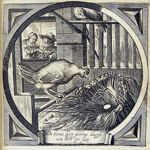
De Hinne leydt geerne daerse een nest ey siet: Cats, Spiegel (The Hague, 1632), emblem 23 uses the imagery of a chicken only laying an egg where she sees a nest egg to convey the message of the woman that she will only enter a relationship on equal terms; the adage's comment also refers to equal partners
Iconclass: 46C14111 yoke 51B3 Parity, Equality
Loci Communes: Aequalitas (Equality, Égalité)
I vi 9 Uno fasce complecti To bundle together
Uno fasce complecti legitur apud eundem Plinium, pro eo quod est, eadem opera, & coniunctim agere, non separatim. Verebamur, inquit, ne nos dies, ne nox, ne latera deficerent, si tot crimina, tot reos uno velut fasce complecteremur. Translatum est ab iis, qui res multas simul colligant, quo commodius gestari queant. Id Graeci dicunt συλλήβ- δήν. id est, comprehensim.
'To bundle together' is used also by Pliny of doing something in one operation and everything together, not separately. 'We were afraid,' he says, 'that we should run short of time and voice and breath, if we tried, as it were, to bundle together so many accusations and so many defendants.' A metaphor from those who tie many things together to make them easier to carry. For 'collectively' Greek uses syllebden, in one grasp.
Facsimile:
Iconclass: 25G(+224) plants; vegetation (+ bundle of twigs, faggot)
Loci Communes: Breviloquentia (Brevity of speech, Brièveté du discours)
I vi 10 Salem et mensam ne praetereas Transgress not salt and trencher
Αλα καὶ τράπεζαν μὴ παραβαίνειν. id est, Salem & mensam ne praetereas. Ne negligas amiculorum consuetudinem, aut, Ne violes amicitiae iura. Nam his rebus olim conciliabantur amici: & familiares antiquitus mutua inter sese convivia actitabant. Quemadmodum testatur etiam Diogenes Laertius in vita Pythagorae. Et astipulatur Theocritus in Hyla, Οἱ μίαν ἄμφω ἑταῖροι ἀεὶ δαίνυντο τραπεζαν. id est, Qui ad mensam semper eandem Coenabant ambo, fidi nimirum ut amici. Loquens de Hercule ac Telamomone. Tum Euripidis Hecuba, Polymnestoris exaggerans facinus, hospitalis etiam mensae facit mentionem: Κοινῆς τραπέζης πολλάκις τυχὼν εμοι id est, Mensa receptus saepe communi mihi. Quin & Esdrae li. i. cap. iiii. ita legimus, Nos ergo memores salis quod in palatio comedimus, quia laesiones regis videre nephas ducimus, &c. Inde est, quod (ut docet apud eundem Laertium Alexander in commentariis Pythagoricis) Pythagoras vetabat frangi panem, videlicet ne dissecaretur quod amicos copularet. Idem censuit salem potissimum in mensa apponendum, quod aequitatis ac iustitiae nos admoneat, ut quia et servet, tueaturque quicquid occuparit, & ex liquidissimis rebus aqua marique fiat. Origenes adversus Celsum li. ii. Parium quempiam Iambographum adducit, qui Lycomantem insectatus sit, quod salem, ac mensam esset praetergressus. Idque detorquet ad Iudam Christi proditorem. Idem in Matthaeum sic loquitur de Iuda: Neque salis eiusdem neque mensae, neque panis communicati memor est factus. Atque haud scio an Christus ipse, religionis nostrae princeps, huc alluserit, ut illi consilium fuisse videtur in rebus multo vulgatissimis altissima mysteria sua recondere, praescius fore ut hoc symbolum à Iudaeis irrisum gentes amplecterentur. Certe apud Macedones patrio ritu foedus, quod sanctissimum vellent haberi, sic inibant, ut panem gladio divisum uterque libaret. Autor Q. Curtius libro octavo..
Ἅλα καὶ τράπεζαν μὴ παραβαίνειν, Transgress not salt and trencher. Do not neglect the society of your friends, or Do not breach the unwritten laws of friendship. In the old days eating salt with a man and sharing his table cemented a friendship, and in Antiquity friends used often to dine together. So Diogenes Laertius also testifies in his life of Pythagoras, and Theocritus in his Hylas concurs: 'Since these two comrades ever shared one mess,' speaking of Hercules and Telamon. Then Hecuba in Euripides, to empha- size the wickedness of Polymnestor, speaks of the hospitable board: 'He oft had shared a common table with me.' And in 1 Esdras, chapter 4 we read: 'We therefore, mindful of the salt we have eaten in the palace, because we think it wrong to watch injury done to the king, etc' Hence it is that, as we learn from Alexander in his memoir of Pythagoras, quoted by Laertius as before, Pythagoras said that we ought not to break bread, that there might be no division of a thing that brought friends together. It was also his opinion that salt was of all things the most appropriate to set on the dinner-table, because it puts us in mind of equity and justice, it keeps sound and preserves whatever it takes to itself, and it is made of the purest substances, of water and sea. Origen in the second book of his Against Celsus refers to a satirist from Paros, who attacked Lycomantes because he had transgressed salt and trencher. He turns this also against Judas who betrayed Christ. Again in his commentary on Matthew he says of Judas 'Nor did he bethink him of the bread and salt that they had eaten together.' And it may well be that Christ himself, the founder of our religion, alluded to this, as it seems to have been his policy to hide his deepest mysteries in the very commonest things of daily life, for he knew that this emblem would be despised by the Jews and welcomed by the Gentiles. Among the Macedonians, at any rate, it was an ancestral custom, when they ratified a treaty which they wished to be especially sacred, that both parties should partake of a loaf cut in two with a sword; so Quintus Curtius, book 8.
I vi 11 Baceli similis Like Bacelus
Ικελος Βακήλῳ, καὶ Βακηλος εἶ. i. Bacelo similis, & Bacelus es. In cinaedos ac parum viros dictum, aut in magnos quidem corpore, sed animo stupidos. Tractum à forma moribusque Baceli cuiusdam. Ait Suidas Bacelum proprie significare eum, qui sit exectus, eoque in molles dici, quod hoc morbo potissimum laboret illud hominum genus. Antiphanes in Caribus, Bacelum quempiam taxat apud Athenaeum lib. quarto, Οὐχ ὁρᾷς ὀρχούμενον Ταῖς χερσὶ τὸν βάκηλον, οὐδ᾽ αἰσχύνεται; id est, An Bacelum non vides, Manibus suis sic saltitantem, nec pudet? Meminit huius Suetonius in vita Augusti, scribens eum peculiari vocabulo, Bacelum pro stulto assidue solitum dicere. quanquam in vulgatis codicibus Baceolus scriptum est. Hermolaus existimat et apud Quintilianum recte pro Bagoa, Bacelum legi posse. Verba Fabii sunt haec, At vero statuarum artifices, pictoresque clarissimi, cum corpora speciosissima pingendo, fingendóve effingere cuperent, nunquam tamen in hunc inciderunt errorem, ut Bagoam, aut Megabysum aliquem in exemplum operis assumerent sibi. Verum equidem non video, cur Fabiana scriptura mutanda sit, cum βαγώας barbara lingua significet eunuchum, quo nomine Lucianus philosophum quendam inducit, qui vultu corporisque figura eunuchum prae se ferret. Quin & Ovidius De amoribus, servum puellae custodem Bagoum appellat, Quem penes est dominam servandi cura Bagoe.
'Ἴκελος Βακήλῳ, καὶ Βακηλος εἶ, Like Bacelus, and You are a regular Bacelus. Used of catamites and effeminate men, or men of large build but thick-headed. Derived from the physique and behaviour of a certain Bacelus. Suidas says that bakelos properly means a eunuch, and is therefore used of effeminates, because this is the defect from which that class of men most commonly suffer. Antiphanes in his Carians attacks a man called Bacelus, as quoted in Athenaeus, book 4: 'Seest thou not Bacelus / Dancing with his arms without a blush?' Suetonius mentions him in his life of Augustus, whose regular habit it was to use a peculiar word bacelus for a fool, though in the common run of copies the word is baceolus. Ermolao thinks that in Quintilian too Bacelus could rightly be read for Bagoas. Quintilian's words run as follows: 'But the most distinguished sculptors and painters, when they wished to represent very beautiful bodies by painting or modelling, have none the less never fallen into this error of taking some Bagoas or Megabyzus as a model for their work.' I myself do not see why Quintilian's text need be changed, since bagoas in some barbarous language means eunuch, and under that name Lucian introduces a philosopher who looks just like a eunuch in face and body. Ovid too in his Amores gives the name Bagoas to the slave who is set to keep watch over a girl: 'Bagoas, you who guard my mistress dear.'
Facsimile: 
Iconclass: 31A719 womanish man, molly-coddle, milksop 33C711 castrated person 98B(BACELUS) male persons from classical history (BACELUS)
Loci Communes: Intemperantia, libido (Intemperance, lust, Intempérance, désir)
I vi 12 Batalus Batalus
Βάταλος εἶ. id est, Batalus es. Olim in effeminatos per contumeliam dicebatur. Plutarchus ostendit id cognominis Demostheni puero inditum fuisse, & ab inimicis probro obiectum. Porrò cognominis huius idem varias affert rationes: vel quod Batalus quispiam fuerit tibicen, mollis & effoeminatus, qui muliebribus sandaliis primum omnium in scenam prodierit, ac musicam, ut ita dixerim, evirarit: vel quod poetae cuidam obscoeno nomen fuerit Batalo: vel quod apud Atticos Batalus appellata sit ea pars corporis, quae verecunde nominari non potest. Meminit huius rei Libanius. Idem nempe Demosthenes iam provecta aetate, simili contumelia dictus est Argas: sive quod hoc nomine fuerit qusipiam malarum autor legum, sive quod, ut existimat Suidas, serpentis genus sit Argas. Dicunt item Graeci βαταλίζεσθαι, pro eo quod est, turpiter atque effoeminate vivere.
Βάταλος εἶ, You're a regular Batalus, was said in old days by way of insult to effeminate men. Plutarch shows that the nickname was given to Demosthe- nes as a boy, and used to his discredit by his enemies. He adds various explanations of the name: either there was a fluteplayer called Batalus, an effeminate who was the first man to come on the stage wearing women's sandals and who castrated music, if I may use the phrase; or there was an obscene poet called Batalus; or batalos is a name given in Attic Greek to a part of the body that cannot be mentioned without indecency. This is referred to by Libanius. The same man, Demosthenes I mean, at an advanced age was similarly given the insulting nickname Argas, either because someone of that name was the promoter of several bad laws, or because, as Suidas thinks, an argas is a kind of serpent. There is also a Greek verb batalizesthai, to follow a scandalous and effeminate way of life.
Facsimile: 
Iconclass: 31A719 womanish man, molly-coddle, milksop 98B(BATAUS) male persons from classical history (BATAUS)
Loci Communes: Intemperantia, libido (Intemperance, lust, Intempérance, désir)
I vi 13 Bene plaustrum perculit He gave the cart a good shove downhill
Rusticorum proverbium est, Bene plaustrum perculit. Apparet dici solitum in eos, qui quempiam impellunt, quò suapte sponte iam propendebat. Translatum à plaustris onustis, quae quo exonerentur, solent everti. Fit autem id commodius in eam partem, in quam propter solum declivius inclinant. Donatus indicavit hoc adagium, exponens in Eunucho haec Parmenonis verba: Perculeris iam tu me? Ab hac sententia non abhorret Plautinum illud in Curculione, Qui monet, quasi adiuvat. Verba sunt lenonis, qui libentius sit mutaturus fidem, admonitus à trapezita, quod tamen vel citra monitorem erat facturus. Idem eleganter expressit Sophocles apud Plutarchum in vita Artaxerxis: Ταχεία πειθὼ τῶν κακῶν ὁδοιπορεῖ id est, Rerum malarum facilis est persuasio. Plerique ad deteriora proclives sunt.
Country people have a proverb: 'He gave the cart a good shove downhill.' Commonly used, it is clear, of those who urge a man in a direction to which he was already tending of his own accord. A metaphor from loaded carts, which are commonly tipped over to empty them; and this is more easily done in the direction towards which they already tilt because of a slope in the ground. Donatus pointed to this adage in his explanation of Parmeno's words in the Eunuchus: 'You'll quite upset me presently.' This idea is not far removed from that remark in Plautus' Curculio: 'Advice is nearly as good as a helping hand.' The words are spoken by a pandar, who will be all the more ready to break faith when advised by a money-lender to do what he intended to do anyhow, with or without advice. The same thing is elegantly expressed by Sophocles, quoted by Plutarch in his life of Artaxerxes: 'How easy 'tis to preach transgression!' For most men, the road from better to worse runs downhill.
Facsimile:
Iconclass: 31A2748 pushing something 46C123 hand-cart 51LL5 Descent
Loci Communes: Proclivitas (contra) (Propensity (against), Penchant (contre))
I vi 14 In care periculum Risk it on a Carian
Εν καρὶ τὸν κίνδυνον. i. In Care periculum, subaudi, facito: hoc est, in homine, aut re viliore, fac periculosam experientiam, in qua, si parum feliciter cesserit, non multum sit dispendii capiendum. Huic adagio Carum mores fecere locum. Hic populus est, ut autor est Mela Pomponius, incertae originis, ut quos alii αὐτόχθονας, id est, indigenas, nonnulli Pelasgos, alii Curetes existiment. gens usque adeo armorum, pugnaeque amans, ut aliena etiam bella mercede conducti soliti sint agere. Unde Theocritus in Encomio Ptolemaei, Φιλοπτολέμοις τε κάρεσσι dixit. id est Bellandique avidis Caribus. Item Herodotus in Euterpe, ostendit Cares barbaro servilique fuisse ingenio, & ad quidvis malorum ferendum paratos, mercede proposita. Id quod indicat et Aristophanes in Avibus, Εἰ δὲ δοῦλος ἐστι καὶ κὰρ, id est, Quod si servus est & Car. Strab li. Geographiae xiiii, narrat, Cares tota quondam errasse Graecia, passimque stipendiis meruisse. Ceterum in rebus bellicis usque adeo praecelluisse, ut passim apud poetas arma bellica Carica nominentur, quemadmodum Anacreon Caricam loricam, Alcaeus Caricam cristam dixit, ad quam alludit Aristophanes in Avibus. Suidas scribit, Cares primos mortalium mercede militasse, ut qui vitam suam vilem haberent. Hos igitur, qui conduxerant primos in acie collocare consueverant, ut primos hostium impetus suo exciperent periculo: aut ubi fortuna belli difficillima videretur, illic obiciebantur. Persae sua lingua κάρδακας appellabant, qui rapto vivebant. Carum laudem his temporibus aemulari videntur Elvetii, gens bello nata, simplex alioqui, ac minime malum hominum genus, planeque dignum, ut equidem sentio, quod hac quoque nota vacaret, & in literis, & in caeteris honestis studiis egregie valiturum, si relictis bellis huc animum appellerent. Usurpat hoc adagium Socrates apud Platonem in Euthydemo, iubens in se potius fieri periculum transformationis, velut in homuncione Care: quem si perdas, non admodum gravis sit iactura: Εἰ δὲ ὑμεῖς οἱ νέοι φοβεῖσθε, ὥσπερ ἐν καρὶ ἐν ἐμοὶ ἔστω ὁ κίνδυνος. ὡς ἐγὼ, ἐπειδὴ καὶ πρεσβύτης εἰμὶ, παρακινδυνεύειν ἔτοιμος, καὶ παραδίδωμι ἐμαυτὸν Διονυσοδώρῳ τούτῳ, ὥσπερ τῇ μηδείᾳ τῇ κόλχῳ. ἀπολλύτω μέ, και εἰ μὲν βούλεται, ἑψέτω εἰδ᾽ ὅ, τι βούλεται τοῦτο ποιείτω, μόνον χρηστὸν ἀποφηνάτω.. id est, Quod si timetis vos iuvenes, in me tanquam in Care fiat periculum. Nam & ipse quandoquidem senex sum, paratus sum subire periculum, meque ipsum trado huic Dionysodoro, quasi Medeae Colchicae perdat me: et, si velit, in lebete coquat me. Sin minus, quicquid voluerit, id faciat, tantum ut me reddat probum. Idem in Lachete huc respexit, cum ait: Cogitandum esse iis, qui primum docere incipiunt, & artis suae periculum cum magno iuvenum periculo faciunt; non Carem quempiam mercenarium, sed civium liberos in discrimen adduci. Et hunc imitatus Aristides in oratione Panathenaica, ἐν δε τῳ καρὶ, καὶ οὐκ ἐν τοῖς ἑαυτῶν σώμασι τὰς πειρας ποιούμενοι. i. In Care vero, non in suis ipsorum corporibus facientes periculum. Usus est eodem M. Tullius in actione pro L. Flacco: Quid, inquit, de tota Caria? nónne hoc vestra voce vulgatum est: Si quid cum periculo experiri velis, in Caria potissimum esse faciendum? Quem quidem locum apparet esse vitiatum, neque verear deierare, in Care legendum esse, non in Caria. Huic diversum est illud: Aureo piscari hamo: quod alibi reddemus.
Ἐν καρὶ τὸν κίνδυνον, Risk it on a Carian: make a risky experiment on a person or thing of little value, so that if anything goes wrong, there will be no great loss to suffer. This adage took its rise from the character of the Carians. They are a people, as Pomponius Mela tells us, 'of uncertain origin; for some think them autochthones (natives, that is, of the country), some Pelasgians, some Curetes, and their national passion for fighting is such that they habitually fight for pay even in the wars of other peoples.' Hence Theocritus in his Praise of Ptolemy wrote 'And Carians that love war.' Herodotus too in Euterpe indicates that the Carians were by nature barbarous and fit to be slaves, prepared to endure any hardships if they are paid for it. Aristophanes suggests the same thing in the Birds: 'If he's a slave and a Carian.' Strabo in book 14 of his Geography tells how the Carians once roamed all over Greece, fighting in various places as mercenaries, and that in fact they were such outstanding fighters that weapons of war are commonly called Carian by the poets: Anacreon has a Carian breastplate, Alcaeus a Carian crest, to which Aristophanes alludes in the Birds. Suidas writes that the Carians were the first mercenary troops, because they set such a low value on their own lives. Those therefore who had hired Carian troops had a habit of posting them in the front of the battle-line, that they might receive the enemy's first onset at their own peril; or they were thrown into a battle at the point where its outcome looked most uncertain. The Persians in their native tongue had a word kardakes for those who lived by plunder. The reputation of the Carians is rivalled, it seems, in our own day by the Swiss, born fighters, but in other respects a straightforward sort of men with absolutely no vice in them, and quite good enough, in my opinion, to forego this, the only stain on their characters; for they would achieve distinction in literature and all other honourable subjects, if they would give up fighting and attend to these instead. This adage is used by Socrates in Plato's Euthydemus, when he tells them to make an experiment in transformation on himself rather than anyone else, as on a worthless Carian, who will be no great loss if you destroy him in the process. 'If you young men are afraid,' he says, 'make the experiment on me as your Carian; for I am an old man, and quite ready to face the risk, and I hand myself over to Dionysodorus here, as to a modern Medea of Colchis. Let him destroy me; let him boil me, if he wishes, in a cauldron; let him do what he likes, provided he makes me a good man.' He refers to it again in the Laches, when he says that those who are starting to teach and making trial of their skill to the great peril of the young, must remember that it is no Carian mercenary but the children of the citizens that are at risk. Aristides imitates him in his Panathenaic Oration: 'Making the experiment on the proverbial Carian, and not on their own persons.' Cicero uses the same phrase in his speech Pro L. Flacco: 'Why, is not all Caria the subject of a common proverb in your language, that if you wish to make an experiment with some risk attached to it, you should for preference risk it in Caria?' This passage is clearly corrupt, and I have no hesitation in asserting that we should read, not 'in Caria' (in Caria) but 'on a Carian' (in Care). The opposite of this is Aureo piscari hamo, To fish with a golden hook, of which I will treat elsewhere.
Facsimile:
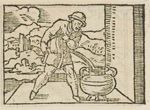
Par vn secret leger, esprouue l'estranger: La Perrière, Le theatre des bons engins (Lyon, 1545), emblem 74 uses the imagery of a man testing a large jar for cracks by first pouring cheap water into it, so as not to risk losing wine
Iconclass: 32B2(CARIANS) historical peoples: Carians 52BB41 Uncertainty 54DD52 Risk; 'Ardire ultimo & necessario' (Ripa)
Collectanea (1500): 751
Loci Communes: Experientae seu pericliationis (Experience or risk-taking, Expérience ou mise à l'épreuve)
I vi 15 In dolio figularem artem discere To learn the potter's art on a big jar
Item illud, ἐν πίθῳ τὴν κεραμείαν μανθάνειν, id est, In dolio figulariam artem discere. De iis, qui protinus maximis in rebus artificii sui capiunt experimentum, cum paulatim à minutis ad summa proficisci conveniat. Neque enim figulus statim à dolio, i. vase maximo artem auspicatur, sed à pusiliis quibusdam vasculis, in quibus non sit grave dispendium, si quid secus accidat. In hanc fermè sententiam usurpat Plato in Lachete: Σκοπεῖν χρὴ μὴ οὐ ἐν τῷ καρὶ ἡμῖν ὁ κίνδυνος κινδυνεύνται, ἀλλ᾽ ἐν τοῖς υἱεσι τε καὶ ἐν τοῖς τῶν φίλων παισὶ , καὶ ἀτεχνῶς τὸ λεγόμενον κατὰ τὴν παροιμΐαν ἡμῖν συνβαίνῃ, ἐν πιθῳ ἡ κεραμεία. id est, Considerare oportet, ne hoc periculum nobis fiat, non in Care, sed in filiis, simul atque amicorum liberis: ac planè contingat, quod proverbio dicitur, in dolio figulina. Dicaearchus ad aliam sententiam torquet proverbium, ut admoneat unumquemque artificem in suis negociis exerceri oportere, velut aurigam in ducendis curribus, nauclerum in guberanda navi, medicum in curandis morbis. Tanquam absurdum sit, figulum in aurigatione versari, re videlicet aliena, ac non magis in dolio. Atque ita huc pertinebit illa sententia: Quam quisque novit artem, in hac se exerceat. Et Horatianum illud in Epistolis: Navim agere ignarus navis timet, abrotanum aegro Non audet nisi qui didicit dare, quod medicorum est, Promittunt medici, tractant fabrilia fabri. Scribimus indocti, doctique poemata passim. Sic propemodum usurpat Gregorius Theologus in Apologia De fuga: ὡς τόγε παιδεύιεν ἄλλους ἐπιχειρεῖν, πρὶν αὐτοὺς ἱκανῶς παιδευθῆναι, καὶ ἐν πίθῳ τὴν κεραμείαν τὸ δὴ λεγόμενον, ἐν ταῖς τῶν ἄλλων ψυχαῖς ἐκμελετᾶν τὴν εὐσέβειαν, λίαν ἐμοὶ φαινεται ἀνοήτων. i. Itaque alios velle docere, prius quàm ipsi satis edocti sint, & in dolio, quod aiunt, figulinam, in aliorum animis meditari pietatem, mihi quidem videtur hominum insigniter desipientium.
The same is true of Ἐν πίθῳ τὴν κεραμείαν μανθάνειν, To learn the potter's art on a big jar, used of those who from the start practise their skill on the largest projects, though it is wise to proceed gradually from small things to great. For a potter does not start by making a big jar immediately, which is a vessel of the largest size, but sundry small pots, which will not involve heavy loss if something goes wrong. This is roughly the sense in which Plato uses it in the Laches: 'We must ensure that we do not run this risk, not with the proverbial Carian, but in our sons and our friends' sons, so that it happens to us exactly as the proverb says, that we learn our potting on a big jar.' Dicaearchus turns the proverb to mean something different: he makes it say that every craftsman ought to practise his own art, a coachman by driving carriages, a shipmaster by steering his ship, a physician by curing the sick, as though it were absurd for a potter to try driving a carriage, which is someone else's business, instead of making a big jar. And thus the well-known principle will apply here too: 'Let each man ply the trade that he knows best,' and Horace's remark in his Epistles:
Who knows not ships will fear to venture aught,
Nor southernwood prescribe, who's not been taught;
Leeches their physic, smiths their hammers ply -
Skilled and unskilled, we all can versify.
Gregory the Theologian makes a similar use of it in his Apologia defuga: 'To attempt to teach others before they are properly educated themselves, and like the potter learning on a big jar, as the saying is, to practise piety on the souls of other people, seems to me the height of folly.'
Facsimile: 
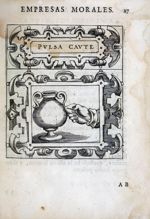
Pulsa caute: Borja, Empresas morales (Bruxelles, 1680), emblem 13 uses the imagery of cautiously testing earthenware
Par vn secret leger, esprouue l'estranger: La Perrière, Le theatre des bons engins (Lyon, 1545), emblem 74 uses the imagery of a man testing a large jar for cracks by first pouring cheap water into it, so as not to risk losing wine
Iconclass: 41A773 container of ceramics: jar, jug, pot, vase 48C313(+333) potter, ceramist (+ making pottery, ceramics)
Loci Communes: Absurda, indecora, seu praepostera (Absurd, unbecoming, or preposterous things, Choses absurdes, inconvenantes ou déplacées); Experientae seu pericliationis (Experience or risk-taking, Expérience ou mise à l'épreuve)
I vi 16 Ne sutor ultra crepidam Let the cobbler stick to his last
Huic finitimum est illud, Ne sutor ultra crepidam. id est, Ne quis de his iudicare conetur, quae sint ab ipsius arte, professioneque aliena. Quod quidem adagium natum est ab Apelle nobilissimo pictore. De quo Plin. lib. xxxv. cap. x. scribit in hunc modum: Idem perfecta opera proponebat in pergula transeuntibus, atque post ipsam tabulam latens, vitia quae notarentur auscultabat, vulgum diligentiorem iudicem quam se praeferens: feruntque à sutore esse reprehensum, quod in crepidis una intus pauciores fecisset ansas. Eodem postero die superbe ob emendationem pristinae admonitionis cavillante crus, indignatum prospexisse, denunciantem ne supra crepidam sutor iudicaret. Quod & ipsum in proverbium venit. Hactenus Plin. Huic similimum est, quod refert Athenaeus. Stratonicus citharoedus fabro secum de musica contendenti: Non sentis, inquit, te ultra malleum loqui? Eódem pertinet, quod huius nepos in epistolis scripsit, De artificio non recte iudicare quenquam, nisi & ipsum artificem. Quodque primo Moralium lib. dixit Aristoteles, Earum rerum unumquenque iudicem esse idoneum, quarum sit eruditus. Et quod idem scripsit lib. ii. Naturalium, Caecum disputare de coloribus. Quae verba iam inter nostri temporis scholasticos in proverbium abierunt, quoties quispiam de rebus ignotis disputat. Ad eandem sententiam referendum, quod ait Fabius Pictor apud Quintilianum, Felices futuras artes, si soli artifices de iis iudicarent.
Close to this is Ne sutor ultra crepidam, Let the cobbler stick to his last - let no one, that is, attempt to judge of matters which are far removed from his own skill and calling. This adage took its rise from Apelles, the famous painter, of whom Pliny, book 35 chapter 10, tells the following story: 'When his work was finished, he would expose it in the porch to the view of passers-by, hiding behind the picture to listen to their comments on its faults, because he thought the public a more strict critic than himself; and they say that he was criticized by a cobbler for painting one loop too few on the inner side of a pair of sandals. Next day, finding his criticism had been attended to, the man went proudly on to criticize the drawing of a leg; and Apelles looked out indignantly and told him when passing judgment to stick to his last. These words became proverbial.' So much for Pliny. There is a similar story in Athenaeus: Stratonicus the lyre-player said to a smith who was arguing with him about music 'Can't you see that you're not sticking to your hammer?' His nephew's remark in his Letters points the same way, that no one can judge a work of art properly unless he too is an artist. And Aristotle's saying in the first book of the Ethics that everyone is a proper judge of the things he knows about. Also what he wrote in the second book of the Physics of a blind man disputing about colours - words which have become proverbial among academics of our own day for disputing on subjects of which a man knows nothing. To the same opinion we may refer what Fabius Pictor says in Quintilian, that the arts would be fortunate if none but artists were their critics.
Facsimile:
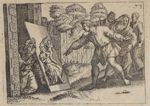
Ne sutor ultra crepidam: Meyer, Homo Microcosmus (Frankfurt, 1670), emblem 73
Nimb dich nicht mehr an als du kanst - Sutor non ultra crepidam: Meisner, Politica Politica (Nürnberg, 1700), emblem 792
Schoenmakers ... blijven leert by uwen houten leest: Vondel, Gulden Winkel (Amsterdam, 1622), emblem 72
Der Tadel-Narr: Weigel, Ein Schock Phantasten (Nürnberg, 1705), emblem 52
Der künstliche Mahler Apelles: Nilson & Thelott (Augsburg, 1728-1760), inscription on the print quotes the adage
Iconclass: 47H73 shoe-maker, cobbler 47H731 last (shoe-maker's tool) 51EE11 Restriction, Limitation 98B(APELLES)51 Apelles and the cobbler; upon hearing a remark about his painting Apelles advises the cobbler to stick to his last, 'ne sutor supra crepidam'
Collectanea (1500): 153
Loci Communes: Arrogantia jactantiaque (Arrogance and boastfulness, Arrogance et vantardise)
I vi 17 Dii facientes adiuvant The gods help those who help themselves
Varro libro De re rustica primo: Et quoniam, ut aiunt, dii facientes adiuvant, prius invocabo deos. Significat divinam opem non cessantibus, sed industriis, & pro sua virili conantibus auxilio esse solere. Huc arbitror referendum illud Homericum carmen, quod iam velut in proverbium abiit: Τηλέμαχ᾽ ἄλλα μὲν αὐτὸς ἐνὶ φρευὶ σῆσι νοήσεις, Αλλα δὲ καὶ δαίμων ὑποθήσεται. id est, Haec partim ipse tuo perpendes pectore tecum, Partim aliquis divûm tibi suggeret. Id M. Tullius usurpavit lib. Epistolarum ad Atticum nono: Omnia vobis imparatis agenda: Sed tamen Αλλα μὲν αὐτὸς Αλλα δὲ καὶ δαίμων ὑποθήσεται. id est, Partim ipse invenies, partim fors suggeret ipsa.
Varro in his Agriculture, book 1: 'And since, as they say, the gods help those who help themselves, I will invoke the gods first.' He indicates that divine help is commonly available, not to the idle, but to industrious men who try as hard as they can. To this I think we should refer those lines in Homer which have already become proverbial: 'Some things, Telemachus, will you devise / In your own heart; some too will heaven suggest.' Cicero used this in book 9 of his Letters to Atticus: 'You have to do everything unprepared. But nevertheless "some you'll devise, some too will heaven suggest."'
Facsimile: 
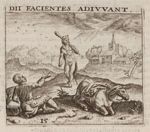
Dii facientes adiuvant: Lebey de Batilly, Emblemata (Frankfurt, 1596), emblem 15
Si tu requiers à Dieu ayde, ayde toy: La Perrière, Le theatre des bons engins (Lyon, 1545), emblem 95 uses the imagery of a man whose donkey collapsed to convey the idea that he should first try to help the donkey himself and then God will help him further
Iconclass: 54A11 Industriousness, Assiduity; 'Assiduità', 'Industria', 'Zelo' (Ripa) 54A6 Helpfulness 92 gods ~ classical mythology
Loci Communes: Industria (Industriousness, Application, diligence)
I vi 18 Cum Minerva manum quoque move Invoke Minerva, but use your own strength too
Huic finitimum est, σὺν ἀθηνᾷ καὶ χεῖρα κίνει, id est, Auxiliante Minerva manum interim move. Monet adagium, ne fiducia divinae opis industriam remittamus. Convenit peculiariter in mulieres, quae lanificium exercent, favente quidem atque invocata Minerva: sed ni> hilo segnius interim operi insistentes. Sunt qui putent ab agasone quopiam natum, cuius asinus cum luto infixus haereret, deberetque illi succurrere, ociosus Herculem implorabat. Huic respondisse deum, uti interim manum admoveret asino laboranti, atque ita demum numen adfuturum. Alii diversam huic fabulam adferunt: puta, quendam cum esset decertaturus, Minervam consuluisse, num futurum esset ut victor discederet. Responsum est, fore. Verum cum ille ingressus in theatrum, in certamine manibus staret ociosis, percussum ab adversario victum fuisse. Ad hoc adagium pertinet elegantissimum illud carmen, quod ex Agathonis tragoedia citat Aristoteles, libro Moralium Eudemiorum quinto: Τέχνη τύχην ἔστερξε, καὶ τύχη τέχνην. id est, Fortunam ut ars, fortuna ita artem amat invicem. Citatur à Suida senarius hic in eandem sententiam: Αὐτός τι νῦν δρῶν, εἶναι τοὺς θεοὺς κάλει. id est, Fac interim aliquid ipse, dein deos voca.
Close to this is Σὺν Ἀθηνᾷ καὶ χεῖρα κίνει, Let Minerva help you, but make a start meanwhile yourself. The adage warns us not to relax our efforts in reliance on divine assistance. It is specially appropriate to women: their woolwork has Minerva as its patron, and they ask her aid, but press on with no less energy all the time. Some think it arose from a carter whose ass stuck fast in the mud, and when he ought to have helped it out, he did nothing and appealed to Hercules. The god replied, as the story goes, that he should set his hand meanwhile to help his donkey in distress, and that heaven would help him then, but not before. Others produce another tale: when a man was to enter a contest, he asked Minerva whether he would emerge victorious, and the answer was yes. However, when he entered the ring and stood there with folded arms, his opponent knocked him out, and he lost. To this adage belongs that most elegant line cited from a tragedy by Agathon in Aristotle's Eudemian Ethics, book 5: 'Art fond of fortune, fortune fond of art.' The following iambic line is quoted by Suidas to the same effect: 'First take your coat off, and then say your prayers.'
Facsimile:
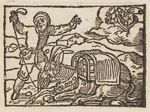
Si tu requiers à Dieu ayde, ayde toy: La Perrière, Le theatre des bons engins (Lyon, 1545), emblem 95 uses the imagery of a man whose donkey collapsed to convey the idea that he should first try to help the donkey himself and then Minerva will help him further; the adage's comment uses the story of the donkey
Iconclass: 53CC31 Invocation; 'Invocatione' (Ripa) 54C12 Purpose, Aim 92C2 (story of) Minerva (Pallas, Athena)
Loci Communes: Industria (Industriousness, Application, diligence)
I vi 19 Nostro Marte By our own prowess
Quoties nullis auxiliis adiuti, nostropte ingenio, propriisque viribus rem peragimus, nostro Marte peragere dicimur. Aut etiam cum nostro periculo res geritur. M. Tullius libro Officiorum tertio, Hanc igitur partem relictam explebimus, nullis adminiculis, sed, ut dicitur, Marte nostro. Hactenus ille. Idem Philippica ii. de Deiotaro loquens. Rex enim ipse sua sponte, nullis commentariis Caesaris, simul atque audivit eius interitum, suo Marte res suas recuperavit. Cod. libro secundo, tit. Ne liceat potentioribus, capite primo: Divine admodum constituit Divus Claudius consultissimus princeps, parens noster, ut iactura causae afficerentur hi, qui sibi potentiorum patrocinium advocassent, ut hoc proposito metu, iudiciariae lites potius suo Marte decurrerent, quàm potentiorum domorum opibus niterentur. Rursus lib. iii. Titulo De iudiciis, cap. xi. Illo proculdubio observando, ut si neque per alterutram litigantium partem, nec per iudices steterit, quo minus lis suo Marte decurrat, sed per patronos causarum licentia detur iudici. Translatum videtur ab Imperatoribus, qui suis ipsorum auspiciis & copiis bellum sustinent: siquidem Plautus etiam Meis copiis, dixit, pro Meo Marte. Sapiunt proverbium etiam illa, Vario Marte, dubio Marte, iníquo Marte. Huic adagio penè diversum est illud quod alibi retulimus, οὐκ ἄνευ θησέως. id est, Non absque Theseo.
Whenever we bring something to a conclusion with no outside help, by our own wits and such strength as we possess, we are said to do it by our own prowess or on our own merits; also when something is done at our own risk. Cicero in his De officiis, book 3: 'This gap then I propose to fill, with no outside help but, as they say, by my own prowess.' Again in his second Philippic, speaking of Deiotarus: 'For the king himself on his own initiative and with no support from Caesar's memoranda, as soon as the news of Caesar's death reached him, recovered his property by his own prowess.' In the second book of the Code, in the title Ne liceat potentioribus, chapter 1: 'It was an inspired provision of his late imperial majesty that most sapient emperor Claudius our kinsman, that all such persons should be cast in their suit as might have secured the assistance of powerful patrons, in order that with this threat in prospect, questions at issue in the courts should be decided on their own merits, in preference to reliance on the resources of powerful persons in high place.' And again in book 3, title De iudiciis, chapter 11: 'This rule being observed beyond a peradventure, that neither of the parties engaged in a suit and none of the judges may so act, that the case does not proceed on its own merits; but absolute freedom must be left to the judge by counsel on either side.' A metaphor, it would seem, from supreme commanders, who fight a campaign on their own initiative and with their own forces; for Plautus too has 'With my own forces' instead of 'By my own prowess.' Other phrases have a proverbial ring, such as vario Marte, dubio Marte, iniquo Marte, when Mars, representing the fortunes of war, is said to be changeable or doubtful or unfair. This adage is almost the opposite of one I have recorded elsewhere: Οὐκ ἄνευ θησέως, Not without Theseus.
Facsimile:
Iconclass: 54D2 Action; 'Operatione manifesta' (Ripa)
Collectanea (1500): 292
Loci Communes: Cum auxilio ; citra auxilium (With help; without help, Avec aide ; sans aide)
I vi 20 Nequicquam sapit, qui sibi non sapit He's wise in vain that's not wise for himself
Sententia vel hodie vulgo frequentissime iactata, Frustra sapere, qui sibi non sapiat. Plato in Hippia maiore, Καὶ πολλοῖς, inquiens, συνδοκεῖ, ὅτι τὸν σοφὸν, αὐτὸν αὑτῷ μάλιστα δεῖ σοφὸν εἶναι. id est, Idem itidem & plerisque videtur, quod oportet eum qui sapiat, ipsum sibi maximè sapientem esse. Usurpat & Cicero in epistola quadam ad Trebatium, ostendens ex tragoedia Medea sumptam: Et, quando, inquiens, coepi agere Medeam, illud semper memento: Qui sibi ipse sapiens prodesse nequit, nequicquam sapit. Est autem versus trochaicus. Idem Epistolarum familiarum lib. decimotertio, ad Caesarem Imperatorem: Itaque ab Homeri magniloquentia confero me ad vera praecepta Εὐριπίδου, Μισῶ σοφιστὴν, ὅς τις οὐχ αὑτῷ σοφός. Quem versum senex Praecilius laudat egregie. Idem lib. De divinatione primo citat ex Ennio in divinos, Qui sibi ipsimet non sapiunt, alteri monstrant viam. Quibus divitias pollicentur, ab his drachmas ipsi petunt. Citatur à Luciano in Apologia: Μισῶ σοφιστὴν, ὅς τις οὐχ αὑτῷ σοφός. id est, Sapientem enim odi, qui sibi ipse non sapit. Eundem Alexander torsit in Callisthenem, qui se moribus eorum quibuscum vivebat non accommodaret, sed prae se ferebat, nihil eorum quae illic gerebantur sibi placere. Eaque libertas optimo viro attulit exitium, cum Anaxarchus philosophus omnium adulatorum abiectissimus, haberetur in precio. Eam sententiam sic ad unguem servant huius tempestatis homines, ut hominis vocabulo videatur indignus, qui non quavis ratione suis consulere commodis noverit. Huius generis est illud apud Suetonium: Aspice felicem sibi, non tibi, Romule Syllam.
It is an old saw in very frequent use even in our own day, that a man's wisdom is useless who is wise only for others. Plato in the Hippias major says: 'And many agree that the wise man should be wise above all for his own benefit.' Cicero too uses it in a letter to Trebatius, showing that it comes from a tragedy on the subject of Medea: 'And since I have begun to play Medea's part, always remember that line "He whose wisdom nought avails him, all in vain is counted wise."' It is a trochaic verse. Again in his Letters to Friends, book 13, writing to Caesar the emperor: 'And so I betake me from Homer's grand style to the true precepts of Euripides: "Wisdom I hate that's not wise for itself," a line most highly praised by the elder Praecilius.' Again, in the first book of the On Divination he quotes against soothsayers the lines of Ennius:
They whose wisdom tells them nothing yet show other men the way;
'Riches shall be yours' they promise, yet themselves must beg their bread.
Lucian in his Apology quotes 'Wisdom I hate that's not wise for itself.' Alexander turned the same line against Callisthenes because, he said, he did not adapt himself to the characters of those he lived with, but made it clear that he disapproved of everything that went on. And this freedom of speech cost the excellent man his life, while that contemptible toady the philosopher Anaxarchus was held in high esteem. This principle is so precisely observed by our contemporaries, that one would be thought unworthy to be called a human being who could not find some means of promoting his own advantage. In this class falls that thing in Suetonius: 'Observe a second Sulla, fortunate / Not for Rome's benefit but for his own.'
Facsimile: 
Iconclass: 52A51 Wisdom; 'Sapienza', 'Sapienza humana', 'Sapienza vera' (Ripa) 54BB3 Inutility, Noxiousness; 'Nocumento', 'Nocumento d'ogni cosa' (Ripa)
Collectanea (1500): 293
Loci Communes: Proprii commodi studium (Pursuit of one's own advantage, Recherche de son propre intérêt)
I vi 21 Cantherium in fossa Donkey in a ditch
Cantherium in fossa: rusticum proverbium, sed tamen è re militari natum. Hoc licebit uti, quoties quis ad id negocii trahitur, in quo nequaquam valeat. Aut ubi res vehementer erit impedita, periculosave. Refertur à T. Livio, decadis tertiae libro tertio. Narrat autem, cum Fabius Capuam obsideret secundo bello Punico, Iubellium Tauream inter equites Campanos nobilissimum, è Romanorum exercitu quemvis ad singulare certament evocasse, ausumque prodire Claudium Asellium. Deinde, ubi diutius uterque alterum libero campo elusisset, Campanus in cavam viam descendere iussit, alioqui equorum, non equitum fore certamen. Eò cum Romanus, re quam verbis ferocior, extemplo descendisset, rursum elusit Taurea sermone, qui postea in rusticum versus est proverbium: Minime scis, inquiens, cantherium in fossa? Quanquam ex Livianis verbis parum liquet adagii sensus, tamen coniecturis facile deprehenditur. Pugnat autem cum illo, quod alibi dicemus: τὸν ἵππον εἰς πεδίον. id est, equum in planiciem. Etenim quemadmodum plurimum valet equus in planicie, ita minime valet in fossa.
Donkey in a ditch: a country proverb, but it has a military origin. Can be used whenever someone is obliged to do what he is quite incapable of, or when something will be extremely complex or dangerous. The story comes in Livy, book 3 of the third decade. He tells how, when Fabius had laid siege to Capua in the second Punic war, Jubellius Taurea, the most renowned of the Campanian knights, challenged the first comer in the Roman army to single combat, and one Claudius Asellius dared to step forward. When they had dodged each other for a long time in open ground, the Campanian called to his opponent to come down into a hollow way, since otherwise it would be a contest between the horses instead of their riders. The Roman, whose courage ran to deeds not words, came down at once; whereupon Taurea again got the better of him with a remark which has passed into a country proverb. 'Don't you know' he said 'how little a donkey can do in a ditch?' Although from Livy's words the sense of the adage is far from clear, we can easily guess what it means. It conflicts with one of which I shall speak elsewhere: Equum in planiciem, The horse to the plain. A horse is of the greatest value on an open plain, and is very little use in a ditch.
Facsimile:
Iconclass: 25H224 small canal, ditch 46C13142 ass, donkey
Loci Communes: Absurda, indecora, seu praepostera (Absurd, unbecoming, or preposterous things, Choses absurdes, inconvenantes ou déplacées); Proclivitas (contra) (Propensity (against), Penchant (contre))
I vi 22 Tantali talenta The talents of Tantalus
Τάλαντα ταντάλου. id est, Tantali talenta. De immensis opibus. Nam Tantalus Phryx ob luculentas divitias in fabulam hominum venit, ita ut fingatur et apud inferos similie quiddam pati, cuiusmodi solent inter congestas opes tenaces isti divites. Horatius, Tantalus à labris sitiens fugientia captat Pocula quid rides? mutato nomine de te Fabula narratur. Ostendit, allegoriam figmenti ad divites sordidos pertinere. Usurpatur adagium à Platone in Euthyphrone. Suidas ait esse & apud Epicharmum, & apud Anacreontem. Effertur & ad hunc modum, cum venusta quadam vocum allusione: τάλαντα ταντάλου ταλαντίζεται, id est, Tantali talenta talentizat: hoc est, librat & accumulat. Porrò Tantalum praedivitem fuisse, testatur vel illud ex tragoedia carmen apud Plutarchum, libro De exilio: Σπείρω δ᾽ ἀρούρασ δώδεχ᾽ ἡμέρων ὁδον. id est, Viam dierum duodecim sero iugera. Idem alibi, ingentes divitias, πλοῦτον ταντάλειον appellat: id est, opes Tantalicas, Antiphanes apud Athenaeum libro sexto: Οἷαν ποτ᾽ ἔσχε καὶ θρίβων ὁ ταντάλου, Μαλακόν ταλάντοις ἐκταλαντωθεὶς ἀνήρ. id est, Qualem olim habebat & Thribon, qui molliter Exutus est ipsis talentis Tantali.
Τάλαντα Ταντάλου., The talents of Tantalus. Used of immense wealth. Tantalus was a Phrygian who became a byword for his enormous riches, so that he is supposed to endure even in the nether regions the sort of frustration that these grasping rich men feel in the midst of their piled-up wealth. Horace, when he says of Tantalus:
In vain he grasps the cup he fain would quaff -
At you this story points: how dare you laugh?
shows that the lesson of this myth is aimed at those who are at the same time both rich and mean. Plato uses the adage in the Euthyphro. Suidas says it occurs in Epicharmus and in Anacreon. It also takes another form, with an elegant play on words: Tantali talenta talentizat, meaning He weighs and hoards as much as Tantalus. That Tantalus moreover was a man of great wealth is shown by, among other things, that line from a tragedy quoted by Plutarch in his essay 'On Exile': 'The fields I sow are twelve days' journey long.' In another passage he calls immense riches 'Tantalic wealth.' Antiphanes, cited by Athenaeus, book 6:
Such once was Thribon's, who was gently stripped
Of all the fabled wealth of Tantalus.
I vi 23 Pelopis talenta The talents of Pelops
Consimili figura Theocritus in Idyllio Θ. dixit Pelopis talenta: Μή μοι γᾶν πέλωπος, μήμοι χρύσεια τάλαντα Εἴη ἔχειν, μηδὲ πρόσθε θέειν ἀνέμων. id est, Non Pelopis mihi sint agrique, aurique talenta: Nec ventos celeres antevolasse pede. Porrò talentum apud Atticos, maxima pecuniae summa erat. Talentum minus valebat libras sexaginta, talentum magnum octoginta. Unde illud in Phormione: Si quis daret talentum magnum. Imo malum. Et Aristophanes, Αλλ᾽ ἐγώ γ᾽ ὀπούντιος Οὐκ αν γενοίμην ἐπι ταλάντῳ χρυσίου. id est At ego sanè Opuntius Nolim esse, si quis det talentum mi aureum. Id est, Nolim esse luscus vel quantalibet pecunia.
Theocritus uses a similar expression in idyll 8, when he writes of the 'talents of Pelops': Not Pelops' land nor Pelops' wealth I crave, Talents of gold, nor to outrun the winds. In Attica moreover a talent was the largest sum of money they knew. The lesser talent weighed sixty pounds, the greater talent weighed eighty. Hence these lines in the Phormio: Geta If anyone would give him a great talent... Demipho Great talent? Rather give him a great thrashing. And Aristophanes: 'What? Turn Opuntian? / Not I! Not for a talent of pure gold!' which means, I would not sacrifice the sight of one eye, however much you gave me.
Facsimile:
Iconclass: 55B1 Wealth, Opulence; 'Opulenza', 'Richezza' (Ripa) 95A(PELOPS)7 (story of) Pelops - specific aspects, allegorical aspects, as patron of
I vi 24 Midae divitiae The riches of Midas
Μίδου πλοῦτος, και μΐδου πλουσιώτερος.. id est, Midae opes, & Mida locupletior: in proverbium abierunt, propter immensas eius regis opes, quae fabulis quoque compluribus fecere locum. Statius in Surrentino Pollii: Vive Midae gazis, & Lydo ditior auro. Fuit hic Midas Phrygiae tyrannus, cui iuxta poetarum figmenta, concessum à diis est, ut propter Bacchum hospitio acceptum, quod vellet, optaret, accepturus quicquid optasset. Optavit ut quicquid corpore contigisset, protinus in aurum verteretur. Historicorum literis proditum est, huic puero dormienti formicas in os grana tritici congessisse: respondisse augures, omnium mortalium illum ditissimum futurum, atque ita evenisse. Huic Plinius primum attribuit locum inter insigniter divites, libro tricesimotertio.
Μίδου πλοῦτος, The riches of Midas, and Μίδου πλουσιώτερος., As rich as Midas, have passed into a proverb on account of the great wealth of a king of that name, which gave rise also to numerous stories. Statius in his poem on Pollius' villa at Sorrento: 'Richer than Midas' wealth and Lydian gold.' This Midas was a tyrant of Phrygia who, if we believe the fables of the poets, in return for his hospitality to Bacchus was permitted by the gods to wish for anything he liked, and it would be given him. He prayed that whatever he touched might instantly be turned into gold. The historians tell us that, when he was a child, ants piled grains of wheat on his lips as he lay asleep; the soothsayers said this meant that he would be the richest of all mortal men, and so it turned out. Pliny gives him first place in his list of outstandingly rich men, in book 33.
Facsimile: 
Si sciens fallo: Paradin, Les devises héroïques (Antwerp, 1563), emblem 52
Contre les avaricieulx: Corrozet, Hecatomgraphie (Paris, 1540), emblem 68 uses the imagery of king Midas
Iconclass: 55B1 Wealth, Opulence; 'Opulenza', 'Richezza' (Ripa) 95A(MIDAS)7 (story of) Midas - specific aspects, allegorical aspects, as patron of
Collectanea (1500): 733
I vi 25 Non omnino temere est, quod vulgo dictitant What is in every man's mouth is not spoken wholly without cause
Apud Aristotelem usurpatur proverbii vice, & apud eruditos iam olim in proverbium abiit nobilis illa Hesiodi sententia: ἥν ἅπαντες ἄδουσι, quemadmodum ait aristides in defensione Periclis, quae dicit, non usquequaque irritum esse solere, quicquid rumore populi iactatum fuerit. Ea est in operis volumine secundo, cui titulus, Opera & dies: Δεινὴν δὲ βροτῶν ὑπαλεύεο φήμην. φήμη γάρ τε κακὴ πέλεται, κούφη μὲν ἀεῖραι Ρεῖα μαλ᾽, ἀργαλέη δὲ φέρειν, χαλεπή δ᾽ ἀποθέσθαι. φήμη δ᾽ οὔτις πάμπαν ἀπόλλυται ἥν τινα πολλοὶ Λαοὶ φημΐζουσι, θεὸς νύτις ἐστὶ καὶ αὐτή. id est, Rumores hominum cures vitare molestos. Fama malum est, oritur, surgitque facillima: verum Difficile hanc perferre, grave est sedare coortam. Nam non ulla quidem prorsum perit irrita fama, Per populos quaecunque volat, quia numen & ipsa est. Potest bifariam accipi sententia: nimirum aut non planè falsum videri, quod plurimis est in ore, quodque populi consensus approbat: aut non prorsus aboleri posse rumorem, etiam falsum, qui iam in vulgus dimanarit. Proinde admonet. ut solicite caveamus, ne vel falso per temeritatem in fabulam vulgi venire contingat. Quod autem famam deam dixit, cum Homero sensit, qui compluribus locis ὄσσαν suam inducit. sic enim deam ipsam appellat. Et hunc aemulatus Vergilius in quarto Aeneidos: Haec passim dea foeda virûm diffudit in ora.
Aristotle uses as a proverb - and it has long ago passed into a proverb among educated men - that famous saying in Hesiod, 'which all men repeat' as Aristides says in his defence of Pericles, to the effect that whatever is spread by popular rumour is rarely devoid of all foundation. It comes in the second volume of his poems, which has the title Works and Days:
And shun the fearful rumour of mankind.
Rumour's an evil thing, so lightly raised,
Grievous to bear and hard to put away;
Rumour dies hard that many folk have uttered;
Rumour herself's a sort of deity.
The statement can be taken in two ways, either that a thing which is in every man's mouth and accepted by popular opinion does not seem wholly false, or that a rumour, false though it may be, once it has already spread in public cannot be wholly suppressed. And so it warns us to take great care that we may never have the misfortune to become a byword even unjustifiably through some rash act. In calling Rumour a deity, he agrees with Homer, who in several passages introduces a character called Ossa; for this is his name for Rumour regarded as a goddess. And Virgil imitates him in the fourth book of the Aeneid: 'This the foul goddess o'er the lips of men / Spread broadcast.'
Facsimile:
Iconclass: 51C Causation 52D5 Rumour; 'Rumore' (Ripa)
Loci Communes: Probrum, gloria (Disgrace, glory, Honte, gloire)
I vi 26 Domum cum facis, ne relinquas impolitam When you make your house, leave it not unplaned
Cum nulla huius poetae sententia non cesserit in poverbium, tamen equidem eas libentius recensuerim, quae, propter aenigmatis involucrum, propius accedunt ad speciem proverbialem: quod genus est illa ex eodem, quem modo citavi, libro: Μηδὲ δόμον ποιῶν ἀνεπίξεστον καταλείπειν, Μή τοι ἐφεζομένη κρώζῃ λακέρυζα κορώνη id est, Néve domum fabricans, linquas mutilamque rudemque, Ne fors insideat cornicans garrula cornix. Proculus interpres admonet locum hunc bifariam accipi. Quibusdam videri, monere poetam uti quisque domicilium ante hyemem absolvendum curet, ne tum non habeat, quo depellat frigoris molestiam. Hyemem enim cornicis indicatam symbolo, videlicet avis hybernae. Porrò cum semper aliàs, tum maximè mensibus hibernis οἶκος φίλος, οἶκος ἄριστος. id est, Est grata domus, domus optima: quemadmodum in proverbio est. Alii putant significatum, aedificium semel institutum, non oportere semiperfectum relinquere, ne vulgo risui sis: & qui praeterierint obloquantur carpantque levitatem tuam, qui quod ceperis non absolvas. Quandoquidem hunc obloquendi morem vulgo peculiarem esse, vel evangelicae notant parabolae. Eam autem obtrectantium petulantiam per cornicem voluit indicare poeta: nempe avem garrulam & obstreperam: ut hinc etiam verbum proverbiale ductum sit, κρώζειν. At ipsi Proculo magis probatur, ut καθολικῶς accipiamus, unicuique negocio, quod semel instituerimus, finem idoneum imponendum, ut nihil omnino desideretur, & ubique connitendum ad perfectionem. Id quo longius avocabitur à simplici sermone, hoc venustius fiet, & magis proverbiale. Veluti si quis adhortetur aliquem, ne literarum studium deserat, sed laudabiliter institutis summam imponat manum, ne vulgo ludibrio sit, quod à bene coeptis destiterit, Hesiodium hoc obiiciens. Μηδὲ δόμον ποιῶν, ἀνεπίξεστον καταλείπειν, Μή τοι ἐφεζομένη κρώζῃ λακέρυζα κορώνη.
Although there is no saying of Hesiod's that has not become proverbial, I myself prefer to list those which, being wrapped up in riddles, come closer to proverbs in form. An example of this may be found in these lines from the book I have just quoted:
Building thy house, leave not the roof unplaned,
Lest clamorous crows upon it perch and croak.
Proculus the commentator tells us that this passage is taken in two ways. Some think the poet is warning us that every man should see that the building of his house is finished before the winter, for fear that he may then have no means of keeping out the cold; for the crow, he says, is a symbol of winter, as being a winter bird. Moreover, while it is true always, it is most true in the winter months that 'There's no place like home,' as the proverb runs. Others think it means that a building once begun ought not to be left half finished, for fear you become a public laughing-stock, and the passers-by speak against you, and criticize your infirmity of purpose in not finishing what you have started. For this custom of criticizing others is a speciality of common people, as the Gospel parables indicate. It was this habit of persistent denigration that the poet meant to indicate by his crow; for the crow is a noisy and obstreperous bird, so that it has given rise to the proverbial use of the verb 'to croak.' But Proculus for his part prefers to take the expression in a general sense: every piece of business to which we have once set our hands ought to be brought to its proper conclusion, so that nothing at all is lacking, and everywhere we ought to strive for complete- ness. The further removed this can be from its literal use, the more elegant it will appear, and the more like a true proverb: for example, if one were to urge a man not to abandon humane studies, but to put the finishing touches to what has been so admirably started, for fear he many become an object of general derision by giving up something well begun, and bring against him Hesiod's words:
Building thy house, leave not the roof unplaned,
Lest clamorous crows upon it perch and croak.
Facsimile: 
Iconclass: 47D8(PLANE) tools, aids, implements ~ crafts and industries: plane 54D3 Completion
Loci Communes: Obtrectatio et maledicentia (Disparagement and slander, Dénigrement et médisance); Perficiendi sive absolvendi (Finishing, completing, Achever, accomplir)
I vi 27 Ne a chytropode cibum nondum sacrificatum rapias Snatch not food as yet unblest out of the dish
Aenigmaticum est & illud, quod eo loco continenter sequitur: Μήδ᾽ ἀπὸ χυτροπόδων ἀνεπιῤῥέκτων ἀνελόντα Εσθειν, μηδὲ λόεσθαι. id est, Néve à chytropode sublatam protinus escam Ante sacrum, neque lotus edas. Indicat & M. Tullius, irreligiosum fuisse, cibum è patella edere. Scribit enim ad hunc modum libro De finibus secundo: Atqui reperiemus asotos primum ita non religiosos, ut edant de patella: deinde ita mortem non timentes, ut illud in ore habeant ex Hymnide: Mihi sex menses satis sunt vitae, septimum orco spondeo. Est autem versus trochaicus. Suetonius in Vitellio prodit, eum illum adeo non profundae modo, verumetiam intempestivae fuisse gulae, ut ne in sacrificio quidem unquam, aut ullo itinere temperarit, quin inter altaria ibidem statim viscus & farra è foco penè rapta manderet, circaque viarum popinas fumantia obsonia, vel pridiana, atque semesa. Quantum ad simplicem attinet sensum, docet, ne ritu pecudum ad cibum capiendum irruamus, sed ita demum edamus, si prius inde primitias diis immolaverimus. Antiquitus enim, ut autor est in Symposiacis Plutarchus, inter res sacras habebatur & mensa quotidiana: proinde cibum sumpturi, diis consecrabant τὰς ἀναρχάς., hoc est, primitias: ac deinde non indecore, neque tumultuanter, sed religione quadam ad convivium accedebant lotis manibus, non aliter quàm ad sacrum epulum. Qui mos & hodie durat apud benemoratos Christianos. Sed proverbialius fiet, si intelligamus, non esse spoliandos, nec inhumanius expilandos ministros aut servos nostros, verum & illis aliquam pecuniae portionem relinquendam, quo vivant. Fortassis quadraverit & in hos, qui praepropera aviditate commodum auferre student, prius quàm oporteat: & quodammodo messem facere, prius quàm maturuit seges: veluti si quis legatum aut promissum statim & vestigio flagitet, cum civilius sit in dies aliquot silere: aut si quis modo nactus imperium, protinus incipiat populum exactionibus spoliare: aut si quis sponsam puellam, non exspectata aetate, nec exspectatis nuptiarum caeremoniis, properet amplecti. Sumptum est à ritu sacrorum, in quibus olim epulabantur. Huc pertinet & illud, quod alibi retulimus ex Athenaeo, libro nono, ἀπὸ τηγάνου. id est, à patella frixoria. Libro sexto refert hunc senarium ex Pherecrate: Απο τηγάνου τ᾽ ἔφασκεν ἀφύας φαγεῖν. id est, Se vesci apuis dixit è sartagine. Quidam pro lopade τήγανον dixere, quod Iones ἤγανον. Hinc composita ἀποτηγα νίζειν. Ita Phrynichus apud Athenaeum libro sexto: ἡδὺ δ᾽ ἀποτηγανίζειν ἄνευ συμβολων. id est, Iucundum est à sartagine tollere sine symbolis, id est, si nihil sit solvendum, & si id liceat immuni. Rursus alias apud hunc ipsum ex Archestrato: ἀφαρπάζουσα ὀβελίσκου. id est, Rapiens à veru. De muliere quae sacra nondum immolata devorare dicta sit: Apud eundem libro sexto, Anaxandrides: Τῶν ζωγράφων μὲν ἡ καλὴ χειρουργία Εν τοῖς πίναξι κρεμαμένη θαυμάζεται. Αὕτη δὲ σεμνῶς ἐκ λοπάδος ἁρπάζεται, Απὸ τοῦ ταγήνουτ᾽ οὐθέωας ἀφανίζεται. id est, Pictoris opera pulchra, tabula pensili Spectantur, ac spectata sunt miraculo, at Rapiuntur haec è lopade pulchre, ac protinus Redduntur ipsa evanida è sartagine. In genere poterit accommodari ad quemvis, qui negocium irreverenter, & illotis, ut aiunt, pedibus aggreditur.
There is another puzzle in that passage, in the lines that immediately follow:
Nor from unhallowed vessels take thou aught
To eat nor wash.
Cicero too suggests that it was irreligious to eat food out of the dish, for he writes as follows in book 2 of his Definibus: 'And yet we shall find profligates who in the first place are so devoid of scruples that they eat out of the dish, and then so far from the fear of death that they have ever on their lips that verse from the Hymnis: "Six bare months of life suffice me; Death is welcome to the rest."' It is a trochaic line. Suetonius in his life of Vitellius relates that 'his greed was not only so great but so ill-timed, that even at a sacrifice or on a journey he never controlled himself, but when at the altar would snatch fat and spelt-grains almost out of the fire and eat them there and then, and the hot food in a wayside eating-house, even if it was two days old and half-eaten.' As far as the plain sense goes, it tells us not to fall greedily upon our food like brute beasts, but to wait until we have first offered the first-fruits to heaven. For in ancient times, as Plutarch tells us in his 'Table-talk,' even daily food was included among things sacred; and so, when they were about to eat, they used to consecrate the first-fruits to the gods, and then they would proceed to their repast with no indecent haste but with a certain solemnity, with hands duly washed, as they might to some sacred meal. This custom survives to our own day among well-conducted Christians. But it will be more like a proverb, if we understand it to mean that we must not rob our underlings and servants or strip them heartlessly of what is theirs, but must leave them in possession of some portion of their money, for them to live on. It will perhaps be found suitable for those men too who are greedy, and therefore in a hurry, and are eager to snatch an advantage before the right moment comes, and reap their harvest, as it were, before the crop is ripe; for example, the man who demands on the spot something bequeathed or promised to him, when it would be more courteous to say nothing for some days, or he who has lately come into a position of power and begins at once to despoil the people with his exactions, or who, when betrothed to a girl, does not wait for her to be of full age, does not wait for the marriage ceremony, but beds her forthwith. It is taken from the liturgy of sacrifices, which in old days included a meal.
With this belongs a phrase I have reported elsewhere from Athenaeus, book 9: Ἀπὸ τηγάνου,, A patella, Straight from the pan. In book 6 he quotes from Pherecrates the iambic line 'Said he ate whitebait straight out of the pan.' Some used the form teganon for a pan, the Ionic eganon; hence the compound verb apoteganizein, to eat from the pan. Thus Phrynichus, quoted by Athenaeus book 6, uses it: 'Sweet indeed, this eating from the pan, and no scot paid,' meaning, if there is nothing to pay and you are allowed to do it free. Again, in another passage, he quotes from Archestratus 'Snatching it from the spit'; said of a woman who was described as eating the sacrificial meat before it had been offered. The same author in his sixth book quotes from Anaxandrides:
Let 'em gape as they will at the painter's great skill,
As it hangs in its frame very nice:
Here's art, if they can, that they snatch from the pan,
And it's gone from the pot in a trice.
In general it will be possible to adapt this to anyone who embarks on something heedlessly and, as the saying goes, with unwashed feet.
Facsimile:
Iconclass: 12B43 ritual practices ~ purification, blessing (non-Christian religions) 41C342 serving-dish, platter 41C6 foodstuffs; still life of foodstuffs 44G544 theft
Loci Communes: Rapacitas et avaritia (Rapacity and greed, Rapacité et avarice)
I vi 28 Haec potior This is sovereign
Plutarchus in Problematibus Graecanicis proverbium quoddam refert ad hunc modum, Απὸ τίνος ἐῤῥὲθη τὸ παροιμιῶδες, αὕτη κυρία; δνων ὁ ταραντῖνος στρατηγῶν, ἀνὴρ δὲ ὤν ἀγαθὸς ἐν τοῖς πολεμικοῖς, ἀποχειροτονησάντων, αὐτοῦ τινα γνώμην τῶν πολιτῶν, ὡς ὁ κῆρυξ ἀνεῖπε ττὴν νικῶσαν, αὐτος ἀνατείνας τὴν δεξιὰν, ἅδε, εἶπε, κρείσσων, οὕτως γὰρ ὁ θεόφραστος ἱστορηκε δὲ ὁ ἀπολλόδωρος ἐν ῥυτίνῳ, τοῦ κήρυκος, αὗται πλείους, εἰποντος. ἀλλ᾽ αὗται, φάναι βελτίους. καὶ ἐπικυριῶσαι τὴν των ἐλαττόνων χειροτονίαν.. Horum verborum hic fermè sensus, Unde fluxit illud, quod proverbii vice dicitur, Haec victrix? Dinon Tarentinus, ductor exercitus, vir adprime fortis, reique bellicae sane quàm peritus, cum in concione dixisset sententiam, eaque civium suffragiis esset reiecta: deinde praeco pronunciaret sententiam, quae vinceret, sublata dextera, Haec, inquit, potior. Nam hunc ad modum retulit Theophrastus. Caeterum Apollodorus in Rhytino illud adiunxit, cum praeco respondisset, At hae sententiae numero plures sunt, Dinonem protinus subiecisse, Sed hae meliores. Atque ita pauciorum sententiam fuisse promulgatam. Quibus ex verbis coniicere licet, ita vulgo dici solere, si quando significaretur consilium aliquod esse praestantius & conducibilius, etiamsi pluribus secus videretur: aut ubi qui numero pauciores essent, facultate praeponderarent. Quod genus fuerit, ut res exemplis demonstrem: Maxima pars hominum voluptate, lucrisque felicitatem metitur, perpauci virtutem amplectuntur. Cave ne quid te moveat multitudinis exemplum, αὕτη γᾶρ κρείσσων. Item, Nemo penè est in toto principis famulitio, qui tibi non bene velit: sed unus tibi refragatur, qui tantum ubique valet, ut in ipsum ferè principem agat tyrannum: Quare, si res è suffragiis penderet, viceras: sed αὕτη κυρία. Porphyrion leviter, ceu digito proverbium indicat, exponens eum locum in Horatianis Epodis, Eamus omnis exsecrata civitas, Aut pars indocili melior grege. Quanquam depravate, sicut opinor, legitur in multis exemplaribus κιῤῥόνον νίκα. Castigate legetur, ni fallor, καῤῥόνον νίκα, hoc est, praestantiorum victoria. Nam Oda concionalis est, ac fugam decerni iubet, communibus omnium suffragiis. Quod si fieri non queat, ut id quod est optimum, multitudini probetur, saltem vincat ea sententia quae sit potior, etiamsi paucioribus suffulta suffragiis. Ad id faciunt, quae Plato scripsit lib. De legibus i. pulcherrimum esse victoriae genus, cum turba cedit potioribus: & in decernendo magis spectatur pondus suffragiorum, quàm numerus. Verba Platonis ex eo quem diximus libro, sunt haec: Εν ὁπόσαις μὲν ηὰρ οἱ ἀμείνονες νικῶσι τὸ πλῆθος καὶ τοὺς χείρους, ὀρθῶς ἄν αὕτη κρείττων τε αὐτες λέγοιθ᾽ ἡ πόλις, ἐπαί νοιτότε ἄν δικαίοτατα τῇ τιαύτῃ νικῃ, τοὐναντίον δὲ ὅπου τ᾽ ἀναντία, id est, Quibuscumque siquidem in civitatibus meliores qui sunt, ii vincunt multitudinem ac deteriores: ibi respublica seipsa superior recte dicetur, & huius victoriae nomine meritissimo laudabitur: Secus autem, ubi secus accidit. Eodem respexit Plinius, cum queritur in epistolis, numerari sententias, non expendi. Huc pertinet Livianum etiam illud: Maior pars vicit meliorem. Indicat idem Homerus Iliados lib. primo Επεὶ τὰ χερείονα νικᾷ. quando superant iam deteriora. Neque vero praetereundum hoc loco, quod de Zenone philosopho memorat Diogenes Laertius. Zenon cum videret Theophrastum magnifieri, laudarique quod plures haberet auditores, ad hunc respondit modum: Εκείνου μὲν χορὸς μείζων, ὁ ὐμὸς δὲ συμφωνότορος. id est, Maior quidem est illius chorus, at meus melius consonans. Itaque locus fuerit adagio, sive cum negabimus spectandum, quam multis placeamus, sed quàm bonis: sive cum suadebimus, id sequi oportere, non quod plurimis placeat, sed quod per se sit optimum factu, etiam si paucissimorum calculis approbetur. Sive cum dicemus, unius aut alterius studium pluris aestimandum, qui vel opibus, vel gratia, vel autoritate praepolleat, quàm multitudinis benevolentiam, quae numero tantum superior sit, reliquis omnibus inferior. Quemadmodum apud Plautum quispiam contemnere se dicit minutos illos deos, modo Iovem unum sibi propitium habeat. Nec absurde trahetur in usum, quoties una vis plus potest reliquis omnibus: ut si quis dicat: Haec causa pluribus probatur, pluribus fulcitur rationibus, nititur aequo, dictatur à legibus, verum altera κυρία. Sic enim volo, sic iubeo. Nam omnia cedant necesse est, quoties rex huiusmodi promit oraculum, quale profet apud Homerum Agamemnon, Εἰ δέκε μὴ δώησιν, ἐγὼ δκεν αὐτὸς ἕλωμαι. id est: Ipse equidem eripiam, si tradere forte graventur. De cuiusmodi Lucian. in Captivo, καὶ τὸ δίκαιον ἐν τῷ χειρί τιθεμένων, id est. Qui ius in manu reponunt, quique ius in manu posuerunt. Pyrrhum è liberis quidam adolescens admodum, interrogabat cuinam esset relicturus regnum. Is respondit, ὅς ἄν, inquit, ὑμῶν τὴν μάχαιραν ὀξυτέραν ἔχη . Quicunque vestrum acutiorem habet gladium. Id dictum Plutarchus in eius vita non arbitratur multum abesse ab illa tragica execratione, Θηκτῷ σιδήρῳ δῶμα διαδοχᾶν τοῦς ἀδελφούς. id est. Fratres acuto dividant ferro domus Vices habendae. In hos igitur, qui vi rem gerunt, & quibus, ut Ennius ait, ferro geritur res, quibus ius est in armis, & quibus leges inter arma silent, per ironiam recte torquebitur, αὕτη κρείσσων, καὶ αὑτη κυρία. Nam Graecis κύριος non solum dominum significat, verum etiam eum, qui praevalet auctoritate. Et Suidas indicat concionem illis κυρίαν dici: in qua soliti sint creari magistratus. Aristophanes in Acharnensibus κυρίαν ἐκκλησίαν appellat, in qua ἐκύρουν τὰ ψηφίσματα, id est, vincebant suffragia. Nonnumquam ad rem refertur, ut apud Euripidem in Iphigenia Aulidensi, Οὐμὸς, οὐχ ὁ τουδε μῦθος κυριώτερος λέγειν. id est. Plus valere nostra debet, quàm huius hic oratio. Significat enim servus, quanquam esset conditione inferior Menelao, tamen hoc se potiorem esse, quod iustiorem haberet causam. Non abhorret hinc quod M. Tullius dixit in Pisonem, Sed omitto ut sit factus uterque nostrum. sit sanè fors domina campi.
Plutarch in his 'Greek Questions' records a proverb in the following fashion: 'Whence came the proverbial saying: This is sovereign? Dinon of Tarentum, when he was general, being a soldier of long experience, put forward a proposal which was voted down by the citizens; and when the herald announced the result, he held up his right hand and cried "No! This is stronger." So the story is told by Theophrastus. Apollodorus in his Rhytinus adds that when the herald said "There are more votes on the other side," he retorted "But these are better," and ratified the opinion of the minority.' From this we may infer that the phrase was commonly used to convey that some proposal was better or more profitable, although the majority thought otherwise, or when those who were fewer in number commanded greater resources. In this class would fall, to illustrate what I mean by examples, the following. 'Most men measure felicity by happiness and wealth, and very few are devoted to virtue; but do not be moved by the majority, for this is sovereign.' Again: 'There is almost no one in the prince's entire household who does not wish you well; but one man is against you, and he is so universally powerful that he can lord it almost over the prince himself. And so, if all depended on a vote, success is already yours; but this is sovereign.' Porphyrion touches lightly on the proverb, as it were with a finger-tip, in his note on that passage in Horace's Epodes:
Let us bind our citizens all with a solemn oath:
It is time to be gone, for those at the least
Who stand out from the ignorant throng.
Although the reading of many copies τὰ χερείονα νικᾷ is, I think, corrupt. It will be more correct, if I am not mistaken, to write καῤῥόνων νίκα - not 'The worse counsel wins' but 'Victory is with the better party.' For the ode is a rhetorical piece, and urges a unanimous vote in favour of emigration. If however it is impossible for the best policy to commend itself to the multitude, at least let the soundest opinion win the day, even if supported by fewer votes. Plato writes to the same effect in the first book of the Laws, that it is the most admirable sort of victory when the crowd give way before their betters, and in decisions the weight of votes gets more attention than their number. His words, in the book I mentioned, run as follows: 'For wheresoever the better citizens do overcome the multitude and the worser sort, that city would rightly be said to surpass itself, and such a victory would most justly redound to its credit; and the converse, where the converse happens.' Pliny had the same point in mind when he complains in his Letters that votes are counted and not weighed. Here belongs also that remark in Livy: 'The larger party defeated the better.' Homer points the same way in the first book of the Iliad: 'Since the worse counsel wins.' Nor should one pass over in this context a story told by Diogenes Laertius of the philosopher Zeno. When Zeno saw that Theophrastus was made much of and highly praised because he attracted a larger audience, his answer was: 'His choir is larger, but mine sings more in tune.'
There will therefore be scope for this adage, when we declare that the quality of those who think well of us is more important than the quantity; or when we propose that we should follow not the opinion of the majority but the best course, even if it has very few votes; or when we say that the support of two or three people eminent for wealth or popularity or influence is worth more than the goodwill of the multitude, who are superior in numbers but inferior in all else. In the same way, a character in Plautus says that he thinks nothing of those lesser gods, provided he may enjoy the favour of Jove alone. And it will not be absurd to bring this in, whenever one force is greater than all the rest; one might say, for instance, 'This course has more public support, has more reasons in its favour, is based on justice, is enjoined by the law; but the other is the winner. For "such is my will and pleasure."' For inevitably everything must give place whenever the king utters an oracle like those words of Agamemnon in Homer: 'If he says no, I'll take her for myself.' In the same way Lucian speaks in his Captive of those 'who think might is right.' Pyrrhus, when asked by one of his children, who was still very young, to whom he proposed to bequeath his kingdom, replied 'To whichever of you has the sharpest sword.' Plutarch in his life of Pyrrhus thinks this runs very close to that curse in tragedy, that brothers may divide their family inheritance 'by the sword's whetted edge.' And so, when confronted with those who use violence and, as Ennius puts it, 'by iron win their way,' who make might their right and for whom 'the laws are silent amid the clash of arms,' it will be right to give an ironic twist to the saying 'This wins the day' and 'This is sovereign.' For the Greek word kyrios means not only 'master' in the proper sense, but any person who has the final say. Suidas shows that they spoke of a 'sovereign assembly' in which magistrates were normally elected. Aristophanes in the Acharnians uses kyrios of an assembly in which he says, using a related verb, that they cast their sovereign votes. Sometimes it can be applied to things as well as people, as by Euripides in his Iphigeneia in Aulis: 'My words, not his, deserve to win the day.' For the slave's point is, that, for all that he is of lower standing than Menelaus, he has the advantage over him of a more just cause. Not far from this are Cicero's words in the In Pisonem: 'But I will say nothing of the way in which each of us was elected. By all means let Fortune be mistress of the hustings.'
Facsimile: 

Iconclass: 51E2 Superiority 57B11 Rewarding Goodness 59CC21 Inequality, Inequity, Iniquity; 'Iniquità' (Ripa)
Loci Communes: Excellentia, inaequalitas (Excellence, inequality, Excellence, inégalité); Vis injustia (Unjust force, Force injuste)
I vi 29 Delius natator A delian diver
Δήλιος κολυμβητής, Delius natator. Olim vulgo dicebatur admodum natandi peritus, quique posset in summa natare aqua. Natum adagium, aut certe factum illustrius ex Socratis apophthegmate. Cum enim huic Euripides librum obtulisset Heracliti, cui cognomen additum σκοτεινῷ propter affectatam scriptorum obscuritatem, rogaretque cuiusmodi videretur, respondisse fertur hoc pacto, Α μὲν συνῆκα, γενναῖα. οἶμαι δὲ ἅ μὴ συννῆκα, πλὴν δηλίου δεῖται κολυμβητοῦ εἰς τὸ μὴ ἀποπνιγῆναι ἐν αὐτῷ . id est. Quae quidem intellexi, praeclara: arbitror autem & ea quae non intellexi: quanquam natatore Delio opus, ut ne quis in eo praefocetur. Haec Socrates, alludens simul & ad proverbium, & ad Heracliti sensus nimium abstrusos ac profundos: ut nisi natator insigniter peritus contigisset, periculum esset, ne lector in eo libro suffocaretur mergereturque. Laertius in Heraclito refert hoc dictum ad Cratetem quendam, qui primus Heracliti librum de natura Graecis invexerit, & hoc elogio commendarit.
Δήλιος κολυμβητής, A Delian diver. Commonly used in old days of an expert swimmer who could swim on the surface of the water. The adage took its rise, or at least won greater currency, from a remark of Socrates. When Euripides once showed him a book by Heracleitus, who was nicknamed 'the prince of darkness' for the deliberate obscurity of what he wrote, and asked him what he thought of it, the story goes that he replied: 'Splendid, where I could understand it and, I daresay, where I could not; but you need to be a Delian diver if you are not to drown in his depths.' Socrates referred at the same time both to the proverb and to the excessive profundity of Heracleitus' abstruse opinions, which were such that without the help of a really powerful swimmer there was some danger that the reader of his book would sink without trace. Laertius in his life of Heracleitus attributes this dictum to a certain Crates, who was the first, he says, to introduce Heracleitus' book on nature to the Greek public, and paid it this tribute.
Facsimile:
Iconclass: 31A2775 diving (movement in water) 31A2776(+0) sinking (movement in water) (+ variant)
Loci Communes: Obscuritas (Obscurity, Obscurité)
I vi 30 Dicendo dicere discunt By speaking men learn how to speak
Εκ τοῦ λέγειν τοὺ λέγειν πορίζεται, id est, Dicendo consequimur ut dicamus. Syrianus Hermogenis interpres, Evagoram sophistam taxat, qui dicendi facultatem non putarit ratione, sed usu duntaxat constare, fierique ut dicendo consequeremur dicendi facultatem. Αξιοῦντος δὲ, inquit, κατα τὴν συρφετήν παροιμίαν, τὸ λεγειν ἐκ τοῦ λέγειν ποριζεσθαι, id est, Existimantis, iuxta vulgare proverbium, dicendi facultatem dicendo contingere. Usurpavit & M. Tullius lib. primo De oratore, In quo, inquit, fallit eos, quod audierunt, dicendo homines ut dicant efficere solere. Verum etiam illud dicitur, perverse dicere, homines perverse dicendo facillime consequi. Plinius libro Epist. vi. Video etiam multos parvo ingenio, literis nullis, ut bene agerent agendo consequutos. Latius autem patet adagium, nempe ad cuiusvis rei peritiam, quam potissimum usus suppeditat, optimus rerum omnium magister. Proinde proverbiales erunt omnes id genus, Fabricando fabricam disces, Canendo musicam, militando militarem artem, scribendo disces scribere.
Ἐκ τοῦ λέγειν τὸ λέγειν πορίζεται, By speaking we learn how to speak. Syrianus, the commentator on Hermogenes, criticizes the sophist Evagoras for holding that fluency in speaking is a matter merely of practice and not theory, and that we achieve readiness of speech by speaking, 'supposing' he says, 'as the vulgar proverb has it, that by speaking one learns how to speak.' Cicero also used it in the first book of his De oratore: 'In this' he says 'they are misled by what they have been told, that men normally contrive to become good speakers by speaking. There is truth also in the opposite saying, that a bad style is most easily acquired by speaking badly.' Pliny in the sixth book of his Letters: T observe that many men of small talent and no education have become good advocates by practice in advocacy.' The adage also has a wider application, to skill in any field, which is most appropriately acquired by practice, the best teacher of any subject. Hence all statements will have a proverbial flavour which are of the form 'You will learn building as you build, music as you play, tactics on the field of battle, writing as you ply your pen.'
Facsimile:
Iconclass: 42A512 learning to talk 54D21 Practice; 'Prattica' (Ripa)
Loci Communes: Assiduitas (Diligence, persistence, Assiduité)
I vi 31 Multi bonique Many good men and true
Πολλοί κἀγαθοί Multi bonique. Proverbiali figura dicebatur olim. Translatum à ritu sacrorum, in quibus sacrificus rem divinam facturus dicebat, τίς τῇδε; id est, Quis hic? Dein qui aderant, respondebant, πολλοί κἀγαθοί. id est, Multi & boni. Atque haec partim ominis causa dicebantur: oportebat enim in sacris εὐφημεῖν, hoc est, bene ominata dicere: partim, ut si quis esset sibi conscius admissi piaculi, discederet à mysteriis. Plutarch. in Symposiacis, Επεί μάρτυρές γε τῷ πλάτωνι πολλοί τ᾽ ἀγαθοι τε πάρεισιν. id est. Quandoquidem Platoni testes adsunt multique bonique. Sed de hoc ante meminimus. Quo quidem allusit et Aristides in Pericle, Αλλ᾽ ὥς γ᾽ ἄν εἴς τῶν καλῶν κἀγαθῶν, ἀνεπίφθονον αὐτῷ καὶ καθαρὰν τὴν μαρτυρίαν ἀπέδωκε. id est, Verum velut unus è numero honestorum ac bonorum, citra invidiam, ac purum illi reddidit testimonium. Quin etiam Homericum illud iam proverbii vice receptum est, Ηύς τε μέγας τε. magnusque bonusque. Est subinde & apud Aristophanem. Proverbium igitur locum habuerit, quoties aut testes, aut iudices, aut convictores significamus idoneos, ac neutiquam reiiciendos.
Πολλοὶ κἀγαθοί, Many good men and true, was used in old days as a proverb. Derived from a sacrificial rite in which the celebrant, when about to offer sacrifice, used to ask who was present. The assembled company then replied 'Many good men and true.' This they did partly to secure a good omen, for it was important at a sacrifice to avoid all unlucky words, in Greek euphemein; partly to give anyone with a crime on his conscience a chance to leave the sacred mysteries. Plutarch in his 'Table-talk': 'Since many good men and true are here to support Plato.' But I have referred to this before. Aristides too alluded to this in his Pericles: 'But he gave evidence in his favour ungrudgingly and unequivocally, as one would expect of a good man and true.' Homer's phrase 'great and good' is also current as a proverb, and is found here and there even in Aristophanes. The proverb therefore will be in place whenever we wish to convey, of witnesses or judges or colleagues, that they are well-chosen and by no means to be rejected.
Facsimile:
Iconclass: 31D14 adult man 57A1 Good Behaviour
Loci Communes: Fides et gravitas (Trust and seriousness, Confiance et gravité); Non solus ille (He is not the only one, Il n'est pas le seul)
I vi 32 Heroum filii noxae Great men have trouble from their children
Ανδρῶν ἡρώων τέκνα πήματα. id est, Virorum heroum filii noxae. Veteribus illud obser vatum fuit, praestantium virorum filios multum à progenitorum moribus abfuisse. Unde & Demosthenes dixit, τῶν ἀγαθῶν ἀνδρῶν, ὥσπερ εἱμαρμένη εἴη, φαύλους ἀποβαίνεν τοὺς υἱούς. id est, A viris egregiis, perinde quasi fato quodam id accidat, improbos proficisci filios. Quae quidem Demosthenis sententia refertur ab Aristide in Cimone. Interpres, quisquis is fuit, homo nec indiligens, nec indoctus, hoc loco proverbium citat, quod modo retulimus. Manet & hodie vulgatus iocus: Ex sapientissimis patribus stultissimos propagari liberos. Euripides in Heraclidis, generaliter hanc sententiam ad omnes mortales retulit, Ενα γὰρ ἐν πολλοῖς ἴσως Εὕροις ἂν ὅς τις ἐστὶ μὴ χείρων πατρός. id est, Unum forsan inter plurimos Inveneris, qui patre non sit nequior. Astipulatur huic sententiae locis aliquot Homerus, nominatim Odysseae Ε. Παῦροι γὰρ τοι παῖδες ὁμοῖοι πατρὶ πέλονται Οἱ πλέονες κακίους, παῦροι δέ τε πατρὸς ἀρείους. id est, Aequat rara patrem soboles, sed plurimi ab illis Degenerant, pauci superant probitate parentem. Declamat hoc argumentum Aelius Spartianus in Severo Caesare, multis exemplis declarans, ita ferè usuvenisse, ut viri, seu virtute, seu literis, seu fortunae indulgentia insignes, aut nullos omnino liberos habuerint, aut tales reliquerint, ut magis ex usu rerum humanarum fuerit, illos absque liberis decedere.
Ἀνδρῶν ἡρώων τέκνα πήματα., Great men have trouble from their children. The Ancients observed that in character the sons of distinguished men fall far short of their forbears. Hence Demosthenes' remark that 'good men, as though by a kind of destiny, produce bad sons.' This opinion of his is reported by Aristides in the Cimon. The scholiast, whoever he was - and he was neither idle nor ignorant - quotes on this passage the proverb I have just recorded. Even today it remains current as a humorous saying, that the wisest fathers have most fools as their children. Euripides in the Heracleidae applies this opinion widely to mortals in general: 'One among many haply you may find / No worse man than his sire.' Homer says the same in several passages, especially in Odyssey book 2:
Few sons indeed are equal to their fathers;
Most men are worse, few better than their sires.
Aelius Spartianus holds forth on this theme in his life of the Emperor Severus, showing with many examples how it often happens that men who are distinguished for courage or literary gifts or the favours of fortune either have no children at all, or leave offspring of such a kind that it would be better for humanity if they died childless.
Facsimile: 
Iconclass: 42B832 the naughty child 53C11 Authority, Power; 'Dominio', 'Giurisdittione' (Ripa)
Loci Communes: Degenerantium in pejus (Degenerating for the worse, Dégénérer en pire)
I vi 33 Nunquam ex malo patre bonus filius Never good son from bad father
Euripides hanc sententiam proverbio celebrem fuisse testatur, ex malo patre non progigni bonos liberos: Φεῦ φεῦ, παλαίος αἴος ὡς καλῶς ἔχει, Οὐκ ἄν γένοιτο χρηστὸς ἐκ κακοῦ πατρός. id est, Heu heus, ut illud dictitant recte, probum Patre ab improbo, non posse nasci filium. Adstipulatur huic dicto proverbium illud: κακοῦ κόρακος κακὸν ὠὸν. id est, Mali corvi malum ovum. Item illud Theognidis: Οὔτε γὰρ ἐκ σκύλλης ῥόδα φύεται. id est, Non etenim ex squillis rosa nascitur. Atque id genus alia, quae suis referentur locis.
Euripides is evidence for the currency as a proverb of the maxim that a bad father does not beget good children:
Alas, how true that ancient saying runs:
An evil father ne'er begat good sons!
This dictum finds support in the proverb Mali corvi malum ovum, An ill crow lays an ill egg. Also in that line of Theognis: 'For ne'er on squills do roses grow,' and others of the kind, which shall be recorded in their places.
I vi 34 Alio relinquente fluctu alius excepit One wave left me and another caught me up
Aristides in Themistocle: Θεμιστοκλέα δὲ τὰ δεύτερα ἀεὶ τῶν προτέρων μείζονα ἐξεδέχετο, καὶ τὸ τῆς παροιμίας αὐτῳ περιειστήκει, τὸ μὲν γὰρ ἔλιπεν αὐτὸν κῦμα, τὸ δ᾽ ἐγκατέλμβανεν, ἕως διεξῆλθε διὰ τῶν τρικυμίων νικῶν. i. Themistoclem posteriora semper maiora prioribus excipiebant, atque illud, quod proverbio dicitur, illi accicidit: Nam haec illum reliquit unda, illa vero excepit, donec per tricymias victor evasisset. Videtur autem versus fuisse proverbialis, quem Aristides ad usum suae sententiae nonnihil detorsit. Legetur integre ad hunc modum: Τὸ μὲν μ᾽ ἔλιπε κῦμα, τόδ᾽ ἐγκατελάμβανεν. i. Haec me reliquit unda, at illa corripit. Sumpta metaphora à periculose navigantibus, qui semper post unius impulsum fluctus, alium expectant, succedentibus invicem procellis. Atque etiam numerant undarum insultus, periclitantes nautae. Nam decimam quanque maximè formidant, quam veteres decumanam appellabant. Graeci gravissimas illas procellas, τρικυμίας vocant. Nec inconcinne deflectetur ad incursus malorum, cum (ut ferè fit), calamitas calamitati succedit, iuxta proverbialem illum versiculum: Fortuna obesse nulli contenta est semel.
Aristides in his Themistocles: 'But for Themistocles the sequel was always greater than what went before, and he felt the force of the proverb "one wave left me and another caught me up," until at length he emerged victorious from the third great wave.' There seems to have been a proverbial verse, which Aristides has distorted somewhat to fit his sentence; it will read properly like this: τὸ μέν μ᾽ ἔλιπε κῦμα, τό δ᾽ ἐγκατελάμβανεν. The image is taken from men on a dangerous voyage, who after one wave has hit them always expect another, as squall follows squall. And sailors in peril actually count the onset of the waves; for they have a special fear of every tenth wave, which the Ancients called a 'tenner,' a decumana. The Greek name for those very heavy squalls was trikumia, the 'great third wave.' This can be neatly adapted to the onset of misfortunes when, as often happens, one calamity succeeds another, according to that proverbial verse 'Fortune is ne'er content to strike but once.'
Facsimile:
Iconclass: 25H2311 wave 31A2776 sinking (movement in water) 31A2778 emerging from the water
Loci Communes: Infortunii sive exitii (Misfortune or ruin, Malheur ou ruine)
I vi 35 Duobus pedibus fugere To put your best foot first
Εκ δυοῖν ποδοῖν καταφεύγειν. id est, Duobus pedibus confugere. Aristides in oratione Panathenaica: καὶ μὴν αὐτὸ τοῦτο πρῶτος, τὸ πάντας τοὺς ἐν χρείᾳ βοηθείας καταφεύγειν ἐπὶ τὴν πόλιν ὥσπερ ἐκ δυοῖν ποδοῖν ὡς ἀληθῶς, καὶ μηδεμίαν τῶν ἄλλων πόλεων ὁρᾷν, μέγα καὶ φανερὸν σύμβολον ἐστὶ, καὶ στήλης ἄμεινον, τῶν προέχειν εὐθὺς ἐξ ἀρχῆς. id est, Atqui primum illud ipsum, quod quibuscumque opus esset auxilio, ad hanc confugerent civitatem, planè tanquam duobus pedi bus, neque ullam aliam reliquarum civitatum respicerent, magnum & evidens argumentum est, ac monimentum columna praestantius, eam protinus ab initio praecelluisse. Is qui scho liis quibusdam, haudquaquam contemnendis, hunc auctorem illustravit, admonet proverbium ductum ab iis, qui festinant cursu, ut non dissimile videatur illi, ἀμφοτέραις χερσὶν. id est, Ambabus manibus, quo proverbio sedulitatem celeritatemque peragendi negocii significamus: Vel à navigantibus, perinde quasi dicas, duobus clavis. Nam gubernaculum navis pedem appellant, quod eo navis, cum huc atque illuc vertitur, velut ingredi videatur. Itaque confine fuerit illi, quod alibi diximus, ἐπὶ δυοῖν ὁρμεῖν. ut alterutrum sensum accipiamus, aut summo studio, summaque celeritate illos ad urbem confugere solitos, aut tutissimum illic omnium receptaculum fuisse. Quanquam Aristophanes ἐν ὄρνισιν, ad celeritatis significationem retulit, cum ait: Ανεπτομεσθ᾽ ἐκ τῆς πατρίδος ἀμφοῖν ποδοῖν. id est, E patria utroque devolavimus pede. Interpres admonet à navibus sumptum, secundo vento currentibus: sensum autem esse hunc, summa vi, summoque conatu.
Ἐκ δυοῖν ποδοῖν καταφεύγειν., To make for shelter with both feet, putting your best foot first. Aristides in his Panathenaic Oration: 'And this first point alone, that all who needed help made for shelter in Athens just as though they were really putting their best foot first, with never a glance at any of the other cities, is clear and weighty evidence, better than any inscription on a monument, that she was pre-eminent from the start.' The man who equipped this author with explanatory notes, which are by no means to be despised, tells us that the proverb is derived from men in a hurry running, so that it seems to resemble ἀμφοτέραις χερσὶν Take both hands to it, which we use to express care and speed in the finishing of a task; or from sailors, as one might say 'with two helms. ' For the rudder or steering-oar of a ship they call its foot, because as the ship is turned by it this way and that, she may be thought to take as it were a step forward by means of it. Thus it would come close to the proverb we have treated of elsewhere, To lie at two anchors. And so we can take either of two meanings, that their custom was to seek refuge in the city eagerly and as fast as they could, or that they found there the safest refuge of all. Though Aristophanes in the Birds used it to convey the idea of speed, when he wrote 'We flew up from our country, best foot first.' The commentator points out that this is taken from ships that run with the wind, so that the sense is 'with very great energy and effort.'
I vi 36 Quis aberret a janua? Who could miss the gate?
Τίς ἄν θύρας ἁμάρτοι; id est, Quis aberret à ianua? Dici solitum, ubi quis penitus aberret à vero, totoque fallitur iudicio. Usurpatur ab Ariftotele τῶν μετὰ τὰ φυσικὰ, libro secundo, ipsa statim in fronte: & in omnibus quidem exemplaribus, quae mihi videre contigit, θύρας per υ scriptum reperio. Praeterea ianuam vertit Argyropylus, nec malus interpres, nec philosophus cuiquam aspernandus. Ad haec Averrois, cuius nunc praecipua in philosophiae scholis autoritas, hunc enarrans locum, palàm declarat sese de ianua sensisse. Denique in commentariis Alexandri Aphrodisei, consimili modo θύρας invenitur. Quod si quo modo fas esset, à tot exemplaribus, à tantis autoribus dissentire, mihi quidem magis probabilis lectio videatur, si θήρας legatur per η non per υ. Quod autem θήρας irrepsit, mirandum non est. Primum, quod perfacilis erat lapsus unius literulae depravatione, haud scio, an fortuïta, maximé cuim in sono nihil fermè sit discriminis. Deinde metaphorae ratio magis obvia, magisque ad manum sita, fieri potuit, ut doctis etiam philosophis imposuerit. Quippe quibus fabula non perinde nota fuerit, ut communis illa similitudo de domus ingressu, deque primis cognitionis principiis. Postremo de codicum inter se consensu nequaquam mirandum videbitur, iis qui sunt vel mediocriter in pensitandis conferendisque codicibus exercitati. Fit enim saepenumero, ut unius archetypi mendum, modo veri fucum aliquem prae se ferat, in universam deinde veluti posteritatem librorum propagetur, Καὶ παῖδας παίδων καὶ τοι μετόπισθε γένωνται Neque vero haec dixerim, quod hac de re, si quis forte diversum sentiat, digladiari velim, vel quod hoc sit ab nostro instituto alienum, vel quod non ignoremus quam lubrica, plenaque discriminis res sit, in tantis autoribus quicquam immutare. Tantum coniecturas, quibus adducimur, in medium adferam. Quae si cui videbuntur idoneae, nostrae subscribet opinioni: sin minus, veterem sententiam hoc iam obtinebit libentius, quod etiam in dubium vocata, vicerit. Primum igitur omnium nobis scrupulum haud mediocrem iniecit vetustissimus simul & emendatissimus codex orationum Aristidis rhetoris, in quo non solum θύρας invenio scriptum, verum etiam indicatam fabulam antiquissimam, pariter & autorem, unde proverbium hoc Aristotelicum, ni fallor, demanarit. Igitur Aristidis in oratione, cui titulus, Pericles, verba sunt haec: Οὐκοῦν πρίν τινα τῶν ἀντιπάλων ἑλεῖν ἕνα τῶν φίλων θηρεύσας ἄγεις, καὶ πέπονθας ταυτὸν τῷ πινδάρου πηλεῖ, ὅς τῆς θήρας διήμαρτε, καὶ τὸν εὐρυτίωνα φίλτατον ὄντα αυτῷ πρὸς διέφθειρε. i. Itaque, priusquàm adversariorum quempiam ceperis, unum ex amicis venatu nactus adducis. Atque idem accidit tibi, quod apud Pindarum Peleo, qui aberrans à fera, quam petebat, Eurytionem, quem sibi carissimum habebat, interemit. Adstipulantur hoc loco scholia, quae extant in hunc auctorem: nullo quidem certo titulo, veruntamen, sicuti res indicat, hominis nec indiligentis, nec indocti. Proinde non gravabimur & huius adscribere verba, si quis forte fortuna requisiturus est, Μέμνηται, inquit, ἐν ὕμνοις πίνδαρος, ὅτι τὸν εὐρυτίωνα τὸν τοῦ ἱρου τῶν ἄκτορος παῖδα, ἕνα ὄντα τῶν ἀργοναυτῶν, συνθηρεύοντα ἄκων ἀπέκτεινε πηλεύς. Φίλον δὲ λέγει, ἐπειδὴ συγγενὴς τούτου ἦν, πηλεὺς γὰρ πρὸ θετίδος, θυγατέρα ἄκτορος τή πολύμηλον εἶχε γυναῖκα, ὁ δὲ ἄκτωρ πατὴρ ἴρου ὅς παῖδα ἔσχε τὸν εὐρυτίωνα.. i. Meminit in hymnis Pindarus, quemadmodum Eurytionem Iri, cui pater Actor, filium, ex argonautis unum, secum venantem imprudens occiderit Peleus. Amicum autem vocat, quia huic esset affinis. Nam Peleus ante Thetidem, Po lym elam habuerat uxorem Actoris filiam. Porrò Actor Iri pater erat, cui filius Eurytion. Proinde non dissimile veri videtur, ex Pindaro profectum adagium, quod tacito, sicuti ferè facit, autoris nomine usurpavit Aristoteles: ut intelligamus illum τὰς θήρας διαμαρτεῖν, qui non solum feram ea parte non ferit, quam destinarat, verum toto aberrat captu, ne attingens quidem quod appetebat. Iam vero neque postularim, ut quisquam haec probet: nisi videbuntur cum Aristotelis sententia vel ad amussim, ut aiunt, congruere. Disserit enim eo loco philosophus de rerum naturalium cognitione, quae sit eadem & facilis & difficilis. Facilitatis illud argumentum adducit, quod ea nemini non aliqua ex parte contigit: difficultatis, quod exacte nulli. Neminem autem fuisse, qui nihil omnino veritatis in rerum cognitione naturalium attigerit, id proverbio veluti fulcit, τίς ἄν, inquiens, θήρας ἁμαρτοι;. Tanquam singulorum exactam tenere scientiam, perinde sit, quasi si quamcunque partem destinaris, eam citra errorem ferias: rursum ubique labi, sit velut à toto corpore aberrare, & in aliud longe diversum ceu telum deflecti coniecturam. Verum quo curioso etiam lectori, ac δυσπείστῳ fiat satis, ipsius Aristotelis, ex eo quem dixi libro, verba subscribam, Η περὶ τὰς ἀληθείας θεωρία, τῇ μὲν χαλεπὴ, τῇ δὲ ῥᾳδία. Σημεῖον δὲ, τὸ μήτε ἀξίως μηδένα δύνασθαι τυχεῖν αὐτὴς, μήτε πάντως ἀποτυγχάνειν, ἀλλ᾽ ἕκαστον λέγειν τι περὶ τας φύσεως, καὶ καθ᾽ ἕνα μηδὲν, ή μικρὸν ἐπιβάλλειν αὐτῇ, ἐκ πάντων δὲ συναθροιζομένων γίνεσθαι τι μὲγεθος. ὥς τ᾽ εἴπερ ἔοικεν ἔχειν, καθάπερ τυγχάνομεν παροιμιαζομενοι, τίς ἄν θύρας ἁμάρται; ταύτη μὲν εἴη ῥαδία, τὸ δὲ ὅλον τ᾽ ἔχειν καὶ μέρος μὴ δύνασθαι, δηλοῖ τὸ χαλεπὸν αὐτης.. id est. Veritatis consideratio partim difficilis est, partim facilis. Huius rei illud argumentum est, quod neque quisquam illam sit assecutus pro rei dignitate, neque rursum omnino frustratus sit aliquis: sed cum unusquisque aliquid de natura disserat, fit, ut unusquisque per se nihil, aut paullum adferat ad illam momenti: verum ex omnibus in unum collectis aliqua magnitudo confletur. Itaque si res ad eum videtur habere modum, quemadmodum proverbio dicimus, quis non attigerit ostium? hoc quidem nomine facilis fuerit. Caeterum habere totum, partem autem non posse, difficultatem illius declarat. In his philosophi verbis non video quis locus sit ianuae. Verum illa similitudo principiorum & ostii praebuit, ni fallor, erroris ansam. Quin potius, ἁμαρτάνειν τας θήρας Aristoreles sentit eum, qui nulla ex parte consequitur quod petit: id quod mox τὸ ὅλον ἔχειν vocat, quasi confusim, ac generatim habere: cui contrarium τὸ μέρος ἔχειν, facit, velut exacte tenere, & non solum feram utcunque, sed hanc aut illam belluae partem, quam maximè velis, attingere. Tametsi in hunc locum interpres tam multos affert sensus, ut nullum idoneum percepisse videatur. Idem admonet etiam lectionem aliam aliis placere. Quod quoties fit, mihih protinus suboritur suspicio, mendum aliquod subesse. Alioqui ἁπλοῦς ὁ μῦθος τὰς ἀληθείας ἔφυ. Simplex veritatis oratio, quemadmodum vere dixit Euripides. Iam vero telum illud restar potissimum, Alexander Aphrodiseus, qui praeterquam, quod tota eius oratio nostrae sententiae palam suffragatur, nominatim etiam admonet, proverbii metaphoram à sagittariis esse ductan, quorum nemo solet à lato aberrare scopo, nimirum cuiusmodi est tota belua, cum ab exili scopo nonnumquam aberrent. Sed praestiterit & huius verba eatenus subscribere, quatenus ad proverbii pertinent explanationem: Δοκεῖ δὲ μοι, διὰ τὸ μὲν τοὺς τε ἐπιβάλλεσθαι λέγειν περὶ αὐτῆς, καὶ μηδένα αὐτῶν πάντα διαμαρτάνεν, δείκνυσθαι τὸ κατὰ φύσιν ἡμῖν εἶναι, τήν δε τὴν πραγματείαν. διὰ δὲ του μηδένα κατ᾽ ἀχίαν εἰρηκένα περὶ αὐτῆς, τὸ μέγετος αὐτῆς ἐνδείκνυσθαι καὶ τὴν χαλεπότητα, καὶ ὅτι μὴ χρὴ πάρεργον ποιεῖσθαι τὴν ζήτησιν αὐτῆς. ἔχεσθαι μὲν γὰρ αὐτῆς χρὴ, ὅτι ἡμῖν ἐστὶ κατὰ φύσιν, μὴ παρέργως δὲ, ὅτι ἐστὶ χαλεπή. προτρέπει δ᾽ ἄν ἡμᾶς δὶ᾽ ὧν εἴρηκε, καὶ ἐπὶ τὸ μήτε καταφρονεῖν αὐτῆς ὡς ῥαδίας πάντη, μήτε ἀπογινώσκειν, ὡς πάντη χαλεπῆς. ὤστ᾽ εἰπερ ἔιοκεν ἔχειν καθάπερ τυγχάνομεν παροιμιαζόμενοι, τίς ἄν θύρας ἁμάρτοι; ὅτι τὸ πάντας τί ὑγιές εἰρηκένοι τοὺς περὶ αὐτῆς λέγοντας σημεῖον ἄν εἴη, τοῦ ῥᾳδίαν αὐτὴν εἶναι, ἔδειξε τῇ παροιμίᾳ προσχρησάμενος τῇ, τίς ἄν θύρας ἁμάρτοι; ἥ λέγεται μὲν ἐπὶ τῶν εὐκόλων καὶ μηδὲν χαλεπὸν καὶ δυσάρετον ἐχόντων. εἴρηται δὲ ἀπὸ τῶν τοξοτῶν, τῶν ἐπὶ σκοπὸν τοξεύοντων. οὗτοι γὰρ ἄν μὲν στενὸς ὁ προκείμενος ᾖ σκοπὸς οὐ ῥᾳδίως αὐτοῦ τυγχάνουσιν. ἄν δὲ ᾖ πλατύς, οὐ χαλεπὸν τὸ τουτου τυγχάνειν, διὸ καὶ πάντες τυγχάνουσιν ῥᾳδιον τοῦτο., id est, Videtur autem mihi quod permulti tentant de ea disserere, neque quisquam illorum omni ex parte fallitur, hoc argumento demonstrare, tractationem hanc nobis naturalem esse. At rursum, quod nemo pro dignitate, pleneque deilla sit locutus, ex hoc et amplitudinem illius & difficultatem argui posse. Simulque illud admonere, non oportere obiter, aut indiligenter vestigationem illius peragere: imò sectandam quidem esse, propterea quod ad eam natura pro- pensi videamur: at rursum non oscitanter, eo quod sit difficilis. Atque his verbis adhortatur nos, ut eam neque contemnamus, tanquam omnino facilem, neque rursum per desperationem ab ea deterreamur, tanquam admodum difficili. Itaque si perinde videtur habere, quemadmodum proverbio dicimus, quis non attigerit ianuam? quod omnes aliquid recte dixerint, quicunque de ea sunt locuti, id facilitatem illius arguere, adhibito proverbio demonstrat, nempe illo, quis non attingat ostium? Quod quidem usurpari consuevit, de rebus factu proclivibus, in quibus omnino nihil insit vel difficile vel arduum. Sumptum est autem à sagittariis, ad scopum propositum iaculantibus. Siquidem ii, si scopus fuerit minutus, facile fit ut fallant, neque feriant: sin autem amplus, haud difficile feriunt. Hactenus Alexandri verba retulimus, è quibus satis abunde liquet, θήρας legendum, non θύρας. Quanquam totum hoc quicquid est, eruditorum iudicio relinquimus. Etenim si quis erit, cui ianua illa impendio placebit, habiturus est, quo suffragium suum non omnino absurde tueri possit. Haud enim scio an & antiquitus fieri soleat, quod hodie nonnullis in locis videmus, ut aggeres, qui scopum sustinent, à lateribus atque item à tergo muris defendantur, superne imminente tecto, ut ingressus ille, qui patet, ianuae speciem habere videatur. Porrò vehementer imperitus sit oportet, qui non solum non attingat scopum, aut aggerem, verum etiam ab ipso aberret ingressu, quem difficile non sit vel cuivis attingere. Mihi tamen vero propius videtur, ut ad Pindaricam fabulam referatur adagium. Sed super hoc, quemadmodum dixi, docti pronuntiabunt. Nos commentatoris officio functi, sat habuimus, quod apud autores invenerimus, quodque nobis videatur, id expendendum in medium proponere. Affine videtur huic proverbio, quod apud Platonem legitur in Phaedro: Λυσίας τοῦ παντὸς ἡμαρτηκε. id est, Lysias prorsum aberravit. Allusit huc leviter Lucianus in Timone, cum ait: Iovis fulmen; quod in Anaxagoram philosophum torserat, fallente manu, ab ipso quidem aberrasse, caeterum in Castoris ac Pollucis templum fuisse detortum. Nec abhorrent ab hac forma, Toto aberrare coelo, & Tota aberrare via, quae retulimus alias.
Τίς ἄν θύρας ἁμάρτοι, Who could miss the gate? Commonly used when someone entirely misses the truth and comes to quite the wrong conclusions. Aristotle uses it in the Metaphysics, book 2, right at the beginning; and in all the copies which I have been able to consult, I find the word spelt thuras, gate, with a u. Besides which, Argyropylus renders it by janua, a gate, and he is a competent translator and a philosopher no one can despise. Then again Averroes, who is now the greatest authority in our schools of philosophy, makes it quite clear in his exposition of the passage that he is thinking of a gate. Again, in the commentary of Alexander of Aphrodisias I find in the same way thuras, gate. If it were at all permissible to dissent from so many copies and such great authorities, I myself would think the text more likely to be right if we read theras, the target, with an e in place of the u. That thuras should have crept in is not surprising, in the first place because the mistake was a very easy one, the corruption of a single letter, and probably quite accidental, especially as there is almost no difference in the sound. And then the point of the metaphor could be made more obvious and easier to grasp, so that it deceived even practised philosophers, who were not of course as familiar with the underlying story as they were with the hackneyed image of the house-door typifying the first steps in cognition. Last but not least, that the manuscripts should agree among themselves will not seem remarkable to anyone who is even moderately experienced in the evaluation and comparison of codices; for it often happens that the error of one archetype, provided it displays some semblance of the truth, is propagated thereafter into all the copies which are, so to speak, its progeny, 'be they its children's children, and all that ensue thereafter.' I say this with no desire for a fight to the death, should someone perchance disagree with me, partly because this would be against my principles, partly because I am well aware what a slippery slope it is and a perilous business, to make any change in these eminent authors. All I will do is to put forward conjectures that appeal to me. If anyone thinks they fit, he will subscribe to my opinion; if not, he will hold to his old view all the more readily because, even when challenged, it has won the day. In the first place, then, considerable doubts were raised in my mind by a very old and also very accurate manuscript of the speeches of Aristides the rhetorician, in which I find not only theras, target, in the text, but also a reference to a very ancient story, and with it to an author from whom this proverb of Aristotle's might, if I am not mistaken, have gained currency. What Aristides says, then, in the speech entitled Pericles runs as follows: 'And so, before you have shot any of your opponents, you hit and bring home one of your friends; you have the same experience as Peleus in Pindar, who missed the target he was aiming at and instead killed Eurytion, who was very dear to him.' I am supported here by the extant scholia on that author, which bear no definite title, it is true, but are evidently the work of a disciplined intelligence by no means ill-informed. Consequently I shall append his remarks without hesitation, in case anyone should be interested to see them: 'Pindar recounts' he says 'in his Hymns how Eurytion, son of Irus whose father was Actor, and who was one of the Argonauts, was accidentally killed by Peleus when they were hunting together. He calls him dear because they were kinsmen; for Peleus' first wife, before his marriage to Thetis, had been Actor's daughter Polymelos, and Actor was the father of Irus, whose son Eurytion was.' And so it seems not unlikely that the adage started with Pindar, and was used by Aristotle as usual without giving the name of his authority; so that we are to understand that he misses his target who not only fails to hit the animal in the place he intended, but misses his quarry entirely and does not even touch what he was aiming at. Now I would not expect anyone to accept this, unless it is seen to agree by the rule, as they say, with what Aristotle is saying. For in this passage the philosopher is discussing our knowledge of the natural world, which is at the same time, he says, both easy and difficult. In favour of its being easy, he points out that everyone achieves it to some extent; in favour of its difficulty, that no man's knowledge is exact. The proposition that no man ever existed who achieved no truth at all in his cognition of the natural world is reinforced, as it were, with a proverb; for who, he says, could miss the target? As though to possess an exact knowledge of the details was just like aiming at some selected point and hitting your mark without fail; while conversely, to fall short entirely would be like missing your quarry completely, and deflecting your cognition like a missile upon something quite different. But to satisfy my reader, however captious and hard to persuade he may be, let me add Aristotle's actual words from the book to which I referred: 'Enquiry respecting the truth is in one way difficult and in one way easy. Witness the fact that no one can attain to it as it deserves, nor wholly fail to do so; but while every individual makes some statements about nature, by himself he contributes little or nothing of importance to our knowledge; but when all this is put together, it amounts to something substantial. So that if it seems to hold good, as we say in the proverb, Who could miss the gate?, from one point of view the enquiry would be easy; but the fact of grasping the whole and being unable to grasp the part shows how difficult it is.' In what Aristotle says, I see no place for a gate; but the familiar resemblance between beginning something and finding the gate or way into it provided, if I am not mistaken, a handle for the error. No: Aristotle means that a man misses his target, if he fails entirely to achieve his object, which he goes on to call 'grasping the whole,' as it were to possess it in a confused way and in general terms; the contrary of which he calls 'grasping the part,' meaning to possess something exactly, and not merely to hit your quarry no matter how, but to pierce some definite part of the beast which you have specially chosen. Although on this passage the commentator adduces so many possible meanings, that he seems to have found no one meaning satisfactory. He also observes that there is a difference of opinion on the text; and whenever that happens, I immediately suspect that there is some underlying corruption. Otherwise, 'simple is e'er the language of the truth,' as Euripides so truly puts it.
There is still in reserve my most powerful weapon - Alexander of Aphrodisias, who, apart from the fact that all he says openly supports my view, informs us specifically that the image in the proverb is taken from archers, none of whom as a rule fails to hit a large target, something like a whole animal, though they may sometimes miss a small one. But it will be best to transcribe what he says too, so far as it contributes to the elucidation of the proverb: 'In my view, the fact that so many men attempt to express an opinion on the subject, and that none of them is wholly off the point, shows that the treatment of the subject is by nature within our scope; but the fact that no one has treated of it as it deserves is evidence that it is important and difficult, and that we ought not to make the study of it merely a sideline. We ought on the contrary to get a firm grasp of it, because it is in accordance with our nature, but in no careless spirit, because of its difficulty. And he encourages us by what he says, neither to despise it as something quite easy, nor again to abandon it because it is all so difficult. So that if it seems to hold good, as we say in the proverb, Who could miss the gate?, the fact that all those who say anything on the subject say something sensible, would be an indication that it is easy; and this he demonstrates by adding the proverb, Who could miss the gate?, which is used of easy things with nothing difficult about them, and is derived from archers who shoot at a mark. For if the target set before them is narrow, they do not find it easy to hit; but if it is a wide target, to hit it is not difficult, but they all do so easily.' Down to this point I have been quoting Alexander; and this makes it, I think, abundantly clear that we should read theras, target or quarry, and not thuras, gate. Though I leave this whole question, for what it is worth, to the judgment of the learned. If anyone is specially attached to 'gate,' he will have material with which to defend his choice without being at all absurd. For I think it quite possible that a practice which we see in some places today was followed no less in Antiquity - I mean, that the bank of earth which supports the target is protected on each flank, and behind it as well, by walls with an overhanging roof, so that the open side, from which the target is accessible, may have somewhat the shape of a doorway. Consequently, a man must needs be extremely incompetent who not merely fails to hit the target, or its supporting bank, but even misses the way in to it, which it would be hard for anyone not to achieve. To me however it seems nearer the truth to refer the adage to the story in Pindar. But on this, as I have said, the learned must pronounce. I am satisfied to have done my duty as a commentator by putting forward for consideration what I have found in the authorities and what I think myself.
Close to this proverb, perhaps, is a phrase we find in Plato's Phaedrus: 'Lysias has missed the whole point.' Lucian alludes to this humorously in his Timon, when he says that Jove's thunderbolt, which he had hurled at the philosopher Anaxagoras, missed its target through lack of skill and hit the temple of Castor and Pollux by mistake. The form of the expression recalls Toto aberrare coelo, To be the whole sky wide of the mark, and Tota aberrare via, To be entirely on the wrong road, which I have recorded elsewhere.
Facsimile: 


Iconclass: 41A542 gate, entrance 54FF1 Failure
Loci Communes: Aberrandi (Going astray, S'égarer)
I vi 37 Salsuginosa vicinia A brackish neighbourhood
Αλμυρὸν γειτόνημα. id est, Salsuginosa vicinia. De sterili, agresti, atque inhumana vicinia dicebatur. Aristides in Themistocle: ἔστω τὸ γειτόνημα ἁλμυρὸν, ὥς φασιν. id est, Sit salsa, ut aiunt, vicinia. Interpres adscripsit adagium ex Alcmane Lyrico poeta sumptum. Plato lib. De legibus 4. μάλα γε μὴ ὄντως, ἅλμυρὸν καὶ πονηρὸν γειτόνημα. id est, Haud sane vere; salsuginosa, malaque vicinia. Transferri potest vel ad negocium multi quidem laboris, at parum frugiferum: vel ad vicinos molestos. Traductum ab agris mari finitimis, qui plerunque solent ad culturam inhabiles esse. Proinde Vergilius etiam terram salsam, ut minime feracem, damnat. Ad haec videmus homines & ipsos littorales ferè caeteris inhumaniores, tanquam immanitatis nonnihil ex immanissimo contrahant elemento.
Ἁλμυρὸν γειτόνημα, A briny neighbourhood, said of a barren, countrified, and boorish part of the world. Aristides in his Themistocles: 'Be it a briny neighbourhood, as the saying goes.' The commentator adds that the adage is taken from Alcman the lyric poet. Plato in book 4 of the Laws: 'In reality not a very briny and bitter neighbourhood.' Can be applied either to a piece of business that is very toilsome but unrepaying, or to tiresome neighbours. Drawn from farmland close to the sea, which is often unsuited to cultivation; thus Virgil too condemns salty ground as the least fertile of all. Besides which, we observe that people likewise who live near the sea are more inhospitable than other men, as though they acquired some unpitying quality from that most pitiless element.
Facsimile:
Iconclass: 59AA5 Inhospitality
Loci Communes: Malus vicinus (A bad neighbor, Un mauvais voisin)
I vi 38 Ad fractam canis You sing to a broken string
Πρὸς ἐῤῥωγυῖαν ἄδεις. id est: Ad fractam canis, subaudi, vel chordam, vel citharam. Suidas ostendit dici solitum de iis, qui frustra laborant. Antiquis mos erat ad citharam canere: in qua si qua chorda rupta sit, ad eam frustra vocem accommodes, cum illa non respondeat. Fabulam de cicada, fractae fidis vicem supplente, diximus alibi. Quanquam non inscite accommodabitur, ubi non respondetur officiis alicuius, aut ubi quis suadet obstinato, aut orat inexorabilem.
Πρὸς ἐῤῥωγυῖαν ᾄδεις., You sing to a break (we must understand either a broken string or a broken lyre). Suidas shows that it is used habitually of those who labour in vain. It was an ancient practice to accompany yourself as you sang on the lyre; and if it had a broken string, you would try in vain to sing in tune, because it would not answer. The fable of the grasshopper that took the place of a broken string has already been told elsewhere. Though it will not be without point if adapted when someone's kind actions evoke no response, or when one tries to persuade a man deaf to persuasion or asks forgiveness of the unforgiving.
Facsimile:
Musicam Diis curae esse: Alciatus, Emblemata (Padua, 1621), col. 777 b, emblem 185
Iconclass: 48C731 string instruments (bowed) 48C755 vocal music, singing 54BB3 Inutility, Noxiousness; 'Nocumento', 'Nocumento d'ogni cosa' (Ripa)
Loci Communes: Inaequalis pensatio (Unequal compensation, Compensation inégale); Inanis opera (Vain effort, Effort vain)
I vi 39 Utre territas You terrify with a wineskin
Ασκῷ ἢ ἀσκίῳ μορμολύττεσθαι. id est, Utre terrere, sive terreri. Dici solitum, quoties inanem formidinem aut concipit aliquis, aut incutit. Sumptum ab iis, qui vasorum inanium strepitu pavefaciunt pueros, aut alioqui formidolosos, vel potius qui vasorum huiusmodi sonitu propellunt aves, ut indicat in Avibus Aristophanes. Extat apud Diogenianum, atque huic finitimum putat, ἀσκῷ φαυλίζειν.. Hesychius unica dictione pronuntiat, ἀσκοφαυλίζειν. pro inani metu. Putat idem valere, τῇ σκιᾷ μορμύσσῃ. id est, umbra territas.
Ασκῷ or ἀσκίῳ μορμολύττεσθαι., To terrify, or be terrified, with a wineskin. Used normally when someone either feels a baseless fear or inspires it. Taken from those who frighten children or nervous people by making a noise with empty containers; more likely perhaps of those who use the noise of such vessels to scare away birds, as Aristophanes indicates in the Birds. It is preserved by Diogenianus, who regards it as related to ἀσκῷ φαυλίζειν., to rout with a wineskin. Hesychius gives this as one word, ἀσκοφαυλίζειν., of baseless fear. He thinks the same sense is conveyed by τῇ σκιᾷ μορμύσσῃ., You terrify with a shadow.
Facsimile:
Iconclass: 22D1 loud sound, noise 41A776 container of leather: leather bag 56DD32 Alarm, Fright; 'Spavento', 'Terrore' (Ripa) 54BB3 Inutility, Noxiousness; 'Nocumento', 'Nocumento d'ogni cosa' (Ripa)
Loci Communes: Inanis metus (Groundless fear, Peur vaine); Inanis opera (Vain effort, Effort vain)
I vi 40 Leonem larva terres You terrify a lion with a mask
Μορμολυκίοις ἐκφοβεῖς τὸν λέοντα.. id est, Larvis terres leonem. Apud eundem refertur. Conveniet de minis inanibus, ac terriculis deridendis. Quamquam, ut inquit Plinius, hoc tale, tamque saevum animal rotarum orbes circumacti, currusque inanes, & gallinaceorum cristae, cantusque etiam magis terrent, sed maximè ignes. Quod ni fallor memoria, reperi apud autorem quempi am, leonem etiam larvis & apposititiis vultibus offendi. Adagium usurpat Seneca li. 2.
Μορμολυκίοις ἐκφοβεῖς τὸν λέοντα., You terrify the lion with a mask. Recorded in the same source. Will be applicable to empty threats and bugbears that are merely laughable. Although, as Pliny says, 'this great and savage animal is terrified by turning wheels and empty chariots, even more by the crests and the crowing of cocks, but most of all by fire.' If memory serves, I have found in some author or other that the lion does take fright even at scarecrows and at those who wear masks. The adage is used by Seneca, book 2.
Facsimile: 

Magnis vana terrent: Borja, Empresas morales (Bruxelles, 1680), emblem 84 uses the imagery of a lion terrified by fire that is mentioned in the comment
Vn homme hardy point ne craint les menasses: La Perrière, Le theatre des bons engins (Lyon, 1545), emblem 60 uses exactly the imagery of the adage
Iconclass: 25F23(LION)(+47) beasts of prey, predatory animals: lion (+ animal psychology) 41D283 mask 56DD32 Alarm, Fright; 'Spavento', 'Terrore' (Ripa) 54BB3 Inutility, Noxiousness; 'Nocumento', 'Nocumento d'ogni cosa' (Ripa)
Loci Communes: Inanis opera (Vain effort, Effort vain)
I vi 41 Principatus Scyrius Sovereignty in Scyros
Αρχὴ σκυρία, id est, Imperium Scyrium. De frigido tenuique regno. Scyrus insula, quam olim incoluere Pelasgi & Cares, petricosa & infrugifera, nec ullius bonae rei ferax. Suidas addit, quosdam referre proverbium ad Theseum, qui cum invasisset ditionem Lycomedis, atque huius uxorem sollicitasset ad stuprum, praecipitatus sit: unde videtur saevum imperium dictum principatus Scyrius. Legimus & de saxis Scyroniis, quod an ad hoc proverbium pertineat nescio. Iuxta priorem interpretationem adagium eleganter accommodabitur ad munus aliquod, unde praeter inanem titulum, & molestam administrandi curam nihil emolumenti capitur. autor Zenodotus.
Αρχὴ Σκυρία, To rule in Scyros. Of a tedious and trifling sovereignty. The island of Scyros, once the home of Pelasgians and Carians, is rocky and infertile and produces nothing worth having. Suidas adds that some authorities refer the proverb to Theseus who, having invaded the kingdom of Lycomedes and made adulterous overtures to his wife, was thrown over a cliff; whence it appears that a ruthless government was called 'a Scyrian regime.' We read also of the Scyronian rocks; but whether this has any connection with our proverb I do not know. If we follow the first interpretation, the adage will apply elegantly enough to any office that, apart from an empty title and tedious administrative duties, brings no advantage with it. Zenodotus is the authority.
Facsimile:
Iconclass: 25H14 island 44B1 ruler, sovereign 54BB3 Inutility, Noxiousness; 'Nocumento', 'Nocumento d'ogni cosa' (Ripa) 54BB5 Unimportance 61D(SCYROS) geographical names of countries, regions, mountains, rivers, etc. (SCYROS) (SCYROS)
Loci Communes: Contemptus et vilitatis (Contempt and worthlessness, Mépris et bassesse)
I vi 42 Post Lesbium cantorem But second fiddle to a Lesbian
Μετὰ λέσβιον ᾠδόν. id est, Post Lesbium cantorem. Hoc adagio significabant aliquem non primas, sed secundas tenere parteis. Finitimum illi: Οὐδὲν πρὸς τὴν παρμένοντος ὗν. i. Nihil ad Parmenonis suem, Lacedaemonicum proverbium, hac natum occasione, quemadmodum narrat Suidas: Cum Lacedaemoniorum res seditionibus tumultuarentur, consultum oraculum iussit, uti Lesbium cantorem accerserent. Accersitus itaque Terpander Lesbius, nimirum Antissaeus, & ad Lacedaemonios missus. Is canendo sic illorum animos delinivit, ut seditionem omnem sedaret, redactis in concordiam civibus. Qua ex re factum est, ut Lacedaemonii Lesbiis cantoribus primas in arte musica partes tribuerent, & si quem alium canentem audissent, protinus dicerent, μετὰ λέσβιον ᾠδόν. id est, Post Lesbium musicum. Zenodotus proverbium hoc citat ex Cratini fabula, cui titulus Chiron. Meminit huius adagii Plutarchus in commentario quem inscripsit περὶ τῶν ὑπὸ τοῦ θείου βραδέως τιμωρουμένων. quanquam mihi quidem stilus non redolet Plutarchum. Nihil autem vetuerit, quo minus proverbium etiam ad rem deflectatur: veluti, si quis affirmans quaerendam eruditionem, sed post paratam pecuniam, dicat, μετὰ λὲσβιον ᾠδόν.
Μετὰ Λέσβιον ᾠδόν., But second fiddle to a Lesbian. This adage they used to indicate that someone came in not first but second. It is close to Nihil ad Parmenonis suem, Nothing like Parmeno's pig. A Spartan proverb, which arose on the following occasion, described by Suidas. Sparta was rent by faction, and the Spartans consulted an oracle, which told them to send for a musician from Lesbos. So Terpander, who was a native of Lesbos (in fact, of Antissa), was sent for, and dispatched to Sparta. His playing calmed their passions with such success that he put an end to all the strife and reconciled the citizens. As a result, the Spartans held Lesbian musicians in the highest esteem, and after hearing a performance by anyone else, they would say at once 'But second fiddle to a Lesbian.' Zenodotus cites this proverb from a play by Cratinus, Chiron by name. This adage is recorded by Plutarch in his essay 'On the Delays of the Divine Vengeance' - though to me at least the style does not read like Plutarch's. Nothing however will be found to prevent our diverting this proverb from persons to things; for instance, a man asserting that education is desirable, but only if one has made money first, might say 'But second fiddle to a Lesbian.'
Facsimile:
Iconclass: 32B311(LESBIAN) indigenous European peoples (LESBIAN) 48(+54) art (+ competitions, contests ~ arts) 48C7311 violin, fiddle 51E2 Superiority 59CC21 Inequality, Inequity, Iniquity; 'Iniquità' (Ripa)
Loci Communes: Excellentia, inaequalitas (Excellence, inequality, Excellence, inégalité)
I vi 43 Callipides Callipides
Καλλιππίδης olim proverbio dicebatur, qui in moliendis negociis, cum multa se facturum minaretur, nihil tamen conficeret: aut quemadmodu ait Terentius, qui sedulo movens sese, nihil promoveret. M. Tullius ad Atticum, lib. 13. Quod ad me de Varrone scribis, scis me antea orationes, aut aliquid id genus solitum scribere, ut Varronem nusquam possem intexere. Postea autem quàm haec coepi φιλολογώτερα, Varro mihi denuntiaverat magnam sanè & gravem προσφώνησιν.. Biennium praeteriit, cum ille καλλιππιδης assiduo cursu nullum cubitum processerit. Quibus verbis Cicero notat M. Varronis tarditatem, qui, cum magnas quasdam spes ostenderet, re nihil unquam absolveret. Suetonius Tranquillus in Tiberio: Ad extremum vota pro itu ac reditu suo suscipi passus est, ut vulgo iam per iocum Callippides vocaretur, quem cursitare, ac ne cubiti quidem mensuram progredi, proverbio Graeco notatum est. Hactenus Tranquillus. Parum autem liquet, utrum omnis proverbii ratio sita sit in Callippidis cognomine, quia à pulchritudine equroum est dictum: an aliud quoddam fuerit proverbium, quod in Callippidem sit dictum: quemadmodum ex Suetonii verbis coniectura sumi posse videtur. Deinde quis hic fuerit Callippides, cuius tardam celeritatem notarit adagium, non satis perspicuum est, nisi quod haud dissimile veri videtur accipiendum esse de Callippide tragoediarum histrione: cuius meminit Plutarchus in apophthegmatis Laconicis, his quidem verbis: Α δὲ τοῦς ἄλλους ἑώρα θαυμάζοντας, ἐδόκει μηδὲ γινώσκειν. καὶ ποτε καλλιππίδης, ὁ τῶν τραγῳδοποι- ῶν ὑποκριτὴς ὄνομα καὶ δόξαν ἔχων ἐν τοῖς ἕλλησι, καὶ απουδαζομενος ὑπὸ πάντων, πρῶτον μὲν ἀ- πήντησεν αὐτῷ,, καὶ προσεῖπεν, ἔπειτα σοβαρῶς εἰς τοὺς συμπαρόντας ἐμβαλὼν ἑαυτὸν ἐπεδείκνυ- το, νομΐζων ἐκεῖνον ἄρξεσθάι τινος φιλοφρονήσεως. τέλος δὲ εἶπεν, οὐκ επιγινώσκεις μὲ ὦ βασιλεῦ, οὐκ ηκουσας ὂς τις εἰμί; ὁ ἀγησιλαος ἀποβλέψας εἰς αὐτὸν, ἀλλ οὐ τύ ἐστι καλλιππίδας, ὁ δεικηλίκτας; οὕτω δὲ λακεδαιμόνιοι τοὺς μίμους καλοῦσι. Quorum verborum haec fermè sententia est: Quarum rerum admiratione reliquos teneri videbat, eas ipse ne cognoscere quidem videbatur. Evenit aliquando ut Callippides tragoediorum histrio, multi nominis atque opinionis inter Graecos, & ab omnibus in precio habitus, primum illi fieret obvius, ac salutaret: deinde arrogantius inter reliquos regis assectatores admisceret sese, ostentaretque ratus futurum ut ille prior aliquid comitatis inciperet exhibere. Tandem cum diceret etiam: Non agno scis me, rex, nec qui sim audisti? Agesilaus, contemplatus hominem: An non tu es, inquit, Callippides ille dicelicta? Nam sic appellant Lacedaemonii mimos. Haec Plutarchus. Δείκηλον autem apud Graecos simulacrum, ac repraesentationem, imitamenque significat, ut autor est Eudemus. Unde Lacedaemonii mimi vocabulum duxisse videntur, quod ipsum etiam ἀπὸ τῆς μιμήσεως, hoc est, ab imitatione dictum est nobis. Licet igitur coniicere, Callippidem hunc, aut quisquis is fuit, ita gesticulationibus uti solere, ut cum mira agilitate moveri videretur, à loco tamen non discederet. Meminit huius nominis etiam in Nebulis Aristophanes indicans eam vocem ἀπὸ τῶν ἵππων esse deductam.
Καλλιππίδης, Callipides was an old proverbial name for someone who, with business to be got under way, threatened great activity and got nothing finished or, as Terence puts it, 'though constantly in motion never moved.' Cicero, in book 13 of his Letters to Atticus: 'As for what you say about Varro, you know that in the old days I wrote speeches or something of a kind that made it impossible to bring Varro in. After I started on these more academic subjects, Varro had announced that he would make some grand and important dedication to me. Two years went by, and that old Callippides though he never stopped running was not a foot further forward.' Cicero uses these words to emphasize how slow Marcus Varro was, holding out great hopes and in fact never finishing anything. Suetonius Tranquillus in his life of Tiberius: 'Eventually he allowed prayers to be offered for his safe voyage and return, so that it was a current jest to call him Callipides, from the man in the Greek proverb who was always running and never progressed so much as a foot.' Thus Suetonius; but it is not quite clear whether the whole point of the proverb lies in the name Callipides, which is derived from fine horses, or whether there was some other proverbial saying at Callipides' expense, as it seems one can conjecture from what Suetonius says. And then who this Callipides was, whose speed without progress is criticized in the adage, is far from obvious, except that it seems not unlikely that we should understand it of Callipedes the tragic actor, of whom Plutarch speaks in his 'Sayings of Spartans' in a passage that runs somewhat as follows: 'Of the objects of popular enthusiasm he seemed to be perfectly unaware. It happened one day that Callippides, a tragic actor who enjoyed a great reputation in Greece and was universally admired, first put himself in his way and greeted him, and then thrust himself pompously and prominently among his entourage, expecting the king to open a friendly conversation. At length he broke out: "Does your majesty not recognize me? Have you not been told who I am?" Whereupon Agesilaus looked him up and down, and said "Why, are you not Callippides the busker?" - deikêlictas, which is a Spartan word for an entertainer.' So Plutarch. Deikêlon in Greek means an image, and so an imitation or representation; Eudemus is the authority. Hence the Spartans seem to have got their word for an actor of mimes - a word which itself we derive from mimesis, the Greek for imitation. We may suppose therefore that this Callipides, or whoever was the man in question, used gesture in such a way as to give an impression of remarkable agility, while remaining in the same spot. This name is also recorded by Aristoph- anes in the Clouds, and he indicates that it is derived from hippos, the Greek for horse.
Facsimile: 
Iconclass: 48C8322 actor, actress (non-work situations) 51FF521 Delay 98B(CALLIPIDES)3 male persons from classical history (CALLIPIDES) - representations to which the NAME of a person from classical history may be attached
Collectanea (1500): 120
Loci Communes: Tarditatis et cunctationis (Slowness and delay, Lenteur et retard)
I vi 44 Balneator A bathman
Βαλανεύς. id est, Balneator, sive balnei caupo. Id nominis vulgato convicio dicebatur in hominem alienarum rerum plus satis curiosum. Propterea quod huiusmodi genus hominum, quoniam in ocio vivit, neque suis negotiis distinetur, aliena curare consuevit. Quemadmodum ille Damasippus Horatianus, Aliena negotia curans, Excussus propriis. Cuiusmodi sunt & Tonsores. Unde idem Horatius: Opinor Omnibus & lippis notum & tonsoribus esse. Plato libro De republica I. videtur usurpare in verbosos. Quanquam germana inter se vitia sunt, curiositas & garrulitas, teste vel Horatio: Percunctatorem fugito, quia garrulus idem est. Meminit adagii Diogenianus.
Βαλανεύς., Bathman, One who takes money in the baths. Commonly applied as a term of abuse to someone who is too inquisitive, because men of this sort living in idleness and having no business of their own to occupy them, have a habit of minding other people's; like Horace's Damasippus who 'minds others' business, having lost his own.' The same is true of barbers - Horace again:
A tale, I guess, to every barber known
And every blear-eyed lounger in the town.
Plato in book 1 of the Republic seems to use it of garrulous people. Not but what inquisitiveness and garrulity are closely related faults, as Horace for one will show: 'Shun him who questions asks: he's sure to blab.' The adage is recorded by Diogenianus.
Facsimile:
Iconclass: 31A5451 public baths 46B44 paying (~ commerce) (here also repayment of debt, etc.) 48C8322 actor, actress (non-work situations) 51FF521 Delay 98B(CALLIPIDES) male persons from classical history (CALLIPIDES)
Loci Communes: Garrulitas (Talkativeness, Bavardage)
I vi 45 Bacchae more Like a Bacchant
Βάκχης τρόπον. id est, Bacchae more. De tetricis ac taciturnis dictitari solitum, quod essent huiusmodi Maenades illae, Bacchico afflatae furore. Auctor idem Diogenianus. At Iuvenalis retulit ad vitam intemperantem: Qui Curios simulant & Bacchanalia vivunt.
Βάκχης τρόπον., Like a Bacchant. Used habitually of sullen silent people, from their resemblance to the Maenads we hear so much of, when inspired by Bacchic frenzy. Here too Diogenianus is the authority. Juvenal however referred it to a life of intemperance: 'Who look like Curius, live like Bacchanals.'
Facsimile:
Iconclass: 92L1911 maenad(s), female bacchant(es) 92L1912 male bacchant(es)
Loci Communes: Taciturnitas illaudata (Unpraised silence, Silence non loué)
I vi 46 A lasso rixa quaeritur Weariness loves a wrangle
Seneca De ira libro tertio, proverbium huiusmodi refert: A lasso rixa quaeritur: Aut, lassus rixam quaerit. Quod in quem sensum antiquitus fuerit usurpatum, non satis liquet. Quod si coniecturas sequi licet, apparet dictum in quosdam morosiores, & ad rixandum procliviores, non quod offendantur, sed quod alioqui animo male affecti sunt, ut sunt difficiles ac submorosi, quibus fortuna adversa est. Sed ipsius Senecae verba subscribam, ex quibus proverbii sensus hic, ut opinor, colligi poterit: Ideo quibus stomachus suspectus est, processuri ad res agendas maioris negocii, bilem cibo temperent, quam maxime movet fatigatio: sive quia calorem inedia compellit, & nocet sanguini, cursumque eius venis laborantibus sistit: sive quia corpus attenuatum & infirmum, incumbit animo. Certe ob eandem causam iracundiores sunt, valetudine aut aetate fessi. Fames quoque & sitis, ex eisdem causis vitanda est. Exasperat enim & incendit animos. Vetus dictum est, à lasso rixam quaeri. Aeque autem & ab esuriente, & ab omni homine, quem aliqua res urit. Nam ut hulcera ad levem tactum, deinde etiam ad suspicionem tactus condolescunt: ita animus affectus, minimis offenditur: adeo, ut quosdam salutatio, epistola, oratio, & interrogatio ad litem evocent. Nusquam sine querela, aegra tanguntur. Hactenus Seneca. Huc pertinet quod scribit Plinius lib. 22. cap. 24. Sic & in lassitudine proniores esse ad iracundiam & in siti.
Seneca in the third book of his On Anger records a proverb of the form Weariness loves a wrangle, or It is the weary man who picks a quarrel. The sense in which this was used in Antiquity is not entirely clear. If conjecture is permitted, the object seems to be certain bad-tempered people who are over-ready for a quarrel, not because they suffer an affront but because they are depressed for some other reason, just as those who suffer misfortune are awkward and irascible. But I will subjoin Seneca's own words, from which I think it will be possible to infer that this is the sense of the proverb: 'And so men whose digestion is not above suspicion, when about to embark on important business, should control by eating the bile of which fatigue is a principal cause; either because lack of food concentrates the vital heat and impairs the blood, checking its course through the veins, which are bound to suffer, or because the body when reduced and weakened becomes a burden on the mind. It is surely the same cause that makes men lose their tempers more easily when they are tired through ill-health or old age. Hunger and thirst likewise should be avoided for the same reasons, for they exasperate and inflame the spirits. There is an old saying that a weary man loves a wrangle; and this is equally true of a man who is hungry and thirsty and of everyone who has something on his mind. Like a sore place, which hurts at a light touch to begin with, and afterwards at the mere suspicion of a touch, a mind thus situated takes offence at trifles, so much so that some people are aroused to pick a quarrel by the way they are greeted, and written or spoken to, and asked a question. Sore places can never be touched without protest.' So much for Seneca. Also to the point is Pliny's observation, book 22 chapter 24: 'In the same way to be more inclined to anger when tired and thirsty.'
Facsimile:
Iconclass: 54DD42 Fatigue, Lassitude; 'Lassitudine o Languidezza estiva' (Ripa) 54EE31 Disagreement, Discord; 'Discordia' (Ripa) 56E1 Irritation
Loci Communes: Asperitas, morositas (Harshness, moroseness, Rudesse, morosité)
I vi 47 Gladiator in arena consilium capit A gladiator plans his fight in the ring
Gladiator in harena consilium capit. Admonet è re nata mutandum aliquando consilium, & tempori, quod aiunt, serviendum. Refertur & hoc ab Annaeo Seneca libro epistolarum ad Lucilium 3. Iam intelligis, inquit, educendum esse te ex istis occupationibus speciosis, et malis. Sed quomodo consequi possis, quaeris. Quaedam non nisi à praesente monstrantur. Non potest medicus per epistolas, cibi aut balnei tempus eligere. Vena tangenda est. Vetus proverbium est: Gladiatorem in harena capere consilium. Aliquid adversarii vultus, aliquid manus mota, aliquid ipsa inclinatio corporis, intuentem monet. Quid fieri soleat, quid oporteat, in universum & mandari potest & scribi. Tale consilium, non tantum absentibus, sed etiam posteris datur. Illud autem quando fieri debeat, aut quemadmodum, ex longinquo nemo suadebit. Cum rebus ipsis deliberandum est. Hactenus ille. Caesar commentario belli Gallici 5. Quod plerunque his accidere consuevit, qui in ipso negocio consilium capere coguntur. Dicimus & E re nata consilium capere.
A gladiator plans his fight in the ring. This points out that we should sometimes change our plans to suit changing circumstances and, as the phrase goes, take our cue from events. This too is recorded by Annaeus Seneca in book 3 of his Letters to Lucilius. 'You understand by now' he says 'that you must extricate yourself from these outwardly attractive but unhealthy preoccupations. You ask how you are to achieve this. Some things can be demonstrated only by a man on the spot. A physician cannot prescribe the right moment for meals or baths by letter; he must feel the pulse. There is an old proverb, A gladiator plans his fight in the ring. The look in his opponent's eye, the movement of his hand, the very angle of his body has its message for him as he watches. What is commonly done, what ought to be done, can be conveyed in general both in speech and writing. Such advice can be given not only to those at a distance but even to posterity. But when it should be done, or how, no one will teach you convincingly from a distance. You must make up your mind on the facts.' Thus far Seneca. Caesar in book 5 of his Gallic War: 'As commonly happens to those who are obliged to form their plans right in the thick of the affair.' We speak also of basing our plans on circumstances as they arise.
Facsimile: 
Iconclass: 43C3961(+26) fight of gladiators (+ preparations for the contest (sports, games, etc.)) 43C3961(+4)(RING) 51AA5 Circumstance, Accident 54D21 Practice; 'Prattica' (Ripa) 54DD1 Improvisation
Loci Communes: Servire tempori (To serve the times, Se plier aux circonstances)
I vi 48 Inelegantior Libethriis As rude as any Libethrian
Αμουσότερος λειβηθρίων. id est, Indoctior Libethriis. Proverbialis hyperbole, quadrans in hominem admodum idiotam, & ab omni Musarum commercio prorsus alienum. A gentis huius agresti imperitia sumptum est proverbium. Tradunt enim Libethrios, musices ac poetices, breviter omnium elegantiorum disciplinarum stolidissimos contemptores fuisse, adeò, ut apud hos quidam occisum Orpheum existiment, quorum de numero Zenodotus est, qui Libethrios gentem Persicae scribit fuisse. Servius Libethrum fontem quempiam esse credidit, unde Vergilius in Meliboeo Musas Libethridas cognominarit. Plinius li. 4. mentionem facit Libethrae fontis: quem constituit in Magnesia quae Thessaliae regioni adiungitur. Solinus Libethrum vocat genere masculino. Strabo item libro Geographiae 9. Libethri meminit: Hoc in loco, inquit, consecrata est Musis aedes, fonsque caballinus, & Libethridum spelunca nympharum. Qua ex re suspicari licet, eos qui & Helicona & Pieriam & Libethrum & Pimpliam eisdem Musis consecrarunt, Thraces exstitisse. Pieres autem vocabantur, quibus extinctis loca haec Macedones nunc possident.
Ἀμουσότερος λειβηθρίων, As ignorant as any Libethrian. A proverbial exaggeration appropriate to a thoroughly uneducated man, completely innocent of any commerce with the Muses. The proverb is derived from the rustic ignorance of the tribe of that name. They say that the Libethrians were very stupid, and despised music and poetry and, in short, all elegant subjects, so much so that some authorities suppose it was among them that Orpheus met his death. Of this persuasion is Zenodotus, who writes that the Libethrians were a tribe in Persia. Servius believed there was a Libethrian spring, from which Virgil in his Meliboeus took the name Libethrides for the Muses. Pliny in his fourth book mentions a spring called Libethra, placed by him in Magnesia which is adjacent to Thessaly. Solinus calls it Libethrus, the masculine form. Strabo too in book 9 of his Geography mentions Libethrus. 'In this place' he says 'there is a temple sacred to the Muses, a spring called the Horse Fountain, and a cavern sacred to the Libethrid Nymphs. From which one may suspect that those who consecrated Helicon and Pieria and Libethrus and Pimpleia all to the Muses, were Thracians. They were called Pierians; but they died out, and the Macedonians possess these places now.'
Facsimile:
Iconclass: 32B2(LIBETHRIANS) historical peoples and nationalities (LIBETHRIANS) 52AA55 Bluntness, Obtuseness, Dullness 56B42 Coarseness, Rusticity
Collectanea (1500): 547
Loci Communes: Ignavia et inscitia (Cowardice and ignorance, Lâcheté et ignorance)
I vi 49 Domesticum thesaurum calumniari To speak ill of one's own good things
Τὸν οἴκοι θησαυρὸν διαβάλλεις. id est, Domesticum thesaurum calumniaris, sive traducis. hoc est, tua ipsius carpis, lacerasque. Simillimum illi, quod alibi retulimus, Horatiano: Vineta propria caedere. Aristides rhetor in Pericle: Τὸν οἴκοι θησαυρὸν διαβάλλοιμεν ἄν, εἰ ταῦτα διασύροιμεν.. id est, Domesticum thesaurum insimulabimus, si quidem istis obtrectabimus. Nullus autem sanae mentis, quae domi recondita habet, traducit ac reprehendit: sed suis quisque favet, alienis invidet. Conveniet & in illos, qui sua ipsorum arcana non celant.
Τὸν οἴκοι θησαυρὸν διαβάλλεις., You speak ill of, or traduce, the treasure you have at home, which means that you criticize and tear to bits your own advantages. Very like the phrase from Horace which I have recorded elsewhere: 'To ply the axe on one's own vines.' Aristides the rhetorician in his Pericles: 'We shall be speaking ill of the treasure we have at home, if we object to this.' No man in his right mind misrepresents and vilifies what he holds stored up at home; everyone prefers what he has, and looks askance at what belongs to others. This will be applicable to those people also who cannot keep their own secrets.
Facsimile:
Iconclass: 52CC2 Denial, Negation 54A3 Competence 54A5 Goodness; 'Bontà' (Ripa) 57A643 Timidity, Diffidence 56DD31 Lack of Self-confidence; 'Viltà' (Ripa)
Loci Communes: Carpentis seipsum (Criticizing oneself, Qui se critique soi-même)
I vi 50 Qualis vir, talis oratio As the man is, so is his talk
Annaeus Seneca in epistolis, quas scripsit ad Lucillium li. 20. Apud Graecos, inquit, in proverbium cessit: Talis hominibus fuit oratio, qualis vita. Graecum id proverbium extat apud Aristidem, in secunda Rhetorices adversus Platonem defensione: Οὐκ ἀποστατεῖ δὲ ἡ παροιμια τούτων, ἡ λέγουσα, οἷος ὁ τρόπος, τοιοῦτον εἶναι καὶ τὸν λόγον, καὶ πάλιν τὸ ἕτερον ὡσαύτως. i. Non dissonat autem ab iis adagium, quo dicunt, cuiusmodi sunt mores, eiusmodi & orationem esse. Ac rursum: Qualis sit oratio, tales item esse mores. Ad eandem facit sententiam, quod inter Solonis apophtegma commemorat Diogenes Laertius: τὸν λόγον εἴδωλον εἶναι τῶν ἔργων. i. Orationem factorum esse simulacrum. Persius 5. Satyra, sententiam hanc allegoria texit, cum ait: Pulsu dignoscere cautus, Quid solidum crepet, & pictae tectoria linguae. Nimirum innuens, haud aliter animum hominis ex oratione spectari, quam vasa dignoscuntur crepitu, quem reddunt digito pulsata. Idem in Satyra 3. Sonat vitium percussa, maligne Respondet, viridi non cocta fidelia limo. Idque proverbii non solum locum habet, cum improbum, aut probum virum arguit oratio, verumetiam cum ex stylo perpendimus ingenium cuiusque, omnemque mentis habitum ex ipsa dictionis ratione coniectamus. Etenim tumidi, stilus turgidus: abiecti, humilis; exsanguis: asperi, scaber: amarulenti, tristis ac maledicus: deliciis affluentis, picturatus ac dissolutus: Breviter omne vitae simulachrum, omnis animi vis, in oratione perinde ut in speculo repraesentatur, ac vel intima pectoris, arcanis quibusdam vestigiis deprehenduntur. Itaque Seneca Moecenatis delicias ac molliciem ex ipsa hominis dictione colligi scribit. Huc pertinet, quod socrates apud Platonem iubet loqui Charmidem ut eum videat, nimirum hominem ex oratione aestimaturus. Idem in Gorgia negat se nosse Archileum Perdicae filium, quod nunquam cum eo venerit in colloquium. At vulgo praedicant se nosse hominem, quem viderint tantum, quum animus hominis non perspiciatur, nisi ex oratione.
Annaeus Seneca in his Letters to Lucilius, letter 114, says: 'The Greeks have a proverb to the effect that as men's life is, so is their talk.' The Greek proverb is to be found in Aristides, in his second defence of rhetoric against Plato: 'And the proverb is not at variance with this which says that as a man's way of life is, so is his talk, and equally the reverse,' as a man's talk is, so is his character. This view is confirmed by a remark which Diogenes Laertius records among the sayings of Solon, that 'Speech is the image of action.' Persius in his fifth satire concealed the same opinion in a metaphor, when he said:
Skilled by a tap to tell what solid rung,
What was mere plaster of a varnished tongue,
indicating of course that a man's mind can be gauged from what he says, just as jars are tested by the noise they return when struck with the knuckles. And again in the third:
Strike the flawed jar: cracked sounds its rifts betray,
And doubtful rings its green and ill-baked clay.
And this retains its value as a proverb, not only when a man's talk proves him to be of bad or good character, but when we gauge a man's gifts from his style and form a view of his whole habit of mind simply from the way he expresses himself. A pompous man will have a bombastic style, a humble man a style that is mean and lifeless; a rough man will have a crude style, a bitter man a style that is acrimonious and offensive, the foppish and the self-indulgent one that is flowery and slipshod. In a word, a complete image of a man's way of life and the whole force of his character is reflected in his style as in a mirror, and the very secrets of his bosom can be detected from clues, as it were, that lie beneath the surface. Thus Seneca says that the luxuriant and pleasure-loving nature of Maecenas can be inferred even from the way he writes.
With this belongs what Socrates in Plato says to Charmides: 'Speak, that I may see you,' knowing no doubt that he will form a judgment on him from what he says. Again in the Gorgias he says that he does not know Perdiccas' son Archileus, because he has never had a conversation with him. But in common parlance people say that they know someone they have merely set eyes on, though a person's mind cannot be truly seen except through what he says.
Facsimile:
Iconclass: 32A7 characters (human types) 51B2 Similarity, Likeness 52D Communication of Thought (qualitative aspects)
Loci Communes: Conjecturae (Conjectures, Conjectures)
I vi 51 Ἡ ψελλὴ οὐ πιττεύει The girl who stammers doesn't b-b-believe
Η ψελλὴ οὐ πιττεύει. i. Balba non credit. Iocus proverbialis, ubi quis sua mala conatur dissimulare, quae prae se fert, etiam cum dissimulat. Veluti si quis neget se blaesum esse, idque ipsum non possit, nisi blaese dicere. Dictum est enim πιττεύει pro πιστεύει. propterea quod qui linguae vitio laborant, in literis duabus, sigma & rho potissimum laborant. Refertur à Suida. Notatus est & Alcibiadis labdacismus, qui pro ρ litera, λ solitus sit pronunciare, non linguae vitio, sicut arbitror, sed magis ob delicias. Apud Aristophanem in Vespis, ubi quispiam pro θὲωρος θὲωλος, proque κὸρακος κόλακος dixisset, ὁλᾳς θὲωλον; τὴν κεφαλὴν κόλακος ἔχει, alter subiicit: Ορθῶς γε τουτ᾽ ἀλκιβιάδης ἐτραύλισεν. id est, Recte Alcibiades haec quidem ebalbutiit.
Ἡ ψελλὴ οὐ πιττεύει., The girl who stammers doesn't b-b-believe. A proverbial jest, used of someone who tries to conceal his shortcomings, though he makes them more obvious even while he does so; if a man, for instance, were to deny that he has a lisp, and could not deny it without lisping in the process. For πιττεύει is put instead of πιστεύει, since those with a defect of speech most often have difficulties with two letters, s and r. This comes in Suidas. The lisp of Alcibiades is famous: he pronounced r as I, not, I imagine, from some defect but more as an affectation. In the Wasps of Aristophanes one character says Theolos for Theoros and kolakos for korakos: 'You thee? Theoluth hath a toady'th head,' and the other replies 'So Alcibiades lisping spoke the truth.'
Facsimile: 
Iconclass: 31D11222 girl (child between toddler and youth) 31D13 adolescent, young woman, maiden 51AA7 Imperfection, Incompleteness; 'Imperfettione' (Ripa) 52D Communication of Thought (qualitative aspects)
Loci Communes: Absurda, indecora, seu praepostera (Absurd, unbecoming, or preposterous things, Choses absurdes, inconvenantes ou déplacées)
I vi 52 Nostris ipsorum alis capimur We are shot with our own feathers
Τοῖς αὑτῶν πτὲροῖς ἁλισκόμεθα. id est, Nostris ipsorum pennis capimur. Aristop. in Avibus: Ταυτὶ μὲν ᾐκάσμεσθαι, κατὰ τὸν αἴσύλον Τάδ᾽ οὐχ ὑπ᾽ ἄλλων, ἀλλὰ τοῖς αὐτῶν πτεροῖς. id est, Atque hic quidem coniecimus, iuxta Aeschylum, Haec non ab aliis, imo pennis propriis. Aeschylus autem, ut admonet interpres, in fabula, cui titulus Myrmidones, hoc proverbium appellat λιβυστικόν, quod ex apologo Libyco dictum sit. Fertur autem apologus huiusmodi, aquilam ictam sagitta, cum inspexisset iaculum ad imaginem pennarum effictum, imitatumque dixisse: Τάδ᾽ οὐχ ὑπ᾽ ἄλλων, ἀλλὰ τοῖς αὑτῶν πτεροῖς Αλισκόμεθα id est, Haec non ab aliis, imò pennis propriis Capimur. Usus est hoc Athenaeus lib. undecimo, Καὶ ταῦτα οὐχ ὑπ᾽ ἄλλων, ἀλλὰ τοῖς σαυτοῦ πτεροῖς κατὰ τὸν θαυμάσιον αισχύλον ἁλισκῃ, id est, Idque non ab aliis, sed tuis ipsius alis caperis, ut egregius ille dixit Aeschylus. Convenit in eos, qui ipsi praebent occasionem sui mali, ut Chremes Terentianus ἐν ἑαυτὸν τιμωρουμένῳ, cum servum hortatur, ut technam aliquam in Menede mum intendat, à quo mox ipse deluditur dolis.
Τοῖς αὑτῶν πτὲροῖς ἁλισκόμεθα., We are shot with our own feathers. Aristophanes in the Birds: 'And this we guessed, as Aeschylus would say, / Not taught by others, but with our own feathers.' Aeschylus, as the commentator tells us, in his play The Myrmidons, calls this a Libyan proverb, because it derives from a fable located in Libya. The story runs as follows. An eagle was struck by an arrow, and when it saw that the shaft was made to resemble and imitate feathers, it said 'Thus not by others, but with our own feathers / Are we undone.' Athenaeus uses this in book 11: 'And thus not by others but with your own feathers are you undone, as that wonderful poet Aeschylus puts it.' Appropriate to those who provide the occasion for their own misfortunes, like Chremes in Terence's Heautontimorumenos, when he urges his slave to aim some trick at Menedemus, and shortly afterwards is himself a victim of Menedemus' wiles.
Facsimile:

Bis pereo: Camerarius, Symbolorum et Emblematum Centuria(e) (Nürnberg, 1590, 1595, 1596, 1604), emblem 213
So kann der Undanck Zinsen - Ingratus precipitat: Woytt, Emblematischer Parnassus (Augsburg, 1727), emblem 578
Ostons de nous cela qui nous deçoit: La Perrière, Le theatre des bons engins (Lyon, 1545), emblem 52 uses the imagery of the eagle being shot with an arrow of its own feathers
Bis pereo: Borja, Empresas morales (Bruxelles, 1680), emblem 9 uses the adage's imagery
Iconclass: 25F33(EAGLE)(+621) predatory birds: eagle (+ animal(s) being hit, shot, caught) 25F33(EAGLE)(+352) predatory birds: eagle (+ feathers) 33B6 killing ~ aggressive relationships 34F12 man killing animal 45C15(ARROW) archer's weapons: arrow 58AA12 Self-destruction
Loci Communes: Malum accersitum aut retortum (Evil brought upon oneself or turned back, Mal attiré ou retourné)
I vi 53 Bonae fortunae, or Boni genii Here's to good luck, or A blessing on it!
Αγαθοῦ δαίμονος. id est, Boni genii, vel bonae fortunae, subaudi, nomine. Sermo est bene ominantis in re quapiam aggrediunda, quemadmodum & illud Persianum: Hoc bene sit. Itaque festivius erit cum ad iocum trahetur de eo, qui rem incoeptat, levem quidem illam, sed perinde laborans quasi esset maxima. Velut si sordidus quispiam tandem vini cadum relineret, aut caseum diu servatum aliquando proponeret ἀγαθοῦ δαίμονος.. Zenodotus & item Aristophanis interpres ostendit, proverbium hinc esse natum, quod olim peracto convivio sublataque mensa meracum inferri consuevit. Isque calix ἀγαθοῦ δαίμονος. id est, boni genii appellatur. Huius commenti autorem citat Theopompum interpres Aristophanis in Vespis. Nec diversum est quod affert ex Apollodoro, cui sententiae suffragari videtur Aristophanes in Equitibus, Μὰ δι᾽, ἀλλ᾽ ἄκρατον οἶνον ἀγαθοῦ δαίμονος. id est, Non per Iovem, verum boni genii merum. Item in Vespis: Μὴδ ποτε πίοιμ᾽ ἀκράτου μισθὸν ἀγαθοῦ δαίμονος. id est, Ne merum unquam bibere detur, praemium genii boni. Idem in eodem, Καὶ σπεῖσον ἀγαθοῦ δαίμονος.. id est, Ac boni libato genii nomine. Paulo diversius in Pace, Νῦν γὰρ ἡμῖν ἁρπάσαι πάρεστιν ἀγαθοῦ δαιμονος. id est, Nam boni genii licet nunc rapere nobis nomine. Quanquam Athenaeus libro Dipnosophistarum 11. palàm demonstrat, à lotione qua coenati utebantur, calicem inferri solere, qui dicebatur ἀγαθοῦ δαίμονος.. Qui sanè mos hodieque durat Germanis. Id poculum ostendit dictum μετάνιπτρον, quod à lotis manibus adferretur, qui mos & hodie religiose diligenter servatur apud Britannos. Antiphanes in Lampade: Δαίμονος ἀγαθοῦ μετάνιπτρον ἐτραγεῖν, Boni dei metaniptron devorare. Rursus idem: Αλλὰ μὴν δαίμονος ἀγαθοῦ μετάνιπτρον. Hunc calicem quisquis accepisset, praebibebat alteri cuipiam, ut idem autor indicat. Erat autem mos apud veteres, ut propinantes, aut bibituri, deum quempiam, aut hominem ominis causa praefarentur, eumque gignendi causa proferebant. Quemadmodum apud Lucianum in Lapithis Alcidamus Cynicus, sponsae Herculis nomine propinat. Item Horatius: Da lunae propere novae, Da noctis mediae da puer auguris. Aliis magis placet hinc ductum adagium, quod antiquitus primus calix ἀγαθοῦ δαίμονος sit appellatus, eaque voce ominari soleant, ob Bacchum, ceu vernaculum ac domesticum deum. Quinetiam mensis cuiusque diem à primo proximum, ἀγαθοῦ δαίμονος appellitabant antiquitus. Fertur & apud Thebanos sacellum fuisse ἀγαθοῦ δαίμονος. Denique est & insula quaedam huius nominis in mari Indico, quemadmodum ostendit Stephanus. Plutarchus Convivalium quaestiuncularum decade tertia, demonstrat antiquitus fuisse morem ut non gustarent vinum, nisi prius libassent alicui deo, quo potus illius ceu pharmaci, sibi innoxius esset & salutaris. Atque Athenis quidem undecimo mensis die immolabant vini primitias, eumque diem pithoeiam appellabant. Ast apud Boeotos septimo mensis ineuntis die, sacris peractis bono daemoni, gustabant ab exorto Zephyro, quod is ventus praecipue suscitet moveatque vinum, adeo, ut quod illum effugerit, videatur iam duraturum. Mensis autem is vocabatur προστατήριος. Aristides in Themistocle videtur ad hoc allusisse proverbium, cum ait: Αλλὰ καθέστη τοῖς ἕλλησι αὐτ᾽ ἀγαθοῦ δαίμονος. id est, Verum constitit Graecis boni genii vice. Quanquam hoc magis referendum ad id, quod alibi diximus: Bonus genius, & malus genius.
Ἀγαθοῦ δαίμονος., A blessing on it! or Here's luck! These are the words of a man who hopes for good fortune as he starts some undertaking, like that remark too in Persius: 'May it be for the best!' It will therefore be more amusing if turned into a joke against a man who enters upon something trivial in itself with as much pother as if it were of the greatest importance; for instance, if some miserly man were to steel himself to broach a cask of wine or put some ancient cheese on the table, saying 'Well, here's luck!' Zenodotus, and equally the scholiast on Aristophanes, make it clear that the proverb arose from the old custom at the end of dinner, when the table was cleared, of bringing on neat wine; this dram was called a health to the agathos dairnon, the good spirit or spirit of luck. As the authority for this invention the scholiast on Aristophanes' Wasps cites Theopompus; nor does it differ from what he adduces from Apollodorus. And this opinion seems to have the support of Aristophanes in the Knights: 'Heavens, no! but a neat dram to bring good luck.' Again, in the Wasps: 'Never may I drink a dram of unmixed fees to bring good luck,' and in the same play 'And drink a health to good luck.' Rather different in the Peace: 'Now the time has come to snatch a hasty dram to bring us luck.' Though Athenaeus in his Doctors at Dinner, book 11, shows clearly that after washing their hands, which was the practice at the end of dinner, they used to bring in a loving-cup which took its name from Good Fortune - a habit which, to be sure, still persists in Germany. This cup was called, as he makes clear, the rinse-cup, because it was brought on after they had washed their hands, a custom scrupulously observed to this day in England. Antiphanes in his Lampas: 'Toss off a rinse-cup to the god of luck,' and the same author elsewhere: 'But yet a rinse-cup to the god of luck.' Any man who had taken this cup in hand invited someone else to drink after him, as the same authority makes clear. Now there was a custom among the Ancients that those who drank wine with someone, or were about to drink themselves, first uttered in order to secure a good omen the name of someone, whether god or mortal, and put this name in the genitive case; as for instance in Lucian, in his Lapiths, the Cynic philosopher Alcidamas toasts the bride in the name of Hercules. It is the same in Horace: 'Quick! Here's to the new moon, here's to midnight, here's to our new augur! Fill, boy, fill!'
Others prefer to think the proverb derived from an ancient custom of making the first cup a health to the Good Spirit, and by these words securing a favourable omen, with reference to Bacchus as a native and domestic deity. Furthermore, the second day of each month was called in Antiquity the day of the Good Spirit. It is said also that there was a shrine of the Good Spirit in Thebes; and there is even an island of that name in the Indian Ocean, as Stephanus assures us. Plutarch, in the third decade of his Postprandial Problems, makes it clear that in Antiquity it was the custom not to start drinking wine without first pouring a libation to some deity, that the draught might do them no harm, but rather good, as though it were a medicine. In Athens too on the eleventh of the month they used to offer the first-fruits of their wine, and called that day the pithoenia. The Boeotians on the other hand, on the seventh day of the opening month, after doing sacrifice to the Good Spirit, used to sample their wine after the west wind had sprung up, because that wind especially rouses and changes wine, so that what has survived it now seems likely to keep; the month is called prostaterios. Aristides in his Themistocles seems to have alluded to this proverb when he says 'But among the Greeks he took the place of a Good Spirit'; though this more properly belongs with Bonus genius and Malus genius, of which I have treated elsewhere.
Facsimile: 
Iconclass: 54F1 Success; 'Evento buono' (Ripa)
Loci Communes: Bonae fortunae, copiae, felicitatis aut ominis (Of good fortune, abundance, happiness, or omen, Bonne fortune, abondance, bonheur ou présage)
I vi 54 Ad aquam malus A rascal at the water
Εφ᾽ ὕδωρ κακός. id est, Ad aquam malus. In infimae sortis homines olim dicebatur, ac sordidissimis quaestibus addictos, propterea quod antiquitus infames habebantur, multoque omnium contemptissimi, qui litigantibus aquam subministrare consueverunt. Nam alias admonuimus, veteres ad clepsydrarum mensuram in iudiciis dicere solitos. Infundebatur & certantibus per clepsydras aqua. Eam aquam tenues quidam, ac nullius frugis homines infundebant, dispensabantque. Porrò qui hoc ministerio fungebantur, Athenis habebantur reiecti, rei pariter ac bonae famae indigi, non aliter quàm Romanis legibus notantur scenici, & aliorum publicorum certaminum ministeria quaedam. Est aliud huic confine, βάλλ᾽ ἐς ὕδωρ. id est, aufer in aquam, id est, in malam rem.
Ἐφ᾽ ὕδωρ κακός., A rascal at the water, was said in the old days of men of the lowest class, employed in the meanest occupations; the reason being that in Antiquity those who habitually supplied litigants with their allocation of water were regarded as disreputable, and as far the most contemptible members of society. For, as I have pointed out elsewhere, the Ancients used to measure the length of speeches in a law-court against a clepsydra or water-clock. Competitors too were given a ration of water put into the clepsydra. This water was poured in, and the outflow measured, by poverty-stricken and worthless individuals. So those who performed this task were regarded at Athens as outcasts, devoid alike of property and of esteem, just as in Roman law a stigma attaches to actors and certain servants employed in other forms of public competition. There is another which resembles this: βάλλ᾽ ἐς ὕδωρ., Off with you to the water, ie to perdition.
Facsimile:
Iconclass: 23U23 water clock 46A139 buffoon (in general) (German: 'Schalksnarr') 46A151 beggar 46A154 generally despised professions, 'unehrliche Leute'
Loci Communes: Infortunii sive exitii (Misfortune or ruin, Malheur ou ruine)
I vi 55 Phocencium exsecratio Phocaean imprecations
Φωκέων ἀρὰ. id est, Phocensium execratio. De iure iurando multis vinculis astricto. Nam olim in foederibus quo minus violarentur, adhibebant, non solum promissa, dextras, & sacrificium, verum execrationes in caput eius, quicunque non staret pactis: id quod ex Euripide licuit colligere, cuius hi versus in Iphigenia Aulidensi: Ορκους συνάψαι, δεξιας τε συνβαλεῖν Μνηστῆρας ἀλλήλοισι, καὶ δι᾽ ἐμπύρων Σπόνδας καθεῖναι, κἀπαράσθαι τάδε. Eorum versuum sententiam nos olim sic vertimus: Ut coirent iureiurando proci, Atque inter ipsos iungerent dextras, adhaec Adolenda divûm ponerent aris sacra: Ac semetipsi astringerent, diris ad id Caput obligantes execrationibus. Proverbium autem, ut ad id redeam, ab huiusmodi profectum est casu. Phocenses Ioniae populus, olim communi populi consilio patrium solum reliquerunt, adacti devotionibus, atque execrationibus quibusdam, ne quisquam usquam de repetenda patria cogitaret. Itaque iuxta Dianae oraculum Aristarcha duce, Galliam Narbonensem adierunt, ibique civitatem florentissimam Massiliam condiderunt. Cuius historiae mentionem faciunt, Herodotus libro primo, Strabo quarto. Meminit & Horatius libro Epodon: Forte quid expediat communiter, aut melior pars Malis carere quaeritis laboribus. Nulla sit hac potior sententia, Phocaeorum Velut profugit execrata civitas, Agros, atque lares patrios, habitandaque phana, Apris reliquit & rapacibus lupis. Deinde qui fuerit eiusmodi ritus execrationis, aperit, Sed iuremus in haec, simul imis saxa renarint Vadis levata, ne redire sit nephas. Neu conversa domum pigeat dare lintea, quando Padus Matina laverit cacumina, In mare seu celsus procurrerit Apenninus, Novaque monstra iunxerit libidine Mirus amor, iuvet ut tigres subsidere cervis, Adulteretur & columba milvio: Credula nec flavos timeant armenta leones. Ametque salsa laevis hircus aequora. Haec & quae poterunt reditus abscindere dulces, Eamus omnis execrata civitas. Stephanus φωκαίαν urbem Ioniae facit, cuius denominativum φωκαιεὺς, iuxta Herodotum, καὶ φωκαεὺς, & alteram eiusdem nominis in Mycala Cariae. Est autem & φωκὶς Boeotiae regio, iuxta Parnassum, à quo denominativum φωκεῖς καὶ φωκικοί. Hoc idcirco visum est mihi admonere, quod quidam affinitate nominum labi videntur. Siquidem à Phocaeis sive Phocaeensibus Ioniae ductum est hoc proverbium: à Phocicis Boeotiae natum est, quod alibi referemus, Phocensium, seu Phocidensium desperatio. Proverbium refertur à Zenodoto.
Φωκέων ἀρά., Phocaean imprecations. Of an oath enforced by many sanctions. In olden time when they ratified a treaty they employed to protect it from violation not merely exchange of promises and clasping of right hands and sacrifice but imprecations too, to hang over the head of anyone who might not abide by the agreement. This it was possible to infer from Euripides, who has the following lines in his Iphigeneia Aulidensis:
Suitor with suitor make a covenant,
With oaths exchanged and pledge of clasped right hands,
Burnt sacrifice, libations duly poured,
Calling down imprecations on his head.
The proverb, to return to our subject, took its rise from an incident such as the following. Once on a time the Phocaeans, a people of Ionia, by common consent abandoned their native soil, having bound themselves with curses and imprecations never again to think of returning to their own country. So, in accordance with an oracle of Diana, and led by Aristarchas, they made for Narbonese Gaul, and there founded the most flourishing city of Massilia. The story is touched on by Herodotus in his first book, and by Strabo in his fourth; and it is alluded to also by Horace in his Epodes: 'Maybe, in common council or the better part at least, you seek some expedient whereby to live without these evils and these toils. No better plan could be than this, as Phocaea's citizens deserted under oath ancestral field and hearth, and left their temples to be lairs for wild boars and ravening wolves ...' And then he explains what sort of thing this rite of imprecation was: 'But let us swear an oath to this effect: when the time comes that rocks rise from the sea-bed and float, then it shall be no sin to return, nor need we hesitate to set sail for home, when once the Po's waters wash the top of Mattinata, once lofty Appennine pushes out into the sea, once a strange passion makes monstrous unions of unheard-of lust, tigress submitting gladly to be trodden by stag, pigeon and kite in adulterous union, while trustful herds have no more fear of tawny lions and goats with slippery scales love the salt sea. This let us swear, and all that can cut us off from the sweet pleasure of returning home; and under these imprecations with all our fellow-citizens let us be off.' Stephanus makes Phocaea a city of Ionia, of which an inhabitant is Phocaeeus, as in Herodotus, or Phocaeus, and has another of the same name in Mycala which is part of Caria. There is also Phocis, a part of Boeotia near Mount Parnassus, the people of which are Phoceis and Phocicoi. I thought it well to mention this, because some fall into mistakes through the resemblance of the names. For it is from the Phocaeans or Phocaeensians of Ionia that this proverb is derived, while from the Phocici of Boeotia comes Phocensium or Phocidensium desperatio, which I shall report elsewhere. The proverb is recorded by Zenodotus.
I vi 56 Sybaritica oratio The language of Sybaris
Συβαριτικοὶ λόγοι. id est, Sybaritici sermones. Hesychius narrat Ακωπον quempiam, Sybaritam opinor, summo studio incubuisse, ut orationis quoque genus haberet lautum & opiparum: hinc iocum proverbialem ortum, ut oratio nitidior & accuratior, Sybaritica diceretur. De luxu Sybaritarum in apparandis conviviis, dictum est in proverbio, Sybaritica mensa. Sic & Asiaticum dicendi genus venit in proverbium. Fit enim ferè, ut qualis vita, talis sit oratio. Congruet & in orationem arrogantem atque ampullosam. Nam & fastus nomine notati sunt Sybaritae per plateas.
Συβαριτικοὶ λόγοι., The language of Sybaris (or Tales from Sybaris). Hesychius tells of a man called Acopus, presumably a native of Sybaris, who worked so hard to secure a suitable rich and luxuriant prose style that he gave rise to a humorous proverbial saying: an exquisite and highly polished style was called 'the language of Sybaris.' The luxury of dinner-parties in Sybaris has been touched on in the proverb Sybaritica mensa. Similarly an Asiatic style of writing became proverbial; for there is much truth in the remark that as man's life is, so is his language. This will be suitable also for an arrogant and bombastic style, for the Sybarites were criticized for their pride; see Sybaritae per plateas.
Facsimile: 
Iconclass: 52D Communication of Thought (qualitative aspects) 55B2 Luxury, Luxuriousness 57AA644 Arrogance; 'Arroganza' (Ripa) 61E(SYBARIS) names of cities and villages (SYBARIS)
Loci Communes: Luxus et mollicies (Luxury and softness, Luxe et mollesse)
I vi 57 A linea incipere To start from scratch
Απὸ γραμμῆς ἄρχεσθαι. id est, A linea incipere, dicuntur, qui ab ipso rei exordio sumunt initium. Aristides sophista in Themistocle, Αὕτη πρώτη θεμιστοκλέους ἐξέτασις καὶ κρίσις. ἐντεῦθεν ὅρα τὸν ἄνδρα, ἀπὸ γραμμῆς ἀρξάμενος. id est, Hoc primum Themistoclis specimen, ac probatio. Hinc virum spectato, à linea exorsus. Is qui in hunc autorem addidit scholia, putat hoc proverbium finitimum illi, ἀφ᾽ ἑστίας ἀρξάμενος. id est, A lare exorsus. Mihi magis videtur cognatum illis, quae diximus alibi: A capite, à carceribus. Sic enim vocabant unde primum emittebantur equi, quod ipsum & oppidum vocatur, autore Festo. Sumpta est autem metaphora ab his, qui cursu certant in stadiis. Nam iis linea quaedam ducitur, ad quam ex aequo stent, donec currendi signum accipiant: ut ostendit Aristophanis interpres in eo quem mox citabimus loco. Tertullianus libro adversum Marcionem primo, Age igitur ad lineas rursus & ad gradum. Ad lineas dixit, pro eo quod est, ab integro.
Ἀπὸ γραμμῆς ἄρχεσθαι., To start from scratch, is used of those who begin at the very beginning of something. Aristides the sophist in his Themistocles: 'This was the first crucial test which Themistocles underwent; begin here to watch the man at work, and start from scratch.' The person who provided this author with scholia thinks this proverb is related to A lore exorsus, Beginning at home. To me it seems more closely related to those of which I have spoken elsewhere, A capite, From the head downwards, and A carceribus, From the pens. For so they called the place from which the horses were dispatched at the start of a race, for which another name was oppidum (Festus is our authority). The image is taken from competitors in a race in the stadium; for one special line is laid down for them, on which they must stand level until they get the starting signal, as the commentator on Aristophanes shows in the passage I shall shortly quote. Tertullian in his Adversus Marcionem, book 1: 'Back you go then to scratch again! Back on your marks!' When he says 'to scratch,' he means 'Right back to the beginning.'
Facsimile:
Iconclass: 51AA4 Nothingness, Absence 51F5 Beginning; 'Principio' (Ripa) 54DD3 Start
Loci Communes: Perficiendi sive absolvendi - ab initio ad finem (Finishing, completing - from beginning to end, Achever, accomplir - du début à la fin)
I vi 58 A carceribus From the start
Απὸ βαλβίδων. id est, A repagulis, sive carceribus. Eandem habet sententiam cum eo quod proxime retulimus. Aristophanes in Vespis: καὶ μὴν εὐθύς γ᾽ ἀπὸ βαλβίδων περὶ τῆς ἀρχῆς ἀποδείξω. id est, Atqui protinus à carceribus, de fonte rei reserabo. id est, ἀπ᾽ ἀρχῆς εὐθέως. Interpres ostendit, ut modo dixi, metaphoram mutuo sumptam à stadiis, in quibus carceres erant repagula quaedam, unde cursus initium erat, quae Graeci βαλβίδας seu ἀφετηρίας appellant: iuxta has linea tendebatur, cui insistebant cursuri. Unde frequentes illae apud Latinos etiam scriptores formulae, A carceribus ad metam, à meta ad carceres. Quae quidem exempla citavimus alibi.
'Απὸ βαλβίδων., From the starting-rope or starting-pens, means the same as the adage we have just given. Aristophanes in the Wasps: 'Yes, right from the starting-rope I'll tell you how it all began,' that is, beginning at the beginning. The scholiast makes it clear, as I have just said, that the image is borrowed from the race-course, at which the carceres were a kind of pen or enclosure from which the race started, called in Greek balbides or apheteriae. Close to these a line was drawn, on which the competitors took up their positions. Hence those phrases, which are common in Latin authors too, A carceribus ad metam and A meta ad carceres, From starting-point to finish and vice versa, of which I have cited examples elsewhere.
Facsimile:
Iconclass: 43C2121 horse-racing 51F5 Beginning; 'Principio' (Ripa) 54DD3 Start
Loci Communes: Perficiendi sive absolvendi - ab initio ad finem (Finishing, completing - from beginning to end, Achever, accomplir - du début à la fin)
I vi 59 Nova hirundo The first swallow
Νέα χελιδὼν. id est, Nova hirundo. Suidas hoc adagium citat ex Avibus Aristophanis, fallente sicut opinor, memoria. Nam extat apud hunc poetam in Equitibus, his versibus, Εξηπάτων γὰρ τοὺς μαγείρους, ἐπιλέγων τοιαυτὶ, Σκέψασθε παῖδες οὐχ ὁρᾶθ᾽, ὥρα,νέα χελιδὼν. Οἱ δ᾽ ἔβλεπον, κἀγὼ᾽ν τοσούτῳ τῶν κρεῶν ἔκλεπτον id est, Etenim coquos ego fefelli, fatus haec ad illos: Spectate pueri, non videtis ver, nova ecce hirundo: Illi tuentur, interim autem sustuli ipse carnes. Interpres admonet proverbiali figura dictum, ac perinde valere, quasi dicas initium veris: propterea quod id temporis appareat haec avis. Quemadmodum & Horatius, Zephyris & hirundine prima. Suidas ait dici solere, quoties verba darentur alicui. Sumptum à ioco puerili. Nam hi data opera, novam hirundinem adsimulantes videre sese, ostendunt aliis: deinde contemplantibus illis & intentis, interim quod volunt surripiunt. Theognis apud Athenaeum libro octavo declarat, Rhodiis sollemne fuisse quotannis publicis votis invitare hirundinem sub tempus vernum, quod illi χελιδονίζειν appellabant, acclamantes in hunc modum: ἦλθε ἦλθε χελιδὼν καλὰς ὥρας ἄγουσα καὶ καλοὺς ἐνιαυτοὺς. id est, Veni, veni, hirundo, pulchra tempora adducens, ac pulchros annos. Proinde quadrabit in eos, qui falsa spe quapiam iniecta fallunt, ac nocent.
Νέα χελιδὼν., The first swallow. Suidas cites this adage from the Birds of Aristophanes, by a slip of memory I suppose, for it occurs in that poet in his Knights in the following lines:
I played those cooks a pretty trick. I said to them, I said:
Look, boys! Spring's come. You see, there's the first swallow overhead.
Then while they gaped I helped myself to a nice piece of meat.
he scholiast tells us this is a proverbial image, which means the same as 'the beginning of spring,' because that is the season when the bird appears. So in Horace: 'When Zephyrs blow and swallows first appear.' Suidas says it was in current use when a trick was played on someone. This is taken from a children's game. One party elaborately pretends to see the first swallow, and shows it to the rest; then, while the others are absorbed in looking for it, they help themselves to what they want. Theognis in the eighth book of Athenaeus states that it was a regular custom in Rhodes to issue a public invitation to the swallow every year at the beginning of spring, which they called chelidonizein, summoning it with the formula 'The swallow is here, is here, bringing lovely seasons, bringing lovely years.' So it will fit those who deceive and do harm by inspiring false hopes.
Facsimile: 
Iconclass: 23D42 spring, 'Ver'; 'Primavera' (Ripa) 25F32(SWALLOW) song-birds: swallow
Loci Communes: Imposturae (Impostures, Impostures)
I vi 60 Jovis et regis cerebrum Jove's brain and the king's
Διός ἐφκέφαλος. id est, Iovis cerebrum: και βασιλέως ἐγκέφαλος. id est, Regis cerebrum. De cibo vehementer opiparo ac suavi. Aut de molliter delicateque viventibus. Clearchus apud Zenodotum scribit, opiparas epulas apud Persas, Iovis ac regis cerebrum appellari. Athenaeus li. 12. docet, Sardanapalum iis, qui voluptatem aliquam essent commmenti, Iovis ac regis cerebrum apponere solitum, cibum opinor exquisitum. Idem li. 14. Iovis cerebrum inter secundae mensae delicias annumerat. Apud Apuleium in prima Apologia citatur Ennius: Quid scarum praeterii, cerebrum Iovis penè supremi. Nestoris ad patriam hic capitur, magnusque, bonusque. Ephippus apud Athenaeum, διὸς ἐγκέφαλον. id est, Iovis cerebrum inter secundae mensea lautitias commemorat. Idem cibum praelautum νέκταρος ἄνθος vocat, id est, nectaris florem. Atque alibi vinum, τῆς ἀφροδίτης γάλα. id est, Veneris lac, ab Aristophane nominatum docet. Rursum alio in loco suaves cibos, τῆς ἑλένης βρώματα. id est, Helenae cibos, dictos indicat.
Διὸς ἐφκέφαλος., Jove's brain, and βασιλέως ἐγκέφαλος, The king's brain. Used of exceptionally succulent and delicious food, or of people who live a soft luxurious life. Clearchus, cited by Zenodotus, writes that in Persia rich dinners are called Jove's brain and the king's. Athenaeus, book 12, tells us that Sardanapalus rewarded the inventors of some new pleasure with a dish of 'Jove's brain and the king's,' something very delicious I suppose. And again in book 14 he lists 'Jove's brains' among the great delicacies of the second course. In Apuleius, in his first Apologia, Ennius is quoted as saying: 'Why pass over the wrasse, great Jove's brains, or very near it? / Off old Nestor's home they catch very big, very good ones.' Ephippus in Athen- aeus mentions 'Jove's brain' among the luxuries of the second course. He also calls dishes he prefers 'the flower of nectar,' and tells us in another passage that wine was called by Aristophanes 'Venus' milk.' Again in another place he indicates that delicious dishes were called 'Food for Helen.'
Facsimile:
Iconclass: 31A22151 brains 44B113 king 92B1 (story of) Jupiter (Zeus)
Collectanea (1500): 345
Loci Communes: Lautitiae (Sumptuousness, luxuries, Somptuosités)
I vi 61 Non movenda moves You move what should not be moved
Ακίνητα κινεῖς. id est, Non movenda moves. Quadrabit aut in eos qui moliuntur ἀδύνα- τον aliquid, aut qui res sacras violant, aut qui pacta mutant, sive qui conviciis incessunt eos, quibus ob autoritatem debetur reverentia. Zenodotus inde natum putat, quod fas non sit movere, neque aras, neque sepulcra, neque sacella, quibus reverentia quaedam ac religio debetur. Plutarchus in commentario De daemonio Socratis, scribit hanc vocem aeditam cuidam evocanti manes amici defuncti, τὰ ἀκίνητα μὴ κινεῖν. Idem, ἐν τῳ ερωτικῷ usurpat in eum, qui receptam de diis opinionem convellere videbatur. Meminit huius Plato li. De legibus 8. proferens legem quam Iovis terminalis appellat, ne quis vicini civis, aut hospitis, limites agrorum moveat: ne quis item urbis, aut regionis pomeria moveat, malitque quisque saxum ingens movere, quam exiguum lapidem, foedere iureque iurando fixum. νομίζας, inquit, τὰ ἀκίνητα κινεῖν ἀληθῶς τοῦτο εἶναι. id est, Existimans hoc esse vere quod dicitur, non movenda movere. Idem li. De legibus 11. ἐπι πολλοι γὰρ δὴ λεγὸμενον εὖ τὸ μὴ κινεῖν τὰ ἀκινητα.. id est, Inter multa illud recte sane dicitur: Ne moveris non movenda. Meminit & eiusdem operis libro tertio. Et in epigrammate quodam ita legitur: Ακινήτων ἅπτεται οὐδ᾽ ἀΐδης. id est, Immota haud tangit ne Libitina quidem. Sophocles in Antigone: Ορσεις μὲ τ᾽ ἀκίνητα διὰ φρενῶν φράσαι id est, Coegeris me non movenda proloqui. Idem in Oedipo Coloneo: Αλλ᾽ οὐ γὰρ αὐδᾶν ἡδὺ τ᾽ ἀκίνητ᾽ ἔπη. id est, Neque enim suave est, verba in auras eloqui, Quae sit nefas movere. Plutarchus in libello De auscultando: ἐπιθυμία κινοῦσα χορδὰς τὰς ἀκινήτους.. id est, Cupiditas chordas movens non movendas. Idem περὶ τῆς ἀδολεσχίας, Κινοὺσα χορδὰς τὰς ἀκινήτους φρενῶν. id est, Fides movens minime movendas mentium. Eleganter huc allusit oraculum quod extat in Eratone Herodoti: Κινήσω καὶ δῆλον, ἀκίνητόν περ ἐοῦσαν. id est: Et Delum, quamvis sit adhuc immota, movebo. Simul enim respexit ad fabulam, sive mavis historiam, Delon antea fluitantem, postea fixam in gratiam Apollinis. Unde Maro: Immotamque coli dedit & contemnere ventos.
Ακίνητα κινεῖς., You move what should not be moved, will fit those who either attempt something impossible, or violate sacred things, or change a solemn agreement, or launch scandalous attacks on people whose authority entitles them to respect. Zenodotus thinks it arose from the solemn prohibition on moving altars or tombs or shrines, which are rightly the objects of some sort of respect and reverence. Plutarch in his essay 'On the Divine Sign of Socrates' writes that a man who was trying to raise the ghost of a dead friend heard the words 'Move not what should not be moved.' He uses it again in the 'Eroticus' of a man who was thought to be undermining the accepted view of the gods. Plato records it in the Laws, book 8, where he brings forward a law which he calls the statute of Jove god of boundaries, forbidding any alteration of a neighbour's bounds, be he fellow-citizen or stranger, and any removal of the frontiers of a city or region, and ordaining that everyone should rather move an immense rock than a small stone, if the stone is fixed by treaty and on oath, thinking, as he says, that this really is to move what should not be moved.' Again in the Laws, book 11: 'For that saying which holds good in many contexts, that one ought not to move what should not be moved.' He mentions it also in book 3 of the same work. And in a certain epigram are the words 'Not Death himself grasps what may not be moved.' Sophocles in the Antigone: 'You'll make me utter what should not be moved.' And again in the Oedipus Coloneus: 'Words that may not be moved 'tis pain to speak.' Plutarch in his essay 'On Listening' speaks of 'desire moving strings not to be moved,' and again in his 'On Garrulity': 'Moving the heart-strings that should not be moved.' There is an elegant allusion to this in an oracle to be found in Herodotus' Erato: 'Delos I'll move, though moved she may not be.' For with the same words he glanced at the fable, or fact if you prefer, of Delos floating freely at first, and then being anchored fast to please Apollo. Whence Virgil's 'Granted to stand unmoved and spurn the winds.'
Facsimile:
Iconclass: 51L1 Motion 51LL1 Rest, Immobility, Stasis
Loci Communes: Vis injustia (Unjust force, Force injuste)
I vi 62 Neque mel neque apes No bees, no honey
Μήτε μέλι, μήτε μέλισσας. id est, Neque mel, neque apes. In eos dici solitum, qui recusant incommodum ferre, quia sit cum commodo quopiam coniunctum. Veluti si quis apes, quod sint aculeatae, nolit perpeti, is nec melle quidem, quod optat fruetur. Res enim mortalium ita temperaverunt superi, ut semper incommoditas comes sit commoditatum. Tryphon grammaticus in figuris hoc exemplum adfert paroemiae, citatque ex Sappho poetria Lesbia: Μήτ᾽ ἐμοι μέλι, μήτε μέλιττα.. id est, Neque mihi mel, neque apis. Celebratur Mimus ad hanc faciens sententiam: Feras quod laedit, ut quod prodest, perferas. Eodem pertinet illud Plautinum: Fortiter malum qui patitur, post potitur bonum. Idem obscurius quidem, sed tamen eleganter innuit Homerus, ut opinor, per herbam moly, cui radicem nigram, florem lacteum attribuit: radicis nigrae symbolo laboris molestiam significans, qua pervenitur ad animi tranquillitatem, virtutis absolutae praemium.
Μήτε μέλι μήτε μέλισσας., No bees, no honey. Used commonly of those who refuse to tolerate a drawback which is tied up with something advantageous; for example, if a man could not endure bees because they have stings, and therefore will be unable equally to enjoy honey, which he is very fond of. For heaven has so blended the affairs of mortals that gains are always accompanied by loss. Tryphon the writer on grammar gives this among the figures of speech as an example of the proverb, and illustrates it from Sappho the poetess of Lesbos: 'For me no honey and no bee.' There is a well-known maxim to the same effect: 'Bear now what hurts, and reap the benefit.' Here too belongs that thing in Plautus: 'Take the rough like a man, and the smooth is yours hereafter.' Homer points to the same thing, I suppose, more indirectly but elegantly all the same, in his plant the moly, when he gives it a black root and a milk-white flower. The black root he means for a symbol of the toil and trouble by which one arrives at that peace of mind which is the reward of virtue perfected.
Facsimile: 
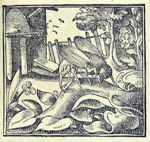
Neque mel neque apes: Reusner, Aureolorum Emblematum (Strasbourg, 1587), emblem 71
Virus ero, si me carnalis aranea carpat, sed mel, si qua legat spiritualis apes: Printer's device 1569
Iconclass: 25F711(BEE) insects: bee 41C636 honey
Collectanea (1500): 62
Loci Communes: Industria (Industriousness, Application, diligence)
I vi 63 Tussis pro crepitu A cough for a fart
Βὴξ ἀντὶ πορδῆς, Tussis pro crepitu. Dici solitum, quoties aliquis perplexus, aliud pro alio simulat. Veluti si quis in adulterae domo deprehensus, fingeret se quippiam mercatum venisse. Translatum ab iis, qui crepitum clara tussi dissimulant. quod genus homines etiam hoc tempore non raro magno cum risu deprehenduntur.
Βὴξ ἀντὶ πορδῆς, A cough for a fart. Used in practice when someone in a state of confusion pretends one thing to conceal another; for instance, if a man caught in the house of an unfaithful wife were to maintain that he was there to buy or sell something. A metaphor from those who, when they break wind, conceal the fact with a resounding cough - a class of men who are quite often detected even today, and cause considerable mirth.
Facsimile:
Iconclass: 31A463322 coughing 31A621 flatulence 52AA6 Falsehood 52DD1 Secrecy, Latency, Concealment; 'Secretezza' (Ripa) 57AA611 Dissimulation, Hypocrisy; 'Hippocresia', 'Simulatione' (Ripa)
Loci Communes: Simulatio, dissimulatio (Pretense, dissimulation, Simulation, dissimulation)
I vi 64 Cornicibus vivacior As long-lived as the crows
Υπὲρ τὰς κορώνας βεβιὼκως. id est, Cornicibus vivacior. De vehementer annosis, proverbialis hyperbole. Ab avis eius prodigiosa vivacitate sumpta, de qua ita scribit Plutarchus in commentario, qui inscribitur, περὶ τῶν ἐκλελειπότων χρηστηρίων, citans Hesiodum, sub persona Naidis, aetates animalium varias sic complectentem, Εννέατοι ζώει γενεὰς λακέρυζα κορώνη Ανδρῶν ἡβώντων, ἔλαφος δὲ τε τετράκρωνος. Τρεῖς δ᾽ ἐλάφους ὁ κόραχ γηράσκεται. αὐτὰρ ὁ φοῖνιξ Εννέα τοὺ κόρακας, δέκαδ᾽ ἡμεῖς τοὺ φοίνικας, Νύμφαι ἐϋπλοκαμοι, κουραὶ διὸς ἀιγίοχοιο id est, Ter tria secla hominis transmittit garrula cornix, Quatuor at peragit cornicis tempora cervus, Cervinam aetatem corvus ter praeterit ater. Corvinos annos novies agit Indica Phoenix. Atqui crispicomae, soboles Iovis alma tonantis, Egredimur decies phoenicia secula nymphae. Hos versus Hesiodios interpretatus videtur quidam quisquis fuit. extat autem carmen inter reliquas Maronis appendices. Estque huiusmodi: Ter binos, deciesque novem superexit in annos Iusta senescentum quos implet vita virorum, Hos novies superat vivendo garrula cornix, Et quater egreditur cornicis secula cervus. Alipedem cervum ter vincit corvus, at illum Multiplicat novies phoenix reparabilis ales. Quem vos perpetuo decies praevertitis aevo Nymphae Hamadryades, quarum longissima vita est. Hi cohibent fines vivacia fata animantum, Caetera secreti novit deus arbiter aevi. Hos versus ideo pariter libuit subscribere, ut mihi saepius ex tempore, id quod erit necesse vertenti, venia detur, si quando videbor non omnia usquequaque ad amussim reddere: cum in his apparuerit, quantum sibi permiserit antiquitas in traducendis poetarum carminibus. Eandem hanc Hesiodi sententiam oppido quàm commode, breviterque reddit Plinius: Hesiodus, inquiens, cornici novem nostras attribuit aetates: quadruplum eius cervis: id triplicatum corvis. Etiam si nonnullis autoribus haec fabulosa videntur. Inter quos Aristoteles arbitratur, homine nullum aliud animal esse vivacius, excepto uno elephanto. Martialis, Et cornicibus omnibus superstes. De anu nimium vivace. Item Horatius in Odis: Servatura diu, parem Cornicis vetulae temporibus Lycen. Eodem pertinet quod philosophus ille moriens, cornicibus invidisse legitur longaevitatem, quam natura negasset homini. Synesius in epistola quadam: Εἰκός ἐστὶ κορώνης ἐνιαυτοὺ ἄρξαι παρ᾽ ἡμῖν, τὸν δικαίτατον. id est, Consentaneum est iustissimum principem, cornicis annis imperaturum esse.
Υπὲρ τὰς κορώνας βεβιωκώς., As long-lived as the crows. A proverbial exaggeration for persons of very great age, taken from that bird's prodigious life-span, of which Plutarch writes as follows in the essay entitled 'On the Obsolescence of Oracles,' citing Hesiod who 'in the person of a Naiad' thus puts together the different life-span of various living creatures:
Nine generations of men the crow with her chatter outliveth;
Four crows yield to the stag and three stags yield to the raven.
Nine long ravens' lives will not see the end of the phoenix;
We the Nymphs can live ten times as long as a phoenix,
We the long-haired daughters of Jove who is lord of the aegis.
What seems to be a version of these lines of Hesiod was produced by someone, I know not who, and is to be found with the other pieces in the Appendix to Virgil; it goes something like this:
Four score and sixteen years runs the full span
Of men; nine times as far the noisy crow;
And the crow's age four times outlives the stag;
Thrice the swift stag yields to the raven's years,
Nine times the phoenix, that its life renews,
Outlives the raven, and ten times do we,
The Hamadryads, longest-lived of Nymphs,
Surpass the phoenix. Such the span of life
That living creatures bounds; but all the rest
God only knows, time's secret who controls.
It was equally a pleasure to add these lines, because I hope thereby to secure forgiveness for myself when I translate so often extempore, as I shall be compelled to do, if I seem sometimes not to have rendered everything quite precisely; for these lines will have shown how much latitude the ancients allowed themselves when translating poetry. The same view is repeated from Hesiod with great point and brevity by Pliny: 'Hesiod' he says 'allots to the crow nine times our span of life; four times that amount to the stag; and three times more to the raven.' Though some authorities regard all this as fabulous; among them Aristotle, who thinks that no living creature lives longer than man except only the elephant. Martial: 'And outlived every crow' of a woman who lived to an inordinate old age. Horace too in the Odes: 'But Lyce meant to keep to match the years / Of some old crow.' It was to the same effect that that great philosopher on his deathbed envied the crows that length of days, which nature had denied to man. Synesius in one of his letters: 'It is right that the most just man should govern us for a crow's span of years.'
Facsimile: 
Iconclass: 25F32(CROW) song-birds: crow 31D91 long life
Loci Communes: Longae vitae (A long life, Longue vie)
I vi 65 Tithoni senecta The old age of Tithonius
Τιθωνοῦ γῆρας. id est, Tithoni senecta. Fabulae tradunt Tithonum adamatum ab aurora in coelum sublatum fuisse, atque illius succo perfusum, ad tantam pervenisse senectutem, ut tandem optaverit, ut in cicadam verteretur. Lucianus in quodam dialogo: καὶ ὑπὲρ τιθω νὸν ἔζη ὁ γέρων, id est, Atque ultra Tithonum vivebat senex. Huius Tithoni personam inducit Aristo Chius in libro De senectute, propter vivacitatis miraculum, ut testatur in Catone M. Cicero. Suidas adagium refert hunc in modum, καταγηράσαις τιθωνοῦ βαθύτερον. id est, Senescas Tithono profundius.
Τιθωνοῦ γῆρας., The old age of Tithonus. The myth tells how Aurora fell in love with Tithonus, and how he was taken up into heaven and bathed with some heavenly elixir, as a result of which he lived to such an immense age that at length he prayed to be turned into a grasshopper. Lucian has in one of his dialogues 'And the old man was living longer than Tithonus.' This same character of Tithonus is introduced as a marvel of longevity by Ariston of Chios in his book on old age; so Cicero tells us in his Cato. Suidas records the adage in the form 'May you sink deeper into old age than Tithonus!'
Facsimile:
Iconclass: 31D91 long life 92E1231 Aurora with her aged husband Tithonus 97E5 Tithonus changed into a cicada: when grown old and infirm, Tithonus is changed into a cicada by Aurora
Collectanea (1500): 681
Loci Communes: Longae vitae (A long life, Longue vie)
I vi 66 Nestorea senecta As old as Nestor
Itidem certe apud Latinos Nestoris anni in proverbium abierunt, cui treis aetates attribuit Homerus in Odysseae tertio: Τρις γὰρ δήμιν φασὶν ἀνάξασθαι γένε ἀνδρῶν. id est, Illum iam exegisse hominum tria saecula fama est. Idem affirmat in primo Iliados. Et Iuvenalis: Atque suos iam dextra computat annos. Tertiam aetatem indicans. Breviter proverbii faciem habebit, quicquid ab iis sumetur qui insigni vivacitate fuerunt. ut, Phoenice vivacior, quem Hesiodus scribit, novem corvi aetates vivere: et, Cervo vivacior: corvo vivacior: et Tiresia vivacior, quem tragoedia fingit sex aetates hominum vixisse. et, Seribus vivacior: quos Graecis historiis proditum est, trecentos annos vivere. Quod genus exempla si quis desideret, legat Lucianum de Macrobiis, id est, longaevis, & Plinii septimi libri caput quadragesimum octavum.
In the same way, in Latin at any rate, the great age of Nestor became proverbial; for Homer in book 3 of the Odyssey says he lived for three generations: 'Thrice has he ruled, they say, over a whole generation of men,' and he asserts this likewise in the first book of the Iliad. So too Juvenal: 'Now starts to count his years on his right hand,' meaning that he has outlived three generations. In a word, any expression drawn from creatures which are exceptionally long-lived will have the air of a proverb; for example, 'as old as a phoenix,' which lives (as we are told by Hesiod) nine times as long as a raven, and 'as old as a stag' or 'as a raven,' and 'as old as Tiresias,' who is said in the tragedy to have outlived six generations of men, and 'as old as a Chinaman,' for the Greek historians tell us that the Chinese live for three hundred years. Anyone who needs examples of this sort of thing should read Lucian's Marcrobioi, which means Men of great age, and Pliny, book 7 chapter 48.
Facsimile:
Iconclass: 31D91 long life 95A(NESTOR)7 Nestor - specific aspects, allegorical aspects, as patron of
Loci Communes: Longae vitae (A long life, Longue vie)
I vi 67 Ultra pensum vivit He outlives his allotted span
Lepidum est quod ait Lucianus in Philopseude: ὑπὲρ γὰρ τὸν ἄτρακτον ἤδη βιοῖ. id est, Iam enim ultra fusum vivit. hoc est, vivit ultra fatalem diem. Allusum ad Parcarum fusos, quibus aevum mortalium evolui fabulantur poetae. Quin & Theologi metam vitae fatalem, periodum appellant, quam praetercurrere nulli fas sit.
Lucian has a neat remark in his Philopseudes, 'For he is already outliving his spindle,' meaning that he has already reached his allotted span. This is an allusion to the spindle with which, if we may believe the poets, the Fates are supposed to draw out the thread of the lives of mortals. Theologians also speak of the fated bourn of life, when they mean the period allotted to a man, which none may outlive.
Facsimile:
Iconclass: 31D91 long life 47H312 spindle 92G1 Fates, Parcae (Moirae) 92G13(+0) Atropos, usually with shears (+ variant)
Loci Communes: Longae vitae (A long life, Longue vie)
I vi 68 Facile, cum valemus, recta consilia aegrotius damus Good counsel to the sick is cheap enough, when we ourselves are well
In Andria Terentiana ab adolescente non admodum cordato, cordatissima simul & elegantissima sententia profertur. Facile cum valemus, recta consilia aegrotis damus. Tu si hic sis, aliter sentias. Ea nata videtur ab oraculo Thaletis Philosophi. Nam is, ut autor est Laertius, interrogatus quod nam esset difficilimum, respondit γνῶναι σεαυτὸν. id est, nosse seipsum: quid facillimum, respondit: ἄλλῳ ὑποτίθεσθαι.. id est, alteri consilium dare. Comicus autem translationis gratiam admiscuit. Euripides in Alcestide: Μὴ νῦν ὑπέρβαιν᾽, αλλ᾽ ἐναισίμως φέρε. id est. Ne nimius hic dolor esto, sed modice feras. Verba sunt Herculis Admetum consolantis super uxoris morte. At ille, Ρᾷον παραινεῖν, ἢ παθόντα καρτερεῖν.. id est. Facilius est monere, quàm situm in malis Animo imperare. Fertur & huic similis sententia proverbialis, Απαντες εὐμὲν εἰς τὸ νουθετεῖν σοφοὶ, Αὐτοι δ᾽ ἁμαρτάνοντες, οὐ γινώσκομεν. id est, In admonendo sapimus omnes, verum ubi Peccamus ipsi, non videmus propria. Ducta est sententia à communibus hominum moribus. Omnes enim aegrotantibus recte praecipiunt, quid fugiendum, quid agendum, & obiurgant nonnunquam, quod salutis causa non obtemperent bene monentibus. Ipsis posteaquam in morbum inciderint, non succurrunt illa praeclara monita, sed aliis item monitoribus & obiurgatoribus est opus. Porrò cupiditas omnis animi morbus est, quo velut excaecatus, aut non perspicit, aut si perspicit, sequi non potest ea quae sunt ad salutem necessaria. Nam Phaedria Terentianus prudens & sciens in flammam manum mittit, & vivus, vidensque perit. Item Horatius fugien da sequitur, fugiens quae profore credit. Perspicit avarus aliquando, quam prodigiosa res sit ambitio. Contra ambitiosus avari morbum pervidet, & uterque alteri in alieno malo recte consulir, neuter in suo sapit.
In the Andria of Terence a young man, not particularly intelligent himself, makes a most intelligent and apt remark:
Good counsel to the sick is cheap enough,
When we ourselves are well; but in my place
You would think different.
This seems to derive from an oracular saying of the philosopher Thales. According to Laertius, when asked what is the most difficult thing to do, and what is the easiest, he replied, 'The hardest is to know yourself, and the easiest to give another person good advice'; and in the comedy the author has added elegance by his metaphor. Euripides in the Alcestis: 'Grieve not o'ermuch, but bear it like a man.' This is Hercules consoling Admetus on the death of his wife; and his response 'To advise is easy; to bear wrongs is hard.' Close to this is the proverbial saying:
To counsel others, all men have a mind,
But when we err ourselves, then are we blind.
This observation is drawn from human nature. Everyone gives invalids good advice on what to avoid and what to do, and often they take them up for not doing what they are told in order to get well. When they fall ill themselves, those fine precepts are no help at all, and they need advice and criticism from others too. In fact, all inordinate desire is a sickness of the mind, by which it is virtually blinded, so that it either cannot see what it needs for its own well-being or, if it sees, cannot pursue it. Thus Phaedria in Terence puts his hand into the fire 'well knowing what he does' and 'goes to his doom with his eyes open.' Horace too pursues what he ought to avoid, and 'shuns what he believes will do him good.' An avaricious man sometimes sees clearly what a monstrous thing ambition is. Conversely the ambitious man is well aware of the disease from which the miser suffers. Each of them prescribes admirably for a complaint from which he himself is free, and neither knows how to treat his own.
Facsimile: 
Iconclass: 31A469 health 49G2 patient, sick person 52E3 Counsel; 'Consiglio' (Ripa)
Collectanea (1500): 284
Loci Communes: Aliis sapere (To be wise for others, Être sage pour autrui)
I vi 69 Quae supra nos, nihil ad nos The things that are above us are nothing to us
Τὰ ὑπὲρ ἡμᾶς, οὐδὲν πρὸς ἡμᾶς. id est, Quae supra nos, nihil ad nos. Dictum Socraticum, deterrens à curiosa vestigatione rerum coelestium & arcanorum naturae. Refertur proverbii vice à Lactantio libro tertio, capite vigesimo: Ex his, inquit, unum eligam, quod ab omnibus sit probatum. Celebre hoc proverbium Socrates habuit: Quod supra nos, nihil ad nos. Torqueri potest & in illos qui de negociis principum, aut theologiae mysteriis temere loquuntur. Vertere licebit & in contrarium, Quae infra nos, nihil ad nos. ubi significamus res leviusculas, quàm ut nobis curae esse debeant.
Τὰ ὑπὲρ ἡμᾶς, οὐδὲν πρὸς ἡμᾶς, The things that are above us are nothing to us. A remark of Socrates which discourages us from restless enquiry into heavenly things and the secrets of nature. It is referred to as a proverb by Lactantius, book 3 chapter 20, 'Of these' he says 'I will choose one which enjoys universal approval and is well known, and was regarded by Socrates as a proverb: That which is above us is nothing to us.' It can be diverted also for use against those who talk loosely about the business of princes or the mysteries of theology. It will further be possible to turn it upside down: The things that are beneath us are nothing to us - when we refer to trivial affairs, the importance of which is too small to demand care on our part.
Facsimile:
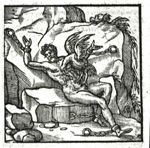
Quae supra nos, nihil ad nos: Alciatus, Emblemata (Leiden, 1591), emblem 102
't Is al te kleyn, als 't is ghemeyn: De Brune, Emblemata of zinne-werck (Amsterdam, 1660), emblem 5 quotes the adage and its reference to Socrates
Summa impietas - Ἄθεοσ, καὶ ἄπατωρ: Aneau, Picta poesis (Lyon, 1564), emblem 98
Iconclass: 51AA8 Things Unknown, the Unknown 52A12 Curiosity, Inquisitiveness, Desire of Knowledge; 'Curiosità' (Ripa)
Loci Communes: Aliena curantis (Meddling in others' affairs, Qui se mêle des affaires d'autrui)
I vi 70 Notum lippis ac tonsoribus Known to blear-eyed men and barbers
Quae iam in ora vulgi abierunt, omnibus tonsoribus ac lippis nota dicuntur: propterea quod olim in tonstrinarum consessibus omnes rumores narrari consueverunt. Quod indicat Aristophanes in Pluto: Καὶ τοι λογος γ᾽ ἦν, νὴ τὸν ἤρακλέα πολὺς Επὶ τοῖσι κουρείοισι τῶν καθημένων, Ως ἐξαπίνης ἀνὴρ γεγένηται πλούσιος. id est. Hercle profecto sermo erat videlicet In officinis desidentium frequens Tonsoriis, hominem repente divitem Factum esse. Et apud Terentium Antipho, in tonstrina de puella cognoscit. Item Horatius de tonstrina: Gaudent ubi vertice raso Garrula securi narrare periculae nautae. Idem in Sermonibus, Opinor, Omnibus & lippis notum & tonsoribus esse. Ubi proverbium explicuit, significans rem vulgo iactatam. Nam lippi in tonsorum officinis desident expetentes remedium oculorum. De tonsorum garrulitate complura lectu digna tecenset Plutarchus in libello, quem scripsit De futili loquacitate. Quorum unum illud referre non pigebit. Cum aliquando, inquit, in tonstrina sermo esset de Dionysio, dicereturque tyrannidem illius adamantinam esse & inexpugnabilem: ridens tonsor, Haeccine, inquit, loqui nos de Dionysio, in cuius iugulo ego subinde teneo novaculam? Quod dictum simulatque Dionysius rescisset, tonsorem in crucem sustulit, atque ita, quod ait Plinius, voces per iugulum rediere in auctorem. Ut autem tonsorum genus usqueadeo loquax sit, id existimat esse in causa, quod in eorum officinas loquacissimi quique conveniant, desideantque, quorum assiduo convictu garrulitatis morbo inficiuntur & ipsi. Quas ob res Theophrastus, ut idem testis est Plutarchus, τὰ κουρεῖα ἄοινα συμπόσοα (id est, sine vino compotationes) appellavit, quod illic loquacitate ceu temulenti reddantur homines. Simili infamia laborant balneatores, quod illic quoque desideant ociosi, garrientes quidlibet. Quin hinc factum est, ut veteres aerarias officinas λέσχας dixerint, ut indicavit loannes grammaticus, quod hybernis frigoribus huc sese turba tenuium temporis gratia conferre consueverit, ibique desidens ociosis fabulis tempus fallere. Haec loca velut ignavis apta Hesiodus iubet vitare agricolam, Γὰρ δ᾽ ἴθι χάληειον θῶκον καὶ ἐπαλέα λέσχην, ὥρῃ χειμερίη. id est, Mensibus hibernis valeat ferraria sedes, Ac nugae tepidae.
What has already become common gossip is said to be 'known to all the barbers and blear-eyed men,' because in the old days it was in the gatherings at the barbers' shops that rumour flourished. Aristophanes suggests this in the Plutus:
And yet 'twas often said, by Hercules,
While men were sitting in the barber-shops,
That he had suddenly waxed very rich.
And Antipho in Terence gets news of his girl in the barber's. Horace too says of the barber's: 'There with shaven poll / Sailors safe home long-winded perils tell.' And again in his Satires:
A tale, I guess, to every barber known
And every blear-eyed lounger in the town,
where by his reference to something widely known he made the sense of the proverb clear; for blear-eyed men sit doing nothing in the barbers' shops in search of some treatment for their eyes. On the talkative habits of hairdressers Plutarch has many interesting things to say in his essay 'On Pointless Garrulity,' one of which I shall give myself the pleasure of repeating. 'When there was talk once,' he says, 'in a barber's shop about Dionysius, and they said his tyranny was like adamant and unbreakable, the barber remarked with a laugh "What a way to speak about Dionysius, when I constantly have my razor at his throat." As soon as Dionysius heard what the man had said, he crucified his barber,' and thus, as Pliny puts it, his words cut his own throat. That barbers as a class should talk so much he attributes to the tendency of all very talkative men to congregate in their shops and sit there doing nothing, and he thinks that constant exposure to their chatter has infected the barbers themselves with the same complaint of garrulity. This is why Theophrastus, as Plutarch also tells us, called barbers' shops 'teetotal drinking parties,' thinking that the endless talk in them made men virtually intoxicated. Bath-attendants suffer from a bad reputation of the same kind, because public baths likewise are places where men sit idle, uttering any gossip that comes into their heads.
It was for some such reasons that the Ancients called smithies leschai, talking-places, as Joannes Grammaticus makes clear, because on cold days in the winter a crowd of humble folk used to gather there to keep warm, and there they sat doing nothing and passed the time in idle talk. Such places seem designed for lazy men, and Hesiod warns the husbandman to avoid them: 'Pass by the smithy in the winter-time, / Its warmth and gossip.'
Facsimile:
Iconclass: 31A535 barber, barbershop 52AA1 Stupidity, Poverty of Intellect; 'Stupidità overo Stolidità' (Ripa) 52D4 Prolixity, Verbosity, Loquacity; 'Loquacità' (Ripa) 52D5 Rumour; 'Rumore' (Ripa)
Loci Communes: Garrulitas (Talkativeness, Bavardage); Perspicuitas (Clarity, Clarté)
I vi 71 Optat ephippia bos, piger optat arare caballus The ox would wear the trappings and the lazy nag would plough
Oppido quàm eleganter extulit Horatius: Optat ephippia bos piger, optat arare caballus. Vitium illud significans humanis ingeniis insitum, ut semper alienam sortem magis mirentur, suam contemnant ac fastidiant, optent inexperta, experta damnent. Siquidem ephippia vocantur, quas vulgo sellas equestres appellant, additas in hoc, ut commodius sedeat eques. Veteres bubus arabant, non equis. Videtur esse sumpta allegoria ex apologo quopiam. Citra metaphoram dixit Terentius: Nostri nosmet poenitet.
There is great elegance in that phrase in Horace 'The ox would wear the trappings and the lazy nag would plough,' which expresses an inborn fault in human nature, men's constant envy of another person's lot and contempt and dislike for their own, their wish for things they have never tried and rejection of what they know. For 'trappings' means what we normally call riding-saddles, added with the object of giving the rider a more comfortable seat. The Ancients ploughed with oxen, not with horses. The allegory looks as though it was taken from a fable of some sort. The sense without the metaphor is given in Terence's 'We are dissatisfied with what is ours.'
Facsimile:
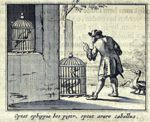
Optat ephippia bos piger, optat arare caballus: De la Court, Sinryke Fabulen (Amsterdam, 1685), emblem 14
Nostri nosmet poenitet: Lebey de Batilly, Emblemata (Frankfurt, 1596), emblem 11 quotes the comment
Iconclass: 46C13141(+724) horse (+ very old animal) 46C131614 saddle 47I123 ploughing 47I21111 ox 56BB3 Dissatisfaction 57AA76 Jealousy; 'Gelosia', 'Rammarico del ben'altrui' (Ripa)
Loci Communes: Invidia, aemulatio (Envy, rivalry, Envie, rivalité)
I vi 72 Fertilior seges est alieno in arvo The crop is heavier in another man's field
Ovidius mutavit metaphoram, eundem explicans sensum: Fertilior seges est alteno semper in arvo: Vicinumque pecus grandius uber habet. Persius satyra sexta: Securus & angullus ille, Vicini, quia pinguior. In eandem sententiam celebratur & Mimus, unus, ut opinor, ex illis Publii ab Aulo Gellio laudatis: Aliena nobis, nostra plus aliis placent Et Horatius: Qui fit, Mecoenas, ut nemo quam sibi sortem Seu ratio dederit, seu fors obiecerit, illa Contentus vivat, laudet diversa sequentes?
Ovid changed the metaphor while expressing the same meaning:
Another's crops are heavier still than thine
And heavier udders grace thy neighbour's kine.
Persius in his sixth satire: 'What care I if that cantle of my neighbour's / Is better land than mine?' Then there is a well-known moral maxim to the same effect, one of those, I fancy, by Publius which are quoted by Aulus Gellius: 'Other men's goods we like, and they like ours.' And Horace:
How is't, Maecenas, no one likes the lot
That reason chose, or chance cast in his way,
But envies those who follow other paths?
Facsimile: 
Iconclass: 33A7 neighbour 47I14 harvest 56BB3 Dissatisfaction 57AA76 Jealousy; 'Gelosia', 'Rammarico del ben'altrui' (Ripa)
Loci Communes: Invidia, aemulatio (Envy, rivalry, Envie, rivalité)
I vi 73 Fecem bibat, qui vinum bibit He must drink the dregs that drank the wine
Haud dubium quin proverbialiter dixerit Aristophanes in Pluto, fecem epotandam eidem, qui vinum ebrius ebiberit. id est, qui fruitus sit optimis, eundem boni consulere debere deteriora: Ομως δ᾽ ἐπειδὴ καὶ τὸν οἶνον ἠξίους Γίνειν, συνεκποτέον ἐστὶν τὴν τρύγα. id est. At ubi haud gravatus bibere vinum es, fex item Tibi nunc eidem est ebibenda scilicet. Verba Chremyli de muliere, quae quondam vernans ac florens aetate placuerat, tum anus fastidiebatur à iuvene.
There was no doubt an element of proverb in it when Aristophanes said in the Plutus that the same man who has already finished the wine must drink up the dregs as well; the man, that is, who has prospered in everything must not complain if his luck turns: 'But yet, if you saw fit to drink the wine / You must drink up the dregs.' The words are spoken by Chremylus about a woman who had once been popular in the springtime and flower of her youth, and now was old and was spurned by a young man.
Facsimile:
Iconclass: 25G211(DREGS) parts of a fruit (DREGS) 31D5 young versus old age; young and old 41C12 drinking 41C711 wine ~ alcoholic drinks
Loci Communes: Malum accersitum aut retortum (Evil brought upon oneself or turned back, Mal attiré ou retourné)
I vi 74 Croeso, Crasso ditior As rich as Croesus or Crassus
Apud Graecos opulentia Croesi Lydorum regis in proverbium abiit, praesertim nobilitata dicto Solonis. Apud Romanos item M. Crassi, cui cognomentum etiam divitis ad ditum est. Hic negabat divitem esse, nisi qui redditu annuo legionem tueri posset. In agris suis sestertiûm vicies mille possedit. Commemorantur & alii nonnulli apud Plinium libro tricesimotertio, capite decimo & item tertio, qui immodicas opes possederunt: atque in his est Aristoteles, sanctus ille philosophus, ac nostratium Theologorum penè deus, cuius haeredes in auctione septuaginta patinas venum produxisse leguntur, Verum non itidem in vulgi cessere sermonem. Proinde nihil attinet hoc loco referre. Festivior erit adagii figura, si numerum etiam commutemus, ut divus Hieronymus: Croesos licet spires, & Darios, literae marsupium non sequuntur. Horatius & Arabum gazas dixit, pro cumulatissimis opibus, non sine specie proverbiali, quemadmodum & Persicos apparatus, pro nimis exquisitis ac sumptuosis.
In Greece the riches of Croesus king of Lydia were a byword, to which Solon's remark gave special currency. So it was in Rome with the wealth of Marcus Crassus, who was even given the extra name of Dives, the Rich. He refused to call a man wealthy unless he could support a legion out of his yearly income. His estates amounted to two billion sesterces. Several other men are recorded in Pliny, book 33 chapter 10, and also in chapter 3, as possessed of inordinate wealth; and among them is Aristotle, the sainted philosopher and virtually the god of theologians in our own day, whose heirs are said to have produced seventy dishes for sale by auction. But they did not pass in the same way into common speech, and so there is no call to mention them here. There will be more wit in the adage as a figure of speech if we also change the number, as St Jerome does: 'You may give yourself the airs of Croesuses and Dariuses, but a full pate and a full purse are not inseparable.' Horace used 'the treasures of Arabia' for piled-up wealth, with a proverbial air, just as he used 'Persian splendours' for over-elaborate and expensive decorations.
Facsimile:
Iconclass: 55B1 Wealth, Opulence; 'Opulenza', 'Richezza' (Ripa) 98B(CRASSUS, M.L.) (story of) M. Licinius Crassus 98B(CROESUS) (story of) Croesus king of Lydia
I vi 75 Pactoli opes The wealth of Pactolus
Τὸν πακτώλου πλοῦτον. id est, Pactoli divitias, pro summis opibus alicubi dixit Philostratus. Est autem Pactolus Lydiae fluvius, ex monte Tmolo profluens, aureis scatens harenis, unde & χρυσοῤῥόας, à poetis cognominatus. Cuiusmodi narratur & Tagus in Hiberia, & Ganges in India, & Hebrus in Thracia. Plinius addit Padum in Italia, negatque ullum esse aurum absolutius, quam id quod in fluviis reperitur, utpote cursu ipso trituque perpolitum. Horatius in Epodis: Sis pecore & multa dives tellure licebit, Tibique Pactolus fluat. Iuvenalis: Tanti tibi non sit opaci Omnis hrena Tagi, quodque in mare voluitur aurum. Has hyperbolas in varios usus accommodare licebit. Veluti si quis dicat: Hos tantos sumptus sustinere nemo queat, ne si Pactolus quidem illi domi fluat. Huius hominis cupiditatem ne Tagus quidem ipse possit explere. Nihil mediocre sperabat, sed totos Pactolos ac Tagos animo conceperat. Aut, Pactolos pollicebatur. id est, divitias effertissimas.
Τὸν Πακτώλου πλοῦτον., The riches of Pactolus, is a phrase used somewhere by Philostratus to express very great wealth. The Pactolus is a river in Lydia that rises under Mount Tmolus and abounds in gold-bearing sand, whence it gets the epithet in poetry chrysoroas, streaming with gold. The same story is told of the Tagus in Spain, the Ganges in India and the Hebrus in Thrace. To these Pliny adds the Po in Italy, and says that no gold is of higher purity than what is found in rivers, as being rendered very fine by friction due to the current. Horace in the Epodes:
Rich you may'be in flocks and lands,
For you Pactolus roll his sands.
Juvenal:
No prize is worth it, not the golden sand
That shady Tagus rolls into the sea.
Exaggerations like this can be adapted to various ends. One might say, for instance, 'This enormous expense is more than anyone could support, even if he had the Pactolus flowing through his garden.' 'This man's greed is more than the Tagus itself could satisfy.' 'He had no ordinary ambitions, but in his mental picture it was to be all Pactoluses and Taguses.' Or 'He promised one Pactolus after another,' riches pressed down and running over.
Facsimile:
Iconclass: 25D13(GOLD) minerals and metals: gold 25H213 river 55B1 Wealth, Opulence; 'Opulenza', 'Richezza' (Ripa) 61D(PACTOLUS) geographical names of countries, regions, mountains, rivers, etc. (PACTOLUS) (PACTOLUS)
I vi 76 Iro, Codro pauperior As poor as Irus or Codrus
Contra, Iri & Codri paupertas proverbio locum fecit. Ovidius: Irus erit subito, qui modo Croesus erat. De Codro Iuvenalis. Tota domus Codro rheda componitur una. De Iro mentionem facit Homerus Odysseae Σ. Scribitque eum publicum fuisse mendicum apud Ithacenses, corpore specieque praegrandi, à matre dictum Arnaeum, à iuvenibus Irum fuisse nominatum, quod iret nuncius, quò usus esset. Cum hoc commissus Ulysses, cum haberetur & ipse pro mendico, eiicit hominem. Quin & Hecale paupertate nobilis est, cuius meminit Plautus in Cistellaria: Si quidem eris ut volo, nunquam Hecale fies. Meminit & Ovidius: Cur nemo est Hecalen, nulla est, qua ceperit Irum? Nempe quod alter egens, altera pauper erat. His formulis quot modis uti liceat, in operis ingressu satis ostendimus.
On the other hand, with Irus and Codrus their poverty provided material for a proverb. Ovid: 'Irus he straight will be, who late was Croesus.' Codrus comes in Juvenal: 'All Codrus' furniture packed in one cart.' Irus is mentioned by Homer in Odyssey, book 18, where he is said to have been a common beggar in Ithaca, a great big man to look at, whose name from birth was Arnaeus, but the young men called him Irus because he would carry a message wherever one was needed. It was he who was matched against Ulysses, who was then thought to be a beggar too, and Ulysses threw him out. Hecale too is celebrated for her poverty, and is mentioned by Plautus in the Cistellaria: 'It all answers my hopes, you'll ne'er be Hecale.' Ovid too speaks of her: 'Hecale no husband, Irus had no wife; / And why? He was a beggar, she was poor.' In how many different ways these phrases can be used has been shown at sufficient length in the introduction to this book.
Facsimile: 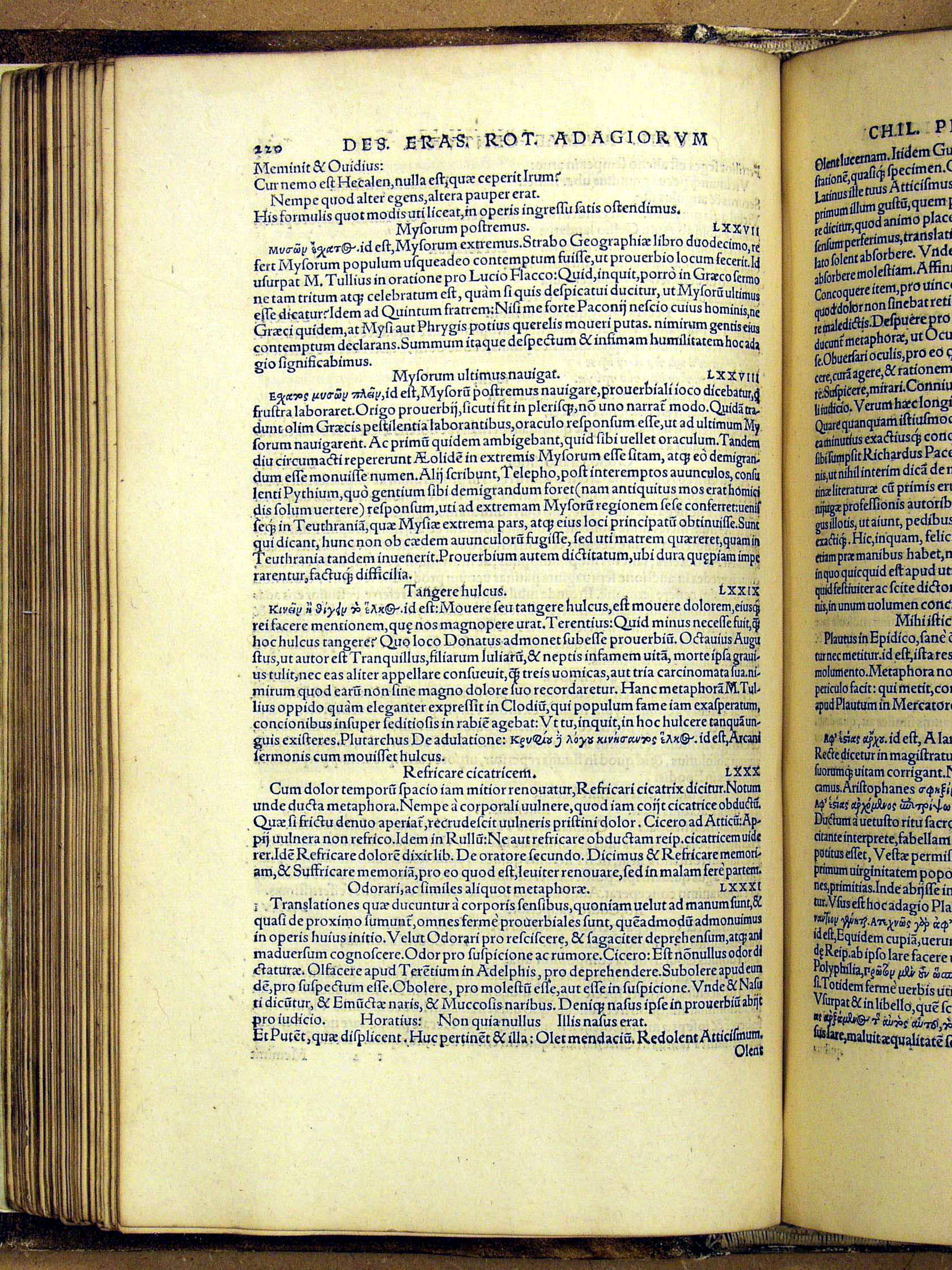
Iconclass: 55BB1 Poverty; 'Povertà', 'Povertà del doni', 'Povertà in uno ch'habbia bell'ingegno' (Ripa) 82A(CODRUS) male literary characters (CODRUS) 94I532(+0) Ulysses' fight with Irus, the beggar (Homer, Odyssey XVIII) (+ variant)
I vi 77 Mysorum postremus Lowest of the Mysians
Μυσῶν ἔσχατος.. id est, Mysorum extremus. Strabo Geographiae libro duodecimo, refert Mysorum populum usqueadeo contemptum fuisse, ut proverbio locum fecerit. Id usurpat M. Tullius in oratione pro Lucio Flacco: Quid, inquit, porrò in Graeco sermone tam tritum atque celebratum est, quàm si quis despicatui ducitur, ut Mysorum ultimus esse dicatur? Idem ad Quintum fratrem: Nisi me forte Paconii nescio cuius hominis, ne Graeci quidem, at Mysi aut Phrygis potius querelis moveri putas. nimirum gentis eius contemptum declarans. Summum itaque despectum & infimam humilitatem hoc adagio significabimus.
Μυσῶν ἔσχατος, Farthest of the Mysians. Strabo in his Geography, book 12, records that the people of Mysia were so much despised as to give rise to a proverb. This is used by Cicero in his speech Pro Flacco: 'Is there any phrase in Greek so commonplace and familiar as to call a man "the lowest of the Mysians," if you despise him?' And again, in a letter to his brother Quintus: 'Unless perhaps you think I am moved by the complaints of one Paconius of whom I know nothing and who is not even a Greek but a Mysian or, more likely, a Phrygian,' in which of course he shows his contempt for the race. Great contempt therefore, and very lowly station, can be expressed with this adage.
Facsimile:
Iconclass: 32B2(MYSIANS) historical peoples and nationalities (MYSIANS) 59BB4 Despicableness
Loci Communes: Contemptus et vilitatis (Contempt and worthlessness, Mépris et bassesse); Tarditatis et cunctationis (Slowness and delay, Lenteur et retard)
I vi 78 Mysorum ultimus navigat The last of the Mysians on a voyage
Εσχατος μυσῶν πλεῖν, id est, Mysorum postremus navigare, proverbiali ioco dicebatur, qui frustra laboraret. Origo proverbii, sicuti fit in plerisque, non uno narratur modo. Quidam tradunt olim Graecis pestilentia laborantibus, oraculo responsum esse, ut ad ultimum Mysorum navigarent. Ac primum quidem ambigebant, quid sibi vellet oraculum. Tandem diu circumacti repererunt Aeolidem in extremis Mysorum esse sitam, atque eò demigrandum esse monuisse numen. Alii scribunt, Telepho, post interemptos avunculos, consulenti Pythium, quò gentium sibi demigrandum foret (nam antiquitus mos erat homicidis solum vertere) responsum, uti ad extremam Mysorum regionem sese conferret: venisseque in Teuthraniam, quae Mysiae extrema pars, atque eius loci principatum obtinuisse. Sunt qui dicant, hunc non ob caedem avunculorum fugisse, sed uti matrem quaereret, quam in Teuthrania tandem invenerit. Proverbium autem dictitatum, ubi dura quaepiam imperarentur, factuque difficilia.
Εσχατος Μυσῶν πλεῖν, To be the last of the Mysians on a voyage, used to be said in a humorous and proverbial way of a man who laboured in vain. The origin of the proverb, as generally happens, is given in more than one fashion. Some say that once, when the Greeks were suffering from a pestilence, they received a reply from the oracle that they should sail to the last of the Mysians. At first they wondered what the oracle meant. At length, after wandering around for a long time, they found that Aeolis was situated on the edge of Mysian territory, and that was where the god had told them to move to. Others write that Telephus after killing his uncles enquired of the Pythian oracle where he should move to (for it was the custom in Antiquity for those who had killed anyone to go to another country); and the reply was that he should migrate to the farthest region of the Mysians. So he went to Teuthrania, which is on the edge of Mysia, and became the prince of the country. Some give as the reason for his flight not the murder of his uncles but the search for his mother, whom he found eventually in Teuthrania. The proverb was used when anyone was ordered to do something hard and difficult.
Facsimile:
Iconclass: 32B2(MYSIANS) historical peoples and nationalities (MYSIANS) 46C5 travelling; tourism 51II4 Farness 54BB3 Inutility, Noxiousness; 'Nocumento', 'Nocumento d'ogni cosa' (Ripa) 54DD4 Difficulty
Loci Communes: Inanis opera (Vain effort, Effort vain)
I vi 79 Tangere ulcus To touch on a sore place
Κινεῖν ἤ θίγειν τὸ ἕλκος.. id est: Movere seu tangere ulcus, est movere dolorem, eiusque rei facere mentionem, quae nos magnopere urat. Terentius: Quid minus necesse fuit, quam hoc ulcus tangere? Quo loco Donatus admonet subesse proverbium. Octavius Augustus, ut autor est Tranquillus, filiarum Iuliarum, & neptis infamem vitam, morte ipsa gravius tulit, nec eas aliter appellare consuevit, quam tres vomicas, aut tria carcinomata sua. nimirum quod earum non sine magno dolore suo recordaretur. Hanc metaphoram M. Tullius oppido quàm eleganter expressit in Clodium, qui populum fame iam exasperatum, concionibus insuper seditiosis in rabiem agebat: Ut tu, inquit, in hoc ulcere tanquam unguis exsisteres. Plutarchus De adulatione: Κρυφίου δὲ λόγου κινήσαντος ἕλκος. id est, Arcani sermonis cum movisset hulcus.
Κινεῖν ἤ θίγειν τὸ ἕλκος, To rouse or touch on a sore place, is to arouse pain, and to mention something which may hurt us very much. Terence: 'Was anything less necessary than to touch on this sore place?' Donatus in his note on the passage tells us there is an underlying proverb. The Emperor Augustus (so Suetonius tells us) felt the shameful behaviour of his two daughters called Julia and his grand-daughter of the same name as something worse than death, and was accustomed not to refer to them except as his three boils or three malignant ulcers, because it gave him great pain even to think of them. The same metaphor was used with the greatest elegance by Cicero in an attack on Clodius who, when the common people were already exasperated by famine, was goading them still further into fury with his incendiary speeches: 'So you were like the finger that scratched this sore spot.' Plutarch 'On Flattery': 'When he had scratched the sore of secret talk.'
Facsimile:
Iconclass: 31A(+934) the (nude) human figure; 'Corpo humano' (Ripa) (+ reaching for somebody or something, seizing something, touching) 56A1 Sensation, Sensibility, Sensitivity 56BB1 Pain, Sorrow, Sadness; 'Dolore', 'Dolore di Zeusi' (Ripa)
Collectanea (1500): 92
Loci Communes: Lacessentis (Provoking, Provoquer)
I vi 80 Refricare cicatricem To rub up a sore
Cum dolor temporum spacio iam mitior renovatur, Refricari cicatrix dicitur. Notum unde ducta metaphora. Nempe à corporali vulnere, quod iam coiit cicatrice obductum. Quae si frictu denuo aperiatur, recrudescit vulneris pristini dolor. Cicero ad Atticum: Appii vulnera non refrico. Idem in Rullum: Ne aut refricare obductam reip. cicatricem viderer. Idem Refricare dolorem dixit lib. De oratore secundo. Deicimus & Refricare memoriam, & Suffricare memoriam, pro eo quod est, leviter renovare, sed in malam ferè partem.
When grief or resentment which has softened with the passage of time is roused afresh, this is called 'rubbing up old sores.' The source of the metaphor is familiar; it is taken of course from a physical wound which has now closed up and is covered with a scar, but can be opened afresh by rubbing, so that the original pain of the wound returns in force. Cicero, writing to Atticus: 'I don't scratch the sores that Appius has left behind him.' Again, in his attack on Rullus: 'For I would not be thought to be rubbing up old sores inflicted on the body politic,' and he speaks of 're-opening wounds' in his De oratore, book 2. We speak also of rubbing up the memory, or jogging the memory, which means administering a mild reminder, but nearly always with intent to annoy.
Facsimile:
Iconclass: 31A(+934) the (nude) human figure; 'Corpo humano' (Ripa) (+ reaching for somebody or something, seizing something, touching) 31A46321 scar, cicatrix
Loci Communes: Malum conduplicatum aut renovatum (Evil doubled or renewed, Mal redoublé ou renouvelé)
I vi 81 Odorari, et similes aliquot metaphorae Scenting out, and sundry metaphors of this kind
Translationes quae ducuntur à corporis sensibus, quoniam velut ad manum sunt, & quasi de proximo sumuntur, omnes fermè proverbiales sunt, quemadmodum admonuimus in operis huius initio. Velut Odorari pro resciscere, & sagaciter deprehensum, atque animadversum cognoscere. Odor pro suspicione ac rumore. Cicero: Est nonnullus odor dictaturae. Olfacere apud Terentium in Adelphis, pro deprehendere. Subolere apud eundem, pro suspectum esse. Obolere, pro molestum esse, aut esse in suspicione. Unde & Nasuti dicuntur, & Emunctae naris, & Muccosis naribus. Denique nasus ipse in proverbium abiit pro iudicio. Horatius: Non quia nullus Illis nasus erat. Et Putent, quae displicent. Huc pertinent & illa: Olet mendacium. Redolent Atticismum. Olent lucernam. Itidem Gustum rei vocamus, veluti primam illam experientiam, & degustationem, quasique specimen. Cicero ad Atticum: Hominem degustes. Idem ad eundem, Et Latinus ille tuus Atticismus ex intervallo regustandus. Unde & Salivam primam dicimus primum illum gustum, quem pueri tanquam à nutricibus imbibimus. Et Palato satisfacere dicitur, quod animo placet. Et Devorare dicimur, cum rem alioqui acerbam, veluti citra sensum perferimus, translatione sumpta ab his, qui amara catapotia, tanquam invito palato, solent absorbere. Unde aliquoties apud Ciceronem & Fabium: Devorare taedium, absorbere molestiam. Affinia sunt illa: Sapiunt arrogantiam. Resipiunt iuvenile quiddam. Concoquere item, pro vincere molestiam. Nauseare, cum taedio audire. Evomere, dicere, quod dolor non sinebat reticere. Et Expuere miseriam ex animo. Consputare pro lacessere maledictis. Despuere pro contemnere. Stomachari, pro indignari. A visu item multae ducuntur metaphorae, ut Oculis ferre, pro vehementer amare, curaeque habere. In oculis esse, Obversari oculis, pro eo quod est recordari, & in memoria cogitationeque esse. Respicere, curam agere, & rationem habere. Prospicere, in posterum consulere. Despicere, fastidire. Suspicere, mirari. Connivere, pro data opera dissimulare. Caecutire, hallucinari, pro falli iudicio. Verum haec longius persequi, nec huius est instituti, & infiniti fuerit operis. Quare quanquam istiusmodi videntur ad proverbiorum cognationem pertinere, tamen ea minutius, exactiusque conquirere, non est sententia: maxime quod iam hanc provinciam sibi sumpsit Richardus Paceus, natione Britannus, cuius & saepius meminisse, iuvenis, ut nihil interim dicam de moribus, prorsum tali dignus ingenio, Graece pariter ac latinae literaturae cum primis eruditus, tum haud mediocriter exercitatus in evolendis omniiugae professionis autoribus: deinde oculatissimus in annotandis iis, quae lectorum vulgus illotis, ut aiunt, pedibus praetereunt. denique iudicii nequaquam iuvenilis, sed excussi exactique. Hic, inquam, felicibus Musarum auspiciis opus animo concepit, iam opinor etiam prae manibus habet, magno, ni fallor, usui futurum politioris literaturae studiosis, in quo quicquid est apud utriusque linguae scriptores insignium metaphorarum, quicquid festiviter ac scite dictorum, quicquid huiusmodi gemmarum ac delitiarum orationis, in unum volumen concinnare destinat.
Metaphors derived from the bodily senses, being more or less ready to hand and taken as it were from what is very close to us, are nearly all proverbial, as I have pointed out at the beginning of this work. 'To scent out,' for instance, in the sense of to discover, and to establish some fact by intelligent detective work. 'A whiff of something for suspicion and rumour. Cicero has 'There's a certain whiff of dictatorship.' 'To nose out' in Terence's Adelphoe for to detect. 'To smell' (Terence again) for to be suspected. 'To stink' for being offensive or under suspicion. Hence too people are said to have 'a keen nose' and to be 'keen-scented,' with its converse 'thick in the head.' In fact the nose by itself became proverbial for critical judgment; Horace's 'Not that no nose was theirs.' And things which we do not like 'have a bad smell.' Here belong phrases like 'It smacks of falsehood,' 'They are redolent of Atticism,' 'They smell of the lamp.' We often use 'a taste of something' as though it meant our first acquaintance with it, as if we sipped a thing or tasted some kind of sample. Cicero writing to Atticus: 'Get a taste of the man,' and again 'That Latin Atticism of yours must be savoured again after an interval.' And thus we use 'that first flavour' to express that first experience of a thing which we acquire in childhood more or less from our nurses. And a thing we like is said to 'please the palate.' And we say 'swallow something' when we accept some normally unpleasant experience as though we did not feel it, taking the metaphor from those who drink nasty medicines as though against the protests of their sense of taste. Hence we find several times in Cicero and Quintilian 'to swallow the tedium' or 'to digest the inconve- nience' of something. Related phrases are 'They smack of arrogance,' 'They have a whiff of adolescence.' Also 'to stomach' for to overcome something unwelcome. 'Sickening' of something insupportable to listen to. 'To vomit out,' to utter what passion did not allow us to repress. And 'to spit out that trouble from one's heart,' 'to bespatter' a man with abuse as one might with spittle, 'to spit upon' as expressing contempt. 'His gorge rises' for 'he is indignant.' The sense of sight also provides many metaphors, as 'to bear someone in one's eyes' for to love him dearly and be concerned for him; 'to be in someone's eyes,' 'to have someone's eyes upon one' to express memory and being remembered and thought of. 'Look out for,' be concerned about something and take thought for it; 'look forward,' plan for the future; 'look down on' of contempt; 'look up to' of admiration; 'to wink at' for to ignore deliberately; 'to be blind' for to be deluded and make errors of judgment. But to pursue this to greater lengths is not my present intention and would be a boundless task. And so, although materials of this kind have some family relationship to proverbs, to collect them in greater detail and more precisely is not now my purpose, especially since this department has already been taken in hand by a native of Britain, Richard Pace, whom I often think of, and always with pleasure; a young man (to say nothing for the moment of his character, which is fully worthy of his abilities) expert alike in Greek and Latin literature, and possessed of unusual experience in the reading of authors in every subject. Then he is very keen-sighted in picking up things which the common run of readers pass over, as the saying goes, with unwashed feet; and last but not least, his judgment is by no means that of a young man, but refined and scrupulous. With the Muses' blessing, he has formed, as I say, and I believe is now engaged on, a project which (unless I am much mistaken) will be of great value to all who wish to make progress in polite literature; he intends to collect all the notable metaphors to be found in classical authors in both tongues, with all the pointed and elegant phrases and other jewels and ornaments of style, and arrange them in a single volume.
Facsimile: 
Iconclass: 31A22111(NOSE) parts of the face: nose 31A33 smell, smelling (one of the five senses) 56A1 Sensation, Sensibility, Sensitivity 56DD2 Distrust, Suspicion; 'Sospitione' (Ripa)
Collectanea (1500): 88
Loci Communes: Judicandi (Judging, Juger); Perficiendi sive absolvendi - ab initio ad finem (Finishing, completing - from beginning to end, Achever, accomplir - du début à la fin); Perspicacitas (Perspicacity, Perspicacité)
I vi 82 Mihi istic nec seritur nec metitur The sowing and reaping there are none of mine
Plautus in Epidico, sanè quam elegans adagium usurpavit: Mihi, inquiens, istic nec seritur nec metitur. id est, ista res nihil ad me pertinet, ut quae neque meo fiat periculo, neque emolumento. Metaphora notissima est. Etenim qui sementem facit, is suo impendio, suoque periculo facit: qui metit, compendium accipit, & in tuto est. Diversum est huic quod est apud Plautum in Mercatore: Tibi aras, tibi occas, tibi seris, tibi eidem metis.
Plautus in the Epidicus used a proverbial phrase of great elegance when he wrote 'The sowing and reaping there are none of mine,' meaning 'The business you speak of is nothing to do with me, for neither risk nor profit is to my account.' The metaphor is very familiar. The man who sows a field does so at his own expense and risk; the man who reaps takes the proceeds and is in the clear. This is the opposite of what Plautus has in the Mercator: 'Yours is the ploughing and the hoeing yours, / Yours is the seed, yours too the harvesting.'
Facsimile:
Iconclass: 47I131 sowing 47I141 reaping, picking, mowing ~ harvest 51BB1 Absoluteness, Non-relatedness
Collectanea (1500): 78
Loci Communes: Aliena a re (Irrelevant to the matter, Étranger au sujet)
I vi 83 Ab ipso lare Begin at home
Αφ᾽ ἑστιας ἄρχου. id est, A lare incipe. hoc est, à domesticis ac familiaribus initium sumito. Recte dicetur in magistratus, & alienae vitae censores, quorum officium est, ut in primis suos suorumque vitam corrigant. Nam ἑστίαν Graeci vocant, quem nos Larem ac Vestam vocamus. Aristophanes: σκηξίν, οὐκ, ἀλλ᾽ ἵνα Αφ᾽ ἑστίας ἀρχόμενος ἐπιτρίψω τινὰ. id est, Non, verum ut aliquem, exorsus à lare obteram, Ductum à vetusto ritu sacrorum, in quibus primitiae laribus immolabantur. Aristocritus citante interprete, fabellam huiusmodi refert. Cum devictis Titanibus Iupiter imperio potitus esset, Vestae permisit optionem, ut quicquid vellet eligeret è regni partibus. Illa primum virginitatem poposcit: deinde sacrorum omnium, quae diis immolarent homines, primitias. Inde abiisse in consuetudinem, ut in omni sacro primae partes lari tribuerentur. Usus est hoc adagio Plato in Euthyphrone: Βουλοίμην ἄν ὦ σώκρατες, ἀλλ᾽ ὀῤῥοδῶ μὴ τοὐναντίον γέηται. Ατεχνῶς γὰρ ἀφ᾽ ἑστίας δοκεῖ μοι άῤχεσθαι κακουργεῖν τὴν πόλιν, σὲ ἐπιχειρῶν ἀδικεῖν. id est, Equidem cupiam, verum vereor, ne res in diversum exeat. Nam mihi quidem laedendae Reip. ab ipso lare facere videtur initium, cum te tentat laedere. Plutarchus in libello de Polyphilia, Πρῶτον μὲν οὖν ὥσπερ ἀφ᾽ ἑστίας ἀρξάμενοι. id est, primum igitur velut à lare exorsi. Totidem fermè verbis utitur in commentario, Περὶ τῶν ὑπὸ τοῦ θείου βραδέως τιμωρουμένων. Usurpat & in libello, quem scripsit adversus Herodotum. Aristides in Pericle: Ο δ᾽ ἀφ᾽ ἑστίας ἀρξάμενος τῆς αὐτὸς αὐτοῦ, τὸ σύμμετρον ᾑρεῖτο, πρὸ τοῦ πλείονος. id est, At ille a suo ipsius exorsus lare, maluit aequalitatem sequi, quàm reliquos antecellere. Interpres admonet dici so litum de iis, qui ab ipso statim initio, vel boni sunt, vel mali. Quasi dicas, ab ipsis incunabulis, quod Lar statim nascentes excipiat.
'Ἀφ᾽ ἑστίας ἄρχου., Start from your own hearthstone, begin at home; make a beginning, that is, with your own family and household. This will rightly be addressed to magistrates and to critics of the lives of other people, whose first duty is to correct the faults of their own dependants and the way they live. For hestia in Greek means hearth, what in Latin we call Lar and Vesta. Aristophanes in the Wasps: 'No, no: / To crush my man I must begin at home.' Taken from the ancient custom at sacrifices of offering the first-fruits to the Lares, the household gods. Aristocritus, cited by the scholiast, tells the following story. When Jupiter had defeated the Titans and achieved supreme power, he offered Vesta the choice of anything in the various parts of his kingdom that she might select. First she asked for virginity, and then for the first-fruits of all sacrifices offered to the gods by men. Hence, he says, it became the custom to assign the first share in every sacrifice to the Lar or household god. Plato uses this adage in the Euthyphro: 'So I could wish, Socrates, but I fear things may turn out differently. For the man who tries to do you wrong seems to me to be simply set on injuring the city at its very hearthstone.' Plutarch in his essay 'On Having Many Friends': 'First of all, beginning at the very hearthstone, as it were.' He uses almost the same words in his treatise 'On the Delays of the Divine Vengeance.' He also makes use of them in the essay he wrote 'Against Herodotus.' Aristides in his Pericles: 'But it was his choice, beginning at his own hearthstone, to pursue equality rather than to excel other men.' The scholiast points out that the phrase is normally used of those who are either good or bad from the very outset. It is like saying 'From the cradle,' because the Lar welcomes infants at the moment of birth.
Facsimile: 
Iconclass: 42B71 family life at home 51F5 Beginning; 'Principio' (Ripa)
Loci Communes: Perficiendi sive absolvendi - ab initio ad finem (Finishing, completing - from beginning to end, Achever, accomplir - du début à la fin)
I vi 84 Propria vineta caedere To cut down one's own vineyards
Huic affine est illud Horatianum: Ut vineta egomet cadam mea. id est, Ut à me ipso incipiam, & poetas ipse poeta carpam ac lacerem. Translatum videri potest vel ab amputantibus vineam, vel ab iis, qui per iniuriam novellas vites laedunt. Horatius in Epistolis, Multa quidem nobis facimus mala saepe poetae, Ut vineta egomet caedam mea.
There is a phrase in Horace related to this, 'If I on my own vines the axe may ply,' which means to begin with myself and tear poets to pieces although I myself am one. It may be supposed a metaphor from those who cut down a vineyard or who damage newly planted vines out of spite. Horace in his Epistles: 'A poet's oft his own worst enemy, / If I on my own vines the axe may ply.'
Facsimile:
Iconclass: 47I421 vineyard 48A2 criticizing and discussing art, art criticism 48C919(+0) author destroying his own work (+ variant) 58AA1 Destruction
Collectanea (1500): 319
Loci Communes: Carpentis seipsum (Criticizing oneself, Qui se critique soi-même)
I vi 85 Aedibus in nostris quae prava aut recta geruntur The good or ill that's wrought in our own halls
Aulus Gellius scribit hunc Homericum versiculum qui est Odysseae δ proverbii vice Diogeni semper in ore fuisse: Οττι τοι ἐν μεγάροισι κακῶν τ᾽ ἀγαθῶν τε τέτυκται. id est, Aedibus in nostris quae prava aut recta gerantur. Quod alii tribuunt Socrati, Diocles adscribit Diogeni, ut refert Laertius. Socrates autem hoc dicto dehortans à studio rerum naturalium ac supernaturalium, item à disciplinis mathematicis, revocabat ad curam moralis philosophiae, quod haec tractat ea, quae proprie ad nos pertinent. Plutarchus in commentario De servanda bona valetudine, proverbii vice usurpavit: Εἰ μᾶλλον αὑτὸν οἴεται προσήκειν γεωμετρίας ἤ διαλεκτικῆς καὶ μουσικῆς ὁρᾶσθαι μεταποιούμενον, ἤ ζητεῖν καὶ μανθάνειν βουλόμενον, Οττι τοι ἐν μεγάροισι κακὸν τ᾽ ἀγαθόν τε τέτυκται. id est, Si magis officii sui putat esse, ut in geometriae, dialecticae, musicaeque studio versari videatur, quam ut inquirat, cupiatque cognoscere Aedibus in proverbiis, quae prava aut recta gerantur. Quo versu monemur, ut ea potissimum, quae ad nosipsos pertinent curemus, externa atque aliena ne inquiramus. Quo vitio festiviter Martialis Ollum quendam notat, qui malorum alienorum erat observator curiosissimus, & taxator acerrimus, cum ipse uxorem haberet adulteram, filiam viro maturam, deberetque etiamnum pro togula. Diogenes Cynicus, cui carmen hoc, ut modo dixi, semper in ore consuevit esse, grammaticos nimis ridicula facere aiebat, qui tanto studio Ulyssis mala inquirerent, sua ignorarent. Huc referri potest & illud apud Homerum penè sollemne: Habetur enim ζ Iliados α. θ & φ. Αλλ᾽ εἰς οἶκον ἰουσα τὰ σαυτῆς ἔργα κόμιζε. id est, Quin in tecta abiens, tua propria munia cura. Plutarchus, πολυπραγμοσύνην, definit φιλομάθειαν ἀλλοτρίων κακῶν. id est, Curiositatem, studium aliena mala cognoscendi. Atque id hominum genus lamiis similes ait, quae domi oculos reconditos habent, foras egressurae reponunt, Atque ita fit, ut domi caecutiant, foris sint oculatissimae. In huiusmodi praepostere oculatos eleganter torseris illud Sophoclis de senibus dictum: πόῤῥωθε λούσων, ἐγγύθεν δὲ πᾶς τυφλόσς. id est, Procul videns, sed cominus videns nihil. Nam in senibus accidit, ut propius admota non cernant, longius semota videant: atque huius rei causam reddit Plutarchus Convivialium quaestionum prima decade.
Aulus Gellius says that this Homeric line, which comes from the fourth book of the Odyssey, was always current as a proverb: Ὅττι τοι ἐν μεγάροισι κακῶν τ᾽ ἀγαθῶν τε τέτυκται., The good or ill that's wrought in our own halls. Others attribute this to Socrates; Diocles ascribed it to Diogenes, as Laertius tells us. Socrates used this saying to discourage the study of nature and the supernatural and also of the whole field of mathematics, and to recall people to the pursuit of moral philosophy, on the ground that it alone deals with things in which we are really concerned. Plutarch employs it like a proverb in his essay 'On the Maintenance of Good Health': 'If he thinks it more becoming to him to be seen taking some interest in geometry, dialectic, and music than in enquiring into and trying to find out "the good or ill that's wrought in our own halls."' The lesson of this line is that we should attend as far as we can to the things that concern our own selves and not enquire into outside things which are no business of ours. Martial has a witty attack on a man called Ollus who suffered from this fault, being a most painstaking observer and most keen critic of misconduct in others, while he himself had an unfaithful wife and a daughter ready for a husband and on top of that an unpaid tailor's bill. Diogenes the Cynic philosopher, who, as I said just now, was constantly quoting this line, used to say that schoolmasters made great fools of themselves with their passionate researches into the misfor- tunes of Ulysses while ignoring their own. To this we may also refer that line in Homer which is almost hackneyed, for it comes in the sixth book of the Iliad and books 1,8, and 21 of the Odyssey, 'Go home now, and attend to your own tasks.' Plutarch defines inquisitiveness as 'a love of hearing about other people's misfortunes,' and says that inquisitive people are like vampires, who put their eyes away for safe keeping while they are at home and replace them when they go out, with the result that at home they can see nothing and are very clear-sighted out of doors. Those who make such an inverted use of their sight are a fair target for that line in Sophocles about old men: 'Far-sighted they, but blind as bats at home,' for old men suffer from a difficulty in seeing things close to them and can see clearly what is at some distance; a fact for which Plutarch supplies an explanation in the first decade of his 'Table-talk.'
Facsimile:
Iconclass: 42B71 family life at home 52AA53 Lack of Self-knowledge 54A5 Goodness; 'Bontà' (Ripa) 54AA5 Badness
Collectanea (1500): 444
Loci Communes: Aliena curantis (Meddling in others' affairs, Qui se mêle des affaires d'autrui); Aliena curantis - ad rem pertinentia (Meddling in others' affairs - relevant matters, Qui se mêle des affaires d'autrui - choses pertinentes)
I vi 86 In se descendere To venture down into oneself
In se descendere, est sua ipsius vitia quempiam inspicere. Translatum vel à fodinis, vel à cellis, in quas qui descendunt, quid illic repositum reconditumque sit, nosse possunt. Allusum est autem ad specus illos & sinus humani cordis quibus Momus fenestram adhiberi voluit. Persius: Ut nemo in sese tentat descendere, nemo: Sed praecedenti spectatur mantica tergo.
To venture down into oneself is for a man to contemplate his own faults. The image is taken from undercrofts or cellars, into which people descend and can then see what is kept there in store. But the reference is to those cavernous recesses of the human heart, which Momus thought should have been supplied with windows. Persius:
None, none dare venture down into themselves.
They watch the wallet hanging on the back
Of him that walks before.
Facsimile:
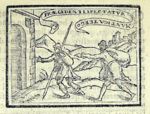
Praecedenti spectatur mantica tergo: Covarrubias, Emblemas Morales (Madrid, 1610), emblem 286 quotes the comment
Iconclass: 31A22210 heart symbolism 51LL5 Descent 52A53 Self-knowledge 92G441 Momus finding fault with the gods
Loci Communes: Modestia modusque (Modesty and moderation, Modestie et mesure)
I vi 87 Tecum habita To be your own lodger
Proximum Homerico carmini videtur & illud eiusdem Persii: Tecum habita, ut noris, quam sit tibi curta supellex. Id est, domi tuae vivito, ut intelligas, quàm tenuis sit tua fortuna. Translatum ab iis, qui in principum familiis agunt, & ut vulgo fit, ex alienis opibus perinde quasi suis intumescunt: quibus si domi vivendum sit, vix salinum habeant, quod apponant. Tecum igitur habita, id est, tuapte supellectile te metire, ac tuis ipsius malis bonisve te ipsum expende. Haud scimus an huc pertineat, quod scribit M. Tullius in Catone maiore, Secum, ut dicitur, vivere.
Homer's line seems to have a very near neighbour in another place, also in Persius: 'Be your own lodger, and you'll shortly come / To learn how scant the gear you have at home.' You must live at home, this means, in order to learn how little your possessions amount to. A metaphor from those who live in princes' households and, as commonly happens, wax fat on the wealth of other men as though it were their own, when if they had to board at home they would scarcely have a salt-cellar to set on the table. 'Be your own lodger' therefore means 'Measure yourself by the scale of your own possessions and rate yourself by the advantages and disadvantages that are really yours.' I suspect that we should place here those words of Cicero in his Cato major: 'Live in his own house, as the saying goes.'
Facsimile: 
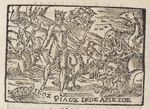
Tecum habita: Aneau, Picta poesis (Lyon, 1564), emblem 68
Tecum habita: Meisner, Politica Politica (Nürnberg, 1700), emblem 73
Tecum habita: Reusner, Aureolorum Emblematum (Strasbourg, 1587), emblem 66
Tecum habita: Oppelt, Sammlung geist-und sinnreicher Gedancken (Prague, 1749), emblem 18
Tecum habita: Whitney, A choice of emblemes (Leiden, 1586), emblem 99
Tecum habita: Visscher, Sinnepoppen (Amsterdam, 1614), emblem 169
Secret est á louer: Corrozet, Hecatomgraphie (Paris, 1540), emblem 20 uses the iamgery of the snail
Iconclass: 33A3 visiting; receiving guests; elegant company 52A53 Self-knowledge 55B Possession
Collectanea (1500): 268
Loci Communes: Modestia modusque (Modesty and moderation, Modestie et mesure)
I vi 88 Messe tenus propria vive Live up to your own harvest
Idem diversa explicuit metaphora Persius satyra sexta: Messe tenus propria vive. id est, Sumptum facito pro modo facultatum tuarum. Ab agricolis traductum, qui sumptus annuis agrorum proventibus metiuntur. Neque enim res consistere potest, cum quaestum superat sumptus, quemadmodum ait Plautus. Ostentatorem divitiarum elegante verbo Alexis apud Athenaeum li. vi. πτωχαλαζόνα dixit. eodem verbo declarans fastum cum paupertate coniunctum. Nunc mundus hoc hominum genere plenus est, qui plusquam tyrannicum fastum cum paupertatis professione coniungunt
The same idea was expressed in a different image by Persius in his sixth satire: 'Let your own harvest your expense dictate,' spend, that is, only so much as you can really afford. A metaphor from the husbandman, who measures what he can spend by the produce of his land year by year; for, as Plautus says, no man can keep going if his expenses outrun his income. A man who makes a great pretence of wealth was described by Alexis, according to Athenaeus, book 6, by the elegant word ptochalazôn, a 'beggar-bully,' for this clearly conveys the combination of pomp and penury. Nowadays the world is full of men of this class, who unite the swagger of a tyrannical bully with the vow of poverty.
Facsimile:
Iconclass: 47I14 harvest 51B3 Parity, Equality 55C1 Spending 55CC2 Receiving
Loci Communes: Arrogantia jactantiaque (Arrogance and boastfulness, Arrogance et vantardise); Modestia modusque (Modesty and moderation, Modestie et mesure)
I vi 89 Tuo te pede metire Measure yourself by your own foot
Ad eandem sententiam pertinet illud Horatianum: Metiri se quenque suo modulo ac pede, verum est. Lucianus in libello, cui titulus, ὑπερ τῶν εἰκόνων, Αλλὰ διακρίνῃς καὶ προσαμετρῆς τῷ ἑκάτερον. id est, Verum diiudices dimetiarisque propria utrunque mensura. Nimirum hoc est, quod dixit Horatius, suo modulo, οἰκείῳ μέτρῳ, & tanquam interpres sui adiecit, ac pede. Pindarus item: Χρὴ δὲ καθ᾽ αὑτὸν ἀιεὶ παντὸς ὁρᾷν μὲτρον. id est, Oportet autem iuxta suam quenque conditionem uniuscuiusque rei spectare modum. Et Aristophanes in Avibus: Οὐκ ἀναμετρήσεις σαυτὸν ἀπιὼν ἀλλαξῆ. id est, Non ipse te remetieris hinc loci Aliò profectus. Monet adagium, ne quis se dilatet ultra conditionem suam, néve seipsum ex assentatorum laudibus, aut vulgi opinione, aut fortunae favore, verum propriis ac veris dotibus, animique virtutibus aestimet. Translatum ab iis, qui corporis humani modum, pedum numero aestimant. Porrò iusta cuiusque hominis mensura, septem ipsius pedibus constat, si quid pictoribus & statuariis credimus. Eodem pertinet illud Martialis: Qui sua metitur pondera, ferre potest.
To the same line of thought belongs that verse in Horace: 'Tis right each man should measure his own strength / On his own scale and by his own foot's length.' Lucian, in the essay entitled On Behalf of the Images, has 'But you should judge between the two and measure each on his own scale,' the phrase being of course just what Horace used, except that he added 'by his own foot' as if to explain what he had said. Pindar too: 'But one should ever observe the limit in all things, each man according to his own condition.' And Aristophanes in the Birds: 'Now measure yourself off to somewhere else.' The message of the adage is that no man should inflate himself beyond his own condition, and he should gauge his own worth not by the praise of those who flatter him or by public opinion or by the favours of fortune but by his own genuine gifts and by his powers of mind. A metaphor from those who gauge the dimensions of the human body as a multiple of the length of the foot. In fact, the exact stature of every individual is seven times that length, if painters and sculptors are to be trusted. Here too belongs that line in Martial: 'For he who weighs his load can bear the weight.'
Facsimile:
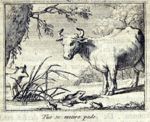
Tuo te metire pede: De la Court, Sinryke Fabulen (Amsterdam, 1685), emblem 13
Iconclass: 31A2255 foot 49D52 measuring 52A53 Self-knowledge
Loci Communes: Arrogantia jactantiaque (Arrogance and boastfulness, Arrogance et vantardise)
I vi 90 Non videmus manticae quod in tergo est We see not what is in the wallet behind
Catullus in Scazonte: Sed non videmus, manticae quod in tergo est. id est, Non videmus nostra ipsorum vitia, cum aliena curiosis oculis perspiciamus. Proverbium natum est ex Apologo quopiam Aesopico, qui fertur huiusmodi apud Stobaeum: Αἴσωπος ἔφη δύο πήρας ἕκαστον ἡμῶν φέρειν, τὴν μὲν ἔκπροσθειν, τὴν δ᾽ ὄπισθα. καὶ εἰς μὲν τὴν ἔμπροσθειν ἀποτιθέναι τὰ τῶν ἄλλων ἁμαρτήματα, εἰς δὲ τὴν ὄπισθα, τὰ ἑαυτῶν. Quorum verborum haec fermè sententia, Finxit Aesopus singulos mortales binas habere manticas, hoc est, peras, alteram ante pectus, alteram à scapulis tergoque propendentem. Sed in priorem, inquit, aliena vitia immittimus, in posteriorem nostra. Persius: Ut nemo in sese tentat descendere, nemo, Sed praecedenti spectatur mantica tergo. Horatius: Refpicere ignoto discet pendentia tergo. Divus Hieronymus: Sed illa est vera inter amicos reprehensio, si nostra opera non videntes, aliorum, iuxta Persium, manticam consideremus.
Catullus (it is an iambic line): 'We look not in the wallet on our backs,' which means that we do not see our own faults, while watching with sharp eyes the faults of others. The proverb took its rise from one of Aesop's fables, which is told as follows by Stobaeus: Aesop said that each of us carries two wallets, one in front and the other behind hanging from our shoulders; and in the front one we put what other men do wrong and our own failings into the back one. Persius:
None, none dare venture down into themselves.
They watch the wallet hanging on the back
Of him that walks before.
Horace: 'Will learn to look / At what hangs on the back he never sees.' St Jerome: 'But this is a real reason for friends to correct one another, if we cannot see what we do ourselves and concentrate, as Persius says, on the wallet of other men.'
I vi 91 Festucam ex alterius oculo ejicere To cast a mote out of another man's eye
Hanc humani ingenii caecam φιλαυτίαν non solum poetarum literae verum etiam evangelicae (neque enim gravabuntur in hunc citari ordine) notarunt, cum aiunt quosdam esse, qui festucam videant in oculo fratris, in suo trabem non vident. id est, aliorum vel minimis vitiis offenduntur, suis & maximis blandiuntur. Sic enim habet Matthaeus, τί δε βλέπεις τὸ κάρφος ἐν τῷ ὀφθαλμῷ τοῦ ἀδελφοῦ σου, τὴν δὲ ἐν τῷ σῷ ὀφθαλμῷ δοκὸν οὐ κατανοεῖς; ἤ πῶς ἐρεῖς τῷ ἀδελφῷ σου, ἀφες εκβάλω τὸ κάρφος ἐκ τὸ ὀφωαλμοῦ σου, καὶ ἰδοὺ ἡ δοκὸς ἐν τῷ ὀφθαλμῷ σου. id est, Quid autem vides festucam in oculo fratris tui, trabem vero quae in oculo tuo est, non intelligis? Aut quomodo dices fratri tuo, Sine, eiiciam festucam ex oculo tuo, & ecce trabes in oculo tuo? Sic enim ad verbum Graeca reddita sonant. Divus Hieronymus: Qui per trabem, inquit, oculi sui, festucam alterius nitatur eruere. Hoc hominum genus Horatius eleganter notat: Cum tua, inquiens, pervideas oculis mala lippus inunctis, Cur in amicorum vitiis tam cernis acutum, Quàm aut aquila, aut serpens Epidaurius? Idem alibi: Qui ne tuberibus propriis offendat amicum, Postulat, ignoscat verrucis illius aequum est. Quod ipsum proverbii speciem evidentem ante se gerit. Tubera maiora vitia dixit, verrucas minora, quae alibi naevos appellavit.
This blind self-love, so characteristic of human nature, has been pilloried not only in the poets but in the Gospels too (for they will have no objection to being appealed to in this context), when they say that there are some men who can see a mote in their brother's eye and cannot see a beam in their own, meaning that they take offence at the smallest faults in others and flatter then- own however great. For so it runs in Matthew: 'Why do you see the mote in your brother's eye, and take no note of the beam in your own eye? Or how will you say to your brother, Let me cast the mote out of your eye? - and look at the beam in your own eye!' Such is the literal sense of the Greek. St Jerome has: 'Who through the beam in his own eye would try to extract the mote from another man's.' Men of this class are pointedly criticized by Horace:
Blear-eyed with salves, you scarce discern your faults,
Yet in your friends' shortcomings there's no eagle,
No Epidaurian serpent sees so clear.
And again elsewhere: 'Who his friend's pardon for his boils demands, / 'Tis fair that his friend's warts he should forgive.' This in itself has all the look of a proverb. The boils of which he speaks are a much greater disfigurement than the warts, which elsewhere he calls wens.
Facsimile: 
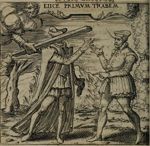
Eiice primum trabem: De Montenay, Cent Emblèmes Chrestiens (Frankfurt, 1619), emblem 18
Ne extra oleas: Printer's device 0496
Iconclass: 52AA53 Lack of Self-knowledge 73C74511 the mote and the beam in the eye ~ doctrine of Christ on love, etc. (Matthew 7:4; Luke 6:42)
Loci Communes: Philautia (Self-love, Amour-propre); Totum ut nihil reliqui (The whole, so that nothing remains, Le tout, sans rien laisser)
I vi 92 Intra tuam pelliculam te contine Keep inside your own skin
Intra tuam pelliculam te contine. Porphyrion proverbium esse admonet, quo vetamur obliti sortis nostrae, maiora conari, quam pro nostra facultate. Idque inde sumptum putat, quod olim ductores in pellibus, hoc est, pelliceis tentoriis dormitarent. Mihi videtur rectius referri ad asinum illum Cumanum, quem Apologi fabulantur adaptasse sibi leonis exuvium, atque ita sese ad tempus pro leone gessisse: Verum eam illi magno fuisse malo, cum agnitus, & magno omnium risu, aliena, apposititiaque exutus pelle, fustibus ad necem caederetur. Neque absurde quis ad Cleonem Atheniensem referat, qui ex Byrsopola, hoc est, coriario creatus exercitus ductor, fortuna favente victoriam reportavit, capta Pylo, suam ipsius civitatem furto spoliavit, atque ad eum modum ad summas opes evectus est, tandem per alium eiectus, maleque acceptus, poenas dedit, quod non in propria pelle quiesset. Hic inducitur in Aristophanis comoedia, cui titulus Equites, neque non aliis locis fubinde mordetur ab eodem poeta. Huc nimirum videtur allusisse Plautus, cum militem gloriosum & iactabundum fingit elegphantino corio circumtectum, non suo. sive quod stolidum significaret, sive quod maiora, quàm pro facultate, loquentem. Horatius: Et merito, quoniam in propria non pelle quiessem. Martialis in sutorem quendam, qui Cleonis exemplo, prius ad summas evectus divitias, ut venti erant, ita velum in altum sustulit: deinde ad pristinam rursus inopiam largitionibus suis redactus est, ut nihil iam esset nisi cerdo: Lusisti, inquit, satis est: sed te, mihi crede, memento Intra pelliculam cerdo tenere tuam. Item Seneca in Epistolis: Sapientem undique submovent, & intra cutem suam cogunt. Id citra metaphoram sic extulit Ovidius: Crede mihi, bene qui latuit, bene vixit: & intra Fortunam debet quisque manere suam. Allusit huc & Lucianus in Imaginibus, οὐκ ἔτι μένουσιν ἐπὶ τῶν ὑπαρχόντων. id est: Non iam manent in his quae adsunt: de his qui fortunae successibus elati, suae conditionis non satis meminerunt. Denique mihi non absurdum videtur, si proverbium referatur ad Marsiae excoriati fabulam, qui quoniam parum memor suae conditionis, ausus est cum Apolline certare, sua pelle exutus est.
Porphyrion points out that this is a proverb, which tells us not to forget our condition and attempt what is beyond our powers; and he thinks it derives from the fact that in the old days generals who were 'under canvas' slept in tents made of skins. To me it seems more likely to be connected with the famous ass at Cumae, who dressed himself, according to the fables, in a lion's skin and thus passed for some time as a lion. But this did him very little good when he was detected and became a universal laughing-stock, and then was stripped of the hide that was not his and beaten to death with cudgels. Nor would it be absurd to refer this to Cleon the Athenian who, after starting life as a leather-seller or cordwainer, was made general in command of an army and by the favour of fortune won a victory and captured Pylos; then robbed and despoiled his native city and thus became excessively rich; then at length was overthrown by another man and roughly handled, and paid the penalty, all because he had not stayed quietly among the skins where he belonged. Cleon is a character in the Knights of Aristophanes, and is criticized from time to time by the same poet in other places. It is of him, in fact, that Plautus seems to have been thinking when he makes his braggart and swaggering soldier 'clad in an elephant's hide and not his own,' either to show that he was a blockhead or because he used to tell of feats beyond his powers. Horace: 'Aye, and rightly too, / Because I had not stayed within my skin.' Martial addresses a shoemaker who, like Cleon, had risen to great riches and hoisted his sails to catch the favouring winds; but was then reduced again by his extravagance to his original poverty, so that for the future he could be nothing but a cobbler.
'You've had your fun,' he says, 'but mark my words: begin,
My cobbler friend, to stay within your skin.'
Seneca too in his letters: 'They banish the wise man from everything and compel him to stay inside his own skin.' Ovid brings out the point without using the metaphor, in this way: 'Take my advice: he who lives hid, lives best. / Let each man with his lot contented rest.' Lucian too alluded to it in his Images: 'They remain no longer within their proper sphere,' said of people who have been promoted by strokes of good fortune and are not sufficiently mindful of where they belong. In conclusion, it would not, I think, be unreasonable to refer our proverb to the story of the flaying of Marsyas, who did not sufficiently remember who he was and challenged Apollo to a contest, in return for which he was stripped of his skin.
Facsimile:

Aut terra, aut mari: Borja, Empresas morales (Bruxelles, 1680), emblem 95 shares the adage's warning against hubris, using the imagery of a high spire being hit by lightning
Iconclass: 25F23(LION)(+351) beasts of prey, predatory animals: lion (+ skin, fleece, hide, fur, leather) 31A2262 skin (human) 46C13142 ass, donkey 51EE11 Restriction, Limitation 51I1 Limited, Defined Space 52A53 Self-knowledge 85(ASS AND THE LION'S SKIN) fables (ASS AND THE LION'S SKIN)
Loci Communes: Modestia modusque (Modesty and moderation, Modestie et mesure)
I vi 93 Pennas nido maiores extendere To spread wings greater than the nest
Est apud Horatium in Epistolis, non dubium, quin proverbialis metaphora: Pennas nido maiores extendere. pro eo quod est, rem, fortunamque, quam mediocrem, aut tenuem à maioribusus acceperis, auctiorem reddere. Quod quidem, si virtute fiat, summa laus est, tantum abest ut vitio dandum existimem. Me, inquit, libertino natum patre, & in tenui re, Maiores pennas nido extendisse loqueris, Ut quantum generi demas, virtutibus addas. Translatum ab avium pullis, qui sic grandescunt, subnascentibus plumis, ut materno nido capi non possint.
In Horace's Epistles we find a metaphor which is no doubt proverbial, To spread wings greater than the nest, in the sense of enhancing your estate and position in society, which were small and modest when you inherited them from your forebears. If this is achieved by honourable conduct, it is greatly to a man's credit, so far am I from thinking it should be reckoned a fault. 'A freedman's son,' he says,
'with modest fortune blest,
Tell how I spread wings greater than the nest;
Add to my virtues and demean my birth.'
The image is derived from fledgling birds which grow so big, as then- plumage sprouts, that the maternal nest cannot hold them.
Facsimile:
Iconclass: 25F3(+342) birds (+ wings of an animal) 25F3(+421) birds (+ nest, den, burrow) 51H5 Growth, Increase
Collectanea (1500): 158
Loci Communes: Arrogantia jactantiaque (Arrogance and boastfulness, Arrogance et vantardise)
I vi 94 In tuum ipsius sinum inspue Spit into your own bossom
Hac nostra tempestate multis regionibus hoc circumfertur adagium. lubent enim hominem aliena vitia taxantem, in suum ipsius sinum inspuere, tanquam admonentes, ut domesticorum malorum recordatione desinat arrogantius insectari vitam alienam. Idem antiquis fieri solere, colligi utcunque potest ex verbis Plinianis, qui li. xxviii. ca. iiii. scribit hunc in modum, Veniam quoque à deis, spei alicuius audacioris petimus, in sinum spuendo. Idem in eodem capite scribit, ex autoritate Salpae, torporem sedari quocunque membro instupente, si quis in sinum expuat. Quorum utrunque non prorsus abhorret à nostro vulgato proverbio. Siquidem qui carpit aliena, spe quadam improba peccat, quasi speret sibi nihil simile à quoquam opprobrari posse, cum nemo sit, qui non aliquo vitio teneatur. Et qui proprii mali, quasi sui ipsius sensu caret, ceu torpore quodam tenetur. Seneca li. De beneficiis vii. Fortasse vitium de quo quereris, si te diligenter excusseris, in sinu invenies. Lucianus in apologia De mercede servientibus, καὶ ὄτι οὐκ εἰς τὸν κόλπον πτυσας προτερον ἠξίους κατηγορεῖν. i. Quodque non prius in tuum ipsius sinum inspueris, quam accusare coeperis. Idem in Votis, ὑπερμαζᾷς γε ὦ ἀδείμαντε, καὶ ἐς τὸν κόλπον οὐ πτύεις, οὐδε οισθα ὅστις ὤν ναυκληρεῖς. Iocatur quispiam in amicum, quod tanquam oblitus sui, opes immensas imaginaretur, neque in sinum spueret, ut agnosceret, quisnam esset. Idem indicat Theocritus Ecloga sexta. Nam Polyphemus, cum paulo arrogantius suam formam extulisset: Ως μη βασκανθῶ δὲ, τρίς εἰς ἐμὸν ἔπτυσα κόλπον Ταῦτα γὰρ ἁ γραῖά με κοτυτταρίς ἐξεδίδαξεν. Quorum carminum haec fermè sententia est: Ne quid me laedat invidia, néve noceat fascinatio, ter in meum inspui sinum. nam id me Cotyttaris anus docuit. Scholiastes addit eum morem sua etiamnum aetate durasse mulierculis, ut abominantes in vidiam in sinum expuant. Refert & Callimachi versum, Δαίμων, τί κόλποισιν ἐπιπτύουσι γυναῖκες; id est, O fortuna, sinum mulier quur conspuit omnis? Huc fortasse pertinet, quod ait Lucianus in Necyomantia, τρίς ἄν μου πρὸς τὸ πρόσωπον ἀποπτύσας. id est, Postea quàm ter mihi despuisset in faciem. Nec alienum hinc est, quod in secunda Satyra scripsit Persius: Frontemque, atque uda labella Infami digito, & lustralibus ante salivis Expiat. E simili superstitione profectum est, quod indicat Athenaeus lib. i. priscos ad depellenda mala solitos ter abstergeri. Refert versiculum hunc Cyrenaei, τρίς δ᾽ ἀπομαξαμένοισι θεοὶ διδόασιν ἄμεινον. id est, Ter vero abstersis, melius bona numina donant.
In our own day this adage is current in many parts of the world. They tell a man who criticizes other people's faults to spit into his own bosom, as though warning him to remember his own private errors and desist from arrogant attacks on the way other men live. That the Ancients did the same can be inferred from the words of Pliny, who in book 28 chapter 4 writes as follows: 'We also ask for forgiveness from the gods for expressing some unduly optimistic hope by spitting in our bosoms.' In the same chapter he also says on the authority of Salpa that the stiffness in any numbed limb can be eased by spitting into the bosom. Neither of these practices is very far from our current proverb; for the man who criticizes others offends by a kind of self-centred optimism, as though he hoped that no one would ever be able to blame him for anything of the kind, whereas nobody exists who is not the victim of some fault or other, and the man who is unconscious of his own mistakes (which is a kind of insensibility) is the victim of a sort of numbness. Seneca in book 7 of the De beneficiis: 'It may be that if you examine yourself carefully, you will find the fault of which you complain in your own bosom.' Lucian in his defence of the essay On Salaried Posts in Great Houses: 'And that you did not spit in your own bosom before you began your accusations,' and again in his Wishes: 'You are above yourself from over-eating, Adimantus, and you don't spit in your bosom nor remember who you are, though you may be a ship-owner,' which is a joking attack on a friend, who seems to have forgotten himself and imagines he is immensely rich, and did not spit in his bosom to remind himself who he really was. Theocritus makes the same point in his sixth eclogue. Polyphemus, after speaking rather boastfully about his own good looks, says: 'But to avert the evil eye I spat thrice in my bosom as the hag Cotyttaris taught me.' The scholiast adds that in his own day the custom still survived for women to spit into their bosoms to avoid the evil eye. He also quotes a line from Callimachus: 'O fortune, why do women spit in their bosoms?' Here perhaps belongs a phrase from Lucian's Necyomantia: 'When he had spat three times in my face.' Nor is it irrelevant that Persius in his second satire tells how the maternal aunt protects the baby's brow and dribbling lips, 'with magic finger and purifying spittle.' An ancient practice referred to by Athenaeus in his first book, of wiping the face three times to drive away misfortune, took its rise from the same superstition. He quotes the following line from a poet of Cyrene: 'To men with face thrice wiped god gives good luck.'
Facsimile: 
Iconclass: 31A222 chest, bust 31A65 spitting
Loci Communes: Modestia modusque (Modesty and moderation, Modestie et mesure)
I vi 95 Nosce teipsum Know thyself
Ad eam sententiam pertinent tria illa, inter omnia fapientum apophthegmata vel maximè celebrata, adeo ut quemadmodum in Charmide testatur Plato pro foribus templi Delphici ab Amphictyonibus inscripta, veluti digna deo viserentur. Quorum primum est γνῶθι σεαυτὸν, Nosce teipsum. In quo modestiae mediocritatisque commendatio est, ne nobis vel maiora, vel etiam indigna sequamur. Nam hinc omnis vitae pestis oritur, quod sibi quisque blanditur, & quantum aliis praeter aequum detrahit, tantum sibi philautiae vitio praeter meritum tribuit. M. Tullius ad Qu. fratrem libro tertio. Et illud γνῶθι σεαυτὸν, noli putare ad arrogantiam minuendam solum esse dictum, verumetiam ut bona nostra norimus. Fertur hic quoque senarius inter sententias proverbiales: Τὸ γνῶθι σεαυτὸν πανταχοῦστι χρήσιμον. id est, Ubique confert, ut teipsum noveris. Citatur à Nonio Marcello Satyra quaedam Varronis, hoc titulo, γνῶθι σεαυτὸν. Ovidius de arte amandi: Fama celebrata per orbem Litera, cognosci quae sibi quenque iubet. Iuvenalis. E coelo descendit γνῶθι σεαυτὸν. Ouidius hanc sententiam ad Pythagoram autorem refert. Platonicus Socrates ab Apolline profectam arbitratur. Plato in Phaedro, οὐ δύναμαί πω, τὸ κατὰ δελφικὸν ἐπίγραμμα, γνῶθι ἐμαυτὸν. id est, Nondum possum meipsum iuxta Delphicam inscriptionem cognoscere. Sunt qui ex Homero tanquam Oceano, hanc quoque mutuo sumptam existiment, apud quem Hector, cum in reliquos omneis impetum faceret, tamen Aiacem ut se praestantiorum declinavit. Sic enim ait poeta, Αἴαντος δ᾽ ἀλέεινε μάχην τελαμωνϊάδαο. id. est, Congressum Atacis fugit Telamone creati. Diogenes Thaleti tribuit. Apud hunc Antisthenes Phemonoae adscribit, caeterum Chilonem usurpasse. Thales autem rogatus, Τί ἐστι δύσκολον; ἔφη, τὸ ἑαυτὸν γνῶναι. τί ἐύκολον; ἀλλῳ ὑποτίθεσθαι. i. Quid est difficile? respondit, seipsum nosse. Quid facile? alterum admonere. Macrobius primo in Scipionis somnium commentario tradit, cuidam Delphicum oraculum consulenti, quonam itinere posset ad felicitatem pervenire, responsum ad hunc modum: Si teipsum cognoveris. Id autem oraculum redditum fuit Croeso, ut autor est Xenophon in Paedia Cyri. Citatur à Gnomologis Graecis hic ex Antiphane senarius: Εἰ θνητὸς εἶ βέλτιστε, θνητὰ καὶ φρόνει. id est, Praeclare, si mortalis es, mortalia fac cogites. Eandem sententiam sic extulit Pindarus, θνατᾶ θνατος πρέπει. id est, Mortalia mortales decent. Demonax interrogatus, quando coepisset philosophari, Posteaquam, inquit, coepi nosse me ipsum. Socrates quod Apollinis oraculo solus esset sapiens iudicatus, quum Graecia tot haberet sophos, sic interpretatur: quòd ceteros profitentes se scire, quod nesciebant, hoc nomine vinceret, quòd sciret se nihil scire: & hoc unum se scire profitebatur. Caeterum hanc Socratis modestiam vicit Anaxarchus, qui praedicabat se ne id quidem scire, quod nihil sciret. Apud Menandrum Comicum quispiam corrigit hoc omnibus laudatissimum dictum, Κατὰ πολλ᾽ ἄν ἐστιν, οὐ καλῶς εἰρημένον Τὸ γνῶθι σαυτὸν, χρησιμώτερον γὰρ ἦν Τὸ γνῶθι τοὺς ἄλλους. id est, Multis modis dictum videtur perperam, Cognosce teipsum, magis enim in rem fuerat hoc, Cognosce caeteros.
To the same line of thought belong those three sayings which are easily the most famous of all the utterances of wise men, so much so that, as Plato bears witness in the Charmides, they could be seen inscribed by the Amphictyons in front of the doors of the temple at Delphi as maxims worthy of the god. The first of these is Γνῶθι σεαυτόν, Know thyself, which recommends modera- tion and the middle state, and bids us not to pursue objects either too great for us or beneath us. For here we have a source of all life's troubles: every man flatters himself, and blinded by self-love takes to himself without deserving it all the merit that he wrongly denies to others. Cicero in the third book of letters to his brother Quintus: 'As for that famous Know thyself, you must not think it was uttered merely to reduce our self-conceit; we should also recognize our own blessings.' There is also a line preserved among the proverbial maxims: 'That Know thyself is useful everywhere.' Nonius Marcellus quotes a satire by Varro, the title of which was Know Thyself. Ovid in his Art of Love: 'Those world-famous words, / That every man should to himself be known.' Juvenal: 'And Know Thyself descended from the sky.' Ovid gives Pythagoras as the author of this rule; Socrates in Plato thinks it started with Apollo. Plato in the Phaedrus: 'I cannot yet achieve the self-knowledge of the Delphian inscription.' Some think that this too was taken from that ocean we call Homer; for Hector in Homer, while attacking everyone else, fought shy of Ajax whom he knew to be stronger than himself. As the poet says, 'he shunned an encounter with Ajax son of Telamon.' Diogenes ascribes it to Thales, but cites Antisthenes as giving it to Phemonoe, though he says that Chilon appropriated it. Thales when asked 'What is difficult?' replied 'To know oneself.' Asked 'What is easy?' he said 'To give another man good advice.' Macrobius in the first book of his Commentary on the Dream of Scipio records that when someone asked the Delphic oracle by what road he could arrive at happiness, the answer was: 'If you have learnt to know yourself.' The same reply was given by the oracle to Croesus, as we learn from Xenophon in his Cyropaedeia. The Greek proverb-collections cite this line from Antiphanes: 'Friend, if you're mortal, think as mortals should.' The same principle is expressed by Pindar in the words 'Mortal desires are fit for mortal men.' Demonax, asked when he had begun to be a philosopher, replied 'As soon as I began to know myself.' Socrates when judged by the oracle of Apollo to be the only philosopher in Greece, though Greece was full of them, explained this by saying that the others professed to know what they knew not, and that he defeated them because he knew that he knew nothing, and that was the only thing he professed to know. But Socrates was outdone in modesty on this point by Anaxarchus, who used to maintain that he did not even know that he knew nothing. Menander the writer of comedies has one of his characters correct this universally accepted dictum: 'This Know thyself in many ways is wrong; / Far better were it, other men to know.'
Facsimile: 
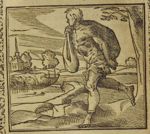
Nosce teipsum: Holtzwart, Emblematum Tyrocinia (Strasbourg, 1581), emblem 33
Nosce teipsum: Isselburg, Emblemata politica (Nürnberg, 1617) emblem 3
Cognoy toy-mesme - Γνωθι cεαυτον: Boissard, Emblemes (Metz, 1588), emblem 7
Kent u zelven: Hoogstraten, Zegepraal der goddelijke liefde (Gouda, 1709), emblem 35
Nosce te ipsum: [Anonymous], Thronus Cupidinis (Amsterdam, 1620), emblem 29
Hominem te esse cogita: Borja, Empresas morales (Bruxelles, 1680), emblem 100 stresses the importance of self-knowledge
Elck spiegle hem selven: Cats, Spiegel (The Hague, 1632), emblem 5 uses the imagery of an old man instructing a young woman in front of a mirror about beauty and self-knowledge
Iconclass: 52A53 Self-knowledge
Collectanea (1500): 108
Loci Communes: Modestia modusque (Modesty and moderation, Modestie et mesure)
I vi 96 Ne quid nimis Nothing to excess
Alterum diversis verbis eandem fermè sententiam complectitur, μηδὲν ἄγαν. i. Ne quid nimis, quam quidem, tamquam vulgo celebratam, Terentius in Andria etiam Sosiae libertini personae tribuit. Diogenes Laertius Pythagorae adscribit. Aristoteles iii. Rhetoricorum lib. ad Biantem autorem refert, tractans de iuvenum immoderatis affectibus, quos ait ubique nimia vehementia peccare: nam & amare nimium, pariter & odisse nimium. Senes non item, sed ut ipsius Aristotelis utar verbis, κατὰ τὴν βίαντος ὑποθήκην, καὶ φιλοῦσιν ὡς μισήσοντες, καὶ μισοῦσιν ὡς φιλήοντες. i. Iuxta Biantis admonitionem, & amant tanquam osuri, & oderunt tanquam amaturi. Sunt qui Thaleti tribuant. Sunt qui Soloni, teste Laertio. Plato quodam loco ex Euripide citat. Neque desunt, qui ad Homerum veluti fontem referant: cuius hi versus sunt in Odysseae ο. Νεμεσσῶμαι δὲ καὶ ἄλλῳ Ανδρὶ ξεινοδόκῳ, ὅς κ᾽ ἔξοχα μὲν φιλέησιν, Εξοχα δ᾽ ἐχθαίρησιν, ἀμείνω δ᾽ αἴσιμα πάντα. id est, Mihi nequaquam is placet hospes, Qui valde praeterque modum simul odit, amatque. Sed puto rectius esse ut sint mediocria cuncta. Idem in Iliados Κ. Τυδείδη, μήτ᾽ ἄρμε μάλ᾽ αἴνεε, μήτ᾽ ἔτι νείκειν. id est, Ne nimis aut laudes Tytida, aut vituperes me. Equidem ad Hesiodum referre malim. Cuius illud est in opere, cui titulus, ἐργα καὶ ἡμέραι, Μέτρα φυλάσσεσθαι, καιρὸς δ᾽ ἐπὶ πᾶσιν ἄριστος. id est, Mensuram serva, modus in re est optimus omni. Euripides cum aliis aliquot locis, tum in Hippolyto coronato: Οὕτω τὸ λίαν γ᾽ ἥσσον ἐπαινῶ Τοῦ μηδέν ἄγαν id est, Sic equidem minus approbo, quicquid Est vehemens, quàm quod vulgus ait, Ne quid nimium. Pindarus apud Plutarchum, σοφοὶ δὲ καὶ τὸ μηδὲν ἄγαν ἔπος, αἴνησαν περισσῶς. id est, Sapientes hoc verbum, ne quid nimis, praeter modum laudarunt. Sophocles in Electra: Μηθ᾽ οἷς ἐχθαίρεις ὑπεράχθεο, μή τ᾽ ἐπιλάθου. id est, Ne nimium, praeterque modum te torqueat ille Quem odisti, sed nec neglexeris immemor hostem. Plautus in Poenulo, Modus omnibus in rebus, soror, est optimus. Eodem pertinet Ho mericum illud Iliados Ν. Πάντων μὲν κόρος ἐστὶ καὶ ὕπνου καὶ φιλότητος, Μολπῆς τε γλυκερῆς καὶ ἀμύμονος ὀρχῃθμοῖο. id est, Cunctarum rerum saties contingit, amorisque, Et somni, & blandae citharae, choreaeque decentis. Id imitatus videtur Pindarus in Nemeis, Κόρον δ᾽ ἔχει καὶ μὲλι, καὶ τὰ τέρπν᾽ ἄνθ᾽ ἀφροδίσια. i. Satietatem habet & mel & iucundi flores venerei. Plin. lib. xi. Perniciosissimum autem & in omni quidem vita, quod nimium. Horatius: Est modus in rebus, sunt certi denique fines, Quos ultra, citraque nequit consistere rectum. Rursus idem: Virtus est medium vitiorum utrinque redactum. Phocylides: Πάντων μὲτρον ἄριστον. id est, Omnium modus optimus. Et Alpheus in Epigrammate, Τὸ μηδὲν γὰρ ἄγαν, ἄγαν μὲ τέρπει. id est, Hoc Ne quid nimium, nimis placet mi. Quintilianus scripsit modum in pronunciatione regnare, quemadmodum in caeteris omnibus. Denique Plutarchus in Camillo docet, pietatem esse mediam inter contemptum numinum & superstitionem, ἡ δὲ εύλάβεια, καὶ τὸ μηδέν ἄγαν, ἄριστον. id est, Pietas autem, &, quod aiunt, ne quid nimis, optimum est. Nihil autem est rerum omnium, in quo non peccari queat nimietate, praeter amorem dei: quod aliis verbis fatetur & Aristoteles, pro deo supponens sapientiam. Huc pertinet quod ex poeta quopiam refert Athenaeus lib. i. de laudibus vini, Πάσας δ᾽ ἐκ κραδίας, ἀνΐας ἀνδρῶν ἀλαπάζει Πίνόμενος κατὰ μέτρον, ὑπὲρ μετρον δὲχερείων. id est, Atqui omnes hominum pellit de pectore curas Si modice biberis: sin absque modo, nociturum est.
The second embodies almost the same principle in different words: Μηδὲν ἄγαν, Nothing to excess. Terence in the Andria puts it in the mouth of one of his characters, Sosia the freedman, as though it were widely known. Diogenes Laertius ascribes it to Pythagoras. Aristotle in book 3 of the Rhetoric gives Bias as the source, where he is treating of the ungoverned passions of the young who, he says, go wrong in every field through enthusiasm; for they love to excess and hate to excess too, while the aged are different, for (to borrow Aristotle's own words) 'they follow the advice of Bias, loving as though they might one day hate and hating as though they might one day love.' Some attribute it to Thales, some to Solon, according to Laertius. Plato cites it in one place from Euripides. And there is no lack of people who trace it back to Homer as the fountain-head, who has the following lines in Odyssey 15: 'That host I like not who beyond the mean / Both loves and hates; reason is always best.' Again in Iliad book 10: 'O son of Tydeus, praise me not too much / Nor too much blame me.' Personally I should prefer to trace it back to Hesiod, who has in his Works and Days the line 'Observe the mean; due time is best in all.' So Euripides in several places and especially in the Hippolytus: 'So what there is too much of I like less / Than the old rule of nothing to excess.' Pindar, cited by Plutarch: 'The wise have ever praised exceedingly this saying Nothing to excess.' Sophocles in the Electra: 'Be not over-angry with those whom you hate, but let not your enemies slip out of mind.' Plautus in the Poenulus: 'Moderation, sister, in all things is best.' Here too belongs that Homeric tag, in book 13 of the Iliad: 'But in all things there comes satiety, / In sleep and love, sweet song and gracious dance.' Pindar seems to have imitated this in the Nemeans: 'In honey lies satiety, and in the delightful flowers of love.' Pliny in his eleventh book: 'Most destructive, even in every walk of life, is that which is carried to excess.' Horace: 'All things are ruled by reason, have fixed bounds, / Within which only can the right hold firm.' And again: 'Virtue's a mean 'twixt vices either side.' Phocylides: 'Measure's the best of all things.' And Alpheus in an epigram: 'This Nothing to excess I like excessively.' Quintilian writes that moderation is sovereign in delivery, as in everything else. Finally Plutarch in his life of Camillus tells us that piety is halfway between contempt of the gods and superstition, and that 'piety and the principle of nothing to excess are best.' And there is nothing in the whole world in which one cannot go wrong by excess, except the love of God, as Aristotle too admits in different words, putting wisdom in the place of God. Here belongs a quotation from some poet, given by Athenaeus in his first book, on the virtues of wine: 'All human cares it drives from out the heart / With reason drunk, but to excess, 'tis worse.'
Facsimile:
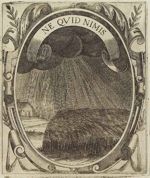
Ne quid nimis: Saavedra, Idea de un principe (München, 1640), emblem 40
Ne quid nimis: Cramer, Emblemata sacra (Frankfurt, 1624), emblem 82
Ne quid nimis: Picinelli, Mundus symbolicus (Köln, 1694), emblem 6
Ne quid nimis: De la Feuille, Devises et emblemes anciennes et modernes (Augsburg, 1697), emblem 180
Ne quid nimis: Rollenhagen, Nucleus emblematum (Arnhem, 1618), Cent. II, emblem 84
Ne quid nimis: Wither, A collection of emblems (London, 1635), emblem 184
Est modus in rebus: De Bruc, Emblemes et devises morales (s.l., ca. 1660), emblem 21 quotes the comment
Vitam inveniet: Borja, Empresas morales (Bruxelles, 1680), emblem 12 uses the imagery of the Golden Mean
Iconclass: 54A43 Temperance, Moderation; 'Misura' (Ripa) 54A431 the Golden Mean; 'Mediocrità' (Ripa)
Loci Communes: Modestia modusque (Modesty and moderation, Modestie et mesure)
I vi 97 Sponde, noxa praesto est Stand surety, and ruin is at hand
Εγγύα, παρά δ᾽ ἄτη. id est, Sponde, sed noxa praesto est. Quae quidem omnia Socrates apud Platonem putat ad eandem sententiam pertinere. Nam qui pro altero fideiubet, id pollicetur, quod non sit in ipso situm praestare, nempe fidem alienam. Sed primum illud Apollini tribuit, reliqua duo à mortalibus adiecta credit. Plin. lib. vii. cap. trigesimosecundo cuncta pariter adscribit Chiloni, sed ita ut oraculorum vice fuerint habita: Rursus, inquiens, mortales oraculorum societatem dedere Chiloni Lacedemonio, tria praecepta eius Delphis consecrando aureis literis, quae sunt haec: Nosse se quenque. et, Nihil nimium cupere, Comitemque aeris alieni, atque litis esse miseriam. Explicuit Plinius, quid sit spondere. Fideiubemus enim pro eo cui creditur pecunia: & saepe fit, ut fideiussor cogatur creditori numerare pecuniam. Fideiubemus & apud iudices, de sistendo reo, atque illo fallente plectuntur vades. Et hoc dictum ad Homerum autorem referunt. Cuius hoc est carmen Odys. θ. Δειλαί τοι δειλῶν γε καὶ ἐγγύας ἐγγυάασθαι. Chersias apud Plutarchum in convivio Platonis refert ad fabulam Homericam de Ate, quae quod adfuerit Iovis sponsioni de nativitate Herculis, ab eo praecipitata est in terram. Citantur, ac laudantur haec tria apophthegmata à Plutarcho in libello de futili loquacitate.
'Ἐγγύα, παρὰ δ᾽ ἄτη., Stand surety, and ruin is at hand. All three of these are thought by Socrates in Plato to belong to the same line of thought. For he who gives a guarantee for another man makes a promise regarding something which it is not in his power to guarantee, the honesty of someone else. But he attributes the first of them to Apollo and thinks the other two were added by mortals. Pliny, book 7 chapter 32, ascribes them all equally to Chilon, qualified by their being treated as oracles; 'again' he say 'mortals have admitted Chilon the Lacedaemonian to a partnership in the oracle by writing up his three precepts at Delphi in letters of gold, viz that everyone should know himself, that he should desire nothing to excess, and that misery is the bedfellow of debt and litigation.' Pliny has explained the meaning of 'stand surety.' We give a guarantee on behalf of a man when he is borrowing money, and it often happens that the guarantor is obliged to repay the lender in cash. We also give a guarantee to the judges that we will produce the accused, and if he lets them down it is those who have gone bail for him who are punished. This saying too is traced back to an origin in Homer, who has a line in the eighth book of the Odyssey: 'Worthless the pledges given by worthless men.' Chersias in Plutarch's 'Symposium of Plato' refers this to the story in Homer about the goddess of Mischief who, because she had been present when Jupiter stood surety for the birth of Hercules, was hurled by him down to earth. These three sayings are cited with approval by Plutarch in his essay 'On Pointless Garrulity.'
Facsimile:
Iconclass: 44G151 swearing an oath (with two fingers raised) 52B21 Credulity 57A613 Integrity
Loci Communes: Magnifica promissa (Magnificent promises, Promesses magnifiques)
I vi 98 Novit quid album, quid nigrum He knows white from black
Οἶδε τὸ λευκόν καὶ τὸ μέλαν. id est, Novit quid album, quid nigrum. Duplicem in sententiam accipi potest. Aut novit discrimen recti, pravique: aut novit id, quod nemo vel indoctus ignorat. Nam evidentius est albi nigrique discrimen, quàm ut quisquam non videat. Aristophanes in Equitibus: Νῦν ἀρίγνωσον γὰρ οὐδεὶς ὅστις οὐκ ἐπίσταται Οστις ἤ τὸ λευκὸν οἶδεν, ἢ τὸν ὄρθιον νόμον id est, Nunc Arignotum lyristen nullus est, qui nesciat, Qui album noverit, rectosve noverit modos. Interpres ostendit, exponitque proverbium. Videtur esse tractum à priscis illis mortalibus, qui duos tantum naturales colores noverant, album & nigrum, teste Pompeio.
Οἶδε τὸ λευκόν καὶ τὸ μέλαν., He knows what white is and what black. This can be taken in two different ways, either He knows the difference between right and wrong, or He knows something known to the veriest ignoramus; for the difference between white and black is too obvious to be lost on anyone. Aristophanes in the Knights says that 'Not a soul but knows Arignotus, of those who know what white is and what high stirring music' The scholiast points out and expounds the proverb. This seems to be taken from men in very early days, who could distinguish two colours in nature only, white and black, as Pompeius records.
Facsimile:
Iconclass: 22C4(BLACK) colours, pigments, and paints: black 22C4(WHITE) colours, pigments, and paints: white 52B511 Distinction between Good and Bad; 'Distintione del bene & del male' (Ripa)
I vi 99 Albus an ater sis, nescio I know not whether you are dark or fair
Albus an ater sis, nescio. Solet dici de homine vehementer ignoto. Cice. Philippica secunda: Me nemo nisi amicus fecit heredem: ut cum illo commdo, si quod erat, animi quidam dolor iungeretur. Te is, quem numquam vidisti, L. Rubrius Cassinas fecit haeredem. Et quidem vide quàm te amarit is, qui albus, atérve fueris ignorans, fratris filium praeteriit. Quintilianus in undecimo Oratoriarum institutionum lib. Negat, inquit, se magnifacere aliquis poetarum, utrum Caesar sit albus, an ater homo: Catullum, opinor, digito indicans, cuius in Caesarem hoc extat carmen: Nil nimium studeo Caesar tibi velle placere, Nec scire utrum sis albus, at ater homo. Apuleius in apologia Magiae: Etiam libenter te nuper usque, albus an ater esses, ignorabam, adhuc hercle non satis novi. Divus Hieronymus adversus Heluidium: Quis te, oro, ante hanc blasphemiam noverat? Quis dupondio supputabat? Consecutus es, quod volebas. Nobilis es factus in scelere. Ego ipse, qui contra te scribo, cum in eadem urbe tecum consistam, qua balbutis & erubescis, albus, ut aiunt, an ater sis, nescio. Horatius in extrema epistola: Vultu mutabilis albus & ater. Quo loco Porphyrion admonet proverbiali figura dictum, albus et ater, pro eo quod est, bonus & malus; & Horatium album aut ad liberalem, aut laetum reddidisse, atrum ad sordidum & erumnosum. Huc festiviter allusit Mateon apud Athenaeum libro quarto, de sepia loquens, Η μόνη ἰχθὺς ἐοῦσα, τὸ λευκὸν καὶ μέλαν οἶδε. id est, Quae cum sit piscis, sola album novit & atrum. Est enim sepia colore albo, sed succum habet atrum, quem spargit in metu ne deprehendatur.
Said commonly of a man entirely unknown. Cicero in the second Philippic: 'No one save friends ever left me anything, so that a touch of regret might be sweetened by the windfall, if such it was. But you! A man you had never set eyes on, Lucius Rubrius of Cassinum, left you his heir. How that man must have loved you! He knew not whether you were dark or fair, and passed over his own brother's son.' Quintilian, in book 11 of his Principles of Rhetoric, says: 'one of the poets maintains that he does not care greatly whether Caesar is dark or fair,' putting his finger no doubt on Catullus, among whose surviving poems is one addressed to Caesar: 'Caesar, to flatter you I don't much care, / Nor yet to know if you be dark or fair.' Apuleius in his defence against a charge of witchcraft: 'Up till quite lately I was perfectly content not to know whether you were fair or dark, and I do not really know you even now.' St Jerome attacking Helvidius: 'Who pray knew of you before this blasphemous outburst? Who thought you worth twopence? You have got what you wanted, and your crimes have made your reputation. Even I, who write against you and live in the same city as yourself (how you stammer and change colour!), do not know, as the saying goes, whether you are fair or dark.' Horace in the last of his Epistles: 'Whose features change; now fair he is, now dark,' where Porphyrion points out that 'fair and dark' is a proverbial expression for good and bad, and that Horace 'has related fair to generous or prosperous and dark to mean or miserable.' Matron makes a pretty use of this, as quoted in the fourth book of Athenaeus, when speaking of the cuttlefish: he says that though only a fish, it alone knows the difference between black and white, because the cuttlefish itself is white, but has a black juice which it spreads when afraid of being caught.
Facsimile: 
Iconclass: 22C4(DARK) colours, pigments, and paints (DARK) 22C4(FAIR) colours, pigments, and paints (FAIR) 31A22621 hair 51AA8 Things Unknown, the Unknown
Collectanea (1500): 121
I vi 100 Non novit natos He does not know that they exist
Simillima huic figura est, Naturm non novi, pro eo quod est, prorsus ac modis omnibus ignoro. M. Tullius libro familiarium epistolarum nono, ad Papyrium: Nam mihi scio iam e regibus ultimis allatas esse literas, quibus mihi gratias agunt, quod se mea sententia reges appellaverim, quos ego non modo reges appellatos, sed omnino natos nesciebam. Simillimum est illi, quod est apud Aristophanem in Vespis: ὅς ἐμ᾽ οὐδ᾽ ἄν ζῶντ᾽ ᾔδει. id est. Qui me ne vivum quidem novisset. id est, nullam omnino mei rationem habuisset. Item Theocritus in Pharmaceutria: Οὐδ᾽ ἔγνω πότερον τεθνάκαμεν ἤ ζοοὶ εἰμὲς. id est, Non etiam illud utrum sim viva, an mortua, novit. In eandem sententiam usurpavit Plautus in Euclione: Non magis me respicias, quàm si natus numquam siem.
An idiom very like this is 'I do not know that he exists,' when you mean you are utterly and completely ignorant of a man. Cicero in the ninth book of his Letters to Friends, writing to Papyrius: 'I am aware that before now I have had letters from kings at the ends of the earth, thanking me for having proposed that they should be given the title of kings, when not only was I ignorant that they had the royal title, I simply was not aware that they existed.' Very like this is a phrase in the Wasps of Aristophanes: 'He would not even have known that I existed,' meaning that he would have paid no attention to me whatever. Theocritus too in his Sorceress: 'And knows not whether I am dead or alive.' Plautus uses it with the same sense in the mouth of Euclio: 'You'd take no more heed / Than if I never had been born at all.'