Guillaume de La Perrièrre, Le Theatre Des Bons Engins (Lyon, 1545)
Emblem 34
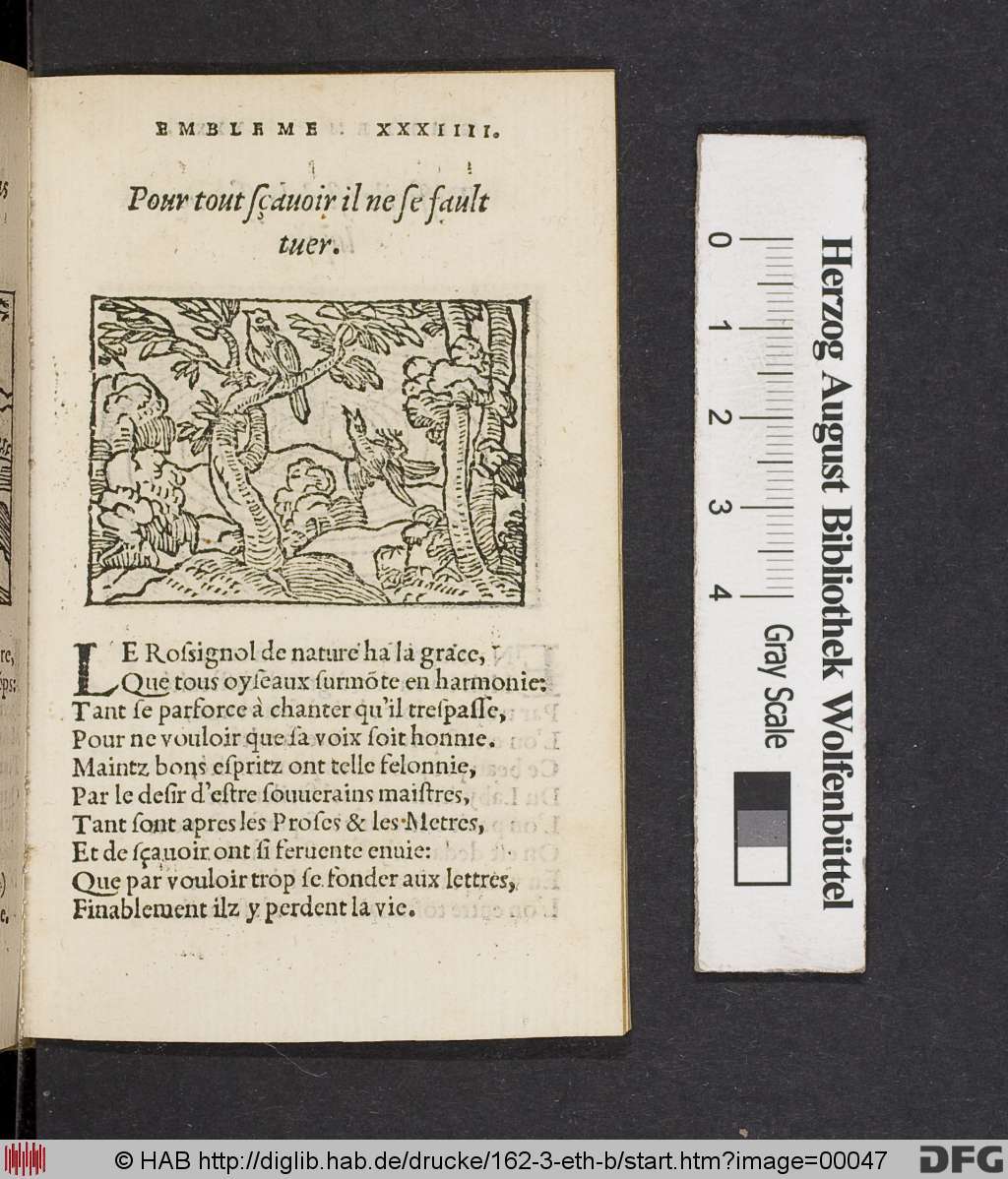
A nightingale singing on a branch, another fallen dead belowAI-generated

Pour tout scauoir il ne se fault tuer.
One ought not to kill oneself in order to know everything.AI-generated
Description of the woodcutAI-generated
A woodcut in a rectangular frame showing a wooded landscape with several trees and bushes. In the upper left a bird (a nightingale) perches singing on a branch; in the middle, lower down, a second bird lies or falls among the foliage with wings spread and beak open, apparently collapsed. Shrubs and grassy mounds fill the foreground, with a tall tree trunk at the right edge.
Subscriptio
TranscriptionAI-generated
LE Rossignol de nature ha la grace,Que tous oyseaux surmôte en harmonie:Tant se parforce à chanter qu'il trespasse,Pour ne vouloir que sa voix soit honnie.Maintz bons espritz ont telle felonnie,Par le desir d'estre souuerains maistres,Tant sont apres les Proses & les Metres,Et de sçauoir ont si feruente enuie:Que par vouloir trop se fonder aux lettres,Finablement ilz y perdent la vie.
TranslationAI-generated
The nightingale has by nature the gift of surpassing all birds in harmony: it strains itself so much in singing that it dies, from not wishing its voice to be scorned. Many good minds have such a cruel passion, through the desire to be sovereign masters; they so pursue prose and verse, and have so fervent a craving for knowledge, that by wanting to ground themselves too deeply in letters, they finally lose their lives thereby.
Iconclass
86(POUR TOUT SCAUOIR IL NE SE FAULT TUER)proverbs, sayings, etc. (POUR TOUT SCAUOIR IL NE SE FAULT TUER)25G3trees25F32(NIGHTINGALE)(+63)song-birds: nightingale (+ dying animal; death of animal; dead animal)25F32(NIGHTINGALE)(+535)song-birds: nightingale (+ sitting animal)48A3competition, art contest56F11Ambition; 'Ambitione', 'Amor di Fama' (Ripa)
Suggested Iconclass codesAI-generated
Additional codes proposed for this emblem, not (yet) part of the indexing.
25F32(NIGHTINGALE)song-birds: nightingalehighThe correlate 'song-birds: nightingale' directly matches the singing nightingale on the branch and the second nightingale fallen with beak open in the foliage.
54AA43Intemperance, ImmoderationlowThe correlate 'Intemperance, Immoderation' may capture the emblem's moral of the nightingale that sings itself to death through immoderate effort, though it is not explicitly depicted.
Relationships to the Adagia of ErasmusAI-generated
Suggested relationships between this emblem and adages in Erasmus’ Adagia.
- II ii 3 Lusciniae nugis insidentes – thematic inventiohigh
Erasmus applies this nightingale adage precisely to learned men (especially poets) who are immoderately carried away by their own studies, and cites Pliny 10.29 on the bird's incredible straining in song (the loser in song-contests dying, its breath failing before its song) — exactly the emblem's picture of one nightingale singing and another collapsed, and its moral that scholars kill themselves pursuing 'Proses & Metres'.
- III vi 77 Lusciniae deest cantio – thematic inventiomedium
This adage transmits the same Pliny 10.29 locus on the nightingale's unrivalled, exhausting musical mastery and its rivalry in song, the natural-history basis for the emblem's claim that the nightingale 'surpasses all birds in harmony' and strains itself to death rather than have its voice scorned.
- IV v 77 Arcus tensus rumpitur – thematic inventiolow
Erasmus' adage on the over-strung bow, illustrated by the epitaph on Theophrastus and the 'bow of study', shares the emblem's lesson that immoderate intellectual straining destroys the one who strains; no verbal borrowing, only the common moral of excess in letters.
Sources
Record ID: embhab_162-3-eth-b_emblem034
This emblem on the Iconclass site: https://iconclass.org/view/embhab_162-3-eth-b_emblem034
Page in the digital copy of the Herzog August Bibliothek: http://diglib.hab.de/drucke/162-3-eth-b/start.htm?image=00047