IV v 1 Ne bos quidem pereat Not even an ox would be lost
Iam ante proverbiis aliquot nobis declaratum est quantum utilitatis adferat bonus vicinus, quantum incommodi malus. Sed quae conducunt ad vitae felicitatem, iterum atque iterum expedit in culcare, quo penitius infigantur animis. Neque enim ea res tantum habet locum in parandis aedificibus aut fundo, sed in omni pene vita: ut quod Portius Cato prodidit de commodo vicino habendo, non solum ad agricolas pertineat, verumetiam ad unumquemque nostrum. Etenim si quis iam provectior aetate vitae totius cursum relegat, comperiet maximam bonorum malorumque partem a bonis malisque vicinis fuisse profectam. Hesiodi carmen Columella tamquam proverbiale refert: Μηδ᾽ ἂν βοῦς ἀπόλοιτ᾽ εἰμὴ γείτων κακὸς εἴη. id est, Nec bos intereaet, vicinus si improbus absit. At levis est bovis iactura. si cum his malis conferatur, quae capiuntu ex improbis convictoribus, ex fucatis amicis, ex uxoribus et famulis parum fidelibus. At Catonis quidem sentntiam nonnullli reiciendam esse duxerunt, quod in nobis situm non est, qualem habeamus vicinum, quem nonnumquam mors aliaeque diversae causae nobiscum mutant. Id tametsi negari non potest, sapienter tamen a Carone praeceptum est, ut agricola quantum in ipso est, curet habere bonum vicinum, nec bonum tantum, sed et commodum. Bonus enim esse potest, qui tibi commodus non sit. Id ut contingat, duae res potissimum adiuvabunt, diligentia in parando agro et commodi mores erga vicinum. Frequenter enim habemus malum vicinum, quod ipsi nos praebeamus malos vicinos. Quemadmodum igitur, ut eleganter scribit Columella, sapientis est fortuitos casus magno animo sustinere, ita dementis est spsum sibi malam facere fortunam. Quod facit, qui nequam vicinum suis nummis parat, cum a primis cunabulis, si modo liberis parentibus est oriundus, audisse potuerit: Οὐδ᾽ ἂν βοῦς ἀπόλοιτ᾽ εἰμὴ γείτῶν κακὸς εἴη. Quod non solum de bove dicitur, sed de omnibus partibus rei nostrae familiaris, adeo qui dem ut multi praetulerint carere penatibus, et propter iniuriam vicinorum sedibus suis profugerint. Nisi aliter existimamus diversum orbem, universas gentes petiisse relicto patrio solo, Acliaeos dicimus et Hiberos, Albanos quoque, nec minus Siculos, et ut primordia nostra contingamus, Pelasgos, Aborigenes, Arcadas, quam quia malos vicinos ferre non potuerint. Ac ne tantum de publicis calamitatibus loquamur, privatos quoque memoria tradidit, et in regionibus Graeciae, et in hac ipsa Hesperia detestabiles fuisse vicinos: nisi Autolycus ille potuit cuiquam tolerabilius esse conterminus, aut Auentini montis incola, Palatinis ullum gaudium finitimis suis Cacus attulit. Malumus enim praeteritorum vam praesentium meminisse, ne vicinum nostrum nominemus, qui nec arborem prolixiorem stare nostrae regionis, nec inviolatum seminarium, nec pedamentum annexum vineae, nec etiam pecudes negligentius pasci sinit. Iure igitur, quantum nostra fert opinio, M. Portius talem pestem vitare censuit, etin primis futurum agricolam praemonuit, ne sua sponte ad eam perveniret. Hactenus quidem Columella declamatoria quadam eloquentia, simul et Catoni patrocinatus est, et nos docuit, quanta pestis sit malus vicinus. Tametsi Cato non solum de vicini moribus sentit, verumetiam quam lauta sit re. Vicini, inquit, quo pacto niteant id animadvertito. In bona regione bene nitere oportebit. Interdum enim nitor arguit agri bonitatem, in solo vero parum fertili declara industriam agricolae. Porro quemadmodum diligens vicinus exstimulat ad studium bene colendi, ita vicinorum luxus ex ignavia corrumpit vicini familiam. Itidem etpraepotens vicinus opprimit propinquum pauperem, et supra modum tenues vicini semper aliquid abradunt, sive precibus, sive furto. Iam cum morosis et improbis vicinis num quam rixa non est, nunc de finibus, nunc de damno dato, nunc de stillicidio, nunc de semita actuve, nunc de prospectu, aut de lumine. Quod si fortuna nobis dederit talem vicinum, nec liceat mutare, reliquum est, ut nostra commoditate reddamus illum ex malo bonum, certe caveamus ne lacessitus fiatincommodior. Turpissimum enim fuerit si nostris moribus ex commodo vicino faciamus incommodum. Videlicet hoc est quod praecipit Cato: Vicinis bonus esto. Et ne satis esse putares, si ipse temperes ab iniuria vicini, adiungit: Familiam ne siveris peccare. Mox indicat, quid utilitatis capiatur ex bonis vicinis. Si te, inquit, libenter vicinitas videbit, facilius tua vendes, operas facilius locabis, operarios facilius conduces. Si aedisicabis, operis, iumentis, materia iuvabunt. Si quod bona salute usus venerit, benigne defendent. Olim igitur qui fundum proscribebant venalem praeconem edocebant, quibus dotibus esset ager commendabilis, quam salubri caelo, quam commodo situ, quam fertili solo, qu bene aedificatis villis. Sed vir acerrimi ingenii Themistocles, quum fundum venderet, iussit huiusmodi dotibus et illud adici, quod haberet bonum vicinum. Id factum primum risu iocoque multitudinis acceptum est, mox intellectum est hanc agri commendationem esse praecipuam. Plurimum itaque refert ad totius vitae commoditatem, qualem quisque vicinum sibi deligat, tum quo pacto, qui contigit, utatur. Princeps qui ditionem ambit, quam sine maximo negotio, summoque ditionis avitae dispendio tueri non possit, malam viciniam sibi adiungit. Rursum qui cordatos ac fidos consiliarios, qui magistratus integros et rei publicae amantes adsciscit, bonos vicinos adiungit. Neque minimum interest quas nationes in adfinitatem adglutinet. Qui dotis aut honoris gratia sponsam adsciscit incommodis moribus, aut cui sint cognati procaces, malos vicinos sibi adiungit. Qui cum improbis init amicitiae foedus, malam viciniam accersit. Qui ductus amore censuum coniicit sese in collegium aut monasterium impiorum aut etiam superstitiosorum, malam viciniam sibi parat. Prima igitur cautio sit in deligendo, proxima in corrigendo, postrema in fugiendo quod corrigi non potest. Quanquam ne fuga quidem debet carere cautione. Alioqui in vitium ducit culpae fuga, si caret arte, neque raro fit, ut odio mali praecipitemus nos in aliud gravius malum. Raro paenituit amicitiae, qui iudicio delegit amicum. Et saepe nostra culpa fit, ut rescindatur amicitia, quod amicis bonis utamur non bene, tum quod parum commodos amicos nec ferre novimus, nec emendare. Neque vero levius peccant, qui cum inciderint in amicos pestilentes, nesciunt sese subducere, sed aut haerent his, quos oderunt clanculum, aut non dissuunt amicitiam, sed abrumpunt. Idem accidit mei similibus in deligendis ac retinendis studiorum nostrorum patronis & altoribus. Negligimus oblatos, aut amplectimur nobis parum aptos, aut si quis obtigit accommodus, non studemus, illius erga nos benevolentiam mutuis officiis alere. In prima certe parte gravissime peccavi adolescens. Eenim si tum respondissem favoribus magnatum qui me coeperant amplecti, futurus eram aliquid in literis, sed immodicus libertatis amor effecit, ut dium cum perfidis amicis, et pervicaci paupertate colluctarer. Nec erat finis futurus, nisi GUILELMUS ille WARAMUS Archiepiscopus Cantuariensis, vir non tam ob tituli muneris quam dignitatem, qui ob egregias summoque praesule dignas virtutes reverendus, me veluti fugitantem in amicitiae suae nassam pellexisset. Gustata duntaxat illius huamniatate contuli me in Italiam. Ibi cessantem neque quicquam minus quàm de repetenda Britannia cogitantem, ultro revocat delato sacerdotio. Hoc quoque neglectum est. Caeterum ubi me ventus alius retulisset in Angliam, sic astrinxit non tam benignitate, quanquam ea quoque fuit & est in illo singularis, quam morum amabili quadam iucunditate miraque in amando constantia, id quod in viris primatibus sanè rarissimum est, ut nolens illi praeberem manus. Haec erat esca qua me pertraxit in suum ius. Ita meo bono captus sum, hoc uno nomine felix quod hic Moecenas obtigit, sed longe felicissimus futurus si maturius contigisset. An illum huius alumni poeniteat nescio, certe mutuis in illum officiis meo animo nondum ipse satisfeci, nec videor unquam satisfacturus. Proinde mihi rogandi sunt omnes, qui bonarum literarum, qui religionis amore ducuntur, ut si quid fructus non poenitendi coeperunt ex meis lucubrationibus huic sanctissimo praesuli pro me gratis agant, atque adeo si possint referant. Referent autem, si non patientur illius memoriam apud posteros intermori, cuius benignitati debent, quicquid ex libris meis hauserunt, si quid omino frugiferum hauserunt. Obstrepunt undique quaerimoniae deplorantium sibi ad studiorum cultum deesse Maecenates. Atqui Maecenas non statim amplexus est Virgilium aut Horatium, nec Maevio Baviove fuit Maecenas. Illud primum agat adolescens, ut egregium aliquod specimem ceu pignus de se praebeat, non periturum quod in ipsum conferatur. Nec satis esse putet, quibuscumque rationibus abstulisse munus vel praedam verius. Non est improbitate petendi ambienda benignitas, sed literis ac moribus semper in melius proficientibus. Sic invitat fundus agricolam ad uberiorum sementem, si quod creditum erat bona fide multoque cum foenore reddat. Nec est subinde mutandus patronus, ut relicto quem defatigasti, quaeras integrum, et una quercu excussa, sub alia colligas. Sic uni aut duobus serviendum est, quasi sis perpetuo iisdem usurus. Nunc quam multos videmus qui suis moribus et literas odio, et patronos pudore invidiaque onerant, Est quidem nonnulla gratitudinis pars literis, dictisque celebrare nomen patroni, sed magni refert quo quem modo laudes. Vana laudatio fidem abrogat etiam vera praedicantibus, itaque fit, non ut lector melius sentiat de laudato, sed peius de laudante. Immodicae laudes conciliant invidiam potius, quam gloriam. Iam qui laudibus vehunt ea, quae bonorum ac sapientum iudicio damnantur, laudando vituperant. Primum quod adfers ad Encomium sit verum: deinde quod erum est sic tractetur ut fiat etiam verisimile. Absint autem poetarum quorundam hyperbolae, quibus ex homine cum libet, Deum faciunt: hae virtutes potissimum depingantur, quae favorem ac benevolentiam conciliant, quod genus sunt pietas, integritas, pudicitia, modestia, benignitas, morum candor ac facilitas. Nihil est humano ingenio invidentius, nihil hominum iudiciis morosius. Proinde si quid attigendum erit earum rerum quas vulgus sic miratur ut invideat possidentibus, id arte tractandum est, ne fascinatio sit metuenda laudato. Nullus invidet opulento, qui quod vel ex benignitate fortunae, vel sine fraude partum possideat, sic habet, ut dispesator sit potius quam dominus. Neque quisquam invidet potenti qui potens est rei publicae commodis, qui quantum eminet dignitate, tantum se submittit modestia, comitate vincens etiam humiles. Nullus invidet formoso, qui naturae dono pudorem, ac pudicitiam adiunxit. Nullus invidet valenti aut longaevo, qui magno plurimorum bono valet, ac vivit. Quod si cui deest ingenium aut ars ad haec pro dignitate tractanda, abstineat potius, quam velut malus pictor bonam forma imperitia sua reddat deteriorem. Alexander ille fortasse morosius, qu nullius manu pingi sustinebat nisi Apellis. Nemo tamen egregio corpore, à Fuluo Rutubaque pingi cupiat. Quod emittis in lucem publicam tale sit, ut posteritatis memoriam polliceatur. Denique sic temperanda laudatio ut hoc officium non appareat esse tributum eius animo quem laudas, nulli enim minus expetunt aut sustinent etiam laudari quam qui maxime promerentur: sed ipsi potius virtuti, quam nolentem etiam sequitur sua gloria, sed aliis ad similia studia provocandis. Sic et utiliter laudabitur qui promeritus est, et citra periculum invidiae, aut assentationis suspicionem. In defunctorum autem laudes uberius effundenda est vis eloquentiae, cum iam mitior est invidia, et minor adulandi suspicio. Hactenus ostendimus quomodo studiosi suis patronis commendari queant. Nunc paucis attingamus quibus rationibus et studiis ipsis favorem omnium valeant conciliare. Multis enim in locis iam linguae bonaeque quas vocant literae magna flagrant invidia: quod quidem fit partim culpa maiorum, qui putant auctoritati suae detrahi si quid novae eruditionis accedat iuventuti, contentique his, quae pueri didicerunt, alia nec doceri patiuntur, nec sustinent discere, vel quia piget, vel quia pudet: partim etiam eorum vitio, qui haec vetera nova invehunt. Sunt enim in hoc ordine quidam intolerabili insolentia. qui simulatque tenuerint duodecim verba Latina et quinque Graeca, Demosthenes ac Cicerones sibi videntur, effutiunt ineptos libellos, nonnumquam et virulentos, liberales disciplinas omnes miro fastu aspernantur. et in harum professores scurriliter debacchantur. Nec desunt qui bonis literis ad res pessimas abutuntur, ad seditiosam maledicentiam, ad concutiendam, luxandam, et labefactandam concordiam tranquillitatemque reipub. Christianae. At qui olim his literis erant instructi, principum tumultus sua facundia componebant, cum haeresiarchis belligerabantur, celebrabant divorum memoriam, carmine prosaque decantabant Christi laudes, exhortabantur ad contemptum huius mundi, ad amorem rerum coelestium. Talis erat Basilius, talis Nazianzenus, talis Ambrosius, talis Prudentius, talis Lactantius, in quibus linguarum ac politioris literaturae cognitio ideo caret invidia, quia servivit pietati. Solent autem & hominem mores studiis imputari: quemadmodum hodie non pauci sunt qui detestantur Evangelium, ob impuros quorundam mores Evangelii nomine sese venditantium. Quod si quemadmodum Paulus cavens ab omni specie mali, glorificat Evangelium suum, omnibus omnia factus omnes lucrifaciat, ita literarum huiusmodi professores integritate morum, comitate temperantiaque linguae commendarent suam professionem, longe plus esset fructus, & invidiae minus. E diverso, si maiores civiliter & aequis animis reciperent, non novas advenas sed veteres hospites postliminio sese recipientes, sentirent sibi non mediocrem lucem neque vulgarem utilitatem ex harem accessione accrescere. Nunc cum veteribus amicis perinde atque cum hostibus irreconciliabile bellum gerunt. Nova vocant quae sunt vetustissima, vetera nominat, quae sunt nova. In priscis ecclesiae doctoribus sacrorum voluminum cognitio. cum linguarum & humanioris literaturae peritia fuit coniuncta. Idem videmus in priscis philosophis. medicis, iureconsultis. Ubi soloecissat Aristoteles aut Hippocrates? Nónne facundi sunt Plato & Galenus? In veteribus autem Iurisperitis quae fuerit utriusque linguae peritia, quae Romani sermonis tum puritas tum maiestas, declarant haec ipsa fragmenta quae gloriosus Iustinianus nobis pro solidis voluminibus obtrusit, quanquam haec ipsa scatent undique mendis prodigiosis. Novum est pueris ad grammaticam instituendis inculcare modos significandi, praelegere delira glossemata, quae nihil aliud doceant quàm impure loqui. Novum est adolescentem ad philosophiae, Iuris, medicinae. Theologiae studium recipi, qui ob inscitiam sermonis nihil intelligat in vetustis autoribus. Novem est à Theologiae adytis excludi, nisi quamdiu sudarit in Averroe & Aristoteles. Novum est adolescentibus philosophiae candidatis inculcari nugas sophisticas, & commentitias quasdam difficultates, meras ingeniorum cruces. Novum est in publicis scholis, aliud responderi secundum viam Thomistarum & Scotistarum, nominalium & realium. Novum est illic excludi argumenta quae petita sunt ex divinorum voluminum fontibus, sola vero recipi, quae ducuntur ex Aristotele, ex epistolis decretalibus, ex placitis scholasticorum, ex glossematis iuris pontificii professorum, aut similitudinibus plerunque frigidis ex iure Caesareo detortis. Si novis offendimur, haec vere nova sunt. Si vetera probamus, vetustissima sunt quae nunc offeruntur: nisi forte novum est, quod ab Origenis seculo proficiscitur, & vetus est, quod ante trecentos annos ex ortum semper in deterius profecit. Sed his etiam iniquiores quidam non verentur privatim ac publice, atque adeo in sacris etiam concionibus deblaterare, has literas esse fontes omnium haereseon, non animadvertentes hanc blasphemiam cadere in Hieronymum, Ambrosium & Augustinum, aliosque complures, quibus doctoribus gloriatur ecclesias. Huiusmodi stolidissimas nugas inculcant auribus adolescentium in secretis confessionibus. Cave à Graecis, ne fias haereticus, fuge literas Hebraeas ne fias Iudaeorum similis, abiice Ciceronem, ne cum illo damneris. O graves admonitiones. Nec cogitant futurum, ut haec pueri passim effutiant redenda cordatis omnibus. Eadem instillant parentum auribus, hoc agentes ut ipsis mandetur liberorum instituendorum cura. Facile imponitur mulierculis & simplicius idiotis sanctimoniae fuco. Verum ovem nihilo rectius lupo commiseris, quàm talibus ventribus liberos. Quid audio? Valdenses, pauperes à Lugduno, Vuiclevus, linguas ac bonas literas calluerunt? Deinde nunc Hieronymus haereticus fuit, quia linguis et omni literarum genere praecelluit? Si quis Gallicae duntaxat linguae peritus, sua lingua scriberet opiniones haereticas, an protinus admoneremus omnes ne quis disceret Gallice? Nuper etiam principium aulis persuadere coeperunt, totum hunc tumultum, & Lutherarnismi & rusticane seditionis, ex linguis humanioribus literis esse natum. Habent aulae Midas ac Thrasones suos, summique principes hoc magis patent talium insidiis, quo magis ingenui sunt, quoque verhementius indulgent suis affectibus. Si de haeresi periclitatur qui Graece & Hebraice novit, quod Lutherus harum linguarum rudis non est, quur non potius in tuto esse dicitur, quod Ioannes episcopus Roffensis, quod Hieronymus Aleander Archiepiscopus Brundusinus porpugnatorus sunt nutantis ecclesiae, quorum hic omnibus linguis excellit, ille treis linguas aetate iam vergente non vulgari studio amplectitur? Addunt & aliam calumniam. Forte in secretis admissorum confessionibus adolescentum audiunt aliquid lasciviae, qui morbus peculiaris est illi aetati. Rogant quos autores legant: quum audiuunt Vergilium aut Lucianum, studiis imputant aetatis aut hominis vitium, traducuntque protinus & aetatem & literas, quasi vero non multo peiora audiant ab iis, qui nullas omnino literas attigerunt. Etenim quemadmodum literarum studium non liberat ab omnibus vitiis, ita negari non potest, quin à multis arceat aetatem lubricam. Nihil autem tam sanctum, quin is qui natura improbus est, vertat in occasionem peccandi. Quod si tollendum est quicquid quomodocunque praebet turpitudinis occasionem, quur tantopere laudatur coactus iste coelibatus? An pu tant ignotum, quae lerna malorum hinc nascatur? Sed quis tandem erit fructus, si studiorum professoribus invicem sese lacerantibus collabantur omnes honestae disciplinae, quod iam magna ex parte factum videmus locis aliquot? At sine his vita hominum, non est hominum sed ferarum. Quid igitur superest, nisi ut linguae bonaeque literae postliminio redeuntes ac velut à radice repullulantes, civiliter & comiter sese insinuent in sodalitatem earum disciplinarum, quae tot iam seculis regnant in Academiis? neque cuiusquam studium incessant, sed omnium studia potius adiuvent. Deferant nonnihil autoritati professionis, deferant aliquid inolitae & velut in naturam versae consuetudini, deferant aliquid & aetati multorum non facile ad diversa flexili. Quos viderint insanabiles, suo relinquant ingenio, ne maiores excitent tragoedias. Qui tractabiliores erunt, hos inescent tempestivis ac blandis admonitionibus. Sic admoneant, sic adsint, sic corrigant, ut officiosa pedisequa monet, adest, corrigit heram suam. Merito regina disciplinarum omnium est Theologia, verum haec erit & honestior, & instructior, si tam utiles pedisequas qua decet comitate receperit in suum famulitium. Praeclara res est philosophia, sed huic plurimum accedet dignitatis si veteres amicas agnoverit. Honesta hera est iuris prudentia, verum huic ornamenti non parum adferent tam elegantes famulae. Egregia res medicina, sed absque linguarum & veterum literarum cognitione penè caeca est. Ad hunc modum si sua bona vicissim inter sese communicent, utraeque fient & locupletiores & splendidiores. Monarchas autem illud admonittos velim, ne susurronibus huiusmodi praebeant aures, cogitent potius quantum fructus ac dignitatis ex hoc studiorum genere, rebus ipsorum sit accessurum, & olim accesserit. Postremo res omnium & publice & privatim erunt feliciores, si suo quis que vicino bonum vicinum praestiterit. Ut ad proverbium redeamus congruit illi, quod alibi commemoratum est, Aliquid mali propter vicinum malum, quod usurpavit Demosthenes in oratione contra Calictean, οὐκ ἦν ἄρα ἄνδρες Αθηναῖπο χαλεπώτερον οὐδὲν ἢ γείτονος πονηροῦ καὶ πλεονέκτου τυχεῖν. id est, Non erat quidquam ô Athenienses perniciosius, quam improbum vicinum, nec suis contentum, esse nactum:
In some earlier proverbs we have already shown the great value of having a good neighbour and the troublesomeness of having a bad one. But it is profitable to stress again and again those features that make for a happy life so as to fix them more deeply in our minds. For having a good neighbour is important in almost all aspects of our life, not just when buying property or a farm. This is why Porcius Cato's view about having a good neighbour concerns not only farmers, but also each one of us. Indeed, if anyone of advanced age reviews the whole course of his life, he will come to realize that most of his good fortune and bad has sprung from having good or bad neighbours. Columella quotes a verse of Hesiod as if it were proverbial: 'Not even an ox would be lost if you did not have a wicked neighbour.' But the loss of an ox is slight when compared with those misfortunes that one suffers at the hands of unscrupulous associates, false friends, or disloyal wives and servants. Some have thought that Cato's view is to be rejected since the kind of neighbour we have is not in our control: 'Sometimes death or other circumstances bring us new neighbours.' This is undeniable, but it was wise advice of Cato's that a farmer should take care, as far as he could, to have a good neighbour, and not only a good neighbour, but also an obliging one. (For a man who is not obliging can still be good.) Two things in particular will help to achieve this, being very careful when buying land, and being accommodating and helpful to one's neighbour. For we often have a bad neighbour because we ourselves behave like one. As Columella so elegantly says:
As a wise man bears with fortitude the misfortunes of chance, so a mad-
man creates his own bad fortune. This happens to the man who acquires
a good-for-nothing neighbour when he spends his money; and yet, if born
from free parents, he may have heard even in earliest childhood, 'Not even
an ox would be lost if you did not have a wicked neighbour.' This applies
not only to an ox, but to all parts of our estate. Indeed many have cho-
sen to give up their household gods and have fled from their homes be-
cause of their neighbours' wrongdoing - unless we think that whole nations
abandoned their ancestral lands and made for distant regions for any rea-
son other than that they could not tolerate wicked neighbours. I mean the
Achaeans and the Iberians, the Albanians too, as well as the Sicilians, and, to
touch on our own beginnings, the Pelasgians, the Aboriginals and the Arca-
dians. And, to speak not only of calamities that afflicted whole peoples, tra-
dition has handed down the memory of individuals who were hateful neigh-
bours both in the regions of Greece and here in Hesperia itself. Could any-
one have tolerated living next to the infamous Autolycus? Did Cacus, who
lived on the Aventine hill, bring any joy to his neighbours on the Pala-
tine? I prefer to mention persons of the past rather than those of the present
so as not to name my own neighbour, who does not allow a tree of any
great size on our land to stand, or any seedbed or any vine stake to re-
main undisturbed, or even our herds to graze without their being carefully
watched. For what my opinion is worth, then, Marcus Porcius was right in
thinking that such nuisances were to be avoided and especially in warn-
ing the farmer-to-be not to put himself into such a situation of his own
accord.
So much for Columella, who, with an eloquence that has something of the flavour of a declamation, has both supported Cato and informed us what a pest a bad neighbour is. And yet Cato has views not only on a neighbour's character but also on how well cared for is his property. 'Observe,' he says, 'how prosperous your neighbours look. In a fertile region they should be thriving.' For sometimes healthy crops show that the land is good, but in soil that is not very fertile they reveal the industriousness of the farmer. Moreover, just as a hard-working man stimulates his neighbour's household with the desire to farm well, so neighbours who are lazy and extravagant corrupt it. Similarly, having an over-powerful neighbour weighs hard upon those of little means, while extremely poor neighbours are always paring your resources, either by begging or by stealing. With sour-tempered and dishonest neighbours there are incessant disputes: about boundaries, damages incurred, rainwater from the roof, rights of way, the view from the house, or the blocking of light. But if circumstances have given us such a neighbour and if we cannot move our residence, all that we can do is to change him from a bad neighbour into a good one by being very obliging ourselves and certainly to avoid making him more troublesome by provoking him. The most shameful thing will be to turn a helpful neighbour into a disagreeable one by our own behaviour. Clearly this is the point of Cato's advice, 'Be good to your neighbours.' And in case you may think it sufficient if you yourself refrain from injuring your neighbour, he adds, 'Do not allow your household to err in this way.' Next he points out the advantages of having good neighbours. He says, 'If you are popular with your neighbours, it will be easier for you to sell your products, contract out jobs, hire workmen. If you are building, they will help you with labour, animals, materials. If, heaven forbid, the need ever arises, they will be glad to defend you.' Now, at one time, those who put up their farm for sale would inform the auctioneer of the features that made the property attractive: healthy climate, convenient location, fertile soil, well-constructed buildings. But when Themistocles, a man of the keenest intellect, was selling his farm, he gave instructions that to attractive features such as these there should be added 'good neighbours.' At first this action met with widespread laughter and mockery; later it was realized that to commend land in this way was of especial importance. And so, to have an agreeable way of life in all its aspects the kind of neighbour each person chooses for himself is of the highest importance, as is also how he treats the neighbour that he happens to acquire. A prince who seeks new territory that he cannot protect without great difficulty and without spending all the resources of his ancestral realm creates bad neighbours for himself. On the contrary, a prince who appoints to his service loyal, intelligent counsellors and magistrates of irreproachable character who are devoted to their country creates good neighbours for himself. It is also of the greatest importance which nations he unites through marriage. If consideration of dowry or rank prompts him to take a wife with a disagreeable character and insolent relatives, he is creating bad neighbours for himself. The prince who makes a treaty of friendship with those who are unscrupulous is actually seeking out bad neighbours.
The man whose desire for prestige makes him rush to join a college or a monastery whose members are irreligious or even superstitious is acquiring bad neighbours. The first precaution, then, should be in choosing one's associates, the next in correcting them, the final one in fleeing from those who are incorrigible. But even when one flees there is need of caution. Otherwise, 'if it is not done properly, fleeing from one fault can lead to another vice.' And it often happens that in our loathing for one evil we rush headlong into a different, more serious one. Those who have chosen a friend judiciously rarely have regrets about the friendship. And it is often our fault that a friendship breaks up, because we do not treat our good friends well and also because we do not know how to put up with or correct friends who are unhelpful. No less in the wrong are those who do not know how to extract themselves from harmful friends whom they have encountered, but either cling to those whom they secretly detest or break off the friendship suddenly instead of allowing it to dissolve gradually. The same thing happens to people in my situation in choosing and keeping patrons and supporters of our studies. We pass over those who offer themselves to us voluntarily, or we embrace those that do not suit us, or, if we have someone suitable, we do not exert ourselves to foster his good will towards us by performing services in return. I made most grievous errors of the first kind when I was young. Indeed if I had responded to the favours of the important men who had begun to embrace me I would have made something of myself in literature. But because of an excessive love of independence I wrestled for a long time with treacherous friends and persistent poverty. And this would not have come to an end had it not been for the great William Warham, Archbishop of Canterbury, a man to be revered more for his outstanding virtues, worthy of the highest prelate, than for the dignity of his title and office. I was like a fugitive that he snared and enticed into his friendship. After only a brief taste of his kindness I went off to Italy. When I was lingering there with no thought at all of going back to Britain, of his own accord he invited me back with the offer of a benefice. This too was treated with disdain. But when another wind returned me to England, he put me under such obligation to him that I surrendered to him, unwilling though I was. He achieved this, not so much by his kindness, which was, and still is, unequalled, as by an amiable and pleasant disposition and a wonderful constancy of affection - extremely rare in men of the highest rank. These qualities were the bait with which he enticed me into his service. In this way I was captured, much to my advantage, fortunate simply in his being my Maecenas, but I would have been by far the most fortunate of men if it had happened sooner. I do not know whether he has regrets about me as his protege, but I have certainly not repaid to my own satisfaction his kindnesses with my services to him, and I do not think that I will ever be able to do so. Accordingly, I must ask all who are devoted to good letters and to religion and who have derived from my works anything that pleased them to give thanks to this most holy prelate instead of to me, and indeed repay him if they can. They will repay him if they will not allow his memory to fade away among the generations to come. It is to his generosity they owe whatever they have drawn from my books - if they have actually drawn anything of value from them. On all sides there is the clamour of complaints from those bewailing that they do not have a Maecenas to foster their studies. And yet Maecenas did not immediately embrace Virgil or Horace, and neither Maevius nor Bavius had a Maecenas. The first thing a young man should do is to provide an outstanding specimen of his work as a pledge that what is given him will not be wasted. Let him not think it sufficient to carry off gifts (or, more accurately, plunder them) by any means at all. Generosity is not to be sought by shameless begging, but by continuously improving one's writings and character. Land that never fails to repay with considerable interest whatever a farmer entrusts to it invites him to sow seed more copiously.
Nor should one continually change patrons, abandoning one whom you have worn out and then seeking another who is fresh and undepleted. Do not shake one oak clean and then gather acorns under another.15 You should serve only one or two, and do so as if you are always going to rely on them. How many do we see at present who by their behaviour bring odium to literary studies and shame and unpopularity to their patrons! One way to show gratitude is to celebrate a patron's name in what you write and say, but how you praise someone is of great importance. Hollowsounding praise prompts disbelief even if what is said is true. The result is that instead of thinking more highly of the person praised a reader thinks worse of the person doing the praising. Extravagant praise brings ill-will rather than glory. Those who extol those characteristics that are condemned by good and wise men are actually censuring those whom they are praising. First of all, the content of your encomiurm should be true; this should then be handled so as also to seem believable Away with the hyperbole of certain poets by which they transform at will a mortal into a god! Depict in particular those virtues that win favour and goodwill, such as piety, honesty, purity in thought and deed, humility, generosity, openness and affability. Nothing is more prone to envy than human nature, or more captious in judging others. If, therefore, you have to touch on any of these qualities that the general public admires so much that it envies those who possess them, you must handle this skilfully, so that he who is praised will not have to fear the evil eye of envy. No one enviies the rich man who acts not as the owner, but only as the steward of pos sessions that he has received by the kindness of fortune or has acquired honestly. And no one envies a powerful man who uses his power for the good of his country, and who is as self-effacing in humility as he is exalted in rank, winning over even the low-born by his affability. No one envies a handsome man when in addition to his physical appearance he has also propriety and good morals. No one envies those who are healthy or have lived long lives if they use their health or years to benefit many others. Whoever lacks the talent or skill for treating these things in the appropriate way should abstain from encomia rather than be like a bad painter who turns a beautiful form into an inferior one through his clumsiness. Perhaps Alexander the Great was too fastidious when he would not allow himself to be painted by anyone but Apelles. Yet no handsome person would wish to be painted by a Fulvius or a Rutuba. Let what you bring into public view be such that it promises to be remembered by posterity.
Finally, praise must be so tempered that the duty you are performing may not appear to have been prompted by the person you are praising (for no one seeks or even tolerates praise less than those who especially deserve it), but rather by virtue itself, which even against its will has glory in its train, and by the desire to inspire others to similar achievements. In this way not only will it be profitable to praise a man who has deserved it, but the risk of envy and the suspicion of flattery will also be avoided. When praising the dead, however, one should be much less inhibited in unleashing the power of which eloquence is capable, since in these circumstances envy is felt much less keenly and the suspicion of flattery is diminished. So far I have shown how scholars can commend themselves to their patrons. Now I shall touch briefly on the ways in which they have the power to win universal support for their scholarly activities as well. For in many places the study of languages and of what is called 'good letters' meets burning hostility. This is partly the fault of the older generation, who think that the acquisition of any of the new learning by the young detracts from their authority. Content with what they learned as children, they do not allow anything different to be taught, nor do they bear to learn it themselves, either because the thought of doing so annoys them or because they are ashamed of their ignorance. In part too this is the fault of those who take up these ancient 'new' disciplines. For in this group there are some who are intolerably arrogant; as soon as they have learned twelve words of Latin and five of Greek they think that they are a Demosthenes or a Cicero; they babble on in their writings, which are quite silly and sometimes even venomous; with incredible contempt they spurn all liberal studies, and rant and rave in a scurrilous fashion at those who study them as a profession. And there are also some who use good letters for the worst of ends - for factious slander and to disturb, damage and destroy the harmony and tranquillity of Christendom. But in the past those who were learned in such studies would settle strife among princes with their eloquence, wage war with the leaders of heretical sects, celebrate the memory of the saints, sing the praises of Christ in verse and prose, and urge men to despise this earthly world and to love heavenly things. Such were Basil, Nazianzenus, Ambrose, Prudentius, and Lactantius, but they are not objects of hostile criticism since they used their knowledge of languages and classical literature in the service of their pious works. Fields of study, however, are customarily judged by the character of those engaged in them.
For example, nowadays, many loathe the Gospel because of the immorality of some who use it for self-promotion. By guarding 'against every appearance of evil,' Paul glorifies his Gospel, 'having become all things to all men' so as to win all. If those who profess letters were like him and commended their profession by living pure lives and by using courteous and temperate language, they would reap a much richer harvest and incur much less hostility. On the opposite side, if the older generation accepted, with civility and calmness, such studies as old friends being repatriated instead of as new immigrants, they would realize that their addition brings them considerable enlightenment and profit. As it is, they are waging a never-ending war with old friends as if they are fighting with enemies. Those things that are very ancient they call 'new,' and they term as 'ancient' what is new. The early doctors of the Church had a knowledge of Scripture that was combined with mastery of languages and of secular literature. We see the same thing in ancient philosophy, medicine and law. Where do Aristotle and Hippocrates utter solecisms? Are not Plato and Galen eloquent? How skilled in both languages were the ancient jurists! The purity and majesty of the Latin language is revealed by the very fragments that the boastful Justinian thrust upon us instead of complete works, though even they are full of the most unbelievable textual errors. What is new is cramming children's heads with 'the modes of signification' to teach them grammar, and reading out lists of senseless words that teach them nothing but how to speak improperly. What is new is accepting young men into the study of philosophy, law, medicine and theology when they understand nothing in the ancient authors because of their ignorance of the language. What is new is to be excluded from the holy shrine of theology unless you have sweated long over Averroes and Aristotle. What is new is stuffing young candidates for a degree in philosophy full of sophistic rubbish and imaginary problems. All these do is torture the brain! What is new is that in our schools different answers are given according to whether one follows the path of the Thomists or Scotists, Nominalists or Realists. What is new is the exclusion there of arguments taken from the founts of divine Scripture, and the acceptance only of those that are drawn from Aristotle, papal decretals, schoolmen's tenets, definitions of professors of canon law, and precedents from Roman law, which are usually pointless and distorted. If new things offend us, these are the things that are really new.
If we approve of what is old, it is the oldest disciplines that are now being sacrificed - unless perhaps what goes back to the time of Origen is new, and what came into being three hundred years ago and has continuously deteriorated since then is old. But some persons who are even more hostile to such studies do not shrink from babbling, both privately and publicly, and even while preaching, about how these are the source of all heresies, not noticing that this slander applies to Jerome, Ambrose and Augustine, and many others - the doctors in whom the church takes such pride. When hearing confession they din the ears of young men with such stupid nonsense as 'Beware of the Greeks, lest you become a heretic; avoid Hebraic literature lest you become like the Jews; throw away Cicero lest you be damned along with him.' What grave admonitions! They do not realize that boys will spout such words to all and sundry, for all sensible people to laugh at. They drop similar words into the ears of parents, their aim being to have the children's education entrusted to them. Women and simple ordinary folk are easily taken in by sanctimonious deceit. But you might just as well entrust a sheep to a wolf as entrust children to such ventres 'maws'! What do I hear? 'Were the Waldensians (the Poor of Lyon) or Wycliff versed in languages and good letters?' Surely it does not follow that Jerome was a heretic because he was pre-eminent in his knowledge of languages and all kinds of literature. If anyone who knew only French wrote heretical views in his own language, would we immediately issue a general admonition that no one should learn French? Recently they have even persuaded the courts of princes that all this turmoil, of Lutheranism and the peasants' revolt, had its source in the study of languages and classical literature. Courts have their Midases and Thrasos, and the more naive the highest princes are and the more they indulge their inclinations the more exposed they are to the tricks of such men. If a person who knows Greek and Hebrew runs the risk of heresy because Luther is not unskilled in these languages, why is such a person not said to be safe because of John, Bishop of Rochester, and Girolamo Aleandro, Archbishop of Brindisi, who are stout defenders of the tottering church? The latter excels in all languages, the former is embracing the study of three languages with extraordinary zeal even though he is in his declining years. They add another slander as well. When a young man admits his sins in confession, they hear of some licentious behaviour, a defect that belongs particularly to those of such an age. They ask what authors he is reading. When they hear that it is Virgil or Lucian, they blame his studies for what is a vice of their time of life (or of general human weakness), immediately making literature the cause instead of youthfulness, as if they do not hear much worse things from those who have never read even a word of literature. To be sure, while the study of literature does not free us from all vices, it is undeniable that it protects those at a dangerous age from many of them.
Yet nothing is so sacred that it cannot be used as a pretext for wrongdoing by someone who is naturally prone to wicked behaviour. But if we should remove whatever provides the slightest opportunity for immorality, why does the requirement of celibacy receive such praise? Do they think no one knows what 'A Lerna of troubles' springs from that? But, I ask you, what profit will there be if all honourable disciplines collapse in ruin because those who devote themselves to learning are tearing each other to pieces? We see that this has already happened to a great extent in some places. Without such disciplines, however, humans no longer live like humans but like beasts. The only course left for us, then, is that the study of languages and the study of good letters should return from exile and, like plants springing up again from the roots, make their way, with courtesy and civility, into the society of those disciplines that have ruled now for many centuries in the universities, without attacking anyone's particular subject of study but rather helping all disciplines. Let them make some concession to a profession's prestige, to long-established practices that have become second-nature, and to the advanced age of many practitioners, not readily adaptable to change. Let them leave those who are incurable to follow their own inclination so as not to stir up greater catastrophes. Let them win over those who are more treatable with timely and flattering advice. Let them advise, help and correct, as a conscientious attendant advises, helps, and corrects her mistress. Theology is by rights the queen of all disciplines, but she will be more distinguished and more enlightened if she receives into her service such useful attendants with the appropriate friendliness. Philosophy is a very splendid subject, but it would win much more esteem by acknowledging old friends. Jurisprudence is a noble mistress, but such elegant servants will bring no little adornment to her. Medicine is a pre-eminent discipline, but is almost blind without knowledge of the ancient languages and literature. If the disciplines share with each other what each possesses, all will become richer and more splendid. I would like to advise monarchs not to listen to the kinds of whispering that I have been talking about. Rather, let them think how much profit and prestige will accrue to their lands from such disciplines, as it did in the past. Finally, all will be more prosperous, both publicly and privately, if each is a good neighbour to his neighbour. To return to the proverb, it agrees with what has been mentioned elsewhere, 'Something bad from a bad neighbour,' used by Demosthenes in his speech against Callicles: 'Nothing is more harmful, men of Athens, than to acquire a neighbour who is wicked and not content with what he has.'
Facsimile: 


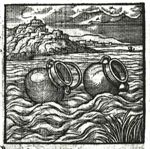
Aliquid mali propter vicinum malum: Alciatus, Emblemata (Leiden, 1591), emblem 165 quotes the comment
Bonis a divitibus nihil timendum: Alciatus, Emblemata (Padua, 1621), col. 181 a, emblem 32 quotes the comment
Ex malo bonum: De Montenay, Cent Emblèmes Chrestiens (Frankfurt, 1619), emblem 66 quotes the comment
Iconclass: 33A7 neighbour 47I21111 ox 56F21(+0) Neighbourly Love; 'Amor del Prossimo' (Ripa) (+ variant)
Loci Communes: Malus vicinus (A bad neighbor, Un mauvais voisin)
IV v 2 Caput artis, decere quod facias The secret of artistic success is doing what suits you
Quintilianus libro Institutionum oratoriarum 11. videtur veluti vulgo celebratum adducere: Caput est artis decere quod facias. Ipsius verba sunt: Unum etiam his adiciendum est, cum praecipue in actione spectetur decorum, saepe aliud alios decere. Est enim latens quaedam in hoc ratio et inenarrabilis: et ut vere dictum est, caput esse artis, decere quod facias, ita nec sine arte esse, nec totum arte tradi potest. Hactenus Fabius. Id usurpare licebit, non solum ubi quid fiet parum decore, veluti si cantillet aut lusitet senex, si praeeat et obiurget iuvenis: verum etiam cum negabimus quibuslibet quiduis esse decorum Quod saepenumero videamus evenire, ut quod ab hoc dictum aut factum placet universis, si idem tenet alius, etiamsi doctior peritiorque nemo tamen ferat. Id cum quottidie videamus accidere, tamen ut accidat, ratio reddi non potest.
Quintilian in book eleven of his Principles of Oratory seems to adduce a wellknown common expression: 'The prime means of attaining artistic success is to do what suits you well.' I shall add his actual words.
One further point must be made. While what is seemly is the main consider-
ation in delivering a speech, different things often suit different people. For
there is some hidden and inexplicable principle underlying this, and while
it is a true saying that the prime means of attaining artistic success is to do
what suits you, this cannot be achieved without art nor can it be taught in its
entirety by art.
So Fabius. We can use this not only of some unseemly action (for example, of an old man singing or playing games, or of a young man walking ahead of or castigating older men), but also to deny that there is anything that suits all persons. We often see that something said or done by one individual happens to please everyone, while no one would tolerate it if someone else tried the same thing, even if he were more learned and more experienced. Although we see this happening every day, it is impossible to explain it.
Facsimile:
Iconclass: 48 art 51BB6 Originality 54F1 Success; 'Evento buono' (Ripa)
Loci Communes: Absurda, indecora, seu praepostera (Absurd, unbecoming, or preposterous things, Choses absurdes, inconvenantes ou déplacées)
IV v 3 Domus recta A good home
Annaeus Seneca libro Epistolarum familiarum xvi. Videbimus quod parum recisum sit, quod parum structum, quod non huius recentis politurae. Cum circumspexeris omnia, nullas videbis angustias inanes. Desit sane varietas marmorum et conscis. sura aquarum a cuniculis in terfluentium, et pauperis cella, et quidquid aliud luxuria, non contenta decore sim plici miscet. quod dici solet, domus recta est. Hacterus Seneca. Quod si locus non vacat mendo, significat vulgo domum rectam vocari, non quidem opulentam et ambitiosam, sed cui nil desit iustae supellectilis. Ad eundem modum M. Tullius Graecorum linguam ambitiosae merettici confert, quae multo luxu superfluat: Latinorum honestae, ac pudicae matronae, cui nihil deest, quod ad honestam pertineat mundiciem.
Annaeus Seneca in book sixteen of his Letters: 'We shall see what is roughly hewn, poorly constructed, and has nothing of the polish that is now fashionable. When you consider everything as a whole, you will see no useless nooks. Granted there are no different kinds of marble, no complex network of water channels, no 'pauper's room' or anything else that luxury adds when it is not content with simple charm; all the same, in the common phrase, it is a good house.' So Seneca. If the passage is not free of error, it means that what is commonly called 'a good house' refers to one that does not lack the proper furnishings, not to one that has expensive and ostentatious fittings. In the same way Marcus Tullius compares the Greek language to a pretentious harlot living in a surfeit of luxury, the Latin language to a modest and upright wife who has all that is needed for simple elegance.
Facsimile:
Iconclass: 57A641 Discretion, Modesty; 'Discretione', 'Modestia' (Ripa) 57A642 Simplicity; 'Simplicità' (Ripa)
Loci Communes: Modestia modusque (Modesty and moderation, Modestie et mesure)
IV v 4 Non est beatus, esse qui se nesciat He is not happy who does not know it
Idem in eodem opere versiculum hunc e poeta quopiam allegat Comico: Non est beatus, esse qui se nesciat, haud dubium quin populari sermone iactatum, cum auctoris nomen non adscripserit. Sensus est, haud esse satis, ut adsit felicitas, ni felicitatem tuam intellexeris. Huc adludens Virgilius: O fortunatos nimium, bona si sua norint Agricolas Eodem pertinet, quod Martialis inter felicitatis calculos hunc quoque commemorat. Quod sis esse velis. Quid enim felicius libertate: Atqui videas non paucos qui sortem deplorent suam, quod in principum aulis locum non inveniant: miseros se putant, quod seruire non liceat. Verum ut beatus non est, qui se non putat beatum: ita bis miser est, qui cum animi malis sit infelix, tamen sibi videtur felix. Etenim ut qui sanus est, et sibi videtur aegrotus, non fruitur suo bono: ita qui morbo tenetur, non intelligens suum malum, longissime abest a sanitate: quippe qui usque adeo sanus non sit, ut sit etiam insanabilis.
The same author in the same work adduces this verse from some comic poet, 'He is not happy who does not know it.' It must have been a common expression of everyday speech since he has not given the author's name. The sense is that it is not enough to enjoy good fortune unless you realize you have it. Virgil, alluding to this: 'How blessed are farmers if they know their blessings.' What Martial mentions as one of the principles of happiness, 'Wish to be what you are,' is similar in nature. For what is happier than freedom? And yet we can see many persons bewailing their lot because they find no place in the courts of princes. They think themselves miserable because they cannot be slaves. But just as those who do not think themselves happy are not happy, so twice miserable are those who think themselves fortunate, even though they are unfortunate in respect to their moral weaknesses. To be sure, the man who is healthy but thinks himself sick does not enjoy his good fortune. Similarly, the man who is gripped by disease but does not realize his misfortune is very far removed from good health; so far from being healthy, he is even incurable.
Facsimile: 
Iconclass: 52A5:56B2 Knowledge; 'Cognitione', 'Cognitione delle cose' (Ripa)❧Happiness, Felicity 52A53 Self-knowledge
Loci Communes: Contrarium philautiae (The opposite of self-love, Le contraire de l'amour-propre)
IV v 5 Amicus certus in re incerta cernitur Uncertainty sees a certain friend
M. Tullius in Laelio, senarium hunc ex Ennio citat proverbii specie: Amicus certus, in re incerta cernitur. Quo significatum est, amici fidem in rebus adversis explorari. Nam quod cum periculo coniunctum sit, id dubium appellant, pro quo Ennius posuit incertum, affectans ἐναντιωσιν & προσονομασίαν, quibus schematis impendio delectatus est, atque adeo non ipse solum, sed et omnis illa aetas usque ad M. Tullium. Plautus item, eum amicum pronuntiat, qui in re dubia iuvat. Habent eandem sententiam Hebraeorum proverbia, Omni tempore diligit qui amicus est, & frater in angustiis comprobatur.
Marcus Tullius in his Laelius cites this senarius from Ennius as a proverb, 'Uncertainty shows a sure friend.' This means that a friend's loyalty is tested in adversity. For what is linked to danger is termed dubius 'doubtful,' for which Ennius wrote incertus 'uncertain,' aiming for ἐναντιωσιν 'the conjunction of opposites' and προσονομασίαν 'assonance,' figures that he took particular delight in. And he was not alone in this; that whole period up to the time of Marcus Tullius did so too. Plautus also asserts that a friend is 'he who helps in times of doubt.' The same sentiment is found in the proverbs of the Hebrews: 'A friend loves at all times and is proved a brother in adversity.'
Facsimile:
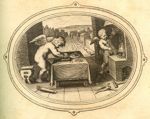
Amor certus in re incerta cernitur: Vaenius, Amorum emblemata (Antwerp, 1608), emblem 23
Certus in re incerta amicus: Reusner, Aureolorum Emblematum (Strasbourg, 1587), emblem 31
L'amy certain au besoin se cognoit: Boissard, Emblemes (Metz, 1588), emblem 31
Iconclass: 54FF11 Adversity, Misfortune, Bad Luck; 'Fortuna infelice', 'Infortunio' (Ripa) 56F231 Fidelity in Friendship; 'Confermatione dell'Amicitia', 'Fede nell'Amicitia' (Ripa)
Loci Communes: Amicitia (Friendship, Amitié)
IV v 6 Avarus nisi cum moritur, nil recte facit A miser does nothing right except when he dies
Omnes fermê Publianas sententias videmus proverbiorum vice fuisse cellebratas, nec iniuria sane. Nihil enim illis fingi potest nec argutius nec iucundius, quorum hic unus est: Avarus nisi cum moritur, nil recte facit. Etenim qui sese pecuniae studio addixit nulli commodus est dum vivit. Sola mors voluptartem et emolumentum adfert heredi.
I am aware that almost all the aphorisms of Publius were celebrated as proverbs, and quite rightly too. For nothing wittier or more pleasing can be imagined. We ourselves recently published an emended version of his 'mimes' and were happy to explain them in brief notes. It is not my intention, therefore, to take all of them over into this collection, except for one or two that appeal to me more than others. One of these is 'A miser does nothing right except when he dies.' Certainly the man who has bound himself over to the pursuit of money does no one a good turn while he lives. Death alone brings pleasure and profit to his heir.
Facsimile:
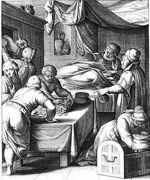
Avarus nisi cum moritur nil recte facit: Vaenius, Emblemata Horatiana (Antwerp, 1612), emblem 54
Iconclass: 31E:32A44 death of human being❧miser 54F12 Luck, Fortune, Lot; 'Fato', 'Fortuna', 'Fortuna aurea', 'Fortuna buona', 'Fortuna pacifica overo clemente', 'Sorte' (Ripa)
IV v 7 Bona nemini hora est Time is good for no one
Arrisit et hic: Bona nemini hora est, quin alicui sit mala. Ita fortuna temperavit res mottalium, ut quod huic laetum est, alii pariat dolorem: quod alii lucro est, alii damnum adferat. Nemo ditescit, nisi malo alterius. Nemo vincit in bello, nisi exitio alterius. Nisi mavis pro alicui legere, alicubi.
This one too appealed to me: Bona nemini hora est quin alicui sit mala 'Time is good for no one without being bad for someone else.' Fortune has so tempered human affairs that what brings joy to one produces pain for another, what profits one person brings loss to another. No one becomes rich except at the expense of someone else. No one conquers in war without another's death. Unless you prefer to read alicubi 'somewhere' instead of alicui 'someone.'
Facsimile:
Iconclass: 23 time 46B47 profit and loss 54F122 Vicissitudes of Life
Loci Communes: Fortunae commutatio (Change of fortune, Changement de fortune)
IV v 8 Spontanea molestia Trouble of one's own making
Celebratur inter Graecos, cum primis bellus & elegans trimeter: Αὐθαίρετος λύπη ᾽σὶν ἡ τέκνων σπορά. id est, Ultroneus dolor est parare liberos. Dici non potest, quantum et quàm molestum negocium sit, educare filios, praesertim cum adeo pauci sint, qui parentum officio respondeant. Verum hanc molestiam, non est cui possint imputare, cum liceat coelibem vivere. Longius trahi potest, ad eos, qui sibi sponte periculum ac molestiam accersunt. Atque adeo similis propemodum conditio est, tollentium liberos & scribentium libros. Tuendum, emendandum, quod scripseris, & tamen non est quem incusemus, cum nobis liberum sit dormire.
An especially fine and elegant trimeter is well known among the Greeks: Αὐθαίρετος λύπη ᾽σὶν ἡ τέκνων σπορά 'Having children is self-inflicted pain.' It is impossible to say what a great and troublesome task it is to bring up children, especially when there are so few who are capable of fulfilling the duties of a parent. But there is no one else parents can blame for this trouble since one can choose to be a bachelor. It can be applied less literally to those who seek out danger and trouble for themselves of their own accord. Having children and writing books are very similar activities. We must protect and correct what we have written, but there is no one to complain to, since we are free to sleep instead of writing.
Facsimile:
Iconclass: 42A:58AA12 procreation, birth and (early) youth❧Self-destruction 42B1 parental love 42B8 correction of naughty children 54DD4 Difficulty
Loci Communes: Malum accersitum aut retortum (Evil brought upon oneself or turned back, Mal attiré ou retourné)
IV v 9 Sapiens sua bona secum fert The wise man carries his resources with him
Ο σοφὸς ἐν αυτῷ περιφέρει τὴν οὔσίαν id est, Sapiens opes sibi secum habet semper suas, à Biantis, ni fallor, apophthegmate natum, qui rogatus, cur nihil exportaret rerum suarum ex incendio patriae, Ego vero, inquit, omnia mea bona mecum porto: significans ea, quae vere nostra sunt intra nos esse, velut eruditiohem ac virtute,. Ut rersum quae vere mala sunt nostra. non licet effugere, quantumlibet commutetur locus.
Ο σοφὸς ἐν αυτῷ περιφέρει τὴν οὔσίαν, The wise man always has his resources with him. In origin this is an apophthegm of Bias, if I am not mistaken. When he was asked why he was not removing any of his possessions when his native city was ablaze, he said, 'I carry all my goods with me.' He meant that those things that are truly ours, such as learning and virtue, lie within us. Similarly, one cannot escape those things of ours that are really bad, no matter how often you change your abode.
Facsimile:
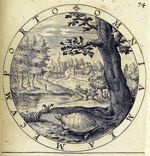
Omnia mea mecum porto: Rollenhagen, Nucleus emblematum (Arnhem, 1618), Cent. I, emblem 74
Omnia mea mecum porto: Alciatus, Emblemata (Leiden, 1591), emblem 37
Iconclass: 31B7 wise man 46C121:55B carrying something❧Possession 51E1 Independence, Autonomy
Loci Communes: Bonae fortunae, copiae, felicitatis aut ominis (Of good fortune, abundance, happiness, or omen, Bonne fortune, abondance, bonheur ou présage)
IV v 10 Citius Telegorae donarim I would sooner give it to Telegoras
Telegoras apud Naxios praedives quispiam ac praepotens erat, cui quia quottidie multa missitarentur, vulgato sermone receptum est, ut venditores paruo licitantibus dicerent, μᾶλλον προέλοιμι τῷ τελεγόρᾳ δοῦναι. id est, Malim Telegorae dare. Refertur apud Athenaeum lib. Dipnosoph. 8. ex Aristotele. Rem longius prosecuti sumus in proverbio: Nullus malus magnus piscis. Nec videtur quis usus adegionis esse possit, nisi si dicamus officium rectius gratuito collocari penes probos ac magnos, quam mercede penes improbos ac viles.
Telegoras was an extremely rich and powerful man in Naxos. Because he received many gifts every day it became the custom in everyday speech for traders to say to those who offered too little for their wares, μᾶλλον προέλοιμι τῷ τελεγόρᾳ δοῦνα 'I would rather give it to Telegoras.' It is cited from Aristotle in Athenaeus, in book eight of his Doctors at Dinner. We have pursued the topic at greater length in the proverb 'No bad big fish.' I do not see how we may use the proverb except to point out that it is better to perform a service for upright and important persons at no charge than one for worthless scoundrels at a price.
Facsimile:
Iconclass: 55C2:46A16 Giving❧the rich 98B(TELEGORAS) male persons from classical history (TELEGORAS)
Loci Communes: Divitum praerogativa (The privilege of the rich, Le privilège des riches)
IV v 11 Hecatae coena A Hecate dinner
Veteres coenam perparcam et impendio frugalem Hecatae cenam appellabant, quod apud inferos tenuissimo victu, minimoque cibo, eoque vilissimo vivitur, iuxta poetarum theologiam. Siquidem umbrae plebeiae malva porroque victitant, Hecate Maenides ac Triglidas pisces, apud nos contemptissimos, habet in deliciis, ut sibi sacros, Unde et Athenis locum esse dictum Triglam, qtque inibi simulacrum Hecates Triglantinae. Alii Triglam illi sacram putant ob nominis rationem a ternione dicti, cum triformis sit et Hecate. Exstat apud Athenaeum libro septimo. Memin et Lucianus alicubi. Verum illud expendat eruditus lector, an proverbium accipi possit de cena illa, quam singulis mensib. in triviis Hecatae collocabant divites, diripiebant pauperes. Cuius rei meminit etiam Aristophanes in Pluto: Παρὰ τῆς ἑκάτης ἔξεστι τοῦτο πύθεσθαι, Εἴτε τὸ πλουτεῖν, εἴτε τὸ πεινῆν βέλτιον. φησὶ γὰρ αὕτη Τοὺς μὲν ἔχοντας καὶ πλουτοῦντας δεῖπνον κατα μῆνα προσάγειν, Τοὺς δὲ πένητας τῶν ἀνθρώπων ἁρπάζειν, πρὶν καταθεῖναι. id est, Hoc ex Hecata si vis didicisse licebit, Utrum potius, ditem esse, an egenum, quandoquidem tubetilla Hos quibus est rex quoque benignam mense uno ponere cenam, Ceterum egenos hanc praedari prius ac deponere possunt. Quo quidem loco in hanc sententiam scribit interpres: olim in triviis venerabantur Hecaten, quod eadem tribus nominibus appelletur, Luna, Artemis et Hecate, Ceterum sub novilunium divites mittebant cenam vespere, veluti cenam Hecatae in triviis. Pauperes enim esurientes diripiebant ac devorabant, quae erant apposita, dicentes quod Hecate come disset. Itaque congruet, ubi res per tumultum diripitur.
The ancients called a very frugal and cheap meal 'A Hecate dinner,' because according to the religious views expressed in the poets those in the underworld have a very tenuous existence and live on a very small amount of food (and the cheapest at that). The ordinary shades live on mallow and leek, while sprats and triglides 'tiny red mullet,' fish that we think little of, are Hecate's favourites since they are sacred to her. Because of this there was a place in Athens called Trigla, where there was a statue of Hecate Triglantina. Others think that Trigla was sacred to her since its name was explained as deriving from the number three and Hecate too is of triple form. This is found in book seven of Athenaeus. He also mentions it in book eight. So also does Lucian somewhere. But a learned reader should consider whether the proverb can be taken to refer to the dinner placed by the rich each month at the crossroads, which were sacred to Hecate, and plundered by the poor. Aristophanes also mentions this in the Plutus:
This you can learn from Hecate, if you wish,
Whether 'tis better to be rich or poor,
Since she says that those with wealth
Offer a generous dinner a month,
But the poor steal it almost before they serve it up.
At this point the commentator says of these words: 'Formerly Hecate was worshipped where three roads met because she is called by three names: Moon, Artemis, and Hecate. At the new moon the rich used to send a meal in the evening as an offering for Hecate at such crossroads. In their hunger, however, the poor snatched up what had been set down and ate it, saying that Hecate had eaten it.' And so the proverb will be appropriate when something is seized violently.
Facsimile: 
Iconclass: 41C43 evening meal, dinner, supper 55CC1 Saving, Frugality, Parsimony; 'Parsimonia' (Ripa) 92N271(+0) Hecate triformis, i.e. with three bodies standing back to back (+ variant)
Loci Communes: Frugalitas (Frugality, Frugalité)
IV v 12 Mens videt, mens audit The mind sees, the mind hears
Νοῦς ὁρᾷ καὶ νοῦς ἀκούει. id est, Mens videt; mens audit. Hemistichium prius videtur carminis Trochaici, tetrametri, catelectici. Refertur ab Aristotele quasi vulgo iactatum Sectionis undecimae problemate xxxiii. ubi proposita quaestione, cur noctu acrius audiamus quam interdiu, inter alias causas et hanc reddit, quod interdiu animus variis negotiis distrahitur, qui nisi sit praesens, nec corporis sensus officio suo fungatur, adeo ut mente alienata, nec corporis dolorem interdum sentiamus: et ipsi sumus experti in cruciatu dentium, aut calculi, multo leviorem reddi doloris sensum, si possis animum in aliquam cognitionem alienam intendere, ὥσπερ, inquit, εἴρηται τὸ, νοῦς ὁρᾷ καὶ νοῦς ἀκούει. Noctu vero, quoniam oculoru sensus quiescit, et animi cogitatio tranquillior est, tum aurium meatus non minus patent nocte quam interdiu, nec minus capaces sunt sonorum, sed eos facilius etiam renuntiant animo, quod tum nullis actionibus distrahatur, nec oculorum sensu avocetur, quemadmodum in die fit, ut acutior sit aurium sensus. Locus erit adagio, ubi iubemus quempiam attentum esse, quemadmodum dicimus, Hic esto, & Isthic sum. De mente peregrinante nobis dictum est alias.
Νοῦς ὁρᾷ καὶ νοῦς ἀκούει, The mind sees, the mind hears. It seems to be the first half of a trochaic verse, a tetrameter catalectic. It is cited by Aristotle as a common saying in problem 33 of section 11, where the question under discussion is 'Why do we hear more keenly at night than during the day?' Among other reasons, he gives this one too, that during the day the mind has to focus on different tasks. For if the mind were not so focused, the bodily senses would not perform their functions. Indeed, if the mind is distracted we sometimes do not feel any physical pain. (I myself have experienced this when suffering the excruciating pain of toothache or of the stone, that one is much less aware of the pain if one can direct the mind into thinking of something quite different.) 'As the saying goes,' Aristotle says, 'the mind sees and the mind hears.' At night, however, our eyes are resting and our minds are more tranquil, but access to our ears is as unimpeded as during the day, and they are no less receptive of sounds. The ears can communicate these sounds to the mind more easily, since the mind is at rest and is not distracted by sight sensations, as happens in the day. The result is that our hearing is more acute. The adage can be used when we tell someone to be attentive, just as we say, 'Are you with me?' or 'I am with you.' I have spoken elsewhere about a wandering mind.
IV v 13 Thymbra victitans Living on savory
Θυμβρογάγοι, id est, Thymbra victitantes adagio dicebantur, vel qui tutius ac liberius vitam agerent, vel moribus essent parum blandis, vel qui hilariter citraque sollicitudinem paruo contenti viverent, quod Thymbra, quam eandem cunilam dicunt, herbae genus sit, quam Plinius non distinguit a Satureia, Columella distinguere videtur: Et Satureia, inquiens, Thymireferens, Thymbraeque saporem. Est autem saporis subamari, in agris passim provenit, et pratensis ad remedia praestantior est hortensi, ut auctor est Dioscorides, locis gaudens petricosis. Hortensis cibis aptior. Proverbium recensuit Suidas et Hesychius. Fertur Epaminondas mire frugalem vitam egisse, itaque de prandio parco tenuique dixisse, τὸ τοιοῦτον ἄριστον, οὐ χωρει προδοσίαν. id est, Tale prandium non recipit proditionem. Sensus autem dicti geminus est, vel quia nemo molitur insidias rebus modicis, vel quia qui modicis contenti sunt non facile corrumpuntur, ut prodant rem publicam. Amphis apud Athenaeum libro decimo: Εὐτελὲς γὰρ δεῖπνον οὐ ποιεῖ παροινίαν. id est, Ubi caena frugi est, nulla dehacchatio Graecus trimeter videtur corruptus inversione duarum dictionum: Restituetur si legas δεῖπνον γὰρ εὐτελὲς. & subdit ex Alexide, Ex prolixis conviviis primum nasci scommata, è quibus fere plus est doloris quam voluptatis. Hinc maledictum. Id geritur ac recipro catur in dicentem, mox à verbis ad verbera, Non ita qui Thymbra victitant.
Θυμβρογάγοι, Those who live on savory. Said of those who lived their lives in safety and freedom, or of those who had an unpleasant disposition, or of those who lived happy lives free of worries since they were content with a little. Savory, also called cunila, is a kind of plant that Pliny does not distinguish from satureia, although Columella seems to differentiate them, since he says, 'And satureia, recalling the taste of thyme and savory.' It has a rather bitter taste, and grows everywhere in the fields. The meadow savory has much better medicinal power than the garden variety, according to Dioscorides, and likes rocky ground. The garden variety is more suitable for eating. Suidas listed the proverb, as did Hesychius. Epaminondas is said to have lived an unbelievably frugal life, and said the following about a very light and scanty lunch: 'Such a lunch does not promote betrayal.' These words have two meanings, either that no one engages in treachery if he is of modest means or that those who are content to live modestly are not easily bribed to betray their country. Amphis in book ten of Athenaeus: 'A cheap dinner does not lead to drunken behaviour.' The Greek verse seems to be a trimeter that has been corrupted by the exchange of two words. The metre will be restored if one reads δεῖπνον γὰρ εὐτελὲς. Drawing on Alexis, Athenaeus tells us that at first very lengthy parties produce scurrilous jokes, which generally give more offence than pleasure. Then these give way to curses that are thrown back at the speaker; then words lead to blows. Not so for those who live on savory.
Facsimile: 
Iconclass: 25G4(SAVORY) plants and herbs: savory 41C232 poor kitchen 55CC1 Saving, Frugality, Parsimony; 'Parsimonia' (Ripa) 57A613 Integrity
Loci Communes: Asperitas, morositas (Harshness, moroseness, Rudesse, morosité); Frugalitas (Frugality, Frugalité); Securitatis et tutae rei (Security and safety, Sécurité et sûreté)
IV v 14 Doryphorematis ritu Like a bodyguard
Graeci δορυφόρημα vocant satellitium illud ex barbarorum saece conductum, quod olim tyranni ad custodiam corporis adhibebant, nunc a regibus magis fastus quam tutelae gratia alitur. In tragoediis igitur sic addebatur regum personis dorufo/rhma, ut adstarent modo, nihil etiam loquerentur. Unde qui taciti assident, δορυφόρημα τρόπον adesse dicuntur. Sic Athenaeus lib. quinto, παρεμβάλλοντός τινα λόγον πεισιστράτου, χρὴ γὰρ καὶ τοῦτο μὴ παρεῖναι δορυφορήματος τρόπον. i. Cum iniceret sermonem quendam Pisistratur: Neque enim oportet hunc adesse more Doryphorematis: hoc est, tacitum et nihil adferentem in medium. Usurpatur à Luciano in libello De conscribenda historia, his quidem verbis: οὐκοῦν ὦ φίλων, ὡς μὴ μόνος ἄφωνος εἴην ἐν οὕτω πολυφώνῳ τῷ καιρῷ, μή δ᾽ ὥσπερ κωμικόν δορυφόρημα κεχηνὼς σιωπῇ περιφεροίμην, i. Igitur amici, ne solus essem mutus in tempore tam vocali, neque veluti comicum Doryphorema hians cum silentio obambularem.
The Greeks give the name δορυφόρημα 'bodyguard' to escorts hired from the dregs of the barbarians. In antiquity tyrants used these as protection; now kings have them in their household more for show. And not just kings but even the highest prelates! In tragedies kings were given an escort who simply stood beside them, saying not even a word. Because of this, those who sit beside you in silence are said to attend you δορυφόρημα τρόπον 'Like a bodyguard.' So Athenaeus in book five: 'When Peisistratus interposes a word, one should not be present like a bodyguard,' in other words, being silent and contributing nothing to the conversation. It is used by Lucian in his essay On Writing History in these words: 'So, friend, that I might not be the only mute at such a talkative time and, like a bodyguard in comedy, wander around in silence with mouth agape .. .'
Facsimile:
Iconclass: 44B1527 body-guard of ruler 52DD3 Taciturnity; 'Secretezza', 'Secretezza overo Taciturnità' (Ripa)
Loci Communes: Taciturnitas illaudata (Unpraised silence, Silence non loué)
IV v 15 Musicam docet amor Desire is a teacher of the arts
Plutarchus adducit et hoc adagium trochaico versu expressum, Μουσικὴν ἔρως διδάσκει, κἄντις ἄμουσος ᾖ τὸ πρὶν. id est, Musicen docet amor, et si fuerit indoctus prius. Sensus est amorem ad industriam excitare animum, artiumque & omnis elegantiae magistrum optimum esse, Socrates in convivio Platonis, putat animam immersam corpori, velut expergisci amoris stimulis, et hinc primos ad honesta impetus capere, tamquam excusso veterno. Unde deum hunc idem Plato παντὸς ἐπιχειρήτην appellat, quod nihil non experiatur. Siquidem e taciturno reddit loquaculum, e verecundo stupidoque comem ac blandum, è negligente diligentem. Extat in hanc sententiam non illepidam fabella Boccatii, ni fallor, de Cimone, qui tactus amore puellae, ne posset ut rusticus fastidiri, omni literarum ac morum genere semet expolivit. Nam Musicen hic sentit literas, quas antiquitas novem Musis dicabat. Adlusit ad proverbium Bion in Bucolicis, qui cum multis versibus docuisset musas semper esse comites amoris, subiicit, Μάρτυς ἐγὼν, ὅτι μῦθος ὅδ᾽ ἔπλετο πᾶσιν ἀληθὴς. id est, Testis ego dictum hoc haud umquam fallere quemquam. Potest et ad verecundiorem usum detorqueri proverbium, si dicas non mediocrem esse gradum ad discendum, amasse praeceptorem: potest et ad pium, si dieas caritatem esse virtutem omnium magistram, quae nisi adsit, nihil recte feceris.
Plutarch adduces this proverb too, expressed in a trochaic verse: Μουσικὴν ἔρως διδάσκει, κἄντις ἄμουσος ᾖ τὸ πρὶν, 'Love teaches the arts, even in someone who is uncultured.' The meaning is that love stirs the mind to industry and that it is the best teacher of the arts and of everything that is elegant. Socrates in the Banquet of Plato thinks that the soul, immersed in the body, is, so to speak, awakened by the goads of love and is first impelled by it to pursue what is good. It is as if the soul has shaken off its lethargy. This is the reason that Plato also describes this god, Eros, as παντὸς ἐπιχειρήτην 'he who attempts all things,' because there is nothing he does not put his hand to. For he turns someone who is taciturn into a chatterer, someone who is shy or doltish into one who is friendly and charming, someone who is careless into one who is conscientious. There is a rather charming story, of Boccaccio I think, about Cimon that relates to this expression. Touched by love for a young girl, he became polished in every kind of literature and in his manners so that she could not despise him as being uncultured. I say this for in this verse musice means literature, which the ancients dedicated to the nine Muses. Bion alluded to the proverb in the Bucolics. After expounding in many verses that the Muses are always the companions of love, he adds, 'I myself am a witness that this saying applies to all.' The proverb can be used in a less immodest context if one says that love of one's teacher is a giant step towards learning. It can also be applied to a devout person by saying that love of one's fellow beings is the teacher of all virtues. For if you do not have that love, nothing you do will be righteous.
Facsimile:

Amor docet musicam: Cats, Spiegel (The Hague, 1632), emblem 7 uses the adage as its motto
Amor docet musicam: Wither, A collection of emblems (London, 1635), emblem 70 uses the adage as its motto
Amor addocet artes: Vaenius, Amorum emblemata (Antwerp, 1608), emblem 36 paraphrases the adage
Amour contrainct toutes gens estre braues: La Perrière, Le theatre des bons engins (Lyon, 1545), emblem 62 uses the imagery of a donkey dancing to the music of a lute played by Cupid; subscriptio and the adage's comment both refer to Boccaccio
Iconclass: 48C7 music 56F2:48B14 (personifications and symbolic representations of) Love; 'Amore (secondo Seneca)' (Ripa)❧education, tuition of the artist (in general)
IV v 16 Sicyon arrodens uxor lacernam texe Gnaw on your gourd, wife, and weave the cloak
Athenaeus libro Dipnosophist. 3. heroicum hunc ut proverbialem adducit, Τὸν σικυὸν τρώγουσα γύνα, τὴν χλαῖναν ὕφαινέ. id est, Arrodens Stoyon uxor subtexe lacernam. Apparet esse verba mariti iubentis, ut uxor tenui contenta victu, perageret opus suum. Nam Sicyon seu Sicyos bulbi genus est, aut certe peponis: nonnulli putant cucumeris. Vox ea propemodum quadrat in huius temporis principes, qui strenue profundunt, quod populus esuriens, summis laboribus paraverit. Idque suum ius esse putant, ut ceu fuci quidam alienis fruantur sudoribus. Hermolaus Barbarus Corollariis in Dioscoridem ca. ccc.lxvi, videtur aliud divinare, scribens ex Aristotelis sententia, plerasque textrices esse impudicas. An Sicyos Venerem temperet nescio.
In book three of the Doctors at Dinner Athenaeus adduces this hexameter line as proverbial: Τὸν σικυὸν τρώγουσα γύνα, τὴν χλαῖναν ὕφαινέ 'Gnaw at your gourd, wife, and weave the cloak.' These are obviously the words of a husband, telling his wife to be content with very modest fare and to complete her work. For sicyon or sicyos is a kind of gourd or melon. Some think it is a kind of cucumber. This expression suits quite well the princes of our times, who spend eagerly and extravagantly what their starving people have accumulated for them with the greatest labour. And they think it is their right, like drones, to enjoy what is earned by the sweat of others. Ermolao Barbaro in chapter 366 of his Corollaria on Dioscorides seems to interpret it differently. Following Aristotle he writes that most weaverwomen are promiscuous. Whether the sicyos reduces sexual desire I do not know!
Facsimile:
Iconclass: 41C11:25G21(GOURD) eating❧fruits: gourd 47H46:41D212 weaving❧coat, cape 55CC1 Saving, Frugality, Parsimony; 'Parsimonia' (Ripa) 56B3 Satisfaction, Contentment; 'Contento' (Ripa)
Loci Communes: Frugalitas (Frugality, Frugalité)
IV v 17 Tetigit lapidem a cane morsum He has touched a stone that a dog has bitten
Plinius lib. 29. cap. 5. de veneno rabidi canis agens: Tanta, inquit, vis mali est, ut urina quoque calcata rabiosi canis noceat, maxime hulcus habentibus. Remedium est fimum caballinum, aspersum aceto, et calefactum in vino appositum. Minus hoc miretur, qui cogitet lapidem a cane morsum usque in proverbium discordiae venisse. Hactenus Plinius. Cuius e verbis conicere licet, vulgo creditum fuisse, si quis lapidem a cane morsum contigisset aut calcasset, eum iracundiorem evadere, et ad dissidia propensum. Fortassis ita dictitabant in hominem convitiatorem ac rixosum? Hic lapidem calcavit a cane morsum.
In his discussion of a rabid dog's poison in book twenty-nine chapter five, Pliny says, 'The poison is so strong that it is harmful even to step in the urine of a rabid dog, especially if one has open sores. The cure is a poultice of horse manure to which vinegar has been added and which has been placed and heated in wine. This will occasion less surprise to anyone who remembers that "A stone that a dog has bitten" has become a proverb for quarrelsomeness.' So Pliny. We can infer from his words that it was a common belief that whoever touched or stepped on a stone that had been bitten by a dog became more irritable and was inclined to quarrelsomeness. Perhaps it was said of a person who ranted and raved and was always ready for a fight, This fellow has stepped on a stone that a dog has bitten.'
Facsimile:
Iconclass: 31A2742(+933):25D12 reaching for something (+ holding something)❧kinds of non-precious stone 31A4623(RABIES) (RABIES) contagious diseases (RABIES) 34B11(+9512) dog (+ animal(s) attacking) 56E21 Irascibility
Loci Communes: Rixosus (Quarrelsome, Querelleur)
IV v 18 Erecti To one's full height
Athenaeus in Dipnosophistarum lib. 5. Καὶ τὸ θαυμασιον, ὅτι παρειμένοι καὶ καρηβαροῦντες ὑπο τῆς μέθης, ὁπότε τὶ τοῦ ἀγομένων θεασαίμεθα, πάντες ἐξενήφομεν, ὀρθοὶ τὸ δὴ λεγόμενον, ἀνισταμενοι, id est, Et quod dictu mirum, cum de pressi essemus, et capite gravato temulentia, quoties spectassemus aliquid eorum, quae inferebantur, omnes expergiscebamur, recti, quod dici solet surgentes. Accommodum erit, ubi signiricabimus aliquem toto pectore attentum ad rem quampiam. Erigut enim se totos, & summis nonnunquam insistunt pedibus, qui auscultant aut spectant avidius.
Athenaeus in book five of his Doctors at Dinner.
And what is marvellous, although we were low in spirit and suffering from
heads that were heavy from drinking, whenever we saw any of these things
being brought in, we all pulled ourselves together, [greek] 'rais-
ing ourselves to our full height,' as the saying goes.
The expression will be suitable for describing someone who is wholeheartedly set upon some enterprise. Those who are rather eager to listen to or see something raise themselves to their full height and sometimes stand on tiptoe.
Facsimile: 
Iconclass: 31A26112 standing or leaning with both legs straight, side by side, standing on tiptoe 31A2752 stretching (movement of the human body) 56D32 Commitment
Loci Communes: Attentio et contra (Attention and its opposite, Attention et son contraire)
IV v 19 E clibano boves Pot-roast oxen
Proverbium sapit, quod scripsit Aristophanes, ἐν ἀχαρνεῦσι: Εἶτ᾽ ἐξένιζεν, παρετίθει δ᾽ ἡμῖν ὅλευς Εκ κριβάνου βοὖς. id est, Accepit inde, & apposuit totos beves E clibano nobis. Usus erit, quoties efferemus splendorem convivii, aut insignem edacitatem. Consimili figura vocabant Hecatomben, id quod aliquanto post sequitur apud eundem Poetam: καὶ πολύποδων ἑκατόμβην. i. Et polyporum hecatomben.
What Aristophanes writes in the Acharnians has the flavour of a proverb: 'Then he welcomed us and set before us whole '[greek]s "Oxen pot-roast."' It will be used to indicate the sumptuousness of a banquet or excessive greed. 'Hecatomb' was a term used with the same figure of speech, as appears somewhat later in Athenaeus in a citation from the same poet: [greek] 'and a hecatomb of octopuses.'
Facsimile:
Iconclass: 41C231 rich kitchen 41C5 celebration meal, feast, banquet 41C692(OXEN)(+7) kinds of meat (OXEN) (+ cooked foodstuffs) 55B2 Luxury, Luxuriousness
Loci Communes: Luxus et mollicies (Luxury and softness, Luxe et mollesse)
IV v 20 Sequitur perca sepiam A perch follows a cuttle-fish
Athenaeus lib. 7. nullo autore, refert huiusmodi proverbium: e(/pitai pe/rkh melanou/rw|, id est, Comitem sibi ducit sepia percam. lib. 10. ex Aristoph. adducit, nec addit in quem sensum soleat usurpari, nisi quod videtur dictum de improborum societate. Apud eundem paulo inferius adducutur hi versus Numenii, qui de piscibus prodiderit: Φυκίδας ἀλφηστήν τε καὶ ἐν χροιῆσιν ἐρυθρὸν Σκορπίον,ἢ πέρκαισι καθηγητὴν μελάνουρον.
In book seven Athenaeus reports this proverb, without naming a source: [greek] 'A cuttle-fish brings along a perch as a companion.' In book ten he adduces it from Aristophanes, but he does not add in what sense it is customarily used, I conjecture, however, that it was said of a gang of scoundrels. A little later in the same author these verses of Numenius, who wrote about fish, are adduced: 'Wrasse and labrus and scorpion fish red in its skin / Or a cuttle-fish, the guide to perch.'
Facsimile:
Iconclass: 25F62(PERCH) bony fishes (PERCH) 25F72(CUTTLE-FISH) molluscs: cuttle-fish 33A71(+0) partner (+ variant)
Loci Communes: Similitudinis et congruentiae (Similarity and congruence, Similitude et convenance)
IV v 21 Feri puer Shoot, child
Athenaeus lib. Dipnosophistarum 25. demonstrat olim proverbio solitum acclamari i/h paiw\n, quo significabant quempiam suo munere defunctum. Itidem ferme, quemadmodum nos absolutae virtuti gratulantes dicere solemus: Macte animo, macte virtute Narrat enim cu quispiam e con vivio discessisset probe potus, ac magnopere somnolentus, ceteros in eum acclamasse i/h paiw\n. Huius adagii fieri mentionem apud Clearchum in proverbiis, quod ab huiusmodi natum eventu tradit: Cu Latona Apollinem ac Dianam ex Chalcide Delphos deportaret, iamque ad Pythonis specum venisset, et draco concitus in eos provolaret, Latona puellam ulnis baiulans, Apollinis praesidium implorans, clamabat, ἵε παῖ, cum is forte fortuna arcum teneret, ac petinde valere, ἵε παῖ, quasi dicas ἄφιε παῖ, id est, mitte ac percute fili. Nonnullos deflexis nonnihil vocibus efferre, ἵε παιὼν, idque proverbio dici solere, quoties in reb afflictis poem imploramus. Rursum alii putant acclamari hoc pacto feliciter suo perfunctis munere, et eo quod expetebant potitis. Ceterum ob adsuetudinem non videri proverbium, quod his vocibus sollemniter uterentur in sacris Apollinis. Ιη παιὰν, ἴη παιὰν, ἴη παιὰν Unde & ἰαμβικὸν τρίμετρον ortum existimant, quod & ipsum impetum ac celeritatem habet. Etenim si producas priorem in ih, carmen erit hexametrum heroicum: si corripias, iambicum. Porro quod apud Athenaeum in ἵε & ἴη nunc aspiratur, nunc tenuis est, nescimus an librariorum incuria factum sit. Ovidius in arte amandi videtur usurpasse pro acclamatione, qua gratulantur victori votique compoti. Dicite io Paeaen, & io bis dicite Paean, Decidit in casses praeda petita meos.
In book fifteen of his Doctors at Dinner Athenaeus points out that in antiquity approbation was shown by the proverb [greek], which indicated that someone had completed his task - much the same as we are accustomed to say, 'Bravo, well done,' when congratulating someone for an act of consummate bravery. He says, for example, that when someone left a banquet quite drunk and very sleepy all the others called out to him [greek]. He adds that this adage is mentioned by Clearchus in On Proverbs, who says that it originated in the following event. When Latona was taking Apollo and Diana from Chalcis to Delphi, they came to the cave of Python. The serpent, disturbed, rushed out at them. Latona, who was carrying her daughter in her arms, begged Apollo for help and called out [greek] 'Shoot, son,' since by good luck he happened to be carrying a bow, [greek] meaning much the same as [greek], that is, 'Shoot and strike, son.' Then some people varied the expression somewhat, saying [greek]. This is customarily used in a proverbial way whenever we beg for help in danger. Others think that those who have successfully performed their duty and have achieved their aim are acclaimed in this way. However, in light of how they are commonly used, the words that are solemnly spoken in the rites of Apollo, [greek], do not seem to be proverbial. It is thought that the iambic trimeter, which by its nature expresses forcefulness and speed, sprang from these words. If you pronounce the first syllable in [greek] as a long vowel, the verse will be a dactylic hexameter; if you pronounce it as short, the verse will be iambic. The fact that in the text of Athenaeus te and [greek] sometimes have a rough breathing, sometimes a smooth one, probably results from the carelessness of scribes. Ovid in his Art of Love appears to use it as a shout of approbation, one that congratulates a victor or someone whose aspirations have been fulfilled: 'Say "io Paean," repeat "io Paean"; / The booty I sought has fallen into my nets.'
IV v 22 Pulcre fallit vulpem It's a fine thing to deceive a fox
Παλεύει καλῶς τὴν ἀλώπεκα. i. Decipit pulchre vulpem. Suidas recenst duntaxat, nec explicat. Apparet dictum in eum, qui dolis captaret astutum, cuique frustra tenduntur insidiae. Nam παλεύειν est arte illectare. Unde et columbae exoculatae quas aucupes in reti ponunt, quo subsultantes, reliquas deceptas alliciant, παλεύτριαιpaleu/tri/ai dicuntur. Et qui feris tendunt casses, παλευταίpaleutai\ vocantur. At vulpem dolo circumveniro difficile est.
[greek], It's a fine thing if he deceives a fox. Suidas only lists this, without explanation. It appears to have been said of someone who tried to get the better of a clever person by deceit but set his trap in vain. For [greek] means to allure by artifice. This is why [greek] is the name given to doves that fowlers blind and place in a net. As they flutter around they will deceive other doves and lure them in. In addition, those who stretch out nets for wild beasts are called [greek]. It is difficult, however, to get the better of a fox by deceit.
Facsimile:
Iconclass: 25F23(FOX) beasts of prey, predatory animals: fox 43C1113(+432) bird hunting (+ decoy animals, e.g. decoy duck, stool pigeon ~ lures (hunting)) 57AA621 Cheat, Deceit; 'Fraude', 'Inganno' (Ripa)
Loci Communes: Insidiae (Ambush, treachery, Embûches)
IV v 23 Aut piscem olet, aut florem Smelling of fish or flower
Aut piscem olet, aut timallum. Ambrosius Hexaemeron lib. 5. cap. 2 testatur dictum in eum, qui bene oleret, quod timallus piscis sit odore gratissimus, et aeque fragrans eiusdem nominis flos. Sed praestiterit Ambrosii verba subscribere. Neque te inhonoratum nostra prosecutione timalle dimittam, cui a flore nomen inolevit, seu Ticini unda te fluminis, seu amoeni Atesis unda nutrierit, flos es Denique sermo testatior, quia de eo qui gratam redo let suavitatem, dictum facete sit, aut piscem olet, aut florem: ita idem pronuntiatus est, piscis odor esse, qui floris. Quid specie tua gratius? quid suavitate iucundius? quid odore fragrantius? Quod mella fragrant, hoc tu corpore tuo spiras. Verum haud scimus an pro timallo apud Ambronu legi debeat tithymallus, cuius varia genera receser Plin. lib. 26. cap. 8. cuiusque subinde meminit Dioscorides locis diversis.
Ambrose in Hexaemeron 5.2: 'Smelling of fish or timallus.' He attests that the saying is directed at someone smelling nicely, since timallus is the name of a fish with a most pleasing aroma, and the flower of the same name is equally fragrant. But it may be better to give Ambrose's words:
I shall not send you away unhonoured in my inquiry, timallus, on whom the
name of a flower has been engrafted; whether nourished by the waters of the
river Ticinus or of the beautiful Atesis, you are a flower. A more powerful
witness is a saying that has been wittily applied to a person who gives off
the aroma of a pleasing and sweet fragrance, 'Smelling of fish or flower.'
The smell of the fish is said to be the same as that of a flower. What can
be more pleasing than your appearance, more enjoyable than your sweetness,
more fragrant than your aroma? You breathe the fragrance of honey from your
body.
I rather think, however, that instead of timallus one should read tithymallus, various kinds of which are listed by Pliny in book twenty-six chapter eight, and which Dioscorides repeatedly mentions in different passages.
Facsimile: 
Iconclass: 25F6 fishes 25G41 flowers 31A331 agreeable smell 51B2 Similarity, Likeness 51B3 Parity, Equality
Loci Communes: Bonae fortunae, copiae, felicitatis aut ominis (Of good fortune, abundance, happiness, or omen, Bonne fortune, abondance, bonheur ou présage); Similitudinis et congruentiae (Similarity and congruence, Similitude et convenance)
IV v 24 Equi dentes inspicere donati Looking a gift horse in the mouth
Sunt quaedam & hodie vulgo iactata, non indigna quae veterib. adagiis annumerentur, quod genus est illud, non oportere equi dentes inspicere donati. Cum significamus aequi bonique consulendum, qualecumque est quod non emitur, sed gratis donatur. Siquidem equum empturus denres inspicir, in quibus aetatis indicia cerussima sunt, ne circumveniatur. Ac incivile sit idem facere in equo donaticio. Usus est tamen hoc proverbio D. Hieronymus in praefatione commentarioru, quos scripsit in epistola Pauli ad Ephesios. Parum, in quit, eloquens sum, Quid ad te? Disertiorem lege. Non digne Graeca in Latinum transfero, aut Graecos lege, si eius linguae habes scientiam, aut si tantum Latinus es, noli de gratuito munere iudicare, & ut vulgare proverbium est, equi dentes inspicere donati. Hactenus Hieronymus. Sed hanc hominum incivilitatem quam incusat Hieron. nos nuper & experti & admirati sumus. Dedimus Novum testamentum, innumeros locos vel emendavimus, vel explicuimus, idque non aestimandis vigiliis. Incredibile dictu, ut obstrepuerint, ut reclamaverint Theologi quidam ac monachorum vulgus, quibus is meus labor plurimum adiumenti adferebat. Quorum ut quisque maxime egebat hac mea industria, ita odiosissime reclamabat: ingratum hominum genus, quibus si quispiam largiatur prandiolum aliquanto lautius, unde distenti ac temulenti discedant, tantum non adorant hominem: & qui tantam utilitatem gratis donat, tot sudoribus constantem, etiam conviciis insectantur.
There are some common sayings even of our own day that deserve to be included among ancient adages. An example is 'One should not look at the teeth of a gift horse,' when we mean that one should look well upon and be pleased with whatever is given for nothing and not purchased. For the purchaser of a horse looks at its teeth, the surest indicators of its age, to avoid being cheated. But it would be impolite to do the same to a horse that you are being given for nothing. St Jerome used the proverb in the preface to commentaries which he wrote on Paul's Epistle to the Ephesians. He says:
I am not very eloquent. What is that to you? Read someone who is more stylish.
If I do not translate the Greek into Latin in a proper way, then either read the
Greek authors yourself if you know the language or if you know only Latin
do not make judgments on a service freely given or, as the common proverb
says, do not look a gift horse in the mouth.
So Jerome. Recently, however, we ourselves experienced, not to say were astounded by, the impoliteness of the kind of people with whom Jerome finds fault. We published the New Testament, correcting and explaining countless passages, and doing so after an incalculable number of hours of study.3 The clamour of protests that came from certain theologians and a crowd of monks who were helped most by this labour of mine was beyond belief. These ungrateful men were as offensive in their protests as they were deficient in my industriousness. Such persons almost worship a fellow who gives them so sumptuous a meal that they leave the table stuffed full and tipsy. On the man who gives them such useful material for nothing and at the cost of much sweat they actually heap abuse.
Facsimile:
Iconclass: 31A31 sight, looking (one of the five senses) 46C13141(+757331) horse (+ animal with mouth wide open, teeth pressed together) 57A9 Humanity, Politeness; 'Cortesia', 'Humanità' (Ripa) 57AA9 Brutality
Loci Communes: Munus boni consulendum (A gift to be taken in good part, Un présent à prendre en bonne part)
IV v 25 Grata brevitas Brevity has charm
Χάρις βαιοῖσιν ὁπηδεῖ. i. Adiuncta est parvis gratia rebus. Hemistichium est carminis heroici, specie nimirum proverbiali. Nam idem hodieque sic vulgatum est, ut nihil tritius. Quaedam mole placent ac magnitudine. Sunt quae ob id ipsum grata sunt, quod minuta, veluti gemmae quaedam ac sculpturae. Idem usu venit in epistolis ac libris, qui non raro ipsa brevitate redduntur commendatiores, praesertim apud fastidiosos & occupatos. Sunt in deliciis & pumiliones, non ob aliud quàm insignem corporis parvitatem.
[greek], Small things are attractive. This is the second half of a dactylic hexameter, and certainly has the look of a proverb. For even today there is no expression more common than this one. Some things please by their mass and greatness. There are others that are attractive because they are very small, for example, some gems and carvings. The same is true of letters and books. If brief, these are often more appealing, especially to those who are fastidious and busy. Dwarfs too are the delight of some persons simply because of their unusual lack of height.
Facsimile:
Iconclass: 51GG1 Littleness, Smallness 52D21 Conciseness 56F13(+0) (Feeling of) Attraction (+ variant)
Loci Communes: Breviloquentia (Brevity of speech, Brièveté du discours)
IV v 26 Amicitias immortales esse oportet Friendships should last for ever
T. Livius libro 10. De bello Macedonico & Asiatico, cuius fragmentum debemus aureae Magontiae, scribit in hunc modum: vulgatum illud, quia verum erat, in proverbium venit: Amicitias immortales, inimicitias mortales esse debere. Sic enim legendum esse, vel ipse sermonis tenor admonet. Recte quidem admonet proverbium, verum eo rediere mores mortalium, ut simultates sint immortales, amicitiae plusquam vitreae, plusque possit una Ate quam centum Litae, atque omnium tardissime senescatira, benevolentia ad quamvis levem. occasionem intereat: quae si sarciatur, ne quidquam coit et rescinditur. In hanc sententiam citat carmen Aristoteles Rhetoricorum libro secundo, quod alibi, ni fallimur, retulimus: Οὐδεὶς ἐραστὴς ὅστις οὐκ ἀεὶ φιλεῖ. id est, Non est amicus quisquis amare desiit. Citat ibidem & alterum carmen: Αθανατον ὀργὴν μὴ φυλαττε θνητὸς ὢν.. id est, Ne maneat immortalis irate penes, Mortalis ipse cum sies.
In his tenth book on the Macedonian and Asian wars, part of which we owe to 'golden' Mainz, Titus Livius writes as following: 'Because of its truth that common saying, "Friendships should live for ever, enmities should die," has become proverbial.' The context itself suggests that we should read it in this way. The proverb does indeed give sound advice, but human behaviour has come to this, that feuds last for ever and friendships are more fragile than glass. Infatuation is more powerful than a hundred Prayers and 'Resentment is the last thing to grow old,' while feelings of friendship disappear at the slightest chance. Even if it is stitched together, 'it does not knit but tears apart again.' The reason, I think, is what we have learned from the philosophers: each person ignores the public weal and serves his own interests. In the second book of his Rhetoric Aristotle cites a verse on this sentiment, which, if I am not mistaken, we have reported elsewhere: 'No lover he whose love can ever cease.' He also cites another verse in the same place: 'Nurse not wrath for ever; for you yourself are mortal.'
Facsimile:
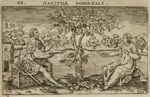
Parfaite est l'amitie, qui vit apres la mort - Amicitiae immortali: Boissard, Emblemes (Metz, 1588), emblem 18 paraphrases the adage
Amicitia post mortem: Borja, Empresas morales (Bruxelles, 1680), emblem 57 paraphrases the adage
Iconclass: 56F23:23A2 Friendship; 'Amicitia' (Ripa)❧Eternity, 'Aeternitas'; 'Eternità','Eternità o Perpetuità' (Ripa) 56FF23:31E1(+0) Enmity; 'Inimicitia', 'Inimicitia mortale' (Ripa)❧dying (+ variant)
Loci Communes: Amicitia (Friendship, Amitié)
IV v 27 Ad bonam frugem To good harvests
Qui commutatis ad meliora studia moribus resipiscunt, proverbis dicebantur ad meliorem frugem sese recipere. Usurpat M. Tullius in actione pro M. Caelio: Et se ad bonam frugem, ut dicitur, recepisse, gravesque homines atque illustres fuisse. Item Plautus in Trinummo, certum est ad frugem applicare animum. Lampridius in Heliogabalo, Milites se parsuros dixerunt, si ad bonam frugem rediret. Unde frugi et bonae frugi diecuntur, qui suo funguntur officio, praesertim serui quos ad operam praestandam alimus. Ulpianus ad legem Aquiliam cap. Inde Neratius. Sed si bonae frugi servus intra annum mutatis moribus occisus sit. Idem Titul. de quibus rebus ad eundem iudicem eatur. Cap. Si quis servum. Inter esse fructuarii videtur, bonae frugi servum esse. Rursum in digestis lib. 11. Tit.de Seruis corrupis, paragrapho, Quod ait praetor. Sed utrum ita dem um tenetur, si bonae frugi servum perpulit ad delinquendum. Plautus in Cassina: Credo pol esse, si tu frugi bonae es. Rursus in Pseudolo, Cupis me esse nequam, tamen ero frugi bonae. Nequam opposuit frugi. Nequam enim nulli est usui. Et ita frugi hominem dicimus, quemadmodum nequam, utraque voce indeclinabili. Columella de re rustic. lib. primo. Eiusdem agilitatis homo frugi melius quam nequam faciet. Et in Declamationibus, frugi filius opponitur luxurioso. Hinc et frugalis dicitur. Sumptum videtur ab agris, qui cultu redduntur frugiferi.
Those who came to their senses and changed their way of life to engage in better pursuits were said proverbially to take themselves 'To better harvests.' Marcus Tullius uses it in his speech for Marcus Caelius: 'And they have taken themselves "to good harvests," as is said, and have become important and famous men.' Also Plautus in the Three-shilling Day: 'I am resolved to apply my mind to fruitfulness.' Lampridius in his Heliogabalus: 'The soldiers said they would spare him if he returned "to good harvests."' Because of this those who do what they are expected to do, especially servants whom we keep and feed to perform their tasks, are said to be frugi or bonae frugi. Ulpian on the lex Aquilia, in the chapter beginning 'Therefore Neratius': 'But if a slave who is bonae frugi "virtuous" has been killed within a year after changing his character .. .' Also in the section entitled 'On what matters a case should go before the same judge,' the chapter beginning 'If anyone makes a slave worse': 'It seems to be in the interest of the usufructuary that his slave be bonae frugi "upright."' Again in the Digest book eleven, in the section entitled 'On corrupt slaves,' the chapter beginning 'As for what the praetor says': 'But is he held liable if he has driven a slave who is bonae frugi "good" to misdeeds?' Plautus in the Casina: 'I believe it is so, if you are frugi bonae "honest."' Again in the Pseudolus: 'You wish me to be a scoundrel, but I shall be frugi bonae "virtuous."' Plautus contrasted nequam with frugi. For nequam means 'good-for-nothing.' And so we say frugi homo just as we say nequam homo, both words being indeclinable. Columella in On Agriculture book one: 'An honest man is better than a scoundrel when they are equally diligent in their work.' And in the Declamations a son who is frugi 'upright' is contrasted with one who is luxuriosus 'extravagant.' Accordingly, the former is also called frugalis. The proverb seems to have been taken from fields; they produce a harvest after cultivation.
Facsimile: 
Iconclass: 47I14 harvest 54F1 Success; 'Evento buono' (Ripa) 58A3 Fruitfulness, Productiveness, Fertility, Fecundity; 'Fecondità' (Ripa)
Collectanea (1500): 476
Loci Communes: Mutati instituti (A changed custom, Une coutume changée)
IV v 28 Per manus tradere To pass down from hand to hand
Quod successione quadam ab aliis ad alios devenit, per manus tradi dicitur: quod translatum videtur ab his qui navim aut plaustrum exonerent. Idem frequenter fit in militia, velut in Commentario belli Civilis primo: Saxa, inquit, praerupta multis locis iter impediebant, ut arma per manus necessario traderentur, militesque inermes sublevati alii ab aliis magnam partem itineris confic erent. Rursus belli Gallici libro septimo: Quidam ante portam oppidi Gallus per manus sebi ac picis traditas glebas in ignem e regione turris proiiciebat. In eodem. Non nullae de muris per manus demissae. Item libro octavo: Tale consilium sui recipiendi inierunt: facsces ubi consederant, per manus stramentorum ac virgultorum, quorum summa erat in castris copia, inter se traditos, ante aciem collocaverunt. Verum hic nullus est tropus. Qui quoties accedit, transit in speciem proverbialem, quomodo frequenter obvium est apud auctores. Velut apud Fabium lib. duodecimo: Non ea modo quae conscripta sunt historiis, aut sermonibus velu per manus tradita, quaeque quotidie aguntur nosse, verum ne ea quidem quae a poetis ficta sunt negligere. Item Livius lib. ab urbe condita 5. Etiam si nobis cum urbe simul positae, traditaeque per manus religiones nullae essent. Idem lib. 9. Tum disciplina militaris iam inde ab initiis urbis tradita per manus in artis perpetuis praeceptis ordinatae modum venerat. M. Tullius in oratione De provinciis consularibus. Nam ut C. Iulius omnibus a senatu eximiis ac novis rebus ornatus, per manus hanc provinciam tradat ei, cui minime vos velitis. Quin et Iureconsultis per manus tradi dicitur, quod de manu in manum datur. Veluti Papinianus lib. Pandectarum 29. Titulo De iure codicillorum, Quod per manus traditum est, codicillis hereditatem dari non posse, rationem illam habet, et cetera. Plautus in Trinummo: E manibus dedit ipse mihi in manus: de epistola loquitur. Fit autem iucundius, quoties ad res animi proverbium accommodatur, quemadmodum cum dicim us institutum, aut opinionem, aut consuetudinem, aut disciplinam aliquam, per manus traditam ad nos venisse.
What comes down from one person to another who follows him in some way or other is said to be passed down from hand to hand. This seems to be a metaphor drawn from men unloading a ship or a wagon. The same procedure frequently occurs in military service, for example, in the first commentary of the Civil War. Caesar says, 'Steep crags were blocking the route in many places. Weapons had to be passed down from hand to hand, and then the soldiers completed a large part of their way, unarmed, supporting each other.' Again, in book seven of the Gallic War: 'A Gaul in front of the town gate hurled into the fire clods of grease and pitch that reached him by being passed from hand to hand from the region of the tower.' In the same book: 'Some were let down from the walls, being passed from hand to hand.' Also in book eight: 'This was the plan for retreat that they adopted. When they had taken up their position, bundles of straw and faggots, of which there was a great supply in the camp, were passed from hand to hand and then placed in front of the line of battle.' In these passages, however, the expression is meant literally. Whenever it is used figuratively, the expression becomes proverbial and we frequently encounter it in authors. For example, in book twelve of Fabius: 'Know not only those things that are recorded in history or transmitted orally, "passed from hand to hand," as it were, and the things that occur everyday, but do not neglect what has been made up by poets.' Also Livy in book five of From the Founding of the City: 'Even if no religious ordinances had been established when the city was founded and then passed down to us "from hand to hand."' The same author in book nine: 'Then the military training that had been "passed down hand to hand" right from the beginning of the city had become a skill based on fixed precepts.' Marcus Tullius in his speech On the Consular Provinces: 'Is Gaius Julius Caesar, who has been given all these splendid honours by the senate, to pass over this province from his hand to the hand of him whom you least wish to have it?' In fact even the jurists use the expression per manus 'handed down' for what 'is passed from hand to hand.' For example, Papinianus in book twenty-nine of the Pandects, in the section entitled 'On the law of codicils': 'The rule handed down, that an inheritance cannot be granted in codicils, has this justification .. .' Plautus in the Three-shilling Day: 'He himself gave it from his hands into mine.' He is speaking about a letter. A more pleasing use is whenever the proverb is applied to intellectual matters, as when we say that some teaching, belief, custom, or discipline has come to us by being passed down from hand to hand.
Facsimile:
Iconclass: 31AA2512(+933) arm stretched forward - AA - both arms or hands (+ holding something) 31AA2512(+935) arm stretched forward - AA - both arms or hands (+ receiving something) 47C242(+31) vertical transport, hoisting (industrial processes) (+ processes by hand ~ crafts, industries, agriculture) 52D1(+0) Communication of Thought (+ variant)
Loci Communes: Fortunae commutatio (Change of fortune, Changement de fortune)
IV v 29 De manu in manum From hand to hand
Ut non arbitramur idem esse cum superiori, ita non usquequaque dissimile est, quod sscribit Cicero li. Epist. famil. 7. Totum denique hominem tibi trado de manu, ut aiunt, in manum, tuam istam et victoria, et fide praestantem. Traduntur enim et qui commendantur. Terentius: Hanc in manum dat. Item Horatius: Ut tibi se laudare ac tradere coner. Item: Hunc hominem velles si tradere.
Although I do not think that what Cicero writes in book seven of his Letters to Friends is the same as the above, it is not completely dissimilar: 'In short, trado "I give over" the whole man to you, "from my hand to your hand," as they say, as distinguished for his loyalty as for his victories.' For those who are recommended traduntur 'are given over.' Terence: 'She gives this girl into my hand.' Horace too: 'So that I may try to praise him to you and recommend him.' Also: 'If you wished to recommend this fellow.']
Facsimile:
Iconclass: 31AA2512(+933) arm stretched forward - AA - both arms or hands (+ holding something) 31AA2512(+935) arm stretched forward - AA - both arms or hands (+ receiving something) 54C2 Recommendation, Inducement, Incitement
Loci Communes: Amicitia (Friendship, Amitié); Fides et gravitas (Trust and seriousness, Confiance et gravité); Fortunae commutatio (Change of fortune, Changement de fortune)
IV v 30 Mira de lente Wondrous words about a lentil
Rodulphus Agricola vir immortalitate dignus, lib. Dialectices 3. testatur apud Graecos proverbio dici solere, egregia de lente, quoties res humilis et pusilla magnificis laudibus attolleretur: perinde quasi lentem minutum ac vile legumen splendidis encomiis efferas. Opinamur Graecis efferri hunc in modum: δεινὰ περὶ φακῆς.
In book three of his On Dialectic Rodolphus Agricola, a man worthy of immortal memory, attests that the Greeks often used the proverb 'Outstanding things about a lentil' whenever something insignificant and trivial was extolled with magnificent praise, just as if you were to honour a lentil, a cheap and tiny legume, with a splendid encomium. I think the Greeks expressed it in this way: [greek].
Facsimile:
Iconclass: 25G2111(LENTIL) seed (LENTIL) 54BB2 Unnecessity, Superfluity 57B1 Praise, Approbation, Approval; 'Lode' (Ripa)
Loci Communes: Aliena a re (Irrelevant to the matter, Étranger au sujet); Arrogantia jactantiaque (Arrogance and boastfulness, Arrogance et vantardise); Intempestiva et inepta (Untimely and inept things, Choses inopportunes et ineptes)
IV v 31 Non una manu capere Catch with both hands
Οὐ τῇ ἑτερᾳ ληπτέον. i. Non una tantum manu capiendum. De re lubrica variaque, captuque difficili. Nam huiusmodi solemus utramque admovere manum. Usus est Plato in sophista: ὁρᾷς οὖν ὡς ἀληθῶς λέγεται τὸ ποικίλον εἶναι τοῦτο τὸ θηρίον, καὶ τὸ λεγόμενον, οὐ τῇ ἑτέρᾳ ληπτέον. id est, Vides igitur vere dici, bestiam hanc esse variam, neque (quod dici solet) unica manu capiendam. Sumptum est a venatu, in quo ferae quaedam miris artibus ex ipsis venantium manibus frequenter elabuntur, quibus adsimilem putat hominem sophistam, ad elabendum omnib. dolis instructum. Accommodari potest & ad opimum sacerdotium, quod nemo facile assequitur, nisi summa vi adnitatur.
[greek], Not to be caught with only one hand. About something difficult, complex and not easy to grasp. For we usually use both hands in such cases. Plato used it in the Sophist: 'You see then that it is a true saying, that this beast is resourceful and, as the saying goes, "Not to be caught with only one hand."' Taken from hunting where some animals are marvellously adept and slip out of the very hands of the hunters. Plato thinks that a sophist is like these animals, since he is well equipped with all kinds of guile to escape. It can also be applied to a rich benefice that no one can acquire easily, but must struggle with all his might to get.
Facsimile:
Iconclass: 31AA2512(+934) arm stretched forward - AA - both arms or hands (+ reaching for somebody or something, seizing something, touching) 54DD4 Difficulty
Loci Communes: Diligentiae (Diligence, Diligence)
IV v 32 Omnes laqueos effugere To escape from every snare
In eodem dialogo non dissimilem huic allegoriam adducit, veluti proverbio iactatam: Difficile omnes laqueos effugere. Quod ipsum a venatu translatum est, in quo sic undique sepiuntur exitus, ut necesse sit feram in aliquas insidias incidere: ὀρθὴ γὰρ ἡ παροιμΐα, τὸ τὰς ἁπάσας μὴ ῥᾴδιον εἶναι διαφεύγειν. i. Siquidem recte habet proverbium, quo dicitur, haud facile esse omnes laqueos effugere.
In the same dialogue he adduces a very similar metaphor, one that is used proverbially: 'It is difficult to escape from every snare.' This is taken from hunting when all the escape routes are blocked in such a way that an animal must be trapped somewhere. 'For the proverb is right that says [greek] "It is not easy to escape from every snare."'
Facsimile: 
Iconclass: 43C11(+4141) hunting, chase (+ snare) 54DD4 Difficulty 57AA6223 Ambuscade, Trap; 'Insidia' (Ripa)
Loci Communes: Difficultatis (Difficulty, Difficulté); Elabendi (Slipping away, escaping, S'échapper)
IV v 33 Hostis domesticus An enemy within
Rursum in eodem domesticum hostem proverbio solitum dici testatur, ubi malum non aliunde proficiscitur, sed ex nobis ipsis nascitur: velut cum quis ipse se prodit, aut redarguit, ipse sua bili aut livore sese conficit: οὐκ ἄλλων δέονται τῶν ἐλεγχόντων, ἀλλὰ τὸ λεγόμενον, οἴκοθεν τον πολέμιον καὶ ἐναντιωσόμενον ἔχοντες. i. Non opus habent aliis qui redarguant, sed iuxta proverbium, cum domi hostem habeant, quique sit adversaturus, etc. Agit de sophista, qui cum sit loquax, ipse ex sese praebere solet, quo revincatur.
'An enemy within.' Again, in the same work Plato attests that this expression is frequently used proverbially when misfortune does not have an external source but originates from our own nature; for example, when someone betrays himself, or refutes himself, or destroys himself by his own anger or envy: 'They have no need for others to refute them, but as the proverb says, [greek] "They have an enemy within who will be their adversary."' He is talking of a sophist who talks too much, and therefore often provides the material for his own rebuttal.
Facsimile:
Iconclass: 51A51:33B5 Interior, Interiority❧enemy 58AA12 Self-destruction
Loci Communes: Malum accersitum aut retortum (Evil brought upon oneself or turned back, Mal attiré ou retourné)
IV v 34 Capere civitatem Capturing a city
Plato in eodem dialogo significat proverbio dici solere: Capere sive expugnare civitatem, qui rem difficilem esset assecutus. Neque enim civitas primo statim impetu capitur. Illic hospes animat Theaetetum, ut quod instituit, persequatur, eo quod qui ad leviores difficultates aut haeret, aut resilit, numquam aliquid perficiet in eo, quod est disputationis caput. Verba Platonis sic habent: Θαῤῥεῖν ὦ θεαίτητε χρῆ τον καὶ σμικρόντι δυνάμενον εἰς τὸ πρόσθεν ἀεὶ προϊέναι. τί γὰρ ὅγ᾽ ἀθυμῶν ἐν τούτοις, δράσειεν ἂν ἐν ἄλλοις, ἢ μηδὲν ἐν ἐκείνοις ἀνύττων, ἢ πάλιν ἐς τοὔπισθεν ἀπωσθεὶς, σχολῇπου τὸ κατα τὴν παροιμΐαν λεγόμενον, ὅγε τοιοῦτος ἄν ποτε ἕλοι πόλιν. i Confidere oportet Theaetete, fore ut qui vel paululum aliquid potuerit, semper ultra progrediatur. Quid enim facturus sit in aliis qui in his animum desponderit? aut nihil in illis efficiens, aut retrocedere etiam compulsus: haud unquam ille talis, urbem, quod dici solet, ceperit. In bello facile est in excursionibus, aut pagorum incendiis aliquid designare: at munitas urbes expugnare perdifficile est. Simile est illi: Timidi numquam statuerunt Tropaeum.
In the same dialogue Plato points out that the proverb 'Capturing (or storming) a city' was customarily said of someone who had completed a very difficult task. For a city is not captured immediately on the first attack. In the relevant passage the stranger is encouraging Theaetetus to continue steadfastly in what he has begun. For the man who gets stuck or shrinks back in the face of less demanding difficulties will never bring anything to completion in the crucial part of the argument. These are Plato's words:
You should have confidence, Theaetetus, that the man who makes some
progress, even if very little, will always make advances beyond that. For
if a person gives up in these circumstances, what will he achieve in others,
when he is making no progress or when he is even being compelled to re-
treat?[greek] 'Such a man will never capture a city,'
as the saying goes.
In war it is easy to have some success in making sallies or in burning villages, but it is extremely difficult to storm fortified cities. This is similar to 'Faint hearts never set up a trophy.'
Facsimile:
Iconclass: 45K21 siege 45K27 breaking into city or fortress ~ siege 54D3 Completion
Loci Communes: Difficultatis (Difficulty, Difficulté); Timiditas (Timidity, Timidité)
IV v 35 Divinum excipio sermonem I except the gods
Plato lib. de repub. 6. demonstrat proverbii vice in ore fuisse vulgo: θεῖον ἐξαίρω λόγον. id est, Divinum excipio sermonem, quoties gloriosius aliquid dictum esset, ominis gratia deos excipiebant, qui nihil non possunt, & quibus nemo praescribit. Platonis verba subscribemus: Οὖ τε γὰρ γίνεται οὔτε γέγονεν, οὐδ᾽ οὖν μὴ γένηται ἀλλοῖον ἦθος πρὸς ἀρετὴν, παρὰ τὴν τοὺτων παιδείαν πεπαιδευμένον ἀνθρώπειον, ὦ ἐταῖρε. θεῖον μέν τοι κατα τὴν παροιμΐαν ἐξαίρω λόγον. i. Neque enim sunt, neque fuerunt, neque futuri sunt mores aliter ad virtutem instituti, quàm ad horum institutionem. De humanis loquor amice, ac divinum iuxta proverbium excipio sermonem. Apparet esse fragmentum carminis iambici: θεῖον ἐξαίρω λόγον, fortassis ex Homero natum: θεοί δέ τε πάντα δύνανται, id est, Divi tamen omnia possunt. Accommodari potest ad summos principes, veluti pontificem, aut cardinales, aut monachos.
In book six of the Republic Plato points out that [greek] 'I except the gods' was a proverb commonly used, I believe, whenever something rather boastful was said and, as a good omen, the gods were excluded. For they are all powerful and no one gives orders to them. I shall give Plato's words: 'For there is not, there never has been, and there never will be a character altered and made virtuous by a system not in line with theirs. I am talking in human terms, my friend. I exclude the gods, as the proverb says.' The expression seems to be part of an iambic verse. Perhaps the sentiment originated in Homer: 'Nevertheless the gods are all powerful.' It can be applied to the highest dignitaries, the pope, for example, or cardinals - or monks!
Facsimile:
Iconclass: 51E2:92 Superiority❧gods ~ classical mythology
Loci Communes: Arrogantia jactantiaque (Arrogance and boastfulness, Arrogance et vantardise); Excellentia, inaequalitas (Excellence, inequality, Excellence, inégalité)
IV v 36 Una pertica By the same pole
Una pertica, pro eo quod est eadem opera. Plinius secundus libro 8. epist. 2. Nam regione, inquit, tota, et novitas remissionis, et forma laudatur, ipsis etiam, quos non una, ut dicitur, pertica, sed distincte gradatimque tractavi. Quanto melior et probior, tanto mihi obligatior abit, expertus non esse apud me: ἐν δ᾽ ἰῇ τιμῇ ἠμὲν κακός ἠ δὲ καὶ ἐσθλός. i. Vir malus ac fortis pretio ducuntur eodem. Sumpium videtur ab his, qui metiuntur agros, Perticam posuit pro decempeda. Nam Servius Sulpitius, ut indicat Festus Pompeius, dixit perticam esse lineam, qua dividuntur agri, et versus est Homericus, libro Iliad. 9. quem alibi recensuimus atque exposuimus.
'By one pole,' meaning 'in the same manner.' Pliny the Younger in book eight, letter 2:
The whole region is praising the novelty of my rebate and the way in which it
was carried out. And the people, whom I did not measure by the same pole, so
to speak, but individually and by their different levels, have departed, feeling
obliged to me in proportion to their moral worth and being satisfied that I
am not a person in whose mind 'the wicked and the good are held in equal
honour.'
The expression seems to have been taken from field surveyors. Pliny used pertica in the sense of decempeda 'a ten-foot rod.' Servius Sulpicius, as Festus Pompeius points out, said that the pertica was the line that marked off fields. The verse is from Homer, in book nine of the Iliad. We have cited and explained it elsewhere.
Facsimile:
Iconclass: 49D521(POLE) measuring-instruments (POLE) 51B4 Uniformity
Loci Communes: Proclivitas (contra) (Propensity (against), Penchant (contre))
IV v 37 Sarta tecta Windproof and watertight
Sarta tecta, pro consummatis, probeque curatis, & in quibus nihil sit omissum, ex solemnibus verbis iureconsultorum abiit in proverbium. Plautus in Trinummo: Ne tibi aegritudinem pater parerem, parsi sedulo. Sarta tecta tua praecepta usque habui mea modestia. M. Tul. lib. Epist. fam. 13. Hoc mihi da, atque largire, ut marcum Curium sartum & tectum, ut aiunt, ab omni incommodo, detrimento, molestia, syncerum, integrumque conserves. Idem in Verrem Actione tertia, In sartis tectis vero quemadmodum se gesserit, quid ego dicam? Idem in concione ad populum priusquam iret in exilium: Si igitur aliquo tempore his hominibus consuluistis, quorum animus est religionis pietate defunctus, debetis mihi quoque prospicere, qui numini deorum consecratum, sartum tectum ab omni periculo conservavi. Idem in Verrem actione eadem: Quapropter ita me de praeturae criminibus auditote, ut ex utroque genere, & iuris dicendi, & sartorum tectorum exigendorum ea postuletis, quae maxime digna sunt eo reo. In eadem: Quaesivit quis aedem Castoris sartam tectam deberet tradere. Aliisque locis compluribus: velut in eundem Verrem actione quinta. Ulpianus libro Pandectarum primo, titulo De officio procons. & legati, capite: Si in aliquam. Aedes sacras & opera publica circumire, inspciendi gratia, an sarta tectaque sint, vel an aliqua refectione indigeant. Item Celsus Pandect. li. 7. tit. De usu fruct. capite, Hactenus, loquens de reficiendis aedificiis: Hactenus tamen, inquit, ut sarta texta habeat: si qua tamen vetustate corruissent, neutrum cogi reficere. Ac mox: Unde Celsus de modo sarta tecta habendi quaerit &c. Rursus lib. 48. tit. ad legem De repetundis, cap. Lex Iulia. Illud quoque cavendum ne in acceptum feratur opus publicum faciendum, frumentúmve publice dandum. praebendum, apprehendendum, sarta tecta tuenda, antequam probata, perfecta, praestita legerint. Festus Pompeius docet veteres sarte dixisse pro integre, quamobrem & opera publica quae locantur ut integra tecta praestentur, sarta tecta locantur. Nam sarcire est integrum facere. Sed Festus legisse videtur, sarte tecta locantur, pro integre tectis: Nisi forte legendum est in prioribus, sarta & integra.
'Windproof and watertight' is an expression describing things that have been completed and well cared for and in which nothing has been overlooked. This was a formal legal term that became proverbial. Plautus in the Three-shilling Day:
I have resolutely refrained from causing you grief.
I have always kept your precepts 'Windproof and watertight' by my
self-control.
Cicero in book thirteen of his Letters to Friends: 'Grant me this that you may keep Marcus Curius "Windproof and watertight," as they say, untouched by any trouble, harm, or damage.' Also in the third speech against Verres: 'As for how he behaved with respect to what were "Windproof and watertight," what am I to say?' The same author in his speech to the people before he went into exile: 'If therefore you have at any time consulted the interests of those who have abandoned religious piety, you ought to look out for me now, who have kept all that is consecrated to the gods "Windproof and watertight" and safe from every danger.' Also in the same speech against Verres: 'Therefore hear me on the crimes of his praetorship so that you may ask what this defendant especially deserves with respect to both kinds - his legal judgments and his demands for what is "Windproof and watertight."' In the same speech: 'He asked who ought to hand over the temple of Castor "Windproof and watertight."' And in several other places, as in the fifth speech against the same Verres. Ulpian in book one of the Pandects, the section entitled 'On the duty of the proconsul and legate,' the chapter beginning 'If in some city': 'He should go around the sacred temples and the public works to inspect them to see whether they are "Windproof and watertight" or need some repair.' Also Celsus in book seven of the Pandects, the section entitled 'On usufruct,' the chapter beginning 'So far,' when he is speaking of repairing buildings: 'To this extent he should keep them "Windproof and watertight." If any part collapses through age, neither party is compelled to repair it.' And soon after this: 'How Celsus inquires into how things should be kept "Windproof and watertight."' Again in book forty-eight, the section entitled 'On the law of extortion,' the chapter beginning 'The Julian law': 'That too we should see to, that no one should be credited for carrying out a public work, for giving or providing corn to the general public or for importing it, or for keeping buildings "Windproof and watertight" before everything is completed, approved, and answered for, according to law.' Festus Pompeius informs us that the ancients 'said sarte for integre, so that public works that are contracted out to be made Integra tecta are contracted out to be sarta tecta. For sarcire means "to make whole."' But I think Festus read sarte tecta for sarta tecta in the sense of integre tecta, unless perhaps we should read sarta et integra tecta for Integra tecta in the preceding phrase.
Facsimile: 
Iconclass: 51A7 Perfection, Completeness; 'Perfettione', 'Operatione perfetta' (Ripa) 54E42 Protection; 'Custodia', 'Difesa contra nimici, malefici & venefici', 'Difesa contra pericoli', 'Riparo da i tradimenti' (Ripa)
Loci Communes: Perficiendi sive absolvendi (Finishing, completing, Achever, accomplir); Securitatis et tutae rei (Security and safety, Sécurité et sûreté)
IV v 38 Pulmo prius venisset A sea-lung would have come more quickly
Pulmo prius venisset, dictum est olim in lentos ac cessatores. Opinamur quod pulmo cum perpetuo moveat, numquam tamen loco se promovet. Plautus in Epidico: Dii immortales, soccos iussi adimere pedibus. Pulmo enim, quod perhibent, prius venisset, quam tu advenisti mihi.
In ancient times it was said of those who were slow or loiterers, 'A sealung would have come more quickly.' The reason, I think, is that although the sea-lung is always in motion, it never moves its position. Plautus in Epidicus:
Heavens above, did I order you to take your shoes off? For a sea-lung
Would have arrived before you, as the saying goes.
Facsimile:
Iconclass: 25F75(JELLY-FISH) coelenterata: jelly-fish 25F75(SEA-LUNG) coelenterata (SEA-LUNG) 51LL1 Rest, Immobility, Stasis 51MM1 Slow Motion
Loci Communes: Tarditatis et cunctationis (Slowness and delay, Lenteur et retard)
IV v 39 Pedem conferre To put foot to foot
Pedem conferre, à militia sumptum. Usurpatur, ubi propius acceditur ad rem. Cicero in actione pro Plancio: Non possum magis conferre pedem, ut aiunt, aut propius accedere. Huius obiter & alibi meminimus ex Quintiliano. Sumptum videtur ex Homero apud quem illud frequens est, ἐγγὺς ἴοντεσ. i. propoe venientes, hoc est, comminus congressi. Idem non minus iucunda figura extulit Vegetius De re militari libro tertio, cap. 14. Prima autem & secunda acies, quum ad spathas & pila, ut dicitur, ventum fuerit, totum sustinet bellum. Spathas autem vocabant gladios longiores: quemadmodum pila, hastas breviores, nimirum quinque semis pedum, quae deinde spicula sunt dicta. Autor Modestinus, Huius modi pugnae genus describit Q. Curtius li. 3. Ergo cominus coacti conserere, gladios impigre stringunt, tum vero multum sanguinis fusum est, duae quippe acies ita cohaerebant ut armis arma pulsarentm, mucrones in ora dirigerent: non timido, non ignavo cessare tum licuit: collato pede quasi singuli inter se dimicarent, in eodem vestigio stabant, donec vincendi locum sibi facerent. Et maro, Haeret pede pes, densusque viro vir.
To put foot to foot To put foot to foot' is taken from the military sphere. It is used when one is getting nearer to something. Cicero in his speech for Plancius: 'I cannot put foot to foot more quickly, as they say, or approach more closely.' We have mentioned this elsewhere in passing as coming from Quintilian. It seems to have been taken from Homer in whom the phrase [greek] 'coming together,' that is, fighting at close quarters, is very common. Vegetius in book three, chapter fourteen, of his On Warfare, expressed the same idea in an equally appealing figure of speech: 'The first and second lines of battle bear the brunt of the whole war when it has come down to spathae "long swords" and pila "spears," as they say.' The name spathae was given to longer swords, while pila were shorter spears, five-and-a-half feet in length, which were later called spicula. Our source is Modestinus. Quintus Curtius describes such a battle in book three:
Compelled therefore to fight hand to hand they promptly drew their swords.
Then indeed was much blood spilt. For the two lines were so close together
that arms struck on arms, and they aimed the tips of their swords at each
other's faces. This was no time to be timid or cowardly and do nothing. They
stood, foot to foot, as if they were each fighting a duel, they stood in the same
spot until they could make room for themselves by victory.
And Maro: 'Foot clings fast to foot, men are packed tightly together.'
Facsimile:
Iconclass: 31A2255(+934):31A2255 foot (+ reaching for somebody or something, seizing something, touching)❧foot 45H3 battle 51I4 Nearness
Loci Communes: Aliena curantis - ad rem pertinentia (Meddling in others' affairs - relevant matters, Qui se mêle des affaires d'autrui - choses pertinentes); Experientae seu pericliationis (Experience or risk-taking, Expérience ou mise à l'épreuve)
IV v 40 Qui multum obfuit He who did great harm as an enemy
Sicut eiusdem artificis est egregie mentiri, & vera dicere, ita eiusdem est prodesse plurimum ac laedere. Id olim proverbio iactatum fuisse testatur Thucydides lib. 6. in oratione Alcibiadis: τοῦτον δὴ ὑπὸ πάντων προβαλλόμενον λόγον, ὡς εἰ πολέμίος γε ὢν σφόδρα ἔβλαπτον, καὶ αὰν φίλος ὢν ἱκανῶς ὠφελείην. i. Dictum videlicet illud, quod ab omnibus usurpatur, quod si hostis cum essem, vehementer nocui, etiam si sim amicus magnopere quero prodesse.
Just as the same author can be gifted when telling what is false and in telling what is true, so the same person can give great help and inflict great harm. Thucydides in the speech of Alcibiades in book six attests that this was a proverb in antiquity. He writes, 'That saying, used by all: "If I did you serious harm when I was your enemy, I shall also be able to be of great help to you if I should become your friend."'
Facsimile:
Iconclass: 33A5:54A6 friends❧Helpfulness 33B5:54AA6 enemy❧Obstructiveness
Loci Communes: Infortunii sive exitii (Misfortune or ruin, Malheur ou ruine); Mutati instituti (A changed custom, Une coutume changée)
IV v 41 Non vulgari ancora nititur Depending on no ordinary anchor
Demosthenes in oratione pro Ctesiphonte: Οὐκ επὶ τῆς αὐτῆς ὁρμεῖ τοῖς πολλοῖς, id est, Non eadem ancora nititur qua vulgus, significans illum novis, minimeque vulgarib. praesidiis niti. Suidas admonet esse proverbium, & subaudiendum ancoram.
Demosthenes in his speech for Ctesipho: [greek]
'He does not depend on the same anchor as most people,' meaning that he
depends on novel and by no means ordinary help. Suidas tells us that it is
a proverb and that 'anchor' is to be understood in the Greek expression.
Facsimile:
Iconclass: 51E2:46C215(ANCHOR) Superiority❧parts of ship's exterior: anchor
Loci Communes: Securitatis et tutae rei (Security and safety, Sécurité et sûreté)
IV v 42 Non pluris quam simias Worth as little as monkeys
Simia ridiculum animal, et vulgo contemptum, non uni proverbio locum fecit. Dion Prusensis in li. De Troia non capta: Quos ego, inquit, non pluris facio quam ut dici solet, simias.
The monkey, a ridiculous animal and one that is commonly despised, has prompted many proverbs. Dio of Prusa in his essay 'On the Non-capture of Troy' says, 'I care less for them than for monkeys.'
Facsimile:
Iconclass: 25F22 monkeys, apes 54BB6 Worthlessness
Loci Communes: Contemptus et vilitatis (Contempt and worthlessness, Mépris et bassesse)
IV v 43 Aspis a vipera An asp borrows poison from a viper
Tertullianus lib. adversus marcionem 3. proverbii titulo refert: Aspis a vipera, cum pessimus a pessimo sumit mali quidpiam. Desinat, inquit, nunc haereticus a ludaeo, aspis quod aiunt a vipera mutuari venenum. Refertur aunt inter Diogenis apophthegmata, qui conspicatus duas feminas inter se conferentes clam sermonem, protulit versiculum, e comoedia quapiam sumptum: ἀσπὶς παρ᾽ ἔχίδνης φάρμακον δανείζεται. id est, Sumit venenum à vipera aspis mutuo. Utriusque serpentis venenum immedicabile, pariterque noxium, nisi quod viperae morsus magnis enecat cruciatibus, aspidis adeo nullum adfert dolorem, ut nec voluptas desit, si Plinio credimus. Est autem aspidis genus, quod absque morsu, conspuens hominem veneno, perimit, unde Graecis dicta πτυὰς. Usus erit quoties qui per se malus est, contagio mali fit deterior.
Tertullian in book three of Against Marcio cites as a proverb 'An asp from a viper,' referring to when a despicable person takes some of his evil nature from some other despicable person. He says, 'Let the heretic stop borrowing poison from the Jews, as the asp, so they say, borrows poison from the viper.' It is reported among the apophthegms of Diogenes, who, when he saw two women secretly conversing with each other, produced a verse, taken I believe from some comedy: '[greek] 'The asp borrows poison from the viper.' The poison of neither snake can be treated, and is equally harmful, except that a viper's bite brings more excruciating suffering before death, while the asp's bite is so free of pain that it can bring a feeling of wellbeing, if we believe Pliny. There is a kind of asp that can kill humans with its poison without biting them but simply by spitting on them. And so in Greek it is called[greek] 'a spitter.' The proverb will be used whenever anyone who is wicked in himself becomes worse through contact with one of the same kind.
Facsimile: 
Iconclass: 25F42(ASP) snakes (ASP) 51B2 Similarity, Likeness 55CC3:25F42(VIPER)(+92) Borrowing, Hiring❧snakes: viper (+ poison ~ product of animal)
Loci Communes: Similitudinis et congruentiae (Similarity and congruence, Similitude et convenance)
IV v 44 Neque intus, neque foris Neither inside nor outside
Irenaeus lib. 1. cap. 9. refert hoc proverbium, dicens hoc quadrare in mulierculas quasdam, qui cum in telligerent se fuisse delusas a discipulis Valentini, non tantum se committebant ecclesiae, ut remedio paenitentiae reciperentur in consortrum unde discesserant, sed inter utrumque degentes, nec Valentinianis adhaerebant, nec ecclesiae sese reconciliabant. Simili figura dicunt hodie, neque caro est, neque piscis, dehomine qui sib vivit, nec ullarum est partium.
In book one, chapter nine, Irenaeus reports this proverb, saying that it suits some women who realized that they had been tricked by the followers of Valentinus, but did not surrender themselves to the church in such a way as to repent and to be received into the fellowship that they had left. Instead they lived together, neither adhering to the Valentinians nor being reconciled with the church. A proverb with a similar figure of speech is used today of a person who lived simply for himself and belongs to no group: Neque caro est neque piscis 'Neither fish nor flesh.'
Facsimile:
Iconclass: 11P361(GNOSTICS)(+0) Christian sects (GNOSTICS) (+ variant) 11P361(VALENTINIANISM) Christian sects (VALENTINIANISM) 51A51 Interior, Interiority 51AA51 Exterior, Exteriority
Loci Communes: Anceps et dubius (Doubtful and uncertain, Incertain et douteux)
IV v 45 De toga ad pallium From the toga to the pallium
Certe speciem habet proverbii quod refert Tertullianus in libello de pallio: Haec nimirum indignitas erit a toga ad pallium. cuius duplex erit usus: vel cum ad diversum vitae genus sese contulerit aliquis: vel cum a fortuna honestiore ad humiliorem, velut si quis e praefecto fiat paedagogus, e consule rhetor. Toga Romanorum erat, pallium Graecorum: Post pallium coepit esse gestamen philosophorum. Confine illi: Ab equis ad asinos.
What Tertullian says in his work On the Pallium certainly has the appearance of a proverb: 'This surely is a mark of shame, to go "From the toga to the pallium."' This can be used in a double way, either when someone undertakes a quite different mode of living or when he moves from a higher status to a lower one. For example, if a courtier becomes a monk, a prefect becomes a tutor, the highest magistrate becomes a teacher of rhetoric. The toga is Roman, the pallium is Greek. Later the pallium began to be the garb of philosophers. The proverb is similar to 'From horses to asses.'
Facsimile:
Iconclass: 11Q71467(PALLIUM) other liturgical vestments (PALLIUM) 41D21(TOGA) clothes covering the entire body (TOGA) 59BB2 Degradation
Loci Communes: Inconstantiae, perfidiae, versutiae (Inconstancy, treachery, cunning, Inconstance, perfidie, ruse); Mutati instituti (A changed custom, Une coutume changée)
IV v 46 Extrema linea The finishing line
Quoniam olim initium unde cursus incipiebatur, ducta linea notabatur, rursus extremum linea signabatur, idcirco à linea incipere, sive ad lineam redire dicebantur, qui rem ab initio repetebant, Et quod in quaque re postremum est, extremam lineam appellabant. Ita Terentianus Phaedria: Postremo extrema linea amare nonnihil est. Et Tertullianus li. quem adversus Hermogenem scripsit, vocat eum ignorantium extremam lineam, quod ultimus esset haereticorum. Siquidem adhuc erat in vivis, quum ea scriberet Tertullianus.
Since at one time the point at which a race began and ended was marked by the same line, those who repeated something from the beginning were said 'to begin from the starting line' or 'to return to the starting line.' The final part of anything was also called 'the finishing line.' So Phaedria in Terence: 'Finally, it is better than nothing to love "From the finishing line."' And Tertullian in the work he wrote against Hermogenes calls him 'the finishing line' of ignoramuses because he was the last of the heretics. For he was still alive when Tertullian wrote these words.
Facsimile:
Iconclass: 43C21213(+4)(FINISH LINE) 51FF5:49D32 End; 'Fine' (Ripa)❧line (~ planimetry, geometry) 54D3 Completion
Loci Communes: Proximis utendum (One must make use of one's neighbors, Il faut se servir de son prochain)
IV v 47 Caecus et claudus non intrabunt templum The blind and the lame will not enter the temple
Recensetur lib. Reg. 2. ca. 5. Quum David tribuum omnium tribuum consensu suscepisset regnum totius gentis Israeliticae, iamque constituisset regiam suam statuere in monte Sion, quae tum erat arx Hierosolymae, quam id temporis obtinebant Iebusaei, denunciatum est illi à Iebusaeis, non futurum ut ingrederetur urbem, ni prius amovisset caecos & claudus. Id ubi factum esset, abiit in proverbium: Caecus & claudus non intrabunt in templum. Nec satis convenit inter interpretes, quid hoc loco sibi velit caecus & claudus. Quidam existimant per contemptum dictum, Huc non ingredieris, nisi sustuleris propugnatores moenium quibus tuendis sufficiunt caeci claudique nostri. Hebraei solent affingere fabulas, per quas explicent nodum quaestionis. Aiunt in moenibus urbis positas fuisse duas imagines, Isaac & Iacob: quorum ille legitur caecutisse senio, hic claudicasse ex lucta cum angelo. Has ideo collocatas, ut essent monumentum foederis, quod olim pepigerant cum Abraham, qua de re meminit libri Geneseos cap. 21. His igitur sublatis capta est arx, & natum proverbium, cuius sensum non satis perspicio. Nam quod in Levitico caecus & claudus arcentur à sacris ministeriis templi, non video quid faciat ad hanc historiam. Si divinare licet: fortassis in summis tectis aedium erant imagunculae, quales solent imponi fastigiis aedificiorum. Eas vulgo caecos & claudos appellabant, quod nec ambularent affixae, nec cernerent. Non patebat igitur ingressus in aream, nisi transcensis aedium fastigiis. proinde David praemii loco promisit militiae principem futurum, quisquis primus contigisset domatum fistulas. Fortassis adagio locus erit, quoties excluditur aliquis ab honore velut indignus. Merito enim excluduntur qui videbantur excludere. Et huiusmodi imagines in templorum tectis affiguntur foris, quum ipsum templum nunquam ingrediantur.
It is recounted in book two of Kings, chapter five, that when David had become king of the whole nation of the Israelites by the agreement of all the tribes and had already decided to establish his palace on Mount Sion, which was then the citadel of Jerusalem and was occupied at that time by the Jebusites, the latter told him that he could not enter the city until he got rid of the blind and the lame. When this had been done, a proverb arose: 'The blind and the lame will not enter the temple.' There is no clear unanimity among the commentators on the meaning of 'blind and lame' in this passage. Some think that it was an expression of contempt, meaning 'You will not enter the city until you remove the defenders of the walls, to protect which our blind and lame are sufficient.' The Jewish commentators are in the habit of making up stories to explain the problem in some enquiry. They say that two statues had been placed on the walls of the city, of Isaac and Jacob. Isaac had become blind in old age, the latter limped as a result of his struggle with the angel. The statues had been placed there by the Jebusites in order to be a reminder of the pact that they had once made with Abraham. Chapter twenty-one of the book of Genesis tells of this. And so when these were removed, the citadel was captured and a proverb came into being, the sense of which, however, I do not clearly perceive. For I do not see how what is said in Leviticus about the blind and the lame being kept away from the sacred rites of the temples has anything to do with the story. If one can make a guess, perhaps there used to be small statues on the top of temple roofs, like those that are often placed on the highest points of buildings. These were commonly called the blind and the lame because they could not walk since they were fixed and they could not see. There was no access into the main area except by crossing over the temple pinnacles. Accordingly, as a reward David promised that whoever first happened to get to the water-courses would be commander of his soldiers. Perhaps there will be an opportunity to use the proverb whenever someone is excluded from an honour on the grounds that he is unworthy of it. For it is right for those who were seen to exclude others to be themselves excluded. And such images are fixed on temple roofs, on the outside, although they are never to be found inside the temple itself.
Facsimile:
Iconclass: 31A4111 blind, blindness 31A415 crippled 57BB2 Mockery, Derision, Irreverence; 'Derisione', 'Dispreggio della Virtù' (Ripa) 71H512(+0) Joab is the first to go up to the fort of Zion and becomes commander of David's army (+ variant)
Loci Communes: Dignitatis (Dignity, Dignité)
IV v 48 Homini diligenti semper aliquid superest There is always something for a hard-working man to do
Homini diligenti semper aliquid superest. Chrysostomus homilia in Ioannem 19. refert hoc dictum, ut tritum vulgi sermone proverbium: Qui vere diligens est in negocio, nunquam sibi satisfacit, semperque videt aliquid quod operi coepto adiiciat, cum ignavis quicquid egerint nimium videatur.
'There is always something for a hard-working man to do.' In his sermon on John chapter 19 Chrysostom says that this was an extremely common proverb in everyday speech. A person who is truly conscientious in whatever he does is never satisfied, and always sees something more that he may do in what he has undertaken. Lazy persons think anything at all they have done to be too much.
Facsimile:
Iconclass: 32A49(WORKAHOLIC)(+0) other human types (WORKAHOLIC) (+ variant) 54A11 Industriousness, Assiduity; 'Assiduità', 'Industria', 'Zelo' (Ripa) 54A2 Carefulness, Diligence; 'Diligenza' (Ripa)
Loci Communes: Diligentiae (Diligence, Diligence)
IV v 49 Fuit et Mandroni ficulna navis Mandro too had a ship made of fig-wood
Εγύετο καὶ μάνδρωνι συκίνη ναῦς. i. Fuit et Mandroni ficulna navis. In eos dici solitum, qui praeter meritum ad felicitatem atque opes evecti, pristinae conditionis non meminerunt, sed praesenti rerum successu insolentius abutuntur, ita ut fere mos est τοῖς νεοπλούτοις, id est, iis, qui ad novas divitias ex infima fortunae conditione provehuntur. A Mandrone quodam, sumptum, qui indignus et immerens ex naviculario factus est imperator.Navim autem ficulnam per contemptum dixit. Nam ficulnum in genere vocant Graeci, quidquid imbecille, aut contemnendum significare volunt.
'[greek], Mandro too had a ship made of fig-wood. Customarily said of those who have been elevated to good fortune and wealth beyond their deserts and do not remember their former condition. Instead they enjoy their new prosperity too arrogantly. This is generally the way with [greek], that is, those who come to new riches from the most humble of circumstances. It is taken from a certain Mandro who was transformed from an ordinary sailor into an admiral though he was unworthy of it and did not deserve it. And indeed to show contempt his ship was said to be made of fig-wood. For the Greeks usually describe something that they think is cheap or despicable as being made of fig-wood.
Facsimile: 
Iconclass: 46A166 parvenu, 'nouveau riche', upstart 47I872:25G3(FIG-TREE) beam, log of wood❧trees: fig-tree 47L1 building a ship, ship under construction 57AA644 Arrogance; 'Arroganza' (Ripa) 98B(MANDRO) male persons from classical history (MANDRO)
Loci Communes: Proficientium in melius (Improving for the better, Progresser vers le mieux)
IV v 50 Lupus in fabula The wolf in the story
Hoc proverbium quum in prima aeditione quae Lutetiae prodita est, non indiligenter esset à nobis explicatum: tamen nescio quo casu videtur omissum in caeteris aeditionibus. Solitum est dici, quoties is, de quo confabulatio est, de improviso intervenit. Quod inde sumptum putat Donatus, interpres Terentii, quia lupus ei quem prior viderit, vocem adimere dicitur, ut cum cogitatione in qua prius fuerat simul et vocem amittat et verba. Nec desunt qui huius seu rei, seu opinionis causam philosophicam reddere conentur, videlicet quod lupus natura sit hostis homini, et ideo spiritus quosdam ac vim nativam ab illius oculis proficiscentem in eum, quem conspexit inopinato, vires illius obstupefacere, atque hinc esse subitum silentium, Donatus huc pertinere putat quod alibi citatum est a nobis, Theocriticum illud λυκον εἰδες. Rursum illud Maronis: Lupi Moerim videre priores, cum vocem peraetatem adem pram pastor quereretur. Sunt qui ex nutricum fabulis natum existimant, quae narrant ludificato puero terrore lupi, verum lupum a cavea pauliatim venisse ad limen cubiculi. Nam est & in apologis, matrem, ut puerum vagientem compesceret, lupum frequenter inclamasse, ut nisi desineret plorare, devorandum auferret. Tandem lupum spe praedae venisse: sed frustra hinatem abiisse, hac tantum sententia doctiorem, non esse fidem habendam feminae pollicenti. Nam hoc opinamur, sensit Donatus. Locus enim in libris evulgatis non videtur carere mendo. Tertiam opinionem reicit Donatus, quae putat hinc natum, cum in Nevia na fabula repraesentaretur, quo. modo Romulus et Remus aliti sint a lupa, repente verum lupum actioni intervenisse, quo factum ut subitum esset totius fabulae silentium, quod talis spectaror inexspectatus intervenisser. Sic usus est Terentianus Syrus in Adelphis, silentium innuens Ctesiphoni, quod Demea pater adolescentis, quem ruri esse credebat, praeter exspectationem adesset. Festivius eitam usus est Plautus in Sticho. Atque eccum, inquit tibi lupus, in sermone praesens esuriens adest. Loquitur enim de parasico Gelasino, qui fratribus de ipso confabulantibus de repente intervenit. Addit enim proverbio gratiam, adlusio ad hominis edacitatem, quemadmodum apud Theocritum, ad nomen adolescentis, de quo dicitur, λυκον εἰδες. Utitur et M. Tullius epist. ad Atticum libro 13. De Varrone loquebamur, lupus in fabula. Venit enim ad me. Fere fit autem ut quoties interveniat, de quo colloquimur, obmutescamus, propterea quod sive laudabatur, pudet in os dicere, quod recte narratur de absente, sive vituperabatur, timemus offendere.
Although we carefully explained this proverb in the first edition published in Paris, somehow or other it seems to have been omitted in all later ones. It was usually said when the subject of a conversation suddenly appeared on the scene. Donatus, the commentator on Terence, thinks that it arose from the belief that a wolf can render a person speechless if it sees him first. The person loses not only his voice and words but also forgets what he had previously been thinking about. Some try to give a philosophical reason for this phenomenon or belief, namely that the wolf is a natural enemy of man. It releases certain vapours and directs an innate native power from its eyes at the person it has seen, suddenly paralysing his strength. Because of this there is a sudden silence. Donatus thinks that germane to this is the Theocritean phrase that has been cited by us elsewhere: [greek]; 'Have you seen a wolf?' Also the Virgilian phrase, 'The wolves have seen Moeris first,' when the shepherd was complaining that his voice had been taken away because of his age. Some think it originated with the tales of nurses who deceive children through their fear of a wolf; they say that a real wolf has crept from its cave up to the bedroom door. (There is also a fable about a mother and a wolf. To stop her child crying, she frequently called to a wolf to carry the child off to be eaten if it did not stop sobbing. Finally the wolf had come in hope of the booty, but after opening its jaws to no purpose had gone off, the wiser only for this, that one should not place any trust in a woman's promises.) This, I think, is what Donatus thought the expression meant. I say this for the passage does not seem to be free of corruption in the printed editions. Donatus rejects a third view according to which the expression originated in the sudden appearance of a wolf during a performance of a play of Naevius that depicted how Romulus and Remus were suckled by a wolf. Silence suddenly fell over the whole performance because such an unexpected spectator had appeared. This was how Terence's Syrus used it in the Brothers, signalling to Ctesipho to be silent because Demea, the young man's father, whom he thought to be in the country, had unexpectedly arrived. Plautus used it more humorously in Stichus. He says, 'Look, there you have your wolf in the fable, here in person and ravenous.' He is speaking of the glutton Gelasimus who suddenly comes upon the brothers while they are talking about him. The allusion to the fellow's greed makes the proverb more attractive, just as in Theocritus 'Have you seen a wolf?' alludes to the name of the young man being talked about. Marcus Tullius also uses it in book thirteen of his Letters to Atticus: 'We were talking of Varro. The wolf in the fable! For he arrived at my house.' It generally happens that we fall silent whenever someone we are discussing suddenly appears. If he was being praised, we are ashamed to say to his face what it is appropriate to say of him in his absence. If he was being bitterly criticized, we are afraid to offend him.
Facsimile:
Iconclass: 25F23(WOLF):85 beasts of prey, predatory animals: wolf❧fables 31B62359 being silent 52BB3 Surprise, Wonder; 'Maraviglia' (Ripa)
Loci Communes: Subiti interventus (A sudden intervention, Intervention soudaine)
IV v 51 Prolixius Iliade As long-winded as the Iliad
Μακρότερα τῆς ἰλιάδος λαλῶν. i. Prolixiora Iliade loquens. Refert Iulius Pollux, libro. De rerum vocabulis 6. cap. 26, adiungens ei, quod alibi docuimus, competete in homines vehementer garrulos, τὸ ἐκ δωδώνης χαλκεῖον. & αῤάβιος αὐλὸς, sic enim ibi refertur. Hunc in sensum usus est et Aeschines in Demosthenem, qui locus nobis alibi citatus est. Non dissimile est huic, Ilias malorum. Sed quoniam hoc congruit im mensis malis, quod nunc referimus immodicae loquacitati, separare visum est ob usum diversum. Est autem Ilias nobile opus Homeri, quo Troiae captae historia libris vigintiquatuor explicar, cum Virgilius duodecim libris complexus sit, quod ex utroque opere visum est decerpere.
[greek], Talking at greater length than the Iliad. Cited by Julius Pollux in book six of his Names of Things adding to what we have already explained, that To [greek] 'Dodonean bronze' and [greek] 'An Arabian piper' fit persons who are excessively talkative. This is how it is reported by Pollux. Aeschines also used it against Demosthenes, in a passage already cited by us elsewhere. The expression is not dissimilar to 'An Iliad of troubles.' But since the latter suits great misfortunes, and what we are now reporting fits unbridled loquacity, I thought it best to separate them because of their different use. The Iliad is a great work of Homer's, in which he unfolds the story of the capture of Troy in twentyfour books. Virgil, however, fitted into twelve books what he decided to take from both works of Homer.
Facsimile:
Iconclass: 52D4 Prolixity, Verbosity, Loquacity; 'Loquacità' (Ripa) 83(HOMER, Iliad) (HOMER, Iliad) specific works of literature (with AUTHOR, Title)
Loci Communes: Garrulitas (Talkativeness, Bavardage)
IV v 52 Apud novercam queri To complain to a stepmother
Qui deplorant infelicitatem suam apud eos, qui nihil auxilii sunt laturi, vel gavisuri magis conquerentium malis, apud novercam queri dicuntur, quod novercae fere male velint privignis. Ballio leno in Pseudolo Plauti: Nam istue quod nunc lamentare, non esse argentum ubi, Apud novercam querere. Leno pro se supposuit novercam. Quod dictum Pseudolus simulans se non intelligere. Eho, inuqit, an unquam huius nupsisti patri?
Those who bewail their bad luck to those who will give no help or who will take greater pleasure in the misfortunes of the complainers are said 'To complain to a stepmother,' because stepmothers are generally ill-disposed to their stepchildren. The pimp Ballio in Pseudolus of Plautus:
For as for your present lamentation, that you have no money,
You are complaining to a stepmother.
The pimp has put himself in the role of a stepmother. Pseudolus, pretending that he does not understand the expression, says, 'What! Did you ever marry this fellow's father?'
Facsimile:
Iconclass: 33C55 pimp (brothel scene) 42B222 stepmother 54BB3 Inutility, Noxiousness; 'Nocumento', 'Nocumento d'ogni cosa' (Ripa) 56BB33 Grumbling, Complaint; 'Pianto', 'Querela' (Ripa)
Loci Communes: Inanis opera (Vain effort, Effort vain)
IV v 53 Animus habitat in auribus The mind lives in the ears
Veteres animo sedem in oculis dedere, plerique in corde. At Herodotus in Polymnia, iuxta vulgi sermonem ut videtur, docet animum habitare in auribus, quod qui bene audiunt, voluptate afficiantur, qui secus, exacerbentur. Herodoti verba subscribam: Καὶ νῦν τοῦτό γε ἐξεπίστησο, ὡς ἐν τοῖσιν ὠσὶ τῶν ἀνθρώπων οἰκέει ὁ θυμὸς, ὄς χρηστὰ μὲν ἀκούσας, τέρψεως ἐμπιπλέει τὸ σῶμα, ὑποεναντία δὲ τουτοισὶ ἀνοιδεει. i. Et nunc illud sane discito, quod in auribus hominum habitet animus: qui cum bona audierit voluptate corpus implet, cum his diversa, molestia afficit. Opinamur hunc esse sensum adagii, quod ex his quae audimus maxime placatur, aut irritatur animus. Nam hac potissimum iter est ad animum hominis. Comiter ac blande dictum, saepe atroces iras vertit in benevolentiam, et asperior sermo provocat capitales inimicitias. Quin et convitio quidam iugulantur, non aliter quam ferro, aut veneno. Proinde pestilentissimum homicidarum genus est, quod hoc saeculo potissimum regnat, qui venenum aspidum portant in lingua, et qui idem peragunt lingua, quod sicarii ferro.
The ancients located the mind in the eyes, although most have placed it in the heart. But Herodotus, apparently following a view commonly expressed, tells us in Polyhymnia that the mind lives in the ears, since those who have good hearing experience pleasure, while those who do not are irritable. I shall give Herodotus' words: 'And now learn this: ' [greek] "The minds of mortals live in the ears." When the mind hears good things, it fills the body with pleasure. When it hears the opposite, it causes the body discomfort.' I think that the sense of the adage is that the mind is especially soothed or irritated by what we hear. For the most direct passageway to the mind is by the ears. A friendly and pleasing word often transforms the fiercest anger into goodwill and rough words provoke the deepest enmity. In fact some people are killed by abuse, just as if by a sword or poison. Therefore the most deadly kind of murderers (and they hold sway particularly in this day and age) are those who carry the poison of asps on their tongue and who achieve the same with their tongue as murderers do with their sword.
Facsimile: 
Iconclass: 31A2213 ears 31A412:56E1 deaf, deafness❧Irritation 31B mind, spirit 44G5111:49K321 murder❧word
Loci Communes: Tristitia, laetitia (Sadness, joy, Tristesse, joie)
IV v 54 Inscitia confidentiam parit Ignorance begets overconfidence
Αμαθία μὲν θράσος, λογισμὸς δὲ ὄκνον φέρει. id est, Inscitia quidem confidentiam. prudentia vero cunctationem parit. Exstat apud Thucydidem libre Peloponnesiaci belli secundo. Divus Hieronymus in epistola ad Euagrium ita refert: Imperitia confidentiam, eruditio timorem creat. Refert et Plinius Epistolarum lib. quarto, Sicut ἀμαθία μὲν θράσος, λογισμὸς δὲ ὄκνον φέρει, ita recta in genia debilitat verecundia, perversa confirmat audacia. Utitur eodem et Lucianus in Nigrino, ut dubium non sit, qum haec sententia fuerit olim vulgi sermone pertrita. Cognitio rerum reddit hominem cunctantiorem ad aggrediendum negotium: hinc nimirum est, quia iuventus audacior est, quam senectus: et, ut docet Quinctilianus, fortius dicunt qui minus habent artis: cum interim cordatus orator ac periculum intelligens initio trepidet. Et qui minus sapiunt, minus habent pudoris. Et qui nondum didicere, quid sit scire, nullius rei sibi non arrogant scientiam. Denique maxime bellum adfectant, qui, qui sit bellare, numquam experti sunt.
Αμαθία μὲν θράσος, λογισμὸς δὲ ὄκνον φέρει, Ignorance begets overconfidence, while prudence begets caution. It can be found in Thucydides in book two of the Peloponnesian War. St Jerome quotes it in the following form in a letter to Euagrius: Imperitia confidentiam, eruditio timorem creat 'Inexperience produces overconfidence, learning produces fear.' Pliny too reports it in the fourth book of his Letters: 'Just as ignorance begets overconfidence and careful thought begets caution, so diffidence weakens virtue, while brazen behaviour strengthens vices.' Since Lucian also uses it in his Nigrinus, there can be no doubt that this expression was extremely common in antiquity in everyday conversation. Knowledge makes a man more cautious when about to undertake a task. That is why, of course, the young are more bold than the old, and, as Quintilian informs us, those who have less skill speak more vigorously, while an orator who is skilled and understands the risks is initially very nervous. Those who have less knowledge have less shame, while those who have not yet learned what knowledge is claim for themselves knowledge of everything. Finally, those who have never experienced what war is are the most eager to want it. Just as today the world is in terrible turmoil under the rule of young princes.
Facsimile:
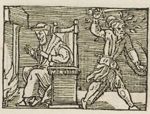
Experience corrige l'homme: La Perrière, Le theatre des bons engins (Lyon, 1545), emblem 12 uses the imagery of an old man warming himself at a fire-place and a young man wildliy brandishing a sword to express the effects of inexperience
Iconclass: 52A5:52A24 Knowledge; 'Cognitione', 'Cognitione delle cose' (Ripa)❧Precaution 52AA5:52AA21 Ignorance; 'Ignoranza', 'Ignoranza di tutte le cose', 'Ignoranza in un ricco senza lettere' (Ripa)❧Rashness, Imprudence, Recklessness
Loci Communes: Temeritas (Recklessness, Témérité)
IV v 55 Non statim finis apparet The end is not immediately in sight
Herodotus in Polymnia, significat hoc olim proverbio dici solitum: Non statim cum principio apparere rei exitum. καὶ τὸ παλαιὸν, inquit, ἔπος ὡς εὖ εἴρηται, τὸ μὴ ἅμα ἀρχῇ τὸ τέλος καταφαίνεσθαι, i. Et vetus adagium, quo recte dictum est, non statim cum initio apparere finem. Conveniet in quorundam praeproperas spes, qui negotio vix coepto, statim arbitrantur se rem factam habere, cum saepe exitus non respondeat initiis. Vulgi iocus est in Batavum quendam, qui iussus sumere catapotia, rogavit medicum quid essent effectura. Cum medicus respondisset fore, ut moveretur alvus, deuoravit, moxque nondum egresso medico, clamavit se cacaturire, nimirum suspicans statim apparere finem una cum principio. Alter quidam eiusdem sapientiae, cum a parentibus missus esset in Galliam, ut Gallice disceret, cum illic egisset quatriduum, querebatur apud suos, quod nondum loqueretur Gallice, putans hanc vim habere solum ipsum, ut quisquis adisset Galliam, ilico Gallice loqueretur. Sunt et huiusmodi quidam, qui simulatque filius triduo versatus est in ludo literario, mirentur eum nondum scire literas, queranturque operam simul et impensam periisse. Poterit ad seria torqueri. Rebus honestis strenue vacandum, ut olim liceat egregiorum laborum optimam messem metere. Semper in hac vita recte faciendum, olim non defutura praemia, etiam si non contingant in hoc mundo.
Herodotus in Polyhymnia points out that the following was often used proverbially: 'The end of something is not immediately in sight at the beginning.' He says, 'And it is an old adage, in which it was correctly said, [greek] "The end is not immediately in sight at the beginning."' This will suit the unbelievable attitudes of some people who think that the moment they have begun an enterprise they have completed it, although often the outcome does not correspond to initial expectations. There is a popular joke directed at a Dutchman. When he was told to take a draught of medicine, he asked the doctor what it would accomplish. The doctor replied that his bowels would move. He swallowed it down, and then, when the doctor had not yet left, shouted out that he was beginning to shit, no doubt thinking that the end was immediately in sight at the beginning. Another man with the same level of intelligence was sent by his parents to France to learn French. When he had been there for four days, he complained to his associates that he was not yet speaking the language. He thought that the very fact of going to France was alone sufficient for anyone to speak French immediately. There are also some of this type who are amazed that their son does not yet know his letters three days after he has been in elementary school and complain that it has been a waste of effort and money. The saying can be turned to serious matters. We should devote ourselves to virtuous behaviour so that at some time we can reap the best harvest for outstanding labours. We must act honourably in this life; we will have our rewards some time even if we do not get them in this world.
Facsimile:
Iconclass: 49G81:31A62 medicament, medicine❧defecation 51M12 Haste 54AA44 Impatience 56B131 Joke; 'Giuoco (dall'antico)' (Ripa)
Loci Communes: Festinatio praepropera (Overhasty haste, Précipitation excessive)
IV v 56 Philippide tenuius As skinny as Philippides
Athenaeus libro Dipnosophist 12. ostendit Philippidem comoediarum scriptorem sic tenui fuisse corpore, ut etiam πεφιλιππῶσθαι, dixerint, pro macruisse. Refert autem proverbium ex Aristophonte, ἐν ἡμεραις αὐτὸν τρισὶν ἰσχνότερον ἀποφανῶ φιλιππίδου, id est, Intra triduum graciliorem illum reddam Philippide. Rursus ex Menandro: Ο λιμὸς ὑμῶν τὸν καλὸν τοῦτον δακὼν Φιλιππίδου λεπτοτερον ἀποδείξει νεκρόν. id est, Vestrum ubi fames formosulum hunc momorderit, Reddat cadaver macrius Philippide. > Rursus ex Alexide citat hoc dictum: ψυκτηρΐδιον φιλιππίδον λεπτότερον. i. Poculum Philippide gracilius. Accommodabitur non invenuste ad orationem ieiunam, aut disputationem otiosae subtilitatis.
Athenaeus in book twelve of Doctors at Dinner reveals that Philippides was a writer of comedies who was so thin that there was even an expression 'to have been Philippidesized' that meant 'to have become skinny.' He cites the proverb from Aristophon: 'In three days I shall make him '[greek] "Skinnier than Philippides."' Again from Menander:
When your hunger gnaws away at this handsome young man,
It will turn him into a corpse thinner than Philippides.
He also cites this saying from Alexis: 'A cup thinner than Philippides.' It will be witty to apply the saying to a speech that lacks substance or to an argument of pointless subtlety.
Facsimile: 
Iconclass: 32A22 thin (human type) 51CC19:46A633 No Result, Lack of Result, Inefficacy, Futility❧debate, discussion (~ meeting) 98B(PHILIPPIDES) male persons from classical history (PHILIPPIDES)
Loci Communes: Sordes et parcimonia (Meanness and stinginess, Bassesse et avarice)
IV v 57 Quae semel ancilla, nunquam hera Once a servant, never a mistress
Ut vulgo iactatum refertur in Graecis epigrammatis libro primo, titulo Palladae: Μή ποτε δουλεύσασα γυνὴ δέσποινα γένοιτο Εστὶ παροιμϊακὸν. id est, Si qua ancilla semel fuit, haud Unquam dominetur, Ut proverbium habet. Videturideo dictum, quod qui ex humili fortuna subuehuntur ad res amplas, soleant esse ceteris insolentiores, minusque tolerabiles, quam qui felices nascuntur.
In the first book of Greek epigrams, in a poem ascribed to Palladas, a common saying is reported: [greek].
May she who has once been a servant never become a mistress,
As the proverb says.
The reason for the saying seems to be that those who are elevated from low fortune to high are usually more arrogant than others and more insufferable than those who are born to good fortune.
Facsimile:
Iconclass: 42F1 housewife 42F51 maid ~ house personnel 46A166 parvenu, 'nouveau riche', upstart 57AA644 Arrogance; 'Arroganza' (Ripa)
Loci Communes: Dissimilitudinis et incongruentiae (Dissimilarity and incongruity, Dissemblance et incongruité)
IV v 58 Exurere mare To burn up the sea
Admoniumus ἀδύνατα ferme pertinere ad cognationem proverbiorum. Quod genus est illud, quod refert Virgil. Aeneidos libro 9. Maria ante exurere Turno, Quàm sacras dabitur pinus. Nec dissimile est quod habet Propertius: Tu prius et fluctus poteris siccare. marinos Altaque mortali detrahere astra manu.
We have suggested that [greek] 'impossible things' are generally closely related to proverbs. Of such a kind is the one that Virgil uses in book nine of the Aeneid: 'Turnus will be able to burn up the seas before he burns sacred pines.'
Not dissimilar is what Propertius says:
Sooner will you be able to dry up the waves of the sea
And draw down the lofty stars with mortal hand.
Facsimile:
Iconclass: 41B12:25H23 burning as process❧sea (seascape) 52BB42 Impossibility
Loci Communes: Inanis opera (Vain effort, Effort vain)
IV v 59 Obedientia felicitatis mater Obedience is the mother of prosperity
Aeschylus in ἑπτὰ ἐπὶ θήβαις: Πειθαρχία γὰρ ἐστι τῆς εὐπραξίας Μητὴρ, γυνὴ σωρῆρος, ὧδ᾽ ἔχειλόγος.. id est, Felicitatis mater oboedientia, Coniuxque, ut atunt, sospitatoris Iovis. Fingit poeta Iovem sospitatorem, cuius beneficio contingat salus: huic esse uxorem, cui nomen πειθαρχία. id sonat oboedientiam, sed proprie qua paremus magistratibus ac principibus: ex horum coniugio natam esse filiam, cui nomen εὐπραξία, id est, felicitas. Principis est consulere saluri civium. Id conatur bonis et aequis legibus. populi est his obtemperare, si velit esse felix. Sed utinam non essent loves ὀλέθρϊοι, quibus uxor esset ἁρπυῖα & filia δυστυχία.
Aeschylus in Seven against Thebes:
For Obedience is the mother of Prosperity,
The wife of Jupiter the Saviour, as the saying goes.
The poet imagines that Jupiter, through whose kindness we are kept safe, is called Saviour, and that he has a wife called Πειθαρχία (this means 'obedience,' but literally the obedience we show to magistrates and princes). From their union was born a daughter called εὐπραξία 'Prosperity.' It is the duty of a prince to concern himself with the safety of his citizens; he attempts to do this by good and just laws. It is the duty of the people to obey these if it wishes to be prosperous. I only wish, however, that princes were not Jupiter ὀλέθρϊος 'Destroyer,' whose wife is ἁρπυῖα 'Plunderer' and whose daughter is δυστυχία 'Misfortune.'
Facsimile:
Obedientia foelicitatis mater: Hulsius, Epitome Emblematum (Nürnberg, 1602), emblem 15
Mens omnibus una sequendi: Zincgreff, Emblematum Ethico-politicorum (Heidelberg, 1619), emblem 55 uses the imagery of a flock of sheep obediently following their leader
Iconclass: 42A30(+0):54F11 motherhood (+ variant)❧Welfare, Prosperity; 'Felicità publica', 'Prosperità della vita', 'Salute' (Ripa) 53B5 Obedience; 'Obedienza' (Ripa)
Loci Communes: Infortunii sive exitii (Misfortune or ruin, Malheur ou ruine); Obsecundantis (Complying, being obliging, Se conformer, obéir)
IV v 60 Ver ex anno tollere To remove spring from the year
Εκ τοῦ ἐνιαυτοῦ τὸ ἔαρ ἐξαίρειν. i. Ver ex anno tollere dicebatur, qui id quod in negotio quopiam erat praecipuum tolleret. Meminit Herodotus in Polyhymnia. Lacedaemonii et Athenienses missis in Siciliam legatis, petebant a Gelone Syracusano et societatem et suppetias, adversus Xerxem bellum inferentem Graeciae. Nec recusavit Gelo, modo se imperatorem vel maritimarum rerum vel terrestrium copiarum constituerent: quam conditionem cum repudiarent legati, iussit eos ilico discedere, ac renuntiare Graecis: ὅτι ἐκ τοῦ ἐνιαυτοῦ τὸ ἔαρ αὐτοῖς ἐξῄρηται. Ver ipsis ex anno sublatum esse, videlicet illud subindicans, suum exercitum praecipuum esse Graeciae florem ac robur, qui si deesset, defuturum illi quod esset praecipuum. Ver enim anni praecipua pars est. Meminit Aristoteles libro Rhetoricorum tertio inter metaphorarum genera. Rursus Rhetoricorum libro primo ostendit hoc dictum esse Periclis in epitaphio qui dixerit: τὴν νεότητα ἐκ τῆς πόλεως ἀνῃρῆσθαι ὥσπερ τὸ ἔαρ ἐκ τοῦ ἐνιαυτοῦ ἐξαιρεθείη. i. Iuventutem è Repub. sublatam esse perinde, ac si ver ex anno tolleretur. Potest deflecti longius, ut dicantur ver eximere anno, qui linguarum ac bonarum literarum peritiam sustollant è scholis.
'[greek], To remove spring from the year. This was said of anyone who dispensed with the most important part of some task. Herodotus mentions this in his book entitled Polyhymnia. The Spartans and the Athenians sent envoys to Sicily and asked Gelon of Syracuse for an alliance and support against Xerxes, who was waging war on Greece. Gelon agreed, provided that they appointed him as commander-in-chief of the navy or of the land forces. When the envoys refused this condition, he told them to leave and to tell the Greeks 'that they themselves had removed spring from the year,' obviously suggesting that his army was the outstanding flower and strength of the Greeks, and that without it they would lack what was essential. For spring is the most important part of the year. In the third book of his Rhetoric Aristotle mentions 'spring' as a type of metaphor. Again, in the first book of his Rhetoric he points out that this was a saying used by Pericles in the funeral oration. Pericles said:
The youth of the state have been lost, just as if spring were removed from the
year.
The adage can be used in a more oblique way if we say that those who remove the knowledge of languages and literature from the schools are removing spring from the year.
Facsimile:
Iconclass: 47C2(+0):23D42 displacing, removing (industrial processes) (+ variant)❧spring, 'Ver'; 'Primavera' (Ripa) 51AA4:51A5 Nothingness, Absence❧Intrinsic Nature, Essence, Idea (according to Plato) 51AA7 Imperfection, Incompleteness; 'Imperfettione' (Ripa)
Loci Communes: Inanis opera (Vain effort, Effort vain)
IV v 61 Etiam si Cato dicat Even if Cato were to say it
Plutarchus in vita Catonis Uticensis, narrat tantam Catonis apud populum fuisse fidem, et auctoritatem, ut de rebus incredibilibus proverbio diceretur: Τοῦτο μὲν οὐδὲ κάτωνος λέγοντος πιθανόν ἐστιν. i. Istuc incredibile est, etiam si dicat Cato. Et orator quidam cum hyperbolicos diceret uni resti non esse credendum, adiecit ne Catoni quidem. M. Tullius epistola ad Atticum libro secundo. Quid Cato ille noster, qui mihi unus est pro centum milibus. Similis erat auctoritas Aristidis apud Athenienses ac Xenocratis, cui populus remisit iusiurandum, cum alioqui nullus illic testis admitteretur absque iureiurando. Huic adfine est: Nec iurato istuc crediturus sim.
Plutarch in his Life of Cato tells us that Cato commanded so much trust and influence in the minds of the people that there was a proverb about unbelievable things: [greek] 'This cannot be believed, even if Cato were saying it.' And when a certain orator was saying by way of hyperbole that no witness should be believed, he added, 'Not even Cato.' Marcus Tullius in a letter to Atticus, book two: 'What of that Cato of ours, who on his own. I think is as good as a hundred thousand?' Among the Athenians Aristides had the same kind of influence, as did Xenocrates, who was the only person granted dispensation from taking an oath, although no other witness was accepted without an oath. Related to this adage is Nec iurato istuc crediturus sim 'Even were he on oath I would not believe that.'
Facsimile:
Iconclass: 52BB21 Incredulity 98B(CATO THE ELDER):57A6141 (story of) Marcus Porcius Cato the Elder❧Trustworthiness, Reliability
Loci Communes: Diffidentia (Distrust, Méfiance)
IV v 62 Decipienti semel A once-deceiver
Suspicor esse vulgo iactatum apud Italos, quod refert Ioannes Campanus vir suo seculo magnus, & admirabilis ingenii, libro De fugienda ingratitudine secundo: Decipienti me semel, dii male faxint: faxintque bene, si bis idem deceperit. Quod semel falli, perfidiae decipientis par sit imputari: verum qui semel expertus, rursum fidem habuerit eidem, dignus videatur qui fallatur. Confine est illi quod alibi recensuimus, Improbe Neptunum accusat, qui iterum naufragium facit. Quoniam Campanus erat variae reconditae lectionis, fieri potest ut hoc dictum alicubi citatum legerit. Nam videntur esse duo senarii pauculis immutatis, Decipienti semel me, dii faxint male. Faxintque bene, si bis idem deceperit. Nam ipse Campanus adducit titulo veteris proverbii, quanquam vetus dici potest, quod nostra quoque memoria natum est.
I suspect that there was a common saying among the Italians, reported by Giovanni Campano, a great man of his age and one of remarkable abilities, in his On Avoiding Ingratitude, book two: Decipienti me semel dii male faxint, faxintque bene si bis idem deceperit 'May the gods damn the man who deceives me once, and bless him if he does it twice.' It may be right to blame the perfidy of a deceiver if you are tricked on one occasion, but the man who has experienced this once and then again trusts the same person may seem to deserve to be tricked. It is closely related to an expression we have noted elsewhere, 'He wrongly rails at Neptune who suffers shipwreck twice.' Since Campano was a man of wide and learned reading, it may be that he came across this saying when it was cited in some work. For with few changes these words seem to be two senarii: Decipienti semel me, dii faxint male/Faxintque bene si bis idem deceperit? And Campano himself adduces it as an old proverb, although even what has come into being in living memory can be termed 'old.'
Facsimile: 
Iconclass: 51B61:57AA621 Repetition❧Cheat, Deceit; 'Fraude', 'Inganno' (Ripa) 51B61 Repetition
Loci Communes: Iteratus error (A repeated error, Erreur répétée)
IV v 63 Qualis hera, tales pedissequae Like mistress, like maids
Et hodie vulgo dicitur ex Athanasii symbolo detortum, Qualis pater, talis filius. Huic similimum est pervetus adagium libro Epistolarum ad Atticum quinto, epistola undecima: Si verum est, inquit, illud ὁποία ἡ δέσποινα, τοῖαι καὶ θεραπαινίδες. i. Qualis hera, tales & ancillae. Quanquam nec hoc multum abest a senario Δέσποιν᾽ ὁποῖα, τοῖαι καὶ θεραπαινίδες. Plato libro De Repub. 4. ἢ οὐκ ἀεὶ τὸ ὅμοιον ὂν ὅμοιον παρακαλεῖ. i. Aut non semper quod est simile, simile accersit.
'Like father, like son,' a distortion of part of the Athanasian Creed, is a common saying even today. Very like it is an extremely old adage in book five, letter eleven of Cicero's Letters to Atticus? He says, 'If the saying [greek] "Like mistress, like maids," is true.' And yet this is not far from being a senarius: [greek]. Plato in book four of the Republic: 'Does not always like attract like?'
Facsimile:
Iconclass: 42F1 housewife 42F51 maid ~ house personnel 51B2 Similarity, Likeness
Collectanea (1500): 536
Loci Communes: Similitudinis et congruentiae (Similarity and congruence, Similitude et convenance)
IV v 64 Bibere mandragoram To drink mandrake
Inest vis somnifica mandragorae, adeo ut enecet etiam largiore potu, si Plinio credimus, Historiae mundi libro 25. cap. undecimo. Dioscorides indicat radicem vino decoqui ad tertiam partem, ex eo colato sumi cyathum adversus insomnium. Datur & secandis. adversus intolerabilem cruciatum. Quin & sedi immissa herba glandis vice, somnum facit. Hanc Pythagoras ἀνθρωπόμορφον appellavit, quod radix imitetur hominis formam. Unde Columel. in carmine semihominem dicit: Quamvis semihominis vesano gramine feta Mandragorae pariat flores. Eandem circeam appellant, quod radix illius amatoriis veneficiis credatur utilis. Unde qui cessant in officio dormitantque, multam mandragoram bibisse dicuntur. Sic usus est Iulianus in epistola quadam ad Callixenem, Οὐ φανεῖται πολλὴν πάνυ μανδραγόραν ἐκπεπωκώς; i. An non videtur multam hausisse mandragoram? Usurpat et Demosthenes in Philippica 4. ἀλλὰ μανδραγόραν πεπωκόσιν, ἢ τι φάρμακον ἄλλο τοιοῦτον ἐοίκαμεν ἀνθρώποις. i. Similes videmur his qui mandragoram biberunt, aut aliud simile pharmacum. Itidem qui dormitant in negotio, sub mandragora dormire dicutur. Lucianus in Timone, ὅπουγε καθάπερ ὑπὸ μανδραγόρου καθεύδεις. i. Quandoquidem veluti sub mandragora dormis. Hoc non dissimile est illi, quod alibi retulimus: Bibe elleborum.
Mandrake has a soporific power so that too large a draught made from it is even fatal, if we believe Pliny in book twenty-five, chapter eleven, of his History of the World. Dioscorides informs us that the root is boiled in wine, the liquid being reduced down to one-third, and that a draught of the strained juice is taken for insomnia. It is also given to those undergoing surgery to combat the intolerable pain. In fact if the root is inserted in the rectum, in a pellet form like an acorn, it produces sleep. Pythagoras described this plant as 'anthropomorphic' because its root resembles a human form. Because of this Columella calls it 'half human' in a verse:
Although fertilized by the insane herb of the half-human mandrake
It produces flowers.
It is also called 'Circean' because it is thought to be useful as a lover's potion. Because of its effects those who are idle at their task and doze off are said to have drunk a lot of mandrake. Julian used it in this way in a letter to Callixenes: 'Do you not think that he has drunk a lot of mandrake?' Demosthenes also uses it in the fourth Philippic: 'We seem like those who have drunk mandrake or another, similar drug.' Similarly, those who fall asleep while working are said 'to be sleeping under the effect of mandrake.' Lucian in Timon: 'Since you are sleeping under the effects of mandrake.' This is not unlike the proverb that we have given elsewhere, 'Drink hellebore.'
Facsimile:
Iconclass: 25G22(ROOT) (non-fruit) products of plants or trees (ROOT) 33C72 aphrodisiacs 41C75(MANDRAKE) drugs (MANDRAKE)
Loci Communes: Oblivio (Forgetfulness, Oubli)
IV v 65 Ne pictum quidem vidit He has not even seen a picture of it
Quemadmodum de vehementer ignoto dicimus, ne natum quidem novi, sic dicimus, ne pictum quidem vidit. Multas enim urbes et res, atque etiam homines numquam nobis conspectas, ex pictura utcumque novimus. Marcus Tullisu libro De finibus bonorum ultimo. Dicis eadem omnia et bona et mala, quae quidem dicunt, qui numquam philosphum pictum, ut dicitur, viderunt. Plautus in Asinaria: Nam neque unquam fictum, aut pictum, neque scriptum in poematis, ubi lena bene agat. Venustius etiam fiet, si longius transferatur. Rhetoricam ne pictam quidem vidit. Virtutem ne pictam quidem. Nam piguntur haec quoque.
We say of someone who is quite unknown to us, 'I do not know if he has even been born.' A similar expression is 'He has not seen even a picture of it.' For we have some knowledge of many cities, objects, and even persons that we have never seen from pictures. Marcus Tullius in the final book of Definitions of Good and Evil: 'You say that all the same things are both good and evil. This is said by those who, as the saying goes, have never seen even a picture of a philosopher.' Plautus in the Comedy of Asses: 'I have never seen the representation of a pimp acting honourably, either in sculpture or in painting or in poetry.' The adage will be even more attractive if it is used in a less literal sense: 'He has not seen even a picture of Rhetoric, not even a picture of Virtue.' For pictures of these are also made.
Facsimile:
Iconclass: 51AA4:48C514 Nothingness, Absence❧picture, painting 52BB31 Improbability
Loci Communes: Differentiae (Differences, Différences); Ignoratio (Ignorance, Ignorance)
IV v 66 Scrupulum injicere To cast a small stone
Scrupuli sunt minuti lapilli, qui inter ambulandum insiliunt in calceos hominis, ac pedem torquent, inde Iniicere scrupulum dicitur, qui sollicitudinem iniicit animo cuiuspiam. Et scrupulum eximit, qui sollicitudinem eximit. Terentius in Adelphis, Timet, inieci scrupulum homini. M. Tullius 4. De finibus, in fine disputationis, Scrupulum inquam abeunti? Sed videbimus. Hoc non dissimile est illi quod aliàs retulimus, Infixo iaculo fugere. Rursum Terentius in Andria: At mihi unus etiam scrupulus restat, qui me habet male.
Scrupuli are small stones that get into one's shoes while one is walking and cause the foot great pain. This is why those who cause someone to worry are said 'To cast a small stone.' And those who remove anxiety 'remove a small stone.' Terence in the Brothers: 'He's afraid. I've cast a small stone in the man's mind.' Marcus Tullius in book four of Definitions of Good and Evil, at the end of the discussion: 'That's a sharp stone for me when I am leaving, but we shall see.' This expression is quite similar to the one we have given elsewhere, 'To flee after planting the spear.' Also Terence in the Woman of Andros: 'But there is still one small stone remaining that troubles me.'
IV v 67 In angulo In a corner
Εν γωνίᾳ. i. In angulo fieri dicitur, quod fit in occulto. Quod usurpatum in Evangeliis à domino Iesu Christo, reperitur esse apud Platonem in Gorgia: Τὸν λοιπὸν βίον βιῶναι, μετὰ μειρακίων ἐν γωνίᾳ τριῶν ἢ τεττάρων ψυθυρίζοντα. i. Reliquum vitae degere cum adolescentulis tribus aut quatuor in angulo susurrantem. Item Lucianus in contione deorum, μηκέτι τονθορίζετε ὦ θεοὶ, μηδὲ κατὰ γωνίας συστρεφόμενοι, πρὸς οὖς ἀλλήλοις κοινολογεῖσθε. Ne posthac susurros miscere ô dii, nec ad angulos conversi, aliis alii ad aurem conspirate. Marcus Tullius lib. De oratore primo: Quibus ego de his rebus omnibs in angulis consumendi otii causa, ut disserant, &c. Sic & illud in Evangelicis literis proverbialiter est dictum, Super tectum praedicare, pro eo quod est, palàm & in publico praedicare. Nunquam enim legimus apostolos de tecto clamasse.
What is done secretly is said to be done [greek] 'In a corner.' This is used in the gospels by the Lord Jesus Christ and can be found in Plato in his Gorgias: 'To live the rest of one's life, whispering with three or four young men in a corner.' Also Lucian in On the Assembly of the Gods: 'Do not whisper from now on, gods, and do not resort to corners, breathing words in each other's ear.' Marcus Tullius in book one of the Making of an Orator: '[I allow them] to discourse about all these things in every corner so as to use up their leisure time.' So also Super tectum praedicare 'To proclaim upon the housetops' was a proverbial expression in the gospels. For we never read of the apostles shouting from the housetops.
Facsimile: 
Iconclass: 33B91 hiding, hiding oneself 52DD1 Secrecy, Latency, Concealment; 'Secretezza' (Ripa)
Loci Communes: Occulta (Hidden things, Choses cachées)
IV v 68 Calidum mendacium A hot lie
Calidum facinus, θερμὸν ἔργον, pro audaci dici, monuimus aliàs. Simili figura dici solere calidum mendacium pro audaci et imprudenti, docet Plautus in Mustellaria: Calidum herde audivi esse optimum mendacium. Aut non est mentiendum, aut est fortiter mentiendum: alioqui mox deprehenditur qui verecunde mentitur. Quemadmodum Aeschinus Terentianus, Non istas, quod sciam.
We have said that [greek] 'A hot deed' is said of an act that is bold. By a similar metaphor, Calidum mendacium 'A hot lie' was customarily said of a lie that was bold and shameless, as is shown by Plautus in the Haunted House: 'I have heard to be sure that a hot lie is the best lie.' If we must lie, then we should do so brazenly. For the man who lies with diffidence is soon caught out: so Aeschinus in Terence, who says, 'I didn't knock at the door - as far as I know.'
IV v 69 Muti citius loquentur Sooner will a dumb man speak
Ad ἀδυνάτων genus pertinet & hoc quod habet Plautus in Persa, Muti prius loquentur quàm ego: Ne hoc, inquit, cuiquam homini dicerem, edsctum est mihi Magnopere, nec cuiquam homini crederem. Omnes muti ut prius loquerentur hoc quàm ego
'Sooner will the dumb speak,' in Plautus in the Persian, is related to those proverbs that express [greek] 'impossibilities.' He says:
It has been strongly enjoined upon me
Not to say this or entrust this to any man,
So that sooner will the dumb speak than I.
Facsimile:
Iconclass: 31A4121 deaf-mute, deaf and dumb 31B6235 speaking 52DD3 Taciturnity; 'Secretezza', 'Secretezza overo Taciturnità' (Ripa)
Loci Communes: Laudata (Praised things, Choses louées)
IV v 70 In transennam in ducere To lure into the snare
In transennam inducit, qui dolo fallit. Plautus in Persa: Hunc ergo hodie hominem intransennam doctis ducam dolis. Itaque huic insidiae paratae sunt, prope aggrediar virum. Ab aucupibus sumptum est, qui intra cancellos escam spargunt insidiantes aviculis. Unde & hodie qui dolo captus est, intra transennam esse dicitur. Huic simillimum: In foveam, & in laqueum inducere, quorum alibi meminimus.
The person who tricks by deceit 'Lures into a snare.' Plautus in the Persian: 'I'll lure this fellow this day into a snare by clever wiles. / The trap is set for him. I'll approach the man.' It was taken from fowlers, who trap birds by scattering food in cages. Because of this even today a person who is caught through trickery is said to be 'in the snare.' 'To lure into the pit and into the net,' which we have mentioned elsewhere, is very like this proverb.
Facsimile:
Iconclass: 43C13(+4141) fowling, fowler (+ snare) 43C13(+43) fowling, fowler (+ lures ~ hunting) 57AA621 Cheat, Deceit; 'Fraude', 'Inganno' (Ripa) <a href="https://bildgrid.org/emblems/embhab_162-3-eth-b/embhab_162-3-eth-b_emblem054.html" title="Le Prince doibt euiter les flatteurs">La Perrière, Le theatre des bons engins (Lyon, 1545), emblem 54 uses the imagery of a fowler to express how flatters at court lure princes into their trap</a>
Loci Communes: Insidiae (Ambush, treachery, Embûches)
IV v 71 Ab transenna cibum petere To go after food from a snare
Ab transenna cibum petere dicicitur, qui periculo proximus est. Plautus in Bacchidibus: Nunc ab transenna hic turdus lumbricum petit. In senem dicitur legentem epistolam, per quam erat fallendus. Ab eadem metaphora sumptum, cuius modo meminimus.
A person who is very close to danger is said 'To be going after food from a snare.' Plautus in the Bacchis Sisters: 'Now this thrush is going after the worm in the snare.' The words are directed at an old man who is reading a letter that was designed to deceive him. Based on the same metaphor that we have just mentioned.
Facsimile:
Iconclass: 41C11:43C13(+4141) eating❧fowling, fowler (+ snare) 54DD51 Danger; 'Pericolo' (Ripa) 54DD52 Risk; 'Ardire ultimo & necessario' (Ripa)
Loci Communes: Insidiae (Ambush, treachery, Embûches)
IV v 72 Omnes adhibere machinas To employ all one's artillery
M. Tul. lib. Epist. ad Brutum, Ad reliquos hic quoque labor mihi adcessit, ut omnes machinas adhibeam ad tenendum adolescentem, item Plato de legib. li. 7. Οὐκοῦν φαμὲν ἅπασαν μηχανητέον μηχανήν. i. Itaque dicimus omnem adhibendam machinam. Rutsum in eodem, πᾶσαν μηχανὴν προσφέρων, id est, Omnem machinam admovens. Sumptum est ab his, qui summa vi oppugnant arcem aut oppidum, nullum machinae genus non admoventes, nihilque relinquunt intentatum.
Marcus Tullius in his book of letters to Brutus: To my other tasks this one too has been added, that I should employ all my artillery to hold on to the young man.' Also Plato in book seven of the Laws: 'And so we say that [greek] "All the artillery should be used."' Again in the same book: 'Applying all the artillery.' It is taken from those who attack a town or citadel with all their might, using every kind of machine and leave nothing untried.
Facsimile:
Iconclass: 45H32(+24) charge ~ battle (+ artillery) 45K26(+24) assault ~ siege (+ artillery) 53A2 Perseverance, Resolution, Determination; 'Perseveranza' (Ripa) 54A11 Industriousness, Assiduity; 'Assiduità', 'Industria', 'Zelo' (Ripa)
Loci Communes: Conatus (Effort, endeavor, Effort)
IV v 73 Leo cordula vinctus A lion tied up with a thread
Lucianus in libello de mercede servientibus, Νῦν δὲ τὸ τοῦ λόγου, λέων κρόκῃ δεθεὶς ἄνω καὶ κάτω περισύρομαι. i. Nunc autem quod dici solet, Leo filo vinctus, sursum ac deorsum citcumferor: cum quis exiguo commodo captus, apud aulicos ostentatur passim, quod princeps tantum alat virum. Hoc enim principes sibi gloriosum ducunt, si episcopos aut doctos viros cogant sua relinquere negocia, & aulicae servire pompae.
Lucian in his essay Salaried Posts: 'Now I walk up and down, Νῦν δὲ τὸ τοῦ λόγου, λέων κρόκῃ δεθεὶς ἄνω καὶ κάτω περισύρομαι "A lion tied up with a thread," as the saying goes.' As when a great man is bound to a prince for a tiny advantage and is openly displayed at court to show that he is part of the prince's household. For princes think that it redounds to their glory if they compel bishops or scholars to abandon their work and be slaves to the pomp of the court.
Facsimile:
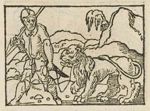
L'espoir qu'est vain, met l'homme en seruitude: La Perrière, Le theatre des bons engins (Lyon, 1545), emblem 58 uses the imagery of a lion led by a leash to express the adage's moral
Iconclass: 34E3:25F23(LION) animals tied up❧beasts of prey, predatory animals: lion 47H352 (ball of) yarn 51HH41:53C11 Insufficiency❧Authority, Power; 'Dominio', 'Giurisdittione' (Ripa)
IV v 74 Sinapi victitare To live on mustard
Tristes ac supra modum tetrici sinapi victitate dicuntur, quod hodieque vulgo tritum est. Plautus in Truculento: Si aecastor hic homo sinapi victitet, Non censeam tam tristem esse posse. Aristophanes in Equitibus consimili figura dixit, Tueri sinapi, Κᾄβλεψε νάπυ, καὶ τὰ μέτωπ᾽ ἀνέσπασε. id est, Torvum tuens, ut qui sinapi victitant, Frontem severam contrahebat. Interpres Aristophanis admonet napy semen esse, unde fiat sinapi. Huius vis est ciere la chrymas, eoque Ennius apud Macrobium triste vocat. Nec triste quaeritat sinapineque maestum cepe: De cepis alias nobis est dicutm.
Those who are sour-faced and exceptionally crabbed-looking are said 'To live on mustard.' Even today this is a common saying. Plautus in Truculentus: 'Heavens, if this fellow were living on mustard, / I don't think he could be so sour-faced.' Aristophanes in the Knights used a similar figure in saying, '[greek] "he looked like mustard" and knitted his solemn brow.' The commentator on Aristophanes tells us that napy is a seed from which mustard is made. It can make one's eyes water, and this is why Ennius, as quoted in Macrobius, describes it as bitter. 'He is not looking for the bitter mustard or the tearful onion.' We have spoken about onions elsewhere.
Facsimile: 
Iconclass: 41C663 mustard 56BB11 Bitterness; 'Amaritudine' (Ripa)
Loci Communes: Tristitia, laetitia (Sadness, joy, Tristesse, joie)
IV v 75 Pueri senesque Young boys and old men
In principio Chiliadum admonuimus omneis fermè huiusmodi figuras esse proverbiales, quae constant ex contrariis, maximi, minimique, iuvenesque senesque, diis atque hominibus, Sacra prophana, fas nefas, fanda infanda. Horatius: Parvi properemus & ampli. quum omnibus sentiat huc esse connitendum. Plato lib. De legibus vii. Αλλὰ τὸ λεγόμενον πάντ᾽ ἄνδρα καὶ παῖδα, κατα τὸ δυνατὸν, &c. id est, Imò quod dici solet, omnem puerum ac senem pro viribus, &c.
At the beginning of the Chiliades we suggested that usually all expressions comprising opposites, such as the following, are proverbial: 'Great and small,' 'Young and old,' 'Gods and men,' 'Sacred and profane,' 'Right or wrong,' 'Speakable and unspeakable.' Horace: 'Let us hasten, the humble and the great,' since he means that everyone must strive together. Plato in book seven of the Laws: 'Nay, as is often said, every boy and old man, as best they can .. .'
Facsimile:
Iconclass: 31D11221 boy (child between toddler and youth) 31D16 old man 51BB2 Dissimilarity, Unlikeness
Loci Communes: Multi (Many people, Beaucoup de gens); Omnia (All things, Toutes choses)
IV v 76 Omni voce In full voice
Quod summa contentione asseritur, omni seu tota voce dicitur praedicari. Vehemens enim affectus animi solet vocem intendere. Plato lib. De legibus X. Πᾶσαν δὴ τὸ λεγόμενον φωνὴν ἰέντι. id est, Omni emissa voce. Clare loquimur quum asseveramus, & quanto possumus clamore sonamus, si quid magnopere nos commovet. Potest & in hunc usum accomodari, ut omnem vocem promere dicatur, qui modis omnibus conatur persuadere, nunc blandiens, nunc obiurgans, nunc pollicitans, nunc minitans.
What is asserted with the greatest vigour is said 'to be proclaimed with full voice or with the whole voice.' For intense feeling usually makes us raise our voice. Plato in book ten of the Laws: [greek] 'Releasing the whole voice, as they say.' We speak loudly when we are making strong assertions, and we proclaim in the loudest voice we can muster if we have very deep feelings about something. It can be adapted to the following use. If anyone uses everything to try and persuade us, such as compliments, rebukes, promises or threats, he can be said to be 'using his whole voice.'
IV v 77 Arcus tensus rumpitur The bow breaks if strung too tight
Plutarchus in libello, cui titulum fecit, An sit seni administranda Respub. Τόξον μὲν, inquit, ὥς φασιν ἐπιτεινόμενον ῥήγνυται, ψυχὴ δὲ ἀνιεμένη, id est, Arcus, quemadmodum aiunt, quum intenditur, rumpi solet, contrà animus, quum remittitur. Refertur autem in epitaphio Theophrasti, qui tantisper viguit dum esset in labore, simulatque remisit studium, interiit. Οὐκ ἄρα τοῦτο μάταιον ἒπος μεροπων τιν᾽ ἐλέχθη, Ρἥγνυσθαι σοφίης τόξον ἀνιέμενον. Δὴ γὰρ καὶ θεόφραστος ἔως ἐπόνει μὲν, ἄπηρος Ην δέμας, εἶτ᾽ ἀνεθεὶς, κάτθανε πηρομελής. id est, Frangi ni studii tensum laxanueris arcum Veridici sane verba fuere viri. Namque opere assiduo valuit Theophrastus, & idem Laxato studio, mebra solutus obit.
In his essay entitled 'Whether an Old Man Should Govern the State' Plutarch says, 'As the saying goes, Τόξον μὲν ὥς φασιν ἐπιτεινόμενον ῥήγνυται, ψυχὴ δὲ ἀνιεμένη' "A bow, if strung too tight, often breaks." In contrast, the mind breaks when it is too relaxed.' And indeed this is said to have been part of the epitaph of Theophrastus, who was extremely healthy as long as he worked, and died as soon as he relaxed:
That you are broken once you loosen the taut bow of study
Were the words of the prophetic bard.
For constant toil kept Theophrastus well
And when he ceased, he died, his body weak.
Facsimile:
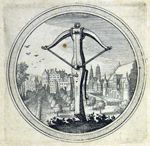
Ni laxes rumpitur: Zincgreff, Emblematum Ethico-politicorum (Heidelberg, 1619), emblem 69 paraphrases the adage and uses its imagery
Zu hoch gespannt zerbricht den Bogen: Friedrich, Emblemata Nova (Frankfurt, 1617), emblem 12 translates the adage and uses its imagery
Sans adversaires vertu devient lasche, flestrie, & deffaillie: Boissard, Emblemes (Metz, 1588), emblem 18 uses the adage's imagery
Vi frangitur obsequio flectitur: Borja, Empresas morales (Bruxelles, 1680), emblem 11 uses the imagery of bending versus breaking
Vi frangitur obsequio flectitur: Camerarius, Symbolorum et Emblematum Centuria(e) (Nürnberg, 1590, 1595, 1596, 1604), emblem 21 uses the imagery of bending versus breaking
Il nous conuient trauailler par raison: La Perrière, Le theatre des bons engins (Lyon, 1545), emblem 25 uses the imagery of an archer straining his bow
Iconclass: 31A2746 breaking something 45C15(BOW) archer's weapons: bow 54A11 Industriousness, Assiduity; 'Assiduità', 'Industria', 'Zelo' (Ripa) 54A46 Rest; 'Quiete' (Ripa)
Loci Communes: Modestia modusque (Modesty and moderation, Modestie et mesure)
IV v 78 Ne Apollo quidem intelligat Not even Apollo would understand it
Quod vehementer esset obscurum, et intellectu perdifficile, id negabant vel ab Apolline posse intelligi. Athenaeus lib. Dipnosophistarum iii. Τὶ δὲ ἡ ἐπιστολὴ δηλοῖ, νομίζω ἐγὼ μηδὲ τὸν πύθιον διαγνῶναι. id est, Quid autem sibi velit epistola, arbitror equidem, nec ipsum Apollinem intelligere. Adducit inibi senarium ex Antiphane: Ταυτι δ᾽ ὅτ᾽ ἐστὶν οὐδ᾽ ἂν ἀπόλλων μάθοι. id est, Nec Apollo, quid sibi haec velint, intelligat.
It was said of anything extremely obscure or very difficult to understand that 'Not even Apollo could understand it.' Athenaeus in book three of Doctors at Dinner: 'What the letter means I do not think Apollo himself understands.' He adduces there also a senarius from Antiphanes: [greek] 'Not even Apollo would understand what this means.'
IV v 79 Destitutus ventis remos adhibe When the winds desert you, use the oars
Cum res non succedit, ut volumus, ad alia praesidia confugiendum est, aut cum fortuna est adversa, tum magis adlaborandum. Refert adagium Hermolaus in epistola quadam Graeca, quae Politianicis admixta est: καὶ τοῦ πνεύματος ἁμαρτών φασιν, ἐπὶ τὰς κώπας χώρει id est, Et destitutus ventis, ad remos, quod aiunt, te confer.
When something is not going well in the way that we wish, we must resort to other means of assistance, or we must strive all the harder when we experience misfortune. In a Greek letter that is included with Poliziano's letters, Ermolao records an adage: [greek] '"When the winds desert you, take to the oars," as they say.'
Facsimile:
Iconclass: 26C9 absence of wind, calm 43C223 rowing, canoeing, etc. (sport)
Loci Communes: Experientae secundae (Experience that turns out well, Expérience favorable)
IV v 80 In pace leones Peace-time lions
Aristophanes in Pluto: Οντες οἴκοι μὲν λέοντες, ἐν μάχῃ δ᾽ ἀλώπεκες. id est, Quum leones sint domi, iidem in Marte sunt vulpeculae. AIistophanis interpres ostendit proverbium iactatum in Lacones, qui in Asia infeliciter rem gesserant: Οἴκοι λέοντες, ἐν εφέσῳ δ᾽ ἀλώπεκες. id est, Domi leones, in Epheso vulpeculae. Ad hoc nimirum allusit Comicus. Plutarchus in comparatione Syllae et lysandri, refert hanc sententiam tamquam vuglo iactatam in principes. sic enim de Lysandrifrugalitate praedicat. Αλλ᾽ εἰδέ τις ἄλλος ἐκπεφευγὼς τουτὶ τὸ περίακτον, Οἴκοι λέοντεστ, ἐν ὑπαίθρῳ δ᾽ ἀλώπεκες. id est, Imò si quis alius effugerat illud. quod vulgo cirumfertur, Domt leones, sed foris vulpeculae. Olim fortasse sic emergebant potentes, post et domi et foris leones esse coeperunt, aut si quod animal leone violentius. Conveniet in eos qui praepostere se gerunt, ibi feroces, ubi nihil erat opus, ibi fugaces, ubi res poscebat virum, aut qui in suos saevi, non itidem audent adversus inimicos, quod Ciceroni obicit Salustius, videlicet, quod contumeliosus in amicos, supplex inimicis. Aut in illos, qui simulata mansuetudine perveniunt ad tyrannidem.
Aristophanes in Plutus: [greek] 'Although they are lions at home, in battle they are foxes.' The commentator on Aristophanes points out that the proverb was directed at the Spartans who had been unsuccessful in war in Asia: 'They may be lions at home, but they are foxes in Ephesus.' This was certainly what the comic writer was alluding to. Plutarch in his comparison of Sulla and Lysander cites this expression as a common saying targeted at rulers. For this is what he declares about Lysander's thriftiness: 'But if anyone else had escaped the criticism of that common saying, "Lions at home but foxes outside" ...' Perhaps in antiquity this is how powerful men gained prominence; later they became lions (or an even more savage animal, if there is one) not only at home but also abroad. The expression will suit those who do the opposite of what they should. They are fierce when there is no need, cowardly when the situation demands manliness. Or it suits those who are cruel to their own people, but do not dare to act in the same way towards their enemies, an accusation levelled by Sallust at Cicero: 'He was abusive of his friends, but he fell prostrate before his enemies.' Or it will suit those who feign a gentle disposition and become tyrants.
Facsimile: 
Iconclass: 25F23(LION) beasts of prey, predatory animals: lion 45A2 peace 54BB2:54AA4 Unnecessity, Superfluity❧Vehemence, Violence, Fierceness; 'Sforza con Inganno', 'Violenza' (Ripa)
Loci Communes: Absurda, indecora, seu praepostera (Absurd, unbecoming, or preposterous things, Choses absurdes, inconvenantes ou déplacées); Intempestiva et inepta (Untimely and inept things, Choses inopportunes et ineptes); Timiditas (Timidity, Timidité)
IV v 81 Certissima paupertas The surest poverty
Sententiam proverbialem refert Iunius Columella. lib. De re rust. xii. cap. ii. Praeparatis igitur receptaculis, oportebit suo quidque loco generatim, atque etiam speciatim nonnulla disponere, quo facilius, cum quid postulabit usus, recipere possit. Nam vetus proverbium est, paupertatem certissimam esse, cum alicuius indigeas, uti eo non posse, quia ignoretur vib proiectum iaceat, quod desideratur. Hactenus Columellae verba retulimus. Sentit autem, ni fallimur, si quis habeat domi, quod cum utendum est, inveniri non porest, eum magis egere eo, quod habet, quam si non haberet. Etenim, qui non habet, rogat alicunde commodato: qui habet, ubi ventum est ad articulum, quo sit utendum, nec suum habet, quod ubi sit, nescit, nec alienum habet, quo possit uti.
Junius Columella in book twelve, chapter two, of On Agriculture gives a proverbial expression: 'Therefore you should make ready containers and arrange the articles so that each is in its appropriate place according to its kind. And some things too should be put in smaller separate groups so that one can more easily find something when the circumstances demand it. For there is an old proverb, "The surest poverty of all." This is when you need something and cannot make use of it because you do not know where it has been put.' So much for Columella. His view, if I am not mistaken, is that if a person cannot find something he has in his possession when he needs to use it, he is more needy than if he did not possess it at all. For the man who does not possess what he needs asks someone to lend it to him. But when a man possesses something that has to be used immediately and does not know where it is, we can say that not only does he not possess it but also that he cannot use someone else's.
IV v 82 Mercator naviga et expone Merchant, just sail in and sell
Strabo libro Geographiae suae 14. refert huius modi proverbium, ἔμπορε κατάπλευσον, ἐξελοῦ μάντα πέπραται, id est, Mercator adnaviga, expone, omnia divendita sunt. Ait natum a Cilicibus olim piraticam exercentibus, quorum praecipuus quaestus erat ex mancipiis, quae propter oportunitatem loci facile capiebantur, et celerrime distrahebantur, quod Delus quae non procul aberat, emporium praestaret, et amplum et pecuniosum, ut illic eodem die praesente pecunia, multa mancipiorum milia distrahi possent et avehi. In causa erat illud quoque, quod Romani ex Carthagine Corinthoque subversis vehementer locupletati fuerant, eoque pluribus mancipiis uti coeperunt. Si quid habet proverbium, praeter rei gestae memoriam, poterimus uti, quoties significabimus rei cuiuspiam esse tantam aviditatem, ut nulla copia sufficiat, praesertim si quid mali sit, quod expetitur: quemadmodum nihil avidius emitur, quàm nugaces quidam & seditiosi libelli, fastiditis bonis autoribus.
Strabo in book fourteen of his Geography records the following proverb: [greek] 'Merchant, just sail in, unload, and everything is as good as sold.' He says that it originated with the Cilicians, who were once pirates and whose chief profit came from selling slaves, the location of Cilicia being suitable for easily taking captives and selling them very quickly. For Delos, which was nearby, had a huge market with wealthy buyers, and many thousands of slaves could be sold there in lots for ready cash and shipped off on the same day. An additional reason was that the Romans had become very rich after conquering Carthage and Corinth and had begun to use more slaves. If the proverb has any relevance beyond its historical context, we can use it whenever we want to point out that something is so greedily desired that no supply of it can suffice. This is especially so if what is sought is bad, as when certain worthless and factious books are desired and excellent authors are treated with disdain.
Facsimile:
Iconclass: 46A181 slave-trade 46B21 merchant, salesman 54D4:46B471 Facility❧profit (~ commerce)
Loci Communes: Proclivitas (contra) (Propensity (against), Penchant (contre))
IV v 83 Nisi crura fracta etc. Unless his legs are broken
M. Tullius in Philippica 13. docet proverbio fuisse iactatum in C. Plancum, eum perire non posse, nisi crura ei fracta fuissent. Is incenderat curiam, ob quod facinus cum esset eiectus in exilium, tamen post aimatus ausus est redire in urbem. Adagium autem ductum est ab his, qui ob scelera subiguntur in crucem, tantaque est malitiae vivacitas, ut nec illic mori possint, nisi fractis crurib. mors acceleretur. Iocatur autem Cicero Planco fuisse fracta crura, cum legibus esset adempta potestas redeundi in civitatem. Et tamen vixit ac rediit. Adscribemus M. Tullii verba. Sequuntur alii tribunitii, G. Plancus in primis, qui si senatum dilexisset, numquam curiam incendisset, quo scelere damnatus, in eam urbem rediit armis, a qua excesserat legibus: sed hoc ei commune cum plurimis dissimilimis. Illud tamen verum, quod Planco pro verbii loco dici solet, perire cum non posse, nisi crura ei fracta essent, Fracta sunt, et vivit. Hoc tamen, ut alia multa, aquilae fertur acceptum. Hactenus Tullii verba recensuimus. In quorum postremis iocus est in aquilam, quo significatur armata manus. Nam vexilla Romanorum praecipua habebant aquilam. Meminit etin oratione pro Roscio Amerino: Sin autem sic agetis, ut arguatis aliquem patrem occidisse, neque dicere possitis, aut quare, aut quomodo, ac tantummodo sine suspicione latrabitis, crura quidem vobis nemo suffringet: sed si ego hos bene novi, literam illam cui vos usque eo inimici estis, ut etiam eas omnes oderitis, ita vehementer ad caput adigent, ut postea alium neminem nisi fortunas vestras accusare possitis. Quidam putant hic significari. q. de quo dictum est in proverbio θ. praefigere: sed magis videtur sentire de τ. quod crucis habet imaginem, & in crucem suffixis solent frangi crura. Et hac quidem litera rei absolvebantur, sed interim actor referebat notam calumniae & impudentiae, qui crimen atrox obiecerit, quod nullis argumentis probare valebat.
Marcus Tullius in the thirteenth Philippic informs us that the following was directed proverbially at Gaius Plancus: 'He cannot perish unless his legs are broken.' Plancus had set the senate house on fire, and although he had been exiled for this crime he later dared to return to the city under arms. The adage was taken from those who were crucified for their crimes but whose evil nature was so strong that they could not die even on the cross unless death was hastened by their legs being broken. Cicero is making a joke that Plancus' legs had been broken when by law he did not have the right to return to the city. And yet he lived and did return. I shall give the words of Marcus Tullius:
There follow the other tribunicians, with Caius Plancus among the leaders,
who would never have set the senate house on fire if he had respected the
senate. After being found guilty of this crime, he returned under arms to this
city that the law had compelled him to leave. But he has this in common with
very many others who are completely different from him. Nevertheless, what
is customarily said, as a proverb, of this Plancus, that 'He cannot die unless
his legs have been broken,' is true. They have been broken and yet he lives.
This, however, like many other things, must be put to the credit of the eagle.
So Tullius' words. At the end there is a joke on the word 'eagle,' by which is meant 'armed band.' For the principal standards of the Romans had an eagle on top. He also mentions this in his speech for Roscius Amerinus: 'But if you take pains to prove that a son killed his father and yet cannot say either why or how, and if you can only bark since there is no cause for suspicion, no one will break your legs. But if I know these gentlemen well, they will affix to your head that letter which you hate so much that you hate all letters - and will do it so vigorously that you will be able to bring charges against no one except your ill-luck.' Some think that the letter theta is meant here. I have spoken about this on the proverb 'To prefix a theta.' It seems to me that he is thinking more of the tau, because it looks like a cross and those who had been fixed to the cross often had their legs broken. This letter was used to acquit defendants, but sometime a plaintiff received it as a mark of his calumny and shamelessness for having made accusations of a terrible crime that he could not prove by any arguments.
Facsimile:
Iconclass: 31A4631:31A225 fractures of bones❧legs 44G37 public punishment (death not intended or involved) 98B(PLANCUS, TITUS MUNATIUS) male persons from classical history (PLANCUS, TITUS MUNATIUS)
Loci Communes: Pertinacia (Stubbornness, Obstination)
IV v 84 Cuculus Cuckoo!
Olim qui fuissent in re quapiam parum honesta deprehensi, vulgari probro Cuculi di cebantur. Id ortum a vinitoribus, qui serius coepissent putare vineam, nec hoc munus absolvissent, priusquam audiretur ea avis, velut cessationem exprobrans agricolis. Huius vocem imitantes viatores deridebant vinitores. ita Plinius lib. 18. cap. 26. In hoc temporis intervallo 15. diebus primis agricolae rapienda sunt ea, quibus peragendis ante aequinoctium non suffecerit, dum sciat inde natam exprobrationem foedam putantium vites per imitationem cantus alitis temporarii, quem cuculum vocant. Dedecus enim habetur opprobriumque meritum, falcem ab illa volucre in vite deprehendi, ut ob id petulantiae sales etiam cum primo vere ludantur. Auspicio tamen detestabiles videntur. Adeo minima quaeque in agro naturalibus trahuntur argumentis. Porro quos Plinius petulantiae sales appellat, apud quasdam nationes et hodie licet agnoscere. Vernis enim mensibus, cum auditur coccyx, si tamen hic est cuculus, id quod sentit Gaza, coniugati mutuis falibus inter se ludunt, dicentes, tibi canit haec avis, significantes, uxorem parum vigilanter custoditam. Quin et Plautus in Asinaria, sic facit uxorem conviciantem marito in amica deprehenso. At etiam cubat cuculus, surge amator,i domum. Ac mox: Cano capite te cuculum uxor ex lustris rapit. Horatius Sermonum lib. 1. Satyra vii. Tum praenestinus salso multumque fluenti Expressa arbusto regerit convitia, durus Vindemiator et invictus, cui saepe viator Cessisset, magna compellans voce cuculum. Haec nimirum congruunt cum his, quae scribit Plinius, probro solere obici vindemiatoribus, si cuculus eos, deprehendisset putantes vineam. Eum Horatii locum sic explicat Porphyrio. Nam solent levia rustici circa viam arbusta vindemiantes a viatoribus cuculi appellari, cum illi provocati tantam verborum amaritudinem in eos effundant, ut viatores illis cedant, contenti cos cuculos iterum atque iterum appellare. Acron haec affert, Hoc autem ipsa re novimus, quod viatores saepe vindemiatores conviciis agant cum transierint, et illi respondent ita, ut cuculum eum appellent, quasi pigrum, et recitant hoc custodibus, eo quod semper assideant. In his Porphyrionis et Acronis verbis, videmus mendas aliquot subesse. Cum his conventi illud Plautinum. Etiam cubat cuculus, quod gravatim surgeret assessor puellae. Quin arbitramur in convitio cuculi, allusum ad vocem cubandi. Unde pro levia in verbis Porphyrionis fortasse legendum lenti. Iam quod quidam ex cuculo faciunt cucullum, ex avi vestem, nihil est necesse, cum haec vox penultimam habeat productam, apud Plautum in carmine trochaico, At etiam cubat cuculus, surge amator, in domum. Ac mox: Cano capite te cuculum uxor exlustris trahit. Trochaicus est. In Pseudolo pro generali convicio videtur usurpasse. Quid fles cucule, vives. Nisi forte lacrimantem ac singultientem amatorem cuculum appellat, quasi κοκκύζοντα similiter in Mercatoe, Isthaec filio non credam, qui obsequitur patri, huic non ut mero cuculo. Itidem in Persa, Tua quidem cucule causa non hercel si os praeciderim tibi, metuam morticine.
In antiquity those who had been caught out in something disreputable were called 'cuckoos,' a common term of reproach. This originated with vinedressers who had begun to prune their vines too late and had not completed the task before this bird was heard, so that it was as if the cuckoo were reproaching their dilatoriness. Passers-by used to make fun of vine-dressers by imitating its cry. So Pliny in book eighteen, chapter twenty-six:
In this period of time in the first fifteen days the farmer must quickly complete
before the equinox those things that he has not had time to finish. He is aware
that such dilatoriness gives rise to foul abuse directed at vine-pruners through
the imitation of the cry of the bird that is called a cuckoo, which was seen at
this time. For it was thought to be disgraceful and worthy of reproach that
this bird should come upon a pruning hook on the vine. Because of this there
is great sport in hurling insolent witticisms even at the very beginning of
spring. However, it is thought that they should be avoided as bringing bad
luck. To such an extent are even the smallest things in farming linked with
the hints that nature gives.
Moreover, even in this day and age we can recognize in some countries what Pliny means by the exchange of insolent witticisms. For in the spring months when the coccyx is heard (if this is the cuckoo as Gaza thinks) married men have fun exchanging jibes, saying, 'This bird is calling to you.' They mean that the husband has not kept careful enough watch of his wife. In fact Plautus in the Comedy of Asses depicts a wife railing at her husband whom she has caught with a girlfriend: 'But even the cuckoo goes to bed! Get up, lover boy, come home.' Then shortly afterwards, 'Your wife is dragging you, a hoary-haired cuckoo, from the brothel.' Horace in book one of his Conversations, satire seven:
Then in answer to the copious streams of wit the man of Praeneste
Hurls back abuse, the very essence of the vineyard,
Like a wine-dresser, hard and unconquerable, to whom often
The traveller has yielded, while shouting at him 'Cuckoo'!
This certainly agrees with what Pliny writes, that abuse was directed at vine-dressers if the cuckoo came upon them pruning the vine. Porphyrion explains the Horatian passage in this way: 'For peasants cutting the light (levia) bushes beside the road are often called cuckoos by passers-by. The pruners are provoked by this and hurl such a bitter tirade on the travellers that they yield, content to call them cuckoos over and over again.' Acron gives the following: 'We know this from the very fact that travellers often hurl abuse at vine-dressers as they pass by, and the latter respond in such a way that the travellers call a pruner a cuckoo, meaning that he is lazy, and they call this out to the guards because they are always sitting beside them.' In these words of Porphyrion and Acron I see that some corruption is present. In agreement with the latter is the Plautine passage 'even the cuckoo goes to bed' since the man who was sitting beside the girl was reluctant to stand up. And indeed I think that in the insult 'cuckoo' there is an allusion to the word cubare 'to go to bed.' Therefore, I think that in Porphyrion one should perhaps read lenti 'sluggish, sleepy' instead of levia 'light.' As for creating the form cucullus, a garment, from cuculus, the bird, as some do, this is not at all necessary since the penultimate syllable is long, as in a trochaic verse of Plautus: At etiam cubat cuculus, surge amator, i domum and then a little later: Cano capite te cuculum uxor ex lustris trahit. This is a trochaic verse. In Pseudolus the word seems to be used as a general term of abuse: 'Why are you crying, you cuckoo? You will live.' But perhaps the speaker calls the lover, who is sobbing and gasping, a cuckoo because he is making the sound of the call of the 'cuckoo' ([greek]). Similarly, in the Merchant: 'I shall not entrust these things to a son who obeys his father. / I shall not give them to this man, who is a pure cuckoo.' Also in the Persian: 'Thanks to you, cuckoo. / By heavens I'll have no fear if I cut your tongue out, you piece of dead meat.'
Facsimile: 
Cuculi: Alciatus, Emblemata (Padua 1621), col. 276A, emblem 60
Iconclass: 25F39(CUCKOO) other birds: cuckoo 51FF52 Lateness 51MM11 Slowness, Tardiness; 'Tardità' (Ripa)
Collectanea (1500): 171
Loci Communes: Decretum - in deprehensos (Decree - against those caught in the act, Décret - contre les pris sur le fait); Tarditatis et cunctationis (Slowness and delay, Lenteur et retard)
IV v 85 Arator nisi incurvus praevaricatur The ploughman is no ploughman unless he is bent
Proverbii speciem habet, quod refert Plinius lib. xviii. cap. xix. Arator nisi incurvus, praevaricatur. Praecipit ut arator arvum primum rectis sulcis proscindat, mox et obliquis subigat, id fieri vix potest, nisi toto corpore incumbat labori, unde et Virgilio dictus est curvus arator. Ceterum praevaricari est a recto sulco divertere. Unde et in causis praevaricari dicuntur, qui causam diversam adiuvant. Videlicet hoc est, quod ait Plinius, Inde translatum hoc crimen in forum. Ibi itaque caveatur, ubi inventum est. Transferri potest ad quemuis, ut leno nisi periurus est, praevaricatur. Miles nisi impius est, praevaricatur. Conveniet in negotium, quod absque magnis sudoribus peragi non potest.
What Pliny cites in book eighteen, chapter nineteen, 'The ploughman does not do his job properly unless he is bent,' has the appearance of a proverb. Pliny is giving instructions to the ploughman. He says that he should first break up his field in straight furrows from end to end, then afterwards plough it with furrows at an angle to these. This can scarcely be done unless the ploughman applies his whole bodily strength to the toil. Because of this Virgil too calls a ploughman 'bent' but praevaricari really means 'to plough a crooked furrow.' This is why those who help the opposing cause in the courts are also said praevaricari 'to plough a crooked furrow.' Clearly, this is what Pliny means in the following: 'Then this charge of prevaricating was transferred metaphorically into public life. One should therefore beware of using the term in its original context.' It can be transferred to anyone; for example, a pimp who is not a perjurer 'ploughs a crooked furrow' and a soldier who is not completely unprincipled 'ploughs a crooked furrow.' It will suit a task that cannot be completed without much sweat.
Facsimile:
Iconclass: 46A14:31A2391 farmers❧bending figure 47I123:49D322 ploughing❧curved line 54DD4 Difficulty
Loci Communes: Similitudinis et congruentiae (Similarity and congruence, Similitude et convenance)
IV v 86 Metiri digitis To count up on one's fingers
Qui rem accuratius expendit quam oportet, digitis metiri dicitur, veluti si quis cum amico rationem ineat, uter in alterum plus contulisset officiorum M. Tullius in paradoxo tertio: Poetam non audio in nugis, in vitae societate audiam civem digitis peccata dimetientem sua: Si sunt visa breviora, leviora qui possunt videri, cum quidquid peccetur, perturbatione peccetur rationis atque ordinis. Allusit huc Cicero, quod poetae carminis pedes digitis metiri soleant, unde & Horatius: Legitimumque sonum digitis callenus et aure. Non optimus autem poeta videtur, qui non statim aurium iudicio deprehendit carminis vitium.
A person who weighs up something more carefully than one should is said 'To count up on his fingers'; for example, if someone calculates with his friend as to which of them has performed more services for the other. Marcus Tullius in his third Paradox:
I pay no attention to a poet counting up on his fingers the errors he has made
in his trifling poems. Am I to pay attention to a fellow citizen counting up
on his fingers the peccadilloes of his daily life? Even if these seem trifling,
how can they be thought to be less grave when every kind of transgression,
no matter what, is a violation of reason and order?
Cicero was alluding to a custom of poets in checking the feet of their verse with their fingers. So also Horace: 'And we know the proper sound through our fingers and our ear.' However, I do not think that a poet who does not immediately detect a fault in the verse with his ear is an excellent one.
IV v 87 Salem et caseum edere To eat salt and cheese
Plinius lib.xxi. cap. vii. indicat proverbium, quod tamen non refert. Siquidem inter laudes salis et hoc refert. Varro etiam pulmentarii vice usos veteres auctor est, esitasse enim salem cum pane, et caseo, ut proverbio apparet. Conicere licet tale fuisse dictum, nihil convivio deerat, habuimus salem, panem et caseum. Aut ne sis sollicitus, quo me apparatu accipias, praeter salem, panem et caseum nihil requiram. De Xenocratis caseo dictum alibi.
Pliny in book twenty-one, chapter seven, refers to a proverb without however citing it. For when he is praising salt, he also says this: 'Varro is also the source for our knowledge that the ancients used salt as a relish. For they ate salt with bread and cheese, as is clear from the proverb.' One can guess that the saying was something like this: 'The feast lacked nothing; we had salt, bread, and cheese'; or 'Do not worry about what supplies you have to entertain me. I shall require nothing other than salt, bread, and cheese.' I have spoken elsewhere about 'Xenocrates' scrap of cheese.'
IV v 88 In agro surculario capras Like goats in a young orchard
Varro De re rust. lib. 1. cap. 2. dictum hoc veluti legem agricolariam adfert: Colonus in agro surculario ne capras compascat. Deflecti potest ad eos, qui noxiarum rerum aut hominum admixtu corrumpunt teneram aetatem, veluti si quis sacris virginibus adiungat iuvenes lascivos, aut adolescentib. addat lascivas puellas. Aut si quis studiis admisceat voluptates studiis inimicas. Nam capra plantis omnibus non vulnere tantum, sed & veneno dentium pestifera est, praesertim oleae & viti, unde & Baccho immolatur vindictae gratia, Minervae nihil caprini generis, quod vitis ille repertor dicitur: huic sacra est olea.
Varro in book one, chapter two, of On Agriculture adduces this saying as a rule of farming: 'Let not the husbandman pasture goats on a young orchard.' It can be applied metaphorically to persons who corrupt those of tender years by exposing them to harmful things or persons. For example, if someone brings together young nuns and lusty men, or lustful girls and teenage boys, or if someone mixes with his studies pleasures that are inimical to study. For a goat is deadly to all plants, not only through the damage it does with its teeth but also through the poison of its bite. This is especially true for the olive and the vine. That is why a goat is sacrificed to Bacchus as a kind of punishment, while no goat of any kind is sacrificed to Minerva, the reason being that Bacchus is said to be the inventor of the vine, and the olive is sacred to Minerva.
Facsimile: 
Iconclass: 47I411:25G3(+361) orchard❧trees (+ young plant) 47I214(+945) goat (+ animals eating and drinking) 54C4 Temptation; 'Tentatione' (Ripa)
Loci Communes: Dissimilitudinis et incongruentiae (Dissimilarity and incongruity, Dissemblance et incongruité)
IV v 89 Oportet agrum imbecilliorem esse The land should be more feeble
Columella lib. 1. cap. 3. testatur apud Afros huiusmodi proverbium fuisse celebre, Oportet agrum imbecilliorem esse quam agricolam. Hoc aenigma sic explicuit Vitgilius, specie non minus proverbiali: Laudato ingentia rura, Exiguum colito. Sed praestat ipsa Columellae verba adscribere. Adhibendum modum mensuramque rebus, idque ut non solum aliud acturis, sed et agrum paraturis dictum intelligatur, ne maiorem quam calculorum ratio patitur emere velit. Nam huc pertinet nostri poetae sententia: - Laudato ingentiarura, Exiguum colito. Quod vir eruditissimus traditum vetus praeceptum numeris signavit. Quippe acutissimam gentem Poenos dixisse convenit, Imbecilliorem agrum quam agricolam esse debere, quoniam cum sit colluctandum cum eo, si fundus praevaleat, allidi dominum. Nec dubium quin minus reddat laxus ager non recte cultus, quam angustus eximie. Conveniet in eos, qui student imperio proferendo, cum hoc ipsum quod habent non possint administrare, aut qui suscipiunt munus, cui gerendo sunt impares. Congruet cum eo, quod alibi retulimus, Spartam nactus es, hanc orna.
Columella in book one, chapter three, attests that among African farmers there was a very common proverb of this kind: The land should be weaker than the farmer.' This puzzling statement is explained in the following way by Virgil, in a form no less proverbial: 'Praise large estates, cultivate a small one.' But it is better to append the actual words of Columella.
One should apply moderation in everything and this should be under-
wish to purchase a larger property than a reckoning of his resources per-
mits. Pertinent to this are the words of our great poet, 'Praise large es-
tates, cultivate a small one,' since by this verse that most learned of men
(at least in my opinion) gave added weight to an ancient precept that has
come down to us. For it is agreed that the Carthaginians, a very shrewd
people, said 'that the land ought to be weaker than the farmer' since in
the inevitable struggle with the land the owner is crushed if the farm pre-
vails. And there is no doubt that a huge estate, if not properly cultivated,
gives less return than a small farm that is cared for with the greatest
diligence.
The proverb will suit those who are eager to extend their dominion when they cannot administer the territory that they actually have, or those who undertake a task that they are incapable of performing. It will be in harmony with what we have cited elsewhere, 'Sparta is your portion, do your best for her.'
Facsimile:
Iconclass: 25H18 cultivated land 46A14 farmers 54A43 Temperance, Moderation; 'Misura' (Ripa) 54A7 Strength, Power; 'Fortezza', 'Fortezza d'Animo e di corpo', 'Fortezza del corpo congiunta con la generosità dell'animo', 'Fortezza & valore del corpo congiunto con la prudenza & virtù del animo', 'Forza' (Ripa)
Loci Communes: Modestia modusque (Modesty and moderation, Modestie et mesure)
IV v 90 Ab ipsa messe From the actual harvest
Non est animus converrere in hoc opus, quidquid aliquam prover bii speciem habet. Pauca, quae se casu obtulerunt visum est non praeterire, praesertim si commodius et argutius dicta videbantur. Quod genus est illud apud Senecam epistolarum libro 3. epistola 22. Ab ipsa messe discedam? Agit enim de his, qui vel commodis, vel spe commodorum detinentur, quo minus semet explicent a negotiis, quasi deserturi agrum, cum instat messis. Quam multi sunt in principum aulis, quos taedet eius vitae, discrucianturque libertatis desiderio, verum istis ad libertatem aspirantibus relcamat cupiditas: Tam magnas spes relinquam? Ab ipsa messe discedam?
It is not my intention to sweep up anything at all that has the appearance of a proverb and include it in this work. It did not seem right, however, to pass over a few sayings that I came upon by chance, especially if I thought that they were rather wittily expressed and were quite useful. Of such a kind is what is found in Seneca in the third book of his Letters, letter twentytwo: 'Shall I leave at the very time of the harvest?' For he is talking about those who are constrained by the advantages they enjoy or by the hope of such advantages from extricating themselves from their occupations. It is the same as if they were about to abandon a farm when the harvest was imminent. How many there are in the courts of princes who are disgusted with their kind of life and are tortured by the longing for freedom! At such aspirations, however, their greed calls out in protest, 'Shall I abandon such great hopes? Shall I leave at the very time of the harvest?'
Facsimile:
Iconclass: 46C512 departure ~ travelling 47I14 harvest 51F521 Precocity
Loci Communes: Spes pertinax (Persistent hope, Espoir tenace)
IV v 91 Cum sarcinis enatare To swim to shore with your baggage
Nec minus commode dictum est in eadem epistola: Nemo cum sarcinis enatat, id est, nemo sese recipit in libertatem, nisi contemptis praemiis seruitutis. Non enim potest evadere occupationes, qui curarum auctoramentum non potest negligere. Congruit cum eo, quod alibi retulimus ex Martiale: Totis pilea sarcinis redemi: rursum cum apologo, quem adducit Horatius de vulpe pasta in camera frumentaria.
No less salutary is what was said in the same letter: 'No one swims to shore with his baggage.' In other words, no one achieves freedom unless he despises the rewards of servitude. For the person who cannot abandon the recompense he receives for his employment cannot give it up. It is consistent with what we have recorded elsewhere from Martial: 'For my cap of freedom I have bartered all that I possess.' Also with the fable that Horace adduces about the fox that feasted itself in a granary.
Facsimile:
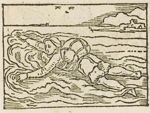
Desir d'auoir, faict viure en grand trauail: La Perrière, Le theatre des bons engins (Lyon, 1545), emblem 70 uses the imagery of a man swimming across a stream with a heavy rucksack to express the adage's moral that to be free you need to 'despise the rewards of servitude'
Iconclass: 31A2773 swimming (movement in water) 44G316 escape, escape attempts 46C55 luggage, travel requisites 46C1211 carrying something in basket, bag, rucksack, etc.
IV v 92 Dosones Shall-givers
Plutarchus in vita Pauli Aemylii tradit Antigonum regem, Demetrii nepotem, eo quod benigne promitteret omnibus, nec praestaret promissa, populari ioco dictum fuisse Dosonem, quasi latine dicas Dabonem, quod ille quiduis petentibus respondere soleat dw/s1w, id est, Dabo. Tales sunt xrhstolo/goi, de quibus alibi nobis dictum est. Ouidius: Promittas facito, quid enim promittere laedit? Pollicitis dives quilibet esse potest. Huiusmodi Dosonibus scatent aulae principum. Cras, mox redi.
Plutarch in his Life of Aemilius Paulus reports the story of king Antigonus, the grandson of Demetrius. As a joke people called him Doso, which would be Dabo in Latin, because he made generous promises to all, but did not keep them. When people asked him for anything he would customarily say [greek] 'I shall give.' Similar are the [greek] 'glib talkers' that we have spoken about elsewhere. Ovid: 'Be lavish with your promises. For what harm can they do? Promises are a currency in which anyone can be rich.' The courts of princes are full of such 'Shall-givers': 'Tomorrow.' 'Come back soon.'
IV v 93 Humeris sustinere To carry on one's shoulders
Quorum auctoritas diligentiaque plurimum valet in conservanda salute cuiuspia, ii dicuntur humeris sustinere Marc. Tull. pro L. Flacco: De summa Reip. taceo, quam nos universam hoc iudicio, vestris inquam humeris Iudices sustinetis. Ammianus Marcellinus lib. 16. Ubi bellorum inundantium molem humeris suis, quod dicitur vehens, scindebatur in multiplices curas. Huic affine est: Humeris referre. Cicero pro domo sua: Dicebas te tuis humeris me custodem urbis in urbem relaturum. Ab hac meraphora dicuntur Atlantes Rei pub. qui eam suis humeris sustinent, alioqui collapsuram.
Those whose authority and diligence are extremely effective in preventing someone from encountering harm are said 'To carry him on their shoulders.' Marcus Tullius speaking for Lucius Flaccus: 'On the issue of the state I say nothing. In this case you judges, I say, carry all of it on your shoulders.' Ammianus Marcellinus book sixteen: 'He carried on his shoulders, as they say, the weight of the wars that were engulfing him, and was distracted by many cares.' Cicero in Concerning his House: 'You said that you would bring me back into the city on your shoulders as guardian of the city.' This metaphor is applied to those who carry the state on their shoulders (which otherwise would collapse) and are called 'Atlases of the state.'
Facsimile: 
Iconclass: 46C1215 carrying something on the head or on the shoulders 54A6 Helpfulness 54E42 Protection; 'Custodia', 'Difesa contra nimici, malefici & venefici', 'Difesa contra pericoli', 'Riparo da i tradimenti' (Ripa)
Loci Communes: Arrogantia jactantiaque (Arrogance and boastfulness, Arrogance et vantardise)
IV v 94 Arcem ex cloaca facere To make a citadel out of a sewer
Qui rem hominemve nihili laudibus magnificis attollunt, dicuntur arcem ex cloaca facere. M. Tull. pro Cn. Plancio: Nunc venio ad illud extremum quod dixisti, dum Plancii in me meritum verbis extollerem, me arcem ex cloaca facere, lapidem e sepulcro vencrari pro deo, neque enim insidiarum periculum ullum, neque mortis fuisse. Hactenus Cicero. In cuius verbis et illud proucrbii figuram habet: Lapis e sepulcro, de homine nullius potentiae.
Those who exalt worthless things or persons with splendid words of praise are said 'To make a citadel out of a sewer.' Marcus Tullius in For Gnaeus Plancius: 'Now I come to that last point you made, that in extolling Plancius' services to me I was making a citadel out of a sewer, that I was worshipping a tombstone as a god. You said that there had been no danger of treachery or death.' So Cicero. In this passage, lapis e sepulchro 'a tombstone,' describing a completely powerless person, also looks like a proverb.
IV v 95 Archimedes non posset melius describere Archimedes could not describe it better
Archimedes Syracusanus geometra fuit celeberrimus, nusquam non intentus figuris geometricis, adeo ut pingens sit interfectus. Ex quo prouberbii specie dictum est illud, quia est apud M. Tullium in oratione pro A. Cluentio: Si ut tu dicis, gratiae conciliandae causa, quadraginta istorum accessio millium quid valet? Si, ut nos dicimus, ut quadragena milia nummum sedecim iudicibus darentur, non Archimedes potuit melius describere. Solent enim geometrae mathematicas figuras in pulvere depingere.
Archimedes of Syracuse was a very famous geometrician, always engrossed in geometrical diagrams, so much so that he was killed while drawing one. This gave rise to what Cicero says in his speech For Aulus Cluentius in the form of a proverb:
If, as you say, it was to win good favour, what is the point of the extra
forty thousand sesterces? If, as we say, it was so that forty thousand sesterces
could be given to each of the sixteen jurors, 'Archimedes could not describe
it better.'
Geometricians customarily draw mathematical diagrams in the dust.
Facsimile:
Iconclass: 52D2 Clarity, Precision 98B(ARCHIMEDES) (story of) Archimedes
Loci Communes: Perspicuitas (Clarity, Clarté)
IV v 96 Porta itineri longissima est Going through the gate is the longest part of a journey
M. Varro libro de re rust. 1. cap. 2. subindicat vulgo dici solere, Portam itineri esse longissimam. cuius arbitramur eundem esse sensum, qui est illius: Dimidium facti qui coepit habet. Quin et hodie dicunt bonam itineris partem confectam ei, qui portam egressus sit: semper enim est quod iter apparantem remoretur, et si nihil sit negotii, remorantur amicorum affectus. apud nostrates autem non creditur profectio futura felix, nisi dies aliquot dati fuerint conviviis et compotationibus amicorum. Varronis verba subscribemus. Vultis igitur interea proverbium, quod est; Romanus sedendo vincit, usurpemus dum iste venit? et simul cogitans portam itineri dici longissimam esse, ad subsellia sequentibus nobis praecedit.
'The gate is the longest part of a journey.' In book one, chapter two, of On Agriculture Varro implies that this was a popular saying. I think that it has the same sense as 'He who begins has half performed the deed.' In fact even today it is said that a man has completed a good part of his journey once he has passed through the gate. For someone who is preparing to make a journey can always find something to delay him. Even if there is no business to delay him, then his feelings for his friends hold him back. And indeed in our day and age it is thought that a journey will not turn out well unless some days are given over to eating and drinking with one's friends. I shall append Varro's words: 'Do you want us then to make use of that old proverb "The Roman conquers by sitting still," until the fellow arrives? And thinking at the same time that the gate is said to be the longest part of a journey, he leads the way to a bench with us in his train.'
Facsimile:
Iconclass: 25I1461 city-gate 46C512 departure ~ travelling 51FF521 Delay 54DD4:54DD3 Difficulty❧Start
Loci Communes: Tarditatis et cunctationis (Slowness and delay, Lenteur et retard)
IV v 97 Deorum concio The assembly of the gods
Θεων ἀγορὰ. i. Deorum concio, sive curia. Hesychius indicat dici solitum in eos, qui libere magnaque cum auctoritate loquuntur, perinde quasi dii loquantur hominibus. Addit Athenis esse locum huius cognominis. Conveniet in divites aut praepotentes, qui nonnumquam cum stultissime loquantur, tamen freti opibus ac potentia, pro oraculo volunt haberi quidquid dixerint. Cognatum est illi, quod alibi retulimus: Argenti fontes loquuntur.
[greek], The assembly (or the senate-house) of the gods. Hesychius points out that this was customarily applied to those who spoke without restraint and with great authority, just as if they were gods speaking to mortals. He adds that there was a place of this name in Athens. The expression will suit the rich or very powerful who sometimes wish whatever they have said to be thought of as an oracle; even though they speak in a most foolish manner, they place great weight on their wealth and influence. It is related to what we have recorded elsewhere, 'The springs of silver speak.'
Facsimile:
Iconclass: 57AA64 Pride, Loftiness; 'Alterezza in persona nata povera civile' (Ripa) 93A2(+0) assemblies of the gods (in general) (+ variant)
Loci Communes: Divitum praerogativa (The privilege of the rich, Le privilège des riches)
IV v 98 Camarine loqui To speak Camarinian
Huic non dissimile est, quia exstat apud eundem: καμαρϊνῶς λέγειν. i. Camarine loqui, pro eo, quod est, audacter, praecise, et severiter loqui. Unde natum, non satis liquet, nisi quod Iuvenalis Camarinos inter vetustae nobilitatis familias recenset: Ne tu, inquit, sis Creticus aut Camarinus. Hesychius indicat miliutm zonas dici καμάρας. Itaque fieri potest, ut ab horum ferocia proverbium duxerit originem. Idem docet columnas quasdam, in quibus erat depictus Asiae circuitus, dictas καμάρους. Fortassis ab hac ostentatione dicti sunt kamarinw=s2 loqui, qui sese iactarent barbarico more. Rursum idem ostendit kamari/an dici cubile, in quo sunt plures camerae. In suo quisque cubiculo quae vule loquitur.
Quite similar is an expression found in the same author, [greek] 'To speak Camarinian.' It is used of speaking boldly, briefly, and solemnly. Its origin is not quite clear, though Juvenal lists the Camarini among the families of ancient noble lineage. 'Take care,' he says, 'that you not be a Creticus or a Camarinus.' Hesychius points out that soldiers' belts were called [greek] It is possible then that the proverb originated with the fierceness of soldiers. The same author informs us that there were some columns called [greek] on which was depicted a map of Asia. Perhaps it was from this display that those who behaved like barbarians were said 'To speak Camarinian.' He also points out that a couch with several canopies is called a Kapapia. Everyone says whatever he wants to in his own bedroom. I could add more conjectures about its origin if I did not fear that those that I have already given are more than enough for the reader.
Facsimile:
Iconclass: 31B6235 speaking 45B(+0) the soldier; the soldier's life (+ variant) 46A12 nobility and patriciate; chivalry, knighthood 57AA64 Pride, Loftiness; 'Alterezza in persona nata povera civile' (Ripa)
Loci Communes: Aperte et crasse (Openly and bluntly, Ouvertement et grossièrement)
IV v 99 Glossogastores Bellytalkers
Qui linguam habent venalem, ea loquentes quae ventri conducutn, Comicorum salibus taxati sunt, dictique eo γλωσσογάστορες, voce ridicula ex lingua et ventre composita. Quadrabit in malos advocatos, in assentatores. Auctor est Iulius Pollux libr. De rerum vocab. z. Athenaeus libr. 3. docet eius modi homines a poetis aliquot dictos κνισσοκόλακας et κνισσολοίχους, quod ob culinae nido rem adulentur, et nidorem liguriant: morbum dictum knissoloixi/an. Ita Iuvenalis: Teputat ille suae captum nidore culinae.
Those who have a tongue that can be bought and say only what profits their belly were attacked by the wit of the comic poets and were called [greek] 'Bellytalkers,' a word comically formed from 'tongue' and 'belly.' It will perfectly suit unscrupulous advocates or preachers whose words reek of profit or flatterers. The source is Julius Pollux in the second book of the Names of Things. Athenaeus in book three informs us that such men were called [greek] by some poets because they fawn over the smell of the kitchen and suck it in. He also says that the disease was called [greek] 'fatlickitis.' So Juvenal: 'He thinks that you have been captured by the smell of his kitchen.'

IV v 100 Pereant amici etc. May my friends perish . . .
M. Tull. in oratione pro Deiotaro rege refert hunc versiculum ut proverbio iactatum: Pereant amici, dum una inimici intereant. Dicit eandem sententiam Graeco quoque versiculo celebrari, quem nondum comperimus. Nisi forte is est cuius fragmentum ante retulimus: e)r)r(e/tw fi/los2 s1hn\ e)xqrw=|, id est, valeat amicus cum inimico. Ciceronis verba subscribemus. Itaque cum esset ei nuntiatum Domitium naufragio periisse, etiam te in castello circumsederi, de Domitio dixit versum Graecum eadem sententia, qua etiam nos habemus Latinum: Pereant amici, dum una inimici intereant. Quod ille si esset tibi inmicissimus, nuquam tamen dixisses, ipse enim mansuetus est, versus inanis. Congruet in illos, qui nec amicis parcunt nec inimicis, modo quod impense cupiunt assequantur. Versus autem non solum inanis est, verum etiam immanis, cum humanitatis sit et inimicos inultos sinere, ne laedas amicos. Neque dubitemus contendere a Cicerone immanis scriptum, quod scriba depravarit in inanis, cum mansuetus non respondeat inani, sed immane, nec in hoc versu quidquam sit inane, hoc est, gloriosum aut frivolum, sed feritas homine indigna. Quamquam carmen apud Ciceronem non satis constat suis numeris, constabit si legas: Pereant amici, inimici dum intereant simul. Talis est et ille, quem alibi retulimus, Me mortuo terra incendio misceatur.
Marcus Tullius in his speech in defence of king Deiotarus records this verse as one that was a proverbial: 'May my friends perish, if my enemies perish along with them.' He says that the same idea was also celebrated in a Greek verse, but I have not found it yet. Unless perchance it belongs to the verse a fragment of which we have previously recorded: '[greek] 'Away with friend as well as foe.' I shall append Cicero's words:
And so when he was told that Domitius had perished at sea and that you
also were being besieged in a fort, he spoke a Greek verse with reference to
Domitius that expresses the same idea as the Latin verse that we have, Amici
dum una inimici intereant 'May my friends perish if my enemies perish with
them.' But if he had been your fiercest enemy, he would never have said it.
For he is a man who is mansuetus 'civilized,' and the verse is inanis 'pointless.'
It will suit those who spare neither friends nor foes provided that they satisfy their extravagant desires. But the verse is not only inanis 'pointless' but also immanis 'cruel,' since it is a mark of humanity to allow even one's enemies to go unpunished in order not to harm one's friends. And I would not hesitate to contend that Cicero wrote immanis 'cruel,' which was corrupted by a scribe into inanis. For mansuetus 'gentle, civilized' does not contrast well with inanis 'pointless,' but with immanis 'cruel' and in this verse there is nothing inane, that is, frivolous or vainglorious, but a bestiality that is unworthy of a human being. Although the verse in Cicero does not quite scan, it will do so if one reads pereant amici, inimici dum intereant simul. The proverb we have recorded elsewhere. 'When I am dead the earthcan burn up/ is similar.