Guillaume de La Perrièrre, Le Theatre Des Bons Engins (Lyon, 1545)
Emblem 25
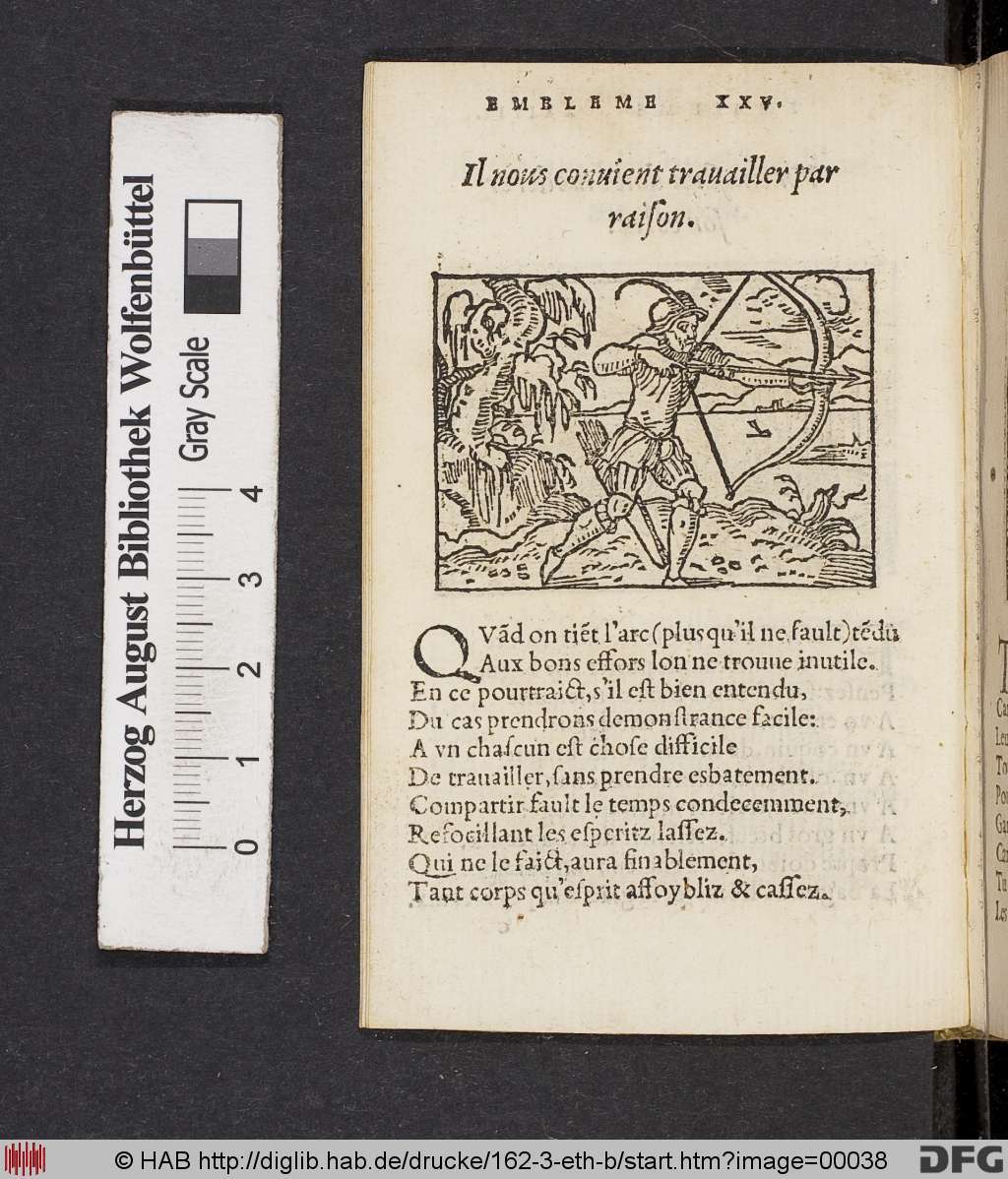
An archer drawing a large bow to its full extentAI-generated

Il nous convient travailler par raison.
It behoves us to work according to reason.AI-generated
Description of the woodcutAI-generated
A woodcut in a rectangular frame. In the centre a man in a plumed cap, doublet and hose stands with legs braced on rocky ground, drawing a very large bow to its full extent and aiming an arrow toward the right. At the left are rocks and a leaning, scraggly tree; behind and to the right is a body of water with a small boat, a distant shoreline, hills and clouds. The ground in the foreground is strewn with stones and tufts of grass.
Subscriptio
TranscriptionAI-generated
QVãd on tiét l'arc (plus qu'il ne fault) téduAux bons effors lon ne trouue inutile.En ce pourtraict, s'il est bien entendu,Du cas prendrons demonstrance facile:A vn chascun est chose difficileDe trauailler, sans prendre esbatement.Compartir fault le temps condecemment,Refocillant les espritz lassez.Qui ne le faict, aura finablement,Tant corps qu'esprit assoybliz & cassez.
TranslationAI-generated
When one keeps the bow drawn more than is necessary, it is found useless for good efforts. In this picture, if it be rightly understood, we shall take an easy demonstration of the case: for everyone it is a hard thing to work without taking some recreation. One must apportion one's time fittingly, refreshing the weary spirits. Whoever does not do so will in the end have both body and mind weakened and broken.
Iconclass
86(IL NOUS CONVIENT TRAVAILLER PAR RAISON)proverbs, sayings, etc. (IL NOUS CONVIENT TRAVAILLER PAR RAISON)
Suggested Iconclass codesAI-generated
Additional codes proposed for this emblem, not (yet) part of the indexing.
43C421shooting with bow and arrow, archery (~ games of skill)highThe correlate 'shooting with bow and arrow, archery' directly matches the man drawing a large bow to full extent and aiming an arrow.
45C15(BOW AND ARROW)archer's weapons: bow and arrowhighThe archer's weapons shown are precisely a bow and an arrow, as described in the correlate.
45C15archer's weaponsmediumThe generic 'archer's weapons' category covers the bow and arrow prominently wielded by the figure.
Relationships to the Adagia of ErasmusAI-generated
Suggested relationships between this emblem and adages in Erasmus’ Adagia.
- IV v 77 Arcus tensus rumpitur – thematic inventiohigh
The emblem's picture (a man straining a bow at full draw) and its subscriptio ('Quand on tient l'arc plus qu'il ne fault tendu... on ne le trouve utile') are a direct vernacular rendering of Erasmus' adage from Plutarch, that a bow strung too tight breaks while the mind needs relaxation; the lesson of apportioning work and recreation matches the essay's Theophrastus exemplum exactly.
- II vi 36 Ne in nervum erumpat – thematic inventiomedium
Donatus' explanation cited by Erasmus — archers who draw the bowstring with excessive force snap it, to their own danger — is the same image of over-tensioned effort that the emblem's woodcut and verse exploit.
- II v 85 In nervum ire – thematic inventiolow
Again the archer who 'dum nimium tendunt arcum rumpant' — excessive straining of bow and sinew — overlaps with the emblem's warning that unrelieved exertion leaves 'corps qu'esprit assoybliz & cassez'.
- I v 67 Funem abrumpere nimium tendendo – thematic inventiolow
Erasmus himself links the over-stretched rope to the over-drawn bowstring; the general lesson against immoderate straining underlies the emblem's call for measured labour.
- V ii 21 Liber non est, qui non aliquando nihil agit – thematic inventiolow
Erasmus' comment 'expedit interdum nihil agere, ut caetera recte agamus' matches the emblem's precept that one cannot work without 'esbatement' and must refresh the weary spirits.
- I ii 91 Jucundissima navigatio iuxta terram, ambulatio iuxta mare – thematic inventiolow
The essay's advice to mix a little relief into one's studies and some learning into one's games corresponds to the emblem's 'compartir fault le temps condecemment' between toil and recreation (and the picture's sea-and-shore setting echoes the adage's imagery).
Sources
Record ID: embhab_162-3-eth-b_emblem025
This emblem on the Iconclass site: https://iconclass.org/view/embhab_162-3-eth-b_emblem025
Page in the digital copy of the Herzog August Bibliothek: http://diglib.hab.de/drucke/162-3-eth-b/start.htm?image=00038