I v 1 Multa cadunt inter calicem supremaque labra There's many a slip 'twixt the cup and the lip
Sulpitius Apollinaris grammaticus apud Aulum Gellium in Noctibus Atticis lib. decimotertio, capite decimoseptimo, duo quaedam adagia notot, alterum Graecum, laterum Latinum: quorum amborum eadem sit sententia. Graecus est versiculus, inquit, hexameter παροιμϊώδης, Πολλὰ μεταξὺ πέλει κύκλικος καὶ χείλεος ἄκρου, id est, Multa cadunt inter calicem supremaque labra. Quo monemur, nihil tam certum sperari, neque quicquam tam esse vicinum, quod non repentinus aliquis casus queat intervertere. Adeoque non esse tutum venturis fidere, ut vix etiam illa sint certa, quae manibus tenemus. Originem adagii quidem ad huiusmodi fabulam referunt. Ancaeus Neptuni & Astypaleae Phoenicis filius, cum vitem sereret, graviterque ministris instaret, urgeretque: quidam operis taedio commotus in herum, negavit futurum ut ex ea vite herus unquam vinum gustaret. Post ubi vitis provenisset feliciter, atque vuae maturuissent, herus exultans, ac gestiens, servum eundem accersit, atque ut sibi vinum infundat iubet. Deinde iam calicem admoturus ori, servo quae dixisset, redegit in memoriam, quasi vanam exprobrans divinationem. At ille sententiam hanc hero respondit. Inter calicem ac summa labia, multa posse intervenire. Servili sententiae favit eventus. Nam inter loquendum priusquam ille vinum hauriret, alter quidam minister ingressus, nunciat vinetum ab apro quopiam immani vastari. Quibus auditis. Ancaeus deposito poculo, protinus in aprum fertur, à quo inter venandum percussus interiit. Usurpavit hoc adagii Lycophron in Iambicis, Εγὼ δὲ τλήμων σὺν κακῷ μαθὼν ἔπος Ως πολλὰ χείλευς καὶ δεπαστραίων ποτῶν Μεσῳ κυλίνδει μοῖρα παμμήτων βροτῶν. id est, Miser ast ego meo dicta cognoscens malo, Ut plurima inter poculum ac labrum solet Vertisse fatum, res agens mortalium. Interpres citat Aristot. autorem, qui & ipse de Ancaei fabula meminerit, in qua illud variat. Ancaeo vitem instituenti, vatem accersitum quempiam praedixisse, non futurum unquam, ut ex ea vinum gustaret, & expresso in calice vino, vatem irrisisse tamquam ψευδόμαντιν. Reliqua conveniunt cum iis, quae ex aliorum retulimus commentariis. Festus Pompeius ab augure quopiam vicino, qui forte praeterierit, praedictum indicat. Lycophron autem aliò detorsit, nempe ad Agapenorem patrem, & Ancaeum Actoris & Eurythemistidis filium, & ad aprum Calydonium. Dionysius apud Zenodotum, mavult paroemiam ad Antinoum referre, de quo meminit Homerus in Odyss. xxii. Is Antinous erat unus ex procis Penelopes, cui poculum tenenti, iamque bibere paranti. Ulysses iugulum telo transfixit. Atque ita manibus elapso poculo, concidit atque interiit. Sed non ab re fuerit, Homericum carmen adscribere, Η, καὶ ἐπ᾽ αὐτινόῳ ἰθύνετο πικρὸν ὀϊστόν. Η τοι καλὸν ἄλεισον ἀναιρήσεσθαι ἔμελλε, Χρύσεον ἄμφωτον, καὶ δὴ μετὰ χερσὶν ἐνώμα, Ωφρα πΐοι οἴνοιο, φόνος δὲ οἱ οὐκ ἐνὶ θυμῷ Μέμβλετο. (τίς κ᾽ οἴοιτο μετ᾽ ἀνδράσι δαιτυμόνεσσι, Μοῦνον ἐπὶ πλεόνεσσι, καὶ εἰ μαλὰ καρτερὸς εἴη Οἳ τεύξειν θάνατόν τε κακὸν καὶ κῆρα μέλαιναν;) Τόν δ᾽ ὀδυσεὺς κατὰ λαιμὸν ἐπισχόμενον βάλεν ἰῷ, Αντικρὺ δ᾽ ἁπαλοῖο δι᾽ αὐχένος ἤλυθ᾽ ἀκοκὴ, Εκλίνθη δ᾽ ἑτέρωσε, δέπας δὲ οἱ ἔκπεσε χειρὸς Βλημένου, αὐτίκα δ᾽ αὐλὸς ἀνὰ ῤῖνας παξὺς ἦλθεν Αἵματος ἀνδρομέοιο. id est, Telum, haec fatus, in Antionoum contorsit amarum. At pulchram is pateram iam iam tollebat, utrinque Auritam, atque auro nitidam, iam iamque manu illam Admotabat uti biberet: neque pectore caedem Voluebat pavido (quis enim fore crederet unquam Unus ut in tanto convivarum agmine, quanquam Viribus anteeat, mortem sibi nigraque fata Moliretur?) at huic iugulum confixit Ulysses Tollenti calicem, iaculum penetravit acutum, Et contra è cervicibus exiit area cuspis. Voluitur in latus ille, calix simul excidit icto E manibus: mox inde cruor de naribus ingens Emicat. Nec alienum est hoc loco meminisse quod Iulio Caesari velut exprobranti vaticinii vanitatem, responsum est: venisse Calendas Martias, non etiam praeterisse.
In the Attic Nights of Aulus Gellius, book 13 chapter 17, the grammarian Sulpitius Apollinaris records two proverbs, one Greek and one Latin, both with the same meaning. The Greek is a hexameter of proverbial form, he says: 'Many things happen between the cup and the final touch of the lip.' It is a warning to us that nothing we hope for is so certain, and nothing so close, that it cannot be suddenly upset by some turn of chance. So little is it safe to trust in things to come, that we are scarcely certain of what we hold in our hands.
The origin of the proverb is traced in some quarters to the following story. Ancaeus, the son of Neptune and Astypalea, daughter of Phoenix, planted a vineyard; and he vehemently harassed and urged on his workers. One of them tired of the work and turned against his master; he swore that his master would never taste any wine from those vines. Later on, when the vines had grown well and the grapes had ripened, the master exulted in triumph and sent for that servant, and ordered him to pour his master a cup of wine. As he was just about to raise the cup to his lips, he reminded the slave of what he had said, and pointed out how vain his prophecy had been. But the slave answered his master with this saying: 'Between the cup and the lips much may befall.' The event justified the slave's saying. For as they were talking, before the master had drunk the wine, another servant came in and announced that the vineyard was being wrecked by a huge boar. Hearing this, Ancaeus put down the cup and rushed off at once after the boar, which gored and killed him during the hunt.
Lycophron takes this over in his Iambics:
Learning the truth, poor wretch, at my own expense
That Fate, directing the affairs of mortals,
Tosses many things between the lip and the drinking-cup.
The commentator gives Aristotle as the authority, who also told the story of Ancaeus, with a certain variant. Ancaeus was planting the vineyard, when a seer who had been summoned prophesied to him that he would never taste the wine from it. He poured out some wine into a cup and taunted the seer as a 'false prophet.' The rest agrees with what we have related from the collections of others. Festus Pompeius says it was an augur from the neighbourhood, passing by, who made the prophecy. Lycophron alters it in another way, bringing in the father Agapenor, and making Ancaeus the son of Actor and Eurythemistis, and the boar the Calydonian boar. Dionysius, in Zenodotus, prefers to connect the proverb with Antinous, mentioned by Homer in Odyssey 22. This Antinous was one of the suitors of Penelope, and . was holding a cup, just about to drink, when Ulysses shot an arrow which transfixed him by the throat. The cup fell from his hands and he collapsed and died. It would not be out of place to transcribe Homer's lines:
He spoke, and aimed the bitter arrow at Antinous.
He was about to lift the fair cup,
Golden, two-handled, taking it in his hands
To drink the wine; murder was not in his thoughts;
Who would think that at a crowded banquet
There was one among many, strong though he be,
To bring him evil death and dark destruction?
But Ulysses aiming at his throat struck him with his arrow
And the point pierced his tender neck straight through.
He swerved to one side, and the cup fell from his hand,
And immediately the thick stream of the man's blood
Issued from his nostrils.
I think it is not inappropriate at this point to recall the reply which Julius Caesar received when he reproached the soothsayer with talking nonsense: The Calends of March have come but not gone.'
Facsimile: 
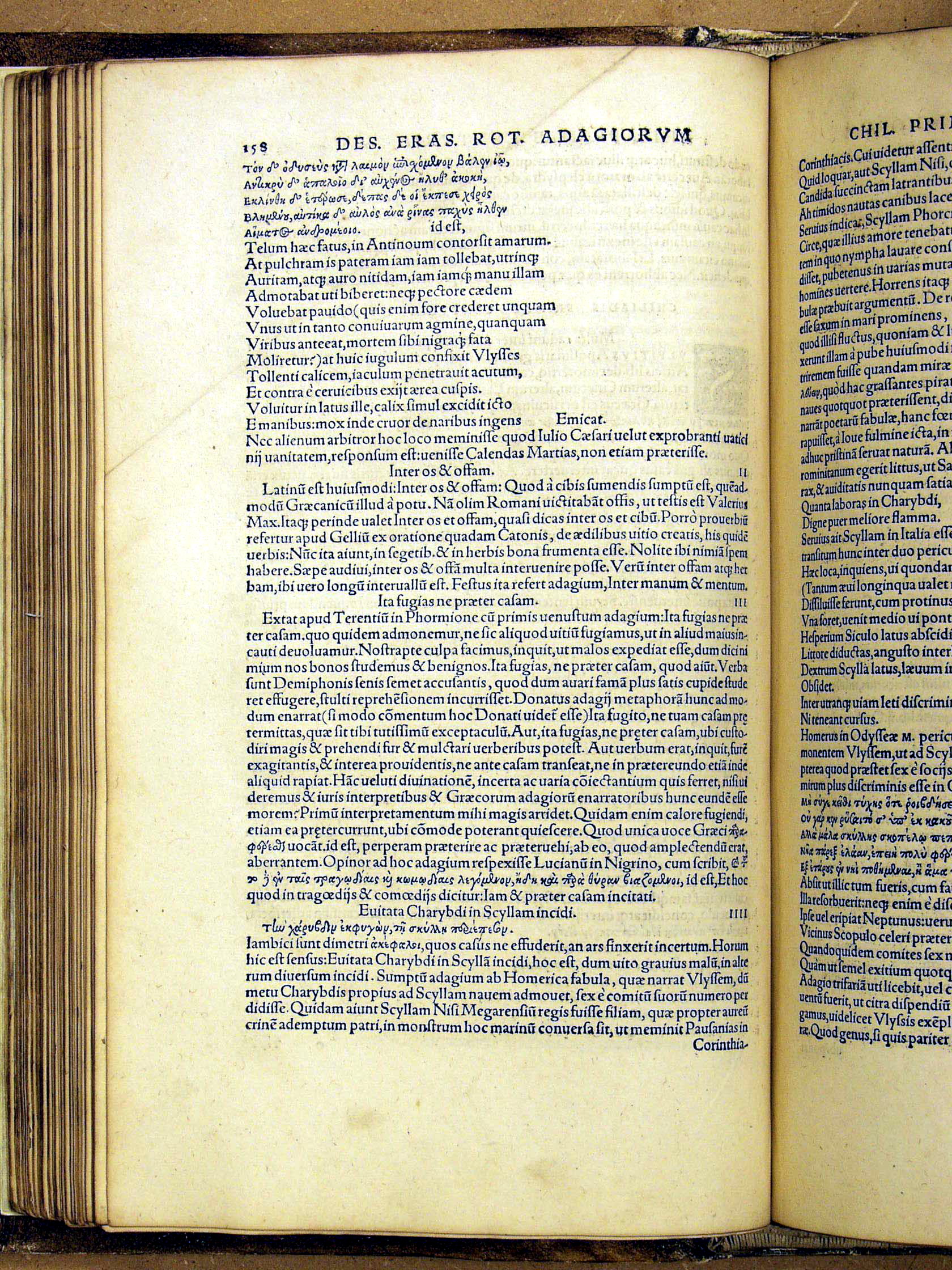
Many a slip twixt the cup and the lip: Cats, Moral Emblems (London, 1860), emblem 18
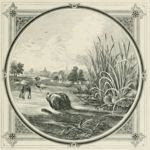
Inter manum et mentum: Cats, Proteus (Rotterdam, 1627), emblem 32
Iconclass: 31A22111(LIPS) parts of the face: lips 31A2732 slipping 41C321 cup 51AA5 Circumstance, Accident
Collectanea (1500): 128
Loci Communes: Incertus eventus (Uncertain outcome, Issue incertaine)
I v 2 Inter os et offam Between mouth and morsel
Latinum est huiusmodi: Inter os & offam: Quod à cibis sumendis sumptum est, quemadmodum Graecanicum illud à potu. Nam olim Romani victitabant offis, ut testis est Valerius Max. Itaque perinde valet Inter os et offam, quasi dicas inter os et cibum. Porrò proverbium refertur apud Gellium ex oratione quadam Catonis, de aedilibus vitio creatis, his quidem verbis: Nunc ita aiunt, in segetibus & in herbis bona frumenta esse. Nolite ibi nimiam spem habere. Saepe audivi, inter os & offam multa intervenire posse. Verum inter offam atque herbam, ibi vero longum intervallum est. Festus ita refert adagium, Inter manum & mentum.
The Latin proverb runs thus, and is taken from eating as the Greek one that precedes is taken from drinking. In old days the Romans lived on offae [morsels, bits and pieces] as Valerius Maximus bears witness. 'Between mouth and morsel' is as if you said 'between the mouth and the food.' In Gellius the proverb is quoted from some speech or other of Cato's, about improper appointment of magistrates, in these words: 'Now they say, there is good grain both in the ear and in the blade. Do not be too hopeful about that. I have often heard it said that between the mouth and the morsel much can intervene. There is certainly a wide interval between the morsel of food and the blade.' Festus records the adage as 'between the hand and the chin.'
Facsimile:
Iconclass: 31A2214 mouth 41C6 foodstuffs; still life of foodstuffs 51AA5 Circumstance, Accident
Loci Communes: Incertus eventus (Uncertain outcome, Issue incertaine)
I v 3 Ita fugias, ne praeter casam Run away, but not beyond the house
Extat apud Terentium in Phormione cum primis venustum adagium: Ita fugias ne praeter casam. quo quidem admonemur, ne sic aliquod vitium fugiamus, ut in aliud maius incauti devoluamur. Nostrapte culpa facimus, inquit, ut malos expediat esse, dum dici nimium nos bonos studemus & benignos. Ita fugias, ne praeter casam, quod aiunt. Verba sunt Demiphonis senis semet accusantis, quod dum avari famam plus satis cupide studeret effugere, stulti reprehensionem incurrisset. Donatus adagii metaphoram hunc ad modum enarrat (si modo commentum hoc Donati videtur esse) Ita fugito, ne tuam casam praetermittas, quae sit tibi tutissimum exceptaculum. Aut, ita fugias, ne praeter casam, ubi custodiri magis & prehendi fur & mulctari verberibus potest. Aut verbum erat, inquit, furem exagitantis, & interea providentis, ne ante casam transeat, ne in praetereundo etiam inde aliquid rapiat. Hanc veluti divinationem, incerta ac varia coniectantium quis ferret, nisi videremus & iuris interpretibus & Graecorum adagiorum enarratoribus hunc eundem esse morem? Primum interpretamentum mihi magis arridet. Quidam enim calore fugiendi, etiam ea praetercurrunt, ubi commode poterant quiescere. Quod unica voce Graeci παρα- φερέσθαι vocant, id est, perperam praeterire ac praetervehi, ab eo, quod amplectendum erat, aberrantem. Opinor ad hoc adagium respexisse Lucianum in Nigrino, cum scribit, καὶ τοῦ το δὲ ἐν ταις τραγῳδίαις καὶ κωμῳδίαις λεγὸμενον, ἤδη καὶ παρὰ θύραν βιαζόμενοι. id est, Et hoc quod in tragoediis & comoediis dicitur: Iam & praeter casam incicati.
In the Phormio of Terence there is one of the most charming proverbs: 'Run away, but not beyond the house,' which warns us not to avoid one fault in such a way that we imprudently fall into a worse one. 'It is by our own fault,' he says, 'that it is profitable to be bad, when we are trying too hard to be called good and kind. Run away, but not beyond the house, as they say.' The words are those of old Demophon, reproaching himself with having striven too eagerly to avoid the reputation of being a miser, and so incurring the blame of being a fool. Donatus explains the metaphor of the adage in the following way (always supposing this comment is by Donatus): 'Run away, but not overlooking your own house, which can be your safest place of refuge.' Or, 'Run away, but not beyond the house, where a thief can better be guarded against and caught and punished with a good flogging. Or,' he says, 'the word is that of a man shouting at a thief and taking care that he should not pass in front of the house, and in passing steal something from there too.' Who would put up with this kind of guesswork, with its variable and uncertain conjectures, if we did not see this to be the very method of commentators on the law and on the Greek adages? The first interpretation suits me best. Some people, in the urgency of their flight, run past the very place where they could comfortably stay quiet. The Greeks have one word for this, parapheresthai, meaning to rush past or be carried past by mistake, away from the thing which was to be grasped. I think Lucian had this adage in mind when he writes in Nigrinus: 'And as the saying goes in the tragedies and comedies, swiftly running past the house.'
Facsimile:
Iconclass: 33B9 flight, running away; pursuing 41A2 interior of the house 51LL1 Rest, Immobility, Stasis 54D5 Safety
Collectanea (1500): 166
Loci Communes: Modestia modusque (Modesty and moderation, Modestie et mesure)
I v 4 Evitata Charybdi in Scyllam indici Having escaped Charybdis I fell into Scylla
Τὴν χάρυβδιν ἐκφυγὼν, τῇ σκύλλῃ περιέπεσον Iambici sunt dimetri ἀκέφαλοι, quos casus ne effuderit, an ars finxerit incertum. Horum hic est sensus: Evitata Charybdi in Scyllam incidi, hoc est, dum vito gravius malum, in alterum diversum incidi. Sumptum adagium ab Homerica fabula, quae narrat Ulyssem, dum metu Charybdis propius ad Scyllam navem admovet, sex è comitum suorum numero perdidisse. Quidam aiunt Scyllam Nisi Megarensium regis fuisse filiam, quae propter aureum crinem ademptum patri, in monstrum hoc marinum conversa sit, ut meminit Pausanias in Corinthiacis. Cui videtur assentiri Vergilius in Bucolicis, cum ait, Quid loquar, aut Scyllam Nisi, quam fama secuta est Candida succinctam latrantibus inguina monstris Ah timidos nautas canibus lacerasse marinis? Servius indicat, Scyllam Phorci & Crateidis nymphae filiam. Hanc cum amaret Glaucus, Circe, quae illius amore tenebatur, quod eum in Scyllam propensiorem esse videret, fontem in quo nympha lavare consueverat, magicis venenis infecit. In quem cum illa descendisset, pubetenus in varias mutata est formas. Nam id Circae peculiare, in ferarum figuram homines vertere. Horrens itaque suam deformitatem, sese in mare praecipitem dedit, ac fabulae praebuit argumentum. De rei veritate, diversa est scriptorum opinio. Salustius putat esse saxum in mari prominens, quod procul visentibus muliebrem formam imitetur, in quod illisi fluctus, quoniam & luporum eiulatum & canum latratum videntur imitari, finxerunt illam à pube huiusmodi feris succinctam esse. In Graecorum commentariis invenio, triremem fuisse quandam mirae pernicitatis, cui nomen fuerit inditum Scyllae, παρὰ τὸ σκυλεύειν, quòd hac grassantes piratae mare Tyrrhenum ac Siculum infestarent, reliquásque naves quotquot praeterissent, dispoliarent: atque hinc natam fabulam. De Charybde vero narrant poetarum fabulae, hanc foeminam fuisse voracissimam, quae quod Herculis boves rapuisset, à love fulmine icta, in mare praecipitata est, & in huiusmodi versa monstrum, quod adhuc pristinam servat naturam. Absorbet enim universa: quaeque absorbuerit, ea circa Taurominitanum egerit littus, ut Sallustius est autor. Unde tanquam proverbio scortum vorax, & aviditatis nunquam satiatae, Charybdim appellat Horatius, Ah miser Quanta laboras in Charybdi, Digne puer meliore flamma. Servius ait Scyllam in Italia esse, Charybdim in Sicilia. Vergilius in Aeneidos lib. iii. transitum hunc inter duo pericula angustum eleganter describit, Haec loca, inquiens, vi quondam vasta convulsae ruina, (Tantum aevi longinqua valet mutare vetustas) Dissiluisse ferunt, cum protinus utraque tellus Una foret, venit medio vi pontus, & undis Hesperium Siculo latus abscidit, arváque & urbes Littore diductas, angusto interluit aestu. Dextrum Scylla latus, laevum implacata Charybdis Obsidet. Et idem alibi: Inter utranque viam leti discrimine parvo, Ni teneant cursus. Homerus in Odysseae Μ periculum utrunque multis verbis describit, facitque Circen admonentem Ulyssem, ut ad Scyllam potius inflectat cursum, quàm ad Charybdim, propterea quod praestet sex è sociis desiderari, quàm pariter omnes interire, declarans nimirum plus discriminis esse in Charybdi quàm in Scylla, Μὴ σύγε κεῖθι τύχης ὅτε ῥοιβδήσειεν, Οὐ γὰρ κεν ῥύσαιτό σ᾽ ὑπ᾽ ἐκ κακοῦ οὐδ᾽ ἐνοσίχθων Αλλὰ μάλα σκύλλης σκοπέλῳ πεπλημένος ὦκα Νῆα πάρεξ ἐλάαν, ἐπειὴ πολὺ φέρτερόν ἐστι Εξ ἐτάρους ἐν νηὶ ποθήμεναι, ἢ ἅμα πάντας. id est. Absit ut illic tum fueris, cum faucibus undas Illa resorbuerit: neque enim è discrimine tanto Ipse vel eripiat Neptunus: verum age Scyllae Vicinus scopulo, celeri praeteruehe cursu, Quandoquidem comites sex multo perdere praestat, Quam ut semel exitium quotquot sunt, aufer at omnes. Adagio trifariam uti licebit, vel cum admonebimus, si quando in eas rerum angustias deventum fuerit, ut citra dispendium discedi non queat, è duobus malis, id quod levius est, eligamus, videlicet Ulyssis exemplo, & magis in eam vergamus partem, ubi minus sit iacturae. Quod genus, si quis pariter et de salute et de pecunia periclitaretur, malit propior esse pecuniae, quàm vitae periculo, propterea quod facultatum iactura utcunque sarciri potest, vita semel amissa nunquam restituitur. Vel cum ostendemus negocium anceps & periculosum, in quo summa moderatione sit opus, ut in neutram pecces partem. Hic iam non habebitur ratio, utrum maius sit periculum: verum hoc rantum intelligitur, ingens utrobique discrimen subesse. Prioris exemplum fuerit: Memento longe satius esse in dispendii Scyllam incidere, quam in valetudinis Charybdim. Praestabilius est in rei pecuniariae iacturam, velut in Scyllam incurrere, quam in infamiae Charybdim incidere. Posterioris hoc: Curandum ut ita populo studeas, ne principis offendas animum. Caute circumspecteque rem gerito, memor tibi inter Scyllam & Charybdim esse cursum. Tertius fuerit modus, si invertas, hoc pacto: Dum parum eruditus videri times, in arrogantis opinionem incurristi: hoc est planè quod dicitur, dum Scyllam vitas, in Charybdim incidisti. Celebratur apud Latinos hic versiculus, quocunque natus autore, nam in praesentia non occurrit: Incidit in Scyllam, cupiens vitare Charybdim.
Τὴν χάρυβδιν ἐκφυγὼν, τῇ Σκύλλῃ περιέπεσον, I escaped Charybdis but fell into Scylla. These are iambic dimeters, akephaloi [without a beginning] whether produced by chance or created by art is uncertain. The meaning is this: 'While I was avoiding a more serious evil I fell into a different one'. The adage comes from the story in Homer, which tells how Ulysses sailed too close to Scylla for fear of Charybdis, and lost six of his crew. Some say that Scylla was the daughter of Nisus king of the Megarians, who for stealing her father's golden lock of hair was changed into this sea-monster, as Pausanias tells in his book on Corinth. Virgil seems to agree with this in the Bucolics, when he says
Or what shall I say of Scylla, Nisus' child,
Whom story pictures as a lovely woman
Ringed round with howling monsters to her waist,
Her sea-dogs' fangs tearing the trembling sailors?
Servius states that Scylla was the daughter of Phorcus and the nymph Crateis. When Glaucus fell in love with her, Circe, who had a passion for him, saw that he was fonder of Scylla than of herself, and mixed magic poison in the spring where the nymph was accustomed to bathe. When she stepped down into it, she was changed from the waist downwards into a variety of shapes. For this was the special quality of Circe, to change human beings into the shape of beasts. Hating her deformity she flung herself into the sea, and became the subject of the legend.
Where the truth lies, opinion differs among writers. Sallust thinks there was a rock jutting out into the sea, which looked like the shape of a woman to anyone who saw it from a distance, and the waves dashing against it seemed to imitate the sound of wolves howling and dogs barking, so it was imagined that she was girdled from the waist down with such wild animals. In the Greek collections I find that there was a trireme, a particularly fleet one, called Scylla, from skyleuein, to despoil, because the pirates who lurked in her infested the Tyrrhenian and Sicilian seas and whenever they overtook other ships, despoiled them: hence the story arose. As to Charybdis, the fables of the poets tell that she was a ravenous woman who stole the oxen of Hercules and was struck by Jove's thunderbolt, and flung into the sea, there to become a monster which retains its previous nature to this day. For it swallows up everything, and what it has swallowed is driven towards the shore round Taormina, according to Sallust. Thus Horace gives the proverbial name Charybdis to a greedy courtesan of insatiable covetousness:
Wretched youth,
In what a great Charybdis art thou caught,
Lad worthy of a better flame.
Servius says Scylla is in Italy, Charybdis in Sicily. In the Aeneid Book 3, Virgil has a beautiful description of the narrow strait between the two perils:
Once on a time, they say, these two lands were a single
Country; then there came a convulsion of nature which tore them
Hugely asunder - the ages can bring such immense geological
Change - and the sea rushed violently in between them, dividing
Italy from Sicily, severing their coasts and washing
Cities and fields on either side with a narrow strait.
Scylla guards the right shore, insatiable Charybdis
The left.
and the same elsewhere:'- not to attempt the passage, there being on either side / So narrow a margin of safety.' In the Odyssey Book 12, Homer describes the double danger at great length, and makes Circe warn Ulysses to keep his course nearer to Scylla than to Charybdis, because it would be better to lose six of his crew than have them all perish; she assures him that Charybdis is more hazardous than Scylla:
Heaven keep you from being there when she sucks the waves in her jaws,
For not even Neptune could save you from such disaster.
No; you must hug Scylla's rock and speedily drive your ship by;
It is better you should have to mourn the loss of six
Of your company, than that of your whole crew.
The adage can be used in three ways. First, when we give a warning that if a point is reached where we are in such straits that there is no escape without cost, we must choose the lesser of the two evils, following the example of Ulysses, and tend to the side where the loss is slighter. For instance, if someone is in danger of losing his money or his safety, he chooses to have his money in danger rather than his life, because the loss of possessions can be repaired in one way or another, but life once lost can never be restored. Secondly, we may use it to point out that a transaction is double-sided and dangerous, and that it needs the utmost prudence to keep from erring on either side. In this case there will be no question of deciding which is the greater risk; but this at least is clear, that on each side there is great danger. An example of the first would be, 'Remember it is far better to incur expense through Scylla than to lose health in Charybdis/ It is preferable to have a financial loss, to run into Scylla as it were, than to fall into the Charybdis of dishonour. Of the second: Take care to please the people in such a way that you do not offend the ruler. Do your business with caution and circumspection, remembering that you are steering a course between Scylla and Charybdis.' Thirdly, you could turn it the other way, like this: 'By being afraid to seem not very learned, you have brought on yourself the reputation of arrogance; that is exactly what is meant by avoiding Scylla and falling into Charybdis.' In Latin this line is famous, whoever was the author (at present it does not come to mind): 'Into Scylla he fell, in hopes of avoiding Charybdis.'
Facsimile: 

Iconclass: 44G316(+0) escape, escape attempts (+ variant) 54DD51 Danger; 'Pericolo' (Ripa) 54FF1 Failure 94I182 Ulysses passes Scylla and Charybdis; Scylla devours six of his men
Collectanea (1500): 378
Loci Communes: Malum male vitatum (Evil badly avoided, Mal mal évité)
I v 5 Fumum fugiens, in ignem indici Fleeing from the smoke I fell into the fire
Κάπνον γε φεύγων εἰς τὸ πῦρ περιέπεσον. id est. Dum vito fumum, flammam in ipsam decidi. Senarius est proverbialis superiori sententiae finitimus. Lucian. in Necyomantia, ἐλελήθειν δὲ ἐμαυτὸν ἐς αὐτόφασι τὸ πῦρ ἐκ τοῦ κάπνου βιαζόμενος. i. Ignoraveram autem, quod iuxta proverbium ex fumo in ipsum ignem compellerer. Utitur & Plato lib. De repub. viii. cum ait populum, dum recusat ingenuis servire, quasi vitato fumo in flammam incurrere, videlicet, ut servis etiam servire cogatur. Huc allusit Horatius, cum ait in Sermonibus: Nam frustra vitium vitaveris illud, Si te aliò pravum detorseris. Et in Arte poetica: In vitium ducit culpae fuga, si caret arte. Plutarchus περὶ δυσωπίας, τῇ δὲ δυσωπίᾳ συμβέβηκεν ἀτεχνῶς φευγούσῃ κάπνον ἀδοξίας, εἰς πῦρ ἐμβάλλειν ἑαυτὴν. id est, Ineptae autem verecundiae illud haud dubie accidit, ut fumum fugiens infamiae, in ignem coniiciat sese. id est, in aliud maius.
Κάπνον γε φεύγων εἰς τὸ πῦρ περιέπεσον, From smoke I fled, into the fire I fell; an iambic line very close to the previous saying. Lucian in Necyomantia:
'It had escaped my notice, that, as they say, I was forcing myself out of the smoke into the fire.'
Plato also uses it in the Republic, book 8, when he says that a people which refuses to obey free men is avoiding the smoke and running into the fire - meaning that they will be forced to obey slaves. Horace alludes to this when he says in the Satires, Tor all in vain one fault you may avoid, / If by the other you are warped.' And in the Art of Poetry: 'Shunning a fault leads to another failing, / If without skill.' Plutarch 'On False Shame': 'But it invariably happens that foolish shame fleeing the smoke of disgrace throws itself into the fire,' that is, into something worse.
Facsimile:
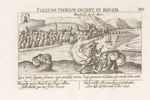
Fugiens fumum incidit in ignis: Meisner, Politica Politica (Nürnberg, 1700), emblem 125
Miseris nulla quies: Borja, Empresas morales (Bruxelles, 1680), emblem 21 uses the imagery of the flying fish who try to escape bigger fish only to be eaten by predatory birds
Iconclass: 33B9 flight, running away; pursuing 41B1 open fire (in general) 41B162 smoke 51AA5 Circumstance, Accident
Collectanea (1500): 683
Loci Communes: Malum male vitatum (Evil badly avoided, Mal mal évité)
I v 6 Latum unguem, ac similes hyperbolae proverbiales A nail's breadth, and similar proverbial hyperbolae
Transversum digitum aut unguem discedere, frequenter est apud Ciceronem, pro eo quod est, quam minimo spacio. Fit autem festivior metaphora, quoties his verbis perfectam imitatione, ac plenum undequaque consensum significamus, ut Academicarum quaestionum lib. secundo: Ab hac regula mihi non licet transversum, ut aiunt, unguem discedere. Ibidem, Ubi enim aut Xenocratem sequitur, cuius libri sunt de ratione loquendi, multi & multum probati, aut ipsum Aristotelem, quo profecto nihil est acutius, nihil politius? A Chrysippo pedem numquam. Loquitur de Antiocho, qui reliquis contemptis, Chrysippum per omnia sequeretur. Rursus Academicarum quaest. lib. ii. Quibus concessis digitum progredi non possunt: Idem ad Atticum: Mihi certissimum est, ab honestissima sententia digitum nunquam. Rursus ad eundem lib. xiii. Curandum est, atque hoc in omni vita sua quenque à nostra conscientia transversum unguem non oportere discedere. Idem in Epistolis familiaribus: Urge igitur transversum unguem, quod aiunt, à stilo. Sunt illa quidem minus figurata, sed tamen proverbialia, quae loquitur Plautinus Euclio in Aulularia. Si tu hercle ex istoc loco digitum transversum, aut unguem latum excesseris. Et Cicero in Verrem, Digitum non discedebant. Idem ad Atticum lib. xiii. epistola prima, Pedem adhuc è villa egressi non sumus, ita magnos & assiduos imbres habebamus. Idem Academicarum quaestionum libro ii. Non quaero ex his illa initia Mathematicorum, quibus non concessis, digitum progredi non possunt. Atque hunc imitatur divus Hieronymus: Et aspostolica voluntatis sequentes vestigia, ne puncto quidem, ut dicitur atque ungue transverso, ab illius sententiis recedamus. Metaphora partim sumpta videtur ab iis, qui tabulam aut saxum aut simile quippiam digitis latis metiuntur quoties exquisite rei modus spectatur (nam reliqua cubitis metiri solemus. minima mensurarum, latus digitus est.) Partim à iugerum mensoribus, qui stadiis, passibus, & ut minima mensura, pedibus, soli spacium metiuntur. Vulgo etiam nunc dicunt: Culmum latum, simili figura, pro eo quod est, ne tantulum quidem.
To swerve by a finger's breadth, or a nail's breadth, is a common saying in Cicero, meaning 'by the least distance.' The metaphor is pleasanter when we use these words to convey perfect imitation and full agreement, as in the Academic Questions, book 2: 'From this rule I may not swerve, as they say, by a nail's breadth.' And again, 'For where does he follow Xenocrates, whose books on method in speaking are many and much approved by many, or Aristotle himself, than whom nothing has more acuteness or polish? Never does he stir a foot from Chrysippus.' He is speaking of Antiochus, who despised all others and followed Chrysippus in everything. Again in Academic Questions book 2, 'Once these are conceded, not a finger's breadth of progress can be made.' Again Letters to Atticus: 'I am determined not to stray a finger's breadth from the path of strict honour.' Again in the same work, book 13: 'One must take care, and this in every kind of life, each one of us, not to swerve one nail's breadth from our conscience.' Again in the Letters to Friends: 'Urge him therefore to stray a nail's breadth, as they say, from his writing.' Less metaphorical, but still proverbial, are the words of Euclio in Plautus' Aulularia: 'By Hercules, if you move out of this place by a finger or the breadth of a nail... .' And Cicero in the Verrines, They did not yield a finger's breadth.' The same, Letters to Atticus, book 13, the first letter: 'We have not yet set foot outside the villa, such heavy and continuous rainstorms we have had.' The same in Academic Questions book 2: 'I am not seeking from them those first principles of mathematics, which must be conceded, or else not a finger's breadth of progress can be made.' And St Jerome in imitation of this: 'And following in the footsteps of the apostolic will, let us not depart by one point, as they say, by the breadth of a nail, from his opinions.'
The metaphor appears partly to be derived from those who measure a plank or a piece of stone, or something of the kind, by fingers' breadth, whenever a precise measurement is required, for we are used to measure other things by cubits. A fingerbreadth is the smallest possible measurement. Partly it comes from land-surveyors, who measure the ground by stadia, paces, or for the smallest measurement, feet. Even now the people say 'a straw's breadth' using the same sort of figure of speech, to mean 'not in the very least.'
Facsimile:
Iconclass: 31A2247 nails (fingers) 51GG1 Littleness, Smallness 51I4 Nearness
Collectanea (1500): 377
Loci Communes: Assiduitas (Diligence, persistence, Assiduité); Diligentiae (Diligence, Diligence)
I v 7 Pedem ubi ponat non habet He has no place to set his foot
Unde & illa proverbialis hyperbole ducta videtur apud Ciceronem frequens: Pedem ubi ponat, non habet. pro eo quod est, ne tantillum quidem agri possidet. Lib. Epist. ad Atticum xiii. Ariobarzanis filius Romam venit: vult, opinor, regnum aliquod emere à Caesare. Nam quomodo nunc est, pedem ubi ponat in suo non habet. Idem Philippicarum secunda: Quid erat in terris, ubi in tuo pedem poneres? Rursum lib. vii. ad Atticum: pedem in Italia vide nullum esse, qui non in istius potestate sit. Idem libro De finibus quarto: Quid enim sapientia? pedem ubi poneret non habebat, sublatis officiis omnibus. Conveniet autem in hominem insignite tenuem atque inopem, cui ne vestigium quidem pedis sit in agrorum possessionibus. Apud eundem est iocus in fundum, quem possis mittere funda.
This proverbial hyperbole often used by Cicero seems to come from the same source: He has no place to set his foot, meaning he does not possess the least scrap of land. Letters to Atticus, book 13: 'The son of Ariobarzanes is coming to Rome. I imagine he wants to buy a kingdom from Caesar, for as things now stand he has not a place of his own to set his foot.' Again in the second Philippic: 'What place in the world was there, where you could set foot on your own ground?' Again Letters to Atticus, book 7: 'Clearly there is not a foot of soil in Italy which is not in that man's grasp.' Again in Definibus, book 4: 'What was to become of wisdom? She had not a place to set her foot, when all her functions were taken away.' It applies to a particularly poor and needy man, who has not as much ownership of land as the sole of his foot. The same writer has a joke about a farm 'which can be shot from a sling.'
I v 8 Iterum eundem ad lapidem offendere To stumble twice over the same stone
Δὶς πρὸς τὸν αὐτὸν αἰσχρὸν εισκρούειν λίθον. id est, Iterum ad eundem turpe lapidem impingere. Senarius elegans ac proverbialis refertur à Zenodoto in collectaneis adagiorum. Cicero Epist. fam. lib. x. Culpa enim illa, bis adeundem, vulgari reprehensa proverbio est, Ovidius libro Tristium secundo, At nunc tanta meo comes est insania morbo, Saxa memor refero rursus ad icta pedem. Usurpatur ab Ausonio in Epistola quadam, Etenim, inquit, poposcisti tu, ut tua epistola ad eundem lapidem bis offenderes: ego autem quaecunque fortuna esset, semel erubescerem. Est autem, Bis ad eundem lapidem offendere, iterum eadem in re peccare. Nam primus error, vel Graeco adagio, veniam meretur: iteranti culpam venia dari non solet. Inter Graecanicas sententias celebratur & haec: Δὶς ἐξαμαρτεῖν τ᾽ αὐτὸν οὐκ ἀνδρὸς σοφοῦ. id est, Sapientis haud est, bis in eodem labier. Extat & Graecum epigramma, incertum cuius: Εϊ τις ἅπαξ γήμας, πάλι δεύτερα λέκτρα διώκει, Ναὐηγὸς πλώει δὶς βυθὸν ἀργαλέον. id est, Altera connubium experto cui ducitur uxor, Hic fracta repetit aequora saeva rate. Fertur & Publianus Mimus, non alienus ab hac forma: Improbe Neptunum accusat, qui iterum naufragium facit. At Scipio sapienti ne semel quidem errare permittit, ut dicat, οὐκ ὤμην. id est, non putaram.
Δὶς πρὸς τὸν αὐτὸν αἰσχρὸν εἰσκρούειν λίθον, It is shameful to stumble twice on the same stone. A neat and proverbial iambic line which is quoted by Zenodotus in his collection of adages. Cicero, Letters to friends, book 10: 'The error of "twice against the same stone" is held up to reproach in a familiar proverb.' Ovid, Tristia, book 2: 'But as it is - such madness accompanying my disease - I strike my foot again on those remembered rocks.' Ausonius uses this in one of his letters: 'Truly, you made your request, so that you should twice fall over the same stone in your letter, but I, whatever fortune should befall, would only blush once.' 'To fall over the same stone twice' is to go wrong twice in the same matter. For the first mistake, as in the Greek adage, deserves forgiveness; but for one who repeats the offence there is no excuse. Among the Greek maxims this one is also famous: 'It is not for a wise man to take the same tumble twice.' There is a Greek epigram also, of uncertain authorship: 'He, married once, who takes another wife, / Seeks the wild ocean with a shipwrecked craft.' A proverbial maxim current under the name of Publius has something not unlike this expression: 'He wrongly rails at Neptune, who suffers shipwreck twice.' But Scipio does not allow the wise man to err even once, or to say 'I never expected this.'
Facsimile: 
Iconclass: 25H1124 boulder, stone 31A27321 stumbling 51B61 Repetition 52AA1 Stupidity, Poverty of Intellect; 'Stupidità overo Stolidità' (Ripa) 57A4 Shame
Collectanea (1500): 398
Loci Communes: Iteratus error (A repeated error, Erreur répétée)
I v 9 Eadem oberrare chorda To strike the same wrong note
Hορatius in Αrte poetica, sententiam haud dissimilem, dissimili metaphora extulit: Et citharoedus, inquiens, Ridetur, chorda qui semper oberrat eadem. A cantoribus ducta translatio est, quibus vehementer foedum sit, in iisdem fidibus saepius peccare. In eos igitur concinne dicetur, qui vel in simili re crebrius peccant, vel culpam eandem iterum atque iterum committunt. Primus enim lapsus vel casui datur, vel imprudentiae: iteratus stultitiae tribuitur, aut inscitiae.
Horace expresses the same idea in the Art of Poetry, with a different metaphor: The lute-player is mocked who is forever playing the same wrong note.' Adopted from musicians, for whom it is a terrible thing to play a wrong note more than once on the same string. It can well be said of those who frequently go wrong in the same matter, or commit the same fault over and over again. The first lapse may be ascribed to chance or rashness, but to do it again argues stupidity or inexperience.
Facsimile:
Iconclass: 48C752 one person playing an instrument 51B61 Repetition 51DD2 Disharmony, Irregularity
Loci Communes: Iteratus error (A repeated error, Erreur répétée)
I v 10 Non tam ovum ovo simile As like as one egg to another
Extant apud autores aliquot similitudinis adagia, quorum de numero est: Non tam ovum ovo simile, de rebus indiscretae similitudinis. Cic. Academic. quaest. lib. ii. Vidésne, ut in proverbio sit, ovorum inter se similitudo? Tamen hoc accepimus, Deli fuisse complures salvis rebus illis, qui gallinas alere quaestus causa solerent. Ii cum ovum inspexerant, quae id gallina peperisset, dicere solebant. Neque id est contra nos. Nam nobis satis ova internoscere. Idem proverbium refertur & à Fabio Quintiliano. Usurpatur & à Seneca in libello, quem in Claudium imperatorem lusit.
Several adages about resemblance are found in the authors, among them 'as like as one egg to another,' of things indistinguishably alike. Cicero, Academic Questions, book 4: 'Do you see how the proverb speaks of the likeness of one egg to another? Yet we have been told that in Delos at the time of its prosperity, a number of people were in the habit of keeping hens for profit. These men, when they had inspected an egg, used to say which hen had laid it. Nor is this against us. For it is enough for us to tell the eggs apart.' Quintilian also quoted this proverb. It is made use of by Seneca as well, in the skit he wrote to make fun of the Emperor Claudius.
Facsimile:
Iconclass: 25F3(+91) birds (+ egg) 51B4 Uniformity 51B61 Repetition
Loci Communes: Similitudinis et congruentiae (Similarity and congruence, Similitude et convenance)
I v 11 Non tam lac lacti simile As like as milk to milk
Idem pollet, & à Plauto usurpatur in Amphitryone: Neque lacte lacti magis est simile, quàm ille similis est mei. Dicitur à Sosia de Mercurio, qui huius assumpserat figuram. Idem in Milite, Tam simile quàm lacte lacti est.
This has the same force, and is used by Plautus in the Amphitryo: 'Milk is not more like milk, than that "I" is like myself.' This is said by Sosia about Mercury, who had assumed his shape. Again in the Miles: 'As like as milk to milk.'
Facsimile:
Iconclass: 41C6413 milk 51B4 Uniformity 51B61 Repetition
Loci Communes: Similitudinis et congruentiae (Similarity and congruence, Similitude et convenance)
I v 12 Non tam aqua similis aquae As like as water to water
Eandem vim obtinet, quod usurpat Plaut. in Menaechmis: Nec aqua aquae, nec lacte lacti, crede mihi, usquam similius, quàm hic tui est, tuque huius. Ad hanc formam & illud ex eadem scena: Tam consimilis est, quàm potest speculum tuum. Rursum in Milite: Nam è summo puteo similior nunquam potest aqua aquae sumi.
Another phrase of Plautus, in the Menaechmi, has the same force: 'Not water to water, nor milk to milk, believe me, was ever more exactly resembling than he to you, and you to him.' Like this is the phrase from the same scene, 'He's so like you that he might be your mirror.' Again in the Miles: Tor never could water be drawn from the top of a well as like water as this.'
Facsimile: 
Iconclass: 21D water (one of the four elements) 51B4 Uniformity 51B61 Repetition
Loci Communes: Similitudinis et congruentiae (Similarity and congruence, Similitude et convenance)
I v 13 Quam apes apum similes As like as bees to bees
His M. Tullius illud etiam adiungit in Academicis quaest. Ut similia sunt, & ova ovorum, & apes apum. Ubi iocatur in Democriti mundos, usquequaque similes inter sese. Simili forma dicunt, Quàm ovis est ovi similis.
Cicero adds to these another, in Academic Questions, 'as like as eggs to eggs, and bees to bees,' when he is joking about the worlds of Democritus, each one just like the other. They say likewise, 'as like as one sheep to another.'
Facsimile:
Iconclass: 25F711(BEE) insects: bee 51B4 Uniformity 51B61 Repetition
Loci Communes: Similitudinis et congruentiae (Similarity and congruence, Similitude et convenance)
I v 14 Acanthia cicada The grasshopper of Acanthus
Ακάνθιος τέττιξ. i. Acanthia cicada. In indoctos atque infantes, aut musices ignaros torqueri proverbio solitum. Auctor est Stephan. Byzantius, iuxta oppidum Aetoliae Acanthum cicadas alibi vocales mutas esse, atque hinc ortum adagium, cuius autorem citat Simonidem. Plin. Naturalis historiae lib. xi. capite vicesimoseptimo, scribit in agro Rhegino cicadas omnes silere, ultra flumen in Locris canere. Idem testatur Pausanias libro rerum Eliscarum ii. Strabo libro Geographiae sexto, refert Rheginum agrum à Locrensi dirimi fluvio, cui nomen Alex. Cicadas autem, quae in Locrensi versantur ripa, sonantius stridere, cum in Rhegino sint mutae. Huius rei hanc esse causam coniectat, quod Rheginorum regio cum sit umbrosa, atque opaca, cicadarum pelliculas humore torpefaciat. Easdem in agro Locrensi, quòd sit aprica, solis arefactas aestu, stridorem aptius emittere. Auget autem miraculum Rheginensium cicadarum, etiam fabulose celebrata vocalitas vicinarum. Nam idem Strabo Timaeum citat autorem, quondam in Pythiorum certamine Eunomum Locrensem, & Rheginensem Aristonem, in canendi certamen venisse, Aristonem Apollinem invocasse Delphicum, ut sibi canenti foret auxilio, quod à Delphis Rheginenses olim essent profecti. Eunomus respondit, Rheginensibus ne certandum quidem omnino de musica, apud quos cicada vocalissimum animal voce careret. Utrisque certantibus, cum in Eunomi cithara, una inter canendum chorda frangeretur, cicada supervolans astitit, ac vocem alioqui defuturam, suo cantu supplevit. Atque ita victor declaratus, statuam citharoedi posuit, cum cicada citharae insidente. Huiusmodi fermè tradit Strabo.
Ακάνθιος τέττιξ, The grasshopper of Acanthus. Used as a proverb against people who are ignorant, inarticulate or unskilled in music. It is Stephanus Byzantius who tells us that it was near the town of Acanthus, in Aetolia, that grasshoppers are mute, though they chirp elsewhere; hence this proverb. He quotes as his authority Simonides. Pliny, in his Natural History, book 11 chapter 27, writes that in the territory of Rhegium all the cicadas are silent, while across the river in the Locrian territory they sing. Pausanias says the same in his second book on Elis. Strabo Geography, book 6, reports that the territory of Rhegium is separated from the Locrian by a river named the Alex. The cicadas which live on the Locrian side chirp loudly, while those of Rhegium are silent. He thinks the cause of this is that the district of Rhegium is shady and dark, and makes the wing-cases of the cicadas heavy with moisture, while in the Locrian country, which is sunny, they are dried by the heat of the sun and are readier to emit their noise. The very fact that there is a well-known story about the vocal powers of their neighbours increases the mystery about the cicadas of Rhegium. For the aforesaid Strabo quotes Timaeus as his authority for the story that Eunomus the Locrian and Ariston of Rhegium competed with each other in song in the Pythian games. Ariston invoked the Delphic Apollo to his aid as a singer, because the people of Rhegium formerly came from Delphi. Eunomus replied that it was not for the people of Rhegium to enter into any musical contest at all, since in their country that most vocal of creatures, the cicada, lacked a voice. As they were competing, one of the strings of Eunomus' lyre snapped, and a cicada flying overhead hopped down and supplied by its chirp the note which would otherwise have been missing. He was therefore proclaimed the victor, and he put up a statue of a lyre-player with a cicada perched on his instrument.This is more or less what Strabo relates.
Facsimile:
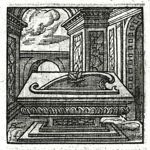
Musicam diis curae esse: Alciatus, Emblemata (Leiden, 1591), emblem 184
Iconclass: 22D9 silence 25F711(CICADA) insects: cicada 54AA33:48C7 Inability, Maladroitness, Awkwardness❧music 61E(ACANTHUS) names of cities and villages (ACANTHUS)
Collectanea (1500): 307
Loci Communes: Taciturnitas illaudata (Unpraised silence, Silence non loué)
I v 15 Eadem pensari trutina To be weighed on the same scales
Eadem pensari trutina. id est, eadem lege. Horatius in Sermonibus, Hac lege in trutina ponetur eadem. Idem in Epistolis, Romani pensantur eadem. Scriptores trutina. Convenit cum illa iureconsultorum regula, Patere legem, quam ipse tuleris. Sine ut eo pacto tecum agatur, quo tu cum aliis egeris. Persius, Examenque improbum in illa Castiges trutina. Huic simillimum, Ad eandem exigere regulam, ἴσῳ σταθμῷ, id est, aequali trutina, sive lance. Plutarch. Αλλ᾽ ἵσῳ σταθμῷ πᾶσιν ἡ κακία περιθεμένη μολυβδὶς ὥσε δίκτυον κατέσπασεν. id est, Sed aequa lance omnibus addita malitia ceu plumbum rete detraxit.
To be weighed on the same scales, that is, under the same conditions. Horace in the Satires: 'This granted, he'll be placed on the same scales.' And again in the Epistles: 'On the same scales Rome's writers must be weighed.' This agrees with the well-known rule of the lawyers: 'You must suffer the law you have yourself laid down.' You must let the same treatment be given to you as you have given to others. Persius: 'In that great scale the lying tongue set straight.' A very similar saying is 'To assess by the same yardstick, ἴσῳ σταθμῷ, by equal weight, that is, with level scale or balance. Plutarch: 'But with equal weight the vice that hangs about all men drags them down, "as leaden weights pull down a fishing-net."'
Facsimile:
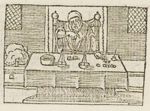
On doibt garder Iustice en toute chose: La Perrière, Le theatre des bons engins (Lyon, 1545), emblem 10 uses the imagery of a well-balanced pair of scales to express fairness
Iconclass: 46B3311 scales 51B3 Parity, Equality
Collectanea (1500): 316
I v 16 Zonam perdidit He's lost his belt
Zonam perdidit. Castrense proverbium in ἀχρημάτους.. id est, eos qui nihil habent nummorum. à Graeca quadam fabula tractum Acron admonet: Porphyrion à militum consuetudine, qui quicquid habent, in zona secum portant. Cuiusmodi sanè hominem perquam venuste describit Lucilius citante Nonio, Cui neque inmentum est, nec servus, nec comes ullus, Bulgam, & quicquid habet nummorum, secum habet omne: Cum bulga coenat, dormit, lavat. omnis in una Spes hominis bulga, hac devincta est caetera vita. Nam Bulgam appellat Lucilius folliculum, sive crumenam, et sacculum de brachio propendentem. Sic enim & Horatius, Suspensi laevo tabulas, loculosque lacerto. Tametsi Festus Bulgam Gallicum vocabulum autumat. Consimili modo Gracchus loquitur apud Gellium: Cum Roma profectus sum, zonas quas plenas argenti extuli, eas ex provincia inaneis retuli. Horat. in Epistolis, Ibit eò quò vis, qui zonam perdidit. Plautus in Poenulo, Tu qui zonam non habes, qui in hanc venistis urbem? aut quid quaeris? In quibus Plauti verbis duplex est allusio, & ad vestem Poenorum more discinctam, & ad pecuniam quae in zona gestatur, citra quam in urbe sumptuosa non sat commode vivitur. Pescennius Niger apud Spartianum vetuit, ne milites zonam secum deferrent in bellum: sed si quid haberent pecuniae, publice commendarent, recepturi post praelium: simul & ipsis luxuriei materiam eripiens, & hosti praedam si quid adversi evenisset. Est apud Lampridium in Alexandro: Miles non timet, nisi vestitus, calceatus, armatus, & habens aliquid in zona.
A soldier's proverb meaning 'he hasn't a penny,' taken, says Acron, from some Greek fable. Porphyrion derives it from the soldiers' habit of carrying whatever they posses in their belts. Lucilius, as quoted by Nonius, has a fine description of such a man:
He has no mount, no servant, no companion,
But always with him has his money-bag;
With money-bag he eats, and sleeps, and washes,
The man's one hope is in his bag, and all
The rest of life's devoted to it.
Bulga is the word used by Lucilius for a purse or pouch, a small bag hanging from the arm. So Horace says 'With copy-book and satchel on their arm'; though Festus indicates that bulga is a Gaulish word. In Aulus Gellius, Gracchus talks in the same way: 'When I set out for Rome, those full belts of silver I took out with me, were empty when I brought them back from the province.' Horace in the Epistles: 'He will go where you will, who's lost his belt.' Plautus in the Poenulus: 'You who have no belt-bag, how did you come to this town? What are you looking for?' In these words of Plautus there is a double allusion to the garment worn in the Carthaginian fashion without a girdle, and to the money carried in the belt, indispensable for living in a costly city. Pescennius Niger, according to Spartianus, forbade the soldiers to carry their belts with them into war, but if they had any money they were to hand it over to the care of the State, and it would be returned to them after the battle. Thus at one and the same time he took away from them the means of spendthrift living, and from the enemy their booty in case of any disaster. In Lampridius, writing about Alexander, we find: 'A soldier is not afraid, except when clothed, shod, armed, and with something in his belt.'
I v 17 Cocta numerabimus exta We shall count the entrails when cooked
Cocta numerabimus exta. Diomedes grammaticus, ubi proverbium definit, hoc exempli vice subiecit. Cuius hunc adscribit esse sensum, ex eventu sciemus. Huic confinis color ille comicus: Res indicabit. Nam, ut ait Ovidius, Exitus acta probat. Et apud Graecos, αὐτὸ δείξει, id est, ipsa res indicabit.
Diomedes the grammarian, defining a proverb, adds this as an example. He gives the meaning as 'we shall know from the outcome.' In the same vein is the argument in the comedy: 'the facts will show.' For as Ovid says, 'The event justifies the deed.' And in Greek αὐτὸ δείξει, The thing itself will show.
Facsimile: 
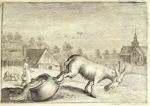
Exitus acta probat: Schoonhovius, Emblemata (Gouda, 1618), emblem 54 quotes the comment
Iconclass: 25F(+323) animals (+ entrails, internal organs of an animal) 41C25 cooking food 49D53 counting, calculating
Collectanea (1500): 333
Loci Communes: Incertus eventus - ex eventu judicium (Uncertain outcome - judging by the outcome, Issue incertaine - jugement d'après l'issue)
I v 18 Multa novit vulpes, verum echinus unum magnum The fox knows many things, but the hedgehog one big thing
Πολλ᾽ οἶδ᾽ ἀλώπηξ ἀλλ᾽ ἐχῖνος ἕν μέγα. id est, Ars multa vulpi, ast una echino maxima. Zenodot. hunc senarium ex Archilocho citat. Dicitur in astutos, & variis consutos dolis. Vel potius, ubi significabimus, quosdam unica astutia plus efficere quàm alios diversis technis. Nam vulpes multiiugis dolis se tuetur adversus venatores, & tamen haud raro capitur. Echinus, quem opinor herinaceum esse (nam hoc loco de terrestri, non de pisce fit mentio) unica duntaxat arte tutus est adversus canum morsus. Siquidem spinis suis semet involuit in pilae speciem, ut nulla ex parte morsu prendi queat. Citantur apud eundem Zenodotum huiusmodi quidam versus ex Ione Chio, tragico poeta. Quos eosdem ex eodem citat in Sermonibus convivialibus Athenaeus è tragoedia, cui titulus Phoenicia. Αλλ᾽ ἔν γε χέρσῳ τὰς λέοντος ᾔνεσα Καὶ τὰς ἐχινου μᾶλλον ὀϊζυρὰς τέχνας, Ος εὖτ᾽ ἄν ἄλλων θηρίων ὀσμὴν μάθῃ, Στρόβυλος ἄμφ᾽ ἄκανθαν εἱλιξας δέμας Κεῖται δακεῖν τε καὶ θίγειν ἀμήχανος. id est, Leonis artes in solo sanè probo, At magis echini comprobo miseros dolos, Qui simul odorem beluarum senserit, Se contrahit spinis operto corpore, Tutus iacens, morsuque, tactuque omnium. Refertur proverbium, ac simul ad carmen alludit Plutarchus in commentario, cui titulus πότερα τῶν ζώων φρονιμώτερα, χερσαῖα ἢ θαλάσσια, id est, utra animantia prudentiora, terrestria an marina. Eius verba subscribam: τῶν δὲ χερσαίων ἐχίνων ἡ μὲν ὑπὲρ αὑτῶν ἄμυνα καὶ φυλακὴ παροιμΐαν πεποίηκε, Πολλ᾽ οἶδ᾽ ἀλώπηξ ἀλλ᾽ ἐχῖνος ἕν μέγα. Προσιούσις γὰρ αὐτῆς, ὥς φασιν, οἷον Στρόβυλος ἄμφ᾽ ἄκανθαν εἰλιξας δέμας, Κεῖται θίγειν τε καὶ δακεῖν ἀμήχανος. id est, Iam vero terrestrium echinorum in tuenda servandaque incolumitate sua, sollertia proverbio locum fecit: Ars varia vulpi, ast una echino maxima. Siquidem quum illa aggreditur, quemadmodum aiunt, Flexibile spinis corpus obvoluens suis, Tutus iacet, sic ut nec ore tangier Ulla queat ratione, nec morderier. Plutarchus aut quisquis est eius operis autor, versibus intermiscuit sua quaedam verba: ne quis id errore nostro factum suspicetur. Sed omnium copiosissime huius animantis ingenium & astutiam describit Plinius libro octavo. capite trigesimoseptimo: Praeparant, inquit, & herinacei cibos, ac volutati supra iacentia poma, affixa spinis, unum non amplius ore tenentes portant in cavas arbores. Iidem mutationem aquilonis in austrum, condentes se in cubile, praesagiunt. Ubi vero sensere venantem, contracto ore, pedibus ac omni parte inferiore, qua raram & innocuam habent lanuginem, convolvuntur in formam pilae: ne quid comprehendi possit praeter aculeos. In desperatione vero urinam ex se reddunt tabificam tergori suo, spinisque noxiam. Reliqua qui cupiet cognoscere, è loco, quem indicavimus, petat. Haec ad proverbii sensum potissimum attinebant. Celebre est & piscis echini ingenium, qui saevitiam maris praesagiens, correptis lapillis operit sese, ut mobilitatem stabiliat pondere, ne nimia volutatione atterat spinas: quod aspicientes nautae, pluribus mox ancoris navigia infrenant. Autor Plinius libro nono, capite trigesimoprimo. Vulpem autem versipellem esse, variis instructam artibus, cum alii complures apologi, tum ille peculiariter indicat, qui refertur à Plutarcho in Moralibus: Cum aliquando pardus vulpem prae se contemneret, quod ipse pellem haberet omnigenis colorum maculis variegatam, respondit vulpes, sibi id decoris in animo esse, quod illi esset in cute. Neque vero paulo satius esse, ingenio praeditum esse vafro, quàm cute versicolore. Graeci sollertem, ac variis armatum dolis, ποικιλόφρονα vocant & ποικιλομῆτιν Latini vafrum & versipellem. Narratur & alius quidam apologus, ab hoc proverbio non multum abludens. Cum aliquando vulpes in colloquio, quod illi erat cum fele, iactaret sibi varias esse technas, adeo ut vel peram haberet dolis refertam: feles autem responderet, sibi unicam duntaxat artem esse, cui fideret, si quid existeret discriminis, inter confabulandum repente canum accurrentium tumultus auditur. ibi feles in arborem altissimam sub siliit, cum vulpes interim à canum agmine cincta capitur. Innuit fabula praestabilius esse nonnunquam unicum habere consilium, modo id sit verum & efficax, quàm plures dolos, consiliaque frivola. Veluti si quis pauper multiiugis artibus solicitaret animum puellae, dives autem unum hoc haberet, quod est apud Ovidium, Quantum libet accipe: recte dixeris: Πολλ᾽ οἶδ᾽ ἀλώπηξ, ἀλλ᾽ ἐχῖνος ἕν μέγα
Πολλ᾽ οἶδ᾽ ἀλώπηξ ἀλλ᾽ ἐχῖνος ἕν μέγα. Many-sided the skill of the fox: the hedgehog has one great gift. Zenodotus quotes this line from Archilochus. It is said about cunning people who are involved in various plots, or rather when we want to show how some people manage to do more with one piece of astuteness than others with their different schemes. The fox protects itself against the hunters by many and various wiles, and yet is often caught. The echinus, by which I take it he means the hedgehog (for in this place he is talking of the land-animal, not the sea-urchin) by its one skill alone is safe from the bites of dogs; it rolls itself up with its spines into a ball, and cannot be snapped up with a bite from any side. In the same Zenodotus these lines are quoted from Ion of Chios, a tragic poet; and Athenaeus quotes the same from the same in his Table-talk, from a tragedy entitled Phoenicia:
But on land a lion's way I praise,
But even more the hedgehog's wretched arts:
When he perceives another creature's smell
Rolling his spiny self into a ball
He lies impregnable to touch and bite.
Plutarch refers to the proverb and to the poem in his essay entitled 'Whether Land or Sea Animals Are Cleverer.' I will give his words: The defending and guarding of their own safety by hedgehogs has provided the proverb: "The fox knows many things, but the hedgehog one big thing." For when the fox approaches, they say, "Rolling his spiny self into a ball, / He lies impregnable to touch and bite."' Plutarch, or whoever was the author of this work, mingled with the lines some words of his own; I say this so that no one will suspect me of the error. But it is Pliny who described most fully the intelligence and astuteness of this animal (book 8 chapter 37): 'Hedgehogs also', he says, 'prepare their food, and by rolling over the apples lying on the ground spike them on their spines; they take just one in their mouths and carry them into hollow trees. By retreating into their holes they foretell the change of wind from north to south. But when they know the presence of a hunter, they contract snout, feet and the whole of their underpart, which is covered with sparse and harmless hair, and they roll up into the shape of a ball, so that nothing can be taken hold of that is not spikes. When driven to desperation they void urine which corrodes their hinder parts and damages their spines.' Anyone who wishes to learn more about this must consult the reference I have given. This is the part which touches most closely on the sense of the proverb.
The sea-urchin also is famous for intelligence; foreseeing the raging of the sea, it collects stones and weighs itself down with them, so that the weight will keep it from being easily shifted, and its spines will not be worn out with too much rolling. When sailors see this, they make fast their boats with several anchors. This is what Pliny says in book 9 chapter 31. The fox is crafty, and knows a great many tricks, as many fables relate, especially this one, which is told by Plutarch in his Moralia. Once, when the leopard was making a scornful comparison between himself and the fox, claiming that he had a coat of varying and many-coloured spots, the fox replied that while the leopard's ornamentation was on his skin, his own was in the mind. And truly it was much better to be endowed with cunning brains than with a party-coloured skin. The Greeks call a clever and guileful person poikilophron and poikilometis; the Latin words are vafer and versipellis.
Another story is told, not unlike this proverb: once the fox was talking to the cat, and boasting that he had so many skills at his disposal that one might say he had a bag of tricks; the cat replied that she had only one, to which she trusted in danger. While they were discussing this there was suddenly a noise of approaching hounds. The cat lept up into a high tree, while the fox was encircled and caught by the pack of hounds. The moral of this story is that it is sometimes worth more to have one plan, if it is realistic and efficacious, than several wiles and trivial schemes. For instance, a poor man might court a girl with manifold devices, but a rich man would have one only, the one described by Ovid: 'Say "take what you like," you will say well.' The fox knows many things, but the hedgehog one big thing.
Facsimile: 
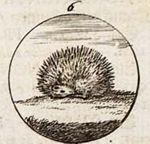
Mea me virtute involvo: De la Feuille, Devises et emblemes anciennes et modernes (Augsburg, 1697), emblem 97
Iconclass: 25F23(FOX) beasts of prey, predatory animals: fox 25F29(HEDGEHOG)(+483) other mammals: hedgehog (+ external changes of animal(s) in relation to their environment) 52A5 Knowledge; 'Cognitione', 'Cognitione delle cose' (Ripa) 54E41 Self-defence
Loci Communes: Inconstantiae, perfidiae, versutiae (Inconstancy, treachery, cunning, Inconstance, perfidie, ruse)
I v 19 Simulare cupressum To paint a cypress
Horatius in Arte poetica: Et fortasse cupressum Scis simulare, quid hoc, si fractis enatat expes Navibus, aere dato? Acron proverbium esse admonet, ortum ab imperito quopiam pictore, qui praeter cupressum nihil noverat pingere. A quo cum naufragus quidam petisset, ut vultum suum exprimeret ac naufragium suum depingeret, interrogavit ille num ex cupresso vellet aliquid adiici. Res ea primum in iocum, deinde etiam in adagionem abiit. Concinne usurpabitur in eos, qui quod didicerunt, id ubique intempestiviter inculcant, cum ad rem nihil attineat.
Horace in the Art of Poetry: 'Perhaps you can paint a cypress tree; / But that's no use, if shipwrecks earn your fee.' Acron points out that this is a proverb, derived from an inexperienced painter who could not paint anything but a cypress. A man who had been in a shipwreck asked him to paint his portrait and show the shipwreck, whereupon the painter asked if he wanted anything added in the way of a cypress? The thing first became a joke and then an adage. It can aptly be used to describe people who are always obtruding what they have learnt at inopportune moments, and when it has no bearing on anything.
Facsimile:
Iconclass: 25G3(CYPRESS) trees: cypress 48C51 painting (including book-illumination, miniature-painting) 54A33 Skill, Ability; 'Artificio', 'Prontezza' (Ripa) 54AA3 Incompetence
Collectanea (1500): 484
Loci Communes: Intempestiva et inepta (Untimely and inept things, Choses inopportunes et ineptes)
I v 20 Flamma fumo est proxima Fire follows smoke
Apud Plautum extat in Curculione: Flamma fumo est proxima. Commonet adagium, periculum mature fugiendum esse: quique malum evitare cupiat, ei vitandam prius occasionem. Ut qui corrumpi nolit, ab improborum abstineat consuetudine: qui cum puella cubare nolit, ne det osculum. Nam & illud protinus addit poeta: Fumo comburi nihil potest, flamma potest. Fumus enim indicium est flammae mox erupturae.
This is found in the Curculio of Plautus. The adage warns us to make an early retreat from danger; whoever wishes to avoid a calamity should avoid what gives rise to it. Thus whoever wishes not to be corrupted should avoid bad company; if one does not wish to lie with a girl one should not kiss her. The poet adds at once, 'Smoke can burn nothing, but fire can.' Smoke is the sign of fire about to break out.
Facsimile:
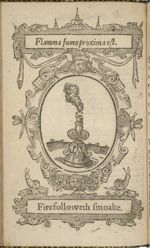
Flamma fumo proxima est: Farley, Lychnocausia (London, 1638), emblem 38
Flamma fumo proxima: Cats, Proteus (Rotterdam, 1627), emblem 17
Iconclass: 21C fire (one of the four elements) 41B162 smoke
Loci Communes: Discriminis (Danger, crisis, Danger)
I v 21 Ad restim res ediit It all comes back to the rope
Terentius in Phormione: Opera tua ad restim mihi quidem res rediit planissime. Hoc adagio summa rerum desperatio significatur. Nam in hac solent quidam amentes ad laqueum confugere. Iuvenalis, Ferre potes dominam salvis tot restibus ullam? Eodem pertinet etiam illud: Suspendio deligenda arbor.
Terence in the Phormio: 'By your doing my situation is obviously getting back to the rope.' This proverb expresses an utterly desperate situation; for at this point some frantic people are apt to turn to the noose. Juvenal: 'Can you bear a mistress when ropes are to be had?' That other phrase belongs here:'Choose your tree and hang yourself.'
Facsimile:
Iconclass: 31E2355(+72) violent death by hanging (+ suicide out of despair)
Collectanea (1500): 165
Loci Communes: Desperatio (Despair, Désespoir)
I v 22 Paupertas sapientiam sortita est Poverty has drawn wisdom as her lot
Πενία δὲ τὴν σοφίαν, id est, Paupertas sapientiam sortita est. Zenodotus citat ex Euripide. Alii tribuunt Aristoni. Ignava est opulentia, verum inopia multarum artium repertrix est: id quod ipsa iactat apud Aristophanem in Pluto, artium omnium inventionem sibi vindicans. Virgilius, Labor omnia vincit Improbus, & duris urgens in rebus egestas. Ovidius, Ingenium malae sape movent. Persius, Magister artis, ingenique largitor Venter. Circumfertur hic quoque versiculus apud Graecos: Πολλῶν ὁ λιμὸς γίγνεται διδάσκαλος. id est, Magistra multorum improba existit fames. Xenophon πενίαν appellavit σοφίαν αὐτοδίδακτον. ἅ γᾶρ ἐνείκη τοῖς λόγοις πείθει, αὕτη τοῖς ἔργοις ἀναγκάζει, hoc est, sapientiam, quae citra doctorem contingit: etenim quod haec persuadet oratione, ad hoc illa re ipsa compellit. Theocritus in Piscatoribus: Α πενία δίοφαντε μόνα τὰς τέχνας ἔχείρει, Αὐτὰ τῶ μόχθοιο διδάσκαλος. id est, Unica paupertas Diophantes suscitat artes, Ipsa laborandi doctrix, studiique magistra. Huc spectat & illud, quod Iuppiter aurei saeculi tam paratam rerum copiam submovit: Ut varias usus meditando extunderet artes. Item Mimus ille non inelegans, Hominem experiri mulla paupertas iubet. Potest & illuc referri proverbium, quod videmus accidere, nescio quomodo, ut penes Midas & improbos homines sit opulentia, doctique probique ferè tenui sint fortuna. Qua quidem de re extant duo problemata, Aristotelis titulo, quorum altero rogat, qui fiat ut paupertas apud probos viros plerumque versetur. Redditque hiusce rei varias causas, sive quod improbi per fas nefasque malunt parare divitias, quam cum paupertate contubernium diutinum habere: proinde fugit illos, quibus videatur maximorum flagitiorum occasio futura, ad illos deflectit, quos existimat sese recte modesteque usuros. Sive, quòd inops et virium & consilii,Z (quippe foemina) plus auxilii sibi futurum sperat apud πολυδράκρυας ἄνδρας (ut habet proverbium) Sive, quod cum ipsa sit mala, malos vitat, ne si πῦρ επὶ πῦρ, id est, malum accesserit malo, iam fiat intolerabile, atque immedicabile. In altero rogat, quid in causa sit, ut opes à malis ferè possideantur, non item à bonis. An quia caecae sunt, inquit, & ob id errant in delectu? Haec quoniam poeticen ac sophisticen sapiunt, magis quam philosophum, praesertim serium, vix mihi fit verisimile, ab Aristotele fuisse profecta. Quod autem dixit de caecis divitiis, id sumptum est potissimum ex Aristophanis Pluto. Quo in loco Plutus qui deus est divitiarum, rogatus, unde caecitatis malum obtigisset, respondit ad hunc modum: Ο ζεύς με ταῦτ᾽ ἔδρασεν ἀνθρώποις φθονῶν Εγὼ γὰρ ὢν μειράκιον, ἠπείλησ᾽ ὅτι Ως τοὺς δικαίους καὶ σοφοὺς καὶ κοσμΐους Μόνους βαδιοίμην, ὅδ᾽ ἐμ᾽ ἐποίησεν τυφλὸν Ινα μὴ διαγιγνώσκοιμι τούτων μηδένα. Οὕτως ἐκεῖνος τοῖσι χρηστοῖσι φθονεῖ. id est, Hoc me malo mulctavit ipse Iuppiter. Rebus videlicet invidens mortalium. Nam olim puer minabar id fore, ut ad probos, Doctos, modestos, tantum adirem. at Iuppiter Oculos in hoc ademit, ut ne quempiam Horum liceret iam mihi dignoscere, Adeo bonae ille frugis invidet viris. Hunc locum imitatus Lucianus in Timone consimilia quaedam de Pluto narrat, quem non caecum modo facit, verumetiam claudum: caecum quidem semper, at tum demum claudicantem, quoties ad bonos viros mittitur, alias pedibus pernicissimis.
Πενία δὲ τὴν σοφίαν, Poverty has drawn wisdom as her lot. Zenodotus quotes this from Euripides; others attribute it to Ariston. Wealth is idle, but Need is the discoverer of many arts. Aristophanes in the Plutus makes her boast of this, claiming the invention of all the arts for herself. Virgil: Toil conquers all, / Persistent toil, and need in hardships dire.' Ovid: Tils often cause the mind to stir.' Persius: 'The belly's a great teacher of craftsmanship, / Bestower of brains.' This line is also quoted in Greek, 'Harsh hunger is the teacher of many men.' Xenophon called poverty 'wisdom learnt without a teacher: what wisdom persuades us to by speaking, poverty drives us to by the very thing itself.' Theocritus in the Fishers: 'Poverty alone, Diophantus, awakens the arts, / She is the teacher of toil, the mistress of studies.' This explains why Jupiter withdrew the readily available plenty of the Golden Age, 'That many arts should be hammered out / By thought and practice.' And so the familiar proverbial maxim says not inelegantly, 'By poverty's command, a man learns much.' The proverb may also refer to something we see happening, inexplicably: wealth goes to Midas and to the wicked, while the learned and the good are usually poor. On this subject there are two problems attributed to Aristotle. In one he asks why poverty usually elects to dwell with good men. He gives various reasons for this: one is that the wicked prefer to amass riches by hook or by crook rather than to have a long acquaintance with poverty, and so she flees from those who might take her as an excuse for great crimes, and turns towards the people who (she thinks) will use her with uprightness and moderation. Another reason he gives is that poverty lacks both strength and counsel, and thus being a woman hopes to find better support among the 'men of many tears' as the proverb has it. Or else, being bad herself, she avoids bad people, lest she should 'add fire to fire' as the saying is, that is, evil on evil, and become unbearable and incurable.
The other question he asks is why do bad men usually have money, which is not true of good men. Is wealth blind, he asks, and thus misguided in its choice? These questions seem more those of a poet and sophist than of a philosopher, especially a serious one, and I think it is hardly likely that they come from Aristotle. However, what is said about 'blind riches' is mostly taken from the Plutus of Aristophanes. Here Plutus, the god of wealth, is asked how he came to incur the evil of blindness? He replies as follows:
'Twas Jove that caused it, jealous of mankind;
For when a little chap, I used to brag
I'd visit none except the wise and good
And orderly: he therefore made me blind,
That I might ne'er distinguish which was which,
So jealous is he always of the good!
Lucian in Timon relates much the same sort of thing about Plutus, whom he makes not only blind but lame; always blind, but only lame when sent to good men - otherwise remarkably fleet-footed.
Facsimile: 
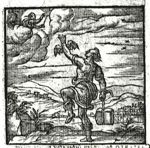
Paupertatem summis ingeniis obesse ne provehantur: Alciatus, Emblemata (Leiden, 1591), emblem 120
Povertà in uno ch'habbia bell'ingegno - Armoede in een treffelijk verstand: Ripa, Iconologia (Florence, 1613), personification of Povertà in uno ch'habbia bell'ingegno
Paupertate premor sublevo ingenio: Wither, A collection of emblems (London, 1635), emblem 142
Animum quoque praegravat una: Cramer, Octoginta emblemata nova (Frankfurt, 1630), emblem 35
Iconclass: 43C581 drawing lots ~ betting 51C2 Necessity, Inevitability; 'Necessità' (Ripa) 52A42 Invention, Inventiveness; 'Inventione' (Ripa) 52A51 Wisdom; 'Sapienza', 'Sapienza humana', 'Sapienza vera' (Ripa) 55BB1 Poverty; 'Povertà', 'Povertà del doni', 'Povertà in uno ch'habbia bell'ingegno' (Ripa)
I v 23 Ollae amicitiae Cupboard love
Χύτρης φιλία, Ollae amicitia. In amicos istos vulgares quadrabit, quos patina, non benevolentia conciliat. De cuiusmodi Iuvenalis: Te putat ille suae captum nidore culinae: Nec male coniectat. Hos arcanae literae, mensae amicos nominant. Plutarchus item in libello, cui titulus: Quo pacto dignoscas adulatorem ab amico: id genus homines, αὐτοληκύθους καὶ τραπέζεας, vulgo dici solitos narrat, quod ventriculi cibique causa diligant, non ex animo: quique tum praesto sunt, quoties audiunt, κατὰ χειρὸς ὕδωρ. Nam Aristophanes grammaticus apud Athenaeum libro nono, tradit lotionem manuum, quae praecedebat coenam vocari κατὰ χειρὸς: à coena, νίψασθαι. In eosdem, ni fallor, dictum est illud à Menandro comico, citante Athenaeo: Οἱ δὲ κατὰ χειρῶν λαβόντες περιμένουσι φίλτατοι. id est, Manibus ut data est aqua, haerent tunc amici maxime. Effertur ad hunc modum paroemia ζεῖ χύτρα, ζῆ φιλία, id est, Fervet olla, vivit amicitia.
Χύτρης φιλία, Cupboard love. This applies to that widespread kind of friend who is attracted by the stewpot, not drawn by affection. On these, see Juvenal: 'He thinks you have been caught by the smell of his kitchen. And he isn't far wrong.' The Scriptures call these 'table-friends.' Plutarch in his book 'How to Tell a Flatterer From a Friend' says that such people were commonly called 'oil-flask and trencher-carriers' because they love from the stomach and not from the heart; those who are always on the spot when they hear 'water for the hands.' For Aristophanes the grammarian, in Athenaeus, book 9, tells how the washing of the hands which preceded a meal was called kata cheiros [on the hands], and after the meal nipsasthai [to wash]. If I am not mistaken, it is against them that the saying of Menander the comic poet is aimed, as quoted by Athenaeus: 'once hands are washed [for dinner] friends stick closely.' There is a proverb like this, The pot boils, friendship thrives.'
I v 24 Antiquiora diphtera loqueris You are talking of things older than the diphthera
Αρχαιότερα διφθέρας λαλεῖς, id est, Antiquiora dipthera loqueris. In eos quadrat, qui nugas narrant, aut de rebus nimium priscis & iampridem obsoletis. Nam diphthera res quaedam erat ex priscis illis fabulamentis relicta. Siquidem aiunt, diphtheram pellem fuisse eius caprae, quae Iovem lactarit, in qua creditum est antiquitus, illum omnia scribere quae fierent. Unde quae nec in historicorum literis extarent, nec in hominum memoria servarentur, ea velut ex Iovis diphthera petita dicebantur. Quin subinde apud Aristophanem, ἀρχαία, παλαιὰ, id est, prisca atque antiqua, pro nugamentis leges, quod antiquitas ferè fabulosissima sit opinor: & ἀρχαϊκῶς, pro eo quod est deliranter ac stulte. Simili modo vocamus κρονικὰ vetera & obsoleta desitaque. Sic apud Athenaeum lib. vii. quispiam, Arrianus opinor, ταῦτα σιτία κρονικά ἐστιν ὦ ἐταῖρε, id est, Isthaec Saturnia sunt ô amice cibaria. Poetae fingunt Saturnum regno pulsum, & huius loco regnare Iovem.
Αρχαιότερα διφθέρας λαλεῖς, You are talking of things older than the diphthera. This applies to people who tell nonsensical stories, or speak of things that are far in the past and out of date. A diphthera or tanned hide was some relic of the early concoctions of legend. They say that a diphthera was the skin of that goat which suckled Jove, on which (or so said the ancients) he wrote everything which happened. So the events which neither survive in the chronicles of the historians nor are preserved in the memory of men were said to be fetched from Jove's goatskin. Indeed you will often read in Aristophanes words like 'primitive, ancient' for 'nonsense,' I imagine because antiquity is so full of fables; and 'archaically' to mean crazily and foolishly. It is in the same style that we call old, obsolete, finished things kronika. So in Athenaeus, book 7, someone, Arrianus I think, says Those are victuals dating from Saturn's time, my friend.' The poets pretend that Saturn was ousted from his kingdom and Jove reigned in his stead.
Facsimile: 
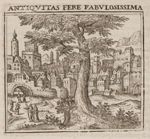
Antiquitas fere fabulosissima: Lebey de Batilly, Emblemata (Frankfurt, 1596), emblem 60 quotes the comment
Iconclass: 47I214(+9351) goat (+ skin, fleece, hide, fur, leather) 48(+7241) art (+ archaic art) 92B1121(+0) Amalthea, the nymph, usually in the shape of a goat, suckles the new-born Jupiter (+ variant)
Loci Communes: Ingrata ob vetustatem (Unpleasant because of age, Déplaisant à cause de l'ancienneté)
I v 25 Auribus lupum teneo I hold the wolf by the ears
Extat apud Terentium in Phormione: Antiphoni adolescenti uxor erat domi, quam nec eiicere poterat, vel quia non libebat, quod in eam deperiret, vel quod integrum non erat, cum esset iudicum sententiis addicta, neque rursum retinere quibat, propter patris violentiam. Et cum à patruele felix diceretur, ut qui domi possideret id quod amabat, Imò, inquit, quod aiunt, auribus teneo lupum. Nam neque quo modo amittam à me invenio, neque uti retineam, scio. Moxque leno quasi referens paroemiam, ait sibi idem usuvenire in Phaedria, quem neque retinere poterat, qui nihil numerabat, neque repellere, quod esset improbe blandus, ac monteis aureos polliceretur. Donatus Graecam paroemiam Graecis adscribit verbis: Τῶν ὤτων ἔχω τὸν λύκον, οὔτ᾽ ἔχειν οὔτ᾽ ἀφεῖναι δύναμαι, id est, Auribus lupum teneo, neque—λβ retinere, neque amittere possum. Suetonius in Tiberio: Cunctandi causa erat mεtus undique imminentium discriminum, ut saepe lupum tenere se auribus diceret. Plutarchus in Praeceptis civilibus, λύκον οὐ φασὶν τῶν ὤτων κρατεῖν, id est, aiunt lupum non posse teneri auribus: cum homines hac parte maximè ducantur, nimirum persuasione. Dicitur in eos, qui eiusmodi negotio involuuntur, quod neque relinquere sit integrum, neque tolerari possit. Videtur ab eventu quopiam natum, ut alia pleraque. Aut inde certe, quod ut lepus auribus quippe praelongis commodissimis tenetur, ita lupus quod aures habet pro corpore breviores, teneri iis non potest, neque rursum citra summum periculum è manibus dimitti, belua tam mordax. Caecilius apud A. Gellium lib. xv. cap. ix. eandem sententiam, sed citra metaphoram extulit. Nam hi sunt, inquit, amici pessimi, fronte hilaro, corde tristi, quos neque ut apprehendas, neque ut amittas scias. Huc allusit Theognis, etiamsi alienius, Αργαλέως μοι θυμὸς ἔχει περὶ σῆς φιλότητος. Οὔτε γᾶρ ἐχθαίρειν, οὔτε φιλεῖν δύναμαι. id est, Pectora nostra tui quàm mire amor afficit, ut quem Non odisse queam, sed nec amare queam. Unde videtur illud effictum: Nec tecum possum vivere, nec sine te. Refertur & à M. Varrone pro exemplo adagionis. Auribus lupum teneo.
This is in the Phormio of Terence: a young man, Antiphon, had a wife at home whom he could not throw out, either because he did not wish to, being desperately in love with her, or because it would not have been upright to do so, since she had been adjudged to him by the pronouncement of the magistrates; but neither could he keep her, because of the violent resentment of his father. And when his cousin called him happy, because he possessed in his house what he loved, he answered 'It's all very well, I am holding the wolf by the ears, as they say. For I cannot see how I can send her away, nor do I know how to keep her.' Later the pander asserts (as if referring to the proverb) that he has the same experience with Phaedria, whom he can neither keep on, because he pays nothing, nor reject, because he is terribly charming and promises mountains of gold. Donatus adds the Greek proverb in Greek words: 'I hold the wolf by the ears, and can neither keep him nor let him go.' Suetonius in his life of Tiberius: The reason for delay was fear of the risks threatening on all sides, so that often he said he was holding the wolf by the ears.' Plutarch in 'Precepts of Statecraft': 'A wolf, they say, cannot be held by the ears,' while men are particularly led by this part, that is by persuasion.
This is said about people who become involved in some affair which it would not be honest to abandon, and yet cannot be borne. It seems to have been derived from some event, like many other proverbs; or at any rate it springs from the fact that while the hare has very long ears and can easily be held by them, the wolf has ears which are short for its size, and there is no holding it in that way, but on the other hand it is most dangerous to let it escape from one's hands, since the beast has such a bite. Caecilius in Aulus Gellius, book 15 chapter 9, has the same idea but without the metaphor: 'For these are the worst friends, cheerful of face, / Dismal at heart, whom you can neither clasp nor let go.' Theognis alludes to it, even more distantly: 'My heart's so strangely moved by love for you / That I can neither love nor can I hate.' An imitation of this, it seems, is the line 'Not with thee can I live nor yet without thee.' Varro also give as an example of an adage: I hold a wolf by the ears.
Facsimile:
Iconclass: 25F23(WOLF)(+333) beasts of prey, predatory animals: wolf (+ ears of an animal) 31A2745 grasping something 53AA2 Irresolution; 'Irresolutione' (Ripa) 54DD51 Danger; 'Pericolo' (Ripa)
Collectanea (1500): 164
Loci Communes: Perplexus (Perplexed, entangled, Perplexe)
I v 26 Necessarium malum A necessary evil
Huic finitimum est illud, ἀναγκαῖον κακὸν, id est, Necessarium malum: de iis quos neque reiicere possis, quod quibusdam in rebus opus sit eorum opera: neque commode ferre, quod viri sint improbi. Natum videtur ex Hybraeae cuiusdam apophthegmate, de quo meminit Strabo lib. xiiii. Cum haberet Euthydamus tyrannicum quiddam multis alioqui nominibus utilis civitati, ita ut cum vitiis virtutes paria facere viderentur, Hybreas orator in oratione quadam sic de illo locutus est: Malum es, inquit, civitatis necessarium. Nam nec tecum vivere possumus, nec sine te. Alexander item Severus Imperator, rationales, quos tollere decreverat, posteaquam perpendisset eos citra Reip. incommodum tolli non posse, necessarium malum appellabat. Huiusrnodi fuit & P. Cornelius Ruffinus, furax quidem & impendio avarus, sed idem egregius Imperator, à quo Fabricius Luscinus compilari maluit, quàm sub hasta venire, quemadmodum refert Gellius libr. iiii. & Cicero De oratore lib. ii. Torqueri poterit & in uxores, cum quibus incommode vivitur, sed absque his Resp. omnino consistere non potest. Potest & ad rem accommodari. Veluti si quis dicat pharmacon, rem quidem molestam, necessariam tamen. Euripides in Oreste: Ανιαρὸν ὤν κτῆμ᾽ ἀναγκαῖον δ᾽ ὅμως. . id est, Molesta cum sit res, necessarias tamen. Non abhorret ab hac forma, quod Plinius scribit, oraculo proditum fuisse, lib. xviii. cap. vi. Quónam igitur, inquit, modo utilissime coluntur agri? Ex oraculo scilicet, malis bonis: Hoc velut aenigmate significatum est, agros quàm minimo potest impendio colendos esse.
Very close to this is the saying ἀναγκαῖον κακὸν, A necessary evil. There are people whom you cannot throw over because their help is needed in some way, but you can hardly tolerate them because of their immorality. This seems to come from the remark of a certain Hybraeas, recalled by Strabo, book 14. Euthydamus was a man with a certain overbearing quality, but in many ways useful to the state, so that his vices and virtues seemed to break equal. The orator Hybraeas in some speech spoke of him thus, 'You are a necessary evil to the state; we can neither live with you nor without you.' The emperor Alexander Severus decreed the abolition of the public accountants, but when he reflected that they could not be abolished without damage to the state, he called them 'a necessary evil.' Publius Cornelius Ruffinus was another of this type, thievish and miserly but all the same an excellent commander; Fabricius Luscinus preferred to be plundered by him rather than be sold into slavery, as Gellius tells us in book 4, and Cicero in the De oratore, book 2. It can be turned round to apply to wives, who are uncomfortable to live with, yet without them the commonwealth cannot exist. It can also be applied to things, as when one may say that a medicine is a troublesome thing, but a necessary one. Euripides in the Orestes: 'A possession painful, but necessary.' Not unlike this in form is the response of an oracle recorded by Pliny, book 18 chaper 6: 'By what methods should the fields be cultivated? Saith the oracle, by bad, by good: this means, in its riddling way, that the fields should be cultivated with the least possible expense.'
Facsimile: 
Iconclass: 51C2 Necessity, Inevitability; 'Necessità' (Ripa) 52B5112 Bad, Evil, Wrong
Loci Communes: Anceps et dubius (Doubtful and uncertain, Incertain et douteux)
I v 27 Non absque Theseo Not without Theseus
Οὐκ ἄνευ θησέως, id est, Haud absque Theseo: Cum significamus rem alieno auxilio confici: Aut cum significamus rerum omnium communionem ac societatem. Nam Zenodotus scribit, Theseum permultis viris fortissimis in certaminibus auxilio fuisse, quippe qui & Meleagro adfuit in conficiendo agro Calydonio, auxiliatus & Pirithoo pugnanti cum Centauris, item Herculi cum Amazonibus belligeranti. Fabula de apro sic habet: Oeneus Meleagri pater, cum de primitiis annui proventus diis libans, Artemidem praeterisset, illa irata aprum immanem in agros Calydonios immisit, omnia populantem: ad quem conficiendum Oeneus praestantissimum quenque excivit, praemiis ad id propositis. Inter multos certavit et Meleager, qui & beluam confecit, sed accersito ad auxilium Theseo. Reliquum fabulae nihil ad proverbii sensum attinet. De Pirithoo sic fertur: Pirithous Hippodamiae procus, Centauros, quod essent sponsae cognati, convivio accipit. Qui simul atque mero incaluissent, sponsae vim adferre coeperunt. coorta pugna, Theseus Pirithoo auxilium ferens, complureis centauros trucidavit. De Hercule sic narrant: Cum Eurystheus Herculi iniunxisset, ut Hippolytae Amazonum reginae baltheum adimeret, atque ille pacta facturus, esset profectus, Iuno semper illi infesta, induta formam Amazonis, famam passim dissipavit, adventare hospitem, vel verius hostem, qui violata regina, baltheum, que gestabat insigne regni, per vim eriperet. Quod ubi auditum esset, Amazones in Herculem parant arma. Hercules ratus haec non errore, sed dolo geri, Hippolyta occisa baltheum abstulit. Deinde quo magis ulcisceretur Amazonas, bello eas adortus est, & oppressit, sed Thesei adiutus opera. Refertur hoc adagium & à Plutarcho in eius vita, significatque Theseum, sicuti dictum est, multis auxilio fuisse, tamen ex plerisque certaminibus nullum retulisse praemium: atque huius rei citat autorem Herodotum. Allusit ad proverbium Aristides in oratione ad Thebanos de auxiliis: Καὶ ὅτε τοίνυν ἡρακλεῖ φίλου ἐδέησε, θησεὺς αὐτὸν ἀθηναζε ἀγαγὼν ἀνακτᾶται, id est, Cumque sanè & ipsi Herculi opus esset amico, Theseus illum Athenas deductum refovet refocillatque. Proinde quoties facinus aliquod alieno nomine celebratur, alterius tamen opera potissimum peractum, veluti si quis librum suo nomine publicet, in quo sit doctioris alicuius adiutus opera, concinne notabitur hoc adagio: οὐκ ἄνευ θησέως, id est, Non absque Theseo. Aut si quis dicat, nullam fortunam sibi iucundam esse posse ἄνευ θησέως.
Οὐκ ἄνευ Θησέως, Not without Theseus. Here we mean that something is achieved with outside help, or we use it to mean that there is association and partnership in all things. For Zenodotus writes that Theseus was of assistance to many of the strongest men in their contests; for instance he was with Meleager in destroying the Calydonian boar, and he assisted Perithous in the battle against the Centaurs, and Hercules in his fight with the Amazons. The story of the boar is as follows: Oeneus the father of Meleager made offerings to the gods of the firstfruits of the year, but he left out Artemis. She, in her anger, sent a huge boar into the Calydonian country, which laid everything waste. Oeneus called for all the most valiant men to destroy it, promising rewards. Among those who competed was Meleager, who slew the beast, but after summoning Theseus to his aid. The rest of the story has nothing to do with the meaning of the proverb.
As to Perithous, the tale runs as follows: Perithous, the suitor of Hippodamia, made a banquet and invited the Centaurs, because they were kinsmen of his bride. As soon as they had warmed up with their wine, they began to try to take the bride by force, and a fight started. Theseus came to the help of Perithous and slaughtered many Centaurs.
About Hercules, they tell this tale: Eurystheus had laid on Hercules the task of stealing the girdle of Hippolyta queen of the Amazons. Hercules set out to fulfil this promise, but Juno, who was always hostile to him, took the form of an Amazon and spread abroad everywhere the news that a stranger, or rather an enemy, was coming to violate the queen and carry off by force the girdle which she wore as part of her royal insignia. When they heard this, the Amazons took up arms against Hercules. He, realising that this was no mistake, but the result of craft, killed Hippolyta and took the belt. Then, to take further vengeance on the Amazons, he went to war with them and defeated them, but with the help of Theseus.
Plutarch too mentions this adage in his life of Theseus, and he indicates that Theseus, as I have said, came to the help of many, but from his frequent contests he reaped no reward; and he quotes Herodotus as authority for this. Aristides recalls the proverb in his speech to the Thebans about military aid: 'When Hercules himself, however, was in need of a friend, Theseus conducted him to Athens and restored and revived him.' Thus whenever some deed is celebrated under a borrowed name, which has been achieved by the work of another, for instance if someone were to publish a book in his own name after using the work of a more learned man, this adage will be found apt: Not without Theseus. Or someone might say that no joyous chance can come his way 'without a Theseus.'
Facsimile:
Iconclass: 54A6 Helpfulness 94M (story of) Theseus
Loci Communes: Cum auxilio ; citra auxilium (With help; without help, Avec aide ; sans aide)
I v 28 Sphaera per praecipitium A ball runs downhill
Eiusmodi proverbium refertur ab Eustathio in Iliados Homeri librum secundum, ἡ σφαῖρα κατὰ πρανοῦς, id est, globus per declive, subaudiendum voluitur aut mittitur. Perinde est quasi dicas currentem incitare. Nam sphaera vel suapte sponte facile per locum declivem devoluitur. Nec male quadrabit in eos, qui vitae genus aliquod nacti sunt, ad quod videntur esse natura propensi, ut conveniat cum illo, τὸν ἵππον εἰς πεδίον, id est, equum in planiciem.
A proverb of this kind is reported by Eustathius on the second book of the Iliad of Homer, ἡ σφαῖρα κατὰ πρανοῦς, A ball on a steep slope (rolls or moves along, is understood). It is just like saying To cheer on the runner.' The ball easily runs down a steep slope of its own accord. This fits those who have taken up some way of life for which they seem naturally inclined; it agrees with that other phrase, 'the horse to the plain.'
Facsimile:
Iconclass: 25H113 (high) hill 43C416(+0) ball games in which ball or bowl is rolled (+ variant) 49D48 sphere, globe ~ stereometry 51LL5 Descent
Loci Communes: Proclivitas (contra) (Propensity (against), Penchant (contre))
I v 29 Magis mutus quam pisces As dumb as the fishes
Αφωνότερος τῶν ἰχθύων, id est, Magis mutus ipsis piscibus. Proverbialis metaphora de vehementer infantibus atque infacundis. Conveniet & in hominem immodicae taciturnitatis. Horatius in Odis, O mutis quoque piscibus Donatura cygni, si libeat, sonum. Pisces enim nullam edunt vocem, exceptis perpaucis, inter quos canis marinus. Lucianus adversus indoctum: μᾶλλον δὲ τῶν ἰχθύων ἀφωνότερος ἐι, id est. Imò vero magis es mutus quam pisces. Rursus in Gallo: πολὺ ἀφωνότερος ἔσομαι τῶν ἰχθύων, id est, multo magis ero mutus quam pisces. Unde Plutarchus in Symposiacis existimat Pythagoricos à piscibus abstinuisse quod hos quasi suae disciplinae domesticos agnoscerent, propter ἐχεμυθίαν, id est, silentium, quod inter animantium genera piscibus est proprium. Nam caeterorum sua quibusque vox est. Aves permultae canorae sunt: quaedam & humanum sermonem referunt. Atque adeo terre strium quoque manticora apud Aegyptios, si Plinio credimus. Solis piscibus nulla vox. Causam adferet Aristoteles, quod his neque pulmo sit neque arteria, neque guttur. Etiamsi sint nonnulli, qui sonitum quendam ac stridorem aedunt: quorum de numero sunt delphinus, lyra, chromis, voca, (quem hinc dictum apparet, quod vocem aedat: Mercurio sacrum, prodidit Athenaeus lib. vii.) pecten. Verum eum sonum non naturalibus organis vocis aedi putat: sed vel attrϊtu branchiarum, vel ab interioribus, quae sunt circa ventrem. Plutarchus existimat Graecis ἰχθῦν hinc appellari, quod vocem habeant compressam. Et Lucianus in Halcyone, ἄφωνα γὰρ δὴ τάγε καθ᾽ ὕδατος διαιτώμενα, id est, Nam muta sanè, quae in aquis degunt. Athenaeus libro Dipnosophistarum octavo, citat autorem Mnaseam Patrensem, qui prodiderit, in Clitorio amne Arcadiae pisces esse vocales. Item Philostephanum, qui scripserit in fluvio Aorno, qui Pheneum urbem interfluit, piscibus dictis poecilis vocem esse fermè qualis est turdorum. Tametsi Aristoteles adimit omnibus piscibus vocem, excepto scaphro, & porco fluviatili. Veteres aunt quemvis piscem vocabant ἔλλοπα, quòd vocem edere non posset: ἴλλεσθαι siquidem est εἴργεσθαι. id est, cohiberi, & ὄψ vox. Unde apud Theocritum ἐλλοπιεύειν pro piscari. Addit Athenaeus, Pythagoricos à caeteris animantibus non prorsus abstinere, sed quibusdam ex his vesci: quaedam etiam sacrificare, solos pisces non gustare, quasi sacros ob ἐχεμυθίαν quam Pythagoras docuit.
Ἀφωνότερος τῶν ἰχθύων, As dumb as the very fishes; a proverbial metaphor about quite inarticulate people, who have no gift of speech. It will also suit a man of extraordinary taciturnity. Horace in the Odes: 'Thou that couldst lend the swan's song to dumb fish / If it pleased thee.' For fish make no sound, except for a very few, among them the dog-fish. Lucian Against An Ignoramus: Truly you are as dumb as a fish.' Again in Gallus: 'I shall be much more silent than fish.' Hence Plutarch in his Table-talk' thinks that the Pythagoreans abstained from fish because they recognised them as followers of their rule of life, owing to their silence, a thing peculiar to fish among all living creatures. All the rest have their own voices. Birds are for the most part songful; some of them even imitate human speech. So, among animals, does the manticore in Egypt, if we are to believe Pliny. Fish alone have no voice. Aristotle gives as a reason that they have no lungs, no windpipe, no gullet. There are a few which give out some sound or noise; among these are the dolphin, the gurnard, the maigre, the voca (which seems to be so called because it gives out a voice; that it is sacred to Mercury is revealed by Athenaeus, book 7), and the scallop. But he thinks this sound is not produced by the natural organ of the voice, but by the rubbing together of the gills, or from the internal organs round the belly. Plutarch thinks the fish is called ichthys by the Greeks because it has a compressed voice. And Lucian in Halcyon says, 'For the creatures which live in the water are voiceless.' Athenaeus in book 8 of his Doctors at Dinner quotes an author, Mnaseas of Patrae, who asserted that in the Clitorius, a river of Arcadia, there were speaking fish. He also cites Philostephanus, who wrote that in the river Aornus, which flows through the town of Pheneus, there was a fish called the poecilias which had a voice rather like that of the thrush. Aristotle, however, denies a voice to all fish, except the scapher and the porpoise. The ancients called any fish ellops, because it could not make a sound (from illesthai, the same as eirgesthai, to be confined or compressed, and ops, the voice). So in Theocritus we have ellopieuein for 'fishing.' Athenaeus adds that the disciples of Pythagoras do not abstain altogether from other animals, but some of them they use for food and some even for sacrifice; but fish alone they do not taste, holding them sacred on account of the 'silence' taught by Pythagoras.
Facsimile: 
Iconclass: 22D9 silence 25F6 fishes 31A4121 deaf-mute, deaf and dumb 52DD3 Taciturnity; 'Secretezza', 'Secretezza overo Taciturnità' (Ripa)
Loci Communes: Taciturnitas illaudata (Unpraised silence, Silence non loué)
I v 30 Turture loquacior As garrulous as a turtle-dove
Τρυγόνος λαλίστερος, id est Turture loquacior. In garrulos & impendio loquaculos homines dici solitum. Sumpta metaphora ab avis natura, quae non ore tantum, sed eriam postica corporis parte clamare fertur, ob id opinor, quod vocem edens, etiam illam movere videatur. Citatur apud Zenodotum ex Plotio Menandri. Aelianus lib. xii. cap. x. meminit huius proverbii, deque ave utraque corporis parte loquaci. Theocritus in Syracusanis, mulieres quasdam loquaculas, turtures appellat: Τρυγόνες ἐκναισεῦντι πλατιάσδοισαι ἅπαντα.
Τρυγόνος λαλίστερος, As garrulous as a turtle-dove. This is said about chattering and extremely talkative people. The metaphor is taken from the nature of the bird, which makes a noise not only with its beak but with the hind part of the body, so they say; I imagine because when it coos it seems to wag that part too. This is quoted in Zenodotus from the Plocium of Menander. Aelian, book 12 chapter 10, recalls this proverb, and the bird speaking with both parts of the body. Theocritus in the Women of Syracuse calls talkative women 'turtle-doves': 'Like turtle-doves they will wear me out with their endless broad vowels.'
Facsimile:
Iconclass: 25F39(TURTLE DOVE) other birds: turtle dove 52D4 Prolixity, Verbosity, Loquacity; 'Loquacità' (Ripa)
Collectanea (1500): 679
Loci Communes: Garrulitas (Talkativeness, Bavardage)
I v 31 Rana Seriphia A Seriphian frog
Βάτραχος ἐκ σερίφου. id est. Rana Seriphia. In homines mutos, & canendi dicendique prorsus imperitos dicebatur. Inde natum, quod Seriphiae ranae in Scyrum deportatae non aedebant vocem. In hunc modum collectanea Graecorum proverbiorum decerpta è libris Didymi, Tarrhaei, & aliorum. Totidem verbis Suidas. Et Βάτραχος σερίφιος, id est, Rana Seriphia. Proditum enim est in Seripho insula ranas mutas haberi. Meminit huiusce rei Plinius lib. viii. cap. lviii. Cyrenis, inquit, mutae fuere ranae, illatis è continente vocalibus, durat genus earum. Mutae sunt etiamnum in Seripho insula. Eaedem aliò translatae canunt, quod accidere & in lacu Thessaliae Sicendo tradunt. Quanquam in vulgatis exemplaribus cicadarum Seriphiarum mentio fit, non ranarum: sed germanam lectionem Hermolaus ex fide veterum codicum restituit. Seriphus autem una est insularum, quas Graeci σποράδας vocant. Non videntur autem satis convenire verba Plinii cum Graecorum commentariis. Nam hic ait mutas esse in Seripho, illi negant vocem aedere deportatas in Scyrum, quasi in Seripho vocales, in Scyro obmutescerent. Verum attentius intuenti rem, nihil est absurdi. Seriphus ranas habebat mutas. Eas ut rem prodigiosam deportabant in Scyrum: quas cum Scyrii mirarentur esse mutas, praeter ingenium ranarum indigenarum, dicebant βάτραχος ἐκ σερίφου, Ea vox abiit in proverbium.
Βάτραχος ἐκ Σερίφου, A frog from Seriphos; used about silent men, and those who are quite unskilled in speaking or singing. Seriphian frogs, when transferred to Scyros, ceased to croak - hence the proverb. The collections of Greek proverbs taken from the books of Didymus, Tarrhaeus and others have it in this form. Suidas has it in the same words. It is said that in the isle of Seriphos there were mute frogs; Pliny recalls this, in book 8 chapter 58: 'In Cyrene,' he says, 'the frogs were mute, although vocal frogs were imported from the mainland and their kind still exists. They are mute at the present time on the island of Seriphos. The same frogs transferred elsewhere sing; this happened, as they say, in Sicendum, a lake in Thessaly.' Though in the common texts it is 'Seriphian cicadas' which are mentioned, not frogs, but Ermolao restored the right reading, relying on old manuscripts. Seriphus is one of the islands which the Greeks call the Sporades. But the words of Pliny do not seem to agree very well with the Greek compilations. He says the frogs were silent in Seriphos; while they declare the frogs stopped making any sound when transferred to Scyros, as if they were vocal in Seriphos and went mute in Scyros. However if you look more closely at the matter there is no absurdity here. Seriphus had mute frogs. These were taken to Scyros as a curiosity, and the Scyrians marvelled at their being mute, unlike their own frogs, and so they talked about Seriphian frogs and this became a proverb.
Facsimile:
Mihi terra lacusque: Paradin, Princeliicke Devisen (Leiden, 1615), emblem 36
Iconclass: 22D9 silence 25F51(FROG) tailless amphibians: frog 52DD3 Taciturnity; 'Secretezza', 'Secretezza overo Taciturnità' (Ripa) 61D(SERIPHOS) geographical names of countries, regions, mountains, rivers, etc. (SERIPHOS) (SERIPHOS)
Collectanea (1500): 303
Loci Communes: Taciturnitas illaudata (Unpraised silence, Silence non loué)
I v 32 Alii sementem faciunt, alii metent Some sow, others will reap
Αλλοι μὲν σπείρουσιν, ἄλλοι δ᾽ ἀμήσονται, id est, Alii quidem sementem faciunt, alii vero metent. Quod citra metaphoram etiam ad hunc modum efferunt: ἄλλοι κάμον, ἄλλοι ὤναντος, id est, Alii laborarunt, alii perceperunt emolumentum. His simillimum est illud Fabii dictum apud Livium libro ab urbe condita decimo: Quam arborem conservisset, sub ea legere alium fructum, id indignum esse dicere. Huc alludit Hesiodus, cum scribit in Theogonia de Fucis: Αλλότριον κάματον σφετέρην ἐς γαστὲρ᾽ ἀμῶνται. id est: Atque metunt ventrem in propirum sudorem alienum. Theognis item, Οὔτε γὰρ ἄν προκαμὼν,ἄλλῳ κάματον μεαδοίης. id est, Ante tibi exhaustos alii ne trade labores. Consimili figura dictum est à Diocletiano nondum Caesare: Ego apros occido, sed alter fruitur pulpamento. Refertur autem in illius vita ad hanc fermè sententiam: Cum Diocletianus apud Tungros in Gallia, in minoribus adhuc locis militans, in caupona quadam moraretur, & cum Druiade quadam muliere familiarem consuetudinem haberet, illaque parsimoniam hominis incusaret, ioco, non serio respondisse fertur, tum se fore liberalem, cum imperator fuerit. Ad hoc illa, Noli, inquit, iocari Diocletiane: planè imperator eris, simul ac aprum occideris. Quam quidem mulieris vocem ominis arripiens vice, studiose sectari coepit apros in venatu: haud intelligens videlicet ominis aenigma, quod eventus postea explicavit. Nam Numerianus imperator, factione Arrii Apri soceri sui interemptus fuerat. Qua re prodita, milites Diocletianum vindicem creant, & Augustum consalutant. Ille itaque pro concione, quo Druiadis dictum expleret, Aprum manu sua confodit, addens Maronianum illud: Aeneae magni dextra cadis. Caeterum interea dum adhuc privatus ille multos apros confecisset, nec affulgeret usquam Imperii spes, dicere solitum ferunt: Ego quidem apros occido, verum alter fruitur pulpamento.
Αλλοι μὲν σπείρουσιν, ἄλλοι δ᾽ ἀμήσονται, Some sow, others will reap. This also recurs as follows, without the metaphor Ἄλλοι κάμον, ἄλλοι ὤνηντο , Some laboured, others gained the reward. Similar to this is what Fabius says in Livy, in the tenth book of his Rome From the Foundation: 'When one has planted a tree, for another to collect the fruit under it is intolerable.' Hesiod alludes to this when he writes in his Theogony: 'They draw another's toil into their own belly.' Theognis too: 'Give not to another the fruit of the work you have already done.' The same figure of speech is that used by Diocletian when he was not yet emperor: 'I kill the boars, but another enjoys the meat.' This is related in his life more or less to this effect. When Diocletian was among the Tungri in Gaul, as yet campaigning in small places, he spent some time in a certain tavern and became familiarly acquainted with a female druid. She scolded him for meanness, and he is said to have replied, not seriously but in jest, 'that he would be liberal when he became emperor.' To this the woman said, 'Do not jest, Diocletian, you will truly be emperor, once you have killed the boar.' Taking the woman's words as an omen, he began to hunt the boar with passion, but that was because he did not understand the riddle, which the outcome later made clear. For the emperor Numerianus had been slain by the conspiracy of Arrius Aper [boar] his son-in-law. When this was known, the soldiers elected Diocletian as their claimant and saluted him as Augustus. Then, so as to fulfil the Druid's saying, he stabbed Aper in public with his own hand, adding Virgil's phrase: 'By the right hand of great Aeneas you fall.' But while he was still an unknown man and had killed many boars without the slightest hope of empire, it is said that he used to say 'I kill the boars but another enjoys the meat.'
Facsimile: 
Non metentis sed seminantis: Borja, Empresas morales (Bruxelles, 1680), emblem 42 paraphrases the adage and uses it imagery
Non metentis sed serentis: Camerarius, Symbolorum et Emblematum Centuria(e) (Nürnberg, 1590, 1595, 1596, 1604), emblem 78 paraphrases the adage and uses it imagery
Two dogs strive for a bone, and the third takes it away: Cats, Spiegel (The Hague, 1632), emblem 19 uses the imagery of two dogs quarelling over a bone while a third one, who has not put in an effort, walks away with it
Iconclass: 47I131 sowing 47I141 reaping, picking, mowing ~ harvest 55A1 Acquisition, Gain, Profit
Collectanea (1500): 413
Loci Communes: Commodum interversum (An advantage diverted, Avantage détourné)
I v 33 Aliena iacis You are making a bad throw
Αλλότρια βάλλεις, id est, Aliena iacis. Quoties res parum ex animi sententia cadit. Translatum ab iis qui ludunt alea, quibus iacientibus interdum ea cadunt, quae minime sunt ad victoriam accommodata. Proinde si quando frustratur nos spes, recte dicemus, Αλλότρια βάλλειν. Adagium refertur à Diogeniano.
'Αλλότρια βάλλεις, You are making a bad throw. Said whenever things fall out against one's wishes. Taken from dice-players, when the results as they throw are as far as possible from winning. So when hope deceives us we aptly say 'It's a bad throw.' The adage is found in Diogenianus.
Facsimile:
Iconclass: 31A2715 rolling 43C552 dice
Loci Communes: Frustrata spes (Frustrated hope, Espoir déçu)
I v 34 Aliam quercum excute Go and shake another oak-tree
Αλλην δρῦν βαλάνιζε, id est, Aliam quercum excute. In eos convenit, qui sine fine petunt aliquid: aut qui continenter ab eodem mutuum postulant. Hos hoc adagio licebit ablegare, ut nobis omissis, aliorum aures suis precibus sollicitent. Paroemiam hinc natam putant, quod olim mortales glandibus victitabant, Cereris usu nondum reperto. Has qui quercubus excussis colligebant, mercede ad id conducti, balanistas, id est, glandium collectores, sive glandiarios appellabant. Qui si quando circumspicerent, si quae glandes etiam dum in arbore reliquae essent, praetereuntes per iocum acclamabant: Aliam quercum excute. eam vocem vulgus arreptam vertit in proverbium. Non inconcinne accommodabitur ad negocium relinquendum, ex quo iam nihil emolumenti potest capi. Aut mutandum amicum, qui iam utilis esse desiit. Aut praeceptorem mutandum, unde nihil est quod amplius discas.
Αλλην δρῦν βαλάνιζε, Go and shake another oak-tree. This aptly fits those who are endlessly asking for something, or who beg for a loan over and over again from the same person. With this adage we may send those people away to din their requests into other ears and leave us alone. It is thought that the proverb arose because in old times human beings lived on acorns, the use of cereals not having yet been discovered. The people who shook the oaks and collected the acorns, and were hired to do so, were called balanistae, which means acorn-gatherers, or glandiarii. When these were taking a look round to see if a few acorns still remained on the tree, the passers-by would shout jestingly 'Go and shake another oak.' This cry was taken over by the public and turned into a proverb. It may well be applied to a business transaction which should be abandoned, since no profit can now be made out of it, or a friend who is to be forsaken because he has now ceased to be useful, or a teacher to be changed because there is nothing more you can learn from him.
Facsimile:
Iconclass: 25G21(ACORN) fruits: acorn 25G3(OAK) trees: oak 47I4132 shaking down, tossing down the fruit
Collectanea (1500): 253
Loci Communes: Repellentis (Repelling, rejecting, Repousser)
I v 35 Nuces relinquere To leave the nuts behind
Nuces relinquere, est omissis studiis ac nugis puerilibus ad graviora magisque seria converti. Persius, Et nucibus facimus quaecumque relictis, Cum sapimus patruos. Translata metaphora, vel à venusta nuptiarum caeremonia, in quibus sponsus uxorem ducens nuces spargebat, utpote iam pueritiae renuncians. Ita Catullus in carmine nuptiali: Da puer, propere nuces: Concubine nuces da. Vergilius in Bucol. 8. Sparge marite nuces. Quanquam Plinius libro decimoquinto, capite vigesimosecundo, causas alias adfert, quam ob rem nuces in nuptialibus caeremoniis consueverint antiquitus adhiberi. Sed praestat ipsius referre verba: Nuces, inquit, iuglandes, quanquam & ipse nuptialium Fesceninorum comites, multum pineis minores universitate, eaedemque portione ampliores nucleo. Necnon & honor his naturae peculiaris, gemino protectis operimento, pulvinati primum calycis, mox lignei putaminis. Quae causa eas nuptiis fecit religiosas, tot modis foetu munito, quod est verisimilius, quam quia cadendo tripudium, sonúmve faciant. Festus item indicat, in nuptiis à pueris nuces spargi solitas, ut novae nuptae intranti domum novi mariti, faustum esset auspicium. Addit Servius, pueros catamitos, cum à turpi Servitio recederent, solitos nuces spargere, significantes se posthac omnia puerilia spernere. Vel hinc igitur, vel certè à puerorum lusibus qui nutibus peraguntur, ductum proverbium videri potest. Nam talis ac nucibus olim lusitasse pueros, vel Horatius testis, cum ait: Te talos Aule nucesque. Proinde ad hanc proverbii formam pertinebunt & reliquae illae figurae: Nunquam à nucibus recedere. Redire ad nuces. Nuces abiicere, Nuces intermittere. Nucibus indulgere. Nuces repetere, atque id genus alia.
To leave the nuts behind means to give up the interests and games of childhood and turn towards weightier and more serious matters. Persius: 'Our record, since we left the nuts behind, / And like wise uncles try to teach mankind.' The metaphor is adapted perhaps from the old wedding ceremonies, in which the bridegroom who was marrying a wife used to scatter nuts around, as if now renouncing his boyhood. So Catullus in his marriage song: 'Give nuts, boy, quickly, / Give nuts, beloved slave.' Virgil, Bucolics 8: 'Scatter the nuts, bridegroom.' However Pliny, in book 15 chapter 22, gives other reasons why nuts used to play a part in old nuptial rites. But it is best to quote his own words: The walnut, though it also accompanies the Fescennine songs sung at weddings, is considerably smaller than a pine-cone taken as a whole, but the kernel is longer in the same proportion. Moreover the walnut has a distinction of structure that is peculiar to it, in that it is protected by a double covering consisting first of a cushion-shaped cup and then of a woody shell. This is the reason why walnuts have become emblems consecrated to weddings, because their progeny is protected in so many ways; a more likely explanation of the custom than that it is due to the rattling rebound which it makes when it falls on the floor.' Festus also notes that it was customary at weddings for children to scatter nuts, as a good omen for the bride when she entered the house of her new husband. Servius adds that the boy catamites when they were retiring from their disgraceful servitude used to throw nuts as a sign that they were casting away all childish things.
It may be from this, or at any rate from children's games in which nuts play a part, that the proverb takes its origin. For boys used to play with nuts and knucklebones, as Horace is witness: '- Your knucklebones and nuts, Aulus.' To this form of the proverb can be attached the rest of these figures: 'Never to leave the nuts behind,' To return to the nuts,' To throw away the nuts,' To give the nuts a respite,' To indulge in, or go back to, the nuts/ and others like them.
Facsimile: 
Iconclass: 25G21(WALNUT) fruits: walnut 31A(+9232) the (nude) human figure; 'Corpo humano' (Ripa) (+ refusing somebody or something) 47I4132 shaking down, tossing down the fruit 51FF511 Maturity
Collectanea (1500): 225
Loci Communes: Mutati instituti (A changed custom, Une coutume changée)
I v 36 Bis pueri senes Old men are children twice over
Δὶς παῖδες οἱ γέροντες, id est. Bis pueri senes. Una est ex illis proverbialibus inscriptionibus satyrarum Varronis. Quadrabit in eos, qui provectiore cum sint aetate, tamen puerilibus quibusdam studiis in tempestiviter atque indecore detinentur. Aut in senes aetatis vitio desipiscentes, tanquam iterum in pueritiam revolutos. Seneca: Non, inquit, bis pueri sumus, ut vulgo dicitur, sed semper: verum hoc interest, quod maiora nos ludimus. Plato libro De re publica primo: Οὐ μόνον ἄρ᾽ ὡς ἔοικεν ὁ γέρων δὶς παὶς γίγνοιτ᾽ ἄν, ἀλλα καὶ ὁ μεθυσθεὶς, id est: Non solum igitur senex, ut videtur, bis erit puer, sed ipse etiam temulentus. Aristophanes in Nubibus: Φήσεις νομΐζεσθαι σύ παιδὸς τοῦτο τοὖργον εἶναι Εγὼ δέ γ᾽ ἀντείποιμ᾽ ἄν, ὡς δὶς παῖδες οἱ γέροντες. id est: Pueri inquies tibi videri facinus illud esse. Respondeo ipse contra, senes bis esse pupos. Sophocles in Peleo: Πηλέα τὸν ἀιάκειον οἰκουρὸς μόνη Γέροντα γωγῶ κἀναπαιδεύω πάλιν Πάλιν γᾶρ αὖθις παῖς, ὁ γηράσκων ἀνήρ. id est: Ego Peleum Aeaco satum, pueri in vicem, Senem puella moderor atque tempero. Nam iterum puer quisquis senescit, redditur. Theopompus, Δὶς παῖδες οἱ γέροντ᾽ ὀρθῷ τῷ λόγῳ, id est. Pueros bis esse senes recte dicitur. Plato Αρ᾽, ὡς ἔοικε, δὶς γέροντ᾽ ἄν παῖς γέρων, id est: Similis videtur bis seni puer senex. Antiphon: Γεροντοτροφιᾳ προσέοικε παιδοτοφία, id est. Senem nutrite, perinde est quasi nutrices puerum. Lucianus in dialogo, cui titulus, τὰ πρὸς κρόνον. Οὕτω γᾶρ ἄν τὴν παροιμίαν ἐ- παληθούσαιμι, ἥ φησι, παλίμπαιδας τοὺσς γεροντας γίγνεσθαι, id est. Sic enim fiet ut verum videatur adagium, quo dici solet, senes rursum repuerascere. Huc pertinet quod libro De lingua Latina tertio scribit Varro, identidem in Atellanis haberi pupum senem, quod Osci suapte lingua vocent casnar. Nam veteres pupum, puerum vocabant. Neque vero proverbium ideo tantum esse dictum, quod senes aetatis culpa desipiscant: verumetiam quod omnibus modis in senibus iam velut exacta vita ad initium recurrere videbatur, quemadmodum scite dixit Aristoteles in problemate quodam, in quo quaerit, quónam pacto sint accipienda, quae priora dicuntur ac posteriora. Primum enim redit albor simul & raritas capillitii, quorum utrumque pueris familiare: deinde balbuties, velut altera infantia. Praeterea gingiva exarmata dentibus, aut certe perpaucis, & eis vacillantibus instructa, quod & ipsum cum infantibus commune. Quinetiam senibus omne corpus ad puerilem decrescit modum: consimilis virium imbecillitas. lam vero cibi quoque consimiles utrique congruunt aetati. Postremo morum ineptia, levitas animi, & hoc ipsum, nihil sapere, in senibus infantiam quandam referre videtur. Autor est enim in Politicis Aristoteles, post annos duodequinquaginta ingenii vigorem evanescere. Quapropter Euripides in Bacchis ait, Τὸ γῆρας ὑμῶν εισορῶν οῦν οὐκ ἔχον. id est, Vestram ubi senectam video mentis indigam. Unde fit, ut senes pueris mire delectentur, quasi similes iam ad similium amorem propensi.
Δὶς παῖδες οἱ γέροντες, Old men are children twice over. This is one of those proverbial titles of the Satires of Varro. It will suit those people who in advanced age cling to some childish occupations, unseemly and inopportune though they may be, or old men doddering with senility, turning back again as it were to childhood. Seneca says, 'We are not children twice, as is commonly said, but always; the only difference is that we play with bigger toys.' Plato in the Republic, book 1: 'Not only will the old man, as it seems, be a child twice over, but so will the drunkard.' Aristophanes in the Clouds: 'You will say you think this is the work of a child, / But I retort that old men are children twice over.' Sophocles in the Peleus:
I, the only guardian of the house,
Guide Peleus, aged son of Aeacus;
An aging man becomes a boy again.
Theopompus: 'It is rightly said that old men are children twice over.' Plato: The puerile old man seems like an old man twice.' Antiphon: To take care of an old man is like taking care of a child.' Lucian in the dialogue called Saturnalia: 'For thus I would prove true the proverb which says that old men become children again.'
Here comes in the remark of Varro in his On the Latin Language, book 3, where he says that sometimes in the Attellane farces the words pupum senem mean what the Oscans in their language call casnar [an old man]; for the ancients called a boy pupus. The proverb means not merely that old men turn silly by reason of their age, but that in all ways, as though they had finished their life, the old seem to go back to the beginning, as Aristotle shrewdly said in one of his Problems, where he asks how it may be decided which things are called first and which last. To begin with, there returns the whiteness and thinness of the hair, both usual in children, and then the lisp, as in a second infancy. The gums lose their teeth, or very few remain and those are loose, which again is a thing shared with babies. Indeed, the whole body, in old men, shrinks to a childish size, and there is a parallel loss of strength. Even the food they eat suits both ages. Finally there is their silliness of behaviour and triviality of mind, and the fact that they have no sense seems to suggest infancy in the old. In the Politics, Aristotle avers that after the age of forty-eight the mental powers decline. Hence, Euripides in the Bacchae: 'When I see your old age lacking sense.' So it comes about that old men delight in children, as if drawn by the love of like to like.
Facsimile:
Bis pueri senes: Covarrubias, Emblemas Morales (Madrid, 1610), emblem 91
Iconclass: 31D112 child 31D16 old man 31D5 young versus old age; young and old 31D52 adults behaving like children
Collectanea (1500): 290
Loci Communes: Multi - in stupidos (Many people - against the stupid, Beaucoup de gens - contre les sots)
I v 37 Sexagenarios de ponte deicere To throw the sexagenarians off the bridge
Sexagenarios de ponte deiicere, est natu maiores, perinde quasi deliros, & ad omne vitae munus inutiles, in ocium reiicere, atque ab omni functione negociorum relegare. Inde natum, quod olim sexagenariis ferendorum suffragiorum ius non erat, aetate velut à publicis muniis dimissa. Vel quod olim inventus Romana, quo sola ferret suffragia, senes invalidos de pontibus praecipites dederit. Nam de ponte suffragia ferri iam coeperant: atque ea sententia magis probatur Sisinnio Capitoni apud Festum Pompeium, quàm vulgata illa qua putant post urbem à Gallis liberatam, ob cibatus inopiam sexagenarios in Tyberim de ponte deiici coeptos. Varro libro De vita patrum secundo, honestam causam religiosamque patefacit: cum in quintum gradum pervenerant, atque habebant quinquaginta annos, tum denique erant publicis negociis liberi, atque expediti, & ociosi. Ideo in proverbium quidam putant venisse: Sexagenarios de ponte deiici oportere: quod suffragium non ferant, quod per pontem ferebatur. Nonius Marcellus: Sexagenarios per pontem mittendos, male dici popularitas intellexit. Macrobius Saturnalium libro primo: Adimere vis doctis viris, in verborum comitiis ius suffragandi, ac tanquam sexagenarios maiores de ponte deiicere? Ovidius in Fastis: Pars putat ut iuvenes ferrent suffragia soli, Pontibus infirmos praecipitasse senes. Unde & Depontani dicuntur senes, iam velut emetiti, & à civilibus negociis in ocium remissi. Plato libro De legibus sexto, loquens de magistratu τῶν νομοφυλάκων, id est, legibus servandis praefectorum, non admittit ad eum magistrarum gerendum minorem annis quinquaginta, nec sinit in eo perseverare maiorem septuaginta: ut si quinquagenarius magistratum inierit, viginti annos eum administret: sin sexagenarius, decem duntaxat. Licebit autem uti proverbio, vel in odium aetatis, tanquam ad nihil iam utilis, & ab omni vitae munere relegandae: vel simpliciter in eos, qui propter aetatis imbecillitatem rude iam donati sunt, ac solitorum munerum vacationem acceperunt.
To throw old men of sixty off the bridge means to consign older people to idleness, as if they were doting and useless in all walks of life, and to cut them off from the exercise of all occupations. It originates from the fact that in old times people over sixty had no right to vote, their age incapacitating them from public functions; or it may be that the youth of Rome, wishing to be the only ones to cast a vote, drove the helpless old men headlong off the bridges. It had already begun to be the custom to vote from the bridge; and this opinion is accepted by Sisinnius Capito in Festus Pompeius as more likely than the widespread notion that after the city was liberated from the Gauls there was such dearth of food that they began throwing sexagenarians off the bridge into the Tiber.
Varro (On the Life of Our Fathers, book 2) explains that there was an honourable and religious reason: when they came to the fifth stage and were fifty years old, they were free at last from public business, relieved from care, at leisure. Thus some think that the phrase became a proverb, 'sexagenarians must be thrown off the bridge,' because they did not cast the votes, which was done by crossing the bridge. Nonius Marcellus: 'It was generally understood that "throwing the sexagenarians off the bridge" was a bad expression.' Macrobius in the Saturnalia, book i: 'Do you wish to take away from learned men the right of voting in the comitia, and so to speak, throw the sexagenarian elders off the bridge?' Ovid in the Fasti: 'Some think the weak old men were thrown from the bridge so that the young alone might cast their vote.' Old men are thus called depontani, unbridged, which is to say emeriti, relegated to leisure from civil administration. Plato, Laws, book 6, speaking of the function of his 'guardians of the laws,' does not admit to this office anyone under fifty years of age, nor does he allow them to continue in it after seventy; so that if a man of fifty became a magistrate, he would have twenty years in office; if he were sixty, only ten.
The proverb may be used to express aversion for old age, as useless for anything, and needing to be cut off from all the activities of life; or simply applied to those who owing to the weakness of old age have sought retirement, and accepted exemption from ordinary duties.
Facsimile: 
Iconclass: 31A2735 being thrown 31A2741 throwing something 31D16 old man 31D36 60-70 years 31D5 young versus old age; young and old 31E2348 violent death ~ being thrown (from a height), being thrown into a pit 46C112 bridge
Collectanea (1500): 19
Loci Communes: Longae vitae (A long life, Longue vie)
I v 38 Crambe bis posita mors Twice-served cabbage is dead
Δὶς κράμβη θάνατος, id est. Crambe bis mors est. Plinius libro vicesimo, cap. nono, inter brassicae species, tertio loco refert & cramben. Dioscorides libro secundo, crambes tres species facit. Quarum prima, praeter quàm quod aliàs ad multa remedia efficax est, eriam ebrietatis & crapulae incommoda tollit, si crudam edas ante coenam ex aceto, ut indicavit M. Cato. Aristoteles in causa putat esse quod, cum ipsa sit frigida, & succum habeat dulcem ac discutientem, fit ut vinosos humores in alvum detrahat, tenues humores in vesicam delabantur, ipsa in ventriculo remaneus, corpus refrigeret. Atque ita humoribus utrinque deductis, & refrigerato corpore cessare crapulam. Inest autem peculiaris quaedam vis crambae, obsistendi vino, ut si in vineto seratur, vinum proveniat dilutius. Proinde apud Aegyptios & Sybaritas sollenne erat, ante omnia sumere cramben coctam: quibusdam mos erat ex amethystino vasculo crambes semen ante compotationem capere, quo citra periculum ebrietatis indulgere vino possent Huiusmodi ferè Athenaeus libro primo, addens illud, priscis cramben ac raphanum pro eodem habita. Unde Theophrastus prodidit, vitem etiamnum vivam raphani odotem fugere. Verum ut ad proverbium redeamus, Suidas scribit illam antiquitus in conviviis adhiberi solere, verum recoctam adeo nauseam afferre, ut Graecis in fastidii proverbium abierit. Quoties enim rem iterum atque iterum repetitam non sine molestia significabant, dicebant, δὶς κράμβη θάνατος, id est, bis crambe mors: hoc est, κράμβη δίσεσθος, crambe recocta. Ad hoc adagii Politianus arbitratur allusisse Iuvenalem, cum scribit in Satyra septima: Declamare doces, ô ferrea pectora Vecti, Cum perimit saevos classis numerosa tyrannos. Nam quaecunque sedens modo legerat, haec eadem stans Proferet, atque eadem cantabit versibus iisdem, Occidit miseros crambe repetita magistros. Cramben repetitam appellat declamationem maximo cum taedio iterum atque iterum audiendam. Finitimum est illi, quod alio commemoravimus loco, ὁ διὸς κόρινθος, id est, lovis filius Corinthus. Contrarium illi, δὶς καὶ τρὶς το καλὸν, id est, bis & ter quod est pulchrum. Quod enim per se praeclarum, id vel decies repetitum, ut inquit Horatius, placere solet. Quod ineptum, id primo gustu commendatione novitatis utcunque toleratur: caeterum iteratum, haud iam ferendum fastidium affert. Et tamen erat priscis admodum celebris haec herba, adeo ut nec religione careret, & ob hoc μάντις vocata: per eandem iurare mos erat, praesertim apud Iones, νὰι μὰ τὴν κράμβην, ut hinc quoque fastidii proverbium ortum videri possit, autor Athenaeus libro Dipnosophistarum nono.
Δὶς κράμβη θάνατος, Twice-served cabbage is death. Pliny, book 20 chapter 9, lists crambe third among the species of brassica. Dioscorides, book 2, gives three kinds of crambe. The first of these, besides being efficacious otherwise in a number of remedies, even takes away the troublesome results of drunkenness and intoxication, if you eat it raw with vinegar before the meal, as Marcus Cato indicated. Aristotle thinks that the reason for this is that being cold, and having a juice which is mild and dispersive, it draws the vinous liquor into the bowels and the thinner liquor slides into the bladder; the cabbage itself remains in the stomach and cools the body. Thus the humours are drawn off in both ways and the cooled body allows the tipsiness to wear off. There is however a special quality in cabbage, which resists wine, and if it is planted in a vineyard the wine is weaker. Thus it was an accepted custom with the Egyptians and Sybarites to eat cooked cabbage before everything else; the custom of some men was to take cabbage-seed from an amethystine goblet before drinking, so as to be able to indulge in wine without fear of intoxication.
Athenaeus, book 1 says something like this, adding that in early timesthe cabbage and the radish were held to be the same thing. Theophrastus asserts that the grape-vine, even when growing, shuns the smell of radishes. But to return to the proverb. Suidas writes that cabbage used to be served at banquets in antiquity, but when recooked it produced such nausea that it became proverbial in Greek for aversion. Whenever they were describing something disagreeable repeated over and over again, not without disgust, they said 'twice cabbageis death' (that is, recooked). Poliziano thinks that Juvenal was referring to this adage in his seventh Satire:
You teach rhetoric, O iron-hearted Vettius,
When your troop of many scholars slays the cruel tyrants.
For what each has just learnt in his seat
He stands and declaims, reciting the self-same things
In the self-same verses; served up again and again
The cabbage is the death of the unhappy masters.
He means by 'cabbage served up again' an utterly boring speech which has ; to be listened to over and over again. This is close to the phrase we quoted in another place 'Corinthus son of Jove,' and it is the opposite of that other one, 'Beauty bears repeating twice and thrice.' Something lovely in itself still pleases, as Horace says, even if repeated ten times. A foolish thing is tolerated at the first taste for the sake of novelty, but when repeated is hardly bearable and causes disgust.
Yet this plant was highly celebrated in early times, so much so that it was not without veneration, and for this reason was called mantis, a prophet. It was the custom to swear by it, especially among the lonians, 'so help me, cabbage!' and this also might be seen as an origin for the proverb in the sense of aversion, as Athenaeus says in Doctors at Dinner, book 9.
Facsimile:
Iconclass: 25G4(CABBAGE) plants and herbs: cabbage 31E death of human being 41C25 cooking food 41C6521(CABBAGE)(+7) processed vegetables (CABBAGE) (+ cooked foodstuffs) 51B61 Repetition
Collectanea (1500): 20
Loci Communes: Taedium ex iteratione (Tedium from repetition, Lassitude due à la répétition)
I v 39 Ne Hercules quidem adversus duos Not even Hercules can take on two
Μηδ᾽ ἡρακλῆς πρὸς δύο, id est, Ne Hercules quidem adversus duos. hoc est, Nemo usque adeo viribus excellit, ut unus pluribus par esse possit. Neque indecorum est cedere multitudini. Erit autem suavior metaphora, si significabimus neminem quantumvis eruditum ad versus duos in disputando sufficere: aut, eundem hominem pluribus negociis sustinendis non esse simul parem: aut non posse resisti precibus duorum rem eandem petentium. Poterit & aliam in formam verti proverbium, ad hunc modum: Si negant vel Herculem adversus duos esse parem, quinam ego tam imbecillis adversus duos Hercules stabo? Quanquam obiter huius usum proverbii, in operis huius vestibulo paucis ostendimus. Plato libro De legibus undecimo: ὀρθὸν μὲν δὴ, πάλαι τε εἰρημένον, ὡς πρὸς δύο μάχεσθαι τ᾽ ἀναντία, χαλεπὸν, καθάπερ ἐν ταῖς νόσοις, πολλοῖς τε ἄλλοισι, id est. Verum est illud & iam olim proverbio celebratum, arduum esse adversum duo, eaque contraria pugnare, quemadmodum in morbis, aliisque compluribus. Significat nobis esse geminam pugnam, tum adversus divitias, tum adversus egestatem. Idem in Phaedone usurpavit: ubi Socrati per iocum hortanti, ut Cebetem ac Symmiam confutet argumentatione, respondet Phaedon: ἀλλὰ πρὸς δύο οὐδ᾽ ἡρακλῆς λέγεται οἷός τε εἶναι, id est, At vero contra duos ne Hercules quidem dicitur suffecisse. Eodem allusit Catullus in carmine nuptiali, cum ait: Noli pugnare duobus. Haec sententia tametsi non iisdem verbis, aliquoties legitur apud Homerum, ut in Odys. Υ. Χαλεπὸν γᾶρ ἐρυκακέειν ἕνα πολλούς. id est, Difficile ac durum est, unum compescere multos. Telemachus ita loquitur de se, ac procis. Idem Iliad. Ε. Αἰνείας δ᾽ οὐ μεῖνε θόος περ ἐὼν πολεμιστὴς, Ως εἶδεν δύο φῶτε παρ᾽ ἀλλήλοισι μένοντε.. id est, Haud stetit Aeneas, alioqui strenuus armis, Conspexit simulatque duos consistere iunctos. Occasionem adagii varie narrant. Quidam aiunt Molionidas adortos aliquando Herculem ex insidiis: atque illum hominum multitudine territum, non ausum contra resistere, sed fuga saluti consuluisse, idque in vulgi sermonem abiisse. Vero propius est quod refert Suidas, Herculem constituto certamine Olympiaco, fretum viribus suis, primum ausum certare cum duobus, & utrosque confecisse. Hos aiunt fuisse Cteaton & Eurytum, Neptuno patre & Moliona matre prognatos. Deinde proxima Olympiade consimili modo congressum fuisse cum duobus quibusdam, atque ab his fuisse superatum. Quanquam sunt qui hos existiment fuisse Laeum & Pherandrum, sed qui vicerint Herculem, non qui victi discesserint. At Plato in Euthydemo longe diversam ab his historiam adducit, puta Herculem cum hydra pariter & cancro quodam immani, qui è mari emerserat, congressum, inferiorem discessisse, atque ob id Iolai nepotis auxilium implorasse. Sed non gravabor ipsius verba subscribere. In eo igitur, quem dixi dialogo, Socrates cum duobus fratribus sophistis, & ut sunt illi, contumeliosis disputans, quasi cum duobus monstris unus congressus, cum illi probro obiiceret Dionysodorus quod fugeret, neque ad interrogata responderet, ad hunc modum respondit: Εἰκότως γᾶρ εἶπον ἐγώ. ἥττων γὰρ εἰμι καῖ τοῦ ἑτέρου ὑμῶν. ὥστε πολλοῦ δέω μὴ οὐ δύο φεύγειν. πολὺ γὰρ που εἰμι φαυλότερος τοῦ ἡρακλέους, ὅς οὐχ οἷός τε ἦν τῇ ὕδρᾳ διαμάχεσθαι σοφιστρίᾳ οὔσῃ, καὶ διὰ τὴν σοφίαν ἀνιείσῃ εἰ μίαν κεφαλὴν ἀποτμηθείη τοῦ λόγου, πολλάς ἀντὶ τῆς μιᾶς, καὶ καρκίνῳ ἑτέρῳ τινὶ σοφιστῇ ἐκ θαλάττης ἀφιγμένῳ νεωστί μοι δοκεῖν καταπεπλευκότι. ὅς ἐπειδὴ αὐτὸν ἐλύπει, οὕτως ἐκ τοῦ ἐπ᾽ ἀριστερᾷ λέγων καὶ δάκνων, τὸν ἴολαον τὸν ἀδελφιδοῦν βοηθὸν ἐπεκαλέσατο, ὁ δὲ αὐτῳ ἱκανῶς ἐβοήθησεν. ὁ δ᾽ ἐμος ἴολεως πατροκλῆς εἰ ἔλθοι, πλέον ἄν θάτερον ποιήσειεν, id est, Non iniuria inquam fugio. Nam, cum alterutri sum impar, cur non fugiam ambos? Equidem Hercule multo sum imbecillior, qui tamen pugnare pariter non valuit, & adversum hydram sophisticam, cui propter sapientiam pro uno sermonis capite amputato multa repullulabant, & adversum cancrum sophistam quendam è mari profectum, & nuper, ut arbitror, advectum. A quo cum Hercules ad sinistram angeretur, verbisque acriter morderetur, nepotis sui Iolai auxilium imploravit, qui abunde illi succurrit. Meus autem Iolaus Patroclus si venerit, magis alteram certaminis partem sustineret. Mordaci videlicet allegoria, Socrates è fratribus sophistis alterum hydram, alterum cancrum nominat, se Herculem: Ctesippum, Iolaum.
Μηδ᾽ Ἡρακλῆς πρὸς δύο, Not even Hercules can take on two. The meaning is that no one so far excels in strength that he alone can be equal to a number of others. There is no disgrace in yielding to a multitude. The metaphor will be pleasanter, however, if we use it to say that no one, however learned, can stand up to two people in debate, or that one man is not equal to handling several business affairs at the same time, or that there is no resisting the prayers of two people begging for the same thing. The proverb might be turned into another form, in this way: if they say that Hercules is not sufficient against two opponents, how shall I, weak as I am, stand up to two Hercules? But I have explained shortly the way to use this proverb at the beginning of the book.
Plato in the Laws, book 11: 'It is true, and well-known in old times as a proverb, that it is hard to fight against two opposite things, as in illness or at many other times.' He indicates that we have a double battle to fight, against wealth and against poverty. He adapted the same in the Phaedo, where Socrates jokingly urges Phaedo to confute Cebes and Symmias in argument, and Phaedo replies, 'But it is said that even Hercules was not strong enough against two.' Catullus alludes to it in a marriage song, when he says 'Do not contend with two.' This thought, though not in the same words, is sometimes found in Homer, as in the Odyssey, book 20: 'It is difficult for one to hold off many.' Telemachus says this about himself and the suitors. Also in the Iliad, book 5: 'Aeneas did not wait, nimble warrior though he was, / When he saw the two men standing together.'
The origin of the adage is recounted in different ways. Some say that the Molionids once laid an ambush for Hercules, and he, alarmed by their numbers, did not dare to make a stand against them, but sought safety in flight, and so it came into everyday speech. More probable is what Suidas relates, that Hercules, having founded the Olympic contest, dared at first, relying on his strength, to contend with two adversaries and defeated them both. These, they say, were Creatos and Eurytus, whose father was Neptune and their mother Moliona. Then at the next Olympiad he met with two opponents again, and was overcome by them. Some say, however, that these were Laeus and Pherandrus, and it was these who defeated Hercules, not losing the fight to him. But Plato in the Euthydemus tells a very different story: he supposes that Hercules fought with the hydra at the same time as with a huge crab which came out of the sea, and Hercules gave way as the weaker, and for this reason begged the help of his nephew lolaus. But I will willingly transcribe his own words. In the dialogue I mentioned, Socrates is disputing with two brothers, sophists, and as usual, insolent fellows; he was, in fact, facing two monsters alone. Dionysodorus reproached him with running away, and not replying to their questions, and this was his answer. It is reasonable of me to take flight. For since I am unequal to either, why should I not flee from both? Certainly I am much weaker than Hercules, and he was not equal to sustaining this sort of fight, both against a sophistical hydra, so clever that when one head of speech was cut off many others sprang up, and against a sophistical crab of some kind coming out of the sea, and recently, as I think, arrived here. When Hercules was close pressed on the left by this creature and sharply bitten by its words, he called on his nephew lolaus for help, and he gave liberal assistance. If my lolaus Patroclus were to come, he would keep up the other side of the contest.' By this biting allegory Socrates is calling the two brother sophists hydra and crab respectively, himself Hercules, and Ctesippus lolaus.
Facsimile: 
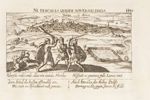
Ne Hercules quidem adversus duos: Meisner, Politica Politica (Nürnberg, 1700), emblem 749
Iconclass: 33B3:31A(+72) fighting❧the (nude) human figure; 'Corpo humano' (Ripa) (+ two persons) 54FF2 Defeat 59CC21 Inequality, Inequity, Iniquity; 'Iniquità' (Ripa) 94L (story of) Hercules (Heracles)
Collectanea (1500): 21
Loci Communes: Cedendum multitudini (One must yield to the crowd, Il faut céder à la foule)
I v 40 Unus vir, nullus vir One man, no man
Εἷς ἀνὴρ, οὐδείς ἀνὴρ, id est, Unus quidem vir, nullus est. Sensus est, nihil egregium praestari posse ab uno homine, omni auxilio destituto. Huc pertinet quod ait Euripides in Heraclidis: μιᾶς γᾶρ χειρὸς ἀσθενὴς μάχη, id est, Nam solitariae manus invalida pugna est. Item illud eiusdem: εἷς ἀνὴρ οὐ πάντ᾽ ὁρᾶ, id est, Vir unus haud videt omnia. Poterit ad varios usus deflecti proverbium, vel ad insuavem vitam, si non adsit convictor amicus: vel ad iudicium haudquaquam uni committendum: vel ad studium literarum, quod citra socium, & eiusdem, ut aiunt, aemulum Musae, planè friget: vel ad quodvis denique peragendum negocium, quod citra alterius adminiculum commode confici non queat. Adagii mentionem facit Zenodotus.
Εἷς ἀνὴρ, οὐδείς ἀνὴρ, One man indeed is no man. The meaning is that nothing excellent can be achieved by one man, bereft of any help. To this belongs what Euripides says in the Heraclidae, The single-handed man is weak in fight,' and from the same author, 'One man does not see all.' The proverb can be turned to various uses: 'life has no sweetness without a friend to live with'; 'it is better not to trust to the judgment of one person'; in literary studies, if there is no companionship or rivalry as they say in the service of the Muses, it is cold and uninspired; or finally, about whatever business has to be conducted, which cannot be brought off properly without the assistance of someone else. Zenodotus mentions this proverb.
Facsimile: 
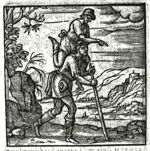
Mutuum auxilium: Alciatus, Emblemata (Leiden, 1591), emblem 160
Mutuum auxilium: Alciatus, Emblemata (Padua, 1621), col. 682 a, emblem 161
In re gravi mutuo auxilio opus est: Meisner, Politica Politica (Nürnberg, 1700), emblem 702
Duo simul viventes ad intelligendum et agendum plus valent quam unus: Vaenius, Amorum emblemata (Antwerp, 1608), emblem 8
Concordia insuperabilis: Rollenhagen, Nucleus emblematum (Arnhem, 1618), Cent. II, emblem 45: the halt leading the blind in the background
Iconclass: 31A(+71) the (nude) human figure; 'Corpo humano' (Ripa) (+ one person) 51BB61 Singularity, Uniqueness 59AA1 Loneliness; 'Solitudine' (Ripa)
Loci Communes: Cedendum multitudini (One must yield to the crowd, Il faut céder à la foule); Cum auxilio ; citra auxilium (With help; without help, Avec aide ; sans aide)
I v 41 Asinus inter simias A donkey among apes
Ονος ἐν πιθήκοις, id est, Asinus inter simias. Ubi quis incidit in homines nasutos, & contumeliosos, ipse stolidus, à quibus impune rideatur. Extat apud Aulum Gellium libro secundo, cap. 23. apud quem Menander comicus in fabula, cui titulus Plotium, maritum de uxoris iniuria querentem inducit his verbis: ὄνος ἐν πιθηκοις τοι, τὸ λεγόμενον, ἐστὶ δὴ τοῦτο, id est, Asinus inter simias, vulgo quod aiunt, sanè istud. Constat autem simiam animal esse petulantissimum, adeo ut non vereatur etiam leonem per lasciviam agitare, natibus illius affixa. Quin & hodie vulgo simile quiddam dicunt: Noctua inter cornices. ubi stupidior aliquis in homines petulantes ac dicaces incidit. Nihil autem vetat, quo minus generaliter usurpetur, ubi quis in negotium incidit vehementer molestum, aut in infortunium aliquod, unde se non queat extricare.
Ονος ἐν πιθήκοις, A donkey among apes. This occurs when a person finds himself among satirical and insolent people, himself being a dull fellow whom they mock with impunity. It comes in Aulus Gellius, book 2 chapter 23, where Menander the comedy-writer introduces into the plot of his play entitled Plocium a husband complaining of the insulting behaviour of his wife: 'This man's an ass among apes, as the saying goes.' The ape, as is well known, is a most impudent creature; it is not even afraid to tease a lion by clinging playfully to its rump. In our own day too there is a similar saying in common parlance, 'an owl among the crows,' when some doltish person happens to fall among impudent and sarcastic people. There is nothing to prevent it being used as a general phrase when someone finds himself involved in troublesome business or in a misfortune from which he cannot extricate himself.
Facsimile:
Simplicité l'on repute pour vice: La Perrière, Le theatre des bons engins (Lyon, 1545), emblem 42 uses the adage's imagery of monkeys mocking a donkey to express how the wicked, and especially the flatterers of the Court, hold a simple man for a fool
Iconclass: 25F22 monkeys, apes 46C13142 ass, donkey
Collectanea (1500): 30
Loci Communes: Infortunii sive exitii (Misfortune or ruin, Malheur ou ruine)
I v 42 Asinus inter apes A donkey among bees
Ονος ἐν μελίτταις, id est, Asinus inter apes. Consimilem habet cum proximo sensum, dici solitum, ubi quis infeliciter incidit in homines improbos atque importunos. Metaphora per se liquet: Quanquam adagium ab eventu quopiam natum videri potest. Meminit Suidas.
Ονος ἐν μελίτταις, A donkey among bees. This has the same sense as the previous one, and is said when someone has the bad luck to fall among worthless and unmannerly people. The metaphor is clear enough. The adage, however, seems to have arisen from some occurrence. Suidas mentions it.
Facsimile:
Iconclass: 25F711(BEE) insects: bee 46C13142 ass, donkey
Collectanea (1500): 448
Loci Communes: Infortunii sive exitii (Misfortune or ruin, Malheur ou ruine)
I v 43 Asinus in unguento A donkey wearing perfume
Ονος ἐν μύρῳ, id est, Asinus in unguento. Cum deliciae adhibentur iis, quos haudquaquam decent, neque qui vel uti norunt illis, vel delectantur. Nam asinus culmos ac foenum mavult quàm aurum, vel unguentum, quo etiam offenditur. Locus fuerit huic adagio, si quando indoctus aliquis in optimos incidat autores, quos ob inscitiam aut negligat, aut etiam depravet. Sive cum amuso cuipiam cum eruditissimis viris vivere contigerit, quorum tamen consuetudine neque frui noverit, neque omnino gaudeat. Refertur à Diogeniano proverbium.
Ονος ἐν μύρῳ, A donkey wearing perfume. Used when delicacies are put before people for whom they are not fitting, and who do not know either how to use them or how to enjoy them. A donkey, indeed, prefers straw and hay to gold, or scented ointment, which he actually dislikes. There would be a place for this adage if an uneducated person should happen to meet with the best authors, which he would either neglect out of ignorance, or even distort; or if a man who is a stranger to the Muses should come to live among learned people, and could neither profit by their company nor even be happy in it. The proverb occurs in Diogenianus.
Facsimile:
Iconclass: 31A5142 perfumes 46C13142 ass, donkey
Loci Communes: Dissimilitudinis et incongruentiae (Dissimilarity and incongruity, Dissemblance et incongruité)
I v 44 Neque coelum neque terram attingit It touches neither heaven nor earth
Οὔτε γῆς ὄτε οὐρανοῦ απτεται, id est, Neque caelum, neque terram attingit. De re vehementer absurda atque aliena, quaeque nulla vicinitate pertineat ad id de quo agitur. Lucianus in Pseudomante: ὀκτώ μοι χρησμοὺς ἔπεμψεν, οὔτε γῆς, φασὶν, οὔτε οὐρανοῦ ἁπτομένους. i. Octo mihi misit oracula, sed quae neque coelum, ut aiunt, neque terram attingerent. Aristides in Cimone leviter alludens ad proverbium, indicat metaphoram sumptam ab iis, qui in medio pendent aere, utrinque liberi.
Οὔτε γῆς ὄτε οὐρανοῦ απτεται, It touches neither earth nor heaven. Said of a thing which is wildly absurd and out of place, and has no connection at all with the matter in hand. Lucian in his False Prophet: 'He sent me eight oracular responses pertaining neither to earth nor heaven, as they say.' Aristides in Cimon alludes jokingly to the proverb, and indicates that the metaphor comes from those who hang in mid-air, unattached on all sides.
Facsimile:
Note: "Dat raakt kant noch wal"
Iconclass: 24 the heavens (celestial bodies) 25 earth, world as celestial body
Collectanea (1500): 836
Loci Communes: Aliena a re (Irrelevant to the matter, Étranger au sujet)
I v 45 Nihil ad versum Nothing to do with the verse
Οὐδεν πρὸς ἔπος. id est, Nihil ad carmen. De iis qui longe discrepant ab iis, quae proposita sunt. Translatum videtur à scena, ubi histrio saltatu gestuque, carminis genus repraesentat. Et haud scio an alius fuerit qui recitaret versus, alius qui gesticularetur. Apparet enim unum aliquem fuisse recitatorem, cuius est illa vox in calce Comoediarum: Calliopius recensui. Nec alioqui video quorsum pertineat, quod admonet Cicero, ab histrione deligi fabulam, ad quam natura sit appositus. quòd in prologo Comoediae Terentianae, qui prologum dicit, queritur clamosas fabulas ad se deferri, minus laboriosas, ad alios. Quod si saltatio parum respondisset ad numeros carminis, aiebant: Οὐδεν πρὸς ἔπος. Lucianus in Philopseude: Οὐδὲν πρὸς ἔπος ταῦτα, φασιν, οὐδὲ περὶ τούτων εἰρόμην, id est, Ista nihil ad carmen, ut dici solet, neque enim de iis interrogabam. Qui in choreis non responderet ad numerum saltationis, eum ἀκρότητον appellabant: isque ἀκροτεῖν dicebatur. Andreas Alciatus, hoc seculo non modo iuris Caesarei, verumetiam omnium studiorum decus, nec minus suspiciendus ob rarum quendam ingenii candorem, quàm ob exactam omnium liberalium disciplinarum peritiam, libro Dispunctionum suarum 2. consentit quidem mihi in sensu usuque proverbii, caeterum de origine nonnihil dissentit, mavultque ab oraculis esse natum, quae quondam carmine reddebantur, praesertim heroico, cuius inventor fuerit Pythius Apollo. Graecis autem ἔπος dicitur, quod ἕποντα τᾶ πράγματα τοῖς χρησμοῖς, id est, Quod res oraculis respondeant. Hanc enim etymologiam adfert Eustathius in principio Iliados Homericae: unde probabilius esse iudicat Alciatus noster, quoties evenirent quae promissis, aut proposito non qua drarent, dici solitum, οὐδεν πρὸς ἔπος. Usus est eo Ulpianus in Pandectis li. 11. Tit. de interrogatoriis actionibus cap. 12. Quod autem ait praetor, omnino non respondisse, posteriores sic acceperunt, ut omnino non respondisse videatur qui ad interrogata non respondit, id est, οὐδεν πρὸς ἔπος. Suidas indicat nonnunquam usurpari οὐδεν πρὸς ἔπος, pro temere ac de nihilo, sive abs re. Adducit hos versus ex poeta, nescio quo: Οὐδὲν πρὸς ἔπος ὅτως ἀνοήτως ἐκβαλῶ, Πρὶν ἐκπύθωμαι πᾶν τὸ πράγμ᾽ ὅπως ἔχει; id est, Adeó ne temere, & inscienter efferam, Prius atque rem omnem ut sese habet cognovero? Prior versus Graecus constabit, si legas, pro οὕτως, χ᾽ ὅτως. Usurpavit idem Aristophanes in Concionatricibus: quem locum retulimus proverbio, Extra cantionem.
Οὐδεν πρὸς ἔπος, Nothing to do with the verse. This applies to things which are far different from what was intended. It seems to come from the stage, where the actor expresses by his movements and gestures the kind of dramatic poem he is representing. Possibly one recited the verses and another acted the part. For there appears to have been one reciter, whose name is seen at the end of comedies: 'I, Calliopius, went through this.' Otherwise I cannot see the force of what Cicero says about the actor selecting a play for which he would be naturally fitted; the actor who speaks the prologue of a comedy of Terence complains that noisy plots have been allocated to him and less troublesome ones to the others. If the acting did not correspond to the metre of the poem, they would say 'Nothing to do with the verse.' Lucian in Philopseudes: These things have nothing to do with the verse, as they say, nor was I inquiring about these.' If anyone in the dances did not fit in with the rhythm of the dance, they called him akrotêtos, and he was said akrotein, to miss the beat.
Andrea Alciati, a luminary of our age not only in Roman law but in all kinds of learning, is no less to be admired for the rare sincerity of his mind than for his accurate grasp of all liberal disciplines. In the second book of his Dispunctiones he agrees with me about the meaning and use of the proverb, but differs somewhat on the question of its origin. He prefers to think that it was derived from the oracles, which used to be delivered in verse, preferably heroic verse, the inventor of which was said to be the Pythian Apollo. This was called in Greek epos, because the facts follow [hepetai] the oracle. This etymology is contributed by Eustathius at the beginning of the Iliad of Homer; and my friend Alciati thinks for this reason that more probably this phrase, 'nothing to do with the verse,' was used whenever events occurred which did not bear out what was promised or proposed. Ulpian made use of it in the Pandects, book 11, title De interrogatoriis actionibus, chapter 12: 'With regard to the Praetor's expression "declines to answer at all," later authorities took his words in the following sense: a man, they said, is held to decline to answer who does not answer the precise question he is asked, that is nothing to do with the verse.'
Suidas affirms that this phrase is sometimes used to mean 'rashly, without reason' or 'not to the point.' He quotes these lines from some unidentified poet: 'Should I speak so far from the verse, so senselessly, / Before I know the whole thing as it stands?' The first line in the Greek will stand, if for οὕτως you read Χ᾽ ὅτως. Aristophanes also made use of it in his Ecclesiazusae, a reference I have given in the proverb 'Out of tune.'
Facsimile: 
Note: Erasmus digresses on his friend Andreas Alciatus
Iconclass: 48C85 theatre, theatrical performance 48C901(+0) symbolic representations, allegories and emblems ~ poetry; 'Poesia' (Ripa) (+ variant) 54C11 Intention 59CC21 Inequality, Inequity, Iniquity; 'Iniquità' (Ripa)
Loci Communes: Aliena a re (Irrelevant to the matter, Étranger au sujet); Dissimilitudinis et incongruentiae (Dissimilarity and incongruity, Dissemblance et incongruité)
I v 46 Nihil ad fides Nothing to do with the lyre
Οὐδὲν πρὸς τὴν χορδὴν, id est, Nihil ad chordam. In eos quorum vita vehementer est inaequalis, quorúmve mores ab oratione dissident. Lucianus De saltatione: καὶ μηδεν, ὥς φασι, πρὸς τὴν χορδὴν. ἕτερα γὰρ ὁ ποὺς, ἕτερα δ᾽ ὁ ῥυθμὸς λὲγει. id est, Nihil ad chordam, ut dici solet: nam alia pes, alia loquitur rythmus. Idem in Meretriciis: καὶ ὅτι εὖ πρὸς τὴν κιθάραν ὁ ποὺς, id est, Et quod pes probe responderet ad citharam. Plutarchus in commentarιο De verecundia, καὶ τοι οὐ διὰ τὴν τοῦ ποδὸς πρὸς τὴν λύραν ἀμετρίαν, ὡς πλάτων ἔλεγε, καὶ πολεις πόλεσι καὶ φίλοι φίλοις διαφερόμενοι, ἔσχατα δρῶσι τε και πασχουσιν, ἀλλὰ διὰ τὴν περὶ τὰ νόμιμα καὶ δικαια πλημμὲλειαν. id est, Haud quaquam ob id, quod pes à lyra dissentiat, sicut ait Plato, civitates cum civitatibus. amici cum amicis conflictantes, extrema tum faciunt, tum patiuntur: sed quod circa leges atque aequitatem peccetur. Locus autem, quem citat Plutarchus, est in li. De legibus septimo: ἀποδιδόντας πρόσχορδα τὰ φθέγματα τοῖς φθέγμασι, τὴν δε ἑτεροφωνίαν και ποικιλίαν τῆς λύρας, ἄλλα μὲν μέλη τῶν χορδῶν ἰεισῶν, ἄλλα δὲ τοῦ τὴν μελῳδίαν συνθέντος, τοῦ ποιητοῦ, και τὰ λοιπά,. id est, Reddentes voces cum lyrae sono concordes. Porrò vocis discrepantiam diversitatemque quoties alios modos edunt chordae, alios is qui cantilenam composuit, & caetera. Videtur ad hoc proverbium allusisse divus Augustinus in epistola quadam ad Licentium: Aut si ego canto, inquit, tu autem ad aliam vocem saltas, nec sic quidem me poenitet. Habet enim suam hilaritatem ipsa cantatio, etiam cum ad eam membra non monet, cui plena charitatis modulatione cantatur.
Οὐδὲν πρὸς τὴν χορδὴν, Nothing to do with the lutestring; aimed at those whose life is inconsistent, or whose behaviour is different from their words. Lucian, On Dancing: 'And nothing, as they say, to do with the lyre-string, for the foot says one thing and the rhythm something else.' Again in Dialogues of Courtesans: 'And because her foot answered truly to the lyre.' Plutarch in his essay 'On False Shame': 'And yet it is not because the foot is not attuned to the lyre as Plato says, that cities in conflict with cities, and friends with friends, inflict and suffer such disasters, but because the laws and justice are sinned against.' The passage Plutarch is quoting is in the Laws, book 7: 'Giving back tones in accord with the sound of the lyre. Then [it makes] a discordance and conflict every time the strings produce notes in a different rhythm from the one chosen by the composer of the song, and so on.' It seems to have been to this proverb that St Augustine alluded in a certain letter to Licentius: 'But if I play and you dance to another tune, even so I am not sorry.' Singing has its own delight, even when the person to whom the song is sung with the tender tones of love does not move a limb in response.
Facsimile:
Iconclass: 48C7321 lyre, cithara, psaltery 54C11 Intention 59CC21 Inequality, Inequity, Iniquity; 'Iniquità' (Ripa)
Collectanea (1500): 837
Loci Communes: Aliena a re (Irrelevant to the matter, Étranger au sujet); Dissimilitudinis et incongruentiae (Dissimilarity and incongruity, Dissemblance et incongruité); Excellentia, inaequalitas (Excellence, inequality, Excellence, inégalité)
I v 47 Formica camelus Ant or camel
Μύρμηξ ἡ κάμηλος. id est, Formica camelus. De vehementer inaequalibus, & modo minimis, modo maximis: quod perinde sit, quasi repente camelus in formicam vertatur. Lucianus in prima epistola Saturnalium: ὡς δὲ νῦν ἔχομεν, μύρμηξ ἡ κάμηλος, Ὡς ἡ παροιμία φησί. id est, Nam ut nunc vivitur à nobis, formica camelus, quemadmodum proverbio dicitur. Loquitur de opibus inaequaliter inter mortales distributis, ut huic plurimum supersit, huic multum desit. Neque intempestive dicetur in eos, qui sibi non constant, in utranque partem immodici. Quod genus hominum describit Euripides in Troadibus: Τί δ᾽ ὧδε πηδᾷς ἄλλοτ᾽ εἰς ἄλλους τρόποσ; Μισεῖς δὲ λίαν, καὶ φιλεῖς ὃν ἂν τύχη. id est, Quid ita modo hos, modo in hosce mores transilis? Odisti acerbe, amasque nimium quemlibet.
Μύρμηξ ἤ κάμηλος, Ant or camel. Referring to things which are violently unequal, and now tiny, now huge, just as if a camel were to be turned all at once into an ant. Lucian, in the Saturnalia, letter i: 'But as we now live, "ant or camel, "as the proverb says.' He is speaking of the unequal distribution of wealth among mortals, so that one has more than enough and another is in dire need. It can aptly be used too of persons who are inconsistent, and go to extremes in either way. Euripides describes this kind of man in the Troades: 'Why do you jump from one mood to another? You hate and love excessively whomsoever you chance upon.'
Facsimile:
Iconclass: 25F24(CAMEL) hoofed animals: camel 25F711(ANT) insects: ant 59CC21 Inequality, Inequity, Iniquity; 'Iniquità' (Ripa) 51E2 Superiority
Loci Communes: Excellentia, inaequalitas (Excellence, inequality, Excellence, inégalité)
I v 48 Os sublinere To smear someone's face
Os sublinere, pro eo quod est, dare verba, & arte quadam illudere, reperitur aliquoties apud autores. Nonius Marcellus tractum putat à ridiculo quodam lusus genere, quo dormientibus ora pinguntur. Plantus in Aulularia: Fidei censebam maximam fidem esse. Ea sublevit os mihi pessime. Idem alibi: Os mihi probe sublitum est. Idem in Epidico: Ego si adlegassem aliquem, ad hoc negocium minus hominem quàm doctum, minusque ad rem callidum, os sublitum esset. M. Varro in mysteriis apud Nonium: aes defraudasse cauponem, bonam luto oblivisse, cum portitores aera induxere. Sophocles in Antigone: Ορῶσι χ᾽ οἰδε, σοὶ δ᾽ ὑπίλλουσι στόμα. id est, Vident & hi, sed os tibi sublinunt. Virgilius item in carmine Bucolico, pueros inducit per lusum, Sileni faciem mori succo oblinentes. Iamque videnti Sanguineis frontem moris & tempora pingit. Ille dolum ridens, Quò vincula nectitis? inquit.
To smear someone's face is to give him empty words and make a fool of him by some form of trickery; it is found several times in good authors. Nonius Marcellus thinks it is taken from some silly kind of game, in which a person's face is smeared while he is asleep. Plautus in the Aulularia: 'I thought Faith was the one god one could have faith in, but she's smeared my face dreadfully.' Again elsewhere: 'I've got my face smeared all right.' Again in the Epidicus: 'If I'd deputed a less intelligent man to this business, one less clever at the job, I should have had my face smeared.' Marcus Varro in his Mysteria, cited by Nonius: 'To have defrauded the innkeeper of his money, to have smeared the goodwife's face with mud, while their cash softened up the customs men.' Sophocles in the Antigone: 'These also see, but they are smearing your face.' Virgil too in one of his Bucolics describes boys playing a trick on Silenus by smearing his face with mulberry-juice:
She stained his brow and temples
With mulberry-juice, and he, awake by now,
Smiled at their ruse, and said 'Fetters? What for?'
Facsimile: 
Iconclass: 25D26 mud (soil type) 31A515 painting of body or face
Loci Communes: Imposturae (Impostures, Impostures)
I v 49 Dare verba To give empty words
Dare verba, passim obvium est apud omnes autores, pro eo quod est fallere. Persius quarta Satyra: Ut mavis, da verba, & decipe nervos. Terentius: Cui verba dare difficile est. Ovidius: Verba dat omnis amans. Idem eleganter transtulit ad fallendas animi curas: Detineo studiis animum, falloque labores: Experior curis & dare verba meis. Sed tum frequentiora, tum expositiora sunt exempla, quàm ut operae precium sit ea persequi. Tantum illud admonuerim, nonnihil Veneris accessurum proverbio, si longius a simplici detorqueatur oratione, videlicet ad fraudem imposturámve, quae vel citra verborum fucos peragitur. Quod genus fuerit, si quis dicat, mundum hunc dare verba suis cultoribus, &, alcimisticam, quam vocant artem, dare verba sui studiosis. &, eum sibiipsi dare verba, qui sibi pollicetur haudquaquam speranda.
This occurs everywhere throughout the authors, with the meaning of cheating. Persius, fourth Satire: 'Well, just as you please, give empty words and fool your sinews.' Terence: 'It is difficult to give him empty words.' Ovid: 'Every lover gives empty words.' The last-named finely applies it to attempts to allay one's own anxieties: 'With study I engage my mind, and beguile my sufferings, /I try to see how I can give empty words to my cares.' But examples are so frequent and so clear that it would be waste of effort to track them down. I would only suggest that more pleasure is to be derived from the proverb if it is turned away from a simple matter of speech and used to express the fraud and imposture which are effective even without the colouring of words. For instance one could say that this world 'gives empty words' to its worshippers; that what they call the art of alchemy 'gives empty words' to those who study it, and that people who promise themselves something they can hardly hope for are 'giving empty words' to themselves.
Facsimile:
Iconclass: 49K321 word 51II2 Emptiness, Void
Loci Communes: Imposturae (Impostures, Impostures)
I v 50 Addere manum To make sport of someone
Illud non inusitatius quod est apud Plautum in Persa: Addere manum: pro eo quod est ludibrio habere. Translatum opinor ab iis, qui manu ad aurem porrecta motaque quempiam irrident. Plautina verba sunt haec: Quid ais, crux, stimulorum tritor? Quomodo me hodie versast"? ut me in tricas coniecisti? Quomodo de Persa manus mihi addita est? Item in Poenulo: Quo pacto avarae Veneri pulchre adii manum. Rursum in eadem scena. Ego faxo posthac dii deaeque caeteri contentiores magis erunt atque avidi minus, cum scibunt, Veneri ut addiderit leno manum. Idem in Aulularia: Ita illis impuris omnibus adii manum. Iterum in Cassina: Satin' lepide addita nobis manus merito? Quanquam varie scriptum invenio, nunc adii, nunc addita. Mihi videtur rectius legi, addidi, ut accipiamus sumptam metaphoram ab irridentium, ut dixi, gestu. cuius meminit Persius: Nec manus auriculas imitata est mobilis albas.
To make sport of someone. There is a phrase in Plautus, Persa, which is less usual: addere manum, 'to put a hand to,' to make a laughing-stock of someone. I think it comes from people who put a hand to their ear and waggle it, to make fun of someone else. The words of Plautus are these: 'What do you say, you gallows, you wearer-away of the whip? How have you imposed on me today? Into what embarrassments have you led me? How have I been baulked [manus mihi addita est] about that Persian?' Again in the Poenulus: 'By these means I fairly played a trick [adii manum] on the greedy Venus.' Again in the same scene: 'I'll make the other gods and goddesses henceforth more contented, and less greedy, when they know how the procurer put a trick [addiderit manum] upon Venus.' Again in the Aulularia: 'Thus did I baulk [adii manum] all those rascals.' Again in the Casina: 'Were you two tripped up [addita manus] neatly enough?' Although I find it written in different ways, now adii and now addita. The more correct reading seems to me addidi, taking the metaphor, as I said, from a gesture of mockery; Persius recalls this: 'Nor a hand that can imitate by its motion a donkey's white ears.'
Facsimile:
Iconclass: 31A(+9341) the (nude) human figure; 'Corpo humano' (Ripa) (+ reaching, handing, giving) 31A2245 hand 33B11 mocking, insulting; teasing
Loci Communes: Imposturae (Impostures, Impostures)
I v 51 Circumtondere comam To cut the hair all round
Περικείρειν τοὺς πλοκάμους. id est, Circumtondere comam, Graecis in proverbio est, pro eo quod est, ludibrio habere. Nam id lusus gratia fieri solet stupidis, ut eis non sentientibus caesaries circumtondeatur. Lucianus in Misanthropo: ἐκάθησο τοὺς πλοκάμους περικειρόμενος ὑπ᾽ αὐτῶν. id est, Sedebas cum tibi caesaries ab illis circumtonderetur. Usurpat idem in Pseudomante.
Περικείρειν τοὺς πλοκάμους, To cut the hair all round. This is a proverb in Greek, and means to make a butt of someone. For this is a joke usually played on stupid people: their hair is cut all round without their being aware of it. Lucian in the Misanthrope: 'You sat while they cut your locks.' He uses it again in his False Prophet.
Facsimile:
Iconclass: 31A532 hair-cutting 31A5333 tonsure 33B11 mocking, insulting; teasing
Loci Communes: Imposturae (Impostures, Impostures)
I v 52 Fucum facere To play a trick
Fucum facere, pro eo quod est imposturam facere, & artificiosa dissimulatione deludere, frequens est apud bonos autores. Terentius in Eunucho: Per alienas regulas venisse clanculum, fucum factum mulieri. Quo loco, factum, supinum est, non participium. Quintus frater ad Ciceronem: Si eum, qui tibi promiserit, fucum, ut dicitur, facere velle senseris, ut te id audisse & scire dissimules. Nam fucus herbae genus, quam Graeci φῦκον vocant, tingendis lanis utile. Unde simpliciter Fucum pro colore reperire licet, & Fucare pro colorare. Horatius in Odis: Stercore fucatus crocodili. Maximè si colorem non nativum aut genuinum, sed artificiosum, ac velut adulterinum significemus, ut idem Horatius: Nec amissos colores Lana refert medicata fuco. Proinde medicamentum illud, quo cuti superinducto mulierculae vitia formae dissimulant, quasique personam assumunt, fucum vocant. Plautus: Vitia corporis fuco occulunt. Ut autem Fucus est color arte additus, ita Persona facies est non vera, sed apposititia. Unde eleganter dictum à Seneca: Ut personam malit quàm faciem. id est, videri malit quàm esse. Lucretius item libro tertio: Nam verae voces tum demum pectore ab imo Eliciuntur, & eripitur persona, manet res. Cornelius Tacitus in Dialogo De Oratoribus, Ita nec praeceptor deerat optimus quidem, & electissimus, qui faciem eloquentiae non imaginem praestaret. Itaque Personatos dicimus, qui aliud prae se ferunt quàm sint. Quin & Offucias vocant, inania quaedam rerum simula chra, quae veluti praestigiis quibusdam, oculis intuentium imponunt. Graeci simplici verbo φενακίζειν vocant, et φενακισμόν, huiusmodi imposturam, φένακα fuci artificem. Qui scripsit etymologicum Graecum, auctor insyncerus & impurus, vocem deductam existimat παρὰ τὴν πηνήκην, quae Graecis coma dicitur apposititia. Latini galericulum appellant. Quin & colorem pro fuco usurpavit Iulianus citante Ulpiano libro Pandect. 14. Tit. Ad senatusconsul. Maced. cap. 9. Sed Iulianus, inquit, adiicit, si color quaesitus sit, ut filius familiâs qui mutuam pecuniam accepturus erat, fide iuberet. Quin & rhetores, probabilem ratione quam ad defensionem commenti sunt, colorem appellant. Iuvenalis, Dic aliquem nobis, dic Quintiliane colorem. Et haerente summo rhetore, uxor deprehensa impudentissimo coloro se tuetur, Convenerat olim Ut faceret tu quod velles, nec non ego possem Indulgere mihi.
Fucum facere, originally 'to apply a dye,' in the sense of practising an imposture and deceiving by skilful pretence, is frequent among good authors. Terence in the Eunuchus: 'Came secretly across another's roof, in order to play a trick on a woman,' fucum factum mulieri, where factum is a supine not a participle. Quintus his brother writes to Cicero: 'If you perceive that a man who has made you a promise wishes to play a trick on you, as they say, you must conceal the fact that you have heard this and know all about it.' For fucus is a species of plant, in Greek phykos, used for dying woollen cloth. Thus fucus may be found meaning simply 'dye,' and fucare 'to colour'; Horace in the Odes: 'coloured with crocodile dung.' Especially if we mean to say that the colour is not natural or original, but artificial or falsely applied, as in Horace again: 'Wool purple-dyed / Never regains the hue it once has lost.' So the cosmetic which women apply to their skin to hide blemishes to their beauty, as if they were putting on a mask, is called fucus; Plautus: 'They hide the body's faults with rouge,' fucus. And just as the fucus is colour added by art, so a mask is not a true face but an applied one. Seneca says wittily 'so that he likes the mask better than the face/ that is, he prefers to seem rather than to be. Lucretius too in book 3: 'Now from the inmost heart true voices come; / The mask is snatched away, the real is left.' Cornelius Tacitus in the Dialogue on Orators: Thus there was not lacking an excellent teacher, a man of real distinction, to show the true face of eloquence and not its image.' Thus we say people are 'wearing a mask' when their appearance belies what they really are. And things are called 'eye-wash,' offucias, when they are empty appearances, which trick the eyes of the spectator like sleight of hand. In Greek there is a single word for this kind of imposture, phenakizein, and the noun phenakismos; the contriver of the disguise is phenax. The compiler of the Etymologicum graecum - and a dishonest and corrupt writer he was - thinks the term came from pênêkê, a Greek word for false hair, which is galericulum in Latin.
Julianus, quoted by Ulpian in the Pandects, book 14 title Ad senatusconsultum Macedonicum chapter 9, used color in the sense of fucus: 'But Julianus adds' he says 'that if any color, any line of defence has been thought up to the effect that the son of the family who was proposing to accept the loan should give a surety.' Experts in forensic rhetoric also use the word 'colour' for a line of argument likely to carry conviction which they have in vented for the defence. Juvenal: 'Quick quick, Quintilian, please give us some colour.' And when that great expert is in difficulties, the wife caught in the act defends herself with the most impudent of 'colours':' 'Twas agreed of old / You should do what you like, and also I / Should please myself.'
Facsimile: 
Iconclass: 41D283 mask 41D43 dyeing (clothes) 57AA613 Cunning, Slyness; 'Astutia ingannevole' (Ripa)
Collectanea (1500): 37
Loci Communes: Imposturae (Impostures, Impostures)
I v 53 Album calculum addere, et similes figurae To add a white stone, and similar metaphors
Λευκὴν ψῆφον προσθεῖναι, id est, Album calculum addere, pro approbare, subinde legimus apud doctos. Inde sumptum, quod antiquitus missis in urnam calculis, ita ferebantur à iudicibus sententiae, ut albis absolverent, nigris damnarent. Qui si forte fortuna fuissent aequales, tamen liberabatur reus. eiusque rei causam Aristoteles copiosissime reddit in problematibus. De calculorum more meminit Ovid. Metam. lib. 15. Mos erat antiquis, niveis, atrisque lapillis, His damnare reos, illis absolvere culpa. Tunc quoque sic lata est sententia tristis, & omnis Calculus immitem dimittitur ater in urnam. Quae simul effudit numerandos versa lapillos, Omnibus è nigro color est mutatus in album. Plinius iunior in epistola quadam: Nam quo magis intendam limam tuam, confitebor & ipsum me, & contubernales, ab aeditione non abhorrere: si modo tu fortasse errori nostro album calculum adieceris. id est, si nostrum hunc errorem tuo iudicio comprobaris. Lucianus in apologia οὐκ ἐν παρέργῳ θὲμενος, τὴν λευκὴν παρὰ σοῦ καὶ πλήρη μοι ἐνεχθῆναι id est, Haud parvo aestimans, si mihi contingat, album abs te plenumque suffragium auferre. Plato libro De legibus 2. οὐκ ἂν τιθείμην ταύτην ψῆφον, id est. Haud posuerim hunc calculum. Huc adscribendum quod Alcibiades, nolens sese iudicum permittere sententiis, ait, Ne matri quidem confidere velle, sed etiam hanc in eiusmodi periculo suspectam habiturum, ne nigrum calculum pro albo subiiceret. Aristides in Pericle, simplici verbo dixit, ἐπιψηφίζειν pro comprobare: eamque vocem tanquam Platonicam usurpat.
Λευκὴν ψῆφον προσθεῖναι, To add a white stone. This means to vote approval, and we often find it among learned authors. It comes from the custom in Antiquity of placing pebbles in an urn to signify the opinions of the judges: white stones meant acquittal, black condemnation. If it happened that they were equal in number, the accused was dismissed. Aristotle treats the reason for this at length in his Problems. Ovid recalls the custom of voting by pebbles in the Metamorphoses, book 15:
With pebbles, black and white, in olden time,
'Twas custom to convict, or clear, of crime;
And thus the fatal vote was cast: each stone
Was black, that in the unfeeling urn was thrown.
But when, upturned, it poured them back to light
For counting, all the blacks had changed to white.
The younger Pliny says in one of his letters: 'To sharpen your critical powers I must confess that my friends and I are thinking of publishing it, if only you cast your vote' [your white pebble] 'for the proposal, mistaken though it may be,' meaning, if you confirm our error with your judgment. Lucian in the Apologia, 'Not considering it a matter of little importance for me to be given a white vote by you.' Plato, Laws book 2: 'I would not have given this vote.' To this may be added what Alcibiades says about not wishing to submit to the sentence of the judges: he says that he would not trust his own mother in such a dangerous situation, but would suspect her of being capable of putting in a black stone instead of a white. Aristides in Pericles puts it in one word, epipsephizein, meaning 'to assent,' and adopts this term as Platonic.
Facsimile:
Iconclass: 22C4(WHITE) colours, pigments, and paints: white 46A635 voting (~ meeting)
Collectanea (1500): 622
Loci Communes: Approbandi (Approving, Approuver)
I v 54 Creta notare, carbon notare To mark with chalk, with coal
Ad hanc formam pertinent et illa: Creta notare, pro eo quod est approbare, & Carbone notare, quod est damnare. Propterea quod Pythagoras aiebat id, quod esset colore candido, ad boni naturam pertinere: quod atro, mali. Unde & felicia alba dicimus, infames nigros. M. Tullius in actione pro Cecinna de teste Sexto Clodio Phormione: Nec minus niger, inquit, nec minus confidens, quàm ille Terentianus Phormio. Et Horatius: Hic niger est, hunc tu Romane caveto. Idem in Sermonibus: Sani, an creta, an carbone notandi. Quem imitatus Persius, ait in quinta Satyra: Quaeque sequenda forent, & quae vitanda vicissim, Illa prius creta, mox haec carbone notasti. Rursum Horatius in Odis: Cressa neu careat pulchra dies nota Candidum calculum Cressam notam appellat, qua veteres dies fortunatos signare consueverunt. Tametsi sunt qui hoc loco pro Cressa legunt Thressa, quod hic mos fuisse perhibetur Thracibus. Ad hanc formam pertinet etiam illud: Unione signare, quod saepius apud autores est, pro eo quod est, inter felicia prosperaque numerare. Ductum à veterum superstitione, qui unumquemque anni diem, missis totidem in urnam, aut ut apud Scythas, in pharetram, calculis signabant: quem arbitrabantur prosperum abiisse, candido calculo, aut creta: quem egregie felicem, unione: Contrà, quem inauspicatum, nigro lapillo notabant. Persius, Hunc Macrine diem numera meliore lapillo. Huius superstitionis meminit Plinius libro 7. capite quadragesimo. Vana, inquiens, mortalitas, & ad circumscribendam seipsam ingeniosa, computat more Thraciae gen tis, quae calculos colore distinctos, pro experimento cuiusque diei in urna condit, ac supremo die separatos dinumerat, atque ita de uno quoque pronunciat. Quid quod iste calculi candore illo laudatus dies originem mali habuit? Hactenus Plinius. Plutarchus in vita Periclis historiam refert ab his non abhorrentem, quam fortassis non ab re fuerit hic ipsius verbis adscriber: Οκτὼ μερή διελὼν τὸ πᾶν πλῆθος, ἐπεκλήρου, καὶ τῷ λαβόντι τὸν λευκὸν κύαμον εὐωχεῖσθαι καὶ σχολάζειν παρεῖχε, τῶν ἄλλων μαχομένων. διὸ καὶ φασι τοὺς ἐν εὐπαθείαις τισι γενομένους, λευκὴν ἡμέραν ἐκείνην, ἀπὸ του λευκοῦ κνάμου προσαγορεύειν, id est, Universam multitudinem partitus in octo partes sortibus utebatur: & cui contigisset alba faba, huic caeteris pugnantibus permittebat in conviviis atque ocio agere: quapropter etiam aiunt eos, quibus res aliquae suaviter succedunt, eum diem album vocare, nimirum ab alba faba. Ad hanc viciniam pertinet, quod quae praecipua sunt, ea melioris notae esse dicimus: veluti quum M. Tullius alicui salutem dici iubet de nota meliore. Tristem notam dixit Livius Decad. I. lib. 4. Posthumius nulla tristi nota est insignitus, id est, nulla crudelitatis infamia aspersus.
These belong to the same category: to mark with chalk for to approve, and to mark with coal for to condemn. This is because of what Pythagoras says, that white belongs to the nature of good, and what is black to that of evil. Thus we call happy things 'white' and villains 'black.' Cicero in his speech Pro Caecina, speaking of the witness Sextus Clodius Phormio: 'No less black and no less brazen than Phormio in Terence.' Also Horace: 'This man is black; beware of him, thou Roman!' and again in the Satires: 'Are they sane, to be marked with chalk, or coal?' Persius, imitating him, says in his fifth Satire: 'What to follow and what to avoid / You first marked, the one with chalk, the other with coal.' Horace again in the Odes: 'Let this fair day not lack a Cretan mark.' He calls the white stone a Cretan mark, because the ancients used to mark in this way days of good omen. It is true that some read Thressa, Thracian for Cressa, Cretan in this place, because the custom is said to have existed among the Thracians.
To this class belongs that other expression, 'to mark with a pearl,'which often occurs in literature, meaning to count something fortunate and prosperous. It arises from the superstition of the ancients, who used to mark every day in the year by means of the exact number of pebbles placed in an urn, or (among the Scythians) in a quiver, and by these pebbles they indicated which day they considered to have been prosperous, with a white stone, or chalk; which had been particularly lucky, with a pearl; on the other hand, the unlucky one was marked with a black stone. Persius: 'This day, Macrinus, mark with a finer stone.' Pliny recalls this superstition in book 7 chapter 40: 'Vain mortality, so ingenious in circumscribing itself, counts by the method of the people of Thrace, who put into an urn pebbles of different colour according to the experience of each day, and on the last day counts them all out separately, and thus decides about each one. What if that much-praised day with the white stone had in it the origin of evil?' Thus far Pliny. Plutarch in the life of Pericles tells a story not without relevance to this, which it would perhaps be appropriate to transcribe in his own words: 'Dividing the whole group into eight parts he had them draw lots, and he allowed those who got the white bean to feast and relax, while the others fought. Therefore those to whom something good happens call it a "white day" from the white bean.'
This is close to our way of calling important things 'matters of higher note' just as Cicero sends someone 'greetings of a superior brand.' Livy, decade i book 4, uses the phrase 'a sinister mark': Postumius had no sinister mark against him,' that is to say, he was not sullied by an imputation of cruelty.
Facsimile: 
Iconclass: 22C4(BLACK) colours, pigments, and paints: black 22C4(WHITE) colours, pigments, and paints: white 25D12(CHALK) kinds of non-precious stone: chalk 25D141 anthracite, hard coal 46A635 voting (~ meeting)
Collectanea (1500): 272
Loci Communes: Approbandi (Approving, Approuver); Damnandi (Condemning, Condamner)
I v 55 Calculum reducere To take back a move (or counter)
Calculum reducere, est mutare factum, cuius te poeniteat. aut, vertere consilium rei non satis commode institutae. Nonius citat Ciceronem in Hortensio: Itaque tibi concedo, quod in duodecim scrupis olim, ut calculum reducas, si te alicuius dati poeniteat. Translatum apparet, aut à ratiocinantibus, aut quod est vero propius, à ludo laterunculario. In summa, proverbii speciem habent, quaecunque à calculis finguntur metaphorae, ut, Ad calculos vocare, pro eo quod est, rationem inire & aestimare. M. Tullius dialogo De amicitia: Hoc quidem est nimis exigue, & exiliter ad calculos vocare amicitiam, ut par sit ratio datorum & acceptorum. Valerius Maximus libro quarto, capite de liberalitate: Si ad calculos revocetur, parvum utpote septem iugeribus, & hoc in Pupinia abditis redactum: sin animo praerogantis, omni pecunia maius. Et, Ad calculos reverti, est redire ad rationem, ac respectum, consiliumque. Cicero ad Atticum: Quare nunc saltem ad illos calculos revertamur, quos tum abiecimus, ut non solum gloriosis consiliis utamur, sed etiam paulo salubrioribus. Et in epistolis Plinianis, Movere calculos, pro eo quod est, proponere rationes. Et ponere, inquit, in utraque parte calculos. id est, utrinque rationes expendere: Et, Hic calculus accedat. id est, hoc momenti adiungatur. Neque quicquam prohibet eadem ratione dici, Decedere calculum, & Detrahere calculum.
To take back a move (or counter). This means to change an action for which one is sorry, or to alter the plan of some badly-arranged affair. Nonius quotes Cicero in the Hortensius: 'So I allow you, as in the twelve stones of old, to change your move [calculum] if you repent of any given proposition.' It appears to be adapted from people who make calculations, or more likely from the game of laterunculi (chess). In short, whatever metaphors are created out of counters or markers [calculi] take the form of a proverb. Thus to 'call to a reckoning' [ad calculos] means to initiate an audit or valuation. Cicero in his dialogue On Friendship: 'But such a view reduces friendship to a question of figures [ad calculos revocare] in a spirit far too narrow and illiberal, as though the object were to have an exact balance in a debtor and creditor account.' Valerius Maximus, book 4, the chapter on liberality: 'If one estimates the amount [ad calculos revocatur], it was small, coming from a piece of land of seven acres and that hidden away in Pupinia; if one regards the motive of the man who made the advance, it was more than any amount of money.' And 'to go back to the counters [calculi]' means to return to the argument, the consideration, the scheme. Cicero to Atticus: 'So let me now at all events return to the standards [calculos] I then rejected, and adopt counsels of safety (in some degree) as well as of glory.' And in Pliny's Letters 'to move the counters' means to put forward arguments. And he says 'to set out the counters on each side' when he means to weigh up the arguments each way; and 'let this counter be added' means 'this matter of importance is also to be considered.' There is no reason why one should not say 'a counter drops out' or 'to take a counter away.'
Facsimile:
Iconclass: 51LL4 Regression, Backward Movement
Collectanea (1500): 38
Loci Communes: Mutandae sententiae (Changing one's opinion, Changer d'avis)
I v 56 Theta praefigere To prefix a theta
Theta praefigere, pro damnare. Persius: Et potis es vitio nigrum praefigere Θ Ausonius in pαedagogum liguritorem, carmine Choliambico, Miselle doctor, ου tibi sit obscoeno, Tuumque nomen theta sectiblis signet. Sunt qui hoc ad figuram Graecanicae literae referant, quod ea cordis humani transfixi speciem quodammodo repraesentet. Nam nescio an debeamus Isidoro credere, qui primo Etymologiarum libro scribit, ita militari more solere fieri, ut caesi Θ, salvi Τ signarentur. Certe de hoc signo Τ fir mentio etiam in Apocalypsi, quae beati Ioannis Evangelistae nomine legitur. Sed vero similius, quod scribit Asconius Pedianus, olim in iudiciis sortes, quae mittebantur in urnam, triplicem notam habere solere: ac Θ quidem damnationis fuisse symbolum, Τ absolutionis, Λ ampliationis, id est, quoties significabant sibi parum adhuc liquere, ac denuo causam agi oportere.
To prefix a theta. This means to condemn. Persius: 'And you may prefix a theta to the error.' Ausonius, in a choliambic poem against a gormandizing schoolmaster: 'Wretched pedant, ou to your obscenity, / May a cleft theta mark your name.' Some say this refers to the shape of the Greek letter, because it has somewhat the appearance of a human heart pierced through. I do not know if we are to believe Isidore, who writes in the first book of the Etymologies that it was a military custom to use the mark Θ for the slain, Τ for the survivors. Certainly there is a reference to the sign Τ in the Apocalypse, which bears the name of St John the Evangelist. But more likely to be true is what Asconius Paedianus writes, that in old times there were three marks on the lots cast into the urns in legal cases. Of these, Θ was indeed the sign of condemnation, Τ of absolution, while Δ stood for deferment, when they indicated that it was not sufficiently clear to them as yet, and the case should be tried again.
Facsimile:
Iconclass: 49L13(Θ) Greek script (Θ)
Collectanea (1500): 261
Loci Communes: Damnandi (Condemning, Condamner)
I v 57 Stellis signare. Obelo notare To mark with stars. To brand with an obelus
Αστροις σημειοῦσθαι, ἤ ἄστροις τεκμαίρεσθαι, id est, Stellis notare. Eustathius in quintum Odysseae librum, admonet dictum de his, qui longam ac desertam viam peragunt, adeo, ut necessum habeant regionum situm, stellarum observatione signare. Ductam autem esse metaphoram à navigantibus, qui cum eousque provecti sunt à terra, ut iam coelum undique & undique pontus, stellarum indicio cursum moderari solent, maximè Cynosurae, et Helices, teste Arato ἐν φαινομένοις, Οἳ τὴν μὲν κυνόσουραν ἐπικλησιν καλὲουσι, Τὴν δ᾽ ἑρέρην ἑλίκην. ἑλίκῃ γε μὲν ἄνδρες ἀχαιοὶ Εἰν ἁλὶ τεκμαίρονται ἵνα χρὴ νῆας ἀγινεῖν Τῇ δ᾽ ἄρα φοίνικες πισυνοι περόωσι θάλασσαν. Αλλ᾽ ἡ μὲν καθαρὴ καὶ ἐπιφράζασθαι ἑτοίμη, Πολλὴ φαινομένη ἑλίκη πρώτης ἀπὸ νυκτὸς, Η δ᾽ ἑτερή ὀλίγη μὲν, ἀτὰρ ναύτῃσιν ἀρείων, Μειοτερή γὰρ πᾶσα περιστρέφεται στροφάλιγγι, Τῇ καὶ σιδόνιοι ἰθύντατα ναυτίλλονται Quorum carminum interpretationem adscribam ex Germanici Caesaris interpretatione, Hic Iovis altrices Helice, Cynosuraque fulgent. Dat Graiis Helice cursus maioribus astris, Phoenicas Cynosura regit: sed candida tota, Et liquido splendore Helice, nitet haud prius ulla, Cum sol Oceano fulgentia condidit ora, Stella micat coelo septem qua Cresia flammis. Certior est Cynosura tamen sulcantibus aequor, Quippe brevis totam fido se cardine vertit, Sidoniamque ratem nunquam spectata fefellit. Et Aratum imitatus Ovidius, libro de Tristibus quarto: Magna minorque ferae, quarum regis altera Graias, Altera Sidonias, utraque sicca rateis. Idem indicat Vergilius in quinto, de Palinuro loquens: Talia dicta dabat, clavumque affixus, & haerens, Numquam amittebat, oculosque sub astra tenebat. Idem alibi, Cuncta notat tacito labentia sidera coelo. Consimiliter Homerus cum aliàs, tum Odysseae libro quinto: Αὐτὰρ ὁ πηδαλίῳ ἰθύνετο τεχνηέντως Ημενος, οὐδὲ οἱ ὕπνος ἐπὶ βλεφάροισιν ἔπιπτε, Γληϊάδας ἐσορῶντι, καὶ ὀψὲ δύοντα βοώτην Αρκτονθ᾽, ἥν καὶ ἅμαξαν ἐπίκλησιν καλέουσιν, Η τ᾽ αὐτοῦ στρέφεται καὶ τ᾽ ὠρίωνα δοκεύει, Οἴη δ᾽ ἄμμορός ἐστι λοετρῶν ὠκεανοῖο id est, Ille quidem navim arte regens, clavo assidet haerens, Nec sinit illapso torpescere lumina somno, Pleiadas, seroque recondentem ora Booten Suspectans, ursamque, alio cognomine plaustrum, Quae fixa usque loco se circumflectit eodem, Et nunquam Oceani liquidis aspergitur undis. Unde ἄστροις σημειοῦσθαι τὴν ὁδον videntur ii, qui notulis quibusdam & coniecturis arte deprehensis, rem alioqui pervestigatu difficilem inquirunt, aut assequuntur: aut qui signis quibusdam multo ante colligunt quid sit eventurum. Postea deflexum est, ut stellas praenotare dicantur, qui quippiam velut animadvertendum insigniunt. Cui diversum ὀβελίζειν, id est, veru praenotato quasi iugulare ac damnare. Translatum ab Aristarcho, qui Homeri carmina in corpus redegit atque in libros digessit: versus nothos, hoc est adulterinos & subdititios, qui non viderentur sapere venam illam Homericam, ὀβελισκοις, id est, minutis verubus praenotatis damnans; contrà, qui viderentur insignes ac genuini, ἀστερίσκοις, id est stellulis illustrans. Quem morem sequutus est & Origenes, & divus Hieronymus in literis divinis. Quin hoc ipsum Aristarchi cognomen in proverbium abiit, quod is eum damnandi notulis probandique morem excogitarit. M. Tullius Attico: Totum hunc locum, in aristocratia, ego varie meis orationibus, quarum tu Aristarchus es, soleo pingere, de flamma, de ferro, (nosti illas ληκύθους) valde graviter pertexuit. Atticum vocat suarum orationum Aristarchum, id est, censorem & emendatorem, quod illi mos fuerit, si quae parum probasset in scriptis Ciceronis, ea ceris rubris notare. Quod quidem alibi declarat idem M. Tullius, libro ad Atticum decimosexto: Quae mihi florentia visa sunt tuo iudicio. Cerulas enim tuas miniatulas illas extimescebam. Idem ad Dolabellam: Profert alter, opinor, duobus versiculis expensum: Alter Aristarchus hos ὀβελίζει. Ego, tanquam criticus anti quus iudicaturus sum. Item M. Varro de lingua Latina Aristarchos appellat, criticos grammaticos, qui de libris iudicant. Et Horatius: Fiet Aristarchus, id est, castigator & expensor alieni scripti. Et divus Hieronymus subinde quempiam sui temporis Aristarchum vocat, quod arbitrio suo alia damnaret, alia probaret.
Αστροις σημειοῦσθαι or τεκμαίρεσθαι, To mark with stars or to tell by the stars. Eustathius on the fifth book of the Odyssey suggests that the saying concerns travellers on a long and deserted road, needing to mark their regional position by observation of the stars; and that the metaphor comes from seafarers, who when they are far enough out from land to have nothing but 'sky all around and all around them sea,' regulate their course by the indications of the stars, especially the Little Bear and the Great Bear. Thus Aratus in the Phaenomena; I will copy the translation of his verses out of the version of Germanicus Caesar.
Here the Great Bear, and lesser Cynosure,
Jove's nurses, shine; one guides the Greeks, great-starred;
Pure white, the other rules Phoenician ways.
The Great Bear shines unmatched in liquid splendour,
When Sun in Ocean's plunged his dazzling face,
Where with seven fires glitters the Cretan star;
More certain for the ploughers of the sea
Is Cynosure, whose short course turns itself
On steady hinge, and never once deceived
The craft from Sidon which had sight of her.
And Ovid imitating Aratus, in the fourth book of the Tristia:
Ye two beasts, great and small, one the guide
Of Grecian, the other of Sidonian ships.
Ye never-setting.
Virgil mentions the same thing in Book 5, speaking of Palinurus: 'While he spoke, he kept a good grip on the tiller - / By no means would he release it - and a steadfast gaze on the stars,' and elsewhere, 'All the stars he scanned as they slid through the quiet sky.' Likewise Homer in several places, as in the Odyssey, book 5:
And taking his seat artfully with the steering oar he held her
On her course, nor did sleep ever descend on his eyelids
As he kept his eye on the Pleiades and late-setting Bootes,
And the Bear, to whom men also give the name of the Wagon,
Who turns about fixed ever in the same place,
And she alone is never plunged in the wash of the Ocean.
Thus those people seem to 'tell the way by the stars' who use signs and conjectures skilfully worked out to inquire into or follow up a subject which would otherwise be difficult to investigate; or who by means of certain signs reckon up far in advance what is going to happen. Later on the meaning changed, so that people were said to 'note down the stars' when they pointed out something particularly worthy of notice.
To mark with an obelus is different: it means to affix a marginal sign shaped like a spit for confutation and condemnation. It is taken from Aristarchus, who gathered together the poems of Homer and arranged them in books, rejecting by means of 'obeli' or small dagger-signs prefixed to them the spurious lines, that is to say the counterfeit and substituted lines which did not seem to have the true feeling of the Homeric vein. Those, on the other hand, which seemed outstanding and genuine he marked with asterisks, little stars. Both Origen and St Jerome followed this method in Holy Scripture.
The very name of Aristarchus became a proverb, since he was the person who invented this system of approving or rejecting by means of critical marks. Cicero to Atticus: 'In short, he worked up most impressively the whole theme which in aristocratic style I am in the habit of embroidering in my speeches (you are their Aristarchus) all about fire and sword (you know my colour-box).' He calls Atticus the Aristarchus of his speeches, that is, the censor and emendator, because it was his custom to mark with red pencil anything which did not meet with his approval in the writings of Cicero. Cicero makes this clear in another place, Letters to Atticus, book 16: 'Your good opinion makes them sparkle the brighter in my eyes. I was terrified of those little red wafers of yours.' The same to Dolabella: The latter brings forward, I take it, record in two little lines of money advanced, and the other, a regular Aristarchus, obelizes them, while I, like an ancient critic, have to decide the matter.' Varro, also in his On the Latin Language, calls the grammarians who criticize books 'Aristarchs.' And Horace: 'He will become an Aristarchus,' that is, a censor and critic of others' writings. St Jerome often calls someone 'the Aristarchus of his time' because he condemns some things and approves others at his own sweet will.
Facsimile: 

Iconclass: 46C2821 position-finding with the help of the stars or the sun 49B(+6) scholastic education, tuition (+ report, mark ~ school) 49E12 star-chart, star map
Collectanea (1500): 765
Loci Communes: Conjecturae (Conjectures, Conjectures); Damnandi (Condemning, Condamner)
I v 58 Notari ungui et similia To be marked with the finger-nail, etc
Ad eandem formam pertinent haec quoque: Notare ungui, quod soleat ungui signum apponi, ubi quid parum placet. Horatius dixit, Transverso calamo signum apponere, pro eo quod est, damnare. In eundem sensum, Censoria virgula legitur identidem apud divum Hieronymum, pro castigandi notandique autoritate. Item apud Quintilianum libro Institutionum primo, Qua quidem ita sunt severe usi veteres grammatici, ut non versus modo censoria quadam virgula notare. A censoribus Romanis traductum, quorum partes erant notare, si quid in moribus civitatis dignum emendatione iudicassent, ac multam dicere. Eodem pertinent Spongia, lima, caelum, quae in emendationis proverbium abierunt. Spongia deletur, quod non placet. Lima detrahitur atque expolitur, quod redundat, quodque incultum est. Coelo deformatur item, ac fingitur id, quod est rudius. Proinde in spongiam incubuisse dixit Augustus Aiacem suum, quem deleverat. Et Elimata dicuntur expolita. Et Sculpturam orationis, cultum dicunt.
Another which belongs to the same group is Notare ungui, to mark with the finger-nail, because it was the custom to make a mark with the nail against anything unsatisfactory. Horace spoke of drawing a cross-stroke with the pen, when he meant 'to condemn.' In the same way, the phrase 'critical mark,' censoria virgula, is found several times in St Jerome to express the power of correcting something and branding it as spurious. Again, in Quintilian, Institutions book 1, 'And this the ancient grammarians used so severely that they mark with some sort of critical sign not only single lines' and what follows. This is derived from the censors in Rome, whose duty it was to pick on anything in the behaviour of the citizens which needed correction, and to impose a fine. Here belong the sponge, the file and the chisel, which have become proverbial as instruments of emendation. A sponge wipes out what is unsatisfactory. A file removes excess and polishes crudity. A chisel shapes and fashions what is still unfinished. So Augustus said of his Ajax, which he had wiped out, that 'he had fallen upon his sponge.' A polished piece of writing is said to have been under the file, and the word 'sculpture' is used of well-chiselled prose.
I v 59 Stilum vertere To reverse the pen
Silum vertere, est mutare quod scripseris. Horatius in Sermonibus: Saepe stilum vertas. Antiquitus in tabellis ceratis scriptitabant stilo graphiario, cuius altera parte, nimirum acuta, per aequor cereum ducta literas exarabant, altera latiore, rursum obliterabant quod exarassent. Hieronymus adversus Ruffinum: Quamdiu non renuebam laudationem tuam, sequebaris ut magistrum, fratrem & collegam vocabas, & catholicum in omnibus fatebaris. Postquam vero non agnovi laudes tuas, & me indignum tanti viri praeconio iudicavi, vertis stilum, & omnia laudata prius, vituperas, de eodem ore & dulce proferens & amarum. Hieronymus imitatus est Ciceronem, qui Verrinarum actionum 4. scribit in hunc modum: Timuit aliquando & commotus est: vertit stilum in tabulis suis, quo facto causam omnem evertit suam. Invenitur & Stilum infigere, & stilo appetere, pro eo quod est, scriptis insectari atque invehi.
To reverse the pen is to change what you have written. Horace in the Satires: 'Often reverse the pen.' In Antiquity they used to write on wax tablets with a writing-stylus, using one end, very sharp, to trace the letters in the soft wax, and the other broader end to rub out what they had written. Jerome Against Rufinus: 'As long as I did not refuse your praise, you followed me like a master, calling me brother and colleague, and declaring that I was orthodox in all things. But since I have not accepted your praises, and judged myself unworthy of being publicly commended by such a great man, you reverse your pen and you are showering blame on everything you praised before, producing both sweet and sour from the same mouth.' Jerome copied Cicero, who writes as follows in the fourth of his Verrines: 'He was at last thoroughly frightened and upset; and then he reversed the pen on his records, thereby making an end of all his chances of acquittal.' One also finds 'to stick in the stylus,' 'to attack with the stylus,' meaning to upbraid and reproach in one's writings.
Facsimile:
Iconclass: 49L11(+0) handwriting, writing as activity (+ variant) 49L51 pen 49L6452 wax tablet 49L67(ERASER) other writing accessories: eraser
Collectanea (1500): 770
Loci Communes: Correctio dicti aut facti (Correction of a word or deed, Correction d'une parole ou d'un acte)
I v 60 Omne tulit punctum; Omnium calculis He obtained every point; With everyone's votes
Omne tulit punctum, & cunctorum calculis, legimus pro eo quod est, omnium sententia & comprobatione. Quorum prius translatum est à consuetudine comitiorum, ubi tabella circumferri consuevit, in qua puncto apposito significabant, cui candidatorum suffragarentur. Posterius à iudiciorum sortibus de quibus paulo superius meminimus. Horat. Omne tulit punctum, qui miscuit utile dulci. Nam, qui iucunda modo scribunt, iis duntaxat placent, qui voluptatem appetunt. Contra qui utilia, ab iis tantum probantur, quibus utilitas quaeritur. At qui voluptatem cum utilitate coniunxit, is omnium suffragio laudabitur. Idem in Epistolis: Discedo Alcaeus puncto illius. ille meo quis? Quis, nisi Callimachus? Item in epigram mate Choliambico, quod refertur à Porphyrione: Ciconiarum Rufus iste conditor, Hic est duobus elegantior Plancis. Suffragiorum puncta non tulit septem. Aristides in Themistocle: ἥ κοινὴ ψῆφος ἑλλήνων, id est: qui est communis Graecorum calculus, dixit pro eo quod erat, totius Graeciae consensus. Cicero libro Tusculanarum quaestionum secundo: Quae flamma est, per quam non cucurrerunt, qui haec olim punctis singulis colligebant? Agit autem de magistratibus, qui singulorum civium suffragus mandabantur. Apuleius Asini sui libro sexto: Certe calculo cunctorum, utcunque mors ei fuerat destinata, id est, omnium suffragiis sententiisque.
He obtained every point; With everyone's votes. We read these phrases as a way of saying 'with everyone's agreement and assent.' The first is adapted from the custom of carrying round in election meetings a wax tablet on which people indicated by a dot, punctum, which of the candidates they were voting for; and the other from the system of voting by the judges, which we have just mentioned. Horace: 'All votes [punctum] he won, who mingled use with pleasure.' For those who write nothing but agreeable things please only the readers who seek for pleasure, and those who produce useful writings only win the approval of the readers in search of the useful. But the one who has combined pleasure with usefulness will win the approval of all. Horace again in his Epistles: 'Alcaeus I in his opinion [punctum] shine, He soars a new Callimachus in mine.' And again in the choliambic epigram quoted by Porphyrion:
This Rufus, noted maker of stork-pie,
This man's more elegant than both the Planci.
He didn't carry seven votes.
Aristides in Themistocles uses the phrase 'the common voting-pebble of the Greeks' to mean the consensus of all Greece. Cicero, Tusculan Questions, book 2, 'What fire have these men not been through who once used to gather in these things vote by vote?' He is speaking of the magistracies, which were allotted by the votes of single citizens. Apuleius in his Ass, book 6, says 'death in some form or other had been allotted to him by the general pebble' meaning the votes and opinions of all.
Facsimile:
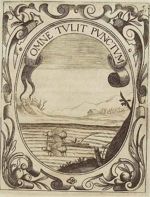
Omne tulit punctum: Saavedra, Idea de un principe (München, 1640), emblem 41
Omne tulit punctum: De la Feuille, Devises et emblemes anciennes et modernes (Augsburg, 1697), emblem 122
Iconclass: 46A635 voting (~ meeting) 54E31 Agreement, Unity; 'Concordia', 'Concordia insuperabile', 'Concordia militare', 'Concordia di Pace', 'Unione civile' (Ripa)
Collectanea (1500): 492
Loci Communes: Approbandi (Approving, Approuver)
I v 61 Cumani sero sapiunt The people of Cumae learn wisdom late
Οψὲ ἀισθάνονται οἱ κυμαῖοι. id est. Sero sapiunt Cumani. Id agium refertur à Strabone Geographiae libro decimotertio: putatque eos vulgo male audisse, tanquam stupidos atque insulsos, ob hanc causam, quod ducentis annis portus vectigalia exegerint, hoc nomine, ut urbem aedificarent, quae dare tamen non desierunt, cum iam urbs esset extructa. Adiicit et aliam fabulam: Cumanos publica pecunia mutuo accepta, porticus construxisse: deinde cum pecuniam eam ad diem praescriptum non reddidissent, à deambulatione fuisse prohibitos. Aliquanto pòst cum ingens esset pluvia, creditores ludibrii causa praeconem misisse, qui publicarent edictum, uti Cumani porticus subirent. Atque ita voce praeconis admonitos subiisse: inde natum adagium, Pero sapere Cumanos, qui non nisi moniti senserint defugiendam esse pluviam. Notat & Stephanus, Cumam ac Lesbum male vulgo audisse stupiditatis nomine. Proverbium autem non sentit de Cuma Italiae, sed Aeolidis, quae eadem dicta fuisset Amazonium & Phriconitis, aut, ut Herodotus libro primo, Phriconis. Simillimum illi: Sero sapiunt Phryges. Nihil enim vetat, quo minus dicatur & in illos, qui non nisi suo malo docti parent recte monentibus.
'Οψὲ ἀισθάνονται οἱ Κουμαῖοι, The people of Cumae learn wisdom late. This adage is mentioned by Strabo, Geography, book 13. He thinks these people were generally decried as foolish and absurd, because after two hundred years of exacting taxes at the port for the purpose of building the town, they did not stop paying them when the town was built. He adds another story: that the Cumaeans had built a colonnade with borrowed money, and then when they failed to repay the money on the appointed day, they were forbidden to walk there. Some time later there was a heavy rain, and the creditors sent out a crier in jest, to publish an edict that the Cumaeans must come under the colonnade. Thus admonished by the voice of the crier, they did so; and hence the origin of the proverb 'the people of Cumae learn wisdom late,' because it was only after receiving advice that they learned they should come in out of the rain. Stephanus remarks that Cumae and Lesbos both had a bad name for stupidity. The proverb does not apply to Cumae in Italy but to Cumae in Aeolis, which had been called Amazonium, and Phriconitis, or as Herodotus says in his Book 1, Phriconis. It resembles that other phrase, The Phrygians learn wisdom late.' There is no reason why it should not also be used with regard to people who only follow good advice when taught by their misfortunes.
Facsimile: 
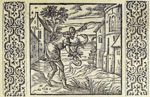
Sero sapiunt Phryges: Whitney, A choice of emblemes (Leiden, 1586), emblem 84
Iconclass: 32B2(CUMAEAN) historical peoples and nationalities (CUMAEAN) 52AA1 Stupidity, Poverty of Intellect; 'Stupidità overo Stolidità' (Ripa)
Loci Communes: Sera paenitentia (Late repentance, Repentir tardif)
I v 62 Mala attrahens ad sese, ut caecias nubes Attracting trouble as the north-easter draws clouds
Κακ᾽ ἐφ᾽ αὑτὸν ἕλκων ὥστε καικίας νέφος, id est: Sic mala sibiipsi, ut caecias nubem attrahens. Versus est senarius, proverbio celebratus, in eos, qui sibiipsis litium ac negociorum materiam pariunt accersuntque. Ducta similitudine ab eius venti natura, cui nomen caecias, quem Plinius media inter aquilonem & exortum regione flare scribit, & unum contra aliorum septentrionalium ventorum naturam, nubes non pellere, sed attrahere. Quin ipsius adscribam verba: Ventorum, inquit, etiam frigidissimi sunt, quos à septentrione diximus spirare. Vicinus his corus. Hi & reliquos compescunt, & imbres abigunt. Humidi auster & aphricus, & praecipue auster Italiae. Narrant & in Ponto caeciam in se trahere nubes. Hactenus Plinius. Aristoteles libro De mundo putat caeciam circa ortus aestivos flare: additque hunc à nonnullis eundem haberi cum illo, quem alii θρασκίαν nominant, flatque proximus argestae. Quid autem in causa sit, ut hic ventus nubes non more reliquorum à se propellat, sed ad se vocet, Aristoteles in Meteorologis conatur ostendere. Vel quod alius, inquit, ventus reflet adversus eodem tempore: vel quod hic è sublimi coeli parte spirans, puta orientali, non transversus per terram feratur, sed recurvata linea, propter reflexum, unde exortus est, eò recurrit. Atque ita fit, ut nubes ad sese cogat. Unde idem in libro De mundo, caeciam inter eos ventos numerat, qui ἀνακάμψιπνοι, id est, resupinati flatus vocantur. In Problematis autem sectione vigesima sexta, duas huiusce rei causas reddit. Alteram hanc esse putat, quòd eodem tempore reflet alius ventus caeciae contrarius. Altera non dissonat ab iis, quae retuli: nempe caeciam spirare ab eminentiore coeli regione, nimirum ab ea quae vergit ad orientem: hanc autem esse aeditiorem quam occiduam, colligit ex magnitudine & altitudine maris occidentalis. itaque fieri, ut caecias occiduam regionem adversus invadens, nubes contrahat, easque suo in se reflexu ad se trahat. Huius rei mentionem facit & Plutarchus in vita Sertorii, scribens hunc ducem, animadversa caeciae natura, qui tum fortè flabat, Cacitanos, aut ut Graeci codices habet, Characitanos hostes ad deditionem coegisse ad hunc modum. E regione speluncarum, in quibus illi se continebant, obiecit aggeres cinericios. Quibus incursatione equitum concitatis, caecias tantum pulveris in fauces speluncarum devexit, ut cum ferre non possent, sese Sertorio in manus darent. Refertur adagium ab Aulo Gellio, libro 2. cap. 22. idque ex Aristotele. Refertur & à Theophrasto, libro De natura ventorum. Sed ab hoc atque item ab Aristotele refertur, ut videatur etiam in bonam partem dici posse. Ait enim, ἕλκων ἐφ᾽ αὑτὸν τὸν πλοῦτον ὥσπὲρ ὀ καικίας νέφη. id est: Attrahens ad sese divitias, ut caecias nubes. Plutarchus in commentario, cui titulus, Quo pacto quis possit ab inimicis iuvari: ὡς γὰρ ὁ καικίας τὰ νέφη, οὕτως καὶ ὁ φαῦλος βιος ἐφ᾽ αὑτὸν ἕλκει τὰς λοιδορίας, id est: Quemadmodum enim caecias nubes, itidem improba vita, probra ad sese attrahit. Usurpat idem in bonam partem in Praeceptis politicis. Unde de re quavis dici posse videtur in utramlibet partem. ut, Hic ad sese eruditorum hominum gregem attrahit, perinde ut caecias nubes. Hic undique pecunias attrahit ad sese, quemadmodum caecias nubes. Hunc omnes bonae felicitates non aliter sequuntur, quàm caecias nubes. Nusquam absunt iurgia, ubicumque hic adest: neque enim secus ad sese lites attrahit, quàm caecias nubes. Consimiliter ad rem referri potest, Res est tumultuosa ambitio: quippe invidiam, simultatem, profusionem, atque id genus alia incommoda non aliter attrahit ad sese, quàm caecias nubes. Modestia cunctorum hominum benevolentiam allicit ad sese, itidem ut caecias nubes.
Κακ᾽ ἐφ᾽ αὑτὸν ἕλκων ὥστε καικίας νέφος, Attracting trouble as the northeaster draws clouds. This is an iambic line, in common use as a proverb against those who are the very begetters and purveyors of their own troubles, in the way of lawsuits and affairs. The comparison comes from the nature of the wind called caecias, which as Pliny writes, 'blows between north and east,' and unlike any other of the northerly winds does not drive the clouds away but attracts them. I will give his own words: 'The coldest of the winds are those which blow, as we said, from the north. The north-west wind, corns, is close to these. These hold the others in check, and drive away rainstorms. The south wind and the south-west wind (auster and africus) are wet, especially the former in Italy. They say that in Pontus the caecias draws the clouds to itself.' Thus far Pliny. Aristotle in his De mundo thinks that the north-east wind blows roughly from the sun's point of rising in summer, and adds that some people identify it with the wind others call thraskias, which blows nearest to the argestes. Why it should be that this wind does not, like the others, drive the clouds away, but calls them to it, Aristotle attempts to explain in the Meteorological 'Either because another wind is blowing the other way at the same time; or because this one blowing from the highest part of heaven (say from the east) is not carried across the land, but makes a curving back on itself and turns towards the place from whence it came. And so it happens that it draws the clouds to itself.' So in his De mundo he counts the north-easter among what are called 'regressive winds.' In the Problemata, section 26, he gives two causes for this. One, he thinks, is that another wind is blowing contrary to the north-east wind at the same time. The other is in agreement with what I have said; that the north-easter blows from a higher region of the sky, namely that which lies towards the east; that this is loftier than the west, he deduces from the size and depth of the western sea. Thus it comes about that the north-easter, blowing into the western regions, collects the clouds together, and draws them towards itself by a spiral movement. Plutarch mentions this in his life of Sertorius; he writes that this general observed the nature of the north-east wind at a time when it happened to be blowing, and forced his adversaries the Cacitani (or as the Greek copies have it, Characitani) to surrender, in the following way. In front of the caves where they were keeping close, he threw up mounds of ashes. When these were disturbed by the onrush of the cavalry, the northeast wind sent so much dust into the mouth of the caves that the enemy could not endure it, and gave themselves up to Sertorius.
The adage is mentioned by Aulus Gellius, book 2 chapter 22, out of Aristotle, and also by Theophrastus in his book on the nature of winds. But both he and Aristotle mention it in such a way that it appears it can be used in a good sense; for he says 'attracting riches to himself as the north-easter attracts clouds.' Plutarch in his essay entitled 'How to Profit by One's Enemies': 'Just as the north-easter attracts the clouds, so a wicked life attracts disgrace.' In the 'Precepts of Statecraft' he makes use of it in a good sense. So it seems that it can be used about anything in either a good sense or a bad. 'This man gathers a swarm of learned men about him, as the northeaster attracts the clouds.' This man attracts money to himself, from everywhere, as the north-easter the clouds.' 'Every kind of good fortune follows that man, as the clouds the north-easter.' 'Wherever this man is there are disputes - he collects lawsuits as the north-easter collects clouds.' Similarly it may be used of things: 'Ambition is a turbulent thing, attracting to itself, as the north-easter attracts clouds, envy, strife, extravagance, and other troubles of the same kind.' 'Modesty attracts to itself the goodwill of all men, as the north-easter attracts clouds.'
Facsimile:
Iconclass: 26C122 northeast wind, 'Kaikias' (Caecias) (one of eight directions) 51CC1 Effect, Result 54FF11 Adversity, Misfortune, Bad Luck; 'Fortuna infelice', 'Infortunio' (Ripa)
Loci Communes: Malum accersitum aut retortum (Evil brought upon oneself or turned back, Mal attiré ou retourné)
I v 63 Oleum in auricula ferre To carry oil in the ear
Oleum in auricula ferre, est apud Martialem. Quo loco non satisfacit interpres Domitius Calderinus, vir alioqui probe doctus. Nam poeta taxare videtur hominem rigida supinaque aure. id quod etiam Graeci notant, ἀν᾽ οὖς ἔχων, ἀντὶ τοῦ ἄνω τὸ οὖς ἔχων, id est: sublimem & supinam aurem habens. Carmen Martialis est huiusmodi: Narratur quidam belle dixisse Marulle: Qui te ferre oleum dixit in auricula. Porrò, ut in Problematibus scripsit Aristoteles, aures aqua infusa offenduntur, oleo non item. Quin si forte aqua in aurem inciderit, oleo infuso medemur, dum lubrica facta aure, aqua defluit. Proinde & urinatores oleum auribus instillare consueverunt, quo minus aqua laedantur. Hinc itaque videtur natum adagium, nempe à gestu eorum, quibus est aliquid liquoris infusum, quod ne effluat, aurem supinant, quasi aversantes ac fastidientes audire. Neque tamen negaverim posse referri ad assentatores, qui velut oleum in aurem instillant, dum iucunda loquuntur magis quàm salutaria. Cui diversum est illud Persianum: Auriculas teneras mordaci radere vero. Huc igitur pertinebit & illud evangelicum, de venditoribus olei. Verum cui placet hic sensus posterior, in auriculam, accusandi casu legat oportet. Quod quoniam & proverbii speciem prae se gerit, & vulgo iactatum Martialis indicat, non existimavi praetereundum.
To carry oil in the ear. This is in Martial. In this passage the commentator Domizio Calderini does not satisfy me, though otherwise he is a learned man enough. For the poet seems to be twitting a man with an inflexible, up-turned ear, a distinction made also in Greek ('having a proud and lofty ear'). Martial's poem is as follows:' Tis said he made a witty jest, Marullus, / Who said you carry oil in your ear.' Aristotle wrote in the Problemata: The ears are disturbed by water poured into them, but it is not so with oil. If by chance water gets into the ear, we relieve this by pouring in oil, for when the ear becomes slippery the water flows away. Thus divers have formed the habit of dropping oil in their ears, so that the water may do them less harm.' The adage seems to have originated from this, that is from the gesture of those who have some liquid injected and bend the ear upwards so that it will not flow out, which gives them the appearance of averting their ears and being unwilling to listen. I would think it could also refer to flatterers, who instil something like oil in the ear when they speak what is pleasant rather than what is wholesome. A different idea comes out of the phrase in Persius: 'Grating on delicate ears with the harsh truth.' To this meaning belongs the allusion in the Gospel to the sellers of oil. But if one chooses this latter sense, one must read the accusative case, in auriculam [into the ear]. But I did not think it right to omit the version which appears to have a proverbial meaning and which Martial's mention shows to have been commonly used.
I v 64 Quid si coelum ruat? What if the sky should fall?
Τί εἰ οὐρανὸς ἐμπὲσοι; id est, Quid si coelum ruat? Ironia proverbialis in eos, qui tutissimis etiam in rebus ridiculè timent. Hoc unde manarit, Aristoteles indicat libro τῶν μετὰ τὰ φυσικὰ quinto, scribens priscis illis & rudibus mortalibus persuasum fuisse, coelum hoc, quod videbant imminere, Atlanticis humeris sustineri. Quod si ille se subduxisset, fore ut è sublimi in terram decideret. Idque non solum poetarum figmentis fuiisse proditum, verumetiam à physicis nonnullis adfirmatum. Plutarchus in libello De facie quae apparet in orbe lunae, citat Phenacem quendam, qui metuerit ne luna decideret in terram, quique commiseratus sit vicem eorum qui lunae forent subiecti, cuiusmodi sunt Aethiopes ac Taprobani, si tantum pondus in eos rueret: idem veritus de terra, coeloque, nisi columnis Atlanticis fulcirentur. Theognis: Εν μοι ἔπειτα πέσοι μέγας οὐρανὸς εὐρὺς ὕπερθεν Χάλκεος, ἀνθρώπων δεῖμα παλαιγενέων id est: Deinde meo vastus capiti illabatur Olympus Ferreus, antiqui quod metuere viri. Terentius ἐν ἑαυτὸν τιμωρουμένῳ, Quid si redeo ad illos, qui aiunt: Quid si nunc coelum ruat? Allusit huc Horat. in Odis: Si fractus illabatur orbis, Impavidum ferient ruina.
Τί εἰ οὐρανὸς ἐμπέσοι;; What if the sky should fall? An ironically proverbial dig against people who in the safest of situations have absurd fears. Its origin is indicated by Aristotle in the fifth book of his Metaphysics, where he writes that early primitive men were convinced that the sky which they saw overhead was held up on the shoulders of Atlas. If he were to withdraw from under it, the result would be that it would fall from its height on to the earth. And this was not only a product of the poets' fancy, but asserted by some natural philosophers. Plutarch in his essay 'On the Face which Appears in the Orb of the Moon' quotes a certain Phenaces, who was afraid that the moon would fall upon the earth, and grieved for the fate of those who would be beneath it, like the Ethiopians and Taprobani, if such a weight should fall upon them; he was in fear too about the earth and the sky, if not held up by the pillars of Hercules. Theognis: Then on my head may fall vast brazen Olympus, / The thing so feared by men of olden time.' Terence in the Heautontimorumenos: 'What if I go back to the people who say, what if the sky should fall now?' Horace alludes to this in the Odes:
Were the vault of heaven
To break and fall upon him, yet its ruins
Would smite him undismayed.
Facsimile: 
Iconclass: 24F1 contemplating the firmament 51LL5 Descent
Loci Communes: Impossibilia (Impossible things, Choses impossibles)
I v 65 Umbram suam metuere To be afraid of one's own shadow
Τὴν αὑτοῦ σκίαν φοβεῖσθαι, id est, Suam ipsius umbra metuere, dicuntur, qui pueriliter trepidant, ubi nihil omnino sit periculi. Translatum vel ab his, qui fortè conspecta corporis sui umbra, subito expavescunt. Vel à melancholicis quibusdam, qui autore Aristotele, propter oculorum imbecillos spiritus in aere proximo veluti suam quandam imaginem contemplantes, arbitrantur sese suos videre manes. Socrates in Phaedone Platonis, Tu vero tuam, quemadmodum dici solet, metuens umbram. id est, tibiipsi diffisus. Qu. ad Ciceronem de Consulatu petendo: Alter vero, quo, dii boni, splendore est? Primum nobilitate eadem qua Catilina. Num maiore? Non: sed virtute. Quamobrem, qui manium umbram suam metuit, hunc negliges quidem. Quanquam is locus non uno modo erat depravatus in codicibus. Plutarchus Symposiacorum problematum decade septima, τὸ μὲν τῆς σκιᾶς ἀναινόμενος ὄνομα καὶ δυσχεραίνων, ἀληθῶς σκιὰν δόξει φοβεῖσθαι. id est. Qui umbrae nomen refugiat ac moleste ferat, is verè umbram videbitur formidare. Agit autem de umbris ita vocatis, qui non ipsi vocati à convivatore, sed vocatum sequentes adeunt convivium.
Τὴν αὑτοῦ σκιὰν φοβεῖσθαι, To be afraid of one's own shadow. This is said of people who tremble like children when there is no danger at all. It comes either from those who catch sight of their own shadow and are suddenly frightened, or from the melancholies of whom Aristotle speaks, who on account of weak spirits in the eye see something like an image of themselves in the surrounding air, and then they think they see their own ghosts. Socrates says in the Phaedo of Plato, 'But you, afraid of your shadow, as they say,' that is, mistrusting yourself. Quintus to Cicero on seeking the consulship: The other indeed, in heaven's name, of what distinction is he? First, of the same aristocracy as Catiline. Of greater? No, but in his valour. For this reason, Manius, the man who feared his own shadow, you will indeed despise.' This passage, however, was corrupted in the manuscripts in more ways than one. Plutarch, decade 7 of the Table-talk,' The one who refuses and resents the name of "shadow" seems truly to be afraid of a shadow.' He is speaking of 'shadows' so called because they themselves were not invited by the host but followed an invited guest to the feast.
Facsimile:
Iconclass: 31A28 man and his shadow 56DD1 Fear, Dread; 'Paura', 'Timidità o Timore', 'Timore' (Ripa)
Loci Communes: Absurda, indecora, seu praepostera (Absurd, unbecoming, or preposterous things, Choses absurdes, inconvenantes ou déplacées); Timiditas (Timidity, Timidité)
I v 66 Vel muscas metuit praetervolitantes He is afraid of the very flies fluttering past
Proverbialis esse videtur hyperbole, quam refert Aristoteles septimo De repub. libro, ἀλλὰ δεδίοτα μέν τὰς παραπετομένας μυίας, id est, Qui muscas, inquiens, etiam praetervolitantes metuat. id est, quamvis frivola de causa. Idem similem quandam commemorat in Mo ralium septimo, loquens de iis, qui usque adeo natura sunt timidi, ut etiam si sorex obstrepat, protinus expavescant.
This seems to be a proverbial hyperbole, quoted by Aristotle in his seventh book on the state: ἀλλὰ δεδίοτα μέν τὰς παραπετομένας μυίας, 'but fearing even flies flitting by,' meaning that he is afraid from some trivial cause. Much the same thing is recalled in the Ethics, book 7, speaking of people who are so unnaturally timid that even if a shrew squeaks they nearly die of fear.
Facsimile: 
Iconclass: 25F711(FLY)(+5262) insects: fly (+ flying animal(s)) 56DD1 Fear, Dread; 'Paura', 'Timidità o Timore', 'Timore' (Ripa)
I v 67 Funem abrumpere nimium tendendo To stretch the rope till it breaks
Αποῤῥαγήσεται τεινόμενον τὸ καλώδιον, id est: Abrumpetur tensus funiculus. In eos dici solitum, qui dum extrema experiuntur, alienant à se eos cum quibus agunt, & universae rei iacturam faciunt, dum plus satis attenti sunt ad lucrum. Lucianus in dialogo quodam, matrem lenam facit obiurgantem filiam, quod amatorem in convivio nimis pervicaciter contempserit: periculum autem esse, ne praeter modum exacerbatus atque irritatus iuvenis amorem pariter, & commodum aliò convertat. καῖ ὅρα, inquit, μὴ κατὰ τὴν παροιμίαν ἀποῤῥήζωμεν πάνυ τείνουσαι τὸ καλώδιον. id est, Ac vide, ne iuxta proverbium, abrumpamus dum nimium tendimus funiculum. Pindarus apud Plutarchum, καὶ λύοντι τὸ τῶν δυσφόρων σχοινίον μεριμνῶν. id est: Atque intolerabilium curarum funiculum solventi. Quanquam hoc ab adagio nonnihil est diversum, magisque congruit cum illo, quod est apud Senecam in Epistolis ad Lucilium, de explicanda catena negociorum, atque adeo abrumpenda, si nequeat explicari. Proverbium generaliter trahi poterit ad quemlibet conatum immodicum, & ob id in malum aliquod erumpentem. Huic finitimum est illud Hebraeorum, haudquaquam inscite, neque invenuste dictum proverbium: Qui nimium emungit fortiter,elicit sanguinem. Nec abhorret Mimus ille Publianus: Furor fit laesa saepius patientia. Atque alter huic consimilis, eiusdem, opinior, etiamsi Senecae nomine fertur: Bonus animus laesus, gravius multo irascitur.
Ἀποῤῥαγήσεται τεινόμενον τὸ καλώδιον, The taut rope will break. Said of people who make extreme efforts and in doing so estrange those they are dealing with; thus they incur an entire loss because they are immoderately intent on gain. Lucian in one of his dialogues makes a bawd scold her daughter because she has shown scorn for her lover in too spirited a way at a banquet; the danger is, says she, that the young man in his annoyance and irritation will take his love and his money elsewhere. 'Look out,' she says, 'in case we snap the rope by pulling on it too much, as the proverb says.' Pindar, in Plutarch: 'to one loosing the rope of unbearable cares.' Although there is some difference here from the proverb, and it is more in agreement with the phrase in Seneca, Letters to Lucilius, about the need to undo the chains of business, and break them if they cannot be undone. The proverb can be applied in general to any attempt of the immoderate kind, which ends in trouble through excessiveness. Near this is the Hebrew saying, shrewd and not unpicturesque: 'Blow your nose too hard and you'll make it bleed.' And so says Publius' well-known maxim: 'Oft-wounded patience will to madness turn.' And the other similar saying, by the same author, I think, even if it bears the name of Seneca: 'A kind heart wounded makes for deeper rage.'
Facsimile:
Note: Compare: "Zorgen dat het lijntje niet breekt ..."
Furor fit laesa saepius patientia: Giovio, Dialogo dell' Imprese (Lyon, 1574), emblem 28 (Symeoni) quotes ad adage from the comment
Furor fit laesa saepius patientia: Wither, A collection of emblems (London, 1635), emblem 194 quotes the comment
Pedetentim: Rollenhagen, Nucleus emblematum (Arnhem, 1618), Cent. II, emblem 94 quotes the comment
Ne quid nimis: Cramer, Emblemata sacra (Frankfurt, 1624), emblem 82 illustrates the Hebrew saying from the comment
Furor fit laesa saepius patientia: Paradin, Les devises héroïques (Antwerp, 1563), emblem 209 quotes the comment
Presser ne fault son amy follement: La Perrière, Le theatre des bons engins (Lyon, 1545), emblem 25 uses the imagery of a man breaking his sword by immoderately striking an anvil to express that one might estrange friends by pressing them too hard
Iconclass: 31A2746 breaking something 31A64 nose-blowing 47C2432 pulling (industrial process) 47D8(ROPE) tools, aids, implements ~ crafts and industries: rope
Collectanea (1500): 147
Loci Communes: Modestia modusque (Modesty and moderation, Modestie et mesure)
I v 68 In matellam immeiere To make water in a chamber-pot
Εἰς τήν ἀμΐδα εἰνουρεῖν, id est, In matellam immeiere. Cum sordide tractantur, aut ad munus aliquod parum honestum adhibentur ii, qui non indigni videantur, utpote ipsi sordidi atque inhonesti, quasique ad contumelias ferendas facti. Lucianus de mercede servientibus, Οὐδὲν οὖν οὐτ᾽ αὐτοὶ δεινόν πασχοιεν ἂν, οὔτ᾽ ἐκεῖνοι υβρισταὶ δοκεῖεν, ἐς τὴν ἀμΐδα, φασὶν, ἐνουροῦντεσ. id est: Itaque nec hic quicquam indignum aut acerbum patiantur, neque illi eos contumeliis afficere videantur, si, quod aiunt, in matellam immingant. Siquidem ad hunc usum quasi nascitur matella. Ex adverso Martialis Bassum quendam ioco taxat, qui in aureum vas incacaret, cum vitro biberet: Ventris onus misero (nec te pudet) excipis auro Basse: bibis vitro, carius ergo cacas.
Ἐς τήν ἀμΐδα εἰνουρεῖν, To make water in the chamber-pot. When people are treated basely, or are appointed to some dishonourable function, who can be seen to be not unworthy of it, being dishonest and knavish themselves, as if they were made for disgrace. Lucian, On Salaried Posts: Therefore those would not suffer anything dreadful or unworthy, nor would these be considered insolent for, as they say "pissing into the chamber-pot.'" The chamber-pot, after all, was made for that. On the other hand Martial twits a certain Bassus with using a golden vessel for his excretions and drinking out of glass: 'You catch your belly's burden, unrepentantly, in gold (poor gold!); / But you drink from glasses, Bassus: dearer cost your stools.'
Facsimile:
Iconclass: 31A61 urination 31A611 chamber-pot
Loci Communes: Contemptus et vilitatis (Contempt and worthlessness, Mépris et bassesse)
I v 69 Risus ionicus An Ionian laugh
Γέλως ἰωνικός, id est, risus Ionicus, In molles & voluptarios dicitur. Nam Ionum mollicies perinde ut Sybaritarum fastus in proverbium abiit, quod alteri Graecorum, alteri Barbarorum essent luxuriosissimi. Athenaeus lib. Dipnosophistarum duodecimo de luxu Ionum locutus, ait extare paroemiam auream, quae mores eius gentis testificetur, hanc (ut opinor) intelligens. Idem lib. decimoquarto docet, saltationis genus olim fuisse lascivum ac petulans, quod Ionicum diceretur. Valerius Maximus libro rerum memorabilium secundo, prodidit Ionas primos unguenti coronarumque in convivio dandarum, & secundae mensae consuetudinem, haud parva luxuriae irritamenta, reperisse. Maximus Tyrius in dissertatione, cui titulus, Quis sit philosophiae finis: Crotoniates, inquit, Olympicum oleastrum adamat, Spartiates armaturam, venationes Cretensis, luxum Sybarites, Ion choros. Hinc Horatius in Odis: Motus doceri gaudet Ionicos Matura virgo. Lascivas saltationes, & parum decoras gesticulationes significans. Unde &t apud Atistophanem ἰωνϊκῶς, pro eo quod es, ἁβρῶς, id est, molliter ac delicate.
Γέλως ἰωνικός, An Ionian laugh. Said of the luxurious and pleasure-loving. For the voluptuousness of the lonians, like the extravagance of the Sybarites, became proverbial, the first being the most luxurious of the Greeks, the second, of the barbarians. Athenaeus, in book 12 of Doctors at Dinner, speaking of Ionian luxury, says there is a golden proverb which testifies to the way of life of that race, and I think he means this one. He also asserts in book 14 that there was a wanton, lascivious dance which was called Ionic. Valerius Maximus, in Memorabilia, book 2, tells how the lonians were the first to invent the custom of handing out scent and garlands at banquets, and having dessert, both notable incitements to luxury. Maximus Tyrius in his dissertation entitled The Aim of Philosophy: 'A man of Crotona loves the wild olive of Olympus, the Spartan loves weapons of war, the Cretan hunting, the Sybarite luxury, the Ionian dancing.' So Horace in the Odes: The maiden early takes delight / In learning Ionian dances,' meaning lascivious steps and less than decorous gestures. In Aristophanes too we have ionikôs, in Ionian fashion, for habrôs, meaning softly and delicately.
Facsimile:
Iconclass: 31B62321 laughing 56B11 Mirth, Hilarity 61D(IONIA) geographical names of countries, regions, mountains, rivers, etc. (IONIA) (IONIA)
Loci Communes: Luxus et mollicies (Luxury and softness, Luxe et mollesse); Risus (Laughter, Rire)
I v 70 Risus Megaricus A Megarian laugh
Γέλως μεγαρικός, id est. Risus Megaricus, in eos dicendum, qui parum tempestive iocantur, quique, quod vetat Quintilianus, malunt aliquoties amicum quàm dictum perdere. Aut quorum artes iam in contemptum abierunt, successione maiorum artificum obscuratae. Neque male quadrabit in senes, qui aetate aliena, lusus quosdam indecoros, ac voluptateis iuveniles turpiter consectantur. Nam Ionica comoedia viguit ad tempus: deinde in con temptum venit, irrisa ab Atheniensibus. De risu intempestivo celebratur & hic senarius, Γέλως ἄκαιρος ἐν βροτοῖς δεινὸν κακὸν id est, Non in loco ridere pergrave est malum.
Γέλως μεγαρικός, A Megarian laugh. Said of those who make jokes at the wrong time, and - a thing Quintilian advises against - would sometimes rather lose a friend than a witticism; or whose arts have now become despised and put in the shade by better craftsmen following them. It can be fairly applied to old men who eagerly pursue indecorous games and the pleasures of youth, at a time of life when this is indecent. Ionian comedy had a vogue in its time, then came into disrepute and was mocked by the Athenians. This line of poetry on inopportune laughter is well known: 'It's a serious thing to laugh in the wrong place.'
I v 71 Risus Chius The laugh of Chios
Γέλως χῖος, id est, Risus Chius, de molli lascivoque luσu. Quandoquidem & Chiorum mores taxavit vetus comoedia. Adagium commemoratur à Diogeniano.
Γέλως χῖος, The laugh of Chios. This refers to a wanton, lascivious game, for the Old Comedy rebuked the Chian way of life. The adage is mentioned by Diogenianus.
I v 72 Quicquid in buccam venerit Whatever came into his mouth
Quicquid in buccam venerit. Quoties libere quospiam ac tuto loqui significamus, incircumspecte, & quicquid forte fortuna in animum inciderit. Quemadmodum apud fidos amiculos facere solemus, apud quos impune quidvis nugamur atque effutimus. M. Tullius ad Atticum, lib. xiiii. Aut si nihil erit, quod in buccam venerit scribes. Idem libro duodecimo: Quid cum coram sumus, & garrimus quicquid in buccam venit? Recte torquebitur & in eos qui temere atque inconsiderate loquuntur, perinde quasi sermo illis non in pectore nascatur, sed in faucibus.
Whatever came into his mouth. Used whenever we speak of people talking freely and in security, without premeditation, saying whatever comes into their heads. This is what we do in the company of our loyal friends, with whom we can joke and chat with confidence. Cicero to Atticus, book 14: 'If there is nothing special, write to me whatever comes into your mouth.' Again in book 12, 'When we are together, and chatter away with whatever comes into our mouths.' This is applicable to those who talk rashly and without forethought, just as if their words were born not in their hearts but in their throats.
Facsimile: 
Note: Compare Dutch saying "Alles zeggen wat je voor de mond komt"
Iconclass: 31A2214 mouth 31B6235 speaking 52AA21 Rashness, Imprudence, Recklessness 52D41 Trifles, 'Nugae'
Loci Communes: Garrulitas (Talkativeness, Bavardage)
I v 73 Quicquid in linguam venerit Whatever may come on the tongue
Huic planè germanum est illud, quod usurpat Lucianus in libello De ratione conscribendi historiam, ἐπινοοῦντες δὲ καὶ ἀναπλάττοντες ὅττικεν ἐπ᾽ ἐκαιρίαν γλῶττάν φασιν ἔλθῃ. id est, comminiscentes affingentesque, quicquid verbi temere in linguam, ut aiunt, venerit. Plato dictum hoc libro De repub. octavo citat ex Aeschylo Tragico poeta. Usurpavit & Athenaeus lib. Dipnosophistarum quinto, κατὰ γὰρ τὸν εἰπόντα ποιητὴν, ὅττικεν ἐπ᾽ ἀκαιρίμαν γλῶτταν ἔλθῃ. id est: Iuxta poetam qui dixit, Quicquid temere in linguam venerit. Hoc velut interpretans Isocrates in oratione Panathenaica, ὅμοιος ἄν εἶναι δόξαιμι τοῖς εἰκῆ καῖ φορτικῶς καὶ χύδην ὅτι ἄν ὑπέλθῃ λέγουσι. id est: Similis videbor iis qui temere & arroganter ac furiliter quicquid in mentem venerit loquuntur.
Clearly akin to this is a saying used by Lucian in his essay on 'How History Should be Written': 'Devising and inventing whatever comes in a rash moment to the tongue, as the saying goes.' Plato quotes this expression in the Republic, book 8, out of Aeschylus the tragic poet. Athenaeus in Doctors at Dinner, book 5, also used it: 'As the poet says, whatever comes in a rash moment to the tongue.' Isocrates in his Panathenaic Oration gives what is virtually an interpretation of it: 'I shall seem like those who talk rashly, in an arrogant and vulgar way, saying whatever comes into their heads.'
Facsimile:
Iconclass: 31A22141 tongue 31B6235 speaking 52AA21 Rashness, Imprudence, Recklessness 52D41 Trifles, 'Nugae'
Loci Communes: Garrulitas (Talkativeness, Bavardage)
I v 74 Momo satisfacere, et similia To satisfy Momus, and the like
Τῷ μώμῳ αρέσκειν. id est, Momo satisfacere. Proverbialis est hyperbole. Hesiodus in Theogonia & Momi cuiusdam meminit, quem ait, Nocte matre, Somno patre progenitum. Huic deo mos est, ipsum quidem nihil operis aedere, sed aliorum deorum opera curiosis oculis contemplari, & si quid est omissum, aut perperam factum, id summa cum libertate carpere. Nam μῶμος Graece reprehensionem sonat, Aristoteles De partibus animalium libro tertio, meminit huius, qui naturam incusarit, quod bobus cornua in capite ac non in armis potius addiderit, videlicet quo vehementius possint ferire. Ad quod allusisse videtur Lucianus, cum in secundo Verarum narrationum libro, scribit se vidisse boves quosdam, quibus cornua inessent, non in fronte quemadmodum reliquis, sed sub oculis. Idque ita visum esse Momo. Huius idem Lucianus cum aliis compluribus locis meminit, tum in Dialogo de haeresibus, huiusmodi quandam de eo fabulam refert. Minervam, Neptunum, et Vulcanum de principatu artificii inter se contendisse. Et ut quisque artis suae praecipuum aliquod specimen aederet, Neptunum taurum quendam finxisse. Minervam domum excogitasse, Vulcanum hominem composuisse. Momus delectus arbiter certaminis, & artis expensor. Ille inspecto uniuscuiusque opere, praeter alia quae in reliquorum operibus reprehendit, illud potissimum in hominis opificio notavit, quod artifex non in pectore fenestras, aut ostiola quaedam addidisset, quo perspici posset quid in corde lateret, quod illi specuosum alioqui, multisque recessibus sinuosum finxisset: Cuius fabulae mentionem facit & Plato. Philostratus in epistola quadam ad uxorem, de Momo scribit in hanc fermè sententiam: Hunc in Venere nihil alioqui, quod reprehenderet invenisse, nisi quod sandalium illius calumniabatur, ut stridulum, nimisque loquax, ac strepitu molestum. Quod si Venus citra sandalium incessisset, ita ut emersit à mari, tota nuda, nullam omnino ansam carpendi Momus invenisset. Qui quidem deus tametsi non perinde gratus est atque caeteri, propterea quod pauci veram reprehensionem libenter admittant, tamen haud scio, an ullus alius è maxima poeticorum deorum turba sit utilior. Quanquam nunc nostri Ioves excluso Momo solam Euterpen audiant, blanda salutaribus anteponentes. Hic igitur Momus varias adagiorum formas suppeditat. Vel cum Plato de repub. lib. vi. scribit, philosophiae studium esse eiusmodi, ut ne à Momo quidem possit reprehendi. Vel cum Venus Lucianica, iam itura in iudicium, negat se dubitaturam, etiamsi Momus ipse iudicaturus esset. Vel cum Cicero scribit ad Atticum lib. quinto: Quod me maxime hortaris, & quod pluris est, quam omnia, in quo laboras, ut etiam Ligurino Momo satisfaciam, moriar si quicquam fieri poterit elegantius. Ergo proverbii speciem habebunt omnes id genus formulae: Haud dubitem tecum vel Momo iudice decertare. Inculpatior est eius viri vita, quàm ut vel Momus ipse possit carpere. Hanc faciem ne Momus quidem possit reprehendere. Nec Momum iudicem recusarim. Haec vel Momo ipsi satisfaciant. Et si quae fingi possunt consimiles. Ad hanc formam pertinet illud Ovidianum de forma Adonidis: Laudaret faciem livor quoque. Breviter omnes id genus hyperbolae proverbii faciem obtinent, veluti Terentianum illud: Ipsa Salus si cupiat, servare domum hanc non possit. De familia deplorata. Item de loco vehementer munito: Hanc arcem ne Mars quidem ipse expugnarit. De homine praefracto ac pertinaci. Huius animum ne Vertumnus quidem ipse verterit. De foemina supra modum virosa: Huius foeminae libidinem ne Priapus quidem ipse satiarit. De re neutiquam probabili: Istud ne Pitho quidem ipsa persuaserit. De re tacitu difficili: Hoc ne Harpocrates quidem ipse aut Angerona continere queat. In tanto rerum strepitu ne Somnus quidem ipse somnum ceperit. De homine praeter modum suspicaci & diffidenti: Iste ne Fidei quidem ipsi fidem habeat. Hic vel Argum fallat, de vehementer astuto. Hic miserior est, quàm ut ei vel ipsa invidere possit invidentia. Verum de his loquendi formulis admonuimus in operis huius initio.
Τῷ Μώμῳ αρέσκειν, To satisfy Momus, This is a proverbial hyperbole. Hesiod in his Theogony mentions a certain Momus, whose mother (he says) was Night, and his father Sleep. This god has the habit of producing nothing of his own, but staring at the works of the other gods with inquisitive eyes, and if anything is lacking or wrongly done he criticizes it with the utmost freedom. Momus, in fact, means 'reproof in Greek. Aristotle On the Parts of Animals, book 3, speaks of him as one who reproached nature for having given oxen horns on their heads rather than on their shoulder-blades, no doubt so as to strike harder. Lucian was apparently making an allusion to this when he writes (Verae historiae, book 2) that he has seen some oxen whose horns were not on the forehead as they usually are, but under the eyes. That was the idea of Momus. The same Lucian recalls him in several other places, especially in the dialogue about philosophical schools, where he tells this story about him. Minerva, Neptune and Vulcan were competing with each other for the prize of the best craftsmanship. Each produced an outstanding specimen of his art: Neptune created a bull, Minerva planned a house, Vulcan put together a man. Momus was chosen a judge of the contest and assessor of the workmanship. He inspected the work of each one; apart from the deficiencies he had noticed in the works of the others, he particularly complained that in the making of the man the craftsman had not added some windows or openings in the breast, to allow an insight into what was hidden in the heart, which he had made full of caverns and winding sinuosities. Plato mentions this fable too. Philostratus in a letter to his wife writes about Momus in the following strain: he says that Momus could find nothing in Venus to carp at, except that he blamed her sandal for being squeaky, making too much of a chatter and a troublesome noise. If Venus had walked without the sandal, naked as when she came up out of the sea, Momus would have seen nothing at all to find fault with. This god is not as popular as the others, because few people freely accept true criticism, yet I do not know if any of the crowd of gods in the poets is more useful. Nowadays, however, our Joves shut out Momus and only listen to Euterpe, preferring flattery to wholesome truth. This Momus supplies various forms of adage, whether in Plato who writes in the Republic, book 6, that the study of philosophy is such that not even Momus could reprove it; or when the Venus of Lucian, about to face judgment, says she has no misgivings even if Momus is to be the judge; or when Cicero writes to Atticus, book 5; 'So far as concerns the capital object of your exhortations, the most important point of all, in which you are anxious that I should satisfy even that Momus Ligurinus, well, confound me if anything could be done more elegantly!' Therefore all these types of formula will have the appearance of a proverb; 'I would not hesitate to fight it out with you even if Momus were the judge.' That man's life is so free from faults that Momus himself could not carp at him.' This face is one with which Momus himself could not find fault.' 'I would not refuse the judgment of Momus.' These things may satisfy Momus himself.' And so on, whatever of the kind can be made up. Ovid's expression about the beauty of Adonis comes in here: 'Envy itself would praise so fair a face.' In short, all hyperbole of this kind takes on the look of a proverb, as when Terence says of a miserable family 'Salvation itself could not save this house if willing.' Again, on a strongly fortified place, 'Mars himself would never have made it yield.' On an inflexible and pertinacious man, 'Not even Vertumnus himself could bend his mind.' On a man-mad woman, This woman's appetite would not be sated by Priapus in person.' On something highly improbable, Peitho herself could not persuade one of this.' On something hard to conceal, 'Neither Harpocrates himself nor Angerona could hold this in.' 'In the middle of such a din Sleep himself could not manage to sleep.' On a suspicous and diffident man, That man could not have any faith in Faith itself.' This one would deceive Argus himself,' on a very clever person. This man is so much to be pitied, that Envy itself could not envy him.' But we have written an account of this form of speech at the beginning of this book.
Facsimile: 
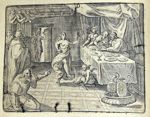
In Momi scheel gezicht geen dingen zyn volmaeckt: Vondel, Gulden Winkel (Amsterdam, 1622), emblem 14
Reprehendere proclive: et animum apertum esse debere: Junius, Emblemata (Antwerp, 1565), emblem 1
Momus: Meyer, Homo Microcosmus (Frankfurt, 1670), emblem 14
Momus: Faerno, Centum Fabulae (Antwerp, 1585), emblem 92
Momus muß etwas zu tadeln han: de Zetter, Speculum virtutum & vitiorum (Frankfurt, 1644), emblem
Invidia integritatis assecla: Whitney, A choice of emblemes (Leiden, 1586), emblem 123 refers to "Momus broode"
Invidiae integritatis assecla: Printer's device 0403
Iconclass: 56B3 Satisfaction, Contentment; 'Contento' (Ripa) 92G441(+0) Momus finding fault with the gods (+ variant)
Collectanea (1500): 34
Loci Communes: Approbandi (Approving, Approuver); Inculpatus (Blameless, Irréprochable)
I v 75 Coelo ac terrae loqui To call on heaven and earth
Qui frustra vociferantur, coelo ac terrae loqui dicuntur. Sic enim solent, qui diffidunt hominum praesidiis, exclamare, ô caelum, ô terra. Theognetus apud Athenaeum libro tertio, ac rursus libro decimoquinto, Πεφιλοσόφηκας, γῇ καὶ οὐρανῷ λαλων, Οἷς οὐδέν ἐστιν ἐπιμελὲς τῶν σῶν λόγων. id est, Terrae loquens coeloque philosophatus es, Sed hisce nulla, est cura sermonis tui. Confine est illi, quod albii retulimus, Vento loqueris.
To call on heaven and earth. This is what people are said to do who call out in vain; for those who despair of help from mankind usually cry out 'O Heaven! O Earth!' Theognetus in Athenaeus, book 3, and again in book 5: 'You have philosophized babbling to earth and heaven, / Who pay no attention to your words.' This is close to the phrase we have quoted elsewhere, 'You are speaking to the wind.'
Facsimile:
Iconclass: 24 the heavens (celestial bodies) 25 earth, world as celestial body 31B62351 crying, shouting
Loci Communes: Inanis opera (Vain effort, Effort vain)
I v 76 In portu impingere To be shipwrecked in the harbour
Est apud Quintilianum in Institutionibus: In portu impingere, pro eo quod est, statim in ipso operis ingressu peccare. Usurpatur & à divo Hieronymo in apologia secunda adversus Ruffinum: Statim de portu egrediens, navim impegi. Idem ad Pammachium: Egredientes de portu statim impegimus. Sumptum à navigantibus, qui magno cum dedecore prius quàm portu exierint, navim illidunt. In diversum sensum inflexit Papyrius Fabianus, referente Seneca in controversiis: Navim in portu mergis. de sene qui luxuriari coeperat aliena aetate. Apte dicetur in omnes, qui negocio iam propemodum cum laude confecto, in extremo degenerant. Idem est apud Graecos, ἐν τῷ λιμένι προσκρούειν, id est, In portu impingere. Nilus quidam Graecus autor, ita refert, μή ἐπαίρου, μή πως τὸ ναυάγιον ἐν τῷ λιμένι γένηται. id est, ne efferaris animo, ne forte naufragium tibi fiat in portu.
To be shipwrecked in the harbour. This is in Quintilian, in the Insitutions: it means, to make a mistake at the very outset of a work. St Jerome adopts it in his second apologia Against Rufinus: 'As soon as I left the harbour I wrecked the boat.' Again to Pammachius: 'Leaving the harbour we immediately were wrecked.' It is taken from seamen, for whom it is a disgrace to dash the boat to pieces before they have left the harbour. Papyrius Fabianus takes it in a different sense, as reported by Seneca in his Controversies: 'You are sinking the boat in harbour,' referring to an old man who had begun to live luxuriously at the wrong age. It can well be said of all who have a final collapse after having almost finished their affairs with credit. The Greeks have the same saying: ἐν τῷ λιμένι προσκρούειν. A certain Nilus, a Greek author, quotes it thus: 'Do not be too elated lest you should come to shipwreck in harbour.'
Facsimile:
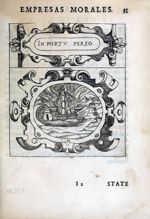
Annotation: Being shipwrecked upon leaving the harbour. Differs from "stranden in het zicht van de haven" which means: being shipwrecked, having almost reached the harbour
In portu pereo: Borja, Empresas morales (Bruxelles, 1680), emblem 27 paraphrases the adage and uses the imagery of a shipwreck in a harbour
Iconclass: 46C291(+62) shipwreck (+ departure; weighing anchor) 54FF11 Adversity, Misfortune, Bad Luck; 'Fortuna infelice', 'Infortunio' (Ripa)
Collectanea (1500): 287
Loci Communes: Error in initio (Error at the outset, Erreur au commencement)
I v 77 In limine deficere aut offendere To fail or stumble on the threshold
Huic proximum sit illud: In limine offendere, aut deficere. Translatum ab iis, qui domum egressuri, statim in limine pedem offendunt, prius quam quicquam occeperint agere. Vergil. Cur indecores in limine primo Deficimus? Id est, statim, ac vix dum inito bello. Duriuscule dixit Qu. Curtius lib. sexto: In ipso limine victoriae stamus. pro eo quod est, proxima est victoria. Huic contrarium est, quod in Epistolis ad Lucillium scribit Seneca: In summo deficit clivo. Ducta translatione ab iis, qui conscenso propemodum monte, tum delassantur, cum proximi sunt cacumini.
To stumble or fail on the threshold is very close to the previous one. It is taken from people who are just going out of the house and immediately catch their foot on the threshold, before they have begun to do anything. Virgil: 'Why fail we on the threshold in disgrace?' - that is, immediately and when the battle has scarcely begun. Quintus Curtius, book 6, said less poetically: 'We stand on the very threshold of victory,' meaning, a victory is at hand. This is the opposite of what Seneca writes in his Letters to Lucilius: 'He fails at the top of the slope,' the metaphor being adapted from those who have almost climbed a mountain, and then give in from weariness when they are close to the summit.
Facsimile:
Iconclass: 31A27321 stumbling 41A325 threshold 54FF1 Failure
Loci Communes: Error in initio (Error at the outset, Erreur au commencement)
I v 78 Cantherius in porta The gelding at the gate
Confine est superioribus: Cantherius in porta. Natum à Sulpitio Galba quodam, cui cum provinciam exituro, cantherius in porta cecidisset: Rideo, inquit, te cantheri in porta, cum tam longum iter sis iturus, iam lassum esse te, cum vix dum sis ingressus. Quod dictum in proverbium abiit. Refertur adagium à Festo Pompeio in dictione, ridiculus, atque is indicat convenire, cum quis in principio rei vix inchoatae deficit animo. Quid autem sit cantherius, dilucide exponit; nempe equus exsectis testibus: ut hoc differat cantherius ab equo, quo maialis à verre, capus à gallo, vervex ab ariete.
The gelding at the gate. This is close to the foregoing ones. It is derived from a certain Sulpitius Galba, who was about to leave for his province when his gelding fell down at the gate. 'It makes me laugh,' said he, 'that you, my gelding, should be tired already, with such a long journey ahead of you, when you have just set out.' This remark turned into a proverb. The adage is mentioned by Festus Pompeius under the word Ridiculus, and he indicates that it is usable when someone loses heart at the outset of a thing scarcely begun. He explains clearly what a cantherius is, a castrated horse, differing from the equus [horse] as a barrow hog differs from a boar, a capon from a cock, a wether from a ram.
Facsimile:
Iconclass: 34(+511) man and animal (+ castration of animal) 41A542 gate, entrance 46C13141 horse 46C13143 mule
Loci Communes: Error in initio (Error at the outset, Erreur au commencement)
I v 79 Citra pulverem Without dust
Ακονιτὶ. id est, Citra pulverem Graeci dicunt contingere, quo quis facile, citraque negotium potitur. Translatum vel ab Aphe, id est, à pulveris contactu, quo se spargebat, in palaestrico certamine congressurus: vel certe à pulvere, quo non indecore sordidari scripsit Horatius eos, qui certant Olympia, quive bellum gerunt. Plinius libro trigesimoquinto: Alcimachus Dioxippum, qui pancratio olympiae citra pulveris tactum, quod vocant ἀκονιτὶ, vicit. Aulus Gellius lib. quinto: Ovandi, inquit, causa est, eum deditione repente facta, sine pulvere, ut dici solet, incruentaque victoria obvenit. Horatius in Epistolis: Quis circum pagos & circum compita pugnax Magna coronari contemnat olympia, cui spes, Cui sit conditto dulcis, sine pulvere. palmae? Invenitur & ἀνιδρωτὶ. id est: citra sudorem, & ἀναιματὶ, id est, citra sanguinem.
Ακονιτὶ, Without dust. The Greeks say this when someone reaches his objective easily, with no trouble, taking it either from the aphe, the handful of powder with which a man about to enter the wrestling-ring sprinkled himself, or at least from that not inglorious dust, as Horace wrote, which soils the contestants at Olympia, or those who wage war. Pliny, book 35: 'Alcimachus made a statue of Dioxippus, who carried off the prize in the pancratium at Olympia without touching the dust, or as they say akoniti.' Aulus Gellius, book 5: 'It is a cause of rejoicing that a surrender was quickly made and a bloodless victory ensued, without dust, as they say.' Horace in the Epistles:
What strolling gladiator would engage
For vile applause to mount a country stage,
Who at th'Olympic games could gain renown
And without danger bear away the crown?
One also finds ἀνιδρωτὶ, 'without sweat,' and ἀναιματὶ, 'without blood.'
Facsimile: 
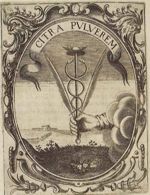
Citra pulverem: Saavedra, Idea de un principe (München, 1640), emblem 96
Iconclass: 25D29 dust (soil type) 51AA4 Nothingness, Absence
Loci Communes: Citra laborem (Without effort, Sans effort)
I v 80 Deserta causa Case undefended
Ερήμη δίκη. id est, Deserta causa, cum nemo repugnat. Translatum à iudiciis, ubi nonnunquam altera pars cedens tradit causam adversario. Itaque deserta causa vincere, est vincere nullo contra pugnante. Lucianus in Iove tragoedo: Ως τε τί ἄλλο, ἢ ἐξ ἐρήμης κρατεῖν οὕτω δόξομεν, id est, Itaque quid aliud videbimur fecisse, quam deserta causa vicisse? Idem in Toxaride: Καὶ τοσαύτας πόλεις ἐρήμην ὑπὸ σοῦ ἁλῶναι, id est, Totque civitates, nullo defendente, abs te capi. Usurpat & Socrates in apologia apud Platonem: ἐρήμην κατηγοροῦντες ἀπολογουμένου οὐδενὸς. id est: Deserta causa, nullo defendente accusantes. Iureconsulti composita voce ἐρημοδίκια vocant. Ita Paulus, Pandect. lib. iiii. Tit. de minoribus, cap. Et si sine dolo. Item & in eremodiciis ei subvenitur. Constat autem omnis aetatis hominibus restitutionem eremodicii praestari debere, si doceant se ex iusta causa abfuisse. Rursum lib. xlvi. Tit. Iudicatum solvi. cap. Quum quaerebatur. Si interposita iudicatum solvi stipulatione, quis reum non defenderet, postea ex eremodicio sententiam esset passus, an ob rem iudicatam clausula committatur, &c. Rursum in Codice libro tertio. Tit. De iudiciis, cap. Properandum. Sin autem reus abfuerit, & similis eius processerit requisitio, quemadmodum pro persona actoris ediximus, etiam absente reo eremodicium contrahatur. Haec Iustinianus. Est igitur ἐρημόδκϊον, quum altera parte absente fertur sententia.
Ερήμη δίκη, An undefended case, when there is no opposition. Taken from lawsuits in which sometimes one party withdraws and abandons the case to his opponent. So 'to win an undefended case' is to win against no resistance. Lucian in Jupiter tragoedus: 'What else then shall we seem to be doing than winning by default?' Again in Toxaris: 'And so many cities taken by you by default.' Socrates makes use of it in his defence in Plato: 'Bringing a charge against no opponent, the case being undefended.' Lawyers use for judgments by default a compound noun, eremodikia. So Paulus in the Pandects, book 4, title De minoribus, chapter Et si sine dolo: 'He also gets some relief in cases where judgment has gone by default. It is established that men of any age ought to be restored to the list after judgment by default, if they show that they had just cause for their absence.' Again in book 46, title Iudicatum solvi, chapter Quum quaerebatur: 'When security has been given for payment of any sum adjudicated, if the party does not defend the case and afterwards allows judgment to go by default, would he be committed by the clause having reference to the sum adjudicated, etc.' Again in the Code, book 3, title De iudiciis, chapter Properandum: 'But if a defendant should be absent, and a similar search go forward for him to the one we have ordered for the person of the plaintiff, even in the absence of the defendant judgment would go by default.' So Justinian. It is an eremodikion therefore, a judgment by default, when a case is decided in the absence of one of the parties.
Facsimile:
Iconclass: 44G41 litigation, legal proceedings, lawsuit 44G41(+5) litigation, legal proceedings, lawsuit (+ stadia of judicature) 51AA4 Nothingness, Absence 54EE11 Opposition, Counteraction, Resistance
Loci Communes: Causa indefensa (An undefended case, Cause indéfendue)
I v 81 Citra arationem citraque sementem Without ploughing and without sowing
Quae citra nostram operam casu nobis eveniunt: ἄσπαρτα καῖ ἀνήροτα contingere dicunt Graeci. Lucianus in Parasito: Οτι δή μόνος, κατὰ τὸν σοφόν 0μηρον οὔτε φυτεύς χερσὶ φυτὸν, οὔτε ἀροῖ, ἀλλα τὰ ἄσπαρτα, καὶ τὰ ἀνήροτα πάντα νέμεται. id est: Quod videlicet unus iuxta egregium illum Homerum, nec manibus plantat, nec arat, verum citra sementem, citra arandi laborem fruitur omnibus. Idem in Rhetorum didascalo: Σοὶ δὲ ἄσπορα καὶ ἀνήροτα φυέσθω πάντα. id est, Tibi porrò citra seminandi arandique laborem proveniant omnia, id est, citra studium. Natum apparet adagium à fabula insularum fortunatarum, de quibus Horatius in Odis: Reddit ubi Cererem tellus inarata quotannis, Et imputata floret usque vinea. Sumptum est autem, opinor, ex Homero, qui Odysseae libro nono Cyclopum terram describit ad hunc modum: Κυκλώπων δ᾽ ἐς γαῖαν ὑπερφιάλων ἀθεμιστων, Ικόμεθ᾽, οἵ ῥα θεοῖσι πεποιθότες ἀθανάτοισιν, Οὔτε φυτεύουσι χερσὶ φυτὸν, ὄτ᾽ αῤόωσιν. Αλλὰ τὰ γ᾽ ἄσπαρτα καὶ ἀνήροτα πάντα φύονται, Πυροὶ καὶ κριθαὶ, ἤδ᾽ ἄμπελοι αἵτε φέρουσιν, Οἶνον ἐριστάφυλον, καὶ σφῖν διὸς ὄμβρος ἀέξει id est, Venimus in terram, quam magnanimi Cyclopes Et legum expertes habitant, hi numine freti Divûm, nec manibus terrae plantaria figunt, Vomere nec segetem proscindunt, quin ea cuncta, Nullo semente, & nullo nascuntur aratu Ordea, frumentum, plenisque onerata racemis Venita, & largis haec luppiter imbribus auget.
Things that fall to our lot by chance, without our own doing are called in Greek ἄσπαρτα καῖ ἀνήροτα: they happen 'without sowing and without ploughing.' Lucian in The Parasite: 'He alone, according to wise Homer, does not plant with his hands or plough, but without sowing or ploughing he enjoys everything.' The same in the Teacher of Public Speaking: 'But to you everything may come without the toil of sowing and ploughing,' that is, without exertion. The adage seems to have arisen from the legend of the Fortunate Isles, of which Horace writes in the Odes: 'Where every year the land unploughed yields corn, / And ever blooms the vine unpruned.' But I think it comes from Homer, who describes the land of the Cyclops in this way, in the Odyssey, book 9:
We came to the land of the Cyclops, proud and lawless,
Who relying on the immortal gods
Neither sow with their hands, nor plough,
But all things grow wild without sowing and without ploughing,
Wheat and barley and vines which give good wine
And the rain of Jove makes them increase.
Facsimile:
Iconclass: 47I123 ploughing 47I131 sowing 51AA4 Nothingness, Absence
Loci Communes: Citra laborem (Without effort, Sans effort)
I v 82 Dormienti rete trahit The sleeper's net makes a catch
Εὕδοντι κύρτος αἱρεῖ. id est, Dormienti rete capit. In eos, quibus citra conatum obtingunt ea, quae cupiunt. Natum ex eventu, quod aliquando acciderit, ut dormientibus piscatoribus pisces forte retibus involuti caperentur. Quidam ad Timotheum Imperatorem Atheniensium referunt, cui quod multa feliciter obtingerent, magis commoditate fortunae, quam ipsius opera, εὐτυχοῦς, id est, felicis cognomen inditum. In huius invidiam pingebant nonnulli Fortunam ad rete cogentem urbes, illo iuxta dormiente. Quos ille sic elusit, autore Plutarcho, ut diceret: Si huiusmodi urbes capio dormiens, quid me facturum arbitramini si vigilaro? Huc allusit Terentius, cum ait in Adelphis: Quid credebas dormienti haec tibi confecturos deos? Et illam sine tua opera in cubiculum iri deductum domum? Non dissimili forma dictum est apud T. Livium libro ab urbe condita vii. Unicum belli ducem, qui nihil agenti sibi de coelo devolaturam in sinum victoriam censet. M. Tullius in Verrem actione ultima, Sed non idem mihi licet quod iis, qui nobili genere nati sunt, quibus omnis populi Romani beneficia dormientibus deferuntur. Quin & hodie vulgo dicitur in id genus homines, Fortunatior est, quàm sapientior. Et Eupolis comicus apud Athenaeum: Ω πόλις πόλις Ως εὐτυχὴς εἶ μᾶλλον ἤ καλῶς φρονεῖς. id est, O civitas o civitas Ut tu quidem es felix magis quàm provida. Congruunt quae dicentur in proverbio, Atheniensium inconsulta temeritas.
Εὕδοντι κύρτος αἱρεῖ, The sleeper's net makes a catch. This refers to people who get what they want without trying. It comes from an event which sometimes happens, when fish are caught entangled in the nets when the fishermen are asleep. Some attribute it to Timotheus the Athenian general, who had great success more from the favour of fortune than from his own effort, and was nicknamed Lucky. Some people who begrudged him this, depicted Fortune driving cities into the net while he lay sleeping near by. He gave them a mocking answer, according to Plutarch: 'If I capture such cities when I am asleep, what do you think I will do if I am awake?' Terence alludes to this when he says in the Adelphoe: 'What? Did you think the gods were going to do this for you as you slept? And the girl would be led home to your bedroom without any effort of yours?' There is a saying of the same kind in Livy, in book 7 of Rome From the Foundation: The one and only general in the war, who thinks that victory will fly down from heaven to light on him, without his doing anything.' Cicero in the Verrines, in his last speech: 'But I have not the same privileges as men of noble birth, who while they are asleep have all the honours the Roman people can bestow laid at their feet.' Today too it is commonly said of such people 'He does it more by good luck than good management.' And in Athenaeus, Eupolis the comedywriter: 'O city, city, / How fortunate you are rather than wise.' This agrees with the comments I shall make on the proverb The rashness of the Athenians.'
Facsimile: 
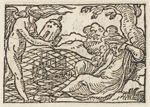
La fortune est ingrate aux bons espritz: La Perrière, Le theatre des bons engins (Lyon, 1545), emblem 29 uses the imagery of Fortuna carrying symbols of luck and wealth to the net of a sleeping idler
Iconclass: 31B1 sleeping; unconsciousness 43C1151 catching animals 43C12(+4163) fishing (sports) (+ net)
Collectanea (1500): 352
Loci Communes: Citra laborem (Without effort, Sans effort)
I v 83 Cum mula pepererit When the mule foals
Adagium pervetustum: Cum mula pepererit, quoties signisicamus aliquid nunquam futurum, aut adeo raro solere accidere, ut improbum ac stultum videatur sperare. Ortum videri potest ex eo quod refert Herodotus in Thalia: Cum Babyloniorum urbs obsideretur à Dario, quidam Babylonius conviciis insectans Darium, atque exercitum: Quid, inquit, isthic desidetis Persae? Quin potius absceditis, tunc expugnaturi nos, ἐπεὰν ἡμίονοι τέκωσι, id est, cum mulae pepererint: videlicet ratus id nullo unquam tempore futurum, propterea, quod natura steriles sunt mulae. At paulo pòst evenit, ut Zopyro mula quaepiam pareret, quo quidem ostento in spem capiendae Babylonis erectus est, ac cepit. Huic simile quiddam refertur à Suetonio in vita Galbae Caesaris. Huius avo procuranti fulgur, cum aquila de manibus exta rapuisset, & in frugiferam quercum contulisset, summum, sed serum imperium portendi familiae, responsum est. Atque ille irridens: Sanè, inquit, cum mula pepererit. Quod omen ita arripuit Galba, ut eum postea res novas molientem, nihil aeque confirmarit ac mulae partus: caeterisque ut obscoenum ostentum horrentibus, solus pro laetissimo acciperet, memor sacrificii dictique aviti. Plin. lib. viii. cap. xliiii. de mularum sterilitate scribit hunc in modum: Observatum est è duobus diversis generibus nata, tertii generis fieri, & neutri parentum esse similia. Eaque ipsa, quae ita nata sunt, non gignere in omni animalium genere, idcirco mulas non parere. Huius rei causam affert Alexander Aphrodiseus, quod semina natura & habitu diversa, si commisceantur, tertium quiddam ab utroque diversum conficiunt, vimque simplicium prorsus amittunt: veluti si misceas album nigro, abolitis utrisque coloribus redditur fuscus ab utroque diversus, quem Graeci λευκόφαιον appellant. Sed multo exactius de his Aristoteles lib. De generatione animalium secundo, cap. vi. refellens Democriti & Empedoclis rationes. Quanquam proditum est in annalibus Romanorum mulas peperisse saepe, verum id prodigii loco habitum, ut eodem in loco, quem modo citavi, testatur Plinius. Theophrastus vulgo parere in Cappadocia tradit. Aristoteles lib. De natura animalium primo, cap. sexto tradit mulas coire ac gignere in Syria supra Phoenicem: sed esse id animal ibi sui generis, etiam si simile.
When the mule foals. A very old adage, used when we signify that something will never happen, or happens so rarely that it seems wicked and foolish to hope for it. It may seem to arise from what Herodotus says in Thalia: when the city of the Babylonians was besieged by Darius, a certain Babylonian shouted insults at Darius and his army, saying, 'What are you sitting here for, you Persians? Much better take yourselves off, you will only take our town "When mules give birth,"' obviously meaning that the time would never come, as mules are sterile by nature. But it came about soon after that a mule belonging to Zopyrus did have a foal, and by this marvel he was encouraged in the hope of taking Babylon, and took it. A similar thing is reported by Suetonius in his life of the emperor Galba. When this emperor's grandfather was making a sacrifice to avert the lightning, an eagle snatched the entrails from his hands and carried them off to an oak covered with acorns. This was interpreted to him as meaning that his family would attain imperial rank, but late. Laughing, he said, 'Yes when a mule foals.' Galba was so struck by this omen, that when later on he was planning revolution, nothing encouraged him so much as the foaling of a mule, and while others shuddered at this unlucky marvel, he alone accepted it as most propitious, remembering his grandfather's sacrifice and his remark. Pliny, book 8 chapter 44, writes as follows about sterility in mules: 'It has been observed that the offspring of two different species is a third species, and unlike either parent. Also that they themselves, which are born in this way, do not bring forth young in any kind of animal, and therefore mules do not foal.' Alexander of Aphrodisias alleges as a cause of this that when seeds of different nature and character are mixed together, they produce a third creature unlike either, and henceforth lose the force of the simple strains; just as when you mix black and white, both colours disappear and you have grey, neither the one nor the other, which is called leukophaion in Greek. But Aristotle is much more precise on this in his work On the Generation of Animals, book 2 chapter 6, where he refutes Democritus and Empedocles. However, it is recorded in the annals of Rome that mules often foaled, but this was regarded as a portent, as Pliny testifies in the passage just quoted. Theophrastus states that they commonly foal in Cappadocia. Aristotle On the Nature of Animals, book 1 chapter 6, states that mules mate and give birth in Syria above Phoenicia, but there the animal is of a special kind, even if similar.
Facsimile:
Iconclass: 46C13143(+72) mule (+ sex and age of animals; propagation of animals)
I v 84 Ad Graecas calendas At the Greek calends
Huic affinem habet sensum, Ad Graecas calendas, pro nunquam: Propterea quod Graeci non habent calendas more Latinorum, sed νουμηνίας, id est, novilunia. Atque ad lunae recursus Graeci solvebant usuras. Unde Strepsiades in Nubibus Aristophanis, optat sibi incantatricem quampiam, quae carminibus suis efficiat, ne quando luna exoriatur: sic enim fore, ut non reddat usuras: quandoquidem trapezitae ad lunas, mutuam dant pecuniam, & lunis usurae crescunt. Huc itaque respexit Augustus, cum diceret ad Graecas calendas soluturos, quos nunquam reddituros mutuum significabat. De quo in ipsius vita scribit Tranquillus ad hunc modum: Quotidiano sermone quaedam frequentius & notabiliter usurpasse eum literae ipsius αὐτόγραφοι ostentant. In quibus identidem, cum aliquos nunquam soluturos significare vult, ad calendas Graecas soluturos ait. Huic simile est, quod nunc inter eruditos iactatur, Anno magno Platonis, quem existimant numquam futurum.
At the Greek calends has much the same sense: that is, never. The Greeks did not have calends in the Roman manner, but 'new moons' and they settled their debts at the return of the moon; hence Strepsiades in Aristophanes' Clouds longs for a sorceress to cause the moon not to rise, by her spells, so that he will not have to pay his debts, seeing that the bankers give loans at the new moon, and interest increases moon by moon. Augustus was thinking of this when he said that some people 'would settle at the Greek calends,' meaning that they were never going to pay back a loan. Suetonius Tranquillus writes thus in his life of Augustus: 'Some of his letters, written with his own hand, show that he made frequent and prominent use of certain words in his everyday speech. In the same letters, when he means to say that some men will never repay, he says they will pay at the Greek calends.' A similar expression is used now by the learned when they say 'in the great year of Plato' which they think will never be.
I v 85 Acessaei luna The moon of Acessaeus
Ακεσσαίου σελήνη. id est, Acessaei luna. Dictum in comperendinatores, qui novam subinde causam comminiscuntur, quo negocium proferant: à nautae cuiusdam moribus ortum cui Acessaeo fuerit nomen. Is cum esset ignavus, ita prorogare consuevit navigationem, ut se diceret lunam magis opportunam expectare. Nam Graeci, praecipueque ex his Lacedaemonii, quicquid essent rerum auspicaturi, superstitiose lunam observabant. Id quod tacite notat Euripides, cum in Iphigenia in Aulide respondet Agamemnon, tum nupturam filiam, ubi lunae dexter circulus advenerit. videlicet de plena luna sentiens. Lucian. in libello de Astrologia, palàm refert Lycurgum legem instituisse Lacedaemoniis, ne praelium inirent ante plenilunium. In eam superstitionem iocatur Aristoph. τῇ πανσελήνῳ. id est, plenilunio. sero aut nunquam futurum significans. Etenim cum Datis & Artaphernes ductores regis Persarum, in Marathonem irrupissent, plenilunium observabant, ut tum exirent in praelium. Ergo prius quàm illi venirent, Athenienses bellum aggressi sunt. Historiae meminit Herodotus lib. vi. Inde quasi proverbio de cunctantibus, & quavis occasione rem proferentibus, dicitur, ἐν τῇ πανσελήνῳ. id est, plenilunio. Adagium refertur à Diogeniano. De lunis Laconicis & alibi nonnihil nobis dicetur.
Ακεσσαίου σελήνη, The moon of Acessaeus. This is said of procrastinators, who often find yet another reason to put off a piece of business. It comes from the behaviour of a certain seaman called Acessaeus. He was a lazy fellow, who used to postpone sailing because he said he was waiting for a more propitious moon. The Greeks, especially the Spartans, observed the moon with superstitious care when they were looking for omens to start something. Euripides hints at this in the Iphigenia in Aulis, when Agamemnon makes the reply that his daughter will be wedded when the right-hand curve of the moon comes in sight, meaning at full moon. Lucian in his essay On Astrology openly states that Lycurgus laid down a law for the Spartans, that they should not go into battle before the full moon. Aristophanes makes fun of this superstition; he says that 'at full moon' means late or never. And indeed when Datis and Artaphernes, generals of the king of Persia, had invaded Marathon, they were waiting for the full moon as the time to go into battle. Thus it was that before they came the Athenians took the initiative. Herodotus recalls this in book 6 of his History. Hence 'at full moon' is a proverbial way of referring to dilatory people and those who take any excuse for putting a thing off. The adage is mentioned by Diogenianus. I shall say something about 'Spartan moons' elsewhere.
Facsimile: 
Iconclass: 24B moon as celestial body 24C2 mankind influenced by the planets, including sun and moon; 'Planetenkinder' 51MM11 Slowness, Tardiness; 'Tardità' (Ripa) 51MM12 Lingering 54DD311 Waiting, Watching 98B(ACESSAEUS) male persons from classical history (ACESSAEUS)
Collectanea (1500): 527
Loci Communes: Nunquam (Never, Jamais); Tarditatis et cunctationis (Slowness and delay, Lenteur et retard)
I v 86 Ubi per Harma fulgurarit When lightning strikes through Harma
Οπότε δι᾽ ἅρματος ἀστράπτει. id est, Ubi per Harma fulgurat. De iis quae nimis cunctanter ac sero, aut admodum raro fiunt: aut cum nimis anxie, ac superstitiose captatur rei gerendae opportunitas. Strabo lib. geographiae ix. unde natum sit adagium, indicat, scribens vicum quempiam esse desertum atque infrequentem apud Mycaletum Boeotiae, seu Mycalessum Tanagraei iuris, quem harma, id est, currum nominant. Rursum alterum ab hoc diversum, eiusdem tamen nominis in Attica, quae quidem tribus ex Atticae populo Tanagrae similis, atque ob hanc similitudinem nominis quoque communionem sortitum. Ceterum harma Boeotiae sic vocatum, quod Amphiarao excusso currus inanis in eum locum delatus sit, ubi nunc sacellum eius exstat. Alii ferunt Adrasto fugiente, currum eius eo loco confractum fuisse, ipsum Arionis opera servatum: hinc natam paroemiam, ὁπότε δι᾽ ἅρματος ἀστράπτει id est, Ubi per harma fulgurat, videlicet Pythicis vatibus fulgur aliquod certum, quod ex eo loco veniret, observantibus, eoque viso sacra Delphos mittentibus. Observabant autem ad menses treis, singulis mensibus treis dies, noctesque totidem: idque è Iovis fulguralis foco, qui est in muro inter Pythium & Olympium. Haec fermè Strabo. Usum adagii Plutarch. palam indicat in Symposiacis: Οἱ γὰρ, inquiens, σπανίως καὶ διφ ἅρματος ὥς φασιν ἐστιῶντες, ἀναγκάζονται τὸν ὁπωσοῦν ἐπιτήδειον ἤ γνώριμον καταγράφειν. i. Etenim qui raro & per harma, ut aiunt, convivium exhibent, hi coguntur utcunque accommodum, ac notum describere. Itaque de raris & incertis dici solitum videtur. Poterit & per iocum accommodari ad ea, quae nunquam eventur a credamus, quemadmodum aiunt, Ad Graecas calendas.
Οπότε δι᾽ ἅρματος ἀστράπτει, When lightning strikes through Harma. Referring to things which are done slowly and late, or not often enough; or when the opportune moment for carrying something through is waited for too anxiously and with superstitious fervour. Strabo in his Geography, book 9, explains how the adage originated. He writes that there is a certain village near Mycaletus in Boeotia (or Mycalessus, in the territory of Tanagra) called Harma or 'chariot.' It is abandoned and deserted. There is also another different one with this name in Attica, where the population was part of Attica but similar to that of Tanagra, and on account of this resemblance they shared the same name. The Harma in Boeotia was so called because the empty chariot from which Amphiaraus had been thrown was conveyed to that place, where there is now a shrine to him. Others say that when Adrastus was in flight, his chariot was smashed in pieces at this place, but he himself was saved by the help of Arion. The proverb 'when the lightning flashes through Harma' arises from the action of the Pythian seers, who kept watch for a special sort of lightning that came from that place, and as soon as they had seen it sent offerings to Delphi. They used to keep watch every three months for three days in the month, and as many nights; and also from the hearth-altar of Jove the Thunderer, which is in the wall between Pythium and Olympium. Thus far Strabo. Plutarch clearly indicates the use of the proverb in his 'Table-talk': Tor those who give dinner-parties as infrequently as lightning flashes "over Harma," as they say, are forced to list every acquaintance and suitable person.' So it seems to be used of infrequent and uncertain things. It could also be applied in jest to things which we think will never happen, as they say 'at the Greek calends.'
Facsimile:
Iconclass: 26E2 lightning, flash of lightning, thunderbolt 51MM11 Slowness, Tardiness; 'Tardità' (Ripa) 51MM12 Lingering 54DD311 Waiting, Watching 61E(HARMA) names of cities and villages (HARMA)
Loci Communes: Nunquam (Never, Jamais); Raritas (Rarity, Rareté); Tarditatis et cunctationis (Slowness and delay, Lenteur et retard)
I v 87 Lydius lapis, sive Heraclius lapis The Lydian, or Heraclian, stone
Λίθος ἡρακλεία, ἢ λιθος λυδή.i. Heraclius, sive Lydius lapis. In eos dicitur, qui vehementer acri exactoque iudicio sunt. Refertur à Theophrasto li. De natura lapidum. Ait enim lapidem quendam esse, qui Lydius seu Heraclius dicatur, qui attritu aurum atque argentum cuiusmodi sit arguat. Hunc quidam Magnetem putant, velut Herculanum, qui ferrum ad sese trahit: unde nomen etiam additum σιδηρίτῃ, sed ex Theophrasti verbis satis liquet βάσανον significari, quem Latini vocant indicem, in quem Battus ille pastor apud Ovid. transfiguratus est, manente nimirum etiamnum in lapide prodendi studio. Nec Heraclium vocatum ab Hercule, sed ab Heraclea Lydiae civitate. De hoc meminit Plinius li. xxxiii. ca viii. his quidem verbis: Auri argentique mentionem comitatur lapis, quem coticulam appellant, quondam non solitus inveniri, nisi in flumine Tmolo, ut autor est Theophrastus, nunc vero passim, quem alii Heracleum, alii Lydium vocant. Sunt autem modici, quaternas uncias longitudinis, binasque latitudinis non excedentes. Iis coticulis periti, cum è vena lima rapuerint experimentum, protinus dicunt, quantum auri sit in ea, quantum argenti vel aeris, scrupulari differentia, mirabili ratione non fallente. Huc allusit Theocritus in Aita: Λυδίῃ ἶσον ἔχειν πέτρῃ στόμα id est, Ut Lydio Lapidi par os habeam. Nimirum quo in variis osculis optime iudicaret, cuius essent: sic enim ineptiunt amantes. Scholiastes putat hos lapides apud Lydos inveniri, & hinc proverbium ortum. Et ne dubites quin de indice loquatur, sequitur χρυόν ὁποιη Πεύθονται μὴ φαῦλον ἐτήτυμον ἀργυράμοιβοι id est, Cuius ab affectu explorat mensarius aurum Sit ne probum. Adagium accommodari potest vel ad personam, vel ad rem. Ad personam hoc pacto: Tu scriptorum meorum optimus iudex, planeque, quod dici solet, ἡρακλεία λίθοσ. Item hoc modo: In pensitandis aestimandisque ingeniis emuctissimae naris, ac prorsus Lydius, ut aiunt, lapis. Ad rem transfertur hoc pacto, Adolescentium ingenia libertas aperit: viris commissum imperium, Lydius, quod aiunt, lapis est.
Λίθος ἡρακλεία, ἢ λιθος Λυδή, The Lydian, or Heraclian, stone. This is said of people whose judgment is particularly sharp and precise. It is mentioned by Theophrastus in his book On the Nature of Stones. He says there is a stone called Lydian or Heraclian, which when rubbed will tell the quality of gold or silver. Some think that this is a kind of magnet, like the stone of Hercules, which attracts iron to itself, hence also called siderites, loadstone; but from the words of Theophrastus it is clear that the basanos or touchstone is meant, which in Latin is index. It was into this that the shepherd Battus was transformed, in Ovid, keeping even as a stone his tendency to betrayal. It is not called Heraclian from Hercules, but from Heraclea, a city in Lydia. Pliny recalls this, book 33 chapter 8: 'A description of gold and silver is necessarily accompanied by that of the stone known as coticula. In former times, according to Theophrastus, this stone was nowhere to be found, except in the river Tmolus, but at the present day it is found in numerous places. By some persons it is known as the "Heraclian," and by others as the "Lydian" stone. It is found in pieces of moderate size, and never exceeding four inches in length by two in breadth. With these stones persons of experience in these matters, when they have scraped a particle off the ore with a file for testing, can tell in a moment the proportion of gold there is in it, how much silver, or how much copper; and this to a scruple, their accuracy being so marvellous that they are never mistaken.' Theocritus alludes to this in Aites: That I may have a mouth like a Lydian stone,' suggesting that by this he might judge best between various kisses and tell whose they were - for such is the foolishness of lovers. The scholiast thinks these stones are found in Lydia, and hence the origin of the proverb. So that you should not doubt that he is speaking of the touchstone, there follows the 'gold-test': 'From whose influence the money-changer tries / The gold, if it be good.' The adage can be applied either to persons or things. To persons, in this way: 'You are the best judge of my writings, the very Heraclian stone, as they say.' Or like this: 'With the most brilliant flair for weighing up and judging mental quality, a very Lydian stone, as they say.' Or applied to things in this way: 'Freedom opens the minds of the young, but to grown men, to be given authority is the Lydian stone.'
Facsimile: 
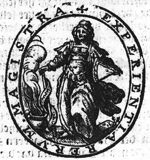
Experientia rerum magistra: Printer's device 1498 - Experientia's foot resting on a touchstone
Fides hoc uno virtus que probantur: Giovio, Dialogo dell' Imprese (Lyon, 1574), emblem 34
Amor certus in re incerta cernitur: Vaenius, Amorum emblemata (Antwerp, 1608), emblem 23
Sic spectanda fides: Paradin, Les devises héroïques (Antwerp, 1563), emblem 114
Sic spectanda fides: Rollenhagen, Nucleus emblematum (Arnhem, 1618), Cent. II, emblem 75 uses the imagery of the touch-stone
Sic spectanda fides: Wither, A collection of emblems (London, 1635), emblem 175 uses the imagery of the touch-stone
Lapide aurum, auro homo: Borja, Empresas morales (Bruxelles, 1680), emblem 54 uses the imagery of the touch-stone
Examen demonstrat - Durchs Proben zu erkennen: Woytt, Emblematischer Parnassus (Augsburg, 1727), emblem 273 uses the imagery of the touch-stone
Examen indicabit - Die Prob'erst zuerfahren: Woytt, Emblematischer Parnassus (Augsburg, 1727), emblem 862 uses the imagery of the touch-stone
Er nimmt jenen schein nicht an, deshalb kann die probe nicht halten: Sporck, Geistliche Todts-Gedancken (Passau, 1753), emblem 29 uses the imagery of the touch-stone
Experience - Rerum magistra: Ripa, Essay d'un Dictionaire (Iconologia), (Amsterdam, 1700), emblem 83 uses the imagery of the touch-stone
Iconclass: 22B21(+0) magnet (+ variant) 25D12 kinds of non-precious stone 48C34(TOUCH-STONE) tools, implements of craftsman: touch-stone 61D(LYDIA) geographical names of countries, regions, mountains, rivers, etc. (LYDIA) (LYDIA) 94L7(+0) specific aspects, allegorical aspects of Hercules; Hercules as patron (+ variant)
I v 88 Amussis alba An unmarked rule
Λευκῇ στάθμῃ. id est, Alba amussi, hoc est, nullo delectu, ac citra discrimen. Aulus Gell. in Noctibus Atticis: Nanque illi omnes, & eorum maximè Graeci, multa, et varia lectitantes, in quas res cunque inciderant, alba, ut dicitur, linea, sine cura discriminis, solam copiam sectati converrebant. Plutarchus in commentario, περὶ τῆς ἀδολεσχίας, Εστι μὲν οὖν ἀτεχνως ἡ λευκὴ στάθμη πρὸς τοὺς λόγους ἀδόλεσχος. id est, Est igitur planè alba linea erga sermones garrulus, propterea quod nullo delectu quavis de re quidvis nugetur. Effertur & expressius adagium à nonnullis, Λευκῷ λιθῳ λευκή στάθμη. id est, In albo lapide alba linea. Diciturque vel in eos, qui nullo sunt iudicio: vel in stupidos: vel in eos, qui incertis probant aut significant incerta. Sophocles in Cidalione apud Suidam: Τοῖς μὲν λόγοις τοῖς σοῖσιν οὐ τεκμαίρομαι Οὐ μᾶλλον, ἣ λευκῷ λίθῳ λευκὴ στάθμη. id est, Nihilo mihi plus indicat sermo tuus, Quàm lapide in albo signat alba linea. Citatur à Nonio Marcello Lucilius libr. xxx. (sed corrupte, ut opinor: quod genus sunt pleraque illius) Et amabat omneis. Nam discrimen non facit, neque significat linea alba. Usurpatur et à Platone in dialogo, cui titulus, Charmides, ubi Socrates ait, se erga formosos adolescentes perinde esse, ut albam amussim in albo lapide, propterea quod neque discerneret satis inter formas, & omnes ex aequo amaret. Solet enim funiculus ille minio oblini, quo discrimen faciat, unde & rubricam vocavit Persius: Ac si oculo rubricam dirigat uno.
Λευκῇ στάθμῃ, An unmarked rule. This means 'without selection, making no distinctions.' Aulus Gellius in the Attic Nights: 'For all those people, and among them especially the Greeks, read eagerly and widely and swept together everything they came across without discrimination, using a "blank ruler" as they say, simply intent on quantity alone.' Plutarch, in his essay 'On Garrulity,' says, The garrulous person is absolutely an unmarked rule as far as conversation goes,' because he talks nonsense with no discrimination about anything whatever. The adage is found in an expanded form in some writers: 'a white line against a white stone.' It is used for those who have no judgment, or for the stupid, or for people who base proof or exposition of doubtful things on doubtful facts. Sophocles in the Cidalion, in Suidas: 'Your words tell me no more, / Than a white line on a white stone.' Nonius Marcellus quotes Lucilius, book 30 - but in a corrupt form, in my opinion. Many of his sayings are like this: '- and he loved all, / For a white line marks nothing, makes no distinction.' Plato adopts it in his dialogue entitled Charmides, where Socrates says his attitude to beautiful boys can be described as 'a white rule against a white stone,' because he did not distinguish clearly between types of beauty, and loved them all alike. That well-known rope was smeared with red-lead so as to show up a difference, so Persius called it 'red-ochre': 'if he should set the red-ochre straight with one shut eye.'
Facsimile:
Iconclass: 22C4(WHITE) colours, pigments, and paints: white 49D511(RULER) drawing-instruments: ruler 51B5 Identity
I v 89 Eadem per eadem Over and over again
Αὐτὰ δι᾽ αὐτῶν. id est, Eadem per eadem. Refertur in collectaneis Diogeniani, de his, qui semper eadem inculcant, aut eadem assidue faciunt. Non dissimile illi, quod alio reddidimus loco, ὁ διὸς κόρινθος. id est, Iovis Corinthus. Potest & in eos torqueri, qui res nugaces nugaciter tractant, veluti si quis in autorem indoctum indoctos scribat commentarios, aut in obscoenum obscoenos.
Αὐτὰ δι᾽ αὐτῶν, Over and over again. This occurs in the collections of Diogenianus, about people who always teach the same things, or continuously repeat the same actions. It is not unlike that other which I have mentioned in another place, 'Corinthus Son of Jove.' It can also be applied to those who treat frivolities frivolously, for example a man who writes ignorant notes on an ignorant author, or obscenities about an obscene person.
Facsimile:
Iconclass: 51B61 Repetition
Loci Communes: Taedium ex iteratione (Tedium from repetition, Lassitude due à la répétition)
I v 90 Ad amussim By rule
Frequens est apud autores, Ad amussim, examussim, examussatim, amussatim, pro eo quod est, exquisita diligentia, atque exactissima cura. Gellius lib. i. cap. iiii. Ad haec omnia scripta antiquiora tam curiose spectabat, aut virtutes pensabat, aut vitia rimabatur, ut iudicium factum esse ad amussim diceres. Et Amussitata pro examinatis apud Nonium. Translatum à fabris lapidariis, aut lignariis, qui funiculo illo regulari, operis aequalitatem explorant. Quanquam Festus in dictione Examussim testatur, Amussim quibusdam esse non lineam, neque regulam, sed ferramentum quo fabri in poliendo utantur. Persius de poeta absoluta carmina componente, quod modo citavimus: Scit tendere versum, Non secus, inquit, ac si oculo rubricam dirigat uno, Item in carmine de viro bono, quod Vergilio tribuunt: Ne quid hiet, ne quid protuberet angulus, aequis Partibus ut coeant, ne quid deliret amussis. Usurpat idem Basilius ad nepotes, cum iubet unamquanque disciplinam ad finem felicitatis referre, perinde quasi lapides, iuxta Doricum proverbium, ad amussim dirigentes. Natum videri potest apud Homerum Odysseae ε. cum loquitur de Ulysse navem sibi fabricante: Ξέσσε δ᾽ ἐπισταμένως, καὶ ἐπι στάθμην ἴθυνε id est, Expoliit multa arte, superque induxit amussim. Rursus Iliados ο. Αλλ᾽ ὥς τέ στάθμη δορύ νήϊον ἐχιθήνει Τέκτονος ἐν παλάμησι δαήμονος, ὃς ῥά τε πάσης Εὖ εἰδῇ σοφίης ὑποθημοσύνησιν ἀθήνης. id est, Materiam veluti navalem exaequat amussis, Ducta fabri docti digitis, qui calleat artem. Quaecumque est, teneatque probe, monitrice Minerva. Est apud eundem, & aliis aliquot locis.
In the best authors we often find Ad amussim, By rule (with examussim, examussatim, amussatim) put for 'with the utmost diligence,' 'with the most precise care.' Gellius, book 1 chapter 4: 'He inspected all these ancient writings with such care, weighing their merits and investigating their shortcomings, that you would say his judgment was made exactly by rule.' And we find amussitata for 'examined' in Nonius. This is taken from stone-cutters or carpenters, who test the evenness of their work with the familiar measuring-line. Festus however records, under the word examussim, that for some people the amussis is not a line or a rule but an iron tool used by blacksmiths for polishing. Persius, describing a poet composing finished verses, as I quoted above: 'Expert to stretch his verse, as if he should / Set the red-ochre straight with one shut eye.' Also in the Vir bonus, a poem on the good man which is ascribed to Virgil: 'That nothing gape, no corner jutting out / But all parts equal, by the unfaltering line.' Basil too uses it when writing to his nephews, recommending them to consider every branch of learning in its relationship with the final aim of felicity, just as stones, according to the Doric proverb, are 'marked out against the rule.' It may be thought to come from Homer's Odyssey, book 5, where he speaks of Ulysses building his ship: 'Trimmed with great skill and trued them to the line.' Again in the Iliad, book 15:
But as the line sets a ship's timber straight
For the skilled shipwright, master of his trade,
Taught by Minerva all that cunning art.
It also occurs in several other places in the same author.
Facsimile: 
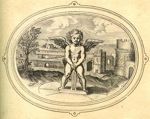
Ad amussim: Vaenius, Amorum emblemata (Antwerp, 1608), emblem 39
Ad amussim: Anonymous, Templum Gratiarum (Passau, 1633), emblem 5
Iconclass: 47C511(+32) polishing (industrial process) (+ tools and appliances ~ crafts, industries, agriculture) 47G6(PLUMB-LINE) tools and machines ~ building: plumb-line 49D511(RULER) drawing-instruments: ruler 52D2:52A52 Clarity, Precision❧Judgement, Discrimination; 'Giuditio' (Ripa) 51G6 Smoothness
Collectanea (1500): 773
Loci Communes: Diligentiae (Diligence, Diligence); Justitia (Justice, Justice)
I v 91 Ad unguem To the finger-nail
Ad unguem, eundem habet sensum. A marmorariis sumpta metaphora, qui superinducto ungui, commissuras explorant marmorum. Horatius: Fonteius ad unguem Factus homo. id est, absolutus. Idem in Arte, Carmen reprehendite, quod non Multa dies, & multa litura coercuit, atque Perfectum decies non castigavit ad unguem. Vergilius secundo Georgicôn libro: Nec secius omnis in unguem Arboribus positis secto via limite quadret. Persius: Ut per leve severos Effundat iunctura urbes. Macrobius Saturnalium li. i. Nec quisquam alius tam futilis posset esse iudicii, qui Romani anni sic ad unguem, ut aiunt, emendatum ordinem non probaret. Ad consimilem modum Graeci quod exactum sit, & impensis accuratum, δίονυχον vocant. Plutarch. de praeceptis bonae valetudinis: Η μέν οὖν ἀκριβὴς σφόδρα καὶ δίονυχος λεγομένη δίαιτα. id est: Itaque vehementer exacta, quae ad unguem observata dicitur victus ratio & ἐξονυχίζειν, pro ἀκριβῶς ἐξετάζειν. Quam vocem usurpat & Athenaeus lib. iii. ἐξονύχεις δὲ πάντα τὰ προσπίπτοντα τοῖς συνδιαλεγομένοις τὰς ἀκάνθας. id est, Porrò ad unguem exploras omnia, quae congruunt iis, qui cum spinis disputant.
To the finger-nail has the same meaning. The metaphor is taken from workers in marble, who draw the nail over the surface to test the joins in the stone. Horace: 'Fonteius, finished to the finger-nail,' that is, a really polished person. Again, in the Art of Poetry:
That poem you should blame,
Where time and tenfold proving has not shaped
The finished work, and smoothed it to the nail.
Virgil in the second book of the Georgics:
Let every alley, when your trees are set,
Square to the nail where'er it cuts the path.
Persius: 'So that each joint may let the searching nail / Glide o'er it smoothly.' Macrobius Saturnalia book 1 chapter 16: 'Nor could any other man's judgment be so misguided as not to admire the arrangement of the Roman year, thus refined as it is to the nail.' In the same way Greek has a word dionychos for something exact and precisely finished. Plutarch 'Precepts of Good Health: 'The very precise rule of life observed, as they say, to the nail' [dionychos].And exonychizein for 'to examine carefully.' Athenaeus uses this expression in book 3: 'You run your nail over everything that suits those who indulge in thorny discussions with you.'
I v 92 Incudi reddere To put back on the anvil
Eleganter Horat. incudi reddere dixit, pro eo quod est, refingere, ac mutare, corrigereque, Et male tornatos incudi reddere versus. Consimili forma dicunt Recoquere. Quintilianus lib. xii. Sed praecipue tamen Apollonio Moloni, quem Romae quoque audierat, Rhodi rursus reformandum, ac velut recoquendum dedit. Item Horatius: Recoctus Scriba ex quinqueviro.
Horace uses this phrase, To put back on the anvil, elegantly, for remaking, altering, correcting: 'Back to the anvil with your ill-turned verse.' In the same way they say 'to recook.' Quintilian, book 12: 'But particularly to Apollonius Molo, whom he had heard at Rome, he went to be improved and as it were recooked, in Rhodes.' So Horace: 'A quinquevir rehashed into a clerk.'
Facsimile:
Iconclass: 47D8(ANVIL) tools, aids, implements ~ crafts and industries: anvil 51B61 Repetition
Loci Communes: Diligentiae (Diligence, Diligence)
I v 93 Lesbia regula By the Lesbian rule
Lesbia regula, dicitur quoties praepostere, non ad rationem factum, sed ratio ad factum accommodatur. Et cum lex moribus applicatur, non mores ad legem emendantur: aut quoties princeps se populi moribus accommodat, cum contra conveniat plebem ad principis arbitrium vitam instituere, si modo princeps ipse ad honesti regulam ac scopum respiciat. Huius adagii mentionem facit Aristoteles v. Moralium. lib. Τοῦ γὰρ ἀορίστου ἀόρϊστος καὶ ὁ κανὼν, ὥσπερ καὶ τὰς λεσβίας οἰκοδομῆς ὁ μολύβδιος κανών. πρὸς γὰρ τὸ σχῆμα τοῦ λιθου μετακινεῖτες, καὶ οὐ μένει ὁ κανών. id est, Siquidem infinitae rei infinita item regula, quemadmodum plumbea Lesbiae aedificationis regula: ad lapidis enim figuram transmovetur, neque manet regula.
By the Lesbian rule. This is said when things are done the wrong way round, when theory is accommodated to fact and not fact to theory, when law is suited to conduct, not conduct corrected by law; or when the ruler adapts himself to the behaviour of the populace, though it would be more fitting for common people to conduct their lives according to the will of the prince; if only the prince himself has right conduct before his eyes as his rule and aim. Aristotle mentions this adage in his Ethics, book 5: 'For the rule of what is indefinite is also indefinite, like the leaden rule used in Lesbian architecture; the rule changes to fit the shape of the stone and does not remain a rule.'
Facsimile:
Iconclass: 29A1 'mundus inversus', the reversed world, the topsy-turvy world, 'le monde bestourné' 51DD1 Disorder, Confusion, Derangement, Disorganization, Chaos 61D(LESBOS) geographical names of countries, regions, mountains, rivers, etc. (LESBOS) (LESBOS)
Loci Communes: Absurda, indecora, seu praepostera (Absurd, unbecoming, or preposterous things, Choses absurdes, inconvenantes ou déplacées)
I v 94 Indignus qui illi matellam porrigat Unworthy to hold out a chamber-pot to him
Hyperbole proverbialis est, de vehementer inaequalibus, ac ne ulla quidem ex parte conferendis. Martialis: Dispeream si tu Pyladi praestare matellam Dignus es, aut porcos pascere Pirithoi. Nam sordidissimum obsequium est, micturienti matulam exhibere: quo qui sit indignus, is videlicet nimio inferior videtur. Unde divus Hieronymus in epist. ad Nepotianum, inter sordida captatorum ministeria hoc quoque commemorat: Ipsi, inquit, apponunt matulam, obsident lectum. Plutarch. in apophthegmatis Laconicis refert puerum quendam Spartanum ab Antigono captum ac venditum, paruisse quidem emptori in omnibus quae non essent indecora ingenuis. Caeterum iussus afferre matulam detrectavit obsequium, addens, Non serviam: Surgente domino, puer, Senties, inquit, quem emeris. simulque conscenso tecto sese praecipitem dedit. Extat & hodie vulgo tritissimus sermo: Indignus est, qui illi calceos detrahat. Quod adagium usurpatum est in literis Evangelicis a Ioanne Baptista. Quin etiam negant eodem die nominandos, quos admodum inaequales volunt videri.
Unworthy to hold out a chamber-pot to him. A proverbial hyperbole, describing total inequality, where there is no comparison on any grounds. Martial: 'May I die, if you are fit to hold a chamber-pot to Pylades, / Or be a swineherd to Pirithous.' It is indeed the most squalid service to present the chamber-pot for a man to piss into, and anyone unfit for this is obviously the lowest of the low. Hence St Jerome in a letter to Nepotianus lists this also among the sordid services of legacy-hunters: 'they themselves,' he says, 'bring the chamber-pot and lay siege to the bedside.' Plutarch in his 'Sayings of Spartans' recalls that a Spartan boy captured and sold by Antigonus obeyed the master who had bought him, in everything which was not dishonourable to the free-born. But when ordered to bring the chamber-pot, he refused this service, adding 'I will not be a slave.' The master got up, and the boy said 'You shall know whom you have bought!' Rushing up immediately to the roof, he threw himself down. There is a very common saying used in our own day: 'He is not fit to take off that man's shoes.' This adage is used in the Gospel by John the Baptist. People even say 'not to be named in the same day' when they want to describe utter inequality.
Facsimile: 
Iconclass: 31A(+9341) the (nude) human figure; 'Corpo humano' (Ripa) (+ reaching, handing, giving) 31A611 chamber-pot 54BB6 Worthlessness 51E2 Superiority 59CC21 Inequality, Inequity, Iniquity; 'Iniquità' (Ripa)
Loci Communes: Contemptus et vilitatis (Contempt and worthlessness, Mépris et bassesse); Excellentia, inaequalitas (Excellence, inequality, Excellence, inégalité); Judicandi (Judging, Juger)
I v 95 Scopae dissolutae; Scopas dissolvere Loose broom-twigs; To untie a broom
Homines nihili, nulliusque prorsum consilii Cic. scopas dissolutas nominat, scribens ad Attic. epistolarum lib. vii. his quidem verbis: Caesarem vidi Minturnis ad viii. Calendas Februarias mane, cum absurdissimis mandatis, non ad homines, sed scopas dissolutas, ut id ipsum ille mihi videatur irridendi causa fecisse. Idem in Oratore persecto, agens contra eos qui numeros orationis contemnunt, scopas dissolvere dixit, pro eo quod est rem prorsus inutilem efficere. Nam scopae colligatae, & speciem videntur habere qualemcumque & ad verrendum pavimentum sunt accommodatae. Porrò si dissolveris, nihil inutilius, nihil inelegantius. Tulliana verba sunt haec: Sed si quos magis delectent soluta, sequantur ea sanè: modo si quis Phidiae clypeum dissolverit, collocationis universam speciem sustulerit, non singulorum operum venustatem: ut in Thucydide, orbem modo orationis desidero, ornamenta comparent. Isti autem cum dissolvunt orationem, in qua nec res, nec verbum ullum est, nisi abiectum: non clypeum, sed ut in proverbio est (etsi humilius dictum est, tamen consimile est) scopas, ut ita dicam, mihi videntur dissolvere.
Cicero calls worthless men, entirely without forethought, 'loose broomtwigs.' Writing to Atticus, in book 7 of the Letters, he uses these words: 'Early on 25 January, I saw Caesar at Minturnae with the most absurd instructions, directed not to men but to a set of loose brooms, if ever there was one. Indeed it looks to me as though Caesar were deliberately making a mock of us.' Also in the Perfect Orator, disputing with those who despise rhythm in a speech, he uses this phrase 'to untie a broom' to mean doing a totally useless thing. For brushwood twigs bound together have a look of being something, and are useful for sweeping the floor. But if you untie them, nothing could be more useless or untidy. Cicero's words are these: 'If, however, anyone likes a loose style let him by all means use it, but in the manner of one who should take apart the shield of Phidias: if anyone ever takes it apart, he destroys the beauty of the composition but not the charm of the several pieces. In Thucydides, for example, I miss only the poetic structure, the ornaments are there. But when these people take a speech to pieces in which there is neither matter nor words which are not mean, they seem to me not to be taking apart a shield, but as the proverb has it - and if the expression is somewhat vulgar yet it is apt - to be untying a broom.'
Facsimile:
Iconclass: 42F32(BROOM) (BROOM) utensils and implements (BROOM) 47C429(+89224) unravelling, untying (industrial processes) (+ bundle of twigs, faggot)
Loci Communes: Similitudinis et congruentiae (Similarity and congruence, Similitude et convenance)
I v 96 Apertis tibiis Using all the holes (With all the stops out)
Apertis tibiis, id est, clariore voce. Translatum à tibicinibus, qui quaedam obturatis tibiarum foraminibus, quasique pressiore sono canunt, quaedam apertis tibiis, acriore sonitu. Quintilianus Institutionum lib. xi. Illa vero iam penè apertis, ut aiunt, tibiis, qui, quocunque inciderunt, veterem consuetudinem fori, & pristinum morem iudiciorum requirunt. Venustior erit metaphora, si quis dicatur apertis tibiis invehi in quempiam. id est, non clanculum obtrectare, sed palàm insectari, lacerareque conviciis: aut, apertis tibiis laudes cuiuspiam celebrare. id est, palàm & magnifice. Fortassis in hanc sententiam pertinet senarius ille Graecus quem citat Tullius in Epistolarum ad Atticum lib. secundo, ex poeta nescio quo: Cn. quidem, inquiens, noster, planè iam quid cogitet nescio: Φυσᾷ γὰρ οὐ σμικροῖσι αὐλίσκοις ἔτι id est, Neque enim minutis iam ille spirat tibiis. Videtur innuere, Pompeium ingentia promittere per legem agrariam, & rem maximam moliri. Athenaeus lib. iiii. refert tibiarum genus, quas Anacreon ἡμιόπους appellat, caeteris minores, sonoque minus claro, quod ipsum indicat cognomen.
Using all the holes (With all the stops out) means 'with a loud sound.' It is taken from flute-players: when they play with the holes in the instrument closed, the notes are subdued, but with all the holes open the sound is piercing. Quintilian, Institutions book 11: 'And then those words in which he opens almost every stop, as the saying is: "who, wherever they turn, look in vain for the familiar environment of the courts and the traditional procedure of the law."' The metaphor would be more graceful if a person were to inveigh against another 'with all the holes open,' that is, not opposing him privately but assailing him publicly and tearing him to pieces with accusations; or it might be to sing someone's praises 'with all the holes open,' that is, openly and splendidly. Perhaps there is a reference to this in that line of Greek poetry which Cicero quotes in his Letters to Atticus, book 2, from some poet or other: 'What our friend Gnaeus is up to now, I simply do not know. On tiny pipes he now no longer blows.' He seems to be suggesting that Pompey was promising great things from his agrarian law, and setting on foot great events. Athenaeus, book 4, speaks of a kind of flute which Anacreon calls 'half-holed,' smaller than the others and giving a less clear note, as the name itself shows.
I v 97 Quid opus erat longis canere tibiis? What need was there to play on the long pipes?
Dion lib. i. huiusmodi quoddam adagium refert, τί γὰρ με ἔδει μακροῖς αὐλοῖς αὐλεῖν; id est, Quorsum attinebat me longis tibiis canere? Idque aiunt convenire in eos, qui sumpsissent inanem operam, aut sumptum. Ductum ab Othone, qui post caesum Galbam fecerat sacrum, in quo exta inauspicatos exitus portendebant. Itaque poenitens sumptus & operae frustra insumptae, fertur ita dixisse, τί μὲ ἔδει μακροῖς αὐλοῖς αὐλεῖν; quae verba deinde in vulgi fabulam abierunt. Olim in sacris, longis tibiis cani solitum est: qui mos postea sublatus, autore Plutarch. Meminit huius & Suetonius in vita Othonis. Postridie quoque, inquit, in augurando tempestate orta, graviter prolapsum, identidem obmurmurasse: τί γὰρ μοι καὶ μακροῖς αὐλοῖς; id est, Quid mihi cum longis tibiis? Quo quidem loco demirοr quid commoverit quendam, non obscuri nominis interpretem, ut reiectis Suetonii verbis velut adulterinis, Dionis supponenda putaret: quasi vero nephas sit autoribus eandem sententiam diversis explicare formis, aut quasi non elegantius etiam dixerit Suetonius, quàm Dion.
Dion, book 1, quotes an adage of this sort: Tί γὰρ με ἔδει μακροῖς αὐλοῖς αὐλεῖν; Of what avail was it for me to play on the long pipes? They say that this fits people who have expended futile labour or expense. It comes from Otho, who had performed sacrificial rites after the slaying of Galba, and in these the entrails foretold an inauspicious outcome. He was sorry for the cost and trouble spent for no result, and is said to have spoken thus, 'Of what avail was it for me to play on the long pipes?' and his words turned into a common proverb. It was formerly the custom to play long pipes in religious rites, a custom later discontinued, according to Plutarch. Suetonius also recalls this in his life of Otho: The next day too,' he says, 'when a storm arose as he was taking the auguries, he fell down heavily and was heard to mutter over and over again, What have I to do with long pipes?' On this passage, I wonder what caused a certain person (a commentator of no obscure reputation) to reject the words of Suetonius as spurious and to prefer to substitute those of Dion; as if it were not permissible for authors to express the same thought in different words, or as if Suetonius has not phrased it more elegantly than Dion.
Facsimile:
Iconclass: 48C7356(LONG PIPES) other wind instruments (LONG PIPES) 48C75 making music; musician with instrument
Loci Communes: Inanis opera (Vain effort, Effort vain)
I v 98 Utinam mihi contingantea, quae sunt inter Corinthum et Sicyonem If only I had what lies between Corinth and Sicyon!
Eustathius enarrans Iliad. secundum lib. ait hunc versum olim proverbio fuisse celebratum: Εἴη μοὶ τὰ μεταξὺ κορίνθου καὶ σικυῶνοσ id est, Sit mihi quod Sicyonem interiacet atque Corinthum. Id inde venit in adagium, quod urbs utraque esset opulentissima, agrique longe feracissimi interiacerent. Aristophanes in Avibus, indicat ex oraculo natum: Αλλ᾽ ὅταν οἰκήσωσι λύκοι πολιαί τε κορῶναι Εν ταῦτῷ τὸ μεταξύ κορίνθου καὶ σικυῶνοσ. id est, Cornix cana lupusque ubi eadem sede morantes Quod spatium Sicyonem dirimit atque Corinthum. Interpres adscribit Aesopo consulenti de parandis opibus, ita responsum fuisse: Εἰ τὸ μέσον κτήσαιο κορίνθου καὶ σικυῶνοσ id est, Si teneas quod agri Sicyonem, interque Corinthum est. Refertur & à Zenodoto, atque item Athenaeo lib. Dipnosophistarum v. Conveniet ubi quis optat ingentia. Poterit & per iocum torqueri in eum, qui quod assequi non potest, id votis tamen quasi somniat. Simili figura dictum est illud Theocriti in Ergatinis: Αἴθε μοι ἦσαν ὅσα κροῖσον ποκα φαντὶ πεπάσθαι id est, Quae Croesum tenuisse ferunt, utinam illa mihi sint.
Eustathius, commenting on the Iliad, book 2, says that this line was celebrated as a proverb in old times: Εἴη μοὶ τὰ μεταξὺ κορίνθου καὶ σικυῶνοσ, 'What lies between Sicyon and Corinth, would it were mine!' This became a proverb because each of these towns was very wealthy and the intervening land of the utmost fertility. Aristophanes in the Birds says it arose from an oracle: 'But when wolves and gray crows dwell / In the space that lies between Corinth and Sicyon.' The commentator ascribes it to Aesop, who asked the advice of the oracle on amassing wealth and received this reply: 'If you possess what lies between Corinth and Sicyon.' Zenodotus quotes it, and Athenaeus in his Doctors at Dinner, book 5. It is apt when a person wishes for great things. It can also be applied in jest to one who goes on wishing and dreaming about something he cannot obtain. A similar metaphor is used by Theocritus in the Ergatinae: 'Would I possessed what they say Croesus had.'
Facsimile: 
Iconclass: 47I agriculture, cattle-breeding, horticulture, flowerculture, etc. 61E(CORINTH) names of cities and villages (CORINTH) 61E(SICYON) names of cities and villages (SICYON)
Loci Communes: Votum (A vow, a wish, Vœu)
I v 99 Deum esse. Deum facere To be a god. To make a god of someone
Hyperbolae sunt proverbiales de singulari laude dignis. M. Tullius in Oratoris sui libro ii. In quo tu mihi, inquit, deus esse videris. id est, singularis ac summus. Terentius in Adelphis: Deum te facio. id est, summis laudibus effero. Inde natum, quod prisci mortales, si quem ob egregias, ac minime vulgares virtutes suspiciebant, eum deum, ac diis genitum aiebant. Id quod evenit Alexandro Magno, Scipioni Africano, Octavio Augusto, cumque his aliis compluribus. Cui quidem rei Aristoteles adstipulatur Moralium lib. vii. Hanc, inquiens, virtutem, heroicam, velut homine maiorem, & divinitati proximam vocant. Hinc & Homerus Priamum de Hectore loquentem facit ad hunc modum Iliados ω. Οὐδὲ ἐῴκει Ανδρός γε θνητοῦ πάϊς ἔμμεναι, ἀλλὰ θεοῖο. id est. Nec iam hominis sanè mortalis filius ille Esse videbatur, sed divo semine natus. Porrò Laconibus, ut idem testatur, peculiaris hic erat mos, ut cum vehementer quempiam admirarentur, divum virum appellarent. Idem commemorat Socrates apud Platonem in Menone, καὶ οἱ λάκωνες ὅταν τινὰ ἐγκωμιάζουσιν ἀγαθὸν ἄνδρα, θεῖος, φασὶν, ἀνὴρ οὗ- τος. id est. Et Lacones quoties laudant aliquem virum bonum, divinus, inquiunt, vir hic. Inde illa apud Homerum sollennia: θεῷ ἴκελος καὶ θεοειδὴς. id est. Deo similis, & divina specie. και ἰσόθεος και ζάθεος. id est, Deo par, & admodum divinus. Contra, insigni improbitate viros, beluas appellamus, idque etiam vulgo tritissimum est. Divus Hieronymus ad Aurelium Augustinum scribens, per Ironiam torsit in quosdam, non contentos communi hominum iudicio, sed nova quaedam desiderantes, deos illos appellans. Quintilianus Institutionum lib. i. hominem omnibus numeris consummatum, vulgo mortalem deum dici solitum indicat. Nam sapientes, inquit, formantes eum, qui sit futurus consummatus undique, &, ut dicunt, mortalis quidam deus, non modo cognitione coelestium vel mortalium putant instituendum, &c.
These are proverbial hyperboles about people who deserve high praise. Cicero in his De oratore book 2: 'In which you seem to me to be a god/ that is, outstanding and supreme. Terence in the Adelphoe: 'I make a god of you,' meaning I exalt you with the highest praise. It derives from the fact that early men, when they looked up to someone for his excellent and unusual virtues, called him a god, or a son of the gods. This happened to Alexander the Great, Scipio Africanus, Octavius Augustus, and many others. Aristotle falls in with this in his Ethics, book 7: This heroic virtue they call more than human, and close to divinity. Hence Homer makes Priam speak of Hector in this way.' Iliad 24: 'He did not seem, / To be a child of mortal man, but of a god.' It was a particular way of the Spartans (as the same author says) to call someone whom they strongly admired 'a godlike man.' Socrates recalls this in Plato's Meno: 'And the Spartans, when they praise some good man, say "This man is divine."' Hence those customary phrases in Homer, 'like to god', 'of divine nature, 'equal to a god', 'absolutely divine.' On the other hand, men of extreme wickedness we call wild beasts, and that also is the commonest of terms in ordinary speech. St Jerome, writing to Augustine, turns this round in irony, and applies it to people who are not content with the ordinary judgment of men, but want something new - he calls them 'gods.' Quintilian, Institutions, book '1, tells us that a man of consummate perfection used to be called in common speech 'a mortal god': 'For the sages who are forming a person to be completely perfect, and as the phrase goes "a mortal god," think he should be taught with not only divine but human wisdom, etc.
Facsimile:
Iconclass: 12B13 representations ~ gods, demi-gods, heroes, etc. (non-Christian religions) 43A4321 apotheosis (or ascension) of individuals
Collectanea (1500): 538
Loci Communes: Bonae fortunae, copiae, felicitatis aut ominis (Of good fortune, abundance, happiness, or omen, Bonne fortune, abondance, bonheur ou présage)
I v 100 In coelo esse To be in heaven
Cui confine est, In coelo esse, pro eo quod est, supra modum fortunatum esse ac gloriosum. m. Tullius ad Atticum lib. ii. Bibulus in coelo est, nec quare scio: sed ita laudatur, quasi unus homo nobis cunctando restituat rem. Idem alibi ad eundem: Si vero quae de me pacta sunt, ea non servantur, in coelo sum. Rursum alibi: Nihil enim σολοικοτυραννοκτόνοις in coelo esse. Huc allusit Horatius, cum ait: Diis miscent superis. id est, beatum me & celebrem reddunt. Et Theocritus in Hodoeporis, Ες οὐρανὸν ὕμμιν ἁλεῦμαι. id est In coelum vobis saliam. Ex adverso, qui repente decidunt à summa felicitate, dicuntur Ex astris decidisse. M. Tullius ad Atticum lib. ii. de Pompeio loquens: O spectaculum uni Crasso iocundum, caeteris non item. Nam quia deciderat ex astris, lapsus potius quam progressus videbatur. Sed expende lector, an hoc dictum magis pertineat ad illud quod alibi retulimus: Tertius è coelo cecidit Cato, Huis formae cognatum est, In coelum laudibus ferre, pro eo quod est, summopere laudare. T. Livius Decadis primae lib. ii. Manat tota urbe rumor: Fabios ad coelum laudibus ferunt.
To be in heaven is close to the foregoing; it means to be extraordinarily fortunate and renowned. Cicero to Atticus, book 2: 'Bibulus is in heaven, I don't know why, but they praise him as if "One man by his delay had saved our all."' The same elsewhere to the same: 'If however the bargain as respects myself is not observed, I am in heaven.' Elsewhere again: 'It is not incongruous that the tyrannicides should be lauded to the skies.' Horace alludes to this when he says, 'They link me with the gods above,' that is, they call me blessed and famous. And Theocritus in the Wayfarers, 'I shall rise to heaven before your eyes.' On the other hand, those who suddenly fall from the height of felicity are said to have 'fallen from the stars.' Cicero to Atticus, book 2, speaking of Pompey: 'What a sight! Only Crassus could enjoy it, not so others. He was a fallen star, one looked upon him as a man who had slid rather than moved of his own volition.' But consider, reader, whether this saying does not rather belong more to the one we have quoted elsewhere: 'Here's a third Cato, fallen from the skies!' This is related to the phrase 'to laud to the skies,' meaning to give the highest praise. Livy, decade 1 book 2: The talk runs through all the town: they laud the Fabii tothe skies.'
Facsimile:
Iconclass: 93 meetings and dwellings of the gods
Collectanea (1500): 761
Loci Communes: Bonae fortunae, copiae, felicitatis aut ominis (Of good fortune, abundance, happiness, or omen, Bonne fortune, abondance, bonheur ou présage)