Jacob Cats, Spiegel (The Hague, 1632)
Emblem 60

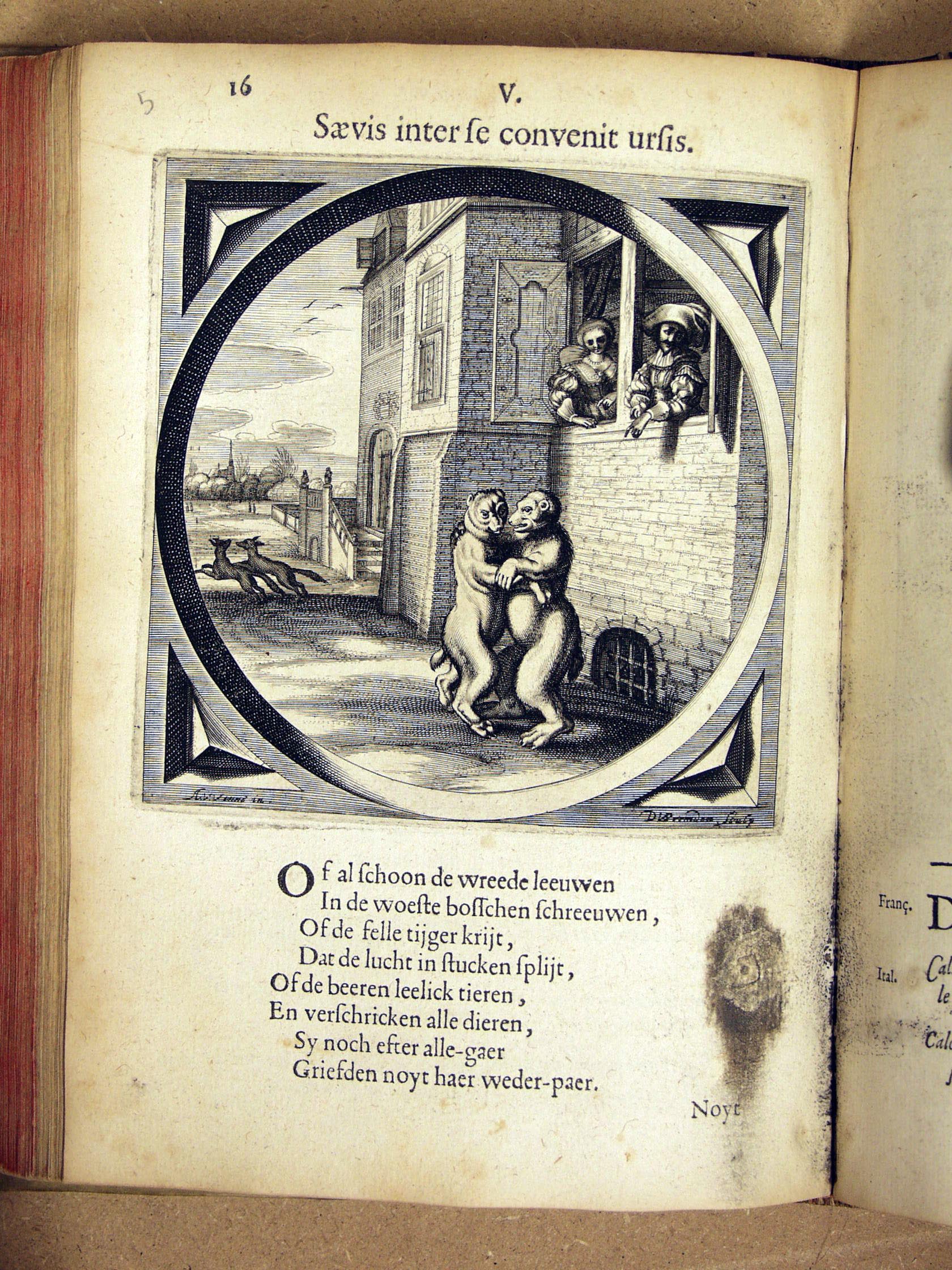
Saevis inter se convenit ursisLatin
Savage bears agree among themselves.AI-generated
Description of the imageAI-generated
Within a thick circular band set into a square plate with ornamental corner spandrels, a scene shows two bears standing upright on their hind legs in front of a tall brick house, embracing each other with their forepaws and touching muzzles. At the upper right, a richly dressed man in a plumed hat and a woman in a ruff and headdress lean out of an open window above a brick wall, looking down at the bears. A small grated cellar window is visible at the foot of the wall. To the left, beyond the house and a low balustraded bridge or wall, a flat landscape opens out with trees, a distant town with a church spire, and clouds; three foxes or wolves run across the open ground. The engraving carries the designer's and engraver's signatures in the lower corners ('A. v. Venne in.' and 'D. v. Bremden sculp.').
Subscriptio


TranscriptionAI-generated
Of al schoon de wreede leeuwen In de woeste bosschen schreeuwen, Of de felle tijger krijt, Dat de lucht in stucken splijt, Of de beeren leelick tieren, En verschricken alle dieren, Sy noch efter alle-gaer Griefden noyt haer weder-paer. Noyt vecht Leeuwe met Leeuwinne, Maer hy oeffent soete minne, Noyt en was een Tyger fel Tegen sijnen bed-gesel. Maer een Beer, noch boven allen, Placht te jocken, en te mallen, En te toonen soet gelaet Aen sijn lieve mede-maet: Beeren kunnen sachtjens spelen, Kunnen vryen, kunnen telen, Beeren paren in het groen Soeter als veel menschen doen. 'tFy! dan grimmers, kijvers, krijters, 'tFy! onsoete wijve-smijters, 'tFy! het wijf die haren man Niet in liefde vieren kan. Felle beesten sonder reden, Noyt geleert in goede seden, Toonen liefd' en soeten aert Als sy t'samen zijn gepaert: Ghy dan, die u rechter-handen Eens te samen ginght verpanden, Hebt voor al een sachten geest, Of komt leertet van een beest.
TranslationAI-generated
Though the cruel lions roar in the wild woods, or the fierce tiger screams so that the air is split in pieces, or the bears growl hideously and frighten all animals, yet all of them together never injured their own mate. Never does a lion fight with a lioness, but he practises sweet love; never was a tiger fierce against his bedfellow. But a bear, above all the rest, used to joke and frolic and to show a sweet countenance to his dear companion. Bears can play gently, can court, can breed; bears mate in the green more sweetly than many people do. Fie then on snarlers, scolders, screamers; fie on unkind wife-beaters; fie on the wife who cannot honour her husband in love! Fierce beasts, without reason, never taught in good manners, show love and a sweet nature when they are paired together. You then, who once went to pledge your right hands together, have above all a gentle spirit — or come and learn it from a beast.
CommentaryAI-generated
13 passages · original left, translation right (click to fold)
Franç. Deux bestes paissent bien en un pré.
French: Two beasts graze well in one meadow.
Ital. Calze di stallone non fere mai male à cavalla.
Italian: A stallion's kicks never do harm to a mare.
Calce di giumenta non nuore al stallone.
A mare's kick does not harm the stallion.
Es beisset kein wolff den andren. Hoogd.
High German: No wolf bites another.
Es beisst kein krawe der andern die augen auß.
No crow pecks out the eyes of another.
Wilde bern seind bei einander gern.
Wild bears like to be with one another.
Spaens. Con un lobo no se mata otro.
Spanish: One wolf is not killed by another.
Nederl. Twee quade honden bijten malkanderen niet.
Dutch: Two bad dogs do not bite one another.
Franç. Corbeau à corbeau ne creve jamais les yeux.
French: A crow never puts out the eyes of a crow.
Corvi con corvi non si cavan mai gli occhi. Ital.
Italian: Crows with crows never pluck out each other's eyes.
Ein krähe sitzt gern bey der andern. Hoogd.
High German: One crow likes to sit beside another.
Es muß ein kalter winter sein / daß ein wolff den andern frisse.
It must be a cold winter for one wolf to devour another.
Iean Fornier de Montauban.
Tous animaux lesquels sont en la terre Vivent en paix, & tranquille est leur faict, Ou bien s'ils ont debat, & se font guerre, A la femelle onc le masle n'en faict: L'ourse avec l'ours seure par les bois erre Pres du lion la lionne se plaist Avec le loup la louüe est sans contrainte Et du Taureau la vache n'a point crainte. Quelle furie & peste tant infame Vient à troubler les hommes vitieux? Qu'on oit tousiours le mary & la femme S'entrepincer de mots pernitieux? S'esgratigner d'outrage qui diffame Baigner de plaincts seulement mais bien pire Souvent de sang les baigne leur folle ire.
Jean Fornier of Montauban.
All the animals that are on the earth live in peace, and their doings are tranquil; or if they do quarrel and make war, the male never does so against the female: the she-bear wanders safe through the woods with the bear; near the lion the lioness takes pleasure; with the wolf the she-wolf is without constraint, and the cow has no fear of the bull. What fury and what infamous plague comes to trouble vicious men, so that one always hears husband and wife pinching one another with pernicious words, scratching each other with defaming outrage, bathing themselves not only in complaints but far worse — often their mad anger bathes them in blood?
Iconclass
86(SAEVIS INTER SE CONVENIT URSIS)proverbs, sayings, etc. (SAEVIS INTER SE CONVENIT URSIS)
Suggested Iconclass codesAI-generated
Additional codes proposed for this emblem, not (yet) part of the indexing.
25F23(WOLF)beasts of prey, predatory animals: wolfmediumThe correlate 'beasts of prey, predatory animals: wolf' fits the three wolf-like animals running across the open landscape and the repeated proverbs that 'no wolf bites another' and the she-wolf lives peaceably with the wolf.
33Baggressive relationships, enmity, animositymedium'Aggressive relationships, enmity, animosity' matches the commentary's core theme of husband and wife quarrelling, scratching and even bloodying one another, contrasted with the peaceable embracing bears.
56E2Rage, Angerlow'Rage, Anger' corresponds to the 'mad anger' and fury that the text says drives spouses to violence, though no personification of Anger is actually depicted.
Relationships to the Adagia of ErasmusAI-generated
Suggested relationships between this emblem and adages in Erasmus’ Adagia.
- II iii 63 Furemque fur cognoscit et lupum lupus – thematic inventiomedium
Erasmus's essay explains that creatures of like kind love one another ('wolves band together like robbers'), which is precisely the proverbial cluster assembled in the emblem's multilingual commentary ('no wolf bites another', 'a crow never puts out the eyes of a crow', 'two bad dogs do not bite one another'), all glossing the motto 'Saevis inter se convenit ursis'.
- I i 70 Homo homini lupus – thematic inventiolow
The subscriptio's point — that lions, tigers and bears never injure their mates while husbands and wives wound each other with words and blood — is the mirror image of Erasmus's adage that man is a wolf to man, and the emblem's French verses make exactly that contrast between peaceable beasts and 'hommes vitieux'.
Sources
Record ID: embstma_1288_emblem060
This emblem on the Iconclass site: https://iconclass.org/view/embstma_1288_emblem060
Copy: University Library, Glasgow, Stirling Maxwell 1288