Jacob Cats, Spiegel (The Hague, 1632)
Emblem 114

Mortuo leoni etiam lepores insultantLatin
Even hares insult a dead lion.AI-generated
Description of the imageAI-generated
Within an oval frame set in a rectangular engraved border (with a blank scroll/cartouche below), a landscape scene: a dead lion lies stretched on the ground at the right, its mane spread out and its head resting on the earth. Five hares surround and torment it: two at the left tug at its tail with their mouths and paws, one black hare in the foreground leaps at its body, another hare sits astride the lion's back, and a fifth at the far right nibbles at its beard/face. Behind, a bare twisted tree with a few leafy branches, low bushes and shrubs, a cloudy sky with birds flying. On a rise at the upper right stand two onlookers in cloaks and hats, one holding a staff, watching the scene.
Subscriptio

TranscriptionAI-generated
Ey siet de Leeuw, dat moedigh beest, Dat al de werelt heeft gevreest, Dat yder mijd' en yder weeck Soo haest het maer eens op en keeck, Dat wort van hasen aen-getast, En lijdt nu schimp en over-last, Want d'eerste treckt hem metten baert, De tweede grijpt hem by den staert, De derde springt hem op het lijf, En al tot enckel tijdt-verdrijf; Vraegt yemant, die het speeltjen siet, Waerom dit heden soo geschiet? De leeuw is nu geheel veracht, Want hy is doot en sonder kracht.
TranslationAI-generated
Ah, look at the lion, that brave beast, which the whole world has feared, which everyone avoided and everyone shunned as soon as it so much as looked up: it is now assailed by hares, and suffers scorn and abuse, for the first pulls it by the beard, the second grabs it by the tail, the third jumps onto its body, and all merely for pastime. If anyone who sees this little game asks why this now happens so: the lion is now wholly despised, because he is dead and without strength.
CommentaryAI-generated
1 passages · original left, translation right (click to fold)
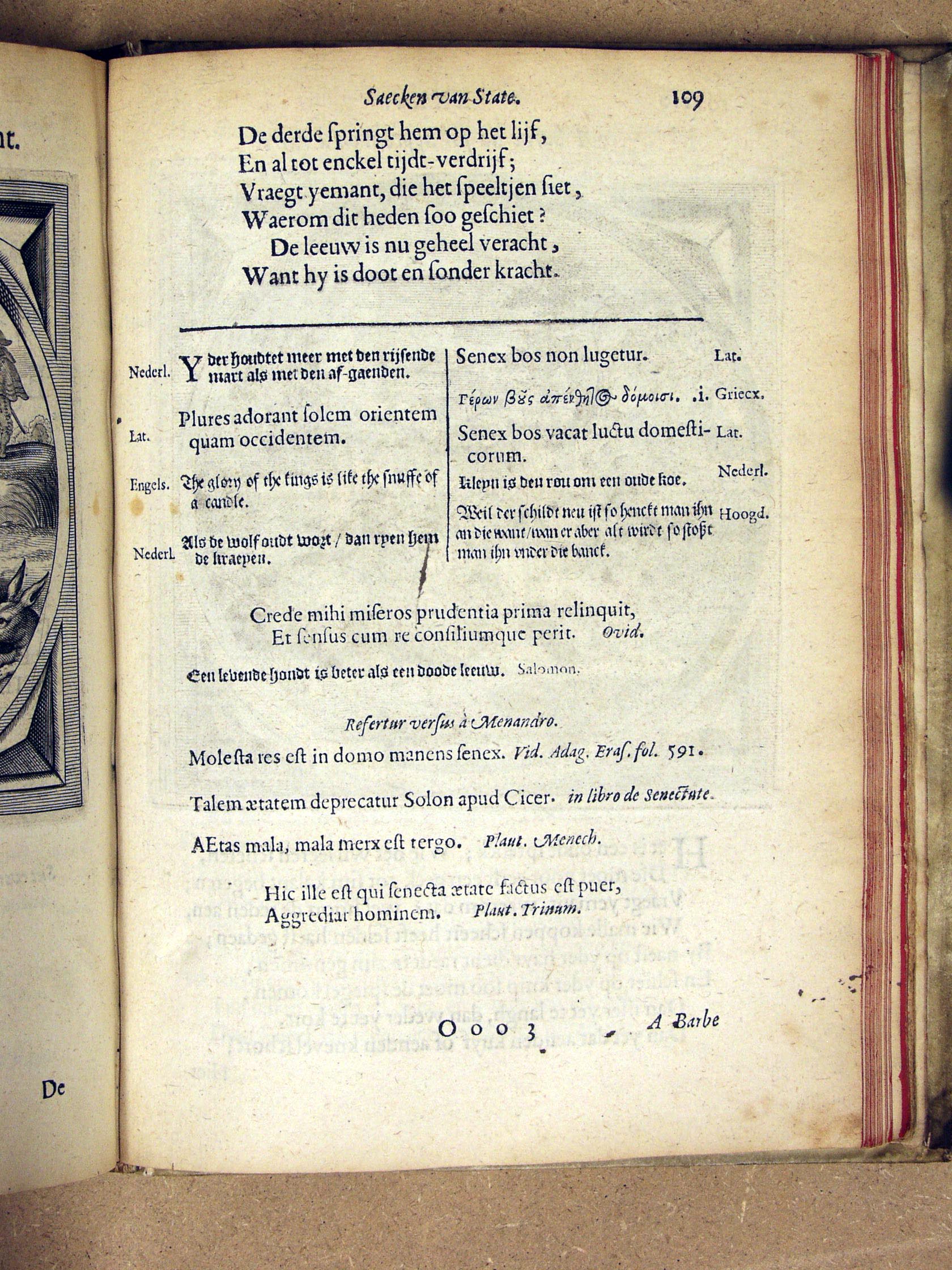
Nederl. Yder houdtet meer met den rijsende mart als met den af-gaenden. Lat. Plures adorant solem orientem quam occidentem. Engels. The glory of the kings is like the snuffe of a candle. Nederl. Als de wolf oudt wort / dan rijen hem de kraeyen. Lat. Senex bos non lugetur. Griecx. Γέρων βοῦς ἀπένθητος δόμοισι. .i. Lat. Senex bos vacat luctu domesticorum. Nederl. Kleyn is den rou om een oude koe. Hoogd. Weil der schildt neu ist so henckt man ihn an die wandt / wan er aber alt wirdt so stoßt man ihn under die banck. Crede mihi miseros prudentia prima relinquit, Et sensus cum re consiliumque perit. Ovid. Een levende hondt is beter als een doode leeuw. Salomon. Refertur versus à Menandro. Molesta res est in domo manens senex. Vid. Adag. Eras. fol. 591. Talem ætatem deprecatur Solon apud Cicer. in libro de Senectute. AEtas mala, mala merx est tergo. Plaut. Menech. Hic ille est qui senecta ætate factus est puer, Aggrediar hominem. Plaut. Trinum.
Dutch: Everyone sides more with the rising market than with the declining one. Latin: More people worship the rising sun than the setting one. English: The glory of kings is like the snuff of a candle. Dutch: When the wolf grows old, the crows ride upon him. Latin: An old ox is not mourned. Greek: An old ox is unlamented in the house, that is, Latin: An old ox lacks the mourning of the household. Dutch: Small is the grief for an old cow. High German: While the shield is new one hangs it on the wall, but when it grows old one shoves it under the bench. Believe me, prudence is the first thing to abandon the wretched, and sense and counsel perish along with one's property. Ovid. A living dog is better than a dead lion. Solomon. A verse is reported from Menander: An old man staying in the house is a troublesome thing. See Erasmus' Adages, fol. 591. Solon, in Cicero's book On Old Age, prays to be spared such an age. A bad age is bad merchandise on one's back. Plautus, Menaechmi. This is the man who in his old age has become a child; I shall accost the fellow. Plautus, Trinummus.
Iconclass
25F23(LION)(+63)beasts of prey, predatory animals: lion (+ dying animal; death of animal; dead animal)25F26(HARE)(+452)rodents: hare (+ animal with prey)25F26(HARE)(+512)rodents: hare (+ animal(s) attacking)86(MORTUO LEONI ETIAM LEPORES INSULTANT)proverbs, sayings, etc. (MORTUO LEONI ETIAM LEPORES INSULTANT)
Suggested Iconclass codesAI-generated
Additional codes proposed for this emblem, not (yet) part of the indexing.
25F26(HARE)rodents: harehighThe correlate 'rodents: hare' directly matches the five hares that surround and torment the dead lion in the picture.
31D160Old Age, 'Senectus'; 'Vecchiezza' (Ripa)mediumThe correlate 'Old Age, Senectus' matches the emblem's theme, since the commentary repeatedly moralizes on the contempt shown to the aged ('When the wolf grows old, the crows ride upon him', 'An old ox is not mourned').
Relationships to the Adagia of ErasmusAI-generated
Suggested relationships between this emblem and adages in Erasmus’ Adagia.
- IV vii 82 Mortuo leoni et lepores insultant – direct mottohigh
The emblem's motto 'Mortuo leoni etiam lepores insultant' is verbatim this adage (with the added 'etiam'), and the picture literalizes Erasmus' epigram 'Audet vellere lepus exanimi insultare leoni' with hares tormenting a dead lion.
- II v 11 Leonem radere – essay quotemedium
Erasmus' essay on 'Leonem radere' quotes Martial's 'noli / Barbam vellere mortuo leoni' ('stop plucking a dead lion by the beard'); the subscriptio's detail that the first hare 'treckt hem metten baert' (pulls him by the beard), shown in the picture as a hare nibbling the lion's face, matches that quoted line rather than the headword adage itself.
Sources
Record ID: embstma_1288_emblem114
This emblem on the Iconclass site: https://iconclass.org/view/embstma_1288_emblem114
Copy: University Library, Glasgow, Stirling Maxwell 1288