Geffrey Whitney, A choice of emblemes (Leiden, 1586)
Emblem 13
Apollo and Diana killing the children of Niobe

Superbiae vltioLatin
Vengeance on pride
- Interpretation
- Niobe and children (Vengeance on pride)
- Interpretation (German)
- Vermessenheit
Description of the imageAI-generated
A woodcut in an ornamental floral border. In the upper part, among clouds, two winged archers (Apollo and Diana) draw their bows and shoot arrows downward; a third small cloud-figure appears at the upper right. Below, on a rocky, craggy landscape, several youths and maidens lie dead or dying, pierced with arrows; one figure kneels with arms raised toward the sky, another stands at the right, and in the foreground bodies are sprawled over the rocks. At the centre of the rocks a form resembling a draped, bowed human figure merges with the stone.
Subscriptio
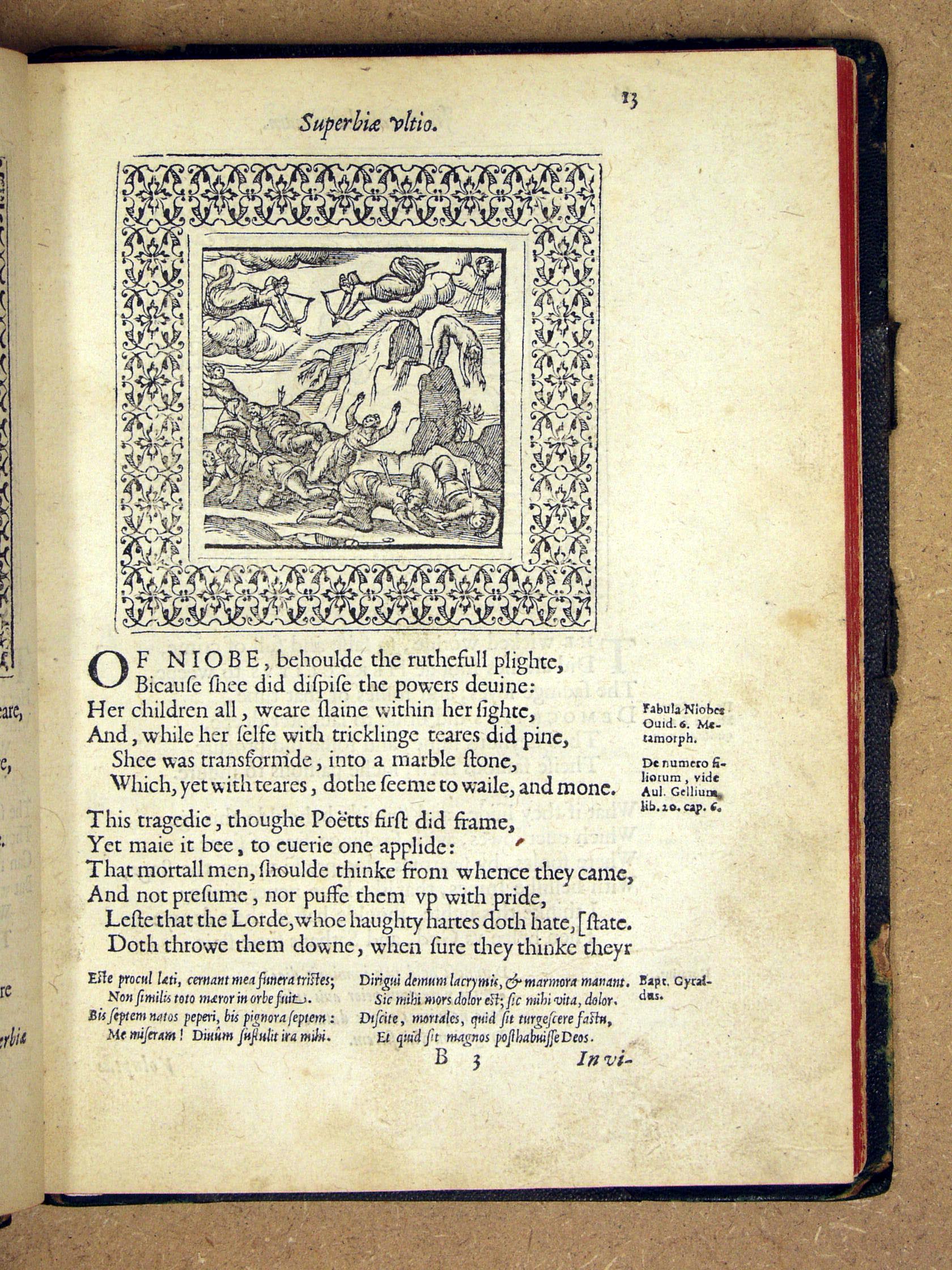
TranscriptionAI-generated
OF NIOBE, behoulde the ruthefull plighte, Bicause shee did dispise the powers deuine: Her children all, weare slaine within her sighte, And, while her selfe with tricklinge teares did pine, Shee was transformide, into a marble stone, Which, yet with teares, dothe seeme to waile, and mone. This tragedie, thoughe Poëtts first did frame, Yet maie it bee, to euerie one applide: That mortall men, shoulde thinke from whence they came, And not presume, nor puffe them vp with pride, Leste that the Lorde, whoe haughty hartes doth hate, Doth throwe them downe, when sure they thinke theyr state.
TranslationAI-generated
Of Niobe, behold the pitiful plight, because she despised the divine powers: all her children were slain within her sight, and while she herself pined away with trickling tears, she was transformed into a marble stone, which yet with tears seems to wail and moan. This tragedy, though poets first devised it, yet may it be applied to everyone: that mortal men should think from whence they came, and not presume, nor puff themselves up with pride, lest the Lord, who hates haughty hearts, throw them down when they think their estate most sure.
CommentaryAI-generated
4 passages · original left, translation right (click to fold)
Este procul læti, cernant mea funera tristes; Non similis toto mæror in orbe fuit. Bis septem natos peperi, bis pignora septem: Me miseram! Diuûm sustulit ira mihi. Dirigui demum lacrymis, & marmora manant. Sic mihi mors dolor est; sic mihi vita, dolor. Discite, mortales, quid sit turgescere fastu, Et quid sit magnos posthabuisse Deos.
Be far away, you joyful ones; let the sorrowful behold my funerals; no grief like mine has been in all the world. Twice seven children I bore, twice seven pledges: wretched me! The anger of the gods has taken them from me. At last I grew stiff with weeping, and the marble flows with tears. Thus death is grief to me; thus life is grief to me. Learn, mortals, what it is to swell with arrogance, and what it is to have slighted the great gods.
Fabula Niobes Ouid. 6. Metamorph.
The fable of Niobe, Ovid, Metamorphoses book 6. (marginal note)
De numero filiorum, vide Aul. Gellium lib. 20. cap. 6.
Concerning the number of her children, see Aulus Gellius, book 20, chapter 6. (marginal note)
Bapt. Gyraldus.
Baptista Giraldi. (marginal note)
Notes and related emblems
- In Alciatus, Emblemata, the motto of the emblem is "Superbia"
- Related emblem in another book: embmne_mig1591_emblem067
Iconclass
11A3God's wrath25G13groups of plants (herbs)25H112rocks26Aclouds26Cwinds31A221head (human)31A2321(+89)leaning forward (+ nude human being)31AA236lying figure - AA - female human figure31AA247looking over the shoulder - AA - female human figure31AA2511(+926)arm raised upward - AA - both arms or hands (+ despairing)31A2512(+933)arm stretched forward (+ holding something)31A25162hand on the heart31A2712crawling, going on all fours31AA2731falling - AA - female human figure31A2762flying31AA2762flying - AA - female human figure31A2763(+0)floating in the air (+ variant)31B6241cheeks rounded31E23461violent death by arrow(s)33B9flight, running away; pursuing41D211(+81)dress, gown (+ men's clothes)41D211(+82)dress, gown (+ women's clothes)45C15(BOW AND ARROW)(+63)archer's weapons: bow and arrow (+ handling of weapons)54A82(+4)Audacity, Temerity; 'Audacia' (Ripa) (+ emblematical representation of concept)57AA64(+4)Pride, Loftiness; 'Alterezza in persona nata povera civile' (Ripa) (+ emblematical representation of concept)86(SUPERBIAE ULTIO)proverbs, sayings, etc. (SUPERBIAE ULTIO)92B34aggressive, unfriendly activities and relationships of Apollo92B38(BOW AND ARROW)attributes of Apollo (BOW AND ARROW)92C34(story of) Diana (Artemis) - aggressive, unfriendly activities and relationships92C38(BOW AND ARROW)attributes of Diana (BOW AND ARROW)95B(NIOBE)62Apollo and Diana kill Niobe's children97FF5Niobe changed into stone: in her grief for the loss of her children, Niobe is changed into a stone (Ovid, Metamorphoses VI 305)
Suggested Iconclass codesAI-generated
Additional codes proposed for this emblem, not (yet) part of the indexing.
95B(NIOBE)(story of) NiobehighThe emblem explicitly depicts and narrates the story of Niobe as told in Ovid's Metamorphoses VI.
95B(NIOBE)621the sons of Niobe, who were mounting their horses, die by the darts of ApollohighThe dead youths pierced with arrows shot by the winged archer Apollo correspond to the sons of Niobe slain by Apollo's darts.
95B(NIOBE)622the daughters of Niobe are killed by arrows of DianahighThe dying maidens struck by arrows from the second cloud-borne archer match the daughters of Niobe killed by Diana's arrows.
95B(NIOBE)6suffering, misfortune of NiobehighThe commentary is a lament on Niobe's unparalleled grief at the loss of her fourteen children, i.e. her suffering and misfortune.
97FF5Niobe changed into stone: in her grief for the loss of her children, Niobe is changed into a stone (Ovid, Metamorphoses VI 305)highThe draped bowed figure merging with the rock and the line 'I grew stiff with weeping, and the marble flows with tears' depict Niobe's transformation into stone (Met. VI 305).
83(OVID, Metamorphoses)(scenes from) specific works of literature: Ovid, MetamorphosesmediumThe emblem is explicitly captioned as a scene from Ovid's Metamorphoses book 6.
57AA644Arrogance; 'Arroganza' (Ripa)mediumThe moral tag 'Learn, mortals, what it is to swell with arrogance' makes arrogance the personified vice illustrated by Niobe's punishment.
Relationships to the Adagia of ErasmusAI-generated
Suggested relationships between this emblem and adages in Erasmus’ Adagia.
- III iii 33 Niobes mala – thematic inventiohigh
The emblem is wholly built on the Niobe story that Erasmus retells in this adage: her insolent contempt of Latona, the slaughter of her children by Apollo and Diana, and her petrifaction into weeping marble. The emblem's Latin epigram ('Dirigui demum lacrymis, & marmora manant') echoes the very Ovidian line (Met. 6, 'lacrimis etiam nunc marmora manant') that Erasmus quotes in his essay, and both cite Ovid Metamorphoses 6 as the source.
- II vi 38 Adrastia Nemesis. Rhamnusia Nemesis – thematic inventiomedium
Erasmus explains Nemesis/Adrastia as the goddess who avenges insolence and arrogance and punishes immoderate hopes, threatening a reversal of fortune on the proud — exactly the emblem's motto 'Superbiae vltio' and its moral that the proud are cast down when they think their estate most sure.
- II vi 11 Reperit Deus nocentem – thematic inventiolow
The adage's point — that divine retribution unfailingly overtakes the guilty, with Pindar's line that God 'bends any proud mortal to his will' — matches the emblem's closing lesson that 'the Lorde, whoe haughty hartes doth hate, doth throwe them downe'.
Sources
Record ID: embstma_1667_emblem013
This emblem on the Iconclass site: https://iconclass.org/view/embstma_1667_emblem013
Copy: University Library, Glasgow, Stirling Maxwell 1667