Guillaume de La Perrièrre, Le Theatre Des Bons Engins (Lyon, 1545)
Emblem 37
A lady looking at herself in a standing mirror on a tableAI-generated
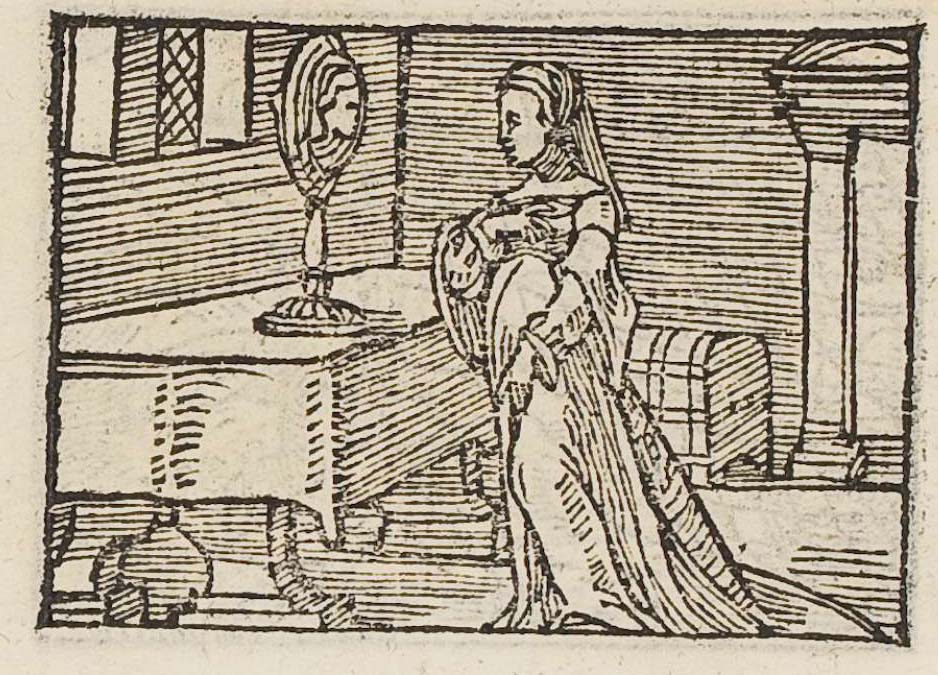
A quelle fin sont trouuez les miroirs.
For what purpose mirrors were invented.AI-generated
Description of the woodcutAI-generated
A woodcut interior scene: a richly dressed woman in a long gown with headdress stands at the right of a table covered with a cloth; on the table stands an oval standing mirror on a foot, in which a face is reflected. Behind her is a chest or bench, a window with latticed panes at the left, and an architectural pillar/doorway at the right. A small animal (dog) appears beneath the table at the lower left.
Subscriptio

TranscriptionAI-generated
LOrs que la Dame au miroir se regarde,Et qu'elle void la beaulté de sa face,Fault que de vice en tant se contregarde,Que deshonneur à sa beaulté ne face:Si belle n'est, pour lors, fault qu'elle effacePar ses vertus, le deffault de nature:Beaulté de corps tourne à desconfiture,S'elle se plonge en plaisirs reprouuez.Icy noter peult toute creature,Que les miroirs à ces fins sont trouuez.
TranslationAI-generated
When the lady looks at herself in the mirror, and sees the beauty of her face, she must guard herself so far from vice that she brings no dishonour upon her beauty: if she is not beautiful, then she must efface by her virtues the defect of nature: beauty of body turns to ruin, if it plunges itself into reprehensible pleasures. Here every creature may note that mirrors were invented for these purposes.
Iconclass
86(A QUELLE FIN SONT TROUUEZ LES MIROIRS)proverbs, sayings, etc. (A QUELLE FIN SONT TROUUEZ LES MIROIRS)41A22communal rooms41A711table31AA511mirror - AA - (for) women31AA5111looking in the mirror; (possibly: contemplation of own beauty - AA - (for) women)31D15adult woman51D4Beauty; 'Bellezza' (Ripa)57A6Virtuousness; 'Amor di Virtù', 'Attione virtuosa', 'Guida sicura de' veri honori', 'Virtù', 'Virtù insuperabile' (Ripa)
Suggested Iconclass codesAI-generated
Additional codes proposed for this emblem, not (yet) part of the indexing.
31A511mirrorhighThe correlate 'mirror' directly matches the oval standing mirror on the table, the central object of the scene.
31A51111reflection (in a mirror)highThe correlate 'reflection (in a mirror)' matches the face visible reflected in the standing mirror.
31AA511mirror - AA - (for) womenmediumThe correlate 'mirror - (for) women' fits the richly dressed woman standing beside the mirror as her attribute.
34B11doghighThe correlate 'dog' matches the small dog depicted beneath the table at lower left.
11R512(woman) looking in a mirror ~ scene symbolizing 'Vanitas'lowThe correlate '(woman) looking in a mirror ~ scene symbolizing Vanitas' is plausible for a richly dressed woman with a mirror, but no commentary confirms a vanitas reading.
Relationships to the Adagia of ErasmusAI-generated
Suggested relationships between this emblem and adages in Erasmus’ Adagia.
- I vi 95 Nosce teipsum – thematic inventiomedium
The mirror emblem teaches that the point of mirrors is self-examination leading to moral self-correction (the beautiful guarding against vice, the plain compensating by virtue), which is the Delphic 'Know thyself' applied to the glass; Erasmus' essay likewise explains the maxim as curbing self-flattery and teaching one to recognize one's own good and bad qualities.
- I vi 86 In se descendere – thematic inventiolow
Erasmus glosses the phrase as 'for a man to contemplate his own faults', the same introspective act that the lady's mirror is said to be invented for; the emblem's mirror functions as the window into the heart Momus wished for.
- IV vii 81 Quod pulchrum, idem amicum – thematic inventiolow
The subscriptio's claim that bodily beauty turns to ruin without virtue, and that virtue can efface natural ugliness, matches Erasmus' concluding remark on this adage that 'nothing is more beautiful than virtue, and therefore nothing more lovable.'
Sources
Record ID: embhab_162-3-eth-b_emblem037
This emblem on the Iconclass site: https://iconclass.org/view/embhab_162-3-eth-b_emblem037
Page in the digital copy of the Herzog August Bibliothek: http://diglib.hab.de/drucke/162-3-eth-b/start.htm?image=00050