Guillaume de La Perrièrre, Le Theatre Des Bons Engins (Lyon, 1545)
Emblem 38
A bird singing in a cageAI-generated
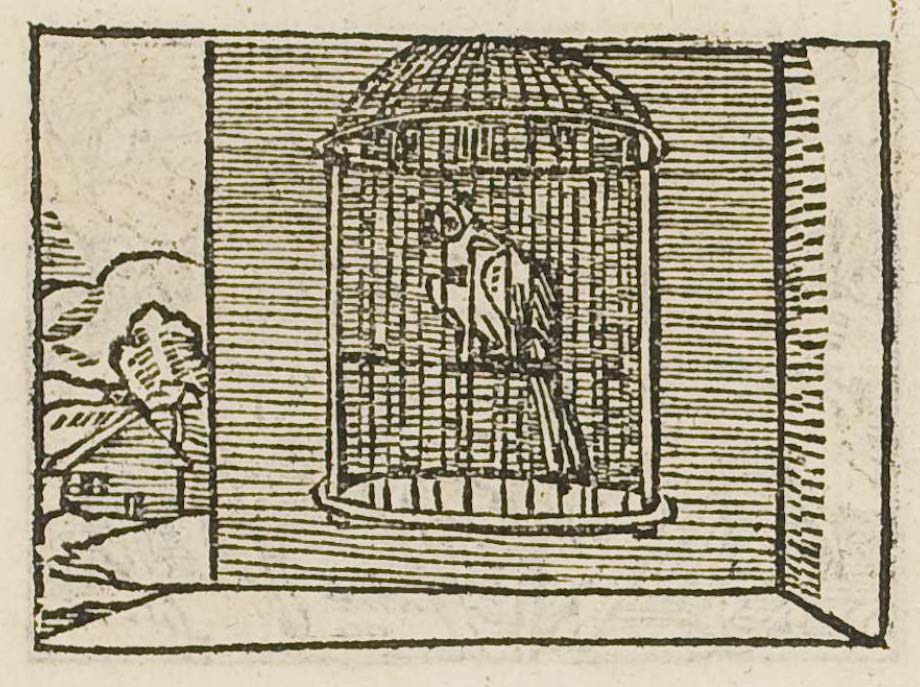
Resiouys toy en toute aduersité.
Emblem 38. Rejoice in every adversity.AI-generated
Description of the woodcutAI-generated
A square woodcut showing the interior of a room: in the centre stands a large domed, barred birdcage resting on a floor, with a single bird perched inside, its beak open as if singing. The cage sits before a panelled wall rendered in dense horizontal hatching; at the left an open doorway or window gives onto an outdoor scene with rocks and a leafy tree, and at the lower left a small figure or bush is visible. A projecting panel frames the right side of the scene.
Subscriptio

TranscriptionAI-generated
L'Oyseau captif, & mys dedans la caige,Ne laisse pas, pour sa captiuité,De iargonner en son beau chant ramaige,Soy consolant sur toute aduersité.Par cest exemple, estre doibt incitéTout triste cueur, à prendre esiouyssance:Car à vn mal, tristesse & doleance,Ne peult donner remede ne secours,Et si par dueil iamais rien on auance,Fors que le terme, & la fin de ses iours.
TranslationAI-generated
The captive bird, put inside the cage, does not cease, for all its captivity, to chatter in its fine woodland song, consoling itself in the midst of all adversity. By this example every sad heart ought to be urged to take up rejoicing: for sadness and lamenting can give neither remedy nor help to an ill, and if by grief one never advances anything, except the end and the close of one's days.
Iconclass
86(RESIOUYS TOY EN TOUTE ADUERSITÉ)proverbs, sayings, etc. (RESIOUYS TOY EN TOUTE ADUERSITÉ)25F35(PARROT)ornamental birds: parrot34B131bird in a cage25I3farm or solitary house in landscape56BB1Pain, Sorrow, Sadness; 'Dolore', 'Dolore di Zeusi' (Ripa)56BB19Consolation
Suggested Iconclass codesAI-generated
Additional codes proposed for this emblem, not (yet) part of the indexing.
41A3211open doormediumThe scene shows an open doorway on the left giving onto an outdoor view, matching the correlate 'open door', though the description allows it may be a window.
Relationships to the Adagia of ErasmusAI-generated
Suggested relationships between this emblem and adages in Erasmus’ Adagia.
- III iv 68 In re mala, animo si bono utare, adjuvat – thematic inventiomedium
The emblem's lesson — that sadness and lament bring no remedy, so one should rejoice even in captivity — is precisely Erasmus's gloss on the Plautine adage: unavoidable evil is defeated by being borne with good courage, and 'courage in an evil pass halves the evil.'
- III vii 78 Iactare iugum – thematic inventiomedium
Erasmus explains that misfortune borne impatiently is doubled but lessened by equanimity; the caged bird that does not fret at its bars but sings is the visual counterpart of not 'shaking the yoke' of an inescapable constraint.
- II vii 13 Sustine et abstine – thematic inventiolow
The first half of Epictetus' maxim — fortitude in adversity, 'good too is he who beareth bad things well' — matches the emblem's exhortation that every sad heart take up rejoicing in affliction.
- II ix 56 Omnia sapientibus facilia – thematic inventiolow
Erasmus glosses the adage as 'nothing so painful that a wise man cannot endure it easily and with resignation,' which is the moral the emblem draws from the singing captive bird.
Sources
Record ID: embhab_162-3-eth-b_emblem038
This emblem on the Iconclass site: https://iconclass.org/view/embhab_162-3-eth-b_emblem038
Page in the digital copy of the Herzog August Bibliothek: http://diglib.hab.de/drucke/162-3-eth-b/start.htm?image=00051