II ix 1 Stultior Morycho As big a fool as Morychus
ΜΩρότερος εἶ μορίχου. i. Stultior es Morycho. Siculum proverbium, in eos qui ridicule, stultéve quippiam facerent. Sed videntur peculiariter obnoxii huic adagioni, qui domesticorum negociorum negligentes, foris agunt, aliena curantes. Quod genus inducitur Ollus apud Martialem. Cuiusmodi sunt & apud Plutarchum Lamiae. Zenodotus tradit, apud Siculos Baccho cognomen esse Morycho, idque inde adtum, quod in vindemiis, huius dei facies musto, ficisque virentibus oblini consueverit, quod utriusque arboris inventae laudem Baccho tribuunt veteres, ut testis est Athenaeus libro Dipnosophistarum secundo: παρὰ τὸ μορύξαι τὸ μολύνεσθαι. id est, à moryxae, quod est contaminare: unde & Homerus, μεμορυγμένος, dixerit, pro με μολυσμένος. Bacchus autem ubique ridiculus, ac parum cordatus inducitur à poetis, utpote deus temulentus, velut in Ranis Aristophanis, ideoque in huius sacris ludicra quaedam, tanquam in eius contumeliam fiebant. Quin & cognomen additum contumeliae causa, ἐρεβίνθειος. Apud Siculos huius simulacrum, non in templo, sed extra phanum sub dio positum erat iuxta ingressum siut vestibulum, confectum è lapide, cui nomen Psella, arte Simmii cuiusdam Eupalami. Proinde vulgari ioco iactatum est de illo, μωρότερος εἶ μορύ χοῦ, ὅς τᾄνδον ἀφεὶς, ἔξω τῆς οἰκίας κάθητου. i. Stultior es Morycho, qui omissis his quae sunt intus, foris extra domum desidet. Zenodotus adagium citat ex epistola quadam Polemonis ad Diophilum. Quanquam alienissimum est ab ingenio moribusque meis, vestigandis, aut insectandis aliorum erratis operam conterere, tamen non possum hoc loco mihi temperare, quin ridendi magis quàm insectandi causa proferam cuiusdam apud Italos non infimi nominis, inscitiam ne dicamus, an socordiam: praeseritum cum is τὴν λεοντὴν ἐνδύσας, tantum sibi sumat in literis, ut arrepta veluti censoria virgula, non solum de scriptoribus caeteris magna pronunciet autoritate, verumetiam Angelum Politianum, virum modis omnibus & incomparabilem & inimitabilem, ceu praeceptor quispiam flagellet, atque emendet. Cui cum non pauca concedat homo candidus, tamen delicatae illae, & meris Atticismis assettae aures, transmarinae Veneris sensum in eodem desiderant, quod οὐδ᾽ ἀρχὴν verterit, ne initio quidem. Audiamus igitur in hoc Aristarcho Venerem illam transmarinam, ac germane Graecanicam. Principio proverbium hoc è vulgatissimis Zenobii collectaneis enarrans, Polemonem perinde citat, quasi locum ipse legetit. Id quod suo more facit, videlicet ut in abstrusis, minimeque vulgatis autoribus versari videatur. Deinde Graeca, quae modo retulimus, indidem, ὁς τὰ ἔνδον ἀφεὶς, ἔξω τῆς οἰκίας κάθηται, reddidit ad hunc modum: Qui relinquens habitationem interiorem, extra positam quaerebat. Rursum quod habetur in iisdem collectaneis, μόρυχος δὲ διανύσου ἐπίθετον ἀπὸ τοῦ πρόσωπον αὐτοῦ μολύνεσθαι, ἐπειδὰν τρυγῶσι, τῶν βοτρύων γλεύκει, καὶ τοῖς χλωροῖς σύκοις. expressit hoc pacto, Morychus sanè epitheton est Bacchi ἀπὸ τοῦ πρόσωπον αὐτοῦ μολύνεσθαι, id est, ab inquinando videlicet propriam faciem. Inquinare namque solet eam Bacchus racemis, & viridibus ficis. Deinde quod idem coacervator etymologiam nominis reddens, scripsit, μορύξαι γὰρ τὸ μολύναι, sic interpretatus est lepos Atticus nostri remporis.μορύξαι, inquit, porrò idem est quod μολύναι, hoc est, ineptire, hoc est desipere. Iam illud quanto est, παντὸς μορύχου μωρότερον, quod de Bacchi statua reddidit? Graeca sic habent, παρόσον ἔξω τοῦ νεὼ τὸ ἄγαλμα αὐτοῦ ἔστη παρὰ τὴν εἴσοδον ἐν ἑπαίθρῳ. Ea sic extulic transmarina Venus: Praetera dicitur à simplicitate Bacchi, cuius simulacrum in aperto statuitur apud Hesiodum. Vide quot veneres in uno, eoque perbrevi capite prodidit hic venustus. Primum Bacchus, fastiditis penetralibus aedium suarum, peregrinas sectatur domos: deinde, cum saxeus sit (fit enim de statua mentio) tamen ipse sibi faciem racemis & ficis oblinit, quo vindemiatores delectet. Ad haec cum idem significent, μορύξαι & μολύναι, utrunque declarat, ineptire & desipere: verum his duntaxat, qui Venerem illam transmarinam usquequaque percalluerint. Denique quod est omnium venustissimum, è vestibulo, siquidem autore Polluce, εἴσοδος templi vocatur, quod & προπύλαιον dicitur, Hesiodum fecit, hoc est, è mutis saxis eloquentissimum poetam. Et habet tamen hic talis artifex quibus sit admirationi, hoc est, Similes habent labra lactucas, cum innumera sint in huius commentariis, pari flore reddita Graeca, οὔτε οὐρανοῦ, quod aiunt, οὔτε γῆς ἁπτόμενα, quae vel ipse saxeus Morychus rideat. Homo me hercle, suavis, atque adeo Moriae beneficio felix, qui transmarinae Veneris sensum requirat in aliis, ipse communi carens, & ut videtur, marinae, quàm transmarinae Veneri familiarior. Sed praestat, opinor, ut omissis iocis ad institutum negocium calamus recurrat. Iocatur in Morychum & Aristophanes in Vespis, ζῦν βίον γενναῖον ὥσπερ μόρυχος. i. Vivere vitam generosam, quemadmodum Morychus. At Suidas indicat, huius nominis poetam quempiam fuisse tragicum, cuius vita non carverit luxus ac mollitiei nota. Citatque hoc in eum carmen Aristophanis. Extat autem in Acharnensibus. ὦ φιλτάτη σύ, καὶ πάλαι ποθουμένη, ἧλθες, ποθεινὴ μὲν τρυγῳδικοῖς χοροῖς φίλη μορύχῳ. id est: Carissima, ac desiderata aim diu Optata ades, faece sublitis choris Grata & Morycho.
[greek], You're as big a fool as Morychus. A Sicilian proverb, used of people who did something ridiculous or foolish. The natural targets of this adage seem to me to be those who neglect their own affairs and are full of outside activities, minding other people's business. A character of this kind is Ollus in Martial, and the lamias in Plutarch are in the same class. Zenodotus tells us that in Sicily Morychus was a nickname for Bacchus, and that it was given him because at vintage-time it was the custom to smear the god's face with grape-juice and green figs; the reason being that the credit of discovering both vine and fig-tree was given to Bacchus by the Ancients, as Athenaeus bears witness in the second book of his Doctors at Dinner: 'molynesthai [stain] is related to moryxai,' whence Homer's memorygmenos, defiled, for memolysmenos. Bacchus is presented by poets everywhere as a figure of fun and none too intelligent, being a tipsy god (in the Frogs of Aristophanes, for example); and therefore at his festivals a certain amount of comic business took place as though designed to make him look absurd. He was also given by way of ridicule the nickname Chickpea. In Sicily his image was not set up in a temple, but outside the shrine in the open air near the entrance or portico; and it was made of a marble called psella by an artist whose name was Simmias the son of Eupalamus. Hence he became the subject of a common jest: 'You are as big a fool as Morychus, who abandoned what he had to do indoors and sits idle outside his house.' Zenodotus cites the adage from a letter of Polemon addressed to Diophilus. Although it is very far indeed from my temperament and character to waste any effort in hunting out and attacking other men's mistakes, I cannot refrain in this context from displaying, in a spirit of mockery rather than invective, the ignorance (or should I call it idleness?) of a man who enjoys a considerable reputation in Italy, especially since, having donned the lion's skin, he assumes such authority in the world of letters that, snatching up some sort of censor's rod, he not merely pontificates about all other authors but chastizes and corrects like any schoolmaster a man on every count both incomparable and inimitable, Angelo Poliziano. Some virtues our fairminded critic does allow to Poliziano; but his delicate ear, attuned solely to the purest wit of Attica, finds him deficient none the less in a feeling for the elegance that comes from overseas, because he renders oud' archên by 'not even at the beginning.' Let us then give ear to the true overseas elegance, the authentic Greek scholarship of our modern Aristarchus. To begin with, though the proverb he expounded comes from Zenodotus, the commonest of all compilations, he quotes Polemon for all the world as though he has himself read the original, in an attempt to seem at home in abstruse and most uncommon authors. And then the Greek I have just rendered from the same source, 'who has abandoned what he had to do indoors and sits idle outside his house,' he translates as follows: 'who leaving his inner habitation was looking for an outer.' Again that passage in the same Greek collection: 'Morychus was a nickname for Bacchus, because at vintage-time it was the custom to smear the god's face with grape-juice and green figs,' he turns like this: 'Morychus of course is an epithet of Bacchus, derived from 'dirtying,' his own face, that is; for he has a habit of dirtying it with grape-clusters and green figs.' And then, where the same compiler, giving the origin of the name, wrote 'moryxai is related to molynai,' the Attic wit of our generation offers the following interpretation: 'moryxai is just the same as molynai, to be silly, that is, to play the fool.' And what does he make of the phrase 'As big a fool as any Morychus,' which is applied to a statue of Bacchus? The Greek says: 'inasmuch as his statue stands outside the temple near the entrance in the open air'; and this our true overseas elegance explains: 'Besides, this comes from the simplicity of Bacchus, whose image is set up in the open air in Hesiod.' Observe how many elegancies this elegant author puts forward in a single chapter, and that a very short one. First, Bacchus spurns the privacy of his own home and seeks a foreign dwelling; then, marble though he is (for a statue is actually mentioned), he smears his own face with grape-clusters and figs to amuse the harvesters. Besides which, though moruxai and molunai mean the same thing, to defile, he explains both 'to be silly,' 'to play the fool,' but only for those who have attained this high level of overseas elegance. And then, the most elegant touch of all, out of a vestibule (for Pollux assures us that the eisodos [vestibule] of a temple is a name for what is also called its propylaeum) he makes Hesiod, turning dumb stones into a most eloquent poet. And yet an artist of this quality has his admirers (every thistle finds its donkey), though in his collections there are innumerable Greek phrases rendered with the same brilliance, touching neither heaven nor earth, as the saying goes, which could make Morychus laugh himself, though made of marble. A charming man indeed, and Folly's favourite son, who finds others lacking in a sense for overseas elegance while lacking common sense himself, and better known, it would seem, to sea-born Venus than to overseas. But it is time, I think, to be serious, and to recall my pen to the business in hand. There is another jibe at Morychus in the Wasps of Aristophanes: 'To live a noble life like Morychus.' But Suidas suggests that there was a tragic poet so called, whose life was not free from imputations of luxurious and dissolute living; and he cites a reference to him in Aristophanes, which is found in the Acharnians:
And art thou come, whom I have loved long since,
Dearest of nymphs? Dearest to these our choirs
With raddled faces, Morychus' true love?
Facsimile: 


Iconclass: 31B8 fool, simpleton, numskull 52AA51 Folly, Foolishness; 'Pazzia', 'Sciocchezza', 'Stoltitia' (Ripa) 61B2(POLIZIANO, Angelo) historical person (POLIZIANO, Angelo)
Loci Communes: Aliena curantis (Meddling in others' affairs, Qui se mêle des affaires d'autrui); Multi - in stupidos (Many people - against the stupid, Beaucoup de gens - contre les sots)
II ix 2 Quatuor obolis non aestimo I wouldn't give four obols for it
Τεττάρων ὀβολῶν εἶναι οἴει, i. Quattuor obolorum esse putat. Simile illis quae alibi retulimus: Assis te non facio, & Dupondii non facio, & Teruncii non facio. Suidas haec quoque refert, sed tacito, qui frequens illi mos, autoris nomine, τὴν παῤῥησίαν τὴν σὺν οἴει τεττὰρων εἶναι ὀβολῶν τό λεγόμενον. i. Tuam maledicentiam existimato quatuor esse obolorum, quemadmodum dicitur. Et Diobolare vocant Latini, quod vilissimum videri volunt.
[greek], Think it worth four obols. Like those I have recorded elsewhere: I don't think you worth a penny,' 'Not worth twopence, in my view,' and 'Not worth a farthing.' Suidas records these too, but suppresses the name of his authority, as his custom often is: 'As for your malice, consider it worth four obols, as the saying is.' And in Latin a thing is called 'two obols' worth' when they wish to make it sound quite worthless.
Facsimile:
Iconclass: 49D11(4):46B311 numerals: 4❧coin 54BB6 Worthlessness
Loci Communes: Contemptus et vilitatis (Contempt and worthlessness, Mépris et bassesse)
II ix 3 Tenuem nectis You weave a small web
Λεπτὴν πλέκεις.Tenuem nectis. De pauperibus dictum, quibus plerumque tenuibus in rebus labor. Dicitur & λεπτὴ ἐλπὶς. id est, Spes tenuis, pro exigua. & λεπτὴ φροντὶς, id est, Tenuis cura, pro subtili & curiosa. & λεπτὰ ξαίνεις, id est, Tenuiter diducis. in sordidos, quique vel minutissimarum rerum habent rationem. ducta metaphora à textoribus.
[greek], You weave a small web. Said of poor people, whose work as a rule is confined to small tasks. Greek also speaks of 'small hope,' when there is very little, and 'small cares' for minute and painstaking concern, and 'you shred into small pieces' of mean people and those who bother about the very minutest details. The image is taken from weavers.
Facsimile:
Iconclass: 25F713(+4712) spiders (+ animals nesting; making nests, lodges, webs, etc.) 55BB1 Poverty; 'Povertà', 'Povertà del doni', 'Povertà in uno ch'habbia bell'ingegno' (Ripa) 51GG1 Littleness, Smallness
Loci Communes: Paupertas (Poverty, Pauvreté); Sordes et parcimonia (Meanness and stinginess, Bassesse et avarice)
II ix 4 Terrestria balnea Subterranean baths
χθόνια λουτρὰ. i. Terrestria, sive inferorum balnea. Dictum videtur, nam coniectandum est, ubi quid sero iam adhibetur, nulli futurum usui ei cui exhibetur. Veluti si quis tum reo patrocinetur, postquam pronunciata fuerit irrevocabilis iudicum sententia. Mos olim fuit, defunctis ad sepulchrum balnea quaedam inferre. Cadavera item sepulturae danda prius lavabantur. Unde Ennius: Tarquinii corpus bona foemina lavit, & unxit. Fit & nostra tempestate, fortassis ex prisca relictum consuetudine, ut defunctorum monumentis aquam inspergant consecratam, praesertim apud Germanos, huius rei praeter caeteros benignos.
[greek], Subterranean baths, or Baths of the nether world. Used apparently (for we are reduced to guesswork) when some measure is taken too late in the day, when it can be of no benefit to the man it was meant to help; if, for example, support is given to an accused person at a stage when the judges have already passed sentence from which there is no appeal. It was the custom in old days to carry some kind of bath to a tomb for the benefit of those who have died, and corpses on their way to burial were first washed. Hence Ennius: 'A good woman washed and anointed Tarquin's corpse.' It happens in our own day too, perhaps as a relic of ancient custom, that they sprinkle holy water on the monuments of the dead, especially among the Germans who are more inclined toward this practice than other people.
Facsimile:
Iconclass: 31A5454 tub-bath 51CC19 No Result, Lack of Result, Inefficacy, Futility 51FF52 Lateness 93E Hades, the Underworld
Loci Communes: Infortunii sive exitii (Misfortune or ruin, Malheur ou ruine)
II ix 5 Ter Thrice
Ne illud quidem figura proverbiali vacat, quod Graeci numeri additione rem amplificant, maximè ternionis, fortassis, quod is apud priscos & absolutissimus, & sacer habetur, ut quicquid ter dictum aut factum esset, id ratum & efficax haberetur, unde in magorum mysteriis adhiberi solitus. Vergilius in Pharmaceutria: Terna tibi haec primum triplici diversa colore Licia circundo, terque haec altaria circum Effigiem duco. numero deus impare gaudet. Et apud Theocritum, in eiusdem tituli carmine: Ες τρὶς αποσπένδω, καὶ τρὶς τάδε πότνια φωνῶ. id est, Ter libo, ter & haec pronuncio mystica verba, Item in Caeremoniis funebribus, Et supremum ter voce ciemus. Apud Euripidem in Hecuba praeco ter iterato verbo silentium indicit: Σιγᾶτ᾽ ἀχαιοὶ. σίγα πᾶς λαὸς, Σίγα σιώπα. id est, Silete Achivi, populus omnis sit silens Taciturnitate silentioque. Aristophanes in Ranis, Τούτοισιν ἀπαυδῶ, καὖθις ἀπαυδῶ, καὖθις μάλ᾽ ἀπαυδῶ. id est, Istis recuso, iterumque recuso, rursum valde recuso. Passimque legitur non solum apud poetas, verum etiam oratores: τρὶς μιαρὸς, τρὶς κατάρατος, τρὶς μακάριος, τρὶς μέγιστος, τρὶς ἄθλιος, id est, Ter scelestus, ter exsecrabilis, ter bearus, ter maximus, ter infelix. Quod latini dumtaxat in carmine sunt imitati. Vergilius: O terque quaterque beati. Ovidus: Omnia bis dices vera fuisse mea. Et illud etiam nunc vulgo familiare, ut si quid asseverent vehementius, id ter repetant. Ut hinc etiam adagium ortum videri possit. Strabo lib. Geographiae primo, quod Homerus scribit, Charybdim ter in die reddere quod absorbuit, ter resorbere, quum constet id non fieri nisi bis in die, excusat hac hyperbole, quasi τρὶς non sonet hic numerum, sed vehementiam. Ad hanc sermonis formam pertinet, quod est apud Platonem libro de repub. X. καὶ τὰ ἔργα αὐτῶν ὀρῶντες, οὐκ αἰσθάνονται τριττὰ ἀπέχοντα τοῦ ὄνος. id est, Et quum vident illorum opera, non intelligunt ea tertio gradu abesse à veris. Agit de iis qui è poetis sumunt recte vivendi rationem, quum illi pro veris tradant phantasmata. Durat huius sermonis vestigium & hodiernis diebus in lingua Gallica, qui huius syllabae adiectione, è comparativo faciunt superlativum, nisi quod inversis literis, tre sonant pro ter.
There is another practice which has something of the proverb about it - the way in which Greek adds emphasis to something by the use of a numeral, especially the number three, perhaps because in Antiquity this was thought to be the most perfect numeral and also a sacred number, so that anything said or done thrice was thought to be confirmed and effective. Hence its customary use in magic rites. Virgil in The Sorceress: First these three threads with threefold varied hues Round thee I bind, and round this altar thrice Thy image bear. Odd numbers please the god. And Theocritus in a poem with the same title: 'And thrice I pour, thrice speak these magic words.' It was the same at solemn funerals: "Thrice we raise our last cry.' And the herald in Euripides' Hecuba thrice repeats a word to proclaim silence: 'Silence, Achaeans! Silence, all the folk! Silence and stillness!' Aristophanes in the Frogs: "Them I forbid, forbid again, and once again forbid.' And in many passages, in orators as much as poets, we read Triply a rascal, thrice accursed, thrice blest, thrice greatest, thrice wretched.' And this Latin writers have imitated, at least in verse. Virgil: 'O thrice and four times blest!' Ovid: 'You will say all my words were true twice over.' There is another practice now in common use among the uneducated: when they wish to give something strong emphasis, they repeat it three times, so that this seems another possible origin for the adage. Strabo in the first book of his Geography discusses the statement in Homer that Charybdis gives up again what it has swallowed three times in the day, and swallows it again three times, whereas it is a known fact that this happens only twice in the day; and this he defends as a rhetorical exaggeration, as though tris, thrice in this passage was not a numeral but conveys emphasis. To this form of expression belongs a phrase in Plato in the tenth book of the Republic: 'And when they see their productions do not perceive that they are three degrees removed from reality.' He treats of those who draw the theory of the good life from the poets, although the poets offer fancies instead of the truth. A trace of this form of expression survives even in our own day in French, where by the addition of this syllable they turn a comparative into a superlative, except that the letters are reversed, for they say tre instead of ter.
Facsimile: 
Iconclass: 13C2 magic mathematical figures; magic numbers, words, monograms 49D11(3) numerals: 3 51A7 Perfection, Completeness; 'Perfettione', 'Operatione perfetta' (Ripa)
Loci Communes: Libertas, veritas (Freedom, truth, Liberté, vérité)
II ix 6 Theagenis pecuniae Theagenes' wealth
Θεαγένους χρήματα, τάτ᾽ αἰσχίνου. id est, Theagenis pecuniae, quemadmodum Aeschynis. Iocus proverbialis in eos, qui pauperes cum essent, tamen divites haberi volebant. Hoc morbo notatus est uterque, & Theagenes & Aeschines. Unde cognomen his additum, σέλλοις, à Sello quopiam inepte ambitioso, qui cum re esset perquam tenui, tamen affectabat videri locuples, unde qui hoc morbo laborabant, σελλίζειν dicebantur. Finitimum ei que alio dicetur loco, φανίου θύρα, id est, Phaniae ianua. Proverbii meminit Aristophanes in Avibus: Ινα καὶ τὰ θεαγένους τὰ πολλὰ χρήματα, Τάτ᾽ αἰσχίνου γ᾽ ἅπαντα. id est, Ubi sunt Theagenis plurimae pecuniae, Et Aeschynis quidem universae.
[greek], Theagenes' wealth and Aeschines' likewise. A proverbial jest, directed against those who, though badly off, wished to be thought rich. This was a complaint from which the two men, both Theagenes and Aeschines, were notorious sufferers. Hence they acquired the nickname Selli, from a man called Sellus who had foolish ambitions and, though he had in fact very modest means, yet aspired to be thought wealthy; and hence those afflicted with this complaint were said to sellizein. It is close to one which will be treated of in another place, Phanias' door. The proverb is mentioned by Aristophanes in the Birds: 'Where is Theagenes' abundant wealth / And Aeschines' whole fortune.'
Facsimile:
Iconclass: 55B1 Wealth, Opulence; 'Opulenza', 'Richezza' (Ripa) 55BB1 Poverty; 'Povertà', 'Povertà del doni', 'Povertà in uno ch'habbia bell'ingegno' (Ripa) 57AA641:56F11 Immodesty❧Ambition; 'Ambitione', 'Amor di Fama' (Ripa) 98B(AESCHINES) male persons from classical history (AESCHINES) 98B(THEAGENES) male persons from classical history (THEAGENES)
II ix 7 Tantali lapis The rock of Tantalus
Ταντάλειον λίθον. i. Tantali lapidem, vocant imminens capiti periculum. Apud Suidam haec referuntur, ἐπειδὴ τὸν ταντάλου λίθον τῆς κεφαλῆς ἀπετιναξάμεθα. id est, Quandoquidem Tantali saxum capiti impendens excussimus. Plato apud Stobaeum, οὐδ᾽ εἰ τὸν λεγόμενον ταντάλου λίθον ἐπηρτημένον τὶς ἔχοι. id est, Ne si Tantali quidem, quem vocant, lapidem imminentem haberet aliquis. Sumptum à fabula Tantali, quem quidam fingunt apud inferos, etiam hoc supplicii genus pati, ut ingens saxum sic immineat capiti, ut iamiam casurum videatur. Athenaeus lib. Dipnosophistarum vi. fabulae originem refert hunc in modum: Tantalus, voluptatum avidus, cum in deorum consortium admissus impetrasset optionem petendi quicquid vellet, à Iove postulavit, ut ad eum modum iugiter viveret inter epulas, nihil hac re ducens felicius. At indignatus Iupiter promissum praestitit, hominisque optatis satisfecit. Caeterum ne frui posset appositis, saxum ingens iamiam casuro simile supra verticem suspendit, cuius metu non libeat quicquam attingere. Virgilius Aeneidos suae libro sexto, commentum hoc ad Lapithas, Ixionem ac Prithoum refert, Quid memorem Lapithas, Ixiona, Pirithoumque, Quos super atra silex, iamiam lapsura, cadenti Imminet assimilis? lucent genialibus altis Aurea fulcra thoris, epulaeque ante ora paratae Regifico luxu, Furiarum maxima iuxta Accubat, & manibus prohibet contingere mensas, Exurgitque facem attollens, atque intonat ore. Usurpat & Pindarus in Isthmiis hymno septimo: ἐπειδὴ τὸν ὑπὲρ κεφαλᾶς γὲ ταντάλου λιθον παράτις ἔτρεψεν ἄμμι θεός. id est, Quandoquidem lapidem Tantali imminentem capiti aliquis nobis admovit deus. Sentit autem metum instantis belli. Interpres citat ex Euripide: Κορυφῆς ὑπερτέλλοντα δειμαίνων πέτρον Αέρι ποτᾶται. id est, Saxum pavescens vertici quod imminet Per aerem volat. Gregorius Nazianzenus in epistola quadam ad Basilium fratrem, vitam sollicitam, ac periculis expositam, ταντάλειον ζωὴν appellat.
[greek], The rock of Tantalus, is a name given to any peril that hangs over a man's head. Suidas provides the following reference: 'Since we have shaken off the rock of Tantalus that hung over our heads.' Plato, cited by Stobaeus: 'Not even if someone had that fabled rock of Tantalus hanging over him.' Derived from the myth of Tantalus, who is imagined by some authors to suffer a penalty of this kind among others in the lower world: an immense rock hangs over his head in such a way that it seems likely to fall at any moment. Athenaeus in book six of the Doctors at Dinner records the origin of the myth as follows: Tantalus, who was a passionate lover of pleasure, had been admitted to the society of the gods, and had secured permission to ask for whatever he wished; so he besought Jupiter that he might go on living in the same way forever between one feast and the next, for he could think of nothing more blessed than that. Jupiter however was angry; he kept his promise to the man and granted his prayer; but, to prevent him from enjoying what was set before him, he hung a huge rock over his head that looked as if it would fall at any moment, so that in fear of this he would never dare touch anything. Virgil in the sixth book of his Aeneid transfers this invention to the Lapiths, Ixion and Pirithous: 'Why need I tell of the Lapiths, of Ixion and Pirithous, over whose heads looms a dark flinty rock as though at any moment it would fall? The golden festal couches with their deep pillows gleam, rich feasts are spread before their eyes fit for a king; but there beside them sits the eldest of the Furies and will not let them lay a finger on the banquet, but rises with a voice like thunder brandishing her torch.' Pindar too uses it in the seventh hymn of his Isthmians: 'Since the rock of Tantalus that hung over our heads has now been turned aside from us by some god.' He is thinking of the fear of approaching war. The scholiast cites from Euripides: 'Fearing the stone threatening his head, he flies through the air.' Gregory of Nazianzus in one of his letters addressed to his brother Basil calls a life full of anxieties and exposed to dangers 'a life worthy of Tantalus.'
Facsimile:
Iconclass: 25H1124 boulder, stone 31EE23421 violent death by blow on the head with object - EE - death not certain; wounded person 51KK1:54DD51 Permanence❧Danger; 'Pericolo' (Ripa) 95A(TANTALUS)6 (story of) Tantalus - suffering, misfortune
Loci Communes: Sollicitudo (Anxiety, care, Souci)
II ix 8 Surdior Toronaeo portu As deaf as the harbour at Torone
Κωφότερος τορωναίου λιμενος, id est, Surdior Toronaeo portu. Aiunt portum esse quendam Toronae Thraciae civitatis, qui longis & angustis duobus excursibus porrigitur in mare, ita ut in ipso portus secessu nullus fluctuum fragor audiatur. Unde proverbium in eos qui non audiunt. Quanquam alii Toronem ponunt in Macedonia. Stephanus meminit etiam sinus cognomento Toroneaei, à quo proverbium ductum videri possit. Nisi quod Mare surdum vocatur, aut littus surdum, magno fragore resonans, ut ob strepitum undarum praeterea nihil exaudire liceat.
[greek], As deaf as the harbour at Torone. They say there was a harbour at Torone, a city in Thrace, formed by two long and narrow promontories running out into the sea, in such a way that in the depths of the harbour itself no sound of breaking waves could be heard. Hence the proverb, of those who hear nothing. Though others place Torone in Macedonia. Stephanus also mentions a gulf called the Gulf of Torone, from which the proverb might be thought to be derived; except that they speak of a 'deaf sea' or a 'deaf shore' where there is such a roaring sound that on account of the noise of the breaking waves nothing else can be heard.
II ix 9 Surdior turdo As deaf as a starling
Κωφότερος κίχλης, id est, Surdior turdo. Zenodotus ex Euboli Dionysio citat. Adscribit surditatem huic avi peculiarem, cum sit loquacissima, vel proverbio teste. Unde concinne dicetur in eos, qui perpetuo blaterantes ipsi non auscultant quid vicissim ab aliis dicatur: quod vitium in multis licet deprehendere.
[greek], As deaf as a starling. Cited by Zenodotus from the Dionysius of Eubulus. He ascribes a special deafness to this bird, although it is very talkative, as the proverb by itself would show. Hence it will be used appropriately of those who are chattering themselves all the time, and never listen to what other people in their turn are saying - a fault one may discern in many men.
II ix 10 Effoeminatorum etiam oratio effoeminata Womanish men's language is womanish too
Ενεισιν ἐν δειλοῖσι ἄνανδροι λόγοι. id est, Inertibus viris iners oratio. Ut quisque est, ita & loquitur. Refertur à Zenodoto. Confine illi, quod alibi retulimus, Fatuus stulta loquitur. Item illi: Qualis vir, talis oratio. Tametsi longe alium Drancen fecit Vergilius, lingua fortem bellatorem, re imbellem.
[greek], Sluggish language is in sluggards found. Each man talks like the man he is. Recorded by Zenodotus. Close to one I have recorded elsewhere: Fools in their folly speak, and also to As the man is, so is his talk. Though Virgil made a very different creature of his Drances, a valiant warrior in words and in the field a craven.
Facsimile: 
Iconclass: 32A7:31A719 characters (human types)❧womanish man, molly-coddle, milksop 31B6235(+82) speaking (+ female (human being) (not to be used where -AA- is prescribed)) 46A5 linguistic communication 51B5 Identity
Loci Communes: Conjecturae (Conjectures, Conjectures)
II ix 11 Stupidior Praxillae Adonide As stupid as the Adonis of Praxilla
Ηλιθιώτερος πραξίλλης ἀδώνιδος, id est, Stultior Praxillae Adonide. In vehementer stupidos. Polemon apud Zenodotum, tradit Praxillam fuisse quampiam Sicyoniam poetriam, quae in suis cantionibus Adonidem inducit ab inferis interrogatum, quid apud superos pulcherrimum reliquerit, respondere solem, cucumeres, mala. Quod cum vehementer insulsum videretur, cucumeres & mala cum sole componere, proverbio dici coeptum in homines nullius iudicii.
'[greek], As big a fool as Praxilla's Adonis. Used of exceptionally stupid people. Polemon, cited by Zenodotus, tells us that Praxilla was a poetess from Sicyon, who introduces Adonis in her poems as being asked by the inhabitants of the nether regions what were the most beautiful things he had left behind him in the world above; and he replied The sun, gourds, and apples.' And it seemed so utterly absurd to class gourds and apples with the sun, that he began to be used as a proverbial example of men of no judgment.
Facsimile:
Iconclass: 48C91:98C(PRAXILLA) writer, poet, author❧female persons from classical history (PRAXILLA) 52AA1 Stupidity, Poverty of Intellect; 'Stupidità overo Stolidità' (Ripa) 82A(ADONIS) male literary characters (ADONIS)
Loci Communes: Multi - in stupidos (Many people - against the stupid, Beaucoup de gens - contre les sots)
II ix 12 Simonidis cantilenae Songs of Simonides
Σιμωνίδου μέλη. Simonidis cantilenae. De vafris ac subdolis dictum est. Hunc tradunt primum astutiam & quaestum in artem induxisse. Erant illi duo scrinia, alterum gratiarum, alterum praemiorum, quae cum post tempus aliquantum aperuisset, gratiarum arculam semper offendebat inanem, praemiorum, semper plenam. Hoc commento significans se nolle gratis donare carmina. Meminit huius rei Plutarch. in libello, περὶ τῆς πολυπραγμοσύνης. Unde Aristophanes apud Suidam, ᾄσαι σιμωνίδου μέλη. id est, Cane Simonidis carmina. Meminit Aristophanes in Avibus: Πρῶτον μὲν αὐτὸν τὴν λύραν λαβόντ᾽ ἐγὼ κελεύσα Ασαι σιμωνίδου μέλος. id est, Primum quidem ipsi iussi, ut sumpta lyra sonaret Simonideam cantionem. Ad duo scrinia allusit Theocritus in Charitibus: Οκνηραὶ δὲ πάλιν κενεᾶς ἐπὶ πυθμένι χηλοῦ. id est, Rursum at ignavae vacuo intra scrinia fundo.
[greek], Songs of Simonides, was applied to crafty and deceitful people, for according to tradition Simonides was the first man to bring cunning and an eye for profit into the realm of art. He kept two boxes, one for thanks and one for fees; and when he opened them some time later, he used to find the box of thanks always empty and the box of fees always full. He made this up as a means of conveying that he was not willing to give his poems away free. This is mentioned by Plutarch in his essay 'On Being a Busybody.' Hence Aristophanes, cited by Suidas, speaks of singing the songs of Simonides. Aristophanes mentions it in the Birds: 'First I told him to take his lyre and sing the songs of Simonides.' Theocritus alludes to the two boxes in The Graces: 'Once again, timidly, in the bottom of the empty box.'
Facsimile:
Iconclass: 46B471 profit (~ commerce) 48C91 writer, poet, author 55A12 Reward, 'Praemium'; 'Premio', 'Remuneratione' (Ripa) 57A8 Gratitude; 'Gratitudine', 'Memoria grata de beneficii ricevuti' (Ripa) 98B(SIMONIDES) male persons from classical history (SIMONIDES)
Loci Communes: Proprii commodi studium (Pursuit of one's own advantage, Recherche de son propre intérêt)
II ix 13 Si tibi est machaera, et nobis urbina est domi You may have a sword, but I too have a spit of my own
Plautus in Bacchidibus: Si tibi est machaera, & nobis urbina est domi. Quoties malum malo opponitur. Nam machaera & urbina utrunque teli genus est. Sunt autem apud Plautum Chrysali verba minas referentis, & militis saevitiam saevis item dictis retundentis. Placiades Fulgentius pro urbina legit, Veruina, & interpretatur teli genus oblongum. Similimum est illis: Par pari. & Malo nodo malus quaerendus cuneus.
Plautus in the Bacchides: 'You may have a sword, but I too have a spit of my own.' When threats are met with threats, for both sword and spit are offensive weapons. The words are spoken in Plautus by Chrysalus, who is rejecting menaces and countering the soldier's ferocity in words equally fierce. Planciades Fulgentius reads vervina for urbina, and says it means a long thin instrument of some kind. Very close to Like for like, and to A hard wedge must be sought for a hard knot.
Facsimile:
Iconclass: 45C13(SWORD) hacking and thrusting weapons: sword 45C14(SPIT)(+0) helved weapons, polearms (for striking, hacking, thrusting) (SPIT) (+ variant) 51B3:45C1 Parity, Equality❧weapons 53C22 Menace, Intimidation; 'Minaccie' (Ripa)
Collectanea (1500): 52
Loci Communes: Minantis (Threatening, Menacer)
II ix 14 Semper agricola in novum annum dives Farmers are always rich next year
Αεὶ γεωργὸς εἰς νέωτα πλούσιος. id est, Agricola semper dives annum in proximum. De iis dictitatum, qui spe futuri compendii divites sunt, ac sibimet, exspectatione rerum amplarum, blandiuntur. Ductum à colonis, qui semper proximae aestatis uberiorem proventum sibi pollicentur, eaque spe iam sumptus nonnullos audent facere.
'[greek], Farmers are always rich next year. A saying of those who are rich in hopes of future profits, buoyed up by the expectation of good times to come. Taken from husbandmen, who always promise themselves heavier yields next harvest-time, and in this hope find courage to lay out money now.
Facsimile:
Iconclass: 23A33 future 46A14 farmers 51H42:47I14 Abundance; 'Abondanza', 'Abondanza maritima' (Ripa)❧harvest
Loci Communes: Frustrata spes (Frustrated hope, Espoir déçu)
II ix 15 Semper virgines Furiae The Furies, ever virgins
Αεὶ παρθένοι ἐρϊννῦς, id est, Semper virgines furiae. Proverbium obscurius deterret à peccando. Erinyes enim malefactorum ultrices corrupi non queunt, quo minus poenas sumant de iis qui commeruerunt, atque hac gratia dictae virgines. Suidas è Sophocle citat.
'[greek], The Furies, ever virgins, is a somewhat obscure proverb which deters us from doing wrong; for the Erinnyes who punish malefactors cannot be corrupted nor induced not to exact penalties from those who have deserved them, and for this reason they are called virgins. Suidas cites this from Sophocles.
Facsimile:
Iconclass: 23A2:31A7211 Eternity, 'Aeternitas'; 'Eternità','Eternità o Perpetuità' (Ripa)❧virginity 31D130 Maidenhood 57AA741 Revenge, Requital, Retaliation; 'Vendetta' (Ripa) 59C221 Incorruptibility 92N3 Furies, Dirae (Erinyes), Eumenides; 'Furie' (Ripa)
Loci Communes: Ultio malefacti (Vengeance for a wrongdoing, Vengeance d'un méfait)
II ix 16 Senex bos non lugetur No mourning for an aged ox
Γέρων βοῦς ἀπένθητος δόμοισι, id est, Bos senex vacat luctu domesticoru. Hoc est, senum mors, quòd tempestiva videatur, non lugetur ab amicis. Quin et hodie si quando nunciatur obitus hominis natu grandis: Nihil acerbum inquiunt, haud periit in cunabulis. Mortem iuvenum complorant ii quoque ad quos nihil attinet. Talem mortem deprecatur Solon apud Ciceronem lib. De senectute. Elogium autem Solonis cuius meminit Tullius, sic habet: Μηδὲ μοι ἄκλαυστος θάνατος μόλοι, ἀλλὰ φίλοισι Ποιήσαιμι θανὼν ἄλγεα καὶ στοναχάς. id est, Ne mi illugubris veniat mors, sed mihi charis Moerorem potius afferat & gemitus. Ennius contrà, Nemo me lachrymis decoret, neque funera fletus Faxit. Sed uterque recte sensit. Solon vult mori carus, ac desiderandus suis, Ennius non putat lugendam mortem quam consequitur immortalitas. Refertur & hic versus in Menandro, Πικρόν ἐστι χρῆμα γέρων ἐν οἰκίᾳ μένων. id est, Molesta res est, in domo manens senex.
[greek], No mourning in the household for an aged ox. In other words, an old man's death, because it seems timely, is not mourned by his friends. It is the same today: when the news comes that an old man has died, they say 'Nothing sad about that; he has not died in his cradle,' and when young people die, they are mourned even by those who are no relation. This is the kind of death which Solon, in Cicero's book On Old Age, prays he may be spared. The lines of Solon mentioned by Cicero run as follows: 'Let not death come to me without a tear; / May my friends grieve and groan when I am dead.' Ennius takes the opposite view: 'Let no man honour me with tears, nor weep at my funeral.' They are both right. Solon wants to know that on his deathbed he will be loved and regretted by his friends, Ennius thinks there should be no mourning for one whose death is followed by immortality. And there is another line recorded from Menander: 'An old man housebound is a sorry sight.'
Facsimile: 
Iconclass: 31E211 death in old age 47I21111(+924) ox (+ very old animal) 51AA4:42E131 Nothingness, Absence❧mourning the dead 51AA4:56BB1 Nothingness, Absence❧Pain, Sorrow, Sadness; 'Dolore', 'Dolore di Zeusi' (Ripa)
Loci Communes: Longae vitae (A long life, Longue vie)
II ix 17 Sero venisti, sed in Colonum ito You're late; off with you to Colonus
Οψ᾽ ἦλθες, ἀλλὰ γ᾽ εἰς κολωνὸν ἴεσο. id est, Serus ades, ast colonon hinc te conferas. Iocus proverbialis adversus eos, qui post tempus advenirent, aut qui mercede quippiam facerent. Porrò Colonus est terra aeditior, in speciem tumuli seu collis. Huiusmodi duo erant Athenis, alter iuxta Neptuni templum, in quem equites conveniebant: alter iuxta templum Vulcani, qui à foro seu mercatu dictus est ἀγοραῖος. Hinc colonetae dicti, qui mercede conducerentur, quod illic consisterent, qui conductorem quaerebant. Huiusmodi fermè Suidas.
[greek], You arrive late; but off you go to Colonus. A proverbial jest used against those who came out of time or who did something for hire. Colonus in fact means rising ground, such as a mound or hill. There were two places of the kind in Athens, one near the temple of Neptune, where the cavalry used to meet; the other near the temple of Vulcan, who was called agoraios, of the Market, from the proximity of a market-place or exchange. Hence colônetês was a name for wage-labourers, because that Colonus was the place where men stood who wanted someone to hire them. Such, more or less, is the account in Suidas.
Facsimile:
Iconclass: 46A173 labourers going to work 51FF52:46C514 Lateness❧arrival and return ~ travelling 61F(COLONUS) names of historical buildings, sites, streets, etc. (COLONUS)
Loci Communes: Tarditatis et cunctationis (Slowness and delay, Lenteur et retard)
II ix 18 Ad pedem To fit the foot
Περὶ πόδα. id est, Iuxta pedem. Quod appositum & vehementer accommodatum est, id περὶ πόδα dicebatur. Sumpta metaphora à calciamentis probe ad pedis mensuram quadrantibus. Unde celebratur & illud Pauli Aemilii apophthegma, novum calceum ostendentis. Vos, inquit, videtis bellum, ac novum esse calceum, verum qua parte pedem torqueat meum, id ego demum sentio. significans Papyriam uxorem non esse suis accommodatam moribus. Suidas Platonem citat, poetam opinor, Ως ἐστί μοι τὸ χρῆμα τοῦτο περὶ πόδα. id est, Ut hac meo negocium quadrat pedi.
[greek], To match the foot. Anything handy and exceptionally convenient was said 'to fit the foot.' The metaphor derives from shoes which really match the measure of the foot. Hence that well known apophthegm of Paulus Aemilius, who said as he displayed a new pair of shoes, 'You can see that my shoes are handsome and brand-new, but where they hurt my feet no one knows except me.' He was referring to his wife Papyria; he meant to convey that she did not suit his temperament. Suidas cites Plato (the poet, I presume): 'How well this course of things doth fit my foot!'
Facsimile:
Iconclass: 31A2255 foot 41D2332 shoes, sandals 51D2 Harmony, Regularity 51E3 Conformity; 'Temperamento delle cose terrene con le celesti' (Ripa) 51G6:47C621 Smoothness❧shaping in a mould (industrial process)
Loci Communes: Munus aptum aut ineptum (A gift fitting or unfitting, Un présent convenable ou inconvenant)
II ix 19 Sarpedonium littus Sarpedon shore
Σαρπηδονία ἀκτὴ, id est, Sarpedonium litus. De re turbulenta recte dixeris, sive de vehementer clamosis & obstreperis. Est enim huiusmodi litus quoddam Thraciae Neptuno sacrum, quod assiduis fluctibus tunditur. Est & aliud eiusdem nominis in Cilicia. Rursum aliud iuxta Oceanum, ubi Gorgonibus sedes esse ferunt.
'[greek], Sarpedon shore, could be rightly applied to some stormy piece of business, or to exceptionally noisy and contentious people. There is a beach of this sort in Thrace sacred to Neptune and pounded by continuous breakers; another of the same name in Cilicia; and yet a third close to the ocean, said to be the dwelling of the Gorgons.
Facsimile:
Iconclass: 22D1 loud sound, noise 25H1313:61D(SARPEDON) cape (coast)❧geographical names of countries, regions, mountains, rivers, etc. (SARPEDON) (SARPEDON) 25H2311 wave
Loci Communes: Clamosus (Noisy, clamorous, Bruyant)
II ix 20 Servilior Messena As harshly enslaved as Messene
Δουλότερος μεσσηνής. i. Servilior Messena. De minime liberis dicebatur, & alieno viventibus arbitrio. Lacedaemonii Messenios, quod iterum atque iterum descivissent, in servitutem redegerunt, eosque durius etiam quàm reliquos servos tractarunt, ne denuo res novas moliri possent. Historia refertur à Pausania in Messenicis & à Iustino libro Epitomatum iii.
[greek], As harshly enslaved as Messene, was applied to those who enjoyed absolutely no freedom and lived under other men's orders. The Messenians were reduced by Sparta to slavery because they were constantly in revolt, and were treated by them more harshly even than their other slaves, to prevent any fresh attempts at rebellion. The story is told by Pausanias in his book on Messene and by Justin in book three of his Epitomes.
Facsimile:
Iconclass: 32B311(MESSENIANS) indigenous European peoples (MESSENIANS) 46A18 slavery; serfs and enslaved persons 57AA91 Cruelty, Ferocity; 'Crudeltà', 'Ferocità' (Ripa)
Loci Communes: Multi - in stupidos (Many people - against the stupid, Beaucoup de gens - contre les sots)
II ix 21 Servus cum sis, comam geris You wear your hair long, though you're a slave
Δοῦλος ὢν κόμην ἔχεις. i. Servus cum sis, comam habes. De eo qui praeter decorum quippiam faceret. Veluti si quis humili conditione patriciorum cultum imitaretur. Apud Lacedaemonios enim ingenui comam alebant. Adagium refertur quidem à Suida, caeterum extat apud Aristophanem in Avibus, Επειτα δῆτα δοῦλος ὢν κόμην ἔχεις; id est, Ac deinde servus cum sies, portas comam?
[greek], You wear your hair long, though you're a slave. Of a man who did something regardless of propriety, if, for instance, someone of low degree were to imitate the costume of a nobleman; for in Sparta it was only the well-born who let their hair grow. The adage is recorded by Suidas, but occurs in Aristophanes, in the Birds: Then do you wear long hair, though you're a slave?'
Facsimile:
Iconclass: 31A533(LONG HAIR) styles of hairdress (LONG HAIR) 46A18 slavery; serfs and enslaved persons 59BB33 Ignobility, 'Vulgus'; 'Vulgo overo ignobilità' (Ripa)
Loci Communes: Dissimilitudinis et incongruentiae (Dissimilarity and incongruity, Dissemblance et incongruité)
II ix 22 Servorum civitas Slave city
Δούλων πόλις. i. Servorum civitas. De coetu convictuque hominum improborum, furacium, aut ignobilium dici potest. Est hoc nomine civitas quaepiam in Libya, ut autor est apud Suidam Ephorus in v. apud Stephanum Hecataeus. In hanc si quis servus lapidem importasset, continuo liber fiebat, etiam si peregrinus fuisset. Est & altera, cui nomen ἱεροδούλων, quod servis dicata sit, in qua unum duntaxat ingenuum vivere tradunt. Est rursum in Creta δουλόπολις χιλίανδρος. id est, Mille viris habitata, ut autor est Sosicrates in prima narratione rerum Creticarum. Est item alia iuxta Thraciam, πονηρόπολις, id est, im proborum civitas. In hanc Philippus collegisse dicitur, velut in sentinam, infames ac moribus improbatis, ut sycophantas, falsos testes, praevaricatores, et id genus alios ad numerum duûm milium, ut autor est Theopompus, in rerum Philippicarum lib. xiii. Testatur & Plutarchus in commentario De curiositate. Est & in Aegypto regio quaedam δουλόπολις appellata, teste Olympianico. Plutarch. in Collectaneis proverbiorum ostendit, dici solitum de raris inventu, effertque ad hunc modum, οὐκ ἐχστι δούλων πόλις, id est, Non est servorum civitas. Non dissimile quod Plinius narrat de gente Hessenorum in Syria, ad quos fugitant usquequaque nocentes. Quae sola toto in orbe, sine ulla foemina vivit, omni Venere abdicata, socia palmarum, in diem ex aequo convenarum turba renascitur, longe frequentantibus quos vita fessos ad mores eorum fortunae fluctus agitat.
[greek], A city of slaves, can be used of a company or community of rascals, thieves or ruffians living together. There is a city of this name in Libya, as we learn from the fifth book of Ephorus, cited by Suidas, and Hecataeus, cited by Stephanus; and any slave who had carried a stone into that city at once became a free man, although he had been an alien hitherto. There is another, called Hierodoulôn as being consecrated to slaves, in which they say only one free man lived, and yet another in Crete, Doulopolis chiliandros, which means it had a thousand inhabitants, as we learn from Sosicrates in the first book of his Cretan History. Besides these there is Poneropolis, Rogueborough, in Thrace, in which Philip is said to have collected, as a sort of sink of iniquity, all the disreputables and the known bad characters, informers, perjured witnesses, blackmailers, and others of the kind to the number of two thousand; for this the authority is Theopompus in book 13 of his Life and Times of Philip. Plutarch is evidence for it too in his essay 'On Curiosity.' Egypt also has a region called Doulopolis, Slave City, according to Olympianicus. Plutarch in his 'Collected Proverbs' points out that the name is used of things very rarely found, and quotes it in the form 'Slave City there is none.' This is not unlike the account given in Pliny of the tribe of Essenes in Syria, with whom criminals from every part find refuge. 'This is' he says 'the only city in the whole world which exists without women, sexual intercourse having been entirely abandoned; like the palm-trees it grows afresh day by day from the crowd of new arrivals, for people flock thither from great distances who are tired of life and are driven by the storms of fortune to adopt their way of living.'
Facsimile: 
Iconclass: 44G5 criminals 46A18 slavery; serfs and enslaved persons 46A183 freedom ~ slavery 46A93(+0) clans, tribal relationships (+ variant)
Loci Communes: Contemptus et vilitatis (Contempt and worthlessness, Mépris et bassesse)
II ix 23 Samiorum flores The flowers of Samos
Σαμίων ἄνθη, id est, Samiorum flores. Ubi quis extremam voluptatem decerperet. Hoc autem nomine dicebatur locus quidam, in quo mulieres cum viris convivium agitabant, omnique genere voluptatum affatim explebant sese. Quibus deliciis effoeminati, postea subacti sunt à Persis, & in servitutem acti. Stephanus admonet, Samum insulam olim ἀνθεμουσαν, appellatam fuisse, nimirum à floribus. Eandem παρθενιάν fuisse vocatam, videlicet à virginibus. Refertur adagium in Collectaneis, quae Plutarchi feruntur titulo. Meminit & Athenaeus lib. xii. ex Clearcho, demonstrans locum ita vocatum, ob varias formas puellarum, quae veluti flores arridentes, ad libidinem invitabant. Apte quadrabit in civitatem, domum, denique hominem voluptatibus perdite addictum.
[greek], The Flowers of Samos, of a place where a man could take his pick of pleasure in its most extreme form. For the name was applied to a place where women feasted on equal terms with men and could indulge to their heart's content in every kind of dissipation. Unmanned by this dissolute life, the Samians were later subdued by the Persians and reduced to slavery. Stephanus points out that the island of Samos was once called Anthemoussa, Isle of Blossom, from its flowers, and also Parthenia, Virgin Island, from its girls. The adage is recorded in the collection that goes by the name of Plutarch. It is also mentioned by Athenaeus in book 12, following Clearchus, who makes it clear that the place was so called from the range of beauty in the girls, who like radiant blossoms invited men to fulfil their lusts. This will be a neat fit for a city, a household or a man hopelessly abandoned to dissipation.
Facsimile:
Iconclass: 25G41 flowers 25H14:61D(SAMOS) island❧geographical names of countries, regions, mountains, rivers, etc. (SAMOS) (SAMOS) 33C8110 'Libidine', 'Voluttà' (Ripa) 57AA51 Licentiousness, Lasciviousness; 'Lascivia', 'Licenza' (Ripa)
Loci Communes: Intemperantia, libido (Intemperance, lust, Intempérance, désir)
II ix 24 Summaria indicatura A grab bag
Ρωπικὸν ὤνιον, id est, Summaria indicatura. De rebus vilibus, magno tamen emptis. Quemadmodum fit nonnunquam in auctionibus, cum non expenditur singillatim uniuscuiusque rei precium, sed multa simul congesta pariter aesitimantur. Graecis enim ῥωπες virgulta dicuntur, & ῥωπον appellant fasciculum, seu sarcinam è diversis rebus colligatam, aut varios colores simul confusos. Fit autem saepenumero, ut emptor parum attentus in hoc emptionis genere circumveniatur. Adagium refertur à Diogeniano. Meminit & Suidas.
'[greek], A grab bag, of objects which, though of no value, have been bought at a high price, as happens sometimes at auction-sales, when the worth of each item is not considered separately but many things are lumped together and valued as a whole. For in Greek rhôpes is a word for brushwood, and they use rhôpos for a bundle or collection of different things tied together, or a mixture of different colours. It is a common experience to see an inattentive purchaser taken in by a purchase of this type. The adage is recorded by Diogenianus. It is also mentioned by Suidas.
Facsimile:
Iconclass: 43C57(+0) tombola (+ variant) 46B16 auction sale, public sale 51BB4:46B61 Multiformity, Variety❧sales, bargain-sale
Loci Communes: Fuerunt non sunt (They were, they are no more, Ils furent, ils ne sont plus)
II ix 25 Regia vaccula A kingly cow
Βασιλικὸν βοΐδιον. i. Regia bucula. De prodigiosa foecunditate ferebatur, natum è miraculo rei gestae. Aetate Ptolemaei iunioris, vacca quaedam eodem partu sex aedidit vitulos. Autor Diogenianus. Simile illud Iuvenalis, Scropha foecundior alba.
[greek], A cow fit for a king, was a current expression for prodigious fertility, which took its rise from an astonishing event that actually happened. During the time of the younger Ptolemy, a cow gave birth to six calves at a time. The authority is Diogenianus. It recalls Juvenal's 'more prolific than a white sow.'
Facsimile:
Iconclass: 25F93 multiple birth ~ mis-shapen animals, monsters 59B41 Regality, Majesty; 'Maestà regia', 'Regalità' (Ripa) 49D11(6):47I2112(+941) numerals: 6❧cow (+ birth of an animal)
Loci Communes: Dignitatis (Dignity, Dignité)
II ix 26 Pura a nuptiis Unsullied by wedlock
Αγνὴ γαμων. id est, Rudis nuptiarum. Per ironiam dicebatur in impudicam, quod citra nuptias sui copiam faceret. Horatius, Nuptiarum expers, & adhuc protervo Cruda marito.
' [greek], Innocent of wedlock, was used ironically of an unchaste woman, because she exposed herself before reaching the stage of marriage. Horace: 'Untouched by wedlock, and still fresh and green / For some oncoming husband.'
Facsimile:
Iconclass: 33C811 sensuality 57AA66 Frivolity
Loci Communes: Impudicitia (Unchastity, Impudicité)
II ix 27 Rheginis timidior As frightened as the Rhegians
Ρηγίνων δειλότερος, id est, Rheginis formidolosior. Xenarchus apud Zenodotum, Sophronis, qui de mensibus scripsit, filius, in gratiam Dionysii tyranni taxavit Rheginenses ut ignavos in rebus bellicis, animique pavidi, quemadmodum testantur Graecorum adagiorum collectanea.
'[greek], As frightened as the Rhegians. Zenodotus cites Xenarchus, son of Sophron, who wrote a book on the months, as having accused the people of Rhegium, to please Dionysius the tyrant, of inaction in war and a cowardly disposition, as the collections of Greek adages bear witness.
II ix 28 Inertium chorus A party of lazybones
Αργούντων χορὸς. id est, Feriatorum chorus. De coetu lascivientium dicebatur. Ocium enim ad omnem nequitiam impellit, praecipur iuventam. Confine est illi quod aliàs dictum est, Inertibus semper feriae.
'[greek] A band of idlers, was used of a group of dissipated people, for idleness is a great encouragement to loose living, particularly among the young. Related to one of which I have spoken elsewhere: For sluggards it is always a holiday.
Facsimile:
Iconclass: 54AA11 Sluggishness, Inertia; 'Dapocaggine', 'Pigritia' (Ripa) 54DD2 Idleness; 'Otio' (Ripa) 57AA51 Licentiousness, Lasciviousness; 'Lascivia', 'Licenza' (Ripa)
Loci Communes: Contemptus et vilitatis (Contempt and worthlessness, Mépris et bassesse)
II ix 29 Rapina rerum Cinnari Despoiling Cinnarus of his possessions
Αρπαγὴ τῶν κιννάρου. i. Direptio bonorum Cinnari. De facultatibus per tumultum direptis. Veluti cum principes praeter ius in alienas fortunas iniiciunt manus. Timaeus scriptum reliquit, Cinnarum quempiam fuisse, patria Selinusium, arte lenonem, qui hoc quaestu ad summas opes pervenerit. Is quoad vivebat, pollicebatur se facultates omnes Veneri consecraturum, caeterum moriens, populo diripiendas exposuit. Huic non dissimile, quod alibi commemoravimus, Porsenae bona.
'[greek], Plundering Cinnarus' goods. Of the plundering of a man's possessions by violence; when, for instance, princes lay their hands unlawfully on other men's property. Timaeus has left it on record that there was a Cinnarus native of Selinus and by profession a brothel-keeper, who from this trade became very rich. During his lifetime he always promised that he would dedicate all his property to Venus, but at his death he left it all to be torn in pieces by the mob. This is not unlike one I have recorded elsewhere, Porsena's property.
Facsimile:
Iconclass: 33C55:98B(CINNARUS) pimp (brothel scene)❧male persons from classical history (CINNARUS) 44B17 bad ruler 44G522 robbery
Loci Communes: Rapacitas et avaritia (Rapacity and greed, Rapacité et avarice); Vis injustia (Unjust force, Force injuste)
II ix 30 Rhadamantheum iudicium The verdict of Rhadamanthys
Ραδαμάνθυος κρίσις, id est, Rhadamanthi iudicium. De incorrupte iudicantibus. Rha damanthus enim manium iudex, neque muneribus, neque gratia deflectitur, quo minus severè iudicet. Accommodari poterit ad mortis necessitatem, maximis pariter, ac minimis ex aequo communem. Iuxta illud Aeschyli apud Aristophanem in Ranis: Μόνος θεῶν γὰρ θάνατος οὐ δώρων ἐρᾷ. id est, Una è deis Mors nulla captat munera. Item Horatius, Pallida mors aequo pulsat pede pauperum tabernas, Regumque turreis. Item alibi: Non si trecentis, quotquot eunt dies, Amice places illachrymabilem Plutona tauris. Item Pindarus in Nemeis, Αλλὰ κοινὸν γὰρ ἔρχεται Κῦν᾽ ἀΐδαο. πέσε δὲ ἀδόκητον Καὶ δοκέοντα. id est, Fluctus enim Orci communiter accidit, obruitque tum opinantem, tum inopinum. hoc est, & iuvenem & senem. aut, pariter & nobilem et obscurum. Bifariam enim interpretantur ἀδόκητον καὶ δοκέοντα. Item in Olympiacis: Βουλαῖς ἐν ὀρθαῖς ῥαδανάνθυος. id est, Rectis Rhadamanthi decretis. Item alibi demonstrans unum Rhadamanthum nec assentari cuipiam, nec quicquam ad gratiam facere. ὁ δὲ ῥαδάμανθυς εὖ πέπραγεν, ὅτι φρενῶν ἔλαχε καρπὸν ἀμώμητον, οὐ δ᾽ ἀπάπταισι θυμὸν τέρπεται ἔνδοθεν. id est, Fortunatus Rhadamanthus, qui fructum iudicii sortitus est inculpatum, neque imposturis intus in animo delectatur. Usurpat & Plato lib. De legibus xii.
'[greek], The verdict of Rhadamanthys, of those who pass judgment with complete integrity; for Rhadamanthys, the judge of the dead, is diverted by no bribes and no influence from passing strict judgment. It will be possible to adapt this to the inevitability of death, which comes on equal terms alike to the greatest and the least, as Aeschylus says in the Frogs of Aristophanes: 'Death is the only god who loves not gifts.' Horace likewise: Pale Death with undiscriminating foot The poor man's hovel and the rich man's towers kicks, and in another passage: Though with three hundred cattle each successive day You seek, my friend, to soften Pluto's heart, Who knows no tears. And Pindar in the Nemeans: 'But Hades' breaking wave advances indiscriminate, and falls alike on the unthinking and the expectant,' that is, on both young and old; or 'alike on the noble and the obscure,' for the Greek words can be taken in two different senses. Again in the Olympians: 'In Rhadamanthys' upright counsels.' In another passage too, to make it clear that Rhadamanthys alone never complies in order to give pleasure nor does anyone a favour, he says 'Blessed Rhadamanthys, for to him was given the fruit of wisdom that is beyond all blame, and he takes no delight in falsehood in his inward heart.' This is used by Plato also in the twelfth book of the Laws.
II ix 31 Rhadamanthi jusjurandum Rhadamanthys' oath
Ραδαμάνθυος ὅρκος. i. id est, Rhadamanthi iusiurandum, dicebatur quod verissimum quidem esset, caeterum nullum deum adscisceret. Socrates per canem & anserem iurare consuevit, ne quem deorum citaret: sive que non crederet ullos esse deos, sive quod non arbitraretur esse boni viri, deos suorum negociorum testes accersere. Hoc autem iusiurandi genus ad Rhadamanthum referebant. Notavit adagium Aristides rhetor in Pericle, cum ait, ὥσπερ ἂν εἶ λέγῃς τὸ ῥαδάμανθυν ἐθίζειν τοὺς ἀνθρώπους ἐπεορκεῖν, ᾧ τοσοῦτον περιῆν εὐσεβείας καὶ δικαιοσύνης, ὥς τε καὶ τελευτήσας τοῖς ἐκεῖσε ἀφικομένοις δικάζειν δοκεῖ. id est, Perinde, quasi dicas Rhadamanthum mortales in consuetudinem adduxisse peierandi, qui usque adeo pietate, iustitiaque praecelluerit, ut etiam vita defunctus, iis, qui illuc appellunt, iudex esse credatur. Pythagorici per quaternionem iurare solent, quem τέτρακτυν appellant. Οὐ μὰ τὸν ἁμετέρᾳ ψυχᾷ παραδόντα τέτρακτυν. id est, Non per eum à quo animae est datus ille quaternio nostrae. Existimant enim hunc numerum usque adeo ad animae perfectionem pertinere, ut eum in arcanis venerentur. Autor Macrobius primo commentario in Somnium Scipionis. Pythagoras in Carminibus aureis, quaternionem sacrum animae fontem vocat. Graeci per caput alterius iurare consueverunt. Iuvenalis, Graecis nonduns iurare paratit Per caput alterius. Virgilius, Per caput hoc iuro.
'[greek], Rhadamanthys' oath, was used to describe one that was utterly reliable, but did not appeal to the name of any deity. Socrates used to swear by a dog and a goose to avoid using the name of one of the gods, either because he did not believe there were any or because he thought it wrong for a virtuous man to summon the gods to witness his private concerns. This kind of oath they attributed to Rhadamanthys. Aristides the rhetorician alludes to the adage in his Pericles when he writes: 'You might as well say that Rhadamanthys gets men into the habit of perjuring themselves, when his piety and justice were so outstanding that even after death he is believed to sit in judgment on new arrivals in the lower world.' The Pythagoreans have a custom of swearing by the number four, which they call the tetraktys: 'No, not in the name of him who established the tetraktys in our souls.' For they suppose such a close relation to subsist between this number and the perfection of the human soul that they worship it among their mysteries. The authority is Macrobius in the first book of his Commentary on Scipio's Dream. Pythagoras in his Golden Lines calls the number four 'the sacred fountain of the soul.' In Greece it was customary to swear 'by the head' of some other person. So Juvenal: 'Not yet were Greeks ready to swear by another man's head.' Virgil: 'By this head I swear.'
Facsimile: 
Iconclass: 57A6142 Oath
Loci Communes: Fides et gravitas (Trust and seriousness, Confiance et gravité)
II ix 32 Littore loquacior As talkative as the seashore
Ραχίας λαλέστερος. i. Littore loquacior, In rabulam & obstreperum dicebatur. Nam rhachia Graecis littus appellatur, praesertim scopulis ac rupibus asperum, quod assiduis tunditur fluctibus, non sine fragore, unde & Graeca vox ducta videtur ῥαχια quasi τραχία, Nam ea vox ad omne quod asperum ac spinosum est, deflectitur.
'[greek], As talkative as the seashore, was applied to a rough, noisy, obstreperous fellow, for rhachia is a Greek word for 'shore,' and especially a rugged rocky shore, pounded continually by the roaring waves. And this seems to be the source of the Greek word rhachia, which stands for trachia, a word applied to anything rough and thorny.
Facsimile:
Iconclass: 25H133 beach 52D4 Prolixity, Verbosity, Loquacity; 'Loquacità' (Ripa)
Loci Communes: Garrulitas (Talkativeness, Bavardage)
II ix 33 Praesentem fortunam boni consule Take your present fortune in good part
Τὸ παρὸν εὖ ποιεῖν, id est, Quod adest, boni consule, καὶ τὸ παρὸν εὖ τιθεσθαι, id est, Quod adest aequi bonique facere oportet. Admonet adagium, ne nos alienarum rerum cupiditate maceremus, sed quaecunque contigit sors eam velut optimam amplectamur. Magna enim felicitatis pars, ut sua cuique fortuna placeat. Plato in Gorgia, ὡς ἔοικεν ἀνάγκη μοι κατα τὸν παλαιὸν λόγον τὸ παρὸν εὖ ποιεῖν, καὶ τοῦτο δέχεσθαι τὸ διδόμενον παρά σου. id est, Necessum est mihi, sicut videtur, iuxta vetus adagium, quod adest, boni consulere, & hoc accipere quod abs te datur. Cratinus in Pylaea, Ανδρας σοφοὺς χρὴ τό γε παρὸν πρᾶγμ᾽ ὡς κσλὸν Εἰς δύναμιν εὖ τίθεσθαι. id est, Sapientum est virorum, uti quod adest boni, Tanmquam bonum sit, consulant pro viribus. Affine illi, quod alibi retulimus, σπάρτην ἔλαχες, ταύτην κόσμει, id est, Spartam es nactus, eam dispone. Quod quidem carmen citat Stobaeus ex Euripidis tragoedia, cui titulus, τήλεφος, id quod obiter admonendum duximus. Nam adagium suo dictum es loco.
[greek], Take your present fortune in good part, and [greek] , Make the best of what you have. The lesson of the adage is that we should not torment ourselves by coveting what is not ours, but should embrace whatever luck may come our way as though it were the best. It is a great part of happiness that everyone should be content with his own lot. Plato in the Gorgias: 'It is necessary, it seems to me, to take my present fortune in good part, as the old saying runs, and to be content with what you give me.' Cratinus in his Pylaea: Wise men must do all they can to take their present fortune in good part.' Related to one which I have recorded elsewhere. Sparta is your portion; do your best for her. This line is cited by Stobaeus from a tragedy by Euripides called Telephus; a fact which I thought worth a mention in passing, for I have dealt with the adage in its place.
Facsimile: 
Iconclass: 54A47 Peace of Mind, 'Aequitas' 56B3 Satisfaction, Contentment; 'Contento' (Ripa)
Loci Communes: Proximis utendum (One must make use of one's neighbors, Il faut se servir de son prochain)
II ix 34 Qui omni in re et in omni tempore He who in everything and at every season
Aulus Gellius, explicans vim μορίου στερητικοῦ, ait hunc senarium antiquissimum proverbii vice celebratum fuisse. Sed enim qui in omni re, atque in omni tempore Omnt laude vacat, is illaudatus est, Is omnium pessimus deterrimusque est. Admonet paroemia, ferè neminem esse tam deplorati ingenii, qui non aliquando dicat faciátve quod laudem promereatur. Refertur iisdem fermè verbis à Macrobio libro Saturnalium vi. ex quo mihi visus sum deprehendisse manifestum errorem scripturae in Gelliano libro per eruditum quempiam admissum. Is enim non intelligens hos esse versus. Sed enim qui in omni re atque in omni tempore, &c. suspicatus est Graecum versiculum omissum à librariis, in eius locum supposuit hoc carmen: Πολλάκι καὶ κήπωρος ἀνὴρ μαλὰ καίριον εἶπεν. quum versus de quo sentit Gellius, sit Latinus quem mox subiicit: Sed enim qui in omni &c. Id liquet ex Macrobio, qui locum hunc ad verbum penè suffuratus est in suos commentarios. Porrò Graecus versiculus nihil facit ad explicandam vim huius vocis Illaudatus, sed obiter admixtus est, quasi probandum esset, quod dixerat, neminem esse tam efflictis moribus, quin faciat dicátve nonnunquam aliquid, quod laudari queat. Quo quidem loco rursus Efflictis depravatum est in Efferis: potest enim illaudatus esse, qui non sit efferis moribus. sed efflictos mores dixit perditos & corruptos. Sunt autem tres senarii sententiam absolventes: nisi quod alicubi videntur vitiati à scribis, Sed enim qui in omni re, atque in omni tempore. Hic primus pulchre constat: Constabit & alter, si legatur, Qui omni vacat laude, is vir illaudatus est. Nam dictiunculam Vir etiam aurium sensus in hoc versu videtur requirere. Constabit et tertius, si legas: Isque omnium est deterrimusque ac pessimus. Locus est apud Gellium lib. ii. cap. vi. si quis volet conferre.
Aulus Gellius, when explaining the force of the privative particle un-, says that this very ancient iambic line was current as a proverb: 'But he who in everything and at every season receives no praise on every count is "unpraised," and he is of all men wickedest and worst.' The message of the proverb is that almost no one is of such desperate wickedness by nature that he does not from time to time say or do something praiseworthy. This is recorded in almost the same words by Macrobius in book 6 of the Saturnalia; and with the help of that passage I think I have detected that an undoubted verbal error has been made by some learned man in the text of Gellius. Not understanding that the words 'But he who in everything' etc are lines of verse, he supposed that the scribes had omitted a line of Greek, and substituted in its place 'Even a gardener oft speaks to the point,' whereas the line on which Gellius expresses an opinion was in Latin, the line in fact which immediately follows, 'but he who' etc. This is clear from Macrobius, who has pilfered this passage almost word for word for the benefit of his own collections. In fact the Greek line contributes nothing to our understanding of this word 'unpraised,' but is brought in in passing, as though it were necessary to support what he had said, that 'no man is so depraved in character that he does not occasionally do or say something that is to his credit.' In this passage again efflictis, depraved, has been corrupted into efferis, savage; for a man can be 'unpraised' without being of savage character, and the word he used was efflictus, of a dissolute and corrupt character. And there are three iambic lines, forming a complete sentence, except that in several places they have clearly been corrupted by the scribes. 'But he who in everything and at every season' makes a good first line. The second line will also stand, if we read qui omni vacat laude, is vir for omni laude vacat, is; for that small word vir seems to be demanded in this line by the reader's ear as well as the metre. The third line will also scan, if we read est deterrimusque ac pessimus for pessimus deterrimusque est. The passage, if anyone wishes to look it up, is in Gellius, book 2 chapter 6.
Facsimile:
Iconclass: 51AA4 Nothingness, Absence 57B1 Praise, Approbation, Approval; 'Lode' (Ripa)
Loci Communes: Improbi (The dishonest, Les malhonnêtes)
II ix 35 Qui e nuce nucleum esse vult, frangit nucem He who wants to eat the inside of a walnut breaks the shell
Qui commodum appetit, ne fugiat laborem. Qui quaerit voluptatem, prius experiatur sudo-[] rem, sine quo non paratur vera voluptas. Hanc sententiam Plautus figura sanè quam proverbiali extulit. Qui è nuce, inquiens, nucleum esse vult, frangit nucem. Qui quaerit animi pabulum in arcanis literis, scrutetur sub allegoriae involucro conditum mysterium. Sic enim usurpavit alicubi divus Hieronymus. Nux enim foris tum dura est tum amara, intus suavissimum condit cibum. Huc referendum illud Homericum figmentum de Moly herba, quam ait radicem quidem habere nigram, sed florem lacteum. Hanc ita describit Odysseae lib. x. Ρίζη μὲν μέλαν ἔσκε, γάλακτι δὲ εἴκελον ἄνθος, Μω»λυ δὲ μιν καλέουσι θεοὶ, χαλεπὸν δέ τ᾽ ὀρύσσειν Ανδράσι γε θνητοῖσι. θεοὶ δὲ τε πάντα δυνανται. id est, Atra quidem radix suberat, sed lacteolus flos, Moly vocant superi, mortalibus ardua res est Evulsisse viris: caelestes omnia possunt. Accommodari potest cum ad omnem disciplinam, tum peculiariter ad grammaticam, quae cum sit pueris amara, senibus iucunda est. Quadraverit & in virtutis studium, cuius initium acerbum, progressus facilis, finis iucundus.
He who seeks some advantage must not shirk hard work; the seeker after happiness must first experience the toil without which true happiness is not to be had. This maxim was expressed by Plautus with the use of a highly proverbial metaphor; 'he who would eat the inside of a walnut' he says, 'breaks the shell.' He who seeks food for the mind in Holy Scripture should work out the mystery hidden in its allegorical wrappings; for that is how the phrase was used in some place by St Jerome. For the walnut outside is both hard and bitter, but its contents are delicious eating. To this we may refer Homer's famous invention of the plant called moly, which had, he says, a black root and a milk-white flower. This he describes as follows in the tenth book of the Odyssey: 'Black was its root beneath, milk-white its flower, / And the gods call it moly, hard to uproot / For mortals; all comes easy to the gods.' This can be adapted to all subjects, and specially to grammar which, though school-children find it bitter, gives pleasure to the old. It will also suit the pursuit of virtue, the start of which is bitter, the progress easy, and the end delightful.
Facsimile:
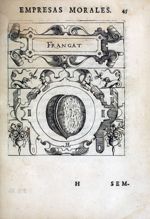
Frangat: Borja, Empresas morales (Bruxelles, 1680), emblem 22 uses the imagery of the walnut
Iconclass: 25G21(WALNUT)(+29) fruits: walnut (+ other parts of plants) 31A2746 breaking something 54A11 Industriousness, Assiduity; 'Assiduità', 'Industria', 'Zelo' (Ripa) 55A12 Reward, 'Praemium'; 'Premio', 'Remuneratione' (Ripa)
Loci Communes: Industria (Industriousness, Application, diligence); Occulta (Hidden things, Choses cachées)
II ix 36 Quis parentem laudabit, nisi infelices filii? Who shall praise a father except children who are failures?
Τίς πατερ᾽ αἰνήσει᾽ εἰ μὴ κακοδαίμονα τέκνα; id est, Quis patrem laudet, nisi proles laudis inanis? Carmen vulgo iactatum de his qui maiorum suorum facinora iactitant, nimirum nihil habentes, quod de se ipsis vere praedicent, cuiusmodi Ponticum quempiam ridet iuvenalis Sat. viii. Sed te censeri laude tuorum, Pontice noluerim, sic ut nihil ipse futurae Laudis agas. Miserum est alienae incumbere famae. Poterit in hanc quoque torqueri sententiam: Impii filii sic laudant parentes, dum illos ceu bonos desiderat populus, quod hos longe deteriores ferre non possit. Id quod nonunquam solet in principibus usu venire, videlicet, ut quem vivum oderant, mortuum probent ac requirant, filii comparatione bonum. Refert & explicat, hoc adagium Plutarchus in vita Arati: Παροιμΐαν τινὰ παλαιὰν ὦ πολύκρατες δείσας, μοι δοκεῖ τὸ δύσφημον αὐτῆς ὁ φιλόσοφος χρύσιππος, οὐχ᾽ ὅν ἔχει πρόπον, ἀλλ᾽ ὡς αὐτὸς ὤλετο βέλτιον εἶναι, διατίθεσθαι, Τις πατέρ᾽ αἰνήσει᾽ εἰ μὴ εὐδαίμονες ιἱοί; Διονυσόδωρος δὲ ὁ τροιζηνΐος ἐξελέγχων αὐτὴν, ἀνεκτίθησι τὴν ἀληθινὴν οὕτως ἔχουσαν, Τίς πατέρ᾽ αἰνήσει᾽ εἰ μὴ κακοδαίμονες ἱοί; Και φησι τοὺς ἀφ᾽ αὑτῶν οὐδένὸς ἀξίους ὄντας, ὑποδυμένους δὲ προγόνων τινῶν ἀρεταῖς, καὶ πλεονάζοντας ἐν τοῖς ἐκείνων ἐπαίνοις, ὑπο τῆς παροιμΐας ἐπιστομΐζεσθαι. id est, Adagium quoddam vetus ô Polycrates, Chrysippus philosophus, infamiam illius ut mihi videtur veritus, non ut habet, sed ut ipsi visum est melius, proposuit: Quis patre laudarit, nisi felices filii? Caeterum Dionysodorus Troezenius redarguens illum, verum proverbium denuo exponit. Id habet ad hunc modum: Quis patrem laudet, nisi proles indiga laudis? Aitque eos qui si suis ipsorum meritis aestimentur, nullius sint precii, caeterum insinuantes sese maiorum suorum quibusdam virtutibus, atque illorum laudibus sese immodice venditantes, hoc proverbio ad silentium adigi. Hactenus Plutarchus. Usurpavit in eundem sensum M. Tullius in Epistolis ad Atticum.
[greek], Who would praise a father except offspring devoid of praise? A line in common circulation with reference to those who boast of the exploits of their ancestors, having of course no achievements of their own which they can honestly recount. The man Ponticus was like that, who is mocked by Juvenal in his eighth Satire: I should be sorry, Ponticus, to see you valued for the reputation of your ancestors, on the understanding that you yourself do nothing that may earn you future repute. It is a wretched thing to lean on the repute of other men.' It will be equally possible to turn it to another sense: bad sons bring credit to their parents, when the people feel nostalgia for the supposed virtues of the older generation because it cannot endure the much greater faults of the younger. This is a not uncommon experience with princes: one who was most unpopular when alive is admired and missed after his death, because in comparison with his son he seems a good prince. This adage is recorded and explained by Plutarch in his life of Aratus: 'Chrysippus the philosopher, my dear Polycrates, transforms an old adage, the critical tone of which frightens him, no doubt from its traditional form to one which he prefers, Who shall praise a father if not successful children? But Dionysodorus of Troezen disagrees with him and restores the proverb to its original form, Who shall praise a father except children who are failures? This is a refutation, he says, of those who are worth nothing themselves and take refuge in the virtues of their forebears, using other men's reputation to advertize themselves.' So Plutarch. It is used in the same sense by Cicero in his Letters to Atticus.
Facsimile: 

Successore noscar: Zincgreff, Emblematum Ethico-politicorum (Heidelberg, 1619), emblem 40 uses the imagery of a sunset to illustrate the adage's moral that we praise what we miss
Iconclass: 31D112 child 42B741 father and child(ren), man and child(ren) (family group) 54FF1 Failure 57B1 Praise, Approbation, Approval; 'Lode' (Ripa)
Loci Communes: Degenerantium in pejus (Degenerating for the worse, Dégénérer en pire)
II ix 37 Nam iam illi non sunt, at qui sunt, mali For they are no longer alive, and those who are alive are no good
Οἱ μὲν γὰρ οὐκ ἔτ᾽ εἰσὶν, οἱ δ᾽ ὄντες κακοί. id est, Partim haud quidem iam sunt: at ii, qui sunt, mali. Dici solitum, ubi quis requirit ea, quae quondam quidem extiterunt, verum temporum culpa perierunt. Veluti si quis inter principes Codros, Camillos, Fabricios, Epaminondas, hac tempestate requirat, aut inter monachos, Paulum, Antonium, Hieronymum, non intempestiviter hoc carmen occinas. Est autem Aristophanis in Ranis, in qua fabula Bacchus inducitur descendens ad inferos, ut Euripidem, aut bonum aliquem poetam inveniret. Apud superos enim neminem reperiri nisi malum.
[greek], For they are no longer alive, and those who are alive are no good. Used normally when someone regrets the loss of things that were once available but have perished by lapse of time. If, for example, he were to look nowadays among princes for men like Codrus, Camillus, Fabricius or Epaminondas, and among monks for a Paul, and Antony or a Jerome, it would not be unreasonable to din this line into his ear. It comes from Aristophanes, from the Frogs, the play in which Bacchus is shown descending to the Nether Regions to find Euripides or some other good poet, for in the upper world only bad poets can be found.
Facsimile:
Iconclass: 54FF13 Regression, Deterioration, Relapse 56BB33 Grumbling, Complaint; 'Pianto', 'Querela' (Ripa)
Loci Communes: Fuerunt non sunt (They were, they are no more, Ils furent, ils ne sont plus)
II ix 38 Quaerendae facultates, deinde virtus Seek riches first, then virtue
Δίζεσθαι βιοτὴν, ἀρετὴν δὲ ὅταν ᾖ βίος. id est, Quaerendus victus, virtus autem, ubi victus adfuerit. Refertur à Diogeniano. Hoc proverbium Horatius sic effert in Epistolis, O cives cives, quaerenda pecunia primum, Virtos post nummos. Per Ironiam autem dictum est. Neque enim hoc sentit Horatius, prius habendam esse rationem facultatum quàm morum. Sed irridet sententiam vulgo decantatam, quam his quoque temporibus plerique parentes liberis suis serio inculcant.
[greek], First seek a livelihood, then virtue when your living is secure. Recorded by Diogenianus. This proverb is expressed by Horace in his Epistles in the words 'Dear fellow citizens, / Seek money first, let virtue wait on coin.' This was of course ironical; it is not really Horace's opinion that riches matter more than character, but he is mocking a view very commonly repeated and even in our own day seriously dinned by many parents into their children.
II ix 39 Qui apud Inferos sunt terniones The triplets that exist among the dead
Τὰς ἐν ᾅδου τρϊακάδας, id est, Qui sunt apud inferos terniones. Hoc adagio ridebantur ii, qui res abditas & abstrusas, curiosa quadam diligentia vestigarent. Non absurde torquebitur in eum, qui nimis anxie vel superstitiose magis arcanarum literarum mysteria rimatur, aut qui Homericas fabulas omneis inanibus allegoriis interpretari conetur, aut Platonicorum & Pythagoreorum numeros explicare laboret. Aiunt terniones apud inferos honoratos esse, ut Hecatae sacros: cui quidem ob id ipsum trigla piscis sacrificatur, & simulacrum eiusdem in triviis constitui mos erat. Ad quod respiciens Vergilius, Tergeminamque Hecaten, tria virginis ora Dianae.
[greek], The triplets that exist among the dead. This adage was used to show scorn for those who with a sort of painstaking industry pursued the thread of things secret and mysterious. It will be far from absurd if turned against a man who with excessive devotion, superstition rather, rummages through the mysteries of Holy Scripture or who tries to interpret all Homer's stories with empty allegories or labours to explain the numerals in Plato and Pythagoras. The number three is said to be highly respected in the Nether Regions as sacred to Hecate, to whom for this same reason the fish called trigla is sacrificed, and it was customary to set up her statue where three roads meet, to which Virgil refers in the line 'And threefold Hecate and the three faces of Virgin Diana.'
II ix 40 Neque quantum lusciniae dormiunt They do not sleep as much as nightingales
Οὐδ᾽ ὅσον ἀηδόνες ὑπνώουσιν. i. Nec quantum lusciniae dormiunt. In eos convenit, qui somni parcissimi sunt. Lusciniae minimum dormire feruntur, vel propter Ityn extinctum vel ob timiditatem. Equidem magis arbitror dictum quod lusciniae vernis mensibus, per omnem ferè noctem perpetuo cantu garriant.
[greek], They do not sleep as much as nightingales, is appropriate for those who can do with very little sleep. The nightingale is said to sleep very little, either from grief for Itys' death, or from timidity. I think the more likely reason for the saying is the fact that in the early summer months nightingales keep on singing practically the whole night long.
Facsimile: 
Iconclass: 25F32(NIGHTINGALE) song-birds: nightingale 11Q31:31B11 mortification of the senses ~ ascetic life❧sleeping in bed
Loci Communes: Diligentiae (Diligence, Diligence)
II ix 41 Cuiusmodi portento me involvit fortuna With what a portent fortune has embroiled me!
Οἵῳ μ᾽ ὁ δαίμων τέρατι συγκαθεῖρξεν. id est, Monstro cui fortuna me implicavit. Trimeter est Catalecticus. Dici conveniet, ubi negocium incidit cum homine moroso, difficilique, cum quo non queas vivere, nec à quo te possis extricare. Carmen sumptum ex tragoedia Philoxeni poetae, apud quem Ulysses inclusus in antro Cyclopis, hoc modo loquitur: Οἵῳ μὲ ὁ δαίμνων τέρατι συγκαθεῖρξεν. Refertur à Zenodoto.
Οἵῳ μ᾽ ὁ δαίμων τέρατι συγκαθεῖρξεν, With what a monster fortune has involved me! (it is a catalectic trimeter). Will be appropriate when one has to do with a person who is difficult and never satisfied, and whom one can neither live with nor get free from. The line is taken from a tragedy by the poet Philoxenus, who puts into Ulysses' mouth, when he is imprisoned in the Cyclops' cave, the words 'With what a monster fortune has involved me!' Recorded by Zenodotus.
Facsimile:
Iconclass: 54F12 Luck, Fortune, Lot; 'Fato', 'Fortuna', 'Fortuna aurea', 'Fortuna buona', 'Fortuna pacifica overo clemente', 'Sorte' (Ripa) 56BB33 Grumbling, Complaint; 'Pianto', 'Querela' (Ripa)
Loci Communes: Infortunii sive exitii (Misfortune or ruin, Malheur ou ruine)
II ix 42 Fixis oculis intueri To gaze fixedly at
Ατενὲς ὁρᾶν. id est, Defixis oculis obtueri. Si transferatur, proverbialis erit figura, nempe pro eo quod est, attentius accuratiusque considerare. Fixius intueri, pressius inspicere. Sumptum est ab animantibus, qui stupentibus, nec usquam dimotis oculis inspiciunt id quo delectantur. Adagium recensetur à Diogeniano. Plutarchus in commentario De audiendo, βαρὺς μὲν γὰρ ὁ ἀκροατὴς καὶ φορτικὸς ὁ πρὸς πᾶν ἄτεγκτος, καὶ ἀτενὴς, τὸ λεγόμενον. id est, Gravis enim auditor ac molestus, qui ad singula stupet, & defixis est oculis, uti dicitur. Marcus Tullius pro Lucio Flacco, Ut totam causam quàm maximè intentis, ut aiunt, oculis acerrime contemplemini.
Ἀτενὲς ὁρᾶν, To gaze fixedly at, if used metaphorically, will become a proverbial formula to express concentrated and meticulous inspection, gazing at some object intently and examining it closely. Taken from lovers gazing with eyes bewitched and unmoving at the object of their delight. The adage is listed by Diogenianus. Plutarch in his essay 'On Listening': For any listener is tedious and ill-bred who listens to everything intently and fixedly, as the phrase goes.' Cicero in the Pro Lucio Flacco: 'So that you scrutinize the whole case with, as they say, the most unwinking eyes.'
Facsimile:
Iconclass: 31A31:52A11 sight, looking (one of the five senses)❧Attention, Concentration
Loci Communes: Diligentiae (Diligence, Diligence)
II ix 43 Pulverem oculis offundere To throw dust in a man's eyes
Pulverem ob oculos offundere dicitur, qui de industria rem obscurat, & adversario iudicium eripit. Traductum videtur à militia. Saepe fit enim ut hostis data opera, pulverem cieat in hostem. Hac arte Sertorius Romanus Cacitanos, (ut Graecus habet Characitanos) quosdam vicit, autore Plutarcho, cuius rei mentionem fecimus in adagio de Caecia nubes attrahente. Utitur hoc proverbio praeter alios divus Hieronymus in Epistolis. M. Tullius gloriatur se in actione quadam iudicibus tenebras offudisse. Est apud Plautum in Milite, simile quiddam de glaucomate oculis oborto.
A man is said to throw dust in someone's eyes who of set purpose makes a question difficult and deprives his adversary of the means of solving it. Drawn clearly from warfare, for it often happens that in war one side deliberately raises a dustcloud to the prejudice of the other. This trick was used by the Roman general Sertorius to defeat a people called the Cacitani (in the Greek text Characitani), as Plutarch tells us, a fact which I have mentioned in the adage about the North-easter gathering the clouds. This proverb is used by, among others, St Jerome in his letters. Cicero boasts of having in one of his speeches thrown dust in the eyes of the jury. There is something like it in Plautus in the Miles about a cataract growing over someone's eyes.
Facsimile:
Iconclass: 25D29 dust (soil type) 31A2741 throwing something 57AA621 Cheat, Deceit; 'Fraude', 'Inganno' (Ripa)
Collectanea (1500): 478
Loci Communes: Caecutientia (Poor eyesight, near-blindness, Mauvaise vue)
II ix 44 Psecas aut ros Drizzle or dew
Ψεκὰς ἢ δρόσος, id est, Psecas aut ros. In crebrius expuentes dictitabatur. ψεκὰς enim aspersio illa, ac velut irroratio vocatur, quoties minutissimis guttulis irrigamur, ut pluvia rori similima. Primitus autem per lusum dictum est in Antimachum Lyricum poetam, quod subinde expuens eos, quibus cum loquebatur, conspergeret. Idem cognominis datum fuit & Olympico cuidam, quem nonnulli putant tulisse legem, ne quem nominatim taxarent poetae: atque ita factum, ut multo quàm prius pauciores accederent ad certamen, & qui prodibant, laudarent, non carperent. Unde huiusmodi delinimenta, ψεκὰς appellata viden-ς tur. Vocantur enim Psecades ancillae, quae delicatarum matronarum capillos medicato fu-ς co conspergunt. Adagium refertur à Diogeniano. M. Tullius in epistolis ad Atticum, Consputare dixit, pro, conviciis levioribus adspergere, nimirum ad hoc alludens adagium.
[greek], Drizzle or dew, was commonly used of those who sputtered when they spoke, for psekas, drizzle, is a word for that sprinkling with a sort of fine spray which we get when very fine drops are falling, a light rain much like dew. Originally this was used in jest of Antimachus the lyric poet, who besprinkled the person he was talking to with his continual sputtering. The same nickname was also applied to a certain Olympicus, who is thought by some to have introduced the law that prohibited poets from criticizing people by name, with the result that there were many fewer competitors than there had been, and those who did compete praised rather than criticized. Hence it seems that the word psekas was applied to blandishments of this type; for serving maids who sprayed scent on the hair of married women living in luxury were called psekades. The adage is recorded by Diogenianus. Cicero in his Letters to Atticus uses 'to besputter' of scattering the milder forms of abuse over one's opponents, presumably with this adage in mind.
Facsimile:
Iconclass: 26B3 dew 31B6235:31A651 speaking❧spittle, spit
Loci Communes: Anceps et dubius (Doubtful and uncertain, Incertain et douteux)
II ix 45 Haesitantia cantoris tussis A singer in difficulties means a cough
Απορία ψάλτου βὴξ, id est, Haesitantia cantoris tussis. Suidas adagium neotericum esse monet. Dictum videtur, quoties non suppetit quod dicamus. idque velut aliud agentes dissimulamus: velut apud Platone Aristophanes, ne diceret in convivio, singultum fingit. Sumptum apparet à cantoribus, qui cum haerent in cantione, tussim simulant, ut hac videatur interrupta cantilena, non inscitia. Confinc puto illi, quod aliâs dictum est: Tussis pro crepitu.
'[greek], A singer in difficulties means a cough. Suidas tells us that this is a more recent adage. It seems to be used when we are short of something to say and try to conceal this by introducing something irrelevant, as Aristophanes in Plato to avoid having to speak at a party feigns the hiccups. Apparently derived from singers who, when they find the music difficult, pretend to cough, so that this and not incompetence may seem to be the reason why they broke off. This is close, I take it, to one I have mentioned elsewhere: A cough for a fart.
Facsimile:
Iconclass: 31A463322 coughing 48C7551 singer without accompaniment 52AA6 Falsehood 52DD1:52CC41 Secrecy, Latency, Concealment; 'Secretezza' (Ripa)❧Error; 'Errore' (Ripa) 57AA611 Dissimulation, Hypocrisy; 'Hippocresia', 'Simulatione' (Ripa)
Loci Communes: Simulatio, dissimulatio (Pretense, dissimulation, Simulation, dissimulation)
II ix 46 Extritum ingenium A worn-out brain
Παρεξηυλημένον νοῦν ἔχων, id est, Mentem habens evandiam. παρεξηυλημένον perinde sonat, quasi dicas extibiatam. Ducta siquidem est metaphora à tibiarum linguis, quae postea quàm exciderint, inutilis est tibia.
[greek], With wits worn out. The meaning of the adjective is exactly what 'played out' would mean if used of an old flute; the metaphor is taken from the tongues of reed pipes, for once they have fallen out, the pipe is unusable.
Facsimile:
Iconclass: 31A22151:54BB6 brains❧Worthlessness
Loci Communes: Senium praematurum aut mors (Premature old age or death, Vieillesse prématurée ou mort); Contemptus et vilitatis (Contempt and worthlessness, Mépris et bassesse)
II ix 47 Panagaea Diana Panagaean Diana
Η παναγαία ἄρτεμις. id est, Panagaea Diana, dicebatur olim, peregrinationem impensius amans, errabundus, instabilis, nulla certa sede consistens. Siquidem Diana vagari dici tur apud poetas, & per nemora montesque oberrare. Quin domicilium etiam subinde mutat, nunc apud superos agens, nunc apud inferos. Ne specie quidem semper eadem, sed nunc pleno orbe, nunc mutila, nunc nulla.
'[greek], Panagaean Diana, was applied in old days to anyone who had an unbridled passion for foreign travel and was always on the move and unreliable, never settling in one definite spot. For Diana is said in poetry to be a wanderer and to stray over forest and mountainside. In fact she even moves her residence from time to time, living now among the gods above and now in the nether world. In appearance too she is not always the same, but now appears full, now incomplete, now not at all.
Facsimile: 
Iconclass: 53AA21 Inconstancy; 'Incostanza', 'Instabilità', 'Instabilità overo Incostanza' (Ripa) 54AA46 Unrest, Restlessness, Inquietude; 'Inquietudine' (Ripa) 92C37 specific aspects, allegorical aspects of Diana; Diana as patroness
Loci Communes: Inconstantiae, perfidiae, versutiae (Inconstancy, treachery, cunning, Inconstance, perfidie, ruse); Aberrandi (Going astray, S'égarer)
II ix 48 Pastillos Rufillus olet, Gorgonius hircum Rufillus reeks of lozenges, Gorgonius of he-goat
Paroemias speciem prae se gerit illud Horatianum in Sermonibus: Pastillos Rufillus olet, Gorgontus hircum. Dicendum vel in duos aliquos diversis laborantes vitiis, vel in eundem sui dissimilem, nempe modo loquaciorem quàm sat sit, modo impendio taciturnum, interdum pueriliter ineptum, interdum Catone severiorem, nonnunquam profusum, nonnunquam sordidum. Siquidem ut vitio dandum, si quis hircum oleat, ita adaeque vituperandum, si quis oleat unguenta. Nam pastilli, pilulae sunt unguentariae. Alterum spurci est, alterum mollis.
There is a proverbial air about that line in Horace, in the Satires: 'Rufillus reeks of lozenges, Gorgonius of he-goat.' It can be applied either to any two men who suffer from opposite faults or to one man who is highly inconsistent, intolerably garrulous at one moment and then plunged in silence, sometimes silly and childish and sometimes grave as any Cato, extravagant one day and mean the next. It is a fault if someone smells of the he-goat, and no less blameworthy if he reeks of perfume (for these lozenges are a sort of pill made up with scent); one is a mark of the unwashed and one of the effeminate.
Facsimile:
Iconclass: 31A331 agreeable smell 31A332 disagreeable, repellent smell 31A5142(LOZENGES) perfumes (LOZENGES) 31A719 womanish man, molly-coddle, milksop 47I221 herding, herdsman, herdswoman, shepherd, shepherdess, cowherd, etc. 52D4 Prolixity, Verbosity, Loquacity; 'Loquacità' (Ripa) 52DD3 Taciturnity; 'Secretezza', 'Secretezza overo Taciturnità' (Ripa) 53AA21 Inconstancy; 'Incostanza', 'Instabilità', 'Instabilità overo Incostanza' (Ripa)
Collectanea (1500): 582
Loci Communes: Contemptus et vilitatis (Contempt and worthlessness, Mépris et bassesse); Differentiae (Differences, Différences); Modestia modusque (Modesty and moderation, Modestie et mesure)
II ix 49 Claudus optime virum agit The lame man makes the best lecher
Αριστα χωλὸς οἰφεῖ., sive, ut aliàs legitur, ὀχεῖ. id est, Optime claudus virum agit, Dici solitum, ubi quispiam suam sortem, vel parum egregiam, anteponit alienae tametsi praestantiori. Ab Amazonum apophthegmate natum aiunt. Tradunt morem Amazonibus fuisse quondam, ut pueros masculos detorta tibia coxáve claudos efficerent. Porrò cum bellum esset illis adversus Scythas, atque illi eas conarentur illicere ut ad sese desciscerent, dicentes futurum ut posthac non cum claudis ac mutilis, sed cum integris vitis rem haberent, Antianira Amazonum dux respondit ad hunc modum: ἄριστα χωλὸς οἰφεῖ. Usurpavit Athenaeus lib. xiii. ὄντως γὰρ ἄριστα χωλὸς οἰφᾷς. id est, Vere enim claudus optime virum agis. Theocritus φιλοίφην appellat virum coitus avidum, Hesychius φίλοιφον dicit. Animadversum est etiam illud nostris temporibus, plerunque qui tibiis sunt mutilis, aut quopiam membro trunci, eos ad usum Veneris reliquis magis idoneos esse, nimirum varia faciente natura. De claudo quare sit salacior caeteris, causam reddit Aristotel. in Problematibus sectionis decimae problem. xxvi. quod in hoc parum alimenti deorsum delabatur, ob crurum vitium, plus autem superiora petat, & in semen vertatur.
[greek], or, as others read [greek]. The lame man makes the best lecher. Customarily used when someone prefers his own lot, though it may be far from grand, to another man's, though it seems preferable. It derives, they say, from a saying of the Amazons. The story goes that the Amazons in old days had a custom of making their male offspring lame by damaging shin or hip. And so, when they were engaged in a war with the Scythians, and the Scythians were trying to induce them to come over to their side, saying that thus they would have fit men for their husbands and not lame and mutilated, Antianira the Amazon leader replied with the words 'The lame man makes the best lecher.' Athenaeus in book thirteen: 'For it is true that you, as a lame man, make the best lecher.' Theocritus calls a man fond of copulation philoiphes, Hesychius philoiphos. The same thing has been observed in our own day: those who have deformed legs or lack some other limb are often sexually more effective than the rest of men, presumably by way of some natural compensation. A reason why a lame man should be more lecherous than others is given by Aristotle in the Problems, section 10 problem 26: in his case 'less nutriment passes downwards owing to his defective lower limbs, and more makes for the parts above them and is turned into semen.'
Facsimile:
Iconclass: 31A415:33C2 crippled❧lovers; courting, flirting 33C41 man and woman cohabiting 33C721 means to preserve potency 57AA51 Licentiousness, Lasciviousness; 'Lascivia', 'Licenza' (Ripa) 95B(AMAZONS)4 aggressive, unfriendly activities and relationships of the Amazons
Loci Communes: Alibi diminutum alibi redditum (Diminished in one place, restored in another, Diminué ici, rendu là); Inconstantiae, perfidiae, versutiae (Inconstancy, treachery, cunning, Inconstance, perfidie, ruse)
II ix 50 Ogygia mala Ogygian disasters
Ωγύγια κακὰ. id est, Ogygia mala. Recte dicentur, vel ingentia vel antiqua. Nam utrunque Graece significat Ogygium. Alii malunt ad Ogygium primum Thebanae civitatis principem referre. Huius filius Cadmus, ob filias suas in varias calamitates incidit. Quò respiciunt qui Ogygia mala, pro atrocissimis interpretantur. Huiusmodi fermè Suidas, nisi quod magis probat, ut Ogygia mala, vetusta dicantur. Caeterum qui Ogygia vetera dicunt, illud sequuntur, quod olim Boeotiorum ac Thebana regio, Ogygia dicta sit. Quin et omnis Attica olim hoc habuit nominis, sicuti testatur Stephanus. Est et insula pervetusta dicta Ogygia, in quam Ulysses naufragus emersisse fingitur ab Homero. Unde vox iam obsoleta velut in iocum proverbialem abiit. Nec in figura sita est huius proverbii ratio, sed in novitate vocis, ut in operis huius initio monuimus. Consimili ratione, nec sine proverbii specie, Graeci priscos ac pervetustos, ὠγενίδας & ὠγενίους appellant, à prisco quopiam deo, & multis iam seculis obsoleto. Huiusmodi propemodum de Ogygiis Suidas & Stephanus.
' [greek], Ogygian disasters, is a suitable name for those which are either huge or ancient, for in Greek the word Ogygia carries both meanings. Some prefer to trace it back to Ogygius, the first prince of the city of Thebes, whose son Cadmus met with various calamities on account of his daughters. People have this in mind when they interpret 'Ogygian' as appalling. Such is very much the view of Suidas, except that he prefers to take Ogygian disasters as meaning very ancient. In any case, those who take 'Ogygian' to mean ancient are guided by the fact that in Antiquity Ogygia was a name for Boeotia and the city of Thebes; in fact, the whole of Attica was once so called, as we learn from Stephanus. There is also a very ancient island called Ogygia, on which Ulysses landed in Homer's tale after his shipwreck, and hence the word, when by now obsolete, came to have a more or less humorous proverbial use. Nor does the basis of this proverb rest on a metaphor; it is the novelty of the word, as I have pointed out at the beginning of my work. On the same principle, and with something of the form of a proverb, old-fashioned and very ancient people are called in Greek Ogenidae and Ogenioi, from some ancient god or other, who has now for many centuries been out of mind. Such, more or less, is the account of things 'Ogygian' in Suidas and Stephanus.
Facsimile:
Iconclass: 51FF51 Oldness 51G1 Largeness, Magnitude 54FF11 Adversity, Misfortune, Bad Luck; 'Fortuna infelice', 'Infortunio' (Ripa) 94I21 Ulysses is kindly received by the nymph Calypso on the island of Ogygia (Homer, Odyssey XII)
Loci Communes: Infortunii sive exitii (Misfortune or ruin, Malheur ou ruine)
II ix 51 Omnia chnaumata Every scrap
Πάντα χναύματα, id est, Omnia chnaumata, dicebant olim, quoties omne negocium significabant. χναύματα enim Graeci placentarum, atque id genus ciborum fragmina vocant. Latini quoque Reliquias belli, & reliquias Danaûm dicunt simili figura. Refertur adagium à Zenodoto.
[greek], Every scrap, was used in old days when they wished to convey the whole of a piece of business; for chnaumata in Greek is a word for the broken remains of cakes and similar edibles. In Latin too they use a similar metaphor when speaking of 'relics of war' or 'relics of the Danaans.' The adage is recorded by Zenodotus.
Facsimile:
Iconclass: 51H1 Totality, the Whole 51HH1 Part, Section, Aspect
Loci Communes: Totum ut nihil reliqui (The whole, so that nothing remains, Le tout, sans rien laisser)
II ix 52 Sic est ad pugnae partes re peracta veniendum That's the way to take part in a battle, when it's all over
Plato in Gorgia, πολὲμου καὶ μάχης φασὶ χρῆναι, ὦ σώκρατες ὅτω μεταλαγχάνειν. id est, Ad belli, pugnaeque munia Socrates sic aiunt accedere oportere. Iocus erat proverbialis, ubi quis negocio peracto, tum demum adveniret. Quemadmodum ignavi milites solent, qui conflictu peracto, sublatoque metu, tum denique solent adesse, vel ad colligendam praedam, vel ad epinicia, id est, epulum victoriale celebrandum. Nam verbum illud μεταλαγχάνειν, tarditatem significat, ac seram muneris functionem. Socrates autem, respondens, paroemiam explicat simili paroemia, ἅρα τὸ λεγομενον, κατοπιν ἑορτῆς ἥκομεν καὶ ὑστεροῦμεν, id est, Num post festum, quod aiunt, venimus, seroque adsumus? Sumptum videtur à Rheso, Thracum duce, quem apud Euripidem obiurgat Hector, quod serius ad belli societatem venisset, nimirum decimo demum anno: Σύμμαχος μὲν οὐ, ξένος δὲ πρὸς τράπεζαν. id est: Socius haud quidem advenis, sed hospes ad mensam, isque respondet, Αλλ᾽ ὕστερον μὲν ἦλθον, ἐν καιρῷ δ᾽ ὅμως. Σὺ μὲν γὰρ ἤδη δέκατον αἱχμάζεις ἔτος, Κοὐδεν περαίνεις. id est: Sero quidem, ast in tempore advenio tamen: Nam tu quidem iam proelians decennium, Nihil explicas. Allusit huc, ni fallor, Diogenes. Quum enim quidam inscripsisset aedibus suis hunc titulum, Iovis filius Callinicus Hercules hic habitat, ne quid ingrediatur mali. Diogenes adiecit aliam inscriptionem, μετὰ πόλεμον ἡ συμμαχΐα, id est, post bellum auxilium. Significans, sero vocari Hereulem depulsorem malorum, cum iam malus hospes immigrasset in eas aedes.
Plato in the Gorgias: 'Why, Socrates, that is how they say one ought to share in fighting a battle.' A humorous comment, made proverbially when someone came on the scene only after the business was concluded, as idle soldiers have a way of doing, whose habit it is not to arrive until the conflict is over and there is nothing more to be frightened of, so as either to collect booty or to celebrate the triumph by sharing in the feast. For the Greek verb used to express sharing conveys a sense of being late, and slow to perform one's part. Socrates in reply fills out the sense of the proverb with another very like it: 'Have I come, as they say, after the feast? Am I too late?' The source seems to be the story of Rhesus, leader of the Thracians, who is rebuked by Hector in Euripides for arriving too late to take his part in the war, no doubt because it was already in its tenth year: 'No ally are you, but a guest in search of dinner.' To which Rhesus replies: Late I may be, but timely none the less, / You have been fighting now for ten long years, / And make no progress.' This was alluded to, if I am not mistaken, by Diogenes. When someone had put up on his house an inscription which ran 'Here dwells Hercules, victorious son of Jove. Here let no evil enter,' Diogenes added another sentence: 'Allies the day after the battle,' his point being that it was too late to invite Hercules as an averter of evil, when a very evil stranger was already installed in the house.
Facsimile: 
Iconclass: 33B3:45I fighting❧after the battle 51FF52 Lateness 51MM11 Slowness, Tardiness; 'Tardità' (Ripa)
Collectanea (1500): 507
Loci Communes: Tarditatis et cunctationis (Slowness and delay, Lenteur et retard)
II ix 53 Obsequium amicos, veritas odium parit Flattery wins friends and truth engenders hate
Obsequium amicos, veritas odium parit. Senarius est proverbialis apud Terentium in Andria, non admonens, quid oporteat fieri, sed ostendens, quid vulgo fiat. Vulgaris enim amicitia constat obsequiis. Nam, invicem connivere ad familiarium vitia, Haec res & iungit, iunctos & servat amicos. At inter veros amicos, nihil est veritate iucundius, modo absit asperitas agrestis & inconcinna gravisque. Porrò qui vulgo plurimis studet amicus esse, moribus alienis obsecundet, caveatque iuxta Persium: Auriculas teneras mordaci radere vero. Non probari vero sententiam hanc poetae, satis indicat cum ait: Nanque hoc tempore, id est, his corruptis moribus. Eandem sententiam in Adelphis idem aliter extulit. Ut homo est, inquiens, ita morem geras. Donatus admonet proverbialiter dictum. M. Tullius in Sermone De amicitia: Sed nescio quomodo verum est, quod in Andria familiaris meus Terent. dixit: Obsequium amicos, veritas odium parit. Molesta veritas est, siquidem ex ea nascitur odium, quod est venenum amicitiae, Sed obsequium multo molestius, quod peccatis indulgens, praecipitem amicum ferri sinit. Maxima autem culpa in eo est, qui & veritatem aspernatur, & in fraudem obsequio impellitur. Pindarus in Nemeis quinto, οὔτοι ἅπασα κερδίων φάνουσα πρόσωπον ἀλάθει᾽ ἀτρεκὴς. καὶ τὸ σιγᾶν πολλάκις ἐστὶ σοφώτατον ἀνθρώπων νοῆσαι. i. Sentit simplicem veritatem, non semper, ut est, proferendam, quod damnosa sit: sed sapientis esse nonnunquam celare suam sententiam, in tempore prolaturus, quum fructus spes ostenditur. Apud Athenaeum libro quinto, citatur hic trimeter ex Agathone, Εἰ μὲν φράσω τᾀληθὲς, οὐχί σ᾽ εὐφρανῶ, Εἰ δ᾽ εὐφρανῶτι σ᾽, οὐχὶ τᾀληθὲς φράσω. id est, Si vera dicam, tibi voluptati haud ero. Si sim voluptati, haud tibi vera dixero.
A proverbial iambic line from the Andria of Terence, which does not so much suggest what ought to happen as tell us what happens as a rule; for among common people friendship consists of civilities. To turn a blind eye mutually to the faults of your acquaintance - "tis this joins friend to friend and keeps them joined.' Among true friends, on the other hand, nothing gives greater pleasure than the truth, provided there is none of the boorish asperity which is ill-timed and may give offence. In fact, the man who is anxious as a rule to make as many friends as possible must fall in with other men's dispositions, and be careful, in Persius' words, not to 'grate on delicate ears with the harsh truth.' That the poet does not approve of this maxim is made clear enough by his saying 'For nowadays,' meaning By the corrupt standards of our generation. The same principle is expressed by him in another way in the Adelphoe, where he says 'As a man is, so must you humour him.' Donatus tells us this is a proverbial saying. Cicero in his dialogue On Friendship: 'But somehow there is truth in what my favourite Terence says, that "flattery wins friends and truth engenders hate.'" Truth can be tiresome, for it is a source of hatred, which in friendship is a deadly poison; but flattery is much more so, because by its indulgence to the faults of a friend it allows him to be swept away headlong. But the fault lies principally in the man who both rejects the truth and is driven into deception by flattery.' Pindar in the fifth hymn of his Nemeans: 'It is not every truth that is the better for showing its face without disguise, and silence is often the best thing for a man to have in mind.' His point is that the plain truth should not always be put forward as it really is, because it can do harm; but it is the part of a wise man to conceal his opinion sometimes, with the intention to put it forward later, when some hope appears that it may be fruitful. In Athenaeus, book 5, the following iambic line is cited from Agathon: 'If I speak the truth, I shall give you no pleasure; And if I am to please you, I shall not speak the truth.'
Facsimile:
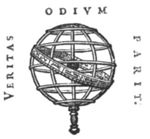
Veritas odium parit: Printer's device 0855
Iconclass: 52A6:56FF2 Truth; 'Verità' (Ripa)❧Hate; 'Odio capitale' (Ripa) 57AA6121:56F23 Flattery; 'Adulatione' (Ripa)❧Friendship; 'Amicitia' (Ripa)
Collectanea (1500): 224
Loci Communes: Libertas, veritas (Freedom, truth, Liberté, vérité)
II ix 54 Obviis ulnis With open arms
Obviis ulnis, est apud Quintilianum, pro eo quod est, avide, sitienterque. Translatum ab iis qui porrectis ulnis properant in complexum eorum, quorum magno desiderio tenebantur, quosque cupidissime conspiciunt. Legimus & Obviis manibus. Divus Hieronymus ad Pammachium, Condiscipulum quondam, & sodalem & amicum, obviis, ut aiunt, manibus excipio. Basilius in praefatione dialogi, ἀμφοτέραις χερσὶν , id est, Ambabus manibus, eodem sensu scripsit. Haec si ad rem animi detorqueantur, figuram proverbialem habebunt: ut, Ego tuas literas obviis ulnis excipiam.
Obviis ulnis, With open arms, is found in Quintilian in the sense of eagerly or greedily. The image derives from people hastening with arms outstretched to embrace some person whom they longed for and whom they see with the greatest delight. We also find it in the form With outstretched hands, obviis manibus. St Jerome writing to Pammachius: 'My former fellow-student and companion and friend I welcome, as they say, with outstretched hands.' Basil in the preface to his Dialogue writes With both hands in the same sense. If these are adapted to the things of the mind, they will have a proverbial air, as for instance 'I shall receive your letter with open arms.'
Facsimile:
Iconclass: 31A2511(+911) arm raised upward (+ saluting, showing reverence) 31A2513(+911) arm stretched sidewards (+ saluting, showing reverence) 33A14 embracing each other, kissing 33A53 arm in arm (friends)
Collectanea (1500): 768
Loci Communes: Libenter (Willingly, Volontiers)
II ix 55 Oblivionis campus Oblivion Fields
Λήθης πεδίον. i. Lethes campus. Dicetur vel de vehementer obliviosis, vel de rebus commenticiis ac frivolis, quae nusquam sint. Aristophanes, τίς εἰς τὸ λήθης πεδίον; id est, Quis in Lethes campum? Vulgus enim nugas esse credit, quae de inferis tradunt poetae. Et, ut Iuvenalis inquit, Stygio nigras in gurgite ranas, Nec pueri credunt.
[greek], The plain of Lethe, will be used of those who are very forgetful, or of imaginary and frivolous things which do not exist anywhere. Aristophanes: 'Who's for the Plain of Lethe?' For the common people regard what the poets tell us about the Nether Regions as mere fable, and, in Juvenal's words, 'that there are black frogs in the pools of Styx / Even a child refuses to believe.'
II ix 56 Omnia sapientibus facilia To the wise all things are easy
Απαντα τοῖς σοφοῖσιν εὔκολα. id est: Facilia cuncta sunt viris sapientibus. Nihil est tam arduum, quod prudenti consilio non facile conficiatur. Aut, Nihil tam acer bum, quod sapiens non aequo animo, facileque ferat, ratione cuncta leniente. Si addas verbum, constabit senarius, Εστι δ᾽ ἅπαντα. Refertur à Zenodoto.
[greek], All things are easy to men who are wise. Nothing is so hard that care and prudence may not accomplish it easily; or, nothing so painful that a wise man cannot endure it easily and with resignation, for reason makes all things less hard. The addition of one word will make an iambic line: [greek]. Recorded by Zenodotus.
Facsimile: 
Iconclass: 51C2 Necessity, Inevitability; 'Necessità' (Ripa) 52A51 Wisdom; 'Sapienza', 'Sapienza humana', 'Sapienza vera' (Ripa) 54A44 Patience; 'Patienza' (Ripa) 54D4 Facility
Loci Communes: Prudentia (Prudence, Prudence); Aequanimitas (Equanimity, Équanimité)
II ix 57 Omnia esculenta obsessis The besieged find all things edible
Απαντα γὰρ τοι βρωτὰ πολιορκουμένοις. id est, Cinctis ab hoste vesca sunt, & quaelibet. Senarius proverbialis, cum urget necessitas, nihil non facimus. Et vehementer famelicis nullus non suavis est cibus. Natum ab urbium obsidionibus, in quibus nonnunquam & canes & feles, herbarum radices, nonnunquam humana excrementa, inopia cibi devorantur.
[greek], To those besieged all things may serve as food. A proverbial iambic line: when driven by necessity, we can do anything. To those who are really hungry, no food is uneatable. This took its rise from cities in a state of siege, where sometimes even dogs and cats, the roots of plants, and now and again human excrement, are devoured for want of food.
II ix 58 Omnia similia They're all the same
Απανθ᾽ ὁμοια καὶ ῥοδῶπις ἡ καλή. id est: Simila cuncta, Rhodopis ipsa etiam decens. Eadem est conditio mortalium, formosi pariter ac deformes senescunt, ac moriuntur. Rhodopis nomen est puellae cuiuspiam formae celebris, cui nomen à roseo adspectu videtur inditum. De Rhodope meretricula multa Herodotus lib. ii. nonnulla Plinius libro xxxvi. cap. xii. Cum Graecum carmen habeat ῥοδῶπις, mirum cur Iuvenalis corripuerit: Dum Rhodopes uda terit inguina barba. Refertur à Suida proverbii loco.
Απανθ᾽ ὁμοια καὶ ῥοδῶπις ἡ καλή, Lovely Rhodopis too, they're all the same. Our mortal condition is the same for all: lovely and unlovely alike, all grow old and die. Rhodopis is the name of a girl famous for her beauty, so called, it would appear, from her rosy complexion. Of a courtesan called Rhodope, Herodotus has much to say in his second book, and Pliny something in book 36 chapter 12. As the Greek line gives the name the second 0 long, it is surprising that Juvenal should shorten this: 'Rubs Rhodope's privates, dribbling down his beard.' Recorded by Suidas as a proverb.
Facsimile:
Iconclass: 51B3:51FF5 Parity, Equality❧End; 'Fine' (Ripa) 54F122 Vicissitudes of Life 51FF5:51D4 End; 'Fine' (Ripa)❧Beauty; 'Bellezza' (Ripa) 98C(RHODOPIS) the courtesan Rhodopis
Loci Communes: Vita hominis misera et brevis (The life of man, wretched and short, La vie de l'homme, misérable et brève); Aequalitas (Equality, Égalité)
II ix 59 Totus echinus asper A sea-urchin is rough all over
Απας ἐχῖνος τραχὺς. i. Totus echinus asper. In morosos & iniucundis moribus quadrat. Echinus piscis, & item erinacius undique spinis obseptus est, ut nusquam impune possis attingere. Est et hominum huiusmodi genus, cum quibus nulla ratione possis agere citra litem. Aristophanes in Pace, Οὐ δέ ποτ᾽ ἂν θείης λεῖον τὸν τραχὺν ἐχῖνον. id est: Ex scabro in levem nunquam vertetur echinus.
[greek], A sea-urchin is rough all over, is suitable for men who are unpleasant and hard to please. The sea-urchin, and in the same way the hedgehog, is covered with spines all over, so that you cannot touch it anywhere without being hurt. There are men like that, with whom it is impossible to do business on any terms without a quarrel. Aristophanes in the Peace: 'Never will you make the rough sea-urchin smooth.'
Facsimile:
Iconclass: 25F74(SEA-URCHIN) echinoderms: sea-urchin 51GG6 Roughness
Loci Communes: Asperitas, morositas (Harshness, moroseness, Rudesse, morosité)
II ix 60 Omnia bonos viros decent Everything comes well from a good man
Απαντα τοῖς καλοῖσιν ἀνδράσιν πρέπει. id est, Bonos probosque cuncta perdecent viros. Habet hoc improbitas, ut si quis illaudatus, recte faciat dicátve, tamen nescio quo pacto non adsit decorum illud: Contrà veram virtutem decus quoddam comitatur, ut quicquid vir bonus agat, id decorum esse videatur. Tametsi potest & hic accipi sensus. Cuncta formosos viros decent, quod formae gratia commendat & dicentem & canentem, & quidvis agentem. Id erit venustius si huc deflectat, ut dicas In bonam partem accipi, laudarique, quicquid dixerint fecerintque gratiosi apud principes: adeo, ut quod huic capitale sit futurum, illi laudem etiam pariat. Refertur à Diogeniano.
[greek], Good men and true seem to do all things well. It is typical of a bad character that even if a man of ill repute does or says something good, somehow or other he gets no credit for it. True goodness, on the other hand, has some quality about it such that, whatever a good man does, seems to be admirable. Though one could also take the meaning to be that everything comes well from handsome men, because his good looks ensure a kind of reception for a handsome man when he speaks or plays music or does anything whatever. This will have more point if you turn it to mean that those who enjoy the favour of princes are sure of a favourable reception, whatever they may say or do, so much so that what would cost one man his life will actually win praise for another. Recorded by Diogenianus.
Facsimile:
Iconclass: 52AA553 Prejudice, Bias 54A5 Goodness; 'Bontà' (Ripa) 54AA5 Badness
Loci Communes: Fuerunt non sunt (They were, they are no more, Ils furent, ils ne sont plus)
II ix 61 Omitte vatem Hands off the holy man
Πάρες τὸν μάντιν. id est, Omitte vatem. Uti conveniet, quoties alicui parcendum admonebimus, quod is eximius sit, & immunis habendus à vulgari sorte. Veluti si quis poetae, theologo, sacerdoti diceret, oportere parci. Antiquitus mos erat, ut augur coronatus ante aciem incederet: neque fas erat, hunc telis impetere, utpote virum sacrum. Poterit adagium etiam per ironiam usurpari.
[greek], Leave the seer alone, will be suitable for use when we wish to convey that someone should be spared because he is a special person who should be protected from the common lot of men; for instance, if one were to say that a poet, a theologian, or a priest ought to have special consideration. It was the custom in Antiquity to send out an augur, wearing a garland, in front of an army advancing to battle, and it was unlawful to aim a weapon at him, because he was a holy man. The adage can also be used ironically.
Facsimile:
Iconclass: 12B52 seer, prophet ~ non-Christian religions 54E42 Protection; 'Custodia', 'Difesa contra nimici, malefici & venefici', 'Difesa contra pericoli', 'Riparo da i tradimenti' (Ripa)
Loci Communes: Internitio (Utter destruction, Extermination totale)
II ix 62 Oderint, dum metuant Let them hate, so long as they fear
Oderint, dum metuant, Tyrannica vox, sumpta è tragoedia, et à nemine scriptorum non usurpata: praecipue M. Tullio familiaris: quam etiam in vulgi sermonem processisse, satis indicat Seneca lib. de Clementia ii. scribens multas voces, magnas, sed detestabiles, in vitam humanam pervenisse, celebresque vulgo fieri, ut illam: Oderint, dum metuant. Cui Graecus, inquit, versiculus similis est, qui mortuo terram misceri ignibus iubet. Idem libro De ira i. Nam aliquae voces ab iratis emittuntur, quae magni videantur animi, verum ignorantibus magnitudinem: qualis illa dira & abominanda, Oderint dum metuant, Syllano scias seculo scriptam. Licebit adagium per iocum usurpare: veluti si quis eruditione superior, de clanculariis hostibus, qui tamen ob metum hiscere non audeant, dicat, Oderint dum metuant, Conveniet & in divites, qui dicunt illud Horatii: Populus me sibilat, at mihi plaudo Ipse domi, simalac nummos contemplor in arca. Item illud Iuvenalis, Tunicam mihi malo lupini, Quam si me toto laudet vincinia pago.
'Let them hate, so long as they fear,' an utterance typical of any tyrant, comes from a tragedy, and every author quotes it. A special favourite with Cicero, it also passed into common use as a proverb, as is made clear enough by Seneca in his On Clemency, book 2, where he says that 'many powerful but detestable sayings touch human life, and become popular, such as that famous "Let them hate, so long as they fear." And there is a Greek line,' he says, 'similar to this, which calls for fire on the earth as soon as the speaker is dead.' Seneca again in the first book of his On Anger: 'For some sayings are uttered by angry men which are thought to be products of great courage, but only by those who do not know true greatness when they see it, such as those dire and dreadful words "Let them hate so long as they fear." You may be sure they were written in the days of Sulla.' It will also be possible to make a humorous use of the adage, for example, if a scholar of distinction were to say of the secret enemies who are too much frightened to utter a word against him 'Let them hate, so long as they fear.' And it will be appropriate for rich men who use language like Horace's "The public hiss me, but I enjoy my own applause, when I get home and contemplate the coin in my money-bags.' And those words of Juvenal: 'I'd rather keep my pea-pods to myself / Than have the praise of the whole countryside.'
II ix 63 Odit cane peius et angue Hates worse than dog and snake
Proverbiali figura dictum est & illud ab Horatio, Alter Mileti textam cane peius & angue, Vitabit chlamydem. Sentit autem, ut opinor, de cane rabiente. Quod si longius etiam traducatur, magis erit proverbiale, ut, Hic totus lucris addictus est, literas, quas amavit aliquando, nunc, quod aiunt, vitat cane peius & angue. Vel, Hic se totum adulatoribus permittit amicos, à quibus verum audiat, vitat cane peius & angue. Idem Horatius in Odis, Cur olivum Sanguine viperino Cautius vitat. Plautus in Mercatore, Nempe ruri uxor est tua, quam dudum dixeras Te odisse aeque atque angues.
There is a proverbial formula again in those words in Horace: 'One of the two will shun worse than dog and snake a cloak woven in Miletus.' He is thinking, I suppose, of a mad dog. If it is applied in a still more remote context, it will be more proverbial: for instance, 'This man is entirely devoted to making money; the studies which he loved at one time he now shuns worse, as they say, than dog and snake,' or 'He puts himself entirely in the hands of toadies, and friends, from whom he might learn the truth, he shuns worse than dog and snake.' Horace again in the Odes: Why does he shun the olive oil with greater care than viper's blood?' Plautus too in the Mercator. 'Your wife is in the country, whom you said long since you hate as much as any snake.'
II ix 64 Stultior Coroebo As foolish as Coroebus
Ηλιθιώτερος κοροίβου. i. Stultior Coroebo. Proverbialis hyperbole in stupidos & vecordes. Coroebi stultitia vulgi fabula celebrata est, qui maris undas numerare sit conatus, cum non potuerit ultra quinque prosequi supputationem. Meminit huius Eustathius in decimum Odysseae, & Lucianus in Amoribus. Quanquam apud alios κορύβου, lego per y. Adduntque quidam Corybum hunc Mygdonis Phrygis fuisse filium, temporibus belli Troiani. Meminit & Virgilius Coroebi cuiusdam: Iuvenisque Coroebus Venerat insano Cassandra captus amore, Et gener auxilium Priamo Phrygibusque ferebat. Quo quidem in loco Servius indicat sumptum ex Euphorione. Hunc, inquit, Coroebum stultum inducit Euphorion, quem & Vergilius sequitur, dans ei, Dolus an virtus, quis in hoste requirat? Cum sit turpissima dolo quaesita victoria.
'[greek], As foolish as Coroebus. A proverbial exaggeration for stupid people and blockheads. Coroebus' stupidity gave rise to a popular proverb; he tried to count the waves of the sea, though he could not count beyond five. He is mentioned by Eustathius in his commentary on the tenth Odyssey, and by Lucian in the Amoves. Though in other places I find Corybus written with an upsilon; and some add that this Corybus was the son of Mygdon the Phrygian, in the period of the Trojan war. Virgil also mentions a certain Coroebus: 'And young Coroebus had come, in thrall to a mad passion for Cassandra, and brought what help he could to Priam, his wife's father, and the Phrygians.' Servius on this passage indicates that this is taken from Euphorion. 'This Coroebus' he says 'is introduced as a fool by Euphorion, and Virgil too follows this, when he makes him say "By fraud or valour? In a foe who cares?" though a victory won by fraud is highly disgraceful.'
Facsimile: 
Dolus an virtus quis in hoste: Meisner, Politica Politica (Nürnberg, 1700), emblem 484 quotes the comment
Iconclass: 52AA1 Stupidity, Poverty of Intellect; 'Stupidità overo Stolidità' (Ripa) 82A(COROEBUS) male literary characters (COROEBUS)
Loci Communes: Multi - in stupidos (Many people - against the stupid, Beaucoup de gens - contre les sots)
II ix 65 Stupa seniculus An old man is but chaff
Στυπεῖον γερόντιον. i. Stupa sive stipulaceus seniculus. De viribus effoeto sene. Similimum illi quod alio diximus loco, Homo bulla. Sumptum à ligno, quod iam exaruit, exsuccumque redditum est & marcidum, in stipulae morem. Stupa dicitur, quod è lino excutitur siccum & inutile.
[greek], An old man is only chaff or straw. Of one whose years have taken all his strength. Very much like that proverb of which I have spoken in another place, Man is a bubble. Taken from wood which has already dried out and lost its sap, and become limp like straw. Stupa chaff, is the word for the dry and useless stuff that is beaten out of flax.
Facsimile:
Iconclass: 31D16 old man 31D920 'Velocità della vita humana', 'Vita breve' (Ripa) 47I17(CHAFF) agricultural products and by-products (CHAFF)
Loci Communes: Vita hominis misera et brevis (The life of man, wretched and short, La vie de l'homme, misérable et brève)
II ix 66 Phormionis thori Phormio's camp beds
Στιβάδες φορμΐωνος. i.Tori Phormionis. De stratis sordidis ac frugalibus, minimeque delicatis, qualia sunt cubilia militaria, & quale sibi apud Homerum parat Ulysses, ex arborum congestis frondibus, ac ramis humi substratis. Refertur à Suida. Phormio dux quispiam militum fuit, in perferendis militiae in commodis notae, sicut coniicio, patientiae. Poterit & longius deflecti ad quamvis tractationem duriusculam. Extar in Pace Aristophanis, Εἰ γὰρ μοι γένητ᾽ ἰδεῖν ταύτην ἡμέραν ποτέ, Πολλὰ γὰρ ἠνεσχόμην Πράγματά τε καὶ στιβάδας, ἅς ἔλαχε φορμΐων. id est, Utinam mihi contingat videre hunc diem. Multas enim sustinui tum molestias, tum culcitras quas sortitus est Phormio. Versus sunt chorici, eoque prosa vertimus.
[greek], Phormio's camp beds, was used of mean and frugal bedding with nothing of comfort about it, like the way soldiers sleep, or like the bed Ulysses makes for himself in Homer by collecting the leaves of trees and making a pile of branches on the ground. This is recorded by Suidas. Phormio was a general who showed, I take it, notable endurance in sharing the hardships of his men. It can also be diverted further to any form of rather rough treatment. It comes in the Peace of Aristophanes: 'If ever I might live to see that day! Many are the troubles I have endured, the camp beds such as Phormio had.' These lines are sung by the chorus, and I have therefore translated them in prose.
II ix 67 Stultitia est Jovem putare esse It's folly to believe that Jove exists
Τῆς μωρΐας, τὸν δία νομΐζειν ὄντα τηλικουτονί, id est, Inscitia est, natum tot annos, credere esse ullum Iovem. In eum accommodari potest, qui grandis natu, dicit, aut sentit absurdum quippiam, cum propter aetatem nihil oporteat iam ignorare. Non convenit enim in natu grandes puerilis superstitio. Recensetur à Suida. Carmen est Aristophanis in Nubibus, Ιδούγ᾽ ἰδοὺ δί᾽ ὀλύμπιον, τῆς μωρίας Τὸν δία νομΐζειν ὄντα τηλικουτονι. id est: Ecce, ecce Olympium Iovem, dementia est, Natum tot annos credere esse ullum Iovem.
[greek], What folly, at his age to believe that Jove exists! This can be adapted to anyone who, though quite grown up, says or thinks something absurd when, being of full age, he ought no longer to show ignorance of anything; for childish superstition does not sit well on mature years. Listed by Suidas. There is a line of Aristophanes in the Clouds: 'Look, look! Olympian Jove! What a piece of folly! / A man of his age to believe in Jove!'
Facsimile:
Iconclass: 51A1:92B1 Existence❧(story of) Jupiter (Zeus) 52AA51 Folly, Foolishness; 'Pazzia', 'Sciocchezza', 'Stoltitia' (Ripa) 52BB53 Nonsense, Absurdity
Loci Communes: Multi - in stupidos (Many people - against the stupid, Beaucoup de gens - contre les sots)
II ix 68 Tuum tibi narro somnium I tell you your own dream
Τὸ σὸν ὄναρ σοι διηγοῦμαι. i. Tuum somnium tibi narro. id est, Narro tibi quod ipse me rectius nosti. Apud Suidam haec referuntur ex autore quopiam, Εἰ γὰρ ἐγώ σοι νῦν αὐτὸν γνωρίζω, πέπονθα τῆς παροιμίας, τὸ σὸν ὄναρ σοι διηγούμενος. Quod si te tibi ipsi notum reddere coner, tum mihi acciderit id quod proverbio dicitur, ut tuum tibi somnium narrem. Plato li. De Repub. octavo, Τὸ ἐμόν γ᾽ ἔφη ἐμοὶ λέγεις ὄναρ. id est, Meum quidem, inquit, mihi narras somnium. Traductum videtur ab his, qui ὀνειροπόλους, id est, somniorum interpretes consulunt. A quibus nonnulli hoc quoque requirunt, ut quid somniarint coniiciant, quasi parum sit si interpretentur. Ad eum modum aegroti quidam imprudentes à medicis expectant, ut viso duntaxat lotio divinent & sexum, & aetatem, & omnem morbi naturam, ubi & unde acciderit, quid sentiant: ac propemodum etiam, quid in febri somniarint.
[greek], I tell you your own dream - I tell you, that is, something you yourself know better than I do. In Suidas there is a quotation from some author or other: 'For if I try now to make you known to yourself, I shall be in the state of the man in the proverb, telling you your own dream.' Plato in book 8 of the Republic: 'You tell me, he said, one of my own dreams.' A metaphor, clearly, from people who consult a professional interpreter of dreams, for some of them expect to be told what they have dreamed, as though to have it interpreted was not enough. In the same way there are some invalids who unwisely expect the physicians, after merely inspecting their water, to infer their sex, their age, the whole nature of their disease and when and how they caught it and how they feel and almost, on top of that, their feverish dreams.
Facsimile: 
Iconclass: 31B34 interpreting a dream 52C4 Understanding, Comprehension; 'Apprehensiva' (Ripa)
Loci Communes: Absurda, indecora, seu praepostera (Absurd, unbecoming, or preposterous things, Choses absurdes, inconvenantes ou déplacées)
II ix 69 Sponsi vita A wooer's life
Νυμφίου βίος. i. Sponsi vita, pro molli ac delicata. Confine illi, quod alibi relatum est, Musica vira. Suidas senarium hunc adducit, qui extat apud Aristophanem in Avibus: Υμεῖς μὲν ἄρα γε ζῆτε νυμφίου βίον. id est, Sponsi quidem profecto vitam vivitis, Propterea quod proci frondibus & sertis coronari soleant, & delicatius nitidiusque coli, vel quod molles videantur, nuptiis inhiantes. Apud Athenaeum lib. octavo Stratonicus citharoedus Rhodios λευκοὺς κυρηναίους καὶ μνηστήρων πόλιν. i. Albos Cyreneos & procorum civitatem appellat. Nisi malumus ad Homericos illos Penelopes sponsos referre, quibus nihil cordi erat praeter convivia, citharam, choream, talos, discum, parasitos, atque id genus alias voluptates. Unde Horatius Homines luxui deditos, sponsos Penelopes appellat.
[greek], A wooer's life, for a life of fastidious luxury. Related to one I have recorded elsewhere, A life of pure music. Suidas cites this line, which comes from Aristophanes in the Birds: 'I take it, you must live a wooer's life,' because wooers commonly wear garlands of leaves and flowers and are smart and well turned out, or because they seem unmanly, being so passionately set on marriage. In Athenaeus, book 8, Stratonicus the harp-player used to call the Rhodians 'Cyrenaeans with white skins,' and 'a city of wooers.' Unless we would rather refer this to Penelope's famous suitors in Homer, who thought of nothing but feasting, harp-music, dancing, dice, throwing the discus, jesters and other such amusements, which led Horace to call men devoted to luxury 'suitors of Penelope.'
Facsimile:
Iconclass: 33C2 lovers; courting, flirting 33C8110 'Libidine', 'Voluttà' (Ripa) 57AA51 Licentiousness, Lasciviousness; 'Lascivia', 'Licenza' (Ripa) 94I3 Penelope, Telemachus, and the suitors (Homer, Odyssey I-IV)
Loci Communes: Intemperantia, libido (Intemperance, lust, Intempérance, désir)
II ix 70 Et fama fuit eras et eras So ran the tale, and such you were
Η μὲν κλέος, ἠδὲ καὶ ἦσθα. id est, Et dicebaris erasque. Hemistichion proverbiale, quoties facta respondent opinioni. Suidas meminit è poeta quopiam. Est enim fragmentum carminis Heroici.
'[greek], Such you were called and such you were, is a proverbial half-line, for use when things answer our expectations. Suidas mentions it, and draws on some poet or other, for it is a fragment of a hexameter line.
Facsimile:
Iconclass: 54E32:52B3 Compliance❧Expectation
Loci Communes: Libertas, veritas (Freedom, truth, Liberté, vérité)
II ix 71 Innocuus alium aspiciam meum habentem malum Unhurt I shall watch another man enduring my trouble
Εξάντης λεύσω τοὐμὸν κακὸν ἄλλον ἔχοντα. id est, Indemnis spectabo alium mala nostra ferentem. Hoc est, ex aliorum malis ipse rebus meis consulam. ἐξάντης, autem dixit, quasi ἔξω τῆς ἄτης. id est, extra noxam situs & illaesus. Similimum illi Plautino, Feliciter sapit, qui alieno periculo sapit.
'[greek], Unharmed I'll see another bearing my burdens -I shall learn, that is, from other men's misfortunes how to govern my own affairs. He uses the word exantês, unharmed, as the equivalent of exô tês atês, placed outside disaster, and so unhurt. It is very close to that line in Plautus 'Happy is he who learns wisdom at another's cost.'
Facsimile:
Feliciter sapit, qui alieno periculo sapit: Meisner, Politica Politica (Nürnberg, 1700), emblem 109 quotes ad adage from the comment
Iconclass: 54A31 Experience, Mastery; 'Esperienza' (Ripa) 54D5 Safety 54FF11 Adversity, Misfortune, Bad Luck; 'Fortuna infelice', 'Infortunio' (Ripa)
Collectanea (1500): 551
Loci Communes: Alieno periculo (At another's risk, Au risque d'autrui)
II ix 72 Simul et dictum et factum No sooner said than done
Αμ᾽ ἔπος, ἄμ᾽ ἔργον. i. Simul dictum, simul & factum. Ubi quis citra moram id re praestat, quod verbis pollicetur. Latini, Cum dicto, dicunt, pro eo quod est, statim postea quàm dixeris. Et Virgilius, Et dicto citius tumida aequora placat. Sumptum apparet ex Homero, apud quem est hoc carmen, Αὐτικ᾽ ἔπειθ᾽ ἅμα μῦθος ἔην, τετέλεστο δὲ ἔργον. id est, Mox simul ac dictum est verbum, res ipsa peracta est. Idem Graecis dicitur unica voce, αὐτοβοεὶ, quod à militari clamore translatum videtur, quo nonnunquam funditur hostis priusquàm ad manus fuerit ventum. Sic usus Thucydides. Theopompus usus est, pro κατα κράτος. id est, vi ac virtute, non ex insidiis. Quisquis enim insidias molitur hosti, silet: qui fidit viribus suis, cum clamore irruit in hostem. Quidam putat dictum à bubus, ut deductum videatur ab arantibus, qui quum pollicentur se eodem die, id est, αὐτῆμαρ aliquid operis absoluturos, dicere solent αὐτοβοεὶ, hoc est, priusquam disiungam boves. Transfertur ad cuiuslibet actionis celeritatem, ut perinde valeat, atque παραχρῆμα, αὐτόθεν.
[greek], No sooner said than done, when a man actually does without delay what he promises verbally. In Latin they say cum dicto, On the word, to mean immediately after the word has been uttered. Virgil has 'Swifter than speech he calmed the swelling waves,' which is clearly taken from Homer, who has the line 'At once the word was spoken and the deed was done.' Greek gives the same meaning in a single word autoboei, with the shout, which looks like a metaphor from the shouting of soldiers, by which the enemy is sometimes put to flight even before battle has been joined. It is so used by Thucydides. Theopompus has it in the sense of 'with all one's might,' and not from ambush. The man who lays an ambush for his enemy does so in silence; the man who trusts in his own strength charges down with shouts upon the foe. Some think it derived from boes, the word for oxen, so that it would look like a reference to ploughmen who, when they promise to finish a piece of work autêmar, on the same day, often use the word autoboei, with the same pair of oxen before they unyoke them. It can be adapted to the rapid performance of any action, so that it has the same value as parachrema or autothen, immediately.
Facsimile:

Tumida aequora placant: Oppelt, Sammlung geist-und sinnreicher Gedancken (Prague, 1749), emblem 32 quotes the comment
Tumida aequora placat: Mayer, Vortrefflich-hoch-adeliches Controfeé (Vienna, 1709), emblem 12
Iconclass: 31B6235 speaking 51F52 Earliness 51M11:54D2 Swiftness, Speed; 'Agilità', 'Celerità', 'Velocità' (Ripa)❧Action; 'Operatione manifesta' (Ripa)
Loci Communes: Festinationis (Haste, Hâte)
II ix 73 Obiicere canibus agnos To throw lambs to the dogs
Προβάλλειν τοῖς κυσὶν ἄρνας. i. Obiicere canibus oves, dicebatur qui imbellem & litium imperitum, calumniatoribus & exercitatis exponeret, quod id animal omnium maxime sit imbelle. Refertur à Diogeniano, Hemistichium est heroicum, ex oraculo quopiam, ut coniicio, decerptum.
[greek], To throw lambs to the dogs, was applied to anyone who exposed an unwarlike person with no experience of litigation to skilled masters in the art of false accusation, for no animal is more unsuited to such a contest. Recorded by Diogenianus. It is the half of a hexameter line, taken, I should guess, from some oracle or other.
Facsimile:
Iconclass: 34B11 dog 34C1 feeding wild animals 47I2133 lamb 55C221 Sacrifice 57A631 Innocence; 'Innocenza', 'Innocenza o purità' (Ripa)
Loci Communes: Discriminis (Danger, crisis, Danger)
II ix 74 Nullius indigens Deus God is in need of nothing
Ανενδεὴς ὁ θεὸς. i. Nullius egens Deus. Admonet paroemia, nullum esse mortalium tam absolutum, in quo non aliquid desideretur: unum esse deum, undequaque perfectum. Dici potest & in divites, aut plurimis praeditos naturae pariter ac fortunae commoditatibus, tanquam dei cuiuspiam similes, ut quibus omnia suppetant, quaecunque videntur ad perfectam felicitatem pertinere.
'[greek], God is in need of nothing. The proverb reminds us that no mortal is so perfect as to lack nothing, and God alone is complete in every possible respect. It can also be used of rich people or those endowed with great advantages both of nature and of position, since they resemble some god in being equipped with everything that is supposed to contribute to perfect felicity.
II ix 75 Nucleum amisi, reliquit pignori putamina I've lost the kernel, and he's left the shell in pledge
Plautus in Captivi duo, Nucleum amisi, reliquit pignori putamina. Verba sunt Hegionis, ubi rescivisset, sibi impositum esse, & herum amissum pro servo, servum pro domino retentum. Is enim ex quo fructus expectabatur aufugerat, eo relicto ex quo nihil emolumenti poterat capi. Allegoria per se liquet.
Plautus in the Captivi: 'I've lost the kernel, and he's left the shell in pledge.' The words are spoken by Hegio, when he has discovered the trick played on him, and how he has lost the master instead of the servant and kept the servant, thinking he was the master. The character out of whom he expected to make a great profit has got away, leaving behind one of whom nothing can be made. The allegory is transparent in itself.
Facsimile: 
Iconclass: 52CC41 Error; 'Errore' (Ripa) 54B5 Importance, Preponderance 54BB5 Unimportance
Collectanea (1500): 787
Loci Communes: Frustrata spes (Frustrated hope, Espoir déçu)
II ix 76 Nudo mandas excubias You post a naked man on sentry-duty
Γυμνῷ φυλακην ἐπιτάττεις. i. Nudo custodiam mandas. Quoties negocii quippiam mandatur ei, cui deest praestandi facultas, obeundaeque provinciae propter inopiam neutiquam idoneus est. Neque enim nudus commode potest excubias agere propter rigorem nocturni frigoris, neque ad pugnam est idoneus inermis. Refertur à Zenodoto. Quo longius deflectetur, hoc erit proverbialius. Iniungis ut aliquid in hunc poetam scribamus, verum iuxta vetus proverbium, γυμνῷ τὴν φυλακην ἐπιταττεις. Neque enim est quo meum interim ocium alam. Hesychius nonnihil dissidet ab his, quae à Suida Zenodotoque traduntur: licet is locus apud hunc depravatus habeatur in editione Aldina. Caeterum coniicio sensum hunc esse, proverbium dici solere, ubi quid mandatur his, quibus nihil opus est. Propterea quod vel iniussi cogantur id facere, nisi fallor, ob id quod nudis nihil est quod egeat asservatore.
[greek], You post a naked man on sentry-duty. When a piece of business is entrusted to a man who lacks the ability to execute it, and is quite unfitted by his lack of resources to carry out his allotted task. For a naked man cannot very well stand sentry; he will be frozen stiff by the cold of night; nor is an unarmed man equipped to fight. Recorded by Zenodotus. The further it is diverted from its literal sense, the more like a proverb it will be: 'You urge me to write a commentary on this poet, but, as the old proverb has it, you post a naked man on sentry-duty, for I do not possess the wherewithal to support myself at leisure while I do so.' Hesychius differs to some extent from the account given by Suidas and Zenodotus, though this passage of his work is corrupt in the Aldine edition. In any case, I take the sense to be this, that the proverb is normally used when some task is entrusted to people for whom this is quite unnecessary since, even without instructions, they are obliged to perform it (unless I am mistaken) because naked men possess nothing which requires someone to defend it.
Facsimile:
Iconclass: 31D14(+89):45B31 adult man (+ nude human being)❧guard duty, keeping sentry 54AA32 Unpreparedness
Loci Communes: Absurda, indecora, seu praepostera (Absurd, unbecoming, or preposterous things, Choses absurdes, inconvenantes ou déplacées)
II ix 77 Nunc contingat servari May my luck save me now
Νῦν γένοιτο σωθῆναι. i. Nunc contingat servari: Cum significamus nos satis cauturos in posterum, si modo liceat praesens periculum effugere. Hoc modo Davus in Andria: Post hac incolumem sat scio fore me, nunc si devito hoc malum. Natum aiunt ex apologo quopiam. Aquila testudinem unguibus rapuerat: eam parabat è sublimi deiicere, quo testa rupta carnibus vesci posset: In hoc itaque discrimine testudo optabat, ut in praesens incolumis esse posset, de reliquo sibi curae futurum, nequando in simile periculum incideret. Νῦν γένοιτο σωθῆναι, τοῦ δὲ λοιποῦ αὑτῇ μελήσει. i. Nunc liceat incolumem esse, de reliquo mihi ipsi curae fuerit. Quidam apologum narrant ad hunc modum, Testudini quondam incessisse volandi desiderium, aquilam orasse ut se doceret. Cumque illa negasset fieri posse, quod natura refragaretur, illa nihilominus instabat. Itaque paruit aquila, ac testudinem in sublime vectam demisit ut volatum experiretur. Et cum timeret infelicem eventum, optavit ut id temporis contingeret incolumem esse, νῦν σωθείην. Ita Diogenianus. Suidas hoc modo refert, νῦν σωθείην, ἵν᾽ ᾖ μοι δίδαγμα τοῦτο τοῦ χρόνου λοιποῦ. id est, Utinam nunc incolumis evadam, ut hoc mihi documentum sit in reliquum tempus. Plinius facit tertium quod dam aquilae genus, quam alii morphnon, nonnulli plancum & anatariam, Homerus percnon vocavit: lingua caret, eoque muta, sed dentibus armata, nigerrima, prominentiore cauda. Huic ingenium est, testudines raptas frangere è sublimi iaciendo. Atque hac sorte ait Aeschylum poetam interiisse, cum praedictum esset, eum ruina periturum, isque quo caveret, eum diem sub dio perseverasset. Nam aquila decepta splendore capitis calvitio renidentis ad solem, dum saxum esse putat, testudinem illisit, ut fractae carnibus vesceretur. Autor Valerius Maximus, libro nono, capite duodecimo.
[greek], May my luck save me now. When we wish to convey that we shall be pretty cautious in future, if only we may be allowed to escape from present danger. So Davus in the Andria: 'In future I well know I shall be safe, if I avoid this disaster now.' It arose, they say, from a fable. The eagle had seized the tortoise in his talons, and was preparing to drop it from great height, so as to be able to break the shell and eat the meat. At this critical moment the tortoise expressed the wish that it might be allowed to survive for the time being, and for the rest it would take good care not to fall into any such danger again: 'May my luck save me now, and I myself will take good care for the future.' The fable is sometimes told in another form. The tortoise was once seized with a great desire to fly, and asked the eagle to give her lessons. When the eagle said this was impossible, being contrary to nature, she none the less insisted. The eagle therefore gave in, and having carried the tortoise to a great height let her go, to practise her flying. Terrified of a disastrous outcome, she besought the eagle to save her life just this once: 'This time let me be saved.' So Diogenianus; Suidas gives it in the form 'This time let me be saved, that I may learn my lesson for the future.' Pliny knows a third kind of eagle, called by some morphnos, by others plancus and anataria, while Homer's word was perknos. This has no tongue, and is therefore silent, but it is armed with teeth; it is a deep black, and has a somewhat prominent tail. This eagle has a trick of seizing tortoises and breaking them by dropping them from a height. Hence, he says, the fate that befell the poet Aeschylus. It had been foretold to him that he would die by a 'falling down'; and to avoid this risk, he had spent the day in the open air. An eagle, deceived by his gleaming head, which was bald and shining in the sunlight, thought it was a stone, and dropped a tortoise hard on his skull to break the shell and eat the meat. The authority for this is Valerius Maximus, book 9 chapter 12.
Facsimile:
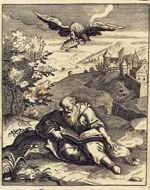
Tute, si recte vixeris: Vaenius, Emblemata Horatiana (Amsterdam, 1684) emblem 89 uses the imagery of Aeschylus' death
Futura latent: Schoonhovius, Emblemata (Gouda, 1618), emblem 9 uses the imagery of Aeschylus' death
Nil nimium: Reusner, Aureolorum Emblematum (Strasbourg, 1587), emblem 118 uses the imagery of Aeschylus' death
Dum detenet imber: De la Feuille, Devises et emblemes anciennes et modernes (Augsburg, 1697), emblem 601 uses the imagery of an eagle carrying a turtle
Ut lapsu graviore ruat: Zincgreff, Emblematum Ethico-politicorum (Heidelberg, 1619), emblem 26 uses the adage's imagery of the eagle seizing a tortoise
Iconclass: 23A32:54F12 present❧Luck, Fortune, Lot; 'Fato', 'Fortuna', 'Fortuna aurea', 'Fortuna buona', 'Fortuna pacifica overo clemente', 'Sorte' (Ripa) 23A33:54FF11 future❧Adversity, Misfortune, Bad Luck; 'Fortuna infelice', 'Infortunio' (Ripa) 52A24 Precaution 98B(AESCHYLUS)68 death of Aeschylus: an eagle drops a turtle on Aeschylus' bald head
Loci Communes: Discriminis (Danger, crisis, Danger)
II ix 78 Nunc bene navigavi, cum naufragium feci Now that I've suffered shipwreck, my voyage has gone well
Νῦν εὖ πεπλόηκα ὅτε νεναυάγηκα. i. Nunc bene navigavi, posteaquam naufragium feci. Quories id, quod videtur incommodum, fortuna praeter spem vertit in bonum. Zenon Citiensis, qui relictis prioribus praeceptoribus, Cratetis auditor esse coepit, naufragio eiectus dixisse legitur, εὖγε ποιεῖ ἡ τύχη προσελαύνουσα ἡμᾶς φιλοσοφία. i. Bene facit fortuna, cum nos ad philosophiam admovet. Autor Suidas. Plutarchus in libello De utilitate capienda ex inimico, meminit huius proverbii.
[greek], Now that I've suffered shipwreck, my voyage has gone well. Whenever something that looked like a disaster is turned by fortune unexpectedly into a blessing. Zeno of Citium, who abandoned his earlier teachers and became a pupil of Crates after being shipwrecked, is reported to have said 'Fortune does me a good turn by driving me into philosophy.' Suidas is the authority. Plutarch mentions this proverb in the essay 'How to profit from one's enemies.'
Facsimile:
Iconclass: 46C291 shipwreck 54F121 Turn of Fate, Wheel of Fortune
Loci Communes: Malum vertens bono (Evil turning to good, Mal qui tourne en bien)
II ix 79 Nunc in regionem veni Now I've arrived
Νῦν εἰς χώραν ἦλθον. i. Nunc in regionem veni. Ab iis dictitari solitum, qui tandem sua sponte illuc, quo oportuit, perveniunt, cum diu non querunt. Fit enim plerunque, ut res diu quaesita non occurrat, tandem velut ultro veniat in mentem. Quidam sic efferunt, Νῦν εἰς χώραν ἦλθες, id est, Nunc in regionem venisti, ubi quis eo venit, quo se venturum negarat.
[greek], Now I've arrived, was a current expression used by those who have at last without effort reached the required destination, though this has long been beyond their powers. For it commonly happens that something you have long sought for does not occur to you, yet at length it comes into your mind, as it were, of its own accord. Some use it in the form 'Now you've arrived,' when a man arrived at an end which he had said he would never attain.
Facsimile: 
Iconclass: 46C514 arrival and return ~ travelling 54D3 Completion
Loci Communes: Aliena curantis - ad rem pertinentia (Meddling in others' affairs - relevant matters, Qui se mêle des affaires d'autrui - choses pertinentes)
II ix 80 Nunc illa advenit Datidis cantilena Now is the moment come for Datis' tune
Νῦν τοῦτ᾽ ἐκεῖν᾽ ἥκει τὸ δάτιδος μέλος. id est, Nunc id quod aiunt, Datidis adest cantio. Dicebatur, ubi quid laetum ac festivum accidisset. Datis quispiam erat Persarum satrapes, excelles in rei bellicae gloria. Is Graece loqui conatus, consuevit dicere, ἥδομαι, καὶ εὐφραίνομαι, καὶ χαίρομαι. i. Delector, gaudeo, laetor. Ea cum saepius ac male Graece pronunciaret, res in vulgi iocum abiit. Autor Suidas. Extat autem apud Aristophanem in Pace, Νῦν τοῦτ᾽ ἐκεῖν ἥκει τὸ δάτιδος μέλος, Ο δεφόμενος ποτ᾽ ᾖδε τῆς μεσημβρίας, Ως ἥδομαι καὶ τέρπομαι καὶ χαίρομαι. Adest, ut aiunt, cantilena Datidis, Quod mastuprans is cecinit in meridie, Ut laetor, ut delector, utque gaudeo. Interpres addit, Datismum usurpari pro barbarismo, eo quod χαίρομαι dixerit pro χαίρω secutus vocum consonantiam, quemadmodum apud nos ridetur, qui dixerit corpus meus, & domus tuus. Nam χαίρομαι Graecis non dicitur. Miror autem cur interpres huic velut affine subiunxerit: Αμας ἀπῄτουν, οἱ δ᾽ ἀπηρνοῦντο σκάφας. Ex quo coniectura sumi potest, hoc proverbium natum ex inscitia linguae, quae non raro praebet huiusmodi risus materiam, dum Germani gestiunt loqui Gallice, aut Galli Germanice. Idem accidit in surdastris.
[greek], Now here at last is Datis' fabled song, was said on any happy and cheerful occasion. There was a Persian satrap called Datis who had an outstanding reputation in the arts of war. When he tried to speak Greek, he had a habit of saying 'I'm joyed, cheered, and pleasured'; and since he often spoke this bad Greek, the thing became a popular byword. Suidas is the authority. But this comes from the Peace of Aristophanes: Now here at last is Datis' fabled song, Sung as he masturbated at high noon: "How joyed and cheered and pleasured now am I!" The scholiast adds that 'datism' was in use for 'speaking bad Greek,' because he said chairomai instead of chairô, misled by the similar endings, in the same way that nowadays we make fun of anyone who says corpus mens and domus tuusy for chairomai in Greek is not used. I am surprised, however, that the scholiast should adduce 'Sickles I asked for, and they said "No spades,'" as though it were related. From this we can infer that the proverb took its rise from ignorance of the language, which not uncommonly provides material for mockery of this kind, when Germans try to talk French or Frenchmen talk German. The same thing happens with men who are hard of hearing.
Facsimile:
Iconclass: 33C46 masturbation, onanism 48C7562 vocal popular music 56B2 Happiness, Felicity 57BB2 Mockery, Derision, Irreverence; 'Derisione', 'Dispreggio della Virtù' (Ripa) 98B(DATIS) male persons from classical history (DATIS)
Loci Communes: Bonae fortunae, copiae, felicitatis aut ominis (Of good fortune, abundance, happiness, or omen, Bonne fortune, abondance, bonheur ou présage)
II ix 81 Non enim spinae No more thorns
Οὐ γὰρ ἄκανθαι. i. Non enim spinae. De conditione dicebatur in melius commmutata. Sumpta metaphora à novalibus, quae repurgatis spinis frugiferae incipiunt esse. Recte quadrabit de negocio prius infrugifero ac molesto, unde postea capitur emolumentum. Quidam inde natum existimant, quod antiquitus ante repertam agricolationem, agri spinis infrugiferis occupabantur, mortalesque duram quandam & agrestem agebant vitam. Deinde ostensa ratione colendi terram, mitior victus successit. Atque hinc dici coeptum: Non enim spinae. Concordat cum hoc interpretamento, quod alio diximus loco, de puero gestante spineas frondes & panes in nuptiis, ac dicente, ἔφυγον κακὸν, εὗρον ἄμεινον. i. Effugi malum, nactus sum melius. Legitur & illud, βίος ἀκανθώδης. i. Vita spinosa, pro incommoda & infrugifera.
[greek], No more thorns, was used when things changed for the better, the metaphor being taken from fallow fields which begin to bear crops once the thornbushes are pulled up. This will be a good fit for some piece of business which was previously unrewarding and tedious and later becomes a source of profit. Some trace its origin to the fact that in early times before the discovery of agriculture the fields were blocked with thorns that bore no fruit, and mortals lived a hard and boorish kind of life. Then, when they were shown how to till the ground, a more civilized way of living took its place, and hence arose the expression 'No more thorns.' This interpretation is supported by what I have said elsewhere about the boy who carried thornbranches and loaves at a wedding and said 'I have escaped evil, I have found good.' There is also the expression 'A life of thorns' for one that is uncomfortable and unproductive.
Facsimile:
Iconclass: 51AA4:25G4(+223) Nothingness, Absence❧plants and herbs (+ thorn, prickle) 54F121 Turn of Fate, Wheel of Fortune
Loci Communes: Proficientium in melius (Improving for the better, Progresser vers le mieux)
II ix 82 Non statuar leaena in machaera I'll not be set up as a lioness on a sword-hilt
Οὐ στήσομαι λέαινα ἐπὶ τυροκνήστιδος. id est, Non ego leaena statuar in tyrocnestide. Proverbium meretricium, cum negat scortum sui copiam facturum sese. Nam in capulis militarium gladiorum elephantes ac leones imponi solent. At hi procumbentes inscalpuntur, sive ne laedant manum utentis gladio, sive ne defringantur facile, si in pedes erecti fingerentur. Tyrocnestis vox militaris videtur ensem significans. Potest adagium & ad verecundiorem usum detorqueri, ut si quis negans se per omnia morem gesturum, inserviturumque pro libidine dicat, οὐ στήσομαι λέαινα ἐπὶ τυροκνήστιδος. Adagium recenset Suidas. Extat autem apud Aristophanem in Lysistrata.
[greek], I'll not be set up as a lioness on tyroknestis [literally, a cheese-grater]. A prostitute's proverb, when the woman declares that she will not make her services available. It is the practice to depict elephants and lions on the handles of soldiers' swords; but they are represented lying down flat, either to prevent the figure from hurting the hand of the man who uses the weapon, or so that they are not easily broken through being shown standing up. Tyroknêstis seems to be a soldiers' word for a sword. The adage can also be diverted to a more respectable use, if, for instance, a man wishes to show that he will not be entirely complaisant and the slave of his master's slightest wish, and were to say 'I'll not be set up as a lioness on a cheese-grater.' The adage is listed by Suidas; it survives in Aristophanes in the Lysistrata.
Facsimile:
Iconclass: 25F23(LION)(+23):25F23(LION)(+15) beasts of prey, predatory animals: lion (+ female animal)❧beasts of prey, predatory animals: lion (+ ornamental variants of animals) 33C52 whore, prostitute 45C13(SWORD) hacking and thrusting weapons: sword 48A984 ornament derived from animal forms 53DD1:33C4 Refusal❧coitus, cohabiting, sexual intercourse
Loci Communes: Obsecundantis (Complying, being obliging, Se conformer, obéir)
II ix 83 Ne contra bovem opta Pray not against your ox
Μὴ κατα βοὸς εὔχου. Ne contra bovem opta. Admonet adagium non esse vitam instituendam iuxta votum animi, neque quiduis sperandum à superis, sed ut ea duntaxat sibi quisque promittat, quae possit industria consequi. Refertur in Collectaneis Diogeniani. Unde sumpta metaphora, parum liquet: nisi quod apparet ductam ab agricola, qui negligens adhibere bovis operam in colendis agris, optat ut citra suum laborem proveniat seges.
[greek], Pray not against your ox. The lesson of this adage is that one should not arrange one's life in accordance with what one wants to happen, or hope for anything one chooses from the powers above; everyone should promise himself only those things which he can secure by his own exertions. Recorded in the collections of Diogenianus. The source of the image is not very clear, except that it is clearly taken from a husbandman who neglects to use the labour of oxen in tilling his fields, and hopes that crops will be forthcoming without any exertion on his part.
II ix 84 Non nostrum onus: bos clitellas? Not my burden: a saddle on the ox?
Quintilianus Institutionum oratoriarum libro quinto, paroemiae, quam ait esse ceu brevem apologum, hoc adfert exemplum: Non nostrum onus, bos clitellas? Satis constat ex apologo sumptum: verum quis sit is apologus, equidem nondum reperi. M. Tullius Epistolarum ad Atticum libro quinto in epistola cuius initium est, Laodiceam veni pridie Calendas sextiles: videtur ad hoc adagium alludere, & nobis velut ansam coniectandi praebere. Inde, inquit, ire ad Taurum cogitabam, ut cum Maphragone collatis signis, si possem de servo tuo decidere. Clitellae bovi sunt impositae. Illáne? Non est nostrum onus, sed feremus: modo, si me amas, sit annus. At si tu ad tempus, ut senatum totum excites. Mirifice sollicitus sum, quod iam diu ignota sunt mihi omnia. Item in eadem epistola paulo superius: Sed est incredibile quàm me negocii taedeat, ne non habeat satis magnum campum, ille tibi non ignotus cursus animi & industriae meae, praeclara opera cessat. Quippe ius Laodiceae me dicere, cum Romae A. Plotius dicat? Et cum exercitum noster amicus habeat tantum, me nomen habere duarum legionum exilium? Denique haec non desidero. Lucem, forum, urbem, domum, vos desidero. Sed feram ut potero, sit modo annuum. So prorogatur, actum est. Hactenus Tullius, Quibus quidem ex verbis, quanquam subobscuris, & haud scio an etiam medosis, odorari licet, Non nostrum onus, bos clitellas, proverbium fuisse recusantis munus aliquod, veluti parum accommodatum sibi. Neque enim boum est, clitellis tergo impositis onera gestare, sed potius asinorum ac mulorum. Neque dubitandum est, quin Fabius ex hoc Ciceronis loco exemplum illud sit mutuatus. Raphael Regius, qui Fabius, additis scholiis conatus est emendare, scripturam mutat ad hunc modum, Nos nostrum onus, vos clitellas, interpretant hunc esse sensum, neutram partem absque onere discessuram. Mihi, si phas est quicquam immutare, sic potius legendum videtur, Non nostrum onus, bos clitellas? Ut sit velut rem absurdam, seque indignam abominantis: si quis bovi clitellas velit imponere. Neque discrepat hoc cum sententia verborum Tullianorum, quae modo retulimus. Ait enim eam provinciam non satis vel aptam, vel dignam ingenio suo, laturum tamen utcunque, modo ne sit longior annua. Proinde proverbium duplici forma poterit efferri: Bovi clitellae impositae sunt. ubi mandatum est negocium parum apto. Et, bos clitellas? ut subaudias, ferat: Ubi quis deprecatur provinciam, cui parum sit idoneus, aut quam sibi ducat indecoram. Illud obiter admonitum lectorem velim, ne protinus radat, aut dispungat, si quod in his quae citamus ex autoribus, viderit ad quarundam emendationem non respondere. Non quod profiteamur à mendis repurgatum, quicquid huc adducimus, sed quod labantur hi quoque qui libros emendant: velut hoc loco, quem modo retulimus ex Epistolis, in aeditione Aldina, quot voces sunt immutatae nescio cuius opera, ne dicam culpa? Nam Aldo non libet imputare, tum quia doctus est, tum quia amicus. Primum enim quis non videat rectius esse, opera cesset, quàm opera cessent? Deinde quod sequitur, cui non perspicuum sit, esse vitiatum, tum distinctione, tum voce exilium mutata in exulum? Sic enim legit, Et cum exercitum noster amicus habeat, tantum me nomen habere duarum legionum exulum? Cum Tullius tantum posuerit pro magno, cui legiones exiles opposuit, hoc est pusillas. Et aliquanto post, Ut cum Maphragone, signis collatis, si possem, de servo tuo decerne rem. Quid erat causae ut pro deciderem sive decidere, mutaretur decernerem? Quasi non fuerit illud multo verbum elegantius, Etenim si legas decidere, subaudiendum est verbun, certarem, sive congrederer (cuiusmodi eclipses familiarissimae sunt Ciceroni, praesertim in hoc opere) ut legas, Ut cum Maphragone collatis signis: subaudiasque congrederer. Rursum hoc quod sequitur, Clitellae bovi sunt impositae. Illáne? Non nostrum onus. Offensus, nescio quis aposiopesi, Illáne? mutavit, Illae, non est nostrum onus. Quod iterum usu venit in hoc quod subiicitur, At si tu ad tempus, subaudi, adfueris. Mutavit enim, Ad sis tu ad tempus, Latinitate quoque corrupta, nedum argutia sententiae. Haec invitus & coactus admonui, ne qui, ut sunt nonnulli, praecipites ad id, ob celebritatem Aldini nominis protinus damnent, aut radant, si quid deprehenderint ab illius aeditionem discrepare, nec statim priores abiician codices emendationibus huiusmodi freti. Proverbium usurpavit & Ammianus libro decimosexto.
Quintilian, in book 5 of his Institutiones oratoriae, gives as an example of the proverb, which he says is a short form of fable, 'Not my burden: a saddle on the ox?' It is clear enough that this is taken from a fable, but what the fable was, I have yet to discover. Cicero in book 5 of his Letters to Atticus, in a letter beginning Laodiceam veni pridie calendas sextiles, seems to refer to this adage, and to give us some sort of a handle for conjecture: 'From there' he says 'I have in mind to go on to the Taurus and join battle with Maphragones in hopes of coming to some decision, if I can, about your slave. The saddle is on the ox (don't you agree?). It's not my burden, but I'll bear it; only, if you love me, let it be for a year. But if you are on time, mind you rouse the whole senate. I am surprisingly worried, having now been so long in ignorance of everything.' And again, a little earlier in the same letter: 'But it is incredible how tedious I find the business, for fear that it does not give sufficient scope for the intellectual energy and industry of which you know something. My honourable activity is at a standstill. Imagine me dealing out justice in Laodicea, while Aulus Plotius does the same in Rome! And while our friend has such a large army, here am I with the nominal command of two skeleton legions. Anyhow this is not what I want; what I want is daylight, the Forum, Rome, my own house, and people like you. But I will bear it as best I can, provided it lasts only a year. If there's a prolongation, that will be the end.' These are Cicero's words, and though they are somewhat obscure and (I rather suspect) corrupt as well, one can discern that 'Not my burden: a saddle on the ox' was a proverb referring to someone refusing an assignment as unsuited to his talents. For to wear a packsaddle and carry burdens on their backs is a task not for oxen but for asses and mules. Nor can it be doubted that Quintilian borrowed his example from this passage of Cicero. Raffaele Regio, who attempted to correct Quintilian with added notes, altered the reading as follows: Nos nostrum onus, vos clitellas, 'We (carry) our burden, you (carry) saddles,' supposing the sense to be that neither party would get off without a load. To me, if one is allowed to make any change, it seems better to read Non nostrum onus: bos clitellas? so that these become the words of a man who is rejecting some proposal as absurd and unworthy of him, if it were intended to put a saddle on an ox. Nor is there any discrepancy between this and the sense of Cicero's words which I have just quoted; for his point is that his province is neither suited to him or worthy of his gifts, but he will endure it all the same, provided it does not last longer than a year. And so the sense of the proverb can be expressed in two forms: 'the saddle is placed on an ox,' when some piece of business is entrusted to an unsuitable person, and (supplying a verb meaning 'to carry') 'Is the ox to carry a saddle?' when someone asks to be excused from a task for which he is quite unfitted or which he finds degrading. One thing I would point out to the reader in passing: he must not promptly scratch out or delete anything he may find in my quotations from classical texts which may seem to him not to correspond with sundry people's emendations. Not that I claim to have purged the errors from every text which I cite in this work, but because those who emend texts have their lapses like other men. In this passage, for example, which I have just quoted from the Letters, what a lot of words have been altered in the Aldine edition; whose doing (not to say, whose fault) it is, I do not know. I do not choose to impute this to Aldus, because he is both a good scholar and a friend of mine. In the first place, anyone can see that for 'activity at a standstill' opera cesset is more correct than opera cessent. And then, further on in the same passage, who does not see clearly that there is an alteration both in the punctuation and in the word exsilium, skeleton, which was changed to exulum, exiles. For the [Aldine] text reads 'And while our friend has an army, here am I with only (tantum) the nominal command of two legions of exiles (exsulum)'; whereas Cicero must have meant tantum to be 'so large,' with which he contrasts 'skeleton' legions (exiles), that is, much undermanned. And a little further on in the passage 'join battle with Maphragones in hopes of coming to some decision, if I can, about your slave,' why was the word for decision, deciderem or decidere, changed to decernerem? - as though the former were not far more elegant. For if you were to read decidere, you must supply a verb, such as certarem, to fight, or congrederer, to do battle, a kind of ellipse very common in Cicero, especially in this work, so as to read ut cum Maphragone collatis signis, then supply congrederer. Again, in what follows: 'Clitellae bovi sunt impositae. Illane? Non est nostrum onus, someone took offence at Illane? by itself in aposiopesis, and wrote illae,... [followed by a comma]. The same thing has happened with the words which follow, At si tu ad tempus, but if you [are] on time, where we should understand adfueris, are; for he changed this to adsis tu ad tempus, be on time, corrupting the Latin, to say nothing of the neatness of the phrase. I mention these points reluctantly and under compulsion, for fear that someone, jumping to conclusions as many people do, may be overawed by Aldus' famous name and reject or delete forthwith any wording where they notice a difference from his edition, and may abandon earlier texts out of hand in reliance on this kind of emendation. The proverb was used by Ammianus too, in book 16.
Facsimile: 
Iconclass: 46C131614 saddle 47I21111 ox 53DD1:57A24 Refusal❧Task
Loci Communes: Munus aptum aut ineptum (A gift fitting or unfitting, Un présent convenable ou inconvenant)
II ix 85 Nota res mala optima An evil thing known is best
Plautinum illud in Trinummo proverbiali schemate dictum videtur: Nota res mala optima est. Dictum est autem sub persona senis, suadere conantis amico, ne uxorem tametsi malam repudiaret, aliam ducturus: propterea, quod plerunque fit, ut qui commutat, primum pro malo peius accipiat, tum ignotum pro noto, postremo insuetum pro familiari. Tantum enim valet assuetudo, ut mala quibus assueverimus, optima videantur. Contrà quae sint optima propter insolentiam pessima videantur. Adagium itaque deterret, ne temere novandis rebus studeamus, vitemusque vitium illud, haud scio an maximum, quod Graeci φιλόκαινον appellant, id est, novarum rerum appetentiam, cui comes alterum veluti germanum, quod ἀψίκορον vocant, quod mox fastidiuntur paulo ante adamata. Convenit cum Plautina sententia, quod apud T. Livium Pacuvius Calavius suadens Campanis, ne senatores mutare vellent, populum iam re doctum dicere compulit, Notissimum quodque malum maximè tolerabile esse. Huc pertinet & Ovidianum illud, Quod male fers, assuesce, feres bene: multa vetustas Lenit. Eódem pertinet & Mimus ille, nescio cuius, Mulier tum demum est bona, cum aperte est mala. Cognitum enim malum, aut vitamus, aut nos ad id accommodantes ferimus. Item ille, Consueta vitia ferimus, non reprehendimus, Aristoteles lib. Moralium Nicomachiorum septimo, ἀεὶ γὰρ πονεῖ τὸ ζῶον ὥσπερ καὶ οἱ φυσικὸ λόγοι μαρτυροῦσι, τὸ ὁρᾶν καὶ τὸ ἀκούειν φάσκοντες εἶναι λυπηρὸν, ἄλλ ἤδη συνήθεις ἐς μὲν ὥς φασιν. i. Semper enim animal laborat ut audiat, videatque, quemadmodum testantur & naturales sermones, dum fatentur quidem esse molestum, sed iam adsuevimus ut aiunt.
That phrase in Plautus, in the Trinummus, An evil thing known is best, is clearly proverbial in form. It is put into the mouth of an old man, who is trying to persuade a friend not to divorce his wife, however bad she may be, in order to marry another, on the ground that as a rule the man who makes a change, for a start, instead of a bad thing gets something worse; secondly, for something he knows gets an unknown, and thirdly gets something strange for what he is used to. So great is the force of familiarity that evils we are used to seem excellent, and very good things on the other hand seem very bad because they are unfamiliar. So the adage discourages us from any rash zeal for change, and recommends avoidance of what is perhaps the greatest of faults, what was called in Greek philokainon, a passion for novelty, the companion and virtual brother of which is hapsikoron, the rejection of things we had a passion for a short time ago. This maxim in Plautus finds support in Livy from one which Pacuvius Calavius, in an attempt to dissuade the Campanians from their desire to replace their senate, compelled the people, who had learnt from experience, to accept: The more familiar the evil, the easier it is to bear.' Here too belongs that remark in Ovid: What you find hard to bear, the habit formed, / Will easy be; time lightens many loads.' To the same effect is that moral maxim, the author of which I do not know: 'A wife's good, once you know how bad she is'; for once we know what's wrong, we either avoid it or adapt ourselves and put up with it. There is another too: 'Familiar faults we bear and do not blame.' Aristotle in book 7 of the Nicomachean Ethics: 'For living creatures are always working, as the writings of naturalists confirm when they tell us that seeing and hearing are hard work; but we have already acquired the habit, as the saying goes.'
Facsimile: 
Iconclass: 51A8:52B5112 Things Known, the Known❧Bad, Evil, Wrong 53A22 Stability, Firmness; 'Fermezza', 'Stabilimento', 'Stabilità' (Ripa) 54DD51:54F131 Danger; 'Pericolo' (Ripa)❧Renovation
Collectanea (1500): 518
Loci Communes: Malum assuetum (Habitual evil, Mal habituel)
II ix 86 Inveni, non quod pueri in faba I've made a find, and it's not what children find in beans
Strophylus servus in Aulularia Plautina, aulam auri plenam à sene defossam, furto sustulerat, eamque rem gestiens indicare hero, Reperi, inquit. Et rogatus quid reperisset, Non quod pueri clamitant, inquit, in faba se reperisse. proverbiali nimirum figura magnum quiddam reperisse se significans. Est enim midas vermiculus quidam, qui fabis innascitur: hunc si quando nacti sunt pueri, gestiunt atque exclamant, perinde quasi magnum quiddam invenerint.
Strophylus, a slave in the Aulularia of Plautus, had stolen a pot full of gold which had been buried by the old man in the play, and, being very keen to give his master a hint of this, says I've made a find.' And when asked what it was, he replies 'Not what makes children shout when they find it in beans,' using no doubt a proverbial metaphor to convey that he has found something important. For there is a kind of small worm called a midas which lives in beans, and if children find one of these, they are excited and shout as if they had found something important.
Facsimile:
Iconclass: 25F73(MIDAS) worms (MIDAS) 25G21(BEANS) fruits: beans 41A773:25D13(GOLD) container of ceramics: jar, jug, pot, vase❧minerals and metals: gold 51CC2 Chance, Haphazard 54F12 Luck, Fortune, Lot; 'Fato', 'Fortuna', 'Fortuna aurea', 'Fortuna buona', 'Fortuna pacifica overo clemente', 'Sorte' (Ripa)
Collectanea (1500): 130
Loci Communes: Bonae fortunae, copiae, felicitatis aut ominis (Of good fortune, abundance, happiness, or omen, Bonne fortune, abondance, bonheur ou présage)
II ix 87 Midas in teseris consultor optimus Midas on the dice gives the best advice
Μίδας ὁ ἐν κύβοισιν εὐβουλότατος. id est, Midas qui in tesseris, consultor optimus. Proverbium à tesserarum ludo natum. Est enim Midas, iactus vocabulum. Refertur à Suida proverbii nomine. Perpendat diligens & eruditus lector, num εὐβουλότατος legi oporteat, ut versus sit iambicus trimeter, Μίδας γὰρ ἐν κύβοισιν εὐβολώτατος. id est, In tesseris iactus midas prosperrimus. Accommodari poterit adagium ad rem, quae forte fortuna bene cadit.
[greek], Midas on the dice gives the best advice, is a proverb that originated in the game of dice, for Midas' is the name of a particular throw. Recorded by Suidas as a proverb. The industrious and learned reader may wish to consider whether for euboulotatos, the best adviser, we ought not to read eubolôtatos, the luckiest throw, which makes the line an iambic trimeter 'For Midas on the dice is the most lucky throw.' The adage can be adapted to a thing that by pure chance turns out well.
Facsimile:
Iconclass: 43C55:61K(MIDAS) dice-games❧(MIDAS) historical names (MIDAS) 51CC2 Chance, Haphazard 54F12 Luck, Fortune, Lot; 'Fato', 'Fortuna', 'Fortuna aurea', 'Fortuna buona', 'Fortuna pacifica overo clemente', 'Sorte' (Ripa)
Loci Communes: Bonae fortunae, copiae, felicitatis aut ominis (Of good fortune, abundance, happiness, or omen, Bonne fortune, abondance, bonheur ou présage)
II ix 88 Ni purges et molas, non comedes Unless you clean and grind, you'll have nothing to eat
Αν μὴ καθαρῇς καὶ ἀλέσῃς, οὐ μὴ φάγῃς. id est, Nisi & repurges & molas, haud unquam edes. id est, non continget tibi victus, nisi tuam item industriam adiunxeris. Ceres cum ostenderet usum frumenti Triptolemo, ita dixisse fertur. Videtur esse senarius è poeta quopiam usurpatus, sed depravatus: constabit filegas κᾀλέσῃς. Potest transferri longius, non proderit tibi ingenii felicitas, nisi exercueris. Inutilis erit principum favor, nisi te gesseris ut oportet. Nihil conducet, quod doctum praeceptorem nactus es, ni vigilaveris. Refertur à Diogeniano.
[greek], Unless you clean and grind, you'll have nothing to eat. No food, that is, will come your way unless you also contribute your own energy. Ceres is said to have used these words when she taught Triptolemus the use of grain. It looks like an iambic line borrowed from some poet, but it is corrupt; it will scan if you read [greek]. It can be adapted to a very different context: 'Your intelligence will be no use to you unless you use it,' 'Princes' favour will be useless unless you know how to behave,' 'It will be no help to have acquired a good teacher if you don't keep awake yourself.' Recorded by Diogenianus. 88A. Nihil essent alia sine auro All the rest would be nothing without gold [greek], All the rest would be nothing without gold. Where there is poverty, all is neglected. Plato in book 3 of the Laws: 'Declaring by their deeds that, compared with gold and silver, all the things commonly regarded in the city as valuable and beautiful are trifles.'
Facsimile:
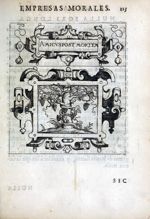
Sic vitam invenies: Borja, Empresas morales (Bruxelles, 1680), emblem 57 shares the imagery of cleaning grain to convey that you won't eat unless you work
Iconclass: 41C261 cleaning (food) 47C37 grinding, milling (industrial processes) 54B2:54A11 Indispensability❧Industriousness, Assiduity; 'Assiduità', 'Industria', 'Zelo' (Ripa)
Loci Communes: Industria (Industriousness, Application, diligence)
II ix 89 Nihil differs a Chaerephonte There's no difference between you and Chaerephon
Οὐδὲν διοίσεις χαιρεφῶντος τὴν φύσιν. id est, Nihil ore quicquam à Chaerephonte discrepas. In macilentum pallidumque dicebatur. Chaerephon enim tragoediarum scriptor fuit. Is Heraclidarum res prosecutus est. Quoniam autem in nocturnis lucubrationibus erat maiorem in modum extenuatus confectusque vulgari ioco taxatus est. Quin etiam noctuae cognomen additum. Aristophanes in Nebulis, Οὐδὲν διοίσεις χαιρεφῶντος τῇ φύσει. id est, Nihil figura a Chaerephonte differes. Allusit idem in Pluto, Οὐδὲ διοίσοντ᾽ ἀντικρὺς Τῶν ἡρακλειδῶν, οὐδ᾽ ὁτιοῦν τῶν παμφίλου. id est, Ne tantulum quidem Ab Heraclidis differentem Pamphili. Pamphilus enim in Stoa depinxerat Heraclidas supplices Atheniensibus, ad quos metu Eurysthei confugerant. Hos igitur vocat Heraclidas Pamphili.
[greek], There's no difference in build between you and Chaerephon, was said of a pale and skinny person. Chaerephon was a writer of tragedies who told the story of the Heraclidae, and when his nightlong labours made him exceptionally thin and worn, to criticize him became a common jest. He also got 'the Owl' as a nickname. Aristophanes in the Clouds: 'You'll be no different in look from Chaerephon.' He refers to him in the Plutus too: 'Not at all different from Pamphilus' Heraclidae.' For Pamphilus had painted the Heraclidae in the Stoa, supplicating the Athenians with whom they had taken refuge for fear of Eurystheus; and so he calls them 'Pamphilus'.'
Facsimile:
Iconclass: 32A22 thin (human type) 48C91:48C8545 writer, poet, author❧tragedy 51B3:98B(CHAEREPHON) Parity, Equality❧male persons from classical history (CHAEREPHON)
Loci Communes: Multi - in stupidos (Many people - against the stupid, Beaucoup de gens - contre les sots)
II ix 90 Nihil ab elephante differs There's no difference between you and an elephant
Ελέφαντος διάφέρεις οὐδέν, id est, Ab elephante differs nihil. In magnos & stupidos dicebatur: etiam si primam ingenii laudem Plinius tribuit Elephantis, sed inter bruta. Verum corporis moles & formae foeditas adagio locum fecit. Refertur à Diogeniano. Videtur huc alludere Palestrio Plautinus, qui herum suum elephanti corio circumtectum ait, nec plus habere sapientiae quàm lapidem.
'[greek], There's no difference between you and an elephant, was said of big, stupid people; though Pliny gives elephants very high praise for intelligence - but only among brute creatures. It was the size of their bodies and the ugliness of their appearance that gave rise to the adage. Recorded by Diogenianus. It is perhaps to this that Plautus' Palestrio alludes, when he says that his master is 'clad in an elephant's hide' and 'has no more sense than a stone.'
Facsimile: 
Iconclass: 51B3:25F25(ELEPHANT) Parity, Equality❧trunked animals: elephant 52AA1 Stupidity, Poverty of Intellect; 'Stupidità overo Stolidità' (Ripa)
Loci Communes: Multi - in stupidos (Many people - against the stupid, Beaucoup de gens - contre les sots)
II ix 91 Ne intra vestibulum quidem Not even as far as the porch
Οὐδ᾽ ἐντὸς ἰωροῦ, id est, Ne intra vestibulum quidem. In tumidos, feroces & insolentes dici solitum, qui procul omneis à sese submovent. Lex erat Athenis, ut homicidio contaminati extra septa sacrorum consisterent. Siquidem prima magnarum atria solent patere quibuslibet. Ad hunc morem adagium videtur alludere.
[greek], Not even as far as the porch. Used customarily of pompous, brutal, and insolent men who keep everyone at a distance. There was a law at Athens banning all those tainted with homicide from temple enclosures, just as the outer courts of great men are as a rule open to all comers. The adage evidently alludes to this custom.
Facsimile:
Iconclass: 41A323 monumental door, porch, 'aediculum' 53DD1:46C5141(+0) Refusal❧being welcomed ~ travelling (+ variant) 56F241 Narcissism 57AA644 Arrogance; 'Arroganza' (Ripa) 57AA9 Brutality
Loci Communes: Philautia (Self-love, Amour-propre)
II ix 92 Neque cum malis neque sine malis Neither with bad things nor without them
Aristophanes apud Suidam in Lysistrata, Κᾄστ᾽ ἐκεῖνο τ᾽ οῦπος ὀρθῶς κοὐ κακῶς εἰρημένον, Οὔτε σὺν πανολέθροισιν, οὔτ᾽ ἄνευ πανολέθρων. id est, Istud haud male, imò recte proditum est pro verbium, Nec simul cum pestibus, nec rursus absque pestibus. De uxoribus dictum, cum quibus incommode sanè vivitur: sed nec citra has constant familiae. Simile illi, quod est in Epigrammatis, Nec tecum possum vivere, nec sine te. Et quod alibi retulimus, ἀναγκαῖα κακὰ. Citantur eodem loco versus & hi, Κακόν γυναικες, ἀλλ᾽ ὅμως ὦ δημόται Οὐκ ἔστιν εὑρεῖν οἰκίαν ἄνευ κακοῦ. id est, Malum quidem uxor, attamen cives, sine hoc Nulli licet parere familiam malo. Notum est illud Catonis, quod cum uxoribus incommode vivitur, at sine illis omnino non vivitur.
Aristophanes, cited by Suidas, in the Lysistrata: 'How true that saying is, nor off the point: / Neither with the abandoned creatures nor without them.' This was said of wives, who do, it is true, make life more difficult, but without them a household cannot exist. It is like that phrase in the Epigrams: 'Not with thee can I live nor yet without thee.' And one I have recorded elsewhere, Necessary evils. In the same passage the following lines are quoted: 'An ill thing is woman; / But none the less, my fellow-citizens, / Without this ill no household can be had.' Cato's saying is well known, that life with wives is uncomfortable, but without them one cannot live at all.
Facsimile:
Iconclass: 52BB42:51AA4:42D342 Impossibility❧Nothingness, Absence❧dominating wife 52BB42:51A4:42D342 Impossibility❧Presence❧dominating wife
Loci Communes: Anceps et dubius (Doubtful and uncertain, Incertain et douteux)
II ix 93 Ne in pelle quidem Not even in skin
Οὐδ᾽ ἐν δέρματι. id est, Ne in pelle quidem. Hyperbole proverbialis de supra modum tenuibus: velut usqueadeo nudis, ut ne pelle quidem propria tegantur. Commemmoratur à Suida.
[greek], Not even in skin. A proverbial exaggeration, of exceptionally thin people, as though they were so poorly covered that they seemed to lack even a skin of their own to protect them. Recorded by Suidas.
II ix 94 Ne tria quidem Stesichori nosti You don't know even Stesichorus' triplet
Οὔτε τὰ τρία στησιχορου γινώσκεις. id est, Ne tria quidem Stesichori nosti. De vehementer indocto & imperito dici solitum. Adagium sumptum hinc existimant, quod pleraque Stesichori poemata Epodica sunt, quae tribus constant, στροφῇ, ἀντιστρόφῳ, καὶ ἐπῳδῷ. Strophe est prima series variis metrorum generibus incedens. Antistrophus est iteratus per eadem ferme genera recursus. Epodus est diversi carminis accentio. His & alii tragici poetae nonnunquam utuntur, potissimum in choris.
[greek], You don't know even Stesichorus' triplet, of someone exceptionally ignorant and ill-informed. The adage is thought to derive from the fact that the majority of the poems of Stesichorus are 'epodic,' that is to say they consist of three parts, strophe, antistrophus, and epode. Of these the strophe comes first and is formed of a varying series of metrical forms; the antistrophus is a repetition of more or less the same series of metres; and the epode is an epilogue in a different rhythm. These are also used sometimes by the tragic poets, particularly in their choral odes.
Facsimile:
Iconclass: 48C911 author, poet writing 52AA1 Stupidity, Poverty of Intellect; 'Stupidità overo Stolidità' (Ripa) 98B(STESICHORUS) male persons from classical history (STESICHORUS)
Loci Communes: Ignavia et inscitia (Cowardice and ignorance, Lâcheté et ignorance)
II ix 95 Nephalia ligna Nephalian wood
Νηφάλια ξύλα. i. Nephalia ligna. Dici posse videtur in abstemios, & ab omni voluptate procul alienos. Apud Athenienses, nephalia ligna vocabantur, quae neque vitea essent, neque ficulna, neque myrtea. Nephalia sonat, quasi dicas sobria.
[greek], Nephalian wood. This looks as though it might be applied to abstemious people, who give all forms of pleasure a wide berth; for in Athens the words 'nephalian wood' were applied to anything that came neither from the vine nor the fig nor the myrtle. Nephalian has the same meaning as our word sober.
Facsimile:
Iconclass: 31B59 sobriety; 'Sobrietà', 'Astinenza' (Ripa) 47B(+444) handicrafts and industries (+ wood ~ crafts, industries, agriculture) 55CC1 Saving, Frugality, Parsimony; 'Parsimonia' (Ripa) 61K(NEPHALIA) (NEPHALIA) historical names (NEPHALIA)
Loci Communes: Sordes et parcimonia (Meanness and stinginess, Bassesse et avarice)
II ix 96 Nephalian sacrum A Nephalian sacrifice
Νηφάλιος θυσία. i. Nephalium sacrificium. De convivio abstemio non inepte dicetur: aut de convivio vehementer frugali, sobrioque. Apud Athenienses hoc genus sacrificii exhibebatur Mnemosynae, Aurorae, Soli, Lunae, Nymphis, Veneri, & Uraniae. Nam in eo non libabatur vinum, sed aqua melle diluta. Haec ferme Suidas. Meminit & Iulius Pollux libro sexto, capite tertio, addens νηφαλεύσειν idem esse quod νηφάλια θύειν. Hoc sacrificii genus ἄοινον dicebant, quemadmodum caetera in quibus vinum adhibebatur, οἰνόσπονδα vocabant. Seleucus apud Athenaeum libro secundo, negat, apud veteres fuisse morem, ut vini copia, aut aliud quidlibet deliciarum inferretur in sacrificia. Quum enim sacrificia deorum gratia peragerentur (unde & θοίνας & θαλίας, ac μέθας appellabant, θοίνας quod deorum gratia vino uterentur, θαλίας quod deorum gratia vescerentur, convenirentque, μέθας vero, quod ut indicavit Aristoteles, μετὰ τὸ θύειν, id est, post sacrificium vino uterentur) non conve niebat illic ventris negocium agere. Ibidem Epicharmus his verbis notat mores collapsos, ἐν μὲν θυσίας θοίνη, ἐκ δὲ θοίνης πόσις ἐγένετο, ἐκ δὲ πόσιος κῶμος, ἐκκώμου δ᾽ ἐγένετο θυανία, ἐκ θυανίας δίκη, ἐκ δὲ καταδίκης πέδαι, καὶ σφάκελος καὶ ζημία. i. ex sacrificio epulum, ex epulis facta est potatio, ex potatione commessatio, ex commessatione facta est subatio sive ludus, ex subatione seu ludo lis, ex condemnatione compedes, sphacelus & mulcta. Quanquam hic locus mihi non caret suspitione mendae. Videtur enim deesse particula, ἐν δίκης καταδίκη. Non dissidet ab illo quod alio posuimus loco, Caninum prandium.
[greek], A nephalian (or sober) sacrifice, will not be out of place when used of an abstemious meal or of one which is exceedingly frugal and sober. In Athens this form of sacrifice used to be offered to Mnemosyne, to Aurora, to the Sun, to the Moon, to the Nymphs, to Venus and to Urania; for in such a rite there was no pouring of a libation of wine, but of water mingled with honey. So, more or less, Suidas. This is also mentioned by Julius Pollux, book 6 chapter 3, who adds that a verb nephaleuein meant the same as 'to perform a nephalian sacrifice.' This form of offering they called aoinos, wineless, and in the same way the others, in which wine was used, were oinosponda, offered with wine. Seleucus, cited by Athenaeus in book 2, says it was not the custom in the old days for a quantity of wine or anything else in the way of luxuries to be introduced into sacrifices. For since sacrifices were performed in honour of the gods (and that was the reason too why they called them thoinai, thaliai, and methai: thoinai because they drank wine for the gods' sake, thaliae because they came together and dined in honour of the gods, and methai because, as Aristotle suggested, it was after the sacrifice that they drank wine), this was not a proper place to put the business of the stomach first. In the same book Epicharmus writes as follows in criticism of the fall in moral standards: 'After the sacrifice a thoinê, after the thoinê came drinking, after the drinking revelry, after the revelry a swinish rutting, after the rutting, a court-case, after the sentence fetters, mortification, and penalty.' Though this passage arouses my suspicions that there is something wrong, for a phrase 'after the court-case sentence' seems to be missing. There is no disagreement between this and one I have placed elsewhere, A dog's dinner.
Facsimile: 
Iconclass: 12E212 sacrifice ~ Greek religion 55CC1 Saving, Frugality, Parsimony; 'Parsimonia' (Ripa) 61K(NEPHALIA) (NEPHALIA) historical names (NEPHALIA)
Loci Communes: Sordes et parcimonia (Meanness and stinginess, Bassesse et avarice)
II ix 97 Neglectis urenda filix innascitur agris Fern to be burnt grows in neglected fields
Horatius Satyra tertia: Neglectis urenda filix innascitur agris. Mira admonuit allegoria, animum honestis excoledum disciplinis, alioqui futurum, ut inutili sylva vitiorum occupetur. Filix enim herba invisa agricolis, quae totos agros occupare solet, nec facile repurgatur, ubi semel occupaverit.
Horace in his third satire: 'Fern to be burnt grows in neglected fields.' A striking metaphor teaches us that the mind should be cultivated by a liberal education, or else the result will be its taking-over by a useless forest of vices. Fern is a plant detested by husbandmen, which in practice took over whole fields, and cannot easily be rooted out once it has got a hold.
Facsimile:
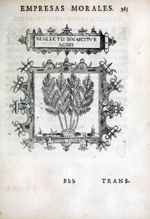
Neglectis innascitur agris: Borja, Empresas morales (Bruxelles, 1680), emblem 179
Iconclass: 41B12(FERNS) burning as process (FERNS) 54B2:49A Indispensability❧education 54BB3:25G51 Inutility, Noxiousness; 'Nocumento', 'Nocumento d'ogni cosa' (Ripa)❧ferns
Collectanea (1500): 600
Loci Communes: Ignavia et inscitia (Cowardice and ignorance, Lâcheté et ignorance)
II ix 98 Nauphracton tueri To have a warship look
Ναύφρακτον βλέπεις. Nauphracton Graece, classis est ad bellum instructa. Solent autem in triremibus magna quaedam inesse foramina oculorum instar, per quae remos inserunt. Unde velut aenigmatice dictum, Classis more intueris: de his, qui latis ac praegrandibus, aut toruis & minacibus oculis quempiam aspicerent. Aristophanes ἐν ἀχαρνοῦσι: Προς τῶν θεῶν ἄνθρωπε ναύφρακτον βλέπεις. id est, Homo per deos, quiddam obtuere classicum. Fortassis & hinc proverbii iocus est natus, quod Athenienses aliquoties feliciter navali pugna rem gesserint: velut apud Artemisium & Salaminem, unde sublati animi. Unde videtur dictum in turgidos & arrogantes.
[greek], You have a warship look. The word nauphracton in Greek means a fleet in battle order. It was the custom of triremes to have certain large holes like eyes, through which the oars are fitted. Hence this somewhat riddling expression 'You stare like a battleship' for those who look at someone with wide-open and very large eyes, or with a savage and threatening air. Aristophanes in the Acharnians: 'Good heavens, man, you have a warship look.' Perhaps too the opportunity for a proverb arose from the successes won from time to time by the Athenians at sea, at Artemisium for instance and at Salamis, which made them very self-confident; so that the phrase might be applied to someone proud and arrogant.
Facsimile:
Iconclass: 31B621(+921) morphology of facial expression ~ eyes (+ threatening; fury) 45(+31) warfare; military affairs (+ oared ships, e.g.: galley) 56E3 Fury; 'Furore', 'Furore implacabile', 'Furore & Rabbia', 'Furore superbo & Indomito' (Ripa)
Loci Communes: Arrogantia jactantiaque (Arrogance and boastfulness, Arrogance et vantardise)
II ix 99 Negocium ex ocio Leisure to business turned
Πράγματ᾽ ἐξ ἀπραξίας. id est, Ex ocio negocium. Hemistichium iambicum usurpandum, ubi res praeter opinionem evenit, & inde tumultus oboritur, unde tranquillitatem & ocium sperabamus. Nam & istud multis usu venit, ut dum sectantes ocium, fugiunt honestam industriam, incidant in turbas inexplicabiles. Autor Suidas. Nec indicat unde sit natum.
[greek], Leisure to business turned, is the half of an iambic line, which can be used when things turn out unexpectedly, and trouble arises from a source whence we looked for tranquillity and ease. For this too is a thing that happens to many people: while in pursuit of leisure they avoid honest toil and fall into inescapable turmoil. Suidas is the authority, but he gives no clue to the source.
Facsimile:

In otio negotiosus: Printer's device 0720
Iconclass: 54D2 Action; 'Operatione manifesta' (Ripa) 54DD2 Idleness; 'Otio' (Ripa) 54DD4 Difficulty
Loci Communes: Praeter spem bonum aut malum (Good or bad beyond expectation, Bien ou mal inattendu)
II ix 100 Navis aut galerus Ship or cap
Πλοῖον ἢ κυνῆ. i. Navis aut galerus. De re ancipiti. Quod genus si quis de voce incognita diceret, Aut piscem significat, aut cucurbitam. Nec invenuste dicetur in eos, qui cultu, moribusque diversam personam prae se ferunt. Veluti si quis pallio philosophico baltheum adderet militarem. aut cultu monachum, moribus & lingua lenonem ageret. Fragmentum est senarii ex Avibus Aristophanis, πλοῖον ἢ κυνῆ. i. Aut galerus, aut ratis. Sumptum ab hoc triremium genere, quas hodieque vulgo dicunt galeas, veluti dicas galeratas. Hae sic erant instructae, ut remos alarum vice porrigerent, moverentque. Caeterum summo malo galerum, seu petasum instar Mercurii praeferrent. Nam Peloponnenses πέτασον, id est, galerum, appellant κυνῆ, ἀπὸ κυνὸς, à cane, quod hoc genus pilei primum è pellibus canum fieri consuevit. Hinc iocus militaris videtur fuisse natus in elatos & fastuosos, supericilioque arroganti. Itidem Festus Pompeius indicat quasdam naves onerarias appellatas Corbitas, quod in summo malo pro signo, Corbem haberent. Quae bello erant paratae, galeam habebant: at quae ad celeritatem, petasum Mercurii signum gestabant.
[greek], Ship or cap, for things unidentified; if, for instance, one were to say of an unfamiliar word 'It means either a fish or a pumpkin.' It will not lack point if used of those who in dress and character behave like several different people; if for example a man wore a soldier's belt on top of a philosopher's cloak, or dressed like a monk and in actions and language resembled a brothel-keeper. It is a fragmentary line from the Birds of Aristophanes: 'Ship or cap.' It comes from a species of trireme which is still commonly called a galley, galea, as though it were galerata, wearing a cap. These were built so that they could stretch out oars and move them like wings, besides which they wore at the masthead a cap or a petasus like Mercury's. For in the Peloponnese they call a petasus or broad-brimmed hat a kune, derived from kuôn, the word for dog, since this kind of hat used at first to be made of dogskin. This seems to have been the source of an army jest directed against conceited proud men with an arrogant air. In the same way Festus Pompeius tells us that some merchant ships were called corbitae, because they wore a corbis or basket by way of an emblem at the masthead. Ships that were readyfor war had a cap; those designed for speed wore Mercury's hat as a badge.
Facsimile:
Iconclass: 46C24 sailing-ship, sailing-boat 52BB41 Uncertainty 92B58(PETASUS) attributes of Mercury: petasus, a winged sun hat
Loci Communes: Anceps et dubius (Doubtful and uncertain, Incertain et douteux)