II vii 1 Pomarius Hercules Hercules eating apples
Μηλιος ἡρακλῆς. id est, Pomarius Hercules. Per contemptum dicebatur in eum, qui nomen quidem magnificum gereret, caeterum opibus nullis, nullaque potentia pollens. Ab eventu natum. Narrat Suidas, cum rustici quidam Herculi bovem essent immolaturi, isque rupto fune profugisset, nec esset quod sacrificaretur, malum arreptum suppositis quatuor ramis crurum vice, deinde additis alteris duobus ceu cornuum loco, bovem utcunque sunt imitati, idque ridiculum simulachrum pro victima sacrificaverunt Herculi. Iulius Pollux libro de vocabulis rerum primo, fabulam aliquanto secus narrat, nempe ad hunc modum. Sollenne est, inquit, apud Boeotos, Herculi malis rem divinam facere. Cumque iam adesset dei festum, & immolandae victimae tempus urgeret (porrò hostia erat aries) quum ea serius adduceretur, propterea quod Asopus fluvius ita subito crevisset, ut transiri non posset, pueri qui iuxta aram ludebant, sacrificii ritum nihilominus peregerunt. Pulchro cuipiam malo quatuor stipulas vice pedum addiderunt, rursum alia duas cornuum loco, imaginantes sese ad eum modum arietem immolare. Creditum est Herculem hac victima magnopere delectatum, proinde mansisse apud Thebanos hunc morem, ut malis sacrificaretur Herculi. Cognomen hinc additum deo, ut ἡρακλῆς μήλων, id est, Hercules malorum vocaretur.
[greek], Hercules eating apples, was a contemptuous way of referring to a man who had some grand title, but neither wealth nor influence to give him power. An incident gave rise to this. Suidas tells us that one day some country people were proposing to sacrifice a bull to Hercules, and it broke its halter and escaped; nor had they any alternative offering. They seized an apple, stuck four twigs into it to serve for legs and then added two more as though in the place of horns, thus producing a sort of model of a bull; and this absurd image they sacrificed to Hercules instead of a victim. Julius Pollux, in book one of his work On the Names of Things, tells the story rather differently, as follows. It is a regular practice in Boeotia, he says, to sacrifice apples to Hercules. Once, when the god's festival was imminent and it was urgently necessary to have the offering ready, the victim, which should have been a ram, was late in arriving because of a sudden flood which made the river Asopus impassable. None the less, some children who were playing near the altar duly performed the sacrifice. They had a fine apple, into which they stuck four stout straws by way of legs and two more in place of horns, playing with the idea that they were thus offering a ram. Hercules was thought to have been greatly delighted with his victim; and so it remained a custom in Thebes to sacrifice apples to Hercules. And hence the god acquired a nickname, the Hercules of apples.
Facsimile: 
Iconclass: 12E212 sacrifice ~ Greek religion 25G21(APPLE) fruits: apple 54AA7 Weakness, Powerlessness, Helplessness; 'Infermità' (Ripa) 57BB21 Contempt 94L (story of) Hercules (Heracles)
Loci Communes: Contemptus et vilitatis (Contempt and worthlessness, Mépris et bassesse)
II vii 2 Verecundia inutilis viro egenti Bashfulness is useless to a man in want
Αἰδὼς δ᾽ οὐκ ἀγαθὴ κεχρημένῳ ἀνδρὶ παρεῖναι. Ita legitur apud Homerum Odysseae Ρ. Citatur à Platone in Lachete. Ac mox, Αἰδὼ δ᾽ οὐκ ἀγαθὴν φῂς ἐμμεναι ἀνδρὶ παρίκτῃ. Apud Hesiodum item: Αἰδὼς δ᾽ οὐκ ἀγαθὴ κεχρημένῳ ἀνδρὶ κομΐζει. id est, Verum homini pudor haud quaquam conducit egeno. Is versus in proverbium abiit. Admonet autem abiciendum pudorem, quoties urget necessitas. Est enim verecundia cum ad multa vehementer inutilis, tum maximè quum res postulat, ut omnia nobis sint facienda: velut inutilis pudor est qui deterret à discendo quod turpe est nescire. Et, ut ait Flaccus, Incurata malus pudor ulcera celat. Idem alibi, Pudor, inquit, te malus urget. Eodem allusit Euripides in Iphigenia in Aulide: Ομως δ᾽ ὅσον γε δυνατὸν, αἰδεῖσθαι χρέων. id est, Veruntamen pudere oportet eatenus, Quo ad licet. Homerus Iliados Ω. scribit verecundiam seu reverentiam plurimum prodesse, & eandem officere plurimum, Οὐ δὲ οἱ αικδώς Γίγνεται, ἥτ᾽ ἄνδρας μεγα σίνεται ἤδ᾽ ὀνίνησιν. id est, Nec pudor est illi, qui vel laedit vehementer, Vel multum prodest homini. Et videre est nonnullos hoc inutili pudore praeditos, qui corporis incommoda celare malunt, quam amicorum ope tolli: quo ingenio fuisse legitur Apelles, cui & morbum & inopiam dissimulanti candidus amicus furtim sub cervicale pondus auri submisit. Sed eorum multo maxima turba est, qui animi morbos & egestatem inutili pudore dissimulant. Atqui his ferè accidit, ut post malo in apertum erumpente, tum miserius, tum frustra erubescant.
'But diffidence is no good companion for a needy man'; so we read in Homer, Odyssey 17, and it is cited by Plato in the Laches. And a little further on: 'Diffidence, he says, ill becomes a beggar.' And again in Hesiod: 'Shame is no profit to a man in need.' The line passed into a proverb, the lesson of which is that we should cast off diffidence when under pressure of necessity. Diffidence, which in many situations is highly unhelpful, is never more so than when circumstances demand that we do all we can, just as modesty is unprofitable which deters us from learning what it is disgraceful not to know. As Horace puts it, 'foolish is shame that hides untreated sores,' and in another passage You are the victim of a foolish shame.' Euripides alludes to the same point in the Iphigeneia in Aulis: 'But yet one should be modest, when one can.' Homer in Iliad 24 writes that diffidence or reverence can be a very great help, and also a very great hindrance: 'Nor has he the shame / Which does so much for men, both good and bad.' And we can see a number of sufferers from this unprofitable diffidence, who would rather conceal their bodily infirmities than be rid of them with the help of their friends. Such, we read, was the disposition of Apelles, who tried to conceal both his ill health and his poverty; and a kind friend secretly put a gold nugget under his pillow. But those are very much in the majority who through an unhelpful bashfulness conceal ill health and poverty of mind. Yet they often find as a result that their trouble breaks out into the open, and their shame is then more pitiable and quite unavailing.
II vii 3 Ventrem mihi objicis You taunt me with my belly
Commemorantur & hi versus in Graecanicorum adagiorum collectaneis: Ιαστέρα μοι προφέρεις κάλλιστον ὄνειδος ἁπάντων. Η πλήρης μέν ἐλαφροτέρα, κενεὴ δὲ βαρεῖα. id est, Ventrem mi obiectas, quo probrum haud pulchrius ullum. Plenus is est levior, gravis idem ubi pendet inanis. Equidem ubi proverbium sit non video, nisi in hoc, κάλλιστον ὄνειδος, quod apud Graecos proverbii vice videtur usurpatum. Euripides in Iphigenia Aulidensi, Καλόν γε μοι τ᾽ ὄνειδος ἐξωνείδισας. id est, Mihi opprobraesti probrum honestum scilicet. Aut in ea parte velut aenigmatica, Levis cum plenus est, gravis quum inanis. Nam reliqua vascula quo pleniora sunt, hoc sunt graviora: quo magis inania, hoc leviora. Contra venter quo distentior cibo, hoc levior est, propter auctos, excitatosque pastu spiritus.
Two other lines are recorded in the collections of Greek adages: 'You taunt me with my belly; but this is the most honourable of all reproaches, for when full it is a featherweight, only when empty is it heavy.' For my part I do not see where the proverb comes in, unless it is in the phrase 'most honourable of reproaches,' which seems to have been in use in Greek as a proverb. Euripides in his Iphigeneia in Aulis: This is an honourable reproach with which you charge me.' Or it may lie in the part that sounds something like a riddle: 'when full it is a featherweight, heavy when empty.' For other containers grow heavier as they grow fuller and lighter as they empty, but with the belly it is the opposite: the more distended it is with food, the lighter it becomes because the spirits are stimulated and heightened by eating.
Facsimile: 
Iconclass: 31A2233 stomach 33B14(+0):57A77 threatening behaviour, challenging (+ variant)❧Friendliness, Gentleness, Affability; 'Affabilità, piacevolezza, amabilità', 'Animo piacevole, trattabile & amorevole', 'Benignità' (Ripa) 51I2:51GG2 Fullness❧Lightness; 'Leggierezza' (Ripa) 51II2:51G2 Emptiness, Void❧Heaviness
Loci Communes: Luxus et mollicies (Luxury and softness, Luxe et mollesse)
II vii 4 Turpe silere Shame to be mute
Αἰσχρὸν σιωπᾶν. id est, Turpe silere. Hoc licebit uti, quoties quis alterius exemplo extimulatur ad studium, aut negocium aliquod suscipiendum. Aut natum, aut certe usurpatum ab Aristotele, qui quum Isocrates rhetoricen doceret, aemulatione commotus, coepit & ipse pomeridianis illis suis περιπατοῖς dicendi artem docere, dicens illud, Αἰσχρὸν σιωπᾶν λαλοῦντος Ισοκράτους. id est, Turpe silere loquente Isocrate. M. Tullius in opere de Oratore ostendit è tragoedia quapiam mutuasse Aristotelem, paucis immutatis. Scribit enim hunc in modum: Aristoteles quum florere Isocratem nobilitate discipulorum videret quòd ipse suas disputationes à causis forensibus & civilibus ad inanem sermonis elegantiam transtulisset, mutavit repente totam propè formam disciplinae suae, versumque quendam de Philocteta paulo secus dixit. Ille enim turpe sibi ait esse tacere cum barbaris: hic autem quum Isocratem pateretur dicere. Ad Atticum lib. vi. Ego, nisi Bibulus (qui dum unus hospes in Syria fuit, pedem porta non plus extulit quàm domo sua) admiraretur de triumpho, aequo animo essem. nunc vero αἰσχρὸν σιωπᾶν. Hoc nunc quidam abutuntur, nihil existimantes turpius quam silere, ne apud homines illiteratos parum eruditi, parumque diserti videantur. Unde apud Lucianum praeceptum illud ἀπαιδεύτου ῥήτορος, μηδέποτε σιωπᾶν. id est, Ne unquam sile. propterea quod apud imperitos is demum infans & imperitus habeatur, qui non perpetuo garriat.
[greek], Shame to be mute. It will be right to use this whenever someone is roused by another man's example to pursue a course of study or a piece of business. It originated with, or at any rate was used by, Aristotle. When Isocrates was teaching rhetoric, he was moved by a spirit of competition and he too began to teach the art of speaking in those afternoon promenades of his which are so celebrated, with the comment 'Shame to be mute when Isocrates is vocal.' Cicero in his De oratore shows that Aristotle borrowed the words with a few changes from some tragedy, for he writes as follows: 'When Aristotle saw that the school of Isocrates was prosperous and full of well-born pupils as a result of his switching the subject of his discourses from litigation public and private towards an empty elegance of style, he suddenly altered the shape of his own teaching almost entirely, quoting with some changes a line about Philoctetes. Philoctetes said it was shame for him to be mute in front of barbarians; Aristotle [changed this to] "when Isocrates was free to speak.'" In book six of the Letters to Atticus: Tor my part, were not Bibulus so excited about a triumph, though as long as there was a single foreigner in Syria he no more set foot outside the city gates than he did out of his own front door, I should not give this a second thought; but as things are, it is shame to be mute.' But nowadays this is misused by some people, who think nothing more shameful than to be mute, for fear that an illiterate audience may underestimate their learning and their literary style. Hence comes the principle of the uneducated speaker in Lucian, 'never to keep silence,' because in front of the ignorant a man will be thought tongue-tied and ignorant himself, unless he is perpetually chattering.
Facsimile:
Iconclass: 31B62359 being silent 48A3 competition, art contest 49C113 'Rhetorica', 'Eloquentia' (~ trivium); 'Rettorica' (Ripa) 52DD3 Taciturnity; 'Secretezza', 'Secretezza overo Taciturnità' (Ripa) 54EE33 Competition, Rivalry, Emulation; 'Emulatione' (Ripa) 57A43 Sense of Guilt
Loci Communes: Invidia, aemulatio (Envy, rivalry, Envie, rivalité)
II vii 5 Munerum animus optimus In gifts the spirit is what matters
Ξενίων δέτε θυμὸς ἄριστος. id est, Verum in muneribus res praestantissima mens est. Graecis hemistichium Heroicum proverbiale, quo significatur, in amicorum muneribus non esse spectandum rei missae preχium, sed mittentis potius animum, ut Xerxes ille aquam manibus haustam, à rustico libenter accepit. Et Christus viduae nummulos omnibus divitum muneribus praetulit. Et quidam monet exiguum munus à tenui missum amico, perinde ut maximum boni consulere. Plinius in praefatione diversa extulit metaphora. Verum & diis lacte rustici, multaeque gentes supplicant: & mola tantum salsa litant, qui non habent thura. Quin tritissimum hodie est, ut qui munus aliquod offerant, animum iubeant spectari, non rem. Refertur adagium à Phurnuto in opere de Natura deorum.
[greek], But in gifts the intention is the most important thing. In Greek this is the half of a dactylic hexameter, and it was used proverbially to convey that, when we receive gifts from friends, we should consider, not the value of what they have sent us, but much more the intention of the sender, in the same way that Xerxes in the story took the water that the countryman offered him in his cupped hands, and Christ preferred the widow's mite to all the offerings of the rich. And we are told by one authority that for 'a small present sent by a humble friend' we ought to be as grateful as if it was something big. Pliny in his preface expressed this in a different metaphor: Tut milk is offered to the gods by country folk and many foreign peoples, and mere salted meal is the tribute of those who have no incense.' It is indeed a very familiar fact in our own day that those who offer some gift should draw attention to the spirit of it rather than the thing itself. The adage is recorded by Phurnutus in his work On the Nature of the Gods.
Facsimile:
Iconclass: 33A4 bringing gifts; exchanging gifts 54C11:54B5 Intention❧Importance, Preponderance 55C2 Giving
Loci Communes: Munus boni consulendum (A gift to be taken in good part, Un présent à prendre en bonne part)
II vii 6 Nescit capitis et inguinis discrimen He does not know the difference between head and groin
Qui eò impudentiae vel caecitatis potius devenerunt, ut nullum prorsus faciant discrimen inter honestum ac turpe, hi nescire dicuntur, quid intersit inter caput & inguen. Inter honesta corporis mebra caput primum obtinet locum, ac proinde recte nudatur. quae vero sub ventre sunt, ut inhonesta teguntur. Iuvenalis de muliere temulenta, Quid enim Venus ebria curat? Inguinis & capitis quae sint discrimina nescit. Proverbiali figura dictum videtur.
Those who have reached such a depth of effrontery, or rather blindness, that they make simply no distinction between what is respectable and what is indecent are said not to know the difference between head and groin. Among respectable parts of the body the head holds first place, and so it is quite right to keep it bare; from the belly downwards all is indecent, and is kept covered. Juvenal, of a tipsy woman: 'For Venus when in liquor makes no sense; / 'Twixt head and groin she knows no difference.' These words clearly have the shape of a proverb.
Facsimile:
Iconclass: 31A221 head (human) 31A2236 sexual organs (human) 52AA5:51BB2 Ignorance; 'Ignoranza', 'Ignoranza di tutte le cose', 'Ignoranza in un ricco senza lettere' (Ripa)❧Dissimilarity, Unlikeness 57BB23 Ignominy
Collectanea (1500): 459
Loci Communes: Multi - in stupidos (Many people - against the stupid, Beaucoup de gens - contre les sots)
II vii 7 Multitudo imperatorum Cariam perdidit Excess of generals ruined Caria
Πολλοὶ στρατηγοὶ καρίαν ἀπώλεσαν. id est, Multi duces deperdidere Cariam. Admonet senarius, nihil esse perniciosius licentia multitudinis, dum nulli paretur, sed pro sua quisque libidine rem gerit. Hanc Graeci vocant ἀναρχίαν, malum penè tyrannide peius, qua nihil potest esse peius. Par autem malum est πολυαρχία cum eo, quod dicitur ἀναρχίαν. Idem docet Homericum illud Iliados libro secundo, quod ipsum in proverbium abiit, Οὐκ ἀγαθὸν πολυκοιρανίη, εἶς κοίρανος ἔστω. id est, Multos imperitare malum est, rex unicus esto. Nam his verbis Ulysses milites tumultuantes, in quibus erat & Thersites, compescit. Eum Homeri versiculum usurpavit Dion, quum videret Heraclidem moliri factionem. Autor Aemilius Probus. Natum adagium à Caribus quondam florentissimis, postea per civiles seditiones eò redactis, ut etiam in vilitatis proverbium abierint, quemadmodum alio docuimus loco.
[greek], Too many generals brought Caria down. An iambic line, of which the message is that nothing is so disastrous as liberty of action in the mob, when they obey no one man, but everyone does what is right in his own eyes. The Greek for this is anarchia, an evil almost worse than tyranny, which is the worst thing there is. But polyarchia, the rule of many, is as great an evil as the so-called anarchia, the rule of none. Homer teaches the same lesson in that line in the second book of the Iliad, which itself later passed into a proverb: "The rule of many is not good; let one man rule.' These words are used by Ulysses when repressing disorder among the soldiery, one of whom was Thersites. The same Homeric line was adopted by Dio, when he saw that Heracleides was preparing to rebel, as we learn from Aemilius Probus. The adage took its rise from the Carians, who once enjoyed great prosperity, but later were brought so low by civil strife that their worthless character became proverbial, as I have shown in another place.
Facsimile: 
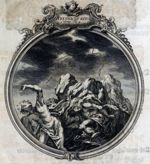
Rex unicus esto: Oppelt, Sammlung geist-und sinnreicher Gedancken (Prague, 1749), emblem 1 quotes the comment
Iconclass: 32B2(CARIAN) historical peoples and nationalities (CARIAN) 44F553 anarchism 51DD1 Disorder, Confusion, Derangement, Disorganization, Chaos 51H3:45D311 Multitude❧commander-in-chief, general, marshal
Collectanea (1500): 452
Loci Communes: Divitum praerogativa (The privilege of the rich, Le privilège des riches)
II vii 8 Mus albus A white mouse
Μῦς λευκὸς, id est, Mus albus, apud Suidam: μῦς κακὸς, id est, mus malus, apud Diogenianum. In hominem lascivum & libidinis immodicae dicebatur. Nam mures domestici salacissimi sunt, praesertim albi. Aelianus miram esse murum salacitatem autorum testimoniis docet, libro xii. capite x. Atque inter multa illud addit, Epicratem in fabula quapiam quum mulierem significare vellet prodigiosae libidinis, μυωνίαν appellasse, citatque proverbium, μῦς λευκὸς, ex Philemonis comoedia. Unde receptum videtur, ut inter amatoria blandimenta, quemadmodum passerculi, columbulae, & id genus aliorum, itidem & muris cognomentum usurpetur. Martialis. Nam cum me murem, cum me tua lumina dicas.
[greek], A white mouse, in Suidas ([greek], A bad mouse, in Diogenianus) was applied to a lecherous man and one prone to sexual excess, for house mice are very lecherous creatures, and white mice especially. Aelian, book 12 chapter 10, cites authorities to show that the lechery of mice is extraordinary. To much other evidence he adds that of Epicrates in one of his plays where, wanting to convey that a woman is particularly lewd, he calls her myonia, a mousehole; and he quotes the proverb A white mouse from a comedy by Philemon. Hence, it seems, came the practice of using as words of endearment between lovers not only 'lovebird' and 'dove' and others of the kind, but 'mouse' as well. Martial: 'Call me mouse if you will, and the light of your life.'
Facsimile:
Iconclass: 25F26(MOUSE):22C4(WHITE) rodents: mouse❧colours, pigments, and paints: white 55B2 Luxury, Luxuriousness 57AA51 Licentiousness, Lasciviousness; 'Lascivia', 'Licenza' (Ripa)
Collectanea (1500): 455
Loci Communes: Adulatio - in deliciis (Flattery - among favourites, Flatterie - parmi les favoris)
II vii 9 Facies tua computat annos Your years are counted in your face
Proverbiali nimirum schemate dictum à Iuvenale in vetulam, iam ἔξωρον quidem, & ad Veneris lusus prorsum intempestivam, sed quae verborum nequitiis puellam etiamdum ageret. Facies tua computat annos. hoc est, frontis rugae, numerum annorum tuorum praeferunt, quanquam libido nondum in te consenuit. Congruit huc apologus de crocodilo, cui iactanti maiorum suorum claritatem, & primas in certaminibus partes, vulpes ad hunc modum respondit: ἀλλὰ κᾂν μὴ σὺ λέγῃς, ἀλλ᾽ ἀπὸ δέρματός γε φαίνῃ, ὡς ἐκ παλαιῶν ἐτῶν εἶ γεγυμνασμένος. i. Quin etsi tu non dixeris, tamen ipsa pelle prae te fers, quod multos iam annos in certaminibus sis versatus. Habet enim hoc animal cutem, ceu laminis quibusdam durissimis adversus ictus armatam. Martialis in quendam qui affectabat etiamnum puer videri puer, In te (inquit) reclama sed tua barba: vir es.
This, which of course has the air of a proverb, is used by Juvenal of an old woman who has already passed her time of life and is far too ancient for amatory dalliance, but in her lascivious language still carries on as if she were a girl. 'Your years are counted in your face' he says, which means that the wrinkles in your face advertize how old you are, although your lecherous disposition has not yet grown old. The fable of the crocodile is relevant here. A crocodile was boasting of its distinguished ancestry and how it won all its battles, and the fox replied as follows: 'Even though you do not admit it, it is clear from your hide that you have many years of active service behind you.' For that creature has a hide which is armed against all blows with a kind of very tough plate. Martial says of someone who prided himself on his youthful appearance 'Your beard cries out against you, You're a man.'
Facsimile:
Iconclass: 31A2211 face 31B6251 creased, wrinkled forehead 31D172 ugly old woman, hag 49D53:23C counting, calculating❧year, solar year 52AA511 Ridiculousness
Collectanea (1500): 457
Loci Communes: Longae vitae (A long life, Longue vie)
II vii 10 Phoenice rarior As rare as the phoenix
Φοίνικος πανιώτερος, id est, Phoenice rarior. De rebus aut etiam hominibus inventu perquam raris. Natum adagium à fabula phoenicis avis, de qua scribit Plin. lib. x. cap. ii. Et ante omnes nobilem Arabiae phoenicem, haud scio an fabulose, unum in toto orbe, nec visum magnopere. Aquilae narratur magnitudine, auri fulgore circa collum, caetera purpureus, caeruleam roseis caudam pennis distinguentibus, cristis faciem, caputque plumeo apice honestante. Commemorantur hoc loco & alia quaedam de phoenice prodigiosa, quae quoniam ad proverbii sententiam nihil attinent, cui libebit inibi legenda relinquo. Ovidius in Transformationum lib. xv. sub persona Pythagorae, Una est quae reparet seque ipsa reseminet ales. Assyrii phoenica vocant: nec fruge, nec herbis, Sed thuris lachrymis & succo vivit amomi. Haec ubicumque suae complevit secula vitae, Ilicis in ramis tremulaeque cacumine palmae, Unguibus & duro nidum sibi construit ore, Quo simul & casias & nardi lenis aristas, Quassaque cum fulua substravit cinnama myrrha, Se superimponit, finitque in odoribus aevum. Inde ferunt totidem qui vivere debeat annos, Corpore de patrio parvum phoenicae renasci. Cum dedit huic aetas Vires, onerique ferendo est, Ponderibus nidi, ramos levat arboris altae. Fertque prius, cunasque suas, patriumque sepulchrum. Perque leves auras Hyperionis aede potitus, Ante fores sacras Hyperionis aede reponit, Extat de Phoenice carmen & Firmiani Lactantii non inconcinnum, per Musas, neque fastidiendum.
[greek], As rare as the phoenix, is used of things, or even of men, that are very hard to find. The adage derives from the myth of a bird called the phoenix, of which Pliny writes in book 10 chapter 2: 'And above all the famous phoenix of Arabia, of which it is said (but I rather think this is a myth) that there is only one in the whole world, and that after great efforts it has not been sighted. They say it is as big as an eagle; the neck glittering with gold and the rest of the body scarlet; the tail dark blue picked out with feathers of a rose-colour; its face distinguished by a crest, and a plume of feathers on its head.' In the same passage other marvels relating to the phoenix are recorded; but as they do not contribute to the understanding of the adage, I leave them for anyone interested to read there for himself. Ovid in book 15 of the Metamorphoses puts the following lines in the mouth of Pythagoras: One bird there is that still himself renews: Phoenix the Assyrians call him, and his food Is neither seed nor blade, but incense-beads And spicy juices. When life's span is spent, In holm-oak sprays and crest of quivering palm With beak and talons he constructs his nest. With spikenard this he lines and cassia, With pounded cinnamon and tawny myrrh; Then sits thereon, and dies an odorous death. A fledgling phoenix next, the story runs, Springs from his corpse, to live as long as he, Then, when full-grown and strong to bear the load, The ponderous burden of those lofty boughs, Lifts his own cradle and his father's grave, And to Hyperion's city wings his way In filial duty, there to lay it down, Before Hyperion's holy temple-gates. A poem on the phoenix also survives, the work of Lactantius Firmianus, a piece not without eloquence (the Muses be my witness) and by no means to be despised.
Facsimile: 
Iconclass: 25FF3(PHOENIX) fabulous animals ~ birds: phoenix 51BB61 Singularity, Uniqueness
II vii 11 Non es laudanus ne in coena quidem You deserve no praise, even at a feast
Οὐκ ἐπαινεθείης οὐδ᾽ ἐν περιδείπνῳ, id est, Non queas laudari, ne in parentalibus quidem. In hominem dicebatur vehementer illaudatum. Antiquis mos erat, praesertim Atticis, in coenis funeralibus, quas Graeci περίδειπνα vocant, encomiis, epicediis & epithaphiis laudare vita defunctum, etiam si parum meruisset in vita. Siquidem, ut inquit Ovidius, Pascitur in vivis liver, post fata quiescit. Unde fit, ut vivos nonnunquam merita lauda fraudemus, mortuis etiam immeritam tribuamus. Festus Pompeius docet, antiquitus solere conduci mulieres quae in funere non sine laudibus lamentarentur vita defunctum, aliisque lamentandi modum praeirent, unde & praeficae dictae sunt, quasi praefectae: citatque Nevii testimonium. Haec quidem me her[] cle opinor praefica est, quae sic mortuum collaudat. Fortassis hinc ductum est, quod antiquitus mos fuisse videtur, ut in compotationibus aliquorum, etiam viventium laudes dicerentur. Quemadmodum apud Platonem Alcibiades Socratis encomium refert, & apud Plutarch. Alexandrum Magnum laudat Callisthenes. Eiusmodi vero laudes non admodum speciosae videbantur, ut inter pocula decantatae. Nec absurdum arbitror, si quis ad priscorum consuetudinem referat paroemiam, qua fieri solet, ut in conviviis citharoedus, aut deorum, aut insignium virorum facta cantaret. Veluti apud Homerum in omnibus fermè conviviis. Apud Virgilium item, Cithara crinitus Iopas Personat aurata. Tametsi hae quoque laudes plerunque ad auditorum gratiam fingebantur. Adagium refertur à Diogeniano.
[greek], You could not be praised, even at a funeral feast, was said of someone who was utterly disreputable. The Ancients, and the Athenians in particular, had a practice at funeral feasts, called in Greek perideipna, of delivering encomiums, memorial addresses and panegyrics in praise of a dead man, even if he had done little to deserve this while alive. For, as Ovid puts it, 'Ill will feeds on the living but is silent after death.' As a result we sometimes deprive the living of the praise they deserve, and give the dead even what they have not earned. Festus Pompeius tells us that in Antiquity it was the custom to hire women to lament the departed at funerals, with some admixture of praise, and to lead the rest in the process of mourning; hence they were called praeficae, which is close to praefectae, appointed leaders. For this he quotes evidence from Naevius: 'I really think this woman must be a praefica, a professional mourner, from the way she praises a dead man.' The origin of the phrase may be what seems to have been a custom in Antiquity, that at drinking-parties some men's praises should be recited even in their lifetime, in the way that Alcibiades in Plato produces an encomium on Socrates, and in Plutarch Callisthenes praises Alexander the Great. Praises of this kind were not, however, considered of great value, as being produced under the influence of liquor. Nor do I think it would be foolish if one were to refer the proverb to a practice in the old days of having a lyre-player at feasts to sing of the exploits of the gods or famous men, as happens in Homer at almost every feast. In Virgil too 'Long-haired Iopas sounds his golden lyre.' Though here again the praise was often invented to give pleasure to the audience. The adage is recorded by Diogenianus.
Facsimile:
Iconclass: 42E261 funeral repast, mourners' meal 59BB3 Dishonour, Disrepute
Collectanea (1500): 447
Loci Communes: Improbi (The dishonest, Les malhonnêtes)
II vii 12 Pedibus in sententiam discedere To vote with one's feet
Quid sit pedibus in sententiam discedere, & quid pedaria sententia, satis explicuit Aulus Gellius lib. iii. cap. xviii. Id si transferatur ad quamlibet alienae sententiae comprobationem, proverbii formam accipiet. Veluti si quis dicat, Non est viri prudentis quicquid uxori libuerit, protinus in illius sententiam pedibus discedere. Aut, Par est, ut affectus in rationis sententiam pedibus discedat, non contra. Ego vero in tuam sententiam manibus pedibusque, ac toto corpore discedo. Translatum est à veteri consuetudine quae servari consuevit, quoties ingens erat turba suffragia ferentium. Livius decadis primae, lib. vii. Ubi sententiam meam vobis peregero, tum quibus eadem placebunt, in dextram partem taciti transibitis. Quae pars maior erit, eo stabitur consilio. Et aliquanto post, Quibus haec salutaria videntur, agite dum in dextram partem pedibus transite. Omnes transierunt, vadentemque per intermissa custodiis loca Decium sequuti sunt. M. Tullius Philippica xi. Dixit tamen si quis eorum qui post se rogati essent, graviorem sententiam dixisset, in eam se iturum. Idem in epistola ad Lentulum: Perspiciebant enim in Hortensii sententiam multis partibus plures ituros, quam aperte Volcatio assentirentur. Ibidem, Frequentes ierunt in alia omnia. Idem Planco, Frequens eum senatus reliquit, & in alia omnia discessit. Haec oratio ferendorum suffragiorum, Discessio dicebatur. Plinius nepos epistol. lib. ii. Adriano, Sed quum fieret discessio, qui seliis curulibus astiterant in Cornuti sententiam ire coeperuunt. Tum illi qui se collegae adnumerari patiebantur, in diversum transierunt. Qui sententias interrupebat, Intercedere dicebatur. T. Livius lib. ab Urbe condita IX. Quum omnes laudibus modo prosequentes virum, in sententiam eius pedibus irent, tentata paulisper intercessio est. Idem ab Urbe condita v. In quam sententiam quum pedibus iretur, caeteri tribuni militum nihil contradicere. Plin. maior lib. ii. cap. vii. nonnihil novavit sermonis formam, Sedere, inquiens, coepit sententia haec, pariterque & eruditum vulgus & rude in eam cursu vadit. Vehementer ac praecipitanter assentiri, dixit Cursu vadere in sententiam, et Sedere dixit pro placere. Nam Flavius Vopiscus in vita Aureliani imperatoris, indicat & manuum porrectione sententiam alienam comprobari solere. Sic enim scribit: Deinde aliis manus porrigentibus, aliis pedibus in sententiam euntibus, plerisque verbo consentientibus, conditum est senatusconsultum. Tale quidam sensit & Sallustius in bello Catilinario, quum ait: Sillanum postea permotum C. Caesaris oratione, pedibus in sententiam Tiberii Neronis iturum se di xisse: caeteros verbo, alios varie Caesari assensisse. Quintilianus dixit: Manibus pedibusque in sententiam discedere. Porrò qui vultu quoque ac gestu significant se assentiri, toto corpore in sententiam discedere dicuntur. Suffragiorum genus quod porrectis manibus peragitur, Graeci vocant χειροντονεῖν & χειροντονία, quam vocem usurpant & sacrae literae. Ut ii. Corinth. viii. χειροντονηθεὶς. Quinetiam Subscribere sententiae, subscribere iudicio, subscribere voluntati, suffragari, refragari, atque id genus aliae metaphophorae, quoties longule trahuntur ab oratione simplici, in proverbii speciem paulatim abeunt.
The meaning of To vote with one's feet and of A foot-slogger's vote (pedaria sententia) is adequately explained by Aulus Gellius, book 3 chapter 18. If applied by way of metaphor to any form of approval for someone else's views, it will assume proverbial shape; if, for instance, one were to say 'No sensible man would vote with his feet forthwith for anything that may have come into his wife's head,' or 'It is right that emotion should vote with its feet for the proposals made by reason, not against them,' 1 vote for your proposal with hands and feet and with my whole body.' A metaphor from the ancient custom, which used to be observed whenever there was a great crowd of people wishing to record their votes. Livy in book 7 of his first decade: 'When I have finished giving you my opinion, those of you who think the same as I do will cross over in silence to the right, and the view of the larger number will prevail,' and shortly after that '"Those of you who think this is the solution should cross over forthwith to the right." And they all crossed over, and followed Decius as he made his way through a gap left by the pickets.' Cicero in his eleventh Philippic: 'He said however that if any of those who had been asked their opinion after him should have produced a better suggestion, he would vote [lit, 'go'] for it.' Again, in a letter to Lentulus: 'For they saw clearly that many times more would vote for Hortensius' proposal than openly agreed with Volcatius.' In the same letter: They voted in large numbers for the other points.' Again, writing to Plancus: 'A well-attended senate abandoned him, and voted for all the other points.' This system of voting was called discessio, a division [lit, 'a going away']. Pliny the nephew in book two of his Letters, writing to Adrianus: 'But, when there occurred a division, first the members standing by the consuls' chairs proceeded to go over to Cornutus' side, then those who were letting themselves be counted with Collega crossed the floor.' The man who interrupted the taking of votes was said to 'intercede.' Livy in book nine of his Rome from the Foundation: When this was received with nothing but praise, and they were all voting [pedibus irent] for his proposal, a brief attempt was made to intercede.' And again in book five of the same work: 'When they were voting [pedibus iretur] in favour of this proposal, the remaining tribunes made no attempt at opposition.' Pliny the Elder, book 2 chapter 7, made something of a change in the form of the phrase: 'This opinion' he says 'began to take root, and both the learned public and the unlearned adopted it at the run.' To give enthusiastic and over-hasty support to something he calls 'adopting it at the run,' and puts 'to take roof for 'to prove acceptable.' Flavius Vopiscus in his life of the Emperor Aurelian shows that it was also customary to approve someone else's proposal by raising one's hand, for he writes as follows: 'Then with some lifting their hands, others voting with their feet, and most of them shouting their approval, the senatorial decree was carried.' Sallust too conveyed much the same in his War against Catiline, when he wrote that 'Silanus later was moved by Gaius Caesar's speech to say that he would support [pedibus iturum se] the proposal of Tiberius Nero, while others signified their approval of Caesar in various ways.' Quintilian speaks of 'voting in support of a proposal with hands and feet'; besides which, anyone who also indicated his assent by the look in his face and his gestures was said 'to vote in support with his whole body.' The method of voting by raising the hand is known in Greek as cheirotonein or cheirotonia, a word also found in Scripture, as in chapter eight of second Corinthians: cheirotonetheis. Phrases such as 'to subscribe to' a proposal, an opinion, a wish, and suffragari, refragari, to lend or withdraw support, and other metaphors of the kind, whenever they are diverted some little distance from their straightforward meaning, pass gradually into the status of proverbs.
II vii 13 Sustine et abstine Bear and forebear
Epictetus Cynicae sectae philosophus universa philosophorum dogmata, quae ad humanae vitae pertineant felicitatem, quaeque tot voluminibus vix explicant caeteri, duobus verbis absolute complexus est, quae iam olim proverbii vice celebrantur à doctis, digna profecto, quae omnibus parietibus, omnibus columnis inscribantur, omnibus anulis inscalpantur. Ea sunt huiusmodi ἀνέχου καὶ ἀπέχου, id est, Sustine aut abstine. Quorum altero monemur, ut adversa fortiter toleremus: altero, ut ab illicitis temperemus voluptatibus. Referuntur in Noctibus Gellianis lib. xvii. cap. xix. Apud Athenaeum refertur hoc carmen, tacito auctoris nomine, Αγαθὸς ἀνὴρ λέγοιτ᾽ ἄν ὁ φέρων τᾀγαθὰ, Αγαθὸς ἄν εἴη καὶ ὁ φέρων καλῶς κακά. id est, Bona quisquis adfert, vir bonus vocabitur: Bonus erit & ille, qui mala pertulerit bene.
Epictetus, a philosopher of the Cynic school, embraced without exception all those principles of philosophy which relate to the happiness of human life, and which other philosophers expound with difficulty in so many volumes, in two words and no more. For a long time now they have been current as a proverb among educated men, and well do they deserve to be inscribed on walls and columns everywhere, and to be engraved on every ring. They are as follows:'[greek], Bear and forbear. One of them teaches fortitude in adversity; the other warns us to refrain from forbidden pleasures. They are recorded in the Nights of Gellius, book 17 chapter 19. The following lines are recorded in Athenaeus, with no mention of the author's name: 'Good should we call the man who brings good things; / Good too is he who beareth bad things well.'
Facsimile: 
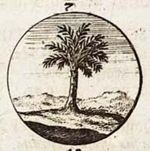
Sustine vel abstine: De la Feuille, Devises et emblemes anciennes et modernes (Augsburg, 1697), emblem 440
Ανέχου καὶ ἀπεχου: Alciatus, Emblemata (Leiden, 1591), emblem 34
Sustine et abstine: Covarrubias, Emblemas Morales (Madrid, 1610), emblem 278
Sustine et abstine: Borja, Empresas morales (Bruxelles, 1680), emblem 163
Sustine vel abstine: Camerarius, Symbolorum et Emblematum Centuria(e) (Nürnberg, 1590, 1595, 1596, 1604), emblem 41
Iconclass: 32A130 'Flemmatico (per l'acqua)' (Ripa) 54A4 Calmness, Equanimity, Imperturbability 56EE1 Forbearance
Collectanea (1500): 443
Loci Communes: Tolerantia (Tolerance, endurance, Tolérance); Temperantia (Temperance, Tempérance)
II vii 14 Naturam expellas furca, tamen usque recurrit Though you cast out nature with a fork, it still returns
Cum videam à Graecis quaedam velut obtorto, quod aiunt, collo in proverbiorum acervum trahi, cur verear eiusmodi recensere, quae praeter adagii figuram, ita venuste dicta sunt, ut venustius dici non possint? Quod genus est illud Horatii in Epistolis, Naturam expellas furoa, tamen usque recurret. Sensus est, haud facile dedisci, quae nobis natura pentus indidit atque insevit. Quod si quando vi fit, vel metu, vel pudore, vel alia quavis causa personam alienam sumamus, facile per occasionem redimus ad mores naturales. Velut qui metuunt peccare, non virtutis amore sed formidine fustis, ii simulatque tollitur fustis, recurrunt ad mores pristinos. Et Terentius: Si sperat fore clàm, rursus ad ingenium redit. Ducta est metaphora à ramis, qui apposita furca torquentur aliò quam natura posuerat: qua sublata rursum vergunt eódem quò prius. Pindarus in Olympiis hymno xi. eandem sententiam aliter extulit: τὸ γὰρ ἐμφυὲς, οὔτ᾽ αἴθων ἀλώπηξ, οὔτ᾽ ἐρίβρομοι λέοντες διαλλὰξαιντο ἦθος. id est, Nam ingenium nativamque indolem, nec astuta vulpes, neque praevalidi leones mutare querint. Quantumvis enim cicures leonem, semper redit ad genuinam feritatem: neque vulpes unquam obliviscitur fraudulentiae nativae, quantumvis mansuefacta. Idem in eodem opere hymno xiii. ἄμαχον δὲ κρύψαι τὸ συγγενὲς ἦθος. i. Difficile est occultare nativos mores. Item Horat. alibi, Tolle periclum, Iam vaga prosiliet frenis natura remotis.
When I see the Greeks dragging some things into their pile of proverbs by the scruff of the neck, as the saying goes, why should I hesitate to include the sort of sayings which are not only adages in form but so neatly expressed that nothing could be neater? A good example is that line in Horace's Epistles, 'You may cast out nature with a fork, but she will still return.' The point is, that things which Nature has deeply rooted and implanted in us are not easily unlearned. If we are sometimes forcibly obliged, by fear or shame or any other cause, to put on a mask which is not ours, we resume our normal character with ease when we have the chance. Those, for instance, whose fear 'to do wrong' arises not 'from love of virtue' but from fear of the big stick, return to their original way of life as soon as the stick is removed. And Terence: 'If he hopes it will escape notice, he returns to his true self.' The image is taken from branches which are twisted by the use of a forked prop into a different position from the way nature had placed them; and when the prop is removed they tend to resume their former direction. Pindar in the eleventh of his Olympians expressed the same idea in another way: 'But their inborn nature neither wily fox nor roaring lions can change.' However much you may tame a lion, it always returns to its native ferocity, nor does a fox, however much domesticated, ever forget its inborn treachery. Pindar again, in hymn 13 of the same collection, writes 'It is difficult to conceal one's natural character.' Horace too in another passage: 'Remove the danger and, the bit removed, / Nature without restraint will gallop off.'
Facsimile:
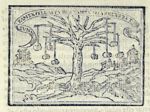
Naturam expellas furca, tamen usque recurrit: Covarrubias, Emblemas Morales (Madrid, 1610), emblem 185
Iconclass: 31A2741 throwing something 41C312 fork 47I71(+57) tree nursery (+ bending, folding, shaping ~ industrial processes) 51A5 Intrinsic Nature, Essence, Idea (according to Plato) 53A211 Obstinacy; 'Ostinatione', 'Pertinacia' (Ripa)
Collectanea (1500): 430
Loci Communes: Ingenii malitia et institutio (Malice of character and its formation, Malice d'esprit et son origine)
II vii 15 Navis annosa haudquaquam navigabit per mare An old ship will not sail the open sea
Ναῦς παλαιὰ πόντον οὐχὶ πλώσει. i. Navis antiqua non navigabit per mare. Congruit in eos qui iam ob aetatis imbecillitatem ad res arduas obeundas, sustinendaque pericula parum sunt idonei, ac primum ipsi pereunt oppressi negociorum magnitudine, & in discrimen adducuntur quorum res agitur. Nota est allegoria. Refertur adagium à Diogeniano.
[greek], An old ship will not sail the open sea, is well adapted to those whose strength has been sapped by old age, so that they are no longer capable of doing something difficult or facing danger; first the size of the burden overwhelms them and they perish, and those whose business is at stake are put in jeopardy. It is a familiar image. The adage is recorded by Diogenianus.
Facsimile:
Iconclass: 25H23 sea (seascape) 31D160 Old Age, 'Senectus'; 'Vecchiezza' (Ripa) 51FF51:46C21 Oldness❧ships (in general)
Loci Communes: Munus aptum aut ineptum (A gift fitting or unfitting, Un présent convenable ou inconvenant)
II vii 16 Ni pater esses Were you not my father
Εἰ μὴ πατὴρ ᾖσθα, Ni pater esses, Hoc vulgo dici consuevit, quoties honoris, aut metus causa convicium reticebant, & coniiciendum relinquebant. Plene sic effertur, Εἰ μὴ πατὴρ ἦσθ᾽, εἶπον ἄν σ᾽ οὐκ εὖ φρωνεῖν. id est: Ni esses pater, te sapere dicerem haud bene. Est autem versus hic in Antigone Sophoclis, Sunt enim Haemonis verba Creontem patrem obiurgantis, quod sponsam filii pararet occidere. Itaque quoties senis, aut potentis, aut alioqui venerandi sententiam nobis haud quaquam probari significabimus, cui tamen honoris causa nolimus refragari, veluti si quis opinionem Aristotelicam apud Peripatetitos recte damnare vellet, loquetur ad hunc modum: Haec habet sententia gravissimum auto rem. Fortassis enim phas non est ab Aristotele dissentire. Alioqui, Εἰ μὴ πατὴρ ἠεν, hoc est, nisi autoritati deferrem, habeo quo refellam. Quod si mutilum efferas, plusculum etiam habebit gratiae. Refertur à Diogeniano.
[greek], Were you not my father. This was commonly said when they repressed some severe criticism out of respect or fear, and left it to be understood. The complete phrase runs as follows: Were you not my father, I would have said you are not in your right mind.' It is a line from Sophocles' Antigone, spoken by Haemon, who is protesting against his father's preparations to put to death the girl to whom the son is betrothed. We shall use it to indicate that we heartily disagree with someone who by his age or influence or for some other reason commands our respect, but out of reverence do not wish to take issue with him openly. Suppose for instance that one rightly wanted to refute one of Aristotle's opinions before an audience of Peripatetics, one might speak like this: 'The author of this opinion carries the greatest weight, for it is perhaps a crime to disagree with Aristotle. Otherwise, were he not my father ...,' meaning 'Did I not defer to his authority, I possess the means of refuting him.' If you leave half the sentence unexpressed, it will gain somewhat more point. Recorded by Diogenianus.
II vii 17 Magnum os anni A good year talks big
Μέγα στόμα τοῦ ἐνιαυτοῦ, id est, Magnum os anni. Dicebatur quoties uberior rerum proventus, aut vilior annona animos & loquendi liberatem adderet, alioqui timidioribus. Solent enim rustici magnificentius loqui largiusque polliceri, spe proventus uberioris. Refertur à Suida. Non admodum dissidet ab illo, Foenum habet in cornu. Item illo: Argentifontes loquuntur.
[greek], A good year talks big, was used whenever an unusually good harvest or a fall in the cost of bread raised the spirits of those who would otherwise have lacked self-confidence, and set them talking. It is typical of country people to speak more boastfully and make more generous promises when they have the prospect of a good harvest. Recorded by Suidas. It does not differ much from He has hay on his horn, or from The springs of silver speak.
II vii 18 Megaricae sphinges Megarian sphinxes
Μεγαρικαὶ σφίγγες, id est, Megaricae sphinges, ita scorta quaedam vulgus olim appellabat, sive quod vulgo molles sphictae παρὰ τὸ σφίγγω dicuntur apud Graecos, sive quod apud Megarenses nutrix sphinx appelletur, sive quod Megarensium mores improbi fictique & populari convicio quondam notati fuerint. Unde Aristophanes in Vespis, risum Megaricum, de quo dictum est alibi, taxat, Μή δ᾽ αὖ γέλωτα μεγάρόθεν κεκλασμένον. id est, Sed ne Megaricos rursus infratos iocos. Suidas refert & hunc versiculum, sed tacito, ut solet autoris nomine, Αλλ᾽ ἔστιν ἡμῖν μεγαρϊκή τις μηχάνη. id est, Nobis adest Megarica quaedaem machina. Risum, seu iocum Megaricum, intelligit molliciom Megarensium. Refertur in collectaneis Diogeniani.
[greek], Megarian sphinxes, was a name given commonly in old days to certain courtesans, either because catamites are currently called sphictae in Greek from the word sphingo, or because in Megara sphinx was a word for a children's nurse, or because the people of Megara were immoral and untrustworthy, and their character earned them in old days this discreditable name. Hence Aristophanes in the Wasps criticizes the Megarian laugh, of which I have spoken elsewhere: 'Nor yet a knock-kneed laugh from Megara.' Suidas too quotes another line, but as usual without giving the author's name: 'Yes, but for this I've a Megarian trick.' By 'Megarian laughter' or 'tricks' he understands the luxurious habits of the Megarians. Recorded in the collection of Diogenianus.
Facsimile: 
Iconclass: 31A45231 sphinx (lion/woman); 'Sfinge' (Ripa) 32B311(MEGARIANS) indigenous European peoples (MEGARIANS) 33C521 courtesan, hetaera 54AA5 Badness
Loci Communes: Rapacitas et avaritia (Rapacity and greed, Rapacité et avarice)
II vii 19 Mellis medulla Marrow of honey
Μέλιτος μυελὸς, id est, Mellis medulla. De re maiorem in modum suavi dicebatur. Unde & Ennius apud M. Tullium, M. Cornelium Cethegum, Suadae medullam appellat, ob singularem suaviloquentiam. Nam quod optimum est, id natura videtur intime recondidisse. Unde & illa passim obvia In medullis, & Medullitus amare, non dissident à simulacro proverbiali. Huius est formae, τῆς ἑλλάδος ἑλλάς.
[greek], Marrow of honey, was applied to anything exceptionally sweet. Hence too it comes that Ennius, as reported by Cicero, called Marcus Cornelius Cethegus 'the marrow of persuasion' as being a singularly attractive speaker, for that which is best of its kind seems to have been hidden by nature in the very heart of things. For the same reason those very common expressions 'in one's very marrow' and 'to love in the marrow of one's bones' are no different in form from proverbs. We find the same formula in The Greece of Greece.'
Facsimile:
Iconclass: 31A342 sweet (taste) 41C636 honey 51I5 Middle; 'Mezo' (Ripa)
Loci Communes: Lautitiae (Sumptuousness, luxuries, Somptuosités)
II vii 20 Meliores nancisci aves To be given better auspices
Αμεινόνων οἰωνῶν τυχεῖν. id est, Meliores nancisci aves dicuntur, quibus post res adversas succedunt prosperiora. Nam ut apud Latinos avis & ales interdum non animal, sed omen ipsum & augurium significat, itidem apud Graecos, οἰωνὸς & ὄρνις, quum στρουθὸς non eodem accipiatur modo, quemdamodum indicat Eustathius in primum Odysseae librum. Horatius in Odis: Mala ducis aevi domum. Idem alibi, Maeonii carminis alite. Homerus Iliados Ω. Μηδὲ μοι αὐτὴ Ορνις ἐνὶ μεγάροισι κακὸς πέλευ. id est, Hisce mihi ne tu fueris mala in aedibus ales. Rursum eiusdem operis M. Εἶς οἰωνὸς ἄριστος ἀμύνασθαι περὶ πάτρης. id est, Optimum id augurium est, patriam virtute tueri. Laboravit autem hac superstitione antiquitas, ut in magnis rebus aggrediundis avium occursus observaret, neque defuerunt, qui eam velut artem profiterentur. Atque hinc apud Romanos augurum collegium. Iam penè explosa est apud Christianos huius professionis superstitio, sed ita ut in eius locum successerit malum propè pestilentius, atque adeo conduplicatum, nempe horum, qui ex astris futura pronuntiant: & aliorum qui numinis afflatum mentientes, apud credulam & indoctam plebeculam prophetae volunt haberi. At qui mirum est utroque invenire quibus imponant. Imponunt enim non vulgo tantum, verumetiam ipsis regibus & orbis moderatoribus.
Those people are said 'Αλλο γένος κώπης', To be given better auspices, who after a period of adversity find themselves in more prosperous circumstances. For in Latin two words for 'bird,' avis and ales, mean sometimes not the living creature but the actual omen and augury derived from it, and it is the same in Greek with oiônos and ornis; for strouthos is not used in the same way, as Eustathius shows in his comment on Odyssey book one. Horace in the Odes: 'Ill-augured are you now, taking her homeward,' and again in another passage: 'That winged Maeonian poet.' Homer in the Iliad, book 24: 'So do not you yourself become for me / A bird of evil omen in these halls,' and again in book 12 of the same poem: 'The one best augury is to fight in defence of the fatherland.' The Ancients laboured under the superstitious belief that in attacking any great enterprise they must observe the chance encounter of birds, and some of them were professed specialists in this field as though it were an art. Hence the Romans had their College of Augurs. Among Christians this profession, based on superstition, has already been almost drummed out of town, but only with the result that its place has been taken by an evil almost more pestilential and actually double-headed - those who foretell the future by the stars, and others who falsely claim divine inspiration and wish to be taken for prophets by the credulous and uneducated public. Yet it is astonishing how both parties find victims on whom they can impose; for impose they do, not only on the mob but on kings themselves and the rulers of the world.
Facsimile:
Iconclass: 12F52(HARUSPEX) 'haruspex' ~ Roman religion 14 astrology 52E21 Good Omen; 'Augurio buono' (Ripa)
Loci Communes: Proficientium in melius (Improving for the better, Progresser vers le mieux)
II vii 21 Aliud genus remi Another sort of oar
Αλλο γένος κώπης. i. Aliud genus remi. Dicebatur olim, ubi quispiam res novas, & antea non visas induceret. Aut ubi quis versis moribus pristinis, novum & inusitatum vitae genus institueret. Hinc ortum aiunt, quod Hercules cum ad boves Erythraeas navigaret, leonis exuvio carbasi vice, clava mali loco, pro rudentibus pharetrae loris, pro remo arce, denique pro navigio lebete sit usus. Quod inusitatum profecto navigandi genus cum vi dissent accolae, acclamabant: ἄλλο γένος κώπης. Refertur in Plutarchi collectaneis.
Αλλο γένος κώπης, Another sort of oar, was used in old days when someone introduced a novelty which had never been seen before, or when there was a change in someone's original character and he adopted a new and unaccustomed way of life. It arose, they say, from the fact that, when Hercules was voyaging in search of the Erythraean cattle, he used his lion-skin in place of a sail, his club for a mast, the thongs of his quiver for rigging, his bow for an oar, and a cauldron for his boat. When the inhabitants caught sight of this highly unusual style of sailing, they cried out Another sort of oar.' Recorded in the collections of Plutarch.
II vii 22 Clamosior lauro ardente As noisy as burning bay-leaves
Μείζωνα βοᾷ δάφνης χλώρας καιομένης. i. Magis vociferatur quam laurus viridis incensa, propterea quod Laurus adhuc virens in ignem coniecta, maximos crepitus aedit. Unde & in maleficiis amatoriis incendi consuevit, tanquam amantium querimonias repraesentans. Daphnis me malus urit, ego hanc in Daphnide laurum. Refertur à Diogeniano.
[greek], He makes as much noise as green bay-leaves burning, because a branch of bay, if thrown on the fire while still green, makes a very loud crackling sound. Hence it was also the practice to burn bay-branches in the witchcraft used by lovers, as though the noise symbolized a lover's complaints: 'Cruel Daphnis burns me, and against Daphnis do I burn this bay.' Recorded by Diogenianus.
Facsimile: 
Iconclass: 22D1 loud sound, noise 25G3(LAUREL)(+27) trees: laurel (+ leaf) 41B12(BAY-LEAVES) burning as process (BAY-LEAVES)
Loci Communes: Clamosus (Noisy, clamorous, Bruyant)
II vii 23 Nunc leguminum messis Now's the time to pick the beans
Νῦν ὀσπρίων ἄμητος, id est, Nunc leguminum messis. id est, nunc tempestivum hoc aut aliud agere. Veluti si quis admoneat iuvenem nunc adesse tempus, parandae gloriae, parandae eruditioni, parandis opibus idoneum, dicat, νῦν ὀσπρίων ἄμητος. Sumptum à rusticis, qui tum maximè vigilant, nec sinunt iIlud tempus per ocium perire. Recensetur à Diogeniano & Suida.
[greek], Now's the time to pick the beans - in other words, it is now the right moment to do this or that. For example, if one were to tell a young man that the time is now at hand to win glory, to acquire knowledge, or to get rich, one might say 'Now's the time to pick the beans.' It is taken from country people, who are then most keenly on the watch, and never allow that moment to be lost through idleness. Recorded by Diogenianus and Suidas.
Facsimile:
Iconclass: 47I141:25G21(BEANS) reaping, picking, mowing ~ harvest❧fruits: beans 54B12 Opportunity, Opportuneness, Seasonableness
Loci Communes: Tempestiva (Timely things, Choses opportunes)
II vii 24 Nunc dii beati Now the gods are happy
Νῦν θεοὶ μάκαρες, id est, Nunc dii beati. Vox erat velut adgaudentis & adgratulantis, quoties nocentibus supplicium meritis dignum contigisset, perinde quasi diis & iucundum & honestum sit, ut scelerati dent poenas: Contra probrosum, si viris improbis res secundae sint, videlicet iuxta sententiam illam proverbialem, Θεοῦ δ᾽ ὄνειδος τοὺς κακοὺς εύδαιμονεῖν. id est: Probrum est deo, si res malis sint prosperae. Siquidem hinc alii collegerunt nullos omnino deos esse.
[greek], Now the gods are happy. The phrase conveyed a kind of pleasure and satisfaction, whenever the guilty had paid some penalty adequate to their deserts, just as though it brought the gods satisfaction and credit when criminals are punished, but disgrace when things go well for the wicked, in accordance with that proverbial aphorism 'God is to blame, if the ungodly flourish.' After all, others have found in this an argument that the gods do not exist at all.
Facsimile:
Iconclass: 44G25 arrest (of criminal) 44G29 outlaw 44G3 criminal law; punishment 56B3 Satisfaction, Contentment; 'Contento' (Ripa) 92 gods ~ classical mythology
Loci Communes: Ultio malefacti (Vengeance for a wrongdoing, Vengeance d'un méfait)
II vii 25 Ordinem deserere To desert one's post
Λιπεῖν τὴν τάξιν. i. Ordinem deserere dicitur, qui deest officio suo in re quapiam per agenda. Ducta allegoria ab iis qui stant in acie. Nam poena capitalis erat, qui locum ab imperatore datum deservisset. Unde & Desertoris vocabulum apud militares homines ignominiosissimum. Plato lib. De legibus iubet, τόν καταλελειπότα τὴν φρουρὰν, id est, qui excubias deservisset, in foro propalàm describi, infamiae notaeque causa, tanquam is quod inpso erat, rempublicam omnem prodiderit loco relicto. Aristophanes in Vespis, Φυλακήν καταλύειν νυκτερινὴν διδάσκομαι, id est, Deserere nocturnam doceor custodiam. Lucian. in libello De mercede servientibus, χρὴ οὖν σε ἀεὶ σὺν αὐτῳ ὁρᾶσθαι, καὶ μηδέποτε ἀπολείπεσθαι, ἀλλ᾽ ἕωθεν ἐξαναστάντα παρέχειν σεαυτὸν ὀφθησόμενον ἐν τῇ θεραπείᾳ. καὶ μὴ λιπεῖν τὴν τάξιν. id est, Necessum est itaque, ut assidue apud illum conspiciaris, neque desis unquam, quin diluculo surgas, teque in famulitio conspiciendum exhibeas, neque deseras ordinem. Simpliciter usus est Isocrates in oratione De pace, ἀτιμώτεροι γίνοντες τῶν τὰς τάξεις λειποντῶν καὶ ἀσπίδας ἀποβαλλόντων. i. magis infames fiunt iis qui ordinem deserunt, & clypeos abiiciunt. M. Tullius in Epistolis ad Atticum, De praesidio decedere dixit. In Finibus bonorum, Deserere praesidium: In Catone, De statione decedere. nimirum varie reddens, quod Graeci dicunt, λιπεῖνν τὴν τάξιν. Apud Athenaeum lib. i. Eubulus comicus refert hunc versiculum ex Archilocho, Ασυμβόλου δεἴπνου γαρ ὅστις ὑστερεῖ, Τοῦτον ταχέως νώμιζε καὶ τάξιν λιπεῖν.. id est, Cessando coenae quisquis immuni deest, Hic idem in acie facile deseret locum. Aeschines in apologia obiicit Demostheni, ὡς ἐνεγράφη λειποταξίου. id est, quod illi diesf esset dictus ob desertum ordinem, quem ῥιψάσπιδα probro dictum, aliàs commemoravimus. At ille eum qui diem ipsi dixerat, ad extremum adegit diem, occiso eo Aristarchi praesidio, quemadmodum ibidem criminatur Aeschines. Postremo Latinis In sua classe manere dicuntur, qui non deserunt vitae institutum. & Classem suam deserere, qui mutant.
Λιπεῖν τὴν τάξιν, To desert one's post, is used of those who fail to do their duty in carrying out some piece of business. The figure is taken from men stationed in line of battle, for death was the penalty for anyone who had deserted the place assigned to him by his commanding officer, and so the word 'deserter' carried the greatest possible disgrace among military men. Plato prescribes in the Laws that the name of a sentry who has deserted his watch should be publicly posted up in the market-place as a mark of disgrace and dishonour, as though by leaving his place a man did all that was in his power to betray the entire commonwealth. Aristophanes in the Wasps 'I am learning how to abandon my night's watch.' Lucian in his essay On Salaried Posts: 'So you must always be seen with him and never fail to appear, but be up at daybreak and put yourself among his servants where you are certain to be seen, never deserting your post.' It is used in a straightforward way by Isocrates in his speech On the Peace: 'They are more deeply dishonoured than those who desert their posts or throw away their shields.' Cicero in his Letters to Atticus spoke of 'abandoning guard-duty,' and in the Definibus of 'deserting guard-duty'; in the Cato of 'abandoning one's allotted station,' all of which of course are different ways of rendering the Greek phrase which we have given as 'deserting one's post.' In the first book of Athenaeus Eubulus, the writer of comedies records the following line from Archilochus:
But he who comes late to a dinner for which he will not have to pay
Will be quick, you may guess, to abandon his post in the battle-array.
Aeschines in his speech in his own defence accuses Demosthenes of having been indicted for desertion of his post; and I have recorded elsewhere that by way of insult he was called rhipsaspis, one who has thrown away his shield. But the man who had put Demosthenes in peril of his life lost his own life as a result, for Demosthenes killed him with the support of Aristarchus; so Aeschines asserts in the same passage. Last but not least, in Latin those who do not abandon their established course of life are said to 'remain in their class,' [in sua classe manere] and those who change it to 'abandon their class,' [classem suam deserere].
Facsimile:
Iconclass: 45B9 desertion 54FF1 Failure
Loci Communes: Vices officii (The vicissitudes of duty, Les vicissitudes du devoir)
II vii 26 Ovium nullus usus Sheep are no use
Προβάτων οὐδὲν ὄφελος, ἐὰν ὁ ποιμὴν ἀπῇ. id est, Ovium nulla utilitas, si pastor absit. Admonet adagium ἀναρχίαν rem esse omnium perniciosissimam. Nihil recte faciunt ministri, nisi adsit herus. Inutiles discipuli, quoties abest praeceptor. Inutilis populus, nisi principis auctoritate gubernetur. Apparet senarium fuisse. Nam paucis syllabis commutatis restituetur hoc pacto: Προβάτων γὰρ οὐδὲν ὄφελος, ἄν ποιμὴν ἀπῇ. id est, Namque usus ovium nullus, ubi pastor deest. De huius animantis stulticia, quanque sibi sit inutile; ni pastoris cura succurrat, lege quae aliàs ex Aristotele citavimus in proverbio, Ovium mores.
[greek], Sheep are no use, if the shepherd is not there. The lesson of the adage is that anarchy is the most pernicious thing there is. Servants do nothing right, unless the master is at hand; pupils are useless in the absence of their teacher; the common people are useless unless they have the prince's authority to guide them. This clearly formed an iambic line, for by the change of a few syllables it can be restored as follows: 'Sheep are no use when there's no shepherd there.' On the foolishness of this animal, and how little it therefore can do for itself without the shepherd's care to help it, read what I have cited elsewhere from Aristotle on the proverb The character of sheep.
Facsimile: 
Iconclass: 46A24 relation between master and servant 49B24 teacher and pupil 51AA4:47I221 Nothingness, Absence❧herding, herdsman, herdswoman, shepherd, shepherdess, cowherd, etc. 54BB3:47I213 Inutility, Noxiousness; 'Nocumento', 'Nocumento d'ogni cosa' (Ripa)❧sheep
Loci Communes: Multi - in stupidos (Many people - against the stupid, Beaucoup de gens - contre les sots)
II vii 27 Periculum prorae selis The danger-point is the bench in the prow
Κίνδυνος ἡ ἐν πρώρᾳ σελὶς. i. Periculum sella prorae. Quoties in re quapiam praecipuum periculum, caputque negocii esse significamus. Nam hostes expugnaturi navim, in proram primum assultum faciunt. Selis autem sella est, quae in proris esse consuevit, si Zenodoto credimus.
[greek], The danger-point is the bench in the prow. Whenever we wish to convey that in some piece of business there is some particular risk, some point of special importance. For when a ship is attacked by the enemy, they deliver their first assault on the prow. Selis means the bench commonly situated in the prow, if we may believe Zenodotus.
Facsimile:
Iconclass: 41A723 bench 54AA72:46C215(PROW) Vulnerability❧parts of ship's exterior (PROW) 54DD52 Risk; 'Ardire ultimo & necessario' (Ripa)
Loci Communes: Discriminis (Danger, crisis, Danger)
II vii 28 Impete peritum artis Attack a man skilled in the art
Βάλλ᾽ εἰς ἔχοντα τὴν ἐπιστήμην. id est, Iaculare in eum qui novit artem, ubi quis convicium facit homini, qui norit & ipse retorquere convicium, aut qui carpit velut imperitum, qui non inferior sit in artis scientia. Sumpta metaphora videtur ab iis qui iaculo aut saxo petunt eum, qui calleat ictum vel declinare, vel in iaculantem retorquere.
[greek], Aim at a man who knows the art. When someone abuses a man who knows how to retaliate with abuse in his turn, or criticizes as an ignoramus one who knows as much of the art as he does himself. The metaphor is evidently taken from those who aim javelins or stones at those who have the skill, either to dodge the missile or to turn it back upon the man who threw it.
Facsimile:
Iconclass: 33B1 quarrel, argument 51B3 Parity, Equality 54BB3 Inutility, Noxiousness; 'Nocumento', 'Nocumento d'ogni cosa' (Ripa) 57BB22 Insult; 'Ingiuria', 'Offesa' (Ripa)
Loci Communes: Inanis opera (Vain effort, Effort vain)
II vii 29 Philippi gallus Philip's cock
Φιλίππου ἀλεκτρυὼν, id est, Philippi gallus. Hoc dictari consuevit, ubi quis de levi quopiam facinore, perinde ut maximo sese iactaret. Nam Alectryon dux quidam erat Philippi Regis, quem Chares Atheniensis confecerit. Apparet autem Charetem hunc huius facti, nimium crebro, nimisque insolenter apud populum Atheniensem verba facere solere, ut hinc vulgo sit usurpatum. Recensetur apud Zenodotum.
[greek], Philip's cock. This came to be used when a man boasted of some trifling action as though it were really important. Alectryon (which means 'the Cock') was the name of one of King Philip's generals, who was cut to pieces by Chares the Athenian. It appears that this Chares recounted the action before a public audience in Athens far too often and with far too much self-satisfaction, so that he gave rise to a proverb. Recorded by Zenodotus.
Facsimile:
Iconclass: 34B232(+51) fowl (cock, hen, chicken, etc.) (+ male animal) 57AA647 Hybris 98B(ALECTRYON) male persons from classical history (ALECTRYON) 98B(CHARES) male persons from classical history (CHARES)
Loci Communes: Arrogantia jactantiaque (Arrogance and boastfulness, Arrogance et vantardise)
II vii 30 Parit puella, etiam si male adsit viro A girl has a baby, even if she consorts badly with her husband
Τίκτει κόρη ὅταν κακῶς ἀνδρὶ παρείῃ, id est, Parit puella, cum male etiam adfuerit viro. Dici conveniet, quoties res facile conficitur ex sententia, etiamsi negligenter & ignaviter gesta fuerit. Veluti puella propter aetatis felicitatem facile gerit uterum, etiamsi cum viro non admodum viro rem habuerit. Non item anus: imò bis virum requirit aetas affecta mulieris. Ea res nec Augustinum fugit theologum. Nam quaestionem quod Abraham autore Paulo, Sarae effoetus, tamen ex Cethura sustulisse prolem legitur, sic explicat, ut dicat, illum Sarae anui effoetum fuisse, Cethurae puellae fuisse virum. Egregium ingenium etiam sub malo & indiligente praeceptore bonas literas assequitur. Contra, si discipulus sit ὄνος λύρας, praeceptor etiam optimus oleum perdit & operam.
[greek], A girl has a baby, even though she has consorted badly with her husband. It will be appropriate to use this whenever something is quickly accomplished as one wished, even if one set about it carelessly and idly. A girl, for instance, conceives easily - it is the privilege of her youth - although she may have lain with a man of less than complete virility; this is not true of an older woman, and in fact one who is past her youth requires two contacts with a husband. This fact did not escape the notice of, among others, Augustine as a theologian; for the problem that Abraham who, according to Paul, was already impotent in respect of Sarah is said in Scripture none the less to have had children by Keturah, is thus explained by him: Abraham was impotent in respect of Sarah because of her age, but with Keturah, who was a girl, he could still play a man's part. Outstanding ability can acquire a liberal education even under a bad and idle teacher; but if the pupil, on the other hand, is an ass listening to the lyre, even the best of teachers wastes both oil and toil.
II vii 31 Pasetis semiobolus Pases' halfpenny
Τὸ παχσητος ἡμιοβόλιον, id est, Pasetis semiobolus. De re nova stupendaque, & praestigiis simillima. Veluti cum orator efficit, ut eadem causa primum optima, mox pessima videatur, res eadem maxima, statimque minima appareat. Et cum sophistae demonstrant eundem & asinum esse & hominem. Aut ubi quis asseverat id factum, quod citra magiam aliquam fieri non potuerit, licebit ἐπιφωνεῖν, πάσητος ἡμιοβόλιον. Nec intempestiviter dixeris, quum quidam ita dant munus aliquod, ut idem mox arte quadam ad se retrahant. Tradunt Pasetem quendam praestigiarum & magiae peritia primum nomen meruisse. Is incantamentis quibusdam efficiebat, ut repente convivium omnibus instructum partibus adesse videretur: rursum ubi libuisset, omnia protinus evanescebant. Emebat autem frequenter, pretiumque rei numerabat, verum mox nummus non apud venditorem, sed apud Pasetem reperiebatur. Huiusmodi fermè tradit Suidas.
[greek], Pases' halfpenny, was used of something strange and astonishing, something with the effect of a conjuring-trick. When, for instance, a speaker makes the same case appear very good at first and then very bad, and the same thing seem very important and then immediately very unimportant; and when logicians demonstrate that an ass and a man are the same thing; or when someone maintains that a thing has happened which could not possibly happen without some sort of witchcraft - on all such occasions it will be proper to cry 'Pases' halfpenny!' Nor will it prove out of place when people make some gift and then by a trick get it back into their own hands. The story goes that a man called Pases had the reputation of being the finest conjurer and most skilled magician of his time. By the use of certain spells he could produce the sudden appearance of a well-furnished dinner-table, and when he thought fit, could make the whole thing completely vanish. He used often to make a purchase, and pay cash for it; and not long thereafter, there were the coins, not in the shopkeeper's till but in Pases' pocket. Such more or less is the account in Suidas.
Facsimile:
Iconclass: 43A375 illusionist, conjurer, juggler, 'legerdemain' 46B311 coin 52AA521 Illusion, Phantasm 52BB3 Surprise, Wonder; 'Maraviglia' (Ripa) 98B(PASES) male persons from classical history (PASES)
Loci Communes: Mira nova (Wonderful new things, Choses nouvelles et étonnantes); Imposturae (Impostures, Impostures)
II vii 32 Parvus semper tuus pullus Your chick is always small
Μικρὸς ἀεὶ ὁ σὸς πῶλος, id est, Parvus semper tuus pullus. ubi quis ob staturae brevitatem diu puer videri cupit. Conveniet & in hos, qui tametsi natu grandiores, tamen verborum deliciis affectant videri iuvenculi. Aut cum ob amorem cascus cascam puppam vocat, & ipse vicissim puppus audit, quod aliàs indicavimus. Aristophanis interpres admonet apud Graecos, quod cuique vehementer charum esset, id pullum illius appellari solere. blandimur autem verbis diminutivis, eoque in Equitibus quidam populo blandiens appellabat illum δημΐδιον. i. popellum, eoque mox audit, ὡς ἀπὸ μικρὸν ἐύνους αὐτῷ θωπευματίων γεγένησαι. i. ut è pusillis blandiciolis benevolus illi factus est. Parva vocat blanda, atque is vicissim audit, καὶ σὺ γὰρ αὐτὸν πολὺ μικροτέροις τούτων δελεάσμασιν εἲλες, quod ipse multo abiectius adulatus esset populo.
[greek], Your chick is always small, when someone who is short of stature wishes for that reason to continue being taken for a child. It will also be suitable for those who, though older in years, aim by their use of cute phrases to seem still juvenile; or when of an elderly and doting couple the man calls his wife puppa, lass, and is called puppus, pet, in return, as I have pointed out elsewhere. The scholiast on Aristophanes informs us that in Greek whatever a person was passionately fond of was called his 'chick.' To convey affection we use diminutive forms of words; and thus a character in the Knights who wishes to curry favour with the crowd calls it his 'darling crowdlet,' and in return someone says to him 'What goodwill in that quarter your tiny sweet nothings have earned for you!' By 'tiny' he means affectionate; and the reply he gets is 'Much tinier still than these were the baits with which you caught him,' because he himself had flattered the mob in much more grovelling fashion.
Facsimile:
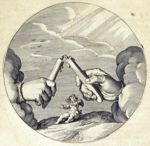
Cascus cascam: Cats, Maechdenplicht (Middelburg, 1618), emblem 36 quotes the comment
Iconclass: 34B232(+53) fowl (cock, hen, chicken, etc.) (+ young animal) 51GG1 Littleness, Smallness 57A77 Friendliness, Gentleness, Affability; 'Affabilità, piacevolezza, amabilità', 'Animo piacevole, trattabile & amorevole', 'Benignità' (Ripa)
II vii 33 Phaselitarum sacrificium A sacrifice Phaselite-fashion
Φασηλιτῶν θῦμα. id est, Phaselitarum sacrificium tanquam vile, citraque sanguinem. Sor didum ac tenuem sumptum hoc adagio significabant. Tradunt enim apud Phaselitas Pamphyliae gentem moris esse, ut pisciculi salsi diis sacrificentur. Autor Zenodotus. Eudemus item scribit, eos Capro deo salsamentis rem divinam facere, eiusque rei testem citat Callimachum. Finitimum est illi, Sine fumo sacrum.
[greek], A sacrifice Phaselite-fashion, as being cheap and without shedding of blood. They used this adage to convey that the cost was mean and small; for it is said that among the Phaselites, a people in Pamphylia, it was customary to offer the gods small salt fish. Zenodotus is the authority. Eudemus also says that to their god Cabrus they sacrifice salt meat, and cites Callimachus as evidence for this. Close to the adage A smokeless sacrifice.
Facsimile: 
Iconclass: 12E2121:25F6 animal sacrifice ~ Greek religion❧fishes 32B311(PHASELITES) indigenous European peoples (PHASELITES) 54BB6 Worthlessness
Loci Communes: Sordes et parcimonia (Meanness and stinginess, Bassesse et avarice)
II vii 34 Peius Babys tibia canit Babys plays the flute even worse
Κάκιον βάβυς αὐλεῖ. i. Peius Babys cantat. Hoc adagium iaci consuevit in eos, quorum exercitatio semper vergit in peius. Quod genus sunt oratores quidam, qui quo diutius dicunt, hoc dicunt indoctius. Refertur autem ad huiusmodi fabulam. Ferunt Babym fratrem fuisse Marsyae, qui non veritus est ipsum Apollinem ad canendi certamen evocare. A quo quum esset victus, ab eodem supinus de pinu suspensus, excoriatus est. Deinde cum Apollo pararet Babym quoque perdere, intercessit Pallas, admonens hunc usque adeo infeliciter & indocte tibiis canere, ut omnino negligendus esse videretur, κάκιον, inquiens, βάβυς αὐλεῖ. id est, Deterius Babys tibiis canit. Quibus verbis commotus Apollo Babyn adeo contempsit, ut eum ne supplicio quidem dignum existimaret, sed suae potius inscitiae iudicaret relinquendum. Usurpabitur adagium & per comparationem, ut mentione facta de praeceptore indocto, si quis de discipulo percunctanti, hoc pacto respondeat, κάκιον βάβυς αὐλεῖ. Neque vero repugnamus, si quis hoc loco κάκιον, accipiat pro miserius, ut sit sententia, Babym infeliciorem esse, dum indocte canens omnibus est ridiculus, quam si tolleretur è medio. Meminit huius adagionis Athenaeus lib. xiiii. ostendens dici solitum de iis qui indies deterius canerent. Quanquam hic locus apud hunc autorem depravatus est in vulgatis exemplaribus, ni fallor. Sic enim legimus, καὶ κίων ἢ βάβυς αὐλεῖ, id est, Et Cion aut Babys canit. Erroris ansam praebuit, quod paulo ante commemorans ineptos tibicines, quos Hipponax iambographus lacerasset, nominavit Cionem, Codulum & Babyn. In collectaneis quae noster excudit Aldus reperitur, τὸν βάβυος χορὸν. i. Babys chorum, pro indocta parumque modulata cantione, & fabulam asscriptam huiusmodi. Maeandro fluvio duo fuere filii, quorum Babys solitus est unica tibia canere, Marsyas duabus Phrygio more. Cum autem suum uterque chorum habert, & Babys inscite tractaret tibiam, frater eò insolentiae sublatus est, ut Apollinem quoque prae se contemneret, à quo cum esset excoriatus, iamque Babyi similis poena pararetur, Palladis interventu exemptus est supplicio. Verum equidem suspicor scripturam esse depravatam, ac legendum esse τοῦ βάβυος χεῖρον, ut idem sit cum eo quod modo retulimus.
[greek], Babys plays the flute even worse. This adage was used as a familiar jibe against those whose performance always tends to deteriorate. Some speakers are like that: the longer they go on, the worse they speak. They attribute this to a story on the following lines. Babys, they say, was a brother of Marsyas, the man who was not afraid to challenge Apollo himself to a musical contest. When he was defeated, he was suspended by Apollo from a pine-tree upside down, and flayed. Then, when Apollo was preparing to destroy Babys too, Pallas interceded for him, saying that his flute-playing was so unsuccessful and unskilful that clearly he was quite negligible; 'Babys' she said 'plays even worse.' Apollo was impressed by her words, and treated Babys with such disdain that he did not even think him worthy of punishment, but judged it better to abandon him to his incompetence. The adage will also be useful in comparisons; after speaking of an incompetent teacher, if asked about one of his pupils, one might reply 'Babys plays even worse.' Nor should I object if anyone were to take 'worse' here in the sense of more pitiful, giving the meaning that Babys is more to be pitied for the way in which his incompetent playing makes him a general laughingstock than he would be if he were dead. This adage is mentioned by Athenaeus in book 14, and he shows that it was commonly used of those who played worse every day. Though the passage is corrupt in this author in ordinary texts, if I am not mistaken, for what we find is 'and Cion or Babys plays the flute.' A handle for the error is provided by the fact that shortly before, when speaking of incompetent flute-players, who had been torn to pieces by Hipponax the satirist, he has mentioned Cion, Codylus and Babys. In the collection printed by my friend Aldus I find [greek], the choir of Babys, for an unskilled and badly played performance, with the following story attached. The river Maeander had two sons, of whom one, Babys, used to play the single flute and the other, Marsyas, played the double flute in the Phrygian style. Each of them had his own choir, and since Babys was an unskilful performer on the flute, his brother reached such a pitch of insolence that he despised even Apollo in comparison with himself. When Apollo had flayed him alive, and a similar punishment was in train for Babys, the intervention of Pallas saved him from execution. I suspect, however, that the text is corrupt, and that we should read cheiron for choron, giving Worse than Babys,' to produce the same sense as I have recorded above.
Facsimile:
Iconclass: 42G2221 brothers (second degree family relationships) 54AA3 Incompetence 92B3412(+0) contest between Apollo and Marsyas; the Muses acting as judges (+ variant) 92L423(BABYS) other single named satyrs (BABYS)
Loci Communes: Infacundia (Lack of eloquence, Manque d'éloquence)
II vii 35 Cercopum coetus An assembly of Cercopes
Αγορὰ κερκώπων. id est, Coetus Cercopum, de conciliabulo, conventuque versutorum & improborum hominum dicebatur. Narrant enim, Cercopes quosdam in Epheso fuisse, notae fraudulentiae viros, qui suis dolis conati sint ipsi lovi imponere. Hos admonuerat mater, ne in Melampygum inciderent, id quod evenit. Nam post ab Hercule vincti sunt iussu Omphales. Quidam aiunt, quosdam ob imposturas & malas artes, κέρκωπασ, quasi caudatos, appellatos fuisse apud Ephesios atque Athenienses, ut idem sit sensus huius adagionis, & illius cuius alibi meminimus, λύκου δεκάς. Torquet hoc convicium Aeschines in Demosthenem, ὅτι μὲν οὖν ἦν ποθ᾽ ὁ κέρκωψ, ἢ τὸ καλούμενον παιπάλημα, ἢ τὸ παλίμβολον, ἢ τὰ τοιαῦτα ῥηματα, οὐκ ἤδειν πρότερον. νυνὶ δὲ ἐξηγητὴν τοῦτον λαβὼν τῆς πάσης κακοηθείας μεμάθηκα.. id est, Aliquando fuisse cercopem, aut quod dicitur paepalema, aut palimbolum antehac nesciebam. Nunc vero nactus hunc omnis maliciae expositorem, didici. Videntur & illa duo verba paepalema, & palimbolum fuisse iactata vulgo. Hesychius indicat παιπάλημα dictum hominem ποικίλον ἐν κακίᾳ. id est, varium in malitia: dictum apparet à πάλλω, quod est, moveo, & παι syllaba per conduplicationem adiecta est, cuius futurum παλῶ. & παιπαλᾶν est circumspicere ac scrutari, nihilque non tentare. Rursus παιπάλη, subtilissima pars frumenti cribro excussi. Concussione fit utrunque, sortitio & frumenti purgatio. Unde πάλος, sors, & πάλη farina. Proinde qui se vertunt in omnia, paepalematis scommate notari videntur, simul allusum suspicor ad voces. Nam παῖς puerum sonat, & παλεύω venor, sive in retia duco. Idem exponit multis verbis quid sit παλίμβολον, nimirum hominem qui sibi minime constat, sed facile in diversum revoluitur. Suspicor convicium sumptum ab instrumentis sic arte confectis, ut facile recurrant in diversum, atque hinc detortum in hominem lubricae fidei.
'[greek], An assembly of Cercopes, was applied to any gathering and council-of-war of cunning rascals. The story goes that there were people called Cercopes in Ephesus, who were notoriously untrustworthy, and attempted by their treachery to impose on Jove himself. They had been warned by their mother not to have anything to do with Blackbottom. But that is just what happened; for later they were bound by Hercules at the request of Omphale. Some say that there were people in Ephesus and Athens called Cercopes (in effect, men with tails) on account of their deceptions and their black arts, so that this adage would have the same sense as one I have mentioned elsewhere, Lupus' gang of ten. Aeschines aims this verbal attack against Demosthenes: 'I never knew before what the Cercops was, or what they call a paipalema or a palimbolon or other words of the kind; but now that I have him as an expert authority on villainy in all its forms, I have learnt my lesson.' These two further words, paipalema and palimbolon, seem also to have been in popular use. Hesychius suggests that paipalema meant a man of great subtlety in all forms of mischief; it is derived clearly from pallo, I move to and fro (with the syllable pai added by way of reduplication), the future form of which is palo, and paipalan means to look around and hunt about to and fro and try every expedient. Paipale, again, is the subtlest and finest part of wheat-flour that has been shaken to and fro in a sieve. Both processes, the selection and the cleaning of the flour, are effected by shaking; and hence palos means a lot (as in casting lots) and palê fine flour. And so it is those who turn themselves into all shapes who seem to be branded with the unflattering name of paipalema. At the same time I suspect an allusion to words like pais which means a child and paleuo, I hunt or drive into the nets. Hesychius also gives a lengthy explanation of palimbolon: it applies to a man of great inconsistency, who changes direction easily into the opposite course. I suspect this abusive name for them is taken from tools which are cleverly designed to work in either direction, the word being adapted to people who cannot be trusted.
Facsimile:
Annotation: Melampygos - blackbottom = Hercules
Iconclass: 46A63:44G29 meeting, assembly❧outlaw 31A4522(+23) monsters ~ apes, monkeys (+ tail) 94L4117(+0) Cercopes (monkey-like beings) are slung upside down on a pole and carried away by Hercules, because they had tried to steal his weapons (+ variant)
Loci Communes: Improbi (The dishonest, Les malhonnêtes)
II vii 36 Cervinus vir A man with the heart of a deer
Ελάφειος ἀνὴρ, id est, Cervinus vir, olim dicebatur formidolosus & fugae fidens magis, quàm viribus. Cervus enim animal cursu pernicissimum, & in venatu pedibus sibi quaerit salutem. Unde apud Homerum Iliados primo, Achilles, ut vir fortis, Agamemnoni, velut imbelli, & ignavo convicium facit ad hunc modum, Οἰνοβαρὲς, κυνὸς ὄμματ᾽ ἔχων, κραδίην δ᾽ ἐλὰφοιο Obiicit illi temulentiam, impudentiam in occupandis aliorum praemiis, & cor cervinum, quòd ad congressum timidus esset. Aristoteles lib. De natura animantium ix. tradit, cervo nativam quandam inesse prudentiam, ut quod viribus tueri non potest, id efficiat ingenio: parere enim iuxta semitas, quo videlicet tutior sit à beluis propter hominum frequentiam. Deinde postea quàm peperit, involucrum statim exedit, ne deprehendatur: praeterea hinulum ducens in stabula, monstrat, ac consuefacit quò debeat refugere, si quod immineat periculum, id ait, saxum esse abruptum.
[greek], A man with the heart of a deer, was applied in old days to a cowardly person, one who put his trust in running away rather than in force; for deer can run very fast and when hunted they seek safety in speed. Hence in Homer, in book one of the Iliad, Achilles, being a brave man, mocks Agamemnon as unwarlike and cowardly with the words 'Heavy with wine, with a dog's eyes and a deer's heart,' taunting him as a drunkard, shameless in seizing on rewards won by others, and deer-hearted because he was afraid to fight. Aristotle in his Nature of Animals, book nine, records that deer have by nature a certain innate prudence, such that what they cannot defend by force they secure by ingenuity; for the hind brings forth her young near a public path, that she may be better protected from wild beasts by the passage of human beings. Then, when she has calved, she at once eats the afterbirth, that it may not be found; besides which she takes the fawn and shows it her lair, to make it familiar with the place of refuge where it must take shelter if any danger threatens; and this, he says, is a precipitous rock.
II vii 37 Cercopissare Cercopian tricks
Κερκωπίζειν, id est, Cercopissare dicuntur, vel qui lasciviunt, aut qui adulantur. Metaphora ducta ab animantibus, quae mota cauda adblandiuntur, ut Chrysippo placet, Suida teste: vel qui molesti sunt, obturbantque & obstrepunt, ut vox deflexa sit à Cercopibus illis Lydiis, quos Hercules, quod sibi cum Omphale cubanti, petulantius obturbarent, amicae iussu vinctos de clava suspendit, quemadmodum retulimus in adagio, Ne in Melampygum incidas.
[greek], Cercopian tricks, describes the conduct of those who behave in a disorderly fashion, or who fawn upon other people. The image derives, either from animals which wag their tails to attract favourable attention, as Chrysippus thought according to Suidas, or from tiresome persons who create a disturbance and make a noise. This suggests that the word is derived from the Cercopes in Lydia, who interrupted Hercules in an offensive way when he was sleeping with Omphale, and at her request were bound by him and suspended from his club, as I have recorded in the adage Mind you don't fall in with Blackbottom.
Facsimile: 
Iconclass: 25F(+491) animals (+ silent means of communication of animal(s): wagging of tail etc.) 46A636 chaos, disorderly procedure (~ meeting) 57AA5 Indecency, Impudence; 'Sfacciatigine' (Ripa) 94L4117(+0) Cercopes (monkey-like beings) are slung upside down on a pole and carried away by Hercules, because they had tried to steal his weapons (+ variant)
II vii 38 Vale carum lumen Farewell, beloved light
Χαῖρε φίλον φῶς. id est, Vale gratum lumen. Hoc apparet vulgo dici solitum, quoties extingueretur lucerna. Referunt autem ad fabulam, non admodum castam, sed docendi causa referendam tamen. Narrant enim anum quampiam, cum nuda libidinari pararet, extinxisse lucernam, ne rugae situsque corporis offenderet, & extinguentem dixisse, χαῖρε φίλον φῶς. id est, Vale amicum lumen. Quae quidem verba suspicamur huc magis in vulgi iocum abiisse, quod iisdem utantur in tragoediis exituri è vita, velut Polyxena in Hecuba Euripidis, Iphigenia in sui nominis fabula, Alcestis & Electra, aliaeque complures. Tametsi Plutarch. Convivialium quaestiuncularum decade septima, problemate quinto. indicat dictum à quodam, qui amicae prodeunti in conspectum, quum ipse vino, opinor, caecutiret, χαῖρε, inquit, φίλον φῶς. Poterit ad varios usus accommodari paroemia. Sive cum nos significamus licentius agere velle. (Nox autem tegit omne dedecus & quoniam iuxta Nasonem, pudore vacat, accommoda videtur inhonestis ac flagitiosis actionibus, quas eò Lucianus νυκτερινὰς appellat. Huc allusit Aristophanes in Contionatricibus, cum mulierem volentem deicere alvum, ita loquentem facit, Η πανταχοῦτοι νυκτὸς ἐστὶν ἐν καλῷ; id est, An vero ubique est hoc honestum noctibus?) Sive cum relinquimus amicum, aut rem interius adamatam. Sive cum innuimus mulierem iam marcida forma, quaeque non possit nisi per tenebras adamari, χαῖρε φίλον φῶς. Aut cum significabimus nobis perisse rem longe carissimam. Siquidem divus Ambrosius in homiliis quas conscripsit in Evangelium Lucae, refert ad huiusmodi fabulam, Theotimo cuipiam, cum gravi morbo oculorum laboraret, medici interminati fuerant ne cum uxore rem haberet: si faceret, prorsus caecitatem imminere. Verum is libidinis impatiens, non potuit sibi temperare, quin uxorem amplecteretur. Itaque cum iam medio Veneris calore ferveret, & in mentem venisset medicorum interdictum, χαῖρε, inquit, φίλον φῶς, id est, Vale amicum lumen. Nimirum intelligens se voluptatem eam perbrevem oculorum dispendio emisse. Similis est apud Martialem fabula de Phryge quodam lusco bibone, cui cum interdictum esset à medicis, ne biberet vinum, alioqui nihil visurum, protinus admotis poculis, Valebis, oculo inquit, exitum requiris? Vinum Phryx, oculus bibit venenum.
[greek], Farewell, dear light, evidently was a common saying whenever a lamp was put out. It is traced back to a story which is not wholly proper; but to make the point clear, it must be told all the same. They say that some lecherous old woman, when she was undressed and ready to indulge her passion, put out the lamp, that her flabby and wrinkled flesh might not arouse disgust, and said as she did so 'Farewell, friendly light.' These words were the more able, I suspect, to form a catch phrase, because the same language is used in tragedy by characters at the point of death, such as Polyxena in Euripides' Hecuba, Iphigeneia in the play that takes its name from her, Alcestis and Electa and many others. Though Plutarch in his 'Table Talk,' decade 7 problem 5, shows that the words were used by a man who, when his lady-love came in sight at a time when he, from drinking as I suppose, could hardly see, greeted her with 'Hail, dear light!' It will be possible to adapt this proverb to various uses. One is, when we wish to convey that we think the time has come to take liberties. Night is a cover for everything disgraceful, and since, as Ovid puts it, she 'knows no shame,' she seems the proper time for what is shameful and sinful, actions which Lucian for that reason calls 'nightwork.' Aristophanes alluded to this in his Ecclesiazousae, when he makes a woman who wants to relieve nature say 'Or can one do this everywhere by night?' Another is, when we part from some friend or some object to which we are tenderly attached. Another, when we hint that a woman's beauty is now faded, and that she could not attract except in the dark: 'Farewell, dear light.' Or when we wish to convey that we have lost something to which we were passionately devoted. For St Ambrose in the homilies he wrote on St Luke refers it to the following story. There was a man called Theotimus who suffered from severe eye-trouble, and was told by the doctors to have no intercourse with his wife, or else he faced the threat of going blind. Unable to control his desire, he could not refrain from embracing his wife; and thus it was that in the full heat of sexual activity he remembered that the doctors had forbidden it, and uttered the words 'Farewell, friendly light,' as he realized that he had bought that very brief gratification at the price of losing his eyesight. There is a similar anecdote in Martial about a Phrygian with very bad sight who was addicted to the bottle. When the doctors told him to give up drinking, or he would go blind, he at once reached for his drinking-cup and bade farewell to his eyesight. 'Ask you the outcome? In that cup did lie / Wine for the Phrygian, poison for his eye.'
Facsimile:
Iconclass: 22C9 darkness 31A4111 blind, blindness 31D172(+918) ugly old woman, hag (+ caressing, courting, making love) 33C8110 'Libidine', 'Voluttà' (Ripa) 41B3(+2) lighting; lamps (+ extinguishing; extinguished light, lamp, candle) 52DD1 Secrecy, Latency, Concealment; 'Secretezza' (Ripa) 57AA51 Licentiousness, Lasciviousness; 'Lascivia', 'Licenza' (Ripa)
Loci Communes: Commodo magno emptum (Bought at great advantage, Acheté à grand profit); Improbi (The dishonest, Les malhonnêtes); Intemperantia, libido (Intemperance, lust, Intempérance, désir)
II vii 39 Veniat hospes quisquis profuturus est A welcome to any stranger who will be profitable
Ξένος ἔλθοι ὅστις ὀνήσει. id est, Veniat qui proderit hospes. Theopompus citante Zenodoto, scribit hoc adagium ex Philippi regis apophthegma te profectum esse. Nam is ubi Thessalorum civitatem subvertisset, & hospites quos inibi reperit divendisset, per iocum dicebat, Ξένος ἔλθοι ὅστις ὀνήσει.. Videtur ex oraculo, aut poeta quopiam sumptum. Est enim hemistichium carminis heroici. Admonet adagium, eorum demum adventum esse gratum, qui commodi quippiaam adferunt. Ovidius, Ipse licet venias Musis comitatus Homere, Si nihil attuleris, ibi Homere foras.
Ξένος ἔλθοι ὅστις ὀνήσει, The stranger who brings profit will be welcome. Theopompus, cited by Zenodotus, writes that this adage arose from a remark made by King Philip. After he had overthrown a city in Thessaly and sold into slavery all the strangers he found there, he used humorously to say 'The stranger who brings profit will be welcome.' It looks as though it came from an oracle or from some poet or other, for the Greek forms the second half of a hexameter line. The lesson of the adage is that only guests by whom we can make something can be sure of a welcome. Ovid:
'Come, Homer, with the Muses in your train: /
If empty-handed, out you go again.'
Facsimile: 
Iconclass: 55A12 Reward, 'Praemium'; 'Premio', 'Remuneratione' (Ripa) 57AA65 Selfishness; 'Interesse', 'Interesse proprio' (Ripa) 59A5 Hospitality; 'Hospitalità' (Ripa)
Loci Communes: Proprii commodi studium (Pursuit of one's own advantage, Recherche de son propre intérêt)
II vii 40 Obolum reperit Parnoetes Parnoetes invented the obol
Οβολον εὗρε παρνοίτης. i. Reperit obolum Parnoetes. Accommodari poterit ad illos, qui novum aliquod excogitarunt praemium, quo illectent. Natum aiunt à Callistrato Atheniensium reipublicae principe, cui cognomen additum Parnoetes. Is enim instituit, ut in iudiciis & concionibus numuli quidam distribuerentur. Quam rem Comicorum insectatio vertit in proverbium.
[greek], Parnoetes invented the obol. It will be possible to adapt this to people who have invented some new reward with which they can win over other men. They say it arose with an Athenian political leader called Callistrates, nicknamed Parnoetes. It was he who introduced the practice of distributing a small sum of money to jurors and those who attended meetings of the assembly; and the constant attacks of the comic poets turned this into a proverb.
Facsimile:
Iconclass: 46B31 money 46B911 bribery 55A12 Reward, 'Praemium'; 'Premio', 'Remuneratione' (Ripa) 98B(PARNOETES) male persons from classical history (PARNOETES)
Loci Communes: Imposturae (Impostures, Impostures)
II vii 41 Apertae Musarum ianuae The Muses' doors are open
Ανεῳγμέναι μουσῶν θύραι, id est, Apertae musarum ianuae. Hoc adagio conveniet uti, quoties aliquem facili, promptoque ingenio significamus, & in percipiendis optimis disciplinis celerem, quasi musis faventibus, & haud gravatim suppeditantibus. Ediverso, qui tardiores sunt, Clausis musarum ianuis discere dici poterunt. Aut si quando dicemus, non oportere celare doctrinam musarum munus, sed candide, citraque invidiam impertire, tanquam lumen de lumine suppeditantes. Refertur à Zenodoto.
'[greek] The Muses' doors are open. This adage will be in place whenever we wish to convey that someone has a fertile and ready intelligence, quick to absorb the noblest subjects of study, as though he had the blessing of the Muses, and they showed no reluctance to keep him supplied. Conversely, it will be possible to say of men whose minds work more slowly that, as they learn, the Muses' doors are closed. Or, when the point is that we ought not to keep learning, the gift of the Muses, to ourselves, but share it openly and without jealousy, as if we were kindling another man's lamp from our own. Recorded by Zenodotus.
II vii 42 Martis campus The field of Mars
Αρεος πεδίον. i. Martis campus. Suidas ex Alexandridis Pisandro citat. In eos torquebatur, qui militari confidentia praediti viderentur, quique rem vi, non iudicio gererent: non doctis dictis, sed pugnis: non ex iure manu consertum, sed improbis clamoribus. & quibus ius est in armis, quos Hesiodus eleganter composita voce χειροδίκας vocat. Caeterum quo quis valet, id Graeci campum illius vocant.
[greek], The field of Mars. Cited by Suidas from the Peisander of Alexandrides, it was diverted to apply to those who clearly were equipped with the self-confidence of fighting-men, and operated by force rather than policy, with fists rather than fair phrases; no 'joining issue out of court' for them, but unprincipled clamour; might was their right. For them Hesiod has an admirable compound word cheirodikai, strong-arm justice. In general, a man's sphere of action is called in Greek his 'field.'
Facsimile:
Iconclass: 45B the soldier; the soldier's life 54AA4 Vehemence, Violence, Fierceness; 'Sforza con Inganno', 'Violenza' (Ripa) 57AA9 Brutality 92B4 (story of) Mars (Ares)
Loci Communes: Vis injustia (Unjust force, Force injuste)
II vii 43 Argenteis hastis pugnare To fight with silver spears
Αργυρέαις λόγχαις μάχεσθαι. i. Argenteis hastis, pugnare dicuntur, qui cum negocium alio pacto confici nequit, muneribus & largitione perficiunt. Nihil autem tam arduum, quod pecunia non explicetur. Quemadmodum eleganter dictum est à M. Tullio actione in Verrem secunda. Nihil esse tam sanctum, quod non violari, nihil tam munitum quod non expugnari pecunia possit. Ortam aiunt paroemiam ab oraculo quodam Apollinis Pythii, qui Philippo regi consulenti, quo pacto posset victoria potiri, responderit ad hunc modum. Αργυρέαις λόγχαιςι μάχου, καὶ πάντα νικήσεις. id est, Argenteis pugna telis, atque omnia vinces. Videlicer innuens, ut quosdam largitionibus ad proditionem sollicitaret, atque ita consecuturum, quae vellet.
'[greek], To fight with silver spears, was used of those who, when some project cannot be completed in any other way, achieve their aim by bribery and gifts. Nothing is so difficult that money will not solve the problem; as Cicero elegantly puts it in his second speech against Verres, 'there is no sanctity which money will not violate, no fortress so strong that money will not take it by storm.' The proverb is said to stem from an oracle of the Pythian Apollo who, when consulted by King Philip how he could win some victory, replied as follows: Tight with spears of silver, and the day is yours,' hinting of course that he should incite certain people to betray their side with bribes, and thus get what he wanted.
Facsimile:
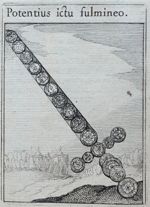
Potentius ictu fulmineo: Visscher, Sinnepoppen (Amsterdam, 1614), emblem 28 quotes the comment
Potentius ictu fulmineo: Meisner, Politica Politica (Nürnberg, 1700), emblem 758 quotes the comment
Iconclass: 45C11(SPEAR):25D13(SILVER) casting weapons: spear❧minerals and metals: silver 46B911 bribery
Collectanea (1500): 140
Loci Communes: Munerum corruptela (Corruption by gifts, Corruption par les présents)
II vii 44 Archytae crepitaculum Archytas' rattle
Αρχύτου πλαταγὴ. id est, Architae crepitaculum. In hominem vehementer garrulum & obstreperum iaciebatur. Archytas, crepitaculi genus aereum excogitavit, quod pueris lusitantibus daretur, ne quid interim ex vasis domesticis contingerent. Quemadmodum docet Aristoteles viii. lib. Politicorum. Suidas indicat, Archytam fuisse Pythagoricum, Empedoclis praeceptorem. Quanquam huius nominis referuntur aliquot, tamen consentaneum est hunc Tarentinum philosophum eius organi fuisle opificem, utpote qui fertur in mechanicis mire praecelluisse. Cuius & columba lignea celebratur, ita ratione mathematica librata, uti volaret. Quanquam Diogenes Laertius in huius vita testatur, huius nominis & architectum fuisse quendam, qui librum quoque conscripserit de machina. Columbae meminit & Aulus Gellius lib. x. cap. xii. ex autoritate Phavorini tribuens inventum hoc Archytae philosopho. Sed utriuscunque fuit inventum, consentaneum est huiusmodi quoddam organum fuisse, quod suapte sponte sonaret. Unde non absurde torquebitur in eos, qui naturae vitio, quovis loco, quavis de re, & apud quosvis, quidvis garriunt, quos Graeci λάλους, ἀμετροεπεῖς, ἀκριτομύθους, & πολυμύθους appellant, Latini garrulos, locutuleios, rabulas, blaterones & linguaces: In quos Eupolis scite, Λαλεῖν ἄριστος, κᾀδυνατώτατος λέγειν. id est, Ad garriendum praecipuus & optimus, Verum ad loquendum nemo minus idoneus. Nec inscite Epicharmus, Οὐ λέγειν δεινὸς, ἀλλὰ σιγᾶν ἀδύνατος. id est, Nihil valebat eloquendi viribus, Verum silendi habebat impotentiam. Habebatur simile quiddam & apud Romanos, Citeriam appellabant. Erat ea effigies quaedam arguta & loquax, quae ridiculi gratia in pompa vehi solita sit. Unde M. Cato in M. Cecilium, Quid ergo dicerem amplius, quem ego denique credo in pompa vectitatum iri, ludis pro Citeria, ac spectatoribus sermocinaturum? Ergo proverbii speciem habebunt orationes huiusmodi, Citeria loquacior, &, Prae hoc mutam dicas Citeriam. &, unus cum multis Citeriis certare possit.
Αρχύτου πλαταγὴ, Archytas' rattle, was a taunt levelled at any excessively garrulous and tiresome man. Archytas invented a sort of rattle made of bronze, to be given to children who wanted something to play with, to prevent their laying hands meanwhile on the household pots and pans. So Aristotle tells us in book 8 of the Politics. Suidas indicates that Archytas was a Pythagorean, and the teacher of Empedocles. Although there are references to several men of this name, it is generally agreed that this one, the philosopher from Tarentum, was the inventor of the device, for he is said to have been amazingly skilled in the mechanic arts. A pigeon made by him of wood was also famous, which his calculations balanced so skilfully that it could fly. However, Diogenes Laertius in his life of Archytas records that there was also an architect of this name, who wrote a book On Mechanism. The pigeon is also mentioned by Aulus Gellius, book 10 chapter 12, who gives this invention, on the authority of Favorinus, to Archytas the philosopher. But whichever of the two can claim the invention, it is generally agreed that it was a device of some kind of the sort that can omit a noise of its own accord. Hence it will not be absurd if we divert the expression to describe those who through some natural failing chatter aimlessly, regardless of place, subject and audience, who are called in Greek laloi, ametroepeis, akritomythoi and polymythoi, and in Latin garruli, locutuleii, rabulae, blaterones and linguaces. Of them Eupolis elegantly writes 'In talking excellent, in speaking null,' and Epicharmus not inelegantly 'In speech not gifted, of silence incapable.' Something of this sort was in use among the Romans too; they called it a citeria, and it was 'some sort of speaking image that never stopped talking,' which 'it was the custom to carry in procession as an entertainment. Hence Marcus Cato in his speech against Marcus Cecilius: "What more then can I say? I fully expect to see him carried in procession at the games as a citeria, and holding forth to the spectators.'" Thus there will be a proverbial air about phrases like As garrulous as a citeria, and Compared with him you might call a citeria dumb, and He could compete on his own with many citeriae.
Facsimile: 
Iconclass: 42A45 rattle (child's toy) 52D4 Prolixity, Verbosity, Loquacity; 'Loquacità' (Ripa) 98B(ARCHYTAS) male persons from classical history (ARCHYTAS)
Loci Communes: Garrulitas (Talkativeness, Bavardage)
II vii 45 Aratro iacularis You shoot with a plough
Αρότρῳ ἀκοντίζειν, id est, Aratro iaculari dicuntur, qui quippiam incircumspecte faciunt, haud prospicientes quid sit in posterum eventurum: aut qui suo magno incommodo conantur alterum laedere. Quisquis enim iacto aratro petit alium, is quo morem gerat irae, semet re necessaria privat, cuius usum paulo post sit desideraturus. Recensetur à Diogeniano. Translatum videri potest à belli temporibus, quibus vomeres, marrae et sarcula, reliquaque agriculationis arma, in Martia diffinguntur arma. Plutarchus in commentario περὶ τῆς εὐθυμϊας usurpat, veluti de re vehementer absurda, οὐδὲ γὰρ ὁ τοξεύειν ἀρότρω, βουλόμενος, καὶ τῷ βοῒ τὸν λαγὼ κυνηγεταῖν, δυστυχὴς ἐστὶν. id est, Neque enim is qui vult aratro iaculari, & bove leporem venari, est infortunatus.
'[greek], To shoot with a plough, is applied to those who do something heedlessly without foreseeing what will happen later, or who attempt to hurt someone else at great inconvenience to themselves. The man who attacks another by throwing a plough at him deprives himself, in order to gratify his rage, of a necessary object, the loss of which he will soon regret. Listed by Diogenianus. One might suppose that it originated in wartime, when men refashion ploughshares, spades, and hoes and the other implements of farming into implements of war. Plutarch uses it in his essay 'On Tranquillity of Mind' as if it indicated something profoundly absurd: 'For he is not unfortunate who wishes to shoot with a plough and hunt the hare with an ox.'
Facsimile:
Iconclass: 31A2741 throwing something 31EE2341 violent death ~ throwing of heavy object - EE - death not certain; wounded person 45C11(PLOUGH)(+0) casting weapons (PLOUGH) (+ variant) 52AA21 Rashness, Imprudence, Recklessness 52AA511 Ridiculousness
Loci Communes: Absurda, indecora, seu praepostera (Absurd, unbecoming, or preposterous things, Choses absurdes, inconvenantes ou déplacées)
II vii 46 Atticus moriens porrigit manum An Athenian holds his hand out on his deathbed
Αττικὸς ὑπέχει τὴν χεῖρα κᾀποθνήσκων, id est, Atticus porrigit manum, etiam cum moritur. Huic adagio locum fecit Atheniensium in muneribus captandis, & aucupandis lucris insatiata cupiditas. Unde & apud Aristoph. frequens iocus in τοὺς δωροδοκοῦντας. Autor Diogenianus.
'[greek], An Athenian holds his hand out even on his deathbed. What gave rise to the adage was the insatiable greed of the people of Athens in fishing for gifts and hunting for sources of gain. Hence too the frequent jibes in Aristophanes against those who take bribes. The authority is Diogenianus.
Facsimile:
Iconclass: 31A2512(+93231) arm stretched forward (+ begging) 31E12 deathbed 32B311(ATHENIANS) indigenous European peoples (ATHENIANS) 55CC11 Greed, Covetousness, Cupidity; 'Cupidità' (Ripa) 56BB32 Insatiableness
Loci Communes: Rapacitas et avaritia (Rapacity and greed, Rapacité et avarice)
II vii 47 Argi collis Argus' hill
Αργου λόφος, id est, Argi collis. Ubi quis ingentibus malis esset implicitus. Potest accommodari, vel ad locum, vel ad negocium variis obnoxium calamitaribus. Natum aiunt à colle quodam, cui cognomen Argi, frequentibus homicidiis ac latrociniis infami.
[greek], Argus' hill. When someone was involved in immense misfortune. Can be adapted either to a place or to a piece of business that is exposed to disasters of various kinds. It arose, they say, from a hill of that name, which was notorious for constant murders and robbery.
Facsimile:
Iconclass: 25H113 (high) hill 44G522 robbery 54FF11 Adversity, Misfortune, Bad Luck; 'Fortuna infelice', 'Infortunio' (Ripa) 61D(ARGUS) geographical names of countries, regions, mountains, rivers, etc. (ARGUS) (ARGUS)
Loci Communes: Infortunii sive exitii (Misfortune or ruin, Malheur ou ruine)
II vii 48 Asinus esuriens fustem negligit A hungry ass does not notice the stick
Ονος πεινῶν ῥοπάλου ἀμελεῖ. Asinus esuriens fustem negligit. In eos congruit, qui ventris, compendiive gratia quamvis contumeliam perferunt. Refert Aristoteles in libro Moralium tertio, ἐπεὶ οὕτω γε καὶ ὄνοι ἀνδρεῖοι ἄν εἶεν πεινῶντες, τυπτομενοις γὰρ οὐκ ἀφίσταντες τῆς νομῆς, id est, Nam isto pacto & asini quum esuriunt essen fortes, quod licet verberentur, non discedunt tamen à pabulo. Negans fortem esse censendum, qui quovis pacto tolleret incommoda. Alioquin asinos longe fortissimos futuros, qui dum esuriunt, nullis verberibus à pabulo dimoveri queunt. Apparet ex Homero sumptum, qui sanè quàm eleganter describit asininam patientiam Iliados λ. Ως δ᾽ ὅτ᾽ ὄνος παρ᾽ ἄρουραν ἰών ἐκιήσατο παῖδας Νωθὴς, ᾧ δὴ πολλὰ περὶ ρὅπαλ᾽ ἀμφὶς ἐάγη, Κείρειτ᾽ εἰσελθὼν βαβὺ λήϊον, οἱ δέτε παῖδες Τύπτουσιν ῥοπάλοισι, βίῃ δὲ τε νηπίῃ αὑτῶν, Σπουδῆ τ᾽ ἐξήλλασσαν ἐπεί τ᾽ ἐκορέσσατο φορβῆς. id est, Ut cum per segetes ignavus transit asellus Invitis pueris, cui multus tergora circum Iam crepuit fustis, neque segnius ille profundam Ingreditur segetem: pueri sed fustibus illum Caedentes studio, tandem ac puerilibus arvo Viribus eiiciunt, Ubi pastu expleverit alvum.
[greek], A hungry ass does not notice the stick, suits those who, to fill their stomachs or their pockets, endure contempt of every kind. Recorded by Aristotle in book three of the Ethics: 'Since at this rate even donkeys would show courage when they are hungry; for even when beaten they do not stop eating.' He says we should not reckon a man courageous who endures ill-treatment at any price; otherwise asses, he thinks, would be far the most courageous, because when they are hungry no blows can separate them from their food. Clearly taken from Homer, who gives a most elegant description of a donkey's patience in Iliad 11: 'As when a donkey passing by a field of grain is too strong for the boys, an obstinate idle ass. Many the sticks that are broken on his back as he plunges into the deep standing corn and lays it waste. The boys beat him with sticks, but their strength is like a child's, and with much ado they drive him out at last when he has eaten his fill.'
Facsimile:
Iconclass: 46C13142(+745) ass, donkey (+ animals eating and drinking) 56AA1:56BB1 Insensibility, Insensitivity❧Pain, Sorrow, Sadness; 'Dolore', 'Dolore di Zeusi' (Ripa)
Loci Communes: Contemptus et vilitatis (Contempt and worthlessness, Mépris et bassesse)
II vii 49 Aut cucurbitae florem aut cucurbitam Either the gourd-flower or the gourd
Η κρίνον, ἢ κολοκύντην, id est, Aut florem, aut cucurbitam. Id perinde valet quasi dicas, aut mortem, aut vitam, aut lucrum, aut damnum, aut victoriam, aut contra. Graeci cucurbitae florem κρίνον appellant. Incertum autem utrum mox evanescat, an cucurbitam sit pariturus. Proinde per florem, mortem, aut frustratam spem significabant, per cucurbitam vitalem. Diphilus apud Zenodotum, ἐν ἡμέραις αὐτὸς ἑπτάσοι γέρον θὲλω παρασχεῖν κολοκύντην ἢ κρινον. i. Ipse tibi senex intra septem dies exhibere volo cucurbitam, aut crinon. id est, possum efficere, ut aut recte valeas, aut moriaris. Huic non dissimile est illud, quod apud Homerum Odysseae δ. dicit spectrum apparens Penelopae dormienti: Ζώει ὅγ᾽ ἢ τέθνηκε, κακὸν δ᾽ ἀνεμώλια βάζειν. id est, Is superest, aut interiit: nam vera loquendum est. Et quod ad huius imitationem Horatianus dixit Tiresias, O Laertiade, quicquid dicam, aut erit, aut non.
[greek], Either the flower or the gourd, has the same force as if one were to say 'either death or life,' 'either gain or loss,' 'either victory or the opposite.' The Greek name of the gourd-flower is krinon, and there is no telling whether it will fade soon or will produce a gourd. Thus they conveyed by the flower the sense of death or hopes frustrated, and by the gourd the hope of life. Diphilus, cited by Zenodotus: 'Within seven days I wish, my aged friend, / To show you myself the gourd-flower or the gourd,' I can secure, that is, that you shall be either in good health or dead. This is not unlike what we find in Homer, Odyssey, book 4: 'He lives or he is dead; random talk is wrong,' which is said by a ghost that appears to Penelope in her sleep. So too the echo of this put by Horace in Teiresias' mouth: 'Son of Laertes, whatever I shall say, either will be or will not be.'
Facsimile: 
Iconclass: 25G21(GOURD)(+32) fruits: gourd (+ flowers, blossom, blossoming) 25G21(GOURD)(+34) fruits: gourd (+ bearing fruit) 54F2 Victory 54FF2 Defeat 55A1 Acquisition, Gain, Profit 55AA1 Loss
Loci Communes: Anceps et dubius (Doubtful and uncertain, Incertain et douteux)
II vii 50 Nudae Gratiae Naked are the Graces
Αἱ χάριτες γυμνὰι. id est, Gratiae nudae. Admonet adagium, ut candide ac benigniter impertiamus amicis. Aut ne quid inter amicos fictum, aut fucatum, verum nuda, simpliciaque omnia. Nam poetae tres fingunt Charitas, id est, Gratias, humanitatis & benevolentiae praesides. Horatius in Odis, Gratia cum nymphis, geminisque sororibus audet Ducere nuda choros. Idem alibi, Et solutis gratiae zonis. Sunt qui paroemiam ad ingratos referant, quod ab iis gratiae veluti dispolientur, dum semper auferunt beneficii quippiam, nihil rependunt. Itaque conveniet in illos, qui sua benignitate rediguntur ad inopiam, largientes amicis quicquid nacti fuerint.
[greek], Naked are the Graces. The moral of this adage is that we should show open-hearted goodwill in sharing with our friends; or, that between friends there should be no pretences, no concealments, but everything bare and straightforward. For the poets imagine three Charites or Graces, to preside over humane and generous actions. Horace in the Odes: 'Boldly now the naked Grace and her twin sisters, with the Nymphs, lead on the dance,' and in another passage: 'And the Graces with loosened girdles.' Some apply the proverb to ungrateful people, because they strip the Graces, as it were, by always accepting kindness in some form and giving nothing in return. It will thus be appropriate for those who are reduced to want by their generosity, because whatever they get they give lavishly to their friends.
Facsimile:
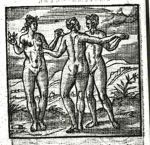
Gratiae: Alciatus, Emblemata (Leiden, 1591), emblem 162 uses the imagery of gratitude and friendship
Iconclass: 56F23 Friendship; 'Amicitia' (Ripa) 57A6131 Guilelessness, Artlessness, Openness, Ingenuousness 57AA8 Ingratitude; 'Ingratitudine' (Ripa) 92D3 Graces (Charites), generally three in number; 'Gratie' (Ripa)
Loci Communes: Amicitia (Friendship, Amitié)
II vii 51 Crobyli iugum Crobylus' yoke
Κροβύλου ζεύγος, id est, Crobyli iugum. De societate duorum pari improbitate dici consuevit, ut de quibus est in Epigrammatis Martialis libro octavo, Uxor pessima, pessimus maritus, Miror non bene convenire vobis. Ductum proverbium à Crobylo lenone quodam omnium scelestissimo. Is duo scorta domi alebat, quorum lenociniis quam plurimos adolescentes in perniciem alliciebat, nec his contentus eosdem illectos furto compilabat. Unde Crobyli iugum dictum, vel quod digni viderentur, qui tanquam pares improbitate cum hoc copulari deberent, vel quod iugum, id est par scortorum aleret domi.
[greek], Crobylus' yoke, was commonly used of the partnership of two well-matches rascals, like those characters in Martial's Epigrams, book 8: 'Worst of wives and worst of husbands, I am surprised that you do not agree.' The source of the proverb is a certain brothel-keeper called Crobylus, who was the biggest rascal of them all. This man kept two prostitutes in his house by whose charms he ensnared many young men to their doom; and not content with that, when he had them in his power he used to rob them of all they had. Hence the phrase Crobylus' yoke, either because his equals in wickedness seemed worthy to be his yoke-fellows, or because he maintained a yoke, that is a pair, of prostitutes.
Facsimile:
Iconclass: 33C55 pimp (brothel scene) 33C511 the man is robbed (brothel scene) 46C14111 yoke 98B(CROBYLUS) male persons from classical history (CROBYLUS)
Loci Communes: Similitudinis et congruentiae (Similarity and congruence, Similitude et convenance)
II vii 52 Mylus omnia audiens Mylus hearing everything
Μῆλος πάτ᾽ ἀκούων, id est, Mylus omnia auscultans. Dici solitum, ubi quis se dissimularet audire, fingeretque surditatem, cum omnia tamen auribus curiosis captaret, auscultaretque. Tractum videtur à mola, unde exploratores observare soleant quae fierent (nam μύλον molam sonat Graecis) aut Myli curiosi cuiuspiam moribus. Zenodotus testis est, Cratinum hoc usum adagio in Cleobulinis. Hesychius indicat Mylon fuisse poetam quempiam Comicum, praeterea piscis esse nomen, mullum opinamur sentiens. Ad haec μύλλον Graecis significare, curvum, obliquum ac distortum. Scribit enim duplici λλ. De Carcinis strobilis dictum est aliàs. Habent autem principes quidam & hoc sycophantarum genus, qui se fingunt surdos ac mutos, quo magis audita referant.
[greek], Mylus listening to everything, was applied to anyone who pretended not to hear and shammed deafness, while none the less picking up everything and listening with inquisitive ears. This looks as though it were taken from mola, the word for a mill, so often used as an observation-post by spies, for the Latin mola is mylos in Greek; or from the behaviour of some inquisitive character called Mylus. Zenodotus bears witness that Cratinus used this adage in his Cleobulinae. Hesychius points out that there was a comic poet called Mylos, and also that this was the name of a fish; he is thinking, I take it, of the mullet. Besides this, that myllos in Greek means curved, slanting and twisted (it is written with a double lambda). Of the Strobili of Carcinus I have spoken elsewhere. There are certain princes who have informers of this kind, pretending to be deaf and dumb that they may hear and report all the more.
Facsimile:
Iconclass: 31A329 eavesdropper 49G26:31A412 person feigning illness❧deaf, deafness 52A12 Curiosity, Inquisitiveness, Desire of Knowledge; 'Curiosità' (Ripa) 98B(MYLUS) male persons from classical history (MYLUS)
Loci Communes: Simulatio, dissimulatio (Pretense, dissimulation, Simulation, dissimulation); Curiositas (Curiosity, Curiosité)
II vii 53 Nos decem Rhodienses, decem naves We ten Rhodians are ten ships
Ημεῖς δέκα Ρὅδιοι δέκα νῆες. id est, Nos decem Rhodienses, decem naves. In eos torquendum qui nimium suis tribuunt viribus. Natum videtur à dicto Thrasonis cuiuspiam, qui decem homines, decem navibus opposuerit. Nisi malumus ad Homericum illud referre, Τληπόλεμος δ᾽ ἡρακλείδης ἠΰς τε μέγας τε Εκ Ρὅδου ἐννέα νῆας ἄγεν ῥοδίων ἀγερώχων. id est, Tlepolemusque Heraclides, magnusque bonusque Ter ternas naves Rhodiis praestantibus aptas E Rhodo egit.
' [greek], We ten Rhodians are ten ships, can be diverted for use against those who are over-confident of their own strength. It looks as though it came from the words of some thrasonical braggart who matched ten men against ten ships. Unless we would rather take it back to those lines in Homer: 'And Tlepolemus, the valiant son of Hercules, from Rhodes brought nine ships full of lordly Rhodians.'
Facsimile:
Iconclass: 49D11(10):32B311(RHODIANS) numerals: 10❧indigenous European peoples (RHODIANS) 49D11(10):46C24 numerals: 10❧sailing-ship, sailing-boat 57AA647 Hybris
Loci Communes: Arrogantia jactantiaque (Arrogance and boastfulness, Arrogance et vantardise)
II vii 54 Obliquus cursus A devious course
Κάμπιος δρόμος. i. Obliquus cursus. Quoties res arte ac dissimulanter agitur. Aut quoties aliud prae nobis ferentes aliò tendimus, & cuniculis atque ambagibus quibusdam pergimus ad id quod assequi conamur. Sumptum adagium à genere quodam cursus, qui κάμπιος dictus est, propterea quod anfractibus certis ac flexibus perageretur. Ut in aliis impetus & celeritas plurimum valuerit, in hoc ars & ratio plus habuerit momenti. Huiusmodi cursus genus describit Vergilius libro quinto, Olli discurrêre pares, atque agmina terni Diductis solvere choris, rursusque vocati Convertêre vias, infestaque tela tulere: Inde alios ineunt cursus, aliosque recursus. Ac paulo post, Ut quondam Creta fertur Labyrinthus in alta Parietibus textum caecis iter, ancipitemque Mille viis habuisse dolum, qua signa sequendi Falleret indeprehensus & irremeabilis error. Potest à navigantibus traductum videri, cum reflantibus ventis, transversim navigant.
[greek], A devious course. When some course of action is crafty and deceitful, or when we pursue one goal in public while heading towards another, and progress as it were by tunneling and roundabout ways towards the object of our efforts. The adage is derived from a special sort of race, called 'devious' because it demanded compliance with certain defined twistings and turnings, so that while in other races energy and speed were paramount, in this one skill and reasoning had more effect. A race of this kind is described by Virgil in his fifth book: 'Each of the three bands opens out pair by pair, breaking column as the groups wheel apart; then at a signal given turn about, and face each other with arms at the ready. After this they perform other movements and counter-movements.' And shortly afterwards: 'As once upon a time in lofty Crete the Labyrinth is fabled to have had its path entwined in walls through which a man could not see, and its thousand doubtful turnings left him bewildered, as the evidence he should have followed was falsified by confusions which he could neither detect nor retrace.' It might also be thought to be taken from mariners who, faced with a contrary wind, tack this way and that.
Facsimile: 
Iconclass: 41A634 labyrinth, maze ~ garden 43C211:49D3221 running, race❧irregularly curved line 51LL3 Deviation, Divergence 57AA6131 Guile, Artfulness, Craftiness, Deceitfulness
Loci Communes: Inconstantiae, perfidiae, versutiae (Inconstancy, treachery, cunning, Inconstance, perfidie, ruse)
II vii 55 Ne Jupiter quidem omnibus placet Even Jupiter does not please everybody
Theognis in sententiis Οὐδὲ γὰρ ὁ Ζεὺς Οὔθ᾽ ὕων πάντας ἀνδάνει οὔτ᾽ ἀπέχων . id est, Neque Iupiter ipse, Sive pluat, seu non, unicuique placet. Hodieque vulgo dicunt, neminem inveniri qui satisfaciat omnibus Nam aliis alia probantur. Et, Tres mihi convivae, propè dissentire videntur: Poscentes vario multum diversa palato. Pindarus in Olympiorum octavo: Τερπνὸν δ᾽ ἐν ἀνθρώποις ἴσον ἔσσεται οὐδέν. id est, Inter homines nihil erit aeque iucundum. videlicet quòd alios alia delectant, & suum cuique pulchrum est. Cui simile est illud Evangelicum, quod in operis initio retulimus, cum de paroemiae dignitate loqueremur, ἠυλήσαμεν ὑμῖν, καὶ οὐκ ὠρχήσασθε. ἐθρηνήσαμεν ὑμῖν, καὶ οὐκ ἐκλάυσατε. i. Cecinimus vobis, & non saltastis: lamentati sumus vobis, & non plorastis.
Theognis among his moral maxims: 'For Jove himself may not content us all, / Whether he holds rain back or lets it fall.' In our own day too there is a common saying that no one can be found who pleases everybody. For different people like different things, and Three guests I have, of wishes quite contrary; / As their tastes differ, so their orders vary.' Pindar in the eighth of his Olympians: 'But among men nothing will be equally delightful,' because of course some like one thing, some another, and What is one's own is beautiful.' This resembles that saying in the Gospel which I referred to in the outset of this work, when I was speaking of the respect due to proverbs: 'We have piped to you and you have not danced; we have mourned to you and you have not wept.'
II vii 56 Non persuadebis, ne si persuaseris quidem Even if you persuade me, I'll never believe you
Οὐ γὰρ πείσῃς, οὐδ᾽ ἂν πείσῃς. id est, Haud etenim persuaseris unquam. Nec si etiam persuaseris istud. proverbiali schemate dictum ab Aristophane. Est autem hyperbolae genus, qua significamus tanquam ἀδυνατώτατόν τι. Perinde quasi dicas, Non credam etiamsi videro.
[greek], For you will never make me believe that, persuade me as you may. This, which has a proverbial air, comes from Aristophanes. It is a stock type of exaggeration, used for conveying that something is quite impossible. It is like saying 'I shan't believe it, though I see it with my own eyes.'
II vii 57 Novit haec Pylaea et Tyttygias Pylaea knows this and Tyttygias
Οἷδέ τε Πυλαῖα ταῦτα καὶ Τυττυγίας. id est, Haec & Pylea novit & Tyttygias. Hoc velut aenigmate veteres innuebant, opes malis artibus quaesitas. Tyttygias plagiarius quispiam fuit, qui servos & res alienas, quas furto sustulerat, in Pylaea (is est Arcadiae locus) venditare consuevit, atque hoc quaestu dives evasit. Autor Zenodotus.
[greek], Pylaea knows this and Tyttygias. A sort of riddle, used by the Ancients to suggest wealth acquired by improper means. Tyttygias was a rascal, whose practice was to steal slaves and goods belonging to other men, and sell them in Pylaea, a place in Arcadia; and thus he became very rich. Zenodotus is the authority.
Facsimile:
Iconclass: 44G522 robbery 44G54 thief 46A181 slave-trade 59CC3 Illegality 98B(TYTTYGIAS) male persons from classical history (TYTTYGIAS)
Loci Communes: Rapacitas et avaritia (Rapacity and greed, Rapacité et avarice)
II vii 58 Polycrates matrem pascit Polycrates looks after my mother
Πολυκράτης μητέρα νέμει. i. Polycrates matrem pascit. Hoc adagium ex historia petunt, narrantes Polycratem Samiorum tyrannum, matres militum, qui in bello interissent, recensuisse, easque locupletioribus civibus nutriendas tradidisse, unamquamque his commendantem verbis σοὶ τάυτην μητέρα δίδωμαι. i. Hanc tibi do matrem. Usum proverbii non adscribit Zenodotus, proinde liberum est unicuique coniicere, cui sententiae rectissime possit accommodari. Ego puto non incommode posse usurpari, quoties aliquis in commendandis amicis est benignior, officiosiorque. Aut ubi quis alieno sumptu de quopiam bene mereri studet, ita ut aliis nummos impendentibus, ipse praeter officiosa quaedam verba nihil insumat. Qui mos hodie quoque vulgo principibus manet. Siquidem ministros, annis iam ad aulicum usum inutiles, monasteriis, aut civium ditioribus alendos mandant.
[greek], Polycrates looks after my mother. The source of this adage is taken to be a historical event. They relate that Polycrates, tyrant of Samos, listed the mothers of all soldiers who had been killed in battle, and put them in the charge of the more well-to-do citizens for their maintenance, handing them over individually with the words 'I give you this woman to be your mother.' Zenodotus does not add how the adage was used, and so it is open to anyone to make his own guess at the sense which may suit it best. I myself think it can be used not unsuitably whenever someone is more than normally generous and painstaking in recommending his friends. Or when someone is anxious to do another man a service at the expense of a third party, in such a way that other people will find the money, and apart from a few generous words it will cost him nothing. This system is still current in our own day among princes: when their servants are too old to be any further use at court, they hand them over for maintenance to monasteries or to their richer citizens.
Facsimile:
Iconclass: 31E23:45B violent death, being killed; being mishandled and maltreated; seeking death❧the soldier; the soldier's life 46A32:42G2112 care of the aged❧mother (first degree family relationships) 98B(POLYCRATES) (story of) Polycrates, tyrant of Samos
II vii 59 Te ipsum laudas You praise yourself
Σαυτὴν ἐπαινεῖς. i. Laudas te ipsam, Hemistichium iambicum, quod accinitur, ubi quis sese laudat, suique tibicinem agit. Plene sic effertur, Σαυτὴν ἐπαινεῖς ὥσπερ Αστυδάμας γύναι. id est, Laudas teipsam mulier Astydamae in modum. Astydamas histrio quispiam fuit Morsimi filius. Huic statua in theatro ponenda decreta fuerat, quod in agendo Parthenaeum sese gnaviter, ac scite gessisset. Itaque titulum ipse conscripsit, in quo suas laudes complectebatur, eumque in concionem attulit, ut approbatus adderetur statuae. Verum suffragiis populi decretum, ne molestus ille titulus inscriberetur. Ea res primum comoediae iocis agitata, post in proverbium abiit: Ita nunc quoque non infacete vulgus dictitat, malignos esse vicinos illi, qui ipse laudator sui fuerit. Recensetur à Zenodoto. Titulus quem Astydamas statuae suae inscripsit, extat etiamnum apud Suidam, Εἴθ᾽ ἐγὼ ἐν κείνοις γενόμην, ἢ κεῖνοι ἃμ᾽ ἡμῖν, Οἳ γλώσσης τερπνῆς πρῶτα δοκοῦσι φέρειν. Ως ἐπ᾽ ἀληθείης ἒκρἰθην ἀφεθεὶς παράμιλλος Νῦν δὲ χρόνῳ παρέχουσ᾽ οἷς φθόνος οὐχ ἕπεται. Eos versus quoniam eleganter Latinos reddidit Conradus Goclenius, linguae Latinae publicus professor in Academia Lovaniensi, iuvenis utriusque linguae ad unguem doctus, & in utroque scribendi genere mirificus artifex, sive prosam orationem malis, sive carmen. olim inter primos eruditionis proceres praecipuas habiturus, non est cur ego tentemaliter vertere. Latini versus Goclenii sunt hi. Vixissent utinam mecum illi, aut inter ego illos, Quos penes est linguae suaviloquentis honos: Praemia prima equidem citra certamen haberem, Nunc adimunt in quos nil habet invidta. Usurpavit & Iulianus in epistola quadam ad Basilium, ἐπῄνεσα γὰρ ἐμαυτὸν ὥσπερ Αστυδάμας, id est, Laudavi meipsum ut Astydamas.
[greek], You praise yourself, is the half of an iambic line, with which anyone is taunted who praises himself and blows his own trumpet. The complete line runs as follows: 'Lady, / You praise yourself, as did Astydamas.' Astydamas was an actor, the son or Morsimus. It had been decreed that a statue should be set up in his honour in the theatre, to commemorate his powerful and expert performance in the part of Parthen[op]aeus. He himself therefore composed an inscription enshrining his own praises, and brought it before the popular assembly for approval before it was added to the statue. It was, however, decreed by a public vote that the unpopular wording should not be added. This forthwith became a standing jest in comedy, and later passed into a proverb, so that even now there is a popular saying not without its point to the effect that his neighbours look askance at a man who sings his own praises. Listed by Zenodotus. The inscription written by Astydamas for his own statue still exists, and is quoted by Suidas: 'Would I had lived in their days, or they in mine, / Those men who are thought to bear the palm for beauty of language! / For I should have been judged by Truth, and have left her court without fear of a rival; / But, as it is, they expose me to the verdict of Time, who are themselves beyond the reach of envy.' These lines have been rendered in such elegant Latin by Conradus Goclenius, professor of Latin in the university of Louvain - a young man who is an accurate scholar in both the ancient tongues and wonderfully skilled in both types of composition, whether you ask for prose or verse, and who will one day hold a high place among the first leaders of learning - that there is no call for me to attempt an alternative version. Goclenius' Latin verses run as follows... Used also by Julian in one of his letters addressed to Basil: 'For I praised myself as did Astydamas.'
Facsimile: 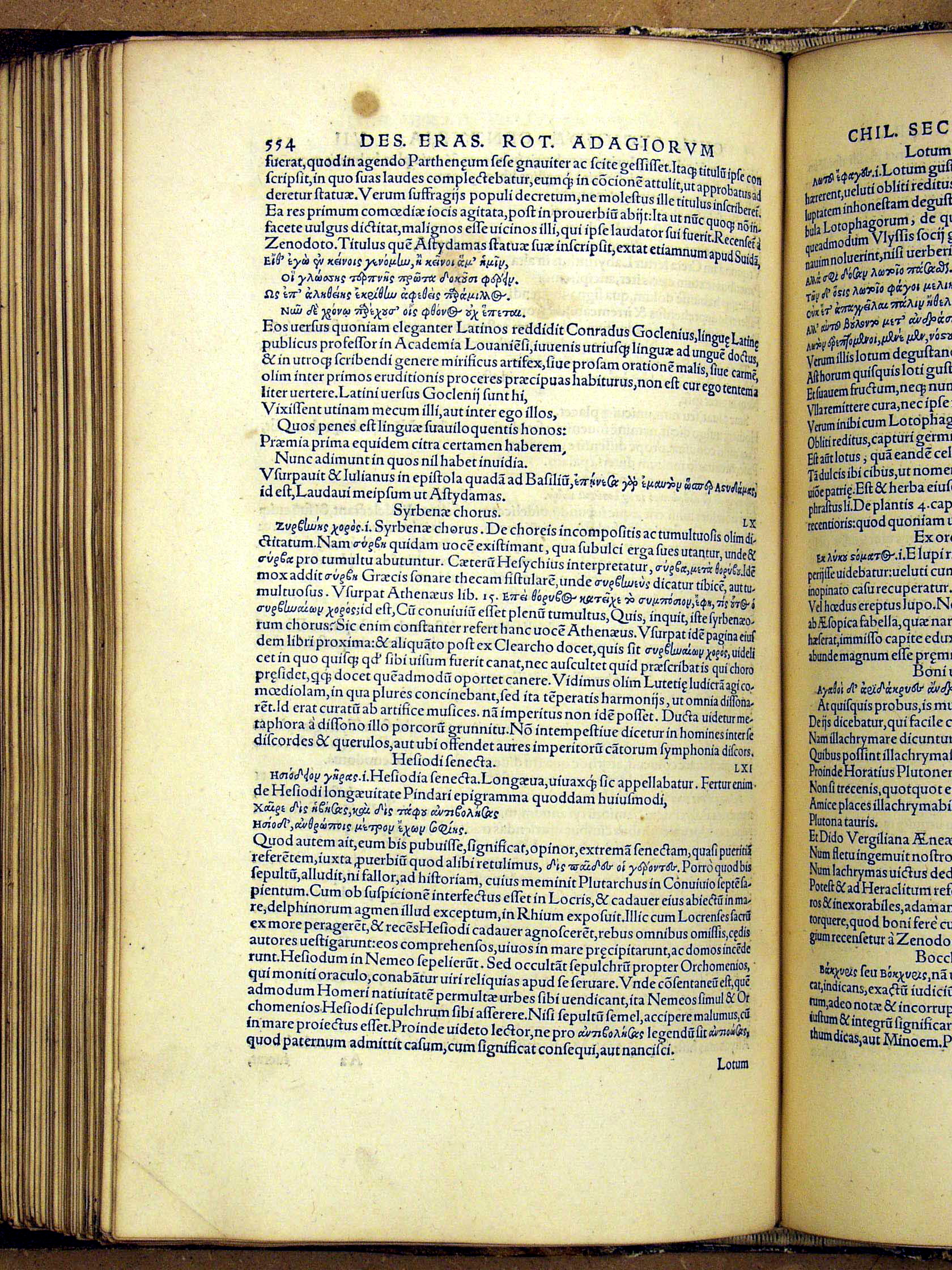
Iconclass: 48C8521 actor (on the stage) 57AA646 Complacency, Self-conceit 56F241 Narcissism 57B1 Praise, Approbation, Approval; 'Lode' (Ripa) 98B(ASTYDAMAS) male persons from classical history (ASTYDAMAS)
Loci Communes: Philautia (Self-love, Amour-propre)
II vii 60 Syrbenae chorus A band from Syrbene
Ζυρβήνης χορὸς i. Syrbenae chorus. De choreis incompositis, ac tumultuosis olim dictitatum. Nam σύρβη quidam vocem existimant, qua subulci erga sues utantur, unde & σύρβα pro tumultu abutuntur. Caeterum Hesychius interpretatur, σύρβα, μετὰ θόρύβου. Idem mox addit σύρβη Graecis sonare thecam fistularem, unde συρβηνεὺς dicatur tibicen, ac tumultuosus. Usurpat Athenaeus libro 15. Επεὶ θόρυβος κατεῖχε τὸ συμόσιον, ἒφη, τίς οὗτος ὁ συρβηναίων χορος; id est, Cum convivium esset plenum tumultus, Quis, inquit, iste syrbenaeorum chorus? Sic enim constanter refert hanc vocem Athenaeus. Usurpat idem pagina eiusdem libri proxima: & aliquanto post ex Clearcho docet, quis sit συρβηναίων χορός, videlicet in quo quisque quod sibi visum fuerit, canat, nec auscultet quid praescribit is qui choro praesidet, quique docet quemadmodum oportet canere. Vidimus olim Lutetiae ludicram agi comoediolam, in qua plures concinebant, sed ita temperatis harmoniis, ut omnia dissonarent, Id erat curatum ab artifice musices. Nam imperitus non idem posset. Ducta videtur metaphora à dissono illo porcorum grunnitu. Non intempestive dicetur in homines inter se discordes & querulos, aut ubi offendet aures imperitorum cantorum symphonia discors.
[greek] A band from Syrbene, was a catch phrase in old days for a group of performers whose playing or singing was disorderly and chaotic. For syrba is thought by some to be the sound used by swineherds when addressing their charges, as a result of which syrba is stretched to mean a disorderly noise. In any case, Hesychius explains syrba as meaning 'accompanied by uproar,' and shortly thereafter he adds that syrbê in Greek meant a case in which musical pipes were kept, so that a syrbeneus was a word for a fluteplayer, or for a man who made a great deal of noise. Athenaeus uses the word in book 15: 'When uproar overwhelmed the party, "Who" he said "are this band of Syrbenaeans?"' for that is the form of the word consistently used by Athenaeus. He has it again on the next page of the same book, and explains somewhat further on, by reference to Clearchus, what a 'band of Syrbenaeans' is: one in which every individual plays or sings what he thinks fit, and pays no attention to the instructions of the conductor of the band, who tells them how they ought to play. I once witnessed in Paris the performance of a ludicrous comic scene, in which a number of people were singing at the same time, but with the intervals between them so arranged that all was perfect discord. This had been organized by an expert musician, for it would be beyond an unskilled person. The image seems to be taken from the familiar discordant grunting of pigs. It will not be out of place if applied to people who are full of mutual discord and complaints, or when our ears are assailed by the discordant performance of unskilled musicians.
Facsimile:
Iconclass: 22D12 disharmonious sound, dissonance 51DD1 Disorder, Confusion, Derangement, Disorganization, Chaos 51HH2 Particularity, Individuality
Loci Communes: Rixosus (Quarrelsome, Querelleur)
II vii 61 Hesiodi senecta The old age of Hesiod
Ησίοδειον γῆρας. i. Hesiodia senecta. Longaeva, vivaxque sic appellabatur. Fertur enim de Hesiodi longaevitate Pindari epigramma quoddam huiusmodi, Χαῖρε δὶς ηβήσας, καὶ δὶς τάφου ἄτιβολήσας Ησίοδ᾽, ἀνθρώποις μέτρον ἔχων σοφίης. Quod autem ait, eum bis pubuisse, significat, extremam senectam, quasi pueritiam referentem, iuxta proverbium quod alibi retulimus, δὶς παῖδες οἱ γεροντες. Porrò quod bis sepultum, alludit, ni fallor, ad historiam, cuius meminit Plutarchus in Convivio septem sapientum. Cum ob suspicionem interfectus esset in Locris, & cadaver eius abiectum in mare, delphinorum agmen illud exceptum, in Rhium exposuit. Illic cum Locrenses sacrum ex more peragerent, & recens Hesiodi cadaver agnoscerent, rebus omnibus omissis, caedis autores vestigarunt: eos comprehensos, vivos in mare praecipitarunt, ac domos incenderunt. Hesiodum in Nemeo sepelierunt. Sed occultant sepulchrum propter Orchomenios, qui moniti oraculo, conabantur viri reliquias apud se servare. Unde consentaneum est, quemadmodum Homeri nativitatem permultae urbes sibi vendicant, ita Nemeos simul & Orchomenios Hesiodi sepulchrum sibi asserere. Nisi sepultum semel accipere malumus, cum in mare proiectus esset. Proinde videto lector, ne pro ἀντιβολήσας legendum sit ἀντιοώσασ, quod paternum admittit casum, cum significat consequi, aut nancisci.
Ησίοδειον γῆρας, An old age worthy of Hesiod, was the name for one that was prolonged and lively; for on Hesiod's long life there is an epigram by Pindar, which runs as follows: 'Twice childhood was your lot, and twice the grave; / Men's arbiter of wisdom, Hesiod, hail!' When he says that Hesiod was twice a child, he thinks, I take it, of that advanced old age which recalls infancy, in accordance with the proverb I have recorded elsewhere: Old men are children twice over. Further, when he says the poet was twice buried, he alludes, if I am not mistaken, to a story mentioned by Plutarch in his 'Dinner of the Seven Sages.' when, being suspected, he was killed in Locri, and his corpse cast into the sea, it was taken up by a school of dolphins which landed it on the beach at Rhium. The Locrians were performing the traditional sacrifices at that point, when they recognized the corpse of Hesiod, newly dead, and abandoning everything else, they set out to find those guilty of his murder and, having seized them, flung them alive into the sea and burnt their homes. Hesiod they buried in the Nemeum, but they concealed the place of his burial on account of the people of Orchomenus who, on the advice of an oracle, tried to preserve his remains in their own country. Hence the known fact that both the Nemeans and the Orchomenians claim to possess the tomb of Hesiod, in the same way that many cities claim to be the birthplace of Homer. Unless we prefer to understand that he was buried the first time when he was cast into the sea. And so the reader should consider whether instead of antibolêsas received as your lot, we should not read antioôsas, which governs a genitive when used in the sense of to catch up with or obtain.
Facsimile:
Iconclass: 31D160 Old Age, 'Senectus'; 'Vecchiezza' (Ripa) 31D910 'Vita longa' (Ripa) 98B(HESIOD) male persons from classical history (HESIOD)
Loci Communes: Longae vitae (A long life, Longue vie)
II vii 62 Lotum gustavit He has tasted the Lotus
Λωτοῦ ἔφαγες, id est, Lotum gustasti. de iis dicebatur, qui diutius in peregrinis regionibus haererent, velut obliti reditus. Neque inconcinne dixeris in eos, qui simulatque semel voluptatem inhonestam degustarint, ad pristina studia revocari non quaunt. Sumptum à fabula Lotophagorum, de quibus meminit Homerus Odysseae libro nono, narrans quemadmodum Ulyssis socii gustata apud Lotophagos populos herba loto, redire ad navim noluerint, nisi verberibus adacti, Αλλά σφιδόσαν λωτοῖο πάσασθαι Τῶν δ᾽ ὅστις λωτοῖο φάγοι μελιήδέα καρπὸν, Οὐκ ἔτ᾽ ἀπαγγεῖλαι πάλιν ἤθελεν, οὐδὲ νέεσθαι. Αλλ᾽ αὐτοῦ βούλοντο μετ᾽ ἀνδράσι λωτοφάγοισι Λωτὸν ἐρεπτηομενοι, μενέμεν, νόστουτε λαθέσθαι. id est, Verum illis lotum degustandam exhibuere. Ast horum quisquis loti gustarat amicum Et suavem fructum, neque nuncia protinus illi Ulla remittere cura, nec ipse redire studebat. Verum inibi cum Lotophagis remanere volebant. Obliti reditus, carpturi germina loti. Est autem lotus, quam eandem celtim dici docet Dioscorides li. 1. arbor, de qua Plinius li. 13. Tam dulcis ibi cibus, ut nomen etiam genti terraeque dederit, nimis hospitali, advenarum oblivione patriae. Est & herba eiusdem nominis gratissima & ipsa palato, de qua permulta Theophrastus li. De plantis 4. cap. 9. Reperimus & hoc proverbium in collectaneis cuiusdam recentioris: quod quoniam videbatur haud illepidum, non gravatus sum adscribere
Λωτοῦ ἔφαγες, You have tasted the lotus, was said of those who lingered unduly long in foreign parts as though they had forgotten their return. One may also use it neatly of men who, having once tasted dishonourable pleasures, cannot be recalled to their original pursuits. Taken from the story of the Lotus-eaters of whom Homer tells in the ninth book of the Odyssey, where he relates how the companions of Ulysses, having once tasted the lotus when they were among the lotus-eating tribes, refused to return to the ship unless driven with blows. 'But they gave them lotus to taste; and anyone who ate the honey-sweet fruit of the lotus was no longer willing to send back news or to return, but there among the Lotus-eater folk they wished to remain, plucking the lotus-fruit, and to forget their journey home.' The lotus, which Dioscorides in book 1 says is also called celtis, is a tree, of which Pliny, book 13, says 'Its fruit in those parts is so delicious that it has even given its name to the inhabitants and to their country, where strangers find too warm a welcome, for they forget their native land.' There is also a plant of the same name which, like the tree, has a most delicate taste; there is a long account of it in Theophrastus On Plants, book 4 chapter 9. This proverb also I found in the collection of a comparatively recent author, and since it has a certain elegance, I have seen no objection to its being added here.
Facsimile: 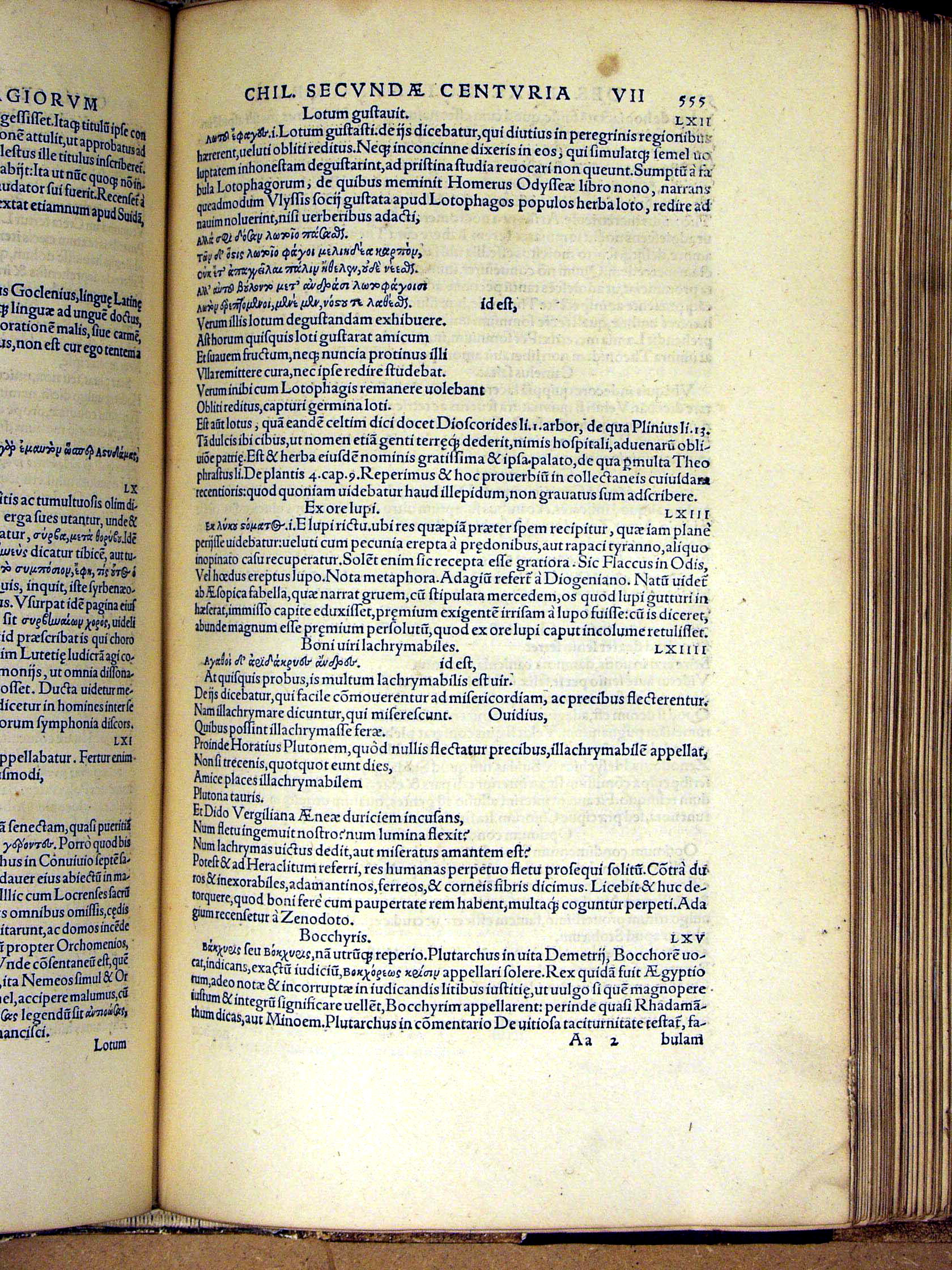
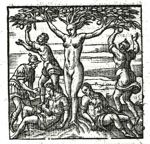
In oblivionem patriae: Alciatus, Emblemata (Leiden, 1591), emblem 114 uses the imagery of Lotus eaters
Difficile est delaisser volupté: La Perrière, Le theatre des bons engins (Lyon, 1545), emblem 35 uses the imagery of a labyrinth to convey that it is easy to enter into pleasure but difficult to leave
Iconclass: 25G41(LOTUS) flowers: lotus 31B53 addiction 52AA31 Oblivion; 'Oblivione' (Ripa) 94I12 Ulysses and his men in the land of the lotus-eaters (Homer, Odyssey IX)
Loci Communes: Illecebra mali (The allurement of evil, L'attrait du mal)
II vii 63 Ex ore lupi From the wolf's mouth
Εκ λύκου στόματος. i. E lupi rictu, ubi res quaepiam praeter spem recipitur, quae iam planè periisse videbatur: veluti cum pecunia erepta à praedonibus, aut rapaci tyranno, aliquo inopinato casu recuperatur. Solent enim sic recepta esse gratiora. Sic Flaccus in Odis, Vel hoedus ereptus lupo. Nota metaphora. Adagium refertur à Diogeniano. Natum videtur ab Aesopica fabella, quae narrat gruem, cum stipulata mercedem, os quod lupi gutturi inhaeserat, immisso capite eduxisset, praemium exigentem irrisam à lupo fuisse: cum is diceret, abunde magnum esse praemium persolutum, quod ex ore lupi caput incolume retulisset.
Εκ λύκου στόματος, From the jaws of the wolf. When something which seemed already to be utterly lost is unexpectedly recovered - when, for example, money seized by pirates or by a rapacious tyrant is returned to one by some unforeseen chance, for things thus recovered are all the more welcome. So Horace in the Odes: 'Or a kid rescued from the wolf.' The image is familiar. The adage is recorded by Diogenianus. Derived clearly from that fable of Aesop, which tells how, when a bone had stuck in a wolf's throat, a stork, having secured the promise of a reward, inserted her head and pulled it out. When she then demanded her recompense, she was mocked by the wolf, who pointed out that she had received a very large reward already, in being allowed to pull her head back out of a wolf's mouth.
Facsimile:
Iconclass: 25F23(WOLF)(+573) beasts of prey, predatory animals: wolf (+ morphology of facial expression of animal(s) ~ mouth) 33B9 flight, running away; pursuing
Loci Communes: Discriminis (Danger, crisis, Danger)
II vii 64 Boni viri lachrymabiles Good men are prone to tears
Αγαθοὶ δ᾽ ἀρϊδάκρυες ἄνδρες. id est, At quisquis probus, is multum lachrymabilis est vir. De iis dicebatur, qui facile commoverentur ad misericordiam, ac precibus flecterentur. Nam illachrymare dicuntur, qui miserescunt. Ovidius: Quibus possint illachrymasse ferae. Proinde Horatius Plutone, quòd nullis flectatur precibus, illachrymabilem appellat: Non si trecenis, quotquot eunt dies, Amice places illacrymabilem Plutona tauris. Et Dido Vergiliana Aeneae duriciem incusans, Num fletu ingemuit nostro? num lumina flexit? Num lachrymas victus dedit, aut miseratus amantem est? Potest & ad Heraclitum referri, res humanas perpetuo fletu prosequi solitum. Contrà duros & inexorabiles, adamantinos, ferreos, & corneis fibris dicimus. Licebit & huc detorquere, quod boni ferè cum paupertate rem habent, multaque coguntur perpeti. Adagium recensetur à Zenodoto.
Αγαθοὶ δ᾽ ἀρϊδάκρυες ἄνδρες, Any good man is much inclined to tears, was said of those who were easily stirred to pity and moved by prayers; for those who show pity are described as shedding tears. Ovid: 'Such as might move even wild beasts to weep.' And similarly Horace uses the same word illachrymabilis, not prone to tears, of Pluto, because no prayers can move him: Though with three hundred beeves each passing day You seek, my friend, to soften Pluto's heart, Who knows no tears. And Dido in Virgil, declaiming against Aeneas' hardness of heart: Did he sigh when I wept, or turn his gaze? Did he give way and weep? Or spare a thought For her that loved him? It can also be made to refer to Heraclitus, whose custom was to weep perpetually over human affairs. Used against the hard-hearted and unpitying, whose heartstrings are hard as bone. It will also be possible to adapt it to another point: that good men as a rule have to contend with poverty and are compelled to carry a load of suffering. The adage is listed by Zenodotus.
II vii 65 Bocchyris Bocchyris
Βάκχυρις seu Βόκχυρις, nam utrumque reperio. Plutarchus in vita Demetrii, Bocchorem vocat, indicans, exactum iudicium, Βοκχόρεως κρισιν appellari solere. Rex quidam fuit Aegyptiorum, adeo notae & incorruptae in iudicandis litibus iustitiae, ut vulgo si quem magnopere iustum & integrum significare vellet, Bocchyrim appellarent: perinde quasi Rhadamantum dicas, aut Minoem. Plutarchus in commentario De vitiosa taciturnitate testatur, fa bulam de hoc iactatam fuisse, quod esset cum natura gravis & austerus, Isis illi aspidem immittere solita sit, quae capiti circumvoluta, superne hominem inumbraret, ut ostento territus recte iudicaret. Adagium refertur à Suida. Dici potest & de iis, qui non temere de re quapiam pronunciant. Negant enim hunc regem solere sententiam ferre, nisi de causa iam comperta, & certis argumentis deprehensa: & tamen huius Bocchoris iudicium quoddam reprehensum fuit à meretrice Lamia. Adolescens quidam in Aegypto deperibat amore Theonidis meretriculae. At illa pro nocte mercedem ingentem postulabat. Interim evenit, ut adolescens noctu somniaret se rem habere cum Theonide. Eo viso liberatus est a amore, desiitque scorto molestus esse. Illa ubi factum rescivit, appellat adolescentem, petit pactam mercedem. Quum non conveniret, itum est ad iudicem Bocchorem. Is causa cognita pronunciat, ut adolescens tantum pecuniae adferret in vasculo, quantum illa postulasset, eamque praesente ac inspectante Theonide, huc illucque manu tenens volveret, & illa interim haereret umbrae, quasi recte somnium umbra pensaretur. At hoc iudicum ut iniquum reprehendit Lamia meretrix: Per somnum, inquit, adolescens amore coitus liberatus est, at umbra Theonidem non liberaut amore pecuniae. Haec Plutarchus in vita Demetrii.
Bacchyris, or Bocchyris, for I find both forms. Plutarch in his life of Demetrius calls him Bocchoris, showing that a very precise verdict was called by custom Βοκχόρεως κρισιν, A judgment of Bocchoris. He was a king of Egypt, whose sense of justice in the settlement of disputes was so well known and so incorruptible that in common parlance, if they wished to convey an idea of the strictest justice and integrity, they called the man a Bocchyris, exactly as you might speak of a Rhadamanthus or a Minos. Plutarch in his essay 'On Mistaken Silence' bears witness to a story current about him to the effect that, though he was by nature serious and austere, Isis used to send the asp to him to coil round his head and shadow him from ab,ove, that he might be frightened by this portent into giving a just verdict. The adage is recorded by Suidas. It can also be used of those who never pass judgment in haste on any question; for they say that it was this king's habit never to express an opinion except in a case which he had fully mastered and arrived by certain evidence at the truth. Yet one verdict given by this Bocchoris was criticized by Lamia the courtesan. There was a young man in Egypt who was madly in love with a courtesan called Theonis; but she demanded an enormous price for her favour for one night. In the meantime it so fell out that the young man dreamed that he was sleeping with Theonis, and by this delusion he was cured of his passion and ceased to pester the prostitute. When she heard what had happened, she sent for the man and demanded the stated price. Agreement being impossible, they appealed to Bocchoris sitting in judgment. Having heard the facts, he decided that the young man should produce in a bag the sum of money that she had demanded, and in the presence and full view of Theonis should turn it this way and that as he held it in his hand, while she meanwhile laid hold of its shadow, seeing that a shadow is the proper equivalent for a dream. This verdict was criticized as unfair by Lamia the courtesan. The dream' she said 'released the young man from his love of copulation, but the shadow did not release Theonis from her love of money.' So Plutarch in his life of Demetrius.
Facsimile: 
Iconclass: 31B3 dream 33C521:98C(LAMIA) courtesan, hetaera❧female persons from classical history (LAMIA) 44G13(+2) magistracy, judges (+ judge) 44G6 juridical examples; exemplary judges; 'Gerechtigkeitsbilder' 57A63 Incorruption, Purity; 'Purità' (Ripa) 59C21 Equality, Equity, Fairness, Righteousness; 'Equalità', 'Equità', 'Giuditio giusto', 'Ordine dritto e giusto', 'Ugualità' (Ripa) 98B(BOCCHYRIS) male persons from classical history (BOCCHYRIS)
II vii 66 Camelus saltat The camel dances
Ubi quis indecore quippiam facere conatur, & invita, sicut aiunt, Minerva, Camelum saltare dicebant. Veluti si quis natura severus ac tetricus, affectet elegans, ac festivus videri, naturae genioque suo vim faciens. Divus Hieronymus proverbii nomine citat, torquetque in Heluidium. Risimus, inquit, in te proverbium, Camelum vidimus saltitantem. Taxat Hieronymus hominis ineptiam, qui cum à Musis esset alienissimus, tamen disertus haberi vellet.
When a man tried to do something, but ungracefully and against Minerva's will, as the saying goes, they used to say it was a camel dancing, for instance if a severe and straitlaced person attempts to seem an elegant and merry fellow, doing violence to his nature and his genius. Saint Jerome cites it expressly as a proverb, and turns it against Helvidius: 'It made us laugh' he says 'to see the proverb fulfilled in you: we saw the camel dancing.' Jerome pillories the folly of a man who wished to be taken for a stylish author, though utterly foreign to the Muses.
Facsimile:
Iconclass: 25F24(CAMEL)(+525):43C9(+0) hoofed animals: camel (+ some other movements of animal(s))❧dancing (+ variant) 51DD4 Ugliness 59AA2 Ill-breeding, Bad Taste
Collectanea (1500): 382
Loci Communes: Absurda, indecora, seu praepostera (Absurd, unbecoming, or preposterous things, Choses absurdes, inconvenantes ou déplacées)
II vii 67 Canis in vincula The dog asks for his chain
Κύων ἐπὶ δεσμὰ, i. Canis in vincula. Dicebatur, ubi quis se ipsum in servitutem, aut in malum aliquod iniiceret. A canibus sumptum ultro se praebentibus vinciendos cibi lenocinio. Autor Zenodotus. Hesychius indicat in eandem sententiam dici, βοὺς ἐπὶ δεσμὰ. id est, Bos in vincula.
[greek], The dog asks for his chain, was said when someone cast himself into slavery or into some misfortune. Taken from dogs which offer themselves to be chained of their own accord when bribed by food. Zenodotus is the authority. Hesychius points out that the same sense is given by The ox asks for his chains.
Facsimile:
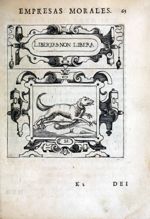
Libertas non libera: Borja, Empresas morales (Bruxelles, 1680), emblem 31 uses the imagery of a dog asking to be chained
Dulcescit amarum: Camerarius, Symbolorum et Emblematum Centuria(e) (Nürnberg, 1590, 1595, 1596, 1604), emblem 160 uses the imagery of a dog asking to be chained
Iconclass: 34B11(+9471) dog (+ instinct of animal) 41C111 giving food 47D8(CHAIN) tools, aids, implements ~ crafts and industries: chain 53CC2:46A180 Voluntariness❧'Servitù', 'Servitù per forza' (Ripa)
Loci Communes: Infortunii sive exitii (Misfortune or ruin, Malheur ou ruine)
II vii 68 Chius ad Coum Chiot against Coan
Χῖος πρὸς κῶον. i. Chius ad Coum. De comparatione vehementer inaequali dicebatur. Nam in ludo talorum iactus, qui Chius dicebatur, unioni respondebat, Cous senioni. Quem Graeci Chium dicunt, nos canem vocamus: & quem illi Coum sive ἑξίτην, nos senione. Porrò quemadmodum Cous inter felices iactus habebatur, ita Chius fuit inter infelices. Unde Persius, Quid dexter senio ferret Scire erat in votis, damnosa canicula quantum Raderet. Videtur autem senio per se felix, infelix haberi solere, si accederet canis. Sic enim Martialis, Senio nec nostrum cum cane quassat ebur. Quod si verum est, adagium conveniet non solum in collationem rerum inaequalium, verumetiam pugnantium. Velut si quis conferat plebeium cum rege, Chius est ad Coum: si quis adolescentem cum sene, contrarietas est, non solum inaequalitas. Adagii meminerunt Zenodotus, Hesychius & Suidas, nisi quòd Suidas pro ἐν habet ἐνδον, pro ἓξ ἔξω. Id utrum scribae culpa commissum sit, an interior talis pars & exterior intelligenda sit, doctis excutiendum relinquimus. Fit autem interim allusio ad gentes, quarum utriusque mores non caruerint nota, sed praecipue Chiorum. Ita simile fuerit illi: Κρὴς πρὸς τὸν Κρῆτα.
Κύων ἐπὶ δεσμὰ, Chiot against Coan, was used of any emphatically unequal comparison; for in the game of knuckle-bones the throw called a Chiot corresponded to a one, and the Coan to a six. What in Greek is called a Chiot is our 'dog,' and their Coan or exites we call a six. Also, just as the Coan was reckoned a lucky throw, the Chiot was one of the unlucky ones. Hence Persius: The summit of my scientific ambition was to know what that lucky dice would bring me, how much that ruinous ace would sweep off.' The six seems to have been lucky in itself, but to have been thought unlucky if joined with a dog. For Martial writes 'No six and dog my ivory dice-box shake.' If this is correct, the adage will be suitable for the comparison not only of unequal things but of things which conflict: if, for instance, one were to compare a plebeian with a king, it is Chiot against Coan, but between a young man and an old one, there is opposition and not merely inequality. The adage is mentioned by Zenodotus, Hesychius and Suidas, except that Suidas writes endon, within, for hen, one, and exô, outside, for hex, six. Whether this is due to a mistake by a scribe, or we are meant to understand the inside and outside, I leave for discussion by the learned. There is a reference all the time to the character of the two sets of people, [Chiots and Coans], neither of whom was without blemish, and the Chiots particularly. Thus it will be found to resemble the adage Cretan and Cretan.
Facsimile:
Iconclass: 43C552:49D11(1) dice❧numerals (1) 43C552:49D11(6) dice❧numerals: 6 43C726 (playing at) knuckle-bones, 'astragali' 51BB3 Imparity, Inequality, Difference 51I6 High, Top 51II6 Low, Bottom
Loci Communes: Similitudinis et congruentiae (Similarity and congruence, Similitude et convenance)
II vii 69 Optimum condimentum fames Hunger is the best sauce
Optimum condimentum fames. Inter apophthegmata Socratica celebratur. Irridebat hoc dicto luxum Atheniensium, qui variis cupediis & operosis condituris conarentur efficere, ut cibus saperet palato, cum id optime praestet fames, condimentum ut optimum, ita & vilissimum. Nihil enim suavius edi, quàm quod editur ab esuriente. Manet hodieque vulgo tritum proverbium, famem efficere, ut crudae etiam fabae saccarum sapiant. Antiphanes apud Strobaeum, Απανθ᾽ ὁ λιμὸς γλυκέα πλὴν αὐτοῦ ποιεῖ. id est, Praeter seipsam caetera edulcat fames. Quod fames facit in cibo, idem sitis facit in potu. Darius enim in fuga cum aquam turbidam bibisset & cadaveribus inquinatam, negavit se unquam bibisse iucundius, nimirum nunquam sitiens biberat. Eandem sententiam sic apud Athenaeum libro quarto effert Xe nophon: ἡδὺ μεν μάζαν καὶ κάρδαμα φαγεῖν πεινῶντι, ἡδὺ δὲ ὑδωρ αῤυσάμενον ἐκ ποταμοῦ διψῶντα πιεῖν Dulce est mazam & nasturtium edere esurienti, dulce est sitienti aquam è fluvio haustam bibere. Ibidem refert quiddam non infestivum de Socrate, qui frequenter ad multam vesperam ambulare consuevit ante aedes suas, percontantibus quid illic ageret, Obsonium, inquit, comparo in coenam. De Dionysio, cui fastidienti nigrum ius quod in Phiditiis apponebantur, coquus respondit, non esse mirum, cum deessent condimenta, de palaestra, cursuque ante coenam sentiens, aliâs nobis dictum est. Aut natum à Socrate proverbium, aut ab illo usurpatum, quod vulgo ferebatur. M. Tullius in lib. De finibus bonorum 2. Diceret id quod Socratem, qui voluptatem nullo loco numerat, audio dicentem, cibi condimentum esse famem, potionis sitim. Licebit non nihil gratiae addere proverbio, si longius deflectatur: velut ad literarum studium, quod eo dulcius est, quo vehementius sitiautur literae. Et voluptates commendat rarior usus.
Hunger is the best sauce is a familiar example of the aphorisms ascribed to Socrates. He used these words to ridicule the luxury of the Athenians, who used relishes of all kinds and laborious confections to give some flavour to their dishes when the best recipe to secure this was hunger, which is not only the best sauce but the cheapest. Nothing tastes better than the food eaten by a hungry man. Even in our own day there is a proverb in common use to the effect that hunger makes even raw beans taste of sugar. Antiphanes, cited by Stobaeus: 'Hunger makes all things sweet except itself.' And what hunger does for food, thirst does for drink. 'Darius in the course of his flight drank muddy water polluted with corpses, and said he had never enjoyed a drink so much; evidently he had never drunk when he was thirsty.' The same view is thus expressed by Xenophon in the fourth book of Athenaeus: 'Barley bread and cress are good eating when one is hungry, and water drawn straight from the river is good to drink when one is thirsty.' In the same passage he records a story of Socrates which is not without its point; he used often to walk up and down in front of his house until late at night, and when they asked him why, he replied 'I am looking for an appetizer for my supper.' The story of Dionysius who, when he could not stomach the black broth served in the public meals at Sparta, was told by the cook that this was not surprising, because the sauce was lacking (by which he meant exercise in the wrestlingschool or on the running-track before supper), I have told elsewhere. The proverb either started with Socrates, or was already in common circulation when he used it. Cicero in book two of the Definibus bonorum: Tie would say what I hear Socrates saying, who holds pleasure of no account, that hunger is the best relish for food, and thirst best for drink.' It will be possible to add something to the point of this proverb, if it is diverted from its original meaning, to the study of the humanities for example, which are more enjoyable, the greater one's thirst for good literature. And 'pleasure' is 'more pleasant made by sparing use.'
Facsimile: 
Iconclass: 41C119:51C1:31A3411 hunger❧Cause❧agreeable taste 41C652(BEANS):31A342 vegetables (BEANS)❧sweet (taste) 41C673 sauces
Collectanea (1500): 109
Loci Communes: Lautitiae (Sumptuousness, luxuries, Somptuosités)
II vii 70 Phani ostium Phanus' front door
Η φάνου θύρα. i. Phani ostium. Id accinebatur, ubi quis frustra servasset aliquid, veluti si cuius uxorem adulterio vitiari contingeret, quam tamen ille multa zelotypia servasset. Natum aiunt à Phano quodam usurario: vel ut alii dicunt, caeco, qui cum cellae penuariae ostium ita obstruxisset, ut citra strepitum non quiret aperiri, tamen à ministro apertum est, sublatumque penu. Alii narrant, huic Phano uxorem fuisse parum spectatae fidei, quam quod is haberet adulterii suspectam, atrii fores sic occlusit, ut non nisi cum stridore, sonituque possent aperiri. Verum illa cum per tegulas reciperet adulterum, vicini per iocum dicebant, ἡ φάνου θύρα. Eaque vox postea cessit in vulgi sermonem. Haud scio, an sit idem cum eo, quod refert Eustachius in Odysseae librum ultimum, φανίου θυρα, A Phania quodam, qui finxerit sibi multam opum vim domi reconditam esse.
Η Φάνου θύρα, Phanus' front door, was levelled as a taunt at anyone who had kept watch on something to no purpose; for example, if it so happened that a man's wife was tainted with adultery, in spite of all the jealous care with which he had watched over her. It arose, they say, from a certain Phanus, a usurer or (according to others) a blind man, who had blocked the door of his storeroom in such a way that it could not be opened without making a noise, but for all that it was opened by a servant, and his stores removed. Others tell how this Phanus had a wife of very dubious loyalty, and since he suspected her of adultery, he shut the door of his hall so that it could not be opened without creaking and making a noise. When however her lover gained admittance over the roof tiles, the neighbours took to talking by way of a joke of Phanus' front door,' and the phrase afterwards passed into common currency. Perhaps the same as the one recorded by Eustathius on the last book of the Odyssey, Phanias' door, from a certain Phanias who pretended that he had great riches stored in his house.
Facsimile:
Iconclass: 41A3221 closed door 42DD391 adulterer - DD - adulteress 44G544 theft 54BB3:46A16331(+0) Inutility, Noxiousness; 'Nocumento', 'Nocumento d'ogni cosa' (Ripa)❧guarding of treasure by men (+ variant) 98B(PHANUS) male persons from classical history (PHANUS)
Loci Communes: Indiligentiae (Carelessness, Négligence)
II vii 71 Aut Plato philonissat aut Philo platonissat Either Plato philonizes or Philo platonizes
Divus Hieronymus in Catalogo scriptorum illustrium, Philonem quoque Iudaeum recenset, qui & eloquentiam & omnem Graecanicam eruditionem ita sit assecutus, tum Platonicam in dicendo maiestatem ubertatemque sic expressit, ut eum alterum Platonem appellet. Testatur autem apud Graecos, vulgo de illis dici solitum, Η πλάτων φιλονίζει, ἣ φίλων πλατωνίζει. i. Aut Plato Philonem imitatur, aut Philo Platonem. Extat huius opus, in quo vitas illustrium aliquot Hebraeorum tractat, orsus ab Abraham. Tractat autem non tam ad historiae cognitionem, quam ad institutionem regulamque vivendi: videlicet omnia trahens ad morales allegorias, unde theologis praecipue legendus. Stilus tum candidus est, tum sublimis, ac divinum quiddam prae se ferens, qualis est & Platonis: Gaudet symbolis ac mysteriis numerorum, quod ipsum Pythagorae Platonique familiare. Ad morum institutionem accommodat omnia, nec hac parte dissidens à Platone. Per allegoriam torqueri poterit ad quosvis inter sese vehementer similes. Nam hoc ipsum non simpliciter, sed figurate dictum, illud sat argumenti est, quod Philonem longe Platone constat posteriorem esse. Caeterum in malam partem fiet proverbialis: veluti si quis dicat, Aut Cretissat Africa, aut Afrissat Creta: aut Neronissabat Galba, aut Galbissabat Nero. huic figurae confine videtur illud Platonis, τὸ πολύμνητον, ut ait Aristides, Beatas for respublicas, Εἰ μὲν, ἢ οἱ βασιλεῖς φιλοσοφήσωσιν, ἢ βασιλεύσωσιν οἱ φιλόσοφοι. id est, Si aut reges philosopharentur, aut regnarent philosophi.
Saint Jerome in his Catalogue of Distinguished Authors lists among others Philo Judaeus, as having achieved such a mastery of style and of all the knowledge available in Greek, and reproduced so successfully the amplitude and richness of Platonic language, that he can be called a second Plato. This is supported by the common currency in Greek of a phrase about the two of them: Either Plato imitates Philo or Philo Plato. A work by him survives in which he deals with the lives of sundry illustrious Hebrews from Abraham onwards. And he deals with them with a view to imparting not so much a knowledge of history as a set of principles and rule of life, adapting everything, that is, to the purposes of moral allegory, so that he ought to be read above all by theologians. He has a forthrightness and at the same time nobility of style, with a touch of inspiration about it, which again reminds us of Plato. He delights in symbols and in the mystical meaning of numbers, which is already a habit with Pythagoras and Plato. The building of character is the purpose to which everything is fitted, and in this point also he does not disagree with Plato. It will be possible to turn this figuratively to suit any persons who have a very strong degree of resemblance; for that the original dictum was used not literally but as a metaphor is sufficiently shown by the fact that Philo is known to have lived many years later than Plato. In any case when used to impart criticism it will have a more proverbial ring: if one were to say, for instance, 'Either Africa cretizes or Crete africizes' or 'Either Galba neronized or Nero galbized.' This form of expression is evidently related to that Platonic saying, 'much praised in song' as Aristides calls it, that communities would be happy if either kings were to imitate philosophers or philosophers were to imitate kings.' (I remember some wag once in Orleans, who had heard lawyers holding forth in the sort of voice used in those parts by dealers selling wine, and commented 'Either these fellows borrow their voices from the wine-merchants, or the wine-merchants borrow from them.')
Facsimile:
Iconclass: 48C91 writer, poet, author 51B2 Similarity, Likeness 98B(PHILO JUDAEUS) male persons from classical history (PHILO JUDAEUS) 98B(PLATO) male persons from classical history (PLATO)
Loci Communes: Anceps et dubius (Doubtful and uncertain, Incertain et douteux)
II vii 72 Viro Lydo negocium non erat A man from Lydia was free of troubles
Ανδρὶ λυδῷ πραγματα οὐκ ἦν, ἀλλ᾽ αὐτὸς ἐξελθὼν ἐπρίατο. i. Viro Lydo negocium non erat, at ipse foras profectus paravit. Dici solitum, ubi quis impatiens ocii, ipse sibi negocium, ac turbam arcessit. Allusisse videtur huc Plutarchus, adversus Colorem: Εμοὶ δὲ δοκεῖ καθάπερ ὁ λυδὸς ἐφ᾽ αὑτὸν ἀνοίγειν οὐ θύραν μίαν, ἀλλὰ ταῖς πλείσταις τῶν ἀποριῶν καὶ μεγίσταις περιβάλλειν τὸν Επίκουρον, i. Mihi verò videtur quemadmodum Lydus ille, in seipsum aperire non unam ianuam, sed maximis ac plurimis difficultatibus circumvallare Epicurum. Sumptum à Croeso Lydorum rege, qui antea felix rebusque florentissimis utens, Cyrum in se provocavit: à quo victus, in maximas calamitates devenit. Autor Zenodotus.
Ανδρὶ λυδῷ πραγματα οὐκ ἦν, ἀλλ᾽ αὐτὸς ἐξελθὼν ἐπρίατο, A man from Lydia was free of troubles, but he went out and acquired them for himself. Said customarily when someone cannot bear to be idle, and sets out to collect business and trouble on his own account. Plutarch in his 'Against Colotes': 'But he seems to me like the proverbial Lydian, to open more than one door against himself, but to plunge Epicurus in many very serious and insoluble problems.' Taken from Croesus, king of Lydia, who at one stage was successful and enjoyed great prosperity, but provoked Cyrus to attack him, and was defeated and reduced to disaster. Zenodotus is the authority.
Facsimile:
Iconclass: 32B311(LYDIANS) indigenous European peoples (LYDIANS) 33B14 threatening behaviour, challenging 45F8 challenging the enemy 52AA53 Lack of Self-knowledge 54D2 Action; 'Operatione manifesta' (Ripa) 57AA647 Hybris
Loci Communes: Malum accersitum aut retortum (Evil brought upon oneself or turned back, Mal attiré ou retourné)
II vii 73 Ne unquam viri senis Never ... of an old man
Ανδρὸς γερόντος μή ποτ᾽ εἰς πυγὴν ὁρᾶν. id est: Tu ne viri unquam inspicito podicem senis. Id est, Ne requiras illud à quoquam, quod ab eo praestari non possit. Veluti si quis à philosopho requirat eloquentiam, ab oratore exactam colligendi rationem, à sene facilitatem & festivitatem iuvenilem. Metaphora foedior est, quam ut libeat interpretari: simul autem apertior, quàm ut opus sit. Refertur à Zenodoto.
Ανδρὸς γερόντος μή ποτ᾽ εἰς πυγὴν ὁρᾶν, Never look into the arse of an old man; do not, that is, make a request of someone with which he cannot comply, as for instance if one were to demand eloquence of a philosopher, precise logical reasoning of an orator, and of an old man the fluency and elegance of a young one. The image is too indecent for me to be willing to expound it, and at the same time clear enough to require no exposition. It is recorded by Zenodotus.
Facsimile: 
Iconclass: 31A22371(+813) anus (+ old male (human being)) 31A31 sight, looking (one of the five senses) 31B6211 looking upwards 31D16 old man 52BB42 Impossibility
Loci Communes: Intempestiva et inepta (Untimely and inept things, Choses inopportunes et ineptes)
II vii 74 Amaea Azesiam reperit Amaea has found Azesia
Αμαῖα τὴν Αζησίαν μετῆλθεν. i. Amaea ad Azesiam accessit. Dici consuevit de re diu, multumque quaesita, desiderataque. Didymus autor est, apud Troezenios Cererem appellari Amaeam: Proserpinam, Azesiam. Nota fabula de Proserpina à Plutone abducta ad campos Elysios, & Cerere toto orbe quaerente filiam. Refertur à Plutarcho in Alexandrinensium proverbiorum collectaneis.
Αμαῖα τὴν Αζησίαν μετῆλθεν, Amaea has come upon Azesia, used to be used of something much missed and long sought after. Didymus is our authority for the fact that the people of Troezen called Ceres Amaea and Proserpine Azesia. The story is familiar, how Proserpine was carried off by Pluto to the Elysian Fields, and Ceres sought her daughter all over the world. This is recorded by Plutarch in his collection of the proverbs current in Alexandria.
Facsimile:
Iconclass: 92M139 Proserpina returned to her mother
Loci Communes: Tarditatis et cunctationis (Slowness and delay, Lenteur et retard)
II vii 75 Tanquam heros in clypeo excipere Like a hero to entertain in my shield
Αλλ᾽ ὥσπερ ἥρως ἐν ἀσπιδι ξενίσαι σὲ βούλομαι. i. Imò tanquam heros in clypeo te volo hospitio accipere. Dici solitum, ubi quis suis ipsius artibus, aut benefactis fretus, de amicis bene mereri conaretur. Inde ductum, quod antiquitus heroes assidue in armis agentes, velut in clypeo diversabantur: & si quid opus fuisset amicis, quod armis praestari poterat, id prompte praestabant, utpote sola virtute divites. Et apud Homerum, heroes tergoribus bubulis accipiuntur, & apud Maronem, Euander Aeneam villosi pelle leonis Accipit. Ex tergoribus autem integebantur clypei.
Αλλ᾽ ὥσπερ ἥρως ἐν ἀσπιδι ξενίσαι σὲ βούλομαι, But like a hero I wish to entertain you in my shield, used to be said when someone tried to do his friends a service in reliance on his own skill or prowess. It stems from the fact that heroes in Antiquity remained continuously under arms and almost lived in their shields; so that if their friends had need of anything that force of arms could provide, they produced it promptly, for courage was their only asset. In Homer too, heroes are entertained on ox-hides, and in Virgil Evander receives Aeneas 'on a hairy lion's skin.' It was with hides that shields were covered.
Facsimile:
Iconclass: 33A61 help (to an endangered fellow man) 45C19(SHIELD) protective weapons: shield 54A6 Helpfulness 54A8 Courage, Bravery, Valiance, Manliness; 'Ardire magnanimo et generoso', 'Gagliardezza', 'Valore', 'Virtù heroica', 'Virtù dell'animo e del corpo' (Ripa) 95A the Greek heroic legends (II): heroes
Loci Communes: Cum auxilio ; citra auxilium (With help; without help, Avec aide ; sans aide)
II vii 76 Jovis sandalium Jove's sandal
Τοῦ διὸς σάνδαλον, id est, Iovis crepida. Per ironiam dicebatur in eum, qui magni quippiam videri vellet, propter principis alicuius familiariratem: veluti si quis insolens sit ac ferox, quod regius sit coquus, aut Imperatoris satelles, aut pontificius tonsor, apposite dicetur, τοῦ διὸς σάνδαλον. Nihil autem vetat, quo minus & ad rem accommodetur: ut si quis equum regium, aut vestem miretur, quemadmodum vulgus facere consuevit, non ob aliud, nisi quod regis sit. Suidas ex Eupolide citat.
Τοῦ διὸς σάνδαλον, Jove's slipper, was used ironically of anyone who wished to be taken for something of great importance because of his association with some prince; if a man, for instance, were insolent and peremptory because he was a royal cook, the emperor's footman or the pope's barber, he will properly be called Jove's slipper. Nor is there any reason why it should not be applied to things, suppose a man were to think a royal horse or coat marvellous, as the vulgar custom is, for no better reason than that it belongs to the king. Cited by Suidas from Eupolis.
Facsimile:
Iconclass: 41D233(SLIPPER) 57AA641 Immodesty 57AA644 Arrogance; 'Arroganza' (Ripa) 92B1 (story of) Jupiter (Zeus)
Loci Communes: Arrogantia jactantiaque (Arrogance and boastfulness, Arrogance et vantardise)
II vii 77 Lux affulsit Light has dawned
Ubi melior rerum spes ostendi coeperit, lucem affulsisse dicunt. Euripides in Oreste: Ηκει φῶς ἐμοῖς καὶ τοις κακοῖς. id est: Meisque venit lumen ac tuis malis. De Menelao dictum, è cuius adventu remedium aliquod malorum suorum sperabant. M. Tullius in Antonianarum prima, Lux quaedam videbatur oblata, non modo regno quod pertuleramus, sed etiam regni timore sublato. Porrò lumen fausti ominis apud veteres fuisse, testis est & M. Varro libro De lingua Latina secundo. Putat enim mane diei inde dictum, quod antiquitus manu bonum vocabant. Ad cuiusmodi religionem Graeci quoque cum lumen infertur, solent dicere, φῶς ἀγαθόν. Nos item illata lucerna fausta invicem precamur. Lumen enim vitam interpretantur. Unde, Invisam abrumpere lucem. Et, Taedet caeli convexa tueri. Euripides in Iphigenia in Aulide, Το φῶς τόδ᾽ ἀνθρώποισιν ἥδιστον βλέπειν. id est, Lucem tueri est hominibus dulcissimum. Et apud Graecos βλέπειν, simpliciter dicuntur, qui vivunt. Aegyptii vitam lucernae symbolo repraesentabant: quod nihil aliud existimarent esse vitam, quàm ignem humore velut olei liquore nutritum.
When things have begun to seem more hopeful, they say Light has dawned. Euripides in the Orestes: 'For your misfortunes and for mine the dawn has come.' A reference to Menelaus, from whose arrival they hoped for some remedy for their troubles. Cicero, in the first of his speeches against Antony: 'Light seemed somehow to have dawned, with the removal not only of the tyranny which we had suffered but even of the fear of tyranny.' Light was in fact regarded as a good omen in Antiquity, as we learn from book two of Marcus Varro On the Latin Language, for he thinks that mane, the Latin for morning, comes from an archaic word manum meaning good; 'and it is a superstitious feeling of this kind that moves the Greeks, when lights are brought in, to greet them with the words "Good is the light.'" We too, when a lamp is brought in, bless it in our turn. For light is commonly identified with life; hence 'to cut short this hated light,' and 'I tire of looking on the dome of heaven.' Euripides in the Iphigeneia in Aulis: 'It is very sweet for mortals to behold the light;' and in Greek the living are called simply 'those who see.' The Egyptians used a lamp as the symbol of life, because they thought life was nothing but fire nourished by moisture, as a flame is by oil.
Facsimile:
Iconclass: 24A11 dawn 56D1 Hope; 'Speranza', 'Speranza delle fatiche' (Ripa)
Loci Communes: Bonae fortunae, copiae, felicitatis aut ominis (Of good fortune, abundance, happiness, or omen, Bonne fortune, abondance, bonheur ou présage)
II vii 78 Lupus aquilam fugit The wolf runs away from the eagle
Λύκος ἀετὸν φεύγει. i. Lupus aquilam fugit. ubi periculum imminens evitari non potest. Aquilam enim, alata cum sit, frustra lupus fugit. Refertur à Diogeniano, meminit autem & Zenodotus. Nec indicant originem proverbii. Nunquam enim audivi aquilas molestas esse lupis.
Λύκος ἀετὸν φεύγει, The wolf runs away from the eagle. When an imminent danger cannot be avoided; for the eagle has wings, and the wolf tries in vain to escape. Recorded by Diogenianus, and mentioned also by Zenodotus. Nor do they indicate the source of the proverb; I never heard of eagles interfering with wolves.
Facsimile:
Iconclass: 25F23(WOLF)(+5212) beasts of prey, predatory animals: wolf (+ running animal) 25F33(EAGLE) predatory birds: eagle 33B9(+0) flight, running away; pursuing (+ variant) 54DD51 Danger; 'Pericolo' (Ripa)
Loci Communes: Metus ex conscientia (Fear from a guilty conscience, Peur due à la conscience coupable)
II vii 79 Lupus ante clamorum festinat The wolf is off before the shouting starts
Λύκος πρὸ τῆς βοῆς σπεύδει. i. Lupus ante clamorem festinat. ubi quis admissi conscius, ultro timet, prius quàm accusetur. Siquidem lupus simul atque praedam rapuit, mox properat aufugere, ne coorto rusticorum clamore veniat in peticulum. Autor Diogenianus.
Λύκος πρὸ τῆς βοῆς σπεύδει, The wolf is off before the shouting starts. When someone knows he has done wrong, and is himself afraid before he is accused; for a wolf makes off at top speed the moment it has seized its prey, so as to run no risk when the countrymen raise the alarm. Diogenianus is the authority.
Facsimile:
Iconclass: 25F23(WOLF)(+5212) beasts of prey, predatory animals: wolf (+ running animal) 31B62351 crying, shouting 33B9(+0) flight, running away; pursuing (+ variant) 54DD51 Danger; 'Pericolo' (Ripa)
Loci Communes: Metus ex conscientia (Fear from a guilty conscience, Peur due à la conscience coupable)
II vii 80 Lupo agnum eripere postulant They want to snatch the lamb from the wolf
Leno quispiam in Poenulo Plautina, Lupo agnum eripere postulant, nugas agunt. Ubi quis frustra conatur praedam recipere, cui semel manus iniecit rapax aliquis. Improbum enim videtur sperare futurum, ut lupus agnum semel abreptum amittat. Confine, quod alibi diximus, ἐκ λύκου στόματος, id est, E lupi ore.
A brothel-keeper in Plautus' Poenulus says: 'They want to snatch the lamb from the wolf; what utter nonsense!' When someone tries in vain to recover the prey on which some robber has once got his claws; for it seems desperate to hope that a wolf will relinquish a lamb which is once within its grip. Close to one of which I have spoken elsewhere: From the jaws of the wolf.
Facsimile: 
Iconclass: 25F23(WOLF)(+452) beasts of prey, predatory animals: wolf (+ animal with prey) 33A62(+0):47I2133 freeing (an endangered fellow man) (+ variant)❧lamb 52BB42 Impossibility
Collectanea (1500): 206
Loci Communes: Impossibilia (Impossible things, Choses impossibles)
II vii 81 Viam qui nescit ad mare etc He who knows not the way to the sea, etc
Plautus in Poenulo, Viam qui nescit, qua deveniat ad mare, eum oportet amnem quaerere comitem sibi. id est, qui rem commode conficere nequit, is quavis ratione conficiat necesse est. Potest & in hunc accommodari sensum, qui per se non sapit, aliis obtemperet qui plus sapere videantur. Potest item in hunc, Qui recte vivendi rationem ignorat, eos sibi proponat, quorum vita laudata est. Fluvius etiam si longis ambagibus, tamen aliquando tandem ad mare deducit, quandoquidem illuc infunditur. Huic confine est, Qui viae ignarus est, virgiferum adhibet. Cato Censorius in eos, qui subinde ambirent magistratum, non inscite dicere solet, eos καθάπερ τοὺς ἀγνοοῦντας τὴν ὁδὸν ἀεὶ μετὰ ῥαβδούχων ζητεῖν πορεύεσθαι, μὴ πλανηθῶσι. i. Non aliter quam viae ignaros semper velle cum virgiferis incedere ne errarent. Magistratus en im ex more lictor aut aliquis virgam gestans praecedebat.
Plautus in the Poenulus: 'He who knows not the way to the sea should find a river as a guide.' The man, that is, who cannot easily finish something must needs finish it as best he can. This can also be adapted to convey another meaning, that the man who has no sense of his own should take orders from those who obviously have more sense than he has. Another too is possible: he who is ignorant of the principles of the good life should model himself on those whose way of life wins general approval. For a river, after long wanderings it may be, brings one eventually down to the sea; for into the sea it must run. This is close to that saying: 'The man who does not know the way should follow the man who carries the flag.' Cato the censor used to say, not without point, of those who put up for office from time to time that 'like men who do not know where they are going, they always look for someone they can follow who is carrying the flag, that they may not lose their way.' For magistrates were preceded, according to custom, by a lictor or someone carrying a staff.
Facsimile:
Iconclass: 54E2:25H213 Guidance❧river
Collectanea (1500): 205
Loci Communes: Proximis utendum (One must make use of one's neighbors, Il faut se servir de son prochain)
II vii 82 Volens nolente animo Willingly, but with a heavy heart
Εκὼν ἀέκοντί γε θυμῷ. i. Volens invito sanè animo. Hemistichium Homericum Iliados libro quarto. Dicendum, ubi quis fingit se nolle quod cupit: aut contra. Terentius non dissimili figura dixit in Andria, Tu voluntate coactus es tua. Nonnunquam de ambigente, animique incrto dicitur, ut apud Euripidem in Hecuba, Ο δ᾽ οὐ θέλωντε καὶ θέλων. id est: At is volensque & non volens. Est etiam in arcanis proverbiis Hebraeorum, Pigrum velle & non velle.
Εκὼν ἀέκοντί γε θυμῷ, Willingly, though with an unwilling heart. A half-line from Homer, from the fourth book of the Iliad. To be used when someone pretends that he does not want what he really desires, or the reverse. Terence uses a not dissimilar image in the Andria: 'You were compelled of your own free will.' Sometimes said of a man in a quandary, who cannot make up his mind, as in Euripides in the Hecuba: 'But he, unwillingwilling.' It also says in the secret proverbs of the Hebrews that the sluggard desires and desires not.
Facsimile:
Iconclass: 52BB2 Doubt; 'Dubbio' (Ripa) 53B4 Willingness 53BB4 Unwillingness
Loci Communes: Anceps et dubius (Doubtful and uncertain, Incertain et douteux)
II vii 83 Vulturis umbra A vulture's shadow
Γυπὸς σκιὰ, id est, Vulturis umbra. De nullius precii homine dicebatur. Refertur à Diogeniano. Mihi magis quadrare videtur in haeredipetas, aut alioqui rapaces inhiantesque praedae. Respondet illi, Si vultures, cadaver expecta.
Γυπὸς σκιὰ, A vulture's shadow, was used of a worthless man. Recorded by Diogenianus. To me it seems better adapted to legacy-hunters, or to rapacious characters of other kinds who brood over their prey. It corresponds to the adage If you're a vulture, wait for your carcass.
Facsimile:
Iconclass: 22C8 shadow 25F33(VULTURE) predatory birds: vulture 55CC11 Greed, Covetousness, Cupidity; 'Cupidità' (Ripa)
Loci Communes: Rapacitas et avaritia (Rapacity and greed, Rapacité et avarice)
II vii 84 Praesens abest Though present he is far away
Παρὼν ἀποδημεῖ, id est, Praesens peregrinatur. In eum dicendum, qui non animadvertit ea quae dicuntur, cogitatione aliis in rebus occupata. Unde quos iubemus attentos esse, iis sic loqui solemus: Hic estote & Hoc agite, & Adeste animis. Hodieque vulgo dicunt, cogitatione peregrinantem, domi non esse, sed foris. Terentius in Eunucho. Cum isto milite praesens, absens ut sies. id est, corpore quidem praesens, caeterum animo semota. Contrà, qui amant, absentes, praesentes sunt, veluti de Didone Virgilius in quarto, Absens absentem, auditque videtque. Theocritus Cyrenensis Therapeutices lib.o primo ex Heraclito Ephesio adducit, Αξύνετοι ἀκούσαντες κούφοις ἐοίκασι, φάτις αὐτοῖσιν μαρτυρεῖ, παρέοντας ἀπεῖνα. i. Stolidi cum audierint, surdis sunt adsimiles. Testatur proverbium illos praesentes abesse. Item Aristophanes in Equitibus, Πρός τε τὸν λέγοντ᾽, ἀεὶ Κέχῃνας, ὁ νοῦς δέ σου παρὼν ἀποδημεῖ. id est: Tu semper inhias ad loquentes, caeterum Animus peregre est, mensque tuis praesens abest.
Παρὼν ἀποδημεῖ, Though present he is wandering, can be used of the man who pays no attention to what is said because his thoughts are taken up with other things. Hence when we tell someone to pay attention, we often say things like 'Follow closely' and 'Please attend' and 'Do not let your attention wander.' Even in our own day those whose attention wanders are commonly said to be all abroad and not at home. Terence in the Eunuchus: 'When in that soldier's presence, be yourself far away/ present in body, that is, but absent in spirit. Conversely, lovers even in absence are present one with the other, as Virgil says of Dido in book 4: 'She sees and hears him when he is not there.' Theodoritus of Cyrene in the first book of his Therapeutic Art cites from Heraclitus of Ephesus Those who are too stupid to understand what they hear are like the deaf; the proverb confirms that though present they are far away.' Aristophanes too in the Knights: 'You're always gaping at the speaker, but for all that you are present, your mind is far away.'
Facsimile:
Iconclass: 51A4 Presence 51AA4 Nothingness, Absence 52A11 Attention, Concentration
Loci Communes: Attentio et contra (Attention and its opposite, Attention et son contraire)
II vii 85 Una lavabor I will bathe with you
Παραλοῦμαι. Unà lavabor. Dici consuevit, ubi quis insinuat se in societatem alterius, aut ubi quis admittit aliquem in societatem: uti qui pauperior est, sumptum effugiat. Suidas ait olim fuisse morem ut divites una cum pauperibus lavarent: ut quibus propria supellex strigilum, spongiarum, guttorum atque id genus rerum non esset, divitum uterentur supellectile. Citat idem Aristophanem ex Anagyro, ἀλλὰ πάντας χρὴ παραλοῦσθαι, καὶ τοὺς σπόγγους ἐᾷν, id est, Verum oportet omneis unà lavare, ac spongias omittere. Tanquam hoc commoditatis laturi sit tenues, si cum divitibus balneum ingrediantur, ut spongiis suis parcant. Unde mihi videtur, non inconcinne dici posse, ubi quis leviculam aliquam commoditatem, quam circa suum incommodum praestat, perinde ut ingens beneficium imputat Veluti si Cardinalis inanem titulum familiaritatis largiatur alicui, nihil ipsi nociturum, qui concedit, profuturum nonnihil ei, qui accipit, recte dicetur, παραλοῦσθαι. Quidam codex habet, παραδύομαι, velut unà mergor.
Παραλοῦμαι, I will bathe with you, was a familiar expression when a man wormed his way into someone else's society, or admitted someone into his inner circle, so that the poorer of the two escapes expense. Suidas tells us that it was an old custom for the rich to visit the baths in the company of poor men, so that those who did not possess their own equipment of scrapers, sponges, oil-flasks and so on could borrow the utensils of the rich. He also cites the Anagyrus of Aristophanes: 'But all must bathe together and let their sponges go,' as though those in modest circumstances would get this advantage from going to the baths in company with the rich, that they would save the wear on their own sponges. And so it seems to me that this could be used not inaptly when one man does another a small favour, which he can confer without inconvenience, and expects gratitude as for some great benefit; if a cardinal, for instance, were to confer on a man the great privilege of being called his friend, which costs the donor nothing and does only a little good to the recipient, one might well say that they went to the bath together. One codex has paradyomai, I strip off my clothes with you, as though to convey that we plunge in together.
Facsimile: 
Iconclass: 31A545:33A3 taking a bath❧visiting; receiving guests; elegant company 46A2120 'Elemosina' (Ripa) 52B3:57A8 Expectation❧Gratitude; 'Gratitudine', 'Memoria grata de beneficii ricevuti' (Ripa) 59A1 Sociality
Loci Communes: Proprii commodi studium (Pursuit of one's own advantage, Recherche de son propre intérêt)
II vii 86 Pinus in morem Like a pine-tree
Πεύκης τρόπον, id est, Piceae ritu. Ubi qui funditus radicitusque periv, ita ut nullo pacto restitui possit, piceae ritu perditus dicitur. Nam piceam succisam negant suppullulascere. Meminit huius proverbii Staphylus, citante Diogeniano, meminit & Suidas.
Πεύκης τρόπον, Fir-tree fashion. When someone is utterly destroyed, root and branch, so that he can in no way be reinstated, he is said to be destroyed 'fir-tree fashion'; for it is said that a fir, once cut down, never shoots again. This proverb is mentioned by Staphylus, who is cited by Diogenianus. It is mentioned also by Suidas.
Facsimile:
Iconclass: 25G3(FIR)(+371) trees: fir (+ dead, withered plant) 58AA11 Extirpation
Loci Communes: Desperatio (Despair, Désespoir)
II vii 87 Procridis telum Procris' weapon
Πρόκριδος ἀκόντια, id est, Procridis iacula. De iis, qui veluti certis telis, quicquid animo destinant, assequuntur. Sumptum à notissima fabula, vel Ovidio narratore, libro Transformationum septimo, de Cephalo, qui certo iaculo emisso, Procridem uxorem interemit, ratus feram esse. Huic diversum est illud Horatianum, Non semper feriet, quodcunque minabitur arcus. id est, non semper assequeris quod cupis.
Πρόκριδος ἀκόντια, The darts of Procris. Said of those who, like a deadly marksman, always achieve whatever they determine to do. Taken from the well-known fable, told by Ovid among others in book seven of his Metamorphoses, of Cephalus, who threw a spear that was sure to hit its target, and killed his wife Procris, whom he had taken for a wild creature. The opposite of this is that line in Horace: 'Not always will the bow hit what it threatens,' that is, you will not always achieve what you want.
Facsimile:
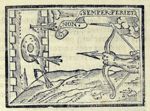
Non semper feriet: Covarrubias, Emblemas Morales (Madrid, 1610), emblem 148 quotes the comment
Zelotypia: Whitney, A choice of emblemes (Leiden, 1586), emblem 175 uses the imagery of Procris' weapon
A matrimonio absit suspicio: Aneau, Picta poesis (Lyon, 1564), emblem 65 uses the imagery of Procris' weapon
Iconclass: 54F1 Success; 'Evento buono' (Ripa) 57BB241 Irony 95A(CEPHALUS)214 Cephalus inadvertently kills Procris
Loci Communes: Bonae fortunae, copiae, felicitatis aut ominis (Of good fortune, abundance, happiness, or omen, Bonne fortune, abondance, bonheur ou présage)
II vii 88 Promeri canes Promerus' hounds
Προμέρου κύνες. i. Promeri canes. Dici solitum, ubi quis novo casu poenas daret iis, quos aliquando laesisset. Promerus regius quidam minister fuit. Is Euripidem tragicum poetam, supra modum exosum habebat, delatus ab eodem aliquando nescio quo nomine apud regem. Quare postea canes quosdam feros in poetam solvit, à quibus ille devoratus interiit. Proinde quoties potens quispiam offensus aliquos subornat, submittitque, qui tibi negocium facessant; tempestive dixeris, προμέρου κύνες. Convenit cum illo, quod alio dictum est loco, κυνὸς δίκην, id est, Canis vindictam, Recensetur à Diogeniano.
Προμέρου κύνες, The hounds of Promerus. Used by custom when someone paid the penalty by a new sort of calamity to those whom he had injured some time before. Promerus was an officer in the royal service who had an excessive hatred for the tragic poet Euripides, because he had once complained of him to the king on some grounds, I know not what. On a later occasion, therefore, he turned some fierce hounds on the poet, which killed and ate him. Thus, whenever some powerful person takes offence, and puts people up and eggs them on to make trouble for you, it will be the moment to say 'Promerus' hounds.' This agrees with one of which I have spoken in another place, A dog's revenge. Listed by Diogenianus.
Facsimile:
Iconclass: 34F14 (corpse of) man eaten by animals 57AA741 Revenge, Requital, Retaliation; 'Vendetta' (Ripa) 98B(PROMERUS) male persons from classical history (PROMERUS) 98B(EURIPIDES) male persons from classical history (EURIPIDES)
Loci Communes: Ultio malefacti (Vengeance for a wrongdoing, Vengeance d'un méfait)
II vii 89 Magistratum gerens, audi et juste et injuste When in office expect both just and unjust criticism
Αρχων ἄκουε καὶ δικαίως κᾀδίκως. id est, Princeps iniqua & aequa pariter audias. Sumptum aiunt hoc adagium ex Solonis elegiis, etiam si hic trimeter est iambicus. Admonet, ut qui in tractandis Reip. muneribus versatur, patientissimis sit auribus, aequoque animo & bene & male audire consuescat: neque facile populi vel laudibus vel conviciis à recto dimoveatur: Congruit huc illud Sophocleum in Antigone, Αλλ᾽ ὅν πόλις στήειε, τόνδε χρὴ κλύειν Καὶ σμικρὰ καὶ δίκαια καὶ τἀναντία. id est: Sed quem instituerit civitas, & parva eum Audire oportet, & aequae, & his contraria. Potest & ad hoc accommodari, quod quidam Romanus imperator dixisse legitur, In civitate libera linguas item liberas esse oportere. Neque vero mirum aut magnum, si principes permittant populo quae velint dicere: cum ipsis liberum sit quae velint facere. Praeterea de principum factis vulgus vatie pronunciare consuevit, quod alius probat, alius damnat. Maiore autem animo oportet esse principem, quam ut huiusmodi voces captandas aut observandas existimet: tantum id spectet, quod ex usu sit reipublicae. Huc Alexandri dictum pertinet, cui cum quidam renunciasset, esse qui de ipso male loqueretur, Regium est, inquit, male audire quum bene feceris.
Αρχων ἄκουε καὶ δικαίως κᾀδίκως, When in office, expect comments fair and unfair alike. They say that this adage is taken from the elegiac poetry of Solon, although the line is an iambic trimeter. Its point is that he who is engaged in bearing office in the state must have very long-suffering ears, and grow accustomed to hear himself both well and ill spoken of while remaining unmoved, nor should he be easily diverted from the right course by the plaudits or curses of the populace. With this those lines in Sophocles are in agreement, in the Antigone: 'A city's chosen lord must learn to hear / Small things and just things and their opposites.' We can adapt to the same purpose the reported saying of one of the Roman emperors, that in a free state men's tongues should also be free; nor is it surprising or of great importance if princes allow people to say what they like, while they themselves are free to do as they like. Besides which, the common people have grown accustomed to passing different judgments on the actions of princes, for one man approves and another condemns; but a prince ought to have too lofty a spirit to think such praise worth seeking or such criticism worthy of notice, and should set his sights on one thing only, the good of the commonwealth. Here belongs that saying of Alexander who, when someone had reported that he had his critics, replied 'It is a property of kings to be ill spoken of when they have done well.'
Facsimile:
Iconclass: 44B1 ruler, sovereign 44G13 magistracy, judges 57B1 Praise, Approbation, Approval; 'Lode' (Ripa) 57BB1 Disapprobation, Disapproval, Rebuking
Loci Communes: Aequanimitas (Equanimity, Équanimité)
II vii 90 Fulgur ex pelvi A flash in the pan
Αστραπὴ ἐκ πυέλου. i. Fulgur ex pelui. De mims inanibus eorum, qui laedete non queant. Fulgor enim, qui fulguris imitatione quadam è vasculorum nitentium vibratione, aut ex aquis redditur, nocendi vim nullam habet, pueros modo territat. Habentur & hodie specula quaedam quae vibrata ad solem fulgur imitantur: verum id fulmen non est, quod montes ac maria percutiat, ut inquit Plinius. Paroemiam recenset Diogenianus. Ad quam allusit Augustinus, aut si quis est alius autor, in libro De quinque haeresibus, Non nos hostium turba, non bellantium revocet forma, non quasi vitrea fulgentia terreant arma. quanquam legendum opinor Vitra.
Αστραπὴ ἐκ πυέλου, A flash in the pan. Of the empty threats of those who have no power to harm. The flash which is produced, by some sort of imitation of lightning, by the oscillation of polished vessels or from water, has no power to damage and frightens only children. In our own day too there are mirrors which imitate a flash of lightning when oscillated in the sun; but that is not the true lightning, which, as Pliny says, 'strikes mountains and seas.' The proverb is listed by Diogenianus. It is also alluded to by Augustine, or the author whoever he was of the De quinque heresibus: 'Let us not be recalled by a crowd of enemies or the appearance of armed men, nor frightened by the glitter of weapons as though made of glass.' Though I think we should read vitra, 'Weapons that glitter like glass.'
Facsimile:
Iconclass: 22D1 loud sound, noise 43A44 bonfire, fire-works 54AA7 Weakness, Powerlessness, Helplessness; 'Infermità' (Ripa)
Collectanea (1500): 133
Loci Communes: Contemptus et vilitatis (Contempt and worthlessness, Mépris et bassesse)
II vii 91 Ex inanibus paleis From empty chaff
Ατὰρ ἐκ καθαρῶν ἀχύρων τετρύγηκας σιτίον, id est, Atqui è puris paleis trituram frumenti facis. id est, Operam sterilem & infrugiferam sumpsisti. Natum à rusticis adagium, cum male enatis segetibus, praeter culmos & paleas mhil adferunt in horrea. Recensetur à Diogeniano.
Ατὰρ ἐκ καθαρῶν ἀχύρων τετρύγηκας σιτίον, But it is from mere chaff that you have threshed your wheat; you have undertaken a sterile and fruitless task. The adage arose among countryfolk, when their crops have failed to grow and they carry nothing home to their barns except straw and chaff. Listed by Diogenianus.
Facsimile:
Iconclass: 47I148 threshing 47I17(CHAFF) agricultural products and by-products (CHAFF) 51II2 Emptiness, Void 51CC19 No Result, Lack of Result, Inefficacy, Futility 54BB3 Inutility, Noxiousness; 'Nocumento', 'Nocumento d'ogni cosa' (Ripa)
Collectanea (1500): 134
Loci Communes: Inanis opera (Vain effort, Effort vain)
II vii 92 Atrei oculi The eyes of Atreus
Ατρέως ὄμματα. i. Atrei oculi. De toruo truculentoque aspectu dicebatur. His enim oculis in tragoediis inducebatur Atreus, qui Thyestae fratri filios ipsius epulandos apposuit, propter uxorem adulterio vitiatam.
Ατρέως ὄμματα, The eyes of Atreus, was used to describe a fierce and savage aspect. It was with eyes of this sort that Atreus was presented in tragedy, who set before his brother Thyestes his own sons to eat, because his wife was tainted with adultery.
Facsimile: 
Iconclass: 31B621:54AA42 morphology of facial expression ~ eyes❧Wildness, Untamedness 95A(ATREUS)41 Atreus' banquet: Thyestes is served with the flesh of his own sons
Loci Communes: Tristitia, laetitia (Sadness, joy, Tristesse, joie)
II vii 93 Mutus Hipparchion Hipparchion loses his voice
Αφωνος ἱππαρχίων. i. Mutus Hipparchion. Ubi quis repente obmutescit, cum maxime vox illius exspectatur. id quod non raro consuevit quibusdam in coetu dicturis evenire, ut subito velut attonitis vox faucibus haereat. Quod aiunt accidisse Theophrasto, homini in circulis alioquin eloquentissimo. In huiusmodi casu igitur fuerit huic adagio locus. Narrant olim apud Graecos, duos praecipuos fuisse citharoedos, Hipparchionem & Rufinum. Cum autem in sollennibus ludis, qui decimo quoque anno apud Iuliopolitas agebantur, essent inter se decertaturi: contigit, ut Hipparchion theatri strepitu turbatus, obticuerit, eaque res in vulgi iocum abiit. Autor Zenodotus.
Αφωνος ἱππαρχίων, Hipparchion loses his voice. When someone falls silent suddenly, at a moment when people specially want to hear what he has to say. It is a by no means rare occurrence for some individuals that when they have to speak before an audience their 'voice sticks in their throat,' as though they were terrified. It is said that this happened to Theophrastus, who was otherwise a very ready speaker in company. On such occasions as these, therefore, there may well be a place for this adage. They say that in Greece in the old days there were two leading lyre-players, Hipparchion and Rufinus. At the regular games celebrated every nine years at Juliopolis these two were to engage in a contest; and it so happened that Hipparchion was unnerved by the uproar in the theatre and lost his voice; hence this became a popular joke. Zenodotus is the authority.
Facsimile:
Iconclass: 31A4121(+0) deaf-mute, deaf and dumb (+ variant) 31B62359 being silent 48C721 musician at work 56DD3 Insecurity 98B(HIPPARCHION) male persons from classical history (HIPPARCHION)
Loci Communes: Taciturnitas illaudata (Unpraised silence, Silence non loué)
II vii 94 Pecuniarum cupiditas Spartam capiet, praetera nihil Love of money will be Sparta's undoing, and nothing else
Α φιλοχρηματία σπάρταν ἕλοι,ἄλλο δὲ οὐδέν. id est: Una fames auri Spartam capiet, subigetque Praeterea nihil. De iis qui sola pecunia possunt expugnari, alioquin invicti. Natum adagium ab oraculo, quo responsum est Alcameni & Theopompo Spartae regibus: tum demum vincendos esse Lacedaemonies, cum aurum & argentum in precio coeperint habere. Respondet apophthegmati Philippi Macedonum regis, qui putavit nullam arcem tam munitam esse, quin capi posset, modo asino pateret accessus onusto auro. Respondet & Danaes fabulae, à qua nulla custodia, auri insultum arcere potuit. Memivit M. Tullius in secundo libro Officiorum, & Plutarchus in Laconicis.
Α φιλοχρηματία σπάρταν ἕλοι, ἄλλο δὲ οὐδέν. Hunger for gold will Sparta captive make, and nothing else. Of those who can be overcome by money alone, and are otherwise invincible. The adage takes its rise from an oracle, which replied to an enquiry by the Spartan kings Alcamenes and Theopompus that the Spartans would not be defeated until they began to set a value on gold and silver. It corresponds to a saying of Philip, king of Macedon, who thought no citadel so strong that it could not be taken, provided it was accessible to an ass laden with gold. It corresponds also to the story of Danae, whom no precautions could protect from the insidious shower of gold. Cicero mentions this in book 2 of the De officiis, and Plutarch in his 'Customs of the Spartans.'
Facsimile:
Iconclass: 32B311(SPARTANS) indigenous European peoples (SPARTANS) 45A42 capitulation 54FF2 Defeat 55CC11:46B310 Greed, Covetousness, Cupidity; 'Cupidità' (Ripa)❧'Pecunia' (Ripa)
Loci Communes: Rapacitas et avaritia (Rapacity and greed, Rapacité et avarice)
II vii 95 Non decet principem solidam dormire noctem A ruler should not sleep the whole night through
Inter pleraque Homeri carmina, quae quondam proverbiorum vice celebrata fuisse testatur Macrobius, illud vel praecipue annumerarim, quod est in Iliados libro secundo: Οὐ χρὴ παννύχιον εὕδειν βουηφόρον ἄνδρα. id est: Haud dignum duce id est, noctem dormire per omnem. Admonet paroemia, vigilantiam ac sollicitudinem maximè convenire principibus; ut qui tantam negociorum sarcinam sustmeant humeris. Unde & Vergilius Aeneam suum aliis dormientibus aut voluptati indulgentibus, aut vigilantem facit, aut certe excitat, fingitque cogitabundum, sobrium, & de futuris agitantem animo: At pius Aeneas per noctem plurima voluens. Et rursum, Aeneas potes hoc sub casu ducere somnos? Atque iterum, Vigilásne deûm gens Aenea? vigila. Huius rei praeclarum exemplum praebuit Epaminondas ille dux Thebanus. Siquidem cum Thebani cives festis quibusdam diebus solutius compotationibus indulgerent, licentiusque voluptatibus fruerentur, ille solus vigil, ac sobrius arma lustrabat, et urbis obambulabat moenia. Rogatus cur id faceret, respondit se νήφειν καὶ ἀργυπνεῖν, ὅπως ἐξῇ τοῖς ἄλλοις μεθύειν καὶ καθεύδειν. i. sobrium esse se ac vigilare, quo reliquis liceret temulentis esse ac dormire: quemadmodum refert Plutarchus in libello Adversus ducem impetitum. Porrò quae modo retulimus ex Homero dicuntur ad Agamemnonem sub persona somnii, Nestoris speciem imitantis. Integrum carmen sic habet, Εὕδεις Ατρέος ὑιὲ δαΐφρονος ἱπποδάμοιο; Οὐ χρὴ παννύχιον εὕδειν βουληφόρον ἄνδρα, ᾧ λαοίτ᾽ ἐπιτετράφαται καὶ τόσσα μέμηλε. id est: Belligeri Atridae proles dormísne Agamemnon? Perpetuam noctem dormire haud principe dignum est, Cui populi commissi, & tanta negotia curae. Eundem caeteris dormientibus solum vigilantem facit Iliados Κ Αλλοι μὲν παρὰ νηυσὶν ἀριστῆες παναχαιῶν Εὕδον παννύχιοι, μαλακῷ δεδμημένοι ὕπνῳ, Αλλ᾽ οὐκ Ατρείδην Αγαμεμνονα ποιμένα λαῷν Υπνος ἔχε γλυκερὸς, πολλὰ φρεσὶν ὁρμαίνοντα. id est, At reliqui Danaum proceres noctem usque per omnem. Dormibant, placido correpti membra sopore. At non Atridem pastorem Agamemnona plebis Somnus habet dulcis, versantem pectore multa. Consimilem ad modum Iovem vigilantem fecit Iliados secundo, Αλλοι μὲν ῥὰ Θεοί τε, καὶ ἀνέρες ἱπποκορυσταὶ Εὗδον παννύχιοι, Δία δ᾽ οὐκ ἔχε νήδυμος ὕπνος, Αλλ᾽ ὅγε μερμηριζε κατα φρένας. id est, Tum reliquos omnes, divosque virosque tenebat Pernox somnus. at insomnis Saturnius unus, Pectore sollicito voluebat. Narrat Plutaichus in eodem commentario, quem modo citavimus, quiddam nec alienum ab hac paroemia, nec indignum memoratu: nimirum regi Persarum hunc fuisse morem, ut semper unum quempiam haberet cubicularium, cui hoc muneris erat mandatum, ut mane regium thalamum ingressus, his verbis illum expergefaceret, Ανάστα ὧ βασιλεῦ, καὶ φρόντιζε πραγμάτων, ὧν σὲ φροντιζειν ὁ Μεσορομάσδης ἠθελησε. i. Surge rex, ac negocia cura, quae te Mesoromasdes curare iussit. Quod si quis princeps eruditus sit ac prudens, huic nihil opus fuerit eiusmodi cubiculario monitore: sed ipsa ratio semper in pectore tale quiddam insonabit: φρόντιζε, & οὐ χρὴ παννύχιον. Plato septimo De legib. libro, multis modis vigilantiam commendat, maximè in principe. Eius verba subscribam: Εργηγορότεςδὲ ἄρχοντες ἐν πόλεσιν νύκτωρ, φοβεροὶ μὲν κακοῖς, πολεμίοις τε ἅμα καὶ πολίταις. i. Principes, qui noctu vigilant in civitatibus, malis sunt formidabiles civibus pariter & hostibus. Ac paulo superius eodem in loco: Καθεύδων γὰρ οὐδεὶς, οὐδένος ἄξιος. Nullus enim dormiens, alicuius est rei. Dormiunt autem qui oscitanter agunt, quibus interdum succedit, sed raro. Proin recte Pindar. Olymp. X. Απονον δ᾽ ἔλαβον χάρμα παῦροι τινές. i. Gaudium citra laborem pauci quidam assequuti sunt.
Among the numerous lines in Homer which, as Macrobius tells us, were once current as proverbs, I would place near the top of the list one from book two of the Iliad: 'A wise prince should not sleep the whole night through.' The message of the proverb is that watchful care is specially appropriate for princes, who bear such a load of business on their shoulders. So it is with Aeneas in Virgil: while others sleep or indulge in pleasure, he either lies awake, or at the least is aroused, and is painted as thoughtful, serious, and full of planning for the future, 'But pious Aeneas all night long full of thought,' and again, 'Aeneas, can you prolong your sleep at such a juncture?' and again 'Art thou awake, Aeneas child of the gods? Awake!' A distinguished example of this is provided by Epaminondas, the famous Theban general. When the people of Thebes during several days of public holiday were indulging with some freedom in drink and abandoning themselves to pleasure, he alone was awake and sober, and went round the city walls, checking the weapons. When asked why he did so, he replied that 'he was sober and wakeful in order that the rest might be free to drink and sleep.' So Plutarch records in his essay 'To An Uneducated Ruler.' To return to the quotation I have just given from Homer, the words are spoken to Agamemnon by a Dream personified, which bears the likeness of Nestor. The whole passage runs as follows: 'Sleepest thou, son of Atreus and sage Hippodamas? A wise prince should not sleep the whole night through, to whom the people are entrusted, and such a load of care.' Again in Iliad 10 Agamemnon alone is portrayed as wakeful while all the rest are asleep: 'Down by the ships all the other Achaean chieftains lay all night long in the gentle bonds of sleep. Not so the son of Atreus, Agamemnon, shepherd of the people; sweet sleep held him not, for his mind was full of thought.' In the same way he shows us Jove awake in Iliad 2: 'Then did the other gods, and men that marshalled chariots, sleep all night long, but no sweet sleep held Jove as he pondered in his heart.' Plutarch, in that same essay which I have just quoted, tells us something not irrelevant to the proverb, and well worth remembering in itself. 'It was the custom of the king of Persia always to have one chamberlain on whom the duty was laid of entering the royal bedchamber every morning and waking the king with the following words: "Arise, o king, and consider the business which Mesoromasdes instructed you to consider.'" If a prince were learned and wise, he would have no need of any such chamberlain to remind him of his duty; but reason herself will be always in his bosom, repeating such words as 'Consider' and 'not sleep the whole night through.' Plato in the seventh book of the Laws praises wakefulness on many grounds, and particularly in princes. I will subjoin his words: 'Princes who are wakeful in their cities in the night are a terror to the wicked, alike to their enemies and their citizens.' And a little earlier in the same passage: Tor no one when he is asleep is good for anything.' For they are asleep who act in a listless manner, and sometimes they achieve their purpose, but not often. So Pindar in his tenth Olympian is right when he says that 'Joy that has cost no toil falls to few men's lot.'
Facsimile: 
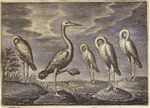
Typus regis: Schoonhovius, Emblemata (Gouda, 1618), emblem 22 uses the imagery of the crane for vigilance
Non maiestate securus: Saavedra, Idea de un principe (München, 1640), emblem 44 uses the imagery of the lion for vigilance
Pro grege: Isselburg, Emblemata politica (Nürnberg, 1617) emblem 21 uses the imagery of the crane vigilance
Οὐ χρὴ παννύχιον ἕυδειν: Sambucus, Emblemata (Antwerp, 1564) emblem 18 quotes the comment
Parte tamen vigilat: Zincgreff, Emblematum Ethico-politicorum (Heidelberg, 1619), emblem 1 uses the imagery of the lion for vigilance
Officium natura docet: Neugebauer, Selectorum Symbolorum Heroicorum Centuria (Frankfurt, 1619), emblem 25 uses the imagery of vigilance
Officium natura docet: Giovio, Dialogo dell' Imprese (Lyon, 1574), emblem 60 uses the imagery of vigilance
Officium natura docet: Hulsius, Epitome Emblematum (Nürnberg, 1602), emblem 9 uses the imagery of vigilance
Oculis indormit apertis: Verani, Monumentum Extremi Honoris (München, 1679), emblem 15 uses the imagery of the lion for vigilance
Facile exsuscitatur - Gar hurtig aufzuwachen: Woytt, Emblematischer Parnassus (Augsburg, 1727), emblem 444 uses the imagery of the lion for vigilance
Cor vigilat: Weigel, Gedankenmuster (Nürnberg, 1700), emblem 292 uses the imagery of the lion for vigilance
Dormiens vigilat: Hagelhans, Christlicher Hochtheurer Helden Tugend-lauff (Nürnberg, 1653), emblem 10 uses the imagery of the lion for vigilance
Non maiestate securus: De la Feuille, Devises et emblemes anciennes et modernes (Augsburg, 1697), emblem 579 uses the imagery of the lion for vigilance
Deo opt max - His servire: Peacham, Minerva Britanna (London, 1612), emblem 20 uses the imagery of the lion for vigilance
Iconclass: 25F23(LION)(+46) beasts of prey, predatory animals: lion (+ sleeping animal(s)) 44B10 virtues of the ruler 52A23 Alertness, Vigilance; 'Guardia', 'Vigilanza', 'Vigilanza per difendersi & oppugnare altri' (Ripa)
Loci Communes: Somnolentia (Sleepiness, Somnolence)
II vii 96 Capram portare non possum, et imponitis bovem I cannot carry a she-goat and you load me with an ox
Plutarchus in commentario, cui titulus, περὶ τοῦ μὴ δεῖν δανιζεσθαι. Επεὶ τὸ τῆς παροιμίας ἔσται γελοῖον, Οὐ δύναμαι τὴν αἶγα φέρειν, ἐπιτίθετέ μοι βοῦη. id est, Tauro oneratis, cum nequeam portare capellam. Ubi quis quod levius est recusat, & quod multo sit intolerabilius, imponi sibi postulat. Veluti si quis impatientia paupertatis (nam ad id accommodat Plutarchus) usuris involvat sese, quod onus vix divitibus sit tolerabile.
Plutarch in the essay entitled 'That we ought not to borrow': 'For there will be the ridicule expressed in the proverb I cannot carry a she-goat and you load me with an ox.' When a man refuses a lighter burden and demands to have something far heavier put upon him; if, for example, from reluctance to suffer poverty (for that is the subject to which Plutarch adapts it) one were to entangle oneself with money-lenders, a burden which even rich men find hard to bear.
Facsimile:
Iconclass: 47I21111 ox 47I2142 she-goat, nanny-goat 52BB42:46C121 Impossibility❧carrying something 55CC3:46B31 Borrowing, Hiring❧money 56DD1:55BB1 Fear, Dread; 'Paura', 'Timidità o Timore', 'Timore' (Ripa)❧Poverty; 'Povertà', 'Povertà del doni', 'Povertà in uno ch'habbia bell'ingegno' (Ripa)
Loci Communes: Impossibilia (Impossible things, Choses impossibles)
II vii 97 Nunquam enim meas boves abegerunt nec equos For they have never driven off my cows nor yet my horses
Οὐ γὰρ πώποτ᾽ ἐμὰς βοῦς ἤλασαν, οὐδὲ μὲν ἵππους. id est, Non enim equos unquam mihi subduxere bovésve. Proverbiali figura videtur olim usurpatum, pro eo quod est, Nunquam me laeserunt, aut adfecerunt iniuria. Cum negamus nobis esse causam, cur illum aut illum odisse debeamus. Plutarchus in commentario De vitanda usura: Καὶ ταῦτα μή με οἴεσθε λέγειν, πογλεμον ἐξενηνοχο τα πρὸς τοὺς δανειστάς. οὐ γᾶρ πώποτ᾽ ἐμὰς βοῦς ἤλασαν, οὐδε μὲν ἵππας. i. Neque vero me existimetis haec dicere, quod bellum mihi sit cum usurariis: Nunquam etenim vel equos mihi subduxere bovésve. id est, nunquam quicquam mei abstulerunt. Id quo longius traducetur à simplici sermone, hoc magis erit proverbiale. Sumptum est autem ex Iliados Homericae libro primo: ubi Achilles contendens cum Agamemnone, negat sibi causam esse, quamobrem cum Troianis bellum suscipiat, nisi ut illi morem gerat: Οὐ γὰρ ἐγὼ τρῴων ἕνεκ᾽ ἤλυθον αἰχμητάων Δεῦρο μαχησομενος, ἐπεὶ οὔ, το μοι αἴτιοι εἰσιν. Οὐ γὰρ πώποτ᾽ ἐμὰςβοῦς ἤλασαν, οὔτε μὲν ἵππους, Οὐδεποτ᾽ ἐν φθιφῃ ἐριβώλακι βωτιάνείρῃ Καρπὸν ἐδηλήσαντο.. id est, Haud ego Troiugenûm huc accessi nomine, quo cum His bellum gererem, neque enim sum laesus ab istis. Nunquam etenim vel equos mthi subduxere bovésve Nec Phthies unquam segetumque, virumque feracis Sunt populati agros. Ductum est autem ex antiqui saeculi ritu, quo cum vita mortalium adhuc esset pastoralis, prima belli causa erant abacta pecora: quemadmodum eleganter indicat Homerus Ilia. σ. depingens Achillis clypeum: Τοῖσι δ᾽ ἔπειτ᾽ ἀνάνευθε δύο σκοποί εἵατο λαῶν, Δέγμενοι ὅπποτε μῆλα ἰδοίατο καὶ ἕλικας βοῦς. Οἱ δὲ τάχα προγένοντο, δύο δ᾽ ἅμ᾽ ἕποντο νεμῆες, Τερπόμενοι σύριφξι, δόλον δ᾽ οὔτι προνόησαν. Οἱ μὲν τὰ προϊδόντες ἐπέδραμον. ὦκα δ᾽ ἔπειτα Τάμνον δ᾽ ἀμφὶ βοῶν ἀγέλας καὶ πώεα καλὰ Αργεννῶν ὀΐων, κτεῖνον δ᾽ ἐπὶ μηλοβοτῆρας & reliqua quae sequuntur: Quos versus ne quis omnino contemptos quaeratur, ita vertimus: Dehinc procul his speculatores populi unus & alter Observant, si fors videant oviúmve boúmve Agmina. at haec confestim adsunt, quae ponè sequuntur Pastores duo, demulcentes pectora cannis, Ignari fraudis: contra illi ex composito, mox Accurrunt, armenta boum, niveosque bidentum Concidere greges, caesis pastoribus ipsis.
Οὐ γὰρ πώποτ᾽ ἐμὰς βοῦς ἤλασαν, οὐδὲ μὲν ἵππους, For they have never driven off my cows nor yet my horses, was clearly used in the old days as a proverbial formula for 'They have never hurt me nor done me an injury,' when we maintain that there is no reason why we ought to hate this man or that. Plutarch in his essay 'That we ought not to borrow': 'And do not think that I say this because I have declared war on the money-lenders, for they have never driven off my cows nor yet my horses,' they have never, that is, deprived me of anything of mine. This will be more like a proverb, the further it is transferred from its straightforward sense. It is taken from the first book of Homer's Iliad, where Achilles in his quarrel with Agamemnon maintains that he has no reason to engage in war with the Trojans except to oblige Agamemnon: 'I did not come hither on account of the Trojan warriors, to fight against them, for they have done me no harm; they have never driven off my cows nor yet my horses, nor did they ever lay waste my harvests on the deep soil of Phthia, nurse of heroes.' This originates in the customs of a bygone age, when men still led a pastoral life, and the prime cause of warfare was the rustling of cattle, as Homer elegantly suggests in Iliad 18, when he is describing the shield of Achilles... That no one may complain that I do not think highly of these lines, I have translated them as follows: 'Aloof from them there sat two watchmen of the folk, on the look-out in case they might see sheep and cows with crumpled horns. And at once there they were, and with them went two herdsmen playing on their pipes, and they foresaw no trap. But the watchers when they saw them ran down, and quickly then did they cut to pieces the herds of cattle and the fair flocks of sheep with white fleeces, and killed the herdsmen.'
II vii 98 Felix qui nihil debet Happy is he that owes nothing
Αὐδαίμων ὁ μηδὲν ὀφείλων. i. Felix qui nihil debet. Sententia Graecis celebrata: quam facile his veram dicet, qui periculum fecerit, quid sit aere alieno obstrictum esse. Qui non sit expertus, is Plutarchi commentarium evoluat De vitandis usuris, quamque sit miserum debere, facile cognoscet. Quid enim calamitosius quàm toties erubescere, toties perfricare faciem, fugitare, latitare, mentiri, dissimulare: nunc supplicem agere, nunc flagitare: palàm appellari, vitari, notari digito: breviter nunquam tui iuris esse? Nam haec, cumque his multa alia incommoda secum affert aes alienum. Extat in hanc sententiam epigramma Graecum huiusmodi, titulo Automedontis: Εὐδαίμων πρῶτον μὲν, ὁ μηδενὶ μηδὲν ὀφείλων, Εἷτα δ᾽ ὁ μὴ γήμας. τὸ τρίτον, ὅς τις ἄπαις. Ην δὲ μανεὶς γήμῃ τὶς ἔχει χάριν, ἢν κατορύξῃ Εὐθὺς τὴν γαμετὴν, προικα λαβὼν μεγάλην Ταῦτ᾽ εἰδὼς, σοφὸς ἴσθι. μάτην δ᾽ ἐπίκουρον ἔασον Ποῦ τὸ κενὸν ζητεῖν, καὶ τίνες αἱ μονάδες. id est, Qui nulli debet, fortunatissimus ille est, Proximus huic coelebs, tertius orbus erit. Quod si quis demens uxorem duxerit, illi Haec ita res demum commoda grata feret: Eveniat si sors, ut grandi dote recepta, Protinus uxorem deferat in tumulum. Haec doctus sapies: Epicurum quaerere frustra Qua sit inane sinas, quaeque sient monades. Plutarchus in libello, cui titulus, περὶ τοῦ μὴ δεῖν δανείζεσθαι, scribit Persis duo fuisse peccata: primum debere, proximum mentiri. Nam ea iudicabant cohaerere, quod qui sunt obaerati, saepius cogantur mentiri. Quod autem refert Plutarchus, est apud Herodotum lib. primo.
Αὐδαίμων ὁ μηδὲν ὀφείλων, Happy is he that owes nothing. A familiar aphorism in Greek, the truth of which will easily be confirmed many times over by anyone who has made the experiment of being heavily in debt. Those without this experience should read Plutarch's essay 'That we ought not to borrow,' and he will easily discover how miserable it is to be in debt. What can be more calamitous than so often to turn red with shame, so often to put a bold face on things, to be in constant state of running away, of hiding, of telling lies and covering up; to be the humble suppliant one day and importunate claimant the next; to suffer demands in public for repayment, to be avoided, to be pointed out by the finger of scorn - never, in short, to be one's own master? All these troubles, and many others beside them, go with being in debt. There is a Greek epigram on the same theme, bearing the name of Automedon, which runs like this: 'First on the list of happy men is he who owes no one anything, second the bachelor, third he who is childless. If one goes mad and marries, he gets his reward if he can bury his spouse forthwith and pocket a large dowry. Learn then this lesson and know yourself wise; let Epicurus waste his time enquiring where the void is and what the atoms are.' Plutarch, in the essay called 'That We Ought Not To Borrow,' says that among the Persians there were two sins; the first was to be in debt, and next after that, to tell lies, because they thought these were closely connected, seeing that those who have borrowed heavily are often driven to falsehood. What Plutarch tells us is to be found in Herodotus, in the first book.
II vii 99 Ad digit crepitum At the snap of a finger
Qui arrogantius, fastuosiusque iubent quippiam, digituli crepitu significare dicuntur. Divus Hieron. in epist. ad Rusticum monachum usurpavit, in superciliosum quendam & fastidientem, qui dicturus, digituli crepitu silentium imperabat: deinde simili fastu, singulas voces, per intervalla promebat: ut singultire crederes, non proloqui. Videtur autem hic gestus fuisse dominorum, servis humilius aliquid ministerium innuentium. Martialis libro tertio in Zoilum: Digiti crepantis signa novit Eunuchus. Item in Distichis, Cum poscor crepitu digitorum, & verna moratur, O quoties pellex culcitra facta mea est. M. Tullius lib. Officiorum tertio: Itaque si vir bonus habeat hanc vim, ut si digitis concrepuerit, possit in locupletum testamenta nomen eius irrepere, hac vi non utatur, ne si exploratum quidem habeat id omnino neminem unquam suspicaturum. Simile est illud de nutu & renutu Iovis, quod ex Homero citat Plinius in Epistolis. Et Nutu dicuntur efficere, qui minimo negocio rem conficiunt: Item, ad omnes nutus obsequi, qui prompte morigerantur.
Those who give some command in an arrogant and contemptuous manner are said to convey their meaning by the snap of a finger. St Jerome in his letter to Rusticus the monk, used the phrase of a very proud and supercilious man who, when about to say something, demanded silence by a snap of his fingers, and then in a similarly pompous way brought out his words with long intervals between them, 'so that you might think it was a fit of the hiccoughs and not someone talking.' This gesture seems to have been typical of masters telling their servants to perform some menial task. Martial in book 3 in his attack on Zoilus: 'Some eunuch knows the signal when he snaps his fingers,' and in his book of distichs: 'When I'm summoned with a snap of the fingers, and the houseboy is slow off the mark, how often have the cushions taken over the task which is properly mine!' Cicero in book 3 of the De officiis: 'If therefore a good man were to possess this power of insinuating his name into rich men's wills by a mere snap of his fingers, he would never make use of this power, not even if he were perfectly satisfied that no one at all would ever suspect what he had done.' This resembles the phrase about Jove nodding his head in agreement or refusal, which is quoted from Homer by Pliny in his Letters. And people are said to do things 'on the nod,' who achieve some result with the minimum of effort. Also 'to obey someone's lightest nod,' of those who hasten to comply.
Facsimile: 
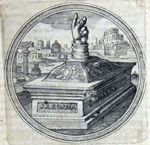
Omnia nec tanti: Zincgreff, Emblematum Ethico-politicorum (Heidelberg, 1619), emblem 93 uses the adage's imagery of snapping one's fingers
Iconclass: 31A2512(+9322) arm stretched forward (+ commanding) 31A25543 snapping one's fingers 57AA644 Arrogance; 'Arroganza' (Ripa)
Loci Communes: Obsecundantis (Complying, being obliging, Se conformer, obéir)
II vii 100 Suem irritat He provokes the boar
Υν ὁρίνει. i. Suem iritat. In avidum rixarum dicebatur. Sus enim agrestis provocatus rectà petit eum, à quo provocatus est. Sic enim narrant venandi periti, si quis suem lancea protensa provocarit, etiam si iam ille sequebatur alium quempiam, ilico vertere cursum, & in provocatorem tendere, ne cuspide quidem vitata.
Υν ὁρίνει, He rouses the boar, was used of someone with an appetite for quarrels. For a wild boar when challenged makes straight for its challenger. Experts in hunting tell us that if a man threatens a boar with his spear, even if the boar was already in pursuit of someone else, it will turn immediatelyand attack the man who has challenged it, not even avoiding his spear-point.
Facsimile:
Qui furit ...: La Perrière, Morosophie (Lyon, 1553), emblem 34
Iconclass: 33B14 threatening behaviour, challenging 43C111243(+4111) boar-hunting (+ spear) 47I2121 boar (male pig) 56E1 Irritation 56E3 Fury; 'Furore', 'Furore implacabile', 'Furore & Rabbia', 'Furore superbo & Indomito' (Ripa)
Collectanea (1500): 690
Loci Communes: Malum accersitum aut retortum (Evil brought upon oneself or turned back, Mal attiré ou retourné)