Guillaume de La Perrièrre, Le Theatre Des Bons Engins (Lyon, 1545)
Emblem 68
Youth seated on a ball beside a table clockAI-generated
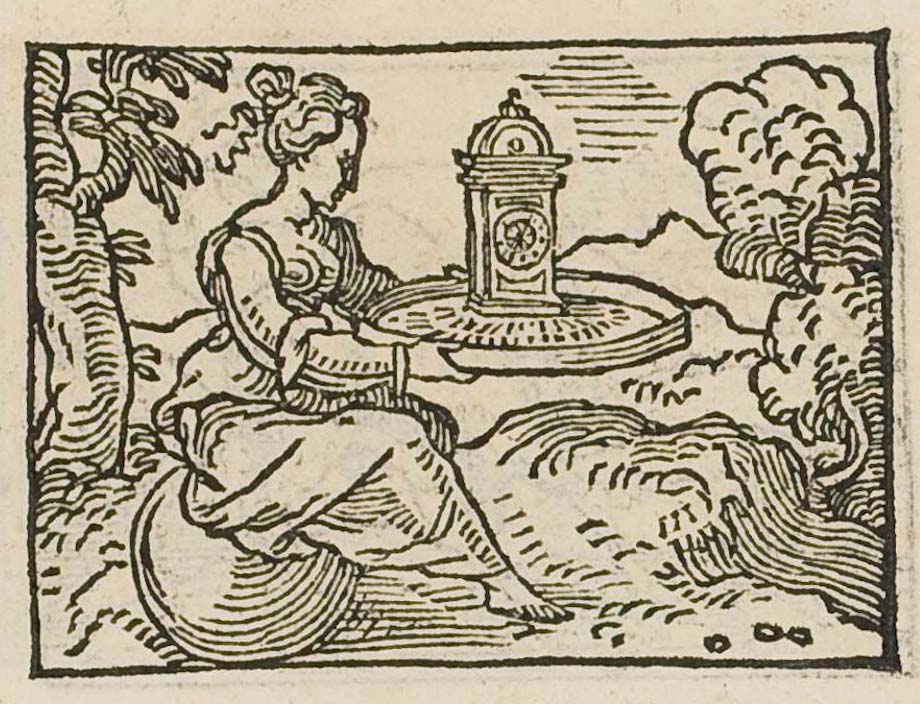
Les ieunes Gens n'ont soing de l'aduenir.
Emblem 68. Young people take no care for the future.AI-generated
Description of the woodcutAI-generated
A woodcut in a rectangular frame. At the left, beneath a leafy tree, a young woman with elaborately dressed hair and a long full-skirted gown sits sideways on a large round ball or sphere, her hands folded in her lap. Beside her, in the centre of the scene, stands a round-topped table or pedestal on which rests a small domed clock with a visible dial. Behind and to the right is an open landscape with a curving stream or hillside, scattered stones in the foreground, and large billowing clouds in the sky.
Subscriptio

TranscriptionAI-generated
IEunesse estant sur vne boule ronde,Ne pense ailleurs, fors qu'a passer le temps:Son siege rond, muable comme l'onde,Monstre qu'elle ha ses vouloirs inconstantz.Les ieunes gens ne sont gueres contentzDe trauailler, sinon à leurs desirs:Leurs voluptez tournent à desplaisirs,Perte de temps, trop grande s'en ensuyt,Ieunesse tasche à tous mondains plaisirs,Sans aduiser, que Vieille la suyt.
TranslationAI-generated
Youth, being seated on a round ball, thinks of nothing else but passing the time: her round seat, changeable as the wave, shows that her wishes are inconstant. Young people are hardly content to labour, except at their own desires: their pleasures turn into displeasures, too great a loss of time follows from it; Youth strives after all worldly pleasures, without considering that Old Age follows her.
Iconclass
86(LES IEUNES GENS N'ONT SOING DE L'ADUENIR)proverbs, sayings, etc. (LES IEUNES GENS N'ONT SOING DE L'ADUENIR)31D120Youth, Adolescence, 'Iuventus'; 'Adolescenza', 'Gioventù' (Ripa)31D15adult woman41C27(SIEVE)kitchen-utensils: sieve23U24clock49D48sphere, globe ~ stereometry31D5young versus old age; young and old23A44fugacity of Time
Suggested Iconclass codesAI-generated
Additional codes proposed for this emblem, not (yet) part of the indexing.
23U24clockhighThe correlate 'clock' directly matches the small domed clock with visible dial standing on the pedestal at the centre of the scene.
25A13globelowThe correlate 'globe' could cover the large round ball/sphere on which the woman sits, though here it functions as a symbolic sphere rather than a geographical globe.
Relationships to the Adagia of ErasmusAI-generated
Suggested relationships between this emblem and adages in Erasmus’ Adagia.
- IV i 83 Iuvenari – thematic inventiomedium
Erasmus' essay explains that young people, 'because of ignorance and lack of control over their emotions', are 'more unstable', and quotes Basil's proverb that the immature 'go round in circles and vacillate' - exactly the emblem's point that Youth, seated on a rolling ball, has 'vouloirs inconstantz' and pursues pleasure thoughtlessly.
- I ix 62 Euripus homo – thematic inventiolow
The subscriptio's image of a round seat 'muable comme l'onde' (changeable as the wave) matches the adage's tidal metaphor for human inconstancy, and the essay's citation 'Dii nos, quasi pilas, homines habent' (men are the gods' balls) echoes the figure perched on a ball.
Sources
Record ID: embhab_162-3-eth-b_emblem068
This emblem on the Iconclass site: https://iconclass.org/view/embhab_162-3-eth-b_emblem068
Page in the digital copy of the Herzog August Bibliothek: http://diglib.hab.de/drucke/162-3-eth-b/start.htm?image=00081