Guillaume de La Perrièrre, Le Theatre Des Bons Engins (Lyon, 1545)
Emblem 69
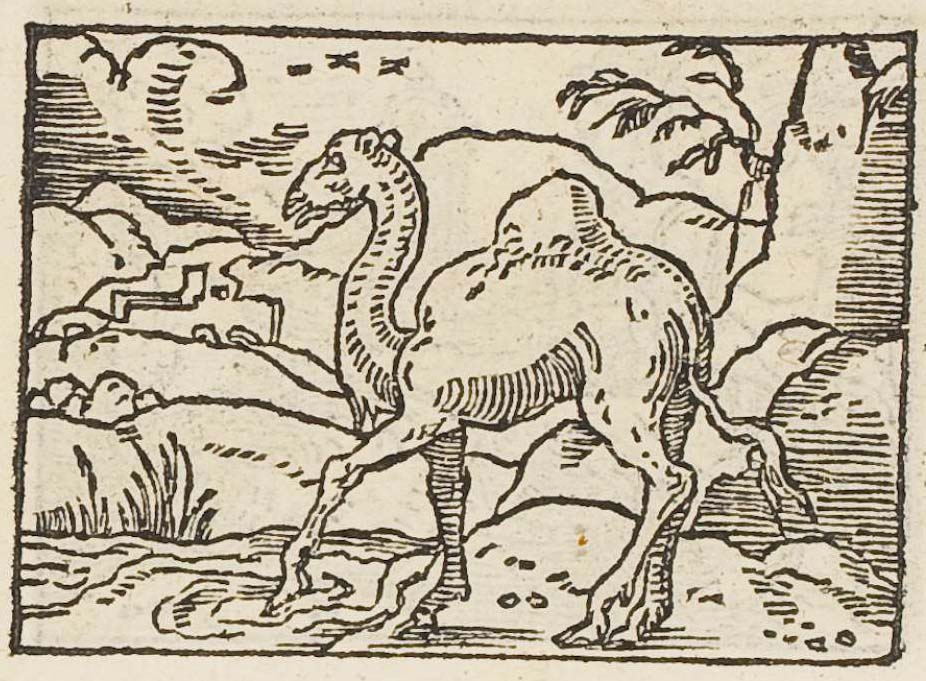
A camel muddying the water with its foot before drinkingAI-generated
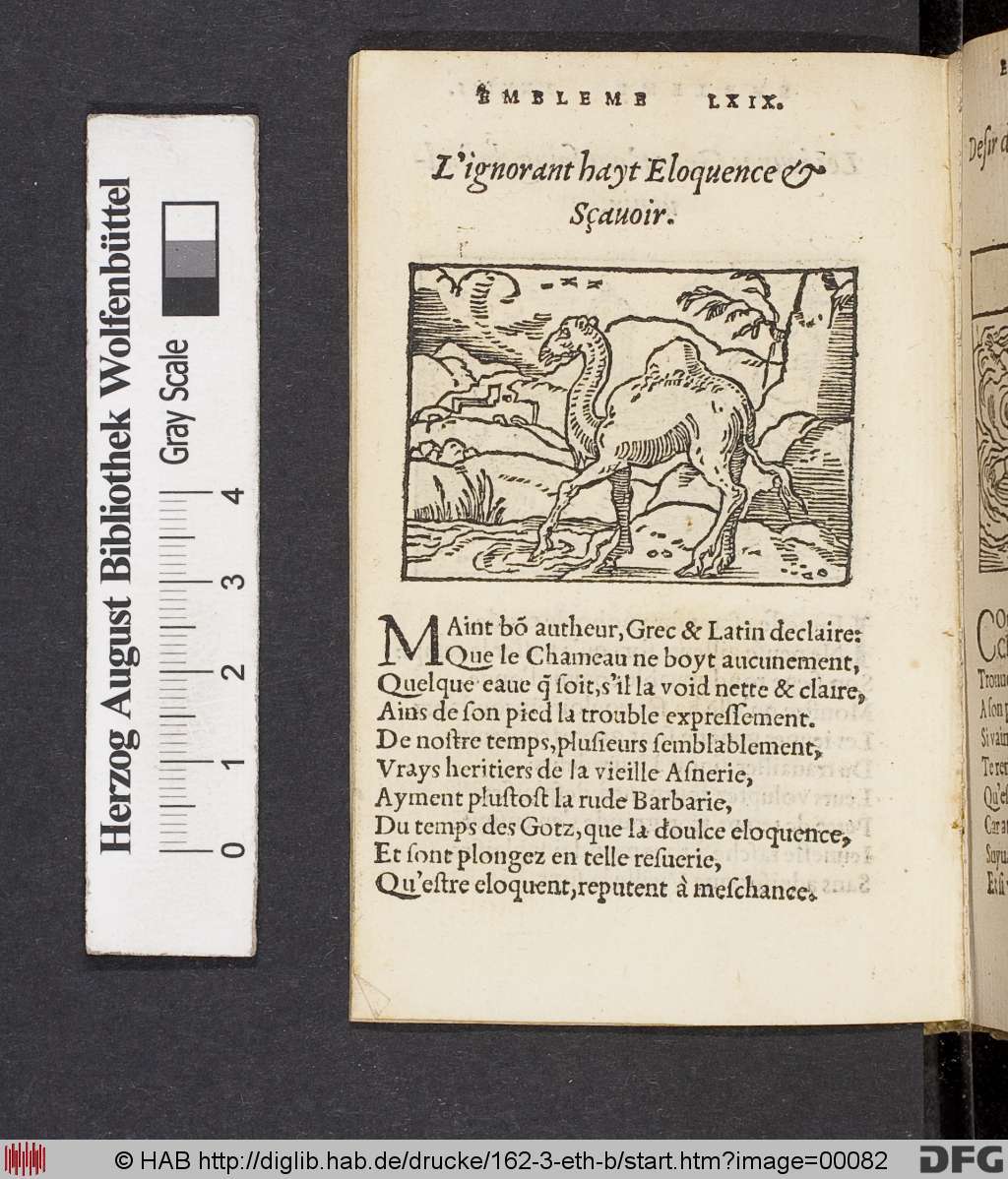
L'ignorant hayt Eloquence & Scavoir.
The ignorant man hates Eloquence and Knowledge.AI-generated
Description of the woodcutAI-generated
A woodcut in a rectangular frame showing a camel standing at the edge of a shallow stream or pool in a rocky landscape. The camel, seen in profile facing left with its long neck raised and turned, lowers one foreleg into the water. Behind it rise rocky hills and a crag with a bare, windswept tree at the right; tufts of grass and a few scattered stones lie in the foreground, with clouds and birds sketched in the sky at the upper left.
Subscriptio
TranscriptionAI-generated
Maint bõ autheur, Grec & Latin declaire:Que le Chameau ne boyt aucunement,Quelque eaue q̃ soit, s'il la void nette & claire,Ains de son pied la trouble expressement.De nostre temps, plusieurs semblablement,Vrays heritiers de la vieille Asnerie,Ayment plustost la rude Barbarie,Du temps des Gotz, que la doulce eloquence,Et sont plongez en telle resuerie,Qu'estre eloquent, reputent à meschance.
TranslationAI-generated
Many a good author, Greek and Latin, declares that the Camel will not drink at all of any water whatsoever, if he sees it clean and clear, but rather deliberately muddies it with his foot. In our own time, many likewise, true heirs of the old Asinine breed, love rather the rude Barbarity of the time of the Goths than sweet eloquence, and are plunged in such raving folly that they reckon being eloquent a misfortune (a wickedness).
Iconclass
86(L'IGNORANT HAYT ELOQUENCE & SCAVOIR)proverbs, sayings, etc. (L'IGNORANT HAYT ELOQUENCE & SCAVOIR)25F24(CAMEL)(+557)hoofed animals: camel (+ postures and gestures of animal forelegs, forepaws, claws in relation to another animal, human figure, or object)25H2143pond, pool23T25medieval history, middle ages (historical epoch)91E3primitive stages of mankind; men rise from their brutish condition to civilization
Suggested Iconclass codesAI-generated
Additional codes proposed for this emblem, not (yet) part of the indexing.
25F24(CAMEL)hoofed animals: camelhighThe correlate 'hoofed animals: camel' exactly matches the single camel shown in profile at the water's edge, the dominant subject of the woodcut.
25H211spring, source of river or streamlowThe correlate 'spring, source of river or stream' loosely matches the shallow stream or pool in the rocky landscape into which the camel sets its foot.
59CC221Corruptibility, Venality, CorruptionmediumThe correlate 'Corruptibility, Venality, Corruption' fits the emblematic sense, signalled by the commentary's 'corruption', of the camel fouling the clear water it drinks from.
57A63Incorruption, Purity; 'Purità' (Ripa)mediumThe correlate 'Incorruption, Purity' matches the commentary's theme of purity (of the water) that the camel's trampling destroys.
54A43Temperance, Moderation; 'Misura' (Ripa)lowThe correlate 'Temperance, Moderation' corresponds to the commentary's 'temperance', a virtue traditionally associated with the camel's drinking habits.
Relationships to the Adagia of ErasmusAI-generated
Suggested relationships between this emblem and adages in Erasmus’ Adagia.
- I vi 48 Inelegantior Libethriis – thematic inventiomedium
Erasmus's Libethrians are described as stupid contemners of music, poetry and 'all elegant disciplines', exactly the type the emblem pillories: ignorant men who hate eloquence and learning and prefer 'rude Barbarity'.
- II vi 18 Αμουσοι – thematic inventiomedium
The emblem's moral — that boors 'reckon being eloquent a wickedness' — matches Erasmus's discussion of the amousoi, men wholly estranged from the Muses, Graces and letters.
- II vii 66 Camelus saltat – thematic inventiolow
The only Erasmian adage joining the camel to the theme of eloquence: Jerome's 'we saw the camel dancing' mocks a man utterly foreign to the Muses who nonetheless wished to be thought eloquent; the emblem similarly makes the camel the beast of anti-eloquence.
- II i 20 Barbarus ex trivio – thematic inventiolow
The subscriptio's 'rude Barbarie du temps des Gotz' echoes the proverbial 'barbarian from the roadside', Erasmus's image of the lowest, wholly uncultivated sort of man (and of the soul sunk in the mud of ignorance).
Sources
Record ID: embhab_162-3-eth-b_emblem069
This emblem on the Iconclass site: https://iconclass.org/view/embhab_162-3-eth-b_emblem069
Page in the digital copy of the Herzog August Bibliothek: http://diglib.hab.de/drucke/162-3-eth-b/start.htm?image=00082