II i 1 Festina lente Make haste slowly
Σπεῦδε βραδέως. id est, Festina lente. Proverbium hoc non invenustam aenigmatis speciem prae se fert, propterea quod constat ex verbis inter sese pugnantibus. Ideo que referendum est ad eam formam, quam in operis huius initio demonstravimus, nimirum eorum, quae per ἐναντίωσιν, id est, contrarietatem efferuntur. Quod genus est illud, δυσδαίμων εύδαιμονια. id est, infelix felicitas. Nec absurde coniectasse videatur, si quis effictum existimet ex eo, quod est apud Aristophanem in Equitibus, σπεῦδε ταχέως, i. Propera propere, ut illusor quisquis is fuit, τὴν ἀναδίπλωσιν in ἐναντίωσιν commutarit. Ad hunc autem figurae colorem atque ad hanc allusionis facetiam, non mediocrem gratiam adiungit tam commoda, tamque absoluta brevitas, quae & ipsa velut in gemmis, itidem & in adagiis nescio quo modo peculiariter decere mihi videtur, & ad precii miraculum facere. Etenim si vim ac sententiam aestimes, quam haec tam circum cisa vocum brevitas in se complectitur, quam sit fecunda, quam gravis, quam salutaris, quam ad omnem vitae rationemm late patens, profecto facile discesseris in hanc sententiam, ut in tanto proverbiorum numero non arbitreris ullum aliud esse, perinde dignum, quod omnibus incidatur columnis: quod pro templotum omnium foribus describatur, et quidem aureis notis: quod in principalium aularum valvis depingatur, quod primatium inscalpatur anulis: quod regiis in sceptris exprimatur: denique quod omnibus ubique monumentis repraesentetur, ptopagetur, celebretur, ut quod tantopere expediat semper cuiusque obversari animo, quo nusquam non occurrat oculis, nulli quidem mortalium non maximo suturum usui, praecipue tamen principibus, & iis, quibus, ut verbis dicam Homericis, Λαοίτ᾽ ἐπιτετράφαται καὶ τόσσα μέμηλε. id est, Commissi populi, ac tam multa negotia curae. Quandoquidem a plebeiae sortis hominibus, si quid forte sit, vel praetermissum socordia, vel admissum temeritate, quemadmodum iactura levor, ita et incommodum, quod acceptum est, faciliore remedio sarcitur. At vero principis vel unica cessatio, semelve praecipitatum consilium, deum immortalem, quas tempestates nonnumquam excitat, quantas rerum humanarum ruinas secum trahit? Rursum si adsit τὸ σπεύδειν βραδέως, hoc est, maturitas quaedam, ac moderatio simul ex vigilantia, lenitudineque temperata, ut neque per temeritatem quidquam faciat paenitendum, neque per socordiam quidquam praetereat, quod ad Reipub. commodum pertinere videatur, quaeso te quid esse possit hoc imperio felicius, firmius,stabiliusque? quanquam haec felicitas haudquaquam ipsis imperii terminis circumscribitur, quin undique longe lateque ad finitimos populos dimanat, nec usquam aeque locum habet Hesiodium illud: Πῆμα κακὸς γείτων, ὅσσον τ᾽ ἀγαθὸς μέγ᾽ ὄνειαρ. Proinde equidem existimo, proverbium hoc, si quod aliud, optimo iure, βασιλικόν, id est, Regium appellari debere, non tantum ob eam, quam modo diximus, causam, verumetiam quod duobus his vitiis ingenia principum fere peculiarite videantur esse confinia. Nam fortunae favor, rerum affluentia, tam paratae voluptatum illecebrae: praeterea protinus licere quicquid collubitum fuerit, denique pestilentissimum illud assentatorum εῦγε, semperque parati, quicquid quocunque modo dictum factúmve fuerit, arrisus, applausus, adgratulatio: haec inquam atque id genus alia, non mirum, si quibusdam socordiam concilient. Maximè si his omnibus fomentis aetas iuventa contigerit, & huius comes rerum imperitia. At è diverso fit nonnunquam, ut insitus ille principum ingeniis vigor, & impetus quidam, ut ita dixerim, leoninus, adauctus amplitudine fortunae, excitatus rerum maximarum successibus, inflammatus vel iracundia, vel ambitione, vel aliis huiusmodi cupiditatibus. extimulatus consiliis praeferocibus, transversos rapiat aliquoties, ac tum ipsos, tum omnem imperii molem in praecipitium auferat. Quanquam si quidem in alterutram partem peccandum sit, non paulo praestiterit, regem impendio lentum esse, quàm plus aequo praecipitem. Homerus Agamemnoni vitiosam quandam animi mollitiem, hoc est, τὸ βραδέωςaffinxisse videtur: ut eius nullum egregium facinus afferatur, aut animosum, nisi cum ob ereptam Chryseidem stomachatur, et Achillem sua spoliat Bryseide. Rursum Achilli parum moderatos impetus, hoc est, τὸ σπεύδειν, attriburit, nisi si cui tum σπευδειν βράδως videtur, cum in consilio districto gladio regem impetiturus, à Pallade coercetur, admonitus ut in tra convitia duntaxat indignetur. Atqui hoc ipsum erat impotentis animi, in frequenti principum consessu, tot probris, tam manifestis convitiis in eum debacchari, penes quem rerum erat summa. Achillem imitatus videtur Alexander ille magnus, ac plane vicit, quippe quem eousque praecipitem egerit impetus animi, ut in amicissimos etiam ferrum distrinxerit. Agamemnonem Sardanapalus est aemulatus, sed ita aemulatus, ut longo praecesserit intervallo. Quin utriusque generis innumerabiles invenire liceat, qui vel huius inertiam, vel illius ferociam referant: perpaucos autem reperias, qui, proverbium hoc secuti, tempestivam celeritatem cum prudenti tarditate recte miscuerint, nisi quod pro multis unus sufficit Fabius ille Maximus, cui cognomen etiam additum Cunctatori: qui cum sibi laudem peperit immortalem, tum Romano Imperio cunctando restituit rem, aliorum ducum inauspicata celeritate iam ad extrema redactam. Itaque non sine causa est factum, ut hoc σπεῦδε βραδέως in tantum arriserit duobus imperatoribus Romanis, omnium facile laudatissimis, Octavio Augusto, & Tito Vespasiano, quorum utrique singularis quaedam aderat animi magnitudo, cum incredibili quadam lenitate, facilitateque coniuncta: ut, cum amabili morum popularitate, omnium animos sibi devinxissent, nihilo setius tamen pari diligentia, si quando res virum postularet, celeriter res maximas confecerint. Octavius igitur hoc dicto tam impense delectatus est, quemadmodum in Noctibus Atticis libro decimo capite undecimo narrat Aulus Gellius, & hunc secutus Macrobius Saturnalum li 6. ut non in sermonibus modo quottidianis crebrius usurparet, verum etiam epistolis suis frequenter insereret, admonens his duabus vocibus, ut ad rem agendam adhiberetur simul & industriae celeritas, et diligentiae tarditas. Quod quidem Gellius Latinis existimat unico verbo dici, matura. Nam Maturari, quod neque praeproperfiat, neque serius, quam oporteat, sed ipso in tempore. In hunc sensum usurpasse Maronem, cum ait Aeneidos libro primo: Maturate fugam. Quanquam omnino vox haec apud auctores significat idem quod festinare, sed ita festinare, ne tempus legitimum antevertas. Siquidem festinata recte dixeris etiam praepropera, maturata non dixeris. Neque dissident ab his, quae Suetonius tradit in huius vita: Nihil, inquiens, minus in duce perfecto, quam festinationem, temeritatemque convenire arbitrabatur. Crebro itaque illa iactabat: Σπεῦδε βραδέως, ἀσφαλὴς γὰρ ἐστ᾽ ἀμείνων ἤ θρασὺς Στρατηγός Haec ferme Suetonius. Est autem versus trochaicus tetrameter catalecticus ex poeta quopiam, ut coniicio, decerptus, cui Caesar de suo subiecit στρατηγός. Cuius haec est sententia, Festina lente. Nam qui tuto citraque lapsum rem gerit, melior est, quam audax & confidens. Tutiora sunt enim, quae lentis consiliis providentur, quam quae calidis consiliis properantur. Iam vero dictum idem Tito Vespasiano placuisse, ex antiquissimis illius nomismatis facile colligitur: quorum unum Aldum Manutius mihi spectandum exhibuit argenteum, veteris, planeque Romanae scalpturae, quod sibi dono missum aiebat à Petro Bembo patritio Veneto, iuvene cum inter primos erudito tum omnis literariae antiquitatis diligetissimo pervestigatore. Numismatis character erat huiusmodi: Altera ex parte faciem Titi Vespasiani cum inscriptione praefert, ex altera anchoram, cuis medium ceu temonem delphin obvolutus complectitur. Id autem symboli nihil aliud sibi velle, quam illud Augusti Caesaris dictum, speu=de fradews2, indicio sunt monimenta literarum hieroglyphicarum. Sic enim vocantur aenigmaticae scalpturae, quarum priscis saeculis multus fuit usus, potissimum apud Aegyptios vates, ac theologos: qui nefas esse ducebant, sapientiae mysteria literis communibus vulgo prophano prodere, quemadmodum nos facimus: sed si quid cognitu dignum iudicassent, id animantium, rerumque variarum expressis figuris ita repraesentabant, ut non cuivis statim promptum esset coniicere: verum si cui singularum rerum proprietates, si peculiaris cuiusque animantis vis ac natura cognita, penitusque perspecta fuisset, is demum collatis eorum symbolorum coniecturis, aenigma sententiae deprehendebat. Veluti, cum Aegyptii Osirim suum, quem endem solem esse putant, significare vo lunt, inscalpunt scepturm, inque eo speciem exprimunt oculi, nimirum innuentes hunc deum esse, regalique potestate sublimem, cuncta despicere, quia solem, Iovis oculum appellat antiquitas: Huiusmodi ferme refert Macrobius libro Saturnalium primo. Item annum hoc modo demonstrabant: Effingebant serpentem ita circumvolutum, ut caudam ore teneret insertam, innuentes annum semper iisdem vicibus temporum reciprocantibus in sese recurrere. Unde Servius autumat apud Graexos, e)niautou= vocabulum attributum anno, atque huc respexisse Maronem, cum ait: Atque in se sua per vestigia voluitur annus. Etiam si Horus Aegyptius, cuius extant duo super huiusmodi symbolis libri, serpentis scalptura non annum, sed aevum repraesentari tradit: annum autem tum Isidis, tum Phoenicis imagine. Scripsit his de reb. Plutarchus in commentario de Osiride, & Chaeremon apud Graexos testimonio Suidae, cuius ex libris excerpta sunt ea, quae nos nuper conspeximus huius generis monumenta, in quibus etiam haec inerat pictura: Primo loco circulus, deinde ancora, quam mediam, ut dixi, delphinus obtorto corpore circumplectitur, Circulus (ut indicabat interpretamentum adscriptum) quoniam nullo finitur termino, sempiternum innuit tempus. Ancora, quoniam navim remoratur & alligat, sistitque, tarditatem indicat. Delphinus, quod hoc nullum aliud animal celerius, aut impetu perniciore, velocitatem exprimit: quae si scite connectas, efficient huiusmodi sententiam: ἀεὶ σπεῦδε βραδέως. i. Semper festina lente. Porrò hoc scripturae genus non solum dignitatis plurimum habet, verumetiam voluptatis non parum, si quis modo rerum proprietates penitus perspectas habuerit, id quod partim contingit sollerti contemplatione rerum causarumque naturalium, partim liberalium cognitione disciplinarum. Veluti si quis ex Aristotelicis libris, quos de naturali auditu inscripsit, probe teneret analogiam quandam esse, et similitudinem inter magnitudinem, motum, ac tempus, nam horum trium unumquodque pariter in eodem exsistunt. Siquidem ut tempus adhaeret motui, ita motus adhaeret magnitudini. Quod in magnitudine punctum, hoc momentum in tempore, impetus in motu (liceat enim interim sic appellare, quod in motu minimum est atque indivisibile. Neque enim de vocibus laborandum, si de re conveniat.) Iam igitur, si in recta linea magnitudinem consideres, duo puncta reperies, quorum alterum sit initium duntaxat, alterum finis tantum, hoc est, unde quasi fluit longitudo, et in quod desinit. In eadem, si motum constituas, duos item reperies impetus, alterum unde motus oritur, alterum, in quem desinit. Horum ea ratio est, ut, qui initium est, tantum eius motus initium sit, qui finis, tantummodo finis. Motum tempus necessario comitatur. Est enim huius veluti regula, cuius naturam si separatim contemplare, duo vides moments, (liceat enim ita loqui) alterum temporis illius initium, alterum finem. Rursum autem si in eadem linea consideraris, puncta magnitudinis, impetus motus, momenta temporis, quae media intercedunt inter initium & finem, vides horum uniuscuiusque velut ancipitem esse naturam. Etenim ad initium relata, fines sunt, ad finem, initia. Proinde ubi finita erit magnitudo, ibi simul et finitus motus, et tempus finitum sit, oportet. Finita est autem ea magnitudo, in quam tale competit initium, ut idem finis esse non possit: talis inquam finis, ut in eundem non cadat ratio principii, id quod evenit in omnibus figuris, excepta circulari, seu sphaerica. Nam ut in hac nullum certum est punctum, quod proprie dici queat initium, nullum item, quod ita sit finis, ut tantum eam recipiat appellationem; ita nec momentum huiusmodi ullum est, nec impetus. Unde consequitur, ut ibi neque finita sit magnitudo, neque notus finitus, neque finitum tempus. Rursum, ubi quodlibet magnitudinis punctum, simul et initium, & finis esse potest, ibi magnitudinem infinitam esse necesse est. Ad eandem rationem, ubi quilibet impetus, vel principium motus esse potest, vel finis, illic motus videtur infinitus. Demum, ubi quodvis momentum, simul vel initium temporis esse potest, vel finis, ibi tempus infinitum oportet esse. Sed infinitum tempus aeternum vocamus, quod quidem aeterno respondet motui. Motus aeternus magnitudinem item aeternam requirit. Haec non possunt compertere, nisi in sphaericam, aut circularem magnitudinem. Unde philosophi quidam aeternitatem mundi collegerunt, quod animadverterent caeli universi, siderumque, et sphaericam esse figuram, et motum item esse sphaericum. Porro non solum in huiusmodi magnitudinem, circuli ratio quadrat, verum etiam motus huic adhaerens, circulus est quidam. Item tempus, eum dimetiens motum, non respuit appellationem circuli, quemadmodum testa tur etiam Aristoteles quarto περὶ τῆς φυσικῆς ἀκροάσεως libro. Haec igitur atque id genus alia, qui ex philosophorum disciplinisperdidicerit, is facile coniectabit, quam ob rem Aegyptii criculo sempiternum tempus exprimere voluerint. Iam vero Delphini vim naturamque paucis inspiciamus. Tradunt auctores hunc incredibili velocitate, et admirabili impetu reliquum animantium genus longo intervallo post se relinquere. Proinde Oppianus libro De naturis Piscium secundo, Delphinos non cum quibuslibet avibus, sed cum aquilis confert: Οσσον γὰρ κούφοισι μετ᾽ οἰωνοῖσιν ἄνακτες Αἰετοὶ, ἢ θηρεσσι μετ᾽ ὠμηστῇσι λέοντες, Οσσον ἀριστεύουσιν ἐν ἐρπυστῆρσι δράκοντες, Τόσσον καὶ δελφινες ἐν ἰχθύσιν ἡγεμονῆες. id est, Quippe citas quantum inter aves, insignis honore Regalis, reliquas aquila praevertitur omnes, Inque feris leo crudivoris, saevique dracones Serpentum in genere exsuperant, tantum impete delphin Eximius vincit regnantes aequore pisces. Confert & iaculo, Διὰ γὰρ βέλος ὥστε θάλασσαν ἵπτανται id est, Namque per aequoralata sagittae More volant. Denique confert etiam vento, vel turbini potius, ac procellae ventorum: Αλλοτε μὲν βαθὺ κῦμα διατρέχει ἤϋτε λαίλαψ. id est, Altas aliquando per undas Turbinis in morem discurrit. Plinius libro historiae mundi nono, cap. octavo, Aristotelis secutus sententiam, haudquaquam ab his discrepantia refert, videlicet Delphinum omnium animalium pernicissimum esse: neque id solum inter maritimi generis, verumetiam volucri quavis ociorem, quovis acriorem telo. Singularem autem huius velocitatem hoc potissimum argumento colligi, quod cum os habeat longo dissitu intervallo a rostro, nempe medio pene ventre (quae res in consectandis, piscibus non mediocrem illi moram afferat necesse est: neque enim nisi resupinus atque conversus corripit) tamen vix ullus est piscium qui illius effugiat celeritatem. Nec ignorat ipse hanc naturae dotem, sed veluti laudis, animive causa certat aliquoties cum navigiis, plenis velis euntibus. Est enim praecipue φιλάνθρωπος delphin, quin & παιδερα στὴν aiunt nonnulli, et ob id capitalis est hostis Crocodili, quo non aliud animal infensius homini. Itaque non pavescit hominem, ut alienum, verum obviam navigiis venit: alludit exsultans, caetat etiam, et quamvis plena praeterit vela. Quinetiam in muglium venatu apud stagnum Laternam magnifice declarat, quantum valeat celeritate, quantum polleat ingenio, quantum denique bene velit homini. Iam vero, quid dicetur de impetu vix credibili? Siquidem ubi fame concitatus, fugientem in vada ima persecutus piscem, diutius spiritum continuit, non aliter, quam arcu emissus ad respirandum emicat, tantaque vi exilit, uti plerumque vento turgentia vela navium saltu transuolet. Quod igitur symbolum magis conveniebat ab exprimendum acrem illum, 'et indomitum animi impetum, quam Delphini? Porro ad significandam tarditatem cunctationemque, non male quadrabat ἐχενηὶς piscis, quem Latini remoram vocant: verum quoniam huius figura parum cognobilis videbatur (nam praeterquam quod admodum pusillus est, nec ulla insigni nota discernitur) magis ad id placuit ancorae symbolum, quae, si quando periculose navigatur ob veros nimium secundos, ibi cursum immoderatum navis figit, ac retinet. Itaque dictum hoc σπεῦδε βραδέως, ex ipsis usque priscae philosophiae mysteriis profectum apparet, unde adscitum est a duobus omnium laudatissimis imperatoribus, ita, ut alteri adagionis esset loco, alterii insignium vice, utriusque moribus, ingenioque mire quadrans. Nunc vero in Aldum Manutium Romanum, ceu tertium heredem, devenit. Haud equidem sine mentereor, sine numine divûm. Nam huis eadem, quae quondam Titio Vespasiano placuerunt, colebrantur insignia, non notissima modo, verumetiam gratissima, quibuscunque ubivis terrarum bonae literae, vel notae sunt, vel carae, Neque vero symbolum hoc tum illustrius fuisse credidermus, cum, inscalptum imperatorio numismati, negotiatorum manibus terendum circumferretur, quam nunc, cum ubique gentium, vel ultra Christiani imperii terminos, una omnigenis utriusque lin guae voluminibus propagatur, agnoscitur, tenetur, celebratur ab omnibus, qui liberalium studiorum colunt sacra: praesertim iis, qui fastidita barbare ista pinguique doctrina, ad veram atque antiquam adspirant eruditionem: ad qu restituendam vir is quasi natus, & ab ispis, ut ita dixerimus, fatis factus, scalptusque videtur: tam ardentibus votis unum hoc optat, tam infatigabili molitur studio, usque adeo nullum refugit laborem, ut literaria supellex et integra, et sincera, puraque bonis ingeniis restituatur. Quam quidem ad rem quantum iam attulerit momenti, tametsi fatis, penè dixerim, invitis, res ipsa nimirum indicat. Quod si pulcherrimis, planeque regiis Aldi nostri votis Deus aliquis bonis literis amicus adspiraverit, et si quidem numina laeva sinant, intra paucos annos illud futurum polliceor studiosis, ut quidqui est bonorum auctorum in quatuor linguis, Latina, Graeca, Hebraica, Chaldaica, tum autem in omni genere disciplinarum, id unius huius opera, & plenum habeant, et emendatum, nullamque iam literariae supellectilis partem quisquam desideret. Quod simul atque contigerit, tum vero palàm fiet, quantum adhuc bonorum codicum in abdito sit, vel retrusum ob negligentiam, vel suppressum quorundam ambitione, quibus hoc unum cordi est ut soli sapere videantur. Tum denique cognitum erit quam prodigiosis mendis scateant autores etiam hi, qui nunc satis emendati putantur. Cuius rei si cui libebit, velut ex degustatione coniecturam facere, Plinianas epistolas quae propediem ex Aldina officina prodibunt in lucem cum vulgatis exemplarib. conferat, quodque ibi deprehenderit, idem in aliis exspectet auctoribus. Herculanum mehercule facinus, ac regio quodam animo dignum, rem tam divinam, quasi funditus collapsam, orbi restituere, latentia pervestigare, eruere retrusa, revocare exstincta, sarcire mutila, emendare tot modis depravata, praecipue vulgarium istorum excusorum vitio, quibus unius etiam aureoli lucellum antiquius est, quam vel universa res literaria. Adde iis, quod, quantumlibet exaggeres eorum laudem, qui res publicas sua virtute vel tuentur, vel etiam augent, in re certe profana, tum angustis circumscripta spatiis versantur. At qui literas collapsas vindicat, nam id pene difficilius, quam genuisse, primum rem sacram molitur, et immortalem, tum non unius alicuius provinciae, sed omnium ubique gentium, omnium saeculorum negotium agit. Postremo quondam Principum hoc munus erat, inter quos prae cipua Ptolomaei glora. Quamquam huius bibliotheca domesticis et angustis parietibus continebatur. Aldus bibliothecam molitur, cuius non alia septa sint quàm ipsius orbis, In hanc digressiunculam non abs re mihi videtur exspatiatus, nempe quo studiosi hoc impensius his insigniis & faveant, & delectentur, posteaquam cognoverint a tam inclitis auctoribus fluxisse: praeterea, quid sibi velint, intellexerint. Denique cum meminerint, quantum bonae rei Delphinus ille polliceatur, si quis modo deus pulcherrimis conatibus dexter adfuerit. A diverticulo repetetur fabula, si prius exposuero querelam de typographis quibusdam pessime de re literaria merentibus. Non est nova querimonia, nunquam tamen iustior quàm hisce temporibus, quibus haec mihi quarta ni fallor, parabatur editio. Ea fuit anno 1525. Venetorum urbs multis quidem nominibus celeberrima, per Aldinam tamen officinam celebrior est, adeo ut quicquid librorum isthinc adfertur ad exteras nationes, ob civitatis tantum titulum ilico sit vendibilius. Atqui eius nominis lenocinio sordidi quidam typographi sic abutuntur, ut vix ab ulla civitate nobis veniant autores impudentius depravati, nec ii sanè quilibet, sed omnium primi, velut Aristoteles, M. Tullius, & Quintilianus, ne quid faciat scrinium, nisi fuerit ab eius opificii sodalicio conprobatus, & tantos autores, quorum monumentis etiam religio debetur, emittunt in vulgus adeo literarum ignari, ut ne legere quidem possint, adeo ignavi, un nec relegere libeat quod excuditur, adeo sordidi, ut citius patiantur sex milibus mendarum oppleri bonum librum, quàm paucis aureolis velint conducere qui praesit castigationi. Nec ulli magnificentius pollicentur in titulis, quàm qui impudentissime depravant omnia. Ex legum autoritate datur redhibitio, si quis pannum ut cocco tinctu vendiderit, si deprehendatur in tinctura nihil additum cocci, quin mulcta afficitur, quisquis in huiusmodi mercibus fucum fecit. Et lucro suo vel furto potius fruitur, qui eadem opera tot hominum milib. imponit? Olim & in describendis libris adhibebatur religio non minor quam nunc adhibetur in notariis publicis ac iuratis, certe maior debebatur: nec aliunde tam prodigiosa librorum confusio profecta est, quam quod obscuris quibuslibet & monachis impe ritis, mox etiam mulierculis citra delectum rei tam sacrae tractatio committebatur. At quantulum est mali, quod adfert scriba negligens aut indoctus, si conferas typographum? Et his oscitant leges publicae. Punitur, qui vendit pannum apud Britannos tinctum, pro panno tincto apud Venetos: & audacia sua fruitur, qui meras cruces & ingenii tormina vendit pro bonis autoribus? Dices, non est venditoris emptori praestare quodvis vitium. Certe hic debebat esse, si titulus, promittit exactam diligentiam, & liber scatet mendis, Et sunt errata quae nec ab eruditis statim deprehenduntur. Iam typographorum innumerabilis turba confundit omnia, praesertim apud Germanos. Non licet cuivis pistorem esse, Typographia quaestus est nulli mortalium interdictus. Nec tutum est quidvis pingere aut loqui, at quamvis materriam excudere fas est. Ubi terrarum non volitant novorum libellorum examina? Quorum si singuli adferrent aliquid scitu dignum, tamen ipsa turba studiis vehementer officeret, vel ipsa satietate, quae bonis in reb. est multo perniciosissima, vel hoc ipso, quod his velut illecebris animi hominum natura apsicori, & novarum rerum avidi, sevocentur à lectione veterum scriptorum, quibus nihil melius proferri potest, etiam si non inficior à neotericis aliquid inveniri posse quod illos fugerit. Existere potest, verbi causa, qui doceat aliquid quod latuerit Aristotelem, nullum tamen arbitror exoriturum qui philosophiae corpus tradat absolutius, quàm ille tradidit. Sic erit fortassis qui in literis sacris videat quendam quae fefellerint Chrysostomum aut Hieronymum: at non arbitror fore, qui in summa praestet, quod illi praestiterunt. Nunc illis propemodum antiquitatis, omnibus omnium naenniis terimus horas, negliguntur interim honestae disciplinae cum suis autoribus collabitur autoritas senatuum, conciliorum, scholarum, iureconsultorum ac Theologorum. Quod si res pergat quà coepit, futurum est, ut summa rerum ad paucos redacta, barbarica quaedam tyrannis sit apud nos, qualis est apud Turcas. Unius aut paucorum libidini parebunt omnia, nec erunt politiae civilis ulla vestigia, sed militari violentia gubernabuntur universa. Iacebunt omnes honestae disciplinae, lex una vigebit, Sic vult ὁ κοσμοκράτωρ. Re ligionis antistites aut nullo erunt in precio, aut si quid habebunt opum dignitatisve, id totum serviet iis, quorum non iudicio, sed nutu, ac renutu temperabuntur omnia. Quanto melius consuleretur rebus humanis, si quemadmodum in elementis mundi alia ab aliis sic temperantur, ut aeterno foedere consistant omnia: sic in republica sua cuique legitima maneret autoritas, populo tribueretur quod aequum ewst, senatui ac magistratui tantum concederetur, quantum eruditio, leges & aequitas pateretur, episcopis ac sacerdotis suus maneret honos: nec monachis negaretur quod debetur. horum omnium concors discordia, & eodem tendens varietas, longe fidelius servaret Reipub. statum, quàm nunc, dum quisque ad se rapere conatur omnia. Ne familia quidem potest consistere, nisi maritus functionis partem cedat uxori, ni discrimen sit inter liberos & servos, & nisi servi quoque non pro iumentis habeantur, sed pro hominibus: postremo nisi discrimen sit inter servum & servum: ut qui liberaliter serviunt, habeantur indulgentius, ac praemium officiorum expectent libertatem. Dicet hic aliquis: Heus divinator, quid haec ad typographos? Quia non nullam mali partem invehit horum impunita licentia. Implent mundum libellis, non iam dicam nugalibus, quales ego forsitan scribo, sed ineptis, indoctis, maledicis, famosis, rabiosis, impiis ac seditiotis: & horum turba facit, ut frugiferis etiam libellis suus pereat fructus. Provolant quidam absque titulis, aut titulis, quod est sceleratius, fictis. Deprehensi respondent, Detur unde alam familiam, desinam tales libellos excudere. Aliquanto meliore fronte respondeat fur, impostor aut leno: da qui vivam, & desinam his artibus uti: nisi forte levius crimen est, clàm minuere rem alienam, quàm palàm eripere famam alienam, aut sine vi ad quaestum abuti tuo alienóve corpore, quàm vitram alterius ac famam vita quoque chariorem impetere. Sed querelae iam dudum satis. Indicandum est remedium. Mitigabitur hoc malum, si principibus ac magistratibus curae fuerit, ut quantum fieri potest excludantur ociosi, quos potissimum bella mercenaria nobis, progignunt: deinde si improbis quos nec ratio nec pudor cohibet, leges ostendant fustem paratum, ni se verterint ad meliora: deinde conantibus ea, quae faciunt ad publicam utilitatem, si viribus destituantur, succurant praemia, vel à principibus vel ab episcopis & abbatibus, vel ex aerario publico. Nam à negociatoribus, qui se plerique Mammonae dedicarunt, fortassis improbum sit tale officium exigere. Qui extructo altari sepulchróve, qui suspensa tabula aut statua posita, sibi promit tunt nomen apud posteros, quanto vivaciorem famam hac via sibi pararent? Ex multis unum exemplum proferam. Vix alius in enarrandis sacris voluminibus dexterius versatus est, quam divus Ioannes Chrysostomus, nec alius scriptor magis accommodus his, qui se parant ad munus concionandi. Et scripsit plurima, quorum bonam partem habemus, utcunque versam, sed plerique depravatis, nonullis etiam admixtis, quae nihil habent Chrysostomi. Quanta vero lux accederet sacris studiis, si tantus doctor totus haberetur Graecus & emendatus: aut certe sic haberemus eum loquentem latine, quemadmodum loquitur Graece. Non hic commemorabo, quot modis pereant magnatibus pecuniae, quantum absumant, alea, scorta, compotationes, profectiones non necessariae, pompae, bella quaesita, ambitio, colax, morio, ludio: saltem ex his quae turpiter pereunt, aliqiam portionem decidant vel utilitati publicae, vel suae gloriae, vel utrique. Aldo haec molienti quis non favit eruditorum? Quis non suggessit aliquid, quod illum laboribus tantis imparem sublevaretur? Quoties ad illum ab Hungaris ac Polonis missa sunt ultro vetusta exemplaria, non sine honorario munere, ut ea iusta cura publicaret orbi? Quod Aldus moliebatur apud Italos (nam ipse concessit in fata, quaquam gratiosi nominis titulo adhuc commendatur officina) hoc Ioannes Frobenius molitur apud Cisalpinos non minore studio, quam Aldus, nec prorsus infeliciter, sed, quod non est idem ingeniorum candor apud nos, qui est apud Italos, sanè quod ad rem attinet literariam. nec enim vereor praedicare, quod sum expertus. Cum apud Italos aederem Proverbiorum opus homo Batavus, quotqout illic aderant eruditi ultro suppeditabant autores nondum per typosgraphos evulgatos, quos mihi suspicabantur usui futuros, Aldus nihil habebat in thesauro suo, quod non communicaret. Idem fecit Ioannes Lascaris, Baptista Egnatius, Marcus Musurus, Frater Urbanus, Quorundem officium sensi, quos nec de facie nec de nomine noveram. Venetiam nihil mecum apportabam, praeter confusam & indigestam operis futuri materiam, idque ex evulgatis duntaxat autoribus. Magna mea temeritate simul utrique sumus aggressi: ego scribere, Aldus excudere. Summa negocii intra menses plus minus novem confecta est, & interim mihi cum calculo malo nondum noto res erat. Hic mihi cogita quanta pars utilitatis ab futura fuerit, nisi docti libros manu descriptos suppeditassent. In his erant, opera Platonis Graeca, Plutarchi vitae, Eiusdem moralia, quae sub finem operis mei coepta sunt excudi, Athenaei dipnosophistae, Aphthonius, Hermogenes cum commentariis, Aristotelis rhetorica cum scholiis Gregorii Nazianzeni, Aristides totus cum scholiis, commentarioli in Hesiodum ac Theocritum, Eustathius in totum Homerum, Pausanias, Pindarus cum accuratis commentariis, Proverbiorum collectio titulo Plutarichi, rursus alia titulo Apostolii, cuius libri nobis copiam fecit Hieronymus Aleander. Erant & alia minuta, quae vel non succurrunt, vel non attinet referre. Horum nihil adhuc fuerat typis evulgatum. Nunc vicisiim accipe candorem amici cuiusdam Cisalpini, quem in praecipuis habebam, nec habere desii, quandoquidem amici mores nosse oportet, non odisse. Cum adornarem editionem Venetam, forte videram apud illum Suidam, cuius margines habebant paroemias annotatas. Opus erat ingens, & erant evolvenda plurima. Cupiens igitur hoc laboris lucrifacere, rogavi faceret eius voluminis copiam vel ad horas paucas, dum puer notulas in meum codicem transcriberet. Iterum atque iterum roganti pernegavit. Cum nullum obtestationis genus non admovissem, nec exorarem, rogabam nun ipse haberet in animo aedere proverbia, me cessurum perlubenter hoc opus felicius tractaturo. Deierabat nihil esse tale. Quid igitur, inquam, te movet? Tandem veluti tormentis adactus fassus est, haec iam evulgari, per quae docti hactenus fuissent vulgo mirandi. Hinc illae lacrymae. Latitant in collegiis ac monasteriis Germanorum, Gallorum & Anglorum pervetusti codices, quos exceptis paucis adeo non communicant ultro, ut rogati vel celent, vel pernegent, vel iniquo precio vendant usum decuplo aestimatorum codicum. Tandem pulchre servatos vel caries tineaeque corrumpunt, vel fures augerunt. Magnates autem adeo non adiuvant sua benignitate rem literariam, ut existiment nullam pecuniam perire perditius quam quae in tales usus consumit: neque quicque omnino placet illis, unde non vectigal aliquod tollitur. QUod si pari candore principes Cisalpini prosequerentur honesta studia cum Italis, Frobeniani serpentes non tantum abessent ab opibus delphinis Aldini. Ille lente festinans non minus auri sibi peperit, quam nominis, utroque dignus: Frobenius dum baculum semper erectum gerit, non aliò spectans quam ad publicam utilitatem, dum à co lumbina simplicitate non recedit, dum serpentum prudentiam magis exprimit insigniis suis quam factis, fama potius dives est quaere. Sed digrossionum iam modus esto. Nunc ad adagionis enarrationem nostra sese referat oratio. Trifariam uti licebit proverbio: primum, si quando admonebimus, diutius deliberandum, priusquam aggrediare negotium: postea, quam statueris, tum velociter peragendum, ut ad consultandi moram pertineat anchora, ad conficiendi celeritatem Delphinus. Huc pertinet Salustianum illud: Antequam incipias, consulto, ubi consulueris, mature facto opus est: Quam sententiam Aristoteles recenset sexto Moralium libri, tamquam vulgo iactatam. Aiunt, inquiens, de quibus iam deliberaris ea celeriter esse peragenda, cunctanter autem consultandum. Cuius auctorem Biantem fuisse testatur Laertius, qui solitus sit admonere: βραδέως ἐγχειρεῖν τοῖς πραττομένοις, ὅδ᾽ ἄν ἕλῃ, βεβαίως τηρῶντα διαμένειν. id est, Cunctanter aggrediendum negotium, verum in suscepto constanter perseverandum: Nec admodum abludit hinc Mimus Publianus opinamur: Diu apparandum esse bellum, ut vin cas celerius. Idem ille: Deliberare utilia, mora tutissima est. Adde iis proverbium illud, ἐν νυκτὶ βουλὴ. id est, In nocte consilium. Praeterea Sophocleum illud in Oedipo tyranno: Φρονεῖν γὰρ οἱ ταχεῖς, οὐκ ἀσφαλεῖς. id est, Periculosa ect praepropera prudentia. Addendum his illud Platonis, quod alibi citavimus. Qui plus satis festinat initio, serius ad finem pervenit. Paulo diversius est, sed tamen ad hanc referendum formam, quod ait Quintilianus: Praecox illud ingeniorum genus non temere, pervenire ad frugem. Et, quod vulgo dicunt. Qui pueri adhuc, & velut ante tempus sapiunt, eos in senectute stultos evade re. Quod Actius approbare videtur, qui apud Gellium ait, sibi in iuvenilibus ingeniis itidem ut in pomis immaturis placere acerbitatem: nam haec demum maturescere. (porrò maturitas tempestivam affert suavitatem) reliqua ante tempus putrescere. Alter usurpandi modus fuerit, cum admonebimus affectus animi, rationis velut habenis reprimendos esse. Siquidem Plato animum hominis in tres partitus partes, rationem, iracundiam, concupiscentiam, in hoc Philosophiae summam sitam esse putat, si affectus pareant rationi, non ali ter, quam regi, cui quidem ob id ispum sedem in cerebro, velut in arce datam existimat. Peripatetici, quorum signifer Aristoteles, affectus, qui sunt animorum impetus quidam, ceu stimulos quosdam a natura datos existimant, quibus ad virtutis usum excitemur, quanquam reclamantibus Stoicis, et nominatim Seneca in libris, quos ad Neronem scripsit, de ita. Putant enim effectus huiusmodi non modo nihil conducere ad virtutem, verum etiam officere: quamquam ne isti quidem inficias eunt, in animo sapientis illius, quem imaginantur, relinqui primos impetus, antevertere solitos rationi, quos funditus exstirpare non queas. Verum ii, ne consequatur assensio, protinus a ratione reiciuntur. Hoc innuit Homerus, cum Iliados primo, Pallas à tergo adstat Achilli, iamque manum admoventem gladio, coercet. Igitur violentos illos animi motus, Delphinum rexte dixeris: ancoram moderatricem sapientiam. Seneca scripsit, nulli rei prodesse moram, nisi iracundiae. Imo quidquid impense cupimus, aut odimus, ibi salutaris est mora. Plutarchus in apophthegmatis Romanorum narrat Athenodorum Philosophum, cum ob senium impetrasset ab Octavio Augusto veniam redeundi domum, admonuisse illum, ut ne quid iratus diceret, faceretve, prius quam viginti quatuor Craecorum liccras apud se nominatim recensuisset. Quo audito, respondit, sibi illo adhuc opus esse, quo disceret et tacendi artem, atque hoc praetextu totum annum hominem apud se detinuit. Huc spectat etiam Terentianum illud: Vide, ne nimi um calidum hoc sit modo. Sunt autem quaedam ingenia, quibus calcaribus est opus: sunt quibus freno. Proinde recte veteres illi a Delphino ancoram ocmplecti voluerunt quod oporteat alterum altero temperari, et utrumque cum altero coniungi, quo videlicet eiusmodi quidam animi habitus exsistat, qualem Plato conflari putat ex musica, gymnasticaque, si pariter exerceantur. Tertia utendi ratio fuerit, cum admonebimus, in omni negotio vitandam praecipitem celeritatem: quod vitii quibusdam ingeniis peculiariter insitum est, ut illis in omnire quantulacumque mora longa videatur. Huismodi festinationis comites esse solent, error et paenitentia, iuxta versiculum illum apud Graecos celebrem: Προπέια πολλοῖς ἐστιν αἰτία κακῶν. id est, Multis malorum est causa praecipitantia. His occinendum nobile illud Catonis dictum: Sat cito, si sat bene. cuius mentionem fecit divus Hieronymus, scribens ad Pammachium in haec verba: Scitum est illud quoque Catonis, Sat cito, si sat bene: quod nos quondam adolescentuli, cum a perfecto oratore in praefatiuncula diceretur, risimus. Meminisse te puto erroris mutui, cum omne Athemaeum scholasticorum vocibus consonabat, Sat cito, si sat bene. Hactenus Hieronymus. Quadrabit et in illos, qui praepropere famam affectant, maluntque paratam, acmagnam, quam solidam & perpetuam. Solent enim praecocia subito flaccescere. Quod autem paulatim accrescit, durabile est. Horatius: Crescit occulto velut arbor aevo Fama Marcelli. Et Pindarus in Nemeis hymno 8. Αύξεται δ᾽ ἀρετὰ, χλωραῖς ἐέρσαις ὡς ὅτε δένδρον ἀΐσσει, σοφοῖς ἀνδρῶν ἀερθεῖσα ἐν δικαίοις τε πρὸς ὑγρὸν αἰθέρα. id est, Augescit autem virtus, veluti cum arbor virenti rore surgit, sapientes inter viros sublata iustosque, ad liquidum aethera. In summa, quicunque vel socordia peccant, vel immoderato impetu, iis illud Octavii Caesaris, σπεῦδε βραδέως, simul symbolum illud olim Titi Vespasiani, nunc Aldinum, oportebit in memoriam revocare, ut Delphini atque anchorae meminerint.
Σπεῦδε βραδέωσ, Make haste slowly. This proverb has at first sight an agreeable touch of the riddle about it, made up as it is of contradictory words. It must therefore take its place in a particular class which I pointed out at the beginning of this work - those which are expressed by enantiosis, the contrast of opposites, of which δυσδαίμων εὐδαμονία , Infelix felicitas, Unhappy happiness, would be an example. And I should think it a reasonable guess, were someone to suppose that it started from that phrase in the Knights of Aristophanes, 'Make haste with speed,' σπεῦδε ταχέως, that is, propera propere, the man who alluded to it [in the corresponding expression], whoever he was, having substituted an enantiosis for the anadiplosis, the forcible doubling of the same idea. This effective use of the contrast, and the neatness of the allusion, acquire not a little further grace from such apt and utter brevity, which seems to me somehow to have a special value of its own in adages, as in seal-rings, and makes them all the more admired and valued. If you consider the vigour and wealth of meaning embodied in these few brief words, so pregnant, so authoritative, so wholesome, so widely applicable to the whole range of human life, you will easily agree with me that in this great company of proverbs no other so richly deserves to be inscribed on every pillar, written up over the gate of every church (yes, and in letters of gold!), painted on the great doors of princes' courts, graven on the seal-rings of prelates and figured on the sceptres of kings - it should, in a word, be brought before the eye on all public buildings everywhere and become widespread and familiar, as something which ought ideally to be always present in every man's mind and never very far from men's eyes. For there is no mortal creature who would not greatly profit by it, and especially princes and those to whom, if I may borrow Homer's words, 'peoples are given in trust, and many the cares that beset them.' For men of humble station, if they are idle and fail to do something, or headstrong and make a mistake, do far less damage and any unfortunate results are more easily set right. But one fit of idleness in a prince, one rash decision - just think what storms it sometimes raises and what ruin it can bring with it into the affairs of men! If on the other hand to make haste slowly is not forgotten, which means the right timing and the right degree, governed alike by vigilance and patience, so that nothing regrettable is done through haste, and nothing left undone through sloth that may contribute to the wellbeing of the commonwealth, could any government be more prosperous, more stable and firmly-rooted than this? - though this prosperity is by no means limited by its actual boundaries, but spreads everywhere far and wide among neighbouring peoples, so that nowhere is there more truth in that remark of Hesiod's: 'An evil neighbour is as great a bane / As a good one's a boon.' And so my personal opinion is that if ever a proverb truly deserved the name of royal, this is the one, not only for the reasons I have given but because the spirit of princes seems especially close to these two faults. The favour of fortune, great possessions, every incitement to luxury ready to hand, complete liberty to do as one pleases; above all, the plaudits of the toadies that are so corrupting, and the approval, the applause and congratulations that await everything they do or say whatever it may be like - it is not surprising, I say, that all this and more of the kind makes some princes lazy, most of all if this soothing treatment is lavished on youth and youth's constant companion, inexperience. Conversely, it happens sometimes that the inborn vigour natural to a prince, and his lion-like spirit, if I may so express it, increased by ample resources, stimulated by success in great enterprises, fired perhaps by anger or ambition or other such desires and sharpened by bloodthirsty counsellors - all this sometimes sweeps them off their course and carries princes themselves and the whole mass of their dominions to the edge of the abyss. Though if one must make a mistake in one direction or the other, it will be much better for a king to be too slow than to be over-hasty. Homer seems to have given his Agamemnon some reprehensible kind of soft-heartedness, which is the 'slowly' of our proverb, so that no valiant deed or show of spirit is reported of him, except for his anger when Chryseis was taken from him, and his seizure of Briseis who belonged to Achilles. On the other hand he makes Achilles too rash and headstrong, in fact gives him our 'Make haste;' unless anyone thinks it was 'making haste slowly' when he drew his sword in the council and made for the king, and had to be restrained by Pallas, who told him to confine his anger to abusive words. And yet to go even that far showed a complete lack of self-control - in a crowded session of the princes to break out with such a flow of curses and open abuse against the man who held supreme command. Achilles seems to have served as a model for Alexander the Great, who indeed outdid him; for he was driven so headlong by his passions that he drew his sword even against his dearest friends. Sardanap-alus imitated Agamemnon, and so successfully that he far surpassed him. In fact it is possible to find an infinite number of each kind, reproducing the sloth of one or the ferocity of the other; but you would discover very few who have followed our proverb and found the right mixture of well-timed speed and wise deliberation. One man perhaps may stand for many, the famous Fabius Maximus who was actually nicknamed Cunctator, Old Steady-does-it, who not only won immortal glory for himself but by his 'slow, slow tactics saved the Roman state,' which the ill-advised haste of other generals had by then brought into the greatest jeopardy.
I can see therefore that it was not without reason if our 'Make haste slowly' appealed so much to two Roman emperors - and those two easily the most highly thought of among them all - Octavius Augustus and Titus Vespasian. There was a lofty spirit in them both beyond the common run, coupled with a remarkable gentleness and easiness in personal relations, such that, after winning all hearts by their friendly and gracious demeanour, none the less, when the situation called for a strong man, they rapidly solved the greatest problems. Augustus in consequence was so devoted to this saying, as Aulus Gellius tells us in the Attic Nights, book 10 chapter 11, followed by Macrobius in book 6 of the Saturnalia, that he used it freely in his daily conversation and often included it in his letters, using these two words as a spur to encourage 'the concurrent application to business of rapid energy and meticulous care.' Gellius thinks this is expressed in Latin by a single word matura, ripe. For we call things 'ripe' that happen neither prematurely nor later than the proper time, but just when they should: and Virgil used the word in this sense when he wrote in the first book of the Aeneid The time is ripe to flee.' Though in general this word maturare is used in good authors in the sense of festinare, to hasten, subject to the proviso that, hasten though you may, you do not anticipate the proper time; for you could rightly call things done prematurely festinata, but not maturata. This agrees with what Suetonius tells us in his life of Augustus: 'He thought nothing more out of place in the finished general than to be hasty and rash, and often used to repeat the familiar words Σπεῦδε βραδέως, ἀσφαλής γάρ ἐστ᾽ ἀμείνων ἤ θρασὺς / στρατηγός. So says Suetonius. It is a line of verse, trochaic tetrameter catalectic, taken from some poet, I suppose, to which Caesar added the last word out of his own head. The sense is 'Make haste slowly. For he who achieves a result slowly and without a mistake is better than someone rash and self-confident.' What is foreseen and planned at leisure is safer than what is done in a hurry and planned in haste. Again, Vespasian's approval of our maxim can easily be inferred from very ancient coins issued by him, one of which I was allowed to inspect by Aldo Manuzio. It was struck in silver from ancient dies clearly of Roman date, and he said it had been a present to him from Pietro Bembo, a Venetian patrician, a young man who was not only a scholar of distinction but a most industrious explorer of the whole field of ancient literature. The design of the coin was as follows. One side showed the head of Vespasian with an inscription, the other an anchor, the central shaft of which had a dolphin coiled round it. Now the only meaning conveyed by this symbol is that favourite maxim of the emperor Augustus 'Make haste slowly;' and this we learn from the ancient texts relating to hieroglyphics.
Hieroglyphics is the name given to those enigmatic designs so much used in the early centuries, especially among the priest-prophets and theologians in Egypt, who thought it quite wrong to express the mysteries of wisdom in ordinary writing and thus expose them, as we do, to the uninitiated public. What they thought worth knowing they would record by drawing the shapes of various animals and inanimate things, in such a way that it was not easy for the casual reader to unravel them forthwith. It was necessary first to learn the properties of individual things and the special force and nature of each separate creature; and the man who had really penetrated these could alone interpret the symbols and put them together, and thus solve the riddle of their meaning. For example, when the Egyptians wish to denote their god Osiris, whom they identify with the sun, 'they represent a sceptre and draw on it the outline of an eye,' to indicate of course that Osiris is a god, enjoys a king's exalted power, and can see everything, because the Ancients used to call the sun Jove's eye. Something of the sort is recorded by Macrobius in the first book of his Saturnalia. The year they represented like this: they drew a serpent coiled into a ring so that it held its own tail in its mouth, suggesting how with the same changing round of seasons the year always returns upon itself. Hence (so Servius maintains) the Greeks gave the year the name eniautos, and Virgil had this in mind when he wrote 'Round its old track returns the rolling year.' Though Horus the Egyptian, author of two books which still survive on symbols of this kind, tells us that the serpent-image represents time and not the year; the symbol for a year is sometimes an image of Isis and sometimes of a phoenix. The same question was considered by Plutarch in his essay 'On Osiris,' and among the Greeks by Chaeremon, according to Suidas,24 from whose works are excerpted, I suspect, the records of this sort of thing which I have seen lately. These included among other things a design to this effect: a circle to begin with, then an anchor, the middle of which, as I have said, has the twisted body of a dolphin twined around it. According to the explanation which was attached, the circle as having neither beginning nor end represents eternity. The anchor, which holds back and ties down the ship and binds it fast, indicates slowness. The dolphin, as the fastest and in its motions most agile of living creatures, expresses speed. If then you skilfully connect these three, they will make up some such principle as 'Ever hasten slowly.' What is more, this kind of symbolic expression is not only of venerable antiquity, it has a charm of its own for anyone who, as I said above, has fully mastered the properties of things; and this result is achieved partly by the careful examination of things and their natural causes, and partly by acquiring a good knowledge of the humanities.
Suppose for example that one were to obtain from that book of Aristotle's which he called his Lectures on Physics a firm grasp of the existence of some relation and resemblance between magnitude, motion and time, because each of these three exists equally in the same object. Just as time is inseparable from motion, so motion is inseparable from magnitude. What a point is in magnitude, a moment is in time and an impulse in motion (if I may use that word provisionally for the smallest quantum of motion, which is indivisible; for we need not trouble ourselves about names, provided we are agreed on the thing). Suppose then that you were to consider magnitude in a straight line; you will find two points, one of which is solely the beginning and the other exclusively the end - the points from which, as it were, length starts to run and in which it stops. Now set up motion in that same straight line, and you will equally find two impulses, with one of which the motion begins and in the other it finishes. It is basic to these that the initial impulse is nothing except the beginning of that motion, and the concluding impulse is nothing except its conclusion. Motion must of necessity be associated with time; for time is as it were the measure of it, and if you were to contemplate its nature in abstraction you can find two moments (if I may so put it), one of which is the beginning of that space of time and the other its end. But now suppose that in the same line you consider the points of magnitude, the impulses of motion and the moments of time which lie between the beginning and the end: you can see that each of them has a sort of dual nature. Considered in reference to the beginning, they are ends; considered in relation to the end, they are beginnings. Moreover, when the magnitude comes to an end, at the same place and time the motion ends and the time also must be ended. But a magnitude which has a beginning of such a kind that it cannot also be the end, and an end of such a kind that it cannot be considered as a beginning, must be finite; and this we find in all shapes except that of the circle or the sphere. In this there is no definite point which can properly be called a beginning, and nothing which can be called an end in the sense that it is the only thing so called; and in the same way there is no moment and no impulse of which this can be true. Hence it follows that in this shape there is no finite magnitude, no finite motion and no finite time. Again, when any point of magnitude you like to take is at the same moment a beginning and an end, magnitude must of necessity be unlimited. And by the same reasoning, when an impulse you choose can be either a beginning of motion or an end, there motion is clearly unlimited. Finally, when any moment you choose can be simultaneously either a beginning of time or an end, there time must be unlimited. But time unlimited we call eternity, and this corresponds to eternal motion; eternal motion requires magnitude which is also eternal or infinite. These considerations do not apply to any magnitude that is not spherical or circular. Hence certain philosophers have inferred the eternity of the universe, because they observed that the heavens as a whole and the heavenly bodies are spherical in shape, and their motion also is spherical. And so not only does the principle of the circle agree with magnitude of this kind; but the motion inherent in it is also a kind of circle. Likewise the time by which this motion is measured can be called circular, as Aristotle also avers in the fourth book of his Lectures on Physics. Anyone therefore who has mastered all this and more of the same kind from the study of philosophy will easily form an idea why it was that the Egyptians chose a circle to represent everlasting time.
Now let us briefly consider the significance and nature of the dolphin. The authorities tell us that with its incredible speed and amazingly vigorous movement it leaves all other living creatures far behind. Thus Oppian in his second book on the nature of fishes compares dolphins, not with birds of any ordinary kind, but with the eagle:
As in the fowls of the air there is no king but the eagle,
Over carnivorous beasts the monarch of all is the lion,
Just as in things that crawl the mastery lies with the viper,
Even so by his onrush the dolphin is lord of the fishes.
He also compares it to a projectile: 'For they fly through the sea like an arrow/ and even finally with the wind, or rather, with a whirlwind or hurricane: 'Sometimes it darts through the deep sea-wave like a whirlwind.' Pliny in his History of the World, book 9 chapter 8, accepting the view of Aristotle, gives an account which at no point differs from this. The dolphin, he says, is the fastest of all living creatures, and not only among those which live in the sea; it is faster than any bird and has a higher velocity than any missile. And its exceptional speed can be inferred from one piece of evidence in particular: the fact that, though its mouth is a long way from its snout - in fact, half way down its belly, which must necessarily be a considerable handicap to it in catching fish, for it cannot seize them unless it turns over on its back - yet hardly any fish is fast enough to get away from it. Nor is the creature itself unaware of this natural gift; but as though to secure admiration, or to amuse itself, it sometimes races ships in full sail. For the dolphin is exceptionally fond of man (some say of boys in particular), and it is therefore a mortal enemy of the crocodile, which is more hostile to man than any other animal. And so it does not fear man as something alien, but comes to meet vessels and plays exultantly round them - races them even and passes them, however great their spread of canvas. Moreover, when chasing mullet in Lake Laterna, it gives a splendid exhibition of its speed and skill, and also of its goodwill towards mankind. And how can I describe its thrust, which almost defies belief? When, spurred on by hunger, it has pursued a fleeing fish down to the bottom and has held its breath for some time, it rushes up to breathe like an arrow shot from a bow, and leaps out of the water with such force that often it will clear a ship's canvas swollen by the wind at a single bound. To express that eager and tireless spirit, what symbol could be more appropriate than the dolphin? To convey the idea of slowness and hesitation the fish they call echenêis, the Latin remora, was not unsuitable; but its shape was thought too difficult to recognize (for apart from its small size, it has no distinguishing mark), and so for this purpose the anchor was preferred as an emblem, which, if sailing is rendered dangerous by high following winds, ties down the ship's excessive speed and holds it fast.
It is clear then that this saying, Make haste slowly, arose in the secret heart of ancient philosophy; whence it was called into their service by two of the most highly esteemed of all Roman emperors, one of whom used it as a device and the other as an emblem, so well did it agree with the character and disposition of both. And now it has passed to Aldo Manuzio, citizen of Rome, as a kind of heir in the third generation, 'for so methinks heaven's power and purpose held.' It is he that gives fresh celebrity to the same device that was once approved by Vespesian. And it is not only most familiar, it is also highly popular among all those everywhere in the world to whom sound learning is either familiar or dear. Nor do I think this symbol was more illustrious then, when it was stamped on the imperial coinage and suffered the wear and tear of circulation as it passed from one merchant to another, than it is now, when in every nation, even outside the limits of any Christian empire, it spreads and wins recognition, it is held fast and prized in company with books of all kinds in both the ancient languages, by all who are devoted to the cult of liberal studies. I think especially of those who despise the barbarous and uncouth learning of our own day and aspire to that true knowledge stemming from Antiquity, for the restoration of which this man was surely born - was made and modelled, so to say, by the fates themselves. Such is his burning devotion to this single end, such is his tireless zeal, so great his readiness to shoulder any burden, so that their supply of texts may be restored, complete and genuine and uncorrupted, to all intelligent men of good will. How great the influence he has already exercised in this direction, although with fate (I would almost say) against him, the facts are there to prove. And if only some deity that favours good literature would give a fair wind to the noble, the positively royal ambitions of my friend Aldus - 'if only hostile powers give leave' - I can promise students a great future in the next few years. Everything in the way of good authors in four languages - Latin, Greek, Hebrew, and Chaldaean - and in every field of study will be at their disposal, complete and correct, through this one man's efforts, and none of them will any longer feel the lack of any part of his literary heritage. And when that moment comes, it will then be clear what a wealth of good manuscripts is still lying hid, either concealed by neglect or kept secret by some men's ambition, whose only motive is the wish to have an apparent monopoly of knowledge. Then at length it will be recognized what prodigious blunders disfigure the text, even of those authors who are now thought to be in a pretty good state. Anyone who wishes to form an idea of this from one sample should compare the letters of Pliny, as they will shortly appear from the Aldine press, with the current copies, and what he will find there he may expect in other authors. A labour indeed worthy of Hercules, fit for the spirit of a king, to give back to the world something so heavenly, when it was in a state of almost complete collapse; to trace out what lies hid, to dig up what is buried, to call back the dead, to repair what is mutilated, to correct what is corrupted in so many ways, especially by the fault of those common printers who reckon one pitiful gold coin in the way of profit worth more than the whole realm of letters. And another point: however loudly you may sing the praises of those men who by their valour protect or even extend the boundaries of their country, they are active at best in worldly things and constrained within narrow limits. But he who restores a literature in ruins (almost a harder task than to create one) is engaged on a thing sacred and immortal, and works for the benefit not of one province only but of all nations everywhere and of all succeeding ages. Last but not least, this was in old days the privilege of princes, among whom Ptolemy won special glory, although his library was contained within the narrow walls of his own palace. Aldus is building a library which knows no walls save those of the world itself.
I cannot believe this modest digression to be without its point. Let it encourage all who wish to learn to give these symbols more serious support and to take more pleasure in them, now that they know from what distinguished precedents they descend, and understand what they mean, and while they bear in mind the blessings which that dolphin promises, if only some deity is at hand to bless these splendid efforts. I will resume the thread of my discourse after this diversion; but first I must set out my grievance against certain printers, who do a great disservice to the cause of literature. The complaint itself is not new; but never was it more justified than in these latter days, in which I was preparing the fourth edition, if I am not mistaken, of this work. It was in the year 1525.
The city of Venice, with its many claims to distinction, has none the less become more distinguished through the Aldine press, so much so that any books shipped from Venice to foreign countries immediately find a readier market merely because they bear that city's imprint. And yet the attraction of the name of Venice is so misused by certain sordid printers, that scarcely any city sends us more shamelessly corrupt editions of the standard authors, and those no ordinary names but the very first, Aristotle for instance and Cicero and Quintilian, to say nothing of religious books. It is provided by law that no man should sew a shoe together or make a cupboard, unless he has been approved by his trade guild; yet these eminent authors, to whose works we owe religion itself, are published to the world by men so ill-educated that they cannot so much as read, so idle that they are not prepared to read over what they print, and so mercenary that they would rather see a good book filled with thousands of mistakes than spend a few paltry gold pieces on hiring someone to supervise the proof-correcting. And none make such grand promises on the title-page as those who are most shameless in corrupting everything. The authority of the law gives a right of redress against a man who sells cloth as dyed scarlet, if it is discovered that no berry of the scarlet oat has been added in the dying, and a man can be fined heavily who has practised deception in such goods as these. And is he to enjoy his profits, or rather, the proceeds of his thieving, who at one stroke imposes on so many thousands of his fellow-creatures? In the old days the copying of books by hand was subject to standards no less high than are now demanded of notaries public and sworn attorneys, and they ought certainly to have been higher; nor has there been any more portentous source of textual confusion than the entrusting of so sacred a responsibility haphazard to obscure nobodies and ignorant monks and lately even women. Yet how little is the damage done by a careless or ignorant scribe, if you compare him with a printer! And on this the law of the land has gone to sleep. Punishment waits for the man who sells cloth dyed in England for cloth dyed in Venice, and he is left free to profit from his impertinence who markets mere textual corruptions, intellectual colic, under the label of good authors. You may say, it is not the seller's business to guarantee the buyer against any and every defect. Perhaps: but at least it should be so here, if the title-page promises diligent accuracy and the book is stuffed with blunders. And some are errors which even good scholars cannot at once detect. It is the innumerable crowd of printers that now throws all into confusion, especially in Germany. The first comer is not allowed to set up as a baker; printing is a source of profit from which no mortal being is excluded. You may not draw what you like, or say what you like, without some risk; you may print anything.
Facsimile: 
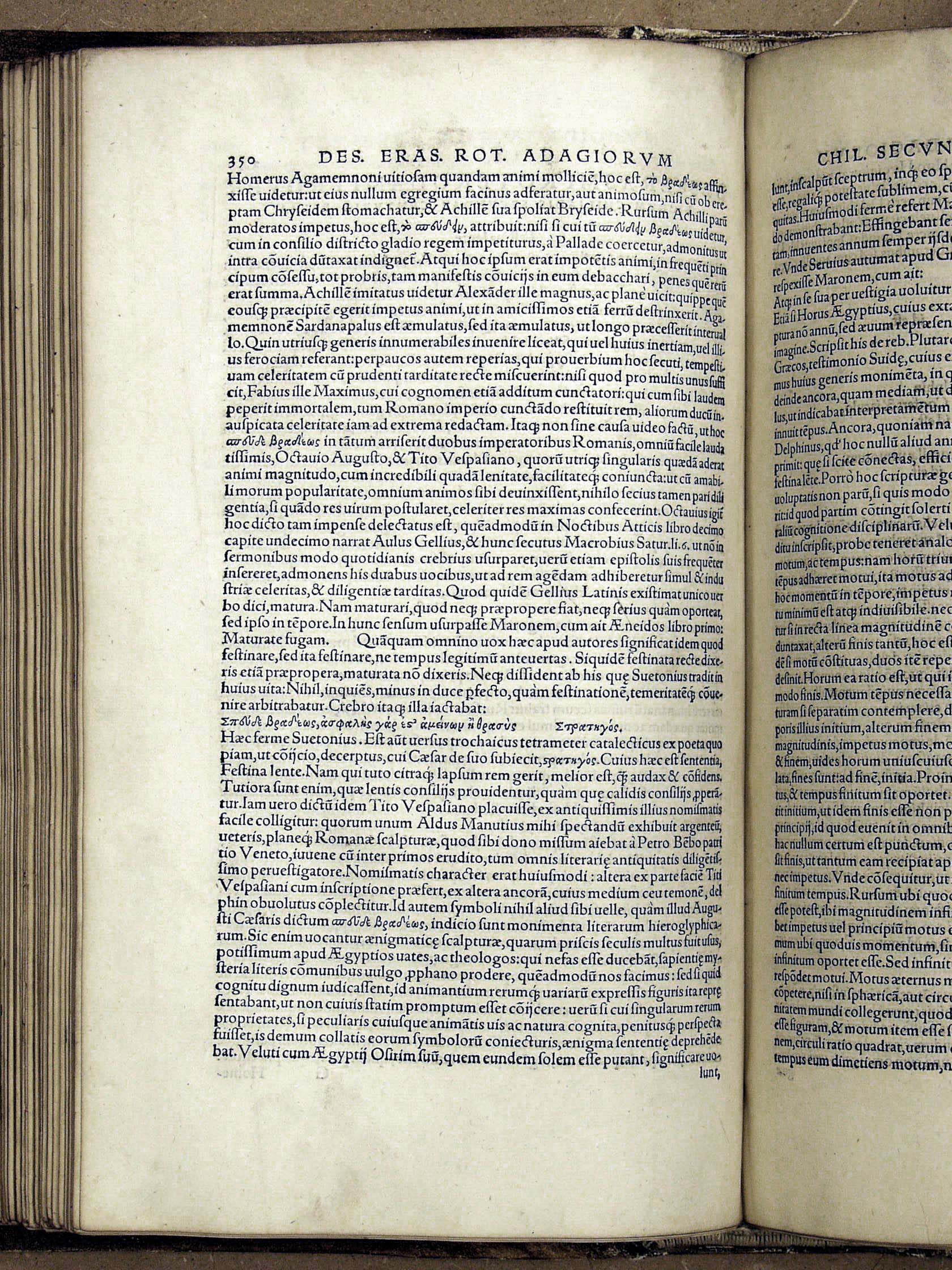


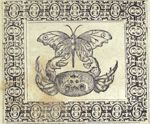
Festina lente: Whitney, A choice of emblemes (Leiden, 1586), emblem 126 uses the adage as its motto
Festina lente: Isselburg, Emblemata politica (Nürnberg, 1617) emblem 8 uses the adage as its motto
Festina lente: Giovio, Dialogo dell' Imprese (Lyon, 1574), emblem 2 (Symeoni) uses the adage as its motto
Festina lente: Giovio, Dialogo dell' Imprese (Lyon, 1574), emblem 3 (Symeoni) uses the adage as its motto
Festina lente: Vaenius, Amorum emblemata (Antwerp, 1608), emblem 50 uses the adage as its motto
Festina lente: Thurneysser zum Thurn, Archidoxa (Münster, 1569), author portrait includes the adage among the inscriptions
't kleyn vischken remore: Vondel, Gulden Winkel (Amsterdam, 1622), emblem 65 uses the imagery of the remora
Force n'a lieu, ou Prudence domine: La Perrière, Le theatre des bons engins (Lyon, 1545), emblem 55 uses the imagery of the horse's tail (Quintus Sertorius)
Story of Quintus Sertorius: Manuscript Valerius Maximius, The Hague KB 66 B 13 (Loire region, c. 1475), Q. Sertorius orders two men to pull hairs from a horse's tail
Amour des peuples, forces des états: Ripa, Essay d'un Dictionaire (Iconologia), (Amsterdam, 1700), emblem 514
Story of Quintus Sertorius: Kuijl, Gerard van (1638), Q. Sertorius orders two men to pull hairs from a horse's tail - painting in Gorinchem
In nocte consilium: Covarrubias, Emblemas Morales (Madrid, 1610), emblem 247 - quoted in the Festina lente essay
In nocte consilium: Wither, A collection of emblems (London, 1635), emblem 9 - quoted in the Festina lente essay
Festina lente: Printer's device 1312 uses the adage as its motto
Scripta non temere edenda: Peacham, Minerva Britanna (London, 1612), emblem 57 uses the imagery of a crab with a pen to convey the idea that an author should not publish too rashly
Scripta non temere edenda: Whitney, A choice of emblemes (Leiden, 1586), emblem 197 uses the imagery of a wise old author preventing a young man to hand over his writings to Fame too rashly
Sapiens in omnibus providus: Schoonhovius, Emblemata (Gouda, 1618), emblem 52 also uses the imagery of Alciatus' Maturandum emblem in the background and that of a snail carefully crossing crossing a stream
Princeps subditorum incolumitatem procurans: Alciatus, Emblemata (Leiden, 1591), emblem 143 uses the imagery of anchor and dolphin to convey the message of the stability of government
Festina lente: Paradin, Les devises héroïques (Antwerp, 1563), emblem 184 uses the adage as its motto
Festina lente: Baudoin, Recueil d'emblemes (Paris, 1638), uses the adage with the imagery of a turtle in its title illustration
Festina lente: Hulsius, Epitome Emblematum (Nürnberg, 1602), emblem 7 uses the imagery of the anchor and dolphin with the adage as its motto
Haast is geen spoed, snel rijk is niet goed: Cats, Emblemata Moralia et Economica (Rotterdam, 1627), emblem 94 uses imagery of a branch grafted onto a young stem to express the idea that quick wealth is not sustainable
Festinandum lente: Weigel, Gedankenmuster (Nürnberg, 1700), emblem 383 uses the image of a snail with a paraphrase of the adage as its motto
Gemach kombt man auch weit - Candia insula: Meisner, Politica Politica (Nürnberg, 1700), emblem 748 quotes the adage in its comment
Nec tarde nimis, nec nimis celeriter: Meisner, Politica Politica (Nürnberg, 1700), emblem 196 uses the imagery of the dolphin and anchor and uses a German translation of the adage
In Eile zu verweilen - Festina lente: Woytt, Emblematischer Parnassus (Augsburg, 1727), emblem 545 uses a translation of the motto and the imagery of a man walking too quickly along a dangerous path
Haec illa est remora: Visscher, Sinnepoppen (Amsterdam, 1614), emblem 48 uses the imagery of a wine cask as the "real remora" slowing down the course of a ship
Lente festinandum: Pfeffel, Güldene Aepfel (Augsburg, 1746), emblem 370 - slow cooking ... and a paraphrase of the motto
In se sua per vestigia voluitur: Wither, A collection of emblems (London, 1635), emblem 123 quotes the comment
In se sua per vestigia voluitur: Rollenhagen, Nucleus emblematum (Arnhem, 1618), Cent. II, emblem 23 quotes the comment
Ny temerairement ny lascheement: Boissard, Emblemes (Metz, 1588), emblem 27's epigram quotes the adage
Sat cito si sat bene: Boissard, Emblematum liber (Frankfurt, 1593), emblem XXII quotes the comment
Iracundiam cohibendam: Borja, Empresas morales (Bruxelles, 1680), emblem 72 uses the imagery about the hasty use of power that princes should avoid
A minimis quoque cavendum: Borja, Empresas morales (Bruxelles, 1680), emblem 96 uses the imagery of the remora slowing down the course of a ship
Promptius extrahitur quam immittitur: Camerarius, Symbolorum et Emblematum Centuria(e) (Nürnberg, 1590, 1595, 1596, 1604), emblem 9 applies the adage's argument about the timing of military action
Le Pelerin en vieillesse s'arreste: La Perrière, Le theatre des bons engins (Lyon, 1545), emblem 51 uses the imagery of speed (wings on the staff) and slowness (the tortoise) to convey the idea that in old age a pilgrim should stay home
Iconclass: 44B61 good government 51MM11 Slowness, Tardiness; 'Tardità' (Ripa) 51M12 Haste 54B121 'Occasio', 'Kairos'; 'Occasione' (Ripa) 94F11 the ransom of Chryseis: Agamemnon refuses to return Chryseis to her father Chryses 94F12 Briseis is taken away from Achilles and led to Agamemnon by the heralds Talthybius and Eurybates; Achilles may be holding a lyre
Collectanea (1500): 196
Loci Communes: Festinatio praepropera (Overhasty haste, Précipitation excessive); Tarditatis et cunctationis (Slowness and delay, Lenteur et retard)
II i 2 Pedetentim One step at a time
Κατὰ ποδὸς βάσιν, Graecis proverbio dicitur, quod Latini reddiderunt, pedetentim: ubi quis non praecipitanter atque inconsiderate, sed sensim atuqe cunctanter aggreditur negocium, atque arte rem gerit magis quam impetu. Translatum ab his qui cautim, ac praetentantes per glacie, locúmve lubricum ingrediuntur. Terentius in Phormione: Dii bene vertant quod agas, pedetentim tamen. Quintilianus: At si quod secundo loco diximus, nesciet actor, quod propositi testis attulerit, paulatim, & ut dicitur, pedetentim experietur. Alexis comoediarum scriptor iam extrenae senectutis, quum lento incessu inambulans rogaretur à quodam quid ageret: κατα ποδὸς βάσιν, inquit, ἀποθνήσκω. id est, pedetentim morior. M. Tullius De officiis lib. i Sin minus, sensim erit pedetentimque faciendum. Idem in oratione pro P. Quintio: Viri boni quum palàm fraudentur, quum experiundi potestas non est, timide tamen, & pedetentim istuc descendunt, vi ac necessitate coacti, inviti, multis vadimoniis desertis, saepe illusi ac destituti. Et in Verrinis actione 2. Quae tamen à me pedetentim cauteque dicentur.
Κατὰ ποδὸς βάσιν is a proverb in Greek, for which the Latin is Pedetentim, One step at a time, used when a man attacks some piece of business not hastily and unadvisedly but after slow deliberation, and acts with more skill than speed. A metaphor taken from those who advance over ice or slippery ground cautiously and feeling their way. Terence in the Phormio: 'God grant you success; but remember, one step at a time.' Quintilian: 'But if, as I suggested in the second passage, counsel has no idea what intentions a witness has brought with him, he will test him gradually and one step at a time, as the saying is.' Alexis, the writer of comedies, when he was a very old man and could only walk very slowly, was asked by someone how he did, and replied 'I'm dying, one step at a time.' Cicero in the first book of the De officiis: 'If not, then it must be done gradually and one step at a time.' Cicero again in his speech Pro Quinctio: 'Right-thinking men, when they are openly swindled, when they are given no chance to use the machinery of the courts, even so are full of misgivings and are brought only step by step to this procedure, under strong pressure of necessity, with every reluctance, after the man has forfeited his recognizances time and again and they have been repeatedly tricked and let down.' And in the second process against Verres: 'All this however I shall say step by step and circumspectly.'
Facsimile:
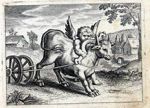
Pedetentim: Vaenius, Emblemata aliquot selectiora amatoria (Amsterdam, 1618), emblem 11
Pedetentim: Rollenhagen, Nucleus emblematum (Arnhem, 1618), Cent. II, emblem 19
Paulatim: Schoonhovius, Emblemata (Gouda, 1618), emblem 67 quotes the comment
Pedetentim: Wither, A collection of emblems (London, 1635), emblem 119
Paulatim: Hulsius, Epitome Emblematum (Nürnberg, 1602), emblem 57 quotes the comment
Paulatim: Hulsius, Epitome Emblematum (Nürnberg, 1602), emblem 50 quotes the comment
Paulatim non impetu: Hulsius, Epitome Emblematum (Nürnberg, 1602), emblem 98 quotes the comment
Sine Cerere et Baccho: Peacham, Minerva Britanna (London, 1612), emblem 88 quotes the comment
Festina lente: De la Feuille, Devises et emblemes anciennes et modernes (Augsburg, 1697), emblem 609 quotes the comment
Paulatim: Printer's device 0044 quotes the comment
Paulatim: Printer's device 0092 quotes the comment
Paulatim: Printer's device 0099 quotes the comment
Paulatim: Printer's device 0221 quotes the comment
Paulatim - Avec le temps: Printer's device 0411 quotes the comment
Paulatim - Qui va piano va sano: Printer's device 0420 quotes the comment
Paulatim: Printer's device 0536 quotes the comment
Paulatim: Printer's device 0559 quotes the comment
Paulatim - Avec le temps: Printer's device 0632 quotes the comment
Paulatim - Deo et rege: Printer's device 1198 quotes the comment
Paulatim: Printer's device 1751 quotes the comment
Iconclass: 31A2711 walking 51F7 Regularity of Recurrence 51MM11 Slowness, Tardiness; 'Tardità' (Ripa)
Collectanea (1500): 613
Loci Communes: Tarditatis et cunctationis (Slowness and delay, Lenteur et retard)
II i 3 Placide bos Slowly the ox
Ατρέμας βοῦς. id est, Lente bos, subaudiendum, incedit, aut simile quippiam. Congruet in illos, qui placide, ac paulatim, citraque tumultum, sed tamen assiduitate rem conficiunt. Equorum laus est velocitas. Boves non valent celeritate, sed viribus: & assiduitate pollent, non impetu. Proinde in pugna stataria, vel leonib. formidandum animal, & ad exhauriendos ingentes labores appositum. Eodem dem pertiner illud: Bos lassus fortius figit pedem. In sacris precibus tradit Plutarchus in commentario de Ofiride, et Iside, mulieres Helaeas publicis, ac sollennibus votis ad hunc modum solitas Bacchum invocare, ut accederet βοέῳ ποδὶ, id est, Bubulo pede: sive quod huic animanti, cum sit viribus immensis praeditum, deinde tanta corporis mole, tamen peculiare videatur molliter, quasique pedetentim ingredi, nulloque strepitu, vel quod bovis pedes arva calcatu reddunt meliora, cum reliquorum animantium noceant.
Ἀτρέμας βοῦς, Unhurriedly the ox. We must supply a verb: 'Slowly plods the ox,' or some such word. This will suit those who get things done slowly and gradually and without fuss, but finish by sticking to it. The glory of a horse is in its speed. Oxen are not valued for their pace; it is to energy and staying-power that they owe their strength, not to any sudden rush. In a pitched battle therefore even the lion would find the ox a formidable creature, and it is capable of very great exertions. That saying 'The tired ox treads the more firmly' points the same way. In their solemn litanies, as Plutarch tells us in his essay 'On Osiris and Isis,' the women of Elis publicly invoked Bacchus in solemn language to appear 'with hoof of ox,' either because this creature, immensely powerful though it is and very bulky, yet has a special way of walking gently, as though it were feeling its way, and with no noise, or because the hooves of an ox make the fields more fertile by their tread, whereas the tread of all other animals is bad for them.
Facsimile:
Pedetentim: Vaenius, Emblemata aliquot selectiora amatoria (Amsterdam, 1618), emblem 11
Pas à pas: Rollenhagen, Nucleus emblematum (Arnhem, 1618), Cent. II, emblem 39
Semper ignavus: Sambucus, Emblemata (Antwerp, 1564), emblem 34
Iconclass: 47I21111(+95211) ox (+ walking animal) 51MM11 Slowness, Tardiness; 'Tardità' (Ripa)
Loci Communes: Tarditatis et cunctationis (Slowness and delay, Lenteur et retard)
II i 4 Tacito pede With silent foot
Huic similimum est, quod indicavit quisquis is fuit, certe haud quaquam indiligens scriptor, qui Rethoricam Aristotelis exponit, ἡσύχῳ ποδί. id est, Tacito pede, seu lento pede, cum cautim, ac pedetentim ad rem accedimus. Apud Latinos aliquanto setius usurpatur Tacito pede, pro furtim ac clanculum, ut apud Ovidium: Tempora labuntur, tacitisque senescimus annis Id imitatus Columella in carmine: Tacito nam tempora gressu Diffugiunt, nulloque sono convertitur annus.
Something very close to this is suggested by the man, whoever he was - and at least he was an industrious compiler - who expounded Aristotle's Rhetoric: Ἡσύχῳ ποδί, With silent foot, or With slow foot, when we approach something cautiously and one step at a time. In Latin the phrase has sometimes a different meaning, furtively and secretly, as in Ovid: Time flies; we age with silent lapse of years.' This was imitated by Columella, in the book he wrote in verse: 'Time flies with silent pace; without a sound / Revolves the turning year.'
Facsimile:
Iconclass: 22D9 silence 31A2255 foot 51MM11 Slowness, Tardiness; 'Tardità' (Ripa) 52DD3 Taciturnity; 'Secretezza', 'Secretezza overo Taciturnità' (Ripa)
Loci Communes: Tarditatis et cunctationis (Slowness and delay, Lenteur et retard)
II i 5 Cumini sector A cummin-splitter
Impendio parcus, ac sordidus, olim proverbio κυμινοπρίστης, id est, Cumini sector dicebatur. Testis et Aristoteles libro Moralium quarto: Τούτων δὲ καὶ ὁ κυμινοπρίστης καὶ πᾶς ὁτοιοῦτος. id est, Ex hoc genere est Cumini sector, & quisquis eiusmodi. Meminit & Theocritus Idyllio Κ. Κάλλιον ὦ πιμελητὰ φιλάργυρε τὼς φακὼς ἑψεῖν Μὴ πιτάμῃς τὴν χεῖρα καταπρίων τὸ κύμινον. id est, Lenticulam coquere, pastor tibi praestat avare, Nefodias digitos, cupiens secuisse cuminum Seholiastes non dissimulat vulgo sic dici solsitos, homines praeter modum frugales ac parcos. Item Alexis in Philocalo apud Atheneum libro octavo: Αλλ᾽ εὖ οἶδ᾽ ὅτι Κυμινοπριστης ὁ τρόπος ἐστί σου πάλαι. id est: Ceterum novi probe, Cyminopristae olim esse iam mores tibi. Est autem Cuminum per se quidem exilis herba, tum praecipue genus Aethiopicum, quod Hippocrates, auctore Plinio, regium appellat, quod olim serebatur a male precantibus, autore Plutarcho, atque ita felicius provenire creditum est. Quo magis quadrat in hos huiusmodi convicium, qui ob parcimoniam male audiunt. Item Plutarchus Convivialium quaestionum decade secunda, significat hominem vehementer parcum, Cuminum appellari solere. Siquidem, loquens de iis dicteriis, quae citra dolorem dici possunt, Velut, inquit, si quis hominem splendidum, ac benignum, Cimbicon appellet, aut Cuminum. Est autem κίμβικον Graecis apicula, seu parsimonia, Suida interprete Hesychius legit cymbion, addens dici solitom in parcos: κύμβον autem dici fundum ollae fictilis. Aristoteles libro, quem modo citavimus, ait, homines perparcos κύμβικας vulgo dici solitos: Iulius Pollux βέμβικας, opinor quod per domum obambulent semper murmurantes. Nam βέμβιξ trochus est, quo ludunt pueri. Apud eundem mulier impendio sordida ὀβολοστάτις, vir ὀβολοστάτης dicitur, quasi minutissima quaeque ad stateram expendens, unde & ὀβολοστατεῖν. Eustathius autem indicat eosdem & λιμοκίμβικας, & κυμινοκίμβικας dici, putatque vocem dictam ab auro adulterino. Hesychius addit eosdem vocari καρδαμογλύφους, quod aliquid desculpant è nasturtio ob parcimoniam. Nec desunt, qui eosdem κνίφους & κνῖπας sive κνίφας (nam utrumque scriptum reperimus) vocant. est autem Cnips animalculum culici non dissimile.
For a man who was very parsimonious and mean they had in old days a proverbial expression: he was a κυμινοπρίσης, A cummin-splitter. Aristotle attests this in book four of the Ethics: 'In this class fall the cummin-splitter and others of the kind.' Theocritus too mentions it in Idyll 10: 'You'd better boil the lentils, greedy shepherd, / For fear you cut your fingers splitting cummin.' The scholiast does not conceal that this was a common way to speak of exceptionally frugal and tight-fisted people. Alexis too in his Philocalus, cited by Athenaeus book 8: 'But well I know / You are an old-established cummin-splitter.' Cummin itself is a small plant, particularly the Ethiopian variety, which Hippocrates, according to Pliny, calls 'royal'. According to Plutarch, those who planted this would curse it as they sowed, and this was supposed to improve the germination. This fact makes this type of uncomplimentary saying more appropriate for notorious skinflints. Plutarch again in the second decade of his Table-talk indicates that an extremely economical man was often called a cummin; for, speaking of critical remarks which can be made without giving offense, 'If for instance' he says 'you were to call an open-handed generous man a cimbicon or a cummin.' Cimbicon, according to Suidas, means 'a little bee/ or 'frugality.' Hesychius read cimbion, adding that the word was used of frugal persons, because kymbos means the bottom of a pottery jar. Aristotle in the book I have just quoted tells us that very frugal people were commonly called kymbikes. Julius Pollux says bembikes, I suppose because they wander to and fro through the house muttering to themselves, for bembix is a child's top. In the same source a woman who is very mean is an obolostatis, a she-obol-weigher, and a man obolostates, as though they put the most minute quantities of everything on the scales; and hence there is a verb for accurate weighing, obolostatein. Eustathius suggests that they are also called limokimbikês and kyminokimbikês, and thinks the word is taken from counterfeit gold. Hesychius adds that there is another word for them, cardamoglyphi, cress-parers, because they are supposed to be so mean that they cut bits off the cress in the salad. Some writers also describe them as cniphi and cnipes or cniphae (for I find both forms in the texts); the cnips is a small creature, something like a gnat.
Facsimile: 
Iconclass: 25G2111(CUMMIN) seed (CUMMIN) 47C312 cleaving, splitting (industrial processes) 55CC1 Saving, Frugality, Parsimony; 'Parsimonia' (Ripa)
Collectanea (1500): 830
Loci Communes: Sordes et parcimonia (Meanness and stinginess, Bassesse et avarice)
II i 6 Ficos dividere To split figs
Huic affine est, quod refert Martialis li. Epigram. quinto: σῦμα μεριζειν. id est, Ficos dividere: unde licebit & cognomen fingere συκοπρίστου. Martialis car men est huiusmodi: Quadringenta secat, qui dicit σῦκα μέριζε. Sordidum, ac parcum significans, etiam si ditissimum. Captatus autem est iocus ex vocis amphibologia sectoris.
There is a phrase very close to this in the fifth book of Martial's epigrams: σῦκα μερίζειν, to divide figs, which will authorize us to coin the nickname 'fig-splitter.' Martial's line runs thus: 'Who says Divide the figs, four hundred cleaves.' He is thinking of a man who is mean and stingy, though very rich; but the basis of the joke is the double meaning of the word sector.
Facsimile:
Iconclass: 25G21(FIG) fruits: fig 47C312 cleaving, splitting (industrial processes) 55B1 Wealth, Opulence; 'Opulenza', 'Richezza' (Ripa) 55CC1 Saving, Frugality, Parsimony; 'Parsimonia' (Ripa)
Collectanea (1500): 829
Loci Communes: Sordes et parcimonia (Meanness and stinginess, Bassesse et avarice)
II i 7 Myconius calvus Myconian baldpate
Μυκώνιος φαλακρὸς id est, Myconius calvus. Strabo lib. Geographiae decimo refert vulgo Myconios calvos dici solitos, quod in ea insula vitium hoc quasi gentilitium sit, atque omnibus fermè commune. Idem affirmat Plinius libro undecimo. capite trigesimosepti mo. Meminit & Stephanus. Est autem Myconus una Cycladum insularum. Quanquam Herodotus in quarto scribit, in Scythia quoque gentem esse ab ipso natali calvam. Admonet & Donatus grammaticus, Hecyram interpretans Terentianam, proverbio dictum calvus Myconius, citatque Lucilii testimonium: Myconi omnis calva iuventus. Tuetur autem Terentium, qui à nonnullis hoc loco imperitiae nomine reprehenderetur, quod cum Apollodorus calvum dixerit, ipse crispum mutaverit: putatque poetam non inscitia, sed facetius etiam per ironiam dixisse crispum, quam si calvum dixisset. Quod quidem etiam ipsum proverbium resipit de raris inventu: velut, si quis Scytham dicat eruditum, Italum bellacem, negociatorem integrum, militem pium, aut Poenum fidum. Erit autem elegantius adagium, si calvos homines, raroique capillitio, simpliciter Myconios appellemus, perinde, ut si quis fastuosum Sybaritam nominet, negotiatorem Phoenicem. Notati sunt olim et alio nomine Myconii, quod ob tenuitatem alienas cenas captarent: proinde qui invocati ad convivium venirent, Myconii more venire dicebantur. Invehitur enim in Periclem Archilochus apud Athenaeum in primi libri fragmentis, ὡς ἄκλητον ἐπεισπτάωντα εἰς τὰ συμπόσια μυκονίων δικᾳ, velut, qui invocatus ingereret se ad convivia Myconiorum more.
Μυκώνιος φαλακρός, A Myconian baldpate. Strabo in book 10 of his Geography tells us that the people of Myconos were commonly called baldpates, 'because baldness is a defect more or less endemic in the island' and affects almost all the inhabitants. This is confirmed by Pliny, book 11 chapter 37, and mentioned also by Stephanus. Myconos is an island in the Cyclades; though Herodotus says in book 4 that in Scythia too there is a tribe whose members are bald from birth. Besides which the grammarian Donatus in his commentary on the Hecyra of Terence informs us that 'Myconian baldpate' was a proverbial saying, and quotes the evidence of Lucilius: The youth of Myconos, bald one and all.' He is defending Terence, who was criticized by a number of people for the ignorance he showed in this passage, because Apollodorus had written 'bald' and he had altered this to 'curly-headed.' Donatus thinks this was not ignorance on the poet's part but irony, and 'curly' was more humorous than 'bald.' The phrase itself has the look of a proverbial expression for something that one seldom finds - an educated Russian, for instance, a brave Italian, an honest merchant, a godly soldier or a Carthaginian that one can trust. The adage will gain in point if we call men who are bald or have very little hair simply 'Myconians,' just as one might call a man who lives in luxury a Sybarite or a merchant a Phoenician.
The Myconians had a bad name in old days for a quite different reason: they were so poor that they were said to fish for invitations to supper with other people, and so those who came to a party uninvited were said to come 'like a Myconian.' Archilochus, cited by Athenaeus among the fragments of his first book, attacks Pericles for 'forcing his way into parties unbidden, as they do in Myconos.'
Facsimile:
Iconclass: 25H14 island 31A5339 baldness 61D(MYCONOS) geographical names of countries, regions, mountains, rivers, etc. (MYCONOS) (MYCONOS)
Collectanea (1500): 697
Loci Communes: Forma, deformitas (Beauty, deformity, Beauté, difformité)
II i 8 Cum aqua fauces strangulet When water chokes you
Aristoteles Moralium libro septimo citat huiusmodi quoddam adagium: ὁ δὲ ἀκρατὴς ἔνοχος τῇ παροιμΐᾳ, ἐν ᾗ φαμὲν, ὅτον τὸ ὕδωρ τὸν φάρυγγα πνίγῃ, τί δεῖ ἔτι πίνειν i. Intempe rans autem obnoxius est proverbio, quo dicimus, Cum aqua fauces strangulet, quid iam opus est bibere? Refert idem in eundem usum libro Moralium Eudemiorum sexto, disputans de eo, qui prudens intemperantiae vitio noxia sequitur, haud quaquam ignorans, quid sit optimum: hunc autem longe insanabiliorem esse eo, qui falsus opivione non expetenda expetit. Usurpavit et Galenus alicubi: ὅταν τὸ ὕδωρ πνίγῃ, τί ἐπιῤῥοφήσομεν; id est, Quum aqua praefocat, quid insuper sorbebimus? Fortassis Galenus scripserat, τί ἔτι ῥοφήσομεν. Quadrat in eos, qui in absurdissima sententia pertinaciter manent, vel manifesta negantes, quibuscum frustra disceptes. Constat enim faucibus siti arentibus aquam esse remedio, ac solvere praefocationem. Confine illi quod alibi diximus: Nil intra est oleam, nil extra est in nuce duri.
Aristotle in the seventh book of the Ethics cites an adage that runs something like this: 'But the intemperate man is a target for the proverb that asks why one should go on drinking when the water chokes one already.' He uses this to the same effect in book six of the Eudemian Ethics, where he is discussing the victim of intemperance who knowingly pursues what is bad for him although by no means ignorant of the best course, and says that he is far more incurable than the man who pursues the wrong objects by mistake. Galen also used it somewhere: 'When water chokes us, why shall we go on drinking?' (Galen perhaps wrote not epirrhophesomen but eti rhophesomen.) This suits those who obstinately maintain some most absurd point of view, denying the truth of what is perfectly obvious, so that it is useless to reason with them. For it is well known that when one's throat is dry with thirst, water is the remedy and clears the obstruction. It is close to one I have given elsewhere: 'Olive no kernel hath, nor nut no shell.'
Facsimile: 
Iconclass: 11N35 Gluttony, Intemperance, 'Gula'; 'Gola', 'Ingordigia', 'Ingordigia overo Avidità', 'Voracità' (Ripa) ~ personification of one of the Seven Deadly Sins 21D water (one of the four elements) 31EE23141 deprivation of air, choking - EE - death not certain; wounded person 52AA511 Ridiculousness 54AA43 Intemperance, Immoderation
Loci Communes: Absurda, indecora, seu praepostera (Absurd, unbecoming, or preposterous things, Choses absurdes, inconvenantes ou déplacées)
II i 9 Dimidio vitae nihil differunt felices ab infelicibus For half their lives there is no difference between the happy and the unhappy
Aristoteles Moralium libro primo: ὁ δ᾽ ἀγαθος καὶ κακός ἥκιστα διάδηλος καθ᾽ ὕπνον, ὅθεν φασὶν οὐδὲν διαφέρειν τὸ ἥμισυ τοῦ βίου τοὺς εύδαίμονας τῶν ἄλλων. id est, Porrò probus, atque improbus nequaquam in somno dignoscuntur. unde natum est, ut dicant, felices nihil à reliquis distare dimidio vitae. Idem refert lib. Eudemiorum 2. reddens hanc causam, quod dormientes nihil agant. Ex actionibus autem nascitur felicitas, aut infelicitas hominis. Proinde non inscite dixit Ariston apud Plutarchum in commentario De contentione ignis & aquae: Ολίγου χρονου τοῦ βίου τοῖς ἀνθρώποις δεδομένου, ὕπνος οἷον τελώνης τὸ ἥμισυ ἀφαιρεῖ τούτου. i. cum exiguum vitae tempus datum sit hominibus, somnus velut publicanus dimidium eius aufert. Plato libro Delegibus septimo. Καθεύδων γὰρ οὐδεὶς οὐδενὸς ἄξιος, οὐδὲν μᾶλλον τοῦ μὴ ζῶντος id est, Nullus enim dormiens alicuius est pretii, nihilo magis, quam is, qui vivus non est. Proverbium consolatur parum fortunatos, divitumque ac potentium insolentiam retundit. Somnus enim adimit nobis nostri sensum, undefit, ut neque miseris nolesta siut sua calamitas, neque fortunatis iucunda felicitas. Praeterea felicitas, iuxta philosophos, sita est in actu rationis per habitum virtutis: somnus autem quies est animi, bonis pariter, ac malis communis.
Aristotle in the first book of the Ethics, 'But the good man and the bad are indistinguishable during sleep, and this is the origin of the saying that for half their lives there is no difference between those who are happy and everyone else.' He says the same thing in book two of the Eudemian Ethics, giving as a reason that in sleep they are inactive, while activity is the source of man's happiness or unhappiness. There was thus some point in Ariston's remark, quoted by Plutarch in his essay 'On the Competition between Fire and Water,' that man has been allotted a short span of life, and sleep like the tax-collector takes half of it. Plato in book 7 of the Laws: 'No man is worth anything when he is asleep, any more than he is when he is dead.' This proverb is a solace to the underprivileged, and blunts the insolence of the rich and powerful. For sleep removes our awareness of ourselves, so that the unhappy do not suffer from their misfortunes nor do the fortunate enjoy their good luck. Besides which, as the philosophers tell us, happiness consists in rational activity in accordance with the habitual practice of virtue, while in sleep the mind is at rest and it is enjoyed equally by good and bad.
Facsimile:
Iconclass: 31B1 sleeping; unconsciousness 31D9 the lifespan 51HH1 Part, Section, Aspect 56B2 Happiness, Felicity 56BB2 Unhappiness; 'Infelicità' (Ripa)
Loci Communes: Vita hominis misera et brevis (The life of man, wretched and short, La vie de l'homme, misérable et brève)
II i 10 In eadem es navi You are in the same boat
M. Tullius Epistolarum familiarium libro secundo ad Curionem: Et si ubicunque es, ut scripsi ad te antea, in eadem es navi, tamen, quod abes, gratulor. Ine adem es navi, dixit, pro eo, quod est, in communi periculo. Siquidem ad eos, qui eodem vehuntur navigio, periculum naufragii communiter pertinet, neque magnopere refert, in prora sint, an in puppi, an carina, cum nihilo magis absint a discrimine. Idem alibi: Hoc miror enim, querorque quenquam hominem ita pessundare alterum velle, ut etiam navim perforet, in qua ipse naviget, hoc est, ut Rem publicam evertat, cum qua sit etiam ipsi pereundum. Aristophanes in Vespis: Περὶ τῆς πόλεως γὰρ ἐστι τοῦ σκάφους ὅλου. id est: De civitate est, nave de tota puta. Est autem familiare poetis a navibus ad rempublicam similitudinem mutuari.
Cicero in the second book of his Letters to Friends, writing to Curio: 'And if you are in the same boat wherever you are (as I have written to you before), even so I am glad you are not here.' When he says 'in the same boat' he means 'in the danger we all share,' for the risk of shipwreck is shared equally by all those who sail in the same vessel, nor does it make a great difference whether they are in the bow or the stern or the belly of the ship, for they are no further away from the danger. In another passage he says: 'It fills me with astonishment and regret that one man should be so anxious to destroy another that he will even make a hole in the ship's bottom in which he himself is sailing,' meaning that he will overthrow the state in whose downfall he too must perish. Aristophanes in the Wasps: 'Concerns our country, the whole skiff of state.' It is a common practice with poets to borrow from ships an image for the commonwealth.
Facsimile:
Iconclass: 46C24 sailing-ship, sailing-boat 51B3 Parity, Equality 54DD51 Danger; 'Pericolo' (Ripa)
Collectanea (1500): 329
Loci Communes: Discriminis (Danger, crisis, Danger)
II i 11 Qui arat olivetum He who ploughs an olive-grove
COLUMELLA de Re rustica libro sexto, paroemiam huiusmodi refert. Quinetiam, inquit, compluribus interpositis annis, olivetum putandum est. Nam veteris proverbii meminisse convenit, Eum, qui aret olivetum, rogare fructum, qui stercoret exorare; qui caedat, cogere. Allusit huc Virgilius primo Georgicôn: Exercetque frequens tellurem, atque imper at aruis. Huic adagio locus fuerit, ubi significabimus, fieri non posse, quin voto potiatur is, qui curam extremam impenderit. Vulgaris enim diligentia quasi rogat, mediocris impetrat, extrema cogit. Allusio fit ad eos, qui a principibus improbo studio, officioque sic impetrant, ut non precibus, sed vi videantur impetrasse. Laudatur, atque imitandus proponitur in Evangelicis etiam literis flagitator importunus.
Columella in book 6 of his Agriculture records a proverb in these words: 'Moreover an olive-grove should be pruned at intervals of several years; for one should keep in mind the old proverb "He who ploughs an olive-grove invites it to bear fruit, he who manures it urges it to bear, and he who prunes it gives it orders."' Virgil alludes to this in the first book of the Georgics: 'Works his land constantly and gives his fields their orders.' This adage will be in place when we wish to convey that a man cannot fail to secure what he wants if he spends the greatest effort on it. Diligence of an ordinary kind, makes a request; when of middling force, it gets what it wants; when extreme, it compels. There is an allusion to those who secure what they want from princes by a self-centred zeal and subservience such that one feels they have got their way by force rather than entreaty. Even the Gospels praise and put forward as a good example the importunate asker.
Facsimile:
Iconclass: 25G3(OLIVE-TREE) trees: olive-tree 47I123 ploughing 47I411 orchard 54A2 Carefulness, Diligence; 'Diligenza' (Ripa) 54C1 Purposefulness
Loci Communes: Industria (Industriousness, Application, diligence)
II i 12 Difficilia quae pulchra Good things are difficult
Δύσκολα τὰ καλὰ. i. Ardua quae pulchra. Extat apud Platonem in Hippia maiore in calce dialogi, τὴν γὰρ παροιμΐαν ὅτι ποτε λέγει τὸ, χαλεπὰ τὰ καλὰ, δοκῶ μοι εἰδέναι. i. Nam quod ait proverbium, difficilia esse quae pulchra sunt, videor mihi intelligerere. Et in Cratylo, circa initium, παλάα παροιμΐα, ὅτι χαλεπὰ τὰ καλά ἐστιν. id est, Vetus proverbium est, difficilia esse, quae sunt egregia. Citatur alicubi a Luciano. Item à Plutarcho in libello De liberis instituendis, proverbii nomine. Quidam prodiderunt Pittacum ubi semet abdi casset imperio, dixisse, χαλεπὸν ἐσθλὸν ἔμμεναι. id est, Difficile bonum esse. Porrò Solonem, Pittaci mollitiem, atque ignaviam, taxantem, dixisse, χαλεπὰ τὰ καλὰ. i. Difficilia quae honesta: utriusque dictum in proverbium abiisse. Usurpavit Plato libro de Rep. 4. ἴσως γὰρ ὦ σώκρατες τὸ λεγόμενον ἀληθὲς, ὅτι χαλεπὰ τὰ καλὰ. id est, Fortassis enim verum est ô Socrates, quod dici solet, difficilia esse, quae pulchra sunt. Usus est eodem lib. Politiae ii. πάντες γὰρ ἐξ ἑνὸς στόματος ὑμνοῦσι, ὡς καλὸν ἡ μὲν σωφροσύνη τε καὶ δικαιοσύνη, χαλεπὸν μέν τοι καὶ ἐπίπονον. i. Omnes enim uno ore canunt, Honestam quidem rem esse temperantiam ac iustitiam; sed difficilem tamen, ac laboriosam. Utitur eiusdem operis libro sexto, ac septimo, et aliis compluribus locis. Sunt, qui hine arbitrentur natam paroemiam: Periander Corinthius, initio populariter, ac moderate gerebat imperium, postea, versis moribus, tyrannice agere coepit. Id simul atque cognitum esset Pittaco Mitylenaeo, diffisum de sui ipsius animi constantia, magistratum deposuisse, relictoque imperio in exilium abiisse. Percontantibus deinde quibusdam, qua gratia fugisset imperium, respondisse, quod admodum esset arduum, probum esse, propter mutatum Periandrum: quibus auditis, Solonem addidisse suum apophthegma, χαλεπὰ τὰ καλὰ. Huc spectat illud quoque, quod meminit Plutarchus in commentario, πέρι δυσωπίας, Platonem, cum Heliconem quendam Dionysio, datis literis, commendasset, scribens illum virum probum, ac modestum, adscripsisse in calce epistolae, γράφω δέσοι ταῦτα περὶ ἀνθρώπου, ζώου φυσει εὐμεταβολου. i. Haec autem tibi scribo de homine, videlicet animante natura mutabili. Nec absurde quis referat ad celeberrimam illam Hesiodi sententiam: Τὴν μέν τοι κακότητα καὶ ἰλαδον ἐστιν ἑλέσθαι Ρηιδίως, ὀλιγη μὲν ὁδός, μάλα δ᾽ ἔγγυθι ναίει. Τῆς δ᾽ ἀρετῆ ιδρῶτα θεοὶ προπάροιθεν ἔθηκαν Αθάνατοι, μακρός τε καὶ ὄρθιος οἶμος ἐφ᾽ αὐτὴν Καὶ τρηχὺς τὸ πρῶτον. ἐπὴν δ᾽ εἰς ἄκρον ἴκηαι Ρηϊδίη δ᾽ ἤπιτα πέλει χαλεπὴ περ ἐοῦσα. id est: Omnino vitium facile est contingere cuivis. Est via ad id brevis, et vicinae in sede moratur, Contra virtutem sudoribus undique divi Praesepsere, et longus ad hanc, perque ardua callis, Asper et est primum: sed, ubi alta cacumina victor Contigeris, iam fit facilis, licet ardua dudum. Neque quidquam est tritius eo, quod dixit Aristoteles libro Moralium Nicomachiorum secundo: περὶ τὸ χαλεπώτερον ἀεὶ καὶ τέχνη και ἀρετή, id est, Et ars, et virtus circa id versatur quod est difficilius. Eodem pertinet, Litera Pythagorae discrimine secta bicorni. Et evangelicum illud de via arcta, quae ducit ad vitam. Item de duplici via apud inferos, quarum altera ducit ad campos Elysios, altera ad malam rem. Diximus alibi de Litis, & Ate, quae fabula declaret, multo difficilius esse bene facere, quam male; sarcire concordiam, quam rumpere. Eam sententiam Pindarus extulit in Pythiis, hymno quinto: ῥάδιον μὲν πόλιν σείσαι καὶ φαυροτέροις, ἀλλ᾽ ἐπὶ χώρας αὖθις ἕσσαι δυσπαλὲς δη γίνεται ἐξ ἀπίνας, εἰμὴ θεὸς ἁγεμόνεσσι κυβερνατὴρ γένηται, id est, Facile est civitatem commovere, etiam malis. Caeterum in locum pristinum ilico reponere difficile sanè est, ni deus principibus gubernator contingat. Retulimus alibi quod in seditione etiam Androclides abiectissimus belli ducem agat. Et nos hac aetate vidimus, per quos quanti tumultus excitati sint. Celebratur elegans Lacedaemonii dictum, apud quem cum quidam laudibus veherent Philippum, quod civitatem opulentissimam evertisset: Atqui, inquit, non posset talem condere. Huiusmodi voces inscribi deberent principum animis, qui cum ne minimam quidem urbeculam extruant, dii sibi videntur, quod urbes & agros perdant.
Δύσκολα τὰ καλά, Good things are hard. This comes in Plato, in the Hippias major at the end of the dialogue: 'I feel myself familiar with the proverb which says that good things are difficult.' And in the Cratylus near the beginning: 'The old proverb says that good things are difficult.' It is cited somewhere by Lucian, and also by Plutarch in his 'On the Education of Children,' expressly as a proverb. Certain authorities have stated that Pittacus after resigning the supreme power remarked 'How hard it is to be good!' On which they say that Solon, criticizing Pittacus for self-indulgence and laziness, observed that good things are indeed difficult; and the sayings of both these sages passed into a proverb. Plato used it in book four of the Republic: 'For perhaps, Socrates, there is some truth in the saying that good things are difficult.' He used it again in the Republic, book 2: 'For all men repeat with one voice that temperance and justice are a good thing, but difficult and hard to come by.' It comes again in books 6 and 7 of the same work, and in several other places. Some think the source of the proverb is this. Periander of Corinth was at first a moderate and democratic ruler. Later his character changed, and he began to behave like a tyrant. When Pittacus of Mytilene heard this, having no confidence in his own powers of self-control, he resigned his position in the state, retired from the government and went into exile. When asked later why he had abandoned his governing position, he replied (according to the story) that it was very hard to be a good man, thinking of the change in Periander; and when Solon heard this, he added his own apophthegm 'Good things are difficult.'
Something else is relevant here of which Plutarch tells in his essay 'On Compliancy.' Plato, he says, had written a letter of recommendation to Dionysius on behalf of a man called Helicon, in which he was described as an honourable and modest person; and at the end of the letter he added 'But the man I write of is a human being, a creature naturally subject to change.' Nor would it be absurd to relate this to that very famous maxim in Hesiod:
Vice may be easily had, dwells near us, and short is the journey,
While between virtue and us hard work is set by the immortals;
Long and steep is the road, and rugged it is to begin with.
Once you have conquered the heights, though hard, it comes easy thereafter.
Nor is anything more familiar than what Aristotle says in the second book of the Nicomachean Ethics: 'It is the more difficult things that are the province of both skill and excellence.' Here too belongs the line 'Pythagoras' letter forked with parting arms,' and the Gospel saying about the strait and narrow way that leads to eternal life. Also the two roads in the nether regions, one of which leads to the Elysian fields and the other to perdition. I have spoken elsewhere about Prayers and Infatuation, a story which makes clear that it is far harder to do good than evil and to make peace than to destroy it. This opinion is expressed by Pindar in the fifth hymn of his Pythians: 'Easy it is to shake a city, even for men of no account; but to settle it in its place again forthwith is hard indeed, unless some god acts as pilot to its leaders.' I have recorded elsewhere how in civil war even Androclides, most worthless of men, can be a leader, and in our own day we have seen by what men the greatest upheavals have been caused. There is a well-known remark made very neatly by some Spartan, when somebody in his hearing was praising Philip for his overthrowing of some very rich city: 'Yet to found a city like that would be beyond him.' Such words should be graven on the hearts of princes, who never build a city however small, and think themselves gods because of the cities and farms they devastate.
Facsimile: 
Ardua quae pulchra: Schoonhovius, Emblemata (Gouda, 1618), emblem 74 quotes the comment
Adversa magis lucet: Borja, Empresas morales (Bruxelles, 1680), emblem 16 uses the idea that success is more valuable if the opposition is stronger
Le bon veneur ne prend la bête qui se rend: Cats, Spiegel (The Hague, 1632), emblem 20 uses the imagery of a rabbit offering itself to the hunter to convey the idea that what is worth having must cost labour
Ardua quae pulchra: Printer's device 0042 quotes the comment
Ardua quae pulchra: Printer's device 0130 quotes the comment
Ardua quae pulchra: Printer's device 0141 quotes the comment
Ardua quae pulchra: Printer's device 0248 quotes the comment
Ardua quae pulchra: Printer's device 0747 quotes the comment
Ardua quae pulchra: Printer's device 0921 quotes the comment
Ardua quae pulchra: Printer's device 1927 quotes the comment
Iconclass: 54A2 Carefulness, Diligence; 'Diligenza' (Ripa) 54A5 Goodness; 'Bontà' (Ripa) 54DD4 Difficulty
Loci Communes: Difficultatis (Difficulty, Difficulté)
II i 13 Colophonia ferocitas Colophonian wantonnes
Κολοφώνεια ὕβρις. i. Colophonia ferocitas. In insolentes, qui ferociter despiciunt, & affligunt humilioris fortunae homines. Aut in eos, quibus sua ferocitas exitium attulit. Sumptum ab arrogantia, superbiaque eius gentis. Refertur à Diogeniano in adagionum collectaneis. Theognis, Υβρις καὶ μάγνητας ἀπώλεσε καὶ κολοφώνα. id est, Perdidit & Colophona ferox mens & Magnetes. De gentis huius ferocia non nihil dictum est nobis in proverbio, Colophonis suffragium.
Κωλοφώνεια ὕβρις, Colophonian wantonness. Used of the insolent, who wantonly despise and oppress men of humbler station, or of those whose wantonness has brought destruction on them. Derived from the arrogance and insolence of the people of Colophon. It is recorded by Diogenianus in his collection of adages. Theognis: 'Wantonness was the undoing alike of the Magnesians and of Colophon.' On the arrogance of this people I have said something under the proverb Colophonium suffragium.
Facsimile: 
Iconclass: 57AA647 Hybris 61E(COLOPHON) names of cities and villages (COLOPHON)
Collectanea (1500): 608
Loci Communes: Philautia (Self-love, Amour-propre)
II i 14 Nemini fidas, nisi cum quo prius modium salis absumpseris Trust no man, unless you have eaten a peck of salt with him first
Vulgo apud nostrates circumfertur adagium, haud fidendum esse cuipiam, nisi cum quo prius modium salis absumpseris. Significat autem, hominis ingenium non posse perspici, nisi diuturno convictu, longoque commercio. Apparet, proverbium hoc ab antiquitate profectum esse. Quando quidem Aristoteles lib. Moralium 8. simile quiddam refert his quidem verbis: Ετι δὲ προσδεῖται χρόνου καὶ συνηθείας, κατα τὴν παροιμΐαν γὰρ, οὐκ ἐστὶν εἰδῆσαι ἀλλήλους πρὶν λεγομένους ἅλας συναναλῶσαι. id est, Praeterea autem spatio temporis et consuetudine opus est, Siquidem iuxta proverbium fieri non potest, ut nos mutuo pernoscamus, antequam salis, quem dicunt, modium pariter absumpserimus. Idem Moralium Eudemiorum libro septimo: Διὸ εἰς παροιμΐαν ἐλήλυθεν ὁ μέδιμνος τῶν ἁλῶν. id est, Quapropter in proverbium abiit salis modius. Eodem in libro refert illud quoque ex poeta quopiam hemistichium, ni fallor: Οὐδ᾽ ἄνευ χρόνου φίλος. id est: Non est amicus absque temporis mora. Addit ex Theognide: Οὐ γὰρ ἄν εἰδείης ἀνδρὸς νόον οὐδὲ γυναικὸς Πρὶν πειραθείης ὥσπερ ὑποζυγίου. id est: Haud nosse ingeniumve viri licet, aut muliebre, Ut nec iumenti, ni experiare prius. Notat hanc paroemiam & Plutarchus in commentario περὶ φιλαδελφίας, his quidem verbis, τοὺς μὲν γαρ ἀλλοτρίους, ὡς ἔλεγε θεόφραστος, οὐ φιλοῦντα δεῖ κρίνειν, ἀλλὰ κρίναντα φιλεῖν. ὄπου δὲ ἡ φύσις ἡγεμονίαν τῇ κρίσει πρὸς εὐνοιαν δίδωσιν, οὐδὲν ἀναμένει τὸν θρυλλούμενον τῶν ἁλῶν μέδιμνον, ἀλλὰ συγγεγένηκε τὴν ἀρχὴν τῆς φιλίας, ἐνταῦθα δεῖ μὴ πικροὺς εῖναι μηδὲ ἀκριβεῖς τῶν ἁμαρτημάτων ἐξεταστάς. id est, Alienos enim, quem admodum ait Theophrastus, non oportet amantem iudicare, sed amare, postea quam iudicaris. Siquidem, ubi natura ipsa dux est ad benevolentiam praecedens iudicium, neque exspectans illum vulgo celebratum Salis modium, quippe quae amicitiae seminarium inseverit, ibi non oportet acerbos, et exquisitos esse delictorum expensores. Meminit huius paroemiae & M. Tullius in sermone de amicitia: Verum illud est quod vulgo dicitur, Multos modios salis simul edendos esse, ut amicitiae munus expletum sit. Huc pertinet illud quoque Sophoclis in Oedipo: Χρόνος δίκαιον ἄνδρα δείκνυσιν μόνος, Κακὸν δὲ κᾷν ἐν ἡμέρα γνοίης μόνη. id est: Mora temporis probum arguit tantum virum, At improbum vel unico agnoscas die. Huc pertinet etiam ille senarius proverbialis: Ηθους δὲ βάσανός ἐστιν ἀνθρώποις χρόνος. id est: Nota morum, et index tempus est mortalibus. Idem admonet illud Epicharmi: Νῆφε καὶ μὲμνης ἀπιστεῖν id est: Sobrius sis, ac memineris nemini confidere. Versus integer refertur apud Cic. lib. epist. ad Atticum i. Atque ita tamen novis amicitiis implicati sumus, ut crebro mihi vafer ille Siculus insusurrer Epicharmi cantilenam illam suam. Νᾶφε καὶ μέμνασ᾽ ἀπιστεῖν, ταῦτα νεῦρα τῶν φρεινῶν Sic enim carmen Trochaicum e vestigiis codicum restituimus, nequis temere depraver. Nam quod νᾶφε dixit pro νῆφε & μέμνας pro μέμνης, διαλέκτου proprietas est. Cicero in libello de petitione consulatus: Quamobrem Epicharmion illud teneto, nervos atque artus esse sapientiae, non temere credere. Item illud Euripidis in Helena: Σώφρονος δ᾽ ἀπιστίας Οὐκ ἐστιν οὐδὲν χρησιμώτερον βροτοῖς. id est: Prudente diffidentia Haud alia res utilior est mortalibus. Invenio citatum mutilatim ad hunc modum. Αλῶν μὲδιμνον ἀποφαγὼν. id est: Modium salis postquam ederis. Quo quidem licebit uti, si dicas: Vide, quid agas, qui tua arcana credas isti, nondum ἁλῶν μέδιμνον ἀποφαγών. Aut sic: Tum demum isti fidas ἁλῶν μέδιμνον ὰποφαγών. Est autem iambicus dimeter, ex poeta quopiam sumptus.
There is an adage in common circulation among my countrymen that you should not trust anybody unless you have eaten a peck of salt with him first. They mean by this that one cannot tell what a man is really like until one has lived with him for some time and has had prolonged dealing with him. This proverb is clearly derived from Antiquity, for Aristotle has something like it in book eight of the Ethics, which runs like this: 'Time also is needed and familiarity for, as the proverb says, we cannot know one another really well until we have, as they say, eaten salt together.' Again in book seven of the Eudemian Ethics: 'Hence the peck of salt passed into a proverb.' In the same book he records another saying - a half-line from some poet, if I am not mistaken, 'No friend till tried by time,' and adds from Theognis: 'You can know neither man nor womankind, / Till like a yoke-fellow you try their mind.' Plutarch too records this proverb in his essay 'On Brotherly Love,' in these words: Those who are not of our own kindred, as Theophrastus used to say, we should not make friends with first and judge them later; we should judge them first and later make friends. But when nature herself gives first place to the judgment in making friends, and does not wait for the proverbial peck of salt but has sown the seeds of the friendship in the friends themselves, we ought not to be severe and strict critics of their shortcomings.' This proverb is also recalled by Cicero in his dialogue On Friendship: 'But this is expressed in the common saying, that one should eat many a peck of salt with a man in order to fulfil the duty of a friend.' Here too belongs that sentiment of Sophocles in the Oedipus: 'While time alone brings the good man to light, / One day suffices to detect the bad,' and with it the proverbial line: The touchstone of man's character is time.' Epichar-mus' phrase 'Keep your head and credit no man' conveys the same message. The line is given complete in the first book of Cicero's Letters to Atticus: 'And yet I am so tied up in new friendships that the cunning Sicilian Epicharmus often whispers his jingle in my ear: "Keep your head, and credit no man - sinews these of common sense."' For this is how I have restored the trochaic line from the traces left in the texts, so let no man needlessly corrupt it; if he uses naphe for nephe and memnaso for memneso, this is the form proper to his dialect. Cicero in the pamphlet on standing for the consulship: 'So do not forget Epicharmus' advice, that the sinews and joints of common sense are to credit no man rashly.' Then there are the words of Euripides in the Helena: 'A wise suspicion, man's most useful guide.'
I find it also cited in the mutilated form 'When you have eaten a peck of salt.' This one could use, if one were to say 'Mind what you are doing, trusting your secrets to that man before you have eaten a peck of salt.' Or 'Do not trust him until you have eaten a peck of salt.' It is an iambic dimeter, taken I should guess from some poet or other.
Facsimile:
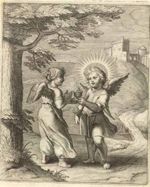
Animae sal est amor: Vaenius, Amoris divini emblemata (Antwerp, 1615), emblem 49 uses the adage's imagery
Animae sal est amor: Suderman, De godlievende ziel (Amsterdam, 1724), emblem 94 uses the adage's imagery
Animae sal est amor: de La Motte Guyon, Pia Desideria and Emblemata Amoris Divini (Regensburg, 1743), emblem 95 uses the adage's imagery
Ne fais amy auant que l'esprouuer: La Perrière, Le theatre des bons engins (Lyon, 1545), emblem 11 uses the imagery of men shaking hands to express that friendship should be tested first
Iconclass: 41C11 eating 51GG1:41C661 Littleness, Smallness❧salt 56D2 Trust
Loci Communes: Diffidentia (Distrust, Méfiance)
II i 15 Leporem non edit He has not eaten hare
Antiquitus superstitiose creditum est, esu leporinae pulpae conciliari formam. Unde extat iocus Martialis in Gellium lib. v. quae misso lepore addeb et ex vulgata opinionme ad muneris commendationem: Formosus septem, Marce, diebus eris. Id poeta in ipsam torquens, quae deformis esset: Si me non fallis, inquit, si verum lux mea dicis, Edisti nunquam Gellia tu leporem. Plinius lib. xxxviii. cap. ix. scribit leporem in cibis sumptum gratiam corporis in septem dies conservare. Lampridius scribit, poetam quendam in Alexandrum Severum, quod quottidie vesceretur leporina, ita lusisse, Pulchrum quod vides esse nostrum regem, Quem Syrum sua detulit propago, Venatus facit & lepus comesus, Et quod continuum capit leporem Primum carmen vitiatum est. Hos versus cum quidam ex amicis ad Alexandrum detulisset, respondisse fertur in hanc sententiam satis Christiane, (Nam hoc illi ab inimicis obiectum est, quod Mosen & Christum quendam haberet in larario.) Pulchrum quòd putas esse vestrum regem Vulgari miserande de fabella, Si verum putas esse, non irascor. Tantum tu comedas velim lepusclos, Ut fias animi malis repulsis Pulcher, ne invideas livore mentis. Si vides lector parum observatas metri leges, memineris Imperatorem scripsisse, cuius est praescribere leges, non parêre. Est autem & piscis lepus appellarus, qui venenum habet immedicabile, si quis imprudens ederit. In Indico mari etiam contactu necat hominem, autore Plinio: lenta tabe consumit. Malum hac deprehenditur nota, quod piscem olent, qui ederint. Huic homo vicissim pestilens est, cuius contactu protinus emoritur. Hoc cibis admixto, multos sustulit Domitianus: eodem Titium fratrem sustulisse creditur, ut autor est Philostratus in Apollonii vita. Proinde in hos qui contabescunt, nec ulla medicorum ope possunt restitui, dici poterit, Edit leporem marinum.
There was a superstition in Antiquity that to eat hare's meat made one handsome. Hence a joke in Martial's fifth book at the expense of a certain Gellia, who had sent him a hare and to make the gift more acceptable added, with reference to the popular belief, 'Dear Marcus, you'll be handsome for a week.' The poet turns this against the lady, for she has no beauty, and says 'If you speak the truth and there is no deceit, / Hare's flesh, dear Gellia, you did never eat.' Pliny, book 28 chapter 9, records that the eating of hare preserves the eater's personal attractions for seven days. Lampridius records that a certain poet wrote an epigram on Alexander Severus, who ate hare every day, in the following terms: 'For all his Syrian blood / Our king is young and fair. / What makes him look so good? / He daily dines on hare.'
(The first line is defective in the Latin.) One of Alexander's friends reported this to him, and he is said to have replied in a tolerably Christian spirit (for his enemies held it against him that he had set up figures of Christ and Moses in his chapel): 'If you think your king is fair, / Common rumour too much heeding, / Think so, poor fool; I do not care. / Fairness of mind is what you're needing: / Eat hare yourself, and get rid quite / Of all this jealousy and spite.' If you notice, dear reader, a certain failure to observe the laws of metre, pray remember that the lines were written by an emperor, whose job is to lay down the law, not to comply with it.
There is also a fish called the hare which contains a poison for which there is no antidote, if it is eaten unawares. In the Indian ocean it kills a man who no more than touches it; according to Pliny he slowly wastes away. The trouble can be detected by the fact that those who have eaten the fish have a fishy smell. Human beings in return are fatal to the fish, which dies instantly if brought into contact with one. Domitian got rid of many people by mixing this with their food, and is thought to have used it to rid himself of his brother Titus, as Philostratus tells us in his life of Apollonius. Thus is will be possible to say of those who are wasting away and cannot be restored by any medical skill, that the man 'has eaten sea-hare.'
Facsimile: 
Iconclass: 25F26(HARE) rodents: hare 41C11 eating 41C692(HARE) kinds of meat (HARE) 51D4 Beauty; 'Bellezza' (Ripa) 51DD4 Ugliness
Loci Communes: Forma, deformitas (Beauty, deformity, Beauté, difformité)
II i 16 Plena manu In handfuls
Plena manu, pro eo, quod est; ampliter, copiose, prolixe, minimeque maligne. Translatum ab iis, qui non minutim, et parce, sed plena manu largiuntur. Cicero ad Atticum lib. ii. At hercle alter familiaris tuus Horatius quàm plena manu, quàm ornate nostras laudes in astra sustulit. Seneca in declamationibus: Liberaliter hodie et plena manu faciam. Idem in ludicro, quod scripsit in Claudium Caesarem: At Lachesis, quae & ipsa homini formosissimo faverer, fecit illud plena manu, & Neroni multos annos donat. Fit lepidius, quo magis ad animi res transfertur.
In handfuls, equivalent to generously, plentifully, at full length, anything but grudgingly. A metaphor from those who give not by little and little or sparingly, but with their hands full. Cicero in book 2 of his Letters to Atticus: 'And your other friend Horatius has praised me to the skies, in handfuls I must say, and with such elegance!' Seneca in his Declamations: Today I will deal generously and in handfuls.' Seneca too, in the skit that he wrote on the Emperor Claudius: 'But Lachesis, who was also in favour of such a very handsome man, did it in handfuls, and gave Nero many years.' It gains in neatness, the more it is applied to the things of the mind.
Facsimile:
Iconclass: 31A2245 hand 51H42 Abundance; 'Abondanza', 'Abondanza maritima' (Ripa) 55C21 Generosity, Liberality; 'Generosità', 'Liberalità' (Ripa)
Loci Communes: Liberalitas (Generosity, Générosité); Profusio (Extravagance, Prodigalité)
II i 17 Sine rivali diligere To love without a rival
Sine rivali diligere, dicuntur, qui stulte mirantur, quod nemo alius concupiscat. Veluti simia catulos suos et miratur, et amplectitur, & indocti poetae suas nugas soli diligunt. Sumpta est allegoria ab amantibus, quibus est amica deformis, et quam alius nemo velit. Extat adagium in Epistolis Ausonianis. M. Tullius ad Atticum libro sexto. Huius nebulonis oratione si Brutus moneri potest, licebit eum solus ames, me aemulum non habebis. Item lib. ad Qu. fratrem tertio: O dii, quàm ineptus, quàm se ipse amans, sine rivali. Horatius in Arte poetica: Nullum ultra verbum aut operam sumebat inanem, Quin sine rivali teque & tua solus amares.
To love without a rival is used of those who have a foolish passion for something no one else could want - a monkey, for instance, admiring and dandling her own offspring, and bad poets whose scribbling is admired by no one but themselves. The image is taken from lovers who have an ugly mistress such as nobody else would find desirable. The adage is found in the Epistles of Ausonius. Cicero in book six of his Letters to Atticus: 'If Brutus can be moved by the style of this worthless fellow, you are welcome to love him all by yourself; you will have no competition from me.' Again in book 3 of his Letters to his brother Quintus: 'God, what a fool! infatuated with himself, without a rival.' Horace in the Art of Poetry: 'Not one word more: he would spend no effort in a vain attempt to save you from becoming, without a rival, sole admirer of yourself and your own verses.'
Facsimile:
Iconclass: 25F22(+21) monkeys, apes (+ young animal) 25F22(+422) monkeys, apes (+ animal 'educating the young', playing with young) 42D7:51DD4 mistress❧Ugliness 51H42:33C8 Abundance; 'Abondanza', 'Abondanza maritima' (Ripa)❧amorousness, desire 52AA51 Folly, Foolishness; 'Pazzia', 'Sciocchezza', 'Stoltitia' (Ripa)
Collectanea (1500): 453
Loci Communes: Philautia (Self-love, Amour-propre)
II i 18 Pedibus trahere To drag by the feet
Pedibus trahere, est rem pro suo arbitratu versare. M. Tullius ad Atticum lib. iiii. Non recordor unde ceciderim, sed unde surrexerim. Fratrem meum & te si habeo, per me pedibus ista trahuntur. Idem lib. septimo, Epistolarum familiarium: Nam de iudiciis quod quereris, multo laboro minus. trahuntur per me pedibus omnes rei. Apud T. Livium ter tiae decad lib. iiii. Andronodorum parantem cedere principatu, Demarata uxor admonuit vocis quam Dionysius usurpare solebat, Non equo insidentem sed pedibus tractum debere relinquere tyrannidem: quod facili momento esset, quo quis vellet die cedere possessionem magnae fortunae: facere & parare eam, difficile atque arduum esse. Ex his verbis liquet eos pediubus trahi, qui place victi, sunt in potestate victoris. Metaphora ducta videri potest, vel à Vulcano illo Homerico, quem Iupiter ut longe viribus praestantior, pedibus tractum è coelo deiecit, quemadmodum testatur ille: Ρίψε ποδὸς τεταγὼν ἀπὸ βηλοῦ Θεσπεσίοιο. id est, Protractum pedibus supero deiecit Olympo. Vel ab eiusdem Hecotre, cui victor Achilles libro Iliados vigesimosecundo, Αμφοτέρων μετόπισθε ποδῶν τέτρηνε τένοντε Ες σφυρὸν ἐκ πτέρνης, βοέους δ᾽ ἐξῆπτεν ἱμάντας, Εκ δίφροιο δ᾽ ἔδησε, κάρη δ᾽ ἕλκεσθαι ἔασεν. id est, Qua post ambo pedes calcaneus imus adhaeret Talo, transfodit nervos, ac bubula lora Inseruit, corpus de curru deligat alto, Pendulum at interea trahitur caput. Trahitur ad eundem modum & Cacus apud Maronem lib. viii. ab Hercule victore: Pedibusque informe cadaver Protrahitur. Iuvenalis Satyra quinta: Duceris planta velut ictus ab Hercule Cacus, Et ponere foras, si quid tentaveris unquam Hiscere.
To drag by the feet is to deal with something just as one thinks best. Cicero in the fourth of his Letters to Atticus: 'I do not recall the height from which I have fallen, but where I rose from. While I have my brother and you, all this business, for me, is dragged by the feet.' And again in the Letters to Friends, book 7: 'As for your complaint about the courts, that troubles me much less. All defendants, for me, are dragged by the feet.' In Livy's third decade, book 4, when Andronodorus prepares to resign as prince, his wife Demarata reminds him of a favourite saying of Dionysius, that a despot should never leave his post on horseback but only when dragged by the feet, because 'it is easy to cease to occupy a great position on any day of your own choosing, but to make such a position and secure it for yourself is hard uphill work.' It is clear from this that men are 'dragged by the feet' when utterly defeated and at the disposal of the conqueror. The image might well be taken either from the famous scene in Homer when Jupiter, being by far the stronger, dragged Vulcan by the feet and threw him down from heaven, as appears from the words 'seized by the foot, And o'er the crystal battlements cast down;' or from Homer's Iliad, book 22, when the victorious Achilles Hector's 'two feet from heel to ankle pierced, / Threaded with leathern thongs and bound them fast / Behind his car, let the head drag behind.' That is how Cacus too in Virgil is dragged in book 8 by the victorious Hercules: 'And by the feet did hale his hideous corpse.' Juvenal in the fifth satire: 'Dare but to speak one word: / Dragged by the heel, as Hercules dragged Cacus, / You will be shown the door.'
Facsimile: 
Iconclass: 31A2255 foot 31A2734 being dragged 31A2747 drawing, pulling something 45I7 the defeated (after the battle) 59CC21 Inequality, Inequity, Iniquity; 'Iniquità' (Ripa)
Loci Communes: Excellentia, inaequalitas (Excellence, inequality, Excellence, inégalité)
II i 19 Naribus trahere To lead one by the nose
Τῆς ῥινὸς ἕλκεσθαι.. i. Nare trahi, est citra iudicium, alieno arbitratu quovis adduci. Metaphora mutuo sumpta à bubalis animantibus, qui anulo in summam narem inserto circunducuntur, non aliter quàm equi freno. Quanquam & equis lignum aut ferrum dentatum in nares inseritur, aut etiam in mosrum, ad cohibendam eorum ferociam. Id instrumentum Postomin appellatum indicat Nonius. Lucianus in Dialogo quodam Iunonis & Iovis, Σοῦ μὲν καὶ πάνυ οὗτός γε δεσπότης ἐστὶ, και ἄγει σὲ καὶ φέρει τῆς ῥινός φασιν ἕλκων. id est, Iste quidem modis omnibus tibi dominatur, ducitque te, & circumagit, ipsa, quod dici solet, nare trahens. Idme in Haeresibus, Οὐδὲν κωλύσαι δὲ τῆς ῥινὸς ἕλκεσθαι ὑφ᾽ ἑκάστων. id est, Nihil obstiterit, quo minu sà quibusvis nare traharis. Obtorto collo trahi dicuntur, qui volentes nolentes ad aliquid adiguntur. Philostratus in Heliodoro pro eodem dixisse videtur, mento trahere, ἀλλὰ παρήγαγεν αὐτὸν εἰς τὰ δικαστηρια, ἄκοντάτε καὶ τοῦ γενείου ἕλκων.. id est, Sed adduxit illum ad tribunalia, & nolentem & mento trahens. Id translatum est ab equis, quos equisones inferiore labro trahunt donec imponant frenum.
Τῆς ῥινὸς ἕλκεσθαι, To be led by the nose, is to be carried in any direction at another man's will and pleasure without any choice of one's own. The image is borrowed from oxen, creatures which have a ring inserted in the tip of the nostril, and so can be led about as horses are governed by the bit. Though horses too sometimes have a piece of wood or metal fitted with teeth inserted in the nostril, or even in the mouth, to curb their bad temper. This instrument, says Nonius, is called a postomis. Lucian in a dialogue between Juno and Jupiter: 'As for you, he is indeed your master, and drags you hither and thither, leading you as they say by the nose.' And again in The Sects: 'Nothing will stop you from being led by the nose by each one in turn.' To be dragged by the scruff of the neck is used of people who are forced to do something whether they will or no. Philostratus in his life of Heliodorus seems to have used 'to lead by the chin' in the same sense: 'But he carried him off into court, unwilling as he was, dragging him by the chin.' This is a metaphor from horses, which their grooms lead by the lower jaw until they can put the bridle on them.
Facsimile:
Iconclass: 31A22111(NOSE) parts of the face: nose 31A2734 being dragged 31A2747 drawing, pulling something 59CC21 Inequality, Inequity, Iniquity; 'Iniquità' (Ripa)
Loci Communes: Multi - in stupidos (Many people - against the stupid, Beaucoup de gens - contre les sots)
II i 20 Barbarus ex trivio A barbarian from the roadside
Βάρβαρος ἐκ τρίοδου. id est, Barbarus ex trivio. In hominem dicebatur extremae humilitatis, ac prorsum nullius pretii, perinde quasi dicas, extremum, ac vilem servulum alicunde e triviis emptum, non dono datum, aut domi natum. Lucianus in eum, a quo fuerat Prometheus appellatus. Οἷος ἐκ τρίοδου βάρβαρός τις παρὰ μικρὸν, id est. Qualis pene barbarus quispiam e trivio. Quamquam quidam hoc loco legunt non Barbarus, sed βόρβορος ἐκ τρίοδου, id est, Coenum è trivio. quae lectio sola probanda est, mea quidem sententia, propterea quod eo loco de luto fiat mentio, non de barbaro quopiam. Item Plato lib. de Rep. vii. καὶ τῷ ὄντι ἐν βορβόρῳ βαρβαρικῷ τινι, id est, Ac revera in coeno quopiam barbarico. Loquitur de anima demersa tenebris ignorantiae.
Βάρβαρος ἒκ τριόδου, A barbarian from the roadside, was used of a man of the very lowest class and of no possible value, as though one spoke of some depraved and worthless slave, purchased somewhere by the roadside, not a present and not born in the household. Lucian says of the man who had called him a Prometheus that he was very much like some barbarian from the roadside. Though some people read in this passage not barbaros, a barbarian, but borboros, mud from the roadside; and this is the only acceptable reading in my opinion, because in that passage he is speaking of mud or clay and not of any sort of barbarian. Plato too in book 7 of the Republic: 'And in reality in some barbaric kind of mud.' He speaks of the soul plunged in the darkness of ignorance.
Facsimile:
Iconclass: 25D26 mud (soil type) 46A152 'fahrende Leute', vagrants 46A155 outcasts, pariahs 46C11 road, path
Loci Communes: Ignavia et inscitia (Cowardice and ignorance, Lâcheté et ignorance)
II i 21 Rara avis A rare bird
Rara avis, proverbio dicebatur res quaevis nova, & inventu perrara. Persius, Si forte quid aptius exit, Quando haec rara avis est. Iuvenalis: Rara avis in terris, nigroque similima cycno. Idem, Corvo quoque rarior albo. Quin & Phoenicis raritas in proverbium abiit. Ducta allegoria ab avibus peregrinis & inusitatis, quae nonumquam casu in nostram regionem devolant, vel miraculi gratia de portantur. Unde illud saepius iteratum apud Aristophanem: Τις ἐστιν ὄρνις οὑτοσί; id est, Quae est avis? De hospite, & ignoto.
A rare bird was a proverbial expression for anything new and very seldom to be found. Persius: 'Should something good emerge ... however rare the bird.' Juvenal: 'Rare bird the wide world o'er, your true black swan,' and elsewhere: 'rarer than white crow even.' As for the rarity of the phoenix, it became proverbial. The image is derived from outlandish unfamiliar birds, which sometimes find their way to our country by chance or are imported as something marvelous. Hence the phrase often repeated in Aristophanes: 'Whatever bird is this?' of a foreigner and a person unknown.
Facsimile: 

Rara avis in terra phaenix: Printer's device 0674
Iconclass: 22C4(BLACK):25F36(SWAN) colours, pigments, and paints: black❧water-birds: swan 22C4(WHITE):25F32(CROW) colours, pigments, and paints: white❧song-birds: crow 25FF3(PHOENIX) fabulous animals ~ birds: phoenix 51BB61 Singularity, Uniqueness
Collectanea (1500): 235
II i 22 Succisiva opera Odds and ends of time
Succisivis operis fieri dicitur, quod horis quibusdam quasi furtivis agitur, ubi iam ordinariis ac legitimis officiis perfuncti sumus. Metaphora traducta à mercenariis aut servis, qui praeter pactas operas quas debent, extra iustas illas horas nonnihil etiam operantur sibi, quod sedat in peculium. M. Tullius lib. De oratore ii. Quae ego sero, quae cursim arripui, quae succisivis operis, ut aiunt, iste à puero summo studio, summis doctoribus. Idem Philippica ii. Et tamen omni genere monumentorum meorum perfecisse operis succisivis, ut meae vigiliae meaeque literae, & iuventuti utilitatis, & nomini Romano laudis aliquid adferrent. Idem libro de legibus i. Succisiva quaedam tempora incurrunt, quae ego perire non patior, ut si qui deis ad rusticandum dati sint, ad eorum numerum accommodentur quae scribimus. Plinius in praefatione historiae mundi: Et occupati officiis, succisivis temporibus ista curamus, id est, nocturnis. Itaque quod obiter atque aliud agentes curamus, id operae succisivae tribuitur. Graeci simili penè figura πάρεργον apellant. Agathon apud Athenaeum: Τὸ μὲν πάρεργον έργον ὡς ποιούμεθα, Τὸ δ᾽ ἔργον ὡς πάρεργον ἐκπονούμεθα. Quorum carminum, quandoquidem verti commode non possunt, haec est sententia, quod obiter faciundum erat, ei principalem operam impendimus: quod principalis est operae, id obiter curamus. Legimus etiam τῆς ὁδοῦ πάρεργον, quod à proposito sit paulo alienius, & παρέργως, quod nos ferè, obiter aut negligenter vertimus. Divus Hieronymus in epistola quadam: Cum hoc furtivis, ut aiunt, operis ad lucernulam velox notarii manus me dictante signaret. Furtivas vocat, quod illi succisivas.
Something is said to be done in odds and ends of time which we perform in what might almost be called stolen hours, when we have finished our regular and contractual duties. The image is derived from hired hands or slaves who, over and above the fixed tasks which they must perform, can also do a certain amount of work outside those official hours for their own benefit, the profit on which will be theirs. Cicero in book 2 of the De oratore: 'What I learnt late in life and in a hurry and in odds and ends of time, as the saying is, he acquired from boyhood onwards by intensive work under the best teachers.' Again, in the second Philippic: 'And yet that in every department of my literary work I succeeded in odds and ends of time in making all my nights of study and my literary pursuits contribute something useful to the younger generation and bring some credit to the Roman name.' Again, in the first book of the De legibus: 'Certain odds and ends of time become available which I do not allow to run to waste, so that if I am allowed any free days for a holiday in the country, they are made to fit in with the rhythm of what I am writing.' Pliny in the preface of his History of the World: 'And I am busy, and pursue these studies in odds and ends of time, which means, at night.' And so whatever we undertake as a sideline and while engaged on something else, we attribute to 'odds and ends of time.' In Greek they use a similar metaphor, and speak of a parergon, bywork. Agathon, quoted by Athenaeus: 'Our bywork we perform like work itself, / And do our work as though it bywork were.' These lines cannot be rendered aptly, but their sense is that we devote our principal effort to the thing that should be treated as a sideline, and the task that demanded our principal effort we deal with on the side. We find also 'side-turning' used of something that is rather outside a man's intention, and an adverb parergôs, which we could render more or less by 'curiosity' or 'in passing.' St Jerome in one of his letters: 'When in a stolen moment, as they say, by lamplight my secretary's swift fingers were taking this down from my dictation,' uses 'stolen' where the other writers spoke of 'odd and ends.'
II i 23 Compressis manibus With folded hands
Compressis sedere manibus, dicitur in otiosos, et nihil aliud, quam sua fata, deplorantes. Titus Livius ab urbe condita lib. vii. Quur veteranus dux fortissimus bello, compressis, quod aiunt, manibus sedeas. Extat & in Hebraeorum proverbiis: Paululum conseres manus. in ignavum, figura sumpta à gestu sollicitorum quidem, sed inertium tamen.
To sit with folded hands is used of idle people who do nothing but lament their lot. Livy in book 7 of Rome From the Foundation: 'You are an experienced general with a good fighting record: why sit there, as they say, with folded hands?' It is also proverbial in Hebrew: 'A little folding of the hands' of a lazy man, the image being taken from the attitude of those who are anxious but inactive.
Facsimile:
Iconclass: 31A25165 arms folded over the abdomen 54AA11 Sluggishness, Inertia; 'Dapocaggine', 'Pigritia' (Ripa)
Loci Communes: Indiligentiae (Carelessness, Négligence)
II i 24 Ioca seriaque Grave and gay
Quoties omnia nostra cum aliquo communicamus, cum eo ioca seriaque conferre dicimur. M. Tullius libro De finibus bonorum 2. At qui cum ioca seriaque, ut dicitur, quicum arcana, qui cu occulta omnia? Tecum optime, deinde etiam cum m,ediocri amico. Donatus in Adelphos, huiusmodi ferme figuras omnes, quae constant ex contrariis, proverbiales existimar. Quod genus sunt, Fanda infanda: Quo iure quaque iniuria: facta atque infecta: digna atque indigna: fasque nefasque: clamque palamque: terraque marique: noctesque diesque: iuvenesque senesque: neque in minimo neque in maximo: neque deos neque homines veretur: vocatus atque invocatus: re salva et perdita: atque alia huius generis innumerabilia, de quibus meminimus & in initio operis.
Whenever we share all our concerns with some other person, we are said to have all in common with him, grave and gay. Cicero in book 2 of his De finibus: 'Is it then as someone with whom you share, as the saying is, both grave and gay, and all your secrets and private thoughts? You can share them very well with yourself, and in the second place even with someone who is no special friend.' Donatus in his commentary on the Adelphoe reckons as proverbial almost all the phrases of this kind which are composed of opposites. Examples are: Lawful and unlawful, by what right or wrong, fact and fiction, fit and unfit, legal and illegal, public and private, by land and sea, nights and days, young and old, neither least nor greatest, he fears neither god nor man, invited and uninvited, saved and lost, and countless other things of this kind, to which I have already referred at the outset of this work.
Facsimile:
Iconclass: 33A5 friends 56B2 Happiness, Felicity 56BB1 Pain, Sorrow, Sadness; 'Dolore', 'Dolore di Zeusi' (Ripa)
Loci Communes: Omnia (All things, Toutes choses)
II i 25 Ea tela texitur Such is the web now woven
Proverbialis allegoria, Ea tela texitur, pro eo quod est, eiusmodi negotium in manibus est, & res inceptantur tales. Translatio sumpta à textoribus telam instituentibus. M. Tullius in extremo De Oratore lib. Quanquam ea tela texitur, et ea incitatur in civitate ratio vivendi, ac posteritati ostenditur, ut eorum civium, quos nostri patres non tulerunt, similes habere cupiamus. Plautus dixit Exordiri telam, pro incipere negotium: Exorsa est haec rela non omnino pessime mihi. Affine est illi, quod alibi dicemus, Exordiri telam.
A proverbial metaphor, Such is the web now woven is used to convey that such a business is now in train and things of this kind are starting. The image is taken from weavers setting up a piece of work on the loom. Cicero in the last book of the De oratore: 'Though such is the web now being woven, such are the standards now being introduced into public life and held up as an example to posterity, that men whom our fathers would have found intolerable as fellow citizens are the sort we now wish we had more of.' Plautus used 'to start a web' for undertaking a piece of business: This web of mine is started, by no means badly.' It is related to one I shall speak of elsewhere: To start a web.
Facsimile:
Iconclass: 47H46(+61) weaving (+ plan, design ~ production) 54DD3 Start
Loci Communes: Perficiendi sive absolvendi - ab initio ad finem (Finishing, completing - from beginning to end, Achever, accomplir - du début à la fin)
II i 26 Multas amicitias silentium diremit Many's the friendship silence hath undone
Πολλὰς φιλίας ἀπροσηγορία δίελυσεν. i. Multas amicitias silentium diremit. Admonet adagium, assiduo convictu, ac frequentibus alloquiis necessitudines ali, intermissione et absentia dissolvi. Meminit huius Aristoteles libro Moralium viii. Εὰν δὲ χρόνιος ἡ ἀπουσία γενηται, καὶ τῆς φιλίας δοκεῖ ἡ ἀπουσία λήθην ποιεῖν. ὅθεν εἴρηται, πολλὰς δὴ φιλίας ἀπροσηγορία δίελυσεν. i. Quod si diuturna fuerit absentia, videtur & necessitudinis oblivionem afferre: unde dictum est illud, multas amicitias silentium diremit. Versus ut refertur in collectaneis, diminutus est una syllaba. Ab Aristotele citatur integer Heroicus: Plurium amicitias solvere silentia ruptas. Apud Athenaeum libro quinto citantur ex anonymo poeta versus hi, Οὐ χρὴ συμποσΐοισι φλους ἀπὲξεσθαι ἐταίρους Δηρὸν, ἀναμνησις δὲ πέλει χαριστάτη αὕτη. id est, Non diu amicorum mensis decet abstinuisse, Quippe animi memoris res haec renovatio bella est. Figuratius, atque ob idipsum elegantius est illud Alphii foeneratoris dictum apud Columellam: Bona nomina nonnumquam mala fieri, si numquam interpelles. Ille nomina, iureconsultorum more, debitores vocat, et interpellare, subinde creditum reposcere. Vox autem Graeca, ἀπροσηγορία, non ita commode reddi Latine potest: neque enim simpliciter significat silentium, sed illud silentium, cum quis non appellat, ac salutat amicum.
Πολλὰς φιλίας ἀπροσηγορία διέλυσεν, Many's the friendship silence hath undone. The lesson of this adage is that relationships are nourished by continual intercourse and frequent meetings, and by interruption and separation they are undone. Aristotle mentions this in book 8 of the Ethics: 'But if the absence is prolonged, it seems to cause the friendship to be forgotten; and hence the saying Many the friendship silence hath undone.' The line as given in the collections is one syllable short; Aristotle cites it as a complete hexameter. In Athenaeus, book 5, the following lines cited from an anonymous poet: 'Do not too long the social glass forego; / Such arts, dear friends, best kept the memory green.' The metaphor is more fully realized, and just for that reason more effective, in the remark of Alphius a money-lender, which we owe to Columella: Good names, he said, sometimes become bad ones if you never call them up. By the word 'names' he means, as lawyers do, debtors, and to 'call one up' means to demand repayment of the debt from time to time. The Greek word ἀπροσηγορία, used in the adage, has no very convenient Latin equivalent; it does not mean just ordinary silence, but the state of affairs in which one friend does not approach another and offer his greetings.
Facsimile: 
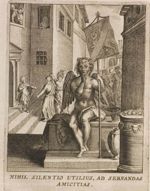
Nihil silentio utilius ad servandas amicitias: Moralia Horatiana (Amsterdam, 1656), emblem 28 inverts the adage's moral
Iconclass: 31B623591 putting a finger to the lips, 'Silentium'; 'Silentio' (Ripa) 51C Causation 51FF5:56F23 End; 'Fine' (Ripa)❧Friendship; 'Amicitia' (Ripa)
Collectanea (1500): 495
Loci Communes: Amicitia (Friendship, Amitié)
II i 27 Ad pileum vocare To call one to his cap of liberty
Ad pilem vocare, pro eo quod est, ad libertatem invitare, aut promissis ingentibus seditionem commovere, proverbiali figura dixit Macrobius lib. Saturnalium i. Dicet aliquis, nunc me dominos de fastigio suo deiicere, & quodammodo ad pileum servos vocare. Atque haec quoque verba sublegit à Seneca, qui epistola quadragesimaseptima scribit in hunc modum: Dicat nunc me vocare ad pileum servos, & dominos de fastigio suo deiicere. Livius lib. xiiii. Postero die servi ad pileum vocati, & carcere vincti emissi, confusaque omnis multitudo Hippocratem atque Epicidem creant praetores. Metaphora ducta à veterum consuetudine, qua servi cum statum mutarent, ac manu mitterentur, capite raso pileum accipiebant. Unde est in Amphitryone Plautina, sub persona Sofiae servi liberatem optantis: Quod ille faciat Iuppiter, ut ego hodie raso capite calvus capiam pileum. Huc pertinet quod Plutarchus refert in Apophthegmatis Scipionis, qui non prius sustinuit agere cum Carthaginensibus de pace, quàm L. Terentium, quem captivum habebant, ad sese reducerent. Terentius autem Scipionem triumphantem subsequutus est pileatus, veluti libertus. Item quod ibidem refertur de T. Quintio, quem in triumpho subsequuti sunt pileati omnes Romani, quos in bello captos & apud Graecos servientes drachmis quingentis redemptos ipsi dono dederant. Cuius meminit T. Livius lib. iiii. de bello Macedonico. Martialis Epigrammatum secundo ad Olum: Totis pilea sarcinis redemi. Hoc est, rebus omnibus relictis contemptisque peperi mihi libertatem. Etenim qui potest nihil habere, is nulli servire cogitur, eique liberum est suo more vivere. Atque idea subiicit: Servum si potes Ole non habere, Et regem potes Ole non habere. Persius: Hanc nobis pilea donant. Suetonius in Tiberio: Servisque ad pileum frustra vocatis, in Siciliam profugit. Idem in Nerone: Obiit trigesimosecundo aetatis anno, die quo quondam Octaviam interemerat: tantumque gaudium publice praebuit, ut plebs pileata tota urbe discurreret, nimirum hoc indicio additam sibi libertatem significans. Servius in Aeneidos octavum, refert Feroniam servorum deam haberi, in cuius templo capite raso soliti sint pileum accipere. Videtur autem pileum priscis insigne fuisse virtutis spectatae, ut hinc fluxerit mos, ut qui magistri doctorisque titulo eos venire solitos pileatos, quorum nomine venditor nihil praestaret. Eius rei Caelius Sabinus iureconsultus hanc fuisse causam scribit, quod eiusmodi conditionis mancipia insignia esse in vendendo deberent, ut emptores errare & capi non possent, neque lex vendundi operienda esset, sed oculis iam perciperent, quodnam esset mancipiorum genus.
To call a man to his cap of liberty, in the sense of offering his freedom or of raising a rebellion by inordinate promises, is a proverbial metaphor used by Macrobius in the first book of the Saturnalia: 'Someone will say that I am now casting masters down from their proud position and more or less calling slaves to their cap of liberty.' This is another case of theft from Seneca, who writes as follows in letter 47: 'Let someone say I am now calling slaves to their cap of liberty, and casting masters down from their proud position.' Livy, in book 14: 'Next day slaves were called to their cap of liberty, prisoners in irons were released from gaol, and the whole mob without discrimination elected Hippocrates and Epicides as praetors.' The image is drawn from the ancient customs, when slaves changed their status and were given their freedom, of shaving their heads and giving them a pileum or felt cap. Hence that phrase in the Amphitryo of Plautus, put into the mouth of Sosia, a slave who is longing for his liberty:
May Jupiter in heaven fix it so
That I this day may shave my head, and plant
A cap of liberty on my bald head.
Here belongs a story recorded by Plutarch among the sayings of Scipio: he could not bring himself to discuss peace-terms with the Carthaginians, until they handed over Lucius Terentius whom they held as a prisoner; and Terentius followed Scipio in his triumphal procession wearing a cap of liberty like a slave newly set free. Also the tale told in the same context of Titus Quinctius, who was followed in his triumph by all the Romans who had been made prisoners-of-war and were serving as slaves in Greece; they all wore caps of liberty, the Greeks themselves having purchased their freedom for five hundred drachmas and given them to Quinctius as a present. Livy mentions this in the fourth book of his Macedonian War. Martial in book 2 of the Epigrams, addressing Olus: 'All that I possess / I've bartered for my cap of liberty.' The sense is that by sacrificing and despising all my worldly goods I have won my freedom; for the man who can exist without possessions is not compelled to be any man's slave and is free to live as he pleases. And so he goes on: 'If, Olus, you can live without a slave, / Then, Olus, you can live without a king.' Persius: 'So much for all our caps of liberty!' Suetonius in his life of Tiberius: 'After calling the slaves to their caps of liberty without result, he took refuge in Sicily.' Suetonius again in the life of Nero: 'He died in the thirty-second year of his age on the anniversary of his murder of Octavia long before; and his death caused such public delight that the whole city was full of crowds wearing the cap of liberty, as a sign of course that they had recovered their freedom.' Servius on the eighth book of the Aeneid records that Feronia was accounted the patron deity of slaves, who by custom received the cap of liberty in her temple with their heads shaven. This pileum or cap seems to have been in early times the mark of some special merit, whence arose the custom of giving a cap or bonnet to those who are honoured with the title of master or doctor. Aulus Gellius too in his Attic Nights, book 7 chapter 4, says that caps of liberty 'were ordinarily worn by slaves in the market for whom the vendor was not prepared to give any guarantee.' The reason for this was given, he says, by the jurist Caelius Sabinus as follows: 'Slaves of this class ought to be distinguishable at the point of sale to protect purchasers from error and deception; there should be no concealment of the conditions of sale, but buyers should be able at the time to see what kind of slave they were buying.'
Facsimile:
Iconclass: 41D221(CAP) head-gear: cap 41D221(PILEUM) head-gear (PILEUM) 46A1831 liberation (of an enslaved person) 51E11 Freedom, Liberty; 'Libertà' (Ripa)
Loci Communes: Magnifica promissa (Magnificent promises, Promesses magnifiques)
II i 28 Eiusdem Musae aemulus A suitor of the selfsame muse
Eiusdem artis, aut disciplinae studiosi, eiusdem musae aemuli dicuntur. Usurpatur apud A. Gellium proverbii vice. Graeci ὁμότχνους appellant eiusdem artis opifices.
Those who pursue the same art or science are called 'suitors of the selfsame Muse.' The phrase is used like a proverb in Aulus Gellius. Greek has a word, homotechnoi, brothers in the craft, for those who follow the same profession.
Facsimile:
Iconclass: 33C21 courting 47B1 handicrafts, craftsman at work 51B2 Similarity, Likeness 51B3 Parity, Equality 92D4 (story of the) Muses; 'Muse' (Ripa)
Loci Communes: Caecutientia (Poor eyesight, near-blindness, Mauvaise vue); Similitudinis et congruentiae (Similarity and congruence, Similitude et convenance)
II i 29 Lolio victitant They live on darnel
Aenigmate proverbiali lolio victitare dicuntur lusciosi & caecutientes, quos Graeci, teste Nonio, Myopes vocant. Plautus in Milite: Mirum est lolio victitare te tam vili tritico. Quid iam? Quia lusciosus. Verbero, aedepol tu quidem caecus, haud lusciosus. Lolium autem Plinius inter frugum pestes commemorat, una cum carduis, ac tribulis. Vergil. in Bucolicis, Infelix lolium & steriles dominantur avenae. Item Geiorg. lib. i. Mox & frumentis labor additus, ut mala culmos Esset rubigo segnisque horreret in arnis Carduus, intereunt segetes, subit aspera sylua Lappaeque tribulique interque nitentiae culta Infelix lolium & steriles dominantur avenae. Inest autem lolio peculiare quoddam malum, ut oculis caliginem inducat, id quod indicat Ovidius lib. Fastorum i. cum ait: Et careant loliis oculos vitiantibus agri. Hinc nimirum iocus proverbialis.
Shortsighted people and sufferers from what in Greek, according to Nonius, is called myopia, are said to live on darnel, according to a riddling proverb. Plautus in the Miles: 'I wonder you live on darnel when breadcorn is so cheap. - By which you mean? - You're so shortsighted. - Scoundrel, it's not shortsighted you are, in god's name, but stone-blind.' Darnel is listed by Pliny among the weeds of graincrops, together with thistles and caltrops. Virgil in the Bucolics: The fruitless darnel rules and barren oat.' And again in the first book of the Georgics:
Soon wheat-crops too new toils and troubles found:
Mildew must eat the ears, and in the fields
The lazy thistle must erect its spines;
The grain is choked and prickly thickets rise,
Cleavers and caltrops; in the tidy crops
The fruitless darnel rules and barren oat.
Darnel contains some peculiar toxin which can dim the eyesight, as Ovid suggests in the first book of the Fasti, when he says 'May darnel spare the fields that spoils the sight.' Hence of course the jest, which became proverbial.
Facsimile: 
Iconclass: 25G4(DARNEL) plants and herbs (DARNEL) 25G4(LOLIUM TEMULENTUM) plants and herbs (LOLIUM TEMULENTUM) 25G4(WHEAT) plants and herbs: wheat 31A4114 near-sightedness, myopia 52AA552 Intellectual Blindness; 'Cecità della Mente' (Ripa)
Collectanea (1500): 15
Loci Communes: Caecutientia (Poor eyesight, near-blindness, Mauvaise vue)
II i 30 Intus canere. Aspendius citharoedus To play privately to oneself. A lyre-player from Aspendus
Qui privati commodi impendio studiosi essent, ac fere, quidquid rerum agerent, id omne ad domestiam referrent utilitatem, ii proverbio, Intus canere, iidem apud Graecos ἀσπένδιοι κιθαρισταὶ, id est, Aspendii citharistae dicebantur. M. Tullius in Verrem actione tertia: Atque etiam Aspendium citharistam, de quo saepe audistis, id quod est Graecis in proverbio, quem omnia intus canere dicebant, sustulit, et in intimis aedibus suis posuit, ut etiam illum ipsum artificio suo superasse videatur. Facetissime taxavit Cicero Verris rapacitatem, qui intus canentem in intimis aedibus collocarit, hoc est, plus quam intus cecinerit. Idem in Rullum adversus legem agrariam: Atque hoc carmen hic tribunus plebis, non vobis, sed sibi intur canit. Nam ostendit Tullius in ea oratione, legem, tametsi popularis videretur, haud tamen populi, sed decemvirum utilitati repertam. Porro de Aspendio citharoedo Asconius Pedianus ad hanc ferme sententiam enarrat: Vulgares citharoedi, cum canunt, utriusque manus funguntur officio, ita, ut dextra plectrum teneant, id, quod foris canere appellant: sinistra digitis chordas carpant, quod quidem intus canere vocant. Difficile autem visum est, quod Aspendius citharoedus faciebat, qui nequa quam utraque uteretur manu, sed omnia, id est, totam cantionem intus, et sinistra tantum manu complecteretur: atque ita tacita, levique modulatione sinistra contactis chordis, cantilena peragebatur, ut vox ad citharoedum duntaxat, aut proxime assistentem perveniret. Hinc fluxisse proverbium, ut furaces homines Aspendii citharistae Graecis vulgo dicerentur, quod ut hi carminis, ita illi furtorum essent occultatores. Fatetur Asconius adagionem etiam in illos apte dici, qui multum intestinis suis commodis consulunt praeter honestatem. Neque discrepat interpreta mentum, quod adfert Zenodotus ex Zenone Myndio in adagiorum Collectaneis. Porro Aspendius Pamphyliae civitas est auctore Stephano, unde Aspendii dicebantur, apud quos citharoedi hoc artificio praecelluisse videntur. Ad hoc proverbium apparet allusisse Plinium lib. vigesimooctavo cap. v. cum ait, Verum id remediis cecinit, non epulis.
Those who were excessively devoted to their own advantage, and in almost everything they did had an eye to the main chance and nothing else, were said proverbially to play privately to themselves, and in Greek were called Ἀσπένδιοι κιθαρισταί, Aspendus lyre-players. Cicero in the third speech of his Verrines: 'As for that Aspendus lyre-player of whom you have heard so often, who is proverbial in Greek and was said always to play privately to himself, Verres removed him and set him up in his own private quarters, so that as far as privacy goes, you could say Verres had beaten him at his own game.' Cicero is making a joke, attacking Verres' greed in placing in his private apartments the man who played so privately; for he now played in greater privacy than ever before. And again in his attack on Rullus over the agrarian law: 'And this tune our tribune of the people plays not to you but privately to himself;' for Cicero shows in that speech that the law, however democratic it might seem, had been devised for the benefit, not of the public but of the ten commissioners. Furthermore, the Aspendus lyre-player is explained by Asconius Pedianus more or less on these lines. Ordinary lyre-players 'while playing make use of both hands, holding the plectrum in the left hand, which the call "outside playing," and plucking the strings with the fingers of the left hand, which they call "inside." It was thought difficult to do as the Aspendus player did, who never used both hands, but played everything - the music in its entirety - "inside," and encompassed it all with the left hand only. In this way the piece was entirely performed by the left hand, which touched the strings silently and with a light action, so that the sound was audible only to the player or to a person very close to him. Hence,' he says, 'came the proverb: thieving fellows were often called in Greek Aspendus lyre-players, because they kept their thefts to themselves, as the players did their music.' Asconius agrees that the adage can also be used appropriately of those 'who have a keen eye to their own personal profit, beyond what honesty admits of.' Nor is this at variance with the explanation given by Zenodotus from the collection of adages made by Zeno of Myndus. Aspendus moreover is a city in Pamphylia, as given by Stephanus, whence the name Aspendians; and the lyre-players there seem to have brought this skill to a high level. Pliny clearly alluded to this proverb in book 28 chapter 5, when he says 'But he played this tune for the benefit of physic rather than gastronomy.'
Facsimile:
Iconclass: 22D2 soft sound 44G54 thief 48C7321 lyre, cithara, psaltery 48C7521 one person playing string instrument (bowed) 51II5 Isolation 57AA65 Selfishness; 'Interesse', 'Interesse proprio' (Ripa) 59AA1 Loneliness; 'Solitudine' (Ripa) 61E(ASPENDUS) names of cities and villages (ASPENDUS)
Collectanea (1500): 26
Loci Communes: Proprii commodi studium (Pursuit of one's own advantage, Recherche de son propre intérêt)
II i 31 In lapicidinas To the quarries
Εἰς λατομίας. i. In lapicidinas. Simillimum est illis, ἐς κόρακας, καὶ ἐς τὴν μακαρίαν, cum significamus quempiam è medio tollendum, et in rem malam aliquò auferendum. Natum à Philoxeno poeta dithyrambico, qui cum Dionysii tyranni poemata non probaret, utpote indocta, in lapicidinas ab eo detrusus est: deinde revocatus illinc amicorum precibus, ubis denuo Dionysium sua carmina pronunciantem audisset, surrexit: et rogatus à Dionysio, quid esset rei, respondit, satius ac potuis esse in lapicidinis vitam degere, quàm illius audire poemata. M. Tullius in Epistolis ad Attic. lib. iiii. Philoxeni animum probat, qui maluerit in carcerem reduci quàm assentari tyranno. Lucian. in libello, cui titulus: De mercede servientibus Σύ δ᾽ οὖν ἐὰν μὴ ἐπαινῇς, ἐς τὰς λιθοτομίας διονυσίου εὐθὺς ἀφίξῃ. id est, Quod ni tu laudes, protinus in Dionysii lapicidinas relegaberis. Plautus in Captivi duo: Inde ibis porrò in latomias lapidarias. Hoc nomine carcer erat insignis, quem Dionysius extruxerat. Plutarchus libro ii. De fortuna & virtute Alexandri, οἷος ἦν ἀνάπαλιν διονύσιος, ὁ τὸν ποιητὴν φιλόξενον εἰς τὰς λατομίας ἐμβάλλων, ὅτι τὴν τραγῳδίαν αὐτοῦ διορθῶσαι κελεύθεὶς, εὐθὺς ἀπαρχῆς ὅλην μέχρι τῆς κορωνίδος περϊέγραψεν. id est, Qualis rursus erat ille Dionysius qui Philoxenum poetam in latomias coniecit, quod ipsius tragoediam emendare iussus, ab ipso statim initio usque ad finem dispunxit. M. Tullius in Verrem actione vii. Latumias Syracusanas omnes audistis, plerique nostis. Opus est ingens, magnificum, regum ac tyrannorum, totum est è saxo, in mirandam altitudinem depressum, & multorum operis penitus excisum. Item in eadem: Carcer ille qui est à crudelissimo tyranno Dionysio factus Syracusis, quae latumiae vocantur, in istius imperio domicilium Romanorum fuit. Ut quisque istius animum aut oculos offenderat, in Latumias statim coniiciebatur. Idem in eundem actione tertia: L. Suetius homo omnibus ornamentis praeditus, qui iuratus apud vos dixit, multos cives Romanos in Latumiis istius crudelissime per vim morte esse multatos, &c. Huius carceris meminit & T. Livius Belli Punici secundi libro sexto.
Εἰς λατομίας, To the quarries, closely resembles To the crow and To Macaria, used when we wish to convey that a person ought to be taken clean away and consigned to some hideous end. It took its rise from the poet Philoxenus, a writer of dithyrambs, who rejected the verses of the tyrant Dionysius as ignorant doggerel and was despatched by him to the stone-quarries. After which, when his friends' entreaties had secured his release, and he had again heard Dionysius reciting his poems, he rose from his seat and, when asked by Dionysius whether there was anything wrong, replied that it would be far better to spend a lifetime in the quarries than to listen to his verses. Cicero in his Letters to Atticus, book four, thinks Philoxenus showed a proper spirit in preferring to go back to prison rather than be a tyrant's toady. Lucian in the essay called On Salaried Posts has 'And so if you do not applaud, you will find yourself forthwith in Dionysius' quarries.' Plautus in the Captivi: 'And then you'll go straight off to the stone-quarries.'
This was the name of a notorious prison constructed by Dionysius. Plutarch in his second essay 'On the Fortune and Valour of Alexander:' 'Or like Dionysius once again, who despatched the poet Philoxenus to the stone-quarries because, when told to correct a tragedy Dionysius had written, he drew a line through the whole piece from beginning to end.' Cicero in his seventh speech against Verres: 'The stone-quarries at Syracuse you have all heard of, and many of you know them personally. They are a vast and grandiose affair, the work of kings and tyrants and cut entirely in the rock, sunk to an amazing depth and driven far in with an immense expenditure of labour.' Elsewhere in the same speech: That notorious prison made at Syracuse by that most barbarous of dictators Dionysius, and called the Stone-quarries, was under his tyrannous rule the dwelling-place of Roman citizens. Any man whose views or whose presence he found objectionable was despatched at once to the Stone-quarries.' And in the third speech: 'Lucius Suetius, a man of great distinction, who declared in your hearing on oath that many Roman citizens were most brutally put to death by his orders in the Stone-quarries' and what follows. This prison is also mentioned by Livy in book six of his Second Punic War.
Facsimile: 
Iconclass: 25D34 quarry 44G314 workhouse, penal camp, penitentiary, chain gang 98B(DIONYSIUS II)3 (story of) Dionysius II, tyrant of Syracuse - representations to which the NAME of a person from classical history may be attached
Loci Communes: Infortunii sive exitii (Misfortune or ruin, Malheur ou ruine)
II i 32 Equi senecta A horse's old age
Ιππου γῆρας, id est, Equi senecta. Proverbium in eos dici solitum, qui praeclaris rebus gestis in iuventa, postea quam consenuerint, ad sordidas curas semet abiciunt. Allegoria sumpta à generosis equis, qui senio facti segnes, in pistrinum, aut carrum, aut aliud id genus opus detruduntur: olim in pretio habiti, dum viribus integris essent. Plutarchus in libello, cui titulus, An seni sit administranda Respub. Οὐ παντάπασιν δόξει τοῦτο δὴ τὸ καλούμενον, ἵππου γῆρας ἐπάγεσθαι μηδενος ἀναγκάζοντος; id est, An non is plane videbitur equi senectam, quemadmodum vulgo vocant, accersere, nemine compellente? Cum hoc convenit Ennianum illud, quod refertur à Cicerone in Catone Maiore: Sicut fortis equus, spatio qui forte supremo Vicit Olympia, nunc senio confectus quiescit.
Ἵππου γῆρας, A horse's old age, is a proverb often applied to those who, after a distinguished career in the prime of life, debase themselves to mean concerns when they grow old. The image derives from thoroughbred horses which have grown slow in old age, and are degraded to turn a mill or drag a cart or some such purpose, though when in full vigour they were highly valued. Plutarch in the essay entitled 'Whether an old man should engage in public affairs' says 'Will he not be thought to bring on himself without any compulsion just what people mean by a horse's old age?' This agrees with those lines of Ennius cited by Cicero in his Cato major: 'As that bold steed who won the Olympic race / In the last lap, rests now, fordone with age.'
Facsimile:
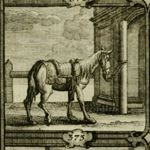
Non ornamenta, sed usus: Pfeffel, Güldene Aepfel (Augsburg, 1746), emblem 373 uses the imagery of an old horse
Iconclass: 46C13141(+724) horse (+ very old animal) 47D221(+952481) treadmill driven by horizontal device (+ animal(s) turning something) 59BB2 Degradation
Loci Communes: Ignavia et inscitia (Cowardice and ignorance, Lâcheté et ignorance)
II i 33 Si tibi amicum, nec mihi inimicum If it's agreeable to you, it's not disagreeable to me
Plato in Theaeteto: Αλλ᾽ εἰ οὕτως ὦ θέοδωρέσοι φίλον, οὐδ᾽ ἐμοὶ ἐχθρὸν, φασὶν οἱ παροιμιαζομενοι. id est, Si istud tibi amicum Theodore, nec mihi est inimicum: quemadmodum proverbio dicunt. Hoc est, Si tibi res placet, mihi non displicet. Captata est autem in figura vocum pugnantia: deinde τὸ ἀμφίβολον φίλου καὶ ἐχθροῦ, quorum utrunque è personis ad res detorquetur: quanquam ad personas relata sunt usitatiora. Usus erit, quoties alienae obsequimur voluntati.
Plato in the Theaetetus: 'But if this is agreeable to you, Theodorus, it's not disagreeable to me, as people say who speak in proverbs,' in other words, if you like it I don't dislike it. This expressions makes a feature of the opposition between the words, and also of the double use of 'agreeable' and disagreeable,' both words being transferable from persons to things, although they are more commonly applied to persons. This can be used whenever we follow someone else's wishes.
Facsimile:
Iconclass: 53D12 Favour; 'Favore' (Ripa) 54E31 Agreement, Unity; 'Concordia', 'Concordia insuperabile', 'Concordia militare', 'Concordia di Pace', 'Unione civile' (Ripa) 56B1 Pleasure, Enjoyment, Joy; 'Allegrezza', 'Allegrezza da le medaglie', 'Allegrezza, letitia e giubilo', 'Diletto', 'Piacere', 'Piacere honesto' (Ripa)
Loci Communes: Approbandi (Approving, Approuver)
II i 34 Rana gyrina sapientior As wise as a tadpole
Plato in Theaeteto: Οτι ἡμεῖς μὲν αυτὸν ὥσπερ θεὸν ἐθαυμάζομεν ἐπὶ σοφίᾳ, ὅδ᾽ ἄρα ἐτύγχανεν ὤν εἰς φρόνησιν οὐδὲν βελτίων βατραχου γυρίνου, id est, Nos illum tamquam deum ob sapientiam admirabamur. At ille nihilo magis antecellebat prudentia, quàm rana gyrina. Sumptum est adagium ab informi partu ranarum, quem Graeci γυρίνους vocant, a figura corporis in gyrum orbiculati: quo fit, ut mira celeritate se quo velint voluant, versentque, quemadmodum testatur quisquis is fuit, qui scripsit Etymologicon Graecarum dictionum. Meminit gyrinorum & Hesychius. Suidas etiam Aristophanis adducit testimonium: Οἷον πατέρες βοὸωσι γυρίνων. id est, Quemadmodum patres clamat gyrinorum. Nec ab his abhorrent, quae tradit Plinius lib. ix. cap. li. Ranae, inquit, superveniunt, prioribus pedibus alas feminae mare apprehendente, posterioribus clunes. Pariunt minimas carnes nigras, quas gyrinos vocant, oculis tantum, et cauda insignes: mox pedes figurantur, cauda findente se in posteriores. Mirumque semestri vita resolvuntur in limum, nullo cernente, & rursus vernis aquis renascuntur, quae fuere natae, perinde occulta ratione, cum omnibus annis id eveniat. hactenus Plinii verba recensuimus. Meminit & Aratus αὐτόθεν ἐξ ὕδατος πατέρες βοόωσι γυρίνων. i. Inde gyrinorum clamant per stagna parentes. Porrò cum ranae tribuitur loquacitas, quae stoliditatis solet esse comes, minimum mentis inesse oporret gyrinis, quos vix de prehendas animal esse, nisi moverentur. Ut autem hunc locum diligentius expenderem, Hieronymus Aleander, vir non tantum literis clarus, mihique vetere necessitudine iunctus, in causa fuit: ille rursus, quod indicavit, Coelio Calcagnino transcribit. Nos neutrum voluimus sua laude fraudatum esse. Neque enim unquam tam iuveniliter fuimus affecti, ut nobis placuerit cornicula Aesopica.
Plato in the Theaetetus: That while we admired him for his wisdom as though he was a god, he was really, as far as commonsense was concerned, no better than a tadpole.' [I myself think that in place of gyrina, a tadpole, we should read Grynea, A Grynean frog. Gryneum is a small town in the territory of Myrina, where it is natural that the frog should have been thought a very contemptible creature, out of respect for Apollo, who had a special dislike for it on account of the country-folk in the story who were changed into frogs. For there is at Gryneum a temple of Apollo built of white marble, and an oracle of great antiquity, from which the god himself got the name Apollo Gryneus.]
The adage is derived from the tadpole, the misshapen embryo of the frog, the Greek for which is gyrinos, derived from the spherical shape (gyros) of its body, which enables it to turn and twist as it pleases with surprising speed, as we are told by the anonymous author of the Greek Etymologicon. These gyrinoi are mentioned also by Hesychius, and Suidas produces evidence from Aristophanes: 'So cry the tadpoles' sires.' Nor is there any conflict between this and Pliny's statement in book 9 chapter 51. 'Frogs' he says 'engender from above, the male clasping the armpits of the female with his forelegs and with his hindlegs her posterior. The offspring are very small fleshy objects, black in colour, which are called tadpoles (gyrini), featureless except for eyes and a tail; but later the feet take shape, the tail dividing in two to form hindlegs. It is remarkable how after six months of life they dissolve into mud unobserved, and in the spring are born again in the water in which they started life; and how this happens is entirely obscure, though it takes place every year.' Such is Pliny's account. Aratus also mentions them: 'Straight from the water cry the tadpoles sires.' And of course, as frogs are known for their constant croaking, which frequently goes with stupidity, tadpoles ought properly to have small brains, and except for their movement you would hardly detect they are living creatures.
I examined the passage with greater care on the insistence of Girolamo Aleandro, a man distinguished not only as a scholar and an old friend of mine, and he in turn ascribes what he tells us to Celio Calcagnini.I for my part have no wish to rob either of his due credit, for I have never been so childishly disposed as to approve of Aesop's crow.
Facsimile:
Iconclass: 25F51(FROG)(+21) tailless amphibians: frog (+ young animal) 25F51(TADPOLE) tailless amphibians (TADPOLE) 52A51 Wisdom; 'Sapienza', 'Sapienza humana', 'Sapienza vera' (Ripa) 52A511 Wisdom of the Fool
Loci Communes: Multi - in stupidos (Many people - against the stupid, Beaucoup de gens - contre les sots)
II i 35 In puteo constrictus Caught in a well
Plato in Theaeteto: Τί γὰρ χρήσῃ ἀφύκτῳ ἐρωτήματι, τὸ λεγόμενον, ἐν φρέατι συσχόμενος; id est, Cur enim utaris inexplicabili quaestione, in puteo, quemadmodum aiunt, constrictus? Quadrabit in eos, qui in angustias eas redacti sunt, ut extricare sese nullo modo possint. Non admodum abludit ab illo ἐν φρέατι κυνομαχεῖν, id est, In puteo cum cane pugnare. Item illo, Canterium in fossa.
Plato in the Theaetetus: 'How will you deal with a question you cannot get out of, when you are, as the saying goes, caught in a well?' This will be suitable for those who are caught in such a tight place that they have no means of extricating themselves. This is not far from To fight with a dog in a well' or 'Donkey in a ditch.'
Facsimile:
Iconclass: 41A3911 well 44G313 prisoner in cell or locked place 54AA33 Inability, Maladroitness, Awkwardness
Loci Communes: Perplexus (Perplexed, entangled, Perplexe); Proclivitas (contra) (Propensity (against), Penchant (contre))
II i 36 In easdem ansas venisti You are caught in the same grip
Plato in Phaedro: Περὶ τούτου μὲν ὦ φίλε εἰς τὰς ὁμοίας λαβὰς ἐλήλυθας. id est, Quantum ad istam rem pertinet, amice, in easdem ansas venisti, i. nihilominus teneris, nec potes effu gere quin dicas. item Aristid. in communi quatuor oratorum defensione: Ως εἶχεν ἄν παλιν ὁ καλλικλῆς εἰς αὐτὰς λαβὰς ἐπανελθεῖν, id est, Itaque Callicli erat in easdem ansas recidendum. Quadrat in eum qui sic irretitus est, ut, quocunque se vertat, teneatur: nec explicare sese possit. Huic similimum est, quod scribit Lucianus in Hermotimo: Οἴομενος γὰρ ἐκπεφευγέναι, εἰς τὸν αὐτὸν κύρτον ἐμπέπτωκας. id est, Nam arbitratus effugisse te, in eandem nassam incidisti. item illud, quod alibi dicetur, κύκλῳ περιέλκειν.
Plato in the Phaedrus: 'On this point, my friend, you are caught in the same grip,' meaning You are entrapped none the less, and cannot escape without answering. Aristides too in his common defence of the Four Orators: 'So that Callicles would have had to be caught again in the same grip.' This suits a man who is so tightly caught in the toils that turn as he may he is held fast and cannot work himself free. There is a phrase of Lucian's very close to this in the Hermotimus: 'For though you thought you had made your escape, you have fallen into the selfsame net.' Also a phrase I shall return to elsewhere: To lead in a circle.
Facsimile: 
Iconclass: 31A2541 gripping someone by the arm 44G31 imprisonment 54AA33 Inability, Maladroitness, Awkwardness 57AA6223 Ambuscade, Trap; 'Insidia' (Ripa)
Collectanea (1500): 801
Loci Communes: Decretum - in deprehensos (Decree - against those caught in the act, Décret - contre les pris sur le fait)
II i 37 Qui possim ab hoc epulo abesse? How could I be absent from this feast
Plato in Phaedro: Πῶς γὰρ οἷός τε εἴην τοιαύτης θοίνης ἀπέχεσθαι; id est, Qui possim ab hoc epulo abstinere? De re vehementer suavi atque expetenda, quod genus est festum aliquod convivium. Allusum, opinor, ad eam fabulam, qua tradunt Dianam iracunde tulisse, quod cum reliqui dii adhibiti essent ab Oeneo ad sacrum epulum, sola fuisset praeterita, solaque domi sederit, secum stomachans, quod nihil ex illo nidore sentiret. Qua de re meminit Lucianus in Lapithis: item in libello De sacrificiis.
Plato in the Phaedrus: 'How could I abstain from this feast?' Used of anything exceedingly pleasant and desirable, some cheerful party for example. An allusion, I suppose, to the myth that tells how indignant Diana was when all the other gods had been invited to a feast by Oeneus, and she alone had been left out and sat alone at home, inwardly seething with anger because she could smell none of that sweet savour. Lucian mentions this in his Lapiths, and again in his piece On Sacrifices.
Facsimile:
Iconclass: 41C5 celebration meal, feast, banquet 51A4 Presence 51AA4 Nothingness, Absence 94N311 King Oeneus neglects Diana in his yearly sacrifices
Collectanea (1500): 797
Loci Communes: Lautitiae (Sumptuousness, luxuries, Somptuosités)
II i 38 Dulcis cubitus Sweet elbow
Γλυκὺς ἀγκών, i. Dulcis cubitus. Abominantis est sermo, aut cum aliud dicimus, aliud sentientes. Plato in Phaedro: Γλυκὺς ἀγκὼν ὦ φαῖδρε λέληθέ σε ὅτι ἀπὸ τοῦ μακροῦ ἀγκῶνος τοῦ κατὰ τὸν νεῖλον ἐκλήθη, καὶ πρὸς ἀγκῶνι λανθάνει σε, ὅτι οἱ μέγιστον φρονοῦντες τῶν πολιτικῶν, μάλιστα ἐρῶσι λογογραφίας καὶ καταλείψεως συγγραμμάτων; id est, Num, Phaedre, fugerat te, quod dulcis cubitus a longo illo, qui in Nilo est, cubito dictus esset? Quin etiam praeter cubitum illud fugit te, quod, qui rerum civilium sunt peritissimi, conscriben darum orationum, ac posteris reliquendarum sunt cupientissimi. Hactenus Plato. Ancon autem Nili pars est, in qua navigantes plurimum & sudant & periclitantur. Unde proverbio dicebant κατ᾽ εὐφημι σμόν, γλυκὺς ἀγκών id est, Dulcis cubitus, quasi deprecantes eius loci discrimina. Id autem perinde valet, quasi dicas: εὔφημα φώνει, id est, Bona verba, aut bene ominata loquere. Sunt qui è Comico Platone natum existiment. is in fabula, cui titulus, Phaon, senem facit amantem tibicinam, atque haec loquentem: Ω χρυσοῦν ἀνάδημα, ὦ τοῖσιν ἐμοῖσι τρυφεροῖς τρόποις ὦ γλυκὺς ἀγκών. id est, O aureum amiculum: ô meis delicio sis moribus gratus cubitus. Suidas scribit Anconem Carthaginensibus vocari domicilium obscurum ac profundum, in quod coniici solent, si quibus indignaretur tyrannus. Praeterea summa montium iuga, Ancones vocari. Denique praeter alia gurgitem ac tumorem fluminis circa ripas, propter anfractum, et amnis repercussum, Ancoinem dici, a cubiti figura, ni fallimur, ducta similitudine, quod quibusdam locis ripa excurrat, promineatque specie cubitalis. Unde & oppidis ac locis aliquot Anconis inditum est vocabulum, ut Anconi, Pcentinorum civitati, teste Stephano. Item Ovid. libro Transform. ultimo: Et spissi litoris ancon. ut quidam legunt. Valerius Argonauticon lib. iiii. Quid memorem quas Iris aquas, quas torqueat Ancon? Unde non absurde, κατ᾽ ἀντίφρασιν quis acceperit, sicut placet Zenodoto. Nam alii putant per exclamationem dictum. Athenaeus libro Dipnosophistarum xii. ostendit Anconem locum quempiam fuisse Sardis, voluptatum ministeriis paratum, in quo popinae, scorta, atque aliae id genus deliciae. Dulcis igitur Ancon, ob blandimenta voluptatum, sed in eo complures naufragium faciebant. Idem indicat, Polycratem apud Samios mulieres aliquot voluptatum architectrices instituisse, ad exemplum Anconis, ducis Sardorum, eumque locum Laura dictum fuisse, sive Samiorum flores. Idem addit, Omphalem, eius gentis reginam, per vim virgines dominorum cum eorum seruis inclusisse ad stuprum, ne sola haberetur impudica. Lydos aunt eum locum, in quo feminae constuprabantur, γλυκὺν ἀγκῶνα dixisse, sceleris atrocitatem verbo mitigantes. Vocem autem dictam putat ab eo, quod illic gerebatur. Etymologus indicat ἀγκῶνα dici locum ossibus durum, παρὰ τὸ ἐπάγεσθαι τὴν χεῖρα, id est, ab adducenda manu, velut ἄγνυσθαι, id est, frangendo: sive ab ἄγχειν, id est, à praefocando. Hesychius adiicit & murorum flexus, ἀγκῶνας vocari. Breviter, quicquid in cubiti speciem inflectitur, ἀγκὼν dicitur, quemadmodum sunt & citharae ancones.
Γλυκύς ἀγκών, Sweet elbow. This is the language of rejection, or when we say one thing and mean another. Plato in the Phaedrus: 'surely, my dear Phaedrus, you had not forgotten the Sweet Elbow, and how it got its name from the long elbow formed by the Nile? And besides the elbow you forget that those who have the greatest experience of public affairs have the greatest passion for writing down their speeches and leaving them to posterity.' So Plato. Ancon, the Elbow, is the part of the Nile where those who travel the river by boat have to work harder than anywhere else and run greater risks. Hence they used the proverbial expression 'Sweet Elbow' by way of a euphemism, as if they were seeking to minimize the dangers of the place. This comes to the same thing as saying 'Good words, if you please' or 'None of this ill-omened talk.' Some think the source is to be found in Plato the writer of comedies. In a play called Phaon he has an old man in love with a flute-girl, and saying 'O that gold head-band! O that sweet elbow of all my luxurious thoughts!' Suidas writes that Ancon, the Elbow, was the name in Carthage of the dark and dismal place, into which were cast those who had incurred the tyrant's displeasure. Besides which, he tells us that the topmost ridges of mountains were called ancones. And lastly, apart from anything else, that the name ancon, elbow was given to the turbulent and seething water near the bank of a river, where the bank projects sharply and repels the water, the image being derived, if I am not mistaken, from the shape of a bent elbow, because at certain places the bank protrudes and runs out like the bow of a bent arm. Hence the name Ancon, Elbow, was given to several towns and other places: for instance, to Ancona, the city of Pioenum, as Stephanus tells us. Ovid too in the last book of the Metamorphoses has in some texts 'And Ancon's leafy shore.' Valerius in book four of the Argonautica: 'Why should I tell what whirlpools Iris makes / And what Ancona?' So it is not absurd to accept this as an example of antiphrasis, as Zenodotus suggests; others think it is the figure called exclamation.
Athenaeus in book 12 of his Doctors at Dinner explains that there was a place at Sardis called Ancon, which was equipped for the pursuit of pleasure and filled with eating-houses, loose women, and other entertainments of the kind. It thus got the name Sweet Elbow from its irresistible attractions; but many men there suffered shipwreck. He also tells us that Polycrates installed a number of women in Samos to plan a programme of pleasures on the lines of the Sweet Elbow at Sardis, and that the place was called Laura or the Flowers of Samos. He adds further that Omphale, queen of that country, forcibly enclosed the maiden daughters of the nobility with their servants for the purpose of prostitution, that she might not be thought to be the only wanton woman there; and the Lydians called the place where these females were exposed to violation the Sweet Elbow using the name to gloss over the monstrous wickedness of what she did, for he thinks the name derived from what went on there. The compiler of the Etymologicon points out that any hard and bony place was called ancon, from epagesthai, to draw one's hand over it, or from agnysthai, to be broken, or from anchein, to throttle. Hesychius adds that bends in walls were also called ancones and in a word, anything bent like a forearm is called an ancon or elbow, just as there are also ancones as parts of a lyre.
Facsimile:
Iconclass: 25H213 river 31A342 sweet (taste) 31A342:31A2242(+0) sweet (taste)❧elbow (+ variant) 57BB241 Irony 61D(ANCON) geographical names of countries, regions, mountains, rivers, etc. (ANCON) (ANCON) 61D(NILE) geographical names of countries, regions, mountains, rivers, etc. (NILE) (NILE)
Loci Communes: Deprecantis, abominantis (Pleading, abhorring, Qui implore, qui abhorre)
II i 39 Bos ad praesepe An ox at the manger
Βοῦς ἐπὶ φάτνῃ, id est, Bos ad praesepe. In emeritos dici consuevit, quique iam ob aetatem ocio, vitaeque molliori indulgent. Effertur & ad hunc modum: Βοῦς ἐν αὐλίῳ, id est, Bos in stabulo. Congruit & in eos, qui nullis honestis negociis exercentur, sed turpi otio, atque abdo mini serviunt. Philostratus in Cassandra, Αλλ᾽ ἐν μειρακίοις καὶ γυναιοις, βοῦς ἐπὶ φάτνῃ id est, Verum inter adolescentulos ac mulieres, bos ad praesepe. De Agamemnone loquitur, voluptariam agente vitam. Effertur item ad hunc modum, βοῦς ἐπὶ αυλίῳ γέρων. id est, Bos in stabulo senex. Rursum hoc modo, βοῦς ἐν αὐλιῳ κάθη. id est, Bos in stabulo desides. De iis qui molliter, & in otio vivunt. Athenaeus li. viii. refert quiddam non illepidum, nec alienum ab hoc proverbio. Cantor quidam imperitus, quum Stratonicum excepisset convivio, inter pocula ostentabat illi artem. Quum autem esset splendidum, ac magnificum convivium, ac Stratonicus eo frustraretur, non habens alterum, qui cum sermocinaretur, confregit poculum, ac poposcit maius, multosque cyathos cum accepisset, solique calicem ostendisset, affatim bibens obdormitt, cetera fortunae committens, cum autem forte comessabundi quidam supervenissent cantori, ex notis, Stratonicus ilico factus est sobrius. li quum audissent, quod semper multum vini bibens fuisset inebriatus, compendio respondit, Insidiator enim, & sceleratus ille cantor, tamquam bovem ad praesepe, data cena, occidit. Quod in Athenaei verbis legimus ψαλλόμενος, opinamur legendum σφαλλόμενος. Congruet & in illos, qui in suum aluntur exitium, quemadmodum ii, iqui se voluptatibus mundi explent, orco quid aliud quam victimae nutriuntur, veluti bos ad praesepe?
Βοῦς ἐπὶ φάτνῃ, An ox at the manger, was commonly used of veterans and of those whose age already entitled them to leisure and a softer form of life. It is also expressed in the form Βοῦς ἐν αὐλίῳ, An ox in the stable. It fits equally those who practise no honourable employment, but live in shameful idleness and are slaves to their bellies. Philostratus in his Cassandra: 'But among young men and women, an ox at the manger.' He speaks of Agamemnon, leading a life of pleasure. It is also found in this form: Βοῦς ἐπὶ αὐλίῳ γέρων, An aged ox in the stable, and again as Βοῦς ἐν αὐλίῳ κάθῃ, You sit like an ox in the stable. Used of those who live in luxury and idleness. Athenaeus in book 8 tells a story not without point, which has some relevance to our proverb. An unskilful musician, who had asked Stratonicus to dinner, proceeded while they were drinking afterwards to give an exhibition of his skill. The dinner had been very rich and splendid, but Stratonicus was frustrated because he had no one else to talk to. So he broke his drinking-cup and called for a larger one; and after having his cup refilled many times and turning it 'bottoms up,' and drinking as much as he wanted, he fell asleep, leaving the rest to chance. It so happened that some men known to him, in the course of the drunken evening, came to call on the musician, whereupon Stratonicus sobered up at once. When they heard that constant and deep drinking had been too much for him, he gave them a brief reply: This treacherous and cursed player gave me a dinner and cut me down like an ox at the manger.' (The word ψαλλόμενος [listening to the harp] which we read in Athenaeus should, I think, be σφαλλόμενος [frustrated]). This will be suitable for those who are well provided for, but to their own destruction, as for instance: 'Surely men who indulge to the full in the pleasures of this world are being fattened like victims for Orcus, as one might an ox at the manger.'
Facsimile: 
Iconclass: 45B81 veteran 47I21111 ox 47I2223 trough 54DD2 Idleness; 'Otio' (Ripa) 55B2 Luxury, Luxuriousness
Loci Communes: Bonae fortunae, copiae, felicitatis aut ominis (Of good fortune, abundance, happiness, or omen, Bonne fortune, abondance, bonheur ou présage)
II i 40 Ne genu quidem flexo Without even bending a knee
Οὐδὲ γόνυ κάμψας id est, Ne genu quidem flexo. Philostratus in Antaeo: καὶ οὐδε γόνυ φα σὶ, κάμψας ἀποδύεται πρὸς τὸν ἀνταῖον, id est, Ac ne genu qui. dem curvato adversus Antaeum exsuitur. Idem in Herode: Ενταῦθα, ἔφη, γόνυ κάμψας, id est, Hic, inquit, genu flectamus: Dictum est autem ὑπερβολικῶς, pro eo, quod est, ne tantulum quidem. Etenim, qui iam incipit ad quietem componere sese, primum genu flectit. itaque perinde valet, οὐδὲ γόνυ κάμψας, quasi dicas, citra respirationem, sine omni intermissione. Sumptum apparet ex Aeschyli Prometheo, ubi Vulcanus sic loquitur: Ανθ᾽ ὧν ἀτερπῆ τήνδε φρουρήσεις πέτραν Ορθοστάδην ἄϋπνος, οὐ κάμψας γόνυ id est, Ideo petram servabis hanc inamabilem, Insomnis adstans, nec genu unquam flexeris. Nisi mavis esse mutatum ex Homericae Iliados η, ubi de Hectore sic loquitur Menelaus, Φημΐ μιν ἀσπασίως γόνυ κάμψειν, αἴκε φύγησι Δηίου ἐκ πολέμοιο. id est, Ille lubens genua flectet, puto, si modo tristi Fugerit è bello.
Οὐδε γόνυ κάμψας, Without even bending a knee. Philostratus in his Antaeus: 'And without even bending a knee, as they say, he strips to fight Antaeus.' Again in the Herodes: 'At this point, he says, let us bend our knees.' It is used by way of exaggeration for 'not in the very least,' for a man who is just beginning to settle down to rest starts by bending his knee. And so 'without so much as bending a knee' has the same force as 'without drawing breath/ without a break of any kind. It appears to be taken from the Prometheus of Aeschylus, where Vulcan speaks as follows: 'So keeping watch upon this joyless rock / With knee unbent, unsleeping shalt thou stand.' Unless you would rather it were borrowed from book 7 of Homer's Iliad, where Menelaus uses these words of Hector: 'Full gladly would he bend his knee, I trow, / Could he but 'scape out of this cruel war.'
Facsimile:
Iconclass: 31A2611 both legs straight 51AA4:54A46 Nothingness, Absence❧Rest; 'Quiete' (Ripa) 51F2:54A1 Continuity❧Activity
Loci Communes: Citra laborem (Without effort, Sans effort)
II i 41 Quo properas, num ad ephebum? Whither away so fast? Not to see the young man?
Philostratus in vita Apollonii: Οτε κιλικος λόγος, ποῖ τρέχεις, ἢ ἐπὶ τὸν ἔφηβον; ἐπ᾽ ἐκείνῳ τε ἐλέγετο, καὶ παροιμιώδη τιμὴν ἔσχεν, id est, Ac Cilicibus celebratum dictum, quò curris, num ad ephebum? de illo quoque ferebatur, adagiique vim obtinebat. Parum liquet, quid sibi voluerit Cilicium illud adagium, nisi forte sumptum est ab Apollinis oraculo, ad quod undique festinabatur: fingebatur autem imberbis Apollo, quemadmodum & Bacchus.
Philostratus in his life of Apollonius: 'And the Cilician saying, Whither away so fast? Not to see the young man? was applied to him, and achieved the status of a proverb.' It is none too clear what that Cilician adage meant, unless it was perhaps taken from an oracle of Apollo which was much frequented on all sides; for Apollo, like Bacchus, was imagined as a beardless youth.
Facsimile:
Iconclass: 31A27112 running 31D12 youth, young man, adolescent 33A2 taking leave 51M12 Haste 92B3 (story of) Apollo (Phoebus)
Loci Communes: Excellentia, inaequalitas (Excellence, inequality, Excellence, inégalité)
II i 42 Et puero perspicuum est Even a child can see it
Καὶ παιδὶ δῆλον. id est. Et puero perspicuum. De resupra modum perspicua, confessaque. Utitur & Plato quodam in loco, quem ante commonstravimus: & Philostratus in vita Apollonii. Est in epistolis Basilii, τοῦτο καὶ παιδὶ γνώριμον. id est, hoc & puero notum. Finitimum illi, quod alibi retulimus, καὶ τῷ τυγλῷ δῆλον. id est, Vel caeco perspicuum.
Καὶ παιδὶ δῆλον, Even a child can see it, of something unusually clear and generally admitted. Plato too has it in one passage, which I have already pointed out, and so does Philostratus in his life of Apollonius. It comes in Basil's letters: 'Any child knows this.' Close to one I have recorded elsewhere: Καὶ τῷ τυφλῷ δῆλον, Clear even to a blind man.
II i 43 Ne in Melampygum incidas Mind you don't fall in with Blackbottom
Μὴ τῷ μελαμπύγῳ περιτύχοις, id est, Ne in melampygum incidas. in lascivos & iniuriosos homines quadrat. Est autem comminantis, ne quando incidant in eum, qui malefactorum poenas de eis sumat. Utitur hoc adagio Philostratus in Apollonii vita, lib. ii. Καὶ τοῦτο ἴσως ἦν τὸ μελαμπύγου τυχεῖν. id est, Et hoc fortassis erat in melampygum incidere. Aristophanes in Lysistrata. Καὶ μυρωνίδης γὰρ ἦν τραχὺς ἐντεῦθεν, Μελάμπυγός τε τοῖς ἐχθροις ἅπασιν. id est, Et Myronides enim erat hirsutus illinc, Melampygusque hostibus omnibus. Melampygum dixit quasi vindicem, ultoremque. Porro Melampygus Graecis significat eum, qui nigro sit podice, quo quidem cognomento notatus est Hercules, quod eam corporis partem, non Lydorum more vulsam, neque candidam, quemadmodum effeminati solent, sed nigris pilis hirsutam, ac syluosam haberet. Nam Graeci quemadmodum molles, et imbelles, factosque deliciis πυγάργους καὶ λευκοπύγους appellant, itidem e diverso fortes, ac strennuos μελαμπύγους vocare consueverunt, ut autor est Lycophronis interpres. Idem ostendit paroemiam ad hunc quoque modum efferri: ούπω μελεμπύγῳ τετύχησας, id est, Nondum in Melampygum incidisti. Proverbium ex huiusmodi quadam historia natum existimant, quam partim ex Suida, partim ex Gregorii Nazianyeni enarrationibus adscribemus. Olim duo quidam fratres erant, omni genere maleficiorum passim in omnes debacchantes, unde & ex morum atrocitate nomina repererunt. Nam alter Passalus dictus est, alter Achemon: sive, ut alicubi legitur, Achmon. Hos mater, nomine Sennonis, ubi videret atrocia facinora passim patrantes, iussit cavere, ne quando in Melampygum inciderent. Evenit deinde, ut Hercules aliquando sub arbore quadam dormiret, armis in eandem reclinatis. Accesserunt Cercopes sive Perperi fratres, (utrunque enim scriptum invenitur) & Herculem dormientem ipsius armis aggregi tentarunt. Ille protinus sensit insidias, & correptos, ac vinctos de clava à tergo suspendit, leporum ritu, atque ad eum modum gestabat, Illi pendentes capitibus deorsum demissis, cum herculis posticum nigris pilis horridum, atque hispidum viderent, materni moniti memores, super hac re inter sese consabulantur. Quod simul ac audisset Hercules, hoc cognomine delectatus, et in risum effusus, eos vinculis solutos dimisit. Notat hanc historiam Plutarchus in libello de discrimine amici, et adulatoris, cum ait Herculem Cercopibus fuisse delectatum. Meminit & Herodotus in septimo de loco, dicto lapide Melampygo, & Cercopum sede. Quo sanè loco lapsus est insigniter Laurentius Valla: quod fabulam hanc aut nesciret, aut certe non meminerit. Plutarchus in libello De puerorum educatione refert et hoc inter Pythagorica aenigmata: Μὴ γευεσθαι τῶν μελάνούρων. id est, Non gustanda quae nigra sunt cauda. Atque hunc in modum interpretatur, abstinendum à convictu mortalium atrorum, & improborum: quanquam hoc à proverbio diversum.
Μὴ τῷ Μελαμπύγῳ περιτύχοις, Mind you don't fall in with Blackbottom. Suitably addressed to licentious men who do wrong to others, for it is the language of one who threatens them that they may one day happen upon somebody strong enough to punish their misdeeds. This adage is used by Philostratus in his life of Apollonius, book 2: 'This was perhaps what they mean by falling in with Blackbottom.' Aristophanes in the Lysistrata: 'Hence came that hairy man Myronides; / Blackbottom he in truth to all his foes.' He uses the word as though it meant one who will avenge and punish. Blackbottom in Greek indicates in any case one whose posterior is black, and this was given to Hercules as a nickname, because he did not pluck the hair from that part of his person as they did in Lydia, nor was it white as in effeminates, but shaggy and thick with black hairs. For effeminate and unwarlike men and those who lead a dissolute and luxurious life are called in Greek bright-rumped and whitebottomed, and conversely they had a habit of calling strong and valiant men blackbottoms, as we learn from the scholiast on Lycophron. He tells us that this proverb is also found expressed in these words: Οὔπω Μελαμπύγῳ τετύχηκας, You have not yet fallen in with Blackbottom. They think the proverb must be derived from some story such as this, which I will append here, partly from Suidas and partly from the explanatory notes on Gregory of Nazianzus. Once upon a time there were two brothers, who ranged far and wide, inflicting outrages of every kind on their fellow-men, from which they earned names to match their monstrous behaviour; for one of them was called Passalus and the other Achemon or, as other sources have it, Achmon. Their mother, whose name was Sennonis, when she saw the wicked crimes they committed everywhere, told them to be careful in case one day they should fall in with Blackbottom. Later one day it happened that Hercules was lying asleep under a tree, against which he had leaned his weapons. The brothers, Cercopes or Perperi (for both names are found), came up and tried to attack Hercules as he slept with his own weapons. He at once detected their stealthy approach, seized them and bound them, and hung them from his club like a couple of dead hares, to carry them around like that behind his back. As they hung with their heads downwards, they had a good view of Hercules' backside, all shaggy and rough with black hair; this recalled their mother's warning, and they spoke of it one to the other. The moment Hercules heard what they said, he was delighted with his new nickname, roared with laughter, and set them free and sent them away. Plutarch alludes to this story in the essay 'How to tell a Flatterer from a Friend,' where he says that Hercules was amused by the Cercopes. Herodotus also mentions it in book 7, where he speaks of the place called Blackbottom Stone, and the home of the Cercopes; a passage where a notable mistake has been made by Lorenzo Valla, because he either did not know this story or at any rate did not recall it. Plutarch in his essay 'On the Education of Children' records this among the other riddles of Pythagoras: 'Taste not of anything with a black tail,' and explains this as meaning that one should have nothing to do with wicked and disreputable people - though this is rather different from the proverb.
Facsimile: 
Iconclass: 22C4(BLACK) colours, pigments, and paints: black 31A2237:31A4441 buttocks, 'partes posteriores'❧excessive hairiness 31D14(+9212) adult man (+ challenging) 54A7 Strength, Power; 'Fortezza', 'Fortezza d'Animo e di corpo', 'Fortezza del corpo congiunta con la generosità dell'animo', 'Fortezza & valore del corpo congiunto con la prudenza & virtù del animo', 'Forza' (Ripa) 56DD1 Fear, Dread; 'Paura', 'Timidità o Timore', 'Timore' (Ripa) 57AA741 Revenge, Requital, Retaliation; 'Vendetta' (Ripa) 94L4117 Cercopes (monkey-like beings) are slung upside down on a pole and carried away by Hercules, because they had tried to steal his weapons
Loci Communes: Discriminis (Danger, crisis, Danger)
II i 44 Noctuinum ovum An owl's egg
Γλαυκεῖον ὠόν, id est, Noctuinum ovum: Refertur à Nicolao Perotto in Copiae cornu proverbii loco, nec explicatur tamen. Fortassis antiquitus abstemium, & à vino abhorrentem hoc adagio significabant. Philostratus enim in vita Apollonii, lib. iii, de ovo noctuae rem oppido quàm prodigiosam refert. Itaque satius est ipsius referre verba: Τὴν γλαῦκα, inquit, χρὴ ἐπιφυλάττειν οὗ νεοττεύει, καὶ τὰ ὠὰ σπάσαντα δοῦναι μασᾶσθαι τῷ βρέφει, συμμετρῶς ἕψαντας. εἰ γὰρ βρώσεταί τι τούτων πρὶν οἴνου γεύσασθαι, μίσος πρὸς τὸν οἶνον αὐτῷ ἐμφύσεται, καὶ σοφρονέστατα διακείσεται, id est, Observandum, ubi loci niduletur noctua, deinde ova subducere oportebit, eaque mediocriter cocta infanti mandenda dare. Quod si quid ex his ederit, prius quam degustarit vinum, insereturilli vini odium, adeo, ut in omnem vitam quam maxime sobrius sit futuras. Aelianus libro de naturis animantium primo, fabulam refert paulo magis etiam quam haec est, anilem. Eam quoque praestiterit ipsius auctoris recensere verbis: Οἱ πελαργοὶ λυμαινομένας αὐτῶν τὰ ὠὰ νυκτερίδας ἀμύνονται πάνυ σοφῶς. αἱ μὲν προσαψάμεναι ἀνεμϊαῖα ἐργάζονται καὶ ἄγονα αὐτὰ. Οὐκοῦν τὸ ἐπὶ τούτοις φάρμακον, ἐκεῖνό ἐστι. πλατάνου φύλλα ἐπιφέρουσι ταῖς καλιαῖς, αἱ δὲ νυκτερίδες ὅτ᾽ ἂν αὐτοῖς φειτνειάσωσι, ναρκῶσι καὶ γίνονται λυπεῖν ἀδύνατοι. id est, Ciconiae noctuas ova sua perdere solitas arcent miro ingenio. Nam hae contactu reddunt ea subventanca, steriliaque, Remedium igitur adversus haec illud adhibent. Platani frondes in nidum convehunt, quas noctuae posteaquam contigerint torpescunt, ita ut iam nocere non queant. Hactenus Aelianus. Sunt, qui negent noctuinum ovum inveniri. Proverbium itaque quadrabit vel in hominem nihili, nulliusque frugis, iuxta fabulamentum Aeliani: vel in rem raram inventu, iuxta horum sententiam.
Γλαυκεῖον ὠόν, An owl's egg, is recorded as a proverb by Niccolo Perrotti in his Cornucopiae, but without an explanation. It was perhaps used in Antiquity to convey that a man was abstemious and detested wine; for Philostratus in his life of Apollonius, book 3, tells a quite extraordinary story of the egg of an owl, which it will be best to give in his own words. 'You must observe' he says 'where the owl nests, and seize its eggs and give them lightly cooked to the child to chew; for if he eats anything of this sort before he first tastes wine, it will implant such a hatred of wine in him that he will entirely abstain in future.' Aelian in book i of his On the Nature of Animals records something which is even more of an old wives' tale than that, and this too will be better told in the author's own words: 'Storks have a very clever way of protecting their eggs from owls that would damage them. When they touch the eggs, the owls turn them into wind-eggs and make them infertile; so the remedy they use against this is to lay leaves from a plane-tree over their nests, and when the owls touch these leaves they are stupefied and become incapable of doing any harm.' Such is the account in Aelian. There are those who deny that owls' eggs are ever found. The proverb therefore will suit equally a worthless man who comes to no good, which follows from the legend in Aelian, or something almost never found, as this second view suggests.
II i 45 Amazonum cantilena A song for the Amazons
Αμαζόνων ᾆσμα, id est, Amazonum cantilena: in delicatos ac lascivos & parum viros. Philostrat. in Apollonii vita, lib. iiii. Μειράκιον τῶν ἁβρῶν οὕτως ἀσελγὲς νομιζόμενον, ὡς γενέσθαι ποτὲ καὶ τῶν ἀμαζονων ᾆσμα, id est, Adulescens de numero mollium usque adeo lascivus habitus, ut aliquando Amazonum quoque fuerit cantio. Quid autem sibi velit Amazonum cantio,fateor mihi nondum satis compertum est apud idoneos autores. Nisi si cui placet, ut accipiamus, Amazones ludibrii causa in molles viros cantilenas solere celebrare. Quod si fas sit mutare scripturam, mihi nequaquam displiceat, ut pro ἀμαζονων μαζονόμωμ legamus. Sic enim appellant lancis genus praegrande, quo cibi inferuntur, in convivium. Mos autem erat antiquitus, ut epulae lautiores tibicine praecedente inferrentur, ut accipenser. Horatius in extrema Satyra: Mazonomo pueri magno discerpta ferentes Membra gruis: Verum hoc interim meum esto somnium, donec ab eruditis certius aliquid proferetur. Quod sanè desperandum non est, indies in lucem emergentibus novis auctoribus. Quum haec iam quartum essent aedita, prodiit opus Caelii Rhodigini, qui trahit sibi videri proverbium hoc non de foeminis Amazonum, sed in genere de tenuibus dici. Hoc commentum cum sit insigniter frigidum, quanto ipse verecundius, qui me professus sum nescire quod nesciebam?
Ἀμαζόνων ᾆσμα, A song for the Amazons, used of effeminate and lascivious men, whose virility is in question. Philostratus in his life of Apollonius, book 4: 'One of those dandified young men, with such a lascivious reputation that he sometimes actually became a song for the Amazons.' What 'A song for the Amazons' means I confess that I have not yet discovered in any reliable authority, unless anyone is content to suppose that it was customary among the Amazons to sing taunting songs in mockery of effeminate men. If it is permissible to alter the text, I should be by no means reluctant to read mazonomon for Amazonon, for that is the name for a dish of the largest size, on which food was brought to table. It was the practice in Antiquity, when very special dishes were carried in, for flute-players to precede them, sturgeon for instance. Horace in his last satire: 'On a great dish the servants carry in / A stork carved limb from limb.' But let this be my private fancy, until such time as scholars produce something more dependable; and of this we need not despair, when new authors are emerging into the light every day. When the fourth edition of this book had already been published, there appeared a work by Celius Rodiginus in which he goes on record as thinking the proverb to refer not to the Amazons' women-folk, but to poor people in general. This is a singularly pointless idea. How much more modesty I myself have shown in openly professing my ignorance of something I did not know!
Facsimile: 
Iconclass: 31A719 womanish man, molly-coddle, milksop 48C755 vocal music, singing 95B(AMAZONS) (story of) the Amazons
Loci Communes: Luxus et mollicies (Luxury and softness, Luxe et mollesse)
II i 46 Tantali horti Gardens of Tantalus
Ταντάλου κῆποι, id est, Tantali horti. De bonis, quibus tamen frui non liceat, aut de iis, quae videantur aliquid esse, cum nihil sint. Philostratus in vita Apollonii, lib. iiii Τοὺς ταντάλου εφη κήπους εἴδετε, ὡς ὄντες οὐκ εἰσί. Tantali hortos videtis, inquit, esse cum non sint. Nota est fabula de Tantalo apud inferos ad aquam stante, deque pomis in caput imminentibus, cum sitiens interim atque esuriens neutra possit contingere. De his nonnulla retulimus prius in proverbio Adonidis horti.
Ταντάλου κῆποι, Gardens of Tantalus. Of possessions which all the same one is not allowed to enjoy; or of things which seem to be substantial when they are nothing. Philostratus in his life of Apollonius, book 4: 'You see, he said, how the gardens of Tantalus both exist and do not exist.' Everyone knows the fable of Tantalus in the world below, standing by the water with apples hanging over his head; and all the time, hungry and thirsty as he is, he can reach neither. I have said something of this before on the proverb Gardens of Adonis.
Facsimile:
Iconclass: 41A6 garden 93E81 Tantalus, suffering eternal hunger and thirst
Loci Communes: Inanis opera (Vain effort, Effort vain); Vanitas (Vanity, Vanité)
II i 47 Res sacra consultor A counsellor is something sacred
Σύμβουλος ἱερὸν χρῆμα. id est. Consultor res sacra. Zenodotus ex Epicharmo refert. Sensus est adagionis, plurimum utilitatis afferre bene consulentem: aut religiose, pureque dandum consilium iis, quibus est opus. Plato in Theage: Αλλὰ μὲν δὴ ὦ δημόδοκε καὶ λέγεταὶ γε σύμβουλον ἱερον χρῆμα εἶναι, i. Quin illud etiam dicitur Demodoce, consultorem rem esse sacram. Idem in epistola ad Perdiccam: δίκαιος δὲ εἰμὶ καὶ ξενικὴν καὶ ἱερὰν ξυμβουλὴν λεγομένην ξυμβουλεύειν. id est, aequum est autem, ut & hospitale & sacrum ut dicitur consilium impertiam. Suidas indicat dictum, ubi deliberatur de rebus periculosis, ut simile videatur illi, sacram ancoram iacere. Effertur & ad hunc modum: ἱερὸν ἡ συμβουλὴ, id est, Res sacra consilium. Exstat inter Graecas sententias hic senarius: Ιερὸν ἀληθῶς ἐστὶν ἡ συμβουλία. id est, Res est profecto sacra consultatio.
Σύμβουλος ἱερὸν χρῆμα, A counsellor is something sacred. Cited by Zenodotus from Epicharmus. This adage means that the man who gives good advice brings something of great value, or that we should be scrupulously honest in giving our advice to those who need it. Plato in the Theages: 'It is also said, Demodocus, that a counsellor is something sacred.' Again in his letter to Perdiccas: 'It is right that I should give you counsel as a guest, the kind of counsel that they say is sacred.' Suidas tells us that the phrase is used when something dangerous is the subject of debate, so that it seems to resemble To let go one's sacred anchor. It is also expressed in the form Counsel is sacred. Among the Greek maxims is found an iambic line: 'Counsel's in very truth a sacred thing.'
II i 48 Ante mysteria discedere To leave before the mysteries
Απιέναι πρὸ τῶν μυστηρίων, id est, Ante mysteria discedere, est, re nondum absoluta subducere sese. Sumpta metaphora à sacris, in quibus profani iubebantur abire, cum iam essent peragenda mysteria, initiati manebant, nec fas erat nisi peractis ritibus abire. Plato in Menone: Εἰ μὴ ὥσπερ χθὲς ἔλεγες, ἀναγκαῖόν σι ἀπιέναι πρὸ τῶν μυστηρίων, ἀλλ᾽ εἰ περιμείναις τε και μυνθείης, id est, Nisi quemadmodum heri dicebas, tibi fuerat ante mysteria discedendum: verum si & permaneas, & mysteriorum particeps fias, & caetera quae sequuntur.
Ἀπιέναι πρὸ τῶν μυστηρίων, To leave before the mysteries, is to slip away before the business is completed. The metaphor is derived from sacrifices, at which the profane were ordered to leave when the moment came to perform the mystic rites, while the initiated stayed behind; nor was it permissible to leave until the rites were completed. Plato in the Meno: 'Unless, as you said yesterday, you had to leave before the mysteries; but if you were to remain and become an initiate,' and what follows thereafter.
Facsimile:
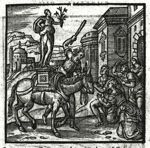
Non tibi sed religioni: Alciatus, Emblemata (Padua, 1621), col. 49 a, emblem 7
Non tibi sed religioni: Alciatus, Emblemata (Leiden, 1591), emblem 7
Iconclass: 12B212 sacrifice ~ non-Christian religions 33A2 taking leave 51F3 Priority, Pre-eminence
Loci Communes: Perficiendi sive absolvendi (Finishing, completing, Achever, accomplir)
II i 49 Ex uno multa facere To make many things out of one
Εξ ἑνὸς πολλὰ ποιεῖσθαι, id est, Exuno multa facere, proverbio dicebantur, qui rem quampiam minutim secabant. Quadrabit in eos qui idem aliis, atque aliis modis variant: ut non iam unum, sed plura videantur. Plato in Menone: Καὶ παῦε πολλὰ ποιῶν ἐκ τοῦ ἑνὸς, ὅπερ φασὶ τοὺς συντρίβοντάς τι ἑκάστοτε οἱ σκώπτοντες. id est, Ac parce ex uno plura facere, quo dicto taxant eos, qui rem quampiam undecumque comminuunt. Narratur apud Titum Livium belli Macedonici lib. v. non illepida fabula de caupone quodam, qui suis unius carnes tam vario coctas apparatu proponebat, ut dux Romanus, admiratus, rogaret, unde nam media bruma suppeteret tanta venatus copia. Tum arridens caupo, confessus est; eas omnes ciborum species ex uno sue domestico confectas fuisse. Neque secus isti faciunt, inquit, qui commemorandis variis, et horrendis nominibus, von territant, cum haec omnia una gens sit.
Ἐξ ἑνός πολλὰ ποιεῖσθαι, To make many things out of one. People were proverbially said to do this who divided anything into small pieces. It will be suitable for those who present the same material in so many different ways that it seems no longer a unity but several different things. Plato in the Meno: 'And stop making many things out of one, as people say when they criticize those who divide something from every possible aspect.' Livy in the fifth book of his Macedonian War tells an agreeable story of an innkeeper, who kept on serving up the meat of one pig, done with so many different trimmings that the Roman general was astonished, and asked him how on earth he could secure such a supply of game in midwinter. The innkeeper laughed, and confessed that all his separate dishes had been made out of one domestic pig. 'And that is just what these men do,' he said, 'who frighten you by reciting all these formidable names, when it is all just one tribe.'
Facsimile:
Iconclass: 47C3 dividing (industrial process) 51BB61 Singularity, Uniqueness 51H3 Multitude
Loci Communes: Arrogantia jactantiaque (Arrogance and boastfulness, Arrogance et vantardise)
II i 50 Jovis Corinthus Corinthus son of Jove
Οδιὸς κόρινθος. i. Iovis filius Corinthus. In eos dici solitum, qui semper eadem aut dicunt aut faciunt, Pindarus in Nemeis hymno vii.: Ταῦτα δὲ τρὶς τετράκις τ᾽ ἀμπολεῖν, ἀπορία τελέθει τέκνοιον ἁτε μαψυλάκας διὸς κόρινθος. Negat se velle iterum atque iterum eadem iterare: perinde, quasi pueris nugas narraret διὸς κόρινθος. Nam μαψυλάκας eum significat, qui frustra nugas effutit. Interpres hoc loco fabulam affert, ad proverbium hoc, meo quidem animo, non multum pertinentem, tamen adscribam. Aletes, inquit, consuluit Dodonaeum oraculum, quod tum Iovis erat, num Corinthiorum imperio potiri posset. Responsum est, tum illum potiturum, cum quispia illi glebam daret, aut ruder, idque die multarum coronarum: nam id addidit. itaque Corinthum profectus penem ab rustico quopiam petiit, is gle bam porrexit. Sensit ille iam perfectum oraculum, animumque ad capessendum imperium adiecit. Parentabatur co die manibus, eamque ob causam, cum pletaque civitas in monumentis abesset, accedens, reperit Creontis silias iam paciscentes de imperio. Harum natu minimae persuadet, si velit adiurare, se simul atque principatum esser consecutus illam ducturum uxorem. Illa in petii cupiditate prodit civitatem, ac portis apertis, Aletem admittit. Is itaque victor, Iovis Corinthum eam appellat, quod ex Iovis oraculo contigisset. Deinde subtexit aliam fabulam, cum aliorum in terpretamenro fere convenientem. Ea est huiusmodi: Olim Megarenses Corinthiis erant vectigales. Ceterum, cum iliorum imperium insolentius gravatim ferrent, ac defectionem pararent, missus est legatus Cotinthiorum nomine, qui apud plebem Megarensem cum alia multa ferociter dixit, tum illud indignabundus, ac vociferans intonuit, Οὐκ ἀνέξεται ὁ διὸς κόρινθος. id est, Non feret Iovius filius Corinthus. Id ubi saepius iteraret, concitatus populus, succlamare coepit, Feri feri Iovis Corinthum, simulque legatum expulerunt. Erat autem Corinthus hic Corinthiorum rex, Iove prognatus: tam etsi Pausanias in Corinthiacis negat se apud auctores serios reperisse, Corinthum lovis fuisse filium: sed vulgus duntaxat Corinthiorum ita praedicare. Usurpat adagium Plutarchus in commentario, quem in scripsit adversus Stoicos: Πολὺς οὖν διὸς κόρινθηος ἐπὶ τὸν λόγον αὐτῶν ἀφιᾶται, τὴν γὰρ ὑπέρου περιτροπὴν ἵνα μὴ σκώπτειν δοκῆς, ἔασον. i. Multus igitur lovis Corinthus ad orationem illorum admittirur. Nam pistilli circumvolutionem, ne mordere videaris, omitte. Aristophanes in Ranis: Τουτὶ τί ἦν πρᾶγμα Αλλ᾽ ἢ διὸς κόρινθος ἐν τοῖς στρώμασι; id est: Quid aliud haec eratres, Nisi Iovis Corinthus in ipsis stragulis? Verba sunt ministri, Bacchi ταυτολογίαν notantis, qui dixerat: Αἴροις ἂν αὖθις αὖγε τὰ στρώματα. id est, Haec rursus iterum, tolle minister stromata. Idem in Concionatricibus: Οτε δὴ ἀνασκοπουμέναις ἐφαίνετο Ο διὸς κόρινθος. id est: Ubi denuo considerantibus, Iovis Apparuit Corinthus. Philostratus in Antipatro Sophista: Ωθούντων δὲ αὐτὸν τῶν συγγενῶν ἐς τὸν γάμον, καὶ διὸς κόρινθον ἡγουμένων τὸν ἀντίπατρον. i. Impellentibus autem illum cognatis ad nuptias, & Iovis Corinthum existimantibus Antipatrum. Quanquam hic Iovis Corinthum usurpasse videtur pro homine magnopere felici. Usurpat hoc adagium et Socrates apud Platonem in Euthydemo: Αλλ᾽ ἀτεχνῶς, τὸ λεγόμενον, ὁ διὸς κόρινθος γίγνεται. i. Sed prorsus id quod dici solet, Iovis Corinthus fit. Convenit cum illo, quod alibi retulimus, δὶς κράμβη. id est, Bis crambe. Neque solum uti licebit, cum eadem iterum atque iterum dicuntur, verumetiam cum in eodem negocio nimium assidue persistitur. Veluti si quis cibum semper eundem apponat: aut si quis semper studiis literariis incumbat, aut assidue venetur, ut hinc iam oboriatur ex assiduitate satietas, recte dicemus, ὁ διὸς κόρινθος. Molestum est enim, quidquid perpetuum: vel Pindaro teste in Nemeis, Αλλὰ γὰρ ἀνάπαυσις ἐν παντὶ γλυκεῖα έργῳ. κόρον δὲ ἔχει καὶ μέλη καὶ τὰ ττέρπν᾽ ἄνθ᾽ ἀφροδίσια. id est, Verum enim vero intermissio in omni negocio iucunda. Accipiunt autem satietatem & cantilenae & amoeni flosculi Venerei. In nonnullis exemplaribus pro μέλη, scriptum erat μέλι. Sic in epigrammate: Πᾶν τὸ περιττὸν ἄκαιρον, ἐπεὶ λόγος ἐστὶ παλαιὸς Ως καὶ τοῦ μέλιτος τὸ πλέον ἐστὶ χολή. id est: Insuave est, quidquid nimium est. Nam dicitur olim, Mel quoque, si immodica est copiae, bilis erit. Illud admonitu non inutile est, proverbium ifariam accipi posse. Nam & hoc ostendit interpres Pindari, vel cum eadem iterantur saepius, vel cum ii, qui initio magnifice loquuntur, minanturque ferociter, post ea timide fugiunt: id quod evenit legatis Corinthiorum, qui, cum saepius illud intonuissent in concione: Δικαίως στενάξει ὁ διὸς κόρινθος, εἰ μὴ λάβοιτο δικας παρ᾽ ὑμῶν. i. Merito suspirabit Iovis Corinthus, nisi poenas sumpserit de vobis: postea, cum ad manus esset ventum, ignaviter aufugerunt. Nec illud praetereundum, adagionem accommodari posse, tum ad rem, tum ad personam. Ad rem hoc pacto. Iam millies audivi, non possum diutius ferre τὸν διὸς κόρινθον. Ad personas: ut, si quis hominem, eadem semper inculcantem, τὸν διὸς κόρινθον appellet. Indicat & hoc interpres Pindari.
Ὁ Διὸς Κόρινθος, Corinthus son of Jove, used to be directed at those who always say or do the same things. Pindar in the seventh hymn of his Nemeans, in the words 'But to go over this thrice and four times shows a poverty of spirit, like one who chatters to children again and again of Corinthus son of Jove,' makes it clear that he does not wish to repeat the same thing over and over again, like a man telling children a silly story about Corinthus son of Jove. For mapsulakas, the word he uses for chattering, means one who talks idly and to no purpose. The scholiast on this passage produces a story which is not very relevant, in my opinion, but I will repeat it none the less. Aletes asked the oracle of Dodona, which then belonged to Jove, whether he could make himself master of Corinth. The reply was that he would be successful, if anyone were to give him a piece of turf or clod of earth; but it must be on a day of many garlands, for that was an added condition. So he set out for Corinth; and when he asked some countryman for a loaf bread, the man gave him a turf. Realising that the oracle was now fulfilled, he concentrated on achieving control of the city. It was a day when offerings were made to the dead, and so when he arrived most of the citizens had gone out to the tombs. He found Creon's daughters already bargaining about the monarchy, and promised the youngest of them, if she were willing to assist him, that as soon as he secured the mastery he would make her his wife. Being eager for power, she betrayed the city, opened the gates and let Aletes in. Having won the day, he called it Jove's Corinth, because it had fallen to him as a result of Jove's oracle. He then adds another story, which agrees more or less with the explanation given by others. It runs as follows. The people of Megara in early times had to pay tribute to the Corinthians. However, their rule was oppressive and much resented by the Megarians, and they were preparing to rebel, when an envoy arrived from the Corinthians, who made a very savage speech at a public assembly in Megara and thundered out at the top of his voice in a great passion 'Corinthus son of Jove will not stand this.' As he kept on doing this, the mob were furious and there were shouts of 'Down, down with Corinthus son of Jove!' And they drove the envoy out forthwith.
This Corinthus was a king of Corinth, who was descended from Jove. It is true that Pausanias in his account of Corinth says he has found no authority for making Corinthus a son of Jove; but that anyhow public opinion in Corinth maintains he was. Plutarch uses the adage in the essay which he entitles 'Against the Stoics:' 'Corinthus son of Jove is always coming into their conversation; but say nothing of the twirling pestle, for fear you seem to get your teeth into them.' Aristophanes in the Frogs: 'What can this be? / Jove's son Corinthus in the blanketry?' This is the slave speaking, who criticizes Bacchus for repeating himself, he having just said 'Again, again pick up the blankets, boy.' And in the Ecclesiazusae: 'When, as they looked, again appeared Corinthus son of Jove.' Philostratus in his life of Antipater the sophist: 'When his kinsman tried to force him into the marriage, and regarded Antipater as Corinthus son of Jove.' Though in this passage he seems to have used Corinthus son of Jove for a man of great wealth. Socrates also uses this adage in Plato's Euthydemus: 'But it is clearly a case of Corinthus son of Jove, as the saying goes.' This is close to an adage I have recorded elsewhere, Twice-served cabbage.
Nor will its use be confined to occasions when the same thing is said over and over again; there are also times when people persist too long in the same activity without a break: when, for example, a man always serves the same food, or always sits bowed over his books, or hunts continually, so that he is already beginning to sicken from the sameness of it, we shall rightly use the phrase Corinthus son of Jove. For anything that goes on for ever becomes tedious, as Pindar for one bears witness in the Nemeans: 'But in all that men do, repose is sweet. In music lies satiety, and in the delightful flowers of love.' Some texts read meli, honey for melê, music. So it is in the epigram: Too much is always wrong: 'tis an old saying, / E'en honey to excess sets the bile flowing.'
I think it may be useful to point out that the proverb can be taken in two different senses; for this too is made clear by the scholiast on Pindar. One is, when the same thing is repeated too often. The other when those who start by talking very big and threatening ferociously run away later in cowardly fashion, like the Corinthian envoys, who after so often thundering out 'Corinthus son of Jove will rightly be ashamed of himself if he does not make you pay the penalty for this,' later on, when they came to grips, turned tail and fled. Nor should we fail to notice that the adage can be adapted equally to both things and persons. To things in this way: I've now heard that a thousand times: I cannot stand any longer this Corinthus son of Jove;' to persons if, for example, one were to call a man who is always harping on the same theme, Corinthus son of Jove. This too is pointed out by the scholiast on Pindar.
Facsimile: 

Iconclass: 42B7411 father and son(s) (family group) 51B61 Repetition 52D4 Prolixity, Verbosity, Loquacity; 'Loquacità' (Ripa) 56BB31 Boredom 61E(CORINTH) names of cities and villages (CORINTH) 92B19 (story of) Jupiter (Zeus) - offspring, companion(s), train etc.
Collectanea (1500): 730
Loci Communes: Taedium ex iteratione (Tedium from repetition, Lassitude due à la répétition)
II i 51 Testulae transmutatio The turning of the potsherd
Οστράκου περιστροφή, id est, Testulae conversio. De rebus repente in diversum commutatis. Lucianus in Apologia, περὶ τῶν ἐπὶ μισθῶ συνόντων. Επειτα πάντων ἐκλαθόμενος ὀστράκου φασί μεταπεσόντος, ἐκὼν ἑαυτὸν φέρων εἰς δουλείαν οὕτω περιφανῆ καὶ περίβλεπτον ἐνῆκε. id est, Deinde oblitus omnium, testula, ut aiunt, transmutata, volens ipse semet in servitutem usqueadeo manifestariam & insignem coniecit. Incertum utrum sumpta sit metaphora à ludi genere quodam, quem ostracinda Graeci vocant. (Hunc innuit Plato in amatoriis, nepe in Phaedro: Φυγὰς δὴ, inquit, γίγνεται ἐκ τούτων, καὶ ἀποστερηκως ὑπ᾽ ἀνάγκης ὁ πρὶν ἐραστης μεταπεσόντος ἴεται φυγῇ μεταβαλών. ὁ δὲ ἀναγκάζεται διώκειν ἀγανακτῶν καὶ ἐπιθεάζων. id est, Tandem profugus fit ab his: & dum necessario privatus est is, qui prius erat amator, testula in diversum versa, fuga se proripit immutatus. At ille cogitur insequi, indignans, deosque; obtestans.) An ab Ostracismo suffragiorum genere quodam, quod per calculos, ac fabas ferebatur: in hoc repertum, ut per id cives, qui vel opibus immodicis, vel nobilitate, vel gloria, vel alia quavis insigni virtute multitudinis invidiam in se provocassent, in exsulium decenne relegarentur. Hoc pacto fuit eiectus et Aristides: non aliam ob sausam, nisi quod molestum esset populo, iusti cognomen illi vulgo tributum. Ferebatur autem ostracismus ad hunc modum. Ostraci, id est, testulae viritim in comitiis dabantur. In eis, quem quisque vellet urbe cedere, literis inscriptis indicabat: hos deinde omnes in fori locum quendam cancellis circumseptum deportabant: porro magistratus, quibus hoc datum erat negotii, primum universos recensebant, qui nisi plures sex milibus fuissent, nihil consiciebatur. Deinde, semotis uniuscuiusque calculis, is, qui pluribus calculis damnatus erat, ad decennium in exsulium ire iubebatur: ita tamen, ut illi liberum interim esset fructus suos accipere. Erat itaque ostracismus non improbitatis castigatio, sed vulgaribus animi insitae invidiae placatio. Antiquatus est autem hic ostracismus, eiecto per hunc Hyperbolo quopiam homine contempro, atque humili. Huiusmodi ferme referuntur a Plutarcho in vita Aristidis. Ab hoc igitur ostracismo, quoniam magna vulgi licentia, ac temeritate peragebatur, ac repente praestantissimi cuiusque civis fortunam commutabat, non absurde videri potest ductum adagium. De lusu ostracorum Iulius Pollux in hunc fere modum tradit. Pueri, ducta in medio linea, duas in partes sese distribuebant, quarum. altera intra ostracum, altera extra dicebatur. Deinde, mittente quopiam ad lineam testam, utrius partis superior exstitisset aliquis, hunc insequebantur, qui illi adhaerebant, reliquis in fugam conversis. Ceterum e fugientibus qui comprehensus esset, is considebat, asinus dictus testaque proiecta dicebat, Nox dies. Nam interior testae pars pice sublita erat, quae nocti respondebat. Hoc autem lusus genus appellabatur ὀστράκου περιστροφή, id est, Testae conversio. Plato lib. De repub. vii. videtur ad lusus genus referre, quum ita loquitur: τοῦτο δὴ ὡς ἔοικεν οὐκ ὀστράκου ἂν εἴη περιστροφὴ, ἀλλὰ ψυχῆς περιαγωγὴ ἐκ νυκτερινῆς τινὸς ἡμέρας εἰς ἀληθινὴν τοῦ ὄντος ἰούσας ἐπάνοδον, id est, Istuc sanè ut videtur non fuerit testae conversio, sed mentis circumductio, ex nocturno quodam die ad eius, quod vere est ascensum euntis. Agit de philosophia, quae à falsis honorum simulacris educit animum ad verorum bonorum cognitionem.
Ὀστράκου περιστροφή, The turning of a potsherd. Of things changed suddenly into their opposites. Lucian in his defence of the Salaried Posts in Great Houses: Then he forgot everything, and in the turning of a potsherd, as the saying goes, he willingly subjected himself to such an evident and conspicuous form of slavery.' It is uncertain whether the image is taken from a kind of game which in Greek is called ostracinda. This is hinted at by Plato in his amatory dialogues, in fact in the Phaedrus: 'At length' he says 'he makes his escape from this, and becoming of necessity a defaulter, he who was formerly a lover changes in the turning of the potsherd and runs away; while the other one is obliged to follow him, indignant and protesting.' Or it may be taken from ostracism, which was a kind of voting registered by pebbles and beans, invented for the purpose of sending into exile for ten years any citizens who had become unpopular with the mob by excessive wealth or high birth or reputation or distinction of any other kind. This is how Aristides too was driven out, for no better reason than that the mob was tired of hearing him commonly called 'Aristides the just.'
The method of conducting an ostracism was as follows. An ostracon, which means a piece of broken pot, was given to every individual in the assembly. On these each of them wrote down the name of the man he wished to leave the city, and they were then all taken to a particular part of the market-place which was railed off. There the magistrates who were entrusted with this duty first of all counted them; and unless there were more than six thousand, the matter went no farther. Next they separated the votes given against each individual, and the man who had the most votes against him was ordered to go into exile for ten years, with permission however to receive his income during that period. Thus ostracism was not a punishment for criminal behaviour, but a means of satisfying the envy which is a natural feature of ignoble minds. This practice of ostracism was done away with after it had been used to get rid of a mean and contemptible wretch by name of Hyperbolus. Such is more or less the account given by Plutarch in his life of Aristides. And so, since ostracism of this kind was inflicted by the uncontrolled and hasty prejudices of the mob, and overturned in a moment the position of the most distinguished citizens, there is nothing absurd in taking it to be the origin of the adage.
The game played with ostraca is described by Julius Pollux much as follows. The children divided themselves into two groups on either side of a drawn line, one group being called 'inside the potsherd' and the other 'outside.' Someone then put a potsherd on the line, and whoever proved successful was followed by all those who belonged to his side, and the other side had to run away. But if any one of them was caught as he ran, he sat down and was called 'Donkey,' and when the potsherd was thrown he said 'Night and day;' for the inner surface of it was smeared with pitch, corresponding to night. This form of game was called 'turning the potsherd.' Plato in book 7 of the Republic seems to refer to this sort of game when he writes: 'This would not, it seems, be the turning of a potsherd, but a conversion of the mind as it passes from some kind of nocturnal daylight to the ascent towards true being.' He is thinking of the way philosophy raises the mind from false images of good things to the knowledge of those that are really good.
Facsimile:
Iconclass: 31A27481 turning something, (causing) circular movement 41A773 container of ceramics: jar, jug, pot, vase 44C23 voting, election 47F9(+431) loss, damage, destruction of products (+ ceramics ~ crafts, industries, agriculture) 51HH1 Part, Section, Aspect 51K2 Mutability; 'Immutatione' (Ripa)
Loci Communes: Fortunae commutatio (Change of fortune, Changement de fortune)
II i 52 Alterum pedem in cymba Charontis habere To have one foot in Charon's boat
Extremae, decrepitaeque senectae homines, etiam hodie vulgo dicuntur alterum pedem in sepulchro habere. Nec hinc abhorrent, quae scribit Lucianus in apologia: Πρὸς αὐτῷ δὲ ἠδη τῷ αἰακῷ γενόμενον, καὶ μονονουχὶ τὸν ἔτερον πόδα ἐν τῷ πορθμείῳ ἔχοντα. id est, Qui iam sit Aeaco ipsi vicinus, quique iam tantum non alterum pedem in cymba Charontis habeat. Idem in Sectis, Καὶ τὸν ἔτερον πόδα φασὶν, ἐν τῇ σορῷ ἔχων. id est, Et alterum pede, ut aiunt, in tumulo habens. Pompoponius libro Pandectarum xl. titulo de fideicommis. libert. cap. Apud Iu lianum, dixit his verbis: Ego discendi cupiditate, quam solam vivendi rationem optimam, in octavum et septuagesimum annum aetatis duxi, memor sum huius sententiae, quam dixisse fertur Iulianus: Etsi alterum pedem in sepulcro haberem, adhuc addiscere quaedam vellem. Haud scio an huc pertineat, quod Lucianus scribit in Votis: ὅς γε δὴ ἐν τῇ νηὶ ἕτερον ποδα ἔχει. id est. Qui quidem iam alterum pedem habeat in navi. Plutarchus in commen tariolo De puerorum institutione, notat, senes vulgato convicio vocari solere κρονολήρους καὶ βροδαὶμονας, quod iam aetate desiperent, & fossae confines essent, magisque bustuariae larvae, quàm homines. Plautus Acherontium senem dixit. Terentius Silicernium. Et capularem dixit nescio quis. Graeci τυμβογέροντας vocant, auctoribus Hesychio & Suida, ac πεμπέλους, extremae aetatis homines: illos, quod tumulo sunt proximi, hos quod brevi mittendi sint ad inferos, παρὰ τὸ πέμπειν, quod est mittere, & ἕλος palus, quod qui moriuntur crederentur per Stygiam paludem transmitti ad inferos.
Men in the decrepit stage of extreme old age are said commonly even in our own day to have one foot in the grave. Nor is there much difference between this and Lucian's words in his Apologia: 'Already close to Aeacus himself and with one foot almost in Charon's boat.' Again in The Sects: 'And with one foot almost in the grave, as the saying is.' Pomponius in the Pandects, book 40, title De fidei commissariis libertatibus, chapter Apud Julianum, uses these words: 'Personally, from the desire to learn, which alone is the best principle for the good life and which I have maintained down to my seventy-eighth year, I have never forgotten that remark attributed to Julianus, "Though I had one foot in the grave, I should still want to learn something new."' There is something in Lucian's Wishes which I rather think is relevant here: 'Who already has one foot in the boat.' Plutarch in his brief essay 'On the Education of Children' observes that it is a common criticism of the aged to call them 'old dotards' and 'candidates for the coffin,' because they are already foolish from old age and on the edge of the tomb, and more like ghosts from the grave than human beings. Plautus calls an old man 'ripe for Acheron/ Terence 'a Silicernian/ someone (I forget who) 'a coffinworthy.' In Greek, according to Hesychius and Suidas, men of very advanced age are called tymbogerontes and pempeloi: the first word meaning that they are on the edge of the tomb, and the second derived from pempein, to send, and helos, a marsh, because it was thought that the dead on their way to the Lower World had to pass by ferry across the marshes of the Styx.
Facsimile: 
De Morte & Amore: Alciatus, Emblemata (Padua, 1621), col. 660 a, emblem 155
Iconclass: 31D160 Old Age, 'Senectus'; 'Vecchiezza' (Ripa) 46C1112(+621) ferry (+ getting in; mounting; embarkation) 46C232(+621) rowing-boat, canoe, etc. (+ getting in; mounting; embarkation) 93E3(+7) Charon, the ferryman (+ specific aspects, allegorical aspects)
Loci Communes: Fortunae commutatio (Change of fortune, Changement de fortune); Longae vitae (A long life, Longue vie)
II i 53 Cavam Arabiam serere To sow the hollows of Arabia
Τὴν κοίλην ἀραβίην σπείρειν, id est, Cavam Arabiam serere. Pro frustra sudare, aut in re perdifficili, nec admodum frugifera operam sumere. Lucianus in Apologia: Ως τὴν κοίνην ἀραβίην σπείρειν ἐπιχειρεῖν, id est, ut cavam Arabiam serere aggrediatur Significat autem palustrem Arabiae partem, neutiquam idoneam sementi. Plutarchus περὶ τῆς ἀδολεσχίας. Τῶν μὲν γὰρ πρὸς τὰς ἀσίας εὐκαταφόρων ἄγονον εἶναι τὸ σπέρμα λέγουσιν. τῶν δὲ ἀδολέσχων ὁ λόγος ἀτελὴς καὶ ἀκαρπός ἐστι. id est, Aiunt enim sterilem esse sationem hun ilium Asiae regionum: at loquaculorum ipsa oratio inutilis est, atque infrugifera.
Τὴν κοίλην Ἀραβίην σπείρειν, To sow the hollows of Arabia, for To toil in vain, or to waste effort on something very difficult and not particularly rewarding. Lucian in his Apologia: 'So that they must try to sow the hollows of Arabia,' by which he means the marshy part of Arabia, which is most unsuitable for sowing seed. Plutarch, 'On Garrulity:' 'For they say that seed sown in the low-lying parts of Asia does not germinate, and the conversation of talkative people comes to nothing and is fruitless.'
Facsimile:
Iconclass: 25H191 swamp, inland marsh, fens 47I131 sowing 58AA3 Unproductiveness, Fruitlessness, Lost Labour, Wasted Labour 61D(ARABIA) geographical names of countries, regions, mountains, rivers, etc. (ARABIA) (ARABIA)
Loci Communes: Inanis opera (Vain effort, Effort vain)
II i 54 Lynceo perspicacior More clear-sighted than Lynceus
Lyncei perspicacitas in proverbium abiit. Plinius naturalis historiae lib. ii. cap. xvii. Novissimam, inquit, lunam, primamque eadem die vel nocte, nullo alio in signo, quam in ariete conspici, id quod paucis mortalium contingit. Et inde fabula cernendi Lynceo. Sunt, qui tradunt, Lynceum primum reperisse fodinas metallorum, aeris, argenti, auri. Et hinc vulgo natam fabulam, quod ea quoque videret, quae sub terra forent. Testis Lycophronis interpres. Meminit huius et Plato in epistola quadam. Aristophanes in Pluto: Βλέπειν τ᾽ ἀποδείξω σ᾽ ὀξύτερον τοῦ λυγκέως. id est: Faxo, ut videas vel Lynceo ipso acutius. Lucianus in Hermotimo: Σὺ δὲ ὑπὲρ τὸν λυγκέα ὑμῖν δέδορκας, καὶ ὁρᾷς τὰ ἔνδον ὡς ἔοικε διὰ τοῦ στέρνου. id est, Tu vero nobis ipso etiam Lynceo perspicacior es, qui, sicuti videtur, per pectus ipsum, qsunt mtus cernis. Idem in Icaromemippo: Πῶς νῦν καθάπερ λυγκεύς τις ἄφνω γένομενος ἅπαντα διαγινώσκεις; id est, Quî nunc repente quasi Lynceus quidam effectus, cuncta discernis? Horatius in prima epistola ad Mecoenatem: Non oculo quantum contendere Lynceus, Non tamen idcirco contemnas lipus inungi. Marcus Tullius M. Varroni: Quis est tam Lynceus, qui in tantis tenebris nihil offendat, nusquam incurrat? Apollonius in Argonauticis scribiut hunc Lynceum usque adeo fuisse perspicacem, ut etiam terram ipsam oculorum acie penetraret, quaeque apud inferos fierent, pervideret: Λυγκεὺς δὲ, καὶ ὀξυτάτοις ἐκέκαστο Ομμασιν, εἰ ἔτεόν γε πέλει κλέος ἀνέρα κεῖνον Ρηϊδίως καὶ νέρθε κατα χθονὸς αὐγάζεσθαι. id est, At miro visus pollebat acumine Lynceus, St modo vera est fama, virum quae praedicat illum, Perfacile inspexisse sub altis condita terris. Plutarchus in commentario, quem scripsit adversus Stoicos, testatur, famam fuisse de Lynceo, quia saxa quoque, et arbores oculorum acie penetraret. Pausanias in Corinthiacis tradit Lynceum, Danao vita defuncto, regni successionem suscepisse. Pindarus in Nemeis hymno decimo, meminit Lyncei qui ex Taygeto monte viderit Castorem & Pollucem sub quercus trunco latitantem, et horum alterum iaculo vulnerasse. Pindari interpres citat historiam rerum Cypriarum, Aristarchum & Didymum
Lynceus' piercing sight was proverbial. Pliny in the Natural History, book 2 chapter 17: 'That the last of the old moon and the new moon can be both seen on the same day or in the same night, in Aries the Ram and in no other sign; and few mortals have this gift. Hence the fable of Lynceus and his eyesight.' Some say that Lynceus was the first man who discovered mines for metals, copper silver and gold, and that this was the origin of the widespread myth that he could even see things underground. The scholiast on Lycophron is a witness to this, and Plato mentions it in one of his Letters. Aristophanes in the Plutus: 'I'll make you see clearer than Lynceus' self.' Lucian in the Hermotimus: 'But you seem to us more clearsighted than Lynceus, for apparently you can pierce the breast and see what is within.' And again in the Icaromenippus: 'How have you now suddenly become a second Lynceus, able to see everything? Horace in his first Epistle to Maecenas: 'You may not see as clear as Lynceus could, / Yet for sore eyes a salve you'd not refuse.' Cicero writing to Marcus Varro: 'Who is such a Lynceus that in such great darkness he never stumbles, never runs into anything?' Apollonius writes in the Argonautica that this man Lynceus was so clear-sighted that his gaze could pierce the earth itself and watch what was going on in the Nether Regions:
Lynceus, whose eyes most piercing were of all,
If fame speaks true, which says that easily
E'en things hid deep in earth he could espy.
Plutarch in the essay which he called 'Against the Stoics' assures us that Lynceus had the reputation of being able to see even through rocks and trees, his sight was so penetrating. Pausanias in his account of Corinth records that Lynceus succeeded to the throne after the death of Danaus. Pindar in the tenth hymn of his Nemeans mentions Lynceus who, he says, from Mount Taygetus could see Castor and Pollux lying hid under the trunk of an oak, and wounded one of them with a javelin. The scholiast on Pindar cites the History of Cyprus, Aristarchus and Didymus.
Facsimile:
Iconclass: 31A31 sight, looking (one of the five senses) 31A4115(+0) far-sightedness (+ variant) 98B(LYNCEUS) male persons from classical history (LYNCEUS)
Loci Communes: Perspicacitas (Perspicacity, Perspicacité)
II i 55 Quod in animo sobrii, id est in lingua ebrii What is in the heart of a sober man is in the mouth of the drunkard
Τὸ ἐν τῇ καρδίᾳ τοῦ νήφοντος, ἐπὶ τῆς γλώττης ἐστὶ τοῦ μεθύοντος. id est, Quod in corde sobrii, id est, in lingua cbrii. Proverbialis sententia, quam refert in Collectaneis Diogenianus. Usurpat Plutarchus, idque proverbii nomine in libello, cui titulus περὶ ἀδολεσχίας. Nec praetereundum illud Herodoticum: Οἴνου κατίοντος, ἐπιπλόουσιν ἔπεα. id est, Subsidente vino, supernatant verba. Nam sobrios aut metus aut pudor cohibet, quo minus effutiant ea quae satius putarint suppressisse. At vinum et pudorem discurit, et timorem abigit. Unde fit, ut temulenti saepenumero non contineant voces periugulum redituras. Pindarus in Nemeis, θαρσαλέα δὲ παρὰ κρητῆρα φωνὰ γίνεται, id est, Audax iuxta craterem vox fit, sive quod vinum affert confidentiam, sive quod in convivio tutum est magnifice loqui; sive quod qui vicit, merito, citraque periculum laudatur.
Τὸ ἐν τῇ καρδίᾳ τοῦ νήφοντος ἐπὶ τῆς γλώττης ἐστὶ τοῦ μεθύοντος, What is in the heart of the sober man is in the mouth of the drunkard. A proverbial maxim, recorded in the collection of Diogenianus. Plutarch uses it, expressly as a proverb, in the essay called 'On Garrulity.' Nor should that thing in Herodotus be overlooked: 'Down goes the wine, up float the words.' For men while sober are restrained by fear or shame from blurting out things which they think it better to keep secret; but wine puts shame to flight and drives out fear, and the result is that men in their cups 'cannot suppress words which in the end will cut their throats.' Pindar in the Nemeans: 'And words wax brave over the mixingbowl,' either because wine brings with it confidence, or because boasting has no dangers at a drinking-party, or because he who has won a victory is praised deservedly and without risk.
Facsimile: 
Iconclass: 31B521 drunkard 31B59 sobriety; 'Sobrietà', 'Astinenza' (Ripa) 51AA4:54A42 Nothingness, Absence❧Restraint 52A6 Truth; 'Verità' (Ripa) 52D4 Prolixity, Verbosity, Loquacity; 'Loquacità' (Ripa) 54DD51 Danger; 'Pericolo' (Ripa)
Loci Communes: Bibacitas (Excessive drinking, Penchant pour la boisson); Garrulitas (Talkativeness, Bavardage)
II i 56 Virgultea scaphula Aegaeum transmittere To cross the Aegean in a wicker boat
Επὶ ῥιπὸς τὸν αἰγαῖον διαπλεῦσαι. id est, Virgulto Aegaeum transmittere. In eos dicitur, qui rem supra modum ardum levi opera conficere tentant, Lucianus in Sectis, Επὶ ῥιπὸς, ὡς ἡ παροιμία φησὶν, τὸν αἰγαῖον ἢ ἴονιον διαπλεῦσαι θέλοντας. id est, Virgulto, quemadmodum proverbio dicitur, Aegaeum aut Ionium mare transmittere cupientes. Citatur hic senarius à Suida. Extat autem apud Aristophanem in Pace, Κέρδους ἕκητι κᾂν ἐπὶ ῥιπὸς πλέοι. id est: Causa lucelli naviget & in vimine: Taxat Simonidem, tamquam lucri cupidiorem, quod ad quastum scriptitarit carmina. Porrò ῥίψ vimen est flexibile, aut ramus salignus, παρὰ τὸ ῥέπω, videlicet, quod inflectatur ob lentitudinem. Citatur & hic, Σὺν τῷ θεῷ πλῶν, κᾂν ἐπὶ ῥιπὸς πλέοι. id est: Quisquis secundo navigarit numine, Is vel saligno navigarit vimine. Exstat & hic inter sententias proverbiales, citatus item ab Aristophanis interprete: Θεοῦ θέλοντος κᾂν ἐπὶ ῥιπὸς πλέοις. id est: Deo favente, nautge vel vimine.
Ἐπὶ ῥιπὸς τὸν Αἰγαῖον διαπλεῦσαι, To cross the Aegean in a wicker [boat], is said of those who try to perform some exceptionally difficult task with little effort. Lucian in The Sects: 'Wishing to cross the Aegean or the Ionian sea in a wicker [boat], as the proverb has it.' The following iambic line is quoted by Suidas (it is to be found in the Peace of Aristophanes): 'For paltry gain he'd sail upon a mat.' He is criticizing Simonides for being too fond of money, because he used to write poetry for pay. The word used for wicker, rhips, means a flexible osier or branch of willow, and is connected with rhepo, I incline or bend, because being springy it bends easily. Another line is also quoted: 'Who sails with God could sail upon a mat.' And there is also one among the proverbial maxims, quoted in addition by the scholiast on Aristophanes: 'If God so please, you'll sail upon a mat/
Facsimile:
Iconclass: 25H23 sea (seascape) 46C2 traffic on the water 46C24:47G541 sailing-ship, sailing-boat❧reeds, rushes ~ building material 52AA511 Ridiculousness 52BB31 Improbability 61D(AEGEAN SEA) geographical names of countries, regions, mountains, rivers, etc. (AEGEAN SEA) (AEGEAN SEA)
Loci Communes: Absurda, indecora, seu praepostera (Absurd, unbecoming, or preposterous things, Choses absurdes, inconvenantes ou déplacées)
II i 57 Phoenice vivacior Living longer than the phoenix
Lucianus in Sectis, Ην μὴ φοίνικός ἔτη βιώῃ. id est. Ni phoenicis annos vixeris. De phoenicis vivacitare diximus alibi. Cuius etiam raritas proverbio fecit locum, Phoenice rarior: quale est illud: Coruo quoque ratior albo. Negant enim phoenicem esse nisi unicam, si qua fides scriptoribus.
Lucian in The Sects: Ἢν μὴ φοίνικος ἔτη βιώῃ, Unless you have lived as many years as a phoenix. On the longevity of the phoenix I have written elsewhere. Its rarity also gave rise to a proverb: As rare as the phoenix. Of the same type is the phrase As rare too as a white crow. For they say that the phoenix is unique, if one can believe what one reads.
Facsimile:
Iconclass: 25FF3(PHOENIX) fabulous animals ~ birds: phoenix 31D91 long life 51BB61 Singularity, Uniqueness
Loci Communes: Longae vitae (A long life, Longue vie)
II i 58 Cum plurimum laboraverimus, eodem in statu sumus Much hard work, and we're where we were
Lucianus in Sectis, καὶ κατα τοὺς παροιμιαζομένος πολλὰ μοχθήσαντες ὁμοίως ἐσμέν. id est. Ac, iuxta proverbium, cum multum laboraverimus, itidem ut antea sumus. De frustra laborantibus. Quod evenit iis, qui post diuturnum studium nihilo reperiuntur eruditiores, post longam negotiationem nihilo ditiores.
Lucian in The Sects: Καὶ, κατὰ τοὺς παροιμιαζομένους, πολλὰ μοχθήσαντες ὁμοίῳς ἐσμέν , as the proverb says, after much hard work, we're where we were. Of those who toil in vain. This happens to men who after prolonged study are no better educated than they were before, and no richer after a life spent in business.
Facsimile:
Iconclass: 51LL1 Rest, Immobility, Stasis 58AA3 Unproductiveness, Fruitlessness, Lost Labour, Wasted Labour
Loci Communes: Inanis opera (Vain effort, Effort vain)
II i 59 Aquam in mortario tundere To beat water in a mortar
Υδωρ ὑπέρῳ πλήττειν. id est. Aquam pistillo tundere. Lucianus in Sectis. Ωσπερ εἴτις ἐς ὅλμον ὕδωρ ἐγχέας ὑπέρῳ σιδηρῷ πλήττοι. id est, Tanquam si quis aquam in mortarium infusam ferreo pistillo tundat Quadrat in eos, qui laborant inaniter: liquidem aquam si quis vel aetatem contundat, nihil aliud erit quam aqua. Lucianus in eodem opere: Οὐκ εἰδὼς, ὅτι ἂν ἀποβάλῃ φασὶ τοὺς ὤμους πλήττων, ὕδωρ ὁμοίως τὸ ὕδωρ μένει. id est, Ignarus, quod, etiam si humeros, ut aiunt, verberando decutias, tamen aqua manet aqua. Suidas ad hunc effert modum: Αναπολεῖς τοὺς ὤμους ὕδωρ πίσσων, ὁμοίως ὕδωρ μένει. id est, Versas scapulas aquam pinsens, aqua tamen aeque aqua manet. Quantumvis doceas ὄνος λύρας, quantumlibet admoneas stupidum, sui similis esse pergit.
Ὕδωρ ὑπέρῳ πλήττειν, To pound water with a pestle. Lucian in The Sects: 'As if a man were to put water into a mortar and pound it with an iron pestle.' This suits those who labour to no purpose; for if a man were to pound water for a whole generation, it will never be anything but water. Lucian in the same work: 'Not knowing that even if you pound till your arms come off, as the saying is, the water will be water still.' Suidas expresses it in this way: 'Pound water till you put your shoulder out, all the same it will be water still.' You can teach a donkey to play the lyre as much as you like, and give a fool good advice to your heart's content, they go on just the same.
Facsimile:
Iconclass: 21D water (one of the four elements) 49G831(+0) pestle and mortar (+ variant) 51LL1 Rest, Immobility, Stasis 58AA3 Unproductiveness, Fruitlessness, Lost Labour, Wasted Labour
Loci Communes: Inanis opera (Vain effort, Effort vain)
II i 60 Gnomon et regula Set-square and right rule
Quod est in re quapiam praecipuum, & ad quod unum reliqua omnia conferuntur, regulam & gnomonem proverbio vocabant. Lucianus in Harmonide: Οτι τὸ κεφάλαιον ἀρετῆς ἁπάσης, ὁ γνώμων φασὶ καὶ ὁ ὀρθὸς κανὼν τῶν τοιούτων. id est, Quod est caput omnis virtutis, gnomon, ut aiunt, & recta regula. Idem in Scytha: Οὗτός σοι ἑλληνικὸς κανών, id est, Hic tibi Graecanica regula. Item in Sectis: Τουτονὶ κανόνα καὶ στάθμην ἀκριβῆ τοιούτων, id est, Hac regulam & amussim certissimam retum eiusmodi. Porrò ad regulam exaequant fabri structuram. Idem utuntur & gnomonibus. Constat autem gnomon è duabus lineis rectis, quas utrinque dimetiens dissecto quadrangulo constituit.
An outstanding feature of anything, the one standard by which everything else is judged, used to be called proverbially the set-square and right rule. Lucian in the Harmonides: 'Which is the summit of all excellence, the set-square, as they call it, and right rule of everything.' Again, in The Scythian: 'This, let me tell you, is the right rule in Greece.' Again, in The Sects: 'This right rule and accurate measuring-line for everything of the sort.' Craftsmen employ a straight-edge or right rule to true up their work, and they also use set-squares. A set-square has two straight sides, the connection of which forms the diagonal in a rectangle.
Facsimile:
Iconclass: 47D8(LEVEL) tools, aids, implements ~ crafts and industries (LEVEL) 47G6(PLUMB-LINE)(+0) tools and machines ~ building: plumb-line (+ variant) 49D3212 angle 49D5112 square (drawing-instrument) 52A52 Judgement, Discrimination; 'Giuditio' (Ripa) 58AA3 Unproductiveness, Fruitlessness, Lost Labour, Wasted Labour
II i 61 Caput The head
Eiusdem formae est, cum praecipuam negocii partem aut autorem rei, caput vocamus. Terentius in Adelphis, Te esse huic rei caput. Exempla tum apud Graecos scriptores, tum apud Latinos passim obvia sunt. Eundem in modum & Arcem dicimus rei cuiuspiam. Ari stoteles in praefatinoe Rhetoricorum ad Alexandrum, Ως ἀκρόπολίς ἐστι σωτηρίας. i. Quoniam incolumitatis arx est. ποντιανὸς apud Athenaeum lib. x. πάντων δεινῶν μητροπολιν εἶναι τὸν οἴνον. id est, Vinum omnium malorum metropolim esse dixit. Hinc oriri temulentiam, hinc insaniam, hinc debacchationes. Plato de legib. lib. primo, Κεφάλαιον δὴ παιδείης λέγεμεν τὴν ὀρθὴν τροφήν. id est, Caput eruditionis censemus rectam educationem. Plautus in Asinaria, Ego caput huic argento fui hodie reperiundo, Ego pes fui. Quin nec caput nec pes sermonis apparet. Idem in Captivis: Quod neque pes usquam, neque caput appareat. Aliter usurpant capitis vocabulum, cum indicant rem non singulatim explicari, sed in summa proponi. Sic Aeschines adversus Timarchum, ὡς δὲ ἐν κεφαλαίῳ εἰρῆσθαι. id est, ut in summa dicam. Idem in oratine περὶ τας παραπρεσβείας,, eodem sensu dixit, Διὰ κεφαλαίων. id est, per singula. Itidem Demosthenes in oratione περὶ τῶν ἐν χεῤῥονήσῳ. ἐν κεφαλαίῳ δὲ ἅ λέγω φράσας καταβῆναι βούλομαι. id est, Ubi in summa de quibus loquor, dixero, volo descendere. Rursus in oratione contra Zenothemin, τὸ μὲν οὖν πρᾶγμα ὑπερ οὗ τὴν ψῆφον οἴσετε, ὡς εἰπεῖν ἐν καφαλαίῳ, τιοῦτόν ἐστι. id est, Itaque negocium quidem de quo feretis suffragia, ut in summa dixerimus, sic habet.
It is an expression of the same type when we call the principal part of a piece of business or the person responsible for something the head. Terence in the Adelphoe: 'You are the head of this affair.' Examples can be found everywhere in both Greek and Latin authors. In the same way we speak of 'the citadel' of anything. Aristotle in the preface to the Rhetorica ad Alexandrum: 'that this is the citadel of salvation.' Pontianus in the tenth book of Athenaeus says that wine is 'the mother-city of all dreadful things,' for it is the source of intoxication, delirium and drunken rioting. Plato in book one of the Laws: 'We consider the head and chief of education to be sound nurture.' Plautus in the Asinaria: 'In finding this money to-day I've been the head. - And I the foot. - Head or foot, what you say is no sense at all.' And again in the Captivi: 'Something that makes no sense from head to foot.'
The word 'head' is used in another way, when people convey that they do not expound a subject in detail but give it summary treatment. Thus Aeschines Against Timarchus: To give only the heads of it.' Again in his speech on Misconduct on an Embassy he uses in the same sense To give the individual headings.' Demosthenes too in his speech On the Chersonese: 'Having given the heads of what I wish to say, I propose to sit down.' Again in the speech Against Zenothemis: 'Such is the subject, such at least the main heads of it, on which you will have to give your verdict.'
Facsimile: 
Iconclass: 31A221 head (human) 51H1 Totality, the Whole 54B5 Importance, Preponderance
Loci Communes: Perficiendi sive absolvendi - ab initio ad finem (Finishing, completing - from beginning to end, Achever, accomplir - du début à la fin)
II i 62 Somnium A dream
Rem futilem, inanem & nihili, somnium proverbio dicimus. Terentius in Adelphis: De argento somnium. Lucianus in Harmonide, Πάντα ἐκεῖνα ὑπηνέμια ὀνείρατά φασι, καὶ ἐπων σκιαί. id est, Omnia illa subventanea somnia, sicut aiunt, & verborum umbrae. Idem in dialogo Nirei & Thersitae & Menippi, ονείρατά μοι λέγεις. id est, Somnia mihi narras. Plato lib. de Rep. vii οὕτω ὕπερ ἡμῖν καὶ ὑμῖν ἡ πόλις οἰκήσεται, ἀλλ᾽ οὐκ ὄναρ.. id est, Atque ita vere nobis ac vobis civitas habitabitur, non autem somnium. Idem in Theaeteto, Ακουε δὴ ὄναρ ἀντὶ ὀνείρατος. id est, Audi iam somnium pro somnio, frivolam rationem pro frivola. Et Syrus servus in Adelphis, herum suum somnium vocat, prae Demea: Tu quantus quantus es, nihil nisi sapientia es: ille futilis, somnium. Plautus in Captivi duo, Hic vigilans somniat. Plato lib. De legibus iii somnia dixit, pro tenuibus veswtigiis. Quum enim narrasset Darium non fuisse regis filium, sed eruditione rectaque institutione sic ad regnum pervenisse, ut ipse in divisio ne principatus septimam modo portionem obtineret. οὗ καὶ νῦν ἔτι, inquit, σμικρὰ ὀνείρατα λέλειπται. id est, cuius rei nunc quoque exigua restant somnia.
Something baseless, empty and of no account we proverbially call A dream. Terence in the Adelphoe: The money was all a dream.' Lucian in the Harmonides: That was all windy dreams, as they say, mere shadows of words.' Lucian again in the dialogue between Nireus and Thersites and Menippus: 'What you tell me is a pack of dreams.' Plato in book 7 of the Republic: 'And thus our city and yours will be inhabited in waking life, not merely in a dream.' Again in the Theaetetus: 'Now let me give you one dream in exchange for another,' one frivolous argument for another. And Syrus, the slave in the Adelphoe, calls his master a dream compared with Demea: 'You're wisdom, every inch of you; he's useless, just a dream.' Plautus in the Captivi: This man dreams wide awake.' Plato in the third book of the Laws uses 'dreams' for the unsubstantial remains of something. After telling how Darius, though not of royal birth, owed his throne to his knowledge and sound education, on the footing that in the division of the royal power, he would secure only a seventh of it, he goes on: 'Of which some slight dreams remain even to this day.'
II i 63 Ne in tonstrinis Not even at the barber's
Lucianus in libello, cui titulus, quomodo conscribenda sit historia, Οὔτε τὸ λεγόμενον δὴ τοῦτο, ἐπὶ κουρείων τὰ τοιαῦτα μυθολογοῦντων ἀκούσας, id est, Qui nec in tonstrinis, quod dici solet, talia fabulantes audiverit. Quod in tonsorum officinis ferè ociosi desideant, & suam quisque fabulantes adferat in medium, unde Flaccus, Gaudent ubi vertice raso Garrula securi narrare pericula nauta. Item alibi, Opinor Omnibus & lippis notum & tonsoribus esse. Cuius alibi meminimus.
Lucian in the essay called How History should be written: 'Never having heard such stories told, not even (as they say) at the barber's,' because men with time on their hands tend to sit doing nothing in the barbers' shops, and they each contribute some story to the common stock. Hence Horace's 'Where with shaven poll / Sailors safe home long-winded perils tell,' and again in another passage: 'A tale, I guess, to every barber known, / And every blear-eyed lounger in the town.' This I have mentioned elsewhere.
Facsimile:
Iconclass: 31A535 barber, barbershop 33A341 story teller; listening to story teller 52D5 Rumour; 'Rumore' (Ripa)
Loci Communes: Garrulitas (Talkativeness, Bavardage)
II i 64 Numquid et Saul inter prophetas? Is Saul also among the prophets?
Libro Regum primo, capite decimo refertur huiusmodi proverbium [hebrew proverb] id est, Nunquid & Saul inter prophetas? Natum à Saule, qui cum in prophetarum coetum incidisset, subito & ipse divino furore correptus, vaticinari coepit, Id admirantes qui Saulem antea cognoverant, inter se dictitabant, Quid accidit Sauli, nun & Saul inter prophetas? Ea vox deinde versa est Hebraeis in proverbium de re nova & inopinata, subitaque. Est autem apud illos iambicus dimeter. Gregorius Nazianzenus in Apologia. De fuga sua in Pontum sic usurpat, ut quadrare videatur, ubi promiscue quilibet sibi magnificam aliquam functionem usurpant, velut hisce temporibus nemo non tractat sacras literas, ἀντι τοῦ, inquit, εἶναι διδακτοὺς θεοῦ, καὶ πάντων προφητεύοντων, ὥστε εἶναι καὶ σαούλ ἐν προφήταις, κατα τὴν παλαιὰν ἱστορίαν καὶ παροιμΐαν. id est, dum pro eo quod deberent esse dociles dei, propheomnes, adeo; ut Saul sit inter prophetas iuxta priscam historiam ac proverbium. Finitimum illi, Καὶ κόρχορος ἐν λαχάνοις, καὶ τὸ ἐν φακῇ μύρον. id est, Corchorus inter olera, & In lente unguentum, sive lenti admixtum unguentum.
In the first book of Kings, chapter 10, a proverb is recorded to this effect: 'Is Saul also among the prophets?' It started with Saul who, after falling in with a company of prophets, was himself suddenly seized with the divine frenzy and began to prophesy. This astonished those who had known him before, and one said to the other: 'What has happened to Saul? Is Saul also among the prophets?' This remark became proverbial among the Hebrews, used of anything new sudden and unexpected; in Hebrew it is a four-foot iambic line. Gregory of Nazianzus in his Defence of his taking refuge in Pontus uses it in a way that makes it seem suitable when any casual nobodies take upon themselves some very important task, as for instance in our own day, when everyone discusses the Holy Scriptures: 'Instead of learning, as they should, from God, they all prophecy, so that as it runs in the old story and in the proverb, Saul also is among the prophets.' It is close to 'Blue pimpernel too is a vegetable,' and to 'Perfume on the lentils.'
Facsimile:
Iconclass: 52BB3 Surprise, Wonder; 'Maraviglia' (Ripa) 71G11431 Saul prophesies with the prophets
Collectanea (1500): 456
Loci Communes: Dissimilitudinis et incongruentiae (Dissimilarity and incongruity, Dissemblance et incongruité)
II i 65 In foribus urceum The water-jar on the doorstep
Επὶ θύραις τὴν ὑδρίαν, id est, In foribus qualem. Nam hoc verbo usus est Plautus. Aristoreles lib. Rhetoricorum primo, Τὸ δὲ τέλος ἀγαθὸν, ὅθεν ταῦτα εἴρηται, καδδέκεν εὐ χωλὴν πριάμῳ. καὶ, αἰσχρόν τοι δῆρόν τε μένειν. καὶ ἡ παροιμϊα δὲ τὸ ἐπὶ θύρας τὴν ὑδρίαν. id est, Finis autem bonus, unde illa dicta sunt, Et laudem Priamo. Praeterea, Turpe diu mansisse. Iam vero proverbium etiam illud, Urceum iuxta fores. Interpres quispiam: nam librum ἀνώνυμον suppeditarat eruditissimus amicus noster Baptista Egnatius, ait significari rem contemptam, ac vilem. Negliguntur enim quae passim sunt obvia, quaeque facile quibuslibet contingunt. Itaque urceum in foribus positum nemo studet tollere, proclive enim. Verum uniones in scriniis reconditos magis expetunt. Plutarchus περὶ πολυφιλίας ait, rubum ultro haerentem negligi ac praeteriri, vineam, oleasque expeti: recensens hanc sententiam, Οὐ γὰρ αἱρετέον πάντων τὸ ῥᾳδίως ἁλισκόμενον. id est, Non est tollendum quod admodum facile consequi licet. Item in Epistolis Seneca, Multi aperta transeunt, condita, et abstrusa rimantur. Furem signata sollicitant. Vile videtur, quicquid patet, aperta effractarius praeterit. Hos mores habet populus, hos imperitissimus quisque, in secreta irrumpere cupit. Porro proverbium im perfectum ac mutilum videtur. Quando quidem Aristoteles ad eum modum pleraque refert, tamquam alioqui per se satis nota. Apparet esse hemistichium Iambici trimetri à Comico quopiam mutuo sumptum.
Ἐπὶ θύραις τὴν ὑδρίαν, The pitcher on the doorstep (this is Plautus' word). Aristotle in the first book of the Rhetorica: 'But the end is good. Hence those phrases "And praise for Priam" and "'Tis shame to wait so long," and the proverb "The water-jar on the doorstep".' Some commentator (I was provided with the book by my very learned friend Battista Egnazio, and it has no author's name) says that this means something despicable and worthless; for things are neglected which can be found everywhere and are easily accessible to all. Thus no one troubles to pick up a water-jar on his own doorstep - it is too easy; pearls stored safely in chests are more sought after. Plutarch in 'On having Many Friends' says that brambles which cling to one by nature are thought nothing of and passed by, while vineyards and olive-trees are coveted; he is reviewing the aphorism 'Choose not that which is very easily obtained.' Again, in Seneca's Letters: 'Many men pass over what is accessible, and search diligently for what is hidden and obscure. Padlocks attract the thief; what is open is thought worthless, the housebreaker overlooks what is exposed to view. This is typical of the multitude, and of the uneducated in general; they long to break into a secret.'
Apart from that, the proverb seems incomplete and mutilated; for Aristotle often reproduces things in that state, as though they were already well enough known from other sources. This is clearly half of an iambic trimeter, borrowed from some writer of comedy.
Facsimile: 
Iconclass: 41A325 threshold 41A773 container of ceramics: jar, jug, pot, vase 54BB6 Worthlessness
Loci Communes: Contemptus et vilitatis (Contempt and worthlessness, Mépris et bassesse)
II i 66 Haud quaquam difficile Atheniensem Athenis laudare To praise an Athenian in Athens is no problem
Aristoteles libro Rhetoricorum primo, Ωσπερ γὰρ ὁ Σοκράτης ἔλεγεν, οὐ χαλεπὸν ἀθηναίους ἐν ἀθήναις ἐπαινεῖν. id est, Quemadmodum enim dixit Socrates, haud difficile est, Athenienses Athenis laudare. Citat idem, eodem in opere, de prooenmiis agens, Haudquaquam esse difficile, Athenienses laudare apud Athenienses, verum apud Lacedaemonios id fore difficile. Extat autem in Menexeno Platonis, idque in adagionis locum cessit. Dictum est autem, propter encomia, orationesque panegyricas, quae Athenis ex more exhibebantur iis, qui fortiter oppetiissent in bello, in quibus quoniam plurima dicebantur in laudem populi Atheniensis, pronis auribus audiebantur: propterea quod suis quisque laudibus favet.
Aristotle in the first book of the Rhetoric. 'As Socrates used to say, to praise the Athenians in Athens is no problem.' He quotes it again in the same work where he is dealing with introductions: 'It is no problem' he says 'to praise the Athenians before an Athenian audience,' whereas it would be difficult before Spartans. The saying is to be found in Plato's Menexenus, and from there passed into common currency. The reason for it is the panegyrics and laudatory orations which were by custom delivered in Athens over those who had met a hero's death in battle. Containing as they did much that contributed to the glory of the Athenian people, these found a ready hearing; for everyone listens readily to his own praises.
II i 67 Exigua res est ipsa justitia Justice itself is nothing much
Aristoteles libro Rhetorices primo, Διὸ καὶ τὴν δικαιοσύνην φασὶ, μικρὸν εἶναι, id est, Unde etiam aiunt, ipsam iustitiam, exiguum quiddam esse. Quo proverbio significabant, non multum afferre momenti, si probus sis, nisi talis etiam habearis: & opinionem longe plus valere, quam rem ipsam. At quanto melius Aeschylus in tragoedia, cui titulus, ἑπτα ἐπὶ θήβαις, de Amphiarao, Οὐ γὰρ δοκεῖν ἄριστος ἀλλ᾽ εἶναι θέλει, βαθεῖαν αὔλακα διὰ φρενὸς καρπούμενος. id est, Neque enim videri, at esse vir cupit optimus, Mentis profundae segete perfruens bona. Rectius Socrates, admonens, ut talis quisque sit, qualis haberi velit. Modestius Euripides in Oreste, probans opinionem, ubi res ipsa non adest, tamquam optimo proximam, Κρεῖσσον δὲ τὸ δοκεῖν κᾂν ἀληθείας ἀπῇ. id est, Res ipsa utabsit, optima est opinio. Itidem Terentius in Adelphis: Si tibi istuc re ipsa non dolet, at simulare certe est hominis.
Aristotle in the first book of the Rhetoric: 'So even justice, as the saying goes, is nothing much.' What they meant to convey by the proverb was, that it does not make much difference if you are a virtuous man, unless you are also thought to be virtuous, and that opinion carries far more weight than fact. How much better Aeschylus puts it in the tragedy called Seven against Thebes, speaking about Amphiaraus: 'He wishes not to seem, but be, the best, / Reaping the harvest of a deep-ploughed heart.' Socrates gives better advice when he says that every man ought to be the sort of man he wishes to be taken for. And Euripides puts it more unambitiously in the Orestes, accepting reputation when reality is not accessible, as the next best thing: 'If truth be out of reach, seeming is best.' Terence in the same way in the Adelphoe: 'If it does not really pain you, at least it is a man's duty to feign.'
Facsimile:
Iconclass: 52C111 Public Opinion; 'Opinione' (Ripa) 54BB5 Unimportance 57B2 Respect, Reverence, Esteem 59B3 Repute, Renown; 'Splendore del nome' (Ripa) 59C2 Justice; 'Forza alla giustitia sottoposta', 'Giustitia', 'Giustitia retta', 'Giustitia rigorosa', 'Impietà e violenza soggetta alla giustitia' (Ripa)
II i 68 Occasione dumtaxat opus improbitati Rascals have all they need to save opportunity
Aristoteles lib. Rhetor. ii. Καὶ πρὸς οὕς ἔχουσι προσφασιν,ἢ προγόνων, ἢ αὐτῶν, ἢ φίλων,ἢ ποιησάντων καλως, ἢ μελησάντων, ἢ αὐτοὺς, ἢ προγόνος, ἢ ὧν κήδονται. ὥσπερ γὰρ παροιμία, προφάσεως δεεται μόνον ἡ πονηρία. id est, Aut adversus quos occasionem habent, sive progenitorum nomine, sive suo ipsorum, sive amicorum, sive eorum, a quibus beneficio fuerunt affecti, aut curae habiti ipsi, vel maiores ipsorum, vel eorum pro quibus solliciti sunt. Quemadmodum enim proverbio dicitur, Occasione duntaxat opus est malitae. Quadrabit in nocendi cupidos, qui ne temere laesisse videantur, causas praetexunt. Celebratur hic mimus Publii, in hanc sententiam: Malefacere qui vult, nusquam non causam invenit. Circumfertur & hodie vulgo apud nostrates adagium non usquequaque spernendum, Facile fustem invenerit, qui cupit caedere canem. Eódem spectat Terentianum illud, Fingit causas, ne det sedulo. Item illud Martialis, Irasci tantum felices nostis amici, Non quiae sic merus, sed iuvat hoc facere. Fortassis huc allusit & Euripides, cum sic ait in Iphigenia Aulidensi: Επὶ βραχείας προφάσεως ἔδει μόνον, Εφ᾽ ἧς σ᾽ ἐγὼ καὶ παῖδοες αἱ λελεινμμέναι Δεξόμεθα δέξιν, ἥν σε δεξασθαι χρεών. id est, Occasione tantum opus fuerit levi, Ut & ipsa quique mihi supersunt liberi, Terursus accipiamus isthunc ad modum, Quo te accipi par est. Citant et hunc senarium ex Menandro, Μικρὰ πρόφασίς ἐστι τοῦ πράξαι κακῶς. id est, Ad prave agendum parva satis oecasio est.
Aristotle, in the second book of the Rhetoric: 'And whom they have some excuse to attack, derived either from their forebears or from themselves or from their friends or benefactors or those who have done a service either to themselves or their forebears or to those for whom they are responsible. For as the proverb runs, rascals have all they need save opportunity.' This will be appropriate for those who wish to hurt someone, and put forward excuses for fear of being thought to have done him harm without good reason. There is a familiar moral maxim, one of those ascribed to Publius, if I am not mistaken, to this effect: 'Who would do harm, ne'er fails to find a reason.' In our own day too there is an adage in common use among my countrymen, which is by no means to be despised: 'He who wants to beat his dog will soon find a stick.' There is a remark in Terence to the same effect: 'He makes up endless reasons not to give it me.' And in Martial: 'Chiding's the only art my rich friends know, / Not that I've earned it, but they like it so.' Euripides too was perhaps alluding to this, when he write as follows in the Iphigeneia in Aulis:
It needed but slight opportunity
For me and of my children what remains
To give you the reception you deserve.
They also quote this iambic line from Menander: 'But small excuse suffices to do wrong.'
Facsimile: 
Iconclass: 34B11(+9621) dog (+ animal(s) being hit, shot, caught) 41D263 walking-stick, staff, cane 44G5 criminals 54B121 'Occasio', 'Kairos'; 'Occasione' (Ripa) 57AA6221 Lie; 'Bugia' (Ripa)
Loci Communes: Ingenii malitia et institutio (Malice of character and its formation, Malice d'esprit et son origine)
II i 69 Vel a mortuo tributum auferre To exact tribute even from the dead
Κᾂν ἀπὸ νεκροῦ φέρει. id est, Etiam à mortuo tollit. In hominem undecunque per fas nefasque lucrum captantem. Aristoteles lib. Rhetor. iii. tractans de iis, quae pudenda habeantur, Οἷον, inquit, πένητων, ἢ τέθέθτων. ὅθεν καὶ παροιμΐα, τὸ καὶ νεκροῦ φέρειν. ἀπὸ αἰσχροκερδίας γὰρ. id est, Veluti si quis exigat à pauperibus, sive defunctis: unde etiam illud ortum est adagium: Etiam à defuncto tollere? propterea quod id a turpi lucri cupiditate pronciscitur. Finitimum est illi, Αἰτει γε καὶ τοὺς ἀνδρίαντας ἄλφιτα. id est, Ipsis vel à statuis farinas postulat. Natum à tyrannis, qui & a sepulchris, aut defunctorum statuis, vectigal colligunt. Legitur in epistola quadam ad Craterem Diogenis, Καὶ τοὺς ἀνδρίαντας τοὺς ἐν τῇ ἀγορᾷ προσιὼν αἴτει τὰ ἄλφιτα. id est, Adi & statuas quae in foro sunt, atque ab his cibum poscito.
Κᾂν ἀπὸ νεκροῦ φέρει, He takes even from a dead man. Used of someone who aims at profit from any source, by fair means or foul. Aristotle in book three of the Rhetoric, treating of actions commonly regarded as disgraceful: 'To levy tribute, for example, on the poor or the dead, which is the origin of the adage about taking even from a dead man; because this springs from a love of ill-gotten gain.' It is close to that other phrase: 'He asks a crust of bread from the very statues.' This derives from despotic rulers, who collect taxes on burial-places or on statues of the dead. It comes in a letter from Diogenes to Crates: 'Go to the statues in the market-place, and ask them for a crust of bread.'
Facsimile:
Iconclass: 31E3 the corpse 45L2 levy 46B5120 'Usura' (Ripa) 55A1 Acquisition, Gain, Profit 55CC11 Greed, Covetousness, Cupidity; 'Cupidità' (Ripa)
Loci Communes: Rapacitas et avaritia (Rapacity and greed, Rapacité et avarice)
II i 70 Pudor in oculis Shame is in the eyes
Εν ὀφθαλμοῖς ἡ αἰδὼς. id est, In oculis pudor. Horum nos pudet, quae in propatulo sunt. Aspectus enim vel incutit, vel renovat etiam pudorem. Unde fit ut pueri cum pudescunt, oculos tegant. Et apud Platonem Socrates dicturus de amore, ob pudorem oculos tegit, nimirum huc alludens. Hinc & poetae Cupidinem, quod sit improbissimus, caecum fingunt. Eodem pertinet illud Ciceronis, Epistolam non erubescere. Videmus etiam eos, qui oculis capti sunt, à verecundia plurimum abesse, Huc spectavit Ovidius cum ait, noctem, utpote caecam, pudore vacare. Nox, inquit, & amor, vinumque nihil moderabile suadent. Illa pudore vacat, Liber amorque metu. Refertur adagium ab Aristotele lib. Rhetoric. ii. Καὶ τὰ ἐν ὀφθαλμῷ καὶ τὰ ἐν φανερῷ. ὅθεν καὶ ἡ παροιμΐα, τὸ ἐν ὀφθαλμοῖς εἶναι αἰδώ. id est, Et ea quae sunt oculis exposita, quaeque in propatulo sunt. Unde & illud proverbio dicunt, Pudorem in oculis esse. Citatur & apud Athenaeum lib. xiii. Idem in Problematis causam inquirens, quamobrem pudefactis rubescant aures, iratis oculi, huius adagii testimonium citat. Η ὅτι, inquit, ἡ μὲν αἰδὼς ἐν ὀφθαλμοῖς κατάψυξις τις μετὰ φόβου. ὥς τε εἰκότως ἀπολείπει τοὺς ὀφθαλμοὺς; χωριζομενον δὲ εἰς τὸν δεκτικώτατον φέρεται τόπον. τοιοῦτος δὲ ὁ ἐν τοῖς ἄκροις τῶν ὤτων. ὁ γὰρ ἄλλος ὠστώδης. ὀργιζομένοις δὲ ἐπανέρχεται τὸ θερμὸν, μάλιστα δε γίνεται φανερὸν ἐν τῖς ὀφθαλμοῖς διὰ τὴν χρόαν οὖσαν λευκὴν. id est. An propterea, quod pudor in oculis frigus quoddam adducit unà cum metu, atque ob id merito calor destituit oculos? Is vero demigrans inde fertur ad locum sui maximè capacem. Est autem huiusmodi summa pars aurium, nam reliqua pars est ossea, Rursum iratis calor suffunditur: idque potissimum apparet in oculis, propter albicantem illorum colorem. Refertur hic versus ex Euripide, Αἰδὼς ἐν ὀφθαλμοῖς γίνεται τέκνον. id est, Mea gnata, in oculis nascitur hominum pudor. Aristophanes in Vespis, Αλλὰ τούτοις γε οὐκ ἔνι Οὐδ᾽ ἐν ὀφθαλμοῖσιν αἰδὼς τῶν παλαιῶν ἐμβάδων. id est, Ceterum istis haud inest, Calciamenti vetusti, nec vel in oculis pudor. Huc referri potest & illud, quod Aristoteles lib. Rhetorico. primo ex Sapphone citat, Αἰδὼς κέν σε οὐκ εἶχεν ὄμματα, id est, Non esset tibi pudor in oculis. Hinc & illae figurae: Quo ore, qua fronte audebis obiurgare filium? Et illud apud Ciceronem in epistolis ad Atticum, Nec enim conquisitores, φαινοπροσωπεῖν audent. Quin & hodie vulgo dicunt: Non audebis faciem ostendere. Apud Euripidem in Iphigenia Aulidensi, Menelaus iubet Agamemnoni, ut sese adspiciat, videlicet, quo facti pudeat. Βλέψον εἰς ἡμᾶς, ἵν᾽ ἀρχὰς τῶν λόφων ταύτας λάβω. id est, Adspice in nos recta, ut hoc capiam loquendi exordium. Isque respondet, Μῶν τρέσας, οὐκ ἀνακαλύψω βλέφαρον ἀτρέως γεγώς; id est, Num verebor lumina inte tollere, Atreo satus? Fortassis huc adscribendum erat, quod apud Homerum Achilles Agamemnonem κυνώπην vocat, ob impudentiam, velut oculis caninis & inverecundis.
Ἐν ὀφθαλμοῖς ἡ αἰδώς, Shame is in the eyes. We are ashamed of things which are exposed to view, for it is when we see something that we first feel ashamed of it, or our shame revives. That is the reason why children, when embarrassed, put their hands over their eyes. And Socrates in Plato, feeling shy because he has to speak about love, covers his eyes with this in mind, no doubt. That is also why the poets imagine Cupid blind, because he knows no shame. Here too belongs that remark of Cicero's, that a letter doesn't blush. In the same way we see that blind people are most unlikely to feel shame. Ovid was no doubt thinking of this when he wrote that night, being blind, is immune from shame: 'Night, love and wine no moderate counsel bear; / Night knows no shame, and love and wine no fear.' The adage is recorded by Aristotle in the second book of the Rhetoric: 'Things that are open and in full view; hence too the proverb that shame is in the eyes.' This is also quoted in Athenaeus, book 13. Aristotle again in the Problems, when discussing why it is that a man's ears go red when he is ashamed, and his eyes when he is angry, cites this adage as evidence: Is it because shame in the eyes produces a cooling effect accompanied by fear, so that colour naturally deserts the eyes, and goes off in search of the most appropriate place of refuge. And that place is the upper part of the ears; for the rest of the ear is bony. But when people are angry, the heat in them increases, and this is particularly visible in the eyes, on account of their white colour. A line is recorded from Euripides; Tis in the eyes, dear child, that shame is found.' Aristophanes in the Wasps: 'But there's no reverence, even in their eyes, / For ancient shoes.' To this we can also refer words quoted from Sappho by Aristotle in the first book of the Rhetoric: 'No shame would there be in your eyes.' Hence too come metaphors like 'How will you have the face to rebuke your son?' and in Cicero, in his Letters to Atticus: The recruiting officers dare not show their faces.' Even to-day there is still a current saying 'You will not dare to show your face.' In Euripides, in the Iphigeneia in Aulis, Menelaus tells Agamemnon to look him in the face, clearly to make him ashamed of what he has done: 'Look me in the face, and I will then say what I have to say.' To which he replies: Think you, son of Atreus, fear will make me close my eyes in shame?' I should perhaps have added here the passage in Homer where Achilles calls Agamemnon 'dog-eyed,' for being so brazen that his glance is shameless, like a dog's.
Facsimile: 
Iconclass: 31A2212 eyes 31A2534(+929):57A5 hand(s) towards the eye(s) (+ other connotations)❧Decency, Shyness, Bashfulness
Loci Communes: Pudor (Shame, modesty, Pudeur)
II i 71 Conciliant homines mala Bad luck brings men together
Συνάγει τοὺς ἀνθρώπους κακά. id est, Conciliant homines mala. Sententia proverbialis, quae declarat id, quod vulgo fit, ex hostibus nonnunquam amicos fieri propter malum aliquod incidens utrisque commune. Aristoteles libro Rhetoricorum primo, Οὐδὲν γὰρ κωλύει ἐνιστε τἀυτὸ συμφέρειν τοῖς ἐναντίοις. ὅθεν λέγεται, ὡς τὰ κακὰ συνάγει τοὺς ἀνθρώπους, ὅτ᾽ ἂν ᾖ τἀυτὸ βλαβερὸν ἀμφοῖν. id est, Nihil enim vetat, quo minus idem conducat ambobus adversariis. Unde dicitur illud, Conciliari homines malis, quoties idem utrisque noxium fuerit. De syncretismo diximus alibi. Quin huc quoque potest deflecti proverbium, ut dicamus, indoctum favere indocto, infantem infanti, nepotem nepoti. Neque enim bonarum modo rerum similitudo conglutinat necessitudinem, verumetiam ex malis communibus saepenumero mutua nascitur benevolentia. Amant ferè inter se, qui simul fecere naufragium, qui militarun unà, qui simul capti fuerunt ab hoste: denique qui corporis aut animi morbis iisdem laborant.
Συνάγει τοὺς ἀνθρώπους κακά, Bad luck brings men together. An aphorism with proverbial effect, which sets down a common experience - that enemies are sometimes turned into friends by the impact of some disaster which afflicts them both. Aristotle in the first book of the Rhetoric: 'For there is no reason why the same thing should not sometimes be to the advantage of the opposing sides. Hence the saying that bad luck brings men together, whenever the same thing is bad for both parties.' Of 'Syncretism' I have spoken elsewhere.
The proverb can also be turned to quite another purpose, to express the way one man who is ignorant or tongue-tied or extravagant supports another of the same description. It is not merely a similarity in their advantages that forges a close link between man and man; often it is shared handicaps that give rise to mutual goodwill. There is some feeling of affection, as a rule, between those who have been in the same shipwreck or fought side by side or been prisoners of war together; those, in short, who suffer from the same afflictions, whether of body or spirit.
Facsimile:
Iconclass: 54E11 Necessity of Mutual Co-operation 54E31 Agreement, Unity; 'Concordia', 'Concordia insuperabile', 'Concordia militare', 'Concordia di Pace', 'Unione civile' (Ripa) 54FF11 Adversity, Misfortune, Bad Luck; 'Fortuna infelice', 'Infortunio' (Ripa)
Loci Communes: Amicitia (Friendship, Amitié)
II i 72 Ama tanquam osurus, oderis tanquam amaturus Love as in time to come you should hate, and hate as you should in time to come love
Δεῖ φιλεῖν ὥσπερ μισήσοντα, μισεῖν δὲ ὥσπερ φιλήσοντα. id est, Sic amandum tanquam sis osurus, sic oportet odisse tanquam sis amarurus. Hanc Biantis sententiam Aristoteles in libris Rhetoricorum satis indicat in proverbium abiisse, cum ita scribit, ὅτι οὐ δεῖ, ὥσπέρ φασι, φιλεῖν ὡς μισήσοντα, ἀλλὰ μᾶλλον μισεῖν ὡς φιλήσοντα. id est, Non est amandum quasi sis osurus, quemadmodum aiunt, sed ita exercendum odium, tanquam sis aliquando amaturus. Ac paulo inferius, δεῖ φιλεῖν, οὐχ ὥσπέρ φασιν, ἀλλ᾽ ἀεὶ φιλήσοντα. id est, Oportet amare non quemadmodum aiunt, sed tanquam semper amaturum. Commonstrat enim illic philosophus quo pacto refellendae corrigendaeque sint sententiae vulgo receptae, atque inculcatae. M. Tullius in sermone De amicitia, scribit Scipioni usque adeo non placuisse dictum hoc Biantis nomine celebratum, ut negaret ullam vocem inimiciorem amicitiae reperiri potuisse, quàm eius qui dixisset, ita amare oportere, ut si aliquando esset osurus: nec vero se adduci posse, ut hoc, quemamodum putaretur, à Biante dictum esse crederet, qui sapiens habitus esset unus è septem: sed impuri cuiusdam, aut ambitiosi, aut omnia ad suam potentiam revocantis esse sententiam. Quonam enim modo, inquit, quisquam amicus eius esse poterit, cuius se putabit inimicum esse posse? quin etiam necesse erit cupere & optare, ut quam saepissime peccet amicus, quo plures det sibi tanquam ansas ad reprehendendum. Rursum autem recte factis, commodisque amicorum necesse erit angi, dolere, invidere. Quare hoc quidem praeceptum, cuiuscumque est, ad tollendam amicitiam valet. Illud potius praecipiendum fuit, ut eam diligentiam adhiberemus in amicitiis parandis, ut ne quando amare inciperemus eum, quem aliquando odisse possemus. Hactenus Cicero. Refertur ab eodem Aristotele paulo superius, ac repetitur libro Moralium Eudemiorum septimo hic senarius, Οὐδεὶς έραστὴς, ὅς τις οὐκ ἀεὶ φιλεῖ. id est, Non est amicus hic, qui amare desinit. Qui emolumenti causa amat, potitus eo quod concupiscebat, amare desiit. At bonorum amicitia quoniam virtuti nititur, immortalis est. Extat autem hic versus apud Euripidem in Troadibus. Diogenes Laertius mutilum adagium refert, ἔφασκε φιλεῖν ὡς μισήσοντας, τοὺς γὰρ πλείστους εἶναι κακούς. id est, Iubebat amare tamquam osuros; plurimos enim esse nalos. Huc adscribendus Mimus ille Publianus, qui est apud Aulum Gellium: Iam amicum habeas, posse ut fieri inimicum putes. Et alius eiusdem, sed Senecae titulo, Ita crede amico, ne sit inimico locus. Sophocles item in Aiace mastigophoro, Εγὼ δ᾽ ἐπισταμαι γὰρ ἀρτίως, ὅτι Οτ᾽ ἐχθρὸς ἤμην, ἐς τοσον δ᾽ ἐχθραντέος Ως καὶ φιλησων αὖθις. ἒς τε τὸν φίλον Τοσοῦθ᾽ ὑπουργῶν ὠφελεῖν βουλήσομαι Ως αἰὲν οὐ μενοῦντα. τοῖς πολλοῖσι γὰρ Βροτῶν ἄπισός ἐσθ᾽ ἐταιρείας λιμὴν. id est, At ipse didici nuper, ut si quando sim Inimicus ulli, hunc oderium hactenus, velut Aliquando amicum habiturus erga amicum item Officia sic exerceam, ut qui non siet Semper futurus amicus: etenim plurimis Sodalitatis portus est tutus parum.
Δεῖ φιλεῖν ὥσπερ μισήσοντας, μισεῖν δὲ ὥσπερ φιλήσοντα, You should love as if in time to come you will hate, and you ought to hate as if in time to come you will love. This is an aphorism of Bias, and Aristotle in the Rhetoric shows us clearly enough that it had become proverbial when he writes as follows: 'One ought not, as the saying goes, to love as though in future one will hate, but rather to hate as though in time to come one will love.' And a little further on: 'One should love not, as the saying goes, but as though one would love for ever.' For the philosopher shows in that passage how the opinions commonly held and taught on this subject need refuting and correcting. Cicero in his dialogue On Friendship writes that Scipio so strongly disapproved of the familiar dictum ascribed to Bias, that he used to say it would have been impossible to invent any saying more fatal to friendship than that of the man who maintained that one should love as though in time to come one might hate; and that nothing would induce him to believe that it had been uttered by Bias, as was commonly supposed, for Bias was thought to be a wise man, in fact one of the Seven Sages; no, it was the opinion of some vile or ambitious man or one of those who reduce everything to their own standard. 'For how' he says 'can one make friends with a man if in future, he thinks, they may be enemies? Why, this will make it necessary to wish and hope that one's friend may make as many mistakes as possible, and so give one more handles, as it were, to find fault with him. Conversely, if one's friends do something right or things go well with them, resentment pain and jealousy will be in the order of the day. So this principle, whoever invented it, is the very thing for destroying friendship. It would have been much better to lay down that one should take such care in acquiring friends as will never let us begin to like a man whom some day it might be possible to dislike.' That is what Cicero says. To return to Aristotle: a little earlier he quotes the following iambic line, which is also found in book 7 of the Eudemian Ethics: 'No friend is he whose love can ever cease.' The man whose affections are inspired by greed ceases to love the moment he has got what he wanted; but the friendship of good men, founded as it is on virtue, is immortal. The line comes, in fact, from the Troades of Euripides. Diogenes Laertius records the adage incomplete: 'He said that men should love their friends as though they might one day hate them, for the majority of men are bad.' To this we should add that moral maxim of Publius which is quoted by Aulus Gellius: 'Your friend today could be your foe tomorrow,' and another which I suppose is his, though it bears the name of Seneca: 'Beware an enemy while you trust a friend.' Sophocles too in the Ajax Carrying a Scourge:
For well I know that one should hate one's enemy
Only so far, as we may yet be friends,
And serve one's friend so far, as one who yet
May not be friends for ever. Most men learn
That friendship's roads are no safe anchorage.
Facsimile: 
Νῆφε καὶ μὲμνησ᾽ ἀπιστεῖν. ἄρθρα ταῦτα τῶν φρενῶν: Alciatus, Emblemata (Padua, 1621), col. 98 b, emblem 16
Iconclass: 23A33 future 51K2 Mutability; 'Immutatione' (Ripa) 56F2 (personifications and symbolic representations of) Love; 'Amore (secondo Seneca)' (Ripa) 56F23 Friendship; 'Amicitia' (Ripa) 56FF2 Hate; 'Odio capitale' (Ripa)
Loci Communes: Amicitia (Friendship, Amitié)
II i 73 Atticus advena A new neighbour from Athens
Αττικὸς πάροικος. id est, Atticus advena. In violentos & feroces vicinos dicebatur. Duris apud Zenodotum ait ex Atticorum moribus natum, quòd olim finitimos è sedibus suis exigere consueverint. Craterus inde manasse putat, quod Athenienses, qui Samum missi fuerant, indigenas expulerint. Notatur adagium ab Aristotele lib. Rhetoricorum iii. ἔτι, inquit, ἔνιαι τῶν παροιμιῶν καὶ γνῶμαι εἰσὶν, οἷον μαρτυρίαι, ἀττικὸς πάροικος. id est, Ad haec nonnulla proverbia sunt & sententiae, tanquam testimonia, ut Atticus advena. Proinde proprie quadrabit in eos, qui ita nuper in munus aliquod adsciti sunt, ut superiores eiiciant.
Ἀττικὸς πάροικος, A new neighbour from Athens, was applied to neighbours who were rough and fierce. Duris, quoted by Zenodotus, says it took its rise from the Athenian character because at one time they had a regular practice of forcing neighbours off their land. Craterus thinks it started with the Athenians who had been sent to Samos, and drove out the native inhabitants. The adage is touched on by Aristotle in book 3 of the Rhetoric: 'Some proverbs, and aphorisms too, can be used as a sort of evidence: a new neighbour from Athens, for instance.' So too it will be appropriate for those who have recently been appointed to some office in the hope that they will drive out their superiors.
Facsimile:
Iconclass: 32B311(ATHENIANS) indigenous European peoples (ATHENIANS) 33A7 neighbour 33B aggressive relationships, enmity, animosity
Loci Communes: Vis injustia (Unjust force, Force injuste)
II i 74 Purpura juxta purpuram dijudicanda Purple should be judged against purple
Η πορφύρα παρὰ τὴν πορφύραν διακριτέα. id est, Purpura ad purpuram diiudicanda est. Certissimum iudicium ex collatione nascitur. Unde emptores mercaturi purpuram, ne fallantur, alteram adhibent purpuram. Licebit uti, quoties negabimus infantiam, aut inscitiam indoctorum plene deprehendi, nisi cum eloquentium, et eruditorum scriptis conferantur. Etenim si vel Sallustium conferas cum Cicerone, iam velut obmutescit ille, alioqui per se disertissimus. Refertur adagium à Phoebammone sophista in commentario. De figuris rhetoricis. Meminit & Isocrates in oratione Panathenaica, Αλλ᾽ ὥσπερ τὴν πορφύραν καὶ τὸν χρυσὸν θεωροῦμεν καὶ δοκιμάζομεν ἑτέρᾳ παραδεικνύοντες. id est, Sed quemadmodum purpuram & aurum consideramus, ac probamus, purpuram cum purpura conferentes. Haud arbitror prorsus ἀπροσδίονυσον fore, si de conferenda purpura locum huc adscripserimus ex Aureliano Flavii Vopisci. Meministis, inquit, fuisse in templo Iovis Opt. Max. Capitolini pallium breve purpureum, lanestre: ad quod cum matronae atque ipse Aurelianus iungeret purpuras suas, cineris specie decolorari videbantur ceterae, divini comparatione fulgoris. Hoc munus rex Persarum, ab Indis interiorib. sumptum, Aureliano dedisse perhibetur, scribens: Sume purpuram, qualis apud nos est. Nam postea diligentissime & Aurelianus, & Probus, & proximè Diocletianus missis diligentissimis confectoribus, requisiverunt tale genus purpurae, nec tamen invenire potuerunt. Dicitur enim sandix Indica talem purpuram facere, si curetur. Allusit huc Quintilianus lib. xii. cap. De generibus dicendi, agens de dictione, quae, quod mediocris est, per se habet admirationem, sed admotis iis quae sunt eximia, desinit esse admirationi. Habet, inquit, admirationem: neque immerito. nam ne illud quidem facile est: sed evanescunt haec atque moriuntur comparatione meliorum: ut lana tincta fuco, citra purpuras placet: at si contuleris, etiam lacernae conspectu melioris obruatur, ut Ovidius ait.
Ἡ πορφύρα παρὰ τὴν πορφύραν διακριτέα, Purple should be judged against purple. The most reliable criterion of anything is comparison. That is why merchants, when they buy purple cloth, put another purple piece alongside it to avoid mistakes. We shall be able to use this whenever we maintain that the ignorance of uneducated people and their inability to express themselves cannot be fully grasped, unless they are compared with what is written by those who are articulate and learned. Compare, for example, Sallust with Cicero, and he seems virtually tongue-tied, though an excellent writer when taken on his own. The adage is recorded by Phoebammon the sophist in his work on the figures of rhetoric. Isocrates too mentions it in his Panathenaic Oration: 'But as we examine and assess purple and gold by laying one piece against another.'
I do not think it will be entirely off the point if, while on the subject of comparing purple dyes, I add here a passage from the life of Aurelian by Flavius Vopiscus. 'You remember' he says 'that in the temple of Jupiter Optimus Maximus on the Capitol there was a short length of purple cloth, made of wool, and when the great Roman ladies, and indeed Aurelian himself, laid their purple stuffs alongside it, they all seemed to go off, and take on an ashy tinge, when confronted with its divine brightness. The story is that the king of Persia had obtained it somewhere in the heart of India, and sent it to Aurelian as a present, saying in his letter "I send you a gift of the sort of purple we have in our country." After which both Aurelian and Probus, and most recently Diocletian, took particular pains and sent their most experienced technicians to look for a purple of the same quality; but they could not find one. For the Indian dyestuff they call sandix is said to produce purple of this quality, if correctly treated.' Quintilian alluded to this in book 12, in his chapter on the different types of style, when he speaks of writing which is of good average quality and makes an impression when taken by itself; but does so no longer when compared with work of real distinction. 'It makes an impression,' he says, 'and deservedly so, for even this is not easy; but such things grow pale and come to nothing when compared with what is better, like wool treated with an ordinary dye, which in the absence of true purple looks well enough; but if you compare the two, "at sight," as Ovid says, "the better mantle will subdue it quite."'
Facsimile:
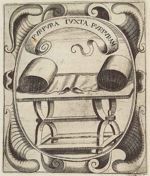
Purpura iuxta purpuram: Saavedra, Idea de un principe (München, 1640), emblem 15 uses the adage as its motto and uses the imagery of two roles of purple cloth
Purpura iuxta purpuram: De la Feuille, Devises et emblemes anciennes et modernes (Augsburg, 1697), emblem 243 uses the adage as its motto and uses the imagery of two roles of purple cloth
Iconclass: 22C4(PURPLE) colours, pigments, and paints: purple 47H6 textile fabric, cloth 51B2 Similarity, Likeness 51BB2 Dissimilarity, Unlikeness
Loci Communes: Assiduitas (Diligence, persistence, Assiduité); Judicandi (Judging, Juger)
II i 75 Saturniae lemae Saturnian rheums
Κρονικαὶ λῆμαι. id est, Saturniae lemae. In caecutientes ac stupidos dicitur: praesertim in eos, qui aetatis vitio desipiscunt. Est enim lema humor in oculis concretus, unde lippitudo nascitur. Derivatur autem ἀπὸ τοῦ λεύω, id est, video, et μὴ negativa particula, quod eiusmodi lachrymae crassae oculos occupantes visui officiant. Aristophanes in Pluto, Αλλ᾽ ὦ κρονικαῖς γνώμαις ὄντως λημῶντες τὰς φρένας ἄμφω. id est, Saturninis animis vere, lippitis sensibus ambo. Gnomis dixit pro lemis, unde λημῶ Graecis lippio, caecutioque significat. Porrò Saturniae dicuntur quasi seniles ac veteres, propterea quod κρόνος, id est, Saturnus podagrosus, ac senex a poetis fingitur, et temporum deus: quasi χρόνος. αῤχαῖα. vero, id est, prisca & antiqua, Graeci nonnunquam stulta vocant. Plato in Euthydemo, ἔχων φλυαρεῖς, καὶ ἀρχαιότερος εἶ τοῦ δέοντος. id est, Nugaris, ac stultior es, quam decet. Et κρονικώτερα, μωροτερα: & κρόνους nugas, ac deliramenta. Timothaeus apud Athenaeum libro iii. Νέος ὁ ζεὺς βασιλεύει, τὸ παλαιὸν δ᾽ ἦν κρόνος ἄρχων. id est, Iuvenis regnat Iuppiter. Olim autem principatum tenebat Saturnus: Aristophanes in Vespis: Καὶ τοὺς τραγῳδούς φησιν ἀποδείξειν κρόνος Τὸν νοῦν.. id est, Sese tragoedos mente Saturnos ait Mox redditurum. Idem in Nebulis: Καὶ πῶς ὦ μωρὲ σὺ καὶ κρονίων ὄζων καὶ βεκκεεσέληνε; id est, Et quomodo, o stulte & Saturnalia olens, & lunaris? Dionysodorus in Euthydemo Platonis, Socratem Saturnum vocat, bardum ac stupidum sentiens, οὐτως, inquit, εἶ κρόνος, id est, Adeo es Saturnus. Allusit huc Lucian. in Timone, Λημᾶς καὶ ἀμβλυώττεις πρὸς τὰ γινόμενα, id est, Caecutis ac lippis ad ea quae patrantur. Atque inibi paulo inferius, καὶ κατ᾽ ὀλίγον κρόνον σὲ ὦ θεὼν γενναίοτατε ἀποφαίνουσι, παρωσάμενοι τῆς τιμῆς. id est, Et paulatim Saturnum te, ô deorum praeclarissime reddum depellentes ab honore. Plutarchus aetate desipientes ostendit vulgo κρονολήρους appellatos fuisse: id est, Saturni more delirantes: videlicet propter aniles fabulas, quae de hoc deo referuntur. Eas refert idem Plutarchus in commentario de facie apparenti in orbe lunae: Saturnum in insula quapiam fortunata, profundo in antro dormire, saxa complexum aurea. Caeterum hunc somnum illi accidere ex vinculis in eum usum arte confectis à Iove. Aves autem, quae in scopuli cacumine versantur, afferre illi ambrosiam, universamque insulam mira fragrantia compleri, è rupe, velut è fonte scatente: adesse daemones, qui Saturnum observent & inserviant. Hos olim cum illo amicitia coniunctos fuisse, cum diis atque hominibus imperaret, multaque de futuris rerum eventibus ex se praedicere. Sed maxima, maximisque de rebus sic efferunt, ut Saturni somnia videantur. Nam quicquid cogitarit Iuppiter in animo, id somniare Saturnum. Huiusmodi quaedam nugamenta de Saturno commemorantur in hoc, quo dixi libello. Iam illud eruditi lectoris iudicio relinquo, nunquid ad hoc adagium pertineat, quia Pythagorici συμβολικῶς mare, Saturni lachrymam appellant, ut testatur idem autor, commentario de Iside & Osiride. Siquidem est aqua marina non salsa solum & amara, sed crassior item & impurior eliquis.
Κρονικαὶ λῆμαι, Saturnian rheums. Used of people who are dim-sighted and dull-witted, especially those who grow foolish from old age. The word lema denotes a gathering of rheum in the eyes which causes a weakness of sight; it is derived from lemo, I see, and me the negative particle, not, because gummy secretions of this kind spread over the eyes, and one does not see. Aristophanes in the Plutus:
Dim-sighted in troth
Are the wits of you both
In your rheumy [lemontes] Saturnian brains [gnomais].
He has used gnomai, brains, instead of lemai, rheums; the Greek lemontes, which means having sore eyes or dim sight, is derived from it. To call the brains Saturnian, in Greek Cronian, gives a colouring of age and senility, for Cronos, the Greek counterpart of Saturn, is imagined in poetry as gouty and old and god of time, by equation with chronos which means time. Archaios, ancient or prehistoric, is sometimes used in Greek for 'stupid': Plato in the Euthydemus 'You talk unbroken nonsense; need you be so prehistoric?' And 'as Cronian as' for 'as foolish as,' 'Cronoses' for nonsense and foolishness. Timotheus, quoted by Athenaeus, book y. 'Now a new Jupiter is king, where Saturn ruled of old.' Aristophanes in the Wasps: 'As for the scribblers of our tragedies, / He says he'll prove them doting Cronos-wits.' Again, in the Clouds: 'How can it be, you Cronos-reeking dotard, / Old when the moon was young?' / Dionysodorus in Plato's Euthydemus calls Socrates a Saturn, meaning he is dull and doltish; 'You're such an old Saturn,' he says. Lucian referred to this in his Timon: 'You are too purblind and too blear-eyed to see what is going on.' And a little farther on: 'By little and little they're making a regular Cronos of you, most worshipful of gods, and thrusting you down from your high position.'
Plutarch shows that men whose wits wandered in old age were called Cronoleroi, doting Cronoses, no doubt because of the old wives' tales told about this same god. Plutarch refers to them again in his essay 'On the Face that appears in the Orb of the Moon.' He tells how Saturn lies sleeping in a cave deep down in one of the Fortunate Isles with golden rocks in his arms, and how this sleep came upon him as an effect of the chains cunningly contrived for that purpose by Jupiter. There are birds, he says, living on the summit of a rock, which bring him ambrosia, which spills from the rock as though it were a fountain, and the whole island is filled with the marvellous fragrance. There are also demons who keep watch over Saturn and supply his needs. These used in old days to be his close friends, when he was ruler of gods and men, and they make many predictions of the future on their own account; but their most important prophecies, and those on the most important subjects, they produce in such a way as to make them pass for Saturn's dreams; for whatever thoughts come into Jupiter's head are dreams in Saturn's. Various trifling stories of this kind are recorded about Saturn in the book I have mentioned. Another point I leave to the judgment of the learned reader: is there any connection between this adage and the symbolic name given by the Pythagoreans to the sea, a tear of Saturn; for this the same writer is our authority in his essay 'On Isis and Osiris.' For sea-water is not only salt and bitter, but also more opaque and more impure than other kinds of water.
Facsimile: 
Iconclass: 31A4113(+0) cataract (+ variant) 31A464 emotional illness, derangement, madness 31D160 Old Age, 'Senectus'; 'Vecchiezza' (Ripa) 52AA552 Intellectual Blindness; 'Cecità della Mente' (Ripa) 91B1117:31D16 specific aspects of Saturn; Saturn as patron❧old man
Loci Communes: Caecutientia (Poor eyesight, near-blindness, Mauvaise vue); Multi - in stupidos (Many people - against the stupid, Beaucoup de gens - contre les sots)
II i 76 Cucurbitas lippis Your eyes run pumpkins
Κολοκύνταις λημᾷν. id est, Lippire cucurbitas, Ad superiorem adagii formam pertinet. Aristophanes in Nubibus, Νῦν γέ τοι ἤδη καθορᾶς αὐτὰς, εἰ μὴ λημᾶς κολοκύνταις. id est, At nunc ipsas plane cernis, nisi fors lippis colocyntis. κολοκύντας Graeci vocant, quas nos cucurbitas. Verba sunt Socratis ostendentis nubes, hoc est, nisi planè nihil vides, & tantas habes in oculis lemas, quantae sunt cucurbitae.
Κολόκνταις λημᾷν, To have the eyes run with pumpkins, belongs to the same type of adage as those we have been discussing. Aristophanes in the Clouds: 'Now surely you can see them plainly, unless your eyes run with colocynths.' The Greeks call a pumpkin colocynth. The speaker is Socrates, who points to the clouds and says in effect 'unless you can see nothing at all, and have drops of rheum in your eyes as large as pumpkins.'
Facsimile:
Iconclass: 25G21(PUMPKIN) fruits: pumpkin 31A319 interference with sight 52AA552 Intellectual Blindness; 'Cecità della Mente' (Ripa)
Loci Communes: Caecutientia (Poor eyesight, near-blindness, Mauvaise vue)
II i 77 Ollas lippere Your eyes run pots
Χύτραις λημᾷν, Ollas lippire. Proverbialis hyperbole, proximae simillima. Lucianus adversus ineruditum, & multos coementem libros, χύτραις, inquit, λημῶντες, id est, Ollas lippientes, Lachrymas indicans, llis aequales. Hoc adagium utrunque quoties ad animum refertur, fit elegantius & iucundius: veluti si quis hominem crassi iudicii, ac vehementer caecutientis, & turpiter errantis dicat lippire non lemis, sed ollis.
Χύτραις λημᾷν, To have the eyes run with pots. A proverbial exaggeration very like the last. Lucian in his Against an Ignoramus, about a man buying many books wholesale, uses the word pot-rheumy, in the sense of having drops of rheum in your eyes as large as pots. Both these adages gain in elegance and flavour when applied to the mind - for example, if one were to say of a very stupid man who is quite purblind and makes disgraceful mistakes, that his eyes run with pots and not rheum.
Facsimile:
Iconclass: 31A319 interference with sight 41A773 container of ceramics: jar, jug, pot, vase 52AA552 Intellectual Blindness; 'Cecità della Mente' (Ripa)
Loci Communes: Caecutientia (Poor eyesight, near-blindness, Mauvaise vue)
II i 78 Odium agreste Rustic hatred
Μῖσος ἀγρικὸν, id est, Odium agreste. Atrox odium veteres sic appellabant, propterea quod rustici plerunque μισάνθρωποι sunt, et acerbius atque implacabilius oderunt. Lucianus contra indoctum, Μῖσος δὲ ἄγρίον φασιν παρὰ πάντων ἔχεις ἐπι τῇ βδελυρίᾳ. id est, Laboras autem agresti, sicuti dicitur, omnium odio, propter insolentiam. Unde et civitatem appellamus morum comitatem, humanitatemque. Et apud Iureconsultos civilis actio discernitur à criminali. Denique Graeci quicquid barbarum, immane aut crudele volunt intelligi, id ἄγριον vocant.
Μῖσος ἀγρικόν, Rustic hatred. The Ancients applied this name to any passionate dislike, because rustics are misanthropic as a rule, and their hatreds are bitter and irreconcilable. Lucian Against an Ignoramus: 'And you enjoy, they say, the rustic hatred of everyone on account of your insolence.' Thus it is that we also use the word 'civilised' of a courteous and friendly character; and among lawyers a distinction is made between civil and criminal actions. In fact, when you want to convey that anything is barbarous, brutal or cruel, you call it in Greek 'rustic.'
II i 79 Megarenses neque tertii neque quarti The Megarians are neither the third nor the fourth
Μεγαρεῖς οὔτε τρίτοι οὔτε τέταρτοι. id est, Megarenses neque tertii, neque quarti, Dicebatur olim in homines supra modum ignavos & contemptos, nulloque honore dignos. Natum adagium ex oraculo quodam. Id quidam, inter quos Stephanus, Mneas & Ion, Aeginensibus, alii Megarensibus redditum existimant. Narrat itaque Mneas, cum Aeginenses in Achaia debellassent Aetolos, ac decimam pentecontorum cepissent (ea est navis remigum quinquaginta) hanc Apollini Pythio victoriae monumentum dedicarunt. Rogabantque deum quinam essent Graecorum praestantissimi, arbitrantes futurum, ut ob eam victoriam ipsis prima laus ab Apolline tribueretur. Oraculum hunc ad modum respondit, Ιππον θεσσαλικὴν, λαδεδαιμονίην τε γυναῖκα, Ανδρας δ᾽ οἳ πίνουσιν ὕδωρ καλῆς ἀρεθούσις. Αλλ᾽ ἔτι καὶ τῶν δ᾽ εἰσὶν ἀμείνονες, οἵτε μεσηγὺ Τίρυνθος ναίουσι καὶ ἀρκαδίης πολυμήλου, Αργεῖοι λινοθώρηκες κέντρα πτολέμοιο. Υμεῖς δ᾽ αἰγϊέες, οὔτε τρίτοι ὄτε τέταρτοι, Ουδὲ δυωδέκατοι, οὔτ᾽ ἐν λόγῳ, οὔτ᾽ ἐν ἀριθμῷ. id est, Thessala equa praestat reliquis, mulierque Lacaena. Porro viri potant qui pulchra fluenta Arethusae. Hos quoque praeterea, mediae gens incola vincit Tirynthi, Arcadiaeque bidentibus inclytae albis, Argivi stimuli bellorum, armisque potentes. At vos, Aegini, neque tertius accipit ordo, Nec quartus, neque bissenus, neque denique vestri Ulla usquam ratio est, nusquam numerûsve, locûsve, Qui scripsit commentariolos in Theocritum, refert hoc epigramma paulo diversius, nimirum ad hunc modum: Γαίης μὲν πάσης τὸ πελασγικὸν ἄμεινον, Ιπποι θρηΐκιαι, λακεδαιμόνιαί τε γυναῖκες, Ανδρες δ᾽ οἱ πίνουσιν ὕδωρ καλῆς ἀρεθούσης. Αλλ᾽ ἔτι καὶ τῶν δ᾽ εἰσὶν ἀμείνονες, οἵτε μεσηγὺ Τίρυνθος ναίουσι, καὶ ἀρκαδίης πολυμνήλου, Αργεῖοι λινοθώρηκες κέντρα πτολέμοιο. Υμεῖς δ᾽ ὦ μεγαρεῖς οὔτε τρίτοι, οὔτε τέταρτοι, Οὔτε δυωδέκατοι, οὔτ᾽ ἐν λόγῳ, οὔτ᾽ ἐν ἀριθμῷ. id est, Callimachus item in epigrammatis ad Megarenses retulit proverbium Τῆς δὲ ταλαίνης Νύμγης, ὡς μεγαρέων, οὐ λόγος, οὐδ᾽ ἀριθμός. id est, Sed veluti Megarensibus acciditolim, Nymphae infelicis, non locus, aut ratio. Item Theocritus in Catellae amore, Αμμες δ᾽ ὄτε λόγω τινός ἄξιοι οὐδ᾽ ἀριθμητοὶ, Δύστανοι μεγαρῆες, ἀτιμοτάτῃ ἐνὶ μοίρᾳ. id est, Nostri nec ratio est, numero neque ponimur ullo Extremae sortis veluti quondam Megarenses. Est et inter amantes ordo, cum hic primus est apud amicam, ille secundus, alius tertius aut quartus. Quemadmodum & in testamentis est primus, secundus & tertius haeres. Effertur etiam hac forma proverbium, τῆς μεγαρέων ἄξιοι μερίδος, id est, Megarensium parte, seu loco digni. Huc spectat & Homericum illud Iliados β Οὔτε ποτ᾽ ἐν πτολέμῳ ἐναρίθμιος, οὔτ᾽ ἐνι βουλῇ. id est, Nusquam in consiliis, nusquam numeratur in armis. Refertur ex Euripide, Δειλοὶ γὰρ ἄνδρες οὐκ ἔχουσιν ἐν μάχῃ Αρϊθμὸν, ἀλλ᾽ ἄπεισι κᾂν παρῶσ᾽ ὅμως. id est, Formidolosi nullum habent in praelio Numerum, sed absunt, licet ibi adsint maximè. Hanc figuram & Latini videntur exprimere. M. Tullius, Neminem esse puto, qui modo in aliquo numero sit. hoc est, qui sit alicuius momenti, alicuius precii. Idem Philip. iii. Bombalio quidam pater, homo nullo numero, nihil illo contemptius. Plutarchus in Symposiacis, Τῶν δὲ ἐμῶν πολιτῶν ὥσπερ μεγαρέων οὐδεὶς λόγος. id est, Atqui meorum civium, veluti Megarensium nulla ratio. Idem aliàs in eodem opere. Τῶν δὲ δημοκριτείων ἔφη εἰδώλων, ὡσπερ αἰγιέων ἢ μεγαρέων ἀριθμὸς οὐδεὶς οὐδὲ λόγος. id est, Atqui Democriticarum, inquit, imaginum, perinde ut Megarensium aut Aeginensium, nullus numerus, neque respectus. Equidem arbitror & Aristophanem huc leviter allusisse cum scribit in Acharnensibus: Ως χρὴ μεγαρέας μήτ᾽ ἐν γῇ μήτ᾽ ἐν ἀγορῇ, Μή τ᾽ ἐν θαλάττῃ, μή τ᾽ ἐν ἠπείρῳ μένειν. id est, Megarensibus nefas manere esset neque In terra alicubi, nec foro, nec in mari, Neque continente. Siquidem excludens Megarenses quatuorlocis, nimirum ad illud respexit, οὔτε τέταρτοι Quanquam in versibus opinor non abesse mendum, videlicet in μή τ᾽ ἐν γῇ, nisi forte quarto loco sibi permittit spondaeum, quemadmodum permittit anapaestum. Mihi subolet huc & M. Tullitum allusisse cum in Bruto suo sic loquitur: Duobus igitur summis Crasso & Antonio. L. Philippus proxime accedebat, sed longo intervallo, tamen proximus. Itaque eum, etsi nemo intercedebat qui se illi anteferret, neque secundurn tamen neque tertium dixerim. Nec enim in quadrigis eum secundum numeraverim, aut tertium, qui vix è carceribus exierit, cum palmam iam primus acceperit: nec in oratoribus, qui tantum absit à primo, vix ut eodem curriculo esse videatur. Simili forma M. Tullius in Academicis lib.ii. dixit quintae classis Democritum: Quis, inquit, hunc philosophum non anteponat Cleanthi, Chrysippo, reliquisque inferioris aetatis, qui mihi cum illo comparati, quintae classis videntur? id est, postremi ordinis. E diverso primae classis dicuntur, qui caeteris praeferuntur: et nulla classe, qui prorsus contempti. Translatum e classib. in quas Servius Tullius rex divisit populum Romanum pro census modo. Florus epitome xlix. dixit Ultimae sortis hominem vehementer obscurum. Andriscus, inquit, ultimae sortis homo, Persei regis se filium ferens, &c. Item epitome xix. C. Glauciam dixit ultimae sortis hominem. Hoc fiet lepidius, si transferatur ad animi res: veluti si dicas, ultimae sortis ingenium: aut orationem cum aliorum scriptis vix conferendam, extremae classis orationem. Ad hanc pertinet formam, cum dicunt hominem primae notae, postremae notae. & M. Tullius, salutem appellat de meliore nota, salutationem accuratam. Ad personam accommodavit Catullus: Et quisquis de meliore notae. Id translatum videtur à negotiatoribus, qui vino aut panno notam affigunt indicantem mercis precium.
Μεγαρεῖς οὔτε πρίτοι οὔτε τέταρτοι, The Megarians are neither the third nor the fourth. This used to be said in old days of exceptionally idle and worthless people who had no claims to respect at all. The adage took its rise from an oracle. Some authorities, among them Stephanus Mneas and Ion, say it was given to the people of Aegina; others say, to the Megarians. According to Mneas, when the Aeginetans had defeated the Aetolians in Achaea and taken a tenth part of their penteconters (ships, that is, of fifty oars), they dedicated the tenth to the Pythian Apollo as a memorial of their victory, and asked the god who were the leading Greeks, thinking that in view of this success Apollo would award that proud position to themselves. The oracle replied as follows:
A horse from Thessaly and a wife from Lacedaemon,
But men who drink Arethusa's peerless spring.
Yet better even than they are those who dwell
Between Tiryns and Arcadia with its wealth of flocks,
The Argives in their linen cuirass who goad the god of war.
As for you, men of Aegium, you are neither third nor fourth
Nor twelfth nor of any reckoning or account.
The writer of the scholia on Theocritus records a somewhat different form of this epigram; in fact it runs like this:
All the world over Pelasgian Argos is the best of all:
Horses from Thrace and wives from Lacedaemon,
But men who drink Arethusa's peerless spring.
Yet better even than they are those who dwell Between Tiryns and Arcadia with its wealth of flocks,
The Argives in their linen corslets who goad the god of war.
As for you Megarians, you are neither third nor fourth
Nor twelfth nor of any reckoning or account.
Callimachus too in his epigrams applied the proverb to the Megarians: 'Like the Megarians, the hapless maid / Is of no reckoning now and no account.' Theocritus too, in his Beloved Catella: 'But we are of no reckoning and no account, / Hapless Megarians, with scorn for our portion.' Lovers too are put in numerical order: one is first in his mistress' eyes, another second or third or fourth. It is the same in wills: there is a principal heir, and heirs in the second or third place.
The proverb is also expressed in the form Τῆς Μεγαρέων ἄχιοι μερίδος, Worthy to be treated or placed like the Megarians. Homer's phrase in the second Iliad has this in mind: 'Of no account, in council or in war.' There is a quotation from Euripides: 'Cowards in battle are of no account; / They may be present, but they are not there.' Latin too seems to express the same idea. Cicero: 'There is no one, I think, no one at least of any account,' meaning of any influence or value. Again in his third Philippic: 'Her father was a certain Bambalio, a man of no account, the lowest of the low.' Plutarch in his Table-talk': 'But are my countrymen, like the Megarians, of no account?' And elsewhere in the same work: 'But are the images of Democritus, he said, of no reckoning or account, like the people of Aegium or Megara?' Personally I think that Aristophanes too alludes to this in passing, when he writes in the Acharnians 'that it be unlawful for Megarians to remain on land or in the market-place or on the sea or on the mainland;' for by excluding the Megarians from four places he had in mind of course our 'nor the fourth.' Though in these lines I think there is a corruption in the phrase that means 'on land,' (unless possibly he allows himself a spondee in the fourth foot, as he allows an anapaest). I have a suspicion that Cicero too was alluding to it when he said in the Brutus: 'After these two leaders, Crassus and Antonius, Lucius Philippus came next, next indeed although a long way behind. Although therefore no one came in between who could outdo him, I would call him neither second nor third; just as in a chariot-race I would not count a man as in second or third place who has hardly left the starting-line when the winner has gained the prize, so it would be among orators with anyone who is so far behind that he barely seems to be running in the same race.'
Cicero uses a similar expression - 'fifth-class' - in book 2 of the Academica. Speaking of Democritus, he says: 'Who would not prefer him as a philosopher to Cleanthes and Chrysippus and the others of later date, who seem to me to be fifth-class when compared with him?' meaning, of a most inferior rank. Conversely, those who stand out from the rest are called 'first-class,' and the completely despicable are 'outclassed.' This is a metaphor from the classes into which King Servius Tullius divided the Roman people in accordance with the amount of their property. Floras in Epitome 49 called an extremely obscure man 'of the lowest class': 'Andricus/ he says, 'a man of the lowest class, maintaining that he was the son of King Perseus' and so forth. Again in Epitome 19 he has 'Gaius Glaucius, a man of the lowest class.' This will be more elegant if transferred to things of the mind, if for instance one were to speak of 'an intelligence of the lowest class,' or were to call a style that hardly deserved to be compared with the work of other writers 'a very low-class style.'
It can be ranged under this formula, when they speak of a man as being of a superior or inferior brand, and Cicero calls compliments that are phrased with some care 'greetings of a superior brand.' Catullus adapted it to people: 'And whosoe'er there may be of superior brand.' The image seems to be taken from merchants, who fix a brand-label on wine or cloth to show the value of their wares.
Facsimile: 

Iconclass: 32B311(MEGARIANS) indigenous European peoples (MEGARIANS) 46A23 contrast between important and unimportant people; the inferior before the superior, the weak before the mighty 54BB5 Unimportance 54BB6 Worthlessness 54DD2 Idleness; 'Otio' (Ripa)
Loci Communes: Contemptus et vilitatis (Contempt and worthlessness, Mépris et bassesse)
II i 80 Lepus pro carnibus A hare because of its meat
Λαγὼς περὶ τῶν κρεῶν. id est, Lepus de canibus, subaudi, periclitatur. In eos dicitur, qui ob aliquam sui utilitatem in discrimen vocantur. Nam leporem non insectamur, quod noceat, sed quod pulpamentum habeat. Est enim animal et esculentum, et timidum, atque inerme: ut natura, hominum escis leporem genuisse videatur. Rheginenses autem vulgo lepores dicti sunt, utpote pavidi ac formidolosi. Effertur etiam ad hunc modum adagium, ὁ λαγὼς περὶ τῶν κρεῶν τρὲχει. id est, Lepus pro carnibus currit. De iis qui magno suo periculo, aut capitis etiam discrimine, atque ob id acriter decertant. Translata metaphora à venatu, in quo lepus quoniam intelligit sese ad necem peti, pernicissimo cursu fugit, adeo, ut non raro deficiat, medioque in cursu exanimetur. Qua de re Plutarchus in commentario De terrestrium & marinorum animantium prudentia, narrat quiddam haud quaquam indignum, quod hoc inseratur loco: Οἱ δὲ τοὺς δασύποδας διώκοντες, ἐὰν μὲν αὐτοὶ κτείνωσι, ἥδονται διασσῶντες καὶ τὸ αἷμα μαλάττουσι προθύμως. ἐὰν δὲ ἀπογνοὺς ἑαυτὸν ὁ λαγὼς, ὅ γίνεται πολλάκις, ὅσον ἔχει πνεύματος, ἀναλώσας εἰς τὸν δρόμον ἐκλίπητο, νεκρὸν καταλαβόντες, οὐχ ἅπτονται τὸ παράπαν, ἀλλ᾽ ἵστανται, τὰς οὐρὰς κινοῦντες, ὡς οὐ κρεῶν χάριν, ἀλλὰ νίκης καὶ φιλονεικίας ἀγωνιζόμενοι. id est, Porrò canes cum leporem insequuntur, siquidem occiderint ipsi, gaudent dilacerare, atque alacres sanguine sese contaminant oblinuntque. Quod si lepus desperans de sese, quemadmodum accidit saepenumero, quicquid habet halitus, id omne quàm intensissimo cursu consumpserit, atque ita defecerit, canes exanimem repertum omnino non attingunt, verum consistunt moventes caudam, perinde, quasi non carnium gratia decertarint, sed magis de victoria contenderint. Chaon apud Aristophanem in Ranis, Δοῦλον οὐκ ἄγω Εἰ μὴ νεναυμάχηκε τὴν περὶ τῶν κρεῶν. id est, Servum haud veho, navale ni peregerit Certamen, ac pro carnibus pugnaverit. Adscribit hoc loco Aristophanis interpres, apud Arginusam, servos non pro pecunia, aut alio quovis praemio, sed pro vita dimicare solere. Idem in Vespis, Ποιήσω δακεῖν τὴν καρδίαν Καὶ τὸν περὶ ψυχῆς δρόμον Δραμεῖν. id est, Effecero, ut cor mordeas, cursumque curras pro capite ac vita. Idem in eadem fabula, Η λαγὼν ἢ λάμπαδα ἔδραμες; id est, Leporem cucurristi, an'ne lampadem magis? Plutarchus in Dialogo, quem scripsit adversus Epicurum: Παπαὶ εἶπον ἔγωγε γελάσας, εἰς τὴν γατέρα τοῖς ἀνδράσιν ἔοικας ἐναλεῖσθαι, καὶ τὸν περὶ τῶν κρεῶν ἐπάξειν. id est, Papae, in quam ridens, in ventrem ipsum viris insultum facturus videris, & ad cursum qui pro carnibus dicitur, adacturus. Significat autem eum Epicureos in summum discrimen adducturum, quod adversus voluptatis assertores proposuisset, nec iucunde vivi posse secundum Epicurum. Suspicor allusum est ad priscas historias, quae referunt aliquoties bellum natum inter populos ob direptas è sacrificiis carnes. Ita Pindarus in Nemeis. Ινα κρεῶν νίν ὑπὲρ μάχας ἔλασεν. id est, Ubi pro carnibus pugnas gessit.
Λαγὼς περὶ τῶν κρεῶν, A hare (runs risks, must be supplied) because of its meat. Said of those who can serve some useful purpose, and are therefore at risk; for we pursue the hare not because it does harm but because its meat is good eating. The animal itself is at the same time edible, timorous and unarmed, so that nature might be thought to have produced the hare to serve as food for man. The people of Rhegium, in fact, were commonly called 'hares,' as being fearful and easily frightened.
The adage is also found in the form 'Ὁ λαγὼς περὶ τῶν κρεῶν τρέχει, The hare runs to save its meat, used of those who run great risks or even are in peril of their lives, and so fight with all their might. The metaphor is taken from hunting; for when the hare sees that it is being pursued to the death, it tries to escape by running very fast indeed, and has sometimes been known to collapse and fall dead in mid-career.
On this subject Plutarch, in his essay 'On the Cleverness of Land and Sea Creatures/ has something to say which fully deserves to be inserted here: 'Hounds that pursue hares,' he says, 'if they have killed the animal themselves enjoy tearing it to pieces and eagerly stain themselves with the blood; but if the hare despairs, as often happens, and expires after spending all its breath on a last burst of speed, when they find it dead they entirely refuse to touch it, and stand there wagging their tails, as though they strove not for the sake of the meat, but for the pleasure of victory.' Charon in Aristophanes, in the Frogs: 'I carry no slave, unless he's fought in the sea-fight for his meat.' The scholiast on Aristophanes notes on this passage that at Arginusae the slaves did not fight for money or any other reward, but for their lives. Aristophanes again, in the Wasps: 'I'll make you eat your heart out, and run the race of your life,' and elsewhere in the same play: 'Have you run the hare, or the torch-race?' Plutarch in the dialogue which he wrote against Epicurus: 'Good gracious, said I with a laugh, it looks as though you will jump on these men's stomachs, and make them run to save their meat.' His point is that he will reduce the Epicureans to desperate straits by the attack he had made on those who defend pleasure as their principle, when he suggested that even an agreeable life is impossible to a follower of Epicurus. I suspect that there is an allusion to the traditional stories of war sometimes breaking out between two peoples as a result of the seizure of meat offered in sacrifices. So Pindar in the Nemeans: 'Where a man [smote him] in a quarrel about the meat.'
Facsimile: 
Iconclass: 25F26(HARE) rodents: hare 41C692(HARE) kinds of meat (HARE) 54B3 Utility, Usefulness; 'Utilità' (Ripa)
Loci Communes: Discriminis (Danger, crisis, Danger)
II i 81 Carpathius leporem The Carpathian and the hare
Ο καρπάθιος τὸν λαγών. id est, Carpathius leporem. Dicebatur in eos, qui sibi rem noxiam accerserent. Hinc deductum adagium, quod cum in Carpathiorum insula lepores non essent, illi curarunt importandos alicunde. Verum, ubi eius animantis magna vis increvisset, ut est mira foecunditas, fruges insulae populari coeperunt. Refert & interpretatur paroemiam Iulius Pollux, quinto de rerum vocabulis libro. Addit nec in Ithacensium insula nasci lepores, nec in Sicilia fuisse, priusquam Anaxilas Rheginensis eos importasset, unde victor in Olympiacis, Rheginensium nomismati currum inscalpsit & leporem, Refert item & interpretatur Aristoteles libro Rhetoricorum tertio.
Ὁ Καρπάθιος τὸν λαγών, The Carpathian and the hare, was applied to those who introduced something which did them harm. The source of the adage is as follows. In the island of Carpathos there were no hares, and the inhabitants arranged to import some from elsewhere; but when the creature's numbers had reached a high level (for it is marvellously prolific), they began to ravage the crops on the island. The proverb is recorded and explained by Julius Pollux in book 5 of his Vocabulary. He adds that hares were not native in Ithaca, and that there were none in Sicily either until Anaxilas of Rhegium had introduced them; as a result of which, when he won a race at the Olympic games, he issued a coin for Rhegium with a chariot and a hare on it. It is also recorded and explained by Aristotle in the third book of the Rhetoric.
Facsimile:
Iconclass: 25F26(HARE) rodents: hare 25H14:61D(CARPATHOS) island❧geographical names of countries, regions, mountains, rivers, etc. (CARPATHOS) (CARPATHOS) 54BB31 Damage, Disservice; 'Danno' (Ripa)
Loci Communes: Malum accersitum aut retortum (Evil brought upon oneself or turned back, Mal attiré ou retourné)
II i 82 Γρύζειν To grumble
Γρύζειν, proverbio dicunt hiscere seu mutire. Sunt, qui putent γρύζειν esse, vocem suillam aedere, deductum ἀπὸ τοῦ γρὺ, de quo meminimus alibi. Unde & Grylli nomen effictum apud Plutarchum, & Grunii Corocottae porcelli, cuius meminit divus Hieronymus. Aristophanes in Pluto: Γρύζειν δὲ καὶ τολμᾶτον ὦ καθάρματε; id est, Audetis et mutire sceleraetissimi? Idem in eadem fabula: Αλλὰ φθείρου καὶ μὴ γρυζης. id est, Imò pereas, neve quid hiscas. Simili figura Terentius dixit in Adelphis: Quid gannis? Et in Phormione: Quod illi ad aurem obganniat.
Gryzein is a proverbial expression for grumbling or muttering; some think it means 'to grunt like a pig.' Derived from the word gry, of which I have spoken elsewhere. Hence come the fictitious names of Gryllus in Plutarch, and of Grunnius Corocotta the piglet, who is mentioned by St Jerome. Aristophanes in the Plutus: 'You filthy jailbirds, do you dare to grunt?' Again in the same play: 'Bad luck to you! - and don't you dare to grunt.' Terence uses a similar metaphor in the Adelphoe: 'What are you growling about?' And in the Phormio: 'Something for her to growl into his ears.'
II i 83 Nullum animal. Quod animal? No living creature. What living creature?
Proverbialis videtur & illa figura, Nullum animal, & quod animal. Aristoph. in Pluto, Γενία γὰρ ἐστιν ὦ πόνηρ᾽, ἧς οὐδαμοῦ Οὐδὲν πέφυκε ζῶον εξολέστερον. id est, Inopia nanque est heu, miser, qua scilicet Haud aliudusquam est animal exitialius. Idem ἐν νεφέλαις, Τοῦτο δ᾽ ἐσθ᾽ ὁ τόκος τί θηρίον; id est, Usura at ipsa quaeso, quae nam belua est; M. Tullιυσ ad Atticum, Terentii vestigium nullum agnovi, Metagenes certe periit. Fecit iter per possessionem in qua animal reliquum nullum est. Nec abludit ab hac figura Plinianum illud, Regulus bipedum nequissimus.
This is another metaphor which looks proverbial: No living creature and What living creature? Aristophanes in the Plutus: "Tis poverty, you rogue, / Than which no living creature's more disastrous.' Again in the Clouds: This "interest": what kind of beast is it?' Cicero in a letter to Atticus: 'Of Terentius I have detected no trace; Metagenes is certainly dead. [I] have made a journey through his estates, in which no living creature was to be found.' In agreement with this metaphor is that phrase in Pliny: 'Regulus, vilest of two-legged creatures.'
II i 84 Ne musca quidem Not so much as a fly
Huic affinis est & illa proverbialis hyperbole, Ne musca quidem, qua maximam hominum solitudinem significamus, Plautus in Truculento: Quas tu mulieres mihi narras? Ubi musca nulla foemina est in aedibus? Huc allusit Vibius Crispus orator delectationi natus, ut ait Fabius: Cuius erant mores, qualis facundia, quem admodum scripsit Iuvenalis, cum rogatus ecquis esset cum Caesare in conclavi, respondit, Ne muscam quidem intus esse. Ancipiti ioco Domitiani consuetudinem notans, cui mos erat quottidie sibi secretum horarium captare, nec interim aliud fere agebat, nisi quod muscas captas stylo configeret.
There is some kinship between ['no living creature'] and the familiar proverbial exaggeration Not so much as a fly, by which we indicate that human beings are very few and far between. Plautus in the Truculentus: 'Women! What women do you mean? -when there's not so much as a female fly in the whole house.' This is alluded to by Vibius Crispus, an orator 'born to give pleasure' as Quintilian puts it, (in Juvenal's words 'such was the man, and such his eloquence'): when asked whether there was anyone with the emperor in his study, he replied There's not so much as a fly in there.' This humorous remark was double-edged, for it was a criticism of one of Diocletian's habits: he used to spend an hour in seclusion every day, and do almost nothing during that time except to catch flies and pierce them with his writing stylus.
II i 85 Communis Mercurius Share Mercury
Κοινὸς ὁ ἑρμῆς. id est, Communis Mercurius. Lucianus in Votis, Οὐκοῦν τὸ προχειρότατον τοῦτο, κοινὸς ἑρμῆς φασι, καὶ ἐς μέσον κατατίθει φέρων τὸν πλοῦτον. id est, Itaque, quod passim in ore est omnibus, communis, ut aiunt, Mercurius, opesque in medium allatas depone. Plutarchus in libello, cui titulus, ὅτι μάλιστα τοῖς ἡγεμόσι δεῖ τὸν φιλόσοφν διαλέγεσθαι, Αλλ᾽ ἀμουσίᾳ καὶ ἀπει ροκαλίᾳ τὸν κοινὸν ἑρμὴν ἐμπόλαιον καὶ ἔμμισθον γενέσθαι. i. Sed imperitia & inelegantia communem Mercurium, cauponatorem & quaestuosum factum esse. Quidam hinc natam paroemiam arbitrantur, quod Mercurius, ut est furtorum autor, ac repertor, primus ostendit, quae furto parta sint, ea in medium communiter oportere deponere. Alii malunt huc referre, quod Mercurius sit orationis autor, per quam inter homines omne commercii genus constat: unde & medius inter superos atque inferos à poetis fingitur, pariter superis deorum gratus & imis, quod sermo animi interpres, summos cum insimis, reges cum plebe conciliet. Extat super hac re fabella non illepida Aristidis in secundo libro, quem adversus Platonem conscripsit, in defensionem Rhetorices. Eam hoc magis libuit adscribere, quia is autor haudquaquam adhuc vulgo notus est. Νεωστὶ γὰρ ἀνθρώπων γεγονότων και τῶν ἄλλων ζώων, θόρυβος πολὺς ἦν κατα τὴν γῆν καὶ ταραχή. οὔτε γὰρ αὐτοῖς σφιν εἶχον, ὅτι χρησοντες. οὐδε γὰρ ἦν οὐδὲν τὸ συνάγον, ἀλλ᾽ οἱ μείζους τοὺς ἐλάττους ἦγον. οὔτε τοῖς ἄλλοις ζώοις εἶχον αὐταρκεῖν. πᾶσι γὰρ πάντων ἀπελείπονος ἄλλοτε ἄλλων. τάχει μὲν τῶν πτηνῶν ἁπάντων, ὅπερ οὖν ὅμηρος ἔφη τοὺς πυγμαίουςπάσχειν ὑπὸ τῶν γεράνων, πᾶσι τοῖς τότε ὑπὸ πάντων συνέβαινε τῶν ἀλκίμωμ ὀρνιθων. κατ᾽ ἰσχῦν αὖ πὸῤῥω καὶ τῶν λεόντων, καὶ τῶν κάπρων, καὶ πολλῶν ἄλλων ἦσαν. ὥστ᾽ ἀπόλλυντο σιγῇ. καὶ μὴν τῇ γε κατασκευῇ τοῦ σώματος, οὐ μόνων τῶν κοράκων ἀλλὰ καὶ τῶν κοχλιῶν ἀπελείποντο, οὐδεὶς αὐτῶν ὑπάρχων αὐταρκής. φθειρομένου δὲ ὅτως τοῦ γένους καὶ κατα μικρὸν ὑποῤῥέοντος, κατιδὼν ὁ προμηθεὺς ἀει πως ὢν φιλάνθρωπος, ἀνέρχεται πρεσβευτὴς ὑπὲρ τῶν ἀνθρώπων, οὐχ ὑπὸ τῶν ἀνθρώπων πεμφθεὶς, οὐδὲ γὰρ πρέσβεις ἦν πώποτ᾽ εἰδέναι, ἀλλ᾽ αὐτὸς ἀφ᾽ ἑαυτοῦ. ὁ δὲ ζεὺς τοῦτε προμηθέως ἀγασθεὶς δίκαια λέγοντος, καὶ ἅμα καθ᾽ ἑαυτὸν εἰληφὼς λογισμὸν τοῦ πράγματος, τῶν αὐτοῦ παίδων ἑρμῆν κελεύει ῥητορικὴν ἔχοντα ἐλθεῖν εἰς ἀνθρώπους. ὁ μὲν οὖν προμηθεὺς καθάπερ ἐπίσης ἅπασι τάς τε αἰσθήσεις καὶ τ᾽ ἄλλα μέλη του σώματος, οὐχ οὕτως ἐκέλευσεν, ὥσπερ θεωρικοῦ διάδοσιν διελεῖν, ἵνα πάντες ῥητορικῆς ἐφεξῆς μετέχοιεν, ὥσπερ ὀφθαλμῶν, χειρῶν καὶ ποδῶν, ἀλλ᾽ ἐπιλεξάμενον τοὺς ἀρίστους καὶ γενναιοτάτους καὶ τὰς φύσεις ἐῤῥωμενεστάτους τούτοις ἐγχειρίσαι τὸ δῶρον, ἵνα ὁμοῦ σφάς τε αὐτοὺς καὶ τοὺς ἄλλους σώζειν ἔχοιεν. Αφικομένης δὲ τῆς ῥητορικῆς εἰς ἀνθρώπους, ὅτως ἐκ θεῶν ἠδυνήθησαν μὲν οἱ ἀνθρωποι τὴν μετὰ τῶν θηρίων δίαιταν χαλεπὴν, ἐκφυγεῖν, ἐπαύσαντο δὲ ἐχθροὶ πάντες ὄντες ἀλλήλοις ἐν κύκλῳ. κοινωνίας δὲ εὗρον ἀρχὴν. καταβάντες δὲ ἐκ τῶν ὀρῶν, ἄλλοι κατ᾽ ἄλλα μέρη τῆς οἰκουμένης ἐπλησίασαν, τόγε πρῶτον ὕπαιθροι, μετὰ δὲ τουτο ἤδη λόγου νικήσαντος, πόλιν τε κατεσκευάσαντο καὶ διεκρίθησαν, οὐχ ὥσπερ πρότερον ὡς ἔτυχεν, ἀλλ᾽ εἰς τε συντάξεις κοινωνιῶν, καὶ τοὺς πόλεων ἡγεμόνας νόμους ἔθεντο, καὶ ἄρχοντας καὶ πολιτείαν ένομησαν. καὶ θεοῖς χαριστήρια ἀνήγαγον πρώτας ἀπαρχὰς ποιησάμενοι τὰς ἀπὸ τῶν λόγων, αἷς ἔτι καὶ νῦν χαίρειν μάλιστα τοὺς θεοὺς λόγος αἱρεῖ, ὅτι καὶ γνωρΐσαι πρῶτον αὐτοῖς τοὺς θεοὺς ὑπῆρξεν ἐντεῦθεν. οὕτως ἀνθρωπος ἤρθη μέγας ἐξ ἀσθενοῦς καὶ σαθροῦ καταρχάς. καὶ πρόσθεν καταφρονούμενος ὠς οὐδὲν πρᾶγμα, κύρϊός ἐστιν ἐξ ἐκείνου τοῖς ἐν τῇ γῇ τοῦτο ὅτι βούλεταε χρῆσθαι, πρόβλημα ποιησάμενος αὐτ᾽ ἄλλου φυλακτηρίου τὸν λόγον. καὶ ὁ μῦθος ἡμῖν ταύτην ἐχέτω τὴν τελευτὴν. Quae si quis Latine malit, sensum utcumque reddemus. In initio cum recens essent homines nati, magnus inter hos, ac reliqua animantia tumultus erat, perturbatioque super terram, propterea quod non possent invicem uti sese. Nec enim ulla res intercedebat, quae illos conciliaret: verum, qui potentiores erant, opprimebant inferiores. Neque satis erant idonei, ut reliquis animantibus resisterent. Omnibus enim illis omni ex parte inferiores erant, aliaque in re ab aliis vincebantur. Veluti ab universo genere volucrum celeritate. Unde factum est, ut quod ait Homerus Pygmaeis accidere a gruibus, id tum temporis passim a robustioribus avibus paterentur mortales. Rursum quantum ad vires attinebat, longe superabantur, et a leonibus et ab apris, et aliis item compluribus. Atque hunc in modum silentio peribant. Iam vero, quo ad monitionem ornatumque corporis, non corvis modo, verum etiam cochleis cedebant, neque cuiquam ex ipso suppetebat, quod ad tuendam vitam erat opus. Itaque, cum ad eum modum interiret hominum genus, ac paulatim dilaberetur, Prometheus, ut semper est hominum studiosus, orator adscendit in caelum, mortalium nomine, non ille quidem missus ab eis (neque enim dum id tem poris legatos ullos erat cernere) sed ipse ultroneus abiit. At Iuppiter partim in gratiam Promethei, maxime qui iusta postulare videretur: partim negotio apud sese considerato, filium suum Mercurium iubet ad homines descendere, Rhetoricen secum adducentem. Edixit autem, ut eam mortalibus impertiret, non quemadmodum Prometheus omnibus ex aequo, sensus, reliquaque corporis membra, perinde quasi theatralem pecuniam dispertiens, ut omnes ex aequo Rhetorices essent participes, non aliter, quam oculorum, manuum, ac pedum: sed ut praestantissimos quosque, ingenioque generosissimo & indole pollentissima praeditos deligeret, atque iis demum munus hoc impertiret, ut pariter et suam ipsorum et aliorum incolumitatem tueri possent. Porrò posteaquam Rhetorica iam ad mortales pervenisset, cum negotium, quod habebant, cum beluis molestissimum, licebat effugere, tum vero desierunr undequaque inter sese simultatem exercere, reperto commerciorum initio. Digressique de montibus, alii in aliam orbis partem iungebantur, principio quidem sub dio viventes: post autem ubi verbis inter se communicassent, et civitatem condiderunt, ac distributi sunt: non quemadmodum antea, temere, verum in ordines plebis, ac belli duces, sanctisque legibus, tum principes, tum Reip. statum instituerunt. Diis munera coeperunt offerre, primitias auspicantes ab oratione. Quibus nunc quoque vel maxime gaudere deos consentaneum est, quando quidem hac contigit, ut primum esse deos cognosceremus. Hinc deinceps ita crevit homo, ut, qui initio debilis fuerat at que invalidus, postea in altum tolleretur; quique antea pro nihilo habitus, ac despectus erat, deinceps factus est omnium, quae sunt in terra, dominus, cui quibus uti liberet, ius esset, non alio propugnaculo sibi parato quàm oratione. Atque hic nobis sit fabulae finis. Hactenus Aristides. Extat, si satis commemini, fabella non dissimilis apud Platonem in Protagora.
Κοινὸς ὁ Ἑρμῆς, Share Mercury. Lucian in his Wishes: 'Well, this is the most common saying: Share Mercury, bring your wealth, and put it within reach of us all.' Plutarch in the essay entitled That a Philosopher ought to Converse especially with Men in Power': 'But lack of education and lack of taste have made the sharing of Mercury a commercial and mercenary matter.'
Some derive this proverb from the fact that Mercury, as the patron and inventor of thieving, was the first to teach that the proceeds of theft ought to be contributed to a common pool. Others would rather refer it to Mercury's invention of speech, the essential basis of any sort of communication between man and man, which led the poets to imagine him as halfway between dwellers in the heavens and the lower world, 'welcome alike 'to gods above and gods below,' because speech is the interpreter of thought and forms a bridge between the highest and lowest, between kings and common folk.
There is a rather charming fable on this subject in the second book of Aristides' attack on Plato on behalf of rhetoric, which I add here with all the more pleasure, because the author is as yet very far from being widely known. [The Greek follows.] In case anyone prefers this in Latin, I will render the sense as best I can. 'For when men had lately come into existence, there was much disorder and confusion over the face of the earth between them and the other creatures, because they were unable to communicate with one another; nor was there anything to bring them together, but the larger oppressed the smaller. Nor could man withstand other creatures, being inferior to them in every respect, to some in one way and to some in another. In speed all the birds surpassed them, so that what the Pygmies in Homer suffer from the cranes all human beings suffered in those days from all the powerful birds; and in strength they were far outmatched by lions and boars and many others; and in this way they perished in silence. Then, as far as concerned the defence and the equipment of their bodies, they were far inferior not to ravens only but even to snails, nor were any of them supplied by nature with the means of supporting life. Accordingly, as the human race was dying out in this fashion and gradually fading away, Prometheus, who was always kindly disposed towards men, saw this, and went up to heaven as an envoy on their behalf, not sent by them as an envoy, for such missions were as yet unknown, but on his own initiative. As a favour to Prometheus, for what he said was clearly right; and after considering the matter himself, Jupiter told Mercury, one of his sons, to go down to men, taking Rhetoric with him. He told him to divide her among mortals, not in the way in which Prometheus had distributed the senses and other parts of the body equally to everyone, like a largesse of money in the theatre, which would mean that all men got an equal share of rhetoric, as they did of eyes and hands and feet; he was to choose out the best and noblest and most gifted by nature, and let none but them have a share of this gift, that together they might be able to save themselves and all the others. Once Rhetoric had come down to mortals in this way, they could emerge from the troubles they had in dealing with wild animals, and at the same time they ceased to be occupied on all sides with disagreements among themselves, having discovered the first steps towards communication. So they came down from the mountains and settled in different parts of the world; at first they lived in the open air, but later, when they had learnt the art of communicating in words, they founded cities to live in and separated into classes, not as haphazard as they had before, but into common people and leaders in war, and instituted princes and all the forms of a commonwealth under the sanction of law. And they began to make thank-offerings to the gods, beginning with words of prayer, which are agreed to be still highly popular with the gods, because it was through them that we first came to know that the gods exist. Such was man's growth from these beginnings that he who had at first been weak and powerless rose later to great heights, and he who before seemed worthless and contemptible became lord of all things on earth with power to use them as he pleased; all this with no defence except his power of speech. And so I end my story.' Thus Aristides. There is a not dissimilar fable, if I remember right, in Plato, in the Protagoras.
Facsimile: 

Iconclass: 46A8211(+0) communal sharing of everything (+ variant) 52D1(+3) Communication of Thought (+ symbolical representation of concept) 92B573 Hermes Logios, Mercury as god of eloquence
Loci Communes: Liberalitas (Generosity, Générosité)
II i 86 Ale luporum catulos Keep wolf-cubs
Theocritus in Hodoeporis: Θρέψαι καὶ λυκιδεῖς, θρέψαι κύνας ὡς τὺ φάγοντι. id est: Pasce canes qui te lanient catulosque luporum. Proverbium est, teste interprete, in eos, qui laeduntur ab iis, de quibus benemeriti sint, aut in ingratos. Addit ille dictum Socratis, κακοὺς ποιῶν εὖ, θρέψαι λύκους. Malis faciens bene, nutri lupos. Nam plerunque solet id usu venire illis, qui catulos luporum enutriunt. Extat super hac re non inelegans Epigramma, quanquam incerto autore, de ove lupi catulum alente suis uberibus, Τὸν λύκον ἐξ ἰδίων μαζῶν τρέφω, οὐκ ἐθέλουσα Αλλὰ μ᾽ ἀναγκάζει ποιμένος ἀφροσύνη. Αὐξηθεὶς δ᾽ ὑπ᾽ ἐμοῦ κατ᾽ ἐμοῦ πάλι θήριον ἔσται. Η χάρις ἀλλάξαι τὴν φύσιν οὐ δύναται. id est, Lacto lupum uberibus propriis non sponte, sed horsum Me demens adigit pastor ut id faciam. In me rursus erit fera postquam creverit ex me. Natura kaud unquam vertitur officiis. De canibus autem sumptum est ex Actaeonis fabula, a suis ipsius canibus dilacerati. Nam et hoc indicant enarratores Theocriti. Ex quibus facile liquet, quodnam sit illud proverbium antiquum, cuius meminit M. Varro in libris De re rustica, tractans de canibus alendis: Diligenter, inquit, ut habeant cibaria, providendum. Fames enim hos ad quaerendum cibum ducit, si non dabitur, et a pecore abducet, si non praebebtur. Nisi, ut quidam putant, et illuc pervenerint, ut proverbium attollant antiquum, vel etiam ut aperiant de Actaeone, atque in dominum afferant dentes. Idem in Phoebo citante Nonio: Crede mihi, plures dominos comedere servi, quàm canes. Quasi id Actaeon occupasset, & ipse prius suos comedisset, etc. Huc usque Varronis relata. Ceterum legimus & leones & dracones nutriciis suis gratiam officii retulisse. Verum nulla est fera tam ingrata, quae sit cum hominibus ingratitudine conferenda.
Theocritus in the Wayfarers: 'Keep wolf-cubs too, keep dogs that may devour you,' is a proverb, according to the scholiast, applied to people injured by those to whom they have done some service, or to ungrateful people. He adds a saying of Socrates: 'Be kind to wicked men, and keep a pack of wolves'; for this is the common experience of those who rear wolf-cubs. There survives a rather elegant epigram on this topic, though its author is unknown, about a ewe that fed a wolf-cub from its own teats:
A wolf from my own teats against my will
I fed; the foolish shepherd told me to.
Nursed on my milk, a wolf it will be still;
Kindness nature's fixed bent will not undo.
When used of dogs it is taken from the story of Actaeon, who was torn in pieces by his own hounds; for this too is suggested by the annotators of Theocritus. This makes abundantly clear what the ancient proverb is to which Varro alludes in his Agriculture, where he treats of keeping dogs: 'Strict attention,' he says, 'must be paid to their food, for hunger drives them to look for food if it is not given them, and will make them abandon the flock if it is not provided. Unless, as some suppose, they go as far as to gainsay the ancient proverb, or even illustrate the story of Actaeon and fasten their teeth in their own masters.' Varro again in his Phoebus, cited by Nonius: 'Believe me, more masters have been devoured by their own slaves than by their hounds. As though Actaeon had taken the initiative and devoured his own hounds first,' and what follows. These are the references in Varro. We also read, however, that both lions and serpents have repaid their debt of gratitude to those who brought them up; but no animal is so ungrateful that it can be compared with man for ingratitude.
Facsimile:
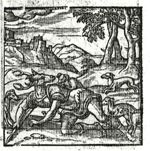
In receptatores sicariorum: Alciatus, Emblemata (Padua, 1621), col. 254 b, emblem 52
In receptatores sicariorum: Alciatus, Emblemata (Leiden, 1591), emblem 52 uses the adage's Actaeon imagery
In eum qui sibi ipsi damnum apparat: Alciatus, Emblemata (Leiden, 1591), emblem 64 uses the adage's goat imagery
Sibi damna parat: De la Feuille, Devises et emblemes anciennes et modernes (Augsburg, 1697), emblem 30 uses the adage's goat imagery
Nullo flectitur obsequio: Camerarius, Symbolorum et Emblematum Centuria(e) (Nürnberg, 1590, 1595, 1596, 1604), emblem 81
Iconclass: 25F23(WOLF)(+21) beasts of prey, predatory animals: wolf (+ young animal) 34C1 feeding wild animals 57AA8 Ingratitude; 'Ingratitudine' (Ripa) 97C11 Actaeon as a stag is devoured by his own dogs
Loci Communes: Ingratitudo (Ingratitude, Ingratitude); Malum accersitum aut retortum (Evil brought upon oneself or turned back, Mal attiré ou retourné)
II i 87 E dolio hauris You draw from the cask
Εκ πίθου αὐτλεῖν. id est E dolio haurire, dicebatur olim qui abundaret rebus optatis. Est enim dolium vas vinarium ingens, unde largiter haurire licet: neque facile sentitur detrimentum, videlicet in tanta copia. Theocritus ἐν ἐργατίναις, Εκ πίθω αυτλεῖς δῆλον, ἐγὼ δ᾽ ἔχω οὐχ ἅλις ὄξος. id est, Dolia plena fluunt , sed mihi vix sat aceti est. Scholiastes ad monet, proverbium dici solitum de iis, quibus adesset benigna rerum copia. Divitum est habere dolia, pauperes vappam bibunt e lagenis. Nam vini vis, quo copiosior est, hoc suavior esse consuevit, ubi paulum est liquoris, celerius vappescit. Admonet & Hesiodus, dimidiato dolio parcendum esse, quod sera sit in fundo parcimonia. Huic similimum est, quod subinde occurrit apud Chrysostomum, ἐκ πηγῶν, id est, è fontibus, quoties uberem, paratamque rerum copiam significat. M. Tullius in Bruto, dicit eos e dolio potare, qui vinum adhuc fervens bibunt: quod vinum expressum primum doliis excipitur, ubi deferbuerit aliquantulum, conditur in vasa. Ipsius verba praestat adscribere: Ut si quis, inquit, phalerno vino delectetur, sed eo nec ita novo, ut proximis consulibus natum velit, nec rursus ita vetere, ut Opimium, aut Anicium consulem quaerat. Atqui eae notae sunt optimae. Credo, sed nimia vetustas non habet eam, quam quaerimus, suavitatem, nec est iam sanè tolerabilis. Num igitur, qui hoc sentiat, si is potare velit, de dolio sibi hauriendum putet? Minime, sed quandam sequatur aetatem. Sic ego istis censuerim, et novam quasi de musto, & lacu fervidam orationem fugiendam, nec illam praeclaram Thucydidis nimium veterem tanquam Anicianam notam persequendam. Hactenus M. Tullius. Nec arbitror alienum ab hac forma, quod Athenaeus lib. 11. ex Hipponacte citat, ἐκ πέλλης πίνειν, id est, è mulctro bibere. Scazontes Hipponactei sic habent, Εκ πελλίδος πίνοντες, οὐ γὰρ ἦν αὐτοις Κύλιχ, ὁ παῖς γὰρ ἐμμεσὼν, κατήραξε. id est, Mulctro bibentes: nam calix eis deerat, Quippe hunc minister forte fregerat lapsus.
Ἐκ πίθου ἀντλεῖν, To draw from the cask, was said in old days of those who had plenty of what they wanted. A dolium or cask is a large container for wine, from which one can draw without restraint, nor is the loss easily detected when the supply is so great. Theocritus in the Husbandmen: 'You of course draw from the cask, while I am short of sour wine.' The scholiast tells us that the proverb was commonly used of those who had a generous supply of everything; rich men have their casks, the poor drink sour wine out of jars. For wine in bulk is usually smoother, the larger the quantity; when the bulk of liquid is small, it sours more quickly. There is Hesiod's warning too, that we should be sparing when the cask is half empty, because 'it's too late to spare when the bottom is bare.
There is a phrase very close to this which comes from time to time in Chrysostom: ἐκ πηγῶν, From the fountain-head, when he wants to convey the idea of a copious supply of things ready to hand. Cicero in the Brutus speaks of people as 'drinking from the cask' who drink wine while it is still fermenting, because must from the wine-press is first put into casks, and then laid up in bottles when the fermentation is partly completed. It is best to give his actual words: 'Suppose a man to like Falernian wine, but to prefer it neither so new that he chooses the production of the last few years nor so old that he hunts out the vintages of Opimius or Anicius. It is true that these are the most famous years; but the wine is so old that it does not have the rounded flavour we are in search of, and in fact by now it is hardly drinkable. Does this mean that a man with these tastes, if he wants a glass of wine, supposes he must draw from the cask? Of course not; he must aim at wine of a certain age. In my opinion, these people should avoid the modern style as they would avoid must that is fermenting straight out of the vat, but at the same time should not pursue Thucydides' famous but old-fashioned style as if it were vintage of Ancius' year.' So Cicero. Nor do I find any disagreement between this formula and a phrase quoted from Hipponax in Athenaeus book 11: To drink from the bucket. Hipponax's scazon-iambics run as follows: 'Drinking from the bucket, for they had no cup; the boy had fallen down and smashed it.'
Facsimile: 
Iconclass: 41A775 wooden container: barrel, cask 41C711(+5) wine ~ alcoholic drinks (+ foodstuffs in other container, e.g.: barrel, can, cask, tin, etc.) 46A21 contrast between rich and poor 51H42 Abundance; 'Abondanza', 'Abondanza maritima' (Ripa)
Collectanea (1500): 824
Loci Communes: Profusio (Extravagance, Prodigalité)
II i 88 Una cum ipso canistro Basket and all
Αὐτῳ κανῷ, id est, Una cum ipso canistro. Quadrat in eos qui rem intemperanter profundunt, devorantque & abliguriunt. Mos enim erat antiquis, ut testatur Didymus, ut coenae canistris inferrentur. Citatur apud Zenodotum Plato, Ανήρπακας ἁπαξάπαντ᾽ αυτῳ κανῷ. id est, Ipso canistro cuncta rapuisti simul.
Αὐτῷ κανῷ, Basket and all, suits those who spend their property waste-fully, devouring it and squandering it without restraint; for it was a custom among the Ancients, as we learn from Didymus, to bring food to the table at dinner in baskets. Zenodotus cites from Plato the line 'You've snatched the whole lot up, basket and all.'
Facsimile:
Iconclass: 41A7751 container made of plant material other than wood: basket 55C11 Squandering, Extravagance, Prodigality, Waste; 'Prodigalità' (Ripa)
Loci Communes: Profusio (Extravagance, Prodigalité)
II i 89 Prius locusta bovem pariet Sooner shall a grasshopper bring forth a cow
Prius locusta bovem pariet, περι τοῦ ἀδυνάτου. M. Varro de lingua Latina libro tertio, refert ex Ennio versum hunc, Atque prius pariet locusta lucam bovem. Nam Lucas antiqui boves appellabant elephantos, qui in Lucania primum à Ro. visi sint.
'Sooner shall a grasshopper bring forth a cow' is an expression for something impossible. Varro in book 3 of his On the Latin Language cites this line from Ennius: 'Sooner shall a grasshopper bring forth a Lucanian'; for the Ancients called cows Lucanians, on account of their size.
Facsimile:
Iconclass: 25F711(GRASS-HOPPER)(+2) insects: grass-hopper (+ sex and age of animals; propagation of animals) 47I2112 cow 52BB42 Impossibility
Loci Communes: Impossibilia (Impossible things, Choses impossibles)
II i 90 Per tenebras quae apud quercum By the darkness around the oak
Τὸ περὶ δρῦν σκότος. id est, Per tenebras, quae apud quercum: de ingenti ac fatali calamitate dicebatur. Zenodotus Aristotelem citat autorem, in politia Samiorum, Prienensium plurimos à Milesiis occisos fuisse iuxta locum, cui nomen quercus. Unde receptum, ut Prienensium mulieres, eius calamitatis memores, per tenebras, quae circa quercum essent, iurarent. Huius historiae simul & adagii meminit & Plutarchus in Problematis ad hanc ferme sententiam. Cum bellum esset inter Prienenses, et Samios, initio mediocribus damnis invicem sese afficiebant: deinde iusto praelio commisso, mille Samii à Prienensibus occisi sunt. Septimo post anno congressi cum Milesiis, primos quosque civium, ac nobilissimos simul uno praelio amiserunt. Quo tempore Bias ille sapiens Samum à Prienensibus orator missus, egregiam laudem adeptus est. Post eam itaque calamitatem atrocem, ac miserandam, Prienensium foeminae per tenebras quae circa quercum erant obtestari ac deierare coeperunt. quod liberos, parentem, maritos, charissima quaeque pignora eo loco perdidissent.
Τὸ περὶ δρῦν σκότος, By the darkness around the oak, was used of a great and fatal calamity. Zenodotus cites Aristotle in his Constitution of Samos as his authority for the heavy casualties suffered by Priene in an engagement with the Milesians near a place known as The Oak, from which came the tradition that the women of Priene in memory of the disaster should swear 'by the darkness that was around the oak.' This story and the adage are both mentioned by Plutarch in his 'Problems,' somewhat to this effect. Priene was at war with Samos, and at first the two sides inflicted moderate damage on one another, but later, when they met in a pitched battle, a thousand Samians were killed by the troops of Priene. Six years later in a war with Miletus they lost all their leading men and the best-known of their citizens in a single engagement. That was the occasion on which Bias the celebrated sage, who had been sent as envoy to Samos by the people of Priene, so much distinguished himself. After that appalling and piteous calamity the women of Priene took to adjuring and taking oaths 'by the darkness that was around the oak/ because in that place they had lost their children, their parents, their husbands, all their nearest and dearest.
Facsimile:
Iconclass: 22C9 darkness 25G3(OAK) trees: oak 56BB21 Calamity, Distress; 'Calamità', 'Calamità o miseria' (Ripa)
Loci Communes: Infortunii sive exitii (Misfortune or ruin, Malheur ou ruine)
II i 91 Concupivit assam farinam He lost his heart to wheaten loaves
Ηρατο ὀπτῷ ἀλεύρω. id est, Concupivit assam farinam. In eum dicebatur, qui domesticam tenuitatem pertaesus, apud alios lautiorem vitam quaesisset. Dictum est autem in Platonem, qui relictis Athenis, ter in Siciliam ad Dionysium navigavit, quo fortunam suam redderet lautiorem, quem admodum interpretantur aemuli. Nam hanc profectionem probro illi datam fuisse, testatur etiam Aristides in oratione, qua tuetur oratores quatuor, adversus Platonis calumniam. Et Diogenes, autore Laertio, cum animadvertisset Platonem in opiparo quodam convivio, à reliquis temperantem cibis, & oleis duntaxat utentem, taxavit hominis ambitiosam abstinentiam: Τί ὁ σοφὸς εἰς σικελίαν πλεύσας τῶν τραπέζων τούτῶν χάριν, νῦν παρακειμένων οὐκ ἀπολάυεις; id est. Quid homo sapiens, cum ob huiusmodi mensas in Siciliam navigaris, nunc appositis non frueris? Ad quod ita Platonem respondisse narrat: Νὴ τοὺς θεοὺς διόγενες κακεῖ τὰ πολλὰ πρὸς ἐλαίας καὶ τὰ τοιαῦτα ἐγινόμην. id est, Per deos Diogenes, & illic plerumque oleis, atque id genus cibis utebar. Ad quod rursum Diogenes, Τί οὖν ἔστει πλεῖν εἰς συρακούσας; ἢ τότε ἀττικὴ οὐκ ἔφερεν ἐλαίας; id est, Quorsum igitur attinebat Syracusas navigare? Num id temporis Attica non ferebat oleas? Theocritus in Cyniscis: Ηρατο μὲν τῆνος ἐμὶν δοκεῖ, ὀπτῶ ἀλεύρω. id est, Nam puto et hic assae correptus amore farinae. Porrò farinam assam, novam & lautiorem victus rationem vocat, propterea quod priscos illos pulte duntaxat victitasse legimus, videlicet clibano coquendi panis usu nondum reperto. Unde et Annus ille Aegyptius, qui primus panarium clibanum excogitavit, in proverbii iocum abiit, tamquam qui rem novam esset commentus, quemadmodum alibi retulimus. De deliciis coquendi panis, multa fecenset Plinius libro 18. cap. 11.
Ἤρατο ὀπτῶ ἀλεύρω, He lost his heart to wheaten loaves, was said of a man who had grown tired of the modest life he led at home and gone to seek luxury under another man's roof. This was a charge levelled at Plato, who left Athens three times and made the voyage to join Dionysius in Sicily, in order to enjoy a more ample style of living according to the explanation offered by those who were jealous of him. For we know that those journeys were thought to discredit him, from the evidence of Aristides also in the speech in which he defended the four orators from Plato's unfair criticisms. And Diogenes, as we learn from Laertius, once observed Plato at some splendid feast refraining from all the other dishes and eating nothing but olives, and took him to task for this exhibition of self-denial. 'You're a clever man,' he said. 'Why did you come all the way to Sicily for the sake of a dinner like this, and now do not enjoy what is set before you?' To which Plato is said to have replied as follows: 'Why, for pity's sake, Diogenes, it was olives and such like on which I lived in Athens too.' To which Diogenes retorted: 'Then why need you set sail for Syracuse? Were there no olive-trees in Attica just then?' Theocritus in his Cyniscae: 'He lost his heart, I think, to wheaten loaves.' Clearly he uses 'wheaten loaves' as a name for a new and more luxurious style of life; for we read that in early times they lived exclusively on porridge, presumably because the practice of baking loaves in an oven had not yet been discovered. This was also the reason why Annus, the Egyptian inventor of the baking-oven, became a proverb as the discoverer of something quite new, as I have described elsewhere. On the finer points of baking bread many details will be found in Pliny, book 18 chapter 11.
Facsimile: 
Iconclass: 32B32(EGYPTIANS) African peoples, Africans (EGYPTIANS) 41C62 bread, cake, pastry, etc. 41C621 bread, loaf 47B1811 baker 47I111 cereal, grain, corn (grass with grains, grown for food, e.g.: wheat, rice, rye, oats, maize, buckwheat, millet) 52A42 Invention, Inventiveness; 'Inventione' (Ripa) 55B2 Luxury, Luxuriousness 55CC11 Greed, Covetousness, Cupidity; 'Cupidità' (Ripa) 57AA76 Jealousy; 'Gelosia', 'Rammarico del ben'altrui' (Ripa)
Loci Communes: Frustrata spes (Frustrated hope, Espoir déçu)
II i 92 Battologia. Laconismus Vain repetition. Spartan brevity
Βαττολογία, Graecis multiloquium vocatur, à Batto quopiam inepto poeta, qui hymnos quosdam conscripsit prolixos, in quibus eadem crebrius iterabantur. Hinc vox etiam conficta, βαττολογεῖν, quae quidem adeo vujlgo fuit usurpata, ut ea Matthaeus apostolus sit usus. Sic enim apud hunc loquitur Christus, προσευχόμενοι δὲ μὴ βαττολογησητε ὥσπερ οἱ ἐθνικοὶ. id est, Orantes autem, ne battologissetis, more gentilium. E diverso λακωνισμός, id est, Laconismus, in breviloquentiae significationem abiit: quo modo usurpatur aliquoties apud M. Tullium in Epistolis.
Βαττολογία, 'Battology,' is a Greek word for vain repetition, derived from Battus, an incompetent poet who composed several prolix hymns in which the same things were repeated over and over again. Hence too was formed the verb battologein, which was in such wide use that it was employed by Matthew the apostle; for he reports Christ as saying: 'When you pray, do not use vain repetitions, as the Gentiles do' (battologêsête). Laconism, 'Spartan,' however, acquired the connotation of brevity, and is sometimes used in this sense by Cicero in his Letters.
Facsimile:
Iconclass: 48C91 writer, poet, author 51B61 Repetition 52D21 Conciseness 54BB3 Inutility, Noxiousness; 'Nocumento', 'Nocumento d'ogni cosa' (Ripa) 98B(BATTUS) male persons from classical history (BATTUS)
Loci Communes: Garrulitas (Talkativeness, Bavardage)
II i 93 Batti silphium Battus' silphium
Βάττου σίλφιον. id est, Batti Silphium, Graeci novum & rarum quempiam honorem proverbio vocant. Aristophanes in Pluto: Οὐδε᾽ ἂν εἰ δοίης γέμοι Τὸν πλοῦσον αὐτὸν, καὶ τὸ βαττου σίλφιον. id est, Nec si mihi donaveris Ipsumque Plutum, ipsumque Batti Silphium. Negat se sycophanta quieturum, etiam si praemium quantumvis magnum detur. Idem in Equitibus, Τὸν καῦλον οἶσθ᾽ ἐκεῖνον Τοῦ σιλφίου τὸν ἄξιον γενόμενον; οἶδα μέντοι. id est: Nosti ne stipitem illum, Qui dignus habitus silphio est? notus quidem est mihi ille. Interpres diversam originem adagionis adscribit. Battus à Thera iuxta Cretam insulam, profectus, oraculo monitus Apollinis, vel, ut alli tradunt, domestica pulsus seditione, Cyrenen condidit. Cui cum Afri beneficii memores summum honorem habere studerent, donarunt illi silphium herbam apud illos omnium pulcherrimam: simulque numisma ferientes, in cuius altera parte regia facies erat inscalpta, altera Silphium, quo fuerat à civitate donatus. Cuius rei meminit et Aristoteles in Republica Cyreneorum. Sed fusius narrat Herodotus in Melpomene, addens, apud Libyas regem Battum appellari, et hoc nomine compellatum ab oraculo, significante fore regem. Sunt, qui dicunt imaginem fuisse datam: sunt rursum, qui anulum, in quo civitas erat expressa, regi Silphium deferens. Porrò Silphium inter herbas primam gloriam obtinet, cuius et folia, et fructus, et caulis, et sucus preciosissimus sit. Unde Ampeliotae (ea gens quaedam est Africae) Delphis Silphii caulem consecratum suspenderunt, ut auctor est Alexandrides. Haec ferme affert in Plutum: nec dissident, quae Suidas memorat. At idem in Equites scribit, Silphium fruticem esse inamoeni odoris: rursus iuxta alios amoeni, et ad medicamenta utilem, cuius usum primus invenisse creditur Aristaeus Apollinis & Cyrenae filius, qui & mellis invenisse traditur. Illud quid sibi velit nescio: Aristophanis interpres ait in altera nomismatis parte insculptam βασιλείαν, id est, regnum seu regiam si transferas tonum: pro eo Zenodotus legit Ammonem, sic enim habet, καὶ τοῦ νομίσματος, ἐπὶ μὲν θατέρου ἄμμωνα, ἐπὶ δὲ θατέρου σίλφιον ἐτύπωσαν. id est, Nomismatis altera parte Ammonem, in altera silphium expresserant. Ammonem, ut arbitror, sentiens Iovem regnorum largitorem, si quidem Homero credimus. Huius Batti meminit & Pindarus in Pythiis: Χρῆσεν οἰκιστῆρα βᾶττον καρποφόρου λιθύας. i. Respondit habitatori Batto frugiferae Africae. Eruditi quidam putant silphium laserpitii genus esse.
Βάττου σίλφιον, Battus' silphium, is a proverbial expression in Greek for any new and rare distinction. Aristophanes in the Pluius: 'Not if you gave me / Riches itself and Battus' silphium.' The sycophant says he will not keep his mouth shut, for any reward however large. The same poet in the Knights: 'You know that blockhead who was thought to deserve the silphium? - Indeed, I know him well.' The scholiast adds a different origin for the adage. Battus set out from Thera near the island of Crete, either on the advice of the oracle of Apollo or, according to others, having been driven out by civil strife, and founded Cyrene. The Africans, remembering all he had done for them and wishing to pay him the highest honours, presented him with the plant called silphium, the most distinguished one they have, and at the same time struck coins which had a king's head on one side and on the other the silphium with which he had been presented by the community. This is also recorded by Aristotle in his Constitution of Cyrene but a longer account is given by Herodotus in his Melpomene, who adds that battus is the word for king in Libyan and that the oracle used this name in addressing him, to show that he would become king. Some say he was given a picture of silphium; others that it was a ring on which the city was represented, offering silphium to the king.
In any case, silphium holds the highest place among plants, for its leaves, fruit, stalk and juice all alike fetch a very high price. Hence it was that the Ampeliotae, an African tribe, hung up a stalk of silphium as an offering at Delphi, as we learn from Alexandrides. This is more or less what we are told by the scholiast on the Pluius. Nor is Suidas' account very different. On the Knights he comments that silphium was a shrub with an unpleasant odour (others say pleasant) of value in medicine, the use of which is believed to have been discovered first by Aristaeus, son of Apollo and Cyrene, the supposed discoverer of honey. There is another point, the meaning of which I do not know. The scholiast on Aristophanes says that on one side of the coin was stamped a basileia, which would mean a kingdom or a palace according to the accent; and for this Zenodotus reads Ammon. His words are: 'On one side of the coin they had represented Ammon, and on the other silphium,' meaning I suppose by Ammon Jupiter the giver of kingship, if we may believe Homer. This Battus is also mentioned by Pindar in the Pythians: 'She uttered an oracle that Battus should found a city in the fertile land of Libya.' Some scholars think silphium is a kind of asafoetida.
Facsimile:
Iconclass: 25G6(SILPHIUM) extinct plants (SILPHIUM) 51BB61 Singularity, Uniqueness 98B(BATTUS) male persons from classical history (BATTUS)
Loci Communes: Dignitatis (Dignity, Dignité)
II i 94 Ne malorum memineris Remember no wrongs
Μὴ μνησικακήσῃς. id est, Ne malorum memoriam refrices. Thrasybulus, ubi civitatem Atheniensium triginta tyrannorum saevitia liberasset, plebiscitum interposuit, ne qua prae teritarum rerum mentio fieret. Quam malorum oblivionem Athenienses ἀμνηστίαν vocant. autor Valerius Maximus libro quarto Rerum memorabilium, titulo de animi moderatione. Meminit & M. Tullius in prima Philippica, his quidem verbis: In quo templo quantum in me fuit, ieci fundamenta paucis, Atheniensiumque revocavi vetus exemplum, Graecum etiam verbum usurpavi, quod tum in sedandis discordiis usurpaverat civitas illa, atque omnem memoriam discordiarum, oblivione sempiterna delendam censui. Aristophanes in Pluto: Μὴ μνησικακήσῃς εἰ σὺ φυλὴν κατάλαβες. id est, Malane acta refrices, Phyla sicapta est tibi. Interpres inter alia tale quoddam commentum adscribit. Thrasybulus occupato loco quodam, cui nomen Phyla, triginta tyrannos sustulit, post ubi arrogantius quiddam dixisset, audisse, μὴ μνησικακῆσαι, id est, Ne malorum memoriam revoces, idque dictum in proverbium abiisse. Probus Aemylius refert, post exactos tyrannos Thrasybulum hanc tulisse legem, ne quis de praeteritis actis accusaretur, aut mulctaretur, ea lex dicta est oblivionis. Idem socios volentes contra legem saevire in eos, cum quibus reditum erat in gratiam, publice cohibuit, et legem latam confirmavit. Huic pro tantis meritis praemii Ioco data est corona ex duab. virgulis oleaginis, et hoc cimli honore vir prudens contentus fuit. Admonet adagium, non esse refricandam commemoratione praeteritorum malorum memoriam. Sunt autem apud Aristophanem verba Mercurii ad Carionem servum. Plato li. De legibus 4. Φράσω γὰρ, οὔτι μνησικακεῖν βουλόμενος ὑμῖν. id est, Dicam certe, non autem quod velim praeteritorum malorum m emoriam vobis refricare. Sumptum videtur ex Homero, apud quem aliquoties hic versus, nempe Iliados Ζ. Θ. Τ Αλλὰ τὰ μὲν προτετύχθαι ἐάσομεν ἀχνύμενοι περ. id est, Verum haec acta quidem, moesti licet ire sinamus. Hunc tanquam proverbialem subinde usurpat Tullius ad Atticum scribens. Eodem spectat et illud eiusdem Odyss. Θ. Επος δ᾽ εἴερτι βέβακται Δεινόν, ἄφαρ τὸ φέροιεν ἀναρπάξασαι ἄελλαι. id est, Si dictum est verbum durius ullum, Id procul abripiant venti per inane procellae. Plutarchus περὶ τῆς φιλαδελφίας. δεῖ ἐν ἀμνηστίᾳ τὴν ἡμέραν ἐκείνην τίθεσθαι. id est, Oportet eum diem oblivioni tradere. erit hic usus proverbii, si iuxta vulpinum illud consilium, admonebimus aliquem, ne ptaeteritorum malorum memoria semet affligat, quandoquidem, quod factum est, infectum fieri non potest. Lucianus in Caucaso: Ες δὲ τὸ αὔριον ταμιεύεσθαι τὸ μῖσος καὶ μνησικακεῖν καὶ ἕωλόν τινα μνήμην διαφυλάττειν, ἄπαγε οὔτε θεοῖς πρέπον οὔτε ἄλλως βασιλικόν. id est, Caeterum in posterum diem reponere odium & malorum meminisse, ac pridianam quandam memoriam reservare, apage, neque diis dignum, neque alioqui regale.
Μή μνημισκακήσῃς, Do not rub up the memory of former wrongs. Thrasybulus, after liberating the Athenian state from the cruelties of the Thirty Tyrants, chose that moment to put forward a decree prohibiting all mention of the past. This forgetting of former wrongs is called by the Athenians amnestia, an amnesty. Our authority for this is Valerius Maximus in book four of his Memorabilia, under the heading 'Moderation.' It is also mentioned by Cicero in his first Philippic in the following words: 'In that temple, so far as was in my power, I laid the foundations of peace, and revived a historic precedent set by the Athenians. I employed that Greek word which had in old days been employed in Athens when warring parties must be reconciled, and proposed that all memory of our disagreements should be plunged in eternal oblivion.'
Aristophanes in the Plutus: 'Remember no wrongs, if you did take Phyle.' The scholiast with other comments adds one to this effect: Thrasybulus, after occupying a place called Phyle, abolished the Thirty Tyrants; and later, when he had shown excessive arrogance, someone said to him 'Remember no wrongs,' and the saying passed into a proverb. Probus Aemilius records that after the expulsion of the tyrants Thrasybulus passed a law that there should be no prosecution or punishment in respect of what had happened, and this enactment was called an amnesty. And again, when his supporters wanted in defiance of the law to vent their anger on those with whom they had come to an agreement, he publicly prevented them and confirmed the law which had been passed. By way of reward for these great services he was presented with a crown made of two branches of olive, and he was content, wise man that he was, with this civilian distinction.
The lesson of the adage is that we should not rub up the memory of former wrongs by dwelling on them. The words in Aristophanes are spoken by Mercury to Carion, a slave. Plato in the fourth book of the Laws: 'For I will say what I think without any wish to remind you of old wrongs.' This seems to be taken from Homer, who several times (in fact, in Iliad 6, 8, and 19) has the line 'What's done is done, and we will let it be, though grieved at heart.' This is used sometimes by Cicero when writing to Atticus, as though it were proverbial. There is another line of Homer's to the same effect in Odyssey 8: 'But if a harsh word has been uttered, let the wind seize it and bear it away.' Plutarch 'On Brotherly Love': That day ought to be consigned to oblivion (amnestia).' This proverb will have its uses when we wish to advise someone, following the fox's advice in the fable, not to make himself wretched by dwelling on evils past, because what's done cannot be undone. Lucian in his Caucasus: 'But to treasure up one's resentment for next day and remember the wrong and preserve such rancid recollections, oh no! This is unworthy of the gods and in no respect proper for a king.'
Facsimile: 
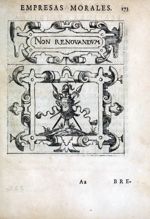
Non renovandum: Borja, Empresas morales (Bruxelles, 1680), emblem 86 shares the message that old grievances should be removed from memory once peace is reached.
Iconclass: 23A31:57AA1 past❧Bad Behaviour 52AA3 Forgetfulness 57A74 Forgivingness
Loci Communes: Oblivio (Forgetfulness, Oubli)
II i 95 Mentam belli tempore neque serito neque edito Neither sow nor eat mint in time of war
Μίνθην ἐν πολέμῳ, μήτ᾽ ἔσθιε μήτε φύτευε. id est, Mentam nec comedas, nec plantes tempore belli. Aristoteles problematum sectione vigesima, statim mitio refert hoc adagium, causam vestigans, unde dictum hoc m ora vulgi pervenerit. Arbitratur autem esse causam, quod menta corpori frigus adducat, eius rei argumentum esse, quod semen genitale minuat; frigus autem adversari fortitudini, atque audaciae, sicut ostendit sectionis decimaequartae ultimo problemare, cum ait eos, qui natura sint frigida, formidolosiores esse, contra qui calida, audaces. Potest et in eum sensum deflecti paroemia, ut admoneat, ne quid alieno tempore fiat, quod officiat, quem adm odum menta bellum inituris est inutilis.
Μίνθην ἐν πολέμῳ μήτ᾽ ἔσθιε μήτε φύτευε, Neither eat nor plant mint in time of war. Aristotle in his Problems, section 20 right at the beginning, records this adage, and seeks for some reason why such a saying should have come into popular speech. He thinks the reason may be that mint has a cooling effect on the body, and that its capacity to reduce the flow of semen is a proof of this; while cold has a bad effect on endurance and courage. He demonstrates this in the last problem of section 14, where he says that all those who are cold by nature are inclined to cowardice, and those who are hot are courageous. The proverb may be turned to express advice not to do anything at the wrong moment that may prove harmful, in the same way that mint is bad for men who will fight in a war.
Facsimile:
Iconclass: 25G4(MINT) plants and herbs: mint 41C11 eating 45A1 war 47I131 sowing 54A8 Courage, Bravery, Valiance, Manliness; 'Ardire magnanimo et generoso', 'Gagliardezza', 'Valore', 'Virtù heroica', 'Virtù dell'animo e del corpo' (Ripa) 54AA8 Cowardice
Loci Communes: Intempestiva et inepta (Untimely and inept things, Choses inopportunes et ineptes)
II i 96 Ad corvos Off with you to the crows
Βαλλ᾽ ἐς κόρακας. id est, abi ad corvos, perinde valet quasi dicas, abi in malam rem, atque in exitium. Aristophanes ἐν νεφέλαις,, Βάλλ᾽ ἐς κόρακας. τίς ἐσθ᾽ ὁ κόψας τὴν θύραν; id est, Apage ad coruos, quis est qui pepulit ostium? Rursum in Pluto: Οὐκ ἐς κόρακας; id est, An non ad corvos? Iterum in eadem fabula: Εῤῥ ἐς κόρακας θᾶττον ἀφ᾽ ἡμῶν. id est, Ocyus hinc ad coruos abeas. Reperitur apud hunc poetam et aliis plerisque locis. Plutarchus in commentario, quem scripsit adversus Herodotum, taxat eum, quod Isagoram ad Cares, velut ad coruos relegarit, id est, quod eum Carem fecerit. Eleganter dictum est a Diogene Cynico: Κρεῖττον εἶναι ἐς κόρακας ἀπελθεῖν ἢ ἐς κόλακας. i. Satius est ad corvos devenire, quam ad adulatores. quod hi & vivos & bonos etiam viros devorarent. Zenodotus scribit, in Thessalia locum esse quendam, cui nomen inditum Corvis, in quem nocentes praecipites dabantur: atque huius adagii Menandrum etiam meminisse. Quosdam autem originem adagionis ad huiusmodi quandam historiam referre. Boeotiis quondam Arnam incolentibus oraculo praedictum est, futurum, ut e finibus expellerentur, fimul atque corui albi apparuissent. Evenit deinde, ut adolescentes aliquot per lasciviam, ac temulentiam coruos, quos coeperant, gypso oblitos, rursum emitterent. Quos ubi vidissent volantes Boeotii, recordantes oraculum, arbitrabantur adesse tempus, quo forent suis e sedibus eiciendi, summopere perturbati sunt. Ceterum adolescentes territi et ipsi tumultu, profugerunt, ac locum quendam sibi mercati sunt, cui nomen Coracon, id est, coruorum. Contigit aliquanto post, ut Aeoles eiectis Boeotiis, Arnam occuparent. Apud quos hic deinde mos receptus, ut maleficos relegarent in eum locum, cui nomen erat Corui. Aristophanis interpres paulo diversius hanc recenset historiam, nempe Boeotiis aliquando a Thracibus subversis, ac profligatis, respondisse deum ut ibi sedem figerent, ubi coruos albos conspexissent, conspexisse autem in Thessalia iuxta sinum Pagaeaticum circum volantes coruos quosdam soli sacros, quos pueri per lusum gypsatos dimiserant. Boeotii vero, rati iam perfectum oraculi symbolum, inibi sedem constituerunt. Sunt, qui paroemiam ad coruorum volatum referant, quod in desertis fere locis volitare consueverint. Ut proverbium conveniat cum illo, In extremas solitudines publicitus deportandum. Euripides in Hecuba: Οὔ ὅσον τάχος Νήσων ἐρήμων αὐτὸν ἐκβαλεῖτε ποι; id est, Non huncce solitarias Quantum potest aliquò auferetis in insulas? Stratonicus citharoedus apud Athenaeum libro octavo, detorquet in cantorem quendam. Is quum ei nescio quid molestus esset, ψάλλε, inquit, ἐς κόρακασ. depravata per iocum voce ψάλλε pro βάλλε.
Βᾶλλ᾽ ἐς κόρακας, Off with you to the crows, has the same force as saying Begone to perdition, Go to hell. Aristophanes in the Clouds: 'Off with you to the crows! Who's that who knocked?' Again in the Plutus: 'Off to the crows, won't you?' and elsewhere in the same play: 'Be off to the crows and leave us instantly.' It is also found in this poet in several other places. Plutarch in the essay he wrote 'Against Herodotus' complains that he sent Isagoras into exile among the Carians, like sending him to the crows, because he made him a Carian. Diogenes the Cynic said very neatly that it was better to end up among crows (korakas) than among flatterers (kolakas), because flatterers devoured men while alive, and good men too. Zenodotus writes that there is a place in Thessaly called The Crows, where criminals were thrown over a precipice, and that Menander also mentions this adage. Some people however, he says, trace the origin of the adage to a story something like this. The Boeotians who once dwelt in Arna were told by an oracle that they would be driven out of their land as soon as white crows had appeared. It happened later that some young men in a drunken frolic white-washed some crows they had caught and let them go again. When the Boeotians saw these on the wing, remembering the oracle and supposing the time was at hand when they were to be driven out of their homes, they were in great anxiety. The young men however, no less frightened by the uproar, took flight, and bought themselves a piece of land called The Crows. It came about some time later that the Aeolians drove out the Boeotians and occupied Arna; and among them the custom grew up of transporting criminals to the place called The Crows.
The scholiast on Aristophanes tells the story rather differently. He says that once the Boeotians, having been defeated and driven out by the Thracians, were told by the oracle to take up their abode in any place where they might have seen white crows. In Thessaly near the Pagaeatic gulf they saw crows, which are a sacred bird in the country, flying about, which had been whitewashed for fun by children and let go again. Thinking the sign given them by the oracle was now fulfilled, the Boeotians settled there.
Some refer the proverb to the flight of the crows, because they are usually seen on the wing in uninhabited places; so that it is equivalent to the public removal of someone to a most remote and deserted place. Euripides in the Hecuba: 'With all speed cast him out to some remotest island.' Stratonicus the lyre-player in Athenaeus, book 8, twisted it to fit some musician, who had got on his nerves, I know not why. 'Go and play to the crows,' he said, humorously putting psalle [play] in place of balle [throw].
Facsimile: 
En tous endroictz flatteurs sont dangereux: La Perrière, Le theatre des bons engins (Lyon, 1545), emblem 45 uses the imagery of crows eating from a corpse to convey the warning against flatterers found in the adage's comment
Iconclass: 13B42 bewitching, cursing, casting spells 25F32(CROW) song-birds: crow 33B1 quarrel, argument 44G38 banishment, exile 55AA11 Relinquishment, Abandonment of Property 58AA1 Destruction 98B(CRATES) male persons from classical history (CRATES)
Loci Communes: Infortunii sive exitii (Misfortune or ruin, Malheur ou ruine)
II i 97 Mitte in aquam Throw him in the water
Βάλλ᾽ ες ὕδωρ, id est, Mitte in aquam. hoc est, aufer è medio. Dicitur vel in hominem, vel in rem exitio dignam. Tractum à supplicio quorundam, qui in profluentem, aut mare praecipitabantur. Quae poena peculiaris erat parricidis apud Romanos. Unde philosophus in timone iubet aurum abici in mare, quod aliquando fecisse legitur Crates ille Thebanus. Horatius: Vel nos in mare proximum Gemmas & lapides, aurum et inutzle Summt materiam mali Mittamus: scelerum si bene paenitet. Sed non absurdum videtur, si referatur ad aquam clepsydrarum dispensandam: ut intelligas in ius trahendum: & ad proverbium quod alio diximus loco, ὑφ᾽ ὕδωρ ὁ πονηρὸς, id est, sub aquam malus. Effertur adagium etiam hoc pacto, βάλλ᾽ εἰς ὄλεθρον, id est, abi in perniciem.
Βᾶλλ᾽ ἐς ὕδωρ, Throwing into the water, which means making a good riddance, is applied either to a person or to a thing that ought to be destroyed. It is taken from the punishment of some people, who were pitched headlong into a running river or into the sea. This penalty was reserved in Rome for parricides. Hence the philosopher in Timon tells him to throw his gold into the sea; and we are told that the celebrated Crates of Thebes once did so. Horace:
Or let us cast into the nearest sea
Our gems and our rare stones and useless gold,
Of deepest wrong the occasion and the means,
If we are truly sorry for our crimes.
It would not be absurd, it seems to me, if taken to apply to the flow of water in a water-clock, giving the sense that a man must be arraigned under the law, and to the proverb of which I have spoken in another place, A rascal at the water. The adage also appears in the form Βᾶλλ᾽ εἰς ὄλεθρον, Off with you to perdition.
Facsimile:
Divitiarum contemtus: Meyer, Homo Microcosmus (Frankfurt, 1670), emblem 39 uses the adage's imagery
Iconclass: 31A2735 being thrown 31A2741 throwing something 31E23111 drowning, ’walking the plank' 58AA1 Destruction 58BB1 Mortality, Extinction of Life 98B(CRATES) male persons from classical history (CRATES)
Loci Communes: Infortunii sive exitii (Misfortune or ruin, Malheur ou ruine)
II i 98 In beatam To blessedness
Βάλλ᾽ εἰς μακαρίαν. id est, Aufer te in beatam. Quibusdam placet dictum, κατ᾽ εὐφημισμὸν, pro eo, quod est, in rem malam. Fingunt enim apud inferos locum esse quendam, cui nomen μακαρία. Aristophanes in Equitibus: Απαγ᾽ ἐς μακαρίαν ἐκ ποδῶν. id est, Aufer te hinc procul in Macariam. Ad consimilem ferme modum Athenaeus Dipnosophistarum lib. primo, εἰς μακαρίαν τὸ λουτρὸν. id est, In beatam balneum. Devovet enim balneum, unde male fuerat affectus. Plato in Hippia maiore, Βάλλε εἰς μακαρίαν τὸν ἄνθρωπον. id est, Aufer in beatam hominem. Alii fabulam huiusmodi allegant. narrant Macariam Herculis filiam fuisse, de qua praedictum erat oraculo, ut se ultro morti obiiceret: sic enim Athenas fore liberas ab incursione Eurysthei, si quis Heraclidarum se sponte offerret ad necem. Itaque Hercule defuncto, cum Eurystheus illius liberos insectaretur, atque illi ad Misericordiae aram confugissent, Athenienses recusantes eos in hostium manus tradere, cum Eurystheo bellum susceperunt. Porrò aedito oraculo, futurum ut Athenienses ab Eurysthei incursatione liberarentur, si quis è liberis Herculis semet inferis devoveret, Macaria sese spontaneae morti obtulit. Quo facto congressi cum hostibus Athenienses victoriam reportarunt, cum aliis quàm plurimis interfectis, tum Eurystheo ipso, ab Hylo, sive Iolao Herculis filio, perempto, cuius caput amputatum ad Alcmenam detulit. Illa defuncti oculos effodit. Caeterum Athenienses Macariae tumulum floribus & coronis decorantes, dicebant: Βάλλ᾽ εἰς μακαρίαν. id est, Mitte in Macariam. Hinc igitur ortum adagium. Primum de his ferebatur, qui sese per virtutem in periculum sponte demitterent: deinde de quovis piaculo dici coeptum. Pausanias refert, Macariam esse paludem in Marathone, in qua magna vis Persarum perierit ignoratione viarum in ipsam prolapsa, qua ex re natum videri potest proverbium. Huc allusit Stratonicus citharoedus apud Athenaeum libro octavo, qui iratus discipulo Macedoni quod nihil recte faceret, εἰς Μακεδονίαν, inquit, ex Macaria faciens Macedoniam, simul alludens ad illud proverbium, Domi, non hic Milesia.
Βᾶλλ᾽ ἐς μακαρίαν, Off with you to blessedness. Some think this is a euphemism for 'Off with you to perdition;' for they imagine there was a place in the nether regions called Macaria or Blessedness. Aristophanes in the Knights: 'Off with you to blessedness; get out of here.' In somewhat the same way Athenaeus in his Doctors at Dinner, book 1: To blessedness with that bath;' for he curses the bath, which had done him so much harm. Plato in the Hippias major: 'Off with the man to blessedness.'
Others produce a story to the following effect. They say Macaria was a daughter of Hercules, to whom it had been foretold by an oracle that she must willingly expose herself to death, because Athens would be free from the invasion of Eurystheus only if one of the children of Hercules would offer himself to be killed of his own accord. So when Hercules was dead, Eurystheus persecuted his children, and they took refuge at the altar of Mercy; whereupon the Athenians refused to surrender them into enemy hands, and declared war on Eurystheus. Then, when the oracle was published which said that the Athenians would be freed from invasion by Eurystheus if one of the children of Hercules were to offer himself to the gods below, Macaria exposed herself to death of her own free will. Whereupon the Athenians joined battle with the enemy and won the day, with very heavy slaughter of the enemy, including Eurystheus himself, slain by Hercules' son Hylus or Iolaus; his head was cut off and taken to Alcmena who, dead though it was, gouged out its eyes. But the people of Athens dressed Macaria's tomb with flowers and garlands, saying 'Off to Macaria.' This then was the origin of the adage, which was originally used of those who were brave enough to expose themselves willingly to danger, and then began to be applied to any object or form of expiation.
Pausanias records that Macaria was the name of a marsh near Marathon, in which a great number of Persians perished, having fallen into it because they had lost their way; and this might seem a source for the proverb. It was alluded to by Stratonicus the lyre-player, as reported in book 8 of Athenaeus: He was angry with a Macedonian pupil, who did nothing right, and cried 'Off with you to Macedonia,' putting Macedonia in place of Macaria, and alluding at the same time to the proverb Milesian luxury at home, not here.
Facsimile: 
Iconclass: 12B18 afterlife, the hereafter, the underworld ~ non-Christian religions 56B21(+0) Eternal Bliss; 'Felicità eterna' (Ripa) (+ variant) 94L9 (story of) Hercules (Heracles) - offspring, companion(s), train etc. 58BB1 Mortality, Extinction of Life
Loci Communes: Infortunii sive exitii (Misfortune or ruin, Malheur ou ruine)
II i 99 Alabanda fortunatissima Alabanda has all the luck
Αλάβανδα Καρῶν εὐτυχεστάτη, id est, Alabanda Carum fortunatissima. Stephanus in commentario de urbibus, tradit Alabandam Cariae civitatem esse conditam à Care, à cuius filio nomen sortita sit. Siquidem is postquam in equestri praelio strenue navasset operam, Alabandus est dictus. Cares enim sua lingua Ala vocant equum, Banda victoriam. Eamque vocem ait Romanis etiam in usu fuisse, ut bandam victoriam dicerent. Equidem opinor hinc Germanis durare vocem eam, qua praepotentem & antiquae nobilitatis principem, Banderum vocant, ut qui victor olim hoc honoris virtute bellica sibi pepererit. Addit ex Philoxeni in Odys. Homeri commentariis, soloecismi genus esse, quod Alabandiacum vocetur: veluti, si quis μὴ pro οὐ ponat, aut apud nos non pro ne, aut quod pro ut. Quandoquidem Homerus quoque Caras βαρβαροφώνους appellat. Iuvenalis in tertia Satyra, Alabandam recenset inter urbes barbaricis deliciis ac luxu perditas: Hic alta Sicyone ast hic Amydone relicta, Hic Andro, ille Samo, hic Trallibus aut Alabandis. Stephanus admonet olim Alabandam inter Cariae civitates opulentissimam ac florentissimam fuisse, ut proverbio quoque locum fecerit, quod modo retulimus. Quadrabit igitur, ubi volemus intelligi fortunam amplam, & vitae genus voluntarium, quanquam à literis & virtutis studio alienum. Veluti, si dicat aulicus aut negociator quispiam: Alii se in literis macerent, alii cum paupertate philosophentur, ἀλάβανδα Καρῶν εὐτυχεστάτη. Itaque confine fuerit illi, quod alio dictum est loco, εὐδαίμων ὁ Κόρινθος. id est, Felix Corinthus. Poterit & per irrisionem usurpari, veluti, si ioceris in quempiam parum egregium, qui tamen in gente vehementer barbara crassaque praecellere videatur, ἀλάβανδα καρῶν &c.
Ἀλάβανδα Καρῶν εὐτυχεστάτη, Alabanda has all the luck in Caria. Stephanus in his book On Cities records that Alabanda is a city in Caria, founded by Car, from whose son it took its name. The son got the name Alabandus from the valour he had displayed in a cavalry engagement; for in the language of Caria ala means 'horse' and banda Victory;' and the word, he says, was also in use in Rome, where a victory was called banda. I myself suppose that this is the source of a word still in use in Germany, where a powerful prince of ancient lineage is called a bander, if he has a record of victories and has won this distinction by a display of martial valour. He adds, on the authority of Philoxenus' commentary on Homer's Odyssey, that there is a type of grammatical blunder called Alabandian: if, for example, one were to use the negative me instead of ou, or in Latin non instead of ne or quod instead of ut. For Homer also calls the Carians 'harsh of speech.' Juvenal in his third satire lists Alabanda among the cities that have been undermined by luxury and soft living: 'Here's one from lofty Sicyon and one from Amidon, from Andros one or Samos, and another from Tralles or Alabanda.' Stephanus tells us that of all the cities of Caria Alabanda was in old days the richest and most prosperous, so that it even gave rise to the proverb which I have just now recorded. It will be suitable therefore when we wish to convey the idea of an ample fortune and luxurious way of life, though remote from education and the pursuit of virtue. Some courtier or merchant might say, for instance, 'Others are welcome to be starveling students or penniless philosophers; it is Alabanda has all the luck in Caria.' And so it will be found akin to one of which I have spoken in another place, Corinth is rich. It can also be used ironically, for instance if you were to say of some far from gifted man who none the less seems to occupy a prominent place in a land of barbarians and dolts 'In Caria Alabanda has all the luck.'
Facsimile:
Iconclass: 54F12 Luck, Fortune, Lot; 'Fato', 'Fortuna', 'Fortuna aurea', 'Fortuna buona', 'Fortuna pacifica overo clemente', 'Sorte' (Ripa) 55B1 Wealth, Opulence; 'Opulenza', 'Richezza' (Ripa) 61E(ALABANDA) names of cities and villages (ALABANDA)
Loci Communes: Excellentia, inaequalitas (Excellence, inequality, Excellence, inégalité)
II i 100 Rubo arefacto praefractior Harsher than a dry bramble
Αγνάμπτοτατος βάτος αὖος, id est, Rigidissimus rubus aridus, Aut ἀγναπωτότερος βάτου αὔου. id est, Rigidior arido rubo. Proverbialis est comparatio, in difficilem atque inexorabilem, ac praefractum, & suorum, ut vulgo vocant, morum hominem. Quod genus homines Graeci vocant αὐθεκάστους, id est, suo quodam instituto viventes, expertesque sensus communis. Refertur adagium à Suida simul & à Zenodoto. Ductum admonet à rubo, qui simulatque exaruit, rumpi potest, inflecti nequaquam. Unde & in senes accommodatius dicetur, aetatis vitio difficiliores.
Ἀγναμπτότατος βάτος αὖος, A dry bramble is a very stubborn thing, or Ἀγναμπτότερος βάτου αὖου, More stubborn than a dry bramble. A proverbial comparison for someone who is difficult to deal with and obstinate and harsh and who, as the common phrase has it, goes his own way. Men of this kind are called in Greek authekastoi, selfwilled, living, that is, by rules of their own and devoid of the common feelings of mankind. The adage is recorded by Suidas and by Zenodotus. He tells us that it is taken from the bramble which, once it has dried, can be broken, but cannot be bent. Hence it will also be used with some propriety of old men, whose age has the defect of making them difficult.
Facsimile:
Iconclass: 25G4(BRAMBLE) plants and herbs (BRAMBLE) 25G412(BRAMBLE)(+0) dried flowers (BRAMBLE) (+ variant) 51G4 Hardness 53A211 Obstinacy; 'Ostinatione', 'Pertinacia' (Ripa)
Collectanea (1500): 248
Loci Communes: Asperitas, morositas (Harshness, moroseness, Rudesse, morosité); Rigor (Strictness, rigidity, Rigueur)