I ix 1 Amyclas perdidit silentium Silence destroyed Amyclae
Τας ἀμύκλας ἀπώλεσεν ἡ σιγὴ, id est, Amyclas perdidit silentium. Quibusdam eruditis, in quibus est autor operis haud quaqum aspernandi, quod inscribitur Copiae cornu, placet hoc ad proverbiorum ordinem pertinere, neque nos ab illorum sententia magnopere dissidemus. Consentaneum enim est, rem vulgari ioco fuisse iactatam. Innuit autem adagium Virgilius Aeneidos libro decimo, cum ait: Fulvumque Camertem, Magnanimo Volscenta Latum, ditissimus agri Qui fuit Ausonidum, & tacitis regnavit Amyclis. Videlicet epitheto notum eius eventum indicans. Eum Servius interpres enarrat hunc in modum. Cum apud Amycleos subinde nunciaretur hostium adventus, idque falso, & ob eam rem civitas frequenter inani terrore quassaretur, lata lege cautum est, ne quis unquam hostis nuntiaret adventum. Atqui post evenit, ut vere iam advenirent hostes. Quod cum nemo nunciaret, propter legis interdictum, civitas de improviso capta est. Qui casus, ut apparet, populari ioco dedit occasionem, ut dicerent Amyclas silentio periisse, si cui sua taciturnitas fuisset incommodo. Citat idem Lucillium: Mihi necesse est loqui. Nam scio Amyclas tacendo periisse. Accipiendae sunt autem hoc loco Amyclae, non ut sit una è centum illis urbibus Laconiae, quam Lacedaemonis filius condidit, sed oppidum quoddam situm inter Caietam & Tarracinam, conditum ab iis Laconibus, qui comites Castoris & Pollucis fuerunt, eique nomen indidere, quo Laconicas illas Amayclas referret. Servius existimat, Laconas Pythagoricae disciplinae fuisse sequaces. Quoniam autem interdixisse creditus est Pythagoras σαρκοφαγίαν, hoc commento, quod diceret humanas animas in ani mantium corpora demigrare, et ob eam rem prohibuisse, ne quod animal occideretur, (quem admodum attestatur et Iuvenalis: A cun ctis animalibus abstinuit qui, tanqum homine) nefas esse ducebant, serpentes, qui ex vicinis paludibus nascebantur, occidere. Quorum tan ta increvit multitudo, ut civitatem eam deleverint, teste etiam Plinio. Potest igitur et hinc ortum videri vulgare dictum, Amyclas silentio periisse, quod Pythagorici dogmatis ob serustio perniciem illis attulerit, quorum primum est, ἐχεμυθια, id est siletium, quod in quinquennium indicebat iis, qui suae philosophiae vellent initiari, sicut declarat Aulus Gellius. Porro, quod ait Servius, Lacones Pythagoricae fuisse factionis, non recordamur apud alium auctorem legisse, nisi quod Plutarchus in Symposiacis tradit, Tyrrhenos hu ius philosophi decretis usque adeo fuisse addictos, ut etiam ea, quae ille symbolis illis prae cepit,ä ridicula superstitione soliti sint observare. Aut igitur ex his erant Amyclei, aut e iusdem instituti sectatores. Meminit de Amyclarum silentio Silius Italicus: Quasque evertere silentia Amiclae. Meminit et Catullus (nisi fallit inscriptio carminis) de Vere, quod nuperä nobis Aldus Manutius noster exhibuit, in antiquissima quadam Galliae bibliotheca repertum: Sic Amyclas, dum tacebant, perdidit silentium. Proverbium ad varios usus accommodare licebit, veluti si ubi quis pecuniam creditam perdidisset, quod non appellasset debitorem, aut iure praecriptionis, ut vocat, excidisset a posses sione, Amyclarum silentium appellet, aut si quis audacius agens causam suam, iussusque ta cere, respondeat, τὰς ἀμύκλας ἡ σιγὴ ἀπώλεσεν. Hoc inutile silentium Graeci vocant δυσωπίανatque huic diversum vitium ἀδολεσχίαν. De utroque exstant Plutarchi praecepta.
Τας Ἀμύκλας ἀπώλεσεν ἡ σιγὴ, Silence destroyed Amyclae. Some learned men, among them the author of a by no means negligible work called Cornucopia, have decided that this belongs to the class of proverbs, and I do not differ widely from their conclusion, for there is no doubt that a humorous reference to the story was widely current. Virgil suggests that there was an adage here, when he writes in the Aeneid, book 10, of
Camers the red-head, noble Volscens' breed,
Of all Ausonia's sons the richest he
In land, and ruled o'er silent Amyclae.
Clearly his epithet glances at a well-known event that happened there, which the scholiast Servius expounds as follows. The people of Amyclae from time to time used to receive reports of the approach of enemies which were quite untrue, so that 'the city was constantly rocked by baseless panic. They therefore passed a law to forbid the reporting of any enemy approach.' It befell after that, that the enemy arrived in reality, and since no one brought the news, this having been declared illegal, 'the city was captured all in a moment.' This occurrence, it is clear, gave rise to a humorous popular saying: 'Silence has destroyed Amyclae,' they said, if a man kept his mouth shut and suffered for it. He also cites Lucilius: 'Speak I must, for well I know / Amyclae was destroyed by keeping mum.' In this context we must take Amyclae to be, not one of the famous hundred cities of Laconia founded by the son of Lacedaemon, but 'a town situated between Gaeta and Terracina, founded by the Laconians who accompanied Castor and Pollux,' and gave it this name in order to recall the more famous Amyclae in Laconia. Servius thinks that the Laconians were followers of the doctrines of Pythagoras. Now Pythagoras was believed to have forbidden the eating of meat, on the spurious pretext that, according to him, the souls of human beings migrate into the bodies of animals; and he therefore prohibited the slaughter of any animal, 'as Juvenal too bears witness, saying that he "refrained from all living creatures as though they were men." The Laconians thus thought it criminal to kill the serpents which bred in the near-by marshes;' and they increased so greatly in numbers that they destroyed the city, as Pliny confirms. This could therefore provide another source for the common saying that silence destroyed Amyclae: it was their devotion to the teaching of Pythagoras that was their undoing, the first of which was the importance of silence, for he instructed those who wished to become adepts in his philosophy to keep silence for five years, as Aulus Gellius avers. Regarding the statement of Servius that the Laconians were of Pythagoras' way of thinking, I do not remember to have read this in any other authority, except for Plutarch's recording in his Table-talk' that the Tyrrhenians were so devoted to the decrees of this philosopher as to carry out to the letter in an excess of superstitious folly the rules laid down in his famous precepts. The people of Amyclae therefore were either included among the Tyrrhenians or were devotees of the same rule of life as they. The silence of Amyclae is mentioned by Silius Italicus: 'And Amyclae that silence overthrew.' It is also spoken of by Catullus, if we may believe the heading of a poem on the spring which my friend Aldo Manuzio showed me recently as having been discovered in a certain very ancient library in France: 'Thus Amyclae mute and voiceless by its silence was destroyed.' It will be permissible to use this proverb in different contexts. For instance, if a man might have lent money, and lost it through failure to remind the borrower, or might have lost possession of something through allowing what they call a prescriptive right to develop, he might call this 'the silence of Amyclae'; or a man arguing his case too boldly and ordered to be silent might reply 'But silence destroyed Amyclae.' Such ill-timed harmful silence is called in Greek dysôpia, mistaken modesty, and garrulity, adoleschia, is the opposite fault. On both there are surviving pieces of advice by Plutarch.
Facsimile: 

Iconclass: 45L4 destruction of conquered city 52DD3 Taciturnity; 'Secretezza', 'Secretezza overo Taciturnità' (Ripa) 61E(AMYCLAE) names of cities and villages (AMYCLAE) 22D9 silence
Loci Communes: Taciturnitas illaudata (Unpraised silence, Silence non loué)
I ix 2 Timidior es prospiciente You are as frightened as the peeper
Δείλότερος εἶ τοῦ παρακύπτοντος, id est, Formidolosior es eo, qui prospectat. Dicitur in homi nem supra modum pavidum. Id orrum aiunt ex huiusmodi fabula. Quidam, natura ti midus, audita Herculis fama, abdiderat se prae metu in specum quendam: deinde, cum ali quando prospectaret, et Herculem forte fortuna praetereuntem vidisset, immodico me tu exanimatus est, ac protinus diriguit in saxum versus, quod adhuc visitur specie viri, velut a specu prospicientis. Unde τὸν παρακύπτοντα, saxum illud vocant. Suidas auctor. meminit Zenodotus, quemadmodum et mox sequentis.
Δείλότερος εἶ τοῦ παρακύπτοντος, You are as fearful as the figure that looks out. Said of anybody who is unduly timorous. They say it arose from the following fabulous incident. A man who was fearful by nature, having heard what Hercules was like, had hidden himself in terror in a cave. At one moment he looked out and happened to catch sight of Hercules as he passed by; whereupon he died of fright and stiffened instantly, having turned to stone. And the stone is there to this day, in the shape of a man peeping out of a cave; so they call that rock the Peeper. Suidas is the authority. It is mentioned also by Zenodotus, as is the one that follows.
Facsimile:
Iconclass: 57A643 Timidity, Diffidence 56DD1 Fear, Dread; 'Paura', 'Timidità o Timore', 'Timore' (Ripa) 33C87 peeping, voyeur
Loci Communes: Contemptus et vilitatis (Contempt and worthlessness, Mépris et bassesse); Timiditas (Timidity, Timidité)
I ix 3 Timidior Pisandro As big a coward as Pisander
Δειλότερος πεισάνδρου, id est, Timidior Pisandro. Dicebatur olim et hoc in immodice formidolosos. Aiunt autem Pisandrum fuisse quempiam prodigiosa timiditate, adeo, ut anxius esset, ne suam ipsius anim am alicubi videret, quae se vivum reliquisset. Idem vide tur cum illo Ciceronis, Umbram suam metuere.
Δειλότερος πεισάνδρου, As big a coward as Pisander. Another phrase used in old days of absurdly nervous people. Pisander, they say, was a prodigiously timid man, who was haunted by the fear that one day he might catch sight of his own soul after it had left his body. This seems in effect the same as Cicero's 'to be afraid of one's own shadow.'
I ix 4 Diomeda necessitas To have Diomede on your track
Διομήδειος ἀνάγκη, id est, Diomedea necessitas. De iis, qui i adacti, non sponte quid faciunt. Usurpatur a Platone libro de Republica sexto: διομηδεία λεγομένη ἀνάγκη ποιεῖν αὐτῷ πάντα ὰ ἄν οὗτοι ἐπαινῶσι. id est, Diomedea, ut dicitur, necessitas est, facere omnia quaecumque isti probarint. Quidam originem adagii referunt ad Thracium illum Diomedem, qui so litus fertur hospites suos compellere, ut cum filiabus suis deformissimis rem haberent: quo facto, eosdem interimebat. Unde fabula spargit, Diomedis equas homines pabuli vice estiare solitas, videlicet filias a viris agitatas, equas appellans. Et sane in hunc sensum interpretatur Aristophanis enarrator in Contionatricibus, ubi versus hic habetur. Καὶ ταῦτ᾽ ἀνάγκη μοὔστι διομήδειαγε Quaerit adolescens, num qua sit necessitas sibi sectari anum. Respondet illa, esse, et quidem Diomedeam. Alii referunt ad Diomedem ducem Graecorum, huiusmodi commetum af ferentes: Cum Diomedes et Ulysses communi opera sublato Palladio, rediret noctu, Ulys ses, quo facti gloriam in se unum transferret, destinabat occidere Diomedem praeceden tem, ac Palladium secum portantem. Itaque, cum ensem in caput illius a tergo vibrasset, Dio medes, animadversa ad lumen lunae gladii umbra, subtraxit se plagae, correptumque Ulys sem, vinctis manibus praecedere compulit, gladio lato subinde caedes illius tergum. Hinc Diomedea necessitas. Huiusmodi fere Suidas, ac Zenodotus.
Διομήδειος ἀνάγκη, To have Diomede on your track. Used of those who do something under strong compulsion and not of their own free will. Plato employs it in the sixth book of the Republic: 'He has Diomede on his track, as the saying goes, and must do whatever these people approve.' Some trace the origin of the adage to Diomede the infamous king of Thrace, whose practice is said to have been to make his guests sleep with his daughters, who were perfecty hideous, after which he used to put them to death. Hence the tradition that Diomede's mares were usually fed on human flesh, the 'mares' being daughters who were ridden by the guests. This indeed is the sense in which it is explained by the scholiast on Aristophanes' Ecclesiazusae, where there is a line '"And must I really do so?"
"And you must. / Diomede's on your track."' The young man there asks whether he is obliged to follow the old crone, and she says 'Yes, Diomede is after you.' Others see a reference to Diomede the Greek captain, and produce the following story. When Diomede and Ulysses by their joint efforts had carried off the Palladium and were returning through the night, Ulysses, who wanted all the credit for the enterprise for himself alone, decided to kill Diomede, who was walking in front of him and carrying the image. As he brandished his sword over Diomede's head from behind, Diomede saw the shadow of the sword in the moonlight and avoided the blow; then seized Ulysses, bound his hands, and compelled him to walk in front, beating his back from time to time with the flat of the sword. Hence the phrase 'To have Diomede on one's track.' So roughly Suidas and Zenodotus.
Facsimile: 
Iconclass: 98B(DIOMEDES) male persons from classical history (DIOMEDES) 94L3281 the four mares of Diomedes 51C2 Necessity, Inevitability; 'Necessità' (Ripa)
Collectanea (1500): 35
Loci Communes: Necessitas (Necessity, Nécessité)
I ix 5 Ad pristina praesepia To his old manger
Εἰς αρχαίας φάτνᾶς. id est, Ad pristina praesepia In eos dicebatur, qui e vita quapiam lau tiore excussi, ad pristinam tenuitatem rediguntur. Aut contra de iis, qui restituuntur in pristinam fortunam, unde exciderant: aut qui ad solitum contubernium sese recipiunt. Translatum ab animantibus, quibus nota, familiariaque praesepia gratissima solent esse. Usurpavit et Plautus in Curculione, Tormento non retineri potuit ferreo, quin recipe ret se huc esum ad praeesepim suam.
Εἰς αρχαίας φάτνᾶς., To his old manger. Used to be applied to those who are suddenly reduced from a more luxurious standard of living to the poverty from which they started; or in the opposite sense, to those who are reinstated in the prosperity from which they had descended, or who return to their accustomed level in society. A metaphor from farm animals which greatly prefer a known and familiar manger. Plautus too used it in the Curculio: 'For ropes of iron could not hold him back / But he'd be guzzling here in his old manger.'
Facsimile:
Iconclass: 47I2223 trough 51K1 Change 54F Fortune and Misfortune
Loci Communes: Fortunae commutatio (Change of fortune, Changement de fortune)
I ix 6 Alia vita, alia diaeta Change your life and change your style
Αλλος βίος, ἄλλη δίαιτα, id est, Alia vita, alia vivendi ratio. In eos quadrabit, qui, commu tata in melius fortuna, partier et vitae rationem, moresque commutant. Translatum ab iis, qui lau tius incipiunt vivere, ubi res lautior obtigit. Huc allusit Aristophanes in Pluto, cum ait: Επειτα πλουτῶν, οὐκ ἔθ᾽ ἥδεται φακῇ. Πρὸ τοῦ δ᾽ ὑπὸ τῆς πενίας ἅπαντα κατήσθιεν. id est, Dein diurtem factum, nihiliam lens iuvat. At pauper antehac devor abat quaelibet. De iuvene, iam anum amicam fastidiente, postea quam desiisset egere. Allusit huc Horatius: Non eadem est aetas, non mens.
Αλλος βίος, ἄλλη δίαιτα,, Change your life and change your life-style, will suit those whose fortunes change for the better, and they change their way of life and habits to match. It is a metaphor from people who begin to live on a more lavish scale when a more lavish income has come their way. Aristophanes alluded to this in the Plutus in the words 'Now he has coin, lentils have ceased to please, / Who once ate everything, when he was poor,' applied to a young man who despised an ageing mistress, now that he had ceased to be in want himself. Horace alluded to this: 'Nor age nor inclination are the same.'
Facsimile:
Iconclass: 46A166 parvenu, 'nouveau riche', upstart 51K1 Change 54F12 Luck, Fortune, Lot; 'Fato', 'Fortuna', 'Fortuna aurea', 'Fortuna buona', 'Fortuna pacifica overo clemente', 'Sorte' (Ripa)
Loci Communes: Fortunae commutatio (Change of fortune, Changement de fortune)
I ix 7 Per medium annulum traharis oportet You might well be dragged through a ring
Διὰ δακτυλίου δεῖ σε ἑλκυσθῆναι. id est, Per anulum trahendus es. In eum quadrabit, qui sit vehementer extenuato, gracilique corpore, seu morbo, seu cura, seu studio, seu qua alia re. Aristophanes in Pluto: Διὰ δακτυλίου μὲν οὖν ἔμεγ᾽ ἂν διελκύσαις. id est, Itaque profecto per anulum me traxeris. Verba sunt anus volentis se videri usque adeo maceratam atque exhaustam dolore, ut per anu lum trahi posset. Opinamur autem adagium esse sumptum a lusu, quo ovum aceto macera tum per anulum trahitur. Cuius rei meminit Plinius lib. 10. cap. 60. Magicum erat, aliquid per anulum traicere. Nam cerebrum caprae per anulum aureum traiectum, prius quam lac daretur infantibus, instillabatur contra comitiales, ceterosque infantium morbos, ve luti testatur idem lib. 28. cap. 10.
Διὰ δακτυλίου δεῖ σε ἑλκυσθῆναι., You might well be dragged through a ring, will suit a person who is exceptionally thin and skinny, whether the cause is sickness or anxiety or overwork or something else. Aristophanes in the Plutus: 'Indeed, you might have pulled me through a ring.' The words are spoken by an old woman who wishes to appear so worn down and exhausted by grief that she could be drawn through a ring. I myself suppose the adage to be taken from a game, in which an egg beaten up in vinegar is drawn through a ring, as is recorded by Pliny, book 10 chapter 60. It had magical force to pass something through a ring, for 'the brain of a nanny-goat that had been passed through a gold ring was administered drop by drop to babies before they were offered any milk as a protection against epilepsy and the other illnesses of childhood,' as Pliny also bears witness, book 28 chapter 10.
Facsimile:
Iconclass: 32A22 thin (human type) 41D2664 ring
Loci Communes: Infortunii sive exitii (Misfortune or ruin, Malheur ou ruine)
I ix 8 Anus bacchatur The hag's on the hop
Γραῦς βακχεύει, id est, Anus bacchatur. In eos dici solitum, qui praeter aetatem indecore lasciviunt. Nam Bacchanalium licentia iuvenculis utcumque permittitur, aniculis certe foedissim est. Quandoquidem insaniae species est, aut vetulam amare, aut potare, aut choros ducere, aut reliquis puellaribus lusibus indulgere.
Γραῦς βακχεύει, The hag's on the hop. Commonly said of those who disport themselves in an unseemly way that does not befit their years. Bacchanalian revelry is to some extent permitted in the young; in a silly old woman it is horrible. It is really a species of lunacy for an old woman to fall in love, to drink, to dance, or to indulge in other girlish frolics.
Facsimile:
Iconclass: 31D172 ugly old woman, hag 43C9 dancing
Loci Communes: Intempestiva et inepta (Untimely and inept things, Choses inopportunes et ineptes)
I ix 9 Anus hircissans A hag in heat
Γραῦς καπρῶσα. id est, Anus hircissans. De anu adhuc intempestiva libidine prurienti, et ut ait Plautus, catuliente. Aristophanes in Pluto: Αλλ᾽ ἠπίστατο Γραὸς καπρώσης τ᾽ ἀφόδια κατεσθίειν. id est, Verum noverat Anus caprissantis varare viatica. De iuvene, cui anus libidinosa omnia suppeditabat, quo vicissim ab illo voluptatem au ferret. Nota est hircorum libido, odorque, qui ae subantes consequitur.
Γραῦς καπρῶσα., A hag in heat, of an old woman still burning with lust which is quite untimely and, as Plautus puts it, playing the bitch. Aristophanes in the Plutus: 'Well he knew the trick: / Gobble up the dinner of a hag in heat.' He speaks of a young man who was supplied with everything by a lecherous old woman, that in return she might get from him all the pleasure she wanted. The lechery of he-goats is notorious, and so is the smell associated with them when they are sexually excited.
Facsimile: 
Iconclass: 31D172 ugly old woman, hag 11N36 Lust, Luxury, 'Luxuria'; 'Lussuria' (Ripa) ~ personification of one of the Deadly Sins
Loci Communes: Intempestiva et inepta (Untimely and inept things, Choses inopportunes et ineptes)
I ix 10 Flere ad novercae tumulum To weep at your stepmother's funeral
Πρὸς τὸν μητρυιῆς τάφον δακρύειν, id est, Ad novercae tumulum lacrimari, est simulare gestu dolorem, cum re gaudeas. Neque enim consentaneum est, privignum moleste ferre no vercae mortem, nihilo setius tamen officii causa nonnumquam ad tumulum illacrymat. Quod idem de divitis heredibus non inconcinne dicetur, in quos exstat Publianus ille mimus, cum primis elegans. Heredis fletus, sub persona risus est.
Πρὸς τὸν μητρυιῆς τάφον δακρύειν, To shed tears at the grave of your stepmother, is to make a great show of grief when you really are delighted. It is not consistent for a stepson to feel distress at his stepmother's death; but all the same he sometimes weeps at her funeral out of a sense of duty. The same phrase will be used neatly enough of a rich man's heirs, about whom there is a well-known and very elegant moral maxim ascribed to Publius: 'The heir in mourning laughs behind a mask.'
Facsimile:
Iconclass: 42E2 funerary ceremonial 42B222 stepmother 42E131 mourning the dead 57AA61 Dishonesty, Falsety
Collectanea (1500): 634
Loci Communes: Simulatio, dissimulatio (Pretense, dissimulation, Simulation, dissimulation)
I ix 11 Celerius elephanti pariunt Elephants breed faster
Sunt, quibus hoc quoque inter adagia videtur annumerandum, quod scriptum est apud Plinium Secundum in praefatione historiae mundi. Nam de grammaticis, inquit, semper exspectavi parturiri adversus libellos meos, quos de grammatica edidi, et subinde abortus fecere iam decem annis, cum celerins etiam elephanti pariant. Hactenus Plinius. Itaque cun ctationem immodicam, et quorundam nimis lenta molimina, his verbis licebit signiscare. Porro de elephantorum partu Plautus in Sticho, Audivi saepe hoc vulgo dicier, solere elephantum gavidam perpetuo decem esse annos. Huic adstipulatur Plinius libro 9. Decem annis gestare in utero: vulgus existimat. Etiamsi Aristoteles biennio parere putat, nec sae pius, quam semel, singulos gignere. Theophrastus refert, arborem quandam Indicam non ferre ante centum annos. Latinis parturire dicuntur, qui moliuntur, animoque destinant aliquid. Proinde licebit adagium etiam in hanc vertere formam. Quando tandem pa ries, obsecro, quod tot iam annos parturis, ut nec elephanti diutius?
Some people think that one should also include among adages a phrase used by the elder Pliny in the preface to his History of the World: 'As for scholars,' he says, 'I have always expected to find them in travail with a reply to my publications in the field of scholarship, and for ten years now there has been a miscarriage from time to time, though even an elephant would take less time to produce its young.' Such are Pliny's words, and they authorize us to use this phrase of his to express undue delay and the excessive time some people take to get under way. Besides which, on the gestation of elephants we have Plautus in the Stichus: 'Oft have I heard it said, an elephant / For ten long years with young will pregnant be.' With this Pliny, book 8, concurs: 'That they carry their young in the womb for ten years is widely believed, though Aristotle thinks they take two years to produce their offspring, never more than once and one at a birth.' Theophrastus records a tree in India that does not bear for its first hundred years. Latin uses parturire, to be in travail, of those who make preparations and are always planning to produce something. And so we can always put the adage in this form: 'And when, may I ask, do you finally expect to produce what you have been in travail with for so many years now, that no elephant could take longer?'
Facsimile:
Iconclass: 25F25(ELEPHANT)(+41) trunked animals: elephant (+ birth of an animal) 51MM11 Slowness, Tardiness; 'Tardità' (Ripa)
Collectanea (1500): 780
Loci Communes: Contemptus et vilitatis (Contempt and worthlessness, Mépris et bassesse); Tarditatis et cunctationis (Slowness and delay, Lenteur et retard)
I ix 12 A mortuo tributum exigere To exact tribute from the dead
Απὸ νεκροῦ φορολεγεῖν, id est, A mortuo tributum exigere dicebantur, qui per fas nefasque di vitias undecumque congerunt. Citat Aristoteles lib. Rhetoricorum. ii. κἂν ἀπὸ νεκροῦ φέρειi. Vel a defuncto vectigal aufert. ostendens dicisolitum in eos qui turpiter undecumque lucrum aucuparentur e rebus minutis ac sordidis, veluti Vespasianus e lotio: aut e tur pibus, velut e lenocinio, quaestuque corporis: aut cum a quibuslibet extorquetur, ab ami cis, a tenuibus, a mendicis, postremo vel a mortusis. Probro datum est Romanis principib us, quod suffossis Corinthiorum monumentis, aera Corinthia sustulerunt, ipso etiam vocabulo rei turpitudinem exprobrante. Nam ad eum sublata modum, νεκροκορίνθια, dicta sunt. Atti ci φόρον vocant emolumentum, sive vectigal, quod ex re quapiam fertur, etiam pecunia rum. Qui praedas huiusmodi colligunt, φορολόγους appellant, invisum omnibus hominum genus, et optimo iure invisum. Deductum est autem φόρος, a verbo φέρειν, quod est ferre, a quo Latinis quoque dictum foenus, qua voce veteres non utebantur, nisi de proventu terrar, quae veluti gratissima debitrix, pro singulis granis aliquoties centena reddidit. Si quidem praeter naturam est, quemadmodum in Politicis scripsit Aristoteles, ut pecunia pecu niam pariat. Opinamur hoc proverbium, aut idem, aut certe vehementer cognatum esse illi, quod alibi retulimus: Αἰτεῖ γε καὶ τοὺς ἀνδρίαντας ἄλφιτα. id est, Ipsis farinas poscit a statuis quoque. Per iocum enim pro vectigali farinas posuit, quod ad cibum referantur omnia, et defunctis signa ponebantur, memoriae causa. Proinde, qui vectigal hinc quoque corradit, is a mortuis extorquere videtur. Apud veteres autem magna fuit sepulturae religio, et sepulcrorum immunitas. Nunc eò processit habendi rabies, ut nihil sit usquam in rerum natura, neque sacrum neque profanum, unde non aliquid foenoris extundatur. Idque non solum à principus verumetiam à sacerdotibus. Olim sub tyrannis etiam, sed rudibus adhuc, & nondum satis quid esset tyrannis, intelligentibus, vel haec omnium erant communia, maria, flumina, viae publicae, ferae. Nunc optimates quidam quasi soli sint homines, vel dii potius, omnia sibi vindicant. Cogitur miserrimus nauta vel cum periculo cursum flectere, & ad insolentissi- mi praedonis arbitrium quid vis & facere, & pati,ceu parum sit infelici, cum fluctibus & ven- tis rem habere, nisi tales quoque tempestates accesserint. Occurrit portus, aliquid extorque- tur: transeundus pons est, dandum est. Traiiciendum flumen, sentis principum ius: est tibi sarcinula, redimenda est à sacrilegis illis: & quod his est multo crudelius, miserrimae plebis genius fraudatur, & toties decimis ac vectigalibus arroduntur pauperum alimenta. Non est fas ex agris tuis convehere frumentum, nisi saepius decimata. Non recondis in cellam, nisi dimidium, aut certe quadrantem totius precii seces Harpyis illis sceleratissimis. Apud quos- dam ex cervisia, quam vocant, plus quam dimidium seponitur principi. Non mactas pecu- dem, nisi numeres exactoribus: non revendis equum, to emptum aere, nisi penderis ali- quid. Vidi cum agerem rure Bononiensi, Iulio iam eius urbis ditionem potito, extremae paupertatis agricolas, quibus universae facultates in duobus bubus erant, nam horum labore totam familiam sustinebant, pro singulis singulos ducatos dependere. Sunt apud quos liberum non est coire legitimum matrimonium, nisi vectigal solverit. Sed quid ego singula percensere coner? vincit omnem eloquentiam istorum rapacitas. Nihil est rerum , unde non aliquid exprimant emolumenti. Nec modus est, nec finis, quotidie novas exigendi vias excogitat, & quicquid semel invasit per occasionem temporis, id mordicus retinent. Haec per se satis odiosa, dum per insolentes ministros odiosius exercentur, non mediocrem in- vidiam conciliant principibus: sed sese nihil indignum existimant, unde colligatur emolumentum. hoc est, unde fames accrescat tenuibus, & procerum, vel praedonum magis, luxu- ries alatur. Neque desunt, qui è nocentum facinoribus haud mediocrem faciant quaestum, legibus ceu retibus utentes. Iam quis est magistratus, quod officium, quoae praefectura, quae non ematur apud complureis? Denique cum haec tam multa non possint explere vere pertusum dolium, hoc est, principum fiscum, bellum praetexitur, colludunt duces, populus infelix ad medullas usque exugitur, perinde quasi principatus nihil aliud sit, quam ingens nego- ciatio. Quanquam autem foedum est, Christianos principes in hisce rebus inhumaniores videri, quam ulli fuerint ethnici tyranni, tamen aliquanto minus execrandum hoc, quàm quod apud sacerdotes quoque, quibus oportebat omnem pecuniam esse vilissimam, & quorum erat, suas dotes gratis acceptas gratis item communicare, nihil non venale est, nihil im- mune. Quas non tragoedias movent pro suis illis decimis, quàm odiose divexant miseram plebeculam? Non datur baptismus, hoc est, non licet fieri Christianum, nisi numeres. atque his praeclaris auspiciis foreis ingrederis ecclesiae. Non conprobant matrimonium, nisi nu- meres: non audiunt poenitentium commissa, nisi sperent praemium. Sacrificant condu- cti. Non psallunt gratis, non orant gratis, non imponunt manum gratis. Vix procul mota manu benedicunt, nisi dederis. Non consecrant saxum, aut calicem, nisi data mercede. Quin & illud vere pontificium munus docendi populum, quaestu vitiatum est. Denique non impertiunt corpus Christi, nisi numeres. Ut ne dicam interim, quanta messis colligant ex li- tibus, ex dispensationibus, sic enim vocant, ex condonationibus, quas vulgus appellat in- dulgentias, è conferendis sacerdotiis, confirmandis episcopis & abbatibus. Sed quid apud istos gratuitum sit, apud quos emitur & sepultura, etiam in alieno solo? Apud Ethnicos miserae plebi stabat commune sepulchrum: erat ubi gratis quos velles sepelires. Apud Christianos nec mortuis operiri terra licet, nisi à sacerdote tantulum spacii conduxeris, & pro precii modo dabitur locus amplus ac magnificus. Si plurimum numeratis, in templo pro- xime summum altare licebit putrescere: sin parce dederis, inter plebeios sub dio conplue- ris. Turpe, si precium acciperent oblatum: nunc ius suum vocant, & dictum mirum, quan- ta exigant improbitate. Barabrus ille & gentilis Hebron offert Abrahae ignoto hospiti gratuitum sepulchri munus, & vix adduci precibus potest ut oblatam accipiat pecuniam: & sacerdotes sepulturae ius vendimus in alieno? Vel potius quod publicum est, id ceu privatum aere locamus. Atque huiusmodi messem nulli metunt avidius, quàm hi, qui nihil se- runt populo, sed toti sibi vivunt aut certe principi. Alii cantionem illam nobis occinunt: Dignus est operarius mercede. perinde quasi nihil intersit inter episcopum & condu- ctum militem, aut fossorem. Serviles operae praemio pensantur: Principum & sacerdotum munus sublimius est, quàm ut mercede sit aestimandum.
'Απὸ νεκροῦ φορολεγεῖν, To exact tribute from the dead, was applied to those who accumulate wealth from any source by fair means or foul. Aristotle in the second book of his Rhetoric quotes 'He levies taxes even on the dead,' and explains that it was used of men who sought to make a disreputable profit from any and every source, even from small things and sordid things, as Vespasian did from urine; or from disgraceful activities such as pimping and prostitution; or by extorting money from no matter whom, from friends, from the poor, from beggars, and in the last resort even from the dead. It was thought discreditable in leading Romans when they dug beneath the ancient monuments of Corinth and removed the Corinthian bronzes which they found, a special word being coined to express the meanness of what they did; for things stolen in this fashion were called Necrocorinthia, Corinthian grave-goods. In Attic Greek phoros means a commission levied or exaction taken from any source, including money. Those who collect such ill-gotten gains are called phorologi, a class of men universally hated and deservedly so. Phoros is derived from the word pherein, the same as the Latin ferre, to bring in, from which Latin in the same way gets the word foenus, usury - a word not used in early times except of the fruits of the earth, which sometimes like a grateful debtor would repay the seed sown a hundredfold. For it is contrary to nature, as Aristotle says in the Politics, for money to breed money. But today this is so much taken for granted among Christians that they despise the husbandman, the most innocent kind of man and the most essential to the community, and reckon usurers almost among the pillars of the Church, although usury was condemned in those very early times, controlled and repressed even by the laws of the gentiles, absolutely forbidden by Jewish law, abominated and attacked with every weapon by the decrees of the Holy See. Not that I am personally hostile to usurers, whose skill can, I am aware, be properly justified, had it not been condemned long ago by the authority of the Fathers.
Especially if you consider the standards of our own time, I would accept a usurer sooner than this sordid class of merchants who use tricks and falsehoods, fraud and misrepresentation, in pursuit of profit from any source, buying in one market in order to sell for twice the price in another, or fleecing the wretched public with their monopolies; and yet these men who do nothing else all their lives are almost the only class we think honourable. I take this proverb to be identical, or at least very closely akin, with one I have recorded elsewhere: 'The very statues he implores for flour.' Flour is put here humorously for tribute, because everything in the end comes down to food, and statues were put up as a memorial to the dead; and thus the man who rakes in profits even from this source can be said to exact it from the dead. Among the Ancients the right of sepulchre was deeply respected, and burial-places were exempt from all obligations. But now our mad passion for property has gone so far that there is nothing in the wide world, sacred or profane, from which something like usury cannot be extorted, and this not only by princes but even by priests. In the old days, even under tyrants, who however did not yet know their business nor fully understand the nature of tyranny, some things were actually held to be common property - seas, rivers, highways, wild beasts. Now a few nobles, as though they alone were men, or rather gods, claim everything as theirs. The wretched seaman is obliged to alter course, whatever the danger, and 'to do and suffer anything' to satisfy the whim of some insolent pirate, as though the poor man had not enough trouble facing winds and waves without the addition of such storms as these. A harbour offers, and a fee is extorted from you; you have to cross a bridge, and you must pay; ferry over a river, and you are made to feel the privilege of princes; you have a piece of baggage, and you must pay these sacrilegious wretches to relinquish it; and what is much more cruel than all this, people in the humblest walk of life are robbed of their simple pleasures, and these countless tithes and taxes take the bread out of the mouths of the poor. It is not lawful to bring in the grain from your fields unless it has been tithed. You may not grind it nor bake it until someone has had a second bite at it.
No wine can be imported without paying repeated tithes; you cannot store it in your cellar unless you cut off half the whole value, or at least a quarter, for these rascally harpies. In some places more than half the ale, as they call it, is put on one side for the prince. You cannot kill a beast without paying the taxman; you cannot resell a horse, which you bought with your own money, unless you pay out. When I was staying in the country near Bologna, after Julius had taken possession of the city, I saw country people in the depths of poverty, whose whole property consisted of a yoke of oxen, by whose labours they had to support their entire household, paying a whole ducat for each ox. In some places it is impossible for a man to be legally married unless he has paid his dues. But why should I attempt to go through every detail? These men's rapacity strains the resources of language. There is nothing in the world from which they cannot squeeze some advantage. There is no limit to it and no end; they invent new systems of extortion every day, and when a precedent has found its way in through some chance opportunity, they maintain it tooth and nail. These exactions are hateful enough in themselves, and since the insolence of the officials who practise them is still more hateful, they rouse no mean resentment against princes; but princes think nothing beneath them which will bring in money, in other words, which will make the poor go even hungrier and support the luxury of great men, or rather, great robbers. Nor is there any shortage of people who make no inconsiderable profit out of the misdeeds of the guilty, with the law as their fishing-net. Is there indeed any public office, any position, any post in government, which is not for sale in most parts of the world? Last but not least, when all these expedients have failed to fill that great jar with holes in it, the prince's exchequer, war is the excuse put forward; the generals all play the same game, and the unfortunate public are sucked dry to the marrow, exactly as though to be a prince was simply to run an enormous business venture. And yet, disgusting as it is to see Christian princes in this field more inhuman than any pagan tyrants ever were, yet this is a little less outrageous than the fact that among our priests also, in whose eyes all money ought to be quite worthless and whose duty it is freely to share the endowments they have so freely received, everything has its price, nothing is free. Think of the storms they raise over those famous tithes of theirs, how hatefully they oppress wretched common people! You cannot be baptized, which means that you cannot become a Christian, unless you pay cash; such are the splendid auspices under which you enter the portals of the Church.
They do not authorize your marriage, unless you pay cash; they do not listen to your story in the confessional except in hope of a reward. They are hired to offer the sacrifice; without pay they sing no psalms; there is no praying without pay, no laying on of hands without pay. They will barely lift a hand to bless you from a distance, unless you have made it worth their while. Not a stone, not a chalice is hallowed without a fee. Even the duty of instructing the people, the true duty of a bishop, is defiled by the love of gain. Not least, they do not give you your share in the body of Christ, unless you pay cash. To say nothing for the moment of the harvest they reap from suits at law, from dispensations as they call them, from pardons known to common people as indulgences, from the conferring of priestly office and the confirmation of bishops and abbots. What could be given free by the hands of men who make you pay for the right of burial even in ground that is not theirs? In pagan times a public place of burial was established for the common people, for the poor; there was a place where you could bury whom you would without paying. Among Christians the dead cannot even be laid in the ground unless you have hired that little scrap of space from a priest, and the size and splendour of the place you are given will be in proportion to the price. A large sum in ready money will buy you the right to lie and rot in church near the high altar; a modest offering, and you will lie out of doors in the rain among ordinary folk. It would be a disgrace if they accept the price you might choose to offer; but now they call it their legal right, and it is astonishing how obstinately they exact it. Hebron was a barbarian and a gentile, but he made Abraham, an unknown guest, the free offer of a burial-place, and could scarcely be induced by entreaty to accept the money proffered in return; how can we priests sell the right of sepulture in ground that is not ours? Or rather, how can we lease public property for money as though it were ours? And none reap this kind of harvest more greedily than those who never plant one seed for the public good, but live entirely for themselves or at least for their prince. Others spin us the old rigmarole, 'The labourer is worthy of his hire,' for all the world as if there were no difference between a bishop and a hired soldier or farm-labourer. The work of menials is recompensed by a reward; princes and priests have an office so exalted as to be beyond price.
Facsimile: 

Iconclass: 46B31 money 55CC11 Greed, Covetousness, Cupidity; 'Cupidità' (Ripa) 42E4 cult of the dead 46A161 acquiring riches
Collectanea (1500): 191
Loci Communes: Rapacitas et avaritia (Rapacity and greed, Rapacité et avarice)
I ix 13 Larus parturit The gull is about to lay
Κέπφος ὠδίνει, id est, Cepphus parturit. Antiquitus dicebatur in eos, qui pollicerentur ingentia, nihil dignum promisssis exhiberent. Aiunt Cepphum, sive Cemphum aviculam es se stupido ingenio, unde et in proverbium stoliditatis abiit, quam nonnulli larum appel lant, alii, quorum est Theodorus Gaza, fulicam vertunt: eam vivere spuma marina, plumis, ac pennis esse copiosis, corpore pusillo, cum parturit, vociferari. Hinc natum proverbium, Larus parturit, ubi quis magna praesefert, spusilla praestiturus. Haec ferme seribit inter pres Aristophanis, in comoediam Pacem. Hesychius tradit, esse avem levissimam cir ca mare versantem, quae facile vento moveatur, eoque hominem inconstantem ac levem cepphon dici. Plinius lib. 8. cap. 19. meminit cepphi quadrupedis, quod Pompeius ex Aegypto deportatum Romanis ostenderit, cuius pedes posteriores hu manis pedibus, priores manibus erant similes. Id negat postea Romae visum. Verum id quidem nihil ad proverbium.
Κέπφος ὠδίνει, The cepphus is going to lay, was used in the old days of men who made enormous promises and never produced anything to match their undertakings. The cepphus or cemphus is said to be a small bird of great natural stupidity, for which it has become proverbial. Some people call it a gull; others, Theodorus Gaza among them, translate it fulica or coot; and it is said to live on sea-spray and to have dense plumage and long wings but a small body, and to make a tremendous noise when it is about to lay. Hence the proverb, The gull is about to lay, when someone makes a great display and will produce very little. Such approximately is the account given by the scholiast on the Peace of Aristophanes. Hesychius tells us that it is a bird which lives by the sea and, being very light in weight, is easily carried away by the wind; and that is why the name cepphos is given to an inconstant and fickle person. Pliny, book 8 chapter 19, speaks of a quadruped called the cephon, which Pompey imported from Egypt for display to the Roman public, 'the hind feet of which resembled human feet, while its forefeet were like hands.' He says it was never seen in Rome thereafter. But this has no connection with our proverb.
Facsimile:
Iconclass: 25F27(GULL)(+41) swimming mammals (GULL) (+ birth of an animal) 57AA645 Boast; 'Iattanza' (Ripa) 53D2:53DD2 Promise; 'Promissione' (Ripa)❧Breach of Promise
Loci Communes: Frustrata spes (Frustrated hope, Espoir déçu)
I ix 14 Parturiunt montes, nascetur ridiculus mus The mountains labour, forth will creep a mouse
Ωδινεν οὖρος, εἶτα μῦν ἀπέκτεκεν. id est, Mons parturibat, deinde murem prodidit. Senarius proverbialis, dici solitus in homines gloriosos, et ostentatores, qui magnificis promissis, tum vultus, vestitusque auctoritate mirani de se movent exspectationem: verum ubi ad rem ventum est, meras nugas afferunt. Utitur hoc adagio Lucianus in libello, cui titulus, Quemadmodum oporteat historias conscribere: dicit enim sic reclamari a valgo in Cupidi nem, Herculis, aut Titanis personam assumentem, ἔδινεν ὄρος. Athenaeus in Dipnosophistis lib. 14. refert, quod Tachas Rex Aegyptiorum huiusmodi sscommate tetigerit Agesilaum Lacedaemonirum regem, cum ad eum venisset, suppetias illi laturus in bello, ἔδινεν ὄρος ζευς δ᾽ ἐφοβεῖτο, τὸ δ᾽ ἔτεκεν μῦν. id est, Parturiit mons, Iuppiter autem metuit, at ille peperit murem. Erat autem Agesilaus pusillo corpore. Porro dicto offensus, respondit: φανήσομί σοι ποτὲ καὶ λέων. i. Atque aliquando tibi videbor leo. Post ovenit, ut, exorat seditione a pud Aegyptios, cum Agesilaus non adesset regi, coactus sit ad Persas fugere. Porro Grae cis videtur esse carmen anapaesticum. Utitur et Horatius in Arte poetica: Quid dignum tanto feret hic promissor hiatu? Parturiunt montes, nascetur ridiculus mus. Porphyrion ex Aesopi apologo quopiam natum existimat. is fertur eiusmodi, Cum olim quidam rudes, atque agrestes homines viderent in monte terram intumescere, moverique, con currunt undique ad tam horrendum spectaculum exspectantes, ut terra novum aliquod, ac magnum portentum ederet, monte nimirum parturiente, foreque, ut Titanes rursum erum perent, bellum cum diis redintegraturi. Tandem, ubi multum diuque suspensis attoni tisque animis exspectassent, mus prorepsit e terra, moxque risus omnium ingens exortus.
Ὤδινεν οὖρος, εἶτα μῦν ἀπέκτεκεν., The mountain laboured, then produced a mouse. A proverbial iambic line, customarily used of boastful characters who are all display, and rouse wonderful expectations by their munificent promises and the magisterial air of their expression and costume, but when it comes to the point they contribute mere rubbish. Lucian uses this adage in the essay called How History Should Be Written; for he says that when a Cupid dressed up as Hercules or a Titan, he was greeted by shouts of 'The mountain laboured.' Athenaeus in his Doctors at Dinner, book 14, records that Tachas king of Egypt directed a jibe of this kind against the Spartan king Agesilaus, who had come to offer him assistance during a war: 'The mountain laboured and Jupiter was in a fright, but it has brought forth a mouse,' Agesilaus being very small in build. He took great offence, and retorted 'One day you will take me for a lion.' Later on there was a rebellion in Egypt and the king, not having the support of Agesilaus, was obliged to take refuge in Persia. In Greek it seems to be an anapestic line. Horace too uses it in the Art of Poetry: 'How will our boaster match these mighty words? / The hills will travail; out will creep a mouse.' Porphyrion thinks this arose from a fable of Aesop's, which runs as follows. Once upon a time, some inexperienced rustics saw the earth on a mountain-side lifting and shifting, and gathered from the country round to such a terrifying sight, expecting the earth to bring forth some new and formidable portent, since a mountain was in labour; the Titans, they thought, would break out once more to renew their war against the gods. At length, after they had waited a long time in suspense and terror, a mouse crept out of the ground, and soon they were all roaring with laughter.
Facsimile:
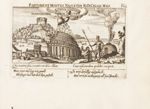
Parturient montes nascetur ridiculus mus: Meisner, Politica Politica (Nürnberg, 1700), emblem 568
Iconclass: 25H11 mountains 25F26(MOUSE)(+41) rodents: mouse (+ birth of an animal) 42A1(+0) procreation and pregnancy (+ variant) 53D2:53DD2 Promise; 'Promissione' (Ripa)❧Breach of Promise 57AA645 Boast; 'Iattanza' (Ripa)
Loci Communes: Liberalitas (Generosity, Générosité)
I ix 15 Aureos montes polliceri To promise mountains of gold
Χρυσὰ ὄρη ὑπισχνεῖσθαι. id est, Aureos polliceri montes. Proverbialis hyperbole, de iis, qui im mensa promittunt, spesque ampissimas ostentant. A Persarum arrogantia ducta, qui pro pter auri venas, montes aureos iactabant. Plautus in Sticho. Neque ille sibi mereat Persarum montes, qui esse aurei perhibentur. Atque idem in Milite, in eandem sententiam dixit Argenti montes. Tum argenti montes, non massas habet. Terentius in Phormione, Is senem per epistolam pellexit, modo non montes auri pollicens, quo quidem loco illud obiter ad monendum, quod vulgus interpretum arbitramur later, Modo non dictum, pro eo, quod est apud Graecos μονονουχὶ, id est, tantum non. id perinde valet, quasi dicas, propemo dum. Nam tantum non Graecanico more reperies, tum apud Livium, tum apud Sueto nium, neque semel apud Valerium Maximum. Apuleius in prima actione Apologiae suae. Qui si est avaritia egenus, et ad omne lucrum inexplebilis, nec montibus auri sa tiabitur. Divus Hieronymus in Rufinum, ut cum montes auri pollicitus fueris, ne scor teum quidem nummum de thesauris tuis proferas. Aristophanes ἐν ἀχαρνεῦσι Κᾄχεζεν ὀκτὼ μῆνας ἒπι χρυσῶν ὄρων. id est, Menses et octo cacavit in auri montibus. Cacavit, dixit, pro desedit, lascivia comoediae veteris. Phoenix Colophonius apud Athe naeum lib. 12. de Ninor rege praedivite loquens, ex monte fecit mare, ait, Οστις εἶχε χρυσίου πόντον, id est, mare possidens auri. Paulo diversius dixit Salustius in Catilinario, Ma ria montesque polliceri coepit. Ad eundem modum Persius: Magnos promittere montes. Ut hyperbole mmagnitudinis sit non in aureis, sed simpliciter in ipsis montibus.
Χρυσὰ ὄρη ὑπισχνεῖσθαι., To promise golden mountains, is a proverbial exaggeration used to describe those who make immense promises and offer most extensive expectations. It is derived from the arrogance of the Persians, who had veins of the precious metal and so boasted that their hills were made of gold. Plautus in the Stichus: 'He'd not do it to earn / Those Persian mountains, made (they say) of gold.' Again in the Miles he speaks to the same effect of silver mountains: 'Mountains of silver, not mere lumps of it.' Terence in the Phormio: 'He won the old man over with a letter, / Promising him virtually mountains of gold.' On this passage I think I should observe in passing what the majority of commentators have apparently failed to notice, that modo non is used for what in Greek would be μονονουχὶ, 'only not,' or 'just not,' meaning 'nearly.' For you will find 'only not' used in this Greek fashion in Livy and Suetonius, and more than once in Valerius Maximus. Apuleius in his first speech in his own defence: 'If it is avarice that makes him feel poor, so that whatever he gains leaves him unsatisfied, mountains of gold will not be enough for him.' St Jerome against Rufinus: 'So that though you have promised mountains of gold, not one beggarly coin do you produce out of all your treasures.' Aristophanes in the Acharnians: 'For eight long months he sat / And eased himself upon the Golden Hills,' using 'eased himself in the ribald style of the Old Comedy for 'had an easy time.' Phoenix of Colophon, cited by Athenaeus, book 12, when speaking of the immense wealth of King Ninus turns the mountains into a sea and says he had 'oceans of gold.' Sallust puts it rather differently in the Catiline: 'Proceeds to promise oceans and mountains'; and in the same way Persius has 'to promise great mountains,' so that the exaggeration of the size is conveyed not by the words 'of gold,' but simply by the mountains themselves.
Facsimile: 
Iconclass: 25H11 mountains 25D13(GOLD) minerals and metals: gold 53D2:53DD2 Promise; 'Promissione' (Ripa)❧Breach of Promise 57AA645 Boast; 'Iattanza' (Ripa)
Collectanea (1500): 189
Loci Communes: Magnifica promissa (Magnificent promises, Promesses magnifiques)
I ix 16 Ambabus manibus haurire To take with both hands
Αντλεῖν ἀμφοτέραις, id est, Haurire ambabus, subaudi, mmanibus. De iis dici consuevit, qui summo conatu quippiam agunt. Itidem Aristophanes in Equitibus: Κᾀμφοιν χερσὶν μυστιλλᾶται τῶν δημοσίων id est, Utraque manu bona dispergens publica sugit. Huic confine est illud Homericum ex Iliados H. Οἶδ᾽ ἐπὶ δεξιὰ, οἶδ᾽ ἐπ᾽ ἀριστερὰ νωμῆσαι βῶν. id est, Novi equidem clypeum dextra, laevaeu movere. Invenitur et illud ἀμφοῖν δωρούμενος. id est, Ambabus manibus largiens, id est, affatim, et prodige, aut etiam perbenigne. Plato in Sophista: καὶ τὸ λεγόμενον οὐ τῇ ἑτέρᾳ ληπτεον, οὐκοῦν ἀμφοῖν χρή. id est, Et, quod dici solet, nequaquam altera prendendum manu quin magis am babus. Nonnihil ab hac forma recedere videtur, quod scriptum est apud Aristidem in Ci mone, qui citat hunc locum ex hymno poetae cuiuspiam, μέγα δ᾽ ἔστενεν ἀσία ὑπ᾽ αὐτῶν πληγεῖσ᾽ ἀμφοτέραις χερσὶ, κράτει πολέμου id est, Graviter autem gemuit Asia, ab illis percussa ambabus manibus, robore belli. Vicinius illud, quod est apud eundem in oratione Pana thenaica, ὁ δὲ ἀμφοτέρᾳ τῇ χειρί παρῆν, ἄγων τοὺς μέχρι τῆς ἀττικῆς ἕλληνας ὁμοῦ καὶ βαρβάρους. id est, At ille utraque aderat manu, ducens usque ad Atticam Graecos simul, ac barbaros. Quam quam hoc loco potest etiam citra figuram dictum accipi, ut intelligamus vel de terre stribus pariter, ac maritimis copiis, vel de barbaris, ac Graecis. Quandoquidem et mili tum manum dicimus, ut apud Virgilium: - Iuvenum manus emicat ardens. De plena manu dictum est alias, quod Graeci dicunt ὀμπνίᾳ χειρὶ, quasi dicas, divite ma nu, unde et Cererem ὄμπνιον cognominant, quemadmodum nos almam, quod affatim alat, & ὄμπνιον ὕδωρ, quod copiose nutriat.
Αντλεῖν ἀμφοτέραις, To take with both at once, hands being understood. Habitually used of those who do something with all their might. So Aristophanes in the Knights: 'And with both hands sups up the public funds.' Related to this is Homer's line in the seventh Iliad: 'I know how / To right and left to turn my ox-hide shield.' We also find the phrase ἀμφοῖν δωρούμενος giving freely with both hands, for excessive and wasteful gifts, or for great generosity. Plato in the Sophist: 'And, as the saying goes, not to be caught with one hand. No indeed; but with both.' There seems to be some difference between this form of the phrase and what we find in the Cimon of Aristides, who quotes this passage from a hymn by some poet or other: 'And Asia groaned aloud beneath their stroke, / With both hands stricken in the stress of war.' There is a more closely similar expression in the same author's Panathenaic Oration: 'And there he was with both hands leading them as far as Attica, both Greeks and barbarians.' Though in this passage it is also possible to take it with no element of metaphor: we are to understand it either of land and sea forces equally, or of barbarians and Greeks. For we use 'hand' or 'handful' of a body of armed men, as in Virgil's 'Up leapt / A valiant handful of the younger men.' Of a 'full hand' as an image of generosity I have spoken elsewhere, in Greek ὀμπνίᾳ χειρὶ, a rich hand; whence the epithet ompnios applied to Ceres (in Latin alma, fostering, because she gives us our daily bread) and to water, as to a thing that abundantly supports life.
I ix 17 Uno ore With one voice
Uno ore, pro summo consensu, passim apud autores obvium est. Terentius, Uno ore, omnes omnia bona dicere. M. Tullius in sermone De amicitia, Una est enim amicitia in rebus humanis, de cuius utilitate omnes uno ore soncentiunt. Seneca Epistolarum li. xi. epistola lxxxii. In tanta iudiciorum diversitate, referendam bene merentibus gratiam, omnes uno tibi, quod aiunt, ore affirmabunt. Aristophanes in Equitibus, Οἱ δὲ εξ ἑνὸς στόματος ἅπαντες ἄνεκραγον. id est, Ore universi clamitant uno simul. Plato lib. De legibus i. Μιᾷ δὲ φωνῇ, καὶ ἐξ ἑνὸς στόματος, πάντας συμφωνεῖν.. id est, Una voce, & ex eodem ore omneis concinere. Idem li. De Repub. ii. Πάντες γὰρ ἐξ ἑνὸς στόματοσ ὕμοῦσιν, ὡς καλὸν μὲν ἡ σωφροσύνη τε καὶ δικαιοσύνη. id est, Omnes enim uno ore praedicant, quod honesta res sit & modestia & iustitia.
With one voice, for 'with entire agreement,' is found freely in good authors. Terence: 'All with one voice wished him the best of luck.' Cicero in his dialogue on friendship: 'Friendship is the one thing in human affairs, on the value of which all men with one voice are agreed.' Seneca in his Letters, book 11, number 82: 'Greatly as men's judgments differ, they will all assure you with one voice, as the saying goes, that a man should recompense those who have done him a service.' Aristophanes in the Knights: 'But they with one mouth all cried out at once.' Plato in the first book of the Laws: 'With one voice and from one mouth all men concur.' And again in the second book of the Republic: 'For all keep on repeating with one voice that both temperance and justice are a good thing.'
I ix 18 Aquilam noctuae comparas You match eagle and owl
Αετὸν γλαυκὶ συγκρίνεις, id est, Aquilam noctuae comparas. Martialis in Scazonte: Aquilasque similes facere noctuis quaeris. Aquila visus acerrimi, adeo, ut ἀσκαρδαμυκτῶς, id est, non connivens adversus solem in tueatur. Et sunt, qui tradant, hanc avem hoc experimento probare, degeneres ne sint pul li, an genuini. Contra noctua, solis lumen modis omnibus refugit. Pindarus quodam loco graculos cum aquila confert.
Αετὸν γλαυκὶ συγκρίνεις, You match eagle and owl. Martial, in a scazon iambic: 'Why seek to make eagles appear like owls?' The eagle has exceptionally keen sight, so much so that it can gaze straight at the sun without winking; and some aver that the bird uses this as a test to decide whether its offspring are legitimate or not. The owl, on the other hand, shuns the sun's light by every means in its power. Pindar in one place contrasts the eagle and the jackdaw.
Facsimile:
Iconclass: 25F33(EAGLE) predatory birds: eagle 25F34 owls 59CC21 Inequality, Inequity, Iniquity; 'Iniquità' (Ripa) 51E2 Superiority
Loci Communes: Excellentia, inaequalitas (Excellence, inequality, Excellence, inégalité)
I ix 19 Congregare cum leonibus vulpes To group foxes with lions
Congregare cum leonibus vulpes, est, res impares, dissimilesque permiscere. Martialis: Quid congregare cum leonibus vulpes? Vulpes dolis nititur, leo virib. fidit. Quamquam utrumque coniunxit Pindarus, indicans virum fortem leonem oportere praestare in exhauriendis certaminum laboribus, vulpem in consiliis: Sic enim in Isthmiis scribit, Τόλμᾳ γὰρ ἐοικὼς θυμὸν ἐριβρεμετᾶν θηρᾶν λεόντων ἐν πάνῳ, μῆτιν δ᾽ ἀλώπηξ. id est, animo similis frementibus leonibus in ferendis labori bus, consilio vero vulpes.
To group foxes with lions is to put together things which are unequal and unlike. Martial: 'Why group in one the lion and the fox?' The fox relies on cunning, the lion's confidence is in his strength. Though the two are joined by Pindar, who suggests that the brave man should prove himself a lion in mastering the exertions of the battlefield and a fox in counsel. He writes thus in the Isthmians: 'For in courage he presents the spirit of loud-roaring lions in the fray, and in counsel he is a fox.'
Facsimile: 
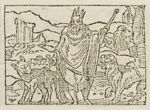
A qui le Prince doibt ressembler: La Perrière, Le theatre des bons engins (Lyon, 1545), emblem 22 uses the imagery of a king holding both a lion and a fox on a leash
Iconclass: 25F23(LION) beasts of prey, predatory animals: lion 25F23(FOX) beasts of prey, predatory animals: fox 59CC21 Inequality, Inequity, Iniquity; 'Iniquità' (Ripa)
Loci Communes: Dissimilitudinis et incongruentiae (Dissimilarity and incongruity, Dissemblance et incongruité)
I ix 20 Aquila in nubibus An eagle in the clouds
Αετὸς ἐν νεφέλαις. id est, Aquila in nubibus, plerique interpretantur de re magna quidem illa, sed quam non facile assequaris: alii de iis, qui longe reliquis praecellunt. Aristopha nes in Equitibus: Ωπερ ἥδομαι Ως ἐν νεφέλῃσιν ἀιετὸς γενήσομαι. id est, - Gaudeo istoc nomine, Quod aquila fiam in nubibus videlicet. Verba sunt populi Atheniensis, promittentis sibi futurum, ut orbi universo imperet. Et paulo inferius in eadem Comoedia, tamquam oraculum pronuntiatur, Αἰετὸς ὡς γίγνει, καὶ πάσης γῆς βασιλεύεις. id est, Quippe aequilaes, terraeque omnem dominaris in orbem. Dicuntur et haec de populo Atheniensi, nisi forte placet allusio, ad spes huius principa tus inanes. Rursum in Auibus, αἰετὸς ἐν νέφέλῃσι γενήσεαι. id est, Aqulia in nubibus fies. Interpres admonet, alludere poetam ad oraculum, quondam Atheniesibus redditum, quo praedicabatur, futurum, ut Athenienses tanto interullo reliquas urbes superaret, quanto Aquila in nubibus reliquis avibus esset sublimior. Pindarus item in Nemeis, quem locum modo attigimus, se vocat aquilam, Bacchylidem aemulum graculum, videlicet quod illum immenso vinceret intervallo: Αἰετὸς ὠκύς ἐν πετανοῖς Ος ἐλαβεν αἶψα τηλόθεν μεταμαινόμενος Δαφοινὸν ἄγραν ποσὶ, Κραγέται δὲ κολοιοὶ ταπεινὰ νέμονται. Quorum carminum haec est sententia: Aquila pernix inter volucres, quae repente ad uloans eminus, corripuit cruentam praedam, loquaces autem graculi humi pascuntur.
Αετὸς ἐν νεφέλαις, An eagle in the clouds. This is commonly understood as something which is in itself great or important, but not easily to be achieved; others apply it to men who far surpass their fellows. Aristophanes in the Knights: 'That line I love, / How I shall become an eagle in the clouds.' The words are those of the Athenian people, looking forward securely to the time when they will rule the whole world. And a little further on in the same play, an oracle is uttered in the words: 'How thou art made an eagle, to have the whole world for thy kingdom.' This too is said of the people of Athens, unless we prefer to see it as an allusion to their empty hopes of world-rule. Again in the Birds: 'You shall become an eagle in the clouds.' The scholiast informs us that the poet alludes to an oracle once delivered to the Athenians, which foretold that Athens would one day surpass all other cities as far as an eagle in the clouds was higher than other birds. Pindar too in the Nemeans, in the passage I have just referred to, calls himself an eagle and his rival Bacchylides a jackdaw, because of course there was such a great distance between them. The sense runs something like this: 'Swift is the eagle among birds, which swoops suddenly down from afar and seizes the blood-stained quarry in its claws; but chattering jackdaws feed upon the ground.'
Facsimile:

Ἀιετὸσ ἐπάνω νεφελῶν: Printer's device 0104
Ἀιετὸσ ἐπάνω νεφελῶν: Printer's device 0066
Iconclass: 54B5 Importance, Preponderance 59CC21 Inequality, Inequity, Iniquity; 'Iniquità' (Ripa) 51E2 Superiority 25F33 predatory birds 26A clouds
Collectanea (1500): 549
Loci Communes: Excellentia, inaequalitas (Excellence, inequality, Excellence, inégalité)
I ix 21 Volantia sectari To pursue a flying quarry
Huic affine est, quod usurpat Aristoteles tertio τῶν μετὰ τὰ φυσικὰ libro, τὰ πετώμενα διώκειν id est, Volantia sectari. loquitur autem de vehementer obscuris, et quae difficilimum sit pervestigare. Cui non dissimile est illud: Est aliquid, quo tendis, & in quod dirigis arcum? Ax passim coruos sequeris, testaque lutoque? De iis, qui nullum certum vitae scopum sibi proponunt, sed ex tempore vivunt, ad quamvis occasionem mutabiles.
Related to this is a phrase used by Aristotle in the third book of his Metaphysics: τὰ πετώμενα διώκειν, To pursue a flying quarry. He speaks of subjects which are excessively obscure and very hard to get to the bottom of. It is not unlike that line
Have you an aim, a target at which you point your bow?
Do you with brickbats and with clods pursue the random crow?
He is thinking of those who set before themselves no certain goal in life, but live for the moment, ready to change at any opportunity.
Facsimile:
Iconclass: 43C11 hunting, chase 54DD4 Difficulty 54B12 Opportunity, Opportuneness, Seasonableness
Loci Communes: Inanis opera (Vain effort, Effort vain)
I ix 22 Ibyci grues The cranes of Ibycus
Αἱ ἰβύκου γέρανοι, id est, Ibyci grues. Graecis in proverbium abierunt. quod dici consuevit, quoties sceleribus novo quodam, et improviso casu proditis, scelesti poenas dant iis, quos laeserunt. Id ex huiusmodi quodam eventu natum memorant. Ibycus poeta quidam, cum in latrones incidisset iam occidendus, grues forte supervolantes obtestatus est. Ali quanto post tempore, cum iidem latrones in foro sederent, rursumque grues supervolarent, per iocum inter se susurrabant in aurem, Αἱ ἰβύκου ἔκδικοι πάρεισιν. id est, Adsunt Ibyci ulto res, eum sermonem assidentes in suspicionem rapurunt, maxime desiderato iam pridem Ibyco. Rogati, quidnam sibi vellet ea oratio, haesitanter, atque inconstanter responderunt, sub iecti tormentis facinus confessi sunt. Atque ita velut gruum indicio poenas Ibyco dederunt, ac potius suo ipsorum indicio, ut dicitur, perierunt. Huiusmodi ferme Plutarchus in com mentario de futili loquacitate: Meminit huius adagii Ausonius in monosyllabis: Ibycus ut periit, vindex fuit altivolans grus. Extat super. hac re Graecum epigramma, titulo Antipatri, quod non gravabimus adscribere. Ιβύκε ληϊσταί σε κατέκτανον, ἐκ ποτὲ νήσου Βάντες ἐρημαίην ἄστιβον ἠΐονα, Πολλ᾽ ἐπιβωσάμενον γεράνων νέφος, αἵτοι ἵκοντο Μάρτυρες, ἄλγιστον ὀλλυμένῳ θάνατον. Οὐ δὲ μάτην ἰάχησας, ἐπὶ ποινήτις ἐριννύς Τῶν δε διὰ κλαγγην τίσατο σεῖο φονον Σισυφίην κατα γαῖαν. ἰώ φιλοκερδέα φύλα Ληϊστέων, τί θεῶν οὐ πεφόβησθε χολὸν; Οὐδὲ γὰρ ὁ προπάροιθε κτανών αἴγιστος αιοιδὸν Ομμα μελαμπέπλων ἔκφυγειν εὐμενίδων. Verissem & hos versus meo more, ni commodum Perus Aegidius Antuerpiensis, hospes meus, imò Pylades meus, & si quid hoc quoque usquam est amicius, iam Latinos fecisset, ac mea quidem sententia feliciter. Eos adscribam, simul & hoc laboris haud illibenter effugiens, & incomparabilis amici mentionem cupide arripiens. Quondam ad desertum venientes Ibyce litus, Vitam preaedones eripuere tibis, Saepe gruum nubem implor anti, quae tibi testes Advenere necis cum morerere tuae. Attamen haud frustra, siquidem clangore volucrum Stsyphio caedem est Eumenis ulta solo. Latronum genus heu cupidum lucri, atque rapinae, Cur vos nequaquam terruit ira deum? Quando nec Aegisthus, vatem qui occiderat olim, Atrarum occursus fugerat Eumenidum. Meminit huius poetae M. Tullius libro Tusculanarum quaestionum quarto, cuius poema maxime lascivum fuisse testatur.
Αἱ ἰβύκου γέρανοι, The cranes of Ibycus, gave rise to a proverb in Greek, which has commonly been used whenever crimes have come to light by some new and unexpected chance, and the criminals give the victims their revenge. This took its rise, they say, from a chain of events somewhat like this. A poet called Ibycus who had fallen into the hands of robbers and was about to be put to death, protested to some cranes which happened to be flying overhead. Sometime later the robbers were sitting in the market-place when again some cranes flew over, and they whispered to each other in jest 'Here they come to avenge Ibycus.' These words were overhead by their neighbours, who were instantly suspicious, for Ibycus had been greatly missed for some time. When asked what their words meant, the men gave embarrassed and inconsistent answers, and when exposed to torture confessed their crime. Thus one might say the cranes were the informers to whom Ibycus owed his revenge; or rather, the guilty died because, as the saying goes, they gave themselves away. This is the story much as Plutarch tells it in his essay 'On Pointless Garrulity.' Ausonius recalls this adage in his Monosyllaba: 'Who avenged Ibycus? 'Twas high-flying cranes.' There is also a Greek epigram on the subject, ascribed to Antipater, which it will be a pleasure to transcribe: 'Pirates killed you, Ibycus, disembarking upon the untrodden beach of a lonely island, while you cried for help to a passing cloud of cranes that came to witness your most bitter death. Nor were your appeals in vain, for the Erinys heard their cry and avenged you in the land of Sisyphus. Why, greedy tribe of pirates, did you not fear the anger of the gods? Aegisthus too, who killed a poet long ago, did not escape the watchful eye of the black-robed Eumenides.' I would have rendered these lines, like the rest, as best I can, had not, as luck would have it, Pieter Gillis, my host in Antwerp - it would be truer to say, my Pylades, or any truer type of friendship there may be than that - already turned them into Latin, in my opinion very skilfully. So I will add his version, happy to spare myself this labour and gladly seizing this opportunity to mention my incomparable friend:
Poor Ibycus, they killed you, that brutal pirate band,
Appealing to the cranes that flew o'er that lone island strand.
But dark Erinys heard their cries - you did not waste your breath -
And in the land of Sisyphus avenged your cruel death.
O brutal band of pirates, in your cruelty and greed,
Why was it, to the wrath of god you gave so little heed?
Remember, old Aegisthus killed a poet long ago,
But the black-robed Eumenides, they did not let him go.
This poet is mentioned by Cicero in the fourth book of his Tusculan Questions, where his poem is said to have been of the most lascivious description.
Facsimile: 
Iconclass: 98B(IBYCUS)68 death of Ibycus: the poet is slain by robbers; before dying he calls upon cranes to bear witness of the crime 25F37(CRANE) shore-birds and wading-birds: crane 44G51 crime 57AA741 Revenge, Requital, Retaliation; 'Vendetta' (Ripa)
Collectanea (1500): 813
Loci Communes: Ultio malefacti (Vengeance for a wrongdoing, Vengeance d'un méfait)
I ix 23 Veriora iis quae apud Sagram acciderunt As true as what happened at the Sagra
Αληθέστερα τῶν ἐπὶ σάγρᾳ, id est, Verior iis, quae apud Sagram acciderunt. Dictum olim in incredulos, quique non nisi magno malo docti credunt. Refertur a Strabone lib. Geogra phiae sexto. Post Locros, inquit, Sagra fluvius labitur, in cuius ripa Castoris, et Pollucis arae sitae sunt, ad quas decem Locrorum milia, una cum Rheginis, adversus Crotoniatas, nu mero centies ac tricies mille, Marte collato victoriam reportarunt Ex quo eventu na tum est in incredulos adagium, Αληθέστερα τῶν ἐπὶ σάγρᾳ, id est, Veriora iis, quae apud Sagram acciderunt. Addidere plerique? quo die certamen initum est, iis, qui in Olympiis erant, eum belli eventum nuntiatum fuisse: tanta celeritate nuntiatae pugnae veritas comperta est. Meminit huius pugnae lustinus lib. 20. Tametsi de numero occisorum a Strabone dis sentit. Meminit et Eustathius in Boeotiam Homeri, additque dici solitum de rebus, veris simis quidem illis, at non creditis. Postremo meminit et M. Tullius De natura deorum 2. Nam de Sagra, inquit, Graecorum etiam est vulgare puerbium, qui, quae affirmant, certiora esse dicunt, quam illa, quae apud Sagram.
Αληθέστερα τῶν ἐπὶ Σάγρᾳ, As true as what happened at the Sagra, was turned in old days against incredulous people and those who do not believe until some misfortune has taught them a lesson. Strabo tells the story in book 6 of his Geography. 'Next to the Locrians' he says 'flows the river Sagra, on the bank of which are the altars of Castor and Pollux, near which ten thousand Locrians with Rhegian help fought and defeated one hundred and thirty thousand troops from Crotona. This victory was the origin of the adage turned against the incredulous, As true as what happened at the Sagra.' Many add that the news of the result reached Olympia on the day the battle was fought; such was the speed with which it became known that the news of the battle was true. This battle is mentioned by Justin, book 20, though he differs from Strabo as to the number of the dead. It is also mentioned by Eustathius in his commentary on Homer's Boeotia; and he adds that the phrase was commonly used of things that were perfectly true but were not believed. Lastly, it also comes in Cicero's On the Nature of the Gods, book 2: 'For the Sagra' he says 'is also the subject of a familiar proverb in Greek: people who tell you something assure you it is as true as what happened at the Sagra.'
Facsimile:
Iconclass: 52BB21 Incredulity 25H213 river 61D(SAGRA) geographical names of countries, regions, mountains, rivers, etc. (SAGRA) (SAGRA)
Loci Communes: Fides et gravitas (Trust and seriousness, Confiance et gravité)
I ix 24 Rudem accipere. Rude donare To be given a wooden sword. To present with a wooden sword
Rudem accipere, pro. dimitti a munere. Rude donare, pro dimittere, crebriter apud i doneos auctores obvia sunt. Inde ducta metaphora, quod antiquitus gladiatores, quib. permissum erat a gladiatorio munere cessare, rude donati dicebantur. Ea cessatio daba tur virga, quam rudem appellabant, unde hoc modo dimissi, Rudiarii vocantur. Proin de, quicumque a munere quovis in otium restituuntur, vel ob aetatem, vel ob im becillitatem, rudem accepisse dicentur. Horatius in prima epistola: Spectatum saetis, et donatum iam rude, quaeris, Moecenas, iterum antiquo meinclisere ludo. Item Iuvenalis: Ergo sibi dabit ipse rudem, si nostra movebunt Consilia. Ovidius, Sic igitur tarda vires adimente senecta Me quoque donari iam rude tempus erat. M. Tull. Philippicarum secundo: Tam bonus gladiator rudentam cito accepisti? Lepidior erit metaphora, si longe traducatur, veluti, si quis adhortetur quempiam, ut a studiorum laboribus abstineat, sibique rudem impartiat: aut qui vitam auli. cam reliquerit, eum aulicae vitaerudiarium appellemus. Huic ferme contrarium videtur, quod ait Fabius, Acutae eloquentiae candidatus: quamquam equidem hoc loco legendum esset, Auitae, pro Acutae, et bonarum literarum candidatus. Nam candidati proprie dicuntur, qui magistra tum ambiunt. Quod si transferatur alio, transibit in proverbii speciem.
To receive a wooden sword for to retire from employment, and To present with a wooden sword for to allow someone to retire are frequently found in reliable authors. The metaphor is taken from the ancient custom of describing gladiators who were allowed to retire from their professional duties as rude donati, presented with a wooden sword. The right to retire was conveyed by means of a wooden foil which they called a rudis, and so those given this leave were called rudiarii. Consequently, anyone who is restored to private life from any office, on account either of age or of failing health, will be said to have received his wooden sword. Horace in the first of his Epistles: 'I've oft performed, and earned my wooden sword, / And must I now my ancient squad rejoin?' Juvenal too: 'And so he'll give himself the wooden sword, / If he takes my advice.' Ovid: 'And so, as tardy age doth sap my powers, / 'Twas time I too received my wooden sword.' Cicero in the second of his Philippics: 'Has so good a gladiator as yourself so soon received your wooden sword?' The metaphor will gain in elegance if slightly more far-fetched: for instance, if one were to urge a man of letters not to work so hard and to 'award himself the wooden sword,' or were to call someone who has given up life at court a rudiarius or 'retired veteran' of court life. What looks like more or less the opposite of this is that phrase in Quintilian, 'a candidate for sharp-edged eloquence,' though in that passage I think we should read 'the eloquence of your ancestors' (avitae), not 'sharp-edged' (acutae) and 'a candidate for good literature,' for 'candidate' is a word properly used of those who wish to be elected to office. If this is transferred as a metaphor to other fields, it will take on a proverbial air.
Facsimile: 
Note: "retirement (from public service)"
Iconclass: 45C13(SWORD) hacking and thrusting weapons: sword 47B241 industries ~ wood
Collectanea (1500): 816
Loci Communes: Perficiendi sive absolvendi (Finishing, completing, Achever, accomplir)
I ix 25 Mali corvi malum ovum An ill crow lays an ill egg
Κακοῦ κόρακος κακὸν ὠὸν, id est, Mali corui malum ovum. Apte usurpabitur, quoties a malo praeceptore discipulus malus proficiscitur: ex improbo patre filius improbus: ex pa tria illaudata vir illaudatus: denique facinus sceleratum ab homine scelesto. Metaphoram alii referunt ad naturam animantis, quae nec ipsa est idonea cibis humanis, nec ovum parit ad quidquam utile. Sunt, qui dicant, fieri, ut coruorum pulli parentes ipsos deurent, si forte non pascant illos ad satietatem, et hinc ductum adagium: alii malunt ad huiusmodi fabu lam referre: Corax quidam primus Syracusis, post mortem Hieronis, instituit artem rhe toricen mercede profiteri. Cum hoc adolescens quidam Tisias hac lege pactus est, ut tum demum mercedem solveret, ubi iam artem perdidicisset. Dein, vib, iam arte cognita, prae mium reddere cunctaretur, Corax in ius discipulum vocat. Ibi iuvenis huiusmodi dilem ma proponit percunctanti, quis esset artis, finis, ubi Corax respondisset, persuadere dicen do. Age, inquit, si persuadeo iudicibus, me nihil debere, non reddam, quia vici causam: sin minus persuadeo, non reddam, quia non perdidici artem. At Corax Tisiae dilemma tam quam vitiosum, et ἀντιστρέφον, in discipulum retorsit ad hunc modum, Imo, inquit, si persua des, dabis, quia tenes artem, et debes ex pacto: sin minus, dabis, quia sententiis iudicum damnatus. Quod commentum tam vafrum, tamque callidum ubi iudices audissent, admirati versutiam adolescentis, succlamarunt, κακοῦ κόρακος κακὸν ὠὸν. Sunt, qui narrent hoc succla matum a corona circumstantium, cum alter alteri litem intenderet. Huiusmodi ferme legun tur in Prolegomenis in Hermogenis rhetoric. Ex hac fabula, ni fallimur, efficta est ea, quam narrat A. Gellius in noctibus Atticis libro quinto, c. 10. de Protagora sophista, et huius discipulo Euathlo: quae tametsi longiuscula est, et in promptu sita, tamen quod o mnium lepidissima videatur, non pigebit adscribere. Gellius igitur, ostenso vitioso dilemma te, (quod Antistrephon vocant, propterea quod totidem verbis possit in adversarium retor queri:) Quale est, inquit, provulgatum illud, quo Protagoram sophistarum acerrim usum esse ferunt adversus Euathlum discipulum suum. Lis namque inter eos, et controversia super pacta mercede haec fuit. Euathlus, adolescens dives, cloquentiae discendae, causarumque oran di cupiens fuit. Is in discipulum Protagorae se dedit, daturumque promisit mercedem, gran dem pecuniam, quantam Protagoras petiverat: dimidiumque eius dedit iam tunc statim prius quam disceret: pepigitque, ut reliquum dimidium daret, quo primum die causam apud iudi ces orasset, et vicisset. Postea, cum diutule auditor, assectatorque Protagorae fuisset, et ion stu dio quidem facundiae abunde promovisset, causas tamen non reciperet, tempusque iam lon gum transcurreret, et facere id videretur, ne reliquum metrcedis daret: capit consilium Pro tagoras, ut tum existimabat, astutum, petere instituit ex pacto mercedem, litem cum Eua thlo contestatur. Et, cum ad iudices coniciendae, consistendaeque causae gratia venisset, tum Protagoras sic exorsus est: Disce, inquit, stultissime adolescens, utroque id modo fore, uti reddas quod peto, sive contra te pronuntiatum erit, sive pro te. Nam, si contra te lis data erit, merces mihi ex sententia debebitur, quia ego vicereo, sin vero secundum te iudicatum erit, merces mihi ex pacto debebitur, quia tu viceris: Ad ea respondit Euathlus: Potui, inquit, huic tuae tam ancipiti captioni isse obviam, si verba ipse non facerem, atque alio patrono ute rer. Sed maius mihi in ista victoria proludium est, cum te non causa tantum, sed etiam in ar gumento vinco. Disce igitur tu quoque, magister sapientissime, utroque modo fieri, uti non reddam quod petis, sive contra me pronuntiatum fuerit, sive pro me. Nam, si iudices pro mea causa senserint, nihil tibi ex sententia debebitur, quia ego vicereo: sin contra me pro nuntiaverint, nihil tibi ex pacto debeo, quia ego non vicero Tum iudices dubiosum hoc, inexplicabileque esse, quod utrinque dicebatur, rati, nesententia sua, utramcumque in partem di cta esset, ipsa sese rescinderet, rem iniudicatam reliquerunt, causam in diem longissimum distulerunt. Hactenus Gellius. Quoid autem? an non optimo iure iudices hoc saltem senten tiae vice pronuntiare debuerunt, κακοῦ κόρακος κακὸν ὠὸν; Narrat eandem fab ulam L. Apuleius in Floridorum libris, non dicamus copiosius: neque enim potest copiosius referri, quam a Gellio denarrata est, sed tamen florulentius, et, ut ita dixetimus, picturatius. Meminit E uathli Aristophanes in Fucis, atqu item in Acharnensibus.
Κακοῦ κόρακος κακὸν ὠόν, An ill crow lays an ill egg, will be appropriate for use whenever an incompetent tutor produces an incompetent pupil, a rascally father a rascal son, a country of ill repute a disreputable native, a man with a criminal record a criminal act. Some derive the metaphor from the nature of the bird itself, which is not fit for human food and lays an egg useless for any purpose. Some say that young crows have been known to devour their parents if they do not bring them enough to eat, and that this is the source of the adage; others prefer to trace it back to the following anecdote. A man named Corax, which means crow, in Syracuse after the death of Hieron, was the first who ever set up to teach the art of rhetoric for pay. A youth whose name was Tisias made an agreement with him that he would not pay the fee until he was a complete master of the art. When he had acquired the technique but was in no hurry to hand over the price, Corax took his pupil to law. Whereupon the young man put forward the following alternative. 'What is the purpose of this art?' he asked; and when Corax replied that it was to achieve persuasion by the use of words, 'Very well,' he said, 'if I persuade the judges that I owe nothing, I shall not pay you, because I have won my case, and if I don't persuade them, I shan't pay you, because I am not yet a master of the art.' Corax however rejected Tisias' alternative as defective and what logicians call reversible, and turned it in this fashion against his pupil. 'On the contrary,' he said, 'if you persuade them, you will pay, because you have learnt the art and are bound to pay by the contract, and if you do not persuade them, you will pay, because the verdict of the court is against you.' When the judges heard this most cunning and artful contrivance, they were amazed at the young man's ingenuity, and cried 'An ill crow (Corax) lays an ill egg.' Some say that it was the crowd of bystanders who cried out like that, when they heard their rival pleas. Such roughly is the story as it appears in the introduction to the Rhetoric of Hermogenes. This tale, if I am not mistaken, is the origin of another, told by Aulus Gellius in the Attic Nights, book 5 chapter 10, about the sophist Protagoras and his pupil Euathlus. It is rather long and easily accessible, but such a very good story that I will give myself the pleasure of transcribing it.
Gellius then, having explained the nature of the faulty alternative which is called reversible, because it can be turned round and used in exactly the same words against an opponent, goes on thus. 'An example of this is the argument used by Protagoras, one of the ablest of the sophists, according to a well-known story, against his pupil Euathlus. A dispute between them and a lawsuit about an agreement to pay a fee arose in the following way. Euathlus was a rich young man who wanted to learn the art of public speaking and of pleading in the courts; and he entered himself as a pupil with Protagoras, promising to pay by way of fee the large sum for which Protagoras had asked. Half this he paid at once before his lessons began, and promised to pay the balance on the day that he first pleaded a case in court and won it. After a longish time spent listening to Protagoras and being a member of his circle, he had made great advances in the art of public speaking, but he got no legal work; the time was going by, and it looked as if he had no intention of paying the balance of his fee. Protagoras therefore formed a plan which he thought clever at the time; he proceeded to demand his fee in accordance with their agreement, and sued Euathlus in the courts. When they came before the judges to establish their case, Protagoras began as follows. "Let it be clear to you, most foolish young man, that either way, whether the verdict is against you or for you, you will have to pay what I ask. If the case is decided against you, my fee will be payable in accordance with the verdict, because I have won; if it goes in your favour, the fee will be payable under our contract, because you have won your case." Euathlus replied like this. "I could have challenged this very two-faced and captious argument of yours, if I were not speaking myself but appearing by counsel. But I defeat you with all the greater pleasure because I not only have the better case, but can use your own argument. Let it be clear to you then, most wise of masters, that either way, whether the verdict is against me or for me, I shall not have to pay what you ask. If the judges' opinion is on my side, nothing will be payable to you in accordance with the verdict, because I have won; if they pronounce against me, I owe you nothing under our contract, because I have not won my case." Thereupon the judges, thinking that what was said on both sides set them an insoluble problem, for fear that their verdict, no matter which side it favoured, would be self-contradictory, left the case undecided and adjourned it to a very distant date.' Thus Gellius. What are we to say? Surely there was at least one comment the judges might have handed down by way of verdict: An ill crow lays an ill egg. The same story is told by Apuleius in his Florida, I will not say, at greater length, for it could not be told at greater length than what we find in Gellius, but in a more florid and (if I may use the word) embroidered style. Euathlus is mentioned by Aristophanes in the Wasps and again in the Acharnians.
Facsimile:
Chi di gatta nasce, sorci piglia: Cats, Spiegel (The Hague, 1632), emblem 21 uses the imagery of cats chasing mice and monkey delousing a boy to convey the concept of "like begets like" and the commentary quotes also from the adage's comment
Iconclass: 25F32(CROW)(+91) song-birds: crow (+ egg) 54AA3 Incompetence 49A education
I ix 26 Ab impiis egressa est iniquitas Wickedness proceedeth from the wicked
Concinit huic Hebraicum illud ex libro regum primo, cap. xxiiii. quod David nominatim etiam pro vetusto proverbio citat: Ab impiis egredietur iniquitas. Significat autem ab improbis semper mali quippiam exoriri, à bonis nihil malorum proficisci. Proinde nihil esse, quur Saul metuat, ne à se occideretur. Hoc facinus impium, non nisi ab impiis esse patrandum, se manus suas regia caede non inquinaturum. Porrò proverbium, si quem hoc quoque iuvabit, Hebraeo sermone pronunicatur ad hunc modum: hebrew quote Quandoquidem habent hoc peculiare pleraque proverbia ut in ea lingua sonari postulent, in qua nata sunt: quod si in alienum sermonem demigrarint, multum gratiae decedat. Quemadmodum sunt & vina quaedam, quae recusent exportari, nec germanam saporis gratiam obtineant, nisi in his locis, in quibus proveniunt. Idem propemodum dicitur apud Graecos versu proverbiali: Γνώμης γὰρ ἐσθλῆς ἔργα χρηστὰ γίγνεται. id est, Probis ab animis facta promanant probae.
In full agreement with this is that Hebrew saying in the first book of Kings, chapter 24, which David actually calls 'a proverb of the ancients': Wickedness proceedeth from the wicked. It means that wicked men are always a source of evil in some form, and nothing evil is ever started by the good. Consequently there is no reason for Saul to fear that he may be killed by David. This would be a wicked crime such as only wicked men would perpetrate, and he himself will not stain his hands with the blood of a king. Moreover the proverb, if anyone would like this extra information, runs in Hebrew like this: [hebrew]. For it is a property of most proverbs that they require to be uttered in the language in which they originated, and if they migrate into another tongue, they lose much of their charm. Some wines are like that: they refuse to travel, and do not retain their native qualities except in the regions in which they are grown. Almost the same thought is expressed in Greek in a proverbial verse: 'For noble deeds do come of noble minds.'
I ix 27 Lemnium malum As bad as Lemnos
Λήμνιον κακόν, id est, Lemium malum, de malis immensis, ac miserandis. Historia, unde natum adagium, varie narratur, neque magni refert eam anxie persequi. Herodotus in Era tone, et proverbii, et historiae meminit, in hanc ferme sententiam: Pelasgi, ex Attica per vim expulsi, Lem non incolebant. Huius iniuriae cum poenas de Atticis sumere cuperent, probeque cognitos haberent dies festos, ac ceremonias illorum, collatis insidiis, uxores Atheniensium abduxerunt, cum Minervae sacra facerent in Braurone: hisque in Lemnum navigio asportatis, concubinarum vice sunt abusi. Ceterum mulieres, cum plurimos libe ros parerent, omnes et Atticis moribus instituerunt, et Attice loqui docuerunt, ita factum est, ut nec miscere coniugia cum puellis Pelasigicis vellent, et, si quando Pelasgus quepiam pulsare conaretur, omnes conglobati Attici huic suppetias ferrent. Breviter adeo in valescebat pubes Attica, ut plerisque in rebus priores tenere videretur. quare visum est Pelasagis, ut silios ex Atticis mulierib. susceptos trucidarent. Idque perfecerunt, occisis u na et matribus, deinde, sterilitate, obitate, pestilentia, reliquisque plurimis adacti malis, Delphicum oraculum consuluerunt, qua via calamitatib. levari possent. Hinc igitur ait per omnem Graeciam increbuisse proverbium, ut ingentia, miserandaque mala, Lemnia dicerentur. Partim igitur hinc natum adagium putat, partim illinc, quod aliquando Lem niae mulieres graveolentia maritorum offensae, eos universos sustulerunt, auxilio Tho antis. Cuius rei meminit Euripides in Hecuba: Καὶ λῆμνον ἄρσένων ἐξῴκισαν. id est, Maresque Lemno sustulere feminae Funditus. Item Seneca in Agamemnone: Et scelere Lemnon nobilem.
Λήμνιον κακόν, As bad as Lemnos, of great and lamentable wrongs. The story from which the adage derives is told in different forms, nor is there much point in meticulously pursuing them. Herodotus in Erato tells both of the proverb and of the events behind it, somewhat as follows. The Pelasgians had been forcibly expelled from Attica, and were living in Lemnos. Wishing to have their revenge on the people of Attica for the wrongs they had suffered, and being familiar with their feast-days and ceremonies, they posted men in ambush and carried off the Athenian wives, while they were sacrificing to Minerva in Brauron; then, having deported them by ship to Lemnos, they treated them shamefully as concubines. The women however having produced a large number of children, brought them all up as Athenians and taught them to speak Attic Greek, with the result that they refused to marry Pelasgian girls, and if a Pelasgian ever tried to beat any of them, all the Athenians banded together to defend him. In a word, the young men of Attic blood grew so powerful that they appeared to have the upper hand in most things, and the Pelasgians thought it best to put to death all the sons they had had by Athenian mothers. This they did, and killed the mothers at the same time; after which they themselves were so much reduced by sterility, loss of children, plague, and all other possible troubles that they consulted the Delphic oracle for some way to relieve themselves of their calamities. Hence, he says, a proverb spread all through Greece, by which huge and lamentable wrongs were called 'as bad as Lemnos.' So he thinks that this is one source for the adage, and the other that the women of Lemnos once took offence at the bad smell emitted by their husbands and killed them all, with Thoas' help. This fact is mentioned by Euripides in the Hecuba: 'And utterly stripped Lemnos of its men.' Also by Seneca in his Agamemnon: 'And Lemnos rendered famous by its crimes.'
Facsimile: 
Iconclass: 42D71 concubine 44G5111 murder 32B311(ATHENIANS) indigenous European peoples (ATHENIANS) 54AA5 Badness 57AA1 Bad Behaviour 61D(LEMNOS) geographical names of countries, regions, mountains, rivers, etc. (LEMNOS) (LEMNOS)
Collectanea (1500): 619
Loci Communes: Infortunii sive exitii (Misfortune or ruin, Malheur ou ruine)
I ix 28 Cicadam ala corripuisti You have taken a grasshopper by the wing
Τέτιγγα πτέροῦ συνείληφας, id est, Cicadam ala corripuisti. Dicitur in cos, qui quempiam provocant minime ex usu suo. Lucianus in Pseudologista, scribit Archilochum poeram iambographum, et ad male dicendum egregie instructum, ad hunc modum respondisse cuidam, a quo fuerat convicio provocatus. Τὸν τέττιγα πτεροῦ συνείληφας. Est autem huius insecti mira quaedam, et prodigiosa loquacitas, maxime efferucscente sole. Plinius negat iis vocem esse, sed stidorem cum tractu: cumque sonum emittit non alis, quemadmodum muscae, apes, culices: nam iis stridor simul cum volatu desinit, at cicadae si presseris alas, vehe mentius etiam perstrepit, sed in pectore subesse ait duos specus, attrituque membranae, mo bili accedente spiritu, per hos e visceribus sonum edi. Ergo, quemadmodum, si cicadam na tura garrulam ala prehensas, clarius obstrepit, ita, si poetico homini praebeas occasionem simultatis, non modo non tacebit, sed clarius obstrepet, et omnem bilem chartis illinet atris. Proinde Platonem aiunt admonuisse, ne quis hominem poetam sibi faceret inimicum. Et Horatius, Genus irritabile vatum, dixit.
Τέτιγγα πτεροῦ συνείληφας, You have taken a grasshopper by the wing. Said of those who provoke a man to do something which is by no means out of keeping. Lucian in his Pseudologista says that the poet Archilochus, who was a satirist and exceptionally well equipped in the art of obloquy, replied to a man who had provoked him with abuse in these words: 'You have taken a grasshopper by the wing.' The grasshopper or cricket is an insect with an astonishing and prodigious capacity for making a noise, especially when the sun is very hot. Pliny says it has no voice, only a rasping noise long drawn out; and it does not produce this sound with its wings, as do flies, bees, and gnats, for their humming ceases when they cease to fly, but the grasshopper if you hold down its wings makes an even more emphatic noise than before. It has in its thorax, he says, two chambers and by the friction of a membrane with the addition of a rapid current of air it emits the sound through these from its intestines. And so, just as if you take a grasshopper by the wing, which is by nature a noisy creature, it makes a louder noise, so, if you give a man of poetical gifts the excuse for a quarrel, not only will he not remain silent; he too will make a louder noise than before, and 'on spiteful paper dash down all his spleen.' And so it was, they say, Plato's advice that one should never make a poet one's enemy. And Horace speaks of the 'irascible tribe of bards.'
Facsimile:
Iconclass: 25F711(GRASS-HOPPER) insects: grass-hopper 54C2 Recommendation, Inducement, Incitement
Loci Communes: Malum accersitum aut retortum (Evil brought upon oneself or turned back, Mal attiré ou retourné)
I ix 29 Tenedia bipennis An axe from Tenedos
Τενέδιος πέλεκυς, id est, Tenedia securis. Conveniet aut in eos, qui nimium severe iudicant, ac puniunt: aut qui celeriter expediunt controversias, et litium ambiguitates. Inde translatum, quod olim rex Tenedi, securim gestans, lites audire consuevit; causaque iudica ta, protinus eum, qui fecisset iniuriam, securi percutere: aut quod Tenedius quidam rex le gem tulit in adulteros, ut utriusque corpus securi concideretur, eiusque legis exemplum etiam in filium edidit. proinde in numismate iussisse insculpi, altera ex parte securim, altera du os vultus ex eadem cervice prominentes. Cuius rei meminit et Stephanus in utbium cata loge. Plutarchus in commentario de Pythiis oraculis, osten dic securim typum, atque insi gne fuisse Tenediorum, idque propter cancros, qui sunt apud illos in loco, qui dicitur Aste rium. Verba Plutarchi, si quis forte re quirer, sunt haec: Ωσπερ ἀμέλει σελινούντιοι ποτε χρυσοῦν σέλινον ἀναθεῖναι λέγονται, καὶ τενέδιοι τὸν πέλεκυν, ἀπὸ τῶν καρκίνων τῶν γινομένων περὶ τὸ καλούμενον ἀστέριον παρ᾽ αὐτοῖς. μόνοι γὰρ ὡς ἔοικεν ἐν τῷ χελωνίῳ τύπον μελέκεος ἔχουσι. Lucianus in Philopseude: Τοῦτ᾽ ἐκεῖνο, ἥκειν γὰρ μοι νομισας, πέλεκύν τινα κατα ψευσμάτων. id est, Ratus enim iuxtra illud. quod vulgo dici consucuit, securim quandam mihi venisse ad incidenda mendacia. Videtur allusum ad Alexandti Magni factum, qui nodum insolubilem in Midae plaustro ense dissecuit, quemadmodum ostendimus alibi. Meminit et Pausanias in Phocicis, sed otiginem adagionis ad aliam fabulam refert. Scribit autem securim inter anathemata fuisse, monumentumPericliti, cuius pater Euthymachius Tenedius, qua de re vetusta ferretur fabula: Cycnon filium fuisse Neptuni, ac regnasse in Colonis. Porro Co lonae erant in terra Troiona, contra insulam, cui nome Leucophrys. Porro, cum Cycnus haberet filiam, nomine Hemitheam, ac filium nomine Tennem ex Proclea, ea fuerat Cly tii filia soror Caletoris, quem Homerus in Iliadoso, tradit interfectum ab Aiace, quodis Caletor in Protesilai navim ignem iniecisset. Haec igitur cum esset defuncta huicsuccessit Philonome, Craugasi silia, quae cum adamaret Tennen, ac reiecta fuisset, mentitur apud maritum, quod ipsa nolens ab eo fuerit de stupro sollicitata. Cycnus, uxo ris mendacio per suasus, Tennen una cum sorore cistae inclusum abicit in mare. Catervm incolumes appulsi sunt in insulam Leucophtyn cui post a Tenne nomen versum sit Tenedos. Cycnus tan dem, ubi comperisset se deceptum, navigat ad filium, simul et agniturius ertorem suum, et ve niam deprecdatuius. Cum autem appulisset Cycnus, et navim ab arbore quapiam, aut saxo religasset, Tennes prae iracundia securi funes incidit. Unde proverbium dici coeptum de iis, qui perinaciter negarent aliquid: Hic est, qui Tenedia securi hoc aut illud incidere posset. Huic non dissimilis historia refertur in proverbio, Tenedius homo.
Τενέδιος πέλεκυς, An axe from Tenedos, will be appropriate either for those who sentence and punish very severely or those who settle disputes and doubtful controversies with great speed. The source is an old custom, by which the king of Tenedos dispensed justice carrying an axe, and when the case was decided would instantly use the axe to execute the guilty party; or else because some king of Tenedos passed a law against adultery, by which both parties were to be executed with an axe, and had to set an example by enforcing it against his own son. As a result he ordered the issue of a coin with an axe on one side and on the other two heads growing out of one neck. This is mentioned by Stephanus in his catalogue of cities. Plutarch in his essay 'On the Pythian Oracles' shows that the axe was an emblem and symbol of the people of Tenedos, on account of the crabs which are found in their territory in a place called Asterium. Plutarch's words, in case anyone would like to have them, are as follows: 'As the people of Selinus are said once to have dedicated a branch of celery in gold, and the Tenedians an axe, derived from the crabs which are found near a place called Asterium in their territory; for they are the only crabs to have the mark of an axe on their shell.' Lucian in the Philopseudes: 'For I thought, as the phrase goes, that I had been offered an axe to cut falsehoods.' I personally think there is an allusion to the action of Alexander the Great in using his sword to cut through the knot on Midas' wagon that could not be untied, as I have shown elsewhere. It is also mentioned by Pausanias in his book on Phocis, but he attributes the origin of the adage to another story. He writes that there was an axe among the offerings in memory of Periclitus, son of Euthymachus of Tenedos, and that there was an old story about this. Neptune had a son called Cycnus, who was king in Colonae. Colonae is a place in the Troad, opposite an island called Leucophrys. Now this Cycnus had a daughter called Hemithea and a son called Tennes by his wife Procleia (she was a daughter of Clytius and a sister of Caletor, who according to Homer in Iliad 15 was killed by Ajax because Caletor had tried to set fire to Protesilaus' ship). When Procleia died, she was succeeded by Philonome daughter of Craugasos. Philonome fell in love with Tennes, and when he rejected her advances, she told her husband a pack of lies about her being unwillingly solicited by Tennes to commit adultery with him. Cycnus believed his wife's falsehoods, shut up Tennes and his sister in a chest, and threw them into the sea. However, they were carried in safety to the island of Leucophrys, which afterwards took its name from Tennes and became Tenedos. When Cycnus learnt at length how he had been deceived, he set sail towards his son, meaning to acknowledge his mistake and ask for forgiveness. But when he had landed, and tied up his vessel to some tree or rock, Tennes in anger cut the rope with an axe. Hence a proverb came into use about those who persistently deny something: 'This man could cut this or that with an axe from Tenedos.' A story not unlike this is told in connection with the proverb Tenedius homo, A man from Tenedos.
Facsimile: 
Iconclass: 61D(TENEDOS) geographical names of countries, regions, mountains, rivers, etc. (TENEDOS) (TENEDOS) 44G321(AXE) instruments of torture, execution or punishment (AXE) 44G3:44G159 criminal law; punishment❧perjury 53C12 Severity; 'Severità' (Ripa) 51M11 Swiftness, Speed; 'Agilità', 'Celerità', 'Velocità' (Ripa)
Loci Communes: Perficiendi sive absolvendi (Finishing, completing, Achever, accomplir)
I ix 30 Thesaurus carbones erant The treasure consisted of coals
Ανθρακες ὁ θησαυρὸς πέφυκεν. id est, Carbones thesaurus erant. In eos competit, qui spe sua frustrantur, quique magnificis rebus exspectatis, meras nugas reperiunt. Ex eventu quo piam natum videtur, quo quispiam, thesauri spe fodiens, carbones defossos invenit. Eaq ueres in risum, vulgique sermonem abiit. Nam antiquitus carbones in terra defodi solent, ad indicandos agrorum terminos, propterea quod, ut testatur in opere de civitate Dei Divus Augustinus, nulla res magis durabilior, magisque perpetua, quam carbones sub terra de fossi. Lucianus in Zeuxide: Τὸ δὲ κατα τὴν παροιμίαν ἄνθρακες ἡμῶν ὁ θησαυρὸς ἦσαν, id est. Verum, iuxt proverbium, thesaurus noster carbones erant. Rursum in Philopseude: Τὸ γοῦν του λόγου ἐκεῖνο, ἄνθρακες ἡμῖν ὁ θησαυρὸς πέφῃνας. id est, Proinde iuxta id, quod dici so let: tu nobis, qui thesaurus credebaris, carbones exstitisti. Idem in Timone de auro invento. Δέδια γοῦν, μὴ ἄνθρακας εὕρω ἀνεγρόμενος. id est, Vereor itaque, ne expergefactus carbones reperiam. Rursus in Votis: Καὶ ἄνθρακές σι ὁ θησαυρὸς ἔσται, id est, Ac thesaurus tibi carbo nes fuerint. Alciphron in epistola quadam: Οὐ σπόδος μοι πάντες οἱ θησαυροί γενήσονται; id est, Non omnes thesauri mihi cinis erunt?
Ανθρακες ὁ θησαυρὸς πέφυκεν., The treasure consisted of coals. Suits those whose hopes are disappointed and who find mere rubbish where they expected something magnificent. It looks as though it must derive from some incident, when a man digging for treasure found a buried deposit of charcoal, and this became a subject of merriment and common talk. For in old days it was the custom to bury charcoal as a marker for the boundary of a property because, as Augustine testifies in his book The City of God, nothing is more durable and more likely to last forever than charcoal buried in the ground. Lucian in his Zeuxis: 'But, as the proverb runs, our treasure consisted of coals.' Again in the Philopseudes: 'As the saying goes, you have shown yourself to be coals instead of treasure.' Again in the Timon, about a discovery of gold: 'So I'm afraid that when I wake up I shall find it's coals.' And in his Wishes: 'And you will find your treasure is coals.' Alciphron in one of his letters: 'Will not all my treasure turn to cinders?'
Facsimile:
Iconclass: 46A1632 money-chest, treasure-chest, money-box 25D141 anthracite, hard coal 56BB34 Disappointment
Collectanea (1500): 418
Loci Communes: Frustrata spes (Frustrated hope, Espoir déçu)
I ix 31 Octopedes Eight-feet
Οκτάποδες. id est, Octapedes Scythico proverbio dicebantur, qui duos possiderent boves, & currum unum. Lucianus in Scytha sive Proxeno: Οἵ παρ᾽ αὐτοῖς ὀκτάποδος καλούμενοι.. id est, Qui apud illos Octapedes vocantu. Dici poteret per iocum in hominem, qui sibi locuples videatur: vel in eum cui rusticanae sunt opes. Inter opes neim rusticanas praecipue recenset Hesiodus, τὸν βοῦν ἀροτῆρα. id est, Bovem aratorem. Addit proverbio gratiam allusio ad scorpium, polypum, sepiam & theutidem, octonis pedibus animantia, & ob id Graecis dicta ὀκτάποδα.. Scorpius etiam proverbio locum fecit, octapedem excitas. Siquidem hoc animal sub omni lapide dormire dicitur. Suidas ὀκτώπουν scribit per ω, non per α.
Οκτάποδες, literally With eight feet, was a proverbial expression in Scythia for men who possessed two oxen and one cart. Lucian in The Scythian or the Consul: 'Those among them who are called Eight-footers.' This can be used in jest of a man who fancies himself rich, or of one whose wealth is entirely countrified. High in the list of countrified wealth in Hesiod is 'a ploughing ox.' The proverb gains in point from its allusion to the scorpion, the polyp, the cuttle-fish, and the squid, all creatures endowed with eight feet and therefore called in Greek octapods. The scorpion even gave rise to a proverb, You are waking up Eight-feet; for this creature is said to sleep under every stone. Suidas writes octôpous, with a long 0 instead of an a.
I ix 32 Satius est recurrere quam currere male Better run backwards than runn all awry
Πάλιν δρομῆσαι μᾶλλον ἢ δραμεῖν κακῶς. id est: Satius recurrere, atque uti curras male. Senarius proverbio celebratus, cuius hic est sensus: Praestat mutare consilium in melius, quam in male institutis pergere. Lucianus asinus sententiam hanc secum voluebat, non ad modum asininam: Εκρινα τοῦτο δὴ τὸ του λόγου, πάλιν δρομῆσαι μᾶλλον ἢ δραμεῖν κακῶς. id est: Visum est tandem iuxta vulgi sermonem, Potius recurrere, atque currere perperam. Quin et hoc saeculo vulgo dictitant, non prorsus aberrare eum, qui medio e cursus recu rrat: significantes, probandos eos, qui mature resipiscunt ab stultitia.
Πάλιν δρομῆσαι μᾶλλον ἢ δραμεῖν κακῶς, Better run backwards than run all awry. An iambic line current as a proverb, the moral of which is that it is advisable to change your mind for something better, rather than to persevere in a wrong decision. Lucian's ass turned this maxim over in his mind, far from asinine though it is: 'I felt the force of what the proverb says, Better run backwards than run all awry.' In our own day too there is a common saying that the man who turns back at halfway is not always wrong, by which they mean that those are to be commended who repent of their folly in good time.
Facsimile: 
Iconclass: 31A27112(+62) running (+ backward) 31A27112:52B112 running❧? 86(THE MAN WHO TURNS BACK AT HALFWAY IS NOT ALWAYS WRONG) proverbs, sayings, etc. (THE MAN WHO TURNS BACK AT HALFWAY IS NOT ALWAYS WRONG)
Loci Communes: Sera paenitentia (Late repentance, Repentir tardif)
I ix 33 Solus currens vicit He was the only runner and he won
Μόνος θέων ἐκράτει, id est, Solus currens vicit. Deiis, qui vincunt nemine contra certante. Translatum a stadiis. Nihil autem est negotii vincere, si nemo tecum certet. Concinne dicetur in eos, qui sibi placent, quasi pulchre causam suam probarint, cum nullus adsit, qui contra disputer. Lucianus in Imaginibus: Ρᾷστον δὲ οἶμαι τουτό ἐστι, κατα τὴν παροιμίαν, μόνον θέοντα κρατεῖν. id est, Haud est difficile, iuxta proverbium, cum solus curras, vincere. Affine illi, quod alias recensuimus, ἐρήμην νικᾷν, id est, Desertam causam vincere. Nec alienum ab illo, ἀκονιτὶ νικᾶν, id est, Citra pulverem vincere. Et ἀνιδρωτὶ νικᾶν, id est, Citra sudorem vincere; quorum alibi meminimus.
Μόνος θέων ἐκράτει, He was the only runner and he won. Of those who win when there is no competition. A metaphor from the sports-ground, for it is no trouble to win when you have no competitor. It will be neatly directed against self-satisfied people, who think they have proved their case in fine style when there is no one to put the other side. Lucian in his Imagines: 'It is, I imagine, very easy, as the proverb puts it, to win when you are the only runner.' Related to one I have recorded elsewhere, 'To win a case by default,' and not far from 'Victory without the dust' and 'Victory without sweat,' all of which I have mentioned elsewhere.
Facsimile:
Iconclass: 43C211(+31) running, race (+ the winner, victor, of a contest (sports, games, etc.)) 49D11(1) numerals (1) 54D4 Facility 86(TO WIN A CASE BY DEFAULT) proverbs, sayings, etc. (TO WIN A CASE BY DEFAULT) 86(VICTORY WITHOUT THE DUST) proverbs, sayings, etc. (VICTORY WITHOUT THE DUST) 86(VICTORY WITHOUT SWEAT) proverbs, sayings, etc. (VICTORY WITHOUT SWEAT)
Loci Communes: Vincere et vinci (To conquer and to be conquered, Vaincre et être vaincu)
I ix 34 Leonem ex unguibus aestimare To know a lion by his claws
Εκ τῶν ὀνύχων λέοντα γινώσκειν, id est, Ex unguibus aestimare leonem, est, ex una quapiam coniectura negotium universum perpendere, ex paucis multa, ex minimis maxima con icere. Natum videtur adagium a Phidia statuario, qui, sicut narrat Lucianus in Haeresibus, inspecto leonis duntaxat ungui, quantus esset totus leo, perpendit, totumque ex indicio un guis effinxit. Plutarchus in commentario De defectis oraulis, videtur ad Alcaeum referre. Sic enim scribit: Οὐ κατ᾽ ἀλκαῖον ἐξ ὄνυχος τὸν λέοντα γράφοντας, id est: Non Alcaei more leo nem ex unguibus depingentes, hoc est, ex re minima, maxima colligentes. Philostatus in vita Apollonii: Οἷον ἐξ ὄνυξος ἤδη ὁρῶ. id est, Qualem ex ungui iam esse video. Basilius magnus ad maximum Philosophum: εἰκὸνες ὄντως τῶν ψυχῶν εἰσιν οἱ λόγοι. κατεμάθομεν οὖν σὲ δια τοῦ γράμματος, ὁσον, φασὶν, ἐξ ὄνυχων τὸν λέοντα, id est, Animi imago re vera est oratio. pro inde cognovimus te ex literis, non aliter, quam leonem, ut aiunt, ex unguibus. Fit autem hoc ma thematica ratione, sicuti docet Vitruvius libro tertio, ut ex membro vel minimo, totius corpo ris modus colligatur. Quemadmodum Pythagoras Herculani corporis mensuram, ex Pi sano stadio quod Hercules suis pedibus fuerat metatus, ratiocinatus est. Sic ex unius arteriae pulsu, medici de tota hominis valetudine iudicant: sic ex unica epistola doctrinam omnem aestimamus: ex unico responso, totam hominis spaientiam perpendimus.
Εκ τῶν ὀνύχων λέοντα γινώσκειν, To know a lion by his claws, is to form an idea of an entire object from one single inference, to infer much from little evidence and great results from small indications. The adage seems to take its rise from the sculptor Phidias who, as Lucian tells us in his Sects, having seen nothing but the claw of a lion, formed an idea of the size of the whole lion and reproduced the whole beast on the evidence of one claw. Plutarch in his essay 'On the Obsolescence of Oracles' appears to refer it to Alcaeus, for he writes: 'Not, as Alcaeus has it, painting the lion from a single claw,' inferring, that is to say, great things from one small one. Philostratus in his Life of Apollonius: 'Such as I see you already to be from the claw.' Basil the Great writing to the philosopher Maximus: 'A man's words are truly a reflection of his soul, and so I learnt to know you from your writings, as they say one knows a lion from his claws.' This is done by using mathematical ratios (as Vitruvius tells us in book 3) in such a way that even from the smallest limb the dimensions of the whole body can be inferred. It was by this method that Pythagoras calculated the dimensions of Hercules' body from the stadium at Pisa, which he had laid out by stepping it himself. In the same way physicians judge the state of a man's health at all points from the pulse in one artery, and one can infer the whole of a man's life from his hair, his waistline, or the movement of his eyes; in this way we assess the whole of a man's education from a single letter, and from one reply form an idea of his whole stock of wisdom.
Facsimile:
Iconclass: 25F23(LION)(+341) beasts of prey, predatory animals: lion (+ claws, paws of an animal) 51HH1:51H1 Part, Section, Aspect❧Totality, the Whole 52A52 Judgement, Discrimination; 'Giuditio' (Ripa)
Collectanea (1500): 22
Loci Communes: Conjecturae (Conjectures, Conjectures)
I ix 35 Cauda de vulpe testatur The fox is given away by his brush
Η κέρκος τῇ ἀλώπεκι μαρτυρεῖ, id est, Cauda de vulpe testificatur. In eos dici solitum, qui pusilla in re, cuiusmodi sint, declarant. Est autem vulpi cauda pro corpore maior, ac pilosior, ut non sit facile celare. Alioqui canis videri possit. Unde quadrabit de exitu declarant, cuius modi fuerint reliqua. Quidam primo aggressu agni, in eventu vulpes comperiuntur.
Η κέρκος τῇ ἀλώπεκι μαρτυρεῖ, The fox is given away by his brush, is normally said of those who betray in some trifling matter what sort of people they are, a fox's brush being so long and bushy in proportion to its size that it is not easily concealed. Otherwise it might be taken for a dog. Hence this will also be suitable when the outcome of something shows what the rest was really like. Some men who are lambs when you first meet them prove in the end to be foxes.
Facsimile:
Iconclass: 25F23(FOX)(+343) beasts of prey, predatory animals: fox (+ tail of an animal) 51HH1:51H1 Part, Section, Aspect❧Totality, the Whole 52A52 Judgement, Discrimination; 'Giuditio' (Ripa)
Loci Communes: Conjecturae (Conjectures, Conjectures)
I ix 36 E fimbria de texto iudico I judge the fabric from its border
Εκ τοῦ κρασπέδου τὸ ὕφασμα γινώσκω. id est, E fimbria textum omne cognosco. hoc est, ex uno aliquo pusillo reliquorum facimus coniecturam. Translatum a negotiatoribus, qui; inspecta texti margine, facile de universo, cuiusmodi sit, iudicant.
Εκ τοῦ κρασπέδου τὸ ὕφασμα γινώσκω., I gauge the whole fabric from the border - from one small fact, that is, I draw an inference about everything else. A metaphor taken from merchants, who can easily form an opinion on the quality of a whole piece of cloth by inspecting the weave of one edge.
Facsimile:
Iconclass: 47H6 textile fabric, cloth 41D2653 border, ribbon, braid 51HH1:51H1 Part, Section, Aspect❧Totality, the Whole 52A52 Judgement, Discrimination; 'Giuditio' (Ripa)
Loci Communes: Conjecturae (Conjectures, Conjectures)
I ix 37 De gustu cognosco I know by the taste
Εκ γεύματος γινώσκω, id est, Ex degustatione iudico, hoc est, ex minima experientia. Du ctum item a negotiatoribus, qui, gustato duntaxat vino, aut oleo, de reliquo mox pronun tiant. Est enim cuiusque arboris foetui suus quidam sapor, et indoles, et forma quoque pecu liaris; quae quoties mutarentur in diversum, pro ostento habitum fuit, ut eleganter Theo phrastus in historia plantarum libro secundo, capite quarto. Unde Plinius: Ad eum, in quit, gustum tibi reliqua promitto. Seneca: Eg gustum tibi dare volui. Et degustationem huiusmodi experientiam vocamus. Haud alienum fucrit huc asscribere, quod Irenaeus refert proverbii nomine, ut discas mare salsum esse, nihil opus totum ebibere. Siquidem e paucis gutiis deprehendere licet, quale sit universum mare.
Εκ γεύματος γινώσκω, I judge by tasting, that is, from a very small experiment. Taken like the preceding from merchants, who from a mere taste of wine or oil pass a verdict without hesitation on the rest. For the fruit of every tree has its own taste, its proper nature and its particular shape; and whenever these changed into something different, it was taken for a portent, as Theophrastus elegantly describes in book 2, chapter 4 of his History of Plants. Hence Pliny: Ι promise you the rest answers to this taste of it.' Seneca: 'And I wanted to give you a taste.' And an experiment of this kind we call a tasting. Nor will it be out of place to add here a phrase used as a proverb by Irenaeus: 'To learn that the sea is salt, there is no need to drink the whole thing.' One can discover from a few drops what the whole sea is like.
Facsimile: 
Iconclass: 31A34 taste, tasting (one of the five senses) 51HH1:51H1 Part, Section, Aspect❧Totality, the Whole 52A52 Judgement, Discrimination; 'Giuditio' (Ripa)
Collectanea (1500): 361
Loci Communes: Conjecturae (Conjectures, Conjectures)
I ix 38 Aethiopem ex vultu judico I judge an Ethiopian by his face
Τὸν αἰθίοπα ἐκ τῆς ὄψεος γινώσκω. id est, Aethiopem ex ipso vultu cognosco. Praefert quisque aliquo signo, cuiusmodi sit moribus. Praesefert enim Aethiops, nigrore vultus, in tortis capillis, labris tumentibus, dentium candore,. patriam suam. Nam vestem mutare potest Aethiops, faciem non potest.
Τὸν Aἰθίοπα ἐκ τῆς ὄψεος γινώσκω., I recognize an Ethiopian simply by his face. Every man offers some indication what sort of person he is. For an Ethiopian indicates by his black face, curly hair, thick lips, and gleaming teeth where his native country is. An Ethiop may change his clothes, but his face he cannot change.
Facsimile:
Iconclass: 32B321(ETHIOPIAN) (ETHIOPIAN) peoples of sub-Saharan Africa (ETHIOPIAN) 31A2211 face 51HH1:51H1 Part, Section, Aspect❧Totality, the Whole 52A52 Judgement, Discrimination; 'Giuditio' (Ripa)
Loci Communes: Conjecturae (Conjectures, Conjectures)
I ix 39 De fructu arborem cognosco I know the tree by its fruit
Εν τοῦ καρποῦ τὸ δένδρον γινώσκω. id est, E fetu cognosco arborem: e factis hominem iudico. Quae paroemia etiam in Evangelicis literis extat, quemadmodum ostendimus in operis initio. Vestis sordida, rasus vertex, ieiunium, oratio, frons tetrica, folia sunt quae saepenumero mentiuntur, quemadmodum illa ficus mentita est Christo: sed pro Christi gloria patienter tolerare infamiam, bene velle malevolis, nec rependere iniuriam, fructus est arboris bonae. Haec si quis constanter & alacriter praestat, arguunt animum syncerum. Nam simulatio nec diuturna potest esse, nec fieri potest, quin, alicunde cedens naturae, prodat animi morbum.
Εν τοῦ καρποῦ τὸ δένδρον γινώσκω., I know the tree from its fruit, I judge a man by his actions. This proverb also appears in the Gospels, as I have shown at the outset of this work. Mean clothing, shaven crown, fasting, prayer, and a severe expression - these are leaves which often tell a lie, just as the figtree in the Gospel lied to Christ; but patiently to endure obloquy for the glory of Christ and to wish well to those who wish one ill and not to render evil for evil are the fruit of a good tree. If a man produces this regularly and readily, it is evidence of a faithful and true heart; pretence cannot last long, and sooner or later nature must assert herself and prove that in heart he is unsound.
Facsimile:
Iconclass: 25G3 trees 25G21 fruits 51HH1:51H1 Part, Section, Aspect❧Totality, the Whole 52A52 Judgement, Discrimination; 'Giuditio' (Ripa)
Loci Communes: Conjecturae (Conjectures, Conjectures)
I ix 40 In tenebris saltare To dance in the dark
Εν τῷ σκόπῳ ὀρχεῖσθαι, id est In tenebris saltare. Est, rem gerere clanculum, nul lo teste, nulloque iudice. Translatum ab iis, qui choros ducunt, quos in tenebris nemo queat diiudicare, recte ne, an secus movesnt pedes. Lucianus in Sectis, Εν σκότῳ φασὶν ὀρχοίμεθα. id est, In tenebris, ut aiunt, saltaremus. Quibus ex verbis videtur adagium dici posse etiam in illos, qui temere, nulloque iudicio, nulla certa ratione rem agunt. Sentit enim Lucianus, nos, philoso phia destitutos, tamquam in tenebris saltaturos, ut, quidquid in manus venerit, id esse cre damus, quod quaerebatur. Apparet huc tacite allusisse Platonem libro de Republ. octavo. Ινα μὴσκοτεινῶς διαλεγώμεθα πρῶτον ὁρισώμεθα, id est, Ne tenebrose disseramus, prius de siniamus, Nam qui confuse disputat, velut in tenebris saltat.
Εν τῷ σκόπῳ ὀρχεῖσθαι, To dance in the dark, means to do something secretly, with no witness and no critic. The image is taken from dancers, of whom no one can say in the dark whether they perform the steps rightly or the reverse. Lucian in his Sects: 'We should, as they say, be dancing in the dark.' From these words it looks as though the adage could also be applied to people who act rashly and without judgment and on no certain principle. For Lucian's point is that, if we are deprived of philosophy, we should be dancing in the dark, so that, 'whatever might come to hand we should believe to be the thing we were in search of.' It is clear that Plato alluded to this tacitly in the eighth book of the Republic: 'To avoid a discussion in the dark, let us first make some definitions.' For discussion in a muddle is like dancing in the dark.
Facsimile:
Iconclass: 43C9 dancing 22C9 darkness 52DD1 Secrecy, Latency, Concealment; 'Secretezza' (Ripa)
Collectanea (1500): 347
Loci Communes: Occulta (Hidden things, Choses cachées)
I ix 41 Areopagita An Areopagite
Αρειοπαγίτης, id est, Areopagita. De tristi severoque dicebatur, aut etiam de iudice vehementer incorrupto. Inventiur et Σκυθρώπτερος ἀρειοπαγίτου, id est, Tristior Areopagita. Athenis summa erat Areopagitarum auctoritast hi eranti iudices, qui de capitalibus causis pronuntiabant, tanta integritate, ut noctu atque in tenebris, non interdiu, neque luci causas co gnocerent: quo non dicentes, sed duntaxat quae dicerentur spectarent. Id ita esse, testatur Lucianus in Sectis. Adlusit ad proverbium Cicero ad Atticum libro 2. Senatus ἄρειος πάγος, nihil constantius, nil severius, nil fortius. Idem eiusdem operis libr. 4. Ex quo intellectum treis τοὺς ἀρειοπαγίτας, ambitum, comitia, interregnum, maiestatem, totam denique Rem publicam flocci non facere.
Αρειοπαγίτης, An Areopagite, was used of a severe and strait-laced person, or even of an utterly incorruptible judge. It is also found in the form Σκυθρώπτερος ἀρειοπαγίτου, As gloomy as an Areopagite. In Athens the Areopagites were the supreme authority; they were the judges who tried offences that incurred the death-penalty, and their integrity was such that they sat by night and in darkness, not by day and in the daylight, to make sure that they considered not the persons of those who spoke before them but only what was said. The evidence for this is Lucian in his Sects. Cicero alludes to the proverb in the first book of his Letters to Atticus: 'The senate are a regular Areopagus: so determined, so strict, so courageous, you never saw the like.' Again in book four of the same collection: 'From which one can infer that our three Areopagites care not a scrap for bribery, elections, interregnum, treasonable conduct, or indeed the whole constitution.'
Facsimile:
Iconclass: 57A613 Integrity 44G law and jurisprudence 53C12 Severity; 'Severità' (Ripa)
Loci Communes: Torvitas (Grimness, fierceness, Air farouche); Tristitia, laetitia (Sadness, joy, Tristesse, joie)
I ix 42 Atticus aspectus The Attic look
Αττικὸν βλέπος, id est, Atticus aspectus, perinde est, quasi dicas, os impudens. In eos di cebatur, qui vultu ipso prae se ferebant impudentiam, dicendique confidentiam. Nam hoc vitio notati sunt Atticorum mores, Aristophanes in Nubibus: Επὶ τοῦ προσώπου τ᾽ ἐστὶν ἀττικὸν βλέπος. id est: Ac vultu in ipso aspectus Atticus eminet. Sic enim loquitur Strepsiades de silio socratica e schola redeunte, quem ex ipsa fronte con icit, malam causam agere posse, quod nescimus quid Atticae astutiae simul atque im pudentiae prae ferret. Quin et Achilles apud Homerum Agamemnonem appellat κυνώπην, ob impudentiam. tales & κυνοβλῶπας, dici admonet Hesychius.
Αττικὸν βλέπος, That Attic look, is tantamount to saying 'a face that shows no sense of shame.' It was applied to those whose effrontery was obvious at first glance and their readiness to say anything; for this was thought to be a characteristic fault of the Athenian character. Aristophanes in the Clouds: 'And on his face is that true Attic look.' This is Strepsiades' comment on his son when he leaves Socrates' school, and he can infer from the look on his son's face that he can now plead a bad case, such is the combination it shows of Athenian cunning and effrontery. Achilles too in Homer calls Agamemnon dog-faced because he is so shameless, and Hesychius tells us that such men were called kunoblôpes, which means the same thing.
Facsimile:
Iconclass: 61D(ATHENS) geographical names of countries, regions, mountains, rivers, etc. (ATHENS) (ATHENS) 61K(ATTIC) (ATTIC) historical names (ATTIC) 57AA4 Shamelessness 31A2211 face
Loci Communes: Impudentia (Shamelessness, Impudence)
I ix 43 Lari sacrificant They sacrifice to the Lar
Εστίᾳ θύουσιν, id est, Lari facrificant. In tenaces dicetur, qui de suis nemini quicquam impartiunt: aut in convivas edaces, qui nihil appositis epulis mittunt amicis: neque quicquam faciunt reliquum. Nam antiquis religiosum erat, ex iis, quae laribus immolabantur, aliquid foras efferre. Huc adlusit Aristophanes in Pluto, apud quem Carion Mercurio obsecranti, ut aliquid sibi de sacrificio, quia intus agebatur im pertiant: ἀλλ᾽ inquit, οὐκ ὲκφορὰ, id est, Efferre nequaqum licet. Item in eadem fabula mulieri volenti pro foribus spargere bellaria: Ενδον γε, inquit, παρὰ τὴν ἑστίαν, ὥσπερ νόμος, Οὐδὲν ἐκφέρειν πρεπῶδές ἐστιν, ἀλλὰ εἰςφέρειν. id est: Intus profecto, ut moris est, apud Larem, Nam nefas efferre quidquam, inferre sed decet magis. Apud Romanos auctore Plutarcho, nefas erat mensam prorsus inanem tolli: vel quod in nuerent semper aliquid resei vandum in tempus posterum: vel ut assuescerent temperare cu piditati, a praesentibus abstinentes: vel ut hoc pacto servorum animos sibi conciliarent, cum quibus mensam aliquo pacto communem habere viderentur: vel quod religiosum habere tur in sacris quidquam vacuum conspici. Porro mensa sacra quaedam res est. Cato libro De re rustica monet, ut villica certis diebus Lari sacrificet pro copia, addita foco corona. Huic diversum adagium fiugi poterit, τῇ ἑκάτῃ θύειν, id est, Hecatae sacrum facere. Siquidem in huius deae sacris, ii, qui cenam inferebant, ipsi nihil inde gustabant, neque quidquam aufere bant praeter tumultum et fumum, ut inquit in Symposiacis Plutarchus. Idem fieri consue vit, si quid inferebatur reliquis diis, quos ἀποτροπαίους appellant. Torquebitur in eos, qui aliis consulunt, non sibi, aliis parant opes, ipsi non fruuntur.
Εστίᾳ θύουσιν, They sacrifice to the Lar, will be applied to selfish people, who never give anyone a share of what they have, or to greedy people at a dinner-party, who never send their friends any of the good things set before them, and leave nothing on their plates. Among the Ancients it was unlucky to take anything that was sacrificed to the household gods out of the house. Aristophanes alludes to this in the Plutus, when Mercury asks that they should give him a share of the sacrifice that was going on within the house, and Carion replies 'Export prohibited.' In another place in the same play a woman who wants to scatter good things to eat in front of the door is told 'Indoors, before the Lar, as custom is; / Nothing may be brought out, only brought in.' In Rome, according to Plutarch, it was forbidden to remove a table that had nothing on it, either to suggest that something must always be kept back for a future occasion, or to teach them to control their appetites by refraining from what they had before them, or as a means of earning the goodwill of the household, since it showed that to some extent they share the table with their slaves, or because it was unlucky during a religious rite for anything to be seen empty. And there is something sacred about a dinner-table. Cato in his book On Agriculture tells us that the farm-bailiff's wife is to sacrifice to the Lar on the appointed days in accordance with what supplies she has at hand, having first hung a garland over the hearth. One could coin an adage which would be the opposite of this: τῇ Ἑκάτῃ θύειν, To sacrifice to Hecate. For in the rites paid to this goddess, those who brought in the supper did not get a taste of it themselves; all they got was the tumult and the smoke, as Plutarch says in his 'Table-talk.' The same thing customarily happened when they brought in any offering for the other gods who are called averters of evil. This was diverted to apply to those who consult other men's interests rather than their own; they make others rich, and get no benefit themselves.
Facsimile: 
Iconclass: 96A41 Lares (Roman house gods) 12B212 sacrifice ~ non-Christian religions 57AA65 Selfishness; 'Interesse', 'Interesse proprio' (Ripa)
Collectanea (1500): 330
Loci Communes: Sordes et parcimonia (Meanness and stinginess, Bassesse et avarice)
I ix 44 Proterviam fecit He has made a clean sweep
Erat hoc religiosum in nonnullis etiam aliis hostiis, ne quid ex sacris epulis relinqueretur: aut, si quid reliquum esset, id igni absumeretur: quemadmodum Moyses tradit de agno paschali. Porrò id genus sacrificii Romani Proterviam appellant. Unde celebratur illud Catonis festiviter dictum in Albidium quendam, qui partrimonium universum luxu absumerat, unis exceptis aedibus, quae in cendio conflagrarunt: Proterviam, inquit, fecit: propterea quod ea, quae comesse non potuerit, quasi combussisset. Auctor Macrobius lib. Saturnalium secundo. Ad hoc facit, quod apud Athenaeum libro octavo, Theocritus Chius Diocliti Gurgiti, qui, devorato pisce calido, dixit se caelum exussisse: Unum, inquit, illud tibi superest, ut mare ebibas, atque ita tres res omnium maximas confeceris, terram, mare, coelum. At, quoties, sumptus superat quaestum, nec morbus decedit iam in naturam versus, quid superest, nisi ut ad malas artes vertant sese, quo luxui semper gliscenti suppeditet pecunia? Atque haec est una non minima pestis Germaniae nostrae, pracipu e apud eos qui nobilitatis titulo gloriantur: quanquam sunt in his, qui nobilitatem finguntur, ut haec faciant impunitius, qui subornant à quibus vocentur Ionckeri, iactant arces paternas, addunt plumam galero, pingunt clypeum, in quo dextra librans machaeram dessecet elephantem: Subscribunt epistolis suis tres literas, Equ. Si quis sit natus viculo quopiam, puta Ornithoplutus dicto Isocomo, non se scribit Isocomensem, Nam id plebeium est, sed Ornithoplutus ab Isocomo. Atque tum sibi ius esse putant indicere bellum cui visum est. Si legum severitas coherceret talium iuvenum intemperantiam, non essent tam multi, quibus supplicia vel infligere cogeretur, vel condonare. Per aleam enim, chartas, scorta, compot tiones, & ocium venitur ad aes alienum, mox ad rapinas, et sycophantas. Curritur in militiam, redeunt cum praeda non ab hostibus parta. His rudimentis exercitati, nullum horrent facinus. Apud veteres erant leges sumptuariae, atque adeo Corinthi, quae civitas erat ceteris corruptior, tamen lex erat opposita, sumptuosius, quam pro ri familiaris modo, viventibus. Eam apud Athenaum libro sexto Diphilus refert hisce versibus: Τοιοῦτο νόμινόν ἐστι βέλτισ᾽ ἐνθάδε Κορινθίοις, ἵν ἄντιν᾽ ὀψωνοῦντ᾽ ἀεὶ Λαμπρῶς ὁρῶμεν, τοῦτον ἀνακρίνειν πόθεν Ζῇ, καὶ τί ποιῶν. κᾂν μὲν οὐσίαν ἔχῃ Ης αἱ πρόσοδοι λύουσι τἀναλώματα, Εᾶν ἀπολάνειν τοῦτον ἤδη του βίου. Εὰν δ᾽ ὑπὲρ τὴν οὐσίαν δαπανῶν τύχῃ, Απεῖπον αὐτῷ τοῦτο μὴ ποιεῖν ἔτι. Ος δ᾽ ἂν δὲ μὴ πείθητ᾽ ἐπέβαλον ζημίαν. Εὰν δὲ μηδ᾽ ὁτιοὖν ἔχων ζῇ πολυτελῶς Τῷ δημίῳ παρέδωκαν αὐτὸν. ἡράκλεις. Τοῦτον, συνΐης. ἀλλ᾽ ἀναγκαίως ἔχει Η λωποδυτεῖν νυκτὸς, ἢ τοιχωρυχεῖν Η τῶν ποιούντων ταῦτα κοινωνεῖ τισὶν, Η συκοφαντεῖν κατ᾽ ἀγορὰν, ἢ μαρτυρεῖν Ψευδῆ, τοιοῦτον ἐκκαθαίρομεν γένος. id est: Hoc lege cautum est hic apud Corinthios Si quempiam obsonare semper splendide Videmus, huncrogamus, unde vinat, et Quid faciat operis: si facultates habet, Ut reditus harum solvere expensas queat, Perpetimur illum perfrui bonis suis. Sin forte sumptus superat ea, quae possidet, Prohebemus huic, ne faciaet hoc in posterum. Ni pareat, iam plectitur mulcta gravi. Sin sumptuose vivit is, qui ntl habet, Tradunt eum tortorib. Proh Hercules. Nec enim licet vitam absque malo ullo degere Talem scias, sed est necesse aut noctibus Abigere praedam, aut fodere muros aedium, Aut haec patrantum iungier commercio, Aut in foro agere sycophantam, aut perfidum Praebere testem. Nos genus hocmortalium Eicimus hac ex urbe, velut purgamina.
It was regarded as unlucky in some other sacrifices too to leave any remnants of the sacred banquet; or, if anything was left over, it had to be consumed with fire, in the way Moses handed down for the paschal lamb. This form of sacrifice was called by the Romans a protervia. Hence the popularity of Cato's witty comment on a certain Albidius, who had used up his entire patrimony in luxurious living with the exception of his house, which was then burnt down. 'Well,' said Cato, 'He has made a protervia,' meaning that he had, as it were, consumed with fire all that he could not eat. The authority is Macrobius in the second book of his Saturnalia. A remark points in the same direction that is recorded by Athenaeus in book 8. Dioclites, a spendthrift, after eating a very hot dish of fish, complained that he had burned the roof of his mouth (for which Greek uses the same word as it does for 'sky'); whereat Theocritus of Chios remarked 'There's only one thing left for you to do; to drink up the sea. Then you will have polished off the three largest things in the world - earth, sea, and sky.' But whenever a man's expenses outstrip his income, and the disease shows no sign of diminishing, having now become second nature, what is there left for him except to take to trickery and crime, so that his finances may keep pace with luxurious tastes that are always growing? And this is a special plague, and by no means the least of them, in our modern Germany, especially among those who pride themselves on a title of nobility; although there are some of them who boast a fictitious nobility so that they can do this with the greater impunity, who suborn men to call them Junkers, pride themselves on their ancestral castles, stick feathers in their hats, get a shield painted on which is a hand brandishing a sword and cutting up an elephant, and add at the end of their letters the magic EQU. Suppose one of them is born in a village - let us say his name is Ornithoplutus and his village called Isocômus - he never signs himself an Isocomian; any plebeian could do that. He is Ornithoplutus von Isocomum. After that, they think they have the right to declare war on whom they please. If the discipline of law were to restrain the intemperance of these young men, there would be no need to inflict punishment on so many of them or to overlook their offences. Gaming, card-playing, whoring, drinking, idleness land them in debt, and soon it is robbery and blackmail. Off they go to the war, and come back loaded with booty which has not been taken from the enemy. Having learnt their lesson when young in a school like this, they shrink from no crime. Among the Ancients there were sumptuary laws: in Corinth even, which was more corrupt than any other city, there was a law to put down those who lived a more expensive life than their means would allow. Diphilus, in the sixth book of Athenaeus, speaks of it in the following lines:
'In Corinth here, good sir, we have a law:
Seeing a man who lives in luxury,
We ask him what he lives on, what he does,
And if he's well-endowed and pays his way,
We leave him to enjoy his livelihood.
If his expenses should outrun his means,
We tell him this has got to stop at once,
And disobedience means a heavy fine.
If he's extravagant and has no money,
We send him to be tortured.' 'Gracious heavens!'
'Such men, you see, can only live by crime;
Needs must they spend their nights in robbery
Or they are burglars, or in league with such,
Run a protection-racket in the market,
Or else give perjured evidence for pay.
Such filth as this we sweep out of the city.'
But today quite famous cities in Germany produce spendthrifts and gamesters of this kind, who not only have no means but are heavily in debt on all sides; and no one ever says to them 'Hey, where do you get the money to live in such luxury?' If they did, they might find there was some truth in those lines from Diphilus.
Facsimile: 
Iconclass: 42F314 sweeping (~ cleaning the house) 12B212 sacrifice ~ non-Christian religions
Loci Communes: Profusio (Extravagance, Prodigalité)
I ix 45 Hic funis nihil attraxit This line's caught nothing
Αὕτη μὲν μήρινθος οὐδὲν ἔσπασεν. id est: Funis quidem iste piscium attraxit nihil. Senarius p roverbialis, quo significabant operam frustra sumptam, neque ex sententia evenisse, quod quis conabatur. Translatum ab hamato funiculo piscantibus, qui saepe hamum retrahunt ina nem. Natum videtur ex fabula Aristophanis, cui titulus, θεσμοφοριάζουσαι, ubi legitur hic Senarius. Ad adagium allusit idem in Vespis: Αλλ᾽ οὐκ ἔσπασεν, id est, Atqui non attraxit. De eo, qui tetenderat patri laqueum, ne quo exiret.
Αὕτη μὲν μήρινθος οὐδὲν ἔσπασεν., This line has caught no fish. A proverbial iambic line which they used to mean that their labour was wasted, and that what a man was trying to do had not succeeded as he wished. The image is taken from the line with hook attached used by anglers, who often pull up an empty hook. It seems to be derived from the Thesmophoriazusae of Aristophanes, in which this line occurs. He alludes to the adage again in the Wasps: 'But he caught nothing,' the subject being the man who had laid a snare for his father to prevent his leaving the house.
Facsimile:
Iconclass: 43C121 angling 54BB3 Inutility, Noxiousness; 'Nocumento', 'Nocumento d'ogni cosa' (Ripa)
Collectanea (1500): 301
Loci Communes: Frustrata spes (Frustrated hope, Espoir déçu); Inanis opera (Vain effort, Effort vain)
I ix 46 Semper tibi pendeat hamus Keep your hook in the water
Adsimili metaphora dixit Ovidius in Amoribus: Casus ubique valet, semper tibi pendeat hamus, Quo minime credis gurgite piscis erit. Semper experienda fortuna, et omnis tentanda occasio. Similie illi: Omnem movere lapidem.
Ovid uses a similar metaphor in the Amores: Keep your hook hanging still; all may come right, And where you least expect, a fish will bite, that is, always be ready to try your luck, and lose no opportunity. This resembles 'Leave no stone unturned.'
Facsimile:
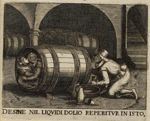
Note: Leave no stone unturned
Casus ubique valet: De Bry, Proscenium Vitae Humanae (Frankfurt, 1627), emblem 6 quotes the comment
Iconclass: 43C121 angling 54B12 Opportunity, Opportuneness, Seasonableness 54B121 'Occasio', 'Kairos'; 'Occasione' (Ripa) 54B1211 Waiting for an Opportunity
Loci Communes: Experientae seu pericliationis (Experience or risk-taking, Expérience ou mise à l'épreuve)
I ix 47 Dives aut iniquus est aut iniqui heres A rich man is either wicked himself or the heir of a wicked man
Divus Hieronymus ad Hedibiam scribit in hunc modum: Unde et illa vulgata senten tia nobis videtur esse verissima: Dives, aut iniquus, aut iniqui haeres. Quod si verum est illud Hesiodium, non omnino temere esse quidquid vulgo dicunt mortales, proverbium hoc haud oscitanter expendendum est iis, qui suis opibus stulte se iactant. Neque enim fere pa rantur ingentes opes sine fraude. Et aut ipse possessor eas per fas nefasque congessit, aut certe successit ei, qui has ea paravit via. Plato lib. De legibus v. Ως τε ὁ λόγος ἡμιν ὀρθὸς, ὡς οὐκ εἰσὶν παμπλούσιοι ἀγαθοί. id est. Ita verum est, quod vulgo dicimus, admodum divites non esse bonos. Circum fertur apud Graecos et hic versiculus ex Menandri comoediis: Οὐδεὶς ἐπλούτησε ταχέως δίκαιος ὤν. id est: Numquam vir aequus, dives evasit cito. Huc respexit ille, qui Syllae, iactanti sese, dixisse legitur: Quo modo vir bonus esse potes, q ui tantas possideas opes, cum a patre nihil tibi sit relictum? Refert Plutarchus in illius vita.
St Jerome in a letter to Hedibia writes as follows: 'Hence too I think it absolutely true, as the common saying has it, that a rich man is either wicked himself or the heir of a wicked man.' If that remark in Hesiod is true, that what is in every man's mouth is not spoken wholly without cause, this proverb should be diligently taken to heart by those who are foolishly proud of being rich. Great wealth is hardly ever acquired without dishonesty; either the owner himself has accumulated it by fair means or foul, or at the very least he is the successor of one who acquired it in that fashion. Plato in book 5 of the Laws: 'So that there is truth in the current saying, that very rich men are not good men.' There is also a line current in Greek from one of Menander's comedies: 'Wealth ne'er comes quickly to an honest man.' The man had this in mind who is recorded as saying to Sulla when he was in a boastful mood: 'How can you be an honest man when you have so much money though your father left you nothing?' Plutarch tells this in his life of Sulla.
I ix 48 Herculanes nodus A Hercules-knot
Ηράκλειον ἅμμα. id est. Herculeus nodus, pro vinculo arctissimo, atque indissolubili legitur apud eruditos. Seneca ad Lucilium: Unus tibi nodus, sed Herculeus restat. Sic enim vocat syllogismum, qui vix dissolvi posset. Quod in eos quadrabit, qui sunt arctissima ne cessitudine copulati. Idque unde sit natum, Plutarchus propemodum indicat in Alexandri vi ta. Scribit enim, Alexandrum Magnum subacto oppido Gordio, Midae regia, visere vo luisse plaustrum illud celebre, mirando artificio ex corni libro connexum. De quo talis fama apud barbaros increbuerat, quisquis eius nodos explicuisset, ei totius orbis impe rium portendi fatis. Alexander ense disecuit. Aristobulus scribit eum facilime dissolvisse, nempe adempto clavo, quo temoni iugum annectitur. Allusit huc Ausonius, scribens Paulino suo, Nae tu Alexandri Macedonis pervicaciam supergressus es? qui fatalis iugi lora, cum solvere non posset, abscidit, et Pythiae specu, quod nefas erat patere, penetra vit. Rursus ad eundem in carmine, Ocius illa iugi fatalis solvere lora Pellaeum potuisse ducem reor, abdita opertis Principtis, et utroque caput celantia nodo. Nodum autem eum, quem ostendit Hercules, religiosum ac sacrum apud priscos fuisse, satis liquet ex iis Plinii verbis, quae sunt in historia mundi, lib. 28. cap. 7. Ac vulnera nodo Herculis paeligare, mirum quantum ocior medicina est. Atque etiam quottidiani cin ctus tali nodo, vim quandam utilem habere dicuntur. Festus Pompeius ostendit antiqui tus fuisse morem, ut nova nupta laneo cingulo praecingeretur, vincto nodo Herculis: quem vir ominis gratia solvebat in lecto, ut et ipse felix esset in liberis suscipiendis: nam Hercu les septuaginta libros reliquit. Athenaeus libro 11. tradit Heracliotas Boeotiae gentem hoc insigni a ceteris distingui, ὅτι ἔπεστιν ἐπὶ ὤτων αὐτοῖς ὁ λεγόμενος ἡράκλειος δεσμὸς, id est, quod super aures gestent vinculum, quod Herculanum dicitur. In consimilem sensum M. Tullius usurpavit, Trabali clavo, actione in Verrem 6. Et ut hoc beneficium quem admodum dicitur, trabali clavo figeret, cum consilio causam Mamertin orum cognoscit. Meminit et Horatius clavorum Trabalium.
Ηράκλειον ἅμμα, A Hercules-knot, is found in learned authors for a fastening that is very tight and difficult to undo. Seneca, writing to Lucilius: 'One knot still confronts you - but it is a Hercules-knot.' This is his word for a syllogism which is almost impossible to solve. It will suit people who are bound by very close ties. Its origin is pretty well suggested by Plutarch in his life of Alexander the Great. He records that when Alexander had captured the town of Gordium, Midas' capital, he wished to inspect the famous wagon constructed with admirable skill out of cornel bark. A story was current about this among the barbarians that whoever should undo the knots with which it was made would be the destined ruler of the whole world. Alexander cut them with his sword. Aristobulus tells us that he undid them very easily: it was only necessary to remove the pin that held the yoke to the pole. Ausonius alludes to this when writing to his friend Paulinus: 'I must say, you are more obstinate than Alexander of Macedon, who cut through the straps of that yoke of destiny when he could not undo the knots, and entered the Pythia's cave which was absolutely forbidden.' Again, when writing to the same friend in verse: 'More swiftly, I think, was Pella's king able to part the thongs of that yoke of destiny, though the ends were hidden and the beginning of both knots concealed.' That the knot which Hercules demonstrated was held to be sacred and traditional by the Ancients is sufficiently clear from what Pliny says in book 28, chapter 6 of his History of the World: 'And to bandage wounds with a Hercules-knot remarkably increases the speed of healing. Even ordinary girdles fastened with such a knot are said to have some sort of beneficial effect.' Festus Pompeius shows that there was a custom in early times for a bride on her wedding night to wear a woollen girdle fastened with a Hercules-knot, which was loosed by the groom in the marriage-bed for good luck, that he too might be fortunate in begetting offspring; for Hercules left behind him seventy children. Athenaeus, book 11, records that the people of Heraclea in Boeotia were distinguished by this emblem from the rest, 'because above the ears they wore what is called a Hercules-knot.' In the same sense Cicero uses trabalis clavus, a nail such as would fix a beam, in his seventh speech against Verres: 'And to establish this good deed, as they say, with such nails as would fix a beam, he investigated with his council the case of the Mamertines.' Horace too speaks of these enormous nails.
Facsimile: 
Iconclass: 47C4291 untying a knot 54DD4 Difficulty
Loci Communes: Vinculum insolubile (An unbreakable bond, Un lien indissoluble)
I ix 49 Fuere qoundam strenui Milesii The Milesians were valiant in days of yore
Πάλαι ποτ᾽ ἦσαν ἄλκιμοι μιλήσιοι. id est, Fuere quondam strenui Milesii. Hoc senario notabant eos, qui a pristina fortuna defluxissent, aut a maiorum moribus de generassent. Breviter in omnes quadrabit, qui desierunt esse quod erant, facti deteriores. In senem, in pauperem factum e divite: in privatum, qui quandoque regnarit: in obscurum, qui aliquando floruerit. Origo proverbii varie narratur a Graecis. Quidam aiunt Mile sios olim belli gloria praeter ceteros floruisse, adeo, ut quoscumque bello lacesserent, eos superarent. Proinde Polycrates Samiorum tyrannus, bellum quoddam gesturus, cum in animo haberet Milesios socios ad eam rem accersere, oraculum super eo negotio consu luit. Deus respondit. Quondam fuere strenui Milesii. Alii diversam afferunt fabulam. Cum Cares bellum adversus quosdam molirentur, statuissentque eius gentis auxiliis uti, quae tum esset inter finitimos pollentissima, quidam Milesios accersendos censuerunt, alii cum Persis res componendas. Itaque consultus hac de re Apollo, respondit modo dictum senarium. Dissipato per omnem Asiam oraculo, Milesii propemodum omnes in praelio cum Persis collocato, caesi sunt, Itaque oraculum cum risu in proverbium abiit. Rursum alii scribunt: Cares, cum Dario belligerantes, iuxta vetus quoddam oraculum, quo moneban tur, ut fortissimos auxilio advocarent, in Branchidas fuisse profectos: atque eius loci deum consuluisse, num Milesiorum auxiliis oporteret uti, atque eum respondisse: Quondam fort es fuisse Milesios, significantem videlicet, eos iam imbelles esse, et deliciis effeminatos. Verum hoc commentum ex ipsa temporis ratione coarguit Zenodotus. Siquidem hunc senarium legimus apud Anacreontem, qui floruit aetate Cyri, Persarum regis, a quo Darius fue rit tertius. Angelus itaque Politianus maluit ad Milesiorum mores in mollitiem versos re ferre: quemadmodum facit et Athenaeus libro Dipnos. 12. Usurpat hoc adagium semel atque iterum Aristoph. In Pluto: Καὶ πρὸς ἐπὶ τούτοις εἶπεν ἀποπέμπων, ὅτι Πάλαι πότ᾽ ἦσαν ἄλκιμοι μιλήσιοι. id est, Ac praeter haec renunicavit hoc quoque, Fuisse quondam strenuos Milesios. Dicitur autem sub persona adolescentis, qui revocatus ab anu, quam pauper aliquando divitem emolumenti gratia coluerat, tunc dives effectus, eandem exhaustam fastidit. Allusit eodem in Vespis, iocans in senes, Ω πάλαι πότ᾽ ὄντες ὑμεῖς ἄλκιμοι μὲν ἐν χοροῖς, Αλκιμοι δ᾽ ἐν μάχαισιν Καὶ κατ᾽ αὐτὸ δὴ τοῦτο μόνον, ἄνδρες μαχιμώτατοι, Πρὶν ποτ᾽ ἦν, πρὶν ταῦτα. νῦν Δ᾽ οἰχεταί γε, κύκνου πολιώτεροι δὴ. i. O qui quondam fortes fuistis in choreis, fortes in pugnis: et secundum hoc denique tantum vi ri pugnacissimi: prius olim fuerunt, prius ista: nunc vero perierunt, cycno magis cani iam. Aristophanes in Ranis notat μιλήσια στρώματα, id est, stragulas Milesias, ut deliciis effe minatorum. Usurpatur et a Synesio in epistola quadam ad Philosophon mulierem, si gnificans sese a pristina felicitate redactum ad calamitatem.
Πάλαι ποτ᾽ ἦσαν ἄλκιμοι Mιλήσιοι., The Milesians were valiant in days of yore. This iambic line was used as a bitter comment on those who had fallen from their original eminence or belied the standards of their ancestors. In a word, it will fit all those who have ceased to be what they once were and gone downhill, the old, the poor who used to be rich, the private person who once held sway, the obscure man who once had a reputation. Different accounts are given by the Greeks of the origin of the proverb. Some say that the Milesians were once such famous warriors that they conquered anyone they might choose to attack. So Polycrates the tyrant of Samos, when about to enter on a war, decided to invite the Milesians to join him as allies, and consulted the oracle on the subject. The reply he got from the god was The Milesians were valiant in days of yore.' Others produce a different story. The Carians were preparing to make war against some other people, and had decided to seek the help of the most powerful of their neighbours; some thought they should send for the Milesians, others that they should come to an arrangement with Persia. So they consulted Apollo on the point, and he replied with the line that I have quoted. After the oracle had spread over the whole of Asia, the Milesians almost to a man were killed in an attack which they had launched against the Persians. So the oracle passed with irony into a proverb. Others again say that the Carians, who were at war with Darius, followed an ancient oracle which advised them to seek the help of the most powerful, and set off for Branchidae to ask the god of that sanctuary whether they ought to get help from the Milesians. The god replied that the Milesians were valiant in days of yore, which evidently meant they were now unwarlike and softened by luxurious living. But this theory is refuted by Zenodotus on chronological grounds; for this line, he says, is to be found in Anacreon, who flourished in the days of Cyrus king of Persia, who was succeeded by Darius at two removes. Consequently Angelo Poliziano thinks it better to refer it to the softening of the Milesian character by luxury, as Athenaeus also does in book 12 of his Doctors at Dinner. The adage is used more than once by Aristophanes in the Plutus: 'On top of this he also brought them word, / Miletus valiant was in days of yore.' This is put in the mouth of a young man who once, when he was young, had courted an older woman for her money; and now she invites him to return, and he is rich and she old and worn-out, and he scorns her. He makes another allusion in the Wasps, poking fun at old men: 'O you who once were valiant in the dance, valiant in battle, and in accord with this, most pugnacious of men, all this was true of old; but now it is all over, and you are whiter in the head than swans.' Aristophanes in the Frogs disapproves of 'Milesian coverlets' as luxurious and effeminate things. It is also used by Synesius in a letter to a woman called Philosophos, saying that he was reduced to calamity from his original good fortune.
Facsimile: 
Iconclass: 32B311(MILESIANS) indigenous European peoples (MILESIANS) 54FF13 Regression, Deterioration, Relapse 59BB Social Position (opposing concepts) 61D(MILETUS) geographical names of countries, regions, mountains, rivers, etc. (MILETUS) (MILETUS)
Collectanea (1500): 18
Loci Communes: Fuerunt non sunt (They were, they are no more, Ils furent, ils ne sont plus)
I ix 50 Fuimus Troes We Trojans have ceased to be
Ημεν τρῶες, id est, Fuimus Troes. Hic loquendi color in Graecanicis tragoediis adeo passim obvius est, ut tamquam in adagiu abierit, ubi periisse quem piam significant: Euri pides in Hecuba: Κᾀγῳ γὰρ ἦν ποτέ, id est Et quondam ego fui. Sophocles in Electra: Απωλόμην δύστηνος, οὐδὲν εἶμ᾽ ἔτι. id est, Miseranda perit, nulla sum posthae ego. Id imitatus Virgilius 2. Aeneidos libro: - Fuimus Troes, fuit Ilium et ingens Glorta Teucrorum. Rursum alibi: Et campos ubi Troiafuit, exstinctam significans. Eandem sententiam diversa metaphora extulit Ouidius lib. De tristibus: Nos quoque floruimus, sed flos fuit ille caducus. Flammaque de stipula nostra, brevisque fuit. Ad eandem figuram pertinet et illud ex Terentiana fabula, cui titulus ἑαυτὸν τιμωρούμενος. Immo habui, Chreme, tamquam periisse significans. Item illud ex Rudentibus Plauti. Mise rum istuc verbum et pessimum est, habuisse. Praeterea nobilis illa vox M. Tullii de con iuratis supplicio affectis. Vixerunt: cum occisos significaret. Hanc sermonis figuram ex antiquissima illa Lacedaemonii chori cantilena putant increbuisse. Eius chori mentionem facit Plutarchus in libello, cui titulus, Quo pacto laudare se quispiam citra invidiam pos sit. Meminit et Diogenianus in Graecorum adagiorum Collectaneis. Constabat autem is chorus triplici serie, atque orbe, senum, puerorum, iuvenum. Senum haec erat cantio: Αμμες πότ᾽ ἢμεν, ἄλκιμοι νεανίαι. id est, Nos fuimus olim strenui iuvenculi. Deinde puerorum haec erat: Αμμες δὲ γ᾽ ἐσσόμεσθα πολλῷ κάῤῥονες. id est, Praestantiores nos futuri olim sumus. Postremo iuvenum haec erat: Αμμες δὲ γ᾽ εἰμὲν, αἰ δὲ λῇς αὐγάσδεο. id est, At nos sumus, vel experire, si velis. Hunc chorum, quem τριχορίαν vocant, instituit apud Lacedaemonios Tyrtaeus, iuxta triplex aetatum discrimen. Nam pueritia ingressus est vitae; virilis aetas, progressus; senecta exitus.
Ἦμεν Τρῶες, We Trojans have ceased to be. This fashion of speaking is so commonly met with in Greek tragedy, that it passed virtually into an adage, when they wish to convey that someone has perished. Euripides in the Hecuba: 'I too have ceased to be.' Sophocles in the Electra: 'Alack, I'm done for; I have ceased to be.' Virgil imitates this in the second book of the Aeneid: 'We Trojans are no more, nor Ilium nor the surpassing glory of the Teucrians,' and again in another passage: 'And fields where Troy once stood,' to convey that it is now extinct. The same sense is expressed in another metaphor by Ovid in book 2 of the Tristia: 'I too was once in flower; that flower soon faded. /I was like fire in stubble, soon put out.' There is a phrase of the same species in Terence's play Heautontimorumenos: 'Not have, dear Chremes: had,' as though to indicate that the son is no more. And another in the Rudens of Plautus: 'O that sad word, that worst of words: J hadY Besides which there is Cicero's famous utterance about the conspirators who had been executed: 'All over,' to convey that they had been put to death. This form of phrase is supposed to have passed into circulation from the words of a very ancient Spartan chorus, which is mentioned by Plutarch in his essay 'On Inoffensive Self-praise,' and referred to by Diogenianus also in his collection of Greek adages. This chorus was made up by three rows of singers in a circle, old men, boys, and young men. The old men's words were 'We too were valiant young men in our time.' Then the boys sang: 'And we shall be far better in the future.' Then the young men followed with 'But we are now. Look, if you want to know.' This triple choir, called a trichoria, was established in Sparta by Tyrtaeus, in accordance with the three stages of human life: boyhood the entrance, manhood the forward progress, old age the way out.
Facsimile:
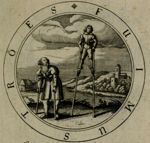
Fuimus Troës: Bornitz, Emblematum sacrorum et civilium miscellaneorum (Heidelberg, 1659), emblem 16
Iconclass: 31E1 dying 32B2(TROJANS) historical peoples and nationalities (TROJANS)
Collectanea (1500): 17
Loci Communes: Fuerunt non sunt (They were, they are no more, Ils furent, ils ne sont plus); Internitio (Utter destruction, Extermination totale)
I ix 51 Pyraustae interitus The death of a fire-worm
Πυραύστου μόρος, id est, Pyraustae interitus. In eos ddicebatur, qui sibiipsis exitium accer sunt. Ait enim Zenodotus, Pyraustam insectum esse, quod lucernis advolet, atque ita exustis alis concidat, pereatque. Citat autem hunc ex Aeschylo senarium: Δέδοικα μωρὸν κάρτα πυραύστου μόρον. id est, Magnopere stultum metuo pyrausta exitium. Tradit eadem de Pyrausta Aelianus De natura animantium libr. 12. citans eundem ex Aeschylo locum. Meminit de Pyrausta & Plinius lib. undecimo, capite trigesi. Gignit, inquiens, aliqua et contrarium natura elementum, siquidem in Cypri aerariis fornacibus ex medio igni maioris muscae magnitudine, volat pennatum quadrupes, appellatur Pyralis, â quibusdam Pyrausta, (aut, ut nonnulli codices habent, pyrotus.) Quamdiu est in igne, vivit: cum evasit longiore paulo volatu, tunc emoritur. Cuiusmodi ferme tradidit Aristoteles lib. 3. De animalibus, e nive vetustiore vermem nasci, qui nive exemptus non vivat. Eum nos vidimus in Alpibus. Quod si placet ad hoc referre a dagium, conveniet et in eos, qui ὠκύμοροι sunt, id est, qui celeriter intereunt. Nec invenu ste deflecteretur in eos, qui nusquam vivere possunt, nisi in propria patria: si contingat agere peregre, rebus omnibus offenduntur.
Πυραύστου μόρος, The death of a fire-worm, was used of those who court their own destruction; for Zenodotus describes the fire-worm as an insect that flies into lamps, and thus singes its wings, falls down, and dies. He cites this line from Aeschylus: 'I greatly fear the fire-worm's foolish death.' Aelian gives the same account of the fire-worm in book 12 of his work On the Nature of Animals, and quotes the same passage from Aeschylus. Pliny, book 11 chapter 36, also speaks of the fire-worm: 'Some things,' he says, 'are actually produced by the converse element in nature. In the copper-smelting furnaces in Cyprus, for instance, a four-footed creature with wings, the size of a fairly large fly, can be seen flying in the heart of the flames. It is called a pyralis and by some a pyrausta,' or, as some manuscripts have it, a pyrotus. 'This lives as long as it remains in the flames, but when it makes a somewhat longer flight and leaves the fire, it falls dead.' This recalls what Aristotle tells us in the third book On Animals of a worm engendered in long-lying snow which, if taken out of the snow, cannot survive. I have seen it myself in the Alps. And if we choose to apply the adage for this purpose, it will also fit what in Greek is called the ocymori, those who die young. Nor would it lose its point if transferred to those who can live happily nowhere except in their own country; and if chance obliges them to live abroad, they find fault with everything.
Facsimile: 
De tribulation vient prosperité: Corrozet, Hecatomgraphie (Paris, 1540), emblem 11 uses the imagery of the danger and the blessing of fire
Iconclass: 25FF711 'pyrausta' 31E1 dying 58AA12 Self-destruction
Loci Communes: Malum accersitum aut retortum (Evil brought upon oneself or turned back, Mal attiré ou retourné)
I ix 52 Post festum venisti You have come too late for the feast
Κατόπιν τῆς ἑορτης ἥκεις, id est, Post festum venisti. Refertur a Diogeniano. Dicitur in eos, qui negotio cuipiam egregio non interfuerunt: propterea quod serius, iam reperacta, ac cesserint. Socrates in Gorgia Platonis: Αλλ᾽ ἢ τὸ λεγόμενον κατόπιν ἑορτῆς ἥκομεν, καὶ ὑστεροῦμεν; id est, Num, inquit, post festum, quemadmodum dici consuevit, venimus, ac serius? Legi tur et hoc pacto: παναθηναίων κατόπιν, id est, Post Panathenae. Item πυθίων ὕστερον ἧκες. id est, Post Pyrthia venisti.
Κατόπιν τῆς ἑορτης ἥκεις, You have come too late for the feast. Recorded by Diogenianus. Said of those who have missed some important piece of business, because they arrived too late when it was all over. Socrates in Plato's Gorgias: 'Have we come, as the saying runs, too late for the feast, and missed it all?' It is also found in the form 'Too late for the Panathenaea' and 'You have arrived when the Pythia is over.'
Facsimile:
Iconclass: 41C5 celebration meal, feast, banquet 51FF52 Lateness 51MM11 Slowness, Tardiness; 'Tardità' (Ripa)
Collectanea (1500): 508
Loci Communes: Tarditatis et cunctationis (Slowness and delay, Lenteur et retard)
I ix 53 Merx ultronea putet Goods given away will soon decay
MERCES ultroneae putent, id est, ingrata sunt, quae ultro non petentibus offeruntur. Trans latum videtur a negotiatoribus, qui merces a venditore ultro oblatas, suspectas habere so lent, quasi studeant eas extrudere. Adagium refertur a Divo Hieronymo in quaestionibus Hebraicis: Tritum, inquit, proverbium est, ultroneas putere merces. Unde et nos de indu stria dicenda reticemus, ut avidius velis audire, quae tacita sunt. Usurpat idem in epistola ad Demetriadem virginem. Ab hac sententia non abludit illud Oudianum: Quod venit ex facili, facile,s segnesque tenemus. Quod spe quodque metu torsit, habere iuvat. Quin vulgo etiamnum in ore est, ultro delatum obsequium pletumque ingratum esse. Cui tamen refragetur Mimus ille non insulsus: Bis est gratum, quod opus est, ultro si offeras.
Goods given away will soon decay, means that free offers to those who do not ask for them are not well received. This looks like a metaphor from merchants who are apt to have doubts about goods offered unasked by a vendor; they suspect that he is keen to get rid of them. The adage is recorded by St Jerome in his Hebrew Problems: 'There's a familiar proverb' he says 'to the effect that Goods given away will soon decay; and so I too deliberately hold back what I have to say, to make you more eager to hear what I am suppressing.' He uses it again in a letter to a nun called Demetrias. The idea is close to that of Ovid's couplet: What lightly comes, we light and easy hold; What cost us hope and fear, we prize like gold. There is a common saying too, even now, that service freely proffered is usually unwelcome; though this is contradicted by the maxim, a rather neat one: 'Twice welcome what we need, when offered free.'
Facsimile:
Le bon veneur ne prend la bête qui se rend: Cats, Spiegel (The Hague, 1632), emblem 20 uses the imagery of a rabbit offering itself to the hunter to convey the idea that what is given away for free is without worth
Iconclass: 33A4 bringing gifts; exchanging gifts 55C2:55CC2 Giving❧Receiving 54BB3 Inutility, Noxiousness; 'Nocumento', 'Nocumento d'ogni cosa' (Ripa)
Loci Communes: Contemptus et vilitatis (Contempt and worthlessness, Mépris et bassesse)
I ix 54 Illotis pedibus ingredi To enter with unwashed feet
Ανίπτοις ποσίν ἀναβαίνειν, id est, Illotis pedibus ingredi. Est, confidenter, atque imperite rem egregiam aggredi, tamquam profane, et ineverenter. Translatum a sacrorum caeremoniis, in quibus omnia pura, lotaque iubebantur exhiberi. Lucianus in Demonactis vita, Οὐ μην ἀνίπτοις γε ποσὶ, τὸ τοῦ λόγου, πρὸς ταῦτα ἧξεν, id est, Haudquaquam illotis, ut aiunt, pedibus ad ista ve nerat, hoc est, neutiquam inexercitatus, neque rudis. Idem in Rhetorum praeceptore notat eos, qui ἀνίπτοις ποσὶν, id est, nullis bonis disciplinis instructi, ad rhetoricum munus accedunt. Aeneas sophista in epistola quadam: Οἱ μἓν πολλοὶ, τὸ δὴ λεγόμενον, ἀνίπτοις ποσὶν ἐπιπηδῶσι τοῖς ἱεροῖς, id est, Plerique quidem illotis, quod aiunt, pedibus irrumpunt ad sacra. Aulus Gellius in Noctibus: Illotis, quod aiunt, pedibus et verbis, reprehendit doctissimi hominis orationem. Macrobius Saturnal. lib. 1. Illotis pedibus praetereunt. De literatoribus loquitur, qui reconditam illam in Virgiliano poemate doctrinam negligunt. Huiusmedi Galenus libro De virtute simplicium remediorum vii. ἀμυήτους vocat καὶ βεβήλους. καὶ οὐδὲν, inquit, ἴσως θαυμαστὸν, εἴγε καὶ μυστηρίων βίβλους ἐτόλμησαν ἕνιοι τῶν ἀμυήτων ἀναγινώσκειν. ἀλλ᾽ οὔτ᾽ ἐκείνας ἔγραψαν οἱ γράψαντες τοῖς βεβήλοις, οὔτ᾽ ἐγὼ ταῦτα τοῖς μή πω περὶ τὰ πρῶτα γεγυμνασμένοις id est, Ac fortassis haudquaquam mirum est, si et mysteriorum libros quidam sacris non initiati sunt ausi legere. At eos libros nec illi, qui scripserunt, scripserunt profanis, nec ego haec scribo iis, qui nondum in primis rudimentis sunt exercitati. In genere sermonem omnem parum verecundum, nimisque procacem, ac petulantem, illotum proverbio vocant.
Ανίπτοις ποσίν ἀναβαίνειν, To enter with unwashed feet, is to attack an important task confidently but without experience, as though in a profane and irreverent attitude of mind. The metaphor comes from the ceremonial of sacrifice, in which the rule was that everything provided must be clean and newly washed. Lucian in his Life of Demonax: 'But he did not enter on this with unwashed feet, as the saying goes,' that is, raw and inexperienced. Again, in the Teacher of Public Speaking, he criticizes those who approach the teacher's task 'with unwashed feet,' meaning, not equipped with a good education. Aeneas the sophist in one of his letters: 'Most men force their way onto this holy ground with unwashed feet, as the saying goes.' Aulus Gellius in the Nights: 'With unwashed feet, as they say, and with unwashed language he criticizes the style of a distinguished author.' Macrobius in book 1 of the Saturnalia: 'They pass by with unwashed feet.' He is thinking of the teachers of literature who ignore the obscure learning concealed in Virgil's poetry. Galen in his Value of Simple Remedies, book 7, calls such people 'uninitiate' and 'profane.' 'It is not perhaps surprising,' he says, 'if some of the uninitiated have actually dared to read the texts of the mysteries. But the writers did not write those books for the profane; nor do I write this for those who have as yet had no practice in the rudiments.' In general, all irreverent, immodest, and offensive language can proverbially be called 'unwashed.'
Facsimile:
Iconclass: 31A543(+0) washing one's feet (+ variant) 54AA31 Inexperience 51AA7 Imperfection, Incompleteness; 'Imperfettione' (Ripa)
Collectanea (1500): 504
Loci Communes: Imperitia (Inexperience, lack of skill, Inexpérience); Temeritas (Recklessness, Témérité)
I ix 55 Illotis manibus With unwashed hands
Ανίπτοις χερσὶν, id est, Illotis manibus. A Diogeniano refertur, pro eo, quod est, irreve renter, atque imparate. Translatum item a sacrorum puritate. Hesiodus in Operibus et Diebus vetat, ne quis mane Iovi libet vinum χερσὶν ἀνίπτοις, id est, manibus illotis. Μηδὲ ποτ᾽ ἐξ ἠοῦς διὶ λείβειν αἴθοπα οἶνον Χερσὶν ἀνίπτοισιν μηδ᾽ ἄλλοις ἀθανάτοισιν. id est, Ne unquam mane Iout vinum li baveris ardens Illotis manibus, neque divum praeterea ulli. Ac ne vel amnem quispiam ingrediatur, aut fontem χεῖρας ἄνιπτος, idem vetat, id est, manibus illotis. Unde χέρνιβος apud Homerum crebra mentio. Ea vox perinde sonat, quasi dicat manuum lotionem, a qua rem divinam antiquitus auspicabantur, atque etiam convi vium, utpote rem sacram. Gregotius, cognomento Theologus, in Apologia De fuga sua in Pontum coniungit utrumque. ἀνιπτοις χερσὶν, ὅ δὴ λέγεται, καὶ ἀμυήτοις ποσὶ τοις ἁγιωτάτοις ἑαυ- τοὺς ἐπεισάγουσιν, id est, Illotis, ut dici solet, manibus, ac profanis pedibus, semet rebus sacratissimis ingerunt. Caius lib. pandec. i. Tit. De Origine iuris: Si in foro, inquit, causas dicentibus nefas, ut ita dixerim, videtur esse, nulla praefatione facta iudici rem exponere, quanto magis interpretationem promittentibus inconveniens erit, omissis initiis, atque origine non repetita, atque illotis, ut ita dixerim, manibus, protinus materiam interpretationis tractare? Utrumque proverbium recte usurpabitur in eos, qui vel audacius, vel parum instructi rebus his, quibus oportuit, negotium invadunt: veluti, si quis principis munus capessat, nulla neque virtute, neque sapientia, neque rerum usu praeditus. Aut si divinas literas interpretari conetur, Graecae, Latinae, & Hebraicae linguae, denique & omnis antiquitatis rudis & imperitus, sine quibus non stultum modo, verum etiam impium est,, theologiae mysteria tractanda suscipere. Quod tamen, heu nefas, iam passim plerique faciunt, qui frigidis aliquot instructi syllogismis, & puerilibus sophismatis, deum immortalem, quid non audent? quid non praecipiunt? quid non decernunt? Qui si possent cernere, quos risus, vel potius quem dolorem moveant linguarum & antiquitatis peritis, quae portenta proferant, in quàm pudendos ad prima literarum elementa redirent. Multi recte iudicant absque dialecticae praeceptis, ut ne dicam sophisticis cavillis. Sapiebant mortales, et prius quàm deus istorum Aristotenasceretur. Nullus unquam sententiam alicuiu intellexit, ignarus sermonis, quo sententiam ille suam explicuit. Proinde divus Hieronymus, cum constituisset arcanas interpretari literas, ne illotis, ut aiunt, pedibus rem tantam aggrederetur: quaeso, num sophisticis nugis instruxit ingenium? Num Aristorelicis decretis? Num his etiam nugacioribus nugis? Minime. Quid igitur? Inaestimabili sudore, trium linguarum peritiam sibi comparavit. Quas qui ignorat, non theologus est, sed sacrae theologiae violator. Ac vere manibus pariter ac pedibus illotis, rem omnium maxime sacram non tractat, sed prophanat, conspurcat, violat.
Ανίπτοις χερσὶν, With unwashed hands, is recorded by Diogenianus in the sense of irreverent and ill-prepared. This too is a metaphor from ritual purity. Hesiod in the Works and Days forbids the offering of a libation to Jove in the morning with hands unwashed: 'Never with hands unwashed in the early light of morning / Offer the glinting wine to Jove and the other immortals.' He also forbids anyone to enter a stream or spring without washing his hands. Hence the frequent mention of the chernips in Homer, a word which by its sound precisely conveys the sense of 'hand-washing,' with which the Ancients always made a propitious start to religious ceremonial, and also to dinners which have a ceremonial element in them. Gregory the Theologian, as they call him, in the apology for his flight into Pontus, connects both phrases: 'With unwashed hands, as the saying goes, and uninitiate feet they force their way into most sacred things.' Gaius in the first book of the Pandects, title De origine juris, writes: 'If it is thought indecent, if I may so put it, for counsel presenting a case in court to set out the facts before the judge with no introduction, how much more improper it will be for those who offer an interpretation to overlook the early stages and make no search for origins, but with unwashed hands, if I may so put it, to proceed at once to the subject-matter of their interpretation.' Either proverb will properly be used of those who plunge into some undertaking full of self-confidence or ignorant of what they ought to know; for instance, anyone who assumes the office of a prince with no equipment of virtue or wisdom or experience of affairs, or sets out to interpret Holy Scripture untaught and unpractised in Greek, Latin, and Hebrew and indeed in the whole of Antiquity, without which it is not only foolish but impious to undertake to treat of the mysteries of theology. And yet, outrageous as it is, this is now common practice. Equipped with a few frosty syllogisms and some childish sophistries, where (Heaven help us) do they draw the line? Where do they not lay down the law? What problems are insoluble?
Could they but see the merriment, or rather, the sorrow that they cause to those with some experience of the ancient tongues and of Antiquity, could they see the monstrosities that they produce and the shameful errors into which they fall continually, they would surely be ashamed of their headlong incompetence and return even in old age to the rudiments of a liberal education. Many men come to a right conclusion unaided by the laws of dialectic, to say nothing of the quillets of sophistry. There was sense and wisdom among mortals, even before the idol of these people, Aristotle, was born. No one ever understood another person's meaning without a knowledge of the tongue in which that meaning was expressed. And so St Jerome, when he had decided to interpret Holy Scripture and was determined not to take up such a task with unwashed feet, as the saying goes -I ask you, did he equip his mind with sophistic rubbish? With Aristotelian principles? With nonsense yet more nonsensical than this? Not he. How did he start then? With incalculable efforts he acquired a knowledge of the three tongues. The man who is ignorant of these is no theologian, he treats divine theology with outrage, and with both hands and feet in very truth unwashed he does not take up this most sacred of all subjects, he profanes it and defiles it and outrages it.
Facsimile: 
Iconclass: 31A541(+0) washing one's hands (+ variant) 54AA31 Inexperience 51AA7 Imperfection, Incompleteness; 'Imperfettione' (Ripa)
Collectanea (1500): 500
Loci Communes: Temeritas (Recklessness, Témérité)
I ix 56 Aquilae senecta An eagle's old age
Αετου γῆρας. id est, Aquilae senecta. In senes dicebatur bibaces magis, quam edaces. Nam Plinius libro 10. cap. 3. refert, aquilas neque senio, neque aegritudine oppetere, sed fame: in tantum superiore accrescente rostro, ut aperiri non queat. Eoque aquilam tantum in senecta bibere, aut de praeda sanguinem sugere: cum nullae fere aves aduncis unguibus utantur potu, prae ter tinnunculum et miluum: quamquam hi quoque perquam raro bibant. Auctor Aristote les libro De natura animalium 8. Sed idem libro 9. narrans de aquilae rostro ea dem ferme, quae Plinius, addit huic rei datam fabulam, quae significat hoc ideo accidere aqui lae, quod olim, cum homo esset, hospiti fecit iniuriam. Terentius in Heautontimorumeno. Visa vero est, quod dici solet, Aquilae senectus. Verba sunt Syri, adulantis hero, quod pri die strenue bibisset in convivio. Est autem veluti peculiaris senibus bibacitas. Sive quod natura frigus aetatis, vini calore pensare desiderat: sive quod vini hilaritas minuit senectu tis molestiam. Unde Plato quoque, cum iuvenibus in totum interdixerit usum vini, viris mo deratum permiserit, senibus largiores compotationes concedit. Tum, cur senectus sit vino sior, causam reddit etiam Alexander Aphrodiseus in problemate quarto ab ultimo, quod aetas ingravescens minuat calorem, vinum autem humectet simul et calefaciat. Unde et vulgo lac senum dicitur. Fertur et prisci Catonis Saepe mero caluisse virtus, ut inquit Flaccus.
Ἀετοῦ γῆρας, An eagle's old age, was used of old men who drank more than they ate. For Pliny, book 10 chapter 3, tells us that eagles die, not of old age or sickness but of hunger, because their upper beak grows to such a disproportionate length that they cannot open their mouths. The eagle therefore in old age can only drink or suck blood from its quarry, although almost none of the birds that have crooked talons drink; only the kestrel and the kite, and they too very rarely. The authority is Aristotle in book 8 of his On the Nature of Animals. But the same author in book 9, after giving much the same account of the eagle's beak as Pliny, adds that there is a myth attached to this, to the effect that this happened to the eagle in return for outrage done to a guest long ago when it was a man. Terence in the Heautontimorumenos: T saw the eagle's old age that they tell of.' The speaker is Syrus, and he compliments his master on a strenuous feat of drinking at a party the day before. Love of the bottle is almost a special characteristic of old men, either because nature requires to make up for the cold of that period of life with the warmth in the wine, or cheerfulness induced by the wine lessens the troubles of the aged. Hence Plato too, though he entirely forbade the young to drink and allowed grown-up men very moderate potations, permitted much greater indulgence to the aged. A further reason why old age should drink more wine is given by Alexander of Aphrodisias in his Problems, the fourth from the end, where he says that advancing years reduce the bodily heat, and wine both moistens and warms at the same time. Hence it is also commonly called 'old men's milk.' It is said 'old Cato oft his valiant heart / With wine would cheer' - so Horace tells us.
Facsimile:
Iconclass: 25F33(EAGLE)(+24)(+45) predatory birds: eagle 41C12 drinking 41C119 hunger 59CC21 Inequality, Inequity, Iniquity; 'Iniquità' (Ripa) 51E2 Superiority
Collectanea (1500): 501
Loci Communes: Excellentia, inaequalitas (Excellence, inequality, Excellence, inégalité)
I ix 57 Aquilae senecta, corydi iuventa An old eagle is as good as a young lark
Αετου γῆρας, κόρδου νεότης. id est, Aquilae senecta, Corydi iuventa. De vivida viridique se necta, quae praestantior sit aliquorum iuventa. Nam anus aquila praestat Corydo avicu lae, etiam aetate integra. Citra allegoriam extulit Euripides in Andromache: Πολλῶν νέων γὰρ κᾂν γέρων ἐύψυχος ᾖ Κρείσσων. id est, Multis enim iuvenibus ante stat senex, Cui mens adest generosa.
Ἀετου γῆρας, κόρδου νεότης, The old age of an eagle equals the youth of a lark. Used of a vigorous and green old age, which is better than some people's youth. For an aged eagle beats a small bird like the lark even in its prime of life. Euripides expresses this without allegory in the Andromache: 'A man of spirit, be he ne'er so old, / Is better far than many younger men.'
Facsimile:
Iconclass: 25F33(EAGLE)(+24) predatory birds: eagle (+ very old animal) 25F32(LARK)(+21) song-birds: lark (+ young animal) 31D160 Old Age, 'Senectus'; 'Vecchiezza' (Ripa)
Loci Communes: Excellentia, inaequalitas (Excellence, inequality, Excellence, inégalité)
I ix 58 Camelus vel scabiosa complurium asinorum gestat onera Even a mangy camel bears the load of many donkeys
Κάμηλος καὶ ψωριῶσα, πολλῶν ὄνων ἀνατίθεται φορτία. id est, Camelus etiam scabiosa, complurium asinorum tollit onera. De iis, qui usque adeo praecellunt quosdam, ut etiam senes, aut alioquin aegroti, praestantiore tamen sint illis integris. Aut de his, qui, rebus pa rum prosperis, tamen plus valent ob pristinae fortunae reliquias, quam alii rebus integris. Usus est Synesius.
Κάμηλος καὶ ψωριῶσα, πολλῶν ὄνων ἀνατίθεται φορτία., A camel, even with the mange, bears the same load as many donkeys. Used of those who are so much more use than certain other people that even when old or disabled in some other way, they can do more than the others do in good health. Or of men who, when things go wrong with them, can yet do more with what's left of their former fortunes than other men whose position is untouched. This is used by Synesius.
Facsimile: 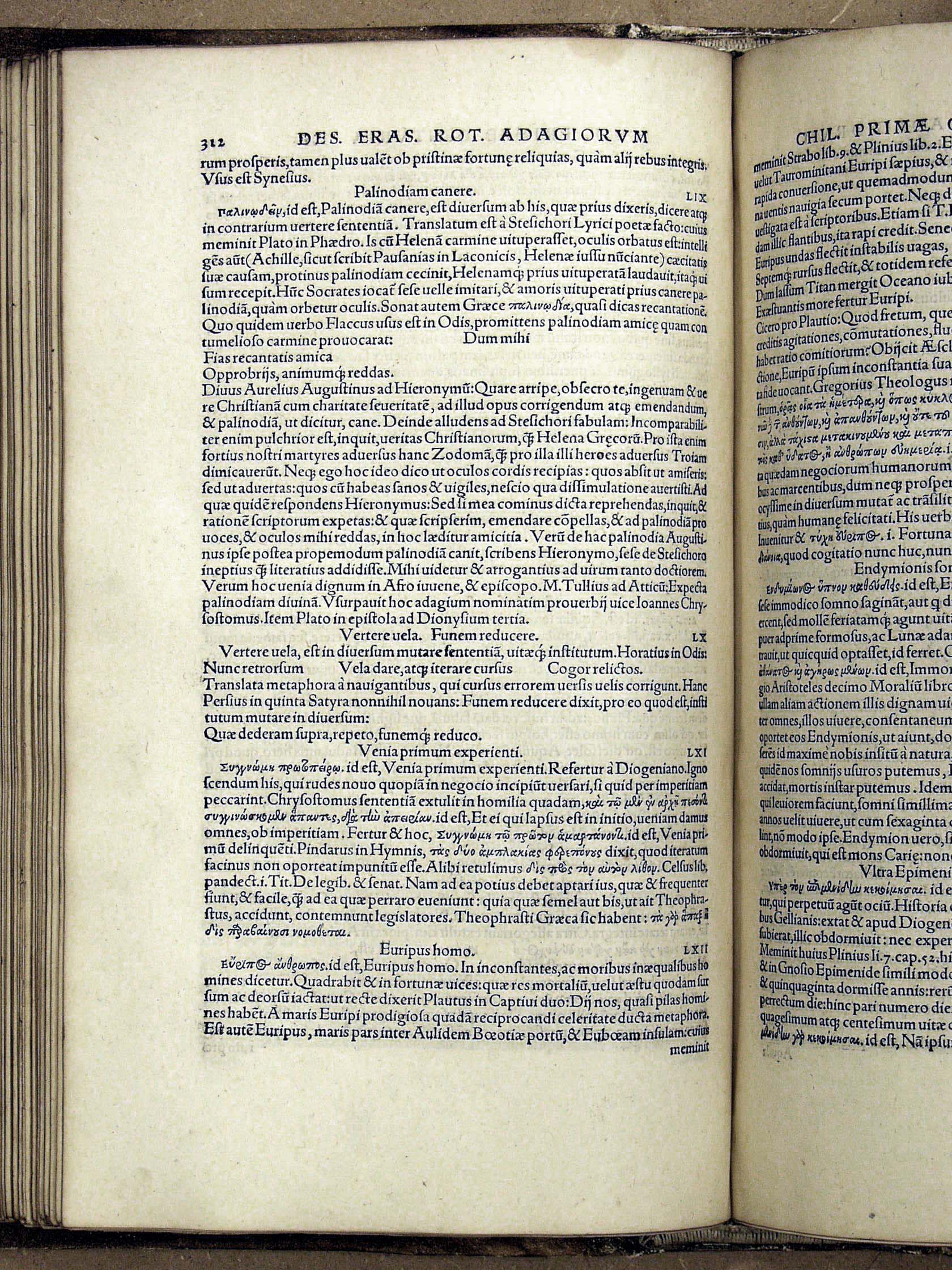
Iconclass: 25F24(CAMEL) hoofed animals: camel 46C13142 ass, donkey 59CC21 Inequality, Inequity, Iniquity; 'Iniquità' (Ripa) 51E2 Superiority
Collectanea (1500): 611
Loci Communes: Excellentia, inaequalitas (Excellence, inequality, Excellence, inégalité)
I ix 59 Palinodiam canere To sing a palinode
Παλινῳδειν, id est, Palinodiam canere, est, diversum ab his, quae prius dixeris, dicere, atque in contrarium vertere sententiam. Translatum est a Sthesichori Lyrici poetae facto: cuius meminit Plato in Phoedro. Is, cum Helenam carmine vituperasset, oculis orbatus est. Intelli gens autem (Achille, sicut scribit Pausanias in Laconicis, Helenae iussu nuntiante) caecitatis suae causam, protinus palinodiam cecinit: Helenamque prius vituperatam laudavit, itaque visum recepit. Hunc Socrates iocatur sese velle imitari, et amoris vituperati prius canere pa linodiam, quam orbetur oculis. Sonat autem Graece παλινῳδία, quasi dicas recantationem. Quo quidem verbo Flaccus usus est in Odis, promittens palinodiam amicae, quam con tumeliose carmine provocarat: Dum mihhi Fias recantatis amica Opprobriis, animumque reddas. Divus Aurelius Augustinus ad Hieronymum: Quare arripe, obsecro te, ingenuam & vere Christianam cum charitate severitatem, ad illud opus corrigendum atque emendandum, & palinodiam, ut dicitur, cane. Deinde alludens ad Stesichori fabulam: Incomparabiliter enim pulchrior est, inquit, veritas Christianorum, quam Helenam Graecorum. Pro ista enim fortius nostri martyres adversus hanc Zodomam, quam pro illa illi heroes adversus Troiam dimicaverunt. Neque ego hoc ideo dico ut oculos cordis recipias: quos absit ut amiseris: sed ut advertas: quos cum habeas sanos & vigiles, nescio qua dissimulatione avertisti. Ad quae quidem respondens Hieronymus: Sed si mea cominus dicta reprehendas, inquit, & rationem scriptorum expetas: & quae scripserim, emendare compellas, & ad palinodiam provoces, & oculos mihi reddas, in hoc laeditur amicitia. Verum de hac palinodia Augustinus ipse postea propemodum palinodiam canit, scribens Hieronymo, sese de Stesichoro ineptius quam literatius addidisse. Mihi videtur & arrogantius ad virum tanto doctiorem. Verum hoc venia dignum in Afro iuvene, & episcopo. M. Tullius ad Atticum: Exspecta palinodiam divinam. Usurpavit hoc adagium nominatim proverbii vice Ioannes Chrysostomus. Item Plato in epist. ad Dionysium tertia.
Παλινῳδειν, To sing a palinode, is to say the opposite of what you said before and adopt the contrary opinion. The source is an anecdote about Stesichorus the lyric poet which is recounted by Plato in the Phaedrus. He had written scandal in one of his poems about Helen, after which he lost his sight; but when he learnt the cause of his blindness, Achilles having been sent by Helen to tell him (as Pausanias informs us in his book on Sparta), he at once sang a palinode, praised Helen whom he had previously vilified, and so recovered his sight. Socrates says jokingly that he wishes to follow Stesichorus' example, and sing a palinode for his abuse of the god of love, before he loses his eyesight. The Greek word palinodia means 'singing backwards' or 'unsinging'; in Latin it might be recantatio. This is the word used by Horace in the Odes, when he promises a palinode to the girl whom he had assailed with scandal in another poem:
If you resume the lover's part,
While I my former taunts recant,
And give me back once more your heart.
St Augustine writing to Jerome: 'Adopt therefore, I beg you, the honourable and truly Christian spirit of severity tempered with charity, correct and emend that work, and as the saying goes, sing your palinode.' Then, alluding to the story of Stesichorus: 'For Truth as we Christians know her is incomparably more beautiful than any Helen known to the Greeks, and our martyrs have fought for her more bravely against this Sodom than ever the Greek heroes fought for Helen against Troy. I say this with no idea that the eyes of your heart should recover their sight, which heaven forbid they should ever have lost, but that you should turn them on the object; for though they are healthy and wide awake, from some desire for concealment you have turned them aside.' To which Jerome replies as follows: 'But if you reject what I said at close quarters and ask me to defend what I have written and compel me to correct it and challenge me to a palinode and give me back my sight, all this is a breach of our friendship.' But on the subject of this palinode Augustine himself almost sings one later on, writing to Jerome to say that his adding of the reference to Stesichorus was not so much scholarly as foolish. I also think it was arrogant to write such a letter to a man so much more learned than himself; but one can forgive this in an African, a young man, and a bishop. Cicero writing to Atticus: 'You may expect a splendid palinode.' This adage was used by John Chrysostom specifically as a proverb. So also Plato in his third letter to Dionysius.
Facsimile:
Iconclass: 31A4111 blind, blindness 48C755 vocal music, singing 51K1:52C11 Change❧Opinion 98B(STESICHORUS) male persons from classical history (STESICHORUS)
Collectanea (1500): 502
Loci Communes: Mutandae sententiae (Changing one's opinion, Changer d'avis)
I ix 60 Vertere vela. Funem reducere To turn one's sails about. To pull in the rope
Vertere vela, est, in diversum mutare sententiam, vitaeque institutum. Horatius in Odis: Nunc retrorsum Vela dare, atque iterare cursus Cogor relictos. Translat a metaphora a navigantibus, qui cursus errorem versis velis corrigunt. Hanc Persius in quinta Satyra non nihil novans, Funem reducere dixit, pro eo, quod est, insti tutum mutare in diversum: Quae dederam supra, repeto, funemque reduco.
To turn one's sails about is to change one's opinion for its opposite and reverse one's way of life. Horace in the Odes: 'Backwards I now must turn my sails perforce, / Again retracing my abandoned course.' The metaphor is taken from sailors, who correct an error in navigation by turning their sails. Persius in his fifth satire changes the image to some extent when he uses 'to pull in the rope' for adopting the opposite of one's former principles: 'Withdraw concessions and pull in the rope.'
Facsimile:
Iconclass: 51K1:52C11 Change❧Opinion 46C24111 sail 47D8(ROPE) tools, aids, implements ~ crafts and industries: rope
Collectanea (1500): 42
Loci Communes: Mutandae sententiae (Changing one's opinion, Changer d'avis)
I ix 61 Venia primum experienti Let a beginner off lightly
Συγγνώμη πρωτοπείρῳ, id est, Venia primum experienti. Refertur a Diogeniano. Igno scendum his, qui rudes non quopiam in negotio incipiunt versari, si quid per imperitiam peccarint. Chrysostomus sententiam extulit in homilia quadam: καὶ τῷ μὲν ἐν ἀρχῇ πεσόντι συγγινώσκομεν ἅπαντες, διὰ τὴν ἀπειρίαν, id est, Et ei, qui lapsus est in itiio, veniam damus omnes, ob im pertitiam. Fertur et hoc, Συγγνώμη τῷ πρῶτον ἁμαρτάνοντι. id est, Venia pri mum delinquenti. Pindarus in Hymnis, τὰς δύο ἀμπλακίας φερεπόνους dixit, quod iteratum facinus, non oportet im punitum esse. Alibi retulimus δὶς πρὸς τὸν αὐτὸν λίθον. Celsus lib. Pandect. 1. Tit. de legibus et senat. Nam ad ea potius debet aptari ius, quae et frequenter fiunt, et facile, quam ad ea, quae perraro eveniunt, quia, quae semel, aut bis, ut ait Theophrastus, accidunt, contemnunt legislatores. Theophrasti Graeca sic habent: τὰ γὰρ ἅπαξ δὶς παραβαίνουσι νομοθέται.
Συγγνώμη πρωτοπείρῳ, Let a beginner off lightly, is recorded by Diogenianus. We should be ready to forgive the unskilled who are starting to operate in some unfamiliar field, if they make a mistake through inexperience. Chrysostom expresses this view somewhere in a homily: 'We all forgive the man who makes a mistake at the outset through inexperience.' It sometimes takes the form, Pardon for a first offence. Pindar in his Hymns says that 'two offences bring troubles in their train,' because the man who goes wrong twice ought not to escape punishment. I have recorded elsewhere To stumble twice on the same stone. Celsus in the first book of the Pandects, title De legibus et senatu: 'For the law ought to be adapted to things which happen both often and easily, rather than to those which rarely come about; for legislators, as Theophrastus says, make light of things that happen once or twice by chance.' Theophrastus' opinion in Greek runs 'For what happens once or twice is overlooked by lawgivers.'
Facsimile:
Iconclass: 25H1124 boulder, stone 31A27321 stumbling 51B61 Repetition 52CC41 Error; 'Errore' (Ripa) 54AA31 Inexperience 57A74 Forgivingness
Loci Communes: Iteratus error (A repeated error, Erreur répétée)
I ix 62 Euripus homo Man's a Euripus
Εὔρϊπος ἄνθρωπος. id est, Euripus homo. In inconstantes, ac moribus inaequalibus homines dicetur. Quadrabit et in fortunae vices: quae res mortalium, velut aestu quodam, sursum ac deorsum iactat: ut recte dixerit Plautus in Captivi duo: Dii nos, quasi pilas, homines habent. A maris Euripi prodigiosa quadam reciprocandi celeritate ducta metaphora. Est autem Euripus, maris pars inter Aulidem Boeotiae portum, & Euboeam insulam: cuius meminit Strabo lib. 9. & Plinius lib. 2. Et quorundain tamen, inquit, privata natura est, velut Taurominitani Euripi saepius, & in Euboea septies die, ac nocte reciprocantis, tam rapida conversione, ut, quemadmodum auctor est Pomponius Mela, ventos, ac etiam ple na ventis navigia secum portet. Neque dum huius tam stupendae rei causa satis idonea per vestigata est a scriptorib. Etiamsi T. Livius, secundi belli Punici lib. octavo, a ventis quibus dam illic flantib. ita rapi credit. Seneca in Hercule OEtaeo: Euripus undas flectit instabilis vagas, Septemque rursus flectit, & totidem refert, Dum lassum Titan mergit Oceano iubar. Boeotius item, Exaestuantis more fertur Euripi. Cicero pro Cn. Plancio: Quod fretum, quem Euripum, tot motus, tantas, tam varias habere creditis agitationes, commutationes, fluctus, quantas perturbationes, et quantos aestus habet ratio comitiorum? Obicit Aeschines Demostheni, quod, subinde commutata fa ctione, Euripum ipsum inconstantia sua vicisset. Unde Graeci Euripiston, hominem incer ta fide vocant. Gregorius Theologus in Epistola quadam ad Sophronium equitum magi strum, ὁρᾷς οἷα τὰ ἡμέτερα, καὶ ὅπως κύκλος τὶς τῶν ἀνθρωπίνων περιτρέχει πραχμάτων, νῦν μὲν τῶν νῦν δὲ τῶν ἀνθούντων, καὶ ἀπανθούντων, καὶ οὔτε του εὖ πράττειν ἑστῶτος ἡμῖν, οὔτε τοῦ δυστυχεῖν, ὅ δὴ λέγουσιν, ἀλλὰ τάχιστα μετακινουμένου καὶ μεταπίπτοντος, ὡς αὔραις εῖναι μᾶλλον πιστεύειν καὶ γράμμασι τοῖς καθ᾽ ὑδατος, ἢ ἀνθρώπων εὐημερίᾳ, id est, Vides, quae sit conditio rerum nostrarum, utque ro ta quaedam negotiorum humanorum cursu circumagatur, nunc his, nunc illis florenti bus, ac marcentibus, dum neque prosperitas, neque adversitas, ut aiunt, nobis constat, sed quam ocyssime in diversum mutatur, ac transilit, ut auris, ac literis aquae inscriptis fidere liceat ci tius, quam humanae felicitati. His verbis pulchre depingit Euripum humanae conditionis. Invenitur et τύχη εὐριπος, id est, Fortuna volubilis. Nihil enim hac instabilius, et εὔριπος διάνοια quod cogitatio nunc huc nunc illuc feratur.
Εὔρϊπος ἄνθρωπος, Man's a Euripus, is to be used of those who are changeable and of no settled character. It will also be suitable for changes of fortune, which sweeps mortal affairs to and fro in a sort of tide, so that Plautus put it rightly in the Captivi: 'We men are the gods' tennis-balls.' The image is taken from the prodigious speed with which the Euripus ebbs and flows, the Euripus being that part of the sea that lies between Aulis, a port in Boeotia, and the island of Euboea, which is mentioned by Strabo in book 9 and by Pliny in book 2. 'Yet among tides' says Pliny 'some have a nature of their own, like those of the Euripus of Taormina, which change frequently, and the Euripus of Euboea, which change seven times, every twenty-four hours.' So rapid is the change that, as we learn from Pomponius Mela, the tide carries with it the wind and even ships in full sail. Nor has an adequate cause for this astonishing phenomenon yet been thoroughly investigated by writers on the subject, though Livy in book 8 of his work On the Second Punic War thinks the water is swept along by certain winds which blow in those parts. Seneca in his Hercules on Oeta:
Changeful Euripus bends its wandering waves;
Seven times it turns them back, and seven times forward,
Ere Sun in Ocean steeps his weary rays.
Boethius too: 'Swept like Euripus with its boiling tides.' Cicero in the Pro Plautio: 'Does any tidal strait, do you suppose, does Euripus itself know such commotions, such great and varying disturbances, such reversals, such breakers as our system of elections with its upheavals and its tides?' Aeschines accuses Demosthenes of changing sides so often that he had outdone Euripus itself in unreliability; whence comes a Greek word for an untrustworthy man, euripistos. Gregory the Theologian in a letter to Sophronius, master of the horse: 'You see how we are placed, and how we are carried round by the turning wheel of human affairs, as now one party now another flourishes and decays, so that neither prosperity nor adversity, as they say, lasts for us very long, but all shifts and changes rapidly into its opposite, so that it is better to put one's trust in the winds and in words written in water than in human felicity.' These words give an eloquent picture of the Euripus that is our human predicament. One also finds τύχη εὐριπος for 'fortune is changeable,' because it is the most instable thing there is, and εὔριπος διάνοια, 'thought is a Euripus,' because thought flows rapidly now this way and now that.
Facsimile: 
Iconclass: 25H23121 ebb, low tide 25H23122 flood, high tide 25H2324(EURIPUS) straits, narrows (EURIPUS) 31 man in a general biological sense 51K2 Mutability; 'Immutatione' (Ripa) 53AA21 Inconstancy; 'Incostanza', 'Instabilità', 'Instabilità overo Incostanza' (Ripa)
Collectanea (1500): 302
Loci Communes: Inconstantiae, perfidiae, versutiae (Inconstancy, treachery, cunning, Inconstance, perfidie, ruse)
I ix 63 Endymionis somnum dormis You sleep Endymion's sleep
Ενδυμΐωνος ὕπνου καθεύδεις, id est, Endymionis somnum dormis. In eos quadrabit, qui sese immodico somno saginant, aut qui diuturno in otio versantur, nec ullis se negotiis ex ercent, sed mollem, feriatamque agunt vitam. Natum a fabula notissima Endymionis. is erat puyer apprime formosus, ac Lunae adamatus. Cui quidem illa a patre Iove precib. impe travit, ut, quidquid optasset, id ferret. Optavit Endymion, ut perpetuum dormiret somnum, ἀθάνατος καὶ ἀγήρως μένων. id est, Immortalis perseverans, et expers senii. Usus est hoc ada gio Aristoteles decimo Moralium libro, colligens neque otium convenire diis, neque rursus ullam aliam actionem illis dignam videri, praeter contemplationem. Porro, cum constet in ter omnes, illos vivere, consentaneum est eosdem et agere quippiam: Neque enim, inquit, oportet eos Endymionis, ut aiunt, dormire somnum. Cicero libro de Finib. quinto, dis serens id maxime nobis insitum a natura, ut agamus aliquid: Itaque, inquit, ne si iucundissimis quidem nos somniis usuros putemus, Endymionis somnum nobis nolimus dari, idque si accidat, mortis instar putemus. Idem Tusc. quaest. lib. 1. Quamquam, qui leviorem faciunt, somni similimam volunt esse. Quasi vero quisquam ita nonaginta annos velit vivere, ut, cum sexaginta confecerit, reliquos dormiat. Ne sues quidem id ve lint, non modo ipse. Endymion vero, si fabulam audire volumus, quando in Latmio obdormivit, qui est mons Cariae, nondum est experrectus.
Ενδυμίωνος ὕπνου καθεύδεις, You sleep Endymion's sleep, will suit people who grow fat by indulging excessively in sleep, or those who are very idle all day and never occupy themselves in business of any kind but live a soft and leisurely existence. It arose from the very familiar story of Endymion. Endymion was a very handsome boy, and the Moon fell in love with him. For his benefit, she asked her father Jove to grant him a wish that should come true, and he wished that he might sleep forever, and remain immortal and unageing. This adage is used by Aristotle in the tenth book of the Ethics, who infers that idleness is inappropriate for the gods, nor does any other activity seem worthy of them, except contemplation. Furthermore, as all men are agreed that the gods are alive, it follows that they must also do something; 'since it is not right' he says 'for them to sleep, like Endymion in the story.' Cicero in book 5 of the De finibus, arguing that chief among the qualities implanted in us by nature is the urge to be up and doing, says that 'even if we thought we should enjoy the most delightful dreams, we should not want to be endowed with Endymion's sleep, and in fact if it did befall us, we should think it like death.' Again in his Tusculan Questions, book one: 'Though those who make death out to be a lighter burden would have it that death is very like sleep. As though any man would be willing to live for ninety years, if it was a condition that once he had finished sixty years he should sleep the rest of the time. Pigs, even, would not like that, let alone the man himself. There is always Endymion, if we are ready to listen to myths, who fell asleep, I know not when, on Latmos, which is a mountain in Caria, and has not yet, I fancy, woken up.'
Facsimile:
Iconclass: 32A21 fat (human type) 51K2 Mutability; 'Immutatione' (Ripa) 54AA11 Sluggishness, Inertia; 'Dapocaggine', 'Pigritia' (Ripa) 54DD2 Idleness; 'Otio' (Ripa) 54F12 Luck, Fortune, Lot; 'Fato', 'Fortuna', 'Fortuna aurea', 'Fortuna buona', 'Fortuna pacifica overo clemente', 'Sorte' (Ripa) 92C321(+0) Diana (Luna) visiting the sleeping Endymion (+ variant)
Loci Communes: Somnolentia (Sleepiness, Somnolence)
I ix 64 Ultra Epimenidem dormis You sleep longer than Epimenides
Υπὲρ τὸν ἐπιμενίδην κεκοίμησαι, id est, Ultra Epimenidis somnum dormivisti. In eos dicetur, qui perpetuum agunt otium. Historia de Epimenide Cretensi exstat in Noctibus Gellianis, exstat et apud Diogenem Laertium. Is, ambulando fessus, in specum quendam subierat, illic obdormivit: nec experrectus est a somno ante exactos annos XLVII. Meminit huius Plin. lib. 7. cap. 52. his verbis, Magna quidem fabulositate, quam equidem et in Gnosio Epimenide simili modo accipio: puerum, aestu, et itinere fessum, in specu septem et quinquaginta dormisse annis: rerum faciem, mutationemque mirantem, velut postero experrectum die: hinc pari numero dierum, senio ingruente, ut tamen in septimum et quinquagesimum atque centesimum vitae duraret annum. Lucianus in Timone: Υπὲρ τὸν ἐπιμενίδην γὰρ κεκοίμησαι, Nam ipsum etiam Epimenidem somno vicisti. Si quid habet veri Pythagorae μετεμψύχωσις, consentaneum est, huius Epimenidis theologi animam in sophisticos istos theologos demigrasse, qui tantum inanium somniorum invexerunt in orbem, quàm multis vix sufficiat somnus in ducentos continuatus annos.
Υπὲρ τὸν Ἐπιμενίδην κεκοίμησαι, You sleep longer than Epimenides, will be used of men who are permanently idle. The tale of Epimenides the Cretan theologian is to be found in the Attic Nights, and also in Diogenes Laertius. He once went for a walk, and when he grew tired, entered a cave and there fell asleep; nor did he wake up until forty-seven years had elapsed. Pliny mentions this in book 7, chapter 52, in these words: 'This is pure fable, and I myself put the story of Epimenides the Cretan in the same class, who is said to have been tired out when a boy by heat and exercise and to have slept in a cave for fifty-seven years. After which he woke up under the impression it was next day, and was much surprised by what he saw and how much things had changed. After that, he lived for the normal span of time and became an old man; but even so he reached his one hundred and fifty-seventh year.' Lucian in his Timon: 'For you have slept longer than Epimenides.' If there is any truth in Pythagoras' doctrine of the transmigration of souls, there can be no doubt that the soul of this theologian Epimenides has migrated into our sophistical theologians, who have brought so many empty dreams into the world that two hundred years' unbroken sleep would hardly suffice for them.
Facsimile: 
Iconclass: 23B9(47) other periods (47) 25H119 cave, grotto 31B1 sleeping; unconsciousness 54DD2 Idleness; 'Otio' (Ripa) 98B(EPIMENIDES) male persons from classical history (EPIMENIDES)
Loci Communes: Somnolentia (Sleepiness, Somnolence)
I ix 65 Matura satio saepe decipit, sera semper mala est Sow early and be often sorry, sow late and always lose
Columella de re rustica scribit hunc in modum: Sed cum omnia in agricultura stren ue facienda sunt, tum maxime sementis. Vetus est agricolarum proverbium: maturam sationem saepe decipere solere, seram numquam, quin mala sit. Hactenus Columella. Ad monet adagium, in omni negotio maturandum esse, neque paulo satius esse, occupare tempus legitimum, quam serius aggredi. Velut, si quis admoneat, ut puer, tenera adhuc aetate, praeceptoribus committatur erudiendus. Consultius enim antevertere, quam provectioribus annis tum demum incipere.
Columella in his Agriculture writes as follows: 'All farming operations must be performed energetically, and above all sowing. There is an old farming proverb to the effect that an early sowing is often disappointing but a late one never fails to go wrong.' So Columella. The lesson of the adage is that, whatever the business, we should act promptly and that it is far better to anticipate the proper time than to start late. If, for instance, one had to point out that a child should be entrusted to the tutors who are to educate him while he is still of tender years; for it is wiser to start too early than to wait till he is older and not begin till then.
I ix 66 Fames Melia A Melian famine
Λιμὸς μηλιαῖος, id est, Fames Meliaea. De fame extrema, deque rebus difficilimis. Est enim Melus oppidum Thessaliae, quod Nicias, Atheniensium dux, obsedit, expugnavitque, non tam machinis bellicis, quam fame. Haec ferme Suidas. Idem effert hoc pacto, λιμῷ μηλίῳ, fame Melia. Meminit huius historiae Thucydides in quinto. Proverbium est apud Aristphanem in Avibus: Τοὺς δ᾽ αὖ θεοὺς ἀπολεῖτε λιμῷ μηλίῳ. id est, Iterum deos fame enecatis Melia.
Λιμὸς Μηλιαῖος, A Melian famine. Of severe famine and other extreme hardships, Melus being a town in Thessaly besieged by Nicias the Athenian general, and taken not by siege-engines but by starvation. So roughly Suidas, who also gives it in the form λιμῷ Μηλίῳ,, By Melian famine. The story of this is told by Thucydides in his fifth book. The proverb is found in Aristophanes, in the Birds: 'You will destroy the gods by Melian famine.'
I ix 67 Saguntina fames Famine at Saguntum
Saguntina fames consimili ratione in proverbium venit. Historiae meminerunt T. Li vius, Val. Maximus, et M. Tullius in Philippicis. Est autem Saguntum Hispaniarum oppidum, iuxta flumen Hiberum, societate, foedereque coniunctum cum Romanis. id longa Poenorum obsidione, fameque eo redactum est, ut cives, exstructo in foro igni, quidquid erat pretionsarum rerum, in eum conicerent, ac postremo, seque suosque liberos eodem praecipi tarent, ne venirent in hostium manus. Ausonius: Iam iam peresam, iam Saguntina fame Lucaniacum liberet. Graeci vehemetem et intolerandam famem, quaeque λειποθυμίαν indu cat, βούλιμον appellant, & βουλιμιᾷν, qui animo deficiunt, praesertim ob mediam. Aristoteles sectione octava, problemate quarto, quaerit, cur in frigore et hibernis mensibus ho mines magis βουλιμιῶσιν, nam hoc verbo utitur: & quam Aristoteles vocat βουλιμίαν, Theodorus vertit famem caninam. Mos erat olim apud Graecos, famem virgis ex aedi bus eicere, dicentes, ἔξω βούλιμον, ἔσω πλοῦσον καὶ ὑγιείαν, id est, Foras famem, intrò divitias & sanitatem.
The famine at Saguntum became proverbial in the same way. The story is mentioned by Livy, by Valerius Maximus, and by Cicero in the Philippics. Saguntum is a town in Spain near the river Ebro, which was bound to the Romans by alliance and a formal treaty. After a prolonged siege by the Carthaginians, famine reduced it to such desperate straits that the citizens built a great pyre in the market-place, threw onto it all their most precious possessions, and finally cast themselves and their children into the flames, that they might not fall into the hands of the enemy. Ausonius: 'From this Saguntine famine let a sausage rescue me.' In Greek, violent and insupportable hunger, such as might make a man faint away, is called a bulimy, and a similar verb is used of those who faint, especially from hunger. Aristotle in his Problems, section 8 number 4, asks why it is that men suffer more from bulimy (he uses the verb I refer to) in cold weather and in the winter months. And what Aristotle calls bulimy Theodorus renders as hunger like a dog's. There used to be an old custom in Greece of driving hunger out of the house with sticks, with cries of 'Out with you, hunger; in with wealth and health.'
Facsimile:
Iconclass: 31E2312(+72) violent death ~ fire (+ suicide out of despair) 42B74 family group, especially parents with their child(ren) 45K33:41C1191 inside the besieged city❧starvation, famine 61E(SAGUNTUM) names of cities and villages (SAGUNTUM)
Collectanea (1500): 757
I ix 68 Famis campus Famine field
Λιμοῦ πεδίον. id est, Famis campus. In civitates dicitur, ingenti fame pressas. Est aunt locus quispiam hoc nomine. Addunt, cum aliquando illic summa fame laboraretur, apud Athe nienses oraculum admonuisse, ut famem, loco designato, certis piaculis, placarent, illi desi gnarunt campum, qui est post aerarium. Atque hinc eum locum, famis campum appellant.
Λιμοῦ πεδίον., Famine field is used of cities which are under severe pressure from famine; but there is an actual place with that name. They say too that once, when famine there was causing great distress, an oracle told the Athenians to make their peace with the famine-god in an appointed place with certain special sacrifices. They appointed a field which lies behind the Treasury, and so it has been called Famine Field ever since.
I ix 69 Elephantum ex musca facis You make of a fly an elephant
Ελέφαντα ἐκ μυίας ποιεῖς. id est, Elephantum ex musca facis, id est, res exiguas verbis at tollis, atque amplificas. Lucianus in Muscae encomio: Πολλὰ δ᾽ ἔτι ἔχων εἰπεῖν, καταπαύσω τὸν λόγον, μὴ καὶ δόξω κατα τὴν παροιμίαν, ἐλέφαντα ἐκ μυίας ποιεῖν. id est, Multa adhuc commemorare possem, sed finem dicendi faciam, ne videar et ipse, iuxta tritum proverbium, ex musca elephantum facere. Sumptum videri potest ex Homero, qui inter proelia deorum, et heroum, muscae improbitatem describit, cum hac invictum & acrem bellatorem conferens Menelaum Iliad. ρ. Quin & divus Augustinus libro contra Manichaeos de duabus animabus, non dubitat muscam conferre ac praeferre soli, velut animal inanimi.
Ελέφαντα ἐκ μυίας ποιεῖς., You make an elephant out of a fly, that is, you use big words about little things and exaggerate them. Lucian in his Panegyric on the Fly: 'There is much more that I could say, but I will stop there, for fear of seeming, as the proverb has it, to make an elephant out of a fly.' This might be thought to come from Homer, who among the battles of gods and heroes describes the indomitable spirit of the fly, comparing with it an invincible and valiant warrior, Menelaus in Iliad 17. St Augustine too in his book against the Manichees On Duality in the Soul does not hesitate to set a fly above the sun in value, one being a living creature and the other inanimate.
Facsimile:
Concordia parve res crescunt. Discordiae magne dilabuntur: Printer's device of Pierre II Regnault (1538), uses the imagery
Iconclass: 25F25(ELEPHANT) trunked animals: elephant 25F711(FLY) insects: fly 51G1 Largeness, Magnitude 51GG1 Littleness, Smallness
Loci Communes: Absurda, indecora, seu praepostera (Absurd, unbecoming, or preposterous things, Choses absurdes, inconvenantes ou déplacées)
I ix 70 Elephantum non capit murem The elephant does not catch mice
Ελέφας μῦν οὐχ ἁλίσκει. id est, Elephantus non capit murem. Generosus & excelsus animus negligit praedas viles, ac lucella minuta. Vir egregie doctus non insectatur minutulos istos literatorum simios. Homo praepotens non offenditur iniuriolis tenuium. Id adagio nis hac tempestate nimis ridicule usurpatur à philosophastris istis ac theologastris, si quando Latinae Graecaeque linguae inscitia foedissime labuntur, quod ferè nusquam non faciunt: Aquila, inquiunt, non capit muscas: quasi vero isti sint aquilae, cum sophisticas illas naenias deblaterant: aut quasi linguarum cognitio non vel maxima pars sit eruditionis.
Ελέφας μῦν οὐχ ἁλίσκει., The elephant does not catch mice. A noble and lofty spirit disdains worthless prey and small returns; a scholar of distinction does not pursue cheap hacks, the apes of men of letters; a powerful man does not resent the petty injuries done him by the poor and weak. This adage is used in our own day absurdly enough by those dabblers in philosophy and theology, when they have taken a fall from their scandalous ignorance of Latin and Greek, as they constantly do. 'The eagle' they say 'does not catch flies,' as though they were the eagles, as they spout their sophistical rubbish, or as though a knowledge of the ancient tongues were not part, indeed the greatest part, of scholarship.
Facsimile:
Iconclass: 25F25(ELEPHANT)(+452) trunked animals: elephant (+ animal with prey) 25F26(MOUSE) rodents: mouse 25F33(EAGLE)(+452) predatory birds: eagle (+ animal with prey) 25F711(FLY) insects: fly 59B4 Dignity; 'Dignità' (Ripa)
Collectanea (1500): 326
Loci Communes: Contemptus et vilitatis (Contempt and worthlessness, Mépris et bassesse)
I ix 71 Aquila thripas aspiciens An eagle confronted with a thrips
Αετὸς θρίπας ὁρῶν. id est, Aquila thripas aspiciens. De magnis, qui pusilla negligunt. Est θρὶψ avicula quaedam minutissima, quam aquila cum videat, ut est oculatissima, haud ta men dignatur persequi, utpote praedam unguib. suis parum dignam. Ad hunc quidem modum invenitur in commenta iis Graecorum, verum haud scimus, an mendose: nam thri pas vermiculi genus est.
Αετὸς θρίπας ὁρῶν, An eagle confronted with a thrips, of great men who disdain small things. The thrips is some sort of very small bird, which the eagle with its very keen sight detects but does not deign to pursue, regarding it as prey unworthy of its talons. This at least is what I find in the Greek collections, but I suspect it is not right, for I find a thrips to be a sort of small worm.
Facsimile: 
Iconclass: 25F33(EAGLE) predatory birds: eagle 25F711(THRIPS) insects (THRIPS) 25F73(THRIPS) worms (THRIPS) 57AA68 Unworthiness
Loci Communes: Contemptus et vilitatis (Contempt and worthlessness, Mépris et bassesse)
I ix 72 De pilo pendet. De filo pendet It hangs by a hair. It hangs by a thread
Εκ τριχὸς κρεμᾶται. id est, De pilo pendet. De re vehementer periculosa. Videtur na tum ab historia illa Dionysii tyranni, propter gladium de pilo in caput impendentem. Ad quod allusit Persius Satyra tertia: Et magis auratis pendens laquearibus ensis Purpureas subter cervices terruit. Citatur hic versiculus apud Macrobium lib. Saturnalium 1. ex Ennianorum annalium li. 3 Hac noctu filo pendebit Hetruria tota. Id est, versabitur in summo discrimine. Hoc dicto non est aliud hodie vulgo tritius. Synesius in epistola quadam ἀπὸ λεπτοῦ φασὶ μΐτου τὸ ζῆν ἠρτῆσθαι. id est, Aiunt vitam de tenui pen dere filo. Eodem pertinet dictum illud Laconicum, cuius meminit Plutarchus in Apoph thegmatis Laconicis. Nam, cum quispiam Lampen Aeginitan efferret, tamquam longe ditissimum, propterea quod multa possideret navigia, Lacon quidam, οὐ προσέχω, ἔφη, τῇ εὐδαιμονιᾳ ἐκ σχοινίων ἠρτημένῃ. id est, Nihil, inquit, moror felicitatem de funiculis pendentem. Nimirum innuens, nauticas opes incertas esse, ac fortunae ludibriis obnoxias.
Εκ τριχὸς κρεμᾶται., It hangs by a hair, of something in very great peril. It looks as though it arose from the story of Dionysius the tyrant and the sword that hung over the man's head by a single hair. Persius alludes to this in his third satire: 'The naked sword from golden ceiling hung / Did more affright that neck in scarlet clothed.' There is a line cited from the third book of Ennius' Annals by Macrobius in his Saturnalia, book 1: 'This night shall all Etruria hang by a single thread,' meaning that it will be at the greatest risk. This is one of the commonest expressions in popular use today. Synesius in one of his letters: 'And life, they say, hangs by a fine thread.' Here belongs that truly Laconic comment recorded by Plutarch in his 'Sayings of Spartans.' Someone was speaking very highly of an Aeginetan called Lampes as being by far the richest man in the world because he owned so many ships; to which a Spartan replied 'I don't think much of prosperity that hangs by ropes,' suggesting of course that a shipowner's wealth is risky and exposed to the vagaries of fortune.
Facsimile:
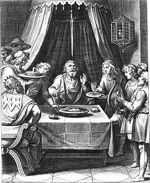
Mortis formido: Vaenius, Emblemata Horatiana (Antwerp, 1612), emblem 34 uses the adage's imagery
Metus est plena tyrannis: Boissard, Emblematum liber (Frankfurt, 1593), emblem XLV uses the adage's imagery
Jamais ne vit le Tyran sans terreur - Metus est plena tyrannis: Boissard, Emblemes (Metz, 1595), emblem XLV uses the adage's imagery
Quis sapor est dapidus quae fercul: La Perrière, Morosophie (Lyon, 1553), emblem 30 uses the adage's imagery
In miserrimam tyrannorum vitam: Schoonhovius, Emblemata (Gouda, 1618), emblem 26 uses the adage's imagery
Caelitus impendet: Paradin, Les devises héroïques (Antwerp, 1563), emblem 88 uses the adage's imagery
Imperio nihil usquam tutum: Maccio, Emblemata (Bologna, 1628), emblem 8 uses the adage's imagery
Ambitieux: Ripa, Essay d'un Dictionaire (Iconologia), (Amsterdam, 1700), emblem 272 uses the adage's imagery
Formido mortis: Meyer, Homo Microcosmus (Frankfurt, 1670), emblem 29 uses the adage's imagery
Iconclass: 31A22621 hair 44B12721 sword of Damocles 47H352(+0) (ball of) yarn (+ variant) 54DD51 Danger; 'Pericolo' (Ripa) 54DD52 Risk; 'Ardire ultimo & necessario' (Ripa)
Collectanea (1500): 324
Loci Communes: Discriminis (Danger, crisis, Danger)
I ix 73 Nil intra est oleam, nil extra est in duce duri Olive no kernel hath, nor nut no shell
Est versus proverbialis apud Horatium in Epistolis, dicendus in eos, qui ad insaniam usque impuedentes, non verentur et confessa negare, et manifesto falsa pro certis affirma re: denique quiduis dicere, ne victi in disputando videantur. Qualem Plato inducit sophistam Euthydemum, qui canem aiebat suum patrem esse, et eundem patrem omnium, et omnes omnia scire, atque id genus portenta pertinaciter, ne coargueretur, asseverabat. Carmen Horatianum est huiusmodi: Nil intra est oleam, nil extra est in nuce duri. Nimirum inter sanos convenit, et nucem corticem habere durum, et baccam oleae, lapillum intus durum. Proinde ludit operam, quisquis cum id genus hominib. disceptat, qui dicunt lucem tenebras, et tenebras lucem. Simile est quod affert Galenus De virtute simplicum remediorum lib. 2. quosdam Anaxagoram auctorem citasse, qui pro nuntiasset nivem non esse albam. Verba Galeni sic habent: καίτινες ἐξ αὐτῶν, καὶ τὸν Αναξαγόραν ἐπικαλοῦνται μάρτυρα, περὶ χίονος ἀποφηνάμενον ὡς οὐκ εἴη λευκὴ. Atque istorum nonnulli, etiam Anaxagoram testem adducunt, qui de nive pronuntiarit, quod non sit alba.
A proverbial line from the Epistles of Horace, which can be used against those who carry effrontery to such crazy lengths that they are not afraid to deny what is generally accepted and to maintain that manifest falsehoods are certainly true, who in fact will say anything rather than be seen to lose an argument. Plato introduces a character like this in the sophist Euthydemus, who says that a dog was his father and indeed everybody's father, and that everyone knows everything; and stoutly maintains other monstrosities of the same sort rather than be defeated. Horace's line goes as follows: 'Olive no kernel hath, nor nut no shell.' All sane people of course agree that the walnut has a hard shell and the fruit of the olive contains a hard stone. In fact it is a waste of time to discuss anything with the sort of men who 'call light darkness and darkness light,' as the inspired poet-prophet puts it. Something similar is produced by Galen On the Virtue of Simple Remedies, book 2; some, he says, cited Anaxagoras as authority for the statement that snow is not white. His words run as follows: 'And some of them actually summon Anaxagoras as a witness, he having stated of snow that it is not white.'
Facsimile:
Iconclass: 25G211(NUTSHELL) parts of a fruit: nutshell 25G211(OLIVE-KERNEL) parts of a fruit (OLIVE-KERNEL) 52CC2:52A6 Denial, Negation❧Truth; 'Verità' (Ripa)
Collectanea (1500): 317
Loci Communes: Absurda, indecora, seu praepostera (Absurd, unbecoming, or preposterous things, Choses absurdes, inconvenantes ou déplacées)
I ix 74 Jupiter orbus Jupiter childless
Ζεὺς ἄγονος. id est, Iuppiter orbus. Ubi quis palam falsa asseverat. Constat enim Iovi quam plurimos esse liberos, utpote deo longe mulierosissimo, salacissimoque: qui non una tantum corporis parte gignat, sed e femore Bacchum, e cerebro Palladem produxerit.
Ζεὺς ἄγονος., Jupiter childless. When a man makes a statement which is manifestly false. It is well known that Jupiter had a very great many children, being of all the gods far the most devoted to the female sex and very lecherous; in fact, that he did not get children with one part of his body only, but produced Bacchus from his thigh and Pallas from his brain.
Facsimile:
Iconclass: 42AA19 sterility; barren woman - AA - sterile man 51AA4:31D112 Nothingness, Absence❧child 52CC2:52A6 Denial, Negation❧Truth; 'Verità' (Ripa) 92B1 (story of) Jupiter (Zeus)
Collectanea (1500): 358
Loci Communes: Absurda, indecora, seu praepostera (Absurd, unbecoming, or preposterous things, Choses absurdes, inconvenantes ou déplacées)
I ix 75 In mari aquam quaeris You seek water in the sea
Εν θαλάσσῃ ζητεῖς ὕδωρ. id est, In mari quaeris aquam. Ibi quaeris, perinde quasi difficile inventu, ubi nihil aliud occurrat: veluti si quis in moribus scelestissimi hominis unum aut alterum admissum vestiget, cum tota vita sit contaminata: aut si quis in scriptoribus indoctis pauca captet, quae reprehendat, cum nihil occurrat non reprehendendum. Martialis, si memini, Per mare, inquit, quaeris aquam. Item Propertius Elegiarum libro primo: Nunc tu Insanus medio flumine quaeris aquam.
Εν θαλάσσῃ ζητεῖς ὕδωρ, You seek water in the sea, you look for it exactly as though it was hard to find, in the very place where there is nothing else to be seen, as one might hunt for one or two faults in the behaviour of a notorious rascal, whose whole life is contaminated, or search for a few points to object to in illiterate authors, in whom everything is objectionable. Martial, if I remember right: 'You seek water in the sea.' Propertius too in the first book of his Elegies: 'But now / Witless you seek for water in midstream.'
Facsimile:
Iconclass: 21D water (one of the four elements) 25H2322 sea 31A31 sight, looking (one of the five senses) 51A4 Presence
Collectanea (1500): 426
Loci Communes: Absurda, indecora, seu praepostera (Absurd, unbecoming, or preposterous things, Choses absurdes, inconvenantes ou déplacées)
I ix 76 Fluvius cum mari certas You're only a river striving with the sea
Ποταμὸς θαλάττῃ ἐρίζεις. id est, Flunius cum mari certas, ubi minimi cum ru aximis certa men suscipiunt. Est autem locus quispiam, ut auctor est Suidas in Leontide, cui nomen potamoi. id est, fluvii. Huius incolae ποτάμιοι, quasi fluviales dicuntur. Hi notati sunt, quod quamplurimos in suam civitatem adscriberent, quos ea non satis commode caperet. Atque hinc proverbii iocus, quod, cum fluvius esset, id est, locus non admodum amplus, mare videretur aemulati, cum omnes undecumque in sese reciperet.
Ποταμὸς θαλάττῃ ἐρίζεις., You are only a river striving with the sea. When little men start to compete with great men. There is a place (so Suidas tells us) in the Leontid tribe called Potamoi (literally Rivers), the inhabitants of which are called Potamians (as it might be Riverines). These people were criticized for admitting to their citizenship a large number of persons for whom their city had no proper room. Hence a proverbial jest to the effect that, though only a River, not (that is) a very spacious place, it was trying to rival the sea by accepting new arrivals from all quarters.
Facsimile:
Iconclass: 25H213 river 25H2322 sea 54EE33 Competition, Rivalry, Emulation; 'Emulatione' (Ripa) 59CC21 Inequality, Inequity, Iniquity; 'Iniquità' (Ripa)
Loci Communes: Excellentia, inaequalitas (Excellence, inequality, Excellence, inégalité)
I ix 77 Balbus balbum rectius intelligit One stammerer better understands another
Balbus balbum rectius intelligit, id est, Barbrus barbari orationem. Ita enim natura comparatum est, ut, qui balbutit, hoc est, patum expedite loquitur, melius iutelligat sermo nem illius, qui et ipse consimili modo balbutiat, quam qui integre, et atticulate loquatur. Concinne dicetur in eos, quib. indoctis indocta magis et nota sunt, et placent. D. Hieronymus hoc adagio cuiusdam stultitiam tangir. Et idcirco, inquit, se eruditum putat, quia Iovinia num solus intelligit. Est quippe proverbium, Balbum melius balbi verba cognoscere. Haec ille. Por ro Ioviniani stylum, ut portentosum, et vehementer obscurum, idem Hieronymus miris salibus deridet in prae fatione librorum, quibus illius coarguit errores.
One stammerer better understands another, that is, one barbarian understands what another barbarian is saying. By a natural dispensation, a man who stammers - who has, that is, an impediment in his speech - finds it easier to understand another sufferer from the same disability than a man whose speech is straightforward and articulate. This will be applied neatly to ignorant people, to whom ignorant writing is more familiar and acceptable. St Jerome uses this adage in criticizing the folly of a certain monk, in language equally humorous and scathing. 'And his reason' he says 'for thinking himself a good scholar is that he alone can understand Jovinian. There is of course an old saw, One stammerer better understands another.' So Jerome; and elsewhere he is very witty at the expense of Jovinian's style as full of monstrosities and excessively obscure, in the preface to the books in which he refuted Jovinian's errors.
Facsimile: 

Birdes of one faether VVil flocke togeder: Cats, Spiegel (The Hague, 1632), emblem 25 uses the imagery of a woman warning a suitor that they are too different - and in its comment Cats quotes the adage
Iconclass: 31A41(+9321) disabilities, deformations (+ speaking) 52C4:54E Understanding, Comprehension; 'Apprehensiva' (Ripa)❧Reciprocal Action
Collectanea (1500): 381
Loci Communes: Similitudinis et congruentiae (Similarity and congruence, Similitude et convenance)
I ix 78 Herbam dare To proffer grass
Herbam dare, pro eo, quod est, victorem agnoscere, ac se victum fateri, passim obvium est apud doctos. Inde sumptum, quod, ut est auctor Festus Pompeius, id erat pastoralis vitae indicium, propterea quod antiquitus cursu, aut alio quopiam certamine, superati, herbam ex eodem statim loco decreptam, adversario porrigebant, victoriae agnitae symbolum. Pli nius libr. 22. cap. 4. loquens de corona obsidionali graminea: Dabatur, inquit, viridi e gra mine, decerpto inde, ubi obsessos servasset aliquis. Namque summum apud antiquos signum victoriae erat, herbam porrigere victos, hoc est, terra, et altrice humo, et humatione etiam cedere. Quem morem, inquit, etiam nunc durare apud Germanos scio. Idem libro octavo, ca. 5. de elephante: Mirus nanquepudor est, victusque vocem fugit victoris, terram, ac verbe nas porrigit. Festivius autem erit adagium, si ad literariam victoriam transferatur.
To proffer grass, as a phrase for acknowledging the winner and confessing oneself beaten, is to be met with freely in good authors. In origin (Festus Pompeius is our authority) it was 'a characteristic of the life led by shepherds,' because it was the ancient custom for the loser in a race or any other form of contest to pluck some grass immediately from the actual spot and offer it to the winner as a sign that he knew he was beaten. Pliny, book 22 chapter 4, when speaking of the wreath of grass awarded for the raising of a siege: 'The wreath awarded was made from green grass plucked from the place where the recipient had delivered those who were besieged. For the chief token of victory in ancient times was for the vanquished to proffer grass, which indicated that they were giving up their claim to the ground, the very earth which had borne them, and the right to be buried in it. This custom' he says T know to be still valid in Germany.' Again, in book 8 chapter 5, of the elephant: 'It has an astonishing sense of shame: when defeated, it shuns the sound of its conqueror's voice, and offers him earth and plucked herbs.' The adage will gain in point if transferred to victory in the field of literature.
Facsimile:
Iconclass: 47I17(GRASS) agricultural products and by-products (GRASS) 54FF2 Defeat 55C2 Giving
Collectanea (1500): 384
Loci Communes: Vincere et vinci (To conquer and to be conquered, Vaincre et être vaincu)
I ix 79 Dare manus To put one's hand up
Simili figura dixit Horatius: Dare manus, pro eo quod est, se victum agnoscere. Nam que se victori dedunt ne interimantur, ultro manus ad vincula offerunt. Horatius in Epodis, Iam iam efficaci do manus scientiae. M. Tullius in sermone De amicitia, Ad extremum det manus, vincique se patiatur. Id si ad animi res deflectatur, redditur venustius. Est autem hominum genus qui nunquam agnoscunt se victos in disputando, etiam cum maximè sint deiecti. Quales depingit Galenus lib. περὶ φυσικων δυνάμεων secundo, Αλλ᾽ ὅταν τὶς ἀναισχυντῇ περιπλέκων τε καὶ μήπω κατὰ πεπτωκέναι συγχωρῶν ὅμοίος ἐστι τοῖς ἰδιώταις τῶν παλαιστῶν, οἵ καταβληθέντες ὑπὸ τῶν παλαιστριτῶν, καὶ κατὰ τῆς γῆς ὕπτιοι κείμενοι, τοσοῦτον δέουσι τὸ πτῶμα γνωρίζειν, ὥστε καὶ κρατουσι τῶν αὐχένων αὐτοὺς τοὺς καταβάλλοντας, οὐκ ἐῶντες ἀπαλλάττεσθαι, κᾂν τούτῳ νικᾶν ὑπολαμβάνουσι. i. Verum ubi quis redargutus est, nihilo secius complectitur tamen, nec agnoscens se concidisse, similis est vulgaribus istis palaestritis, qui deiecti à luctatoribus, & humi iacentes supini, tantum abest ut lapsum agnoscant, ut etiam cervices eorum à quibus deiecti sunt, teneant, non sinentes illos avelli, ac vel ita se vicisse arbitrantur.
Using a similar figure, Horace writes 'to put one's hands up' for to confess oneself beaten; for those who surrender to the man who has defeated them to avoid being killed voluntarily hold out their hands to be shackled. Horace in the Epodes: 'Hands up, I yield to your o'ermastering skill.' Cicero in his dialogue On Friendship: 'In the end let him hold his hands up and admit that he is beaten.' This becomes more elegant if referred to the things of the mind. There are kinds of men who never admit they are beaten in argument, even when they haven't a leg to stand on. They are thus described by Galen in book 2 of his On the Natural Faculties: 'But when a man who has no sense of shame continues the struggle and refuses to admit that he is down, he is like one of those unskilled wrestlers who, when they have been thrown by the wrestling-master and are lying on their backs on the ground, are still so far from admitting the fall that they continue to hold those who have thrown them by their necks, refusing to let them go, and think this is evidence that they have not been beaten.'
Facsimile:
Iconclass: 31A2511 arm raised upward 54FF2 Defeat
Collectanea (1500): 385
Loci Communes: Vincere et vinci (To conquer and to be conquered, Vaincre et être vaincu)
I ix 80 Ut canis e Nilo Like a dog drinking out of the Nile
Qui leviter, ac velut obiter artem quampiam, aut auctorem degustant, hi ceu cani e Ni lo de gustare dicentur. Id adagii natum est ex apopthegmate quodam, cuius meminit Ma crobius Saturnalium libro secundo: Id est hiusmodi: Post fugam Mutinensem, quaeren tibus, quid ageret Antonius, quidam familiaris eius respondit: Quod canis in Aegypto, bibit, et fugit. Nam in illis regionibus constat, canes, raptu Crocodilorum exterritos, bi bere, et fugere. Solinus ait, eos non nisi currentes lambitare, ne deprehendantur.
Those who take a mere sample of some art, or of some author, casually and as it were in passing, are said to taste it 'like a dog drinking out of the Nile.' This adage took its rise from a witty remark which is recorded by Macrobius in book 2 of the Saturnalia, and goes as follows. After his rout at Modena, people were asking what Antony was up to, and some friend of his replied 'He's like a dog in Egypt, drinking on the run.' For in those parts it is well known that dogs have to keep running while they drink, in terror of being seized by a crocodile. Solinus says they drink only on the run, for fear of being caught.
Facsimile:
Iconclass: 34B11 dog 61D(NILE) geographical names of countries, regions, mountains, rivers, etc. (NILE) (NILE) 51M12 Haste
Collectanea (1500): 383
Loci Communes: Festinationis (Haste, Hâte); Indiligentiae (Carelessness, Négligence)
I ix 81 Hastam abjicere To throw away one's spear
Hastam abicere, dixit M. Tullius in oratione pro Murean, pro eo, quod est, causae dif fidere, et contentionem relinquere. Translatum a malitia. Desperat enim quisquis arma in bello abicit, et aut fugam spectat, aut mortem exspectat. Graeci simplici vocabulo ῥιψάσπιδας vocant timidos, et in bello fugitivos, nimirum ab clypei iactu. Id cognominis Demo sthenes in praelio quodam emeruit: tam ignavus in bello, quam in contionibus invictus. Cleonymus apud Aristophanem in Fucis, ἀσπιδαποβλὴς appellatur. Plato libro de le gibus duodecimo declarat ῥιψάσπιδος nomen multo probrosissimum esse.
To throw away one's spear is used by Cicero in his speech Pro Murena to express the loss of faith in one's cause and a readiness to quit the struggle. It is a metaphor from the army. Anyone who throws away his weapons in a battle has lost hope, and is either looking for a way of escape or waiting for death. Greek uses a single word rhipsaspides for frightened men and those who take to their heels in battle, from two words meaning throw away and shield. Demosthenes earned this as a nickname in some battle, being as cowardly in war as he was invincible in the assembly. Cleonymus is called aspidapobles, shield-shedder, by Aristophanes in the Wasps. Plato in book 12 of the Laws says that rhipsaspis is the most discreditable name one can be given.
Facsimile:
Iconclass: 45C11(SPEAR) casting weapons: spear 31A27412 throwing down something 56DD1 Fear, Dread; 'Paura', 'Timidità o Timore', 'Timore' (Ripa)
Loci Communes: Vincere et vinci (To conquer and to be conquered, Vaincre et être vaincu)
I ix 82 Arena cedere To leave the arena
Confine est his, Harena cedere, pro, desistere à certamine, et victoriam ultro concedere. Translatum a pugna gladiatoria. Sic & Horatius: Iam Scythae laxo meditantur arcu Cedere campis.
Related to these is To leave the arena, for giving up the struggle and freely admitting defeat. It is a metaphor from the combats between gladiators. So too Horace: 'The Scythian now unbends his bow / And thinks to leave the field.'
Facsimile: 
Iconclass: 43C8(+6):43C39611 grounds, fields and accomodations for sports, games and physical performances (+ out of doors (sports, games, etc.))❧fight between man and animal 56DD1 Fear, Dread; 'Paura', 'Timidità o Timore', 'Timore' (Ripa)
Loci Communes: Vincere et vinci (To conquer and to be conquered, Vaincre et être vaincu)
I ix 83 In arenam descendere To descend into the arena
In arenam descendere, pro eo, quod est, certamen inire. A gladiatoria item arena trans latum, de qua Flaccus: Ne populum extreme toties exoret arena. Quae si ad rem animi transferantur, metaphoram habebunt proverbialem. In exemplis referendis, quoniam passim obvia sunt, non arbitrati sumus, vel immorandum nobis, vel re morandum lectorem. Meam arenam dixit Plinius in epistolis, pro mea functione. Ita enim scribit Fabato: Itaque Betico Prisco, quantum plurimum potuero, praestabo, praesertim in arena mea, hoc est, apud centumviros.
To descend into the arena, for to enter on a contest, is another image derived from the combat of gladiators in the arena, to which Horace refers when he writes of continually 'begging the public from the arena's edge' for leave to retire. If that group of phrases is transferred to the things of the mind, the resulting metaphor will have proverbial status. Examples are so ready to hand that I have not thought it necessary to spend my time and delay my reader in recording them. Pliny has 'my arena' in his letters for 'my sphere of action,' for he writes in these words to Fabatus: 'So I will do everything I can for Beticius Priscus, especially in my own proper arena, by which I mean the centumviral court.'
Facsimile:
Iconclass: 43C8(+6):43C39611 grounds, fields and accomodations for sports, games and physical performances (+ out of doors (sports, games, etc.))❧fight between man and animal
Loci Communes: Experientae seu pericliationis (Experience or risk-taking, Expérience ou mise à l'épreuve); Temperantia (Temperance, Tempérance)
I ix 84 Austrum perculi I have belaboured the south wind
Austrum perculi, id est, Operam lusi: est apud Plautum in Epidico. Quo quidem adagio non gravatus est uti Paulus in epistolis suis. Aer enim verberantis ictum, cedens eludit. Sumptum videri potest vel ab iis, qui exercentur ad artem gladiatoriam, ensem per aera ventilantes. Vel ab historia, cuius meminit Aulus Gellius de gente quadam, quae cum hoc vento bellum gessit.
I have belaboured the south wind, that is, I have wasted my labour. This occurs in the Epidicus of Plautus, and Paul did not disdain to use it as a proverbial expression in his epistles; for the man who beats the air finds it gives way before his blows and makes a mock of them. This can be derived, it seems, either from gladiators practising their skill who brandish their swords in the air, or from the story referred to by Aulus Gellius of a certain tribe which fought a war against this wind.
Facsimile:
Iconclass: 26C113 south wind (one of the four main directions) 54BB3 Inutility, Noxiousness; 'Nocumento', 'Nocumento d'ogni cosa' (Ripa)
Collectanea (1500): 207
Loci Communes: Inanis opera (Vain effort, Effort vain)
I ix 85 De facie nosse To know by sight
De facie nosse, est leviter cognitum habere, quasi quem semel atque iterum videris duntaxat: non quicum sis familiariter versatu. Id si transferatur ad res animi, fiet venustius. Marcus Tullius in Pisonem: Habet hoc ipsa virtus, quam tu ne de facie quidem nosti. id est, ne tenuiter quidem.
To know a man by sight is to have a slight acquaintance with him, such as you might have with someone whom you have seen only two or three times and never been on familiar terms with. When transferred metaphorically to the things of the mind it will gain in elegance. Cicero in the In Pisonem: 'This is a characteristic of true virtue, which you do not know even by sight,' that is, not even superficially.
Facsimile:
Iconclass: 31A31 sight, looking (one of the five senses) 52A52 Judgement, Discrimination; 'Giuditio' (Ripa) 51HH4 Lack, Deficiency
Collectanea (1500): 195
Loci Communes: Conjecturae (Conjectures, Conjectures)
I ix 86 Ne umbram quidem eius novit He does not know even the shadow of it
Similimum est huic illud, quod usurpat Marcus Tullius in epistola ad Atticum libro octavo: O ho minem amentem, et miserum, qui ne umbram quidem τοῦ καλοῦ viderit. Plutarchus περὶ πολυφιλίας, Menandrum citat, qui beatum dixerit eum, qui vel σκίαν φίλου, id est, amici um bram habeat. Et apud Athenaeum, parasitus quispiam panesrancidos et atros in convi vium illatos, ἄρτων σκϊὰς appellavit: quasi manes panium, non panes. Quanquam adagium magis videtur ductum ab antiqua pictura, quae rem duntaxat umbris ruditer reprae sentabat. Et nota est specus Platonica, in qua qui desident, rerum umbris oblectantur.
An expression very close to the last is used by Cicero in one of his Letters to Atticus, in book 2: 'Poor wretched fool, who has never glimpsed even a shadow of what is right!' Plutarch in his essay 'On Having Many Friends' quotes Menander as calling a man happy who has even the shadow of a friend. And in Athenaeus a lickspittle guest called the sour black loaves that had been brought to the dinner-table 'shadows of loaves,' as though they were the ghost of bread rather than its substance. Though it looks more as though the adage came from ancient painting, which represented objects crudely by the use of shading only. And everyone has heard of Plato's cave, in which those who sit there are beguiled by the shadows of things.
Facsimile:
Iconclass: 31A31 sight, looking (one of the five senses) 22C8 shadow 52A52 Judgement, Discrimination; 'Giuditio' (Ripa) 51HH4 Lack, Deficiency
Loci Communes: Contemptus et vilitatis (Contempt and worthlessness, Mépris et bassesse)
I ix 87 Nomine tantum notus Known by name alone
Huic similimum est illud Horatianum, in Sermonibus, Accurrit quidam notus mihi nomine tantum. Nam hoc quoque proverbio vulgus tenuem quandam ac vulgarem notitiam significat. Atque id etiam plus habebit Veneris, si ad res animi traducatur, ut si quis dicat philosophiam alicui vix etiam nomine cognitam.
This is very like that other phrase of Horace's in the Satires: 'Up runs a man I knew by name alone.' For this is another proverbial expression used by ordinary people to indicate a casual and ordinary acquaintance with someone. And it will be even more effective if transferred to things of the mind; for instance, if one were to say that a man knew philosophy scarcely even by name.
I ix 88 Prima facie. Prima fonte At first sight. On the face of it
Sapiunt et haec quoque proverbium maxime cum ad res incorporeas referuntur: Prima fa cie, Prima fronte, pro eo, quod est, primo obtutu, et priusquam pressius, ac diligentius con sideres. Fallit enim plerumque primus ille aspectus, neque raro caligant oculi pudore quodam. Deinde, iterum atque iterum contemplati, perspicimus quaedam, quae nos antea fefellerant, et primum illud oculorum iudicium quasi recantamus. Huius adagii freques est usus apud scriptores Latinos, nominatim apud Quinctilianum libro duodecimo. Papinianus libro duodecimo, tit. de Condi ctione sine causa, Cessare condictio prima facie videtur. Item libro 16. titul. ad Senatuscon. Velleianum, Cum prima facie quidem alienam, re vera autem suam obligationem susci piat, et aliis item aliquot locis. Celsus libro 22. tit. de Probationibus, capite Quingenta: Prima fronte aequius videtur, ut petitor probet quod intendit, etc.
These phrases too have a proverbial ring, especially when applied to abstract things: 'At first sight' and 'On the face of it,' used when you see something for the first time, before you study it more closely and attentively. For that first glance is often deceptive, and sometimes a kind of shyness in the face of novelty blurs our vision. Then, as we look at the object repeatedly, we perceive certain features which we had missed before, and we withdraw, as it were, the judgment which our eyes first formed. This adage is in frequent use in Latin literature, especially in Quintilian, book 12. Papinian in book 12, title De condictione sine causa: 'The claim for restitution seems at first sight to fall to the ground.' Again in book 16, title Ad senatusconsultum Velleianum: 'When someone undertakes an obligation which at first sight is another man's, but in reality is his,' and in several further passages. Celsus in book 22, title Deprobationibus, chapter Quingenta: 'At first sight it seems more equitable that the claimant should prove what he puts forward etc'
Facsimile:
Iconclass: 31A31 sight, looking (one of the five senses) 52A52 Judgement, Discrimination; 'Giuditio' (Ripa) 51HH4 Lack, Deficiency
Loci Communes: Conjecturae (Conjectures, Conjectures)
I ix 89 Intus et in cute Inwardly and in the buff
Intus, et in cute notus est, modis omnibus cognitus: perinde quasi dicas, foris, atque in tus notus. Persius: Ad populum phaleras, ego te intus, et in cute novi. Id est, aliis fucum facito, mihi plane notus es, neque potes imposturam facere. Et summam cu tem primam illam rei quasi frontem, ac speciem vocamus. Ausonius in praefatione in perio cha Homeri: Haec eius species apparet, summam cutem primi operis intuenti. Et Horatius: Introrsum turpis, spectosus pelle decora.
To be known both inwardly and in the buff is to be familiar in every aspect, equivalent to 'well-known inside and out.' Persius: 'Away with trappings; they are for the mob. /I know you inwardly, close to the skin.' Deceive other men, if you like, that is, I know you too well, and you cannot fool me. We use the words 'surface skin' of the upper layer of something, what you see first. Ausonius in the preface to his Homeric Summary: 'This aspect of it is clear to anyone who looks at the surface skin of the opening work.' And Horace: 'Ugly within, / For all the beauty of that dappled skin.'
I ix 90 Domestice notus Well-known at home
Simili figura dixit Lucian. in Pseudologista, Ανδρὶ ἐλευθέρῳ, καὶ αἴκοθέν σε ἀκριβῶς εἰδότι id est, Viro libero, & qui te ex domestico convictu cognitum habeat. Id erit venustius, si ad res animi traducatur, ut si quis dicat artem rhetoricam οἴκοθεν alicui notam. Eiusdem generis est Plinianum illud, in Epistola ad Atticum: Clementem hunc ego in Syria cum adolescentulus militarem, penitus & domi inspexi.
A similar image is used by Lucian in the Pseudologista: 'To a free man who knew you well at home.' This will be more effective if transferred to things of the mind; if one were to say, for instance, that somebody knew just what rhetoric was like at home. That phrase of Pliny's is similar, in a letter to Attius Clemens: 'When I was a young man and serving in the army in Syria, I got to know him well and in his home context.'
Facsimile: 
Iconclass: 52A52 Judgement, Discrimination; 'Giuditio' (Ripa) 51H1 Totality, the Whole
Loci Communes: Notus (Known, famous, Connu)
I ix 91 A limine salutare To greet from the treshold
Huic pene diversum est: A limine salutare. Plurimum vetustatis obtinebit et hoc, si ad res incorporeas deflectatur. Veluti si quis dicatur theologiam a limine duntaxat salutasse, qui videlicet neque valde diuturnam, neque praecipuam operam impenderit, sed rudimenta modo degustarit. Seneca epistola quadragesimanona: Nec ego nego prospicienda ista, sed prospicienda tantum, et a limine salutanda. Agit de dialecticorum argutiis, quas abun de satis existimat leviter artigisse. Translatum a vulgaribus istis amicis, qui non admit tuntur in penetralia, sed procul, atque a limine salutant, ac deinde discedunt.
Pretty well the opposite of this is A limine salutare, To greet from the threshold. This too will gain greatly in elegance if diverted to incorporeal things; if a man were said, for instance, to have only greeted theology from the threshold, who has spent neither much time nor much trouble on it, but only sampled the rudiments. Seneca in letter 49: 'Nor do I deny that one should glance at the subject, but it should be a glance, one should greet it from the threshold.' He speaks of the niceties of dialectic, with which he thinks a passing acquaintance is enough. The metaphor comes from those casual friends who are not admitted into the more intimate part of the house, but offer their greeting at a distance and from the threshold, and then depart.
Facsimile:
Iconclass: 52A52 Judgement, Discrimination; 'Giuditio' (Ripa) 51HH41 Insufficiency
Collectanea (1500): 473
Loci Communes: Indiligentiae (Carelessness, Négligence)
I ix 92 Primoribus labiis degustare To taste with the tip of one's tongue
Primoribus labiis degustare, est, leviter quippiam attingere. Ductum ab iis, qui cibum, aut potum tenuiter degustant, nihil inde in stomachum transmittentes. Cicero pro Caelio: Equidem multos et vidi in hac civitate, et audivi, non modo qui primoribus labiis degu stassent genus hoc vitae. Idem de natura deorum libro secundo. Is cum dixit fore sempiternum, hunc censes primis, ut dicitur, labiis degustasse physiologiam? id est, naturae rationem. Quinctilianus libro duodecimo. Sed hoc transeo, de quo neminem, qui literas, vel primis, ut aiunt, labiis degustarit, dubitaturum puto. Procopius sophista in epistola quadam, πάλιν δὲ ταύτην ἐμεμφόμην, εἰ τοσούτου γεύσασα πράγματος ἄκρῳ δακτύλῳ φασὶν, εἶτα τὴν ἡδονὴν ἀφαιρήσεται. i. Rursum in hanc stomachabar, si cum tantam rem summo, ut aiunt, digito degustandam praebuisset, deinde voluptate spoliaret. Quibus in verbis illud nove dictum, quod digito gustum tribuit: nisi hoc sensit, qui leviter degustant, eos rem degustandam summo digito admovere linguae.
To taste with the tip of one's tongue is to take a brief sample of something. The image derives from those who taste food or drink and swallow none of it. Cicero in the Pro Caelio: 'Personally I have both seen and heard many in this city who had not merely tasted this kind of life with the tip of the tongue.' Again, in On the Nature of the Gods, book 2: 'As for the man who said the world would be immortal, do you suppose he had tasted natural philosophy with the tip of his tongue? I mean an understanding of nature's workings.' Quintilian in book 12: 'But I pass over this point, about which I cannot think that anyone who has, as they say, tasted literature with the tip of his tongue, can have the slightest doubt.' Procopius the sophist in one of his letters: 'Again, I was angry with her giving us a taste of such a great thing with the tip of her finger, as they say, and then faking away the pleasure.' In these words there is one new expression, where he attributes a sense of taste to the fingers, unless he meant that those who are lightly sampling something bring it to their tongue to taste with the tip of a finger.
Facsimile:
Iconclass: 31AA34 taste, tasting (one of the five senses) - AA - female human figure 31A22141 tongue 51HH1 Part, Section, Aspect
Collectanea (1500): 474
Loci Communes: Indiligentiae (Carelessness, Négligence)
I ix 93 Summis labiis With the tip of the lips
Summis labiis Graeci paulo diversius usurpant, nempe, cum quis verbis duntaxat imu lat quippiam, non autem ex animo facit. Lucianus in apologia, καὶ ἀπ᾽ ἄκρου χείλους φιλοσοφῶν. id est, Ac summis labiis philosophum agens. Item in Dialogis amatoriis ἐπ᾽ ἄκρου του χείλους τοὺς ὄρκους ἔχουσι. i. Summis in labiis iusiurandum habentibus. De amatoribus loquitur, qui venereum iurant iusiurandum, non ex animo. Seneca libro primo, cap. 10. Non a summis labris ista ve nerunt, habent haevoces fundamentum. Ad eundem modum Divus Hieronymus in epistola ad Rusticum monachum, Ut non levi, inquit, citatoque sermone, et, ut ita loquar, summis labiis hospites invitemus.
With the tip of the lips, is used rather differently in Greek, when a man puts up a pretence in words only and takes no action from his heart. Lucian in the Apologia: 'Playing the philosopher with the tip of the lips.' Again in the Amatory Dialogues: 'Keeping their oaths on the tip of their lips.' He speaks of lovers, who swear an oath to their beloved without really meaning it. Seneca, book 1 chapter 10: 'Those words did not come only from the lips; there is something solid behind them.' In the same way St Jerome, writing to Rusticus the monk, says 'that we should not invite our friends casually or in a moment of enthusiasm or, as they say, with the tip of the lips.' This is a habit with some courtiers and civil lawyers, to make enormous promises, and in those great solemn words which have no effect on anyone except a perfect fool.
Facsimile:
Iconclass: 51HH1 Part, Section, Aspect 51HH4 Lack, Deficiency 31AA22111(LIPS) parts of the face: lips - AA - mask (mould taken from face) 52A52 Judgement, Discrimination; 'Giuditio' (Ripa)
Loci Communes: Indiligentiae (Carelessness, Négligence)
I ix 94 Extremis digitis attingere To touch with the fingertips
Huic germanum est, Extremis attingere digitis, pro eo, quod est, leviter attingere, quod ita demum adagium videbitur, si metaphora accesserit. M. Tull. in eo loco, quem mo do citavimus: Equidem multos et vidi in hac civitate, et audivi, non modo qui primoribus la biis gustassent genus hoc vitae, et extremis, ut dicitur digitis attigissent, sed qui totam ado lescentiam voluptatibus dedissent, emersisse aliquando, et se ad frugem bonam, ut dicitur, recepisse. Graeci sic efferunt. τῳ ἄκρῳ ἅψασθαι δακτύλῳ. id est, Summo contingere digito. Ita Basilius in epistolis: οἶδα καὶ αὐτὸς, εἰ καὶ ἄκρῳ δακτύλῳ τοῦ γλυκυτάτου μέλιτος τῆς παρ᾽ ὑμῖν ἐκκλησίας ἀπελαυσάμεωα πέρυσιν. id est, Novi & ipse, tametsi summo digito mel dulcissi mum vestratis ecclesiae gustavimus anno superiore. Translatum videri potest a luctantibus. Nam Graeci vocant ἀκροχειρΐζεσθαι, colluctari cum quopiam citra reliqui corporis congres sum, sed summis duntaxat digitis. Lucianus in Demonactis vita, Οὐ δὲ κατα τὴν οπαροιμίαν, ἄκρῳ τῳ δακτύλῳ ἁψαμενος. id est: Neque summis, ut aiunt, digitis attigerat. Euripides hyper bolem citra metaphoram usurpavit in Iphigenia Aulidensi: Οὐχ ἅψεται σῆς θυγατρὸς ἀγαμέμνων ἄναξ, Οὐδ᾽ εἰς ἄκραν χεῖρα, Haud filiam continget Agamemnon tuam, Non vel manu primore.
Close to this is Extremis attingere digitis, To touch with the fingertips, for to touch lightly, which will only look like an adage if metaphor is added. Cicero in the passage which I have just cited: 'Personally I have both seen and heard many in this city who had not merely tasted this kind of life with the tip of the tongue and touched it, as the saying goes, with the fingertips, but had devoted their whole youth to pleasure, and yet rose above it eventually and returned, as they say, to worthy causes.' In Greek the expression is τῳ ἄκρῳ ἅψασθαι δακτύλῳ, To touch with the tip of your finger. So Basil in his letters: 'I know it myself, though only with the tip of my finger, having enjoyed the honey-sweet hospitality of your church last year.' The metaphor seems to be drawn from wrestlers, for Greek has a word ἀκροχειρίζεσθαι for fighting someone with the fingertips only without engaging the rest of the body. Lucian in his Life of Demonax: 'Nor had he touched it, as they say, with his fingertips.' Euripides uses the hyperbolical expression with no colouring of metaphor in the Iphigeneia in Aulis: 'Nor shall king Agamemnon touch your daughter, / Even with the fingertips.'
Facsimile:
Iconclass: 52A52 Judgement, Discrimination; 'Giuditio' (Ripa) 51HH1 Part, Section, Aspect 51HH4 Lack, Deficiency 31A2246(+934) fingers (+ reaching for somebody or something, seizing something, touching)
Collectanea (1500): 475
Loci Communes: Indiligentiae (Carelessness, Négligence)
I ix 95 Dimidium plus toto The half is more than the whole
Πλέον ἥμισυ παντός. i. Dimidium plus toto, aenigma proverbiale, quo commendatur aurea mediocritas. Refertur, et exponitur a Platone lib. De legibus 3. ἄρα οὐκ ἀγνοήσαν τες τὸν ἡσίοδον ὀρθότατα λέγοντα, ὡς ἥμισυ τοῦ παντὸς πολλάκις ἐστὶ πλέον, ὁπόταν ᾖ τὸ μὲν ὅλον λαμβάνειν, ζημιῶδες, τὸ δὲ ἥμισυ μέτριον, τότε τὸ μέτριον τοῦ ἀμέτρου πλέον ἡφήσατο ἄμεινον ὄν χείρονος. i. Nonne, quod ignoraverint Hesiodum rectissime dicentem, dimidium saepenumero plus esse, quam totum, videlicet cum totum accipere noxium fuerit, dimidium autem moderatum, ibi moderatum immoderato plus esse duxit, utpote quod sit deteriore melius. Ad eundem modum enarrant Hesiodi interpretes: nimirum in toto significatum esse τὴν πλεονεξίαν, in dimidio τὴν ἰσότητα. Siquidem, qui dimidio contentus est, is in medio consistit: contra quis quis ad totum usque progreditur, is, mediocritatem praetergressus, ad extremum perveniat oportet. Meminit eiusdem adagii et libro de Republ. quinto. Rursus libro De legibus sexto, declarans in civitate praecipuum esse, ut eximiis viris committantur magistratus. Αρχὴ γὰρ λέγεται μὲν ἡμισυ παντὸς ἐν ταῖς παροιμίας ἔργου, καὶ τότε καλῶς ἄρξασθαι πάντες ἐφκωμιάζομεν ἑκαστοτε, τόδ᾽ ἐστὶ γε ὥς ἐμοι φαίνεται πλέον ἤ τὸ ἥμισυ. i. principium enim totius negotii dimidium dicitur in proverbiis, ac bene coepisse ab omnibus ubique laudatur. Ceterum hoc mihi sane plus quam dimidium videtur. Plato alludit ad vocis amphibologiam, nam ἀρχὴ Graecis et principium rei, et magistratum sonat. Pittacus apud Laertium, ubi se sponte abdicasset magistratu, agri sibi a Mitylenaeis relicti dimidium resecuit, auctore Sosicrate, dicens, dimidium praestabi lius esse toto. Idem pecuniam a Craeso missam recusavit, respondens, sibi dimidio plus esse, quam vellet. Carmen exstat apud Hesiodum libro primo operis, cui titulus ἔργα και ἡμέραι. Scribit enim ad fratrem Persam in hunc modum: Ηδη μὲν γὰρ κλῆρον ἐδασσάμεθ᾽, ἄλλα τε πολλὰ Αρπάζων ἐχόρει μέγα, κυδαινων βασιλῆας Δωροφάγους, οἱ τήν δε δίκην ἐθέλουσι δικάσαι, Νήπιοι, οὐδ᾽ ἰσασιν, ὅσῳ πλέον ἥμισυ παντὸς, Οὐδ᾽ ὅσον ἐν μαλάχῃ τε καὶ ἀσφοδέλῳ μέγ᾽ ὄνειαρ. Quos versus utcuνque vertimus ad hunc modum: Iamque patris nobis erat herciscunda facultas, At tu ultra sortem rapiebas plurima, reges Donivoros tibi concilians, qui solvere litem hanc Affectant verum stulti nescire videntur, Dimidium quam sit toto praestantius, et quam Magna sit utilitas malvae, asphodelique virentis. Quid autem sit Asphodelus, videdetur olim parum inter eruditos constitisse. Quandoquidem Gellius lib. 18. hanc quaestionem in studiosorum conviviis propositam fuisse praedicat, tamquam de re paucis cognita. Theodorus alicubi vertit Albucum. Quod autem ad huius adagii perti net enarrationem, ex n ultis Luciani locis colligere licet, asphodelum herbam esse plebeiam, ac vilem: atque hac victitare manes, apud quos nullus luxus, nulla sit ambitio. Quinetiam apud Theocritum Idyllio septimo, asphodelus inter rusticanas herbas commemoratur. Κνύσᾳ τ᾽ ἀσφοδέλῳ τε πολυγνάμπτῳ τε σελίνῳ. Proinde Poeta, regum, ac locupletum immoderatos luxus taxat, illorum fastibus, popula rium mediocritatem anteponens. Plutarchus item in convivio septem sapientum, locum hunc Hesiodium putat ad frugalitatis amdonitionem esse referendum. suidas ex eventu natam paroemiam existimat huiusmodi quandam afferens fabulam. Duo fratres erant, quorum alter moriens, fratri testamento mandavit, et filii, quem pupillum relinquebat, tute lam, et facultatum illius procurationem. At is, cum esset eiusmodi, cuiusmodi vulgo sunt homines: nimirum ut plus apud eum valeret lucrum, quam pietas: pueri res occupare co natur, idque dum molitur, etiam sua perdidit. Deinde postulanti, ut sui ratio haberetur, quo posset in locum meliorem restitui, responsum est ad hunc modum: Νήπιος ουκ ἐνόησεν ὅσῳ πλέον ἥμισυ παντὸς. id est: Dimidium, quam sit toto praestantius istud Haud novit stultus. Regum igitur est, dimidium totius, totum auferre tyrannicum. Itaque proverbium trifariam licebit usurpare: primum cum mediocritatem illam vere auream efferemus, citra quam nihil est in rebus humanis, nec honestum, nec iucundum, nec laudatum: mediocritatem autem oportunitate metimur, quemadmodum Hesiodum imitatus ait Pindarus: Επεται δ᾽ ἐν ἐκάστῳ μέτρον, νοῆσαι δὲ καιρὸς ἄρϊστος. id est: Adest unicuique rei modus, ad eum cognoscendum optima opportunitas. Etenim pro lo co, quod alias nimium est, alias erit parum. Idem in Nemeis hymno ultimo: Κέρδων δὲ χρὴ μέτρον θηρεύεμεν, Αποσίκτων δ᾽ ἐρώτων ὀξύτεραι μανίαι. id est: In lucris autem oportet modum sectari. Nam im mensarum rerum cupiditates vehementiores habent insanias. Altera utendi ra tio fuerit, cum aequalitatem anteferemus, quam Pythagoras dixit amicitiae tum paren tem, tum altricem, contra inaequalitatem, discordiarum, bellorumque matrem: id quod eleganter extulit Euripides in Phoenissis: Κεῖνο κάλλϊον τέκνον, Ισότητα τιμᾶν, ἥ φίλους ἀεὶ φίλοις, Πόλεις τε πόλεσι, ξυμμάχους τε ξυμμάχοις Συνδεῖ. τὸ γὰρ ἴσον, νόμιμον ἀνωρώποις ἔφυ. Τῷ πλέονι δ᾽ αἰεὶ πολέμϊον καθίσταται Τούλασσον, ἐχθρᾶς δ᾽ ἡμέρας κατάρχεται. Καὶ γὰρ μέτρ᾽ ἀνθρώποισι καὶ μέρη σταθμῶν Ισότης ἔταξε, κᾀριθμὸν δϊώρισε, Νυκτὸς τ᾽ ἀφεγγὲς βλέφαρον, ἡλίου τε φῶς Ισον βαδίζειν τὸν ἐνϊαύσιον κύκλον, Κ᾽ οὐδέτερον αὐτοῖν φθόνον ἔχει νικώμενον, Εἰθ᾽ ἅλιος μὲν, νύξ τε δουλεύει βροτοῖς. id est: Illud, nate, fuerit pulchrius, Aequalitatem amplecti, amicos haec enim Glutinat amicis semper, urbes urbibus, Sociosque sociis nectit, etenim aequalitas Cum legibus respondet, atque concinit. At, quod minus sit, cum hoc, quod est plus proelium Usque habet, et hinc discordiaerum exordia. Siquidem modos cunctorum, et aequilibria Aequalitas mortalib. praescripsit, et Praefiniit numeros et atrae noctis, ac Lucis diurnae secuit haec discrimina. Ut annuum aequis vicibus exigant simul Orbem, nec altera alteri unquam inviderit Superata, deinde noxque solqueserviunt Mortalibus. et reliqua. Tertia utendi ratio, si quando deterrebimus ab inferenda iniuria, suadebimusque satius esse, iuxta Platonis sententiam, iniuriam in sese admittere, quam inferre alteri. Nam id sibi velle proverbium hoc demonstrat Plutarchus in commentario De audiendis poetis. Huc perti net quod de Dario refert Plutarchus. Cum enim Praefectos provinciarum ad sese accersitos, percunctatus esset, num gravia essent attributa, atque illi respondissent, esse me diocria, iussit de singulis dimidium pendi, indicans esse satius dimidium accipere cum be nevolentia provincialium, quam totum odio suorum. Nostra sententia non semper a spernandum illud comici Syri consilium: Potius quam venias in periculum, serues ne, an perdas totum, dimidium, sive ut legunt alii, dividuum face.
Πλέον ἥμισυ παντός., The half is more than the whole. A riddling proverb, which recommends the golden mean. It is quoted and explained by Plato in the Laws, book 3: 'Was it not because they failed to understand that Hesiod was speaking excellent sense when he said that the half is often more than the whole? Whenever to take the whole is detrimental but to take half is reasonable, then he thought the reasonable was more than the unreasonable, one being better and the other worse.' The scholiasts on Hesiod explain him in the same way: the whole represents greed and the half is fair shares; for he who is content with half takes his stand on the mean, while he who goes on to take the whole passes beyond the mean and must inevitably end in excess. He mentions the same adage in the fifth book of the Republic. Again, in book 6 of the Laws, where he is making clear the great importance to a community of entrusting magistracies to outstanding men, he says: 'For in the proverbs it is said that the beginning is half of a whole action, and everyone always praises a good beginning. But, as it seems to me, it is more than half.' Plato plays on the ambiguity of the word, for arche in Greek means both the beginning of something and also first place, office or rule. Pittacus in Laertius, on his retiring of his own free will from the government, was allotted land by the people of Mytilene, but cut it in half (so Sosicrates tells us) on the ground that the half was better than the whole. He also refused money sent him by Croesus saying in his reply that half what he already had would be all he wanted. The lines are to be found in the first book of Hesiod's poem called Works and Days, where he writes as follows to his brother Perses:
Once ere this we divided our heritage, yet you continued
Seizing and bearing away much else, to oblige the princes,
Eaters of bribes, who are fain to settle this lawsuit for us -
Fools, they have never learnt how much more half than whole is,
Nor how great is the blessing that mallow and asphodel offer.
On the nature of asphodel there seems to have been little agreement among ancient scholars; Gellius in book 18 tells us that this question used to be put forward in social gatherings of the learned, as a thing that few understood. Theodoras renders it somewhere by the word albucus. As far as the interpretation of this adage is concerned, we can infer from many passages in Lucian that asphodel was a cheap and common vegetable, and was a staple food among the dead, where luxury and social pretensions are alike unknown. Asphodel appears further in Theocritus, in the seventh idyll, among vegetables eaten by country folk: 'With fleabane and asphodel and curling celery.' And so the poet is criticizing the unbridled luxury of kings and rich men, showing how inferior their splendours are to the moderate life of ordinary folk. Plutarch too in his 'Dinner of the Seven Sages' thinks this passage in Hesiod should be regarded as propaganda for the simple life. Suidas considers the proverb as derived from something that really happened, and supplies an anecdote to the following effect. Once upon a time there were two brothers, one of whom died, leaving the other by his will as a guardian of his son, who was still a minor, and trustee of his estate. However the brother was no better than the common run of men - he cared more for coin than his duty to his family, tried to seize the son's property, and in the process lost both it and his own. Then, when he asked for sympathy in hopes of recovering his position, the answer took the form: 'Fool, he has never learnt how much more half than whole is.' And so kings take half, and tyrants take everything. The proverb can therefore be used in three ways. The first is, when we wish to praise what is so truly called the golden mean, without which there can be nothing in human affairs that is honourable, or enjoyable, or admirable. And this mean we assess by a standard of fitness, such as Pindar thinks of in his imitation of Hesiod: 'In everything there is due measure, and the due time is the best way to discover it.' For it is a question of context: what is too much in one place will be too little in another. Pindar again, in the last hymn in his Nemeans: 'In the search for gain one must pursue the mean; the desire for things unattainable breeds delusions too severe.' A second way to use it will be found when we wish to extol equality, which is according to Pythagoras both parent and nurse of friendship, while inequality is the mother of discord and war, as Euripides eloquently expounds in the Phoenissae:
Better far, my child,
Embrace equality, which binds friend to friend,
City to city and ally to ally.
Equality's the natural source of law;
The less is ever hostile to the greater -
Hence endless discord. But equality
Prescribes for men limits and balances,
And numbers all things. Tis equality
That makes the darkling eyelids of the night
Keep level progress thro' the turning year
With the sun's rays. No jealous loser there,
But day and night alike serve mortal men -
and what follows. The third way of using it will appear when we wish to dissuade someone from inflicting an injury, and argue that it is better, following Plato's opinion, to suffer an injury oneself than to inflict it on another. For that this proverb means that is made clear by Plutarch in his essay 'How to Study Poetry.' And I think a story told by Plutarch about Darius belongs here too. Darius once summoned his provincial governors and asked them whether the taxes were heavy. When they replied that they were moderate, he gave instructions that only half of each assessment should be paid, thinking it better to get half with the goodwill of the provinces than get the lot and be hated by his own people. Even today, perhaps, there are those who mistakenly neglect this proverb. For while some divines and some prelates are absolutely unwilling to abandon one jot of their principles or their legal rights, they run the risk of losing even things they had a perfect right to. In my opinion one should not invariably neglect the advice of Syrus in the comedy:
Before you find yourself faced with the risk,
Either to keep this sum or lose the lot,
Cut it in two,
or, as others read, 'divide it.'
Facsimile: 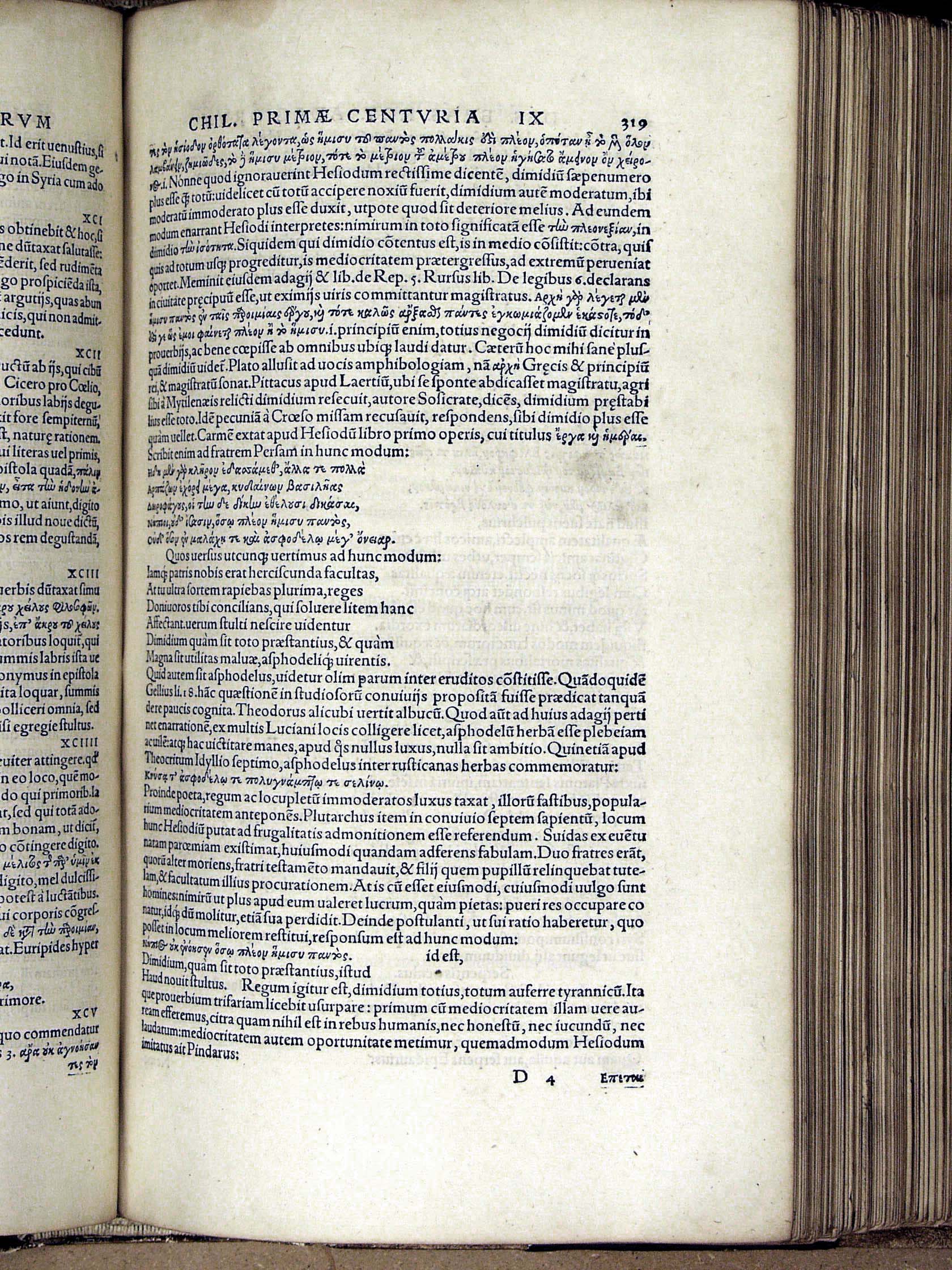

Iconclass: 51H1:51HH1 Totality, the Whole❧Part, Section, Aspect 54A431 the Golden Mean; 'Mediocrità' (Ripa) 55CC11 Greed, Covetousness, Cupidity; 'Cupidità' (Ripa) 59C21 Equality, Equity, Fairness, Righteousness; 'Equalità', 'Equità', 'Giuditio giusto', 'Ordine dritto e giusto', 'Ugualità' (Ripa)
Collectanea (1500): 6
Loci Communes: Modestia modusque (Modesty and moderation, Modestie et mesure)
I ix 96 Serpentis oculus A serpent's eye
Οφεως ὄμμα. id est, Serpentis oculus. De his dici consuevit, qui acribus et in tentis intuerentur oculis. Ab animante sumpta metaphora. Sunt enim huic animanti oculi du riores ac perspicaces. Unde Flaccus: Cur in amicorum vitiis tam cernis acutum, Quam aut aquila, aut serpens Epidaurius?
Ὄφεως ὄμμα., A serpent's eye, was customarily used of those who looked at things with very keen and piercing eyes. The metaphor is taken from a living creature. For the serpent has rather tough eyes and very keen sight; hence Horace: 'Why then in your friends' faults so eagle-eyed? / No snake from Epidaurus sees so clear.'
Facsimile:
Iconclass: 25F42(+337) snakes (+ eyes of an animal) 52A11 Attention, Concentration
Loci Communes: Perspicacitas (Perspicacity, Perspicacité)
I ix 97 Ne moveto lineam Move not the line
Μὴ κίνει γραμμὴν. id est, Ne move lineam. Pindaricorum hymnorum enarrator, exponens eum locum, Οὕτω δ᾽ ἐδίδου λίθυς ἁρμόζων κόρᾳ νυμφίον ἄνδρα, ποτὶ γραμμᾷ μὲν αὐτὰν στᾶσε (Loquitur autem de Anteo, qui iuvenibus desponsam filiam extrema statuerit linea, ut qui primus ad eam cursu pervenisset, is uxorem abduceret domum) recenset huiusmodi p roverbium: Μὴ κίνει γραμμὴν, id est, Ne moveris lineam. Idque translatum existimat a more veterum, qui metam ducta linea signabant, in qua praemium propositum erat, quod au ferret victor. Ducebatur autem et altera linea pro carceribus, quemadmodum alibi dixi mus, unde cursus erat initium. Igitur utraque linea proverbii ministravit occasionem ἀπὸ γραμμῆς, id est, ab ipso initio, et Μὴ κίνει γραμμῆν, id est, Ne moveas metam. Significat autem, non esse mutandas leges, neque praetereundos fines rerum praescriptos. Huc peculiarius pertinet Theocriticum illud ἐν βωκολιάσαις, Καὶ τὸν ἀπὸ γραμμᾶς κινεῖ λίθον. id est, Atque e lineala lapidem movet. Alludit ad flumen Galateae, saxum aliquod ab extrema ripa secum auferens. Est et sacra linea in tesserarum lusu, de qua dictum est alias.
Μὴ κίνει γραμμὴν., Move not the line. The commentator on the Pindaric hymns has to explain the passage 'Such an offer did the Libyan make when he was choosing a fit bridegroom for his daughter: he made her stand upon the line.' He speaks of Antaeus, who set his marriageable daughter as a prize for the young men on the finishing line, so that he who got there first in the race could take her home as his wife. In his explanation he considers a proverb of this form: 'Move not the line,' and supposes it to be a metaphor drawn from the ancient custom of marking the finish of a race by drawing a line, on which was set the prize that the winner could carry off. Another line also was drawn for the starting-point, as I have said elsewhere, from which the race began. Both these lines gave rise to a proverb, 'To start from scratch,' and 'Move not the finishing-line.' The meaning is that one should not alter the laws nor overrun the limits that have been laid down for things. That phrase from the Bucoliastae of Theocritus is specially relevant here: 'And from the line she moves the stone.' He alludes to the river Galatea, carrying off with it some stone or other from the edge of the shore. There is also a 'sacred line' in a board-game, of which I have spoken elsewhere.
I ix 98 Eandem tundere incudem To pound the same anvil
Eandem incudem assidue tundere, est indefatigabili assiduitate in operis alicuius stu dio perseverare. Metaphora ducta a fabris, crebis ictibus incudem ferientibus, atque ita tandem aliquando ferri rigorem perpetuo labore vincentibus. M. Tullius lib. de oratore 2. Ego autem, si quem nunc plane rudem institui ad dicendum velim, iis potius tradam assiduis, uno opere eandem incudem, die noctuque tundentibus. Conve nit in grammatistas ac literatores, quibus sine fine eadem sunt inculcanda pueris, ut haereant aliquando.
To pound continuously at the same anvil is to persevere with untiring persistence in the study of one particular subject. The image comes from blacksmiths, who deliver a rain of blows on the anvil and thus in the end overcome the stubbornness of the iron sooner or later by their unbroken exertions. Cicero in the second book of his De oratore: 'Personally, if I had someone quite untrained and wanted him taught how to speak, I should prefer to entrust him to those untiring characters who pound the same anvil continuously day and night.' This will be appropriate to those who teach the elements of writing and reading, who have endlessly to din into their pupils the same basic teaching, in hopes that one day it will stick.
Facsimile: 
Iconclass: 47D8 tools, aids, implements ~ crafts and industries 53A2 Perseverance, Resolution, Determination; 'Perseveranza' (Ripa)
Loci Communes: Taedium ex iteratione (Tedium from repetition, Lassitude due à la répétition)
I ix 99 Lacerat lacertum Largi mordax Memmius Man-eating Memmius lacerates Largius' limbs
Lacerat lacertum Largi mordax Memmius. Hunc versum Crassus orator usqueadeo vulgo iactatum ait, ut Tarracinae passim in omnibus parietibus inscriptus viseretur. Fabula unde natum est adagium, sic habet: Memmius quidam Romanus cum ageret Tarracinae, mulierculam quandam deperibat, sed non citra rivalem. Cum hoc igitur cum aliquando rixa incidisset, eò iracundiae provectus est Memmius, ut Largii, nam id rivali nomen, brachium mordicus arriperet. Ea res postea quam in popularem abiit iocum, faceti quidam & φιλόγελοι senarium hunc in omnibus eius urbis parietibus quinque literis notarunt, depictis tribus LLL, & duobus MM. videlicet ut advenis percunctandi ministrarent occasionem. Itaque cum M. Crassus Tarracinam aliquando venisset, admiratus novum literarum aenigma, senem quendam oppidanum percunctatus est, quidnam sibi vellent eiusmodi literae. Atque is exposita fabula, versiculum explicuit, Lacerat lacertaum Largi mordax Memmiu. Huius rei mentionem fecit M. Tullius libro de oratore secundo. Tametsi L. Caesar, qui haec loquitur apud Ciceronem, existimat narrationem hanc totam in Memmium adversarium, de dita opera confictam fuisse.
This line is said by Crassus, the famous orator, to have been so popular that at Terracina it could be seen written up on all the walls. The anecdote which gave rise to the adage runs as follows. A certain Roman by the name of Memmius, while staying in Terracina, fell madly in love with a young woman, but not without a rival. A fight broke out on one occasion between the two of them, and Memmius reached such a pitch of fury that he plunged his teeth into Largius' arm (Largius was his rival's name). This caused great public merriment, and some humorous wags painted up this line on all the walls in Terracina; but they reduced it to five letters, three ls and two ms, with the idea that all new arrivals would be provoked into asking what they meant. When therefore Crassus had occasion to go to Terracina, he was surprised by this new letter-puzzle, and asked some ancient inhabitant what on earth letters like that could stand for. The old man told him the story and unfolded the line Lacerat lacertum Largi mordax Memmius, 'Man-eating Memmius lacerates Largius' limbs.' Cicero mentions this in the second book of the De oratore; though Lucius Caesar, a character in Cicero's book, is of the opinion that the whole story had been deliberately made up by Crassus to discredit Memmius, his political opponent.
Facsimile:
Iconclass: 41C9 cannibalism 31A22 parts of the human body (skeleton excepted) 98B(MEMMIUS) male persons from classical history (MEMMIUS) 98B(LARGIUS) male persons from classical history (LARGIUS) 56E3 Fury; 'Furore', 'Furore implacabile', 'Furore & Rabbia', 'Furore superbo & Indomito' (Ripa)
Loci Communes: Improbi (The dishonest, Les malhonnêtes)
I ix 100 Cicada vocalior As noisy as a cricket
Τέττιγος εὐφωνότερος. id est, Cicada vocalior. Dicebatur in hominem impendio garrulum aut admodum musicum: propterea quod hoc insectum rore duntaxat vivens, cantu potissimum delectetur. Et quosdam ita Musicae deditos, ut neglecto cibo perituri fuerint inedia, in cicada à diis mutatos, narrat apud Platonem Socrates in Phaedro. Et Theocritus in Daphnide: Τέττιγος ἐπεὶ τύγε φέρτερος ᾄδεις.. id est, Quippe canis melius quacunque cicada. Apud Diogenem Laertium refertur Timonis carmen in Platonis eloquentiam, Τῶν πάντων δ᾽ ἡγεῖτο πλατύστατος, ἀλλ᾽ ἀγορητὴς Ηδυεπὴς τέττιξιν ἰσογράφος οἵθ᾽ ἑκαδήνου Δένδρεα ἐφεζομενοι ὄπα λειρίοεσσαν ἱεῖσι. id est, Cunctos anteibat latissimus ille, suavis Orator, cuius non cedunt scripta cicadis, Quae super arboribus resident lucis in opacis, Ac mittunt vocem modulato gutture amoenam. Est autem allusio, quam Latinus interpres non potst reddere, in πλάτυστος ad Platonem, & in ἑκαδήμου ad illius Academiam. ALlusum item ad carmen Homeri Iliados γ. de senibus, qui ὄπα λειρίοεσσαν ἱεῖσι. id est, Vocem floridam emittunt. Apud Athenaeum libro sexto, parasitus quispiam seipsum depingens, λαλεῖν, inquit, τέττιξ, id est, garrulitate cicada sum. Et apud eundem libro undecimo, Theopompus τέττιξ κελαδεῖ, id est, Cicada stridet. quod tamen illic videtur boni ominis causa dici.
Τέττιγος εὐφωνότερος, As noisy as a cricket, was said of a man who never stops talking or who is very musical, because the insect in question, though it lives solely on dew, takes a particular delight in singing. There were people so devoted to music that they forgot to eat and would have died of starvation had not the gods turned them into crickets, as Socrates tells us in Plato in the Phaedrus. So Theocritus in his Daphnis: 'For you sing better than any cricket.' Diogenes Laertius also quotes some lines from Timon on Plato's style:
Their leader was the widest of them all,
A master of sweet words, whose pen could sing
Like any cricket, perching on the trees
Of Hekademe with voice so delicate.
Note that there is an allusion in 'the widest,' platustatos, to the name Plato and in Hekademe to the name of his Academy, which a translator cannot convey. There is also a reference to a line of Homer, in the third Iliad, to the old men who 'utter their delicate voices.' In Athenaeus, book 6, a parasite describes himself as 'a cricket in conversation'; and further on, in book 11, from Theopompus 'the cricket chatters,' though in that passage the wordsseem to convey a favourable omen.
Facsimile: 
Alciatus: 'Musicam Diis curae esse': Alciatus, Emblemata (Padua, 1621), col. 777 b, emblem 185
Iconclass: 25F711(CRICKET) insects: cricket 22D1 loud sound, noise 52D4 Prolixity, Verbosity, Loquacity; 'Loquacità' (Ripa)
Loci Communes: Garrulitas (Talkativeness, Bavardage)