Guillaume de La Perrièrre, Le Theatre Des Bons Engins (Lyon, 1545)
Emblem 98
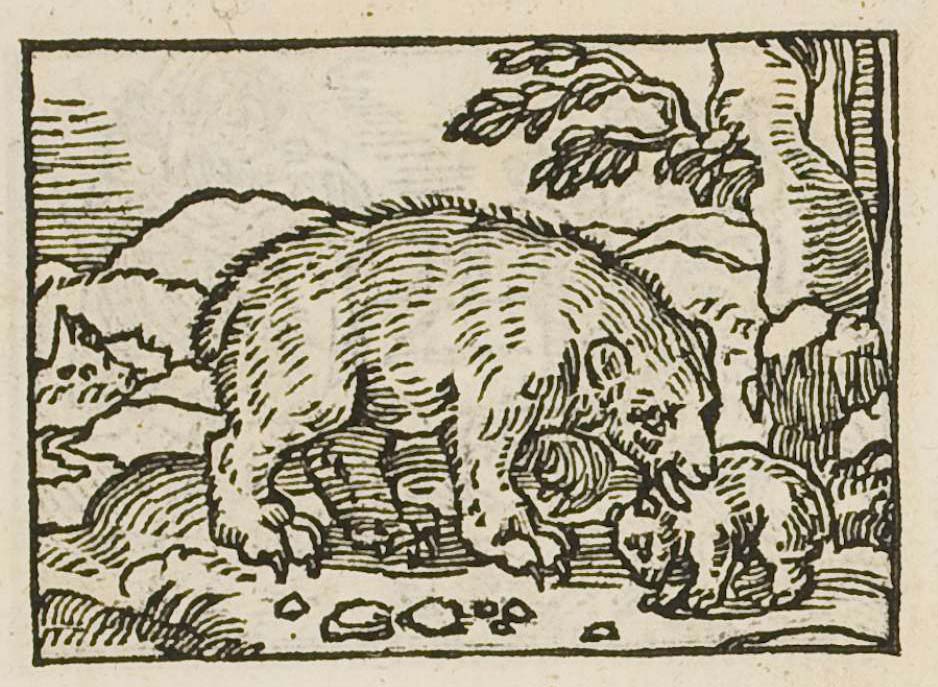
A she-bear licking her shapeless cubs into shapeAI-generated
Le bon scauoir se treuue en le cherchant.
Emblem 97. Good knowledge is found by seeking it.AI-generated
Description of the woodcutAI-generated
A woodcut in a rectangular frame showing a rocky, wooded landscape with trees and foliage at the upper right. In the centre a large shaggy bear stands over two small, shapeless bear cubs lying on the ground before it, lowering its head to lick them. Stones and pebbles lie scattered in the foreground.
Subscriptio

TranscriptionAI-generated
Qvi veult apprendre à dur entendement,De desespoir ne se voyse faschant:Mais voye l'Ourse, & regarde comment,A ses Faons donne forme en leschant.Tout bon sçauoir se treuue en le cherchant,Par artifice on ha ciuilité:L'esprit humain par imbecilité,De sa naissance est mal instruict & rude:Mais lon polit telle brutalité,En luy baillant doctrine par estude.
TranslationAI-generated
Whoever wishes to teach a dull understanding, let him not go about vexing himself with despair: but let him look at the she-bear, and observe how she gives shape to her cubs by licking them. All good knowledge is found by seeking it; by skill one obtains civility. The human mind, through feebleness, is from its birth ill-taught and crude: but such brutishness is polished by giving it learning through study.
Iconclass
86(LE BON SCAUOIR SE TREUUE EN LE CHERCHANT)proverbs, sayings, etc. (LE BON SCAUOIR SE TREUUE EN LE CHERCHANT)25H114low hill country25G3trees25F23(BEAR)(+422)beasts of prey, predatory animals: bear (+ animal 'educating the young', playing with young)25F23(BEAR)(+21)beasts of prey, predatory animals: bear (+ young animal)31Bmind, spirit49Bscholastic education, tuition54C3Influence
Suggested Iconclass codesAI-generated
Additional codes proposed for this emblem, not (yet) part of the indexing.
25F23(BEAR)beasts of prey, predatory animals: bearhighThe correlate 'beasts of prey, predatory animals: bear' directly matches the large shaggy bear with its cubs in a wooded landscape.
49AeducationmediumThe correlate 'education' fits the emblem's traditional meaning of the bear licking its shapeless cubs into form as an image of upbringing and formation.
Relationships to the Adagia of ErasmusAI-generated
Suggested relationships between this emblem and adages in Erasmus’ Adagia.
- II iv 20 Quo semel est imbuta – thematic inventiolow
Erasmus' essay (with Quintilian and Aristotle) argues that the raw mind must be shaped from its earliest years by the best instruction, which is precisely the emblem's moral that the crude human mind is 'polished' by doctrine, just as the she-bear licks her shapeless cubs into form.
- I vii 54 Cum lacte nutricis – thematic inventiolow
The subscriptio's claim that the human mind is 'de sa naissance mal instruict & rude' echoes the Ciceronian commonplace cited by Erasmus that from the moment of birth we are steeped in perversity, imbibing error with the nurse's milk; the emblem offers study as the remedy.
Sources
Record ID: embhab_162-3-eth-b_emblem098
This emblem on the Iconclass site: https://iconclass.org/view/embhab_162-3-eth-b_emblem098
Page in the digital copy of the Herzog August Bibliothek: http://diglib.hab.de/drucke/162-3-eth-b/start.htm?image=00111