II iv 1 Nemo bene merito bovem immolavit praeter Pyrrhiam Nobody sacrificed an ox to his benefactor except Pyrrhias
Ουδεὶς εὐεργέτῃ βοῦν ἔθυσεν ἄλλ᾽ ἢ Πυῤῥίας, id est, Nemo bovem immolavit benè merito, nisi Pyrrhias. Hoc proverbio quondam utebantur, si quando quis exstitisset homo insigniter gratus, qui beneficium acceptum ampliter repensaret. glutarchus in Quaestionibus Graecanicis, unde sit natum adagium, enarrat ad hunc modum: Navis quaedam piratica appulit ad insulam Ithacensem, in qua forte fortuna senex quidam erat unà cum cadis fictilibus plenis pice. Pyrrhias quidam Ithacensis, ut opinor, negociator, senem dato precio redemit à piratis, non ob id quod eo sibi foret opus, sed partim quod misertum esset senilis fortunae, partim hominis oratione persuasus. Emit autem unà cum sene cados illos picarios, idque auctore sene. Deinde profectis piratis, quo Pyrrhiae gratiam referret senex, quod non ob lucri cupiditatem, sed ob benevolentiam sese libetum fecisset, indicavit in cadis multam pecuniae vim pici admixtam, abditam esse. Qua reperta, cum Pyrrhias de repente divus esset redditus, cum magnfice collaudavit senis erga se gratitudinem, tum eidem bovem immolavit officii praemium. Atque hinc re iam pervulgata natum proverbium, de gratia prolixè relata. Veteres enim regale sacrum & magnificum, opiparumque convivium βουθυσίαν appellabant. Accomodabitur recte proverbium & in vulgatam mortalium ingratitudinem, adeo ut vix unum reperias, qui meminerit officii. Non abludit hinc exemplum Evangelicum, quo è decem lepra Christi beneficio liberatis, unus duntaxat reversus est qui gratias egerit.
Οὐδεὶς εὐεργέτῃ βοῦν ἔθυσεν ἄλλ᾽ ἢ Πυρρίας, Nobody sacrificed an ox to his benefactor except Pyrrhias. This proverb was used in old days when someone had shown exceptional gratitude by making a full return for the kindness he had received. Plutarch in his 'Greek Questions' tells the origin of the adage as follows. A pirate ship put in to the island of Ithaca, which happened to be carrying an old man with some earthenware jars full of pitch. A man called Pyrrhias, a merchant I suppose of Ithaca, paid down the money and ransomed the old man from the pirates, not because he had any use for him, but in pity for his misfortunes, so late in life, and touched by his appeals. With the old man he bought the jars of pitch, on the old man's advice. When the pirates had gone, the old man, wishing to show his gratitude to Pyrrhias, who had set him free with no financial motive but out of the kindness of his heart, told him that a large sum of money was hidden in the jars mixed up with the pitch. When Pyrrhias discovered this and suddenly became rich, he praised the old man's gratitude very highly, and also sacrificied an ox to him as a reward for his generosity. So when the story became know, it became a proverb for the return of thanks on a large scale; for the Ancients called a grand sacrifice worthy of a king and a splendid dinner bouthysia, a sacrifice of oxen. It will also be right to adapt the proverb to the ingratitude so common among mankind that you can hardly find one who remembers a kindness. There is no discrepancy between this and the example in the Gospel, in which of ten men whom Christ of his goodness had freed from leprosy, only one returned to thank him.
Facsimile: 

Iconclass: 12E2121 animal sacrifice ~ Greek religion 31D14(+9111) adult man (+ expressing one's gratitude) 47I21111 ox 55C221 Sacrifice 57A8 Gratitude; 'Gratitudine', 'Memoria grata de beneficii ricevuti' (Ripa) 98B(PYRRHIAS) male persons from classical history (PYRRHIAS)
Loci Communes: Ingratitudo (Ingratitude, Ingratitude)
II iv 2 Fumi umbra A shadow of smoke
Καπνοῦ σκιὰ. id est, Fumi umbra. Proverbiali hyperbole id dixit antiquitas pro re qualibet vili. Sophocles in Antigone: Τὰ δ᾽ ἄλλα καπνοῦ σκιᾶς οὐκ ἂν πριαίμην. id est, Reliqua fumi umbra non emerim. Cum omnis umbra res quaedam est inanis, tum vero fumi umbram penè dixeris umbram umbrae. Extat & hoc apud Aristophanem. De hoc aliàs nonnihil attigimus.
Καπνοῦ σκιὰ, A shadow of smoke. A proverbial exaggeration, used in Antiquity to describe something utterly worthless. Sophocles in the Antigone: 'The rest I would not buy for a shadow of smoke.' Every shadow is something quite insubstantial, and a shadow of smoke you could almost describe as the shadow of a shade. (This too is to be found in Aristophanes.) I have touched on this to some extent elsewhere.
Facsimile:
Iconclass: 22C8 shadow 41B162 smoke 54BB6 Worthlessness
Loci Communes: Contemptus et vilitatis (Contempt and worthlessness, Mépris et bassesse)
II iv 3 Vivum cadaver. Vivum sepulcrum A living corpse. A living sepulchre
Εμψυχος νεκρός, id est, Vivum cadaver. Proverbiali figura dixit Sophocles in Antigone, Οὐ τίθεμ᾽ ἐγὼ Ζῆν τοῦτον, ἀλλ᾽ ἔμψυχον ἡγοῦμαι νεκρόν id est, Hunc ego vivere, Haud arbitror, vivum at cadaver indice. Refertur apud Athenaeum libro duodecimo. Euripides in Aeolo apud Stobaeum: Φεῦ φεῦ παλαιὸς αἶνος ὡς καλῶς ἔχει, Γερόντες οὐδὲν ἐσμὲν ἄλλο πλὴν ὄχλος Καὶ σχῆν ὀνείρων δ᾽ ἕρπομεν μιμήματα. Νοῦς δ᾽ οὐκ εἰνεστιν, οἴομεσθα δ᾽ εὖ φρονεῖν. id est, Heus heus, vetustum ut recte habet proverbium, Nil aliud atque turba nos senes sumus, Umbraeque, verum serpimus imitamina Insomniorum, caeterum mens haud inest, Quanquam videmur sapere nobis adprobe. In eos dicetur qui sic vivunt, ut nihil dignum vita agant. Lucianus senem decrepitum ἔμψυχόν τινα τάφον, id est, Vivum quoddam sepulchrum appellat. Huc pertinet etiam illud Mimi cuiusdam Laberii apud Gellium, Similis sepulchris nil nisi nomen retineo.
Ἔμψυχος νεκρός, A living corpse, is used as a proverbial metaphor by Sophocles in the Antigone: 'Alive that man is not; I think him rather / A living corpse.' Recorded by Athenaeus, book 12. Euripides in the Aeolus, cited by Stobaeus: 'Alas, how true the ancient proverb runs / That we old men are nought; we make a crowd. / Shape without substance, phantoms of a dream, / We wander mindless, thinking we are wise.' This will be used of those who live in a way that does not justify their existence. Lucian calls a decrepit old man 'a sort of living sepulchre.' Here too belongs that remark of some moralist, Laberius if I am not mistaken, which is cited by Gellius: 'As tombstones do, / My name I still retain and nothing more.'
Facsimile:
Iconclass: 31D16 old man 31E3 the corpse 31E5 life versus death 58B2 Life
Loci Communes: Longae vitae (A long life, Longue vie)
II iv 4 Ex fronte perspicere To see on the face of it
Ex fronte perspicere dicimus, quod statim & velut ipso protinus occursu percipimus. Sumptum ab Physionomicis, qui se profitentur ex oris lineamentis, reliquaque corporis specie ingenium hominis posse deprehendere. M. Tullius ad Antonium, Non enim solum ex oratione, sed etiam ex vultu, & oculis, & fronte, ut aiunt, meum erga te amorem perspicere potuisses. Id adagium etiam hodie vulgo tritissimum est. Cicero ad Q. fratrem de petitione consulatus, frontem appellat animi ianuam, Cura, inquit, ut aditus ad te diurni atque nocturni pateant, neque foribus solum aedium tuarum, sed etiam vultu & fronte, quae est animi ianua. Quae si significat voluntatem abditam esse ac retrusam, parvi refert patere ostium. Haec Cicero. Unde & Vera fronte fieri dicuntur, quae fiunt ex animo. Interdum enim aliud frons loquitur, aliud celat animus. Allusit huc Aristophanes in Equitibus: Επίδηλον ἡμῖν τοῖς προσώποισιν ποιεῖν Ην τοῖς ἔπεσι χαίρωσι καὶ τοῖς πράγμασιν. id est, Nobis ut ipsis frontibus faciant palàm An nostra dicta, ac facta laeti comprobent.
We are said to see something on the face of it when we perceive it immediately and, as it were, at the very first moment of contact. It is taken from the experts in physiognomy, who maintain that they can discern a man's character from his facial peculiarities and other bodily features. Cicero, writing to Antonius: 'You would have perceived not only from what I said but from my expression and the look in my eye and on the very face of me, as they say, the affection I feel for you.' This adage is still in very common use today. Quintus Cicero in the essay On Standing for the Consulship addressed to his brother calls the face 'the doorway of the mind.' 'Make sure' he says 'that you are approachable both by day and night, not only by the open door of your house, but by the welcoming expression on your face, which is the doorway of the mind. If this indicates that your goodwill is in hiding or not at home, there's little point in a door that stands open.' Those are Cicero's words; and that is why we say things are done 'with open face' which are done with a will. For there are times when the face says one thing and the heart in secret thinks another. Aristophanes alludes to this in the Knights: 'And by their very faces to make clear / If they are pleased with what we say and do.'
Facsimile:
Iconclass: 31A22210 heart symbolism 31A51111 reflection (in a mirror) 31B62 morphology of facial expression 52A6 Truth; 'Verità' (Ripa) 52C42 Interpretation
Loci Communes: Conjecturae (Conjectures, Conjectures)
II iv 5 Spem precio emere To buy hope for good money
Est lucrum incertum, & in eventu situm, certo affectare damno. Terentius in Adelphis, Ego spem precio non emo. Hanc sententiam leno refert illi, Pecuniam in loco negligere maximum interdum est lucrum. Quadrabit potissimum in eos qui spe rerum adducti maximarum, principum favorem muneribus obsequiisque captant: certe aetatis ac temporis impendio, quo non alius sumptus charior. Nam ii quid aliud quam spem precio emunt? Figura mutuo sumpta videtur à quodam emptionis genere, in quo consuevit alea rei, non res emi. Veluti si quis retium iactum emat in piscando, aut missilium praedam in venatu, aut si quid aliud eiusmodi. Qua de re multa fit mentio in Pandectis lib. 18. titulo de contrahenda emptione: veluti cum quis emit proventum agri in annum proximum, aut partum animantis, sive cum emitur captus piscium aut avium, aut etiam missilium, quam illi vocant aleam: in partu tamen non tenetur emptor, si nihil natum fuerit, nisi forte hoc per ipsum actum est ne quid nasceretur: in alea tenetur, quoniam spes empta est: tantum in missilibus evictio rei captae perimit ex empto actionem.
This is to aim at some indefinite advantage which depends on how things turn out, in return for accepting a definite loss. Terence in the Adelphoe: 'I don't buy hope for good money.' With this maxim the pander reacts to the argument that To neglect monetary interest at the right moment can sometimes be very profitable.' It will be specially appropriate for those who are lured by the hope of very great results to curry favour with princes through subservience and gifts, or at any rate through the sacrifice of youth and leisure, the most expensive commodities of all. If this is not to buy hope for good money, I don't know what is. The figure seems to be borrowed from one particular kind of purchase, in which the usual object is the chance to secure a thing rather than the thing itself, like the right to cast your net in fishing, for example, or to keep the game that may be shot in a day's hunting, or anything of the kind. There is much talk of this in the Pandects, book 18, in the title De contrahenda emptione: for example, when someone buys the produce of a field next year, or the offspring of some animal, or when what is purchased is the catch of fish, or the bag of birds, or the hazard (as they call it) of the weapons used. But in a purchase of offspring the purchaser is not bound by his contract if nothing is born, unless this failure results from some action of his own; in the purchase of a chance, he is bound, because what he bought was hope; only in a case involving weapons, eviction from the thing taken destroys the buyer's right of the action against the seller.
Facsimile: 
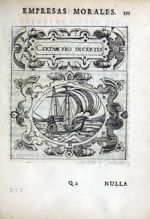
Lapide aurum, auro homo: Borja, Empresas morales (Bruxelles, 1680), emblem 55 uses the comment's imagery about buying the favour of a prince
Iconclass: 46B31 money 46B411 buying 56D1 Hope; 'Speranza', 'Speranza delle fatiche' (Ripa)
Loci Communes: Incertus eventus (Uncertain outcome, Issue incertaine); Frustrata spes (Frustrated hope, Espoir déçu)
II iv 6 Caelum territat He affrights the sky
Proverbialis hyperbole apud Vergilium in Aeneide: Et coelum territat armis. Convenit in minaces & feroces, Thrasonesque magniloquos. Sumpta videtur à bello Giganteo, quae fabula notior quàm ut hic sit repetenda. Confine huic illud Synesii in epistola contra Andronicum, τῇ κεφαλῇ τὸν οὐρανὸν ἐξαράσσειν ἐπιχειρεῖ, id est, Capite coelum perrumpere conatur.
A proverbial exaggeration used by Virgil in the Aeneid, 'And with his arms affrights the sky.' Suitable for bold and threatening characters, blustering like Thraso. The source would seem to be the war against the Giants, a story too well known to need retelling here. Close to it is the remark of Synesius in the letter in which he attacks Andronicus: 'He tries to beat his head against the sky.'
Facsimile:
Iconclass: 31AA2511(+921) arm raised upward - AA - both arms or hands (+ threatening; fury) 56DD1 Fear, Dread; 'Paura', 'Timidità o Timore', 'Timore' (Ripa) 91C21 battle of the Giants against the gods: gigantomachy
Loci Communes: Arrogantia jactantiaque (Arrogance and boastfulness, Arrogance et vantardise)
II iv 7 Subere levior Lighter than cork
Φελλοῦ κουφότερος, i. Subere levior. Proverbialis hyperbole in homines inconstantes & lubrica fide. Suberis enim lignum cavernosum, quod in aqua non sidit, verumetiam retibus & natantibus alligatur, ne possint sidere. Horatius in Odis, Quanquam sydere pulchrior, Ille est:tu levior cortice, & improbe Iracundior Adria. Strabo lib. primo, inter hyperbolas proverbiales hanc quoque commemorat, Subere levior umbra. Quanquam hic locus apud Strabonem non caret suspicione mendositatis. Graeca sic habent, Καὶ καθάπερ εἰσι τινες ὑπερβολαῖ ἐπῒ ὑπερβολαῖς, ὡς καὶ τὸ καουφότερον εἶναι φελλοὺ σκιὰν, δειλότερον δὲ λαγὼς φρυγὸς, ἐλάττω δὲ ἔχειν γῆν τὸν ἄγρον ἐπιστολῆς λακωνικῆς. Haec ita vertit Gregorius Typhernas sive Guarinus, Et sicut nonnulli super excessibus excessus sunt, ut istud, leviorem subere umbram, & illud, formidolosiorem lepore Phrygem, & illud, Ager minorem tellurem habet quàm epistola Laconica. Primum umbram esse leviorem subere non est insignis hyperbole, imò nulla potius est. ut iam demus, Graece recte dici κουφότερον σκιὰν. Unde hic pro σκιὰν legendum arbitramur σκιᾶς, ut sic dicta sit suberis umbra, quemadmodum dicimus umbrae somnium. Item δειλότερον λαγῶ φρύγα id est, timidiorem lepore Phrygem, quomodo legisse videtur interpres. Nec absurdum si intelligamus Phrygium leporem, veluti ceteris pavidiorem, quod ea gens imbellis habebatur & effoeminata delitiis. Pindarus in Pythiis hymno secundo metaphoram flexit ad laudem hominis, qui quanquam pressus calumniis malorum, non deicit tamen animum, sed se suapte natura recipit in apertum, unde & φελλὸν ἀβάπτιστον appellat. id est, suber quod tingi nequeat. Huc respexit Horatius Epistolarum lib. 1. de Ulysse loquens, Dum sibi dum sociis reditum parat, aspera multa Pertulit, adversis rerum immersabilis undis.
Φελλοῦ κουφότερος, Lighter than cork, is a proverbial exaggeration used of men who are changeable and untrustworthy. For the wood of the cork-oak is full of holes, and does not sink in water; on the contrary, it is fastened to nets and to people swimming to prevent them from sinking. Horace in the Odes:
Though he is fair as any star,
And you as cork inconstant are
And treacherous as Adria's cruel sea.
Strabo in his first book among proverbial exaggerations has 'A shadow light as cork.'
Though this passage in Strabo is not free from a suspicion that it is corrupt. In Greek it runs like this: 'And just as one extravagance is piled on another, for example A shadow lighter than cork, or More frightened than a Phrygian hare, or His property covers less ground than a Spartan despatch.' This is how it is translated by Gregorius Tifernas, or it may be Guarino, except that he has 'A Phrygian more frightened than any hare.' My first point is, that for a shadow to be lighter than cork involves no remarkable exaggeration, in fact no exaggeration at all, even granted we accept that the Greek is correct syntax. So here I think that for skian [accusative] we should read skias [genitive], so that the sense would be 'a shadow of [lighter than] cork/ with which we may compare the phrase 'a dream of a shadow.' Again, we should change the Greek to run 'A Phrygian more timorous than a hare/ which the translator seems to have had before him. Yet there would be no absurdity if we were to take 'Phrygian' and 'hare' together, as though a Phrygian hare were more timorous than other hares, because the Phrygians as a people were reputed to be unwarlike and softened by luxurious living.
Pindar in the second hymn of his Pythians adapted the image to express admiration of one who, though hard pressed by the malicious attacks of wicked men, never lost heart, but won his way into the open by native force of character; so Pindar calls him 'a cork unsinkable.' Horace in the first book of his Epistles referred to this, when he wrote of Ulysses: 'As for himself and his companions he made good the journey home, many were the trials he suffered, unsinkable amid the billows of adversity.'
Facsimile:
Iconclass: 46C2932:25G3(CORK OAK)(+2) lifebelt, life-buoy❧trees (CORK OAK) (+ parts of plants) 51GG2 Lightness; 'Leggierezza' (Ripa) 53AA21 Inconstancy; 'Incostanza', 'Instabilità', 'Instabilità overo Incostanza' (Ripa) 57AA6141 Untrustworthiness, Unreliability
Loci Communes: Inconstantiae, perfidiae, versutiae (Inconstancy, treachery, cunning, Inconstance, perfidie, ruse)
II iv 8 Cubito emungere To wipe one's nose on one's forearm
Αγκῶνι ἀπομυσσόμενος, id est, Cubito emungens. Proverbialis ironia in hominem sordidi quaestus & conditionis abiectae. A salsamentariis ducta, quibus mos est narium mucum cubito abstergere, nimirum manibus muria & salsugine oppletis. Bion philosophus apud Suidam ex Laertio, ἐμοῦ πατὴρ μὲν ἦν ἀπελεύθερος, τῷ ἀγκῶνι ἀπομυσσόμενος. id est, Meus pater erat libertinus, cubito emungens Celebratur scomma M. Tullii tortum in quendam salsamentarii filium, cuius tacito autoris nomine meminit qui scripsit rhetoricen ad Herennium, in schematis specie, quae dicitur significatio per consequentiam, Ut, inquit, si salsamentarii filio dicas: Quiesce tu, cuius pater se cubito emungere solebat.
Ἀγκῶνι ἀπομυσσόμενος, Wiping his nose on his forearm. A proverbial way of making fun of a man of humble occupation and low position in society, derived from the makers of salted and pickled meats, who habitually, if they have runny noses, wipe them with the forearm, because their hands are full of brine and salt. The philosopher Bion, according to Suidas who is quoting Laertius, said 'My father was a freed slave, who wiped his nose on his forearm.' There is a famous jest of Cicero's at the expense of a salt meat maker's son, which is recorded with no author's name by the writer of the Rhetoric addressed to Herennius in the shape of the rhetorical figure called conveyance of meaning by logical consequence: 'as if he says 'you were to say to the son of a salt meat maker "Be quiet, you whose father used to wipe his nose on his forearm."'
Facsimile: 
Iconclass: 31A2243 lower arm 31A2535 hand(s) towards the nose 31A64 nose-blowing 46A15 the poor 46A17 working class, labourers
Loci Communes: Contemptus et vilitatis (Contempt and worthlessness, Mépris et bassesse)
II iv 9 Hiberae neniae A Hiberian rigmarole
Hiberas naenias divus Hieron. nugas appellat, in praefatione quam praeposuit Moysi Pentateucho: Quod multi ignorantes, inquit, apocryphorum delyramenra sectantur, & Hiberas naenias libris authenticis praeferunt. Idem in duodecim quaestionibus: Et Hiberas naenias Aegyptiaque portenta sectari. Opinor Hiberas naenias dici propter prodigiosas maleficiorum fabulas vulgo iactatas. Nam Hiberos maleficiorum infamia laborasse, testis est in Odis Horatius. Nisi quis mavult ad flumen auriferum Tagum referre. Quanquam ipse divus. Hieronynus in epistola adversus Vigilantium, satis indicat de portentis ac monstris intelligendum, scribens ad hunc modum: Et quia ad radices Pyrenaei habitas, vicinusque es Hiberiae, Basilidis antiquissimi haeretici, & imperitae scientiae incredibilia portenta persequeris. Athenaeus in secundo tradit Hiberos, cum essent opulentissimi, tamen ob parsimoniam semper ὑδροποτεῖν solitos, & μονοσιτεῖν, hoc est, aquam bibere, & solos cibum capere: caeterum vestitu fuisse sumptuosissimo. Citat hoc ex Athenaeo Stephanus. Sed pro μικρολογία depravatum est μακρολογία.
St Jerome in his preface to Moses' Pentateuch calls nonsense 'a Hiberian rigmarole.' 'Failing to understand this, many people' he says 'follow the crazy fancies of the apocryphal writers, and prefer their Hiberian rigmarole to the truth of the Scripture.' Jerome again in his Twelve Questions: 'To follow a Hiberian rigmarole and Egyptian monstrosities.' I suppose the phrase to be used with reference to the prodigious tales of witchcraft which were then in common circulation; for that the Hiberians were notorious for witchcraft is clear from the Odes of Horace. Unless anyone would rather refer it to the river Tagus which bears gold. Not but what St Jerome himself in a letter attacking Vigilantius makes it pretty clear that we should understand this of portents and monsters, for he writes as follows: 'And because you live at the roots of the Pyrenees and have Hiberians as your neighbours, you follow the portentous absurdities of that most ancient of heretics, Basilides, and his homespun theories.' Athenaeus in book 2 tells us that the Hiberians, although extremely rich, were so abstemious that they always drank water and ate by themselves, though they were most expensively dressed. This is quoted from Athenaeus by Stephanus; but macrologia is a corruption for micrologia.
Facsimile:
Iconclass: 13B witchcraft, sorcery 32B311(SPANIARDS) Europeans: Spaniards 52BB53 Nonsense, Absurdity 61D(IBERIA) geographical names of countries, regions, mountains, rivers, etc. (IBERIA) (IBERIA)
II iv 10 Siculae nugae. Gerrae. Persolae nugae Sicilian nonsense. Trash. Persian nonsense
Siculae nugae, proverbio dicunturres leviculae. Ausonius in epistola ad Symmachum, Cogitans, inquit, non illud Catullianum, Cui dono lepidum, novum libellum. sed amargoteron & verius, Cui dono illepidum, & rudem libellum, non diu quaesivi. Tu enim occurristi, quem ego, si mihi potestas sit, ex omnibus unum semper eligerem. Misi itaque ad te frivola gerris Siculis vaniora. Porrò Siculorum dicacitas nota est veterum literis. Nam Siculus fuit Epicharmus, ad cuius exemplar properare Plautus dictus est Horatio. Plautus autem in nugis ac iocis est immodicus, nec raro ineptus. Porrò gerras Graeci crates vimineas appellant. Ea vox postea vulgo pro nugamentis rebusque frivolis usurpata est, autore Festo Pompeio, hac quidem occasione. Athenienses cum Syracusas obsiderent, & crebro gerras poscerent, irridentes Siculi gerras clamitabant. Hinc in proverbium cessit. Unde et familiares, quique inter se nugas omnes communicant, Congerrones vocantur. Suidas neutro genere γέῤῥα refert, ut Persicam vocem, quae quidem tum arma declarat, tum quodvis defensaculum. Etymologicon graecum addit, apud Siculos naturam muliebrem gerron appellari, γέῤῥα nanque dici, commutatione literae, quasi γέῤῥα. Δέρας autem apud Graecos pellem significat, & gerra proprie defensacula sunt pellicea. Plautus in Poenulo: Scitum per tempus, hoc iam est verbum, si verbum vetus. Nam tuae blanditiae mihi sunt, quod dici solet, gerrae germanae. Aedepol lirae, lirae. Germanas dixit, non Germanicas, absit, sed meras ac veras nugas. Quod autem Plautus vocat lirae, Graeci dicunt λῆρον, sive ληρήματα. Vocem dictam putant à λήθω, & ῥὲω, quod dictum fallens memoriam excidit. Quemadmodum & φλύαρον & φλυαρίαν dictam à φλύω, & ῥὲω, quod superfluant exundentque verbis garruli. Apud hunc ipsum Plautum & Persolas nugas legimus, opinor ob montes aureos, qui apud Persas esse perhibentur.
Sicilian nonsense was a proverbial expression for things of the least possible value. Ausonius says in his letter to Symmachus 'When I asked myself not, as Catullus has it, "Who gets the offer of my smart new book?" but much more selfishly and with more truth "Who gets the offer of my dowdy ill-made book?" I spent little time on the search, for you came to mind as the one person whom I would always choose, if I could, out of all my friends. I send you therefore these trifles, lighter than any Sicilian trash.' The loquacity of Sicilians is notorious in ancient literature; for Epicharmus was a Sicilian, and he is the model, according to Horace, for Plautus' loose bustling style, and Plautus overdoes the use of nonsensical jests, and is sometimes silly.
Gerrae, trash, is a word used in Greek for wicker hurdles, which later came into current use for things of no value, as Festus Pompeius tells us, from one particular occasion. 'When the Athenians were laying siege to Syracuse, and constantly demanding gerrae, wicker hurdles, the Sicilians took to shouting gerrae! at them in mockery,' and thus the word became proverbial. Hence it also results that friends, and those who have their trifling concerns in common, are called congerrones, cronies. Suidas records gerra, in the neuter plural, as a Persian word meaning sometimes weapons and sometimes any form of defensive armour. The Greek Etymologicon adds that in Sicily gerron was a name for the female pudenda, the word being derived by the change of one letter from derm. Dems is the Greek for leather, and so gerra properly speaking is a word for defensive equipment made of hides. Plautus in the Poenulus: 'What you say is clever for the time being, though we have heard it before. For your kind words are, as the saying goes, pure trash, gerrae germanae, just lirae, stuff and nonsense.' By germanae he meant, not 'German/ far from it, but 'pure and unadulterated' nonsense. And lirae, the word he uses for 'stuff,' is the Greek lêron or lêrêmata. The word is thought to be derived from lethô, forget, and rheô, flow away, because the spoken word slips from the memory and is lost, just as phlyaron and phlyaria in Greek come from phlyô and rheô, because talkative people overflow with words.
In Plautus too we find Persolae nugae, Persian nonsense, I suppose on account of the mountains of gold which are fabled to exist in Persia.
Facsimile:
Iconclass: 52BB53 Nonsense, Absurdity 52D4 Prolixity, Verbosity, Loquacity; 'Loquacità' (Ripa) 54BB6 Worthlessness 61D(PERSIA) geographical names of countries, regions, mountains, rivers, etc. (PERSIA) (PERSIA) 61D(SICILY) geographical names of countries, regions, mountains, rivers, etc. (SICILY) (SICILY)
Collectanea (1500): 468
Loci Communes: Nugalia (Trifles, Bagatelles)
II iv 11 Qui semel scurra, nunquam paterfamilias Once a buffoon, never a honest family man
Qui semel scurra, nunquam paterfamilias. Porphyrion enarrans Horatium, admonet fuisse proverbium. Sensus est autem, eum quem semel depuduerit, quique contempta fama scurram agere coeperit, vix unquam ad bonam frugem redire. Scurra gaudet alieno cibo, paterfamilias parat, unde domi vivat. M. Tullius in actione pro Publio Quinctio: Memini, vetus est, de scurra multo facilius divitem quam patremfamilias fieri posse. Fortuna crebro largitur opes indignis: at bonam mentem dat nemini.
He who was once a buffoon will never be an honest family man: Porphyrion in his commentary on Horace tells us this was a proverb. The meaning is that a man who has once lost all sense of shame, and with complete disregard for his reputation has taken to playing the buffoon in public, will scarcely ever return to respectability. A buffoon eats gladly at other men's tables, the honest family man earns the wherewithal to live in a house of his own. Cicero in his speech in defence of Publius Quinctius: There is, as I recall, an old saying that it is easier to make a rich man out of a buffoon than an honest family man.' Fortune often showers wealth on the unworthy, but good character and good sense is not hers to give.
Facsimile:
Iconclass: 42B741 father and child(ren), man and child(ren) (family group) 46A139 buffoon (in general) (German: 'Schalksnarr') 51AA4:59B33 Nothingness, Absence❧Respectability; 'Precedenza et Preminenza de titoli' (Ripa) 59B32 Fame; 'Fama', 'Fama buona', 'Fama chiara' (Ripa)
Collectanea (1500): 460
Loci Communes: Ingenii malitia et institutio (Malice of character and its formation, Malice d'esprit et son origine)
II iv 12 Aegroto dum anima est, spes est While there's life in a sick man, there's hope
Aegroto dum anima est, spes est. Sententia proverbialis, admonens ne in afflictissimis quidem rebus abiciendam esse spem. M. Tullius ad Atticum, Ut aegroto dum anima est, spes esse dicitur, sic ego quoad Pompeius in Italia fuit, sperare non destiti. Sumptum videtur adagium ex Theocriti Batto: Θαρσεῖν χρὴ φίλε βᾶττε, τάχ᾽ αὔρϊων ἔσσετ᾽ ἄμεινον. Ελπίδες ἐν ζωοῖσι, ἀνέλπιστοι δὲ θανόντες. Χὡ ζεὺς ἄλλοκα μὲν πέλει αἴθριος, ἄλλοκα δ᾽ ὕει. Hos versus quoniam non ineleganter vertit Philelphus, haud gravabor adscribere, Fidere Batte decet: melius cras forsan habebis.. Sperandum est vivis, non est spes ulla sepultis. Nunc pluit, & claro nunc Iuppiter aethere fulget. Item Euripides in Troadibus, Οὐ ταυτὸν ὦ παῖ τῷ βλέπειν τὸ κατθανεῖν. Τὸ μὲν γὰρ οὐδὲν, τῷ δ᾽ ἔνεισιν ἐλπίδες. id est, Non est idem mi gnate, vivere, ac mori: Siquidem hoc nihil, spes sunt in illo scilicet. Eodem pertinet fabula de Pandorae pyxide, in cuius summo labro sola spes haeserit, reliquis omnibus morbis evolantibus.
A proverbial maxim which teaches us that even in the most desperate situation we should never abandon hope. Cicero writing to Atticus: They say that while there's life in a sick man, there's hope, and so it was with me; as long as Pompeius was in Italy I never despaired.' The adage looks as though it were taken from the Battus of Theocritus; as Filelfo's version of these lines is not inelegant, I will gladly add it here:
Courage, dear Battus! Tomorrow perchance it may be better;
There's hope among the living, it is the dead who have no hope.
So Jove now rains, now shines in cloudless sky.
Euripides too in the Troades: 'For life and death, my son, are different things; / The one is nought, the other still has hope.' The story of Pandora's box also belongs here, on the extreme edge of which Hope alone had remained behind when all its other contents, the diseases, had flown away.
Facsimile: 
In simulachrum Spei: Alciatus, Emblemata (Padua, 1621), col. 229 b, emblem 44
Iconclass: 49G2 patient, sick person 53A21 Constancy, Tenacity; 'Costanza', 'Tenacità' (Ripa) 56D1 Hope; 'Speranza', 'Speranza delle fatiche' (Ripa) 58B21 Human Life; 'Vita humana', 'Vita inquieta', 'Vita e l'animo' (Ripa) 91E652 Pandora opens her box (or jar); Good or Evil escapes, Hope remains
Collectanea (1500): 442
Loci Communes: Spes pertinax (Persistent hope, Espoir tenace)
II iv 13 Ad vivum resecare To cut to the quick
M. Tullius lib. De amicitia, ad vivum resecare, dixit, pro eo quod est, rem exactius quam sat est, ac morosius excutere. Sed hoc, inquit, primum sentio, nisi in bonis amicitiam esse non posse. Neque id ad vivum reseco, ut illi qui haec subtilius disserunt. Mutuo sumpta metaphora à tonsoribus capillos aut ungues resecantibus. Nam ii saepenumero molesti sunt, dum nimium diligentes esse student. Idem in libris De finibus, dixit Pressius agere, pro exactius & accuratius. Plautus in Bacchidibus sub persona Chrysali: Tondebo auro usque ad vivam cutem. Et hoc ipsum Tondere pro deludere, Graecis in proverbio est.
Cicero in his book On Friendship uses 'to cut to the quick' of the analysis of something with needless precision and pedantry. 'My first feeling' he says 'is that friendship cannot possibly be regarded as other than a good thing. Nor do I cut this question to the quick, as those do who discuss such things with greater subtlety.' The image is borrowed from hairdressers as they cut short one's hair or fingernails; for they are often tiresome with their efforts to be needlessly precise. Cicero again in the Definibus uses 'close work' for something more exact and meticulous than usual. Plautus in the Bacchides puts into Chrysalus' mouth the words: Til shear his gold off him, down to the living quick.' And this same use of 'shearing' for deception is proverbial in Greek.
II iv 14 Hostimentum est opera pro pecunia Work for the money is a fair exchange
Hostimentum est opera pro pecunia. Hoc adagium admonet, nihil gratuitum esse debere, sed officium beneficio pensandum. Hostimentum autem, autore Pompeio Festo, beneficii pensatio est, à prisco verbo hostire & redostire, quod est paria referre. Ab eodem hostem dici putat Nonius, quod ex aequa causa pugnam suscipiat. Sic lena apud Plautum in Asinaria adolescenti respondet sua exprobanti beneficia: Hostimentum est opera pro pecunia. Hoc est: Neuter habet quod imputet alteri. Tu mulierem amabas, missa est: Ego pecuniam, dedisti. T. Livius: Nunquam nec opera sine emolumento, nec emolumentum servis sine impensa opera est. At in amicorum officiis alia ratio est, nec enim liberatur à debenda gratia qui gratiam retulit: nec permutatione officiorum fit, ut neuter alteri quicquam debeat. Confine illis, Manus manum fricat, & scalpentem scalpe.
Work for the money is a fair exchange. The lesson of this adage is that nothing ought to be given away, but one dutiful service rendered should be met by kindness bestowed. The word for fair exchange, hostimentum, means, according to Pompeius Festus, the repayment of a kindness, from an ancient verb hostire and redostire its opposite, which means to return like for like. Nonius thinks that the word hostis, enemy comes from the same root, because enemies take up a struggle for a fair return. Thus a bawd in Plautus, in the Asinaria, retorts to the young man who expects gratitude for what he has done for her: 'Work for the money is a fair exchange,' neither of us, that is, has any reason to complain of the other. You wanted the girl, and she was handed over to you; I wanted money and you gave it me. Livy: 'Slaves do no work without reward, and get no reward till they have done some work.' But when one friend does a service to another, things are very different; for the man who repays a kindness is not quit of his debt of gratitude, nor does an exchange of services mean that neither friend has any obligation to the other. This is related to One hand rubs another and You scratch my back and I'll scratch yours.
Facsimile:
Iconclass: 46A172 paying of wages 51KK3 Interchange, Exchange 53CC11 Service 59C21 Equality, Equity, Fairness, Righteousness; 'Equalità', 'Equità', 'Giuditio giusto', 'Ordine dritto e giusto', 'Ugualità' (Ripa)
Collectanea (1500): 58
Loci Communes: Pensatio beneficii vel officii (Repayment of a favor or duty, Rétribution d'un bienfait ou d'un devoir)
II iv 15 Utramque paginam facit She fills both pages
Plinius Historiae mundi libro secundo, capite septimo, de fortuna loquens, Huic, inquit, omnia expensa, huic omnia feruntur accepta, & in tota ratione mortalium, sola utranque paginam facit. Proverbii faciem habet illud, utranque paginam facit, sumpta metaphora à codicillis rationabilibus, duas habentibus paginas, alteram quae indicat quid sit datum, alteram quae quid acceptum sit, ostendit. Itaque in rebus humanis fortuna utranque facit paginam, id est, sive quid obtigit boni, ea laudatur, quasi dederit: sive mali quid accidit, eadem incessitur, ceu malorum autor.
Pliny in his World-History, book 2 chapter 7, writing of Fortune, says: 'To her all expenditure is debited and all receipts are credited to her; she alone fills both pages.' That phrase 'She fills both pages' looks like a proverb, the metaphor being taken from account-books, which have two facing pages, one showing payments out and the other sums received. Thus in human affairs Fortune 'fills both pages,' in the sense that, if things go well, she is praised as though she were responsible, and if things go wrong it is equally she who is blamed, as though she were the source of all that is bad.
II iv 16 Nec omnia, nec passim, nec ab omnibus Not everything, nor everywhere, nor from everybody
Οὔτε πάντα, οὔτε πάντῃ, οὔτε παρὰ πάντων. i. Nec omnia, nec passim, nec ab omnibus. Admonet adagium, in muneribus accipiendis non solum verecundiam adhibendam esse, verum etiam delectum. Sunt enim quaedam quae neutiquam decorum sit accipere. Est item locus, est tempus quo pulchrum sit recusare munus oblatum. Sunt quidam à quibus inhonestum sit admittere donum. Laudat Horatius Telemachum Homericum, qui equos ab Menelao oblatos recusarit. Hoc adagium citatur ab Ulpiano in Pandectis li. 1. titulo de officio proconsulis, ex epistola divi Severi & Antonini imperatorum, Verba ipsa subscribam, Quantum, inquit, ad xenia pertinet, audi quid sentiamus. Graecum proverbium est, οὔτε πάντα, οὔτε πάντῃ, οὔτε παρὰ πάντων, id est, Nec omnia, nec passim, nec ab omnibus, Nam inhumanum à nemine accipere: sed passim, vilissimum est: & omnia, avarissimum. Hactenus illi. Graeca verba in omnibus exemplaribus desiderabantur. Ea Politianus ex archetypis restituit, ne quid hunc interim debita fraudemus laude. Allusit huc Theocritus in Thionycho, Αἰτεύμενος οὐκ ἀνανεύων Οἷα χρὴ βασιλῆ. αἰτεῖν δὲ δεῖ οὐκ ἐπὶ παντὶ. id est, Non solet ille negare rogatus Principe digna, nec est de re quacunque rogandum.
Οὔτε πάντα, οὔτε πάντῃ, οὔτε παρὰ πάντων, Not everything, nor everywhere, nor from everybody. The lesson of this adage is that in accepting gifts we should be selective as well as moderate. There are some things which it can never be honourable to accept. There are places and there are occasions when it is creditable to refuse a proffered gift. There are certain people from whom it must be wrong to receive a present. Horace praises Telemachus in Homer for rejecting the offer of horses from Menelaus. This adage is cited by Ulpian in the Pandects, book 1i, in the title De officio proconsulis, from a letter of the emperors Severus lately deified and Antoninus; I will give the actual words. 'On the question of gifts our opinion is as follows. There is a Greek proverb: Not everything, nor everywhere, nor from everybody. For it is discourteous to accept from no one, but to accept everywhere is discreditable and to accept everything highly rapacious.' Such was their view. The Greek of the proverb was missing in all copies of the text, and was restored from early manuscripts by Poliziano (for while we are about it we must not deprive him of his due credit). Theocritus alludes to this in the Thionychus: 'He does not refuse a request, as is right for a king, but he ought not to be asked on every occasion.'
Facsimile:
Iconclass: 33A41 gifts being accepted 33A49 gifts being refused 53A11 Choice; 'Elettione' (Ripa) 54A43 Temperance, Moderation; 'Misura' (Ripa) 55C2 Giving 55CC2 Receiving
Collectanea (1500): 14
Loci Communes: Rapacitas et avaritia (Rapacity and greed, Rapacité et avarice)
II iv 17 Tempus omnia revelat Time reveals all things
Tertullianus, quem divus Cyprianus praeceptorem suum appellare consuevit, in apologetico contra Ethnicos: Bene autem, inquit, quod omnia tempus revelat, testibus etiam vestris proverbiis atque sententiis. Aulus Gellius Noctium Atticarum lib. 12. cap. item 12, citat in hanc sententiam hos Sophoclis versus: Πρὸς ταῦτα κρύπτε μηδὲν, ὡς ἅπαντθ᾽ ὁρῶν Καὶ πάντ᾽ ἀκούων, πάντ᾽ ἀναπτύσσει χρόνος. id est: Ob ista ne quid occulas, siquidem intuens Cuncta, audiensque cunctae proferet dies. Idem in Aiace flagellifero: Απανθ᾽ ὁ μακρὸς κ᾽ ἀνάριθμος χρόνος Φύει τ᾽ ἄδὴλα, καὶ φανέντα κρύπτεται. id est, Cuncta pariter immensus ordo temporum Occulta prodit, & idem prodita occulit. Eódem in loco Gellius admonet, quendam veterum poetatum. Veritatem temporis filiam vocasse, quod licet aliquando lateat, tamen temporis progressu in lucem emergat. Fertur in eandem sententiam hic quoque senarius proverbialis, Αγει δὲ πρὸς φῶς τὴν ἀλήθειαν χρόνος. id est: At veritatem tempus in lucem eruit. Et alter huic adsimilis: Πάντ᾽ ἀνακαλύπτων ὁ χρόνος πρὸς φῶς φέρει. id est: Omnia sub auras tempus aperiens refert. Idem opinor sensisse Thaetem, cum ait, τὸν χρόνον σοφώρατον ἁπάντων, ἀνεύρίσκειν γὰρ τὰ τάντα. Hoc est, Tempus omnum esse sapientissimum, ut quod cuncta reperiat, eruatque. Nec aliud Pindarum in Olympiacis, cum ait: Αμέραι δ᾽ ἐπίλοιποι μάρτυφες σοφώτατοι. id est, Posteri dies sapientissimi testes. Idem alibi, tempus omnium parentem appellat, quod nihil non fiat progressu temporis, ἀποιητον οὐδ᾽ ἂν χρονος ὁ πάντων πατὴρ δύνοιτο θέμεν έργων τέλος. id est: Ne tempus quidem rerum omnium pater, possit quod factum est infectum reddere. Habet eandem sententiam Pindarus quum aliquot locis, tum Olympiade X. ὁτ᾽ ἐξελέγχων μόνος ἀλάθειαν ἐτήτυμον χρόνος, τὸ δὲ σαφανες ἰὼν πόρσω κατέφρασεν. id est, Et solum tempus quod veritatem certam prodit, quodque latebat in obscuro, progrediens enarravit. Huc allusisse videtur Vergilius in sexto, Subigitque fateri Quae quis apud superos furto laetatus inani Distulit in seram commissa piacula mortem. Neque discrepat evangelicum dictum apud Matth. ca. 11. οὐδέν ἐστι κεκαλυμμένον ὅ οὐκ ἀποκαλυφθήσεται, καὶ κρυπτον ὅ οὐ γνωθήσεται. id est, Nihil opertum, quod non revelabitur, & occultum, quod non scietur. Plutarchus in Problematis causam inquirit cur antiquitus operto capite res divina Saturno fieri consueverit. Atque id significatum arbitratur, quod veritas plerunque tecta ignorataque sit, sed eadem aperitur tempore. Saturnus enim temporum autor ac deus fingitur. Nam κρόνος Saturnus, χρόνος tempus. Nec aliud sensit T. Livius, cum ait lib. 22. A veritate laborare nimis ius saepe aiunt, exstingui nunquam. Seneca lib. De ira 2. Dandum semper tempus est, veritatem enim dies aperit.
Tertullian, whom St Cyprian habitually called his teacher, in his Apologeticum against the Gentiles says 'It is just as well that time reveals all things, as your proverbs too and moral maxims testify.' Aulus Gellius in book 12 chapter 12 of his Attic Nights cites to this effect these lines of Sophocles: 'Hide nothing therefore, for all-seeing Time / and Time all-hearing brings all things to light.' Sophocles again in Ajax with the Scourge: 'All things the uncountable extent of time / Brings out of hiding, and hides what could be seen.' In the same passage Gellius tells us that some ancient poet called Truth 'the daughter of Time,' because though for a space she may lie hidden, yet with the progress of time she comes forth into the light. There is also a proverbial iambic line to the same effect: 'But time brings out the truth into the light/ and another like it: 'All things revealing time will bring to light.' I suppose Thales to have been of the same opinion when he said: Time is the wisest thing there is, for it discovers all things.' Pindar thought the same in the Olympians: 'The days that remain are the wisest of witnesses.' And in another passage he calls Time the father of all things, because everything is brought about by the progress of time: 'Even Time father of all things could not undo what is once done and finished.' Pindar makes the same point in several places, and particularly in his tenth Olympian: Time that alone reveals the certain truth, and on its forward progress made the whole story clear.' Virgil seems to have had this in mind in book six: 'And drives them to confess if any in the world above, exulting in some fruitless fraud, has left the burden of his guilt unexpiated till the hour of death, too late.' Nor is there any disagreement between this and the saying in the Gospel, Matthew chapter 10: There is nothing covered that shall not be revealed, and hid that shall not be known.' Plutarch in his 'Problems' poses the question why it is that the Ancients were accustomed to sacrifice to Saturn with their heads covered; and he thinks the point was that truth as a rule is covered and unknown, but is none the less revealed by time. For Saturn is fabled to be the creator and the god of time, Kronos being his name in Greek and chronos the word for time. Livy holds the same opinion when he says in book 22; They say the just cause of truth is too often in difficulties, but is never extinguished.' Seneca in his On Anger, book 2: 'We must always allow time, for day after day brings truth to light.'
Facsimile: 

Veritatis inventor: Borja, Empresas morales (Bruxelles, 1680), emblem 85 uses the imagery of Time (Ouroboros) always revealing the Truth
Iconclass: 23A41 Time revealing Truth; Time carrying Truth aloft
Collectanea (1500): 31
Loci Communes: Decretum - in deprehensos (Decree - against those caught in the act, Décret - contre les pris sur le fait)
II iv 18 Alpha paenulatorium Alpha of those that wear the cloak
Martialis epigrammatum libro secundo, Quem non lacernis Publius meus vincit, Non ipse Codrus, Alpha penulatorum. Alpha vocavit praecipuum, & quasi primatem, proverbiali nimirum figura. Idem aliàs iocatur in quendam offensum, quod eum dixisset Alpha, monetque ut huius iniuriae talionem faciat, seque vicissim Beta, si velit appellet. Translatum à notulis literarum, quibus Graeci numerum indicant. Eósdem signiferos & antesignanos appellant, metaphora sumpta à militia. Quamobrem autem alpha inter literas primum obtineat locum, Plutarchus non inscite causas reddit τῶν συμποσιακῶν προβλημάτων Decade nona. Protogenes grammaticus è suo ludo causam adducit, primum vocales iure praeferri consonantibus, quod citra illarum adminiculum sonent: deinde vocales ancipites merito praeferri longis ac brevibus, quod utriusque generis vim complectantur. Caeterum inter ancipites recte primum locum alpha tribui, quod in conficiendis syllabis, iota & ypsilon sequatur alpha, velut in αὔριον, αἴας. Alpha nunquam sequatur illas duas, ut eandem efficiant syllabam, sed resilit & proprium tuetur principatum. At Ammonius mox diversam allegat causam, Cadmum ob id alpha principem inter literas locum tribuisse, quod Phoenicum lingua bos alpha vocetur, cui primum locum attribuendum putarit, non secundum aut tertium, quemadmodum fecit Hesiodus, Οἶκον μὲν πρώτιστα, γυναῖκά τε, βοῦτ᾽ αῤοτῆρα. id est: Primum aedes, deinde uxorem, inde bovem agricolantem. Nam his praesidiis putat opus esse, si quis cupiat famem ac paupertatem effugere. Rursum Plutarchus addit hanc causam se à Lampria suo didicisse avo, Primam vocem naturalem & articulatam reddi per alpha, propterea quod spiritus qui est in ore, potissimum formatur ac fingitur motu labiorum, quibus diductis, primum hic egreditur sonus mire simplex, & nullius indigens negocii, ut neque linguae requirat auxilium, sed ea subiacente per spatium efferatur. Unde & pueri nascentes, primum hanc edunt vocem. Haec atque huiusmodi quaedam, eo quem ostendi loco referuntur. Disputatur & apud Platonem de alpha inter literas principatu. Quin & illa proverbium sapiunt, Primas tenere, primas deferre sive tribuere. &, Non posteriores feram. quae metaphorae sunt à partibus histrionum in fabula: & apud Graecos πρωτεύεσθαι. & τὰ πρῶτα δοῦναι. καὶ τὰ πρῶτα φέρειν. Quod à fabularum actoribus sumptum apparet, inter quos primas agunt, qui maximam fabulae partem sustinent: secundas ac tertias, qui illis sunt inferiores. Quanquam & in causarum actionibus sunt πρωτολογίαι, δευτερολογίαι & τριτολογίαι, quemadmodum sunt πρωταγωνισταὶ, δευτεραγωνισταὶ & τριταγωνισταὶ, quae si commode transferuntur, speciem habent proverbii.
When Martial wrote in the second book of his Epigrams:
Wearing a coat that casts into the shade My dear friend, Publius - yes, and Codrus too, Alpha of those who wear the hooded cloak. He was using alpha to mean a leader or dean, a 'number one' as it were, which is of course a proverbial form of expression. And in another passage Martial takes a humorous thrust at a friend whom he had offended by calling him an alpha, and tells the friend to repay this insult in kind and call him beta if he pleases. This derives from the Greek system of using letters of the alphabet to indicate numerals. Such people are also called 'standard-bearers' and 'men of the first rank,' using a military metaphor. Why alpha should stand first among letters is explained with some finesse by Plutarch in the ninth decade of his 'Problems at Table.' Protogenes the teacher of literature produces a reason out of his own schoolroom. First of all he says that vowels are rightly set above consonants, because they can convey sounds with no help from any consonant; and secondly that vowels of ambiguous length are rightly set above those which are long or short, because they incorporate the force of both kinds. In any case, he says, among ambiguous vowels the first place is rightly given to alpha because, when we form syllables, iota and ypsilon follow alpha, as in aurion (tomorrow) and Aias (Ajax), but alpha never follows those two in such a way as to form one syllable with either of them; it springs away, and maintains its own primacy. But after that Ammonius puts forward a different reason: it was Cadmus who gave alpha first place in the alphabet, because in the Phoenician language alpha means ox, and he thought the ox should have first place and not second or third, as in Hesiod: 'House first and wife and oxen for the plough.' For these were the possessions he thought essential, if a man wants to escape hunger and poverty. Then again Plutarch adds that he learned the following reason from Lamprias his grandfather. The first natural and articulate sound we utter is that expressed by alpha, because the breath in the mouth is mainly shaped and moulded by the movement of the lips, and when they are opened the first thing that issues is this sound in its wonderful simplicity and needing no effort, so that it does not require the help of the tongue but issues through the clear space while the tongue lies flat. Hence too this is the first sound uttered by children at birth. All this and more of the same sort is recorded in the passage to which I have referred. Plato too has a discussion on the primacy of alpha over the other letters. There is also an air of proverb about Primas tenere, To play the principal part, and Primas deferre or tribuere, To yield or offer first place, and Non posteriores feram, I shall not play a secondary role (which are metaphors from the parts performed by actors in a play), and in Greek πρωτεύεσθαι, To stand first, and To yield (or bear) the leading part. This is clearly derived from actors on the stage, among whom the principal role is played by those who support the greatest part of the play, and the second and third roles by those who are less important. Though in forensic rhetoric too there are words like protologia, deuterologia and tritologia for those who speak first, second or third, just as there are protagonists, deuteragonists and tritagonists and if these are appropriately used as metaphors they will have a proverbial air.
Facsimile: 
Iconclass: 41D212 coat, cape 41D221(HOOD) head-gear: hood 49L13(Α) Greek script (Α) 51F3 Priority, Pre-eminence 59B33 Respectability; 'Precedenza et Preminenza de titoli' (Ripa)
Loci Communes: Excellentia, inaequalitas (Excellence, inequality, Excellence, inégalité)
II iv 19 Salivam imbibere To acquire a taste
Divus Hieronymus in evangelia praeloquens, Quis enim, inquit, doctus pariter, vel indoctus, cum in manus volumen assumpserit, & à saliva quam semel imbibit, viderit discrepare quod lectitat, non statim erumpat in vocem? Eleganter profecto, pronerbialique figura dixit, Et à saliva, quam semel imbibit, id est, ab illo gustu quo puer imbutus est. Sumpta metaphora ab infantibus, quibus praemansum cibum nutrices in os inserunt, non sine saliva. Cui cum assueverint, nihil iam illis sapit, quod ab illius primae salivae gustu diversum sit: proinde modis omnibus curandum, ut optimis assuescamus. Idem solet accidere plerisque nostrum, ut quicquid dissideat ab iis quae primis illis annis im bibimus, protinus displiceat. Aiunt & canes eos amare, quorum salivam gustarint. Verum malim ad superiorem metaphoram referri. Huc spectare videtur & Persianum illud, Inque luto fixum possis transcendere nummum, Nec gluto sorbere salivam Mercurialem. Quanquam magis referendum esset ad ficos Mercuriales, de quibus aliàs diximus, quos ioci causa quidam saliva oblinebant, ut ludibrio essent qui tollerent, cum consimilem lusum prae miserit de nummo infixo luto. Illud certe pertinet ad hoc proverbium, quod est apud eundem in sexta Satyra, Nec tenuem sollers turdorum nosse salivam. Salivam pro gustu dixit.
St Jerome in his preface to the Gospels writes as follows: 'Who is there, educated or uneducated alike, who does not at once exclaim in protest when he picks up a book and finds a contradiction between what he reads and the taste he once acquired?' This phrase 'from the taste he once acquired' is a very well-chosen and proverbial metaphor for the standard of judgement instilled into him as a boy, the image being taken from small children whose food is chewed first by their nurses and tastes of their saliva when put into the child's mouth. Once they have got used to this, they no longer like anything that tastes different from that saliva of their first experience. We should therefore use every means to secure that we acquire a taste for the best things. Most of us have the same experience: anything unlike what we experienced in those first years, we dislike at once. They say that dogs in the same way love people whose saliva they have tasted. But I would rather refer the adage to the first image of which I spoke. Those lines of Persius seem appropriate here: 'Can you pass by a coin stuck in the mud, and not swallow hard as the god of luck makes your mouth water?' Though I think this is better referred to the 'Mercury-figs' of which I have spoken elsewhere, which some people by way of a practical joke used to smear with saliva to make fun of those who tried to pluck them up, since it followed here on the similar trick of sticking a coin in the mud. That other line at any rate belongs to this adage, to be found in his sixth satire: 'Expert in the delicate juice of thrushes,' where he uses 'juice' (saliva) for 'flavour.'
Facsimile:
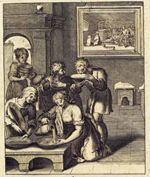
Vis institutionis: Vaenius, Emblemata Horatiana (Amsterdam, 1684) emblem 13
Iconclass: 31A34 taste, tasting (one of the five senses) 49B scholastic education, tuition 51F52 Earliness 54A31 Experience, Mastery; 'Esperienza' (Ripa) 59A2 Refinement, Taste
Loci Communes: Ingenii malitia et institutio (Malice of character and its formation, Malice d'esprit et son origine)
II iv 20 Quo semel est imbuta Long will a crock
Huic non dissimile est Horatianum illud: Quo semel est imbuta recens, servabit odorem Testa diu. Proinde recte monet Fabius, ut statim optima discantur, propterea quod nihil haeret tenacius, quam id quod rudibus annis perceperimus. Et Aristoteles libro Moralium Nicomachiorum secundo, οὐ μικρὸν οὖν διαφέρει τὸ οὕτως ἢ οὕτως εὐθύς ἐκ νέων ἐθίζεσθαι, ἀλλὰ παμπολὺ, μᾶλλον δὲ τὸ πᾶν. i. Itaque non parui refert, hoc an illo pacto protinus à pueris consuefiamus, imò plurimum interest, vel potius omne in eo momentum est situm. Et Vergilianum illud ἐπιφώνημα in Georgicis, Adeo ιν teneris consuescere multum est.
Not unlike this is that thing in Horace: 'Long will a crock retain the taste / Of what in it when fresh was placed.' And so Quintilian is quite right to remind us that learning should begin with the best things, because nothing gets a stronger grip on us than what we have acquired in our tender years. And Aristotle in book 2 of the Nicomachean Ethics: 'Thus it makes no small difference whether we form our habits from our earliest years in this way or in that; it is of very great, and indeed supreme, importance.' And there is Virgil's apophthegm in the Georgics: 'So great the power of habits formed when young.'
Facsimile:
Vis institutionis: Vaenius, Emblemata Horatiana (Amsterdam, 1684) emblem 13
Een algemeene leer van 't nieuwe boter-vat Dat zynen reuck behoud na 't eerste sap oft nat: Vondel, Gulden Winkel (Amsterdam, 1622), emblem 49
Quo semel est imbuta recens servabit odorem testa diu: Meyer, Homo Microcosmus (Frankfurt, 1670), emblem 50
Rami correcti rectificantur, trabs minime: Cats, Spiegel (The Hague, 1632), emblem 1 uses the adage's imagery and its comments quote the adage
Iconclass: 31A34 taste, tasting (one of the five senses) 31D112 child 41A773 container of ceramics: jar, jug, pot, vase 49B scholastic education, tuition
Collectanea (1500): 592
Loci Communes: Ingenii malitia et institutio (Malice of character and its formation, Malice d'esprit et son origine)
II iv 21 Augeae stabulum repurgare To cleanse the stable of Augeas
Αὐγείου βουστασία, id est, Augiae bubile. Allegoria proverbialis in hominem, aut in rem maiorem in modum inquinatam. Lucianus in Pseudomante, καὶ τὴν Αυγείου βουστασίαν, εἰ καὶ μὴ πᾶσαν, ἀλλ᾽ εἰς δύναμΐν γε τὴν ἐμαυτοῦ ἀνεκαθήρασθαι πειράσομαι. id est, Et Augiae bubile, si non omne, at certe pro mea virili conabor submovere. Ostendit autem huius stabula tantum habuisse congesti fimi, quantum ter mille boves pluribus annis reddere potuerint. Huius mentionem facit & Pausanias in Eliacis, deque bubus & fimo nonnihil meminit. In Graecis epigrammatis recensetur inter Herculis labores Augiae stabulum repurgatum. Quin & Seneca ludicro libello de morte Claudii Caesaris usurpat hoc proverbium: In quos, inquit, si incidisses, valde fortis licet tibi videaris, maluisses cloacas Augiae purgare, multo plus ego stercoris exhausi. Etiamsi proverbium omissum erat in exemplari, quod primum secutus est Frobenius, Id nos restituimus ex exemplari, cuius nobis copiam fecit ex sua bibliotheca Collegium liberales artes profitentium, in florentissima Lovaniensium Academia. Neque enim aequum arbitror imputari Universitati, quod paucorum seniculorum conspiratione, tam odiose repugnatum sit hic bonis literis ac linguis. Gregorius Theologus ad Basilium Magnum, πῶς, inquit, παρέλθω τοῦς ἀκήπους κήπους ἐκείνους καὶ ἀλαχάνους, καὶ τὴν Αυγίου κόπρον ἐκ τῆς οἰκίας ἐκκαθαιρομένην; id est, quomodo praeteream hortos illos incultos & holeribus vacuos, atque Augiae stercus ex aedibus repurgatum? Sentit, vitam luxu perditam in melius correctam.
Αὐγείου βουστασία, properly The stable of Augeas. A proverbial allegory, used of a person or thing that is filthy beyond measure. Lucian in The False Prophet: 'And I will try my hardest to clean out this Augean stable, though I cannot clear it all.' He there tells how Augeas' stable contained as much manure heaped up as three thousand oxen would have taken many years to produce. He is also mentioned by Pausanias in his account of Elis, where something is said about his oxen and their manure. In the Greek epigrams the cleansing of the Augean stable is listed among the labours of Hercules. Seneca too in his skit on the death of the emperor Claudius uses this proverb. 'Had you had to deal with them,' he says, 'strong man though you may think yourself, you would have preferred to cleanse the stables of Augeas; I had to bear far more filth.' Though the proverb was omitted in the copy which Froben used to begin with, and I have restored it from that to which I was given access in their library by the college of those who profess the liberal arts in the most flourishing university of Louvain. For I do not think it fair to blame the whole university, if a handful of dotards have put their heads together to fight such an odious rearguard action against good literature and the ancient languages. Gregory the Theologian, writing to Basil the Great, says: 'How can I pass over those gardens untended and uncropped and the Augean dung cleared out of the house,' meaning that a way of life undermined by luxury has been reformed into something better.
Facsimile: 
Iconclass: 94L325 (5) Hercules cleanses the stables of Augeas by diverting the rivers Alpheus and Peneus
Loci Communes: Impossibilia (Impossible things, Choses impossibles)
II iv 22 Periculosum est canem intestina gustasse It is risky for a dog to taste guts
Χαλεπὸν χορίων κύνα γεῦσαι. id est, Intestina canem semel adgustasse periclum est. Proverbiali allegoria dictum est à Theocrito in Idyllio decimo. Admonet adagium, haud facile temperare à peccando qui semel illecebram illam, velut auctoramentum vitiorum degustarit. Quemadmodum qui semel scortum attigerit, qui semel periurio sive furto rem auxerit, qui semel aulicam vitam sit expertus. Effertur & ad huc modum apud Lucianum, οὐδὲ κύων πάυσαιτ᾽ ἂν ἅπαξ σκυτοτραγεῖν μαθών, id est, Neque canis desiturus est, qui semel corium edere didicerit. Theocriti Scholiastes indicat, hoc proverbium & hunc in modum efferri, χαλεπὸν μαθοῦσα κύων σκυτοτραγεῖν, id est, Periculosa res est canis quae didicit arrodere coria. Horatius in Sermonibus simili figura dixit: Quae si semel uno De sene gustarit, tecum partita lucellum, Ut canis à corio nunquam absterrebitur uncto.
Χαλεπὸν χορίων κύνα γεῦσαι, It is asking for trouble to let a dog once taste guts. A proverbial metaphor used by Theocritus in idyll 10. The lesson of the adage is that it is not easy for a man to keep clear of wrongdoing who has once savoured the attractions of it, which are as it were the reward for vice; anyone for instance who has once had dealings with a prostitute or made a profit out of perjury or theft or has once made the acquaintance of life at court. It is also expressed in this way in Lucian: 'Nor will a dog ever stop who has once learned to gnaw leather.' The scholiast on Theocritus points out that there is another way of putting it: 'A dog that has learned to gnaw leather is a source of risk.' Horace in the Satires uses a similar metaphor when he writes: 'But if she's once had a taste of one old man, and shared her gains with you, she'll be no more frightened off in future than a dog from a greasy hide.'
Facsimile:
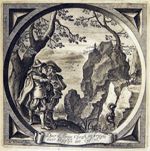
Waer de Slanghe 'thooft in krijght, daer krijgtse 't lijf in: Cats, Spiegel (The Hague, 1632), emblem 3 uses the imagery of a snake crawling head-first into a narrow space and its comments quotes the adage
Iconclass: 31A2234 intestines 34B11(+945) dog (+ animals eating and drinking) 51L42:11N1 Motion Towards, Attractive Force, Attraction, Pull❧Vice, Evil, Sin; 'Peccato' (Ripa)
Loci Communes: Illecebra mali (The allurement of evil, L'attrait du mal)
II iv 23 Dubia coena A doubtful dinner
Dubiam coenam, opiparam, variisque instructam ferculis appellabant, idque proverbium à parasitis repertum apparet. Phormio apud Terentium, Coena dubia apponitur. Quid isthuc verbi est? Ubi tu dubites quid sumas potissimum. Exponit parasitus verbum suum, alioqui anceps. Nam Dubium etiam periculosum significat: & Dubia coena possit intelligi, quae non careat suspicione veneni. Horatius in Sermonibus, Vides ut pallidus omnis Coena desurgat dubia. Et res parum tutas appellamus dubias.
'A doubtful dinner' was a name for a splendid meal enriched with many different dishes, and the proverb was clearly invented by those who dined habitually at other men's expense. Phormio in Terence: 'A doubtful dinner was set before us. - What pray d'you mean by that? - One where you're doubtful which dish to sample first.' The parasite explains his remark, the meaning of which would otherwise be ambiguous. For 'doubtful' can also mean risky, and a 'doubtful dinner' could be one that was not free from the suspicion of poison. Horace in the Satires: 'See how they all rise with pale faces from their doubtful dinner.' And when we think something not safe, we call it doubtful.
Facsimile:
Iconclass: 41C43 evening meal, dinner, supper 52BB2 Doubt; 'Dubbio' (Ripa) 57AA6141 Untrustworthiness, Unreliability
Collectanea (1500): 203
Loci Communes: Lautitiae (Sumptuousness, luxuries, Somptuosités)
II iv 24 Canis circum intestina A dog sniffing offal
Κύων παρ᾽ ἐντέροις. id est, Canis iuxta intestina. Dicebatur, ubi quis res eas quarum esset cupientissimus, propositas conspiceret, quibus frui tamen non liceret. Canes enim oberrant circum intestina, devoraturi nisi fustem timerent. Suidas arbitratur accommodari posse in res inutiles & insuaves: intestina enim non facile deglutiri à canibus, ac devorata revomi plerunque.
Κύων παρ᾽ ἐντέροις, A dog sniffing round offal. This was said when a man could see something he desperately wanted set within his reach, but was not allowed to touch it. Dogs will go pacing round a dish of offal, which they would wolf down in a moment if they were not afraid of the stick. Suidas thinks it can be adapted to fit useless and unpleasant things because, he says, dogs find offal difficult to swallow, and when they have eaten it they often vomit it up again.
Facsimile:
Iconclass: 34B11(+945) dog (+ animals eating and drinking) 41C43 evening meal, dinner, supper 53DD11 Prohibition 56F1 Desire; 'Desiderio' (Ripa)
Loci Communes: Rapacitas et avaritia (Rapacity and greed, Rapacité et avarice)
II iv 25 Aureae compedes Golden fetters
Χρυσαῖ πέδαι, id est, Aureae compedes. Proverbiali metaphora dicitur seruitus splendida & amabilis, qualis est ferè aulicorum vita. Diogenes in epistola quadam scriptum reliquit, Aristippum in aula regia aureis teneri compedibus, ne posset avolare. Seneca in dialogo quodam affectus & rationis, Stulti est, inquit, compedes suas, quamvis aureas, amare. Loquitur de uxore formosa. Horatius item de amica formosa, Tenetque grata Compede vinctum.
Χρυσαῖ πέδαι, Golden fetters, is a proverbial metaphor applied to every form of bondage which is grand and enticing, such as life at court. Diogenes has left it in writing in one of his letters that Aristippus was bound at the king's court by fetters of gold so that he could not take flight. Seneca in one of his Dialogues: 'He is a fool in heart and mind who loves his fetters, though they are made of gold.' He speaks of a beautiful wife. Horace in the same way of a beautiful mistress: 'And holds him bound in fetters that he loves.'
Facsimile: 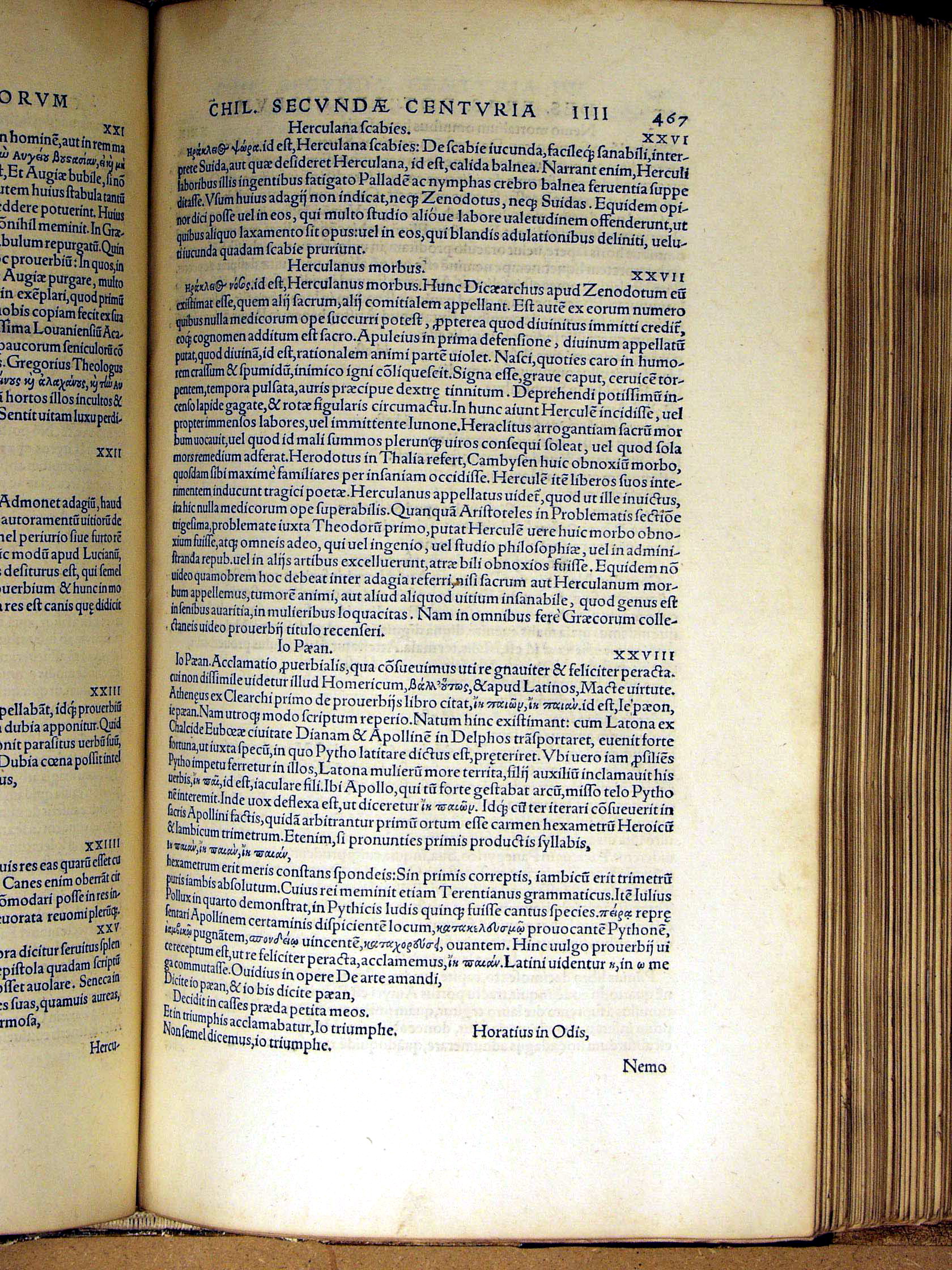
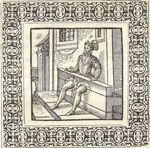
Aureae compedes: Whitney, A choice of emblemes (Leiden, 1586), emblem 216
Iconclass: 44B152 royal household; courtiers, retinue, train 44G3711:25D13(GOLD) in the pillory, in the stocks❧minerals and metals: gold 98B(ARISTIPPUS) male persons from classical history (ARISTIPPUS)
II iv 26 Herculana scabies Hercules' itch
Ηράκλειος ψώρα, id est, Herculana scabies: De scabie iucunda, facileque sanabili, interprete Suida, aut quae desideret Herculana, id est, calida balnea. Narrant enim, Herculi laboribus illis ingentibus fatigato Palladem ac nymphas crebro balnea ferventia suppeditasse. Usum huius adagii non indicat, neque Zenodotus, neque Suidas. Equidem opinor dici posse vel in eos, qui multo studio alióve labore valetudinem offenderunt, ut quibus aliquo laxamento sit opus: vel in eos, qui blandis adulationibus deliniti, veluti iucunda quadam scabie pruriunt.
Ἡράκλειος ψώρα, Hercules' itch, is used of an irritation which is agreeable and easily relieved (so Suidas explains it), or one which demands Hercules' baths, which means hot baths. For they say that Hercules, when exhausted by those colossal labours of his, was often provided with hot baths by Pallas and the Nymphs. The use of this adage is not made clear by either Zenodotus or by Suidas. I suppose myself that it can be applied either to those who have damaged their health by excessive study or labour of some other kind, so that they need some relaxation, or of people soothed by gentle blandishments, who can be said to suffer from a sort of agreeable itch.
Facsimile:
Iconclass: 31A351 agreeable feeling 31A46241 itching 94L (story of) Hercules (Heracles)
Loci Communes: Adulatio (Flattery, Flatterie); Insalubritas (Unhealthiness, Insalubrité)
II iv 27 Herculanus morbus Hercules' disease
Ηράκλειος νόσος, id est, Herculanus morbus. Hunc Dicaearchus apud Zenodotum eum existimat esse, quem alii sacrum, alii comitialem appellant. Est autem ex eorum numero quibus nulla medicorum ope succurri potest, propterea quod divinitus immitti creditur, eoque cognomen additum est sacro. Apuleius in prima defensione, divinum appellatum putat, quod divinam, id est, rationalem animi partem violet. Nasci, quoties caro in humorem crassum & spumidum, inimico igni conliquescit. Signa esse, grave caput, cervicem torpentem, tempora pulsata, auris praecipue dextrae tinnitum. Deprehendi potissimum incenso lapide gagate, & rotae figularis circumactu. In hunc aiunt Herculem incidisse, vel propter immensos labores, vel immittente lunone. Heraclitus arrogantiam sacrum morbum vocavit, vel quod id mali summos plerunque viros consequi soleat, vel quod sola mors remedium adferat. Herodotus in Thalia refert, Cambysen huic obnoxium morbo, quosdam sibi maximè familiares per insaniam occidisse. Herculem item liberos suos interimentem inducunt tragici poetae. Herculanus appellatus videtur, quod ut ille invictus, ita hic nulla medicorum ope superabilis. Quanquam Aristoreles in Problematis sectione trigesima, problemate iuxta Theodorum primo, putat Herculem vere huic morbo obnoxium fuisse, atque omnes adeo, qui vel ingenio, vel studio philosophiae, vel in administranda repub. vel in aliis artibus excelluerunt, atrae bili obnoxios fuisse. Equidem non video quamobrem hoc debeat inter adagia referri, nisi sacrum aut Herculanum morbum appellemus, tumorem animi, aut aliud aliquod vitium insanabile, quod genus est in senibus avaritia, in mulieribus loquacitas. Nam in omnibus ferè Graecorum collectaneis video proverbii titulo recenseri.
Ἡράκλειος νόσος, Hercules' disease. Dicaearchus, cited by Zenodotus, identifies this with the affliction called by some the 'sacred' and others the 'comitial' disease. It is one of those for which the doctors can do nothing, because it is sent, as is supposed, by divine agency, and hence gets its name 'sacred disease.' Apuleius in his first defence thinks it was called 'divine' because it overwhelms the divine, that is, 'the rational part of the soul.' It appears, he says, 'whenever the flesh is liquefied by morbid heat into a thick and frothy humour'; and the signs are 'heaviness in the head, stiffness in the neck, strong pulse in the temples and buzzing in the ears,' especially the right ear; diagnosis is mainly by 'burning the stone called jet' and by rotating a potter's wheel. Hercules suffered an attack, they say, either as a result of his immense labours or it was inflicted by Juno. Heracleitus called arrogance 'the sacred disease,' either because it usually attacks those in high places or because death is the only known remedy. Herodotus records in Thalia that Cambyses, who was subject to this disease, killed some of his dearest friends during an attack of insanity, and in the same way Hercules is represented by the tragedians as killing his own children.
It seems to have been called after Hercules as being, like him, invincible, and beyond the reach of any medical intervention. Though Aristotle in section 30 of the Problems, in the first problem according to Theodore's numbering, thinks that Hercules was truly a victim of this disease, and that all those who have excelled by their natural genius or their devotion to philosophy, or in public affairs or in other skills, have been sufferers from the melancholy.
For my part I do not see why this should be recorded among adages, unless we apply the name 'sacred disease' or 'Hercules' disease' to self-conceit or some other incurable fault, such as avarice in old men or garrulity in women; for I observe that it is listed under the heading of proverbs in almost all the Greek collections.
Facsimile:
Iconclass: 31A464 emotional illness, derangement, madness 48C34(POTTER'S WHEEL) tools, implements of craftsman: potter's wheel 49G23 healing of sick person 52BB42:49G23 Impossibility❧healing of sick person 57AA644 Arrogance; 'Arroganza' (Ripa) 94L (story of) Hercules (Heracles)
Loci Communes: Insalubritas (Unhealthiness, Insalubrité)
II iv 28 Io Paean Io Paean
Io Paean. Acclamatio proverbialis, qua consuevimus uti re gnaviter & feliciter peracta. cui non dissimile videtur illud Homericum, βάλλ᾽ οὕτως, & apud Latinos, Macte virtute. Athenaeus ex Clearchi primo de proverbiis libro citat, ἴη παιῶν, ἴη παιὰν, id est, Ie paeon, ie paean. Nam utroque modo scriptum reperio. Natum hinc existimant: cum Latona ex Chalcide Euboeae civitate Dianam & Apollinem in Delphos transportaret, evenit forte fortuna, ut iuxta specum, in quo Pytho latitare dictus est, praeteriret. Ubi vero iam prosiliens Pytho impetu ferretur in illos, Latona mulierum more territa, filii auxilium inclamavit his verbis, ἴη παῖ, id est, iaculare fili. Ibi Apollo, qui tum forte gestabat arcum, misso telo Pythonem interemit. Inde vox deflexa est, ut diceretur ἴη παιῶν. Idque cum ter iterari consueverit in sacris Apollini factis, quidam arbitrantur primum ortum esse carmen hexametrum Heroicum & Iambicum trimetrum. Etenim, si pronunties primis productis syllabis, Ιη παιὰν, ἴη παιὰν, ἴη παιὰν, hexametrum erit meris constans spondeis: Sin primis correptis, iambicum erit trimetrum puris iambis absolutum. Cuius rei meminit etiam Terentianus grammaticus. Item Iulius Pollux in quarto demonstrat, in Pythicis ludis quinque fuisse cantus species. πείρᾳ, repraesentari Apollinem certaminis dispicientem locum, κατακελευσμῷ provocantem Pythonem, ἰαμβικῷ pugnantem, σπονδείῳ, vincentem, καταχορεύσει, ovantem. Hinc vulgo proverbii vice receptum est, ut re feliciter peracta, acclamemus, ἴη παιάν. Latini videntur η in ω mega commutasse. Ovidius in opere De arte amandi, Dicite io paean, et io bis dicite paean, Decidit in casses praeda petita meos. Et in triumphis acclamabatur, Io triumphe. Horatius in Odis, Non semel dicemus, io triumphe.
'Io Paean' is a shout of triumph which passed into a proverb, used in practice when some feat has been vigorously and successfully performed. It bears an obvious similarity to the Homeric Ball' houtôs, Keep it up, and to the Latin Made virtute, Bravo. Athenaeus cites from the first book of Clearchus on proverbs le paion, Iê paian (for I find both these spellings). Its source is thought to have been this. When Latona was taking Diana and Apollo from Chalcis, a city in Euboea, to Delphi, it so happened that she passed close to the cave in which Pytho the great serpent was said to make its lair. When Pytho darted out and attacked them, Latona was terrified, as women are, and called to her son for help with the words lê pai, shoot, child! Whereupon Apollo, who by good luck was carrying his bow, let fly an arrow and killed Pytho. Hence, with some distortion, came the cry lê paion and after the rise of the custom of repeating this three times at ceremonies performed in Apollo's honour, some suppose that there came into being for the first time the heroic hexameter and the iambic trimeter. For if you pronounce it with the first syllables long throughout, lê paian iê paian iê paian will form a hexameter consisting solely of spondees. If you shorten the first syllables, it will be an iambic trimeter entirely consisting of pure iambic.
This is also mentioned by Terentianus the writer on grammar, and Julius Pollux too in book 4 shows how at the Pythian games there were five kinds of singing: peira which represented Apollo reconnoitring the scene of the conflict, katakeleusmos the challenge to Pytho; iambikon the battle; spondeion, the victory; and katachoreusis, the triumph. Hence it was commonly accepted as a proverb that on a successful outcome we should shout Ie paian. In Latin the e seems to have changed into a long o. Ovid in his book On the Art of Love: To paean, lo paean repeat: / The prize I sought has fallen into my net,' And at triumphal processions they used to shout lo triumphe: Horace in the Odes, 'Over and over we will shout lo triumphe.'
II iv 29 Nemo mortualium omnibus horis sapit No mortal man is wise at all times
Plinius libro septimo, cap. De praestantia gentium, Si verum facere iudiciu voumus, ac repudiata omni fortunae ambitione decernere, mortalium nemo est felix. Abunde igitur atque indulgenter fortuna decidit cum eo, qui iure dici non infelix potest. Quippe ut alia non sint, certe, ne lacessat fortuna metus est. Quo semel recepto, solida felicitas non est. Quid quod nemo mortalium omnibus horis sapit? Utinamque falsum hoc, & non à vate dictum quamplurimi iudicent. Ex quibus Plinii verbis coniicere licet, eam vocem, Neminem omnibus horis sapere, velut oraculo proditam, in vulgi sermonem abiisse. Sensus vel citra interpretem liquet: nempe neminem esse qui non aliqua parte vitae desipiat ac peccet. Porrò stultitiae comes est infelicitas. Aut certe si quod incidit infortunium, id stulticiae solet imputari. Eódem pertinet, quod paulo post eodem in loco subnectit, Alius de alio iudicat dies, supremus de omnibus. Extat apud Aristophanem in Ranis, & huiusmodi senarius, quem illic indicat Euripidis esse, Οὐκ ἔστι ὅστις πάντ᾽ ἀνὴρ εὐδαιμονεῖ. id est, Haud vivit ullus omnibus felix modis. Item Euripides in Supplicibus, Τῶν γὰρ ἐν βροτοῖς Οὐκ ἔστιν οὐδὲν διατέλους εὐδαιμονοῦν. id est, Siquidem universis rebus in mortalium Nil continenter & undecunque prosperum est. Ad eundem modum Horatius, Nihil est ab omni Parte beatum. Simonides apud Stobaeum, Πάμπαν δ᾽ ἄμωμος οὔτις οὐδ᾽ ἀκήριος. id est, Nemo vacat prorsum malo, neque crimine.
Pliny, book 7, in a chapter on the distinction of different peoples: 'If we are prepared to face the truth and discard every wish for success before we decide, no mortal man is happy. Fortune has therefore shown herself highly indulgent to any man who can rightly be called not unhappy. If we assume that there are no other factors, there is in any case the fear that Fortune may not leave him alone, and once that idea has been accepted, unclouded happiness does not exist. And then there is the saying that no mortal man is wise at all times; and would that most people thought this was false, and not the utterance of a prophet.' Pliny's words allow us to suppose that 'No mortal man is wise at all times' had passed into common speech as though uttered by an oracle. The sense is clear even without a commentary: there is no one who is not foolish and misguided in some aspect of his life. And folly's companion is unhappiness, or at least, if misfortune befalls a man, folly is usually held to blame. A little later in the same passage he adds something to the same effect: 'One day judges another, and the last day passes judgment on them all.' There is also an iambic line like this in Aristophanes' Frogs, which he suggests is by Euripides: 'No living man is always fortunate.' Euripides too in the Supplices: 'In mortal things / Good fortune never lasts without a break.' And in the same vein Horace: 'Nought is at all points blest.' Simonides, preserved in Stobaeus: 'No man is wholly free from taint of blame.'
Facsimile: 
Iconclass: 51K1 Change 52A51 Wisdom; 'Sapienza', 'Sapienza humana', 'Sapienza vera' (Ripa) 52BB42:51KK1 Impossibility❧Permanence
Loci Communes: Fortunae commutatio (Change of fortune, Changement de fortune)
II iv 30 Sui cuique mores fingunt fortunam Every man's character moulds his fortune
Cornelius Nepos in vita Pomponii Attici, Itaque hic fecit, ut vere dictum videatur, Sui cuique mores fingunt fortunam. Et paulo post in eodem opere, Supra significavimus suos cuique mores plerunque conciliare fortunam. E medio videtur sumpta sententia. Nam plerunque videmus mala malis evenire, digna dignis, idque vulgo dictitant, Malus malum reperit, & κακοῖς τρίς κακὰ, id est, Malis, ter mala. Attestatur & versiculus proverbialis, Εσθλῷ γὰρ ἀνδρὶ τ᾽ ἐσθλὰ καὶ διδοῖ θεός. id est, Viro bono fortuna suppeditat bona. Item Menander citante Plutarcho: Ο νοῦς γὰρ ἡμῶν ὁ θέος. id est, Nobis enim animus est deus. Et apud eundem Heraclitus, ἦθος ἀνθρώπου δαίμων, id est, Mores hominis deus sive fortuna. Eódem pertinet quod Alcman scripsit, fortunam esse sorore εὐνομιας, πειθοῦς καὶ προμηθείας. id est,. Rectae institutionis, persuasionis & providentiae, ut refert Plutarchus in commentario De fortuna Romanorum. Plautus in Trinummo, Sapiens ipse sibi fingit fortunam. T. Livi. Decadis quartae libro primo de M. Portio Catone ita praedicat, In hoc viro tanta vis animi ingeniique fuit, ut quocunque loco natus esset, fortunam sibi ipse facturus videretur. Pacatus in Panegyrico, Sua, inquit, cuique prudentia deus. Fulgentius in commentariis Vergilianis citat ex Telesiaco Carneadis, Omnis fortuna in sensu sapientis habitat. Opinor idem esse quod adducit M. Tullius Paradoxo quinto ex poeta nescio quo. Tametsi locus is habetur mendosus, arbitror emendandum ad hunc modum: Cui quidem etiam quae vim habet maximam, fortuna ipsa cedit, & sicut sapiens poeta dixit, Suis cuique moribus fingitur. Sentit enim fortunam fingi cuique suis moribus.
Cornelius Nepos in his life of Pomponius Atticus: 'And so he made the old proverb seem true, which says that every man's character moulds his fortune.' And a little further on in the same work: 'We have pointed out above that every man's character procures his fortune.' This is an aphorism clearly derived from common experience; we generally see bad men come to a bad end, as they deserve, and it is a common saying that a bad man comes to no good, and 'Evil thrice over to the evil.' This is supported by a proverbial line of verse: 'To the good man God gives a good reward.' Menander too, cited by Plutarch: 'Because the mind in us is God.' And Heracleitus, whom he also cites: 'A man's character is his God' or 'his fortune.' Here belongs that phrase in Alcman, that 'Fortune is the sister of Good principles, Persuasion and Foresight,' as Plutarch records in his essay 'On the Fortune of the Romans.' Plautus in the Trinummus: The wise man moulds his own fortune.' Livy in his fourth decade, book 1, writes as follows about Marcus Porcius Cato: 'In this man such was the force of personality and natural gifts that it seemed he would have made a great name for himself, whatever the position in life to which he was born.' Pacatus in a Panegyric: 'Each man's own wisdom is his God.' Fulgentius in his essay on Virgil quotes from the Telesiacus of Carneades 'All fortune dwells in the wise man's mind.' I take it that the same point is made when Cicero quotes in the fifth of his Paradoxes from an unspecified poet (the text is defective, I think it should be corrected thus): 'Fortune herself, that most powerful force, gives way to him, and, as a wise poet has said, is moulded for every man by his own character.' For his point is that every man's character moulds his fortune.
Facsimile:
Iconclass: 32A7 characters (human types) 44G3 criminal law; punishment 51C1 Cause 51CC1 Effect, Result 54F12 Luck, Fortune, Lot; 'Fato', 'Fortuna', 'Fortuna aurea', 'Fortuna buona', 'Fortuna pacifica overo clemente', 'Sorte' (Ripa) 55A12 Reward, 'Praemium'; 'Premio', 'Remuneratione' (Ripa) 57AA741 Revenge, Requital, Retaliation; 'Vendetta' (Ripa)
Loci Communes: Ultio malefacti (Vengeance for a wrongdoing, Vengeance d'un méfait)
II iv 31 Insana laurus adest We have a mad baytree among us
Plinius libro decimosexto, capite quadragesimo quinto, iuxta quorundam distinctionem quarto, In eodem, inquit, tractu portus Amyci est Bebrice rege interfecto clarus. Eius tumulus à supremo die lauro tegitur, quam insanam vocant, quoniam si quid ex ea decerptum inferatur navibus iurgia fiant, donec abiiciatur. Hactenus Plinius. Nobis non visum est absurdum hoc adagiis adnumerare, quandoquidem res usque adeo vulgata fuit, ut hinc arbor cognomen invenerit. Itaque quadrabit in hominem rixarum autorem, ut sunt nonnulli, qui quocunque se vertunt, iurgia suscitant.
Pliny in book 16 chapter 45 (in some people's numeration 44): 'In the same region is the harbour of Amycus, famous for the killing of the Bebrycian king. His tomb has been covered since the day of his death by what they call the Mad Baytree, because if a bit of it is broken off and taken on board ship, there are endless quarrels until it is thrown overboard.' So Pliny says; and I thought there would be nothing absurd in the inclusion of this among adages, since the fact was sufficiently well known to give the tree a nickname. And so it will be suitable for anyone who is a fertile source of disputes, as some people are who, wherever they turn, cause quarrels.
Facsimile: 
Iconclass: 13B42 bewitching, cursing, casting spells 25GG3(LAUREL)(+0):31A4640(+0) trees: laurel - GG - fantastic plants, fabulous vegetation (+ variant)❧Madness (+ variant) 42E31 grave, tomb 51C1:33B1 Cause❧quarrel, argument 94A341 boxing-match between the Bebrycian king Amycus and Pollux
Loci Communes: Rixosus (Quarrelsome, Querelleur)
II iv 32 Apologus Alcinoi A story for Alcinous
Απόλογος ἀλκινόου, id est, Apologus Alcinoi. de longis & anilibus fabulamentis. Refertur à Diogeniano, & Iulio Polluce lib. vi. Sumptum ex Homeri Odyssea, ubi Ulysses in convivio Alcinoi Phaeacum regis, prodigiosas ac deridiculas fabulas, & portentuosa mendacia commemorat de Lotophagis, Laestrygonibus, Circe, Cyclopibus, atque id genus aliis plurimis miraculis, fretus videlicet Phaeacum inscitia barbarieque. Plato de Republica lib. X. Αλλ᾽ οὐ μέντοι σοι ἦν δ᾽ ἐγὼ Αλκινόου γὲ ἀπόλογον ἐρῶ, ἀλλὰ ἀλκιμου μὲν ἀνδρὸςἤρος τοῦ ἀρμενίου τὸ γένος παμφύλου, id est, Haud tibi sum narraturus Alcinoi apologum, sed excellentissimi viri Eris Armenii genere Pamphyli. Narrat autem eo in loco fabulam, quae cum Laestrygonum Cyclopumque figmento facile certare possit. Scribit enim cum hic inter multos cecidisset in praelio, decimoque post die cadavera caesorum tollerentur, reliquis putribus, huius unius cadaver integrum atque incorruptum adhuc apparuisse: domumque deportatum, ut iustis caeremoniis sepeliretur, die duodecimo, cum esset imponendus rogo, revixisse, ac prodigiosa quaedam narrasse, quae diebus illis decem apud inferos tum iens, tum rediens conspicatus esset.
Απόλογος ἀλκινόου, A story for Alcinous, applied to rambling narratives and old wives' tales. Recorded by Diogenianus, and by Julius Pollux in book 6. Taken from Homer's Odyssey, where Ulysses, at dinner with Alcinous king of the Phaeacians, produces a string of weird and fabulous absurdities, portentous falsehoods all of them, about the Lotus-eaters and the Laestrygonians and Circe and the Cyclopes and other similar tall stories, relying no doubt on ignorance and barbarous background of the Phaeacians. Plato, in book 10 of the Republic: 'I shall not however relate to you, I said, a story for Alcinous, but the narrative of an excellent man called Er the Armenian, a Pamphylian by birth.' But he then tells in that passage a story which could well hold its own with the fictions about Laestrygonians and Cyclopes. He tells how this man was one of many who were killed in battle, and ten days later, when the bodies of the slain were taken up for burial, the others were all rotting, and Er's alone was clearly still intact and not corrupted. They took it home, that it might be buried with proper ceremony; and on the twelfth day, when he was due to be placed on the pyre, he came to life again, and told a fantastic story of the things he had seen during those ten days in the nether regions, both going and returning.
Facsimile:
Iconclass: 31D17(+0) old woman (+ variant) 33A341 story teller; listening to story teller 52BB53 Nonsense, Absurdity 94I234 Ulysses at Alcinous' court
Collectanea (1500): 146
Loci Communes: Praelongi (Very long, protracted things, Choses très longues); Garrulitas (Talkativeness, Bavardage)
II iv 33 Andabate Blindfold fighters
Citatur apud Nonium Marcellum, cum aliis locis aliquot, tum in verbo Lusciosi, Varro in Andabatis. quem equidem auguror titulum fuisse quempiam Satyrae proverbialem, cuiusmodi sunt alii quoque complures, ὄνος λύρας, γεροντοδιδάσκαλος,, Nescis quid serus vesper vehat. M. Tullius instar proverbii usurpavit in epistola quapiam ad Trebatium libro vii. Epistolarum familiarium, Quem ante, inquit, ne Andabatam quidem defraudare poteramus. Et hunc aemulatus divus Hieronymus adversus Heluidium, Ad hoc, inquit, probandum, congerit, descripturis exempla quàmplurima, more Andabatarum in tenebris gladium ventilans. Idem contra Iovinianum, Periclitamus responsionis verecundia & quasi inter duos scopulos, & quasdam necessitatis & prudentiae symplegadas, hinc atque inde vel pudoris, vel causae naufragium sustinemus. Si ad proposita respondeamus, pudore suffundimur: si pudor impetrarit silentium, quasi de loco videmur cedere, & adversario feriendi occasionem dare. Melius tamen est clausis, quod dicitur, oculis, Andabatarum more pugnare, quàm directa spicula clypeo non repellere veritatis. Idem in secunda contra Ruffinum Apologia, Aliud est, si clausis, quod dicitur, oculis mihi volunt maledicere. Rursum in eodem opere, Habetur dialogus apud Graecos Origenis & Candidi Valentinianae haereseos defensoris, in quo duos Andabatas digladiantes inter se spectasse me fateor. Huc, opinor, respexit in praefatione Esdrae, Aliud est, si clausis, quod dicitur, oculis mihi volunt maledicere. Hieronymus videtur mutuatus à Tertulliano, qui lib. De carnis resurrectione, Si tam abrupte, inquit, ut quidam volunt, clausis, quod aiunt, oculis sine distinctione omnem passim carnem et sanguinem à regno dei extrusit. Hactenus ille. Clausis oculis dixit, pro eo quod est, sine delectu, quemadmodum & Augustinus libro contra epistolam Parmeniani, Quae tandem vis, nisi caecitas & vanitas animi, cogit hominem clausis, ut dicitur oculis, tanquam in alterum iacere quod quum in eum iecerit, continuo redeat, eumque ictu reciproco affligat, intacto eo quem vulnerare voluerat? Caeterum fuerint ne populi ad eum modum soliti pugnare, an gladiatorum genus, qui clausis oculis tenderent in adversarium, an potius lusus genus, ut propemodum ex Seneca licet coniicere, nondum, ut ingenue fatear, satis compertum habeo. Certe vox ipsa ἀνταβάτης, indicat fuisse quosdam, qui sic hostem adversum invaserint. Tum Homerus Iliados ρ. Aiacem sic pugnam ineuntem facit, quemadmodum leo pro catulis dimicans, clausis oculis insilit in venantium agmen, Αἴας δ᾽ ἀμφὶ Μενοιτιάδῃ σάκος εὐρὺ καλύψας Εἰστήκει, ὡς τίς τε λέων περὶ οἶσι τέκεσσι, ᾦ ῥάτε νήπι᾽ ἄγοντι συναντίσονται ἐν ὕλῃ Ανδρες ἐπακτηρες ὁ δὲ τε σθένεϊ βλεμεαίνων Πἂν δὲ τ᾽ ἐπισκύνιον κάτω ἕλκεται ὄσσε καλύπτων, Ως αἴας περὶ Πατρόκλῳ ἥρωϊ βεβήκει. id est, Ast Aiax lato defensans undique scuto Egregium iuvenem prognatum patre Menoetio, Stabat uti leo depugnans sua pignora circum, Cui catulos deportanti venit obvia turba Venantum in sylvis, iaculis urgentibus: ille Deducto prorsum cilio sua lumina velat. Sic cingens heroa Patroclum protegit Aiax. Basilius in epistola quadam non ineleganter dixit, νυκτομαξίαν, ὥστε τοῦ λοιποῦ γνωρίζειν ἡμᾶς τοὺς ὁμόφρονας, καὶ μὴ, ὡς ἐν νυκτομαχίᾳ μηδεμΐαν φίλων καὶ πολεμΐων ἔχειν διάκρισιν. id est, Ut in posterum noverimus eos qui nobiscum sentiunt, nec velut in nocturna pugna nullum amicorum & inimicorum habeamus discrimen. Conveniet in eos, qui temere nulloque iudicio insectantur quippiam, aut repugnant alicui. Neque pessime quadraverit in eos, in cuiusmodi iocus extat Demonactis, autore Luciano, Hic mulget hircum, ille supponit cribrum cum alter inepte proponeret, alter responderet ad id quod propositum erat, nihil facientia.
Nonius Marcellus, in several other places but particularly under the word lusciosi, blind men, cites Varro in his Andabatae, which I myself suppose to have been the title of one of his Satires, taken from a proverb like many others: An ass to the lyre, A teacher of the Old, Who knows what Evening in the end will bring? Cicero used it as proverbial in one of his letters to Trebatius, in book 7 of his Letters to Friends: 'Whom previously' he says 'we could not cheat out of a single blindfold fight.' Following him, St Jerome in his attack on Helvidius: To prove this,' he says, 'he piles up a great quantity of parallels from Scripture, waving his sword in darkness as the blindfold fighters do.' Again, when attacking Jovinian: 'My reluctance to reply puts me in peril; as though I were between two precipices, between two clashing rocks of necessity and prudence, one side or the other, I put at risk either my modesty or the strength of my case. If I reply to these charges, I blush for shame; if shame induces me to remain silent, I shall seem as it were to abandon my post and give my adversary a chance to strike me down. But it is better to fight, as they say, with closed eyes, as the blindfold fighters do, than not to repel the darts aimed at me, using the shield of truth.' Jerome again in his second defence against Rufinus: 'It is another thing if they wish to curse me, as the saying goes, with closed eyes.' And again in the same work: 'A dialogue exists in Greek between Origen and Candidus, a champion of the heresy of Valentinian, in which I confess I saw war to the death between two blindfold fighters.' He had this, I suppose, in mind in his preface to Esdras: 'It is another thing if they wish to curse me, as the saying goes, with closed eyes.' Jerome seems to have borrowed this from Tertullian, who says in his book On the Resurrection of the Flesh: 'If he has so brusquely as some suppose and with closed eyes, as they say, driven all flesh and blood without distinction out of the kingdom of God.' So Tertullian. He used 'with closed eyes' to mean 'without any choice,' as Augustine also does in his Reply to the Letter of Parmenianus: 'What power except blindness and folly compels a man, as the saying goes, with closed eyes to aim, as it were, at another man a missile which, when he has launched it on his target, will at once fly back and hurt him in his turn, leaving untouched the man whom he had wished to wound?'
Be that as it may, whether there were tribes accustomed to fight in this fashion, or a kind of gladiator who fought his adversary with closed eyes, or rather a game of some sort, as we may guess from Seneca, is to speak frankly not yet clear to me; but at least the word itself, in Greek antabates, indicates that there were certain people who advanced in this way against the enemy. And then Homer in Iliad 17 makes Ajax enter the fray like a lioness leaping into the crowd of hunters with closed eyes in defence of her whelps: 'But Ajax stood there, covering the son of Menoetius with his broad shield like a lion protecting its young, which is met in the forest, as it conveys its infant brood, by a band of huntsmen, and exulting in its strength it knits all the skin of its brows down over its eyes; even so stood Ajax to protect the brave Patroclus.' Basil in one of his letters makes an effective use of nyktomachia, fighting by night: 'So that in future we can recognize those who agree with us and not, like men doing battle in the dark, make no distinction between friend and foe.' It will be suitable for those who attack something or resist someone in a headstrong way without stopping to think; and it will be by no means unapt for the objects of that jest of Demonax, reported by Lucian: 'One of them milks a he-goat and the other holds a sieve to catch the milk,' when one man put forward a foolish argument and the other's reply was quite off the point.
Facsimile: 
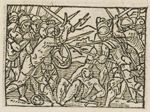
Presser ne fault par trop son ennemy: La Perrière, Le theatre des bons engins (Lyon, 1545), emblem
Iconclass: 31A3191 blindfold 33B3 fighting 52AA21 Rashness, Imprudence, Recklessness
Collectanea (1500): 116
Loci Communes: Temeritas (Recklessness, Témérité)
II iv 34 Canina facundia The eloquence of a barking dog
Salustius apud Nonium Marcellum, in dictione Rabula, Canina, ut ait Appius, facundia exercebatur. Quod quidem Appii dictum apud eruditos scriptores in adagionem cessit in quosdam, qui tantum ad maledicendum eloquentiae studium exercerent: à rixa canum, & oblatratu sumpto epitheto. Siquidem r, litera quae in rixando prima est, canina vocatur. Divus Hieronymus in epistola ad Rusticum monachum, Pomparum ferculis procedunt in publicum, ut caninam exerceant facundiam. Idem obtrectatores suos subinde canes appellat. Sumptum à genere philosophorum, quos κυνικοὺς appellant, sive ob sordidam vitam, sive quod obvios quosque mordent, quum mendicato vivant, more canum.
Sallust, quoted by Nonius Marcellus under the word rabula, demagogue: The eloquence of a barking dog, as Appius puts it, was common practice.' This remark of Appius passed into a proverb among well-read authors, as a description of those for whom obloquy was the sole purpose of the pursuit of eloquence, the phrase being taken from the way dogs bark when they fight [rixare]. In fact, the letter r, the initial of rixare, is called the canine or dog letter. St Jerome in his letter to Rusticus the monk: They heave into public view with all the pomp of carriages in a procession, so as to give their barking-dog eloquence full scope.' And shortly afterwards he calls his own detractors 'curs.' This is derived from the school of philosophers whom they call Cynics, either from their filthy way of life or because they put the bite on anyone they meet, for they live on what they pick up like a dog.
Facsimile:
Iconclass: 33B13 slander 34B11(+949) dog (+ audible means of communication of animal(s): roaring, crying, singing, barking, mewing, neighing, chirping, etc.) 52D3 Eloquence; 'Eloquenza', 'Fermezza & Gravità dell'Oratione' (Ripa)
Loci Communes: Rixosus (Quarrelsome, Querelleur)
II iv 35 Iliensis tragoedos conduxit The man from Ilium hired the tragic actors
Ο Ιλιεὺς τραγῳδοὺς ἐμΐσθωσε. id est, Iliensis tragoedos conduxit. Ubi quis ultro provocat quempiam, unde sua audiat probra: veluti si Troiani accersant histrionem, qui ipsis calamitates quas semel pertulere, denuo quasi renovet. Lucianus in Pseudologista, Επεὶ γὰρ κατὰ τὴν παροιμΐαν ἰλιεὺς ὢν τραγῳδοὺς ἐμισθώσω. id est, Posteaquam enim iuxta proverbium Iliensis cum sis, tragoedos conduxisti. Idem alibi, τὰ γοῦν τῶν Ιλιέων ἀτεχνῶς πεπόνθαμεν, τραγῳδεντινα τοῦτον, ἐφ᾽ ἡμᾶς κεκινήκαμεν, ᾀσόμενον τὰς φρυγῶν συμφορὰς. id est, Itaque planè idem nobis accidit quod Iliensibus, ut qui istum ceu tragoedum quempiam adversus nos excitavimus, qui Phrygum cantet calamitates.
Ὁ Ἰλιεὺς τραγῳδοὺς ἐμίσθωσε, The man from Ilium hired the tragic actors. When someone deliberately stirs up another person from whom he hears the story of his own misdeeds; for example, if the Trojans were to send for an actor to run through for them all over again the calamities they themselves had lived through. Lucian in his Pseudologista: For like the man from Ilium in the proverb, you have hired the tragic troupe.' And again in another place: 'We have done exactly what the men of Ilium did: we have roused this man like some sort of tragic poet against ourselves, to sing the woes of the Phrygians.'
Facsimile:
Iconclass: 33C892(+0) masochism (+ variant) 48C8521 actor (on the stage) 48C8545 tragedy 58AA12 Self-destruction 94C(+0) the Trojan war (94C - 94H) (+ variant)
Loci Communes: Malum accersitum aut retortum (Evil brought upon oneself or turned back, Mal attiré ou retourné)
II iv 36 Tribus minis insumptis duodecim imputat He spends three minas and charges twelve
Ironia proverbialis apud Aristophanem in Pluto, Καὶ μὴν φίλος γ᾽ ἂν μοι δοκῇς νὴ τοῦς θεοὺς Τρεῖς μνᾷς ἀναλώσας γε λογίσασθαι δώδεκα. id est, At certe amicus ut videtur per deos, Uti pro minis tribus imputes duodecim. Quadrabit in eos, qui non nisi compendii sui gratia colunt amicos, & pro quamvis exiguo officio, multum beneficiorum expectant. Vulgo item aiunt. Pileum donat, ut pallium recipiat.
There is irony of a proverbial sort in the Plutus of Aristophanes: 'Yet 't was a friendly act, in heaven's name, / To spend three minas and then to charge up twelve.' This will be suitable to those who never do their friends a kind action except with an eye to the main chance, and in return for some service rendered however small look for a heap of benefits. In common parlance they also say 'He gives a cap to get a coat in return.'
Facsimile:
Iconclass: 46B311 coin 46B44 paying (~ commerce) (here also repayment of debt, etc.) 46B47 profit and loss 57AA65 Selfishness; 'Interesse', 'Interesse proprio' (Ripa)
Loci Communes: Sordes et parcimonia (Meanness and stinginess, Bassesse et avarice)
II iv 37 Oculus dexter mihi salit My right eye twitches
Αλλεται ὀφθαλμός μου ὁ δεξίος. id est, Salit miht oculus dexter. Ubi spes est visuros nos laetum quippiam & vehementer exoptandum. Ductum à muliercularum superstitione, quae ex membri pruritu divinare solent, quid sit eventurum. Unde illa apud Plautum non semel obvia, Prurit mihi tergum, pruriunt dentes, pruriunt pugni: & Utrum dentes tibi pruriunt, an malae? Theocritus in Amaryllide: Αλλεται ὀφθαλμός μευ ὁ δεξίος. ἀράγ᾽ ἰδησῶ Αὐτὰν. id est, En oculus dexter saliit mi: illámne videbo? Est etiam apud Plautum, Supercilium salit. Hodieque per iocum aiunt sibi dextram tinnisse aurem, significantes alicubi sermonem de se absentibus factum cum laude. Idque Plinius testatur vulgo quandoque creditum fuisse, ut qui laudaretur absens, ei dextra tinniret auris: qui vituperaretur, finistra. Lucian. in Dialogis meretriciis, ἤπου ὦ Παρμένον ἐβόμβει τὰ ὠτα ὑμῖν, ἀεὶ γὰρ ἐμέμνητο ἡ κεκτημένη μετὰ δακρύων, id est, Num vobis tinniebant aures Parmeno? Nam hera assidue cum lachrymis vestri meminerat.
Ἄλλεται ὀφθαλμός μου ὁ δεξίος, My right eye twitches, when there is hope that we may behold something agreeable, which we very much wish to see. Taken from the superstitions of silly women, who can foretell from an itch in some part of them what is going to happen. Hence that phrase which we meet more than once in Plautus: 'My back itches,' 'My teeth itch,' 'My fists are itching,' 'Is it your teeth are itching or your jaw?' Theocritus in his Amaryllis: 'My right eye twitches; shall I see her?' Plautus too has 'My eyebrow jumps,' and even today people say by way of a joke that they have a humming noise in the right ear, which means that kind things are being said about them somewhere in their absence. Pliny supports this: there used to be a popular belief that praise of you in your absence made your right ear hum and criticism your left ear. Lucian in the Dialogues of Courtesans: 'Surely, Parmeno, there was a humming in your ears? My mistress was talking of you constantly, and crying.'
Facsimile: 
Iconclass: 31A2212(+32) eyes (+ right side visible; right - (r. hand, r. foot, etc.)) 31A46241 itching 31B62171 one eye closed, winking 52E2 Prediction, Prophecy; 'Augurio', 'Divinatione', 'Profetia' (Ripa)
Loci Communes: Bonae fortunae, copiae, felicitatis aut ominis (Of good fortune, abundance, happiness, or omen, Bonne fortune, abondance, bonheur ou présage)
II iv 38 Nebula in pariete A shadow on the wall
Ausonius in epistola quadam ad Gregorium filium, nebulas in pariete dixit, pro re nihili, somniique simillima. An nunquam, inquit, vidisti nebulam pictam in pariete? Carminis quod ei subscribitur epistolae, lemma significat frivolum ac vanum. Nam nebula res est inanior, quàm ut coloribus exprimi queat.
Ausonius in one of his letters, addressed to his son Gregorius, speaks of shadows on a wall as things of no substance, like dreams: 'Have you never seen,' he says, 'a shadow painted on a wall?' The title of the poem appended to that letter interprets this as something frivolous and empty; for a shadow is a thing too insubstantial to be represented in colour.
Facsimile:
Iconclass: 22C8 shadow 41A54 fence, wall, paling 51AA3 Abstractness, Insubstantiality 51AA4 Nothingness, Absence
Loci Communes: Contemptus et vilitatis (Contempt and worthlessness, Mépris et bassesse)
II iv 39 Ne sis patruus mihi. Sapere patruos Don't play the wise old uncle to me. As full of wise saws as an uncle
Patruorum in nepotes, ceu peculiaris genuinaque severitas, proverbio locum dedit. Horatius in Odis, Metuentis patruae verbera linguae. Patruam linguam vocat severam & obiurgatricem. M. Tullius adversus Herennium, Fuit in hac causa quidam patruus, censor, magister. Obiurgavit M. Coelium sic, ut neminem unquam parens. Horatius, Sive ego prave, Seu recte hoc volui, ne sis patruus mihi. Id est, ne me castiges. Ad hanc formam pertinet illud Persianum, Cum sapimus patruos. id est, Postquam, abiectis puerilibus nugamentis, severos mores induimus. Idem Horatium aemulatus, ut solet, dixit. Ne sis mihi tutor, id est, ne mihi praescribas, atque imperes.
The stern attitude of uncles to their nephews, as though it were something special and native-born, has given rise to a proverb. Horace in the Odes: 'That fears the lashes of an uncle's tongue,' where by 'uncle's tongue' he means language severe and critical. Cicero, of Herennius his opponent: 'On this point he sounded like some sort of uncle, censor, schoolmaster. He reprimanded Marcus Caelius in such a style as no parent ever used.' Horace: 'If I was wrong or right in what I wished, / Don't come the heavy uncle over me,' that is, do not chastise me. To the same formula we can allot that phrase in Persius: 'When we're as full of wise saws as any uncle,' meaning, when we have cast away childish nonsense and adopted serious ways. It was Persius too, following Horace as so often, who said 'Don't come the schoolmaster over me,' meaning: No lessons from you and no orders!
Facsimile:
Iconclass: 31B7 wise man 42G232 uncles, aunts (third degree family relationships) 52A51 Wisdom; 'Sapienza', 'Sapienza humana', 'Sapienza vera' (Ripa) 53C12 Severity; 'Severità' (Ripa)
Collectanea (1500): 226
Loci Communes: Tristitia, laetitia (Sadness, joy, Tristesse, joie)
II iv 40 Saxum volvere To roll a stone
Λίθον κυλινδεῖν, id est, Saxum voluere, dicuntur, qui inexhausto quopiam atque inutili labore fatigantur. Terentius in Eunucho, Satis diu iam hoc saxum voluo. Donatus admonet, proverbium fuisse in eos, qui inextricabili sudore, sed inutili affligerentur, tractumque putat à notissima Sisyphi fabula, saxum apud inferos sursum ac dorsum voluentis. Apte vero stolidum militem saxum vocat: cui ipse fuerit Sisyphus, vafer & callidus.
Λίθον κυλινδεῖν, To roll a stone, is said of those who are worn out by some inexhaustible and useless toil. Terence in the Eunuchus: 'Long enough have I been rolling this stone.' Donatus points out that the proverb was applied to the victims of inescapable but pointless effort, and thinks it is derived from the very familiar fable of Sisyphus rolling his rock in the nether regions uphill and down. He appropriately calls a thick-headed soldier a rock, to which he himself, cunning and quick-witted as he was, played the part of Sisyphus.
Facsimile:
Iconclass: 47C2433(+42) rolling (industrial process) (+ stone ~ crafts, industries, agriculture) 93E82 Sisyphus pushing his boulder uphill or carrying it on his shoulders
Loci Communes: Inanis opera (Vain effort, Effort vain)
II iv 41 Capere provinciam. Tradere provinciam To take on a department. To entrust a department
Tradere provinciam, figura proverbiali dicuntur, qui negocium aliquod curandum committunt. Capiunt, suscipiúntve provinciam, qui rei curandae onus in se recipiunt. Metaphora sumpta est à consuetudine Romanorum, apud quos, qui magistratum gerebant, provincias alias alii sortiebantur. Exempla passim apud autores obvia sunt. Terentius in Seipsum excruciante, Videlicet ille Cliniae servus, tardiusculus est, Idcirco huic nostro tradita est provincia. Idem in Phormione, O Geta, provinciam cepisti duram. Plautus in Cistellaria. Abi rus, abi directus in tuam provinciam. Officium illi delegatum provinciam vocat.
To entrust a department is a proverbial expression used of those who confide some business to the care of another man, while those who receive the task of looking after something are said to be given, or to take on, the department. The metaphor is taken from the Roman custom of assigning different departments of government by lot to those who held office in the government. Examples of this are to be met with everywhere in classical authors. Terence in the Self-tormentor. That slave of Clinias is somewhat slow; that's why the department has been entrusted to this man of ours.' Again in the Phormio: 'O Geta, what a heavy department you have taken on!' Plautus in the Cistellaria: 'Off with you to the country! Off to your proper department, and be damned to you!' where he calls the task entrusted to a man his 'department.'
Facsimile:
Iconclass: 46B322 office (~ administration) 57A24 Task 57A25 Responsibility, Liability
Loci Communes: Difficultatis (Difficulty, Difficulté); Perficiendi sive absolvendi (Finishing, completing, Achever, accomplir)
II iv 42 Corinthus et collibus surgit et vallibus deprimitur Corinth is hilly here and hollow there
Strabo libro Geographiae octavo scribit, Corinthios opibus, & artibus egregiis praecelluisse, caeterum regionem illorum non admodum fuisse feracem, quo inaequalis esset, & aspera, ac petricosa. Eamque ob causam senarium hunc proverbio iactatum fuisse, Κόρινθος ὀφρύεταί τε καὶ κοιλαίνεται. id est, Alibi tumet Corinthus, aliubi cava est. Meminit & Eustathius in Boeotiam Homeri. Huiusmodi autem terrae genus non perinde sementi idoneum est, atque campestris. Id adagium ubinam possit esse usui, non satis videmus, nisi si quis detorqueat ad hominem intractabilem, aspero ingenio, & sibi ipsi inaequalem, parumque secum constantem. Coelius Rhodiginus etiam atque etiam contendit, adhibendum esse proverbium, ubi significabimus felicitatem aliquo incommodo vitiatam, ut est ferè rerum humanarum conditio. Quem libentius sequeremur autorem, si quod contendit & asseverat, vel unius autoritate probasset.
Strabo writes in book 8 of his Geography that the Corinthians were outstanding in wealth and technical skill, but their territory was not very fertile, being all up and down, rough and rocky. On this account, he says an iambic line was in circulation as a proverb: Κόρινθος ὀφρύεταί τε καὶ κοιλαίνεται , Corinth is hilly here and hollow there. This is mentioned by Eustathius too in his notes on Homer's Boeotia. Land of this sort is not so well suited to arable farming as level ground. Where this adage may be of service is far from clear to me, unless it can be diverted to apply to a man who is difficult to work with, being of rugged character, uneven in his performance and lacking in self-consistency. Caelius Rhodiginus maintains with great emphasis that the proverb should be employed when we wish to convey that prosperity is broken by some misfortune, as is our normal experience in human affairs. I should be more ready to follow his authority, had he produced even one piece of evidence in favour of what he so stoutly maintains.
Facsimile:
Iconclass: 25H113 (high) hill 25H12 dale, valley 54FF1 Failure 58AA3 Unproductiveness, Fruitlessness, Lost Labour, Wasted Labour 61E(CORINTH) names of cities and villages (CORINTH)
Loci Communes: Asperitas, morositas (Harshness, moroseness, Rudesse, morosité)
II iv 43 Crotone salubrius Healthier than Croton
Κρότωνος ὑγίεστερον. i. Crotone salubrius. De re nequaquam noxia, sed undequaque salutifera. Zenodotus ab animante sumptam paroemiam existimat. Est enim Croton muscae genus, Theodorus redivum vertit, Hermolaus mavult ricinum dici Latine, placidum & innoxium, neque suctu, neque alia quapiam re molestum. Strabo lib. Geographiae vi. tradit hinc ortum, quod Crotoniatarum locus longe saluberrimus olim fuerit iudicatus, vel hoc argumento, quod brevi temporis spatio quàm plurimos produxerit, tum athletas, tum philosophos, hoc est, corporibus pariter, atque animo praestantes viros: inter athletas praecipuum Milonem, inter philosophos Pythagoram. Idem eodem libro tradit, Myscellum & Architam pariter Delphos adiisse, ut de urbe condenda consulerent oraculum, et alterutrum pollicente deo, Architam opes delegisse, Myscellum loci salubritatem: illum itaque Syracusas condidisse: hunc Crotonem, quarum urbium altera cessit in proverbium opulentiae, altera salubritatis. Allusit ad hoc proverbium Pallada in epigrammate: Οὐκ ἀλόγως ἐν διζυθίοις δύναμίν τινα θείην Εἶναι ἔφην, χθὲς γοῦν δίζυθον ἐν χρονίῳ Ηπιάλῳ κάμνοντι τεταρταίῳ περινῆφα, Καὶ γέγονεν ταχέως οἰα κρότων ὑγιὴς.. id est, Divinum quiddam, vimque admirabilem inesse Dizythiis certe diximus haud temere. Namque here quem febris longa & quartana tenebat, Iam delassatum conficiens misere. Dizython admovi: neque erat mora longa, Crotone, Hoc ubi fecissem, sanior ille fuit. Suida mavult, ad animalis similitudinem referri, quod undique sui simile sit, nec ullam habeat incisionem. Nam ὑγιὲς interdum integrum dicitur, ut Integer vitae, integer mentis, pro quo Graeci ὑγιής. Est autem insecti genus, canibus ac bubus infestum. Suspicor esse cuius sine nomine meminit Plinius lib. undecimo, capite trigesimo quarto: Semper habet caput infixum sanguini: quumque cibi exitum non habeat, nimia satietate dehiscit. Nunquam in iumentis gignitur, in bubus frequens, in canibus aliquando, in quibus omnia: in ovibus & capris hoc solum. Verum pro insecto Stephanus indicat ultimam oportere acui, κροτών. Hesychius addit Crotonem dici genus gummi Aegyptii, cuius varias medicinas indicat Plinius lib. vigesimo quarto, cap. undecimo. Quidam aiunt, & Sesamidem dici Crotonem, fortassis eandem quam Plinius libro vigesimo quinto, capite quinto appellat Sesamoides, quod ait helleboro admisceri solitum, quo tutius sumeretur. id est, ni fallor, ellebori genus, quod Italia veratrum appellat. Quoniam haec herba non solum corpus morbis aliàs immedicabilibus liberat, verum & animum purgat ab insania, non admodum dissimile veri videtur, hinc ductum proverbium, Crotone salubrior. Sesami meminit & Dioscorides. Sesamae Plinius. Libro decimoquinto, cap. septimo, meminit Sesami, quod sit arboris genus unde confici solet oleum, quam alii vocant Cyci voce, ut videtur, Aegyptia, alii Crotonem, alii rhibim, alii Sisamum sylvestre. Ibidem indicat & ex castaneis & ex oriza fieri simile genus olei. Rursum libro vigesimo secundo, cap. vigesimo quinto, meminit sesamae cuius in remediis varios usus indicat. Caeterum quid sit dizythum in epigrammate, nondum compertum habeo, nisi quod Plinius lib. eodem circa finem, ostendit zythum esse potionem apud Aegyptios repertam, ex frugibus: hinc δίζυθον dictum videtur, quasi dicas duplicem cervisiam. Hac sibi medentur & hodie bibuli quidam.
Κρότωνος ὑγιέστερον, Healthier than Croton. Of something which has absolutely no hurtful qualities, but is health-giving from every point of view. Zenodotus thinks the proverb is derived from a living creature, for croton is a kind of fly (translated redivus by Theodoras, while Ermolao prefers to call it ricinus in Latin), which is inoffensive and harmless, and is not tiresome either by sucking blood or in any other way. Strabo in book 6 of his Geography says it arose from the fact that the site of Croton was judged in old days to be exceptionally healthy, for this reason among others, that in a short space of time it produced a very large number of both athletes and philosophers, of men, that is to say, equally distinguished alike in body and in mind; of athletes the chief, he says, was Milo, and of philosophers Pythagoras. In the same book he tells us that Myscellis and Architas both went to Delphi to consult the oracle about founding a city. When the god promised them one of two alternatives, Architas chose wealth and Myscellus a healthy situation. One therefore founded Syracuse and the other Croton, and of their two cities one became proverbial for its riches and the other for its salubrious site. Palladas alludes to this in an epigram: 'How right I was to say that Dizythum enjoys some heaven-sent power! Yesterday, when I was suffering from a chronic quartan ague, I came to Dizythum, and soon found it healthier than Croton.' Suidas would rather see here a comparison with the creature [called croton], which is entirely uniform at all points, and not cut into subdivisions [like other insects]. For hygies, the Greek for 'healthy', can mean 'entire' or 'sound' like the Latin integer, and would be used like integer in phrases like 'of unblemished life' or 'of sound mind.' [The croton] is a sort of insect which attacks dogs and cattle. I suspect it to be the one mentioned, without a name, by Pliny, book 11 chapter 34. This is permanently 'attached by its head to a source of blood,' and having no vent for its food, 'when it is over-full it bursts. It is never found on horses, but is common on cattle and occasional on dogs, which are susceptible to all insect pests, while sheep and goats suffer from this one only.' Stephanus says however that when it means the insect, the word must have an acute on the last syllable.
Hesychius adds that croton is the name for a kind of gum found in Egypt, which has various medicinal uses, as indicated by Pliny, book 24 chapter 11. Some say that croton is also another name for sesamis, the same perhaps as what Pliny, book 25 chapter 5, calls sesamoides, which is commonly mixed, he says, with hellebore to make it safer to take; that is, if I am not mistaken, the kind of hellebore called in Italy veratrum. Since this herb not only relieves the body of sickness which is otherwise incurable but also purges insanity from the mind, it seems not so very unlikely that it should be the source of the proverb Healthier than croton. Dioscorides also speaks of sesamum, Pliny of sesame. Pliny, book 15 chapter 7, mentions sesamum as a kind of tree from which oil is commonly made, which others call cici (an Egyptian word, it seems), others croton, 'others again rhibis or wild sisamum.' In the same passage he tells us that a similar kind of oil is also made from chestnuts and rice. Again in book 22 chapter 25 he mentions sesame, for which he suggests various uses in medicine.
Be that as it may, the meaning of Dizythum in the epigram is not yet clear to me, except that in the same book, towards the end, Pliny shows that the Egyptians had invented a drink called zythum, made from grain; and it looks as though dizythum were derived from this, as we might speak of 'double ale.' Even nowadays this is used by certain thirsty characters as a medicine for their troubles.
Facsimile: 
Iconclass: 25F711(CROTON) insects (CROTON) 25G4 plants and herbs 31A4690 Health, 'Sanitas'; 'Sanità' (Ripa) 57A631 Innocence; 'Innocenza', 'Innocenza o purità' (Ripa) 61E(CROTON) names of cities and villages (CROTON)
Loci Communes: Salubritas (Wholesomeness, Salubrité)
II iv 44 Crotoniatarum postremus reliquorum Graecorum primus est He who is last in Croton is first in the rest of Greece
Κροτωνιατῶν ὁ ἔσχατος, πρῶτος τῶν ἄλλων ἑλλήνων. id est, Crotoniatarum postremus, primus reliquorum Graecorum. Strabo libro Geographiae suae sexto, proverbium hoc ait ortum ob insignem Crotoniatarum praestantiam in certaminibus Graecanicis. Plurimos enim egregios athletas protulit ea civitas, adeo, ut in uno certamine Olympiaco, septem viri, qui reliquos virtute praecesserant, omnes pariter fuerint Crotoniatae. Huius gentis praecipuum decus Milo, literis omnium celebratus, qui septies continenter vicit Olympia. Hunc si constitisset, nullus è vestigio poterat educere. Malum tenenti nemo digitum corrigebat. De admirando nec indigno vita interitu meminit Gellius. Adagioni locus erit, ubi genus aliquod tanto intervallo praecedere dicemus, ut qui in hoc sit vel infimus, in illo possit primus videri: veluti si quis dicat, in re militari vel ignavissimum Graecorum praestantiorem esse fortissimo Troianorum. Aut qui sit apud Italos infantissimus, apud Gallos eloquentissimum videri posse. Aut qui citharoedus sit deterrimus, eum auloedorum principem haberi posse.
Κροτωνιατῶν ὁ ἔσχατος πρῶτος τῶν ἄλλων Ἑλλήνων, He who is last in Croton is first in the rest of Greece. Strabo tells us in book 6 of his Geography that this proverb arose from the outstanding record of the people of Croton in the Greek games; for the city produced a great many distinguished athletes, to such an extent that in one single meeting at Olympia the seven men who surpassed all others in prowess were all alike natives of Croton. The chief glory of the place was Milo, famed in song and story, who was victor at Olympia in seven successive years. If he took a firm stand, no one could pull him off his balance, and when he held a fruit, no one could straighten his finger. He died a remarkable death of which Gellius tells, not unworthy of the life he lived.
The adage will find its place when we wish to say that some group of people is so far outstanding that even the man ranked lowest in it might seem first in any other; if one were to say, for instance, that in warfare even the most cowardly of the Greeks was better than the bravest Trojan, or that the most tongue-tied Italian could be thought a very fluent speaker in France, or that the most incompetent harpist might seem a maestro in the woodwind.
Facsimile:
Iconclass: 12E92(OLYMPIC GAMES) Olympic games, in honour of Zeus 43C3(+1) athletics, gymnastics (+ sportsman, player, etc.) 43C3(+31) athletics, gymnastics (+ the winner, victor, of a contest (sports, games, etc.)) 61E(CROTON) names of cities and villages (CROTON)
Loci Communes: Excellentia, inaequalitas (Excellence, inequality, Excellence, inégalité)
II iv 45 Ne decima quidem Syracusanorum pars Not a tenth part of the Syracusans
Οὐ δὲ τὴν δεκάτην τῶν συρακουσίων ἔχει. id est, Ne decimam quidem partem opum Syracusanarum possidet. Strabo lib. Geographiae vi. συρακούσας δὲ ἐπὶ τοσοῦτον ἐκπεσεῖν πλοῦτον, ὥστε καὶ αὐτοὺς ἐν παροιμίᾳ διαδοθεῖναι, λεγόντων πρὸς τοὺς ἄγαν πολυτελεῖς, ὡς οὐκ ἂν ἐκγίνοιτο αὐτοῖς συρακουσίων δεκάτη. id est, Syracusas eo divitiarum pervenisse, ut in proverbium abierint. Siquidem de divitibus, ac splendidis ita dicere solent, Ne decimam quidem Syracusanarum opum partem assequi possent. Significabant autem aliorum opes, quantumvis amplas, nihil esse ad Syracusanas divitias. Nonnihil Veneris accesserit proverbio, si paulo longius detorqueatur, ut si quis praelocutus, Ciceronem longo intervallo reliquos omneis post se relinquere, dicat, opulentam quidem & uberem esse Quintiliani dictionem, verum hanc vix esse τὴν συρακουσίων δεκάτην.
Οὐδὲν τὴν δεκάτην τῶν Συρακουσίων ἔχει, He does not possess a tenth part of the wealth of the Syracusans. Strabo in book 6 of his Geography says 'the Syracusans had reached such a level of material wealth that they became a byword: people used to say of very rich men, living in luxury, that they could not match a tenth part of the fortune of a rich Syracusan,' their point being that other men, however ample their means, fell far short of the standard of wealth in Syracuse. The proverb will be found to gain not a little in elegance if turned to a somewhat different subject; for instance if, after saying that Cicero leaves all other writers a long way behind him, one were to add that Quintilian's style is rich and copious, but amounts to 'hardly a tenth of the Syracusans.'
II iv 46 Maleam legens quae sunt domi obliviscere When you double Cape Malea, forget what you left at home
Strabo lib. Geographiae octavo tradit, Corinthiorum urbem in Isthmo sitam, duos habuisse portus, alterum Asiam versus, alterum Italiam. Verum quod freti instar esset, non sine discrimine eò navigari, velut olim in mari Siculo, maximè praeter Maleam, propter reflantes inde ventos: Unde & proverbium celebratum fuisse, Μαλέα δε κάμψας ἐπιλάθου τῶν οἴκαδε. id est, Maleam legens, quae sunt domi obliviscere. Est autem malea promontorium Laconiae, à Maleo Argivorum rege dictum, quod per quinque passuum milia in mari protenditur, autore Servio in quintum Aeneidos, in quo libro Vergilius videtur ad paroemiam allusisse, cum ait, Maleaeque sequacibus undis. Item Statius septimo Thebaidos libro, Et raucae circumsonat unda Maleae. Item in Tiburtino Manlii Vopisci, Si Maleae credenda ratis. Significat & Homerus lib. Odysseae ix. periculosam circa Maleam navigationem fuisse, sic Ulyssem loquentem inducens, Καὶ νύκεν ἀσκηθὴς ἱκόμην ἐς πατρίδα γαῖαν, Αλλάμε κῦμα ῥόος τε περιγνάμπτοντα μάλειαν Καὶ βόρεης ἀπέωσε, παρέπλαξεν δὲ Κυθήρων. id est, Forsitan & patrias rediissem sospes in oras, Sed me dum Maleam praetervehor, undaque fluctusque Et Boreas illinc pulsum admovere Cytheris. Allusit huc Ovidius in Heroinis, Ausus es ô nimium, nimiumque oblite tuorum, Thracia nocturno tangere castra dolo. Nam suorum obliti videntur, qui sese temere periculis obiiciunt. Quandoquidem una haec praecipua causa vulgus à subeundis vitae periculis deterret, quod meminerint esse, quibus se salvo sit opus, ut ait Flaccus, & quibus incolumes prodesse tum debeant, tum possint, extincti gravem allaturi luctum. Videbimur non intempestiviter uti hac paroemia, si quando discrimen negocii suscipiendi volemus ostendere, aut non esse suscipiendum, aut negligendam vitam.
Strabo in book 8 of his Geography tells us that the city of Corinth was seated on an isthmus and had two harbours, one facing Asia and the other Italy; but because it was like a strait the voyage to Corinth was not free from risk, as in old days in the Sicilian sea, and especially when rounding Cape Malea on account of the contrary winds. Hence, he says, there was a well-known proverb 'When you double Cape Malea, forget what you left at home.' Malea is a promontory in Laconia, called after Maleus king of Argos, which projects five miles into the sea, as Servius tells us on the fifth book of the Aeneid, where Virgil seems to allude to the proverb in the words 'And Malea's persecuting waves.' Statius too in the seventh book of the Thebaid: 'And gruff Malea's breakers round them roar/ and in 'Manlius Vopiscus' Villa at Tibur': 'If you must put your bark in Malea's power.' Homer also, in Odyssey nine, shows that the voyage round Malea was risky, when he presents Ulysses as speaking these words:
Then had I reached unscathed my native land,
But rounding Cape Malea wind and wave
Seized me, and drove me to Cythera's isle.
Ovid alludes to this in his Heroides:
You dared, all too unmindful of your kin,
By craft at night attempt the Thracian camp,
because those who rashly expose themselves to danger appear to be forgetful of their own kin. This is the one particular reason which deters ordinary people from exposing themselves to any risk to life: they remember that there are people who 'need them safe,' as Horace says, whom they both ought to help and can help if they remain alive, and to whom their death will be a great source of grief. We shall be thought to make a suitable use of this proverb, when we wish to point out the risks of adopting a certain course or to dissuade a man from adopting it or from risking his own life.
Facsimile: 
Iconclass: 25H1313 cape (coast) 52AA3 Forgetfulness 54DD51 Danger; 'Pericolo' (Ripa) 61D(CAPE MALEA) geographical names of countries, regions, mountains, rivers, etc. (CAPE MALEA) (CAPE MALEA)
Loci Communes: Discriminis (Danger, crisis, Danger)
II iv 47 Omnia sub unam Myconum One Myconos to cover everything
Πάνθ᾽ ὑπὸ μίαν Μύκωνον. id est, Omnia sub unam Myconum. Strabo Geographiae suae lib. X. Μύκωνος δ᾽ ἐστὶν ἐφ᾽ ᾗ μυθεύουσι κεῖσθαι τῶν γιγάντων τοὺς ὑστάτους, ὑφ᾽ Ηρακλέους καταλυθέντας, ἀφ᾽ ὧν ἡ παροιμία, πάνθ᾽ ὑπὸ μίαν μύκωνον, ἐπὶ τῶν ὑπὸ μίαν γραφὴν ἀγόντων τὰ διῃρημένα τῇ φύσει. i. Est autem Myconus, in qua fabulis proditum est, positos esse gigantes postremos ab Hercule confectos. unde ductum est illud proverbium, Omnia sub unam Myconum. in eos qui res natura diversas eodem titulo complectuntur. Quibus ex verbis magis colligitur usus adagii quàm ratio: tametsi coniicere licet, quoniam summa gigantum & reliquiae sub Mycono conderentur, sub ea gigantes omneis iacere vulgo dictum, cum sub aliis item montibus siti fuerint. Itaquequi eodem in libro grammatica pariter & theologica, item dialectica, & iurisconsultorum literas tradat, in eum non inconcinne dicetur, Omnia sub eandem Myconum. Aut ubi diversa gesta, ab eo quod postremo loco factum sit, aestimentur. Est autem Myconus ex Cycladibus una, teste Stephano, qui proverbii quoque facit men tionem in dictione Myconus. At Zenodotus longe diversam adfert fabulam, quae proverbio dederit occasionem. Heleus, inquit, filiis suis Hegetori & Hippocli, mandarat, ut insulas illas in mari sparsas subigerent. Deinde ubi Hegetor multas esset aggressus, Hippocles unam Modo Myconum, velletque nihilominus reliquarum etiam omnium ex aequo particeps esse, consuluerunt super hac re oraculum, quaenam insulae Hippocli cederent: Respondit deus, μΐα Μύκωνος, id est, Una Myconus. Usus est eleganter Plutarchus primo συμποσιακῶν lib. μΐα Μύκωνον ἀποφήνας τὸ συμπόσιον. id est, Unam Myconum faciens convivium, significans indistinctos adhuc convivas. Unde et de indiscretis dictum apparet.
Πάνθ᾽ ὑπὸ μίαν Μύκωνον, One Myconos to cover everything. Strabo in book 10 of his Geography: 'Myconos is the mountain under which, according to the fable, lie the last of the Giants, who were destroyed by Hercules; which is the source of the proverb One Myconos to cover everything, used of those who bring under one heading things by nature separate.' From what he says it is easier to gather how the adage was used than where it came from, though one may guess that because the last batch of Giants and their remains were buried under Myconos, all the Giants were commonly said to lie underneath it, though some of them lay under other mountains. Thus, if people give us in the same book grammar and subjects from theology or dialectic and legal texts, it will be fair to say of them One Myconos to cover everything; or when a series of actions different in themselves are assessed in the light of the last of them to happen. Myconos, by the way, is one of the Cyclades, according to Stephanus, who also mentions the proverb in his article on Myconos. Zenodotus however offers quite a different story as having given rise to the proverb. Neleus, he says, had given instructions to his sons, Hegetor and Hippocles, to conquer those islands, which are scattered in the sea. Then, when Hegetor had attacked many of them, and Hippocles Myconos only, and Hippocles none the less wanted to have an equal share in all the other islands, they consulted the oracle to find out which islands should be given to Hippocles; and the god replied 'Only Myconos.' Plutarch makes an elegant use of it in the first book of his 'Table-talk': 'Announcing that his drinking-party is "one Myconos,"' to show that he makes no distinction between one guest and another. Hence it appears that it could also be used of things that were unsorted.
Facsimile: 
Iconclass: 51BB2 Dissimilarity, Unlikeness 51E Hierarchical Order 61D(MYKONOS) geographical names of countries, regions, mountains, rivers, etc. (MYKONOS) (MYKONOS) 91C214(+0) the Giants buried beneath volcanoes (+ variant)
Loci Communes: Similitudinis et congruentiae (Similarity and congruence, Similitude et convenance)
II iv 48 Lerii mali The Lerians are a bad lot
Λέριοι κακοὶ, id est, Lerii mali. In eos recte dicetur, qui pariter omnes gentis vitio sunt improbi. Leriorum enim populus ob insignem morum improbitatem, in proverbium abiit, autore Strabone lib. Geographiae X. Citatque Phocylidis nescio cuius verba haec: Λέριοι κακοὶ, οὐχ, ὁ μὲν ὁ δ᾽ οὐ, πάντες, πλὴν Πατροκλέους, καὶ πατροκλέης Λέριος. id est, Lerii mali, non ut hic malus sit, ille nequaquam, verum omnes, excepto Patroclo. Et Patroclus est Lerius. Leria insula est una ex Sporadibus contra littora Cariae, quam Plinius Leron appellat, quum aliis aliquot locis, tum lib. v. cap. xxi. Quod hic dictum est in Lerios, Graeca epigrammata detorquent in Chios. Epigramma sic habet, Καὶ τόδε Δημοδόκου, Χιοι κακοὶ, οὐχ ὁ μὲν, ὅς δ᾽ οὐ. Πάντες πλήν Προκλέους, καὶ προκλέης δὲ Χίος. id est, Hoc quoque Demodoci, Chius malus, haud quidem hic, hic non. Omnes absque Procle, Chius at ipse Procles. Apud Strabonem Graecum scriptura mendosa est, cum προκλέης legendum sit, non πατροκέης. Interpres usus est codice castigatiore: quin ipsa carminis ratio reicit, πατροκλέης. Si addas, καὶ τόδε Δημοδοκου, plenum erit distichon. Id reddetur venustius, si ab homine ad rem deflexeris: ut si dicas, Omnes prognostae vani, uno excepto Venantio, & tamen prognostes est Venantius. Impii sunt milites omnes, uno excepto Langio, & tamen miles est Langius. Graecorum proverbium imitatus est Ausonius in Siluium quendam cognomento bonum, natione Brittonem, quae natio et hodie apud Gallos vulgò male audit.
Λέριοι κακοὶ, The Lerians are a bad lot, will rightly be used of those who through some national taint are all equally wicked. Such were the criminal tendencies of the people of Leros that they became proverbial; the authority is Strabo's Geography, book 10, and he cites these words from a Phocylides of whom I know nothing: 'The Lerians are a bad lot, not this one bad and that one good but the whole lot, except Patroclus; and Patroclus is a Lerian.' The island of Leria is one of the Sporades, off the coast of Caria; Pliny calls it Leros, in book 5 chapter 21 and some other passages. What is said here of the Lerians is diverted by the Greek epigrams to the people of Chios. The epigram runs as follows: 'Demodocus again: the Chiots are a bad lot, not this one bad and that one good but the whole lot, except Procles; and Procles is a Chiot.' The Greek text of Strabo is corrupt: we must read Procles, not Patroclus. The translator used a more accurate codex, and the metre too rejects Patroclus. If you add 'Demodocus again,' it will fill out the couplet. This will be neater if you divert it from men to things; if you say, for example, All soothsayers are charlatans except Venantius, and Venantius is a soothsayer, or All soldiers are godless except Langius, and Langius is a soldier. The Greek proverb is imitated by Ausonius, and applied to a certain Silvius nicknamed 'the good.' He was a Breton, and the Bretons even nowadays have a bad reputation in France.
Facsimile:
Iconclass: 32B311(LERNIANS) indigenous European peoples (LERNIANS) 44G5 criminals
Loci Communes: Improbi (The dishonest, Les malhonnêtes)
II iv 49 Ad Phasim usque navigavit He has sailed as far as Phasis
Autore Strabone libro Geographiae undecimo, Phasis est Euxini sinus, & extremae navigationis meta, vel teste proverbio: Εἰς φᾶσιν, ἔνθα ναυσὶν ἔσχατος δρόμος. id est, Ad Phasim ubi supremus cursus navibus. Per Phasim Cholchidem significavit, non flumen Phasim, neque urbem eiusdem nominis ad flumen sitam. Theocritus in Idyllio Ν. Πεζός δ᾽ ἐς Κολχώς τε καὶ ἄξενον ἵκετο φᾶσιν. id est, Et Colchos pedes, & te accessit inhospite Phasis. Pindarus consimili figura in Isthmiis hymno Β. ἀλλ᾽ ἐπέρα ποτὶ μὲν φάσιν θερείαις, ἐν δὲ χειμῶνι πλέων Νείλου πρὸς ἀκτὰς. id est, Sed transibat ad Phasim quidem mensibus aestivis, hyeme vero navigans ad Nili ripas, id est, à Colchide in Aegyptum. Strabo enim putat Phasianos ab Aegyptiis oriundos, argumentum fumens ex usu lineorum, quorum tanta sit vis apud Phasianos, ut hinc exportentur etiam in alias regiones. Dicitur de iis, qui longinquas orbis regiones peragrarint. Est enim ipsa figura quasi proverbialis hyperbole. quo modo dixit & Iuvenalis: Omnibus in terris, quae sunt à Gadibus usque Auroram & Gangem. Et Horatius in Odis, Extremum Tanaim si biberis Lyce. Et Virgilius in Bucolicis, At nos hinc alii sitientes ibimus Afros: Pars Scythiam & rapidum Cretae veniemus Oaxem. Sumptum videtur ab Iasonis fabula. Neque dissimile fuerit schema, si quis ad Herculis usque columnas dicatur navigasse, aut usque ad Britannos, quos autores extra mundi terminos ponunt, quòd Oceano separentur. Horatius in Odis, libro iii. Visam pharetratos Gelonos, Et Scythicum inviolatus amnem. Idem in eadem oda. Visam Britannos hospitibus feros. Idem rursum, Et ultimos orbis Britannos.
According to Strabo in book 11 of his Geography, Phasis is a bay in the Euxine, and the farthest limit of navigation, as the proverb alone is sufficient to show: To Phasis, farthest bound that ships can reach.' By Phasis he means Colchis, not the river Phasis nor the town of that name that lies on the river. Theocritus in idyll 13: 'He came on foot to the Colchians and the inhospitable Phasis.' Pindar uses a similar image in the second hymn of his Isthmians: 'But he went as far as Phasis in the summer months, and sailed in winter to the shores of the Nile,' from Colchis, that is, to Egypt. For Strabo thinks that the people of Phasis came originally from Egypt, arguing from their use of linen garments, which are so plentiful in Phasis that they are actually exported to other parts of the world. The phrase is used of those who traverse distant regions, for the image itself is an exaggeration used as a proverb, like Juvenal's 'In all the lands that lie between Cadiz and Ganges, home of Dawn.' And Horace in the Odes: 'If you, Lyce, were to drink of the Tanais at the World's end'; Virgil in the Bucolics: 'The rest of us will go far hence, to the thirsty Africans, some to Scythia and the Oaxes rolling his muddy waters.' It seems to be taken from the story of Jason. The figure will be much the same if a man is said to have sailed to the Pillars of Hercules, or even as far as Britain, placed by classical authors outside the limits of the world, because it is cut off by the Ocean. Horace in the Odes, book 3: 'I shall visit the Geloni, each with his quiver, and the great river of Scythia, and suffer no harm'; and again in the same ode: 'I shall visit the Britons who are fierce to strangers.' Horace again: 'And Britons, farthest tribe of the whole earth.'
Facsimile: 
Iconclass: 25H2323(PHASIS) gulf, bay (PHASIS) 46C24 sailing-ship, sailing-boat 51FF5 End; 'Fine' (Ripa) 51II4 Farness
Loci Communes: Perficiendi sive absolvendi (Finishing, completing, Achever, accomplir)
II iv 50 Mysorum ac Phrygum termini discreti sunt The bounds of Mysia and Phrygia are distinct
Strabo lib. Geographiae xii. regiones quasdam commemorat inter se finitimas, puta Phrygum, Bithynorum, Mysorum, Dolonum. Item qui iuxta Cyzicum accolunt, Mygdonum ac Troianorum. Neminem autem inficias ire quin unaquaeque suis finibus sit circunscripta. Verum eos finesad amussim diiudicare, id neutiquam facile. Porrò de Phrygiis ac Mysis proverbium quoque vulgo iactatum fuisse versibus trimetris. Χωρίς τὰ Μυσῶν καὶ φρυγῶν ἑρίσματα, Τὸ δὲ διορίζειν χαλεπόν. id est, Sunt separati Mysiorum termini, Phrygumque, sed finire perquàm est arduum. Huius rei causam adducit, quod hi populi non satis stabiliter tutati sint suas sedes, sed subinde aliunde aliò depulsi, terminos incertos reddiderint. Plin. lib. v. Mysiam in Phrygia collocat. Plutarchus ἐν τοῖς ὑγιεινοῖς παραγγέλμασι. Χωρίς γὰρ ἔφη τὰ φιλοσόφων, καὶ ἰατρῶν ὥσπερ τινῶν μυσῶν καὶ φρυγῶν ἑρίσματα. id est, Separatam enim aiebat esse philosophorum ac medicorum professionem, non aliter ac Mysorum, ac Phrygum fines. Manent in hodiernum diem passim id genus de finibus gentium rixae, longa serie temporum omnia confundente. Adagio licebit uti, de rebus toto genere inter sese dissidentibus: veluti si quis sentiens longe aliud spectare philosophum, aliud oratorem, dicat, Χωρὶς τὰ Μυσῶν καὶ φρυγῶν. Aut de hominibus inter quos nihil convenit, nihilque commune intercedit, ut apud Euripidem Achilles, Χωρὶς τ᾽ ἀμὰ κᾀγαμέμνονος. id est: Separatae sunt meae res à bonis Agamemnonis.
Strabo in book 12 of his Geography lists various territories with common borders, Phrygia for instance and Bithynia, Mysia and the land of the Dolones, and also the Mygdonians and Trojans who are neighbours of Cyzicus; but no one would deny, he says, that each is circumscribed within its own boundaries, even though to define those boundaries precisely is far from easy. But Phrygia and Mysia actually gave rise to a proverb in iambic metre: 'Distinct the Mysian and the Phrygian bounds, but to distinguish between them is a difficult matter,' The reason he gives for this is the failure of the two peoples to stabilize their territory; the alternate evictions on either side have left the border uncertain. Pliny in book 5 puts Mysia in Phrygia. Plutarch in 'Precepts of Good Health:' 'For he said that the bounds of philosophy and medicine were quite distinct, like those of Mysia and Phrygia.' Even today boundary disputes of this kind are widespread, everything having been blurred by the long lapse of time. It will be possible to use the adage of any things which are entirely different; for instance, a man whose opinion is that a philosopher and an orator have quite different ends in view might say 'Distinct are Mysia and Phrygia,' or of men between whom there is no agreement and no common ground, he might say, in the words of Achilles in Euripides: 'Agamemnon and I have nothing in common.'
Facsimile:
Iconclass: 32B2(MYSIANS) historical peoples and nationalities (MYSIANS) 32B2(PHRYGIANS) historical peoples and nationalities (PHRYGIANS) 51BB5 Contrariety; 'Contrarietà' (Ripa) 61D(MYSIA) geographical names of countries, regions, mountains, rivers, etc. (MYSIA) (MYSIA) 61D(PHRYGIA) geographical names of countries, regions, mountains, rivers, etc. (PHRYGIA) (PHRYGIA)
Loci Communes: Differentiae (Differences, Différences)
II iv 51 Quod index auro, id aurum homini What the touchstone is to gold, gold is to men
Inter multas Chilonis sententias, haec praecipue placuit eruditis, autore Laertio: ἐν πλινθίναις ἀκόναις ὁ χρυσὸς ἐξετάζεται, διδοὺς βάσανον φανερὰν, ἐν δὲ χρυσῷ ἀνδρῶν ἀγαθῶν τε κακῶν τε νοῦς ἔδοκεν ἔλεγχον. id est, In saxeis coticulis aurum exploratur, evidens praebens speciem: in auro vero proborum pariter & improborum ingenium deprehenditur. Stobaeus carmen hoc citat ex Antiphane: Πλοῦτος δὲ βάσανός ἐστιν ἀνθρώπου πρόπων. id est: Opes ut index, hominis ingenium arguunt. Allusit huc Aristides in Themistocle, Εντεῦθεν ὅρα τὸν ἄνδρα, ἀπὸ γραμμῆς ἀρξάμενος, καὶ μή μοι λόγῳ τὸν χρυσὸν, ἀλλὰ τὴν βάσανον προσάγων σκόπει. id est, Hinc virum specta, à linea facto initio. Neque mihi, quod dicitur, aurum, sed ipsum admovens indicem considera.
Of Chile's many aphorisms this one in particular (so Laertius tells us) was a favourite with educated men: 'On touchstones gold is tried, giving a clear answer to the test; and on gold the mind of men both good and bad is put to the proof/ Stobaeus cites this line from Antiphanes: 'Wealth is the touchstone for the ways of men.' Aristides was thinking of this in his Themistocles: 'Begin here to watch the man at work, and start from scratch. Apply to him not the gold in the old saying but the true touchstone.'
Facsimile:
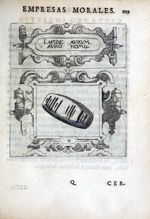
Lapide aurum, auro homo: Borja, Empresas morales (Bruxelles, 1680), emblem 54 paraphrases the adage and uses its imagery
Iconclass: 25D13(GOLD) minerals and metals: gold 48C34(TOUCH-STONE) tools, implements of craftsman: touch-stone 51B2 Similarity, Likeness 57B Judgment of Conduct
Collectanea (1500): 33
II iv 52 Cave Thoracem Beware of Thorax
Φύλαττε τὸν θώρακα. id est, Cave Thoracem. Strabo lib. Geographiae xiiii. scribit, fluvium esse nomine Letheum vicinum Libybus Hesperiis: huic imminere montem cui nomen Thorax, in quo fama est Daphitam grammaticum cruci suffixum fuisse, quod maledico carmine reges incessivisset: unde dictum illud manarit in vulgus, ut dicerent, φύλαττε τὸν Θώρακα, id est, Cave à Thorace. Hoc velut aenigmate proverbiali festiviter admonebimus, frenandam esse linguam, ne voces petulanter emissae, per iugulum aliquando redeant. Stephanus tantum indicat Thoracem esse civitatem Aetoliae, & item Magnesiae, de proverbio silet.
Φύλαττε τὸν θώρακα, Beware of Thorax. Strabo in book 14 of his Geography says there is a river called Letheum in the neighbourhood of the Western Libyans, and that over it hangs a hill called Mount Thorax, the scene (according to the story) of the crucifixion of Daphitas, a schoolteacher who had attacked the kings in a scandalous poem. Hence the phrase passed into common speech 'Beware of Thorax.' This riddling proverb will provide a light-hearted way of warning someone that he had better bridle his tongue, for fear that words impetuously uttered may one day cut his own throat. Stephanus only informs us that Thorax is a city in Aetolia, with another one in Magnesia, and says nothing about the proverb.
Facsimile:
Iconclass: 25H1121 mountain-top, peak 33B11 mocking, insulting; teasing 44G321(CROSS) instruments of torture, execution or punishment: cross 49B24(+3) teacher and pupil (+ teacher, professor) 57BB22 Insult; 'Ingiuria', 'Offesa' (Ripa) 61D(THORAX) geographical names of countries, regions, mountains, rivers, etc. (THORAX) (THORAX) 98B(DAPHITAS) male persons from classical history (DAPHITAS)
Loci Communes: Discriminis (Danger, crisis, Danger)
II iv 53 Abdera pulcra Teiorum colonia Abdera, lovely colony of Teos
Strabo lib. Geographiae xiiii. tradit Teios cum Persarum contumelias ferre non possent, urbe relicta, Abdera Thracum urbem demigrasse. Atque hinc illud vulgatum fuisse, Αβδηρα καλὴ τηΐων ἀποικία. id est, Abdera pulchra Teíûm colonia. Hoc aenigmate proverbiali significamus, non deesse quò confugiamus, si quis praeter modum pergat esse molestus. Huc fortassis allusit M. Tullius lib. Epistolarum ad Atticum septimo, quod imperium habeam, id est ἀβδηριτικόν. Et libro quarto: hic Abdera non tacente me. Dices, Tamen tu non quiescis? Ignosce, vix possum. Laudantur et ab Herodoto libro primo, Teii, quod relicta patria libertatem servarint. cuius rei meminit &Strabo libro decimoquarto, non silens obiter de proverbio, quanquam Aldina aeditio illic depra vata est, ut in multis aliis locis. Ioachimus Vadianus meus, mir iuxta candidus ac doctus, existimat convenire proverbium, ubi quis fortunam tenuem, sed com libertate coniunctam anteponit amplis opibus, sed obnoxiis servituti. Cuius sententiae non refragor. Nam damnatus est Abderitarum aer, & item pascua.
Strabo tells us in book 14 of his Geography how the people of Teos, unable to endure the humiliation they suffered from the Persians, abandoned their city and moved to Abdera, a town in Thrace. Hence he says came the current phrase 'Abdera, lovely colony of Teos.' We can use this riddling proverb to indicate that we are not devoid of a place of retreat if anyone continues to cause trouble beyond all reason. It was perhaps to this that Cicero alluded in book 7 of his Letters to Atticus: 'Because I hold a military command; this is pure Abdera.' And in book 4: 'Here it was pure Abdera, nor did I keep my mouth shut. You will say Can't you be quiet even now? I'm sorry; I hardly can.' Herodotus also praises the people of Teos in his first book for having preserved their liberty at the price of abandoning their fatherland. This comes also in Strabo, book 14, nor does he fail to speak of the proverb in passing, although the Aldine text is corrupt at this point, as in many other places. My friend Joachim Vadianus, a man as upright as he is learned, thinks the proverb will be apposite when someone prefers a modest position in life coupled with liberty to great wealth which brings servitude with it. Nor do I reject his opinion; for the climate of Abdera was objectionable and their pastures poor.
II iv 54 Magna civitas, magna solitudo A great city, a great solitude
Strabo Geographiae lib. xvi. Seleuciam ad Tigrim ait, Babylone maiorem fuisse, sed pleraque sui parte desertam, ac iure optimo de illa dici posse, quod de Megalopoli Arcadiae civitate dixit comicus quispiam: Ερημία μεγάλ᾽ ἠστὶν ἡ μεγάλη πόλις. id est, Est magna solitudo, magna civitas. Allusum est ad nomen urbis, cuius meminit & Plinius in iiii. Quadrabit in urbes, aut domos, agros, aut hortos, aut aliud id genus quippiam, amplum quidem & spaciosum, sed parum excultum. Aut in librum ingentem quidem illum, verum impolitum & illimatum.
Strabo in book 16 of his Geography says that Seleucia on the Tigris was larger than Babylon, but in great part deserted, and that one could fairly say of it what some writer of comedies said of Megalopolis the city in Arcadia: 'A great solitude is the great city.' There is a play on words here with the city's name, which is also mentioned by Pliny in book 4. This will be appropriate for any city or for houses, fields and gardens or other things of the kind, which are large and spacious, but not properly occupied or tilled; or to a book which is long enough in all conscience but lacks elegance and polish.
Facsimile: 
Iconclass: 25I1 city-view in general; 'veduta' 46A2219 depopulation of cities, urban depopulation 51G1 Largeness, Magnitude 59AA1 Loneliness; 'Solitudine' (Ripa) 61E(MEGALOPOLIS) names of cities and villages (MEGALOPOLIS) 61E(SELEUCIA) names of cities and villages (SELEUCIA)
Loci Communes: Mira nova (Wonderful new things, Choses nouvelles et étonnantes)
II iv 55 Ad scolon nec proficisceris ipse nec alterum comitaberis You will not go to Scolon, either alone or with someone else
Strabo lib. Geographiae nono scribit, Scolon vicum esse quempiam Asopiae sub monte Citherone, sedem inamoenam, incultam, infrugiferam, asperam. Atque hinc vulgo proverbium manasse, Εἰς Σκῶλον μήτ᾽ αὐτὸς ἴμεν, μήτ᾽ ἄλλῳ ἕπεσθαι. id est: Nec per te Scolon ipse, nec ulli alii comes ito. Refert eadem totidem verbi Eustathius in Boeotiam Homericam. Nam Scolon & Stephanus ponit in Boeotia. Nomen ex re videtur inditum, σκῶλος enim Graecis spinae genus est. Quo proverbio conveniet uti, si quando significabimus modis omnibus abstinendum à convictu cuiuspiam, aut à loco ubi nihil sit sperandum, quod vel ad voluptatem faciat, vel ad emolumentum.
Strabo in book 9 of his Geography writes that Scolon is a village in Asopa under Mount Cithaeron, an unattractive place, uncultivated, infertile and rugged, and that this gave rise to a current proverb: 'Go not to Scolon yourself nor yet with another companion.' This is given in the same words by Eustathius in his commentary on Homer's account of Boeotia. Stephanus too puts Scolon in Boeotia. The name looks to be derived from the facts, for skôlos in Greek means a kind of thorn. This proverb will be suitable for use when we wish to convey that all possible steps should be taken to avoid the society of someone or the need to visit a place where there is no hope of enjoyment or advantage.
Facsimile:
Iconclass: 56FF13 (Feeling of) Repulsion 58AA3 Unproductiveness, Fruitlessness, Lost Labour, Wasted Labour 61E(SCOLON) names of cities and villages (SCOLON)
Loci Communes: Discriminis (Danger, crisis, Danger)
II iv 56 Oenoë charadram Oenoë and the ravine
Οἰνόη τὴν χαράδραν, id est, Oenoe torrentis alveum. Nam charadra Graecis significat eam terrae fissuram, quam aqua pluvia, aut torrens, nonnunquam torraemotus efficit. Zenodotus in collectaneis adagiorum ait, dici solitum in eos qui sibi malum accerserent. Hinc esse natam paroemiam, quod Oenoe vicus quidam sic Atticae, quem qui incolebant, alveum quendam torrentis vicinum, suis finibus incluserunt. Deinde, ingruente immodica vi aquarum, & ob id corruptis agris, agricolationem perdidisse. Strabo Geographiae lib. viii. duas Oenoas commemorat, alteram Eleutheris finitimam, alteram apud Marathonem, de qua vulgo iactata paroemia, οἰνόν τὴν χαράδραν, id est, Oenoe charadram. Effertur adagium ad hunc quoque modum, οἰναῖοι τὴν χαράδραν, id est, Oenaei charadram, ubi quippiam accersitur ad commoditatem, unde pernicies adfertur. Hesychius hoc proverbium refert & explicat ex Demone proverbiorum autore. Stephanus indicat Oenoem esse unam duarum civitatum quas habet lcaria. Unde dicuntur Oenaei.
Οἰνόη τὴν χαράδραν, Oenoe and the bed of the torrent. Charadra in Greek means the sort of cleft in the ground that is made by torrential rains or a torrent or sometimes by an earthquake. Zenodotus in his collection of adages says that it was used of those who bring misfortunes on themselves, and arose from Oenoe, a village in Attica, the inhabitants of which included in their territory the bed of a neighbouring torrent. There were then serious floods which ruined their fields, and so, he says, they lost their farmland. Strabo in book 8 of his Geography tells of two places called Oenoe, one close to Eleutherae and the other near Marathon, which gave rise to the common proverb Oenoe and the ravine. The adage is also used in the form The Oenaeans and the ravine, when something is acquired with a view to profit and results in a loss. Hesychius records and explains this proverb out of Demon, the authority on proverbs. Stephanus says that Oenoe is one of the two cities in Icaria, and the inhabitants are called Oenaeans.
Facsimile:
Iconclass: 25H1122 ravine, chasm, abyss, canyon 58AA12 Self-destruction 61E(OENOE) names of cities and villages (OENOE)
Loci Communes: Malum accersitum aut retortum (Evil brought upon oneself or turned back, Mal attiré ou retourné)
II iv 57 Nihil ad Bacchum What has this to do with Bacchus?
Οὐδὲν πρὸς δίονυσον, id est. Nihil ad Bacchum. Ubi quis ea nugatur quae ad rem praesentem nihil attinent. Adagionis origo varia traditur. Zenodotus ait, antiquitus in choris Dithyrambos in Bacchum cani solitos. Deinde poetas mutata consuetudine, Aiaces, Centauros, atque id genus fabulas coepisse describere. Proinde spectatores per risum acclamasse, Nihil ad Bacchum. Quo convicio moniti, deinceps satyros inducere coeperunt, ne dei prorsus obliti viderentur. Strabo Geographiae suae lib. viii. scribit eversa funditus à Romanis, propter violatos legatos, Corinthiorum urbe, milites in opera quoque nobilia, quibus ea civitas praeter caeteras abundabat, ludibriis insultasse. Citatque testem Polybium, qui praedicet praesentem vidisse sese, tabulas quasdam abiectas in solum, in quibus milites talis luserint. Quarum una fuit ab Aristide depicta. Argumentum erat Bacchus. Hinc, inquit, quidam aiunt manasse, quod proverbio dicitur, οὐδὲν πρὸς τὸν δίονυσον. id est, Nihil ad Bacchum. Suidas refert Epigenem quendam Sicyonium tragoediam de Baccho conscripsisse, quae cum indigna deo videretur, quosdam è spectatoribus acclamasse, Nihil ad Bacchum, eamque vocem in proverbium abiisse. Verum magis approbat eorum sententiam, qui dicunt quondam poetas de Baccho fabularum argumenta consuesse tractare, eaque demum actitari solita. Deinde paulatim ad tragoedias scribendas conversos, alias fabulas & historias scriptitasse, praetermissa Bacchi mentione: spectatores igitur acclamasse, Nihil ad Bacchum. Eiusque fermè sententiae suffragator citat Chamaeleontem. Huic opinioni astruit Plutarchus in i. lib. Symposiacon, ostendens ab Aeschylo & Phrynicho natam paroemiam, qui fabularum argumenta ad historias & calamitates deflexerint. At Theaetetus apud eundem Suidam, in opere de proverbio, scribit Parrhasium pictorem, Bacchum summa arte finxisse. Itaque cum apud Corinthios pictorum inter ipsos de arte certamen ageretur, & complures Bacchum pictum proferrent, quorum nullus ad Parrhasii Bacchum accederet, succlamasse populum, Nihil ad Bacchum. Apud eundem, quidam cum Coroebum, Ulyssem illum vafrum & versipellem vocasset, audiit: Canem adducis ad praesepe, & nihil adfers ad Bacchum. Utroque proverbio significatum est, nimis inaequalem esse comparationem Coroebi cum Ulysse. Lucian. in Baccho, ἀλλὰ τί πρὸς τὸν δίονυσον οὖτος ὁ δίονυσος, εἴποι τίς ἂν. id est, Sed dixerit quispiam, quid ad Bacchum hic Bacchus? id est, quid ad rem propositam pertinet haec de Baccho fabula? Itaque videtur adagium quadraturum, vel de re ab instituto aliena, vel multo inferiore, vel contemnenda. Plutarchus in Symposiacarum quaestionum prima, de iis agens, qui anxios syllogismos, velut eum quem κυριέυοντα vocant, in poculis proponere solent, τί ταῦτα, inquit, πρὸς τὸν δίονυσον;. Idem inibi, Πέμψω δὲ καὶ τὰ λοιπὰ ταχέως, ἂν ταῦτα δόξῃ μὴ παντελῶς ἄμουσα μηδὲ ἀπροσδίονυσα εἶναι. id est, Mittam autem propediem & reliqua, si quidem haec videbuntur non usquequaque inscita, neque nihil ad Bacchum pertinentia. Nove quidem, sed tamen oppido quàm eleganter dixit, ἀπροσδίονυσα, tacite alludens ad proverbium. Significat autem, οὐκ ἀπροσδίονυσα, non aspernanda, & ad rem pertinentia. Idem in eiusdem operis libro quarto, Οἷμαι δὲ καὶ τῶν σαββάτων ἑορτὴν μὴ παντάπασιν ἀπροσδίονυσον εἶναι, id est, Arbitror autem nec sabbathorum festum, nihil prorsus ad Bacchum pertinere. Athenaeus libro undecimo, ἀπροσδιονύσους λύσεις πραγματεύομενος, id est, Solutiones nihil ad rem pertinentes moliens: tertio, πάραυλα μέλη dixit, modos non respondentes ad tibiam. Ac mox ἀκρότητα κύμβαλα, hoc est, cymbala non congruentia ad numeros saltationis. Sic enim vocat sermones in tempestivos, aut nihil ad rem pertinentes, quos idem ἀμουσολογίας vocat. De huius formae proverbiis dictum est nobis aliàs: Nihil ad versum. Pindarus in Nemeis, παρὰ μέλος ἔρχεσθαι, dixit pro eo quod erat secus quam convenit loqui, μαθὼν δέτις ἂν ἐρεῖ, παρ᾽ μέλος ἔρχομαι. M. Tullius libro ad Atticum xvi. Sed nihil tam ἀπροσδίονυσον mihi primo videbatur, quam ad has literas, quibus ego à te consilium petieram, te mihi illa rescribere. Tametsi quidam hoc loco pro ἀπροσδίονυσον legunt ἀπροσδόκητον, hoc est, inopinatum, inexpectatum. Proverbri speciem habet quod est apud eundem Ciceronem in Bruto, Sed domum redeamus: Id velut interpretans subicit, id est, ad nostros revertamur. Utimur & hodie sermonis huius colore, quoties significamus nos à digressione ad id reverti, quod institueramus.
Οὐδὲν πρὸς Δίονυσον, What has this to do with Bacchus?, is used when someone brings forward trifles which have nothing to do with the matter in hand. The origin of the adage is given in several forms. Zenodotus says that in ancient times it was the custom for choirs to sing dithyrambs in honour of Bacchus. The poets then changed their practice, and began to describe such characters as Ajax and the Centaurs and other fables of the kind; whereupon the spectators shouted in mockery 'What has this to do with Bacchus?' So they learned from this hostile reception, and thereafter brought satyrs onto the scene, to show that they had not forgotten the god altogether. Strabo in book 8 of his Geography writes that when the city of Corinth was completely destroyed by the Romans in return for violence offered to their representatives, the soldiers also showed their contempt for some of the famous works of art in which the city was exceptionally rich; and he cites the evidence of Polybius, who says he was present in person and saw certain pictures thrown on the ground, and the soldiers playing at knuckle-bones on them. One of these was painted by Aristides, and the subject was Bacchus; and this, he says, was according to some people the origin of that phrase which has become proverbial, What has this to do with Bacchus? Suidas records that a certain Epigenes of Sicyon wrote a tragedy about Bacchus, which was thought beneath the dignity of the god, so that some of the spectators shouted 'What has this to do with Bacchus?'; and this phrase passed into a proverb. But he prefers the opinion of those who say that at one time poets used to treat of stories about Bacchus as themes for their plays, and nothing else appeared regularly on the stage. Turning gradually to the writing of tragedies, they wrote of other plots and incidents, making no mention of Bacchus, with the result that the spectators shouted What has this to do with Bacchus? As a supporter of this opinion or something like it, he cites Chamaeleo.
This opinion has the support of Plutarch in the first book of his 'Table-talk,' where he shows that the proverb took its rise with Aeschylus and Phrynichus, who diverted the plots of their plays to historical events and great misfortunes. But Theaetetus, also quoted by Suidas, in his work on the proverb, writes that Parrhasius the painter produced a Bacchus with consummate art; and when there was a competition between painters in Corinth, and several of them produced pictures of Bacchus, none of which came near the Bacchus by Parrhasius, the public shouted 'Nothing to the Bacchus.' The same authority tells us that when someone had called Coroebus 'that cunning and shifty Ulysses,' the reply was 'You bring a dog to the manger, and produce nothing to do with Bacchus.' Both proverbs were meant to convey that the comparison of Coroebus with Ulysses was too unequal. Lucian in his Bacchus: 'But someone will say, What has this Bacchus to do with Bacchus?' meaning, what relevance has this story about Bacchus to the subject on which we are engaged? It seems therefore that this adage will be applicable to things which are either off the point or much inferior or despicable. Plutarch in the first question of his 'Table-Talk,' speaking of those who introduce pedantic logical discussions, such as what they call the 'master' syllogism, into conversation over the wine, asks 'What have such things to do with Bacchus?' Again in the same work: 'I shall soon send you the rest, if you do not think this entirely pointless and irrelevant to Bacchus.' He uses a new, but extremely neat, word, aprosdionyson, irrelevant to Bacchus, in a tacit allusion to our proverb; for 'not irrelevant to Bacchus' means something not contemptible and relevant to the subject. Plutarch again in book 4 of the same work: 'And I think that even the feast of the sabbath is not entirely irrelevant to Bacchus.' Athenaeus in book 11: 'Busying himself with solutions which are irrelevant to Bacchus'; in book 3 'songs out of tune' and a little further on 'cymbals not struck in unison with the dance.' In the words he denotes remarks which are ill-timed or irrelevant; and for these he has another word, amousologia, language which is inelegant, unblessed by the Muses. On proverbs of this form I have said something elsewhere under Nihil ad versum. Pindar in the Nemeans has 'to move out of step with the music' for the use of unsuitable language: 'He who knows will say whether I move out of step with the music.' Cicero in book 16 of the Letters to Atticus: 'But nothing at first sight seemed to me so irrelevant to Bacchus as that you should reply in those terms to a letter in which I had asked your advice.' Though for aprosdionyson in this passage some people read aprosdokêton, unexpected.
There is an air of proverb about another phrase which also occurs in Cicero, in the Brutus: 'But let us turn towards home;' to which he adds, as though explaining the phrase, 'Let us return to our own people.' Even today we use a very similar image, when we wish to convey that we are returning from a digression to the subject with which we started.
Facsimile: 
Iconclass: 48C85 theatre, theatrical performance 51BB1 Absoluteness, Non-relatedness 51BB2 Dissimilarity, Unlikeness 52BB53 Nonsense, Absurdity 92L1 (story of) Bacchus (Dionysus), Liber
Loci Communes: Aliena a re (Irrelevant to the matter, Étranger au sujet); Dissimilitudinis et incongruentiae (Dissimilarity and incongruity, Dissemblance et incongruité)
II iv 58 Farcire centones To stuff a patchwork coat
Periphanes in Epidico Plautina, militi iam pugnas militari more paranti narrare: Quin tu, inquit, alium quaeras, cui centones farcias. id est, quem tu gloriosis mendaciis & consarcinatis fabulamentis expleas. Solent enim homines gloriosi mendacium aliud ex alio connectere, nullum facientes neque finem neque modum. Centones autem dicuntur vestes è variis panniculis, ac diversis etiam interdum coloribus consarcinatae. Iuvenalis: Intravit calidum veteri contone lupanar. Ad harum similitudinem centonem vocant carminis genus, ex diversis carminibus, et carminum fragmentis, hinc atque illinc accersitis, contextum, quasique consutum, Graeci κέντρωνας appellant, addita litera, quam abiiciunt Latini. Extant adhuc ὁμηροκέντρωνες, quorum meminit & divus Hieronymus, & Virgiliocentones Probae mulieris, & Centon nuptialis Ausonii, qui legem etiam eius carminis tradit.
Periphanes in the Epidicus of Plautus, when the soldier is preparing to recount the story of his battles, as soldiers will, observes 'Can't you find someone else for whom to stuff a patchwork coat?' meaning, whom you can fill to the full with your boasting and your lies and your patchwork of tall stories. Boastful men have a habit of stitching together a whole string of lies, with no end and no moderation. Centones, patchwork coats, are garments stitched together from various bits and pieces, sometimes of quite different colours. Juvenal: 'Entered the fetid brother in an ancient patchwork coat.' The analogy of these garments has given us the word 'cento' for a kind of poem made up of different poems and fragments of poems collected from many different sources and as it were stitched together. In Greek the word is kentrôn, with one extra letter which Latin rejects. There still exist the Homeric centos, referred to also by St Jerome, and the Virgilian cento of a woman called Proba, and the Cento nuptialis of Ausonius, who also lays down the principle of this kind of composition.
Facsimile:
Iconclass: 41D212 coat, cape 47H55 patchwork 57AA6221 Lie; 'Bugia' (Ripa) 57AA645 Boast; 'Iattanza' (Ripa)
Collectanea (1500): 80
Loci Communes: Garrulitas (Talkativeness, Bavardage); Mixta (Mixed things, Choses mêlées)
II iv 59 Quod dedi, datum nollem I'm sorry I gave what I did
Lena Milenis in Cistellaria Plautina: Inter novam rem, inquit, verbum usurpabo vetus: Quod dedi, non datum vellem: quod reliquum est, non dabo. Significat se poenitere, quod puellae fecerit copiam, de caetero non facturam. Usus adagii fiet venustior, si paulo longius à simplici figura detorqueatur, veluti si quis indicans se superioris operae, quam in poetices studium insumpserit, poenitere, nec esse consilii diutius in ea tempus terere, dicat: Quod dedi, datum nollem: quod reliquum est, non dabo.
'In this new business,' says Milenis, the bawd in Plautus' Cistellaria, 'the old saying will serve my turn: "I'm sorry I gave what I did; what's left, I will not give."' She means that she regrets having made the girl available, and will not do so in future. In practice the adage will be more elegant if diverted some little distance from the natural meaning of the phrase; for example, if someone wishes to convey his regret for the efforts he devoted in the past to a passion for verse-writing, and his intention to waste no more time on it, he might say 'I'm sorry I gave what I did; what's left I will not give.'
Facsimile:
Iconclass: 33A4 bringing gifts; exchanging gifts 55C2 Giving 55CC1 Saving, Frugality, Parsimony; 'Parsimonia' (Ripa)
Collectanea (1500): 77
Loci Communes: Sera paenitentia (Late repentance, Repentir tardif)
II iv 60 Crocodili lachrymae Crocodile tears
Κροκοδείλου δάκρυα, i. Crocodili lachrymae. De iis qui sese simulant graviter angi incommodo cuiuspiam, cui perniciem attulerint ipsi, cuíve magnum aliquod malum moliantur. Sunt qui scribant, Crocodilum conspecto procul homine, lachrymas emittere, atque eundem mox devorare. Cuiusmodi propemodum erant lachrymae Bassiani imperatoris, apud Aelium Spartianum. Lachrymabatur quoties aut mentio fieret, aut imagines videret Getae fratris, quem occiderat. Alii narrant hanc esse crocodili naturam, ut cum fame stimulatur, & insidias machinatur, os hausta impleat aqua, quam effundit in semita qua novit aut alia quaepiam animantia aut homines aquarum venturos, quo lapsos ob lubricum descensum, neque valentes aufugere, corripiat, correptosque devoret. Deinde reliquo devorato corpore, caput lachrymis effusis macerat, itaque devorat hoc quoque.
Κροκοδείλου δάκρυα, Crocodile tears, is used of those who pretend to be deeply affected by the distress of anyone for whose destruction they are themselves responsible or for whom they are planning some great disaster. Some writers tell us that when the crocodile sees a man in the distance, it sheds tears before proceding to eat him. This is very close to the tears of the emperor Bassianus, of which Aelius Spartianus tells, who wept whenever he heard the name or saw a likeness of his brother Geta, whom he had put to death. Others relate that it is the natural habit of a crocodile, when roused by hunger and planning some treacherous attack, to fill its mouth with water, which it sprays over the path by which it knows that other animals, or men, will come down to drink; the plan being that, when they have fallen on the slippery descent, and cannot make their escape, it will seize and devour them. Then, when it has eaten the rest of the body, it softens the head by shedding tears on it, and eats that too.
Facsimile: 
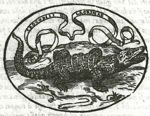
Crocodili lachrimae: Giovio, Dialogo dell' Imprese (Lyon, 1574), emblem 78
Inversus crocodilus amor: Vaenius, Amorum emblemata (Antwerp, 1608), emblem 109
Diffidendum: Schoonhovius, Emblemata (Gouda, 1618),emblem 39
Iconclass: 25F43(CROCODILE)(+47) crocodiles: crocodile (+ animal psychology) 31B62141 tears 57AA611 Dissimulation, Hypocrisy; 'Hippocresia', 'Simulatione' (Ripa)
Loci Communes: Simulatio, dissimulatio (Pretense, dissimulation, Simulation, dissimulation)
II iv 61 Bona est etiam offa post panem After bread barley-cake too is not a bad thing
Αναθὴ καὶ μάζα μετ᾽ ἄρτον. id est: Et post panes bona maza est. Hemistichion carminis heroici. Zenodotus ait de iis solere dici, qui penuria meliorum amplectuntur deteriora. Nam maza quiddam est pane cocto deterius, conflatum ex lacte & farina, quo rustici vice panis uti consueverunt. Siquidem ὀπτὸν ἀλευρὸν, in deliciis olim fuisse aliàs demonstravimus ex Theocrito. Proverbii speciem habet quod est apud Athenaeum lib. vi. licet huic dissimile, πεινῶντι γὰρ ἀνδρὶ μὰζα τιμιωτέρα χρυσοῦτε κᾀλέφαντος. id est, Maza sive offa esurienti homini charior & auro & ebore. Quo licebit uti cum indicabimus, rem usu, non opinione aestimandam. Ex his quae prodidit Athenaeus de apparatu conviviorum, liquet, mazam prins apponi solere, deinde panem. Verum consumpto pane, probatur et maza. Ut possumus, quando, ut volumus, non licer. Xenophn libro sexto paidei/as2, facit quendam eonsolante! milites, qui defecti pane, maza vesci cogebantur. Hoc cibo qui victitant, dicuntur a)lfitositei=n, quem admodum, qui pant, a)rtos1itei=n.
Ἁναθὴ καὶ μάζα μετ᾽ ἄρτον, After bread barley-cake too is no bad thing. (The Greek is half of an epic hexameter.) Zenodotus says it is customarily used of those who for want of better are content with worse. For maza or barley-cake is a substance made up of milk and meal and inferior to baker's bread, which is often used in place of bread by country people, bread baked with wheaten flour being in the old days a luxury, as I have shown elsewhere on the evidence of Theocritus. There is a phrase in Athenaeus, book 6, which has the look of a proverb, although unlike ours: To a hungry man barley-cake is more precious than gold and ivory.' We can use this when we wish to convey that things must be judged by practical use, not by common report. From the account given by Athenaeus of the organization of a dinner-party, it is clear that barley-cakes used to be served first, and bread later. Yet when the bread is all eaten, barley-cakes are acceptable: 'as best we can, since as we would we may not.' Xenophon in book 6 of the Cyropaideia describes someone encouraging troops whose bread-supply had failed, so that they were compelled to live on barley-cake; for living on barley-cake there is a word alphitositein, while living on bread is artositein.
Facsimile:
Iconclass: 41C621 bread, loaf 51EE2 Inferiority 56B3 Satisfaction, Contentment; 'Contento' (Ripa)
Loci Communes: Proximis utendum (One must make use of one's neighbors, Il faut se servir de son prochain)
II iv 62 Si non adsunt carnes, taricho contentos esse oportet Those who have no meat must make do with salt fish
Αν μὴ παρῇ κρέα, στερκτέον τῷ ταρίχῳ. id est: Probanda salsamenta egenti carnium. Sunt qui dicant, τάριχον accipi pro pisce, sed vili putrique, qui idem sit Aphya: fortassis hic pro iure accipiendum tarichus. Nam quibus deest obsonium, solent pane in ius immerso vesci. In aphyas & tarichos creber iocus est in comoediis. Sensus hic est, ubi non est copia meliorum, boni consulere oportet, quaecunque contingunt. Refertur à Diogeniano.
Ἂν μὴ παρῇ κρέα, στερκτέον τῷ ταρίχῳ, He that lacks meat, salt fish must serve his turn. Some say that tarichos here is the name of a fish, but a cheap one already rotten, which is to be identified with the anchovy. Perhaps tarichos here should be taken to mean soup; for those who are short of anything tasty to eat with their bread often dip it in soup. Jokes about anchovy and tarichos of various kinds are very common in Greek comedy. The point here is that when better things are in short supply, one ought to be content with what one may have. Recorded by Diogenianus.
Facsimile:
Iconclass: 41C681:41C661 seafood❧salt 41C692 kinds of meat 54A47 Peace of Mind, 'Aequitas' 56B3 Satisfaction, Contentment; 'Contento' (Ripa)
Loci Communes: Proximis utendum (One must make use of one's neighbors, Il faut se servir de son prochain)
II iv 63 Agathonis cantio Agathon's tune
Αγαθώνιος αὔλησις. i. Agathonia cantio. Recte dicetur de oratione blanda magis, quam frugifera. Agathon tibicen quispiam erat, cantilenarum suavitate maiorem in modum aures deliniens. Nec huius mores dissimiles musicae fuisse perhibentur. Laboravit enim infamia molliciei. Auctor & Suidas & Zenodotus Haud scio an hic sit idem ille Agathon in tragicorum certamine victor, in cuius epiniciis Plato celebrat illud nobile convivium. Huius multis modis Aristophanes in Thesmophoriis, carminum molliciem deridet.
Ἀγαθώνιος αὔλησις, Agathon's tune, will be used correctly of a speech that has more charm than solid matter in it. Agathon was a flute-player whose melodies were more than usually sweet and pleasant to the ear. Nor did his character belie his music, since he had a dubious reputation for effeminacy. Our authorities are both Suidas and Zenodotus. He should perhaps be identified with the well-known Agathon, whose victory in the competition for tragedies inspired the famous party of which Plato tells. Aristophanes in the Thesmophoria finds many ways of ridiculing the effeminacy of his verses.
Facsimile:
Iconclass: 31A719 womanish man, molly-coddle, milksop 31A721 femininity 48C7351 flute, aulos, tibia 48C7525 one person playing wind instrument 56:51GG4(+0) Emotion❧Softness (matter) (+ variant) 98B(AGATHON) male persons from classical history (AGATHON)
Loci Communes: Intemperantia, libido (Intemperance, lust, Intempérance, désir)
II iv 64 Edax currus Greedy as a racing-car
Αδδηφάγον ἅρμα, i. Edax currus, in glutones & voraces dicebatur, propterea quod currus multum absumit unguinis sive ceromatis: sive quod sumptuosa res sit, equos & currus alere. unde & comicus Aristophanes in Nebulis iocatur in Strepsiadem, quem filius ἱπποτροφῶν, ad inopiam redegerat, multo aere alieno contracto. Flavius Vopiscus indicat, Aureliano in deliciis fuisse Phagonem quendam, qui uno die ad mensam imperatoris ederit aprum integrum, centum panes, vervecem & porcellum, biberit autem in fundibulo apposito plus orca. Sed de hoc hominum genere plura Athenaeus in Dipnosophistis, apud quem lib. v. Socrates quum quendam vidisset in convivio sese intemperantius ingurgitantem opsonio, O vos qui adestis, inquit, quidam ex vobis pane utitur ut opsonio, opsonio ut pane. Venustius reddetur, si deflexeris ad animi vitium, veluti si dicas, huius aut illius principis amicitiam immodica pecunia parari ac retineri, alique. aut, cupiditates inexplebiles esse, cum naturae usus perpauca postulet.
Αδδηφάγον ἅρμα, Greedy as a racing-car, was used of gluttons and spendthrifts, because a chariot is very wasteful of oil and grease, or because to keep a chariot and horses runs away with the money. Hence the joke made by Aristophanes the comic poet in the Clouds against Strepsiades, whom his son had reduced to beggary through a passion for horseflesh by contracting enormous debts. Flavius Vopiscus tells us that Aurelian had a favourite called Phagon, who in one day at the emperor's table ate a whole wild boar, a hundred loaves of bread, a sheep and a sucking-pig, and drank more than a firkin of wine straight out of the dipping ladle. But on men of this type there is more in Athenaeus' Doctors at Dinner. He tells us in book 5 that Socrates, seeing someone at a dinner-party stuffing himself with relish, remarked: 'Observe, gentlemen, one of your number who uses bread as his relish and the relish as bread.' This will be made more attractive if you divert it to faults of character; for instance, if you were to say that the friendship of such and such a prince can only be acquired and maintained and fed by heavy outlay, or that men's appetites are inexhaustible though nature's needs are satisifed with very little.
Facsimile:
Iconclass: 32A43 glutton 43C2131 wagon racing (with horses) 55C11 Squandering, Extravagance, Prodigality, Waste; 'Prodigalità' (Ripa) 55CC11 Greed, Covetousness, Cupidity; 'Cupidità' (Ripa)
Loci Communes: Rapacitas et avaritia (Rapacity and greed, Rapacité et avarice)
II iv 65 Sanguine flere To weep tears of blood
Αἵματι κλαίειν, id est, Sanguine flere, proverbialis hyperbole, significans nihil non fieri, quo flectatur aliquis. sic enim antiquitus loquebantur: Haud flectes illum, nec si sanguine quidem fleveris. Itidem αἵματι στένειν, id est, Sanguine gemere. Durat hoc adagium in hodiernum etiam diem. Translatum videtur à prodigiis, quibus interdum statuae sanguineis guttis lachrymare videntur.
Αἵματι κλαίειν, To weep tears of blood, is a proverbial exaggeration, meaning that everything possible is done to persuade someone to relent. They used to say in old days 'You won't make him change his mind even if you weep tears of blood;' and in the same way 'To groan till you bleed.' This adage is still current in our own day. It looks like a metaphor from that form of prodigy in which statues sometimes appear to weep drops of blood.
Facsimile: 
Iconclass: 31B6214 weeping 31B62141:31A22611 tears❧blood 51H4 Plenitude
Loci Communes: Tristitia, laetitia (Sadness, joy, Tristesse, joie)
II iv 66 Pardi mortem adsimulat He shams death like a leopard
Θάνατον παρδάλεως ὑποκρίνεται, id est, Pardi mortem simulat. Dicebatur ubi quis astu perniciem alicui moliretur, veluti cum Brutus stupidum ac dementem ageret, ut in posterum imperio potiretur. Id adagium ad quendam apologum referunt. In Maurusia simiarum ingens copia. Pardalis autem animal est natura simiis infestissimum, quas tamen viribus assequi non potest, nimirum illis in summas arbores subvolantibus. His itaque dolis in eas utitur. Sternit se supinam sub ramis, ac porrectis cruribus emori fingit sese. Gaudent eo spectaculo simiae considentes in arbore. Deinde ubi iam mortuam arbitrantur, unam aliquam emittunt exploraturam, num vere mortuus sit hostis. Illa cautim ac pedetentim accedens, ubi nullum vitae videt argumentum, pardale nimirum modis omnibus cadaveri imitante, demum audet etiam conscendere. Quod simulatque reliquae simiae conspexerint, iam deposito omni metu descendunt, & pardalim omnia ferentem circumsultant: postremo conculcant, insultantes ludibrii causa, donec pardalis sentiens illas iam saltando defatigatas, de repente reviviscens, aliam dentibus, aliam unguibus corripit, dilaniatque ac devorat. Hanc equidem fabulam, ne quid fuci fiat lectori, non reperimus apud idoneum autorem, sed in Graecis collectaneis cuiusdam Apostolii Byzantii, cuius testimonium quodam in loco Politianus etiam adfert, alioquin autoris non admodum gravis.
Θάνατον παρδάλεως ὑποκρίνεται, He shams death like a leopard, was used when someone contrived another man's destruction by a stratagem, as when Brutus pretended to be an idiot and mentally deficient, in order to seize the reins of power later on. This adage is commonly derived from a beast-fable. In Morocco monkeys are extremely common. The leopard is the monkey's natural enemy; but she cannot seize them by force, because of course they scamper up to the treetops. She therefore tricks them like this: she lies on her back under the branches, stretches out her legs and pretends to be dying. The monkeys sitting in the tree see this, and are delighted. Then, when they think she's quite dead, they send down one of their number to find out whether their enemy really is dead. The scout approaches cautiously one step at a time, and when it sees no sign of life (for the leopard gives an expert imitation of a corpse), at length it takes courage and climbs up on her. When the other monkeys see this, they lose all their fear. Down they come; they dance round the leopard (which puts up with anything); and at length trample on her and dance up and down to show their contempt. When she sees that the jumping has tired them out, the leopard all at once comes to life again, seizes one monkey in her teeth and another in her claws, tears them to pieces and gobbles them up. This story (for I must not deceive my readers) I found, not in any proper authority, but in the Greek collections of a certain Apostolius of Byzantium, whose evidence is actually used in one passage by Poliziano, though apart from that he is not a very serious authority.
Facsimile:
Iconclass: 25F22 monkeys, apes 25F23(LEOPARD)(+451) beasts of prey, predatory animals: leopard (+ animal in search of food) 45H13(+0) surprise attack (stratagem) (+ variant) 57AA621 Cheat, Deceit; 'Fraude', 'Inganno' (Ripa)
Loci Communes: Inconstantiae, perfidiae, versutiae (Inconstancy, treachery, cunning, Inconstance, perfidie, ruse)
II iv 67 Mandare laqueum To bid one go hang
Mandare laqueum dicimur iis, quos usqueadeo negligi à nobis significamus, ut si vel suspendant sese, nihil ad nos attineat. luvenalis de Democrito: Cum fortunae ipse minaci Mandaret laqueum, mediumque ostenderet unguem. Confine illi cum iubemus, οἰμώζειν, id est, plorare quempiam, & μακρὰ οικμώξαι, id est, clare plorare, καὶ κλαίειν καὶ μακρὰ χαίρειν, id est, flere & longum valere.
We are said to bid people go hang, when we wish to convey that we have so low an opinion of them, it is a matter of indifference to us if they go so far as to hang themselves. Juvenal says of Democritus: 'When Fortune threatened, he bade her go hang, / showed her his middle fingernail.' It is close to this when we tell a man to go away and howl, or to howl out loud, or bid him 'a long farewell and bad luck to him.'
Facsimile:
Iconclass: 31A22463(+929):57BB21 middle finger, second finger (+ other connotations)❧Contempt 31E2355(+7) violent death by hanging (+ seeking death, suicide) 31E238 seeking death, suicide 52E3 Counsel; 'Consiglio' (Ripa) 54AA21 Indifference 59BB4 Despicableness
Collectanea (1500): 705
Loci Communes: Contemptus et vilitatis (Contempt and worthlessness, Mépris et bassesse)
II iv 68 Medium ostendere digitum To show the middle finger
Medio item digito porrecto, supremum contemptum significabant: Martialis lib. ii. Et digitum porrigito medium. Nam hunc digitum Martialis impudicum vocat: Ostendit digitum, sed impudicum. Persius infamem: Infami digito & lustralibus ante salivis. Huc arbitror pertinere, quod apud Laertium Diogenes, ut alibi diximus, hospitibus quibusdam Demosthenem videre cupientibus, non indice digito, sed medio porrecto demonstravit, parum virum innuens & effoeminatum. Ac paulo post eodem in loco, satis indicat porrectione digiti medii quippiam obscenum significari, cum ait, Insanos haberi, qui medium porrigant digitum: qui indicem, non item. Itaque eodem in carmine duobus adagiis extremum contemptum indicavit Satyricus: Mandaret laqueum, mediumque ostenderet unguem. Elegantius fiet utrunque, si longius detorqueatur: Ut philosophicis praeceptis laqueum mandes, tu tuo vivito more. Et theologorum decretis negociatores medium unguem ostendunt. id est, planè contemnunt, ridentque.
To hold up the middle finger was another way they had of showing supreme contempt. Martial, book 2: 'And hold up your middle finger.' For Martial calls this finger 'shameless:' 'He shows a finger - and his shameless one.' Persius calls it 'infamous:' 'With infamous finger and purifying spittle.' Here, I think, must belong a story in Laertius of which I have spoken elsewhere: how, when some visitors wanted to set eyes on Demosthenes, Diogenes pointed him out by holding up not his forefinger but his middle one, thus suggesting that he was no man and effeminate. A little later in the same passage he makes it quite clear that the outstretched middle finger conveys some obscene symbolism, when he says that those who stretch out the middle finger are thought to be of unsound mind, but that of the forefinger this is not so. So it was two adages in the same line that the satyrist used to express extreme contempt, when he wrote 'Bade her go hang, showed her his middle fingernail.' Both will be more stylish if bent some way from their proper use, for instance Tell the precepts of the philosophers to go hang; live you own life,' and 'Merchants hold up the middle finger at the rulings of divines,' that is, they simply despise and laugh at them.
Facsimile:
Iconclass: 31A22463(+929):57BB21 middle finger, second finger (+ other connotations)❧Contempt
Loci Communes: Contemptus et vilitatis (Contempt and worthlessness, Mépris et bassesse)
II iv 69 Barbam vellere To pull by the beard
Τὸν πώγωνα τίλλειν, id est, Barbam vellere. Est illud quoque sumptum à gestu, barbam vellere, quo summum contemptum ac ludibrium significamus. Horatius Sermonum lib. i. Barbam tibi vellunt. Lascivi pueri. Persius: Idcirco stolidam praebet tibi vellere barbam Iuppiter. Idem aliàs: Si Cynico barbam petulans Nonaria vellit. Et Dionysius Siculus, non dubitavit Aesculapio barbam auream detrahere. Lucianus in Timone de Iove Olympio, ἐκάθησο τοὺς πλοκάμους περικειρόμενος, id est, Desidebas dum tibi circumtonderetur caesaries. Et barbam vellit mortuo leoni, qui ferox est in prostratum: quod aliàs attigimus.
Τὸν πώγωνα τίλλειν, To pull by the beard. This too, To pull by the beard, is derived from a gesture by which we express supreme contempt and scorn. Horace in book 1 of the Satires: 'Impudent schoolboys pull you by the beard.' Persius: 'Is that why Jove offers you his stupid beard to pull?' And again elsewhere: 'If in the carnival / A saucy slave-girl pulls a Cynic's beard.' And Dionysius the Sicilian tyrant had no hesitation about pulling off Aesculapius' golden beard. Lucian in the Timon, or Olympian Jove: 'You sat while they cut your locks.' And To pull the beard of a dead lion, of someone who bodly faces an enemy already prostrate, which I have adduced elsewhere.
Facsimile:
Iconclass: 31A25441:31A534 gripping someone by the hair❧beard 31A2747:31A534 drawing, pulling something❧beard 57BB21 Contempt
Collectanea (1500): 666
Loci Communes: Contemptus et vilitatis (Contempt and worthlessness, Mépris et bassesse)
II iv 70 Malis ferire To pelt with apples
Μήλοις βάλλειν, id est, Malis petere dicuntur, qui muneribus assequi student quod optant; aut qui donis provocant ad amorem mutuum. Ducta est allegoria à fabula Atalantae, quam Hippomenes cursu superavit, sed arte, proiectis inter currendum malis aureis, in quibus sublegendis dum puella subinde remoratur, praecessit ac vicit iuvenis. Refertur adagium à Diogeniano. Plutarchus in Symposiacis indicat olim fuisse morem, ut in eos qui semper vincerent, mala, rosas, nonnulli etiam mala Punica iacerent. Ut hinc quoque videri possit ortum adagium ac dictitatum de iis qui magnopere mirantur ac probant quempiam, aut etiam blandiuntur. Idem decade nona narrat, Anaxarchum cum ab Alexandro post coenam malis peteretur, surrexisse, dixisseque hunc senarium ex Oreste Euripidis, Βεβλήσεται τις θεῶν βροτησίᾳ χερὶ. id est, Ferietur aliquis mox deûm humana manu. Potest & simplicius accipi, malis petere, cum quis ad amandum lacessitur ac provocatur: sic enim interpretatur Suidas. Unde & illud apud Maronem, Malo me Galatea petit lasciva puella. Et, Aurea mala decem misi, cras altera mittam. Et, Ipse ego cana legam tenera lanugine mala. Et Acontius apud Ovidium Cydippae malum inscriptum in gremium mittit. Aristophanes in Nebulis, Μήλῳ βληθεὶς ὑπὸ πορνιδίου, id est, A scorto malo percussus. Interpres adscribit, malum amoris esse symbolum, propterea quod Veneri sit sacrum. Unde in certamine formarum, praemium malum erat aureum, idque Veneri contigit. Theocritus in Cyclope, Ηρατο δ᾽ ῥόδοις, οὐ μάλοις, οὐδὲ κικίνοις, Αλλ᾽ ὀλοαῖς μανίαις. id est, Non malis, non illo rosis, non ille cicinnis, Sed furiis mago pestiferis adamabat. Idem in Hodoeporis, Βάλλει καὶ μάλοισι τὸν Αἰπόλον ἁ Κλεαρίστα. Olim munuscula malis constabant. unde Horatius in Epistolis: Frustis & pomis viduas venentur avaras, Excipiantque senes, quos in vivaria mittant.
Μήλοις βάλλειν, To pelt with apples, is a phrase used of those who try to get what they want in return for gifts, or who give presents to a loved one to arouse love in return. It is an allegory taken from the story of Atalanta, who was beaten in the race by Hippomenes, but only because, as they ran, he cunningly rolled golden apples across her path, and as she stopped from time to time to pick them up, the young man passed her and won. The adage is recorded by Diogenianus. Plutarch in his 'Table-talk' shows that it was a custom in old days to throw apples, roses and sometimes even pomegranates at those who won consistently; so that one might think that this was another source for the adage, and that it was used of those who admire someone very much and think well of him, or even want to curry favour with him. He tells also, in his ninth decade, how Anaxarchus, when he was pelted with apples by Alexander after a dinner-party, rose from table repeating this line from the Orestes of Euripides: 'Some god will soon be struck by human hand.' There is a rather simpler way of taking To pelt with apples, when an attempt is made to secure someone's affections, and an invitation is issued; for that is how Suidas understands it. Hence that line in Virgil 'Galatea, saucy wench, pelts me with apples,' and 'I've sent her ten golden apples, and tomorrow will send ten more,' and 'I will myself pick quinces with their soft silvery down.' And Acontius in Ovid puts an apple with writing on it into Cydippe's lap. Aristophanes in the Clouds: 'When some harlot hits you with an apple.' The scholiast notes that the apple is a symbol of love because it is sacred to Venus. That is why in the beauty-contest the prize was a golden apple, and Venus won it. Theocritus in the Cyclops: 'And he loved not with apples, or roses, or ringlets, but with downright frenzy.' Again in the Wayfarers: 'Clearista pelts the goatherd with apples too.' In the old days apples were sent as presents; hence Horace in the Epistles: 'With scraps and apples greedy widows chase, / And catch old men to store in their reserves.'
Facsimile: 
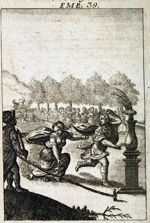
Auro conciliatur amor: [Anonymous], Thronus Cupidinis (Amsterdam, 1620), emblem 15 uses the imagery of Atalante
Fallor in curse: Ayres, Emblems of love (London, 1750), emblem 39 uses the imagery of Atalante
El amor de los asnos entra à coces y a bocados: Cats, Spiegel (The Hague, 1632), emblem 18 uses the imagery of donkeys who start courting by playing roughly; the commentary also quotes an adage about Galatea pelting with apples
Iconclass: 25G21(APPLE) fruits: apple 33C214 presents offered to the beloved 46B911 bribery 59CC221 Corruptibility, Venality, Corruption 94C113(+0) the Judgement of Paris (Mercury present) (+ variant) 95B(ATALANTE)2111 during the foot-race Hippomenes drops the three golden apples; Atalante stops to pick them up, and is thus beaten
Collectanea (1500): 309
Loci Communes: Munerum corruptela (Corruption by gifts, Corruption par les présents)
II iv 71 Mare prius vitem tulerit Sooner will vines grow in the sea
Τὸ πέλαγος πρότερον οἴσει ἄμπελον. id est, Mare prius vitem feret. De iis quae nullo pacto fieri possint, Nam salsitudo vitibus inimicissima: Hinc opinor Homerus & Hesiodus identidem pontum vocant ἀτρύγετον, quod illic nulla colligatur vindemia. Salsa terra ferè sterilis est frugibus, sed vitibus inimicissima. Refertur apud Diogenianum.
Τὸ πέλαγος πρότερον οἴσει ἄμπελον, Sooner will the sea bear vines, of things which could not possibly happen. Salt is quite fatal to vines. This is no doubt why Homer and Hesiod from time to time call the sea 'unvintaged,' because there is no grape-harvest to be gathered there. Salt ground is nearly always barren of crops; to vines it is fatal. Recorded by Diogenianus.
Facsimile:
Iconclass: 25H23 sea (seascape) 52BB42:47I422(+84) Impossibility❧vine (+ harvesting ~ agricultural processes)
Loci Communes: Impossibilia (Impossible things, Choses impossibles)
II iv 72 Betizare. Lachanizare To wilt like beet or salad
Lachanizare vulgo dicebant pro languere, teste Suetonio in vita Octavii Caesaris, pro quo Augustus novavit Betizare. Quadrabit & in insulsos & insipidos. Catullus, Languidior tenera cui pendens sicula beta. Item Martialis, Ut sapiant fatuae fabrorum prandiae betae, O quàm saepe petet vina piperque coquus? Eodem pertinet illud Diogenis Cynici dictum apud Laertium: quum adoloscentes quidam eum canem vocarent, seque cauturos dicerent ne ab illo morderentur, bono animo esse iussit: canem enim haudquaquam vesci betis, mollitiem illorum notans. Bliteos appellant stupidos. Est βλίτον herbae genus, cui nomen etiam à stupore saporis inditum putant, quasi βλὰξ, quae vox bardum & stupidum significat. Aristophanes in Avibus, ὡς βλακικῶς διακονεῖς, Ut stupide ministras. Plautus in Truculento: Blitea & lutea est meretrix, nisi quae sapit in vino, ad rem suam. Laberius Mimographus apud Nonium Marcellum, bipedem & bliteam beluam appellat insulsum & vecordem. Apud Meandrum quoque mariti uxoribus ex blito convitium faciunt, bliteas eas nominantes. Aristophanes in Nebulis, καὶ σε καλοῦσι βλιτὸμαν., id est, Teque vocant bardum ac stultum. Fieri potest ut Gallica quoque vox hinc manarit, qua nunc vulgo contemptissimos, extremaeque notae homines compellant Blitéros, addita litterula.
Lachanizare was a common expression meaning to wilt, to be flabby, as we learn from Suetonius in his life of Octavius Caesar, for which Augustus invented betizare, to wilt like beet. It will be suitable also for dull insipid people. Catullus: 'Whose tool hung flabby as a tender beet.' Martial too: 'That beet, the workman's lunch, may taste at all, / How doth the cook on wine and pepper call!' Laertius quotes a saying of the Cynic philosopher Diogenes to the same effect. Some young men were calling him a dog, and saying they would take good care he did not bite them; and he retorted that they need not worry, for no dog ever ate beet - which showed he thought they were a flabby lot. Bliteus is a word for stupid people, blite being a vegetable which got its name, they say, from its insipid taste, being related to blax which means dull and tedious. Aristophanes in the Birds: 'How sluggishly (blakikôs) you do your job!' Plautus in the Truculentus: 'A girl is tasteless as blite and dull as ditchwater who cannot keep her head and look after herself when she's been drinking.' Laberius the mime-writer, cited by Nonius Marcellus, calls a witless blockhead 'a mere biped, a beast with no more taste than blite.' In Menander too husbands use the same word, blite-like, in abusing their wives. Aristophanes in the Clouds: 'And they call you a blite-like booby.' It is possible that this is also the origin of a French word, now commonly applied to contemptible and worthless characters, bliterus, which has one added letter.
Facsimile:
Iconclass: 41C652(BEET) vegetables (BEET) 41C652(SALAD) vegetables (SALAD) 52AA1 Stupidity, Poverty of Intellect; 'Stupidità overo Stolidità' (Ripa) 54AA11 Sluggishness, Inertia; 'Dapocaggine', 'Pigritia' (Ripa)
Loci Communes: Vehementia, languor (Vehemence, listlessness, Véhémence, langueur)
II iv 73 Promus magis quam condus More spender than saver
Sanè quàm elegans & proverbialis Ausonii dimeter iambicus, Promusque quam con dus magis. in quendam profusiorem, qui parta prodigere nosset, quaerere aut quaesita servare non posset. Sumpta metaphora à rei familiaris dispensatoribus maximeque penuariae, quos Graeci ταμΐας vocant, quorum partes sunt ad usum familiae proferre quaedam, alia condere, hoc est, seponere. Iam qui tantum promit, is ad inopiam velis equisque properat. Plautus in Truculento, parce promos appellat, sordidos ac tenaces, & qui sumptum libenter effugiunt.
There is a remarkably neat and proverbial iambic four-foot line in Ausonius: 'A spender more than a saver,' used of a man of too lavish disposition, who knew how to be generous with what he had, but not how to get more or to keep what he had acquired. The image is taken from stewards in a large household, and especially from the store-keeper, in Greek tamias, whose job is spending, in this context bringing things out of store for the use of the household, and saving, that is, putting other things on one side. The man who only spends is heading full speed for beggary. Plautus in the Truculentus has a word parcepromi, reluctant spenders, for mean and stingy characters and those who do what they can to avoid expense.
Facsimile: 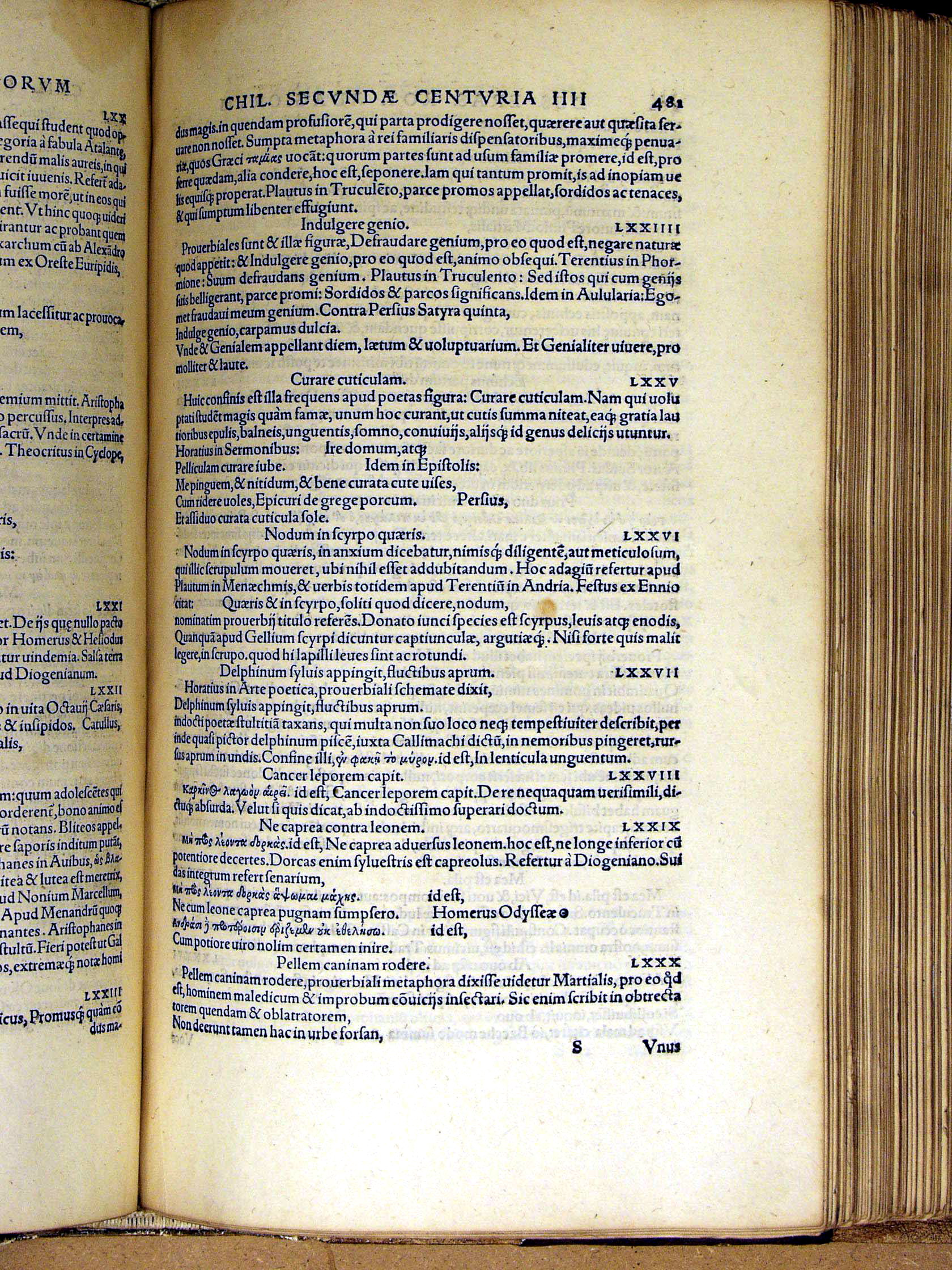
Iconclass: 51AA4:55CC1 Nothingness, Absence❧Saving, Frugality, Parsimony; 'Parsimonia' (Ripa) 55C11 Squandering, Extravagance, Prodigality, Waste; 'Prodigalità' (Ripa) 55C21 Generosity, Liberality; 'Generosità', 'Liberalità' (Ripa)
Collectanea (1500): 708
Loci Communes: Liberalitas (Generosity, Générosité)
II iv 74 Indulgere genio To indulge one's genius
Proverbiales sunt & illae figurae, Defraudare genium, pro eo quod est, negare naturae quod appetit: & Indulgere genio, pro eo quod est, animo obsequi. Terentius in Phormione: Suum defraudans genium. Plautus in Truculent": Sed istos qui cum geniis suis belligerant, parce promi: Sordidos & parcos significans. Idem in Aulularia: Egomet fraudavi meum genium. Contra Persius Satyra quinta, Indulge genio, carpamus dulcia. Unde & Genialem appellant diem, laetum & voluptuarium. Et Genialiter vivere, pro molliter & laute.
There is a touch of the proverb also about phrases like defraudare genium, literally To defraud one's genius, in the sense of denying to one's nature what it needs, and indulgere genio, to indulge one's genius, for doing as one pleases. Terence in the Phormio: 'Defrauding his own genius.' Plautus in the Truculentus: 'But those fellows who are always at war with their own genius, the skinflints,' which indicates 'mean and stingy.' Again in the Aulularia: 'I for my part have defrauded my own genius.' Conversely Persius in his fifth satire: 'Give your genius play; let us take pleasure as it comes.' Hence a day of rejoicing and happiness is called 'genial,' and to live 'genially' means a life of luxury and ease.
Facsimile:
Indulgere iuvat genio: [Anonymous] Nieuwe Jeugdspiegel (s.l. [1617]), emblem 13
Iconclass: 32A7 characters (human types) 55B2 Luxury, Luxuriousness 53BB3 Self-indulgence
Loci Communes: Luxus et mollicies (Luxury and softness, Luxe et mollesse)
II iv 75 Curare cuticulam To cultivate one's dainty skin
Huic confinis est illa frequens apud poetas figura: Curare cuticulam. Nam qui voluptati student magis quàm famae, unum hoc curant, ut cutis summa niteat, eaque gratia lautioribus epulis, balneis, unguentis, somno, conviviis, aliisque id genus deliciis utuntur. Horatius in Sermonibus: Ire domum, atque Pelliculam curare iube. Idem in Epistolis: Me pinguem, & nitidum, & bene curata cute vises, Cum ridere voles, Epicuri de grege porcum. Persius, Et assiduo curata cuticula sole.
Close to this is another metaphor often found in the poets, To cultivate one's dainty skin, Curare cuticulam for those who set more store by their pleasures than their reputation have one aim in view, to have sleek shining skin, and for that purpose they indulge in elaborate dinners, hot baths, perfumes and creams, sleep, drinking-parties and other luxuries of the kind. Horace in the Satires: 'Bid him go home, and cultivate his precious skin.' Again in the Epistles: 'You'll find me fat and sleek with skin in fine condition, when you feel like laughing at a porker from Epicurus' sty.' Persius: 'And your dainty skin cultivated with constant sunning.'
Facsimile:
Iconclass: 54A2:31A2262 Carefulness, Diligence; 'Diligenza' (Ripa)❧skin (human) 55B2 Luxury, Luxuriousness 53BB3 Self-indulgence
Loci Communes: Luxus et mollicies (Luxury and softness, Luxe et mollesse)
II iv 76 Nodum in scyrpo quaeris You seek a knot in a rush
Nodum in scyrpo quaeris, in anxium dicebatur, nimisque diligentem, aut meticulosum, qui illic scrupulum moveret, ubi nihil esset addubitandum. Hoc adagium refertur apud Plautum in Menaechmis, & verbis totidem apud Terentium in Andria. Festus ex Ennio citat: Quaeris & in scyrpo, soliti quod dicere nodum, nominatim proverbii titulo referens. Donato iunci species est scyrpus, levis atque enodis, Quanquam apud Gellium scyrpi dicuntur captiunculae, argutiaeque. Nisi forte quis malit legere, in scrupo. quod hi lapilli laeves sint, ac rotundi.
You seek a knot in a rush used to be said to a meticulous and overconscientious or fussy man, who would raise scruples where there was no reason to hesitate. This adage is recorded by Plautus in the Menaechmi, and in the same words by Terence in the Andria. Festus quotes from Ennius 'And you seek a knot in a bulrush, as men are wont to say,' giving the words expressly as a proverb. Donatus says scyrpus is a kind of reed which is smooth and without joints. Though in Gellius the word is applied to quibbles and playing on words. Unless by any chance one might prefer to read in scrupo, in a pebble, because this sort of small stone is smooth and round.
Facsimile:
Iconclass: 25G4(REED) plants and herbs: reed 31A4114(+0) near-sightedness, myopia (+ variant) 47C421 types of knots 54A211 Scrupulosity; 'Scropolo' (Ripa)
Collectanea (1500): 512
Loci Communes: Curiositas (Curiosity, Curiosité)
II iv 77 Delphinum sylvis appingit, fluctibus aprum Peoples his woods with dolphins, waves with boars
Horatius in Arte poetica, proverbiali schemate dixit, Delphinum sylvis appingit, fluctibus aprum. indocti poetae stultitiam taxans, qui multa non suo loco neque tempestiviter describit, perinde quasi pictor delphinum piscem, iuxta Callimachi dictum, in nemoribus pingeret, rursus aprum in undis. Confine illi, ἐν φακῇ τὸ μύρον, id est, In lenticula unguentum.
Horace in the Art of Poetry uses a proverbial form of words when he writes 'Peoples his woods with dolphins, waves with boards,' criticizing the folly of a bad poet who often describes things in the wrong place or at an inappropriate moment, just like a painter putting (in Callimachus' phrase) a dolphin, which is a kind of fish, into the forest or a wild boar into the waves of the sea. This is close to that other adage, Perfume on the lentils.
Facsimile:
Iconclass: 25F27(DOLPHIN):25H15 swimming mammals: dolphin❧forest, wood 29A1 'mundus inversus', the reversed world, the topsy-turvy world, 'le monde bestourné' 47I2121:25H23 boar (male pig)❧sea (seascape) 52BB42 Impossibility
Loci Communes: Absurda, indecora, seu praepostera (Absurd, unbecoming, or preposterous things, Choses absurdes, inconvenantes ou déplacées); Intempestiva et inepta (Untimely and inept things, Choses inopportunes et ineptes)
II iv 78 Cancer leporem capit The crab catching the hare
Καρκῖνος λαγωὸν αἱρεῖ, id est, Cancer leporem capit. De re nequaquam verisimili, dictuque absurda. Velut, si quis dicat, ab indoctissimo superari doctum.
Καρκῖνος λαγωὸν αἱρεῖ, The crab catches the hare, of something utterly improbable and quite absurd; as if one were to speak, for example, of a good scholar being worsted by a complete ignoramus.
Facsimile:
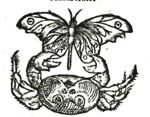
Festina lente: Paradin, Les devises héroïques (Antwerp, 1563), emblem 183 uses the imagery of a crab catching a butterfly
Festina lente: Giovio, Dialogo dell' Imprese (Lyon, 1574), emblem 2 (Symeoni) uses the imagery of a crab catching a butterfly
Iconclass: 25F716(CRAB)(+512):25F26(HARE)(+621) crustaceans: crab (+ animal(s) attacking)❧rodents: hare (+ animal(s) being hit, shot, caught) 51M11 Swiftness, Speed; 'Agilità', 'Celerità', 'Velocità' (Ripa) 51MM11 Slowness, Tardiness; 'Tardità' (Ripa) 52BB42 Impossibility
Collectanea (1500): 614
Loci Communes: Absurda, indecora, seu praepostera (Absurd, unbecoming, or preposterous things, Choses absurdes, inconvenantes ou déplacées)
II iv 79 Ne caprea contra leonem Roedeer must not fight lions
Μὴ πρὸς λέοντα δορκὰς, id est, Ne caprea adversus leonem. hoc est, ne longe inferior cum potentiore decertes. Dorcas enim sylvestris est capreolus. Refertur à Diogeniano. Suidas integrum refert senarium, Μὴ πρὸς λέοντα δορκὰς ἅψωμαι μάχης. id est, Ne cum leone caprea pugnam sumpsero. Homerus Odysseae Θ Ανδράσι δὲ προτέροισιν εριζεμεν οὐκ ἐθελήσω. id est, Cum potiore viro nolim certamen intre.
Μὴ πρὸς λέοντα δορκάς, Roedeer must not fight lions; if you are weak, that is, do not contend with one much stronger than yourself. For dorcas, the word used in Greek, is a kind of wild roedeer. Recorded by Diogenianus. Suidas cites the iambic line complete: 'Lest I, the roedeer, try to fight the lion.' Homer in book 8 of the Odyssey: 'With stronger men I would not wish to strive.'
Facsimile:
Iconclass: 25F24(DEER)(+23) hoofed animals: deer (+ female animal) 25F23(LION) beasts of prey, predatory animals: lion 51AA4:25F24(DEER)(+512) Nothingness, Absence❧hoofed animals: deer (+ animal(s) attacking) 51BB3 Imparity, Inequality, Difference
Collectanea (1500): 642
Loci Communes: Excellentia, inaequalitas (Excellence, inequality, Excellence, inégalité)
II iv 80 Pellem caninam rodere To gnaw dogskin
Pellem caninam rodere, proverbiali metaphora dixisse videtur Martialis, pro eo quod est hominem maledicum & improbum conviciis insectari. Sic enim scribit in obtrectatorem quendam & oblatratorem: Non deerunt tamen hac in urbe forsan, Unus, vel duo trésve, quatuórve, Pellem rodere qui velint caninam.
Used by Martial as what seems to be a proverbial metaphor for pursuing a slanderous and evil man with abuse. For he writes as follows about some malevolent critic who barked at him like a dog:
Yet in this city there may be
Just one or two or four or three
Ready, if they a mad dog spied,
To sink their teeth into his hide.
Facsimile: 
Iconclass: 31B6234 chewing 34B11(+9351) dog (+ skin, fleece, hide, fur, leather) 54AA51 Evil Genius; 'Genio cattivo' (Ripa) 57BB25 Calumny, Detraction; 'Biasimo vitioso', 'Calunnia', 'Detrattione', 'Maledicenza' (Ripa)
Loci Communes: Obtrectatio et maledicentia (Disparagement and slander, Dénigrement et médisance)
II iv 81 Echino asperior Rougher than an urchin
Εχίνου τραχύτερος, id est, Echino asperior: In hominem intractabilem & insuavibus moribus dictum. Metaphora sumpta ab animante cuius duplex est genus: terrestre, spinis obsitum: & maritimum, pinnata undique testudine, ac spinis obductum, quibus se pedum vice voluit, autore Plinio. Martialis, Cortice deposito mollis echinus erit. Aristoteles lib. De generatione animantium quinto, tradit echinum ipsum quidem pusillum esse, caeterum spinas habere & longas & acutas. Athenaeus Dipnosophiston libro tertio, fabellam haud infestivam refert è Demetrio Scepsio. Laconem quempiam vocatum ad coenam, appositis echinis, cum ignoraret quo pacto soleant edi, nec observaret, quomodo caeteri convivae his vescerentur, corripuisse quendam, & in os coniecisse unà cum ipsa testa. Porrò cum inter dentes strideret echinus, et hominis os cibo misere cruciaretur, O sceleratum, inquit, edulium: neque nunc te omittam tibi mitis: nec te posthac unquam sumpsero.
Εχίνου τραχύτερος, Rougher than an urchin. Said of a man of unpleasant manners, with whom it is impossible to do business. The metaphor is derived from a creature of which there are two sorts, the land-urchin or hedgehog, thick set with spines, and the sea-urchin, which has a shell that is ridged all over and covered with prickles, with which it rolls itself along, according to Pliny, having no feet. Martial: 'Remove his shell; an urchin will be soft.' Aristotle in book 5 of On the Generation of Animals tells us that in itself the urchin is quite small, but it has spines which are both long and sharp. Athenaeus in book 3 of the Doctors at Dinner reports an amusing story from Demetrius of Scepsis. A Spartan was once asked out to dinner, and urchins were served. He had no idea how they are normally eaten, and instead of watching the other people at table to see how they did it, he seized an urchin and put it hastily into his mouth, shell and all. The urchin crunched between his teeth, and as for the man's mouth, what he thought was food was simply torture. 'God's curse on what I'm eating' he said; 'I shan't have pity on you and put you out, but after this never do I try another one.'
Facsimile:
Iconclass: 25F29(HEDGEHOG) other mammals: hedgehog 25F74(SEA-URCHIN) echinoderms: sea-urchin 32A7:57AA9 characters (human types)❧Brutality 51GG6 Roughness
Collectanea (1500): 657
Loci Communes: Asperitas, morositas (Harshness, moroseness, Rudesse, morosité)
II iv 82 Echinus partum differt The urchin puts off the birth of its young
Εχῖνος τὸν τόκον ἀναβάλλει. id est, Echinus partum differt. De iis dici suetum, qui prorogarent quippiam suo malo: veluti qui creditam pecuniam comperendinant, tamen aliquando reddendam vel maiore cum foenore. Aiunt echinum terrestrem stimulata alvo, remorari partum, deinde iam asperiore ac duriore facto foetu mora temporis, maiore cruciatu parere. Autor Suidas. Plinius lib. ix. cap. xxv. tradit, piscem, qui dicitur echineis, fluxum gravidarum sistere, & usque ad puerperium in utero continere foetum. Quanquam hoc ἀπροσδίονυσον.
Ἐχῖνος τὸν τόκον ἀναβάλλει, The urchin puts off the birth of its young, was customarily said of those who postponed something and regretted it; adjourned, for instance, the repayment of a loan, and then had to pay it later with even heavier interest. They say that the land-urchin, when its uterus contracts, postpones the moment of birth, and then, when the delay has already made the young harder and rougher, it suffers much more in producing them. Suidas is the authority. Pliny book 9 chapter 25 tells us that a fish called the echineis stanches the flux of pregnant women, and retains the foetus in the womb until the moment of parturition. Though this has nothing to do with the subject.
Facsimile:
Iconclass: 25F29(HEDGEHOG)(+41) other mammals: hedgehog (+ birth of an animal) 51MM11 Slowness, Tardiness; 'Tardità' (Ripa) 54DD311 Waiting, Watching 57A41 Regret
Loci Communes: Malum accersitum aut retortum (Evil brought upon oneself or turned back, Mal attiré ou retourné)
II iv 83 Prius duo echini amicitiam ineant Sooner would two urchins make friends
Πρίν δὲ δύο ἐχῖνοι ἐς φιλίαν ἔλθοιεν, ὁ μὲν ἐκπελάγους, ὁ δ᾽ ἐκ χέρσου. id est, Prius echini duo inierint amicitiam, alter è mari, alter è terra. De iis qui moribus ac studiis sunt inter se discrepantiores, quàm ut spes sit aliquando inter eos necessitudine coituram. Venustius erit ad rem deflexum. Nam est echinus marinus, de quo multa Plinius & Aristoteles. Est & terrestris, quem alio nomine vocant erinaceum: illud commune, quod uterque spinosus est, unde & vocabulum inditum. Refertur à Suida.
Πρίν δὲ δύο ἐχῖνοι ἐς φιλίαν ἔλθοιεν, ὁ μὲν ἐκπελάγους, ὁ δ᾽ ἐκ χέρσου, Sooner would two urchins make friends, one from the sea and the other from the land. Used of those who differ in character and interests too much to allow any hope that one day some relationship might be formed between them. It will be more stylish if adapted to some subject. There can be no agreement between these prickly theologians and the humanities; sooner would sea-urchin and land-urchin agree.' For there is a sea-urchin, of which Pliny and Aristotle have much to tell us; and there is also an urchin that lives on land, for which another name is hedgehog. One thing they have in common, that both are covered with spines, and from that they get the name. Recorded by Suidas.
Facsimile:
Iconclass: 25F29(HEDGEHOG) other mammals: hedgehog 25F74(SEA-URCHIN) echinoderms: sea-urchin 51BB2 Dissimilarity, Unlikeness 52BB42:56F23 Impossibility❧Friendship; 'Amicitia' (Ripa)
Loci Communes: Impossibilia (Impossible things, Choses impossibles)
II iv 84 Non missura cutem nisi plena cruoris hirudo The leech that won't let go till full of blood
Proverbii speciem habet illud etiam Horatianum in Arte poetica. Non missura cutem, nisi plena cruoris hirudo. Quadrabit in homines nimium sedulos, & quibusvis in rebus immodicos. Cuiusmodi nonnullos videas, qui cum semel coeperint, nullum faciunt finem, donec defatigati desistant, nec rationem ullam habent alieni fastidii, sed suo tantum animo negocii modum metiuntur, haudquaquam memores vetustissimi sermonis admonentis ut tum à lusu desistamus, cum adhuc est iucundus, ne voluptatem odii molestia consequuta contaminet. Nemo nescit, hirudinem ubi semel haeserit corpori, nulla ratione posse revelli, donec suctu sanguinis expleta decidat. Quidam appellant sanguisugam, Graeci βδέλλαν, sive βδέλλιον, linguam habet bisulcam ac fistulatam, quam penitus infigit cuti. Meminit Plinius libro undecimo, capite trigesimoquarto, atque inibi de altero quodam animali, cui nomen non sit, quod semper infixo sanguini capite vivat, donec nimia satietate dehiscat, & ipsi immoriens alimento, cum cibi non sit exitus.
There is a line in Horace, in the Art of Poetry, which also has the look of a proverb: The leech that won't let go till full of blood.' This will be suitable for men who are over-meticulous and, whatever they are doing, go too far. You can see some people of this kind who, once they have started, never leave off until they stop from sheer exhaustion, not caring in the least whether other people have had enough but fixing the duration of what they are about to suit themselves; not for a moment do they think of the old saw which tells us to stop the game while we are still enjoying it, for fear that our pleasure may be succeeded and spoiled by satiety and disgust. Everybody knows that once a leech has fastened on the body, there is no way of removing it, until it has sucked itself full of blood and falls off of its own accord. Some call it sanguisuga, blood-sucker; the Greek is bdella or bdellion. It has a forked tongue, up which runs a tube, and it fixes this deep into the skin. Pliny mentions it in book 11 chapter 34, and also another creature, without a name, which 'lives with its head permanently attached to a source of blood,' until it is so excessively full that 'it bursts, and dies actually as it feeds, because there is no passage outwards for the food.'
Facsimile:
Iconclass: 25F73(LEECH) worms (LEECH) 31A22611 blood 51F2 Continuity 52BB42:54DD31 Impossibility❧Interruption, Cessation 56BB32 Insatiableness
Collectanea (1500): 493
Loci Communes: Taedium ex iteratione (Tedium from repetition, Lassitude due à la répétition)
II iv 85 Mea est pila It's my ball
Mea est pila, id est, Vici, & voti sum compos: aut res mihi in manu est, apud Plautum in Truculento. Sumptum à notissimo pilae ludo, cum multis insequetibus, unus aliquis praestantior occupat. Consimili figura dixit in Cassina: Sed si nunc vult hera facere officium suum, nostra omnis lis est. id est, vicimus. Traducta metaphora à iudiciis.
It's my ball; that is, I've won, I can do what I want, I have the answer in my hand. Found in Plautus, in the Truculentus. Taken from the well-known game in which many players pursue the ball, but only the one who is best gets possession of it. He uses a similar metaphor in the Casina when he says 'But if my mistress is now prepared to do her duty, the whole case is ours,' meaning, We have won, the image being taken from the lawcourts.
Facsimile:
Iconclass: 55B:43C41(+4)(BALL) Possession❧? 54F2 Victory 55A12 Reward, 'Praemium'; 'Premio', 'Remuneratione' (Ripa)
Loci Communes: Vincere et vinci (To conquer and to be conquered, Vaincre et être vaincu)
II iv 86 Ab ovo usque ad mala From the eggs to the apples
Ab ovo usque ad mala, proverbiali figura dixit Horatius in Sermonibus Satyra tertia, pro eo quod est, ab initio convivii usque ad finem. Si collibuisset, inquit, ab ovo Usque ad mala, citaret, iò Bacche modo summa Voce, modo haec resonat quae chordis quattuor ima. Antiquitus enim coenam ab ovis auspicabantur, malis finiebant. Erit venustius, si longius trahatur, Ab ovo usque ad mala: id est, toto colloquio, tota navigatione, aut toto opere. Qui rem altius repetunt quàm oportet, notantur illo versu Horatiano, Nec gemino bellum Troiaenum orditur ab ovo. Qui à primis initiis repetunt, ἐκ τῶν ῥιζῶν id est, à radicibus, & à stirpibus imis exordiri dicuntur, qui nihil praetermittunt, ordine narrant: & A capite usque ad calcem, quod alibi retulimus, Graecis ἄνωθεν dicitur, et ἀρχῆθεν.
From the eggs to the apples is a proverbial image used by Horace in the third poem of his Satires to express from the beginning of a dinner-party to the end. 'But if the fancy took him,' he says, 'from eggs to apples Ho Bacchus he would roar, / Now with the lyre's top note, now with the lowest of its four.' For in ancient times they started supper with eggs, and finished with fruit. This will be more effective if it is applied to something different, by using 'from the eggs to the apples' of the whole of a conversation, a voyage or a piece of business.
Those who go more deeply into something than the question warrants are picked on in another line of Horace:- 'Nor starts the Trojan war from that Twinned egg.' If they start something from the very beginning, they are said to take off ἐκ τῶν ῥιζῶν, a radicibus, which means 'from the roots,' from the ultimate stock; if they omit nothing, they tell their story 'in order' and 'from top to toe/ a phrase I have recorded elsewhere.- Greek also uses anôthen, down from the beginning, and archêthen, from the start.
Facsimile: 
A capite usque ad calcem: Scot, Philomythie or Philomythologie (London, 1616), Illustration 5 - the proverb is also quoted in this adage's commentary
Iconclass: 41C43 evening meal, dinner, supper 41C642 eggs, egg-dishes 41C653(APPLE) fruit (APPLE) 51F5 Beginning; 'Principio' (Ripa) 51FF5 End; 'Fine' (Ripa)
Collectanea (1500): 596
Loci Communes: Perficiendi sive absolvendi - ab initio ad finem (Finishing, completing - from beginning to end, Achever, accomplir - du début à la fin)
II iv 87 Virtutem et sapientiam vincunt testudines Virtue and wisdom bow before the turtles
Iulius Pollux libro nono, de rerum vocabulis, scribit hoc carmen olim proverbio celebratum fuisse, Τά ἀρετὰν, καὶ τὰν σοφίαν νικᾶντι χελῶναι. id est, Et virtus testudinibus, & sapientia cedit. Est autem velut aenigma, innuens pecuniam longe plus posse, quàm aut virtutem aut sapientiam. Antiquitus enim Peloponnesiorum numisma χελώνη, id est, testudo dicebatur, propter inscalptam in eo testudinis figuram. Testem huius rei citat Eupolidem, qui in fabula, cui titulus, Captivi, ὀβολὸν dixerit καλλιχέλωνον. id est, obolum pulchrae testudinis. Consimili figura dictum & illud: Multas noctuas sub tegulis latitare, & Bos in lingua: quae suis retulimus locis.
Julius Pollux in the ninth book of his On the Names of Things writes that the following line was current in old days as a proverb: 'Virtue and wisdom yield before the turtles.' This is a sort of riddle, suggesting that money has much more influence than either virtue or wisdom. In ancient times the currency of the Peloponnese was a chelone or turtle, so called from the turtle stamped on it. As evidence for this he cites Eupolis in his play the Captivi where he calls an obol 'fair-enturtled.' This is much after the same formula as Many owls roosting under the tiles, and An ox upon the tongue, which I have recorded in their places.
Facsimile:
Iconclass: 25F44(+1) tortoises, turtles (+ animals used symbolically) 44B132(+0) making a bow to a ruler (+ variant) 46B311 coin 52A51 Wisdom; 'Sapienza', 'Sapienza humana', 'Sapienza vera' (Ripa) 53C11:55B1 Authority, Power; 'Dominio', 'Giurisdittione' (Ripa)❧Wealth, Opulence; 'Opulenza', 'Richezza' (Ripa) 57A6 Virtuousness; 'Amor di Virtù', 'Attione virtuosa', 'Guida sicura de' veri honori', 'Virtù', 'Virtù insuperabile' (Ripa)
Loci Communes: Munerum corruptela (Corruption by gifts, Corruption par les présents)
II iv 88 Sacra haec non aliter constant These rites cannot be performed otherwise
Sacra haec non aliter constant. Hoc adagio licebit uti, si quando fatebimur culpam, sed quae rei locóve conveniat: veluti si quis in balneis agat impudentius: aut rusticius in navi, aut in compotationibus ebriorum intemperantius: aut inter mulierculas ineptius: aut inter aulicos dissimulantius: aut inter sophistas loquacius: aut apud populum adulantius. Ausonius nuptialis Centonis excusans licentiam, Etenim fabula est, inquit, de nuptiis, & velit nolit, sacra haec aliter non constant. Sumptum à sacris, quae certis quibusdam caeremoniis peraguntur: de quibus si quid demutes, piaculum admissum putetur. Plutarch. in commen. De audiendis poetis: Θυσίας μὲν γὰρ ἀχόρους καὶ ἀνάυλους ἴσμεν, οὐκ ἴσμεν δὲ ἄμυθον οὐδε ἀψευδῆ ποίησιν. id est, Sacra enim absque choris ac tibiis novimus. Non novimus autem absque fabula ac mendacio poesim.
This adage can be used when we confess a fault, but maintain that it was not out of key with the place and the circumstances: for instance, if someone behaves without modesty in the baths, or coarsely on board ship, or intemperately at a drunken party, or foolishly among a lot of foolish women, or hypocritically in the company of courtiers, or garrulously among sophistic philosophers, or in such a way as to curry favour before the multitude. Ausonius, excusing the indecency of his work in the preface to the Cento nuptialis, says 'For the wedding night is my subject and, like it or not, these rites cannot be performed otherwise.' This is taken from the rites performed at certain definite ceremonies, any change in which would be regarded as sacrilege. Plutarch in his essay on 'How to Study Poetry': 'We all know of festivals in which there is no dancing and no music, but I never heard of poetry in which there are no fables and no lies.'
Facsimile:
Iconclass: 42D2 (civil) marriage ceremonies 51C2:57AA1 Necessity, Inevitability; 'Necessità' (Ripa)❧Bad Behaviour 54D6 Custom, Habit; 'Consuetudine' (Ripa) 59AA2 Ill-breeding, Bad Taste 59AA3 Vulgarity
Collectanea (1500): 754
Loci Communes: Tempestiva (Timely things, Choses opportunes)
II iv 89 Sequitur ver hiemem Spring follows winter
Sequitur ver hiemem. Hoc adagio rerum vices significamus, necessario sibi succedentium: ut si quis suadens in rebus afflictis animum fulciendum spe meliorum, dicat, Sequetur ver hyemem, id est, tristibus succedent laetiora. Ita Pindarus Isthmiorum hymno quarto, νῦν δ᾽ ἆυ μετὰ χειμέριον ποικίλων μήνῶν ζόφον, χθὼν ἅτε φοινικίοις ἄνθος ῥόδοις, id est, Nunc vero rursum post hibernam multiplicium mensium caliginem, terra veluti purpureis floret rosis. Ausonius in praefatione monosyllaborum, nonnihil abusus est proverbio, Ut in vetere verbo est: Sequitur ver hyemem. Iam similium nugarum subtexo nequitiam.
We can use this adage to emphasize how things change as one inevitably follows another. If for instance one were trying to persuade a friend who has had bad luck to seek support himself in the hope of better times, one might well say Spring will follow winter, meaning that happier days will come after sorrow. So Pindar in the fourth hymn of his Isthmians: 'But now once more, after the winter twilight of the changing months, the earth is gay as it were with red roses.' Ausonius in the preface to his Monosyllables misuses the proverb somewhat: 'As the old proverb says, spring follows winter, and I will now add similar trifles of a more spicy sort.'
Facsimile:
Iconclass: 23D41 winter, 'Hyems'; 'Inverno' (Ripa) 23D42 spring, 'Ver'; 'Primavera' (Ripa) 51F3 Priority, Pre-eminence 51FF3 Posteriority 56B2 Happiness, Felicity 56BB2 Unhappiness; 'Infelicità' (Ripa)
Loci Communes: Similitudinis et congruentiae (Similarity and congruence, Similitude et convenance)
II iv 90 Venereum jusjurandum Lovers' vows
Αφροδίσιος ὅρκος οὐκ ἐμποίνιμος. id est, Venereum iusiurandum non punitur. Sensus est, amantium iusiurandum irritum esse: neque ad deos quicquam pertinere tanquam iocosum. Et autore Nasone, Iuppiter ex alto periuria ridet amantum, Et iubet Aeolios in freta ferre notos. Et Horatius, Ridet hoc inquam Venus ipsa, rident Simplices nymphae. Tibullus, Periuria ridet amantum Iuppiter, & ventos irrita ferre iubet. Citatur hoc adagium à Platone in Convivio: ὅ δὲ δεινότατον, ὥς γε λέγουσιν οἱ πολλοὶ, ὅτι καὶ ὀμνύντι μόνῳ συγγνώμη παρὰ θεῶν, ἐκβάντι τῶν ὅρκων. Αφροδίσιον γὰρ ὅρκον, οὔ φασιν εἶναι, οὔτω καὶ οἱ θεοὶ καὶ οἱ ἄνθρωποι πᾶσαν ἐξουσίαν πεποιήκασι τῷ ἐρῶντι. id est, Quodque omnium maximum est, ut sanè dicitur vulgo, uni etiam iuranti à diis parata est venia, si quae iuravit non praestiterit. Venereum enim iusiurandum negant esse: Adeo tum dii tum homines nihil non permittunt amanti. In verbis Platonis videtur deesse vocula, ἐμποίνιμον. οὔ φασιν εἶναι ἐμποίνιμον. Meminit & Procopius in epistola ad Ephihanium ultima, καλῶς ἄρα ἤδει τὸ τῶν ἐρῶντων πάθος ἡ παροιμΐα, κᾂν ἐπιορκεῖν ἐθὲλωσι, συγγνώμην αὐτοις ἐκ θεῶν ἐπαγγέλλεται. i. Pulchre novit aman tium affectum proverbium: etiam si peierare voluerint, veniam illis a diis pollicetur. Plato in Philebo apud Athenaeum lib. 12: ὡς δὲ λόγος, καὶ ἐν ταῖς ἡδοναῖς ταῖς περὶ ἀφροδίσια, ἅ δὴ μέγιστα δοκοῦσιν εἶναι, καὶ τὸ ἐπιορκεῖν συγγνώμην εἴληφε παρὰ θεῶν, ὥσπερ καθάπερ παίδων τῶν ἡδονῶν οὐ δὲ τῶν λοφισμὸν κεκτημένων. id est, Caeterum quemadmodum dicitur, etiam in voluptatibus circa res venereas, quae sanè videntur esse praecipuae, periurium quoque venia donatur à diis, perinde quasi voluptates puerorum instar sint, qui nondum rationis sunt compotes. Refertur & illud ex Callimacho, Ωμοσεν, ἀλλὰ λέγουσι θεατοὺς ἐν ἔρωτι Ορκους μὴ δύνειν οὔατ᾽ ἐς ἀθανάτων. id est, Iuravit, verum vulgo dicunt, in amore Quod iuras, aures non penetrare deûm. Prior versus non caret mendo. Deflecti potest ad quodvis promissum, cuius fides praestanda non videatur.
Ἀφροδίσιος ὅρκος οὐκ ἐμποίνιμος, A lover's oath carries no penalty. The meaning is that the oaths sworn by lovers are null and void; they are not serious, and not a scrap of them reaches the ear of the gods. As Ovid puts it, 'Jove exalts at lovers' perjuries, and tells / Aeolian winds to bear them out to sea.' And Horace: 'Venus herself, I say, doth laugh / And all her simple-hearted Nymphs.' Tibullus: 'Jupiter laughs at lovers' broken vows, / And tells the winds to bear them to oblivion.' This adage is cited by Plato in the Symposium: 'And what is most extraordinary (such is the common view), he is the one person who can swear an oath and find forgiveness from the gods if he breaks it. They say a lover's oath is not. So true is it that both gods and men allow a lover to do just as he pleases.' In Plato's words 'subject to penalty' seems to have fallen out after 'is not.' Procopius too mentions it in his last letter to Epiphanius: The proverb then is well aware of the state in which lovers find themselves, and promises them the gods' forgiveness, even if they wish to perjure themselves.' Plato in the Philebus, cited by Athenaeus book 12: 'The saying goes that in the pleasures of sex too, which seem to be very great, even perjury is forgiven by the gods, just as though the pleasures were those of children who have not yet learned reason.' And there are those lines quoted from Callimachus: 'He swore; but lovers' oaths, they say, do not reach the ears of the Immortals.' (The first line has something wrong with it.) This can be diverted for use of any promise which there seems to be good reason for not keeping.
II iv 91 Tanquam meum nomen. Tanquam digitos As well as I know my own name, or, my fingers
Proverbiales hyperbolae sunt, Tanquam meum nomen, & Tanquam meos digitos teneo, si quando promptam, certamque memoriam significare volumus. Martialis: Totis diebus Afer haec mihi narras: Et teneo melius ista, quàm meum nomen. Iuvenalis: Tanquam ungues digitosque suos. Nihil magis meminimus quam proprii nominis, unde & vita defunctos olim suo nomine inclamabant. Et, Proprii nominis oblitum dicimus prodigiosae obliviscentiae hominem. Antiquitus in digitis computus peragebatur. Extat ea de re libellus Bedae. Quin hodieque numerandi imperitum & obliviosum per iocum rogare solent, quot in manibus habeat digitos. Plutarchus in commentario, cui titulum fecit, Quo pacto quis intelligere possit se profecisse, scribit olim morem fuisse nomina digitorum ediscere, hisque in metu tanquam remedio futuris uti. ipsius verba subscribam: Οἱ μὲν γὰρ ἐκμεμαθηκότες τὰ τῶν ἰδίων ὀνόματα δακτύλων, χρῶνται πρὸς τοὺς φόβους αὐτοις ὥς ἀλεξικάκοις, ἀτρέμα καταλέγοντες ἕκαστον. id est, Quida enim ediscunt suorum nomina digitorum, eisque contra pavores utuntur, tanquam ad depellenda mala remedium habeant, paulatim singulos recensentes. Quae vero sint digitorum apud Graecos vocabula, Gellius in Noctibus Atticis indicavit. Caelius Calcagninus, ut indicat Aleander, mavult intelligi de nominibus Dactylorum Idaeorum, de quibus nonnihil attingemus in proverbio: Celmis in ferro, licet in Plutarcho, ἰδίων legatur, non ἰδαίων.
These are proverbial exaggerations, when we wish to convey that our memory of something is immediate and certain: 'I know it as well as my own name' and 'as well as my fingers.' Martial: 'Afer goes on like this day after day the same; / By now I know his rent-roll as well as my own name.' Juvenal: 'Like his own fingers, nail by nail.' We remember nothing more clearly than our own names; hence too the ancient practice of calling the dead by name. A man who forgets his own name we regard as a prodigy of forgetfulness. In Antiquity they counted on their fingers; there is a book on the subject by Bede. Even today a man who has no skill in counting and a bad memory is asked, to tease him, how many fingers he has. Plutarch in the essay he called 'How a man may become aware of his Progress,' writes that it was an old custom to learn by heart the names of the fingers, and use these when frightened as though they would help. I will copy his actual words: 'Some people get by heart the names of their own fingers and use them as a protection against terrors, quietly repeating each one in turn, as if they were a remedy against ills.' The names of the fingers in Greek are given by Gellius in his Attic Nights. Celio Calcagnini, as Alexander points out, prefers to understand this of the names of the Idaean Dactyls, of which I shall say something under the proverb Celmis in ferro Celmis [trusting] his sword; though in Plutarch the text reads idiôn, their own, and not Idaiôn, Idaean.
II iv 92 Bonorum glomi Reels of good things
Αγαθῶν ἀγαθίδες, id est, Bonorum glomi: de opibus exstructis & affatim accumulatis. Sumpta metaphora à glomere textorio, cui fila sunt obvoluta, aut certe ligno illo textorio, cui filorum maxima vis est obvoluta, quod idem πηνίον vocant. Proverbii meminit Iulius Pollux lib. vii. cap. x. indicans apud comicos esse frequentissimum. Videtur autem allusum ad vocem in Agathide & Agathis: perinde ut Thucidides in Euripidis Epigrammate Athenas τῆς ἑλλάδος ἑλλάδα, vocat. id est, Graeciae Graeciam. Etiamsi lib. v. tribuit hanc sententiam Pindaro. Et quemadmodum ἔσχατα ἐσχάτων. id est, postrema postremorum: Ιtem κακὰ κακῶν, id est, mala malorum, dicunt Graeci: quam quidem figuram Latini non agnoscunt.
Ἀγαθῶν ἀγαθίδες, Reels of good things, of riches in heaps, piled up to one's heart's content. The metaphor is taken from the spool used by weavers on which the thread is wound or, if not that, from the weaver's beam, on which are wound a very great number of threads, another name for which in Greek is pênion. The proverb is mentioned by Julius Pollux, book 7 chapter 10, who states that it is very common in the comic poets. It seems to contain a play on the words agatha, good things, and agathides, reels, just as Thucydides in the epitaph of Euripides calls Athens 'the Hellas of Hellas' (although in book 5 he attributes this notion to Pindar), and as Greek uses 'last of the last' and 'evils of evils,' a figure of speech not recognized in Latin.
Facsimile: 
Iconclass: 47H3511 reel of yarn 55B1 Wealth, Opulence; 'Opulenza', 'Richezza' (Ripa)
Loci Communes: Bonae fortunae, copiae, felicitatis aut ominis (Of good fortune, abundance, happiness, or omen, Bonne fortune, abondance, bonheur ou présage)
II iv 93 Rem acu tetigisti You have touched the issue with a needle-point
Est apud Plautum in Rudente: Rem acu tetegisti, pro eo quod est, rem ipsam divinasti, nihil aberrans. Metaphora sumpta videri potest à lusu quopiam, in quo divinator, id quod alius notasset, summa acu tangebat: aut lineam, aut calculum, aut aliud quiddam simile. Igitur acu tangere, perinde est quasi dicas, ipsissimum punctum attingere. Nam minutissima puncta denotantur acu.
Plautus in the Rudens has 'You have touched the issue with a needle-point' in the sense of You have discerned the precise problem, missing nothing. The image might seem to be taken from some game or other, in which the player who had to guess something chosen by his opponent, a line on the board or a counter or some such thing, touched it with the point of a needle. In this way 'to touch with a needle-point' is tantamount to identifying the precise point at issue; for the smallest points are indicated with a needle.
Facsimile:
Iconclass: 41D4411:49D31 needle ~ sewing❧point (~ planimetry, geometry) 52C4 Understanding, Comprehension; 'Apprehensiva' (Ripa) 52D21 Conciseness
Collectanea (1500): 506
Loci Communes: Aliena curantis - ad rem pertinentia (Meddling in others' affairs - relevant matters, Qui se mêle des affaires d'autrui - choses pertinentes); Conjecturae (Conjectures, Conjectures)
II iv 94 Purgatis auribus With well-washed ears
Purgatis auribus pro attentis et vacuis, proverbium resipit. Plautus in Milite: Perpurgatis ambo damus tibi operam auribus. Horatius in Epistolis, Est mihi purgatam crebro qui personet aurem. Persius quinta Satyra, Stoicus hic autem mordaci lotus aceto. Nam sordes in auribus collectae auditum hebetant, exemptae reddunt acriorem.
With well-washed ears, in the sense of being attentive and not otherwise engaged, sounds like a proverb. Plautus in the Miles: 'We're all attention, both with well-washed ears.' Horace in the Epistles: 'I have a friend whose clamour oft assails / My well-washed ear.' Persius in the fifth satire: 'Your Stoic here, his ear well washed with biting vinegar.' For dirt collected in the ear dulls the hearing, and makes it more keen when removed.
Facsimile:
Iconclass: 31A542:31A2213 washing one's face and head❧ears 52A11 Attention, Concentration
Collectanea (1500): 509
Loci Communes: Attentio et contra (Attention and its opposite, Attention et son contraire)
II iv 95 Purior clavo As clean as a rudder
Αγνότερος πηδαλίου, id est, Purior gubernaculo. Comparatio proverbialis de re vehementer inculpata, aut moribus undequaque integris & incontaminatis. Clavus enim nauticus assiduis fluctibus abluitur, ut nihil sordidum possit haerere. Adagium refertur à Suida.
Ἀγνότερος πηδαλίου, As pure as a steering-car. A proverbial comparison for anything entirely faultless, or for a character of all-round integrity and freedom from any blemish. The rudder of a ship is washed perpetually by the waves, so that no dirt can possibly stick to it. The adage is recorded by Suidas.
Facsimile:

Nil tamen haeret: Zincgreff, Emblematum Ethico-politicorum (Heidelberg, 1619), emblem 61 uses the adage's imagery that slander does not affect a person of integrity
Iconclass: 46C215(RUDDER):51G6 parts of ship's exterior: rudder❧Smoothness 51A7 Perfection, Completeness; 'Perfettione', 'Operatione perfetta' (Ripa)
Collectanea (1500): 834
Loci Communes: Inculpatus (Blameless, Irréprochable)
II iv 96 De calcaria in carbonariam From the lime-kiln to the charcoal-burner's fire
Quoties fit ut à re proposita ad aliud quippiam longe diversum digrediamur, de calcaria in carbonariam decurrere dicimur: sive cum ex uno malo in aliud diversum incidimus. Tertullianus lib. De carne Christi: Igitur, inquit, de calcaria, quod dici solet, in carbonariam, à Marcione ad Apellem. Huic non dissimile est illud Ciceronis in actione pro Murena: Respondebo igitur Posthumio primum, qui nescio quo pacto, mihi videtur praetorius candidatus in consularem, quasi desultorius in quadrigatum curriculum incurrere.
When the moment comes that we swerve off our intended course into something entirely different, we are said to switch from the lime-kiln to the charcoal-burner's fire - or it may be, when we fall from one evil into another which is quite different. Tertullian in his book De came Christi: 'And so from the lime-kiln, as they say, to the charcoal-burner's fire, from Marcion to Apelles.' There is a phrase not unlike this in Cicero's speech in defence of Murena: 'I will therefore reply to Posthumius first, who reminds me somehow, as a would-be praetor attacking a candidate for the consulship, of a trick-rider's horse charging out onto the course for four-horse chariots.'
Facsimile:
Iconclass: 47B142 lime-burner 47I831 charcoal furnace 51KK3 Interchange, Exchange 54FF11 Adversity, Misfortune, Bad Luck; 'Fortuna infelice', 'Infortunio' (Ripa)
Loci Communes: Mutati instituti (A changed custom, Une coutume changée)
II iv 97 Datyli dies The day of Datylus
Δατύλου ἡμέρα, id est, Datyli dies. Ubi res feliciter successerunt. Sumptum à Datylo quodam, qui apud Athenienses summos est honores consecutus.
Δατύλου ἡμέρα, The day of Datylus. When things have gone very well. Taken from a man called Datylus, who achieved the highest honours at Athens.
Facsimile:
Iconclass: 23R1 day of 24 hours, natural day 54F12 Luck, Fortune, Lot; 'Fato', 'Fortuna', 'Fortuna aurea', 'Fortuna buona', 'Fortuna pacifica overo clemente', 'Sorte' (Ripa) 98B(DATYLUS)3 male persons from classical history (DATYLUS) - representations to which the NAME of a person from classical history may be attached
Loci Communes: Bonae fortunae, copiae, felicitatis aut ominis (Of good fortune, abundance, happiness, or omen, Bonne fortune, abondance, bonheur ou présage)
II iv 98 Monstrum alere To breed a monster
Monstrum alitur, ubi quid occulti vitii latere significamus: haud scio, an inde sumpta metaphora, quod monstra ob pudorem clanculum aluntur & occultantur. Siquidem Pamphilus in Andria Terentiana, quod prius repudiatus gener, rursum ad affinitatem repeteretur, suspicans aliquid esse vitii in puella quod celaretur: Repudiatus, inquit, repetor. Quamobrem? nisi id est, quod suspicor, aliquid monstri alunt. Ea quoniam nemini obtrudi potest, itur ad me.
We speak of breeding a monster when we wish to convey that some frightful thing is being concealed and kept dark. The metaphor probably derives from the way in which monstrous births are brought up secretly and kept in concealment because of the disgrace. Pamphilus for example in the Andria of Terence, having previously been rejected as a son-in-law, is being approached again to renew the connection, and suspects there must be something monstrous about the girl, which they are trying to conceal. 'I was rejected,' he says, 'and am now sought for once again. How can this be? Unless what I suspect is true: they breed some monster, and since they can thrust her off on no one else, now have recourse to me.'
Facsimile:
Iconclass: 25F9 mis-shapen animals; monsters 47I225(+0) breeding ~ cattle (+ variant) 52DD11 Secret
Collectanea (1500): 285
Loci Communes: Occulta (Hidden things, Choses cachées)
II iv 99 Non curat numerum lupus The wolf heeds not your counting
Proverbium sapit Virgilianum illud in Bucolicis: Hic tantum Boreae curamus frigora, quantum Aut numerum lupus, aut torrentia flumina ripas. Recte dicetur in hominem impudenter furacem. Extat hodieque vulgo iactatum adagium: Lupus non veretur etiam numeratas oves devorare. Porrò fures paulo timidiores consueverunt à rebus numeratis abstinere manum, metu videlicet ne hoc indicio deprehendantur. Huic affinis iocus ille facetus in servum furacem, cui nihil erat domi, neque clausum, neque obsignatum.
There is a proverbial ring about that phrase of Virgil's in the Bucolics: 'Here heed we as little the north wind's icy blasts, as heeds the wolf the counting of the flock or rivers in spate heed their banks.' It will be rightly used of a man who helps himself brazenly to other men's property. In our own day too there is an adage in common use, The wolf is not afraid to devour the sheep even though they have been counted. Thieves as a rule are a little more cautious, and commonly keep their hands off things that have been counted, for fear presumably that this may make them easier to detect. This is related to that witty remark about a thievish slave, that 'his master had no secrets from him/ neither under lock and key nor under seal.
Facsimile:
Iconclass: 25F23(WOLF)(+451) beasts of prey, predatory animals: wolf (+ animal in search of food) 44G544 theft 49D53 counting, calculating 54A81 Fearlessness, Intrepidity; 'Intrepidità & Costanza' (Ripa)
Loci Communes: Rapacitas et avaritia (Rapacity and greed, Rapacité et avarice)
II iv 100 Ipsis placet That is how they like it
Αὐτοῖς ἀρέσκει. id est, Ipsis placet. Ubi rem parum nobis probari, aut causam nihil ad nos pertinere significamus. Terentius in Andria, Mihi non fit verisimile. Atqui ipsis commentum placet. Non admodum abludit ab illo, Suum cuique pulchrum: Suis quisque consiliis, suaeque sententiae blanditur. Huc pertinet illud apud Homerum frequens: ἤδανε θυμῷ. id est, Placuit animo. Item illud apud comicos: Sic lubitum est animo meo. Et apud Virgilium: Diis aliter visum. Plato libro De legibus tertio, retulit hoc proverbium.
Αὐτοῖς ἀρέσκει, That is how they like it, is used when we wish to convey that we do not much approve of something, or that it is no affair of ours. Terence in the Andria: 'It doesn't make sense to me. It's their scheme; that's how they like it.' It does not differ much from What is one's own is beautiful. Everybody thinks well of his own plans and his own opinion. This is the context for that phrase common in Homer: 'It pleased his heart,' and another in the comic poets: 'My heart liked to have it so,' and in Virgil: The gods thought otherwise.' Plato recorded this proverb in the third book of the Laws.