Guillaume de La Perrièrre, Le Theatre Des Bons Engins (Lyon, 1545)
Emblem 97
A man trampling saffron in a fieldAI-generated
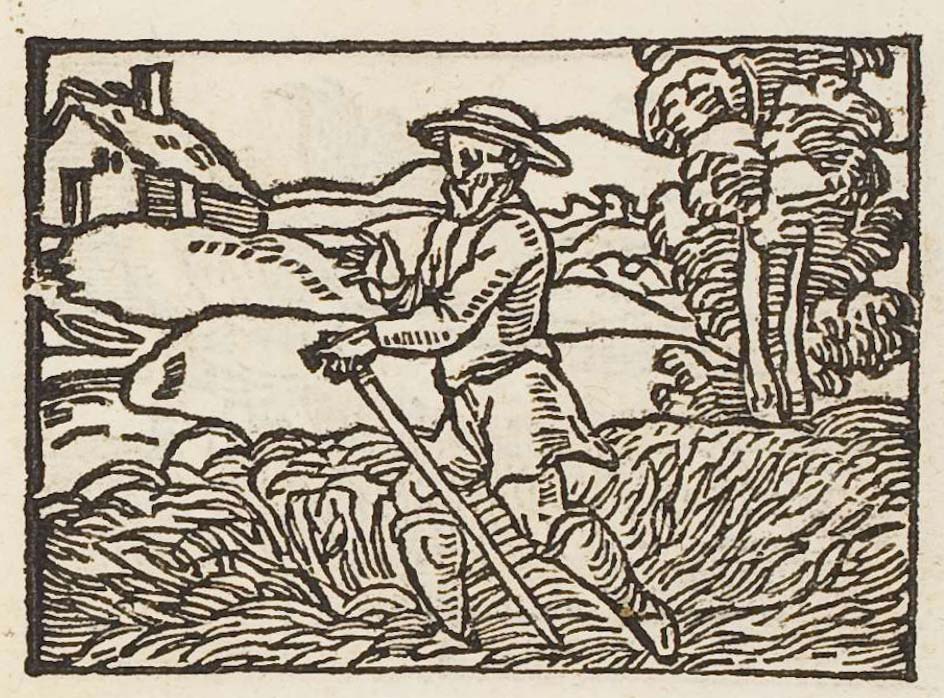
Soyons constans en toute aduersité.
Let us be steadfast in every adversity.AI-generated
Description of the woodcutAI-generated
A woodcut in a rectangular frame showing an outdoor rural scene: a bearded man in a broad-brimmed hat, a short belted tunic and hose, strides across a field, treading on low plants or a crop; he holds a long staff or spade-handle slanting down to the ground before him. Behind him on the left stand a cottage with a steep thatched roof and a small building; in the middle distance are rolling hills and a hedge or bank, and on the right rises a clump of tall bushy trees. The foreground is filled with the hatched, trampled growth of the field.
Subscriptio

TranscriptionAI-generated
TAnt plus des piedz le Saffran est foulé,Plus il florist, & croist abondamment.Cueur vertueux tant plus est affolé,Et plus resiste à tout encombrement.Vertu se preuue en mal plus qu'autrement,Elle florist en temps d'aduersité:Si par malheur elle ha perplexité,Lors elle faict plus forte resistance.Tant plus l'homme est en douleur concité,Plus ha besoing du pauoys de constance.
TranslationAI-generated
The more the saffron is trampled underfoot, the more it flowers and grows abundantly. The more a virtuous heart is stricken, the more it resists every hindrance. Virtue is proved in adversity more than otherwise; it flourishes in times of hardship. If by misfortune it is in distress, then it makes the stronger resistance. The more a man is stirred up in grief, the more he needs the shield of constancy.
Iconclass
86(SOYONS CONSTANS EN TOUTE ADUERSITÉ)proverbs, sayings, etc. (SOYONS CONSTANS EN TOUTE ADUERSITÉ)25I3farm or solitary house in landscape25H18cultivated land41C66(SAFFRON)seasonings, spices: saffron31A2711(+812)walking (+ adult male (human being))41D263walking-stick, staff, cane31A2726trampling, treading, stamping on someone or something57A6Virtuousness; 'Amor di Virtù', 'Attione virtuosa', 'Guida sicura de' veri honori', 'Virtù', 'Virtù insuperabile' (Ripa)56BB1Pain, Sorrow, Sadness; 'Dolore', 'Dolore di Zeusi' (Ripa)54A7Strength, Power; 'Fortezza', 'Fortezza d'Animo e di corpo', 'Fortezza del corpo congiunta con la generosità dell'animo', 'Fortezza & valore del corpo congiunto con la prudenza & virtù del animo', 'Forza' (Ripa)
Suggested Iconclass codesAI-generated
Additional codes proposed for this emblem, not (yet) part of the indexing.
47I15(SPADE)agricultural implements: spademediumThe man carries a long spade-handle/staff in a cultivated field, matching 'agricultural implements: spade'.
47I122spading ~ soil cultivationlowThe rural scene of a labourer with a spade in a field suggests soil cultivation, though he is striding and trampling rather than actually digging.
Relationships to the Adagia of ErasmusAI-generated
Suggested relationships between this emblem and adages in Erasmus’ Adagia.
- II vii 13 Sustine et abstine – thematic inventiomedium
Erasmus explains that the first half of Epictetus' maxim 'teaches fortitude in adversity' (adversa fortiter toleremus), which is precisely the emblem's motto 'Soyons constans en toute adversité' and its praise of the virtuous heart that resists every blow; the citation of Athenaeus ('Good too is he who beareth bad things well') matches the dizain's moral exactly.
- I vii 43 Adamantinus – thematic inventiolow
Erasmus' adage on the adamant, which rejects every blow and is 'invincible and impregnable,' supplies the same commonplace of virtue hardened and strengthened by being struck, which the emblem figures in the saffron that grows better the more it is trodden.
- IV ii 31 Laqueus auxiliari videtur – thematic inventiolow
The emblem's paradox that trampling makes the saffron flourish belongs to the 'malum vertens bono' commonplace that Erasmus illustrates here, where a misfortune turns to the sufferer's advantage; the link is conceptual only, with no textual borrowing.
Sources
Record ID: embhab_162-3-eth-b_emblem097
This emblem on the Iconclass site: https://iconclass.org/view/embhab_162-3-eth-b_emblem097
Page in the digital copy of the Herzog August Bibliothek: http://diglib.hab.de/drucke/162-3-eth-b/start.htm?image=00110