I vii 1 Odi memorem compotorem I hate a pot-companion with a good memory
Μισῶ μνάμονα συμπότην. id est, Odi memorem compotorem. In eos qui, quae inter amicos & inter pocula dicuntur liberius, foras eliminant. Lucianus in Lapithis, ex poeta quopiam citat. Martialis: Μισῶ μνάμονα συμπότην Procille. Iocatur enim poeta in Procillum quempiam, qui inter pocula iussus postridie coenatum venire: venit serio: perinde quasi, quae inter vina dicuntur, pondus habere debeant. Huius proverbii meminit Plutarchus in Symposiacorum pimo statim proble mate, ubi quaerit, num conveniat in conviviis philosophari. Putat autem dictum adversus eos, qui praeter modum instant & urgent in conviviis, ad bibendum impellentes, exigentesque praescriptum poculi modum. Solent enim nonnulli, non admodum avidi bibendi, sic effugere, ut interiectis sermonibus convivas in oblivionem avocent. Deinde si quis forte memor exigat, mentiuntur iam ebibisse sese. Dores autem in Sicilia ἐπιστάθμους, id est, conviviorum, seu mensurarum praefectos, Mnamonas appellant, quos Latini modiperatores vocant, teste Nonio, quod bibendi modum imperent. Unde proverbium quadrare videbitur in eos, qui modum in convivio praescriptum, nimium exacte requirant. Aliis magis videtur, ut proverbium admoneat ἀμνηστίαν, hoc est, oblivionem omnium, quae in conviviis vel fiunt vel dicuntur. Id enim testatum esse & maiorum fabulis, qui Baccho simul & ferulam & oblivionem consecrarint: nimirum hoc innuentes, non oportere meminisse, si quid in convivio peccatum sit, aut certe levem admodum, ac puerilem reprehensionem sufficere. Nam ferula pueros caedi solitos, vel Iuvenalis indicat, Et nos ergo manum ferulae subduximus. Idem Plutarchus alias eodem in opere narrat, Lacedaemoniis hunc fuisse morem ut si quem amicum aut hospitem in domum acciperent, ostensis foribus dicerent, ταύτῃ οὐκ εχέρχεται λόγος.. i. Hac non egreditur sermo. Damnat autem hanc consuetudinem, propterea quod sentiat in conviviis sermonibus utendum non ineptis, sed eruditis ac frugiferis, quos efferri sit honestum & conducibile. Refert idem in vita Lycurgi, ex cuius institutione qui natu maximus erat, stabat ad ostium, & ad convivium ingredientibus dicebat, ostensis foribus, διὰ τούτων ἔξω λόγος οὐκ ἐκπορεύεται. id est, Per hasce nullus sermo progreditur foras. Horatius hoc quoque inter iucundi convivii commoditates commemorat: Ne fidos inter amicos Sit, qui dictae foras eliminet. Huc pertinet ille Graecorum Senarius: Τόν γὰργυναικός ὅρκον εἰς οῖκον γράφω. id est, Inscribo vino si qua iurat foemina. Innuens irrita esse solere quaecunque in compotationibus effutiuntur. Alluditur autem ad proverbium, quod alibi retulimus, εἰς ὕδωρ γράφω. id est, In aqua scribo, de re evanida. Huc adscribendum, quòd quemadmodum in Symposiacis testatur Plutarchus, veteres Bacchum oblivionis filium finxerant: idque per iocum invertit apud hunc quispiam, dicens patrem potius oblivionis appellandum fuisse quàm filium, quod vinum praesertim immodicum, vel ante senectam adimat homini memoriam.
Μισῶ μνάμονα συμπότην, I hate a pot-companion with a good memory. Used of those who publish freely to the outside world what is uttered without constraint among friends over their wine. Lucian in his Lapiths quotes it from some unknown poet. Martial has
No pot-companion welcome here
With memory so crystal-clear:
Procillus, kindly note.
This is a joke at the expense of one Procillus, who in the heat of a drinking-party was asked to supper next day and duly came, as though what a man says in his cups should carry any weight. Plutarch refers to the proverb in his first problem, right at the start of the 'Table-talk,' where he raises the question whether philosophy is a proper subject for conversation at a drinking-party. He thinks it is directed against those who keep up the pressure at a party, urging men to drink more than they want to and prescribing a fixed minimum which must be drunk; for some people who are not very heavy drinkers habitually evade this by introducing topics of conversation designed to make the other guests forget all about it. Then, if anyone happens to remember and insist on the rule, they pretend they have already drunk the prescribed amount. The Dorians in Sicily have epistathmoi who preside over drinking-parties and are in charge of the amount drunk, and call them 'remembrancers.' The Latin for this, according to Nonius is modiperatores, 'bottle-masters,' because they give orders how much people are to drink. And so the proverb will look like a neat fit for those who exact the prescribed amount of drinking at a party too strictly. Others take the proverb to recommend what is called in Greek an amnesty, that everything done and said at a party should be forgotten. In support of this they cite the stories of those in old days who held that Bacchus was the patron deity equally of canes and of forgetfulness, indicating by this, I take it, that any errors committed at a drinking-party ought not to be remembered, or at worst require only the light kind of punishment one might give a child. Caning was a normal penalty for children, as Juvenal for one can show: 'My hand like theirs has flinched beneath the cane.' Plutarch again, elsewhere in the same work, tells how the Spartans had a custom, if they entertained a friend or a visitor, to point out the door to him and say 'No word here spoken passes this.' Plutarch however rejects this custom, because he thinks the conversation at a drinking-party should be educated and improving and not frivolous, so that if it is repeated outside this will be honourable and do some good. He records the same custom in his life of Lycurgus, who instituted a tradition by which the oldest person present used to stand near the door, and as the guests entered for the party he would point out the doorway and say 'No word goes out through this.' Horace too thinks of it as one of the good features of agreeable entertainment in his Epistles book one number 5: 'True friends, and none to publish what we say.' Here too belongs that familiar Greek line 'For what a woman swears I write in wine,' because it suggests that what is uttered casually at a wine-party normally carries no weight. It alludes to a proverb I have recorded elsewhere, 'Writ in water,' of something that will disappear. At this point we may add that the ancients, as Plutarch testifies in his 'Table-talk,' had made out that Bacchus was the child of Forgetfulness; and someone in Plutarch humorously inverts this, saying that he should be called its father, not its child, because wine, especially in excess, deprives a man of his memory even before old age sets in.
Facsimile: 
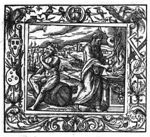
Odi memorem compotorem: Sambucus, Emblemata (Antwerp, 1564) emblem 56
Iconclass: 31B5 the mind affected by drink, drugs or stimulants 41C5 celebration meal, feast, banquet 52D5 Rumour; 'Rumore' (Ripa) 57AA641 Immodesty
Collectanea (1500): 369
Loci Communes: Oblivio (Forgetfulness, Oubli)
I vii 2 Duabus sedere sellis To sit on two stools
Duabus sedere sellis, est incertarum esse partium, & ancipiti fide, ambabus satisfacere velle. Quo verbo nove composito, ἀλλοπρόσαλλον , Homerus appellat Martem, id est, nunc his, nunc illis partibus faventem. Macrobius in Saturnalibus coenis: Laberius mimus in senatum à Caesare lectus, cum à Cicerone ad consessum non reciperetur, dicente: Reciperem te nisi anguste sederemus: nimis mordaciter respondit, Atqui solebas duabus sellis sedere: obiiciens tanto viro lubricum fidei. Sed id quod Cicero dixit, nisi anguste sederemus, scomma erat in Caesarem, qui in senatum passim tam multos admittebat, ut eos quatuordecim gradus capere non possent. Hactenus Macrobius. Est autem omnium consensu turpissimum, cum utraque parte colludere. At Solon legem tulit, qua punirentur hi, qui in civitatis tumultu neutri partium adhaesissent.
To sit on two stools at once is to belong for certain to neither party, being of doubtful loyalty and trying to please both sides. Homer coins a new word alloprosallos, double-faced, and applies it to Mars, because he favours first one side and then the other. Macrobius in his Saturnalian Feast, book 7 chapter 3, tells how Laberius, the pantomime-actor, had been appointed by Caesar to the Senate, and Cicero 'would not make room for him, saying "I would move up, if we were not such a crowd." The actor tartly replied "When you sat on two stools, you had plenty of room," accusing the great man of disloyalty. In any case, Cicero's words "if we were not such a crowd" were a jibe at Caesar, who admitted so many men to the Senate indiscrimi- nately that the official fourteen rows of seats would not hold them all.' Thus Macrobius; and it is generally agreed that to intrigue with both sides is most dishonourable. Solon however passed a law to punish those who in civil strife had taken neither side.
Facsimile:
Iconclass: 31A2352 sitting on an elevation 41A7211 stool 49D11(2) numerals: 2 57AA6141 Untrustworthiness, Unreliability
Collectanea (1500): 137
Loci Communes: Inconstantiae, perfidiae, versutiae (Inconstancy, treachery, cunning, Inconstance, perfidie, ruse)
I vii 3 Duos parietes de eadem dealbare fidelia To whitewash two walls out of the same bucket
Huic finitimum videtur illud: Duos parietes de eadem dealbare fidelia. pro eo quod est, eadem re duplicem inire gratiam, eademque opera duos pariter demereri. M. Curius ad Ciceronem: Sed amice magne, noli hanc epistolam Attico ostendere. Sine eum errare, & putare me virum bonum esse, nec solere duos parietes de eadem fidelia dealbare. Volebat enim Curius pariter & Attico & Ciceroni videri summus, ac de se uno fructum quidem Ciceronis, mancipium autem Attici facere. Tractum videtur ab his, qui parietibus opus albarium superinducunt. Legitur & huiusmodi Graecum adagium apud Suidam, δύο τείχους ἀλείφεις. i. Duos linis parietes. In eos qui in factionibus, utrisque partibus blandiuntur. Ad hanc classem pertinet illud Hebraei vatis, Utroque claudicare pede. Item illud evangelicum, Duobus servire dominis. Rursum illud ex Apocalypsi, de iis, qui neque calidi sunt, neque frigidi.
Close to this, I think, is another: To whitewash two walls out of the same bucket, signifying to earn thanks twice over for the same thing, and lay two people equally under an obligation to you by a single act. Marcus Curius in a letter to Cicero has: 'But pray, my eminent friend, do not show this letter to Atticus. Leave him to enjoy his error and to suppose me a man of honour, not one with the habit of whitewashing two walls out of the same bucket.' For Curius wished to be most highly thought of equally by both Atticus and Cicero, and so to divide his single self that Cicero should get the interest while Atticus held the capital. It is clearly derived from the men who put plaster on walls. A similar adage in Greek is to be found in Suidas: δύο τοίχους ἀλείφεις, You are plastering two walls, applied to those who in party strife make overtures to both sides. To the same class belongs the Hebrew prophet's 'going lame in both legs' and the Gospel phrase 'serve two masters,' and again what is said in the Apocalypse of those who are 'neither hot nor cold.'
Facsimile:
Iconclass: 41A2 interior of the house 47G3352 whitewashing 55A1 Acquisition, Gain, Profit 57AA6131 Guile, Artfulness, Craftiness, Deceitfulness 57AA6141 Untrustworthiness, Unreliability 73C831 'no servant can serve two masters' ~ proverbial saying of Christ (Matthew 6:24; Luke 16:13)
Collectanea (1500): 114
Loci Communes: Inconstantiae, perfidiae, versutiae (Inconstancy, treachery, cunning, Inconstance, perfidie, ruse)
I vii 4 Unica filia duos parare generos To make two sons-in-law of one daughter
His simile quiddam etiam nunc vulgo dicunt, dignum videlicet, quod vel unum inter antiquitatis adagia connumeretur, Unica filia geminos vis parare generos, ubi quis idem beneficium duobus simul pollicetur: aut pro eodem officio, quod alteri praestiterit, à duobus gratim reposcit.
A similar phrase is in popular use today, which, I think, if nothing else, deserves a place among the adages of Antiquity: With one daughter you wish to get two sons-in-law, when a man promises to do the same kindness to two people at once, or when for a service that he has done for one of a pair he expects both to be grateful.
Facsimile:
Iconclass: 42D3 marriage, married couple, 'matrimonium' 42G2122 daughter (first degree family relationships) 49D11(1) numerals (1) 49D11(2) numerals: 2
Loci Communes: Anceps et dubius (Doubtful and uncertain, Incertain et douteux); Inconstantiae, perfidiae, versutiae (Inconstancy, treachery, cunning, Inconstance, perfidie, ruse)
I vii 5 Nescis quid serus vesper vehat Who knows what evening in the end will bring?
Nescis quid serus vesper vehat. Ex Menippeis Varronis satyris citatur hic titulus, tum ab A. Gellio, tum à Macrobio: neque dubitandum, quin proverbialis, sicut sunt & alii plerique. Quo salubriter admonemur, ne praesentium successuum prosperitate sublati, futuri curam abiiciamus. Neque ulla de re securi simus, priusquam exitum viderimus. Idem hodie quoque vulgo dicunt, Diem nondum ad vesperam decurrisse, cum significant diversum exitum posse accidere. Apparet Maronem ad paroemiam allusisse, cum ait primo Georgicorum libro, Denique quid serus vesper vehat. agens de prognosticis occasus. Potest referri & ad illam Solonis sententiam: ὅρα τέλος μακροῦ βίου. id est, Specta finem longae vitae. Titus Livius Decadis v. lib. v. In secundis rebus nihil in quenquam superbe ac violenter consulere decet, nec praesenti cedere fortunae, quum quid vesper ferat incertum sit. Hoc allusit Philippus rex apud eundem Decadis iiii. lib. ix. quum Thessalis respondens minacem clausulam adiecit, Nondum omnium dierum solem occidisse.
Who knows what evening in the end will bring? Cited as the title of one of Varro's Menippean Satires both by Aulus Gellius and by Macrobius, and no doubt it was proverbial, like most of his other titles. It gives us a salutary warning, not to be so much elated by the fair prospect of our successes at the moment that we abandon thought for the future, and not to be confident about anything until we have seen the outcome. The same thought is current in our own day: 'It is not bedtime yet,' when people mean that things can still turn out very differently. It is clear that Virgil alludes to the proverb, when he says in the first book of his Georgics, 'In short, what evening in the end will bring,' referring to weather-signs derived from the sunset. It can also be connected with Solon's famous warning Ὅρα τέλος μακροῦ βίου., Wait till you see the end of a long life. Livy in his fifth decade, book 5: 'When things go well, one should form no proud or violent designs against anyone, nor trust to the prosperity of the moment, for what evening will bring is still uncertain.' King Philip referred to the same thing in Livy's fourth decade, book 9, when he ended his reply to the Thessalians with the veiled threat that 'the sun of all their days had not yet set.'
Facsimile: 
Iconclass: 23A33 future 23R13 evening 56DD3 Insecurity
Collectanea (1500): 334
Loci Communes: Incertus eventus (Uncertain outcome, Issue incertaine)
I vii 6 Multi thyrsigeri, pauci bacchi Many feel the wand, few feel the god
Πολλοί τοι ναρθηκοφόροι, παῦροι δὲ τε Βάκχοι. id est, Plures thyrsigeros, paucos est cernere Bacchos. Carmen hexametrum proverbio Graecis celebratum, quo significatum est, compluribus mortalium adesse virtutis insignia, aut etiam famam, qui tamen vera virtute vacent. Ut non omnes vere theologi, qui pileum theologicum gerunt, quíve hoc nomine sunt donati. Non enim omnes poetae, qui se eo titulo circumferunt. Non omnes monachi, qui cucullo onerantur. Non omnes Christiani, qui caeremoniis agunt Christianum. Non omnes generosi, qui torquem gestant auream. Non omnes virgines, quae passis sunt capillis, Non omnes reges, qui diademate insigniuntur. Non omnes episcopi, qui mitram gerunt bicornem, aut pedum argenteum. Non omnes summi pontifices, qui vocantur sanctissimi, quique triplici corona insigniuntur, Non omnes imperatores, qui in vexillis ostentant aquilam. Neque πωγωνοφορία aut τριβωνοφορία quemademodu loquitur Plutarchus, philosophum facit, hoc est, gestata barba, aut gestatum pallium. Translatum à caeremoniis Bacchanalium, in quibus thyrsos, id est, hastas quasdam vitreas quatiebant afflati furore. Usurpatur à Platone in Dialogo, cui titulus Phaedon. Allusit huc eleganter Plutarchus in libello, quem scripsit adversus Colotam: Eἶς τῶν ἑταίρων ἀριστόδημος ὁ αἰγιεὺς, οἶσθα γὰρ τὸν ἄνδρα τῶν ἐκ τὰς ἀκαδημίας, οὐ ναρθηκοφόρον, ἀλλὰ ἐμμανέστατον ὀργιαστὴν πλάτωνος.id est, Quidam amicus Aristodemus AEgiensis: nam hominem nosti, Academicorum non thyrsigerum, sed ardentissimum mystem Platonis. ναρθηκοφόρον appellat, nomine & cultu duntaxat Acaedmicum, non re. Scitum est & illud Herodis Attici in palllatum, crinitum, barba ad pubem usque porrecta: Video barbam & pallium, philosophum non video.
Πολλοί τοι ναρθηκοφόροι, παῦροι δέ τε Βάκχοι., For many bear the wand, few feel the god. A hexameter line current in Greece as a proverb, meaning that many mortals enjoy the outward signs and even the reputation of virtue, who lack virtue itself. Similarly, not all are really theologians who wear the bonnet of a doctor of divinity or are honoured with that title. Not all are poets who go about under that name. Not all are monks who are burdened with the cowl. Not all Christians who play a Christian's part in outward observance. Not all of noble birth who wear collars of gold. Not all virgins who have flowing hair. Not all kings who are distinguished by a crown. Not all bishops who wear the twin-peaked mitre or carry the silver crook. Not all are popes who are called Your Holiness and glorified by the triple tiara. Not all are emperors who boast an eagle on their banners. It is not pogonophory or tribonophory, as Plutarch expresses it, wearing of beards or cloaks, that makes the philosopher. This adage is drawn from the ceremonies of the Bacchanalia, during which in a fit of religious ecstasy they brandished thyrsi, a kind of wand wreathed in vine-shoots. Plato uses it in his dialogue called Phaedo. There is an elegant allusion to it in Plutarch's 'Against Colotes': 'One of his friends, Aristodemus of Aegiae, - you know the man, I think, a disciple of the Academy, no mere wand-bearer but a passionate devotee of Plato.' He calls a 'wand-bearer' one who is an Academic philosopher in name and dress alone, not in reality. Herodes Atticus also made a good remark about a man with a cloak and long hair and a beard down to his waist: 'Beard and cloak I see; I do not yet see the philosopher.'
Facsimile:
Iconclass: 52A6 Truth; 'Verità' (Ripa) 52AA6 Falsehood 92L1 (story of) Bacchus (Dionysus), Liber 92L18(THYRSUS) thyrsus ~ attribute of Bacchus
Collectanea (1500): 322
Loci Communes: Simulatio, dissimulatio (Pretense, dissimulation, Simulation, dissimulation)
I vii 7 Non omnes qui habent citharam sunt citharoedi Not all that hold the lyre can play it
M. Varro lib. De re rustica ij, eandem sententiam extulit diversa metaphora: Sed non omnes, inquit, qui habent citharam sunt citharoedi. Huc adscribendum videtur, quod lepide scripsit Seneca, quendam personam malle, quam faciem. Faciem vocat, ubi quis talis videtur, qualis est: personam, cum prae se fert aliquis quod non est. Potest & ad avaros torqueri, si neges eos divites, qui possident opes, sed qui recte norint uti. Uti non est citharoedus, quisquis tenet citharam, sed qui cithara recte noverit uti. Non is rex, cui contigit amplum imperium, sed qui sciat administrare.
Marcus Varro in the second book of his Agriculture has expressed the same sentiment in a different metaphor: 'But not all those' he says 'who hold the lyre can play it.' To this, I think, we can add a neat remark of Seneca's, that some people 'prefer the mask to the face.' By face, he meant the state of affairs in which a man looks like what he is; by mask, when a man purports to be what he is not. This can also be diverted for use against avaricious people, if you say that the rich are not those who possess wealth but those who know how to use it, just as not everyone is a lyre-player who carries a lyre, but only the man who knows how to play it properly. He is not a king who happens to possess wide dominions, but he who knows how to govern.
Facsimile:
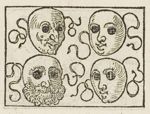
Chascun veult faindre & colorer sa ruse: La Perrière, Le theatre des bons engins (Lyon, 1545), emblem 6 uses the imagery of masks used to deceive others, for which Erasmus quotes Seneca in his comment
Iconclass: 48C7321 lyre, cithara, psaltery 48C7522 one person playing string instrument (plucked) 54A33 Skill, Ability; 'Artificio', 'Prontezza' (Ripa) 54AA33 Inability, Maladroitness, Awkwardness
Loci Communes: Simulatio, dissimulatio (Pretense, dissimulation, Simulation, dissimulation)
I vii 8 Plures thriobolos, paucos est cernere vates Many the casters of lots, but few can you find that are prophets
Πολλοὶ θρΐοβόλοι, παῦροι δὲ τε μάντιες ἄνδρες. id est, Plures thriobolos, paucos est cernere vates. Simile carmen est superiori, eodem modo Graecis celebratum. Philochorus apud Zenodo tum auctor est, olim tres nymphas, Apollinis nutrices, Parnassum incoluisse, quae Thriae di cerentur, unde postea receptum sit, ut calculi, sortesque divinorum Thriae vocarentur. Un de Thrioboli, qui thrias in urnam divinam iaciunt. Sunt, qui affirment rationem divinandi per sortes a Minerva fuisse repertam, quae cum magis floreret, quam oracula Delphica, mendax, et vana reddita est, idque opera Iovis, Apollini gratum facere cupientis. Deinde, ubi rursum mortales Delphica frequentarent oracula, Pythia ad hunc modum dixisse, Πολλὸ θριοβόλοι, παῦροι δὲ τε μάντιες ἄνδρες.
Πολλοὶ θριοβόλοι, παῦροι δέ τε μάντιες ἄνδρες., Many the casters of lots, but few can you find that are prophets. A verse-line like the last, and like that in common use in Greece. Philochorus, cited by Zenodotus, tells us that there were once three nymphs, Apollo's nurses, who dwelt on Parnassus, and were called the Thriae; whence came the later custom of giving the name thriae to dice and to the lots used by soothsayers. Hence the word thrioboli for those who cast lots into the divining-urn. Some maintain that the theory of divining by lots was invented by Minerva, and was more successful than the oracle at Delphi; so it was turned into something false and useless by Jupiter, who wished to give pleasure to Apollo. Then, when mortals once again frequented the Delphic oracle, the Pythia made this pronouncement: Many the casters of lots, but few can you find that are prophets.
Facsimile:
Iconclass: 12B52 seer, prophet ~ non-Christian religions 13E divination, prognostication ~ magic 43A376 fortune-teller ~ pleasure fair and circus 52A6 Truth; 'Verità' (Ripa) 52AA6 Falsehood 52E2 Prediction, Prophecy; 'Augurio', 'Divinatione', 'Profetia' (Ripa)
Loci Communes: Simulatio, dissimulatio (Pretense, dissimulation, Simulation, dissimulation)
I vii 9 Multi qui boves stimulent, pauci aratores Few men can plough, though many ply the goad
Consimilem habet sententiam & hic versus, Πολλοὶ βουκένται, παῦροι δὲ τε γῆς ἀροτῆρες. id est: Qui taurum stimulent multi, sed rarus arator. Multi prae se ferunt quod non sunt. Siquidem antiquitus arabant bubus, ut ante dictum est: eos extimulabant praelonga arundine, aut hastili cuspide quapiam acuminato. Qui mos & hodie durat apud Italos.
The same sense is given by another line: Πολλοὶ βουκένται, παῦροι δέ τε γῆς ἀροτῆρες., Those who can goad an ox are common, the man who can plough is rare. Many pretend to be what they are not. In Antiquity they ploughed with oxen, as has been said above, and goaded them with a very long reed or shaft fitted with a sharp point. The practice exists to this day in Italy.
Facsimile: 
Iconclass: 46C1461 prick, goad 47I123 ploughing 47I21111 ox 54A33 Skill, Ability; 'Artificio', 'Prontezza' (Ripa) 54AA33 Inability, Maladroitness, Awkwardness
Loci Communes: Simulatio, dissimulatio (Pretense, dissimulation, Simulation, dissimulation)
I vii 10 Simia in purpura An ape in purple
Πίθηκος ἐν πορφύρᾳ. id est, Simia purputata. In varios usus potest adhiberi paroemia, nempe vel in hos, qui tametsi magnifico cultu sint ornati, tamen cuiusmodi sint, ex ipso vul tu moribusque cognoscitur: vel in hos quibus dignitas indecora additur: vel quoties rei per se foedae ascititia peregrinaque ornamenta indecenter admoventur. Quid enim tam ridiculum, quam simia vestita purpurea veste? Atque id tamen non raro fieri videmus apud istos qui simias habent in deliciis, ut quàm maximè possunt, ad humanum morem ornent ac vestiant, aliquoties & purpura, quo parum attentos, aut imperitos fallant, proque homine salutetur simia, aut si deprehensus fuerit fucus, res magis sit ridicula. Quàm multos id genus simios videre est in principum aulis, quibus si purpuram, si torquem, si gemmas detrahas, meros cerdones deprendes. Lepidius erit si longius transferatur, velut in eos qui barba pallioque simulant sanctimoniam. Tales Augsutinus alicubi non ineleganter amiculo philosophos appellat. Et Ammianus lib. xiiii. Antigonum quendam amictu tenus philosophum appellat. De Barbae tenus sapientibus antea nobis dictum est.
Πίθηκος ἐν πορφύρᾳ, An empurpled ape. The proverb can be applied to various purposes: for example, to men whose true nature, though they may be wearing very fine clothes, is obvious from their expression and behaviour, or to those who have some inappropriate dignity thrust upon them, or when something nasty in itself is unsuitably decked out with ornament from some unconnected or external source. What could be more ridiculous than an ape dressed in purple clothes? And yet this is a thing we quite often see in a household where they keep apes or monkeys as pets: they dress them up with plenty of finery to look as much like human beings as possible, sometimes even in purple, so as to deceive people who do not look carefully or have seen nothing like it before, in hopes that the monkey will be greeted as though it were a person, or if a man sees through the deception, the joke will be funnier still. How many apes of this kind one can see in princes' courts, whom you will find, if you strip them of their purple, their collars and their jewels, to be no better than any cobbler! It will be more elegant if the comparison is stretched a little, for example, to those who aim at a venerable appearance with a long beard and a flowing gown. Augustine somewhere calls such men rather neatly 'cloak-deep philoso- phers.' And Ammianus, book 14, calls a certain Antigonus 'a philosopher no wiser than his cloak.' Of sages whose wisdom goes no deeper than their beards I have already spoken.
Facsimile:
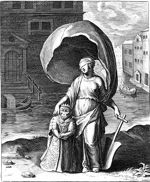
Fortuna non mutat genus: Vaenius, Emblemata Horatiana (Antwerp, 1612), emblem 74 uses the adage's imagery about an ape dressed in purple
Claro sese deformat amictu: Zincgreff, Emblematum Ethico-politicorum (Heidelberg, 1619), emblem 47 uses the adage's imagery about an ape dressed in purple
Iconclass: 22C4(PURPLE) colours, pigments, and paints: purple 25F22 monkeys, apes 41D2 clothes, costume 57AA611 Dissimulation, Hypocrisy; 'Hippocresia', 'Simulatione' (Ripa)
Loci Communes: Dissimilitudinis et incongruentiae (Dissimilarity and incongruity, Dissemblance et incongruité); Honos indigno habitus (Honor given to the unworthy, Honneur accordé à qui ne le mérite pas); Simulatio, dissimulatio (Pretense, dissimulation, Simulation, dissimulation)
I vii 11 Simia simia est, etiamsi aurea gestet insignia An ape is an ape, though clad in gold
Πίθηκος ὁ πίθηκος, κὰν χρύσεα ἔχῃ σύμβολα. i. Simia simia fuerit, etiamsi aurea gestet insignia. Superiori respondet, admonens fortunae ornamenta non mutare hominis ingenium. Citatur adagium à Luciano in oratione contra ineruditum. Natum videtur à simiis illis Aegyptiis saltationem humanam imitantibus. Lucianus refert apologum in hunc modum: Rex quidam AEgyptius simias aliquot instituit, ut saltandi rationem perdiscerent. Ut enim nullum animal ad figuram hominis propius accedit, ita nec aliud actus humanos aut melius, aut libentius imitatur. Artem itaque saltandi protinus edoctae saltare coeperunt, insignibus indutae purpuris, ac personatae. Multoque iam tempore maiorem in modum placebat spectaculum, donec è spectatoribus facetus quispiam, nuces, quas clanculum in sinu gestabat, in medium abiecit. Ibi simiae, simul atque nuces vidissent, oblitae choreae, id esse coeperunt quod ante fuerant, ac repente è saltatricibus in simias redierunt. Contritisque personis, dilaceratis vestibus, pro nucibus inter se depugnabant, non sine maximo spectatorum risu. Narratur apologus non absimilis de fele, quam Venus belle adornatam in pedissequarum ordinem asciverat, ac satis apte ἐγυναίκιζε, donec mure è cavo quopiam in medium procurrente, declaravit sese nihil aliud esse quàm felem.
Πίθηκος ὁ πίθηκος, κᾄν χρύσεα ἔχῃ σύμβολα., An ape will be an ape, though he wears gold on his uniform. Corresponds to what has preceded, pointing out that the trappings of fortune do not change a man's nature. The adage is quoted by Lucian in his harangue Against an Ignoramus. It seems to derive from the well-known Egyptian monkeys that can dance like human beings. Lucian tells a story to the following effect. There was once a king in Egypt who taught a number of monkeys how to dance; for no animal looks more like a human being, and in the same way none is more able or more ready to mimic human actions. So having learnt the art, they immediately began to dance, dressed in scarlet uniforms and wearing masks. For a long time the performance was extremely popular, until some clever fellow among the audience brought a quantity of nuts secreted in his pocket, and scattered them. The moment they saw the nuts, the monkeys forgot their dancing, resumed their true nature, and instantly became monkeys again instead of dancers. They trampled on their masks, they tore their clothes to shreds, and fought each other for the nuts, while the spectators roared with laughter. A similar story is told of the cat which was elegantly dressed by Venus and admitted to the company of her ladies-in-waiting. And it played a woman's part pretty well, until a mouse ran out of some hole or other, when it made quite clear that it was only a cat after all.
Facsimile:
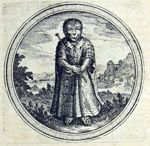
Claro sese deformat amictu: Zincgreff, Emblematum Ethico-politicorum (Heidelberg, 1619), emblem 47 uses the adage's imagery about the unchangeable nature of an ape
Chi di gatta nasce, sorci piglia: Cats, Spiegel (The Hague, 1632), emblem 21 uses the imagery of cats chasing mice and monkey delousing a boy to convey the concept of "nature over nurture" and the commentary quotes also from the adage's comment
Iconclass: 25D13(GOLD) minerals and metals: gold 25F22 monkeys, apes 57AA611 Dissimulation, Hypocrisy; 'Hippocresia', 'Simulatione' (Ripa)
Loci Communes: Forma, deformitas (Beauty, deformity, Beauté, difformité)
I vii 12 Asinus apud Cumanos An ass at Cumae
Ονος παρὰ κυμαίους. id est, Asinus apud Cumanos. Competit in eos, qui, cum sint inepti ridiculique, tamen apud ignotos ipsa novitate habentur in pretio. Aut in eos quibus honos aliquis praeter meritum additus à fortuna, tumorem & insolentiam, ita ut ferè fit, conciliat: id quod eleganter notat Demosthenes Olynthiacarum orationum prima: τὸ γᾶρ εὖ πράττειν παρὰ τὴν ἀξίαν, ἀφορμή του κακῶς φρονεῖν i. Felicitas enim et rerum successus, qui contige rit immerenti, stultis vaesaniae causam praebere solet. Cui congruit illud ex Aeschylo citatum: Η βαρὺ φόρημ᾽ ἄνθρωπος εὐτυχῶν ἄφρων. id est: Grave pondus amens, rebus utens prosperis. Narravimus alibi fabulam de asino fugitivo, qui apud Cumanos se gessit pro leone.
Ὄνος παρὰ Κυμαίους, An ass at Cumae. Applies to those who, though ridiculous and absurd, are valued none the less by people who do not know them, simply for their novelty; or to men who achieve some appointment which they do not deserve, by a freak of fortune, and thereby (as often happens) become arrogant and boastful. Demosthenes has a neat remark to this effect in the first of his Olynthiac Orations: 'Undeserved success starts fools on misguided courses.' In line with this is that verse quoted from Aeschylus: 'A fool's prosperity is hard to bear.' I have told elsewhere the story of the runaway ass which posed among the good people of Cumae as a lion.
Facsimile:
Iconclass: 25F23(LION)(+351) beasts of prey, predatory animals: lion (+ skin, fleece, hide, fur, leather) 46C13142 ass, donkey 85(ASS AND THE LION'S SKIN) fables (ASS AND THE LION'S SKIN)
Loci Communes: Simulatio, dissimulatio (Pretense, dissimulation, Simulation, dissimulation)
I vii 13 Ira omnium tardissime senescit Resentment is the last thing to grow old
Ο θυμὸς ἔσχατον γηράσκει. i. Ira postremum senescit. Huic diversum illud Aristotelis apophthegma, qui, autore Laertio, rogatus quae res quàm ocyssime consenesceret, respondit, Beneficium. M. Tullius utrumque complexus: Cui placet, inquit, obliviscitur: cui dolet, meminit. Nam vulgo mortales iniuriae tenacissime meminisse solent, benefactorum quam facillime oblivisci. Graecum adagium videtur ex Sophocle sumptum, cuius in Oedipo Coloneo haec sunt verba: Θυμοῦ γὰρ οὐδὲν γῆράς ἐστιν ἄλλο, πλὴν Θανεῖν, θανόντων οὐδὲν ἄλγος ἅπτεται id est. Senecta nulla obtingit iracundis, Nisi mors, sepultos nullus attingit dolor. Hoc idem innuit Homerus lepidissimo sanè figmento de Litis & Ate. Hanc deam facit, quae noxas ac turbas soleat im mittere rebus mortalium, atque ipsam quidem acribus oculis ac praevelocibus esse pedibus. Caeterum post eam multo intervallo consequi Litas deas, quae quod Ate turbaverit, sarcire moliantur. Has & strabis oculis fingit, & pedibus claudis, illud nimirum innuens, offensas esse citas, reconciliationes esse tardas, propterea quod iniuriae diu meminisse solent homines. Carmen ipsum Homeri subscribam ex Iliadis libro ix. Καὶ γὰρ τε λιταί εἰσι διὸς κοῦραι μεγάλοιο, Χωλαί τε, ῥυσσαί τε, παραβλῶπὲς τ᾽ ὀφθαλμὼ Αἳ ῥά τε καὶ μετόπισθεν ἄτης ἀλέγουσι κιοῦσαι. Ηδ᾽ ἄτη, σθεναρή τε, καὶ αῤτίπος, ὄυνεκα πάσας Πολλὸν ὑπεκπροθέει, φθάνει δέ τε πᾶσαν ἐπ᾽ αἶαν Βλάπτουσ᾽ ἀνθρώπους, αἱ δ᾽ ἐξακέονται ὀπίσσω Ος μὲν τ᾽ αἰδέσεται κούρας διὸς ἀσσον ἰούσας. Τόν δε μέγ᾽ ὤνησαν, καὶ τ᾽ ἔκλυον εὐξαμένοιο Ος δέ κ᾽ ἀνήνηται, καὶ τε στερεὼς αποείπῃ Λίσσονται δ᾽ ἄρα ταί τε δία κρονίωνα κιοῦσαι, Τῷ δ᾽ ἄτην ἅμ᾽ ἕπεσθαι ἴνα βλαφωεὶς ἀποτίσῃ Quorum versuum non indolem, neque gratiam, sed sententiam utcunque reddemus Latinis auribus. Nam Litas etiam genuit Saturnius ingens, Rugosas, pedibus claudis, ac lumine laesas, Quae Ates à tergo veniunt, medeantur ut illi. Ipsa Ate, pedtbusque valens, & robore praestans, Proinde gradu celeri longe praevertitur, omneis Occupat, & terras prior advenit illa per omneis Mortales laedens: verum hae post terga sequuntur, Sarturae quicquid commoverit illa malorum. At vero natas Iove qui reveretur, & audit, Se simul ac adiere, huic commoda plurima gratae Conciliant, huiusque vicissim vota receptant. Reiicit at si quis praefracte & pernegat illis, Tunc adito Iove patre, precantur, ut ilicet Ate Huic adsit, poenasque suo det denique damno. Eiusdem Ates fit mentio Iliados Τ. ubi lupiter, imputans huic deae, quod à Iunone dece ptus esset, illam capillis arreptam in terras praecipitem dedit, interdicens ne unquam rediret in coelitum contubernium. Hoc Homeri figmentum quidam existimant esse finitimum ei, quod de Lucifero coelis deturbato credunt Christiani.
Ὁ θυμὸς ἔσχατον γηράσκει, Resentment grows old last of all. The opposite of this is a remark of Aristotle who, according to Laertius, when asked what grows old faster than anything else, replied 'a kind action.' The two are put together by Cicero: 'Please a man, and he forgets it; hurt him, and he remembers.' For it is the common way of mortals to remember an injury stubbornly enough, and to forget kindness done to them with the greatest ease. The Greek adage seems to be taken from Sophocles, who says in the Oedipus Coloneus
Resentment knows no age, save only death,
For there's no feeling that can touch the dead.
Homer makes the same point in his surely very charming fable about Prayers and Mischief or Infatuation. Infatuation he makes out to be a goddess who sends disasters and confusion upon the affairs of men, giving her very keen sight and great swiftness of foot. After her, and some way behind, follow the Prayers, goddesses who do their best, he says, to mend the confusion caused by Infatuation. These he describes as cross-eyed and lame, making the point, no doubt, that men are quick to take offence and slow to be reconciled, because they have a long memory for injuries. I will append Homer's actual lines from the ninth book of the Iliad:
For Saturn's mighty son begot the Prayers,
Wrinkled and lame, squinting with sidelong glance.
Where Mischief went, they follow in her train
To mend the harm that she doth leave behind.
Mischief herself, mighty and fleet of foot,
Runs far in front and quite outstrips them all;
O'er the wide earth she harmeth mortal men,
While they pursue, the damage done to mend.
He who reveres Jove's daughters at their coming, -
Him they will help, and listen to his prayers;
But if he spurns and sternly says them nay,
They seek their father Jove, and beg that straight
Mischief may haunt the man and make him pay.
He mentions the same goddess Infatuation in the nineteenth book of the Iliad, where Jupiter, thinking that it is her doing that he has been deceived by Juno, seizes her by the hair and throws her down to earth headlong, forbidding her ever to return to the society of the gods. This invention of Homer's is thought by some people to be close to the Christian belief that Lucifer was hurled down from Heaven.
Facsimile: 
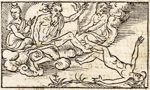
Discorde haye de dieu: Corrozet, Hecatomgraphie (Paris, 1540), emblem 31 uses the imagery of the longevity of Discord
Iconclass: 11N33 Anger; 'Ira' (Ripa) ~ personification of one of the Seven Deadly Sins 51FF51 Oldness 51MM11 Slowness, Tardiness; 'Tardità' (Ripa)
Collectanea (1500): 446
I vii 14 Si vultur est, cadaver exspecta If you're a vulture, wait for your carcase
Captatores testamentorum & haeredipetae, vulgata metaphora vultures appellantur, quod senibus orbis ceu cadaveribus inhient. Nam huic avi proprium, cadaveribus tantum vivere. Unde & natura tantum illi sagacitatis addidit, autore Plinio, ut biduo, aut triduo praevolet illuc, ubi cadavera sint futura: eoque, ut refert vere Magnus ille Basilius, ingenti agmine solet comitari castra militum. Hoc minu nocens, quam sint homines isti divitum funeribus imminentes, quod neque fruges attingit, neque ullum animal, quantumvis imbelle, occidit, aut insectatur: tantum cadavera, vel eorum, quae sponte interierunt, vel ab aliis relicta sunt, depascitur. In quibus tamen abstinet à sui generis, id est, avium cadaveribus. Quemadmodum & Plutarchus docet in problematis rerum antiquarum, ne quid interim afferam ex Aegyptiorum opinione, qui dicunt vultures omnes esse foeminas, nec aliter ex euro concipere, quàm è zephyro gravidae fiunt arbores. Unde mirum est, hanc avem innocentissimam apud homines tam male audire. Proinde qui divites audent aut accusare, aut veneno tollere è medio, milvii vocantur: qui vero duntaxat obsequiis & adulationibus aucupantur, ut misceantur testamento, vultures proverbio dicuntur. Seneca li. Episto. xv. epistola xcvi. Si vultur es, cadaver exspecta. Martial. lib. vi. Amisit pater unicum Silanus. Cessas mittere munera Oppiane? Heu crudele nefas, malaeque Parcae, Cuius vulturis hoc erit cadaver? Diogenianus in collectaneis meminit huius adagii, sed alia figura, ἅπερ γυπὲς. i. vulturum ritu. Admonet autem dictum de iis, qui vel ob haereditatis, vel alterius alicuis emolumenti spem insidiantur cuipiam.
Legacy-hunters, the people who haunt a man when he is making his will, are known in a familiar image as 'vultures,' from the way they hang over a rich man with no children as though he were a corpse. For it is characteristic of the vulture to feed exclusively on carrion, and nature has therefore given it, according to Pliny, such foresight that it flies two or three days beforehand to the place where there will be corpses, and so is accustomed, as Basil the truly Great records, to follow an army from one camp to another in a great column. In one respect it is less noxious than those human beings who hang over rich men's deathbeds: it never touches the fruits of the earth, nor does it ever kill or even pursue any living creature however unfit for combat; it feeds on nothing but corpses, whether they have died a natural death or are the leavings of other animals, and among these it refrains none the less from corpses of its own kind, that is, of other birds. So Plutarch tells us in his 'Antiquarian Problems'; to say nothing for the moment of what the Egyptians believe, for they hold that all vultures are female and conceive by the east wind, just as trees are fertilized by the west wind. It is therefore surprising that this bird, which does so little harm, should have such a bad name. Thus those who have the audacity to blackmail the rich or to poison them, are called 'kites,' while those who fish for a place in their wills merely by acting as toadies and flatterers are proverbially referred to as 'vultures.' Seneca in letter 96: 'If you're a vulture, wait for your carcase.' Martial in his sixth book:
Silanus' only son is deadly sick:
Round with your present, Oppianus, quick!
'O cruel fate, this monstrous blow that struck!'
Let's see which vulture now will be in luck.
Diogenianus records this adage in his collections, but in another form: Ἅπερ γυπὲς, Vulture-fashion. He tells us it is used of those who lie in wait for a man in hopes of a legacy or some other advantage.
Facsimile: 
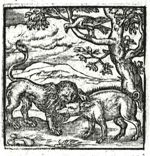
Ex damno alterius, alterius utilitas: Alciatus, Emblemata (Leiden, 1591), emblem 125
Ex damno alterius, alterius utilitas: Whitney, A choice of emblemes (Leiden, 1586), emblem 124
Avarus nisi cum moritur nihil recte facit: Vaenius, Emblemata Horatiana (Antwerp, 1612), emblem 54 - links to the comment about heirs
Iconclass: 25F(+66) animals (+ carrion) 25F33(VULTURE) predatory birds: vulture 42E5321 quarrelling heirs 54B1211 Waiting for an Opportunity
Loci Communes: Heredipetae (Legacy-hunters, Chasseurs d'héritage)
I vii 15 Corvum delusit hiantem He's tricked the gaping crow
Haud dissimili figura dictum est ab Horatio, in eum qui captatorem suum arte frustratus fuerat, Corvum delusit hiantem. (Nam haec quoque avis cadaveribus imminet.) Plerumque, inquit, recoctus Scriba ex quinqueviro corvum delusit hiantem. Loquitur de Corano, qui Nasicae socero, spe testamenti per dolum ostentata, moriens, nihil praeter plorare reliquit. Videtur autem hoc adagium effictum, & imitatum ad illud Graecorum, λύκος ἔχανεν. id est, Lupus hiat. Ut itidem dicere liceat: lupum delusit hiantem, & κόραξ ἔχανεν., id est, Corvus inhiabat.
Horace uses a similar image of someone who had outwitted the man who hoped for a legacy in his will, when he says that he tricked the gaping crow; for the crow, like the vulture, is always on the look-out for carrion. Often he says, 'Some jack-in-office, petty clerk rehashed / Has played your gaping crow a pretty trick.' He speaks of one Coranus, who deluded his father-in- law Nasica with great hopes of a legacy, and when he died left him 'save lamentation, nought.' It looks as though this adage was made up in imitation of the Greek expression λύκος ἔχανεν., A wolf with open mouth, so that one might say equally well He's tricked the gaping wolf, or κόραξ ἔχανεν., A crow with open mouth.
Facsimile:
Iconclass: 25F23(WOLF)(+451) beasts of prey, predatory animals: wolf (+ animal in search of food) 25F23(WOLF)(+5733) beasts of prey, predatory animals: wolf (+ animal with mouth wide open) 25F32(CROW)(+451) song-birds: crow (+ animal in search of food) 25F32(CROW)(+5733) song-birds: crow (+ animal with mouth wide open) 55CC11 Greed, Covetousness, Cupidity; 'Cupidità' (Ripa)
Loci Communes: Frustrata spes (Frustrated hope, Espoir déçu)
I vii 16 Cornicari To croak
Quin & Graeci proverbio κρώζειν, dicunt, pro eo quod est, inhiare praedae, aut inepte garrire. Aristophanes in Pluto: Σὺ μὲν οἶδ᾽ ὅ κρώζεις, ὡς ἐμοῦ τὶ κεκλοφότος Ζητεῖς μεταλαβεῖν. id est, Quid crocites scio, nempe si quicquam rei Furto involarim, ut hinc tibi partem feras. Interpres admonet esse proverbium in eos, qui cornicum more frustra cornicantur. Sunt autem verba Chremyli senis, qui ait se non ignorare, quid sibi vellet Blepsidemus, sursum ac deorsum vertens orationem, dum studet furti confessionem elicere, nimirum ut conscius in praedae partem veniret. Persius satyra v. Nescio quid tecum grave cornicaris inepte. Usus est & divus Hieronymus in epistola ad Rusticum monachum.
Greek also uses κρώζειν,, to croak, proverbially for hovering over a prey or for foolish chattering. Aristophanes in the Plutus: T hear you croak. You think I've helped myself, / And want your share.' The scholiast points out that this is a proverbial expression directed against those who croak like crows to no good purpose. The words are spoken by Chremylus an old man, who says he is well aware what Blepsidemus is up to; he is attacking him from all quarters in hopes of extracting a confession, in order no doubt that once he is in the secret he may claim his share of the spoils. Persius in his fifth satire: 'Croaking mysterious nonsense to yourself.' St Jerome too uses it in his letter to Rusticus the monk.
Facsimile:
Iconclass: 25F32(CROW)(+49) song-birds: crow (+ audible means of communication of animal(s): roaring, crying, singing, barking, mewing, neighing, chirping, etc.)
Loci Communes: Garrulitas (Talkativeness, Bavardage)
I vii 17 In vino veritas Wine speaks the truth
Εν οἴνῳ ἀληθεια. i. In vino veritas, passim apud autores usurpatum adagium, significans ebrietatem animi fucum tollere, & quicquid in pectore conditum est, in apertum proferre. Unde divinae literae vetant vinum dari regibus, quod ibi nullum sit arcanum, ubi regnet ebrietas. Plin. li. xiiii. cap. xxii. scripsit, vinum usque adeo mentis arcana prodere, ut mortifera etiam inter pocula loquantur homines, & ne per iugulum quidem redituras voces contineant: vulgoque, inquit, veritas attributa vino est. Celebratur & Persae cuiusdam apophthegma, qui negavit tormentis opus esse ad exquirendum verum. vino enim rectius elici: quod approbans Horatius in Odis: Tu lene, inquit, tormentum ingenio admoves Plerunque duro, tu sapientium Curas, & arcanum iocoso Consilium retegis Lyaeo. Idem in Arte poetica: Reges dicuntur multis urgere culullis, Et torquere mero, quem perspexisse laborent, An sit amicitia dignus. Rursum alibi: Quid non ebrietas designat? operta recludit. Effertur & ad hunc modum apud Athenaeum li. ii. paroemia, οἶνος καὶ ἀλήθεια. i. Vinum & veritas. Quod largius poti non tantum effutiunt sua arcana, verumetiam audacius in alios loquuntur. Apud Plutarchum in vita Artaxerxis, Sparamixas Mithridati per vinum quid dam insolentius elocuto, φρόνος μὲν οὐδεὶς ὦ μιθριδάτα, ἐπὶ δέ φασϊν ἕλληνες, οἶνον καὶ ἀλήθειαν εἶναι i. Nulla quidem invidia est, ô Mithridates caeterum quando Graeci dicunt, vinum & veritatem esse, &c. Celebratur à Graecis haec quoque sententia proverbialis, τὸ ἐν τῇ καρδίᾳ τοῦ νήφοντος, ἐπὶ τὰς γλώσσης τοῦ μεθύοντος i. Quod in corde sobrii, id in lingua ebrii. Theognis: Εν πυρὶ μὲν χρυσόν τε, καὶ ἄργυρον ἴδριες ἄνδρες Γινώσκουσ᾽. ἀνδρος δ᾽ οἴνος ἔδειξε νόον. id est, Aurum aut argentum fabris dignoscitur igni, Vinum hominis prodens arguit ingenium. Athenaeus hunc senarium citat ex Euripide: Κάθοπτρον γὰρ εἰδους χαλκός ἐσ᾽, οἶνος δὲ νοῦ. id est, Forma aere lucet, vina produnt pectora. Apud eundem Ephippus: Οἴνου σε πλῆθος πολλ᾽ ἀναγκάζει λαλαεῖν, Οὐκοῦν μεθύοντάς φασι τ᾽ ἀληθῆ λέγειν. id est, Vis multa vini, multa te cogit loqui: Loqui proinde vera dicunt ebrios. At idem lib. x. refert Anacharsidis dictum, ὅτι ψουδεῖς δόξαι τοῖς μεθύουσι γίγνονται. id est, quod falsae opiniones accidunt temulentis. Ac mox narrat quiddam haud infestivum. Quidam e convivis dixerat Anacharsidi, Uxorem duxisti admodum deformem. At ille, Prorsus, inquit, idem mihi videtur. Sed heus puer, porrige poculum meracius, ut illam faciam formosam. Non solum igitur amanti, verum etiam ebrio τὰ μὴ καλὰ πὲφανται, quemadmodum inquit Theocritus. Atqui verum qui potest dicere, qui labitur rerum iudicio? Sed veritas no semper respondet mendacio, verum interdum simulationi. Potest autem fieri, ut ex animo loquatur, qui tamen falsum dicat, & verum dicat qui non vere loquatur. Postremo proverbium non sentit de insana temulentia, quae facit, ut quae fixa sunt videantur ambulare; & quae simplicia, videantur multiplicia: sed de moderata, quae dysopiam, ac fucum excutit. Alcibiades in Symposio Platonis: τὸ δὲ ἐντεῦθεν οὐκ ἄν μου ἠκούσατε λὲγοντος εἰ μὴ πρῶτον μὲν, τὸ λεγόμενον, οἶνος ἄνευτε παίδων, καὶ μετὰ παίδων, ἦν ἀληθής. . id est, Quae vero nunc sequuntur, non prius audietis, quàm proverbium illud recensuerim: Vinum & cum pueritia, & sine pueritia, veridicum est. Quibus ex verbis liquet, idem de pueritia quod de vino, proverbio iactatum fuisse. Durat & hodie vulgo tale proverbium, non audiri verum, nisi à tribus hominum generibus, pueris, ebriis, & insanis. Huc adscribendum arbitror versiculum illum proverbialem: Η γλῶσσ᾽ ἁμαρτάνουσα τ᾽ ἀληθῆ λέγει. id est, Verum solet prolapsa lingua dicere. Nam verum esse creditur, quod exciderit imprudenti, quandoquidem id demum vacat fictionis suspicione. Ex huiusmodi lapsu colliguntur & omnia certioris fidei. Saepe Neoptolemi pro nomine nomen Orestis Exit, & errorem vocis ut omen amo. Denique M. Tullius in Topicis, inter ea quae certam faciunt fidem, commemorat pueritiam, somnum, imprudentiam, vinolentiam, insaniam.
Ἐν οἴνῳ ἀλήθεια., Wine speaks the truth. An adage found in many classical authors, meaning that strong drink strips the mind of its pretences and brings out into the open what is hidden in a man's heart. That is why Scripture forbids wine to be given to kings, because where strong drink reigns there are no secrets. Pliny, book 14 chapter 22, writes that wine 'betrays the secrets of the mind so effectively that men in their cups will say what will cost them their lives and cannot even repress remarks that will recoil and cut their own throats. It is a common saying' he adds 'that there is truth in wine.' There is a well-known saying, attributed to an eminent Persian, that torture is unnecessary to get at the truth; wine is much more effective. Horace confirms this in the Odes:
Tough wits to your mild torture yield
Their treasures; you unlock the soul
Of wisdom and its stores conceal'd,
Arm'd with Lyaeus' kind control.
Again in the Art of Poetry:
So kings are said to ply with cups galore
(Strong drink their thumbscrew) him they would explore:
Is he the stuff of which a friend is made?
And again elsewhere: 'Drink's the one key that opens every door.' The proverb is also expressed in the second book of Athenaeus in this way: 'Wine and truth,' because those who have drunk too much not only blurt out their own secrets but make rash statements about other people too. In Plutarch's life of Artaxerxes, when Mithridates has said something insolent in his cups, Sparamixas says 'No offence taken, Mithridates, but when the Greeks speak of "wine and truth'" and what follows. Greek has another common proverbial saying: 'What is in the heart of the sober man is in the mouth of the drunkard.' Theognis: 'Silver and gold by fire the craftsman tries; / 'Tis wine displays the mind before our eyes.' Athenaeus cites this line from Euripides: 'Bronze the face mirrors, and strong drink the mind.' He also quotes Ephippus: 'Liquor in plenty forces one to speak, / And tipsy men, they say, will tell the truth.' But he also preserves in book 10 a saying of Anacharsis that men as they get drunk are filled with false ideas, and then tells a story not without its point. One of the guests had said to Anacharsis 'You have married a very ugly wife.' 'Yes' said he, T quite agree. Hey, waiter, bring me a good strong drink, and I'll make her look handsome.' So it's not only the lover, but the drinker too, who 'thinks what's foul is fair,' as Theocritus puts it. And yet how can a man speak the truth whose judgement is unsteady? Truth however is not always opposed to falsehood; sometimes its opposite is pretence. A man can speak sincerely and what he says may be false; and what he says can be true though he does not speak the truth. Last but not least, the proverb aims, not at the madness of intoxication, to which things that are fixed appear to be going round and round and single things appear double or treble, but at the more moderate stage which clears away false shame and disguises. Alcibiades in the Symposium of Plato: 'What follows you would never have heard me say, unless first I had recalled the proverb that Wine without children or with children speaks the truth.' From these words it is clear that the same proverbial expression was current about childhood as about wine. A similar proverb is still in common use today, to the effect that you never hear the truth from anyone, save only from three kinds of person: children, drunkards and madmen. To this I think one should add another proverbial line: 'A slip of the tongue is wont to tell the truth.' For what a man lets fall unawares is commonly thought to be true, because only then is it free from any suspicion of falsehood. Such slips of the tongue are picked upon as indications that can be trusted: 'For "Neoptolemus" I thoughtless cry / "Orestes" - sign that better days are nigh.' Cicero finally in his Topica lists among those whose remarks carry conviction children, sleepers, persons caught off their guard and drunkards.
Facsimile: 
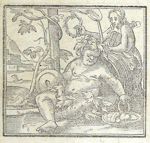
In vino veritas: Reusner, Aureolorum Emblematum (Strasbourg, 1587), emblem 49
In vino veritas: Holtzwart, Emblematum Tyrocinia (Strasbourg, 1581), emblem 16
Iconclass: 41C711 wine ~ alcoholic drinks 52A6 Truth; 'Verità' (Ripa)
Loci Communes: Libertas, veritas (Freedom, truth, Liberté, vérité)
I vii 18 Bos in lingua An ox on the tongue
Βοῦς ἐπὶ γλώττης. id est, Bos in lingua. In eos, qui non audent libere, quod sentiunt, dicere. Translatum, vel a robore animantis, quasi linguam opprimens, non sinat eam eloqui. Vel hinc quod Atheniensium nomisma quondam bovis obtinuit figuram. Item apud Romanos Servius Rex, ovium ac boum effigie primus signavit aes, auctore Plinio li. decimooctavo, cap. iii. Idem testatur Plutarchus in Problemibus rerum priscarum, quod priscis omnis ferè possessio erat in gregibus & armentis. Unde & à pecoribus dictam pecuniam volunt. Itaque qui mulctae pendendae metu deterriti reticerent, aut qui pecunia corrupti loqui non auderent, bovem in lingua dicebantur habere. At Iulius Polluxus nono de rerum vocabulis libro, proverbium hoc exponens, his fermè consentanea commemorat, addens ipsum nomisma bovem vulgo vocari solere. Proinde in Deliacis spectaculis, si cui minus dandum erat, praeconem pronunciare solitum, Tot boves illi dabuntur, Bovem autem valuisse duabus drachmis Atticis, unde fuisse qui crederent hoc nomisma Deliorum fuisse proprium, non Atheniensium. Addit item in Draconis legibus extare mentionem, περὶ τοῦ ἀρτίνειν δεκάβοιον. id est, De pendendis decem bubus, id est, nummis decem. Neque defuisse, qui senserint, Homerum quoque de numismate locutum, non de animante, cum ait: Χρύσεα χαλκείων ἑκατόμβοι᾽ εννεαβοίων Verum hanc opinionem alio in loco refellit Iulius Pollux, ostendens illam fuisse commutationem rerum citra nummos. Qui scripsit scholia in Homerum lib. ii. tradit bovem apud priscos in honore fuisse, quum multis de causis, tum praecipue, quod Apollini sacrum sit animal. Itaque in altera parte nomismatis insculpebant bovem, in altera faciem regiam. Adagium autem effert ad hunc modum, Βοῦς ἐπὶ γλώττης βέβηκεν.. id est, Bos in lingua incedit. admonens id dici solitum, ubi quis pecuniae causa taceret. Theognis, Βοῦς μοι ἐπὶ γλώσσῃ, id est, In lingua mihi bos. Philostratus in vita Apollonii: γλῶπτάν τε ὡς πρῶτος ἀνθρώπων συνέσχε, βοῦν ἐπὶ αὐτῇ σιωπῆς εὑρὼν δόγμα, id est, Linguam primus hominum coercuit, bovem in illa silentii inveniens decretum. De Pythagora loquitur, silentii auctore. Item in Scopeliano sophista: καὶ οὐ χρὴ θαύμζειν εἰ πεπεδημένοι τὴν γλῶττάν τινες καὶ βοῦν ἀφωνίας ἐπ᾽ αὐτὴν βεβλημένοι, id est, Neque mirandum est, si quidam, linguam habentes vinctam, bove silentii eam occupante. Ex stat apud Aeschylum in Agamemnone: Τὰ δ᾽ ἄλλα σιγῶ, βοῦς ἀθῒ γλώττης μέγας βέβηκεν. id est, Taceo caetera, linguam occupavit bos quidam Ingens.
Βοῦς ἐπὶ γλώττης. , An ox on the tongue. Used of those who do not dare say freely what they think. A metaphor either from the great mass of the animal, as though it crushed the tongue and did not let it speak, or from the fact that in Athens there was once a coin with the figure of an ox. In Rome too king Servius first struck bronze coins with sheep and oxen on them, according to Pliny, book 18 chapter 3. Plutarch in his 'Antiquarian Problems' tells the same story, the reason being that in early times almost all wealth took the form of flocks and herds, whence some suppose that pecunia, the Latin for money, is derived from pecora, cattle. And so those who kept their mouths shut for fear of a pecuniary penalty, or had not the face to speak because they had taken bribes, were said to have 'an ox on the tongue.' Julius Pollux, in the ninth book of his Vocabulary where he explains this proverb, more or less agrees with this, adding that the coin itself was commonly called an ox. Further, that in the festival in Delos, if someone was due to receive an award, the herald announced by custom 'Such-and-such a man shall receive so many oxen.' An ox in this sense, he says, was worth two Attic drachmas, whence some people supposed that it was a Delian and not an Attic coin. He adds that in the laws of Draco there was mention of a ten-ox payment, which would mean ten coins; and that there were those who thought that Homer too had spoken of the coin, not of the animal, when he tells of exchanging 'gold arms for bronze, arms worth a hundred oxen / For arms worth nine.' But this view is refuted by Julius Pollux in another passage, where he shows that exchange of goods already existed without coins. The author of the scholia on Homer, in the second book, records that the ox was honoured among the Ancients for many reasons, but particularly because it is sacred to Apollo; and so on one side of the coin they stamped an ox and on the other a king's head. But he gives the adage in the form Βοῦς ἐπὶ γλώττης βέβηκεν., An ox treads on my tongue, pointing out that this is used when a man kept silent for money. Theognis: 'An ox is on my tongue.' Philostratus in his Life of Apollonius: 'He was the first of men to restrain his tongue, inventing "An ox sits upon it" as a principle of silence.' He speaks of Pythagoras, the apostle of silence. Again, in his life of the sophist Scopelianus:" 'Nor should we be surprised if some people, who are tongue-tied themselves and have set upon their tongues the ox of silence.' It occurs also in the Agamemnon of Aeschylus; 'The rest for me is silence; on my tongue / A great ox treads.'
Facsimile: 
Iconclass: 31A22141 tongue 31B62359 being silent 44C59 censorship 47I21111 ox
Collectanea (1500): 304
Loci Communes: Munerum corruptela (Corruption by gifts, Corruption par les présents)
I vii 19 Argentanginam patitur He has the silver-quinsy
Αργυράγχην πάσχει, id est, Argentanginam patitur. Superiori finitimum est, natum ex historia, quam refert Aulus Gellius in Noctibus Atticis, atque item Plutarchus in vita Demosthenis. Ea est huiusmodi. Cum adversus Milesiorum legatos, qui auxilii petendi causa Athenas venerant, acriter in concione dixisset Demosthenes, obsisteretque quo minus impetraturi postulata viderentur, causa in diem posterum reiecta, legati Demosthenem ipsum adierunt, magnaque pecuniae summa, ne contra se diceret, redemerunt. Postridie, quum res denuo foret agenda, Demosthenes multa lana collo circumvoluto in concionem prodiit, fingens sese συνάγχην, id est, anginam pati. Eamque rem impedimento esse, quo minus ex more diceret. Tum è populo quispiam, cui simulatio subolebat, exclamabat, eum non συνάγχην, sed ἀργυράγχην pati. Est autem synanche morbi genus, quem vulgus medicorum depravate squinantiam appellat. Hunc Aretaeus Cappadox libro primo commemorat inter morbos acutos, ostendens bifariam appellari vel κυνάγχην, quod in mali canibus sit familiare, vel συνάγχην, quod spiritum coarctet ac praefocet.
Ἀργυράγχην πάσχει, He has the silver-quinsy. Related to the preceding, and derived from a story told by Aulus Gellius in his Attic Nights book 9 chapter 9, and also by Plutarch in his life of Demosthenes. It runs as follows. A mission from Miletus which had come to Athens to ask for help had been bitterly attacked by Demosthenes in the assembly, and his opposition made it seem unlikely that they would get what they wanted. The question having been put off to the next day, the envoys approached Demosthenes in person, and bought him off with a large sum of money, not to speak against them. Next day, when the question was due to be reopened, he appeared in the assembly with a great woollen bandage round his neck, pretending that he had a synanche, a quinsy, and that this prevented him from speaking in the normal way. At which someone in the audience who suspected he was shamming shouted that this was no ordinary quinsy but an argyranche, a 'silver-quinsy.' A synanche is a complaint the name of which is commonly corrupted by physicians to 'squinancy.' Aretaeus of Cappadocia speaks of it in his first book among acute complaints, and points out that it has two names, either kynanche because it is common among dogs or synanche because it impedes and restricts the breathing.
Facsimile:
Iconclass: 31A22153 mouth and throat cavity 31A4632 infections and wounds 46B911 bribery 49G3211 dressing, bandage
Loci Communes: Degenerantium in pejus (Degenerating for the worse, Dégénérer en pire); Munerum corruptela (Corruption by gifts, Corruption par les présents)
I vii 20 Equus me portat, alit rex A horse to carry me, a king to feed me
Ιππος μὲ φέρει, βασιλεὺς μὲ τρέφει id est, Me rex alit, ac me portat equus. Refertur inter Graecorum adagia, atque addunt hinc natum. Iuvenis quidam sub rege Philippo stipendia faciebat. Is cum admoneretur ut missionem peteret, seseque à militia ab dicaret, negavit se facturum, his quidem verbis: Ιππος μὲ φέρει, βασιλεὺς μὲ τρέφει id est, Equus me portat, Rex me alit. Significans se commodissime vivere, ut qui & pedibus alienis ingrederetur, & aliena pecunia pasceretur. Huc allusit Horatius, cum in Epistolis sub Aristippi persona sic ait: Rectius hoc, & Splendidius multo est, equus ut me portet, alat rex. Quo quidem in loco Acron huius admonet proverbii, cuius etiam meminit Diogenianus. Apparet è tragoedia quapiam ascitum. Est enim carmen anapaesticum dimetrum.
'Ἵππος με φέρει, βασιλεύς με τρέφει, A king feeds me and a horse carries me. Listed among Greek proverbs, with the following note of its origin. A young man was serving in King Philip's army; and when urged to apply for his discharge and abandon a soldier's life, he refused to do so, saying he had a horse to carry him and a king to feed him. By which he meant that he lived in the greatest comfort, never walking on his own feet or buying food with his own money. Horace alludes to this in his Epistles, when he puts into the mouth of Aristippus the words 'Tis a far better and more glorious thing / To ride a horse and be fed by a king.' Commenting on this passage, Acron tells us of this proverb, which is also recorded by Diogenianus. It is taken clearly from some tragedy, for it forms a line of verse, an anapaestic dimeter.
Facsimile:
Iconclass: 41C111 giving food 44B113 king 46C131 riding a horse, ass, or mule; rider, horseman
Collectanea (1500): 364
Loci Communes: Securitatis et tutae rei (Security and safety, Sécurité et sûreté)
I vii 21 Etiam corchorus inter olera Blue pimpernel too is a vegetable
Καὶ κόρχορος ἐν λαχάνοις. id est, Etiam corchorus inter olera. Dici solitum in homines nul lius precii, qui tamen in numero aliquo studeant haberi. Nam κόρχορος, oleris genus est vilissimi, quia Plinius lib. vigesimoprimo, in catalogo olerum recenset. Idem alibi commemorat inter herbas sponte nascentes. Scribit autem corchorum Alexandrini cibi herbam esse convolutis foliis, ad similitudinem mori, multis remediis utilem. Meminit proverbii Theophrastus libro De plantis septimo, capite septimo, Corchorum referens inter olera, quae vel cocta vel cruda possint edi, verum ob amaritudinem proverbio esse infamem. Suidas & Hesychius autores sunt, nonnullis piscem existimari corchorum, contemptissimum, nulliusque precii, qualis sit hippurus. Aristoph. in Vespis: κᾖθ᾽ ἥψαμεν τοῦ κορχόρου. id est, Deinde corchorum attigimus. Nec hic tacuit interpres de proverbio.
Καὶ κόρχορος ἐν λαχάνοις., Blue pimpernel too is a vegetable. Said normally of worthless men who are anxious to be thought of some importance. For blue pimpernel is a kind of greenstuff very little thought of, which is given by Pliny, book 21, in a list of vegetables. Elsewhere he records it among plants that grow wild. He tells us that blue pimpernel is a plant 'used for food in Alexandria, with crinkled leaves like those of the mulberry,' which has many medicinal uses. Theophrastus recalls the proverb in his work on plants, book 7 chapter 7, where he classifies corchorus among the vegetables that can be eaten either cooked or raw, but says that proverbially it had a bad name for bitterness. Suidas and Hesychius inform us that some thought the corchorus was a fish, much despised and of no value, like the hippurus. Aristophanes in the Wasps has 'And then we laid hands on the pimpernel.' Here too the scholiast has not failed to mention the proverb.
Facsimile:
Iconclass: 41C652(BLUE PIMPERNEL) vegetables (BLUE PIMPERNEL)
Collectanea (1500): 365
Loci Communes: Contemptus et vilitatis (Contempt and worthlessness, Mépris et bassesse)
I vii 22 Graculus inter Musas A jackdaw among the Muses
Cui non dissimile videtur, κολοιὸς εν ταῖς μούσαις, id est, Graculus inter musas. Indoctus inter doctissimos: in fantissimus inter eloquentissimos. Recte dicetur et in homines osten tatione falsae do ctrinae sese iactantes, et viris eruditis impudentaer obstrepentes. Est enim Graculus avis minime canora, sed tamen odiose garrula, atque obstrepera. Confine est his, quod in Bucolicis ait Virgilius: - Sed argutos inter strepere anser olores. Cycnos canoros esse sic omnium poetarum literis est decantatum, ut nihil sit celebratius, etiam si nemini contigit hunc audire cantum. Nec desunt philosophi, qui huiusce rei rationem quoque reddere conentur. Aelianus addit, eos non canere, nisi flante Favonio. Unde fertur etiam proverbium, κύκνειον ᾆσμα. id est, Cygnea cantio. Contra, anseres molesto quodam stridore obganniunt. Proinde, cum indoctus inter eruditos garrit, in tempore usurpabitur adagium, Anser inter olores.
There is apparently some difference between that and κολοιὸς εν ταῖς Μούσαις , A jackdaw among the Muses, an ignoramus among eminent scholars, an inarticulate person among practised speakers. It will be rightly used also of men who advertise themselves by a display of spurious learning and brazenly interrupt those who really know. The jackdaw is a bird that cannot sing a note, but chatters tediously all the time. Related to this is a phrase used by Virgil in his Bucolics: 'A cackling goose amid the tuneful swans.' That swans are musical is so constantly repeated in the work of every poet that no fact is better known, although no one has had the good fortune to hear them singing. Nor is there any shortage of philosophers who try to explain the phenomenon. Aelian adds that they do not sing unless a west wind is blowing. Hence also the proverbial expression κύκνειον ἆσμα, A swan-song. Geese on the other hand greet one with a most tedious cackling. Hence when an ignorant man is chattering in educated company, it will be a suitable moment to use the adage A goose among swans.
Facsimile: 
Iconclass: 25F32(JACKDAW) song-birds: jackdaw 92D4 (story of the) Muses; 'Muse' (Ripa)
Loci Communes: Dissimilitudinis et incongruentiae (Dissimilarity and incongruity, Dissemblance et incongruité)
I vii 23 In lente unguentum Perfume on the lentils
Τὸν ἐπὶ φακῇ μῦθον, id est, In lenticula fabulam, subaudi, narras. Ubi quis mentionem inducit vilis cuiuspiam & nihili hominis, aliis de viris egregiis verba facientibus: Ad hunc quidem modum legitur in omnibus vulgatis exemplaribus, apud A. Gellium, lib. xiii. capite vigesimoseptimo. Verum placet Hermolai castigationi subscribere, qui locum hunc ita restituit, ut legat, τὸν ἐν φακῇ μῦρον, id est, In lente unguentum. Quadrat autem in hominem, aut in rem quampiam, quae neutiquam in tempote adhibeatur iis, quibus minime congruit. Veluti si philosophum iuvenem lascivientium convivio misceas: aut inter pocula de rebus gravibus ac theologicis incipias disputare. Quemadmodum videlicet lenticulae vili legumini, inepte quis admiscuerit unguentum. Siquidem autore Dioscoride & oculorum aciem ebetat, stomacho gravis, intestinis noxia, nervis, pulmoni & capiti inimica, gignit turbulenta insomnia. Dicetur etiam ubi plura inter se dissimilia confundentur. Verba Frontonis apud Gellium sunt haec: Videte tamen, ne existimetis semper, atque in omni loco mortales multos, pro multis hominibus esse dicendum: ne plane fiat Graecum illud de Varronis satyra proverbium, τὸν ἐν φακῇ μῦρον, id est, In lente unguentum. Idem usurpavit M. Tullius lib. ad Atticum primo: Legati, inquit, cum auctoritate mitterentur, qui adirent Galliae civitates, darentque operam, ne eae cum Elvetiis se iungerent. Legati sunt Q. Metellus Creticus, & L. Flaccus, τὸ ἐπὶ τῇ φακῇ μύρον. Lentulus Clodiae filius. Tametsi hic quoque locus eodem mendo laborat, quo Gellianus ille. Citatur autem adagium ab Aristotele, in lib. De sensu et sensili: ἀληθὲς γαρ ὅπερ εὐριπίδην εἶπε σκώπτων στράτις, ὅταν φακὴν ἕψηται, μὴ ἐπιχεῖν μῦρον. id est, Nam verum est, quod ait Stratis Euripidem taxans, ubi lenticula coquitur, non oportere unguentum infundere. quo sanè loco, quae portenta habeant nostri vulgati codices, nihil attinet commemorare. Citat & Athenaeus lib. Dipnosoph. quarto: Γαραινέσαι σφῶίν τι βούλομαι σοφόν, Οταν φακὴν ἔψητε μη᾽πιχεῖν μύρον. id est, Vos admonere callidum quiddam volo: Ubi lens coquitur, unguenta nequa infundite. Ex Phoenissis Stratidis, Comici poetae. Citat & ex Sopatri Necya: ἰθακὸς ὀδυσσεὺς τὸ ἐπὶ τῇ φακῇ μύρον παρεστι, θὰρσει θυμὲ. id est, Ithacensis Ulysses in lente unguentum adest, aude anime. Adducit & Clearchum proverbiorum collectorem, qui hoc quoque recensuerit proverbii titulo, τὸ ἐν φακῇ μύρον. Addens extare apud Varronem, complureisque Latinorum usos eo proverbio, quibus in cognitum tamen sit, unde Varro desumpserit eum iambicum. Huc mihi videtur Aristophanes allusisse, cum ait ἐν εἰρήνῃ, Κᾀπιφυτεύσεις ἕρπυλλον ἄνω Κὰι μύρον ἐπιχεῖς id est, Praeterea seres serpyllum sursum, Et unguentum infundes. Porrò unguentum intelligo oleum odoratum, ac velut unguentarium. Alioqui plebeium oleum admiscere lenti, nihil prodigiosum. Athenaeus lib. ii. citat hunc trimetrum ex Eupolide: Οψῳ πονηρῷ πολυτελῶς ἡρτυμένῳ. id est, Conditum opipare vile malumque opsonium. Est autem apud scriptores hoc legumen cum primis celebre, quemadmodum bulbus, cepe, & allium: nonnulli etiam encomium lentis scripsere. Quaedam per se pulchra sunt, quae tamen sibi non congruunt. Elegantis igitur est, scire quid cui conveniet. Diocles philosophus habitus est ὀψοφάγος. Hic cuidam interroganti, uter piscis esset melior, congrus an labrax, nobis dictus lupus, Alter, inquit, elixus, alter assus. Sic Flaccus de poeta, Bello malus, utilis urbi. Quoties munus delegatur minus accommodo, apte dixeris, ἐν φακῇ μύρον. Adiicietur & hoc: apud autores dictionem hanc comperio varie scriptam, nunc acute, φα- κὴν, nunc circumflexe, φακῆν, quod cum tam crebro occurrat, vix inscitia, casuve factum videri potest. Unde coniicioφακῆν dictam ex contractione, pro φακεάν. Nam φακεάς legimus apud Athenaeum. Idem λεοντῆν dictam admonet, pro λεοντέαν. Haec igitur quibus placer origo, malunt dicere φακῆ: quibus magis placet forma communis, origine neglecta, scripserunt φακὴ et φὰκὴν.
Τὸν ἐπὶ φακῇ μῦθον, The story on lentils; we must supply You are telling. When someone introduces the name of some contemptible and worthless person into a conversation concerned with men of outstanding merit. So the phrase runs in all the current texts of Aulus Gellius, book 13 chapter 28. But I gladly subscribe to a correction by Ermolao, who restored the text so as to read τὸ ἐν φακῇ μῦρον, Perfume on the lentils. This is appropriate to any man or subject brought in at entirely the wrong moment in some quite unsuitable context; for instance, if you were to involve a philosopher in a riotous party of young men, or to start an argument over the wine on some serious theological topic, just like some silly fellow pouring perfume on a dish of ordinary lentils. According to Dioscorides, lentils also impair the eyesight, lie heavy on the stomach, damage the intestines, have a bad effect on sinews, lungs, and head, and cause nightmares. The adage will also be useful when several things that are unlike one another are confused. Fronto's words in Gellius run as follows: 'But mind you do not suppose that "many mortals" should always be used for "many men" and in all contexts, or it will be a case (to quote the Greek title of a satire of Varro's) of perfume on lentils.' Cicero also uses it in the first book of his Letters to Atticus, letter 19; 'A mission with full powers was to be sent' he says 'to visit the communities of Gaul and ensure that they should not join the Helvetii. The members were Quintus Metellus Creticus and Lucius Flaccus and, the perfume on the lentils, Lentulus Clodia's son.' Though this passage suffers from the same defect as that from Gellius. Aristotle quotes the adage in his De sensu et sensili: 'For there is much truth in the gibe levelled at Euripides by Stratis, that when cooking lentils it is a mistake to add perfume,' though of the monstrosities offered in that passage by our current texts, the less said the better. Athenaeus also cites it in book four of his Doctors at Dinner: 'I wish to give you now some wise advice: / When cooking lentils, add no unguent in,' from the Phoenissae of the comic poet Stratis. He also cites from Sopater's Necya: 'Here comes Odysseus, prince of Ithaca, / The perfume on our lentils! Courage, heart!' He further adduces the proverb-collector Clearchus as having included 'Perfume on the lentils' in his list of proverbs, adding that it occurs in Varro and that many Latin authors used it as a proverb but without knowing whence Varro got the iambic line. I think Aristophanes had it in mind when he says in the Peace: 'Won't you plant thyme thereon and pour on unguent?' This unguent I take to be oil to which scent has been added, something like what is used by hairdressers; otherwise, to pour ordinary oil on lentils would be nothing outrageous. Athenaeus in book two cites this trimeter from Eupolis: 'A nasty dish in an expensive sauce.' The vegetable of which we speak is among the most familiar in ancient authors, to be classed with onions, chives, and garlic, and some have even written a panegyric on lentils. Some things are admirable in themselves, but none the less will not go together; so the man of taste needs to learn what goes with what. The philosopher Diocles was celebrated as a gourmet. When asked by someone which was the better fish, conger or bass (lupus, wolf-fish, in Latin), 'One boiled,' he replied, 'the other grilled.' So Horace speaks of the poet who is no good in war, but 'has his point in peace.' Whenever a task is entrusted to someone not really suitable, you will fitly say 'This is perfume on lentils.'
I will add a further point. In the authorities I find this word spelt in two ways, sometimes with an acute accent φακήν and sometimes with a circumflex φακῆν, and this happens so often that it can scarcely be due to ignorance or accident. Hence I conjecture that φακῆν is derived by contraction from φακέαν; for we find φακεάς in Athenaeus. He also tells us that λεοντῆν is a contracted form for λεοντέαν. And so those who accept this derivation prefer to use φακῆ; those who prefer the common form have ignored the source of it, and written φακὴ and φὰκὴν.
Facsimile: 
Iconclass: 25G2111(LENTIL) seed (LENTIL) 31A5142 perfumes
Collectanea (1500): 367
Loci Communes: Dissimilitudinis et incongruentiae (Dissimilarity and incongruity, Dissemblance et incongruité); Intempestiva et inepta (Untimely and inept things, Choses inopportunes et ineptes)
I vii 24 Anulus aureus in naribus suis A gold ring in a pig's snout
Huic penè cognatum est illud quod extat in proverbiis Hebraeorum: Anulus aureus in naribus suis. Sic enim habetur proverb. cap. xi: Circulus aureus in naribus suis, mulier pulchra & fatua: Ubi res quaepiam per se praeclara, illic adhibetur, ubi mimime addecet. Ut si stulto contingatur opes, fatuae forma, genus ignavo, eloquentia viro improbo, magistratus imperito. His enim rebus non modo non ornantur, verumetiam magis ridiculi fiunt. Olim autem anulis quibusdam aureis in auriculas insertis, ornari sese credebant, maximè barbari. Inseritur & suillis naribus anulus aereus, quo minus noceatur agris rostri suffossione, quem peculiaris est huis animanti, quapropter & agricolationem monstrasse creditur. Quod si anulum aureum rostro suillo inseras, res sit oppido quàm ridenda. Celebratur apud Graecos menandri versiculus ab hac sententia non admodum abhorrens: Μισῶ πονηρὸν, χρηστὸν ὅταν εἴπῃ λόγον. id est Odi improbum, qui verba proloquitur proba. Huc pertinet illud, quod memorat in Noctibus A. Gellius: Cum quispiam improbatae famae vir sententiam dixisset Reip. conducibilem, iusserunt eandem ab alio quopiam integro, bonoque viro pronunciari, atque illius nomine decerni, quod absurdum existimarent, à malo viro bonum consilium, aut bonam sententiam proficisci. his adiungendum est illud Antiphanis apud Athenaeum libro sexto, Σαπρὸν σιλουρον ἀργυροῦς πίναξ ἔχων.. id est, Putrem silurum quadra habens argentea. Quidam Silurum existimant eum esse, quem nunc vulgo Sturionem dicimus, piscem multo omnium laudatissimum.
More or less akin to this is an adage among the Hebrew proverbs, A gold ring in a pig's snout. For so it runs in Proverbs, chapter 11: 'As a jewel of gold in a swine's snout, so is a fair woman which is without discretion.' For use when something outstanding in itself is distributed in the most unsuitable places; if, for instance, wealth falls to the lot of a blockhead, beauty to a woman without brains, blue blood to a coward, eloquence to a rascal, public office to a man with no experience of the world. Not only do these gifts do those who possess them no credit, they actually make them more ridiculous. There was a time when some sort of gold ring worn in the ears was thought to be an ornament, especially among barbarians. Further, a bronze ring is inserted in a pig's nose so that they can do less damage to the fields by digging them up with their snouts, a habit peculiar to this creature, whence the idea that pigs first showed men how to till the soil. If you were to put a gold ring in a pig's snout, the result would be utterly ridiculous. In Greek a line of Menander is current which is much to the same effect: 'I hate the rogue who speaks like an honest man.' Here belongs a story told by Aulus Gellius in the Nights. When a man of very bad reputation had made a proposal likely to be of great public benefit, they arranged for it to be put forward by someone else who was honourable and right-thinking, and voted on in his name, regarding it as absurd that a bad man should be the source of a good plan or a good policy. To these we must add a line of Antiphanes cited in the sixth book of Athenaeus: 'A stinking sheatfish on a silver dish.' Some think that this fish, the silurus, was what we commonly call the sturgeon, of all fishes by far the most highly valued.
Facsimile:
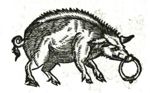
Prostibuli elegantia: Paradin, Les devises héroïques (Antwerp, 1563), 52
Un chascun doibt moderer son estat: La Perrière, Le theatre des bons engins (Lyon, 1545), emblem 24 uses the imagery of a pig with a golden ring through its snout
Iconclass: 25D13(GOLD) minerals and metals: gold 41D2664 ring 47I2122(+9335) sow (+ snout, jaw, beak, nib)
Loci Communes: Absurda, indecora, seu praepostera (Absurd, unbecoming, or preposterous things, Choses absurdes, inconvenantes ou déplacées)
I vii 25 In eburnea vagina plumbeus gladius A leaden sword in an ivory sheath
Huic confine est illud, ἐν ἐλεφαντίνῳ κουλεῷ τὸ μολύβδινον ξίφος., id est, In eburna vagina plumbeus gladius, natum ex Diogenis Cynici apophthegmate. Nam, cum αdolescens quispiam, insigni forma, foedum quiddam, atque obscοenum dixisset: Ex eburna, inquit, vagina plumbeum gladium educis.
Close to this is the adage 'Ἐν ἐλεφαντίνῳ κουλεῷ τὸ μολύβδινον ξίφος., In an ivory scabbard a leaden sword, which arose from a remark made by Diogenes the Cynic philosopher. When a young man who was very handsome had said something disgusting and obscene, he said The scabbard is ivory, but the sword you draw is lead.'
Facsimile:
Iconclass: 25D13(LEAD) minerals and metals: lead 25F25(ELEPHANT)(+334) trunked animals: elephant (+ fang, tusk) 45C13(SWORD) hacking and thrusting weapons: sword 45C231 scabbard, sheath
Loci Communes: Dissimilitudinis et incongruentiae (Dissimilarity and incongruity, Dissemblance et incongruité)
I vii 26 Omnia octo All eights
Απαντοκτὼ id est, Omnia octo. Cum nihil deesse significamus, aut cum multa inter se similia videntur. paroemiam hinc natam existimant: Stesichorus poeta in oppido Catana splendide sepultus fertur, monumento diligenti quadam ratione ex omnibus octonis constructo, octo colunis, octo gradibus, angulis octo. Atque hinc proverbium increbruisse ἁπαντοκτὼ. Meminit huius & Iulius Pollux in nono, agens de lusu taxillorum, quem ait numeris constare, in quibus sit unus qui Stesichorius appelletur, nimirum octo, idque cognominis sumptum esse ab eius monumento. Sunt qui dicant eum, qui Corinthios in unam civitatem coegit, cives universos in octo tribus distribuisse, atque hinc ortum vulgi sermonem. Neque desunt, qui scribant, idque Euandro, ut citant, autore, octo deos esse, qui rerum imperent summae, ignem, aquam, terram, coelum, lunam, solem, mithram, noctem. Mithram autem Persae, eundem cum sole existimant. Rursum alii dicunt octo fuisse certaminum species in Olympiis, atque inde ductum adagium: Omnia octo. Quod si nobis quoque conceditur in aenigmate divinare, non absurde natum videri potest à fabula, quam narrat Plutarchus in commentario de Daemonio Socratis. Deliis, ac caeteris Graecis oraculo responsum fuisse apud Aegyptios, ita demum malorum finem fore, si aram, quae in Delo erat, duplassent. Qui cum non intellexissent, quid sibi vellet oraculum, ridicule duplatis singulis arae lateribus imprudentes solidum octuplum effecerunt, ob inscitiam proportionis, quae longitudine duplum reddit. Caeterum hac in re consultus Plato geometriae cum primis peritus, respondit deum Graecis imperitiam exprobrasse, monere, ut geometriae darent operam. Delectatum apparet hoc proverbio Heliogabalum Imperatorem, cui morem hunc fuisse scribit Aelius Lampridius, ut simul ad coenam vocaret octo calvos, octo luscos, octo podagrosos, octo surdos, octo nigros, octo praelongos, & octo praepingues & obesos.
Απαντοκτὼ, All eights. When we wish to convey that nothing is lacking, or when many things have a strong resemblance. The proverb is thought to have arisen as follows. The poet Stesichorus is said to have been buried in great state in the town of Catania, with a monument ingeniously designed entirely in groups of eight units - eight columns, eight steps, eight corners; and hence the phrase All eights gained its proverbial currency. It is also mentioned by Julius Pollux in his ninth book, where he treats of the game of dice, which consists, he says, of numbered throws one of which is called a Stesichorean, showing in fact eight pips, and gets its name from this monument. Some say that the man who brought the Corinthians together to form one city divided the whole body of citizens into eight tribes, and hence the phrase in common use. And some writers tell us, giving Evander as their authority, that there are eight gods who control the sum of things, Fire, Water, Earth, Sky, Moon, Sun, Mithras, and Night; but the Persians equate Mithras with the Sun. Others again say that there were eight kinds of contest in the Olympic games, and that that is the source of the adage All eights. If I too may hazard a conjecture regarding this conundrum, it might very well be derived from a story told by Plutarch in his essay 'On the Divine Sign of Socrates.' The people of Delos, he says, and the other Greeks received an answer from an oracle in Egypt that there would be no end to their troubles until they had doubled the altar that stood in Delos. Not having understood what the oracle meant, they foolishly doubled all four sides of the altar, and were surprised to find they had produced a solid eight times as large, through ignorance of the ratio which produces a linear double. On this problem, however, they consulted Plato, who was a leading expert in geometry, and he replied that the god had rebuked the Greeks for their lack of education and was telling them to make a proper study of Geometry. This proverb was clearly a favourite with the Emperor Heliogaba- lus; for Aelius Lampridius tells us that he had a trick of inviting to the same dinner-party eight bald men, eight men with bad sight, eight sufferers from the gout, eight deaf men, eight black men, eight very tall men, and eight men who were very fat and gross.
Facsimile:
Iconclass: 49D11(8) numerals: 8 51A7 Perfection, Completeness; 'Perfettione', 'Operatione perfetta' (Ripa) 51H1 Totality, the Whole
Loci Communes: Perficiendi sive absolvendi (Finishing, completing, Achever, accomplir)
I vii 27 Omnia idem pulvis All is the same dust
Πάντα μία κόνις. id est, Omnia idem pulvis. De indiscreta similitudine. Lucianus ἀλλὰ πάντα μία ἡμῖν κόνις φασὶ. id est, Quin nobis omnia idem, quod aiunt, pulvis. Alludens ad defunctorum cineres, inter quos nihil apparet discriminis. Confine illi, quia alio demonstrabimus loco, Eiusdem farinae. Siquidem antiqui farinam pollinem vocabant.
Πάντα μία κόνις., All is one and the same dust. Used of things that are indistinguishable. Lucian: 'But to us, all is (as they say) one and the same dust,' alluding to the ashes of the dead, between which the eye can see no difference. Related to the proverb I shall exhibit elsewhere, 'Of the same meal,' for the Ancients used 'meal' where we use 'flour.'
Facsimile: 
Iconclass: 25D29 dust (soil type) 51B2 Similarity, Likeness
Loci Communes: Similitudinis et congruentiae (Similarity and congruence, Similitude et convenance)
I vii 28 Plaustrum bovem trahit The cart before the horse
Η ἅμαξα τὸν βοῦν ἐλαύνει. id est, Currus bovem ducit. de re quae praepostere geritur. Veluti si uxor praescribat marito, si discipulus reprehendat praeceptorem, si populus imperet principi, si ratio pareat affectui. Lucianus in Terpsione: Νῦν δὲ τὸ παροιμΐας, ἡ ἅμαξα τὸν βοῦν πολλάκις ἐκφέρει. id est, Nunc id evenit, quod vulgo dici solet: Plaustrum saepenumero bovem ipsum aufert. Translata metaphora à plaustris per declive retro labentibus, unaque secum bovem auferentibus.
'Ἡ ἅμαξα τὸν βοῦν ἐλαύνει., literally The wagon drags the ox. Of something that happens the wrong way round: for instance, of a wife laying down rules for her husband, of a pupil correcting his master, of a people giving orders to their prince, of reason subservient to the emotions. Lucian in his Terpsion: 'But now, in the words of the proverb, the wagon often runs away with the ox.' The image derives from carts rolling backwards down a slope and dragging their oxen after them.
Facsimile:
Iconclass: 29A1 'mundus inversus', the reversed world, the topsy-turvy world, 'le monde bestourné' 46C13141(+75248) horse (+ animal(s) pushing something) 46C145 (farm) wagon, freight wagon, cart
Collectanea (1500): 300
Loci Communes: Absurda, indecora, seu praepostera (Absurd, unbecoming, or preposterous things, Choses absurdes, inconvenantes ou déplacées)
I vii 29 Ab equis ad asinos From horses to asses
Αφ᾽ ἵππων ἐπ᾽ ὄνους. id est, Ab equis ad asinos. Ubi quis à studiis honestioribus ad parum honesta deflectit: veluti si quis è philosopho cantor, è theologo grammaticus, è mercatore caupo, ex oeconomo coquus, è fabro fieret histrio. Quadrabit item, ubi quis è conditione lautiore ad abiectiora devenerit. Procopius sophista in epistola quapiam: Τὸ δή λεγούμενον ἀφ᾽ ἵππων ἐπ᾽ ὄνους μεταβεβήκαμεν. id est, Iuxta proverbium, ab equis ad asinos transivimus.
Ἀφ᾽ ἵππων ἐπ᾽ ὄνους., From horses to asses. When a man turns aside from an honourable vocation to something less reputable; for instance, a philosopher turned ballad-singer, a theologian turned schoolmaster, a merchant turned street-hawker, a steward turned cook, a blacksmith turned strolling player. It will also be suitable when someone has sunk from affluence to a humbler station. Procopius the sophist in one of his letters: 'As the proverb has it, we have come down from horses to asses.'
Facsimile:
Iconclass: 46C13141 horse 46C13142 ass, donkey 51LL4 Regression, Backward Movement 54FF13 Regression, Deterioration, Relapse
Collectanea (1500): 215
Loci Communes: Degenerantium in pejus (Degenerating for the worse, Dégénérer en pire)
I vii 30 Ab asinis ad boves transcendere To rise from asses to oxen
Huic diversum est illud Plautinum: Ab asinis ad boves transcendere. pro eo quod est, ex humiliore conditione ad ditiorum partes transire. Sic enim apud Plautum in Aulularia, Euclio, cuius pauperculi dives quidam expetebat affinitatem: Venit hoc mihi in mentem, Megadore, te esse hominem divitem, factiosum, me item esse hominem pauperum pauperrimum. Nunc si filiam locassim meam tibi, in mentem venit, te bovem esse, & me esse asellum. Ubi tecum coniunctus siem, ubi onus nequeam portare pariter, iaceam ego asinus in luto, tu me bos haud magis respicias, natus quàm si nunquam siem. Et te utar iniquiore, & meus me ordo irrideat, neutrobi habeam stabile stabulum, si quid divortii fuat. Asini me mordicus scindant, boves in cursent cornibus. Hoc magnum periculum est, me ab asinis ad boves transcendere. Hactenus Plautus. Videtur allegoria ex apologo quopiam mutuo sumpta; qui mihi in praesentia non succurrit.
The opposite of this is that phrase in Plautus, To rise from asses to oxen, in the sense of passing from a lower walk of life into a richer stratum of society. For it is thus expressed in Plautus' Aulularia by Euclio, a man of modest means, when a rich man wanted to marry into his family:
The thought that has occurred to me is this:
You're influential, Megadorus, you
Are rich, and I'm the poorest of the poor.
If I give you my daughter, as I see it,
We're ox and ass; and when I'm yoked with you,
If I can't share the burden, I the ass
Fall in the mud, and you'd take no more heed
Than if I never had been born at all.
And you would hate me, my own class would flout me,
Nor could I find sure shelter if we parted;
Asses would use their teeth, oxen their horns.
'Tis a great risk, to rise from ass to ox.
So Plautus. The allegory looks as though it must be borrowed from some fable, which at the moment does not occur to me.
Facsimile:
Iconclass: 46C13142 ass, donkey 47I21111 ox 51L4 Progression, Forward Movement 54F13 Progress, Improvement, Recovery
Collectanea (1500): 214
Loci Communes: Proficientium in melius (Improving for the better, Progresser vers le mieux)
I vii 31A Ab asino delapsus Fallen off the donkey
Γῆς βάρος. id est, Terrae onus. De homine vehementer inutili, qui nihil aliud quàm terram, suo pondere gravet. Refertur inter adagia Graecanica, natum ex Homero, apud quem Achilles Iliados σ. hoc pacto loquitur, indigne ferens ocium, & quod non ineat praelium cum reliquis copiis: Αλλ᾽ ἧμαι παρὰ νηυσὶν ἐτώσιον ἄχθος ἀρούρης. id est, Navibus assideo, telluris inutile pondus. Rursum in Odysseae ν. Οἷον μέν τινα τοῦτον ἔχεις ἐπίμαστον ἀλήτην Σίτου καὶ οἴνου κεχρημένον, οὐδέ τι ἔργων Εμπαιον, οὔτε βιης, ἄλλ᾽ αὔτως ἄχθος ἐρούρης; id est, Quem tandem nobis erronem adducis edacem, Enectumque fame, vinique, et panis egenum, Artibus edoctum nullis, neque viribus ullis Pollentem, ac tantum telluris inutile pondus? Utitur eo Plato in Theaeteto, οἴονται γὰρ ἀσούειν, ὅτι οὐ λῆροι εἰσῖν, γῆς ἄλλως ἄχθη, id est, Existimant enim se non haberi pro nugis & inutilibus terrae oneribus. Nec illepidum, nec prorsus, ni fallimur, ἀπρος δίονυσον est, quod memorat Athenaeus lib. octavo. Stratonicus quidam citharoedus Corinthi peregrinabatur. Hunc cum anicula quaedam fixis oculis intueretur, idque diu, tandem: Quid, inquit, tibi per deos vis mater, aut quid me sic continenter intueris? Demiror, inquit illa, si matris uterus te decem menses ferre potuit, cum civitas angatur, unum duntaxat diem te portans. In tales quadraret epitaphium, quod Timocreontis Rhodii poetae, caeterum voracis ac bibacis sepulchro inscriptum indicat Athenaeus li. x. Πολλὰ πιὼν καὶ πολλὰ φαγὼν, καὶ πολλὰ κακ᾽ εἰπὼν Ανθρώπους, καῖμαι τιμοκρέων ῥοδιος, id est, Multum edi, multumque bibi, mala plurima dixi in Mortales, iaceo hic Timocreon Rhodius.
[transcription not found for adag_erasmus_0631 in adagia0700_en.xml]
Facsimile: 
Iconclass: 46C13142 ass, donkey 31A2731 falling 52AA5 Ignorance; 'Ignoranza', 'Ignoranza di tutte le cose', 'Ignoranza in un ricco senza lettere' (Ripa)
Collectanea (1500): 312
Loci Communes: Contemptus et vilitatis (Contempt and worthlessness, Mépris et bassesse)
I vii 31B Telluris onus A burden on the earth
[transcription not found for adag_erasmus_0631B in adagia0700.xml]
Γῆς βάρος., A burden on the earth. Used of a man who is absolutely useless, who does nothing but make the earth heavier by the amount he weighs. It is recorded among the Greek adages, and takes its rise from Homer, where Achilles in the eighteenth book of the Iliad, resenting his idleness and his failure to go out to battle with the rest of the army, uses these words: 'while by the ships / I sit, a useless burden on the earth.' Again in the Odyssey, book 20,
Such is this homeless beggar that you bring,
His mind on food and drink, not honest toil
Nor deeds of might, vain burden on the earth.
Plato has it in the Theaetetus: 'They think they are being told that they are not merely absurd, vain burdens on the earth.' A pleasant story, which is I think by no means off the point, is told by Athenaeus in his eighth book. A well-known lyre-player called Stratonicus was in Corinth on a visit. An old woman stared at him intently for a long time; and at length he said 'What's the matter with you, my good woman? Why do you stare at me like that?' 'I was wondering' she replied 'how your mother could have borne you for ten months, when it is pain and grief to the city that has to bear with you for a single day.' Such people would be well matched by the epitaph which according to Athenaeus, book 10, marked the grave of Timocreon of Rhodes, a poet but also a glutton and a drunkard:
I ate, I drank, I cursed, and all is said:
Now I, Timocreon of Rhodes, am dead.
Iconclass: 25D21 earth (soil type) 51G2 Heaviness 54BB3 Inutility, Noxiousness; 'Nocumento', 'Nocumento d'ogni cosa' (Ripa) 54DD2 Idleness; 'Otio' (Ripa)
Loci Communes: Contemptus et vilitatis (Contempt and worthlessness, Mépris et bassesse)
I vii 32 Arabius tibicen An Arabian piper
Αράβιος αὐλητής. id est, Arabius tibicen, aut ἀράβιος ἄγγελος. id est, Arabius nuncius. In eos dic solitum, qui a semel coeptis numquam desistunt. Quod vitii Flaccus cantoribus peculiare esse scripsit, ut iussi cantare, nunquam adducantur ut incipiant: si iniussi coeperint, nunquam desinant. Citatur ex Menandro: ἀράβιον ἆρα ἐγὼ κεκίνηκα αὐλόν, Arabiam ego hercle tibiam excitavi. Meminit adagii Iul. Pollux, ca. De loquacibus, ad hunc modum: ἀράβιος αὐλός. id est, Arabia tibia. Citatur & Cantharus in Medea: Κιθαρῳδὸν ἐξηγείρατο ἀράβιον. id est, Citharoedum excitavit Arabium. Celebratur Graecis & hic versiculus de tibicine Arabio: Δραχμῆς μὲν αὐλεῖ, τεττάρων δὲ παύεται. id est, Drachma canit, sed quatuor compescitur. Quod paululo precio provocaretur ad canendum, non nisi magna mercede desisteret. Adagium hinc natum existimant, quod olim tibiis canendi artem non discebant ingenui, tanquam sordidam, sed hanc sola mancipia exercebant, quae plerumque ex Arabibus producebantur. Deinde ingenuis usque adeo placere coepit, ut indoctus haberetur, quisquis huius esset rudis, donec Alcibiades tibias abiiceret, oris deformitate conspecta ad speculum. Conveniet & in eos, qui laborant morbo, quem Graeci vocant ἀπεραντολογίαν, id est, qui dicendi finem facere nesciunt. In quos exstat illud Sophoclis, Ανὴρ γὰρ ὅστις ἥδεται λέγειν ἀεὶ, Λέληθεν αὐτὸν τοῖς ξυνοῦσιν ὤν βαρὺς. id est, Quicunque gaudet continenter proloqui, Is se gravem esse, quotquot adsunt, non videt.
Ἀράβιος αὐλητής., An Arabian piper, or Ἀράβιος ἄγγελος., An Arabian messenger, is used of those who once they have started on something never stop. This is said by Horace to be a besetting sin of singers: when invited to sing they can never be induced to start, and if they start unasked they never cease. A phrase is cited from Menander: T see I have aroused an Arabian pipe.' Julius Pollux in his chapter on talkative people recalls the adage in the form An Arabian pipe. The Medea of Cantharus is also cited: 'He started up an Arabian on the lyre.' And this line about the Arabian piper is common in Greek: 'Plays for one drachma, and will stop for four,' because it took a very small fee to induce him to play and nothing but a large one could stop him. The origin of the adage is supposed to be the reluctance of free-born people in the old days to learn the pipes as a thing beneath them; the art was confined to slaves, most of whom were produced by Arabia. It then became so fashionable among the free-born that anyone who could not play was thought uneducated, until Alcibiades threw away his pipes, having seen in the mirror how misshapen they made his face. It will also suit sufferers from the disease for which Greek has the word aperantologia, the inability to stop talking. Sophocles has written something to their address: 'Who loves to talk for ever has not seen / How grievously he tires his company.'
Facsimile:
Iconclass: 32B32(ARAB) African peoples, Africans (ARAB) 48C72 musician 48C7351 flute, aulos, tibia 54DD3 Start 54DD31 Interruption, Cessation
Loci Communes: Garrulitas (Talkativeness, Bavardage); Modestia modusque (Modesty and moderation, Modestie et mesure)
I vii 33 Artem quaevis alit terra Skill fills your hand in every land
Τὸ τέχνιον πᾶσα γαῖα τρέφει, id est, Artem quaevis alit regio. Proverbialis sententia, qua significatum est, certissimum viaticum esse eruditionem aut artificium aliquod. Nam haec neque eripi possunt a latronibus, & quocunque terrarum abeas, te comitantur, nihil afferentia sar cinae. Suetonius scribit, aliquando Neroni praedictum à mathematicis, fore, ut imperio destitueretur: unde vocem illam Neronis celeberrimam exstitisse, τὸ τέχνιον πᾶσα γαῖα τρέφει, quo maiore venia meditaretur citharoedicam artem, principi gratam, privato necessariam. Itaque, cum intelligeret sibi pereundum, illud identide dictitabat. Qualis artifex pereo, velut indignum esset, qui tantus esset musicus, ut ubivis gentium vivere posset, nunc fame ad mortem adigi. Nec enim assentior hoc loco interpretum sententiae, qui locum apud Suetonium hunc secus enarrant. Idem nullo convicio magis offensus est, quam quod quidam illum malum citharoedum appellasset. Idem evenit Dionysio Syracusano tyranno, qui imperio exutus Corinthi ludum aperuit, ac pueros literas & musicam docuit. Apparet autem senarium esse, quem citat Suetonius, sed paucarum syllabarum commutatione depravatum: fortassis sic restituetur, Τὸ τέχνιον γε πᾶσα γαῖα ἐκτρέφει Fertur inter Graecorum sententias huius modi senarius, ab hoc proverbio non admodum dissidens: Λιμὴν ἀτυχίας ἐστὶ ἀνθρώποις τέχνη. id est. Ars ipsa inopiae portus est mortalibus Hoc est, Unicum confugium in egestate ars est. Unde, qui sapiunt, etiam si suppetat abunde res familiaris, tamen liberos suos opificium aliquod discere cogunt: quo, si contingat, ut fortuna auferat opes, aut in exilium ire iubeantur, sit quo sibi victum parent. At nunc plerique, quibus domi nihil est, in divitum familiis consenescunt: unde si pellantur, aut mendicandum sit, aut tollendum, quod non posuerunt, contra Platonis legem. Qui scripsit Cornu copiae Latinum, citat similimum huic proverbium, opinor, vulgo iactatum: Sua cuique ars pro viatico est. Honestissimum sanè viaticum, modo ars sit honesta. Caeterum nunc passim obambulant, quibus nulla est ars, sed condontationes ac despensationes, ut vocant, emptas ac revendendas, pro viatico circumferunt.
Τὸ τέχνιον πᾶσα γαῖα τρέφει, A skilled man need never starve. A proverbial maxim, the point of which is that there is no more reliable provision for a journey than a good education or some technical skill. You cannot be stripped of these by robbers, and wherever you go they keep you company without adding any weight to your baggage. Suetonius tells us that Nero once received from the astrologers a forecast that his empire would be taken from him; and hence Nero's celebrated answer: 'Art fills your hand in every land,' by which he hoped to secure some indulgence for his own efforts in music, which is a luxury to a prince and his bread and butter to a man in private station. Consequently, when he understood that his hour had come, he kept on saying 'That such an artist as myself should perish!' as though it were an outrage that a performer good enough to make a living anywhere in the world should now be starved to death. (For on that point I do not accept the opinion of those commentators who offer a different explanation for this passage in Suetonius.) Nor was Nero ever more infuriated by criticism than when someone had said he played badly. The same thing happened to Dionysius tyrant of Syracuse, who when he was deposed from power opened a school in Corinth, where he taught small boys reading, writing, and music. The words Suetonius quotes are clearly a six-foot iambic line, which has been corrupted by the alteration of a few syllables; it will perhaps be mended thus: To Τὸ τέχνιον γε πᾶσα γαῖα ἐκτρέφει . Among the Greek maxims there is a line of the same sort, which is not very different from our proverb: Λιμὴν ἀτυχίας ἐστὶ ἀνθρώποις τέχνη., 'Skill is a man's best harbour in distress.' Sensible men therefore, even if they have abundant resources, compel their children all the same to learn some sort of skill, so that they may have some way to earn their keep even if luck changes and they lose all their money or are condemned to go into exile. But as things are now a great many people who have no money of their own grow old in the households of the rich; and if they are turned out from there, they must either beg their bread or take up what they have not laid down, against Plato's principle. The author of the Latin Cornu copiae cites a proverb very like this, which was I suppose in common circulation: Sua cuique ars pro viatico est, Every skilled traveller can pay his way. This is to be sure the most respectable sort of journey-money, provided the skill itself is respectable. But now the world is full of travellers who possess no skill, but carry round a stock of licenses and dispensations, as they call them, which they have purchased and must sell again to pay their way.
Facsimile: 
Iconclass: 54A33 Skill, Ability; 'Artificio', 'Prontezza' (Ripa) 46A172 paying of wages
Loci Communes: Industria (Industriousness, Application, diligence)
I vii 34 Non eras in hoc albo You were not on this roster
Non eras in hoc albo, hoc est, Non eras in hoc numero. Translatum ab albata tabula, in qua quondam scribebantur nomina iudicum. Plinius in praefatione historiarum mundi: Cum hanc operam condicerem, non eras in hoc albo. id est, non eras in eorum numero, quos haec lecturos credebam. Erat & Album praetoris, in quo leges & formulae describebantur. Pandectarum lib. primo. tit. de Edendo, ex Ulpiano eum quoque edere Labeo ait, qui producat adversarium suum ad album, & demonstret, quid dictaturus sit. Atque hoc sanè loco Adversarium non declarat eum quicum lis est, sed tabulas ex tempore notatas memoriae gratia. In quem sensum M. Tullius usus est in oratione pro Roscio, idque non semel. Andreas Alciatus existimat legendum, Adversaria, non adversarium, libro Dispunctionum tertio. Item secundo eiusdem operis libro, titulo primo, multa fit mentio de albo. Quintilianus lib Institutionum xi. Quorum alii se ad album & rubricas transtulerunt, videlicet leguleios & formularios irridens, qui non ex libris Iurisprudentium, sed ex albo praetoris iuris scientiam discerent. T. Livius Decadis primae libro ix. Civile ius repositum in penetralibus pontificum evulgavit, fastosque circa forum in albo proposuit, ut quando lege agi posset sciretur. Apuleius metamorphoseos libro vi. meminit albi. Siquidem Iovem adlocuturum deos, ita facit exordiri: Dei conscripti musarum albo. Quibus in verbis subesse videtur obscura quidem, sed faceta allusio scriptoris ad deos à poetis confictos: quasi ii demum in deorum numero sint, quos illic Musae, quibus afflati scribunt poetae, constituerint.
Meaning, You were not in this class of person. A metaphor from the album, the whitewashed board on which in old days the names of jurors were posted. Pliny in the preface to his History of the World: 'When I was composing this work, you were not on this roster,' you were not, that is, in the number of those whom I believed would read it. There was also the praetor's roster or album, on which laws and approved forms of action were written up. In the first book of the Pandects, in the title De edendo, Labeo, as cited by Ulpian, 'says that a man performs the act of publication who produces his adversarium to the album and makes clear what he intends to put forward.' And in this passage at any rate the word must mean, not the adversary with whom he has a dispute but his adversaria, the notes he has taken down extempore on a tablet to refresh his memory. Cicero uses the word in this sense in his speech Pro Roscio, more than once. Andrea Alciati thinks we should read adversaria and not adversarium, in book three of his Dispunctiones. Besides which, in the second book of the same work in the first title much is said about the album. Quintilian in book 11 of the Institutiones: 'Some of whom transferred their attention to the album and the subdivisions of the law,' pouring scorn on the specialists in legal niceties and forms of action, who derived their knowledge of the law from the praetor's roster rather than from the works of eminent lawyers. Livy in the ninth book of his first decade: 'He published the civil law, which was enshrined in the secret archives of the priests, and posted a calendar near the market-place on a whitewashed board, so that it might be possible to know when action at law was permitted.' Apuleius in book 6 of his Metamorphoses speaks of an album or roster; for when Jove is to make a speech to the assembled gods, he makes him begin as follows: 'Ye gods, whose names are entered in the Muses' roster.' In these words I seem to detect a veiled but elegant allusion by the writer to the gods who have been invented by the poets, as though only those are members of the divine fraternity who have been established in it by the Muses, who supply poets with their inspiration.
Facsimile:
Note: that you would sit in judgement upon me (Pliny the Elder, The Natural History)
Iconclass: 52A52 Judgement, Discrimination; 'Giuditio' (Ripa) 59C21 Equality, Equity, Fairness, Righteousness; 'Equalità', 'Equità', 'Giuditio giusto', 'Ordine dritto e giusto', 'Ugualità' (Ripa) 46A62 member, membership
Collectanea (1500): 12
Loci Communes: Similitudinis et congruentiae (Similarity and congruence, Similitude et convenance)
I vii 35 Oleo tranquillior As smooth as oil
Oleo tranquillior, Hyperbole proverbialis, in homines minime iracundos, lenique ingenio praeditos, à liquoris natura sumpta, quo nihil magis tacitum magique lene. Plautus in Poenulo: Ita hanc canem faciam tibi oleo tranquilliorem. Est autem usqueadeo tranquilla olei natura, ut mare quoque rem omnium saevissimam tranquillet, atque ob id urinantes aiunt oleum ore spargere, quod mitiget elementi naturam asperam, lucemque deportet. Autor est Plinius lib. secundo. Idem confirmat Plutarchus: & cur ita fiat, rationem reddit in libello De causis naturalibus. Rursus in convivialium quaestiuncularum Decade sexta, causam afferens, cur Homerus inter tot liquores, oleum duntaxat appellarit ὑγρὸν, id est, humidum, sive liquidum, ostendit oleo nihil inesse asperum, sed undique lene esse, & ob id maximè reddere imagines more speculorum. Praeterea nec motum aut percussum strepit, quemadmodum humores reliqui, nec luctatur cum igni, sed tacite pascit. Denique non est alius liquor, qui tam late diffundatur, cum inungitur corpori, aut serius siccescat, aut aeque molliat ac leniat. Utitur hoc adagio & Plato in Theaeteto de scientia, placida ingenia, quae leniter ac tranquille ad disciplinas & disputationes accedunt, oleo molliter fluenti comparans, ὁ δὲ οὔτω λέως τε καὶ ἀπταίστως καὶ ἀνυσίνως ἔρχεται ἐπὶ τάς μαθήσεις καὶ ζητήσεις μετὰ πολλῆς τῆς πράοτητος, οἷον ἐλαίου ῥεῦμα ἀψοφητὶ ῥέοντος, ὥστε θαυμάσαι τὸν πηλικοῦτον ὄντα οὑτω ταῦτα διαπραττεσθαι. id est, At hic adeo leniter, ac circunspecte, simulque expedite ingreditur ad disciplinas quaestionesque multa cum mansuetudine, olei in morem, citra strepitum fluentis, ut admireris tantus cum sit, haec ad eum modum agere.
A proverbial exaggeration, used of men who never lose their temper and are of a placid disposition, derived from the nature of a fluid which is more silent and smoother than any other. Plautus in the Poenulus: 'I'll see to it: you'll find this dog as smooth as any oil.' Oil is so tranquil in nature that it can even calm the sea, the most cruel thing there is, and 'that is the reason, they say, why divers sprinkle oil from their mouths, because it tames that element which is so wild by nature, and carries light down with them.' The authority for this is the second book of Pliny. It is confirmed by Plutarch, and the reason for the practice is given, in his essay 'On Natural Causes.' Again, in the sixth decade of his 'Table-talk,' when giving the reason why Homer, who mentions so many liquids, reserves his epithet ὑγρὸν, which means wet or liquid, for oil alone, he demonstrates that oil contains nothing rough, but is smooth from every point of view, and therefore gives very clear reflections, as mirrors do. Besides which, when shaken or struck it makes no sound, unlike all other fluids, nor has it any antipathy to fire, but feeds it in silence. Lastly, there is no liquid which covers so wide an area when spread over the body, or takes longer to dry, or is more effective as an emollient or demulcent. Plato too uses this adage in the Theaetetus when speaking of knowledge, for he compares those placid natures which approach the business of learning and discussion in an equable and tranquil spirit to oil with its steady flow: 'But he makes such a placid and cautious, yet at the same time effectual, approach to learning and discussion, always in such a gentle fashion like a stream of oil silently flowing, that you wonder how anyone of that age could behave like this.'
Facsimile: 
Annotation: Olie op de golven
Iconclass: 25D43 oil; oil refinery 51G6 Smoothness 57A77 Friendliness, Gentleness, Affability; 'Affabilità, piacevolezza, amabilità', 'Animo piacevole, trattabile & amorevole', 'Benignità' (Ripa) 56EE2 Meekness; 'Mansuetudine' (Ripa)
Collectanea (1500): 826
Loci Communes: Mansuetudo (Gentleness, Douceur)
I vii 36 Auricula infima mollior As soft as the tip of the ear
Huic similimum, quod M. Tullius usurpat in epistolis ad Q. fratrem libro secundo, Tu, inquiens, quemadmodum me censes oportere esse in Rep. & in nostris inimicitiis, ita & esse, & forte auricula infima scito molliorem. Ammianus libro decimonono: In aliis aimiu severus, in hoc titulo, ima, quod aiunt, auricula mollior. Translata metaphora ab ea auriculae parte, qua non est aliud in humano corpore mollius, aut flexibilius, lentiusque, ut quae nec osse rigeat, neque cartilagine durescat, neque nervis intendatur.
Very similar to this is a phrase used by Cicero in his Letters to His Brother Quintus, book 2, where he says 'Let me tell you that in public affairs and in my private feuds I am and shall be just what you think I ought to be - as soft as the tip of the ear.' Ammianus, book 19: 'In other things unduly severe, in this department he was, as the saying goes, as soft as the tip of the ear.' The image is derived from that part of the ear which is the softest, most flexible, and most pliant part of the human body, having no bone in it to stiffen it, no cartilage to harden it, and no sinew to stretch it tight.
Facsimile:
Iconclass: 51GG4 Softness (matter) 31A2213 ears 57A77 Friendliness, Gentleness, Affability; 'Affabilità, piacevolezza, amabilità', 'Animo piacevole, trattabile & amorevole', 'Benignità' (Ripa) 56EE2 Meekness; 'Mansuetudine' (Ripa)
Collectanea (1500): 827
Loci Communes: Mansuetudo (Gentleness, Douceur)
I vii 37 Apio mollior, aut mitior As soft, or as ripe, as a pear
Απίου πεπαίτερος, Apio mitior. Simili figura dictum est à Theocrito, Καὶ θὴ μὰν ἀπίοιο πεπαίτερος. id est: Et iam cerie apio mansuetior. Est autem apius Graecis raphanus, auri pyri genus.
Απίου πεπαίτερος, As ripe as a pear. The same image is used by Theocritus: 'Sure riper than a pear is he.' Apios in Greek means a radish, or a kind of pear.
Facsimile:
Iconclass: 25G21(PEAR) fruits: pear 51GG4 Softness (matter) 57A77 Friendliness, Gentleness, Affability; 'Affabilità, piacevolezza, amabilità', 'Animo piacevole, trattabile & amorevole', 'Benignità' (Ripa) 56EE2 Meekness; 'Mansuetudine' (Ripa)
Loci Communes: Mansuetudo (Gentleness, Douceur)
I vii 38 Spongia mollior As soft as a sponge
Eiusdem est generis, τῆς σπογγιὰς μαλακώτερος, id est, Spongia mollior. Sic enim assen tator quispiam loquitur apud comicum quempiam citante Plutarcho in commentario De discrimine adulatoris & amici. Εμὲ νικόμαχε πρὸς τὸν στρατιώτην τάξατε, Αν μὴ ποιήσω πέπονα, μάστιγων ὅλον. Αν μὴ ποιήσω σπογγιᾶς μαλακώτερον Τὸ πρόσωπον. id est, Nicomache, me isti militi opponas velim, Nisi pepona loris, quantus est, effecero; Nisi spongia illi molliorem qualibet Reddidero vultum. Ad eundem modum dicebant, pepone mollior. Theopompus apud Athenaeum libro secundo, Μαλακώτερα πέπονος καὶ σικύου μου γέγονε. i. molliora mihi pepone & cucumere facta sunt. Ad hanc formam pertinet, quod idem citat ex Epicharmo, Πραΰτερος ἔγωγε μαλάχης. i. Mitior equidem malva, quod ea herba vim habeat leniendi. Idem, Cinaedo mollior. Plautus in Aulularia, Ita fustibus sum mollior magis, quàm ullus cinaedus. Nam prisci saltatores & pantomimos cinaedos vocabant, quod cum gesticulatione canerent. Similiter Catullus, Cinaede Thalli mollior cuniculi capillis.
To the same class belongs τῆς σπογγιᾶς μαλακώτερος, As soft as a sponge. For this is the phrase used by a toady in some comedy which is quoted by Plutarch in his essay 'On the Difference between Flatterer and Friend':
Send me, Nicomachus, to fight this warrior.
Unless I thrash the wretch into a pumpkin
And make his face as soft as any sponge ...
In the same way they said 'As soft as a pumpkin.' So Theopompus, cited by Athenaeus, book 2: 'Things have become as soft as a pumpkin or a gourd.' To this class belongs a thing he quotes from Epicharmus: 'As for me, I'm mild as mallow/ because mallow is a vegetable with relaxing qualities. Then there is 'As soft as any fancy-boy.' Plautus in the Aulularia: 'With all this beating I'm as tender as any fancy-boy.' For the Ancients called dancers and pantomime- actors 'fancy-boys' because of the gestures they used when they sang. Catullus likewise: 'Thallus you tender fancy-boy, as soft as rabbit fur.'
Facsimile:
Iconclass: 25F75(SPONGE) coelenterata: sponge 31A5462 brush, sponge, etc. (toilet articles) 51GG4 Softness (matter) 56EE2 Meekness; 'Mansuetudine' (Ripa) 57A77 Friendliness, Gentleness, Affability; 'Affabilità, piacevolezza, amabilità', 'Animo piacevole, trattabile & amorevole', 'Benignità' (Ripa)
Loci Communes: Mansuetudo (Gentleness, Douceur)
I vii 39 Felicibus sunt et trimestres liberi How happy he who has a three-months' child
Τοῖς εὐτυχοῦσι και τρίμηνα παιδία. id est, Felicibus sunt & trimestres lberi. Senarius proverbialis in principum, ac divitum felicitatem, quibus per adulationem om nia laudi vertuntur, quique sibi nihil non licere putant, adeo, ut quia in homine plebeio per inde, ut summum sceuls damnatur, in illis virtutis titulo celebretur. Unde nata sit paroemia, Suetonius Tranquillus declarat, Claudii Caesaris vitam his verbis exordiens: Patrem Claudii Caesaris Drusum, olim Decimum, mox Neronem praenomine, Livia, cum Augusto gravida nupsisset, intra mensem tertium peperit, fuitque suspicio ex vitrico per adulterii consuetudinem procreatum. Statim certe vulgatus est versus, Τοῖς εὐτυχοῦσι και τρίμηνα παιδία. id est, Potentibus sunt mensium & partus trium. Nam mense septimo, decimo, & undecimo, legitimi sunt partus: quarto & octavo, neque vitales fere, & perquam rari: mense tertio, nulli partus editi leguntur. Autor Plinius li. 7. cap. 5.
Τοῖς εὐτυχοῦσι και τρίμηνα παιδία., How happy he who has a three- months' child. A proverbial line, pointing to the happy position of princes and rich men, whose flatterers turn everything to their credit and who regard themselves as having a licence to do just as they please; so much so that what in a man of the people is disapproved of as a great disgrace is cried up in them as a virtue. The origin of the proverb is made clear by Suetonius Tranquillus, who begins his life of the Emperor Claudius with these words: 'The father of the Emperor Claudius, whose forename was Drusus but had previously been Decimus and later Nero, had married Livia when she was already carrying Augustus, and within three months she had her baby, giving rise to the suspicion that he was the result of her adultery with his stepfather. Whether true or not, it made immediately popular the line "How happy he who has a three-months' child!"' For births in the seventh, tenth, and eleventh months are legitimate; in the fourth and eighth they seldom survive and are very rare; in the third month viable births are unknown. The authority is Pliny, book 7 chapter 5.
Facsimile:
Iconclass: 42B parents with their children 42D39 adultery 31D112 child 56B2 Happiness, Felicity 57AA6121 Flattery; 'Adulatione' (Ripa)
Loci Communes: Divitum praerogativa (The privilege of the rich, Le privilège des riches)
I vii 40 Aurem vellere To pluck by the ear
Aurem vellere, veteres dicebant admonere: à prisco ritu sumpta figura, quo in ius ducturi quempiam aurem vellicabant, attestantes eum, quem quasi testem meminisse volebant. Inde Horatianum illud in Sermonibus, Et licet antestari, ego vero Oppono auriculam. Siquidem, ut frons antiquitus erat sacra Genio, veluti scribit in Maronis Silenum Servius, ut digiti Minervae, genua Misericordiae, ita auris Memoriae deae, quam Graeci μνημοσύνην vocant. Virgilius in Sileno, Cum canerem reges, & praelia, Cynthius aurem Vellit, & admonuit pastorem, Tityre pingues Pascere oportet oves, diductum dicere carmen. Quod imitatus Calphurnius in Bucolicis: Vellit nam saepius aurem Invida paupertas, & dicit, vilia cura. Nonnihil decoris adiunxit proverbio Calphurnius, quod ad rem transtulit. Quanquam potest paupertas hoc loco pro dea accipi. Seneca li. De beneficiis quarto: Nec tanquam munus dabo, sed verba mea redimam, & aurem mihi pervellam, damno castigabo promittentis temeritatem, Rursus libro secundo, Loquar mecum & mihi aurem pervellam. hoc est, ero mihiipsi monitor, ne similiter peccem. Utitur in hunc modum & aliis aliquot locis, ut in epistola quadam: Sit ergo aliquis custos, & aures subinde pervellat, abigatque rumores, et reclamet populis laudantibus.
'To pluck by the ear' was used by the Ancients in the sense of 'to remind,' the image being taken from a traditional practice by which those who intended to bring a lawsuit against another party plucked by the ear a man whom they proposed to call as a witness, as though they wished to refresh his memory. Hence that phrase in Horace's Satires: 'May I call you as a witness? whereupon I turn my ear towards him.' In old days the forehead was sacred to Genius, as Servius tells us in his commentary on Virgil's Silenus, the fingers to Minerva, the knees to Pity, and in the same way the patron of the ear was the goddess of memory, whom the Greeks called Mnemosyne. Virgil in his Silenus:
My chosen theme was kings and battlefields,
But Cynthius, warning, plucked me by the ear:
'Fat, Tityrus, should be a shepherd's ewes,
But fine and delicate the song he sings.'
Which Calphurnius imitates in his Bucolics with: 'For grudging want oft plucks me by the ear / And bids me mind small things.' Calphurnius gave the proverb fresh elegance by transferring it from persons to things; though 'want' in this passage can be taken for a deity. Seneca in book 4 of his De beneficiis: 'I shall not give it you as a present; I shall redeem my undertaking and pluck myself by the ear. I will punish my rash promise with a loss.' And again in book 2: 'I will have a word with myself and pluck myself by the ear' (meaning, I will give myself a lecture, to ensure that I do not make the same mistake again). He uses it in the same way in other passages as well, for instance in one of his letters: 'Let someone then be on the watch, who can pluck us by the ear from time to time, send common rumour packing and put the other side when public opinion speaks well of us.'
I vii 41 Alter Hercules A second Hercules
Proverbialis hyperbole, οὗτος ἄλλος ἡρακλῆς. id est, Hic alter Hercules. De viro praestrennuo, ac laborum tolerantissimo. Exstat hoc titulo fabula quaepiam ex Menippeis Terentii Varronis, mirum ni proverbiali. Aristoteles libro Moralium Eudemiorum 7. Ο γὰρ φίλος βούλεται εἶναι, ὥσπερ ἡ παροιμία φησὶν, ἄλλος ἡρακλῆς ἄλλος οὗτος. i. Nam amicus cupit esse, sicuti proverbio dicitur, alter Hercules, alter hic. Plutarchus scribit id cognominis vulgo Theseo attributum, quod multa fortiret patraret exemplo Herculis. Laertius in vitis philosophorum ostendit & Cleanthem philosophum alterum Herculem vulgo dictum fuisse, quod esset omnium laborum patientissimus, adeo ut noctu hauriendo è puteo aquam victum diurnum pararet. unde & φρεαντλὴς dictus pro Cleanthe, & nihil tamen segnius egregiam operam interdiu navaret philosophiae. Clearchus apud Zenodotum aliam fabulam adfert, unde hoc sit natum adagium. Ait enim Briareum, qui & ipse Hercules dictus est, profectum Delphos, sublatis inde thesauris aliquot ac monumentis, ex iis quae eo in loco servabantur, iuxta veterem quandam consuetudinem, ad columnas, quas Herculis cognominant, sese contulisse, atque itidem illis, quae illic erant, fuisse potitum. Deinde Tyrium Herculem venisse Delphos, ut oraculum consuleret, deumque respondisse, οὗτος ἄλλος ἡρακλῆς. id est, Hic alter Hercules. atque oraculum in adagionem abiisse. Nec desunt qui huius dicti originem referant ad Titormum quendam bussequam, qui multis exemplis Milonem superarit. Is se profitens superatum, sublatis in coelum manibus, dixit, ὦ ζεῦ, μὴ τουτον ἡρακλῆν ἡμιν ἕτερον ἔσπειρας; O Iupiter, num hunc nobis Herculem alterum genuisti? Huc pertinet illud Theocriti in Pastoribus, Φαντίκνιν ἡρακλῆα βίην καὶ κάρτος ἐρίσδεν. id est, Viribus Alcidae hunc certare & robore dicunt. Subiicitque pastor, Κἤμ᾽ ἔφαθ᾽ ἁ μάτηρ πολυδεύκεος ἧμεν ἀλείνω. id est, Mequoque pollucem mater praecellere dixit. Erat enim hic excellens in pugilum certamine. Et Graeculus adulator apud Iuvenalem divitem imbecillum Herculi aequat, Antaeum procul à tellure tenenti. Macrobius li. Saturnalium 3. scribit in hunc modum: Salios autem Herculi propter ubertatem doctrinae altioris assignat: quia is deus & apud Pontifices idem qui & Mars habetur. Et sanè ita Menippea Varronis affirmat, quae inscribitur, οὗτος ἄλλος ἡρακλῆς, quia cum de Hercule multa loqueretur, eundem esse cum Marte probavit. Apud Latinos quoque Ruticello cuidam prodigiosis viribus, Herculis nomen attributum. Is mulum suum tollebat, ut scribit M. Varro, citante Plinio lib. 7. At Hippocrati medico, quod pestilentiam ab Illyriis venientem praedixisset, dimissis ad auxiliandum circa urbes discipulis, Graecia ob meritum eosdem decrevit honores quos Herculi. nam & is ἀλεξίκακος habitus est. Autor idem Plinius eodem lib. Quin nomen hoc Herculis videtur vulgari sermone ad omnes viros egregie fortes transferri solere, non aliter quam Catonis ad graves & sapientes. Nam Varro quadragintatres Hercules enumerat, additque hoc nomine honoratos fuisse omnes, qui fortiter quippiam egissent. Testatur & Macrobius in Saturnalibus hoc nominis compluribus fuisse commune, & ante Amphitryonis privignum. Sic & Achilles appellabantur insigni fortitudine duces: quorum de numero fuit Lucius Siccius Dentatus, ob ingentem fortitudinem Romanus Achilles appellatus, quod centum & viginti praeliis cum hoste pugnasset, nec ullam haberet cicatricem aversam. Autor A. Gellius libro secundo, capite undecimo. Denique rationem aut argumentum Achilleum vocant, quòd sit insuperabile & insolubile.
There is an exaggerated expression current as a proverb Οὗτος ἄλλος Ἡρακλῆς., He's a second Hercules, used of somebody who is immensely energetic and shows great endurance. A play with this title is on record among the Menippeans of Terentius Varro, and it would be surprising if it were not proverbial. Aristotle in book seven of his Eudemian Ethics: 'For a friend wishes to be, as the saying goes, a second Hercules, another this.' Plutarch says that Theseus was given this as a nickname because he did many valiant deeds with Hercules as his model. Laertius in his Lives of the Philosophers tells us that the philosopher Cleanthes also was commonly called a second Hercules because of his exceptional endurance whatever the burden, so much so that he spent his nights raising water out of a well in order to earn enough to keep himself by day, and was nicknamed Phreantles instead of Cleanthes; yet with unabated energy he did marvellous work in the daytime in philosophy. Clearchus,5 cited by Zenodotus, offers us another story as the source of this adage. He says that Briareus, another person who was also given the name Hercules, went to Delphi, where he carried off a number of the treasures and monuments which were preserved there in accordance with some ancient custom. He then proceeded to what they call the Pillars of Hercules, and in the same way seized what there was there. After that, the Tyrian Hercules came to Delphi to consult the oracle, and the deity replied 'He's a second Hercules.' And this oracle, he says, passed on into an adage. Many people refer the origin of this saying to a certain Titormus, an oxherd who is reported to have shown himself in many instances superior to Milo. Milo, confessing himself beaten, raised his hands to heaven and cried 'O Jupiter, is this a second Hercules you have begotten for us?' Here belongs that remark in Theocritus' Herdsmen: 'They say he vied in might with Hercules,' to which the herdsman replies: T too beat Pollux, mother used to say.' For Pollux was a champion boxer. And the nasty Greek toady in Juvenal compares his rich and flabby patron to Hercules 'holding Antaeus high o'er mother earth.' Macrobius in the third book of his Saturnalia writes as follows: 'The Salii he assigns to Hercules on account of their rich stores of recondite learning, for that deity is regarded by the pontifices also as identical with Mars. And so it is stated in Varro's Menippean, the title of which is He's a second Hercules, for in the course of a long account of Hercules, he proved that he was the same as Mars.' It was the same in Rome: a man of prodigious strength called Ruticellus was nicknamed Hercules. He could pick up his mule, as Varro records, who is quoted by Pliny, book 7. Whereas Hippocrates the physician 'received by decree from the Greeks the same honours as were paid to Hercules, by way of reward for having foretold the onset of a pestilence from Illyria and dispatched his pupils to the various cities to deal with it,' for Hercules too was held to be alexikakos, an averter of mischief. The authority for this is Pliny again, in the same book. In fact this name Hercules seems normally to have been applied in common speech to all men of exceptional strength, just as a serious and wise man was called a Cato. Varro lists forty-three men who bore the name Hercules, adding that it was given as a distinction to anyone who had performed some great feat of strength. Macrobius too bears witness in his Saturnalia that many shared this name before ever Amphitryon had a stepson. Similarly generals of outstanding courage were given the name Achilles, among whom was Lucius Siccius Dentatus, known for his prodigious courage as the Roman Achilles: he had fought in one hundred and twenty engagements against the enemy, and had never received a wound except in front. The authority for this is Aulus Gellius, book 2 chapter 11. Last but not least they give the name Achillean to any argument or demonstration that cannot be surmounted or impugned.
Facsimile: 
Iconclass: 94L (story of) Hercules (Heracles) 51B6 Imitation; 'Imitatione' (Ripa) 54A7 Strength, Power; 'Fortezza', 'Fortezza d'Animo e di corpo', 'Fortezza del corpo congiunta con la generosità dell'animo', 'Fortezza & valore del corpo congiunto con la prudenza & virtù del animo', 'Forza' (Ripa) 54A82 Audacity, Temerity; 'Audacia' (Ripa)
Loci Communes: Audacia (Boldness, Audace); Fortitudo (Courage, Courage)
I vii 42 Bipedum nequissimus Vilest of two-legged creatures
Bipedum nequissimus, de homine vehementer improbato, quique vel pecudes nequitia superet. Dictum est in Regulum quendam oratorem, quem Plinius in epistolis subinde suis pingit coloribus, ubi et adagium hoc refertur: sed ante hunc Cicero torserat in Clodium in oratione pro domo sua: Hoc tu proscriptore, hoc consiliario, hoc ministro, omnium non bipedum solum, sed etiam quadrupedum impurissimo Remp. perdidisti. Consimili figura Alexander Imperator apud Aelium Lampridium: Nuper certe patres meministis, cum ille omnium non solum bipedum, sed etiam quadrupedum spurcissimus, Antonini nomen praeferret: Heliogabalum significans, imperatorum unum omnium effoeminatissimum, & quem optimo iure Romanum Sardanapalum possis dicere. Addit autem in hoc sermone nominis generalitas gratam quandam & novam ἔμφασιν, quemadmodum & Nullum animal, pro nullo homine vulgo dicimus.
Used of a man of whom you disapprove intensely and who surpasses the beasts themselves in wickedness. Directed against a rhetorician called Regulus, who is painted in his true colours by Pliny in several places in his letters, where this adage is also recorded. But before his time Cicero had aimed this shaft at Clodius in his speech Pro donto sua: 'He drafted death-warrants for you, he was your confidant and your right-hand man, this foulest not merely of two-legged creatures but of four-legged ones too, when you ruined the commonwealth.' The Emperor Alexander uses the same image in Aelius Lampridius: 'Lately, members of the Senate, as you will no doubt remember, when that most disgusting not only of two-legged creatures but of four-legged ones too put forward the name of Antoninus'; by which he meant Heliogabalus, of all emperors that ever were the most effeminate, such that he might well be called the Roman Sardanapalus. In this phrase the use of a common noun adds a fresh emphasis which is not without its merits, just as we often say 'no living creature' when we mean 'no man.'
Facsimile:
Iconclass: 31 man in a general biological sense 57AA1 Bad Behaviour
Loci Communes: Improbi (The dishonest, Les malhonnêtes)
I vii 43 Adamantinus Adamantine
Αδαμάντινος. id est, Adamantinus, pro eo quod est inexorabilis, aut infatigabilis. Huic proverbio incredibilis huius lapidis duricies locum fecit: de qua Plinius lib. 37. scribit ad hunc modum: Incudibus adamantes deprehenduntur, ita respuentes ictum, ut ferrum utrinque dissultet, incudesque etiam ipsae dissiliant. Quippe duritia inenarrabilis est, simulque ignium victrix natura, & nunquam incalescens. Unde & nomen indomita vis, Graeca interpretatione accepit. Hactenus Plinius. Unde quicquid invictum atque inexpugnabile, id adamantinum vocamus. Hesiodus, Αλλ᾽ ἀδάμαντινος ἔχει κρατερόφρονα θυμόν. id est: Durus at his animus solido ex adamante creatus. Theocritus in Amatyllide, Καὶ κέμ᾽ ἴσως ποτίδῃ, ἐπεὶ οὐκ ἀδαμαντίνα ἐντί. id est: Me quoque respiciet, neque enim est adamantina forsan. Eodem pertinet quod Homerus Vulcanum fingit, adamantinis vinculis irretientem Venerem & Martem, quod Maro portas & columnas inferorum ex adamante fabricatus est. Socrates in Gorgia Platonis, rationes adamantinas vocat. id est, inexpugnabiles. Rursus li. de Rep. 10. ἀδαμαντίνος ἔχειν dixit, pro firmiter tenere, ἀδαμαντίνως δεῖ δὴ τὴν ταύτην δόξαν ἔχοντα, εἰς ᾅδου ἰέναι. id est, Oportet nimirum adamantine sententiam hanc obtinentem ad inferos proficisci. Plutarchus in vita Dionis, ἐκ δὲ τούτου προϊοῦσα καὶ νεμομένη κατὰ μίκρον ἡ περὶ τὸ μειράκιον ἄνεσις, τοὺς ἀδαμαντίνους δεσμοὺς ἐκείνους, οἷς ὁ προσβύτερος διονύσϊος ἔφη δεδε μένην ἀπολιπεῖν τὴν μοναρχίαν, ἐξέτηξε καὶ διέφθειρεν. id est, Ex hoc autem progressa, ac paulatim serpens circa adolescentem remissio, adamantina illa vincula, quibus senior Dionysius dιxerat se relicturum astrictam monarchiam, solvit ac perdidit. Horatius in Odis: Quis Martem tunica tectum adamantina. Item alibi: Si figit adamantinos Summis verticibus dura necessitas Clavos. Itidem Augustinus adversus Manichaeum: Sed cum ostendere coepero certas necessariasque rationes, quae illas propositiones adamantinis, ut dicitur, catenis innexae consequuntur. Denique scriptoribus aliquot, propter infatigatam studii tolerantiam, adamantini cognomen inditum, ut Didymo grammatico, & Origeni Theologo. In consimilem sensum usurpat Pindarus in Isthmiis encomio quinto, laudans Lamponem quendam inter fortes fortissimum, qualis est Naxia cos inter reliquas. Φαίης κένιν ἄνδρ᾽ ἐν ἀθληταῖσιν ἐμμεν Ναξίαν πέτραις ἐν ἄλλαις Χαλκοδάμαν τ᾽ ἀκόναν. id est, Diceres sanè eum virum inter athletas esse Naxiam in caeteris saxis, ferrique domitricem cotem. Plinius lib. 36. cap. 7. meminit Naxii marmoris, quod diu fuit in precio, & hinc cotes dictas naxias, quae in insula Cypro nascerentur. Est autem Naxus una Cycladum, haud procul à Paro, cuius marmora celebrantur ob candorem. Plindari interpres ponit Naxum hanc in Creta, quid sequutus incertum. Plinius ponit Naxum oppidum in Sicilia. Stephanus indicat hoc nomen ut pleraque sunt, compluribus locis esse commune. Addit Creticam cotem appellatam Naxiam, quae eadem dicta sit ναξιάς. Subindicat autem, hoc proverbium magios pertinere ad diiudicandum & prodendum quod fallebat, quàm ad robur, quemadmodum ante de Lydio lapide diximus. Unde considerandum an in Plinio pro Cypro legendum sit Creta, aut Naxo.
'Ἀδαμάντινος, Adamantine, to take the place of 'inexorable' or 'inexhaust- ible.' This proverb owes its existence to the incredible hardness of the stone in question, of which Pliny in book 37 writes as follows: 'Pieces of adamant are detected when placed on the anvil, for when struck they reject the blow with such violence that iron splits in two and anvils themselves are shattered. Its hardness in fact is indescribable, and at the same time it is naturally proof against fire and never grows hot. Hence its Greek name, which means when translated "indomitable force".' Thus Pliny. Hence anything invincible and impregnable we call 'adamantine.' Hesiod: 'Their stubborn souls were made of adamant.' Theocritus in Amaryllis: 'She'll spare even me a glance maybe; / No piece of adamant is she.' Nor is it irrelevant that Homer imagines Vulcan catching Venus and Mars in a net knotted with links of adamant, or that Virgil made out of adamant the gates and pillars of the infernal regions. Socrates in Plato's Gorgias speaks of 'adamantine arguments' by which he means 'inexpugnable.' Again in book 10 of the Republic he uses 'adamantine grip' of grasping something firmly: 'A man must hold this opinion in a grip of adamant before he descends to the world below.' Plutarch in his life of Dion: 'As a result of this, the relaxation relating to this young man advanced and spread little by little, and eventually softened and destroyed the adamantine chains by which the elder Dionysius had said that he would leave the monarchy anchored.' Horace in the Odes: 'Or Mars in adamantine armour clad,' and in another passage: 'Let harsh Necessity but choose to drive / In your roof-tree her adamantine nails.' In the same way Augustine attacking Manicheus: 'But when I proceed to demonstrate the explicit and inescapable reasoning which follows from these propositions and is attached to them, as the saying goes, by chains of adamant.' Finally, a certain number of writers have earned the nickname 'adamantine' by their indefatigable endurance in research, the scholar Didymus for example and Origen the theologian. Pindar uses it to much the same effect in his Isthmians in the fifth ode, where he praises a certain Lampon who stands out among other men of great strength as Naxian emery does among other stones: 'You might say that this man among other athletes was like a Naxian whetstone, master of metals, among other stones.' Pliny, book 36 chapter 7, speaks of Naxian emery, which for long was highly regarded, and says that from it the whetstones are called Naxian which occur naturally in the island of Cyprus. Naxos however is one of the Cyclades, not far from Paros, whose marble is celebrated for its brilliant white colour. The scholiast on Pindar puts this Naxos in Crete, on what authority is uncertain. Pliny puts a town called Naxos in Sicily. Stephanus indicates that this name, like so many others, was shared by several places, and adds that Cretan whetstone was called Naxian, with a Greek name Naxias. But he suggests that this proverb applies more to the discrimination and testing of things that were liable to mislead than to physical strength, of which I have spoken above in connection with Lydian stone. We should do well therefore to consider whether for Cyprus in Pliny we ought not to read Crete or Naxos.
Facsimile: 
Note: http://en.wikipedia.org/wiki/Adamantine
Iconclass: 25D13(ADAMANTINE) minerals and metals (ADAMANTINE) 51G4 Hardness
Loci Communes: Fortitudo (Courage, Courage); Tolerantia (Tolerance, endurance, Tolérance)
I vii 44 Ferreus, Aheneus Hard as iron, Tough as bronze
Simili figura, ferrea atque ahenea dicuntur, quae solida, firmaque significamus. Vergilius, Non mihi si centum linguae sint, oraque centum, Ferrea vox. Quo quidem in loco videtur expressisle illud Homericum ex secundo Iliados libro, Ουδ᾽ εἴ μοι δέκα μὲν γλῶσσαι, δέκα δὲ στόματ᾽ εἶεν, Φωνὴ δ᾽ ἄῤῥηκτος, χαλκοῦν δὲ μοι ἥτορ ἐνείη. id est, Non mihi si sint ora decem, totidem quoque linguae, Vox infracta, animusque mihi simul aereus adsit. Horatius in prima epistola: Hic murus aheneus esto. de decreto animi non convellendo. Homerus Iliadox Χ. Η γὰρ σοί γε σιδήρεος ἔνδοθι θυμός. id est. Ferrea nimirum tibi mens in pectore clausa est. Idem Odysseae Ε. Οὐδε μοι αυτῇ Θυμὸς ἐνὶ στήθεσσι σιδήρεος, ἀλλ᾽ ἐλεήμων. id est. Neque enim mihi scilicet ipsi Ferreus est animus sub pectore, sed miserescens. Et Iliados Ψ: Σιδήρεον μένος τοῦ πυρός. id est, Ferream incendii vim dixit, Εν δὲ πυρὸς μένος ἧκε σιδήρεον. id est. Ferrea vero ignis venit in praecordia virtus. Paulo diversius est, quod Cicero Attilium ferreum scriptorem vocat, pro duro, atque imperito. Nam in artibus dura dicuntur, quae parum sunt artificiosa: contra mollia, quae summa arte perfecta. Verba M. Tullii lib. De finibus primo, sunt haec: Electram tamen male conversam Attilii mihi legendam putem. De quo Licinius, ferreum scriptorem: verum, opinor scriptorem, ut tamen legendus sit. Eundem in libris De divinatione, durissimum & malum poetam vocat.
By a similar metaphor Hard as iron and Tough as bronze are used of things of which we wish to convey that they are solid and firmly fixed. Virgil: 'Had I an hundred tongues, an hundred mouths, / A voice of iron.' In which passage he seems to have reproduced Homer's famous lines in the second book of the Iliad: 'Had I ten tongues, ten mouths, / A voice unwearied and a heart of bronze.' Horace in the first of his Epistles: 'Be this your wall of bronze,' of an unshakeable resolve. Homer in book 22 of the Iliad: 'Truly an iron heart is in thy breast.' Again in Odyssey, book 5: 'In my breast there lies / No heart of iron, but compassionate.' And in the Iliad, book 23, he calls the power of fire strong as iron: 'Fire strong as iron comes into his heart.' It is rather different when Cicero says of Atilius that his writing is hard as iron, meaning that he is harsh and unskilled. In the arts we call things hard which lack skill, and soft when they have the grace of perfect art. Cicero's words, in the first book of the De finibus, run as follows: '... but think I must read the Electra badly translated by Atilius; who is described by Licius as a writer with an iron style. But he was a writer all the same, so that he must be read.' He speaks of him again in his On Divination as a very harsh bad poet.
Facsimile:
Iconclass: 51G3 Toughness 51G4 Hardness 25D13(IRON) minerals and metals: iron 48(+6122) art (+ bronze ~ arts)
Loci Communes: Asperitas, morositas (Harshness, moroseness, Rudesse, morosité)
I vii 45 Cornea fibra Heart-strings of horn
Neque dissimili figura dixit Persius, Neque enim mihi cornea fibra est. Nam cornua & durissima sunt, & sensu carent, quemadmodum & ungues. Quanquam potest & à corno arbore corneum dici, cuius lignum durissimum esse constat. Persii carmen in prima satyra sic habet, Non ego cum scribo, si forte quid aptius exit, Quando haec rara avis est, si quid tamen aptius exit, Laudari metuam. neque enim mihi cornea fibra est. Unde qui carent humanis affectibus, robur, adamantem, silicem, ferrum, cornu in pectore gestare dicuntur.
A similar image is to be found in Persius' words 'My heart-strings are not of horn.' For an animal's horns are very hard, and have no sensation, and so are hoofs too. Though the adjective might be derived not so much from cornu, horn as from cornus, a cornel-tree, the wood of which is notoriously hard. Persius' lines are in his first satire, and run as follows:
When I take pen in hand, should something good
Emerge (a phoenix this; but if it should,
However rare the bird), I was not born
Afraid of praise; my heart-strings are not horn.
Hence those who are deficient in human sympathies are said to have hearts of oak, adamant, flint, iron, and horn.
Facsimile:
Note: Neque enim mihi cornea fibra est (P.C. Hooft); niet gevoelloos verhoornd zijn mijn veezlen’ (Persius 1, 47). (Vgl. 610).
Note: http://www.dbnl.org/tekst/hoof001hwva03_01/hoof001hwva03_01_0492.htm
Iconclass: 47(+453) crafts and industries (+ horn, ivory ~ crafts, industries, agriculture) 51G4 Hardness 56A1 Sensation, Sensibility, Sensitivity 56AA1 Insensibility, Insensitivity 31A22210(+9) heart symbolism (+ expressive connotations)
Loci Communes: Asperitas, morositas (Harshness, moroseness, Rudesse, morosité)
I vii 46 Ajacis risus To laugh like Ajax
Αἰάντειος γέλως. id est, Aiacinus risus. In eos, qui temere ac vecorditer rident. Id quod apapposite dicetur in homines mortiferis voluptatibus gaudentes, brevi perituros: aut qui malefactis gaudent, mox poenas daturi. Cuiusmodi risum eleganter describit Homerus in Odyss. Υ. Μνηστῆρσι δὲ πάλλας ἀθήνη ἄσβεστον γέλον ὦρσε, πάρεπλαγξεν δὲ νόημα. Οἱ δ᾽ ἤδη γναθμοῖσι γελοίων ἀλλοτρίοισιν. αἱμοφόρυκτα δὲ δὴ κρέα ἤσθιον, ὄσσε δ᾽ ἄρα σφέων Δακρόφιν πίμπλαντο, γόον δὲ ὠΐετο θυμός. id est, Deinde procis risum commovit diva Minerva. Haud compescendum, mentemqque exussit, at illi Protinus attoniti malis risere alienis. Mandunt interea tabentes sanguine carnes. Lumina complentur lacrimis, mens anxia moeret. Adagium natum est ex historia Aiacis. Is adeo graviter tulisse legitur Ulyssem sibi praelatum in capessenda successione armorum Achillis, ut prae dolore in insaniam versus sit: itaque gladio districto in gregem pecorum insiliit, existimans sese Graecorum copias caedere. Tum duos quosdam maximos sues à trabe suspensos flagris cecidit, arbitrans hos esse Agamemnonem atque Ulyssem, quorum alteri ut iudici, alteri ut victori potissimum erat iratus. His igitur suibus plurimo cum risu insultavit, addens convicia quaecunque suggerebat splendida bilis. Deinde postea quam resipuisset, partim pudore, partim metu sibi mortem conscivit. Nec intempestiviter torquebitur in eos, quibus risus oboritur nulla de causa, quem vulgo dicunt, aut insaniae, aut stultitiae argumentum esse. Attestatur & senarius ille proverbialis, Γελᾷ δ᾽ ὁ μωρός, κᾄντι μὴ γελοῖον ἦ. id est, Ridet fatuus, ut nulla risus causa sit.
Αἰάντειος γέλως, An Ajax-laugh. Of those who laugh without reason and like madmen, and will be aptly used of men who enjoy pleasures which end in death and who will soon be dead, or of those who rejoice in doing wrong and will one day pay the penalty. A laugh of this kind is admirably described by Homer in book 20 of the Odyssey: 'But among the suitors Pallas Athene roused laughter unquenchable, driving them out of their wits. And they were laughing now with alien mouths; dripping with blood was the meat they ate, and their eyes brimmed with tears, for their hearts were set on lamentation.' The adage took its rise from the story of Ajax. Ajax is said to have so greatly resented that Ulysses should be preferred to himself in the choice of a successor to the armour of Achilles that in his anger he went mad, and fell with drawn sword upon a flock of farm animals under the impression that he was laying low the Greek army. He then hung two great swine from a beam and flogged them, thinking they were Agamemnon and Ulysses, who were special objects of his wrath as being the judge and the winner. So he attacked these swine with peals of laughter and all the abuse that his 'glittering bile' suggested. Then, when he returned to his senses, partly from shame and partly fear, he killed himself. It will be turned not unsuitably against those who laugh without reason which is commonly regarded as proof of insanity or foolishness. This finds support from the proverbial line 'The fool will laugh when 'tis no laughing matter.'
Facsimile: 
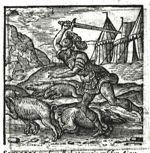
Alciatus: 'Insani gladius': Alciatus, Emblemata (Padua, 1621), col. 732 a, emblem 176
Insani gladius: Alciatus, Emblemata (Leiden, 1591), emblem 175
Iconclass: 95A(AJAX) the Greek heroic legends (AJAX): heroes (AJAX) 31A4640 Madness 31B62321 laughing
Collectanea (1500): 545
I vii 47 Canis vindictam A dog's revenge
Κυνὸσ δίκην. id est, Canis vindictam. Macedonicum adagium in eos, qui praeter expectationem poenas dant iis, quos aliquando laeserunt. Natum ab Euripidis tragici poetae interitu. In Macedonia vicus quispiam est, qui Thracum dicitur, propterea quod olim à Thracibus sit inhabitatus. Hic cum canis quidam Archelai regis aberrasset, Thraces de more suo mactatum sacrificarunt, ac devorarunt. Quod ubi comperisset Archelaus, talentum eis mulctam dicit. Verum cum illi solvendo non essent, Euripidem subornarunt, qui regem exoraret ut sibi mulctam remitteret, ita ut fecit. Postea vero cum Euripides in sylva quadam solus esset, & Archelaus à venatu reverteretur, canes Euripidem cinctum discerpserunt, devoraruntque. Existimatum est autem, eos canes ex eo prognatos fuisse cane, quem Thraces sacrificarant. Hinc adagium apud Macedonas increbuit, Canis vindictam, subaudiendum passus est, aut aliud commodius. Valerius Maximus libro 9. capite de morte non vulgari, refert Euripidem cum ab Archelao rege Macedonum coenae adhibitus fuisset, domum à convivio repetentem, à canibus fuisse discerptum. Eos canes ab aemulo quopiam immissos fuisse, confirmat A. Gellius Noctium Atticarum libro 15. capite vigesimo. Suidas addit, hos aemulos fuisse Arridaeum Macedonem, & Cratevam Thessalum poetam, quos Euripidis gloria urebat. Hi finxerunt eum à regiis canibus dilaceratum fuisse. Sunt qui narrent, eum non à canibus, sed à mulieribus fuisse dilaniatum, cum intempesta nocte Craterum adolescentem peteret, Archelai amasium. Testatur enim & Gellius, Euripidem μισογυνῆ, id est, mulierum osorem fuisse. Sed quod ad superiorem attinet opinionem, fabulam non usquequaque dissimilem narrat Plutarchus in dialogo De comparatione terrestrium animantium & marinorum. Pyrrhus, inquit, rex iter faciens canem reperit, corpus hominis interfecti servantem: cumque cognovisset eum tertium iam diem impastum manere, nec à cadavere divelli, iussit extinctum sepeliri, canem secum adducendum curavit. Paucis post diebus militum delectus est actus, omnesque regem sedentem praeteribant. Aderat & canis, quietus interim, donec domini interfectores praetereuntes conspicatus est: in hos protinus iratus, cum clamore irruit, ac saepius allatravit, subinde respectans Pyrrhum: adeo, ut non solum ipsi Pyrrho, sed et omnibus, qui aderant, suspicio nasceretur: Proinde cum & aliae nonnullae coniecturae, ita ut fit, accederent aliunde, duo comprehensi sunt, & facinus confessi, supplicio sunt affecti. Addit & Hesiodi interfectores, ab ipsius cane proditos, supplicium dedisse. Subiicit his, quod sua memoria dicit accidisse: Quidam irrupit in Aesculapii templum, sublatis aureis & argenteis aliquot monumentis: clam & ignotus, ut putabat, aufugit. At canis templi custos, cui nomen Capparus (nam indignus qui periret ἀνώνυμος) cum videret neminem aedituorum sua voce commoveri, fugientem sacrilegum est insequutus, ac primum quidem saxis petitus, haud tamen discedebat: Exorto die, non accedebat propius, sed procul oculis observans sectabatur, nec cibum obiectum capiebat. Rursum iuxta dormientem cubabat & ipse, & abeuntem ad consimilem modum insequebatur: quod si qui viatores fuissent obvii, iis cauda adblandiebatur, in illum unum latrabat ac saeviebat. Haec cum ab aliis alii didicissent, simulque & canis & hominis figuram cognovissent, sacrilegum apprehenderunt, & supplicium duxerunt, cane praecedente hilari iam, ac gestiente, quod maleficum esset venatus. Unde ei cani de publico pastus decretus est, eiusque rei cura sacerdotibus mandata. Verum, ut ad proverbium redeamus, apparet apte dici posse & in hunc sensum, quoties autor illati mali dissimulatur. Veluti cum veneno tollitur inimicus, & spargitur in vulgum rumor, illum febri perisse: aut cum princeps, immissis in aedes alicuius satellitibus omnia diripit, & fama dissipatur, à latronibus fuisse spoliatas: aut cum tyrannus subvertit eum cui male vult, deinde facti invidia confertur in magistratus, tanquam illo inscio fecerint. Videtur hinc fluxisse, quod hodie passim apud Germanos dictitant, ubi quid accidit incommodi certi, incerto autore, quodque nemini possis imputare, Id canis accidisse morsu.
Κυνὸσ δίκην, A dog's revenge, is a Macedonian adage, applied to those who unexpectedly pay the penalty to the victims of some injury they have inflicted in the past. It arises from the sad end of Euripides the tragic poet. In Macedonia there is a village which takes its name from the Thracians who once lived there. One of King Archelaus' hounds once went astray and found its way there; and the Thracians, as their custom is, killed it, offered it as a sacrifice, and ate it. When Archelaus heard what had happened, he fined them a talent. Being unable to pay, they persuaded Euripides to appeal to the king to remit the penalty, and he did so. Later however, when he was walking in a forest by himself, and Archelaus was returning from hunting, the hounds surrounded the poet, tore him in pieces, and ate him; and it was widely believed that these hounds were the offspring of the hound which the Thracians had sacrificed. Hence the adage gained currency in Macedon, A dog's revenge; with which one must understand 'He has suffered' or whatever suits best. Valerius Maximus in his ninth book, in the chapter on rare forms of death, records that Euripides had been invited to dinner by Archelaus king of Macedon, and was torn in pieces by hounds on his way home that night. The story that these hounds had been set on him by a rival is confirmed by Aulus Gellius in book 15, chapter 20, of the Attic Nights. Suidas adds that these rivals were Arrideus a Macedonian and Crateuas a Thessalian, two poets who were jealous of Euripides' reputation; and they made up the story that he was torn in pieces by the king's hounds. There is another version, to the effect that he was dismembered not by hounds but by women, late one night when he was on his way to visit a youth called Craterus who was Archelaus' bedfellow. Gellius too bears witness that Euripides was a misogynist, a woman-hater. As regards the earlier theory, a not so very dissimilar tale is told by Plutarch in his dialogue 'A Comparison between Living Creatures of Land and Sea.' King Pyrrhus, he says, was once on a journey, when he came upon a dog on guard over the corpse of a murdered man; and when the king discovered that it had gone for over two days without food and could not be dragged away from the corpse, he gave instructions for the dead man to be buried and the dog to be brought away by his own entourage. A few days later a levy was held to recruit soldiers for the army, and as the king sat there they all filed past him. The dog was there too, and lay very quiet to start with, until he saw his master's murderers filing past; at which he flew into a fury and attacked them noisily, barking constantly and looking back at Pyrrhus from time to time, in such a way that not Pyrrhus only but all those present had their suspicions aroused. As a result, with several other clues coming in, as so often happens, from other sources, the two were arrested, confessed their crime, and were duly punished. He adds that in the same way the men who murdered Hesiod were identified by Hesiod's dog, and paid the penalty. After this, he tells the story of something which happened, he says, in his own day. A man broke into a temple of Aesculapius, seized various gold and silver offerings, and escaped secretly and (as he thought) undetected. But a temple watchdog - his name was Capparus, for he deserves not to perish without a name - when he saw that none of the temple staff paid any attention to his barking, pursued the escaping criminal. To begin with, though stones were thrown at him, he would not leave the man; when day broke he kept out of range, but watched him and followed at a distance, refusing all offers of food. When the man went to sleep, the dog lay down near by, and when he moved the dog followed in the same fashion. If they met any travellers on the road, he rushed up to them wagging his tail, but that one man he attacked, barking furiously. This news was passed from hand to hand, and at the same time both dog and man were recognized; they seized the criminal and carried him off to punishment, preceded by the dog now wild with joy at the success of his hunt for the guilty man. So it was decreed that the dog should have his meals at the public expense, and this duty was entrusted to the priests. But we must return to our proverb. Clearly, it can properly be used in this further context, when the author of some wrongdoing is deliberately concealed; for example, when a man's enemy is poisoned, and the story is put about that he died of a fever, or when a prince sends his servants to someone's house and strips it, and they spread a report that it has been attacked by burglars, or when a tyrant makes away with a man he hates and puts all the blame for it on his officials, as though they had done it without his knowledge. This seems to be the origin of a saying widely current in Germany in our own day when something happens which undoubtedly causes damage though the culprit is in doubt and no one can be held responsible; they say it must have been caused by the bite of a dog.
Facsimile: 
Iconclass: 34B11 dog 44G3 criminal law; punishment 57AA741 Revenge, Requital, Retaliation; 'Vendetta' (Ripa)
Loci Communes: Ultio malefacti (Vengeance for a wrongdoing, Vengeance d'un méfait)
I vii 48 In tuo regno In your kingdom
Quod cuiusque privatum est, regnum eius dicitur. Inde & Meliboeus Virgilianus: Post aliquot mea regna videns mirabor aristas. Scaevola apud Ciceronem in Oratore, Id nisi in tuo regno essemus, non tulissemus. id est, in tua villa. Nam Crasso loquitur in Tusculano, quae villa tum erat Crassi. Quinetiam vulgo iactatur adagium, Suae quenque domi regem esse: quod tamen ab ipsa usque antiquitate manasse videtur. Quandoquidem apud Homerum Odysseae Α. versiculus hic extat, Αὐτὰρ ἐγὼν οἴκοιο ἄναξ ἔσομ᾽ ἡμετέροιο. id est, Aedibus in nostris ego regem gessero sanè.
A man's private property is called his kingdom. Thus Meliboeus in Virgil says: 'Far in the future shall these wondering eyes / Behold my kingdom - some few ears of grain?' Scaevola, a character in Cicero's Orator. 'Had we not been in your kingdom, we should not have put up with that,' meaning 'on your country estate,' for he was addressing Crassus in the country- house at Tusculum which at that time was Crassus' property. Besides which there is a popular saying to the effect that every man is king in his own house, and it looks as though this has come down from Antiquity, for in Homer in the first book of the Odyssey there is a line 'But in my house I will myself be king.'
Facsimile:
Iconclass: 44B01 monarchy; 'Monarchia mondana' (Ripa) 56D3 Confidence, Security, Tranquillity; 'Confidenza', 'Sicurezza e Tranquillità', 'Sicurtà', 'Sicurtà o Sicurezza', 'Tranquillità' (Ripa)
Loci Communes: Securitatis et tutae rei (Security and safety, Sécurité et sûreté)
I vii 49 In tuo luco et fano est situm It's put in your grove and shrine
In tuo luco & fano legitur apud Plautum, pro eo quod est, in tua potestate, tuo arbitrio, tua tutela, tua manu. Translatum à fanis & lucis, numinibus dicatis. Nonnihil diversum est quod ait M. Tullius in oratione pro Aulo Cecinna: In meis castris, praesidiisque versaris id est, mecum facis, & pro me pugnant quae dicis.
The phrase In your grove and shrine is found in Plautus in the sense of 'in your power, within your discretion, under your protection, in your hands.' It is a metaphor from the shrines and groves dedicated to deities. It differs to some extent from Cicero's expression in his speech in defence of Aulus Caecina: 'You are now in my camp and garrison,' meaning 'You are on my side, what you say supports my case.'
Facsimile:
Iconclass: 12B61 temple, shrine ~ non-Christian religions 53C11 Authority, Power; 'Dominio', 'Giurisdittione' (Ripa) 56D3 Confidence, Security, Tranquillity; 'Confidenza', 'Sicurezza e Tranquillità', 'Sicurtà', 'Sicurtà o Sicurezza', 'Tranquillità' (Ripa)
Collectanea (1500): 218
Loci Communes: Securitatis et tutae rei (Security and safety, Sécurité et sûreté)
I vii 50 Intra suas praesepes Safe in his own fold
Simili figura dicit Plautus in Cassina, Scit, si id impetret, futurum quod amat intra praesepeis suas. pro eo quod est, certum ac paratum. Nam quod intra septa nostra clausum sit, id tuto certoque possidemus. Dictum est autem in senem dantem operam, ut ancilla quam amabat, villico suo nuberet, hoc quidem consilio, ut insciente uxore, cum liberet, ea ruri potiretur. Idem in Rudentibus, Ad herum arbitrum vocat me hic intra praesepes meas.
Plautus uses a similar image in the Casina: 'He knows that if he gets his way in this, / The thing he loves will be safe in his own fold,' meaning, it will be secure and ready to hand, for what is shut up within our own walls is surely and safely ours. The words are used of an old man who was scheming to get the servant-girl he had taken a fancy to married to his farm-manager, the plan being that he could then enjoy her in the country when he pleased, and his wife be none the wiser. Again in the Rudens: 'My master is to arbitrate, and I / To appear before him - safe in my own fold.'
Facsimile:
Iconclass: 47I22111 return to the fold, byre, stable ~ herd, herdsman 56D3 Confidence, Security, Tranquillity; 'Confidenza', 'Sicurezza e Tranquillità', 'Sicurtà', 'Sicurtà o Sicurezza', 'Tranquillità' (Ripa)
Collectanea (1500): 70
Loci Communes: Securitatis et tutae rei (Security and safety, Sécurité et sûreté)
I vii 51 In aere meo est He is at my service
Quem nobis officiis obstrictum significamus, ita ut iam totus certoque noster sit, eum in aere nostro dicimus esse. Nam antiquitus omnis pecunia aerea erat, auri usu nondum reperto in feriendis numismatis. Memini legere apud Ciceronem libro Epistolarum familiarium decimotertio: Et mehercle semper sic in animo habui, te in aere meo esse, propter Lamiae nostri coniunctionem, & singularem necessitudinem. Item libro decimoquinto: Marcum Fabium quod mihi amicum tua commendatione das, nullum in eo facio quaestum. Multi enim anni sunt, quum ille in aere meo est, & à me diligitur.
When we wish to convey that a man is so much bound to us by what we have done for him that he is now wholly and certainly ours, we say that he is 'at our service,' using a word that really means he owes us bronze money, because in early times all money was coined in bronze, the use of gold for striking coin not yet having been invented. I remember reading this in Cicero in book 13 of the Letters to his Friends: 'And, I must say, I have always had the feeling that you were at my service on account of your connection with my friend Lamia and your special relation to him.' Again in book 15: 'Thank you for introducing Marcus Fabius to me as a new friend, though I gain nothing out of that since he has been at my service for many years now and is a man I like very much.'
I vii 52 A teneris unguiculis Since the time their nails were soft
Απὸ τῶν ἁπαλῶν ὀνύχων, id est, A teneris unguiculis pro eo quod est, à prima pueritia. Translatum à catulis, quorum unguiculi nondum duruerunt. M. Tullius, A teneris, ut Graeci dicunt, unguiculis. Flaccus in Odis: Et incestos amores De tenero meditatur ungui. Plutarchus in libello De puerorum institutione, Ως ἄν ἔνδοθεν καὶ τὸ δὴ λεγόμενον ἐξ ὀνυχων ἀγαπῶσι τὰ τέκνα, id est, Ut intrinsecus, & quod dicitur, ab unguiculis ament liberos. hoc est, à prima statim infantia. De matribus loquitur, quae suis uberibus lactant foetus suos.
Ἀπὸ τῶν ἁπαλῶν ὀνύχων, Since the time their nails were soft, in the sense of 'from earliest childhood.' A metaphor from puppies whose claws have not yet grown hard. Cicero: 'Since your nails were soft, as they say in Greek.' Horace in the Odes: 'And ere her nails are hard, her head / Is full of wanton thoughts of bed.' Plutarch in his essay 'On the Education of Children': 'in proportion as they love their children from the heart and, as the phrase goes, from the finger-nails,' meaning from the earliest days of childhood. He speaks of mothers who feed their own babies at the breast.
Facsimile:
Iconclass: 31A2247 nails (fingers) 51F5 Beginning; 'Principio' (Ripa) 51FF5 End; 'Fine' (Ripa) 23 time
Collectanea (1500): 775
Loci Communes: Perficiendi sive absolvendi - ab initio ad finem (Finishing, completing - from beginning to end, Achever, accomplir - du début à la fin)
I vii 53 Ab incunabulis From the cradle
Eundem habet sensum, Ab incunabulis, id est, à primis vitae rudimentis. Plautus in Pseudolo, Sed hic servus Carysto huc qui advenit, quid sapit usque à cunabulis? Item Titus Livius, Ab incunabulis imbutum odio tribunorum. M. Tullius oratoris incunabula vocat primam illam à fundamentis institutionem. Et Virgilius: Gentis cunabula nostrae. Aurelius lib. Pandectarum primo, titulo de officio praefecti praetorio, His cunabulis praefectorum auctoritas initiata in tantum meruit augeri, ut appellari à praefectis praetorio non possit. Aristoteles in Ethicis lib. 2 dicit, ἐκ νηπίων, ἐκ νέων. Quorum posterius citat ex Platone. Est autem is locus apud Platonem lib. De legibus decimo, νῦν οὖν πειθόμενοι τοῖς μύθοις οὕς ἐκ νέων παίδων ἔτι ἐν γάλαξι τρεφόμενοι, τροφῶν τε ἤκουον καὶ μητέωον. id est, Nunc vero credentes fabulis, quas a pueris, cum adhuc laχte aleremur, à nutricibus ac matribus audivimus. Similiter & Crepundia pro prima aetate accipiuntur.
The same sense is conveyed by 'From the cradle,' meaning from a man's earliest years. Plautus in the Pseudolus: 'This slave now, from Carystos newly come, / What sense has he made since he left the cradle?' Livy too: 'Steeped from the cradle in the hatred of tribunes.' Cicero uses 'the cradle of an orator' for his first introduction to fundamental principles. And Virgil: 'The cradle of our race.' Aurelius in book one of the Pandects, in the title De officio praefecti praetorio: 'Such was the cradle from which the prefect's authority took its rise, and it has grown deservedly to such proportions that from the praetorian prefects there is no right of appeal.' Aristotle in the Ethics, book 2, uses 'from infancy,' 'from childhood,' and cites the latter phrase from Plato. The passage in Plato is in the tenth book of the Laws: 'So now, believing the stories we heard from our nurses and from our mothers from earliest childhood when we were still fed on milk.' 'Toys' can be used in the same way for the years of infancy.
Facsimile: 
Note: Eric Clapton, From the Cradle (1994)
Iconclass: 51F5 Beginning; 'Principio' (Ripa) 51FF5 End; 'Fine' (Ripa) 42A411 cradle, crib 23 time
Loci Communes: Perficiendi sive absolvendi - ab initio ad finem (Finishing, completing - from beginning to end, Achever, accomplir - du début à la fin)
I vii 54 Cum lacte nutricis With our mother's milk
Cognatum est his quae superius retulimus, ab incunabulis, à teneris unguiculis. Cicero Tuscul. quaest. lib. 3. Nunc autem simul atque editi in lucem & suscepti sumus, in omni continuo pravitate, & in summa opinionum perversitate versamur, ut pene cum lacte nutricis errorem suxisse videamur.
Related to the two I have just mentioned, From the cradle and Since the time their nails were soft. Cicero in book 3 of his Tusculan Disputations: 'But now, from the moment we come into the light of day and are allowed to live, we pass our days right from the start in every form of perversity and in most erroneous opinions, so that we seem almost to have imbibed error with our mother's milk.'
Facsimile:
Iconclass: 42A31 nursing, suckling 31A22232 breasts giving milk 23 time 51F5 Beginning; 'Principio' (Ripa) 51FF5 End; 'Fine' (Ripa)
Loci Communes: Ingenii malitia et institutio (Malice of character and its formation, Malice d'esprit et son origine)
I vii 55 Ante victoriam encomium canis You triumph before the victory
Πρὸ τῆς νίκης τὸ ἐγκώμιον ᾄδεις. id est, Ante victoriam encomium canis. In eum, qui praepropere gloriatur, re nondum confecta. Nam apud Graecos, qui rem strenue gessissent bello, oratione quapiam aut carmine laudabantur: quae laudatio proprie enconium dicitur. Extat enim theocriti carmen in laudem Ptolemaei, cui titulus, Encomium, & Luciani Demosthenis encomium. Apud Romanos, orationes, supplicationes, triumphi, praemia virtutis erant: unde liceat dicere, Antequam viceris, triumphum paras. Plato in Lyside, Πρὶν νενικηκέναι ποιεῖς τε καὶ ᾄδεις εἰς ἑαυτὸν ἐγκώμιον. id est, Priusquam viceris, & facis & canis de teipso encomium. Non abludit hinc, quod ait Plato in Thaeeteto, φαινόμεθα ἀγεννοῦς ἀλεκτρυόνος δίκην πρὶν νενικηκέναι, ἀποπηδήσαντες ἀπὸ τοῦ λόγου ᾄδειν. i. Videbimur, galli ignavi more priusquam vicerimus, à sermone desilientes canere. Si quidem hic mos animanti, cantu victorem se testari. Huc pertinet illud quod alibi retulimus ex Solonis autoritate, ὅρα τέλος μακροῦ βίου. Tum illud Pindari in Isthmiis, ἐστὶν δ᾽ ἀφάνεια τύχας καὶ μαρναμένων, πρὶν τέλος ἄκρον ἴκεσθαι. id est, Est autem incerta fortuna etiam pugnantium, priusquam ad summum finem perveniatur.
Πρὸ τῆς νίκης τὸ ἐγκώμιον ᾄδεις., You sing your song of triumph before you have won the day. Used of a man who boasts prematurely when the battle is not yet over. In Greece those who had shown gallantry in battle received a tribute of praise in prose or verse, the special name of which was an encomium. We still have a poem by Theocritus in praise of Ptolemy which is called his 'Encomium,' and Lucian's encomium on Demosthenes. In Rome ovations, supplications, and triumphs were the reward of valour, so that one can use the phrase 'Before you have won the day you get your triumph ready.' Plato in the Lysis: 'Before your victory you write your own triumph-song and sing it.' On the same lines is Plato's remark in the Theaetetus: 'We shall look like cocks of a very poor strain if we drop the argument suddenly and start crowing before we have won'; for it is that creature's habit to celebrate its victory by crowing. Here belongs that aphorism I have recorded elsewhere on the authority of Solon, 'Look to the end of a long life,' and also Pindar's observation in the Isthmians, 'Even for those who strive the outcome is all uncertain till they reach their goal at last.'
Facsimile:
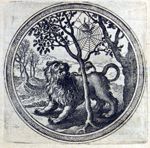
Non laetata diu spes improba: Zincgreff, Emblematum Ethico-politicorum (Heidelberg, 1619), emblem 25 uses the imagery of a gnat feeling victorious after having stung a lion
Iconclass: 57AA645 Boast; 'Iattanza' (Ripa) 57AA646 Complacency, Self-conceit 57AA647 Hybris 43A43 triumphs (allegorical and symbolic) 54F2 Victory 51FF4 Non-simultaneity
Collectanea (1500): 450
Loci Communes: Festinatio praepropera (Overhasty haste, Précipitation excessive)
I vii 56 Omnes attrahens, ut magnis lapis Attracting all men, like the magnet stone
Πάντας γ᾽ ὑφέλκων οἷα μαγνῆτις λίθος. id est, Cuncta attrahens haud aliter, ac magnes lapis. Hoc carmen Suidas citat ex Piside. Videtur proverbiale. Metaphora ducta à natura lapidis, ferrum ad se trahentis, & attractum tenentis, quem quidam eundem putant cum eo, quem Heracleum vocant, cuius alibi mentionem fecimus in proverbio, Lydius lapis. Hoc miraculi Plinius verbis attollit lib. 36. cap. 16. ad hunc modum, Quid lapidis rigore pigrius? Ecce sensus manusque tribuit illi. Quid ferri duritia pugnacius? Sed cedit, & patitur mores, trahiturque à Magnete lapide, domitrixque illa rerum omnium materia, ad inane nescio quid currit, atque ut propius venit assistit, teneturque, & complexu haeret. Sideriten ob hoc alio nomine appellant: quidam Heracleon. Magnes appellatus est ab inventore, ut autor est Nicander, in India repertus. Hactenus Plinii verba reddidimus. Inter multas Magnetis species Aethiopicum commemorat, attractu usque adeo efficaci, ut non ferrum modo, verumetiam alterum Magnetem ad se trahat. Eoque tantus huius lapidis honos, ut argento expendi soleat. Commemorat & Haematiten non perinde in attrahendo ferro violentum, sed alio insignem miraculo. Siquidem ut est colore sanguineo, nam hinc etiam vocabulum, ita si teratur, sanguinem reddit. Huius igitur lapidis tam prodigiosa vis proverbio locum fecit. Citat Suidas Euripidem ex Oeneo, Ως τε μαγνῆτις λίθος Τὴν δόξαν ἕλκει, καὶ μεθίστησιν πάλιν. id est, Sicuti Magnes lapis Mentem trahit, transfertque rursum ac demovet. Confine est illi, quod alibi diximus: Εφ᾽ ἑαυτὸν ἕλκων, ὥς τε καικίας νέφος. id est, Ad se attrahens, ut Cacias nubes trahit.
Πάντας γ᾽ ὑφέλκων οἷα μαγνῆτις λίθος., All things attracting, like a magnet stone. This line is cited by Suidas from Pisides, and has the look of a proverb. The metaphor is drawn from the natural quality of a stone which attracts iron to itself and holds it there, which some suppose to be identical with the so-called Heraclean stone of which I have spoken elsewhere, in the proverb Lydius lapis. This remarkable effect is extolled by Pliny, book 36 chapter 16, as follows: 'What is more difficult to move than solid stone? Yet nature supplies it with feeling and hands. What so hard, so doughty a fighter as iron? Yet it capitulates and does what it is told, and it is attracted by the magnet; that substance which masters everything else runs towards something unsubstantial, and the closer it approaches the more it is paralysed, held fast and clasped in its embrace. For this reason another name for it is siderites, the iron-catching stone, and some call it Heracleon; magnet was the name given it by its discoverer, according to Nicander, and it is found in India.' Thus far I have given Pliny's actual words. Among many kinds of magnet he speaks of one from Ethiopia, the pull of which is so powerful that it will draw to itself not only iron but another magnet, and the stone is therefore so highly valued that it fetches its own weight in silver. He mentions also one called haematite, which exerts no particular force in attracting iron but is remarkable for another peculiar property. Not only is it blood-red in colour (hence its name), but if rubbed, it oozes blood. This stone, then, has such miraculous powers that it has given rise to a proverb. Suidas cites Euripides, from the Oeneus: 'Like the magnet-stone, / It draws the mind and lets it go again.' This is related to one which I have given elsewhere: 'Drawing to itself, as a north-easter draws the clouds.'
Facsimile:
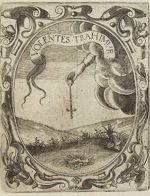
Volentes trahimur: Saavedra, Idea de un principe (München, 1640), emblem 88
Volentes trahimur: De la Feuille, Devises et emblemes anciennes et modernes (Augsburg, 1697), emblem 189
Non tuis viribus: De Montenay, Cent Emblèmes Chrestiens (Frankfurt, 1619), emblem 5 uses the imagery of the magnet
Iconclass: 22B21 magnet 22B221 attractive force, attraction ~ magnetic force 25D3(+21) mining (+ gravel and sand) 51L42 Motion Towards, Attractive Force, Attraction, Pull 56F13 (Feeling of) Attraction
Loci Communes: Malum accersitum aut retortum (Evil brought upon oneself or turned back, Mal attiré ou retourné)
I vii 57 In silvam ligna ferre To carry wood to the forest
In sylvam ligna ferre, est aliquem iis rebus augere velle, quibus ipse maximè abundet. Horatius in Sermonibus, Atque ego cum Graecos facerem naetus mare citra Versiculos, vetuit me tali voce Quirinus Post mediam noctem visus, cum insomnia vera, In sylvam non ligna feras insanius, ac si Graecorum malis magnas implere catervas. Eadem ratione dicimus. In mare deferre aquam: quorum utrumque nos epigrammate quodam coniunximus, Largire numeros tibi Petre, hoc est, Sylvae ligna, vago mari addere undas. Utrumque congruit cum eo, quod alio rerulimus loco, Ululas Athenas.
To carry wood to the forest is to wish to supply someone with things of which he already has a large supply. Horace in his Satires:
When I, born overseas, would write in Greek,
In after-midnight hour, when dreams speak plain,
I saw Quirinus, and he said 'Refrain:
Wood to the forest would be no more mad
Than to the serried ranks of Greeks to add.'
On the same lines we speak of carrying water to the sea. I have used both images together in one of my epigrams: 'To send my Pietro verses sure would be / Wood to the forest, water to the sea.' They both agree with one I have recorded elsewhere, Owls to Athens.
Facsimile: 
Note: cf. "Water to the sea"
Note: "Owls to Athens"
Iconclass: 47(+444) crafts and industries (+ wood ~ crafts, industries, agriculture) 25H15 forest, wood 54BB2 Unnecessity, Superfluity 54BB4 Inefficiency
Collectanea (1500): 313
Loci Communes: Inanis opera (Vain effort, Effort vain)
I vii 58 Lumen soli mutuas You lend light to the sun
Τό φῶς ἡλίῳ δανίζεις. id est, Lumen soli mutuum das. Cum docemus doctissimum, monemus vehementer prudentem: aut cum conamur exponere, quae per se sunt clarissima: aut sermone celebrare, quae sua sponte sat illustria sunt. Sol enim fons omnis luminis putatur, qui lucem mutuare solet, non mutuo accipere. Refertur in iis collectaneis, quae Plutarchi titulo circumferuntur. Est simile quiddam apud Fabium de iis qui per se clara conantur illustrare, eos perinde facere, quasi si quis studeat clarissimo soli mortale lumen inferre.
Τό φῶς ἡλίῳ δανίζεις, You are lending light to the sun. When we give a very learned man a lesson, or offer advice to an extremely wise man, or try to expound something quite obvious in itself, or deliver a panegyric on something that is famous enough in its own right. For the sun is reckoned to be the source of all light, accustomed to lend light and not borrow it. This is recorded in the collection which goes under Plutarch's name. There is something very like it in Quintilian: those, he says, who try to shed light on things clear enough in themselves behave as a man would who should try 'to add some mortal gleams to the sun in his splendour.'
Facsimile:
Iconclass: 24A sun as celestial body 22C light 55C3 Lending, Letting 54BB2 Unnecessity, Superfluity 54BB3 Inutility, Noxiousness; 'Nocumento', 'Nocumento d'ogni cosa' (Ripa) 54BB4 Inefficiency
Collectanea (1500): 631
Loci Communes: Absurda, indecora, seu praepostera (Absurd, unbecoming, or preposterous things, Choses absurdes, inconvenantes ou déplacées)
I vii 59 Fontes ipsi sitiunt The springs themselves are thirsty
Fontes ipsi sitiunt, Ironia proverbialis in eos, qui petunt ab aliis, quod ipsis affatim abundet domi. Cicero ad Q. fratrem, Tibi quod rogas, quoniam ipsi fontes iam sitiunt, si quid habeo spacii, scribam. Significat fratrem magis abundare versibus, quos tamen à se petat, perinde quasi carminum indigens. Idem ad Atticum libro 12. Non ad διψῶσαν κρήνην, sed ad ἠρίνην eum venisse, ut scribis, in tantis praesertim angustiis.
A proverbial expression, used ironically of those who ask others to give them what they themselves have plenty of at home. Cicero, writing to his brother Quintus: 'Since it seems that by now the springs themselves are thirsty, I will write what you ask, if I have room.' He means that his brother is a more fluent versifier than he is himself, although he asks for a piece of verse just as though he himself was barren in that line. Cicero again, in the Letters to Atticus, book 12: 'That he should have come, not to a thirsty spring but to Erine, as you say in your letter, especially at such a difficult moment.'
Facsimile:
Iconclass: 25H211 spring, source of river or stream 41C129 thirst 52BB42 Impossibility 54BB2 Unnecessity, Superfluity
Loci Communes: Impossibilia (Impossible things, Choses impossibles)
I vii 60 Ipsa olera olla legit The pot picks its own greens
Ipsa olera olla legit. In eos quadrabit, qui suum ipsorum vitium in aliud quippiam reiiciunt: aut qui sic ad scelus aliquod quasi facti sunt, ut non possint non peccare. Catullus in Caesarem: Metula moechatur, moechatur mentula certe. Hoc est quod dicunt, ipsa olera olla legit. Nam olla coquendis oleribus nata est: vel quod absurdissimum sit, si quis dicat ollam legere olera quae non coquet, nisi si quis immiserit. Non igitur olla in causa est, sed qui iniicit mala olera. Non est admodum huic dissimile, quod ex Homero ceu proverbiale citat Tertullianus: Ipsum ferrum virum attrahit. Id à nobis alio dictum est loco, in proverbio Tollenda mali occasio. Item, Ipsa olla lenticulam attigit.
This will suit those who shift responsibility for their own faults onto something else or who are, as it were, so expressly adapted to some form of wickedness that they cannot fail to commit it. Catullus, attacking Caesar: 'Mentula makes cuckolds? With a name like that, what else would you expect? So the proverb runs: The pot picks its own greens.' A pot is born for the cooking of greens; alternatively, it would be most absurd to make the pot responsible for its choice of greens, for it will cook only what has been put into it by someone else, so the pot is not to blame but the person who puts rotten greens into it. There is not much to choose between this and the phrase quoted as proverbial by Tertullian from Homer: 'Iron of itself draws a man on.' This I have dealt with in another place, in the proverb Remove the opportunity to go astray. Likewise: The pot helped itself to the lentils.
Facsimile:
Note: cf. "Iron of itself draws a man on"
Note: cf. "The pot helped itself to the lentils"
Iconclass: 41A773 container of ceramics: jar, jug, pot, vase 41C652 vegetables 57AA21 Irresponsibility
Loci Communes: Malum accersitum aut retortum (Evil brought upon oneself or turned back, Mal attiré ou retourné); Similitudinis et congruentiae (Similarity and congruence, Similitude et convenance)
I vii 61 Oedipi imprecatio The curse of Oedipus
Οἰδίποδος ἀρὰ, id est, Oedipi imprecatio. De tragicis & ingentibus malis. Qui Graeca colligunt adagia, citant ex Aeschylo huiusmodi fabulam: Eteocles & Polynices, de more patri ex unoquoque sacro partem anteriorem mittebant. Cum autem aliquando per imprudentiam atque incogitantiam, coxam, hoc est, posteriorem partem misissent, ille, existimans id non oblivione, neque imprudentia, sed contumeliae causa factum, imprecationibus diris eos est exsecratus. Alii narrant, Oedipum, simulatque cognovisset se parricidam esse, tum autem cum matre consuetudinem habuisse, suis ipsius manibus oculos sibi eruisse. Quae res ubi eius loci incolis cognita est, Oedipum expulerunt urbe. Ille in exilium abiens, filios, quod patrem in calamitate non defenderent, exsecrationibus devovit. Quae quidem neutiquam irritae fuerunt: nam iuvenes mutua caede exstincti sunt: Mater sibi mortem conscivit: Oedipus ipse fulmine ictus interiit. Cuiusmodi autem fuerint huiusmodi imprecationes, Diogenes Cynicus apud Laertium propemodum indicat, qui per iocum dicere solitus erat, sibi τάς τραγικάς ἀράς, id est, Tragicas exsecrationes occurrisse. Esse enim sine domo, sine civitate, privatum patria, pauperem, palantem, vitam in diem agentem. Sophocles in Tyranno, fingit Oedipum ignarum etiamnum de quo Phoebus dixisset exigendo, tamquam qui civitatem suis sceleribus pollueret, multa dira in eum, hoc est, in se precantem. Euripides in Phoenissis, Αράς αῤᾶται παισίν ἀνοσιωτάτας. id est, Dirissimas preces precatur liberis. Verba Iocastae de Oedipo. Idem de Oedipo Coloneo, sic Oedipum imprecantem facit Polynici, ut fraterna manu occideretur, vicissimque occideret, Τάς δὲ συλλαβών ἀράς Ας σοοι καλοῦμαι, μήτε γῆς ἐμφυλίου Δορὶ κρατῆσαι, μήτε νοστῆσαι ποτὲ Τὸ κοῖλον ἄργος, ἀλλὰ συγγενεῖ χερὶ Θανεῖν, κτανεῖνθ᾽ ὑφ᾽ οὗπερ ἐξελήλασαι. Τοιαῦτ᾽ ἀρῶμαι, καὶ καλῶ τοῦ ταρτάρου Στυγνοῦ πατρῷον ἔρεβος. Et reliqua quae sequuntur, id est, Haec te sequantur agmine imprecamina, Tibi quae imprecor, uti néve vitali solo Potiare bello, néve ad Argos postea Redire liceat: imò faterna manu Perimaris, ac vicissim eum dedas neci Qui te expulit, fratrem. Ista vobis imprecor, Testorque patrii triste numen tartari. Horatius hoc genus imprecationis diras vocat in Odis: Diris agam vos: dire deprecatio Nulla expiatur victima. Huiusmodi autem parentum in liberos devotiones esse formidandas, Homerus quoque testatur Iliados 1. Cum Phoenix narrat se paternis exsecrationib. obnoxium fuisse, idque contigisse quod illi fuerant imprecatae. Carmen Homeri sic habet, Μή ποτε γούνασιν οἶσιν ἐφέσσηται φίλον υἱὸν Ἐξ ἐμέθεν γεγαῶται, θεοὶ δ᾽ ἐτέλειον ἀπάρας. id est, Orat ne in genibus proles aliquando sederet Ex me nata suis, diique audivere precantem.
Οἰδίποδος ἀρά, The curse of Oedipus. Of tragical and great disasters. The collectors of Greek adages cite the following story from Aeschylus. Eteocles and Polynices, in accordance with custom, used to send their father a forepart from every sacrifice. One day, through ignorance and inattention, they sent him a haunch, which is one of the hinder parts; and he, thinking this was done to insult him rather than from forgetfulness and inadvertence, laid a terrible curse on them. Others tell how Oedipus, discovering that he had killed his own father and had been living with his mother as her husband, tore out his eyes with his own hands. When this became public knowledge, the local people drove Oedipus out of their city. As he went into exile, he laid a curse on his sons for failing to defend their father in his calamity. And his curses were by no means ineffectual, for the young men killed each other, their mother committed suicide, and Oedipus himself was killed by a thunderbolt. The nature of these imprecations is roughly suggested by Diogenes the Cynic philosopher in Laertius, who used to say humorously that he had incurred 'the curses in the tragedy,' for he had no home and no city, was deprived of a native country, was poor and a vagabond, and lived from day to day. Sophocles in the Oedipus tyrannus makes his hero actually unaware who it is that Phoebus has said must be exiled as having polluted the country with his crimes; and he calls down many curses on the culprit, that is, on his own head. Euripides in the Phoenissae: 'He lays most frightful curses on his children'; it is Jocasta speaking of Oedipus. Again in the Oedipus Coloneus he makes Oedipus lay a curse on Polynices, praying that he may be killed by his brother and kill him in return:
These curses with you take,
Which I call down on you. Ne'er may you win
Your native land by arms, and ne'er return
To hollow Argos. By your brother's hand
May you be killed, and kill him in your turn
Who drove you out. This curse I lay upon you
And call the ancestral deeps of hell to witness,
and what follows. Horace calls this form of cursing 'execration' in the Odes: 'With curses I will hound you; no sacrifice shall purge my execration.' That this kind of imprecation by parents on their children was a formidable thing is shown by Homer in the Iliad, book 9, where Phoenix tells how he was exposed to his father's imprecations and how what they had called down upon his head came to pass. Homer's lines run as follows: 'He prays that never on his knees may sit / A son of mine, and the gods heard his prayer.'
I vii 62 Efficimus pro nostris opibus moenia We build the walls we can afford
Efficimus pro nostris opibus moenia. Quadrat in tenui fortuna, parvisque facultatibus homines, qui tamen ipsi quoque pro rei modulo vivunt laute. Plautus in Sticho: Quibus divitiae sunt domi, scaphiis, & cantharis batrochis bibunt. Nos nostro Samiolo poterio, tamen vivimus nos, tamen efficimus pro opibus nostra moenia. Hactenus Plautus. Itidem vulgo dicitur hodieque, Pusillae aviculae pusillos nidulos construunt.
Appropriate to men of humble station and modest means, who none the less live as well as their resources permit. Plautus in the Stichus:
Rich men from gilded cups and goblets drink,
We from our Samian crocks; - and yet we live,
We live and build the walls we can afford.
So Plautus. Even today there is a popular saying to the effect that Little birds build little nests.
Facsimile: 
Note: cf. "Little birds build little nests"
Iconclass: 41A54 fence, wall, paling 47G building activities 57A641 Discretion, Modesty; 'Discretione', 'Modestia' (Ripa)
Loci Communes: Modestia modusque (Modesty and moderation, Modestie et mesure)
I vii 63 Omnium rerum vicissitudo est All things do change
Terentius in Eunucho: Omnium rerum vicissitudo est. Quae sententia significat in rebus mortalium nihil esse perpetuum, nihil stabile, sed omnia velut aestuario quodam fluxu refluxuque decedere atque accedere. Atque his vicibus fortunae, ab aliis ad alios transferuntur imperia, opes, gloria, voluptas, eruditio: denique quidquid est, aut commodorum, aut incommodorum. Sophocles in Oedipo Coloneo has rerum humanarum vices eleganter describit: Μόνοις οὐ γίγνεται Θεοῖσι γῆρας, οὐδὲ κατθανεῖν ποτε Τὰδ᾽ άλλα συγχεῖ πάνθ᾽ ὁ παγκρατης χρόνος. Φθίνει μὲν ἰσχὺς γῆς, φθίνει δὲ σώματος, Θνήσκει δὲ πίστις, βλαστάνει δ᾽ ἀπιστία. Καὶ πνεῦμα ταὐτὸν, οὔποτ᾽ οὔτ᾽ ἐν ἀνδράσιν Φίλοις βέβηκεν, οὔτε πρὸς πόλιν πόλει Τοῖς μὲν γάρ ἤδη, τοῖς δ᾽ ἐν ὑστέρῳ χρόνῳ ὰ τερπνὰ πικρὰ γίγνεται, καὖθις φίλα. Quorum carminum sententiam utcunque reddemus. Solis deis Nunquam senecta molesta, nec mors accidit. At reliqua miscet cuncta tempus impotens. Terrae per hoc vis atque robur interit, Simulque nostri corporis perit vigor, Moritur fides, perfidia pullulat invicem. Nec animus idem, nec eadem fragrantia Haud unquam amico durat erga amiculum, Nec civitati in civitatem permanet, Siquidem his statim, illis post pusillum temporis, Iucunda quae fuerant, amara ac tristia, & Ingrata dudum, grata fiunt invicem. Homerus item Iliados Ζ. Νίκη δ᾽ ἐπαμείβεται ἄνδρας. id est, Nunc his, nunc illis contingit vincere. Item Iliados Σ Ξυνὸς ἐνυάλιος, καὶ τοι κτανέοντα κατέκτα. Communis Mars, inque vicem perimit perimentem. Neque vero praetereundum hoc loco bellissimum eiusdem poetae figmentum de duobus doliis, ex quibus Iupiter varie miscet res mortalium. Carmen extat in Iliados ultimo libro, quod non ab re fuerit adscribere. Δοιοὶ γὰρ τε πίθοι κατακείαται ἐν διός οὒδει Δώρων οἷα δίδωσι, κακῶν, ἕτερος δὲ ἐάων. Ω μὲν καμμίξας δώη Ζεώς τερπικέραυνος, Αλλοτε μὲν τε κακῷ ὅγε κύρεται, ἄλλοτεδ᾽ ἐσθλῷ id est, Dolia nanque Iovis duo stant in limine, plena Muneribus quae is donat: in hoc mala sunt, bona in illo, Hinc miscens dispensat acuto fulmine gaudens, Nunc mala distribuens ac tristia, nunc bona rursum. Tractum videtur adagium ab Aesopi responso. Is enim rogatus, autore Laertio, quid ageret Iupiter, respondit, τὰ μὲν ὑψιλὰ ταπεινοῖ, τὰ δὲ ταπεινὰ ὑψοῖ. id est, Deprimit excelsa, & tollit humilia. Euripides in Ione, Τὰ θνητὰ τοιαῦτα οὐδὲν ἐν ταυτῷ μένει. id est, Eiusmodi mortalium Sunt res, ut in eodem nihil duret statu. Euripides in Icetidibus. Ο γὰρ θεὸς πάντ᾽ ἀναστρέφει πάλιν. id est, Fortuna cuncta versat in contrarium. Theognis in sententiis, Ζεὺς γὰρ τοι τὸ τάλαντον ἐπιῤῥέπει ἄλλοτε ἄλλῳ, Αλλοτε μὲν πλουτεῖν, ἄλλοτε δ᾽ οὐδὲν ἔχειν. id est, Nunc etenim huic libram inclinat, nunc Iuppiter illi, Ut modo sis dives, nil modo possideas. In quibus versibus Theognis, ut illud obiter indicemus, allusit ad locum Homericum in Iliados Θ. ubi Iupiter aureis lancibus expendit Troianorum, ac Graecorum fata. Fertur in eam sententiam huiusmodi versiculus, Τὰ θνητὰ πὰντα μεταβολὰς πολλὰς ἔχει. id est, Varias vices, res obinent mortalium. Celebratur & hoc dictum, κύκλος τὰ ἀνθρώπινα. id est, Circulus res mortalium, ut subaudias, sunt, quod circumagantur, & velut in orbem recurrant, fortuna versante rotam. Item Pindarus in Therone, Ροαὶ δ᾽ ἄλλοτε ἄλλα Εὐθυμιᾶν τε μετὰ καὶ πόνων ἐς ἄνδρας ἔβαν. Quorum carminum sensus est, Iucunda, ac tristia, aestus in morem, vicissim accidere mortalibus. Homerus locis aliquot appellat ἑτεραλκέα νίκην. id est, Victoriam alternatim nunc his nunc illis obtingentem.
Terence in the Eunuchus: 'How all things do change!' This pronouncement means that in the affairs of mortal men nothing lasts for ever, nothing stands still, but all things ebb and flow as it were in a series of tides. By these turns of fortune all things are conveyed from one set of men to another, empire and wealth and glory and happiness and learning and all else whether desirable or undesirable. Sophocles in the Oedipus Coloneus has an eloquent descrip- tion of these vicissitudes in human affairs:
The gods alone know neither age nor death;
All else almighty Time confounds in one.
Earth's strength decays, decays the strength of man;
Faith dies and falsehood burgeons in its place.
The same wind never lasts 'twixt friend and friend,
City and city; but for some forthwith,
And for some later, what was sweet turns sour
And what was hateful pleases in its stead.
Homer too in Iliad 6: 'Victory changes sides from man to man,' and again in Iliad 18: 'The god of war / Impartial slays the slayer in his turn.' Nor should we pass over in this context the same poet's very beautiful invention of the two great jars out of which Jupiter blends in varying proportions the affairs of mortals. The lines occur in the last book of the Iliad, and it will not be off the point to add them here:
For on Jove's threshold two great jars are placed
Filled with his gifts - one full of bad, one good.
From these he mingles what he gives to each,
Whose pleasure is the thunder, and so man
Now meets with evil fortune, now with good.
The adage looks as if it were drawn from an answer given by Aesop. When he was asked (so Laertius says) what Jupiter was doing, he replied 'Bringing down high things and exalting things of low degree.' Euripides in the Ion: 'Such is man's lot: nothing remains in place.' Euripides in the Supplices: 'For heaven again turns all things upside down.' Theognis in his moral maxims: 'Now for this man, now that Jove tips the scale, / That now he should be rich and now have nought.' In these lines, I may remark in passing, Theognis alluded to that passage in Homer, Iliad 8, where Jupiter weighs in a golden balance the fates of Trojans and Greeks. There is also in circulation a line to the same effect: 'All things do change that under heaven abide.' And another popular saying 'Man's life' (is, we must understand) 'a wheel,' because human affairs come round again and again and as it were revolve in cycles, as Fortune spins her wheel. Pindar too in the Theron: 'With joys and sorrows different tides at different times befall men.' Homer in several places calls victory a turncoat.
Facsimile: 

Rerum humanarum vicissitudo: Maccio, Emblemata (Bologna, 1628), emblem 33
Rerum vicissitudo: Borja, Empresas morales (Bruxelles, 1680), emblem 53
Il y a vicissitude, et variation en toutes choses: Boissard, Emblemes (Metz, 1588), emblem 10
Mors extra periculum nos collocat: Boissard, Emblematum liber (Frankfurt, 1593), emblem L quotes the adage in its comment
Iconclass: 51K1 Change 54F122 Vicissitudes of Life
Collectanea (1500): 530
Loci Communes: Fortunae commutatio (Change of fortune, Changement de fortune)
I vii 64 Jucunda vicisstudo rerum Variety's the spice of life
Μεταβολὴ πάντων γλυκὺ, id est, Iucunda rerum omnium vicissitudo. Sententia proverbialis, cum ab aliis passim auctoribus usurpata, tum vero ab Aristotele secundo Rhetoricarum praeceptionum li. Καῖ τὸ μεταβάλλειν ἡδὺ, εἰς φύσιν γὰρ γίνεται μεταβάλλειν. τὸ αὐτὸ ἀεὶ ὑπερβο- λὴν ποιεῖ τὰς καθεστώσης ἕξεως. ὅθεν εἰρητας, μεταβολὴ πάντων γλυκύ. id est, Varietas quoque vicissitudoque iucunda. Fit enim iuxta naturam transmutatio. Quod autem semper idem stati, perpetuique habitus, parit satietatem. Unde illud dictum est: Vicissitudo rerum omnium iucunda. Usurpatur ab eodem libro Moralium Eudemiorum septimo. Sumptum apparet ex Euripidis Oreste, Μεταβολὴ πάντων γλυκὺ, id est, Mutatio iucunda rerum est omnium. Eodem allusit Virgilius in Bucolicis. Alternis dicetis, amant alterna camoenae. Fertur & Mimus quidam in hanc sententiam non illepidus: Nil iucundum, visi quod commendat varietas. Item alter huic consimilis: Bonarum rerum consuetudo pessima est. Ea rerum natura, eiusmodi sensus humani fastidium, ut nihil esse possit tam suave, quod non abeat in nauseam, si paulo diutius utare: nihil tam egregium, quod idem diu placere possit. Unde & illud Iuvenalis, Voluptates commendat rarior usus. Varietas autem tantam in omni re vim habet, ut commendatione novitatis, interdum & pessima pro optimis placeant.
Μεταβολὴ πάντων γλυκύ, literally Change in all things is sweet. A proverbial maxim used by many authors and especially by Aristotle in the second book of his Principles of Rhetoric: 'And variety is pleasant, for change is part of the order of nature. What never changes breeds a distaste for the established order, Hence the saying that variety is the spice of life.' It is used by Aristotle again in book 7 of his Eudemian Ethics. Evidently derived from the Orestes of Euripides: 'Change in all things is sweet.' Virgil has it in mind in his Bucolics: 'And sing by turns, for turns the Muses love.' There is also an elegant moral sentence to this effect: 'Nothing is sweet unless refreshed by change,' and another very like it: 'Good things grown too familiar turn to bad.' Such is the nature of things, so hard to please are human tastes, that nothing can be so sweet as not to provoke satiety if you continue with it a little too long, and there is no excellence that can long give pleasure. Hence too that line in Juvenal: 'Pleasure more pleasant made by sparing use.' In fact variety has such force in everything, that the charm of novelty sometimes makes very bad things acceptable in place of good.
Facsimile: 
Amant alterna camoenae: Vaenius, Emblemata sive Symbola (Bruxelles, 1624), emblem 148 quotes the comment
Amant alterna camoenae: Vaenius, Emblemata Horatiana (Antwerp, 1612), emblem 30 quotes the comment
Iconclass: 41C66 seasonings, spices 51BB4 Multiformity, Variety 51K1 Change 54F122 Vicissitudes of Life
Loci Communes: Modestia modusque (Modesty and moderation, Modestie et mesure)
I vii 65 Invitis canibus venari To hunt with reluctant hounds
Invitis canibus venari. Hoc adagio significatum est, non sat feliciter succedere, quod à nolentibus extorquetur. Neque eorum officio utendum, qui non ex animo operam suam nobis commodant. Apud Plautum in Sticho Panegyris patri interminans, ne se suamque sororem invitas viris collocet: Stultitia est, inquit, pater, venatum ducere invitas canes. Additque sententiam, qua metaphoram explicat: Hostis est uxor, invita quae ad virum nuptum datur.
This adage signifies that work extorted from the unwilling is never as good as we could wish, nor should one use the services of those who do not readily lend us their help. In Plautus' Stichus, Panegyris adjures her father not to get husbands for her and her sister against their will, saying 'To go a-hunting with reluctant hounds / Is folly, sir,' and adds a maxim that explains the metaphor: 'That wife's an enemy / Who's married to a man against her will.'
Facsimile:
Iconclass: 43C1147 hunting dogs 43C11 hunting, chase 53BB4 Unwillingness 54BB3 Inutility, Noxiousness; 'Nocumento', 'Nocumento d'ogni cosa' (Ripa)
Collectanea (1500): 514
Loci Communes: Inanis opera (Vain effort, Effort vain)
I vii 66 Invitos boves plaustro inducere To harness reluctant oxen to the cart
Simile dictum etiam hodie perseverat vulgo celebratum, Incommodum esse, bubus invitis plaustrum ducere, aut invitis equis plaustrum agere. Videtur autem ex Theognide sumptum: Μήμ᾽ ἀκέοντα βίῃ κεντῶν ὑφ᾽ ἅμαξαν ἔλαυνε. id est, Invitum ne me scuitica, stimulisque subactum Vi studeas unquam ducendo inducere plaustro.
A similar saying is still in use in common speech: that it is a mistake to drive the cart with reluctant oxen or harness unwilling horses to the carriage. It looks as though it were taken from Theognis: 'Unwilling am I; drive me not by force / Of whip and goad, nor yoke me to your car.'
Facsimile:
Iconclass: 53BB4 Unwillingness 47I21111 ox 46C145 (farm) wagon, freight wagon, cart 54BB3 Inutility, Noxiousness; 'Nocumento', 'Nocumento d'ogni cosa' (Ripa)
Loci Communes: Inanis opera (Vain effort, Effort vain)
I vii 67 Velocem tardus assequitur Slow catches up with fast
Κιχάνει τοι βραδὺς ὠκὺν, id est, Assequitur celerem tardus. In eum competet, qui viribus imbecillior, arte atque ingenio vincit potentiorem. Natum adagium ex Odysseae Θ. ubi lepidissima narratur fabula, quemadmodum Vulcanus claudus, cum suspectam haberet uxorem Venerem, quod furtim cum Marte congrederetur, nec vires suppeterent, quibus adulterum deprehenderet, ad artes, atque ingenium confugit. Lectum suum adamantinis, atque invisibilibus catenulis circumvinxit: quod ubi fecisset, foras abire se simulat. Deinde cum in arctissimis essent complexib. Mars, et Venus, vinculis illis hoc magis irretiti, quo magis se circumagerent, ecce tibi repente redit Vulcanus, et prodente Sole, deos omnes adhibet, deprehensi adulterii testes. Quo loco Homerus: Κιχάνει τοι βραδὺς ὠκύν Ως καὶ νῦν ἥφαιστος ἐὼν βραδὺς εἷλεν ἄρηα, Ωκύτατόν περ ἐόντα θεῶν, οἳ ὄλυμπον ἔχουσι Χωλὸς ἐὼν τέχνῃσι, τὸν καὶ μοιχάγρι ὀφέλλει. id est, Nonnunquam assequitur tardus celeremque citumque. Sic uti nunc Vulcanus, ut est vestigia tardus, Mavortem cepit, qui pernicissimus unus Cunctorum quicunque tenent supera astra deorum. Et quanquam est claudus pede, rem tamen arte peregit. Proinde etiam debet poenas deprensus adulter. Eodem pertinet apologus de vulpe & corvo, praedam eandem cursu petentibus, quam vulpes, celeritate impar, ingenio sibi vindicavit. Item de cancro cursu cum vulpe certante. Item de corydo avicula, volatu certante cum aquila. Accidit huiusmodi quiddam & in piscibus, ut qui tardissimi sint, arte capiant velocissimos. Quorum de numero est raia, quae abdens sese locis arenosis, aut limosis, capillamentis illis suis porrectis pisces allicit, allectosque ad os usque pertrahit. Item Torpedo abscondit sese in harena, limôve: ac pisces forte incidentes torpore afficit, atque ita depascitur. Qua quidem arte venatur eriam hominem. Occultat sese & pastinaca, Graecis trigonis dicta, sed diversa ratione. Atque ita fit, ut cum sint ipsae segnes, tamen aliquando capiantur mugilem habentes in alvo. Auctor est Aristoteles libro De naturis animalium nono. Plinius autem libro nono testatur, mugilibus praecipuam esse velocitatem, ut aliorum piscium vim timentes, transversa navigia superiactent. Theognis adagium retulit ad hunc modum. Καὶ βραδὺς εὔβουλος εἷλεν ταχὺν ἄνδρα διώκων. id est, Callidus, ac tardus celerem insectando prehendit.
Κιχάνει τοι βραδὺς ὠκύν, Slow catches up with swift. Appropriate to the man who is physically weak, but by skill and cunning overcomes one who is stronger than he is. The adage derives from the eighth book of the Odyssey, where a very amusing story is told about the lame god Vulcan. He had reason to suspect Venus his wife of a secret liaison with Mars, and not having the strength needed to catch the adulterer, he took refuge in his technical skill and invention. He covered his bed with very fine invisible chains made of adamant, and having done so pretended he was going abroad. Then when Mars and Venus were clasped in each other's arms, they found themselves caught in the net, and the more they twisted this way and that, the tighter they were bound. Lo and behold, Vulcan suddenly returns, and having been warned by the Sun, invites all the gods to be witnesses of the adulterous pair caught in the act. At which point Homer comments:
Slow, says the proverb, catches up with swift:
So lately Vulcan, slow though he may be,
Caught Mars, the swiftest of the Olympian gods.
Lame as he is, he won the day by craft,
And Mars the adulterer's penalty must pay.
The same lesson is taught by the fable of the fox and the crow, who pursued the same quarry, and the fox though he was slower secured it by a trick; also by those of the crab that ran a race with the fox, and the lark that contended in flying with the eagle. Something of the sort happens even in fish: very slow-moving species catch very fast ones by cunning. Among these is the ray, which hides itself in sandy or muddy places, stretching out those fine hairy structures it has to attract other fish, and those it attracts it draws into its mouth. The torpedo in the same way conceals itself in sand or mud, paralyses any fish that come within range, and proceeds to eat them. It even tries to play the same trick on human beings. The sting-ray, in Greek trigonis, also hides, but on a different system. Thus it happens that, though themselves sluggish, they are sometimes taken with a grey mullet in their stomachs. The authority for this is Aristotle in book nine of his work on the nature of animals. Pliny however in his ninth book avers that the grey mullet has an exceptional turn of speed, and when afraid of attack from some other fish throws itself clear over a ship. Theognis reports the adage in this form: 'The slow by cunning overtake the swift.'
Facsimile:
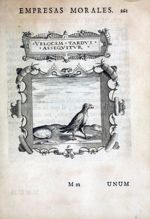
Velocem tardus assequitur: Borja, Empresas morales (Bruxelles, 1680), emblem 127
Iconclass: 51MM11 Slowness, Tardiness; 'Tardità' (Ripa) 51M11 Swiftness, Speed; 'Agilità', 'Celerità', 'Velocità' (Ripa) 54F2 Victory 54A33 Skill, Ability; 'Artificio', 'Prontezza' (Ripa) 53A2 Perseverance, Resolution, Determination; 'Perseveranza' (Ripa) 92B42331 Mars and Venus, caught in a net by Vulcan, are exposed to the ridicule of the assembled gods
Loci Communes: Absurda, indecora, seu praepostera (Absurd, unbecoming, or preposterous things, Choses absurdes, inconvenantes ou déplacées)
I vii 68 Aquilam testudo vincit Tortoise defeats eagle
Ab hoc non discrepat illud quod refert Diogenes Laertius in vita Menedemi philosophi, ex Achaei poetae satyra, cui titulus Omphale, Ηλίσκετ᾽ ἄραγε καὶ πρὸς ἀσθενῶν ταχὺς, Καὶ πρὸς χελώνης ἀετὸς ἐν βραχεῖ χρόνῳ id est. Capta est profecto celer ab imbecillibus, Et aquila tempore in brevi à testudine. Hos senarios ait usurpare solitum Menedemum in eos, qui secum in civilibus honoribus contenderent. Accipi potest per Ironiam, aut simpliciter, ubi quis potentiorem arte vincit, & quod viribus non potest, assiduitate conficit.
There is no conflict between that and something Diogenes Laertius records in his life of the philosopher Menedemus from a satire by the poet Achaeus, the title of which is Omphale: 'The swift, they say, fall victims to the weak, / And soon the eagle to the tortoise yields.' Menedemus, he says, used habitually to quote these lines against those who competed with him for civic office. They can be taken ironically or in their straightforward sense, when a man defeats a more powerful opponent by skill, and achieves by determina- tion what he cannot do by brute force.
Facsimile: 
Iconclass: 51M11 Swiftness, Speed; 'Agilità', 'Celerità', 'Velocità' (Ripa) 51MM11 Slowness, Tardiness; 'Tardità' (Ripa) 54F2 Victory 54A33 Skill, Ability; 'Artificio', 'Prontezza' (Ripa) 53A2 Perseverance, Resolution, Determination; 'Perseveranza' (Ripa)
Loci Communes: Impossibilia (Impossible things, Choses impossibles)
I vii 69 Intempestiva benevolentia nihil a simultate differt Goodwill untimely differs not from hate
Senarius est Graecis proverbii vice celebratus: Ακαιρος ἔυνοἰ οὐδὲν ἐχθρᾶς διαφέρει. id est, Par odio importuna benevolentia. Suidas in dictione ἄκαιρος narrat hoc versu Hippolytum respondisse Phaedrae novercae, dicenti se illius amore captam esse. Quadrabit in eos, qui dum officiosi student esse, non habita temporis ratione, nocent, aut molesti sunt sedulitate. Veluti qui non apto tempore obiurgant amicum, aut qui immodicis & intempestivis laudibus conciliant homini invidiam: aut qui pecuniam suppeditant adolescenti, qua fiat deterior. Fertur & alter huic consimilis, Φίλος με βλάπτων οὐδὲν ἐχθροῦ διαφέρει. id est. Cum nocet amicus, nihil ab hoste discrepat. Huc respexit Horatius in epistolis: Nil moror officium, quod me gravat. Rursum alibi,. Sedulitas autem, quem stulte diligit, urget. Itidem Seneca libro De beneficiis 2. Saepe, inquit, nihil interest inter amicorum munera, & hostium vota. Quicquid illi accidere optant, in id horum intempestiva indulgentia impellit atque instruit. Quid autem turpius, quàm quod evenit frequentissime, ut nihil intersit inter odium & beneficium? In his Senecae verbis, pro vota, quod nos ex vetustis exemplaribus reposuimus, vulgati codices habebant acta. Id admonendum erat, ne quis ignarus ut mendum tollat, quod in multis antehac usu venit. Huc pertinet illud Ennianum optimo iure laudatum à Cicerone li. 2. De officiis: Benefacta male locata male facta arbitror. Proverbio accedet nonnihil gratiae, si paulo longius deflectatur: veluti si dicas, nullos aequae nocere bonis literis, atque hos qui sedulo quidem at parum feliciter tractant eas. Aut, neminem magis officere famae, quàm ineptum praeconem. Aut, secundam fortunam nocentiorem esse adversa.
There is a line current as a proverb in Greek Ἄκαιρος ἔυνοι᾽ οὐδὲν ἐχθρᾶς διαφέρει, Goodwill untimely differs not from hate. Suidas under the word akairos, untimely, tells how Hippolytus replied in these words to Phaedra his stepmother, when she confessed that she had fallen in love with him. It will be appropriate for those whose zeal to be of service without regard to timing actually does harm, or who are too solicitous and become a nuisance. Those for example who take a friend to task at an unfortunate moment, or make a man unpopular by excessive and ill-timed praise of him, or supply a young man with money and thus enable him to go to the dogs. A second line very like it is in circulation: 'The friends who hurt us differ not from foes.' Horace glanced at this when he wrote in his Epistles 'All such provoking fondness I disclaim,' and again elsewhere: 'For sure a foolish fondness of the heart / Hurts whom it loves.' Seneca likewise in book 2 of the De beneficiis: 'Often there is nothing to choose between the kind presents of our friends and what our enemies wish may befall us. Our friends' untimely kindliness forces us into the very position in which our enemies would wish to see us. Yet what could be more discreditable than the state of affairs which happens constantly, that there should be no difference between hatred and good- will?' In this passage from Seneca, for the word vota which I have restored to the text from ancient copies, the common run of codices had acta. I had to mention this for fear that someone in ignorance might remove as a blemish the reading that in old days was familiar in many texts. Here belongs that line from Ennius which Cicero praises so rightly in book 2 of his De officiis: 'Kindness ill-placed unkindness I would call.' The proverb will gain something in effectiveness if the application is a little far-fetched: if one were to say, for instance, that none do so much harm to humane studies as those who handle them with more zeal than discretion. Or, nothing harms a man's reputation more than foolish praise. Or, good fortune is more damaging than bad.
Facsimile:
Iconclass: 51FF4 Non-simultaneity 56F23 Friendship; 'Amicitia' (Ripa) 56FF2 Hate; 'Odio capitale' (Ripa) 57A1 Good Behaviour
Loci Communes: Amicitia (Friendship, Amitié); Intempestiva et inepta (Untimely and inept things, Choses inopportunes et ineptes)
I vii 70 Nosce tempus Consider in due time
Γνῶθι καιρὸν. id est, Noveris tempus, Celebratur in primis inter VII. sapientum apophthegmata: ac, ut alia pleraque, pluribus autoribus adscribitur à nullo non usurpatum. Hesiodus, Μέτρα φυλάσσεσθαι, καιρὸς δ᾽ ἐπὶ πᾶσιν ἄριστος. id est. Observato modum, nam rebus in omnibus illud Optimum erit, si quis tempus spectaverit aptum. Huc allusit Theocritus in Idyllio Λ Αλλὰ τὰ μὲν θέρεος, τὰ δὲ γίγνεται ἐν χειμῶνι. id est: Verum alia aestivo, atque hiberne tempore fiunt. Quin & Isocrates ad Demonicum scribit, Iniucundum in omni re esse, quicquid intempestivum sit. Adeo cunctis in negotiis plurimum habet momenti, temporis & opportunitatis observatio. Idem admoment Graecorum sententiae, Ως μέγα τὸ μικρὸν ἐστιν ἐν καιρῷ δοθέν.. id est: Vel maxima est pusilla res loco data. Rursus alia: Καλὸν τὸ καιροῦ παντὸς εἰδέναι μέτρον. id est: Res bella cuncti nosse temporis modum. Praeterea Pindarus in Pythiis: Ο δὲ καιρὸς ὁμοίως παντὸς ἔχει κορυφάν. id est: Tempus pariter in omni re fastigium obtinet. Item illud Horatii: Dulce est desipere in loco. Tantam vim habet opportunitas, ut ex honesto inhonestum, ex damno lucrum, ex voluptate molestiam, ex beneficio maleficium faciat, & contrà: breviterque rerum omnium naturam permutet. Haec in aggrediundo, conficiendoque negotio praecipuum habet momen tum: ut nonsine causa veteres videantur eam divinitate donasse: tametsi apud Graecos mas est hic Deus, appellaturque kairo\s2. Eius simulacrum ad hunc modum fingebat antiquitas: Volubili rotae pennatis insistens pedibus, vertigine quam citatissima semet in orbem circumagit, priore capitis parte capillis hirsuta, posteriore glabra, ut illa facile prehendi queat, hac nequaquam. Unde dictum est, Occasionem arripere. Ad quod erudite simul, et eleganter allusit quisquis is fuit, qui versiculum hunc conscripsit, Fronte capillata, post haec Occasio calva. Sed libet & Posidippi super hac re carmen adscribere, quod quamobrem Politianus omittendum existimarit, admiror. Est autem huiusmodi: Τίς πόθεν ὁ πλάστης; σικυώνιος οὔνομα δὴ τίς; Λύσιππος σὺ δὲ τίς; καιρὸς ὁ πανδαμάτωρ. Τίπτε δ᾽ ἐπ᾽ ἄκρα βέβηκας; ἀεὶ τροχάω. τί δὲ ταρσοὺς Ποσσὶν ἔχεις διφυεῖς; ἵπταμ᾽ ὑπημένιος. Χειρὶ δὲ δεξιτέρῃ τί φερέις ξυρόν; ἀδράσι δεῖγμα Ως ἀκμῆς πάσης ὀξυτερος τελέθω Η δε κόμη, τί κατ᾽ ὄψιν; ὑπαντιάσαντι λαβέσθαι Νὴ δία τ᾽ ἐξόπιθεν πρὸς τί φαλακρὰ πέλει; Τὸν γὰρ ἅπαξ πτηνοῖσι παρατρέξαντά με ποσσὶν Οὐτις ἔθ᾽ ἱμειρων δράξεται ἐξόπιθεν. Τοῖον ὁ τεχνίτης μὲ διέπλασεν εἵνεκεν ὑμέων Ξεῖνε, καὶ ἐν προθύροις θῆκε διδασκαλίην Quos versus nos ita vertimus, non quo cum archetypo Graeco certaremus, sed crassiore, sicuti solemus, Minerva planeque ex tempore: quod vel tacente me, carmen ipsum indicaverit, videlicet ut intelligi duntaxat possit ab his, qui Graece nesciunt. Quae patria artifici? Sicyon. quo nomine? nomen Lysippo dictum est. ipse quis es? loquere. Illo ego cuncta domans Occasio. cur, age pinnis Insistis? voluor atque rotor assidue. Cur gemina in pedibus gestas talaria? dicam. Huc illuc volucrem me levis aurae rapit. Quid dextrae sibi vult inserta novacula? signum hoc, Quod quavis acie sim mage acuta, docet. Tecta capillitio facies quid nam admonet? Illud, Quisque uti me, quoties offeror, arripiat. Cur autem capitis pars posticaria calvet? Quem semel alatis praeterii pedibus, Is quanquam volet inde cito me prendere cursu, Haud liceat, simul ac vertero terga viro. Hac itaque idque tua me finxit imagine causa, Hospes, scalptoris ingeniosa manus, Spectandamque domus hic prima in fronte locavit, Scilicet ut cunctos & moneam & doceam, Non ab re fuerit & Ausonianum epigramma subscribere: quod, ut admonet Politianus, è Graeco videtur effictum, quanquam cum aliis nonnullis diversum, tum illo potissimum nomine, quod hic additur poenitentia comes. Carmen sic habet, Cuius opus? Phidiae, qui signum Pallados, eius Quique Iovem fecit, tertia palma ego sum. Sum dea, quae rara, & paucis Occasio nota. Quid rotula insistis? stare loco nequeo. Quid talaria habes? volucris sum, Mercurius quae Fortunare solet, trado ego cum volui Crine tegis faciem? cognosci nolo, sed heus tu Occipiti calvo es? ne tenear fugiens. Quae tibi, tuncta comes? dicat tibi. dic rogo, quae sis? Sum dea, cui nomen nec Cicero ipse dedit. Sum dea, quae facti, non factique exigo poenas. Nempe ut poeniteat, sic Metanoea vocor. Tu modo dic quid agat tecum? si quando volavi, Haec manet, hanc retinent quos ego praeterii. Tu quoque dum rogitas, dum percunctando moraris, Elapsam dices me tibi de manibus.
Γνῶθι καιρὸν, Consider the due time. Prominent among the familiar sayings of the Seven Sages; ascribed, like most of them, to several authors and used by almost everyone. Hesiod: 'Observe the mean: due time is best in all.' Theocritus alludes to it in the eleventh idyll: 'Some blooms in summer, some in winter blow.' Isocrates too in the Ad Demonicum remarks that in all things there is less satisfaction if they are done out of due season. So important is it in all business to observe the due and proper time. The same message is to be found in the Greek maxims 'Small things are great when in due season given' and in another 'It always pays to know when time is ripe.' Besides, there is Pindar in the Pythians: 'The proper time likewise is of all things the chief.' And Horace's familiar tag 'Sweet is folly in its proper place.' Such is the force of Opportunitas, of Timeliness, that it can turn what is honourable into dishonour, loss into gain, happiness into misery, kindness into unkindness, and the reverse; it can, in short, change the nature of everything. In the beginning and ending of any business it has especial influence, so that the Anicents, we may well think, had good reason to endow it with divinity, though in Greek this god is masculine, and his name is Kairos, Due Time. Her image was represented in the old days as follows. She had wings on her feet and stood on a freely-turning wheel, and she spun very rapidly round and round. The forepart of her head was thickly set with hair, the back of it bald, so that her forehead could easily be grasped and the back of it not at all. Hence the phrase 'to seize the opportunity.' Thus both a learned allusion and an elegant image were produced by the unknown author of the line 'Long in the forelock, Time is bald behind.' Besides which, it is a pleasure to add the epigram by Posidippus on this subject, which was unaccountably omitted by Poliziano, and runs as follows: "'Where did the sculptor come from?" Sicyon. "And his name?" Lysippus. "And who are you, the subject?" Due Time, master of all things. "Why go on tiptoe?" I am always running. "Why have a pair of winged sandals on your feet?" I fly with the wind. "Why carry a razor in your right hand?" To show that I am keener than a razor's edge. "And your hair, why so long over your face?" That he who is beforehand with me may seize it. "The back part why so bald?" Because once I have run past a man on my winged feet, never for all his longing shall he seize me from behind. Such, stranger, did the artist make me, and set me in the forecourt to be a warning to you and your fellow men.' My version of these verses is not meant to compete with the Greek original; it is, as usual, uninspired and quite extempore, as the poem itself will have made clear even if I said nothing, my sole purpose being to make it intelligible to those who know no Greek. Nor will it be off the point to add an epigram by Ausonius, which, as Poliziano points out, is evidently derived from the Greek, although it differs in certain respects, and in particular by the addition of Remorse as Opportunity's companion. The poem runs like this: '"The artist's name?" Phidias. "What, the man who made the great statue of Athena?" Yes, and the Jupiter, and I am the third of his masterpieces. I am the goddess Opportunity, so seldom seen, recognized by so few. "Why stand on a wheel?" I cannot stay still in one place. "And why those winged sandals?" I am always in flight, and the good fortune of which Mercury is patron I provide when I please. "Do you hide your face with hair?" I have no wish to be recognized. "But why bald behind?" That I may not be seized as I run past. "And who is your companion?" Let her tell you herself. "Tell me, pray, who are you?" I am the goddess who was not named even by Cicero himself, she who punishes what is done and not done in such a way that there are regrets afterwards; and so I am called Remorse. "Now I turn to you again: you must tell me what business she has with you." When I take wing, she stays behind; if I pass any man by, she remains with him. You yourself, while you ask these questions and waste your time in idle curiosity, will find that you have let me slip.'
Facsimile: 

Ne refusons Fortune, quand à nous se presente: La Perrière, Le theatre des bons engins (Lyon, 1545), emblem 63 uses the imagery of Occasio as sculpted by Lysippus and quotes the same dialogue as the adage's comment
Au monde n'est rien plus cher, que le temps: La Perrière, Le theatre des bons engins (Lyon, 1545), emblem 71 uses the imagery of a man holding on to a winged clock to express the value of timing
Post Occasio calva est: Printer's device 0507 quotes the comment
Post Occasio calva est: Printer's device 1363 quotes the comment
Fronte capillata est post est Occasio calva: Printer's device 1499
Dulce est desipere in loco: Bornitz, Emblematum sacrorum et civilium miscellaneorum (Heidelberg, 1659), emblem 25 quotes the comment
L'ymage d'occasion: Corrozet, Hecatomgraphie (Paris, 1540), emblem 83 uses the imagery of Occasio
Ne tenear: Wither, A collection of emblems (London, 1635), emblem 4 uses the imagery of Occasio
Ne tenear: Rollenhagen, Nucleus emblematum (Arnhem, 1618), Cent. I, emblem 4 uses the imagery of Occasio
Usque dum liceat: Borja, Empresas morales (Bruxelles, 1680), emblem 81 uses the imagery of a bird waiting for the right opportunity
Cunctando proficit: Camerarius, Symbolorum et Emblematum Centuria(e) (Nürnberg, 1590, 1595, 1596, 1604), emblem 15 quotes the adage in its comment
Iconclass: 54B12 Opportunity, Opportuneness, Seasonableness 23 time 51F4 Simultaneity 54B121 'Occasio', 'Kairos'; 'Occasione' (Ripa)
Collectanea (1500): 483
Loci Communes: Tempestiva (Timely things, Choses opportunes)
I vii 71 Olet lucernam It smells of the lamp
Τὸν λύχνον ὄζει, id est, Lucernam olet. De re meditata, multoque studio elucubrata. Inde ductum, quod studiosi ad lucernam vigilantes soleant elaborare, si quid accuratius velint excudere. Iactatum olim in Demosthenem, illius ἐνθυμήματα τὸν λύχνον ἀπόζειν. i. Enthymemata lucernam olere, quod omnia descripto diceret, ac praemeditatus domi. Unde & illud de eodem celebratur elogium: quod plus olei quam vini consumpserit. Erat enim abstemius & ὑδροπότης: atque extrema etiam senecta ad lucernulam illam suam exercebatur.
Τὸν λύχνον ὄζει, It smells of the lamp, of something which has been the object of thought and much work has gone into the polishing of it. Derived from the practice among keen students of working late by lamplight to finish some elaborate piece, if they want to produce a special effect. It used to be a common criticism of Demosthenes that his arguments smelt of the lamp, because his speeches were all written and thought out in advance before he left home. Hence too the well-known tribute to him, that he used more oil than wine. For he was temperate and drank only water, and even when a very old man could still be found toiling away by the light of his humble and yet famous lamp.
Facsimile:
L'inconstant perit: Corrozet, Hecatomgraphie (Paris, 1540), emblem 61 uses the imagery of the oil-lamp as symbol of constancy
Iconclass: 52A11 Attention, Concentration 31A33 smell, smelling (one of the five senses) 41B3 lighting; lamps
Collectanea (1500): 471
Loci Communes: Diligentiae (Diligence, Diligence)
I vii 72 Aristophanes et Cleanthis lucerna The lamp of Aristophanes and Cleanthes
Aristophanis & Cleanthis lucerna, propter insignem studii diligentiam in proverbium abiit. Ut is ad Aristophanis aut Cleanthis lucernam dicatur lucubrare, qui summo studio, exquisitaque cura singula pensitat. Varro lib. de lingua Latina i. Quod non solum ad Aristophanis lucernam, sed etiam ad Cleathis lucubrem, nolui praeterire, qui poetarum modo verba, ut significant, expediunt. Opinor autem adagium sentire de Aristophane grammatico. Neque fama caruit etiam Epicteti lucernula, quae post illius mortem magno aere redempta est. Ceterum, quod ait Iuvenalis: Haec ego non credam Venusina digna lucerna? magis pertinet ad investigationem, quàm ad lucubrationem.
This became proverbial because they worked with such exceptional dili- gence, so that a man is said to study by the lamp of Aristophanes or Cleanthes who ponders every detail with great diligence and meticulous care. Varro in the first book of his On the Latin Language: 'Studying as I do not merely by Aristophanes' lamp but by Cleanthes' as well, I was unwilling to pass over those who develop the significance of words, as poets do.' I suppose the adage to refer to Aristophanes the grammarian. Then there is the modest lamp of Epictetus too, which won its place in history by being sold for a great sum after his death. But when Juvenal asks 'Am I not right? / These themes deserve Venusia's midnight lamp,' it is finding out rather than writing up that he has in mind.
Facsimile:
L'inconstant perit: Corrozet, Hecatomgraphie (Paris, 1540), emblem 61 uses the imagery of the oil-lamp as symbol of constancy
Iconclass: 41B3 lighting; lamps 54A2 Carefulness, Diligence; 'Diligenza' (Ripa) 98B(ARISTOPHANES) male persons from classical history (ARISTOPHANES) 98B(CLEANTHES) male persons from classical history (CLEANTHES)
Loci Communes: Diligentiae (Diligence, Diligence)
I vii 73 De plaustro loqui Wagon-language
Libertas veteris comoediae eousque progressa est, ut non solum civium primates, verumetiam deos nominatim taxaret. id quod apparet ex Aristophane, qui in Pluto Iovem, Mercurium, Aesculapium, reliquosque deos omneis contumeliose tractat. Bacchum item in Ranis, non admodum honorifice. Quoniam autem apud priscos illos huiusmodi fabulae in plaustris agebantur, à iuvenibus, ore fece collito ne possent agnosci, qui magna licentia in obvium quemque dicteria iaciebant, inde natum adagium, ὡς ἐξ ἁμαξης λαλεῖν, id est, Tanquam è plaustro loqui, de his qui palàm ac libere conviciantur. Id notat Aristophanes in Nebulis dicens, οὔ μοι σκώψῃς, οὐδὲ ποιήσῃς ἅπερ οἵ τρυγοδαίμονες οὗτοι, id est, Non me ludes, nec mi facies ea quae trygodaemones isti. Nisi malumus haec referre ad consuetudinem quae posterioribus etiam saeculis duravit apud Athenienses. Nam in festo, quod Lenaeum appellant, mos erat poetas, inter se concertare scriptis carminibus, ad risum concitandum accommodatis, quae sedentes in plaustris pronunciabant, invicem sibi convicia dicentes. Sunt qui ad Eleusinia sacra, quae magna vocantur, referunt: in quibus mulieres curru vehebantur, atque interim dum veherentur, ex more mutuis conviciis sese lacessebant. Lucianus in Iove tragoedo, Ως δαιμόνων οὐδενος φείδεται, ἀλλ᾽ ἐξ ἁμᾴξης παῤῥησιάζεται, καὶ μάρπτει ἑξείης, ὅστ᾽ αἴτιος, ὅς τε καὶ οὐκί. id est. Ut nulli deorum parcit, verum è plaustro libere loquitur. Corripiens simul insontem, pariterque nocentem. Obicit et Demosthenes Aeschini, quod in se veluti de plaustro, dicenda & non dicenda protulisset. Unde hoc ipsum, veteris comoediae licentia, proverbii quiddam sapit. Divus Hieronymus ad Rusticum monachum, Ego enim neminem nominabo, nec veteris comoediae licentia certas personas eligam, atque perstringam. Allusit huc, opinor, Aristophanes in Equitibus, Οἴμοι, σὺ δ᾽ οὐδὲν ἐξ ἁμαρξουργοῦ λέγεις. id est: Heu mihi, nihil tu loqueris è plaustrario. Siquidem ἁμαξουργοὶ vocantur plaustrorum fabri.
Licence in the Old Comedy reached such a pitch that, beside prominent citizens, the gods themselves were lampooned by name, as is clear from Aristophanes, who treats Jove, Mercury, Aesculapius, and all the other gods with contumely in the Plutus; Bacchus too in the Frogs gets far from respectful treatment. Since in those early days plays of this kind were performed in wagons by young men, their faces smeared with wine-lees to make them unidentifiable, who uttered offensive remarks at the expense of any convenient target with great freedom, this gave rise to the adage Ὡς ἐξ ἁμάξης λαλεῖν, To speak like a man on a wagon, for public and gross abuse. Aristophanes criticizes this in the Clouds in the words 'No joking now, don't treat me like those poor devils smeared with lees,' unless we prefer to attribute this to a custom which lasted in Athens even into later centuries. During a festival called the Lenaea it was the custom for poets to compete in writing verses intended to make people laugh, which they recited sitting in wagons amid an exchange of mutual abuse. Some trace the phrase to the feast called the Greater Eleusinia, in which women rode along in carts, and as they rode the custom was for them to abuse one another. Lucian in Jupiter tragoedus: 'As he spares none of the gods, but speaks his mind freely from the wagon and "fastens alike on innocent and guilty".' Demosthenes too holds it against Aeschines that he had brought against him charges speakable and unspeakable, like a man on a wagon. As a result, merely to speak of the licence of the Old Comedy has a proverbial ring about it. St Jerome writing to Rusticus the monk: 'I shall name no names; I shall not borrow the licence of the Old Comedy and pick out special people for criticism.' I suppose Aristophanes alluded to this in the Knights: 'Alack, you have nothing to say from the wainwright's shop,' wainwright being a name for those who build wagons.
Facsimile:
Iconclass: 46C145 (farm) wagon, freight wagon, cart 51E11 Freedom, Liberty; 'Libertà' (Ripa) 51H3 Multitude 52A6 Truth; 'Verità' (Ripa) 54BB12 Profanation 57BB25 Calumny, Detraction; 'Biasimo vitioso', 'Calunnia', 'Detrattione', 'Maledicenza' (Ripa)
Collectanea (1500): 469
Loci Communes: Libertas, veritas (Freedom, truth, Liberté, vérité)
I vii 74 Plaustra conviciis onusta Cartloads of abuse
Eodem allusit Lucianus, cum ait in Eunucho, καὶ ὅλας ἁμαξας βλασφημιῶν κατεσκέδασαν ἀλλήλων.. id est, Et solida plaustra conviciis onusta inter se effundebant. Loquitur de duobus philosophis inter sese contumeliose altercantibus. Significat autem ὑπερβολικῶς tan tum conviciorum, quantum plaustro possit vehi. Quae quidem ipsa figura ad proverbii naturam pertinet, cum dicemus, Plaustra promissis onusta, & naves pollicitis onustas, pro maximis, amplissimisque promissis. Nam & ἁμαξιαῖα id est, Plaustralia, Graeci vocant magnifica, fastuosaque, à plaustris ducto nomine. Alexis apud Athenaeum lib. ix. detorsit in in bonam partem, παρέθηκε τὴν τράπεζαν, εἶτα περιφέρων ἀγαθῶν ἀμαξας. id est, Apposita mensa est, ac dein circumtulit rerum bonarum plaustra.
Lucian alludes to the same custom when he writes in his Eunuchus 'And they poured whole cartloads of abuse on one another.' He speaks of two philosophers engaged in an acrimonious dispute, and means by this exaggerated phrase as much abuse as a wagon could carry. The image itself belongs in its nature to the class of proverbs, when we speak of 'cartloads of promises' or 'shiploads of tempting offers,' to indicate extravagantly generous promises. Greek also has hamaxiaia, 'words that need a wagon' to mean magnificent or splendid, which is derived from the word for wagon. Alexis, quoted by Athenaeus in the ninth book, adapts it to bear a favourable sense: 'He set the table by us, then brought round / A wainload of good things.'
Facsimile: 
Iconclass: 46C145 (farm) wagon, freight wagon, cart 51H3 Multitude 54BB11 Misuse, Misemployment 54BB12 Profanation 57BB25 Calumny, Detraction; 'Biasimo vitioso', 'Calunnia', 'Detrattione', 'Maledicenza' (Ripa)
Loci Communes: Obtrectatio et maledicentia (Disparagement and slander, Dénigrement et médisance)
I vii 75 Tollat te qui non novit Let someone pull you out who doesn't know you
Tollat te, qui non novit. Si cuius dolos iam non ignotos esse nobis significabimus, neque posthac posse ab illo falli, concinne dicemus, Tollat te, qui non novit. Refertur à Quintiliano lib. vi. Simile est, inquit, quod dicitur παροιμία, & proverbia opportune aptata, ut de homine in aquam lapso, ut allevaretur, roganti: Tollat te qui non novit. Haec Fabii verba alioqui subobscura, velut interpretatur Horatius in Epistolis, agens de scurra Plano, qui sponte sua saepe cadens, tanquam crure fracto, miserandis vocibus praetereuntes implorabat, ut humo tolleretur. Peregrinus autem quispiam ac doli ignarus, si quando allevaturus accessisset, à scurra ludibrio habebatur. Verum ubi iam illius simulatio plerisque innotuisset, isque aliquando crure vere fracto tolli precaretur: nemo subvenit, omnibus planum solitos agere ludos arbitrantibus. Nimirum evenerat homini, quod Aristotelem dixisse ferunt, qui, rogatus quid nam lucri facerent mendaces, Hoc, inquit, ut nec vera dicentibus habeatur fides. Versus Horatii sunt hi: Nec semel irrisus triviis attollere curat Fracto crure Planum, licet illi plurima manet Lacrima, per sanctum dicat iuratus Osirim Credite, non ludo, crudeles tollite claudum. Quaere peregrinum, vicinia rauca reclamat. Porrò vocem hanc Planus, A. Gellius li. xvi. ca. vii. commemorat inter verba inusitata, quibus usus sit Mimus Laberius, aitque significare sycophantam. Quanquam eodem nomine usus est M. Tullius, eodem significatu, in oratione quam dixit pro Cluentio. Est autem dictio Graeca πλάνος, significatque tum erronem, tum impostorem. Potest & hoc pacto efferri adagium, Quaere hospitem, aut quaere peregrinum, quemadmodum extulit Flaccus. Conveniet & in eos à quibus aliquando sumus delusi, eaque experientia facti cautiores, minusque creduli. Simile est illud Iuvenalis: Circuit, & fatuos non invenit. Nam fatui facile decipiuntur. Nec abludit hinc Graecum illud, οὐκ αὖθις ἀλώπηξ. id est, Non iterum vulpes, subaudi, decipitur.
If we wish to convey that a man's tricks are no longer hidden from us and that we cannot be taken in by him in future, we shall say very aptly 'Let someone pull you out who doesn't know you.' This is recorded by Quintilian in his sixth book: 'What they call an adage is very similar; and proverbs skilfully adapted, for instance that reply to the man who had fallen into the water and was calling for help, "'Let someone pull you out who doesn't know you.'" Quintilian's words, otherwise rather obscure, receive something like an explanation from Horace's Epistles, where he is speaking of an impostor called Planus, who used often to fall down deliberately, pretending he had broken his leg, and make pitiful appeals to the passers-by to pick him up. Any stranger who did not know the trick and came up to help him was promptly fleeced by the impostor. But the time came when his deception had become generally known; and one day he really broke his leg and implored people to pick him up, and no one helped him, because they all supposed that this was Planus up to his old tricks. He suffered in fact what is said to have been foretold by Aristotle who, when asked whether anything was achieved by telling lies, replied 'Yes: that nobody will believe you when you speak the truth.' Horace's lines run as follows:
Let Planus at the cross-roads break his leg:
Has he once fooled you? You will never stop
To pick him up, though tears roll down his cheeks,
Though he by great Osiris swears 'tis true.
'This is no fooling. You hard-hearted brutes,
Help the poor cripple!' 'Find a stranger first'
Harsh-voiced his fleering neighbours all reply.
It may be added that planus is recorded by Aulus Gellius, book 16 chapter 7, among the unusual words used by Laberius the writer of mimes, and he says it means 'a cunning rogue.' Though the same noun is used by Cicero and with the same meaning, in his defence of Cluentius. It is the Greek pianos, and means both a vagabond and an impostor. The same proverbial sense can also be expressed in this way: 'Find a foreigner' or 'find a stranger,' as Horace puts it. This too will be a suitable retort to those who have deceived us in the past and thus made us more circumspect and less credulous for the future. There is something like it in Juvenal: 'He goes the rounds and finds no innocents,' for innocents are easily taken in. Much the same is that Greek proverb 'No fox a second time,' where we supply 'is taken in.'
Facsimile:
Tollat qui te non noverit: Zincgreff, Emblematum Ethico-politicorum (Heidelberg, 1619), emblem 71
Iconclass: 51A8 Things Known, the Known 51AA8 Things Unknown, the Unknown 56DD2 Distrust, Suspicion; 'Sospitione' (Ripa) 57AA621 Cheat, Deceit; 'Fraude', 'Inganno' (Ripa)
Collectanea (1500): 759
Loci Communes: Repellentis (Repelling, rejecting, Repousser)
I vii 76 Oppedere, et Oppedere contra tonitrua To fart in someone's face, or To fart against the thunder
Oppedere proverbialiter, pro reclamare et contemnere reperimus usurpatum. Horatius in Sermonibus: Vin tu curtis Iudaeis oppedere? Aristophanes in Pluto: Καὶ τῆς πενίας ἀνταποπερδεῖν. Rursum in eadem alibi: Καὶ τῆς πενίας καταπερδεῖν. id est: At paupertati oppedere tristi. Quod iam divites facti paupertatem negligere possent. Idem in Nubibus: Καῖ βούλομαι ἀνταποπερδεῖν πρὸς τὰς βροντάς. id est: Voloque ipsum oppedere contra coeli tonitru. Verba sunt Strepsiadis adorantis nubes, & contemnentis tonitrua Iovis. Interpres addit natum ex artificio quodam in scena repreaesentari solito, lapillis ex amphora in vas quoddam aeneum praecipitatis, atque ita tonitrui strepitum imitantibus, ut hoc sit velut obstrepere tonitruis. Equidem opinor allusum ad veterum poppyssandi consuetudinem. Antiquitus enim cum fulguraret, poppysmatibus obstrepebant, id remedio fore rati, ne quid laederet fulgur. Aristophanes in Vespis, Κᾷν ἀστράψω, ποππύζουσιν. id est, Quod si fulguraro, poppyssant. Unde quidam periocum, veluti perperam imitantes aliorum poppysmata, crepitum ventris edebant. Cyclops apud Euripidem in eiusdem nominis tragoedia, Iovis tonitrum contemnens, loquitur hoc pacto. Εἶτ᾽ εκπιὼν γάλακτος ἀμφορέα, πέπλον Κρούω, διὸς βρονταῖσιν εἰς ἔριν κτυπὼν. id est. Ubi lactis epotavero amphoram, peplum Quatio, Iovis ex pari tonitribus obstrepens.
To fart in someone's face I find in use as a proverbial expression for the display of dislike and contempt. Horace in the Satires: 'Do you really mean / To fart in the face of a pack of curtal Jews?' Aristophanes in the Plutus: 'And fart in the face of penury,' and again elsewhere in the same play: 'And break wind in the face of penury.' This was a way for those who had now become rich to show their contempt for poverty. The same author in the Clouds: 'And fain would I out-fart your thunder-claps.' The speaker is Strepsiades, who is making a humble address to the Clouds and showing contempt for Jove's thunderbolts. The scholiast adds that this is derived from a device used on the ancient stage, by which small stones were poured from a great jar into a bronze vessel so that they made a sound like thunder, and this was a way of making a noise in answer to the thunder. I think myself that there is an allusion to the ancient custom of poppysmos, smacking the lips; for in the old days when they saw lightning it was the custom to make an answering noise by smacking the lips, which they supposed to be a protection against being struck by lightning. Aristophanes in the Wasps: 'And if I send a lightning- flash, they smack their lips'; at which some people by way of a joke would break wind, as though this were a clumsy way of imitating the smacking noises made by other men. The Cyclops, in Euripides' tragedy of that name, to show his contempt for Jove's thunder, speaks as follows: 'Then I drink a great bucket of milk, and raise my skirts and rumble fit to match Jove's thunderbolts.'
Facsimile: 
Iconclass: 31A621 flatulence 31A2211 face 26E1 thunder 56BB4 Disgust, Dislike, Repulsion, Nausea 57BB21 Contempt
Loci Communes: Contemptus et vilitatis (Contempt and worthlessness, Mépris et bassesse)
I vii 77 In antro Trophonii vaticinatus est He has consulted the oracle in Trophonius' cave
Ες τροφωνίου μεμάντευται, id est, In Trophonii antro vaticinatus est. De homine vehementer tristi, tetricoque: propterea quod olim creditum est eum, qui in Trophonii specum descendisset, postea numquam ridere. Aristophanes in Nubibus, Ως δέδοικ᾽ ἐγὼ Εἴσω καταβαίνων ὥσπερ ἐς τροφωνίου. id est: Ut videlicet horrui, Haud aliter, ac subiens specum Trophonii. Porrò historia de Trophonio varie narratur à Graecis. Quidam aiunt hunc Trophonium in secandis saxis summum artificem fuisse, fanumque subterraneum exstruxisse in Lebadia Boeotiae regione, quod Trophonii vulgo cognominatum est, nimirum ab artifice. Dein qui sciscitatentur oracula, in aditu specus sedere solitos, nudos: atque inde flatu quodam abripi sub terram. Gestare autem secum placentas quasdam, quas lemuribus, et serpentibus occurrentibus obicerent. Deinde, percepto oraculo, rursus per alium hiatum in summam terram restitui. Alii narrant hoc pacto: Agamedes Stymphali, quae est Arcadiae pars, rex erat: is uxorem duxit Epicasten, cuius filius erat Trophonius. Ii eius tempestatis mortales omnes artificio superabant, ac Delphicum templum exstruendum receperant, atque in Helide aerarium quoddam condiderant Augeae, ubi aurum suum reconderet: qui postea soluta lapidis cuiusdam commissura, quam in hoc ipsum reliquerant, noctu ingressi, pecuniam furari consueverunt, socio Gercyone Agamedis germano, atque Epicastae filio. Quae res cum vehementer perplexum haberet Augeam, forte fortuna accidit, ut Daedalus Minoem fugiens ad eum diverteret. Hunc exoravit Augeas, ut arte quapiam fures hos investigaret. At Daedalus laqueos quosdam summo artificio constituit, quibus Agamedes captus est. Id conspiciens Trophonius non esse effugium, capite Agamedis amputato ne posset agnosci quis esset, unà cum Gercyone Orchomenon aufugit. Hos cum Augeas, autore Daedalo persequeretur & illic aufugerunt: alter nempe Gercyon Athenas, ut testatur Callimachus in Arcadiam, alter vero in Lebadiam Boeotiae regionem. Ubi parato sibi domicilio subterraneo per omnem vitam perseverabat. Quo defuncto, vulgo creditum est, illic certa reddi oracula, ac Trophonio perinde ut deo sacrificari coeptum. Quidam aiunt Agamedem & Trophonium, Daedali opera suffuratos aufugisse, et Trophonio fugienti terram hiatu diductam, vivumque absorbuisse circa Lebadiam. Aliquot post annis, cum Boeoti pestilentia laborarent, consultum oraculum respondit, Trophonii manibus honorem habendum esse. At illi, cum essent ignari, ubi nam terrarum illius esset monumentum, apum indicio repererunt. Nam ubi eas conspicerent, è cavo quodam subscatentes, coniectarunt eum esse locum. Quare visum est aliquem in id antrum demittere, qui rem exploraret. Quidam igitur ingressus, duos dracones obvios habuit: quibus obiectis offis mellitis, illaesus evasit. Unde & mos inolevit, ut antrum Trophonii subituri placentas aliquot secum deferant. Priusquam autem subirent, certis diebus caeremoniis praescriptis lustrabantur, pure interim agentes: deinde stola sacra ornati descendebant, hastas manu gestantes, ut aiunt nonnulli, quo vim serpentium depellerent. M. Tullius Tusculanarum quaestionum libro i. tradit Trophonium & Agamedem exaedificato templo Apollini Delphico, venerantes deum laboris sui mercedem petisse, nihil quidem certi, sed quod esset optimum homini: quibus Apollo se id daturum ostendit, post diem ab illo tertium, qui ut illuxit, mortui sunt reperti. Recentiores ita tradunt, Trophonium virum quempiam fuisse supra modum gloriae famelicum, Empedoclique simillimum, exstructoque sibi subterraneo domicilio oracula reddidisse: deinde ubi ille fame interisset, genium quendam in id immigrasse, atque oracula reddere perrexisse: post, superstitione mortalium plures in id antrum demisisse sese, ac dies complures fuisse commoratos. Quae quidem Trophonii fabula mihi adeo videtur similis ei quae de Patricii antro, quod est in Hibernia fertur, ut altera ex altera nata credi possit. Tametsi non desunt etiam hodie permulti qui descendant: sed prius triduano enecti ieiunio, ne capite sano ingrediantur. Qui descenderunt, aiunt sibi ridendi li bidinem in omni vita ademptam. Plutarchus in commentario de daemonio Socratis narrat Timarchum quendam in Trophonii specum ingressum, posteaquam illinc redisset, prodigiosa dictu narrasse sibi visa, non abhorrentia ab iis quae Beda & alii nonnulli Christiani scriptores de inferis prodiderunt. Meminit & Cicero lib. de natura deorum iii. huius Trophonii. Meminit Herodotus in primo. Sed plurima de hoc nugamento nugatur apud Philostratum Apollonius, vir nostro iudicio dignus, qui non alia de re philosophari debuerit. Ridet locis aliquot Trophonium hunc Lucianus, adamantinus omnium superstitionum insectator: per cuius antrum & Menippus se iocatur ab inferis redisse. Huius antri mentionem facit Euripides in Ione, Τί θέσπισμ᾽ ἐκ τροφωνίου φέρεις; id est, Quod ex Trophonii refers oraculum? Item in eadem: Σηκοὺς δ᾽ ἐνστρέφεις τροφωνίου. id est, Templa adis Trophonii. Quae nos de Trophonii antro retulimus, partim ex Aristophanis interprete, partim ex Zenodoto sumus mutuati.
Ἐς Τροφωνίου μεμάντευται, He has consulted the oracle in the cave of Trophonius. Of a man who is exceptionally gloomy and severe, because there used to be a tradition that anyone who had gone down into the grotto of Trophonius never smiled again. Aristophanes in the Clouds: 'I took such a fright, / I might have been down in Trophonius' cave.' The story of Trophonius in Greek takes several forms. Some say that this Trophonius was a very great expert in the cutting of rocks, and made an underground shrine at Lebadeia in Boeotia, which is commonly called the shrine of Trophonius from the name of the builder. Later, those who wished to consult the oracle sat according to custom naked in the entrance to the grotto, and from there were suddenly swept underground by something like a blast of wind. They brought some cakes with them, which they threw to the ghosts and serpents they encountered. After which, having received their oracle, they were returned to the surface by way of another cleft in the ground. Others give the following account. There was a king of Stymphalus, which is part of Arcadia, called Agamedes; he married a wife called Epicaste, and Trophonius was his son. These two were quite the most skilful craftsmen of their time, and had undertaken to build the temple at Delphi. They had also constructed a treasury of some kind in Elis for Augeas to keep his gold; but later they loosened the joints round one particular stone which they had left with this in mind, forced an entry by night, and made a practice of helping themselves to the gold, with the help of Agamedes' brother Gercyon and a son of Epicaste. This very greatly puzzled Augeas; but by pure chance Daedalus, who was trying to escape from Minos, took refuge with him, and Augeas begged him to think of some device by which he could detect the thieves. So Daedalus with great skill constructed some snares, in which Agamedes was caught. When Trophonius saw that there was no way out, he cut off Agamedes' head so that he was unrecognizable, and escaped with Gercyon to Orchomenus. When Augeas, guided by Daedalus, pursued them to Orchomenus, they escaped from there too, one of them (Gercyon) to Athens or, as Callimachus has it, to Arcadia, and the other to a place in Boeotia called Lebadeia. There he made himself a dwelling underground, and remained for the rest of his life. After his death, it was widely believed that infallible oracles were delivered there, and they started offering sacrifices to Trophon- ius as though he were a deity. Some say that Agamedes and Trophonius stole some works by Daedalus and escaped, and that while Trophonius was making his escape the earth opened and swallowed him alive near Lebadeia. Some years later, when the Boeotians were suffering from a pestilence, they consulted an oracle, which replied that they must honour the shade of Trophonius. They had no idea where his grave was, and discovered it on the evidence of bees; for when they saw some bees issuing in quantities from a hollow in the ground, they inferred that that must be the place. So they decided to send someone down into the cave to investigate. A man therefore went down, and found himself confronted by two serpents; but by throwing them cakes soaked in honey he managed to escape unharmed. Hence arose the custom that those who propose to enter the cave of Trophonius take some cakes down with them. Before descending they were purified for a specified number of days with the prescribed ceremonial, living to a strict regime in the mean time; and then they put on a sacred robe and went down, spear in hand some people say, to ward off any attack by the snakes. Cicero in the first book of his Tusculan Questions records that Trophonius and Agamedes, having finished the temple of Apollo at Delphi, did obeisance to the god, and asked him by way of reward for their labours not for anything definite, 'but for what was of all things best for mankind. Apollo declared that he would give them this in two days' time; and when the second day dawned, they were found dead.' Later authorities tell the story like this: that there was a man called Trophonius who was excessively eager to be famous, very like Empedocles. This man built himself an underground dwelling, where he delivered oracles; and then, when he died of starvation, his place was taken by a spirit which continued to utter oracles, and thereafter from superstition a number of people lowered themselves into the cave and spent several days there. This story about Trophonius seems to me so close to the tale about St Patrick's cave in Ireland, that one might well believe one of them derived from the other. Though there are plenty of people who make the descent even in our own day; but first they utterly exhaust themselves by fasting for three days, so that they cannot be in their right minds when they enter. Those who have gone down say they have lost all desire to smile for the rest of their lives. Plutarch in his essay 'On the Divine Sign of Socrates' tells how a certain Timarchus went down into the cave of Trophonius, and on his return recounted the astonishing sights he had seen, not unlike what Bede and some other Christian authors have reported of the nether regions. Cicero too in the third book of his De natura deorum mentions this Trophonius, and so does Herodotus in book one. But the greatest nonsense on this foolish subject is talked in Philostratus by Apollonius, a man whose disquisitions on philosophy should in my opinion be confined to this topic. Lucian, that adamantine persecutor of all superstition, mocks this Trophonius in several passages, and Menippus too makes fun of him, saying that he came back from the lower world by way of Trophonius' cave. The cave is mentioned by Euripides in the Ion: 'What oracle bring you from Trophonius?' And again in the same play: 'You visit the precinct of Trophonius.' My account of Trophonius' cave is borrowed partly from the scholiast on Aristophanes and partly from Zenodotus.
Facsimile: 
Iconclass: 12E25 oracle ~ Greek religion 25H119 cave, grotto 56BB1 Pain, Sorrow, Sadness; 'Dolore', 'Dolore di Zeusi' (Ripa) 95A(TROPHONIUS) (story of) Trophonius
Loci Communes: Tristitia, laetitia (Sadness, joy, Tristesse, joie)
I vii 78 Excubiarum causa canens Singing at his post
Φρουρᾶς ᾄδων, i. Excubiarum gratia canens. Dicebatur olim in hominem vigilantem ac diligentem. inde ductum, quod qui excubias agunt, canere consueverunt, veluti vigiliarum taedium cantu solentur, vel ne interim obdormiscant. Sic ait Strepsiades in Nubibus Aristophanis, male acceptus in schola Socratis, Φροῦδα τά χρήματα, φρούδη χροιὰ, Φρούδη ψυχὴ, φρουδή δ᾽ ἐμβὰς, Καὶ πρὸς τούτοις ἔτι κακοῖς, Φρουρᾶς ᾄδων ὀλιγου φροῦδος γεγένημαι id est, Cassi nummi, cassusque color. Cassa est anima, cassae soleae. Hisque malis accedit & illud. Dum canto vigil penè interii. Effertur autem bifariam paroemia, φρουρᾶς ᾄδων, καὶ φρουρὸς ᾄδων.. Alluditur ad hanc vocem φροῦδος quae significat cassum & inanem.
Φρουρᾶς ἄδων, Singing at his post, was used in the old days of a wakeful and industrious man, and came from the habit that men on sentry-duty have of singing, either to beguile the tedium of their watch or to prevent their falling asleep on duty. Thus Strepsiades in the Clouds of Aristophanes, who has made a bad start in Socrates' school:
Lost is my money, lost my ruddy cheeks,
Lost are my life and soul, lost are my slippers,
And what is worse, as I sing at my post,
I'm almost lost myself.
The proverb is expressed in two forms, with phrouras and phrouros, and there is a play on the word phroudos, which means 'lost' or 'vanished.'
Facsimile:
Iconclass: 45B31 guard duty, keeping sentry 48(+373) art (+ singing) 52A23 Alertness, Vigilance; 'Guardia', 'Vigilanza', 'Vigilanza per difendersi & oppugnare altri' (Ripa) 54A11 Industriousness, Assiduity; 'Assiduità', 'Industria', 'Zelo' (Ripa)
Loci Communes: Inanis opera (Vain effort, Effort vain)
I vii 79 Sale emptum mancipium A slave not worth his salt
Αλώνητον ἀνδράποδον id est, Sale emptum mancipium. In barbarum quempiam, ac vilem homuncionem olim dicebatur. Nam negotiatores olim in mediterranea salem importantes, mancipia reportabant à barbaris. Et Thraciae genti peculiaris erat mos, mancipia sale commutare. Unde comicus quidam, Θρὰξ εὐγενὴς ἐι πρὸς ἁλὸς ἠγορασμένος. id est, Generosus es Thrax sale redemptus scilicet. Huiusmodi fermè referuntur à Zenodoto.
Ἁλώνητον ἀνδράποδον, literally A slave exchanged for salt. Used in ancient times of any barbarian and worthless creature, for the merchants of those days who carried salt into the interior used to return with slaves from the barbarians. And it was a practice peculiar to the Thracians to exchange slaves for salt; whence that line in a comedy: 'A true-blue Thracian are you, bought with salt.' Such is more or less what Zeonodotus tells us.
Facsimile:
Iconclass: 41C661 salt 46A18 slavery; serfs and enslaved persons 46B trade, commerce and finance 54BB6 Worthlessness
Collectanea (1500): 420
Loci Communes: Contemptus et vilitatis (Contempt and worthlessness, Mépris et bassesse)
I vii 80 Salis onus unde venerat, illuc abiit Salt to water whence it came
Αλῶν δὲ φόρτος ἔνθεν ἦλθεν ἔνθ᾽ ἔβη. id est, Sal abiit illuc, unde demanaverat. Senarius proverbialis in eos qui parta tueri nequeunt. Aut in eos quibus male parta male dispereunt. Natum adagium ab eventu. Negociator quidam navem onustam sale vehebat: nautis dormitantibus, influxu aquae marinae sentina vehementer adaucta, & salem universum solvit ac corrupit, & navem ipsam demersit: itaque quod ex aqua marina natum fuerat, nam hinc concrescit sal, in eandem denuo liquefactum est.
Ἁλῶν δὲ φόρτος ἔνθεν ἦλθεν ἔνθ᾽ ἔβη., A load of salt has vanished whence it came. A proverbial iambic line for those who cannot look after their gains, or make an ill use of gains ill-gotten. The source of the adage is something that once happened. A certain merchant had chartered a ship and loaded it with salt, and while the crew were asleep the sea got in and caused a sharp rise in the bilge-water, which dissolved and ruined the salt and sank the ship itself; with the result that what had originated in sea-water (out of which salt crystallizes) returned to sea-water again as it dissolved.
Facsimile:
Iconclass: 41C661 salt 25H2322 sea 55AA1 Loss
Collectanea (1500): 579
Loci Communes: Ultio malefacti (Vengeance for a wrongdoing, Vengeance d'un méfait)
I vii 81 Sales vehens dormis You sleep on a cargo of salt
Fertur & his verbis adagium ex eodem eventu natum, ἅλας ἄγων καθεύδεις. id est, Salem portans dormis. Quadrabit in eum, qui in re periculosa socorditer atque indiligenter agit, propterea quod sal influxu sentinae facile corrumpitur.
This is the wording of another adage derived from the same event: Ἅλας ἄγων καθεύδεις. , You sleep on a cargo of salt. It will be suitable for a man who behaves in an idle and careless fashion at a moment of danger, because salt is so easily spoilt if bilge-water gets access to it.
Facsimile:
Iconclass: 41C661 salt 31B1 sleeping; unconsciousness 46C(+53) traffic and transport (+ conveyance for transport of loads and cargoes) 52AA24 Carelessness 54AA2 Negligence; 'Negligenza' (Ripa) 54DD2 Idleness; 'Otio' (Ripa)
Loci Communes: Somnolentia (Sleepiness, Somnolence)
I vii 82 Male parta male dilabuntur Ill gotten ill spent
Respondet superiori sententiae, quod est in secunda Ciceronis Philippica, Sed ut est, inquit, apud poetam nescio quem, Male parta, male dilabuntur. Quod autem de autore du bitat Tullius, est apud Plautum in Poenulo, Male partum, male disperit. Festus Pompeius ex Naevio citat: Male parta, male dilabuntur.
The preceding maxim finds a counterpart in those words in Cicero's second Philippic: 'But, as some poet has observed, ill gotten ill spent.' With regard to Cicero's doubts about the authorship, in Plautus in the Poenulus we find 'Ill gotten ill employed.' Festus Pompeius cites from Naevius 'Ill gotten ill spent.'
Facsimile: 
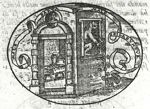
Male parta male dilabuntur: Giovio, Dialogo dell' Imprese (Lyon, 1574), emblem 31 (Symeoni)
Male parta male dilabuntur. In foenatores: Whitney, A choice of emblemes (Leiden, 1586), emblem 179
Male parta male dilabuntur.: Paradin, Les devises héroïques (Antwerp, 1563), emblem 214
Male parta male dilabuntur: Cramer, Octoginta emblemata nova (Frankfurt, 1630), emblem 70
Male quaesitum male dilabitur: Holtzwart, Emblematum Tyrocinia (Strasbourg, 1581), emblem 47 paraphrases the adage
Male parta male pereunt: Reusner, Aureolorum Emblematum (Strasbourg, 1587), emblem 103 paraphrases the adage
Male parta male dilabitur: Cats, Proteus (Rotterdam, 1627), emblem 50 quotes the adage in its comment
Iconclass: 55C11 Squandering, Extravagance, Prodigality, Waste; 'Prodigalità' (Ripa) 55A1 Acquisition, Gain, Profit
Loci Communes: Ultio malefacti (Vengeance for a wrongdoing, Vengeance d'un méfait)
I vii 83 Qui se non habet, Samum habere postulat Who does not own himself would Samos own
Ος αὐτὸς αὑτὸν οὐκ ἔχει, σάμον θέλει. id est, Qui semetipse non habet, Samum cupit. In eos convenit, qui impudenter quippiam postulant. Aut qui minora curant, maiorum negligentes. Natum ex historia quapiam, cuius meminit Plutarchus in apophthegmatis Laconicis. Athenienses, urbe victori tradita, postularunt, ut Samum duntaxat sibi relinqueret. Atque is respondit ad hunc modum, Cum vestri non sitis, alios habere postulatis. Atque hinc ducta paroemia: Ος αὐτὸς αὑτὸν οὐκ ἔχει, σάμον θέλει. id est, Qui semetipsum non habet, Samum petit. Dion sophista in libello περὶ τοῦ ἀπιστεῖν eleganter accommodat in alium sensum, ὅς αὐτὸς αὑτὸν οὐ φιλεῖ, πῶς ἄλοον φιλεῖ; id est, qui sibiipsi non est amicus, quomodo alteri est amicus? Quadrabit & in eos, qui imperium affectant in alios, cum ipsi sibi nequeant imperare.
Ὅς αὐτὸς αὑτὸν οὐκ ἔχει, Σάμον θέλει., He who is not his own master desires to be master of Samos. This will suit people who demand something outrageous, or who concern themselves with details and neglect the larger issues. Derived from an anecdote preserved by Plutarch in his 'Sayings of Spartans.' When the Athenians had surrendered their city to the victor, they asked that he should at least let them keep Samos, and his reply took the form 'When you are not your own masters, do you expect to master other men?' And hence came the proverb: 'Who does not own himself would Samos own.' Dion the sophist in his essay 'On Disbelief adapts it neatly to a different meaning: 'How can a man who is not his own best friend make a good friend for someone else?' It will also fit those who expect to control others when they themselves have no self-control.
Facsimile:
Iconclass: 25H14:61D(SAMOS) island❧geographical names of countries, regions, mountains, rivers, etc. (SAMOS) (SAMOS) 52AA52 Misjudgment 52AA53 Lack of Self-knowledge
Loci Communes: Absurda, indecora, seu praepostera (Absurd, unbecoming, or preposterous things, Choses absurdes, inconvenantes ou déplacées)
I vii 84 Occultae musices nullus respectus Hidden music has no listeners
Occultae musices nullus respectus. Graecis quondam celebratum adagium: cuius sensus est, Quamvis egregias ingenii dotes, si non proferas, perinde esse quasi non habeas. Quo videtur allusisse Persius, cum ait, Scire tuum nihil est, nisi te scire hoc sciat alter. Extat & in Hebraeorum proverbiis, nempe Ecclesiastici ca. vicesimo, simile quiddam, Sapientiae reconditae, & thesauri abstrusi nullam esse utilitatem. Hoc nostrum refertur à Suetonio in vita Neronis Imperatoris, quem scribit imperatoriae dignitatis oblitum usque adeo musices studiosum fuisse, ut non modo nihil omitteret eorum, quae generis eius artifices vel conservandae vel augendae vocis gratia factitarent, verumetiam in scenam prodire concupiverit: subinde inter familiares Graecum proverbium iactans, Occultae musicae nullum esse respectum. Usuprat idem Aulus Gellius lib. Noctium xiii. cap. ultimo Nosti, inquit, magister verbum illud scilicet vetus: egregiam musicam quae sit abscondita, eam esse nulli rei. Usurpatur à Luciano in Harmonide: Οὐδὲν γὰρ ὄφελος ἀποῤῤήτου φασι καὶ ἀφανοῦς τὰς μουσικῆς. id est, Nulla enim utilitas occultae, quemadmodum proverbio dicunt, & abstrusae musices. Allusit huc haud dubie Ovidius, cum ait, Tu licet &Thamyram superes, atque Orpheae cantu, Non erit ignotae gratia magna lyrae. Sunt autem nonnulli mortales, qui vel nativo quodam ingenii vitio, vel data etiam opera quae sciunt, dissimulant, & aliis gravantur impertire. His illud nonnumquam evenire solet, ut pro indoctis negligantur. His adscribendum, quod Graeci τυφλὸν πλοῦτον appellant, id est, caecas divitias, reconditas opes & abstrusas. Ad hunc modum vocat Plutarch. compluribus locis, atque item Lucianus. Hoc dictum Plutarchus in vita Lycurgi testatur vulgo apud Lacedaemonios fuisse iactatum, quod illic Plutus servaretur inhonoratus non aliter, quàm imago picta inanimis & immobilis. Sic enim Lycurgus instituerat rempublicam, ut divitiae nec usui cuiquam esse possent, nec ornamento.
At one time a favourite adage in Greece, the point of which is that natural endowments however distinguished, if not put forward, might as well not exist. Persius seems to have had this in mind when he wrote 'Knowledge is naught if no one knows you know.' Something of the sort can be found among Hebrew proverbs too, in fact in Ecclesiasticus chapter 20: 'Wisdom that is hid and treasure that is hoarded up, what profit is in them both?' This proverb with which we deal is recorded by Suetonius in his life of the emperor Nero, who forgot, he says, what was expected of an emperor, and had such a passion for music that he not merely practised without exception all the tricks used by professional singers to preserve or improve the voice, but actually had ambitions to appear on the stage, making play among his circle with the Greek proverb 'Hidden music has no listeners.' Aulus Gellius uses the same phrase in the last chapter of book 13 of the Nights: 'You know, professor, that saying - it must be an old one - that music however excellent is worthless if kept hidden.' Lucian uses it in his Harmonides: 'Though secret and hidden music, they say, is no use to anyone.' Ovid no doubt had this in mind when he wrote 'Though Thamyras and Orpheus you outsing, / Music unheard's a very pointless thing.' But there are some human beings who either through an inborn fault of character or even by deliberate choice conceal what they know and dislike imparting it to others. Such men sometimes suffer the fate of being disregarded, because they are supposed to be ignorant. To these we may ascribe what is called in Greek τυφλὸς πλοῦτος, blind riches, resources which are kept secret and hidden away. Plutarch speaks of them in this fashion in several passages, and so does Lucian. Plutarch in his life of Lycurgus tells us it was a common boast among the Lacedaemonians that in their country Plutus, the god of wealth, was kept without honour, as lifeless and motionless as a painted image. For Lycurgus had drafted the constitution in such a way that no one could find riches either useful or ornamental.
Facsimile:
Iconclass: 48C7 music 48C78 listening to music 52DD1 Secrecy, Latency, Concealment; 'Secretezza' (Ripa) 54BB3 Inutility, Noxiousness; 'Nocumento', 'Nocumento d'ogni cosa' (Ripa)
Loci Communes: Occulta (Hidden things, Choses cachées)
I vii 85 Ficulnus Fig-wood
Lignum ficulnum, ut fragile, atque ad omnia fermè inutile, proverbiis aliquot locum fecit. Nam ἄνδρα σύκινον, id est, virum ficulnum appellant mollem, atque inutilem, ut Theocritus in Ergatinis: Μὴ παριών τις Είποι, σύκινο ἄνδρες, ἀπώλετο χ᾽ οὗτος ὁ μισθὸς. id est, Ne quis praeteriens dicat, ficulni homines sunt, Atque haec deperiit merces. Scholiastes admonet proverbium ductum à ligno sicus, inutili, fragili & invalido, unde dictum & ficulnum praesidium, pro inutili. Apud Aristophanem in Fucis quidam interrogat τίνος ξύλου σύ, id est, Cuius ligni tu? Respondetur συκίνου, id est, ficulni. Quo loco monet interpres, ex ficulno ligno fumum existere acerrimum ac molestissimum. Apud eundem in Pluto Sycophanta minatur, si quem nactus esset suae sortis virum ficulnum, ulturum iniuriam. Εὰν δὲ σύζυγον λάβω τινὰ, καὶ σύνικον. id est, Si quempiam nanciscar eiusdem iugi Virum, atque ficulnum. Rursum apud eundem in eadem fabula: Καὶ σύνικον τὸν ἰσχυρὸν τοῦτον θεὸν, Εγὼ ποιήσω τήμερον δοῦναι δίκην. id est, Ficulnum ego hercle, ac praepotentem istum deum Compulero poenas hoc die dependere. Ficulnum deum appellans imbecillum ac nullarum virium. Huc allusit Horatius, cum Priapum ita loquentem facit, Olim truncus eram ficulnus, inutile lignum. Ac paulopost, Pepedi diffissa nate ficus. Ficulnam mentem dixit Lucianus ἐν τῷς πρὸς τὸν ἀπαίδευτον. Χωλὴν μὲν ἔχων καὶ συκίνην γνώμην. id est, Claudam habens ac ficulnam mentem. Eodem respexit Alexander Pseudomantis, libros Epicuri lignis exurens ficulnis, nullius precii philosophum significans. Et συκίνη ἐπικουρία. id est, ficulnum auxilium, pro invalido, atque inutili. Aristophanes in Lysistrata: Ος ἦν ἄν ἡμῖν συκίνη ἐπικουρια. id est, Ficulna nobis qui erat opitulatio. Et συκίνη μάχαιρα. id est, Ficulna machaera, pro calumnia. Et συκίνη ναῦς, id est, Ficulna navis, pro vili minimique precii navicula. Quin apud Naxios Bacchum, quem βακχέα dicunt, viteum effingunt: alterum quem μειλίχιον appellant, ficulnum. Nam ficus illi μείλιχα vocant. Existimant autem Bacchum non vini tantum, sed & ficuum autorem. Sic fermè Athenaeus lib. iii. Diversa figura dixit Theocritus in Aita, χρύσειοι πάλαι ἄνδρες. id est, aurei quondam viri. Item Praesidium sacrum, & Anchora sacra, & robur adamantinum.
The wood of the fig-tree, breakable as it is and useless for almost any purpose, has given rise to several proverbs. In Greek 'a figwood fellow' is someone weak and worthless, for instance Theocritus in his Ergatinae: 'Lest someone pass and say Here be figwood fellows; here's more wages wasted.' The scholiast points out that the proverb is derived from figtree wood, which is so fragile and weak as to be useless, whence also the expression a figwood prop, for a useless one. In Aristophanes in the Drones, one of the characters asks another 'Of what wood are you?' and the reply is 'Fig-wood.' The scholiast on the passage points out that fig-wood makes a very acrid and unpleasant smoke. Elsewhere, in the Plutus, a sycophant threatens that if he had found a figwood fellow of the same sort as himself, he would avenge the injury: 'If I find a like-minded man, a figwood fellow like myself.' And again in the same poet and the same play: 'This figwood mighty god of yours I will this day compel to pay the penalty,' using the phrase 'figwood god' to mean a weak and powerless one. Horace alludes to this when he introduces Priapus saying T was once a figwood trunk, a useless log,' and a little further on T opened up and let out a good old figtree fart.' Lucian speaks of 'a figtree mind' in his Against an Ignoramus: 'Having a lame and figtree mind.' Alexander the false prophet had the same thing in mind when he burnt the works of Epicurus on a fire made of fig-wood to show that he thought the philosopher worthless. Also 'a figwood prop' in Greek for support that is weak and worthless; Aristophanes in the Lysistrata 'Who would have been to us a figwood prop.' 'A sword of fig-wood' for calumny. 'A boat of fig-wood' for an inferior one that cost very little. In Naxos too, where Bacchus has two names, one, Baccheus, they represent as god of the vine, the other, Meilichius, as patron of figs; for meilicha is a Naxian word for fig. Bacchus is regarded as having introduced not only the grape but the fig too; so Athenaeus, book 3. The converse image is used by Theocritus in his Aites: 'The golden men of old.' Similar are 'sacred line of defence,' 'sacred anchor' for 'sheet anchor,' and 'strength of adamant.'
Facsimile: 
Iconclass: 25G3(FIG-TREE) trees: fig-tree 47(+444) crafts and industries (+ wood ~ crafts, industries, agriculture) 54BB3 Inutility, Noxiousness; 'Nocumento', 'Nocumento d'ogni cosa' (Ripa) 51GG3 Fragility; 'Fragilità' (Ripa) 54AA7 Weakness, Powerlessness, Helplessness; 'Infermità' (Ripa)
Loci Communes: Auxilium (Help, Aide); Contemptus et vilitatis (Contempt and worthlessness, Mépris et bassesse)
I vii 86 Lupi illum priores viderunt The wolves have seen him first
Lupi illum priores viderunt. In raucum dicitur, & cui vox repente sit adempta. Festivius dicetur in eos, qui metu alicuius obticescunt, alioqui feroces. Virgilius in Ecloga, cui titulus Moeris, Vox quoque Moerim Iam fugit ipsa; lupi Moerim videre priores. Servius admonet, physicos autores esse, inesse eam vim lupis, ut si quem hominem priores viderint, ei vocem adimant. Neque desunt Philosophi, qui huiusce rei causam reddere conantur. Socrates apud Platonem libro De republica i. rem ad allegoriam vertit, dicens Thrasymachum sibi vocem adempturum fuisse, ni forte fortuna prior conspexislet: Καὶ ἐγὼ, inquit, ἀκούσας ἐξεπλάγην, καὶ προσβλέπων αὐτὸν ἐφοβούμην. καὶ μοι δοκῶ, εἰ μὴ πρότερον ἑωράκειν αὐτὸν, ἤ ἐκεῖνος ἐμὲ, ἄφωνος ἄν γενέσθαι. Theocritus in Idyllio Ξ. Οὐ φθεγξῇ εἶδες. id est, Aedere non poteris vocem, lupus est tibi visus. Illud interim observatione dignum, Theocritum vertisse sententiam, cum negat eum proloqui posse, non qui à lupo sit visus, sed qui lupum viderit. Sed allusit duntaxat ad proverbium Theocritus, cum significaret rivalem conspectum, cuius nomen erat Lupus.
Used of a man with a sore throat and one who has suddenly lost his voice. It will have more point if used of those who fall silent from fear of something, though otherwise bold enough. Virgil in the Eclogue they call his 'Moeris': 'Moeris his voice is losing now; the wolves / Caught sight of Moeris first.' Servius tells us that according to the naturalists wolves have this innate power: if they see a man before he sees them, he loses his voice, and there is no shortage of philosophers who try to explain this. Socrates, as reported by Plato in the first book of the Republic, made an allegorical use of this, saying that Thrasymachus would have robbed him of his voice, had he not by great good fortune seen the man first. 'When I heard that,' he says, T was struck dumb. I was terrified at the sight of him. I really think that had I not seen him before he saw me, I should have been speechless.' Theocritus in Idyll 14: 'You will be speechless; you have seen a wolf.' It is worth noting in passing that Theocritus has inverted the sense, for he says that the man struck dumb has seen a wolf, not been seen by one. But in any case Theocritus alluded to the proverb, for he meant that the man had seen a rival whose name was Wolf.
Facsimile:
Iconclass: 31B62350 voice 25F23(WOLF) beasts of prey, predatory animals: wolf 55AA1 Loss
Loci Communes: Munerum corruptela (Corruption by gifts, Corruption par les présents)
I vii 87 Quaecunque in somnio videntur What we see in a dream
Οσσα ἐν ὀνείρῳ βλέπεις. id est, Quaecumque per somnium vides. De votis immodicis dicitur. Nam quidquid optaris, id somniare contingit quibuslibet: sicuti Micyllus ille Lucianicus divitem se ac praepotentem somniat. Apud Theocritum piscator somniat aureum piscem. Et infimae sortis homines, nonnumquam reginarum coniugium somniant. Pastor quidam apud Theocritum in Ecloga nona, Εχω δὲ τοι ὅσσ᾽ ἐν ὀνείρῳ Φαίνονται, πολλὰς μὲν ὄϊς, πολλὰς δὲ χιμαίρας. id est, Possideo quaecumque solent sub nocte videri In somnis, vim magnam ovium, multasque capellas. Interpres admonet proferri hunc in modum, ὁσσα ἐν ὀνείρῳ φέρειν. id est, Ferre quicquid in somno videtur. Citat & versum Homericum, Οὐδ᾽ εἴ μοι τόσσα δοίη, ὄσσα ψεύδονται ὄνειροι. id est, Nec mihi si tantum dederis quam multa sopitis Somnia vana ferunt. Est autem apud hunc poetam Iliados primo, sed paulo aliter: Οὐ δ᾽ εἴμοι τόσσα δοίημ ὅσσα ψάμαθος τε κονίς τε. id est, Nec mihi si tantum dederis, quantum exstat arenae, ac Pulveris. Videtur huc allusisse M. Tullius in Salustium, Unde tu, qui modo ne paternam quidem domum redimere potueris, repente tanquam somnio beatus, hortos preciosissimos, villam Tiburti, & Caesaris reliquas possessiones paraveris.
Ὅσσα ἐν ὀνείρῳ βλέπεις, Whatever you see in a dream, is used of extravagant desires. For to dream that what you wish is true is a thing that can happen to anyone, like Micyllus in Lucian, who dreams that he is rich and powerful. In Theocritus there is a fisherman who dreams of a golden fish. And men of the humblest sort sometimes dream they have married queens. A shepherd in Theocritus' ninth eclogue says 'I possess all you can dream of, many ewes and many she-goats.' The scholiast gives the form 'Your dreams come true,' and quotes a line from Homer 'Not if you brought me all false dreams can bring.' The line is found in the poet in the first book of the Iliad, but in a slightly different form: 'Not if you brought gifts countless as the sand.' Cicero seems to have glanced at this in his attack on Sallust: 'Just lately you could not pay off the debt on your family home, and how is it that, like a man who dreams he is a millionaire, you have suddenly acquired a most valuable suburban estate, a country house at Tibur, and all those other properties of Caesar's?'
I vii 88 Bona Porsenae Porsena's property
Bona Porsenae dicebantur, quae velut ab hostibus erepta paruo veneunt. Eam appellationem Livius ab urbe condita ii. scribit ad suam usque aetatem durasse: putatque inde natam quod in bello soleant bona Porsenae venire Romae, eaque consuetudo unà cum titulo perseverarit & in pace, quod alioqui is mos hostiliter bona vendendi non congruat tam pacatae regis perfectioni, quod si minus probatur, existimat eam consuetudinem a mitiori principio fuisse natam. Illud arbitratur vero proximum, quod Porsena discedens ab Ianiculo ex foederis lege, castra opulenta, convecto ex propinquis ac fertilibus. Hetruriae aruis commeatu, Romanis dono dedit, inopi tum urbe ab longinqua obsidione. Ea deinde ne populo immisso diriperentur, hostiliter venisse, bonaque Porsenae appellata, gratiam muneris magis significante titulo, quàm auctionem fortunae regiae. Fortasse non inepte dicetur in res, quae dono cuiuspiam, aut fortunae commoditate, citra nostram operam, contingunt. Nam Livius non indicat usum adagii.
Porsena's property was a name given to goods sold very cheap, for instance if they were booty seized from the enemy. Livy in the second book of his Rome from the Foundation writes that the expression had survived to his own day; he thinks it arose from the fact that 'Porsena's property' was customarily sold in Rome in wartime, and the practice as well as the name continued in peace as well, because otherwise this custom of selling the goods as enemy property would not be appropriate 'when the king's departure had been so peaceful.' If this does not commend itself, he finds 'a more peaceable origin' for the practice. He thinks it 'most likely that when Porsena' in accordance with the agreed terms 'departed from the Janiculum, leaving a well-stocked camp into which he had collected the booty from the fertile farmland of Etruria which was not far away, he made a present of it to the Romans, the city being then short of supplies after the long siege. To prevent the people from falling on these goods and wasting them, they were sold as enemy property and called Porsena's property, the name indicating a welcome gift rather than the sale by auction of a king's possessions.' The phrase will perhaps be suitable if applied to things which come to us as a gift or by favour of fortune and without any effort on our part. For Livy does not indicate how the adage was used.
Facsimile: 
Iconclass: 98B(PORSENA) (story of) Porsena 55 Property
Loci Communes: Liberalitas (Generosity, Générosité); Rapacitas et avaritia (Rapacity and greed, Rapacité et avarice)
I vii 89 Leonina societas The lion's share
Leonina societas est, cum omne commodum ad unum aliquem redit, reliquis vi fraudatis, qualis fermè solet esse cum regibus, aut praepotentibus plebeiae sortis hominibus. Extat in Pandectis, in quibus ex Ulpiano refert Aristo, Cassium respondisse, societatem talem coiri non posse, ut alter lucrum tantum, alter damnum sentiret: & hanc societatem leoninam solitum appellare. Caeterum Cassianam appellationem, haud dubium proverbialem, ex Aesopi Graeci apologo natam apparet, qui talis circumfertur. Leo, asinus & vulpes societatem inierant, ut quod venatu cepissent, id in commune partirentur. Praedam ubi erant nacti, leo iubet ut asinus partiatur. Ille, ut est stolidus, in treis aequas portiones distribuit. Qua gratia mox indignatus leo, quod caeteris aequaretur, asinum adortus dilaniat. Restabat vulpes, eam de integro partiri iubet: illa totam fermè praedam leoni attribuit, sibi vix paucula quaedam servans. Leo comprobata distributione, rogat quisnam illam artem partiendi docuisset. Et vulpes, Calamitas, inquit, asini.
We speak of Leonina societas, Going shares with a lion, when all the profits go to one of the partners, while the rest are forcibly done out of them; such a partnership as is often shared with kings or men of very great power though of lowly origin. It occurs in the Pandects, in which Ariston, as quoted by Ulpian, records a legal opinion given by Cassius to the effect that a valid partnership cannot be formed where one party is to take all the profits and the other bear any loss, and Cassius used to call this, he says, 'going shares with a lion.' The name Cassius gives it, which is without a doubt proverbial, evidently derives in any case from a fable of Aesop the Greek author, which is still current and goes as follows: A lion, an ass, and a vixen had formed a partnership, on the basis of sharing in common anything they might catch. When they had secured their quarry, the lion ordered the ass to divide it up. The ass, donkey that he was, divided it into three equal shares. Infuriated to find himself put on the same level as the other two, the lion turned on the ass and tore him in pieces. That left the vixen; and the lion told her to make a fresh division. So she allotted almost the whole prey to the lion and kept only a few scraps for herself. The lion approved her distribution, and asked her who had made her such an expert in dividing. And the vixen's answer was: T saw what happened to the ass.'
Facsimile:
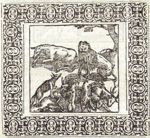
Aliena pericula cautiones nostra: Whitney, A choice of emblemes (Leiden, 1586), emblem 161 uses the fable told in the comment
Les riches sont supportés & les povres oppressés: Gueroult, Le premier livre des emblemes (Lyon, 1550), emblem 15 uses the fable told in the comment
Iconclass: 25F23(LION) beasts of prey, predatory animals: lion 55A1 Acquisition, Gain, Profit
Loci Communes: Vis injustia (Unjust force, Force injuste)
I vii 90 Ex tripode Straight from the tripod
Τὰ ἐκ τοῦ τρίποδος. id est, Ex tripode dicta. Dici solitum de iis quae vehementer vera atque indubitata videri volumus. Effertur varie adagium, ὡς ἐκ τρίποδος. id est, Tanquam ex tripode dicta: τάδε ἐκ τρίποδος. id est, Haec ex tripode dicta, id est, certissima, perinde, quasi ex Apollinis oraculo profecta. M. Tullius in epistola quadam ad Brutum, Haec ex oraculo Apollinis Pythii edita tibi puta. Translatum à tripode, vel Delphica, vel Pythia. Nam haec duo oracula quondam summam fidem apud mortales obtinuerunt. De Pythio testatur Strabo libro Geographiae nono, fuisse quondam celebratissimum, idque liquere thesauris ingentibus inibi constructis, in quos sacrae conferrentur pecuniae, tum operibus praestantissimorum artificum: deinde ludis Pythiis illic celebratis, denique innumerabilibus oraculis, quae mandata literis extarent. Tripodem ita describit, Autores, inquit, certi memorant, divinum ipsum domicilium, profundam, & curvam esse speluncam, non admodum lato patentem ore. Atque hinc auram reddi, sacro efflante numine. Excelsum autem ostio imminere tripodem, quem simul atque Pythia vates inscendetit, hausto divinationis spiritu, responsa aedere, partim metro, partim oratione libera. Comicus, Non Apollinis magis verum atque hoc responsum est. Plato lib. De legibus duodecimo: Ne si Pythius quidem affirmaverit. Quin illae quoque figurae proverbium resipiunt: Quicquid dixerit, oraculum videri vult. Quicquid dixerit, legem esse vult. Stoicorum δόγματα, id est, decreta. Et, quod apud Plinium de medicis ait Cato, Et hoc puta vatem dixisse: id est, existima verum fore, quod dixi. Ipse Plinius alibi, Utinamque falsum hoc, & non à vate dictum, quamplurimi iudicent. Et Plutarchus in commentario De dignoscendo adulatore ab amico: Εὖτ᾽ ἀκούσας ὅτι ἄν εἴπῃ, χρησμὸν εἰληφέναι φήσας, οὐ γνώμην, ἄπεισιν i. Cum is audito quicquid dictum fuerit, ita discedit, ut existimet se oraculum accepisse, non sententiam. Caeterum ab his nonnihil diversa sunt, quae Athenaeus secundo Dipnosophistarum libro commemorat, nempe in Bacchi certaminibus praemium fuisse tripodem, atque ob id qui vera dicerent vulgo de tripode loqui dictos. Tripodem autem fuisse lebetem tribus fultum pedibus. Huius duo erant genera, alterum Apollinis, ob veritatem oraculorum: alterum Bacchi, in quo vinum miscebatur, quod ebrii vera loquantur. Quemadmodum dictum est in proverbio, In vino veritas. Simili figura dixit Galenus libr. περὶ φυσικῶν δυνάμεων primo, velut ex adyto, Απεφήνατο γὰρ ὁ λύκος οὗτος, ὥσπερ ἐξ ἀδύτοῦ τινὸς χρησμὸν ἀποφθεγγόμενος, περιττωμα τῆς τῶν νεφρῶν θρέψεως εἶναι τὸ οὖρον. id est, Pronunciabat enim lupus iste, perinde quasi ex adyto quopiam redderet oreculum, quod superfluum est ex nutrimento renum, id esse urinam.
Τὰ ἐκ τοῦ τρίποδος, Spoken from the tripod, is customarily used of what we passionately wish to be thought unquestionably true. The adage is found in several forms: As though from the tripod, This is straight from the tripod, of something as indubitably true as if it came from the oracle of Apollo. Cicero in one of his letters to Brutus: 'Imagine that you have received this reply from the oracle of the Pythian Apollo.' A metaphor from the oracular tripod, whether Delphic or Pythian; for these two oracles once commanded supreme confidence among men everywhere. Of the Pythian oracle Strabo in the ninth book of his Geography attests that it was once the most popular of all, and that this is clear from the substantial treasuries built there for the storage of religious funds and from the works of the most famous artists; furthermore from the Pythian games which are held there and from the innumerable oracles that survived in writing. Of the tripod he gives the following account. Reliable authorities, he says, record that the god's actual dwelling is a deep and curving cavern with a fairly narrow mouth, and that an exhalation issues from this which is an effluence from the deity. Over the entrance stands a tall tripod, and when the Pythian priestess climbs onto this she inhales the spirit of prophecy, and utters replies some in verse and some in prose. So in the comedy: 'Apollo himself never uttered a truer word.' Plato in book 12 of the Laws: 'Not if Pythian Apollo said so himself.' There are other metaphors too which have a proverbial ring: Whatever he says he wishes to be taken as an oracle, Whatever he says he wants to be a law, and the Stoic dogmata or decrees, and Cato's words in Pliny about physicians This too you must take as spoken by a prophet,' that is, believe that what I have said will come true. Pliny himself elsewhere: 'And would that most people thought this was false and not the utterance of a prophet.' Plutarch too in his essay 'On the Difference between Flatterer and Friend': 'Then, having heard what the man has to say, he goes off, declaring that he has heard not an opinion but an oracle.' In any case there is some difference between this and what Athenaeus records in the second book of his Doctors at Dinner - that in contests in honour of Bacchus the prize was a tripod, and thus the man who spoke the truth was said to speak 'straight from the tripod.' The tripod, he says, was a cauldron on three feet; and of this there were two sorts, one sacred to Apollo because of the truth of his oracles and the other to Bacchus, in which wine was mixed, because those who are drunk speak the truth, as I have remarked on the proverb Wine speaks the truth. Galen uses a similar image in the first book of his On the Natural Faculties, As from some inner shrine: 'For this Lycus maintained, with the air of one uttering an oracle from some inner shrine, that what is superfluous in the nourishment of the kidneys constitutes urine.'
Facsimile: 
Iconclass: 41A7111 tripod 92B37213 the tripod (Delphi) 52A6 Truth; 'Verità' (Ripa)
Collectanea (1500): 673
Loci Communes: Fides et gravitas (Trust and seriousness, Confiance et gravité)
I vii 91 Folium Sibyllae A leaf from the Sibyl's book
Folium Sibyllae apud Latinos eandem vim obtinet. Iuvenalis, Credite me vobis folium recitare Sibyllae: Id est, rem indubitatam. Aristophanes in Pace, Οὐ μετεχω τούτων, οὐ γὰρ ταῦτ᾽ εἶπε σίβυλλα. id est, Haud equidem agnosco, neque enim canit ista Sibylla. Ductum adagium à Cumana Sibylla, cuius oracula cum primis celebrantur. Huic autem mos erat, ut testatur M. Varro, in palmarum foliis oracula scribere. Quod secutus Vergilius in tertio Aeneidos. Insanam vatem aspicies, quae rupe sub ima Fata canit, foliisque notas & nomina mandat. Quaecunque in foliis descripsit carmina virgo, Digerit in numerum, atque auro seclusa relinquit. Illa manent immota locis, neque ab ordine cedunt. Item in sexto: Foliis ne tantum carmina manda, Ne turbata volent rapidis ludibria ventis.
A Sibylline leaf in Latin carries the same idea, for instance in Juvenal's 'Take my word for it, I read you a leaf from the Sibyl's book,' meaning an undoubted fact. Aristophanes in the Peace: 'These lines are nought to do with me; no Sibyl uttered them.' The adage is taken from the Sibyl of Cumae, whose oracles have a very great reputation. It was her practice, as we know from Marcus Varro, to write her oracles on palm-leaves. This is followed by Virgil in the third book of the Aeneid:
There shall you see that frenzied prophetess
Who in her rocky cave foretells the future,
Trusting her knowledge to the tenuous grasp
Of leaves; and what upon those leaves she writes,
She sets in order due and leaves it locked
Within the cave, and there it lies unmoved
Nor shifts its place.
And again in book 6: 'But this I pray: write not your oracles / On leaves, light playthings of the sweeping wind.'
Facsimile:
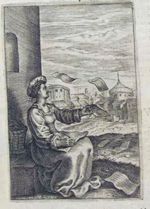
Folia Sibyllae: Reifenberg, Emblemata Politica (Amsterdam, 1632), emblem 14 uses the imagery of adage and uses it for its motto
Iconclass: 52A6 Truth; 'Verità' (Ripa) 11I2 sibyls 49M32 book 49M31 single printed leaf: broadsheet, leaflet
Loci Communes: Fides et gravitas (Trust and seriousness, Confiance et gravité)
I vii 92 Frater viro adsit Let a man's brother stand by him
Αδελφὸς ἄνδρὶ παρείν. i. Frater viro adsit. De fido auxilio dici solitum, propterea quod in rebus periculosis vix unquam frater solet fratri deesse. Apud Platonem ii. De republica lib. Adimantus Glauconis adversus Socratem disputantis partes excipiens, Nondum, inquit, Socrates, satis hac de re dissertum. Cur ita? Nempe quia id nondum est dictum, quod maximè dictum oportuit. Tum Socrates, οὐκοῦν τὸ λέγομενον, ἀδελφος ἀνδρὶ παρείη, id est, Igitur frater adesto viro, ut habet proverbium: quare tu, si quid hic praetermisit, adiuva. Idem ex Homero sumptum adagium testatur in Protagora, ubi Socrates Prodicum advocans, ut Simonidem eiusdem civitatis hominem à Protagorae calumnia tueatur: Videor equidem, inquit, advocare te, quemadmodum ait Homerus, Scamandrum ab Achille obsessum Simoentem advocasse, Φίλε κασίγνητε, σθένος ἀνδρός ἀμφότεροίπερ Σχῶμεν. id est, Frater amice, hominis paeriter compescere vires Ambo huius studeamus. Est autem is locus in Iliad. φ. Rursum Iliados χ. similiter Hector iam impar Achilli Deiphobum fratrem invocat, uti ferat suppetias. Pallas enim illi apparuerat Deiphobi specie, ac deceptus Hector, frustra inclamat, Δηΐφοβον δ᾽ ἑκάλει λευκασπίδα μακρὰν ἀΰσας. id est, Deiphobum fratrem intento clamore vocabat. A quo cum destitueretur, diem fatalem esse intellexit. Plutarchus in vita Caesaris refert, Cascam Caesare retinente gladium, fratris auxilium ad hunc modum implorasse, idque verbis Graecis, ἀδελφὲ βοήθει.
Ἀδελφὸς ἄνδρὶ παρείη, Let a man's brother stand by him. Commonly used of help that one can trust, because in moments of danger a man's brother hardly ever leaves him in the lurch. In Plato, in book 2 of the Republic, Adeimantus takes over from Glaucon the argument with Socrates, and says 'No, Socrates, we have not yet really dealt with this. Why so? Because we have not yet settled the point which needed settling more than anything.' 'Very well,' replies Socrates, 'let a man's brother stand by him, as the proverb runs: if he has left something out, you must help him.' He also says the adage comes from Homer, in the Protagoras where Socrates calls on Prodicus to defend Simonides his fellow-citizen from being maligned by Protagoras. T find myself he says 'calling on you for help, just as Scamander in Homer, when he is hard-pressed by Achilles, calls on Simoeis: "Dear brother, let us both withstand this man."' The passage is in Iliad 21. Again in Iliad 22 in the same way Hector, who is already being worsted by Achilles, calls on his brother Deiphobus to come and help him. For Pallas had appeared to him in the likeness of Deiphobus and Hector, deceived by this, appeals to him in vain. 'And with a mighty shout he summoned Deiphobus of the white shield.' And when Deiphobus abandoned him, he knew that his last hour had come. Plutarch in his life of Caesar records that when Caesar caught hold of the sword, Casca sought his brother's help in the same way, and that too in Greek: 'Help, brother, help.'
Facsimile:
Iconclass: 56F211 Brotherly Love 42G2221 brothers (second degree family relationships) 54A6 Helpfulness
Collectanea (1500): 651
Loci Communes: Cum auxilio ; citra auxilium (With help; without help, Avec aide ; sans aide)
I vii 93 Ne temere Abydum Not rashly to Abydos
Μὴ εἰκῆ τὴν ἄβυδον. id est, Ne temere Abydum, subaudiendum, naviges. Ne quod grave periculum suscipias sine causa idonea. Veluti si quis admoneat, ne se facile coniiciat aliquis in aulam principis, quod ea res non omnibus feliciter cedat: aut ne compotationibus temulentis admisceat sese, quod ferè non contingat abire sine malo: aut ne poetarum attingat literas, quod animos complurium soleant corrumpere. Athenaeus li. xii. narrat, Alcibiadem, posteaquam à tutoribus accepisset suas facultates, Abydum Hellesponti navigasse, atque illic luxu, deliciisque fuisse corruptum, ut non dissimile sit illi, Non cuivis homini contingit adire Corinthum. Male audiebat Abydena gens, quod calumniatrix esset, ut intelligas ea gratia non esse tutum illic versari. Meminit adagii Stephanus & Suidas. Stephanus sic effert adagium, εἰ μὴ δ᾽ εἰκῆ ἄβυδον πατεῖν. id est, Si ne temere quidem Abydum calcare. id est, ne quis confidenter illam ingrediatur: indicat usurpari de temerariis, addens hoc iaci solitum in eos, qui Abydum insulae Mileti incolebant. Commonstratum est olim mihi quoddam oppidulum in Picardia, quod negant ullum hospitem potuisse transire, non aliquo noratum scommate.
Μὴ εἰκῆ τὸν Ἄβυδον., Not rashly to Abydos (should you sail, understood). Run no serious risk without good reason. For instance, if one were advising somebody not to plunge into a prince's court too readily, because such a venture does not always succeed; or not to become involved in drunken parties, because as a rule one does not succeed in escaping unharmed; or not to read poetry because so often it corrupts the mind. Athenaeus in book 12 tells how Alcibiades, having received his property from his trustees, set sail for Abydos on the Hellespont and was there corrupted by luxury and dissipation, so that this would be not unlike the well-known line 'Not all men have the luck to get to Corinth.' The inhabitants of Abydos had a bad reputation as tale-bearers, and one might suppose that for this reason it was not safe to live there. The adage is recorded by Stephanus and Suidas. Stephanus gives the adage in the form 'If not even unadvisedly to set foot in Abydos,' let no one, that is, go there without misgivings; he indicates that it was applied to headstrong people, and adds that it was habitually directed at the inhabitants of Abydos in the island of Miletus. I was once shown a village in Picardy, which no stranger could ever pass (so they told me) without being the target of vulgar abuse.5
Facsimile: 
Iconclass: 61D(ABYDOS) geographical names of countries, regions, mountains, rivers, etc. (ABYDOS) (ABYDOS) 52AA21 Rashness, Imprudence, Recklessness 52A2 Forethought, Deliberation; 'Previdenza', 'Providenza' (Ripa)
Collectanea (1500): 639
Loci Communes: Discriminis (Danger, crisis, Danger)
I vii 94 Una hirundo non facit ver One swallow does not make summer
Μία χελιδὼν ἐαρ οὐ ποιεῖ, id est, Unica hirundo non efficit ver, hoc est unus dies non sat est ad parandam virtutem, aut eruditionem. Aut non unum aliquod bene factum, benedictúmve sufficit ad hoc, ut viri boni, aut boni oratoris cognomen promerearis: plurimis enim virtutibus ea res constat. Aut ut certum aliquid cognoscas, non satis est unica coniectura. Quod si permultae conveniant, tum denique probabilis fuerit coniectura. Siquidem fieri potest, ut una quaepiam hirundo casu maturius appareat. Sumptum ab hirundinis natura, quae veris est nuncia, nam hieme devolat. Unde Horatius, Zephyris & hirundine prima. De primo vere sentiens. Aristoteles lib. Moralium i. Τὸ γὰρ ἔαρ οὔτε μΐα ξελιδὼν ποιεῖ, οὔτε μΐα ἡμέρα, id est, Ver enim nec una hirundo facit, nec unus dies. Et beatum eodem modo, felicémve nec unus dies, nec breve efficit tempus. Aristophanes in Avibus, Δεῖσθαι δὲ ἔοικεν οὐκ ἠλίγων χελιδόνων. id est, Multa videtur opus habere hirundine. Interpres indicat allusum ad proverbium quod modo retulimus, Μία χελιδὼν ἐαρ οὐ ποιεῖ Huic affine videtur illud Sophocleum in Antigona, Πόλις γὰρ οὐκ ἔσθ᾽ ἥτις ἀνδρὸς ἐσθ᾽ ἑνός. id est, Namque unius quae sit viri, haud est civitas. Etenim quemadmodum una hirundo non facit ver, ita nec unus homo facit civitatem, nec unus nummus divitem.
Μία χελιδὼν ἐαρ οὐ ποιεῖ, A single swallow does not make a summer, meaning that one day is not time enough to acquire virtue or education. Or that one thing well done or well said is not sufficient to earn you the reputation of a good man or a good speaker, for many good qualities go to make this up. Or that to obtain certainty on some question, one single theory is not enough. If a great many approaches lead to the same result, then and then only will your theory be acceptable. It can so easily happen that one swallow should appear early by mere chance. This is derived from the natural habits of the swallow, which is the herald of early summer, for it flies away when winter comes. Whence Horace's phrase 'When Zephyrs blow and swallows first appear,' which refers to the early summer. Aristotle in the first book of the Ethics: 'One swallow makes no summer, nor does one day'; and in the same way it takes more than one day or one short space of time to make a happy man. Aristophanes in the Birds: 'He seems to me to need full many swallows,' where the scholiast sees a reference to the proverb I have just recorded, One swallow does not make a summer. There is something akin to this in Sophocles' Antigone: 'What one man owns can never make a city.' For just as one swallow does not make a summer, so one man does not make a commonwealth nor one coin a rich man.
Facsimile:
Iconclass: 25F32(SWALLOW) song-birds: swallow 23E43 summer ~ human activities (the four seasons of the year) 51F2 Continuity 51F7 Regularity of Recurrence
Collectanea (1500): 638
Loci Communes: Conjecturae (Conjectures, Conjectures)
I vii 95 Da mihi mutuum testimonium Lend me your evidence
Δάνεισόν μοι μαρτυρίαν. id est, Da mihi mutuum testimonium, hoc est, Da mihi tuum testimonium recepturus itidem meum, si quando desiderabis. In eos recte iaciendum, qui se mutua talione laudant ac praedicant: aut qui mutuo studio sibi invicem suffragantur, aut qui ad gratiam testificantur, neglecta religione. M. Tullius pro L. Flacco, repudians, elevansque Graecorum testium fidem. Veruntamen, inquit, hoc dico de toto genere Graecorum, Tribuo vel literas, do multarum artium disciplinam: non adimo sermonis leporem, ingeniorum acumen, dicendi copiam. Deinde si qua sibi alia sumunt, non repugno. Testimoniorum religionem, & fidem nunquam ista natio coluit: totiusque huiusce rei quae sit vis, quae autoritas, quod pondus, ignorant. Unde illud est, Da mihi testimonium mutuum? Non Gallorum, non Hispanorum putatus. Totum istud Graecorum est, ut, etiam qui Graece nesciunt, hoc quibus verbis à Graecis dici soleat, sciant. Quibus ex verbis M. Tullii satis liquet, adagium hoc aetate illa multo fuisse tritissimum.
Δάνεισόν μοι μαρτυρίαν, Lend me your evidence, meaning Give evidence in my favour, and when you need it you shall have mine in exchange. Rightly aimed at those who praise and recommend each other turn and turn about, or support one another on a system of exchange, or who testify to give satisfaction and overlook their duty to the truth. Cicero in his Pro Flacco rejects Greeks as witnesses and rates their honesty very low, observing: 'Let me say what I think about the Greeks as a whole. I grant they have a literature, I recognize the width of their education, I do not grudge them the charm of their language, their intellectual ability, their abundant eloquence, and any other claims they make I shall not resist. But honesty and respect for the truth in giving evidence they as a nation have never developed, and of the meaning of such things and their importance and the weight they carry they have no idea. "Lend me your evidence" - where did that come from? No one supposes that we owe that to Gaul or Spain. It belongs entirely to the Greeks, so much so that even those who have no Greek know the actual Greek words for it.' What Cicero says makes it clear enough that in his time this adage was exceptionally familiar.
Facsimile:
Iconclass: 55C3 Lending, Letting 53D12 Favour; 'Favore' (Ripa) 44G law and jurisprudence 52A6 Truth; 'Verità' (Ripa) 52AA6 Falsehood
Loci Communes: Pensatio beneficii vel officii (Repayment of a favor or duty, Rétribution d'un bienfait ou d'un devoir)
I vii 96 Mutuum muli scabunt One mule scratches another
Mutuum muli scabunt. Ubi improbi atque illaudati se vicissim mirantur, ac praedicant. Translatum à mulis, qui sicuti reliqua iumenta, sese invicem dentibus scabere solent. Citatur hic titulus, Mutuum muli scabunt, à Nonio Marcello inter reliquos Menippearum titulos M. Varronis, mirum ni proverbialis. Ausonius in altera praefatione monosyllaborum, Sed ut quod per adagionem coepimus, proverbio finiamus, mutuo muli scabunt. Meminit huius & Varro li. de lingua Latina iii. Quanquam is locus est foedissime depravatus, non temporum modo culpa, verumetiam impressorum istorum vulgarium, quibus hoc unice propositum videtur, ut omnes bonos libros radicitus extinguant. Sic autem legitur, Amica Philoptorus, eius qui senex puerum dicit pulsum, puellam pulsam. Sic fiet mutuam mulinam. Arbitror legendum mutuum muli, ut subaudiatur scabunt. Symmachus in epistola quadam, Mutuum, inquit, scabere mulos, cui proverbio ne videar esse consinis, praeconium virtutum tuarum, presso dente restringo. Non videtur autem adagium recte accipi posse, nisi malam in partem: veluti si indoctum indoctus, deformem deformis, improbum improbus vicissim laudaret. Cuiusmodi fabulam memorat Horatius de duobus fratribus, qui se mutuum scabebant, ac mutuo officio alterum alter vicissim efferebant laudibus. Fratur, inquit, erat Romae, consulti rhetor, ut alter Alterius sermone meros audiret honores, Gracchus ut hic illi foret, hic ut Mutius illi. Idem poetas indoctos notans, qui tamen invicem se recitantes audiebant, ac laudabant, Discedo Alcaeus puncto illius, ille meo quis? Quis? nisi Callimachus?
When rascals and men of no reputation admire and cry up one another. The image is taken from mules which, like other beasts of burden, have a habit of scratching one another with their teeth. The phrase is cited by Nonius Marcellus as the title of one of Marcus Varro's Menippean Satires, and must surely be proverbial. Ausonius in the second preface to his Monosyllaba: 'But to end with a proverb what I began with an adage, mules scratch one another.' Varro also mentions this in the third book of his On the Latin Language, though the wording is most foully corrupt, for which the passage of time is not so much to blame as the common run of printers, whose only object seems to be the utter extinction of all good books. For the text runs thus: 'Philoptorus, a female friend of the man who in old age calls a boy pusus and a girl pusa. The result will be mutuant mulinam.' I think we should read mutuum muli and understand scabunt. Symmachus in one of his letters: 'The proverb says that mules scratch one another, and for fear I may be within reach of that, I hold back behind clenched teeth what I would say in praise of you.' It looks however as if the adage could not be correctly understood except in a derogatory sense, as for instance if two ignorant men were to praise each other or two cripples or two rascals. This recalls Horace's anecdote of the two brothers who enjoyed mutual back-scratching and an exchange of panegyrics in turn.
Rome had two brothers; one the spoken word
And one the law pursued. And how they purred!
How oft reciprocal the butter flew! -
'Gracchus has met his match.' 'And Mucius too!'
He also criticizes poetasters who, bad as they are, listen to each others' recitations with rapture:
Alcaeus I in his opinion shine,
He soars a new Callimachus in mine.
I vii 97 Tradunt operas mutuas They help each other out
Huic confine est Terentianum illud ex Phormione: Tradunt operas mutuas. De adulescentibus, qui se vicissim in peccatis defenderent. Translatum videtur ab agricolis vicinis, qui mutuam inter sese operam commodare solent. Aut ab artificibus, qui mutua nonnunquam utuntur opera: maximè fabri aerarii.
There is a phrase related to this in Terence's Phormio, 'They help each other out,' used of the young men who get into scrapes and defend one another in turn. It looks as though it might be a metaphor from neighbouring farmers who have a custom of lending a hand with the work in both directions, or from craftsmen, especially coppersmiths, who sometimes share their work.
Facsimile: 
Iconclass: 54A6 Helpfulness
Loci Communes: Concordia (Harmony, Concorde); Cum auxilio ; citra auxilium (With help; without help, Avec aide ; sans aide)
I vii 98 Senes mutuum fricant Old men rub another
Huc pertinet & iocus ille in proverbium versus, de senibus mutuo se fricantibus. Narrat autem fabulam Aelius Spartianus in Adriani Imperatoris vita. Is Adrianus in balneo veteranum quempiam, servuli penuria, sese marmoribus affricantem conspicatus, eum et servulis aliquot & sumptibus donavit. Quod reliqui veterani, feliciter cessisse videntes, coeperunt & ipsi complures sub oculis imperatoris sese marmoribus affricare, ut hoc modo principis elicerent benignitatem. At ille, evocatis senibus, iussit, ut alius alium vicissim defricarent, atque ita pueris nihil opus fore. Is iocus postea in vulgi fabulam cessit. Celebratur et Scipionis Aemiliani apophthegma, Iumenta, quod manibus carent, alieno egere frictu. Quo significatum est, eos, qui res egregias gerere non possunt, egere praecone, quo famam sibi comparent.
There also belongs here a humorous turn which gave rise to a proverb, about old men rubbing one another. The story is told by Aelius Spartianus in his life of the Emperor Hadrian. Hadrian once saw an old soldier in the baths, who was too poor to keep a slave, rubbing himself down against the marble walls, and presented him with a few slaves and the money to maintain them. A number of other veterans, seeing what a success that had been, began likewise to rub themselves down against the marble when they were within sight of the emperor, hoping in this way to extract some more bounty from their prince. He however sent for the old men and told them to rub each other down in turns, and in that way they would not need slaves. This humorous turn afterwards became a common proverb. There is also a well-known retort of Scipio Aemilianus, 'Beasts must be rubbed down by someone else because they have no hands'; by which he meant that those who are not capable of famous exploits need an expert in publicity, through whom they can secure a reputation.
Facsimile:
Iconclass: 31D16 old man 31A254(+916) postures and gestures of arm(s) and hand(s) in relation to another person (+ helping) 31A5451 public baths 54A6 Helpfulness
Loci Communes: Pensatio beneficii vel officii (Repayment of a favor or duty, Rétribution d'un bienfait ou d'un devoir)
I vii 99 Fricantem refrica You scratch my back and I'll scratch yours
Τὸν ξύοντα ἀντιξύειν, id est, Scalpentem vicissim scalpe. Refertur in Diogeniani collectaneis. Par est, de merente bene, bene mereri, & officium officio pensare. Suidas ab asinis metaphoram translatam existimat invicem morsicantibus: & in utranque partem dici posse, qui se mutuis officiis adiuvant, aut qui se mutuis contumeliis afficiunt. In quam sententiam celebratur & Mimus ille non illepidus, Senecae titulo, sed falso, Ab altero exspectes, alteri quod feceris. Aristides in communi defensione quatuor oratorum, Τὸν ξύοντα ἀντιξύειν καὶ τοῖς ὄνοις ἡ παροιμία δήπου δίδωσι. περικλέα δὲ κἂν τοῖς λέουσι μᾶλλον,ἤ τοῖς ὄνοις εἰκάζειν φαῖεν ἄν ὁμηρίδαι id est, Scalpentem invicem scalpere, etiam asinis videlicet tribuit proverbium. Porrò Periclem cum leonibus magis, quam cum asinis esse conferendum dixerint Homerici. Huc pertinet illud, χεὶρ χεῖρα νίζε, id est, Manus manum lavat. Quod citat in Axiocho Plato, Διὰ παντὸς δὲ ἔθος ἐστὶν αὐτῷ φρονεῖν τὸ ἐπιχάρμενον Α δὲ χείρ τὴν ξεῖρα νίζει; δός τι καὶ λάβε τι. id est, Semper illi mos erat in animo voluere illud Epicharmi dictum, Abluit manum manus, da aliquid, & aliquid accipe. Quanquam Aldina aeditio pro φρονεῖν habet φωνεῖν id est, in ore habere: & melius trochaicus tetrameter Graecus constabit, si pro λάβε τι legas λάμβανέ τι. Quod idem alio loco citavimus, sed aliter, mendosum exemplar secuti, cum Graecus Plato nondum esset ad manum, quem consulere possemus. Cuius rei visum est commonefacere lectorem, ne quis hoc nomine mihi calumniam struat, quod temere Platonis scripturam inverterim. Quantum autem ad sententiam pertinet, nihil omnino refert, νίζει legas, an κνίζει, quandoquidem ut manus manui mutuum praestat officium lavando, itidem et scalpendo.
Τὸν ξύοντα ἀντιξύειν, If someone rubs you rub him in return. Recorded in the collections of Diogenianus. It is only fair to oblige a man who has obliged you and to repay one kindness with another. Suidas thinks the metaphor is drawn from donkeys nibbling one another, and that it can be used in either sense, of the exchange of mutual assistance or abuse. There is a well-known and rather neat moral maxim to the same effect, which is ascribed to Seneca but wrongly, 'Your neighbour will treat you as you treat him.' Aristides in his united defence of the four orators: 'Scratch my back and I'll scratch yours is proverbially credited, I think, to donkeys; but our Homeric enthusiasts would surely compare Pericles to a lion rather than a donkey.' Here belongs that other phrase, 'One hand washes the other,' which Plato cites in the Axiochus: 'On every point he follows that tag from Epicharmus, One hand washes the other; give first and take afterwards.' Though the Aldine edition reads φωνεῖν for φρονεῖν, not 'he follows' but 'he repeats'; and the trochaic tetrameter in Greek will run better if you read λάμβανέ τι for λάβε τι. I have already quoted this elsewhere, but with a different text, following a defective copy, because as yet I had no Greek Plato at hand which I could consult. It seemed advisable to draw the reader's attention to this, for fear someone might accuse me rashly of inverting Plato's text. Though, as far as the sense goes, it makes no difference at all whether you read κνίζει or νίζει, since whether one hand scratches the other or washes it, the exchange of services is exactly the same.
Facsimile:
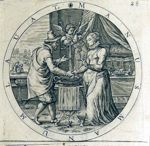
Manus manum lava: Wither, A collection of emblems (London, 1635), emblem 128 quotes the comment
Iconclass: 31A25222 rubbing, wringing one's hands 31A25372(+0) scratching one's ear (+ variant) 54A6 Helpfulness 54AA6 Obstructiveness
Collectanea (1500): 685
Loci Communes: Pensatio beneficii vel officii (Repayment of a favor or duty, Rétribution d'un bienfait ou d'un devoir)
I vii 100 Ferrum ferro acuitur Iron sharpeneth iron
Non erat consilium in hunc ordinem admiscere proverbia theologorum, non quod ea contemnam, sed partim quod hoc honoris habendum iudicarim sacris literis, partim quod passim in manibus sint. Unum tamen illud, quoniam sic ad amussim ad ista quadrat, non pigebit adscribere. Id est in Proverbiis Salomonis, cap. vigesimo septimo. Ferrum ferro exacuitur, & homo exacuit faciem amici sui. Hebraei pronunciant ad hunc modum, (siquidem est aliquid, adagium in suapte audire lingua,) ...
It was not my intention to mingle with this series the proverbs which belong to theologians, not that I despise them, but partly because I thought this showed a proper respect for Holy Writ and partly because they are universally accessible. There is however one which I shall add without hesitation because it chimes in so exactly with what I have just said. It comes in the Proverbs of Solomon, chapter 27: 'Iron sharpeneth iron; so a man sharpeneth the countenance of his friend.' In Hebrew it is expressed like this - forit is something to hear an adage in its original language: [hebrew].
Facsimile:

Ferrum ferro acuitur: Printer's device 1802
Iconclass: 25D13(IRON) minerals and metals: iron 54A6 Helpfulness 47C55 sharpening, grinding (industrial processes)
Loci Communes: Pensatio beneficii vel officii (Repayment of a favor or duty, Rétribution d'un bienfait ou d'un devoir)