Jacob Cats, Spiegel (The Hague, 1632)
Emblem 18
A donkey is biting another donkey, while various couples of lovers are playing on the beach and in the dunes

El amor de los asnos entra à coces y à bocadosSpanish
The love of donkeys begins with kicks and bites.AI-generated
Description of the imageAI-generated
Within a large oval frame (with hatched spandrels in the corners), two donkeys stand in an open dune landscape by the sea. The animal on the left rears up on its hind legs, forelegs raised, mouth open and teeth bared, biting at the neck and head of the second donkey on the right, which turns its head upward and back with an open braying mouth. The ground is sandy with tufts of grass; in the left middle distance small figures sit and lie on a dune, with a slender tower on the horizon; at the right small figures of a man and a woman struggle or tumble together on the dunes. Birds fly in the cloudy sky above. Below the oval a banderole carries the motto in three panels: 'El amor de los asnos entra a coces y a bocados'.
Subscriptio


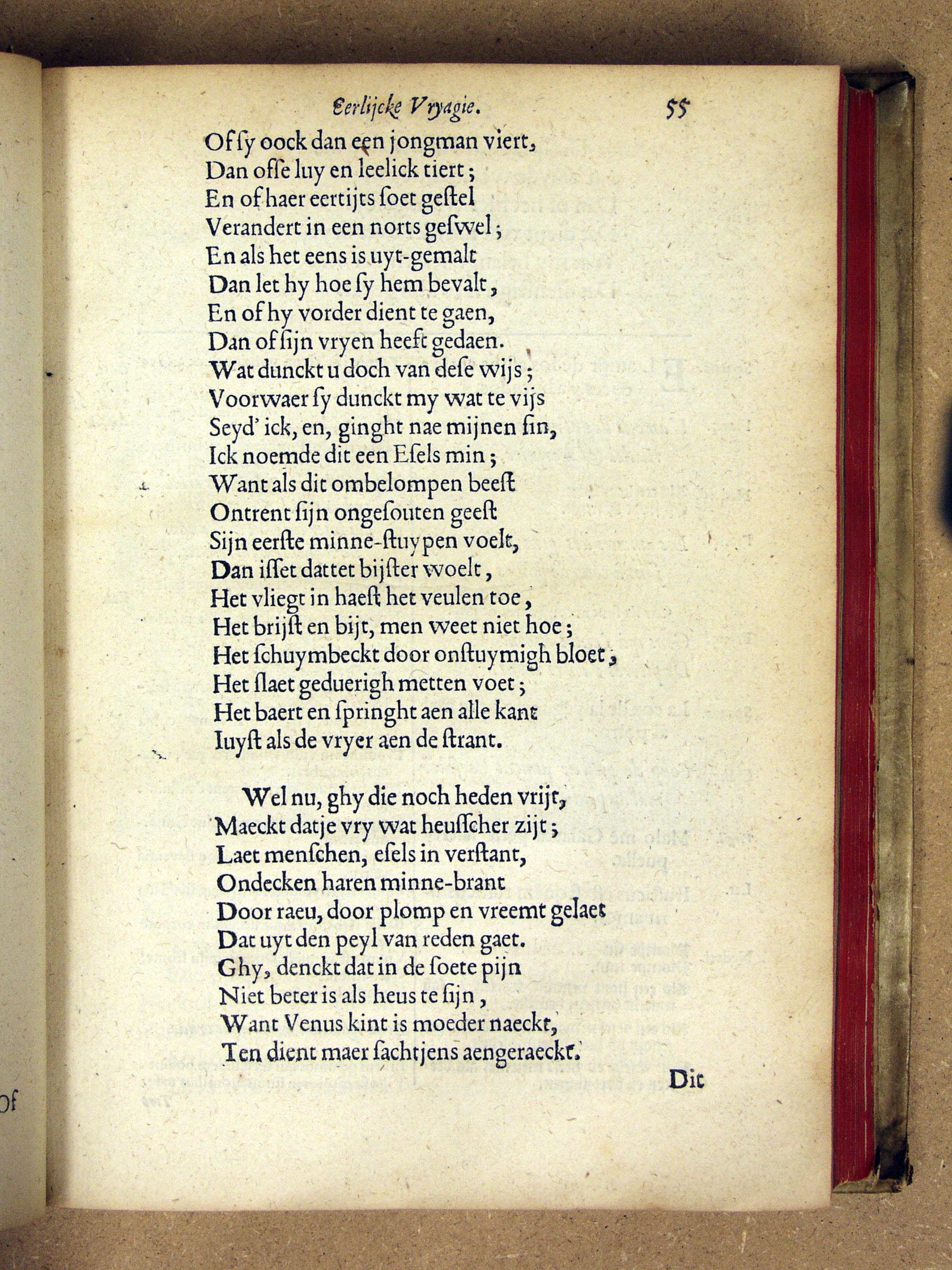
TranscriptionAI-generated
Een Ridder uyt het Britten-landt Gingh dwalen aen de Zeeusche strandt, En hadde ( soo het scheen ) gesien Hoe dat aldaer de jonge lien Haer gaen vermaecken aen de Zee, Niet verre buyten Zierickzee; Hy sagh het als een selsaem dingh Dat vry wat uyt de regel gingh, En daerom heeft hy't ons vertelt Gelijck hier onder is gestelt: Ick quam eens treden op de strant, Daer ick veel jonge lieden vant, Ick sagher ses of seven paer, Den eenen hier, den genen daer, Maer boven al soo wasser twee Die gingen veerdigh na de zee, Een yeder had een jonge maegt Die hy tot in het water draegt; En of de vrijster vreese kreegh, Iae schier van angst ter neder seegh, Oock hem met bleecke lippen badt, Noch gingh hy dieper in het nat, Tot dat het water wert gesien Tot aen, jae boven, hare knien, En noch ist niet genoegh gedaen Het moester vry wat holder gaen; Ten lesten neemt de losse quant En giet oock water metter hant, Iuyst als Diana voortijts plagh Als sy Actæon by haer sagh; Hy goot het water hier en daer Tot in haer schoon gekrinckelt haer, Soo dat het 'tgeen eerst geestigh stont Geleeck een natten water-hont. Ten lesten als de joncker sagh Dat hy niet hooger op en magh, Soo keert hy weder naer het droogh, Want hy sagh tranen in haer oogh; Maer stracx soo loopt hy van de strant, En treckt haer naer het mulle sant; Hy leyt haer op een hoogen duyn, En rolt dan van de steyle kruyn, Tot onder in het lage dal, En daer eens weder even mal; Hy sout haer in het gulle sant, En stroyt het stof aen alle kant; Hy laet niet af, hoe datse wijckt, Soo datse naeu een mensch gelijckt. Ick sach daer by een oude vrou, Die vraegd' ick wat dit seggen wou, En wat de vrijster had gedaen Om dit soo uyt te moeten staen, Of sy oock yemant had misseyt Dat sy in't water wert geleyt; Of dat sy van een dollen hont Haer in het lijf gebeten vont. Het wijf verklaerde datter niet Van 'teen of 'tander was geschiet; Maer ( sprack sy ) hoort eens wat het zy, En sit een weynigh nevens my, Het is een wijse van het landt, Dat yemant in sijn eersten brandt, Ontrent den soeten meye tijt Met vrijsters in den duyne rijt; En isser dan een geestigh dier Hem oorsaeck van sijn eerste vier, Soo gaet hy dus met haer te werck, En al op seker oogh-gemerck: Ghy, hoort doch waerom dit geschiet, Het is vermits hy daer uyt siet Hoe sich de jonge vrijster heeft, Als hy soo selsaem met haer leeft, Of sy oock dan een jongman viert, Dan offe luy en leelick tiert; En of haer eertijts soet gestel Verandert in een norts geswel; En als het eens is uyt-gemalt Dan let hy hoe sy hem bevalt, En of hy vorder dient te gaen, Dan of sijn vryen heeft gedaen. Wat dunckt u doch van dese wijs; Voorwaer sy dunckt my wat te vijs Seyd' ick, en, ginght nae mijnen sin, Ick noemde dit een Esels min; Want als dit ombelompen beest Ontrent sijn ongesouten geest Sijn eerste minne-stuypen voelt, Dan isset dattet bijster woelt, Het vliegt in haest het veulen toe, Het brijst en bijt, men weet niet hoe; Het schuymbeckt door onstuymigh bloet, Het slaet geduerigh metten voet; Het baert en springht aen alle kant Iuyst als de vryer aen de strant. Wel nu, ghy die noch heden vrijt, Maeckt datje vry wat heusscher zijt; Laet menschen, esels in verstant, Ondecken haren minne-brant Door raeu, door plomp en vreemt gelaet Dat uyt den peyl van reden gaet. Ghy, denckt dat in de soete pijn Niet beter is als heus te sijn, Want Venus kint is moeder naeckt, Ten dient maer sachtjens aengeraeckt. Dit sprack de Ridder al te mael, En 'tluyde wel in sijne tael; Dan of het hier wel is geseyt Dat dient wat naerder over-leyt; Wat my belangt, ick vinder wat Dat dienstigh is te zijn gevat.
TranslationAI-generated
A knight from the land of Britain went wandering on the Zeeland shore, and had (so it seemed) seen how the young people there go to amuse themselves by the sea, not far outside Zierikzee; he thought it a strange thing that went rather far outside the rule, and therefore he told it to us as it is set down here below: I once came walking on the beach, where I found many young people; I saw there six or seven couples, one here, another there; but above all there were two who went briskly toward the sea, each of them having a young maid whom he carried right into the water; and although the sweetheart grew frightened, indeed nearly sank down from fear, and begged him with pale lips, still he went deeper into the wet, until the water was seen to reach up to, indeed above, her knees. And still it was not enough done, it had to go still more wildly; at last the loose fellow takes and also pours water with his hand, just as Diana used to do of old when she saw Actaeon near her; he poured the water here and there, right into her fair curled hair, so that what at first stood daintily now looked like a wet water-dog. At last, when the young gentleman saw that he could go no higher, he turns back to the dry land, for he saw tears in her eye; but at once he runs off the beach and drags her toward the loose sand; he lays her on a high dune and rolls her down from the steep crest right to the bottom of the low valley, and there again just as foolishly; he salts her in the yielding sand and strews the dust on every side; he does not leave off, however she gives way, so that she scarcely resembles a human being. I saw there beside me an old woman, whom I asked what this was supposed to mean, and what the sweetheart had done to have to endure this; whether she had insulted someone, that she was led into the water; or whether she had been bitten in the body by a mad dog. The woman declared that neither the one nor the other had happened; but (said she) just listen to what it is, and sit a little beside me: it is a custom of the country that someone in his first passion, about the sweet month of May, rides in the dunes with girls; and if there is then a lively creature who is the cause of his first fire, then he goes to work with her like this, and all with a certain aim in view. You, do hear why this happens: it is because from it he sees how the young girl behaves when he deals with her so strangely; whether she still honours a young man, or whether she carries on lazily and nastily; and whether her formerly sweet disposition changes into a surly swelling; and when it has once been fully played out, then he notes how she pleases him, and whether he ought to go further, or whether his courting is done. Well, what do you think of this custom? Truly, it seems to me rather too coarse, said I; and, if it went by my mind, I would call this a donkey's love. For when this clumsy beast feels, about its unsalted spirit, its first fits of love, then it stirs itself outrageously; it flies in haste at the filly, it brays and bites, one knows not how; it foams at the mouth from turbulent blood, it strikes continually with its foot; it makes noise and leaps on every side, just like the wooer on the beach. Well now, you who still go courting today, see that you be a good deal more courteous; let men who are donkeys in understanding discover their love-fire by raw, by clumsy and strange behaviour that goes beyond the measure of reason. You, think that in the sweet pain nothing is better than to be decent, for Venus' child is stark naked, and must be touched only gently. This the knight spoke all together, and it sounded well in his own tongue; but whether it is rightly said here needs to be considered more closely; as for me, I find in it something that is useful to have grasped.
CommentaryAI-generated
3 passages · original left, translation right (click to fold)
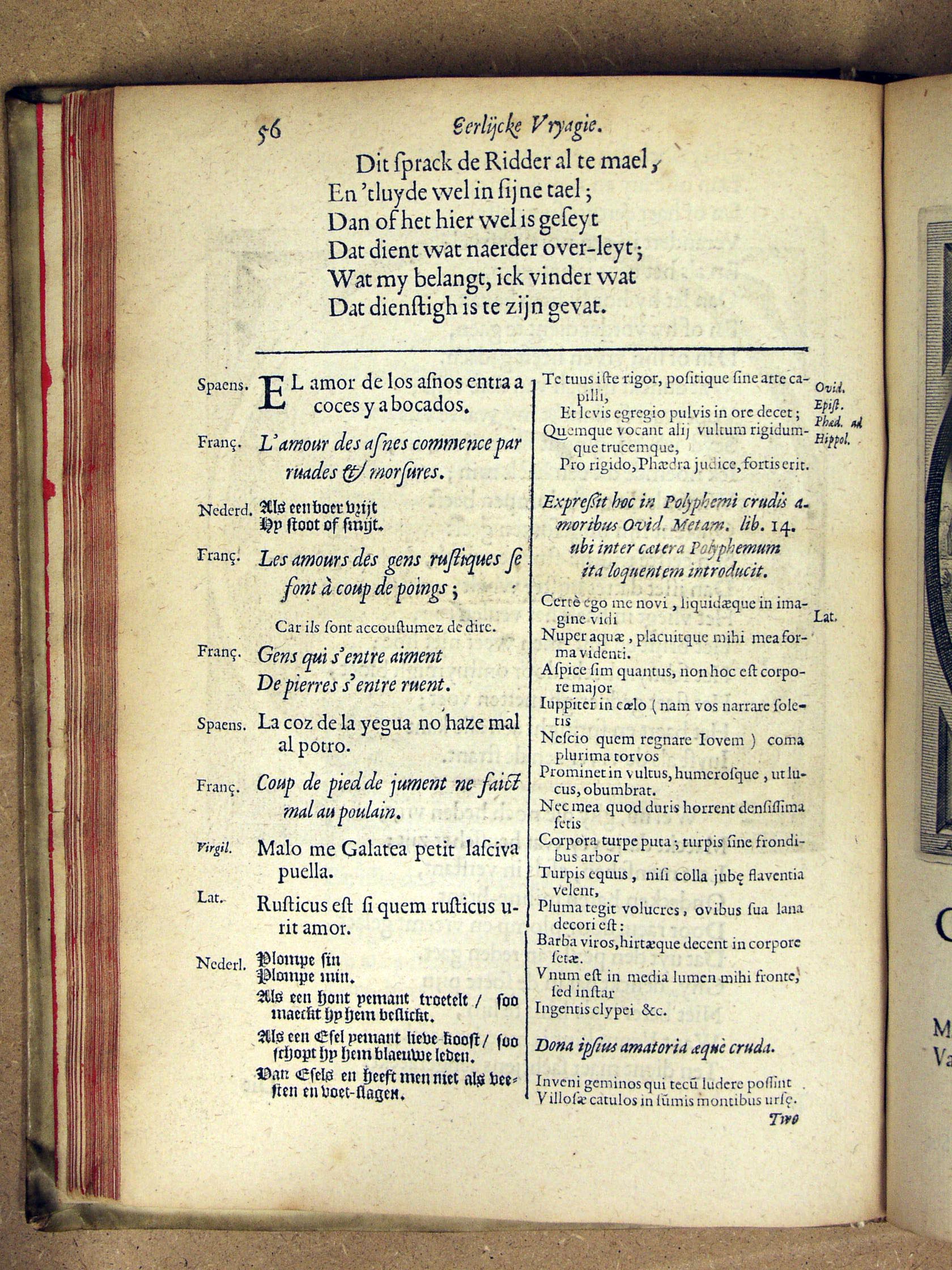
Spaens. EL amor de los asnos entra a coces y a bocados. Franç. L'amour des asnes commence par ruades & morsures. Nederd. Als een boer vrijt / Hy stoot of smijt. Franç. Les amours des gens rustiques se font à coup de poings; Car ils sont accoustumez de dire. Franç. Gens qui s'entre aiment / De pierres s'entre ruent. Spaens. La coz de la yegua no haze mal al potro. Franç. Coup de pied de jument ne faict mal au poulain. Virgil. Malo me Galatea petit lasciva puella. Lat. Rusticus est si quem rusticus urit amor. Nederl. Plompe sin / Plompe min. Als een hont yemant troetelt / soo maeckt hy hem beslickt. Als een Esel yemant lieve koost / soo schopt hy hem blaeuwe leden. Van Esels en heeft men niet als beesten en voet-slagen.
Ovid. Epist. Phæd. ad Hippol. Te tuus iste rigor, positique sine arte capilli, Et levis egregio pulvis in ore decet; Quemque vocant alij vultum rigidumque trucemque, Pro rigido, Phædra judice, fortis erit.
Expressit hoc in Polyphemi crudis amoribus Ovid. Metam. lib. 14. ubi inter cætera Polyphemum ita loquentem introducit.
Lat. Certè ego me novi, liquidæque in imagine vidi Nuper aquæ, placuitque mihi mea forma videnti. Aspice sim quantus, non hoc est corpore major Iuppiter in cælo ( nam vos narrare soletis Nescio quem regnare Iovem ) coma plurima torvos Prominet in vultus, humerosque, ut lucus, obumbrat. Nec mea quod duris horrent densissima setis Corpora turpe puta; turpis sine frondibus arbor Turpis equus, nisi colla jubę flaventia velent, Pluma tegit volucres, ovibus sua lana decori est: Barba viros, hirtæque decent in corpore setæ. Vnum est in media lumen mihi fronte, sed instar Ingentis clypei &c.
Dona ipsius amatoria æquè cruda.
Inveni geminos qui tecu ludere possint Villosæ catulos in sumis montibus ursę.
Spanish: The love of donkeys begins with kicks and bites. French: The love of donkeys begins with kickings and bitings. Low German/Dutch: When a peasant courts, he pushes or strikes. French: The loves of rustic people are made with blows of the fist; for they are accustomed to say: French: People who love one another pelt one another with stones. Spanish: The mare's kick does the colt no harm. French: A mare's kick does the foal no harm. Virgil: Galatea, a wanton girl, pelts me with an apple. Latin: He is a boor, if a boorish love inflames anyone. Dutch: Clumsy mind, clumsy love. When a dog fondles someone, it makes him muddy. When a donkey caresses someone lovingly, it kicks him black and blue. From donkeys one gets nothing but beastliness and kicks.
Ovid, Heroides, Phaedra to Hippolytus: That stiffness of yours becomes you, and your hair arranged without art, and the light dust on your excellent face; and the countenance which others call stern and grim will, instead of stern, in Phaedra's judgement be called manly.
Ovid expressed this in the crude loves of Polyphemus, Metamorphoses book 14, where among other things he introduces Polyphemus speaking thus:
Latin: Surely I know myself, and lately I saw my likeness in the clear water, and my form pleased me as I looked. Look how big I am: Jupiter in heaven is not greater in body than this (for you are wont to tell of some Jove or other who reigns there); abundant hair overhangs my grim face, and shades my shoulders like a grove. And do not think it ugly that my body bristles thickly with stiff hairs: a tree without leaves is ugly, a horse is ugly unless a yellow mane veils its neck; feathers cover birds, their own wool is an ornament to sheep; a beard and shaggy bristles on the body become men. I have one single eye in the middle of my forehead, but it is like a huge shield, etc.
His love-gifts are equally crude:
I have found twin cubs of a shaggy bear on the high mountains that can play with you.
Gens qui s'entre aiment De pierres s'entre ruent.
People who love one another pelt one another with stones.
Plompe sin Plompe min.
Clumsy mind, clumsy love.
Iconclass
25H132dune coast31A2715(+64)rolling (+ downward)31AA2715(+64)rolling - AA - female human figure (+ downward)33C235lovers' tussle46C13142(+7512)ass, donkey (+ animal(s) attacking)46C13186(+0)kicking (horse in motion) (+ variant)86(EL AMOR DE LOS ASNOS ENTRA À COCES Y À BOCADOS)proverbs, sayings, etc. (EL AMOR DE LOS ASNOS ENTRA À COCES Y À BOCADOS)
Suggested Iconclass codesAI-generated
Additional codes proposed for this emblem, not (yet) part of the indexing.
46C13142ass, donkeyhighThe correlate 'ass, donkey' directly names the two donkeys that are the main subject of the emblem's picture and motto.
46C13186kicking (horse in motion)medium'Kicking (horse in motion)' fits the equine kicking that the motto ('the love of donkeys begins with kicks and bites') and the rearing donkey depict.
83(OVID, Metamorphoses XIII:789-869)The song of Polyphemusmedium'The song of Polyphemus' is precisely the Ovidian passage quoted at length in the commentary as the exemplar of crude, boorish love.
91B24Polyphemuslow'Polyphemus' is invoked in the commentary as the emblematic figure of rustic wooing, though he is not shown in the picture.
33B32kickinglow'Kicking' as an act of aggression matches the motto's claim that donkeys' (and peasants') courtship proceeds by kicks and blows, though the agents here are animals.
Relationships to the Adagia of ErasmusAI-generated
Suggested relationships between this emblem and adages in Erasmus’ Adagia.
- II iv 70 Malis ferire – thematic inventiomedium
Erasmus' adage (Μήλοις βάλλειν) explains pelting a beloved with apples as a way of provoking love, exactly the idea behind the emblem's commentary cluster on rough love-tokens ('Gens qui s'entre aiment / De pierres s'entre ruent'; 'Malo me Galatea petit lasciva puella'), which is the Virgilian tag Erasmus associates with this same proverb of provoking love by throwing things.
- IV vii 91 Ut lupus ovem – thematic inventiolow
Erasmus' essay describes the young man who 'hunts' a girl and so harms rather than loves her, which matches the emblem's picture of the brutish suitor who drags, ducks and rolls his sweetheart in the dunes — love that is really beastliness, 'a donkey's love'.
Sources
Record ID: embstma_1288_emblem018
This emblem on the Iconclass site: https://iconclass.org/view/embstma_1288_emblem018
Copy: University Library, Glasgow, Stirling Maxwell 1288