Jacob Cats, Spiegel (The Hague, 1632)
Emblem 76

Ogni gallo rupsa à seItalian
Every cock scratches for himself.AI-generated
Description of the imageAI-generated
A circular medallion image set within a square frame with dark corner spandrels. Inside the roundel, a flock of cocks and hens scratch and peck at scattered chaff, straw and grain on open ground; a large cock in the left foreground bends low with its beak to the ground, another cock at the right pecks beside a small chick, and further hens and chicks are spread across the middle ground, several bent over with beaks down. In the background rises a bank on which two men in cloaks, breeches and broad-brimmed hats stand side by side, one holding a stick, apparently conversing and looking toward the birds. Behind them are rows of conifers, a haystack or shrub, a distant village tower at the left, and birds flying in the cloudy sky. Engraver's signatures appear at the lower left and lower right of the plate.
Subscriptio

TranscriptionAI-generated
VVilder yemant seecker wesen Hoe het in de werelt gaet? Siet! die sal het konnen lesen In het beeldt dat voor hem staet: Let eens hoe't de hanen maecken Die hier schraven in het kaf, Yder doet sijn eygen saecken, Niemant wijst het koren af, Yder siet men tot hem trecken Wat hem voor komt op de straet, Alle pooten, alle becken, Staen gekromt naer eygen baet. Hanen van gelijcke grepen Vint men onder jonck en out, Yder soeckt maer in te slepen; Vrienden siet wie ghy betrout.
TranslationAI-generated
Would anyone like to be sure How things go in the world? Look! he will be able to read it In the picture that stands before him: Just note how the cocks behave That are scratching here in the chaff, Each one does his own business, No one refuses the grain, Each one is seen to drag toward himself Whatever comes before him in the street, All claws, all beaks, Are bent toward their own profit. Cocks of the same grasping kind One finds among young and old, Each only seeks to rake things in; Friends, watch whom you trust.
CommentaryAI-generated
16 passages · original left, translation right (click to fold)
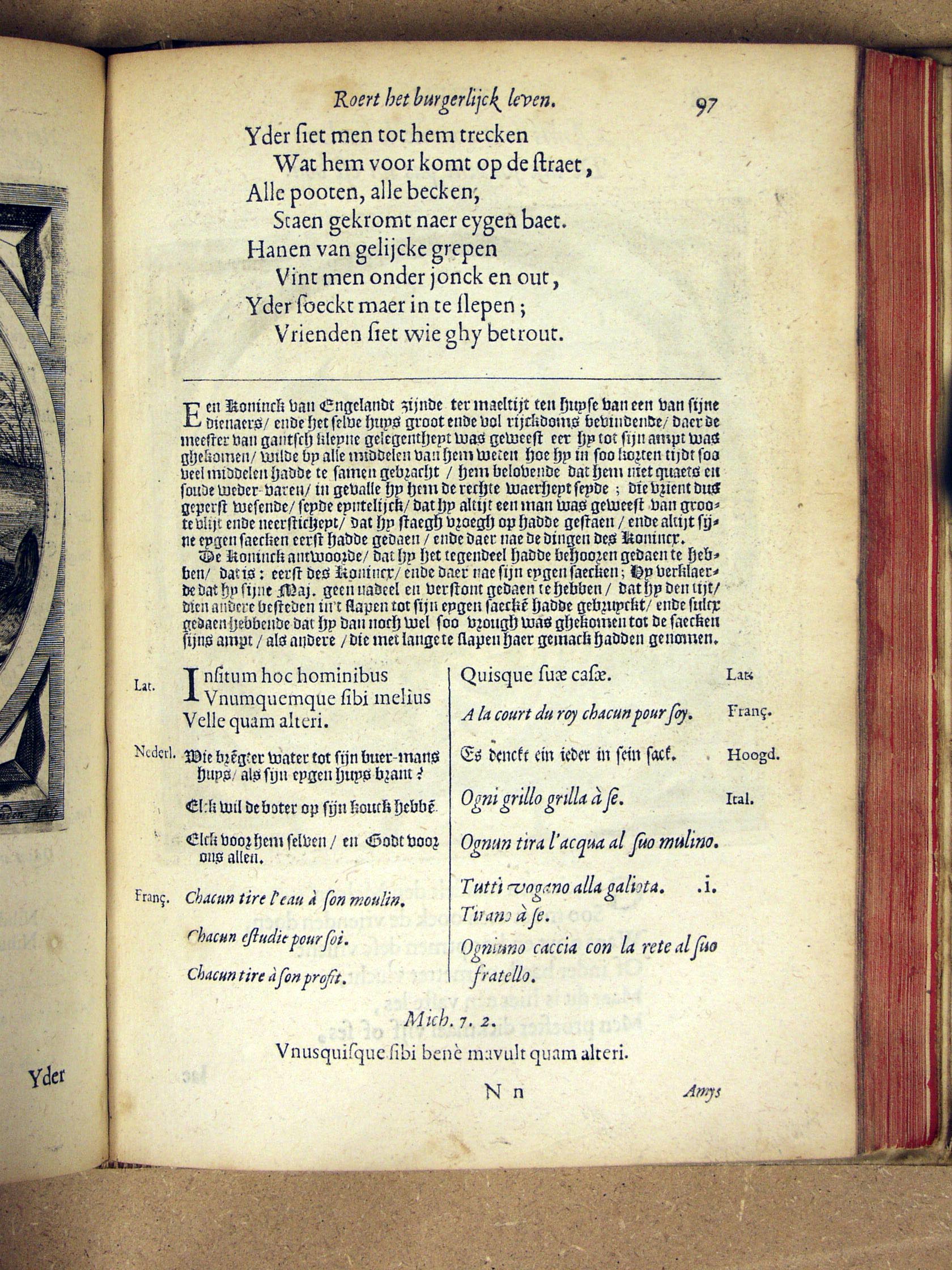
Een Koninck van Engelandt zijnde ter maeltijt ten huyse van een van sijne dienaers/ ende het selve huys groot ende vol rijckdoms bevindende/ daer de meester van gantsch kleyne gelegentheyt was geweest eer hy tot sijn ampt was ghekomen/ wilde by alle middelen van hem weten hoe hy in soo korten tijdt soo veel middelen hadde te samen gebracht / hem belovende dat hem niet quaets en soude weder-varen/ in gevalle hy hem de rechte waerheyt seyde; die vrient dus geperst wesende/ seyde eyntelijck/ dat hy altijt een man was geweest van groote vlijt ende neersticheyt/ dat hy staegh vroegh op hadde gestaen/ ende altijt sijne eygen saecken eerst hadde gedaen/ ende daer nae de dingen des Konincx. De Koninck antwoorde/ dat hy het tegendeel hadde behooren gedaen te hebben/ dat is: eerst des Koninx/ ende daer nae sijn eygen saecken; Hy verklaerde dat hy sijne Maj. geen nadeel en verstont gedaen te hebben/ dat hy den tijt/ dien andere besteden in't slapen tot sijn eygen saecke hadde gebruyckt/ ende sulcx gedaen hebbende dat hy dan noch wel soo vrough was ghekomen tot de saecken sijns ampt/ als andere/ die met lange te slapen haer gemack hadden genomen.
A King of England, being at a meal at the house of one of his servants, and finding that same house large and full of riches, whereas the master had been of very small means before he came to his office, wanted by all means to know from him how in so short a time he had brought together so much wealth, promising him that no harm would befall him if he told him the plain truth. The friend, being thus pressed, said at last that he had always been a man of great diligence and industry, that he had constantly risen early, and had always done his own affairs first, and afterwards the King's business. The King answered that he ought to have done the contrary, that is: first the King's affairs, and afterwards his own; whereupon he declared that he did not think he had done His Majesty any harm, since he had used for his own business the time that others spend in sleeping, and having done so, he had still come as early to the business of his office as others who by long sleeping had taken their ease.
Insitum hoc hominibus Vnumquemque sibi melius Velle quam alteri.
This is inborn in men: that each one wishes better for himself than for another.
Wie brengter water tot sijn buer-mans huys/ als sijn eygen huys brant?
Who carries water to his neighbour's house when his own house is burning?
Elck wil de boter op sijn kouck hebben.
Everyone wants the butter on his own cake.
Elck voor hem selven / en Godt voor ons allen.
Each for himself, and God for us all.
Chacun tire l'eau à son moulin.
Everyone draws the water to his own mill.
Chacun estudie pour soi.
Everyone studies for himself.
Chacun tire à son profit.
Everyone pulls toward his own profit.
Quisque suæ casæ.
Each one for his own cottage.
A la court du roy chacun pour soy.
At the king's court, everyone for himself.
Es denckt ein ieder in sein sack.
Everyone thinks of his own bag (pocket).
Ogni grillo grilla à se.
Every cricket chirps for itself.
Ognun tira l'acqua al suo mulino.
Everyone draws the water to his own mill.
Tutti vogano alla galiota. .i. Tirano à se.
They all row galley-fashion, i.e. they pull toward themselves.
Ognuno caccia con la rete al suo fratello.
Everyone hunts with the net against his own brother.
Mich. 7. 2. Vnusquisque sibi benè mavult quam alteri.
Micah 7:2. Every man prefers good for himself rather than for another.
Iconclass
86(OGNI GALLO RUPSA À SE)proverbs, sayings, etc. (OGNI GALLO RUPSA À SE)
Suggested Iconclass codesAI-generated
Additional codes proposed for this emblem, not (yet) part of the indexing.
34B232fowl (cock, hen, chicken, etc.)highThe correlate 'fowl (cock, hen, chicken, etc.)' exactly matches the flock of cocks, hens and chicks scratching and pecking that fills the roundel.
54A2Carefulness, Diligence; 'Diligenza' (Ripa)mediumThe correlate 'Carefulness, Diligence' matches the commentary's praise of the servant's great diligence and industry in rising early and doing his business first.
47I1431hay-cocklowThe correlate 'hay-cock' could correspond to the haystack-like form in the background landscape, though the description is uncertain whether it is a haystack or a shrub.
Relationships to the Adagia of ErasmusAI-generated
Suggested relationships between this emblem and adages in Erasmus’ Adagia.
- I iii 91 Omnes sibi melius esse malunt, quam alteri – direct mottohigh
The emblem's Latin sententiae — 'Insitum hoc hominibus / Vnumquemque sibi melius / Velle quam alteri' and 'Vnusquisque sibi benè mavult quam alteri' — are verbatim variants of Erasmus's adage headword (itself from Terence's Andria), serving as the Latin equivalent of the Italian motto 'Ogni gallo ruspa à se.'
- IV i 42 Suam quisque homo rem meminit – thematic inventiomedium
The subscriptio's 'Yder doet sijn eygen saecken' (each does his own business) and the commentary's tale of the official who did his own affairs before the King's exactly embody Plautus' proverb as Erasmus explains it: men nod through another's business but are wide awake in their own.
- III vii 19 Ad suum quemque quaestum aequum est esse callidum – thematic inventiomedium
The picture's cocks with 'all claws, all beaks bent toward their own profit' and the shrewd royal servant who enriched himself illustrate Erasmus's point that everyone keeps a sharp eye on his own advantage.
- I iii 89 Tunica pallio propior est – thematic inventiolow
The emblem's vernacular proverbs ('Elck voor hem selven', 'Who carries water to his neighbour's house when his own is burning?') express the same commonplace of self-interest classed by Erasmus under 'Proprii commodi studium' and exemplified by this adage.
- I iii 90 Genu sura propius – thematic inventiolow
Erasmus applies this adage to the grasping man who lives for himself and shares nothing with friends — precisely the warning of the subscriptio, 'Each only seeks to rake things in; friends, watch whom you trust.'
- I iii 92 Φίλαυτοι – thematic inventiolow
The emblem's moral — that men pursue their own advantage while neglecting others' affairs — is the very definition Erasmus gives of the philautoi, self-lovers.
Sources
Record ID: embstma_1288_emblem076
This emblem on the Iconclass site: https://iconclass.org/view/embstma_1288_emblem076
Copy: University Library, Glasgow, Stirling Maxwell 1288