I iii 1 Aut regem aut fatuum nasci oportere One ought to be born a king or a fool
ANNAEUS Seneca, vir amoenissimi, ut Tacitus ait, ingenii: (quod quidem ex eo liquet libello ludicro, quem scripsit in Claudium Caesarem, nam is nuper in Germania repertus, in lucem emersit) huiusmodi refert adagium, in eo de quo modo diximus opusculo, Aut regem, aut fatuum nasci oportet. Sed praestat illud ipsius verbis ascribere: Ego, inquit, scio me liberum factum, ex quo suum diem obiit ille, qui verum proverbium fecerat, aut regem aut fatuum nasci oportere. Rursum in eodem libello: Occidit in una domo Crassum Magnum, Scriboniam, Bassioniam, Assarios, nobiles tamen. Crassum vero tam fatuum, ut etiam regnare posset. Iterum alio in loco obscurius quidem, sed tamen eodem allusit carmine, Abrupit stolidae regalia tempora vitae. Iam si vere scripsit Hesiodus, non omnino de nihilo esse quod populari sermone celebratur, fortassis haud abs re fuerit vestigare, quae res huic proverbio dederit occasionem, quod duo tam dissimilia, nempe regem et fatuum ita coniugit, ut utrunque alteri si millimum videri velit. Praesertim cum haec sit peculiaris regum laus, solaque vere regia, sapientia, prudentia, vigilantia, caeteros antecellere. Consentaneum est igitur, priscos illos reges, maxima ex parte insigni stultitia praeditos fuisse, id quod partim è poetarum fabulis, partim ex historiographorum monumentis, licet cognoscere. Siquidem Agamemnonem suum Homerus, & hunc imitati Tragici, ambitiosum potius quam cordatum faciunt. Quid autem stultius, quam unicae filiae crudelissima caede, Imperatoris mercari titulum"? Quid ineptius quam pro barbara puellula tam iuveniliter digladiari: utque suos amores retinere non posset, Achillem sua spoliaret amicula: nec id sanè sine summo totius exercitus discrimine. Tum autem quam inepte stomachatur Achilles orbatus suis amoribus, quam pueriliter deplorat apud matrem? At hunc nobis unum poeta, velut absolutum egregii principis exemplar proposuit. Ad haec, quàm non sapienter indignatur Aiax: quàm seniliter delirat Priamus, dum Helenam prostitutae pudicitiae mulierculam amplectens, ac filiam appellans, negat se poenitere belli, in quo tot clades acceperat, tot orbatus liberis, toties luctu funstatus, ne Paris non potiretur amica. Quid multis? Tota Ilias, quàm est longa, nihil aliud quàm, quod eleganter scripsit Horatius, Stultorum regum & populorum continet aestus. Quanquam & Odyssea suos habet Procos & Alcinoos, crassos & stupidos. Quin & Herculem ipsum robustum faciunt & animosum, sed hebetis crassique animi. Iam Hesiodus, quem nonnulli volunt antiquiorem Homero esse, principes δωροφάγους ac νηπίους appellat. Opinor quod & parum saperent in administranda repub. & opibus per fas nefasque cumulandis inhiarent, potius quam communibus populi commodis. Cuiusmodi fingunt & Midam illum, ob animi stoliditatem, asininis auriculis insignitum. Et haud scio an huc perineat & illud, quod prisci theologi, nimirum poetae sapientiam Apollini tribuuntur ac palladi, Iovi deorum & hominum monarchae, fulmen duntaxat trisulcum, & nutum illum ac supercilium, quo totum olympum tremefacit, relinquunt. Alioqui quis nepos, quis balatro unquam nugatus est nugacius, aut nequius nequam fuit, quam hic cui regnum mundi dederunt? Technis fallit uxorem, nunc cygnus, nunc taurus, nunc aurum factus: insidias struit mulierculis, subornat Ganymedes, ac coelum nothis implet. Ad eundem modum Neptunum & Plutonem feroces & inexorabiles fingunt, sapientiam non tribuunt. Sed ut ad recentiores veniamus historias, & missas faciamus fabulas, quid tandem cordis fuisse credis Croeso Lydorum regi, si modo talis fuit, qualem depinxit Herodotus, qui gemmis & auro congesto fretus, Soloni indignabatur, quod sibi felicis cognomen non tribuerit. Aut quid fingi stultius potest Xerxe, cum ad Athum montem legatos mitteret, eumque contumeliosissimis ac minacissimis literis territaret: cum Hellesponot mari certum plagarum numerum infligi iuberet. Neque vero minus regaliter desipuit Alexander ille Magnus, cum abdicato patre, Iovis filius salutari gauderet, dum vino certaret, dum in conviviis ab adulatoribus ut deum adorari sese pateretur, dum queritur hunc orbem suis victoriis angustum esse, & Oceanum ingressus, alios quaerit mundos, quos expugnet: ut ne commemorem interim Dionysios, Ptolemaeos, Iulios, Nerones, Tiberios, Caligulas, Heliogabalos, Commodos, Domitios, quorum alius sibi dei nomen vindicavit, quum esset hominis vocabulo indignus: alius se totum assentoribus deridendum propinavit: alius ambitione praeceps universum orbem insanissimis rerum tumultibus concussit. Sed ego iure videar ineptus, qui catalogum hunc ingrediar, & aquam, ut aiunt, quaeram in mari. Quin omnes potius & veterum & neotericorum annales evolve, nimirum ita comperies, vix seculis aliquot unum aut alterum extitisse principem, qui non insigni stultitia maximam perniciem invexerit rebus humanis. Siquidem princeps, aut magno orbis totius malo stultus est, aut magno omnium bono sapit: tametsi proclivius est laedere quam prodesse, & citius erpit, vel pervadit potius pernicies quam utilitas. At nunc videmus nonnullos principes, quidvis expetere potius, quam id quod unum principis vocabulo dignos reddit: & stutam plebeculam, omnia potius suspicere in regibus, quam id quod solum erat requirendum. Iuvenis est. isto pacto sponsum commenda sponsae, non principem reipub. Formosus est: recte hoc nomine laudetur foemina. Bonis est lacertis aut lateribus: probe dixisti , si laudes athletam. Robustus est, & tolerans labrum: isto titulo calones ac lixae commendantur. Multum auri congestum habet: foeneratorem diligentem praedicas. Facundus est: sic admiror sophista. Belle canit, belle saltat: histrionum ac tibicinum laus ista est, non regum. Invictus est bibendo (nam hac quoque laude veteres delectati sunt principes) apte, si spongiam mihi laudas. Procerus est, & ab humeris inter omnes eminet: praeclarum, si quod ex alto detrahendum sit. Iam illa, scite ludit alea, scite laterunculis: laus est cum infimis nebulonibus communis, ac pudenda principi. Omnia congeras, cultum, aurum, gemmas, imagines, ab Hercule deductum genus, aut si mavis à Codro, Cecropéve: nisi pectus mihi narras longe à vulgi stultitia semotum, liberum à sordidis humilium rerum cupiditatibus, à falsissimis multitudinis opinionibus, non audio laudem rege dignam. Neque enim temere divinus ille Plato scripsit, non aliter felices fore respub. nisi si aut philosophis committeretur imperium, aut quibus imperium contigisset, philosophiam sequerentur. Porrò philosophiam sequi, non est pallium aut peram circumferre, barbam demittere. Quid igitur? Ista quae vulgus stulte miratur, contemnere, deque rebus longe secus sentire, quam hominum multitudo sentit. Nec video qui fieri possit, ut qui putet sibi licere quicquid libet, qui divitias ut magnum quiddam admiretur, qui pro imperio quodvis etiam iusiurandum violandum putet: qui inani rapiatur gloria, qui pudendae serviat libidini, qui mortem vehementer horreat, salutarem principem agere possit. Ac primum quidem est recte de singulis iudicare: propterea quòd infectis opinionibus ceu fontibus, unde omnes vitae scatent actiones, omnia perperam gerantur oportet. Proximum est, ut abhorreant à turpibus ferantur ad honesta. Nam vera sapientia non solum complectitur veri cognitionem, verum etiam studium & amorem honesti. Siquidem liceat fortassis invenire, qui persipiciat bellum sine gravi rerum humanarum pernicie suscipi non posse: nec esse tanti veterem aliquem & obsoletum ditionis titulum, verum impellit ambitio ut omnia misceat armis. Et est fortassis, qui videat, hinc maximam reipublicae pestem nasci, quod ad gerendos magistratus asciscuntur, non qui prudentia, rerum usu, vitae integritate, plurimum prodesse reipub. possint, sed qui maxima pecuniae summa licitentur: verum huc pertrahit avaritia, ut neglecto publico malo, fisci negocium agat. Et non deest qui intelligat, principis esse munus, sicut ab omnibus accipit vectigal, ita omnium consulere rebus, praesidere in iudiciis, excludere maleficia, magistratus observare, corrigere leges inutiles: Verum ab hoc studio revocant voluptates, per quas non est ocium curis principe dignis vacare. Est qui snetiat se plurimum prodesse posse rebus mortalium, verum id quidem non sine vitae discrimine: Hic deseret rempub. quisquis existimabit, infelicissimum esse mori. Proinde primum omnium, principis animus omnibus erroribus liberandus est, ut perspiciat, quid vere honestum, quid vere gloriosum, quid vere magnificum. Deinde instillandum turpitudinis odium, & amor honesti, quo videlicet perspiciat, quid principem deceat, & nihil appetat, nisi quod sit bono ac salutari principe dignum. Ut honestum ubi sit videat, & hoc uno metiatur omnia, nec unquam ab hoc aberret scopo. Atque hanc vocant sapientiam, qua necesse est ut princeps tanto caeteros antecellat mortales, quanto dignitate, opibus, ornatu, potentiaque antecedit. Atque utinam saltem Christiani principes omnes sapientissimum illum regem imitentur, cui cum daretur optio, quicquid vellet ab eo qui nihil non praestare poterat, nihil aliud optavit quàm sapientiam, & eam sapientiam qua populum sibi commissum recte gubernaret. Atque idem quaeso quid aliud inculcat suo filio, quam amorem ac studium sapientiae? Eodem spectat, quod Aegyptii simulacrum principis ita repraesentabant, ut oculum pingerent, cum sceptro. Nimirum quod oculus in corpore, id verus princeps in repub. Quod sol in coelo, id princeps in populo. Sol oculus mundi, princeps oculus multitudinis. Quod animus in homine, id princeps in civitate. Animus sapit, corpus obtemperat. Et imperat quidem animus corpori sed corporis bono: nec sibi gerit regnum veluti tyrannus, sed ei cui praesidet. Denique dei moderantis universa, salutaris princeps vivam imaginem refert. Atque eo magnificentior est princeps, quo propius ad archetypi sui formam accessit. Deus nihil non perspicit, nihil non sentit, nullis corrumpitur affectibus. Ita potentissimus est, ut idem sit optimus. Omnibus benefacit, etiam indignis. Non punit nisi raro, idque coactus. Nobis administrat hunc mundum, non sibi. Hoc illi praemii loco est, si profuit. Contrà qui pestilens est princeps, is cacodaemonis simulachrum ac vicem reddere videtur. Aut non sapit, aut si sapit, in publicam perniciem sapit. Quod habet potentiae, in reipub. pestem abutitur. Et cum plurimum noceat omnibus, plus tamen vult nocere quam possit. Nihil est bono rege praeclarius, nihil melius, nihil deo propius. Rursus nihil malo principe foedius, nihil perius, nihil cacodaemoni similius. Numen quoddam est princeps salutaris. At nulla belua nocentior tyranno. tyrannus est autem, quisquis sibi gerit imperium, quocunque nomine pingatur aut sculpatur. Non est nostrum de summis proceribus veluti pronunciare, sed tamen cogimur, non sine suspiriis, hanc quam dixi sapientisam, in Christianis principibus desiderare. Alioqui, unde tot rerum novationes, tot toties icta & rescissa foedera, tam crebri tumultus, tot strages, tot pugnae, tot minae, tot dissidia, nisi à stultitia proficiscuntur? Et haud scio, an nonnulla huius mali pars nobis ipsis sit imputanda. Clavum navis non committimus nisi eius rei perito, quod quatuor vectorum, aut paucarum mercium sit periculum: & rempub. in qua tot hominum milia periclitantur, cuivis committimus. Ut auriga fiat aliquis, discit artem, exercet, meditatur: at ut princeps sit aliquis, satis esse putamus natum esse. Atqui recte gerere principatum, ut est munus omnium longe pulcherrimum, ita est omnium etiam multo difficilimum. Deligis cui navim committas: non deligis cui tot urbes, tot hominum capita credas? Sed esto, receptius est, quam ut convelli possit. Nascuntur principes, & cuicunque sors faverit, sive probus sit ille, sive improbus, sive stultus, sive sapiens, sive sanus, sive motae mentis, modo figuram habeat hominis, ei summa rerum credenda est. Huius arbitrio mundus bellis & caedibus miscebitur, sacra ac prophana omnia perturbabuntur. Sed ea res si minus mutari potest, proximum tamen erat, diligenti institutione succurrere: &, si non licet idoneum imperio deligere, enitendum est, ut idoneum imperio faciamus eum, quemcumque fortuna nobis dedit. Videmus, qua sollicitudine, qua cura, qua vigilantia, paterfamilias educat puerum, unius fundi dominum futurum. Quanto igitur maiori cura instituendus est is, qui vel magno omnium bono futurus sit bonus, aut magno omnium exitio malus, & de cuius unius nutu salus aut pernicies pendebit orbis? Quibus decretis, quibus philosophiae praeceptis, hoc pectus erit praemuniendum: non solum adversus tantas rerum tempestates, quae solent in civitatibus exoriri, verum etiam adversus fortunae indulgentiam, quam arrogantia & stultitia ferè solet comitari: adversus delicias, quibus vel optima natura corrumpi possit: multo maxime vero adversus adulatorum pestiferas assentationes, et illud venenatissimum euge, quod illi tum potissimum occinunt, cum princeps insanit maxime. Hic mihi iam tum infantulo adhibendus erat artifex quispiam egregius. Non enim recte fingit princeps, nisi cum se nondum intelligit esse principem. Statim, inquam, asciscendus formator, in quo deligendo conveniet & hoc esse diligentiores, quod principem deligere non licet, instituere licet. Hic mihi in pectusculum adhuc vacuum ac sequax instillet opiniones principe dignas, muniat optimis de honesto decretis: ostendat discrimen veri principis ac tyranni: subiiciat oculis, quam deo propinqua res est salutaris rex, quam tetra belua, quamque abominanda tyrannus: Admoneat eum qui sibi gerit imperium, non reipub. praedonem esse, non principem: nihil interesse inter piratas & principes piratarum animo praeditos, nisi quod hi quo sunt potentiores, hoc maiorem adferunt perniciem rebus humanis. Inculcet, quàm multis hominum milibus, imò quàm universo mundo prodesse queat, si is unum sapientem ac bonum praestiterit virum. Doceat, apud Christianos homines imperium nihil aliud esse, quàm reipublicae administrationem, non dominium. Imperium quidem appellari, sed meminerit se imperaturm, & liberis, & Christianis, hoc est, bis liberis. Ad hoc ut princeps sit aliquis, non satis esse natum fuisse, non satis esse vetustas imagines, non sceptrum, non diadema. Animus sapientia praecellens, animus pro publica incolumitate semper sollicitus, & nihil spectans, nisi commune bonum, principem facit. Praemoneat, ne sese vel applausibus stultae plebeculae, vel adulatorum laudibus metiatur. Ne quid agat impulsu odii, amoris, irae, aut ullius affectus instinctu. In creandis magistratibus in condendis legib. in caeteris muniis, unicum tantum spectet scopus, nempe honestum, & publicam utilitatem. Non satis esse, si ipse nemini faciat iniuriam, officialium quoque suorum integritatem praestanda esse principi. Non esset sitam in hoc principis laudem; si ditionis terminos proferat, si finitimos submoveat armis: verum si quam forte nactus est ditionem: iustitia, frugalitate, caeterique pacis artibus efficiat florentiorem. Doceat, ut ad bene merendum de bonis sit propensissimus, ad ignoscendum facilis, ad puniendum non aliter accedat quàm amicus medicus, membrum deploratum amputaturus, aut inusturus: ut omnia studiose vitet, unde perspiciat reipub. magnum malum fore. Super omnia vero bellum modis omnibus declinet, quod aliis è rebus, alia atque alia mala nascuntur: at bellum universum malorum agmen semel effundit. Haec atque huiusmodi decreta, sunt animo puerili, sapientum apophthegmatis & laudatorum principum exemplis infigenda. At nunc videmus vix ullos homines educari vel corruptius vel indiligentius iis, quos tanti refert omnium quam optime institutos fuisse. Infans hic orbi imperaturus, stultissimis mulierculis committitur, quae adeò nihil instillant in animum illius principe dignum, ut etiam si quid recte moneat praeceptor, aut si suapte sponte videatur ad mansuetudinem propensior, dehortentur: & principem, hoc est, tyrannum agere doceant. Denique nemo non blanditur, nemo non assentatur. Applaudunt proceres, obsecundant ministri, adulatur & praeceptor: non hoc agens ut patriae salutarem reddat principem, sed ut sibi magnificam paret fortunam. Adulatur & Theologus, quem vulgo confessorem vocant, episcopen aliquam aucupans. Assentatur magistratus, assentantur qui colludunt, qui convivunt: ut rectissime dixerit Carneades, à regibus nullam artem recte discit, praeter artem equitandi. propterea quod solus equus, quoniam non sentit principis ac plebei discrimen, nescit adulari regi: sed excutit, quicunque is fuerit, qui non apte norit insidere tergo. Statim docetur fastum, docetur arrogantiam: admonetur licere quicquid libet. Audit, omnes omnium possessiones esse principis, principem esse superiorem legibus: in pectore principis omnem legum & consiliorum mundum esse reconditum. Audit sacras maiestates, serenitates, divinitates, terrestre numen, & huiusmodi magnificos titulos. In summa dum adhuc puer est, nihil aliud discit ludere, quam tyrannidem. Mox rapitur ad puellas, invitant, laudant, inserviunt omnes. Hic ades aequalium effoeminatissima turba, nullus risus, nullus sermo, nisi de puellis. Sub haec alea, choreae, convivia, citharae, discursus: in his aetatis optima pars conteritur. Quod si quando libeat literis oblectare ocium, leguntur aniles fabulae, aut his perniciosiores historiae. Ex his animus nulla praemunitus antidoto, imbibit admirationem & zelum, ut Graeci vocant, alicuius pestilentissimi ducis, puta Iulii Caesaris, aut Xerxis, aut Alexandri Magni. Atque in his ipsis quae pessima sunt, maxime placent. ab his impetus dementes, ab his exemplum pessimum sumunt. Pone nunc, si placet, ingenium non delectum è multis, quod oportuit, sed qualecunque contigit. Pone tot adulationis venena, pone delicias, quibus male convenit cum sapientia, pone voluptates, pone fortunae splendorem, pone potestatem, pone aetatem ferocem, & suapte sponte proclivem ad pessima. Super omnia, pone pectus falsissimis infectum opinionibus. Et miraris si hic ab his profectus rudimentis ad gerendam rempub. parum sapienter administrat? Sed iuvenis est, inquiunt, sapiet aliquando rerum usu. At principem non oportet esse iuvenem, etiamsi iuvenis fuerit. Et cum misera est omnis prudentia, quae colligitur usu rerum, tum in principe miserrima est. Nimio constabit reipub. principis sui prudentia, si gerendo bello discet bellum rem esse modis omnibus fugiendam. Si non prius intelligat, magistratus integris viris esse committendos, quàm improborum temeritate rempublicam labefactam conspexerit. Nec est committendum, ut sicuti qui cithara discunt canere, prius quàm artem assequantur, citharas aliquot obterunt ac perdunt, quemadmodum scripsit Xenophon: ita princeps reipublicae pernicie di scat rempublicam administrare. Non mirum igitur, si quando videmus evenire, ut praepostere res geratur: nimirum ut cum affectus è corpore orti, ab animo coerceri debeant, ab animo perturbationes proficiscantur in corpus, ut oculus minus perspiciat quam reliquum corpus: ut omnibus noxius sit ac pestilens, qui dei vicem gerens, omnibus debuit esse salutaris. An non videmus egregia oppida à populo condi à principibus subverti? Remp. civium industria ditescere, principum rapacitate spoliari? Bonas leges ferri à plebeis magistratibus, à principibus violari: populum studere paci, principes excitare bellum? Haec, opinor, dederunt occasionem adagio quod retulimus, à quo quidem nescio quo pacto longius simus digressi: sed iam ad id redimus. Dictum est igitur: Aut fatuum, aut regem nasci oportere, quod huiusmodi fermè fuerint barbari reges apud veteres, quorum utinam nostrae tempestatis principes sint dissimillimi. Nam & fatuis ob inopiam mentis omnia permittuntur, & regibus ob potentiam omnia laudi quoque tribuuntur. Possimus & de pari regum ac fatuorum felicitate dictum interpretari, quòd regibus quicquid volunt, fortuna suppeditet: fatui vero non minus felices sint sua philautia, per quam sibi putant nihil bonarum rerum deesse. Porrò proverbium apud Romanos natum videtur, apud quos regis cognomen erat invisum, ceu barbarum ac tyrannicum, & pugnans cum publica libertate, quam illi vel in primis tum sectabantur.
Annaeus Seneca was a man, as Tacitus said, of a very pleasant wit; this is clear from that amusing skit which he wrote against Claudius Caesar, and which has recently come to light in Germany. In this short work he mentions an adage, One ought to be born a king or a fool. It is best to give his very words: 'As for me,' he says, `I know I have gained my freedom from the fact that the end has come for that man who proved the truth of the proverb, One ought to be born a king or a fool.' And again in the same book, 'He killed in one and the same house Crassus, Magnus, Scribonia, Bassionia, the Assarii, although they were noble, while Crassus was such a fool that he might have reigned.' In another place, though the allusion is less clear, he refers to the same thing in his line 'He snapped the royal thread of a stupid life.' If Hesiod is right in the view that a popular saying is never meaningless, perhaps it would not be beside the point to inquire what can have given rise to this proverb, uniting as it does two such dissimilar things - a king and a fool - with the obvious intention of drawing a parallel between the two. Especially as it is the particular distinction of kings (and the only true royal one) to surpass all others in wisdom, prudence, and watchfulness. Well, everyone agrees that those famous kings of old time were for the most part well endowed with stark stupidity; one can see this in the fables of the poets on the one hand, in the writings of the historians on the other. Homer, for instance (and the writers of tragedy after him), makes his Agamemnon ambitious rather than wise. What could be more stupid than to purchase the title of commander-in-chief by the cruel slaughtering of an only daughter? What could be more idiotic than to be up in arms so childishly for the sake of a chit from a barbarous land, and then when he couldn't keep his sweetheart, to snatch the girl belonging to Achilles, and put the whole army in danger? And then there is Achilles himself- how foolishly he rages when bereft of his lady-love and how childishly he goes crying to his mother! And yet he is the one whom the poet sets before us as the perfect example of an excellent prince. Look at Ajax, and his unwise anger; look at Priam, and his senile maunderings when he embraces Helen - that shameless creature - and calls her his daughter, and declares he has no regrets for that war which brought him such disasters, bereaved him of so many children, plunged him into such mourning so often - and all so that Paris should not fail to possess his girl. Why say more? The whole of the Iliad, long as it is, has nothing in it, as Horace says in an elegant line, but `the passions of foolish kings and foolish peoples.' The Odyssey also has its dense and stupid suitors and characters like Alcinous. Even Hercules himself is described as sturdy and spirited, but heavy and doltish in mind. Indeed Hesiod (whom some think older than Homer) calls princes 'gift-greedy' and 'childish' - I suppose on account of their small wisdom in government, and the way they strained after the accumulation of riches by fair means and foul, rather than after the public good. So they imagine old Midas, wearing his asses' ears as a mark of stupidity. And I think perhaps this is the place to mention how the earliest theologians - that is, the poets - attribute wisdom to Apollo and to Minerva, but to Jove, the ruler of gods and men, they leave nothing but the threeforked lightning, and that nod and that eyebrow which makes all Olympus tremble. Moreover, what profligate, what buffoon ever fooled so foolishly, or was more vilely vile, than this character whom they make ruler of the world? He deceives his wife with tricks, turning himself into a swan, a bull, a shower of gold; he rigs up traps for women, suborns his Ganymedes, fills heaven with bastards. In the same way Neptune and Pluto are painted as fierce and ruthless, but they are not credited with wisdom. But suppose we dismiss the legends and turn to more recent times, to history: how much sense do you think Croesus King of Lydia had, if he was truly such as Herodotus paints him, so relying on his treasure of jewels and gold that he was angry with Solon for refusing him the name of `fortunate'? Or what could be imagined more idiotic than Xerxes, when he sent messengers to Mount Athos, to terrify it with most scornful and threatening letters, or ordered so many lashes to be given to the Hellespont? Alexander the Great showed a no less kingly stupidity when he renounced his father and took pleasure in being greeted as the son of Jove, when he competed in drinking to excess, when he allowed himself to be worshipped as god by the flatterers in his banquets, when he complained that this world was too small for his victories, and took to the ocean to find other worlds to conquer. I leave aside all the others, the Dionysiuses, the Ptolemies, the Juliuses, the Neros, the Tiberiuses, the Caligulas, the Heliogabaluses, the Commoduses, and the Domitians - among whom one arrogated to himself the name of god when he was unworthy of the name of man, another exposed himself to be laughed to scorn by his very flatterers, another urged by ambition shook the whole world with meaningless wars. But I look rather silly myself when I embark on this catalogue, and as they say, seek water in the sea. You merely have to turn over the chronicles of both the ancients and the moderns, and you will find that in several centuries there have been barely one or two princes who did not by sheer stupidity bring disaster to human affairs. A prince, indeed, is either a fool to the immense detriment of the whole world, or a wise man to the immense benefit of all; although it is easier to do badly than well, and the harm he does spreads or rather pervades everything more quickly than the good. But nowadays we see some princes who aspire to anything except the one thing which would make them deserve the name of prince; and stupid subjects, who admire everything in their kings except the one thing needful. 'He is young'; that would recommend him as a bridegroom to a bride, not as a prince to the state. 'He is good-looking'; that is the right praise for a woman. 'He is broad-shouldered, broad-flanked'; if you were praising an athlete, that would be the way to do it. 'He is strong and can stand hard toil'; that is a testimonial for a batman or a houseboy. 'He has a large store of gold'; you are describing an active moneylender. 'He is eloquent'; that's what dazzles me in a sophist. 'He sings well, he dances well'; that is the way to praise flute-players and actors, not kings. 'He has no equal in drinking' - for former princes actually delighted in this commendation! It would be fitter praise for a sponge. 'He is tall, and stands head and shoulders above the rest'; that's splendid, if one wants to reach something down from a high place. As for saying 'He's a skilled dice player, he's good at chess,' that is praise shared with the lowest idlers, and a prince should be ashamed of it. You may heap up everything - public refinement, gold and jewels, ancestral images, a pedigree drawn from Hercules (or from Codrus or Cecrops if you prefer), but unless you tell me of a mind far removed from vulgar foolishness, free from sordid desires for worthless things, and from the prejudices of the herd, I have not heard any praise worthy of a king. For it was not ill-advisedly that the divine Plato wrote that the only way for a state to attain happiness was for the supreme command to be given to philosophers, or else, inversely, that those who govern should themselves follow philosophy. And to follow philosophy is not just to wear a mantle and to carry a bag round, or let your beard grow. What is it then? It is to despise those things which the common herd goggles at, and to think quite differently from the opinions of the majority. And I don't see how it is possible for a man who thinks he is free to do just what he likes, who marvels at riches as if they were important, who thinks even a sworn oath may be set aside for the sake of power, who is captivated by empty glory, who is a slave to shameful lust, who is terrified of death - I just can't see how such a man can play the part of a beneficent king. The first requisite is to judge rightly about each matter, because opinions are like springs from which all the actions of life flow, and when they are contaminated everything must needs be mismanaged. The next essential is to recoil from evil and to be led towards good. For true wisdom consists not only in the knowledge of truth, but in the love and eager striving for what is good. You may well find among rulers one who can see that it is not possible to go to war without grave disaster to human affairs, and that an old obsolete claim to sovereignty is not very important - and yet he will plunge everything into war merely out of ambition. There may be one who can see that the greatest curse of a state comes from appointing as magistrates, not those who can be of the most use to the public weal by their prudence, experience and integrity, but those who can bid the highest sums - and yet he will be impelled by avarice to look after the treasury and let the abuse go on. And there is another who understands that the duty of a prince, who takes taxes from all, is to look after everyone's interest, to preside over trials, to stamp out crime, to watch the magistrature, to amend . useless laws. And yet he is called away from this business by pleasures, which do not give him the time to attend to matters worthy of a ruler. Another is conscious that he has it in his power to confer a great benefit on the human race, but at the risk of his life; and anyone who thinks it is the most terrible thing to die, will fail in duty to the state at this point. And so first of all the mind of the prince must be freed from all false ideas, so that he can see what is truly good, truly glorious, truly splendid. The next thing is to instil the hatred of what is base, the love of what is good, so that he can see clearly what is becoming to a prince, and wish for nothing but what is worthy of a good and beneficent ruler. Let him recognize the good where it may be found, and always measure everything by it, never varying from this aim. This is what is meant by wisdom, and it is in this that the prince must so far excel other mortals, as he excels them in dignity, in wealth, in splendour, and in power. If only all Christian princes would copy that wisest of all kings, who when he was given a free choice of a boon from Him to whom nothing is impossible, wished for wisdom alone, and that wisdom by which he might rightly govern his people! And pray what did he teach his own son, but the love and following of wisdom? It is for this reason that the Egyptians make a symbolic representation of a prince by drawing an eye and a sceptre. Indeed what the eye is to the body, so is a true prince to the people; the sun is the eye of the world, the prince the eye of the multitude. As the mind is to the body, so is the prince to the state; the mind knows, the body obeys. And if the mind commands the body, it is for the body's good; it does not rule for itself like a tyrant, but for that which is in its charge. Above all, the good ruler is the living portrayal of God, who rules the universe. And the closer the prince conforms to the lines of the original, the more magnificent he is. God is all-seeing, all-feeling, and swayed by no passions. He is greatest in power, but at the same time greatest in goodness. He does good to all, even the unworthy. He deals no punishments, except rarely and when he must. He governs this world for us and not for himself. All the reward he asks is to do good. But the evil prince, on the contrary, seems to be the copy of the devil, and to act in his stead. Either he knows nothing, or what he knows is how to bring about public disaster. What power he has, he uses to harm the state. And though it is in his power to do a great deal of harm to everybody, he would like to do even more than he can. Nothing is nobler than a good king, nothing better, nothing nearer God; equally, nothing is worse than a bad prince, nothing viler, nothing more like the devil. There is something divine about a beneficent prince, but no wild beast is more destructive than a tyrant. And a tyrant is whoever wields power for himself, whatever name his paintings and statues give him. It is not for us to pass judgment, as it were, upon the great ones of the earth, but yet we are obliged - not without sorrow - to feel the lack in Christian princes of that high wisdom of which we have spoken. All these revolutions, treaties made and broken, frequent risings, battle and slaughter, all these threats and quarrels, what do they arise from but stupidity? And I rather think that some part of this is due to our own fault. We do not hand over the rudder of the ship to anyone but a skilled steersman, when nothing is at stake but four passengers or a small cargo; but we hand over the state, in which so many thousands of people are in peril, to the first comer. If anyone is to be a coachman, he learns the art, spends care and practice; but for anyone to be a king, we think it is enough for him to be born. And yet to rule a kingdom well, as it is the finest of all functions, is also the most difficult by far. You choose the man who is to have charge of a ship; but you do not choose the man to whom you are entrusting so many cities, so many human lives? But there it is, the thing is so established that it is impossible to root it out. Kings are born, and whoever may have been picked out by chance, whether he be good or bad, stupid or wise, sane or clouded in mind, as long as he looks like a human being, he is to be entrusted with supreme power in the state. By his will the world is to be thrown into an uproar with wars and slaughter, all things sacred and profane are to be turned upside down. But if this is a thing which we cannot change, the next best plan would be to improve matters by careful education; and if we may not choose a suitable person to be our ruler, we must strive to try to make that person suitable whom fate has given us. We see with what care and solicitude and watchfulness a father brings up his son, who is the future master of one estate. How much more care, then, should be spent on the education of one who, if good, will be so to the immense benefit of all, and if bad, will bring about the ruin of all - one on whose nod hangs the safety or the destruction of the world? With what rules and precepts of philosophy must that mind be fortified, not only against such great calamities as may arise in a state, but against the favour of fortune, so often accompanied by pride and stupidity; against pleasures, which can corrupt the best natures; still more against the dangerous fawning of flatterers, and that poisonous 'Bravo!' which they chant - particularly when the prince is acting most like a madman. It seems 2 to me that he should have attached to him, while still an infant, some skilful educator; for no one can truly be fashioned into a prince, except long before he knows that he is what he is. In the early days, I say, a preceptor should be appointed, and we should take all the more care in choosing him because we are not free to choose our prince - but we are free to educate him. Let him instil into this childish mind, as yet blank and malleable, opinions worthy of a prince; arm it with the best principles of conduct, show it the difference between a true prince and a tyrant, and lay before its very eyes what a god-like thing is a beneficent ruler, what a loathsome hateful brute is a tyrant. He will explain that a ruler who wields power for himself and not for . the state is no prince, but a robber; that there is no difference between pirates and pirate-minded princes, except that the latter are more powerful and can bring so much more disaster on human affairs. He will impress on his pupil that he can be of use to so many thousands of people - nay, to the whole world, by simply behaving as one good and wise man. He will teach : that among Christians supreme rule means administration of the state, and not dominion. It may bear the name of supreme rule, but he must remember that he is ruling over free men, and over Christians, that is, people who are twice free. In addition, for a person to be a prince it is not enough to be born, to have ancestral statues, the sceptre and the crown. What makes a prince is . a mind distinguished for its wisdom, a mind always occupied with the safety of the state, and looking to nothing but the common good. He will warn his pupil not to judge himself by the plaudits of the stupid populace or the praise of flatterers, not to do anything on the impulsion of hatred, love, or anger, or at the urge of any passion. When he appoints magistrates, creates . laws, or in his other duties, he must work for one end only, for good, and for the people's benefit. It is not enough if he himself does harm to no one - the prince is also the guarantor of the uprightness of his officials. The glory of a prince does not lie in extending his sway, in removing his neighbours by force of arms; but if he happens to acquire the sovereignty of a region, he must make it flourish by justice, by wise economy, and the other arts of peace. The teacher will recommend him to be particularly inclined to serve the cause of good men, to be ready to pardon, and with the attitude towards punishment of a friendly doctor, who amputates or cauterizes the limb which he despairs of healing; to be careful to avoid everything from which he can foresee the danger of evil to the state. Above all, he is to shun war in every way; other things give rise to this or that calamity, but war lets loose at one go a whole army of wrongs. These principles and others like them should be impressed on the child's mind, with the help of the maxims of the wise and the examples of esteemed princes. What actually happens is that no kind of man is more corruptly or carelessly brought up than those whose education is of such importance to so many people. The baby who is to rule the world is handed over to the stupidest of womenkind who are so far from instilling anything in his mind worthy of a prince, that they discourage whatever the tutor rightly advises, or whatever inclination to gentleness the child may have in himself - and they teach him to act like a prince, that is like a tyrant. Then no one fails to fawn and flatter. The courtiers applaud, the servants obey his every whim, even the tutor is obsequious; and he is not doing this to make the prince more beneficial to his country, but to ensure a splendid future for himself. The cleric who is popularly called his confessor, is obsequious too - he has some bishopric in mind. There is flattery from the judges, flattery from playmates and companions; so that Carneades was right when he said that the only art kings could learn properly was the art of riding, because only a horse makes no distinction between prince and peasant and is unable to flatter. He just tosses off the rider who is not skilful enough to stay on his back, no matter who it may be. One of the earliest lessons is pomp and pride; he is taught that whatever he wants, he can have. He hears that the property of everyone belongs to the prince, that he is above the law; that the whole paraphernalia of government, laws and policies exist stored in the prince's mind. He hears the terms sacred majesty, serene highness, divinity, god on earth, and other such superb titles. In short, while he is yet a boy, all he learns to play at is being a tyrant. Then he is caught up among the girls; they all allure and admire and defer to him. The effeminate crew of young friends is there, and they have no other topic for jokes or conversation but girls. Next there are other diversions - gaming, dancing, feasting, lute-playing, gadding about; the best years of his life are used up like this. If he takes a fancy to beguile his leisure by reading, he reads old wives' tales, or what is worse, historical romances. His mind is not in the least equipped with any antidote, and he imbibes from them an enthusiasm - what the Greeks call zeal - for some pernicious hero, say Julius Caesar or Xerxes or Alexander the Great. And what suits him best in them is the worst. They furnish the worst example, they foster the craziest urges. Now imagine, if you please, an intelligence not selected from among many, as should be the case, but a very ordinary mind, and an education so corrupt that it would corrupt the mentality of an Aristides; then imagine the poison of flattery, frolic and pleasure (which don't agree very well with wisdom), luxurious living, wealth and magnificence, the sense of power; all this at an age of ruthlessness and inclined naturally to bad courses. Add finally the tainting of the mind by false ideas. And can you wonder if, coming from this early environment to the administration of a kingdom, he doesn't do it very wisely?
'But never mind,' they say, 'he's young, he'll learn by experience.' But the prince must never be young, even if he is young in years. Any prudence which is won from experience is of a sorry kind, and sorriest of all in a prince. The prince's prudence will be too dearly bought by the country, if he only learns by waging war that war is the thing he must avoid at all costs; or if he fails to understand that public offices must be given to upright men, until he sees the state tottering through the audacity of evildoers. Don't tell me that those who wish to learn to sing to the lute will spoil several lutes in the process, before they learn the art, as Xenophon said; that would mean that the prince would only learn to administer his state by the ruin of the state. It is not therefore much to be wondered at, if we see things going absolutely contrary to the way they should; when instead of the passions which arise from the body being controlled by the mind the disturbances in the mind spread out into the body, when the eyes see less than the rest of the body sees, when the person who is most pernicious and harmful to the public is the very person who should be beneficial to all, acting in place of God. Do we not see fine cities, created by the people, overthrown by the princes? Or a state enriched by the toil of its citizens, and looted by the princes' greed? Plebeian lawyers make good laws, princes violate them; the people seek for peace, the princes stir up war.
I think these are the things which give rise to this adage, from which somehow or other we have digressed a long way; but now we return to it. So it is said, One ought to be born a king or a fool, because the primitive kings were of that sort, as the ancients tell - and may the princes of our day be altogether different! For everything is permitted to fools, because of the weakness of their minds. And everything is praised in kings, because of their power. There is perhaps another way of understanding the saying, in reference to the equal happiness of kings and fools; because whatever a king wants is provided by fortune, and fools are no less fortunate because of their selfsatisfaction, it allows them to think they have no lack of good gifts. And in fact the proverb seems to have originated among the Romans, who hated the name of king as barbaric and tyrannous, and contrary to political freedom, of which they at that time were the most enthusiastic supporters.
Facsimile: 


Iconclass: 31B8 fool, simpleton, numskull 44B113 king
Loci Communes: Multi - in stupidos (Many people - against the stupid, Beaucoup de gens - contre les sots)
I iii 2 Minutula pluvia imbrem parit A tiny rain gives birth to a rainstorm
Ψεκάδες ὄμβρον γεννῶσαι, id est, Minutae guttulae imbrem parientes. Quoties res initio pusilla crescit in maius. Quemadmodum apud Plautum in Menaechmis: Nunc in te cadunt folia, pòst cadent arbores. Quare in minutis vigilandum, ne paulatim incidamus in maxima incommoda, admonente proverbiali senario: Εἰ μὴ φυλάσσεις μικρ᾽ ἀπολεῖςτὰ μείζονα. id est, Maiora perdes, parva ni servaveris. Est enim psecas tenuis irroratio, qualem reddunt & nebulae densiores.
Ψεκάδες ὄμβρον γεννῶσαι, Tiny drops that produce a shower: suitable whenever a thing which is small at the outset grows into something large. As for instance in Plautus, Menaechmi: 'Now your leaves are falling, then the trees will fall.' So it behoves us to be watchful about small things, lest we should little by little fall into some great trouble, as the proverbial line warns us: 'Great things you'll lose, unless you watch the small.' The Greek word (psekas) means a thin drizzle, such as comes even from mist when fairly thick.
Facsimile:
Iconclass: 26B rain 26E thunderstorm 51GG1 Littleness, Smallness 51H5 Growth, Increase
Loci Communes: Assiduitas (Diligence, persistence, Assiduité); Diligentiae (Diligence, Diligence)
I iii 3 Citra vinum timulentia Intoxication without wine
Αοινος μέλη. id est, Ebrietas absque vino. Theophrastus, ut testatur in Sympos. Plutarc. τὰ κουρεῖα ἄοινον μέθην ἐκάλει. id est, Tonstrinas ebrietatem absque vino vocabat: propterea quod illic desidentes, sermonibus ita temulenti redderentur, ut non aliter effutirent quicquid esset in animo, quam inter pocula solent ebrii, voces interdum per temulentiam effutientes, per iugulum, ut ait Plin. redituras. Horatius insolentiam ebrietatem appellat: Fortunaque dulci ebria. Vulgo panariam ebrietatem appellant arrogantiam, licentiamque morum, quae secundis rebus comes esse consuevit. Et est haec quidem non paulo periculosior illa, quam vinum adduxit. Siquidem vini aestus pauculis horis, aut etiam somno defervescit: haec multis in omnem usque vitam durare consuevit.
Αοινος μέλη, Drunkenness without wine. Theophrastus, as Plutarch tells us in his'Table-talk,' called barbers' shops'teetotal drunkenness' because as people sat in them, doing nothing, they became so drunk with speech that they poured out everything they had in their minds just as drunkards do in their cups, pouring out words all the time in a sort of intoxication, words which in the end will cut their throats, as Pliny says. Horace calls insolence drunkenness, 'intoxicated with fortune's favours.' There is a common name, 'the drunkenness of the bread-basket,' for arrogance and the moral licence which often goes with prosperity, and this is much more dangerous than the kind induced by wine. The heat of wine, indeed, is calmed down by a few hours, or even by sleep; but the other kind is prone to last in many cases right to the end of life.
Facsimile:
Iconclass: 31A535 barber, barbershop 31B520 'Ubriachezza' (Ripa) 31B59 sobriety; 'Sobrietà', 'Astinenza' (Ripa) 51F4 Simultaneity 52D4 Prolixity, Verbosity, Loquacity; 'Loquacità' (Ripa)
Loci Communes: Garrulitas (Talkativeness, Bavardage)
I iii 4 Palmam ferre To bear the palm
Palmam ferre, & palmam tribuere, & palmam praeripere, & his consimiles orationes: tametsi propter frequentem usum simplices esse videantur, tamen proverbiali schemate dictae sunt. Neque enim palma per se victoriam significat, sed arborem ἐμπεδόφυλλον id est, perpetuo virentem frondibus, quam Graeci φοινίκα vocant. Cur autem ab hac potissimum sumpta sit metaphora, illud arbitror in causa fuisse, quod quemadmodum in Convivialibus quaestionibus refert Plutarchus, haec una fuerit communis omnium sacrorum certaminum corona, cum alioqui singuli ludi peculiares quasdam arbores aut herbas haberent, quibus victores insigniebantur: veluti laurum, oleam, myrtum, apium. Praetera sunt, qui putent hanc arborem initio Phoebo sacram fuisse ante laurum, & antiquissimum victoris insigne fuisse palmam, non aliam quampiam arborem. Quamobrem autem haec arbor potissimum delecta sit ad eum usum ab antiquis, A. Gellius causam reddit libro Noct. Attic. iii. cap. vi. scribens arbori palmae peculiare quiddam inesse, quod cum ingenio fortium virorum conveniat. Nam si super eius, inquit, lignum magna pondera imponas, ac tam graviter urgeas oneresque, ut magnitudo oneris sustineri non queat: non deorsum palma cedit, nec infra flectitur, sed adversus pondus resurgit, & sursum nititur, recurvaturque: huiusque tam stupendae rei citat autores, Aristotelem in vii. Probl. libro, & Plutarchum in octavo Symposiacorum. Et Plutarchi quidem verba super hac re reperi in eo, quem Gellius citat lib. Φοίνικος γὰρ ξύλον ἅν ἄνωθεν ἐπιθεὶς βαρυπιέζῃς, οὐ κάτω θλιβόμενον ἐνδίδωσιν, ἀλλὰ κυρτοῦται πρὸς τοὐναντίον, ὥσπερ ἀντιστάμενον τῷ βιαζομένῳ. τοῦτο δὴ καὶ περὶ τοὺς ἀθλητικοὺς ἀγῶνας ἐστι. τοὺς μὲν ὑπ᾽ ἀσθενείας καὶ μαλακίας εἴκοντας αὐτοῖς πιέζουσι κάμπτοντες. ὁ δὲ ἐῤῥωμένως ὑπομένοντες τὴν ἄσκησιν, οὐ μόνον τοῖς σώνασιν, ἀλλὰ καὶ τοῖς φρονήμασιν ἐπαίρονται καὶ αὐξοῦνται. id est, Nam palmae lignum, si superimposito pondere graviter premas, haud deflectitur deorsum, verum in contrarium curvatur: perinde quasi resistens oneri vim facienti. Hoc ipsum sanè accidit & in certaminibus athletarum. Etenim qui per imbecillitatem animique molliciem cedunt illis, eos premendo deflectunt. At qui fortiter in eo studio perdurant, hi non modo corporis robore, verum etiam animi prudentia provehuntur atque augentur. Idem affirmat Plin. lib. xvi. cap. xlii. Pondus, inquiens, sustinere validae, abies, larix, etiam in transversum positae. Robur, olea incurvantur ceduntque ponderi, illae renituntur: nec temere rumpuntur, priusque carie quàm viribus deficiunt. Et palma arborum valida, in diversum enim curvatur. At populus contra omnia inferiora pandatur: palma è contraio fornicatur. Idem affirmat Theophrastus lib. De plantis quinto. Hoc virilis animi robur, cum palmae genuina vi congruens, Virgilius scite descripsit, cum ait: Tu ne cede malis, sed contrà audentior ito, Quàm tua te fortuna sinet. Nec abhorret hinc Horatianum illud: Duris ut ilex densa bipennibus Nigrae feraci frondis in Algido Per damna, per caedes, ab ipso Ducit opes animumque ferro. Non hydra secto corpore firmior, Vinci dolentem crevit in Herculem, Monstrúmve summisere Colchi Maive, Echioniaeve Thebae. Merses profundo, pulchrior evenit, Luctere, multa proruet integrum Cum laude victorem, geretque Praelia coniugibus loquenda.
'To bear the palm,' 'to award the palm,"to carry off the palm,' and suchlike expressions, even if they seem straightforward through their frequent use, are yet a proverbial figure of speech. The palm does not itself signify victory, but a tree 'with leaves perpetually green,' which the Greeks call phoinix. Why the metaphor should be taken particularly from this tree is a question answered, I think, by what Plutarch says in his'Table-talk,' that this tree alone was used for the crown common to all the sacred contests, whereas otherwise each game had its own tree or plant to mark the victor: such as the bay, olive, myrtle or celery. Some think that this was the tree sacred to Apollo before the bay, and that the oldest sign of victory was the palm, not any other tree. Why this tree was chiefly selected by the ancients for this use, Aulus Gellius tells in Attic Nights, book 3 chapter 6, where he writes that the palm-tree has a peculiar quality which agrees with the natural temper of brave men: 'for if,' he says, 'you place a heavy weight on the wood from this tree, and so increase the pressure that the weight of the burden cannot be borne, the palm does not break down nor bend but reacts against the weight, pushes upwards and makes a rising curve.' He quotes authorities for this amazing thing, Aristotle in Problemata, book 7, and Plutarch in the 'Table-talk,' book 8. And I found the words of Plutarch on this subject in the book cited by Gellius: 'For the wood of the palm-tree, if you subject it to great pressure under a weight, is not bent downwards, but curves the other way, just as if it were resisting the violence done to it by the weight. This very thing happens also in contests between athletes. For those who yield to their opponents through weakness and lack of spirit are pushed out of the way by them. But those who persevere steadfastly in this exercise are borne forward and strengthened not only in physical force but in quality of mind.' Pliny says the same thing in his sixteenth book, chapter 42: 'Fir and larch are strong for bearing weight, even when placed transversely. Oak and olive bend and give under a weight, but those others resist, and are not easily broken; if they give way it is from decay rather than strain. And the palm is the most robust of trees, for it curves the other way. But the poplar would spread under any downward weight; the palm, on the contrary, takes the form of an arch.' Theophrastus says the same in his fifth book on plants. This virile force of mind, corresponding to the native strength of the palmtree, is aptly described by Virgil, when he says: 'You must not yield to affliction, but go forth all the more daringly, / As your fortune allows you.' And that passage of Horace is not unlike it:
Like some tough-grained oak, lopped by the woodman
On Algidus, that dark-browed, verdurous mountain:
It bleeds, it feels the shock
Yet draws in vigour from the very axe,
Flourishing as fiercely as the severed Hydra
Sprouted at chafing Hercules. Old Cadmus'
Dragon-sown fields at Thebes
Never pushed up a prodigy like this.
Whelm it in water, it will come up brighter,
Throw it, and it will grapple with the winner
Again and take the applause.
The wars they wage breed tales for wives to tell.
Facsimile: 
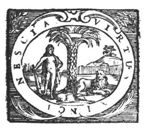
Virtus vinci nescia: Printer's device 0568
Cresco sub pondere pressa: Printer's device 0343
Victrix patientia duri: Rollenhagen, Nucleus emblematum (Arnhem, 1618), Cent. I, emblem 28
Obdurandum adversus urgentia: Alciatus, Emblemata (Leiden, 1591), emblem 36
Per damna, per caedes: Camerarius, Symbolorum et Emblematum Centuria(e) (Nürnberg, 1590, 1595, 1596, 1604), emblem 25 quotes the comment
Sed contra audentior ito: Oppelt, Sammlung geist-und sinnreicher Gedancken (Prague, 1749), emblem 35 quotes the comment
Tu ne cede malis: Neugebauer, Selectorum Symbolorum Heroicorum Centuria (Frankfurt, 1619), emblem 25 quotes the comment
Nitor in adversum: Peacham, Minerva Britanna (London, 1612), emblem 167 uses the imagery of the palm growing against the pressure of a stone
Nitor in adversum: Borja, Empresas morales (Bruxelles, 1680), emblem 10 uses the imagery of the sun to express the concept of opposing difficulties to become victorious
Gaudet patientia duris: Camerarius, Symbolorum et Emblematum Centuria(e) (Nürnberg, 1590, 1595, 1596, 1604), emblem 58 uses the image of the acanthus, pressed down by a basket and stone to express the concept of growth against adversity
Iconclass: 25G3(PALM-TREE)(+22) trees: palm-tree (+ branch, stick) 31A2245(+933) hand (+ holding something)
Loci Communes: Vincere et vinci (To conquer and to be conquered, Vaincre et être vaincu)
I iii 5 Relinque quippiam et Medis Leave something for the Medes too
Λειπέ τι καὶ Μήδοις. id est, Reliquum facito aliquid & Medis. Proverbialis iocus in eos qui ex convivio nihil reliqui faciunt, aut qui facultates universas abliguriunt. Plutarch. in Symposiacis: Ημῖν μὲν οὖν τοῖς βοιωτοῖς τὸ, λεῖπέ τι καὶ μήδοις, διὰ στόματός ἐστι. ἐξ οὗ μῆδοι τήν τε φωκίδα καὶ τὰ ἔσχατα τῆς βοιωτίας ἄγοντες καὶ φέροντες ἐπέτρεχον. id est, Nobis quidem Boeotis illud in ore est: Relinque quippiam & Medis: ex quo Medi & Phocidem ipsam & extremos Boeotiae terminos incursarunt, omnia vexantes miscentesque populationibus. Subiicit autem, quod etiam vulgo hodie dictitant: λεῖπέ τι καὶ ξένοις ἐπελθοῦσιν. id est, Relinquito quippiam & hospitibus adventuris. Adagium ad varios usus trahi potest, aut per ironiam, ut si dicas diviti, indignis & sumptuosis haeredibus suas opes destinanti relinquere, Relinque quippiam & Medis, hoc est, comparce tu quod dissipent ii qui tibi male volunt. aut immodice profuso, aut intemperantius garrulo, quemadmodum in Phormione Terentius: Parce sodes, ut possis cum illa.
Λειπέ τι καὶ Μήδοις, Leave a remnant for the Medes too, is a proverbial jest against people who leave nothing after a banquet, or who waste their whole substance. Plutarch in the 'Table-talk': 'This is a common saying among us Boeotians, "Leave something for the Medes," from the time when the Medes invaded Phocis and the farthest borders of Boeotia, harassing and distressing everything with devastation.' However he adds what is still currently said today: 'Leave something for the guests who are to come.' The proverb can be applied in various ways: ironically, as if one were to say to a rich man who proposed to leave his wealth to unworthy and wasteful heirs 'Leave something for the Medes too', meaning 'You save up, and your savings will be spent by those who bear you ill will'; or it may be said to a wildly extravagant person, or one who talks too much out of season, as in the Phormio of Terence: 'Stop, if you please, that you may have power with her.'
Facsimile:
Iconclass: 32B2(MEDES) historical peoples and nationalities (MEDES) 41C111 giving food 55C5 Sharing
Loci Communes: Profusio (Extravagance, Prodigalité)
I iii 6 Deorum manus Hands of the Gods
Θεῶν χεῖρες. id est, Deorum manus. Olim per ironiam, ut opinor, dicebantur efficacia illa pharmaca, quae plurimis ex rebus & è longinquo petitis conficiuntur: quibus hodie tum medici, tum Pharmacopolae vulgo faciunt imposturam. Plutarchus quarta Decade τῶν συμποσιακῶν, simul & proverbium refert, & Erasistratum citat, huiusmodi medicorum mixturas improbantem: Αλλὰ πολὺ μᾶλλον ὅτ᾽ ἄν μιγνύντες τὰς βασιλικὰς καὶ ἀλεξιφαρ μάκους ἐκείνας δυνάμεις, ἅς θεῶν χεῖρας ὠνόμαζον. ἐρασίστρατος δὲ ἐλέγχει τὴν ἀτοπίαν καὶ περιεργίαν, ὁμοῦ μεταλλικὰ, καὶ βοτανικὰ καὶ θηριακὰ, καὶ τὰ ἀπὸ γῆς, καὶ θαλάττης, εἰς τὸ αὐτὸ συγκεκραννύντας. καλὸν γὰρ ταῦτα ἐάσαντας ἐν πτισάνη, καὶ σικύᾳ, καὶ ὑδρελαίῳ τὴν ἰατρικὴν ἀπολιτεῖν. ἀλλὰ νὴ δία τὸ ποικίλον ἐξάγει καὶ γοητεύει τὴν ὄρεξιν. i. Quin multo magis cum regales illas et efficaces variorum remediorum mixturas conficiunt, quas deorum manus appellarunt. Erasistratus autem coarguit absurditatem & curiositatem eorum, qui simul & metallica & herbaria, & ferina, quaeque terra gignit, quaeque mare, in unum commiscuerunt. At bene haberet, si his omissis in ptisana & cucurbita, & hydrelaeo medendi artem finissent. Verum per Iovem ipsa rerum varietas imponit nobis, & appetentiam illicit. Hactenus Plutarch. Meminit huius adagii Galenus tractatu vi. citans ex Erophilo. Libet obiter & C. Plinii verba hoc loco subscribere, quibus medicorum mixturas taxat. Ea sunt in praefatione libri xxiiii. Hinc, inquit, nata medicina. Haec sola naturae placuerat esse remedia, parata vulgo, inventu facilia, ac sine impendio, ex quibus vivimus. Postea fraudes hominum, & ingeniorum capturae officinas invenere istas, in quibus sua cuique homini venalis promittitur vita. Statim compositiones & mixturae inexplicabiles decantantur. Arabia atque India in remedio aestimantur. Hulcerique parvo medicina à rubro mari imputatur, cum remedia vera quotidie pauperrimus quisque caenet. Nam si ex horto aut petatur herba, vel frutex quaeratur, nulla artium vilior fiet. Hactenus Plinius.
Θεῶν χεῖρες, Hands of the Gods. In old days they used to say (ironically, I suppose) that remedies were efficacious when they were made up from various ingredients brought from far away; just the things which doctors and apothecaries use today to trick the public. Plutarch in the 'Table-talk,' fourth decade, mentions the proverb, at the same time quoting from Erasistratus, who disapproved of such doctors' mixtures: 'But much more when they make the royal and effective mixtures which they used to call "the hands of the gods." Erasistratus exposes the absurdity and useless inquisitiveness of those who mixed into one potion mineral, vegetable and animal ingredients, mingling in one whatever earth or sea produced. But he would approve if omitting these things they had confined their art of healing to barley-water, cupping-glasses and oil-and-water cures. But dear me, how the mere variety of things imposes on us and stirs up longing!' Thus far Plutarch. Galen recalls this adage, in his sixth tractate, quoting from Erophilus. We may also add at this point in passing the words of Pliny, by which he censures the mixtures made by the doctors. They are in the preface to book 24: 'Hence sprang the art of medicine. Such things alone had Nature decreed should be our remedies, provided everywhere, easy to discover and costing nothing - the things in fact which support our life. Later on man's usual perfidy and the art of laying traps for human nature led to the invention of the quack laboratories, in which each customer is provided with a new lease of his own life at a price. At once compound prescriptions and mysterious mixtures are glibly repeated, Arabia and India are valued as the storehouse of remedies, and a small sore is charged with the cost of a medicine from the Red Sea, although the genuine remedies form the daily dinner of even the poorest. For if a plant were to be sought in the kitchen-garden, or a shrub were to be procured thence, none of the arts would become cheaper than medicine.' Thus far Pliny.
Facsimile: 
Iconclass: 12B13 representations ~ gods, demi-gods, heroes, etc. (non-Christian religions) 31A2245 hand 49G231 miraculous healing 49G232(+0) (healing by) imposition of hands (+ variant)
Loci Communes: Praeter spem bonum aut malum (Good or bad beyond expectation, Bien ou mal inattendu)
I iii 7 Quot homines, tot setentiae So many men, so many opinions
Nihil vel hodie vulgo tritius est quam haec Terentiana sententia: Quot homines, tot sententiae. Cui similis est apud eundem & illa: Suus cuique mos est. Persius item, Mille hominum species, & rerum discolor usus . Velle suum cuique est, nec voto vivitur uno. Eodem pertinet & illud epigrammaticum, quod dictum est, Inveniri qui non recusent agris paternis cedere: qui velit ingenio cedere, reperiri neminem. Horatius decentissimam addidit allegoriam, Tres mihi convivae propè dissentire videntur, Poscentes vario multum diversa palato. Idem primam omnium Odam huius argumento sententiae conscripsit, aliis studiis alios duci, aliis alia cordi esset. Allusit facetissime Terent. in Phorm. cum è tribus advocatis primus ait, secundus negat, tertius deliberandum censet. Huc allusisse videtur & divus Paulus apostolus, cum admonet, ut ad praecludendam aemulationem sinamus unumquenquam in suo sensu abundare. Cui consilio si theologorum vulgus auscultaret, non esset hodie tanta digladatio de nihili questiunculis: Sunt enim omnino quaedam quae citra pietatis dispendium ignorari possunt. Eam sententiam Euripides in Phoenissis latius explicuit: Εἰ πᾶσι ταὐτὸ καλὸν ἔφυ, σοφόν θ᾽ ἅμα, Οὐκ ἦν ἂν ἀμφίλεκτος ἀνθρώποις ἔρις. Νῦν δ᾽ οὔθ᾽ ὅμοιον οὐδὲν οὔτ᾽ ἴσον βροτοῖς Πλὴν ὀνομάσαι, τὸ δ᾽ ἔργον οὐκ ἔστι τόδε.. id est, Cunctis idem si pulchrum & egregium foret, Nulla esset anceps hominibus contentio. At nunc simile nil, nil idem mortalibus, Nisi verba forsan inter istos concinunt, Arte tamen factisque convenit nihil. Idem in Hippolyto coronato: Αλλοισιν ἄλλος θεῶν τε κ᾽ ἀνθρώπων μέλει. id est, Hic is, hic illis, & homo cordi est, & deus. Huc respexit Homerus in Odisseae ξ. Αλλος γὰρ ἄλλοισιν ἀνὴρ ἐπιτέρπεται ἔργοις. id est, Nanque aliis aliae res arridentque placentque.
Nothing is more widely known even today than this saying of Terence 'So many men, so many opinions,' and in the same author there is a similar phrase, 'every man has his own way.' Persius also: 'Men are of a thousand kinds, and diverse the colour of their lives; / Each has his own desires; no two offer the same prayer.' In the same class is that remark in an epigram that one may find people who are willing to yield in the matter of family acres, but not one who will give way on a matter of opinion. Horace adds an elegant metaphor: 'Three guests I have, of wishes quite contrary; / As their tastes differ, so their orders vary.' It was Horace, too, who devoted the first ode of all to the subject of this proverb, ie that different people are led by different interests, that some have one thing at heart and some another. Terence, in the Phormio, plays upon this in jest when he says of three advisers, 'the first says yes, the second says no, and the third says "Let's think about it."' St Paul the Apostle seems to have made a reference to this when he says that for the putting aside of strife, we should allow every man to have his own convictions. If the general run of theologians had listened to this advice, there would not now be such fierce contention about little questions of no moment at all; for there certainly are some things of which one may remain in ignorance without any lack of piety. The same thought is expressed at greater length by Euripides in the Phoenissae: If what were fair and wise were so to all Disputing strife would not exist for men, But now for mortals naught is 'like' nor 'same,' Only the words may happen to agree, In deed and fact no likeness can be found. Again in the Hippolytus Crowned: 'This man, this God, is after their own heart / To some, not so to others.' Homer thought of this in the Odyssey, book 14: 'For one man takes delight in certain things, / Another in others.'
Facsimile:
Iconclass: 51BB4 Multiformity, Variety 52C11 Opinion
Loci Communes: Alia aliis placent (Different things please different people, Chacun ses goûts)
I iii 8 Eum ausculta, cui quatuor sunt aures Listen to him who has four ears
Inter Graecanicorum proverbiorum collectanea refertur, ἄκουε τοῦ τὰ τέσσαρα ὦτα ἔχοντος. id est, Eum ausculta cui quatuor sunt aures. Huius adagionis, huiusmodie quoddam interpretamentum adfert Zenodotus: Oraculo quondam fuisse responsum Entimo Cretensi & Antiphemo Rhodiensi, ut eum observarent cui quatuor essent aures. Is autem erat praedo quidam Phoenix, quem cavendum esse monebat oraculum. Porrò quod quatuor aures habere dictus est, non satis liquet, veréne habuerit, an per allegoriam sit accipiendum, quod quatuor locis exploratores haberet dispositos. Verum illi, cum dei responsum tan quam ridiculum negligerent, in praedonem inciderunt, atque ab eo sunt extincti: Itaque ex hoc eventu vulgo natam esse paroemiam existimant. Sed mihi magis arridet, quod idem ex Aristophane grammatico refert, Lacedaemonios Apollinis simulacrum ita solere fingere, ut quatuor haberet aures, & manus totidem: vel quod, ut autor est Sosibius, hac figura visus sit illis apud Amyclas pugnantibus: vel significantes, ut equidem coniicio, viro prudenti res quamplurimas tum audiendas esse, tum usu vitae periclitandas. Porrò creditum est antiquitus, nulla oracula fuisse certiora quam Apollinis. Unde iactatum etiam illud: τὰ ἐκ τρίποδος. Atque ita monet proverbium, audiendos esse illos qui diuturno complurium rerum usu prae caeteris sapiunt, ita ut ferè faciunt senes. Unde & apud Homerum laudatur Nestoris oratio, tanquam omnium auditu dignissima: et in Odysseae secundo libro, Aegyptium heroa senem primo loco loquentem facit: Ος δὴ γὴραι κυφὸς ἔην, καὶ μυρία ἤδη. id est, Qui iam incurvus erat senio, sed plurima norat. Eodem spectavit Euripides in Phoenissis, ad quem locum allusit Lucian. in Hercule Gallico, id quod obiter admonendum putavi, propterea quod is dialogus inter multos alios à nobis Latinus est factus: & allusio nonnihil habet tenebrarum, sed carmen poetae referam: Ω τέκνον οὐχ ἅπαντα τῷ γήρᾳ κακὰ Ετεόκλεες πρόσεστιν, ἀλλ᾽ ἡ ᾽μπειρία Εχει τι λέξαι τῶν νεῶν σοφώτερον Verba sunt Iocastae iam anus ad Eteoclem adolescentem filium. Ea nos sic vertimus: O gnate Eteocles, cuncta nequaquam mala Adsunt senectae: nam per experientiam Usumque rerum dicere, haud nihil, rudi Potest iuventa melius, ac prudentius. Idem nunc vulgus nostratium effert, subsordida quidem, sed tamen apta metaphota, cum aiunt: Prospectandum vetulo latrante cane. hoc est: nequaquam negligendum quoties senes periculum cavendum admonent. Canes enim vetuli non latrant temere, quemadmodum iuvenculi.
This is found among the Greek collections of proverbs: "ἄκουε τοῦ τὰ τέσσαρα ὦτα ἔχοντος", Listen to him who has four ears. Zenodotus contributes an interpretation on these lines: a reply was given by an oracle to Entimus of Crete and Antiphemus of Rhodes, saying that they should watch the one who had four ears. He was in fact a robber named Phoenix, of whom the oracle was warning them to beware. But why he was said to have four ears is not easy to understand: whether he really had them, or the phrase is to be taken allegorically as meaning that he had spies posted in four places. However, as they regarded the god's reply as nonsense and paid no heed to it, they met with the robber and were destroyed by him; and it is thought that the proverb arose in popular speech from this event. But an explanation which appeals more to me is the one given by the same author out of Aristophanes the grammarian: that the Spartans used to make a figure of Apollo with four ears and as many hands, either because, as Sosibius says, Apollo was seen by them in this guise as they fought at Amyclae, or to indicate, as I for my part conjecture, that the wise man must hear as many things as possible, and test them out by the experience of life. It was certainly believed by the ancients that no oracle was to be trusted more than those of Apollo. Hence the current saying 'Straight from the tripod.' And the proverb is a warning that it is necessary to listen to those who are wiser than others because of their long and varied experience, as old men usually are. It is for this reason that the speech of Nestor is praised in Homer, as being worthy to be listened to by all, and in the Odyssey, book 2, the poet shows the grand old man Aegyptius being first to speak: 'Bent was he with his years, yet much he knew.' Euripides had the same idea in the Phoenissae, and this is the passage Lucian was referring to in Hercules Gallicus. I thought I should mention this in passing, because that dialogue is one of many which I translated into Latin, and the allusion is somewhat obscure. But I will give the poet's lines. These are the words of Jocasta, already old, to Eteocles, her young son. I have translated them as follows: My son Eteocles, not everything is evil Which old age has; for through experience, Knowing the world, it has some power to speak Better, more prudently than untaught youth. Our own common folk say the same thing, in less elegant terms perhaps, but with an apt metaphor, when they say 'an old dog's bark is worth listening to,' meaning it is best not to turn a deaf ear when old men issue a warning of danger. For old dogs do not bark without reason, as young ones do.
Facsimile: 
Iconclass: 31A32 hearing, listening (one of the five senses) 31A42(+413) human beings (legendary or not) of abnormal proportions, size, strength, etc. (+ ears) 33A341(+0) story teller; listening to story teller (+ variant) 49D11(4) numerals: 4
Collectanea (1500): 546
Loci Communes: Prudentia senilis (The prudence of old age, Prudence de la vieillesse)
I iii 9 Semper feliciter cadunt Iovis taxilli The dice always fall out well for Jove
Αεὶ γὰρ πίπτουσιν οἱ διὸς κύβοι id est, Semper cadunt feliciter tali Iovis. Senarius est proverbio celebratus, dicique solitus in eos, quibus res omnes perpetuo quodam fortunae favore, ex animi sententia cederent. Apparet translatum à talorum iactu, ubi fortassis antiquitus observatum est, Iovis talos feliciores esse. Nam mos erat iactibus alearum, ominis causa, deorum aut hominum nomina praefari. Unde & Veneris iactus inter felices numeratur, vel proverbio teste: Si saepe iacies, aliquando Venerem iacies. Nisi malumus ad Iovis victoriam, Iunonisque victae fabulam referre. Sunt qui putent quadrare in eos qui factis suis dignas poenas dependerint, quasi Iove non sinente culpam inultam. Mihi videtur non absurde dici posse & in viros fortunatos ac praepotentes, quorum etiam parum recte factis applauditur, attestante versu proverbiali: Ως εὐκόλως πίπτουσιν αἱ λαμπραὶ τύχαι. id est, Quàm facile semper res cadunt potentium. Ab hac sententia non abhorret illud Euripidis in tragoedia, cui titulus Phoenissae: Πάντα δ᾽ εὐπετῆ θεοῖς. id est, Sunt cuncta diis proclivia. Tum illud Homero frequens: Θεοὶ δέ τε πάντα δύνανται. id est, Coelestes omnia possunt.
Αεὶ γὰρ πίπτουσιν οἱ διὸς κύβοι, Always the dice fall happily for Jove. A line of poetry proverbially famous, and usually applied to people for whom everything always falls out as they wish, by some favouritism of fortune. Obviously it is taken from the throw of the dice, perhaps because it was observed in antiquity that Jove's dice were the luckier ones; the custom being for players to preface their throws by uttering the names of gods or men, to bring good luck. A throw dedicated to Venus was counted among the lucky ones, as the proverb shows, 'If you throw often, you'll sometime throw a Venus.' Or we may prefer to see in it a reference to the victory of Jove and the story of discomfited Juno. Some think this applies to people who are properly punished for their deeds, as if Jove would not suffer a fault to go unavenged. It seems to me that it would not be improper to apply it also to powerful and fortunate men, whose deeds are applauded even when they are not quite creditable; as the proverbial verse has it, 'Great men's concerns will always turn out well.' What is said by Euripides in the tragedy called the Phoenissae is not unlike this: 'All things are easy for the gods,' and what is often found in Homer: 'The gods can do all things.'
Facsimile:
Iconclass: 43C552 dice 51CC11 Positive Result, Good Result 54F12 Luck, Fortune, Lot; 'Fato', 'Fortuna', 'Fortuna aurea', 'Fortuna buona', 'Fortuna pacifica overo clemente', 'Sorte' (Ripa) 92B1 (story of) Jupiter (Zeus)
Collectanea (1500): 488
Loci Communes: Bonae fortunae, copiae, felicitatis aut ominis (Of good fortune, abundance, happiness, or omen, Bonne fortune, abondance, bonheur ou présage)
I iii 10 Thessalorum commentum A trick of the Thessalians
Θεσσαλών σόφισμα, id est, Thessalorum commentum, varias ad res accommodari scribit Suidas: tum ad eos, qui in acie locum deserunt: tum ad eos qui cultu delicatiore utuntur: tum ad hos qui dolis quempiam circumveniunt. Natum autem arbitrantur ex huiusmodi quapiam historia: Arato Thessalo cuidam oraculo responsum est, caveret ne clanculum vinceretur ab iis qui maiore splendidioreque voto oraculum adversus ipsum ambirent. Quod ille simulatque audivit, votum nuncupat, se centum hominum capita deo sacrificaturum. Deinde posteaquam ea, quorum gratis venerat, ex animi sententia confecisset, votum ac sacrum persolvere sine fi ne cunctabatur, tanquam neque pium satis, neque dignum Apolline. Qua quidem ex re natum aiunt, ut postea quotannis hecatomben ei deo polliceri sint soliti: neque reddere tamen quod essent polliciti. Thessalorum fraudulentiam notat & Euripides in Phoenissis: Καί πως νοήσας ἐτεοκλῆς τὸ θεσσαλῶν Εἰσήγαγε τὸ σόφισμ᾽ ὁμιλίᾳ χθονός. id est, At sentiens hoc Eteocles, mox Thessalam Adhibuit artem gentis ob commercium. Idem alibi: Πολλοὶ παρῆσαν, ἀλλ᾽ ἄπιστοι θετταλοί. id est, Multus quidem aderat, lubrica tamen fide, Grex Thessalorum. Idem declarat Demosthenes in Olynth. prima: Εἶτα τὰ τῶν θετταλῶν, ταῦτα γὰρ ἄπιστα μὲν ἦν δήπου φύσει καὶ ἀεὶ πᾶσιν ἀνθρώποις. id est, Accedunt, inquit, ad haec res Thessalorum, quae profecto cunctis quoque mortalibus natura, semperque infidae fuerunt. A quibusdam sic refertur hoc adagium: ἀεὶ γὰρ τὰ θεσσαλωνῶ ἄπιστα. id est, Semper enim res Thessalorum infidae. Aristophanis enarrator ab Iasone natum proverbium existimat, quod is Medeae promissam fidem solverit. quod quidem illa illi exprobrat apud Ovid. in Heroidum epistolis. Proverbii meminit & is qui fragmenta nobis Athenaei tradidit.
Θεσσαλών σόφισμα, A trick of the Thessalians. Suidas writes that this can be applied to various uses: to those who desert their place in the line of battle, to those who adopt a luxurious type of dress, to those who circumvent someone else by trickery. It is thought that the source of the proverb is a story of this kind. A certain Aratus, a Thessalian, had a reply from an oracle, to the effect that he should take care not to be privately defeated by people who were appealing to the oracle against him and bringing a more important and magnificent offering. As soon as he heard this, he pronounced a vow that he would sacrifice a hundred men's heads to the god. Later, when he had completed to his satisfaction the affairs for which he had come, he put off indefinitely the performance of his vow, under the pretext that it was not virtuous enough, and unworthy of Apollo. The result of this, they say, was that every year after this the people would customarily promise a hecatomb to this god, but the promise was never carried out.
Euripides in the Phoenissae remarks on the trickery of the Thessalians: 'Eteocles then played the Thessalian trick, / Learnt in his own experience of that land.' And elsewhere: 'Many were present indeed, but faithless are the Thessalians.' So Demosthenes asserts in the First Olynthiac: 'Added to this,' he says, 'are the affairs of the Thessalians, always mistrusted by all men by their very nature.' This proverb is quoted by some writers in this form: 'Thessalian ways are never to be trusted.' The commentator on Aristophanes thinks that the proverb came from Jason, because he broke his promise to Medea, and she upbraids him with this, in Ovid in his Heroides. There is also a mention of the proverb by the writer who handed down to us the fragments of Athenaeus.
Facsimile: 
Iconclass: 32B2(THESSALIANS) historical peoples and nationalities (THESSALIANS) 53DD2 Breach of Promise 57AA6131 Guile, Artfulness, Craftiness, Deceitfulness
Loci Communes: Inconstantiae, perfidiae, versutiae (Inconstancy, treachery, cunning, Inconstance, perfidie, ruse)
I iii 11 Thessalorum alae The wings of the Thessalians
Θεσσαλικαὶ πτέρυγες. id est. Alae Thessalicae. Proverbiali ioco quondam dicebatur in vestes manicatas, quas Graeci χειροδοτοὺς vocant: quod hoc genere per luxum ac delicias ute rentur Thessali. Apud Maronem hoc amictus genus, tamquam parum virile, Troianis ab hostibus opprobatur: Et tunicae manicas, & habent redimicula mitrae. Et apud Plautum quidam cultu Punico, velut avis exotica, ridetur propter manicas, aut angulos alarum instar, utrinque propendentes atque extantes.
Θεσσαλικαὶ πτέρυγες, The wings of the Thessalians. A jesting proverbial allusion that used to be made to the garments with sleeves (which the Greeks call cheirodotoi) because these were worn by Thessalians, luxurious and pleasure-loving as they were. In Virgil the Trojans are reproached by their enemies for wearing this type of garment, as not manly enough: 'Their tunics have sleeves, their bonnets strings to tie.' In Plautus someone in Carthaginian dress, like an exotic bird, is ridiculed for his sleeves, hanging and spreading out on both sides like pointed wings.
Facsimile:
Iconclass: 25F(+342) animals (+ wings of an animal) 32B2(THESSALIANS) historical peoples and nationalities (THESSALIANS) 41D22(CHEIRODOTOS)(+0) 41D224 sleeves
Loci Communes: Luxus et mollicies (Luxury and softness, Luxe et mollesse)
I iii 12 Thessala mulier A Thessalian woman
Θεσσαλικὴ γυνὴ. id est, Tessalica mulier. In veneficas, malarumque peritas artium dici solitum. Propterea quod ea gens praeter caeteras hoc nomine notata est, id quod ex Apuleiano asino pluribusque scriptoribus aliis satis liquet. Unde Horatius in Odis: Quae saga, quis te solvere Thessalis Magus venenis, quis poterit deus? Plautus in Amphit. veneficum appellat Thessalum. Et Strepsiades apud Aristoph. in Nub. consulit Socratem, an adhibenda sit Thessala incantatrix, quae lunam coelo detrahat, quo minus in Neomenia cogatur aes alienum reddere. Eam superstitionem in Thessalos à Medea profectam existimant: quae cum illac fugeret, per aerem vecta, scriniolum veneficiis ac magicis herbis plenum deiecerit, eaque sparsa suppullulasse. Quin & Plin. li xxx. ca. i. docet, magiam ad Thessalos usque propagatam, diu ab ea gente cognomen obtinuisse: adeo ut Menander quoque literarum subtilitatibus peritus, Thessalam cognominarit fabulam, complexam ambages foeminarum detrahentium lunam.
Θεσσαλικὴ γυνὴ, A Thessalian woman. This was said of poisoners, skilled in evil arts; because that race was notorious above all others for this reason, as appears clearly from the Ass of Apuleius and from many other writers. So Horace in the Odes: 'What witch can rescue thee, / What wizard with Thessalian charms, what god?' Plautus in the Amphitryo calls a poisoner'the Thessalian.' And Strepsiades, in Aristophanes' Clouds, consults Socrates as to whether a Thessalian witch should be employed to pull the moon out of the sky, so that he would not have to pay his debts at the time of the new moon. It is thought that this superstition about Thessalians comes from Medea, who when she fled that way carried through the air, dropped a little box full of poisons and magic herbs; they were scattered abroad and sprouted everywhere. Pliny, book 30 chapter 1, tells us that magic was widespread among the Thessalians and was long called by their name, to such an extent that 'Menander, experienced in literary refinements, called a play A Woman o f Thessaly which dealt with the tricks of the women who drag down the moon.'
Facsimile:
Iconclass: 31A4629 poisoning 31D15 adult woman 32B2(THESSALIANS) historical peoples and nationalities (THESSALIANS)
Loci Communes: Feminae (Women, Femmes); Veneficia (Poisonings, Empoisonnements)
I iii 13 In sinu gaudere To rejoice in one's own bosom
In sinu gaudere, est tacitam apud se voluptatem sentire, neque quod vulgo faciunt, foras proferre gaudii notas. Tibullus:> Qui sapit, in tacito gaudeat ille sinu. Propertius item: In tacito cohibe gaudia clausa sinu. Idem: Alter in alterius mutua flere sinu. De amantibus dictum, qui secretas animi curas invicem effundunt, quas aliis celant tamen. Cic. Tusc. quaest. lib. iii. Quoniam haec plausibilia non sunt, ut in sinu gaudeant, gloriose loqui desinant. Plin. Caecil. lib. ii. Epist. i. Quibus ex causis necesse tanquam immaturam mortem eius in sinu tuo defleam. Est aliquoties apud Senecam. Velut Epist. cvi. Si bona tua non iactaveris, si scieris in sinu gaudere. Atque ea quidem loquendi figura videtur ab Homero sumpta mutuo, qui in Odysseae xxii. lib. sic ait: Εν θυμῷ γρηῦ χαῖρε καὶ ἴσχεο. In tacito longaeva sinu preme gaudia nutrix. Perinde dictum est, in sinu, quasi dicas, in pectore tuo. non in labiis aut fronte: quibus partibus vulgus consuevit prodere quid in animi penetralibus occultat. M. Tullius in epist. quadam ad Q. fratrem, Mihi crede, in sinu est, neque ego discingor. His verbis promittit fidem silentii. Nam si quis discingatur, effluit quod sinui creditum est. Plutarch. in vita Catonis Uticensis, è sinu dixisse videtur, pro intima familiaritate: ὑπάτους πείσωνά τε καλπούρνιον, ὃς ἦν πατὴρ τῆς καίσαρος γυναικὸς, καὶ γαβίνιον παῦλον, ἐκ τῶν πομπηΐου κόλπων ἄνθρωπον, ὥς φασιν οἱ τὸν τρόπον αὐτοῦ καὶ βίον εἰδότες. id est, Pisonem Calfurnium, qui erat pater uxoris Caesaris, & Gabinium Paulum ex intimis Pompeii sinibus, ut aiunt, qui mores ac vitam hominis norunt. Scaevola lib. Pandect. xxii tit. De probationib. cap. xxvii. paulo diversius usurpat: Quod omnem, inquit, fortunam & substantiam, si quam à matre susceperat, in sinu meo habui sine ulla cautione. In sinu meo dixit, pro in potestate ac fide mea: quod enim alterius fidei committimus, in sinu deponere dicimur. Ita Terent. Hanc mihi in manum dat.
To rejoice in one's own bosom means to feel in oneself a silent joy, without doing as people commonly do, showing public signs of pleasure. Tibullus: 'Let the wise man keep his joy, / Hushed up within his bosom.' And Propertius too: 'Keep thy joy shut within thy silent bosom.' The same: 'To weep in one another's bosom'; this latter said of lovers,who pour out to each other the secrets of their hearts which they conceal from everyone else. Cicero in the Tusculan Questions, book 3: 'Then, as such things are not likely to win applause, let them keep their joy in their own hearts, let them cease to speak so boastfully.' Pliny the Younger, book 2 letter i: 'For these reasons I must pour my mourning into your bosom, as for his untimely death.' It is sometimes found in Seneca, as in letter 106: 'If you have not boasted of your good luck, but known how to keep your joy in your heart.' And indeed this figure of speech seems to be taken in turn from Homer, who says in the Odyssey, book 22: 'Rejoice in your bosom, old nurse, and be quiet.' 'In the bosom' means in your breast, not on the lips or on the brow, which are the features by which the common people usually betray what they are thinking in the depths of their soul. Cicero says in a letter to his brother Quintus: 'Believe me, he is my bosom friend, and I never ungird myself.' By these words he promises to keep silent, for he who ungirds himself lets go what has been entrusted to his bosom. Plutarch in the life of Cato of Utica seems to have used the term 'bosom' for intimate friendship: 'The consuls, Piso Calpurnius, who was the father of Caesar's wife, and Gabinius Paulus, a bosom friend of Pompey, as those people say who knew the character and life of the man.' Scaevola in the Pandects, book 22, title De probationibus, chapter 27, uses it in a somewhat different way: 'Because all the wealth and substance which he had inherited, if any, from his mother, I had in my bosom without security'; he says 'in my bosom' meaning 'in my power, committed in trust to me.' What we commit to the safe-keeping of another, we say we 'lay in his bosom.' So Terence: 'He gives her into my hand.'
Facsimile: 
Annotation: In zijn vuistje lachen
Iconclass: 31A(+912) the (nude) human figure; 'Corpo humano' (Ripa) (+ laughing, joy) 31B62359 being silent 52DD3 Taciturnity; 'Secretezza', 'Secretezza overo Taciturnità' (Ripa) 56B1 Pleasure, Enjoyment, Joy; 'Allegrezza', 'Allegrezza da le medaglie', 'Allegrezza, letitia e giubilo', 'Diletto', 'Piacere', 'Piacere honesto' (Ripa)
Collectanea (1500): 485
Loci Communes: Laudata (Praised things, Choses louées)
I iii 14 Feras non culpes, quod vitari non potest What can't be cured, must be endured
A. Gellius scribit, Publii Mimi sententias aliquot, ad communem sermonem accommodatissimas vulgo circumferri solitas, è quibus haec una est quovis philosophorum dogmate salubrior, Feras non culpes, quod vitari non potest. Quibus verbis admonemur, ut mala fatalia quae nulla ratione possint neque declinari, neque propelli, saltem animi aequitate leniantur. Nec aliud, tametsi verbis aliis, docet Euripides in Phoenissis, quum ait: δεῖ φέρειν τὰ τῶν θεῶν. id est,Toleranda fata numinum. Idem in eiusdem tragoediae calce: Τὰς γὰρ ἐκ θεῶν ἀνάγκας θνητὸν ὄντα δεῖ φέρειν Quippe mortalem necesse est ferre fata numinum. Homerus Odysseae lib. ix. Νοῦσόν γ᾽ οὔπως ἐστὶ διὸς μεγάλου ἀλέασθαι. id est:, Nulli vas vitare malum ex Iove rege profectum. Huc pertinet & illud scitum Varronis dictum: Uxoris vitium aut tollendum esse, aut ferendum. Item adagium quod suo dicemus loco: Μὴ πρὸς κέντρον λακτίζειν. id est, Ne con tra stimulum calcitres.
Aulus Gellius writes that certain sayings of Publius the moralist, which were couched in everyday language, were often bandied about in common speech. This is one of them, more wholesome than any dictum of the philosophers: 'What can't be cured must be endured.' These words warn us that destined evils, when they cannot by any means be avoided nor warded off, can at least be alleviated by resignation. The same thing, in different words, is taught by Euripides in the Phoenissae, when he says 'The will of the gods one must endure,' and again at the end of the same play, `What the gods will, mortals needs must endure.' Homer, Odyssey, book 9: 'A sickness sent from great Jove can never be avoided.' Varro's shrewd saying comes in here: 'The faults of a wife must be cured or endured,' and the proverb which I shall mention in its place, 'You shall not kick against the pricks.'
Facsimile:
Iconclass: 54A44 Patience; 'Patienza' (Ripa) 57A72 Tolerance, Long-suffering; 'Longanimità', 'Toleranza' (Ripa)
Loci Communes: Necessitas (Necessity, Nécessité)
I iii 15 Sursum versus sacrorum fluminum feruntur fontes The springs of the sacred rivers flow backwards
Proverbialis allegoria, qua quippiam praepostere fieri significamus, legitimasque rerum vices inverti: quod genus sit, si puer senem admoneat, discipulus praeceptorem do cere conetur, servus imperare domino. Sumptum est adagium ex Euripidis Medea: Ανω ποταμῶν ἱερῶν χωροῦσι παγαὶ, Καὶ δίκη, καὶ πάντα πάλιν στρέφεται. Ανδράσι μὲν δόλιαι βουλαὶ, θεῶν δὲ Οὐκ ἔτι πίστις ἄρηρε Quibus verbis chorus indicat, pristinum rerum ordinem inverti, viros iam dolis muliebribus uti, neque manere promissis: contrà mulieres audere virilia. Usurpat hanc paroemiam Lucianus in Terpsione, ubi haeredipeta delusus Plutonem incusat, quod ipse iuvenis adhuc morte praereptus esset, superstite sene quem captaverat, idque contra naturalem ordinem, ἄνω γὰρ ποταμῶν τοῦ τό γε, inquit. Rursus idem in Apologia libelli, περὶ τῶν ἐπὶ μισθῷ συνόντων: Πολλὴ γοῦν ἡ διαφωνία τοῦ νῦν βίου πρὸς τὸ σύγγραμμα, καὶ τὸ ἄνω τοῦ ποταμοῦ ωρεῖν, καὶ ἀνεστράφθαι τὰ πάντα, καὶ παλινῳδεῖν πρὸς τὸ χεῖρον τοῦτο ἄν εἴη. i. Longe, inquit, lateque a scriptis tua nun dissidet vita. Iamque illud quod aiunt, accideret, ut sursum versus incedant flumina, cunctaque pariter inverterentur, ac in deterius recantarentur. Usurpat & Diogenes Laertius in vita Diogenis Cynici, narrans quemadmodum Diogenes, ubi perinde quasi dominus esset, non servus, hero suo mandaret, ut quod erat iussus faceret: atque ille proverbio respondisset, ἄνω ποταμῶν ἱερῶν: Atqui si medicum, inquit, aegrotus esses aere tuo mercatus, utrum illi monenti pareres, an istum ad modum responderes ἄνω ποταμῶν; Usurpat & Aristot. in Meteorologicis. Eodem allusit Verg. in Aeneid. cum ait: Amnis & Adriacas retro fugit Aufidus undas. Ubi Servius admonet subesse proverbium de re neque verisimili, neque consistente. Flaccus in Odis sic extulit, Quis neget arduis Pronos relabi posse rivos Montibus, & Tiberim reverti: Cum tu coemptos undique nobiles, Libros Panaeti, Socraticam & domum, Mutare loricis Iberis Pollicitus meliora, tendis? Ubi proverbium annotavit Porphyrion. Item Ovidius in Heroidum epistolis: Cum Paris Oenone poterit spirare relicta, Ad fontem Xanthi versa recurret aqua. Xanthe retro propera, versaeque recurrite lymphae: Sustinet Oenonem deseruisse Paris. Item Propertius, Fluminaque ad caput incipiunt revocare liquores.
A proverbial allegory, which we use to signify that something is upside down, that the proper arrangement of things is reversed, as for instance if a boy should admonish an old man, or a pupil try to teach his teacher, or a servant give orders to his master. The adage comes from Euripides, Medea:
Upwards flow the streams of sacred rivers,
Overturned are justice and tradition,
The plans of men are treacherous
And trust in the gods no longer fixed.
In these words the chorus is pointing out that the original order of things is reversed: men are using women's wiles and not abiding by their promises, while women are daring to do manly deeds. Lucian in Terpsion makes use of this proverb when the deceived legacy-hunter reproaches Pluto because he himself has been carried off by death as a mere youth, while the old man whose money he had desired to inherit is still alive, against all the natural order of things. 'This is a case of Upwards flow the streams,' he says. Again in his Apology for the essay On Salaried Posts in Great Houses: 'At any rate there is a big difference between your present life and your writing; this would be, as they say, Upwards flow the streams and all things overturned, and a recantation towards what is worse.' Diogenes Laertius uses this in his life of Diogenes the Cynic: he tells how Diogenes sent a message to his master, as if he were the lord and not the servant, that he should do what he had been ordered to do, and the master replied with the proverb, 'Upwards flow the streams of the sacred rivers'; 'but if you were ill,' Diogenes said, 'and had hired the doctor with your own money, would you follow his prescription or reply in that way, "Upwards flow the streams?"' Aristotle makes use of it in his Meteorologica. Virgil has an allusion to it in the Aeneid, when he says: 'Back flows Aufidus river from Adriatic waves.' Servius remarks here that a proverb is lying concealed, suggesting unlikelihood or inconsistency. Horace expresses it thus in the Odes:
Who shall deny that streams ascend
And Tiber's currents backward bend,
While you have all our hopes betrayed;
You, that far other promise made,
When all your volumes, learned store!
The treasure of Socratic lore,
Once bought at mighty price in vain,
Are sent to purchase arms in Spain?
Porphyrion noted that this was a proverb. Ovid, too, in his Heroides:
If Paris' breath shall fail not, once Oenone he doth spurn,
The waters of the Xanthus to their fount shall backward turn.
O Xanthus, backward haste; waters, to your springs again,
Oenone has been deserted, and Paris feels no pain.
Propertius again, 'Rivers begin to recall their waters to their fount.'
Facsimile: 
Iconclass: 25H211 spring, source of river or stream 29A1 'mundus inversus', the reversed world, the topsy-turvy world, 'le monde bestourné'
Loci Communes: Impossibilia (Impossible things, Choses impossibles)
I iii 16 Ad felicem inflectere parietem To lean to the lucky side
Aristophanes in comoedia cui titulus, Ranae, bellissimum usurpat adagium, quod utinam in literis duntaxat extaret, non etiam in omnium prope mortalium vita, Ταῦτα μὲν πρὸς ἀνδρός ἐστι Νοῦν ἔχοντος καὶ φρένας, καὶ ΡΠολλὰ περιπλευκότος Μετακυλινδεῖν αὑτὸν αἰεὶ Πρὸς τὸν εὖ πράττοντα τοῖχον. id est: Nam viri est prudentis illud, Atque cordati, catique Multum aquae cui navigatum, ut Semper ad felicius se Cautus inflectat latus. Proverbium autem ita commodius effertur:πρὸς τὸν εὐπράττοντα τοῖχον ῥέπειν. id est, In felicem parietem vergere. Aristophanis interpres translatum existimat ab his qui navi vehuntur: qui si quando navis alterum latus fluctu deprimatur, protinus in alterum transcurrunt, quod altius extat ab undis. Dicetur & in hos qui commodi sui respectu semper ad potentiores ac fortunatiores amicos applicant sese: ac quemadmodum muscae ad culinae nidorem advolant revolantque ita fortunam potiorem in amicitia, non fidem sequuntur. Aut qui dum est anceps exitus belli, quietem agunt: porrò simul atque iam inclinarit fortuna, ac appareat utra pars sit victoriam reportatura, protinus ad eam adiunguntur. Hoc animo legitur fuisse Metius ille Vergilianus, & Polymnestor, qui victricia arma secutus magis quàm hospitii fidem, Polydorum obtruncat, & auro vi potitur. Huiusmodi genus hominum elegante notat idem Aristophanes in Pluto. Siquidem hic Chremylus iam dives factus, queritur sese obtundi huiusmodi salutatoribus qui aurum olfecerant, Βάλλ᾽ ἐς κόρακας, ὡς καλεπόν εἰσιν οἱ φίλοι Οἱ φαινόμενοι παραχρῆμα ὅτ᾽ ἄν πράττῃ τις εὖ. id est, Malam in crucem: ut res est molesta, ubi ilico Ad res secundas demum amici provolant. Eodem pertinet Euripideum illud ex Medea, Πένητα φεύγει πᾶς τις ἐκ ποδῶν φίλος. id est, Tenuem atque egenum cuncti amici deserunt. Antiphanes in Progonis, citante Athaeneo li. vi. Μή μοι πότ᾽ ἔλθῃς, ὅτ᾽ ἂν ἐγὼ πράττω κακῶς. id est: Ne tum mihi adsis, quando res cedunt male. Interpres proverbium subesse admonet, dici solitum in eos, qui tum amicorum consuetudinem deserunt, cum in periculis versantur. Caeterum poetam verbis in contrarium versis ad paroemiam allusisse, quae recte sic efferri consueverit: Μή μοι πότ᾽ ἔλθῃς, ὅτ᾽ ἂν ἐγὼ πράττω καλῶς. id est, Ne tum mihi adsis, quando res sunt prosperae. Ad hoc facit & illud apud Euripidem in Oreste: τοὺς φίλους Εν τοῖς κακοῖς χρὴ τοῖς φίλοισιν ὡφελεῖν. Οτ᾽ ἂν δ᾽ ὁ δαίμων εὖ διδῳ, τί χρὴ φίλων Αρκεῖ γὰρ αὐτὸς ὁ θεὸς ὠφελεῖν θέλων. id est, Iuvare amicos rebus afflictis decet. Quorsum opus amicis, cum benigna sors favet? Siquidem ipsa per se sufficit Rhamnusia, Volens secundis adivare favoribus. Idem poeta propius allusit ad adagium in eadem tragoedia, nisi quod catholicam sententiam ad praecones retulit: Τὸ γὰρ γένος τοῖόνδ᾽ ἐστ᾽ ἐπὶ τὸν εὐτυχῆ Πηδῶσ᾽ ἀεὶ κήρυκες. ὅδε δ᾽ αὐτοῖς φίλος, Ος ἂν δύνηται πόλεος ἔν τ᾽ ἀρχαῖσιν ᾖ.. id est, Nanque id genus sunt usque praecones, uti Feliciorum partibus se accommodent, Amentque demum hunc, qui sit inter principes, Reique qui temperat habenas publicae. Idem in Hercule furente: Καὶ τῶν καλῶν ὅς τις ἀπολαύειν θέλει, Συμπλεῖν δὲ τοῖς φίλοισιν δυστυχοῦσιν, οὔ. id est: Cui res secundae, huic naviganti quilibet Comes ire quaerit, non item infelicibus. Huc pertinet, quod Aristoteles libro Moralium Eudemiorum vii. proverbium dictum ostendit, χρόνον δεικνύναι τὸν φιλούμενον. id est, Tempus indicare quis vere amet. Tempestas enim arguit amicitiam, ac fucatos illos amicos detegit.
Aristophanes, in his comedy entitled the Frogs, quotes a splendid proverb; if only it were merely a matter of literature and not a feature of the life of almost every human being:
This is the mark of a man
Who has mind and wit and
Has often gone to sea,
He always rolls over, cautious man,
To the snug side of the ship.
The proverb may be expressed more succinctly as 'to incline towards the fortunate side.' The commentator on Aristophanes thinks it comes from voyagers by boat, who when the swell forces the ship down on one side immediately rush to the other, because it rises higher out of the waves. It may be applied to those who look after their own advantage by always attaching themselves to influential and wealthy friends; they are like flies, flitting to and fro round the smell of the kitchen, and what they look for in friendship is the solidest advantage, not loyalty. There are those who keep quiet while the outcome of a war is uncertain, but as soon as fortune has turned and it is clear which side is going to win, they join it at once. We read that Metius in Virgil was of this mind, and Polymnestor, who 'took the winning side' rather than keep the law of hospitality; he 'slew Polydorus and secured the gold / By force.' Aristophanes again, in the Plutus, aptly characterizes this sort of men. When Chremylus has become rich he complains of being deafened by the greetings of people who have smelt out his money: 'Hang you, be off! The nuisance these friends are, / Emerging suddenly when fortune smiles.' The phrase of Euripides in the Medea belongs here: 'Every friend shuns a man who's poor.' Antiphanes in the Progoni, cited by Athenaeus, book 6. 'Don't come near me, when things are going wrong.' The commentator remarks that there is a proverb lurking here, which is often applied to those who abandon the company of their friends as soon as they get into danger, but that the poet has inverted the sense and is alluding to the proverb usually expressed thus: 'Don't come near me, when things are going well.' Agreeing with this, there is the phrase of Euripides in the Orestes:
In desperate need ought friends to help their friends.
When Fortune gives her boons, what need of friends?
God's help suffices, when he wills to help.
The same poet came nearer to expressing the proverb in the same tragedy, except that he is applying a general dictum exclusively to heralds: Such is the herald tribe; lightly they skip
To Fortune's minions' side; their friend is he
Who in a state hath power and beareth rule.
Again in the Hercules furens: 'When things go well, a comrade for the voyage, / Offers himself, but not to the unlucky.' Here comes in, what Aristotle in the Ethica Eudemia, book 7, shows to be a proverb: 'Time shows who truly loves.' The passage of time proves friendship, and reveals those counterfeit friends.
Facsimile: 
Iconclass: 31A232 leaning figure 54F12 Luck, Fortune, Lot; 'Fato', 'Fortuna', 'Fortuna aurea', 'Fortuna buona', 'Fortuna pacifica overo clemente', 'Sorte' (Ripa)
Loci Communes: Amicitia (Friendship, Amitié)
I iii 17 Amico amicus A friend to his friend
Quod est apud Terent. in Phorm. Solus est homo amico amicus, Donatus indicat esse paroemiam, atque ita legi apud Apollodorum. cuius utique Phormio Graecae est: Μόνος ἐπίσταται φιλεῖν τοὺς φίλους. id est. Solus novit diligere amicos. Aristoph. apud Athenaeum, Αλλ᾽ οὐδὲν μέλει Τῶν σκωμμάτων μοι, τῶν φίλων γὰρ ὢν φίλος Εργοισι χρηστὸς, οὐ λόγοις ἔφυν μόνον. id est, At nil moror dicteria, Amico amicus cum siem, factis: neque Verbis modo prodesse propositum mihi, Sed re simul factisque. Ipsa figura proverbium prae se fert, quemadmodum initio demonstravimus. Quadrabit in eos qui nullum officium refugiunt, modo gratum faciant amicis. Huic affine videtur illud Euripidis in Medeai: Βαρεῖαν ἐχθροῖς καὶ φίλοισιν εὐμενῆ. id est: Benevolam amicis, rursus asperam hostibus. Theocritus in Aita: Αλλήλους δ᾽ ἐφίλησαν ἴσῳ ζυγῷ, ἦ ῤὰ πότ᾽ ἦσαν Χρύσειοι πάλαι ἄνδρες, ὅκ᾽ ἀντεφίλησ᾽ ὁ φιληθείς. id est: Par amor ambobus, mortales aurei olim Vivebant, tum cum redamabat amatus amantem. Aristoteles apud Laertium crebro solitus dicere, ὦ φίλοι, φίλος οὐδεὶς, significans veram amicitiam interisse inter mortales.
As Terence has it in the Phormio, 'a man is a friend only to his friend.' Donatus points out that this is a proverb, and can be found in Apollodorus, who wrote a Phormio in Greek: 'He alone knows how to love his friends.' Aristophanes, quoted by Athenaeus:
But nothing care I for the common jests:
My friend's friend am I, not in words alone,
I aim to serve him both in act and deed.
The metaphor itself is proverbial on the face of it, as I showed in the beginning. It will fit those who refuse no duty, as long as it is a service to their friends. This seems close to what Euripides says in the Medea:'Harsh to a foe and kindly to a friend.' Theocritus in Aita:
They loved each other with an equal yoke:
Truly the men of old were golden then,
The loved one loved the lover in return.
Aristotle is quoted by Laertius as saying habitually: 'My friends, I have no friend,' meaning that true friendship has perished among mortals.
I iii 18 Muneribus vel dii capiuntur Even the gods are won over by gifts
Quod scripsit Ovidius: Munera (crede mihi) capiunt hominesque deosque: Placatur donis luppiter ipse datis. Euripides in Medea, vulgi sermone fuisse celebratum ostendit, cum ait: Πείθειν δῶρα καὶ θεοὺς λόγος. Χρυσὸς δὲ κρείσσων μυρίων λόγων βροτοῖς. id est, Donis vel ipsos dictitant flecti deos. Certe inter homines, mille dictis luteum Praepollet aurum prorsus ac praeponderat. Celebratur & hic versiculus, quem etiam usurpavit Plato libro tertio Politiae, Δῶρα θεοὺς πείθει καὶ αἰδοίους βασιλῆας. Cum divis flectunt venerandos munera reges. Unde Seneca, philosophi cuiusdam apophthegma referens, ait: Omnium esse dulcissi mum accipere.
As Ovid wrote: 'Presents, believe me, buy both gods and men: / And Jove himself's appeased by offered gifts.' Euripides, in the Medea, shows that this was well-known in common speech, when he says:
There is a saying that gifts bend even gods;
Surely to mortal men the yellow gold
Has weight and power more than a hundred sayings.
This line of poetry is also celebrated, which Plato borrowed in his Republic, book 3: 'Gifts move the gods and venerable kings.' Hence Seneca, quoting a remark of some philosopher, says that of all things the sweetest is to receive.
Facsimile: 
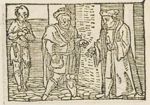
L'argent content faict playder Aduocatz: La Perrière, Le theatre des bons engins (Lyon, 1545), emblem 66 uses the imagery of lawyers accepting a bribe
Iconclass: 12B13 representations ~ gods, demi-gods, heroes, etc. (non-Christian religions) 33A4 bringing gifts; exchanging gifts 54C21 Persuasion; 'Persuasione' (Ripa)
Loci Communes: Munerum corruptela (Corruption by gifts, Corruption par les présents)
I iii 19 Manum de tabula Hands off the picture
M. Tullius in epistola quadam: Heus tu manum de tabula. Magister adest citius quam putaramus. Videtur autem hac proverbiali figura, manum de tabula, admonuisse ut desisteret à scribendis dicteriis. Allusum autem apparet ad Apellis nobilissimi pictoris dictum: qui cum Protogenis opus immensi laboris ac curae supra modum anxiae miraretur, ait omnia sibi cum illo paria esse, aut illi meliora, sed uno se praestare, quia manum ille de tabula nesciret tollere, memorabili praecepto, nocere saepe nimiam diligentiam. Haec Plin. lib. xxxv. cap. x. Proinde si quando admonebimus, ut recedat aliquis ab opere, negocióve, quod in manibus habet, iubebimus illum manum de tabula tollere. Peculiariter autem conveniet in quosdam scriptores plus satis accuratos, & morosae cuiusdam diligentiae, qui sine fine premunt suas lucubrationes, semper aliquid addentes, adimentes, immutantes, & hoc ipso maxime peccantes, quo nihil peccare conantur.
Cicero says in some letter or other: 'Hands off your picture! The master is here sooner than we expected.' He seems to have been warning by this proverbial metaphor that there should be an end of writing witticisms. The allusion is clearly to a saying of the famous artist Apelles. 'When he was admiring the work of Protogenes, with its immense taking of pains and over-anxious care, he said that he and Protogenes were equal in all they did, or indeed Protogenes' work was the better, but there was one thing in which he himself had the advantage: Protogenes did not know when to take his hand from the picture. By this memorable precept he meant that overdiligence often does harm.' So says Pliny, book 35 chapter io. And so, when we wish to warn someone to draw back from the work or piece of business he has in hand, we shall tell him to take his hand from the picture. This is particularly applicable to over-meticulous writers, of peevish industry, who are forever poring over their writings, always adding, subtracting, altering, and whose greatest fault is that they are trying to avoid all faults.
Facsimile:
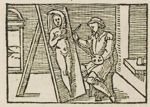
De n'estre trop en sçauoir curieux: La Perrière, Le theatre des bons engins (Lyon, 1545), emblem 15 uses the imagery of a painter who spoils his own work by being too fastidious to express that excessive curiosity is dangerous
Iconclass: 31A2245(+62) hand (+ backward) 48C514 picture, painting 51H421 Excess 54D3 Completion
Loci Communes: Metus poena (Fear as punishment, La peur comme châtiment)
I iii 20 Emere malo quam rogare I would rather buy than beg
M. Tullius in Verrinis actionibus adagii vice citat: Emere malo quam rogare. Quo significatum est, haudquaquam gratis accipi quod precibus emitur: imò nihil emi charius quam quod roganti datur. Durum enim illud verbum ingenuis animis Rogo, nec inter amicos unquam expectandum, autore Seneca. Translatum à veterum consuetudine, qua vicinus à vicino supellectilem commodato rogabat, quam ipse fortè domi non habebat. Hunc autem morem antiquitus fuisse ex Plauti tum Aulularia, tum Rudentibus licet cognoscere. L. Apuleius in Floridis, Neque enim levi mercede emit qui precatur: aut parvum precium accipit qui rogatur, adeo ut omnia utensilia emere potius velis quam rogare. Idem innuit, obscurius quidem, sed eleganter, Graecis celebratum proverbium, quod alio reddemus loco, ἐύχου τῷ πλησίον ἔχειν, ἐπὶ πλέον δὲ τῇ χύτρα. id est. Precare vicino ut habeat, magis autem ollae. Significat autem, optandum quidem, ut vicinum habeas locupletem, à quo queas utendum sumere, quod ipse domi non habes: verum multo satius esse, teipsum domi possidere, quicquid postulat vitae usus.
Cicero in the Verrines quotes as an adage, 'I would rather buy than beg.' The meaning is that something bought with entreaty is not freely received; indeed, nothing is bought more dearly than what is given to an asker. That word 'I beg' is a harsh one to honourable minds, nor should it ever be awaited between friends, as Seneca says. The saying is derived from the custom of the ancients, by which one neighbour would beg from another such furnishings as he himself did not happen to have in the house. We can tell that this custom existed in old days from the Aulularia and Rudens of Plautus. Apuleius in his Florida says: 'The man who asks is buying at a substantial rate; the man who is asked receives no inconsiderable price; so it is preferable for you to buy all you need rather than beg for it.' The same idea is conveyed with more obscurity but with elegance, by a proverb well known in Greek, which I shall give in another place: 'Pray for plenty for your neighbour, but still more for your pot,' signifying that it is a desirable thing to have a rich neighbour from whom one can borrow what one has not got of one's own, but it is much better to possess oneself in one's own house whatever is needful for daily life.
Facsimile:
Iconclass: 46A151 beggar 46B411 buying 55B Possession
Collectanea (1500): 403
Loci Communes: Elabendi - ex sese (Slipping away - from oneself, S'échapper - de soi-même)
I iii 21 Manum non veterim. Digitum non porrexerim I would not turn a hand. I would not raise a finger
Proverbialis hyperbole, Manum non verterim, pro eo quod est, nihil omnino laboro, aut, mea nihil refert. Nihil enim facilius, quam manum vertere. Extat praeter alios apud Apuleium in Apologia magiae: Quid de me, inquit, Mezentius sentiat, manum non verterim. Item Cicero lib. v. De finibus: Ne manum quidem versuros fuisse. Idem eius operis lib. iii. Chrysippus quidem & Diogenes detracta utilitate, ne digitum quidem eius causa porrigendum esse dicebant. quibus ego vehementer assentior. Agit illic de gloria sive bona fama, quae sit omnino contemnenda, si nihil adferat utilitatis, iuxta illud è Satyra, Gloria quantalibet, quid erit si gloria tantum est? De pollice verso diximus alibi. Quintilianus lib. xi. scribit, manuum gestus tantum habere momenti in pronunciatione, ut propemodum velut altera lingua pro omnibus verbis loquatur. Sed admirationi proprie convenit ille gestus, quo manus modice supinata, ac per singulos à minimo collecta digito, redeunte flexu simul explicatur atque convertitur. Interrogationi congruit ille, sum vertimus manum utcunque composita est. Quin & hodie manum erectam invertimus, quoties discrimen minimum significamus. In sermone quem modo citavimus ex Quntiliano, quod est Pro omnibus verbis, puto rectius legi, pro omnibus membris: ut intelligas, quicquid caeterarum corporis partium gestu significari potest, id solam praestare manum. Apud Plutarchum in vita Timoleontis quidam missus ad Andromachum, post multa inhumaniter ac barbarice dicta, manum denique porrexit, ac modo supinam, mox pronam ostendit, minitans hoc gestu se subversurum illorum civitatem. At Andromachus ridens, nisi quod manu similiter supinata, ac mox versa, iussit illum quàm primum abire, nisi vellet talem reddi navem ipsius.
A proverbial hyperbole, I would not turn a hand, meaning 'it does not trouble me,' 'it is no concern of mine.' For nothing is easier than to turn the hand. It is found, among other places, in Apuleius, Apology for Magic: 'As for what Mezentius thinks about me I would not turn a hand'; Cicero too, in De finibus, book 5: 'They would not raise a hand.' Again in book 3 of the same work: 'Chrysippus indeed and Diogenes said that apart from utility not a hand should be raised on that account, and I heartily agree with them.' He is there discussing glory or reputation, which is to be altogether disdained, if it brings nothing useful with it, as that remark of the Satirist says: 'Glory, as much as you like, what is it if nothing but glory?' Of the turning down of the thumb we have spoken elsewhere. Quintilian, book 11, writes that the movements of the hands are so important in delivery that 'it is almost another tongue speaking, instead of any words.' 'Wonder is best conveyed by the following gesture: the hand turns slightly upward and the fingers are brought in to the palm, one after the other, beginning with the little finger; the hand is then opened and turned over by a reversal of this motion. The gesture which expresses interrogation is a turn of the hand, however the fingers are arranged.' Today, we hold up the hand and turn it over to express the smallest difference. In the passage from Quintilian I have just quoted, I think it would be more correct to read not 'instead of any words' but'instead of any other members,' so as to indicate that the hand alone can convey whatever might be expressed by other parts of the body. In Plutarch's life of Timoleon a messenger sent to Andromachus, after making a long, cruel and barbarous speech, finally held out his hand, first palm upwards and then palm downwards, threatening by this gesture to overthrow their state. But Andromachus only laughed, and made the same gesture with his hand, ordering the man to be off at once, unless he wanted the same treatment to be given to his ship.
Facsimile:
Iconclass: 31A2552(+66) postures and gestures of the palm of the hand (+ circular) 31A255 postures and gestures of hand and fingers
Collectanea (1500): 401
Loci Communes: Contemptus et vilitatis (Contempt and worthlessness, Mépris et bassesse)
I iii 22 Semper Leontini iuxta pocula Always at their cups, the Leontini
Αεὶ λεόντιοι περὶ τοὺς κρατῆρας. id est, Semper Leontini iuxta crateres. In voluptarios quadrabit, aut in eos, qui semper iisdem studiis sunt addicti. Leontini Siciliae populi sunt, quos ubi Phalaris expugnasset, ne quando rebellionem pararent, ademptis armis ad compotationes & voluptates reiecit: atque hinc natum adagium quod refertur à Diogeniano.
Αεὶ λεόντιοι περὶ τοὺς κρατῆρας Always at their cups, the Leontini. This aptly describes the luxurious, or those who are always addicted to the same studies. The Leontini are a people of Sicily, whom Phalaris defeated, and to prevent them from starting a rebellion he took away their weapons and turned them over to drinking and pleasure; hence this adage, which is mentioned by Diogenianus.
Facsimile:
Iconclass: 32B2(LEONTINI) historical peoples and nationalities (LEONTINI) 41C322 mug, beaker, goblet 41C711 wine ~ alcoholic drinks
Collectanea (1500): 422
Loci Communes: Luxus et mollicies (Luxury and softness, Luxe et mollesse)
I iii 23 Cestreus ieiunat The grey mullet is fasting
Κεστρεὺς νηστεύει. id est, Cestreus ieiunat. De famelicis & voracibus dici convenit. Unde & qui fame oscitant, κεστρεῖς dicuntur, & κεστρεύειν quod convicium olim in Athenienses iactum tradit Hesychius. Alii malunt referre ad eos qui vitam innocuam agunt, & ab aliorum iniuriis abstinent, nec ullum emolumentum ex sua innocentia ferunt. Est enim cestreus piscis genus quoddam, quod reliquis mutua devoratione victitantibus unum ab aliorum carnibus abstinet, ideoque non capitur esca, sed in limum abdit sese, atque ibi perdurat: & ut arbitrantur nonnulli, limo pascitur. Quin captus etiam non alitur escis, aut ullo animante, cum sit acutis dentibus. Quin ipse impune devoratur à lupo, atque ob id quia non sit edax, parum est esculentus. In metu vero caput occultat, arbitrans totum corpus iam esse tutum. Unde & Aristophanes apud Athenaeum: Αρ᾽ ἐνδον ἀνδρῶν κεστρέων ἀποικία; id est, Num intus virorum Cestreum colonia? Alludit ad Cestrinam Chaoniae partem. Et apud eundem Diphilus: Κεστρεὺς ἂν εἴην ἕνεκα νηστείας ἄκρας. id est, Cestreus futurus ob inediam gravissimam. Rursum libro septimo refert ex Anaxandride: Τὰ πολλὰ ἄδειπνος περιπατεῖ, κεστρῖνός ἐστι νήσης. id est, In coenis obambulat ferè, ieiunus ille mugil. Refertur adagium à Zenodoto, Diogeniano, Suida, Athenaeo libro Dipnosophistarum septimo, qui quidem praeter alia complura & illud asscribit, piscem à nonnullis appellari ploten, & à congro devorari, ut congrum ipsum à murena. Theodorus Gaza mugilem vertit.
Κεστρεὺς νηστεύει, The grey mullet is fasting. This is appropriately said of people who are both starving and voracious. Those who gape with hunger are called kestreis, mullets, and there is a verb kestreuein which expresses an accusation formerly levelled at the Athenians, Hesychius tells us. Others prefer to apply the term to those who lead a harmless life, and refrain from injuring others, but never reap any reward from their blameless behaviour. The grey mullet is a kind of fish, which alone among all the rest who live by eating each other up, abstains from the flesh of others and is therefore not caught by the bait, but hides in the mud and there survives for a long time; some think it feeds on mud. Even when caught it is not nourished by food or any other creature, though it has sharp teeth. It is indeed easily devoured by the pike, but for the very reason that it is not voracious, it is not very tasty. When frightened it hides its head, thinking that thus its whole body will be safe. So Aristophanes says in Athenaeus: 'Is there a colony of Kestrians inside?' He is alluding to Cestrina, a part of Chaonia. Again Diphilus in the same author: 'I am going to be a grey mullet, with this starvation.' Again in book 7, he quotes out of Anaxandrides: 'He wanders about at feasts like a starving mullet.' The adage is mentioned by Zenodotus, Diogenianus, Suidas, Athenaeus in his Doctors at dinner, book 7; and this last, among other information, says that this fish is called by some the plotes, and is devoured by the conger-eel, as the eel is eaten by the lamprey. Theodorus Gaza translates it as 'mullet.'
Facsimile: 
Iconclass: 25F62(MULLET) bony fishes: mullet 41C1191 starvation, famine
I iii 24 Ubi amici, ibi opes Where there are friends, there is wealth
Plautus in Truc. Verum est verbum quod memoratur: ubi amici, ibidem opes. Citatur & à Fabio proverbii vice, lib. Orat. instit. v. Sensus est, potiores esse amicos quàm pecuniam, & ad vitae praesidium plus habere momenti amicos citra pecuniam, quàm absque amicis opes. Unde & apud Scythas, autore Luciano, is habebatur ditissimus, qui certissimos & optimos amicos possideret. Verum si quis ad huius seculi mores respiciat, adagium invertendum existimabit: ubi opes, ibi amici. Quandoquidem Vulgus amicitias utilitate probat. Et, Illud amicitiae quondam venerabile nomen Prostat, & in quaestu pro meretrice sedet.
Plautus in the Truculentus: 'True is the word often quoted, Where there are friends, there is wealth.' Quintilian also quotes it as a proverb in his Institutions book 5. The meaning is that friends are to be preferred to money, and it is more important as a protection in life to have friends without money than to have riches without friends. That is why among the Scythians (so says Lucian) that man was deemed the richest who had the best and most loyal friends. However, if anyone were to look at the ways of the world today, he would think the adage should be reversed: Where there is wealth, there are friends, seeing that'The crowd assesses friendship by its use,' and 'Friendship, that venerable name of old, / Has now turned harlot and is bought and sold.'
Facsimile:
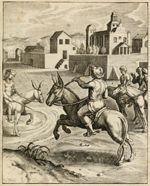
Vulgus amicitias utilitate probat: Moralia Horatiana (Amsterdam, 1656), emblem 25 quotes the comment
Iconclass: 55B1 Wealth, Opulence; 'Opulenza', 'Richezza' (Ripa) 56F23 Friendship; 'Amicitia' (Ripa)
Collectanea (1500): 176
Loci Communes: Amicitia (Friendship, Amitié)
I iii 25 Terra volat The earth flies
Η γῆ ἵπταται. id est, Terra volat. De re vehementer absona, quaeque nullo pacto fieri queat. Suidas hoc adfert exemplum τοῦ ἀδυνάτου. Iulianus in epistola quadam proverbii nomine refert mutato verbo, κούφη ἡ γῆ, καθάπερ ὁ λόγος. id est, Levis terra, quemadmodum dicitur. Adagium hoc ad illorum affinitatem pertinet, quae retulimus alibi, ζεὺς ἄπαις, id est, Iuppiter orbus. Et, Nil intra est oleam, nil extra est in nuce duri.
Η γῆ ἵπταται, The earth flies. This describes a totally incongruous thing, which cannot possibly occur. Suidas gives it as an example of the 'impossible [adynaton]. Julian, in some letter or other, mentions it under the heading of a proverb, with one word changed: 'The earth is light, as the saying goes.' This adage is of the type I have mentioned elsewhere, 'a childless Jupiter' and'Olive no kernel hath nor nut no shell.'
Facsimile:
Iconclass: 25 earth, world as celestial body 46C3(+0) airborne traffic, aviation (+ variant) 52BB42 Impossibility
Loci Communes: Impossibilia (Impossible things, Choses impossibles)
I iii 26 Ilias malorum An Iliad of troubles
Ιλιὰς κακῶν. id est, Ilias malorum. De calamitatibus maximis simul & plurimis. Propterea quod in Iliade Homerica nullum mali genus non recensetur. Unde ex hac docti putant tragoediarum argumenta fuisse sumpta, sicut ex Odyssea comoediarum. Est autem opus verbosum, vigintiquatuor voluminibus vix absolutum. Unde & quamvis orationem plus satis prolixam, Iliade longiorem vocant, ut Aeschines adversus Demosthenem, ταῦτα δὲ εἰπὼν δίδωσιν ἀναγνῶσαι ψηφισμα τῷ γραμματεῖ, μακρότερον μὲν τῆς ἰλιάδος, κενώτερον δὲ τῶν λώγων οὓς εἴωθε λέγειν. id est, His dictis decretum scribae legendum tradit, prolixius quidem Iliade, vanius autem verbis iis, quae dicere consuevit. Eustathius invertit adagionem ad hunc modum, καὶ παροιμία μέν τοι κακῶν ἰλιάδα φησὶ, αὕτη δὲ καλοῦ παντὸς. id est, Iliadem malorum proverbium ait, at haec omnium bonorum Ilias. Synesius in epistola quadam ad fratrem: καὶ ὅλως κακῶν ἂν ἰλιὰς περιέστη τὴν πόλιν ἡμῶν. i. In summa malorum Ilias circumstetit urbem nostram. Plutarch. in praeceptis coniugalibus, ὁδὲ ἐκείνων ἰλιάδα κακῶν ἕλλησι καὶ βαρβάροις ἐποίησεν. id est, At illorum nuptiae Iliada malorum Graecis ac Barbaris invexerunt. Loquitur enim de coniugio Paridis & Helenae, quod inaestimabilium malorum fuit causa. Utitur & M. Tullius in epistolis ad Atticum. Tanta malorum impendet Ilias.
Ιλιὰς κακῶν, An Iliad of troubles. This means the simultaneous occurrence of the greatest catastrophes, because in Homer's Iliad every kind of disaster is recounted. For this reason scholars think that the writers of tragedy drew their plots from this, as the writers of comedy did from the Odyssey. It is a lengthy work, hardly finished in 24 books. So a speech which is too prolix is called `longer than the Iliad,' as Aeschines against Demosthenes: 'And saying this, he gave the decree to the scribe to read, longer than the Iliad and more meaningless than the words he was accustomed to speak.' Eustathius turns it round like this: 'The proverb speaks of an Iliad of evils, but this is an Iliad of all good things.' Synesius in a letter to his brother: 'In short, an Iliad of evils surrounded our city.' Plutarch in 'Advice to Bride and Groom': 'But the marriage of these made an Iliad of evils for Greeks and barbarians.' He is speaking of the marriage of Paris and Helen, which was the cause of countless misfortunes. Cicero uses it in his Letters to Atticus: 'Such an Iliad of troubles is impending.'
Facsimile: 
Iconclass: 94F the tenth year of the Trojan war (part I); the wrath of Achilles: from the quarrel about Briseis to the death of Patroclus 94G the tenth year of the Trojan war (part II): Achilles back to war; his last deeds and his death 54FF11 Adversity, Misfortune, Bad Luck; 'Fortuna infelice', 'Infortunio' (Ripa)
Collectanea (1500): 193
Loci Communes: Bonae fortunae, copiae, felicitatis aut ominis (Of good fortune, abundance, happiness, or omen, Bonne fortune, abondance, bonheur ou présage); Infortunii sive exitii (Misfortune or ruin, Malheur ou ruine)
I iii 27 Lerna malorum A Lerna of troubles
Λέρνη κακῶν. id est, Lerna malorum, de malis item plurimis simul in unum congestis & accumulatis. Paroemiam Strabo commemorat, lib. Geographiae viii. scribens, Lernam lacum fuisse quempiam, Argivorum ac Mycenaeorum agro communem, in quem cum passim ab omnibus purgamenta deportarentur, vulgo natum proverbium, λέρνη κακῶν. id est, Lerna malorum. In hoc lacu poetae fingunt hydram illam septem capitum constitisse, quam Hercules igni Graeco confecerit. Eam autem hydram Hesiodus scribit, ex Echidna et Typhaone prognatam, alitam à Iunone: nimirum in odium Herculis. Zenodotus ait, locum quempiam fuisse in Argolica, in quem cum omne sordium genus promiscue coniicerent, foetidas inde ac pestilentes nebulas solitas exhalari. Quamquam rectius autumat, ut adagium ad Danaidum fabulam referatur. Nam ferunt Danaum quinquaginta iuvenes, Aegypti filios, quibus totidem filias suas collocarat, omnes eadem nocte trucidasse, atque horum capita in eum locum fuisse congesta. Hinc ortum esse proverbium. Neque vero negat fieri potuisse, ut contumeliae causa in eundem locum in quo capita composuerat, iusserit & purgamenta comportari. Itaque quoties hominem significamus vehementer infamem, atque omni turpitudinis genere contaminatum, aut coetum hominum pestilentium, quasique sentinam & colluviem facinorosorum, recte dicemus λέρνη κακῶν. id est, Lernam malorum. Apud Hesychium Cratinus comicus theatrum quod ex varia mixtaque homium colluvie constaret, λέρνη θεατῶν appellavit.
Λέρνη κακῶν, A Lerna of troubles. Used of an accumulation of many ills all piled up on one another. Strabo mentions this proverb in his Geography, book 8, where he writes that Lerna was a lake, joining the lands of the Argives and Mycenaeans, into which all the refuse from everywhere was pitched. Hence the common proverb, 'a Lerna of evils.' The poets claim that in this lake dwelt the famous seven-headed hydra, which Hercules destroyed with Greek fire. This hydra, as Hesiod writes, was the offspring of Echidna and Typhaon, and nourished by Juno, doubtless in hatred of Hercules. Zenodotus says that Lerna was a certain place in the Argolid into which every kind of filth was promiscuously thrown, and from which fetid and poisonous vapours used to rise. However he affirms that the proverb is more likely to refer to the story of the Danaids. It is said that Danaus had given his fifty daughters in marriage to fifty young men, the sons of Aegyptus, whom he slaughtered all in one night; and their heads were piled up in that place, hence the proverb. It is not unlikely, he thinks, that out of contempt Danaus would have ordered refuse to be carried to the spot where he had collected the heads together. Thus, when we signify a totally infamous man, stained with all kinds of baseness, or a pestilential gang of men, the dregs and offscourings of the criminal classes, we shall be right in saying 'a Lerna of evils.' In Hesychius the comedy-writer Cratinus calls the theatre a Lerna of spectators, because it consists of the mixed and various offscourings of humanity.
Facsimile:
Lerna malorum: De Bry, Proscenium Vitae Humanae (Frankfurt, 1627), emblem
Iconclass: 54AA5 Badness 54FF11 Adversity, Misfortune, Bad Luck; 'Fortuna infelice', 'Infortunio' (Ripa) 92I74913 Hydra of Lerna
Loci Communes: Infortunii sive exitii (Misfortune or ruin, Malheur ou ruine)
I iii 28 Mare malorum A sea of troubles
Κακῶν θάλασσα. id est, Mare malorum, dici solitum de calamitatibus immensis & omnigenis. inde sumptum quòd mare res quaedam est infinita, vel quòd infinitis erumnis abundant qui in eo versantur. Euripides in Hippolyto stephanophoro: Κακῶν δὲ ὁ τάλας πέλαγος εἰσορῶ, Τοσοῦτον, ὥς τε μή ποτ᾽ ἐκνεύσαι πάλιν. id est, Tantum malorum pelagus aspicio miser, Unde enatandi nulla spes alluceat. Plautus in Asinaria, meretricem & lenam mare vocat, tanquam omnium autores calamitatum. Mare, inquit, non est mare: vos estis mare acerrimum. Aeschylus in Supplicibus: Κακῶν δὲ πλῆθος πόταμος ὡς ἐπέρχεται, Ατῆς δ᾽ ἄβυσσον πέλαγος οὐ μάλ᾽ εὔπορον. id est, Agmen malorum fluminis ritu ingruit, Velutique pelagus altum, ita ut fundo vacet, Nec sine periclo navigetur maximo. Quin & sacrae literae vim inexhaustam rei cuiuspiam significantes, abyssum appellant. Itidem divus Chrysostomus περὶ τῆς ἱερωσύνης lib. vi. τὴν ἀβυσσον τῶν πόνων, Vide, inquit, laborum immensum pelagus.
Κακῶν θάλασσα, A sea of troubles. This is usually said of catastrophes which are boundless and manifold, because the sea is an infinite thing, or else because those who occupy themselves in it are subject to infinite hardships. Euripides says in the Hippolytus Crowned: 'Wretched I see a sea of evils, / So great that there's no hope of swimming out.' Plautus in the Asinaria gives the name of 'sea' to harlot and bawd, because they are the authors of so many ills: 'the sea,' he says, 'is no sea - it is you who are the bitterest of seas.' Aeschylus in the Suppliants:
A throng of evils bursts upon me like a river,
Or like a deep sea, unfathomable,
Not to be crossed without the greatest peril.
The Scriptures also, when they refer to the inexhaustible force of something, call it an 'abyss.' And St Chrysostom says in his De sacerdotio, book 6, 'Look, a great abyss of toil.'
Facsimile:
Iconclass: 25H2322 sea 54FF11 Adversity, Misfortune, Bad Luck; 'Fortuna infelice', 'Infortunio' (Ripa)
Loci Communes: Infortunii sive exitii (Misfortune or ruin, Malheur ou ruine)
I iii 29 Mare bonorum A sea of good things
Dicitur & diversam in partem, ἀγαθῶν θάλασσα. i. Bonorum mare, de magnis & vehementer cumulatis commoditatibus. Vel quod ipsum mare ministret innumerabiles oper rerum, puta piscium, gemmarumque: vel quòd amplissimum profundissimumque sit, adeo ut nec exhauriri possit, nec redundet unquam, cum tanta fluminum vis in ipsum influat.
The opposite is also said, ἀγαθῶν θάλασσα, A sea of good things, with reference to great and heaped-up benefits. This may be either because the sea itself yields innumerable riches in the way of fish and gems; or because of its tremendous width and depth, so great that it can never be exhausted, nor does it ever overflow, though such a mass of water flows into it from the rivers.
Facsimile:
Iconclass: 25H2322 sea 54F11 Welfare, Prosperity; 'Felicità publica', 'Prosperità della vita', 'Salute' (Ripa)
Collectanea (1500): 192
Loci Communes: Bonae fortunae, copiae, felicitatis aut ominis (Of good fortune, abundance, happiness, or omen, Bonne fortune, abondance, bonheur ou présage)
I iii 30 Thesaurus malorum A store of evils
θησαυρὸς κακῶν. id est, Malorum thesaurus. Ad eundem modum invenitur cum alibi, tum apud Euripidem in lone: Οἴ μοι, μέγας θησαυρὸς ὡς ἀνοίγνυται κακῶν.. id est, Me miseram ut ingens panditur thesaurus, ac Penus malorum. Extat inter Graecanicas sententias huiusmodi senarius: Θησαυρὸς ἐστὶ τῶν κακῶν κακὴ γυνή. id est, Thesaurus est mulier malorum, si mala est. Usurpavit adagium Plaut. in Merc. Tu quidem thesaurum huc apportasti mali. Unde est et illud crebrius in arcanis literis: Thesaurizat sibi malum, id est, colligunt, accersunt, quasique reponunt. Siquidem thesaurum proprie vocamus, rerum utilium vim pariter reconditarum.
θησαυρὸς κακῶν, A store of evils. Something in the same style is found in other places, for instance in Euripides, Ion: 'Alas, how great a store of evils opens.' Among the Greek maxims there is this line: `A wife's a store of ills if she be bad.' Plautus uses this adage in the Mercator: 'You have indeed brought me a store of ill.' Hence that saying so frequent in Holy Scripture, 'They treasure up evil for themselves,' that is, they collect it, seek it out, hoard it up. But what we really mean by treasure is a mass of useful things similarly stored away.
Facsimile:
Iconclass: 46A1632 money-chest, treasure-chest, money-box 54FF11 Adversity, Misfortune, Bad Luck; 'Fortuna infelice', 'Infortunio' (Ripa)
Loci Communes: Infortunii sive exitii (Misfortune or ruin, Malheur ou ruine)
I iii 31 Acervus bonorum A heap of good things
Αγαθῶν σωρὸς. id est, Bonorum acervus. De opibus ingentibus. Unde & frequenter extructas dapes, exstructas opes, & cumulatas opes pro copiosis legimus, tanquam acervatim congestas, neque pondere, neque numero, sed ipso cumulo infusas. Aristophanes in Pluto: Ημῖν γὰρ ἀγαθῶν σωρὸς εἰς τὴν οἰκίαν Επεισπέπαικεν, οὐδὲν ἠδικηκόσιν. id est, Nobis bonorum acervus influit in domum Sine fraude, nemini patrata iniuria. Idem in eadem fabula, Ως ἀγαθὰ συλλήβδην ἅπαντά σοι φέρω. id est, Ut agminatim cuncta tibi fero bona. Rursum in eadem fabula per iocum in malam partem flexit, Δηλοῖς γὰρ αὐτὸν σωρὸν ἥκειν χρημάτων ἔχοντα. id est, Venisse narras, quiferat pecuniarum acervum. Verba chori senilis, cui Carion servus iocans ita respondet: Πρεσβυτικῶν μὲν οὖν κακῶν ἔγωγ᾽ ἔχοντα σωρόν. id est, Imò senilium ferat qui ad vos malorum acervum. Allusit autem ad senectutem illorum iam capulo vicinam. Nam σορὸς per ο μικρὸν tumulum significat sepulchralem, σορὸς per ω μέγα cumulum atque acervum. Proinde consen-—λβ taneum est, servum eius vocis syllabam data opera perperam pronuntiasse. Haec atque id genus alia tum fiunt venustiora, quemadmodum iam saepius admonuimus, si paulo longius à simplici sensu detorqueantur. Veluti, si quis dicat, in aliis oratoribus alias atque alias eminere dicendi virtutes, in M. Tullio uno τῶν πάντων ἀγαθῶν σωρὸν εἶναι, id est, Omnium bonorum acervum esse. Resipiunt huius adagii naturam illa Ciceroni familiaria, cumulare officiis, cumulatissime satisfacere, cumulus meritorum.
Αγαθῶν σωρὸς, A heap of good things - referring to immense wealth. Hence we often read of feasts or riches as 'heaped-up,' wealth as 'amassed,' as a term for abundance, as if those things had been thrown together pell-mell, poured out by mass, not by weight or counting. Aristophanes in the Plutus: 'For us a heap of goods has flowed / Into our house, though we've done nothing wrong.' Again in the same play: 'As I bring all good things to you in crowds.' Again, in the same play, he turns it jokingly to a bad meaning: 'You say one came bearing a pile [soron] of money,' the words of the chorus of old men, to which the slave Carion replies jokingly: 'Nay, rather bearing to you a pile of old men's ills.' He is alluding to the old age of those people with 'One foot in the grave.' For the word soros with a short o [omicron] means 'burial mound,' and soros with a long o [omega] means heap and mass. The slave naturally takes care to pronounce the vowel wrong. These, and other phrases of the same kind, will be improved, as I have often pointed out, if they are twisted a little from their original meaning. One might say that other orators excel in this or that quality, but Cicero is 'alone the accumulation of all good qualities.' Those phrases which come often to Cicero have the flavour of this adage, 'to load with kindness,' 'to give massive satisfaction,' 'a heap of services rendered.'
Facsimile: 
Iconclass: 47C22 heaping up (industrial process) 54F11 Welfare, Prosperity; 'Felicità publica', 'Prosperità della vita', 'Salute' (Ripa)
Loci Communes: Bonae fortunae, copiae, felicitatis aut ominis (Of good fortune, abundance, happiness, or omen, Bonne fortune, abondance, bonheur ou présage)
I iii 32 Bonorum myrmecia An ant-hill of good things
Αγαθῶν μυρμηκία. id est, Bonorum myrmecia, de immensis opibus. Nam Myrmecia Graece significat cavernam, aut agmen formicarum. Quanquam ab illis formicis sumptum videri potest, de quibus meminit Plin. lib. xx. cap. xxxi. quas ait esse colore felium, magnitudine luporum Aegypti. Eas in septentrionali Indorum, qui Dardae vocentur, regione aurum è cavernis egerere. Erutum hyberno tempore, Indi furantur aestivo fervore, conditis propter vaporem intra cuniculos formicis: quae tamen odore sollicitatae provolant, neque raro lacerant, quamvis praevelocibus camelis fugientes. Atque huc videtur respecisse divus Basilius, cum scribit ad nepotes, quicquid ultra necessitatem usus superesset, sive id esset Lydia gleba, sive formicarum auriferarum opus, hoc magis esse contemnendum, quo minus esset eo opus. Quanquam nihil prohibet, quo minus ad nostras formicas referatur, non solum propter innumerabilem agminum multitudinem, verumetiam propter genuinam quandam animantis in accumulando penore industriam, ore trahentis quodcumque potest, atque addentis acervo, quemadmodum scripsit Flaccus. Qua quidem ex re factum opinor, ut antiquitus formicarum coetus opulentiam portenderit. Quemadmodum testatur Cicero lib. De divinat. i. Midae, inquiens, illi Phrygio cum puer esset, dormienti formicae in os tritici grana congesserunt. Ditissimum fore praedictum est, Quod evenit. Huc allusit Theocritus in Encomio Ptolemaei, Μυρμάκων ἅ τε πλοῦτος ἀεὶ κέχυται μογεόντων. id est, Nec secus, ac formicarum semper properantum Divitiae sunt exstructae. Idem in Syracusanis, Μύρμακες ἀνήριθμοι καὶ ἄμετροι. id est, Formicae numeroque modoque carentes. turbam hominum frequentem significans. Huic affine generi est quod Plato lib. De republica. ix. τὸ τῶν ἠδονῶν σμῆνος dixit, id est, voluptatum examen: & Socrates apud Plutarchum Cheronensem, ἀρετῶν σμῆνος id est, virtutum examen, pro turba numeroque immenso. Porrò locus quem adducit Plutarchus, est in Menone Platonis. Confine est his quod idem adducit in Cratylo, σμῆνος σοφίας, id est, examen eruditionis. Item quod apud Athenaeum lib. viii. Alexis scripsit in Pamphila, Παρέθηκα τὴν τράπεζαν, εἶτα παραφέρων Αγαθῶν ἁμάξας. id est, Apposita mensa est, plaustra deinceps intulit Bonorum.
Αγαθῶν μυρμηκία, An ant-hill of good things. This describes uncounted wealth. Myrmecia, the word used, is the Greek for an ant-hill or column of ants; though this may be derived from those ants mentioned by Pliny, book 11 chapter 31, which he says are the colour of cats and the size of wolves in Egypt. 'These ants dig gold out of caves in the northern territory of the Indians, who are called Dardae. It is dug out in winter, and in the warm summer the Indians pillage it, when the ants are hiding away in their holes because of the heat. But sometimes, attracted by smell, they fly out and often sting, even when the pilferers escape on the swiftest camels.' St Basil appears to have been thinking of this when he writes to his nephews that everything in excess of necessities should be despised, whether it were Lydian nuggets or the work of gold-digging ants; and the less needed, the more it should be despised. There is no reason, however, why he should not be referring to our own ants, not only because of the immense numbers of their marching columns but because of the natural industry of the creature in building up its store, bringing everything it can in the mouth to add it to the heap, as Horace wrote. It is due to this, I think, that in Antiquity an assemblage of ants presaged wealth. Cicero testifies to this in the On Divination, book 2: 'When Midas of Phrygia was a boy, ants collected grains of wheat in his mouth as he lay asleep. It was prophesied that he would be extremely rich; and this happened.' Theocritus in the Praise of Ptolemy: 'Just as the wealth of ever-toiling ants is piled up.' And in the Women of Syracuse: 'Ants unnumbered and unmeasured,' meaning a vast crowd of men. This is close to what Plato says in the Republic, book 9, about the 'swarm of pleasures' and Socrates in Plutarch of Chaeronea speaking of a'swarm of virtues,' a crowd or countless number. The passage quoted by Plutarch is in Plato s Meno. Similar to these is the phrase used by Plato in the Cratylus, 'a swarm of learning.' Also what Alexis wrote in his Pamphila, cited by Athenaeus, book 8: 'I brought the table in, and laid thereon / A wainload of good things.'
Facsimile: 
Iconclass: 25F711(ANT)(+4712) insects: ant (+ animals nesting; making nests, lodges, webs, etc.) 54F11 Welfare, Prosperity; 'Felicità publica', 'Prosperità della vita', 'Salute' (Ripa)
Loci Communes: Bonae fortunae, copiae, felicitatis aut ominis (Of good fortune, abundance, happiness, or omen, Bonne fortune, abondance, bonheur ou présage)
I iii 33 Dathos bonorum A Dathos of good things
Δάθος ἀγαθῶν. id est, Dathus bonorum: in eandem sententiam dici consuevit. Est autem Dathus Thassiorum colonia iuxta Strymonem, cum alioquin opulenta ac florens, tum quod habet etiam auri venas, ut hinc in proverbium abierit, Δάθος ἀγαθῶν. id est, Dathus bonorum, de conferta rerum opulentia. Proverbii praeter alios meminit Suidas, apud quem legimus δατὸς non δάθος.
Δάθος ἀγαθῶν, A Dathos of good things. It was customary to use this in the same sense. Dathos is a colony of the Thasians, near the Strymon; it was rich and flourishing in other ways as well as having veins of gold, so that the proverb grew up 'A Dathos of good things' to suggest collected wealth. Suidas mentions this, among others; in him we read Datos not Dathos.
Facsimile:
Iconclass: 44B04 colonial system 54F11 Welfare, Prosperity; 'Felicità publica', 'Prosperità della vita', 'Salute' (Ripa) 61D(DATHOS) geographical names of countries, regions, mountains, rivers, etc. (DATHOS) (DATHOS)
Collectanea (1500): 693
Loci Communes: Bonae fortunae, copiae, felicitatis aut ominis (Of good fortune, abundance, happiness, or omen, Bonne fortune, abondance, bonheur ou présage)
I iii 34 Thasos bonorum A Thasos of good things
Θάσσος ἀγαθῶν. id est, Thassus bonorum. Similiter natum adagium, nempe à loci fertilitate. Nam Thassus insula est iuxta Thraciam. Zenodotus huiusmodi quandam fabulam refert: Callistratus orator demigrans Athenis, persuadere conatus est Atheniensibus, ut regionem, quae ex adverso erat, incolerent, multa splendida de eius feracitate iactitans, & quod auri venas haberet, & quod glebam optimam. Denique in summa, inquit, Thassus bonorum est. hinc in vulgi sermonem abiisse, Θάσσος ἀγαθῶν, id est, Thassus bonorum, de iis qui splendida pollicentur.
Θάσσος ἀγαθῶν, A Thasos of good things. This proverb grew likewise out of the fertility of a place. Thasos is an island near Thrace. Zenodotus tells a story of this sort: Callistratus the orator, on his departure from Athens, tried to persuade the Athenians that they should inhabit the region opposite to them; he gave a splendid description of its fertility, and said it had veins of gold and the most fruitful soil. In a word, he said, it is a Thasos of good things; and this became a popular saying about people who make magnificent promises.
Facsimile:
Iconclass: 54F11 Welfare, Prosperity; 'Felicità publica', 'Prosperità della vita', 'Salute' (Ripa) 61D(THASOS) geographical names of countries, regions, mountains, rivers, etc. (THASOS) (THASOS)
Loci Communes: Bonae fortunae, copiae, felicitatis aut ominis (Of good fortune, abundance, happiness, or omen, Bonne fortune, abondance, bonheur ou présage)
I iii 35 Hostium munera, non munera Gifts of enemies are no gifts
Priscorum superstitio credidit, observanda vel maxime munera, à quibus, quo animo mitterentur: propterea quod quae darentur ab iis qui nobis male cuperent, exitio plerumque fuisse constaret: ita ut fuit pyxis illa fallax, per Pandoram à Iove Prometheo missa: quemadmodum fuit & vestis, qua Medea novam nuptam Iasonis donavit: rursum vestis illa quam Deianira misit Herculi. Proverbiorum interpretes existimant hanc paroemiam ex historia natam, quae refertur apud Homerum Iliados lib. vii. Narrat autem Hectorem & Aiacem inita amicitia, dona inter sese permutasse, atque Hectorem Aiaci donasse gladium, Aiacem Hectori dedisse baltheum: deinde pariter ambobus suum munus exitio fuisse. Siquidem Aiax victus ab Ulysse, cognitisque iis quae per insaniam tum dixerat, tum fecerat, eodem gladio sibi necem conscivit. Item Hector per occasionem balthei occisus est ab Achille iuxta muros Troianos. Adagium refertur apud Sophoclem in Aiace mastigophoro, sed ita refertur, ut non ab Aiace natum, sed tanquam vetus iam tum ab eo videatur usurpari. Siquidem is posteaquam mori decrevisset, execratur eum gladium quem quondam ab inimicissimo dono acceperat, eumque sibi fuisse inauspicatissimum ait, neque quicquam omnino postea feliciter apud Argivos successisse. Deinde suspicionem hanc vulgato dicto confirmans ait, Αλλ᾽ ἐστ᾽ ἀληθὴς ἡ βροτῶν παροιμία, Εχθρῶν ἄδωρα δῶρα, κοὐκ ὀνήσιμα. id est, Quin verum id est mortalium proverbium, Non esse dona, dona quae veniant tibi Ab hoste, verum inauspicata ac noxia Hac de re fertur epigramma Graecum huiusmodi, Εκτωρ ἄιαντι ξίφος ὤπασεν, ἕκτορι δ᾽ ἄιας Ζωστῆρ᾽ ἀμφοτέρων ἡ χάρις εἶς θάνατος. Aiaci datus ensis ab Hectore, baltheus Aiace Hectori: utrique suum donum erat exitio. Rursum ex alio quodam epigrammate, Οὕτως ἐξ ἐχθρῶν αὐτοκτόνα πέμπετο δῶρα, Εν χάριτος προφάσει μοῖραν ἔχοντα μόρου. id est, Atque ita ab hoste hosti veniunt letalia dona, Quae studii specie fata necemque ferunt. Huc spectat & illud quod apud Euripidem Medea recusans Iasonis xenia, tanquam perniciem allatura, Κακοῦ γὰρ ἀνδρὸς, inquit, δῶρ᾽ ὄνησιν οὐκ ἔχει. id est, Laedit, iuvat nil improbi munus viri. Servius ostendit & Vergilium huc allusisse, cum ait in Aeneid. lib. iiii. Ensemque recludit Dardantum, non hos quaesitum munus in usus. De gladio loquitur ab Aenea relicto, quo Dido sese confodit: quem Aeneam hostem, & impium eadem vocat. Huic ascribendum loco, quod arcanae scripturae proverbia admonent, ne de inimico reconciliato simus securi. Item proverbialis ille senarius, Λόγον παρ᾽ ἐχθροῦ μή ποτ᾽ ἡγήσῃ φίλον. id est, Ab hoste dicta ne unquam amica duxeris. Et alter huic similis, Εχθροῖς ἀπιστῶν μή ποτ᾽ ἡγησῃ φίλιον. id est, Diffisus hosti, nil feres unquam mali. Proverbium accommodari poterit etiam ad illos qui pauperes munusculis quibusdam captant divites, ad eum modum liberalitatem illorum velut elicientes. Neque enim hoc est dare munus, sed flagitare. Unde Plutarchus in commentariolo, περὶ ΕΙ τοῦ ἐν δελφοῖς, probat, quod Dicaearchus Archelao dictum ab Euripide putat, Οὐ βούλομαι πλουτοῦντια δωρεῖσθαι πένης Μή μ᾽ ἄφρονα κρίνῃς, ἢν διδοὺς, αἰτεῖν δοκῶ. id est, Donare pauper diviti velim nihil, Ne stultus habear scilicet, si muneris Titulo atque specie dona videar poscere. Quadrabit & in eos qui per artes magicas daemonum utuntur obsequiis. nam ea demum exeunt in perniciem utentium: & in haeredipetas: postremo qui quovis officio captant, non ex animo, sed aliud spectantes. Itaque mutatione voculae novabitur paroemia: nempe hoc pacto, Κολάκων ἄδωρα δῶρα, & πενήτων ἄδωρα δῶρα. denique ποιητων ἄδωρα δῶρα, quemadmodum admonuimus in operis initio.
The ancients held religiously to their belief that gifts were to be carefully examined, as to who had sent them and with what intention; since it is well known that anything given by those who wish us ill would usually be for our destruction. It was so with the deceiving box sent to Prometheus by Jove through Pandora; and with the garment which Medea gave to the new wife of Jason, and the garment Deianira sent to Hercules. The commentators on proverbs think that this proverb was derived from the story told by Homer in the seventh book of the Iliad. He tells how Hector and Ajax became friends and exchanged gifts: Hector gave Ajax a sword and Ajax gave Hector a belt. Afterwards each of them came to grief through the gift he had received. Ajax, in fact, after being defeated by Ulysses, and knowing what he had said and done in his madness, killed himself with that same sword. Likewise Hector was slain by Achilles before the walls of Troy, as a result of that same belt. The adage is mentioned in Sophocles in the Ajax Mastigophoros, but the reference suggests that it was not derived from Ajax but was already old when he used it. After his decision to kill himself, Ajax curses the sword which he had accepted as a gift from his bitterest enemy, and declares it was a most unlucky one for him and that thereafter nothing has gone right for the Argives. He confirms his suspicions by the well-known proverb:
How true it is, as says the world's old saw,
That gifts from foes are never gifts at all,
But luckless, bringing harm.
There is a Greek epigram about this: 'Hector gave Ajax a sword, Ajax gave Hector a belt; / To each his gift meant death.' Another epigram says; 'So pass the lethal gifts from foe to foe, / Kindness apparently, but bringing doom.' There is a hint of this in Euripides, when Medea refuses Jason's presents, saying they will cause her destruction: 'Harm and not good must come from gifts of an evil man.' Servius points out that Virgil referred to this in the Aeneid, book 4, when he says: 'She unsheathed the blade, / The Trojan's gift, not for these uses sought.' He is speaking of the sword left behind by Aeneas, with which Dido stabs herself, calling Aeneas wicked, and her enemy. We may add the warning among the proverbs in Holy Scripture, not to be too sure of the enemy after reconciliation. A proverbial line runs 'Never think friendly what is said by foe,' and another in the same vein: 'Distrust thy foe, and thou shalt not fare ill.' The proverb can be applied to those, poor themselves, who aim at the favour of the rich by little presents, thus hoping to induce them to be generous. This is not giving but begging. Hence Plutarch in his essay 'On the E at Delphi approves of what Dicaearchus thinks was said to Archelaus by Euripides:
I being poor do not wish to give a gift
To a rich man, lest I be thought a fool,
Or asking for a gift in return.
This will fit both those who gain the services of demons by magic arts, for these result in the destruction of the users, and seekers after inheritances, and those who try to please by doing a good turn, not for genuine reasons but with another end in view. And so the proverb may be given a new meaning by the alteration of a word: 'flatterers' gifts are no gifts,' 'poor men's gifts are no gifts,' and finally'poets' gifts are no gifts,' as I have shown at the beginning of this work.
Facsimile: 
Εχθρῶν ἄδωρα δῶρα: Alciatus, Emblemata (Leiden, 1591), emblem 167
Pandora et Prometheus: Boissard, Theatrum vitae humanae (Frankfurt, 1596), emblem 12
Εχθρῶν δῶρα ἄδωρα: Cats, Proteus (Rotterdam, 1627), emblem 83
Iconclass: 33A4 bringing gifts; exchanging gifts 33A410:33B5 ?❧enemy 33B5 enemy 91E652(+0) Pandora opens her box (or jar); Good or Evil escapes, Hope remains (+ variant) 94A72 Medea, through her children, sends Creusa wedding-gifts (a crown and a long robe) 94L681 Deianira sends Hercules a robe smeared with Nessus' blood 95A(AJAX THE GREAT)5 Ajax the Great - non-aggressive, friendly or neutral activities and relationships 95A(HECTOR)5 Hector - non-aggressive, friendly or neutral activities and relationships
Loci Communes: Diffidentia (Distrust, Méfiance); Munus non munus (A gift that is not a gift, Un présent qui n'en est pas un)
I iii 36 Davus sum, non Oedipus I am Davus, not Oedipus
Oedipi ingenium scite proponendis simul & dissolvendis aenigmatum scyrpis nobilitatum est, propter dissoluta sphingis problemata, adeo ut in proverbium abierit eius nominis apellatio. Velut apud Terentium in Andria, servus, dissimulans intelligere quod herus dixerat, Davus, inquit, sum non Oedipus. Id quod commutato nomine potest ad quemlibet accommodari, Paulus sum, non Oedipus: Antonius sum, non Oedipus. Quin ipsa per se figura proverbialis est, potestque ad eundem modum fingi ex quavis vel persona, vel re vulgo nobilitata. ut, Qui possim haec omnia meminisse? Petrus sum non Lucullus. Qui possim tantis sufficere laboribus? Nicolaus sum, non Hercules. Qui potero rem tam duram persuadere? Ricardus sum, non Cicero. Sed Terentiano dicto simile est illud Euripidis in Hippolyto coronam gestante, Οὐ μάντις εἰμι τἀφανῆ γνῶναι σαφῶς. id est, Non sum augur, abdita scire uti queam palàm. Itidem in Hecuba, Οὔντι πέφυκα μάντις, ὥς τε μὴ κλύων Εξιστορῆσαι σῶν ὁδὸν βουλευμάτων. id est, Divinus haud sum, nec nisi audiero queam Viam tuorum nosse cogitatuum. Ergo torqueri poterit in eos, qui de industria loquuntur obscurius, & αἰνιγματικῶς: aut in hos, qui vel ob imperitiam, vel superstitiosam incognitarum vocum affectationem, stilum obscurant, ac vate magis egent quam lectore. Cuiusmodi fuisse Heraclitum tum Plato locis aliquot, tum Aristoteles Rhetoricae artis lib. iii. testatur, additque eam hominis obscuritatem ex ancipiti verborum compositione fuisse profectam, cum incertum esset, utrò verbum aliquod essert referendum, ad superiora an ad sequentia. Proinde ad huius intelligendos libros Socrates Delio quopiam natatore opus esse dixit. Ad quod alludens Martialis, ita iocatur in Sextum obscuritatis affectatorem, Non lectore tuis opus est, sed Apolline libris. Iudice te maior Cinna Marone fuit. Eundem Heraclitum cum suo vitio, Ioviniano divus opprobat Hieronymus. Quanquam Laertius scribit eum philosophum, si quando libeat, oratione luculentissima uti, ut appareat ex industria affectatam obscuritatem, adeo ut discipulis etiam solius sit praecipere σκότισον, id est, obscura.
The ingenuity of Oedipus in cleverly proposing riddles and solving them at the same time is famous owing to the problem of the Sphinx which he solved: indeed his very name has become a proverb. In Terence, in the Andria, the slave pretends not to understand what his master has said, and replies, 'I am Davus, not Oedipus.' This can be made to suit anyone by changing the name: `I am Paul, not Oedipus'; `I am Antony, not Oedipus.' Since the form is proverbial in itself, it can be applied to any person or thing well known to the public: 'How could I remember all that? I am Peter, not Lucullus. How could I succeed in so many labours? I am Nicholas, not Hercules. How can I convince you of such a difficult thing? I am Richard, not Cicero.' Something like Terence's phrase is found in Euripides' Hippolytus Crowned: 'I am no prophet to know clearly things obscure.' Again in the Hecuba: 'I am no seer, so that hearing not, / I can search out the pathway of your purposes.' Thus it can be turned against those who make a point of speaking obscurely, and in riddles; or those who out of inexperience or a superstitious veneration for unknown words write in such a complicated way that they need a prophet rather than a reader. Heraclitus was of this sort, as we learn from Plato in several places, and from Aristotle's Rhetoric, book 3; and the latter adds that this man's obscurity arose from an ambiguous arrangement of words, since it was uncertain whether the word in question belonged to what went before or to what followed after. Hence Socrates said that to understand him one would need a'Delian diver.' Martial alludes to this when he teases Sextus, who affected obscurity: 'It's not a reader your books need, but Apollo; / In your judgment Cinna s a better poet than Virgil.' The same Heraclitus and his failing is used by Jerome to upbraid Jovinianus. However Laertius writes that this philosopher, when he wanted to do so, used the clearest possible speech, so that it is clear this obscurity was purposely assumed, indeed he recommended his disciples to practice it.
Facsimile:
Iconclass: 82A(DAVUS) male literary characters (DAVUS) 83(TERENTIUS, Andria) (TERENTIUS, Andria) specific works of literature (with AUTHOR, Title) 94T (story of) Oedipus
Collectanea (1500): 223
Loci Communes: Obscuritas (Obscurity, Obscurité)
I iii 37 Finem vitae specta Look to the end of life
Extat apud Herodotum historia longe notissima, quemadmodum Solon Croeso responderit, nemini competere nomen beati, nisi qui feliciter vitae cursum peregisset. Quod referens Iuvenalis. Quem vox, inquit, facunda Solonis Respicere extremae iussit spatia ultima vitae. Hanc sententiam copiosius extulit Sophocles in Oedipo tyranno, Ωστε θνητὸν ὄντ᾽, ἐκείνην τὴν τελευταίαν ἰδεῖν Ημέραν εἰπισκοποῦντα μηδὴν᾽ ὀλβίζειν, πρὶν ἂν Τέρμα τοῦ βίου περάσῃ μηδὲν ἀλγεινὸν παθών. id est, Itaque mortali supremus illefatorum dies Usque respectandus, ut ne quem beatum iudicet, Quin mali nihil universum passus aevum exegerit. Eadem paulo diversius idem extulit in Trachiniis. Λόγος μέν ἐστ᾽ ἀρχαῖος ἀνθρώπων φανεὶς, Ως οὐκ ἂν αἰῶν᾽ ἐκμάθοι βροτῶν, πρὶν ἂν Θάνοι τις, οὔτ᾽ εἰ χρηστὸς, οὔτ᾽ εἴτ᾽ ᾦ κακός. id est, Vetus inter homines extat hoc proverbium, Haud posse quenquam quempiam cognoscere, Bonus an malus sit, antequam fatalibus Defunctus annis, ultimum obierit diem. Consimiliter Euripides in Andromache, Χρὴ δ᾽ οὔποτ᾽ εἰπεῖν οὐδέν᾽ ὄλβιον βροτῶν Πρὶν ἂν θανόντος τὴν τελευταίαν ἴδῃς. id est, Ne quempiam pronuncies mortalium Unquam beatum, citius, atque mortuo Illo supremum videris vitae diem. Idem in Troadibus, Τῶν δ᾽ εὐδαιμόνων Μηδένα νομίζετ᾽ εὐτυχεῖν πρὶν ἂν θάνῃ. id est, Ne quempiam horum quos benignis flatibus Fortuna provehit, beatum enuncies, Prius atque vita excesserit feliciter. Eadem repetit aliis verbis in Heraclidis: τῃ δὲ νῦν τύχῃ Βροτοῖς ἅπασιν λαμπρὰ κηρύσσει μαθεῖν, Τὸν εὐτυχεῖν δοκουντα μὴ ζηλοῦν, πρὶν ἂν Θάνοντ᾽ ἴδῃ τις, ὡς ἐφήμεροι τύχαι. id est, Caeterum hoc rerum statu Mortalibus denunciat palàm omnibus Docetque, ne qui prosperis successibus Uti videtur, hunc beatum existiment Prius, atque demigrasse vita viderint. Usqueadeo sunt mutabiles rerum vices. Ovid. in Transformationibus sic extulit, Sed scilicet ultima semper Expectanda dies homini est, dicique beatus Ante obitum nemo supremaque funera debet. Quin hodieque passim omnibus est in ore, Ab exitu rem spectandam esse.
In Herodotus there is a famous story, of how Solon replied to Croesus that no one can claim the name of 'fortunate' except the man who has successfully terminated the journey of life. Juvenal refers to this: '- whom the eloquent voice of Solon, / Bade to consider the last end of life.' Sophocles extends this thought in Oedipus Tyrannus: So watch to see that final day And deem no mortal happy till All free from pain his life he ends. Again, slightly differently, in the Trachiniae: There lives an ancient proverb among men, That none may know another good or bad Whoe'er he be, until his destined span Has run and he attains his final day. Euripides has something similar in the Andromache: 'Never call a mortal blessed, Until you see his day of dying.' Again in the Troades: 'Of those borne on by fortune, call none happy, / Till happily he dies.' He repeats the same in other words in the Heraclidae: Now by his fate He heralds clear to mortals all Not to envy him who seems to prosper, Until they see him die, since fates are fleeting. Ovid in the Metamorphoses expresses it thus: Yet a man's final day Is to be looked for, and no one called blessed Before his death and final obsequies. Even today we often hear it said 'the affair must be judged by the outcome.'
Facsimile: 
Iconclass: 51FF5 End; 'Fine' (Ripa) 52B11 Contemplation 58B21 Human Life; 'Vita humana', 'Vita inquieta', 'Vita e l'animo' (Ripa)
Loci Communes: Perficiendi sive absolvendi (Finishing, completing, Achever, accomplir)
I iii 38 Posterioribus melioribus Better luck next time
Inter Graecanicas paroemias refertur, δευτέρων ἀμεινόνων. i. Alteris melioribus. Quo significabant ea quae prima experientia parum bene successerant, secunda nonnumquam commodius evenire, & prioris consilii erratum, posteriore consilio corrigi. Quod quidem nonnulli putant à sacris ortum, in quibus si prima victima non fuisset litatum, iterabant sacrum, meliora sperantes. id quod satis indicat leno Plautinus, qui saepius Veneri caesa victima litare non poterat. Plato lib. De legib. iiii. videtur ad talorum iactum, aut lusum consimilem referre. Propterea quod non raro fit, ut cui lusus incommode ceciderit, is de integro novari ludum atque iterari postulet, sperans fore ut iam felicius ludat. Ait enim, Πάλιν οὖν οόν φασιν οἱ παίζοντες, ἀμεινόνων ἐξ ἀρχῆς δευτέρων ἐπαναπολήσωμεν. i. Rursum igitur, quemadmodum ludentes dicere consueverunt, secundis denuo melioribus repetamus. Quanquam et hoc loco παίζοντες referri potest non ad lusum aliquem, sed iocum magis proverbialem. Sed interpretamento priori Tullius adstipulatur, qui secundo De divinatio ne libro sic ait, Quae est autem inconstantia deorum, ut primis minentur extis, bene promittant secundis? Idem in Philippicis oratione xii. Posteriores enim cogitationes, ut aiunt, sapientiores esse solent. Idem ad Quintum fratrem, Ego vero nullas δευτέρας φροντίδας habere possum in Caesaris rebus. hoc est, nullum idoneum reperio consilium, quo superioribus malis possim mederi. Huc respexit & Davus ille Terentianus, cum ait, Hac non successit, alia aggrediamur via. Quin eodem allusisse videtur & Aristot. i. τῶν μετὰ τὰ φυσικὰ lib. cum ait: Δεῖ δὲ εἰς τοὐναντίον καὶ τὸ ἄμειονον, κατὰ τὴν παροιμίαν, ἀποτελευτῆσαι. Loquitur de his qui causarum naturalium admiratione provocati accedunt ad philosophandum. Quos causis cognitis vult iam desinere mirari, & ad meliora converti. Porrò proverbium videri potest ex Euripidis ortum tragoedia, cui titulus Hippolytus coronatus, Κᾂν βροτοῖς Αἱ δεύτεραί πως φροντίδες σοφώτεραι. id est, Siquidem solet mortalibus prudentior Posterior esse aliquando cogitatio. Verba sunt nutricis ad Phaedram, quasi recantantis ac palinodiam canentis superioris orationis, posteaquam videt eam de moriendo cogitare. Respexit huc & in Supplicibus, Αλλ᾽ ἐν δόμοις μὲν ἤν τι μὴ καλῶς ἔχῃ Γνώμαισιν ὑστέραισιν ἐξορθούμεθα, αἰῶνα δ᾽ οὐκ ἔξεστιν. id est, In aedibus si quid parum recte est, licet Corrigere posterioribus sententiis, At non item aevum. Inde & metanoea dicta Graecis, quòd posterior cogitatio perspicit aliter agendum fuisse.
Among the Greek proverbs we find this: δευτέρων ἀμεινόνων, Better the second time. This is applied to affairs which have had little success on the first try, but sometimes turn out more favourably the second time; a mistake in the first plan is corrected in the later one. Some think this arose from religious rites: if the first victim did not give a favourable augury they repeated the ritual, hoping for better things. This is clearly enough indicated by the pimp in Plautus, who could not get a favourable answer after sacrificing to Venus repeatedly. Plato in the fourth book of the Laws seems to refer it to throwing knuckle-bones or some similar game, because it often happens that when a player finds the game going against him, he asks to begin it again from the outset, hoping that he will have more luck. Plato says, 'So once again, as players are used to say, let us see whether a second try has a better result.' It is true that the Greek word he uses, players, can refer not to a game but to a more proverbial jest. However Cicero gives his assent to the first interpretation, when he says in the second book of the On Divination: 'How inconstant are the gods, who threaten with the entrails of the first sacrifice and give good augury with the second.' Also in the twelfth of his Philippics: 'Later thoughts, as they say, are wiser.' The same to this brother Quintus: 'I assure you that, as for "second thoughts," I could have none in my relations with Caesar,' meaning 'I can find no suitable plan by which I can amend the earlier bad ones.' Davus in Terence was thinking of this when he said, 'No success here, we'll try another way.' Aristotle seems to allude to this in the first book of the Metaphysics, where he says, 'It is necessary to end up with the opposite and the better, according to the proverb.' He is speaking of those who turn to philosophy from interest and wonder at natural causes; wishing them, once the causes are known, to cease from wonder and turn to better things. It may be that the proverb arose from the tragedy of Euripides called Hippolytus Crowned: 'Among mortals, / Second thoughts are sometimes wiser.' The words are spoken by the nurse to Phaedra, as a recantation or palinode to what she has said earlier, now that she sees Phaedra meditating on suicide. He thought of this too in the Supplices: At home if something goes not well With later thoughts we set it right, But life is not the same. The Greeks spoke of metanoea [hindsight] when later reflexions showed that it would have been better to act differently.
Facsimile: 
Iconclass: 23A33 future 54B121 'Occasio', 'Kairos'; 'Occasione' (Ripa) 54F12 Luck, Fortune, Lot; 'Fato', 'Fortuna', 'Fortuna aurea', 'Fortuna buona', 'Fortuna pacifica overo clemente', 'Sorte' (Ripa)
Collectanea (1500): 315
Loci Communes: Experientae secundae (Experience that turns out well, Expérience favorable)
I iii 39 Actum est All is over
Proverbialiter his verbis etiam hodie desperationem significamus, Actum est, Graece πέπρακται. Euripides in Hippolyto coronato, Φεῦ φεῦ πέπρακται, βασιλὶς οὐκ ἔτ᾽ ἐστὶ δή. id est, Eheu peracta res, hera occidit palàm. Terentius in Eunucho: Actum est, ilicet, peristi. Donatus existimat, actum est, sumptum à iure, ilicet, à iudicio: peristi, à supplicio. Nam haec tria pariter verba incremento quodam indicant desperationem. Quoniam autem fas non erat rescindere iudicum sententiam, & eadem de re bis iudicium adipiscier, ut ait Teren. vulgo receptum est, ut de negociis desperatis actum esse diceretur, Etiamsi postea repertum est, ut quidam per iudicem in integrum restituerentur. Aut certe ideo dictum est, Actum est, quod quicquid peractum est, hoc iam infectum esse non potest, iuxta proverbiales sententias, quae testantur, ne deo quidem permissum esse, ut quod factum sit, efficiat infectum. Plautus, Nisi quid rei praesidium apparas, acta haec res est. Certum est moriri. Dicimus autem vel absolute, Actum est, vel cum adiectione quapiam huiusmodi: Actum est de republica, Actum est de tuis omnibus. Actum est de rebus humanis. Actum est de tua salute, ni vigilas.
We use these words proverbially even today to signify despair: 'All is over,' Greek πέπρακται. Euripides in Hippolytus Crowned: 'Alas, all's over, my lady's clearly lost.' Terence, in the Eunuchus, says actum est, ilicet, peristi. Donatus thinks the first (it is all over) comes from the law, the second (it's finished) from the judgment, the third (you are done for) from the punishment. For these three words all signify despair in an increasing degree. Since it was not allowable to rescind the decision of the judges, and obtain a second judgment on the same case, as Terence says, it was popularly accepted that one could say of irremediable cases 'It's all over!' even if it were to be found later that people were completely reinstated by the judge. At any rate the phrase actum est is used because what is once done can never be undone; witness the proverbial sayings to the effect that it is not permitted even to God to undo what has been done. Plautus: 'Unless you find some cover against it, the affair is finished. I am resolved to die.' We can either say 'it is over' absolutely, or with some addition of this kind, 'It is all over with the republic.' 'It is all over with your business.' `It is all over with human affairs.' 'It is all over with your safety, unless you watch out.'
I iii 40 Rem factum habere To consider a thing done
Huic penè diversum est illud quod aliquoties apud Martialem legitur: Rem factam habere. pro eo quod est, certam & indubitatam. Siquidem promissa parum certa sunt. Verum iis demum queas fidere, quae iam praestita sint atque exhibita. Velut ad Procillum: Tu facta tibi rem statim putasti. Rurus, Iam te rem factam Bithynice credis habere. rem factam dixit, quasi non promissam, sed paratam atque absolutam. Unde & argentum factum dicimus, non rude, sed elaboratum ac caelatum. Aut respexit ad morem iuris, iuxta quem dixit Terent. Facta transacta omnia. Et M. Tullius in Catilinam invectiva iii. Atque illud quod faciendum primum fuit, factum atque transactum est. Quoties in contractibus adhibetur quicquid ad legitimam conventionem pertinet.
Very little different is the phrase we read here and there in Martial, `to consider a thing done,' meaning it is certain and indubitable. Promises, to be sure, are far from certain, but you may put your trust solely in what has been kept and openly fulfilled. For instance he says to Procillus 'You thought the whole thing was already done,' and again 'And now you take the thing as done, Bithynicus.' He used the term 'a thing done' to show that it was not promised, but ready and completed. Se we use 'wrought silver' of what is not roughly made but carefully finished and chased. Perhaps he referred to a legal phrase, as Terence did when he said 'all finished and concluded,' and Cicero in the third of his speeches against Catiline 'And what first needed to be done was finished and concluded,' used whenever reference is made in contracts to anything which is legally agreed between the parties.
Facsimile:
Iconclass: 51A8 Things Known, the Known 54D3 Completion
Loci Communes: Incertus eventus - ex eventu judicium (Uncertain outcome - judging by the outcome, Issue incertaine - jugement d'après l'issue); Securitatis et tutae rei (Security and safety, Sécurité et sûreté)
I iii 41 Fumos vendere To sell smoke
Nimis quàm elegans adagium extat apud Martialem, fumos vendere, pro eo quod est, principum benevolentiam, simulato commendationis officio per occasionem familiaritatis precio vendere. Nam fumus initio quidem magnum quiddam esse videtur, verum evanescit ilico. Martialis carmen hoc est, Vendere nec vanos circum palatia fumos, Plaudere nec Cano, plaudere nec Glaphyro. Unde & praestigiosam rerum magnarum spem atque ostentationem, fumum ac nebulas vocamus. Divus Hieron. contra Ruffinum: De tanta librorum silva unum surculum ac fruticem proferre non potes. Hi sunt veri fumi, hae nebulae. Nam Rufinus opprobrarat Hieronymo, quod poetarum literas quasi fumos obiiceret virginibus non intellecturis. At Hieronymus proverbii telum imperite tortum, in eum retorquet doctius, indicans eo verbo non obscuritatem, sed inanem ac falsam ostentationem significari. Plutarchus de deo Socratis, τὸν δὲ τύφον ὥσπερ τινὰ καπνὸν φιλοσοφίας εἰς τοὺς σοφιστὰς ἀποσκεδάσας. id est, Fastum autem ceu fumum quendam philosophiae in sophistas dispersit. Porrò genus hoc hominum, maximam aularum regalium pestem, Helius Lampridius eleganter ac luculenter exponit in imperatoris Heliogabali vita. Eius verba libuit subscribere: Zoticus, inquit, sub eo tantum valuit, ut ab omnibus officiorum principibus sic haberetur, quasi domini maritus esset. Erat praeterea idem Zoticus, qui hoc familiaritatis nomine abutens, omnia Heliogabali dicta ac facta venderet, fumis quam maxime divitias enormes sperans, cum aliis atque aliis polliceretur, omnes falleret. Egrediensque ab illo, singulos audiret: dicens, De te hoc locutus sum. hoc de te audivi, hoc de te futurum est. Ut sunt homines huiusmodi, qui si admissi fuerint ad nimiam familiaritatem principum, famam non solum malorum, sed & bonorum principum vendunt: & qui stultitia vel innocentia imperatorum, qui hoc non perspiciunt, infami rumigeratione pascuntur. Hactenus ille. Caeterum adagium fecit insignius, Thurini Verconii supplicium, quod quidem in vita Alexandri Severi, idem Helius refert ad hunc modum: Solus, inquit, post meridiem, vel matutinis horis, idcirco numquam aliquos videbat, quod ementitos de se multa cognoverat, speciatim Verconium Thurinum, quem cum familiare habuisset, ille omnia vel fingendo sic vendiderat, ut Alexandri quasi stulti hominis, & quem ille in potestate haberet, & cui multa persuaderet, infamaret imperium. Sicque omnibus persuaserat, quod ad nutum suum omnia faceret. Denique hac illum arte deprehendit, ut quendam immitteret, qui à se quiddam publice peteret, ab illo autem occulto quasi praesidium postularet, ut pro se Alexandro secretò suggereret. Quod cum factum esset, & Thurinus suffragium promisisset, dixissetque se quaedam imperatori dixisse cum nihil dixisset, sed in eo pendere ut adhuc impetraret, eventum vendens: Cumque iterum iussisset Alexander interpellari, & Thurinus quasi aliud agens, nutibus annuisset, neque tamen interim quicquam dixisset: impetratum autem esset, quod petebatur: Thurinus autem ab illo qui meruerat, fumi venditor ingentia praemia percepisse, accusari eum Alexander iussit. Probatis per testes omnibus, & quibus praesentibus quid accepisset, & quibus audientibus quid promisisset, in foro transitorio ad stipitem illum ligari praecepit, & fumo apposito quem è stipulis & lignis humidis fieri iusserat, necavit, praecone dicente: Fumo punitur, qui vendidit fumum. At, ne in una tantum causa videretur crudelior fuisse, quaesivit diligentissime antequam damnaret, & invenit Thurinum saepe etiam in causis ab utraque parte accepisse, cum eventus venderet, & ab omnibus qui aut praeposituras, aut provincias acceperant. Atque inibi paulo post: Nec dedit alicui facultatem vel fumorum vendendorum de se, vel sibi de aliis male loquendi, maxime occiso Thurino qui illum quasi fatuum & vecordem saepe vendiderat. Quid autem dixerit forum transitorium, ipse in eiusdem vita videtur explicare, cum alio quodam loco sic ait: Qui de eo fumum vendiderat, & à quodam militari centum aureos acceperat, in crucem tolli iussit per eam viam qua esset seruis suis ad suburbana imperatoria iter frequentissimum. Porrò genus illud supplicii, Avidius Cassius imperator primus excogitasse legitur, ut stipitem praelongum poneret, pedum centum octoginta, id est materiam, & è summo usque ad imum damnatos ligaret, & ab imo focum apponeret, incensisque aliis, alios fumi cruciatu, timore etiam necaret. Hactenus ille. Immane profecto supplicium, sed tamen factis tam pestilentibus dignum. Atque utinam non etiam hodie, non principum modo, verumetiam episcoporum aulae passim hoc teterrimo hominum genere scaterent, ac non complures haberent Thurinos, atque adeo plus quam Thurinos: quippe qui non officium modoo falso promissum vendunt, verumetiam ipsum silentium, videlicet Demosthenicum quiddam referentes: imò quod est utroque sceleratius, linguae venenis officiunt is à quibus officii pacti mercedem acceperunt. Utinamque nostri temporis principes Alexandrum Severum curent imitari, qui cum esset ethnicus, praeterea Syrus genere, postremo vehementer adolescens, tamen adu latoribus, delatoribus, iudicibus furacibus, fumi venditoribus, atque id genus aulae pestibus usque adeo erat infensus, ut vir alioqui moribus placidissimis his demum esset implacabilis. Circumfertur & hoc tempore proverbium in splendida promissa aulicorum. Aiunt enim Thus aulicum, significantes thureum illum vaporem, qui nunc inter sacra spargitur acerra pensili. Quod quidem à nostro non admodum abludit. Addunt & aquam consecratam aulicorum, eam aquam significantes quae pro templis proponitur: ut qui ingrediuntur aut egrediuntur, es sese conspergant.
In Martial there is a particularly neat adage, 'to sell smoke,' which means to sell the favour of the great, pretending that one can do a man the service of recommending him because one has a certain proximity to them. Smoke, in fact, begins by seeming something sizeable, but it vanishes in no time. Martial's lines run: 'To sell about the palace no empty smoke, nor applaud Canus, nor applaud Glaphyrus.' So it comes about that we talk of 'smoke and clouds' when we mean a display which is all deceit, and the vain hope of great things. St Jerome against Rufinus: 'From such a forest of books you cannot produce one sprig, one bush. These are mere puffs of smoke, mere clouds.' Rufinus had reproached Jerome with having brought the works of the poets like smoke to the notice of nuns who were not likely to understand them. But Jerome takes the proverb like a clumsily hurled weapon and thrusts it back more skilfully,indicating that the word 'smoke' does not mean obscurity, but vain, false ostentation. Plutarch, 'On the Divine Sign of Socrates': `But he sent off nonsense to the sophists, as a kind of smoke of philosophy.' This kind of man, the greatest plague of kingly courts, is neatly and excellently described by Aelius Lampridius in his life of the emperor Heliogabalus. I should like to quote his very words: 'Zoticus,' he says, 'was of such importance under him, that he was regarded by all the highest officials of the court as if he had been the mate of their master. It was this same Zoticus, as well, who making bad use of his familiarity used to sell for bribes all the actions and words of Heliogabalus, hoping for enormous riches from this "smoke," as he made promises to one and another and deceived them all. Leaving the presence of Heliogabalus he interviewed them one by one, saying "I said this about you," "I heard this about you," "This is what is going to happen to you." There are men of this kind, who if they are admitted to too great familiarity with princes, sell the reputation not only of the bad princes but of the good ones; and who live on the proceeds of their infamous scandal-mongering, through the stupidity or innocence of the rulers who do not perceive what is going on.' Thus far Aelius. But the adage is given greater point by the punishment of Thurinus Verconius, which the same Aelius recounts in his life of Alexander Severus in this manner: 'When alone, in the afternoon or in the early morning, he never saw certain people because he knew that they told lies about him, especially Verconius Thurinus, who had been his close companion. This man had put up everything for sale by his deceptions, with the result of dishonouring the rule of Alexander, as if he were a stupid man whom Thurinus had in his power and whom he could persuade to everything. Indeed he convinced everybody that he could do anything by a nod. In the end Alexander caught him by a stratagem. He sent someone to him who was asking publicly for a favour, and approaching Thurinus for it in private, as if asking for his support in interesting Alexander in him in secret. This was done, and Thurinus promised to use his influence, and said that he had spoken to the emperor when he had not spoken at all, but left it to be thought that the request might yet be granted, selling the outcome for money. Alexander ordered him to be spoken to again, and Thurinus, as if thinking of something else, assented by a nod, but still did not say anything. The request was granted, and Thurinus the "seller of smoke" exacted a huge reward from the man who had won his case. Alexander ordered him to be accused, and when everything had been proved by witnesses, those who were present when he had been paid and those who had heard his promises, the emperor ordered him to be tied to a stake in the Passage Market and a fire to be made from burning straw and damp wood, which killed him. Meanwhile the herald proclaimed, "By smoke he is punished, who sold smoke." But as he did not wish to seem cruel in even one case, he made diligent enquiries before pronouncing sentence, and found that Thurinus had accepted bribes from both parties in lawsuits, putting up the result for sale; and from all who had received lucrative posts or provinces.' And a little further on: 'He gave no one of these "sellers of smoke" the chance to speak ill of him, or of others to him, particularly after the death of Thurinus, who had often betrayed him as if he were stupid and senseless.' The phrase he uses, Passage Market or 'open market,' he seems to explain himself in another part of the same Life, when he says: 'The man who "sold smoke" about him, and had accepted a hundred gold pieces from a certain soldier, he ordered to be crucified, beside the road frequently used by his slaves on their way to the imperial estates.' 'The Emperor Avidius Cassius, we read, thought out this kind of punishment, by making a tall wooden stake a hundred and eighty feet high, and ; tying the criminals on it from the top to the bottom, setting fire to the lowest, so that some were burnt and others killed by the torment of the smoke and even by fear.' Thus far the historian. A horrible punishment, yet fitting for such heinous crimes. But I could wish it were not true today that the Courts, not only of princes but of bishops were full of this detestable kind of people, and had not only a lot of men like Thurinus but much worse than he; who not only sell an office falsely promised, but even sell silence itself, as it were copying Demosthenes; or indeed, what is still worse, they use the poison of the tongue to thwart those whose bribes they have accepted for their good offices. If only our princes would take care to imitate Alexander Severus. He was a pagan moreover, and a Syrian by race, and a mere youth, and yet he was so violently opposed to flatterers, informers, dishonest judges, sellers of smoke and all such pests of Courts, that he was implacable towards them, though otherwise a man of the mildest character. There is a proverbial saying bandied about in our own time regarding the splendid promises of courtiers. For they talk of 'court incense,' thinking of that incense-vapour which is wafted in our sacred rites from a swinging censer. That is not very different from our proverb. They speak too of the 'holy water' of courtiers, thinking of the water which is placed at the door of churches, for those to sprinkle themselves with who go in or come out.

I iii 42 Columen familiae A pillar of the household
Columen familiae dixit Terent. in Phorm. non dubium quin proverbialiter, Getam servum natu grandem, cui peregrè profecturus, tanquam paedagogo & curatori iuvenum mores, & rem domesticam senex commendarat. Donatus columen dici putat, perinde quasi columnam dicas, cui reliqua domus innitatur, unde antiquitus servos maiores, columellas dictos. Huic adstipulatur illud Vergilianum, In te omnis domus inclinata recumbit. Item illud Euripidis in Iphigenia in Tauris, Στύλοι γὰρ οἴκων εἰσὶ παῖδες ἄρσενες. id est, Domus columnae liberi sunt masculi Pindarus in Olympiis Hectorem appellat columnam Troiae, ὃς ἕκτορ᾽ ἔσφαλε τροίας ἄμαχον, ἀστραβῆ κίονα. id est, Qui Hectorem subvertit, Troiae inexpugnabilem, immobilem columnam. De Achille loquitur. His affine quod dixit Iuvenalis, Miserum est alienae incumbere famae, Ne collapsa ruant subductis tecta columnis.
Terence in the Phormio, using a proverbial phrase, I am sure, says this of Geta, the elderly slave to whom the old man, who is setting out on a journey, had entrusted the character of his children, as their tutor and guardian, and also his household affairs: 'A pillar of the household.' Donatus thinks columen is put for columna or pillar on which the rest of the house is supported, and so in former times the older slaves were called 'props,' columellae. Virgil's phrase agrees with this: 'On thee the whole house rests though tottering.' So does that line of Euripides in the Iphigenia in Tauris: 'Male children are the pillars of the house.' Pindar in the Olympians calls Hector the pillar of Troy: 'Who toppled Hector, Troy's unconquerable steadfast pillar.' He is speaking of Achilles. Close to this is that remark in Juvenal: 'A sorry state, to rest on borrowed fame: / Down come your rafters if the columns crack.'
Facsimile: 
Iconclass: 42F household management; housewife at work 47G2 laying the foundations; trench 48C161 column, pillar ~ architecture 49A education
Loci Communes: Cum auxilio ; citra auxilium (With help; without help, Avec aide ; sans aide); Dignitatis (Dignity, Dignité)
I iii 43 Ancora domus The anchor of the house
Simili figura apud eundem Eurip. Hecuba Polydorum familiae gentisque ancoram nominat, Ος μόνος οἴκων ἄγκυρά τ᾽ ἑμῶν. id est, Qui iam solus generis superest ancora nostri. Porrò ancoram Graecis pro refugio proverbialiter usurpari solere alibi notavimus, cum Sacram ancoram exponeremus. Denique quicquid illud est cui innitimur, cuiusque fulcimur fiducia, ancoram vocant, sumpta à navibus metaphora, quae cum anchoris fultae sunt, veluti defensae à fluctibus quiescunt. Unde & illud apud Aristidem in oratione Panathenaica prima: Πάντες ἐπὶ δυοῖν ὁρμεῖν ἔδοξαν οἱ ἕλληνες. id est, Omnes Graeci sibi videbantur in portu quodam esse, duabus nixi ancoris, quasi gemino fulti praesidio. Quem locum & paulo superius adduximus.
With a similar metaphor Hecuba in Euripides calls Polydorus the anchor of his family and clan: 'The one remaining anchor of my house.' We have noted elsewhere, when we were explaining the 'sacred anchor,' how the Greeks often used 'anchor' proverbially, meaning 'refuge.' Indeed, whatever we lean on and put our trust in they call an anchor, taking the metaphor from ships which are steadied by an anchor and so are at rest and protected from the waves. So Aristides in the first Panathenaic Oration: 'All the Greeks seemed to themselves to be in a kind of harbour, moored by two anchors' as if strengthened by a double defence. I have cited this passage also a little while back.
Facsimile:
Iconclass: 41A housing 46C215(ANCHOR) parts of ship's exterior: anchor 53A22 Stability, Firmness; 'Fermezza', 'Stabilimento', 'Stabilità' (Ripa) 54D5 Safety 56D3 Confidence, Security, Tranquillity; 'Confidenza', 'Sicurezza e Tranquillità', 'Sicurtà', 'Sicurtà o Sicurezza', 'Tranquillità' (Ripa) 57A6141 Trustworthiness, Reliability
Loci Communes: Cum auxilio ; citra auxilium (With help; without help, Avec aide ; sans aide)
I iii 44 Nullus sum I am nothing
Proverbiales sunt & illae apud Comicos hyperbolae, Nullus sum, & Occidi, perii: quibus desperationem & ingens malum significamus. Euripides ex Iphigenia in Tauris, Δειλοὶ δ᾽ εἰσὶν οὐδὲν οὐδαμοῦ. id est, Timidi, atque inertes sunt nihil videlicet. Rursum in Iphigenia Aulidensi, Οὐδὲν ἦσθ᾽, ἀλλ᾽ ἐξεπλήσσου τῇ τύχῃ. id est, Nihil eras, sed perditum fortuna consternaverat. Opinor hoc ipsum esse quod ex Platone citat Athenaeus lib. x. ὑμεῖς γὰρ οὐδὲν, καθάπερ ἡ παροιμΐα. id est, Vos quippe nihil, ut dicitur proverbio: quanquàm hoc non ad exitium, sed contemptum pertinet. Sumptum videri potest ab Homero, apud quem Odysseae lib. ix. Ulysses fingit sibi nomen οὖτις, id est, nullus, innuens se propemodum periisse. At que huius nominis commento deceptus est Cyclops.
The hyperbolic phrases of the comedy-writers are also proverbial. 'I am nothing, I am down, I am lost'; thus we signify despair and immense disaster. Euripides, from Iphigenia in Tauris: 'Cowards and idle folk are nothing anywhere,' and again in Iphigenia in Aulis: 'You were nothing, but ruined by fate, you were dismayed.' I think this is the very thing which Athenaeus is quoting from Plato in his tenth book: 'For you are nothing, as the proverb says,' although this does not refer to ruin but expresses contempt. It may seem to be taken from Homer, in whose Odyssey, book 9 Ulysses pretends that his name is Noman, suggesting that he had almost perished. And by this invented name the Cyclops was deceived.
Facsimile:
Iconclass: 51AA4 Nothingness, Absence 59BB1 Nobody, 'Nemo'
Loci Communes: Desperatio (Despair, Désespoir)
I iii 45 Nolens volens Willy-nilly
Omneis id genus figuras proverbiales esse, sicuti superius ostensum est, Donatus admonuit, quae nimirum constant ex contrariis. propterea quod aenigmaticum quidam habere videantur. Sunt autem frequentes apud Graecos poetas, ut apud Euripidem in Hecuba, Ο δ᾽ οὐ θέλων τε καὶ θέλων. id est Atque ille nolens pariter ac volens. Iden in Iphigenia in Tauris, Φεύγω τρόπον γε δή τιν᾽ οὐχ ἑκὼν ἑκών. id est, Sanè exulo quodammodo nolens, volens. Ad hanc pertinet formam quod ait Terentius in Andria, Tu coactus tua voluntate es.
As has been shown earlier, and as Donatus explains, almost all figures of this kind are proverbial - which consist largely in opposites, because they seem to have an enigmatic quality. They are frequent among the Greek poets: as in Euripides, in the Hecuba, 'But he not willing and yet willing,' and in the Iphigenia in Tauris: 'I am in exile in a sense, not willing yet willing.' To this form belongs what Terence says in the Andria, 'You were compelled of your own free will.'
Facsimile:
Iconclass: 53A11 Choice; 'Elettione' (Ripa) 53BB4 Unwillingness
Loci Communes: Anceps et dubius (Doubtful and uncertain, Incertain et douteux)
I iii 46 Contra stimulum calces You are kicking against the goad
Πρὸς κέντρα λακτίζειν. i. Contra stimulos iactare calcem, est frustra repugnare iis quos vincere nequeas, aut eos provocare qui lacessiti noceant. Aut reluctari fatis, & incommodum quod evitare non queas, impatienter ferendo, non solum non effugere, verumetiam conduplicare. Veluti si quis uxorem nactus rixosam, assiduè cum ea litiget, nihil profecturus, nisi quia illam reddat rixosiorem. Terentius in Phorm. Nanque inscitia est adversum stimulum calces. Donatus παροιμΐαν esse admonet cum eclipsi: deesse enim iactare, quod unico verbo Graeci dicunt, λακτίζειν. Plautus in Trucul. Si stimulos pugnis caedis, manibus plus dolet. Extat hoc adagium etiam in Actis apostolorum, Durum est tibi contra stimulos calcitrare. id est, durum adversum deum pugnare. Euripides in Bacchis, Θύοιμ᾽ αὐτῷ μᾶλλον, ἢ θυμούμενος Πρὸς κέντρα λακτίζοιμι θνητὸς ὢν θεῷ. id est, Potius sacra illi fecerim, quàm calcibus Stimulos ferire coner, iracundia Citus in deum, mortalis ipse cum siem. Pindarus in Pythiis, Ποτὶ κέντρον δέ τοι λακτιζέμεν τελέθει. id est. Contra stimulum autem calcitrare est. Metaphora ducta est à bobus, quos agricolae lignis praeacutis à tergo fodiunt, unde & Βουκένται, dicuntur in proverbio, Πολλοὶ βουκένται, παῦροί δε τε γῆς ἀροτῆρες. id est, Multi boum stimulatores, pauci autem terrae aratores. Quod si quando calcibus repugnent adversus stimulum, gravius etiam laeduntur boves, tantum abest ut stimulo noceant. Plutarch. in commentario περὶ τῆς ἀοργησίας, cuiusdam meminit Ctesiphontis pancratiastae, qui per iracundiam malae calcitranti recalcitrarit.
Πρὸς κέντρα λακτίζειν, You are kicking up your heels against the pricks, means to struggle in vain against those you cannot conquer, or to provoke those who are harmful when roused. Or it may mean to rebel against destiny, and by failing to bear with patience an evil you cannot avoid, not only to fail to escape from it but to double it. For instance, a man has a quarrelsome wife: if he is constantly disputing with her, he will achieve no result except to make her more quarrelsome still. Terence says in the Phormio: 'For this is ignorance - heels against the goad.' Donatus points out that this is a proverb, but with an ellipse, as the word iactare, to kick up, is missing, and Greek says it all in one word, laktizein. Plautus in the Truculentus: 'If you fight a goad with your fists, the hands get the worst of it.' This proverb also comes in the Acts of the Apostles: 'It is hard for thee to kick against the pricks,' that is, to fight against God. Euripides in the Bacchae:
I would much rather do him sacrifice
Than hot with anger kick against the goad,
Myself a mortal man and he a god.
Pindar in the Pythians: 'For this is to kick against the goad.' The metaphor comes from oxen jabbed in the rear by ploughmen with pointed poles; hence they are called boukentai, goaders of oxen, in the proverb 'Few men can plough, though many ply the goad.' If the oxen fight back with their heels against the goad, so far are they from damaging the goad that they are worse hurt themselves. Plutarch in his essay 'On the Control of Anger' tells of a pancratiast Ctesiphon who was so angry with a kicking mule that he kicked: it in return.
Facsimile: 
Adversum stimulum calces: Reusner, Aureolorum Emblematum (Strasbourg, 1587), emblem 64 quotes the comment
Durum est tibi [contra stimulos calcitrare]: De Montenay, Cent Emblèmes Chrestiens (Frankfurt, 1619), emblem 17 quotes the comment
N'entreprendz rien contre plus fort que toy: La Perrière, Le theatre des bons engins (Lyon, 1545), emblem 33 uses the imagery of a man attacking a huge boulder with just a razor to express the warning that you shuold not pick a fight with someone far stronger
Iconclass: 31A2744 kicking something 46C1461 prick, goad 54BB3 Inutility, Noxiousness; 'Nocumento', 'Nocumento d'ogni cosa' (Ripa)
Collectanea (1500): 188
Loci Communes: Inanis opera (Vain effort, Effort vain)
I iii 47 In aurem dicere To speak in the ear
Εἰς οὖς λέγειν. id est, In autem dicere, vel hodie vulgo dictitant. pro eo quod est clanculum, ac secreto committere. Translatum ab iis qui propius admoti, ad aurem insusurrant, quae nolint ab aliis exaudiri. Unde & illud apud Homerum aliquoties, Αγχι σχὼν κεφαλὴν, ἵνα μὴ πευθοίατο ἄλλοι. id est, Admoto capite, reliqui ne audire valerent. Horatius in Sermonibus, In aurem Dicere nescio quid puero. Euripides in lone, Δεῦρ᾽ ἔλθ᾽ ἐς οὖς γὰρ τοὺς λόγους εἰπεῖν θέλω. id est., Accede, in aurem ut quae volo tibi eloquar. Lucianus in Gallo, Πρὸς οὖν τισι τῶν συρακουσίων κοινολογούμενος.i. Ad aurem cum Syracusanis quibusdam communicans. Huc pertinet & illud evangelicum: Et quae in aurem audistis, praedicate super tecta: id est, quae secretis colloquiis acceptis, palàm praedicare.
Εἰς οὖς λέγειν, To speak in the ear. This is still used nowadays, to mean a secret and private communication. It is taken from people who come near to whisper in someone's ear what they do not want heard by others. So sometimes in Homer, 'Bringing his head near, so that the others would not hear.' Horace in the Satires: 'And whisper something or other in my servant's ear.' Euripides in the Ion: 'Come here, for I wish to speak into your ear.' Lucian in Gallus: 'Speaking a word in the ear of some Syracusans.' To this belongs the phrase in the Gospel, 'What ye hear in the ear, that preach ye upon the housetops,' that is, what you have received in private conversation, preach in public.
I iii 48 Nec obolum habet, unde restim emat He hasn't a farthing left to buy himself a rope
Proverbialis hyperbole in eos qui maxima rei familiaris inopia laborant. Lucianus in Timone, Χθὲς μὲν οὐδὲ ὀβολὸν, ὥστε πρίασθαι βρόχον ἐσχηκότας, id est, Qui pridie ne obolum quidem habebant, quo laqueum emerent. Pauperrimus autem sit oportet, qui tenuitatis taedio sese laqueo praefocare velit. Porrò plus quàm pauperrimus videtur, cui ne numulus quidem suppetit ut restim emat, qua se suspendat.
A proverbial hyperbole about people in the direst poverty. Lucian in Timon, 'Who had not an obol yesterday to buy a noose with.' The man must indeed be poor who wants to strangle himself with a noose for very weariness of his poverty; but poorer still is the man who has not a coin left to buy a rope to hang himself with.
Facsimile:
Iconclass: 31E2355(+72) violent death by hanging (+ suicide out of despair) 31E238(+72) seeking death, suicide (+ suicide out of despair) 31E238(+791) seeking death, suicide (+ suicide prevented) 46B311 coin 47D8(ROPE) tools, aids, implements ~ crafts and industries: rope 51AA4 Nothingness, Absence 55BB1 Poverty; 'Povertà', 'Povertà del doni', 'Povertà in uno ch'habbia bell'ingegno' (Ripa)
I iii 49 Hinnulus leonem A fawn against a lion
Proverbialis est allegoria, ὁ νέβρος τὸν λέοντα. id est. Hinnulus leonem. subaudiendum cepit, vicit, aut provocat, aut id genus aliquid pro ratione sententiae, quoties praepostero rerum ordine, qui viribus multo est inferior, superat potentiorem. Lucianus De captatore testamenti, qui iuvenis à sene, captator à captato captus est: τοῦτο ἐκεῖνο τὸ τῆς παροιμΐας, ὁ νέβρος τὸν λέοντα. id est, Hoc est illud quod proverbio dicunt, Hinnulus leonem. Huc respexit quisquis fuit qui scripsit Megaram Herculis: Ηρά τι ἀλγεα πάσχει ἀπείριτα φαίδιμος υἱὸς Ανδρὸς ὑπ᾽ οὐτιδανοῖο, λέων ὡσείθ᾽ ὑπὸ νέβρου; id est, An quoniam immensis affligitur inclyta proles A viro inerte, leonem ut si hinnulus urgeat acrem? Non inconcinne trahetur ad id quoque, quoties fit ut longe inferior lacessat potentiorem, aut multis partibus indoctior certet cum eruditissimo.
This is a proverbial allegory: ὁ νέβρος τὸν λέοντα The fawn (we must supply) has caught, or has conquered, or is challenging, the lion (or any other verb which gives the gist of the saying); used whenever a far weaker antagonist defeats a stronger, thus turning things upside down. Lucian, of the legacy-hunter who, young as he is, is caught out by an old man, the pursuer outdone by his quarry: 'This is just what the proverb says, the fawn has caught the lion.' This was in the mind of whoever wrote Megara the Wife of Hercules: `Is it because your glorious son suffers boundless woes at the hands of a worthless man, as a fierce lion might from a fawn?' It can also be suitably extended to the case where a much weaker person attacks a stronger, or one who is far less learned disputes with an accomplished scholar.
Facsimile:
Iconclass: 25F23(LION) beasts of prey, predatory animals: lion 25F24(DEER)(+21) hoofed animals: deer (+ young animal) 54FF15 Submission; 'Forza minore da maggior forza superata' (Ripa) 59CC21 Inequality, Inequity, Iniquity; 'Iniquità' (Ripa) 51E2 Superiority
Loci Communes: Excellentia, inaequalitas (Excellence, inequality, Excellence, inégalité)
I iii 50 Iungere vulpes To yoke foxes
De re palàm absurda dicitur, Ζευγνύειν τὰς ἀλώπεκας, Vulpes iungere. Verg. in Palaemone, Qui Bavium non odit, amet tua carmina Mevi, Atque idem iungat vulpes, & mulgeat hircos. Est enim vulpes animal ab aratro vehementer alienum.
Said of a palpably ridiculous thing, Ζευγνύειν τὰς ἀλώπεκας, To yoke foxes together. Virgil in Palaemon: 'Who hates not Bavius, let him like your songs, Maevius, / Let him yoke foxes to the plough and milk he-goats.' The fox is an animal utterly foreign to the plough.
Facsimile: 
Iconclass: 25F23(FOX) beasts of prey, predatory animals: fox 46C14111 yoke 52BB53 Nonsense, Absurdity
Collectanea (1500): 379
Loci Communes: Absurda, indecora, seu praepostera (Absurd, unbecoming, or preposterous things, Choses absurdes, inconvenantes ou déplacées)
I iii 51 Mulgere hircum To milk a he-goat
Τράγον ἀμέλγειν. id est, Mulgere hircum: eundem habet sensum. Lucianus in vita Demonactis, inter huius festiviter dicta commemorat & illud: Cum conspiceret duos quosdam philosophos, utrosque pariter indoctos, inter se discrepantes, & alterum quidem riiculas quasdam quaestiones proponentem, alterum item aliena, neque quicquam ad rem facientia respondentem: Quid, inquit, amici, an non horum alter hircum mulgere videtur, alter cribrum supponere? Refertur à Diogeniano his verbis: Πότερον ὁ τὸν τράγον ἀμέλγων, ἢ ὁ τὸ κόσκινον ὑποτιθεὶς, ἀφρονέστερος; id est, Utrum stultior, qui mulget hircum, an qui cribrum supponit? cum uterque pariter absurde faciat. Ab hoc sanè non abludit illud, Similes habent labra lactucas, &, Dignum patella cooperculum.
Τράγον ἀμέλγειν To milk a he-goat. This has the same sense. Lucian, in his Life of Demonax, recalls among the many witty sayings of this man the following: when he saw a pair of philosophers, each as ignorant as the other, disputing together, one propounding absurd questions and the other giving crazy answers, entirely off the point: 'Why, friends,' said he, 'is not one of these fellows milking a he-goat and the other putting a sieve under it?' Diogenianus gives it in these words, 'Which is the stupider, the one who milks the he-goat or the one who holds the sieve?' Both are equally absurd. Not unlike this is that other proverb Like lips, like lettuce, and The cover is worthy of such a cup.
Facsimile:
Iconclass: 47I2141 he-goat, billy-goat 47I223 milking 52BB53 Nonsense, Absurdity
Loci Communes: Absurda, indecora, seu praepostera (Absurd, unbecoming, or preposterous things, Choses absurdes, inconvenantes ou déplacées)
I iii 52 De asini umbra About an ass's shadow
Υπερ ὄνου σκιᾶς. id est, Super asini umbra: pro eo quod est, de re nihili. Sophocles in Cedalione apud Suidam, τὰ πάντ᾽ ὄνου σκιὰ, id est, cuncta asini umbra: hoc est, nugae, nihilique res. Apud eundem Aristoph. in Daedalo, περὶ τοῦ φὰρ ὁ πόλεμος νῦν ὑμῖν ἐστι; περὶ ὄνου σκιᾶς. id est. Qua de re nunc inter vos bellum est? Nimirum de asini umbra. Citatur ab eodem & Aristoteles, ἐν διδασκαλίαις, qui fabulam quandam extare dixerit hoc titulo, ὄνου σκιὰ, id est, Asini umbra. Archippi comoediam, opinor, sentiens, de qua meminit Zenodotus. Lucianus in Sectis, πάντες, ὡς ἔπος εἰπεῖν, περὶ ὄνου σκιᾶς μάχονται οἱ φιλοσοφοῦντες. id est, Omnes, ut ita dixerim, de asini umbra depugnant philosophi. Aristophanes in Vespis, περὶ τῶν μάχη νώϊν; περὶ ὄνου σκιᾶς. id est, De quo pugna est nobis? de asini umbra. Demost. in Philippica quadam, πρὸς ἅπαντας περὶ τῆς ἐν Δελφοῖς σκιᾶς νυνὶ πολεμῆσαι. id est, Cum omnibus in praesentia de Delphica umbra digladiari. Proinde sunt qui credant hoc adagii primum ab autore Demosthene natum fuisse, fabulam huiusmodi referentes: Cum aliquando Demosthenes quendam in causa capitali defenderet, ac iudices haberet parum attentos, sed dicenti obstreperent, ille, Paulisper, inquit, aures mihi praebete, siquidem rem narrabo novam ac lepidam, atque auditu iucundam. Ad quae verba cum illi iam aures arrexissent, Adulescens, inquit, quispiam asinum conduxerat, rerum quiddam Athenis Megaram deportaturus. Inter viam autem cum aestus meridianus ingravesceret, nec inveniret quonam umbraculo solis ardorem defenderet, depositis clitellis, sub asino sedens, eius umbra semet obtegebat. Ceterum id agaso non sinebat, hominem inde depellens, clamansque asinum esse locatum, non asini umbram. Alter item ex adverso tendebat, asseverans etiam umbram asini sibi conductam esse. Atque ita inter eos acerrima rixa in longum producta est, ita ut etiam ad manus venerint: hoc pertinaciter affirmante, non conductam esse asini umbram, illo pari contentione respondente, umbram etiam asini conductam esse. Demum in ius ambulant. Haec locutus Demosthenes, ubi sensisset iudices diligenter auscultantes, repente coepit à tribunalibus descedere. Porrò revocatus à iudicibus, rogatusque, ut reliquum fabulae pergeret enarrare: De asini, inquit, umbra libet audire, viri causam de vita periclitantis audire gravamini? Paulo aliter narrat Plutarch. in vita Demosth. his quidem verbis: Λέγειν δὲ ποτε κωλυόμενος ὑπὸ ἀθηναίων ἐν εκκλησίᾳ, βραχὺ ἔφη βούλεσθαι πρὸς αὐτοὺς εἰπεῖν. Τῶν δὲ σιωπη σάντων, νεανάας, εῖπε, θέρους ὤρᾳ ἐμισθώσατο ἐξ ἄστεος ὄνον μεγαράδε. μεσούσης δὲ τῆς ἡμέρας, καὶ σφοδρῶς φλέγοντος τοῦ ἡλίου, ἑκάτερος αὐτῶν ἐβοίλετο ὑποδύεσθαι ὑπὸ τὴν σκιάν. εἶργον δὲ ἀλλήλους, ὁ μὲν μεμισθωκέναι τὸν ὄνον, οὐ τὴν σκιὰν λέγων. ὁ δὲ μεμισθωμένος, τὴν πᾶσαν ἔχειν ἐξουσίαν. καὶ ταῦτα εἰπὼν, ἀπῄει. τῶν δὲ ἀθηναίων ἐπισχόντων, καὶ δεομένων πέρας ἐπισθεῖναι, εἶθ᾽ ὑπὲρ μὲν ὄνου σιᾶς βούλεσθε ἀκούειν, λέγοντος δὲ ὑπὲρ σπουδαίων πραγμάτων οὐ βούλεσθε;. id est. Cum in concione dicenti obstreperent Athenienses, ait se breviter illis velle narrare quiddam. At silentio facto, Adolescens, inquit, aestatis tempore asinum mercede conduxerat, ut eo ab urbe Megaram proficiscens uteretur. Porrò meridie cum sol acriter aestuaret, uterque cupiebat sub umbram asini succedere. Verum alter alterum arcebat, cum hic diceret asinum conductum esse, non umbram. Rursus alter qui conduxerat, se plenum habere ius responderet. Atque haec locutus, discedere parabat. Retinentibus autem Atheniensibus utque reliquam fabulae partem adderet orantibus: Itáne, inquit, de asini umbra audire cupitis, de rebus seriis loquentem auscultare non vultis? Quidam aiunt, asinum Athenis, non Megaram, sed Delphos fuisse conductum. quod idem apparet ex verbis Demosthenis, qui Delphicam umbram nominat, in calce orationis De pace: Οὐκοῦν εὔηθες καὶ κομιδῇ σχέτλιον, πρὸς ἑκάστους καθ᾽ ἕνα οὑτωσὶ ἤδη προσενηνεγμένους, περὶ τῶν οἰκείων, καὶ τῶν ἀναγκαιοτάτων, πρὸς ἅπανταςπερὶ τῆς ἐν δελφοῖς σκιᾶς νυνὶ πολεμῆσαι. id est, An non igitur stultum ac vehementer miserum, singulos adversus singulos ita commissos de rebus propriis, ac maxime necessariis, cum universis de umbra Delphica nunc depugnare? Apuleius in Asino, iocatur ex sese natum. Usurpavit hoc adagium Menander in Enchiridio, & Plato in Phaedro, cum ait: Oratores imperitos impudenter ac periculose facere, quoties apud plebem imperitam & ipsam, non umbram asini, rem videlicet levem ac nullius momenti, sed turpia pro honestis laudant: Μὴ περὶ ὄνου σκιᾶς, inquit, ὡς ἵππου τὸν ἔπαινον ποιούμενος, ἀλλὰ περὶ κακοῦ ὡςἀγαθοῦ. Procopius in Epistola quapiam, Καὶ αὐτὸς δὲ οἶμαι περὶ τῆς τέχνης, ὦ σοφώτατε, τάναντια φρονῶν, σκωμμάτων ὡς ἔοικε χάριν, ὄνου φασὶ σκιὰν ἐγκαλεῖς. id est. Ipse etiam, opinor, doctissime, de arte pugnantia cum sentias, deridendi sicut videtur, gratia, de asini, quod aiunt, umbra lite moves. Usus est eodem Origenes in praefatione lib. iii. quem scripsit adversus Celsum. Sed iamdudum tempus ut ab asini umbra digrediamur, ne quis iure non rideat, περὶ ὄνου σκιᾶς plus satis curiosos.
Υπερ ὄνου σκιᾶς, About an ass's shadow. That is, about a thing of no moment. Sophocles in the Cedalion, cited by Suidas: 'All things are the shadow of an ass,' that is, nonsense, rubbish. Also cited by him, Aristophanes in the Daedalus: 'Concerning what are you now at war? Concerning the shadow of an ass.' The same author quotes Aristotle, in the Didaskaliai, as saying that there was a play with the title Shadow of An Ass; it was a comedy of Archippus, I think, that he meant, of which Zenodotus makes mention. Lucian, in The Sects, 'All philosophers, or almost all, are fighting over the shadow of an ass.' Aristophanes in the Wasps: 'What are we fighting about? About an ass's shadow.' Demosthenes in one of his Philippics says: 'Going to war with the whole world now about that shadow in Delphi.'
There are some who think that this adage was first derived from Demosthenes as its author, and they tell this story: Once when Demosthenes was defending someone on a capital charge, and he had judges who were inattentive but interrupted constantly, he said, 'Lend me your ears for a little while, and I will tell something new and amusing, and merry to hear.' At these words they pricked up their ears to listen to him. 'A certain young man, ' he said, 'had hired an ass to carry goods from Athens to Megara. On the way, as the midday heat grew stronger, and he could not find a tiny bit of shade to shelter him from the sun, he took off the pack-saddle and sat under the ass, protecting himself with its shade. However the owner would not allow this, and dragged the man out, shouting that he rented the ass but not the ass's shadow. The other held the opposite view, and declared that he had paid for the ass's shadow too. The quarrel between them dragged on until they came to blows, the one stoutly asserting that the ass's shadow had not been paid for, the other declaring on the contrary that he had hired it as well. Finally they went to law.' Having got thus far, when he knew the judges were listening carefully, Demosthenes suddenly began to leave the rostrum. The judges called him back and asked him to go on with the rest of the story. 'Do you mean to say,' he said, 'that you will listen to something about an ass's shadow, but you can't bother to hear the cause of a man in peril of his life?'
Plutarch tells the story a little differently in his life of Demosthenes, as follows: 'When the Athenians interrupted him in a speech in the assembly, he said he would like to tell them a short story. When there was silence he said: A young man hired an ass one summer to go from the city to Megara. At midday when the sun was burning fiercely, he and the owner wanted to lie down in the shadow of the ass. But each prevented the other from doing so. The owner said he had rented the ass, not the shadow, and the other who had hired it replied that he had full rights over the ass. And after saying this he was preparing to depart. But the Athenians detained him, asking him to tell the rest of the story of the ass. He said, "Are you willing to listen when I speak of the shadow of an ass, but not willing to listen when I speak of serious matters?"' Some say that the ass was hired in Athens to go not to Megara but to Delphi, and this appears from the words of Demosthenes who mentions the `Delphic shadow' at the end of his speech On the Peace: 'Is it not stupid, is it not truly lamentable, that we, who are already at odds with one another about our own concerns, many of them of the greatest importance, should be going to war with the whole world now about that shadow in Delphi?' Apuleius in the Ass claims jokingly that it came from him. Menander in the Enchiridion and Plato in the Phaedrus make use of this adage, Plato saying that inexperienced politicians act impudently and dangerously when, speaking to a public equally inexperienced, they praise, not the shadow of an ass, which would be something frivolous and unimportant, but evil as though it were good: 'not so much exalting the ass's shadow as if it were the shadow of a horse, but praising evil instead of good.' Procopius says in one of his letters: 'I myself believe that, holding as you do the opposite view of the art, my clever friend, you are starting a quarrel on the proverbial ass's shadow, for the pleasure, I suppose, of the scurrilities.' Origen used it in the preface to his third book Against Celsus.
But it was time long ago for me to abandon the ass's shadow, before anyone laughs at me legitimately for fussing over the shadow of an ass.
Facsimile: 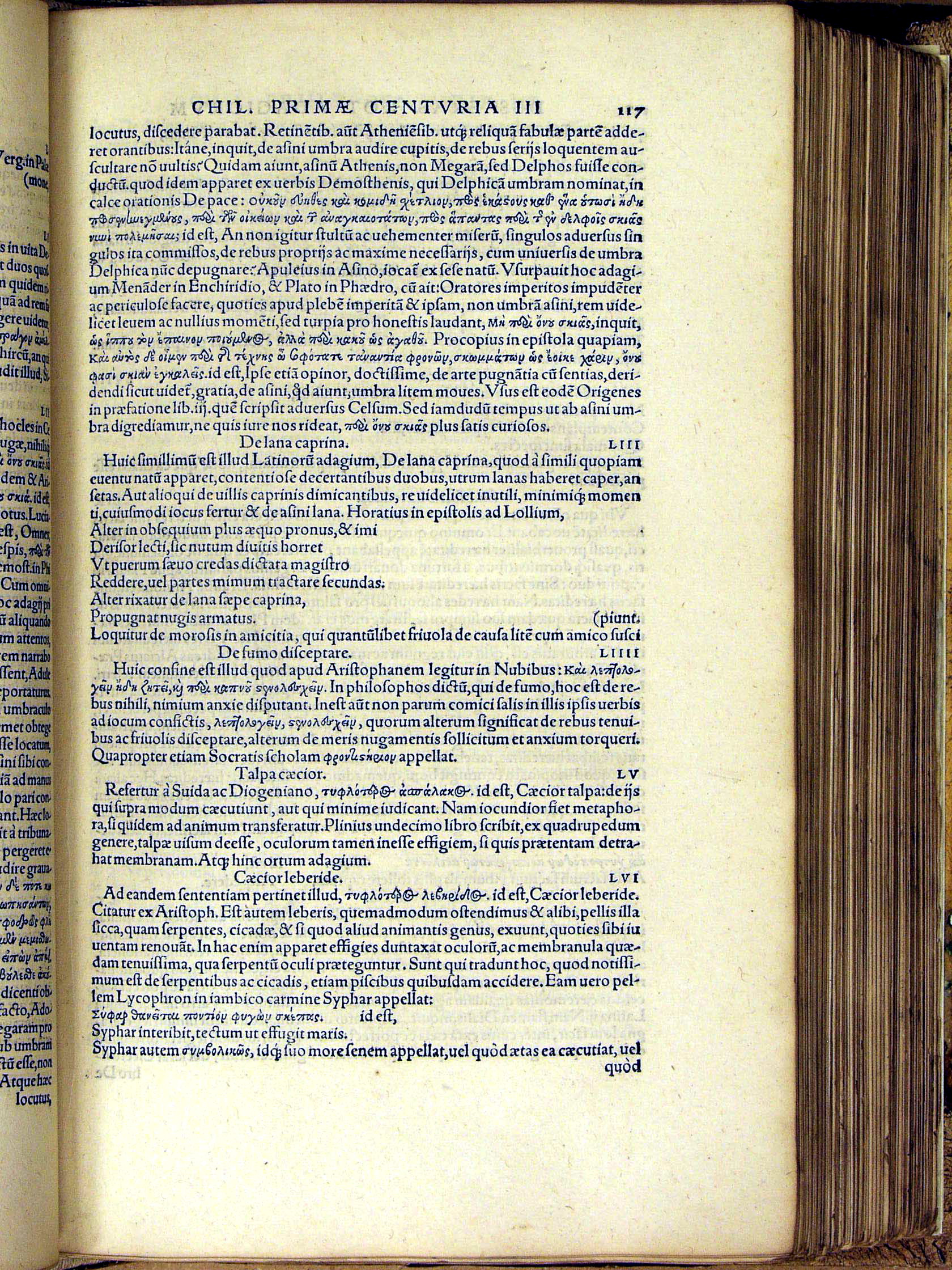
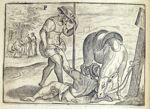
Empedocles bewijst ... dat daer het Vyerschaer slaept, de Rechters Ezels zijn: Vondel, Gulden Winkel (Amsterdam, 1622), emblem 56
Iconclass: 22C8 shadow 44G69 bad, corrupt judge 46C13142 ass, donkey 54BB3 Inutility, Noxiousness; 'Nocumento', 'Nocumento d'ogni cosa' (Ripa)
Loci Communes: Inanis opera (Vain effort, Effort vain)
I iii 53 De lana caprina About goat's wool
Huic simillimum est illud Latinorum adagium, De lana caprina, quod à simili quopiam eventu natum apparet, contentiose decertantibus duobus, utrum lanas haberet caper, an setas. Aut alioqui de villis caprinis dimicantibus, re videlicet inutili, minimique momenti, cuiusmodi iocus fertur & de asini lana. Horatius in epistolis ad Lollium, Alter in obsequium plus aequo pronus, & imi Derisor lecti, sic nutum divitis horret Ut puerum saevo credas dictata magistro Reddere, vel partes mimum tractare secundas: Alter rixatur de lana saepe caprina, Propugnat nugis armatus. Loquitur de morosis in amicitia, qui quantumlibet frivola de causa litem cum amico suscipiunt.
A very similar adage is found in Latin, about goat's wool, which seems to have arisen from some event of the same kind, when two people were disputing as to whether a goat has wool or hair; or else from a discussion on goats' hair as a useless and unimportant subject, just as there is a proverb about asses' wool. Horace in the Epistles, to Lollius: Another, with devotion fervent, Is more than your obsequious servant; Admitted as a humbler guest Where men of money break their jest, He waits the nod, with awe profound, And catches, ere it reach the ground, The falling joke, and echoes back the sound. A schoolboy thus with humbler air Repeats to pedagogue severe; His players act an under-part, And fear to put out all their art. Another in disputes engages, With nonsense armed for goat's wool rages. He is talking about people who are bad-tempered with their friends, and start a quarrel with a friend on the slightest pretext.
Facsimile:
Iconclass: 47H14 wool (material ~ textile and clothing industry) 47I214 goat 54BB6 Worthlessness
Collectanea (1500): 154
Loci Communes: Inanis opera (Vain effort, Effort vain)
I iii 54 De fumo disceptare To dispute about smoke
Huic confine est illud quod apud Aristophanem legitur in Nubibus: καὶ λεπτολο γεῖν ἤδη ζητεῖ, καὶ περὶ καπνοῦ στενολεσχεῖν. In philosophos dictum, qui de fumo, hoc est de rebus nihili, nimium anxie disputant. Inest autem non parum comici salis in illis ipsis verbis ad iocum confictis, λεπτολογεῖν, στενολεσχεῖν, quorum alterum significat de rebus tenuibus ac frivolis disceptare, alterum de meris nugamentis sollicitum et anxium torqueri. Quapropter etiam Socratis scholam φροντιστήριον appellat.
Similar to this is what we read in Aristophanes' Clouds: 'Already he seeks to quibble and speak subtly of smoke, καὶ περὶ καπνοῦ στενολεσχεῖν: It is a dig at philosophers, who discuss with great earnestness about smoke, that is, things of no importance. There is a spice of comic wit in the very words he uses for the joke, leptologein, stenoleschein, one meaning to discuss silly and frivolous things, the other to be tormented with care and anxiety about sheeer nonsense. So the school of Socrates was called a phrontisterion, a thinking-shop.
Facsimile:
Iconclass: 41B162 smoke 49C4 discussion, dialogue, dispute ~ scholar, philosopher 54BB3 Inutility, Noxiousness; 'Nocumento', 'Nocumento d'ogni cosa' (Ripa)
Loci Communes: Inanis opera (Vain effort, Effort vain)
I iii 55 Talpa caecior As blind as a mole
Refertur à Suida ac Diogeniano, τυφλότερος ὰσπάλακος, id est, Caecior talpa: de iis qui supra modum caecutiunt, aut qui minime iudicant. Nam iocundior fiet metaphora, si quidem ad animum transferatur. Plinius undecimo libro scribit, ex quadrupedum genere, talpae visum deesse, oculorum tamen inesse effigiem, si quis praetentam detrahat membranam. Atque hinc ortum adagium.
τυφλότερος ὰσπάλακος, As blind as a mole. Suidas and Diogenianus record this, referring to people whose sight is exceptionally poor, or who have no judgment, for the metaphor will be more pleasing if it is transferred to the mind. Pliny, book 11, writes that among quadrupeds, 'the mole is without sight, and yet the shape of the eyes is there, if the covering membrane is drawn back.' From this arose the adage.
Facsimile:
Comment ilz signifioient ung homme aueugle: Horapollo, Hieroglyphes (Paris, 1543), emblem 129
Blindheyt des Verstants: Ripa, Iconologia, of uytbeeldingen des verstands (Amsterdam, 1644), personification of Cecità della mente
Domi Argus, foris talpa: Vaenius, Emblemata Horatiana (Antwerp, 1612), emblem 69
Iconclass: 25F29(MOLE) other mammals: mole 31A4111 blind, blindness
Collectanea (1500): 675
Loci Communes: Caecutientia (Poor eyesight, near-blindness, Mauvaise vue)
I iii 56 Caecior leberide As blind as a sloughed skin
Ad eandem sententiam pertinet illud, τυφλότερος λεβηρίδος. id est, Caecior leberide.Citatur ex Aristoph. Est autem leberis, quemadmodum ostendimus & alibi, pellis illa sicca, quam serpentes, cicadae, & si quod aliud animantis genus, exuunt, quoties sibi iuventam renovant. In hac enim apparet effigies duntaxat oculorum, ac membranula quaedam tenuissima, qua serpentum oculi praeteguntur. Sunt qui tradunt hoc, quod notissimum est de serpentibus ac cicadis, etiam piscibus quibusdam accidere. Eam vero pellem Lycophron in iambico carmine Syphar appellat: Σύγαρ θανεῖται πόντιον φυγὼν σκέπας. id est, Syphar interibit, tectum ut effugit maris. Syphar autem συμβολικῶς, idque suo more senem appellat, vel quòd aetas ea caecutiat, vel quod iam effoeta, atque arida, succo, viribusque destituta sit. Sophron in Mimis, Τὶ μὰν ξύσιλος, τί γὰρ σύφαρ ὰντ᾽ ἀνδρός; Quid enim Xysilus, quid Syphar pro viro? Xysilum appellans aridum & pruriginosum senem, παρὰ τὸ ξύειν: aut Syphar, quasi iam non hominem ipsum, sed pellem duntaxat exuccam atque inanem. Quod quidem & ipsum proverbium resipit. Aiunt autem leberidem proprie significare membranam extremam, qua foetus vaccarum obtegitur, in qua & ipsa vestigia duntaxat oculorum apparent. Adagium trifariam effertur, τυφλότερος λεβηρίδος. id est. Caecior leberide: γυμνότερος λεβηρίδος. id est, Nudior leberide: & κενώτερος λεβηρίδος, id est, Inanior leberide.
Τυφλότερος λεβηρίδος, As blind as a sloughed skin. This phrase belongs to the same order of ideas. It is quoted from Aristophanes. The leberis, as I have shown elsewhere, is that dry skin which snakes, crickets and other kinds of creature slough off, whenever they renew their youth. In this there is at least the appearance of eyes, and that extremely thin membrane which protects the eyes of snakes. Some say that this, so well known in snakes and crickets, happens to fish also. Lycophron calls this skin syphar, in his iambic poem: 'A syphar he will die, fleeing the covering of the sea.' Syphar is used symbolically; it is his way of speaking of an old man, either because that age brings blindness, or because it is worn out and dried up, deprived of sap and strength. Sophron in the Mimes: 'What is Xysilus, what Syphar, for a man?'
He gives the name Xysilus to a dry and scabby old man, from the Greek for scraping, or Syphar, as if he were now no man at all, but a dry and empty skin. This too has a hint of the proverb in it. It is said however that leberis properly signifies the outer membrane which protects the foetus of cows, and in which there are merely vestiges of the eyes. There are three forms of the adage: 'As blind as a sloughed skin', 'As bare' or 'As empty.'
Facsimile: 
Iconclass: 25F42(+4821) snakes (+ shedding of skin of animal(s)) 31A4111 blind, blindness
Loci Communes: Caecutientia (Poor eyesight, near-blindness, Mauvaise vue)
I iii 57 Tiresia caecior As blind as Tiresias
A notissima fabula sumptum, τυφλότερος τειρεσίου id est. Caecior Tiresia. Iuvenalis, Nec surdum, nec Tiresiam quenquam esse deorum. Tiresiam proverbiali figura pro caeco dixit, quemadmodum Horatius pro paupere Irum: Intererit multum, divés ne loquatur an Irus.
Τυφλότερος τειρεσίου, As blind as Tiresias. Taken from a well-known story. Juvenal: 'Neither a deaf man nor a Tiresias, / Is one of the gods.' He used Tiresias for a proverbial way of saying 'blind,' as Horace says 'Irus' for 'poor': 'It differs much if wealth or Irus speak.'
Facsimile:
Iconclass: 31A4111 blind, blindness 95A(TIRESIAS)7 (story of) Tiresias - specific aspects, allegorical aspects, as patron of
Collectanea (1500): 653
Loci Communes: Caecutientia (Poor eyesight, near-blindness, Mauvaise vue)
I iii 58 Hypsea caecior As blind as Hypsea
Non dissimili figura dixit Horatius in Sermonibus, Ne corporis optima Lyncei Contemplans oculis, Hypsea caecior, illa Quae mala sunt spectes. Satis apparet, paroemiam ab Hypsea muliere quapiam infami, notaeque caecitatis, esse profectam.
Horace used a similar metaphor in the Satires: 'Not with Lynceus' eye her charms inspect, / While blind as Hypsea to her plain defect.' It is clear that the proverb comes from a certain woman of ill fame named Hypsea, well known for her blindness.
Facsimile:
Iconclass: 31A4111 blind, blindness 98C(HYPSAEA) female persons from classical history (HYPSAEA)
Loci Communes: Caecutientia (Poor eyesight, near-blindness, Mauvaise vue)
I iii 59 Sine sacris haereditas Inheritance without rites
Ubi qua commoditas de improviso praeter sumptum objecta esset, veteres sine sacris haereditatem vocabant. Et omnino quicquid citra nostram operam alicunde obtigisset lucri, quasi proverbialiter haereditatem appellabant propterea quod ea quae sic obveniunt, gratis, quasique dormientibus, a fortuna donari videntur. Ergasilus parasitus apud Plautum in captivi duo: Sine sacris haereditatem sum adeptus effertissimam. Et alibi: Annona est, sine sacris haereditas. Nam heredes alioqui vel pro salute laborantis, vel in parentalibus defuncti, sacra quaedam suo sumptu factitare mos erat Idem Plautus alibi: Mihi tales haereditates non saepe obveniunt. Cicero in Verrem actione quinta. Hic Verres haereditatem sibi venisse arbitratus est, quod in eius regnum, ac manus venerat iste. Andreas Alciatus Praetermissorum libro i. mavult adagionis originem ad prisci iuris consuetudinem referri. Lex enim xii. tabularum sic habebat: Sacra privata perpetua manento. Ea verba interpretatur Cicero lib. De legibus ii. ut omnis ad quem patrisfamiliàs pecunia perveniret, is teneretur sacra celebrare. Refertque Scaevolae pontificis interpretationem, qua traditum est quinque modis astringi sacris hereditatem. Proinde ad quos ex iure propinquitatis redibat haereditas, tenebantur communium sacrorum societate: Suavius autem esse solet, quod inopinato contingit boni, quemadmodum sine sacris haereditas. Haec aliaque doctissime sanè disserit Alciatus noster, cuius equidem sententiae lubens addo meum suffragium, quanquam à mea minimum dissentienti. Porrò in Plautino dicto allusum arbitror ad Graecoru illud adagium: ἄθυτα ἱερὰ κατεσθίειν. id est, Non sacrificata sacra devorare. Item ad Hesiodium illud: ἀπὸ χυτροπόδων ἀνεπιῤῥέκτων ἀνελόντα Εσθίειν. id est: Ante sacrum factum, cibum ab ollis tollere raptum, Atque edere.
When something advantageous is thrown in a person's way unexpectedly and at no cost, the ancients called this An inheritance without rites. Everything in fact in the way of profit which might have accrued from any source without our effort they styled, as though proverbially 'an inheritance,' particularly because what comes freely, while we are asleep, as it were, seems to be the gift of Fortune. So Ergasilus the parasite says in Plautus, in the Captivi duo: 'I have acquired an ample inheritance without rites.' And in another place: 'At the present price it is an inheritance without rites.' For it was the custom for the heir to celebrate certain rites at his own cost, either for the welfare of the dying or as offerings for the departed. Plautus again elsewhere: 'Such legacies do not often come my way.' Cicero against Verres, in the fifth speech: 'Verres seemed to himself to have come into a legacy, when he saw come into his dominions, and under his power, that man.' Andrea Alciati in his Praetermissa, book 1, prefers to trace the origin of the adage to a practice in ancient law. The code of the Twelve Tables says: 'Private rites shall be maintained in perpetuity.' These words are interpreted by Cicero, in the second book of the De legibus, as meaning that anyone to whom the estate of the head of household might pass was under an obligation to celebrate these rites. He also quotes the interpretation of Scaevola the pontifex to the effect that an inheritance is subject to five kinds of sacrificial rites. Those who inherited by right of kinship were bound by partnership in rites which they shared. But it is normally more agreeable when some advantage befalls one unexpectedly like an inheritance without rites. These and other matters are discussed most learnedly by my friend Alciati, and I willingly give my vote in favour of his interpretation, albeit slightly different from mine. Moreover I think the phrase of Plautus contains an allusion to the well-known Greek proverb 'To devour the sacrifice before it has been offered,' and also to that passage in Hesiod, 'From unhallowed vessels to take aught to eat.'
Facsimile:
Iconclass: 12B2 ritual practices ~ non-Christian religions 42E531 inheritance 51AA4 Nothingness, Absence
Loci Communes: Citra laborem (Without effort, Sans effort)
I iii 60 Inter caesa et porrecta Between the slaying and the offering
Elegans in primis adagium extat apud M. Tullium in epistolis ad Atticum: Ea multa, inquit, imò omnia, quorum κεφάλαιον, ne quid inter caesa & porrecta, ut aiunt, oneris mihi addatur aut temporis. Videtur significare cunctationem, & ancipitem haesitationem, ac velut intervallum illud, inter omittendum quod coeptum est, & incipiedum quod novari oportet. Sumptum est autem è prisco auspiciorum ritu, in quibus inter caesa & porrecta sacerdos caeremonias quasdam agebat, quemadmodum testatur M. Varro lib. De lingua Latina ii. Nam flamen Dialis, inquit, auspicatur vindemiam, & ut iussit vinum legere, agna Iovi facit, inter cuius exta caesa & porrecta flamen prorsus vinum legit. Porrò quod exta caesa prorogationem temporis apud veteres significaverint, declarat Cicero li bro De divinatione ii. Quid enim, inquiens, habet aruspex, cur pulmo incisus etiam in bonis extis dirimat tempus, & proferat diem?
A particularly choice adage is to be found in Cicero, in his Letters to Atticus: Many other points, all other points in fact, but first and foremost that nothing be added to my responsibilities or my tenure between slaying and offering as the saying is.' He seems to mean delay and wavering hesitation, an interval as it were between laying aside something begun, and beginning something which has to be renewed. This is taken from the old method of augury, when the priest carried out certain ceremonies'between the slaying and the offering,' as Varro explains in his On the Latin Language book 2: 'For the Flamen Dialis,' he says, 'solemnly inaugurates the vintage, and when he has ordered the grapes to be picked he makes a sacrifice to Jove of a ewe lamb; between the slaying and the offering of entrails, precisely, the priest picks the grapes.' That 'entrails slaughtered' among the ancients meant an extension of time, Cicero makes clear in his On Divination, book 2: `What has the diviner in mind, why does the cutting up of the lung, even when the entrails are favourable, interrupt the time and postpone the day?'
Facsimile: 
Iconclass: 12B2121 animal sacrifice ~ non-Christian religions 12F52(AUGUR) 'augur' ~ Roman religion 34F12 man killing animal
Loci Communes: Tarditatis et cunctationis (Slowness and delay, Lenteur et retard)
I iii 61 Pensum persolvere To complete one's task
Pensum persolvere, est tuas implere parteis, debitoque perfungi officio. Translatum à lanificio muliebri, in quo singulis certum lanae pondus in opus distribuebatur. Plautus in Persa, Pensum meum quod datum est, confeci. Idem in Bacchidibus, Ego pensum meum lepide accurabo. Et M. Tullius lib. De oratore iii. Nunc ad reliqua progrediar, meque ad meum munus, pensumque revocabo. Varro De re rustica: Nos nostrum pensum absolvimus. Hieronymus ad Rusticum: Et operis tui pensa persolvas. Verum, quo longius erit detorta metaphora, hoc erit adagium venustius. Veluti si ad sermonem, ad studium, ad officium, aut alias animi res referatur.
Pensum persolvere means to fulfil one's part, to do the duty expected of one. It is adapted from the way women worked at the wool: each of them had a definite weight of it distributed to her for her to work up. Plautus in the Persa: 'I have finished the task I was given.' Also in the Bacchides: 'I will make a nice job of my allotted task.' And Cicero, in the third book of the De oratore: 'Now I will go on to the rest, and recall myself to my duty and allotted task.' Varro in his Agriculture: 'We have fulfilled our allotted task.' Jerome writing to Rusticus: 'And you may complete your allotted task.' But the further the metaphor is twisted to new uses, the more attractive the adage will be: if, for instance, it is applied to speech, to study, to moral obligations or other mental activities.
Facsimile:
Iconclass: 54D3 Completion 57A21 Duty
Loci Communes: Vices officii (The vicissitudes of duty, Les vicissitudes du devoir)
I iii 62 Ne per somnium quidem Not even in a dream
Οὐδ᾽ ὄναρ, id est. Ne in somnio quidem. Graecis proverbialiter dictum est, pro eo quod est, nulla ratione, nullo tempore. Alioqui nemo ferè tam omni felicitate destitutus, quin aliquando per quietem vel somniet laetiora quaepiam. Lucianus ἐν τῷ περὶ τῶν ἐπὶ μισθῷ συνόντων. ουδ᾽ ὄναρ λευκοῦ ποτε ἄρτου ἐμφορηθείς. id est. ne per somnium quidem unquam albo pane satiatus. Idem usurpavit in Gallo, quum ait, regibus ne persomnium quidem aliqua re iucunda frui licere: ὑφ᾽ ὧν οὐδ᾽ ὄναρ ἀπολαῦσαί τινος ἡδέως εγγίνεται. Rursus περὶ τοῦ ἠλέκτρου, ἀδόντων δὲ ἡδὺ, καὶ σὺ φῂς, οὐδ᾽ ὄναρ ἀκηκόαμεν. id est. Porrò suaviter canentes, & eo modo quo tu praedicas, ne per somnium quidem audivimus. Huc eleganter allusit Theocritus ἐν βουκολίσκῳ. apud quem Eunica puella civilis, rusticum, basium dare conantem, ab se repellit, dicens tantum abesse ut illi datura sit basium, ut hoc ne per somnium quidem oporteat sperate. Carmen sic habet: ἔῤῥ᾽ ἀρ᾽ ἐμοῖο. Βωκόλος ὤν μ᾽ἐθέλεις κῦσαι; τάλαν οὐ μεμάθηκα Αγροίκως φιλέειν, ἀλλ᾽ ἄστυκα χείλεα θλίβειν Μὴ τό γε μεῦ κύσῃς τὸ καλὸν στόμα, μηδ᾽ ἐν ὀνείροις. id est, Aufer te hinc procul, inque malam rem, Tu mihi suaviolum dare vis homo rusticus? atqui O miser haud didici dare basia agrestibus unquam. Sed magis urbanis soleo oscula figere labris. Non mihi tu nitidum os labris sordentibus unquam, Contigeris, nec per somnum. Utitur eodem & M. Tullius in Epistolis ad Atticum: πολιτικὸς ἀνὴρ, οὐδ᾽ ὄναρ, quisquam inveniti potest. Theocritus in Megara Herculis uxore, τὸ δ᾽ οὐδ᾽ ὄναρ ἤλυθεν ἄλλῳ. id est. Quod alii—λβ ne per somnum quidem accidit. Galenus περὶ φυσικῶν δυνάμεων. lib. ii. καὶ ταῦτα οὐκ ἐχρῆν ἀγνοεῖν τὸν ἐρασίστρατον, εἴπερ κᾂν κατ᾽ ὄναρ ποτὲ τοῖς ἐκ τοῦ περιπάτου συνέτυχεν. id est, Atque haec oportebat non esse ignota Erasistrato, si modo vel in somnis unquam illi cum Peripateticis incidisset consuetudo. Solent autem vel extremae sortis homines aliquando magnifica quaedam somniare, quemadmodum apud Lucianum Micyllus, qui per somnium opulentissimus, experrectus, cerdo quispiam erat Iro penè pauperior. Nam somniare sperandi genus est. Unde & Virgil. in Bucolicis, spes inanes amantum somnia vocat, An qui amant, ipsi sibi sommia fingunt? Huc respexit & Flaccus in Satyris, cum ait, Cum te servitio longo curaque levarit, Et certum vigilans quarta sit partis Ulysses Audieris haeres. Itaque, Ne per somnium quidem, perinde valet, quasi dicas, quod ne sperare quidem audeas. Plutarch. in libello quem scripsit adversus Stoicos, adagium extulit paulo diversius, ὧς οὐδ᾽ ὀνείρατα λαβεῖν μᾶλλον ἐστὶ παρὰ τὰς κοινὰς ἐννοίας, id est, Quorum ne somnia quidem magis capere licet extra communes cogitationes. Divus Chrysostomus adversus Iudaeos onχione tertia sic extulit, Οὐδ᾽ ὡς ὄναρ
Οὐδ᾽ ὄναρ, Not even in a dream. In Greek, this is a proverbial way of saying 'by no means, at no time.' No one was ever so utterly deprived of happiness that he did not occasionally, at a quiet moment, dream of happier things. Lucian On Salaried Posts: 'Not even in a dream did he ever have his fill of white bread.' He makes use of it also in Gallus, when he says that kings cannot enjoy any pleasant thing, even in a dream: 'because of which not even a dream of some pleasure is possible.' Again in Electrum: 'As for the sweet singing, such as you tell of, we haven't heard it even in our dreams.' Theocritus made a charming allusion to this in the Boukoliskos, when he described Eunica, a well brought-up girl, thrusting aside a boor who tried to kiss her; she was so far from giving him a kiss, she said, that he need not hope for it even in a dream. The poem runs thus:
Take yourself off, and good riddance!
Do you want to kiss me, you boor?
I never learnt to kiss the country folk,
But city lips to press, nor shall you ever
Touch with your filthy lips my shining mouth
Even in a dream.
Cicero uses the same thing in Letters to Atticus: 'Not one statesman is to be found, even in a dream.' Theocritus in Megara, Wife of Hercules: 'This happened to no one else, even in a dream.' Galen On the Natural Faculties, book 2: 'And these things should not have been unknown to Erasistratus, if even in dreams he had ever happened to be familiar with the Peripatetics.' Even men of the humblest sort may have magnificent dreams, like the Micyllus of Lucian, who was the richest of men in his dreams, but when he woke up he was a cobbler almost poorer than Irus. For to dream is a kind of hoping. So Virgil in the Eclogues calls the vain hopes of lovers 'dreams': 'Those who love, do they shape their own dreams?' Horace was thinking of this in the Satires, when he says: When he shall free you from your servile fear And tedious toil; when broad awake, you hear 'To good Ulysses, my right trusty slave, A fourth division of my lands I leave.'
So to say 'not even in a dream' is equivalent to saying 'you do not even dare to hope.' Plutarch, in the essay he wrote 'Against the Stoics,' expresses the adage in a slightly different way: 'One cannot even take their dreams beyond ordinary thoughts.' St Chrysostom in his third sermon against the Jews expresses it thus, 'not even as a dream.'
Facsimile:
Iconclass: 31B3 dream 52BB42 Impossibility
Loci Communes: Frustrata spes (Frustrated hope, Espoir déçu)
I iii 63 Per nebulam, per caliginem, per somnium Through cloud, through darkness, as in a dream
Qυarum rerum ambiguam quandam ac tenuem, peneque evanidam memoriam aut intelligentiam obtinemus, eas res per nebulam recordari, per somnium meminisse, per caliginem videre, proverbio dicimus. ut qui puelli vidimus, senes quasi per somnium recordamur, vix tenuibus quibusdam simulacris rerum inhaerentibus animo nostro, qualis est fermè vulgarium insomniorum memoria. Porrò quod per mediam nebulam intuemur, eius confusam duntaxat imaginem, ac velut umbram incertam aspicimus. Cuiusmodi sunt quae per caliginem cernuntur in tenebris. Hinc igitur ducta metaphora. Huiusmodi sermonis formae frequenter obviae sunt apud scriptores. Plaut. in Pseud. Sunt quae te volumus perconctari, quae quasi per nebulam nosmet scimus atque audivimus. Idem in Capt. duobus: In memoriam regredior audisse me quasi per nebulam. M. Tullius lib. De finib. v. In infirma aetate, imbecillaque mente, vis naturae per caliginem cernitur. Plato De legibus lib. vii ἅ δὴ λέγω, δειλῶσαι πειρητέον οἷον δείγματα ἐξενεγκόντα εἰς φῶς. νῦν γὰρ λεγουμένοις ἔοικε κατά τι σκότος. id est, Caeterum quae dico, conandum est, ut velut exemplis in lucem prolatis reddamus perspicua. Nam haec videntur similia iis quae dicuntur per caliginem quandam. Eodem in lib. legitur κάθ᾽ ὕπνον, id est, per somnum, sive in somnis.
Our memory or grasp of some things may be doubtful, vague or even fading, and then we say proverbially that we register them through a mist, we remember them as in a dream, we see them darkly. What we saw as children, we recall as old men as if in a dream, as if faint images of those things were clinging to our minds; this is the form memory takes of ordinary dreams. When we gaze at something through an intervening mist, we see only its confused image, like a wavering shadow; so it is with things seen in darkness, through the obscurity, and hence the metaphor. These turns of speech are frequently found among writers. Plautus in the Pseudolus, 'There are things we particularly want to ask you, which we know and have heard ourselves as if through a cloud.' Again in the Captivi duo: 'I go back in memory, seeming to have heard myself as if through a cloud.' Cicero in book 5 of the De finibus: 'In the years of immaturity and intellectual weakness the powers of our nature are discerned as through a mist.' Plato in the seventh book of the Laws: 'But I must try to make what I am saying clear, with examples brought out into the light. For they appear now like things which are said in some kind of darkness.' In the same book we read 'through sleep' or 'in sleep.'
Facsimile: 
Iconclass: 22C9 darkness 26B1 mist, fog 31B3 dream
Collectanea (1500): 279
Loci Communes: Indiligentiae (Carelessness, Négligence); Obscuritas (Obscurity, Obscurité)
I iii 64 De asini prospectu About the ass that poked its head in
Περὶ ὄνου παρακύψεως. i. De asini prospectu. Vetus adagium dici solitum in eos, qui ridendo titulo quempiam calumniantur, aut de frivolis rebus aliquem in ius vocant. Eventus qui fabulae praebuit occasionem, varie narratur ab auctoribus. Quidam huiusmodi quaedam memorant: figulus quispiam varias avium formas finxerat, easque in officina collocatas habebat. At asinus quidam, in observantius sequente agasone, inserto per officinae fenestellam capite, pariter & aves & reliqua vasa deiecit, comminuitque. Is cuius erat officina, agasonem in ius vocat. Quumque rogaretur ab omnibus, quanam de re litem moveret: de asini, inquit, prospectu. Alii aves non fictiles, sed veras fuisse volunt, quae asino, sicuti dictum est, per fenestram immittente caput, disturbatae perticam ruperunt, reliquaque vasa subverterunt. Reliqua fabulae utcunque conveniunt. Lucianus in Asino suo paroemiam hanc fingit ex se natam, quod dum asinus conaretur obliquato capite per fenestram prospicere quid ageretur, tum sese, tum dominos suos prodidit. Eamque rem magno omnium risu exceptam, in adagionem abiisse, ἐξ ὄνου παρακύψεως, id est, ex asini prospectu. Porrò iuxta Luciani sententiam magis quadrabit in eos qui stoliditate sua, dum inepte student dissimulare, ridicule produntur. Hunc Luciani locum aemulans Apuleius in ix. Metamorph. suae lib. scribit ad hunc modum: Qua contentione & clamoso strepitu cognito, curiosus alioqui & inquieta procacitate praeditus asinus, dum obliquata cervicem per quandam fenestrulam, quid nam sibi vellet tumultus ille, prospicere gestio, unus è commilitonibus, casu fortuito conlimatis oculis ad umbram meam cunctos testatur in coram. Magnus denique continuo clamor exortus est. Et emersis protinus scalis, iniecta manu quidam me veluti capituum detrahunt, iamque omni sublata cunctatione, scrupulosius contemplantes singula, cista etiam illa revelata, repertum, productumque & oblatum magistratibus miserum hortulanum, poenas scilicet pensurum, in publicum deducunt carcerem, summoque risu de meo prospectu cavillari non desinunt. Unde etiam De prospectu & umbra asini, natum est frequens proverbium Hactenus Apuleius.
Περὶ ὄνου παρακύψεως, About the ass that poked its head in. This old adage used to be said of those who speak ill of someone for an absurd reason, or take someone to court for a trifling cause. The event which gave rise to the story is variously told by different authors. Some tell it as follows: a certain potter had created various shapes of birds and displayed them in his shop. But a donkey, followed by its driver, who was not looking, poked its head through the shop window and knocked over the birds and the rest of the pots and smashed them to pieces. The owner of the shop took the driver to law. When asked by everybody what he was going to law about, he said: 'About the ass that poked its head in.' Others say that the birds were not made of clay, but real birds, which the ass disturbed by thrusting its head in as aforesaid, so that they broke their perch and upset the other pots. The rest of the story is the same. Lucian in his Ass claims to have given rise to this proverb; when, being an ass, he tried to turn his head sideways to see through the window what was happening, he gave both himself and his masters away. This was greeted by all with a mighty laugh and became a proverb. However for Lucian the phrase is more applicable to people who try to keep up a foolish pretence but are betrayed by their own stupidity. Apuleius copies the passage of Lucian in the ninth book of the Metamorphoses, where he writes as follows: 'When I heard the noise and uproar of the quarrel, being an ass of a most curious disposition and endued with the most restless indiscretion, I poked my head out slantwise through a small window and sought to discover what the tumult might mean. But one of the soldiers chanced to see me out of the corner of his eye, and espied my shadow. Whereupon he called all the others to bear witness. A great uproar arose, they rushed upstairs, laid hands on me, and dragged me downstairs as a prisoner. Then without a moment's delay they searched everything even more carefully than before. Among other things they opened the chest, found the wretched gardener, dragged him out and showed him to the magistrates. Then they led him away to the public jail to be punished for this offence. As for me, they never tired of laughing and jesting about the way I had poked my head out. And from this the well-known proverb has arisen about the ass that poked its head out and the ass's shadow.' Thus far Apuleius.
Facsimile:
Iconclass: 46C13142 ass, donkey 52AA23 Inattention 54BB3 Inutility, Noxiousness; 'Nocumento', 'Nocumento d'ogni cosa' (Ripa)
Loci Communes: Inanis opera (Vain effort, Effort vain)
I iii 65 Suo ipsius indicio periit sorex The shrew-mouse gave itself away
Cui confine est illud Terentianum ex Eunucho: Egomet meo indicio miser quasi sorex hodie perii. Verba sunt Parmenonis, qui delusus à Pythia prodiderat se seni. Donatus admonet esse proverbium in eos qui suapte voce produntur. Atque hinc existimat ductam esse metaphoram, quòd soricum proprium sit vel stridere clarius, quam mures, vel strepere magis cum obrodunt frivola, ad quam vocem multi se intendentes, quamvis per tenebras noctis transfigunt eos. Usurpat hoc adagium dius Aurelius Augustinus in primo De Ordine libro erga suum Licentium, qui dum pulsata tabula, soricem strepitu absterret, ipse sese prodebat Augustino quod vigilaret. Allusit eódem Origenes homilia in Genesim tertia. Sed videbor, inquit, ipse meis indiciis captus.
Terence in the Eunuchus says much the same thing: 'Today, alas, I perished by giving myself away like the shrew.' It is Parmeno speaking, when the deceit of Pythia has led him to betray himself to the old man. Donatus explains that the proverb is directed against people who give themselves away by their own talk. He thinks the metaphor comes from the fact that shrews typically squeak louder than mice, or make more noise when they are gnawing at bits and pieces; and people often notice this squeak and pin them down even in the darkness of night. St Augustine uses this adage in the first book of the De ordine, about his friend Licentius, who frightened a shrew by hitting his writing tablet and making a noise, thereby letting Augustine know that he was awake. Origen has the same allusion in his third homily on Genesis: 'But I shall seem to have been caught by the hints I gave myself.'
Facsimile:
Suo sorex indicio perit: Reusner, Aureolorum Emblematum (Strasbourg, 1587), emblem 54 quotes the comment and illustrates the idea with a noisy woodpecker
Iconclass: 22D1 loud sound, noise 25F26(SHREW-MOUSE) rodents (SHREW-MOUSE)
Collectanea (1500): 572
Loci Communes: Malum accersitum aut retortum (Evil brought upon oneself or turned back, Mal attiré ou retourné)
I iii 66 Induitis me leonis exuvium You are dressing me up in the lionskin
Ενδύετέ μοι τὴν λεοντὴν. id est, Induitis me leonis exuvium. In eos dici solitum, qui suscipiunt negocium maius facultate, quique se magnificentius gerunt quam pro sua conditione. Quidam ab Hercule sumptum putant, cuius hic ornatus erat, ut leonis exuvio tegeretur, deinde altera manu clavam, altera gestaret arcum, atque hoc ornatu descendit ad inferos, Cerberum extracturus. Huc alludens Aristophanes in Ranis, Bacchum fingit, Herculis instar, leonis exuvio clavaque instructum, ad inferos descendere parantem, ut Euripidem cum Aeschylo certantem audiret. Ridetur autem ab Hercule, quòd id gestaminis neuti quam illum deceret, utpote mollem & effoeminatum. Eodem pertinet quod Menippus ille Lucianicus eodem ornatu se ab infetis redisse adsimulat. Nihil autem prohibet, quo minus proverbium ad apologum illum referatur, cuius meminit Lucianus in Piscatore: Apud Cumanos asinus quispiam pertaesus servitutem, abrupto loro in sylvam aufugerat. Illic forte repertum leonis exuvium corpori applicabat suo. Atque ita pro leone se gerebat, homines pariter, ac feras voce, caudaque territans. Nam Cumani leonem ignorant. Ad hunc igitur modum regnabat aliquandiu personatus hic asinus, pro leone immani habitus ac formidatus. Donec hospes quispiam Cumas profectus (qui saepenumero viderat & leonem et asinum, atque ob id non erat difficile dignoscere) aurium prominentium indicio, neque non aliis quibusdam coniecturis asinum esse deprehendit, ac probe fustigatum reduxit, dominoque agnoscenti reddidit. Interim autem risum non mediocrem concitabat omnibus Cumanis asinus iam agnitus, quos dudum creditus leo, metu propemodum exanimaverat. Cumanos autem hic appellat, non qui sunt in Italia, sed qui sunt in Aeolide supra Lesbum. Nam & Lesbii & Cumani notati sunt stoliditatis, ut indicat Stephanus. Usurpat hoc adagium Socrates Platonicus in Cratylo, negans oportere deterreri sese magnitudine disputationis institutae, postea quam semel leonis pellem esset indutus. Lucianus in Pseudologista: οὐδὲ δεῖ τινος, τοῦ ἀποδύσοντος τὴν λεοντὴν, ὡς φανερὸς γένοιο, κανθήλιος ὢν, εἰ μή τις ἄρα ἐξ ὑπερβορέων ἄρτι ἐς ἡμᾶς ἥκοι, ἢ ἐς τοσοῦτεν κυμαῖος εἴη, ὡς μὴ ἰδὼν εὐθὺς, εἰδέναι ὄνων ἁπάντων ὑβριστότατόν σε ὄντα, μὴ περιμείνας ὀγκωμένου προσέτι ἀκούειν, id est, Nec opus est quopiam, qui tibi leonis exuvium detrahat, quo palàm fiat te canthelium esse, nisi quis sane ab ipsis Hyperboreis hospes modo ad nos advenerit, aut usque adeo Cumanus sit, ut qui viderit non protinus intelligat te asinorum omnium asinum ferocissimum esse, aut exspectet, ut te praeterea rudentem audiat. Eusebius Caesariensis adversus Hieroclem, οἰχήσεται μὲν ἡμῖν φιλόσοφος, ὄνος δὲ τῇ τοῦ λέοντος ἐπικρυπτόμενος, id est, Abibit nobis quidem philosophus, ceterum asinus leonis intectus pelle. Demutavit nonnihil de proverbio Lucianus in Philopseude, cum ait:τοσοῦτον χρόνον ἐλελήθει με, ὑπὸ τῇ λεοντῇ, γελοῖόν τινα πίθηκον περιστέλ- λων, id est, Tantum temporis non animadverti eum sub leonis exuvio ridiculam quandam simiam tectam habere.
Ενδύετέ μοι τὴν λεοντὴν, You are dressing me up in the lionskin. Said of those who undertake a work beyond their means, and who bear themselves with more pride than their rank warrants. Some think this comes from Hercules, whose accoutrement was this: he wore a lionskin, held in one hand a club and in the other a bow, and thus equipped he went down into the underworld to bring out Cerberus. Aristophanes, alluding to this in the Frogs, pretends that Bacchus, like Hercules equipped with lionskin and club, proposed to descend to the underworld to hear Euripides and Aeschylus having a dispute. However, Hercules makes fun of him, on the grounds that such accoutrements are not in the least suitable to a weak effeminate character like his. Similarly, the famous Menippus of Lucian feigns to have returned from the underworld in the same array. But there is no reason why the proverb should not refer to the story told by Lucian in the Fisherman. In Cumae there was a certain donkey who got tired of servitude, broke his leash and ran away into the woods. There he happened to find a lionskin, and put it on himself. He then behaved like a lion, frightening men and wild beasts with his noise and his tail (for the good people of Cumae know nothing of lions). So the masquerading donkey had it all his own way for some time, and was taken for a fierce lion, and feared. This went on until a visitor came to Cumae who had often seen both lions and donkeys, and thus it was not difficult to discern - he recognized the donkey by its long sticking-out ears and some other indications, and after giving it a good beating led it back to the owner who claimed it. The unmasking of the donkey roused a general laugh at the expense of the population of Cumae, who had been almost terrified out of their wits for so long by an imaginary lion. The people of Cumae of whom he speaks, are not, however, those in Italy but those who live in Aeolis above Lesbos. The people of both Lesbos and Cumae are famous for their stupidity, as Stephanus remarks. The Socrates of Plato uses this adage in the Cratylus, declaring that he need not be frightened at the importance of the discussion embarked upon, once he had put on the lionskin. Lucian in Pseudologista: 'There is no need of anyone to strip away your lion's skin that you may be revealed as a donkey, unless perhaps someone has just come to us from the Hyperboreans, or has spent so much time in Cumae as not to know, as soon as he sees you, that you are the most unbridled of all asses, without waiting to hear you bray.' Eusebius of Caesarea against Hierocles: 'Indeed he will depart from us as a philosopher, but he is an ass covered with a lionskin.' Lucian altered the proverb a little in Philopseudes, where he says, 'I had failed, in all these years, to notice that his lion's skin covered a silly ape.'
Facsimile: 
Iconclass: 25F23(LION)(+351) beasts of prey, predatory animals: lion (+ skin, fleece, hide, fur, leather) 94L8(LION'S SKIN) attributes of Hercules: lion's skin
Loci Communes: Dissimilitudinis et incongruentiae (Dissimilarity and incongruity, Dissemblance et incongruité); Honos indigno habitus (Honor given to the unworthy, Honneur accordé à qui ne le mérite pas)
I iii 67 Midas auriculas asini Midas has ass's ears
Μίδας ὄνου ὦτα, id est, Midas auriculas asini. Refertur à Diogeniano. Natum à fabula notissima Midae regis Phrygiae, cui Phoebus, quod stolide Panem canentem sibi praetu{-] lisset, asininas affixit auriculas. Quas cum diu mitra occuluisset, tandem à tonsore ani madversum est, ac prolatum in vulgus. Porrò adagium rectè dicetur, vel in stolidos & crassis auribus pinguique iudicio homines: Vel in tyrannos, quibus cum aures sint asininarum instar longae, procul etiam audiunt, velut auscultatoribus dimissis qui audita referant. Quos Plutarchus in libro De curiositate, ὠτακουστὰς appellat, προσαγωγίδας. Eoque Lucianus in libello cui titulus, Non esse facile credendum delatoribus, calumniae depingens imaginem, Midae aures illi tribuit, propter studium subauscultandi captandique quid alii retum faciant: ἐν δεξιᾷ τὶς ἀνὴρ κάθηται, τὰ ὦτα παμμεγέθη ἔων, μικροῦ δεῖν τοῖς τοῦ μίδου προσεοικότα. id est, Ad dextram vir quispiam sedet, auriculis maximis, quales fermè Midae fuerunt. Aristophanes in Pluto: Μίδας μὲν οὖν ἢν ὦτ᾽ ὄνου λάβεντε. id est, Midas quidem itaque, si asini aures sumatis. Quo loco interpres admonet proverbii de auriculis asininis, eiusque commenti varias allegat causas. Quosdam auctores esse, Midam hunc ob contemptum aliquando vituperatumque Bacchi numen, in asinum fuisse conversum. Alii narrant, cum aliquando praeteriret asinos huius dei, atque eos affecisset iniuria, iratum Bacchum, Midae auriculas asininas addidisse. Sunt qui dicant huic aures natura praelongas fuisse, & asininarum instar prominentes, atque hinc fabulae iocum ortum esse. Quanquam pluribus placet, hac allegoria significatum, Midam utpote tyrannum Corycaeos ac subauscultatores dimittere solitum, per quos quaecunque per omnem regionem, vel fierent, vel dicerentur, cognosceret, nimirum illis utens aurium vice. Proinde cum vulgus admiraretur, ab illo resciri etiam ea quae clàm, ac procul fierent, occasionem fabulae dederunt, ut Midas diceretur auriculas asini habere. Vel quod nullum aliud animal acrius audiat quam asinus, excepto mure: vel quod aures habeat omnium longissimas. Persius, Auriculas asini quis non habet? Ferunt nonnulli primum à poeta scriptum fuisse. Auriculas asini Mida rex habet. deinde metu Caesaris scripturam mutasse, quis non habet?
Μίδας ὄνου ὦτα, Midas has ass's ears. Recorded by Diogenianus. It is taken from the well-known story about Midas, king of Phrygia; when he had stupidly judged Pan's singing to be superior to Apollo's, the god fixed a pair of ass's ears to his head. For a long time he managed to hide them under a turban, but his barber saw them and told the tale abroad. The adage will be properly applied to stupid people, with dense ears and doltish wits; or to tyrants, who have ears as long as asses' and hear from a long way off, since they have eavesdroppers sent out to bring back news of what they hear. Plutarch in his essay 'On Being a Busybody' has special Greek words for 'listeners' and 'tale-bearers.' Lucian, in his essay on Not Believing Slanderers, draws a portrait of Calumny and gives her Midas's ears, because of her eagerness to eavesdrop and catch what other people are doing: 'On the right sits a certain man with very large ears, almost like those of Midas.'
Aristophanes in the Plutus: 'Midas indeed, if you put on the ears of an ass.' The commentator on this passage notes the proverb about asses' ears and gives several reasons for the fabrication. He says that according to some authorities Midas was turned into an ass for having at one time scorned and disparaged the divinity of Bacchus. Others tell a story about his having one day passed the asses of this god and insulted them, so Bacchus in anger gave him asses' ears. Some say that he had ears that were overlong by nature and stuck out like asses' ears, and hence this jesting tale arose. Most of them, however, prefer to take the meaning of this allegory to be that Midas, being a despot, used to send out spies and eavesdroppers, whom he used as ears, to let him know whatever was being said or done all over the country. Hence, as there was general astonishment at the way in which he had news even of things which were done in secret and far away, these gave rise to the proverb, that Midas was said to have asses' ears. Perhaps it was because no other animal has more acute hearing than the donkey, except the mouse; or because it has the longest ears of any. Persius: 'Who has not the ears of an ass?' Some say that the poet first wrote: 'King Midas has the ears of an ass,' and changed it into a question, 'Who has not' for fear of the emperor.
Facsimile: 
Iconclass: 31A314 spying on someone 46C13142(+7333) ass, donkey (+ ears of an animal) 52AA1 Stupidity, Poverty of Intellect; 'Stupidità overo Stolidità' (Ripa) 95A(MIDAS)7 (story of) Midas - specific aspects, allegorical aspects, as patron of 97C6(+0) Midas given ass's ears: Apollo gives Midas ass's ears as punishment for preferring Pan in the musical contest between Apollo and Pan (Ovid, Metamorphoses XI 174) (+ variant)
Collectanea (1500): 645
Loci Communes: Multi - in stupidos (Many people - against the stupid, Beaucoup de gens - contre les sots)
I iii 68 Hinc illae lachrymae Hence those tears
Ex Andria Terentiana per allusionem proverbialiter usurpatum videtur ab Horatio: Hinc illae lachrymae. Usurpavit ad hunc modum M. Tullius in actione pro M. Caelio: Hinc illae lachrymae: nimirum & haec causa est horum omnium scelerum atque criminum. Dicetur autem de rei causa aliquandiu dissimulata, quae vere tandem deprehendatur. Veluti si quis dicat barbaros damnare Graecas literas, ne scilicet ipsi parum docti videantur, commode subnecter: Hinc illae lachrymae, hoc est quo eos male habet. Sumuntur autem frequenter id genus allusiones à claris auctoribus, & in proverbii vicem transferuntur, etiamsi nulla figura proverbialis adsit. Quod genus illud ex Homero saepius iteratum in Epistolis Ciceronis ad Atticum, αἰδέομαι Τρῶας, id est, Vereor Troianos.
In the Andria of Terence there is a phrase which seems a proverbial allusion borrowed by Horace, 'hence those tears.' Cicero made use of it in his speech in defence of Marcus Caelius: 'Hence those tears, indeed, and this is the cause of all those offences and criminal charges.' It may be said, when the reason for something has remained long concealed and at last the truth is discovered. For instance, suppose someone said that the barbarians despise Greek learning for fear, of course, they themselves should appear uneducated; he could usefully add 'hence those tears' that is, because it makes them uncomfortable. This sort of allusion often appears in good authors; and it takes on a proverbial function even if there is no proverbial metaphor present. Of this kind is the often-repeated Homeric phrase in Cicero's Letters to Atticus: 'I fear the Trojans.'
Facsimile:
Iconclass: 31B62141 tears
Loci Communes: Decretum - in deprehensos (Decree - against those caught in the act, Décret - contre les pris sur le fait); Origines (Origins, Origines)
I iii 69 Haec Helena This is the Helen
Non dissimili figura dixit Lucianus in Eunucho, αὕτη ὦ πάμφιλε ἑλένη, ὑπὲρ ἧς ἐμονομάχουν, id est, Haec ipsa erat Helena, pro qua digladiabantur. Loquitur autem de duobus Peripatericis, mercedis ac lucri cupiditate turpiter apud iudices contendentibus. Allusit ad monomachiam, id est, singulare certamen, quod inter Menelaum & Paridem factum describit Homerus Iliados libro tertio.
Something of the same kind is said by Lucian in the Eunuch: 'This, Pamphilus, was that very Helen, αὕτη Ἑλένη, for whom the champions fought so fiercely.' He speaks of two Peripatetic philosophers, contending disgracefully in court about fees and filthy lucre. The allusion is to the fight in single combat between Menelaus and Paris, which Homer describes in the Iliad, book 3.
Facsimile:
Iconclass: 94F31(+0) Paris and Menelaus duelling (+ variant)
Loci Communes: Decretum - in deprehensos (Decree - against those caught in the act, Décret - contre les pris sur le fait)
I iii 70 Ebur atramento candefacere To whiten ivory with ink
Ebur atramento candefacere, est genuinae formae, cultum atque ornatum externum inducere, quo decus illud nativum obscuretur magis quàm illustretur. Proinde lena Plautina puellae naturali forma praeditae, tamen cerussam ad oblinendas malas postulanti: Una, inquit, opera ebur atramento candefacere postules. Propterea quod omne lenocinium rebus natura pulchris dehonestamentum adferat, non venustatem. Veluti si quis veritatem, qua nihil est pulchrius, rhetorum pigmentis conetur exornare. Porrò quemadmodum cerussa ad candorem conciliandum adhiberi consuevit, itidem purpurissa ad tingendas rubore malas. Simili forma dixit in Mostelaria, Nova pictura interpolare vis opus lepidissimum.
To whiten ivory with ink is to apply external refinement and decoration to something naturally beautiful, so as to obscure rather than enhance its native charm. The bawd in Plautus says to the naturally pretty girl who is asking for white pigment to smear on her cheeks: 'You might as well ask for ink to whiten ivory.' Every attempt to add allurement to things which are beautiful by nature results in disfiguring them, not beautifying. It would be the same if one were to use the face-paint of rhetoric to prettify truth, the most beautiful of all things. White-lead used to be used to produce a white complexion, and similarly rouge to redden the cheeks. On the same lines Plautus says in the Mostellaria, 'It's a lovely piece of work and you want to furbish it up with a new look.'
Facsimile:
Iconclass: 22C4(WHITE) colours, pigments, and paints: white 47(+453) crafts and industries (+ horn, ivory ~ crafts, industries, agriculture) 49L61 ink
Collectanea (1500): 220
Loci Communes: Absurda, indecora, seu praepostera (Absurd, unbecoming, or preposterous things, Choses absurdes, inconvenantes ou déplacées)
I iii 71 Sincerum vas incustrare To daub a sound vessel
Eodem fermè pertinet Horatiana metaphora, quae in Sermonum lib. i. legitur Satyra iii. At nos virtutes ipsas invertimus, atque Syncerum cupimus vas incrustare. Hoc est, quae per se recta sunt, ea nominibus alienis impositis depravamus atque obtegimus. Quanquam potest & ad superiorem sententiam eleganter accommodari, hoc est, cum rebus per se decentibus tectorium inducimus, quod tegat & obscuret nativum decus, non augeat.
To this class belongs the metaphor in Horace which we read in the first book of the Satires, poem 3: 'But we distort their virtues to a crime, / And joy th'untainted vessel to begrime.' That is, we corrupt and mask things which are right in themselves, by applying to them unsuitable names. It would however be neatly matched with the previous saying: we apply a covering to things which are in themselves seemly, and this masks their native comeliness instead of increasing it.
Facsimile:
Iconclass: 41C32 drinking-vessels 48C35 ornamenting, decorating ~ applied arts 54FF13 Regression, Deterioration, Relapse
Loci Communes: Absurda, indecora, seu praepostera (Absurd, unbecoming, or preposterous things, Choses absurdes, inconvenantes ou déplacées)
I iii 72 Pulchrorum etiam autumnus pulcher est Even the autumn of beauty is beautiful
Τῶν καλῶν καὶ ὀπώρη καλὴ, id est, Pulchrorum, etiam autumnus pulcher. Metaphora proverbialis nata ex Archelai apophthegmate, quod ab eo dictum Plutarchus refert in Euripidem, qui iam pubescentem atque exoletum Agathonem in convivio suaviabatur. Non abludit ab illo Homerico, quod alio reddemus loco, ἐκ τῆς καλάμης γινώσκειν, id est, è culmo cognoscere. Vernis enim mensibus nihil non tenerum ac nitidum, cum omnia adhuc in flore aut in herba sunt. Caeterum autumni tempore postea quàm iam in culos, aut caulem excreverunt, horridiora videntur. Quadrat igitur in ea, quae cum natura sint egregia, ne tum quidem fastidienda videntur, cum maturuerunt. Alioqui nihil ferè tam foedum, quod non aliquando niteat aetate. Dicetur non eleganter & in hos, qui belle portant aetatem.
Τῶν καλῶν καὶ ὀπώρη καλὴ, Even the autumn of beauty is beautiful. The proverbial metaphor comes from an observation of Archelaus, made by him, according to Plutarch, about Euripides, who was showering kisses at a banquet on Agathon, already a young man and grown up. It is not far from that Homeric phrase I shall comment on elsewhere, 'to judge by the husk.' In the spring months everything is tender and shining, since all is in flower or leaf. But in the autumn when all things have turned to straw and bare branches, they seem harsh and wild. This can be applied to naturally excellent things which do not seem wearisome even when they grow old. Nothing, indeed, is so ugly that it has not a time of attractiveness. This can be suitably said also of those who carry their age well.
Facsimile:
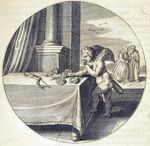
Pulchrorum etiam autumnus pulcher: Cats, Maechdenplicht (Middelburg, 1618), emblem 40
Iconclass: 23D44 autumn, fall, 'Autumnus'; 'Autunno' (Ripa) 51D4 Beauty; 'Bellezza' (Ripa)
Loci Communes: Forma, deformitas (Beauty, deformity, Beauté, difformité)
I iii 73 Magnorum fluminem navigabiles fontes Great rivers have navigable springs
Simili metaphora videtur dictum & illud, quod refert ac notat Fabius in octavo Institutionum libro: Magnorum fluminum navigabiles fontes sunt. eam sententiam ait se iuvene decantatam fuisse. Significat autem, praepotentium quantulacunque, plus pollere, quàm universas tenuium opes. Caeterum notat Fabius hoc sententiarum genus, quòd palàm falsae videantur.
There seems to be a similar metaphor in the saying quoted by Quintilian in the Institutions, book 8: 'Great rivers have navigable springs.' He says this was often repeated everywhere when he was young. Its meaning is that things belonging to the great, however tiny, have more power than all the possessions of the small. But Quintilian gives a bad mark to maxims of this kind, on the ground that they may be clearly seen to be false.
I iii 74 Generosioris arboris statim planta cum fructu est The slip of a noble tree bears fruit at once
Simillimam huic eodem loco subiicit: Generosioris arboris statim planta cum fructu est. Quo quidem id innui videtur, egregia beneque nata ingenia, statim maturescere, & ad frugem pervenire. Taxat Fabius & hoc sententiae genus. Mihi tamen visum est in adagiorum catalogum has quoque referre, quòd vulgo celebres fuisse testatur, & impudentior hyperbole, sicut paulo superius dictum est, non reiicitur ab hoc genere.
He adds this similar saying in the same place. It seems to mean that excellent and well-endowed minds mature early and come to fruition. Quintilian criticizes this kind of saying. It seemed right to me, however, to include these in the list of adages, because he testifies to their having been in general use, and the shameless exaggeration (as has been said earlier) does not exclude them from this class.
I iii 75 Cornicum oculos configere To pierce crows' eyes
M. Tullius in oratione pro Murena scribit ad hunc modum, Deinde etiam si quid apud maiores nostros fuit in isto studio admirationis, id enunciatis vestris mysteriis, totum est contemptum & abiectum. Posset agi lege nécne, pauci quondam sciebant. Fastos enim vulgo non habebant. Erant in magna potentia, qui consulebantur, à quibus etiam dies tanquam à Chaldaeis petebantur. Inventus est scriba quidam Cn. Flavius, qui cornicum oculos confixerit, & singulis diebus ediscendos fastos populo proposuerit, & ab ipsis iureconsultis, eorum sapientiam compilarit. Itaque irati illi, quòd sunt veriti, ne dierum ratione pervulgata & cognita, sine sua opera lege posset agi, notas quasdam composuerunt, ut omnibus in rebus ipsi interessent. Idem in actione pro L. Flacco: Hic Hercule cornici oculum, ut dicitur: nam hunc Hermippum hominem eruditum, civem suum cui debebat esse notissimus, percussit. Porrò proverbium natum sit ex apologo quopiam, an ex eventu, an ex metaphora sumptum, non satis liquet. Undecunque fluxerit, perinde valere videtur, Cornicum oculos configere, quasi dicas, novo quodam invento veterum eruditionem obscurare, efficereque ut superiores nihil scisse, nihil vidisse videantur. Effertur autem per ironiam. In eadem sententia usus est divus Hieronymus, Apologetico adversus Ruffinum secundo, Nunc vero cum pro varetate regionum diversa ferantur exemplaria, & germana illa antiquaque translatio corrupta sit atque violata, nostri arbitrii putas, aut ex pluribus iudicare, quid verum sit, aut novum opus in vetere condere, illudentibusque Iudaeis, cornicum, ut dicitur, oculos configere. Haec Hieronymus sentiens, quasi sua castigatione prolata, Iudaei iam nihil scituri viderentur, à quibus id temporis veteris testamenti veritas petebatur. Nec admodum diverse usurpavit Macrobius libro Saturnalium septimo. Et quia, inquiens, his loquendi labyrinthis nos impares fatemur, age Vecti, hortemur Eustachium, ut recepta contraria dispositione, quicquid pro vario cibo dici potest, velit communicare nobiscum: ut suis telis lingua violenta succumbat, & Graecus Graeco eripiat hunc plausum, tanquam cornix cornici oculos effodiat. hactenus Macrobius. Illud non ab re fuerit admonere lectorem, ut etiam atque etiam consideret, num cornicum vivacitas & concordia huic adagioni locum fecerit. Siquidem cornix antiquitus concordiae symbolum erat. Eiusdem vivacitas etiam Graeco proverbio celebrata est. Ut is videatur cornicum oculos velle configere, quisquis ea quae antiquitas magno consensu approbavit, damnare ac rescindere conetur. Nec admodum absurdum, si quis in hunc modum accipiat, ut dicatur oculos cornicum configere, qui perspicacissimis oculatissimisque visum adimat, offundatque tenebras: aut rem ipsissimam acu, quod aiunt, tangat, tantus videlicet artifex, ut non solum scopum, aut avem, verum & ipsos oculos iaculo feriat.
Cicero in his speech in defence of Murena writes thus: 'In the second place, if any awe attached to that profession in the time of our ancestors, it fell into utter contempt and was destroyed by the publication of your mysteries. In former times very few knew whether or not an action at law could be brought; for the calendar was not publicly known. Those who gave legal decisions had great power; they were asked to indicate the day on which a suit could be brought, as if they were Chaldean astronomers. A clerk by name Gnaeus Flavius was found who pierced the crows' eyes and published the calendar, enabling the people to learn up which were court days, and plucked their wisdom from the learned counsel themselves. And so these men, enraged because they were afraid that lawsuits could be conducted without their assistance, once the proper days were published and made a matter of general knowledge, invented certain legal formulae that they might still have a part in every transaction.' Again in the speech for the defence of Lucius Flaccus: 'Here, by Hercules, is a case of the proverbial crow's eye. For he swindled Hermippus here, a learned man, his own fellow-citizen, who should have been thoroughly acquainted with him.' Whether the proverb comes from some fable, or event, or is taken from a metaphor, is not quite clear. Wherever it came from, the meaning of 'to pierce crows' eyes' seems to be: to put the learning of older generations in the shade with some new discovery, and make it appear that earlier people knew nothing, have seen nothing. It is uttered in irony. Jerome, in his second apologetic against Rufinus, used it in the same way: 'Now, indeed, owing to the diversity of the regions, different copies are in circulation, and the genuine old translation has been corrupted and spoilt; and so you may think it within our province either to judge between several as to which is authentic, or to found a new work on the old one, and when the Jews laugh at us, as they say, to pierce their crows-eyes.' Jerome means by this to suggest that his examination of texts might seem to impute ignorance to the Jews, to whom at that time one had to go to get the truth of the Old Testament. Macrobius uses it in much the same way in the seventh book of his Saturnalia: 'And since we confess ourselves unable to cope with this labyrinth of words, come, Vettius, let us urge Eustathius to maintain the contrary opinion and be good enough to give us all the arguments for a mixed diet. In this way the language of violence will be the victim of its own weapons and just like one crow pecking at another's eyes, one Greek will steal the applause from another.' Thus far Macrobius. It would not be inappropriate to suggest to the reader that he should consider very carefully whether crows have given rise to this proverb through their long life and peaceful cohabitation. Indeed the crow was the symbol of concord in Antiquity; and its length of life is celebrated in a Greek proverb. So that anyone who tried to bring into contempt, cancel or remove the things which antiquity approved with one accord, may be said to wish to 'pierce the crows' eyes.' This is not so absurd, if one takes 'piercing the eyes' to mean removing the sight from those who have it at the clearest and best, so letting the darkness flood in; or to mean touching the very thing with the point, as they say, so skilfully that not only the target or the bird is pierced by the dart, but its very eyes.
Facsimile: 
Iconclass: 25F32(CROW)(+337) song-birds: crow (+ eyes of an animal) 47C8 boring, drilling, piercing (industrial processes) 54E31 Agreement, Unity; 'Concordia', 'Concordia insuperabile', 'Concordia militare', 'Concordia di Pace', 'Unione civile' (Ripa)
Collectanea (1500): 16
Loci Communes: Mira nova (Wonderful new things, Choses nouvelles et étonnantes)
I iii 76 Gladiatorio animo With a gladiator's spirit
Proverbii speciem habet quod legimus in Phormione Terentiana: Hem gladiatorio animo ad me affectant viam. Quo significatur, ita tendi ad nocendum alteri, ut id cum proprio etiam periculo tentetur, animo pertinaci, paratoque vel perdere, vel perire. Nam gladiatori composito ad certamen haec pugnae proposita sors est, aut occidere si occupaverit; aut occumbere si cessaverit. Aristoteles audaciam huiusmodi, cum propriae salutis contemptu coniunctam, Celticam appellat.
The phrase we read in the Phormio of Terence has the look of a proverb: 'Why, they are on their way to me in a gladiatorial spirit.' This means with the intention of wreaking harm on another even if it were to one's own peril, steadfastly resolved and ready to destroy or be destroyed. For a gladiator, all set for the fight, has the gamble of battle before him, either to kill if he should gain the upper hand, or to fall dying if he yields. Aristotle calls this kind of bravery, carrying with it scorn for one's own safety, `Celtic.'
Facsimile:
Iconclass: 31B mind, spirit 43C3961 fight of gladiators 54DD52 Risk; 'Ardire ultimo & necessario' (Ripa)
Loci Communes: Pertinacia (Stubbornness, Obstination)
I iii 77 Frusto panis For a crust of bread
Frusto panis, pro re quantumlibet pusilla ac vili, nostris quoque temporibus vulgo dictitant. M. Cato in oratione quadam M. Coelio vilitatem opprobrans, non loquendi tantum, verum etiam tacendi: Frusto, inquit, panis conduci potest, vel uti taceat, vel uti loquatur. Citatur locus ab A. Gellio in Noctibus Atticis. Videtur hyperbole sumpta, vel à canibus quos frusto panis invitare solemus, vel à mendicis.
`For a crust of bread' is still used in our own day by the common people to mean something quite insignificant and worthless. Marcus Cato, charging Marcus Coelius in a speech with cowardice, not only in what he said but in what he did not say, observes that 'he can be bribed with a crust of bread either to keep silence or to talk.' This is quoted by Aulus Gellius in his Attic Nights. The hyperbole seems to be taken either from dogs which we tempt with a piece of bread or from beggars.
Facsimile:
Iconclass: 41C621 bread, loaf
Loci Communes: Contemptus et vilitatis (Contempt and worthlessness, Mépris et bassesse)
I iii 78 Quem mater amictum dedit observare To keep to the clothes one's mother gave one
Quem mater amictum dedit observare, pro eo quod est, pueriliter ex alieno praescripto vivere, legitur apud Quintilianum libro quinto: Nam quid, inquit, illa miserius lege, veluti praeformatas infantibus literas prosequentium, & ut Graeci dicere solent, quem mater amictum dedit, sollicite custodientium? Quibus ex Fabii verbis apparet, Graecis in proverbio fuisse. Usurpat autem & indicat adagium Lucian. in Nigrino: καὶ πόθεν ὁ ταὼς οὗτος; καὶ τάχα τῆς μητρός ἐστιν αὐτοῦ, id est, Et unde hic pavo? atque fortassis materna vestis est. Dicuntur haec scommata in eum, qui versicolore veste amictus advenerat. Plutarch. in commentario de Fortuna Alexandri, δίκην νηπίου παιδὸς, φυλάττοντα τὴν περιβολὴν, ἣν ἡ πάτριος αὐτῷ συνήθεια, κὰάπερ τιτθὴ περιέθηκε, i. More puelli servantem amictum, quem illi patriae consuetudo veluti nutrix addiderat. Quin hoc ipsum, quo nihil iam tritius, Ex praescripto vivere, proverbiali metaphora dictum apparet, tracta videlicet à pueris, quibus, ut inquit Plato, ἐν τῇ γραφίδι, id est, in tabula graphiaria doctor exemplar praescribit, quod imitantes literarum notulas consuescant effingere. Hoc imitationis genus velut addictum ac servile ridet Horat. O imitatores servum pecus, ut mihi saepe. Risum, saepe iocum, vestri moucere tumultus. Et Fabius nihil putat ad bene dicendum inutilius, quàm ita servire praeceptis artis, ut non ausis digitum latum ab illis discedere, si quando causae ratio postulabit.
To keep to the clothes one's mother gave one. This means to live like a child, following the dictates of others; we read it in Quintilian, book 5: 'For what could be more pitiful than that law; it is like following up letters traced beforehand for infants, and (as the Greeks say) carefully keeping to the dress prescribed by mother?' From these words of Quintilian it is clear that this was a proverb in Greek, and it is adopted, and indicated as a proverb, by Lucian in Nigrinus: 'And whence comes this peacock? Perhaps it is his mother's clothing.' These jeers are addressed to one who arrives in a gaudy garment. Plutarch in his essay 'On the Fortune of Alexander': 'Preserving like a small child the dress which the custom of his country, like a nurse, had prescribed for him.' The very phrase 'to live according to prescription' seems to be a proverbial metaphor (nothing could be more commonplace): it is apparently taken from children, who (as Plato says) have writing-copies given them by their teacher as a model, so that they can imitate them and learn to form the letters. This is the kind of imitation made fun of by Horace, imposed and servile: 'O servile herd of mimics, all your fuss / Has roused so oft my laughter and my jest.' And Quintilian thinks nothing less conducive to good oratory than the practice of following the rules of the art in such a way that one dares not diverge from them by a finger's breadth, when the nature of the case calls for it.
I iii 79 Quid distent aera lupinis What a difference between bronze coins and lupins!
Proverbii faciem habet, quod est apud Horatium in Epistolis: Nec tamen ignorat, quid distent aera lupinis. Id est: novit discrimen rerum vilium & preciosarum. Agit autem Horatius de iis, qui beneficia non ita conferunt in quosvis, velut abiiciant, sed ita collocant, ut expendant & eius meritum, ac dignitatem cui praestant, & precium muneris quod largiuntur. Porrò lupini vilitatem proverbialiter notavit & Iuvenalis: Tunicam mihi malo lupini, Quàm si me toto laudet vicinia pago. Notat & Lucianus in libello De mercede servientibus, cum rogat num usque adeo defuerit lupini & aquae fontanae copia, ut in eam sese coniiceret servitutem.
Horace's phrase in the Epistles has the appearance of a proverb: 'Yet he knows well enough / How far bronze coins are from lupins.' That is, he knows the difference between what is cheap and what is precious. Horace is speaking about people who do not confer benefits on anybody and everybody, as it were throwing them away, but place them so as to correspond to the merit and dignity of the recipient, and the value of the gift which is given. Juvenal too mentions, as a proverb, the worthlessness of the lupin: 'I'd rather keep my pea-pods to myself / Than have the praise of the whole countryside.' Lucian in On Salaried Posts mentions it, when he asks if there were such a famine of lupins and spring-water, that he should give himself up to such slavery.
Facsimile: 
Iconclass: 25G4(LUPIN) plants and herbs: lupin 46B311 coin 48(+6122) art (+ bronze ~ arts)
Collectanea (1500): 427
Loci Communes: Differentiae (Differences, Différences)
I iii 80 Me mortuo terra misceatur incendio When I am dead the earth can burn up
Extat Graecus senarius παροιμιώδης apud Suetonium Tranquillum in vita Neronis: Εμοῦ θανόντος γαῖα μιχθήτω πυρι. id est, Me mortuo conflagret humus incendiis. Quod cum à quodam sermone communi diceretur: Nero, respondens, Imò, inquit, ἐμοῦ ζῶντσς, id est, Me vivo. alludens ad urbis incendium, quia paulo pòst effecit. Meminit huius proverbii M. Tullius lib. De finibus bonorum tertio, Quoniamque illa vox inhumana & scelerata dicitur eorum, qui negant se recusare, quo minus ipsis mortuis, terrarum omnium deflagratio consequatur, quod vulgari quodam versu Graeco pronunciare solent. Item Seneca libro De clementia secundo, cum dicit, multas voces magnas, sed detestabiles, in vitam humanam pervenisse, celebresque vulgo fieri, ut illam, Oderint, dum metuant. Cui, inquit, Graecus versus similis est, qui se mortuo terram misceri ignibus iubet. Quin eadem sententia, hodieque vulgo durat inter mortales, Mihi, inquiunt, morienti mundus universus moritur. Qua significant nihil sua referre, quid posteris accidat vel boni vel mali, cum ipsi tollantur è vita, nequaquam sensuri.
There is a Greek iambic line of a proverbial kind in Suetonius Tranquillus' life of Nero: 'When I am dead, the earth may burn with fire.' When this was quoted by someone as a common saying, Nero replied 'Even while I live,' alluding to the burning of the city, which he brought about soon after. This proverb is mentioned by Cicero in the third book of the De finibus: 'And as we feel it wicked and inhuman for men to declare (the saying is usually expressed in a familiar Greek line) that they care not if, when they themselves are dead, the universal conflagration ensues.' Similarly, Seneca in the De clementia, book 2, when he says that 'many powerful but detestable sayings touch human life, and become popular, such as that famous "Let them hate, so long as they fear." There is a Greek line similar to this, which calls for fire on the earth as soon as the speaker is dead.' This same saying still exists among mortals to this day: 'When I die,' they say, 'the whole world dies.' They mean that it does not matter to them what happens to future generations, whether it be good or bad, when they themselves, removed from life, will feel nothing at all.
Facsimile:
Iconclass: 25 earth, world as celestial body 31E death of human being 51FF1 Subsequence 58AA1 Destruction
Loci Communes: Aliena a re (Irrelevant to the matter, Étranger au sujet)
I iii 81 Mare coelo miscere To mingle sea and sky
Mare caelo miscere, Proverbialis hyperbole est, pro eo quod est, omnia perturbare, nihilque non facere. T. Livius, Quid est, quod coelo terram, terrae coelum misceant? Idem alibi: Quid tandem est, cur coelum ac terras misceant? Iuvenalis: Clames licet, & mare coelo Confundas: homo sum. Lucianus in dialogo Promethei & Mercurii: τί οὖν διὰ τοῦτο ἐχρῆν τὸ τοῦ λόγου, τῇ γῇ τὸν οὐρανὸν ἀναμεμίχθαι; id est, Quid igitur oportebat ea gratia, terrae, quod dici solet, miscere coelum? Virgilius in quinto, de Iunone omnia tentante: Maria omnia coelo Miscuit. Idem apulo diversius in duodecimo: Non si tellurem effundat in undas, Diluvio miscens, coelumve in tartara solvat. Aristophanes in Lysistrata, non dissimili figura dixit, Τὰ δ᾽ ὑπέρτερα νέρτερα θήσει ζεὺς ὑψιβρεμέτης. id est, Quin & supera infera reddet Iuppiter altifremus. Plutarchus in vita Romuli sic usurpat, ut coelum terrae misceant, qui ex hominibus deos, ex diis homines faciunt, & quae sunt hominum fabulantur de diis: ἀπογνῶναι μὲν οὖν παντάπασι τὴν θειότητα τῆς ἀρετῆς ἀνόσιον καὶ ἀγεννὲς, οὐρανῷ δὲ μιγνύειν γῆν ἀβέλτερον. id est, In totum abnegare divinitatem virtutis, impium est & ingenerosum: caeterum caelo miscere terram, stuporis est.
To mingle sea and sky, is a proverbial hyperbole, meaning to throw everything into confusion, to leave nothing undone. Livy: 'Why do they mingle earth and heaven?' Again in another place, 'Finally what are they doing, why do they mingle heaven and earth?' Juvenal: 'You may confound sea and sky with your bellowing, / I am a man after all.' Lucian in the dialogue between Prometheus and Mercury: 'Was it necessary on account of this to mix earth and sky, as the saying goes?' Virgil in book 5, speaking of Juno trying everything: 'All the seas and sky / She mingled.' The same author, a little differently in book 12: Not though in deluge it confound the earth, And plunge it in the waves, shatter the sky, And cast it down to Hell. Aristophanes in the Lysistrata said with a similar metaphor, 'Zeus the Lord-Thunderer shall turn high to low.' Plutarch in the life of Romulus makes use of it to equate people who 'mix earth and heaven' with those who turn gods into men and men into gods, and tell very human stories about divinities: 'Total denial of the divinity of virtue is impious and ignoble, and to mix earth and heaven is utter stupidity.'
I iii 82 Miscebis sacra profanis You will mix sacred and profane
Consimili figura dixit Horatius: Miscebis sacra profanis. Id est: Nihil non facies. Item, Confundens fasque nefasque. Apud veteres multum erat discriminis inter res hominum ac res deorum, adeo ut Homerus etiam vocabula discernat, quibus dii consueverunt uti, à vocibus humanis. Et Pythagoras à quibusdam iusserit abstineri, quod numinibus essent consecrata. Unde qui nihil habent pensi, quique nihil non audent, miscent sacra profanis.
In a similar way Horace says: 'You will mix the sacred with the profane' meaning 'there is nothing you will not do.' Also 'confounding right and wrong.' Among the ancients a great difference was made between what belonged to man and what to the gods, so that Homer even distinguishes the names used customarily by the gods from any human words. And Pythagoras ordered abstinence from some things because they were consecrated to the divine powers; hence those who have no scruples, who dare anything, mix sacred with profane.
I iii 83 Susque deque Neither here nor there
Apud Plautum atque alios autores proverbialiter positum invenitur, Susque deque fero, & Susqeu deque habeo. pro eo quod est, nihil mea refert, nil laboro. Plautus in Amphitryone: Quae neque sunt facta, neque ego in me admisi, arguit, atque id me susque deque esse habituram putat. A. Gellius lib. Noctium sextodecimo scribit, Susque deque ferre, idem valere quod aequo animo esse, & quod accidit non magnipendere, atque interdum negligere & contemnere, simillimumque esse illi quod Graeci dicunt αδιαφορεῖν. Citat autem Laberium in Compitalibus: Nunc tu lentus es, nunc tu susque deque fers. Item M. Varronem in Sisenna: Quod si non horum omnium similia essent principia, susque deque esset. Denique versus hos ex Lucilio refert: Verum hic ludus ubi susque omnia deque fuere: Susque & deque fuere, inquam, omnia ludus iocusque Imitatum ex illo Graeco schemate, ἄνω καὶ κάτω, id est, Sursum ac deorsum. quo nullum ordinem, nullumque rerum discrimen significamus.
In Plautus and other authors a proverbial phrase is found 'To me it's neither here nor there, I reckon it's neither here nor there,' meaning 'I have no concern with it, I am entirely indifferent.' Plautus in the Amphitryo: 'He accuses me of things that were never done and which I never thought of doing, and he thinks I shall take it as neither here nor there.' Aulus Gellius in book 16 of the Nights says that to take something as neither here nor there is equivalent to 'being composed in mind and indifferent to what happens, and sometimes to ignoring and despising it,' on the lines of 'the Greek verb adiaphorein, to be indifferent.' He quotes Laberius in his Compitalia: 'Now you are unconcerned; now you reckon it neither here nor there.' Marcus Varro too in his Sisenna: 'Even if the beginnings of all these were not the same, it would be neither here nor there.' Finally he cites these lines out of Lucilius: 'All this is but a game, which neither here nor there is - / Neither here nor there, but all is a game and jesting.' This is imitated from the familar Greek phrase Ἄνω καὶ κάτω, Up and down, by which we convey that there is no order and no distinguishing feature between things.
Facsimile: 
Iconclass: 51I4 Nearness 51II4 Farness 54AA21 Indifference
Loci Communes: Contemptus et vilitatis (Contempt and worthlessness, Mépris et bassesse)
I iii 84 Ultro citroque To and fro
Ultroque citroque proverbialiter figura dicitur, valetque perinde quasi dicas, hinc atque illinc, sive utrinque. Fit autem venustior metaphora, quoties ad mutuam altercationem, disceptationem, confabulationem, rixamve refertur. Quod genus est apud Ciceronem De republica: Multisque verbis ultro citroque habitis, ille nobis consumptus est dies. Idem in libris Officiorum: Beneficiis ultro & citro datis acceptisque. Seneca De beneficiis lib. v. Beneficium & gratiae relatio ultro citroque ire debent. Consimili forma dicimus: Ultro citroque agitata causa. &, Ultro citroque datis & acceptis cladibus, Ultro citroque certatum convitiis.
To and fro is used as a proverbial phrase, and is equivalent to saying'now on this side, now on that,' or 'on both sides.' The metaphor is more attractive if applied to disputes, altercation, discussion or quarrels. Cicero uses it like this in the De republica: 'We spent the whole of that day in much talk to and fro.' Again in the De of ficiis: 'By kind services given and received, to and fro.' Seneca in the De beneficiis, book 5: 'Kindness and gratitude ought to pass to and fro.' Using the same phrase we say'The question was tossed to and fro,' 'Damage was inflicted and received to and fro,' 'There was a competition in insults to and fro.'
Facsimile:
Iconclass: 51L4 Progression, Forward Movement 51LL4 Regression, Backward Movement
Loci Communes: Diligentiae (Diligence, Diligence)
I iii 85 Sursum ac deorsum Up and down
Huic simillimum est illud ex Eunucho Terentiana: Sex ego te totos Parmeno hos menses quietum reddam, ne sursum deorsum cursites. id est huc atque illuc, aut certe subinde ad Thaidem ab hero, rursum ab hero ad Thaidem intercursites, ita ut solent amantium ministri. Quod quidem plusculum habebit decoris, si longius transferatur, ut si quis dicat, iureconsultos, à volumine ad volumen, à legem, ab interprete ad interpretem, subinde transferentes sese, sursum ac deorsum vagari. Ea metaphora mutuo sumpta videtur à Sisyphi fabula saxum voluentis apud inferos. Cui Graecum illud ἄνω καὶ κάτω, de quo modo meminimus, ita finitimum est, ut idem esse videatur. Demosthenes in prima contra Philippum oratione: ἐὰν ἄλλοθί που, συμπαραθεῖτε ἄνω καὶ κάτω. id est, Quod si alio quopiam in loco Philippum adesse nunciatum sit, pariter accurritis sursum ac deorsum. Aristophanes ἐν ἀχαρνῇς, Οἱ δ᾽ ἐν ἀγορᾷ λαλοῦσι, κ᾽ ἄνω καὶ κάτω Τὸ σχοινίον φεύγουσι τὸ μεμιλτωμένον. id est, At hi in foro loquuntur, & resticulam Sursum ac deorsum minio vitant litam. Euripides in Bacchis: Ανω κάτω τὰ πάντα συγγέας ὁμοῦ. id est, Sursum deorsum cuncta confundens simul. Plato in Phaedro, χρὴ πάντας τούς λόγους ἄνω καὶ κάτω μεταστρέφοντα ἐπισκοπεῖν, id est, Oportet rationes omnes sursum ac deorsum versemus, atque ita consideremus. Idem in Theaeteto: καὶ γένοιτ᾽ ἂν τὸ λεγόμενον, ἄνω κάτω πάντα, id est, Fiatque quod dicitur, sursum deorsum omnia. Usus est & in Parmenide. Utitur eodem Aristides rhetor, cum aliis aliquot locis, tum in Cimone: ἐγώγε οὐχ ὁρῶ πῶς ἂν μᾶλλον πάντα ἄνω καὶ κάτω γένοιτο, id est, Ego sanè non video quo pacto possint universa magis sursum ac deorsum misceri. Menander apud Plut. Οὐ δὲ στρεφομένους ἄνω κάτω, οἴμοι λέγειν. id est, Neque dum se agunt sursum deorsum, dicere, Heu mihi. Pro ἄνω καὶ κάτω, dixit Euripides πάλιν τε καὶ πρόσω. quasi dicas, antrorsum ac retrorsum. Φύρουσι ταῦθ᾽ οἱ θεοὶ πάλιν τε καὶ πρόσω. id est, Miscent enim haec sursum ac deorsum numina. Versus à scribis corruptus constabit si legas: Φύρουσι ταῦτα θεοὶ πάλιν τε καὶ πρόσω. Apud Athenaeum libro sexto: Αλλὰ μεταφέρει ἕκαστος αὐτῶν ταῦτ᾽ ἄνω τε καὶ κάτω, id est, Sed ista singuli Sursum deorsum transferunt. De poetis loquitur qui nihil ipsi reperiunt novi, sed ab aliis inventa miscent, & aliter tractando faciunt sua. Proinde proverbium accommodabitur, vel ad omnia tentantem, vel ad omnia confundentem, vel ad intelligentiam omni ex parte negocium circunspicientis. Huic planè simillimum est quod extat apud Terentium in Ecyra: Cursari rursum prorsum. pro eo quod est, huc illuc. Nam Rursum proprie sonat, retro: & prorsum, ante. Proverbial sche ma annotavit et Donatus. Cuiusmodi sunt et illa, sursum deorsum, intrò foras, hac illac, & Graecis: ἄνω καὶ κάτω, πρόσσω καὶ ὀπίσσω. Quo longius recesserit à rebus corporeis, hoc plus venustatis habebit adagium. Quod genus est illud Iuliani ad Galenum lib. quo hunc refellit: Οὐδ᾽ ἄν πείσειν ἡμᾶς τε ἢ αὑτοὺς ἐπ᾽ ἀληθείᾳ, ὅτι ἴσασι τί φύσις ἐστὶν, ἣν ἄνω τε καὶ κάτω θρυλλοῦσι, τραγῳδοῦντες πανταχοῦ. id est, Nequaquam persuasuri sunt vel nobis, vel sibiipsis vere, ipsos scire quid sit natura, quam sursum ac deorsum celebrant, ubique magnifice praedicantes. Ita qui variis modis rem apud sese expendit, ἄνω κάτω λελογικέναι dici poterit.
This is very like the previous phrase, and comes from Terence's Eunuchus: 'I will give you peace for all these six months, Parmeno, so that you don't run up and down,' that is, here and there, or at any rate beteeen Thais and your master and your master and Thais, after the manner of lovers' servants. A little more style is given to it by widening the meaning, and speaking for instance of lawyers turning rapidly from volume to volume, from statute to statute, from commentator to commentator, switching from time to time and ranging up and down. This metaphor seems to be borrowed from the Sisyphus of legend, rolling his stone in the underworld. The Greek phrase for `up and down,' ἄνω καὶ κάτω, which I have just mentioned, is so close that it seems the same. Demosthenes in the first Philippic: 'Even though news has come that Philip is somewhere else, you run up and down just the same.' Aristophanes in the Acharnians: 'They chatter in the market-place and up and down they run, / Fleeing the ruddled rope.' Euripides in the Bacchae: `Confusing all things together, up and down.' Plato in the Phaedrus: `One ought to turn all the arguments over, up and down, and consider them.' Again in the Theaetetus: 'It might be, as the proverb says, that all is up and down.' He also used it in the Parmenides. Aristides the rhetorician uses the same phrase in several places, notably in Cimon: 'Really I cannot see how everything could be more completely jumbled up and down.' Menander, quoted by Plutarch: 'Nor would they fuss up and down and say O me!' For 'up and down' Euripides used'back and forth': 'The gods are tumbling these things back and forth.' The line has been corrupted by copyists, and will run better if we omit the definite article. In Athenaeus, book 6: 'But each of them shifts these things up and down.' He is speaking of the poets, who make no new discoveries themselves but mix up the inventions of others and make them their own by a fresh treatment.
And so the proverb can be applied either to the man who tries everything or to the one who confuses everything, or to the acuteness of one who looks at a subject from all sides. This is very like a phrase in Terence, in the Hecyra: 'Running rursum prorsum, back and forth,' for hither and thither. For rursum properly means 'backwards' and prorsum 'forwards.' That this form is proverbial was also remarked by Donatus. Of the same sort are those others, sursum deorsum, intro foras, hac illac, and two Greek examples ἄνω καὶ κάτω, πρόσσω καὶ ὀπίσσω. The further the adage is removed from the physical world, the pleasanter it will be. Of this kind is Julianus' saying to Galen, in the book Galen wrote to confute him: 'Nor could they persuade either us or themselves truly that they know what nature is, about which they chatter up and down, declaiming on all sides.' So anyone who thinks out for himself the various aspects of a thing can be said to have thought it out up and down.
I iii 86 Omnium horarum homo A man for all hours
Qui seriis pariter ac iocosis esset accommodatus, & quicum assidue libeat convivere, eum veteres omnium horarum hominem appellabant. Atque ita vocatum Asinium Pollionem, autor est Fabius. Apud Suetonium Tiberius duos quosdam combibones suos, iucundissimos, & omnium horarum amicos profiteri solet, etiam codicillis. Eiusmodi amicum eleganter simul, & graphice depinxit Ennius, sub persona Gemini Servilii. Carmen quanquam extat apud Aulum Gellium Noctium Atticarum libro duodecimo, capite quarto, tamen non gravabor adscribere: Hocce loquutus, vocat quicum bene saepe libenter Mensam, sermonesque suos, rerumque suarum Comiter impertit, magna cum lapsa dies iam Parte fuisset, de parvis summisque gerundis. Consilio, induforo, lato, sanctoque senatu. Cui res audacter magnas, parvasque, iocumque Eloqueret: quae tincta malis, & quae bona dictu Evomeret, si quid vellet, tutoque locaret. Quocum multa volup, ac gaudia, clamque palamque Ingenium, cui nulla malum sententia suadet, Ut faceret facinus levis, tamen haud malus, idem Doctus, fidelis, suavis homo, facundus, suoque Contentus, scitus, atque beatus, secunda loquens, in Tempore, commodus, & verborum vir paucorum. Multa tenens antiquae, sepulta, & saepe vetustas Quae facit, & mores, veteresque novosque tenentem. Multorum veterum leges, divumque hominumque Prudentem, qui multa loquive, tacereve possit. Talis & inter philosophos fuisse traditur Aristippus, qui Dionysii iussu cum caeteris nec in foeminea purpura saltare detrectavit, Platone recusante, addens vel in Bacchanalibus oportere pudicum esse. Hinc Horatius: Omnis Aristippum decuit color. Contra qui suis quibusdam sunt moribus, neque faciles ad cuiusvis hominis convictum, perpaucorum hominum homines dicuntur, ut apud Terentium. Apud Horatium autem, Communi sensu planè caret, inquimus.
The man who suits himself to seriousness and jesting alike, and whose company is always delightful - that is the man the ancients called 'a man for all hours.' Quintilian tells us that Asinius Pollio was called so. In Suetonius, Tiberius used to call two of his boon companions the merriest of men, and friends for all hours, even in his imperial orders. A friend of this kind is depicted, with vividness and grace, by Ennius, in the person of Geminus Servilius. Although the poem is preserved in the Attic Nights of Aulus Gellius, book 12 chapter 4, I have pleasure in transcribing it here:
When he had spoken thus, he called the man
Who shared with him his table and his talk,
And all he had; with whom at close of day,
Wearied with counsel and affairs of state,
He might with jesting tell things great and small
And pour out all he thought and know it safe;
A mind to which he turned with full delight
In public and in private, never swayed
By others' views to doing wrong, but light
Of heart, and without malice; learned and loyal;
A man of pleasant ways and power of speech,
Happy, contented with his own, and shrewd,
Speaking a word in season, ready with help,
Sparing with talk, retentive; prizing high
The value of the buried years of old,
Keeping old ways but not despising new,
Wise in the ancient laws of gods and men,
Able to speak but also hold his peace.
Such a one among philosophers is said to have been Aristippus, who did not refuse to obey the command of Dionysius and dance with the rest in the purple worn by women, though Plato objected, adding that even in the Bacchanalia one should behave with modesty. Hence Horace says: 'Every colour became Aristippus.' Those on the other hand who have their own code of behaviour and do not find it easy to live with anyone else, are said to be 'men of few men,' as Terence says. In Horace: 'He lacks, we say, the common feelings of a man.'
Facsimile: 

Iconclass: 33A5 friends 43A2 private festivities, merry company 51F2 Continuity 56B1 Pleasure, Enjoyment, Joy; 'Allegrezza', 'Allegrezza da le medaglie', 'Allegrezza, letitia e giubilo', 'Diletto', 'Piacere', 'Piacere honesto' (Ripa)
Collectanea (1500): 760a
Loci Communes: Servire tempori (To serve the times, Se plier aux circonstances)
I iii 87 Pecuniae obediunt omnia Everything bows to money
Tam omnibus nationibus in ore fuisse videtur haec sententia, quàm nunc etiam omnibus est in usu: Pecuniae obediunt omnia. Et refertur in Proverbiis Hebraeorum, apud Ecclesiasten, capite x. nec eo secius à Graecis pariter ac Latinis autoribus celebratur. Euripides in Phoenissis: Τά χρήματ᾽ ἀνθρώποισιν τιμιώτατα, Δύναμίν τε πλείστην τῶν ἐν ἀνθρώποις ἔχει. id est, Mortalibus nil charius pecunia, Atque inter homines una plurimum valet. Item Aristophanes in Pluto: Ως οὐδὲν ἀτεχνῶς ὑγιές ἐστιν οὐδενὸς, Αλλ᾽ εἰσὶ τοῦ κέρδους ἅπαντες ἥττοντες. id est, Proh ut nihil sanum reperias uspiam, Sed pariter omnes serviunt victi lucro. Huc alludit & Demosthenicum illud in prima Olynthiaca: δεῖ δὴ χρημάτων καὶ ἄνευ τούτων οὐδέν ἐστιν γενέσθαι τῶν δεόντων. id est, Breviter opus est pecuniis, neque citra has quicquam eorum quae facienda sunt, confici potest. Rursum Aristophanes in eodem Pluto, facetissime persequitur, quicquid rerum vel bonarum, vel malarum geritur inter mortales, id pecuniarum gratia fieri, quin etiam diis ipsis non aliam ob causam rem divinam fieri. Atque inter alia permulta hanc catholicam sententiam refert: Εἰ τί γ᾽ ἐστὶ λαμπρὸν καὶ καλὸν, . Η χάριεν ἀνθρώποισι, διά σε γίγνεται. . Απαντα τῷ πλουτεῖν γάρ ἐσθ᾽ ὑπήκοα. id est, Si quid eximium est aut splendidum, Si quid venustum, hominibus abs te uno venit. Siquidem opibus universa simul obediunt. Proinde Horatius pecuniam reginam appellat: Scilicet uxorem, cum dote, fidemque & amicos, Et genus & formam regina pecunia donat. Sed nemo festivius pecuniae tyrannidem descripsit, quàm Euripides Bellerophontem ad hunc modum loquentem faciens. Referuntur autem à Seneca lib. epistolarum tricesimo primo, nam opsa quidem fabula non extat, versus aliquot. hi quoniam sunt in primis lepidi ac venusti, non gravabor asscribere, sed aliquos locis emendatos. quandoquidem apud Senecam habentur depravati: Sine me vocari pessimum, ut dives vocer. Nemo an bonus, an dives, omnes quaerimus. Non quare, & unde, quid habeas, tantum rogant. Ubique tanti quisque, quantum habuit, fuit. Quid habere nobis turpe sit, quaeris? nihil. An dives, omnes quaerimus, nemo an bonus. Aut dives opto vivere, aut pauper mori. Bene moritur, quisquis moritur dum lucrum facit. Pecunia, ingens generis humani bonum. Cui non voluptas matris, aut blandae potest Par esse prolis, non sacer meritis parens. Tam dulce si quid Veneris in vultu micat, Merito illa amores coelitum atque hominum movet. Cum hi, inquit, novissimi versus in tragoedia pronunciati essent, totus populus ad eiiciendum & actorem & carmen consurrexit, uno impetu, donec Euripides in medium ipse prosiliit, petens ut expectarent, viderentque quem admirator auri exitum faceret. Dabat in illa fabula poenas Bellerophontes, quas in sua quisque dat. At ex his versibus, quos Latinos recitat Seneca, posteriores aliquot reperi Graecos apud Athenaeum in Dipnosophistis lib. iiii. sed citra nomenclaturam autoris: eos hoc loco subscribam: Ω χρυσέ δεξίωμα κάλλιστον βροτοῖς, Ως οὔτε μήτηρ ἡδονὰς τοιάς δ᾽ ἔχει, Οὐ παῖδες ἐν δόμοισιν, οὐ φίλος πατὴρ, Οἵας σύ, χ᾽ οἱ σὲ δόμασιν κεκτημένοι Εἰ δ᾽ ἡ Κύπρις τοιοῦτον ὀφθαλμοῖς ὁρᾷ, Οὐ θαῦμ᾽ ἔρωτας μυρίους αὐτὴν ἔχειν. id est, O captus aurum hominibus ornatissimus, Ut nec genitrix, nec pater, nec liberi In aedibus tales voluptates ferunt: Quales paris tu his, qui domi te possident. quod si hoc modo Veneris renident lumina, Haud mirum amores si cit innumerabiles. Subit interim admirari perversum praeposteumque mortalium ingenium. Sententiam probam in ficta fabula, sub persona improba, ab histrione recitatam in thatro non ferunt, ac per tumultum eiiciunt, sibi quisque domi ignoscit. Quotus enim quisque est qui studio vitaque non loquitur, quod illic histrio sonabat? Horrent voces in theatro, & non horrent rem in omni vita? Quid infamius, quid execratius apud omnes mendacii vocabulo, quid ipsa re in moribus hominum usitatius? Quid periurio detestabilius? Excute vitam hominum, periurii plena sunt omnia. Vide quid populo iurent principes, quid episcopi, quid abbates, imo; quid in baptismo Christiani omnes. Confer mores, quantam invenies periuriorum μυρμηκίαν; Quàm abominamur furis nomen? At in vita nihil aliud invenies. Nisi forte furtum non est, accipere pecuniam mutuam animo non reddendi, negare depositum quum tutum est, mala fide invadere haereditatem aut possessionem alienam, imponere emptori, suffurari nonnihil de materia quam suscepisti, pro gemmis vitra obtruderem, aliud vini genus pro alio vendere. denique nullam praetermittere occasionem fraudandi proximum. Sed ad proverbia redeo.
It seems as if this was as popular a saying among all peoples as it is now in general use: Everything bows to money. It is mentioned among Hebrew proverbs in Ecclesiastes, chapter 10, and is well known in the same form in Greek and Latin alike. Euripides in the Phoenissae: 'Nothing is dearer to mortals than money, / Among men it has the greatest power.' Again Aristophanes in the Plutus: 'Nowhere will you find anything sound, / But all alike bow to the love of gain.' Demosthenes alludes to this in the First Olynthiac: 'In a word, money is needed, and without this nothing can be done that needs to be done.' Aristophanes again in the Plutus explains in humorous vein how everything which is done among mortals, good or bad, is done on account of money, and even the worship of the gods themselves in performed for no other reason. Among many other remarks he quotes this all-embracing thought:
If aught be fine, magnificent or fair,
It comes to men from thee alone; to wealth
All things together are obedient.
Horace calls money a queen: 'Queen Money gives us all; well-dowered wife, / Loyalty, friends, beauty, and lineage.' But no one more clearly describes the tyranny of money than Euripides when he makes Bellerophon speak in this way. Seneca quotes a few lines in his volume of Letters, no 115, for the play itself is lost; as these lines are exceptionally amusing and charming, I will transcribe them with pleasure (but emended in some places, since in Sencea these are corrupt):
Call me the worst of men, but call me rich.
None asks if a man's good, but is he rich?
Not whence or why they ask, but what have you got?
A man's prestige hung everywhere on pelf.
What (do you ask) is shameful to have?
Naught. We ask if he is rich, not if he s good.
I wish to live rich, but if poor, to die.
It's a good death, to die while making profits.
Money, that blessing to the race of men,
Cannot be matched by mother's love, or lisp
Of children, or the honour due one's sire.
And if the sweetness of the lover's glance
Be half so charming, Love will rightly stir
The hearts of gods and men to adoration.
'When these last lines in the play were spoken,' he writes, 'the whole populace rose up as one man to throw out the actor and the poem, until Euripides himself jumped up in the audience and begged them to wait and see what a bad end was reserved for the worshipper of gold. Bellerophon paid the same penalty in that play as each man does in his own.'
But from these lines quoted in Latin by Seneca, I found some later Greek ones in the Doctors at Dinner of Athenaeus, book 4, with no author's name, and I will add them here:
O gain of gold, most honoured among men,
So that no mother, father, children bring
Such pleasure to the house as you confer
On those who hold you in their home; if
Love Has eyes that shine so bright, it is no wonder
If loves be numberless.
It comes into one's mind to wonder at the perversity and unreasonableness of the human mind. A vile opinion spoken by a vile character in a fictitious play, recited by an actor on the stage - they can't bear this, and they riot to have him thrown out; but every man of them makes light of it in his own house. How many of them do not declare in their wishes, in their life, just what that actor was declaiming? Are they shocked at words in the theatre, and not at the thing itself in everyone's life? What is there more infamous, more generally detested than that word 'lie,' and what more common than the thing itself in the conduct of men? What is there more hateful than perjury? Examine the lives of men, and you will find perjury everywhere. Look at the vows which princes swear to their people, and bishops and abbots too - nay, look at the vows all Christians take at baptism. Compare their actual behaviour, see what a mass of perjuries you will find. How we execrate the name of 'thief'! But in real life you will find nothing else. Unless it is not theft, to accept a loan with no intention of paying it back, to deny that a thing was entrusted to you when you have it packed safely away, to usurp an inheritance or someone else's property, to hoodwink a purchaser, to filch part of the goods you have in your charge, to offer glass for gems, to sell one kind of wine as another. In short, to lose no opportunity of defrauding your neighbour. But I return to the Adages.
Facsimile: 
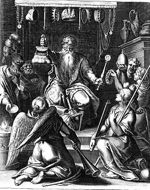
Pecuniae obediunt omnia: Vaenius, Emblemata Horatiana (Antwerp, 1612), emblem 59
Pecuniae obediunt omnia: Cats, Spiegel (The Hague, 1632), emblem 75
Prudentiae obediunt omnia: Pers, Bellerophon (Amsterdam, 1614), emblem 21, paraphrasing
Iconclass: 44B132(+0) making a bow to a ruler (+ variant) 46B31 money 53B5 Obedience; 'Obedienza' (Ripa)
Loci Communes: Munerum corruptela (Corruption by gifts, Corruption par les présents)
I iii 88 Veritatis simplex oratio The plain speech of truth
Refertur in Diogeniani collectaneis hoc adagium. Extat autem in Phoenissis Euripidis, ad hunc modum: Απλοῦς ὁ μῦθος τῆς ἀληθείας ἔφυ, Κ᾽ οὐ ποικίλων δεῖτ᾽ ἄν διχ᾽ ἑρμηνευμάτων, Εχει γὰρ αὐτὴ καιρὸν, ὁ δ᾽ ἄδικος λόγος Νοσῶν ἐν αὑτῷ, φαρμάκων δεῖται σοφῶν. id est, Nam veritatis suevit esse oratio Simplex, vafris nec est egens ambagibus Interpretum: siquidem ipsa per se congruit. At sermo iniquus, quia per se sit morbidus, Medicamenta exquisita deposcit sibi. Citatur à Seneca epistola xlix. Nam, ut ille ait tragicus, veritatis simplex oratio est. Proverbium usurpabitur, vel in rhetores ac poetas, qui mendacia verborum lenociniis fucare solent. Vel in blandiloquos, qui quod non ex animo dicant, solent accuratius adornare sermonem, ac veros affectus hoc diligentius imitari verbis, quo magis vacant affectibus: (Ut, qui conducti plorant in funere, dicunt Ac faciunt propè plura dolentibus ex animo: Cum interim simplex illa rusticanaque veritas, negligat id genus orationis fucos: Τὰ οῦκα οῦκα, την σκὰφην σκὰφην. id est, Ficus ficus, ligonem ligonem appellans.) Vel in divinos, qui vaticinia sua verbis ambiguis efferunt, ne queant deprehendi, sitque rima quaepiam, per quam elabantur. Denique in eos qui perplexe loquuntur, dum verum dissimulant. Nam hoc indicio saepenumero deprehenditur vanitas, velut in Eunucho Terentiana: Pergin' scelesta mecum perplexe loqui? Scio, nescio, abiit, audivi, ego non adfui, Non tu isthuc mihi dictura aperte es, quidquid est?
This adage is found in the collections of Diogenianus. It stands however in the Phoenissae of Euripides, thus: The tale of truth is simple And it needs no fancy explanations. For it has its own proportion, but the unjust word Being diseased, has need of clever drugs. It is quoted by Seneca, letter 49: 'For as that writer of tragedy says, the language of truth is simple.' The proverb can be taken up against orators and poets, who usually trick out their lying words with decorative touches. Or against those who speak fair, and since they do not speak from the heart, are all the more careful to adorn their speech, and make their words imitate true feelings just because those feelings are lacking, 'as those who are paid to weep at funerals / Say and do more than the truly sorrowful.' Meanwhile old-fashioned rustic truth is plain, and knows nothing of this kind of pretence in speech, calling a fig a fig, a spade a spade. Or it may be used against soothsayers, who produce their prognostications in ambiguous terms, for fear they may be caught out; there is always a chink through which they can slink away. Finally it hits at those who talk in riddles to hide the truth. Often this is the sign which gives the falsehood away, as in the Eunuchus of Terence: Are you going on talking roguery with me in riddles? I know, I don't know, he went, I heard, I wasn't there. Will you not speak to me openly, and tell me the truth?
Facsimile: 
Iconclass: 52A6 Truth; 'Verità' (Ripa) 52D Communication of Thought (qualitative aspects) 52D2 Clarity, Precision
Collectanea (1500): 145
Loci Communes: Libertas, veritas (Freedom, truth, Liberté, vérité)
I iii 89 Tunica pallio propior est The tunic is nearer than the cloak
Apud Plautum in Trinummo legitur allegoria proverbialis: Tunica pallio propior est. Quo significatum, ex amicis nos aliis atque aliis magis esse devinctos, neque parem omnium habendam esse rationem. Apud veteres primum in officio locum habebant parentes, proximum pupilli nostrae fidei crediti, tertium clientes, quartum hospites, quintum cognati & affines, ut indicat Gellius libro quinto, cap. xiii. Praeterea quaedam negocia propius aliis ad nos pertinere. Pallium extrema vestis apud Graecos, quemadmodum apud Romanos toga. Tunica toga tegebatur, ut frequenter apud Homerum, χλαῖναι καὶ χιτῶνες, simul nominantur.
In the Trinummus of Plautus we read a proverbial allegory in these words: The tunic is nearer than the cloak. It means that among our friends there are some who are more closely linked with us than others, and not all are to be considered on the same footing. Among the ancients the first obligation was towards parents, the next to wards committed to our care, the third to clients [dependants], the fourth to guests, the fifth to kinsmen and relatives, as Gellius says, book 5 chapter 13. Besides, some affairs are more our concern than others. The cloak was the outer garment of the Greeks, like the toga worn by the Romans. The tunic was covered by the toga, and frequently as in Homer both are mentioned together.
Facsimile:
Annotation: Cf. "Het hemd is nader dan de rok"
Iconclass: 41D212 coat, cape 41D223(TUNIC)(+0) clothing for the upper part of the body (TUNIC) (+ variant) 51B1 Relation 51I4 Nearness
Loci Communes: Proprii commodi studium (Pursuit of one's own advantage, Recherche de son propre intérêt)
I iii 90 Genu sura propius The knee is closer than the calf
Γονυ χνήμης ἔγγυον. id est, Genu sura propius. Qui Graecas paroemias collegerunt, aiunt, hoc adagium ex eventu quodam esse natum. Cum in praelio quidam conspiceret duos amicos, pariter de vita periclitantes, fratrem & consobrinum, neque posset utrique simul ferre suppetias, omisso consobrino fratrem defendit, atque hanc interim sententiam pronunciavit, quae postea transierit in proveribum, γόνυ χνήμης ἔγγυον. id refertur ab Aristotele lib. Moralium nono: Accedunt, inquiens, eodem & proverbia universa, ut Anima una, & Amicorum communia sunt omnia, & Amicitia est aequalitas, & Tibia genu propinquius. Theocritus in Idyllio, cui titulus Charites, tribuit hoc adagium viro tenaci, qui sibi vivat, neque quidquam velit impertiri amicis: Πᾶς δ᾽ ὑπὸ κόλπου χεῖρας ἔχων πόθεν αὔξεται ἀθρεῖ Αργυρος, οὐδέκεν ἰὸν ἀποτρίψας τινὶ δοίη Αλλ᾽ εὐθὺς μυθεῖται, ἀποτέρω ἤ γόνυ κνάμα, Αὐτῷ μοί τι γένοιτο. id est, Verum quisque sinu dextram occulit, illud & unum Cogitat, unde sibi congesta pecunia crescat, Nec cuiquam abstersa rubigine donet amico. Imo statim hoc, mihi sura genu longinquior, inquit? Ipsi malim aliquid detur mihi. Athenaeus libro ix. eò deflexisse videtur, ut dicat de iis potius, quae propius ad rem pertinent. Ex hoc igitur Plautus suum illud effinxisse videtur: Tunica pallio propinquior. Confinis est huic adagio illa Hesiodi sententia: Μηδὲ κασιφνήτῳ ἴσον ποιεῖσθαι ἑταῖρον. id est, Sed nec germano quisquam est aequandus amicus. Est enim inter hos, quos amamus, habendus ordo. Nihil autem vetat, quo minus ad rem torqueatur: quod genus, si quis dicat, maiorem habendam esse vitae quàm pecuniae, corporis quàm vestis, animae quàm corporis rationem, recte adduxerit, γόνυ κνήμης ἔγγυον.
Γονυ χνήμης ἔγγυον The knee is closer than the calf. The collectors of Greek proverbs say that this adage arose from an event. When in battle, a man saw two friends both in peril of their lives, one his brother and the other his cousin, and was not able to help them both, he left the cousin and defended his brother, saying these words meanwhile, which turned into a proverb: 'the knee is closer than the calf.' It is mentioned by Aristotle in the Ethics book 9: 'Widely-known proverbs touch on the same thing, like "one soul," "among friends all things are common," "friendship is equality," and "the knee is nearer than the shin-bone."' Theocritus in the idyll entitled The Graces, applied this proverb to the grasping man who lives for himself, and wishes to give nothing to his friends:
Every one keeping his right hand close to his chest
Asks only whence his money will increase,
Nor would he give a friend the rust therefrom,
But straightway says: knee nearer is than shin,
I would prefer a profit for myself.
Athenaeus book 9 seems to have applied it differently, as if speaking of those things which belong more nearly to the matter in hand. Plautus seems to have invented from this his own 'The tunic is nearer than the cloak.' The saying of Hesiod is close to this adage: 'Do not equate a friend with a brother.' We must establish an order among those we love. But there is nothing to prevent a different application, for instance, if one were to say that life is worth more than money, the body than clothes, the soul than the body, he would be right to adduce this proverb.
Facsimile:
Iconclass: 31A2252 knee 31A2253 lower leg 42G2221 brothers (second degree family relationships) 51B1 Relation 51I4 Nearness
Loci Communes: Proprii commodi studium (Pursuit of one's own advantage, Recherche de son propre intérêt)
I iii 91 Omnes sibi melius esse malunt, quam alteri Everyone wants things to go better for himself than for others
Eandem fermè sententiam Terentius simpliciter extulit in Andria: Verum illud verbum est, vulgo quod dici solet, Omnes sibi esse melius malle, quàm alteri. Rursus in eadem fabula proverbium ad personam detorsit: Heus proximus sum egomet mihi. Aristoteles lib. Moralium Eudemiorum septimo, Δοκεῖ γὰρ ἐνίοις μάλιστια ἕκαστος αὐτος αὑτῷ φίλος, id est, Nonnullis enim videtur quemque sibi potissimum amicum esse: Idem Plato lib. De legibus. v. τοῦτο δὲ ἐστιν ὅ λέγουσιν, ὡς φίλος αὑτῷ πᾶς ἄνθρωπος φύσει τέ ἐστι, καὶ ὀρθῶς ἔχει. id est, Hoc est autem, quod aiunt, unumquenque natura sibi amicum esse, idque recte fieri. Quin & hodie theologorum proverbium celebratur, charitatem à seipso proficisci, natum videlicet ex his cantici mystici verbis, Ordinate in me charitatem. Verum de eo quid sentiam, aliàs ubi locus inciderit diligentius tractabimus. Sed Terentianam sententiam Euripides extulit in Medea: Ως πᾶς τις αὐτὸν τοῦ πέλας μᾶλλον φιλεῖ. id est, / Quod quisque semet plus amico diligit. Vel sic, Quod quisque se plus atque amicum diligit. Rursum in graecarum sententiarum collectaneis, Φιλεῖ δ᾽ ἑαυτοῦ πλεῖον οὐδεὶς οὐδένα. id est, Nemo seipso diligit quenquam magis.
The same idea is expressed simply by Terence in the Andria: 'True is the word oft spoken far and wide, / I want the best myself, whate'er to you betide.' Again in the same play he twists it to suit a character: 'The nearest person to myself is me.' Aristotle in the Ethica Eudemia, book 7: 'For it seems to some that each man is his own best friend.' Plato again in the fifth book of the Laws: 'This is what they say, that each man by nature is a friend to himself, and that is right.' Even today there is a proverb in vogue among theologians, that charity begins from oneself, derived apparently from the words of the mystic Song of Songs: 'ordain charity towards me.' But I will explain more carefully what I think about this when opportunity arises. Euripides expressed the thought of Terence in the Medea: 'That each one loves himself more than his friend.' Again in the collections of Greek maxims: 'None loves another man more than himself.'
Facsimile: 
Iconclass: 57AA65 Selfishness; 'Interesse', 'Interesse proprio' (Ripa)
Collectanea (1500): 282
Loci Communes: Proprii commodi studium (Pursuit of one's own advantage, Recherche de son propre intérêt)
I iii 92 Φίλαυτοι Self-lovers
Qui sibi vehementer placent, quique suis ipsorum commodis impense student, aliorum rebus vel neglectis, vel etiam afflictis, à Graecis eleganter φίλαυτοι vocantur. Vitium ipsum φίλαυτία dicitur. Quod apposite circumloquens Horatius: Caecus, inquit, amor sui. Id vitii Plato malorum omnium fontem autumat. Aristoteles ix. Moralium lib. satis indicat hanc φiλαύτου probrosam appellationem, ceu proverbialem vulgo iactatam fuisse, cum ait, homines sui supra modum amantes à multitudine male audire, quippe qui foedo, infamique cognomine vocentur φίλαυτοι. Contra, qui sibi displicent, putiduli vocantur. Mar. Altera rancidula est, altera putidula est. Est autem id vitium fere insitum, ut sua cuique magis probentur, quàm aliena, quod tamen eximie videtur fuisse in Afris. Nusquam autem haec pestis immedicabilior quam in dogmatibus, quorum persuasione semel imbuti sumus: id quod eleganter notat Galenus lib. τῶν φυσικῶν δυνάμεων primo: οὕτος ἄρα δυσαπότριπτόν τι κακόν ἐστιν ἡ περὶ τὰς αἱρέσεις φιλοτιμία καὶ δυσέκνιπτον ἐν τοῖς μάλιστα καὶ ψώρας ἁπάσης δυσιατώτερον. Adeo de sectis contentio malum est, quod aegre excutitur, & cum primis ineluibile, denique quavis scabie insanabilius.
People who are in great favour with themselves, and who diligently study their own advantage, even to the neglect and detriment of the affairs of others, are gracefully called philautoi (self-lovers) in Greek. The vice itself is called self-love or philautia. Horace paraphrases it neatly: 'Blind love of self.' This is the vice which Plato names the fount of all evils. Aristotle, in the Ethics, book 9, makes it clear that this shameful term of self-love was commonly bandied about as a proverb, when he says that men who are over-fond of themselves are publicly reproached with the base and disgraceful name of self-lovers. Those of the opposite sort who dislike themselves are called pedantic: Martial, 'One is rank and the other pedantic.' It is a deeply rooted fault which makes people approve of everything belonging to themselves, rather than what belongs to others; it seems to have been especially so in Africans. It is a sickness never more incurable than in matters of doctrine, once we have been imbued with them. Galen notes this neatly, in the first book of his On the Natural Faculties: 'Contention on matters of conviction is such an evil, that it is hard to shake off, quite indelible, more incurable than any scabby disease.'
Facsimile:
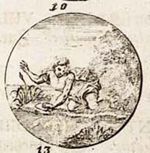
Philautia: De la Feuille, Devises et emblemes anciennes et modernes (Augsburg, 1697), emblem 29
Caecus amor sui: Schoonhovius, Emblemata (Gouda, 1618), emblem 43 quotes the comment
Stultus amor nostri: Isselburg, Emblemata politica (Nürnberg, 1617), emblem 4
Ey siet! hoe Zoilus sijns naesten feylen teeckent ...: Vondel, Gulden Winkel (Amsterdam, 1622), emblem 41
Philautia: Peacham, Minerva Britanna (London, 1612), emblem 5
Amor sui: Whitney, A choice of emblemes (Leiden, 1586), emblem 155
Φιλαυτία: Alciatus, Emblemata (Leiden, 1591), emblem 69
Eigenliebe verliert sich selbst - se se dum deperit, perit: Callot, Lux claustri, emblem 22
Iconclass: 56F24 Self-love; 'Amor di se stesso' (Ripa) 56F241 Narcissism 57AA65 Selfishness; 'Interesse', 'Interesse proprio' (Ripa) 95A(NARCISSUS)21 Narcissus, gazing in a fountain, falls in love with his own reflection; possibly the nymph Echo peeps at the scene
Loci Communes: Philautia (Self-love, Amour-propre)
I iii 93 Extra telorum iactum Out of range
Εξω βελῶν. id est, Extra telorum iactum, pro eo quod est in tuto, citraque periculum.Translatum à bellis, ubi qui nolunt feriri iaculis, longius semovent sese, quam ut possint contingi iactu teli, aut in loco à iaculis defenso se continent. Unde illud frequens apud historicos, Iam ad teli iactum pervenerant. Q. Curtius lib. iii. Iam in conspectu, sed extra teli iactum utraque acies erat. Idem lib. iiii. Ut extra teli iactum essent. Ac rursum: Nondum ad teli iactum pervenerant. Quod Graeci dicunt ἐντὸς βελῶν. Neque vero tantum ii dicuntur ἔξω βελῶν esse, qui longius absunt quam ut iaculo contingi possint, verum etiam qui utcunque tuti sunt. Seneca lib. De beneficiis vii. simili tropo dixit extra ictum, Iniuriam deo sacrilegus quidem non potest facere, quem extra ictum sua divinitas posuit. Lucianus in Votis: ἐπισκοπεῖν ἔξω βέλους ὑπεραιωρούμενον. Optat quispiam pennas, ut è sublimi spectare possit dimicantes, ipse tutus à iaculis. Idem, καὶ ἔξω ἦν βέλους. id est, Iamque extra teli coniectum erat. Polyphemus de Ulysse, qui iam fugerat, ut eum Cyclops telo assequi non posset, Odysseae Κ ad finem. Idem rursus, αἱ δὲ μοῦσαι διὰ τί ἄτρωτοι, καὶ ἔξω βελῶν εἰσιν;, id est, Cur musas non feris, atque a tuis telis sunt tutae? Allusit huc idem in Nigrino, καὶ καθάπερ ὁ Ζεὺς τὸν ἕκτορα ὑπεξαγαγὼν ἐμαυτὸν, ἐκ βελέων φασὶν, ἔκ τε ἀνδροκτασίης ἐκ θ᾽ αἵματος, ἔκ τε κυδοιμοῦ, τὸ λοιπὸν οἰκουρεῖν εἰλόμην. i. Quemadmodum Iupiter Hectorem, ita meipsum à iaculis eximens, ut aiunt: Atque à caede virum, atque à sanguine, deque tumultu, reliquum vitae tempus domi sedere destinabam. Est autem apud Homerum Iliados ξ. Εκ βελέων, μήπουτις ἐφ᾽ ἕλκει ἕλκος ἄρηται id est, Extra tela, uti ne quis vulnus forsitan addat Ad vulnus. Contrà, quem obnoxium periculo videri volemus, hunc ἐντὸς τοῦ βέλους, dicere poterimus. Lucianus in Baccho, οὐδ᾽ ἐντὸς τοῦ βέλους γενέσθαι. id est, Ne tantisper quidem manentes, ut intra teli iactum esset. Vergilius in xi. Iamque intra iactum teli progressus uterque.
Εξω βελῶν Out of range. This means in safety, out of danger. It is a metaphor from battles, in which those who do not want to be hit by missiles remove themselves to a spot too far away to be within reach of a weapon, or else take shelter in a place protected against missiles. Hence that frequent phrase in historians: 'They had now come within range.' Quintus Curtius, book 3: 'The battle-lines were now in sight of each other, but out of range.' Again in book 4: 'So that they were out of range.' And again: 'They had not yet come within range, the Greek for which is ἐντὸς βελῶν. But 'out of range' is applied not only to those who are futher away than a javelin's cast could reach but to those also who are safe in any respect. Seneca in book 7 of the De beneficiis used a similar metaphor, 'Out of harm's way': 'The blasphemer indeed cannot injure God, whose divinity places him out of harm's way.' Lucian in Wishes: 'To look down from on high, hovering out of range;' someone is wishing for wings, so that he might observe the fighting from above, safe himself from being hit. Again: `And he was outside the range of missiles.' So Polyphemus of Ulysses, who had already escaped, so that the Cyclops could not reach him with a missile. Odyssey io, near the end. Again the same author: 'Why not strike the Muses, who are safe from your darts?' He alludes to this again in Nigrinus: 'And as they say Zeus rescued Hector, I withdrew myself "out from the javelins, / The slaughter and the tumult and the blood," planning to spend the rest of my life at home.' This is in Homer's Iliad, book 14: 'Out from the javelins, lest anyone add wound to wound.' Conversely, when we wish it to appear that someone is in danger, we shall say that he is 'within range.' Lucian in Bacchus: 'Not waiting even for a moment to be within range.' Virgil in book 11: 'Now both had come within a spearcast's range.'
Facsimile: 
Annotation: Buiten schot
Iconclass: 43C424 target (~ sharpshooting) 51II4 Farness 54D5 Safety
Loci Communes: Securitatis et tutae rei (Security and safety, Sécurité et sûreté)
I iii 94 Post principia Behind the front rank
Eandem fermè sententiam habet, Post principia. Sumptum item à bellis, in quibus tutissimus locus est post principia. Siquidem in prima acie stabant hastati, in secunda principes, robustior aetas: hos sequebantur scutati omnes, maximè insignes armis. post hos triarii & rorarii, quemadmodum indicat T. Livius Decadis primae, lib. viii. Itaque nullus in acie locus tutior, quàm post principia. Terentius in Eunucho: Tu hosce instrue, hic ego ero post principia: Inde omnibus signum dabo. Erat autem hic locus timido nebuloni conveniens. id quod videns Gnatho: Illuc, inquit, est sapere: ut hosce instruxit, ipsus sibi cavit loco. Idem hoc Pyrrhus factitavit. Donatus admonet eum usum verbo militari. Porrò Vegetius libro De re militari secundo testatur, principales in acie milites, proprie dici principia. Sic enim ait: Antiqua ordinatione legionis exposita, principalium militum, & ut proprio verbo utar, principiorum nomina ac dignitates secundum praesentes matriculas indicabo. Axius apud Varronem: Ego vero, ut aiunt, post principia in castris. In proverbio, Res ad triarios rediit, plura de his comperies.
This has much the same meaning: 'Behind the front rank.' It also comes from war, in which the safest place is behind the front rank. In the front line stood the spearmen, in the second the van (principes), a sturdier age-group; these were followed by the shield-bearers, the most remarkable for feats of arms, and after them came the triarii and rorarii (skirmishers) in the manner described by Livy in the first decade, book 8, so there is no place safer than behind the van. Terence in the Eunuchus: 'You draw these men up, I will be behind the front line, / Thus I shall give the signal to all.' This place was suitable to a cowardly wretch, as Gnatho mockingly says: 'That's real shrewdness,' he says, `to draw up others in battle array and take care to find a spot for himself.' It was the usual practice of Pyrrhus. Donatus points out that this is a military term, and Vegetius in the second book of his De re militari, bears witness that the important soldiers in the line (principales) are properly called principia. He says as follows: 'Now that I have explained the old-time formation of the legion, I will now indicate the names and dignities (according to present arrangements) of the principales, or to use the right word, principia.' Axius, in Varro: `I should like you to start behind the front rank, as they say in the camp.' You will find more about this in the proverb 'Back to the third line.'
Facsimile:
Iconclass: 45F34 battle arrays 54D5 Safety
Loci Communes: Securitatis et tutae rei (Security and safety, Sécurité et sûreté)
I iii 95 Procul a pedibus equinis Far from the horses' hooves
Εκ τῶν ποδῶν ἱππείων. id est, Procul à pedibus equinis. Etiam hodie vulgo dicitur, cum significant fugiendum esse periculum. Hac voce monere consueverunt, ut quisque sibi caveret in certaminibus equestribus, ἔξω τῶν ποδῶν ἱππείων: id est, Extra pedes equinos. Eam deinde vulgus proverbii vice usurpavit.
Εκ τῶν ποδῶν ἱππείων, Far from the horses' hooves. Even today this is commonly said, to mean that one must fly from danger. By this expression they usually conveyed the warning that everyone must take care in cavalry contests to keep away from the horses' hooves. This was later taken up by the public as a proverb.
Facsimile:
Iconclass: 46C13141(+7341) horse (+ claws, paws of an animal) 46C13183 galloping horse 46C13186 kicking (horse in motion) 51II4 Farness 54D5 Safety 54D5 Safety
Loci Communes: Securitatis et tutae rei (Security and safety, Sécurité et sûreté)
I iii 96 Porro a Iove atque fulmine Away from Jove and from the thunderbolt
Πόῤῥω διός τε καὶ κεραυνοῦ. i. Procul à Iove pariter atque à fulmine. Refertur à Diogeniano. Admonet non esse agendum cum praepotentibus, qui nutu possint perdere si quando libeat, maximè cum regibus ac tyrannis. Habent enim fulmen, si quando commoveantur. Porrò Iovi fulmen attribuunt poetae, & reges quidam hac effigie suos colossos fingi voluerunt, autore Plutarcho. Cuius est haec cum primis elegans ὁμοίωσις. Quemadmodum in vulnere prius apparet sanguis quàm plaga, et quemadmodum prius emicat fulgur, quàm tonitrus audiatur: ita apud tyrannos, hoc est, principes fermè omneis, prius erumpit condemnatio quàm probatio, & periit delatus prius quàm coarguatur. Citatur à Suida huiusmodi hemistichion, Αλευ ἀπὸ μείζονος ἀνδρός. id est, Maiorem vitato virum. Refertur & hoc à Diogeniano inter adagia. Monet autem parum esse tutum habere commercium cum principibus, quibus quod libuit licet, et in quos apossite dixeris illud Graecorum apophthegma: Μέγας οὖν ὁ κίδυνος βούλεσθαι ἃ μὴ δεῖ, τὸν ἃ βούλεται ποιεῖν δυνάμενον. id est, Ingens periculum velle quae non decet eum, qui possit quicquid voluerit efficere. Huc pertinet quod Callisthenem admonuit Aristoteles, ut cum Alexandro aut raro loqueretur aut iucunda. Item quod refert Plutarchus in vita Solonis: is spretus est à Croeso, quod de felicitate nimium libere respondisset. itaque cum Aesopus fabularum scriptor admoneret illum, ὅτι τοῖς βασιλεοῦσι δεῖ ὡς ἥκιστα, ἢ ὡς ἥδιστα ὁμιλεῖν. id est, quòd cum regibus aut quàm minime, aut quam iucundissime colloquendum esset: Solon retorsit dictum hunc in modum, μὰ δία, ἀλλ᾽ ὡς ἥκιστα, ἢ ὡς ἄριστα. id est, Non per Iovem, imò potius aut quam minime, aut quàm optime. Allusit ad proverbium Ovidius, hoc attactus fulmine, Vive tibi, quantumque potes praelustria vita. Saevum praelustri fulmen ab arce venit.
Πόῤῥω διός τε καὶ κεραυνοῦ, Away from Jove and from the thunderbolt. This is found in Diogenianus. It is a warning to have nothing to do with great men, who can destroy you with a nod if they feel like it; especially avoiding kings and tyrants. They have their thunderbolt, when they are roused. The thunderbolt is an attribute of Jove, according to the poets, and some kings wished to have their colossal statues made in this image; so says Plutarch. He gives a very neat comparison: just as when a man is struck the blood is seen before the wound, and just as the lightning is seen before the thunder is heard, so it is with tyrants (and this means almost all princes), the condemnation comes before trial and the accused perishes before his crime is proved. Suidas quotes this hemistich: 'Steer clear of the strong.' And Diogenianus gives this too among the adages. He warns that it is not safe to have to do with princes, for whom their liking is their licence; you might apply to this the Greek saying: 'There is great danger that the man who can have everything he wants may want something he ought not to.' This matches the warning that Aristotle gave to Calisthenes, that his talk with Alexander should be either infrequent or such as would give pleasure. Plutarch makes the same point in his life of Solon. Croesus had scorned Solon for replying too freely to a question about happiness, and when as a result Aesop the writer of fables warned him that one should have either the least possible, or the most agreeable possible, conversation with kings, Solon rephrased the saying: 'Indeed not! but rather either the least possible or the best.' Ovid alluded to the proverb, when he had felt the touch of this thunderbolt: 'Live to thyself; as far as thou may'st, shun worldly grandeur; / From the height of grandeur the fierce thunderbolt falls.'
Facsimile:

Iconclass: 51II4 Farness 54D5 Safety 92B18(THUNDERBOLT) attributes of Jupiter: thunderbolt
Loci Communes: Consilium (Counsel, advice, Conseil); Securitatis et tutae rei (Security and safety, Sécurité et sûreté)
I iii 97 Septem convivium, novem convicium Seven make a feast, nine make a fray
Septem convivium, novem convicium. Elegans vel ob ipsam προσονομασίαν sententia, qua significatum est, in convivium paucos adhibendos esse, alioqui fore tumultuosum, atque insuave. Quod significans Horatius: Locus est, inquit, & pluribus umbris, Sed nimis arcta premunt olidae convivia caprae. Extabant antiquitus leges quae praescriberent, simul & moderatum convivarum numerum, & sumptus modicos. M. Terentius Varro apud Celsum censet convivas intra Gratia rum, & Musarum numerum oportere consistere, ne aut plures sint septem, aut pauciores tribus. Sed hoc adagium vetat ad Musarum usque numerum pervenire. Plinius libro vicesimo octavo, capite secundo scribit, Servium Sulpitium commentum fuisse causam, cur ominosum esset mensam relinquere, quòd illis temporibus nondum numerabantur convivae plures quinque. Chaerephon apud Athenaeum lib. vi. videtur admittere convivas usque ad triginta, duntaxat in nuptiis. Caeterum quibus datum erat negocium numerandi convivas, γυναικονόμους appellant. Refert inibi fabulam non illepidam: Parasitus quum invocatus venisset ad nuptias, & postremus accumberet, gynaeconomi numeratis convivis, iusserunt illum abire, quod contra legem, super numerum triginta secutus esset. At ille, Numerate, inquit, denuo, à me sumentes initium. Hoc pacto non erat futurus supernumerarius. Refertur apud Iulium Capitolinum in vita L. Veri imperatoris: Et notissimum quidem, inquit, eius fertur tale convivium, in quo primum duodecimus accubuisse dicitur, cum sit notissimum dictum de numero convivarum, Septem convivium, novem vero convicium. Convicium autem dixit pro clamore, quasi convocium. Torqueri potest ad polyphiliam, aut ad turbam rationum in argumentando, aut exemplorum in suadendo: aut etiam ad polytechniam. Quavis in re turba confusionem parit, ac molestiam.
Seven make a feast, nine make a fray. A neat saying, with a neat pun in it, meaning that there should be few invited to a dinner, otherwise it will be noisy and unpleasant. Horace means this when he says, 'Still there is room for other shades, but note - / Too crowded feasts are scented with the goat.' There were laws in old days which prescribed both that the number of guests should be moderate and the expenses kept down. In Gellius, Marcus Terentius Varro judges that the number of guests should stand between the Muses and the Graces - at the most seven, at the least three. But this adage forbids that it should rise to the number of the Muses. Pliny, book 28 chapter 2, writes that Servius Sulpitius suggested that the reason why it was unlucky to leave the table was because at that time the number of guests was still not more than five. Chaerephon in Athenaeus, book 6, seems to permit up to thirty guests, but only at weddings. Those who had the task of counting the guests were called gunaikonomoi. He tells there an amusing story: a hangeron who had attended a wedding uninvited and had taken the end place at table, was ordered by the gunaikonomoi to leave, after they had counted the guests, because he had followed on after number thirty, and this was against the law. 'Count again,' he said, 'and begin with me.' In this way he would not be the extra one. There is a mention by Julius Capitolinus in the life of the emperor Lucius Verus: 'And it is well known that he gave a banquet in which he took twelfth place, for the first time, although there is a wellknown saying about the number of guests, seven to a feast, nine to a fray.' By 'fray,' convicium, he means noise, as though the word were convocium. This can be applied to a multiplicity of friends, or a mass of arguments in discussion, or of examples in proving a point, or even to versatility in skills. In everything, overcrowding leads to confusion and trouble.
I iii 98 De gradu deiicere To upset, disconcert
Proverbialis allegoria, De gradu deiicere: pro eo quod est animo consternari, ac velut à statu mentis dimoveri. M. Tullius officiorum lib. i. Fortis vero animi est, & constantis, non perturbari in rebus asperis, nec tumultuantem de gradu deiici, ut dicitur, sed praesentis animi uti consilio. Consimilis figurae est, In gradum reponere, quasi in pristinum locum restituere. Quintilianus Institutionum libro quarto, Aut si quid titubaverint, opportuna rursus eius à quo producti sunt, interrogatione velut in gradum reponantur. Ad eandem formam pertinent, Movere loco, deturbare gradu, restituere in locum.
A proverbial image, 'to push someone off the step,' to throw him into consternation, to disturb the balance of his mind. Cicero De officiis, book 1: 'But it takes a brave and resolute spirit not to be perturbed in times of difficulty and thrown off the step, as the saying is, in agitation, but to keep one's presence of mind and act with deliberation.' There is the same image in the phrase in gradum reponere, to settle someone back again, as it were to restore him to his previous place. Quintilian, Institutions, book 4: `Or if they should falter at all they may be restored to their place, as it were, by the opportune questioning of the person who has introduced them.' To the same class belong movere loco, 'to move from its place,' deturbare gradu, 'to disturb from its position,' restituere in locum, 'to restore to its place.'
I iii 99 Post mala prudentior Sadder and wiser
Μετὰ τὰ δεινὰ φρονιμώτερος. id est, Post acerba prudentior. Ubi quis suo malo fit cautior, non aliter, quàm qui gustato veneno, non prius intelligunt esse venenum, quàm noxiam eius vim sentire coeperint. Finitimum est ei quod alibi dicetur: Ῥεχθὲν δέ τε νὴπιος. id est: At novit rem factam denique stultus. Item ei, Κλέων προμηθεύς ἐστι μετὰ τὰ πράγματα. id est: Rebus peractis est Cleon Prometheus. Adagium recensetur in Collectaneis Apostolii, quem equidem autorem non adducerem in medium, nisi cogeret inopia magis idoneorum.
Μετὰ τὰ δεινὰ φρονιμώτερος, Sadder and wiser. Said when someone becomes more cautious through a sad experience, like people who have tasted poison and only know it to be poison when they begin to feel its effects. It is close to the proverb quoted elsewhere: 'The fool is wise after the event.' Or to this: `Cleon is a Prometheus after the fact.' The adage occurs in the collections of Apostolius, an author whom I would not quote except for the lack of anyone better.
Facsimile: 
Iconclass: 52A51 Wisdom; 'Sapienza', 'Sapienza humana', 'Sapienza vera' (Ripa) 54A31 Experience, Mastery; 'Esperienza' (Ripa) 56BB1 Pain, Sorrow, Sadness; 'Dolore', 'Dolore di Zeusi' (Ripa)
Loci Communes: Incertus eventus - ex eventu judicium (Uncertain outcome - judging by the outcome, Issue incertaine - jugement d'après l'issue)
I iii 100 Ex ovo prodiit He came out of an egg
Εξ ὠοῦ ἐξῆλθεν. id est, Ex ovo emersit. Aiunt dici solum de magnopere formosis ac nitidis: quasi neges communi hominum more natos, sed ex ovo, more Castoris & Pollucis. Siquidem est in poetarum fabulis, Ledam Tyndari filiam, ex Iovis concubitu duo peperisse ova, è quorum altero prodiere gemini Castor & Pollux, insigni forma iuvenes: ex altero nata est Helena, cuius forma literis omnium est nobilitata.
Εξ ὠοῦ ἐξῆλθεν, He came out of an egg. They say this remark used to be made about people of great beauty and brightness, as if to say that they were not born in the ordinary way of men but out of an egg, like Castor and Pollux. In the stories of the poets, Leda the daughter of Tyndarus lay with Jove and gave birth to two eggs: from one came the twins Castor and Pollux, boys of exceeding beauty, and from the other was born Helen, whose beauty is celebrated in all literature.
Facsimile:
Iconclass: 25F(+411) animals (+ birth from an egg) 51D4 Beauty; 'Bellezza' (Ripa) 94R11 birth of the Dioscuri: the twins, Castor and Pollux, emerge from one of Leda's eggs; simultaneously Helen, or Helen and Clytaemnestra, hatch from a second egg
Loci Communes: Forma, deformitas (Beauty, deformity, Beauté, difformité)