Guillaume de La Perrièrre, Le Theatre Des Bons Engins (Lyon, 1545)
Emblem 15
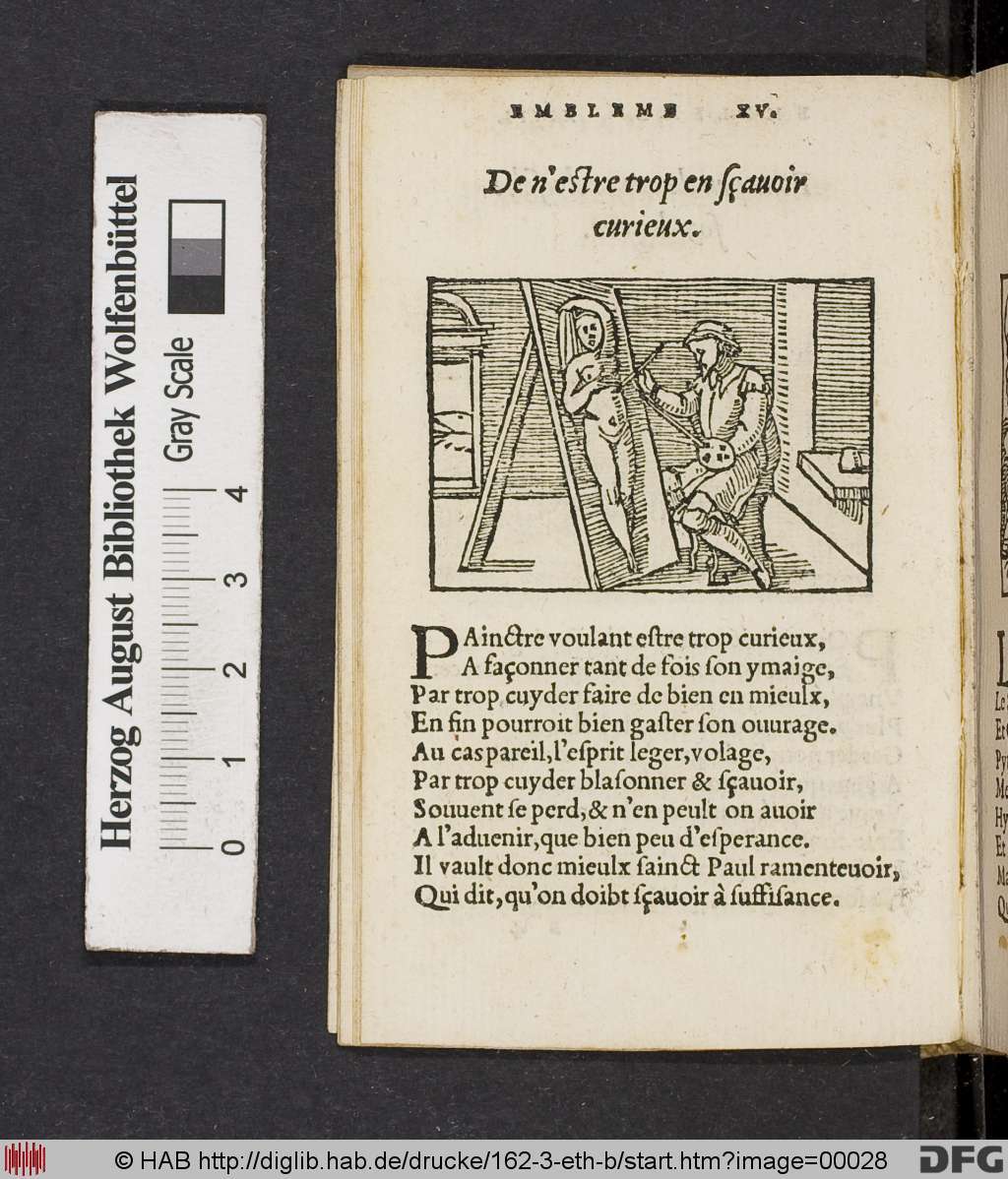
A painter at his easel retouching a painting of a nude womanAI-generated

De n'estre trop en scauoir curieux.
On not being too curious to know.AI-generated
Description of the woodcutAI-generated
A woodcut interior scene: at the left stands a large easel holding a tall panel on which is painted a nude female figure with a veil or headcloth. At the right a seated painter, wearing a cap, doublet, slashed sleeves and boots, sits on a bench; he holds a round palette with brushes in his left hand and reaches toward the panel with a brush in his right hand. Behind him at the right is a window or doorway opening with a table or chest beneath it; at the left in the background is a bench or chest and a wall with hatched panelling. The whole is enclosed in a rectangular frame.
Subscriptio
TranscriptionAI-generated
PAinctre voulant estre trop curieux,A façonner tant de fois son ymaige,Par trop cuyder faire de bien en mieulx,En fin pourroit bien gaster son ouurage.Au cas pareil, l'esprit leger, volage,Par trop cuyder blasonner & sçauoir,Souuent se perd, & n'en peult on auoirA l'aduenir, que bien peu d'esperance.Il vault donc mieulx sainct Paul ramenteuoir,Qui dit, qu'on doibt sçauoir à suffisance.
TranslationAI-generated
A painter wishing to be too fastidious, by working over his image so many times, through too much presuming to go from good to better, might in the end well spoil his work. In like manner the light, fickle mind, by too much presuming to describe and to know, often loses itself, and one can have from it in the future but very little hope. It is therefore better to call to mind Saint Paul, who says that one ought to know in moderation.
Iconclass
86(DE N'ESTRE TROP EN SCAUOIR CURIEUX)proverbs, sayings, etc. (DE N'ESTRE TROP EN SCAUOIR CURIEUX)48C5111workshop, studio ~ painter48C5151easel48C511(+4)painter at work, in his studio (+ the work of art and its production)48C5152(+1)palette (+ artist at work)48C5153(+1)brushes ~ implements of painter (+ artist at work)48C5142(+351)picture within picture (+ painting)41D92woman (showing herself) undressed, quasi-nude58AACreation and Destruction (opposing concepts)52A12Curiosity, Inquisitiveness, Desire of Knowledge; 'Curiosità' (Ripa)
Relationships to the Adagia of ErasmusAI-generated
Suggested relationships between this emblem and adages in Erasmus’ Adagia.
- I iii 19 Manum de tabula – thematic inventiohigh
The emblem's image of a painter who keeps reworking his panel and so spoils it is precisely Erasmus' adage drawn from Apelles' criticism of Protogenes, that he did not know when to take his hand from the picture (nescire manum de tabula tollere); the woodcut literally shows the painter still applying his brush to a finished figure.
- I vi 96 Ne quid nimis – thematic inventiomedium
The whole moral — not wishing to be 'trop curieux', not presuming 'par trop' to know, and St Paul's 'sçauoir à suffisance' (sapere ad sobrietatem) — is the classic doctrine of moderation that Erasmus expounds under 'Nothing to excess'.
- III vii 4 Nihil minus expedit quam agrum optime colere – thematic inventiomedium
Erasmus' adage ends with Pliny's maxim 'Bene colere necessarium est, optime damnosum' — doing a thing too well ruins it — which matches the emblem's 'par trop cuyder faire de bien en mieulx, en fin pourroit bien gaster son ouurage.'
- I v 67 Funem abrumpere nimium tendendo – thematic inventiolow
Erasmus applies the snapping of the over-tightened rope generally to any immoderate effort that destroys the very thing aimed at, the same logic as the painter who ruins his work by excessive retouching.
- II iv 76 Nodum in scyrpo quaeris – thematic inventiolow
The adage mocks the 'anxius nimisque diligens' man who raises scruples where none are needed, akin to the emblem's over-fastidious painter and over-inquisitive mind.
- V i 42 Nihil dulcius quam omnia scire – thematic inventiolow
The emblem's warning against the mind 'par trop cuyder blasonner & sçauoir' is the negative counterpart of this adage of curiositas, the sweetness of knowing everything.
- II ix 39 Qui apud Inferos sunt terniones – thematic inventiolow
Erasmus uses this adage to ridicule those who with excessive, curious diligence pry into hidden mysteries — the very vice the motto 'De n'estre trop en sçauoir curieux' condemns, with St Paul invoked against over-reaching knowledge.
Sources
Record ID: embhab_162-3-eth-b_emblem015
This emblem on the Iconclass site: https://iconclass.org/view/embhab_162-3-eth-b_emblem015
Page in the digital copy of the Herzog August Bibliothek: http://diglib.hab.de/drucke/162-3-eth-b/start.htm?image=00028