Guillaume de La Perrièrre, Le Theatre Des Bons Engins (Lyon, 1545)
Emblem 14
A woman tipping a balance with a tiny objectAI-generated
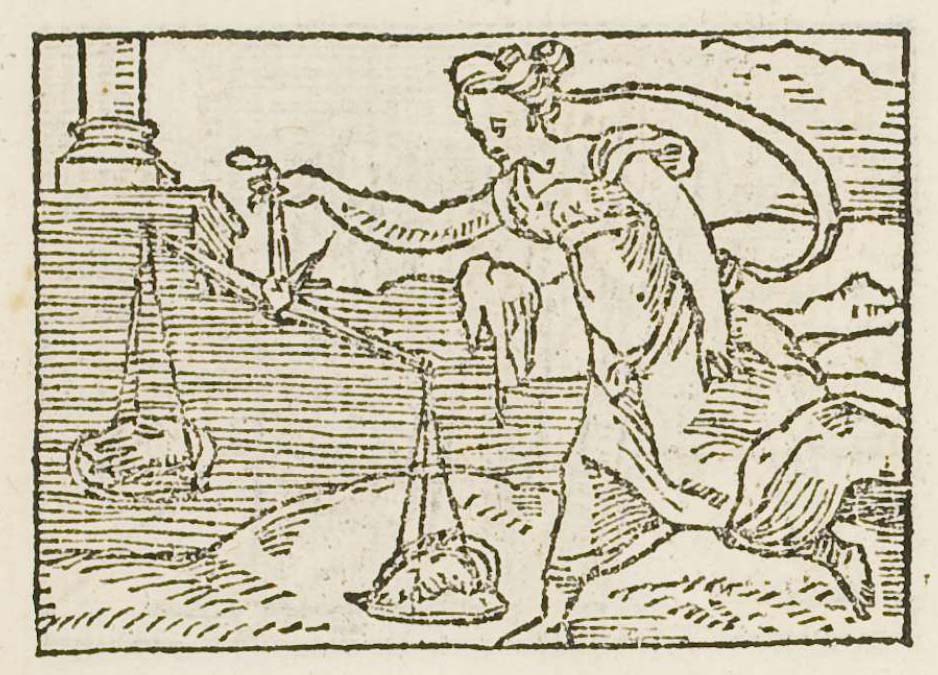
Pour peu de cas, trebuche foy legere.
For a trifling matter, light faith (fickle loyalty) stumbles.AI-generated
Description of the woodcutAI-generated
A woodcut in a rectangular frame. At the left stands a tall stone column or pedestal from which a balance hangs; two conical pans are suspended by cords from a beam. A woman in flowing classical drapery, her hair bound up and a scarf or veil billowing behind her, kneels or leans forward at the right, stretching out her right arm to touch the beam of the balance or to place something tiny in one pan. The pan nearer the column hangs high while the other rests low near the ground. Behind her is open sky with clouds and a hint of a landscape horizon.
Subscriptio

TranscriptionAI-generated
POur peu de cas trebusche foy legere,Et pour vn rien soudain amont se lance:Vne plumette, vn grain de cheneuiere,Plus poisera, contre elle à la balance.Garder nous fault que n'ayons accointanceA gens qui sont amys selon fortune.Vraye amytié, tousiours est opportune:Et se congnoist en temps d'aduersité.Les bons amys (selon la voix commune)Ne sont congneuz qu'à la necessité.
TranslationAI-generated
For a trifling matter light faith stumbles, and for a mere nothing it suddenly shoots upward: a little feather, a grain of hempseed, will weigh more than it does in the balance. We must take care not to have acquaintance with people who are friends according to fortune. True friendship is always timely, and is recognized in time of adversity. Good friends (according to the common saying) are not known except in time of need.
Iconclass
86(POUR PEU DE CAS, TREBUCHE FOY LEGERE)proverbs, sayings, etc. (POUR PEU DE CAS, TREBUCHE FOY LEGERE)31D15adult woman46B3311scales31A254postures and gestures of arm(s) and hand(s) in relation to another person33A12shaking hands, 'dextrarum junctio'25F3(+352)birds (+ feathers)33A51unilateral friendship56F23Friendship; 'Amicitia' (Ripa)56D29Misplaced Trust, False Confidence, 'Pax Falsa'; 'Speranza fallace' (Ripa)
Suggested Iconclass codesAI-generated
Additional codes proposed for this emblem, not (yet) part of the indexing.
11M44Justice, 'Justitia'; 'Giustitia divina' (Ripa) ~ one of the Four Cardinal VirtuesmediumThe correlate 'Justice, Justitia' as a personified virtue matches the classically draped woman attending a hanging balance, the standard attribute of Justitia.
59CJustice and InjusticemediumThe general category 'Justice and Injustice' suits an allegorical emblem built around a pair of scales, here notably unequal.
59C21Equality, Equity, Fairness, Righteousness; 'Equalità', 'Equità', 'Giuditio giusto', 'Ordine dritto e giusto', 'Ugualità' (Ripa)medium'Equality, Equity, Fairness' fits the image of weighing in a balance and the commentary's vocabulary of equity, with the woman adjusting the pans.
59C22Impartialitymedium'Impartiality' corresponds to the even-handed weighing suggested by the balance and to the impartiality term drawn from the commentary.
92D222(story of) Dike (Astraea), goddess of Righteousness and JusticelowThe story of Dike/Astraea, goddess of Righteousness and Justice, may be invoked by the commentary's mention of Astraea and matches the classically dressed female figure with scales.
91B125ThemislowThemis, the Greek goddess of justice named in the commentary, could be the classical female figure attending the balance.
Relationships to the Adagia of ErasmusAI-generated
Suggested relationships between this emblem and adages in Erasmus’ Adagia.
- II viii 81 Viri infortunati procul amici – thematic inventiohigh
The subscriptio's warning against 'gens qui sont amys selon fortune' and its claim that true friendship 'se congnoist en temps d'aduersité' restates exactly this adage on fair-weather friends who, like swallows, fly in with prosperity and away with misfortune; Erasmus even cites 'Fortune tries friendship as the fire tries gold.'
- I iii 16 Ad felicem inflectere parietem – thematic inventiomedium
Erasmus explains the adage of those who 'always attach themselves to influential and wealthy friends ... and what they look for in friendship is the solidest advantage, not loyalty' — precisely the 'amys selon fortune' and 'foy legere' censured in the emblem, with the same image of tipping to the side that rides high.
- II iv 7 Subere levior – thematic inventiomedium
The emblem's 'foy legere' that a feather or hempseed outweighs in the scales embodies this proverbial hyperbole for men of fickle, slippery loyalty (lubrica fide) who are lighter than cork and so cannot sink/stay down.
- III i 88 Felicium multi cognati – thematic inventiomedium
Erasmus quotes Pindar ('few are the mortals faithful in the hour of trouble') and Plato ('he who has nothing has no friends'), matching the emblem's point that friends attach themselves to fortune and are only proved in adversity.
- IV i 58 Aurum igni probatum – thematic inventiomedium
The adage is applied to 'someone whose loyalty (fides) has been tested and confirmed by adversity' — the very doctrine of the subscriptio that good friends are known only 'à la necessité'; the emblem substitutes the balance for the fire/touchstone as the testing instrument.
- I v 23 Ollae amicitiae – thematic inventiolow
Cupboard-love friends, drawn by the stewpot rather than affection, are a species of the 'amys selon fortune' whose acquaintance the emblem warns against.
- I iii 24 Ubi amici, ibi opes – thematic inventiolow
Erasmus' inversion of the adage ('Where there is wealth, there are friends ... the crowd assesses friendship by its use') is the same satire on interest-driven friendship that the emblem's unbalanced scales illustrate.
- II iii 76 Amicitia stabilium, felicitas temperantium – thematic inventiolow
Erasmus argues friendship founded on perishable goods of fortune must itself be perishable, which is the moral of the emblem's 'light faith' that tips at the slightest weight.
- IV v 5 Amicus certus in re incerta cernitur – thematic inventiolow
The closing lines ('Les bons amys, selon la voix commune, / Ne sont congneuz qu'à la necessité') are a French rendering of this common proverb of Ennius cited by Cicero, which Erasmus treats among the sayings on testing friendship.
Sources
Record ID: embhab_162-3-eth-b_emblem014
This emblem on the Iconclass site: https://iconclass.org/view/embhab_162-3-eth-b_emblem014
Page in the digital copy of the Herzog August Bibliothek: http://diglib.hab.de/drucke/162-3-eth-b/start.htm?image=00027