Jacob Cats, Spiegel (The Hague, 1632)
Emblem 87
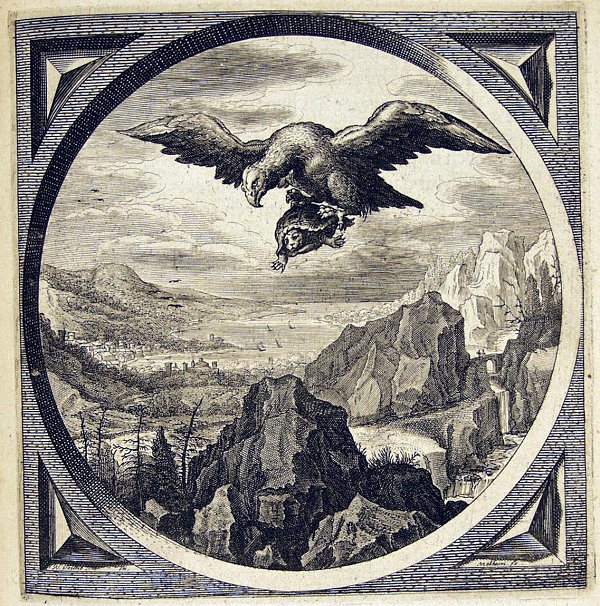
Vt lapsu graviore ruantLatin
So that they may crash down with a heavier fall.AI-generated
Description of the imageAI-generated
Within a circular frame set into a square hatched border with corner spandrels, an eagle with widely outstretched wings flies through a cloudy sky, holding a tortoise by its beak; the tortoise dangles with head and legs protruding from its shell. Below stretches a wide landscape: at the left a hilly, wooded country with a town and castle towers, a broad river or bay with small sailing boats in the middle distance, and at the right and foreground steep craggy rocks and cliffs with a waterfall and sparse vegetation. The engraver's signature appears faintly at the lower right of the roundel.IC 86(UT LAPSU GRAVIORE RUANT)
Subscriptio


TranscriptionAI-generated
Een Arent als hy honger krijght, En uyter hooghten neder-sijght, En vint een schilt-padt, of een sleck, Die grijpt hy veerdich metten beck, En voert hem door een snelle vlucht, Tot boven in de blaeuwe lucht, Soo steyl en uytter-maten hoogh Als immer draeght een menschen oogh; Een die het spel van onder siet En weet de rechte gronden niet, Die houdt gewis in sijn gemoet Dat hy de schilt-padd' eere doet; Doch staet hy maer een weynich stil, Dan siet hy waer het henen wil, Want siet! die, mits sijn hoogen stant, Sach onder hem het gantsche lant, En was daerom geweldich trots, Die koomt daer vallen op een rots, En breeckt dan op den harden steen En huys, en huyt, en hals, en been, Soo dat hy weder over geeft Al wat hy oyt gesopen heeft, En wort dan, in het openbaer, Tot spijse van den Adelaer. Hoe menich worter by het hof Genomen uyt het laege stof, En hoogh getogen inde locht Op dat hy laeger vallen mocht; » Die hooger klimt als hem betaemt » Valt laeger als hy heeft geraemt.
TranslationAI-generated
An eagle, when he grows hungry, swoops down from the heights, and finds a tortoise or a snail; he seizes it nimbly with his beak, and carries it in swift flight right up into the blue sky, so steeply and beyond measure high as ever a human eye can reach. One who watches the play from below and does not know the real grounds of it surely supposes in his mind that the eagle is doing the tortoise honour; but let him only stand still a little while, and he will see where it is heading. For look! the one who, because of his high station, saw the whole land beneath him and was therefore mightily proud, comes falling there upon a rock, and then breaks on the hard stone his house, his hide, his neck and his bones, so that he gives back again all he ever swallowed, and becomes then, in public view, food for the eagle. How many a one at court is taken out of the lowly dust and drawn high into the air, only that he may fall the lower; he who climbs higher than befits him falls lower than he had reckoned.
CommentaryAI-generated
22 passages · original left, translation right (click to fold)
Franç. Grands oiseaux, de coustume, Sont privez de leur plume.
French. Great birds are, as a rule, deprived of their feathers.
Spaens. A grand subida, gran descendida.
Spanish. To a great ascent, a great descent.
Franç. A grande montee, grande descente.
French. To a great climb, a great descent.
Spaens. De gran subida, grand cayda.
Spanish. From a great ascent, a great fall.
Po su mal nacen alas à la hormida.
To its own harm the ant grows wings.
De grande montee, grande cheute. Franç.
From a great climb, a great fall. French.
Pour son mal naissent des aisles à la formy.
To its own harm the ant is born with wings.
Fortuna vitrea est, cum splendet frangitur. Lat.
Fortune is of glass: when it shines, it breaks. Latin.
La voix du Seigneur abbat Les grands cedres tout à plat. Brise les plus haut montez, Au mont du liban plantez.
The voice of the Lord strikes the great cedars quite flat; it shatters the highest-grown ones, planted on the mountain of Lebanon.
Spaens. La fortuna quando mas amiga arma la cancadilla.
Spanish. Fortune, when she is most friendly, sets a trip for you.
Franç. La fortune quand elle est la plus amye donne la jambette.
French. Fortune, when she is most friendly, trips you up.
Qui monte plus haut qu'il ne doit Plus bas chet qu'il voudroit.
He who climbs higher than he ought falls lower than he would wish.
Engels. The highest tree hath the graeter fall.
English. The highest tree has the greater fall.
Nederl. Hoe hooger boom / hoe laeger val.
Dutch. The higher the tree, the lower the fall.
Nae hooge vloeden / diepe ebben. Nederl.
After high floods, deep ebbs. Dutch.
Presto me pondre galan Y en breve volvere à ganapan. Spaens.
Soon I shall make myself a gallant, and shortly I shall turn back into a porter. Spanish.
Proptement je seray brave & tout court je reviendray crocheteur. Franç.
Presently I shall be fine, and right away I shall become a street-porter again. French.
Magna ruunt, inflata crepant, tumefacta premuntur. Lat.
Great things collapse, puffed-up things burst, swollen things are crushed. Latin.
Lucan. Summisque negatum Stare diu, nimioque graves sub pondere lapsus.
Lucan. And it is denied to the highest things to stand long, and heavy falls come under too great a weight.
Syr. 3. 22. Staet niet nae hoogen staet / ende en denckt niet boven u vermeugen.
Sirach 3:22. Do not strive after high station, and do not think beyond your capacity.
Prov. 17. 19. Wie sijn deure hoogh maeckt / die staet nae ongeluck.
Proverbs 17:19. He who makes his door high is seeking disaster.
De Serres en l'Inventaire de France, en la vie de Charles VII. C'est une belle leçon à ceux à qui le vent de la cour favorise, de ne se laisser transporter au vent d'une folle esperance, joüet qui pipe les moins advisez. Les seures gardes de la prosperité sont l'integrite, prudence, modestie, patience: pour se souvenir de l'adversité en la prosperité, suivant le commandement du sage.
De Serres, in the Inventory of France, in the life of Charles VII. It is a fine lesson for those whom the wind of the court favours, not to let themselves be carried away by the wind of a foolish hope, a plaything that cheats the least wary. The sure guardians of prosperity are integrity, prudence, modesty, patience: so as to remember adversity in prosperity, according to the wise man's commandment.
Suggested Iconclass codesAI-generated
Additional codes proposed for this emblem, not (yet) part of the indexing.
25F33(EAGLE)predatory birds: eaglehighThe correlate 'predatory birds: eagle' directly matches the eagle flying with outstretched wings that dominates the roundel.
25F44tortoises, turtleshighThe correlate 'tortoises, turtles' matches the tortoise held in the eagle's beak with head and legs protruding from its shell.
25H216waterfallhighThe correlate 'waterfall' matches the waterfall among the craggy rocks at the right of the landscape.
54FFortune and MisfortunemediumThe correlate 'Fortune and Misfortune' fits the commentary's theme that Fortune is of glass and trips you up when most friendly, with great rises followed by great falls.
54F12Luck, Fortune, Lot; 'Fato', 'Fortuna', 'Fortuna aurea', 'Fortuna buona', 'Fortuna pacifica overo clemente', 'Sorte' (Ripa)lowThe correlate 'Luck, Fortune, Lot' corresponds to the personified Fortune invoked repeatedly in the mottoes, though she is not actually depicted.
98B(AESCHYLUS)68death of Aeschylus: an eagle drops a turtle on Aeschylus' bald headlowThe correlate 'an eagle drops a turtle on Aeschylus' bald head' is the classical source for the motif of an eagle carrying a tortoise aloft, though no Aeschylus figure is shown.
Relationships to the Adagia of ErasmusAI-generated
Suggested relationships between this emblem and adages in Erasmus’ Adagia.
- I vi 93 Pennas nido maiores extendere – thematic inventiomedium
The emblem's moral — 'he who climbs higher than befits him falls lower than he had reckoned' — is precisely Erasmus's image of a bird spreading wings beyond the measure of its nest, i.e. raising oneself above one's inherited condition; the emblem renders this literally with a creature (the tortoise) lifted into the air beyond its nature.
- I i 83 Dionysius Corinthi – thematic inventiomedium
The Spanish/French commentary 'Presto me pondre galan y en breve volvere à ganapan' ('Soon a gallant, shortly a porter again') states exactly Erasmus's point in this adage: someone reduced from the highest rank to a humble private station, as Dionysius the tyrant turned schoolmaster at Corinth.
- III vi 69 Fortuna aestuaria – thematic inventiomedium
The Dutch commentary 'Nae hooge vloeden / diepe ebben' ('after high floods, deep ebbs') reproduces Erasmus's tidal image of Fortune as a Euripus, whose flood is always followed by an ebb, which underpins the emblem's lesson that high elevation prepares a deep fall.
- I vi 89 Tuo te pede metire – thematic inventiolow
Erasmus's warning that no one should 'inflate himself beyond his own condition' but measure himself by his own foot matches the emblem's commentary from Sirach 3:22 ('do not strive after high station, nor think beyond your capacity') and its courtier moral.
- I vi 92 Intra tuam pelliculam te contine – thematic inventiolow
The adage forbids attempting what is above one's station (illustrated by the ass in the lion's skin, beaten to death when exposed); the emblem's tortoise, borne aloft above its nature and dashed on the rocks, embodies the same warning.
- I vi 52 Nostris ipsorum alis capimur – thematic inventiolow
The Spanish/French commentary 'Por su mal nacen alas a la hormiga' ('to its own harm the ant grows wings') states the same idea as Erasmus's eagle slain by an arrow fledged with its own feathers: elevation/wings become the cause of one's own ruin.
Sources
Record ID: embstma_1288_emblem087
This emblem on the Iconclass site: https://iconclass.org/view/embstma_1288_emblem087
Copy: University Library, Glasgow, Stirling Maxwell 1288