Jacob Cats, Spiegel (The Hague, 1632)
Emblem 92

Wer mit katzen jagt der fahet gern maussGerman
He who hunts with cats is apt to catch mice.AI-generated
Description of the imageAI-generated
Within a circular medallion set in a square frame with decorative corner triangles, a hunter strides forward in a bare winter landscape. He wears a broad plumed hat, a belted jerkin, breeches with ribboned garters and high boots; a hunting horn hangs at his right side and a pouch at his belt. Over his left shoulder he carries a long pole (a leaping-pole with a knob at the end) from which dangle a dozen dead rats and mice, hanging by their tails. In his right hand he holds a leash with which he leads two cats, a large striped cat and a smaller kitten, walking at his left. A third cat prowls at the right of the picture. Behind are a leafless gnarled tree, low hills, distant buildings and reeds, with birds in the sky. Below the medallion a ribbon banderole carries a two-line inscription; small monogram marks appear in the lower left and lower right corners of the frame.
Subscriptio

TranscriptionAI-generated
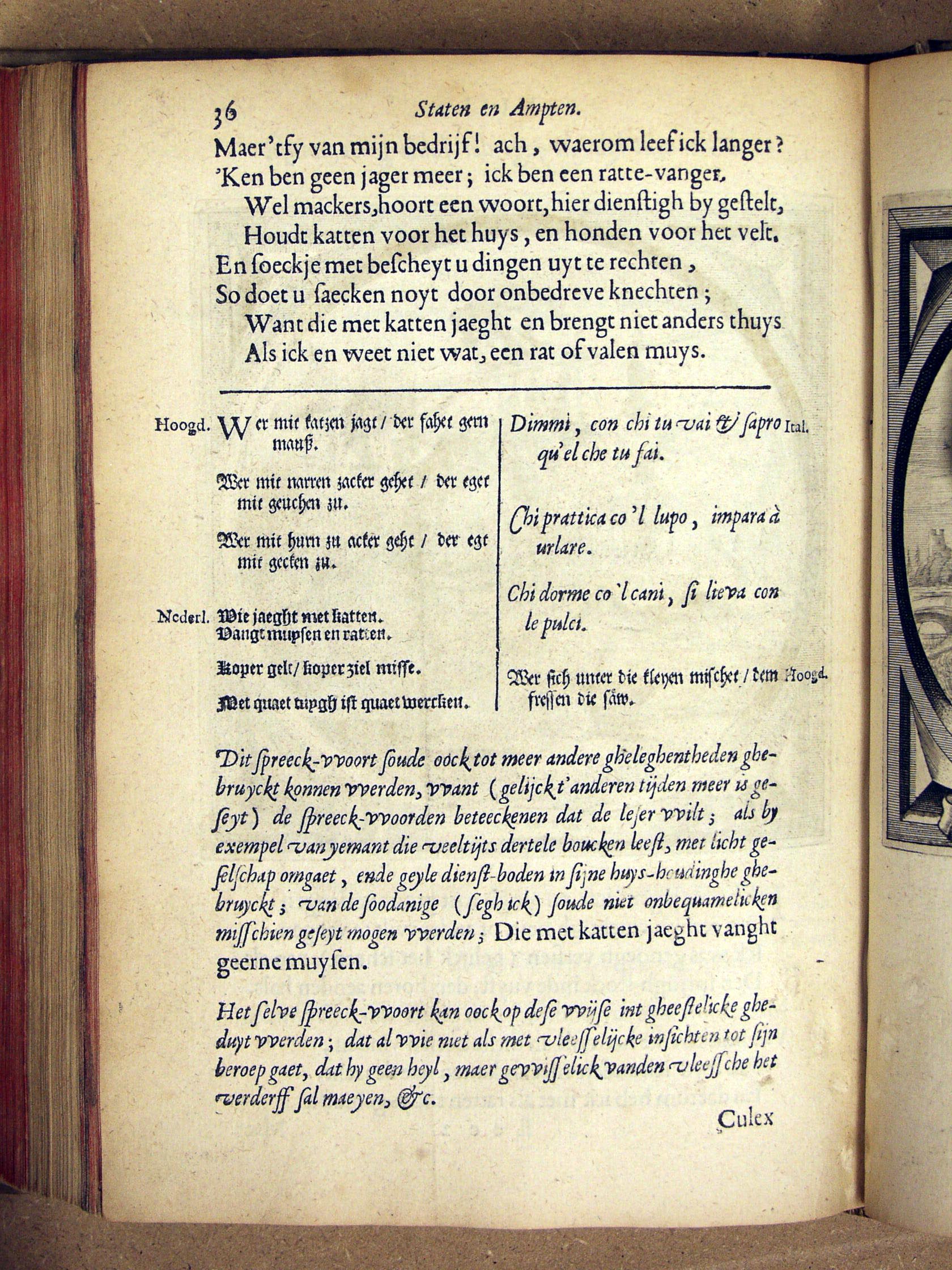
De ratte-vangher spreeckt Ick hadde jagens lust, en gingh met groot verlangen Om eenigh vluchtigh hert, of ander wilt te vangen, Ick was genoegh versien (gelijck het scheen) van als, Den springh-stock inde vuyst, den horen aenden hals. Maer hoort wat my ontbrack; in plaets van hasewinden, Van bracken die het wilt in dicke bossen vinden, Soo leyd' ick anders niet als katten nae de jacht, En daerom heb ick niet als ratten thuys gebracht. Maer 'tfy van mijn bedrijf! ach, waerom leef ick langer? 'Ken ben geen jager meer; ick ben een ratte-vanger. Wel mackers, hoort een woort, hier dienstigh by gestelt, Houdt katten voor het huys, en honden voor het velt. En soeckje met bescheyt u dingen uyt te rechten, So doet u saecken noyt door onbedreve knechten; Want die met katten jaeght en brengt niet anders thuys Als ick en weet niet wat, een rat of valen muys.
TranslationAI-generated
The rat-catcher speaks: I had a desire to hunt, and went out with great longing to catch some fleeing hart or other game. I was, so it seemed, well enough supplied with everything: the leaping-pole in my fist, the horn about my neck. But hear what I lacked: instead of greyhounds, of hounds that find the game in the thick woods, I led nothing but cats out to the hunt, and therefore I have brought home nothing but rats. But fie upon my trade! alas, why do I live any longer? I am no hunter any more; I am a rat-catcher. Well, comrades, hear a word usefully added here: keep cats for the house, and dogs for the field. And if you seek to carry out your affairs properly, then never do your business through unskilled servants; for he who hunts with cats brings home nothing else than I did—I know not what—a rat or a pale mouse.
CommentaryAI-generated
11 passages · original left, translation right (click to fold)
Hoogd. Wer mit katzen jagt / der fahet gern mauß.
High German: He who hunts with cats is apt to catch mice.
Wer mit narren zacker gehet / der eget mit geuchen zu.
He who goes to plough with fools harrows with simpletons.
Wer mit hurn zu acker gehet / der eget mit geeten zu.
He who goes to the field with whores harrows with goats.
Nederl. Wie jaeght met katten. Vangt muysen en ratten.
Dutch: He who hunts with cats catches mice and rats.
Koper gelt / koper ziel misse.
Copper money, a copper soul-mass.
Met quaet tuygh ist quaet wercken.
With bad tools it is bad working.
Dimmi, con chi tu vai & saprò quel che tu fai.
Tell me with whom you go, and I shall know what you do.
Chi prattica co'l lupo, impara à urlare.
He who keeps company with the wolf learns to howl.
Chi dorme co'l cani, si leva con le pulci.
He who sleeps with the dogs gets up with the fleas.
Wer sich unter die kleyen mischet / dem fressen die säw.
He who mixes himself among the bran, the pigs will eat him.
Dit spreeck-vvoort soude oock tot meer andere ghelegentheden ghebruyckt konnen vverden, vvant (gelijck t'anderen tijden meer is geseyt) de spreeck-vvoorden beteeckenen dat de leser vvilt; als by exempel van yemant die veeltijts dertele boucken leest, met licht geselschap omgaet, ende geyle dienst-boden in sijne huys-houdinghe ghebruyckt; van de soodanige (segh ick) soude niet onbequamelicken misschien geseyt mogen vverden; Die met katten jaeght vanght geerne muysen.
Het selve spreeck-vvoort kan oock op dese vvijse int gheestelicke gheduyt vverden; dat al vvie niet als met vleesselijcke insichten tot sijn beroep gaet, dat hy geen heyl, maer gevvisselick vanden vleessche het verderff sal maeyen, &c.
This proverb could also be used on many other occasions, for (as has been said more often at other times) proverbs mean what the reader wishes; as for example of someone who often reads wanton books, keeps loose company, and employs lascivious servants in his household; of such a one (I say) it might perhaps not unfitly be said: He who hunts with cats is fond of catching mice.
The same proverb can also be interpreted spiritually in this way: that whoever goes about his calling with nothing but fleshly intentions shall reap no salvation, but certainly corruption from the flesh, etc.
Iconclass
86(WER MIT KATZEN JAGT DER FAHET GERN MAUSS)proverbs, sayings, etc. (WER MIT KATZEN JAGT DER FAHET GERN MAUSS)86(DIE IAEGHT MET KATTEN VANGHT NIET ALS RATTEN)proverbs, sayings, etc. (DIE IAEGHT MET KATTEN VANGHT NIET ALS RATTEN)
Suggested Iconclass codesAI-generated
Additional codes proposed for this emblem, not (yet) part of the indexing.
43C114hunterhighThe central figure is literally a 'hunter', striding with horn, pouch and game (dead rats and mice) on a pole.
86proverbs, sayings, etc.highThe image illustrates a proverb ('He who hunts with cats catches mice and rats') inscribed on the banderole, matching 'proverbs, sayings, etc.'
86(...)proverbs, sayings, etc. (with TEXT)mediumThe specific proverbial text appears on the ribbon banderole, so the 'proverbs, sayings (with TEXT)' form is appropriate.
43C11482hunting hornmediumA hunting horn hangs at the hunter's right side, matching the correlate 'hunting horn' as an object.
23F41winter landscape; landscape symbolizing winter (the four seasons of the year)mediumThe scene is set in a bare winter landscape with a leafless gnarled tree and reeds, fitting 'winter landscape'.
43C1142hunters huntinglowThe hunter is shown actively engaged in a hunt (with cats as his hounds), which loosely matches 'hunters hunting'.
Relationships to the Adagia of ErasmusAI-generated
Suggested relationships between this emblem and adages in Erasmus’ Adagia.
- II vii 45 Aratro iacularis – thematic inventiomedium
Erasmus's essay cites Plutarch on the absurdity of 'wishing to shoot with a plough and to hunt the hare with an ox' — exactly the emblem's conceit of going hunting with cats instead of hounds, i.e. employing wholly unfit instruments for a task.
- I iv 40 Asinum sub freno currere doces – thematic inventiolow
Both turn on using an animal unsuited to the job (donkey for racing / cats for the chase); the emblem's lesson 'never do your business through unskilled servants' matches Erasmus's point about teaching the unteachable creature.
- I x 74 Corrumpunt mores bonos colloquia prava – thematic inventiomedium
Cats' commentary glosses the proverb with contagion-of-morals sayings ('Tell me with whom you go...', 'He who keeps company with the wolf learns to howl', 'He who sleeps with dogs gets up with fleas') and applies it to one who keeps loose company and lascivious servants — precisely Erasmus's adage on bad company corrupting good manners.
- I x 73 Si juxta claudum habites, subclaudicare disces – thematic inventiolow
The emblem's secondary proverbs (he who ploughs with fools harrows with simpletons; he who lies with dogs rises with fleas) express the same contagion-by-association idea as Erasmus's adage about living beside a cripple and learning to limp.
- I iv 35 Asinus ad lyram – thematic inventiolow
Erasmus's proverb for someone wholly unfitted to the task in hand matches the emblem's moral that unskilled agents (cats as hunting dogs, 'onbedreve knechten') produce only ridiculous results.
Sources
Record ID: embstma_1288_emblem092
This emblem on the Iconclass site: https://iconclass.org/view/embstma_1288_emblem092
Copy: University Library, Glasgow, Stirling Maxwell 1288