Jacob Cats, Spiegel (The Hague, 1632)
Emblem 120
An old man passing on a lantern to a younger man

Lampada tradoLatin
I hand on the torch.AI-generated
Description of the imageAI-generated
Within a thick oval frame set in a square plate with ornamental corner spandrels, a night landscape is shown: a crescent moon shines among clouds in the sky, a winding road or stream runs into the distance at the right, with bare trees and shrubs. In the centre, standing on a dark bank, a young man at the left — wearing a wide-brimmed hat, ruff, cloak, doublet, puffed breeches and shoes — reaches out with his right hand to take a burning lantern. At the right an old, long-bearded man in a long fur-trimmed gown and cap, leaning on a walking stick, holds the lantern out to him with his right hand. On the ground at the lower right lies a spade; at the lower left in the distance is a small building or ruin.
Subscriptio




TranscriptionAI-generated
De oude man spreeckt Dit licht, mijn weerde kint, de fackel van het leven, Was van het hoogste Licht voor desen my gegeven, Nu heeftet voor een tijt, nu heeftet my gedient, Ick gevet heden u, als aen mijn naesten vrient. Ick heb het langh gebruyckt, en ben met staege schreden Op mijn bescheyden wegh ten eynde toe getreden, Nu ben ick op het lest, nu ben ick aenden put, Daer is een licht bequaem, daer is een fackel nut: Ghy hebt in tegen-deel van heden af te dwalen, Nu op een hoogen bergh, dan inde laege dalen, Nu op het vette kley, dan op een dorre strant, Nu op een harde klip, dan op een driftich sant; Treet op de rechte baen, en mijdt de slimme wegen, Gaet midden op de straet, en schouwt de vuyle stegen; En twijl u jonckheyt duert maeckt dat ghy niet en malt, En als ghy trager wort, siet dat ghy niet en valt. Wel gaet dan, lieve, gaet, ô spruyte mijner lenden, Ghy waert mijn eygen vleys, eer u de lieden kenden, Ick ben nu uyt-geleeft, en ghy begint de reys, Ick gae nu, siet ick gae, den wegh van alle vleys: Dit is des werelts loop, de kloeckste menschen leven Tot sy een ander mensch den fackel over-geven, Dus gaet de snelle tijt, gelijck een staege stroom, Dus steeckt het nieu gewas het oude vanden boom.
TranslationAI-generated
The old man speaks: This light, my dear child, the torch of life, was given to me before this by the highest Light; now it has served for a time, now it has served me; I give it to you today, as to my nearest friend. I have used it long, and with steady steps have walked my appointed way to the end; now I am at the last, now I am at the pit — there a light is fitting, there a torch is useful. You, on the contrary, have from today to wander, now on a high mountain, then in the low valleys, now on the fat clay, then on a barren shore, now on a hard rock, then on shifting sand. Tread on the straight road and avoid the crooked ways; go in the middle of the street and shun the foul alleys; and while your youth lasts see that you do not play the fool, and when you grow slower, see that you do not fall. Well go then, dear one, go, O offspring of my loins; you were my own flesh before people knew you; I am now lived out, and you are beginning the journey; I go now, see, I go the way of all flesh. This is the course of the world: the ablest men live only until they hand the torch over to another man. Thus swift time passes like a steady stream; thus the new growth pushes the old from the tree.
CommentaryAI-generated
18 passages · original left, translation right (click to fold)
Deductum hoc adagium à certaminibus quibusdam veterum in quibus currentes facem ardentem gestarent, quam defatigatus proximo in manum dabat, Is item defessus alij, ac deinceps alius alij, successione quasi continuâ. Hujus rei mentionem facit Plato libro de republ. 1. Pausania in Atticis. Herod. in Vrania. Itaque lampada tradere, dicitur de eo qui jam vel delassatus vel emeritus in alios munus gerendum ab se transfert.
This adage is derived from certain contests of the ancients in which the runners carried a burning torch, which, when tired out, one gave into the hand of the next; he likewise, when exhausted, to another, and then one to another, in an almost continuous succession. Plato makes mention of this matter in book 1 of the Republic; Pausanias in the Attica; Herodotus in the Urania. And so 'to hand on the torch' is said of one who, now either worn out or having served his term, transfers from himself to others the office to be discharged.
Lucretius. Et quasi cursores vitai lampada tradunt. De Animalibus agit, quae successione propagantur vitâ per vices ab alijs in alia transfusâ.
Lucretius: 'And like runners they hand on the torch of life.' He is speaking of living creatures, which are propagated by succession, life being poured over by turns from some into others.
Plato de Legibus 6. ait cives oportere liberis generandis & educandis operam dare, ut vitam quam ipsi à majoribus accepissent vicissim quasi lampada sive tædam ardentem posteris alijs post alios tradant. Eodem pertinet illud Persianum:
Plato, Laws 6, says that citizens ought to give their effort to begetting and educating children, so that the life which they themselves had received from their forefathers they may in turn hand on, like a lamp or burning torch, to their descendants, one after another. To the same purpose belongs that saying of Persius:
Qui prior es, cur me in decursu lampada poscis?
You who are ahead of me, why do you demand the torch from me in mid-course?
Faciendum ergo hîc ut Senecâ dicit: Rectum iter quod serò cognovi, lassus errando, alijs monstro.
Therefore one must do here as Seneca says: 'The right road, which I came to know late, weary with wandering, I point out to others.'
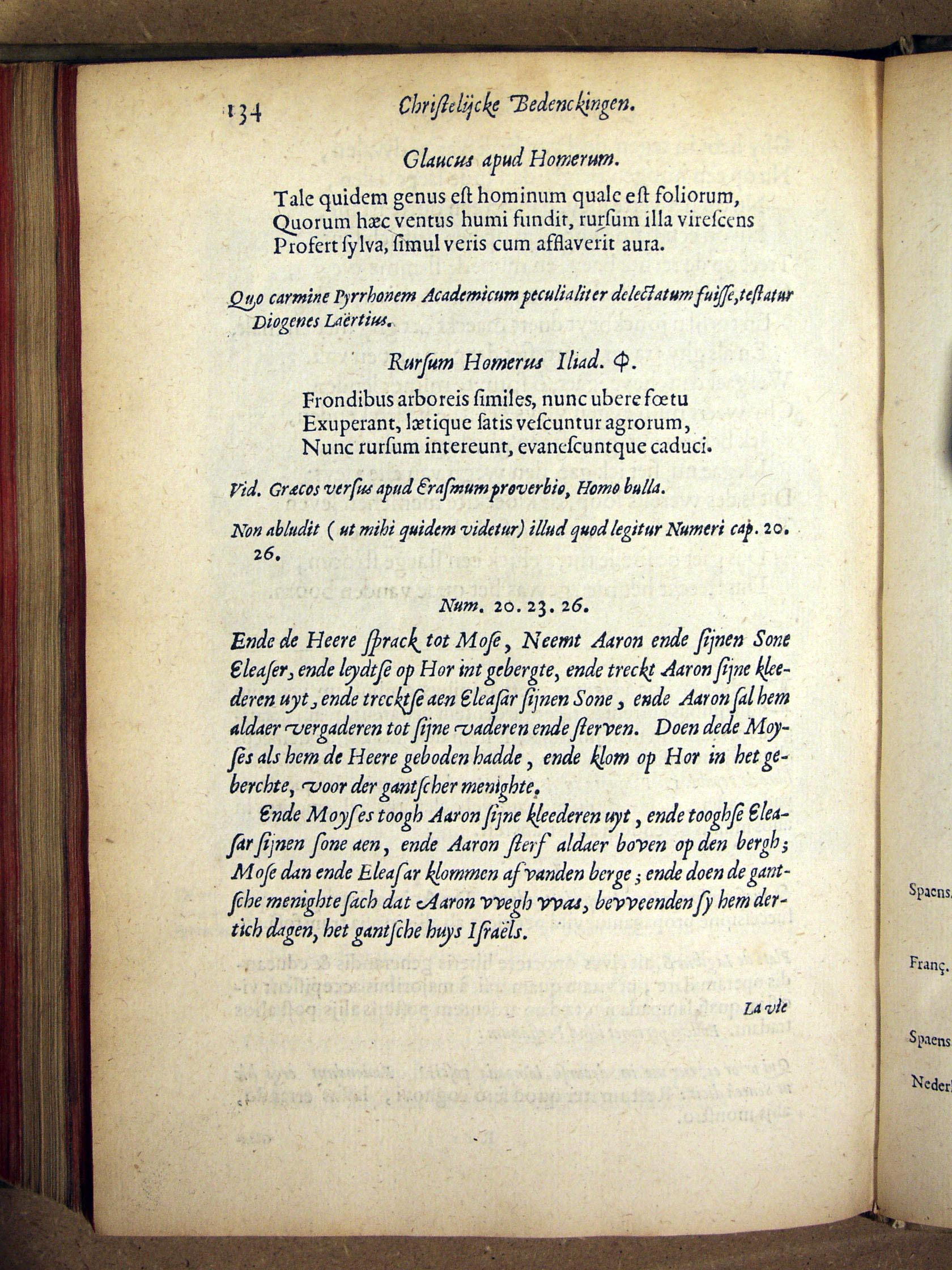
Glaucus apud Homerum. Tale quidem genus est hominum quale est foliorum, Quorum hæc ventus humi fundit, rursum illa virescens Profert sylva, simul veris cum afflaverit aura.
Glaucus in Homer: 'Such indeed is the race of men as is that of leaves: some of them the wind scatters on the ground, while others the greening wood brings forth again, as soon as the breeze of spring has blown.'
Quo carmine Pyrrhonem Academicum peculialiter delectatum fuisse, testatur Diogenes Laërtius.
That Pyrrho the Academic took particular delight in this verse is attested by Diogenes Laertius.
Rursum Homerus Iliad. Φ. Frondibus arboreis similes, nunc ubere fœtu Exuperant, lætique satis vescuntur agrorum, Nunc rursum intereunt, evanescuntque caduci.
Again Homer, Iliad 21: 'Like the leaves of trees, now with abundant offspring they flourish and, joyful, feed on the crops of the fields; now again they perish and vanish away, falling.
Vid. Græcos versus apud Erasmum proverbio, Homo bulla.
See the Greek verses in Erasmus, under the proverb 'Man is a bubble.'
Non abludit ( ut mihi quidem videtur) illud quod legitur Numeri cap. 20. 26.
Not out of tune (as it seems to me at least) is that which is read in Numbers chapter 20, 26.
Num. 20. 23. 26. Ende de Heere sprack tot Mose, Neemt Aaron ende sijnen Sone Eleaser, ende leydtse op Hor int gebergte, ende treckt Aaron sijne kleederen uyt, ende trecktse aen Eleasar sijnen Sone, ende Aaron sal hem aldaer vergaderen tot sijne vaderen ende sterven. Doen dede Moyses als hem de Heere geboden hadde, ende klom op Hor in het geberchte, voor der gantscher menighte. Ende Moyses toogh Aaron sijne kleederen uyt, ende tooghse Eleasar sijnen sone aen, ende Aaron sterf aldaer boven op den bergh; Mose dan ende Eleasar klommen af vanden berge; ende doen de gantsche menighte sach dat Aaron wegh was, bevveenden sy hem dertich dagen, het gantsche huys Israëls.
Numbers 20:23, 26. And the Lord spoke to Moses: Take Aaron and his son Eleazar and bring them up into Mount Hor, and strip Aaron of his garments and put them on Eleazar his son, and Aaron shall there be gathered to his fathers and die. Then Moses did as the Lord had commanded him, and climbed up Mount Hor before the whole congregation. And Moses stripped Aaron of his garments and put them on Eleazar his son, and Aaron died there on the top of the mountain; then Moses and Eleazar came down from the mountain; and when the whole congregation saw that Aaron was gone, they wept for him thirty days, the whole house of Israel.
Spaens. Por ningun tempero, no dexes el camino real, por el sendero.
Spanish: For no weather should you leave the royal highroad for the footpath.
Franç. Pour quelque temps qu'il face ne laisse le chemin royal pour le sentier.
French: Whatever the weather may be, do not leave the royal road for the footpath.
Spaens. Desque naci lore, y cada dia nace porque.
Spanish: Since I was born I have wept, and every day a reason for it is born.
Franç. Des que je nasquis je pleuray, & chasque jour naist le pourquoy.
French: As soon as I was born I wept, and every day the reason why is born.
Lat. A fronte præcipitia A tergo lupi.
Latin: In front, precipices; at the back, wolves.
Vita hominis militia super terram.
The life of man is a warfare upon earth.
Nederl. Alle gelovigen hebben bekent dat sy gasten en vreemdelingen waren op aerden. Heb. 11. 13.
Dutch: All believers have confessed that they were guests and strangers on earth. Hebrews 11:13.
Iconclass
31A2512(+9341)arm stretched forward (+ reaching, handing, giving)31D14adult man31D160Old Age, 'Senectus'; 'Vecchiezza' (Ripa)41B33(+1)lantern (+ kindling a light; lit, burning light, lamp, candle)42E31grave, tomb51F2(+4)Continuity (+ emblematical representation of concept)86(CURSU LAMPADA TRADO)proverbs, sayings, etc. (CURSU LAMPADA TRADO)86(LAMPADA TRADO)proverbs, sayings, etc. (LAMPADA TRADO)
Suggested Iconclass codesAI-generated
Additional codes proposed for this emblem, not (yet) part of the indexing.
31D12youth, young man, adolescenthighThe correlate 'youth, young man, adolescent' matches the young man in hat, ruff and cloak who receives the lantern at the left.
47I15(SPADE)agricultural implements: spademediumThe correlate 'agricultural implements: spade' matches the spade lying on the ground at the lower right of the scene.
71E3221Moses ascends Mount Hor with Aaron and EleazarlowThe correlate 'Moses ascends Mount Hor with Aaron and Eleazar' corresponds to the Numbers 20:23-26 passage quoted at length in the commentary as a parallel to handing on one's office, though it is not depicted.
Relationships to the Adagia of ErasmusAI-generated
Suggested relationships between this emblem and adages in Erasmus’ Adagia.
- I ii 38 Cursu lampada trado – direct mottohigh
The motto 'Lampada trado' is Erasmus's adage, and the emblem's Latin commentary reproduces Erasmus's essay almost verbatim — the Lucretius line 'Et quasi cursores vitai lampada tradunt' with the same gloss ('De animantibus agit, quae successione propagantur...'), the reference to Plato Laws 6 on begetting and educating children, and the Persius verse 'Qui prior es, cur me in decursu lampada poscis?'
- II iii 48 Homo bulla – thematic inventiohigh
The commentary explicitly directs the reader to Erasmus's proverb — 'Vid. Græcos versus apud Erasmum proverbio, Homo bulla' — using it to reinforce the Homeric 'generations of leaves' passages and the emblem's theme of the brevity and succession of human life.
Sources
Record ID: embstma_1288_emblem120
This emblem on the Iconclass site: https://iconclass.org/view/embstma_1288_emblem120
Copy: University Library, Glasgow, Stirling Maxwell 1288